The Interdenominational Foreign Mission Association

ARTHUR F. GLASSER1Arthur F. Glasser is home director for the United States and Canada of the China Inland Mission—Overseas Missionary Fellowship (founded in 1865 by J. Hudson Taylor). He has the C.E. degree from Cornell, B.D. from Faith Theological Seminary, and honorary D.D. from Covenant College and Seminary. Dr. Glasser is co-author with Eric S. Fife of “Missions in Crisis.”

Approximately one-fifth of all Protestant North American overseas missionaries are related to agencies within the Interdenominational Foreign Mission Association. The IFMA, organized in 1917 as a “fellowship of missions without denominational affiliation,” presently comprises forty-six missions (popularly termed “faith missions”) united in theological commitment and missionary outlook. Its doctrinal platform is almost identical with that of the Evangelical Foreign Missions Association, although implicit in the IFMA’s “common adherence to the historic Christian faith” is a deep suspicion of Arminianism and, on the part of some, a fear of the Pentecostal “tongues” movement.

One of the friends of IFMA missions has written: “The star of faith missions has shone brightly for a quarter-century of unprecedented advance with nothing to suggest that it will not continue to do so and with every indication that while there may be a slowing down of its growth, it will continue to move forward impressively in the decades ahead” (Harold Lindsell, “Faith Missions Since 1938,” in Frontiers of the Christian World Mission, New York: Harper & Row, 1962, p. 230). “Move forward impressively.” This optimistic prediction is not universally shared within the IFMA. In fact, there are those deeply concerned over the future. Winds of change are blowing with gale force. Unless strong measures are taken today, there may be shipwrecks tomorrow.

The IFMA’s current problem is deeper and more fundamental than a matter of personnel. And it is not a matter of theology. There is little danger that the now prevalent spirit of theological relativism will penetrate IFMA ranks. All within IFMA are deeply persuaded of the truth and essentiality of Jesus Christ and the basic tenets of historic biblical Christianity. There is clarity in their understanding of revealed truth as well as awe over the mystery of God manifest in the flesh. Many IFMA missions are fifty to seventy years old; some are in their second century. They emerged and prospered in a time characterized by worldwide theological compromise; yet they preserve their theological integrity. They glory in their unshaken adherence to the faith once for all delivered to the saints. And there is every expectation that, with God’s grace and help, this tenacious loyalty will continue.

The Multiplying Ministries

Do some fear that IFMA missions will not be able to cope with the varied challenges and heavy demands of the future? Again, the problem is more than one of dedication and strategy. Through the years IFMA missionaries have shown that they know how to spend and be spent, to suffer and be killed, and to face difficult tasks creatively and with vision. IFMA missions either initiated or greatly developed such significant ministries as aviation, Bible correspondence courses, recruiting the laity for mission, evangelism-in-depth, pioneering among primitive tribes, language reduction and Bible translation, radio and television outreach, magazine evangelism and other types of literature work. In tribute to Gospel Recordings for sending more than 2½ million records into 150 countries in more than 2,000 languages, Dr. Lindsell commented: “Once again faith missions have indicated their genius for the use of new methods and their willingness to venture upon untried pathways because of their urgent desire to get the message of the Gospel to those who have never heard it” (ibid., p. 216). In a recent letter an IFMA missionary working in one of Indonesia’s great cities said of Paul Loeffler’s study document, Laymen in World Mission (International Review of Missions, July, 1964, pp. 297 f.): “This article describes very well our ‘cell group’ program … only there, it is yet theory, whereas here we are already well underway.” There is little doubt that the contribution of IFMA missionaries to the evangelization of this generation is significant.

Again, do some fear that IFMA missionaries use a methodology largely irrelevant to the world situation and that they are impervious to the advice of missionary statesmen? True, some missiologists feel that the IFMA does not get excited enough about social revolution, Communist infiltration, resurgence of ethnic religions, the virtually absolute claims nationalistic states have on the allegiance of Christians, and the racial issue. Critics sometimes fall prey to the temptation to caricature IFMA missionaries as obscurantists, pietists, and out-of-this-world pilgrims because of their obstinate refusal to be diverted from their most strategic service, the preaching and teaching of Jesus Christ.

Actually, however, current IFMA leadership is surprisingly well informed about all aspects of current missionary debate. Even a recent issue of the WCC’s prestigious International Review of Missions spontaneously confirms this: “The cleavage between liberals and conservatives today has little to do with their broad historical orientation to the revolutionary world.… Liberals have no monopoly of ecumenical concern.… The area of agreement in basic missionary principles between conservative evangelicals and ecumenically minded groups appears to be significantly greater now than in the past …” (October, 1964, pp. 484, 485). One has but to recall the December, 1964, Inter-Varsity missionary convention at Urbana, Illinois, to realize the wide representation of IFMA leaders in plenary sessions and workshops. These leaders ranged widely in their references to the most technical missionary literature. Their societies appear to be accepting the best insights of the day on how to perform the missionary task most effectively.

And yet, there is a deep concern about the future. This concern touches the whole tangle of relations between IFMA member missions and their constituencies—the individuals or groups in North America that support them by prayer and gifts and from whose ranks new recruits are enlisted. These supporters come from three main sources: independent churches, Bible schools and colleges, and independent-minded evangelical churches within old-line denominations. In our day all three of these sources are caught up in the profound changes taking place in the American religious scene. A few decades ago all was quiet and orderly. The IFMA missionary in his missionary trench overseas drew comfort from the sure loyalty of his friends at home. He also could predict with reasonable certainty the activities of those who were not his friends.

Today all is different. Demonic forces are at work producing a casual disregard for the past. And God has been working his strange work of renewal and withdrawal in response to faith or the lack of it—all this in most unexpected places. The resulting situation is both complex and fluid. It has produced a tension between the old tried pattern of the past, and new creative approaches to the challenge of the present. Some evangelicals on the home front are reacting so strongly that they are in danger of losing all biblical perspective. Others feel threatened by anything new and are “relegating an increasing number of ideas and viewpoints to a growing category of unthinkable thoughts,” to use Senator Fulbright’s phrase. They are transforming their concern into criticism of the missions and missionaries they formerly endorsed, whenever these appear to have changed in the smallest detail. All this touches the IFMA. Its missions and missionaries are struggling to define a strategy of response to this disintegration of their constituencies.

Decline Of Independency?

Consider the independent church movement. It is in the process of reorganization. In a hunger for identity with all those whom God has chosen, pastors and congregations that were formerly independent are swelling the ranks of such evangelical denominations as the Conservative Baptist Association. Some of the most able leaders of independency today fear that their movement is in decline, despite a few bright spots such as Southern California. Never have key independent churches encountered greater difficulty in securing topflight men to fill their pulpits. All this poses the crucial question whether IFMA missions should regard this movement as central to their constituency or seek a wider constituency. Both positions are strongly held within the IFMA. Inevitably this tension influences overseas effectiveness. Those particularly sensitive to the opinion of convinced independents appear less free to make changes in their work abroad. Pressures bend them to an attitude uncritical of nineteenth-century paternalism and white supremacy and keep them clear of all involvement in such things as social revolution or cooperative evangelism.

Another source of tension within IFMA ranks arises from the Bible school movement. Here also one meets transition, as these institutions seek to discover their role in an age rapidly moving toward college education for all qualified students. Should they become Christian liberal arts colleges? Those that move into liberal arts seem unable to maintain a vital sense of missionary concern. There are notable exceptions (for example, Philadelphia College of Bible and its creative approach to training young people for working in the inner city, at home or overseas). But the general drift means fewer recruits for IFMA missions. In reaction some faith missions are already taking a fresh look at the possibility of recruiting missionaries from theological seminaries. But they are discovering that today’s theological students, in their ecclesiastical sophistication, are less than impressed with the missionary society that does not follow a truly interdenominational pattern overseas.

All this poses the critical question of where IFMA missions are to go for their recruits. Where can the best men be found? At the Bible schools that have moved the least? Or at the seminaries? All agree that the future of the work overseas depends on the quality of personnel recruited today. Tensions result from the school or seminary loyalties of candidate secretaries and their assessment of the type of workers needed. One wonders whether the magnitude of this problem is fully grasped by the leadership of evangelical training schools in America today.

The third tension arises from the situation in denominational churches. Today there is a decline in the spirit of independency that used to characterize evangelical churches within old-line denominations. All faith missions have received valuable financial support from these churches in the past, and they naturally desire to maintain these contacts. And yet how can they honestly do this—especially when some of the faith missions are hardening in their policy of hostility toward cooperative evangelism overseas? The paradox has even been observed of missions receiving support from denominational churches at home while refusing to cooperate with their evangelical denominational missionaries overseas.

This leads to the charge of doublemindedness. How can professed antipathy to the ecumenical movement be justified by those who accept gifts from churches and people within its framework? Even the most determined anti-WCC crusaders gladly receive money from all and sundry without inquiring into their doctrinal or ecclesiastical persuasions. But this does not prevent them from engaging in the most strident attacks against the IFMA mission that encourages its missionaries to minister the Word of God in the denominational church. All this is immeasurably tragic. And it cannot but increase tensions within IFMA ranks.

What is the conclusion of the whole matter? Frankly I believe that the pressures of these days are calling the large family of IFMA missionaries to a greater determination than ever before to look to God to guard their reputations, strengthen their ministries, and enable them with singleness of heart to pursue their missionary calling. With the Apostle Paul they need to learn to say to their critics: “With us it is a very small thing that we should be judged of you.… He that judgeth us is the Lord.”
Cover Story

Missouri Lutherans and Ecumenical Concerns

The Lutheran Church—Missouri Synod is not a member of the World Council of Churches, It is not a member of the National Council of Churches or of the National Association of Evangelicals. It is not a member of the Lutheran World Federation or of the National Lutheran Council. Except for cursory consideration of two invitations (from the National Lutheran Council in 1950 and the Lutheran World Federation in 1956—to both the answer was “No”), The Lutheran Church—Missouri Synod as a body has never considered membership in any existing interdenominational association. In other words, the ecumenical “concerns” of the synod on the whole do not run heavily to “involvement” (a favorite ecumenical term with strong organizational overtones noticeably challenging the former primacy of “concerns,” especially in the common parlance of church executives charged with preparation of budgets).

Let no one imagine, however, that Missouri Synod Lutherans are indifferent to the ecumenical ferment within Christendom today. They may be suspicious of organizational developments associated with the ecumenical movement and critical of the tentative formulations of “ecumenical theology,” but they are not indifferent.

Wild and irrelevant charges hurled at leaders and spokesmen of the ecumenical movement find little or no currency among Missouri Synod pastors and people. They are conscious of a certain lack of experience on their own part in official encounter with other Christian bodies, but they do not propose to remedy that situation with recriminations which, in effect, amount to a grotesque self-defense.

Missouri Synod Lutherans do not consider it necessary to justify the cultural and linguistic isolation into which they were thrust quite naturally and from which they have largely emerged in the normal process of a century or more of history. Isolation from many of the cross-currents affecting American Protestantism during the last half of the nineteenth century and the first two decades of the twentieth gave the church body a doctrinal solidarity and an evangelistic fervor distinctive in American Lutheranism as well as in world Lutheranism, where passion for “pure doctrine” and zeal for the lost ones had come to be regarded almost as mutually exclusive.

Whatever the future may hold for us in the developing contacts among Christians of various denominations, including Roman Catholics, we hope to maintain a posture of Lutheran confessionality without syncretism or sectarianism. We see the Lutheran Confessions, with their insistence upon Holy Scripture as the only valid and infallible norm of the Church’s faith and life, not only as a historic protest against medieval traditionalism but also as solid dogmatic ground on which to stand when meeting the problems and opportunities of the present.

To us, the developments of ecumenism do present problems as well as opportunities. With our strong doctrinal orientation we are troubled by an extraordinarily heavy emphasis upon organization in some ecumenical circles to the detriment, so we think, of necessary discussions on faith and order. We have a rather deep-seated feeling, justified or not, that efforts to get at doctrinal issues frequently occupy a secondary place in the ecumenical process, with a lot of people giving lip service to faith and order while actively pursuing primary objectives for the achievement of which significant differences in doctrine can be disregarded.

We believe the faith must be confessed: “Every spirit which confesses that Jesus Christ has come in the flesh is of God, and every spirit which does not confess Jesus is not of God” (1 John 4:2, 3a). We believe that every denial of the truth of God’s Word in the Scripture and every assault upon the faith of Christ is a call to confession. We may not always have offered that confession in the most effective or winsome fashion, but the will is there: to confess.

This might sound like a defense of the failure or refusal of our church body to take a more active part in organized ecumenical endeavors, but it is not intended to be that. We respect fellow Christians who have become a part of the ecumenical movement and have helped to influence its course in what we consider the right direction; among these are the Lutherans of Norway, who almost single-handedly brought about the discussion which resulted in strengthening the formal doctrinal basis of the World Council at New Delhi with a small but, to us, important phrase: “The World Council of Churches is a fellowship of churches which confess the Lord Jesus Christ as God and Savior according to the Scriptures.”

There is nothing particularly “Missourian” about the unity we seek. If there is anything distinctive about our approach to ecumenical concerns, it may be what one of our theologians has called “the radicalness, or stringency, with which Missouri conceives of and applies the criteria of theocentricity, christocentricity and bibliocentricity in its quest for church unity. This is, we trust, no mere whim of rigor on our part but is grounded in the revealed facts of the case, in the nature of man’s situation before God, both under His judgment and under His grace” (Martin Franzmann, Concordia Theological Monthly, November, 1957, p. 802).

As at least one observer sees it, The Lutheran Church—Missouri Synod does not intend to be or to become a threat to genuine ecumenicity. On the other hand, our church body has no intention of becoming party to any Christian movement, however lofty its purposes, that is disposed to look upon divergence in faith and doctrine as desirable diversity. We are interested in any movement whose goal is genuine unity of faith based upon resolute study of the Scriptures and ready acceptance of what God has to say to us today in his Word. We are interested in confronting an unbelieving world with the Good News of God’s forgiving love in Christ, the Saviour, and in carrying out the mission of the Church without bickering and proselytism. The offense of the Cross is enough to challenge unbelief, without adding the offenses caused by our own shortsightedness or stupidity.

The existence of an independent Christian body like our own, small but determined, may at the present time be a real contribution to genuine ecumenicity, if we can offer our witness in a thoroughly Christian fashion: friendly and frank in Christian testimony to our Christian brethren, helping rather than hindering the cause of Christ throughout the world. Such witness, given in the Spirit’s power with full recognition that we are not the only Christians in the world, may be one of the best guarantees of an ecumenicity that will be a genuine product of the Spirit of God rather than merely a process of homogenization accomplished by political maneuvering and dominated by a few astute churchmen or clever church politicians.

Cover Story

National Association of Evangelicals and World Evangelical Fellowship

The modern impulse toward ecumenism began, significantly, with church leaders who today would be called conservative evangelicals. In 1846 a conference of such men held in London led to the organization of the World Evangelical Alliance. For fifty years, this alliance performed a valuable service to the cause of unity among Christians.

Then came the time near the turn of the century when liberalism began to have a serious effect on the Christian churches. A small group of leaders tried to shape the World Evangelical Alliance into an instrument of liberalism but met majority opposition and so withdrew from the alliance. In 1894 this group created the Open Church League, which was superseded in 1900 by the National Federation of Churches and Christian Workers. This in turn gave way in 1905 to the Federal Council of Churches, which in 1950 became the National Council of Churches.

This record makes it clear that the onus of division rests upon liberalism. But it must be said in the same breath that the responses of conservatives to the encroachments of liberalism were not satisfactory. Instead of keeping control of the mainstream, conservatives became defensive; they largely abandoned the field of scholarship, emphasized withdrawal from the world and separation from liberal churchmen, and exalted independency.

For the second fifty years, therefore, it seemed that conservatism had lost out not because its position was false but because its supporters were fragmented. Even the World Evangelical Alliance grew tame and ineffective, resting upon its endowments rather than upon a real sense of mission.

As early as 1929 Dr. J. Elwin Wright founded the New England Fellowship, which successfully brought a new sense, of unity and mission to conservative evangelicals in that area. In its annual conferences of 1939, 1940, and 1941, the New England Fellowship passed resolutions calling for a national conference. Dr. Wright traveled widely, contacting evangelical leaders across the country, and his vision and labor bore fruit in a conference in St. Louis in April, 1942, at which was born the National Association of Evangelicals.

The character of NAE was largely forged by pressures from two directions. On one side was the fact that the Federal Council was pretending to speak for all Protestants; the NAE group felt it essential to dissociate themselves from a voice that so often spoke for only the liberal wing in heterodox rather than evangelical terms.

The pressure on the other side came from a new and hastily organized group called the American Council of Christian Churches, led by Dr. Carl McIntire. The ACCC viewpoint was represented at the founding meeting of NAE and was given careful attention by those present. At least three points of divergence between the NAE and the ACCC appeared then, and they continue to this day as vital points of difference between these two bodies. They are summarized by Dr. James DeForest Murch as follows:

1. The necessity for immediate and complete separation front denominations and corporations in which apostasy existed;

2. The wisdom of creating an official council of churches as against a fellowship of evangelicals for united action, and

3. The wisdom of a constructive program as against one with a polemical and negative approach [Cooperation without Compromise, Eerdmans, 1956, pp. 58, 59].

The NAE, as Dr. Murch continues, “favored a constructive program, opposed the formation of a council of churches and in certain cases opposed immediate withdrawal from denominations and corporations in which apostasy existed.” Thus it showed a greater understanding of history than the ACCC. Separationism, fragmentation, and negativism were exactly what had led to the fifty-year period of sterility in the conservative evangelical movement. For these things to be the basis for cooperation was therefore impossible.

The NAE is now nearing a quarter-century of growth and service. Its membership includes some thirty-four denominations which together with individual churches total about 28,000 congregations, in addition to other Christian service organizations and individual members. There are more than two million members with another eight million served through commissions and affiliated agencies in such areas as missions, education, broadcasting, Sunday schools, chaplaincies, church extension, evangelism, social action, and world relief. The official publication of NAE is called United Evangelical Action. The headquarters is at Wheaton, Illinois, and an office in Washington handles public affairs and missions. Dr. Clyde Taylor is the general director and Dr. Arthur Climenhaga the executive director.

During the past twenty-five years there has been a great maturing among evangelicals. Their colleges are coming of age, their ministers are better trained, cooperative work has sharpened the focus on essentials instead of denominational distinctives, and a host of able scholars and preachers have come forward.

While a minority in the NAE smart under McIntire’s thrusts and call for an intensified opposition to programs of the National and World Councils, its greater body and leadership have held steadfastly to the positive and spiritual emphases of its founding. NAE’s record of accomplishment in varied fields merits pride. Nowhere has the record excelled that of the Washington office, directed for many years by Dr. Clyde Taylor. This office has the double task of keeping an evangelical eye on legislative affairs and managing the interests of the Evangelical Foreign Missions Association, made up of ninety missionary boards that are responsible for more than one-fourth of all Protestant missionaries sent from this country.

Another organization of similar size and purpose, the Interdenominational Foreign Mission Association, has differed from EFMA in three respects: (1) it has not admitted denominational missions; (2) it has not admitted Pentecostal missions; and (3) it has had more support from and been more sensitive to the followers of McIntire than has the EFMA. But happily the leaders of these two organizations have been in consultation during the past three years, and some measure of cooperation is beginning to take place.

In 1950 the NAE Commission on International Relations sent Dr. Wright and Dr. Taylor around the world to visit evangelical leaders. They found the London leaders of the World Evangelical Alliance, which had been dormant for so long, active in a revitalization program that resulted in the British Evangelical Alliance. On the heels of this visit, evangelical fellowships came into being in some twenty countries. Probably the strongest of these in non-Western countries was the Evangelical Fellowship of India.

The Birth Of W. E. F.

After some preliminary consultations and conferences of American and European evangelical leaders, a constitutional convention held at Woudschoten in The Netherlands in August, 1951, brought into being the World Evangelical Fellowship. Seven national fellowships, representing Ceylon, Cyprus, Great Britain, India, Japan, Taiwan, and the United States, were charter members. Subsequent conferences have been held at Clarens (Switzerland), Barrington (Rhode Island), and Hong Kong, and the membership now exceeds twenty national fellowships.

Each national fellowship is completely autonomous beyond subscribing to a simple statement of faith, approving the WEF constitution, and making an annual contribution to WEF. The statement of faith expresses the beliefs one would expect of conservative evangelicals: an infallible and authoritative Bible; the Trinity; the virgin birth of Jesus Christ, his sinless life, miracles, vicarious atonement, bodily resurrection, ascension, and second coming; the lostness of men and their salvation through faith in Christ and by the regenerating power of the Holy Spirit; the person and work of the Holy Spirit; the unity of all true believers; and the bodily resurrection of all men unto either eternal life or eternal death.

WEF has not directed its members to exclude from fellowship those who also have membership in other bodies, including the WCC. It is concerned with spiritual renewal in the churches, with cooperation among evangelicals, and with a constructive defense of the faith.

It must be admitted that the founders’ ambitious dreams for the future of WEF exceeded subsequent performance. For instance: commissions covering areas such as evangelism, Christian action (concerned with religious freedom), missionary cooperation, literature, theological discussion, and radio and television were set up with experts as chairmen and splendid programs envisioned. Also, the great success of the Washington NAE office in working for religious freedom for oppressed peoples round the world, alerting evangelicals to pending legislation inimical to Christian interests, and serving the needs of missionary boards at official levels, led to a great dream of WEF representation at the United Nations. Furthermore, there was the vision of some WEF leaders of an enormous annual fund-raising effort under the title “Share” that would provide funds for the total operation of WEF plus a big amount for aid to multitudes of projects evangelicals proposed to carry out in many countries.

These were the years soon after the war, and money was flowing very freely in the United States. Several new Christian ventures had found their underwriting very simple. Conservative evangelicals had money plus a heart to give, and dreams such as those of NAE and WEF were not out of line. But some unforeseen factors arose to change the picture completely.

For one thing, leaders of denominational missionary boards in EFMA regarded WEF as a competitor for their dollars and therefore gave the new organization a cool reception and even some positive opposition. More serious was the organization, at the same time WEF was arising, of a number of new missionary bodies that were “missionary” only in an accommodated sense of the word. Their primary purpose was not the classic missionary one of winning converts and establishing them in self-supporting, self-governing, and self-propagating churches. Rather, they were auxiliary to this purpose and to the bodies that functioned for this purpose. They tended to emphasize technical programs, such as aviation, literature, orphan care, relief projects, radio ministry, and gospel records. These are much easier to dramatize than the slogging work of bringing churches to maturity and have therefore won out in the competition for evangelical dollars. This is said without bitterness; it is a plain fact. It has always been true that the most strategic phases of Christian work are the most difficult to “sell” to the rank and file, and that the most dramatic appeals often have the least strategic value. At any rate, the great dream of WEF based on large income never materialized.

The real genius of World Evangelical Fellowship, however, has come to light through its poverty. Some of us who have worked for years in overseas missions know how defeating to spiritual work large sums for distribution can be. Some of us are thankful that the accumulation of large funds is no longer a part of WEF policy. Moreover, assurance on this point, together with an understanding of the real function of WEF, has won the full support of the EFMA mission boards.

Less Than A Shoestring

WEF operates on something less than a whole shoestring. It has not been able to do even the most basic thing—namely, to keep a man in the field for spiritual ministry and to assist the weaker fellowships and organize new ones. Financially the great strength of WEF is its lack of funds to distribute and its emphasis upon helping existing agencies to do more with what they have. Much of the staff work of WEF and indeed of some of the national fellowships is done by people lent part- or full-time by other agencies.

The headquarters today is 30 Bedford Place, London, W.C. 1, England, and the international secretary is the Rev. Gilbert W. Kirby. But this is possible only because the office is that of the British Evangelical Alliance and Mr. Kirby is the secretary of the BEA, which has generously allowed the work of WEF to be handled in this way as a contribution. Since WEF did not have the means to put a man in the field, the EFMA and the IFMA, realizing the strategic value of having their churches in Africa cooperate, have together sent out Mr. Kenneth Downing to assist in forming national evangelical fellowships independent of WEF. Several of these fellowships have applied to WEF for membership. They are more advanced in Asia than elsewhere, and WEF has appointed Mr. Dennis Clark and the Rev. Samuel Kamalesan as co-secretaries for the Asian area. Both men have other work and support. Mr. Clate Risley, who until recently headed the National Sunday School Association, has been appointed WEF secretary for Christian education; he has support from other sources and is offered to various parts of the world to help promote Christian education.

Such facts as these show that WEF is something new and unique in Christian work. It is a living demonstration that cooperation is most valuable when it means a better shepherding of existing resources rather than merely access to additional resources.

The highest importance of WEF and its members lies in its spiritual impact rather than in its handling of material resources (although in certain areas of cooperation, such as literature, the avoidance of duplication and waste is of enormous value). WEF’s primary concern is to foster spiritual renewal of all the churches. Very few people today would claim satisfaction with the current spiritual achievement of their churches, although many would resent the help of an outsider. Yet there is a hunger everywhere, both within and without the ecumenical movement, for a fresh moving of the Spirit of God upon the churches unto newness of life. The main task of WEF is to labor by prayer and ministry for the renewal of the spiritual life of the churches, both old and new.

The question inevitably arises whether WEF is a competitor or an alternative to the World Council of Churches. The answer is simple. If one means “competitor” in the sense of a parallel but opposing movement, the WEF is not one, because it is not just a counter organization. But if one uses “alternative” to mean a group doing something that both WCC and those outside it need to have done, are not doing, and perhaps cannot do, then WEF is indeed an alternative. Many conferences and commissions in National and World Council circles have met to deplore the spiritual lack of the churches and to plan what might be done to correct it, but they have done little more than pass resolutions. The very heterogeneity of these bodies makes united action difficult. The homogeneity of WEF makes action not only possible but often effective. And it cannot be overlooked that the evangelical fellowships have in their ranks many of the men most widely used throughout the world in a ministry of spiritual renewal.

Spiritual renewal, a strengthened evangelical witness in all the churches, and the benefits of cooperative action—these are the major goals of the WEF. One could wish that all the national fellowships, including the NAE in the United States, where admittedly the lines of conflict with the National and World Councils are sharper than anywhere else, might make their services available for spiritual renewal wherever open doors are found. And one could further wish that the World Council leaders might view the World Evangelical Fellowship as an agency with a vital contribution to make rather than as a competitor.

Cover Story

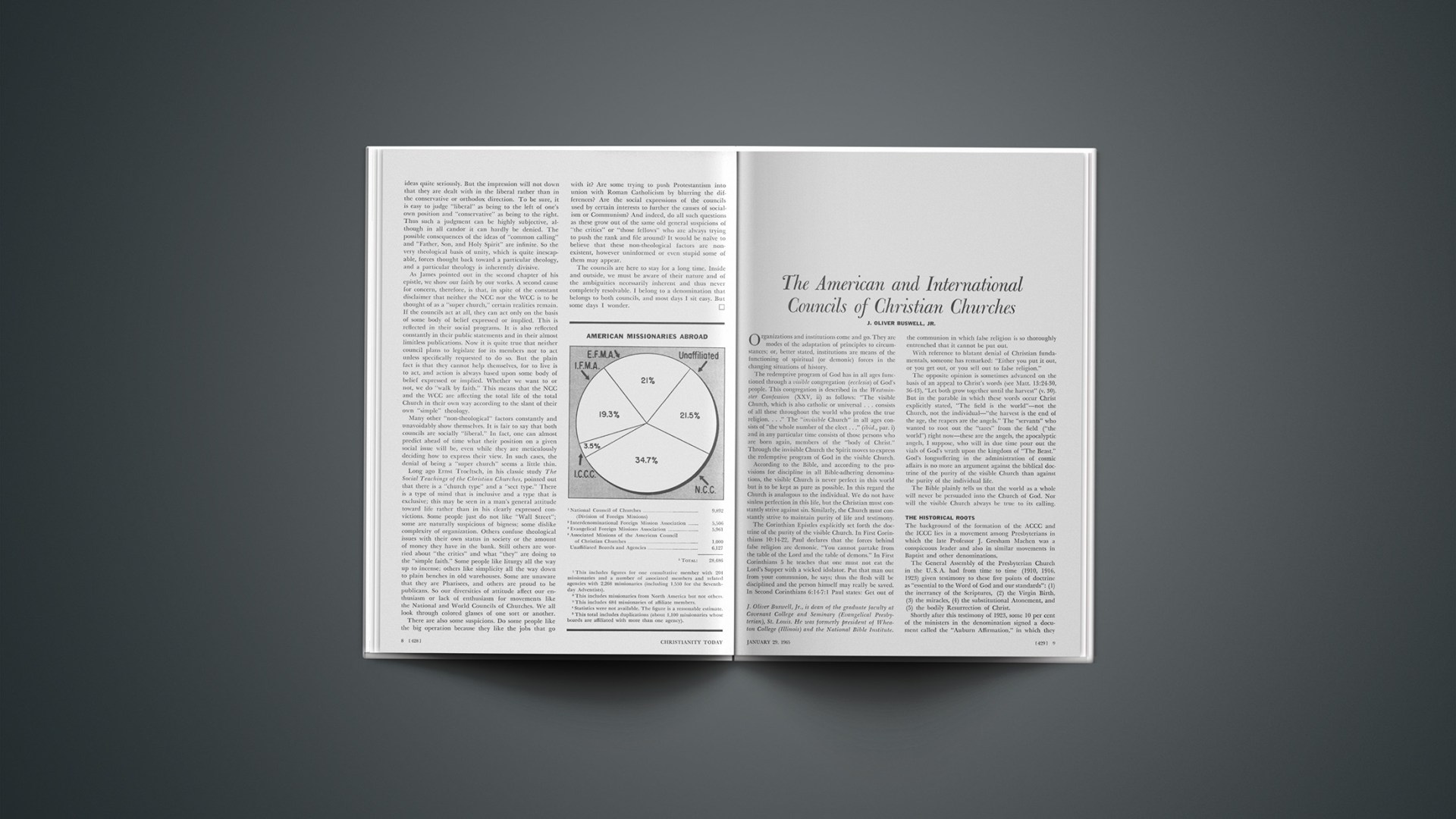
The American and International Councils of Christian Churches

Organizations and institutions come and go. They are modes of the adaptation of principles to circumstances; or, better stated, institutions are means of the functioning of spiritual (or demonic) forces in the changing situations of history.

The redemptive program of God has in all ages functioned through a visible congregation (ecclesia) of God’s people. This congregation is described in the Westminster Confession (XXV, ii) as follows: “The visible Church, which is also catholic or universal … consists of all these throughout the world who profess the true religion.…” The “invisible Church” in all ages consists of “the whole number of the elect …” (ibid., par. i) and in any particular time consists of those persons who are born again, members of the “body of Christ.” Through the invisible Church the Spirit moves to express the redemptive program of God in the visible Church.

According to the Bible, and according to the provisions for discipline in all Bible-adhering denominations, the visible Church is never perfect in this world but is to be kept as pure as possible. In this regard the Church is analogous to the individual. We do not have sinless perfection in this life, but the Christian must constantly strive against sin. Similarly, the Church must constantly strive to maintain purity of life and testimony.

The Corinthian Epistles explicitly set forth the doctrine of the purity of the visible Church. In First Corinthians 10:14–22, Paul declares that the forces behind false religion are demonic. “You cannot partake from the table of the Lord and the table of demons.” In First Corinthians 5 he teaches that one must not eat the Lord’s Supper with a wicked idolator. Put that man out from your communion, he says; thus the flesh will be disciplined and the person himself may really be saved. In Second Corinthians 6:14–7:1 Paul states: Get out of the communion in which false religion is so thoroughly entrenched that it cannot be put out.

With reference to blatant denial of Christian fundamentals, someone has remarked: “Either you put it out, or you get out, or you sell out to false religion.”

The opposite opinion is sometimes advanced on the basis of an appeal to Christ’s words (see Matt. 13:24–30, 36–43), “Let both grow together until the harvest” (v. 30). But in the parable in which these words occur Christ explicitly stated, “The field is the world”—not the Church, not the individual—“the harvest is the end of the age, the reapers are the angels.” The “servants” who wanted to root out the “tares” from the field (“the world”) right now—these are the angels, the apocalyptic angels, I suppose, who will in due time pour out the vials of God’s wrath upon the kingdom of “The Beast.” God’s longsuffering in the administration of cosmic affairs is no more an argument against the biblical doctrine of the purity of the visible Church than against the purity of the individual life.

The Bible plainly tells us that the world as a whole will never be persuaded into the Church of God. Nor will the visible Church always be true to its calling.

The Historical Roots

The background of the formation of the ACCC and the ICCC lies in a movement among Presbyterians in which the late Professor J. Gresham Machen was a conspicuous leader and also in similar movements in Baptist and other denominations.

The General Assembly of the Presbyterian Church in the U. S. A. had from time to time (1910, 1916, 1923) given testimony to these five points of doctrine as “essential to the Word of God and our standards”: (1) the inerrancy of the Scriptures, (2) the Virgin Birth, (3) the miracles, (4) the substitutional Atonement, and (5) the bodily Resurrection of Christ.

Shortly after this testimony of 1923, some 10 per cent of the ministers in the denomination signed a document called the “Auburn Affirmation,” in which they stated that the inerrancy of the Scriptures is a harmful doctrine and that the other four points are not essential for Presbyterian ministers in good standing. Signers of the “Auburn Affirmation” were found in high places in the church. Dr. Machen now came forward as a leader in the struggle for the purity of the Church. In a carefully documented case he exposed the “inclusive” policy of the Board of Foreign Missions. Along with missionaries whose loyalty to the Gospel was unquestioned, others were being sent out who denied the Virgin Birth and other fundamentals. At least one missionary who was writing and speaking in sympathy with Soviet Communism was on the payroll of the board.

“Conservative” men on the board took the position that denial of the fundamentals should be treated as a partisan difference within the church and within its foreign mission program. Machen pointed out that even a political democracy cannot tolerate within itself a party that would destroy its very existence.

Although I was a member of the presbytery, my work was independent and interdenominational. I could have stood to one side (Obad. 11) and washed my hands of the matter (Matt. 27:24). But when Dr. Machen asked me, among others, to give my name to the cause, the possibility of refusing did not even enter my mind.

We spared no effort to purify the ecclesiastical machinery from within. Our best efforts were overwhelmingly defeated. But we were not dismayed. Our efforts and the results are a matter of public record. Could we have used some better method? Obviously! So could Calvin and Luther. We used various methods, the best we knew. A friend wrote, “I agree with your cause, but I don’t like your method.” I sent him a long telegram, “You are just the man I need to hear from. I am not committed to any method. Please tell me your method, and answer quickly.” I got no reply.

A scared young pastor said, “If we oppose the leaders of our denomination we’ll be unfrocked!” I was a little older and, I suppose, a little tougher. I remember telling him, “I’d be ashamed not to be unfrocked by such ecclesiastical leaders at such a time.” In the same General Assembly in which Machen and the rest of us who stood with him were variously deposed from the ministry of that denomination, a pastor in Wisconsin was removed from his church for pointing out the poison in the denominational Sunday school literature. At the same time the name of a minister in Los Angeles was erased from the roll of the presbytery for conducting independent Bible classes among university students. That same General Assembly excommunicated a minister in Wisconsin for participating in an independent Bible conference camp.

Dr. Machen’s death on January 1, 1937, was an unspeakable loss to those who had stood with him. We soon found that the experiences of groups of men in other denominations, Baptist and Methodist Protestant especially, had been very similar to ours. The Independent Fundamental Churches of America (IFCA) also had gathered a strong group of ministers and churches who had come out of Congregational and other connections in which they felt that apostasy was dominant. We had much in common and were drawn together. Our small denominations were harmonious. Any opposition we met in our missionary programs was from the Federal Council of Churches (later known as the National Council) and its international “ecumenical” connections.

Formation Of A. C. C. C.

Then came World War II. Numbers of our ministers desired to serve as chaplains in the armed forces. We found that the Federal Council virtually had control over the appointment of Protestant chaplains. The armed forces administrators did not intend to foster such a monopoly, but they naturally took the Federal Council, as they had in World War I, as representing all Protestants. It was then that the American Council of Christian Churches was formed of denominations of sound evangelical faith not in the Federal Council. By grace and hard work we broke the council’s monopoly on the chaplaincy and supplied a large number of patriotic, courageous, Bible-preaching, soul-winning chaplains for the armed forces.

As the war drew to a close, the missionary agencies of our ACCC denominations found that the World Council of Churches had a virtual monopoly over visas for foreign missionaries in many parts of the world. Moreover, through this near-monopoly pressure was exercised to keep from the foreign mission fields missions and missionaries who stood for the purity of the Church and against inclusivistic ecumenism. History must credit Carl McIntire and the ICCC with breaking the syncretistic near-monopoly of the World Council in several foreign mission areas.

But why am I now outside these councils? And why is my church, the Evangelical Presbyterian (formerly Bible Presbyterian), not in these councils? The story is an uninteresting, petty one of undemocratic organization, hyperbolical exaggeration of statistics, and erratic leadership. I tried my best to persuade the church to which I belong to stay in the councils and make corrections from the inside, but the majority of our synod refused to do so. We pray for these councils. Their people are people we love. We trust the Lord that the testimony for the purity of the visible Church may not have been in vain.

Shortly after the organization of the ACCC, another group met in St. Louis to organize the National Association of Evangelicals. Our interests and purposes were similar in many ways. With others of the ACCC I attended the meeting and prayed for rapprochement and understanding. But our differences came clearly to light. The NAE view crystallized in opposition to the ACCC constitutional provision that constituent membership be limited to denominations not in the Federal Council.

Thus the NAE was formed of brethren who sincerely desired to spread the Gospel but who did not see the doctrine of the purity of the visible Church as we believe the Bible sets it forth.

Is the doctrine of the purity of the visible Church in conflict with the doctrine of “the communion of saints”? The Bible clearly teaches that born-again children of God should love one another and should have fellowship with one another in spiritual matters. “We know that we have passed from death into life by the fact that we love our brethren” (1 John 3:14, my translation). “By this all men will know that you are my disciples, if you have love for one another” (John 13:35). Such Scriptures are more numerous than those commanding separation from communion with false religion.

In the Second Epistle of John the church to which he writes is commanded not to receive into its household (its communion) and not to give endorsement (mé legete chairein) to any teacher who does not “abide in the doctrine of Christ.”

The Deuteronomic law forbids plowing with an ox and an ass yoked together (Deut. 22:10). Sometime about 1937 an article in McIntire’s Christian Beacon spoke strongly against what we call “second-degree separation.” We do not call an “ox” a “donkey” simply because he is foolish enough to plow in fellowship with a “donkey.” We do not call a Christian a heathen simply because he is willing to continue worship in communion with those who teach false religion.

When a Christian earnestly says, “I believe it is wrong for a believer to do so and so under such and such circumstances,” two things happen. First, zealots who agree say, “I won’t have anything to do with those who disagree.” Second, some who disagree say, “He says I am not a Christian because I do such and such!” Both groups are to blame for the bitterness that follows. We separatists have consistently tried to restrain the zealots. We have suffered much from the false image created by some who need a defense for their disagreement. I have traced out a number of instances in which Machen was said to have shown “bitterness” toward the inclusivists. In each case the evidence for his lack of love was that he had logically ruined their arguments!

There are many accusing generalizations, but I do not know of any specific charges of lack of love against our present leaders. We have not felt ourselves committed to any human movement. I, for one, had serious differences with Machen and discussed them frankly in writing and face to face. On certain clearly defined issues we saw eye to eye, and I have no regrets in having taken my stand on those issues, and in being counted with those who took this stand.

A younger friend whose ability I genuinely admire writes, “It has been a costly thing for you to stand across these years first with the Machen movement and then with the McIntire movement and now to find your way back to a broader evangelical framework of cooperation.” These words are Christian and full of kindness, but they reveal a misunderstanding.

We have never felt ourselves cut off from the broadest possible evangelical framework of cooperation. Some of us have occasionally been thrown out of certain connections by sincere brethren who thought they were doing God service. But this exclusion was theirs, not ours; and we have always found broad opportunity for cooperation with a great variety of God’s people.

We who would emphasize the doctrine of the purity of the visible Church have found good fellowship in our several churches. But there is no interdenominational organization at present which stands for what we believe to be the scriptural view of the Church, and in which we would be welcomed. Some of us hope that the Reformed Ecumenical Synod may partly fulfill the need.

I should like to see a series of conferences—not just programs of speeches—among those who truly believe that the Holy Spirit moves in the Church through the Bible. There are competent exegetes and clear-sighted, courageous leaders among American evangelicals. Let us get these competent men together and seek the mind of the Lord as it is revealed in his Word. Thus let us propose to our churches a strategy that will point forward along biblical lines.

We who believe that the Bible teaches those principles of church purity for which the ACCC and the ICCC ostensibly stand must approach conferences in the spirit of self-examination, welcoming the sincere criticisms of our brethren. “Iron sharpeneth iron; so a man sharpeneth the countenance of his friend.” Earnest convictions are not incompatible with personal and group humility. If we can confer in the spirit of the second chapter of Philippians, especially verses 3 to 5, surely some great good can be accomplished.

T. Leo Brannon is pastor of the First Methodist Church of Samson, Alabama. He received the B.S. degree from Troy State College and the B.D. from Emory University.

Cover Story

The National Council and the World Council

When Martin Luther broke with the Roman church his breaking point found expression in these famous words: “God help me. Here I stand. I cannot do otherwise.” Yet he soon learned what was to be his own special problem—that no man can be a Christian and remain alone. There is no such thing as a one-man church, for it is not possible to be a member of a “body” without all the other members. Luther therefore discovered, as we all must, that in order to unite with someone else one must give up something of himself.

Imagine yourself at one end of a long straight line. You are walking this line in the direction of uniting spiritually with other people on the basis of theology or sound doctrine. Let us suppose that you are well adjusted to the congregation to which you belong. Your church in turn belongs to some division—presbytery, classis, conference, diocese—of a denomination. And for this denomination there is a confession or a statement of faith and probably also a catechism. To join the church you have made certain professions, as have the leaders of the church, and these professions are subsumed under the accepted body of doctrine.

Now the farther you move along that line and the larger the group with which you unite, the more absolute is the necessity of laying aside here and there and one by one certain of your own beliefs in order to be part of the whole. Depending on your theological sensitivity and the niceties of expression at the various points on which you agree to “go along,” you will necessarily reach some point where you dig in your heels and say, “This is as far as I can go.” So you finally take your position somewhere along that line, and this by definition is the “kind of Christian” you have decided to be. You are thereby discovering the twin principles of purity versus peace or individualism versus communion, which may be scripturally expressed as “Come out from among them and be ye separate” versus “Let both grow until the harvest,” when God will do the judging.

Councils are made up of denominations that agree to lay aside some of their differentiae in order to satisfy the longing for unity in the Body of Christ. In First Corinthians Paul asks, “Is Christ divided?” Calvin answered that rhetorical question by saying, “Christ is divided who bleeds.” No Christian worthy of the name can be satisfied that the Body of Christ is divided, especially when the division is put in Calvin’s terms, “who bleeds.” The direction of every Christian and every denomination should be toward the healing of the divided Body.

How Much To Lay Aside

Imagine now another line along which denominations move. Some will go no farther along this line than the American Council of Christian Churches. Others stop with the National Association of Evangelicals. Most denominations find their resting place in the National Council of Churches and in the World Council of Churches. We cannot rightly criticize any of these stopping places unless we see that the problem of denominations is exactly the problem of the individual Christian. How much of the individualism of your denomination can be laid aside for the sake of the larger unity? Even the strictest council holding the closest definition of, for example, the inspiration of the Scriptures has to “sit loose” on such subjects as baptism or the Second Coming. The plain fact is that no one unites with anyone or anything without deciding that some things must be laid aside for the sake of this unity.

The National Council of Churches grew out of the old Federal Council of Churches and was formally organized in Cleveland, Ohio, in 1950. The chief officer of each church at that time, speaking on his church’s behalf, declared: “In the providence of God the time has come when it seems fitting more fully to manifest oneness in Jesus Christ as the Divine Lord and Saviour, by the creation of an inclusive cooperative agency of the Christian churches of the United States of America to continue and extend the following general agencies of the church and to combine all their interests and functions.” (There followed a list of eight agencies, which have now become thirteen.) Thirty-one churches united on this basis. It was said then and is repeated constantly in publications of the council (1963 Triennial Report, for example, page 41) that “the council is not a church or a super-church.… It is the medium through which [members] voice their common aspirations and convictions, coordinate their program interests and activities, and delegate responsibility in areas where they wish to conduct united projects.” A list of the agencies and their activities would be almost endless; we need to know only that there are many, many ways in which the various churches may attempt to work together nationally and locally on “united projects.” The organization has proliferated after the manner of Parkinson’s Law.

The strength and influence of the NCC overshadows that of any other cooperative religious agency in the United States. With thirty-one denominations, forty-one million church members, one hundred and forty-four thousand churches, and one hundred and ten thousand clergymen it is of gigantic proportions, and its voice is bound to be listened to by all segments of the American people. It is neither as good as its fondest champions think it to be, nor as bad as its worst critics claim. Its power may be noted by both the affirmative response of its adherents to its pronouncements and the reaction it generates from those who oppose it. The NCC has boldly moved into areas where angels fear to tread. It has made enemies for itself by its pronouncements. And large and significant as it is, it has proved sensitive to the criticisms directed against it and has engaged in promotional programs to demonstrate what is good about its activities. That it is here, that it is here to stay, and that it will continue its efforts to mold economic, social, and political as well as religious aspects of American life, few will doubt.

On The World Scene

The World Council of Churches is likewise a council of churches and not a council of church councils. As the name implies, it attempts on the world scene what the National Council of Churches attempts on the national scene. Its problems are much more complex than those of the NCC because of languages and cultures and because of the many other ecumenical organizations with which it must in some fashion cooperate. The WCC is made up of 200 churches of the Protestant, Anglican, Orthodox, and Old Catholic confessions, from more than eighty countries. It began in August, 1948, with an assembly in Amsterdam, The Netherlands, and has since had assemblies in Evanston, Illinois (1954), and in New Delhi, India (1961). At the New Delhi assembly the delegates affirmed that “in some things our convictions do not yet permit us to act together, but we have made progress in giving content to the unity we seek.”

The membership basis of the WCC is similar to that of the NCC, although somewhat more sophisticated theologically. “The World Council of Churches is a fellowship of churches which confess the Lord Jesus Christ as God and Saviour according to the Scriptures, and therefore seek to fulfill together their common calling to the glory of the one God, Father, Son, and Holy Spirit.” The World Council also insists that it is not a “super church,” because it cannot legislate for its members nor act for them unless specifically requested to do so. Rather, it is a means for churches to fulfill their common calling in service and in witness to the Lordship of Christ, to carry on serious dialogue about their differences, to seek unity, and to join in meeting human need. The ways in which these things are done are diverse and complex. One feature of the ecumenical movement, and a good one, has been a series of study conferences that began in Edinburgh in 1910 and have continued with admirable scholarship to the present.

Some Trouble Spots

A comprehensive critique of movements so majestic in purpose and amorphous in content as these councils is beyond the limits of this article. Yet I should like briefly to point out a few places at which I am constantly disturbed. (Doubtless those in high places in both councils who think seriously about the nature and content of the movements are well aware of these problems.)

Both the WCC and the NCC touch rather gingerly on the whole field of theology, because, as we have already pointed out, to unite at all involves a move towards the least common denominator. But even in their carefulness to be brief the councils have to open the door upon theology. Thus they are by necessity moving toward particularity and are opening the door upon more theology than they care to admit. The NCC speaks about Jesus Christ as “Lord and Saviour.” The WCC confesses Jesus Christ as “God and Saviour” and talks about him “according to the Scriptures”; the aim of its members is to “fulfill together their common calling to the glory of the one God, Father, Son, and Holy Spirit.”

But to speak of Jesus is to speak of his humanity, while to speak of Christ is to open up his deity. And to speak of both demands some kind of treatment of the nature of Christ. Yet this can be divisive. Furthermore, if Christ is to be spoken of as “the Saviour,” we have already moved into questions of sin in both man and society and are thus on the verge of the demonic, whatever that includes. Moreover, we are forced into some view of the Atonement. However loosely or stringently we wish to express their significance, the words “according to the Scriptures” have all kinds of implications in the day of Karl Barth and Rudolf Bultmann—not to speak of John Robinson.

It is my impression that the councils deal with these ideas quite seriously. But the impression will not down that they are dealt with in the liberal rather than in the conservative or orthodox direction. To be sure, it is easy to judge “liberal” as being to the left of one’s own position and “conservative” as being to the right. Thus such a judgment can be highly subjective, although in all candor it can hardly be denied. The possible consequences of the ideas of “common calling” and “Father, Son, and Holy Spirit” are infinite. So the very theological basis of unity, which is quite inescapable, forces thought back toward a particular theology, and a particular theology is inherently divisive.

As James pointed out in the second chapter of his epistle, we show our faith by our works. A second cause for concern, therefore, is that, in spite of the constant disclaimer that neither the NCC nor the WCC is to be thought of as a “super church,” certain realities remain. If the councils act at all, they can act only on the basis of some body of belief expressed or implied. This is reflected in their social programs. It is also reflected constantly in their public statements and in their almost limitless publications. Now it is quite true that neither council plans to legislate for its members nor to act unless specifically requested to do so. But the plain fact is that they cannot help themselves, for to live is to act, and action is always based upon some body of belief expressed or implied. Whether we want to or not, we do “walk by faith.” This means that the NCC and the WCC are affecting the total life of the total Church in their own way according to the slant of their own “simple” theology.

Many other “non-theological” factors constantly and unavoidably show themselves. It is fair to say that both councils are socially “liberal.” In fact, one can almost predict ahead of time what their position on a given social issue will be, even while they are meticulously deciding how to express their view. In such cases, the denial of being a “super church” seems a little thin.

Long ago Ernst Troeltsch, in his classic study The Social Teachings of the Christian Churches, pointed out that there is a “church type” and a “sect type.” There is a type of mind that is inclusive and a type that is exclusive; this may be seen in a man’s general attitude toward life rather than in his clearly expressed convictions. Some people just do not like “Wall Street”; some are naturally suspicious of bigness; some dislike complexity of organization. Others confuse theological issues with their own status in society or the amount of money they have in the bank. Still others are worried about “the critics” and what “they” are doing to the “simple faith.” Some people like liturgy all the way up to incense; others like simplicity all the way down to plain benches in old warehouses. Some are unaware that they are Pharisees, and others are proud to be publicans. So our diversities of attitude affect our enthusiasm or lack of enthusiasm for movements like the National and World Councils of Churches. We all look through colored glasses of one sort or another.

There are also some suspicions. Do some people like the big operation because they like the jobs that go with it? Are some trying to push Protestantism into union with Roman Catholicism by blurring the differences? Are the social expressions of the councils used by certain interests to further the causes of socialism or Communism? And indeed, do all such questions as these grow out of the same old general suspicions of “the critics” or “those fellows” who are always trying to push the rank and file around? It would be naïve to believe that these non-theological factors are non-existent, however uninformed or even stupid some of them may appear.

The councils are here to stay for a long time. Inside and outside, we must be aware of their nature and of the ambiguities necessarily inherent and thus never completely resolvable. I belong to a denomination that belongs to both councils, and most days I sit easy. But some days I wonder.

T. Leo Brannon is pastor of the First Methodist Church of Samson, Alabama. He received the B.S. degree from Troy State College and the B.D. from Emory University.

Cover Story

The Ecumenical Movement Today

The late Archbishop William Temple described the church unity movement as the twentieth century’s most significant development. Conversations have advanced so swiftly that many ecclesiastical leaders now speak of “the ecumenical age.”

Yet the fact cannot be gainsaid that the Christian world remains woefully divided. The ecumenical movement, crystallized in the National Council and World Council of Churches, has achieved spectacular growth; it has stimulated the rise of competitive structures and given ecumenical impetus as well to Roman Catholicism and even to non-Christian faiths. Ecumenism seems prone to become a monolithic movement with new centers of ecclesiastical power and vast potential for propaganda.

There are some signs, however, that ecumenical momentum is slowing, and that new stresses and strains are developing. The ability of ecumenical leaders to command the attention of mass communications media—television, radio, and the press—has created apprehension that a select group of influential leaders is able almost automatically to translate its own desires into history. But the stalemate of the Blake-Pike plan, the comparative ineffectualness of the Montreal Faith and Order Conference, and the limited achievement of Vatican Council II contribute to a more sober view.

The fact remains that basic divisions vex Christendom. Although the ecumenical vision has been most ardently promoted by American Protestants, taken as a whole they seem distrustful of the implications of this vision. What the substance of unity is and what forms it ought to take are still subjects of lively debate. Divergent theories of Christian unity are reflected by the National Council of Churches, the National Association of Evangelicals, and the American Council of Christian Churches. Major denominations such as the Southern Baptist Convention and the Lutheran Church—Missouri Synod hold themselves at a comfortable distance even from these ecumenical manifestations. The statistics of American Protestant proliferation tend to be a thorn in the side of ecumenical propagandists (see page 5, “Non-Aligned Religious Bodies”).

CHRISTIANITY TODAY has invited a number of informed churchmen to write essays appraising rival ecumenical structures in contemporary Protestantism, and to place this evaluation in evangelical perspective. Readers will be interested in the assessment of specific movements by churchmen from various traditions who rise above house-organ enthusiasm and venture into constructive criticism. Supplementary essays focus the searchlight of concern on tensions that the ecumenical movement, as a theologically inclusive enterprise, poses for evangelical conscience, thought, and action. The growing conflict between denominational and ecumenical loyalties, the dilution of doctrinal distinctives below the level of conscientious acquiescence, the tendency of a few strong personalities to shape the direction of ecumenical procedures, the disposition of powerful leaders to issue debatable political pronouncements in the name of the entire ecumenical constituency—these are among the factors that have provoked dissent.

The unpredictable character of the ecumenical movement is reflected in its changing moods. A generation ago denominationalism was much more widely accepted than now. Today denominationalism is downgraded and ecumenism exalted. Since the publication of Church Unity and Church Mission by Martin E. Marty, associate editor of the ecumenical weekly, The Christian Century, the issue of “ecclesiastical Machiavellianism” has emerged into widening discussion. Ministers who have taken denominational ordination vows are increasingly faced with the question of personal honesty and integrity as they participate in a movement that explicitly condemns denominations and aims at their merger into the ecumenical church. Applying the borrowed phrase “sociological Machiavellianism,” Dr. Marty counsels a procedure that would actually promote “the ultimate death and transfiguration of these forms” while patiently “living in denominations and being faithful to their disciplines” (pp. 124 ff.).

In the days of the liberal-fundamentalist controversy, evangelicals urged liberals to conform conscientiously to the historic standards of their church; in the ecumenical era, liberals like Marty, who says he is speaking dramatically, urge ecumenists to work consciously for the “death and transfiguration” of their denominations. A generation ago the liberals charged evangelicals with being denominationally disloyal and disruptive because the conservatives held that liberalism had no legitimate rights within the Church; today ecumenists deplore “denominational hacks” who esteem the churches in which they have been ordained above the World Council of Churches. Historically the ecumenical movement came into being through the missionary arm of the denominations; the latest move is to merge denominational identity in church union.

Some will say such comment aims to vindicate the status quo and lacks zeal for Christian unity. But this objection evades the real issues. Discerning readers will recognize and quickly reject the attempt to reduce all bold criticism of ecumenical enterprises to obscurantism. Let it be plainly said that the Church of Jesus Christ needs renewal and healing of her divisions. The unity of Christian believers is highly imperative. But to speak of “believers” is to raise questions of truth and sound doctrine. Unity is indeed part of that truth; but Christian truth has other aspects than unity. The unity Christ seeks cannot be achieved simply by ecclesiastical maneuvering or by ignoring the basic question of doctrinal purity. Along with considerable ecumenical research into the nature of the Church, there has been a rather wide disregard of what she ought to believe and of what she must preach.

Christendom remains today a broken household of competing congregations and parishes, communions and denominations and sects, federations and councils. Despite the results of the ecumenical movement, those who read history rather than fiction must speak of this continuing disunity of the Christian churches, and even of “struggles and enmities” within Christendom.

Is it wholly improper to ask whether Christendom thus fragmented has perhaps come under the lash of divine judgment? And also to ask whether that judgment might be upon much that the institutional church approves and perhaps even cherishes? Are ecumenical methods and theological inclusivism immune from all such judgment? Is the Spirit of God now saying something to—and not simply through—the ecumenical movement? Is it not time to ask whether the unity of the Church is really or ideally promoted by mergers of denominations into larger bodies compounding the once-isolated afflictions of their members?—ED.

About This Issue: January 15, 1965

This issue is largely devoted to students. Several articles deal with contemporary pressures on Christian youth in colleges and universities. A special feature is the report and accompanying photo coverage of year-end Christian student convocations.

In addition, Jerry H. Gill discusses the rebuttal to the challenge of logical empiricists, and Stanley C. Baldwin contends that Christian belief “does not require intellectual mediocrity or dishonesty, but only intellectual humility.”

Review of Current Religious Thought: January 15, 1965

Werner picht has produced an excellent biography that has been very well translated from the German by the Englishman Edward Fitzgerald and published in London by George Allen and Unwin, Ltd. The title is Albert Schweitzer: The Man and His Work. The American edition, which is due any day now, is being published by Harper and Row and will be entitled The Life and Thought of Albert Schweitzer. It is an understanding book in every way, to which I should like to give an understanding review. The basic problem with Schweitzer is whether his biographers and critics can come up to the measure of the man; my problem is whether I can do justice to the excellencies of Picht’s biography.

For all of us it seems that the life and works of Albert Schweitzer have been in our midst so long that we feel we know all about him. We need a book like this to remind us of many things we have forgotten, to impress us afresh with the magnificence of Schweitzer, and to force us to look more closely at some of our general impressions. A long, long time ago most of us read the writings of Schweitzer, but we have very rarely turned back to them. Meanwhile the man’s image has suffered in our judgment by an almost endless parade of worshipful or disenchanted critics. The book by Picht is a needed corrective.

Werner Picht’s approach to the task is that of an “admirer.” He recognizes the task ahead of him, that of a critical enthusiast. “The most difficult task which any admirer can be called upon to perform is to lay hands on a beloved image, since its features are threatened by every stroke of the chisel. Let this work, therefore, be regarded as the deep public expression of both gratitude and attachment.” Or again in the words of the author, “Albert Schweitzer is a divine gift in troublesome times. But unless the blessing it represents is to run away like sand between our fingers that gift must be cherished with a feeling of utmost responsibility.” Reading and rereading gives us the assurance that Picht is worthy of his chosen task.

A half century ago P. Carnegie Simpson wrote his little classic, The Fact of Christ. In it he tried successfully to hack away at the jungle of opinion and criticism in order to set before us the challenging question, “What are you going to do with the fact of Christ?” That Christ is an endless problem for both mind and heart is evident to any thinking person and might lead one to give up his researches in despair. Meanwhile the marvelous fact keeps shining through. As G. K. Chesterton once put it, “God has placed the cross in the center of history and said to mankind, ‘What are you going to do about that?’ ” So Simpson keeps pressing the fact of Christ on our consciousness. What do you do about that fact?

Picht has the same approach to what he calls “the phenomenon of Schweitzer” or “the revelation of true greatness.” That Schweitzer is wide open to attack on many fronts is perfectly evident, but does any critic think he is big enough to deal with the total man, the phenomenon? If Schweitzer is to be judged by his peers, who are his peers? Watch the treatment of the truly great, when men without genius have tried to understand genius. History is full of big men who have had small followers. The great philosopher Aristotle was able to contain in himself all kinds of variances which his lesser followers could not contain in themselves and which they subsequently broke up into “schools” of philosophy. The great watershed thinking of Kant gathered together the diversities of centuries of human thought. His followers could not hold them together. Luther and Calvin and Pascal in a lesser fashion could also contain within their own minds what became bits and pieces in the minds of others.

So it is with Schweitzer from Picht’s viewpoint, and I find myself in complete agreement with him. “The analysis of the phenomenon is much more difficult than it appears at first sight. To begin with it is impossible for any one man to master truly the various spheres of Albert Schweitzer’s many-sided productivity: theology, philosophy, music and so on. That is a difficulty that must be accepted as inevitable if the author has no intention of seeking the easy way out … but the real difficulty lies even deeper; it is inherent in the paradoxical nature of Schweitzer’s personality …” (italics mine).

After a brief chapter called “Fundamentals,” the author takes up the three great areas of Schweitzer’s theological productivity in chapters called “The Quest of the Historical Jesus,” “Paul,” and “Ethics.” The first of these chapters takes the title of what has become Schweitzer’s most famous work, and the others indicate in brief some areas in which he has done other writing.

A review of these chapters reduces itself finally to a recognition of the paradox of Schweitzer, which reduces itself in turn to the twin centers of both his thought and life, namely, his personal (is it mystical?) experience of the person of Christ over against his devotion to the reasoning of a man under subjection to the Enlightenment. Coldly and purposely Schweitzer lays aside all dogma, all tradition, all authority, and by his own masterful reasoning powers pursues relentlessly wherever his trail leads. This makes him fearfully iconoclastic, and his critics from the orthodox side of things rise en masse to deny even his Christianity. Conversely his deep and personal “experience” of his Lord causes distress to his liberal friends, who think that perhaps he has gone soft or has spent too much time in the jungle. It is a strange synthesis: this liberalism that leads him to believe that Christ was so much a product of his time that he was in error about many things; and his idea that Christ must be understood finally only as an apocalyptic event, which makes Schweitzer appear like a fanatical premillennialist.

What is true of “The Quest” is reflected in his writings on Paul, where “anything goes” in higher criticism and extreme rationalism until it is stopped again by his recognition that Paul’s experience of Christ—one with Christ—is Schweitzer’s experience also. The “Ethics,” which rests on his doctrine of “reverence for life” (and here one must surely read Picht or read Schweitzer), seems to lead right out of the Christian frame of reference only to find its fulfillment in the preeminence of Jesus. How can you fault a man who says to a native coming out from the anesthetic, “It was Jesus who sent me to you”?

Time fails me to speak of Lambaréné or his music or Goethe or his critics. I am reminded of Goethe, when he speaks of the devil’s demanding the soul of Napoleon: “If you are bold enough to face him, in your kingdom you may place him.”

This fortnightly review is contributed in sequence by J. D. Douglas, British editorial director,CHRISTIANITY TODAY; Philip E. Hughes, guest professor of New Testament exegesis, Columbia Seminary, Decatur, Georgia; Harold B. Kuhn, professor of philosophy of religion, Asbury Seminary, Wilmore. Kentucky; G. C. Berkouwer, professor of dogmatics, Free University of Amsterdam; and Addison H. Leitch, professor of philosophy and religion, Tarkio College, Tarkio, Missouri.—ED.

Eutychus and His Kin: January 15, 1965

THE GOOD WORD

With some distress I report that two people from England have written to Eutychus reflecting a little distress of their own. Some time ago in one of my columns I used the word “blast,” and used it in a normal all-American manner. The text and context in which the word was used apparently set off my English brethren, and they wrote in high dudgeon. They really were serious; one even went so far as to suggest that if CHRISTIANITY TODAY is to succeed in any Christian fashion, such language must be eliminated at the earliest possible date.

I really didn’t know what to do about it but finally had a chance to talk to a British member of the Billy Graham team. He straightened me out, not only on the word “blast,” but also on the word “bloody.” After that enlightening conversation, I know how offended my British readers must have been, and I herewith apologize.

From the American point of view it would be hard to know why an apology was called for, because these words are ordinary coin of the realm with none of the overtones that they carry in Great Britain. My British friend told of a couple of words he had used in front of an American audience which, he said, could easily have been used by the Queen of England or the Archbishop of Canterbury; when I heard the words he had used and the reaction of his audience, I went into a mild shock myself.

I think we have a particular problem between the Americans and the British because we think we talk the same language. As a matter of fact, we highly irritate each other by that assumption. When we are both using the “King’s English” according to Shakespeare or the King James Version, we are not too far apart; but in ordinary speech we give each other fits (in case that is a suitable word). What’s the difference between being level-headed and being flatheaded? How would you like it if I said my wife is a vision and yours is a sight?

All kinds of things divide this weary world. It’s a pity that when we reach out with the best speech we know, we don’t always find each other.

THE SPECTRUM

Please accept my very best thanks and high appreciation of your December 18 issue. It was the “richest” in theological nourishment and spiritual meditation that I can remember, although almost all issues are very good. Having been brought up among “Plymouth” Brethren of the strictest (exclusives) sect and being now a convinced Anglo-Catholic, I feel that I can give a very balanced appraisal.

Trinity Cathedral

Easton, Md.

Canon Emeritus

THE GENTILES

I want to commend you for publishing the article, “The Jews and the Crucifixion,” by George H. Stevens (Dec. 18 issue).

You have done a great service to Christendom as well as to the Jewish people by it. I wish that all news media would copy it and thus help repudiate an old libel which is contrary to Bible truth and historic facts.

To the convincing arguments of said article I wish to add that Jesus himself had refuted that libel by his prediction as to who would kill him; according to Matthew 20:18, 19; Mark 10:33, 34; Luke 18:31–34, Christ predicted that the Gentiles would kill him. He did not mention “the Jews,” but only their rulers (whom the Jews disliked) who would deliver him to the Gentiles. His testimony cannot be controverted. Another point: “The Jews” (with few exceptions) were fast asleep when the trial and execution of Christ took place. Had they known what was going on there at Calvary they would have immediately come to his rescue, as they had always shielded him against his few adversaries.

President

International Board of Jewish Missions, Inc. Atlanta, Ga.

ADD ONE COMET

I would like to express my appreciation for the timely publication of the Adler Planetarium article, “What Was the Star of Bethlehem?” (Dec. 18 issue).

Readers who are interested in pursuing the subject further can consult Jack Finegan’s Handbook of Biblical Chronology (Princeton: Princeton University Press, 1964, pp. 215–59). Professor Finegan’s detailed and documented discussion is basically in agreement with the Adler article.

The article, however, said that there was no record of a comet between 11 B.C. and 4 B.C. From John Williams’s Observation of Comets from B.C. 611 to A.D. 1640 Extracted from the Chinese Accounts Finegan cites one comet, No. 52, which appeared in this period. It appeared in the constellation Capricorn in March of 5 B.C. and was visible for more than seventy days. The comet of 4 B.C. appeared in the constellation Aquila in April of that year.

The first comet is called a hui hsing or “sweeping star.” Knut Lundmark (“The Messianic Ideas and Their Astronomical Background,” in Actes du VIIe Congrès International d’Histoire des Sciences [August 4–12, 1953], pp. 436–39, cited by Finegan) believes that this may have been a nova.

The second comet is called a po hsing or “tailless comet,” i.e., a comet in line with the earth and sun so that its tail is not visible. With more justification than in the former case, we may entertain the possibility that this was a nova.

Finegan agrees with the Adler article that the conjunction of planets would have directed the attention of the Magi to Palestine in 7–6 B.C. But on the basis of the above evidence he then concludes: “The comets (or novae) of 5 and 4 B.C. could be the astronomical phenomenon back of the account of the Star of Bethlehem. The comet of March of 5 B.C. could have started the Magi on their journey. They must have reached Judea before the death of Herod which fell between Mar. 12 and Apr. 11. 4 B.C. The comet of April of 4 B.C. could have been shining at that time.… Perhaps a date for the birth of Jesus sometime in the winter of 5/4 B.C. best satisfies all the available evidence.”

History Dept.

Rutgers—The State University

New Brunswick, N. J.

Any planet, planets, or comet remaining at their millions of miles distance, even if they could move, could not do so in relation to that short six miles. Certainly it could not be said that they “stood over the house where the young child was”!…

This “star,” small enough and close enough to do the directing job, could still have been a “sign” in the east.…

Why can’t we be consistent with the rest of the Scriptures? Why exclude the well-known “Shekinah” which variously appears as “a fire,” “a cloud,” “a bright cloud,” “pillar of cloud,” “glory of the Lord,” “bright light,” and so on?

Church of Christ

Wellington, Ohio

COMPUTERS IN GOD’S SERVICE

It is good to see evangelical scholarship coming to grips with the issues raised by Mr. Morton’s application of the digital computer to appraise the style of Paul’s letters (Dec. 4 issue). The article … raises good objections to Morton’s conclusions. Such a priori considerations should open the door for a hearing of the evangelical viewpoint. Our next step is to show that these grounds are a valid model of reality; and this can be done by further application of the computer in the hands of evangelical scholars.

The powerful machines of modern industry supplement human muscles by manipulating things with great speed, power, and precision. Similarly, digital computers supplement human minds by manipulating symbols with great speed, patience, and precision. That is why digital computers, properly programmed, can perform mathematical, logical, and linguistic operations. Such a vast field of potential applications indicates that the digital computer can be applied profitably to studies which are relevant to theology. Several examples come to mind.

A promising use of the computer in the analysis of the syntactical structure of the New Testament would be to provide the statistics for a new type of grammar of New Testament Greek. Dr. Henry R. Moeller describes the need for such a grammar, whose presentation would be modified by structural statistics. (See his “An Approach to the Greek Reading Problem Based on Structural Statistics” in the Bulletin of the Evangelical Theological Society, Vol. 3. No. 2, pp. 45–51.)

A more familiar application of the digital computer is the making of concordances. This use of the computer made possible the prompt publication of a concordance to the Revised Standard Version of the Bible. A concordance for the works of Thomas Aquinas will soon be completed. Concordances to the writings of Martin Luther, John Calvin, Jonathan Edwards, and Karl Barth would be valuable aids to theological studies; and they could be produced by digital computers. The computer can rapidly examine a manuscript and evaluate its correlation to a standard text, thereby accelerating the study of the textual families which underlie the text of Scripture.

The language-handling abilities of computer programs may soon advance to the point where they can aid the Christian missionary who is reducing a tribal language to writing. Word frequency counts and structural statistics would provide the basis for a pedagogically sound method of teaching the language. The computer may become able to expedite the translation of large portions of Scripture, by rapidly producing tentative translations for the missionary to improve until they are ready for publication.…

More mundane uses of computers consist of scheduling classes and examinations to minimize conflicts, and to record and update administrative records. The Billy Graham Evangelistic Association uses a computer to update its extensive mailing list; about 50,000 address changes per month are made.

Many of our seminaries are located near computing centers, or at least near universities which have computers. Time on these machines can be purchased at rates which are nominal for the vast amount of work that is done. I hope that evangelical scholars will make good use of these facilities, and show the secular world that the computer can be used for the glory of God.

Liverpool, N. Y.

CONCERNING CRITICISM

I trust you are not overly disturbed over some criticism of your much needed reporting concerning “Presbyterians Draft New Confession” (Oct. 23 issue).…

While I have serious doubts that protests will do more than temporarily hold up a formal statement, you have done a brave and conscientious bit of reporting, letting the chips fall where they may. It is a shame that the rank and file of this denomination are not readers of CHRISTIANITY TODAY. Few are aware of what is going on behind the scene, and they are not being told by their pastors.…

Be encouraged for your stand, and let no ecclesiastical power turn you for a moment from the truth as you know it.…

Havertown, Pa.

I think you owe the United Presbyterian Church, in general, and Professor Dowey, in particular, a sincere apology. Otherwise, I must conclude that CHRISTIANITY TODAY ranks with those minor smear journals to whom one dares not comment in any fashion for fear the truth will be deliberately distorted.…

First Presbyterian

Poughkeepsie, N. Y.

INTO THE CLAN, TARTAN OR NO

John Lawing’s poignant cartoon, What If … (Eutychus, Nov. 20 issue), was reminiscent of those pleasant moments together with him in seminary when during the course of a lecture his spontaneous cartoons would surreptitiously float around the classroom to sharpen up a delicate point of theology being discussed by the lecturer. I cannot say that comprehension necessarily excelled as the result of his cutting wit, but there was never any question that classroom morale always soared to new heights! For my part, Eutychus could do well to adopt a worthy brother into his clan. Rockford, Ill.

• CHRISTIANITY TODAY is pleased to announce that John Lawing’s cartoons will continue to appear as a regular feature of the magazine.—ED.

FLEXIBILITY

Advertisement:

The Ecumenical Press announces

NEW DO-IT-YOURSELF “ULTIMATE BIBLE”

LOOSE-LEAF

with thousands of pages to choose from

Begin with the BASIC 50

fifty pages agreed upon by our panel of international experts as being

historically genuine

critically valid

mythologically vital

existentially indispensable

Obtain additional on approval pages from our HUGE LIBRARY of inspired and inspirational writings

Expandable from vest-pocket size

(for the overly scrupulous critic)

to a full five-foot shelf

(for the sympathetic syncretist)

Presbyterian Church in Canada

Thorndale, Ont.

ARE THERE ANY QUESTIONS?

Bishop Gerald Kennedy has a point about panels and Hal Luccock about a need for direct answers to urgent questions, but what does Eutychus II (Dec. 4 issue) think about Jesus’ question, “And who do you say that I am?” (The form of my question is intentional.) Has Eutychus II noticed how many times Jesus asked questions of those who questioned him? “What do you read in the law?” “Which was neighbor to the man?” Teachers do not always ask the opinion of their students because they have run out of material. They ask questions to try to start a process of thought, to arouse the desire to know, or to awaken the knowledge of need.…

In our zeal for the Gospel of Christ we sometimes give the answers without our hearers having ever asked any questions.

Rockville, Md.

Federal Aid and Parochial Education

NEWS: Summary

Officials of the National Education Association say they will seek legislation which would increase by 50 per cent the amount of federal aid alloted for education, and which conceivably could result in aid to private and parochial as well as public schools.

Under the proposal, the bulk of a $1.5 billion annual increase would go directly to the states, with no federal strings attached, provided the funds were used for education.

NEA spokesmen state that under these circumstances, those states that wished to aid parochial schools to some degree would be free to do so. In effect, this would lower from federal to state level the controversial question of government aid to church-related schools.

In the meantime, another plan, announced prematurely last fall by a member of a presidential study group on education and embodying a proposal much the same as the one supported by NEA, is considered dead by the White House, at least for the time being.

Strong controversy developed after the announcement, with many feeling the states might misuse the funds intended for among other things, education.

The proposal would have created a sort of a trust fund of federal money made up of 1 or 2 per cent of the annual federal income tax money. While in part the money would be intended for education in the states, as the states saw fit to use it, it also could be used for health programs and for highways. The unknown and possibly inequitable usage of the funds laid the plan open to controversy.

The NEA plan covers funds for educational purposes only. At least $1.25 billion of the annual $1.5 billion increase would be spent at the sole discretion of the states using the resources, under the NEA proposal. Out of this, spokesmen point out. states that already use some of their locally collected taxes for aiding non-public schools—usually in the form of transportation and textbooks—could apply the federal funds to augment the program without the federal government’s becoming directly involved.

Robert E. McKay, chairman of an influential NEA legislative commission, says the approximate $250 million balance would be intended for the federal impact aid program, whereby school districts affected by the proximity of military installations receive aid for federally connected children using the district’s schools.

He says the NEA urges that the federal funds be divided in this way: 75 per cent to the states according to population; 15 per cent to the most needy states; 10 per cent to states with special needs.

Included under special needs might be assistance to urban and rural slum-area schools, according to McKay. He adds that the NEA would urge that the states use the money for teachers’ salaries, classroom construction, and employment of more teachers to reduce class size.

Protestant Panorama

Southern Baptist Home Mission Board plans pilot projects in high-rise apartments in Atlanta, Chicago, and Dallas. Projects will be church-sponsored, with a minister and his wife placed in an apartment complex and space for a chapel and library rented.

The Salvation Army in the United States will begin a national Centennial Evangelistic Crusade this year on the occasion of the Army’s 100th anniversary.

Miscellany

The Roman Catholic archdiocese of Santa Fe, New Mexico, is becoming a member of the New Mexico Council of Churches, the first such American body to join an interdenominational church council. In Grand Rapids, Michigan, St. Andrew’s Catholic Cathedral joined the area council of churches on an associate basis. First to affiliate on a local level was the Church of the Madalene in Tulsa, Oklahoma, which became a member of the Council of Churches of Greater Tulsa last April.

A Milwaukee theater dropped the scheduled showing of Kiss Me, Stupid, first major Hollywood movie condemned by the Roman Catholic Legion of Decency since the 1950s. Residents of the Soviet zone of Germany will be required to state their religious affiliation for a 1965 general census.

The Eighth Congress of the Yugoslav Communist Party rescinded a long-standing rule that party members must not practice religion, according to reports from Belgrade.

Christian Education

Alaska Methodist University, which admitted its first class of students in 1961. has received full accreditation by the Northwest Association of Secondary and Higher Schools.

Houston Baptist College will dedicate a new library this month in memory of astronaut Theodore C. Freeman, killed in a plane accident October 31.

Andrews University, Seventh-day Adventist school, is building an airport to train missionary pilots near its Berrien Springs, Michigan, campus. The field will be named for the late Tom Dooley, who became famous for his medical work in Laos.

A $2,000,000 science center now under construction at North Park College, Chicago, will be named for the late Dr. Paul Carlson, medical missionary of the Evangelical Covenant Church who was slain by Congolese rebels.

A Nigerian court overthrew the conviction of a Baptist missionary who was charged with “insulting and inciting contempt of the Muslim faith.”

Personalia

Dr. James Muilenburg of San Francisco Theological Seminary will serve as Harry Emerson Fosdick Visiting Professor at Union Theological Seminary this year.

Dr. Albert Schweitzer, theologian, philosopher, musician, medical missionary to Africa, and winner of the Nobel Peace prize, celebrates his ninetieth birthday this week.

Dr. H. Wilbert Norton, formerly president of Trinity College, has been appointed professor of missions and church history at the Graduate School of Wheaton College.

They Say

“When a sower goes forth to sow, he does not crowd as many plants together as would be physically possible. Instead, he considers the spacing necessary for healthy plants to grow. Surely the same intelligence and concern is due the human family.”—Methodist Bishop John Wesley Lord, in Together

Apple PodcastsDown ArrowDown ArrowDown Arrowarrow_left_altLeft ArrowLeft ArrowRight ArrowRight ArrowRight Arrowarrow_up_altUp ArrowUp ArrowAvailable at Amazoncaret-downCloseCloseEmailEmailExpandExpandExternalExternalFacebookfacebook-squareGiftGiftGooglegoogleGoogle KeephamburgerInstagraminstagram-squareLinkLinklinkedin-squareListenListenListenChristianity TodayCT Creative Studio Logologo_orgMegaphoneMenuMenupausePinterestPlayPlayPocketPodcastRSSRSSSaveSaveSaveSearchSearchsearchSpotifyStitcherTelegramTable of ContentsTable of Contentstwitter-squareWhatsAppXYouTubeYouTube