Cover Story

The Minister and His Work

The work of the ministry is a calling both varied and humbling. After years of training in the Scriptures, in theology, in the discipline of scholarship, and in the understanding of human beings, to be a minister of the Gospel which is “a savor of life unto life and of death unto death” is a task calling a man to daily dependence upon God. Among the complexities of ministerial life and work, four are central: the minister’s identity, his burden, his preaching, and his purpose.

Consider first the identity of the minister—who he is as a servant of Christ. According to the Apostle Paul, ministers are men to whom Christ has given special gifts (Eph. 4:7–13). Elementary and higher education are deeply concerned for the training of gifted youth, those students of superior intellectual promise. But in another and different sense the theological seminary also is engaged in the education of the gifted. Paul declares in this passage in Ephesians that the risen, ascended Lord gave particular spiritual gifts to men, so that “some should be apostles, some prophets, some evangelists, some pastors and teachers.”

Of these five spiritual gifts, four are present in the Church today. The exception is the gift of apostleship, which was unique with those who had actually seen the Lord himself. But the other gifts have been conferred down through the ages according to Christ’s gracious will: the gift of prophecy (no longer the foretelling of the future but rather the speaking forth of rebuke or encouragement, according to God’s principles); the gift of being an evangelist; and, in indissoluble relation one with the other, the gift of being a pastor and teacher.

In thinking of these gifts and their possession under God, it is a mistake to compartmentalize them rigidly. Undoubtedly all ministers of Christ exercise all four gifts to some degree. But to each our Lord gives in a special measure one or another of the gifts. These gifts are to be thought of not as isolated but as related; and, according to the teaching of the New Testament, every gift is made effective by the one great gift of the Holy Spirit, who indwells every Christian.

It is a wise minister who knows his gift and who cultivates it to the glory of God and the upbuilding of believers. If the Lord has endowed a man as a pastor and teacher, an evangelist, or a prophet, then it is that man’s responsibility to develop his gift. Some seminarians may not yet know beyond a doubt what their gifts are, but the Lord who has called them to his service will surely make this plain in the proving ground of experience. And as it becomes plain, they will recognize the appointed field of concentration that is so essential a part of every minister’s life.

The Minister’S Burden

Consider secondly the burden of the minister. Let us go back in our mind’s eye some twenty-five centuries to the situation described in the first chapter of Habakkuk. This man of God, whose book is one of the summits of Old Testament prophecy, lived in the last days of Judah. It was a time much like ours. Habakkuk looked upon the violence and moral corruption and social injustice of his day and cried out to God. The very first sentence of his book shows the prophet’s personal concern: “The burden which Habakkuk the prophet did see.” This man saw the sin and failure of his people and took to himself the burden. And having assumed that burden, he brought it to the Lord.

Why has God’s work gone on through the years? Surely the answer is that there have always been some who, seeing a need, have taken up their burden for the Lord. We should not have the heritage of the Reformed faith had not men like Luther, Calvin, and Knox seen the Lord’s burden and shouldered it. Africa, despite all its problems today, would still be the dark continent it was a century ago had not David Livingstone been burdened to open it for the Gospel. Slavery and child labor would still be practiced in the United States had not burdens been accepted. There would be no progress in race relations were it not for the burdened. Educational institutions have been begun as the result of burdens seen and accepted. Seminaries would not exist had not their founders borne a burden for training men as pastors and teachers, prophets, or evangelists.

To the young man at the threshold of his work as a minister of Jesus Christ, the challenge is: “Recognize your burden and then bear it for His sake.” Why does a man go into the ministry? “Because God has called me,” he answers. But how has God called him? Has it not been through a burden, a sense of the need of men and women for Christ? Moreover, as a man goes on in the ministry, he sees fresh burdens and is confronted by new needs and concerns.

It is a principle that a need may under God constitute a call. Our country with its violence and corruption, its God-forgetfulness which we call secularism but which is actually atheism by default, its moral callousness and selfish materialism, its racial prejudice and internal strife, is full of needs and burdens that summon Christians to join what Emile Cailliet calls “the brotherhood of the heavy-laden.” Yet basic to all these needs is the need of sinful human beings for the transforming Gospel of Jesus Christ.

As Habakkuk’s dialogue with the Lord continued and as the Lord showed him the Babylonian menace on the horizon much like the Communist menace in our day, the prophet complained that the Babylonians were more wicked than Judah. Then it was that Habakkuk went to his watchtower, to a place where he could be alone with God. There God spoke to him and gave him the truth needed for bearing his burden.

The Work Of Preaching

So we come to a third aspect of the ministry—the work of preaching. Nothing probes personal commitment more deeply than the responsibility of proclaiming God’s truth. Are you and I concerned with meeting the needs of men through preaching the Word and proclaiming Christ according to the Scriptures? Then we must first do as Habakkuk did in going apart before God. At the center of our lives we too must practice being alone with God and waiting upon him. Without this spiritual discipline, no minister, indeed none of us, minister or Christian layman, can be a truly effective witness.

The minister’s disciplined continuance in study and scholarship is indispensable. But along with it there goes the inescapable obligation of growing spiritually. The greatest peril to powerful service for Christ is the temptation to neglect the devotional life alone with God. This is a simple truth, but it is nonetheless vital. Out of Habakkuk’s waiting upon God came the seven short words, “The just shall live by his faith,” that are the germ of the Gospel as the Spirit of God led Paul to expound it in Romans and Galatians. Out of a personal relation with God in prayer and searching the Scriptures come the shaping of the minister’s message and strength for proclaiming it.

One of the most remarkable portrayals of preaching is not in any textbook on homiletics but in Herman Melville’s Moby Dick. One winter Sunday, Ishmael goes to the Whalemen’s Church in New Bedford. In a howling storm Father Mapple preaches a sermon on Jonah. But it is the pulpit from which he preaches that interests us. Melville devotes a chapter to it, as he tells how Father Mapple mounts it. It is shaped like the prow of a ship with the Bible on a projection jutting high over the people. It has no stairs, but a rope ladder with red side cords gives access to it. Mapple mounts it with dignity. Then he draws up the ladder after him. There he is, alone in the pulpit. It is an unforgettable picture, rich in symbolism.

Oh, the aloneness, the holy isolation of a man in the pulpit! Who of us preachers has not felt it! Although we do not draw up a ladder after us when we enter the pulpit, we do stand alone and speak to men for God. Yet all the time, by a blessed paradox, we are not alone. Outside Boston’s Trinity Episcopal Church there is the great St. Gaudens Statue of Phillips Brooks preaching; behind him stands Christ, with his hand on the preacher’s shoulder. It is a moving portrayal of the unseen Companion of the faithful minister in the solitude of the pulpit.

The isolation of the pulpit is one of responsibility—the great and inescapable responsibility of declaring the whole counsel of God, of preaching not ourselves but Jesus Christ the Lord, of never substituting the fallible word of man for the inerrant Word of God. But though we stand alone before men, paradoxically we must also stand in nearness of mind to mind and heart to heart with those who hear us. The isolation of the pulpit is that of individual responsibility to God for the faithful preaching of his Word; it is not and must never be confused with the isolation that comes from faulty communication.

Perhaps the greatest lack of the evangelical ministry today is failure to proclaim the Gospel clearly. All the orthodoxy the minister holds, all the great body of evangelical truth committed to him, is of little avail unless those who hear him understand the way of salvation through Christ alone and the obligations God places on those who belong to Christ. The problem of preaching is always the problem of communication, and woe to the minister who forgets this.

When Habakkuk waited alone before God, God gave him the answer to his problems and with it this instruction: “Write the vision and make it plain … that he may run that reads it.” God is interested in our making the Gospel plain. We have the message in the unchanging, powerful Gospel of Jesus Christ. It would be well for every minister to resolve never to preach a single sermon without mentioning salvation through Christ. Why? Because there may be someone before him who may never have another opportunity to hear the message of salvation. Always the obligation is to proclaim the redeeming Christ. Paul set the right example when he declared, “I determined not to know anything among you save Jesus Christ and him crucified”; and he was also right when he disclaimed “excellency of speech and of wisdom,” which was another way of disclaiming rhetoric for rhetoric’s sake.

In a day when philosophy has invaded the pulpit and professional theological jargon obscures basic Christian truth, we need to remember that, aside from the power of the Spirit, the greatest asset a preacher may have is plain speech. The late C. S. Lewis told of a young parson whom he heard close a sermon like this: “My dear friends, if you do not accept this truth, there may be for you grave eschatological consequences.” “I asked him,” said Dr. Lewis, “if he meant that his hearers would be in danger of going to hell if they didn’t believe. And when he said, ‘Yes,’ I replied, ‘Then why didn’t you say so?’ ”

It is significant that among the gifts of Christ to the Church, two are clearly linked—those of “pastors and teachers.” To a very real extent preachers are teachers. For a preacher there could hardly be any more valuable training than some kind of experience in teaching. Such experience is important simply because the good teacher must constantly ask himself: “Am I making this plain? Are my students understanding this? How can I make this point more clear?,” questions the preacher ought to ask of every sermon he preaches.

Few ministers will be college or seminary professors, but no minister can escape being an essential part of the great enterprise of Christian education. This means that preaching that expounds the Word of God is not optional but obligatory. A question that every preacher ought to face as he takes stock of his ministry year by year is not just, “Have my people been inspired and challenged?,” but, “Do they know more about the Bible than they did last year?” For through the Bible we know more of Christ.

The good teacher must know his pupils—not just their names, but their backgrounds and what interests them and what they are thinking. So with the pastor-teacher. He cannot make himself understood unless he understands the cultural environment of his hearers. The godly isolation of the pulpit does not mean lack of cultural awareness. Evangelicalism has been making great strides in overcoming anti-intellectualism, but it has far to go in overcoming cultural provincialism. For effective communication of the Gospel the minister must speak to people where they are—not just on Sunday morning but where they are every day in their interests and thoughts and recreation.

Purpose Of The Ministry

The fourth aspect of the ministry—namely, its purpose—may be stated with urgent brevity. Some of you have been given spiritual gifts, Paul is saying in Ephesians 4:7–13, and you have been given these gifts for a purpose. That purpose is both broad and wonderful. As the New English Bible correctly translates Paul’s words: “These were his gifts: some to be apostles, some prophets, some evangelists, some pastors and teachers, [and now note the purpose] to equip God’s people for work in his service.” And, Paul continues, “so shall we all at last attain to the unity inherent in our faith and our knowledge of the Son of God—to mature manhood, measured by nothing less than the full stature of Christ.”

Every minister should be careful of an overly exclusive view of his ministry. Yes, he is a man specially endowed. By ordination he is set apart. He has special functions such as preaching and pastoral care and the administration of the sacraments. But the purpose of it all is that as pastor and teacher he should help the rank and file of believers exercise for themselves the work of the ministry in the unity and maturity of truth and love. The test of the minister’s exercise of his gift is the growth into maturity of those entrusted to his pastoral care and instruction. And mature Christians we must have! The moral and spiritual flabbiness of undernourished, underdeveloped church members cannot stand up to the pressures of this secular age.

In the third movement of Beethoven’s Seventh Symphony there is a passage built on what musicians call an organ point, a tone long sustained, measure after measure. In this case the organ point is A, the note to which all the instruments in the orchestra are tuned. Over it, Beethoven quotes an old Austrian pilgrim hymn. First the A sounds softly; then, as the hymn sounds over it, the A grows louder until finally the brasses join in a veritable blaze of tone. It is one of the great moments in music.

There are indeed various aspects of the ministry; Christ gives men different gifts. But the spiritual A, the central point of reference to which all else (evangelism included) is related, the purpose always to be kept in mind and heart in the work of the ministry, is nothing less than the growth and unity of the body of Christ unto mature manhood, even unto the full stature of Christ.
Cover Story

The Army Marches On

One hundred years ago a great Christian movement was born out of a godly concern for people. Its birthplace is marked by a statue of William Booth that stands close to the site of “The Blind Beggar”—the public house in East London where the onetime Methodist superintendent minister began the work that thirteen years later became known as the Salvation Army.

The spiritual birthplace of this “permanent mission to the unconverted” is Christ’s word that joy in heaven is greater over one sinner who repents “than over ninety and nine just persons who need no repentance.” This divine concern for people had possessed William Booth since the time when, as a lad of fifteen, he had made a confession of faith in Jesus as Saviour. Thereafter, from the pawnbroker’s shop where he worked he would hurry to hold cottage meetings in overcrowded areas of his native Nottingham. Street meetings were part of his regular evangelistic program, and it was almost inevitable that in due course he should become a Methodist preacher, though he was born an Anglican and had considered the possibilities of the Congregational ministry.

His early campaigns were like those of Billy Graham without the latter’s large and efficient organization. Booth was a prophet not without honor in his own country. Over 600 people professed conversion under his preaching in Sheffield in 1855. During the following year there were 800 more in Leeds and 200 in Halifax. A Nottingham crusade that followed produced over 700 seekers. It was an incontestable sign of William Booth’s sincerity that he was ready to sacrifice his assured position in the ministry of the church when it conflicted with the passion of his life.

What he founded with an unorganized handful has now become a “church” with formal doctrines and recognized means of grace, with its ministers known as “officers,” its membership rolls carrying the names of its lay people (“soldiers” or “recruits”), its Sunday school and ancillary youth activities and, final hallmark of ecclesiastical respectability, membership in the World Council of Churches since the inauguration of that body in 1948. Officers and soldiers together represent a cross section of society, ranging from the Oxford graduate with first-class honors and the Edinburgh Fellow of the Royal College of Surgeons to the lad or lass who has nothing more to give than a loving heart and a willing pair of hands.

What William Booth at first thought would never be more than a mammoth workingmen’s mission in London is now to be found from Land’s End to the Antipodes, and is active on every continent and the islands of the sea. Its music has now been heard in the London Festival Hall, and recording companies compete for its songs. Yet the Salvation Army is still motivated by the same divine concern for men and women, seeking to meet every form of human need just where it is.

This has called for imaginative adaptation of methods to meet the changed social scene; but to a movement that came out of a sensitive dissatisfaction with the efforts of the Victorian churches to reach the unchurched, this has been no insuperable difficulty.

The unashamed poverty of the mid-nineteenth century has disappeared—at least in the Western world. Nevertheless there remain a multiplicity of human needs that can be met only person-to-person. The Army bonnet still moves swiftly about the streets of the world’s cities; an officer still responds at any hour of the day or night should an emergency arise.

The gin palaces Hogarth drew are gone, but alcoholism remains one of the major social scourges on both sides of the Atlantic. The Army’s “Harbour Light” centers are full every evening, and understanding officers link medical skills to the grace of God in order to rehabilitate those whom an unforgiving society has written off as irretrievable failures. This may be far removed from kneeling at the drumhead at the street corner. Yet both the compelling motive and the glorious end result remain unaltered.

The Salvation Army officer is no longer a person whose grammar is shaky and whose spelling is uncertain. He is likely to have majored in a subject of his own choice and may be found running a Salvation Army hospital near the North Korean border, acting as headmaster of a secondary school for boys and girls in Mary Slessor’s Africa, serving as a triple-certificated nurse in the Eastern Highlands of New Guinea, or using his academic qualifications in one or another of the officer-training colleges dotted all over the globe. After two World Wars, the unity of the Army is stronger than ever, with officers willing to serve anywhere at home and abroad. In Pakistan an Australian directs the work, in Brazil a Frenchman, in Japan a Scot, in the Argentine a Dane, in Korea an Englishman, in Finland a Swede.

Moreover, no one country has anything approaching a monopoly of Salvation Army membership. Although the Army was born in Great Britain, it is four times stronger outside Britain. The movement has no interest in any theory of race superiority but accepts Paul’s grand declaration that in Christ “there is neither Greek nor Jew, circumcision nor uncircumcision, Barbarian, Scythian, bond not free.”

A hundred years ago the state of man’s soul might have been indicated by the state of his suit: the evidences of personal wrongdoing were usually more apparent then than now. Sin today takes a high polish. Outward appearance is no guide to moral standards. The narrowing of human horizons to this world of time and sense has led men to suppose that they can manage without either the admonition or the comfort of the Christian faith. The one is unheeded, the other unwanted. In such a situation the Salvation Army has been recasting its approach without losing sight of its primary aim or weakening its biblical foundations. Fired by the same passion that possessed William Booth, concerned soldiers are displaying a holy inventiveness in the service of Christ.

Radio and television techniques are now in regular use in the service of the Gospel. The Army officer is still to be seen making his rounds of the hotels, but youthful Army lads and lasses now may be encountered in the coffee bars and dance halls, busy in the work of personal evangelism. For all this there is scriptural warrant. Where men were to be saved the Apostle was willing to be made all things to all men; similarly, the young Salvationist is willing to tackle the “beardies and weirdies” on their own ground and in the same great cause.

Some may lament the passing of the blessed and breathless improvisations of the Army’s pioneer days. But there is no beatitude for inefficiency from the Master, who bade the children of light learn from the world. A newspaper with the most modern layout is used as an aid to the Christian message; selling at a few cents, it directs a spiritual challenge to the non-churchgoer whose Saturday concern is sport and whose Sunday interest his personal ease. In Britain the War Cry ranks in circulation next to the Roman Catholic Universe.

The Army’s discipline remains unshaken. Every soldier is a total abstainer. Ninety-nine per cent are non-smokers. Current sexual laxity has not undermined its standards of family life and conduct. Its people, though scattered over five continents, continue to think of one another with mutual affection. Salvationists in Korea will pray for a general whom they have never seen with as much fervor as a youth group in the United States will contribute toward the needs of a Salvation Army primary school in Rhodesia.

There have always been prophets who have declared the Army’s demise to be imminent. On the death of William Booth one London newspaper forecast that “this rope of sand” would dissolve. After my own election the favorite gambit of some bright reporters was to ask whether I did not think that such a Victorian anachronism had outlived its usefulness. But I am neither a prophet nor the son of a prophet. I simply rest on the judgment of a wise man who said in face of similar questionings, “If this counsel or this work be … of God, you cannot overthrow it.”

T. Leo Brannon is pastor of the First Methodist Church of Samson, Alabama. He received the B.S. degree from Troy State College and the B.D. from Emory University.

Cover Story

Preaching the Advent: A Contemporary Approach

At this time of the year, many ministers have the sneaking suspicion that they ought to launch out into eschatology, but they do not know where to begin. At no point does the Christian Gospel appear at first sight to be more dated, not to say incredible, than in its insistence on a Second Coming of Christ to earth. That is why, despite its prominence in the New Testament, this subject is largely neglected today.

And yet this Advent message can, I believe, be of the utmost importance in answering four quests of the human heart, four yearnings deep down in modern man. To neglect the Parousia is to miss a golden opportunity of speaking to man in terms he can understand.

The Quest For Purpose

It is unnecessary to underline the restlessness, the insecurity, the quest for meaning so characteristic of our generation. Why are we here? What should be our goals in life? What does it all add up to? These are questions that many are asking; and cynicism, Angst, and the current rebellion against moral standards are some of the results.

I wonder if we have not contributed somewhat to this climate of opinion by our unbiblical emphasis on the soul as opposed to the whole man, and on eternity as opposed to time. The Greeks thought of the spacetime continuum as a circle in which the soul is imprisoned until it escapes at death into the unlimited Beyond. History, in this view, is, of course, meaningless—“a tale told by an idiot, full of sound and fury, signifying nothing.” This world is unimportant. The body is insignificant, a mere envelope for the immortal soul.

To the Hebrew, however, time was not a circle from which one escapes at death but a line, a line of past, present, and future, the line of God’s redemptive activity in history. Salvation is in time, not from time. What we do now affects then. The body matters to the Lord so much that he became incarnate. The world matters so much to him that he died for it and in it. There is a purpose to history; it is God’s purpose, and it will ultimately prevail. This world is moving on, not to chaos, but to Christ, to the final manifestation of him whose First Coming to the world forever settled its destiny. That is what the doctrine of the Second Coming asserts. It tells us that at the end of the road (and the road has an end; it is not circular) we do not go out like a candle; God steps in. God, who has already been along this road, who is even now in control of all the traffic, will one day rip aside the veil that hides him from the world’s eyes and show himself to be what we by faith already know him to be—ever present. It is perhaps significant that of the three New Testament words for the Advent, two literally mean “unveiling,” and the third meant “presence” before it meant “coming”! The Parousia is the open arrival of the One who is already present.

This is the New Testament hope. It is tied to the straight line of time and is grounded in the historic life, death, and resurrection of Jesus. It sustains us now because it pierces through the veil to the present Lordship of Jesus, and it knows that such decisive, mighty action in the past and present must have a future consummation. It is rather like a game of chess after the critical move has been played. The game goes on, but it can have only one end. The future moves are determined by the past. The outcome is assured. So it is with God’s plan for the world. The really decisive events have taken place, and the future will reveal this. I believe that in this biblical doctrine of the Christian hope we have an intelligible answer to the modern quest for purpose in the world.

The Quest For Personal Identity

Ours is an age of mechanization, mass movements, giant mergers, and increasing automation. And man is in quest of personal identity. What is he worth? What does he matter? What is his destiny?

I believe that the Christian doctrine of the Parousia is intensely relevant to modern mass-produced man. It is God’s answer to a need that has never in the history of the world been so strongly felt as it is today. For Christianity asserts that the ultimate in the universe is love, that final truth is personal. This is no abstract ideal. This personal love has burst forth in the person of Jesus Christ—“I am the truth.” Once we have looked at Jesus, his selflessness, his concern for the needy, his self-sacrifice; once we have seen Jesus on a cross, bearing our sin, canceling our estrangement—we can no longer plead ignorance of the Ideal. It is not beyond us. It is in our very midst, in the man Christ Jesus. By that man we are judged. By that man we are saved. We are neither judged nor saved by one who is alien to us, but by one who perfectly understands, because he is a man like us—albeit man as he ought to be (therein lies the difference). And all through history ever since that life, man has been judged and man has been saved according to his reaction to the light manifested in the person of Jesus Christ.

And what of the end? The major New Testament emphasis is that he will return. We shall meet him. Our destiny is to be conformed to his likeness. If we refuse, we shall find that the incarnate, crucified, exalted Jesus has to say to us, “I never knew you. Depart from me.” Even hell is determined by reference to Jesus. It is “everlasting destruction from the presence of the Lord.” Judgment and salvation are mediated through a man and will be consummated through a man. The coming man is no foreigner. He has been this way before. At the end we must meet him again. Or rather, he will meet us, as he has been doing—though incognito—down the streets of life.

Is not this message of personal love, the need for personal encounter, the emphasis on personal value, the either-or of personal acceptance and rejection of a judgment and a salvation which are alike personal—is not this a message we need to stress in our depersonalized age? It is one of the leading Advent themes.

A Quest For Realism

People are more than ever impatient, in this scientific age, of theories unsupported by hard facts. Is our doctrine of a returning Christ realistic in the twentieth century? Is the Christian optimism that “all will be well in the end” justifiable? Or is it to be consigned to the fairy-tale realm of “living happily ever after”?

There are, I believe, two solid grounds for assurance that this doctrine is realism, not escapism: the Resurrection and the Holy Spirit.

Jack Clemo in The Invading Gospel (pp. 138 f.) says: “The whole philosophy of Christian optimism is based on the literal resurrection of Christ, the fact that his triumph was part of his earthly and corporeal existence. When those feet last walked our earth they were not the feet of a Sufferer, a Man of Sorrows.… Truth did not forever stay on the scaffold. Truth came down from the scaffold, walked out of the tomb, and ate boiled fish.” This is precisely the ground Paul took before the Athenian intelligentsia: “God has fixed a day on which he will judge the world in righteousness by a man whom he has appointed, and of this he has given assurance to all men by raising him from the dead” (Acts 17:31, RSV). He argues from a past to a future certainty. The Resurrection is certain. So is the Parousia. They are respectively the midpoint and the end of the line of redemption history. Thus we can be sure that this talk of the Advent is realistic.

Very well, one may say. This may be intellectually cogent, but what practical evidence can you show to back it up? The answer must be: the Holy Spirit. It is interesting to note that when the disciples asked him about the time of the end, Jesus warned them against speculation and pointed them instead to the age of the Holy Spirit, which was about to be inaugurated (Acts 1:6–8). For the Spirit is the foretaste of the coming of the Lord. Peter was quite right to apply to the experience of the apostles at Pentecost the prophecy of Joel concerning the coming of the Spirit in the last days. For the last chapter had begun. Admittedly, it is a long chapter, this period between Pentecost and the Parousia. But the important thing for us is that we have a fragment of the future age here and now, through the Holy Spirit. He is the earnest of the inheritance, the foretaste of heaven, the representative of Jesus in our midst. The presence of Christ by the Spirit in the Church is the guarantee we have both of the reality of the Resurrection and of the certainty of the Return. The work of the Spirit in convicting, converting, transforming, making new men of forgiven sinners—this is something utterly realistic to which we can point in support of our conviction that Jesus will return.

Thus two concrete evidences support our hope in the final consummation of all things: the Resurrection of Christ can face the most stringent concern for intellectual realism, and the Spirit of Christ can satisfy the most searching inquiry for empirical evidence.

A Quest For Relevance

Any theory that does not have practical results of immediate relevance is suspect today—naturally enough in an age in which scientific theory is translated into practice with the minimum of delay. So aware are some modern theologians of this trend that they no longer ask about a doctrine, “Is it true?,” but only, “Is it relevant?”

A great many Christians think this doctrine of the Advent irrelevant for practical purposes. It has not happened for nearly 2,000 years, despite the protestations of preachers. “Probably it will hold off for mylifetime!” So although it is a possibility to be reckoned with, it is so unlikely as to enable one safely to discount it.

It is instructive to see how the New Testament writers used this hope of the Advent. They never made it a subject for speculation; it was always a spur for Christian attitudes and Christian action. Here are three of the most common conclusions they drew.

The most obvious practical consequence was a call for holiness. “… the coming of the Lord is at hand. Do not grumble …,” writes James (5:8 f.). John urges Christians to holy living “so that when he appears we may have confidence and not shrink from him in shame” (1 John 2:28). Peter concludes his discussion of the Advent with the question, “What sort of persons ought you to be in lives of holiness and godliness?” (2 Pet. 3:11b). This holiness does not mean escape from the world. On the contrary, it means involving oneself in the world at every possible point, pervading it with a new quality of life supplied by the Holy Spirit. God means us to exhibit in this sinful and transitory world the fragrant beauty of the age to come. He who has called us is holy. He who will come for us is holy. In the meantime, he has given us his Holy Spirit to work out in our lives something of his holy character.

It is much the same with evangelism. The Christian knows that the decisive acts in world history have been successfully carried through by Jesus; he knows that Jesus is even now Lord in the universe, albeit unrecognized and opposed; he knows that the day will come when Christ’s sovereignty will be conclusively manifested. This drives him to service in the cause of Christ. The Church is the only part within the total realm of Jesus that gladly and obediently recognizes his lordship. It is, therefore, the Church’s privilege and responsibility to seek, in the King’s name, to bring his rebel subjects into the same happy royal family. The present, then, is no trivial passage of time while we wait for the end to come; it is the time of grace, the time of the Spirit, the time of opportunity. The preaching of the Gospel is always and to every generation a sign of the end (Mark 13:10). For the Gospel concerns a Person whose first coming ushered in the last days and whose return will seal them; its proclamation issues from the command of this Person and is empowered by his Spirit. It is eschatological through and through.

Finally, the doctrine of the Advent, with its repeated call to “Watch,” teaches us the need for discernment, in a way that is obscured if we think only of a Second Coming. The New Testament does not isolate it like that. It does not speak of a Second Coming. The Parousia is not only a single datable event in future history any more than the Fall was in past history. Both are, in a sense, contemporary. The Christ who came and who will come, this same Christ is even now coming to us clay by day. He challenges us constantly and knocks for admission to our thinking and behavior. The parable of the sheep and the goats tells us plainly that Christ confronts us in and through our fellows who are in need, in prison, in famine. Do we not often fail to recognize him because we are looking for the wrong thing? In the days of his flesh, Jesus met people not as God, tout simple, but as man, their neighbor. And in their response to their neighbor, men made and evidenced their response to God. That is still God’s way. And that it is, is a merciful thing. We are not overwhelmed by the naked majesty of God but by his incognito are given room to make our response. At the same time, of course, it is a devastating thing. For we are judged, not by one alien to ourselves, but by our response to Christ’s challenge to us in and through our neighbors. This is not, of course, to subscribe to the heresy that all men are “in Christ” without knowing it; that is manifestly untrue to the New Testament. But it does surely mean that Christ challenges us to Christian action by confronting us with apparently secular needs and people. How we need to pray for discernment so that we may hear Christ speaking to us, coming at us, through the Negro family in the tenement, the lonely widower down the road, the troubled one in the newspaper headlines, the tramp at the door. At points like these Christ comes to us and knocks for admission. By the decisions we make in daily “secular” life we build up the characters that we shall eventually be. Whether we shall welcome him or shrink from him at his final coming will depend not a little on whether in the small choices of daily life we have learned to live with Jesus, to welcome Jesus, to learn from Jesus; or whether we have, for all our protestations of faith and obedience, excluded him from large areas of our lives and grown deaf to his knock. As now, so then. That is where the doctrine of the Coming of Christ touches us most nearly; that is where it is relevant to our ordinary living all day and every day. Should it not bring us in penitence and humility to ask him for that priceless gift of discernment, so that in all we do and behind all we meet we may see Jesus, and thus prepare ourselves and others for his final Coming?

Saint Nicholas Revisited

The conception of St. Nicholas was radically changed by the appearance of the poem, “A Visit from St. Nicholas” (“ ’Twas the night before Christmas”) in the Troy (New York) Sentinel in 1823. A commonly accepted story is that the poem, written the previous year, found its way into the newspaper without the knowledge or consent of the author, Dr. Clement Clarke Moore. This caused considerable embarrassment to him, since the poem was written only for his children. The public response was so enthusiastic, however, that he willingly included “A Visit from St. Nicholas” in a book of his poems published in 1844.

When one considers Dr. Moore’s reputation as a theologian, pastor, and professor, his feeling about the poem is understandable. He had to his credit, among other works, the first Hebrew and Greek lexicon published in the United States. A man of considerable wealth, he was the donor of the extensive grounds on which the General Theological Seminary in New York City was erected. He served there for nearly thirty years as professor, first of biblical learning, then of Oriental and Greek literature.

Dr. Moore had no way of knowing, when he wrote the words, that his little poem with its fresh view of St. Nicholas would go far beyond the walls of his house and change the whole American concept of the old saint, who had before been pictured as tall and thin, with a somewhat stringy beard.

In a sense it is correct to equate Santa Claus and St. Nicholas (in view of the Dutch corruption of the name). But, as the following lines show, a lot more than his name has undergone change.

When the saints go marching in, There is one whose impish grin, Belly-laugh and roguish wink, Face an un-ascetic pink

Set him off from all the rest; Make one wonder by what test He was canonized.

He’s a strange one in that crowd, Scarce with saintly mien endowed; Clothing smudged from head to foot, Stained with ash and chimney-soot, Tarnished crimson plush—How quaint Does this garb look on a saint!

Breaking reverential hush, Suddenly he makes a rush For his waiting sleigh and deer! (Once more it’s that time of year.)

With a wave and “Ho-ho-ho” He whistles for the deer to go Back to Earth’s environs.

Say, old saint with cherry nose (One shade brighter than your clothes), Stubby pipe twixt bow-shaped lips, Nicotine-stained fingertips, Wreathing you in halo’s stead: Anyone so overweight Seems less saint than profligate.

Sainthood speaks of those who knew, In their lives, how to subdue Desire and appetite.

How’d they ever canonize A fat old rogue with winking eyes? When your record was reviewed, I’m surprised you weren’t eschewed.

Who, before, had ever heard Of an elf-saint? How absurd! Isn’t it preposterous— An elf upon the roster as A member of that saintly throng! Somehow, you don’t quite belong.

Tell me: do you favor Earth With its blend of grief and mirth More than Paradise? Reader, surely you’ve surmised St. Nick has been Germanized, Anglicized, Americanized, modernized, publicized, commercialized, And, by some, now ostracized; Yet, by youngsters, idolized.

If in him there’s incongruity, Legend, myth, and superfluity With regard to Christmas Truth, Let me make it clear: forsooth, Mark my word, O dearest friend, That it’s our fault in the end.

This good saint of ancient vintage. Has been remade in our image. And we’ve acquiesced.

Review of Current Religious Thought: December 18, 1964

Christian social ethics is vitally concerned to bring its insights to bear upon two of the major problems confronting the American nation today, poverty and unemployment. In a day in which it seems inevitable that the full powers of government will be exerted directly upon these problems, it seems also desirable that some relevant principles of the Christian Revelation be pondered as solutions are considered.

Thanks to modern journalism, the pockets of poverty in our land are being exposed to the light of day. That one-sixth of our population is compelled to subsist upon a wage insufficient to provide adequate shelter and diet, much less a suitable education for the young, ought to lie heavily upon the hearts of us all.

Likewise, the problem of unemployment ought to disturb the Christian conscience. Unemployment statistics alone do not, of course, afford an adequate picture of our national situation. It would be helpful if we could know how many of the five million listed as unemployed are idle simply because no work is to be had. But even without this information, it is clear that a sizable segment of our population is genuinely unemployed.

As the nation looks for alleviation of these distressing situations, one wonders whether the architects of our programs are taking into consideration some relevant biblical principles. Too seldom, for instance, do we hear emphasis on work as “given” to men, and on the fundamental stewardship of time-work. Creative labor seems as deeply rooted in the nature of things as is marriage. The Fourth Commandment clearly designates the “six days” as times for work.

In stating that labor is to be complemented by stated rest, few would insist that the Commandment specifies a work-week of any particular length. But work is divinely ordained; and it is far from certain that mankind has outgrown the need for the Puritan attitude, which holds time and energy to be a stewardship. It strikes one as novel, to say the least, to read in a Christian journal (The Christian Century, April 8, 1964) an editorial that seems to approve in principle a policy in which the work-income pattern would be set aside, so that an “adequate” income would be guaranteed to all, whether or not they worked gainfully for it. It would, on the surface of things, seem better that space and printer’s ink be devoted to the exploration of possible creative alternatives to such paternalistic proposals as are made in Robert Theobold’s “The Cybernated Era” (Vital Speeches, August 1, 1964).

One wonders whether this solution to the problem of unemployment, in a society in which automation and cybernation are producing dislocations, may not in the long pull founder upon the rock of original sin, and lead to complete decadence.

Biblical perspectives upon society’s responsibility for providing opportunities for employment would need to be derived by inference from the general thrust of Scripture. The mandate to work implies the obligation of society to provide the context within which work can be secured. To what extent it is justifiable to create artificial employment when the normal forms become insufficient is an open question. But certainly the attack upon unemployment involves intimately such problems as high school drop-outs. Are those responsible for our public policy giving adequate thought to the possibility of reducing the incitations to, and the opportunities for, the sexual irregularities that so deeply underlie this problem?

We hear much of Appalachia today. Mountains isolate this region from the broad stream of American life, and any attempt to penetrate the region with roads and to introduce industrial development is all to the good. But in another sense, Appalachia is a state of mind, a passivity that all too easily accepts as inevitable “a span of mules to farm a worn-out ‘eighty’ and eleven hungry mouths to feed.” Until this kind of fatalistic outlook is replaced by one that makes the whole of life a stewardship under rational control, little permanent alleviation seems possible.

Another area that should be removed from the area of “playing politics” is our immigration policies. Much is being made these days of the supposed necessity for the repeal or radical modification of the Walter-McCarran Act, with its quota system as directive for our immigration. One wonders whether there is not room for some hard, dispassionate thinking along this line. Why should not immigration be regarded much as is the adoption of a child? In adoptive procedures, there is an advance determination of the kind of environment desired. To attain this, rather than to empty the orphanage, is the goal.

Now, one would think to read such articles as the editorial in the Christian Century (August 12, 1964) entitled “End Racist Immigration!” that what is proposed is a vast increase of the number of technically trained immigrants from the Afro-Asian nations. Actually, what is proposed for the near future is that unused quotas for northern Europeans be filled with those who now await visas from lands whose quotas are over-subscribed. In plain language, this means that there would be a use of unfilled quotas largely by southern Europeans with relatives in this country. To oppose this is, so the argument runs, to imply that southern Europeans are inferior to those from the north. Actually, it means rather that some nationalities are so conditioned by culture that they meet our national needs better than others. To modify the immigration procedures along lines demanded by some would mean, virtually, the importation of southern Europe’s Appalachia to our shores.

One welcomes the seriousness with which religious writers view these and related problems. One wonders, however, whether many of the accepted presuppositions of the attack upon poverty and unemployment are not unrealistic.

India Greets the Pope

Pope Paul VI blazed an ecumenical trail from Rome to Bombay this month. Highlights of his four-day visit to the Indian metropolis included unprecedented discussions with representatives of non-Christian religions. He even quoted from the Upanishads, the Hindu scriptures.

It was the second long journey this year for the 67-year-old pontiff. Last January he travelled to the Holy Land for a historic meeting with Orthodox Patriarch Athenagoras. No pope in recent history has undertaken comparable jaunts, and no pope had ever before visited the East while in office.

Paul VI made more history by holding what amounted to the first papal news conference. He answered reporters’ questions aboard the Air India jetliner on which he travelled as a regular first-class passenger to Bombay. Associated Press correspondent Eugene Levin reported that the pontiff also walked through the tourist-class cabin and chatted with passengers.

Announced purpose of Paul VI’s visit to Bombay was to attend a gigantic Eucharistic Congress, wherein Roman Catholics exalt what they regard as Christ’s real presence in the bread and wine of Communion. There had been some anxiety in Bombay prior to the Pope’s arrival as posters appeared advising him to go back home. He was greeted, however, by record crowds estimated by some as numbering in the millions. On the evening of the first day he conferred with Prime Minister Lal Bahadur Shastri, and the next day he saw President Sarvepalli Radhakrishnan.

His meeting with non-Christian religious figures included Hindu, Islamic, Buddhist, and Zoroastrian representation. “Are we not all one in this struggle for a better world, in this effort to make available to all people those goods which are needed to fulfill their human destiny and to live lives worthy of the children of God?” he asked.

The Pope also met Roman Catholic, Orthodox, and Protestant churchmen in Bombay. He told them he was striving “humbly but confidently for the reconciliation of all Christians.”

An Indian photographer died of injuries suffered in an accident which marred the Pope’s trip from the airport. The pontiff gave $5,000 to help the victim’s family.

In the meantime, the papacy was also making news in Washington, D. C. The jewel-encrusted crown which Paul VI gave up in a symbolic gesture toward poverty was being dispatched to the U. S. capital for permanent display at the National Shrine of the Immaculate Conception. The priest who brought the ten-pound tiara into the country said he paid no duty on it. He listed the crown, the estimated value of which is $10,000, as an “ecclesiastical ornament.” He said customs officials did not ask him what it was or what it was worth.

A historic conference in Washington marking Georgetown University’s 175th year featured Roman Catholic theologian Hans Küng, who boldly but delicately raised the question of the adequacy of the term “infallibility.” He said that the First Vatican Council of the last century laid stress on the “binding character” of doctrinal pronouncements but that “never having faced the arguments of Protestant theology, it passed over in silence what we may in accordance with St. Paul call the fragmentary character of these pronouncements.”

Küng added: “St. Paul’s words apply to every human utterance, including the solemn utterances of councils and popes, when he says, ‘For we know in part, and we prophesy in part.’ ”

Küng suggested that one might be able to find “a more comprehensive concept than the concept of infallibility,” one which would include the “binding” and the “partial.”

Protestant Panorama

Four small congregations in the tiny town of Schellsburg, Pennsylvania, were merged into one last month. The new church is affiliated with the United Church of Christ. The others were Presbyterian, Methodist, and Lutheran.

The United Church of Canada and the Anglican Church of Canada are sponsoring a series of radio messages by Stan Freberg. The one-minute spots, pioneered in the United States by Presbyterians, were tested in Canada last July.

The newly organized Utah-Idaho Southern Baptist Convention will be welcomed into the Southern Baptist Convention January 1. It is the twenty-ninth SBC state convention.

Presbyterians in New Zealand approved a new program of dialogue with Roman Catholics, including occasional combined worship, prayer, and Bible study.

Miscellany

The Garden Grove (California) Community Church unveiled plans last month for its proposed 18-story “Tower of Hope” capped by a “Chapel in the Sky.” Also envisioned is a prayer room for a permanent 24-hour prayer vigil.

The American Church Institute says that Okolona College, a 62-year-old junior college for Negroes in Mississippi, will close next June. The institute, an Episcopal-related agency which helps to support the school, says that it may be reopened, however, as a different kind of educational agency.

The twenty-fifth anniversary of the Back to God Hour, radio program of the Christian Reformed Church, was commemorated last month with a thanksgiving jubilee service at McCormick Place, Chicago.

A public monument was dedicated in Buenos Aires last month in memory of the late William C. Morris, noted Anglican missionary to Argentina who founded numerous evangelical schools.

Personalia

Dr. T. Watson Street is resigning, effective September 1, 1965, as executive secretary of the Presbyterian U. S. Board of World Missions.

Dr. David J. Wynne was appointed vice-president of Wesley Theological Seminary.

Bishop Shot K. Mondol of India was appointed by the Methodist Council of Bishops to supervise the Manila area of the church after the Philippines Central Conference failed to agree on a candidate.

G. Herbert Shorney was elected president of Hope Publishing Company, noted producer of hymnals, succeeding his brother, Gordon D. Shorney, who died in October.

The Eighty-Ninth Congress: A Denominational Census

NEWS: Church and State

The Democratic landslide in last month’s election produced a Roman Catholic plurality for the Eighty-ninth Congress. The denominational breakdown on Capitol Hill in recent years has given the lead either to Roman Catholics or to Methodists, and in the previous Congress Methodists had a slight edge. In the new Congress that convenes next month there will be 14 Roman Catholic Senators and 94 Representatives for a total of 108. Methodists will claim 24 Senators and 69 Representatives for a total of 93.

There will be at least three clergymen in the Eighty-Ninth Congress, including Democratic Representative Adam Clayton Powell, who is pastor of the huge Abyssinian Baptist Church in Harlem. The often controversial Powell has been chairman of the House Committee on Education and Labor.

Walter H. Moeller, Democrat from Ohio, is a Missouri Synod Lutheran minister who will be returning to Congress after a two-year absence. Moeller lost a bid for re-election in 1962 but won this year.

A Baptist minister from Birmingham, Alabama, John H. Buchanan, won a seat in Congress by defeating the Democratic incumbent by a two-to-one margin. Buchanan, a graduate of Southern Baptist Theological Seminary, resigned a pastorate in 1962 when he made his first bid for Congress as a Republican. He lost that election. His campaign this year was closely tied to the Goldwater program. Buchanan has also been finance director of the state Republican organization and president of the Alabama Republican Workshop.

An interesting sidelight on the denominational makeup of the new Senate is that five of its members grew up in Methodist parsonages. Walter F. Mondale of Minnesota, B. Everett Jordan of North Carolina, George McGovern of South Dakota, John Tower of Texas, and James B. Pearson of Kansas all are sons of Methodist ministers. Jordan, McGovern, and Tower are still Methodists, and Mondale and Pearson are now Presbyterians.

The denominational identifications shown herewith represent a cooperative effort of religious newsmen in Washington. Senators are shown in italics.

Roman Catholic

Addabbo (D.-N.Y.)

Annunzio (D.-Ill.)

Barrett (D.-Pa.)

Bates (R.-Mass.)

Blatnik (D.-Minn.)

Boggs (D.-La.)

Boland (D.-Mass.)

Burke (D.-Mass.)

Byrne (D.-Pa.)

Byrnes (R.-Wis.)

Cahill (R.-N.J.)

Carey (D.-N.Y.)

Clancy (R.-Ohio)

Conte (R.-Mass.)

Daddario (D.-Conn.)

Daniels (D.-N.J.)

Delaney (D.-N.Y.)

Dent (D.-Pa.)

Derwinski (R.-Ill.)

Dingell (D.-Mich.)

Dodd (D.-Conn.)

Donohue (D.-Mass.)

Dulski (D.-N.Y.)

Erlenborn (R.-Ill.)

Fallon (D.-Md.)

Feighan (D.-Ohio)

Fino (R.-N.Y.)

Flood (D.-Pa.)

Fogarty (D.-R.I.)

Foley (D.-Wash.)

Gallagher (D.-N.J.)

de la Garza (D.-Tex.)

Giaimo (D.-Conn.)

Gilligan (D.-Ohio)

Gonzalez (D.-Tex.)

Grabowski (D.-Conn.)

Green (D.-Pa.)

Grover (R.-N.Y.)

Hanley (D.-N.Y.)

Hart (D.-Mich.)

Hebert (D.-La.)

Helstoski (D.-N.J.)

Holland (D.-Pa.)

Howard (D.-N.J.)

Huot (D.-N.H.)

Irwin (D.-Conn.)

Jacobs (D.-Ind.)

Kelly (D.-N.Y.)

Kennedy (D.-Mass.)

Kennedy (D.-N.Y.)

Keogh (D.-N.Y.)

King (R.-N.Y.)

Kirwan (D.-Ohio)

Kluczynski (D.-Ill.)

Krebs (D.-N.J.)

Lausche (D.-Ohio)

Leggett (D.-Calif.)

Macdonald (D.-Mass.)

Madden (D.-Ind.)

Mansfield (D.-Mont.)

McCarthy (D.-Minn.)

McCarthy (D.-N.Y.)

McCormack (D.-Mass.)

McDade (R.-Pa.)

McGrath (D.-N.J.)

McIntyre (D.-N.H.)

McNamara (D.-Mich.)

Miller (D.-Calif.)

Miller (R.-Iowa)

Minish (D.-N.J.)

Monagan (D.-Conn.)

Montoya (D.-N.M.)

Murphy (R.-Calif.)

Murphy (D.-Ill.)

Murphy (D.-N.Y.)

Muskie (D.-Maine)

Nedzi (D.-Mich.)

O’Brien (D.-N.Y.)

O’Hara (D.-Mich.)

O’Konski (R.-Wis.)

O’Neill (D.-Mass.)

Pastore (D.-R.I.)

Patten (D.-N.J.)

Philbin (D.-Mass.)

Price (D.-Ill.)

Pucinski (D.-Ill.)

Rodino (D.-N.J.)

Ronan (D.-Ill.)

Rooney (D.-N.Y.)

Rooney (D.-Pa.)

Rostenkowski (D.-Ill.)

Roybal (D.-Calif.)

Ryan (D.-N.Y.)

Sickles (D.-Md.)

St Germain (D.-R.I.)

St. Onge (D.-Conn.)

Stanton (R.-Ohio)

Sullivan (D.-Mo.)

Sweeney (D.-Ohio)

Thompson (D.-La.)

Thompson (D.-N.J.)

Tunney (D.-Calif.)

Vanik (D.-Ohio)

Vigorito (D.-Pa.)

White (D.-Idaho)

Willis (D.-La.)

Young (D.-Tex.)

Zablocki (D.-Wis.)

Methodist

Abernethy (D.-Miss.)

Adair (R.-Ind.)

Albert (D.-Okla.)

Arends (R.-Ill.)

Aspinall (D.-Colo.)

Ayres (R.-Ohio)

Bass (D.-Tenn.)

Bayh (D.-Ind.)

Belcher (R.-Okla.)

Bible (D.-Nev.)

Boggs (R.-Del.)

Brademas (D.-Ind.)

Brooks (D.-Tex.)

Brown (R.-Ohio)

Callan (D.-Neb.)

Cameron (D.-Calif.)

Collier (R.-Ill.)

Colmer (D.-Miss.)

Conable (R.-N.Y.)

Corman (D.-Calif.)

Cramer (R.-Fla.)

Denton (D.-Ind.)

Devine (R.-Ohio)

Jordan (D.-N.C.)

Kornegay (D.-N.C.)

Long (D.-La.)

Mackay (D.-Ga.)

Mahon (D.-Tex.)

Martin (R.-Ala.)

McGovern (D.-S.D.)

McVicker (D.-Colo.)

Metcalf (D.-Mont.)

Mills (D.-Ark.)

Moore (R.-W.Va.)

Morgan (D.-Pa.)

Mundt (R.-S.D.)

Murray (D.-Tenn.)

Nelson (D.-Wis.)

Olsen (D.-Mont.)

Pickle (D.-Tex.)

Pool (D.-Tex.)

Quillen (R.-Tenn.)

Randall (D.-Mo.)

Rhodes (R.-Ariz.)

Roberts (D.-Tex.)

Robison (R.-N.Y.)

Rogers (D.-Fla.)

Dickinson (R.-Ala.)

Dole (R.-Kan.)

Dowdy (D.-Tex.)

Duncan (D.-Ore.)

Eastland (D.-Miss.)

Fannin (R.-Ariz.)

Flynt (D.-Ga.)

Fulton (D.-Tenn.)

Grider (D.-Tenn.)

Haley (D.-Fla.)

Halleck (R.-Ind.)

Hamilton (D.-Ind.)

Hardy (D.-Va.)

Hawkins (D.-Calif.)

Herlong (D.-Fla.)

Hickenlooper (R.-Iowa)

Hill (D.-Ala.)

Holland (D.-Fla.)

Inouye (D.-Hawaii)

Jennings (D.-Va.)

Jonas (R.-N.C.)

Jones (D.-Ala.)

Jordan (R.-Idaho)

Russell (D.-Ga.)

Shriver (R.-Kan.)

Sikes (D.-Fla.)

Skubitz (R.-Kan.)

Smathers (D.-Fla.)

Smith (R.-Calif.)

Smith (D.-Iowa)

Smith (R.-Me.)

Sparkman (D.-Ala.)

Staggers (D.-W.Va.)

Steed (D.-Okla.)

Talcott (R.-Calif.)

Thomas (D.-Tex.)

Tower (R.-Tex.)

Trimble (D.-Ark.)

Tupper (R.-Me.)

Waggonner (D.-La.)

Walker (D.-N.M.)

Watkins (R.-Pa.)

White (D.-Tex.)

Whitener (D.-N.C.)

Williams (R.-Del.)

Young (D.-Ohio)

Presbyterian

Anderson (D.-N.M.)

Baldwin (R.-Calif.)

Bell (R.-Calif.)

Bolton (R.-Ohio)

Bow (R.-Ohio)

Brock (R.-Tenn.)

Broomfield (R.-Mich.)

Case (R.-N.J.)

Chelf (D.-Ky.)

Church (D.-Idaho)

Clark (D.-Pa.)

Cooper (R.-Ky.)

Corbett (R.-Pa.)

Culver (D.-Iowa)

Curtis (R.-Neb.)

Dague (R.-Pa.)

Davis (D.-Ga.)

Duncan (R.-Tenn.)

Edmondson (D.-Okla.)

Edwards (R.-Ala.)

Ellender (D.-La.)

Ervin (D.-N.C.)

Evans (D.-Colo.)

Everett (D.-Tenn.)

Fountain (D.-N.C.)

Fulton (R.-Pa.)

Fuqua (D.-Fla.)

Gettys (D.-S.C.)

Gibbons (D.-Fla.)

Gross (R.-Iowa)

Gubser (R.-Calif.)

Hansen (D.-Iowa)

Harsha (R.-Ohio)

Harvey (R.-Mich.)

Hays (D.-Ohio)

Henderson (D.-N.C.)

Horton (R.-N.Y.)

Jackson (D.-Wash.)

Jarman (D.-Okla.)

Johnson (D.-Calif.)

Karth (D.-Minn.)

Laird (R.-Wis.)

Lindsay (R.-N.Y.)

Long (D.-Md.)

Love (D.-Ohio)

MacGregor (R.-Minn.)

Marsh (D.-Va.)

Martin (R.-Neb.)

Matthews (D.-Fla.)

McCulloch (R.-Ohio)

McDowell (D.-Del.)

McEwen (R.-N.Y.)

McGee (D.-Wyo.)

Mondale (D.-Minn.)

Morris (D.-N.M.)

Morton (R.-Ky.)

O’Neal (D.-Ga.)

Pearson (R.-Kan.)

Poff (R.-Va.)

Purcell (D.-Tex.)

Reid (R.-Ill.)

Reid (R.-N.Y.)

Rumsfeld (R.-Ill.)

Scott (D.-N.C.)

Secrest (D.-Ohio)

Slack (D.-W.Va.)

Smith (R.-N.Y.)

Springer (R.-Ill.)

Stennis (D.-Miss.)

Stephens (D.-Ga.)

Stratton (D.-N.Y.)

Stubblefield (D.-Ky.)

Thomson (R.-Wis.)

Ullman (D.-Ore.)

Utt (R.-Calif.)

Weltner (D.-Ga.)

Whalley (R.-Pa.)

Whitten (D.-Miss.)

Wright (D.-Tex.)

Congregational Christian

Battin (R.-Mont.)

Berry (R.-S.Dak.)

Bingham (D.-N.Y.)

Burdick (D.-N.D.)

Cotton (R.-N.H.)

Davis (R.-Wis.)

Farnum (D.-Mich.)

Findley (R.-Ill.)

Fong (R.-Hawaii)

Fraser (D.-Minn.)

Griffin (R.-Mich.)

Gurney (R.-Fla.)

Keith (R.-Mass.)

Mink (D.-Hawaii)

Morse (R.-Mass.)

Morse (D.-Ore.)

Mosher (R.-Ohio)

Pike (D.-N.Y.)

Prouty (R.-Vt.)

Stafford (R.-Vt.)

Younger (R.-Calif.)

Episcopal

Adams (D.-Wash.)

Allott (R.-Colo.)

Andrews (R.-Ala.)

Andrews (R.-N.D.)

Ashley (D.-Ohio)

Betts (R.-Ohio)

Bolling (D.-Mo.)

Bonner (D.-N.C.)

Brewster (D.-Md.)

Brown (D.-Calif.)

Byrd (D.-Va.)

Cabell (D.-Tex.)

Callaway (R.-Ga.)

Cohelan (D.-Calif.)

Cunningham (R.-Neb.)

Curtin (R.-Pa.)

Dominick (R.-Colo.)

Dow (D.-N.Y.)

Downing (D.-Va.)

Ellsworth (R.-Kan.)

Farnsley (D.-Ky.)

Ford (R.-Mich.)

Frelinghuysen (R.-N.J.)

Goodell (R.-N.Y.)

Hanna (D.-Calif.)

Hathaway (D.-Me.)

Hayden (D.-Ariz.)

Hechler (D.-W.Va.)

Hosmer (R.-Calif.)

Karsten (D.-Mo.)

Kee (D.-W.Va.)

King (D.-Calif.)

Kuchel (R.-Calif.)

Kunkel (R.-Pa.)

Machen (D.-Md.)

Mailliard (R.-Calif.)

Mathias (R.-Md.)

Matsunaga (D.-Hawaii)

May (R.-Wash.)

McFall (D.-Calif.)

Mize (R.-Kan.)

Monroney (D.-Okla.)

Moorhead (D.-Pa.)

Morrison (D.-La.)

Morton (R.-Md.)

Pell (D.-R.I.)

Pelly (R.-Wash.)

Proxmire (D.-Wis.)

Reifel (R.-S.D.)

Reuss (D.-Wis.)

Rivers (D.-Alaska)

Rivers (D.-S.C.)

Rogers (D.-Tex.)

Roosevelt (D.-Calif.)

Satterfield (D.-Va.)

Schneebeli (R.-Pa.)

Frelinghuysen (R.-N.J.)

Selden (D.-Ala.)

Simpson (R.-Wyo.)

Smith (D.-Va.)

Symington (D.-Mo.)

Thompson (D.-Tex.)

Tydings (D.-Md.)

Van Deerlin (D.-Calif.)

Widnall (R.-N.J.)

Wyatt (R.-Ore.)

Wydler (R.-N.Y.)

Baptist

Abbitt (D.-Va.)

Andrews (D.-Ala.)

Ashbrook (R.-Ohio)

Ashmore (D.-S.C.)

Beckworth (D.-Tex.)

Broyhill (R.-N.C.)

Buchanan (R.-Ala.)

Byrd (D.-W.Va.)

Carlson (R.-Kan.)

Carter (R.-Ky.)

Conyers (D.-Mich.)

Cooley (D.-N.C.)

Diggs (D.-Mich.)

Dorn (D.-S.C.)

Gathings (D.-Ark.)

Gore (D.-Tenn.)

Gray (D.-Ill.)

Hagan (D.-Ga.)

Hall (R.-Mo.)

Harris (D.-Ark.)

Harris (D.-Okla.)

Ichord (D.-Mo.)

Johnson (D.-Okla.)

Johnston (D.-S.C.)

Landrum (D.-Ga.)

Lennon (D.-N.C.)

Lipscomb (R.-Calif.)

Long (D.-La.)

Long (D.-Mo.)

Natcher (D.-Ky.)

McClellan (D.-Ark.)

McMillan (D.-S.C.)

Nix (D.-Pa.)

Passman (D.-La.)

Patman (D.-Tex.)

Pepper (D.-Fla.)

Perkins (D.-Ky.)

Powell (D.-N.Y.)

Randolph (D.-W.Va.)

Robertson (D.-Va.)

Rogers (D.-Colo.)

Shipley (D.-Ill.)

Talmadge (D.-Ga.)

Taylor (D.-N.C.)

Teague (D.-Tex.)

Thurmond (R.-S.C.)

Tuck (D.-Va.)

Tuten (D.-Ga.)

Walker (R.-Miss.)

Watson (D.-S.C.)

Williams (D.-Miss.)

Wilson (R.-Calif.)

Wilson (D.-Calif.)

Yarborough (D.-Tex.)

Lutheran

Broyhill (R.-Va.)

Clausen (R.-Calif.)

Craley (D.-Pa.)

Greigg (D.-Iowa)

Hartke (D.-Ind.)

Langen (R.-Minn.)

Magnuson (D.-Wash.)

Moeller (D.-Ohio)

Nelsen (R.-Minn.)

Olson (D.-Minn.)

Quie (R.-Minn.)

Race (D.-Wis.)

Redlin (D.-N.D.)

Reinecke (R.-Calif.)

Rhodes (D.-Pa.)

Senner (D.-Ariz.)

Stalbaum (D.-Wis.)

Jewish

Celler (D.-N.Y.)

Farbstein (D.-N.Y.)

Friedel (D.-Md.)

Gilbert (D.-N.Y.)

Halpern (R.-N.Y.)

Javits (R.-N.Y.)

Joelson (D.-N.J.)

Multer (D.-N.Y.)

Ottinger (D.-N.Y.)

Reznick (D.-N.Y.)

Ribicoff (D.-Conn.)

Rosenthal (D.-N.Y.)

Scheuer (D.-N.Y.)

Tenzer (D.-N.Y.)

Toll (D.-Pa.)

Wolff (D.-N.Y.)

Yates (D.-Ill.)

Churches of Christ

Anderson (D.-Tenn.)

Burleson (D.-Tex.)

Evins (D.-Tenn.)

Fisher (D.-Tex.)

Sisk (D.-Calif.)

Unitarian

Burton (D.-Calif.)

Clark (D.-Pa.)

Clevenger (D.-Mich.)

Curtis (R.-Mo.)

Edwards (D.-Calif.)

Hruska (R.-Neb.)

Mackie (D.-Mich.)

Neuberger (D.-Ore.)

Saltonstall (R.-Mass.)

Schmidhauser (D.-Iowa)

Vivian (D.-Mich.)

Williams (D.-N.J.)

Latter Day Saints

Bennett (R.-Utah)

Burton (R.-Utah)

Cannon (D.-Nev.)

Clawson (R.-Calif.)

Dyal (D.-Calif.)

Hansen (R.-Idaho)

King (D.-Utah)

Moss (D.-Utah)

Udall (D.-Ariz.)

Young (R.-N.D.)

Disciples of Christ

Bennett (D.-Fla.)

Fulbright (D.-Ark.)

Green (D.-Ore.)

Harvey (R.-Ind.)

Holifield (D.-Calif.)

Hull (D.-Mo.)

Hungate (D.-Mo.)

Jones (D.-Mo.)

Latta (R.-Ohio)

Roudebush (R.-Ind.)

Watts (D.-Ky.)

Protestant

Aiken (R.-Vt.)

Baring (D.-Nev.)

Bartlett (D.-Alaska)

Casey (D.-Tex.)

Chamberlain (R.-Mich.)

Cleveland (R.-N.H.)

Dwyer (R.-N.J.)

Fascell (D.-Fla.)

Griffiths (D.-Mich.)

Hagen (D.-Calif.)

McClory (R.-Ill.)

Meeds (D.-Wash.)

Minshall (R.-Ohio)

Moss (D.-Calif.)

Pirnie (R.-N.Y.)

Schisler (D.-Ill.)

Teague (R.-Calif.)

Apostolic Christian

Michel (R.-Ill.)

Brethren in Christ

Roush (D.-Ind.)

Christian Scientist

Dawson (D.-Ill.)

Hansen (D.-Wash.)

Hutchinson (R.-Mich.)

Evangelical and Reformed

Garmatz (D.-Md.)

Saylor (R.-Pa.)

Evangelical Free Church

Anderson (R.-Ill.)

Cederberg (R.-Mich.)

Mission Covenant

Johnson (R.-Pa.)

Reformed Church of America

Bandstra (D.-Iowa)

Dirksen (R.-Ill.)

Schwenkfelder

Schweiker (R.-Pa.)

Society of Friends

Bray (R.-Ind.)

Douglas (D.-lll.) (also a Unitarian)

Universalist

Poage (D.-Tex.)

United Church of Christ

Ford (D.-Mich.)

Not Listed

Gruening (D.-Alaska)

Hicks (D.-Wash.)

Kastenmeier (D.-Wis.)

Martin (R.-Mass.)

O’Hara (D.-Ill.)

Roncalio (D.-Wyo.)

Todd (D.-Mich.)

The Governors

A denominational census of governors in the United States shows 13 Methodists, 8 Roman Catholics, 7 Baptists, 6 Presbyterians, and 6 Episcopalians for the new year. Here is a complete list:

Methodist: Avery (R.-Kan.), Breathitt (D.-Ky.), Burns (D.-Fla.), Clement (D.-Tenn.), Connally (D.-Tex.), Hughes (D.-Iowa), Johnson (D.-Miss.), McKeithen (D.-La.), Moore (D.-N.C.), Russell (D.-S.C.), Smylie (R.-Idaho), Tawes (D.-Md.), Wallace (D.-Ala.).

Roman Catholic: Brown (D.-Calif.), Burns (D.-Hawaii), Campbell (D.-N.M.), Dempsey (D.-Conn.), Egan (D.-Alaska), Hughes (D.-N.J.), King (D.-N.H.), Volpe (R.-Mass.).

Baptist: Branigin (D.-lnd.), Faubus (D.-Ark.), Hatfield (R.-Ore.), Hearnes (D.-Mo.), Rockefeller (R.-N.Y.), Sanders (D.-Ga.), Sawyer (D.-Nev.).

Presbyterian: Babcock (R.-Mont.), Bellmon (R.-Okla.), Guy (D.-N.D.), Rhodes (R.-Ohio), Scranton (R.-Pa.), Smith (D.-W.Va.).

Episcopalian: Chafee (R.-R.I.), Hansen (R.-Wyo.), Harrison (D.-Va.), Hoff (D.-Vt.), Morrison (D.-Neb.), Terry (D.-Del.).

Congregational Christian: Evans (R.-Wash.), Kerner (D.-Ill.), Knowles (R.-Wis.), Reed (R.-Me.).

Latter Day Saints: Rampton (R.-Utah), Romney (R.-Mich.).

Lutheran: Boe (R.-S.D.), Rolvaag (D.-Minn.).

Unitarian: Goddard (D.-Ariz.).

United Church of Christ: Love (R.-Colo.).

Spanish Delay

The long-awaited bill defining the status and rights of Spain’s Protestant minority apparently will not become law before a final vote is taken on religious liberty at the Second Vatican Council’s next session.

Religious News Service reported that such a postponement was indicated by Archbishop Vicente Enrique Y Tarancon of Oviedo when interviewed by Ya, a Roman Catholic daily in Madrid.

It had been expected that the bill would be submitted to the Cortes (Parliament) at its last session this year, just before Christmas, despite reports that opposition to it had been hardening slightly in government circles.

Archbishop Enrique expressed regret over the “resultant delay” in approving the bill caused, he said, by the fact that there was no final vote on the religious liberty declaration by the Council Fathers. He noted that “among those supporting the idea of a rapid vote on the declaration were American prelates, for whom the matter if of the highest possible importance both from the pastoral and political point of view.”

At the same time, he defended the Spanish bishops against any charge that they were responsible for the postponement of the vote. “Only 25 of Spain’s 80-strong hierarchy attending the council did, in fact, sign the petition for postponement, and one of the Spanish cardinals in Rome did not sign the petition,” he said.

Cover Story

The Congo Massacre

Toll includes at least four Protestant missionaries. Christians mourn losses suffered at hands of Communist-backed rebels during rescue operations at Stanleyville and Paulis

In a show of savagery that shocked the intelligent world, bearded Congolese rebels last month turned back the clock and reverted to a barbarian age. Their slaughter of hundreds, if not thousands, of blacks as well as whites gave Congo a notoriety that historians may compare with that of Auschwitz and the Inquisition.

The cruclest aspect of the Congo atrocities was the singling out of Christian missionaries as targets of the barbarianism. At least four Protestant missionaries were slain during the last week in November, along with four Spanish nuns and an undetermined number of Roman Catholic priests. In addition, dozens of Protestant missionaries were missing, some feared dead. Earlier this year, three other American Protestant missionaries died at the hands of Congolese rebels.

The rebels are known as “Simbas,” which is Swahili for “lions.” Their efforts to overrun the Congo have the support of most Communist and some neutralist leaders. Many of the Simbas were observed to be drunk or drugged.

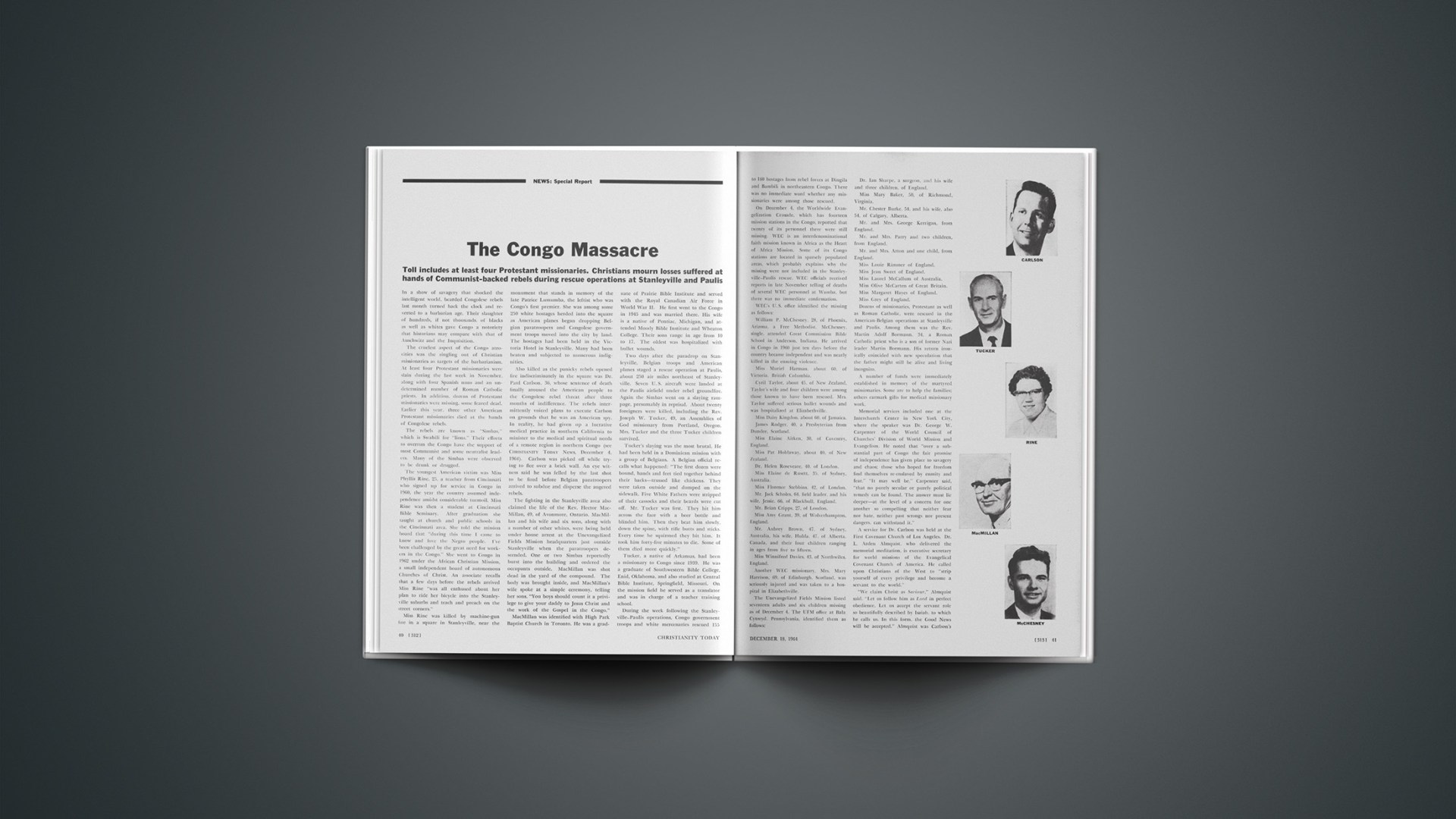
The youngest American victim was Miss Phyllis Rine, 25, a teacher from Cincinnati who signed up for service in Congo in 1960, the year the country assumed independence amidst considerable turmoil. Miss Rine was then a student at Cincinnati Bible Seminary. After graduation she taught at church and public schools in the Cincinnati area. She told the mission board that “during this time I came to know and love the Negro people. I’ve been challenged by the great need for workers in the Congo.” She went to Congo in 1962 under the African Christian Mission, a small independent board of autonomous Churches of Christ. An associate recalls that a few days before the rebels arrived Miss Rine “was all enthused about her plan to ride her bicycle into the Stanleyville suburbs and teach and preach on the street corners.”

Miss Rine was killed by machine-gun fire in a square in Stanleyville, near the monument that stands in memory of the late Patrice Lumumba, the leftist who was Congo’s first premier. She was among some 250 white hostages herded into the square as American planes began dropping Belgian paratroopers and Congolese government troops moved into the city by land. The hostages had been held in the Victoria Hotel in Stanleyville. Many had been beaten and subjected to numerous indignities.

Also killed as the panicky rebels opened fire indiscriminately in the square was Dr. Paul Carlson. 36, whose sentence of death finally aroused the American people to the Congolese rebel threat after three months of indifference. The rebels intermittently voiced plans to execute Carlson on grounds that he was an American spy. In reality, he had given up a lucrative medical practice in southern California to minister to the medical and spiritual needs of a remote region in northern Congo (see CHRISTIANITY TODAY News, December 4, 1964). Carlson was picked off while trying to flee over a brick wall. An eye witness said he was felled by the last shot to be fired before Belgian paratroopers arrived to subdue and disperse the angered rebels.

The fighting in the Stanleyville area also claimed the life of the Rev. Hector MacMillan, 49, of Avonmore, Ontario. MacMillan and his wife and six sons, along with a number of other whites, were being held under house arrest at the Unevangelized Fields Mission headquarters just outside Stanleyville when the paratroopers descended. One or two Simbas reportedly burst into the building and ordered the occupants outside. MacMillan was shot dead in the yard of the compound. The body was brought inside, and MacMillan’s wife spoke at a simple ceremony, telling her sons, “You boys should count it a privilege to give your daddy to Jesus Christ and the work of the Gospel in the Congo.”

MacMillan was identified with High Park Baptist Church in Toronto. He was a graduate of Prairie Bible Institute and served with the Royal Canadian Air Force in World War II. He first went to the Congo in 1945 and was married there. His wife is a native of Pontiac, Michigan, and attended Moody Bible Institute and Wheaton College. Their sons range in age from 10 to 17. The oldest was hospitalized with bullet wounds.

Two days after the paradrop on Stanleyville, Belgian troops and American planes staged a rescue operation at Paulis, about 250 air miles northeast of Stanleyville. Seven U. S. aircraft were landed at the Paulis airfield under rebel groundfire. Again the Simbas went on a slaying rampage, presumably in reprisal. About twenty foreigners were killed, including the Rev. Joseph W. Tucker, 49, an Assemblies of God missionary from Portland, Oregon. Mrs. Tucker and the three Tucker children survived.

Tucker’s slaying was the most brutal. He had been held in a Dominican mission with a group of Belgians. A Belgian official recalls what happened: “The first dozen were bound, hands and feet tied together behind their backs—trussed like chickens. They were taken outside and dumped on the sidewalk. Five White Fathers were stripped of their cassocks and their beards were cut off. Mr. Tucker was first. They hit him across the face with a beer bottle and blinded him. Then they beat him slowly, down the spine, with rifle butts and sticks. Every time he squirmed they hit him. It took him forty-five minutes to die. Some of them died more quickly.”

Tucker, a native of Arkansas, had been a missionary to Congo since 1939. He was a graduate of Southwestern Bible College, Enid, Oklahoma, and also studied at Central Bible Institute, Springfield, Missouri. On the mission field he served as a translator and was in charge of a teacher training school.

During the week following the Stanleyville—Paulis operations, Congo government troops and white mercenaries rescued 155 to 160 hostages from rebel forces at Dingila and Bambili in northeastern Congo. There was no immediate word whether any missionaries were among those rescued.

On December 4, the Worldwide Evangelization Crusade, which has fourteen mission stations in the Congo, reported that twenty of its personnel there were still missing. WEC is an interdenominational faith mission known in Africa as the Heart of Africa Mission. Some of its Congo stations are located in sparsely populated areas, which probably explains why the missing were not included in the Stanleyville—Paulis rescue. WEC officials received reports in late November telling of deaths of several WEC personnel at Wamba, but there was no immediate confirmation.

William P. McChesney, 28, of Phoenix, Arizona, a Free Methodist. McChesney, single, attended Great Commission Bible School in Anderson. Indiana. He arrived in Congo in 1960 just ten days before the country became independent and was nearly killed in the ensuing violence.

Miss Muriel Harman, about 60, of Victoria. British Columbia.

Cyril Taylor, about 45, of New Zealand. Taylor’s wife and four children were among those known to have been rescued. Mrs. Taylor suffered serious bullet wounds and was hospitalized at Elizabethville.

Miss Daisy Kingdon, about 60, of Jamaica.

James Rodger, 40, a Presbyterian from Dundee, Scotland.

Miss Elaine Aitken, 30, of Coventry, England.

Miss Pat Holdaway, about 40, of New Zealand.

Dr. Helen Roseveare, 40, of London.

Miss Elaine de Rusett, 35, of Sydney, Australia.

Miss Florence Stebbins, 42, of London.

Mr. Jack Scholes, 64, field leader, and his wife, Jessie, 66, of Blackbull, England.

Mr. Brian Cripps, 27, of London.

Miss Amy Grant, 39, of Wolverhampton, England.

Mr. Aubrey Brown, 47, of Sydney, Australia, his wife, Hulda, 47, of Alberta, Canada, and their four children ranging in ages from five to fifteen.

Miss Winnifred Davies, 43, of Northwiles, England.

Another WEC missionary, Mrs. Mary Harrison, 69, of Edinburgh, Scotland, was seriously injured and was taken to a hospital in Elizabethville.

The Unevangelized Fields Mission listed seventeen adults and six children missing as of December 4. The UFM office at Bala Cynwyd, Pennsylvania, identified them as follows:

Dr. Ian Sharpe, a surgeon, and his wife and three children, of England.

Miss Mary Baker, 50, of Richmond, Virginia.

Mr. Chester Burke, 54, and his wife, also 54, of Calgary, Alberta.

Mr. and Mrs. George Kerrigan, from England.

Mr. and Mrs. Parry and two children, from England.

Mr. and Mrs. Arton and one child, from England.

Miss Louie Rimmer of England.

Miss Jean Sweet of England.

Miss Laurel McCallum of Australia.

Miss Olive McCarten of Great Britain.

Miss Margaret Hayes of England.

Miss Grey of England.

Dozens of missionaries, Protestant as well as Roman Catholic, were rescued in the American-Belgian operations at Stanleyville and Paulis. Among them was the Rev. Martin Adolf Bormann, 34, a Roman Catholic priest who is a son of former Nazi leader Martin Bormann. His return ironically coincided with new speculation that the father might still be alive and living incognito.

A number of funds were immediately established in memory of the martyred missionaries. Some are to help the families; others earmark gifts for medical missionary work.

Memorial services included one at the Interchurch Center in New York City, where the speaker was Dr. George W. Carpenter of the World Council of Churches’ Division of World Mission and Evangelism. He noted that “over a substantial part of Congo the fair promise of independence has given place to savagery and chaos; those who hoped for freedom find themselves re-enslaved by enmity and fear.” “It may well be,” Carpenter said, “that no purely secular or purely political remedy can be found. The answer must lie deeper—at the level of a concern for one another so compelling that neither fear nor hate, neither past wrongs nor present dangers, can withstand it.”

A service for Dr. Carlson was held at the First Covenant Church of Los Angeles. Dr. L. Arden Almquist, who delivered the memorial meditation, is executive secretary for world missions of the Evangelical Covenant Church of America. He called upon Christians of the West to “strip yourself of every privilege and become a servant to the world.”

“We claim Christ as Saviour,” Almquist said. “Let us follow him as Lord in perfect obedience. Let us accept the servant role so beautifully described by Isaiah, to which he calls us. In this form, the Good News will be accepted.” Almquist was Carlson’s predecessor at the missionary hospital in Wasolo. Carlson was buried at Karawa.

Christians around the world voiced public sorrow for the slain missionaries and uttered prayers for the surviving relatives. Dr. Oswald Smith of Peoples Church in Toronto, which helped to support MacMillan, predicted that the apparent tragedy will “raise up a great deal more prayer for the missionary endeavor.” He said he also expected that it will cause more young people to “rise to the challenge” of missionary service.

The Rev. Theodore Tucker, African affairs specialist for the National Council of Churches, declared that the most serious effect of the Congo massacre will be from the loss of educated community leaders in that part of the country hit by the Simbas. He cited reports which indicated that the nationalist elite upon whom responsible local government must rely have been all but wiped out.

Four Canadian nuns rescued from Stanleyville said that many of the weapons used by the Congolese rebels are of Chinese Communist origin.

The nuns described their ordeal of imprisonment by the rebels upon returning to Montreal. In Stanleyville, one said, “we were thrown into jail. At one time we were taken outside and beaten with sticks and clubs. Many of the rebels were drugged. We found out later they were given narcotics by their leaders.”

Another nun described “a letter that never came.” It was sent from her order’s mother general—the nuns are members of the Daughters of Wisdom—in Rome to Stanleyville in August, instructing all the order’s sisters to leave. It was never delivered.

African Apprehensions

President Kenneth D. Kaunda of Zambia, born and raised in a Presbyterian mission, told U. S. reporters this month that the American-Belgian rescue operation in Congo “makes us a bit apprehensive.” He suggested that it may have set an undesirable precedent.

Kaunda spoke at the National Press Club in Washington during a brief, informal visit to the United States. He voiced doubts that the Congo hostages would have been killed if the operation had not been ordered.

Asked about the future of missionary work in Africa, Kaunda said, “There is a future for those religious groups who want to serve man.” Those who interfere, he added, “will be thrown out, be they black, white, yellow, green, or blue.”

The Zambian leader, father of nine children, was introduced as a practicing Christian whose favorite book is the Bible. He said, however, that he advocated more cooperation among Hindus, Muslims, and Christians. Christian groups in Africa need to bring local men into higher positions in the church, he added.

Kaunda’s parents taught at a mission operated by the Church of Scotland, and Kaunda himself has been a teacher at Christian missions. His father died when he was eight.

A Prime Minister’S Plea

Congolese Prime Minister Moise Tshombe, a Methodist layman, recently issued a call to prayer while speaking in a Protestant church at Leopoldville. An account of his remarks was reported in Congo Mission News and quoted by American Baptist News Service.

“Every Christian is strengthened and encouraged when he knows that other Christians are bearing him up,” said Tshombe. “For one can be endowed with intelligence and strength and have control of the army and the police, but if the Christian faith is not a living force among the people, nothing will be achieved.”

The Congolese leader added that “I will not be able to achieve anything, and you cannot hope for any concrete or encouraging results, if God does not work with me.”

“I would like to invite all the Christians of this country to think of the Congo, this unhappy land whose sons have been fighting and killing one another for the past four years. We shall get nowhere unless there is true and honest reconciliation. We must remember the words of Jesus Christ, ‘Love one another.’ There is only one force which can help ns and that is the Divine Force. I beg you to pray for the Congo. Our country needs this strength, this Divine Force. And we Christians must be aware of our responsibility because we have a strength which others do not possess.”

“I am proud,” Tshombe concluded, “to be among my real brothers for I too am a Christian. You must not think of me as Prime Minister, but as your infant, your child whom you must nurture. Every child needs milk to grow. I too need that milk—your prayers.”

No Room For Complacency

Analysis of 1964 fall enrollment figures of the 127 accredited Protestant seminaries in the United States and Canada fails to turn up any encouraging trends for denominations faced with shortages of qualified clergymen.

Dr. Charles L. Taylor, executive director of the American Association of Theological Schools, issued this statement:

“Although the number in our member schools is the highest that it has ever been except in 1959, when it reached 21,088, the addition of four new schools with 583 students to membership in 1963–64 means that for the other 123 schools there was a net loss rather than gain.”

“Moreover,” Taylor declared, “the numbers in the entering class in 1963 (5,769) and 1964 (5,596) show a progressive decline from 1962 (5,868) which will affect enrollments in the next two years.”

He added that “persons enrolled as candidates for the graduate type of degrees S.T.M., Th.D., Ph.D., and so on) show a noticeable increase, which means that they are counted for more years and that their present interest in the parish ministry is presumably less.

He pointed to a decline in the percentage of students in the B. D. program over the past five years.

The 1964 fall enrollment in the 127 accredited seminaries totaled 21,025, as reported by the AATS, which is the recognized accrediting agency for Protestant theological schools in the United States and Canada.

Southern Baptists, meanwhile, reported a record net enrollment of 62,000 seminaries, colleges, academies, and Bible schools. The total showed an increase of 4,391 over 1963. All categories of educational institutions showed gains except seminaries. Total Southern Baptist seminary enrollment fell off from 4,278 in 1963 to 4181 this year.

Only one of the six Southern Baptist seminaries showed an enrollment increase. Southern Baptist Theological Seminary at Louisville went from 817 students to 860. Biggest jump was in the seminary’s school of religious education (Missouri Synod Lutheran totals also recorded a rise in the number of enrollments for teaching careers).

The Lutheran Church—Missouri Synod reported a slight increase in seminary enrollment over 1963, from 1,003 to 1,015.

First Choice

Trustees of Northern Baptist Theological Seminary ended their year-long search for a president last month with the appointment of Dr. Bryan F. Archibald, an American Baptist clergymen who has held pastorates in Massachusetts, Maryland, and New Jersey.

A seminary spokesman said the trustees acted upon the first recommendation of a presidential search committee in summoning Archibald. He is described as “coming after a thorough consideration of Northern’s historic position in the mainstream of evangelical Christianity.… He is in full sympathy with Northern’s emphasis upon preparation for a biblical and evangelistic ministry.”

Archibald has been pastor of the First Baptist Church of Haddonfield, New Jersey, since April, 1963. Prior to then he served for six and a half years as pastor of Chevy Chase (Maryland) Baptist Church.

When he assumes office on January 1, Archibald will become the sixth president of the fifty-year-old seminary, which formerly was located in Chicago but is now in a suburban area west of the city. He succeeds Dr. Benjamin P. Browne, who retired on September 1.

Archibald is a graduate of Nova Scotia’s Acadia University and Colgate Rochester Divinity School. He holds a Ph. D. in philosophy from Boston University. Interestingly, two other American Baptist seminary presidents have Canadian educational backgrounds: Dr. Thomas P. McDormand of Eastern Baptist Seminary and Dr. Robert J. Arnott of Berkeley Baptist Divinity School.

While in the Washington area, Archibald was chairman of the Baptist Joint Committee on Public Affairs and a director of the local council of churches.

Aiding Relocation

Spokesmen for the Near East School of Theology at Beirut, Lebanon, say that sufficient funds have been secured to enable the school to relocate in the vicinity of the American University of Beirut.

The Theological Education Fund allocated the school $90,000 last year, conditional upon the securing of an additional $200,000 from other sources and continued progress in plans of the school to improve its academic program. Dr. Hovhannes P. Aharonian, head of the Near East School of Theology since 1959, has announced that the $200,000 has been advanced and that the school has appointed Dr. Theodore C. Vriezen, professor of Old Testament at the University of Utrecht, as its director of higher studies.

The newly available funds, raised by the United Presbyterian Commission on Ecumenical Mission and Relations and the United Church Board for World Ministries, in addition to the TEF, will purchase the desired property and will enable erection of a supplementary building.

End Of The Road

For some time concern has been felt by evangelical clergy about what one of them described as the Church of England’s “present drift towards a thoroughly unreformed position.” One weekend last month a double illustration appeared to increase their fears. The press reported that a sixteen-year-old Yorkshire girl had been excluded from a Confirmation class by the local incumbent after she had refused to “make her confession.”

At the same time newspapers and radio were announcing the resignation from the ministry of the Church of England of the Rev. Herbert M. Carson, vicar of St. Paul’s, Cambridge, and a former traveling secretary of the Inter-Varsity movement. Three major reasons prompted his decision. Pledged to use only the Book of Common Prayer and no other in public worship (an ordinance regularly ignored by some), Mr. Carson had come to regard this as bondage of the spirit.

His second problem was linked with the established nature of his church. “I came to believe from my study of Scripture,” he writes in his December parish magazine, “that the whole idea of a state church with parliament as the final arbiter was utterly unbiblical.”

Mr. Carson went on to describe what this meant at parish level. It compelled him to marry couples who had not been to church for years and had no intention of coming—and to do so in a service that treated them as Christians. At funerals he had to utter words about the certain hope of eternal life—“it is a mockery to use them over one who has lived his whole life in neglect or even rejection of the Gospel.… Every time I take such a service I am tending to immunize people against the Gospel.”

The most important problem, however, was that of baptismal regeneration and the demolition of his arguments for infant baptism, leading him to the conviction that New Testament baptism is an ordinance for believers. “The end of the road had come.” declared Mr. Carson. “I could not with any honesty remain outwardly an ordained clergyman of the Church of England while at heart dissenting from her basic position.”

Graduate of Trinity College, Dublin, and a well-known evangelical writer and speaker, Mr. Carson, who is 41 and is married with four children, has given the statutory three months’ notice to his bishop. He has no plans for the future. Last summer another evangelical clergyman, the Rev. G. E. Lane, resigned from his London parish on substantially the same grounds as those outlined by Mr. Carson.

J. D. DOUGLAS

Advance In Adversity

Christian churches in strife-torn Viet Nam are growing. Even though the war has brought extreme adversity, five new church buildings are now under construction.

This is the report brought back to the United States by Dr. Kenneth C. Fraser of Pittsburgh, vice-president of the Christian and Missionary Alliance.

Upon his return from a two-month world tour of Alliance missions, including an entire month spent in Viet Nam, Dr. Fraser said he was deeply impressed with the dedication of the Vietnamese Christians.

“In spite of all this difficulty and danger,” he said, “many of the churches are growing. Among the five new buildings under construction is the American church in Saigon.”

The Rev. Gordon M. Cathey, who was once an assistant pastor under Dr. Fraser, is now minister of the Saigon church. It and a small Anglican church are the only ones whose services are conducted in English in Saigon. The Alliance church, dedicated last month, seeks to attract worshipers from among the 30,000 American servicemen and civilians now in the country.

“This church maintains a very strong youth program for university students,” Dr. Fraser reported. “The Alliance church in Viet Nam is a national autonomous church with radio ministries, Bible schools, seminaries, and literature programs. They invited me over to send forth their first missionaries to Laos and Thailand.”

Dr. Fraser spoke at five pastoral conferences throughout South Viet Nam, preaching from one to four times each day. “One pastor,” he said, “came to a conference from a hospital. A Viet Cong rebel had thrown a paper-covered hand-made bomb under a passing car. Nine persons, including the soldier himself, were killed. The pastor’s hands had been paralyzed.”

Destructive storms in recent weeks have added to the misery of Vietnamese Christians. A typhoon in September destroyed at least one church and damaged a number of others. Last month, heavy flooding caused additional damage.

The Alliance has 333 churches in Viet Nam with 65,000 members and 124 North American missionaries.

ROBERT SCHWARTZ

Quebec In Transition

Is that Martin Luther or the Devil groveling on the ground, held down at the neck by the powerful foot of Ignatius Loyola?

Opinions vary on a large statue of this description, now snow-covered in the fierce winter of Quebec City. If it depicts the Reformer, not the Deformer, it represents the ghost of Quebec past, somewhat as the new Canadian flag that Prime Minister Lester Pearson has promised as a Christmas present represents the ghost of Quebec present.

The present flag, a British Union Jack, peeves French Quebeckers, who are reasserting their cultural distinctiveness and winning new concessions. Radicals among the French want Quebec Province to secede and become a separate state.

The statue in front of Manrese, a Jesuit retreat house on Chemin Ste-Foy, was a product of a previous time of isolationism.1The statue is a duplicate of one at the Church of the Jesu in Rome. Details on its history are obscure. Conversations with many Jesuits at Manrese and other institutions failed to establish what the sculptor had in mind, but the priests all said they think of the prone figure as the Devil.

Protestants who call it “the Martin Luther statue” have some basis. Crawling around the loser in the metallic statuary struggle is a serpent, which could be the Devil as a separate personality in league with Luther. The cringing man has a Germanic cast, and that book he’s clutching looks suspiciously like the Bible.

“It’s supposed to be Luther all right, or else Luther in the Devil’s guise,” said Dr. John MacKay, a United Church of Canada minister in the city for two decades. “It’s regarded as a joke by both Protestants and Catholics,” he said, an anachronism in the light of improved interfaith relations.

Father Alfred Morisette, an American who lives at Manrese and studies French at Laval University, said that he had always understood Loyola’s foe to be the Devil, but that if it was meant to be Luther, the statue must be viewed “from the historical perspective of 300 years.”

In historic Quebec, he continued, “there was only one church, and the priests, as the learned segment of the population, were very strong. Artisans would be tempted to construe anything non-Catholic in a bad light.… It was the atmosphere of a simple, agricultural people.…”

Despite the ecumenical liberality of Montreal’s Cardinal Leger, such religious isolationism still exists at the grass-roots level.

The Rev. Jean Cruvellier, a scholarly European immigrant who leads a group of French Presbyterians, was surprised at the comments from Catholic laymen after he conducted a Week of Unity service this year: “You read the Apostles’ Creed! Do you Protestants believe that?” or “I didn’t realize you spoke so much about God!”

A Protestant who recently held a meeting with Catholics a short distance from the city said it was broken up by a rock-throwing gang directed by a priest.

However, MacKay said “the feeling is very fine” between the faiths in the city, and Cruvellier was allowed to hold Protestant services for Americans and English Canadians this summer at Laval, a nominally Catholic school (and a headquarters for separatism).

Both priests and ministers agreed the political separatists have nothing to do with Catholicism. The Rev. N. D. Pilcher, an Anglican who is president of the Quebec Ministerial Association, said, “Separatism is not a religious movement, and it is not anti-Protestant. The separatists, in fact, are often anti-church (Catholic), which is not in the traditional pattern of French Canadiens.”

Pilcher said the several thousand Protestants among the 350,000 persons in the Quebec area are “in a very privileged position as a minority. I don’t know what the future will be.”

Protestants are limited in such activities as street meetings, but they have the benefit of a national Supreme Court ruling on a Jehovah’s Witness case that ensures door-to-door sale of religious material without a peddler’s license.

An evangelical leader who didn’t want his name published said he would “expect less liberty to spread the word of God” in a separate Quebec. He also considered separation more conceivable than most Protestants: “There is a good chance it could happen.”

MacKay said, “I don’t consider separatism a tremendous movement. We have understood Quebec over the years, and I don’t think it will have any appreciable effect. The real movement is toward more recognition of French-speaking culture, and I’m in favor of this.”

It is doubtful that Mr. Pearson’s flag, derided as a “Boy Scout banner” by some of British ancestry, will alone pacify Quebec. There is still the perennial irritant that the British Parliament has a veto power over changes in the Canadian constitution. Ironically, suspicious Quebec leaders are afraid of what the other nine provinces themselves would do to provincial rights, and a compromise has proved elusive for years. Although the country’s dollar bills are bilingual, they are still graced by Queen Elizabeth and, in both business and private life, are passed by more British hands than population statistics would warrant.

In the uneasy accommodation ahead, the two distinct cultures will either be split further or come to a new appreciation of each other. The same choice may be facing the two religious traditions.

DICK OSTLING

Book Briefs: December 18, 1964

The Synoptic Problem: A Critical Analysis, by William R. Farmer (Macmillan, 1964, 308 pp., $10), is reviewed by John H. Ludlum, minister, The Community Church on Hudson Avenue (Reformed Church in America), Englewood, New Jersey.

Dr. Farmer’s knowledge makes him the world’s leading authority on modern criticism of the Synoptic Gospels. The first five chapters of his book comprise one of the most Herculean labors of digging out knowledge in the annals of scholarship. This reviewer can independently attest the solidness of the results. When knowledge is lacking, reasoning can only darken counsel by words without knowledge. Dr. Farmer’s reasoning, being founded on his superior acquisition of information, compares favorably with any we have seen.

Librarians will wish to obtain this work because it contains information on the origin and development of critical science nowhere else available. It has masses of new factual information. Much that had been forgotten or lost with damaging consequences has been recovered and set forth in a new light. The book is a library in itself. Future study will center around it as scholars oppose or embrace its conclusions and suggestions.

Dr. Farmer’s examination of the history of modern gospel criticism demonstrates that the two-document theory (priority of Mark and existence of “Q”) at no time had a valid foundation, and that the scholarly consensus favoring it was always an illusion. Indisputable facts—knowledge—make these things clear and leave the two-document theory as discredited as the Piltdown Man.

Teachers in seminaries and colleges will wish to get this book and decide how they are going to answer it, before their students and faculty colleagues begin using it to tear them to shreds! On guard! Much can be saved by jumping off a sinking ship quickly! Everything in Synoptic criticism has been rendered uncertain. Gospel studies may now enjoy an academic field day in this newly created vacuum as grand as that which the Dead Sea discoveries made possible. New interpretations can be proposed and contended for once more. Glory beckons! Fear not! All the lions are lying on The field—dead!

As a sociological study this book poses a good question: namely, how was it possible for so many to have been so wrong about so much so often and for so long, while the whole world stood hailing them as great scholars? Dr. Farmer has demonstrated the reality of this particular blind-leading-blind parade and has offered excellent answers for learned men to take to heart. He is to be congratulated for having so often called a spade a spade.

In chapters 6 and 7, Dr. Farmer proposes a solution of the Synoptic problem; but he does so without first vindicating a right to offer the kind of answer he suggests. A whole chapter is missing between chapters 5 and 6. It is first necessary to make out a convincing case against the authenticity of Matthew, Mark, and Luke, before one has a right to assume that unknown editors in the second and third Christian generations picked up a mass of traditions full of fiction and myths and wove them together into our Matthew, Mark, and Luke. Dr. Farmer has reduced to ashes everything that was thought to disprove the authenticity of these Gospels. Hence, nobody, himself included, can have any right to use form-critical principles and evolutionary assumptions until he has first vindicated a right to use them by establishing a new, convincing case against the genuineness of these documents.

Dr. Farmer’s suggestions are thought-provoking. He avowedly strives to re-establish Griesbach’s theory that Mark was written last. His arguments convinced this reviewer that Mark was written second, rather than last. This suggests the shape of things to come. The result of overthrowing the two-document theory is to leave uncontested the claim that Matthew was written first. This forces future debate to deal with a simple question, namely, whether Luke was second and Mark third, or Mark second and Luke third. The next great battle of the books will fight out this issue. Cases for each view will be forged out and expressed as cogently as possible, and will be attacked violently. Griesbach’s theory will receive a second look and a new sifting. More important still, the idea that Mark was second, which has never yet been strongly stated or fairly tried, will be defined and sifted. The more these two views are argued the better, because the question, thus narrowed, is well on its way to final settlement.

Before this reviewer assumes that Matthew, Mark, and Luke are not authentic, and before he uses lines of reasoning based on such an assumption, he is going to insist on seeing a convincing argument for this. It is written: Show me first your penny! The “penny” he will insist on seeing is that missing chapter that was mentioned. He hopes that others will see the necessity for insisting on seeing the same penny. After all, it is only a matter of the most elementary fairness to the Gospels, and of scholarly integrity in not prejudging the only important questions at issue in this whole business! Others may not see this; he does. Why should he put out his eyes?

The People’S Theologian

John Wesley, edited by Albert C. Outler, from “A Library of Protestant Thought” series (Oxford, 1964, 516 pp., $7.50), is reviewed by John Lawson, associate professor of church history, Candler School of Theology, Emory University, Atlanta, Georgia.

This magnificent book, which I have read with great admiration, is a collection of substantial extracts from Wesley’s Journal, Sermons, “Minutes,” Letters, and Treatises, arranged with short but very discerning and scholarly introductions by the editor. The whole is an account of the background and development of Wesley’s thought, and of his position on saving faith, justification, assurance, holiness, and the Church and sacraments. A final section entitled “Theologies in Conflict” shows with what care Wesley repelled the menace of quietism and antinomianism.

The first thing we observe, as Dr. Outler well points out on page 119, is that John Wesley was “by talent and intent a folk-theologian.” His care is not for systematic theology as such but for the spiritual welfare and discipline of his Societies. These writings are all addressed to practical situations. In this Wesley is an essential Englishman, for this has ever been the characteristic method of English Christianity. The Church of England has been adorned by many scholars, but her ideal has always been an educated ministry rather than a learned ministry. Her memorable writings have been her liturgy, and works of devotion, polity, pastoralia, and sermons. My country has never found the inclination to produce an “Institutes of the Christian Religion.” Wesley is decidedly in this track!

The alternative method, characteristic of academic Continental theologians, is devastatingly illustrated today. Since the Reformation this has been to take up a stimulating new idea, express it in an extreme form, make a system out of it, found a school of thought, and stir up doctrinal controversy. These writers naturally fill the pages of textbooks of historical theology and steal all the limelight today! We need to be reminded by a man like Wesley that extreme Christian positions are usually partial and erroneous, and that the everlasting question for the truly judicious theologian, as for the wise preacher, is not “Is it new?” but “Is it true?”

Dr. Outler’s judicious and representative selections and his own notes raise the question: “Was Wesley, the folk-theologian, a Christian thinker?” In the judgment of the present reviewer, at least, the “Arminian evangelicalism” of the Wesleyan movement was a liberating doctrinal synthesis, which since Wesley’s time has been immensely influential in the Church. In this sense Wesley is a Christian thinker. Yet we judge that this doctrine, the leading heritage of Methodism, was not new. It is a strong doctrine of sin and of salvation by grace; yet it is shorn of Augustinian speculation. This is a return to the early patristic position.

Dr. Outler brings this point out in another way. We may ask: “Was Wesley a Protestant thinker?” Certainly he was, but not altogether a Protestant like the classic Protestants. Insofar as the Church of England is both Catholic and Protestant and contains elements derived from Luther and Calvin, the great Reformers have an influence on Wesley. Yet it is only this indirect one. The formative influence upon him was the Church of England, hanging upon the threefold cord of Scripture, the tradition of the ancient and undivided Church, and reason. Thus his doctrine of holiness was largely inspired by the ancient Fathers. His main practical interest in Luther’s writings was to guard some passages from being misunderstood in a quietist sense, while his controversy with what often passed in those times as “Calvinism” was to guard the faith still more abundantly against “Satan’s masterpiece” of antinomianism.

This splendid book reveals the authentic Wesley—the old-school high-church man turned evangelist. It will be read with great profit by all evangelicals, Methodist and non-Methodist.

JOHN LAWSON

No Substitute For Holiness

The Paul Report Considered: Thirteen Studies, edited by G. E. Duffield (Marcham Manor Press, 1964, 94 pp., 7s. 6d.), is reviewed by R. Peter Johnston, vicar of Islington and president of the Islington Clerical Conference, London, England.

In July, 1960, a motion was made in the Church Assembly of the Church of England “that a Commission be appointed to consider, in the light of changing circumstances, the system of the payment and deployment of the clergy, and to make recommendations.” After a vigorous debate this proposal was approved, except that the task was assigned to the newly reconstituted Central Advisory Council for the Ministry (CACTM). Mr. Leslie Paul, a distinguished author and sociologist, was appointed to carry out a fact-finding inquiry and to submit a report. In November, 1963, this report was published.

A preliminary “Study of the Paul Report” was submitted to the Church Assembly in February of this year. In a packed house a full and at times heated debate took place. The value of the survey of the present situation in the Church of England that Mr. Paul had presented was readily acknowledged; but many of the conclusions he had drawn were challenged. It was obvious that, although some enthusiastically welcomed the report and saw in its recommendations (there are sixty-two of them!) the solution for all our ills, there were many who considered that some of the suggested reforms would be disastrous for the spiritual life of both the church and the nation.

In The Paul Report Considered we have a series of appraisals from people of differing backgrounds and churchmanship, all of whom have made their mark in their several spheres. The thirteen contributors vary in their reactions. Some are violently antagonistic to the report. Dr. Margaret Hewitt makes some stringent criticisms as a sociologist. Mr. Bulmer Thomas claims that “the diagnosis is wrong and the remedy would kill the patient.”

Canon Davies severely criticizes the abolition of the present system of patronage (by which the choice of a minister is not made by the congregation), which is advocated by Mr. Paul. In place of this system the report recommends that staffing boards be set up on a regional basis with a central directorate to act as a planning body. But, points out Canon Davies, “the chief danger of any general policy for patronage in England would lie in its encouragement of an accommodating type of incumbent, afraid of being conspicuous by not ‘toeing the current line.’ Those with strong convictions, and the more vigorous personalities, would be regarded as dangerous, and be placed in positions where they could do little harm.” Bishop Barry warmly welcomes “Mr. Paul’s proposal to abolish the stubborn, invidious distinction between the beneficed clergy and the unbeneficed, and put them all on the same financial basis.” Yet concerning patronage he says: “I hope this group of proposals will be dropped.”

Both Dr. Hewitt and the Rev. Edgar Stride (vicar of a large industrial parish) point out that a major flaw in Mr. Paul’s report is his almost complete ignoring of the existence of other Christian bodies, especially the free churches. In discussing the deployment of the clergy he seems to think that there are no ministers outside the Anglican church.

Richard Allen has some salutary things to say in his chapter on team and group ministries. He pinpoints some of the difficulties and warns us that the report “is not a panacea for all ecclesiastical ills: empty churches will not fill overnight, money will not flow to the coffers.”

As in any symposium, the contributions are of varying value. But the book is very useful and clearly sets before us the danger of blindly accepting all the recommendations made by Mr. Leslie Paul. Far more important than any attempt at reorganization is the need for spiritual renewal.

In the opening chapter, the Bishop of Pontefract puts it thus: “The fundamental problem confronting the Church of England is for the increase in holiness of her ministry, and through the ministry, the whole people of God, that the Church may the better manifest the love of God. Payment and deployment need not be incompatible with this, but God forbid that they should ever come to be thought of as substitutes for the deeper qualities of the spiritual life of the Church.”

R. PETER JOHNSTON

There Ought To Be A Law

Ethics and Science, by Henry Margenau (Van Nostrand, 1964, 302 pp., $7.50), is reviewed by Gordon H. Clark, professor of philosophy, Butler University, Indianapolis, Indiana.

Dr. Margenau, competent author of The Nature of Physical Reality and with Lindsay of Foundations of Physics, attempts here to provide a scientific basis for ethics. The first chapter presupposes a fair knowledge of the earlier books and is not designed for beginners.

After this account of the nature of postulation in physics, Margenau argues that the same general procedure can be used to solve the problems of ethics. This, in his opinion, is not to say that norms or the concept of “ought” can be derived from what “is.” Ethics cannot be reduced to physics, but it has the same structure.

Postulates in physics are tentative: the scientist must always be ready to revise them. So too the norms of ethics: there are no norms applicable to all men at all times. Each is to be used so long as it works.

This means of course that ethics is not based on religion. There may be connections between them, or there may be none. Either way, “ethics can stand on its own feet” (p. 149).

Margenau’s observations on religion lead one to doubt that his competence in physics has been transferred to this different field. For one thing, he dates Hammurabi a thousand years after Moses, and Zoroaster a thousand years after Hammurabi (p. 153). Similarly questionable are both his history and his argument that hedonism is refuted by the fact that Moses and Martin Luther were ascetics. He also seizes upon First Corinthians 13 as the sum of Christian morality, ignores the rest of the New Testament, and then complains that love is insufficient for the elaboration of an ethical system (pp. 242–47).

What seems to be a serious flaw in his ethics is his assertion that ethical conflicts are infrequent and unimportant (pp. 266 ff.); that Western democracy and Russian Communism share the same values; that the different values postulated by Hitler did not work since he was defeated, whereas the defeat of ethical nations by brutal conquerors does not invalidate their ideals.

In any case, even if there are fundamental conflicts in ethics, it means no more than the existence of conflicting geometries. “It makes little difference whether you choose as the source of your imperatives the Sermon on the Mount, the Koran, the Analects of Confucius, the eightfold path of the Buddha, or the Tao” (p. 293). And “behavior can differ intrinsically among people because of different choices of imperatives and primary values. There is no obvious reason to suppose that several of these, which differ to the point of contradiction, may not be validated in human living. If this is true, there are several sets of ‘oughts’ between which there can be no reconciliation” (p. 284).

Such is his scientific solution to the problems of ethics.

GORDON H. CLARK

The Wheat And The Chaff

Inspiration of Scripture, by Hugh Martin and R. Bremner (Free Presbyterian Church of Scotland, Publications Committee, 1964, 219 pp., 21s.), is reviewed by Murdo A. MacLeod, minister, Free Church of Scotland, London.

If the writer of Ecclesiastes were living today, he might have altered his famous remark on the making of books to read, “Of the reissuing of books there is no end.” The eras most favored for this treatment are the Puritan and the Victorian. In reviewing another such reissue, one may be forgiven for making a general criticism of this trend by reissuing the wise words of a writer of the same period: “The literature of one century, whether sacred or profane, will not, when served up in the lump, satisfy the craving and sustain the life of another. The nineteenth [now read, the twentieth] century must produce its own literature, as it raises its own corn, and fabricates its own garments. The intellectual and spiritual treasures of the past should indeed be reverently preserved and used; but they should be used as seed.”

Of the 219 pages in the present volume, only 30 are really worthy of resurrection; these are the section containing Martin’s original booklet, “The Westminster Doctrine.” Here we have the doctrine of the Confession of Faith clearly and cogently set out. Its teaching is first guarded against misapprehension, and then the line of proof is briefly indicated. Martin states that his purpose is not to compose a treatise but merely to give some hints. Within these limits the discussion still has its value and is well worth the attention of all who wish to know what the Westminster Confession teaches, and what it does not.

Without doubt there is much that is profitable in the rest of the volume; but it is so immersed in “old forgotten far-off things, and battles long ago” that to sift the wheat from the chaff of the historical controversy is more than the labor may be worth.

MURDO A. MACLEOD

Theology In The University

Theology and the University, edited by John Coulson (Helicon, 1964, 286 pp., $4.95), is reviewed by Calvin D. Linton, dean, College of Arts and Sciences, George Washington University, Washington, D. C.

Higher education has come—or gone—a long way since the term universitas denoted an association of students, later joined by a company of masters, in Bologna and Paris in the thirteenth century. Everyone is aware of the central, even dominating, place of theology in the medieval universities; but not everyone remembers that the universities maintained some degree of academic authority of their own, as symbolized in the movement of students in Paris to the rive gauche to avoid the jurisdiction of the Chancellor of the Cathedral, a movement carrying the support of Pope Gregory IX.

From that day to this, the place of theology in the colleges and universities of Europe and America (with the exception of the Roman Catholic institutions) has dwindled until, in the minds of many, a department of religion is seen as almost an anachronism in a modern, secular, scientifically oriented university. The change is, of course, matched by an equal secularization of life at large, with immense advances in technology and (in the opinion of many) a proportionate loss of values and moral stability. At the very least it may be said that the increase in human well-being and happiness has not been in direct ratio to the multiplication of information and power in the past hundred years or so.

Consequently, as all are aware, there is today a growing movement to foster the growth of “religion” among the academic disciplines, not perhaps as the “queen of sciences,” but as a legitimate area of intellectual study and research. The effort stems partly from the ecumenical movement and the improved dialogue between the Protestant denominations and the Roman church.

This collection of essays grows out of such an ecumenical concern. More specifically, it emerges from a series of meetings of priests and laymen of the Roman Catholic Church in England, assembling since 1952 regularly at Downside Abbey. Its theme is clearly stated: “Theology can choose; it can remain dead and neglected, or take the pressure of the times and live; but if it chooses life it has need of three things: a university setting, lay participation and the ecumenical dialogue.”

Contributors represent the Protestant viewpoint as well as the Roman, and no editorial position is imposed on a free and diverse expression of opinion. As a consequence, the excellence of the volume is more apparent in the quality of its individual essays than in the unity of its message.

A major problem obviously confronting those trying to reinstate theology in college and university studies is that of finding a balance between free inquiry and authoritarianism. In secular American universities, “religion” is often indistinguishable from “philosophy” or cultural anthropology. The Roman Catholic attitude toward this is clear: “There is no adult knowledge of religion when everything is put on the same level: in the bible, the central truth of original sin and the apple of Eve; … the primacy of the Pope as instituted by Christ and the different juridical structures in which this primacy has found its concrete and historically adapted expression, which it will continue to find until the end of time.” So writes Jesuit Peter Fransen of the University of Innsbruck. But, writes Daniel Callahan, associate editor of the Commonweal, reflecting a growing attitude among Roman Catholics in America: “… the traditional American Catholic university approach to theology and philosophy has had some disastrous consequence on Catholic intellectual life.” Anglican Alan Richardson, professor of theology at the University of Nottingham and dean-designate of York, writes: “The pursuit of truth, including theological truth, requires … a free community of scholars for its furtherance.” Scottish Presbyterian J. K. S. Reid of the University of Aberdeen deplores the “seminarization” of theology, and identifies two needs: “There is need for theology to be readily available to all university students—not so much the contents of theology as its methodology as a valid mode of apprehension of truth; and … it is needful that such a discipline should be fully decloistered so that both those who read and those who profess it should be in touch with cognate disciplines.…”

No scattering of quotes, however, can give a fair idea of the breadth or challenging nature of the essays. The context, true, is largely that of the European university; but the academic climate of the Western world is not nearly so diversified as it was a few decades ago, and I know of no better book than this to give the inquiring reader a stimulating introduction to the basic issue involved in this crucial question of the place of theology in higher education.

CALVIN D. LINTON

Freedom Is A Triangle

To Resist or To Surrender?, by Paul Tournier, translated by John S. Gilmour (John Knox, 1964, 63 pp., $2), is reviewed by Earl Jabay, chaplain, New Jersey Neuro-Psychiatric Institute, Princeton.

This little volume is a study of dilemma in human experience. Many people have struggled with this subject, but few have brought to it such wisdom and knowledge as I find in this book by Dr. Paul Tournier. He knows his way around in the spiritual world of persons.

A dilemma, the author points out, confronts us with the need to make a choice. Since we are “deciding creatures” (Jaspers), we are immediately concerned to know how much freedom man really possesses as he stands before his dilemmas.

This amount of freedom depends, according to Dr. Tournier, on how much a man has succeeded in passing beyond his automatic impulses, the conditioning of his environment, and the restrictions of logical reasoning. These factors are not to be discounted, but for the solution of dilemmas we need to enter the world of true freedom—the world of persons who are in dialogue.

The dialogue should be triangular. God is the First Person, and from him we may count, if it is his will, upon direct inspiration. But what if God is silent? What if our prayers go unanswered and his Word gives no light? Most probably we are then asking the wrong questions, or rigidly refusing to make the inner changes in our lives that will alter the dilemma. If one’s attitudes can change through the meaningful encounter of persons, the question of resistance or surrender to other persons usually yields to a totally new and acceptable solution.

Dr. Tournier is a psychiatrist of special distinction. He would go out of business if his God were left out of his practice. This wise little book illustrates that fact.

EARL JABAY

Seugnot

They Speak with Other Tongues, by John L. Sherrill (McGraw-Hill, 1964, 165 pp., $4.50), is reviewed by Harold Lindsell, associate editor, CHRISTIANITY TODAY.

The air is filled with strange sounds emitted by Pentecostalists, Lutherans, Episcopalians, Baptists, and Presbyterians. They are speaking in tongues, a phenomenon that has invaded the churches everywhere. It is of this that Mr. Sherrill writes.

The book has a threefold emphasis: historically, the author traces the rise of the tongues movement in America; biblically, he establishes an apologetic for tongues from the Scriptures; autobiographically, he recounts his own spiritual pilgrimage from unbelief to belief and thence to the exercise of this charismatic gift.

Sherrill has gone to great lengths to gather his facts, separate wheat from chaff, and establish a credible brief to support the tongues phenomenon. He has succeeded in his effort, for however much one is convinced that some aspects of the tongues movement are spurious, one cannot escape the conclusion that there is also much in it that is genuine. The story is well told, the approach is irenic, and the conclusions are well stated. Anyone interested in tongues would do well to read this fascinating account.

Two interesting items stand out in the mind of the reviewer. First, the oddity of a statement made by the author, who was raised in a theological seminary professor’s home (Union of New York) and educated in a Presbyterian college: while facing serious surgery he heard a sermon on Nicodemus that a man must be born again, and about this he says: “All this meant less than nothing to me.” Second, his name-dropping: Billy Graham, the Norman Vincent Peales, Harald Bredesen, John Mackay, Catherine Marshall, Frank Laubach, Henry Pitney Van Dusen, and others.

HAROLD LINDSELL

Book Briefs

This Side of Eden, by Elam Davies (Revell, 1964, 128 pp., $2.95). Good religious essays on life’s basic issues; the language is crisp, the style invigorating.

Hymns Today and Tomorrow, by Erik Routley (Abingdon, 1964, 205 pp., §4.50). A critical and provocative study of American and English hymnbooks by a recognized authority on hymnody. The author shows that he belongs to that school of modern theological thought that is much concerned whether “up” means “up” in the Ascension.

Once Upon a Christmas Time, by Thyra Ferré Bjorn (Holt, Rinehart and Winston, 1964, 92 pp., $2.95). A warm, homey account of Christmases spent in the author’s native Swedish Lapland.

The Christian in Politics, by Walter James (Oxford, 1962, 216 pp., $5). A competent and searching analysis of attitudes of Christians toward politics in early, medieval, and modern times, with special attention given to certain Christian politicians in Britain, such as Wilberforce, Gladstone, and Cripps. The author stresses the wide diversity of Christian opinion, the difficulty of many political choices, the impossibility of institutionalizing love—yet the necessity for Christians to take an active part in politics. Supernatural standards may be unrealizable, says the author, but to declare they have no influence upon politics is wrong.

Unity in Freedom: Reflections on the Human Family, by Augustin Cardinal Bea (Harper & Row, 1964, 272 pp., $5). The president of the Vatican Secretariat for Promoting Christian Unity speaks about unity to the Christian, and to the whole human family.

Pilgrim’s Progress in Modern English, by John Bunyan, retold by James H. Thomas (Moody, 1964, 256 pp., $3.95). A somewhat abbreviated version in modern English for those who found the early version long and sticky.

God’s Encounter with Man: A Contemporary Approach to Prayer, by Maurice Nedoncelle (Sheed & Ward, 1964, 183 pp., $3.95). A study of prayer by a Roman Catholic that begins with an analysis of “prayer” as it occurs between man and man.

It Took a Miracle, by Herbert L. Bowdoin (Revell, 1964, 126 pp., $2.50). The story of Ford Philpot, onetime white-collar drunk, now America’s beloved TV evangelist.

The Living Story of the Old Testament, by Walter Russell Bowie (Prentice-Hall, 1964, 214 pp., $4.95). The Old Testament story told on the bias of a profoundly non-Old Testament view of revelation.

Three Essays: Leonardo, Descartes, Max Weber, by Karl Jaspers (Harcourt, Brace and World, 1964, 274 pp., $4.95). The only three essays written by existentialist Jaspers.

That Incredible Christian, by A. W. Tozer (Christian Publications, 1964, 137 pp., $3). Interesting, readable essays, most of which appeared as editorials in the Alliance Witness, of which the author was once editor.

The Local Church in Transition: Theology, Education, and Ministry, by Gerald H. Slusser (Westminster, 1964. 204 pp., $4.75). In the author’s words: “There are two foundations for theology: the Biblical expressions of faith and the witness of the Holy Spirit in the life of the man of faith today, here and now. A living theology for today will have to be forged in dialogue with God’s whole people … at the level of the local church.… Theology as the proclamation of saving facts … is wrong because it fails to understand that faith is the dynamic of life and that the church is a body constituted solely by faith in God.” Thus the Bible and its recorded redemptive history is displaced by the Church’s day-to-day faith and experience. The author’s Church is indeed in transition. It is moving into the place of objective revelation.

Paperbacks

The Word of God and Modern Man, by Emil Brunner, translated by David Cairns (John Knox, 1964, 87 pp., $1.50). First published as Das Wort Gottes and der moderne Mensch in 1947.

Agostino Cardinal Bea, by Bernard I. Leeming, S. J., from the “Men Who Make the Council” series (University of Notre Dame, 1964. 48 pp., $.75). A brief biography of the “cardinal of unity.”

The Problem of the Historical Jesus, by Joachim Jeremias (Fortress, 1964, 28 pp., $.75).

The Sacrifice of Christ, by C. F. D. Moule (Fortress, 1964, 48 pp., $.75). Treats the relation between Christ’s once-for-all sacrifice and those of the New Testament Church.

The Word Is Truth: The Biblical Doctrine of Inspiration, by Edward J. Young (Eerdmans, 1964, 287 pp., $2.25). A forthright defense of the Bible as the infallible and inerrant Word of God, with explanations of apparent contradictions, based on the evidence of the Bible itself, and a pointed refutation of some modern theories that reject a verbally inspired Bible. First published in 1957.

The Legends of Genesis, by Hermann Gunkel (Schocken Books, 1964, 78 pp., $1.75). This is the opening of Gunkel’s monumental Commentary on Genesis. First published in 1901.

Minorities in the New World, by Charles Wagley and Marvin Harris (Columbia University Press, 1964, 320 pp., $1.95). Prepared for UNESCO by social scientists of five countries.

Guidelines for Family Worship, by Anna Lee Carlton (Warner, 1964. 103 pp., $1.50). Just what the title claims.

Eutychus and His Kin: December 18, 1964

HEROES AND HERO WORSHIP

One of the better events of our day has been the introduction in Life magazine of a series of reviews—plays, movies, and books. It is worth your while to dig out the October 30 issue and read a review by Douglas M. Davis of Donleavy’s Meet My Maker the Mad Molecule. The review is an excellent commentary on the book and on our day. I plan not to read the book, but I have read the review many times. Donleavy apparently has talent, but he has run out of content because he has nothing better to write about than the non-hero and nihilism. As the reviewer puts it, “When he has finished writing about himself—and sex—there is nothing left to engage him.” I take that to be a very succinct review of lots and lots of modern books.

I was reminded of the attempt people have made to insist that Milton makes a hero out of Satan. In one of his classics, A Preface to Paradise Lost, C. S. Lewis settled that idea for keeps. Satan is really a “non-hero.” He is always talking about himself; and after Lewis has illustrated this, he sums the matter up in this way:

He meets sin and states his position. He sees the sun; it makes him think of his own position. He spies on the human lovers and states his position. In Book IX he journeys ‘round the whole earth; it reminds him of his own position.… Satan has been in the Heaven of Heavens and in the abyss of hell and surveyed all that lies between them, and in that whole immensity has found only one thing that interests Satan.… Satan’s monomaniac concern with himself and his supposed rights and wrongs is a necessity of the Satanic predicament.

What Milton makes perfectly plain is “a hell of infinite boredom … the blank non-interestingness of being Satan.”

Adam would make better company. He can talk about God, the forbidden tree, sleep, the difference between beast and man, stars, angels, dreams, crowds, the sun, the moon, the planets, the winds, and the birds; and he “celebrates the beauty and majesty of Eve.” He lived in a little park on a little planet, but he had a different heart.

IN THE BISHOP’S WAKE

It was my privilege recently to chair a panel discussion in Kansas City on “Honest to God and a Relevant Christianity.” Since Addison Leitch was a valued member of that panel, I read with interest … his article: “Honest to God: Good Grief” (Nov. 20 issue). Many, if not all, of the weaknesses of the book to which he points have good support, but is not some positive appraisal also possible? Why is the book “ringing a bell” with many of our college young people who have at least been exposed to Christianity?…

I shall content myself with giving one example. Professor Leitch describes Robinson’s work as “ethically naïve” because it deals with love alone as the basis for ethical conduct without taking into account the passions. The bishop’s illustration (Honest to God, pp. 118, 119) of the blending of love and law in sexual ethics certainly shows that this is not the case. I think that a reading of his chapter on “The New Morality” and his lectures in Christian Morals Today reveals that the author is trying to find some middle ground between the “old morality” and a complete ethical relativism. In between is the “new morality,” which differs from the old in that [the old] rests on legalistic commands coming at the individual from “outside” (perhaps from a god conceived of as only “out there”) while the new ethic insists on one “inner” imperative: love. And this is Christian agape, a sacrificial, unself-regarding kind of lose. The practical success of the bishop’s approach depends on whether the individuals involved sense the high view of human persons it demands and on their commitment to the redemptive quality of agape as manifest supremely in Christ (pp. 119. 128, 129). (I hope we can accept this point and still differ with the bishop’s theology. Paul Tillich’s new book, Morality and Beyond, is a philosophically astute defense of the same position.)

I suspect that perhaps the “reading of the law” in many of our evangelical services appears external and abstract to our young people. They need to be shown how an agape ethic includes law (in the sense of Christ’s “summary of the law”) in a fresh and meaningful way as an inner command. If this is what Robinson is getting at, it may serve as an example as to why he speaks to many people in a positive way in spite of the confusions to which Addison Leitch and Ilion Jones (same issue) both point.…

Dept. of Philosophy

Central College

Pella, Iowa

I do not believe that Dr. Leitch … deals with Robinson on the bishop’s own ground. [Dr. Leitch] actually retreats within the walls of the Church, the covers of the Bible, and the rigid formulations of doctrine. I believe that Bishop Robinson’s book needs and deserves a much better critique than that which is offered by a mind which seems to be so bound by historic Christianity that it fails to deal creatively with the issues and concerns of today.…

Minister of Education

North Broadway Methodist

Columbus, Ohio

I am with the bishop all the way. Our Gospel of Jesus Christ does not need defending, it needs living, or to be lived. As for the soundness of the book on Scripture, the bishop sticks to the Scripture much more than these articles.…

Bishop Robinson teaches the Gospel, the Gospel of love, from one end of the book to the other, and pray tell me, what does the New Testament teach?…

The Church has too long believed in a mystical god, a supernatural god, whom no one has ever seen nor heard. We need something to hold on to, and the bishop gives us that reality.…

Columbus, Ohio

Ilion Jones’s charge of intellectual dishonesty on page 14 of the November 20 issue raises the question of what honesty really demands, after all. Does honesty demand that a person preach his disbeliefs? Am I required to say from the pulpit next Sunday that I think the Virgin Birth is improbable and irrelevant? I do not think so. It seems to me my call is not to tear down but build up. If I have nothing better than the Virgin Birth to offer, then I should not destroy that belief. If I do have something better, then surely my business is preaching that, and let the Virgin Birth and other superstitions fade as they are no longer necessary.

Your editorial on page 29 asks when honesty is permissible and then says, in effect, “only when it agrees with the Bible.” That is incredible. I can only reject your shibboleth about God’s written self-revelation as the only basis for honest questioning. Surely God is not so small as to limit his revelation to persons chancing to live in the first several centuries A.D.!…

Piney Plains Methodist

Little Orleans, Md.

The two articles that I have most appreciated lately were Jones’s “In the Wake of the ‘Honest to God’ Storm” (Nov. 20 issue) and “Theological Default in American Seminaries” (Sept. 11 issue). There is something seriously wrong with theological education in America, and I sincerely trust that many seminaries will heed your warnings. Old heresies never die; they just leave Europe and move to America.

Asst. Prof. of Philosophy

Western Kentucky State College

Bowling Green. Ky.

There should be many loud and long “amens” for the way in which the book Honest (?) to God and its author, Bishop Robinson, were dealt with.…

Salem, Mass.

I enjoyed very much the two articles that made reference to the book, Honest to God. These were the first articles that I have read about this book which I believe will help channel and challenge the thinking of Christians as to the fundamentals of the faith.

Moreover, I read with interest the report on “Negroes and the Christian Campus.” This was a very good report. Ashamedly it must be admitted that Negro Christians have had some very distasteful experiences with various mission boards here in America.…

Although the [Negro] enrollment is low at evangelical colleges and Bible schools in North America, the enrollment in Bible institutes is higher. There are at least 125 students enrolled at the Manna Bible Institute of Philadelphia, Pennsylvania. All of the students are Negroes except for maybe one or two. In Cleveland, Ohio, the Baptist School of the Bible with a Negro president, Walter L. Banks, has a good enrollment. Likewise, in Atlanta, Georgia, the Carver Bible Institute and College has a good enrollment of Negro students.…

Nazarene Baptist Church

Lahaska. Pa.

THE ELECTION

In … “Religious Impact of Johnson’s Sweep” (News, Nov. 20 issue) I noted the following statement …:

“The President said that men in the pulpit have a place in political leadership of our people and they have a place in our public affairs.’ ” Then follows this comment: “Presumably such encouragement will tend to stir a greater degree of political activity among American religious leaders in future election campaigns as well as in the continuing legislative process.”

And my comment is: Why not?…

The Old Testament is an encyclopedia of great reform and reformers: Moses, Abraham, Samuel, Elijah, Elisha, Amos, Micah, and Jeremiah. More and more, socially minded preachers are finding the Old Testament, and particularly the prophetic literature, applicable to the pressing social, industrial, and political problems of the twentieth century! No academic dreamer or mere easy pulpit orator could have flashed out the sentences that illuminate history and glow down to our day. The prophet never had any notion of avoiding public questions.…

Port Charlotte, Fla.

Your … news section of November 20 reports that the National Council of Churches recently issued “a well-timed indictment of ‘the radical right,’ ” buttressed by a twelve-page documentary on the subject. This development is in sharp contrast to the attitude of the NCC’s … predecessor, the FCC, in the 1930s and 1940s, when the Communist Party of the U. S. A. was in its heyday, carrying on a widespread program of subversion and abetted by hundreds of front organizations. At that time, we heard no “well-timed indictments” of the radical left, nor did we read of any twelve-page documentaries seeking to demonstrate that the left-wingers’ “primary challenge [was] to the basic philosophy of democracy and to government itself as we have known it.” The council which is now so apprehensive about the right-wing threat to our national security managed to maintain a stoical silence even when left-wing federal employees were discovered, with alarming frequency, to be filching government documents from secret files for transmission to Soviet agents.

A thoughtful observer can draw only one conclusion from this strange dichotomy of policy—and it reflects no particular credit on the National Council.

Sea Cliff, N. Y.

Regarding the editorial, “Putting God on the Ballot” (Nov. 6 issue), may I point out that this is precisely what many pro-Goldwater Christians have been doing, even to the point of preaching him, along with or instead of Christ, from the pulpit.…

Philadelphia, Pa.

Well, the nation voted for immorality and corruption, and for handing our nuclear weapons over to the United Nations. I wish there was some place to hide; but Mexico and Peru are no better; and Australia is worse. If I were not a Christian, I would commit suicide. As is, I can only hope that the great tribulation will be short (for I am not a pre-trib. man).

Los Angeles, Calif.

A DERBY IN THE BALANCES

Re: “Presbyterians Draft New Confession” (News, Oct. 23 issue): The Westminster Confession provides barriers adequate not only to deal with anti-Reformed dispensationalism (VII, v, vi; XIX, v, vi, vii; XXV, i, ii) but also to deal with anti-Christian liberalism.… The trouble is that in the communion from which this document comes the Confession has been a dead letter since the twenties. The “latitude of interpretation” has long been a fact. When evangelicals sought to apply the bars of the Confession in the thirties they found themselves ultimately barred.… And if there really are any barriers to dispensationalism in the new creed, I’ll eat my derby!

First Evangelical Presbyterian Church

Grand Cayman Island, West Indies

Are you not seeking to superimpose your view upon Presbyterianism in general; and is this ecclesiastically ethical?

By the way, none of us is Presbyterian in this entire city.…

Guayaquil, Ecuador

If there is any need for reconsideration and revision of the Westminster Confession and the Catechisms, then surely a convocation of all Presbyterian churches—including those of Canada, Australia, and the Church of Ireland and Scotland—should be called. A unilateral study and statement by the UPUSA, of which I am a member, seems both irrelevant and impertinent.

Polson, Mont.

The Presbyterian committee on the new confession certainly made a tactical error in airing their spadework at the open conference at Princeton. And who can blame you and your wise and faithful editor for moving in to take advantage of the opening? And how could CHRISTIANITY TODAY as an outsider “betray” anything going on inside? But don’t count on having the “final draft” in advance of the 1965 Assembly.

Worcester, N. Y.

Mr. Hawkins’s reaction to [your] “exposé” of the proposed new United Presbyterian confession reminds one of a child caught with his hand in the cookie jar. A rather upsetting experience, I should think, particularly if the child planned to take away many cookies.

It is sad to observe, however, that Mother Church has forgotten how to discipline.

North Hills, Pa.

FACING OPPOSITE DIRECTIONS

October brought into focus the fact that two great organizations, namely the National Council of Churches and the American Bar Association, were facing opposite directions. Spread across the front of the NCC’s Interchurch News is an article entitled “Clergy Join National Civic Group.” This narrates how such leading clergymen as Bishop R. H. Mueller, president of the NCC, have united with 117 charter members of the Council for Civic Responsibility in opposition to some twelve organizations described as “ultra-right-wing” with allegedly “interlocking directorates” disseminating so-called “radical, reactionary propaganda.” This list includes several organizations with Christian names. Accordingly the CCR is attacking several professedly Christian organizations for their anti-Communist stand. And the NCC is supporting this attack.

Now the same week in which the NCC periodical arrived there was a regional conference of the American Bar Association in Atlanta. Here, Mr. T. Charles Allen, a distinguished Atlanta lawyer, introduced the president of the ABA, the Honorable Lewis F. Powell, Jr., of Richmond, with the following notation: He has been recognized for his promotion of anti-Communist education by the Freedom Foundation. Then Attorney John C. McKay of Miami stated that the ABA was sending the educators from Dade County, Florida, to the Freedom Foundation Seminars at Valley Forge for instruction in methods of indoctrinating our youth against Communism. In this same regional conference Secretary Dean Rusk took explicit exception to Castro of Cuba as well as to the man who labored in a London attic the last century (Karl Marx). Likewise the Honorable Allen Dulles exposed the Communist methodology, while Professor R. B. Allen of Georgetown University and Dr. R. L. Walker of the University of South Carolina denounced its world program and its policy (the Dubose Clubs) of supplying Communist speakers to educational institutions.

Thus there is developing a situation in which many clergymen who take their cue from the NCC periodical may in their antifascism easily become so anti-anti-Communist that they sound pro-Communist to their brethren in the bar association. Ought these things so to be? We are called on to exercise love toward all men whether behind the iron curtain or not. But believing in God the Father Almighty, ministers are not free in pulpit, school, or publication to make or endorse statements that may be construed as approving a God-denying Marxianism. After all, two influences which moved Lee Oswald in his assassination of President Kennedy were his reading of Marx and his sympathy for Castro.

In place of either fascism of the right or Communism of the left, it is the business of the Church of the Lord Jesus Christ to proclaim the God of biblical revelation, as the Head of the Church, the Lord over the nations, the Father of whom every family is named, the Preceptor of youth, the gracious Saviour of sinners.

Columbia Seminary

Decatur, Ga.

CYPRUS

My longer stay in the Near and Middle East gave me a chance to observe the dangerous developments from a closer distance. Archbishop Makarios’s arms deal with the Soviets just completed could be very clearly foreseen. This act opens a new phase in the Soviet expansion to the detriment of the free world. This recent development should give occasion for a frightening reflection to everyone who has not lost his conscience. This unholy spectacle, a pact between an archbishop and the murderous, monstrous, and insatiable tyrants in the Kremlin, is an abomination in the sight of God. The reasons for this grieve me deeply as a Christian minister and teacher. The Protestant leadership cannot escape responsibility for these developments. If this leadership had not flirted with Soviet agents, poisoning the spiritual atmosphere, and had remained faithful to its calling, this archbishop would never have dared to take this step, which is a betrayal of all that is Christian—a step so perilous to the free world.

If the Protestant leadership had been faithful to its calling, siding with the oppressed, the sufferers under injustice, and the enslaved, instead of fraternizing with the agents of the oppressors, the situation would have been entirely different. This president in archbishop’s garb, now busy slaughtering the Turks, could have received from his colleagues lessons that both the Christian spirit and maturity which deserves self-government demand, namely, to learn to respect the minority groups, in this case the Turks, with whom all thoughtful men must side. A Christian cannot remain silent in this situation.

It has been a source of deep grief to me that the attitude and policy of the Protestant leadership have increased peril and the agony of the world. How immense is its service thus given to Soviet aspirations! In the most recent events it becomes so tangibly clear where this kind of leadership takes us. This should shock all who have been lulled by the soporific effects of a time without political or spiritual leadership.

Lutheran School of Theology

Chicago, Ill.

CONGREGATIONS UNPREPARED

What is wrong with Billy Graham?… The question is acute because … undeserved criticisms belittle a sincere and devoted Christian with an ardent missionary spirit, and at the same time give opportunity for the skepticism of those who are eager to ridicule everything which might lead to God. This was the reason that the Laypreacher Institute, 1964, of the United Presbyterian Church in the United States of America put the question on its agenda in the Presbyterian Study Center at Ghost Ranch, New Mexico, this summer. From a lively discussion there emerged the following sound opinion.

The evangelistic work of Billy Graham, which has attracted and continues to attract such a large audience as is rarely seen today, is basically a ground-breaking work. His presentation is based on the Scriptures; his phraseology is accommodated to the intellectual level of his audience. His famous wording, “The Bible says,” is appealing, at many times striking.… His voice reaches the mass of people which could never be reached by traditional church work. This is what I mean by his ground-breaking work. The dried-up, rock-hard ground of religious ignorance and impassiveness is what his crusade breaks up like a powerful bulldozer. In the wake of the thunderous echoes of “The Bible says,” the ignorant get a spark and the impassive catch fire. And as a result, people come forward … “to make a decision.”

This is all that Billy Graham can do as an individual. But this can be done only by his kind of mass evangelism. The process of this evangelical work, however, is not finished at all with a decision. The broken ground has to be cultivated, and the responsibility for continuation of the good wrought by mass evangelism falls upon the congregation chosen by each decision-maker. Here, I am afraid, is the point which makes the whole evangelistic movement so unpopular with many. The congregations just do not know what to do with newcomers. They do not fit into the close society of their congregation. In other words, the congregation simply is not prepared for this evangelical work.…

First Presbyterian Church

Trenton, N. J.

LOVES ME, LOVES ME NOT …

You are making a tremendous contribution through this magazine to the Christian world.…

President

Southern Baptist Convention

Jackson, Tenn.

I congratulate you on your fairness.… Sometimes certain of your contributors make me angry, but they always do me good.

Lucknow, India

Your pig-headed addiction to fundamentalist claims which are plainly untenable any longer and your bitter and downright unjust and inaccurate charges against liberalism and the social gospel are not only unworthy of a Christian publication but false to the Scriptures.…

Ferndale, Mich.

From all the importance of the NCC editorials and articles in your magazine, I fully believe that you approve of the NCC people as a whole, and go along with their way of the one world church—and this ecumenism. Don’t you realize that there has been a great coming out of these NCC churches because of their pro-Communist leanings and political pronouncements?…

I think your magazine has gone quite liberal and embraced the big theological liberals of our day.…

Tarzana, Calif.

CHRISTIANITY TODAY is both scholarly and inspirational. I have found that your writers toe the mark like men who are not ashamed of the Gospel of Christ.

Dallas, Tex.

I have been a Christian for only a year and a half now so part of the time the deeper articles of CHRISTIANITY TODAY are a little advanced for me. But I plow through them anyway in order to keep abreast of current issues and theology as much as possible.… My reading schedule (personal and class work) is mountainous over and above daily devotions, and I have an active schedule and small children. But of course in my new life in Christ I wouldn’t have it any other way!…

Meza, Ariz.

Long live CHRISTIANITY TODAY and The Christian Century! We need both of you: the Century for our social and political philosophy, and you for our theology. And come to think of it, you need each other too! In this day of ecumenicity, perhaps you could merge!

First Baptist Church

Scottdale, Pa.

Instead of opening yourselves to the truth of God as revealed in Jesus Christ, in whatever form it may be found, you have identified that truth with a very narrow band in the theological spectrum, and ignored everything else.…

Ass’t Prof. of Biblical Theology

Saint Paul School of Theology

Kansas City, Mo.

I would like to comment [on] how much CHRISTIANITY TODAY has meant to me in my first six months of seminary. In my course on contemporary American religions, which has included current trends in evangelicalism, I have had numerous opportunities to use relevant portions in our class discussions. I believe that the attempt to make Christianity relevant to the age in which we live is a fine step in the “evangelical undertow,” as Time magazine has put it. I look forward to the continuing leadership of CHRISTIANITY TODAY in this movement.

Wenham, Mass.

Today I received my first copy in my subscription to your fine magazine and wish to express my deep appreciation for your many thought-provoking articles. Reading them is like fresh water to a man dying in the desert of thirst! I was raised a Baptist, but in my teen years became associated with Jehovah’s Witnesses. While I maintain great respect for their fundamental knowledge of Bible texts and morality, my six years with them left me in spiritual dearth. Why? No Christ! How wonderful it is to read and hear about Christ again! One learns a lot about ancient Israelite history from them [Jehovah’s Witnesses], but so little about Christ. Perhaps, with the help of your magazine, I may well find my way back to a Christ-centered church.

Washington, D. C.

Please discontinue my subscription to your magazine as of now. It is about as valuable as a newspaper of 1492. Your contributors seem not to have had a really new thought in fifty years.…

Los Angeles, Calif.

Through your magazine you are doing a great work for God! Keep it up!

Principal

Eden Christian College

Niagara-on-the-lake, Ont.

I would like to compliment you on the standard of the magazine which you produce. I have been receiving it for the last eighteen months, and during that time it has come to fill a very important role in stimulating my thinking. In a comparatively remote situation, working in a young and growing church, the importance of this service cannot be overestimated, and I thank you for it.

Presbyterian Mission

Tangoa, New Hebrides

Your magazine is named correctly, for what is called Christianity today is empty, senseless chatter.…

Blacksburg, Va.

I am not taking out a subscription for 1965 yet, for in past years one of my American cousins has had it sent to me as a Christmas gift. I hope he will do the same this year!

This seems to me to be an excellent opportunity of telling you what a great blessing is brought into our house fortnightly by your periodical. My wife and I enjoy every issue, although admittedly some issues more than others. As a doctor, I get quite a number of night calls, and on returning to bed, and finding it difficult to sleep right away, it is with heartfelt joy that I know CHRISTIANITY TODAY is on the bedside table waiting to be perused literally from cover to cover. A fine bonus for attending someone’s teething baby!…

Manchester, England

Apple PodcastsDown ArrowDown ArrowDown Arrowarrow_left_altLeft ArrowLeft ArrowRight ArrowRight ArrowRight Arrowarrow_up_altUp ArrowUp ArrowAvailable at Amazoncaret-downCloseCloseEmailEmailExpandExpandExternalExternalFacebookfacebook-squareGiftGiftGooglegoogleGoogle KeephamburgerInstagraminstagram-squareLinkLinklinkedin-squareListenListenListenChristianity TodayCT Creative Studio Logologo_orgMegaphoneMenuMenupausePinterestPlayPlayPocketPodcastRSSRSSSaveSaveSaveSearchSearchsearchSpotifyStitcherTelegramTable of ContentsTable of Contentstwitter-squareWhatsAppXYouTubeYouTube