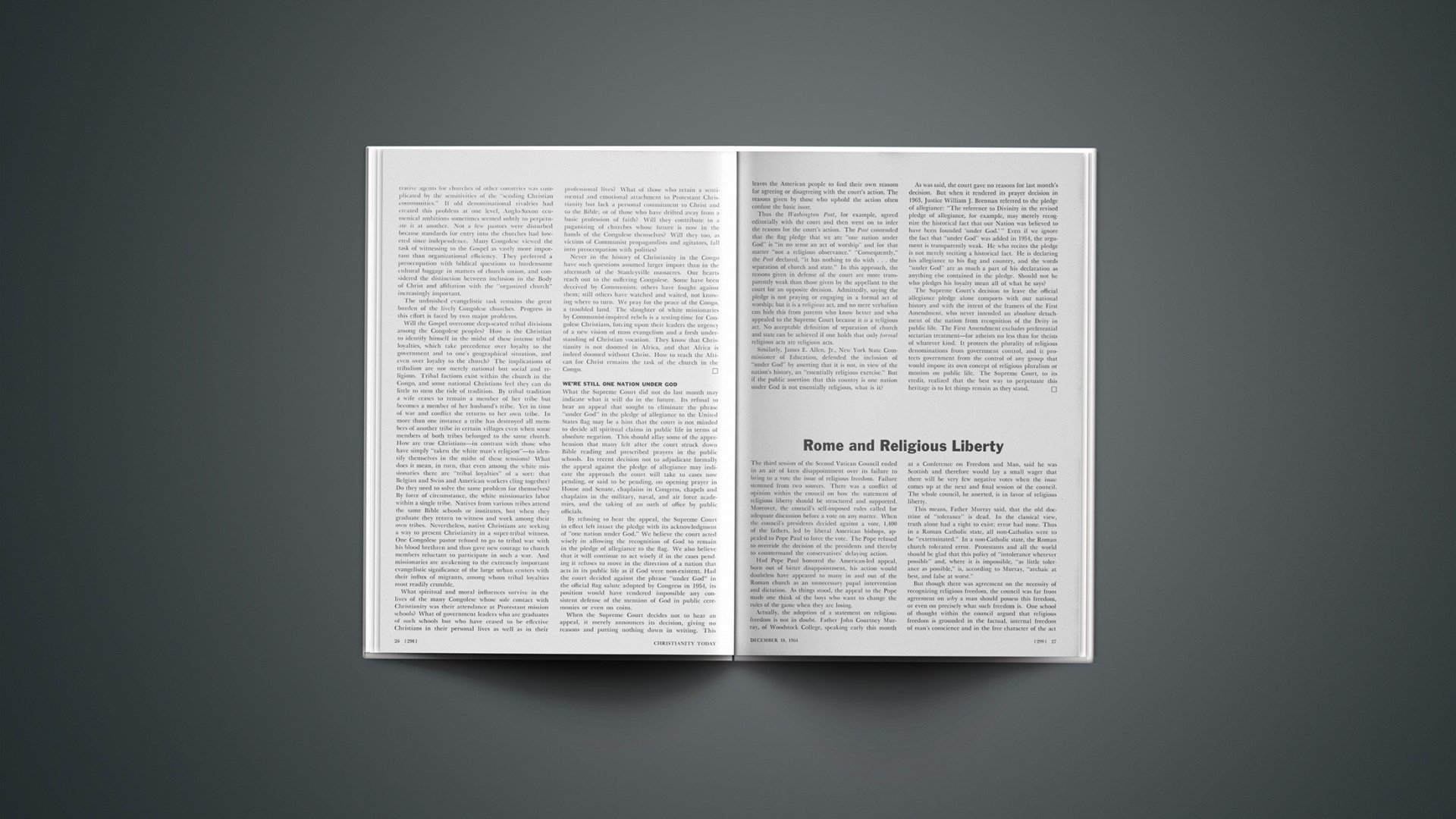
Rome and Religious Liberty

The third session of the Second Vatican Council ended in an air of keen disappointment over its failure to bring to a vote the issue of religious freedom. Failure stemmed from two sources. There was a conflict of opinion within the council on how the statement of religious liberty should be structured and supported. Moreover, the council’s self-imposed rules called for adequate discussion before a vote on any matter. When the council’s presidents decided against a vote, 1,400 of the fathers, led by liberal American bishops, appealed to Pope Paul to force the vote. The Pope refused to override the decision of the presidents and thereby to countermand the conservatives’ delaying action.

Had Pope Paul honored the American-led appeal, born out of bitter disappointment, his action would doubtless have appeared to many in and out of the Roman church as an unnecessary papal intervention and dictation. As things stood, the appeal to the Pope made one think of the boys who want to change the rules of the game when they are losing.

Actually, the adoption of a statement on religious freedom is not in doubt. Father John Courtney Murray, of Woodstock College, speaking early this month at a Conference on Freedom and Man, said he was Scottish and therefore would lay a small wager that there will be very few negative votes when the issue comes up at the next and final session of the council. The whole council, he asserted, is in favor of religious liberty.

This means, Father Murray said, that the old doctrine of “tolerance” is dead. In the classical view, truth alone had a right to exist; error had none. Thus in a Roman Catholic state, all non-Catholics were to be “exterminated.” In a non-Catholic state, the Roman church tolerated error. Protestants and all the world should be glad that this policy of “intolerance wherever possible” and, where it is impossible, “as little tolerance as possible,” is, according to Murray, “archaic at best, and false at worst.”

But though there was agreement on the necessity of recognizing religious freedom, the council was far from agreement on why a man should possess this freedom, or even on precisely what such freedom is. One school of thought within the council argued that religious freedom is grounded in the factual, internal freedom of man’s conscience and in the free character of the act of faith, and that this provides an adequate juridical basis for religious freedom. This school, predominantly French, was criticized by a chiefly Spanish group who objected that this basis was too subjectivistic, particularly since conscience can err.

Father Murray proposed that the matter be broached from the level of experience and history. He pointed out that man in history has come to the place and time where he now demands increasing rights and the external freedom to express his faith and his inner conscience. One may ask, however, whether beginning with “the state of things as they are today” provides a footing for a view of conscience that really escapes the subjectivism of the French school. Does a shift from the subjectivism of the individual to the moving history of the human race satisfy the Spanish argument? Is a wide historicism inherently more prone to truth than the individual subject?

Protestants have always recognized that before God error has no rights. But they have also recognized that a man has a formal right, before men, to be wrong, and that any attempt to exterminate error is an act of human presumption and to exterminate the erring man an act of murder, unless indeed a man thinks himself God, or one called to act on behalf of God.

But it is precisely here that the question arises about the possibility of freedom of conscience within the Roman Catholic Church. Protestants may be happy to hear Murray say that all Catholics recognize the freedom of the religious conscience, and that they agree that no man may be constrained to do what he believes is wrong or made to refrain (within limits) from doing what he believes is right. The “limits,” of course, are the thing. The Roman church will take a big step at the next session of the council if it adopts a statement recognizing the right of all non-Catholics to practice religious freedom according to the dictates of their consciences.

But what about those within the Roman Catholic Church? Can a structuring of religious freedom that recognizes the factual, inherent freedom of the human conscience, and that neither constrains the conscience to do what it thinks wrong nor restrains it from doing what it thinks right—can this be granted by the Roman Catholic Church to those within its membership as well as to those outside? It would seem that this freedom would be so constricted as to be meaningless at that religious center where the individual stands before God. As long as the Roman Catholic Church claims absolute authority and infallibility on all doctrinal and moral matters, there would seem to be no room for the non-constraint and the non-restraint that the Roman church is said to recognize as of the essence of freedom of the religious conscience.

Is this perhaps the reason why Father Murray seeks a grounding for religious freedom in the actualities of the historical situation, “in things as they are,” and thus disagrees with the French school by insisting that religious freedom is first of all a juridical, not a theological, notion?

America As Seen From Abroad

An American Christian traveling around the world sees and hears much to make him thankful for his citizenship and for the liberties and favors his country enjoys under God. To see at first hand something of how hundreds of millions are living without sufficient food, clothing, and shelter, and to realize that multitudes of the physically undernourished are spiritually without the Bread of Life, is humbling. We who are so surfeited with material things and who live in a nation the state of whose poor would be comparative affluence for refugees from Red China pouring into Hong Kong or for the homeless in India, have much for which to thank God. And high among our blessings are religious and political freedom. Americans are blind indeed unless they acknowledge God as the source of these and many other privileges they so casually take for granted.

To look at other peoples without compassion or with a careless feeling of superiority betrays an unbecoming heartlessness. Better to say, “There but for the grace of God am I.” Moreover, any attitude of superiority is strangely ill-founded in the light of our own defects.

The writer of this editorial was given pause by being asked by the daughter of a friend in Athens whether she would be safe on the streets if she were to come to America for her college education. With a note of puzzlement she asked, “Is it true that in Washington women cannot go safely on the streets at night?” The answer—not only for Washington but also for others of our great cities—had to be a shame-faced affirmative. Whereupon she replied, “But in Athens we are quite safe alone on the streets, even up to midnight.” It takes only casual observation of other great foreign cities, including those in non-Christian lands, to realize the rebuking implications of her remark.

Surely one of the scandals of America is that in the most privileged country in the world, where the Gospel has been preached as fully as in any nation in history and where the message of Christ is constantly disseminated by radio and television, lawlessness abounds. There is much about his country for which an American abroad has reason to be grateful. The noble efforts of missionaries are inspiring; educational and medical institutions built by gifts of American Christians are creditable; government programs of aid to underdeveloped nations speak well for our country, as do most of our representatives abroad. But on the other hand, the penetration of alien cultures by the baser productions of Hollywood and by the salacious products of our presses and other effluvia of a materialistic, sex-obsessed society that seems bent on repudiating its spiritual heritage—all this dispels feelings of innate American superiority.

One’s heart is deeply moved as he sees the appalling need of the world. And his perspective is badly distorted if he fails to include in this need his own favored nation. The scriptural principle is always that of those to whom most is committed most is required. What about our stewardship of the blessings God has poured out upon America?

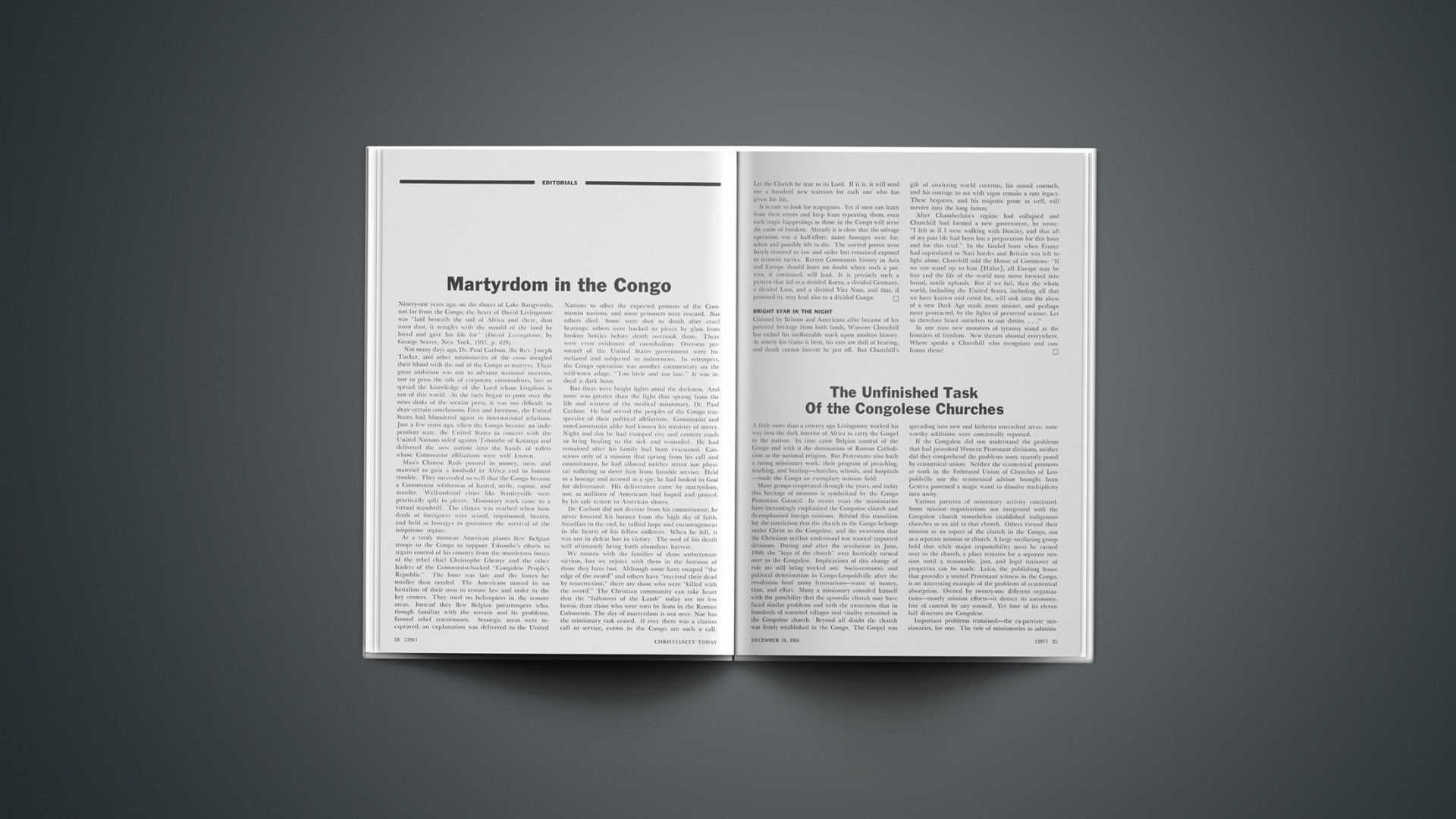
The Unfinished Task of the Congolese Churches

A little more than a century ago Livingstone worked his way into the dark interior of Africa to carry the Gospel to the natives. In time came Belgian control of the Congo and with it the domination of Roman Catholicism as the national religion. But Protestants also built a strong missionary work; their program of preaching, teaching, and healing—churches, schools, and hospitals—made the Congo an exemplary mission field.

Many groups cooperated through the years, and today this heritage of missions is symbolized by the Congo Protestant Council. In recent years the missionaries have increasingly emphasized the Congolese church and de-emphasized foreign missions. Behind this transition lay the conviction that the church in the Congo belongs under Christ to the Congolese, and the awareness that the Christians neither understood nor wanted imported divisions. During and after the revolution in June, 1960, the “keys of the church” were hurriedly turned over to the Congolese. Implications of this change of role are still being worked out. Socio-economic and political deterioration in Congo-Leopoldville after the revolution bred many frustrations—waste of money, time, and effort. Many a missionary consoled himself with the possibility that the apostolic church may have faced similar problems and with the awareness that in hundreds of scattered villages real vitality remained in the Congolese church. Beyond all doubt the church was firmly established in the Congo. The Gospel was spreading into new and hitherto unreached areas; noteworthy additions were continually reported.

If the Congolese did not understand the problems that had provoked Western Protestant divisions, neither did they comprehend the problems more recently posed by ecumenical union. Neither the ecumenical pressures at work in the Federated Union of Churches of Leopoldville nor the ecumenical advisor brought from Geneva possessed a magic wand to dissolve multiplicity into unity.

Various patterns of missionary activity continued. Some mission organizations not integrated with the Congolese church nonetheless established indigenous churches as an aid to that church. Others viewed their mission as an aspect of the church in the Congo, not as a separate mission or church. A large mediating group held that while major responsibility must be turned over to the church, a place remains for a separate mission until a reasonable, just, and legal turnover of properties can be made. Leico, the publishing house that provides a united Protestant witness in the Congo, is an interesting example of the problems of ecumenical absorption. Owned by twenty-one different organizations—mostly mission efforts—it desires its autonomy, free of control by any council. Yet four of its eleven full directors are Congolese.

Important problems remained—the ex-patriate missionaries, for one. The role of missionaries as administrative agents for churches of other countries was complicated by the sensitivities of the “sending Christian communities.” If old denominational rivalries had created this problem at one level, Anglo-Saxon ecumenical ambitions sometimes seemed subtly to perpetuate it at another. Not a few pastors were disturbed because standards for entry into the churches had lowered since independence. Many Congolese viewed the task of witnessing to the Gospel as vastly more important than organizational efficiency. They preferred a preoccupation with biblical questions to burdensome cultural baggage in matters of church union, and considered the distinction between inclusion in the Body of Christ and affiliation with the “organized church” increasingly important.

The unfinished evangelistic task remains the great burden of the lively Congolese churches. Progress in this effort is faced by two major problems.

Will the Gospel overcome deep-seated tribal divisions among the Congolese peoples? How is the Christian to identify himself in the midst of these intense tribal loyalties, which take precedence over loyalty to the government and to one’s geographical situation, and even over loyalty to the church? The implications of tribalism are not merely national but social and religious. Tribal factions exist within the church in the Congo, and some national Christians feel they can do little to stem the tide of tradition. By tribal tradition a wife ceases to remain a member of her tribe but becomes a member of her husband’s tribe. Yet in time of war and conflict she returns to her own tribe. In more than one instance a tribe has destroyed all members of another tribe in certain villages even when some members of both tribes belonged to the same church. How are true Christians—in contrast with those who have simply “taken the white man’s religion”—to identify themselves in the midst of these tensions? What does it mean, in turn, that even among the white missionaries there are “tribal loyalties” of a sort: that Belgian and Swiss and American workers cling together? Do they need to solve the same problem for themselves? By force of circumstance, the white missionaries labor within a single tribe. Natives from various tribes attend the same Bible schools or institutes, but when they graduate they return to witness and work among their own tribes. Nevertheless, native Christians are seeking a way to present Christianity in a super-tribal witness. One Congolese pastor refused to go to tribal war with his blood brethren and thus gave new courage to church members reluctant to participate in such a war. And missionaries are awakening to the extremely important evangelistic significance of the large urban centers with their influx of migrants, among whom tribal loyalties most readily crumble.

What spiritual and moral influences survive in the lives of the many Congolese whose sole contact with Christianity was their attendance at Protestant mission schools? What of government leaders who are graduates of such schools but who have ceased to be effective Christians in their personal lives as well as in their professional lives? What of those who retain a sentimental and emotional attachment to Protestant Christianity but lack a personal commitment to Christ and to the Bible; or of those who have drifted away from a basic profession of faith? Will they contribute to a paganizing of churches whose future is now in the hands of the Congolese themselves? Will they too, as victims of Communist propagandists and agitators, fall into preoccupation with politics?

Never in the history of Christianity in the Congo have such questions assumed larger import than in the aftermath of the Stanleyville massacres. Our hearts reach out to the suffering Congolese. Some have been deceived by Communists; others have fought against them; still others have watched and waited, not knowing where to turn. We pray for the peace of the Congo, a troubled land. The slaughter of white missionaries by Communist-inspired rebels is a testing-time for Congolese Christians, forcing upon their leaders the urgency of a new vision of mass evangelism and a fresh understanding of Christian vocation. They know that Christianity is not doomed in Africa, and that Africa is indeed doomed without Christ. How to reach the African for Christ remains the task of the church in the Congo.

We’Re Still One Nation Under God

What the Supreme Court did not do last month may indicate what it will do in the future. Its refusal to hear an appeal that sought to eliminate the phrase “under God” in the pledge of allegiance to the United States flag may be a hint that the court is not minded to decide all spiritual claims in public life in terms of absolute negation. This should allay some of the apprehension that many felt after the court struck down Bible reading and prescribed prayers in the public schools. Its recent decision not to adjudicate formally the appeal against the pledge of allegiance may indicate the approach the court will take to cases now pending, or said to be pending, on opening prayer in House and Senate, chaplains in Congress, chapels and chaplains in the military, naval, and air force academies, and the taking of an oath of office by public officials.

By refusing to hear the appeal, the Supreme Court in effect left intact the pledge with its acknowledgment of “one nation under God.” We believe the court acted wisely in allowing the recognition of God to remain in the pledge of allegiance to the flag. We also believe that it will continue to act wisely if in the cases pending it refuses to move in the direction of a nation that acts in its public life as if God were non-existent. Had the court decided against the phrase “under God” in the official flag salute adopted by Congress in 1954, its position would have rendered impossible any consistent defense of the mention of God in public ceremonies or even on coins.

When the Supreme Court decides not to hear an appeal, it merely announces its decision, giving no reasons and putting nothing down in writing. This leaves the American people to find their own reasons for agreeing or disagreeing with the court’s action. The reasons given by those who uphold the action often confuse the basic issue.

Thus the Washington Post, for example, agreed editorially with the court and then went on to infer the reasons for the court’s action. The Post contended that the flag pledge that we are “one nation under God” is “in no sense an act of worship” and for that matter “not a religious observance.” “Consequently,” the Post declared, “it has nothing to do with … the separation of church and state.” In this approach, the reasons given in defense of the court are more transparently weak than those given by the appellant to the court for an opposite decision. Admittedly, saying the pledge is not praying or engaging in a formal act of worship; but it is a religious act, and no mere verbalism can hide this from parents who know better and who appealed to the Supreme Court because it is a religious act. No acceptable definition of separation of church and state can be achieved if one holds that only formal religious acts are religious acts.

Similarly, James E. Allen, Jr., New York State Commissioner of Education, defended the inclusion of “under God” by asserting that it is not, in view of the nation’s history, an “essentially religious exercise.” But if the public assertion that this country is one nation under God is not essentially religious, what is it?

As was said, the court gave no reasons for last month’s decision. But when it rendered its prayer decision in 1963, Justice William J. Brennan referred to the pledge of allegiance: “The reference to Divinity in the revised pledge of allegiance, for example, may merely recognize the historical fact that our Nation was believed to have been founded ‘under God.’ ” Even if we ignore the fact that “under God” was added in 1954, the argument is transparently weak. He who recites the pledge is not merely reciting a historical fact. He is declaring his allegiance to his flag and country, and the words “under God” are as much a part of his declaration as anything else contained in the pledge. Should not he who pledges his loyalty mean all of what he says?

The Supreme Court’s decision to leave the official allegiance pledge alone comports with our national history and with the intent of the framers of the First Amendment, who never intended an absolute detachment of the nation from recognition of the Deity in public life. The First Amendment excludes preferential sectarian treatment—for atheists no less than for theists of whatever kind. It protects the plurality of religious denominations from government control, and it protects government from the control of any group that would impose its own concept of religious pluralism or monism on public life. The Supreme Court, to its credit, realized that the best way to perpetuate this heritage is to let things remain as they stand.

Ideas

Martyrdom in the Congo

Ninety-one years ago, on the shores of Lake Bangweolo, not far from the Congo, the heart of David Livingstone was “laid beneath the soil of Africa and there, dust unto dust, it mingles with the mould of the land he loved and gave his life for” (David Livingstone, by George Seaver, New York, 1957, p. 628).

Not many days ago, Dr. Paul Carlson, the Rev. Joseph Tucker, and other missionaries of the cross mingled their blood with the soil of the Congo as martyrs. Their great ambition was not to advance national interests, nor to press the sale of corporate commodities, but to spread the knowledge of the Lord whose kingdom is not of this world. As the facts began to pour over the news desks of the secular press, it was not difficult to draw certain conclusions. First and foremost, the United States had blundered again in international relations. Just a few years ago, when the Congo became an independent state, the United States in concert with the United Nations sided against Tshombe of Katanga and delivered the new nation into the hands of rulers whose Communist affiliations were well known.

Mao’s Chinese Reds poured in money, men, and materiel to gain a foothold in Africa and to foment trouble. They succeeded so well that the Congo became a Communist wilderness of hatred, strife, rapine, and murder. Well-ordered cities like Stanleyville were practically split in pieces. Missionary work came to a virtual standstill. The climax was reached when hundreds of foreigners were seized, imprisoned, beaten, and held as hostages to guarantee the survival of the iniquitous regime.

At a tardy moment American planes flew Belgian troops to the Congo to support Tshombe’s efforts to regain control of his country from the murderous forces of the rebel chief Christophe Gbenye and the other leaders of the Communist-backed “Congolese People’s Republic.” The hour was late and the forces far smaller than needed. The Americans moved in no battalion of their own to restore law and order in the key centers. They used no helicopters in the remote areas. Instead they flew Belgian paratroopers who, though familiar with the terrain and its problems, fanned rebel resentments. Strategic areas were recaptured, an explanation was delivered to the United Nations to offset the expected protests of the Communist nations, and some prisoners were rescued. But others died. Some were shot to death after cruel beatings; others were hacked to pieces by glass from broken bottles before death overtook them. There were even evidences of cannibalism. Overseas personnel of the United States government were humiliated and subjected to indecencies. In retrospect, the Congo operation was another commentary on the well-worn adage, “Too little and too late.” It was indeed a dark hour.

But there were bright lights amid the darkness. And none was greater than the light that sprang from the life and witness of the medical missionary, Dr. Paul Carlson. He had served the peoples of the Congo irrespective of their political affiliations. Communist and non-Communist alike had known his ministry of mercy. Night and day he had tramped city and country roads to bring healing to the sick and wounded. He had remained after his family had been evacuated. Conscious only of a mission that sprang from his call and commitment, he had allowed neither terror nor physical suffering to deter him from humble service. Held as a hostage and accused as a spy, he had looked to God for deliverance. His deliverance came by martyrdom, not, as millions of Americans had hoped and prayed, by his safe return to American shores.

Dr. Carlson did not deviate from his commitment; he never lowered his banner from the high sky of faith. Steadfast to the end, he rallied hope and encouragement in the hearts of his fellow sufferers. When he fell, it was not in defeat but in victory. The seed of his death will ultimately bring forth abundant harvest.

We mourn with the families of those unfortunate victims, but we rejoice with them in the heroism of those they have lost. Although some have escaped “the edge of the sword” and others have “received their dead by resurrection,” there are those who were “killed with the sword.” The Christian community can take heart that the “followers of the Lamb” today are no less heroic than those who were torn by lions in the Roman Colosseum. The day of martyrdom is not over. Nor has the missionary task ceased. If ever there was a clarion call to service, events in the Congo are such a call. Let the Church be true to its Lord. If it is, it will send out a hundred new warriors for each one who has given his life.

It is easy to look for scapegoats. Yet if men can learn from their errors and keep from repeating them, even such tragic happenings as those in the Congo will serve the cause of freedom. Already it is clear that the salvage operation was a half-effort; many hostages were forsaken and possibly left to die. The control points were barely restored to law and order but remained exposed to terrorist tactics. Recent Communist history in Asia and Europe should leave no doubt where such a pattern, if continued, will lead. It is precisely such a pattern that led to a divided Korea, a divided Germany, a divided Laos, and a divided Viet Nam, and that, if persisted in, may lead also to a divided Congo.

Bright Star In The Night

Claimed by Britons and Americans alike because of his parental heritage from both lands, Winston Churchill has etched his ineffaceable mark upon modern history. At ninety his frame is bent, his ears are dull of hearing, and death cannot forever be put off. But Churchill’s gift of analyzing world currents, his sound counsels, and his courage to act with vigor remain a rare legacy. These bequests, and his majestic prose as well, will survive into the long future.

After Chamberlain’s regime had collapsed and Churchill had formed a new government, he wrote: “I felt as if I were walking with Destiny, and that all of my past life had been but a preparation for this hour and for this trial.” In the fateful hour when France had capitulated to Nazi hordes and Britain was left to fight alone, Churchill told the House of Commons: “If we can stand up to him [Hitler], all Europe may be free and the life of the world may move forward into broad, sunlit uplands. But if we fail, then the whole world, including the United States, including all that we have known and cared for, will sink into the abyss of a new Dark Age made more sinister, and perhaps more protracted, by the lights of perverted science. Let us therefore brace ourselves to our duties.…”

In our time new monsters of tyranny stand at the frontiers of freedom. New threats abound everywhere. Where speaks a Churchill who recognizes and confronts them?

The Eternal Verities: How May God Be Known?

This world presents pressing problems, but you can never solve those problems aright unless you first face the question of your relation to God. That is the all-important thing, and the distresses of the present time only serve to press it still more insistently upon our attention.

But if it is important for us to face the question of our relation to God, how can God be known to us? How can we discover whether there is a God at all, and then, if there is, what sort of being he is?

I have something rather simple to say about that. It is something that seems to me to be rather obvious, and yet it is something that is quite generally ignored. It is simply this—that if we are really to know anything about God it will probably be because God has chosen to tell it to us.

Many persons seem to go on a very different assumption. They seem to think that if they are to know anything about God they must discover God for themselves.

That assumption seems to me to be extremely unlikely. Just supposing for the sake of the argument that there is a being of such a kind as that he may with any propriety be called “God,” it does seem antecedently very improbable that weak and limited creatures of a day, such as we are, should discover him by our own efforts without any will on his part to make himself known to us. At least, I think we can say that a god who could be discovered in that way would hardly be worth discovering. A mere passive subject of human investigation is certainly not a living God who can satisfy the longing of our souls. A divine being that could be discovered by my efforts, apart from his gracious will to reveal himself to me and to others, would be either a mere name for a certain aspect of man’s own nature, a God that we could find within us, or else at best a mere passive thing that would be subject to investigation like the substances that are analyzed in a laboratory.

I think we ought to stick to that principle rather firmly. I think we ought to be rather sure that we cannot know God unless God has been pleased to reveal himself to us.

How, then, has God revealed himself to us?

In the first place, he has revealed himself by the universe that he has made. How did the world come into being? It is here. That cannot be denied. But how did it come to be?

I think the universe itself provides the answer to that question. The answer is itself a mystery, but it is a mystery in which we can rest. The world came into being because God made it. It is the work of an infinite and all-wise and all-powerful God.

That answer presses itself upon different people in different ways. It has been defended by philosophers and theologians by way of detailed reasoning. That reasoning has been divided logically into what are called the “theistic proofs”—indications in the world itself that point to the existence of a personal God, creator and ruler of the world.

The revelation of God through nature has the stamp of approval put upon it by the Bible. The Bible clearly teaches that nature reveals the glory of God. In the first chapter of the Epistle to the Romans the Apostle Paul says that “the invisible things of him from the creation of the world are clearly seen, being understood by the things that are made, even his eternal power and Godhead.” Here the Bible approves the arguments of those who in systematic fashion argue from the existence of the world to the existence of a divine Maker of the world. But the Bible also approves those more unreasoned flashes of knowledge in which suddenly we see God’s workmanship in the beauty and the majesty of his world. “The heavens declare the glory of God; and the firmament sheweth his handywork,” says the Psalmist.

All that is true. The revelation of God through nature is a very precious thing. But then a serious question arises. If God has revealed himself through the things that he has made, why do so very few men listen to the revelation? The plain fact is that very few men arrive by a contemplation of nature at a true belief in a personal God. Even those scientists whose religious views are sometimes being incautiously welcomed by Christian people are often found upon closer examination to believe only in a God who is identical with a spiritual purpose supposed to inhere in the world process itself and are found not to believe at all in a living and holy God, are found not to believe at all in the true God who created the heavens and the earth.

Why is that so? If God has revealed himself so plainly through the world that he has made, why do men not see? Well, when men do not see something, there are two possible explanations of fact. One is that there is nothing there to see. The other is that the men who do not see are blind.

It is this latter explanation which the Bible gives of the failure of men to know God through the things that he has made. The Bible puts it very plainly in that same passage already quoted from the first chapter of Romans. “Their foolish heart,” says Paul, “was darkened.” Hence they did not see. The fault did not lie in nature. Men were “without excuse,” Paul says, when they did not see what nature had to show. Their minds were blinded by sin. That is a hard saying, but like many other hard sayings it is true.—J. G. M.

Discernment and Witness

Only the holy spirit can enable Christians to distinguish between scholarly advances with deepened spiritual insights, and unbelief and denial of truth couched in clever terms. There has never been a time when such perception was needed more than now.

Furthermore, only the Holy Spirit can give Christians the grace and wisdom to stand against clever unbelief in a spirit of love and humility.

The cause of Christianity has suffered much at the hands of those who would deny its essential truths. It has also suffered from those who have fought for the faith in a spirit of contentiousness and lovelessness.

The Apostle Paul lays down some simple guidelines for those who find it necessary to witness for truth and against a denial of that truth. Writing to the church of the Thessalonians he says, “If anyone refuses to obey the command given above, mark that man; do not associate with him until he is ashamed of himself. I don’t mean, of course, treat him as an enemy, but reprimand him as a brother” (2 Thess. 3:14, 15, Phillips). Yet how prone we are to regard those with whom we contend as enemies rather than brothers.

Paul speaks clearly to our day in his final letter to Timothy: “Remind your people of things like this, and tell them as before God not to fight wordy battles, which help no one and may undermine the faith of some who hear them” (2 Tim. 2:14). “Wordy battles” continue to this day, often over minor interpretations of the Scripture that have, for some, assumed major importance.

Such battles are not confined to one era. Paul, in the third chapter of this same letter, warns of the last days, dangerous days when men will be “full of big words” and will have a form of godliness but deny its power. “They will no longer listen to the truth, but will wander off after man-made fictions” (2 Tim. 4:4).

A characteristic of our times is the invention of new phrases that are often without meaning, we believe, even to those who coin them. The clear counsel and simple truth of the Gospel is often hidden in a plethora of high-sounding words. All of us need to guard against such foolishness.

Another characteristic of a faithful witness is gentleness and patience. Paul says, “And the Lord’s servant must not be a man of strife: he must be kind to all, ready and able to teach: he must have patience and the ability gently to correct those who oppose his message. He must always bear in mind the possibility that God will give them a different outlook, and that they may come to know the truth. They may come to their senses and be rescued from the snare of the devil by the servant of the Lord and set to work for God’s purposes” (2 Tim. 2:24–26).

We may witness for the truth in sorrow but never in anger, with love but never with bitterness, with deep conviction but always in patience and humility.

Again we would emphasize that only with the help of the Holy Spirit can we sense what is false and affirm what is true. God has given us a norm by which to judge, a means whereby truth and aberrations from truth may be distinguished—and this is the Holy Scriptures.

Those who would be faithful to their Christian witness need to distinguish between the findings of reverent scholarship and the denials based on philosophical presuppositions against the divine revelation. They also need to sense the spiritual implications of truth on the one hand and human deviations on the other. Here again only the Holy Spirit can make clear which interpretations can be a blessing and which are untrue.

Although some are unwilling to accept the Scriptures as determinative, we believe that at this point there can be no compromise. In a game, both contestants must agree to the rules and abide by them. In maintaining Christian truth one must take his stand with the clear affirmations of the Scriptures and against those who would deny them. Let the Word speak for itself while we keep silent.

In this controversy the Christian must be prepared to be misunderstood. Often we create problems and even make enemies by flailing and railing when we should be quiet. Some of us who would most earnestly witness for the truth discredit that truth by showing plainly that the Gospel that we wish to defend has never brought about the fullness of Christian grace within our own hearts.

But on essentials the Christian cannot compromise. Paul says to Timothy, “You must go on steadily in those things that you have learned and which you know are true” (2 Tim. 3:14). But he makes it plain that such an unwillingness to compromise on the basic content of the Christian faith will cost us popularity and position. “Persecution is inevitable for those who are determined to live really Christian lives, while wicked and deceitful men will go from bad to worse, deluding others and deluding themselves” (2 Tim. 3:12, 13).

Then Paul points to the basis of our faith, the source to which we must turn to discern truth from error: “… the holy scriptures, which can open the mind to the salvation which comes through believing in Christ Jesus. All scripture is inspired by God and is useful for teaching the faith and correcting error, for resetting the direction of a man’s life and training him in good living. The scriptures are the comprehensive equipment of the man of God, and fit him fully for all branches of his work” (2 Tim. 3:15–17).

There is never any question about the Christian’s duty, for he lives and witnesses in the sight of his Saviour and Lord: “… preach the Word of God. Never lose your sense of urgency, in season or out of season. Prove, correct, and encourage, using the utmost patience in your teaching. For the time is coming when men will not tolerate wholesome teaching. They will want something to tickle their own fancies, and they will collect teachers who will pander to their own desires. They will no longer listen to the truth, but will wander off after man-made fictions” (2 Tim. 4:2–4).

“Man-made fictions”! How Christians need the Holy Spirit’s guidance to distinguish between that which is of God and the wordy and fictitious doctrines of men!

Paul had fought a glorious fight. He had kept the faith. He was sure of his place for eternity and of the One who had made that place sure. Chained in a Roman prison and knowing that his execution might be very close, he poured out his heart to his spiritual son. In that letter there is a message for each Christian today.

There is so much that is good for us to believe and live by. There is also so much that is false, calculated to destroy faith and our witness for the Lord. This is a time when we must put on the whole armor of God and, having done all, stand. By his Spirit and the Sword of his Spirit—the Word of God—a faithful and consistent witness is possible, and the victory is sure.

About This Issue: December 18, 1964

God’s witness to the Redeemer—in prophetic history, in the star of Bethlehem, in the miracle of the manger, and in the words and works of Jesus of Nazareth—provides the theme of CHRISTIANITY TODAY’S Christmas issue. The case for the deity of Jesus Christ is effectively presented by two prominent British laymen.

The bearing of developments in Congo-Leopoldville upon the missionary cause is assessed editorially and also in an interpretative news report.

Cover Story

The Jews and the Crucifixion

The question of the responsibility of the Jewish people for the crucifixion of Christ may well become one of the major theological issues of the day. The traditional view has been that the Jews through their leaders were responsible for the death of Christ and had admitted this by crying, “His blood be on us and on our children.”

These words have been used as an excuse for the most revolting anti-Semitism. The treatment of the Jews by the medieval Church has well been called “the shame of Christendom.” Jews were shut up in the ghettos of medieval cities in conditions of indescribable squalor. They were forbidden to enter most of the professions and were thus compelled to engage in commerce if they were to exist at all. Prevented from owning land and in constant danger of expulsion, prosperous Jews hoarded their gold, thus earning a reputation for miserliness. At a time when canon law forbade members of the Church to lend to and borrow from one another on “usury” (interest), Christians resorted to the Jews as convenient money-lenders, and the legend of Shylock soon arose. No accusation was too vile to bring against a people who had “murdered God.” They were accused of poisoning the wells to cause the Black Death and of murdering Christian children to use their blood in the Passover feast. Children sometimes disappeared then, as they occasionally do today. But the disappearance of any Christian child at Easter time was enough to start a fresh accusation of ritual murder and trigger a pogrom. And this is not all ancient history. As late as the early days of the present century, there were horrible Easter pogroms at Kishineff in Russia, when worshipers went straight from their Easter services to kill Jews as well as sack their homes and synagogues.

The Reformation made some difference in countries where it was influential. Yet even Luther was capable of violent diatribes against the unbelieving Jews, and the traditional Protestant attitude was that the Jews were under the wrath of God. They had rejected Christ: this was believed to be the reason for their long exile and many sufferings. The Evangelical Revival saw the renewal of missionary work among the Jews, but it was the concern of a very small minority. Those who engaged in it found the past treatment of the Jews by the Church an immense obstacle in commending as a Gospel of love the faith professed by the persecutors.

Today, however, there is a significant change. The massacre of over six million Jews under Hitler roused the Christian conscience at last. On both sides of the Atlantic, councils of Christians and Jews are working to combat anti-Semitism and promote mutual understanding. Successive assemblies of the World Council of Churches have discussed the problem and made pronouncements. The late Pope John XXIII ordered the deletion of some of the most offensive expressions from the Good Friday liturgy and received a delegation of Jews with much kindness, likening himself to Joseph receiving his long-lost brethren. The Jewish question was on the agenda of the Second Vatican Council.

It is in such a setting that recent statements on the degree of Jewish responsibility for the crucifixion must be evaluated. A statement of the Third Assembly of the World Council of Churches denounced anti-Semitism as “absolutely irreconcilable with the profession and practice of the Christian faith” and went on to say: “In Christian teaching the historic events leading up to the crucifixion should not be so presented as to fasten upon the Jewish people of today responsibilities which belong to our corporate humanity and not to one race or community. Jews were the first to accept Jesus and Jews are not the only ones who do not yet recognize Him.” Dr. Michael Ramsey, Archbishop of Canterbury, made a statement in almost exactly similar terms last Holy Week.

Now on the other side there comes a pronouncement from the Arab Evangelical Church Council issued over the signature of the Rt. Rev. Najib Attalah Cuba’in, head of the Arab Evangelical Episcopal (Anglican) Church, whose jurisdiction covers Jordan, Lebanon, and Syria. This pronouncement opposes recent attempts by “Christian Heads in the West” to absolve Jews of responsibility for the crucifixion of Christ, expresses the “firm adherence of the Arab council to the clear teachings of the Gospel as dictated by Divine revelation,” and states its belief that any contrary teaching would be a departure from the Gospel.

No doubt many find such a pronouncement suspect because of its source. Politics and sound theology do not often mix well. The Arab Christians have the State of Israel on their borders but do not recognize its existence. To them, as to their Muslim brethren, what the rest of the world calls Israel is just “occupied territory.” This attitude raises great difficulties for Arab Christians in using traditional forms of Christian worship. The Old Testament and particularly the Psalter with its constant prayers for the victory of Israel over her enemies are full of embarrassment for Arabs, and many passages are deleted or never used. Yet in this matter of the crucifixion they claim to be faithful to Scripture when others have departed from it.

Some Liberal Views

It is true that certain extreme liberal statements must cause grave concern to all who respect the authority of the Scriptures. Paul Winter in The Trial of Jesus has sought to show that the Romans alone were responsible and that the whole story of Jewish participation is a later invention reflecting the hatred of the Church for the synagogue. Similar views have been advanced by Dr. James Parkes and others. In fact, it may be said that the general view of liberals today is that the New Testament records reflect the situation at the time they were compiled rather than that which actually existed at the time of the events they purport to describe.

In resisting these claims and reaffirming the truth and authority of the Scriptures, is the conservative believer forced back to the traditional view that the Jew is really the arch-villain? We do not think so. It is possible to accept the truth of the gospel records as they stand and yet recognize that Christian reading of them has often been prejudiced and misinformed.

Thus much care is needed in interpreting the word “Jew” and the expression “the Jews” as used in the Gospels, especially in the Fourth Gospel. Even those who deny the apostolic authorship of St. John’s Gospel generally recognize that its author was Jewish. Our Lord, his disciples, and all his supporters mentioned in this Gospel were Jewish; yet the expression “the Jews” is constantly used of his enemies. Therefore the expression here cannot possibly refer to the entire Jewish community. In some instances it appears to mean the inhabitants of Judea as distinct from those of Galilee; e.g., “After this Jesus went about in Galilee; he would not go about in Judea, because the Jews sought to kill him” (John 7:1, RSV). In other cases the expression “the Jews” seems to refer to the circle of scribes, lawyers, and priests who opposed him most vigorously in Jerusalem. The constant repetition of the words “the Jews” in an unfavorable context may cause an insufficiently instructed congregation to gain the impression that the entire nation was hostile to Christ. The Revised Standard Version gives “Judeans” as an alternative rendering. And it might indeed be wise to adopt this when reading the lessons to a mixed congregation.

On the scriptural evidence, however, it is impossible to deny that the chief priests and scribes played a major part in handing Jesus over to the Romans for trial and crucifixion. This was the result of sin, which had blinded their eyes (John 12:40). The blindness was real enough. They did not realize they were rejecting the true Messiah, let alone the Son of God. Peter, addressing the people of Jerusalem, said quite clearly (Acts 3:17), “And now, brethren, I know that you acted in ignorance, as did also your rulers.” In the face of this, to accuse even those directly responsible of deliberate deicide is manifestly unfair. Moreover, can it not be reasonably argued that there was a sense in which these Jewish priests were acting as representatives not only of their own nation but of a whole sinful humanity—humanity that was not prepared to see the face of God in Jesus Christ?

The cry, “His blood be on us and on our children,” was terrible indeed. But had these men the power to impose such a curse upon all their descendants? It has been well pointed out that the blood of Christ falls on men only in forgiveness, never in revenge. The words were uttered to persuade the Roman governor Pilate to pass sentence, but they do not acquit him of the charge of corrupting Roman justice for fear of the consequences. Is it only coincidence that the historic creeds make no mention of Annas and Caiaphas but say, “He suffered under Pontius Pilate”? No doubt this was intended to fix the event in history. It also serves as a timely reminder that the Gentile as well as the Jewish world must take its share of the blame. No doubt a Jewish mob could have stoned Jesus, as happened later to Stephen; but a legal execution could be carried out only by the Roman authorities.

From ‘Hosanna’ To ‘Crucify’?

Peter does seem to speak as though the Jerusalem mob were in some sense personally guilty, since they “denied the Holy and Righteous one, and asked for a murderer to be granted to [them]” (Acts 3:14). But would he have judged the entire nation guilty? He was a Galilean. He would have remembered the “Hosannas” of the pilgrims from Galilee. Christian preachers have often assumed that those who shouted “Hosanna” were those who cried “Crucify” a few days later. There is no real evidence for this, although it is true that mobs can often be fickle. The hired mob was probably composed not of pilgrims from the country but of city-dwellers more easily worked upon by the priests.

What of the common statement that the centuries-long exile of the Jews from the promised land was a direct punishment for the crucifixion of Christ? The one passage that seems to support this is Luke 19:41–44, where Christ wept over the city of Jerusalem and foretold its destruction because its people “did not know the time of [their] visitation.” There is indeed a judgment in history, and the wrath of God has a real meaning if regarded as the spontaneous reaction of Absolute Holiness against evil. But analogies based on human anger, so seldom free from all sinful elements, are dangerous in the extreme.

There are indeed Old Testament passages that make habitation of the land conditional upon faithfulness to God’s law (e.g., Deut. 4:23–31), and in view of such Scriptures some Jewish thinkers regard the exile as a punishment for Israel’s unfaithfulness, though not of course for her failure to recognize Jesus as the Messiah. Yet the belief that the Jews’ rejection of Christ caused their disappearance as a settled community, though not as a separate people, has an almost irresistible fascination for the Christian mind. It is easy to say that the Old Israel failed to grasp its moment of opportunity and therefore a new Israel, the Church, was brought into existence to replace it. But to prove this from the New Testament is difficult. Apart from the much discussed phrase “the Israel of God” in Galatians 6:16, no passage speaks definitely of the Church as the New Israel. There are indeed passages (such as the description in Revelation 21 of the founding of the new Jerusalem upon the twelve apostles of the Lamb rather than upon the twelve sons of Jacob) that may be used to support such an idea. And Gentile Christians are told, as were the Israelites of old, that they are the people of God, called out from the world. But is not the thought in such passages as Ephesians 2:11–22 that Gentile believers have been brought into Israel rather than that they are forming a new Israel? It is clear from Paul’s words in Romans 11:1, and indeed throughout chapters 9–11 of the great epistle, that God has not cast away his people in any final sense. In the end, Jews and Gentiles are to come together in the fulfillment of the wonderful purpose of God (Rom. 11:26, 33).

The one thing that the Gentile believer dare not do is to imagine himself in any sense superior to the Jew who fails to see Christ as Messiah. His own knowledge of Christ is all of grace. Left to himself, he would have fared no better than the scribe or Pharisee, since the spiritual pride that was their undoing is still the most subtle temptation of the Christian. His attitude to his Jewish brother must always be one of gratitude for all Israel has given him, of penitence for the terrible treatment that has needlessly added to the inescapable and true offense of the Gospel, and of loving compassion as in spite of all he seeks to commend to Israel Jesus of Nazareth, the true Messiah who by right belongs to her.

Brief Notes on Some of the Texts Used by Arians

John 1:1. Much is made by Arian amateur grammarians of the omission of the definite article with “God” in the phrase “And the Word was God.” Such an omission is common with nouns in a predicative construction. To have used it would have equated the Word and the Word only with God, whereas without it the force is “And the Word was Himself God.” The article is omitted, too, on occasion in other constructions; in fact, there are four instances of it in this very chapter (verses 6, 12, 13, 18), and in John 13:3, “God” is written once without and once with the article. To translate in any one of these cases “a god” would be totally indefensible (see R. Kuehner—B. Gerth. Ausführliche Grammatik der griechischen Sprache, Vol. I, pp., 591 f., and E. Schwyzer, Griechische Grammatik, Vol. II, pp. 24 ff.).

Strange literalistic interpretations, too, have been put on the word “beginning” in this verse, and to read as if it said “In the beginning the Word began,” whereas what is affirmed is that in the beginning he was already existing. The reference is to something within the divine, not the human, order of things, and to apply the analogy of temporal succession and progression to the presence of God (“And the Word was with God”) is utterly unwarranted. Equally narrow interpretations have been put on the word “Beginning” in such passages as Revelation 3:14: “the beginning of the creation of God.” The context, however, demands an agent as a parallel to “witness,” so the sense must be “Beginner” or “the first cause,” as is the case in Revelation 21:6 where “Beginning” is applied to God himself (compare the Greek translation of Genesis 49:3, and Colossians 1:18, and Revelation 22:13). To understand what John means by “Word” (Logos) read Revelation 19:13–16 in conjunction with First Timothy 6:14–16.

John 14:28. “My Father is greater than I.” This can refer only to the self-imposed limitations of the Son in his incarnation. He has already claimed equality with God (John 5:18), and oneness with him (John 10:30); but he was not only true God, he was now also true man. In fact, rightly understood this is a claim of the highest import, for only things of the same order of magnitude can be compared. No mere man or angelic being could ever say, “God is greater than I,” for created and uncreated are of different orders.

Mark 13:32 (Matthew 26:36 RV). “Concerning that day and hour no one knows, not even the angels in heaven, not even the Son, but the Father.” This is in complete harmony with his consistent claim that he came to do the Father’s will. He came to reveal the redemptive purpose of God but certainly not his whole mind (see John 17:8). There is again nothing here to contradict the many passages where his deity is positively and clearly stated; on the contrary it is in itself a very extraordinary claim, when we consider the ascending order: men, angels, Son, Father. He places himself above the category of angels (the highest created beings) and classes himself with the Father (see Hebrews 1:13).

1 Corinthians 11:3. “And the Head of Christ is God.” Paul cannot imply by this inferiority, no more than in the case of the wife to the husband, which would be a contradiction of Galatians 3:28.

1 Corinthians 15:28. “And when all things are subjected to him, then the Son also himself will be subjected to him who put all things under him, that God may be all in all.” Paul is speaking of the relation of the Son to the Father (verse 24) which was ever one of subjection (see John 5:30). But subjection does not imply subordination in the sense of inequality (see First Corinthians 14:32, “The spirits of the prophets are subject to the prophets”). The reference in verse 28 may well refer to organizational matters that do not come within the purview of revealed knowledge.

John 17:21. This verse is quoted in an attempt to weaken the force of John 10:30, “I and the Father are one,” about the meaning of which his audience were in no doubt whatever (see verse 33). In 17:21, however, the second “one” is not the best manuscripts (see RV), thus simply, “that they also may be in us.”

Philippians 2:5–9. A fair rendering of this passage might be: “Cultivate this attitude of mind among you, which was in Christ Jesus, who being already in the form of God, did not treat it as a prize to be equal with God, but divested himself, taking the form of a servant.” No one would dispute that when Paul says, Christ was in the “form” of a servant, he means that he was a servant in the truest and fullest meaning of the word. There is no ground for taking the phrase “in the ‘form’ of God” to mean less. Now from the nadir of his humiliation God has re-invested him with the insignia of his ineffable and divine glory, “and has given him the name that is—without exception—above every name.”

Mark 10:18 (“And Jesus said to him. Why callest thou me good; but one is good, God”). “Good” in the phrase “Good Master” meant in the suppliant’s language (Aramaic) “benevolent,” not “morally good”; hence there is no question of Christ denying that he was sinless (see H. L. Strack, P. Billerbeck, Kommentar zum Neuen Testament aus Talmud und Midrasch, Vol. I, pp. 808 f., and Vol. II, pp. 24 f.). Moreover “The Good”—Psalm 145:9 was probably cited—was one of the many Judaic titles for God (op. cit., Vol. I., p. 809). The point of our Lord’s remark is that a word with such hallowed association should not be used in a merely conventional manner. He is not stating that God alone is sinless, but that he is the personification of benevolence. To deduce from this an unexpressed contrary: “I am not sinless” or “I am not God,” would be sheer sophistry. Besides, in all interpretation, situation and context, immediate and remote, must be taken into account. Now when Christ comes to disclose (verse 21) the full limit of benevolence (the end of selfish possessing), he demands a response that hitherto had been the prerogative of God alone: “And come, follow Me.” No prophet had ever presumed to say this. Even the great Samuel unshakable in his integrity (1 Sam. 12:3) did not suggest personal discipleship but said: “Turn not aside from following Jehovah” (verse 20). And invariably in the Old Testament “following” in a religious sense has as its object God (Num. 14:24 and passim). The implication is surely undeniable.

Mark 15:34 (Matthew 27:46). This prayer on the Cross (“My God, my God, why hast thou forsaken me?”) has been seized upon as a possible refutation of Christ’s claims to deity. We cannot, of course, know all that these words meant for him at that terrible moment, but there are several possible interpretations. First, he was still in communion with his Father, in spite of the past tense of the verb. Second, the meaning of these words to an attentive Jew would be that he was claiming all the Twenty-second Psalm for himself, for it was a common practice to name books and Psalms by their opening words, e.g., Psalm 113 was called the “Hallel,” from the Hebrew word with which it begins. An approximate analogy might be a dying Christian saying only: “Just as I am without one plea”; but his friends would know that the hymn as a whole was in his mind. The third possibility is that he was quoting it with the immediate context in mind, namely, forsaken with regard to present help. The fact that he did not use the Hebrew wording of the original but that of his mother-tongue serves only to bring out the poignant depth of his feeling of desolation.

The main argument of those who deny the deity of Christ seems to rest on a misconception of the full meaning of “Son.” The fallacy consists of arguing from the analogy of human experience, that “son” implies a pre-existing father in time. The truth is, however, that “son” is used widely in both the Old and New Testaments divorced from the idea of “generation” or “priority,” to denote relationship only. For instance in Hebrew, age is expressed by “the son of x years,” and in the New Testament in such expressions as “the sons of disobedience.” It was, in fact, one of the commonest ways of expressing identity. Again the phrase “only-begotten” refers to the uniqueness of Christ’s relationship to the Father. The word is even applied to God himself in John 1:18, where the reading in the most ancient and textually best manuscripts is “God only-begotten” (in Hebrews 11:17 of Isaac, one of several sons, where the stress is on relationship).

New Testament References to the Deity of Christ

No clearer expression of the fact of the Trinity could be desired than that given by the risen Christ in the baptismal formula in Matthew 28:19, with its inescapable implication of the co-equality and hence co-eternity of the three persons of the Godhead. “Go, therefore, and make disciples of all nations, baptizing them into the name of the Father and of the Son and of the Holy Spirit.” Notice that our Lord said “name,” not “names.” There subsist three co-eternal persons, but the divine essence or substance is one. The model for this formula is probably to be found in the benediction given by the Lord to Moses in Numbers 6:24, “Jehovah bless thee and keep thee, Jehovah cause his face to shine upon thee and be gracious to thee, Jehovah lift up his face upon thee and give thee peace.” And God adds: “That they may put my name upon the people of Israel and I will bless you.” Although there are three blessings there is only one Blesser; thus it is “name,” not “names.”

At the end of Paul’s second letter to the Corinthians he pronounces a benediction in which the three persons of the Trinity are named as partners with co-equal power to bless: “The grace of the Lord Jesus Christ, and the love of God, and the communion of the Holy Spirit, be with you all. Amen.” The use of all of Christ’s titles is significant: he is not merely Jesus Christ, he is the Lord Jesus Christ (2 Cor. 13:14).

Paul again in First Corinthians 12 gives us a passage in which the “trinitarian” pattern is obvious: “Now there are diversities of gifts of grace, but the same Spirit. And there are varieties of services, but the same Lord. And there are diversities of activities but the same God, who is effecting all things in all” (verses 4–6). The mention of the same Spirit, the same Lord, the same God, demands the use of the word “trinity,” or another word meaning the same thing.

In Paul’s letter to the Ephesians, within a brief compass he refers to the Trinity no fewer than four times. The first mention describes the trinitarian nature of our approach to God: “For through him [Christ] we both [Jew and Gentile] have access by one Spirit to the Father.” The word for “access” is that used of bringing a subject into the presence of his king, or as we would say, “to have audience of” (Eph. 2:18).

The second reference describes the collaboration of the “Trinity” in our edification (Eph. 2:22): “In whom [Jesus Christ, the chief cornerstone, verse 20] you are builded together for a habitation of God through the Spirit.” Again the same pattern: In whom—Christ; to whom—God; through whom—the Spirit.

The third passage is Ephesians 3:14–17, “For this cause I bow my knees to the Father, of whom the whole ‘repatriation’ in heaven and on earth is named. That he would grant unto you according to the riches of his grace, that ye may be strengthened with power through his Spirit in the inner man, that Christ may come and take up his abode in your hearts by faith.” Thus for enjoyment of abiding fellowship we have the cooperation of the Father, the Holy Spirit, and Christ.

Again Paul refers to the work of the Trinity in maintaining unification in his Church (Eph. 4:4–6). “One body, and one Spirit, even as you were called in one hope of your calling; one Lord, one faith, one baptism, one God and Father of all, who is above all and through all and in all.” Here we have unity in tri-unity.

In the first chapter of Colossians we have a number of significant statements concerning the person of Christ. In verse 15 we read: “who [the Son] is the image of the invisible God.” “Image” by the common process of extension came to denote not only representation but manifestation. Thus in Second Corinthians 4:4 we find it used in this latter sense: “that the light of the gospel of the glory of Christ, who is the image of God, should not dawn upon them.” But Christ is also: “the first-born of every creature.” The word first-born had long since ceased to be used exclusively in its literal sense, just as prime (from Latin primus—first) with us. The Prime Minister is not the first minister we have had; he is the most pre-eminent. A man in the “prime” of life has long since left the first part of his life behind. Similarly, first-born came to denote not priority in time but pre-eminence in rank. For instance in Psalm 89:27, “I have put him [given him] as first-born, higher than the kings of the earth.” In a given situation even a whole company may rank as first-borns, as in Hebrews 12:23, “and church of the first-born ones, who are enrolled in heaven.” But Paul leaves us in no doubt as to what he means by the word; for he proceeds: “for [because, for this reason] by him were all things created”; and the word Paul uses for “all” means without any exception whatever. Had Christ himself been a created being, Paul would have had to use the Greek word meaning “other things” or the word meaning “remainder, rest.” But then Paul would not have called him first-born but “first-created,” a term never applied to Christ. And verse 17 clinches the whole matter: “And he is before all things,” not “he was.” The force of this statement is equal to that of the “I am” of John 8:58.

Paul on occasions exploits language to its maximal limit to find terms in which to describe the absolute exaltation of Christ. To the believers in Rome he writes: “From whom [the Jewish nation] as concerning the flesh is Christ, who is over all, God blessed for ever” (Rom. 9:5). When speaking to the Corinthian converts about the Cross as the focal point of their salvation, he goes on to say: “To us there is one God: the Father, of whom are all things, and we unto him, and one Lord, Jesus Christ, through whom are all things, and we through him” (1 Cor. 8:6). To the Ephesians, he asserts: “[He is set] far above all hierarchy, and authority, and power, and dominion, and every name that is named, not only in this world, but also in that which is to come” (Eph. 1:21). To the Colossian Christians he says: “In him dwells all the fulness of the deity bodily” (Col. 2:9). Even in his short letter to Titus he must mention it: “Expecting the blessed hope and glorious appearing of our great God and the Saviour Jesus Christ” (Titus 2:13).

In the most unlikely places in the New Testament we find the deity of Christ taken for granted. James, his brother, begins his letter with the words: “James, a servant of God, and of the Lord Jesus Christ.” James must have heard our Lord often say, “No servant can serve two masters” (Luke 16:13). But the very title, too, that he gives to Christ, shows that he is placing him equal with God. And if emphasis was needed he provides it in chapter 2:1, “My brethren, hold not the faith of our Lord Jesus Christ, the Lord of Glory, with respect of persons.” For a Jew, glory was an attribute of God alone.

In First John 5:6–9 (as everyone knows, verse 7 is absent from all good manuscripts) there appears again the trinitarian pattern: the witness of the Spirit with the witness of God witnessing concerning his Son. Before John finishes his letter he leaves us in no doubt concerning the person of the Son (verse 20): “And we know that the Son of God is come and has given us understanding that we know him that is true, and we are in him that is true, in his Son Jesus Christ, this is the true God and eternal life.”

It was evident for the writers in the New Testament, as it should be for us, that Christ could not save if he were not fully divine. The all-sufficiency of his sacrifice depends on his absolute authority. Had he been a created being, he would have been in some sense under compulsion, a victim. It is his possession of absolute free will that removes the stigma of injustice from the Cross. And only of one who had himself absolute immortality could it be said that “he became obedient unto death.”

Among the disciples was one who refused to believe in the resurrection of Christ without tangible proof. For him the witness of others was not sufficient in a matter of such momentous consequence. He demanded nothing less than positive proof within the domain of his own senses. When our Lord appeared to him, He did not rebuke him for his skepticism; rather He readily provided the kind of proof asked for. His confession, in words expressing the ultimate in Christian faith, could not have been a consequence of seeing someone risen from the dead, for he must surely have seen the risen Lazarus. There is no mistaking their intent: “Thomas answered and said to him, ‘My Lord and My God.’ ” And our Lord did not restrain him nor rebuke him; he received this as his rightful designation (John 20:24–29).

The claims of Christ to deity, embedded in the highest ethical teaching known to man, are expressed in irreducible matter-of-fact language. Either he was a fraud, or he was God. There is no middle position.

Paul provides a simple test for the sincerity of our faith. To be able to confess Jesus as Lord, Paul says, we need the power of the Holy Spirit (1 Cor. 12:3). Ask the one who places Christ any lower than the highest, if he will submit to this test. What is your own response, for this is a condition of salvation?

“Because, if you confess with your lips that Jesus is Lord, and believe in your heart that God raised him from the dead, you will be saved” (Rom. 10:9).

Works or Actions Peculiar to Jehovah

Both Jehovah and Christ are said to have the power to give life. Hannah in her “Magnificat” says: “Jehovah is the one who causes to die and the one who makes alive” (1 Sam. 2:6). Eleven times in Psalm 119 alone Jehovah is credited with the power to make alive. In John 5:21 Christ claims to have this power in equal measure with the Father: “For as the Father raises the dead and gives them life, so also the Son gives life to whom He will.” In First Corinthians 15:45, Paul quotes Genesis 2:7, “The first man Adam became a living being,” and adds, “the last Adam a life-giving spirit.” And, perhaps the best-known and most often quoted passage of all, the words of Jesus to Martha: “I am the resurrection and the life; he who believes in me, though he die, yet shall he live” (John 11:25).

Creator And The Act Of Creation

The Bible opens with the statement: “In the beginning God created the heavens and the earth,” that is, all things.

In Isaiah 40:28, “Jehovah is the eternal God, the creator of the ends of the earth.” Jeremiah calls him “The former [or creator] of all things” (Jer. 10:16). Paul speaks of Christ in similar terms. “For by [or in] him were all things created in the heavens, and upon the earth, things visible and things invisible, whether thrones or dominions or principalities or powers, all things have been created through him and for him” (Col. 1:16), and John 1:2, “He [the Logos] was in the beginning with God; all things were made through him, and without him was not anything made that was made.”

Apple PodcastsDown ArrowDown ArrowDown Arrowarrow_left_altLeft ArrowLeft ArrowRight ArrowRight ArrowRight Arrowarrow_up_altUp ArrowUp ArrowAvailable at Amazoncaret-downCloseCloseEmailEmailExpandExpandExternalExternalFacebookfacebook-squareGiftGiftGooglegoogleGoogle KeephamburgerInstagraminstagram-squareLinkLinklinkedin-squareListenListenListenChristianity TodayCT Creative Studio Logologo_orgMegaphoneMenuMenupausePinterestPlayPlayPocketPodcastRSSRSSSaveSaveSaveSearchSearchsearchSpotifyStitcherTelegramTable of ContentsTable of Contentstwitter-squareWhatsAppXYouTubeYouTube