Theology

The Radiance of Christmas

The eternal significance of Christmas is being largely obscured by secularization. One has but to look at the large department stores in a city like Tokyo to realize that the celebration of the coming of Christ has been starkly transformed into a gimmick for bigger business here and abroad.

Tokyo and Washington, as far as Christmas is concerned, vary only in degree. But judgment for the exploitation of Christ’s coming rests far more on America because of our national heritage.

The wonder of Christmas, its eternal implications, the mystery of the Incarnation, are being lost. None of these can be appreciated until the Christ of Bethlehem becomes one’s Saviour from sin and the Lord of one’s life.

That Christmas has become for so many merely a pagan holiday, dedicated to the flesh and lacking in spiritual significance, is but one indication of the moral and spiritual blindness of this generation. That there was no room for Jesus in the inn was prophetic of our own generation, where, for millions, he is neither wanted nor welcomed. That he was born in a stable was prophetic of those who in every generation welcome him with humble hearts.

There was no ceremony or show on that first Christmas. There were only a guiding star, a few wise men with prophetic vision, a few shepherds who heard a message from heaven and who went, saw, and worshiped. There were others who recognized in this babe the long-promised Redeemer. All these things remind us that the supernatural significance of Christmas was revealed by the Holy Spirit then, as it is now.

One can imagine the smug complacency of those fortunate enough to have secured shelter in the inn. Their physical wants taken care of, they were oblivious that the Son of God lay close by. They were satisfied with food and entertainment, while on the plains east of the city the heavenly host sang to shepherds, those unremarkable men to whom was revealed the message of the Saviour’s advent.

Was there not a prophetic note in this complacency—a warning to a sophisticated twentieth century that God still reveals himself to the humble of heart while rejecting the proud?

God’s meaning of Christmas can never be understood until Christ is given priority in our hearts and lives. When the transcending significance of Christ’s coming into the world breaks through by the illumination of his Spirit, Christmas is no longer just a holiday; it becomes a holy day.

The Incarnation is a mystery too deep for the human mind to comprehend; but we can believe. And when we believe, the enormity of sin and its consequences become the background for the awareness of something of God’s redeeming love and mercy. Christmas can never be rightly understood apart from the blood and death on Calvary a few years later; or from the joy of the empty tomb and the wondering gaze of disciples as they looked at his retreating form in the clouds of heaven; or from the promise, “This same Jesus … shall so come in like manner as ye have seen him go into heaven.”

Christmas brings to remembrance one event in God’s redemptive schedule. We are told, “But when the fulness of time was come. God sent forth his Son …” (Gal. 4:4). Thus for Christians this is a season of great joy, while for others it involves nothing more lasting than excitement, pleasure, and profits in the market place.

Even the Church may share in distorting the meaning of Christmas, thereby adding to the heart-hunger and confusion of a lost and groping world. In our troubled times, uncertainties of every kind continually add to a sense of futility and need. How urgent, then, that we who bear the name of Christ interpret the meaning of Christmas to those who do not know him, to those who so desperately need the peace, joy, and hope to be found in the Saviour!

Lose the significance of Christmas and we lose the Christ of Christmas. This birth was not a trivial event in history; it was the mysterious entry of God into human flesh, Immanuel—God with us—by whom man’s fellowship with God may be restored.

What a tragedy that for so many who “celebrate” Christmas, its spiritual significance is obscure! What an opportunity for Christian witness—through a spoken word, a friendly smile, an act of compassion, a helpful hand, heart-felt love for those about us. Such witnessing is at the very heart of the Christmas spirit and can glorify God.

Years after the first Christmas the aged Apostle John heard the risen Lord say: “Behold, I stand at the door, and knock: if any man hear my voice, and open the door, I will come in to him, and will sup with him, and he with me” (Rev. 3:20). He continues to stand at the door of men’s hearts. This Christmas he would use us in speaking a word for the divine guest.

The writer recently had an extended conversation with one of the nation’s leading munitions manufacturers who has shared in the making of some of our nation’s more sophisticated weapons. He is desperately afraid. His intimate knowledge of weaponry and his worldwide contacts have brought him face to face with the possibility of world destruction by the triggering of already available bombs. Although not a Christian, he seemed acquainted with many biblical references having to do with destruction. He even quoted extensively from Daniel, our Lord’s predictions, Second Peter, and the Revelation.

What has this to do with Christmas? Very much, if the true meaning of our Lord’s advent is grasped. He came to bring healing to the spirit and hope to the heart.

Christmas means that a Way has been opened into God’s presence—a way for forgiven sinners. Christmas means that Truth has been revealed, so that a world in spiritual ignorance can know Him and be free. Christmas means light out of darkness, sight for the blind, deliverance from the power of Satan.

Christmas means that the love of Christ can be shed abroad in our hearts and reflected in our attitudes toward others. Christmas means that we may be born into the Kingdom of God, no longer aliens and outcasts but children of the King because he has redeemed us to himself.

How the Church and individual Christians need to recapture the awesome radiance and grandeur of the meaning of Christmas! How we all need to accept humbly what God has revealed to us about the person and work of the one who was born in the Bethlehem manger!

In the meaning of Christmas, man is called to see sin in its true light. “And thou shalt call his name JESUS; for he shall save his people from their sins.” This was not a figure of speech; it was God’s way of telling us that only his Son could solve the problem of sin in the human heart.

“Merry Christmas” is a meaningless greeting until we have received the Christ of Christmas in our hearts. Then, and only then, the radiance of Christmas becomes real—a joy to be experienced and a glory to be reflected.
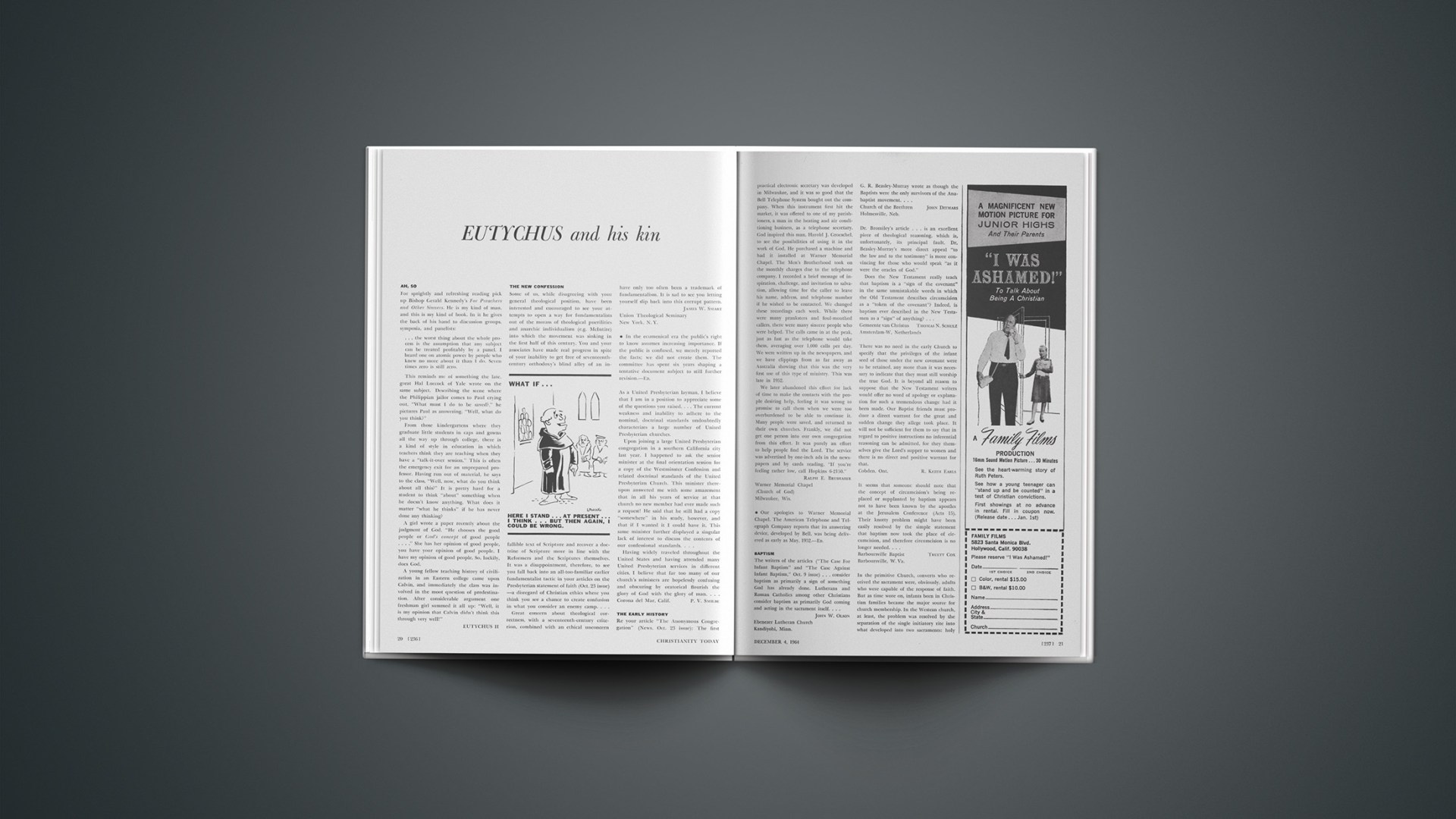
Eutychus and His Kin: December 4, 1964

AH, SO

For sprightly and refreshing reading pick up Bishop Gerald Kennedy’s For Preachers and Other Sinners. He is my kind of man, and this is my kind of book. In it he gives the back of his hand to discussion groups, symposia, and panelists:

… the worst thing about the whole process is the assumption that any subject can be treated profitably by a panel. I heard one on atomic power by people who knew no more about it than I do. Seven times zero is still zero.

This reminds me of something the late, great Hal Luccock of Yale wrote on the same subject. Describing the scene where the Philippian jailor comes to Paul crying out, “What must I do to be saved?,” he pictures Paul as answering, “Well, what do you think?”

From those kindergartens where they graduate little students in caps and gowns all the way up through college, there is a kind of style in education in which teachers think they are teaching when they have a “talk-it-over session.” This is often the emergency exit for an unprepared professor. Having run out of material, he says to the class, “Well, now, what do you think about all this?” It is pretty hard for a student to think “about” something when he doesn’t know anything. What does it matter “what he thinks” if he has never done any thinking?

A girl wrote a paper recently about the judgment of God. “He chooses the good people or God’s concept of good people.…” She has her opinion of good people, you have your opinion of good people, I have my opinion of good people. So, luckily, does God.

A young fellow teaching history of civilization in an Eastern college came upon Calvin, and immediately the class was involved in the moot question of predestination. After considerable argument one freshman girl summed it all up: “Well, it is my opinion that Calvin didn’t think this through very well!”

THE NEW CONFESSION

Some of us, while disagreeing with your general theological position, have been interested and encouraged to see your attempts to open a way for fundamentalists out of the morass of theological puerilities and anarchic individualism (e.g. McIntire) into which the movement was sinking in the first half of this century. You and your associates have made real progress in spite of your inability to get free of seventeenth-century orthodoxy’s blind alley of an in fallible text of Scripture and recover a doctrine of Scripture more in line with the Reformers and the Scriptures themselves. It was a disappointment, therefore, to see you fall back into an all-too-familiar earlier fundamentalist tactic in your articles on the Presbyterian statement of faith (Oct. 23 issue)—a disregard of Christian ethics where you think you see a chance to create confusion in what you consider an enemy camp.…

Great concern about theological correctness, with a seventeenth-century criterion, combined with an ethical unconcern have only too often been a trademark of fundamentalism. It is sad to see you letting yourself slip back into this corrupt pattern.

Union Theological Seminary

New York, N.Y.

• In the ecumenical era the public’s right to know assumes increasing importance. If the public is confused, we merely reported the facts; we did not create them. The committee has spent six years shaping a tentative document subject to still further revision.—ED.

As a United Presbyterian layman, I believe that I am in a position to appreciate some of the questions you raised.… The current weakness and inability to adhere to the nominal, doctrinal standards undoubtedly characterizes a large number of United Presbyterian churches.

Upon joining a large United Presbyterian congregation in a southern California city last year, I happened to ask the senior minister at the final orientation session for a copy of the Westminster Confession and related doctrinal standards of the United Presbyterian Church. This minister thereupon answered me with some amazement that in all his years of service at that church no new member had ever made such a request! He said that he still had a copy “somewhere” in his study, however, and that if I wanted it I could have it. This same minister further displayed a singular lack of interest to discuss the contents of our confessional standards.…

Having widely traveled throughout the United States and having attended many United Presbyterian services in different cities, I believe that far too many of our church’s ministers are hopelessly confusing and obscuring by oratorical flourish the glory of God with the glory of man.…

Corona del Mar, Calif.

THE EARLY HISTORY

Re your article “The Anonymous Congregation” (News, Oct. 23 issue): The first practical electronic secretary was developed in Milwaukee, and it was so good that the Bell Telephone System bought out the company. When this instrument first hit the market, it was offered to one of my parishioners, a man in the heating and air conditioning business, as a telephone secretary. God inspired this man, Harold J. Groeschel, to see the possibilities of using it in the work of God. He purchased a machine and had it installed at Warner Memorial Chapel. The Men’s Brotherhood took on the monthly charges due to the telephone company. I recorded a brief message of inspiration, challenge, and invitation to salvation, allowing time for the caller to leave his name, address, and telephone number if he wished to be contacted. We changed these recordings each week. While there were many pranksters and foul-mouthed callers, there were many sincere people who were helped. The calls came in at the peak, just as fast as the telephone would take them, averaging over 1,000 calls per day. We were written up in the newspapers, and we have clippings from as far away as Australia showing that this was the very first use of this type of ministry. This was late in 1952.

We later abandoned this effort for lack of time to make the contacts with the people desiring help, feeling it was wrong to promise to call them when we were too overburdened to be able to continue it. Many people were saved, and returned to their own churches. Frankly, we did not get one person into our own congregation from this effort. It was purely an effort to help people find the Lord. The service was advertised by one-inch ads in the newspapers and by cards reading, “If you’re feeling rather low, call Hopkins 6-2150.”

Warner Memorial Chapel

(Church of God)

Milwaukee, Wis.

• Our apologies to Warner Memorial Chapel. The American Telephone and Telegraph Company reports that its answering device, developed by Bell, was being delivered as early as May, 1952.—ED.

BAPTISM

The writers of the articles (“The Case For Infant Baptism” and “The Case Against Infant Baptism,” Oct. 9 issue) … consider baptism as primarily a sign of something God has already done. Lutherans and Roman Catholics among other Christians consider baptism as primarily God coming and acting in the sacrament itself.…

Ebenezer Lutheran Church

Kandiyohi, Minn.

G. R. Beasley-Murray wrote as though the Baptists were the only survivors of the Anabaptist movement.…

Church of the Brethren

Holmesville, Neb.

Dr. Bromiley’s article … is an excellent piece of theological reasoning, which is, unfortunately, its principal fault. Dr. Beasley-Murray’s more direct appeal “to the law and to the testimony” is more convincing for those who would speak “as it were the oracles of God.”

Does the New Testament really teach that baptism is a “sign of the covenant” in the same unmistakable words in which the Old Testament describes circumcision as a “token of the covenant”? Indeed, is baptism ever described in the New Testament as a “sign” of anything?…

Gemeente van Christus

Amsterdam-W, Netherlands

There was no need in the early Church to specify that the privileges of the infant seed of those under the new covenant were to be retained, any more than it was necessary to indicate that they must still worship the true God. It is beyond all reason to suppose that the New Testament writers would offer no word of apology or explanation for such a tremendous change had it been made. Our Baptist friends must produce a direct warrant for the great and sudden change they allege took place. It will not be sufficient for them to say that in regard to positive instructions no inferential reasoning can be admitted, for they themselves give the Lord’s supper to women and there is no direct and positive warrant for that.

Cobden, Ont.

It seems that someone should note that the concept of circumcision’s being replaced or supplanted by baptism appears not to have been known by the apostles at the Jerusalem Conference (Acts 15). Their knotty problem might have been easily resolved by the simple statement that baptism now took the place of circumcision, and therefore circumcision is no longer needed.…

Barboursville Baptist

Barboursville, W. Va.

In the primitive Church, converts who received the sacrament were, obviously, adults who were capable of the response of faith. But as time wore on, infants born in Christian families became the major source for church membership. In the Western church, at least, the problem was resolved by the separation of the single initiatory rite into what developed into two sacraments: holy baptism by water and holy confirmation by the laying on of hands.…

Holy confirmation makes it possible for the person of the age of reason to “ratify and confirm the promises made for him at his Baptism,” and the second initiatory rite seals the baptism and bestows upon the recipient the sevenfold gifts of the Holy Spirit, to make effectual the work begun by baptism.… ROBERTS E. EHRGOTT The Church of the Nativity (Episcopal) Indianapolis. Ind.

If infant baptism requires all the explanation which Dr. Bromiley … gives …, there must be something wrong with it.…

Dallas, Tex.

PRAYERS FOR THE DEAD

In regard to your editor’s note to the letter from Father du Bois regarding Anglican belief concerning prayers for the dead (Oct. 9 issue), you appear to be unaware that in the American Prayer Book, there are direct prayers for the dead in five places—the Prayer for the Church in the Communion Office, the Collect for the Eucharist at a burial, the Office for the Visitation of the Sick, twice in the Burial Office.…

Diocese of Tennessee Lay Reader

Kingsport, Tenn.

• The reference of this correspondence and our comment was to the situation in England. The Book of Common Prayer of the Church of England, which in all essentials is the book of 1552, is entirely free from prayers for the dead, since these were seen by Archbishop Cranmer and his colleagues to be not only unscriptural but also indicative of a serious misunderstanding of the Gospel. The inclusion of such prayers in the American Prayer Book is regrettable for the same reasons.—ED.

My favorite Anglican theologian (C. B. Moss in The Christian Faith, p. 440) writes: “The practice of prayer for the dead does not depend upon belief in Purgatory. There is no certain case of it in Scripture, except 2 Maccabees 12:44, in the Apocrypha; 2 Timothy 1:18 is probably, but not certainly, a prayer for the dead. It cannot therefore be regarded as a dogma necessary to salvation, but it has been practised, in every part of the Church, and in every age.… If Purgatory exists at all, its purpose must be to reform the sinner, to free him from evil habits, and to make him fit for Heaven. It is not an extension of our probation.”

The reason I find myself compelled to pray for the dead is because I believe in the communion of saints—that you and I continue to have a close spiritual relationship with those who have passed through the gateway of death and are beyond the grave. I believe that this spiritual relationship includes praying for them. Our Book of Common Prayer in the Liturgy (pp. 74.75) is specific: “And we also bless thy holy Name for all thy servants departed this life in thy faith and fear; beseeching thee to grant them continual growth in thy love and service.…”

Anglicans believe in an Intermediate State, which we prefer to call Paradise after the words of our Lord to the penitent thief: “Today shalt thou be with me in paradise” (Luke 23:43).

Diocese of West Missouri Bishop

Kansas City, Mo.

Of the three prayers numbered “32” in “Occasional Prayer,” two include petitions for the dead. In the Office of the Burial of the Dead there are three prayers for the departed. If it be objected that these are 1928 insertions, then the answer is that the 1928 Book is the one authorized by the Church of England, even if not by the (predominantly non-Anglican) Parliament of Great Britain.…

All Saints Church

Manchester, England

I was distressed to read … that, according to Charles du Bois, “prayers for the dead (as well as belief in purgatory) are part and parcel of Anglican eschatology.” As a member of the Church of England (and therefore, I suppose, an Anglican) I am bound by the formularies to which I gave assent at my ordination. In the Thirty-nine Articles the doctrine of purgatory is expressly rejected (Article XXII), and Article VI assures me that I am not required to believe as an article of faith anything which cannot be proved by Holy Scripture.

It follows from this that in the Church of England a belief in purgatory or in prayers for the dead is a departure from orthodoxy. To be sure, there are many unorthodox people in our denomination (and amongst them in this respect was C. S. Lewis); but whilst these formularies remain it is at least possible in our country to determine what is and what is not orthodox Anglicanism.

St. Barnabas’ Vicarage

Nottingham, England

EVOLUTION AND EVANGELICALS

Re comments toward H. M. Morris’s recent book, The Twilight of Evolution (Current Religious Thought, Sept. 25 issue): As a paleontologist who is also an evangelical Christian, I wish to point out … that this book contains a number of mistakes.…

For example, the book presents serious misunderstandings of the concept of uniformitarianism (pp. 59–64), the use of fossils in dating rock strata (pp. 49–52), instances of fossils and rock formations which are stratigraphically out of order (pp. 53, 54), and the present-day formation of fossils (pp. 62, 63). Moreover, there is no significant discussion of the numerous transitional fossils (“missing links”) which clearly indicate that particular groups of organisms were the actual ancestors of other groups.

In spite of Morris’s assertions to the contrary, an evangelical Christian can quite reasonably incorporate into his own world-life view an attitude which regards evolution as God’s proximate means of creating organisms; Morris’s book seems like an attempt to revive a traditional position which many Christians today believe not to be the only biblically acceptable attitude toward the subject of evolution. It is indeed tragic that such a book is highly recommended by some evangelical Christians, for such actions complicate effective witness to scientists involved in paleontologic matters; in addition, an unfortunate effect of the book’s publicity among evangelicals is the possibility that its statements (pp. 27, 28) will deter Christian students from entering paleontology, geology, and biology, fields in which Christian witness, made effective partly by the demonstrated scientific competence of the Christian, is desperately needed today.

Dept. of Geology

Indiana University

Bloomington, Ind.

The article highlights an important and persistent problem in the area of science and faith. The topics of evolution and evolutionism deserve careful attention on the part of evangelical scholars, both in the biological sciences and in theology. Profitable discussion, in fact, will require a clear distinction between the different meanings of these two terms.

I attended the Darwin Centennial Celebration at the University of Chicago in 1959 and heard Sir Julian Huxley deliver his address entitled “The Evolutionary Vision.” It was quite obvious to me at the time that this was not a scientific lecture but a sermon expounding his personal religious beliefs. Such an extrapolation from science to a comprehensive world view should be labeled evolutionism. Other scientists soon afterward criticized this address for its disregard of accepted principles for interpreting scientific data. Huxley’s position can also be justly criticized for its view of the nature of man as well as its view of God.

The term evolution, on the other hand, can be used to describe that aspect of biology which studies processes of change. When a biologist speaks of evolution (as science) he includes topics such as genetic equilibrium, relative fitness, reproductive isolation, and polymorphism. We can confidently expect that future research will bring considerable modification in evolutionary theory. In fact, it is my obligation as a geneticist to look for inadequacies and inconsistencies in current theory and to collect data that may permit new interpretations. An unqualified global denial of evolution by a Christian, however, will be interpreted by many scientists as a failure or refusal to understand what biologists are talking about.

The distinction between evolution and evolutionism should be helpful because a similar distinction between science and scientism is already widely accepted. As a science teacher I try to help students understand the creative use of scientific investigation and the thrill of discovery. But they must also realize that scientific explanations are never final or ultimate, and that science can never explore all of reality. The results of science do, of course, affect my daily life and my ideas, but science is not a sole and sufficient guide.

I doubt that Sir Julian Huxley would accept a distinction between evolution and evolutionism, for he holds to a straight-line relationship between matters of science and matters of belief. One’s ideas of purpose and values must be brought wholly into line with one’s understanding of science. But it is possible that an unqualified denial of evolution in the name of Christ is also based upon Huxley’s premise, although in reverse direction. In my opinion, both of these positions represent a gross misunderstanding of the meaning of scientific investigation and of faith in God.

I am grateful to Dr. Hughes for his article that prompted these comments and hope that they will aid further discussion rather than hinder it.

University of Minnesota St. Paul, Minn.

MEMBERSHIP RESTORED

I appreciated very much your article entitled “Beauty and Holiness” (News, Oct. 9 issue).…

Vonda’s boy friend, Duane Kapp, is a member of the First Free Methodist Church of Phoenix, rather than the Wesleyan Methodist as you suggest. Both Vonda and Duane have been dedicated Christians. We are proud of her and also him.

It is our hope and prayer that this unusual experience of being Miss America will be a wonderful opportunity to witness for Christ.

First Free Methodist Church

Phoenix, Ariz.

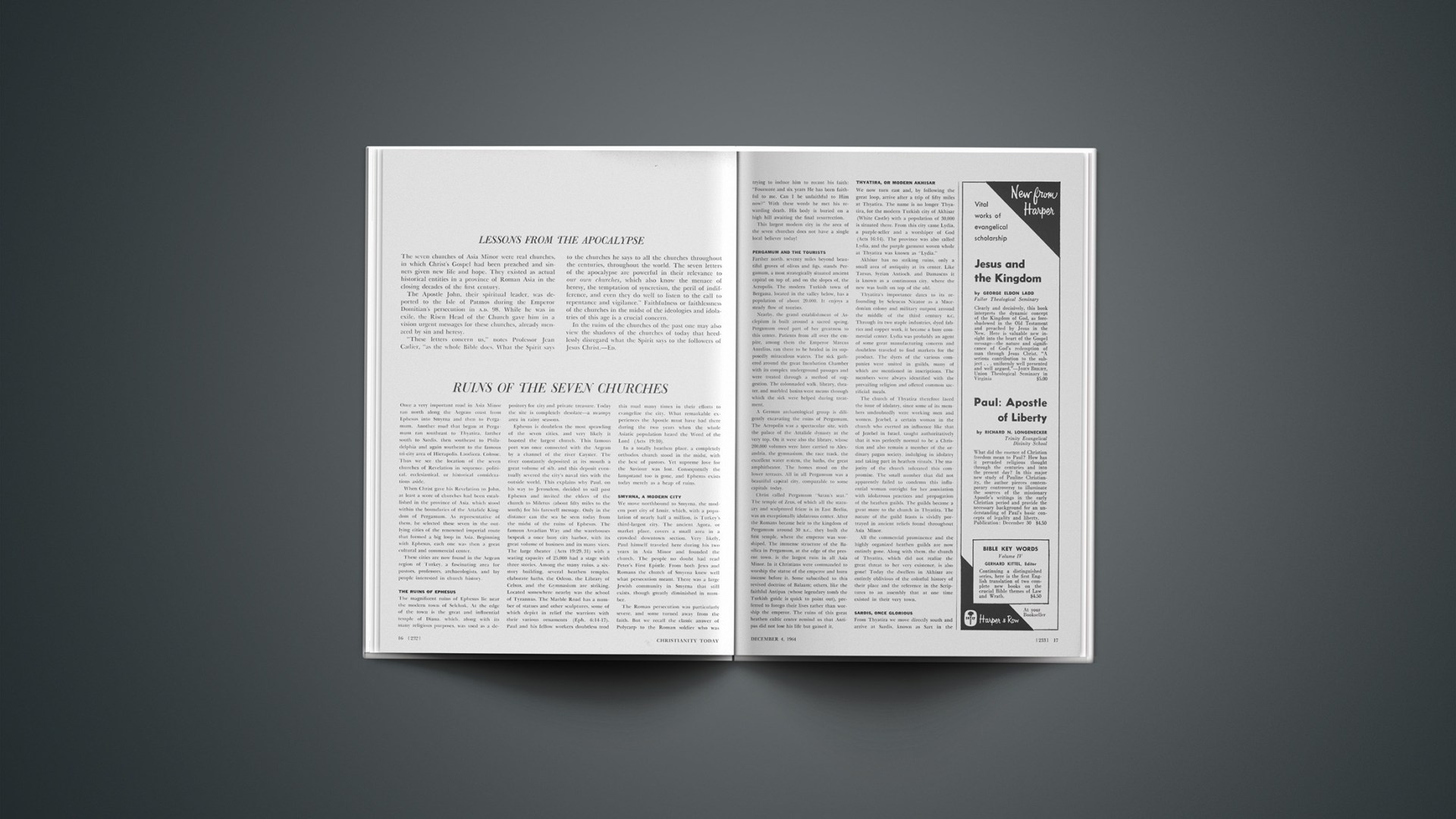
Ruins of the Seven Churches

Once a very important road in Asia Minor ran north along the Aegean coast from Ephesus into Smyrna and then to Pergamum. Another road that began at Pergamum ran southeast to Thyatira, farther south to Sardis, then southeast to Philadelphia and again southeast to the famous tri-city area of Hierapolis. Laodicea, Colosse. Thus we see the location of the seven churches of Revelation in sequence, political, ecclesiastical, or historical considerations aside.

When Christ gave his Revelation to John, at least a score of churches had been established in the province of Asia, which stood within the boundaries of the Attalide Kingdom of Pergamum. As representative of them, he selected these seven in the outlying cities of the renowned imperial route that formed a big loop in Asia. Beginning with Ephesus, each one was then a great cultural and commercial center.

These cities are now found in the Aegean region of Turkey, a fascinating area for pastors, professors, archaeologists, and lay people interested in church history.

The Ruins Of Ephesus

The magnificent ruins of Ephesus lie near the modern town of Selchuk. At the edge of the town is the great and influential temple of Diana, which, along with its many religious purposes, was used as a depository for city and private treasure. Today the site is completely desolate—a swampy area in rainy seasons.

Ephesus is doubtless the most sprawling of the seven cities, and very likely it boasted the largest church. This famous port was once connected with the Aegean by a channel of the river Cayster. The river constantly deposited at its mouth a great volume of silt, and this deposit eventually severed the city’s naval ties with the outside world. This explains why Paul, on his way to Jerusalem, decided to sail past Ephesus and invited the elders of the church to Miletus (about fifty miles to the south) for his farewell message. Only in the distance can the sea be seen today from the midst of the ruins of Ephesus. The famous Arcadian Way and the warehouses bespeak a once busy city harbor, with its great volume of business and its many vices. The large theater (Acts 19:29, 31) with a seating capacity of 25,000 had a stage with three stories. Among the many ruins, a six-story building, several heathen temples, elaborate baths, the Odeon, the Library of Celsus, and the Gymnasium are striking. Located somewhere nearby was the school of Tyrannus. The Marble Road has a number of statues and other sculptures, some of which depict in relief the warriors with their various ornaments (Eph. 6:14–17). Paul and his fellow workers doubtless trod this road many times in their efforts to evangelize the city. What remarkable experiences the Apostle must have had there during the two years when the whole Asiatic population heard the Word of the Lord (Acts 19:10).

In a totally heathen place, a completely orthodox church stood in the midst, with the best of pastors. Yet supreme love for the Saviour was lost. Consequently the lampstand too is gone, and Ephesus exists today merely as a heap of ruins.

Smyrna, A Modern City

We move northbound to Smyrna, the modern port city of Izmir, which, with a population of nearly half a million, is Turkey’s third-largest city. The ancient Agora, or market place, covers a small area in a crowded downtown section. Very likely, Paul himself traveled here during his two years in Asia Minor and founded the church. The people no doubt had read Peter’s First Epistle. From both Jews and Romans the church of Smyrna knew well what persecution meant. There was a large Jewish community in Smyrna that still exists, though greatly diminished in number.

The Roman persecution was particularly severe, and some turned away from the faith. But we recall the classic answer of Polycarp to the Roman soldier who was trying to induce him to recant his faith: “Fourscore and six years He has been faithful to me. Can I be unfaithful to Him now?” With these words he met his rewarding death. His body is buried on a high hill awaiting the final resurrection.

This largest modern city in the area of the seven churches does not have a single local believer today!

Pergamum And The Tourists

Farther north, seventy miles beyond beautiful groves of olives and figs, stands Pergamum, a most strategically situated ancient capital on top of, and on the slopes of, the Acropolis. The modern Turkish town of Bergama, located in the valley below, has a population of about 20,000. It enjoys a steady flow of tourists.

Nearby, the grand establishment of Asclepium is built around a sacred spring. Pergamum owed part of her greatness to this center. Patients from all over the empire, among them the Emperor Marcus Aurelius, ran there to be healed in its supposedly miraculous waters. The sick gathered around the great Incubation Chamber with its complex underground passages and were treated through a method of suggestion. The colonnaded walk, library, theater, and marbled basins were means through which the sick were helped during treatment.

A German archaeological group is diligently excavating the ruins of Pergamum. The Acropolis was a spectacular site, with the palace of the Attalide dynasty at the very top. On it were also the library, whose 200,000 volumes were later carried to Alexandria, the gymnasium, the race track, the excellent water system, the baths, the great amphitheater. The homes stood on the lower terraces. All in all Pergamum was a beautiful capital city, comparable to some capitals today.

Christ called Pergamum “Satan’s seat.” The temple of Zeus, of which all the statuary and sculptured frieze is in East Berlin, was an exceptionally idolatrous center. After the Romans became heir to the kingdom of Pergamum around 30 B.C., they built the first temple, where the emperor was worshiped. The immense structure of the Basilica in Pergamum, at the edge of the present town, is the largest ruin in all Asia Minor. In it Christians were commanded to worship the statue of the emperor and burn incense before it. Some subscribed to this revived doctrine of Balaam; others, like the faithful Antipas (whose legendary tomb the Turkish guide is quick to point out), preferred to forego their lives rather than worship the emperor. The ruins of this great heathen cultic center remind us that Antipas did not lose his life but gained it.

Thyatira, Or Modern Akhisar

We now turn east and, by following the great loop, arrive after a trip of fifty miles at Thyatira. The name is no longer Thyatira, for the modern Turkish city of Akhisar (White Castle) with a population of 30,000 is situated there. From this city came Lydia, a purple-seller and a worshiper of God (Acts 16:14). The province was also called Lydia, and the purple garment woven whole at Thyatira was known as “Lydia.”

Akhisar has no striking ruins, only a small area of antiquity at its center. Like Tarsus, Syrian Antioch, and Damascus it is known as a continuous city, where the new was built on top of the old.

Thyatira’s importance dates to its refounding by Seleucus Nicator as a Macedonian colony and military outpost around the middle of the third century B.C. Through its two staple industries, dyed fabrics and copper work, it became a busy commercial center. Lydia was probably an agent of some great manufacturing concern and doubtless traveled to find markets for the product. The dyers of the various companies were united in guilds, many of which are mentioned in inscriptions. The members were always identified with the prevailing religion and offered common sacrificial meals.

The church of Thyatira therefore faced the issue of idolatry, since some of its members undoubtedly were working men and women. Jezebel, a certain woman in the church who exerted an influence like that of Jezebel in Israel, taught authoritatively that it was perfectly normal to be a Christian and also remain a member of the ordinary pagan society, indulging in idolatry and taking part in heathen rituals. The majority of the church tolerated this compromise. The small number that did not apparently failed to condemn this influential woman outright for her association with idolatrous practices and propagation of the heathen guilds. The guilds became a great snare to the church in Thyatira. The nature of the guild feasts is vividly portrayed in ancient reliefs found throughout Asia Minor.

All the commercial prominence and the highly organized heathen guilds are now entirely gone. Along with them, the church of Thyatira, which did not realize the great threat to her very existence, is also gone! Today the dwellers in Akhisar are entirely oblivious of the colorful history of their place and the reference in the Scriptures to an assembly that at one time existed in their very town.

Sardis, Once Glorious

From Thyatira we move directly south and arrive at Sardis, known as Sart in the Turkish tourist guidebooks. It is about forty-five miles west of Smyrna and is off the main highway. Sardis, the capital of the kingdom of Lydia, was one of the greatest and oldest cities of Asia Minor. The various ruins give evidence of this. Archaeological excavation is being carried on under the auspices of Harvard University.

The Lydians are referred to by Josephus as descendants of Lud (Ezek. 27:10; Jer. 46:9). They were contemporaries of the earlier Hittites. Sardis (the name has the same origin as the stone, sardius) lay in the middle of the Hermus valley. This valley was watered by the river Pactolos, which flowed from the beautiful surrounding mountains. The Acropolis, the site of the original city, stood 1,000 feet high and bore an impregnable fortress-citadel. The great prosperity of Sardis became a byword. The name “Croesus,” that of the last Lydian king, was adopted for the Greek word, “gold.”

In 546 B.C. the Persian emperor, Cyrus the Great, attacked and captured the city. During the Greco-Persian wars it changed hands. In 334 B.C. it surrendered willingly to Alexander; after again changing hands between other powers, it finally became part of the Roman empire, its fame greatly diminished. Sardis was probably the first city to use coined money and to develop certain innovations in music. In A.D. 17, it was devastated by an earthquake. Tiberius contributed liberally to its rebuilding. Because of this great indebtedness to the Romans, the city gave itself completely to the cult of emperor-worship.

The cities of Ephesus, Smyrna, and Pergamum vied for the title of First City of Asia. The Lord’s message to the church at Sardis, the glory of which has gone down in history, begins with the pronouncement that she is dead. And this is actually the condition of the city, now only a small hamlet. A dead church, a dead city!

Doubtless, outsiders who looked at the church of Sardis noticed much religious activity, but her inner life spoke differently. Her doings were like the rattling of dead bones. Scripture often refers to the sinful as dead (e.g., Ezek. 37:1–4; Eph. 2:1; 1 Tim. 5:6; Rev. 3:1). The church of Sardis was tenderly invited by the Lord to repent. The letter does not state the particular sin of this church. Could it have been general complacency and smugness? Did the members coast along with everyday pagan life, unchristian practices, and the heathen culture of the larger society? The downfall of the church of Sardis came subtly. Yet some were faithful and kept their garments clean.

One of the main features of the ruins of Sardis is the magnificent temple of Artemis, built during the fourth century B.C. by Alexander the Great in the glen of Pactolos. The system there was very similar to the worship of Diana at Ephesus. Right behind it at the eastern end are seen the walls of a Christian church built before the fourth century A.D. We ponder upon the immense heathen temple, totally destroyed but for a few standing columns and walls. We look also at the Christian church—everything but its walls gone! Their destruction was not accidental. Dark idolatry met its doom. But why should the church have met this destiny? Christ gives the reason in his letter to her. Although she heard and received the body of truth, she was not awake but was in a miserably dead state. At an unexpected hour, Christ came like a thief and executed judgment. In how many places one may read the same story: here the ruins of a heathen temple, there the ruins of a Christian church. Woe to any church that sinks to the level of the unholy heathen temple!

The Road To Philadelphia

We drive southeast over a dusty gravel road and arrive at the modern town of Alasehir, which is on the very site of Philadelphia. One can also come by train from Izmir. The present population is about 12,000. Other than those specially interested in visiting it because of its mention in Revelation, no stranger ever sets foot in Philadelphia.

“The city of brotherly love,” at one time the site of a spiritual, active church, is without any Christian witness today. There are remains of some walls and the barely noticeable site of an ancient theater, but no other ruins. Once there were a number of temples, where religious festivals were attended by people from all over. Hence the city was later nicknamed “Little Athens.”

Philadelphia was founded by Eumeneus, king of Pergamum, on the slope of Tmolus and on the plain below. It was named after his brother Philadelphus (Attalus II), known for his loyalty to Eumeneus. The valley was fertile enough to support a city, and the Pergamene kings needed it as a communication center. It lay directly on the imperial Roman road. Its long valley constituted an open door to Phrygia and the regions beyond. Christ, however, had provided for her an open door that no one could close. It was a missionary city, founded a century and a half before Christ to spread the Hellenistic civilization eastward. In this task it was very successful, as it thoroughly supplanted the Lydian language and culture. The open door set before the church was her mission, which no power could or ever will be able to stop.

Philadelphia was prone to earthquakes. Following the one in A.D. 17, most of the inhabitants felt unsafe and moved to the surrounding country, where they dwelt in tents. In contrast to this, Christ promises to overcomers the ultimate stability of being built into the temple of God. Tiberius rebuilt the destroyed city. In gratitude, the name Neoceasarea was ascribed to the city. Its name was altered on two other occasions in servitude to emperors. In allusion to this, Christ promises to inscribe permanent new names upon the true believers there.

It is interesting to observe that the church of Philadelphia had only a little strength, the humble and unassuming spiritual power that the Lord seeks in any church. However, not a word of censure is implied.

While the church of Philadelphia is also gone, this city was the last of the seven to be conquered. And no one was able to rob the believers of their eternal crown.

Laodicea, The Lukewarm

City after city, church after church, discloses judgment. But only after we travel southeast sixty miles on a poor road and arrive at Laodicea do we see the worst judgment. There the church received the most scathing rebuke.

Nearby stands the Turkish city of Denizli with a population of 30,000. This area is very important for its New Testament associations, since it includes the three ancient cities of Colosse, Laodicea, and Hierapolis, all within a radius of ten miles (Col. 4:13). Hierapolis is built around copious hot springs. Renowned for their healing power, these springs are still running and are enjoyed by many throughout the year. The spectacular cliffs of lime, deposited over the centuries, are a striking phenomenon, now called Pamukkale (Cotton Castle). This was a center of pagan cults. Hierapolis has an immense and quite intact amphitheater as well as many other ancient structures, but no archaeological excavation has been done. According to early tradition, a church was founded in Hierapolis by the Apostle Philip, who died there.

Southeast of Hierapolis are the ruins of Colosse. Northeast of Colosse is Laodicea. The three cities were closely related, as were the churches in them.

Laodicea was by far the largest and wealthiest of the three. The letter in Revelation is full of allusions to its riches. Originally called Diospolis, city of Zeus, the city was enlarged by the Seleucid Antiochus II and named after his wife, Laodice. Its important location made it an extremely prosperous commercial center. Roads radiated from it in four directions. Its situation as the most important junction between East and West made it a base for banking houses and millionaires. Laodicea became legendary for the gold she possessed. Christ advised the church to buy fire-tested gold from him to be truly wealthy. It was world-renowned for the fine quality of its woven garments, produced from a breed of sheep (today extinct) with long, soft, glossy black wool. Christ instructed the church to buy white clothes from him in order to cover the shame of her nudity. The town was famous for physicians and medicines, one of which was “Phrygian powder,” rubbed on the eyes as a cure for various eye diseases that still afflict many people in these parts. Christ wanted the church to buy eye-salve from him to cure her blindness.

Laodicea’s banks, woolen factories, medical schools, fortifications, and great Roman garrisons were widely known. The church prospered financially along with the city and became a lukewarm, powerless, earthly organization.

To the people round about, the place is known as Eski Hisar (Old Castle). It is in the most desolate condition of the seven cities. The whole ruined area is covered with fields. Once in a while a peasant or a shepherd wanders nearby.

The ruins stretch for hundreds of acres and give mute testimony to past greatness. Unfortunately, many stones have been carried away by villagers through the past centuries, as from other sites. But enough are left to build another city.

A large rock tower houses such an intricate plumbing system that any modern city planner would like to see it. Hierapolis nearby offers the best of hot springs. Laodicea did not have her own water but had a perfect aqueduct system that carried water from a long distance. The water was neither hot like that of Hierapolis, nor cold like that of Colosse. It was lukewarm, and so was the condition of the church that used it.

The Laodiceans used their riches to build two large theaters and a great stadium, all with a seating capacity of tens of thousands. These are still visible but are deteriorating. No systematic archaeological excavation and no renovation is being done; great archaeological wealth lies waiting. It would be worthwhile for a group of Christian archaeologists and students to secure permission from the Turkish government and camp in Laodicea one summer, to excavate and to witness to the people living nearby. Common labor can be secured for a dollar a day.

No Christian can visit Laodicea without sadness of heart. On a Lord’s Day morning our small group held an informal service pondering the message to that church. Immediately a group of peasants came near and stood around us. We made a few remarks on the Word, prayed, sang, and offered them Gospel portions in their language. Before leaving, I pointed to the ruins and asked: “What are these?” One of them gave us a quick and simple answer: “Tash” (stones). Gone are the riches, wealth, and fame of Laodicea! Not even its memory is preserved for the dwellers nearby. Christ had declared to the church, “Because you are lukewarm and neither cold nor hot, I am going to spew you out of my mouth.” May the Church of Christ today be spared a similar judgment!

Theology

Lessons from the Apocalypse

The seven churches of Asia Minor were real churches, in which Christ’s Gospel had been preached and sinners given new life and hope. They existed as actual historical entities in a province of Roman Asia in the closing decades of the first century.

The Apostle John, their spiritual leader, was deported to the Isle of Patmos during the Emperor Domitian’s persecution in A.D. 98. While he was in exile, the Risen Head of the Church gave him in a vision urgent messages for these churches, already menaced by sin and heresy.

“These letters concern us,” notes Professor Jean Cadier, “as the whole Bible does. What the Spirit says to the churches he says to all the churches throughout the centuries, throughout the world. The seven letters of the apocalypse are powerful in their relevance to our own churches, which also know the menace of heresy, the temptation of syncretism, the peril of indifference, and even they do well to listen to the call to repentance and vigilance.” Faithfulness or faithlessness of the churches in the midst of the ideologies and idolatries of this age is a crucial concern.

In the ruins of the churches of the past one may also view the shadows of the churches of today that heedlessly disregard what the Spirit says to the followers of Jesus Christ.—ED.

Theology

Revelation in History

Fourth in a Series (Part II)

The Heilsgeschichte emphasis on historical revelation represents a development that moves beyond both Bultmann and Barth and that is as distasteful to one as to the other. Barth avoids the concept of Heilsgeschichte, preferring to speak instead of “the Geschichte Jesu Christi,” of that which “happens and continues to happen.” The tendency of both post-Bultmannian and Heilsgeschichte scholars to resurrect the search for the historic Jesus he considers a mistake that regrettably “returns to the way of the nineteenth century.” “It marks a retreat from the New Testament witness,” contends Barth, “to something behind the witness and existing independently of it.” “I don’t like the term ‘Historie’ [knowledge of what has happened],” protests Barth, and “much prefer ‘Geschichte’ [something that happens].” Barth’s view of the role of historical investigation in relation to faith remains so negative that historical research, as he sees it, not only may lead to a false construction but “must yield a Jesus not identical with the Christ of the New Testament.” Nonetheless New Testament scholars are increasingly pursuing exegetical and historical studies and are letting the dialectical theologians paddle for themselves.

Yet the Heilsgeschichte emphasis on historical revelation surrenders on the one side what it gains on the other insofar as it suspends the meaning of that revelation on spiritual decision rather than deriving it from an authoritative Scripture through historical investigation. Some Heilsgeschichte scholars view the truth of revelation not as universally accessible and valid for all men but, in agreement with Barth and Bultmann, as existing only for some persons in and through a miracle of grace. Thus the meaning of revelation is presumably carried not by saving history or the biblical interpretation but by spiritual decision.

Precisely at this point the young but growing Pannenberg school insists on historical revelation in a larger sense that incorporates additional elements of an evangelical theology. In his Offenbarung als Geschichte, a recently translated work, Pannenberg sees the denial of the objectivity of revelation as a threat to the very reality of revelation. Contrary to Barth’s contentment with “objectifying” elements in dogmatics, he insists upon the objectivity of divine revelation. Pannenberg vigorously opposes the way in which the dialectical theology relates revelation and its meaning to truth and history alike. He deplores the Barth-Brunner legerdemain with the problem of revelation and history—as when Brunner says that the kerygma which brings forth faith includes history “but not in the isolation which the historian demands.” It distresses him that whenever the dialectical theologians run into a historical problem they rise above it by appealing evasively to the self-communication of God.

Although he reasserts objective historical revelation, Pannenberg does not preserve the traditional distinction between general and special revelation. What has happened in time, he says, is God’s revelation as such, but what has happened in Jesus Christ is the real clue to the totality of happenings. Barth criticizes this approach, contending that no such “general revelation” exists, but only a particular revelation of God’s doing. Pannenberg holds that everyone stands in some relation to God and therefore has a general knowledge of God; but this knowledge he refuses to call revelation. Revelation he defines as the self-disclosure of God in the end-time (because at the end of his deeds) as realized proleptically in Jesus. In defining revelation as history, Pannenberg holds we must regain an original “eschatological understanding.” On this basis he criticizes Cullmann’s view of Christ at the middle of the time line of saving history, and holds instead that Christ is the end of history as fulfillment. Yet this end is at once always present and also future. Whereas Bultmann connects the Old and New Testaments in existential decision and Heilsgeschichte scholars connect them historically, Pannenberg relates them apocalyptically. Some Heilsgeschichte scholars protest that Pannenberg’s main interest is Universalsgeschichte, or universal history, rather than salvation-history; but Pannenberg’s correlation of divine disclosure with special revelation means that he, like Barth, views all divine revelation as saving. In fact, Pannenberg assertedly seeks to carry out the basic intentions of his former teacher, intentions that he thinks Barth weakened by his dialectical concessions.

Radical Transcendence

The main significance of the Pannenberg plea for objective historical revelation is its open recognition that unsatisfactory formulations of the transcendence of God and of the relation between eternity and time have dominated European theology since Kierkegaard. It is noteworthy that in Kierkegaard’s homeland the Copenhagen theologian N. H. Söe (who thinks S. K.’s influence is here to stay) criticizes Kierkegaard’s time-eternity disjunction as being objectionably philosophical. Kierkegaard, says Söe, finds his concept of time in Greek rather than in Palestinian motifs. Like Cullmann, Söe views time as created by God and made therefore to receive God’s revelation. But Söe does not on that account view divine revelation as objectively given in history, because with Kierkegaard and Barth he understands revelation in terms of singularity and as existing for man in any given moment only as an act of grace. At this point Söe’s thought mirrors S. K.’s Postscript. Despite theological perpetuations of Kierkegaard’s views, Kierkegaard now is little followed by European philosophers. And even among Danish theologians his positions are brought under increasing criticism. K. E. Lögstrup of Aarhus assails especially Kierkegaard’s individualistic emphasis and self-centered approach to the teaching of Christian love.

Anders Nygren of Lund, whom Gustaf Wingren groups with Barth and Bultmann in Theology in Conflict (1958) because of his inversion of Gospel and Law, is nonetheless a stern critic of Barth’s extreme disjunction of eternity and time. “We must be done,” he says, “with the docetic notions of revelation so popular in our generation.” Barth found his point of departure in Plato and Kierkegaard, remarks Nygren, and he was “right in drawing the consequences, that we cannot truly speak of God” once eternity and time are overseparated this way. “But,” counters Nygren, “on the basis of God’s image in man, now shattered, and especially of the incarnation, we may indeed speak of God.” Over against Barth, Nygren speaks of God’s continuing revelation in nature, history, and conscience.

Helmut Thielicke of Hamburg assails Barth’s and Bultmann’s radical disjunction of eternity and time from another angle. Their approach, he says, left the Church impotent to provide a social ethics. “The Barth-Bultmann theology was unable to stimulate the ethical concern of the Church, the latter because Bultmann places everything within the individual, the former because Barth so idealizes Christ that even Heilsgeschichte gets lost in a ‘supernatural Heilsgeschichte.’ Hence Barth must superimpose the New Testament imperative and indicative upon his dialectical formulation.” Although Barth was a strong opponent of the Third Reich, the effect of his theology, Thielicke contends, “was to call the Church to think of itself while the world was left to itself. No Christian criterion was given to the world whereby the world could judge itself. As a consequence, both the self-certainty of the Church and the self-certainty of secularism increased.” Unlike Barth, Thielicke insists upon general revelation. Although man is “subjectively closed to the revelation,” an ethical possibility exists different from Barth’s projection—though not without its own difficulties. Thielicke asserts that the kerygma-theologians “forget that the objects of theology are the actions of God—and that involves history.”

The Historical Jesus

Thus far rationalistic and irrationalistic liberalism alike have failed to discover the authentic historical Jesus. Both Bultmann and Barth deplore the historical critical method as leading necessarily to a false Christ. There is growing suspicion that not the facts about revelation and history and faith but prior dialectical-existentialist assumptions arbitrarily dictate this verdict.

Those who insist upon the importance of the Jesus of history as decisive for Christian faith now follow two main avenues—one illustrated by Ethelbert Stauffer, the retired Erlangen New Testament scholar, and the other by the Uppsala New Testament exegetes Birger Gerhardsson and Harald Riesenfeld. Stauffer proceeds on the nineteenth-century notion of a fundamental break between Jesus and the primitive Church. “I see only one way to find an objective basis for our Christian thought and life: the question of the historic Jesus,” says Stauffer. “The historical Jesus in the Bible is my canon.” And the starting point of this truly historical Jesus, he identifies infallibly with “those few hundred words” where the Evangelists give us what is a scandal to them or to the early Church. “There they record what belongs to the historical Jesus.” While Stauffer insists that “the word, the work, and the way of Jesus are crucial,” the Swedish scholars assail the presuppositions underlying his historical study. “A valid methodology,” protests Riesenfeld, “will recognize the continuity between Jesus and the primitive Church.” Nor are the Uppsala exegetes impressed by a second assumption that Stauffer shares with Hans Conzelmann, namely, that anything found in Judaism is not to be ascribed to Jesus. That is simply the myth of the total originality of Jesus, whereas Jesus is not without a point of contact in Judaism.

Riesenfeld and Gerhardsson boldly criticize one crucial presupposition of the Formgeschichte of Dibelius and Bultmann. In a climate of mounting criticism of Bultmann’s methodology, now also joined by Roman Catholic writers (most significantly Heinz Schürmann of Erfurt, Germany), they call for a new approach that treats historical questions earnestly. Riesenfeld and Gerhardsson dispute the Bultmannian notion that one can immediately elucidate the formulation of New Testament material by applying the form-critical method. While they grant that every Gospel pericope has its life situation in the history of the primitive Church, they reject the inference that the pericope has therefore been created by the primitive Church. They concede further that the content has been changed and modified by the primitive Church, but they insist nonetheless that a real tradition originating with Jesus himself is included. What the Uppsala scholars demand, therefore, is a methodology aware of the firmness of this tradition.

“The Bultmannian theology is a twin sister of the form-critical view of the origin of the Gospel tradition,” notes Gerhardsson. “The two presuppose one another. But I don’t find that the a priori skepticism, which determines the form-critical program, is historically justified. I am trying to find a method of exploring—by way of purely historical research—the way in which the Gospel tradition was transmitted—technically speaking—in the early Church. Historical research cannot solve theological problems—in any case not all of them—but it can help theology by way of providing some firm points and basic values. And the unwarranted a priori skepticism of the form-critics can hardly serve as a basis for a realistic theology.”

Theology

A Virgin Shall Conceive

(A dramatic poem for two voices)

Joseph is at work in his carpentry shop.

AN OPEN LETTER

To: The Christian Leadership of America

From: The Administration of Malone College

Re: Our Concern for Faculty Personnel

AN OPEN ADMISSION

Experiencing a rising enrollment, Malone College seeks your assistance in recruiting qualified faculty personnel for the 1965–66 college year.

A NEW COLLEGE

Malone College began operations as a Christian, liberal arts college in Canton, Ohio in 1957. In seven years the college advanced to full accreditation by the North Central Association of Colleges and Secondary Schools and membership in the Ohio College Association.

The new campus has had continual additions in buildings and services. The enrollment has grown from 267 to 1010. Admission standards include that of graduation in the upper half of the high school class.

A MUTUAL CONFRONTATION

Malone College is a conservative, evangelical Christian college operated by the Ohio Yearly Meeting of the Friends Church for the church, Greater Canton and surrounding communities, and Christian youth. Thus the college serves with a non-denominational outreach a heterogeneous community as well as Christian youth.

Dialog between the committed and non-committed is seen to be a strength for the academic and Christian purposes of the college. The college deliberately brings together for mutual confrontation the challenge of the Christian faith and the diverse interests and educational needs of all its students and the world in which they live.

A PRESENT NEED

The college is committed to the position that the faculty is the key to quality. Neither the academic or Christian purposes can be realized without scholars who are respected in their academic fields and who have the breadth of life and learning to create an atmosphere of reflection, achievement, and Christian vocation.

Faculty needs include most fields found in a liberal arts college: literature and composition, speech, German, history (non-American fields), sociology, economics, micro and developmental biology, chemistry, mathematics, physics-mathematics, psychology, elementary education, and philosophy. A professional librarian and an admissions counselor are needed. Only those with or close to the doctorate are sought. Experienced college teachers without the doctorate may be considered in certain fields.

FACULTY BENEFITS

The national averages for salaries paid in private liberal arts colleges for 1964–65 are: instructors, $5792; assistant professors, $6815; associate professors, $7926; and full professors, $9883. Malone salaries agree well with these figures. Faculty fringe benefits include major medical and life insurance programs, a retirement program with TIAA, sabbatical leave, doctoral loan programs, and free tuition for faculty children.

INQUIRIES INVITED

All correspondence should be directed to the Dean of the College, Malone College, Canton, Ohio 44709. Brochures regarding the college are available.

Paul and the Computer

With the help of a computer, the Rev. A. Q. Morton, a Scot, has calculated that of the thirteen New Testament epistles generally ascribed to Paul, only five—Romans, Galatians, First and Second Corinthians, and Philemon—were written by him. Under the title, “A Computer Challenges the Church,” in the London Observer (November 3, 1963), he claims he has proved this in a scientific, unimpeachable manner.

Morton presents his results with the challenge: “Theologians all over the Christian world have now to face the implications of this discovery. They must change their view of the life of Paul, they must revise the history of the early Church and they must jettison doctrines that have now been shown to be without foundation.” He asserts that religion is confronted by natural science in a way “every bit as far-reaching in its effects as the clash between T. H. Huxley and the bishops in the nineteenth century. Once again authority is called upon to yield to the advance of knowledge.” Morton claims that New Testament scholars have lacked the instrumentation to determine questions of authenticity and pseudepigraphy. “The technical resources available to New Testament scholars were quite inadequate to enable them to determine the authorship of an Epistle.” But Morton broke through the impasse, he says, and “set out to discover some scientific techniques that would furnish conclusive answers to such questions.” The theologians originally did not have much confidence in such techniques, Morton says; “the most respectable” of them “are used to treating evidence in a most unscientific way.” He concludes his article with the statement, “They are not searching for the truth but only for illustrations of what they already accept to be true.”

A week later, the November 10 Observer gave the reactions of “five leading churchmen and Bible scholars” to Mr. Morton’s claims—namely, John Robinson, Bishop of Woolwich (Honest to God); Leslie Weatherhead; Professor Christopher Evans; Thomas Corbishley, S. J.; and Charles Raven.

Evans begins by stating the problem: “It is a little difficult to see what is biting Mr. Morton so hard.” Robinson declares that Morton is embittered against theologians. “If he had spent more time supplying figures and less on odium anti-theologicum, one would have more confidence in his judgment.” So sharp a judgment is justified, perhaps even more than Robinson could have known when he wrote. Morton complains that the theologians abuse his work. The editors of the English theological review Expository Times allegedly had rejected his article with the following note: “Dear Mr. Morton, I do not understand this but I am quite sure that if I did understand it, it would be of no value.” A week later Morton had to make an apology. He had been unfair to the editors of the Expository Times, “whose rejection of my article was in courteous traditional terms and I must apologize for a lapse of memory.”

It appears that he has a poor memory at other points. He says that he was allowed to present his case at an international conference at Oxford but that three Scottish professors have had it in for him. Mentioning them by name (W. Barclay, A. M. Hunter, and J. S. Stewart), he suggests that they could not use the results of his investigation because their own published works about Paul would then be worthless. Yet, according to the Observer (November 10), Professor Evans had invited Morton to come to the University of London and explain his theory. Moreover, Barclay reveals in the British Weekly (November 14) that he had allowed Morton to present his case to his students and had hoped that the theologian-mathematician would come to Glasgow again.

What is biting Mr. Morton so hard? It very likely is more than a problem of personal relations. Apparently it stems from the argument that if it could be proved that Paul did not write one or another of the epistles attributed to him by the Bible, the trustworthiness and the authority of the Bible would fall. Now that the non-Pauline authorship of eight epistles ascribed to the Apostle has allegedly been proved, the Bible—and the teaching of the Church which rests on it—has lost its authority.

To non-Christians this argument is very convincing. It is also convincing to some Christians, though not to others. It is generally recognized that apostolic origin had much to do with the acceptance of the canonical books. Nevertheless, Luther asserted, “A writing that does not teach Christ is not apostolic, even if it were from Peter or Paul. On the contrary, a writing in which Christ is preached is apostolic, even if it were written by Judas, Annas, Pilate, or Herod.” Meanwhile it is clear that for Calvin the relation between authorship and canonicity is closer than for Luther. Calvin said, for example, in commenting on Second Peter: “I find it more probable that this epistle was written by someone else in the spirit of Peter than that it was written by Peter himself” (although this is not derived from Second Peter 1:1 and 18). Professor Evans’s remark about Morton’s conclusion with respect to the Epistle to the Ephesians, concerning whose destination Beza had already had questions, may also be considered here: “Ephesians deserves to be considered in its own right, and even if not Pauline is more important than Philemon, which is. The doctrine of Christ’s lordship over the universe remains to be expounded as part of the Church’s developing faith even if Colossians is shown to be non-Pauline, and what Paul sparked off in disciples or later admirers may, in its own place, be as significant as what Paul wrote himself.”

The critics of the Observer (November 10) also reproach Morton for his boasts against the Bible and the Church. Leslie Weatherhead remarks: “I was delighted with Mr. Morton’s article,” but adds quickly—more or less in the spirit of Luther—“All that matters is not authorship but truth and relevance.”

And so it may safely be said of Morton’s calculations and conclusions that, theologically speaking, there is much less at stake than he claims.

Was The Computer Necessary?

In the meantime there remains of course, the much more difficult question: What must be thought of Morton’s high regard for his statistical method of drawing watertight conclusions about the authorship of the Pauline epistles? That Morton overestimates the matter is obvious. We certainly do not need the computer to make it clear that the man who wrote Galatians is not the same one who wrote Hebrews. Every Bible reader can see this. In Galatians one of the main theses of the author is that he received his Gospel, not at second hand through the intermediary of men, but directly from the Lord. Hebrews 2:3 indicates that writer and readers had received the message of salvation “at second hand”; it had been attested to them by those who had heard the preaching of the Lord. Many New Testament scholars would have more appreciation for a balanced argument that weighs all the pros and cons, as does that of Henry Chadwick of Christ College in Oxford, about the authorship of Ephesians (cf. Peake’s Commentary on the Bible, 1962, pp. 980 ff.). They would prefer a statement like that of F. F. Bruce, who in the same commentary says that if Ephesians is not from Paul the man who wrote it was the greatest Paulinist of all time (p. 934), to Morton’s assertion that “the Industrial Revolution has arrived at the New Testament” and that “it is now as crippling to be innumerate as it has been to be illiterate.”

The reader who has a great confidence in statistics may feel at ease. Morton is not the first to use statistics in approaching questions of authorship. In 1959 the Roman Catholic scholar De Solages published a study about the possible literary sources of the first three Gospels. Statistics, mathematics, and charts were all used. The result was not surprising to most of his colleagues: it confirmed the so-called two-sources hypothesis (that Matthew and Luke used Mark, but with complete independence of each other; that both also used another source, which was the same for both, but here too worked independently). The humorous thing is that this result hardly agrees with a statement of the papal Bible commission of 1911 about the origin of Matthew. Nevertheless, Cardinal Tisserant wrote an introductory note for De Solages’s book in which he says that the author’s conclusions are “extremely probable, if not certain.”

I call this humorous in connection with Morton’s remark about Christian theologians: “They are not searching for the truth but only for illustrations of what they already accept to be true.” Robinson calls this “a mere insult.” That is exactly what it is. It is difficult to say to what degree it stems from Morton’s ignorance. Morton does not appear to know everything about the history of research. He writes, for instance, “No scholar had ever challenged the view that Paul wrote Galatians, for this Epistle is his indignant reply to the charge that he lacked authority.” However, the Galatian authorship was vigorously challenged by Bruno Bauer, and for several decades this opinion of Bauer was taught in the public universities of Holland by such men of the so-called Dutch school as Allard Pierson, Naber, A. D. Loman, and Van Manen. And these men were scholars.

But to return to statistics, we are indebted to the Swiss scholar Robert Morgenthaler for a Statistik des neutestamentlichen Wortschatzes, which appeared in 1958. There are plenty of statistics in this book: an endless number of tables, many calculations of probabilities, and a long section of graphs. Morgenthaler does not mention using a computer; he succeeded, I think, by merely counting. And he also investigated data that Morton looked at.

Morton’s work is based on the principle that every writer has his own peculiarities of style that are deeply rooted and always recognizable. These peculiarities no more change in the course of a lifetime than does a man’s fingerprint. Among these unchangeable characteristics Morton reckons the number of words that make up a complete sentence. He chiefly counts such phenomena as the repetition of the word “and” and the space between uses of the word; the use of “it” to begin a sentence; the use of the words “but” and “in,” of the verb “to be,” of the definite article, and of the Greek equivalent of “he,” “she,” and “it.”

Morton investigated the regularity with which these appeared in seven Greek authors. Of these he names Isocrates and Aristotle, and with them his theory holds true. Classical scholars have noted that this can be expected because an orator like Isocrates carefully molded his language. For the rest, scholars would still have to see the figures to be convinced.

Some Relevant Questions?

Several important questions rise about the application of this method to the thirteen biblical epistles ascribed to Paul. The first is whether sufficient account has been taken of the fact that Paul was trilingual. This plurality of languages surely influenced Paul’s style. In a statistical approach to style, the question must be raised whether the style of a trilingual writer under all conditions and during an entire career would remain exactly the same.

Another question: Did Paul dictate all his epistles, or only some? Whether one dictates or writes affects one’s style.

Furthermore, the epistles of Paul are not word-by-word from his own hand. The Apostle repeatedly quotes the Old Testament, and not always in equal amounts. In Romans there are fifty-one quotations from the Old Testament, in the rest of his epistles forty-three. The quotations in Romans comprise 704 words; the whole epistle has 7,105! Many scholars recognize that Paul sometimes quotes a passage known to his readers from, for example, their church hymns, such as the hymn about Christ in Philippians 2:6–11. Sometimes Paul explicitly says that he is handing down a “tradition” (1 Cor. 11:23–25; 15:3–7). It is demonstrable that he then falls into another style and uses a vocabulary other than his own.

How important the use of sources is for style can be demonstrated in Acts. “And” is obviously less frequently used in the second part of this book than in the first. In the second part the author had fewer sources or none at all; if he had sources, they were different from those of the first part. The opinion is rather frequently offered that Romans 16, or at least a great part of it, was originally written to the Ephesians and later attached to the Epistle to the Romans. Does this make a difference in Morton’s figures or not? There are all kinds of theories about the later combination of several small epistles and notes of Paul into one longer epistle (particularly with regard to Second Corinthians). Proponents of such theories presuppose that there have also been non-Pauline pieces inserted; a famous example is Second Corinthians 6:14–7:1.

Has Morton taken all this into account? If so, how? If a short epistle like that of Philemon is serviceable in statistical calculations, then the inclusion or exclusion of Romans 16 would make a considerable difference. This chapter has 435 words, while Philemon has 335. But who decides whether such given and debated sections are to be included or not? The computer does not make such decisions; it only answers the questions put to it.

From further publications of Morton it will have to be seen whether he has considered all the relevant questions and whether he has formulated them properly. (A book by Morton and James McLeman, Christianity in the Computer Age, will soon be published by Harper & Row. This may throw additional light on the matter.) To work honestly with a computer requires that all possibilities and all hypotheses that may be considered reasonable at the present state of research are taken into account. This means, however, a refinement in research that could not have been accomplished by one man in a couple of years. Whether such a micro-syntactical investigation will be fruitful cannot be told in advance. We shall have to wait.

Morton himself would have done far better had he waited to announce his judgments about Pauline authorship until he had stronger evidence on which to base them.

A Decade of Studies in John’s Gospel

During the past decade and a half there has been a revolution in New Testament studies, and at the center of this revolution stands the Fourth Gospel. The Gospel of John has often been a storm center in New Testament research. Sixty years ago the historical accuracy of this Gospel was under attack. Liberal scholars, committed to the doctrine of evolution in ideas, decided that this Gospel reflected an “advanced” Christology and was more theological than the Synoptic Gospels, hence must be considerably later than a “simple” Gospel like Mark. Because John’s Gospel was more theological, and hence late, its historical trustworthiness was considered slight. During this time the study of this Gospel was neglected, especially by Continental scholars. Traditionally, Continental scholars have concentrated on St. Paul, and it is British scholars who have given most attention to the Fourth Gospel during the past half century.

Much of this revival of interest in John is due to the influence of the Dead Sea Scrolls. Soon after the publication of the Scrolls, scholars began to point out verbal parallels between the Scrolls and the writings of the New Testament, especially in the Johannine writings. These parallels indicated to several, including Oscar Cullmann, William Brownlee, W. F. Albright, F. L. Cross, and others, that the theological environment of the Fourth Gospel was Palestinian. Liberal scholars for two generations had been saying that the Fourth Gospel was a result of Greek ideas mingled with Hebrew-Christian concepts, a “Gospel for the Hellenists” (Bacon). This led to the positing of a date toward the middle of the second century and a locale outside Palestine. The significance of the Scroll discoveries is that it no longer was necessary to posit a second-century date to account for such concepts as the “Spirit of Truth,” “eternal life,” “light versus darkness,” and the like. The change in scholarly opinion is reflected in the fact that F. C. Grant has been saying that John is the work of an anonymous writer of the second century who sought to present Jesus in as non-Jewish or anti-Jewish a way as possible, while in contrast his son, R. M. Grant, finds that this Gospel is quite Jewish in background and reflects southern Palestine prior to the Jewish revolt of A.D. 66–70.

Date And Authorship

The trend toward an earlier date was anticipated in 1942 by A. T. Olmstead, who concluded that the alleged Aramaic original was written prior to a.d. 40. E. R. Goodenough compared this Gospel with Philo and concluded that the concepts in John were earlier than those of Philo, necessitating a date toward the middle of the first century (JBL, LXIV, 145–182). Meanwhile Gardiner-Smith called attention to data that convinced W. F. Howard and several other Johannine scholars that John was not dependent on the Synoptic Gospels and hence could have been written prior to or contemporary with them. He argued convincingly that it is not necessary to assume a uniform growth in the development of religious ideas; instead it may be assumed that Christology developed more rapidly in some places than in others. Thus it is not necessary to assume that a long life of reflection preceded the composition of this Gospel.

Some scholars, in their new look at the Fourth Gospel, go even beyond the traditional position. That position is to regard John as being the last of the four Gospels and designed to supplement them. This was the position of Eusebius, and the early Church generally, and is still the prevailing view. However, an increasing number of scholars tend to view John as relatively early. It is coming to be regarded not only as independent of the Synoptic Gospels but as having been written prior to some of them. Scholars like W. F. Albright, R. M. Grant, J. A. T. Robinson, C. L. Mitton, and Oscar Cullmann are now inclined to believe that the substance, although not necessarily the final editing, belongs to Palestine prior to A.D. 70. They consider the Gospel the recollections of an eye-witness, although few would contend for apostolic authorship. It is noteworthy that an increasing number of critical scholars are coming to the position that the Fourth Gospel is the witness of an apostle, whether or not he did the actual writing. Many are coming to believe that it reflects the memory of the Apostle John. This is in striking contrast to the fashion a generation ago to consider John’s Gospel the work of a gifted mystic who did a maximum of theologizing with a minimum of factual data.

The Text

Even more exciting than speculation concerning date, author, and readers are the recent discoveries and discussion regarding the text of the Fourth Gospel. The earliest known portions of the New Testament are two fragments from this Gospel (P52 and P2). The earliest copies of an entire book of the New Testament are of this Gospel. Bodmer Papyrus II (P66) has been dated by experts at c. A.D. 200, making it 125 years older than other manuscripts.

For years the monumental work of Westcott and Hort has stood almost unchallenged as the best available text. Recent textual discoveries, however, have provided attractive new alternatives to the standard text. Important recent commentaries on the Fourth Gospel, including those of Dodd, Bultmann, and Barrett, reflect an unwillingness to accept any one text as definitive. These scholars prefer an “eclectic text.” In many instances contextual evidence outweighs textual evidence from manuscripts (e.g., C. H. Dodd, The Interpretation of the Fourth Gospel, 1953, p. 433). Bultmann often makes a decision concerning a disputed text on exegetical grounds rather than manuscriptural evidence alone. Evidence from the newly published P66 has now been incorporated into the twenty-fourth edition of the Nestle text, making it the most responsible text available.

Scholars are now showing much interest in the newest addition to Johannine texts, the Bodmer Papyrus XIV–XV (P75), which reveals a marked affinity with Codex Vaticanus. The variations between these two texts is much less than the variations between P75 and other extant texts (C. L. Porter, “Papyrus Bodmer XV [P75] and the Text of Codex Vaticanus,” Journal of Biblical Literature, December, 1962). The significance of the new Papyrus P75 is that it is now claimed to be the best available text for the Fourth Gospel, as Kenneth W. Clark of Duke University and scholars working with him have shown. The new discovery also enhances the already immense prestige of Codex Vaticanus.

Bultmann’s influence has been felt in Johannine studies in two ways. He has argued at great length that this Gospel is largely the result of second-century Gnostic influences, something comparable to Harnack’s “acute Hellenization” of Christianity. Two archaeological discoveries have dealt an all but decisive blow to this assumption. The Qumran literature shows that the alleged Gnostic influences were known in a Palestinian locale prior to the Jewish revolt of A.D. 66–70. Recent discoveries of Gnostic writings at Nag Hamadi in Upper Egypt have shed new light on the second-century Gnostics. The effect of these discoveries on Johannine studies is to vindicate the judgment of the church fathers, who, many scholars had feared, were unduly biased against the Gnostics. In the light of this clearer understanding of Gnosticism, it is apparent that the Fourth Gospel, far from being influenced toward Gnosticism, was written to refute this heresy. The Gospel spoke to its intellectual environment rather than from it.

Bultmann has also contended that there are four principal literary sources or layers in the Gospel. First, he says, there is the prologue (Vorlage) from a “revelation source”; second, a miracle-source; third, the passion-resurrection source; and finally, the evangelist himself, who welded the three source-materials together. Some scholars have ignored this thesis. Some, like Barrett and Ruckstuhl, have examined it and rejected it completely. The application of radical form-critical procedure to this Gospel apparently is having little if any lasting influence (D. M. Smith, “Sources of the Gospel of John,” New Testament Studies, April, 1964). The sum total of this form-critical approach to John is to renew the quest for the historical Jesus.

Purpose Of The Gospel

Recent scholarship is more interested in the purpose of the Gospel than in its authorship. J. A. T. Robinson (Twelve New Testament Studies, 1962, p. 117) regards the author as a Jew speaking to other Jews, especially the Jews of the Dispersion (i.e., outside of Palestine). Although far from being a narrow nationalist, the author, he thinks, has written the most Jewish book of the New Testament, with the exception of the Revelation. Oscar Cullmann (Expository Times, November, 1959) believes that the author, like Stephen and the men of Qumran, was hostile to the temple and priesthood and that he wrote to the Jews with a Greek culture, thus “rehabilitating” the Hellenists.

Van Unnik believes that the Gospel was written primarily to convert those in the synagogues of the Dispersion. Mitton argues that one of the purposes of the Gospel is to provide information concerning the “historical personality of Jesus of Nazareth” (Expository Times, August, 1960). The older view is that the author was a Jew who wrote for those who had a Jewish background but were also aware of current trends in thought. This would account for his use of such general terms as logos, truth, light, and life.

Thus within a decade the critics are returning to a much more conservative position with respect to the historical trustworthiness, the apostolic origin, the Palestinian locale, the “primitive” factuality, and the authentic theological insights of this greatest of the Gospels.

T. Leo Brannon is pastor of the First Methodist Church of Samson, Alabama. He received the B.S. degree from Troy State College and the B.D. from Emory University.

Books

Books and the Book

It is not safe for a Christian to lose himself in a multiplicity of religious books unless he is firmly grounded in The Book. Culturally as well as spiritually, a believer worth his salt is one who stands for the theistic, Judaeo-Christian view of the world and of man writ large in the pages of the Bible. Should he for want of a solid scriptural foundation give in to the enticement of naturalistic presuppositions, he would be on his way to making man the measure of all things and would possibly turn into an agnostic or a dilettante, unless rescued by a mighty act of God.

I remember in my younger days having stood for hours in front of the well-stocked shelves of my library in a state of mind and spirit bordering on paralysis. Where was I to turn next in my quest for truth? The heart-rending outcry of the disillusioned poet haunted me:

… and I have read all the books.

At times I have seen seminarians in such a plight. However poor, they would wait at the theological bookstore for the most recently publicized book in their field. Surely the last theologian who had spoken would help them out of the wilderness in which they had lost their bearings! So they waited for his weather report to know what they could believe, perchance proclaim in their next sermon, or say in their pulpit prayer. The main trouble was that having lost their first love for the Book, they found themselves caught in the snare of substitutes.

The least that can be said for such a craze for novelty is that it fails to do justice to the dynamism of Bible truth and so issues in a luxuriance of adventitious growth. But it is high time to realize that the Bible is not a grave; it is a cradle.

Had not the theistic view emerging from Scripture been so dynamic, its expansion and enrichment would never have resulted in such forms of doctrine as the Athanasian creed. And it is failure to realize this that may lead one to see only the just evidences of obsolescence—and nothing more—in that historic attempt to better apprehend the living God of Scripture. Yet this daring thrust into the mystery of the Trinity and of the Incarnate Word brought in those fourth-century days the equivalent of our front-page news and headlines.

Far be it from me, therefore, to object to the luxuriance of theological views claiming our attention today, provided that they are set forth by men of faith grounded in the Bible and in love with the Bible—scholars upon whom the Lord has laid his hand and who have as a result proceeded in the awareness of him in whom they have believed; earnest men who have set out to make biblical realities ever more accessible, trusting in God alone for the outcome of their endeavor.

Let me emphasize this element of earnestness. Upon reading risky and often gratuitous conjectures devised in these days of theological inflation, I have more than once been overwhelmed by the sudden realization that here was a man toying with holy things, the very type of easy-going, pleasure-seeking opportunist whom Kierkegaard portrayed as “the professor.”

As Kierkegaard saw it, “the professor” was indeed a later Christian invention. One would search the New Testament in vain for a passage where this genus is mentioned. Indeed, it is noteworthy that the moment it appeared, Christianity began to go backward, “the professor’s” ascent coinciding with our age, when Christianity is on its way out. So Kierkegaard illustrated his case against the mercenaries of theology in terms of a modernized version of Judas Iscariot à la professor. According to his portrayal, Judas was no longer a man in despair who sold his master for the paltry thirty pieces of silver but a highly cultivated man, calm and endowed with a shrewd understanding of life and profit. Instead of getting once and for all a large sum that he might squander in a few years, he was ready to settle for a regular income, as would befit a young married man with family looking forward to a long and enjoyable life. These conditions once subscribed to, Judas declared himself ready to betray the Lord.

A harsh portrayal indeed, and yet not so severe as its prototype in Bunyan’s The Pilgrim’s Progress. Once “a flourishing Professor,” and, as he thought, “fair for the Celestial City,” he now sat in an Iron Cage, truly a man of Despair. Asked by Christian how he had come to this condition, he explained:

I left off to watch and be sober; I laid the reins upon the neck of my lusts; I sinned against the light of the Word and the goodness of God; I have grieved the Spirit, and he is gone; I tempted the Devil, and he is come to me; I have provoked God to anger, and he has left me; I have so hardened my heart, that I cannot repent.

There are those who will laugh off as old-fashioned such solemn warnings against toying with holy things—as if the Order of God could ever fall into obsolescence! The mockers we have always with us, perhaps only because they enjoy the game. It is fun to play with ideas, the more so when one is paid to do so, and when for good measure the game issues in a proliferation of titles that add to one’s image and reputation.

When such books hit the market, the fun catches on. Hardly have the author’s uncertainties given the scent when a pack of eager-nosed readers press forward and around. Soon there is a dinning clamor of persuasion to the effect that the unaware should join in. The resulting intoxication is likely to lead one reader after another to take the means for the end and become a dilettante—that is, one who almost voluptuously lends himself to all sorts of mental attitudes without surrendering to any cause whatsoever. With the aid of the unreality of much of this kind of speculation, the new knowledge is easily turned into a dazzling show, perchance even into a thriving trade.

My heart goes out to seminarians and to ministers thus contaminated. At first they can hardly be cheered by the new author’s professorial mirth of relaxed gravity wont to triumph in a climax of bright-eyed denial. However insecure their biblical foundation, they are likely to put up a good fight. No man argues more loudly than the frustrated believer who increasingly experiences hell within. There is likely to follow a period of hesitation, until their spiritual abode begins to fall apart as the rot of professionalism sets in. Henceforth the figure these unhappy backsliders cut may be likened to one of those vignettes Lucian put together in his essay, “On Persons Who Give Their Society for Pay.” Well may they preach polished sermons, as did the Hellenistic professional philosophers of the second and third centuries; it has become only too obvious that their heart is no longer in what they say. And besides, according to the new scholars under whose spell they have fallen, any outward evidence of deep feeling stands condemned as emotionalism. The flaming torch of evangelistic fervor had better be given to Pentecostals.

The new professionalism helping, the current Protestant emphasis is no longer on the Bible but rather on “the Church,” and thus unconsciously on the organizational Church of Vested Interests, a great confederacy drawn up on the model of this world’s “mergers,” complete with big boards, committees, and sub-committees. Such a church is no longer responsive to the intimations of the Head. As one wades through the multiplicity of books promoting the modern version of ecumenism, he cannot help being impressed by the dearth of basic biblical references to that which really constitutes the Church.

Just as the rediscovery of the Bible was contemporary with a mighty deliverance from the Roman yoke, a progressive discarding of the biblical approach is becoming under our very eyes a prelude to a Protestant Canossa. As if it were not crystal-clear that the price to pay for union with Rome can only be unconditional surrender, however camouflaged! This is the way Pope Paul VI put the matter in his address at the opening of the third session of the Second Vatican Council:

We shall therefore strive, in loyalty to the unity of Christ’s church, to understand better and to welcome all that is genuine and admissible [italics mine] in the different Christian denominations that are distinct from us.…

We are told that Protestant observers were not surprised by this reassertion of papal supremacy but that they found in the Pope’s support for the collegial authority of the bishops an improved basis for dialogue with Catholicism. And so we may look forward to a fresh proliferation of new books. Their authors, needless to insist, are likely to steer at a safe distance from the reminder that only the Scriptures of the Old and New Testaments constitute the divine rule of Christian faith and practice.

Books

Book Briefs: November 20, 1964

Introduction to the New Testament, by Everett F. Harrison (Eerdmans, 1964, 448 pp., $5.95), is reviewed by James P. Martin, associate professor of New Testament, Union Theological Seminary in Virginia, Richmond.

Introductions to the New Testament have been noted for density of argument and style. Yet attempts to avoid these dangers often result in uneven and superficial treatment of thorny questions. It is a pleasure to discover in Dr. Harrison’s book an eminently clear and comprehensive introduction to the New Testament that avoids turbidity and actually is interesting. Commendable features include the style, fairness toward differing viewpoints, balance of judgment, and up-to-date discussion of scholarly contributions. The problems traditionally associated with the New Testament documents are thoroughly discussed and admirably summarized so that the student is made aware of the complexity of certain questions but does not become lost in detail. Dr. Harrison is able to distinguish important questions and evidence from less important questions and second-rate evidence.

The major divisions of the book comprise, in order, Background, Language, Textual Criticism, Canon, and Literature of the New Testament. The final division on literature is the major contribution. The treatment of background is limited to the literature and history of pre-Christian Judaism of the inter-Testamental period. While recognizing that the language of the New Testament may properly be denoted as Koine Greek, Harrison does not go all the way with Deissmann but points out the peculiarities of the New Testament language. Students will find the discussion on the practice of textual criticism helpful as they train themselves in this science. The bibliographies appended to each chapter are good and up to date.

From this reviewer’s way of looking at it, the approach of this Introduction is primarily literary rather than historical. This is to say that the focus of attention is on the varieties of literature and the problems of composition, date, and authorship of each document. Historical material is used to help us understand literary questions. This approach is certainly justifiable; and in the way in which it is followed in this book, we are given a good balance of both literary and historical considerations.

One wonders, however, if a more adequate method would be to start with the actual history of the New Testament Church as the matrix out of which the literature grew. This approach would call for an enlarged discussion of background to include the Hellenistic world, and especially its religions, at the time of Jesus and the apostles. It would show how the Church engaged itself historically in the ongoing history of its time, and how its literature called forth in this history the record and deposit of its life and faith. The unity of the New Testament would be better served by this method.

Of course, each of these basic approaches supports and requires the other, for some circular reasoning is inevitable in such historical analysis. Nevertheless, would not Introduction come even more alive when viewed in actual history? Does not any concept of revelation as history demand such a method? The New Testament Church was not, first of all, a literary society or a group of “publish or perish” scholars but a community of life and faith, which, because of how it lived and in whom it believed, was historically compelled (as well as inspired) to write about these matters. While we thus argue that Introduction is really a sub-division of a comprehensive historical approach to the New Testament Church, we may all profit from the quality of work given to us by Professor Harrison in his book.

It’s Not That Simple

The Omission of the Holy Spirit from Reinhold Niebuhr’s Theology, by Rachel Hadley King (Philosophical Library, 1964, 209 pp,, $5.75), is reviewed by Theodore Minnema, assistant professor of Bible, Calvin College, Grand Rapids, Michigan.

In this provocative book the authoress levels a serious accusation at the theology of Reinhold Niebuhr. She is concerned not, as the title of the book might imply, with an accidental “omission” but with one that “is essential to the whole structure of Reinhold Niebuhr’s thought” (p. 1). The “omission” is best illustrated through the doctrine of the Holy Spirit, though it involves the whole reality of miracle: “The basic inconsistency that unhinges the whole theology of Reinhold Niebuhr relates to miracle” (p. 175).

Dr. King has organized her case against Niebuhr well. She states forthrightly her conception of miracle; it “is the sporadic breaking of the creation barrier by a power which is beyond nature, that is, by a super natural God” (p. 2). Miracles “are off-schedule activities of God, not the routines by which he regularly supports the ongoing of nature” (p. 185). This conception of miracle underscores that man’s life is not enclosed by inflexible natural law but open to special divine interventions.

With this conception of miracle Dr. King analyzes the thought of Niebuhr. She points out in the foreword that Niebuhr does not accept the reality of miracles because his “science-conditioned confidence that all events in the created universe have their causes in previous events in the created universe makes it impossible for him to believe in miracle.…” Niebuhr believes that “natural causation is more closed, and less subject to divine intervention, than the biblical world view assumes” (pp. 4, 5).

The allegation against Niebuhr is supported by approaching his thought as a system. Basic to his system is his conception of God, and Niebuhr believes in the righteousness of God. In holding to the righteousness of God Niebuhr distinguishes himself from the liberal emphasis on God’s immanence. In contrast to liberalism he emphasizes God’s transcendence. God is righteous because he transcends the processes of history with their injustices and moral ambiguities.

Niebuhr relates the righteousness of God to history apart from miracle. In this process the righteousness of God is reduced to a deistic moral process or “prophetic deism” (p. 8). Niebuhr demonstrates the righteousness of God merely in terms of the moral experiences of human communities. When human communities corrupt their power, history discloses that retribution eventually follows, vindicating the righteousness of God.

Niebuhr applies the righteousness of God to relations between communities and nations on the assumption that the structure of history naturally results in judgments over corrupt groups. This assumption corresponds to part of the prophetic message as found in the Old Testament prophets, particularly Amos, and yet excludes the necessity of believing in miracles.

The denial of miracle in Niebuhr’s thought is most conspicuous and consequential in his reinterpretation of Jesus Christ. Niebuhr consistently avoids the simple positing of a unique divine power or activity in the historical person, Jesus of Nazareth. The results of divesting Jesus as a man of miracle are that “Jesus Christ was not actually incarnate Deity” and “did not actually rise from the dead” (p. 148). From these denials about Jesus Christ, Dr. King draws significant conclusions. The two most startling ones are that if Niebuhr holds to his position consistently, then Calvary becomes “entirely man’s gift to God,” and that the belief in a God of righteousness, the doctrine foundational to Niebuhr’s theology and ethics, is untenable. “The claim that God is righteous breaks down if he permanently left Jesus of Nazareth in the lurch on Good Friday” (p. 148).

This book makes its point that miracle in the traditional sense is absent from the theology of Reinhold Niebuhr, but the reason for this is only partially revealed. Dr. King attributes the absence to Niebuhr’s “science-condition confidence.” But this does not do justice to Niebuhr’s basic assumption that human existence consists of more than the order of nature or natural law. He assumes that human existence has a dimension of spirit, self-transcendence, or freedom. Assuming this dimension, he can lay claim to all the trans-natural factors (grace, resurrection, and so on) of Christianity, and still believe that human life on the natural level is enclosed by natural laws. This assumption, I believe, does not harmonize with Scripture, and forces a reconstruction upon biblical teachings. However, it gives intellectual warrant to Niebuhr’s use of the doctrinal terms of Christianity. He honestly represents his reconstructed use of Christian terms by defining them rather accurately throughout his writings, as well as by placing them in quotation marks. To recognize this is to say that it is not fair to speak about Niebuhr’s “debased verbal coinage” or to imply that he is guilty of “deception” (p. 182).

Finally, I find the distinction of the authoress between “beliefs to which Reinhold Niebuhr subscribes” and “ideas Reinhold Niebuhr loves but does not believe” (p. 201) somewhat presumptuous. I believe that his assumptions permit him to have a normal sense of integrity between belief and love, unless he personally admits to the contrary. The latter admission I never sensed in his teaching, writing, or speaking.

THEODORE MINNEMA

The Issue Won’t Sit Down

The Chair of Peter: A History of the Papacy, by Friedrich Gontard (Holt, Rinehart and Winston, 1964, 629 pp., $12.50), is reviewed by Geoffrey W. Bromiley, professor of church history and historical theology, Fuller Theological Seminary, Pasadena, California.

First published in German under the title The Popes, this book is not a discussion of the doctrine of the papacy but a history of the popes themselves. Beginning with an account of the relations of Peter to Rome, it moves on through the centuries to the election of the present pope, presenting the various characters in all their qualities and failings and working them into the colorful events with which they were associated.

Although it is a large work of more than 600 pages, it is written for the ordinary reader rather than the specialist. Much first-hand material is used. The story is told vividly, and the generous illustrations fulfill the promise of the flamboyant cover. Chronological tables help to keep the historical background and development clear, and a summary of the ecumenical and papal councils is also a valuable aid.

The attempt to write in popular fashion produces the main academic weakness of the work: that the many references and quotations are not documented, so that it is quite impossible for anyone not familiar with the field to exercise any kind of check on them. The lack of a basic bibliography is also a serious weakness in a work of this size and nature.

From the standpoint of Protestant-Roman Catholic relations, the book performs the useful service of presenting the individual popes candidly and truthfully. No kind of favorable or hostile propaganda is attempted. Not all the popes were bad, but many popes defy idealization. The papal claims cannot be supported or overthrown in terms of individual characters.

This is to remind us, however, that large doctrinal claims are in fact made for the institution represented by these men. In this respect the book suffers from the defect of reading the earliest days far too one-sidedly in favor of the papal succession (cf. the treatment of the important passage in I Clement). At the same time, it has the quality of reminding us, in face of unrealistic ecumenism, that no matter what changes are made by the Second Vatican Council, the claim to papal headship will still be made, not merely for the Roman Catholic Church, but for any reunited Christendom. In other words, whatever we make of the men, the issue remains.

GEOFFREY W. BROMILEY

Where The Rats Live

The Spire, by William Golding (Harcourt, Brace and World, 1964, 215 pp., $3.95), is reviewed by Roderick Jellema, assistant professor of English, University of Maryland, College Park.

William Golding’s fifth novel confirms the genius that was apparent in The Inheritors and in The Lord of the Flies. He is now in the front rank of this century’s writers. Like most of the great ones in our contradictory century, he is essentially a religious writer. I mean simply that what he is concerned about in man is the spiritual and the religious, and that the quality of his vision can only be called religious.

His setting this time is not the Neanderthal Age or World War III, but between them, in that age of spiritual cohesion that we somewhat too sneeringly refer to as the “Middle” Ages. He evokes the “feel” of medieval life brilliantly: the textures, the smells, the grey and black fears, the inner values, the workings of the mind, the sounds of real people making the whole of their age incarnate in the very tones of their speech. But his subject has not really changed at all. What he wants to clarify is still the struggle between good and evil in the human race. What he recreates is again the mind and soul of man—man with all his vanity, noble striving, self-deception, sweetness, treachery, compassion, and insufficiency.

The story itself is spare and simple. A cathedral dean named Jocelin, driven by his “faith,” dedicates himself to the building of a 400-foot spire, a magnificent “diagram of prayer” for his cathedral. The pillars and foundations creak and sway under the weight of “Jocelin’s Folly” as it stabs its way obsessively toward the heavens, flying defiance at the laws of stress. But there is no real triumph. In the end there are ruined lives, the spire hanging precariously over the dark and abandoned cathedral, and a sick, guilt-haunted, half-crazed Jocelin stripped naked and beaten by a mob in the street.

What matters here, as in Hamlet, is not so much the plot. What matters in a piece of literature is the intense vision of reality which the author can create and form and communicate to all the senses of his reader as the “story” unfolds. What Golding creates, by image and tone and symbol, is a powerful sense of the terrible ambiguity of human motives, even in self-effacing religions acts. His book is a painfully unforgettable religious experience—and an ennobling one, too.

At one level Jocelin is a persistent martyr-saint, sacrificing himself to the work that God has given him. He will not be diverted merely because his task is irrational; he knows that God has dealt such tasks before:

Out of some deep place comes the command to do what makes no sense at all—to build a ship on dry land; to sit among the dunghills; to marry a whore; to set their son on the altar of sacrifice. Then, if men have faith, a new thing comes.

But he is more complex than that. One innocent slip of the tongue to his master-builder begins to unmask him: “You’ll sec-how I shall thrust you upward by my will. It’s God’s will in this business.” My will; God’s will. The equation assumes too much.

Slowly through the novel—just a step ahead of Jocelin himself—the reader comes to know and feel the terrible bifurcation of Jocelin’s whole being. He is driven not only by religious fervor but also by pride, grand illusions, and thwarted sexuality. When an old priest cries out with pain and astonishment to the dying Jocelin, “They never taught you to pray!,” we have the final ingredient in the complex of motives that sent his spire soaring, overshadowing the “specks” and “apes” that his people had become.

Though the book is tender and compassionate, its vision is appalling. An amusingly vain Jocelin is transformed by the wreckage of his monomania into realizing that he is “a building with a vast cellerage where the rats live”; he orders for his tomb a sculpture of “himself without ornament … a prone skeleton lapped in skin, head fallen back, mouth open.”

What we win in the end is a sense of man’s terrible ambiguity. He is a muddle of good and evil. Jocelin dies half-crazed by a sense of his own evil. Although the book ends there, its point does not. The final irony must be brought in from outside the book. That spire—“Jocelin’s Folly”—is identifiable as the spire of Salisbury Cathedral, still standing, still shooting its hymn of prayer and praise to the heavens. To anyone who has read this book, the spire will be more real, but never quite the same. And the other “spires”—the hymns, the acts of charity, the books, the prayers—may not be quite their proud and unmixed selves, either. But they too—though brought in broken vessels—they too can stand.

RODERICK JELLEMA

The Flesh Persists

The Nature of the Resurrection Body, by J. A. Schep (Eerdmans, 1964, 251 pp., $4.95), is reviewed by Merrill C. Tenney, dean, Graduate School of Theology, Wheaton College, Wheaton, Illinois.

Theological literature of the last decade has shown an increasing interest in the subject of the resurrection; the repudiation of the historic Jesus by the school of Bult mann and an increasing stress on eschatology have brought the topic into the focus of attention. Dr. Schep has concentrated his study on the resurrection body and on the problems accompanying the concept of a physical restoration of material flesh.

In five chapters, dealing with “The Resurrection-Body According to the Old Testament,” “Flesh and Body in the New Testament,” “The Resurrection-Body of Jesus Christ,” “The Body of our Exalted Lord, the Life-Giving Spirit,” and “The Nature of the Believer’s Resurrection-Body According to the New Testament,” he covers the subject in fine detail and with meticulous care. His bibliography is extensive, and his treatment of views on the resurrection is comprehensive and dispassionate.

Dr. Schep concludes that the resurrection will involve a body of flesh, “however great a change our present bodies may undergo at the Parousia.” Sexual and digestive functions may cease, but existence will continue to have its material aspect; resurrection means more than “spiritual survival.”

Like most published theses, this work has both the advantages and disadvantages of being a revised dissertation. It is exhaustive, thoroughly documented, and logical in its reasoning; from the standpoint of the casual reader it is technical, involved, and occasionally tedious. It is, however, refreshingly positive in its affirmation of scriptural authority, and it exegetes quite satisfactorily the pertinent biblical texts.

MERRILL C. TENNEY

Tyndale Rediscovered

The Work of William Tyndale, edited and introduced by G. E. Duffield (Sutton Courtenay Press [Appleford, Berkshire, England], 1964, 406 pp., 16s.), is reviewed by J. Stafford Wright, principal, Tyndale Hall, Bristol, England.

It is appropriate that the principal of Tyndale Hall should have the privilege of reviewing an anthology of the work of William Tyndale. This is the first volume in the Courtenay “Library of Reformation Classics.” To my knowledge there is no other selection of Tyndale readily available at a reasonable price.

The editor has wisely avoided the scrapbook method of collecting whatever takes his fancy and has concentrated on Tyndale’s writings on the Bible, even though this meant omitting what he wrote on the sacraments.

After a twenty-seven-page introduction that gives a fair estimation of Tyndale and his work, there is his prologue to the New Testament, enlarged by him as “A Pathway into the Holy Scripture.” Then follow prologues and prefaces to various books of the Bible, with notes on different words in the Pentateuch. The prologue to the Epistle to the Romans contains an excellent exposition of justification by faith and its relation to works wrought through the indwelling Holy Spirit.

These prologues occupy some 150 pages and are followed by Tyndale’s exposition of Matthew 5–7, a lively piece of work. (“Let every man have his wife, and think her the fairest and the best-conditioned, and every woman her husband so too” [p. 229].) Tyndale regards these chapters in Matthew as “the key and the door of Scripture” for refuting the ideas both of the scribes and pharisees and of the papists.

There follows tire dispute between Tyndale and Joye, who had made alterations to Tyndale’s version without permission, and then comes the substance of the “Obedience of a Christian Man” with its discussion of the proper interpretation of Scripture. A section of Tyndale’s answer to More sets out justification by faith.

“The Practice of Prelates” is chiefly concerned with Henry’s divorce of Catherine of Aragon, and Tyndale attacks the bishops for justifying it. The book ends with two letters to John Frith and Tyndale’s famous letter from prison.

The text has been carefully collated, and where necessary the manuscript source of minor variations is indicated. Some extra footnotes have been prepared for this edition.

J. STAFFORD WRIGHT

Within The New Testament

The Earliest Christian Confessions, by Vernon H. Neufeld (Eerdmans, 1963, 166 pp., $4), is reviewed by Herman C. Waetjen, assistant professor of New Testament, San Francisco Theological Seminary, San Anselmo, California.

In the last decades various studies have appeared devoted to the history of the early creeds. Few, however, have been concerned with the origin, structure, and development of these creeds in the earliest Christian confession contained in the canonical writings of the New Testament. Of course, the New Testament has been drawn upon to reconstruct later creeds. But none of the elaborate theories on creedal development has focused exclusively on the forms of Christian confession inside the New Testament. This is precisely what Neufeld proposes to do in this book, which is Volume V in the “New Testament Tools and Studies” series edited by Bruce M. Metzger.

Three major questions serve as the basis for this investigation: (1) Is there a form of tradition that has a distinct confessional structure? After undertaking a number of important Greek word studies and comparisons as well as a scrutiny of confessions of faith in Judaism, Neufeld answers affirmatively. This, then, leads directly to the second question: (2) What were the content and the meaning of these early creeds? To answer this the author examines the major writings of the New Testament in a thorough, scholarly way. Finally: (3) What role did the primitive Church assign to these confessions of faith? On this question, unfortunately, Neufeld is all too brief in his conclusions.

The book is a fine dissertation with good documentation and a valuable bibliography. It deserves careful study. And the subject it deals with demands further exploration both by the author and by other scholars. Those who have a working knowledge of Greek and the discipline required for scholarly pursuits will enjoy this work and find it rewarding.

HERMAN C. WAETJEN

The Handicapped Child

No Language But a Cry, by Bert Kruger Smith (Beacon, 1964, 165 pp., $5), is reviewed by Dorothy L. Hampton, publicity chairman, Metropolitan Association for Retarded Children, Denver, Colorado, and member of the Colorado Governor’s Committee for the Employment of the Mentally and Physically Handicapped.

The plight of the estimated 1–1½ million American children who are emotionally disturbed is desperate, and the situations in which their families find themselves is often no less desperate. In this eloquent and moving volume the author, using case histories, outlines various types of disturbances, possible causes, symptoms, and, more heartening, research and advances in the care and treatment of emotionally disturbed children.

Mrs. Smith makes plain in her outline of symptoms that these are only possible signs, and that parents and counselors should not be stampeded into premature diagnosis by the appearance of some of these symptoms. This is one example of the sensible as well as sympathetic approach used. An especially informative chapter is the one describing the “team approach” to problems of the mentally ill child at home and in the community. Also covered very well is the pressing need for increasing preventive mental health programs, for school programs, for day-care centers, for more trained personnel, for residential treatment centers, and for more parent counseling. Mention is made of the need for help from churches.

Although the author knows much about the emotionally disturbed child, she seems to be somewhat less informed about mental retardation. Her definition of mental retardation, for instance, is greatly oversimplified and describes only one type of retardate. Although mental illness, not retardation, is the subject of this book, the two fields seem intertwined in many childhood disturbances. There is much confusion of the two in the public mind, and some more specific discussion by Mrs. Smith would have been welcome. She also should have explained more fully her uses of the term “brain damage,” congenital and otherwise; and there is little mention of the numerous retarded children with emotional overlay.

It is time that Christians showed more concern for the handicapped, and this book will open to many an area of real opportunity. It will be a particularly valuable tool for families of an emotionally disturbed child and for pastors and counselors who will sooner or later be confronted with the heartbreaking problems of children “out of step, out of tempo, the halting and the swift, the inward bound, tied into themselves.”

No Language But a Cry is a secular book, and no mention is made of the assurance and hope that faith in Jesus Christ can give. Indeed, though Mrs. Smith quotes freely from Gibran and Emerson and chooses her title from a line of Tennyson, her book lacks quotations from the Bible, which has so infinitely much more to offer. The reviewer, who is the parent of a mentally handicapped child, wishes that at the conclusion of her book Mrs. Smith had placed a verse from Matthew 5, Mark 10, or John 14 to bring her readers from the hopelessness of Tennyson to the blessed hope of our Saviour.

DOROTHV L. HAMPTON

British Empiricism

Reason and Authority in the Eighteenth Century, by Gerald R. Cragg (Cambridge, 1964, 349 pp., $8.50), is reviewed by Arthur F. Holmes, professor and director of philosophy, Wheaton College, Wheaton, Illinois.

The professor of historical theology at Andover Newton Theological School has presented what promises to become an authoritative study. He concentrates on the heritage of Locke and Newton, with particular reference to the role of religious authority in intellectual matters and the role of political authority in ecclesiastical matters. The account is restricted to British thought.

The opening chapter summarizes Locke’s view of reason in relation to faith and freedom, and Newton’s concept of natural law in relation to his religious presuppositions. This sets the theme for the following century: intellectual self-confidence and optimism. Chapters follow on Samuel Clarke and the Latitudinarians who in Lockean style constructed rational proofs for truths that are confirmed (and transcended) by revelation, and on the Deists, with their all-sufficient reason. But the responses of William Law, George Berkeley, and Joseph Butler forced a reassessment of Enlightenment assumptions; appeal is now made, not to abstract reason, but to common sense and experience, to probabilities rather than logical conclusiveness. The skepticism of Hume and Gibbon takes these doubts further, discrediting the entire rational basis of religious belief, whether natural or revealed.

This is a familiar story to students of intellectual history, and Cragg helps us to see the overall picture in the light of the theological tensions of the day. He is especially illuminating in his chapter on Wesley and the eighteenth-century evangelicals, who shared much of the Enlightenment attitude but gave new authority to a “revitalized faith.” The growing authority of science is cited in a discussion of the physiological psychology of Hartley, Priestley, and Godwin, who supplanted abstract metaphysical reason with scientific empiricism.

The breakdown of an intellectual tradition has social implications. Cragg traces this in church-state relations, in the problem of tolerance for Dissenters, and in the demand for reform within the English church. What the French Revolution did in Europe in sweeping away the foundation and edifices of the Age of Reason was accomplished in Britain by lawful processes undergirded by a critically reformed epistemology.

Cragg’s volume provides as objective a history as is possible. Insofar as a thesis emerges, it is that while reason can never be repudiated, it can and must be reformed; that the superficial and overconfident externalism of the rationalists provoked revolt; and that this came in the Romanticism of the nineteenth century. The book represents a vast amount of research and provides excellent synopses of a wide variety of thinkers, with careful documentation.

ARTHUR F. HOLMES

Required Reading

Pastoral Care in the Church, by C. W. Brister (Harper & Row, 1964, 262 pp., $5), is reviewed by William B. Oglesby, Jr., professor of pastoral counseling, Union Theological Seminary in Virginia, Richmond.

Of the making of books on pastoral care and counseling there seems to be no end, and one might wonder whether there is anything significant left to be said. That there is has been demonstrated by C. W. Brister, who combined pastoral experience with solid research to produce this exceedingly helpful volume. It is a comprehensive book; yet for all its scope it is replete with practical wisdom that will commend it to seminarians, parish ministers, and laymen who see themselves as involved in the pastoral care of the Church.

Brister sees the substance of pastoral theology to be none other than theology itself and argues for the crucial importance of a Christian doctrine of man in all pastoral concern. On the basis of this thesis he deals with the preparation of the minister, the role of the Church in pastoral care, and the procedures essential for carrying on a responsible nurture of the people of God. At every point the principles are illustrated with helpful case material so that the reader can examine the experimental data that draw upon and point to the overall hypotheses. Moreover, there are copious footnotes and references indicating resources for additional investigation.

The only question raised in the mind of this reviewer concerned the seeming assumption that insight or the understanding of one’s own problem was of primary importance in the cure of souls. At certain points the author argued cogently for the Christian view of man, which sees his distress as sin rather than ignorance and the cure as forgiveness rather than knowledge. Nevertheless, in the discussion of the “dynamics of the pastoral conversation” there seemed to be the kind of stress—“to enable the counselee to clarify his thoughts or feelings,” or “to confront the counselee in order that he or she may perceive …” (p. 193)—that presupposes a view of man of a somewhat different order. If the first, rather than the second, is Brister’s position, then it would be a pity that the use of certain familiar terms and phrases implies a contradiction.

Nevertheless, even if this criticism is justified, it must be read in the larger context of genuine appreciation for a most helpful book—one that will undoubtedly become “required reading” for theological students and is enthusiastically recommended to all who would have a deeper understanding of their own role in the work of the cure of souls.

WILLIAM B. OGLESBY, JR.

For The Record

Archaeology of the New Testament, by R. K. Harrison (Association, 1964, 138 pp., $3.95), is reviewed by Francis Rue Steele, home secretary, North Africa Mission, Upper Darby, Pennsylvania.

True history is essentially a record of personal experiences, not a mere chronicle of impersonal events. And the Bible is a record of true history, its characters real people in a real world. But since the Bible does not give many details of secular history and society, some tend to regard the people and the incidents of the Bible as mystical and unreal. Moreover, opponents of the Scriptures have attempted to undermine its authority by claiming that it does not contain a reliable historical record. For these reasons it is very useful to have the type of evidence contained in Dr. Harrison’s book. A knowledge of the accuracy with which the Bible records the story of Jesus’ life and the growth of the Church he founded gives confidence to the wary reader. And the multitude of available data which permit a remarkably complete reconstruction of the life of biblical days make the events and people seem real indeed.

The present volume is unfortunately rather sparse in content; but its approach is conservative and competent, and it will be useful to those who have a general interest in New Testament history.

FRANCIS RUE STEELE

What A Procession!

The Hidden Life of Prayer, by D. M. McIntyre (Stirling Tract Enterprise [Scotland], 1964, 94 pp., 7s. 6d.), is reviewed by Andrew MacBeath, principal, Bible Training Institute, Glasgow, Scotland.

Scientific research is infinitely patient and painstaking. The men who make persistent experiments, even to reach and explore the moon, deserve to succeed.

How does it stand with Christians—the people God invites to explore the realms of prayer? Most of us are both inefficient a and spasmodic. We are more like the frenzied and despairing Esau than his resolute brother who became a prince with God.

A most hopeful sign is the appearance in its seventh printing of this book first published nearly sixty years ago. This pocket edition should be kept always at hand, a book to consult constantly. Deeply read in the Scriptures, the former principal of the Glasgow Bible Training Institute was an earlier Dr. Tozer in the intimacy of his acquaintance with the contemplationists of the Middle Ages and with the mystics and men of prayer and fruitful action in all lands and centuries. This volume will be valued as a treasury of precious words from the very heart of many friends of God. Indeed, it is worth buying for the footnotes alone. What a procession of the saints is made to pass before us! Make your own index of them and become a true disciple and a humbler man.

But prayer is not dreaming. It requires “The Direction of the Mind” (chap. 3), which prepares us for “The Engagement.” The core of the book lies in chapters 4 to 6, where the three aspects of engagement are shown to be Worship, Confession, and Request. Afterward we are shown “The Hidden Riches of the Secret Place” and “The Open Recompense.” On the next-to-last page the author wishes he were only beginning his task, for so much more of the might and glory of God as shown in the lives of his servants comes crowding upon his memory, kindling his imagination. But strictly speaking, the book only ends by turning us back to the beginning again. We are so ashamed of our shallowness and feverishness that we are resolved to reexplore “The Life of Prayer” (chap. 1) and “The Equipment” for it—a quiet place, a quiet time, and the quiet heart.

An appropriate and illuminating introduction was contributed by Dr. McIntyre’s successor as principal of the Bible Training Institute, Dr. Francis Davidson, while the preface to the second edition with its notable tribute to Dr. Andrew Bonar by his son-in-law adds still more insight and incentive to the life of prayer.

ANDREW MACBFATH

Book Briefs

The Road to Salvation: A Handbook on the Christian Care of Persons, by Theodor Bovet (Doubleday, 1964. 249 pp., $4.95). A readable, informative, and substantial treatment.

The United Evangelical Lutheran Church: An Interpretation, by John M. Jensen (Augsburg, 1964, 311 pp., $6.50). A picture of the Danes in North America with special focus on Danish Lutherans.

Putnam’s Dark and Middle Ages Reader: Selections from the 5th to 15th Centuries, edited by Harry E. Wedeck (G. P. Putnam’s Sons, 1964, 362 pp., $5.95). Selected writings to give the popular reader a taste of the Middle Ages.

The Search for God, by R. W. Gleason, S.J. (Sheed & Ward, 1964, 311 pp., $5). A study of atheism, anxiety, existentialism, and the ontological proof for the existence of God, by a Roman Catholic.

How Jesus Helped People, by Alan Walker (Abingdon, 1964. 160 pp., $2.75). Sermons on lonely, distressed, or fearful people; pleasant reading, and at times a wee bit shocking.

Culto Cristiano and Ritual Cristiano (“El Escudo” Publications, 1964, 743 and 145 pp„ $3 and $2.50). A service book and hymnal in the Spanish language, prepared by major Lutheran bodies in the United States.

The Bible as History in Pictures, by Werner Keller (William Morrow, 1964, 360 pp., $7.95). A valuable pictorial history of biblical events in the light of archaeological finds.

The Supreme Task of the Church, by John T. Seamands (Eerdmans, 1964, 126 pp., $2.95). A warm, popular, readable declaration of the need to preach Jesus Christ at home and abroad.

Effective Oral Interpretation for Religious Leaders, by Harold A. Brack (Prentice-Hall, 1964, 184 pp., $6.60). Specific practical suggestions for more effective oral reading in worship, baptismal, communion, wedding, and funeral services.

From Hegel to Nietzsche: The Revolution in Nineteenth-Century Thought, by Karl Löwith (Holt, Rinehart and Winston, 1964, 464 pp., $8.50). A definitive history of the period between the development of Hegel’s reconstruction of Christianity and Nietzsche’s rejection of Christianity. First published in Germany in 1941.

Paperbacks

A Handbook of Theological Terms, by Van A. Harvey (Macmillan, 1964, 253 pp., $1.45). The definitions are both theological and historical, always lucid, and frequently perceptive. Naturally they reveal the theological bias of the definition-maker, which is often left of center.

Man Amid Change in World Affairs, by Leonard J. Kramer (Friendship, 1964, 176 pp., $1.95). A discussion of the profound social and political changes of our time by a director of the Department of International Affairs of the NCC.

Older Members in the Congregation, by Arthur P. Rismiller (Augsburg, 1964, 128 pp., $1.95). A lucid and helpful discussion.

Cathedral Reborn (Alec R. Allenson, 1963, 58 pp., $1.75). A souvenir publication commemorating the reconstruction and consecration of the famous Cathedral Church of St. Michael, Coventry, England, damaged in World War II.

Five Minutes a Saint, by John Foster (John Knox, 1964, 112 pp., $1.25). Forty-two “five-minute” sketches of as many saints (such as Augustine, Bede, Patrick). Informative, delightful reading.

Evangelism and Contemporary Issues, edited by Gordon Pratt Baker (Tidings, 1964, 158 pp., $1.50). A symposium on facets of evangelism by churchmen of a variety of theological outlooks.

The Existence of God, edited by John Hick (Macmillan, 1964, 305 pp., $1.95). From Plato to A. J. Ayer on the question, “Does God exist?”

Atheism in Our Time, by Ignace Lepp, translated by Bernard Murchland, C. S. C. (Macmillan, 1964. 160 pp., $1.45). A psychoanalyst’s dissection of the modern varieties of unbelief.

The Preacher’s Portrait, by John R. W. Stott (Eerdmans, 1961, 124 pp., $1.45). The portrait of the preacher as drawn by the meaning of some New Testament words: steward, herald, witness, father, servant.

Karl Barth and Evangelicalism, by Cornelius Van Til (Presbyterian and Reformed, 1964, 33 pp., $.60). An essay intending to show that Barth has no right to classify his theology as evangelical.

The Man for Others, by Erik Routley (Oxford, 1964, 107 pp., $1.50). The author, who long believed that a restatement of Christology was overdue, asserts that J. A. T. Robinson’s Honest to God set his mind in order, and he now presents his view of Christ.

Patterns of Part-Time Ministry in Some Churches in South America, by Douglas Webster (World Dominion Press, 1964, 48 pp., 5s.).

Bells of Bethlehem, The King of Love, and Love’s Unfading Flower, by John Deane; Love’s Questions, by John Pritchard (Moody, 1964; 62, 62. 48. 48 pp.; $.95 each). Devotionals.

Sam Shoemaker at His Best (Faith at Work. 1964, 128 pp., $1.50). Some of the finest writings of the late remarkable Sam Shoemaker.

Apple PodcastsDown ArrowDown ArrowDown Arrowarrow_left_altLeft ArrowLeft ArrowRight ArrowRight ArrowRight Arrowarrow_up_altUp ArrowUp ArrowAvailable at Amazoncaret-downCloseCloseEmailEmailExpandExpandExternalExternalFacebookfacebook-squareGiftGiftGooglegoogleGoogle KeephamburgerInstagraminstagram-squareLinkLinklinkedin-squareListenListenListenChristianity TodayCT Creative Studio Logologo_orgMegaphoneMenuMenupausePinterestPlayPlayPocketPodcastRSSRSSSaveSaveSaveSearchSearchsearchSpotifyStitcherTelegramTable of ContentsTable of Contentstwitter-squareWhatsAppXYouTubeYouTube