What Is the Missionary’s Message?

What are the theological supports that should undergird the work of a churchman overseas? The seven-week program for outgoing missionaries each summer at Drew University in Madison, New Jersey, attempts to give some help. This orientation program, sponsored by the National Council of Churches, also provides intensive courses in area studies and linguistics.

Much of the 1963 program was excellent; the more than two hundred missionary appointees from a dozen or so Protestant denominations could not fail to benefit from it. But the theological basis for the mission of the Church offered at this conference was puzzling. Often the presentations were clouded by theological jargon, and much of their message missed the young people, more than half of whom, as doctors, nurses, teachers, and technicians of various sorts, had had no theological training.

What did come through from speaker after speaker might be summed up as follows; Christ is Lord of the world. The powers of evil have been defeated. Christ is at work in the world, and his work includes those who have never heard of him and who do not acknowledge him as Lord. We are not “taking Christ” to anyone; he is already there. If we undertake a mission overseas, it is to tell people that Christ is the one who has been with them all along. He is the one with whom they have to do. The notion that we possess something that needs to be carried overseas to those who do not have it is “Pharisaism.”

An often mentioned variation of this thesis was that Christ is at work in the secular world. Christ is in the revolutions of peoples who are pressing to overcome privilege and prejudice. Christ is in the movements that are driving to overcome poverty. An important task of the missionary is to identify himself with the aspirations and movements of people who are helping to build a better life for themselves and their children.

In one of the discussion sections, the question was raised whether there might be a spiritual dimension missing from life after social inequalities had been conquered and everyone had cradle-to-grave security. The discussion leaders could not see it this way. If the world was moving in this direction, they said, then the Spirit of God would be in the life of man. When one missionary offered the thought that the spiritual life of individual men should be changed first, the leader stated that he could not disagree more thoroughly.

Undoubtedly there was a lot of truth in what was said. Christ in his atoning work has struck a decisive blow at the forces of evil. I think that the often used illustration of D-day and V-day in World War II illustrates this effectively. When the Allies successfully landed in Europe in June of 1944, there was no doubt about how the war would ultimately end, even though much fighting remained. Our time is like that between D-day and V-day. The decisive blow has been struck; now we await the final victory of Christ at his second coming.

Surely, too, God is at work in the world in ways that are past our finding out. For the fulfilling of his purposes he can and does use people who do not acknowledge him. One thinks of the words addressed to Cyrus in the Book of Isaiah, “I have surnamed thee, though thou hast not known me.” And one Congo missionary said recently that the Congolese turmoil in 1960–61 forced a maturing of the church leadership that would normally have taken a decade.

We should also gladly acknowledge that the Christian has a responsibility to bear witness to his faith as it relates to the great social issues of the day.

But when this has been granted, the theological orientation for missions at Drew still seems inadequate and, in fact, a distortion of the biblical view of missions. This distortion apparently was introduced in at least three ways.

First, it is a mistake to say that the enemy has been defeated. The New Testament gives many warnings about the existence and power of evil forces in the world. Probably the most telling one is in the passage in Ephesians 6 that begins, “Put on the whole armour of God, that ye may be able to stand against the wiles of the devil. For we wrestle not against flesh and blood, but against principalities, against powers, against the rulers of the darkness of this world, against spiritual wickedness in high places.”

Other passages from the epistles reinforce this point. James says, “Resist the devil, and he will flee from you” (4:7b). In First John 3:10, the “children of God” are contrasted with the “children of the devil.” Peter describes the devil as a “roaring lion … seeking whom he may devour” (1 Pet. 5:8).

No, a theological presentation that pretends that the demonic is non-existent and that the world is already saved simply does not do justice to the reality pictured in the New Testament. There, the powers of evil are real. We are enjoined to pray, day by day, for grace to defeat them, and to look for the Second Coming of Christ, when the evil one shall finally be overcome.

The rulers in exile during the war partially illustrate the position of Christ in the world today. The rulers of nations like the Netherlands had the right to govern their nations but could not do so while the enemy occupied their territory. They returned to their land when the climactic battles of World War II had been fought and won. So Christ is rightfully Lord of the world, but the enemy still controls much of the life of the world. The right of Christ to rule will become a reality when he comes again. So the Bible closes with the prayer of John, “Even so, come quickly, Lord Jesus.”

Church And World

In the second place, there is a tension between the Church and the world. The New Testament says that the Christian is to be in the world and to bear witness to the world of the grace to God. But the Christian is also to be separated from the world. The New Testament distinguishes between those who have been saved and those who have not, those who are in Christ and those who are in the world.

Many passages point to this tension; for example: “If ye were of the world, the world would love his own: but because ye are not of the world, but I have chosen you out of the world, therefore the world hateth you” (John 15:19). Moreover, the calls to be separate from the world are many. One is found in Second Corinthians 6:17: “Wherefore come out from among them, and be ye separate, saith the Lord, and touch not the unclean thing; and I will receive you.” The same kind of exhortation is given in John’s epistles: “We know that we are of God, and the whole world lieth in wickedness” (1 John 5:19). “Love not the world, neither the things that are in the world. If any man love the world, the love of the Father is not in him” (1 John 2:15).

The tension is there, and any theology that would mirror the New Testament faithfully must recognize it. The call is clear: Christians are to be in the world and yet are to shun the spirit of the world. In adopting such a posture, of course, there is the danger of being judgmental and pharisaical; there is always the possibility of perverting a Christian witness. But this does not mean that such a position is not valid and cannot be achieved.

In the light of these New Testament distinctions, the theological motif that describes the world as already saved just does not fit the facts. The Buddhist who thinks that the highest good is to enter a state of non-being needs to hear the good news of the Gospel. The animist who lives in mortal fear of evil spirits and who will sometimes kill others and injure himself to appease them needs to be converted.

The Gospel’S Power

Finally, the power of the Gospel must be emphasized. The New Testament stresses that the missionary proclaims the good news of the Gospel and calls upon his hearers to repent and to accept Christ as Saviour and Lord. The new life that men have in Christ will affect all of their experience. There is surely a difference between this and the philosophy of missions that has the missionary concerned primarily about showing people how Christ is already at work in movements for social betterment.

Aside from the fact that such a philosophy is not the central emphasis in the New Testament, there are other problems in the missionary’s involvement in social action overseas. How does one know for certain that a particular social movement or revolution is the work of Christ? Missionaries who have become identified closely with some social movement have been described as progressive in one period and later, when another group has taken control, as reactionary.

We are indeed living in a world in revolution. Science is opening up the possibilities of a materially better life for men everywhere. We rejoice, too, in movements that are freeing groups from oppression and discrimination. But the fact remains that when there is security from the cradle to the grave, there will still be the problem of man’s sin, his pride, and his misery, because he does not know God. And because men are sinful, the defeat of one social evil will be followed by the rise of others.

According to the Bible, God has decreed that men are saved through the preaching of the Gospel. He could have done it some other way, but he chose this way. As Paul declares, “The preaching of the cross is to them that perish foolishness, but unto us which are saved it is the power of God” (1 Cor. 1:18). In spite of hypocrites in the Church and in spite of the weaknesses of Christians, the preaching of the Gospel does make a difference. It changes men’s lives.

The theological orientation for missions at Drew was not quite right. Not that it was all wrong, of course; many things were said that no one could argue with. But if the theological presentation of truth must faithfully reflect the biblical teachings, this presentation did not ring wholly true.
Theology

Christian Faith and the Supernatural

In writing to Timothy the Apostle Paul counsels him to exhort the Christians under his care “that they strive not about words (logomachein) to no profit, but to the subverting of the hearers.” With this exhortation in mind, we observe that rarely if ever in the history of the Christian Church has there been a more important battle of words going on than at present. But this battle is not “to no profit”; it concerns the very essence of our Christian faith. The issue centers about the word “miracle.” This word, which has been precious to Christians from the earliest times, has been called in question for a century or more and is now the subject of vigorous debate. The debate deals also with such words as historical, Historic, Geschichte, suprahistorical, metahistorical, myth and legend, kerygma, and existential; but the key word is miracle.

When the writer was a seminary student, he was given this definition: “In the narrowest biblical sense, miracles are events in the external world, wrought by the immediate power of God and intended as a sign or attestation.” The words, “in the narrowest biblical sense,” are intended to exclude from the definition such spiritual experiences as regeneration, sanctification, faith, and prayer, which are all miraculous in the broad sense of supernatural. In the narrow sense, then, a miracle has three characteristics: (1) It is an event, not an isolated phenomenon. It forms an integral part of the stream of history. As such it is a phenomenon that takes place “in the sphere of the observation of the senses” and is cognizable by them. (2) Its occurrence results from “the immediate power of God”; it is not the necessary consequence of prior events, however closely it may be connected with them. It is an act of divine power and cannot be accounted for by the ordinary laws of nature. (3) It is intended as a sign or attestation. Its occurrence in the external or phenomenal world has evidential value for the human beings who witness it. It can be observed by men and should be recognized as significant by them.

Consider a notable example. The feeding of the five thousand is the only miracle performed by Jesus that is recorded in all four Gospels. It was an event that five thousand men both witnessed and benefited from. It had a definite occasion and was connected with preceding events. Jesus had gone through Galilee preaching, and the common people had heard him gladly. On this occasion the people had sought him out in a desert place. When evening came they were hungry, and the only food available was five barley loaves and two small fishes that a young boy had with him. With this Jesus fed five thousand men, and twelve baskets of fragments were taken up afterwards.

How this took place is very simply stated. Jesus “took the five loaves, and the two fishes, and looking up to heaven, he blessed, and brake, and gave the loaves to his disciples, and the disciples to the multitude” (Matt. 14:19).

All that we can say is that this was an immediate act of God, an act inexplicable by natural laws. It was a miracle. But it was also and just as much an act that directly affected a multitude of men, both mentally and physically, and they were fully competent to judge its occurrence. “They did all eat, and were filled.” So gratifying was this repast to the multitude that Jesus withdrew from them because they were about to “come and take him by force, to make him a king.”

So much for the event itself; now for its meaning. We read that the next day the multitude that had been fed took boats and came to Capernaum, seeking Jesus. When they found him, Jesus said, “Verily, verily, I say unto you, Ye seek me, not because ye saw the miracles [signs], but because ye did eat of the loaves and were filled. Labor not for the meat which perisheth, but for that meat which endureth unto everlasting life, which the Son of man shall give unto you …” (John 6:26, 27).

Here we are told two things; the feeding was intended as a sign or attestation; and the multitude that partook of the material tokens of divine power failed utterly to understand and profit by their real significance. That the miracle was “an event in the external world” is obvious; that it took place “in the sphere of the observation of the senses” is also clear. These people had seen, touched, tasted, smelled; they had eaten of the loaves, and their hunger had been appeased. They were filled with amazement when they saw the loaves and fishes multiplied before their very eyes. How they explained it to themselves, we do not know. But Jesus’ reference to the manna and to himself as the bread of life fell on deaf ears. The significant lesson of the miracle escaped them completely.

Here, then, we have an event recorded in the Bible that is a miracle in the narrowest biblical sense of the word. What shall we of today do with it? Broadly speaking, in the history of the Christian Church miracles have been accepted as evidence of the truth and divine origin of our religion, by which it accredits itself as such to all men and demands their acceptance of it. Not only so, but in the past Christians have gloried in the miracles as convincing proof of the truth of their religion. Is there any reason for the Christian of today to take a different attitude?

The Scope Of Reality

We are often reminded that we are living in a scientific age, one that has made amazing progress in the study of the phenomenal world, the world of temporal sequence, of cause and effect. It naturally follows that many conclude that this world of sense perception is all that there is; that the cosmos is a closed, self-contained, and self-operating system that has not had, does not now have, and cannot receive stimuli of any kind from without. As opposed to the theistic view set forth in Scripture, this view is either naturalistic, deistic, or pantheistic. It may look upon the universe as a self-originating and self-operating continuum; it may see the universe as a mechanism created and set in operation by God and then left, like a well-made clock, to run itself; or it may stress the doctrine of immanence so much that the difference between man, nature, and God disappears and materialism becomes pantheism or idealism. Nature, whether spelled with a small letter or a capital, becomes the be-all and the end-all of human study and attainment.

The conflict is ultimately between theism and antitheism, between the thoroughgoing theism of the Bible and the naturalism that ignores God or denies him completely. The issue is clear-cut; shall we meet it squarely, or shall we compromise or surrender? If we meet it squarely, then in facing, for example, the great fact of the Resurrection, we will say to the unbeliever, “Why should it be thought a thing incredible with you, that God should raise the dead?” We will then proceed with Paul to recount the post-resurrection appearances and conclude with the confident affirmation, “But now is Christ risen from the dead, and become the first-fruits of them that slept.” In other words, we will confront the unbeliever with a confident faith based on what we hold to be known facts. That is what the Christian Church has been doing for nearly two thousand years. It has stood firmly on the supernatural fact, the miracle of the Resurrection, and all that this great central fact means and involves for the believer.

But many today are unwilling or afraid to take that uncompromising position. Either they are not sure it is defensible, or they are afraid of giving offense or of appearing ridiculous to the worldly wise. Of the several current alternative positions, let us consider three of the most common.

The first is the course of absolute surrender. According to the existentialist philosophy, to state it in Old Testament terms, every man may, indeed must, do that which is right in his own eyes. The thoroughgoing existentialist will say with W. E. Henley, “I am the master of my fate. I am the captain of my soul.” The existentialist may be an out-and-out atheist or an agnostic, or he may have some faith; but he rejects all external authority. Nevertheless, there are existentialists who would call themselves Christians. Thus Bultmann rejects the supernatural content of the Bible in toto. He relegates its miracles to the realm of myth and legend, hangovers from an old-fashioned world view that is unscientific and absurd in the eyes of the modern man. But he takes an inconsistent position. Denying the factuality of the Resurrection, for example, he claims that by the kerygma, the Church’s preaching of the Resurrection, the hearer is forced to make a decision for or against Christ, and that this is the Gospel. Although this sounds quite simple and profound, it amounts to saying that salvation, if we may use the word, consists in believing what isn’t so. The kerygma, the preaching of the Gospel, becomes a story like Little Red Ridinghood and the Wolf. A child may learn the lesson of obedience and other things from this goody-goody story. But when he becomes old enough to discover that wolves don’t talk, the story loses much of its meaning and influence, for it does not then square with the facts of life as he has come to know them. In a word, faith must rest on and build on objective fact; it cannot create the fact. Such objectivity is purely illusory. Such so-called faith is superstition.

A second and somewhat similar position is that of Paul Tillich. Like Bultmann, he rejects the miraculous element in Christianity as such. But he treats the miracle as symbol, and his aim is to get beneath the symbol to an underlying reality. Thus he speaks of the quest for “the God behind God,” by which he apparently means the God who remains or who lies behind the God of the Bible when all the supernaturalism revealed in the mighty acts of God has been stripped off. Tillich tells us we must have a “deep faith” to discover this God. But he leaves us with the distinct impression that while he may be a deep thinker and is undoubtedly an earnest seeker, he has not found and does not know the God who is behind God. His “courage of faith” will land most of those who follow him in exercising “the courage to be” in “the courage of despair.” For who by searching can find out God? God must reveal himself, and the Christian believes that He has revealed himself in his wonderful works, recorded in the Bible. If these works are denied, the God who wrought them is denied also.

Clouding God’S Revelation

A third modern attitude toward miracle is that of Barth and his many followers. It is commonly called neo-orthodoxy or the theology of crisis. In sharp reaction against the emphasis placed by the theological liberals of the nineteenth century on God’s immanence, Barth stresses his transcendence. Man can know God only as he reveals himself. He must break through to man, if man is to know him. This God has done in the Bible. But this revelation is not direct; it is indirect. It is made through man and is man’s witness to God’s revelation. This witness, being human, is fallible. Consequently, the Bible contains both truth and error. It is not the word of God as such; it contains both the word of God and human error which cannot be the word of God. Furthermore, this revelation in Scripture is not historical in the ordinary sense of the word. It belongs to Geschichte, a suprahistorical sphere which cannot be brought under the norms of history as it deals with mundane affairs. It is both factual and supra-factual. This teaching cannot fail to undermine the confidence which the Christian is entitled to have in the Bible as the word of God, the only infallible rule of faith and practice.

This Barthian teaching is not only difficult and complicated as a theory; it has the most serious practical consequences in its bearing on human life and conduct. To take a simple and practical example, is the Decalogue the Word of God as such? Or does it only become the Word of God to the individual by a special activity of the Holy Spirit? Suppose a minister has in his congregation a man who is determined to disregard the command, “Thou shalt not covet thy neighbor’s wife.” If the minister believes that the Bible is the Word of God, he can say simply and positively, “The Bible says, It is not lawful for you to have her.” But if they both believe that the Bible is a human book and contains much error, what can he say if he is told by the would-be breaker of the Seventh Commandment, “That command does not come to me as the Word of God. It is a word of man, a human ordinance that does not meet the conditions of life today.” He has no final word of authority to appeal to. Both he and his parishioner have made the law of God of no effect by the traditions and opinions of men, by which a principle of relativism, subjectivism, and existentialism makes it possible for every man to be the judge of his own conduct and a law unto himself.

The fiftieth Psalm describes a judgment scene in which Almighty God pronounces judgment on the wicked. After a brief listing of the sins of the wicked, the explanation is given: “These things hast thou done, and I kept silence; thou thoughtest that I was altogether such an one as thyself. But I will reprove thee, and set them in order before thine eyes.” This charge, “Thou thoughtest that I was altogether such an one as thyself,” is at once the description and condemnation of all natural man-made religions, whether it be the gross idolatries of the heathen or the sophisticated cults of the modernist of today. It is when God keeps silence or when man refuses to hear that this terrible situation arises. Only when God speaks through his word to the heart and consciousness of man is man rebuked and the situation rectified.

In reply to a “hard question” raised by the Sadducees, the problem of the woman with seven husbands, Jesus asked, “Do ye not therefore err, because ye know not the scriptures, neither the power of God?” He then answered the question with the solemn warning, “Ye therefore do greatly err.” Here we have Jesus’ solution of the problem of the miraculous, especially as it concerned the heavenly, the supernatural world. Or as it is stated even more plainly in the words of John the Baptist: “He that cometh from above is above all: he that is of the earth is earthly and speaketh of the earth: he that cometh from heaven is above all. And what he hath seen and heard, that he testifieth.” And like Jesus, John the Baptist adds this solemn warning, “And no man receiveth his testimony.”

In these days of controversy and contradiction, the organization of the Evangelical Theological Society is a hopeful sign. Since its founding in 1950, about a thousand biblical scholars have joined the society, and in so doing have subscribed to its doctrinal basis: “The Bible alone, and the Bible in its entirety, is the Word of God written, and therefore inerrant in the autographs.” This states in brief compass the historic faith of the Christian Church. With this Bible, the sword of the Spirit, the Church has won its victories in the past, and it can face the conflicts of the present and of the future with that same confident faith in God and in his Word that overcomes the world.

Theology

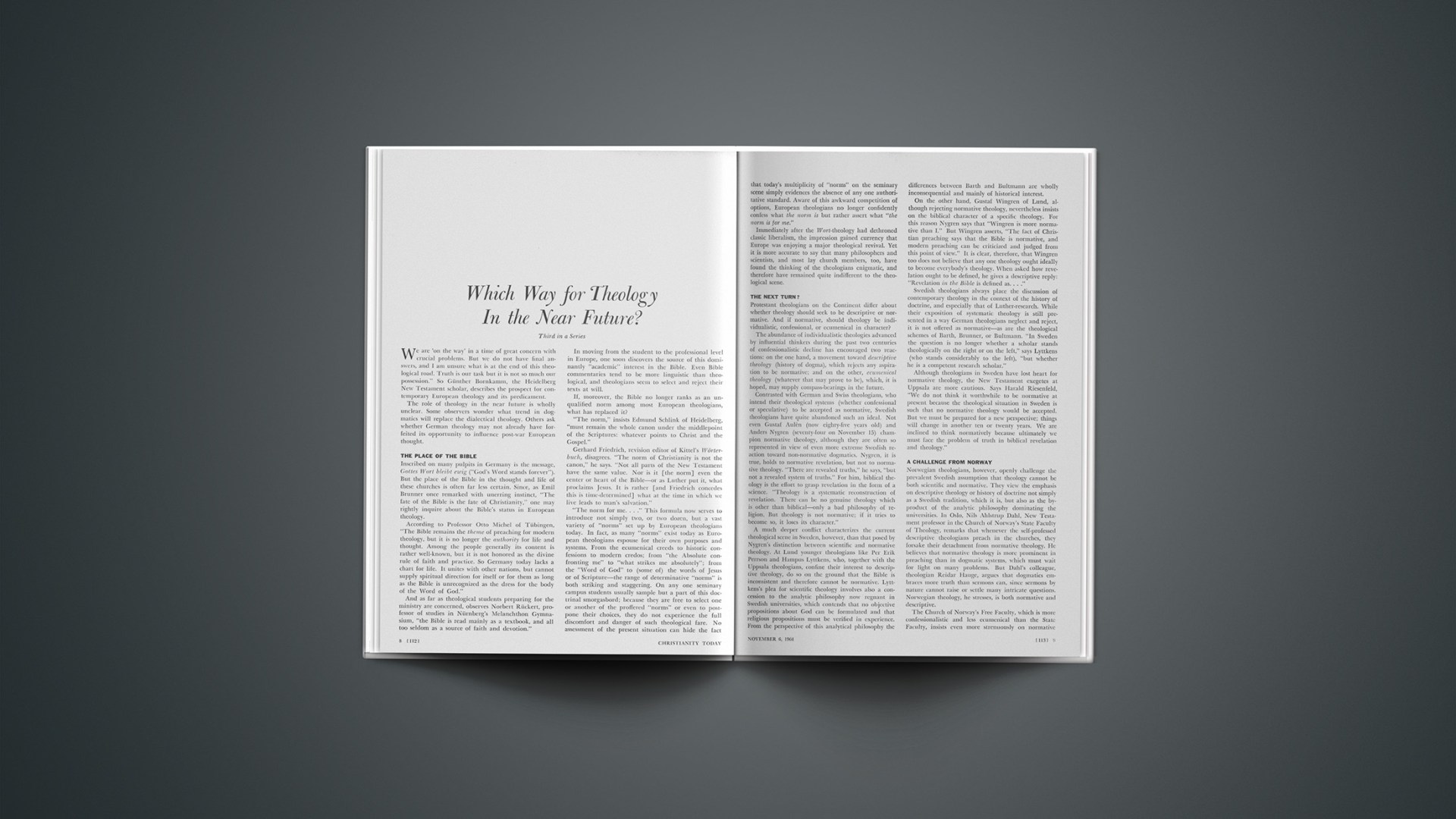
Which Way for Theology in the Near Future?

Third in a Series

We are ‘on the way’ in a time of great concern with crucial problems. But we do not have final answers, and I am unsure what is at the end of this theological road. Truth is our task but it is not so much our possession.” So Gunther Bornkamm, the Heidelberg New Testament scholar, describes the prospect for contemporary European theology and its predicament.

The role of theology in the near future is wholly unclear. Some observers wonder what trend in dogmatics will replace the dialectical theology. Others ask whether German theology may not already have forfeited its opportunity to influence post-war European thought.

The Place Of The Bible

Inscribed on many pulpits in Germany is the message, Gottes Wort bleibt ewig (“God’s Word stands forever”). But the place of the Bible in the thought and life of these churches is often far less certain. Since, as Emil Brunner once remarked with unerring instinct, “The fate of the Bible is the fate of Christianity,” one may rightly inquire about the Bible’s status in European theology.

According to Professor Otto Michel of Tubingen, “The Bible remains the theme of preaching for modern theology, but it is no longer the authority for life and thought. Among the people generally its content is rather well-known, but it is not honored as the divine rule of faith and practice. So Germany today lacks a chart for life. It unites with other nations, but cannot supply spiritual direction for itself or for them as long as the Bible is unrecognized as the dress for the body of the Word of God.”

And as far as theological students preparing for the ministry are concerned, observes Norbert Rückert, professor of studies in Nürnberg’s Melanchthon Gymnasium, “the Bible is read mainly as a textbook, and all too seldom as a source of faith and devotion.”

In moving from the student to the professional level in Europe, one soon discovers the source of this dominantly “academic” interest in the Bible. Even Bible commentaries tend to be more linguistic than theological, and theologians seem to select and reject their texts at will.

If, moreover, the Bible no longer ranks as an unqualified norm among most European theologians, what has replaced it?

“The norm,” insists Edmund Schlink of Heidelberg, “must remain the whole canon under the middlepoint of the Scriptures: whatever points to Christ and the Gospel.”

Gerhard Friedrich, revision editor of Kittel’s Wörterbuch, disagrees. “The norm of Christianity is not the canon,” he says. “Not all parts of the New Testament have the same value. Nor is it [the norm] even the center or heart of the Bible—or as Luther put it, what proclaims Jesus. It is rather [and Friedrich concedes this is time-determined] what at the time in which we live leads to man’s salvation.”

“The norm for me.…” This formula now serves to introduce not simply two, or two dozen, but a vast variety of “norms” set up by European theologians today. In fact, as many “norms” exist today as European theologians espouse for their own purposes and systems. From the ecumenical creeds to historic confessions to modern credos; from “the Absolute confronting me” to “what strikes me absolutely”; from the “Word of God” to (some of) the words of Jesus or of Scripture—the range of determinative “norms” is both striking and staggering. On any one seminary campus students usually sample but a part of this doctrinal smorgasbord; because they are free to select one or another of the proffered “norms” or even to postpone their choices, they do not experience the full discomfort and danger of such theological fare. No assessment of the present situation can hide the fact that today’s multiplicity of “norms” on the seminary scene simply evidences the absence of any one authoritative standard. Aware of this awkward competition of options, European theologians no longer confidently confess what the norm is but rather assert what “the norm is for me.”

Immediately after the Wort-theology had dethroned classic liberalism, the impression gained currency that Europe was enjoying a major theological revival. Yet it is more accurate to say that many philosophers and scientists, and most lay church members, too, have found the thinking of the theologians enigmatic, and therefore have remained quite indifferent to the theological scene.

The Next Turn?

Protestant theologians on the Continent differ about whether theology should seek to be descriptive or normative. And if normative, should theology be individualistic, confessional, or ecumenical in character?

The abundance of individualistic theologies advanced by influential thinkers during the past two centuries of confessionalistic decline has encouraged two reactions: on the one hand, a movement toward descriptive theology (history of dogma), which rejects any aspiration to be normative; and on the other, ecumenical theology (whatever that may prove to be), which, it is hoped, may supply compass-bearings in the future.

Contrasted with German and Swiss theologians, who intend their theological systems (whether confessional or speculative) to be accepted as normative, Swedish theologians have quite abandoned such an ideal. Not even Gustaf Aulen (now eighty-five years old) and Anders Nygren (seventy-four on November 15) champion normative theology, although they are often so represented in view of even more extreme Swedish reaction toward non-normative dogmatics. Nygren, it is true, holds to normative revelation, but not to normative theology. “There are revealed truths,” he says, “but not a revealed system of truths.” For him, biblical theology is the effort to grasp revelation in the form of a science. “Theology is a systematic reconstruction of revelation. There can be no genuine theology which is other than biblical—only a bad philosophy of religion. But theology is not normative; if it tries to become so, it loses its character.”

A much deeper conflict characterizes the current theological scene in Sweden, however, than that posed by Nygren’s distinction between scientific and normative theology. At Lund younger theologians like Per Erik Perrson and Hampus Lyttkens, who, together with the Uppsala theologians, confine their interest to descriptive theology, do so on the ground that the Bible is inconsistent and therefore cannot be normative. Lyttkens’s plea for scientific theology involves also a concession to the analytic philosophy now regnant in Swedish universities, which contends that no objective propositions about God can be formulated and that religious propositions must be verified in experience. From the perspective of this analytical philosophy the differences between Barth and Bultmann are wholly inconsequential and mainly of historical interest.

On the other hand, Gustaf Wingren of Lund, although rejecting normative theology, nevertheless insists on the biblical character of a specific theology. For this reason Nygren says that “Wingren is more normative than I.” But Wingren asserts, “The fact of Christian preaching says that the Bible is normative, and modern preaching can be criticized and judged from this point of view.” It is clear, therefore, that Wingren too does not believe that any one theology ought ideally to become everybody’s theology. When asked how revelation ought to be defined, he gives a descriptive reply: “Revelation in the Bible is defined as.…”

Swedish theologians always place the discussion of contemporary theology in the context of the history of doctrine, and especially that of Luther-research. While their exposition of systematic theology is still presented in a way German theologians neglect and reject, it is not offered as normative—as are the theological schemes of Barth, Brunner, or Bultmann. “In Sweden the question is no longer whether a scholar stands theologically on the right or on the left,” says Lyttkens (who stands considerably to the left), “but whether he is a competent research scholar.”

Although theologians in Sweden have lost heart for normative theology, the New Testament exegetes at Uppsala are more cautious. Says Harald Riesenfeld, “We do not think it worthwhile to be normative at present because the theological situation in Sweden is such that no normative theology would be accepted. But we must be prepared for a new perspective; things will change in another ten or twenty years. We are inclined to think normatively because ultimately we must face the problem of truth in biblical revelation and theology.”

A Challenge From Norway

Norwegian theologians, however, openly challenge the prevalent Swedish assumption that theology cannot be both scientific and normative. They view the emphasis on descriptive theology or history of doctrine not simply as a Swedish tradition, which it is, but also as the by-product of the analytic philosophy dominating the universities. In Oslo, Nils Ahlstrup Dahl, New Testament professor in the Church of Norway’s State Faculty of Theology, remarks that whenever the self-professed descriptive theologians preach in the churches, they forsake their detachment from normative theology. He believes that normative theology is more prominent in preaching than in dogmatic systems, which must wait for light on many problems. But Dahl’s colleague, theologian Reidar Hauge, argues that dogmatics embraces more truth than sermons can, since sermons by nature cannot raise or settle many intricate questions. Norwegian theology, he stresses, is both normative and descriptive.

The Church of Norway’s Free Faculty, which is more confessionalistic and less ecumenical than the State Faculty, insists even more strenuously on normative theology. “True theology must be normative,” says systematics professor Leiv Aalen of the Free Faculty. “The Church in its proclamation of the Gospel must have the truth of Christ, and that will accord with the Scripture and the confessions of the Church.” For Aalen the Lutheran confessional writings in the Book of Concord supply an ideal starting point in this direction. Hauge has criticized Aalen for elevating the confessions above Scripture, but Aalen denies the charge and insists that the confessions simply “protect Scripture against misunderstanding.”

The abandonment of the ideal of normative theology must be traced in part to a reaction against the tide of speculative theologies; claiming to be normative, each has deluged Continental Protestantism with the influence of modern European philosophy. But this reaction against speculative theology may lead in other directions as well, such as toward a plea for a genuinely normative, authoritatively based theology. The real alternative to Bultmann’s theology, contends Riesenfeld, must be “a theology authorized by the churches, a traditional Christian theology, and not the private speculations of some theologian.”

The traditional conservative scholars plead for a theology whose authoritative basis is not so much established by the churches as recognized to be genuinely scriptural by the churches. Yet the loss of the biblical norm leads instead toward substitution of an ecclesiastical norm. As a result the promotion of a normative theology now tends toward two directions, one confessional and the other ecumenical.

Ideally, of course, Christian theology ought to be both ecumenical and confessional in the best sense of those terms. But at present Christendom is fragmented denominationally by competing confessions, and it is ecumenically committed in a context of inclusive theology that embraces confessional, counter-confessional, and anti-confessional elements. While member churches of the World Council of Churches have approved an elemental theological “basis,” this basis serves neither as a test of doctrine nor as a deterrent to heresy.

Some Scandinavian theologians, however, feel that the Church dare not content itself with purely descriptive theological work but must crown such research with theology of a normative nature; they wistfully look to the ecumenical movement to lead the way creatively in such a development. Even those scholars who want no part of a normative theology—adrift as they are from confessional Lutheranism—are moving beyond Luther-research into new areas of dogmatic study under the aegis of their descriptive interest in history of doctrine. In Lund, Per Erik Perrson displays a growing interest in Greek Orthodox theology, and Hampus Lyttkens in Roman Catholic theology. Harald Riesenfeld of Uppsala, on the other hand, thinks the World Council might lead the way to a return to normative theology over against the subjectivistic theological speculation now rampant in Europe.

Because of the breakdown of contemporary Protestant theology, theologians in the old-line denominations are increasingly disposed to look to the ecumenical dialogue with the Eastern Orthodox and Roman Catholic churches to heal the present dogmatic ailments. Heidelberg theologian Peter Brunner believes such conversations may force a new exploration of Scripture and tradition, dogma, and other themes now overshadowed by the Bultmannian preoccupation with hermeneutics. And Edmund Schlink, who represented his church as a Vatican Council observer, predicts that through the ecumenical dialogue with Eastern Orthodoxy and Rome “new constellations will appear” to revive the themes of the Trinity, Christology, and liturgy. In the “far future” he envisions a new ecumenical theology for Christendom built on a Christological foundation; he himself is busy writing a two-volume ecumenical dogmatics. These men, Schlink and Brunner, are more ecumenical and less confessionalistic in their theological writings than are many conservative Lutheran dogmaticians, such as Walter Kunneth of Erlangen and Ernest Kinder of Munster.

Ecumenical Prospects

To date, the ecumenical development has been more hospitable to theological openness and inclusivism than to definitive dogmatics. Much ecumenical effort is based on a tolerance of wide theological differences, even upon a pragmatic impatience with theological priorities. On the Protestant side of the ecumenical movement there is little manifest indignation over alternative and competitive views. Churchmen hostile to historic Christian positions and committed to views that even the ecumenical creeds would exclude as heretical are not only defended but welcomed as divine gifts to the Church. Seminaries most energetically engaged in the ecumenical development tend to become exhibition centers for a great variety of theological viewpoints rather than bearers of an authoritatively given message.

Whether a movement that advances organizationally through theological inclusivism can also become theologically exclusive remains to be seen.

Theologian Leiv Aalen of the Church of Norway’s Free Faculty is not hostile to ecumenical dialogue. Yet because of its scanty achievement to date, he does not think it will serve to reunite the churches on the basis of scriptural truth and recovery of biblical theology.

“A new estimation of Luther is necessarily emerging in Roman Catholic circles,” Aalen comments, “but Rome is still more interested in involving Luther in her own system than in allowing him to oppose it in the name of Scripture. Is Rome really as much concerned about taking the Reformation seriously as about stretching its own point of view over new territory?”

Will the ecumenical direction of theology, one might ask, mean the loss of the Protestant character of the seminaries?

Schlink of Heidelberg thinks not. He feels, instead, that it will mean more serious preoccupation with the basis of the apostolic Church and with the Christianity of the first centuries in view of the ecumenical creeds.

Yet as the Protestant and Roman Catholic options are set side by side, new patterns of theological education are emerging. In Tübingen the Catholic seminar room is the first classroom that greets visitors. Munich, which has had only a Catholic faculty, failed in the effort to get Helmut Thielicke of Hamburg to serve as its first Protestant theologian, in the hope that he and Karl Rahner might occupy corresponding chairs. Hans Küng’s presence in Tübingen has lent additional interest to that campus. Küng wears no clerical collar, often appears in a sport shirt, and displays Barth’s writings in the front office while Aquinas’s Summa remains in the back room. “Lourdes gives me indigestion,” says Küng, who tells his classes he believes in sola fide. “If I were at Tübingen,” a graduate student in Basel remarked recently, “I’d study under Küng; he’s closer to the Reformers than Protestant theology generally.” While Küng’s public lectures are well attended by both Protestants and Catholics, his classes draw few Protestants, although he is credited with turning at least one of them toward the priesthood. American students in Tübingen speak more appreciatively of Küng than do German students, who consider Rahner the truly intellectual source of the ecumenical development but Küng primarily its spokesman.

Karl Barth thinks this proliferation of European theology into descriptive, confessional, and ecumenical options offers no hopeful prospect. He points to Bishop John Robinson’s Honest to God (“at once descriptive, since he was a scientist; confessional, since Robinson is Anglican; and surely ecumenically-minded”) as a clear indication that the alternatives run far deeper. “In this renewal of Feuerbach, of a theology identical with a certain kind of anthropology,” says Barth, “we stand at the end of the whole development of modern theology in a return to the nineteenth century. The real question for the future of theology is this: Is there a theology not anthropological but ‘theanthropological,’ one grounded in the Word of God in Jesus Christ?” Barth declines to venture a prophetic verdict on the outcome: “I cannot prophesy what the general trend of theology will be—whether theology will take ‘the good way’ or not.”

Concerning the Vatican Council dialogue, Dutch theologian G. C. Berkouwer of Amsterdam’s Free University says: “The contacts are many, and Rome has able men in all fields. But to speak now of a theology of the Word of God is only a beginning. We have had this formula for over thirty years, and many accept it who destroy its best sense. It does not of itself solve the hermeneutical problem which faces both Rome and Protestantism. To face this problem is not a matter of ‘unbelief’; if we do not face it, we shall be out of touch with our responsibility as well as with modern thought and life. We are called to a Gospel-conforming theology made concrete in our life work and renewed day by day.”

But Where Is the Substance?

Achievement of the Christian ethic spoken of so earnestly in the nation’s pulpits is postponed from Sunday to Sunday by the Monday–Saturday posture of many of its most devoted advocates, the ministers of our churches. However exhortative their Sunday precepts to prospective supporters of the substance of the Christian attitude toward one’s neighbor—tolerance, justice, mercy, humility, love—their week-day obeisance to the form of Christianity—the church building, the new-member campaign, the bowling team, the women’s society, the men’s club—deprives them of time required for the daily practice of brotherhood.

Any dedicated lay steward of the church knows that the establishment itself, the church with all its excrescences and trappings, is, in the mind of many a pastor, the thing to be preserved at all costs. Of course this is so; otherwise too many pastors would have little to do. It is indeed true that many are comforters of their fellow man, providing surcease from the anxieties of ill health, ministering to the distressed and downtrodden, counseling the emotionally troubled; yet a good many ministers of larger churches delegate visitation chores to an assistant, who must stand in line for a pulpit assignment. Many also reserve to themselves the prestigious administrative-management duties that assure continuity for the accouterments of their ecclesiastical property.

The payoff for the pastor is in the number of new members added to the church during his tenure. Often he can claim little credit for the success he enjoys. He simply had the good fortune of being called or assigned to a church in a neighborhood that was undergoing a population explosion. A new industry or business, a new government agency, a shopping center, grew up overnight in his parish, and increasing numbers of new residents sought a baby-sitting arrangement (sometimes called a church or Sunday school) for their children on Sunday mornings. Incidentally, they become dues-paying (average for the United States perhaps $2 per week) members of the Sunday-morning club and sometimes participate in its meetings—particularly when it rains and the golf course is too soggy to sustain a foursome.

The Establishment

Whatever their motivations, which are usually casual if not frivolous, they become members of the pastor’s cozy little establishment while he basks in the reflected glory of a successful recruitment program. Few if any questions are asked of these casual Christians about their personal relation to God through Jesus Christ or even about their responsibilities toward their fellow men—to do justly, love mercy, and walk humbly. They mouth a pious pledge to support the establishment with their attendance and their money—and they are in.

It’s a comfortable feeling—and a bargain. For a reluctant two bucks a week a fellow buys what he thinks is a little insurance against the harsh confrontations of doomsday. He finds that most of his neighbors are in on it, too. In fact, the Smiths, next door, invite him and his wife in for drinks after the initiation ceremony. Shortly thereafter the new members are bowling on the establishment team, picnicking with the young married group, participating in the men’s club and the women’s society, and at church dinners in the social hall listening to a halfback from the nearby pro-football team, or to a saleswoman for dinnerware. The pastors is at the dinner, too. He calls down the invocation and offers up the benediction.

Soon the sanctuary is too small. It really isn’t, but the pastor observes that his own clubhouse is looking a bit grubby since two other denominations in the community have built new plants. He convenes a handful of his most trusted supporters, the real in-group, and blueprints quickly emerge for the construction of a huge new brick-and-mortar edifice to cost a quarter of a million dollars. At no point, did anyone raise any question about how the new church might serve residents in an adjacent Negro community; or whether new members might be prevented from dumping their children on the church school unless as parents they agreed to go on a regular mission during the year—teaching underprivileged children to read and write, reading to old folks in the nursing home, volunteering for work at the hospital—doing justly, loving mercy, walking humbly with God. No, those questions remain unanswered, and the new church begins to rise. Form stretches its brick-faced steeple heavenward, while substance, the needs of the community for mercy and love, stands outside in the shadow, tin cup in hand.

Most communicants who pass through the massive Gothic doors of the new shrine differ not at all from those who, the previous evening, passed through the wide swinging doors of the country club’s taproom. Many, in fact, are those same patrons. Christians in the United States must be only a small minority—if the Christian is defined as a regenerate person who seeks to do the will of God in his life and who acts toward the other fellow the way he wants the other fellow to act toward him. Many church members are not even Sunday Christians. They are simply citizens who attend church on Sunday. They go to the country club on weekdays and to the church club on Sundays.

Meanwhile, back in the sanctuary the pastor sonorously admonishes his flock to live more Christlike lives, disdain sin, appeal to the Holy Spirit for comfort and guidance. He turns in a fine job. For half an hour his parishioners examine their souls and find them wanting. However, the church bulletin in their hands suggests that they forget their consciences throughout the week and participate in the extra-curricular activities of the “church”—men’s club Wednesday night when J. B. MacTravelleur will show slides of his recent trip to Scotland; the ten-pin team in its engagement with bowlers from the neighboring church; the women’s society’s Thursday night program when the ladies will hear the fashion editor of the Courier prescribe the de rigueur styles for the coming season; choir rehearsal on Tuesday—perhaps the event closest to any of their responsibilities as Christians, and even that of doubtful authority under any New Testament prescription.

As church members sit listening to the pastor’s call to Christian duty, there might come to their minds certain pressing problems of the parish: (1) the several teen-age kids whose father ran out on them, leaving them with their mother while he pursues another woman; (2) the several Negro families scattered throughout the community, whose kids are not quite making it in scholastic competition with the white kids in the recently integrated school but probably could make it if they could get some tutoring in the evenings or on weekends; (3) the man, close to retirement, whose company laid him off and who, as a result, is going through a frightful emotional wilderness trying to find a way to carry out his responsibilities to his family; (4) the seventeen-year-old, from the nice family around the corner, who lost control of his passion so that now the “little” Smith girl (“You know, Mary, the one who headed up the church’s Teen Club last year”) is expecting a baby. Each of these cases (except that of the Negroes) involves communicants in the church. In the name of Jesus, why aren’t we more sensitive to plain human need?

I know what you are thinking, but don’t look at me. I’ve looked at myself. You say that it’s a sin to criticize the pastor and do nothing yourself. But I have done just a little, along with three or four others in the church who helped teach the Negro kids, loved the Smith girl, and succored the retirement-aged neighbor. Three or four others? That seems to be all—in the 1,200-member church club. No, we are not holier-than-thou. How can we be, when our Lord said that the attitude of those who have done all that is commanded can only be, “We are unworthy servants: we have only done that which was our duty to do”? We are simply trying to do what we think is right. But we could use a little help!

Wanted: A Call To Arms

We wish we had in our new pulpit a man who might tell us how for him prayer became meaningful, not just in the chapel at evensong but in every-day engagement with his fellow man. We sometimes think we hear a faint reveille way off in the distance; but there is no clarion call from the bell tower on our new church, no uncompromising aux armes from its pulpit.

Why did our pastors not anticipate, rather than belatedly pontificate about, our days of inter-racial degradation and shame? Why don’t they recognize the longing for understanding in the eyes of the Smith kid? Why don’t they see the anguish in the face of the bereft mother? And when they do anticipate, recognize, and see, why don’t they exclude from the church’s fellowship anyone who does not pledge to respond immediately to their call for help?

We think we know why. They are too immersed in what Elton Trueblood calls the “edifice complex.” They were installing rheostats in the lighting system so that the overheads, dimmed before the service, come up during the processional, are lowered during the sermon, and are brightened again during the recessional. They were dedicating a new chapel, hung with brocaded tapestries bright in the reds and purples of a medieval monastery. They were busy adding new members to the club, neglecting those who have strayed off, who have defected, who are lost. In short, they were seeking desperately to respond agreeably to the sensitivities of the lay culture, which finds the cross easier to look at when, so to speak, its nail holes are invisible from the first row—even when the lights are up.

It’s good that the lights never get too bright. They might reveal, sitting there, the ghosts of Stephen, Paul, Augustine, Luther, Calvin, Wesley. Where now, O Lord, are their descendants?

The Tide of Doubt inside the Churches

In these days we constantly hear and read of pronouncements that flagrantly contradict the Word of God and gravely menace the evangelical basis of faith. Everywhere we are confronted with ideas, theories, methods, pedagogies, and morals that are dangerous because unbiblical, and that are presented, moreover, in such an imperative manner that to resist them is often difficult and sometimes thought in “bad taste.”

These views are doubtless inspired by an apparent generosity, a measure of sensibility and comprehension concerning man, and an openness to the modern world as well as by the thirst for harmony. But should not our generosity, our sensibility, our understanding of man’s problems and sufferings in the world of today and of tomorrow all remain under the control of Christian faith? Can these recent theories be imagined to surpass those of Christ, the Gospel, and the apostles? Who can say, “My heart is more open for my neighbor and for the world, more understanding, more compassionate” than Christ’s?

Discernment of the spirits is particularly difficult today because of a situation that appears to be quite new. Since the age of the Enlightenment the Christian faith and the Church have been the object of numerous attacks. But these attacks came mostly from outside. Today—and this is the new thing—a kind of civil war is going on at the spiritual level within the Church itself. The blows are dealt by men clothed in pastoral gowns or charged with important functions in the Church. The battle is now within the fort; if the fort falls, it cannot possibly be defended any more!

Indeed, the numerous theories now coming to light are no longer presented as “human opinions.” They are expressed under the cover of Holy Scripture or are represented as legitimate “extensions” of the teaching of the Bible—“extensions” that are affirmed necessary for the “success” of Christianity in the “modern” world. Thus adorned with crypto-biblical clothing, presented with sensibility and intelligence, and diffused by powerful means, these opinions solicit the allegiance of Protestants. The error is made seductive, as Paul says, by “craftiness.”

In wide circles the Scriptures, even where quoted, are despised. Theories are elaborated practically without any serious reference to the Bible, even to the New Testament. The Scriptures are then required to comply by means of quotations having little to do with the subject in hand; even when they have nothing to say on a question, they are made to speak in the sense desired. Biblical vocabulary is frequently altered or diverted from its original meaning. The “violations” done to the texts are innumerable. From the Scriptures men compose a menu of their own choice in the name of a superior intelligence and a new “tradition.” Whole groups of biblical texts are systematically “forgotten” by those to whom it seems old-fashioned to understand the Scriptures according to the principle of the analogy of faith.

Even within the individual churches the same type of sectarian mentality is at work. Men serve themselves with mutilated words and references; they juggle with paradoxes, with allegories. There is no serious, mutual critique of the philosophical or sentimental a prioris that underlie their research.

This wind of adaptation to the conceptions of the modern world blows like a storm, and leads to astonishing and dangerous conceptions of inspiration, divine sovereignty, incarnation, the work of the Holy Spirit, salvation, the world, history—in fact, all fields that concern the Church and its place and mission in the world of today.

We shall have to deal with the relations between revelation and religious knowledge, the Church and the world, Christ and the Church, individual salvation and cosmic redemption, Scripture and ethics, in a way quite different from that of many theologians who arrive in one way or another at (1) a reduction or devaluation of Christ and of God to man or to the world; which leads to (2) a devaluation of moral principles and of ethics; which leads to (3) a devaluation of the Christian faith to a renewal of man. All this amounts to the dilution of the Church in the world and of its place and mission.

Christ And The World

When it is affirmed that “the fact of tying Christ exclusively to the Scriptures has made us incapable of recognizing him where he is at work in the world today, of discerning him there, of accepting his call to follow him, and of recognizing him where he has gone before us”; that “it is in the world and in history that Christ makes himself known according to the Scriptures”; that “we shall have to observe and interpret the world, in order that, through the ‘incognito’ of Christ, we might discern and discover him as Lord and Saviour of all men”—all this quite evidently touches the question of the Church’s place and mission in the world.

When it is affirmed that “the presence of Christ in the world is equivalent to an incarnation of his person in the dynamics of human relations,” that “Christ makes the dynamics of social life sacred in an invisible and non-ecclesiastical way, provided that it has the good of man in view,” are we not here on such a dangerous and thoroughly unbiblical course that we must raise the question of the Church’s place and mission?

If I am not mistaken, the starting point of this objectionable train of thought is the denial of the principle that guarantees the sovereignty of God and his transcendence—namely, “The finite is never capable of being infinite” (finitum non est capax infiniti).

The stages of this course of thinking are these:

1. The affirmation of fusion between the two natures of Christ: his human nature is made divine and his divine nature is made human. This unbiblical view, rejected by all Reformed confessions of faith, has disastrous consequences.

2. The assertion of an almost identical fusion between Christ and the Church, resulting in the famous Roman Catholic theory of the Christ-Church (cf. Vitloris Subilia, The Problem of Catholicism, 1964) and in the abuses of this theory.

3. A further fusion between the Church and the world; for in its turn, the world, according to an expression now becoming fashionable, is “christified.”

Some Protestant theologians are moving in this third stage much faster than the Catholics, whether Roman or Orthodox. On this approach, the Church’s “center of gravity” is to be found in the world, “the human situation outside the Church, where Christ leads it and calls it”; or again, the Church is only a little circle within the larger circle of the world, and there is no fundamental difference at all between it and the world. Is not this a devaluation of Christ to man and the world? Is it not biblically unacceptable? And what, in this case, is the meaning and the mission of the Church?

Bishop John Robinson of Woolwich goes still further in reducing God to man. In the time of Gagarin and Titov we cannot talk any longer, he tells us, of a “God out there.” For the sake of the world’s remaining “Christian” (in the sense he gives to the word), he suggests we stop talking about “God” and instead talk about “that which is deepest in all being” (cf. Honest to God).

With this reduction of God to man we are very near Marxist atheism. Indeed, within the very bosom of the Church today we find the over-evaluation of atheism by a number of people, some of whom even make atheism and atheists sacred. Through the voice of atheists resounds the voice of God, they say! God is reduced to man, even to the atheist! Such language no longer astonishes the Christian.

Devaluation Of Christian Morals

All this leads to universalism, and, by a close connection, to a devaluation of moral principles and of Christian ethics. For morality is currently a second front of attack even within the Church. The devaluation of God, of Christ, and of the Holy Spirit, as a consequence of a devaluation of revelation as brought to us in Holy Scripture, ends in a devaluation of Christian morals. There can no longer be any question of commandments from “above” or of absolute precepts. They would be too rigid to satisfy the “differentiated” moral needs of modern man, who of course is quite different from the man of the time of Jesus Christ! The Ten Commandments are out of date. Modern man needs a modern ethic, one that takes into account “individual needs, particular situations,” and defines “what in reason could be asked of him.”

It should be noticed that the rejection of the Ten Commandments, and in a more general way of every absolute moral criterion, of every law, was initiated at the very beginning of modern Protestant theology by one of its most important representatives, Friedrich Schleiermacher. He already had much in common with the present Bishop of Woolwich, inasmuch as he, as a theologian, publicly defended the Lady Chatterley of his generation, Schlegel’s Lucinde, the most lascivious book of the first half of the nineteenth century.

As a result of the deceptive modern pursuit of a “new ethic” that can no longer be located in Scripture, we can ascertain a general moral decline. That decline becomes manifest in every aspect of ethics: in ecclesiastical morals, the “morals” of our synods, the policy of the churches; in the attitude of parents toward their children and of educators and professors toward their responsibilities; in the consent to a great number of distractions for our children and in the use of their spare time; in the attitude of “Christian” journals toward the theater and cinema; in the undisciplined hold of radio and television upon many and in the bad examples these media often propagate; in the liberty recommended with regard to sexual relations.

The overthrow of Christian sexual morality is the final stage of this general moral decline. These are some recent facts: According to SOEPI (May 6, 1964), “the Lutheran Church of Sweden has appointed a special committee to reconsider the position which she has taken in 1951, when she condemned all premarital sexual relations. The Committee has to study whether that attitude should be modified and should take into account the public opinion as it has been generally accepted.” “Mr. Carl Gustav Boetius, editor of the Swedish weekly Our Church, thinks it absurd that the Church forbids premarital relations, while they are practiced by at least eighty per cent of the young Swedish engaged couples. He has quoted statistics which demonstrate that more than a third of the married Swedish mothers, who got a first child in 1960, were pregnant at the moment of their marriage.”

The so-called new “relational sexual ethic” dares to affirm that “the traditional sexual morality is a serious mistake of contemporary Christianity, and prevents its expansion elsewhere than in the western bourgeoisie”!

Someone will answer that such conditions have existed in every age. Doubtless, but not as at the present time! There is a cleavage between remaining in the Church while practicing what the Bible condemns, knowing it is wrong, thus running a risk of being a hypocrite; and the teaching, as we now see it in the Church—by pastors, professors, and doctors who want to be practicing Christians—that intends, under the pretext of public opinion, to give the approval of conscience to manifest sins, with a view to the “opening” of the human personality!

In these examples we discover a devaluation of the moral principles of the Bible as well as the denial of the regeneration and power of the Holy Spirit. We observe a conformity of the teaching of the Church to the world, and to unregenerate public opinion. The theologians become the “idealogians” of the spirit of their time; they express the ideas of their time and provide them with a theoretical justification. What makes it so serious is that this happens precisely in the Church, in the name of Christianity and its future, in the name of love and understanding for men. The theologians work not to christianize humanity but to humanize Christendom.

If the world is present in the Church, how then will the Church be present in the world? The witness of the Church is under threat.

With a mediocre God, a mediocre Christ, a mediocre revelation, a mediocre morality, will the Church no more have a mission of “grandeur”? Christianity without the Cross—can it bring something to the world?

The new ethic is not different from the old paganism; it is an atheism under the mask of Christianity, a dissolution of the Christian morality under the color of piety, a renascence of ancient sects that we recognize well. In reality people live here without God, without his norms and his power. God appears only at the end of the line of concession and compromise; his part is only to overlook man’s mistakes and weaknesses. The belief in the renewal of man also has been devaluated and destroyed. Christianity becomes a miserable religion without decision. “Pardon is given to all, even to those who do not know God or who oppose him.” The only difference between the Christian and the non-Christian is that one knows of his salvation and the other does not. The Church does not distinguish itself from the world as far as it has its place in the secret of God. At the center of such a theology lies this notion: that “knowledge” supplants justification or “remission of sins” by repentance and faith, with all its consequences. Justification by faith becomes justification of the world by the faithfulness of Christ to the world. Is this what the world desires? Is this what the Church must desire for the world?

Searching The Scriptures

In my opinion these ideas—though they come from within the Church—have no intrinsic right in the Christian Church. But they have made such fast progress that it is necessary, on the one hand, to know their points of attack in order to stop their march and, on the other hand, to search the Scriptures continuously in order to know answers to the problems of the present age; and if the Scriptures do not answer directly to certain questions, we should find solutions in harmony with the scriptural premises.

From all sides we Calvinistic Christians are accused of failing to think deeply on behalf of the Church. Yet we have never been without reflection upon and on behalf of the Church, upon and on behalf of the world. In the present as in the past our reflection can and must preserve our churches from lies and errors, from false solutions and easy excuses, in order that men might, as the Apostle desired, be “no longer children, tossed to and fro and carried about with every wind of doctrine, by the sleight of men, in craftiness, after the wiles of error; but speaking truth in love, may grow up in all things into him, who is the head, Christ” (Eph. 4:14, 15, ASV). For this is the will of the Lord.

Modern society defies the Church. Because society is affluent, she requires from theologians understanding of her emotional needs. She is anxious for pleasure and delight, and if she encounters social and psychological difficulties, she asks the Church to comfort her. The world, as it goes its way, asks the Church for its own justification.

Modern society is also in search of “a new type of man, disinterested, honest, and pure,” neither master nor slave, inspired by a living and creative spirit, possessing a “fully developed” personality, in order to pursue his own affairs spontaneously (without imposed norms and without law) in the interest of humanity.

Is it not more the Church’s duty, however, to question the world than to be questioned by the world? to challenge the world than to be challenged by the world? Is not the task of each of us—in obeying the Word of God and in studying it with renewed mind and heart—to discover in the Word the task that Christ entrusts to us, while he places us at the disposal of God for the true revolution in the Church, in our families, and in society? May God give us his light upon the Church and its mission in the contemporary world.

Eutychus and His Kin: October 23, 1964

TAKE TWO—THEY’RE SMALL

If you like one lump of sugar in your coffee, it doesn’t follow that you will like two better. Twice as much of a good thing is not necessarily an improvement. After years of careful, meticulous, and, I am sure brilliant observation, I conclude that the plainest mark of the American Way of Life is that we are constantly taking a good thing and running it into the ground. Two is always twice as good as one. That principle, I am firmly convinced, simply won’t stand up.

I am old enough to remember Tom Thumb miniature golf courses. For a while everyone responded to this novelty, and soon all kinds of people were starting miniature golf courses in all kinds of places. What was a good business for ten people could not possibly be a good one for twenty, but everybody climbed aboard the success machine and managed to ride it into a breakdown.

Last weekend I was fighting my way into Detroit from northern Michigan, and I felt like a little corpuscle crowding its way into a jammed-up artery. By the time we were on the outskirts of the motor city everyone was suffering from thrombosis. A beautiful day in the bright woods of northern Michigan became a nightmare of traffic in a city built for the automobile.

Possibly the solution to farm over-production lies in the fact that eventually we will cover half this country with concrete and have no room for raising extra crops. Maybe, as one writer for the Atlantic Monthly suggested, we will someday have the ultimate traffic jam—population explosion followed by automobile explosion and all traffic finally stopped—and we will simply pave over the top and start all over again.

The politicians begin their speeches too soon. Christmas music is started too early. Too many churches are trying to do too many different things. Just thinking about it exhausts me. No wonder it is hard for the rich to enter the Kingdom.

ONE OF THE PLAGUES

Your very excellent editorial, “Judgment of the Theologians” (Sept. 25 issue), … goes to the very heart of the matter.

One of the plagues upon the theological scene has been and is that philosophers try to be theologians. Dr. E. Y. Mullins pointed out many years ago the separate fields of natural science, religion, and philosophy. You may recall that he pointed out that each has its own method of inquiry and criterion of truth. Each has its own field of labor, and there is no conflict unless one tries to invade the field of the other. They are and must be inter-related; but when philosophy overshadows the theological aspects, theology is in for trouble.

As I view the current theological scene, so many of our American theologians have had their thinking colored by various European systems of thought that it is difficult for them to get back to “the old unshortened gospel.” But I pray that out of the current scene may come a new appreciation for biblical theology.

I enjoy reading your publication, but ever so often I feel that I must write you and thank you for some particular gem of thought.

First Baptist Church

Oklahoma City, Okla.

I thank God it is not necessary for me to revamp my sails every time some new theological wind begins to blow. I have never known of an intelligent fundamental, premillennial, pretribulationist who held to the verbal plenary inspiration of the Scriptures ever finding it necessary to change his position. Those who might ever shift from this position would move their theological structure to the quicksands.…

Dean

Thames Valley Bible College

Woodstock, Ont.

AN ANCIENT WOE

As a Lutheran, I am moved to express my thanks and appreciation for your gentle yet firm rebuke to the Lutheran World Federation (Editorial, Sept. 25 issue) for its failure and inability to speak a clear word on the cardinal doctrine of Lutheranism, the doctrine of justification by faith. I am reminded thereby that Dr. Martin Luther once said, “Where this single article remains pure, Christendom will remain pure, in beautiful harmony, without any schisms. But where it does not remain pure, it is impossible to repel any error or heretical spirit.”

The federation made the mistake which is so often made by theologians when they become crassly rationalistic. It is not necessary to rewrite the doctrine of justification to suit the temper of modern man. It is not his modernity that keeps man in our day from finding meaning and relevance in the doctrines of damnation and justification, of sin and grace, of law and Gospel. Rather, it is the inborn, ancient depravity of man that causes him to close his heart to the Gospel. It is his spiritual blindness that prevents him from seeing its relevance for him.…

Chairman, Dept. of Religion

Milwaukee Lutheran Teachers College

Milwaukee, Wis.

ANTIQUITY OF MAN

After reading the report (News, Sept. 11 issue) on the “spectrum of belief” of the American Scientific Affiliation, it would seem that there is a need of a protest movement such as is apparent in the formation of the Creation Research Society. If one puts man on the earth fifty thousand to several hundred thousand years ago, then the Adam of the Bible is not the first “man” but one who “evolved” to appear on the scene when agriculture and husbandry are found developed. Such a view is not supporting the Bible but destroying it.…

Berlin Bible Church

Narrowsburg, N. Y.

The article is not quite correct in its report of my paper. I proposed no date for the creation of man, although my paper, “The Development of Civilization in Early Mesopotamia,” centered on the development of agriculture, which is generally agreed to have occurred about ten thousand years ago. The best archaeological and geological evidence now available makes it difficult to date man’s origin so recently.

Chairman, Dept. of Philosophy and Religion

Greenville College

Greenville, Ill.

TO AVOID MISUNDERSTANDING

I want to approve the article “Biblical Faith and Sex Education” by E. Herbert Nygren (Sept. 11 issue) but to point out what seems to me a common error. The author says that the Bible uses several words all of which are translated love. He then goes on to say that one of these is the Greek word eros. If you will check the Greek dictionary of the New Testament you will see that the word eros is never used, such was the desire to avoid any misunderstanding. When a contrast is made with the word agape, then the word philia is used, along with the corresponding verb forms.

CLAYTON H. CHAPMAN

Professor of Religion

Cedar Crest College

Allentown, Pa.

OBJECT OF FEAR

The article “The Great Delusion” (A Layman and his Faith, Sept. 11 issue) has much to commend and is most excellent; however, there is a quotation of Scripture which appears to me to be misused, unless of course I am very much mistaken. The text is from Luke 12:5, and it would appear that the writer [of the article] has used the verse to imply that we should fear the devil. As I read the verse in context I understand the Lord Jesus is warning us to fear God who alone has power to cast into hell.…

Dumbartonshire, Scotland

• Reader King is right. The author caught it too … too late!—ED.

ANYTIME

I wish to express my sincere appreciation and enthusiasm for the fine contribution made to Current Religious Thought by G. C. Berkouwer (July 31 issue).

Material such as this treatment of Dr. Bavinck’s work is of tremendous significance anytime.…

The Methodist Church

Iuka, Kan.

FOR FURTHER TRIBUTES

I am completing research and writing on a biography of the late Dr. R. A. Torrey.

I have received replies from several Christian leaders to the effect that Dr. Torrey was a great influence on their lives.… The most significant quotes will be included in a section entitled “Tributes to Torrey.”

Faith Baptist Church

2331 South Ingram

Sedalia, Mo.

THE CHURCH IN THE WORLD

Ralph Bonacker (“The Church and Social Welfare,” Sept. 11 issue) took the words right out of my mouth. If man is to be lastingly helped physically and socially, his spiritual disease (sin) must be ministered to by clergymen who deeply believe in the old-fashioned Gospel of Jesus Christ, the Gospel that works [mightily] from within.

By now it should be extremely evident that our present socialistic trend has inspired neither initiative nor morality. Changing the circumstances and environment of man does not transform his wicked heart. Only the New Birth can accomplish this.

First Baptist Church

Highgrove, Calif.

While at times we hear a weak voice about alcohol and other vital social matters, we hardly ever hear anything about the value and need of the Sabbath to the life of the Church and nation.

The United Presbyterian Church and The Methodist Church had nothing in the official reports concerning this matter, and when I wrote the Board of Social Concerns of The Methodist Church I received a very saucy letter from one of the board secretaries.…

Sometime ago Dr. E. Ben Herbster said, “Unless something happens in the next few years, in a generation the Church will be extinct.” I believe what he says.

General Secretary

The Sunday League

Newark, N. J.

I am a Negro who never clamored for civil rights, knowing this, that the law is not made for a righteous man but for the lawless and disobedient. Now that the bill is law, where do we go from here? With demonstrations getting out of hand in many parts of our great country, it’s evident the stringent laws of men have not the answer to the perplexing problems of our day. Yet there is cause for rejoicing that love—which is of God, for God is love—is the answer. It was he who in love spared not his Son but delivered him up for us all. Greater love hath no man than this, that a man lay down his life for his friends.

No matter how many enforcers of the law, how much money is spent, what talk by our legislators, what good intentions, or even how many may lay down their lives for such, it’s all in vain unless the law of love reigns in the heart.…

Many make the issue skin; the real issue is sin, and it’s the cause of broken lives, homes, and (history in making) a broken nation. Only Jesus Christ, God’s beloved Son who came into the world to save sinners, and his love prevailing in the hearts of people of every race and color, will end the hatred so prevalent. It’s not so much what party, but rather what Person, for apart from him there is no hope.

Denver, Colo.

Just before [I left] for a six-week tour in Europe the July 17 issue came. In it I read with great appreciation your official statement on “The Mission of the Church,” in which the purpose of the paper is ably and clearly stated.…

Your affirmation of the Bible as “the very Word of God” and the Church “as a spiritual body” is a declaration of faith much needed. Not merely is it needed to define the purpose of CHRISTIANITY TODAY’S ministry. There is such great positional confusion among many well-meaning friends of the Christian faith that it is producing a dangerous form of religious indifference in which I sense a great weariness. Far too many such have lost their enthusiasm for the cause of the Gospel of Christ. They are becoming causeless believers, not denying the faith but certainly not much concerned with its promotion.

The note you strike in your statement is one that recognizes God’s wise and merciful providence in preparing the revelation a world of sinners most surely needs. Equally important is your stress upon a right view of the Church. The biblical view of the Church today is obscured by organizational affairs, liturgical matters, priorities based on historical traditions, and the identification of the Church with the socio-political conditions of our time. May God add power and blessing to your witness.…

New York, N. Y.

NO PRESBYTERIAN BISHOPS

“… the father of the Wright Brothers, a Presbyterian minister,” in the article by J. C. Pollock (Aug. 28 issue), would appear more correct as a factual statement if it read: “Bishop Milton Wright, United Brethren Church.”

My own father, the Rev. C. H. Slusher, was ordained as a minister in the United Brethren in Christ Church, Constitution 1841, by Bishop Milton Wright.

Christ Community Church

(Evangelical United Brethren)

Gardena, Calif.

Theology

Current Religious Thought: October 23, 1964

When I was a freshman in college, I decided I had enough money to join the Book-of-the-Month Club. But my money ran out faster than I had planned, so I belonged to the Book-of-the-Month Club for just five months. This may well be some kind of a record. If you have some antiquarian interest in books, you will be interested to know that the books that came to me were Napoleon, by Emil Ludwig; Revolt in the Desert, by Lawrence; Elmer Gantry, by Lewis; Giants in the Earth, by Rölvaag; and another book I can’t remember.

About that time I started listing every book I read with the author’s name, number of pages, and a brief comment, and I have kept it up ever since. It was with great delight, therefore, that I came upon the fortieth-anniversary issue of Saturday Review. This issue is one of the finest pieces of publishing to come my way this year, and you ought to try to get a copy if you are not a subscriber. There are wonderful articles by Toynbee, John Mason Brown, Barbara Ward, and Roscoe Drummond, as well as some special efforts by the usual Saturday Review stable of writers. And then on page 92 they begin a list of forty years of best-sellers. Starting in 1924 and using the figures of Publishers’ Weekly, they list the best-selling fiction and non-fiction from 1924 to 1964. Imagine how contented I am to discover that I have read forty-eight of the eighty titles.

Each of you can get at the list in your own way and wonder about it in your own way (try that for the existential situation). I suppose some general conclusions can be reached about trends, although about the only trend I can find is a rise in interest in the religious type of writing in the 1940s—novels like The Keys of the Kingdom and The Robe. Maybe something can be made of the concern for social justice during the Roosevelt administration in books like The Grapes of Wrath, by John Steinbeck. It is interesting to see the titles of books on self-improvement, and I suppose if I had read Lulu Hunt’s Diet and Health in 1924, I wouldn’t have needed D. D. Alexander’s Arthritis and Common Sense in 1956. Books on dieting and cookbooks are outdone only by Gone With the Wind and the Bible. What one may conclude from this I do not know. Three or four of my all-time favorite books show up, The Story of San Michele, While Rome Burns, Man the Unknown, Days of Our Years, How Green Was My Valley, and The Agony and the Ecstasy. Happiness Is a Warm Puppy made it in 1963. Good grief! I am sorry to report that Forever Amber and Elmer Gantry also made it. So did Linkletter’s Kid Say the Darndest Things—twice, mind you.

Another article in the magazine takes a little different direction and I suppose is more serious than a mere reflection of American book-buying. A committee of experts, twenty-seven of them, representing every part of American life pertaining to intellectual attainment, voted on books in answer to two questions: “What books published during the past four decades most significantly altered the direction of our society? Which may have a substantial impact on public thought and action in the years ahead?” In the list of twenty-seven scholars I recognized Brogan, Chase, William O. Douglas, Hook, the philosopher, Lippmann, Montague, Nevins, Lillian Smith, and Henry P. Van Dusen. Significantly, there is only one theologian, and he is a liberal who is retired. I am sorry to report that my reading in this area has not kept up with my reading of “best-sellers.” The highest agreement of the symposium of writers is twelve votes for one book, Keynes’s The General Theory of Employment, Interest, and Money. I think that was the book that taught us to run our economy in the red! One of the best books, and it is on the race problem, is An American Dilemma, by Gunnar Myrdal; eleven of the symposium agreed on this. I don’t really think you understand the race problem until you have read this book.

Kinsey has seven votes for his two books on the male and the female of our species, and the first religious book to appear has four votes for it: Reinhold Niebuhr’s The Nature and Destiny of Man. And again, what can be made of the fact that only a few books from the best-seller lists are judged to have had an effect on the past and to have some impact for the future?

In addition to the fact that only one man on the symposium is a theologian, what can we say of the dearth of serious religious writing in the list of books positively affecting our society? We have already pointed out some agreement on Niebuhr. He had four votes out of twenty-seven. And then we pick up another book by Niebuhr with two votes, Moral Man and Immoral Society. Paul Tillich’s Systematic Theology shows two votes—talk about relevance! Van Dusen, the theologian, Sidney Hook, the philosopher, and Tillich, the professor, were neighbors in New York. Van Dusen was the president of Union in York, and Sidney Hook is chairman of the department of philosophy at New York University. Other books in the field of religion are Martin Buber’s (not a Christian) I and Thou: Between Man and Man and Tillich’s The Protestant Era and The Religious Situation. You might count for religion one vote by Sidney Hook for Maritain’s True Humanism. The fact that The Joy of Cooking and Wendell Willkie’s One World also got one vote each makes me wonder.

Critics of the Church inside and out are having a field day over the lack of relevance of the Christian religion. Some are suggesting that we now are living in the post-Christian religion. Others are suggesting that we are living in the post-Christian or certainly the post-Protestant era.

Think back a little. Augustine’s City of God set the tone for the Middle Ages. Calvin’s Institutes evenually touched every facet of European and American civilization, while in the meantime he along with Pascal, another religious writer, virtually created the modern French language with its beauty and exactitude. Perhaps it would be unfair to list Luther’s German Bible or the King James Version, but we could move along to John Bunyan’s Pilgrim’s Progress and have for a title way out on the edge of things perhaps Uncle Tom’s Cabin. Some way or another I was led to read a book when I was a youngster called Prudence of the Parsonage. I don’t exactly recommend that kind of religious book or even that kind of title. If you have the time, though, look at the Saturday Review for August 29 and just browse among the book titles. You may well be led to some long, long thoughts.

This fortnightly review is contributed in sequence by J. D. Douglas, British editorial director, CHRISTIANITY TODAY;Philip E. Hughes, guest professor of New Testament exegesis, Columbia Seminary, Decatur, Georgia; Harold B. Kuhn, professor of philosophy of religion, Asbury Seminary, Wilmore, Kentucky; G. C. Berkouwer, professor of dogmatics, Free University of Amsterdam; and Addison H. Leitch, professor of philosophy and religion, Tarkio College, Tarkio, Missouri.—ED.

The Anonymous Congregation

Nine years ago the New York Daily News carried the following story on page four: “For the last three weeks, at all hours of day and night, the phone has been ringing 700 times daily at Hitchcock Memorial Church, a community congregation in Scarsdale. The reason is a one-minute recorded prayer which the phoners hear. The prayers are changed twice daily.”

The Daily News ran the story under a catchy headline—“Dial a Prayer.” Its readers, unfamiliar with the phrase, took it literally and dialed A-P-R-A-Y-E-R. This turned out to be the number of a man who sold cemetery lots and who, presumably, was not accustomed to having people call him up and ask, “Would you pray for me?”

The telephone company unintentionally added to the confusion when its new directory came out by listing, directly underneath the number of a new prayer telephone, “If no answer call …”

Despite the mishaps, a nationwide trend was soon under way. Even after the avalanche of calls following the publicity had subsided, the average at Hitchcock Memorial Church held at 845 calls a day. In Seattle, prayer calls temporarily threw a whole exchange out of commission. The Fifth Avenue Presbyterian Church in New York installed ten trunklines to handle the 4,000 calls a day for Dr. John Sutherland Bonnell’s messages. The Chicago YMCA logged a million calls during its first three years of telephone prayers. In 1957, 100 calls an hour was still considered “modest.”

Today the figures are not so staggering (in Washington, D. C., the reported averages ranged from 3,000 calls a week to 3,000 a year); but the large metropolitan directories, as well as those in many smaller communities, list either Dial-A-Prayer, the Roman Catholic Dial-A-Saint, or variations like Dial-A-Sermon and Dial-A-Devotional.

Unfavorable connotations of “automatic prayer” have made the prayer telephone an easy target for critics. It has been damned by association with all the other things that can be dialed today: the time, the weather, the latest news, movie announcements, voter registration information, skiing conditions, satellite data, and baseball schedules.

To its critics, it is the Protestant rosary, it is impersonal, it may be misused as a substitute for private devotions, or it is further proof of the malaise of a Church that talks too much and listens too little. Some fear that the Church may end up the slave of its own technology, or that local churches will use the prayer telephone to compete with each other.

The minister-sponsors are aware of the hazards—they will even run down the list themselves—but they point out that some of these risks are present in other forms of devotional exercises. And they attach some significance to the simple fact that the prayers are dialed, and that callers write in to say they have been helped. Shut-ins say, “I feel like I’m a part of the church now.” Some people report healings. Regular dialers sometimes have suggestions. “Perhaps you could tell Bob to speak a little louder,” wrote one.

“It’s the most economical extension of yourself you can think of,” says a busy Washington pastor. “Very few days do you get to talk to 200 people.”

“Rather than bother him at three in the morning,” says the wife of another pastor with a large inner-city ministry, “they call that prayer and they feel like it’s the same thing.”

Whatever view one takes, the potential audience of Dial-A-Prayer is enormous: there are over 80 million telephones in the United States, which is more than half of the world total. And the cost is low: in Washington, one prayer telephone, set up for two-minute messages, costs $15 for installation and $15 a month, plus tax.

Reports vary on just when “religion by telephone” got started. Evidently the big surge began in 1955 at Hitchcock, but two years before that St. Paul’s House, a city mission in New York, reportedly started not only the first recorded telephone sermonettes but also the first automatic telephone service of any kind in the city. Its staff-manned “sermon telephone” ministry will be twenty-five years old this December; during this time 1.5 million calls have been taken on its manned and unmanned lines.

Ministers like to experiment with their minute messages: one uses them as a kind of church newsletter and records sermon excerpts, announcements, and other items of interest to attenders and shut-ins. (The telephone number is not advertised.) Another pastor, drawing on his experience in radio, plans to use background music and other broadcasting techniques.

What causes a person to pick up the phone at, say, midnight and dial a prayer? Ministers presume it is some kind of need, defined or undefined; or they will say that Dial-A-Prayer has an appeal to the big-city dweller, “who wants to be anonymous, but doesn’t want to be lonely.”

Of course the minister really does not know what motivates his anonymous callers, any more than he knows whether his messages give them what they called for. But this inevitable ignorance has not proved a deterrent.

“This is one way the Church can give itself away without expecting a return,” said one pastor in Washington. “We talk about the ministering, serving role of the Church. This is one tiny element of that.”

Protestant Panorama

Southern Baptist Executive Committee will tighten voting procedures at future denominational conventions. A spokesman said there is insufficient evidence to prove or disprove charges of ballot-stuffing at the last two annual sessions.

U. S. Methodists added a net total of 69,198 members to their churches last year, a gain amounting to less than 1 per cent. The total for the denomination now stands at 10,304,184, second only to Southern Baptists among American religious bodies.

Miscellany

A solar sea-water conversion plant built on the Greek island of Symi by Church World Service, relief agency of the National Council of Churches, was dedicated this month.

Construction of a half-million-dollar Ecumenical Church Center in Brussels is expected to begin next summer. Current plans call for a church and a nine-story annex. The church will be designed to accommodate international services for some 5,000 employees of the Common Market secretariat.

Personalia

Dr. Dyre Campbell was elected president of the National Evangelistic Association of the Christian Churches (Disciples of Christ).

Dr. James W. Kennedy was named director and editor of Forward Movement Publications, a Protestant Episcopal literature ministry.

Disciples on the Banks of Decision

At Detroit, the United States ends and Canada begins. The Detroit River makes the difference, and on its banks in the modern Cobo Hall Convention Arena the more than 6,300 ministers and lay persons attending the 115th assembly of the International Convention of Christian Churches (Disciples of Christ) October 2–7 pondered the transforming journey of their brotherhood to what some saw as a foreign country. For these, the waters of transition were chilling. For most, buoyancy was the order of the day.

“Restructure of the Brotherhood” was the overshadowing issue of the sessions, even as it has become the dominant fact of the movement and doubtless will remain so for some years to come. Groundwork for a key alteration in church polity was laid at this assembly, which voted to receive a proposal to change from a “mass assembly” to a delegate body. No vote on the proposed amendment to the by-laws can be taken until the next assembly, to be held in 1966 in Dallas. (The restructure process has decreed twelve regional meetings next year in place of the usual annual convention.)

At present any Disciple who registers at the assembly may vote. Under the delegate plan he would lose this right, while retaining speaking privileges. “Voting representatives” would come from congregations, the convention’s committee on recommendations, and member agencies. Officers and staff members of the convention also could vote. Each congregation would be eligible to send three representatives plus one more for “each 500 or fraction thereof of participating members over 1,000.”

Someone wanted to know whether a new policy was being introduced into church history to join the existing ones: papal, episcopal, presbyterian, and congregational. A convention spokesman talked in terms of “the most responsible expression of congregationalism.” But some leaders speak privately of ultimate acceptance of a modified presbyterianism. They look upon congregationalism as springing less from the Scriptures than from the independent spirit of the American frontier whence the Disciple movement arose last century. Opponents of this view point out that presbyterianism also existed on the American frontier and that the Disciple fathers, Thomas and Alexander Campbell and Barton W. Stone, came out of it.

The modern change of outlook was reflected in Detroit by one disciple who pointed to the United Presbyterian Church, U. S. A., as an example of a responsible delegate body. In early days, it is said, such a citation would often have proved enough to defeat a proposal. But many Disciple leaders now view congregational autonomy as an obstacle to full Disciple participation in the ecumenical movement and to the possibility of merger with other churches. The Detroit assembly voted to authorize the drafting of a plan of union with the United Church of Christ, a body formed by merger partly through polity compromise between a congregational group (Congregational Christian Churches) and a presbyterian body (Evangelical and Reformed Church). And a year ago, Disciples authorized representatives to participate in drafting possible union plans among the six communions participating in the Blake merger proposal (the others being the United Church of Christ and the Protestant Episcopal, Evangelical United Brethren, Methodist, and United Presbyterian churches).

The Detroit assembly contributed further to the ecumenical movement by disapproving a resolution which asked that financial support for church councils be confined to gifts from individuals while at the same time approving another resolution that urged more generous support for councils.

Disciple elder statesman Winfred Ernest Garrison of the University of Houston told ministers at a breakfast meeting that their movement is approaching a “fork in the road.” “We will have to decide whether we want to be a more efficient denomination, perhaps part of a bigger and better denomination,” he said, “with such structural integration that we and the world may know exactly who we are, how many there are of us, and where we stand.” “Or,” he continued, “a less clearly defined movement, brotherhood or fellowship which is content to be a pilot project for the united church and therefore as loosely defined in polity and doctrine as the united church must be, yet bound together by a common loyalty, a common hope and a common commitment to the concept of a church which considers no Christian as alien to its communion.” Garrison concluded: “The two ways at the fork of the road can converge. We can organize and restructure for greater efficiencies so many of our churches and people as are willing to be so structured. We can refuse to allow our organization to become a boundary line or a wall of separation by which to determine who are and who are not Disciples of Christ.”

It was reported that some leaders were not entirely happy with Garrison’s inclusion of the second “way” along with the first. They have privately expressed their readiness to sacrifice the churches that are expected to leave the convention over the issue of restructure. They now look more to other denominations for fellowship and possible organizational unity than toward the theologically conservative Disciples who support the North American Christian Convention or toward the still more conservative Churches of Christ, which split from the Disciples early in this century (partly because of Disciple introduction of instrumental music in church services) and have now outgrown the parent body.

In other actions the Detroit assembly:

• Approved, after lively debate and by a vote of 897 to 655, universal membership in the United Nations, with seating of Red China as soon as “practicable” and protection of the rights of Nationalist China.

• Rejected a resolution charging the Supreme Court with subverting the “historic religious allegiance of our government as subordinate to God,” and substituted for it a mild resolution suggesting “some church people are deeply disturbed by the trend of recent decisions” of the court in regard to church-state relations.

• Elected: as convention president, Dr. Stephen J. England, professor of New Testament at the Graduate Seminary of Phillips University, Enid, Oklahoma; as president-elect (a new office), Dr. Forest L. Richeson, minister of the First Christian Church in Minneapolis. He will succeed Dr. England at the close of the 1966 assembly.

A Call To Negroes

The president of the world’s largest Negro religious body called on his race to marshal their own economic resources for the improvement of their communities.

Dr. Joseph H. Jackson, delivering his presidential address before the annual meeting of the National Baptist Convention, U. S. A., Inc., in Detroit last month, criticized boycotts, picketing, and sit-ins as “negative actions,” and stressed that positive actions, like those he was urging, “would be far more rewarding to the cause.”

“Today I call for another type of direct action,” he told some 10,000 delegates and guests. “That is, direct action in the positive which is orientated towards the Negro’s ability, talent, genious, and capacity.

“Let us take our economic resources, however insignificant and small, and organize and harness them; not to stop the economic growth of others, but to develop our own and to help our own community.”

At the convention Jackson was re-elected to his twelfth consecutive one-year term as head of the 5,500,000-member denomination.

In a press interview prior to the meeting, Jackson said there was a “type of commercialization” of the civil rights cause because of the rise of too many Negro organizations in the movement.

“These many organizations,” he declared, “frequently seem to have no central authority aside from the organizer and his close associates; hence, they have been able to launch campaigns in the name of civil rights without always having the support and approval of sound thinking, the best minds, and the more substantial citizens. We have been over-led, which is just as bad as being under-led.”

Asserting that “our best and most trusted leaders are still those in well-established and time-tested organizations,” Jackson urged Negroes to “recognize, appreciate and follow those trusted, dedicated and committed leaders who are wiser in counsel than some of our militants are in planning their community wars.”

He insisted that “athelets and comedians must not make the mistake of assuming the role of political, religious, and cultural leaders. We as a race must see to it that each man serves in his own field, and we must not allow the white community to pick our leaders or tell us what Negro we should follow.”

A resolution passed by the convention condemned violence, vandalism, and murder in the civil rights struggle and called for a crackdown on whites and Negroes who flout law and order. It said:

“The government does not serve the best interest of the Negro or of the nation when it allows any criminals, colored or white, to break the laws of the land with impunity and then fix the blame on the Negro race by saying: ‘Such actions among you people will hurt the Negroes’ cause.’ ”

Pentecostal Positions

Concern over broadcasting rights and privileges was a focal point of the twenty-fourth General Conference of the Pentecostal Assemblies of Canada held in Montreal last month.

Representatives of some 700 Pentecostal churches adopted a resolution that “deplores the Canadian Broadcasting Corporation’s failure to grant radio broadcasting time to the recognized French Protestant churches.”

As citizens of Canada, French-speaking Protestants should have equal access to CBC facilities, “just as other major denominations,” it said.

The CBC said recently that because French-speaking Protestants form such a small minority, it cannot feasibly provide them with facilities.

Also approved by the General Conference was a proposal to protest against the CBC for alleged discrimination in not making available television schedules of Sunday morning services and the “Heritage” drama series to the Pentecostal Assemblies of Canada.

The General Conference commended the Canadian Board of Broadcast Governors for issuing a directive insisting that advertising of alcoholic beverages must not be aimed at youth nor presented in a way to glamorize the drinking habit.

In still another statement the conference endorsed the Board of Broadcast Governors’ regulatory relationship to both private and CBC (government-owned) radio and television outlets. The present arrangement was described as offering “the better promise of access to the airways to broadcast the Christian message.” The Pentecostal constituency was urged to “resist all moves that would abolish the BBG and return the regulation of private radio and television stations to the CBC.”

The Pentecostal Assemblies of Canada point to a federal census that shows them to be the fastest-growing denomination in the nation. Present constituency is believed to number more than 150,000.

Evangelical Psychology

A select group of learned evangelicals in Argentina are breaking new ground in an effort to relate Christian faith to medicine and psychology. A meeting last month of sixty students in both fields, held in the city of Rosario and sponsored by the International Fellowship of Evangelical Students, led to the formation of an Argentine Evangelical Association of Psychology.

Lecturers and students represented five university centers. A Paraguayan psychiatrist and philosophy professor lectured on psychoanalysis. An Argentine clinical psychologist contrasted the doctrines of several schools of psychology with the teachings of Scripture. An Argentine neurologist evaluated Pavlov’s theories from a Christian point of view.

‘Those We Call Americans’

“Some of the City of London incumbents come up from the suburbs every day just as if they were ordinary men.” With this ingenuous introduction a British weekly recently ran a feature article on the Rev. Chad Varah, rector of Walbrook’s beautiful Wren church of St. Stephen, and founder eleven years ago of the Samaritan movement in Britain.

Last month Varah talked to newsmen when 200 delegates from twenty countries met in Oxford for the third international Samaritan conference. Commenting that Britain’s fifty branches could always do with more workers and more money, he stressed nonetheless that the work was not being hindered by lack of either. His principle he expressed simply: “Do the job and sooner or later someone will give you the means.”

The Samaritans advertise an emergency telephone number, so that immediate contact can be made with them at any hour of the day or night. Most “clients” (fewer than 1 in 250 of whom do commit suicide) trust the counselors implicitly, knowing that problems will be treated in the strictest confidence. Lay people from all walks of life gladly give their time, most of them having no qualifications save a genuine concern for other people and a talent for giving friendship to those in need of it.

Delegates from other countries with parallel organizations (“Samaritans is merely an international title of convenience) gave some interesting insights into the work in their countries. Answering a question whether religious ideologies constitute a barrier, a Czechoslovak doctor said the difficulties of establishing a center in Prague were unconnected with the nature of the regime—the authorities, indeed, had been most helpful. The Mexican representative said his country’s statistics showed the proportion of attempted suicides as three women to every man, that of successful suicides as three men to every woman. A Roman Catholic priest from Italy mentioned that many of the callers in Milan suffer from too much wealth—“those,” he added, “whom we call Americans.”

Although the majority of Samaritans belong to one of the major Christian denominations, others are of some other religious affiliation, or of none. As usual Chad Varah at Oxford reduced it to basic language: “We are committed to need before creed.”

J. D. DOUGLAS

Theology

Presbyterians Draft New Confession

When the present United Presbyterian Church in the U.S.A. was formed in 1958, a special eighteen-member committee was saddled with the task of formulating “a brief contemporary statement of faith” to be included in the denominational constitution. Next May the committee’s work is scheduled for presentation to the UPUSA General Assembly in Columbus, Ohio. The committee plans to recommend that its two-part, purposely undefinitive 5,900-word statement built around a doctrine of “reconciliation” be given equal standing with a number of other historic creeds. A collection of these confessions would then be regarded as “the symbolical book of the church.” (See also the editorial on page 24.)

Thus far, the text of the proposed document has not been made public. A draft has been shared with United Presbyterian seminary faculties and other select groups, and this exposure has already aroused considerable controversy. United Presbyterian leaders are understood to have given the statement their blessing.

The new confession, if adopted, will considerably broaden and therefore alter the denomination’s theological rationale. Evangelicals contend privately that it would legitimize theological deviations that liberal and inclusivist churchmen have condoned and surreptitiously promoted for a number of years.

The document explicitly rejects the infallibility of the Scriptures and avoids reference to the Virgin Birth of Christ. It affirms a second coming of Christ but makes no mention of hell. Some of its observations skirt perilously close to syncretism, universalism, and pacifism.

The General Assembly will be asked to decide, not only on the content of the new confession, but on the question of the extent to which the church must subscribe to the proposed collection of creeds. The United Presbyterian Church requires creedal subscription only of its ordained ministers, who must now assent to “the system of doctrine in the Westminster Confession.”

Decidedly ecumenical, at the expense of conservatism, the new statement reflects a broad image of oneness rather than emphasizing distinctives. What few condemnations appear are reserved mostly for fundamentalist tenets. The statement assigns implicit priority to love and social responsibility but minimizes justice and individual initiative. The document singles out racial conflict, war, and poverty as conditions in our time “that threaten the humanity, if not the very existence, of man.” It blends principles and particulars, punctuated with equivocations; more than one critic complains that it makes ambiguity a virtue.

A 2,500-word preamble to the statement asserts there is historical precedent for the committee’s recommendations:

“Your committee is firmly persuaded that the original Reformed and Presbyterian approach to the writing of confessional statements was right. Therefore we are recommending that this procedure of building upon the past and adding what the present needs of the church require, be followed.”

The preamble describes the new creed as “a call to reconciliation in a divided world and a divided church, where nations, races, families, and individual lives are torn by strife and enmity. The statement is meant to summon the church to life in and for the world and is patterned upon the words of Paul, ‘God through Christ reconciled us to himself and gave us the ministry of reconciliation.’ ”

(The only other direct biblical reference in either the preamble or the confession is found at the conclusion of the statement, where the familiar benediction of Ephesians 3:20 is quoted.)

Tracing the use and effect of confessions in American religious history, the preamble laments that “the Westminster documents had come to have the character of timeless truth rather than the truth for the times.” It asserts that “such anti-Reformed and anti-Presbyterian movements as Dispensationalism, ultra-nationalism and racism found an entry into the Presbyterian Church because the three hundred year old Westminster documents provided no barriers adequate to deal with these new heresies.”

The special committee that drafted the statement was composed originally of four theologians, four biblical scholars, four pastors, two historians, and four specialists in philosophy and ethics. Dr. Edward A. Dowey, Jr., a professor at Princeton Theological Seminary, is chairman.

Two members of the original committee have resigned: Dr. Addison Leitch and Dr. David Reed. Two others, Dr. John Mackay, retired president of Princeton, and Dr. Ernest Wright, have not recently been active in committee deliberations.

Highlights

Here are significant excerpts from a draft of the proposed new statement of faith for United Presbyterians:

God was in Christ reconciling the world to himself. This confession of faith is the foundation of any Christian statement about God, man, or the world.

On Jesus Christ:

In Jesus of Nazareth the omnipotent God entered human flesh to accomplish the reconciliation of men.

Jesus lived among sinners and called them his brothers. He shared with them the temptation and suffering that trap other men into bondage to sin, yet he sought the will of God and lived in perfect obedience to him. He was truly man as God intends man to be.

On Christ’s role:

In the cross of Jesus God took upon himself the judgment under which all men stand convicted.… The resurrection of Jesus is the promise of forgiveness and of life for all men, not just as a future hope but as eternal life in the present. To refuse life in the risen Lord is to remain separated from God in death.

The promise of Christ’s return opens the prospect of a final resolution of the issues of reconciliation and so discloses the ultimate seriousness of life. All who put their trust in Christ may look to that judgment without fear, for the Judge is their Redeemer.

… The statement that Jesus Christ is “very God and very man” is intended by Christians today, as long ago, to affirm the uniqueness and the mystery of God’s reconciling act in Jesus Christ.

On God:

The mystery of God’s being, of his acts, and of his love is beyond the grasp of man’s mind; human thought at its best can ascribe to God mere superlatives of power, wisdom, and goodness.… To praise God as Creator and Lord of all is to affirm that his purpose prevails despite sin and evil and will triumph in all things visible and invisible throughout eternity. This affirmation is not intended to answer questions about the origin of matter or of species. Rather it is to acknowledge God’s goodness to man.…

On the Holy Spirit:

… the source of life and the bond of love and unity in all things.

The reconciling work of Jesus is the supreme crisis in human history, for his cross pronounces judgment on man’s sin. The cross becomes personal judgment and present crisis through the power of the Spirit when the gospel is proclaimed and heard.… The Spirit provides nurture and direction for the new life in preaching and prayer, in Baptism and the Lord’s Supper, in the discipline and community of the Christian community, and in opportunities to witness and to serve.

The Spirit not only gives direction but leads into action.… Although members of the body of Christ are emissaries of peace they do not escape struggle. They contend with powers and authorities in the realm of politics, economics, and culture.

On the Bible:

The one sufficient revelation of God is Jesus Christ, the Word of God, to whom the Holy Spirit bears witness. The church has received the Old and New Testaments as the unique and normative witness to God’s Word, and has set them apart from other writings as Holy Scripture.… The Bible should be interpreted in terms of the over-all pattern and purpose of revelation rather than under the control of particular details. The human character of its writings requires for their understanding that all resources of literary and historical scholarship be used with complete integrity.

The sufficiency of the Bible does not depend upon the certainty with which its various authors can be identified. Neither is it derived from regarding the Bible as a book of inerrant and infallible formulations.…

On the Church:

The body of Christ is one, but its oneness is hidden and distorted by the struggles and enmities that persist in the church as they do in the world. Thus the church appears in many divisions and forms.… Nonetheless the church is one body in a unity yet to be disclosed.

On other religions:

As a human phenomenon the Christian religion may benefit from the wisdom of other religions, as well as from secular institutions and movements.

On mission:

Each Christian participates in the mission of the church by the quality and spirit of his relations with other persons and the work he does in the world. His participation may take the form of telling his neighbor of God’s forgiveness; of personal help or shared concern; it may prompt him to resist an unjust law or government, a selfish pressure group, or an irresponsible employer. He may be led to change vocation or party, or even to break with the system altogether and rebel against constituted authority.…

The church is often called to proclaim the Word of God directly with reference to a particular evil.…

On sin:

The reconciling act of God in Jesus Christ exposes the radical meaning of what men already know as evil.… In his pride man declares his independence from God, and so loses his freedom.… Sin divides man within himself and puts him at enmity with his neighbor.… Because God’s love jealously resists all that denies and opposes it, sinful man experiences that love as all-consuming wrath. God’s wrath and Law are always expressions of his love. By revealing to man the seriousness of his rejection of Christ, God leads him to repentance and bestows upon him the gift of forgiveness.

On race:

The Christian community works for the removal of physical, legal, and psychological barriers between races. The mission of the church in this regard is to assist people of different racial origins to know and enjoy each other as persons so that they may live and work together in all levels of common life. When some persons are led across racial lines into the intimacy of courtship and marriage they should not find themselves therefore rejected but rather supported by the church.

On war:

… The church can neither seek to protect partisan interests nor to hold itself apart from them. It is constrained by Christ to expose the relativity of all human conflict and the lie that lurks in all hypocrisy, and to bring support to such policies and institutions as promote justice and preserve peace within and between nations.… Those who reject conscientiously all participation related to war ought not to find themselves for this reason forsaken by the church.

On poverty:

Men and nations blessed with material prosperity and scientific leadership are under the law of Christ constrained to share from the abundance they have received whatever will protect the human dignity of people in need, and will help them make more effective use of their own talents and resources. The church’s mission in this regard is to induce men of good will to make it possible for all men to engage in such dignified labor as will enable them to enjoy the material things of this life.

From Warring To Wooing

Some startling developments in the fast-moving Second Vatican Council have made it plain that the Roman Catholic Church seriously seeks Orthodox-Protestant-Roman Catholic unity.

Perhaps the most surprising decision to come out of the stepped-up meetings in Rome was one permitting Roman Catholics under “special circumstances” to say prayers with their Protestant “separated brethren.” Sacramental services are explicitly excluded, but the definition of what constitutes “special circumstances” under which common worship is permissible was left to bishops.

In Boston this month Archbishop Richard Cardinal Cushing made it clear that such circumstances need not be a personal crisis or a national calamity. Referring to a complimentary editorial, “Bravo Billy,” printed in the archdiocesan newspaper when Graham held his 1950 crusade in Boston, Cushing said, “I am 100 per cent for Dr. Graham, and if I were to rewrite the article in the Pilot now I would go right out and encourage all Catholic people to attend the meetings.”

Cushing was as good as his word. He urged Roman Catholic youth and college students to attend the Graham meetings that were then in progress in Boston, because, he said, “his message is one of Christ crucified and no Catholic can do anything but become a better Catholic from hearing him.” The Archbishop said Catholics “have everything to gain by going.”

After Cushing and Graham had conversed for forty-five minutes in front of newsmen and TV cameras, the Archbishop told the evangelist:

“I’ve never known of a religious crusade that was more effective than yours. I’ve never heard the slightest criticism of anything Dr. Graham has ever said from any Catholic source.” And, Cushing added, “I only wish that we had a half dozen men of his character to go forth and preach Christ crucified as he does.” Evangelical Christians could hardly have written a better testimony if they had had the opportunity to write a script for the Archbishop.

If formal discussions of church unity ever occur between the forces of evangelicalism and Roman Catholicism, evangelicals will doubtless offer stiffer resistance to some elements in Catholicism than will their more liberal brethren. Yet evangelicals will also find that on many fundamentals they are much closer to Rome than to liberal Protestantism. In responding to Cushing’s comments, Graham said, “I feel much closer to Roman Catholic traditions than to some of the more liberal Protestants.”1In contrast to the endorsement from Cushing, Graham got not a word of official encouragement from either the Massachusetts or Boston Councils of Churches.

Another sign of change is the often-repeated affirmation that the Bible is a “common heritage.” Beginning in January, Roman Catholics in Great Britain will be able to use a New Testament that is adapted from the Protestant Revised Standard Version. Earlier this month Bishop John van Dodewaard of the Netherlands told Vatican Council fathers that translations of the Bible into modern languages “should be done with separated brethren.”

It has been said that the Roman church has suddenly opened out to the world. Evangelicals will find it even more exciting that the Roman church has opened itself to the Bible. Now, they may say, anything can happen.

The most dramatic sign of change and renewal within the Roman Catholic mind is the inclusion of Martin Luther’s hymn. “A Mighty Fortress Is Our God,” in a new Roman Catholic hymnal, “The People’s Mass Book.” The volume in which the famous hymn of the Reformation appears bears the official imprimatur of Auxiliary Bishop Paul L. Leibold of Cincinnati. Some observers conclude that when Roman Catholics and Protestants can join in singing what was the battle hymn of the Reformation, then the claim may well be true that the Counter-Reformation is finally over. The most superficial interpretation is that Rome is wooing, not warring on, Protestantism.

Informed Protestants realize that no change that has occurred thus far in the Roman Catholic Church constitutes a change in basic position. Nor does Rome hold up such a hope. Roman Catholics are also “fundamentalists,” who hold doggedly to the unchangeability of Christian doctrine. Cardinal Bea has put it bluntly: “There can be no question of seeking a compromise on dogma, no divinely revealed doctrine.”

There remain, then, what seem immovable roadblocks to total unity. Among them are what Protestants call Mariolatry and Catholics, Mariology, and papal infallibility. Protestants are also taking a long look at the council’s decision of episcopal collegialily, according to which bishops share fully in the total authority of the church, which is to say with the pope, who nonetheless is described as primate of the Roman church. No matter from which end one views this doctrine, the other end always appears to be larger.

A German Groundswell

While the Bultmannian empire in Germany has been shaken from within by a lack of theological and methodological agreement, it has also been assailed from without by those who find its existentialist theology irrelevant and its impetus to evangelism in arrears. Last month, as if to document this groundswell of religious protest, a three-week series of evangelistic meetings was conducted by the Janz Brothers Gospel Association in the picturesque West German town of Biedenkopf within the shadow of Marburg University and the vacant Bultmannian throne.

To Canadian-born evangelists Leo and Adolf Janz, soloist Hildor Janz, and the other members of their diversified evangelistic team, the problems of crusade evangelism in Germany are largely the problems of the state church itself, which dominates 95 per cent of the religious life of the German people. Weakened by decades of Bultmannian theology with its philosophical pre-commitments and a heavy dosage of extreme biblical criticism, many pastors have lost faith in the ability of the Bible to speak to laymen and are themselves many times uncommitted to the ruling doctrines of Reformed, Protestant theology. At an organization meeting that preceded the Marburg-Biedenkopf crusade, many of the 140 pastors and religious leaders who attended voiced objections to Leo Janz’s nightly call to decision, termed by one state pastor a threat to “the decision which is the step of God toward me in Jesus Christ.” Objection was made also to the Scripture-centered counselor-training program, which many pastors with their own heavy dependence upon higher criticism of the Scriptures and formal theology are reluctant to endorse.

To the members of the Janz team, such opposition is vigorously overthrown by the enthusiasm of consecrated laymen that has greeted the evangelists in crusades at Zurich, Munich, Hamburg, Basel, Mainz, and Augsburg over the past few years. “Preach the Gospel so that the layman can understand the message,” admonished the editor of the Hinterlaender Anzeiger at the Biedenkopf crusade. “Not even Hitler could have managed to gather such crowds to this place,” declared one alderman as he watched the people gather from remote areas of the Westerwald, many in colorful national dress. At Biedenkopf closely knit participation by several state churches, the Evangelical Gemeindeschaft, the Marburger Deaconesses, and the Evangelical Free Church kept attendance close to 5,000 nightly.

As the Janz organization enters its ninth year of work in German-speaking Europe, it is furthering an effort that has grown greatly since its beginnings in 1955. Three weekly gospel broadcasts from Radio Luxembourg now blanket East and West Germany, Switzerland, Poland, and Austria. Two periodicals, Ruf zur Entscheidung (Call to Decision) and Crusade for Christ, now circulate to German- and English-speaking readers. And a department of Sunday school promotion is now making adapted Scripture Press material available to churches that have never experienced departmentalized Christian education for all age levels and have until now relied largely upon rote learning in catechetical and pre-catechetical classes.

The Janz brothers do not expect criticism from theological quarters to cease. They are accustomed to objections to evangelization in general, such as that by one state pastor, “Whether I am a Christian, a heathen or a Hottentot, I am one who is loved by God and brought home to him in Jesus; thus far is God the father of all men and not only of the Christian, as Leo Janz maintains.”

But there is no indication that Leo and Hildor Janz intend to change their message. “A man is saved,” the evangelists reply, “not by baptism, nor by membership in the church, but by a personal and genuine conversion to Jesus Christ.”

Supreme Court Review

Of the some 100 cases the U. S. Supreme Court is expected to review during its 1964–65 term, a number involve questions of religion, morals, and ethics.

The court opened its new session October 5, confronted with two crucial tests involving the public accommodations section of the 1964 Civil Rights Act. It broke precedent by hearing cases on opening day, an indication of the importance the court attached to the cases that were before it.

In all, more than 1,000 appeals have been filed, running the gamut from cases involving millions of dollars or involving the entire nation to hand-scrawled pleas from prison inmates.

One that has religious overtones and involves the entire nation is an appeal by Mrs. Madalyn Murray, the professed atheist who was also an appellant in the prayer ruling of 1963. Mrs. Murray holds that the words “under God” may not be included in the Pledge of Allegiance as used in public school classrooms. She regards the reference, appended to the Pledge by Congress in the mid-fifties, as “offensive” because her children, she says, do not profess a belief in God.

A similar but more restricted case centers on whether persons must profess belief in God before they can qualify for draft exemptions as conscientious objectors. Central to the issue is whether religious precepts alone are the criteria on which a decision is to be made.

An appeal from Connecticut seeks to have a state law declared unconstitutional that forbids use of contraceptives and penalizes medical authorities and Planned Parenthood officials who prescribe or advise clients in matters involving birth control. Appellants contend they cannot give what they consider the best medical advice so long as the Connecticut law is enforced.

The question of movie censorship comes up in an appeal from Maryland, where law requires that motion pictures be submitted to a state board before they can be shown publicly.

A question involving race centers on state laws against intermarriage of whites and Negroes and is also expected to be ruled on by the court during the current term.

Apple PodcastsDown ArrowDown ArrowDown Arrowarrow_left_altLeft ArrowLeft ArrowRight ArrowRight ArrowRight Arrowarrow_up_altUp ArrowUp ArrowAvailable at Amazoncaret-downCloseCloseEmailEmailExpandExpandExternalExternalFacebookfacebook-squareGiftGiftGooglegoogleGoogle KeephamburgerInstagraminstagram-squareLinkLinklinkedin-squareListenListenListenChristianity TodayCT Creative Studio Logologo_orgMegaphoneMenuMenupausePinterestPlayPlayPocketPodcastRSSRSSSaveSaveSaveSearchSearchsearchSpotifyStitcherTelegramTable of ContentsTable of Contentstwitter-squareWhatsAppXYouTubeYouTube