Theology

A Reformed View

Trying to assess the character of the current Protestant-Catholic dialogue, we are almost forced to make a comparison between the present efforts at understanding and those of the sixteenth century. For example, we may recall the conference at Regensburg in 1541 at which the doctrine of justification was the nub of the conversation. There was a moment at Regensburg when mutual understanding and rapprochement broke through, enough to cause Contarini to send a message to Rome saying that, God be thanked, both sides had united on the dogma of justification. But the Council of Trent, which opened soon afterward, drew the curtain on this dialogue by anathematizing what it judged to be the Protestant doctrine of justification by faith alone.

The question now is whether, since the Reformation and since Trent, a real dialogue is either necessary or possible. After all these years, is not the issue crystal clear? Need we do more than say again what was said in the sixteenth century? The word “dialogue” suggests that those who enter it have something new to learn from each other, that a new listening as well as a new talking is needed. It suggests that we are no longer dealing with clear and unmistakable assertions that have been repeated from our respective rostrums time and again. But is this really so? Have we not clearly understood each other in the past?

We also face the question of whether Rome has changed and whether, if it has, it has changed in ways that open up new possibilities for ecumenical dialogue. Is it true that if Rome changes, it can change only on the fringes, that change at the center is per se impossible? After all, it is part of the very essence of Rome to claim that it has the infallible and unchangeable truth, thanks to the assistance of the Holy Spirit. Does not this pretension mean that so long as Rome is Rome, it cannot really change?

No one will suggest that the processes of change have made a complete detour around the Catholic Church. All kinds of persistent questions have dented its armor. Anyone who can read is able to see the enormous differences between the official decisions of the Biblical Commission of 1902–1915 against biblical criticism and the current statements coming from today’s Catholic biblical studies. The fact that the problem of evolution has haunted the Catholic Church is well known to everyone who has even heard of Pope Pius’s encyclical, Humani Generis. But this is not all. Even the church’s doctrinal definitions are now recognized as affected by the grinding wheels of history. Catholic thinkers are deeply impressed today with the fact that the church’s statements of faith were made in a context of limited understanding and knowledge.

A New Phase Of Catholic Theology

Roman Catholic theology has entered what we may call an interpretative phase. By this we mean that today, in connection with a great new Catholic biblical impetus, scholars are attempting to get at the church’s deepest intent and purpose in its specific doctrinal definitions. The church, it is suppposed, was infallibly led by the spirit in its deepest intents to confess the faith, even while it was affected by various circumstantial factors in its terminology and concepts. Clearly, if this latter phase dominates, the dogma of infallibility and unchangeability allows for more latitude in the dialogue than has been known since the Reformation. Everything about the church’s dogma has become less transparent and self-evident.

With this too, there comes on reflection an awareness that the dialogue is not only a confrontation but also a discovery that Protestants and Catholics have common problems. Almost every issue on the Protestant agenda has its counterpart within Catholicism—biblical inspiration, evolution, miracles, supernaturalism, demythologizing, and ethical questions as well. This discovery has a definite influence on the dialogue.

All this touches the nature of the church. And it was no accident that the doctrine of the church was a crucial point on the agenda of the Second Vatican Council. At the First Vatican, the church was spoken of with a certain pretension, as though it were the most self-evident and uncontroversial of subjects. The church, according to the First Vatican, was the motive for faith (motivum credibilitatis). That is to say, the church as it existed in its present form, in its holiness and its extension, provided solid grounds for believing the Gospel. Hence, the church was obviously a basis for faith.

This is no longer accepted. The existence of the church as evidence for the truth of Christ is now seen more as a challenge than as a fact: it is understood in a dynamic rather than in a static sense. The church is called to demonstrate that it really is the Church of Christ. And the actual church is summoned to confession of guilt, of failure, and of imperfection in the light of its calling to be evidence of the truth. The awareness of this calling among Catholics takes the form of anti-triumphalism, a movement that has had tremendous influence in many Catholic circles. It is not merely a changed theological notion; this new attitude is expressed in a new posture toward non-Roman Catholic churches.

Who Are Outside?

The problem of those outside the Roman church has become terribly acute within Catholicism. Time was when it was perfectly clear who was outside the church: Jews and heathen, schismatics and heretics (Council of Florence). But it is no longer clear. An appreciation of the commonality of faith and love among Christians was markedly present at the Second Vatican Council. This came out in many reports and discussions in which a new attitude toward “the others” was reflected time and again. Those outside Rome were no longer classified in a black-white category; they were talked about in terms of a fellowship in Christ that embraced many outside the walls of Rome.

For this reason, Catholics today speak of the end of the Counter-Reformation. They choose instead to talk of the need for a “common Reformation” in view of the calling of the church to make its inner reality apparent in this secularized age. I do not know what the other contributors to this issue think of the dialogue, but I am personally impressed with a new sense of responsibility for the whole church among today’s Roman Catholics. This does not mean that the controversy has lost its character as controversy, or that it has become less important. But it does mean that it has been set in a new light. Both sides enter the dialogue aware that they are involved in a common confrontation with the life-and-death issues of belief and unbelief, as well as with the challenges to faith from science and culture.

The controversy between Rome and the Reformation is not about to sink into the morass of vague and simplistic ecumenicity. We may be sure that Rome is not of a mind to seek this sentimental sort of escape from its problems. That it is not of such a mind is evident in discussions among all the wings of Catholicism. A simplistic, common-denominator ecumenicity would be a denial of the very seriousness of the questions that are currently being faced within Catholicism, questions like the relation between the office of Peter and the hierarchy, the nature of the church, and Mariology. But the overshadowing question is that of the division of the churches.

The question of the divided church includes the divisions of the non-Catholic churches as well as the division between Rome and the others. The division among the observers at the Vatican Council was never explicitly mentioned in the discussions, but the fact that Protestants were there as representatives of separated groups was a shadow hanging over them as they listened together to Catholics discussing the relation of Rome to the other churches. It reminded all of them that we are all on the way toward the future in which everything will be made clear, a future that challenges us all—together with Rome—to be intensely occupied with our common calling to be obedient to the Gospel of Jesus Christ.

Each church is influenced deeply by distinct traditions. And all of us are tempted to absolutize our own traditions in a very unhistorical way. The question that faces us all today is whether we are able to let the light of the Gospel judge our own traditions.

Speaking from a Reformed perspective of the dialogue, I find myself unable to define a uniquely “Reformed view” of what is taking place. All I can do is ask about the power of the Gospel, the strength of the Sword of the Spirit, the Word of God, in our time. The “Reformed view” of the dialogue cannot be deduced from a set of principles discovered in some textbook; it can come only from a living encounter with the Gospel. In touch with the Gospel at every point, we are kept from being monologists speaking from a rostrum of self-sufficiency. A dialogue implies that the parties enter with a readiness for self-criticism as well as for criticism of others; and the Gospel demands that we, along with our traditions, be open to criticism—and thus ready for dialogue.

Scripture does not offer us a handy text for putting the dialogues to a touchstone. But First Peter 4:17 is most relevant, for here Peter reminds us that judgment shall begin at the house of God. Rome has real trouble with this text and has tended to apply it to individual believers rather than to the church as a whole. But now Catholics are deeply aware that the judgment of God rests upon the church itself. And this change of mind is of incalculable importance for members of the church that has thought of itself as the infallible custodian of the truth. When churches are aware of this biblical reality, they are ready to enter into serious dialogue. When one knows that his church and its tradition is exposed to judgment, he cannot assume the self-sufficient posture of the monologist. The New Testament warns the church by way of Israel’s example (1 Cor. 10, Rom. 9–11), a fact that many Catholic exegetes have been underscoring. And as Catholics become ever more impressed that the Roman church with all others lies under the possibility of divine judgment, their part in the dialogue will increase in earnestness. We can be sure that they will not enter the dialogue intoxicated with nai¨ve irenicism or romantic ecumenism. But we have reason to believe that they are deeply concerned with the fact that the Holy Spirit has placed the church before more urgent responsibilities today than he has ever done before.

The same urgency will doubtless lead non-Catholics closer together as they seek to understand the Gospel in a common front against the challenges of our time. The dialogue with Rome has led non-Catholics to be more alert to their own internal differences. But the dialogue has also brought non-Catholics closer together. This was felt especially among the Reformed and certain Lutheran observers at the council.

No one can foresee what fruits the Second Vatican Council will finally produce. But one thing is clear. Everything, including the church, is undergoing enormous change: even the church that has long prized its own unchangeability realizes this. We must hope that everyone on both sides of the dialogue will be burdened by the great responsibilities that the churches bear. New light coming from the Gospel is testing the traditions of every church. We are called to let the Word of Christ’s Gospel, with its normative and saving power, function freely within the dialogue. And where the Gospel is at work, no one from any tradition will be able to excuse himself from participation; no one will be able to say with the unemployed man of the parable, “No one has hired us.”

Protestant-Catholic Dialogue: A Lutheran View

One of the most conspicuous facts of modern history is the sharp rise of Roman Catholicism. “The last of the popes is dead”—this news spread through Europe when in 1799 Pius VI died at Valence as the prisoner of the French, far from Rome, which had been transformed into a republic. The idea that the aged pope could have a successor was inconceivable to the Europe of the Enlightenment. Even to the traditionally Catholic nations this office had lost all meaning because it was “contrary to freedom and philosophy.” Even some twenty years later, when the revival of Roman Catholicism was well advanced, the Prussian minister for ecclesiastical affairs advised his government that according to most reliable information just received, the end of the Roman church was imminent. Yet this church developed into one of the major powers—spiritual and political—of the nineteenth century, an enigma to all Protestants and a scandal to the prevailing liberalism and nationalism of the age.

The church did nothing to make itself welcome to modern mankind. On the contrary, the encyclical Quanta cura of 1864 with its Syllabus of errors passed a wholesale condemnation, not only on such dangerous things as “socialism, communism, Secret Societies and Bible Societies,” but even on the very foundations of the modern state (for example, the principle of tolerance) which today are taken for granted by practically all Catholics. The borderline was plainly drawn by the definition of papal infallibility that came out of the Vatican Council of 1870. It is hard to understand why just this doctrine has been and is still so offensive to modern man. Theologically, it makes no essential difference whether the infallibility of the church is vested in the pope or in the “ecumenical council,” in one man or in a few hundred. The real opposition to the dogma of 1870 begins at the point of the infallibility of the Word of God to which church, council, and pope have to submit. But the modern man who protested so passionately against papal infallibility did not accept the infallibility of Holy Scripture either, not even if he happened to be a Protestant professor of theology. He wanted to be his own pope. And when the burden of his own infallibility became too heavy for him, then this enlightened modern man readily transferred it to some philosophical or political messiah who relieved him of the privilege to think for himself. Hardly anything has more effectively helped the Roman church to overcome the damage she had to suffer from the blunders of the Syllabus and from the overstatements of the First Vatican Council than the uninformed, sentimental fight against the specter of “infallibility” that was haunting Europe.

The first attempts at a reconciliation between Rome and the modern world were made by Leo XIII (1878–1903). They were frustrated by the modernistic controversy that began under Leo and lasted throughout the pontificate of Pius X, who died after the outbreak of the First World War. The present situation within the Roman Catholic Church cannot be understood by anyone who does not know the ordeal through which the whole church, pope and curia, bishops and professors, clergy and laity, had to go when modernism became the great heresy and when the mere suspicion that a man was guilty of or associated with this heresy was sufficient to end an ecclesiastical career, to silence a great scholar forever, to break the heart of a faithful son of the church. What the modernists wanted was to lead their church out of the ghetto, to make it again what it had been for centuries: the leading force in all spheres of the spiritual and intellectual life of the Western nations. They wanted to take over from the secular sciences and from Protestant theology the tools needed if Catholic research in philosophy and theology were to succeed. They did not want to take over errors and heresies.

But it was inevitable that differences of opinion arose concerning what can and cannot be adapted to Catholic thought. The tragedy of Loisy was that he took over from Harnack and other Protestant scholars not only their method of historical research but also their liberal thoughts. Language, on the other hand, remained strictly within the limits of Catholic dogma. Suspect in France, he transferred to Jerusalem and became the soul of the Dominican school of biblical studies. Today he is regarded as the greatest of the Catholic exegetes of his era, the man who paved the way for the historical study of the Bible in Roman Catholicism.

We limit ourselves here to these examples, leaving out what went on in dogmatics and philosophy. The full story of this tragic episode in the history of modern Catholicism has not yet been written. But this time of disappointments, broken lives, and quiet suffering for the church was to be a seed-time. The present renewal of the Roman church which began in Central and Western Europe is the harvest prepared in those years of bitter controversy and in the decades of hard work that followed.

Rome’s Two Weapons

Rome has two secret weapons: patience and hard work. It is the patience of a church which knows that she will still be here in a hundred years’ time and even until the end of the world, and that what cannot be done by one generation may be done by the next. She knows that the dimension of the church reaches into another world where her own jurisdiction ceases and where God will rectify the wrongs done by the earthly hierarchy. What hard work means can be seen in the way in which Catholic condemnation of the modernist errors was followed by decades of positive, constructive work in Rome and throughout the world. Difficult problems cannot be solved at short conferences and by commissions consisting of well-meaning churchmen without specific qualifications. There must be experts, and if experts are not available they must be trained in many years of study and work. In this way Rome has been working in biblical studies, and in 1943 the encyclical Divino affiante Spiritu opened the gates to a truly scientific exegesis. Thus Roman Catholic theology was able to assimilate the results of generations of historical research without violating its dogmatic heritage.

We cannot speak here of the various aspects of the aggiornamento, the bringing up to date, as this great endeavor to renew the church was called by John XXIII. The process is by no means finished, and no man can predict its final results. What impresses Christians of other denominations is two great changes. The first is the sweeping reform of the liturgy, which would have been unthinkable thirty years ago when the question of the vernacular in the liturgy could be discussed only in private circles. The second is the new attitude towards non-Catholics, who are now elevated to the rank of “separated brethren,” a term St. Augustine had used of the Donatists, that is, schismatics. To apply it to those who according to the letter of the law are heretics would have been quite impossible under former popes. The polemics of four centuries were suddenly stopped and replaced by the “dialogue.”

To understand this dialogue one must know what it is not. It is not a missionary enterprise, a way of speaking to the non-Catholic with the intention of converting him to Rome, although every Catholic must desire that the “separated brethren” return to the mother church they have left. It has repeatedly been emphasized by leaders of Vatican Council II that the dialogue must be carried on without this intention, because to do otherwise would prevent the non-Catholic from listening and thus destroy the dialogue. Nor can the dialogue be what it is among many Protestants, a common search for a truth that is not yet known but that may be found in the future. The dialogue in the sense of present Roman thinking is rather a talk of Christian with Christian, of brother with brother, for the purpose of knowing each other. The Roman Catholic wants to know what the Baptist, the Methodist, the Lutheran is. And the Protestant should know what the Catholic is. A break through the walls of prejudice built up in centuries of polemics is envisaged. Mutual Christian love should make such a breakthrough possible.

What this may mean for the future of Christendom is another question. The dialogue is not meant to create the future relation between Christians but rather to make it possible. Every partaker in the dialogue may have his own idea of the future. What relation between Christians and churches is possible and desirable, what the will of Christ is concerning this relation, will certainly be understood differently by participants in the dialogue. The Catholic will understand the Una Sancta as the great visible church under the pope. The Lutheran will understand it as the congregation of all believers that is hidden in, with, and under the earthly churches, wherever the Gospel of Christ is preached and his sacraments faithfully administered. Doctrinal differences of this sort will manifest themselves in the dialogue. It may become evident that some differences are based on misunderstandings only, while others are exclusive, irreconcilable interpretations of the Gospel. Thus the dialogue will always deal with interpretations of the Gospel. Thus the dialogue will always deal with the dogma of the churches. But it will not and cannot become a means of or a substitute for negotiations toward union.

The Disappearing Churches

The offer of this dialogue is the great challenge to the non-Roman churches. We cannot and must not refuse it. It is at the same time a challenge to our ecumenical organizations. Complaints have been made that Rome, while recognizing baptized non-Catholics as separated brethren, does not recognize our churches as separated sisters. In reply to this, Roman theologians have asked: Which churches should we recognize? Where are they? Your historic Protestant churches are going out of existence, one after another. The Methodist Church no longer exists in Canada, South India, and on many former mission fields, and it is disappearing in Australia and New Zealand. The Congregationalists are being swallowed up by the great union churches of our age. The same seems to be true of the Presbyterians. Only small bodies will continue as Presbyterian and Reformed churches. The Anglican communion will allow whole church provinces and dioceses to join other churches, as has been done in South India. The same development has been going on in the Lutheran churches for more than a century. No one knows where the Lutheran church is now to be found in the land of the Reformation. The strongest resistance to this movement seems to be among Baptists.

This is what Rome clearly sees. Protestantism is going through a process of disintegration. The modern ecumenical movement as represented by the World Council of Churches is accelerating this process in which the multitude of the older confessional churches is being replaced by a chaos of “united churches.” Each of them has a different doctrinal basis, determined according to local needs at the time of its establishment; it is a formula of compromise rather than a confession of faith. Some of them follow the pattern of the Lambeth Quadrilateral of 1888, an artificial, lifeless formula, theologically untenable because it ignores completely the questions raised by the Reformation and the Council of Trent. Others are based on the tradition of the Reformed confessions, whose content is watered down so that no modern man can be offended by them. The churches no longer confess the Apostles’ Creed and the Nicene Creed. Instead they confess the faith “witnessed to and safeguarded by” the creeds, leaving it to the individual to understand that faith as he likes and expressly granting him a “reasonable freedom of interpretation” (Church of South India).

This development was possible because the great churches of the Reformation have lost their confessions and with them the ability to think dogmatically. What is the faith of the Anglican churches? Nobody knows. What is the faith of the Presbyterian churches? Even the Lutherans are no longer able to confess magno consensu “the article with which the church stands and falls.” This became obvious at the Helsinki Assembly of the Lutheran World Federation and is now confirmed by the final text of the statement on justification.

In this situation we hear the call to dialogue with Rome. We are fully aware that this call comes from a church just as sinful as ours, just as poor and weak against the Satanic powers that the church on earth has to fight and that human power cannot overcome—a church perplexed, as we are, by the situation of the world at the end of this second Christian millennium, embarrassed by its inability to solve the problem of the divided Catholicism in East and West. But behind this call we hear the voice of Him who calls all churches to repentance and to the fearless confession of the unchangeable faith once delivered to the saints.

Theology

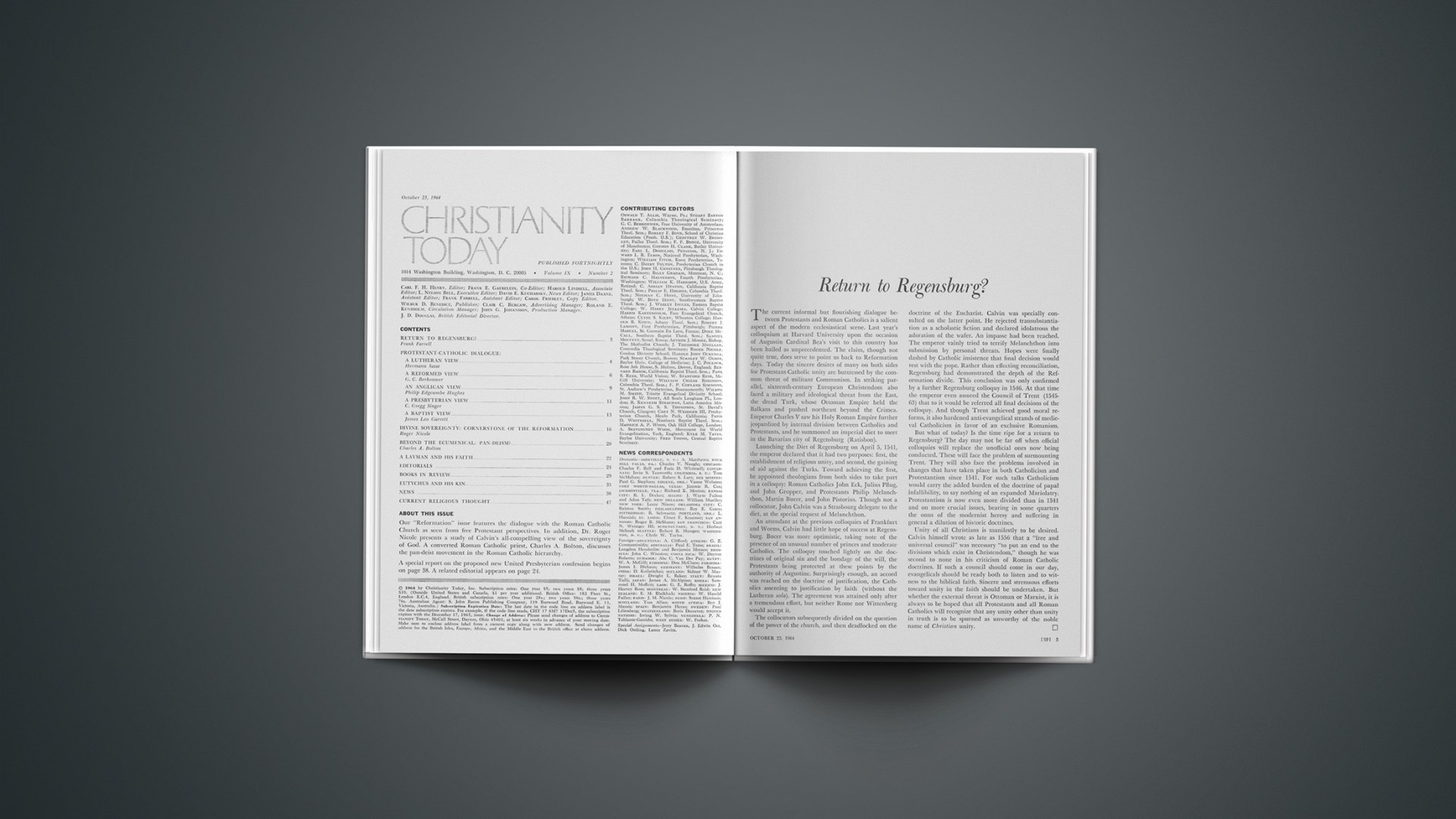
Return to Regensburg?

The current informal but flourishing dialogue between Protestants and Roman Catholics is a salient aspect of the modern ecclesiastical scene. Last year’s colloquium at Harvard University upon the occasion of Augustin Cardinal Bea’s visit to this country has been hailed as unprecedented. The claim, though not quite true, does serve to point us back to Reformation days. Today the sincere desires of many on both sides for Protestant-Catholic unity are buttressed by the common threat of militant Communism. In striking parallel, sixteenth-century European Christendom also faced a military and ideological threat from the East, the dread Turk, whose Ottoman Empire held the Balkans and pushed northeast beyond the Crimea. Emperor Charles V saw his Holy Roman Empire further jeopardized by internal division between Catholics and Protestants, and he summoned an imperial diet to meet in the Bavarian city of Regensburg (Ratisbon).

Launching the Diet of Regensburg on April 5, 1541, the emperor declared that it had two purposes: first, the establishment of religious unity, and second, the gaining of aid against the Turks. Toward achieving the first, he appointed theologians from both sides to take part in a colloquy: Roman Catholics John Eck, Julius Pflug, and John Gropper, and Protestants Philip Melanchthon, Martin Bucer, and John Pistorius. Though not a collocutor, John Calvin was a Strasbourg delegate to the diet, at the special request of Melanchthon.

An attendant at the previous colloquies of Frankfurt and Worms, Calvin had little hope of success at Regensburg. Bucer was more optimistic, taking note of the presence of an unusual number of princes and moderate Catholics. The colloquy touched lightly on the doctrines of original sin and the bondage of the will, the Protestants being protected at these points by the authority of Augustine. Surprisingly enough, an accord was reached on the doctrine of justification, the Catholics assenting to justification by faith (without the Lutheran sola). The agreement was attained only after a tremendous effort, but neither Rome nor Wittenberg would accept it.

The collocutors subsequently divided on the question of the power of the church, and then deadlocked on the doctrine of the Eucharist. Calvin was specially consulted on the latter point. He rejected transubstantiation as a scholastic fiction and declared idolatrous the adoration of the wafer. An impasse had been reached. The emperor vainly tried to terrify Melanchthon into submission by personal threats. Hopes were finally dashed by Catholic insistence that final decision would rest with the pope. Rather than effecting reconciliation, Regensburg had demonstrated the depth of the Reformation divide. This conclusion was only confirmed by a further Regensburg colloquy in 1546. At that time the emperor even assured the Council of Trent (1545–63) that to it would be referred all final decisions of the colloquy. And though Trent achieved good moral reforms, it also hardened anti-evangelical strands of medieval Catholicism in favor of an exclusive Romanism.

But what of today? Is the time ripe for a return to Regensburg? The day may not be far off when official colloquies will replace the unofficial ones now being conducted. These will face the problem of surmounting Trent. They will also face the problems involved in changes that have taken place in both Catholicism and Protestantism since 1541. For such talks Catholicism would carry the added burden of the doctrine of papal infallibility, to say nothing of an expanded Mariolatry. Protestantism is now even more divided than in 1541 and on more crucial issues, bearing in some quarters the onus of the modernist heresy and suffering in general a dilution of historic doctrines.

Unity of all Christians is manifestly to be desired. Calvin himself wrote as late as 1556 that a “free and universal council” was necessary “to put an end to the divisions which exist in Christendom,” though he was second to none in his criticism of Roman Catholic doctrines. If such a council should come in our day, evangelicals should be ready both to listen and to witness to the biblical faith. Sincere and strenuous efforts toward unity in the faith should be undertaken. But whether the external threat is Ottoman or Marxist, it is always to be hoped that all Protestants and all Roman Catholics will recognize that any unity other than unity in truth is to be spurned as unworthy of the noble name of Christian unity.

The Minister’s Workshop: The Way to Note-Free Preaching

One of the greatest joys of the ministry is the spontaneity of note-free preaching. Freedom from notes is worth all that it costs. It depends mainly on three factors in preparation: saturation, organization, and memorization. The last-named factor will be treated in a later study.

Whatever method of preparation the preacher may follow, he needs to be thoroughly familiar with his material. “No man can be eloquent on a subject that he does not understand,” as Cicero, the greatest orator of ancient Rome, declared two thousand years ago. One of the penalties of plagiarism is that it so largely bypasses the processes of saturation. For the expenditure of time and thought and labor, there is no substitute.

Strong churches are not gathered around weak pulpits. And if the discipline of thoroughness and accuracy in preparation seems rugged at first, nothing that the minister does is more rewarding; and in time such sermonizing becomes one of his greatest joys.

For retention and recall, in note-free preaching, the structure “must be simple, obvious, natural, so that it fixes itself in the mind; and it must be clearly articulated in its parts.” With a good outline, the preacher commits to memory a progression of thoughts rather than words, and is never tied to a particular phraseology. A rambling discourse, on the other hand, practically defies memorization, and keeps the preacher bound to his notes.

One way of preaching without notes is to write out and memorize the full manuscript. This has been the method of some of our great preachers. But to memorize a ten-page manuscript for every service calls for prodigious feats of memory; and few preachers could endure the staggering demands of such a procedure two or three times a week, or oftener.

For the great majority of preachers, it seems fairly well established that a carefully prepared outline, the product of hours of labor, is the best preparation for the pulpit. This involves lifelong discipline to conciseness and accuracy of expression. While concise, the outline must carry enough of the sermon so that it can be recalled as needed, perhaps weeks or months or even years later.

A few brave souls go into the pulpit regularly with no notes of any kind. For most preachers, with two or three new messages to deliver every week, this might be sheer recklessness, and at times an invitation to disaster. There may be times when the preacher, whatever his usual practice may be, will need his notes. This could happen if he is weary or physically below par, or if he has been prevented from getting adequate preparation, or if there is an emergency in the preaching service itself. It seems wise, therefore, to have notes that can be carried into the pulpit.

For convenient handling, a loose-leaf notebook of 5 × 7¾ inches is often favored as first choice. Such a notebook is about the size of the average Bible, and a leaf will fit easily between the pages of the Bible. By writing on both sides, it is possible to carry a full sermon outline on the two sides of one sheet; or it could be carried on one side of two opposite sheets in the notebook. This presupposes conciseness, and abbreviations wherever possible.

A better plan, perhaps, for the preacher who is reasonably confident of not having to use his notes in the pulpit, is to place his outline on one side of one sheet of 8½ × 11 inches, thus providing longer lines and greater flexibility in notation. Folded once, this will fit easily into the Bible. It presents the advantage of keeping the whole outline in view throughout the phase of preparing, and leaving room on the back side of the sheet for detailed data with which the outline itself should not be encumbered.

For a thirty-minute sermon, there might be from thirty to thirty-six lines, or approximately one line to a paragraph. For brevity, every preacher must develop his own system of shorthand or abbreviations. For memorization, as will be pointed out later, it is generally preferable that the outline be handwritten rather than typewritten.—Adapted from Expository Preaching without Notes, by Charles W. Koller (Grand Rapids, Mich.: Baker Book House, 1962). Used by permission.

Theology

Current Religious Thought: October 9, 1964

Few things can contribute more to the understanding of what may be called “The New Face of Liberal Journalism” than the manner in which major sectors of the American press have treated Senator Goldwater during the past three months. This holds true not only for the secular news media but for the religious press as well.

During the convention in San Francisco and the period that immediately preceded it, the writer was in Europe. There were available the European editions of two major New York dailies, and the German press quoted exhaustively from other sectors of our metropolitan press. It was impossible to escape the conclusion that the liberal newspapers, both in their editorial commitments and through the commentators to whom they gave prominence, had in advance adopted a position of unconcealed bias against Goldwater and in favor of President Johnson. In the reporting, everything that the Senator from Arizona did or said was presented in an unfavorable light, while at the same time every move made by President Johnson was glamorized and made to appear well advised.

The major thrust of those editorials that did seek to reason concerning the matter was that Goldwater represents an era that is long past. Almost with one voice, they joined in the chorus that the prospective candidate from Arizona is naïve—that he has never considered the complexities of the world of today. Condescendingly, some of them attributed to him as a conservative the minor virtue of sincerity (if there be in him any virtue at all); but the general attitude was that he reflects outlooks and values that are no longer meaningful. By implication, they suggested that as a conservative, Goldwater could not be the intellectual equal of his opponents.

One is not certain whether the alarm expressed by editorialists and columnists over his statement that “moderation in pursuit of justice is no virtue” was genuine or not. Certainly the liberal commentators have shown no disposition whatever to listen to any explanations of the intent of the statement. What is conveniently forgotten by them is, of course, that we live in a day in which every group seeking reform tends to abandon moderation. Perhaps this is the inner logic of social change.

The liberal press gives the impression of condoning excessiveness by advocates of some forms of social change, and of having little or no concern for the maintenance of public order where certain forms of immoderation are concerned. The frightening thing in all of this is that those who profess open-mindedness have shown no inclination to stop and examine issues or meanings. Goldwater’s statement was treated, almost uniformly, as being sinister.

A similar lack of objectivity was manifest in the attitude of the liberal press toward Goldwater’s views on national defense. No effort was spared to depict him as trigger-happy—as one who would without doubt pursue a policy of unmitigated “brinkmanship” and who would probably push his country into war with the Soviet Union. Having jumped to this conclusion, the columnists are scarcely likely to attempt any objective examination of the respective merits of the two candidates.

It is significant that these journalists secured their desired results in Europe. Following the nomination at the Cow Palace, well-meaning and intelligent Europeans mournfully informed this writer that the election of Senator Goldwater would certainly mean war! One gets the impression that major sections of our metropolitan press have determined to decide the highly complex issue of the choice of a President for the years 1965–69 upon the basis of an emotional and highly biased tour de force.

This is being written by an independent voter who at the time of writing is undecided about his vote for President in November. Normally, he would like to feel that at least the religious press of the land would, in the midst of the near-hysteria of the secular liberal press, maintain some objectivity. In point of fact, he finds that the liberal religious press has locked step with its secular counterpart.

One looks in vain in such publications as Christianity and Crisis or the Christian Century for any really objective discussion of the respective merits of the two major candidates. While in general these and similar periodicals have disavowed such agencies as “Christian Political Parties” and the like, yet now they seem to have no hesitancy in identifying the views of the Democratic party with what John C. Bennett calls “everything for which America’s three faiths stand in respect to international relations, civil rights and economic policy” (Christianity and Crisis, Aug. 3, 1964, p. 1).

Bennett declares that Goldwater is clearly opposed to what is religiously normative at these points, and adds that the Christian Century has discovered the same to be true. Now, it surprises nobody that these periodicals should ultimately favor the nominee of the Democratic party. This is clearly their privilege. What is disturbing is that they reached this position with such ease, and in advance of any reasoned discussion of the issues at stake.

It tells us little or nothing that the Century published the views of several professors of social ethics, each of whom voted a thumping No for Goldwater. The discussions printed in this connection did not, if the reaction of this writer is correct, seek to examine the issues at stake and to permit Goldwater to elucidate his case. They seem, rather, to be searching for reasons to support a position already taken.

One expects such secular journals as the Nation to respond to any conservative candidate in terms of a negative conditioned reflex. This is again certainly the privilege of a periodical under the conditions of a free press. Actually, the Nation impresses one as giving more place to a reasoned analysis of the issues at stake than did some of the religious journals. Certainly one welcomes such analyses as those Carey McWilliams presents, whether one agrees with the conclusions or not.

One is perplexed by the apparent inconsistency in Professor Bennett’s article, from which an excerpt was taken above. While deploring what he believes to be a tendency upon the part of Goldwater to wrap “an immoral nationalism, an immoral nuclear recklessness, an immoral racism and an immoral economic individualism” in “the mantle of religion,” Dr. Bennett does not seem to hesitate to identify himself with the editorial policy of the Christian Century, which frankly identifies the policies of Goldwater’s opponent with at least the major principles of a Christian ethos.

It would be ironical in the extreme if the unfair and biased attitude of both the secular and the religious liberal press should provoke a backlash (to use a jaded term) in favor of Goldwater. Certainly the critical reader, as of this date, might well see the Republican candidate as the underdog. If the liberal press finds that it has cast him in this role, it has only itself to blame.

Comeback of Urban Churches

The churches’ retreat to the suburbs seems to have reached its extremity in the United States, and alert congregations are studying the prospects for new approaches in urban centers. A number are taking advantage of urban redevelopment projects by establishing new churches where slums have been cleared away. The Alvarado Church of Christ in Los Angeles is projecting an even more daring move: it hopes to relocate in a new twenty-two-story office building to be erected near the city’s downtown civic center.

Spokesmen for the church say it will follow somewhat the plan of Chicago Temple, which houses the First Methodist Church of Chicago and many professional offices. A chapel will be located on the top floor of the $13.5 million building. The main sanctuary will be adjacent to the office building on a landscaped mall.

The church has engaged a prominent Los Angeles analyst firm to conduct economic feasibility surveys.

In nearby Santa Ana, meanwhile, an ambitious Christian builder has proposed a sixty-acre “Sky Sites for Christ” project costing some $100 million. William Todd, a graduate of Fuller Theological Seminary, wants to build the big commercial and residential project in a way to attract churches and convention centers, Christian schools, and other religious agencies. Todd owns ten acres of the proposed site and is “working for options” on the remainder. The parcel now is an orange grove.

Initial plans call for two twelve-story buildings and a single-story shopping mall. Eventually Todd wants to erect a large arena seating about 20,000 persons to serve religious gatherings.

Todd, who also teaches real estate at Santa Ana College and is pastor of the Church of the United Brethren in Christ at Lakewood, California, hopes to get started by early 1965. Local authorities are balking at zoning changes that will be necessary for the new development, but Todd appears confident of eventual success.

The proposed site is just south of the Santa Ana Freeway-Garden Grove Freeway interchange and is within commuting distance of Los Angeles.

Protestant Panorama

Canadian Lutherans are planning a new coordinating agency to parallel a similar agency being proposed in the United States. The “Lutheran Council in Canada” would embrace 98.5 per cent of Canada’s 290,000 Lutherans and would succeed the present Canadian Lutheran Council, which represents only two denominations.

Swedish Lutheran bishops turned aside demands that the editor of a semi-official church weekly be dismissed for advocating premarital sexual relations. The editor, Carl Gustaf Boethius, has suggested that the church’s position against premarital relations should be “liberalized.”

Methodists in Indonesia broke off organic ties with the parent church in the United States and declared themselves an autonomous, self-governing body.

Miscellany

An agreement between the Vatican and Communist Hungary is expected to ease restrictions against the country’s practicing Roman Catholics. Vatican sources say, however, that there are no plans for establishing official diplomatic relations between the Holy See and Budapest.

The Internal Revenue Service ruled that unordained staff members of churches and agencies in the Southern Baptist Convention cannot qualify for income-tax-free housing allowances.

A “Committee of Concern” was organized to help recently burned Negro churches in Mississippi by twenty-three of the state’s churchmen. The committee includes Protestant, Roman Catholic, and Jewish representation, with both white and Negro leaders participating.

Anglicans on the Caribbean island of Barbados climaxed an eight-month stewardship campaign with a 2½-hour Eucharistic service attended by some 23,000. The open-air event was described as the largest church service ever held in the eastern Caribbean.

The National Council of Churches’ Broadcasting and Film Commission is inaugurating a program of annual awards for American-made motion pictures. The first awards will be given to films released during 1964.

African Challenge, evangelically oriented mass-circulation monthly of the Sudan Interior Mission, is launching a “Don’t Smoke” campaign. The magazine says that “as sales go down overseas, manufacturers try to find new buyers in Africa.”

Fuller Theological Seminary will establish a new mental health center near its campus in Pasadena, California. The Pasadena Community Counseling Center, due to open October 15, is the first phase of a plan aimed at initiating a Ph.D.-level graduate program in clinical psychology at the seminary.

Roman Catholic Archbishop Michael Gonzi lifted an interdict against Labor party leaders in Malta. Roman Catholics still are prohibited from joining the party.

Personalia

Dr. V. Raymond Edman was named first chancellor of Wheaton College. He is being succeeded as college president by Dr. Hudson Armerding.

J. Eugene White was named managing editor of Church and State.

British Church Merger by 1980?

The poetic image of the English Midlands as “sodden and unkind” was badly damaged last month when the first British Faith and Order Conference convened at Nottingham University. The country’s most spacious campus was bathed in sunshine as 550 representatives of twenty denominations met to discuss questions that divide and unite them. The British Council of Churches had earlier pointed out that the ecumenical harvest of fifty years has been no more than the union of three different kinds of Methodists in 1932, and of two different kinds of Scottish Presbyterians in 1929. (The official statement overlooked another Scottish union in 1956.) Non-Roman Catholic bodies outside the BCC include the Brethren and other evangelical bodies and several small Scottish and Irish Presbyterian churches.

For the first few days the timetable ticked along comfortably and predictably. Then something happened to ensure for “Nottingham 1964” a permanent niche in British ecclesiastical history. There came before the whole conference from one of the sections some radical and imaginative resolutions. The first of these (as later slightly amended) read: “United in our urgent desire for One Church Renewed for Mission, this Conference invites the member Churches of the British Council of Churches, in appropriate groupings, such as nations, to covenant together to work and pray for the inauguration of union by a date agreed amongst them.” But the real audacity came with the second resolution. “We dare to hope,” it said, “that this date should not be later than Easter Day 1980.1Easter Sunday in 1980 Will fall on April 6. We believe that we should offer obedience to God in a commitment as decisive as this.”

The date was described as a “splendidly irrational symbol,” a warning was sounded against “dictating to the Holy Spirit,” and the objection was made that until a pattern of reunion had been agreed upon, it was “dangerous and impractical for us to commit ourselves to a date.” But commit themselves they did. Even the influential Bishop of Winchester, Dr. Feolkner Allison, abandoned his opposition and supported what will doubtless be known as the “1980 Plan.” Of 329 official church delegates eligible to vote on the issue, only 53 voted against, and 18 abstained. So far as could be ascertained, most denominational leaders supported the plan. A notable exception was the Archbishop in Wales, Dr. Edwin Morris.

The conference further agreed that negotiations between particular churches already in hand be seen as steps towards this goal; that member churches be invited to plan jointly in common mission and service to the world; that every effort be made to promote the common use of church buildings; that certain designated activities be carried out jointly; and that there should be specific areas earmarked for ecumenical experiment. At some points there was about the debate an evangelical fervor that had been apparent all week in the deeply spiritual Bible studies given by the Orthodox Father Paul Verghese.

That one conference official at least had mental reservations about some united Christian action was seen in the last session. The Rev. David M. Paton, the conference’s study adviser, for some reason felt it necessary not only to express doubts whether Dr. Billy Graham’s “kind of approach” reaches the unchurched but also to question Dr. Graham’s “presentation and understanding of the Gospel.” In an assembly that has continually prayed for and commended the Vatican Council and that is so concerned with Christian charity and rapprochement, some observers considered Mr. Paton’s remarks on Dr. Graham, and an earlier attack on conservative evangelicals generally, surprising.

In his opening address as chairman of the conference, the Bishop of Bristol, Dr. Oliver Tomkins, declared that we falter in our definition of “evangelism.” Was it, he asked, “Billy Graham or Industrial Mission or ‘presence dans le monde’ or an amalgam of the lot?” He suggested that unity is not necessarily a good thing—“the massive merger of unrepentant, unrenewed, self-regarding ‘denominations’ would be a disaster!” The real fiasco, concluded the bishop, “could lie in our going away unchanged, deaf to the Spirit and blind to each other.”

Pursuing the same theme, Dr. W. A. Visser’t Hooft stated that the apparent deadlock on church unity must remind Christians that unity is not man-made but God-given. “We are receivers,” he said, “not creators. So we must get rid of all pride, stop talking about our great churches with their impressive history, forget church statistics which are anyway notoriously misleading, and come together as what we really are: beggars who depend wholly on the grace of God.”

Next morning at the Communion service the preacher was the Rev. Patrick C. Rodger, who amidst mounting controversy is being considered for nomination to succeed Dr. Visser’t Hooft as general secretary of the WCC. Later that day members of the conference (which included Roman Catholic and Orthodox observers) were entertained at tea at the Society of the Sacred Mission, where the Spartan regime of ordinands includes an obligatory cold shower every morning. That the world intrudes even into this Anglican monasticism, however, could be seen on a notice board showing that student football teams had taken unto themselves names of top pop groups—headed, naturally, by the ubiquitous Beatles.

After this outing the vexed problem of intercommunion was tackled. “I believe that if Holy Communion is really the heart and focus of every aspect of the Church’s life,” said Professor G. W. H. Lampe, an Anglican from Cambridge, “then we cannot expect to end our divisions unless we come together at the Lord’s Table so as to be made one Body by receiving his Body.” Support for this came from a distinguished Baptist lawyer Mr. J. G. Le Quesne, who asserted that “we are not entitled to postpone obedience to Christ on this point until we reach agreement on other matters.” That this was not palatable to Anglo-Catholics present was seen indirectly when there began to circulate a Church Union pamphlet advising its supporters against participation in “Open” Communion services.

A significant feature of the Nottingham gathering was the presence of a number of conservative evangelicals who had been specifically sought by the organizers. That the invitation was proferred and accepted reflected the gracious spirit of both parties. It was the more regrettable, therefore, that BCC officials should have commissioned a liberal theologian to read the evangelicals a blunt lecture on the ecumenical difficulties they presented. The project was badly conceived, and executed without a trace of redeeming winsomeness. The chosen instrument was the secretary-elect of the Congregational Union of England and Wales, the Rev. John Huxtable. His delineation of conservative evangelical attitudes faithfully recorded their “notorious” non-cooperation with “second-class Churchmen,” showed an imperfect acquaintance with their theological position, and attributed to all of the party the self-righteous extremism undoubtedly found in a minority.

While expressing sympathy with those church members who think of unity as “a grisly ecclesiastical monster,” Professor J. Robert Nelson of the Graduate School of Theology, Oberlin, Ohio, felt that such an attitude was retrogressive. “The implications of God’s work of reconciliation in Christ for the historic life and mission of the Church,” suggested the American Methodist, might show the unity movement to be, not “a monstrous threat,” but “a veritable opportunity for a more faithful Christian life.”

Council At St. John’s

Although the denomination’s new Sunday school curriculum has stirred a nation-wide controversy, delegates to the twenty-first General Council of the United Church of Canada did not make an issue of it. The delegates were presented with a report of the controversy, and an abbreviated explanation was given on the floor, but no questions were raised. Evangelicals have charged that the curriculum rejects the validity of certain cardinal doctrines.

The General Council was held in the historic city of St. John’s, Newfoundland. Some 396 delegates were on hand. (The denomination was an outgrowth of a 1925 merger embracing Congregationalists, Methodists, and some Presbyterians.)

The Rt. Rev. James R. Mutchmor, retiring moderator, said in his farewell address that he has “a very limited regard for an episcopally-governed church.” “Church statistics clearly show,” he declared, “that North American non-Roman Catholic communions which hold firmly to the doctrine of the apostolic succession are numerically declining bodies. They are extremely weak in rural North America and count for little in the villages and small towns of this continent.”

The rejoinder to the outspoken Mutchmor came from the Rev. R. H. N. Davidson, one of the church’s Committee of Ten that has been discussing union with ten Anglican counterparts. He suggested a resolution asking that the office of bishop be introduced into the presbyterian-designed United Church. The motion was deferred for further study and discussion. Talks on union have gone on intermittently between the two denominations many years.

Endorsement From Canada

Delegates to the triennial convention of the Baptist Federation of Canada voted to participate in the proposed North American Fellowship of the Baptist World Alliance. A resolution approved by the convention in Wolfville, Nova Scotia, hailed “the efforts toward Baptist unity in North America” and affirmed the Canadian federation’s desire to be a part of the proposed cooperative program for seven Baptist bodies. The program is aimed at continuing relations established in the Baptist Jubilee Advance (1959–1964).

‘The Doctor Should Also Pray’

The first “Christian Healing Hospital,” opened last May in Medford, Oregon, by the evangelically oriented Christian Medical Foundation, is so far living up to its founders’ expectations.

Dr. William Standish Reed, a surgeon and president of the foundation, said at the annual meeting of the International Conference on Christian Healing in Philadelphia last month that the new venture will combine medical treatment with a spiritual healing ministry in order to “convince people to pray, and then see their doctor, who should also pray.”

The Christian doctors who staff the 102-bed hospital will seek both to show that spiritual healing has a legitimate place and to reach those who believe that it is “slapping God in the face to go to a doctor.” The hospital is designed to provide “an atmosphere of faith and belief, from the people who mop up the floor to the medical and nursing staff,” Reed said. There was some indication that the “atmosphere of faith” had aided recuperation in several cases, he added.

The Conference on Christian Healing is sponsored by the Episcopal Order of St. Luke the Physician, a non-monastic healing order that helps to support the foundation. Besides the hospital, the foundation operates a clinic in Tampa, Florida, and plans more hospitals in other parts of the country.

The new approach, combining the physical, mental, and spiritual makeup of man, and variously referred to as “thymo-psychosomatic” (“thymo-” for spirit) and “logiatry,” has not attracted much attention in the United States, but is being “commonly discussed in Europe,” said Reed. He mentioned Dr. Paul Tournier as being one of the European pioneers in the field.

Mass Evangelism: Billy Graham: Back to Boston

Billy Graham and his evangelistic team were in Boston again fifteen years after his first and greatly blessed campaign of 1949. It was the same Boston that has experienced marked and dramatic religious changes along its almost 350-year history.

In the campaign of fifteen years ago many churches worked together cooperatively, and the results were dramatic. An estimated 50,000 people jammed the Boston Common to hear Graham preach the Gospel. A drenching rain stopped before he started to preach and resumed when the service was over. Thousands of men and women came to Christ.

In 1964, just 224 years after Whitefield had established an evangelistic beachhead in Boston, Billy Graham was back.1Graham came to Boston fresh from a ten-day crusade in Omaha, where he preached to an aggregate of 183,170 persons, 10,724 of whom stepped forward to record commitments to Christ (the inquirers represented 5.8 per cent of attendance compared with an international average of 2.6 per cent for Graham crusades, the Crusade News Bureau reported). This time Boston Garden, seating 14,000 people, was the main scene of his operations. A ten-day crusade was planned, with a grand finale on the Boston Common, Sunday, September 27. This time the Graham team had greater support than ever before. Richard Cardinal Cushing, Roman Catholic Archbishop of Boston, assured Billy Graham that Boston area Catholics were praying for the success of his crusade. The Cardinal said: “Although we Catholics do not join with them in body, yet in spirit and heart we unite with them in praying God’s blessings upon this Christian and Christ-like experience in our community.”

The Cardinal was joined by other leading Boston prelates. The Rt. Rev. John M. Burgess, Suffragan Bishop of the Episcopal Diocese of Massachusetts and the only Negro Episcopal bishop in the United States, was backing the crusade vigorously, as was Methodist Bishop James K. Mathews, son-in-law of E. Stanley Jones. As usual, Park Street Church, Tremont Temple, and some 300 other local congregations were solidly behind the Graham effort.

On opening night Boston Garden was filled with some 14,000 people who listened in rapt silence as Mr. Graham spoke on the New Birth from John 3 and the story of Nicodemus. Six hundred twenty-five people came forward as inquirers. On the following evening the house was filled again as Mr. Graham spoke on “Manasseh, the wickedest man who ever lived.” When he concluded his stirring sermon 863 people crowded the podium, and scores of seekers were backed up into the aisles.

Boston papers gave extensive coverage. The Globe followed and reported on Mr. Graham and team members who went forth on foot Saturday night into the nightclubs and sin-infested areas of Boston with the message of Christ. There were hostile comments and resistance; but Mr. Graham spoke in one prominent nightclub, following his own notion that if the people won’t come to the meetings, the evangelist will seek out the people where they are and bring the message of Christ to them in the highways and byways.

The only Sunday crusade meeting at the Garden was scheduled for 3 P.M. Ten minutes before the meeting was to commence fire inspectors closed the doors, and hundreds of people were unable to gain admission. Mr. Graham left the meeting and addressed the crowds assembled outside. Then he returned to the platform to speak of salvation by the blood of Christ. An estimated 725 people pressed forward to receive Christ.

Graham spoke nightly despite an apparent virus attack which, during one sermon, almost caused him to black out.

In 1740, when the Great Awakening was moving forward under the dynamic leadership of Jonathan Edwards in Northampton, Massachusetts, George Whitefield came to the Boston Common. He was well received by the clergy with the exception of Charles Chauncey of the First Church, who upon meeting Whitefield said, “I am sorry to see you here.” To this Whitefield replied: “And so is the devil.” Whitefield spoke to 4,000 people and the following Sunday addressed 15,000, many of whom were converted under his Spirit-inspired preaching.

Between the time of the Great Awakening in the 1740s and the appearance of Finney a hundred years later, New England was overtaken by the blight of Unitarianism, from which it has never fully recovered. Hundreds of Congregational churches defected from trinitarianism and raised the banner of a “new theology” that in the twentieth century was to become sheer humanism. Between the advent of Finney and the work of Torrey, Smith, and Sunday, the rise of Christian Science under Mary Baker Eddy further embarrassed New England religion.

Charles Grandison Finney came to Boston in 1831. He too experienced some clerical disapproval. Lyman Beecher, pastor of the famous Park Street Church of Boston, along with Asabel Nettleton and others, attacked Finney for his evangelistic methods, but to no avail. One historian stated that “opposition on the part of a disaffected clergy could not diminish Finney’s popularity.” Elder Jacob Knapp, a Baptist, also came to Boston and was subjected to intense opposition by the clergy. Wholly different from Whitefield and Finney, he nevertheless moved Boston for Christ. And from his ministry there emerged the well-known Tremont Temple.

Dwight Lyman Moody, R. A. Torrey, and Gypsy Smith came to Boston, too. After the 1906 meetings of Gypsy Smith it was stated that 2,550 people made decisions for Christ. During the First World War Billy Sunday came to Boston, and under his fiery and spectacular preaching thousands came to the knowledge of God in Christ. The chairman of his crusade was Allan C. Emery, Sr., whose son, Allan Jr., was chairman of last month’s Billy Graham crusade. Sunday preached against civic sins and was a strong opponent of the liquor traffic. His sermons to men were extraordinarily effective, just as Graham’s sermons to young people and their parents have produced a rich harvest of righteousness.

Boston needs what Mr. Graham had to offer. And Mr. Graham was speaking to the needs of Boston—in power and under the inspiration of the Spirit of God.

The Next Ten Years

A panel of fifteen prominent religious scholars forecasts elements in Christian impact during the coming decade

What factor, more than any other, is likely to decide Christianity’s influence upon the secular thought of the next decade?

This is the question CHRISTIANITY TODAY put to a panel of religious scholars as the focal point of its anniversary-issue news feature this year. Here are the replies:

EDWARD JOHN CARNELL, professor, Fuller Theological Seminary: “The seriousness with which we receive the teaching that love is the queen of Christian virtues (1 Cor. 13)—a love which unites us with Jesus Christ in such an intimate way that we instinctively sense an increased personal responsibility to (a) live lives marked by purity of thought as well as deed, (b) support the work of the Gospel everywhere, (c) respect the dignity of all human beings, (d) help the visible church develop a state of true spiritual unity, (e) defend the civil rights of all who are willing to abide by both the Constitution and the laws of the land, and (f) cooperate in finding ways to convince the various nations of the earth that their own national interests will be furthered by replacing threatening and competitive attitudes with those of kindness and mutual understanding.”

GORDON H. CLARK, professor, Butler University: “The sovereignty of God is the only factor that will decide Christianity’s influence on secular thought. Observation gives no grounds for supposing that Christianity will have any noticeable effect in the next decade. Atheism, Communism, lawlessness, and irresponsibility in government seem to have unrestricted sway.”

JOHN H. GERSTNER, professor, Pittsburgh Theological Seminary: “A candid facing (or lack or it) of problems raised by a secular culture. Some of us Christians, as well as the secularists, are persuaded that most scholarly exponents of Christianity are evading the issues by various question-begging appeals to faith.”

CARL F. H. HENRY, editor, CHRISTIANITY TODAY: “Recognition or non-recognition of divine revelation and divine authority will be the determinative issue. Whenever a culture loses vision of the eternal, drifts from a living sense of the transcendent basis of morality, and otherwise flouts biblical realities, it is headed straight for heathenism.”

HAROLD B. KUHN, professor, Asbury Theological Seminary: “With respect to the influence which the Christian Church may hope to exert upon secular thought in the decade ahead, it seems probable that this will continue to be eroded so long as theologians insist upon projecting as Christian ‘existential’ systems which are essentially esoteric and gnostic in form. Unless Christian theology can disengage itself, especially, from the occult and decadent forms of second- or third-hand Bultmannism, it is likely that Christianity’s influence will become more and more marginal to the stream of the world’s life. The determining issue seems to be, not whether there may not be some grains of truth in existential forms of thought (which nearly all will grant), but whether the Church has the vigor and courage to face the world with a clear and propositional ‘Thus saith the Lord’ or whether she will continue to dispense the theological medicaments handed down by the sophisticated witch-doctors who obscure the content of the Gospel in their existential incantations.”

ADDISON H. LEITCH, professor, Tarkio College: “I am increasingly impressed by the attention being given by the Roman Catholic Church to biblical studies. Apparently, many Roman Catholic scholars accepted Barth and Bultmann as ‘biblical’ theologians, read them for their interest and importance in philosophical theology, and were led to a reassessment of the Scriptures. Coupled with this, for many other reasons, there has been a general loosening in Roman Catholic scholarly circles, making allowances for the centrality of the Word. If my assessment is correct, then I am sure that the Roman Catholic Church will experience something like the Reformation again, and it is well known that when people take the Bible seriously, they expect it to be relevant to the whole of life. The impact of the Roman Catholic Church’s taking the Bible seriously, along with their historic belief in the unity of church and state, plus their memories of history that worked in medieval times, plus their dreams that it might work again, will, I think, have revolutionary repercussions.”

JAMES P. MARTIN, professor, Union Theological Seminary in Virginia: “Insofar as the denominations in America continue to pattern their life according to the image and mores of the ‘successful corporation,’ secular thought will be reinforced in its conviction that Christian life, individual and corporate, can be completely analyzed, understood, and manipulated in terms of the behavioral sciences. This conviction will react upon the churches and intensify their secularization. On the other hand, secular thought could be challenged by the spectacle of the Church’s integrity if she took upon herself the Form of the Servant, manifested the quality of mercy (acceptance) to all men consciously for the sake of Christ and his Kingdom (not for the sake of the Constitution, the Supreme Court, or the denominational image), and did this in accordance with a biblical theology of history which overcame the static metaphysics of orthodoxy and the individualistic escapism of existentialism and pietism.”

J. THEODORE MUELLER, professor, Concordia Seminary: “Christianity’s influence upon the secular thought of the next decade will no doubt be decided by its teaching of the divinely inspired Bible with its greatly needed message of the divine Law and of the Gospel of salvation through faith in our Lord Jesus Christ. It was Scripture with its saving message of Law and Gospel that kept perishing Rome from destruction; and today, when the vices of ancient Rome threaten to destroy our Western way of life, which our pious fathers reared upon the foundation of the Christian faith, the Christian Church must again oppose the spread of atheism, Communism, materialism, lawlessness, and reckless bloodshed with the saving Word of God. If the Church will fail in its duty of stressing seriously and constantly the divine Word there will be nothing to keep secular thought from utter decay and to hold up the ruin toward which also our Western world is heading.”

BERNARD RAMM, professor, California Baptist Theological Seminary: “To me the most important factor concerning the influence of Christianity upon the secular thought of the future is whether or not Christian theologians can make Christian theology the compelling option it enjoyed in other centuries.”

W. STANFORD REID, professor, McGill University: “The factor, more than any other, which humanly speaking will likely decide Christianity’s influence upon the secular thought of the next decade is the willingness of Christians to face and endeavor to deal with the intellectual problems of the day. Over the past five or six decades Christians, by and large, have been shirking the responsibility of offering Christian interpretations of, and solutions to, the basic intellectual problems of the age: new concepts of the physical universe, new discoveries in the fields of human behavior, new practices in economic and social control. In the name of the Lord Jesus Christ, his followers must come to grips with these problems and not run away from them or ignore them. This will mean making the Gospel effectively relevant to our present situation, not merely as individuals, but as a society. We can do this, however, only by the power and the guidance of the Holy Spirit. Thus, in the long run, the deciding factor is the sovereign God, himself.”

WILLIAM CHILDS ROBINSON, professor, Columbia Theological Seminary: “That factor which is likely to have the most decisive influence in diverting the secular thought of the oncoming generation from Christianity is the removal of prayer from our public schools. Under the blessing of God, these bad effects may be curtailed if our people in their several communities will exercise their rights of religious freedom by school worship on a voluntary basis. The powers not delegated to the United States by the Constitution are reserved to the people, and the rights not enumerated are retained by them, so that Congress may not prohibit the free exercise of religion.”

HERMANN SASSE, professor, Immanuel Theological Seminary of Adelaide, Australia: “The factor is in my opinion a change in the spiritual and intellectual climate of our days. It finds, in the field of philosophy, its expression in the downfall of existentialism. The more the high waters of this last system of modern individualism and subjectivism recede, the more the damage becomes visible which it has done to the very foundations of human life. For our life rests on the recognition of eternal and objective truths whose validity is independent of our subjective existence. While the element of truth contained in modern existentialism will be preserved, as no real truth can ever be lost, the longing of our time is for an interpretation of the vast universe in which we live (Weltanschauung in the strictest sense), a philosophy which, on the one hand, does not shrink back from the wisdom and the insights to be found in great religions, and which, on the other hand, as true metaphysics is a worthy companion of the growing natural science and technology of our age. We theologians, even the most progressive ones among us, tend always to defend the positions of the day before yesterday. So it is a serious question for the Christian churches whether they will see and meet the challenge before it is too late.”

WILBUR M. SMITH, professor, Trinity Evangelical Divinity School: “Secularism is increasingly sovereign in the thinking of contemporary man. I do not see any movement today within the confines of Christianity from which we could justifiably hope for a reversal of this secularizing tendency. If, however, the Church of Christ should be granted an experience of a mighty outpouring of the Holy Spirit, convincing multitudes in every tribe and nation of the reality of a holy and omnipotent God and of man’s desperate need of atonement for sin though the sacrifice of Christ, granting to men faith to believe the Word of God and of a life to come, emancipating them from bondage to the spirit of the age, then secular thought would at least be forced to reconsider its present indifference to the revelation of God’s love and to the fact that he has appointed a day in which he will judge the world in righteousness.”

JAMES S. STEWART, professor, New College, Edinburgh: “A radical return to the basic creed of the early Church: Jesus is Lord; for this faith destroys the false antinomy between ‘sacred’ and ‘secular’ and reveals the whole of life, including its ‘secular’ thought and science and culture, as Christ’s domain.”

MERRILL C. TENNEY, dean, Graduate School, Wheaton College: “The impact of Christianity upon the secular mind in the next decade will be largely determined by the spiritual convictions of the laity. If Christianity becomes the refuge of a timid religious minority, it will be dismissed as irrelevant by the materially minded majority. If, on the other hand, the minority can demonstrate the reality of Christ to themselves and his relevance to the frustrations, bewilderment, and fears of this age, their faith can have a potent positive influence on the secular mind that tends to regard life as meaningless and absurd. The acceptance or refusal of individual missionary responsibility may be the critical factor in the perpetuation of vital Christian faith.”

Beauty And Holiness

For a few dramatic minutes, long enough to take in the televised finals of the Miss America contest in Atlantic City, the eyes of the nation were diverted from their usual preoccupation with politics and sports. What they saw reflected important changes in religious attitudes in North America.

The winner, 21-year-old Vonda Kay Van Dyke, professes a steadfast Christian faith. She entered the contest prayerfully, she said, because it presented “an opportunity to meet people and to impress upon them the importance of being a Christian.” She contends that “Christians need to get into this sort of thing to show that they’re not squares.”

Vonda’s bid for the title was undoubtedly enhanced by her talent as a ventriloquist: her TV appearances included a delightful dialogue with her dummy Kurley Q. Perhaps the thing that put her over, however, was her discreetly handled correction of emcee Bert Parks’s observation that she carried a Bible as a “good luck charm.”

It was not a charm, she said, but the “most important book I own.” She went on to tell of her trust in God and her confidence that “His will may be done tonight.”

Something of the rapport she had with the forty-nine other contestants in spite of or because of her Christian convictions is evident from their choice of Vonda as “Miss Congeniality.” Later, on being named Miss America for 1965, she broke into tears and never did regain composure for the television cameras. She was the first girl in the 44-year history of the pageant to win both titles.

An only child, Vonda was born in Muskegon, Michigan. There the family attended Calvary Baptist Church, but when they moved to Phoenix, Arizona, they joined the Central Methodist Church. The father is an osteopath.

Vonda traces her conversion to a fairgrounds evangelistic rally held in Phoenix when she was nine. She attended an evangelical high school and was active in Young Life. At Arizona State University, where she is a speech and drama major, Vonda has been connected with Campus Crusade. She has also taught Sunday school and vacation Bible school classes, but her most effective ministry has been in numerous appearances before youth groups with Kurley Q. In a personal testimony scheduled to appear in the November issue of Decision, she says:

“They won’t listen to me, but they’ll listen to my dummy.”

How does Vonda reconcile her evangelical witness with a bent for beauty contests? Is the commercialized display of female pulchritude really compatible with the message she proclaims? How does she feel about mass media reporting of her vital statistics around the world?

Newsweek, alluding to her affirmation of faith, described Vonda as “a Methodist Sunday School teacher whose blessings include a 36-24-36 figure,” then attributed a supposedly humorous dissent to Kurley Q: “I liked Miss Arkansas, the first runner-up. She was a sexy blonde, but I got stuck with this kid.”

Vonda minimizes the adverse aspects of her role as Miss America and seems not even to be disconcerted by her Wesleyan Methodist boyfriend’s publicly voiced apprehension that “this may affect her life.” She says she had not desired the title unless it would be “God’s will.”

Her outlook reflects a significant change in attitude among American evangelicals from the rigidly separationist view of a generation ago. The only criticism to reach her came from someone connected with the Billy Graham crusade in San Diego, where she gave a testimony subsequently telecast across North America.

A Dormitory Destroyed

A dormitory at Westmont College went up in flames as a series of brush and forest fires hit California last month. The loss of the dormitory, which housed thirty-four students, was estimated at $100,000.

Westmont, an evangelical liberal arts college, is located in a valley near Santa Barbara. At one time the fire enveloped the campus on three sides. Classes were suspended, and students and faculty members joined hands to fight the blaze.

Enter The Strings

String bands organized by the Salvation Army are enjoying a wave of popularity in Britain. At least one tune used by the army’s new crop of instrumentalists, “It’s an Open Secret,” won a place on the British hit parade.

Commissioner Erik Wickberg, chief of the staff and second-in-command of the Salvation Army throughout the world, described the phenomenon during a four-week tour of the United States and Canada.

Guitars have been used by Salvationists in Scandinavia for many years, said Wickberg, a native of Sweden, but their introduction in Britain is a very recent development.

“Singing with guitars is as old as the Salvation Army itself,” he declared, “and cannot be attributed to the Beatles or any other Eatles. They just put a new rhythm in their songs. I can’t say I’m struck with it, but my 18-year-old daughter thinks it’s wonderful.”

Missions Fatality

The aviation chief of the Lutheran Mission in New Guinea was fatally injured last month when the engine of his German-built Dornier DO-27 failed shortly after takeoff from a jungle airstrip and the plane plunged to earth and caught fire.

Captain Ray Jaensch, an Australian, died en route to a mission hospital a few hours later. He was about forty years old. He leaves his wife and four children.

One of four Australian government officials who were aboard the plane was seriously injured. The three others were not hurt.

Theology

God’s Best for You

Text: I beseech you therefore, brethren, by the mercies of God, that ye present your bodies a living sacrifice, holy, acceptable unto God, which is your reasonable service. And be not conformed to this world; but be ye transformed by the renewing of your mind, that ye may prove what is that good, and acceptable, and perfect, will of God (Rom. 12:1, 2).

One of the vivid recollections of my youth is that of watching a baseball game between two teams of unsophisticated teen-age amateurs, who played for fun, but with a tremendous determination to win. When the batter came up for his turn at bat it did not matter what the situation was—how many scores, how many men on bases, how many strikes, balls, outs—he had only one thought; and that was to lose the ball in a grand home run over the backfield fence. And so he would swing at the Hall with all the power he could muster, putting every ounce of his being into the effort. That may not have been good baseball strategy, but it was a magnificent demonstration of aiming for the best.

The Christian who aims for the highest and the best will find in the words of our text a powerful challenge to godly living, a ringing call to higher ground.

(1) Most Christians have never proven “what is that good, and acceptable, and perfect, will of God,” but are living on something less than God’s best.

(2) Many are living unhappily on spiritual lowlands only slightly above the level of the unregenerate world, without “the peace of God, which passeth all understanding” (Phil. 4:7), and without that heavenly lift which is the soul of happiness.

(3) Some are trying to be Christians in a mild sort of way, vainly trying to find happiness without holiness. Thus they live their pinched, meagre little lives, and die their little deaths, and are laid in their little graves, without ever experiencing the “abundant life” which is the unceasing concern of the Saviour, who came “that they might have life, and that they might have it more abundantly” (John 10:10).

(4) All who seriously aspire to God’s best will find help in the scriptural statement which reveals the way and spells out God’s requirements:

I. Complete Consecration

“… present your bodies a living sacrifice, holy, acceptable unto God, which is your reasonable service.”

1. It is required that we “present” the body, the instrument of every vice and every virtue.

(1) How do we serve our Lord? We serve him with the body—with the eyes seeing what he would have us to see, with the ears hearing what he would have us to hear, with the tongue speaking what he would have us to speak, with the hands doing what he would have us to do, and with the feet going where he would have us to go.

(2) How do we serve sin? Again, it is with the body—with the eyes, the ears, the tongue, the hands, and the feet choosing to engage in that which is repugnant to the Holy Spirit.

(3) How does one pay the penalty for sin? Here too the body is involved. Sin ravages the body as well as the soul. The judgment of God descends upon the body as well as the soul, in time and in eternity. The Bible declares that “there shall be a resurrection of the dead, both of the just and unjust” (Acts 24:15). The righteous are “raised incorruptible” (1 Cor. 15:52), with a body “like unto his [Christ’s] glorious body” (Phil. 3:21). About the resurrection body of the wicked we are not expressly told; but there are biblical intimations of a re-identification of the soul with some semblance of its former body.

Jesus repeatedly speaks of the destiny of the doomed in terms of “hell fire,” “outer darkness,” and “weeping and gnashing of teeth” (Matt. 18:9; 22:13). Somewhat more articulate is his reference to the doomed man in the place of torment pleading for a few drops of water to cool his tongue (Luke 16:24).

Clarence E. Macartney, in his very stimulating book, Preaching without Notes, gives the substance of a dialogue between a lost soul and its resurrection body, in the judgment, as imagined by Samuel Davies, noted preacher of Colonial times. The soul curses the body, and blames the lusts of the body for the soul’s eternal undoing, and cries out against the loathesome prospect of being reunited with the body. The body makes answer, bitterly accusing the soul of having prostituted the body to sin, forbidding the knees to bow before the throne of grace, and overruling every inclination of the eyes and ears to read and hear the Word of Life. In consequence, the body recognizes itself to be the just instrument of the soul’s everlasting punishment, while crying out against the necessity of being bound together by chains which even the pangs of hell and the flames of unquenchable fire cannot dissolve.

2. It is “reasonable” that we “present” the body as a living sacrifice.

(1) It is reasonable on the ground of our redemption. “Ye are not your own … for ye are bought with a price; therefore glorify God in your body, and in your spirit, which are God’s” (1 Cor. 6:19, 20). “Ye were not redeemed with corruptible things, as silver and gold … but with the precious blood of Christ, as of a lamb without blemish and without spot” (1 Pet. 1:18, 19). On the cross hangs Christ; beneath the cross lies a helpless sinner, “dead in trespasses and sins” (Eph. 2:1). What takes place is far more than a blood transfusion which revives the body; it is a transfusion which imparts everlasting life to the soul.

To Him I owe my life and breath,

And all the joys I have;

He makes me triumph over death,

And saves me from the grave.

(2) It is reasonable on the ground of our participation in the life of Christ. A valid, saving faith is based not on imitation of Christ, but on participation in the life of Christ. “We are made partakers of Christ”—not mere imitators (Heb. 3:14). “I am the vine, ye are the branches” (John 15:5). “Christ in you, the hope of glory” (Col. 1:27). One of the renowned international statesmen of the past century was a rather consistent imitator of Christ; but, according to his own profession, he was not a Christian. He accepted the ethics of Christ, but not the Lordship of Christ. And it is only when Christ becomes our Lord that he becomes the Saviour of the soul and the Guardian of our destiny.

(3) It is reasonable on the ground of our relation to the Holy Spirit. “Know ye not that ye are the temple of God, and that the Spirit of God dwelleth in you” (1 Cor. 3:16)? This means that your eyes are the eyes of the Holy Spirit; your ears are the ears of the Holy Spirit; your tongue is the tongue of the Holy Spirit; your hands and feet are the hands and feet of the Holy Spirit. When we present ourselves bodily, “a living sacrifice,” there is no conflict between the parts, but perfect co-ordination.

In college days I witnessed an unforgettable demonstration of a so-called split personality. A young woman on the platform with her arms behind her and her back against a curtain, was giving a highly dramatic reading. Behind the curtain stood another young woman, completely out of sight, with her arms extending through the curtain in such a way as to make them appear to belong to the young woman who was in view. While the one was giving her reading, with the utmost vocal and facial expression, the girl from behind was providing the gestures. The result was ludicrous beyond words. But the audience got the message. An uncoordinated Christian is a defeated Christian. There is a better way, and that is total consecration, in the spirit of our text.

This text lays a further requirement upon us:

II. Complete Separation

“Be not conformed to this world.…”

1. Blessed is the man who does not do what the unregenerate world does.

“Blessed is the man that walketh not in the counsel of the ungodly, nor standeth in the way of sinners, nor sitteth in the seat of the scornful. But his delight is in the law of the Lord; and in his law doth he meditate day and night. And he shall be like a tree planted by the rivers of water, that bringeth forth his fruit in his season; his leaf also shall not wither; and whatsoever he doeth shall prosper” (Ps. 1:1–3).

(1) The happy man in the first Psalm was a non-conformist. It is not indicated what he may have endured, in terms of social pressures, ostracism, and ridicule on the part of the ungodly, the sinners, and the scornful. But it is made clear that he had chosen the better part. His prosperity was God-given. He was reaping the blessings of an ancient promise: “Them that honor me I will honor, saith the Lord” (1 Sam. 2:30).

(2) Daniel, who “purposed in his heart that he would not defile himself” after the manner of the Babylonians (Dan. 1:8), was another non-conformist—a man of character, conviction, and determination. How easy it would have been to fall into prevailing patterns of conduct—“When in Babylon, do as the Babylonians do!” Daniel’s “separated life” was no bed of roses, but by the grace of God he survived all the hazards of non-conformity, in crisis after crisis. He powerfully influenced a succession of four reigning monarchs; and after three-quarters of a century in Babylon he stood taller than ever, before God and man. “Be not conformed to this world”; there is a higher conformity!

(3) The young man in the armed forces today faces testings no less crucial than the testings of Daniel. He can go in clean and come out clean, but only as a non-conformist in his personal life. In the anonymity of a uniform, a thousand miles from home, unknown and without the strengthening presence of parents, pastors, and teachers, the easy way is to be “conformed to this world.” When I wore the uniform I was appalled to find what happened to the morals and integrity of many who at home had been active front-line Christians. But, thank God, there was always a precious minority who carried their convictions and dedication with them and who fortified one another when the going was hard.

2. Blessed is the man who does not know what the unregenerate world knows.

It might surprise us to discover in the Bible a case in which our Lord actually places a premium on ignorance. In the message to the church at Thyatira the Lord notes that the church is tolerating in its midst the filthy sins of Jezebel, and is becoming involved in her guilt. Divine judgment is about to descend, but not upon those “which have not known the depths of Satan” (Rev. 2:24).

Mother Eve was intrigued by the promise of Satan that her knowledge would be increased by eating of the forbidden fruit. And so it was. But how infinitely poorer she was with the consequences of this further knowledge (Gen. 3)! The Prodigal Son learned much through his “riotous living” in the “far country” (Luke 15:11–24). But,

Oh, that I never had gone astray!

Life was all radiant with hope one day;

Now all its treasures I’ve thrown away!

No, the increase of knowledge is not always the way to God’s best. “Be not conformed to this world.”

3. Blessed is the man who lays aside “every weight” as well as “the sin which doth so easily beset us” (Heb. 12:1).

Many who are not readily tempted with outright sin are defeated by these “weights”—these practices and indulgences which may seem harmless in themselves, but which at best tend to muffle or limit one’s Christian testimony, and which may open the way to disaster.

Some years ago, in Newark, New Jersey, the front page of a newspaper carried the startling headline that ducks by the hundreds were drowning in one of the bays in the vicinity. What was the story? Great flocks of these migrating wild ducks were settling down upon the water as usual; but there was a new, unsuspected hazard. From a nearby refinery a large quantity of crude oil had spilled into the bay. The oil itself was not harmful; it was not poisonous; it had no hurtful acid content. But gradually and subtly it matted the feathers together; and before the ducks realized what was happening the icy waters had penetrated to the skin; the bodies became numb with cold, and the ducks perished. “My soul, be on thy guard!”

Along the way to God’s best, there is still another requirement:

III. Complete Transformation

“Be ye transformed by the renewing of your mind.”

1. We cannot transform ourselves.

“The natural man receiveth not the things of the Spirit of God … neither can he know them, because they are spiritually discerned” (1 Cor. 2:14). However he might strain for vision and discernment, he is helpless until the transforming grace of God shines in. He cannot change himself from a sinner to a saint, or elevate himself to higher ground. But he can open his heart and life to the One who “is able.”

James L. Kraft, the renowned Christian layman, recalls as a great turning point in his life the day that a certain kindly eye doctor came into his life. James was a fourteen-year-old boy, one of a family of eleven children, living on a farm in Canada. In his book, Adventure in Jade, he relates that he had never been able to distinguish objects clearly. His nearsightedness was so acute and so distressing that he assumed everyone on earth suffered continuously from furious headaches, and that all the earth had the blurry image of a boat seen from under water. It happened that the oculist was vacationing in the vicinity, and young James was taking care of his horse and buggy. Noting his extreme nearsightedness, the oculist insisted that the boy go to the city with him to be fitted with a pair of glasses. In that gift of glasses, Kraft gratefully recalls, “he gave me the earth and all that was in it, completely in focus and beautiful beyond anything I could have dreamed.… I cannot think of another act of human kindness in my lifetime which can compare with his.” It was not possible for the boy to transform himself, but it was quite possible for him to be transformed.

2. We cannot have the “fruit of the Spirit” without the Spirit.

“The fruit of the Spirit is love, joy, peace, longsuffering, gentleness, goodness, faith, meekness, temperance” (Gal. 5:22, 23). This nine-fold fruitage grows spontaneously out of the heart that is indwelt by the Holy Spirit. A semblance of these graces might be achieved without the Holy Spirit, but such simulated graces would be rootless and superficial, like flowers pinned on a corpse. It is not in the nature of unregenerate man to bring forth such fruitage with the vitality to endure. At best, what is brought forth is like the sprouting of the seed that fell on stony ground—quick to come up, and quick to wither away when the sun became hot (Matt. 13:20, 21).

3. We cannot have godliness without God. “It is God which worketh in you both to will and to do of his good pleasure” (Phil. 2:13). There are those who have a “form of godliness” but not “the power thereof” (2 Tim. 3:5). Faith has been defined as “the life of God in the heart of man.” Man is not fully alive until he has that inflow from above. A familiar parting salutation of frontier days was: “I hope you’ll really live until you die.” Perhaps this was meant facetiously, but with the right interpretation it could be a noble and fitting salutation.

4. We cannot have God without Christ. Christ, the Great Reconciler, “hath broken down the middle wall of partition between us … that he might reconcile both unto God in one body by the cross” (Eph. 2:14, 16). But “no man cometh unto the Father but by me” (John 14:6). This fact would account for something that can be seen daily in certain lands of the Near East. The adherents of one particular faith believe in God and in prayer, but emphatically reject the deity of Christ. At appointed times they hasten to the place of prayer, and go through all the ritualistic prostrations as prescribed. But one’s heart goes out in deep sympathy to the many who return with facial expressions no less grim, tense, and distraught than before the prayers. To all appearances, there has been no experience of the mellowing, strengthening, transforming grace of God; and there is not that serenity which is the reward of real prayer communion with the Heavenly Father.

Our text assures us that we can “prove what is that good, and acceptable, and perfect, will of God.”

But we never can prove the delights of His love

Until all on the altar we lay;

For the favor He shows, and the joy He bestows,

Are for them who will trust and obey.

—Chapter 8, “God’s Best for You,” from Sermons Preached without Notes, by Charles W. Koller (Grand Rapids, Mich.: Baker Book House, 1964). Used by permission.

Apple PodcastsDown ArrowDown ArrowDown Arrowarrow_left_altLeft ArrowLeft ArrowRight ArrowRight ArrowRight Arrowarrow_up_altUp ArrowUp ArrowAvailable at Amazoncaret-downCloseCloseEmailEmailExpandExpandExternalExternalFacebookfacebook-squareGiftGiftGooglegoogleGoogle KeephamburgerInstagraminstagram-squareLinkLinklinkedin-squareListenListenListenChristianity TodayCT Creative Studio Logologo_orgMegaphoneMenuMenupausePinterestPlayPlayPocketPodcastRSSRSSSaveSaveSaveSearchSearchsearchSpotifyStitcherTelegramTable of ContentsTable of Contentstwitter-squareWhatsAppXYouTubeYouTube