About This Issue: October 09, 1964

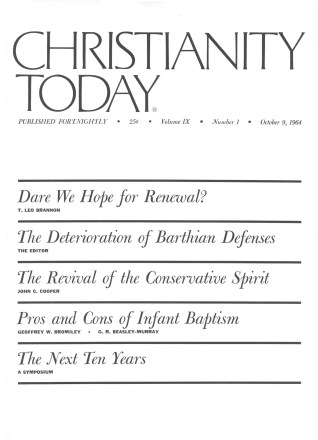
In a moving essay on the dire need of the churches, a Methodist minister contends that the renewal of institutionalized Christianity depends upon divine resources and bold commitment, including a new role for the laity. A panel of prominent Christian scholars discusses what factor, more than any other, is likely to decide Christianity’s influence on secular thought.

CHRISTIANITY TODAY’S analysis of the theological situation in Europe continues with an essay on the deterioriation of Barthian defenses.
Books

Book Briefs: October 9, 1964

Heresy In Poetry

Religious Trends in English Poetry, Vol. V: 1880–1920, by H. N. Fairchild (Columbia University, 1963, 663 pp., $10), is reviewed by Roderick Jellema, assistant professor of English, University of Maryland, College Park.

The first volume of Professor Fairchild’s study of the history of religious sensibility as reflected in poetry appeared twenty-five years ago. He had set out to analyze the whole “spiritual pathology” of English poetry from 1700 to the present. This fifth volume brings us down to 1920—five-sixths of the way to the end.

What Professor Fairchild is quietly giving us is a patchy, crazy-quilt reference work of sound scholarship. It is a queer, uneven work that grumbles and snorts and laughs and smiles and sighs underneath the thrust of its brilliantly developed theses. It is too comprehensive to be tidy; too serious to be slick; too human to be grave or merely scholarly. In short, it has all the earmarks of a neglected but enduring classic.

In an age of graphs and “social sciences” we should perhaps remind ourselves of the importance of Professor Fairchild’s undertaking. He is not sifting through 250 years of mere facts and proclamations. In tracing the course of religious thought and feeling in poetry, he is studying the religious in its highest and most intense form of human speech. That, after all, is what poetry is: heightened human speech coming out of heightened human vision. Henry Zylstra, in the opening paragraphs of his Testament of Vision, reminded us again that poetry “is as a face on which the soul of the time is written.” Professor Fairchild reads the faces of past ages, testing the spirits, whether they be of God, with the fine critical discernment and the disturbed compassion of the Christian scholar.

Volume V studies the crack-ups and confusions and shifting values that followed hard upon the uneasy compromises between Christianity, science, and romantic individualism during the Victorian era (1830–1880—covered in Vol. IV). These two volumes ought to be of special and immediate interest to twentieth-century readers.

Consider, for example, our popular attitude toward the past century. Especially in this election year, but much of the time anyway, we find ourselves being drowned in an oozing honey of nostalgia for “the good old days.” This nostalgia is partly escapist; but it is usually associated somehow with morality, and its impulse is usually vaguely religious. It comes probably more often from the pulpit than from the press or the political stump. Its protest seems to be that our great-grandfathers lived in a sane, responsible, meaningful, moral, religious world, whereas we live in a sick, aimless, immoral, and decaying one.

Partly in the interest of preserving some meaning for the phrase “Christian faith,” Professor Fairchild cracks this nostalgic reverie wide open. If the poets are an accurate thermometer—and have they ever misrepresented the age in which they lived?—then all the symptoms of spiritual disease were already fully present in the body of the nineteenth century. The sickness cannot be hidden by all the gilt and black cloth, the stuffy parlors and sentimental pictures, the grand talk about thrift and industry. The intense preoccupation with Mammon, progress, science, and respectability altered the concept of God beyond biblical recognition. He was romanticized into a vague “Gleam” or “the Grail”; he was an object of great aspiration, but largely as a projected image of what is noblest in man. One can summon forth tons of “religious poetry” from the period, most of it smothering thought rather than laying it bare, much of it written by people whom Fairchild calls “devout birdwatchers.” Such poetry is there, Fairchild notes, because “precisely to the extent that it has ceased to believe anything in particular, the public also likes its poetry to be surcharged with an amorphous religiosity.” There is almost never a redeeming Christ in this stuff (though that is probably the central question about him in twentieth-century poetry); there is usually only gushing sentimentality about a kind martyr named Jesus. The poets, reflecting their age, tend to “dissolve the Cross in that world which it was meant to save.” The salt having lost its savor, to paraphrase Paul Claudel, they savored it with sugar. The convention has not entirely died in our own age.

The discovery of Victorian heresy underneath the smugness is not at all a new one. But Professor Fairchild’s illustrations and discussions of the malaise give the discovery a sharper relevance.

One might expect, for example, that it was the rebels and radicals in the nineteenth century who were effecting the unholy marriage of romanticism and the Christian faith. Not so. The arrogant, self-satisfied heresies are found most often in the respectable and respected family-hearth poets who identified themselves with middle-class mores and therefore (another unholy marriage!) with the Christian faith. While they were grandly flourishing a faith not worth holding, the Jesuit poet G. M. Hopkins was keeping out of print; the bohemians were wrestling painfully against the Christian apologetics of Cardinal Newman (Fairchild overlooks this); and the bitter agnostics, shaking fists against the darkening sky, were grappling with the essential questions and at least coming near a real encounter with the one faith that can save man.

That whole age ended, as we know, in despair. It endowed our own age with disillusionment. But it might be argued, after Professor Fairchild’s book if not out of it, that the illusions were not worth having, anyway; that therefore the honest confusion in our own literature is a harbinger of sounder spiritual health.

In any case, we have to try to understand the spirit of our own times, how it got that way, where it is penetrable by the Christian message. Professor Fairchild’s chock-full masterpiece is an invaluable source book.

RODERICK JELLEMA

Victories In Viet Nam

The Bamboo Cross, by Homer E. Dowdy (Harper & Row, 1964, 239 pp., $3.95), is reviewed by J. Gordon Jones, pastor, First Baptist Church, Vancouver, British Columbia, Canada.

These are times that test the optimism and hopefulness of Christians. We live in a world overshadowed with storm clouds. If it isn’t the Congo, it is Cyprus; if it isn’t Cuba, it is Viet Nam. Yet even in such a world, “it is better to light a candle than to curse the darkness.”

This book tells of the kindling of lights, not in the cities of America, but in the jungles of Viet Nam. What is the Church doing in Southeast Asia? Here is the answer. It is interesting because of its up-to-the-minute story of Christian missions among the tribesmen of Viet Nam. It is informing because it deals with a part of the world about which many of us know very little. And it is inspiring because it describes victories won for Christ by representatives of the Christian and Missionary Alliance among a people whose minds have been darkened by sorcerers and witch-doctors.

This book is required reading for anyone who wishes a first-hand account of how the light of the Gospel is beginning to burn brightly in one of the most disturbed areas of Southeast Asia. There is not a dull page in this carefully written and well-illustrated volume.

J. GORDON JONES

God Or Idols?

The Abolition of God, by Hans-Gerhard Koch (Fortress, 1964, 191 pp., $3.75), is reviewed by William W. Paul, head, Division of Religion and Philosophy, Central College, Pella, Iowa.

“In the long run man is not able to do without God, unless he creates ideologies for himself or endows himself with values which he puts in place of God. God or idols? That is the question facing humanity” (p. 190).

This is the powerful conclusion to which one is persuasively drawn by an author who not only has the critical eye of a scholar but knows what it means to work in the Soviet rock-quarries as a prisoner of war and to try to raise a family and be a pastor to a church in East Germany. Although the book is not an autobiography, it is a moving and carefully documented account of the way materialistic atheism in rapid-fire fashion has taken hold of the educational system and press of the East Zone.

In a series of concise chapters on materialistic atheism’s attack on religion, the Bible, and the historical reality of Jesus (traced back through Engels and Marx to the polemics of Bauer and Feuerbach), Dr. Koch gives his readers an understanding of this current assault on the Christian faith and a sense of direction for confronting the Marxian atheist today. It is the author’s conviction that this task can be undertaken only if the lines are clearly drawn between the Lord Jesus Christ of the Evangelists and Apostles and the “Christ” of a sometimes disobedient, hypocritical church and of apostate theologians like Bauer. “The Christian knows that Jesus Christ means the abolition, the end of ‘religion’ and at the same time something different and new in the world”—the word of judgment and reconciliation spoken by God in Christ to all the world, West and East (p. 59).

Thus, although other books have presented a similar argument, none has made the case more alive in terms of the actual religious battle on the “other side of the Wall.” Indeed, one puts this book down with the feeling that this is not just something that is happening where Communism has taken over. As the prophet Isaiah implied long ago, there is a “wall” within each of us: a point at which we must decide whether it shall be the God who made us or the gods (ideologies) we make for ourselves.

WILLIAM W. PAUL

The Right To Live

The Right to Life, by Norman St. John-Stevas (Holt, Rinehart and Winston, 1964, 117 pp., $2.95), is reviewed by Theodore Minnema, assistant professor of Bible, Calvin College, Grand Rapids, Michigan.

This book is a good warning against taking for granted principles basic to our Western society. “The right to life” is one such principle, and both its validity and its preservation are being consciously and unconsciously undermined in modern times.

The author is a Roman Catholic lawyer and a Conservative candidate for the British Parliament. His legal bent is evident in his knowledge of existing civil laws and in his ability to present material in a well-formulated, caselike manner. His particular concern in the book is not with a Roman Catholic perspective but with a broad Christian principle and its application to legal and civil practices.

The exceptional value of this book is that it clarifies and defends the principle of the “right to life” in relation to contemporary problems. The author sketches the historical background out of which this principle developed, but his focus is on modern society.

The opening chapter is a discussion of the Thalidomide tragedy and the trial of the mother in Belgium who killed her baby deformed by this drug. The legal and ethical implications of this case are explained lucidly and competently. What the mother did, and her subsequent acquittal, cannot be harmonized with the Christian doctrine that all innocent human life has the right to live. The following chapters apply this basic Christian doctrine to the crucial problems of abortion, euthanasia, capital punishment, suicide, and the taking of life through war. Every chapter has illustrative and concrete data. Although the book is oriented to the British situation, it does bear significantly on problems in the United States.

The Right to Life casts a great deal of light on modern ethical and legal problems. The author realizes that the complexity of modern life makes consistent application of a basic ethical principle difficult. But Christians must face up to this responsibility or, as the author makes clear, disastrous consequences will inevitably follow.

THEODORE MINNEMA

Profitable Conversations

Origins of the Synoptic Gospels: Some Basic Questions, by Ned B. Stonehouse (Eerdmans, 1963, 201 pp., $4.50), is reviewed by Charles B. Cousar, assistant professor of New Testament, Columbia Theological Seminary, Decatur, Georgia.

The question of the relation between Jesus Christ and the Gospels is complicated and can be approached from various angles. Professor Ned B. Stonehouse, in a series of lectures given some nine months before his death, proposes a solution by way of tracing the origins of the Synoptic Gospels. Modern scholarship, he feels, has neglected the underlying continuity between Jesus and the evangelists; therefore his major concern is to show that in the last analysis the Gospels owe their existence to Jesus himself and “are what they are because of what he was and did.”

Professor Stonehouse begins with the written documents and proceeds to raise four basic problems: Who wrote them? (Here the primary concern is with Matthew, whose apostolic origin is the most seriously questioned.) Are they dependent on each other, and, if so, how? (Streeter’s analysis is critically followed, with the conclusion that Mark is the prior Gospel and that Matthew is dependent, not only in content but also in order of arrangement and in language.) How was the material transmitted into the hands of the writers? (There was one closely knit group of persons who from the beginning were eyewitnesses of the basic happenings and were recognized as responsible for their transmission by preaching and teaching. The evangelists, in turn, recognized the need of basing their accounts upon this apostolic tradition.) Where is their ultimate origin to be found? (Jesus, not the community, was the creator of Christianity and thus was also ultimately responsible for the origin of the Gospels.)

One feels that the real merit of this work is not in the author’s conclusive proof of his major thesis, for in reality the modest scope of the book means that a number of basic questions are left unanswered. Rather its importance lies in the helpful treatment given to problems of criticism and exegesis, together with the “conversation” the author carries on with differing scholars. For example, a chapter is devoted to the story of the rich young ruler, with particular attention given to the discrepancy in the use of the word “good” in Matthew’s account (19:16, 17) as over against Mark’s (10:17, 18). Professor Stonehouse cogently argues that although there is an inconsistency in usage, the context allows no variation in meaning. Jesus, in responding, “No one is good but God,” is not offering a hidden confession of sin nor making a Christological affirmation but rather is pointing the young man to God and inviting him to reflect on the implications of his reference to goodness.

Again, there is a careful and critical treatment of the thesis of Harald Riesenfeld, who in contrast to the form critics has argued that the Sitz im Leben of the gospel material was neither the preaching of the early community nor its catechetical instruction but a milieu unique to itself. An exactly defined group within the community transmitted the material in a manner similar to the transmission of the Jewish oral tradition until its ultimate reduction to writing. The fact that the sayings of Jesus are for the most part omitted from Acts and the Epistles, Riesenfeld has argued, is due to the special commission given to certain trustworthy persons to transmit the material in a fashion distinct from preaching and teaching. In response Professor Stonehouse rightly notes that the distinction Riesenfeld has drawn between the Gospels as collections of the sayings and deeds of Jesus and the Epistles (and Acts) as the proclamation and instruction of the Church is a false one. The Gospels as well as the Epistles proclaim and instruct.

Other profitable “conversations” with Cadbury, Kilpatrick, and various Roman Catholic scholars (Dom Butler, Chapman, and, to a lesser extent, Wikenhauser) make Origins of the Synoptic Gospels a book well worth owning.

CHARLES B. COUSAR

A Scottish Classic

Human Nature in Its Fourfold State, by Thomas Boston (Banner of Truth Trust, 1964, 506 pp., 10s. 6d.), is reviewed by David J. Innes, minister, Tarbat Parish Church, Ross-shire, Scotland.

The publishers are to be congratulated on reproducing this great religious classic from eighteenth-century Scotland. Written by the saintly minister of Ettrick in the Scottish border country, this book, according to Dr. Thomas McCrie, “contributed more than any other work to mould the religious sentiments of the Scottish people.” It was to be found, along with the Holy Scriptures and Bunyan’s glorious dream, in virtually every humble cottage and stately home over a large part of Scotland 200 years ago. It was read by multitudes, and literally thousands were converted through it. Jonathan Edwards, in a letter of 1747 to his Scottish correspondent, Thomas Gillespie (who was himself a convert of Boston’s ministry), expressed the opinion that Fourfold State showed Mr. Boston “to have been a truly great divine.”

George H. Morrison’s biographical sketch of Boston, originally written to introduce the new edition of his Memoirs published in 1899, is reprinted in this present volume. Then comes a masterly unfolding of “human nature in its fourfold state of primitive integrity, entire depravity, begun recovery, and consummate happiness or misery.” The state of nature and the eternal state are those treated most fully, and this reviewer was a little surprised to find only two chapters—entitled “Regeneration” and “Mystical Union between Christ and Believers”—under the heading of “The State of Grace.” But the cumulative effect of the entire work is certainly to humble the reader, and to lead him to glory anew in the greatness of the saving purposes of God in Jesus Christ.

There is solid, biblical teaching here; the work abounds in quotations and illustrations from the Scriptures. One is forcefully reminded that men could take “solid meat” in Boston’s day. For those seeking instruction, edification, and a deeply rewarding spiritual experience, here is the book.

But there is not just solid doctrine here; there is also a wealth of illuminating illustration, and a constant concern to apply the truth to the conscience, the affections, and the life of the reader. “None are transplanted into the paradise above, but out of the nursery of grace below.” “This world is a great inn on the road to eternity to which you are travelling.” These are but two of the vivid pictures presented. And, time and again as the truth is driven home, there are heart-searching and soul-stirring passages of practical appeal and beseeching tenderness. None will be the poorer for taking time to browse in Boston’s mighty masterpiece.

DAVID J. INNES

Paperbacks

Basic Introduction to the New Testament, by John R. W. Stott (Eerdmans, 1964, 179 pp., $1.45). Originally published in 1954 as Men With a Message. Evangelical—with substance.

Designed for Duty, by Jeanette W. Lockerbie (Moody, 1964, 128 pp., $1). Devotionals designed especially for nurses. Good, practical, inspirational.

The Gospel of Our Sufferings, by Sören Kierkegaard (Eerdmans, 1964, 150 pp., $1.45). Christian discourses that are the third part of Edifying Discourses in a Different Vein, published in 1847 in Copenhagen.

An Old Faith For Modern Man, by Demetrios J. Constantelos (The Greek Orthodox Archdiocese, New York City, 1964, 72 pp., $1.25). An interesting and attractive story of the Greek Orthodox Church, its history and teachings. Revised edition.

Mennonites and Their Heritage: A Handbook of Mennonite History and Beliefs, by Harold S. Bender and C. Henry Smith (Herald Press, 1964, 148 pp., $1.50).

Ministers of God, by Leon Morris (Inter-Varsity, 1964, 128 pp., $1.50). A good study of New Testament teaching on the ministry in all its aspects, with a brief survey of current practice in the Church.

Design for Dedication, by Peter Howard (Regnery, 1964, 192 pp., $.75). Speeches that challenge the morals and ideals of America, by the new head of Moral Re-Armament.

We the People: A Book about Laity, by Kathleen Bliss (Fortress, 1964, 139 pp., $1.75). Written from the current ecumenical perspective; carries solid cargo.

Christian Morals Today, by John A. T. Robinson (Westminster, 1964, 47 pp., $.65). Bishop (Honest to God) Robinson urges that love is the only unconditional moral demand, and that there are no things always sinful.

The Law and the Elements of the World: An Exegetical Study in Aspects of Paul’s Teaching, by Andrew John Bandstra (J. H. Kok [Kampen, Holland], 1964, 209 pp., f 11,50). A doctoral dissertation that faces the question: Since the Law is of divine origin, how could Paul include it under the “elements of the world”?

Jesus, History and You, by Jack Finegan (John Knox, 1964, 144 pp., $1.95). Finegan, a vivid writer, is always interesting. Here in a refreshing style he joins the quest for the “Jesus of history,” confident that he can be found.

Peaceful Coexistence: A Communist Blueprint for Victory (American Bar Association, 1964, 123 pp., $1). The book’s thesis is in the contradictory title.

The Principles of War, by James I. Wilson (Christian Books in Annapolis, 1964, 62 pp., $1). An application of military theory to personal spiritual conflict.

The New Testament in the Language of Today, by William F. Beck (Concordia, 1964, 459 pp., $1.45). An American translation.

Theology

Revelation in History

Chiefly responsible for the tension in contemporary European theology is the speculative notion that divine revelation is never communicated objectively—neither in historical occurrences nor in intelligible propositions—but is always subjectively received through submissive response.

This assumption contradicts the historic Christian concept that divine revelation is objective intelligible disclosure. The classic Christian view, moreover, states that divine revelation is addressed by the Logos to mankind generally through nature, history, and conscience, and is mediated more particularly through the sacred history and Scriptures, which find their redemptive climax in Jesus of Nazareth. On this basis—of the accessibility of a trustworthy knowledge of the Living God and of his purpose in creation and redemption—historic Christianity emphasizes the possibility of personal salvation through experiential appropriation of the truth of God and of his provision for sinners. While the Holy Spirit is indeed the sole source of regenerate life and the illuminator of sinful man’s darkened mind, and while faith alone is the instrument of salvation, the ground of faith—so evangelical Christianity insists—is a historical revelation and redemption; moreover, the Spirit uses God’s objectively revealed truth to persuade unregenerate sinners to appropriate for themselves the saving truth and work of Christ. In a word, then, the historic Christian Church has understood divine revelation to be an intelligible, objectively given disclosure, whether that revelation be universal (in nature, history, and conscience) or special (in the redemptive deeds and declarations of the Bible).

This objectivity of divine revelation, respecting both its historical character and its universal validity, is expressly repudiated by the dialectical and existential movements in contemporary theology. In fact, the traditional “intellectualistic” view of divine revelation is deplored as a “doctrinaire” and “rationalistic” perversion of Christianity. It is ascribed to a misunderstanding of the nature of faith, which presumably is independent of a historical basis and of belief in truths about God. Not some past divine activity in the stream of objective history, nor information mediated to and through chosen bearers of God’s disclosure, but rather present divine confrontation and personal response, an event here-and-now, becomes the crucial carrier of divine revelation. For more than a generation this emphasis on revelation in present-day divine-human confrontation has been the dominant theme of Continental theology, even to the extent of refashioning the doctrine of faith itself.

Much that this approach sought to correct in the many reductions of biblical Christianity needed rectification. Medieval, modern, and recent modern philosophy had all left scars upon the Christian outlook. The lamentable result was evident both in the medieval scholastic and in the neo-Protestant readiness to expound Christianity in the speculative categories of secular philosophy. It was seen, too, in the Hegelian reduction of reality to an immanentistic process in which the Absolute could be viewed only as More but never as Other, so that man’s mind was exalted as part of God’s mind. Other weaknesses were the modernists’ loss of an authoritative Word of God in the plurality of pontifical pronouncements by their influential philosophers of religion, and the prevalent notion even in Continental Protestant churches that salvation is simply a matter of adequate catechetical instruction in Christian doctrine. Moreover, certain conservative theologians, who quite properly emphasized the propositional character of divine revelation, tended to project a schematic theology that neglected the progressive historical character of biblical disclosure. And there were those fringe fundamentalist writers who were obsessed with discovering in Scripture minute and intricate predictions of a scientific and eschatological nature. Many aspects of the theological situation might therefore have encouraged a bold, new presentation of the nature and content of divine revelation.

Nonetheless, one could have discredited and eliminated departures from apostolic Christianity without at the same time rejecting and repudiating the objectivity of divine revelation and its intelligible or universally valid propositional form. But the newer anti-intellectualistic theory of divine disclosure not only opposed certain lamentable compromises that had become current in Protestant Christianity but also proceeded to correct them by an equally egregious error. It opposed not only modern misunderstandings but also a supposed “misunderstanding” of revelation itself that virtually spanned the entire Christian era. The late Cambridge theologian J. M. Creed may have deplored the fact, but the historical actuality remains: “Had any Christian of any Church between the end of the second century and the closing decades of the eighteenth been asked a question as to the content of the Christian religion, his answer could scarcely have failed to be to the general effect that the truths of the Christian religion were contained and conveyed in the inspired books of holy Scripture …” (The Divinity of Jesus Christ, Cambridge University Press, 1938, p. 105). In fact, this confidence in the supernatural and infallible divine communication of propositional truths is characteristic also of the New Testament writers, so that the supposed “misunderstanding” of revelation existed even in apostolic times within the dimensions of biblical Christianity. If the new anti-intellectual theory truly reflects the character of revelation, one would have to contend that the “misunderstanding” permeates almost every portion of the holy Scriptures! The divinely chosen prophets and apostles, and Jesus of Nazareth too, view divine revelation in terms of revealed information about God and his purposes. If this is intellectualistic perversion, then not only a “doctrinaire” view of revelation but Jesus himself and the apostles themselves must be disowned.

The dialectical and existential redefinition of divine revelation—for such it is—clearly reflects the influence of recent philosophical currents. Thus it cannot be explained simply as a corrective reaction to recent compromises of the Christian revelation.

Contributing to this novel reformulation of revelation were numerous speculative trends. Kant emphasized that the concepts of human reason cannot grasp metaphysical realities and maintained that affirmations about the spiritual order therefore lack universal validity. Schleiermacher insisted that God communicates himself but not truths about himself. Lessing believed that no historical event can communicate absolute meaning. Darwin taught that reflective reason is a relatively late emergent in the evolutionary process. Kierkegaard stressed the disjunction of the temporal and the eternal as being so radical that only a leap of naked faith can bridge it. Bergson declared that conceptual reasoning imposes an artificial structure upon reality, whose rationally incomprehensible dimensions must be grasped intuitively. There was also Ebner’s emphasis that God confronts persons only as Subject, never as Object. And Heidegger held that reality must be existentially experienced rather than conceptually grasped. In one way or another, these currents undermined confidence in the ontological significance of reason, in the rationality and objectivity of divine revelation, and in the role of cognition in religious experience.

So many and so great are the differences among the dialectical and existential theologians of our generation that should any effort be made to combine them into a single formula, one might expect an immediate disclaimer from almost all quarters. When one notes the divisions between Barth and Bultmann, for example, and Barth’s increasing inclusion through the years of more and more “objectifying” elements to escape an existentialized “Gospel,” it might seem inaccurate indeed to view the whole dialectical-existential development as a theological monstrosity that rejects objective revelation.

But a simple test will justify classifying both the dialectical and the existential schemes in this way. However much a theology stresses “objectifying” elements, the determinative question is whether or not it views divine revelation as objectively given in historical events and in intelligible concepts and words. While the dialectical-existential theologians differ from one another at many secondary levels, they all agree in respect to this ruling notion of the non-objectivity of divine revelation. Whether the so-called Pannenberg school projects a wholly adequate alternative may be open to serious debate; but its spokesman, Wolfhardt Pannenberg of Mainz, at least recognizes the fatal flaw in contemporary Wort-theology—namely, its denial of the objectivity of divine revelation and of the validity of that revelation for all men irrespective of subjective decision. A former student of Barth, the Mainz theologian considers Barth’s theology, for all its “objectifying” reinforcements, unable to escape Bultmann’s existentialist critique because Barth does not insist upon an objective character of divine revelation.

If ever a theologian has been driven from pillar to post in trying to preserve authoritative divine revelation while disowning its objectivity, it is Karl Barth. His tardy repudiation of existentialism involved no rejection of dialectical theology. Even his more recent attempts to escape the consequences of a dialectical predicament in the arena of religious knowledge involve no return to objective divine revelation. And so Barth’s “objectifying” facets simply exemplify rather than resolve the basic problem of contemporary theology.

The early agreement of Barth’s Römerbrief with Bultmann’s perspective is unquestioned. Bultmann pressed this rejection of objective intelligible revelation increasingly in the direction of sheer existential encounter. He viewed the miraculous aspect of the Christian tradition as unessential myth, and its historical aspect (except for the bare fact of Jesus’ earthly life and crucifixion) as irrelevant to faith. Thus Bultmann retained a rather orthodox view of real objective history, passed a negative critical verdict upon the miracles, sought to overcome the destructive consequences of this negative verdict in historical critical research by his independent grounding of faith, and aimed to preserve the uniqueness of Christianity through an existential interpretation of revelation. In the 1932 revision of his Church Dogmatics Barth repudiated this “demythologizing” existentialism as perverse speculation that destroys the essence of Christianity. Barth struggled to maintain quasi-objectivity for divine revelation. But he did not directly engage in the debate over the outcome of historical criticism; instead, he placed salvation-history in pre-history, and increasingly distinguished Geschichte from Historie. It was the late Karl Heim of Tübingen who protested that Barth had prodded theologians all over Europe to look for the Christian realities “on the rim of history,” but that nobody had as yet been able to locate that rim. Meanwhile, Bultmann continued to give larger scope to historical criticism and repudiated all efforts even to quasi-objectify the basis of Christian faith.

The broad displacement of Barth’s theology by that of Bultmann reflected a growing confidence that Bultmann’s version is the more convincing exposition of dialectical theology. Not only so. The rise of Bultmann precipitated among other scholars a growing conviction that Barth’s theological sleight-of-hand with Historie-Geschichte—by which he accommodates miraculous elements that do not exist merely for faith yet are not historical—was a costly innovation that could not withstand Bultmann’s counterattack, and hence needlessly sacrificed the cause of biblical theology.

The post-Kantian notion that theological assertions cannot be unified with historical and scientific truth blunted the nineteenth century’s devotion to historical investigation. Compatible with this premise, the dialectical-existential movement viewed the historical aspects of the Christian revelation as dispensable, insisted on the “kerygmatical” character of Christian faith, and assigned Christian revelation such independence from philosophic and scientific truth that it remained unrelated to the realm of objective knowledge. It is in this context that one must assess both Barth and Bultmann.

In their insistence on objective historical revelation, traditional conservative scholars are now being joined by Heilsgeschichte scholars and the Pannenberg movement in a fresh probe of the problem of revelation and history.

A Library For All The People

The Library of Congress is not only the library for Congress but also a library for the public. We have found our visits to it rewarding. Probing its vast interior is like exploring levels of meaning in Moby Dick. The dignified sweep of entrance stairs leads to the first floor, with its marble halls and vaulted ceilings, and then to the glassed-in exhibits including the Gutenberg Bible, which no reader should miss while in Washington. This is the surface, or tourist, level.

The regular user, however, soon learns to avoid the dignified approach and gradually penetrates to the air-conditioned Jefferson reading room in the annex (a little more out of the way than the non-air-conditioned main reading room), the friendly little snack bar in the sub-basement, and the restaurant one reaches via the basement below that. If he can prove his need, he will be permitted to breathe the rarefied air of the private study carrels and the somewhat mustier air of the stacks, those labyrinthine ways, easier to get into than out of. He also learns to fill out book request slips properly, so that they do not come back like so many rejected manuscripts.

We express our appreciation to the Library of Congress, and especially to the Information and Publications Office, the research staff, and the Loan Division for their unhesitating help in our frequent times of need. Our recent requests have ranged from the exact wording of a phrase in a speech by President Kennedy to information on traffic laws in Scandinavia. One of the legal experts, evidently well up in the hierarchy of experts, took time to help us with the latter, and he invited us to come back if we had any other questions.

Congress recently commended Dr. L. Quincy Mumford for his ten years of service as Librarian of Congress. It has increased the direct appropriation to the library from $9½ million in fiscal 1954 to over $23 million in fiscal 1965.

“The Library of Congress is in all probability the world’s largest library,” says one of its publications. In its two buildings are close to 13 million books and pamphlets and about 270 miles of bookshelves. Our experience has been that if one selects a book, any book, from the card catalogue and fills out a request slip for it, the book will be on his desk in less than an hour, provided that it was on the shelf.

We doubt whether there is another library anywhere like this one; we feel a quite nationalistic pride in it and are grateful for the privileges it accords us. May its books increase, its air-conditioning never fail, its patience and good will endure. And may its users stop occasionally to count their blessings.

One Mistake Away

Our world is only one mistake away from vast destruction. We are safe only as long as the men who control the push buttons of nuclear warfare act infallibly. One mistake would mean the end of life for hundreds of millions, and survivors would discover that the conditions for human survival had also been largely destroyed.

Unlike the pope of Rome, the men who sit on the thrones of nuclear power claim no infallibility. They claim only to be responsible men. This is not enough for comfort, for the mistake that could lead the world into massive destruction need not be an act of malfeasance. An unintended error will do. Such an error occurred recently when Khrushchev’s remarks about nuclear weapons, in the translation into Japanese and English, came out as an assertion about a new weapon that could destroy all life on our planet. This time, thank God, there was opportunity to correct the translation. Next time there may not be.

As long as we are but one mistake from global destruction and live by the grace of Premier Khrushchev’s and President Johnson’s infallibility, we have a witness in our fearful times that Jesus Christ is Lord of our history. It is he who holds our souls in life, whether we be popes, presidents, dictators, or scientists, or those whose only terror is global destruction.

Let’s Get Back to the Center

The Western world has experienced radical changes, some desirable and some undesirable. Among the latter is the flight from the God of the Bible and from Christianity. God has been remolded in man’s image; man has deified himself in the place of God. We hear much of the post-Christian era, the God who failed, or the great whatever.

Secularism has become enthroned, and religion is being rooted out of American life. But with the repudiation of biblical Christianity, America has had to face searching questions for which no adequate answers have as yet appeared. “Who am I?” “What am I here for?” “What meaning and purpose remains in life?” “Can modern man any longer be certain of anything?” These and other questions press for answers.

Accompanying them is the moral decline resulting from the retreat from standards. This freedom from absolutes leaves only one question: “How do you feel about it?” If you feel all right, then it is all right. Thus fornication, adultery, lying, cheating, and stealing are justified. So man is being propelled away from God, away from the Bible, away from absolutes, away from responsibility, and into the perilous freedom of anarchy and the ultimate destruction of self.

Science has largely pre-empted the place of theology. Outer space is to the fore; the God of space and time is forsaken. On the one hand, earth shots to the moon and its occupation by men and machines and, on the other hand, the exploration of the center of the earth in a coring operation, are major objectives. Philosophically, scientists have moved away from the absolute to the relative. So also with psychology and psychiatry. Neither of these sciences has any integrating principle except that everybody is sick and needs help.

The same diversity and drift mark contemporary Christianity. One may run the gamut from Congregational structures to monolithic Romanism; from theological neo-liberalism to fundamentalism. He may pick the ontological approach of conservative theology or the existentialist approach of Bultmannian speculation. Certainly modern theology is moving not centripetally but centrifugally. Can nothing be done to overcome these centrifugal forces and replace them with forces that drive man once more toward the center?

In the midst of this multiplicity of voices the Christian must speak. What he must say is not new, but it is tried, tested, and true. He must speak the word of Jesus of Nazareth: “You must be born again.” In accordance with the profound truth of Genesis 1–3, Jesus was saying that there is something so wrong with man that he must be recreated. He is estranged from his Creator, and his condition is hopeless.

The Christian must tell modern man that God has made us for himself and that our hearts will be restless until they find their rest in him. But there is rest for the restless and hope for the hopeless. There is light amid darkness and despair and death. Whatever rest and hope and light there are derive from the Gospel: “that Christ died for our sins according to the scriptures; and that he was buried, and that he rose again the third day according to the scriptures” (1 Cor. 15:3b, 4). Thus the solution to man’s estrangement is the new birth. This is the miracle that sets men free from sin and death.

Gladys Is No Lady

Some theologians have lately been reducing God to the impersonal ground of our being. Calling on God in prayer, one says, is pointless, because God can’t hear. He has advised Christians concerned about the weather to call the Weather Bureau.

Some of us have been listening to the Weather Bureau lately. Even if God can’t hear, we can. We hear about Cleo, Dora, Gladys, and some others. These really are not ladies, of course, but wild, untamable hurricanes that the meteorologists designate as persons. They trace the path of these personified elemental powers and then take cover—for if God is no longer “up” and “out there,” these ladies are; and being temperamental and capricious they just might come down and unsettle the ground of our being.

The Christian Church needs a theology of nature. There is a God “up there” who rides the wild winds of the storm and speaks through elemental cosmic powers that even space-age men cannot bring under control. Gladys remains “up there.” She is no lady, but the voice of the Almighty who speaks through the storms, who disturbs the ground of our ordered lives, and who flings our possessions like chips to the cosmic winds.

Look up and out there—the ground of being you see may be your own. For He in whom we live and move and have our being is in the storm. The wild wind is also his voice. And if he speaks through the storm, he can also hear the still small voice of prayer—and hearing once again declare: Peace, be still.

Moral Maturity Without Spiritual Guidance

In an address to the freshmen at the opening of the 218th academic year of Princeton University, President Robert F. Goheen announced that this class is the first to enter Princeton free of the traditional requirement of attending religious exercises. “The maturing and shaping of the moral and spiritual structure of your lives,” he said, “must be largely your own affair. By and large your professors and advisors will be engaged in helping you grow and deepen intellectually. That is their primary business.” Freedom from religious exercises was granted, Dr. Goheen said, “in the belief that the majority of you will seek the chapel or the church of your choice more freely and sincerely.”

Princeton is notable for its Christian heritage. Names like Jonathan Edwards, John Witherspoon, James McCosh, Francis L. Patton, and Woodrow Wilson link it to the Calvinist tradition so influential in the founding and development of our democracy. At the 200th anniversary of Princeton’s Nassau Hall, where the Continental Congress met in 1783, Professor John Baillie of Edinburgh quoted the Westminster Shorter Catechism (“Man’s chief end is to glorify God and to enjoy him forever”) and said that Western civilization is doomed to swift disintegration and decay if it should cease to be aware of itself as standing within that context.

Many who value Princeton’s spiritual heritage cannot but regret the decision of university authorities to leave to freshmen “the maturing and shaping of the moral and spiritual structure” of their lives. Elsewhere in his address, Dr. Goheen pointed to “the symbolism of the library and the chapel as roads which remain open.” But is symbolism enough?

It may be that in following the precedent of most other universities Princeton has fallen into what may be called the fallacy of precocity. The majority of its freshmen class, which is one of the most highly selected in the country, are eighteen years old. The tendency of the American college and university to mistake immaturity for maturity and to provide so little moral and spiritual guidance of students is an abdication of responsibility.

Princeton is a private institution with liberty to go as far as it feels right in the moral and spiritual development of its students. And it should not be overlooked that the university has a well-developed department of religion and a chaplain who is a committed Christian. Nevertheless, a feeling of regret persists that Princeton is giving up so vital a part of its responsibility for its students.

The Religious Liberty Issue

Whether the church of Rome will emerge from its medieval attitude toward religious liberty was a major item of debate at the start of the Vatican Council’s third session. Most American cardinals have supported a religious liberty declaration; their stand was applauded in violation of council rules. Cardinals from Italy, Spain, Ireland, and Brazil have strongly opposed any religious liberty declaration as a danger to the Catholic faith.

It will be important to note the views of prelates in every land where Catholicism is the entrenched majority religion. In the United States, religious freedom is assured by the Constitution whether Rome likes it or not. What Rome does in countries where a Vatican concordat makes Romanism the preferred religion will be decisive. In recent decades the Vatican has spoken increasingly of “separated brethren.” It will be easier for majorities of “separated brethren” in non-Catholic lands to discuss separation when their fellow Protestants in Catholic lands are viewed no longer as bastards in the family of God but as sons.

Ideas

Moral Relativism and Public Guilt

The arrest of twelve persons on charges of serving liquor to minors at house parties following which a seventeen-year-old girl died in an automobile crash recently shocked the suburban community of Darien, Connecticut. According to a New York Times report, Circuit Court Judge Rodney S. Eielson, who initiated the arrests, said: “The guilt of needless loss of life is in every living room in this community and in the conscience of every parent who knew his or her child was going to be served liquor or who served liquor to a minor on that night.… I wish I had the power to get every parent who is guilty.”

Judge Eielson ordered warrants issued for adults who had anything to do with serving liquor to minors at the parties attended by the eighteen-year-old youth on trial for reckless driving and negligent homicide. Fourteen warrants were issued and twelve arrests made on charges of violating a Connecticut statute that prohibits the serving of liquor to minors by persons other than their parents. (Two participants were out of the state.) Among the twelve appearing at the Darien police station were prominent business and professional men. The parties were held at the home of a psychiatrist and of a vice-president of a leading corporation. One of those arrested was a public-school science teacher who had tended bar. The judge said that a medical report showed that the youth on trial had consumed twelve scotches and water.

Judge Eielson deserves nation-wide commendation for his stern realism in facing a scandalous situation by no means confined to Darien. Actually the kind of parental irresponsibility against which he has taken action may be found in hundreds of similar suburban communities. A sore point in American society is delinquency among children of the highly privileged, as shown by FBI reports of marked increase in suburban crime. Surely the judge pointed to one of the main causes—a parental attitude that subscribes to a permissiveness derived from the idea that morals are fluid.

One of the most ominous sociological facts of the day is that our nation now has some five million alcoholics, which means that one out of every fifteen American drinkers is now an alcoholic. What a strange obfuscation of moral responsibility for parents to serve liquor in their homes to children of other people, to have a public-school teacher act as bar-tender, and then to let an immature youth, befuddled with drink, go on the road in the middle of the night to run the risk of fatal accident.

In his book, Push-Button Parents and the Public Schools (Macrae Smith Company, 1964), Dr. Paul P. Mok says out of his experience as a psychologist for the Bronxville (New York) public schools, “We expect [of the child] honesty and decency and consideration—good manners, cooperation, and industry. But what do we actually do to foster such noble ideals?… We drag ourselves home cocktail-sloppy, beat and frenzied, and brush the children off our backs like flies. Do as I say, not as I do.”

But if parents are committed at all costs to the unchallenged place of alcohol in American life and if they insist on inducting youth into the use of alcohol, thus subjecting one out of fifteen of them to the peril of a life permanently blighted by addiction, such abuse of the power of example is simply indefensible.

What is needed in this easy-going, hedonistic society is a host of parents determined to take their standards, not from what others around them think and say and do, but from the unchanging values of right and wrong that, set forth in the Scripture, are the foundation of law and order.

The doctrine of moral relativism, popular as it is today, is nothing new. But old or new, it always leads to moral collapse. Although Montaigne said, “The laws of conscience … proceed from custom,” and although his nineteenth-century successor, Taine, said that virtues and vices are but products like sugar and vitriol, they were wrong. And Bertrand Russell’s assertion, “There are no facts in ethics,” reflects the comfortable premise of sentimental evolutionary thought that varying moral judgments signify progress and that the latest is necessarily the best.

Despite the prestige of moral relativism in social practice today, including that of the university world and even some professedly Christian churches, moral collapse is the inevitable result of addiction to the falsehood that the good is relative to the individual. It is this falsehood that is leading America into its terrifying breakdown of private decency and public righteousness. Thus a society once illumined by the light of the Bible is fast becoming a pagan mission field, not just in its slum areas but also in the finest suburbs of its great cities.

Salute To An Independent Malta

“When they learned Thy Grace and Glory under Malta by the sea!” Kipling’s words recall the link between biblical history in its recording of the Apostle Paul’s shipwreck and the long and colorful Maltese history, which has now reached a milestone in the gaining of independence within the British Commonwealth. Such an achievement stands out in striking relief against a backdrop of thirty-five centuries of successive rule by Phoenicians, Romans, Arabs, Normans, Germans, Angevins, Aragonese, Knights of St. John, French, and British. Somehow tying it all together is the Maltese language, a Semitic tongue inherited from the Phoenicians, developed by the Arabs, and now much sprinkled with English and Italian words.

The importance of this tiny island group cannot be measured by its size. Strategically located south of Sicily, its remarkable megalithic temples bear witness to prehistoric eminence. Modern fame was claimed in 1565 when the Knights of the Order of St. John and their Maltese troops broke a Turkish siege and thus checked the advance of Muslim power in southern and western Europe. And only yesterday Maltese heroism was reconfirmed under aerial siege of Sicily-based German and Italian bombers from 1940 to 1943. After the war Americans heard of the ceaseless air attacks from the “defender of Malta,” Lt. Gen. Sir William G. S. Dobbie, a committed evangelical who toured our country to testify anew of “Grace and Glory under Malta by the sea!”

When Paul came to shore at Malta, the people showed him “no little kindness.” One recalls sharing a box at the Paris Opera for Samson and Delilah with a Maltese lady who said, “Malta has been Catholic ever since the visit of St. Paul.” The Reformation did not reach Malta, and the continuing struggle for her future is between Socialists and a politically domineering Roman Catholic Church, which has been warned by the British Roman Catholic Tablet that its present tactics can only bring “the same history of disintegration as Italian Catholicism” has undergone since Pius IX’s time.

History demonstrates the intimate conjunction between internal and external freedom, the latter finding its wellspring in the former. Jesus Christ pointed to himself as the source of true freedom, and St. Augustine of Hippo testified that in bondage to Him he found liberty.

For St. Paul, Malta was a respite after a harrowing journey, a prelude to further life-and-death challenges. Now Malta herself seems similarly poised. We wish her well.

Theology

Victory over Satan

Third in a Series on Satan

In the two preceding issues we have discussed the reality of Satan as a person and the two realms that exist in the world today, God’s and Satan’s.

No such discussion serves a useful purpose unless it culminates in an answer to the inevitable question: Can we have victory over the Devil?

We know that Satan will ultimately be destroyed forever, and this is a comforting thought. But our immediate problem is to gain victory now.

The first lesson to be learned is that no man can overcome the Devil in his own strength and wisdom. Never forget that he is “as smart as the devil.” This means that in any chosen field he is more astute and stronger than any mere man.

We are told—and this is true today as it has been true all through human history—that “the devil prowls around like a roaring lion, seeking someone to devour.” This simile is given to alert us to the acuteness of our danger.

Unable to stand against the Devil in our own strength, confronted by the reality of his person and activities, we must look for the answer to our problem. Can we be victorious over this implacable enemy who tempts, accuses, distracts, and destroys?

The answer is an unequivocal Yes! Not only is his ultimate fate sealed; there is open to every Christian the means of victory—day-to-day victory—in our conflict. It is possible to stand firm, to defy and to defeat every wile of Satan. It is possible to overcome him whenever and wherever he attacks. This is not to imply perfect sanctification. Rather, it is to affirm the complete effectiveness of the triumph of Christ and of the provisions he has made for those who look to him for victory.

Nor is victory left to a single area of life. In Christ there is victory over sin, the object of Satan’s temptations. There is victory over what has aptly been spoken of as “the world, the flesh, and the devil.” And there is victory over death.

At the heart of victory over Satan there lies the finished work of the Christ of Calvary, the one who died for our sins according to the Scriptures, who was buried, who arose again from the dead according to the Scriptures.

There is victory now and for all eternity because at Calvary, in his malignant wrath, the Devil overstepped himself so that the Cross was not his victory but his doom.

There is victory now because God has placed in our hands the means of subduing his attacks and of waging a counterattack. Protected by the whole armor of God, blunting Satan’s arrows by the shield of faith, we have in our hands the one weapon against which the enemy cannot stand, the Sword of the Spirit, the Word of God.

Little wonder that from the first insinuation, “Yea, hath God said?” there has been an unceasing attack on the divine revelation. Little wonder that the Bible continues to be the object of the Devil’s unending hate—by refutation, alteration, interpretation, and infiltration. Where formerly the Bible was the object of ridicule from without the Church, some of its most avid critics are now to be found within the Church itself.

Nowhere is there a more convincing proof of the usefulness of the Scriptures to defeat Satan than in our Lord’s three thrusts with the Sword when tempted in the wilderness.

Nothing explains the weakness of the average Christian today more clearly than his abysmal ignorance of the Word of God. And this cannot be remedied by reading a verse a day, or by reading a book about the Bible. To have the ability to make victorious use of the Scriptures in our daily living, we must take the time to read and reread and reread until God’s way becomes our way because he has spoken to us through his Word.

In the letters to the seven churches in Revelation 2 and 3 we find out that in each case there is held out a hope and a reward, all based on “overcoming.” And it is revealing to find repeated this phrase, “He who has an ear, let him hear what the Spirit says.…”

The war against Satan is a spiritual war. The means by which he is defeated are spiritual. The teaching and power of the Holy Spirit are necessary if we are to be victorious. Whenever man seeks victory by any other means he is always defeated.

To fight the Devil successfully we must exercise both confidence and distrust—confidence in the completeness of the means made available to us by God’s grace and distrust of ourselves and all man-devised weapons.

For us there is the daily ebb and flow of battle. Temptations come at unexpected times and in unexpected places. The enemy attacks where we are weakest. When we feel a sense of our own sufficiency, defeat is not far away. “Therefore let any one who thinks that he stands take heed lest he fall” (1 Cor. 10:12, RSV).

Looking at ourselves and considering the enemy, we would be overwhelmed but for promises such as this: “No temptation has overtaken you that is not common to man. God is faithful, and he will not let you be tempted beyond your strength, but with the temptation will also provide the way of escape, that you may be able to endure it” (1 Cor. 10:13, 14). The very practical application of this is that we look for the God-given exit when it is needed.

Our own victory over Satan is inexorably linked with our victorious Lord. Apart from him there is no victory; with him and by his grace we can overcome any attack to which we may be subjected. The words of our Lord hold forth a promise for us who live in an increasingly troubled world, “I have said this to you, that in me you may have peace. In the world you have tribulation; but be of good cheer, I have overcome the world” (John 16:33).

We should never forget that God has never promised peace and ease, as the world sees these things. But he has promised the necessary grace and strength, and ultimate victory. In the Revelation John tells of this victory, “They will make war on the Lamb, and the Lamb will conquer them, for he is Lord of lords and King of kings, and those with him are called and chosen and faithful” (17:14).

In our armament there is also prayer. William Cowper’s words: “And Satan trembles, when he sees the weakest saint upon his knees,” are fraught with meaning, for he who prays for strength and guidance finds himself fortified against evil and the way of escape made plain. David expresses this in his prayer: “Thine, O Lord, is the greatness, and the power, and the glory, and the victory, and the majesty” (1 Chron. 29:11a). Once we realize that victory is in and through Christ, prayer becomes the imperative two-way communication with the divine Headquarters.

Finally, Christians are “more than conquerors through him that loved us.” As the Apostle Paul so graphically states, nothing can separate us from the love of God in Christ. He who has defeated Satan gives us the victory.

Eutychus and His Kin: October 9, 1964

HAM ON RYE

I think somebody should be interested in the tomato game, or perhaps even in the lemon game. It was quite a shock to me several weeks ago to discover that the tomato worked its way into international cookery very late in the so-called progress of man. Now I challenge you to get through the day without a tomato.

I remember one time ordering a club steak and tomato salad; when the tomato salad arrived, they had another tomato sliced up on the steak plate—to make it look like more than it was, I suppose. Sometimes they give you a couple of slices of lemon just to make things “pretty”; but I am sure most of the time the real goal is to help fill up the plate because the entree doesn’t.

This may be a part of the increasing feminization of life. The first time I took our oldest daughter out to eat she said she wanted a sandwich. When the waiter asked, “What kind?” she said, “This kind,” and drew a picture of a triangle on the table top. She didn’t care what was in the sandwich so long as it looked “nice.” Personally I think the bread is just a handle for the contents of the sandwich, but this is hard to sell to the waitress. I said to a waitress one day, “Give me a ham on rye.” “With lettuce?” she asked. I said, “All right,” and so we went on down the line through potato chips and pickle slices. Meanwhile I puzzled over whether I wanted anything except the ham in the sandwich.

Sometimes I think this is getting to be a parable on the American Way of Life. Everything around the edges is so full of minor lights that we forget what the main issue is. And a church, you know, is considerably different from and considerably more than the next exciting program.

POIGNANCY ON TWO CONTINENTS

The opening article on “The Theological Situation in Europe” and the editorial “Theological Default in American Seminaries” (Sept. 11 issue) speak a very poignant word.…

Vandalia Presbyterian

Greensboro, N. C.

I particularly enjoyed your … discerning analysis of the drift in European theology, and will look for further articles … along this same line. I have watched with great concern through many years the way our teachers of theology seem to drift into “schools” dominated by one type of thought after another, the prevailing idea being “what everybody believes,” and a horror of teaching anything that “Oh, nobody thinks that way anymore.” To me the way the “demythologizing” idea was taken up has been the strangest of all. I can’t see how it has lived this long. A pity logic and philosophy are not taught as well as New Testament criticism.…

It is good that CHRISTIANITY TODAY is taking the lead as the sort of journal Protestantism ought to have.…

Editor

Dictionary of World Methodism

Atlanta, Ga.

It seems to me that conservative scholars and evangelical seminaries may best serve the cause of the Church of Jesus Christ by opening new paths and offering live alternatives instead of castigating those who fearlessly venture forth in hopes of bringing new light to bear upon our human dilemma and our knowledge of God and his will for man.

Hamden Presbyterian Church

Hamden, N. Y.

I do not concede that a distinction between a non-supernaturalistic Jesus and a supernaturalistic Christ cannot be made on the basis of the Gospels.…

Second Parish Church

Hingham, Mass.

Just a note to express appreciation for the very challenging study of Continental currents in theology and the relation of seminaries to them. You are rendering a great service by giving cogent expression to this sphere of thought.

Gordon Divinity School

Wenham, Mass.

EVEN THE BRAVE AND THE FREE

I found J. Edgar Hoover’s article, “The Faith of Our Fathers” (Sept. 11 issue), shocking! Is his anti-Communism so dear to you that you should be compelled to print such a theological disaster? Having been a consistent reader of your periodical for over six years, I know that some of Mr. Hoover’s theological concepts must be repugnant to you.

Most basic to his difficulties is a total unawareness of original sin. We cannot raise man’s “eternal striving to be free” to the level of a spiritual virtue. You know, as well as I, that man’s “eternal striving” is directed primarily against God, and therefore, in itself, cannot be trusted. Yet Mr. Hoover and others who espouse this current form of political religiosity consistently give us the impression that a totally free man will be a totally responsible man. Unfortunately, this dream runs afoul the Garden of Eden.

I believe, with all my soul, in the necessity of political and social freedom. I reject Communism with all my heart. But we cannot confuse political necessities with deeper theological realities. Even the brave and the free need Jesus Christ.

Our Redeemer Lutheran Church

Newark, Del.

Thank you, thank you for publishing the article; and thanks to J. Edgar Hoover for writing it; and most of all, I thank God for inspiring and keeping alive “The Faith of Our Fathers.” I only wish a copy of Mr. Hoover’s article could be put into the hands of every man and woman, and every boy and girl—in America at least.

Baltimore, Md.

BAD RIDERS ON THE HILL

I wish to commend your editorial on “The Church and Political Pronouncements” (Aug. 28 issue). I believe strongly that it is the duty of the Church and its preachers to speak out clearly and strongly on social and moral questions, and thus to be the conscience of society. But I also believe that it is not the proper function of the Church to operate as a political “pressure group” in support of particular legislation.

The Methodist Church

Rippey, Iowa

“The Mission of the Church” as defined by the Board of Directors of CHRISTIANITY TODAY (July 17 issue) … shines a bright light through a lot of controversial haze surrounding the theology of the Christian mission today. Churches that take the New Testament seriously will concentrate their efforts on fulfilling the task Christ assigned himself and his disciples for the period of his first advent, leaving the invasion and conquest of Caesar’s realm to his second coming.

Principal

Brussels Bible Institute

Brussels, Belgium

The Word of God comes to us in the words and through the personalities of fallible, limited men. Some were spiritual giants, some almost spiritual morons, but God used them as far as he was able.…

The writers of the Bible, known and unknown, were men of their age.…

Gravois Mills, Mo.

FROM A NEW NATION

I am grateful to God for CHRISTIANITY TODAY and all those who make its publication and circulation a reality twice a month.

Methodist Tamil Church

Kuala Lumpur, Malaysia

ECCLESIASTICAL LUBRICATION

Your editorial (“Honest Before God,” July 31 issue) does not tell the whole story on honesty before God in financial matters. It stated that some of the smaller denominations gave far more liberally to foreign missions than the larger denominations. Perhaps the cause may in some instances be found in the fact that the larger denominations spend a proportionately larger amount for administration and for keeping the large ecclesiastical machine oiled and repaired. Thus the church members may be very honest before God in their giving and yet only a small percentage of their contribution reaches to foreign lands. An honest presentation would demand the full story of how mission monies are spent.

Ohio District

The Lutheran Church—Missouri Synod

Napoleon, Ohio

CHRISTIAN SERVICE CORPS

I am a Naval officer with two years remaining on my obligation and presently flying aboard a carrier in the Pacific. I must remark with enthusiasm that I find the idea for a Christian Service Corps, proposed by Robert N. Meyers (July 17 issue), very appealing. I am sure there are thousands in situations similar to my own; persons just getting out of the service or out of school or who are dissatisfied with their present jobs—all who have at some time thought seriously of service on the mission field. The opportunity for interim service with a CSC would give qualified and dedicated personnel (and not only the “young” ones) a crack at the missionary involvement without the necessity of a lifetime commitment. I am aware that participation cannot be solely on a superficial try-it-see-if-you-like-it basis; yet it would perform a great and needed function for the Church with, as we would say aboard ship, a good percentage “shipping over” for a career.

Nas Miramar, Calif.

Is it not possible, and I speak only personally, that the Church should strongly support the entry of Christians into the Peace Corps as a means of fulfilling Christian vocation, and thus be able to use its personnel and financial resources in areas beyond the purview of the Peace Corps?

The Peace Corps Office of the National Council of Churches would welcome reactions from the readers of CHRISTIANITY TODAY to Mr. Myers’s article … and to the work of the Peace Corps.

Director

Peace Corps Office

National Council of Churches

New York, N.Y.

The article was clearly written and to the point on one of the tragedies of the Christian Church today.

As a serviceman serving overseas one realizes how much of a need there is in the world for Christ. Please count me as one of the Corps’s fervent advocators. What can I do to help?

Chaplain’s Assistant

Headquarters, 2d Battalion 34th Infantry

APO 112, U. S. Forces

I would be interested in promoting such a project.

Pilot Grove, Mo.

St. Paul’s United Church of Christ

• Those interested either in helping or in gaining further information should write to Robert N. Meyers, Building 212, Park Terrace Apartments, Vienna, Va.—ED.

ANGLICAN IDENTITY

I am disturbed by the review of C. S. Lewis’s Letters to Malcolm (July 31 issue). The reviewer, J. D. Douglas …, is obviously no Anglican.

Mr. Douglas writes (and I edit freely, but accurately): “When the reviewer is made uncomfortable … he is tempted … to take refuge in the reassuring thought that Lewis … is not always orthodox. And indeed he is not. He admits he prays for the dead and couples this with an engaging plea for something akin to purgatory.”

What Mr. Douglas fails to consider is that C. S. Lewis was an Anglican—an orthodoxAnglican—and prayers for the dead (as well as belief in purgatory) are part and parcel of Anglican eschatology.…

Grace Episcopal

Estherville, Iowa

• Only our correspondent’s presuppositions lead him to conclude that Dr. J. D. Douglas is “obviously no Anglican.” Dr. Douglas is, in fact, a member of the Church of Scotland; yet, even so, it would have been more reasonable to conclude that on the disputed point he is in agreement with the Anglican view, for in the Book of Common Prayer of the Church of England there are no prayers for the dead. The framers of the Prayer Book, finding no sanction in the canonical Scriptures for the practice of praying for the departed, discarded it entirely. Indeed, they regarded the practice as subversive of the Gospel and of the believer’s assurance of security in Christ. We would suggest, in all charity, that Mr. du Bois is mistaken in his assessment of what is classical Anglicanism. But the real point at issue is: Is the custom of praying for the dead scriptural? With the primitive Church, we acknowledge Holy Scripture as the rule or canon by which all things must be judged. If he can prove that this custom is scriptural, or not contrary to the teaching of Scripture, we shall be open to conviction.—ED.

In Robert H. Lauer’s “The Autocracy of Automation” (August 28 issue) is a clear example of the type of error that J. Howard Pew so effectively denounces in his timely and persuasive article, “The Mission of The Church” (July 3 issue). If the Church follows Lauer’s advice and example, it will be engaging in the propagation of a socially oriented gospel based on false assumptions about the cause of modern man’s predicament; and it will contribute to the chaos and bitter strife of secular society by passing judgments and prescribing measures that have no basis in the Gospel of the Kingdom of God, assumptions that are as false, if not as immoral, as the teachings of Marx. It is noteworthy that Lauer cites as his authorities modern psychologists and sociologists rather than the Holy Scriptures. Just this type of ecclesiastical and spiritual prostitution discredits a religious outlook that went overboard for optimistic humanism in the decade before 1914; that sponsored temperance by law in the ill-starred eighteenth amendment; that vociferously and successfully insisted that the democracies disarm before 1939, thereby encouraging Hitler and Mussolini’s aggression, which precipitated the Second World War; and that today is promoting civil rights legislation and demonstrations which have already brought lawlessness and bloodshed and gives fair promise of worse results in the future.

In criticizing Mr. Lauer’s thesis I speak as a Christian who spent over forty years as a successful industrial engineer, manager, and executive, while serving as a lay minister of the Gospel, and who retired from business recently in order to devote full time to the propagation of the good news of Jesus Christ.

Mechanization, automation, assembly-line productivity, according to Mr. Lauer, “promote unemployment,” “drain man of individual dignity and worth,” imply that man is “a temporary asset, whose replacement only awaits electronic refinements,” “may be harbingers of an even greater slavery—the bondage of man to the despair of a pointless existence,” cause the “sense of calling” to fade out “along with the sense of the dignity of the work.” These are pontifical pronouncements, uttered with an assurance that makes them a base from which the Church is advised to design its ministry, in part at least, to modern world society.

Any attempt to refute these assertions decisively would entail extensive presentation of data. That I do not attempt. There is at least a reasonable doubt of the accuracy of the analysis on which the assertions are based; hence any attempt to design a religious program for the solution of the alleged problems is likely to end in the discrediting of the amateur and professional sociologists and philosophers operating from a Christian base, which in turn will tend to close ears and hearts to the true Gospel of Christ and to induce dissention within the Christian community.

Those who say that automation creates unemployment must be embarrassed by the fact that the United States now has more than 70 million people at work. Increasing production does create local and temporary unemployment, but it increases the quantity and quality of goods available to the consumer and reduces their price. The overall effect is to increase employment. The examples and supporting statistics that could be given are legion. The unemployment and poverty that characterized society before the industrial revolution and automation were incomparably worse than those we now have. Furthermore, the help provided for the unemployed today, however inadequate or ill advised, is on any valid comparison much more humane and effective than what there was then.

Any company, manager, or foreman that fails to recognize the dignity and worth of the worker or fails to consider the psychological and physiological effect of any task assigned to him in a modern industry is soon going to find that such indifference does not pay. The shop steward and the success of competition will see to that. I think that these and other agencies can well do without the interference of the Church’s amateur sociological efforts, as can the worker, whether the effort is made from a Protestant pulpit or by a papal encyclical. The idea that the duties of a worker on an assembly line, or of an observer of the charts and indicators of an automated production machine, or of the operator of a $10 million 100-cubic-yard excavator, are more degrading than those of their predecessors who toiled for long hours at physical drudgery more than suggests that the critic has had only meager experience with either the old or the new system. Labor of all kinds imposes both physical and psychological burdens on man. But the suggestion that either of these has been increased by modern industrial life is the dream of minds that seek to find the cause of godlessness and immorality and frustration elsewhere than in the heart of fallen, unbelieving, rebellious, and unregenerate man. Such a compromise of the Christian message may temporarily win favor with humanists, socialists, sensationalistic journalists, and other non-Christian idealists; but it achieves this by reducing the scandal of the Cross of Christ. I am sure St. Paul would have objected to it just as vigorously as he did to legalistic circumcision, and for exactly the same reason—an adulterated gospel is no Gospel.

In what way does automation imply that man is “a temporary asset,” any more than a milking machine suggests that a milkmaid could not become a good mother? How does it suggest a new “slavery—the bondage of man to the despair of a pointless existence”? No doubt, tasks consisting solely of routine drudgery tend to deepen the darkness that characterizes the soul without faith or hope; but on balance, is it not clear that the use of automatic machines greatly increases the percentage of workers who must apply a high degree of skill, intelligence, and creative competence in the design, installation, maintenance, sale, application, and operation of such devices? The suggestion that today there is a smaller proportion of workers engaged in skilled and creative tasks than there was in the day of the medieval stone mason is preposterous nonsense. Serfdom, slavery, feudalism, and cruel exploitation were the social order of that day, and they kept all but a few of the population in abject poverty, painful toil, filth, and undignified self-abasement. Ask any auto plant employee his opinion of the car he drives and he will very likely tell you how good it is and let you know that he helped to produce it, even if his job consists of checking the performance of the horn and headlight switches or inflating the right front tire. Of course, he may not realize how much damage the triviality of his drudgery is doing to him until he visits the World’s Fair and studies Michelangelo’s Pietà and it dawns on him that man was made for higher things. His pastor may be able to help him by explaining the importance of the reliability of horns and the correct tire pressure. At the same time, the clergyman can probably make him feel good by explaining to him how fortunate he is in not having the intelligence and manual dexterity that might have resulted in his being trained as a skilled machinist, as then he would have been a candidate for gastric ulcers; and further, that if he had been that kind of a person, he would probably have had ulcers anyway, because he would have become so frustrated by assembly-line duty—a task far beneath his dignity—that he would find tooting horns and hissing air unbearable. (The parson should bear in mind that resentment against hot air is an occupational hazard he cannot avoid.)

In what way did the dark, cold, and filthy shops before the panic of 1837 salute the dignity and personality of the workers, while by comparison the “lighted, ingeniously laid out, scientifically organized assembly-line plants” of today insult them? How do the men in the “spacious headquarters and offices of the great American corporations” kill this dignity and personality, while the pre-1837 factory owner, with his paternalistic tyranny and indifference to health and safety, nurtured them?

We are told that man has been depersonalized and has lost the sense of the dignity of work and that as a result skilled machinists and those who work with computers have gastric ulcers and heart attacks. Just how the depersonalization and lost dignity of the faceless robot of the automated assembly line influence the health of the worker who is fortunate (or unfortunate) enough to be in the highly skilled, highly responsible, and creative category is not explained. Nor is any reference made to the fact that workers having the aptitude and competence for these specialized occupations are probably the type who have a special susceptibility to the afflictions. I wonder if he has considered that the amount of caffeine consumed during the frequent coffee breaks occasioned by automation may be the real culprit?

It seems clear that a good consulting pastor will have to develop special competence in the fields of medicine, psychology, industrial engineering, personnel relations, and psychiatry in order to cope with the “Autocracy of Automation.”

If the Church bases its approach to modern man’s predicament on delusions of this kind, and rejects as outdated Christ’s social philosophy, “Seek ye first the kingdom of God and his righteousness and all these shall be added unto you,” it will incur both the wrath of God and the contempt of the world.

One of the problems Mr. Lauer faces is that his analysis and conclusions tend to classify him with those anti-Christian humanists and social reformers who must avoid the “Word of the Cross,” which declares that the murder of the Son of God is a criterion of sinful man’s heart and nature, and who must find the explanation of man’s depravity in his environment. Mr. Lauer’s thesis is similar to the party line of the socialist and the labor leader, who use it to advantage in their propaganda for inflation producing “labor gains” and demands. The implication in this propaganda, and it is not absent in Mr. Lauer’s article, is that since industrial ownership and management are motivated by the profit urge, their program must be evil in its consequence. The profit motive is bad; therefore, automation is bad. The autocracy of automation may be a myth, but the presumption of prejudice is a reality that the Church will do well to shun. If the propaganda is truth, then no Christian should inveigh against it; but if it is fiction, or distorted truth, any Christian or church that promotes it does so at the risk of imperiling the Christian witness. And even if the propaganda were true, the danger to the Church from injecting its influence and judgment into the controversy is great. Why did Jesus and Paul so emphatically refuse to participate in social or political controversy and, for all practical purposes, stay out of secular world problems? Not because they had no thoughts about them, but simply because they would not engage in any activity that might distract attention from those moral and spiritual issues of man’s life which are so important and determinative that all other considerations are trivial. “I determined to know nothing among you save Jesus Christ, and him crucified,” was Paul’s policy. It should be ours.

The history of interference by ecclesiastical authorities and organizations in secular affairs is deplorable and tragic, as I have attempted to show from the examples mentioned above. The same conclusion can be supported by reference to the mistakes of Luther, Calvin, Zwingli, Knox, Cromwell, and others, to say nothing of the experience of ecclesiastical Rome. I am persuaded that this is so, not only because of the notorious incompetence of religious leaders in this field, but also and more particularly because God judges those who dare to confuse the Kingdom of God with the kingdoms of the world, the Cross of Christ with social reform.

Whatever contribution Christianity has made to social reform—and it has contributed much—has been accomplished by an attack upon the real cause of social evil. This lies deep in the recesses of the heart of sinful man in revolt against God. It is to this source that the Gospel of Jesus Christ addresses itself in the regenerating power of the Holy Spirit of God, and it is by this indirect but highly effective means that the Church has succeeded in ameliorating the effect of the curse. In my activities as a Christian in the industrial world I have witnessed many examples of the practical effect of the Christian conscience in responsible action in social affairs, and it is my hope that I may have been able to make some small contribution in this field through the application of Christian morality in my work. At any rate, I did recognize responsibility in this area. As I understand the Scriptures, it is by this means that the Church is to function in the world order.

St. Clairsville, Ohio

• Mr. Hyslop was for many years president of Hanna Coal Company, a division of Consolidation Coal Company. He is a recognized leader in the field of labor relations, and his company was widely recognized for its excellent relations with employees and their union. He received an honorary Doctor of Laws degree from Marietta College for the promotion of federal and state laws relating to industrial health, safety, and welfare, including the Federal Coal Mine Safety Act of 1952.—ED.

Theology

Chaos in European Theology: The Deterioration of Barth’s Defenses

Second in a Series

Among the many issues raised by contemporary theology, one question is persistent:

Why was the theology of Karl Barth unable to stem the tide of Rudolf Bultmann’s theories?

No Continental theologian is disposed to conduct a post-mortem examination of Barth’s theology; to do so would be to suggest that its influence were something wholly past. But this is not the case. Emil Brunner regards Barth as Bultmann’s greatest present contender, and many others concur that both the Basel theologian and his theology are still “very much alive.” In French-speaking Switzerland Barthian theology has always held greater sway than Bultmannian theories. And on the German scene, Heidelberg theologian Edmund Schlink thinks Barth’s influence is not only far from spent but actually expanding in some quarters.

Nor are European theologians ready to minimize the differences between Barth and Bultmann, differences which have increased markedly with the years. Often, in fact, the divergences are even exaggerated—for example, by assigning more weight than Barth allows to the “objectifying” elements in his theology, or by imputing to Bultmann a denial of the reality of God in view of his stress on subjectivity. Such distortions aside, the contrariety of their positions cannot be denied. “A wide gulf,” says Erlangen theologian Wilfried D. Joest, “separates the emphasis that God has no objective reality at all, but exists only for me, from the emphasis that concedes that there is no objective revelation, yet asserts an objective reality that cannot be objectified by methods of reason and must be won by faith.”

Barth And Bultmann

As the Bultmann school reiterated its belief in the reality of God, however, and stressed the necessity of a consistently dialectical theology against Barth’s exposition, this “wide gulf” seemed to disappear. Even the “Mainz radicals” speak of Barth and Bultmann as representing complementary rather than opposing viewpoints. “It is not a matter of either/or between Barth and Bultmann,” says Manfred Mezger, “for each theology needs the other as a corrective.” Why so? we might ask. “So Barth does not forget the anthropological relevance of theology,” continues Mezger, “and so Bultmann does not forget the genuine root (revelation) of theology. Barth’s basic principle (the absoluteness or divinity of God) has as its logical consequence that no advance reservations are possible for revelation.” Once this is said, the Mainz school is poised to feed the lamb to the lion in the interest of a Bultmannized Barth: “We emphasize that man does not need to recognize God first and then recognize reality, but the recognition of reality is coincidental with the recognition of the reality of God. Barth says, ‘first the dicta about God, and then the statements about man’; Bultmann says, ‘every dictum about God has to be said simultaneously about man.’ Barth’s principal thesis ‘God is God’ is useless nonsense. God is not absolute in the metaphysical sense but is absolute only in the ‘geschichtliche’ sense of always occurring. We have not seen God and know absolutely nothing about God except what He is saying. All dicta of theological origin must and can only be verified anthropologically.”

However much Barth may deplore existentialism, however much he may reinforce the “objectifying” factors in his theology and appeal to wider and fuller aspects of the biblical witness, his position has remained vulnerable to Bultmannian counterattack. Bultmann was one of the earliest sympathizers with the Barthian revolt against objective historical method, a revolt that Bultmann then carried to a non-Barthian climax by imparting an existential turn to the distinction between the historisch as mere objective past occurrence and the geschichtlich as revelatory present encounter. In the revision of his Church Dogmatics, Barth had sought to divorce dialectical from existential theology; this effort Bultmann fought vigorously. On the premise that Barth expounds the dialectical view uncertainly whereas Bultmann does so comprehensively, the Bultmannian scholars turned the main tide of student conviction away from Barth and toward Bultmann.

“The great effect of Barth’s theology,” remarks Bultmann, “was that it destroyed subjectivism. Barth said God is not a symbol of my own religiosity, but He confronts me. In this we agree. And we agree also in the dialectical method insofar as Barth says theological propositions are genuine only if they are not universal truths. But Barth applies the dialectical method inconsistently: many of his propositions are ‘objectivizing’ propositions—and this I have sought to eliminate in my own theology.”

Walter Kreck, Reformed theologian at Bonn, and one of Barth’s former students who still regards himself as broadly a Barth disciple, concedes that the differences between Barth and Bultmann have receded further into the background. “Both Barth and Bultmann reject objective revelation. Barth and Bultmann have dialectical theology in common, and their main difference lies in Barth’s methodological rejection of existential interpretation. Bultmann fears that Barth’s method leads to a false objectivity, and insists that his existential exegesis alone prevents this. Barth fears Bultmann’s method leads to a false subjectivity, and insists that his emphasis alone preserves the reality of revelation.” “Yet, for all their differences,” Kreck concludes, “to many scholars the two positions no longer look as far apart as they once did.”

An Inner Connection?

Is there an inherent relationship, a principial continuity, between Barth’s theology and Bultmann’s? Or is there rather a vacuum in Barth’s thought that made his dogmatics vulnerable to Bultmannian counterattack? Why did Barthian theology, which held sway in Germany for half a generation, lose its hold in the face of Bultmannian existentialism? These questions press for an answer. Aside from circumstantial factors—for example, Schlink’s indication of political considerations (Barth’s influence in Germany was retarded by his failure to oppose Communism as strenuously as he did National Socialism)—what accounts theologically for the fact that Barthianism, which had routed post-Hegelian rationalistic modernism, could not stem the surge toward Bultmann’s revival of the old modernism in connection with existenz?

Heidelberg theologians suggest two critical areas of weakness. Schlink, for instance, doubts that an inherent principial connection exists between Barth’s and Bultmann’s formulations. Barth, says Schlink, was “more systematic than historical, and he did not deal adequately with the historical aspects of Christian faith. After the Second World War, many problems were again raised at this level, and it was apparent that Barth’s exposition had not really met them.” Schlink’s associate, Peter Brunner, singles out “the historical facet” also as one of the weaknesses in Barth’s theology which Bultmannians were able to exploit. As Brunner sees it, Barth treated too naïvely the question of what historical reasoning can tell us about the facts in which God has revealed himself; indeed, Barth totally suppressed these facts from a purely historical view. Bultmann, on the other hand, took his negative approach seriously, and sought to destroy every effort to find revelation by historical investigation.

Besides Barth’s indifference to the historical, exploited by Bultmann, Brunner adduces “the decision facet” as a second major Barthian weakness. For Barth there is no saving moment in time (the saving moment is an eternal moment). But, observes Peter Brunner, theology must not overlook the importance of this time-event in which man here-and-now encounters the Word of the Cross. Contrary to Barth, Bultmann stresses the event of encounter with the Word here-and-now. For Barth, the salvation of every man is settled in the eternal election of the man Jesus, and the means of grace are significant only for the cognition of salvation, not for the transmission of salvation. Barth and Bultmann agree this far: that without the Living Word of God here-and-now, which is the Word of God for me, one cannot experience the reality of revelation. But when Barth detached the transmission of salvation from the means of grace he opened the door, as Peter Brunner sees it, for Bultmann’s wholly existential setting.

Does this mean that the history of twentieth-century theology will reduce Barth and Bultmann to one theological line? The Heidelberg theologians think not.

Some theologians are less reluctant than the Heidelberg theologians to identify an inner principial connection in the Barth-Bultmann formulations. They insist rather that the transition of influence from Barth to Bultmann was inevitable because of presuppositions common to both systems, presuppositions to which Bultmann allowed greater impact than did Barth. “Theologians of a later century,” says Erlangen theologian Wilfried D. Joest, “will look back and see one line from Barth to Bultmann, and in this movement they will recognize the same type of theology, despite deep-rooted differences.”

Actually, such assessments are not only a future expectation. Theologians both to Barth’s right and to his left are already insisting that certain a prioris common to Barth and Bultmann explain the sudden fall of Barth’s theological leadership, and, in fact, the present predicament of Continental theology. Graduate students in European seminaries increasingly view Bultmann’s position as “an automatic development from Barth’s”; and in the few remaining Bultmann centers they picture the dialectical Barth rather than the demythologizing Bultmann as the “fairy tale dogmatician.”

The essential connection between the two theologians is the basic emphasis that God meets us personally in the Word and makes this Word his own. With this relationship in view, Otto Michel, the New Testament scholar at Tübingen, asserts that “Barth and Bultmann are two parts of one and the same movement of dialectical theology. Barth begins with the Word of God and defines this in relation to human existenz. Bultmann inverts this; he begins with man’s existenz and relates this to kerygma.” “Neither Barth nor Brunner,” says Michel, “gave earnest weight to historical questions—the origin of certain of the biblical elements and theological content, and their relevance for dogmatic questions. The objectivity in Barth’s theology is not an object of historical research. Only by way of philosophical construction does Barth avoid subjectivizing revelation.”

Adolf Köberle, the Tübingen theologian, singles out the Barthian discontinuity between revelation and history as a decisive central point of contact with Bultmann’s delineation. Barth’s “prophetic” role, says Köberle, involved him in a broad and bold criticism of modernism in which he too hurriedly brushed aside some of the fundamental and crucial problems of contemporary theology. Regarding this broad prophetic proclamation, Köberle thinks it not impossible that Barth may exercise in dogmatics somewhat the same influence as Billy Graham in evangelism. Barth “failed fully to engage the historical background of the New Testament, and this failure gave competing scholars an opportunity to correlate the data with contrary conclusions.” Köberle points to Barth’s neglect of such questions as the relationship of Christianity and science and of revelation and history, and his indifference to the problem of supposed Hellenistic or late Jewish apocalyptic influence in the New Testament.

Wolfgang Trillhaas, teacher of systematic theology at Göttingen, and former student there of Barth, has broken with his mentor’s dogmatics, because “Barth so oriented his theology to critical questions and to critical reason that Bultmann could snatch away the initiative.”

Trillhaas recognizes the differing intentions of the two theologians, and is aware of Barth’s efforts to guard his systematics against subjectivizing miscarriages of it. Says Trillhaas, “Both Barth and Bultmann had an interest in the speciality of Christian revelation. But through philosophical speculation Bultmann gave this interest a radically destructive interpretation, whereas Barth has sought increasingly to purge himself from the earlier philosophical influences.” Trillhaas considers Barth’s scheme still vulnerable, however, particularly in its severance of revelation from reason.

Barth And Brunner

Among the theologians at Erlangen and Hamburg, Emil Brunner’s influence is greater than Barth’s. Nonetheless it is Barth more than Brunner who penetrates the mainstream of dialectical controversy. Brunner’s illness has hampered his creative and productive effort and removed him from theological engagement; in the aftermath of his stroke he spends much time indoors. Brunner has become more mellow over his differences with Barth, and with a twinkle he comments to visiting students: “I’m a Barthian. I always have been.” But he nonetheless considers certain facets of Barth’s system unnecessarily weak. Among his favorite anecdotes is that of the lady theologian who embraced him warmly and said: “Barth saved me from liberalism, and you saved me from Barth.”

The strength of Brunner’s theology has always rested in its recognition of general revelation. Its weakness, along with Barth’s, centers in the dialectical presuppositions that relate revelation only tenuously with history and reason. In his revision of Truth as Encounter, which now appears under the title Theology BeyondBarth and Bultmann (Westminster Press, 1964), Brunner stresses that Christianity must be more than merely negative toward philosophy. While he calls for a Christian philosophy, he does not modify his dialectical approach to revelation and reason. His philosophical treatment of the idea of truth as encounter still excludes revealed propositions and a revealed world-life view.

Brunner’s theology also lost ground as he strengthened its basic personalistic philosophy. This reinforcement gave his thought an individualistic touch that—so Wenzel Lohff of Hamburg thinks—prevented Brunner “from fully appropriating the dimensions of the newer Christological and ecclesiological thought.” Yet because of its clarity, Brunner’s work remains useful among lay theologians. Theologian Anders Nygren of Lund notes that Brunner indeed freed the Christian doctrine of God of Platonic and neo-Platonic speculation. In doing so, however, he attached it instead, says Nygren, to “an I-thou philosophy and a kind of philosophical actualism” which represents still another compromise “between a philosophical thinking and the revelation” (in The Theology of Emil Brunner, Charles W. Kegley, ed., New York: The Macmillan Company, 1962, p. 183). In any event, Bultmannian theologians exploited Brunner’s emphasis on the divine-human encounter for their own contrary objectives, and Brunner’s affliction left him a less formidable foe than Barth.

In Europe’s present theological turmoil, Brunner anticipates “a little return” to his own theology which “held the line between Barth and Bultmann” for a time. “The best option is my own,” he insists. But Brunner seems to underestimate the difficulty of regaining a strategic position on the fast-changing frontier of European thought, particularly when a theology that has served for a season and has lost its hold no longer commands the center of debate.

Pro-Barthian theologians are sobered by the fact that the already bypassed options will hardly enjoy more than a limited revival. Neither Barth nor Bultmann is likely to dominate the European theological situation again. Some scholars are now asking if the deterioration of Barthian defenses under Bultmannian assault, and the subsequent collapse of Bultmannian positions, perhaps portends a radical reconstruction of Continental theology.

Barth registered his most comprehensive Christological emphasis immediately after World War II. But in deducing theological positions from Christological analogies, he tended to overlook empirical reality. This weakness also characterized his approach to ethical problems and to critical historical investigation. While many scholars felt it necessary, therefore, to go beyond Barth’s compromised historical interest, they were forced nevertheless to keep in touch with Barth because of his active participation in the theological controversy. At the age of 78, however, the ailments of declining years turn Barth’s thoughts more often to “the tent that is beginning to be dissolved,” as he puts it. While he continues his monthly student colloquiums in the upstairs room of Restaurant Bruderholz near his home, Barth’s creative work has begun to lag, and he feels unsure about completing his Church Dogmatics.

Busily but cautiously Barth has been modifying his theology in the direction of objectivity in order to escape Bultmannian expropriation. “Barth has become almost a Protestant scholastic again,” chuckles Gerhard Friedrich, the Erlangen New Testament scholar; “more and more he leans on the historical rather than the existential.” But the feeling is widespread that the revisions in Barth’s theology are “too little and too late.” The moving frontier of theological debate is shifting beyond the Barth-Bultmann discussion in a manner that brings some of their common a prioris under fire. This means that the revisions in Barth’s theology have lagged too long to have any direct impact upon mainline Continental theology.

The New Frontiers

The formative theology of the foreseeable future is not likely to be Barth’s, Brunner’s, or Bultmann’s, but rather an alternative to all three.

The Heilsgeschichte school is calling for a fuller correlation of revelation and history. The traditional conservative scholars have long attacked dialectical theology in even wider dimensions. And a revolt against dialectical theology has been under way among several followers of Wolfhardt Pannenberg of Mainz, a former student of Barth. In his bold insistence on objective historical revelation, Pannenberg represents the farthest contemporary break from Barth and Bultmann and the dialectical theology.

Says Pannenberg: “Barth and Bultmann both insist on the kerygmatical character of the Christian faith and tradition, and both assign the Christian faith (kerygma) independence over against the truth of science and philosophy. Both Barth and Bultmann refuse to bring Christian tradition in relation to the realm of objective knowledge.” In spite of his “apparent objectivism,” protests Pannenberg, “the later Barth remains a disciple of Herrmann, as is Bultmann.” And, he adds, “Bultmann is the most faithful exponent of the dialectical theology—more so than Barth.”

As Pannenberg sees it, the dialectical theology undermines both historical revelation and the universal validity of Christian truth. He insists that “if one really takes history in earnest, he will find that God has revealed himself in history.” He maintains the necessity of knowing something about the historical facts on which Christian faith depends. Moreover, he strikes at the dialectical theology’s disjunction of revelation and reason, and at its consequent refusal to relate Christianity to the realm of objective knowledge.

Theology

The Case against Infant Baptism

Baptists are distinguished by their conviction that in the New Testament, and therefore in the Church of the apostolic age, the rite of baptism is always related to believers.

The existence of a group holding such a belief inevitably is a potential source of irritation to other churches. It seems presumptuous for a single confessional group to call into question the practice of almost the entire Church of the ages. The Church’s theologians have largely accepted the validity of infant baptism; the few who challenge them must surely be ignorant, or incapable of perceiving the obvious. Worse still, a denial of the validity of infant baptism passes a grave judgment on the rest of the churches, for baptism is generally regarded as the door to the Church. If the churches have the wrong door, what have their members entered? Baptists never raise that question; but churches that attach serious meaning to infant baptism do, and they resent the implications. In the Reformation the Anabaptists were viewed as fanatics, fit for drowning or burning. The stench of Munster has never really been forgotten in Europe. Even now, in the most tolerant ecumenical groups, it is possible for a Baptist to create an uproar if he has the temerity to express plainly his views on Christian initiation.

Of course, I speak of ecclesiastical circles and of dogmatic theologians. But among New Testament students a remarkable change has taken place in this century. For the views of the simple believers, formerly scorned as fanatics, concerning the practice (I will not say interpretation) of baptism are generally regarded by New Testament interpreters as established. It is no less remarkable that this revolution in the judgment of the experts on Christian origins has largely been ignored by the churches’ theologians, with one or two notable exceptions. There is, in fact, a great gulf fixed between New Testament exegesis and the works of dogmatic theology. True, there has been a tendency to shift the apologetic for infant baptism from exegetical to theological grounds, but the churches are hardly affected by this. Most members of the great churches are still under the impression that the sacramental practice of their communions is determined by the New Testament; they have not the faintest idea that hardly a major commentary on the New Testament text gives support to the mode of Christian initiation practiced in their midst.

Doubtless the advent of Cullmann and Jeremias has afforded immense relief to the clergy, but again it must be insisted that this enthusiasm is not shared by the New Testament scholars. I ungrudgingly affirm my admiration for these two men and testify to the help I have gained from their writings. I constantly send my students to Cullmann’s works; but I say without hesitation that I regard his book on baptism as the worst thing he ever wrote and quite unworthy of his scholarship, and I am not alone in that judgment.

The contributions of Jeremias on this subject are of a different order, and are characteristic of his meticulous scholarship. Nevertheless, after careful examination of what Jeremias has written, as well as of a fair amount of the literature on baptism written in the present century, I am compelled to the view that every attempt to provide apostolic sanction to infant baptism is misguided, and that no sound theological reason has yet been adduced to justify the change from the apostolic practice to that which has become customary in the churches.

The Old In The New

In reality, the modern apologetic for infant baptism is simply the old, dressed up in modern theological terminology. For example, the belief that household baptisms recorded in Acts include the baptism of infants is strengthened by Stauffer’s “oikos-formula”; the language concerning the “holy children” of First Corinthians 7:14 is said to reflect the terminology of Jewish proselyte baptism, and it is inferred that customs pertaining to Jewish proselyte baptism obtained also in the Christian Church; the saying of Jesus concerning little children and the kingdom of heaven is given a form-critical evaluation—the story is said to reflect the Sitz im Leben of a church seeking the answer to the question, “Should we baptize our children?,” and an alleged liturgical fragment is believed to show that the answer intended was, “Yes, bring them to baptism as people once brought them to Jesus.” The Reformed view of the one covenant with its continuing sacraments, stressing the close relations of circumcision and baptism, has gained weight, largely because Calvinism, both classical and “Neo-,” has enjoyed a revival.

It is impossible to do justice to these arguments within the limits of this article. Let one example suffice. Much attention is currently being paid to the household baptisms of Acts. Jeremias emphasizes three points in connection with them: (1) Luke says repeatedly that an entire household was baptized (cf. “all your household,” Acts 11:14; “all that belonged to him,” 16:33; “his whole house,” 18:8); hence no member of these families was excepted from the baptisms; (2) the term oikos, house, had acquired in Judaism a technical meaning in religious contexts, so that it not only included young children but had special reference to them (cf. Gen. 17:22 f., 24:27; Exod. 12:27); (3) in ancient society the role of the head of the house was decisive for the whole; hence the Philippian jailor is told, “Believe on the Lord Jesus Christ, and you will be saved and your house” (Acts 16:31). The argument sounds plausible, but the text of Acts just does not permit it. Consider Acts 11:14: it reports the word to Cornelius, “He will declare to you a message by which you will be saved, you and all your household,” and Peter adds, “As I began to speak the Holy Spirit fell on them, just as on us at the beginning.” Now look back to Acts 10:44 f.: “The Holy Spirit fell on all who heard the word. And the believers from the circumcision were amazed, for they heard them speaking in tongues and extolling God.… And he commanded them to be baptized.” On Jeremias’s principle, the meaning of this is plain: All the house of Cornelius heard the word, all received the Spirit, all spoke with tongues, all were baptized—including the infants!

The “oikos-formula” fares equally badly in the texts concerned. Jeremias, in his most recent work, has taken immense pains to show that Stauffer is right in maintaining that in Jewish texts oikos has special reference to children; but alas, his evidence is irrelevant to the five passages in the New Testament where it is pertinent. For example, the only instance of the “formula” in Paul is First Corinthians 1:16: “I baptized also the house (oikos) of Stephanas.” Who were these people? In First Corinthians 16:15 f. we read, “The household (oikia) of Stephanas were the first converts in Achaia; they have devoted themselves to the ministry of the saints; I urge you to be subject to such and to every fellow worker and laborer.” The only way Jeremias can extricate himself from a patent absurdity here (i.e., of exceedingly precocious infants) is to maintain that oikia in the latter passage has a different meaning from oikos in the first; but this will not do, for the terms are used with identical meaning in the narrative of the Philippian jailor (Acts 16:31, 32). And as to the words to the jailor, Alford long ago rightly interpreted them (and Haenchen has recently confirmed it): “Believe … and you will be saved, and let your house do the same”; for this reason the Word of the Lord was spoken to “all who were in his house”—that all might hear and believe with him.

Accordingly, this latest version of an old attempt to demonstrate the existence of infant baptism in the New Testament Church suffers the same fate as all others: it disintegrates under examination.

Some Grave Implications

Let me freely admit, however, that this by no means settles the baptismal controversy. The New Testament scholars, to whom I referred as acknowledging that the New Testament Church did not practice infant baptism, have no intention of abandoning infant baptism in their own churches (note especially Kurt Aland’s outright rejection of Jeremias’s defense of infant baptism from the New Testament, but equally strong endorsement of Luther’s arguments as to its necessity). The major problem of the baptismal dispute, as I see it, is the continued insistence by the churches that infant baptism be given the same significance as the baptism of a believer. The formularies employed in the administration of baptism and the theological expositions of its meaning are based on the theological interpretation of baptism found in the New Testament. This is where the confusion arises and why Baptists feel bound to adhere to their protest against the misuse of the rite when applied to infants, for the implications for the doctrine of salvation, as well as of the Church, are very serious.

If we turn to the New Testament, what do we find? In First Peter 3:21 baptism is defined as “an appeal to God for a clear conscience,” or “an answer to God proceeding from a clear conscience” (the interpretation is uncertain). Such a definition clearly has in view the convert’s making a prayer or pledge of faith; it could never have been framed with the baptism of an eight-day-old infant in mind. We should be honest enough to recognize that here is one aspect of New Testament baptism that is inapplicable to infant baptism. I raise the simple question: Is there any theological statement about baptism in the New Testament of which the same does not hold? I cannot find any.

In the sixth chapter of Romans, baptism as a dying with Christ and rising with him to righteousness implies that the believer (1) was with the Lord on Golgotha, (2) has ended his old life of God-estrangement and begun a life in Christ, (3) has renounced sin and risen to a new life of obedience. Owing to the ethical interest in the passage, the emphasis is on the last aspect: “We were buried with him through baptism to death that … we might walk in newness of life” (v. 4). That statement could never have been framed with infants in view. This is shown by Colossians 2:12, which is the one authentic commentary we possess on Romans 6: “Buried with him in baptism, in which also you were raised through faith in the working of the God who raised him from the dead.” Now this dying and rising with Christ includes the idea of incorporation in Christ, forgiveness and justification, and new life in the Spirit, which is existence in the new age. Every reader of this article knows that all these blessings of salvation are conjoined by the apostolic writers in their various writings with faith. Is the fact that the Church has for centuries applied this language to subjects incapable of faith sufficient excuse for continuing to do so?

The obvious solution to our difficulties would be a return to believer’s baptism. Of this there is no prospect, though I have no doubt that the next generation is going to witness some major upheavals in the thought and administration of baptism in Protestantism. But for ourselves, is it really impossible for the clergy to face this issue and cease to put an interpretation on infant baptism for which it is not suited? And could not more encouragement be given for baptisms to which a more biblical meaning could be given? If infant baptism were accorded a more moderate significance, there would be a more obvious need for a rite of entry to full membership of the Church; this might well be met by a wider application of confirmation—with a careful appraisal of its meaning. The so-called “rebaptism” of a person of mature years, who wanted to receive baptism as a believer, would also not appear so blasphemous as it does to many paedobaptists now. And if the churches were to revise their mode of administering baptism, particularly in Europe with its state churches, it is not impossible that a modus vivendi could be brought about between Baptist churches and the other churches on Christian initiation, though we have a long way to go before that can be envisaged on a universal scale.

The most urgent need in all the churches is a readiness to examine with fearless candor our traditional ideas and practice of baptism and to reform both where needed. From this necessity Baptists themselves cannot be excepted, for we are as confused a body as any on this issue. Baptism is a gift of God for his whole Church, and its misuse is unfitting for the Church. We should permit ourselves a holy unrest till we can use it properly. If that means taking it afresh from the hands of God in penitence, let us be ready for self-humiliation. Such a posture befits the Body of the Servant of the Lord.

Theology

Pros and Cons of Baptism: The Case for Infant Baptism

From the very beginnings of the Christian religion the followers of Jesus Christ have been baptized in his name. Throughout church history a few marginal movements have denied the propriety and significance of water baptism by their exclusive emphasis on the Holy Spirit’s baptism of believers. But the mainstream of Christianity has stressed both the indispensability of Spirit baptism and the importance of water baptism.

The debate in mainstream Christianity over baptism has concerned not the propriety of the baptismal act itself but rather the issues of candidate and mode. The question of mode is at stake in the debate over the practice or non-practice of immersion. The question of candidate is at stake in the dispute between those denominations that baptize infants and those that baptize believers only.

In this issue of CHRISTIANITY TODAY two respected churchmen present differing views on the subject of infant baptism. Dr. Geoffrey W. Bromiley, an Anglican, writes in support of infant baptism; Dr. G. R. Beasley-Murray, a Baptist, in opposition.—ED.

To appreciate the Reformed understanding of the baptism of infants, certain clarifications are essential. First, the Reformers did not casually maintain the existing practice; they devoted a great deal of serious exegetical and dogmatic work to the question. Secondly, they made a decisive break with the medieval understanding (e.g., on absolute necessity or automatic operation), even though they continued to baptize infants. Thirdly, they did not group this with things indifferent on which the criterion could be tradition or utility. They accepted infant baptism only because they believed it to be scriptural. Fourthly, they did not see a necessary alternative between infant baptism and baptism on personal confession. The latter is still the rule in missionary and evangelistic situations, and infant baptism itself must be within the context of a confession of the parents. Fifthly, they could not accept the term “believer’s baptism” as the correct alternative, partly because infants are not precluded from being believers, and partly because all confessors are not necessarily believers. The discussion narrows itself down finally to whether personal confession alone gives a valid title to baptism, or whether the confession of parents may also confer such a title.

The first and basic reason why the Reformed churches believe that the confession of parents may also give a valid title is that they see a final unity between the old and new covenants in spite of all differences of administration. To work out the details of this fully would require much more space than that now available. In brief, however, the presence of children in the New Testament Church (Ephesians, I John) takes on a new significance against the background of the fact that “little ones” are also numbered among the covenant people of the Old Testament. If the covenant is essentially the same, the children of believing Christians, by right of their descent, belong to the covenant community from the very first, and are entitled to its sign.

It is not denied that there are changes in the administration of the covenant. Thus the ceremonial observances have dropped away with their fulfillment in Christ. The provisional signs of the Old Testament have lost their significance (the blood) with the once-for-all shedding of Christ’s blood, and have been replaced by backward-looking signs (Zwingli, Melanchthon). The people of God is no longer identified so narrowly with a single nation. The salvation which is “of the Jews” is a salvation for all men. The “as many as the Lord our God shall call” are added to “you and your children.” The nation Israel yields before the Kingdom of God.

It is denied, however, that these changes in administration involve a change in the covenant itself, as though there were a transition from the covenant of Law to that of Gospel. Paul makes it clear that there is no salvation by legal observance. But the same Paul makes it clear that the true difference between the Old Testament and the New Testament is that between promise and fulfillment. The Gospel fulfills the covenant promise given to Abraham before Sinai. The Law is a kind of teleological interlude. It serves the one covenant that is given to Abraham and that is fulfilled in the promised seed, Jesus Christ. Abraham is the father of the promised Saviour after the flesh and also the father of all believers after the spirit. The newness is not that of something completely different. Like the new commandment that is also the old commandment, the new covenant is the fulfillment of the old. This unity of the covenant, which is an intrinsic unity of theme rather than an imposed unity of understanding, rescues us from the hermeneutic of dichotomy and confusion that will finally disrupt the Scriptures and involve a serious depreciation of the Old Testament. In relation to baptism it has three important implications. It throws light on the true nature of the covenant people in both the Old Testament and the New Testament. It also enables us to understand the true purpose of the covenant signs. Finally, it drives us back to the grounding of the covenant people in the triune Lord of the covenant and his redemptive work.

Nature Of The Church

The unity of the covenant carries with it a unity of the covenant people. To be sure, there has been a broadening out with the ministry of the Gospel. But Ephesians 2 is a reminder of the unity. The defection of Israel has brought certain further changes. But Romans 9–11 is a warning against spiritualizing disjunction on this basis. The New Testament Church still stands in relation to the Old Testament Church. Though there have been changes in administration, there is no change in essential nature. To understand the New Testament people of God, we must set it in the light of the Old Testament people, and vice versa.

Two points stand out in this regard. The first is that as the people of God in the world, the covenant people has both an external form and an inward reality. This is not the antithesis between the Old Testament people and the New Testament people. It is the antithesis between the natural or external form and the spiritual or internal life. An excellent illustration is found in the time of Elijah when the prophet and the 7,000 are the true Israel within the nominal. The remnant of Isaiah brings the same thought into focus. Jeremiah expresses it already in terms of the new covenant and inward circumcision, and Paul finally brings out the contrast between the Israel after the flesh and the Israel of faith.

It should be noted, however, that as the distinction is seen already in the Old Testament, it does not disappear in the New Testament, as though all Christians now constituted the new and pure Israel of faith. There is still the outward church of confession and the inward church of true faith. Wheat and tares grow together to the harvest. Good fish and bad fish are taken in the net. Simon Magus will make a temporary confession of faith qualifying him for baptism. The Corinthian community is hardly a pure church of the saints; the very principles of morality and the basic doctrines of the faith were both denied in it. Warnings against false brethren, wolves, and self-seeking impostors have to be uttered even in New Testament days. It is part of the whole position of the Church as God’s people in the present world that it should take both an external and an internal form, and that these should not be wholly coincident.

But the covenant people of the Old Testament also includes the children of existing covenant members in terms of its external constitution. There are good reasons why this should be so, as Paul tells us in Romans 3:1–3. Children born within the covenant do in fact have by right certain solid advantages that do not accrue to others. Above all, the word that is constitutive of the covenant is part of their heritage. So is the context of the covenant people itself. So is the profession that is its charter. These advantages do not cease with the change from the old form of the covenant to the new. The children of professing Christians are also born with parallel advantages that one dare not underestimate. They have the prayers of the congregation, the benefits of Christian instruction, the fellowship of the Christian Church from the very earliest days, the written Word as a primary textbook, and the opportunity of growing up from the very first in the context of the Gospel. God has not abrogated the divinely given institution, the family. He has taken it as a powerful instrument for the propagation of the Gospel. The family is caught up in the divine operation, not only in Israel, but also in the New Testament and Christian history. By virtue of Christian descent, the children of Christians are born into the external context of the covenant people. In terms of the historical entity, they belong already and from the very first to the congregation.

Whether or not they belong to the inward reality of the Church is another question both in the Old Testament form of the covenant people and in the New Testament form. One cannot rule out the fact that they do, just as one cannot overeasily assume it. The same problem arises, however, in respect of all professed members. The very nature of the Church forbids a simple equation of the external form and the internal reality. The same duality allows that, in the new covenant people as in the old, the children of confessors as well as confessors themselves may be accepted as part of the external constitution of the Church.

Purpose Of The Sacraments

The unity of the covenant carries with it also a unity of the covenant signs. Here again, there has been an obvious change in administration. The Passover has given place to the Lord’s Supper, and circumcision to baptism. But the final purpose of the signs remains the same. They are not just observances to be practiced in token of obedience. They are certainly more than the outward attestation of inward experiences. They are also more than simple commemorative actions reminding us of God’s action in the past. Their purpose is that of signs and seals annexed to the covenant itself and applied to members of the covenant people. This purpose is served both by the signs of the Old Testament and by those of the New Testament.

Thus Paul himself tells us that circumcision was given to Abraham as a seal of the righteousness of the faith that he had being yet uncircumcised. The sign could not precede the covenant, nor the first entry by faith into its blessings. But circumcision could then be administered at once to those who through the faith of Abraham were also brought into at least an external relation to the covenant and its blessings. Circumcision did not confer inward faith. Nor was it coterminous with inward membership of the people of God. But it was an external sign and seal of the covenant and a token of covenant membership, which at the same time might also correspond to the inward reality of spiritual circumcision in believers who shared the true and inward faith of Abraham.

The function of baptism seems to be exactly parallel to that of circumcision even though the outward form and symbolism have changed. Baptism now speaks much more profoundly of the covenant fulfilled in the death and resurrection of Christ. It also brings out more vividly the nature of faith as a dying and rising again to and with Christ. But it is still a sign and seal of the same covenant. Indeed, Paul makes this very point in Romans 4, where the one faith of both circumcised and uncircumcised is that which circumcision signifies, and also in Colossians 2:11, 12, where the inward reality of circumcision is obviously the same as the inward reality of baptism. Like circumcision, baptism does not confer faith. The external ceremony is the sign of external membership of the covenant people. There is an inward reality that may be present in either infants or adults according to the gracious operation of God. But no human action can accomplish an exact equation of the external sign and the inward reality. The sign is for those who belong externally to the covenant people, i.e., for those who make profession of faith or who, like Isaac, are the children of such professors.

Work Of The Triune Lord

Finally, the unity of the covenant testifies to the unity of the triune Lord of the covenant and his work. The covenant is, of course, two-sided. But the two sides are not equally balanced. God himself is the Lord of the covenant. He is its basis. His is the work that establishes it. Indeed, its fulfillment is possible only as he carries it through on the human side as well as the divine. The one covenant speaks to us of the one work of the one God which alone constitutes the one people of God and of which alone the sacraments are ultimately the signs and seals.

This is the elective work of God the Father, the substitutionary work of God the Son, and the regenerative work of God the Holy Spirit. The election speaks to us of the initiation, the substitution of the objective fulfillment, and the regeneration of the subjective realization. The covenant itself is the outworking of this sovereign operation of God, the covenant people is constituted by it, and the covenant signs bear witness to it. Without this work, there is no covenant, no people, no sign. Here is the inward reality of which the external form is only the accompaniment. Here is the essence of the true people of God in, with, and under the external phenomena of Israel and the Church. Here is the thing signified (res significata) to which we are pointed by the sign (res significans).

What is the bearing of this on baptism, and specifically on infant baptism? The ramifications are wide and varied, but a brief list may be given of some of the more important. In the first place, the work of God always precedes the response of man. The Word must always precede faith, and where the Word is already present, the sign of the covenant may also precede. For Word and sign both speak of the divine work. Secondly, it is good that in the Church there should be an objective witness to the objective given-ness of the saving work of Christ, to the fact that atonement was made for us even before we could ever repent or believe. Thirdly, the sovereignty of the Holy Spirit in effectual calling to true repentance and faith is also to be maintained. No one either can or should say either that the Holy Spirit necessarily works in this man who makes profession, or that he cannot work already in this infant who is baptized. The operation of the Spirit, as the Westminster Catechism justly observes, cannot be made dependent on temporal considerations. Fourthly, the range of what is signified in baptism—from election in eternity to consummation in glory—needs to be kept before us, lest we be tempted to exhaust its meaning by too narrow a linking with a single moment, e.g., conversion. Finally, the sign, too, must constantly refer us to the ultimate ground of assurance, not in anything that we do, but in the elective will of the Father fulfilled in the substitutionary work of the Son and applied by the sovereign operation of the Spirit.

Now no one would wish to deny that baptism on confession of faith has also profound theological significance. It is equally plain, however, that the baptism of infants, administered with proper discipline and in the proper context of the ministry of the Word, is specifically calculated, as circumcision was, to keep before God’s people these fundamental and conclusive truths. For this reason the Reformed churches think it good that infant baptism be retained also as essential to a truly biblical and meaningful administration.

T. Leo Brannon is pastor of the First Methodist Church of Samson, Alabama. He received the B.S. degree from Troy State College and the B.D. from Emory University.

Apple PodcastsDown ArrowDown ArrowDown Arrowarrow_left_altLeft ArrowLeft ArrowRight ArrowRight ArrowRight Arrowarrow_up_altUp ArrowUp ArrowAvailable at Amazoncaret-downCloseCloseEmailEmailExpandExpandExternalExternalFacebookfacebook-squareGiftGiftGooglegoogleGoogle KeephamburgerInstagraminstagram-squareLinkLinklinkedin-squareListenListenListenChristianity TodayCT Creative Studio Logologo_orgMegaphoneMenuMenupausePinterestPlayPlayPocketPodcastRSSRSSSaveSaveSaveSearchSearchsearchSpotifyStitcherTelegramTable of ContentsTable of Contentstwitter-squareWhatsAppXYouTubeYouTube