Theology

Two Realms

(Second in a Series on Satan)

We live in two worlds, two realms, God’s and Satan’s. Because of this we are daily confronted with two mysteries, the mystery of God in Christ and the mystery of iniquity. Out of these mysteries proceed truths of which every Christian should be aware. They lie at the heart of our problems, hopes, joys, fears—at the heart of victory or defeat.

We sing, “This Is My Father’s World,” and such it is, by creation. All around us we see the evidences of God’s glory, power, and wisdom. But at the moment this is also Satan’s world, by fraud, deceit, and usurpation.

The mystery of iniquity stems from the fact that Satan—spoken of in the Bible as “the prince of this world,” “the prince of the power of the air,” “the deceiver of the world,” and “the god of this world”—is unceasingly at work deceiving, lying, accusing, and tempting.

The mystery of God in Christ rests upon the fact that God has provided for all who believe in and accept his Son, victory over Satan, deliverance from sin, and a glorious eternity with him.

These two worlds, each operating within the realm of the other while at the same time the two are completely separate as to origin, work, and future, account for the mysteries by which we are constantly confronted.

They explain the antithesis between righteousness and sin, the former an attribute of God, the latter an attribute of Satan. Around us we see evidences of good and of evil, of spiritual light and spiritual darkness, and of the two realms of existence—spiritual life or spiritual death.

Our Lord’s parable of the sower speaks of the gospel message as the good seed, and tells how Satan either plucks the message from the hearer’s heart or deceives all whom he can by sowing tares in the midst of the wheat, thereby confusing an unbelieving world. Unconverted church members are an unending source of weakness to the visible Church and of strength to the enemy of souls.

Only as we recognize the existence of two worlds can we understand the difference between truth and error. God is truth and the source of all truth. Satan is the instigator of error and therefore of all evil that proceeds from error. Where-ever truth is preached and taught, the Devil immediately presents his counterfeit, error—and error can produce a thousand bypaths that lead to death and destruction.

How explain the antithesis of love and hate without admitting these two realms—that of God and that of Satan? God is love. This love is so perfect and complete that it takes in the whole world and goes to the utmost length in the gift of his Son. But Satan hates God and man, and whenever he can he implants in men’s hearts hate—hate for mankind and hate for what is good. Just as God is the epitome of love, Satan is the epitome of hate. This malignant power screams forth from the headlines of every newspaper.

The worlds of faith and unbelief are a part of the picture: God requires faith and the Devil inspires unbelief. The drama of Eden has never ceased, for as long as Satan’s realm exists he will foster unbelief. So, too, while God demands obedence, we find disobedience the accepted way of life for millions.

These two worlds are characterized by wisdom and foolishness. Christ, the power of God unto salvation, is the source of all true wisdom; but this wisdom is challenged at every turn by the satanic insinuation that the beginning of wisdom is not in the fear of the Lord but in man-devised philosophies, so much desired to make men wise but so deadly in their ultimate effect.

The heavens are spiritual and eternal; this world is material and temporary. God is the sovereign ruler of heaven while, for the time being, Satan dominates this world. The Apostle John tells us, “We know that we are of God, and the whole world is in the power of [or, “nests in the hand of”] the evil one” (1 John 5:19). Ignorance of this fact is man’s greatest danger.

Freedom and bondage are also characteristics of these two worlds. The Christian is free, for Christ has set him free. The unbeliever is bound by the countless chains of the enemy. Passions of the flesh, blindness of the mind, stubbornness of the heart are all links in the chains of Satan, and nothing less than divine intervention can set the prisoner free. Only those who have experienced the saving and freeing grace of God understand what this means: one moment bound, the next set free. One moment a prisoner of Satan’s realm, the next a citizen of the Kingdom.

Eternal destinies are involved. To believe otherwise is to deny the multiplied statements of Scripture. The Christian has eternal life; the unbeliever faces eternal separation from God. The Christian immediately acquires eternal life when he receives Christ; the unbeliever is already spiritually dead, and only a miracle (regeneration) can bring him to life. One of Satan’s most popular delusions is that there is no hell, but our Lord’s affirmations on the subject should be sufficient. Let no man deceive: hell is a place of eternal separation from God, so awful in its reality that fire and flames are used to describe it.

The two realms of which we speak involve forgiveness and judgment—forgiveness of sins for all who will accept God’s offer, certain judgment for all who refuse. Many emphasize God’s love while overlooking his judgment of sin. The Cross was more than a demonstration of God’s love: it was also overwhelming evidence of the awfulness of sin. One may attempt to take advantage of the grace of God only to find the necessity and certainty of God’s judgment—too late.

These two realms are peopled by two kinds of people, children of God and children of the Devil. The Apostle John writes: “By this it may be seen who are the children of God, and who are the children of the devil; whoever does not do right is not of God, nor he who does not love his brother” (1 John 3:10). Startling? It should be, for this is a far cry from much that is taught today.

One of these co-existing worlds is peopled by the redeemed, the other by the lost. That Satan denies this truth and camouflages his children no more changes the fact than do his other lies. He who is the father of lies would have you and me take refuge in his delusions. But God has not left himself without a witness: for you and me, for all who will believe, the Gospel is still the power of God unto salvation.

With eyes wide open to the nature of things—that there are two worlds, two realms, and that there is no excuse to stay in Satan’s world, Christians have the obligation to live as children of light, aware of the One who has redeemed and of the enemy who would damn. To do this is to be wise unto salvation.
Books

Book Briefs: September 25, 1964

Concerning Language And Truth

The New Hermeneutic, edited by James M. Robinson and John B. Cobb, Jr. (Harper & Row, 1964, 243 pp., $5), is reviewed by Samuel J. Mikolaski, professor of theology, New Orleans Baptist Theological Seminary, New Orleans, Louisiana.

The New Hermeneutic is Volume II of “New Frontiers in Theology,” a series composed of three volumes of discussions between Continental and American theologians. Volume I, The Later Heidegger and Theology, appeared in 1963, and Volume III, Theology as History, is in preparation. The present book results from a “Consultation on Hermeneutics” at Drew University.

James M. Robinson (Southern California School of Theology) introduces the essays with a long paper on “Hermeneutic Since Barth.” The key essays are the republished “Word of God and Hermeneutic” by Gerhard Ebeling (Zürich) and “The New Testament and the Hermeneutical Problem” by Ernst Fuchs (Marburg). American contributors to the discussion include John Dillenberger (San Francisco Theological Seminary), Robert W. Funk (Drew), Amos N. Wilder (Harvard), and John B. Cobb (Southern California School of Theology), and there is a final response from Professor Fuchs.

Because the opinions of Ebeling and Fuchs are an important extension and variation of Bultmann’s interpretative method, this book is a striking contribution to understanding between European and American theologians. Though Bultmann is profoundly influential in Europe and existentialist theology is an increasingly significant factor in this country, clarification of the precise meaning of its categories and internal shifts of opinion has been needed. To comment briefly on a many-sided book is difficult. I can speak only of a few salient features and ideas.

First, despite the profound anxiety with which scholars of many schools view the technique and results of demythologizing, it is well to see that Bultmann, Ebeling, and Fuchs have certain positive objectives in view. Europeans are enormously conditioned by interest in Luther. Ebeling’s creative reinterpretation of the Reformer does attempt to keep the Word central, though he indicts orthodox theology for making Scripture coextensive with the Word. One might reply that the content of Scripture is crucial to the conservative view, but still the primacy of Scripture to Ebeling in his own way is apparent. He bemoans the displacement of exegesis, for example, in the classical liberal era. The key-feature of his hermeneutic is that Scripture is Word in its proclamation. It is not the understanding of but through language that he pleads for. He refrains from answering why Scripture is unique for this; the event-character of the Word as the Word of God is decisive. Our task is that the text by the sermon become a hermeneutical aid in understanding present experience.

To this Fuchs adds that Christians must revert to interest in history (beyond kerygma) simply because the Gospels do in fact just that. In a significant reductio ad absurdum he asks Bultmann why we should not demythologize Jesus’ expectation of the future, if judgment is the way to understand the Son of Man doctrine. He clearly exhibits the ethical, “decisional” character of existentialist ontology. We speak not to inform or that others may understand, but because they do understand. The norm of preaching is morality—the interaction of the text with daily life—where the truth of the New Testament is experienced. He does claim the defense of one, and only one, Gospel (p. 237).

Robinson’s essay serves to introduce hermeneutic in its new way of usage, in contrast to the old hermeneutics. Despite the valiant attempt by extensive scholarly apparatus to show what hermeneutic means and ought to mean (as seen historically), the argument has an air of unreality about it. Is there an “original” sense of hermeneia? What are the “existentiality of existence” (p. 44), the “call of being” to which it is man’s nature to answer (p. 47), and the “uncorrupted language of being” (p. 49)? Is this theology quite so unique, and is it unique in the way alleged? To claim that the recognition of levels of meaning not only semantically but culturally, and between cultural modes and reality, is new, is to claim too much.

Surely the enormous output of exegetical material in Britain and America of the past eighty years has not been blind to these elements. What of James Denney and P. T. Forsyth, especially the latter’s attempt to interpret “blood” in Scripture? Ought we not to take account of Leonard Hodgson (who contributed to a symposium with Ebeling), Austin Farrer (who has written on Bultmann), H. D. Lewis, Ian Ramsay, and many others who are engaging the question of religion, reality, and language? Can anyone now write on hermeneutic without reference to the fundamental questions raised by James Barr? Is it really a fair assessment of the conservatives’ interest in biblical interpretation (which Ebeling warmly acknowledges) for Robinson to relegate their extensive work to a footnote (p. 15)? What of A. Berkley Michelsen’s Interpreting the Bible (Eerdmans)? Does not the hermeneutical question lie, analogously, at the base of many of the Socratic dialogues of Plato? What of the juxtaposition of Homer and Zenophanes, Aeschylus and Euripides, Protagoras and Plato. Augustine and the Gnostics, which Professor Bambrough of Cambridge has called attention to recently? Too much of the discussion ranges around a doctrine of being without an ontology, and a logic of decision without an epistemology. I have a feeling that John Dewey constructs a doctrine of being as action more consistently than theologians do. It would be helpful if, once for all, American existentialist theologians told us who it is that objectifies God, and what that unhappy phrase means specifically.

In my judgment, by far the best essay on the Continental perspective is the one by Professor Amos Wilder, who makes three trenchant criticisms: (1) the slighting of belief or content of faith; (2) the dehumanization of man to whose mind the appeal of truth must come; (3) the failure to grasp the meaning of the future for Christians who are not just individually responsible now but are socially adapted for the Kingdom of God to come. “The content of the kerygma as an object of faith is obscured and the New Testament teaching on belief is slighted. Man is asked to respond as a matter of the will alone; all that we associate with man’s reason and imagination is neglected.… Logos is divorced from truth and belief, and this is connected with the anthropological criterion used” (p. 209).

This book does not grapple with the parallel development and results of logical analysis in philosophy today. Logical analysis is particularly prevalent in Britain, where tackling theological issues by such methods is in full tilt, though advances in the philosophical faculties of this country, as these may bear on theology, are considerable. In particular this concerns the revelational function of language, its odd theological usage, and the consequent question of the empirical placing of theological statements. Throughout this book one senses a failure to say what it is that must relate to life, or what the content of faith is. In short, existentialism must engage the question of truth, not as an ephemeral whisp, but as the function of language. Do theological statements state or purport to state what is in fact the case? It is not enough to say as does Fuchs that love is self-guaranteeing (authenticating?). The question is, Is it true that God is love? Why should God be love any more than a sweet potato? If God is love, do we know this revelationally? In other words, does revelation have something to do with truth, and does truth have something to do with language?

SAMUEL J. MIKOLASKI

The Forms Of Nonviolence

Nonviolence: A Christian Interpretation, by William Robert Miller (Association, 1964, 380 pp., $6.95), is reviewed by John A. Petersen, pastor, North Haledon Christian Reformed Church, North Haledon, New Jersey.

The summer of 1964 has made us increasingly aware of the difficulty the Negro has in choosing between violence and nonviolence as a way of achieving his goal. This book, though it ranges over a much wider area than the tension between white and black Americans, can be of much value to all who desire a deeper understanding of the Negro’s problem of finding a way to the better life. It is an excellent guide to those principles and strategies for securing and exercising human rights that come under the general designation “nonviolent.”

The author, editor of the United Church Herald, was formerly the editor of Fellowship, a periodical dedicated to the promotion of nonviolence in all social relations. This book reveals how close this subject has been to Miller’s heart and how all-absorbing a scholarly pursuit it has been in his life. His aim in writing this volume is “to show how contemporary man, without embracing nonviolence as a way of life, can nevertheless make effective use of it as a method of solving social problems.”

Miller leads us through the definition of a number of terms by which we can understand the concept itself, terms drawn mainly from two religious traditions: Hinduism and Christianity. He asserts the superiority of the latter, particularly because of its emphasis upon “agapaic” love as that virtue which is the true motivation of nonviolence.

Basic to the development of a program of nonviolence is the distinction of its three forms: nonresistance, passive resistance, and active nonviolent resistance. The first may mean turning the other cheek, that by not resisting evil one may overcome it. The second is exemplified in such action as the walkout or the boycott, “the deliberate refusal to fulfill a role which the opponent depends upon the resister to perform.” The third is seen in the sit-in or “any form of action which tactically takes the offensive and moves into the problem area rather than withdrawing from it.” From this ascending scale there, is no escaping the problem of possible civil disobedience, the serious implications of which Miller does not lightly pass over.

Areas of application become wider as the book progresses. Miller deals with the place of nonviolence as at least an auxiliary arm in revolution and the establishing of a new government. He even dares to apply this by way of example to a hoped-for reconstituting of state governments in the South. From there he goes on to illustrate how nonviolence may be an alternative to nuclear war and a means of keeping the peace between disputing nations. Miller envisions a U. N. nonviolent task force that would with great moral courage insert itself between battling armies and constrain them to negotiate a peaceful settlement.

JOHN A. PETERSEN

New, But Second-Hand

The Russian Religious Renaissance of the Twentieth Century, by Nicolas Zernov (Harper & Row, 1963, 410 pp., $7), is reviewed by Georges Florovsky, professor of Eastern church history, Harvard Divinity School, Cambridge, Massachusetts.

The phrase “Russian Religious Renaissance” was coined by the late Nicolas Berdyaev. In 1935 he published in the Russian magazine Put (“The Way”), of which he was the editor, an inspiring article under this title. The name denotes the many-sided movement of religious awakening that had exploded in certain circles of Russian society by the end of the last century and came to fruition in the subsequent decades. It was a significant and potent episode in the history of Russian culture, with manifold reflections and ramifications on various levels: personal conversions, philosophical search and theological speculations, renewal in art and literature, a new apprehension of moral and social issues. Indeed, it is an important and promising field for study. Dr. Zernov has therefore chosen a timely subject for his new book.

Unfortunately, he was neither able nor competent to cope with it. He is a journalist, not a scholar. In all his books he glides valiantly on the surface and never probes in the depth. He likes summary statements and sweeping generalizations. It may be entertaining—especially for the common reader who wants a book for easy reading. But this kind of presentation is misleading and very often only obscures the real issues. There is, of course, some valid and relevant material in the book, but it must be used with caution and discrimination. Zernov’s use of material is highly subjective and selective—or perhaps his knowledge of the field is incomplete.

What is missing in the book is, first of all, a right perspective. Zernov is not aware of the discordant variety of trends that he hurriedly summarizes under the vague concept of “conversion,” “rediscovery of,” or “return” to, “religion.” He does not notice that different people were rediscovering different “religions.” Nor is he duly cognizant of the erratic character of many trends. On page 324, he declares: “The Russian Renaissance gave to the Russian Church a number of great theologians and religious thinkers.” This statement may be true, but it needs qualification. The reader does not find in the book any adequate information on what these thinkers and theologians have actually contributed to the Church. He does find in the book some impressionistic and usually complimentary snapshots of certain personalities, but he gets almost nothing on their thoughts and ideas.

The weakest chapter is the eleventh: “The Divine Wisdom.” There are vague phrases here, but Zernov even does not attempt to describe the “theology of Sophia” as it has been elaborated, after Vladimir Solovyev, by Florensky and Bulgakov (and, in a drastically different form, by Berdyaev). In a rather naïve manner he traces this “Sophianic vision” back to the peculiarity of the Russian religious mind, and he does not take seriously its obvious dependence upon German mysticism (Jacob Boehme) and German idealistic philosophy (especially Schelling).

But even his portraits are utterly simplified. Father Paul Florensky, for instance, was undoubtedly an outstanding person. But three pages on him in Zernov’s book give no real impression of this great and erratic personality. Zernov does not mention, or probably does not know of, the impressive if rather biased portrait of Florensky by L. Sabaneeff that appeared in the Russian Review of October, 1961, and was recently published in English; in this the whole ambiguity of the person and also the ideology was persuasively emphasized. Nor does he use the informative Russian article on Florensky by E. Modestov in the magazine Mosty (“The Bridges”), published in Munich (Vol. II, 1959), in which one finds revealing data on the post-Revolutionary career of Florensky. Zernov’s portraits are essays in “complimentary iconography.” Again, in order to understand Berdyaev one has to turn to the excellent biography by Donald Lowrie, Rebellious Prophet (1960). There you meet a real man, with his striving and failures, with his problems and aspirations. The skeleton of Zernov’s books is very simple: Russian Intelligentsia was for a long time away from religion and then in the period of Renaissance came back to it. There is too little flesh and blood in the picture.

The major charge that must be brought forward is that Zernov has no understanding of the problematic character of the “Russian Renaissance.” It was indeed a mighty move and movement, but will its heritage stay? Or was it rather a side way, that had its historical justification and value but will hardly be followed in the future? One is compelled to ask this question: Is not the “Russian Religious Mind” itself under the judgment of the Universal Christian Tradition, rather than an independent religious value by itself? Zernov probably will decline this question. But the searching reader who is interested not only in the history of Russia but also in the problems of faith is bound to raise this question. What is the significance of the “Russian Religious Renaissance” in the perspective of the contemporary return to Scripture and tradition, to the eternal values of the divine revelation?

Zernov is described on the book jacket as a “world authority on Russian religious thought.” It is hardly true: he is simply a writer of popular books. Nor is his new book “a firsthand account of the important cultural movement.…” That is precisely what his book is not. It is a distinctively “second-hand book,” a compilation.

GEORGES FLOROVSKY

The Point At Issue

The Case for Calvinism, by Cornelius Van Til (Presbyterian and Reformed, 1964, 154 pp., $3.75), is reviewed by James Daane, assistant editor, CHRISTIANITY TODAY.

With this book Cornelius Van Til responds to the trilogy published by Westminster Press in 1959: The Case for Orthodox Theology, by Edward John Carnell; The Case for Theology in Liberal Perspective, by L. Harold DeWolf; and The Case for a New Reformation Theology, by William Hordern. Van Til makes his case for Calvinism, convinced that the theological methods of Carnell, Hordern, and DeWolf are basically similar and essentially destructive of Christianity. Each, in varying degrees, allows man to retain a spirit of proud and sinful autonomy by permitting him to retain some knowledge, material or formal, by which he can evaluate and judge the revelation of God in Christ.

Van Til is kinder to and yet more critical of Carnell, his former student, amazed as he is at the mystery of Carnell’s erroneous adoption of a theological method that is “destructive of Christianity.”

To Van Til’s credit, he knows the importance of working with the proper theological method. He knows that a man’s theology is shaped by his methodology. He urges that Christian theology has its own distinctive presuppositions and method and that these are not brought to, but brought up out of, the Christian faith itself.

Van Til’s basic criticism of the three authors mentioned is that each works with a theological method informed by the presupposition that man possesses some bit of knowledge, a criterion of value, or a principle of logic (for example, the law of non-contradiction) that favorably relates him to, and enables him to judge, the revelation of God that comes in Christ. This, according to Van Til, is in principle to subscribe to a natural theology, which then permits one to dictate the terms and contents of God’s special revelation in Christ.

The truly biblical thinker for Van Til is the Calvinist who, if not always in fact yet by ideal definition, allows the Bible to set all the presuppositions concerning the human possibilities of knowing God.

The basic biblical presuppositions involved here, according to Van Til, are: God’s general revelation; man’s ethically sinful nature which rejects the knowledge of revelation; and the consequence that the sinner, epistemologically speaking, knows nothing.

Van Til makes a distinction which we must recognize if we are to understand his thought. He distinguishes between the “psychological” and the “epistemological” (cf. his Common Grace). Psychologically man possesses such knowledge of God as comes to him through general revelation, a revelation that constantly impinges upon his consciousness. But being ethically sinful, the sinner wholly rejects the truth of general revelation when as a thinking man he reflects on it. Consequently, epistemologically, the sinner has no knowledge of God (or of himself, or the world). The sinner’s whole-hearted rejection of revelation, in Van Til’s view, means the total loss of the knowledge it conveys.

On this distinction between “psychological” and “epistemological” rests Van Til’s basic criticism of DeWolf, Hordern, and Carnell. DeWolf, says Van Til, confuses Calvin’s teaching about God’s general revelation to man with man’s response to that revelation. In other words, DeWolf allows man’s response to retain some part of revelation. Similarly, Hordern is said to confuse Calvin’s doctrine of general revelation with “natural theology,” for Hordern believes that because of general revelation the sinner does have some knowledge of God. Again—and similarly—Van Til accuses Carnell of turning common grace into “natural theology,” i.e., of thinking that common grace enables sinful man to accept and retain some knowledge of God. This, according to Van Til, is the serious flaw in Carnell’s method (and in that of Hordern and DeWolf), a flaw that makes Carnell’s theology as destructive of Christianity as the liberal theology of DeWolf and the New Reformation theology of Hordern.

Carnell has been criticized by others for his understanding of the so-called “point of contact,” but two observations regarding Van Til’s criticism are in order. First, Calvin, as well as Reformed theologians generally, believed that common grace enables the unregenerate man to have and to hold some valid knowledge of God. For them God’s common grace, and the general operations of the Holy Spirit, meant that sinful men are restrained from wholly rejecting all knowledge of God. The classical representatives of Calvinistic thought did not—nor to my knowledge did any of the non-so-classical representatives—make Van Til’s peculiar distinction between the “psychological” and the “epistemological,” nor did they hold to the position he wishes to protect by this distinction. And it is significant that in all his allusions to Calvin and to Reformed Calvinistic creeds, Van Til does not once quote Calvin or these creeds to support his position, or to demonstrate that it is the position of “Calvinism.” His case for Calvinism rests on the force of his own pleadings, with no supportive evidence adduced from traditional Calvinistic thought. Contrary to Van Til’s claim, such thought held that common grace restrains sin and enables the sinner to possess greater virtue and a greater knowledge of God than his own sin would allow.

A second observation is in order. Even if we grant that sinful men reject the knowledge of God that impinges on their consciousness through general revelation, do they thereby lose all knowledge of what they reject? If they do, what does general revelation continue to reveal? Again, if they do, is sin then stronger than God’s revelation? And finally, what function does common grace serve, if sinners wholly lose that knowledge of God which they sinfully reject? It seems clear that non-recognition of what classical Calvinism has always seen as the achievement of common grace leads Van Til into the error of accusing Carnell of turning common grace into natural theology. Traditional Calvinism rejected natural theology; but it also acknowledged the truth of common grace and did not confuse this acknowledgment with a surrender to natural theology.

Van Til’s avowed acceptance of common grace and attempt to ward off its force by his distinction between the psychological and the epistemological not only raises more questions than it answers; it also makes his Calvinism unrecognizable and his case for it unconvincing. For it is not by traditional Calvinism but only by “another Calvinism” that Carnell’s theology can be judged as one that “requires the destruction of Christianity,” one that “would require him to create God in man’s image” and “would force him to the denial of God as the Creator of man,” and one that “requires the reduction of God’s electing love for sinners to a society of autonomous men.”

Van Til himself, however, does not escape what he calls the “autonomous man.” His purpose, he writes, is “to bring the challenge of the Gospel of Christ to modern man,” because Christianity is modern man’s only hope. “However,” he adds, “this cannot be shown to be true unless it be made evident that Christianity not only has its own methodology but also that only its methodology gives meaning to human life.” In making this “evident,” Van Til himself appeals to something in man to which the truth of Christianity will hopefully appear “evident.” And with this, Van Til’s “autonomous man” has returned.

JAMES DAANE

First-Fruits Of Vatican Ii

The Church’s Worship, by D. J. Crichton (G. Chapman, 1964, 246 pp., 10s. 6d. paper, 25s. cased), is reviewed by Angus W. Morrison, minister, St. Ninian’s Priory Church, Whithorn, Scotland, and Presbyterian observer at the Second Vatican Council.

The final votes on the “Constitution on the Sacred Liturgy” were received with most un-liturgical applause by the Council Fathers: readers are now able to see an English text with a lively and appreciative commentary by the editor of Liturgy and are invited to add their own acclamations. “Since the Council of Trent we have, in the matter of liturgy, been living an unnatural liturgical life.… It cannot be said that reform is premature.” “The low Mass, and to some extent the High Mass, as we have known it, is a thing of the past.… Whenever the Mass is celebrated with the people present, it will be a communal activity in which all will have to take their several parts.” “One cannot but feel that even in baptism it would be a good thing to read the words of our Lord about this sacrament either before or during its administration.” “We have restored a balance that has long been wanting and by implication the purpose of the ministry of the word is seen to be the opening of the mind and heart of the participants so that they may fruitfully feed on Christ’s Body in Holy Communion.” “The Church makes it clear … that communion under one kind is but a disciplinary regulation and that there is no objection in principle to communion under both kinds.” The way is open for a great pulling down of mental and physical shutters that have long darkened the worship of the churches of the Roman communion. If our interest and applause can hasten this work, then we certainly should not begrudge them.

Yet this new vision will show us more sharply than ever that it is in the field of worship that the disunity of Christians reveals itself most to the light of day. While we share in the theology and thrill of the “paschal progress,” the whole import of the history of salvation, the journey of Christ, we are far from agreed on the manner of the continuing presence of the Lord in his Church and in the worship of the people. Is the liturgy of the Church in glory the same as that of the Church on the way? Is the mystery of “Emmanuel—God-with-us” the same as the Church’s call in mysterio “Maranatha—The Lord is coming”? The former promotes the latter, but the latter does not continue the former—this is the nice degree of distinction into which your reviewer is led by Father Crichton in his opening exposition of the theology of the constitution; and it is a distinction that must be tested to show if it belongs more to logic than to God.

The book is primarily a lead toward an intelligent and vigorous application of the council constitution in England; but indirectly it signals new beginnings for interchurch dialogue. It could also remind Protestantism to reassess the “active and conscious participation” of its own congregations, and inspire the council to include experimental versions of the Mass in Western vernaculars even in this next session.

ANGUS W. MORRISON

On The Rugged Frontiers

Men of God, by H. H. Rowley (Nelson, 1963, 306 pp., $8.50), is reviewed by J. Hardee Kennedy, dean, School of Theology, New Orleans Baptist Theological Seminary, New Orleans, Louisiana.

With the publication of Men of God, students of the Old Testament must acknowledge increased indebtedness to Dr. H. H. Rowley, emeritus professor of Hebrew language and literature at the University of Manchester. The materials are not new, for the eight lectures making up the book were originally delivered in the John Rylands Library and appeared subsequently in the Bulletin of the library. Reissued now in an attractive single volume, they are given the prospect of an appreciably larger circulation.

Each lecture is concerned with a particular aspect of the life or work of a major Old Testament personage. Chapter titles suggest the segments of study: Moses and the Decalogue, Elijah on Mount Carmel, The Marriage of Hosea, Hezekiah’s Reform and Rebellion, The Early Prophecies of Jeremiah in Their Setting, The Book of Ezekiel in Modern Study, Nehemiah’s Mission and Its Background, Sanballat and the Samaritan Temple.

A rare combination of reverence and critical acumen marks this forthright approach to troublesome problems in serious study of the Old Testament. In a manner characteristic of his prodigious literary work, the author chooses knotty problems and live issues in current historical research and textual analysis. This he does with an unmistakable perspective of sturdy faith in the basic importance and revelational nature of the biblical materials under scrutiny.

Noteworthy also is the superior skill with which Rowley carries out a dual mission in communication with specialist and non-specialist readers. Since each study is relatively brief, self-contained, and free of technical language, the student having little specialized training is enabled to appreciate the present position of scholarship on many thorny questions in Old Testament study. At the same time, the exacting standards of the specialist are satisfied. The text is marked by cogent argument and the use of scholarly resources and includes extensive footnotes directing the researcher to a wide range of literature and viewpoints. Indices of subjects, authors, and biblical texts provide a useful supplement.

Incisive observations, widely scattered and axiom-like, are a third notable feature. For example: “For religion every age is an age of peril. Sometimes it lies in the tendency to decay from within and sometimes in attacks from without” (p. 37). “But history rarely goes along the lines laid down by the planners, because so many factors other than reason go into its making” (p. 276).

The author’s well-known advocacy of the Kenite hypothesis is sharply articulated in the treatment of Moses’s relation to the Decalogue, but his failure to cite the alternatives is unfortunate. Elsewhere the prevailing method is “a brief summary of the problem and of the solutions” (p. 228). Repetition is natural, even inevitable, in the works of so prolific a writer (e.g., pp. 17, 228); but in the present volume restatement is discreetly pertinent and succinct, and it neither bores nor distracts. The final chapter is inappropriately titled “Sanballat and the Samaritan Temple.” This investigation is actually an extension of the preceding chapter and is concerned principally with the relation of Nehemiah to the establishment of the Temple.

Men of God is a work of extraordinary scholarship that boldly probes frontiers at difficult points. The strongly reasoned contention that the religion of Yahwism had some form of Decalogue as far back as it may be traced, and that nothing less than the person of Moses and the occasion of the covenant could account for the Ethical Decalogue, is not easily challenged. Against the chaotic state of criticism. Rowley adduces formidable evidence for the essential unity of the Book of Ezekiel and for a Babylonian ministry of the prophet immediately before and after the fall of Jerusalem, thus concurring with Muilenburg, Ellison, and others in returning to the critical position of half a century ago. Appeal to the Elephantine papyri for comparative dates in the Persian period yields a cogent argument for reversal of the traditional Ezra-Nehemiah sequence and clarification of biblical notices on Nehemiah’s mission, but the results must be viewed as probability and not proof.

J. HARDEE KENNEDY

A Mennonite Challenge

The Christian Witness to the State, by John Howard Yoder (Faith and Life, 1964, 90 pp., $1.50), is reviewed by William A. Mueller, professor of church history, New Orleans Baptist Theological Seminary, New Orleans, Louisiana.

In this book, written with clarity and with great perception of the problem, Professor Yoder presents a fresh Mennonite view of the church-and-state issue. The perennial question of the pacifist on the harmonizing of force and non-resistance is answered in depth, with the biblical witness always clearly in view. Reinhold Niebuhr, with whom the author has grappled in utmost seriousness, holds that the Mennonite type of pacifism has validity only as a symbolic reminder to all Christians of the absolute demand of the Gospel. Is this position then irrelevant, since Mennonites do not claim to determine the policy of the state? Yoder denies this emphatically. Christ is even now Lord of all men. The state as an order of preservation and providence against rampant evil safeguards the existence of the Church. In fact, the very meaning of history—“and therefore the significance of the state—lies in the creation and the work of the church” (p. 13). The true Christian believer ought to have a constant concern for the highest welfare of his nation and for the statesmen that control its destiny.

How does the Christian witness to the state express itself concretely? Yoder answers: (1) by the Church’s own obedience to Christ’s “standard of discipleship” (p. 16); (2) by a constant acknowledgment of Christ’s Lordship in Christian decision-making; (3) by creative imagination within the Christian community; (4) by work toward specific goals. Through pastoral counsel, constructive social criticism, warnings to the state against overreaching itself, and, on the part of believers, wariness of utopianism, the Church, whether pacifist or non-pacifist, may fulfill her witness towards the state.

The analysis of the traditional Roman Catholic, Lutheran, and Reformed views of church-state relations is worth pondering. But Yoder holds that “all of the positions analyzed thus far, conservative or liberal, old or new, pacifist or not, have one thing in common. They speak of the moral problem of an entire society without considering faith as a decisive dimension” (p. 68). Nor does Yoder agree with those who demand that the Christian must have a clearly defined theory about the state before he can validly act and bear his witness. Mennonites, on the other hand, are summoned to a new creative interaction, under Christ’s absolute Lordship, with the best interests of the state.

WILLIAM A. MUELLER

Book Briefs

The Face on the Cutting Room Floor: The Story of Movie and Television Censorship, by Murray Schumach (William Morrow, 1964, 304 pp., §6.95). How movie and television censorship operates in a maze of all kinds of pressures and counterpressures; told with more sensationalism than moral concern.

The Catholic Church and Nazi Germany, by Guenter Lewy (McGraw-Hill, 1964, 416 pp., $7.50). The author researches the controversial matter of the role the Roman Catholic Church played, or failed to play, in Hitlerian Germany.

A. W. Tozer: A Twentieth Century Prophet, by David J. Fant, Jr. (Christian Publications, 1964, 180 pp., $3.50).

Priest and Worker: The Autobiography of Henri Perrin, translated by Bernard Wall (Holt, Rinehart and Winston, 1964, 247 pp., $4.95). The story of the priest-worker kind of missionary effort that developed after World War II and was suppressed by Rome in 1954. Material is gathered from the notes and letters of the late Frenchman, Father Henri Perrin.

Daniel: Dialogues on Realization, by Martin Buber, translated by Maurice Friedman (Holt, Rinehart and Winston, 1964, 147 pp., §4). First published in 1913, Buber’s Daniel now in translation throws light on a transition stage in Buber’s movement toward a philosophy of dialogue. For students only.

An Introduction to the Apocryphal Books of the Old and New Testament, by H. T. Andrews, revised and edited by Charles F. Pfeiffer (Baker, 1964, 141 pp., §2.95). Written sixty years ago but revised and brought up to date. A good readable introduction.

The Celebration of the Gospel: A Study in Christian Worship, by H. Grady Hardin, Joseph D. Quillian, Jr., and James F. White (Abingdon, 1964, 192 pp., §3.25). A thoughtful and profitable discussion of Christian worship as seen within the context of the whole Gospel.

Black Man’s America, by Simeon Booker (Prentice-Hall, 1964, 230 pp., $4.95). A Negro reporter in outspoken, hard-hitting language tells the story of the bitterness, politics, resentment, and hopes that are the civil rights revolution.

Plain Talk about Christian Words, by Manford George Gutzke (Royal Publishers, 1964, 222 pp., $3.95). Extended definition and study of nine basic biblical words.

The Theology of Marriage: The Historical Development of Christian Attitudes Toward Sex and Sanctity in Marriage, by Joseph E. Kerns, S. J. (Sheed & Ward, 1964, 302 pp., §6). A Roman Catholic view on what happens to a man and his spiritual life when he marries.

The John Birch Society: Anatomy of a Protest, by J. Allen Broyles (Beacon, 1964, 169 pp., $4.50). A New England Methodist minister presents a documented critical analysis of the history, personnel, goals, and methods of the John Birch Society.

The Apostolic Fathers, Vol. I, by Robert M. Grant (Nelson, 1964, 193 pp., §4). An introduction to the Apostolic Fathers and to many commentaries on their writings.

In the Rustling Grass, by Herbert F. Brokering and Sister Noemi (Augsburg, 1964, 64 pp., §3.50). A Lutheran clergyman and a Benedictine nun combine words and photographs to convey, rather uniquely, the story of the life of Christ.

Paperbacks

What Was Bugging Ol’ Pharaoh?, by Charles M. Schulz (Warner, 1964, 64 pp., §1). The creator of “Peanuts” carries on his unique ministry in these cartoons dealing with teen-age utterances such as “Somehow, singing choruses around an electric barbecue never seems to do much for me!” Minister and parents: please note.

The Boy Who Ran Away: The Parable of the Prodigal Son, by Irene Elmer; Eight Bags of Gold, by Janice Kramer; The Good Samaritan: The Story of the Good Neighbor, by Janice Kramer; The Rich Tool: A Parable of a Man and His Treasures, by Janice Kramer, all illustrated by Sally Mathews; The Great Surprise: The Story of Zacchaeus, by Mary Warren, illustrated by Betty Wind (Concordia, 1964, 32 pp., $.35 each). Well-written stories for children in a very attractive format.

Till We Have Faces: A Myth Retold, by C. S. Lewis (Eerdmans, 1964, 313 pp., $1.95). A significant but hard-to-categorize novel by the late C. S. Lewis. First published in 1956.

The Holy Bible (World, 1964, 1100 pp., $1.95). The Revised Standard Version in a quality paperback.

The Word on the Air, edited by Girault M. Jones (Seabury, 1964, 158 pp., $1.95). Twenty-six Episcopal radio sermons.

What’s Lutheran in Education?, by Allan Hart Jahsmann (Concordia, 1964, 185 pp., $2.25). Explorations into the principles and practices of Lutheran education.

The Responsible Church and the Foreign Mission, by Peter Beyerhaus and Henry Lefever (World Dominion Press, 1964, 199 pp., 10s. 6d.). An English presentation (not translation) of Beyerhaus’s German study by the same title. An important contribution to missionary thinking.

Phantastes and Lilith, by George MacDonald (Eerdmans, 1964, 420 pp., $2.45). Two fine novels by George MacDonald. W. H. Auden says of Lilith that it is equal to anything of Poe. C. S. Lewis said his reading of Phantastes was like crossing a frontier.

The Story of Theology, by R. A. Finlayson (Inter-Varsity, 1963, 55 pp., $1.25). Historical studies on some basic themes of Christian truth.

A Christian View of Modern Science, by Robert L. Reymond (Presbyterian and Reformed, 1964, 30 pp., $.60). A view of science in the perspective of C. Van Til, H. Dooyeweerd, and D. H. Vollenhoven.

Studies in Genesis One, by Edward J. Young (Presbyterian and Reformed, 1964, 105 pp., $1.50). Three articles on the first two chapters of Genesis that appeared in the Westminster Theological Journal.

A Man Called Peter, by Catherine Marshall (Fawcett Publications, 1964, 351 pp., $.75). First time in paperback.

Evangelical Theology: An Introduction, by Karl Barth (Doubleday, 1964, 184 pp., $1.25).

The Principle of Protestantism, by Philip Schaff (United Church Press, 1964, 268 pp., $4.50). Volume I of the “Lancaster Series on the Mercersburg Theology,” edited by Bard Thompson and George H. Bricker.

Books

Fall Book Forecast 1964

Christianity Today once more announces titles of religious books to be published this fall and winter. The purpose of this semiannual forecast is to alert our readers to what is coming in religious literature.

If the titles selected are truly representative, this forecast may open a window into what is going on in the thinking of the Church. The titles listed reveal a continuing concern about ethical problems, both personal and social. They also reflect increasing interest in the Protestant-Roman Catholic “getting to know you” movement.

In the realm of theological writing the outlook is less reassuring. Here, with some happy exceptions, solid works are few. During the years between the world wars, theological studies exploded. While the world was at peace, scholars labored and brought forth new theologies. A whole group of theologians of unusual stature and influence appeared. Barth, Brunner, Thurneysen, Tillich, Niebuhr, Bultmann, and others stood large on the horizon. But all are creeping toward fourscore years, and time is silencing their pens. The problems they raised are for the most part still with us, and no group of comparable theological stature has arisen to take their place. The galaxy of retiring theologians has left us with that knotty problem which now occupies the center of theological concern: in what sense are God’s redemptive realities present in our time and history? The list of new titles indicates that some evangelicals are addressing themselves to this problem. May their number increase.

NEW TESTAMENT: Abingdon will publish The Corinthian Church—A Biblical Approach to Urban Culture by William Baird; Baker, The Holy Spirit in the New Testament by Henry Barclay Swete; Fortress, The Theology of St. Paul by D. E. H. Whiteley; Harper & Row, Jesus and the Kingdom by George Ladd and Paul by Richard Longnecker; Helicon, Baptism in the New Testament by J. Delorme and others; Inter-Varsity, The Gospels and Acts by Donald Guthrie; Nelson, Jesus, Paul and Judaism by Leonhard Goppelt; Oxford, New Testament Detection by W. Gordon Robinson; Westminster, The Use of Analogy in the Letters of Paul by Oscar Cullmann; and Yale, The Composition and Order of the Fourth Gospel: Bultmann’s Literaiy Theory by Dwight M. Smith, Jr.

OLD TESTAMENT: Fortress will present From the Exile to Christ by Werner Foerster; Harper & Row, All the Kingdoms of the Earth by Norman Gottwald; Lippincott, The Old Testament by Robert Davidson; Prentice-Hall, The Living Story of the Old Testament by Walter Russell Bowie; and Westminster, The Method and Message of Jewish Apocalyptic by D. S. Russell.

THEOLOGY: Daughters of St. Paul will be coming out with The Creed of a Catholic by Winifred Hurley; Eerdmans, The Work of Christ by G. C. Berkouwer, Easter Faith and History by Daniel P. Fuller, and The Cross in the New Testament by Leon Morris; Fortress, The Scope of Grace by Philip J. Hefner; Helicon, Power and Poverty in the Church by Yves Congar, O. P.; Herder, Man and Wife in Scripture by Pierre Grelot and Word and Revelation by Hans Urs von Balthasar; Holt, Rinehart and Winston, Ultimate Questions: An Anthology of Modern Russian Religious Thought by Alexander Schmemann; John Knox, The Systematic Theology of Paul Tillich: A Review and Analysis by Alexander J. McKelway; Lippincott, The Christian Faith by F. W. Dillistone; McGraw-Hill, Summa Theologiae (Vols. III, IV, VI, XXII) by St. Thomas Aquinas, edited by Thomas Gilby, O. P., P. K. Meagher, O. P., and T. C. O’Brien, O. P.; New American Library, Divine Grace and Man by Peter Fransen and The Meaning and End of Religion by Wilfred Cantwell Smith; Scribner’s, Schleiermacher on Christ and Religion: A New Introduction by Richard R. Niebuhr; Westminster, The Omnipotence of God by Howard A. Redmond; and Zondervan, Vital Heart of Christianity by Merrill C. Tenney and Our Lord’s Resurrection by W. J. Sparrow-Simpson.

RELIGIOUS EDUCATION: Daughters of St. Paul will put out Discipline Concepts in Education by Anthony M. Brown; Helicon, Theology and the University edited by John Coulsen; Judson, Learning to Worship by Edna M. Baxter; Revell, As Matthew Saw the Master by William P. Barker; Westminster, The Local Church in Transition: Theology, Education and Ministry by Gerald H. Slusser; and Zondervan, I Was a Mormon by Einar Anderson and The Kingdom of the Cults by W. R. Martin.

ART AND ARCHITECTURE: From Abingdon will come Hymns Today and Tomorrow by Erik Routley; Holt, Rinehart and Winston, The New Churches of Europe by G. E. Kidder-Smith; New American Library, The Romance of Leonardo Da Vinci by Dimitri Merejkowski; W. W. Norton, The Temple and the House by Lord Raglan; Oxford, Protestant Worship and Church Architecture: Theological and Historical Considerations by James F. White; and Pantheon, The Art and Thought of Michelangelo by C. de Tolnay.

ETHICAL AND SOCIAL STUDIES: Abingdon will print Portrait of the Church—Warts and All by Benjamin Garrison and The Pulpit Speaks on Race by Alfred T. Davies; Association, The Freedom Revolution and the Churches by Robert W. Spike; Baker, Of Sex and Saints by Donald F. Tweedie; Beacon, Women and Religion by Margaret Brackenbury Crook; Broadman, Crises in Morality by C. W. Scudder and The Church’s Ministry in Mental Retardation by Harold W. Stubblefield; Devin-Adair, Never Say Nigger!: The Experiences of a White Teacher in a Black School by Robert Kendall; Eerdmans, Principles of Conduct: Aspects of Biblical Ethics by John Murray; Harper & Row, Christian Sex Ethics by V. A. Demant; Holt, Rinehart and Winston, Baal, Christ, and Mohammed: Religion and Revolution in North Africa by John K. Cooley and Protestant Concepts of Church and State by Thomas G. Sanders; John Knox, The Right to Silence: Privileged Communication and the Pastor by William H. Tiemann; McGraw-Hill, The Cry of the Russian Evangelicals by J. C. Pollock; Nelson, Religion Can Conquer Communism by O. K. and Marjorie Armstrong; New American Library, The PuritanHeritage: American’s Roots in the Bible by Joseph Gaer and Ben Siegel, Dr. Tom Dooley, My Story, and What Modern Catholics Think About Birth Control: A New Symposium edited by William Birmingham; United Church Press, FOR—The Open Door by Allen Hackett; Westminster, The Meaning of Christian Values Today by William L. Bradley and Society and Love: Ethical Problems of Family Life by Roger Mehl; and Zondervan, Encyclopedia of Counseling Terms by Clyde M. Narramore.

DEVOTIONAL: Baker will be coming out with Devotions and Prayers by Richard Baxter and Morning and Evening: Devotions from the Bible by C. H. Spurgeon; Broadman, Conquering Inner Space by John Warren Steen; Eerdmans, The Gospel of Our Sufferings by Sören Kierkegaard; Fortress, Last Things First by E. Gordon Rupp; Herder and Herder, The Epistle to the Romans: Theological Meditations by Karl Hermann Schelkle, S. J.; Revell, There’s Always Hope by Robert V. Ozment; and Zondervan, Then and There by V. Raymond Edman.

APOLOGETICS, PHILOSOPHY, SCIENCE: Harcourt, Brace & World will publish Three Essays: Leonardo, Descartes, Max Weber by Karl Jaspers and Newman’s Apologia: A Classic Reconsidered edited by Vincent F. Blehl, S. J., and Francis X. Connolly; Harper & Row, The Future of Man by Pierre Teilhard de Chardin; Holt, Rinehart and Winston, This People Israel: The Meaning of Jewish Existence by Leo Baeck, Catholicism: Religion of Tomorrow? by Henri Fesquet, From Hegel to Nietzsche: The Revolution in Nineteenth-Century Thought by Karl Löwith, Varieties of Unbelief by Martin E. Marty, and Philosophical Interrogations edited by Sydney and Beatrice Rome; David McKay, Acts of Darkness by J. A. Cuddon; New American Library of World Literature, A Guide to St. Thomas Aquinas by Joseph Pieper and The Essential Augustine by Vernon J. Bourke; Pantheon, Beyond Theology by Alan Watts and Existence and Existent (a reissue) by Jacques Maritain; Regnery, A Contemporary Philosophy of Religion by James A. Overholser; Seabury, Teilhard de Chardin: Pilgrim of the Future edited by Neville Braybrooke, Canterbury Essays and Addresses by Michael Ramsey, the Archbishop of Canterbury, and The Day Is at Hand by Arthur Lichtenberger; Sheed & Ward, The Search for God by Robert W. Gleason, S.J.; University of Chicago, The Works of Sir Thomas Browne edited by Geoffrey Keynes; and Van Nostrand, Ethics and Science by Henry Margenau.

ARCHAEOLOGY: Abingdon will offer Archaeology in Biblical Research by Walter G. Williams; Association, Archaeology of the New Testament by R. K. Harrison; Eerdmans, The Dead Sea Scrolls: A College Textbook and a Study Guide by Menaham Mansoor; Regnery, The Theology of Jewish Christianity by Jean Danielou, S.J.; and University of Chicago, Signs and Wonder Upon Pharaoh by John A. Wilson.

PASTORAL THEOLOGY: Abingdon will be publishing A Psychiatrist Looks at Religion and Health by James A. Knight; Association, Love and Sexuality by Robert Grimm; Baker, Parson to Parson by Adolph Bedsole; Concordia, Toward a More Excellent Ministry by Richard R. Caemmerer and Alfred O. Fuerbringer; Doubleday, The Road to Salvation by Theodor Bovet; Harper & Row, The Heart of Man by Erich Fromm and Suicide and the Soul by James Hillman; Helicon, Contraception and Catholics: A New Appraisal by Louis Dupre; Herder and Herder, Existential Psychology From Analysis to Synthesis by Igor A. Caruso; Judson, The Campus Ministry by George L. Earnshaw; John Knox, To Resist or To Surrender? by Paul Tournier; Prentice-Hall, Preaching and Pastoral Care by Arthur L. Teikmanis; Revell, A Minister’s Obstacles by Ralph G. Turnbull; Sheed & Ward, Paul on Preaching by Jerome Murphy-O’Connor, O. P.; Van Nostrand, Best Sermons (Vol. IX) by G. Paul Butler; and Westminster, The Dynamics of Forgiveness by James F. Emerson, Jr., and Suffering, A Christian Understanding by Merrill Proudfoot.

BIBLE COMMENTARIES AND DICTIONARIES: Baker will print Colossians and Philemon by William Hendriksen and The Acts of the Apostles by Richard B. Rackham; Eerdmans, The Johannine Epistles by John R. W. Stott and Open Letter to Evangelicals: A Devotional and Homiletic Commentary on the First Epistle of St. John by R. E. O. White; Holt, Rinehart and Winston, Conversation with the Bible by Markus Barth; Inter-Varsity, Proverbs by Derek Kidner; John Knox, Deuteronomy, Joshua by Edward P. Blair, I and II Kings, I and II Chronicles by Robert C. Dentan, Proverbs, Ecclesiastes, Song of Solomon by J. Coert Rylaarsdam, and Isaiah by G. Ernest Wright (with the appearance of these the twenty-five-volume set of “The Layman’s Bible Commentary” will be complete); and Westminster, Bible Encyclopedia for Children by Cecil Northcott.

BIBLICAL STUDIES: Abingdon will present Crisis and Response by Roy Lee Honeycutt, Jr.; Cambridge, The Temple and theCommunity in Qumran and the New Testament by Bertil Gartner; Doubleday, The Ten Commandments for Today by Robert I. Kahn; Eerdmans, Free Before God: The Ten Commandments—A Study of Basic Biblical Themes by Ronald S. Wallace; Fortress, Corporate Personality in Ancient Israel by H. Wheeler Robinson and The Sacrifice of Christ by C. F. D. Moule; Harper & Row, Harper Study Bible edited by Harold Lindsell; Helicon, Dogmatic vs. Biblical Theology edited by Herbert Vorgrimler; Loizeaux, The Book of the Revelation by Lehman Strauss; Oxford, From the Apostles’ Faith to the Apostles’ Creed by O. Sydney Barr; Scribner’s, The Ancient Way: Life and Landmarks of the Holy Land by J. Franklin Ewing, S. J.; and Zondervan, From Prison in Rome by E. M. Blaiklock and Expository Sermons on Revelation (No. 3) by W. A. Criswell.

CHURCH HISTORY: Abingdon will publish Rebels with a Cause by Frank S. Mead; Augsburg, The United Evangelical Lutheran Church by John M. Jensen; Bethany, The Church and Its Culture: A History of the Church in Changing Cultures by Richard M. Pope; Eerdmans, Light in the North: The Story of the Scottish Covenanters by J. D. Douglas and God’s Word into English (revised) by Dewey M. Beegle; Fortress, The So-Called Historical Jesus and the Historic, Biblical Christ by Martin Kähler and Pia Desideria by Philipp Jacob Spener; Harper & Row, The Horizon History of Christianity by Roland H. Bainton, Southern White Protestantism by Kenneth K. Bailey, Church Crises and Church Councils by Jean Guitton, Men Who Shaped the Western Church by Hans von Campenhausen, and The Reformation by Hans Hillerbrand; Helicon, Catholics in Colonial America by Msgr. John Tracy Ellis and Vatican II: Last of the Councils by Rock Caporale, S. J.; Herder and Herder, John XXIII: A Documentation of His Life and Work by the editors of Herder, and World Protestantism by Willem Hendrik van de Pol; Holt, Rinehart and Winston, The Chair of Peter: A History of the Papacy by Friedrich Gontard; Judson, Baptists in New Jersey by Norman H. Maring; McGraw-Hill, The First Six Hundred Years by Jean Danielou and Henri Irenee Marrou (Vol. I of “The Christian Centuries: A New History of the Catholic Church”); Nelson, Letters and Diaries of John Henry Newman (Vol. XV) edited by Vincent Blehl and C. S. Dessain; Princeton, Christianity and History by E. Harris Harbison, George of Bohemia, King of Heretics by Frederick G. Heymann, and The Two Kingdoms: Ecclesiology in Carolingian Political Thought by Karl F. Morrison; Westminster, A New Testament History: The Story of the Emerging Church by Floyd V. Filson; and Yale, England’s Earliest Protestants, 1520–1535 by William A. Clebsch.

ECUMENICS: Beacon will issue From Jesus to Christianity by Morton E. Enslin; Eerdmans, The Second Vatican Council and the New Catholicism by G. C. Berkouwer; Fortress, Roman and Evangelical by Per Erik Persson; Harper & Row, Unity and Freedom by Augustin Cardinal Bea and Obedient Rebels by Jaroslav Pelikan; Herder and Herder, Unity Through Love by Jean Guitton; Nelson, Justification by Hans Küng; Prentice-Hall, Ecumenics: The Science of the Church Universal by John A. MacKay; Seabury, Protestant Churches and Reform Today edited by William J. Wolf; United Church Press, Vatican Diary 1962—A Protestant Observes the First Session of Vatican Council II and Vatican Diary 1963—A Protestant Observes the Second Session of Vatican Council II, both by Douglas Horton; Westminster, Two Biblical Faiths: Protestant and Catholic by Franz J. Leenhardt; and Holt, Rinehart and Winston, one that defies categorizing, A Pope Laughs: Stories of John XXIII collected by Kurt Klinger.

MISSIONS: Abingdon will offer Our Christian Hope by Georgia Harkness; Baker, Talking About Jesus With a Jewish Neighbor by Albert Huisjen; Broadman, To Change the World by Ross Coggins; Harper & Row, Christianity in the Computer Age by A. Q. Morton and James McLeman and Crucial Issues in Church Growth Today by Donald McGavran; McGraw-Hill, With God in Russia by Walter J. Ciszek, S. J., and Daniel L. Flaherty, S. J.; Revell, The Master Plan of Evangelism by Robert E. Coleman; and Zondervan, Each One Teach One and Win One for Christ by Frank C. Laubach.

SERMONS: Abingdon will issue How Jesus Helped People by Alan Walker; Baker, Christmas Messages by Leslie B. Flynn, Prelude to the Cross by Paul T. Fryhling, Resurrection Messages by John M. Gordon, The Word of the Lord for Special Days by J. Ralph Grant, and Grace Triumphant by C. H. Spurgeon; Broadman, Preaching from John’s Gospel by Kyle M. Yates and Day of Resurrection by Leslie B. Flynn; Harper & Row, The Showing Forth of Christ by John Donne; Nelson, The Christian Year (Vol. I) by George W. Forell; Revell, Why Not Just Be Christians? by Vance Havner; and Zondervan, Simple Sermons for Time and Eternity by W. H. Ford, Bible Men of Prayer by E. M. Bounds, and Life by the Spirit by A. Skevington Wood.

The Student Exposure

The influence of Bultmann has become so blunted that European seminaries once known as “Bultmann centers”—Tübingen, Zürich, Marburg, Mainz—no longer fit this designation. This is all the more true in such “secondary strongholds” of Bultmannism as Heidelberg and Bonn. Even Marburg, where Bultmann now lives in retirement, is hardly a secure fortress of his views. Kümmel, since 1951 Bultmann’s successor at Marburg, is a vocal critic of his master. And Fuchs’s arrival in 1960 brought in a post-Bultmannian champion, one whose lectures are heard by two-thirds of Marburg’s 300 theological students. Colorful in personality and strongly polemic, Fuchs with his dark sayings, vivid illustrations, and prophetic note readily captures student interest. Walter Schmithals, another Bultmann disciple, also broadly retains his former teacher’s perspective at Marburg.

In Tübingen, Ernst Käsemann draws 500 of the 700 divinity students to the university’s largest lecture hall, a following two times as large as that which Barth enjoyed in his prime at Basel, with its enrollment of about 300. But this turnout represents as much an interest in Käsemann’s tart phrasing and mocking of other positions (“the pietists want proof in their pockets”) as it does an actual Bultmannian commitment. While Käsemann’s hostility to the Fuchs-Ebeling existential setting of the hermeneutical problem convinces quite a few, most students remain committed to the Fuchs-Ebeling perspective. In either case, the temper is Bultmannian. At Tübingen also is Hans Rückert, the repentant Nazi church historian, who is friendly to Bultmannism and respected by Bultmann scholars. Both Otto Michel in New Testament and Adolf Köberle in systematic theology give important representation to conservative theology. But their following is larger in the older generation than among today’s students, who expect more show and scrap in the classroom.

Next to Marburg, Bultmannians consider the Zürich influence most important because of the scholarly work of Gerhard Ebeling, who, like Käsemann of Tübingen, gives more scope than Bultmann to the historical Jesus. In Mainz, Braun and Mezger register their impact somewhat to Bultmann’s left, while Wolfhardt Pannenberg is a forthright opponent of Bultmann’s theology. Philipp Vielhauer carries forward the Bultmannian view in Bonn, where no successor has yet been named to Erich Dinkler, another Bultmannian now at Heidelberg.

Gerhard von Rad is currently the drawing card at Heidelberg. Most students feel they ought not to miss this “exciting Old Testament voice” along the way, and Von Rad gets a hearing from at least half the 700 students. Von Rad is sometimes called “the Bultmann of the Old Testament,” a designation encouraged by his break with the old Erlangen understanding of Heilsgeschichte in the interest of a “history of traditions of revelation” approach. In Von Rad’s scheme, the Old Testament becomes a collation of theologically significant existential confessions of faith, but historical foundations remain in doubt. Yet it is noteworthy that the critical struggle characterizing New Testament theology, torn as it is between competing emphases on the historical Jesus and on Docetic tendencies, does not pervade Old Testament studies.

With an eye on the efforts of Von Rad and others—Ulrich Alt of Leipzig, Walter Zimmerli of Göttingen, and Hans Kraus of Hamburg—the Göttingen theologian, Otto Weber, observes: “All the things that New Testament theology could also have rediscovered (history, the covenant, the event of the Word) have been found in Old Testament theology.” Although no single theological influence predominates at Heidelberg, Bultmannian theology has become influential through the presence of Erich Dinkler and Günther Bornkamm, who retain Bultmann’s methodological premises yet deviate to stress knowledge of the historical Jesus. Karl Kuhn likewise has Bultmannian sympathies, but as a Qumran specialist he thinks Bultmann exaggerates the supposed Gnostic influence on the New Testament. Thus he stresses the late Jewish background more along the line of Jeremias of Göttingen. But other Heidelberg scholars are also well received. Both Peter Brunner and Edmund Schlink have long exerted strong influence for the Barthian stream of dialectical theology, although their interest is shifting increasingly in the direction of ecumenical theology.

The mood in Erlangen, where there are 320 students, has much less in common with Bultmann than with Barth and Brunner. Its dominant interest in Brunner probably comes from Paul Althaus’s emphasis on general revelation and on law as distinct from Gospel.

Göttingen has never been dominated by the influence of Bultmann. Of the 300 students, Hans Conzelmann and Joachim Jeremias each draw about 200 to their lectures, where Conzelmann promotes the Bultmannian line but Jeremias rejects it. Reformed theologian Otto Weber outdraws all his colleagues, however; he is not only an able teacher but also a fluent and vigorous lecturer. Through Weber’s influence, and now also through that of his colleague in Lutheran theology, Ernest Wolf, Barth’s position has long been the dominant force at Göttingen and perhaps still is.

At Hamburg, Thielicke’s teaching ability and public popularity attract the largest following from the 300 students. Leonhard Goppelt is appreciated for his historical overview within a broadly conservative framework, although students do not find in him a definitive point of view. Thielicke, Goppelt, and Hans Rudolf Müller-Schweffe are all aggressively anti-Bultmannian, and Thielicke is a firm critic of Barth as well. Bultmann has gained a measure of student influence through biblical studies that support his systematic theology; Barth’s dogmatic writings, on the other hand, are bypassed by most students because of their discouraging length.

The Netherlands and Switzerland, particularly Basel, are broadly conservative exceptions to the dominant pattern of European theology. Basel has never shown great enthusiasm for Bultmann because of Barth’s opposition and that of Oscar Cullman. Both men have recognized the enmity between demythology and the Gospel. Although Barth’s retirement has made Basel a less exciting center for American students, his spirited off-campus student colloquia there still preserve some of his vigorous influence. Except for Cullman’s contribution, the school has little atmosphere of theological controversy. But this is doubtless due in part to a professorial tendency to read lectures prepared for forthcoming books rather than for classroom use.

Swedish theology, more than that of other Scandinavian countries, has moved largely outside the orbit of Continental debate. Denmark, on the other hand, has been most actively engaged. Neither at Uppsala, with 700 students, nor at Lund, with 420, is there much concern with normative theology of any kind. At Lund, Anders Nygren and Gustaf Aulén brought systematic theology to prominence; it has been New Testament exegesis, however, that has traditionally exerted a stronger influence at Uppsala. Since philosophical existentialism is foreign to both Norway and Sweden, any translation of biblical theology into existential categories would only have made Christianity even less intelligible to the “modern man” in those lands. Hence Bultmannian influence, as through his former student, Nils Ahstrup Dahl, New Testament professor of the State Faculty of the Church of Norway, carries little existential significance beyond the broad emphasis on contemporary relevance. Yet Dahl denies that divine revelation is objectively given in history and is thus knowable by historical critical investigation. Reider Hauge, the State Faculty theologian, is a former student of Barth. Despite large indebtedness to his teacher, Hauge questions Barth’s universalistic tendencies, shares Brunner’s commitment to general revelation, and emphasizes the person of Christ as the center of revelation more than objective propositions and subjective decision.

Theological debate in Norway, however, has revolved much more around the classic modernist-conservative themes than around a dispute over dialectical-existential theology. It was a protest against Ritschlian emphases within the State Faculty of Theology that in 1907 led to a faculty division and brought about establishment of a Free Faculty in the Church of Norway. Whereas the State Faculty has enviable facilities, the Free Faculty has 350 students, more than four times the number enrolled under the State Faculty. More open ecumenically, the State Faculty is also less confessionalistic and theologically more diverse. The Free Faculty is more confessionalistic, unreservedly rejects the dialectical theology, and insists on the full inspiration of Scripture. At the same time, the Free Faculty is not totally committed to the orthodox Protestant view of the Bible. Its theologian, Leiv Aalen, contends that inspiration bears only on the Bible’s function of “speaking of creation and salvation in Christ,” and this, he insists, the Bible does everywhere, either directly or indirectly. Aalen considers Genesis a figurative and symbolic representation not to be literally interpreted, and admits elements of “an ancient world view” into the larger scriptural testimony.

In Denmark, where the early Barth of the Römerbrief exerted considerable influence forty years ago, that influence soon attached itself also to Gogarten and finally to Bultmann, to whom a small circle still responds. But independently of his European interpreters, it was Sören Kierkegaard who most directly influenced the Danish scene. That other nineteenth-century Danish opponent of Hegelianism, N. F. S. Grundtvig, also left an enduring impression. In Copenhagen, where there are 280 divinity students, N. H. Söe is broadly sympathetic to the later Barth. Barth’s influence, thinks Söe, will in the long run outrank that of Bultmann.

Theology

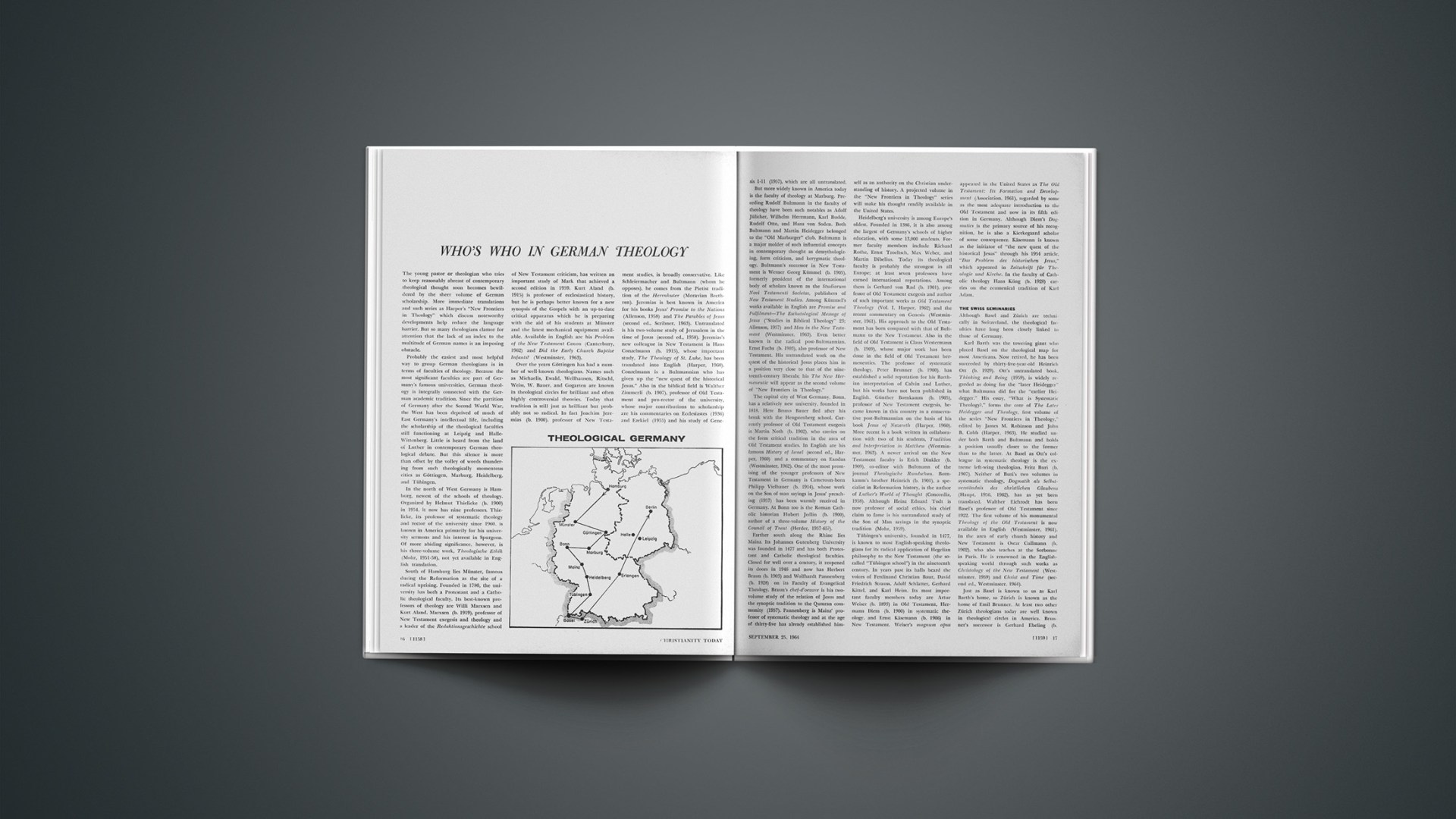
Who’s Who in German Theology

The young pastor or theologian who tries to keep reasonably abreast of contemporary theological thought soon becomes bewildered by the sheer volume of German scholarship. More immediate translations and such series as Harper’s “New Frontiers in Theology” which discuss noteworthy developments help reduce the language barrier. But so many theologians clamor for attention that the lack of an index to the multitude of German names is an imposing obstacle.

Probably the easiest and most helpful way to group German theologians is in terms of faculties of theology. Because the most significant faculties are part of Germany’s famous universities, German theology is integrally connected with the German academic tradition. Since the partition of Germany after the Second World War, the West has been deprived of much of East Germany’s intellectual life, including the scholarship of the theological faculties still functioning at Leipzig and Halle-Wittenberg. Little is heard from the land of Luther in contemporary German theological debate. But this silence is more than offset by the volley of words thundering from such theologically momentous cities as Göttingen, Marburg, Heidelberg, and Tübingen.

In the north of West Germany is Hamburg, newest of the schools of theology. Organized by Helmut Thielicke (b. 1900) in 1954, it now has nine professors. Thielicke, its professor of systematic theology and rector of the university since 1960, is known in America primarily for his university sermons and his interest in Spurgeon. Of more abiding significance, however, is his three-volume work, Theologische Ethik (Mohr, 1951–58), not yet available in English translation.

South of Hamburg lies Münster, famous during the Reformation as the site of a radical uprising. Founded in 1780, the university has both a Protestant and a Catholic theological faculty. Its best-known professors of theology are Willi Marxsen and Kurt Aland. Marxsen (b. 1919), professor of New Testament exegesis and theology and a leader of the Redaktionsgeschichte school of New Testament criticism, has written an important study of Mark that achieved a second edition in 1959. Kurt Aland (b. 1915) is professor of ecclesiastical history, but he is perhaps better known for a new synopsis of the Gospels with an up-to-date critical apparatus which he is preparing with the aid of his students at Münster and the latest mechanical equipment available. Available in English are his Problem of the New Testament Canon (Canterbury, 1962) and Did the Early Church Baptize Infants? (Westminster, 1963).

Over the years Göttingen has had a number of well-known theologians. Names such as Michaelis, Ewald, Wellhausen, Ritschl, Weiss, W. Bauer, and Gogarten are known in theological circles for brilliant and often highly controversial theories. Today that tradition is still just as brilliant but probably not so radical. In fact Joachim Jeremias (b. 1900), professor of New Testament studies, is broadly conservative. Like Schleiermacher and Bultmann (whom he opposes), he comes from the Pietist tradition of the Herrnhuter (Moravian Brethren). Jeremias is best known in America for his books Jesus’ Promise to the Nations (Allenson, 1958) and The Parables of Jesus (second ed., Scribner, 1963). Untranslated is his two-volume study of Jerusalem in the time of Jesus (second ed., 1958). Jeremias’s new colleague in New Testament is Hans Conzelmann (b. 1915), whose important study, The Theology of St. Luke, has been translated into English (Harper, 1960). Conzelmann is a Bultmannian who has given up the “new quest of the historical Jesus.” Also in the biblical field is Walther Zimmerli (b. 1907), professor of Old Testament and pro-rector of the university, whose major contributions to scholarship are his commentaries on Ecclesiastes (1936) and Ezekiel (1955) and his study of Genesis 1–11 (1957), which are all untranslated.

But more widely known in America today is the faculty of theology at Marburg. Preceding Rudolf Bultmann in the faculty of theology have been such notables as Adolf Jülicher, Wilhelm Herrmann, Karl Budde, Rudolf Otto, and Hans von Soden. Both Bultmann and Martin Heidegger belonged to the “Old Marburger” club. Bultmann is a major molder of such influential concepts in contemporary thought as demythologizing, form criticism, and kerygmatic theology. Bultmann’s successor in New Testament is Werner Georg Kümmel (b. 1905), formerly president of the international body of scholars known as the Studiorum Novi Testamenti Societas, publishers of New Testament Studies. Among Kümmel’s works available in English are Promise and Fulfilment—The Eschatological Message of Jesus (“Studies in Biblical Theology” 23; Allenson, 1957) and Man in the New Testament (Westminster, 1963). Even better known is the radical post-Bultmannian, Ernst Fuchs (b. 1903), also professor of New Testament. His untranslated work on the quest of the historical Jesus places him in a position very close to that of the nineteenth-century liberals; his The New Hermeneutic will appear as the second volume of “New Frontiers in Theology.”

The capital city of West Germany, Bonn, has a relatively new university, founded in 1818. Here Bruno Bauer fled after his break with the Hengstenberg school. Currently professor of Old Testament exegesis is Martin Noth (b. 1902), who carries on the form critical tradition in the area of Old Testament studies. In English are his famous History of Israel (second ed., Harper, 1960) and a commentary on Exodus (Westminster, 1962). One of the most promising of the younger professors of New Testament in Germany is Cameroun-born Philipp Vielhauer (b. 1914), whose work on the Son of man sayings in Jesus’ preaching (1957) has been warmly received in Germany. At Bonn too is the Roman Catholic historian Hubert Jedlin (b. 1900), author of a three-volume History of the Council of Trent (Herder, 1957–65?).

Farther south along the Rhine lies Mainz. Its Johannes Gutenberg University was founded in 1477 and has both Protestant and Catholic theological faculties. Closed for well over a century, it reopened its doors in 1946 and now has Herbert Braun (b. 1903) and Wolfhardt Pannenberg (b. 1928) on its Faculty of Evangelical Theology. Braun’s chef-d’oeuvre is his two-volume study of the relation of Jesus and the synoptic tradition to the Qumran community (1957). Pannenberg is Mainz’ professor of systematic theology and at the age of thirty-five has already established himself as an authority on the Christian understanding of history. A projected volume in the “New Frontiers in Theology” series will make his thought readily available in the United States.

Heidelberg’s university is among Europe’s oldest. Founded in 1386, it is also among the largest of Germany’s schools of higher education, with some 13,000 students. Former faculty members include Richard Rothe, Ernst Troeltsch, Max Weber, and Martin Dibelius. Today its theological faculty is probably the strongest in all Europe; at least seven professors have earned international reputations. Among them is Gerhard von Rad (b. 1901), professor of Old Testament exegesis and author of such important works as Old Testament Theology (Vol. I, Harper, 1962) and the recent commentary on Genesis (Westminster, 1961). His approach to the Old Testament has been compared with that of Bultmann to the New Testament. Also in the field of Old Testament is Claus Westermann (b. 1909), whose major work has been done in the field of Old Testament hermeneutics. The professor of systematic theology, Peter Brunner (b. 1900), has established a solid reputation for his Barthian interpretation of Calvin and Luther, but his works have not been published in English. Günther Bornkamm (b. 1905), professor of New Testament exegesis, became known in this country as a conservative post-Bultmannian on the basis of his book Jesus of Nazareth (Harper, 1960). More recent is a book written in collaboration with two of his students, Tradition and Interpretation in Matthew (Westminster, 1963). A newer arrival on the New Testament faculty is Erich Dinkler (b. 1909), co-editor with Bultmann of the journal Theologische Rundschau. Bornkamm’s brother Heinrich (b. 1901), a specialist in Reformation history, is the author of Luther’s World of Thought (Concordia, 1958). Although Heinz Eduard Todt is now professor of social ethics, his chief claim to fame is his untranslated study of the Son of Man sayings in the synoptic tradition (Mohr, 1959).

Tübingen’s university, founded in 1477, is known to most English-speaking theologians for its radical application of Hegelian philosophy to the New Testament (the so-called “Tübingen school”) in the nineteenth century. In years past its halls heard the voices of Ferdinand Christian Baur, David Friedrich Strauss, Adolf Schlatter, Gerhard Kittel, and Karl Heim. Its most important faculty members today are Artur Weiser (b. 1893) in Old Testament, Hermann Diem (b. 1900) in systematic theology, and Ernst Käsemann (b. 1906) in New Testament. Weiser’s magnum opus appeared in the United States as The Old Testament: Its Formation and Development (Association, 1961), regarded by some as the most adequate introduction to the Old Testament and now in its fifth edition in Germany. Although Diem’s Dogmatics is the primary source of his recognition, he is also a Kierkegaard scholar of some consequence. Käsemann is known as the initiator of “the new quest of the historical Jesus” through his 1954 article, “Das Problem des historischen Jesus,” which appeared in Zeitschrift für Theologie und Kirche. In the faculty of Catholic theology Hans Küng (b. 1928) carries on the ecumenical tradition of Karl Adam.

The Swiss Seminaries

Although Basel and Zürich are technically in Switzerland, the theological faculties have long been closely linked to those of Germany.

Karl Barth was the towering giant who placed Basel on the theological map for most Americans. Now retired, he has been succeeded by thirty-five-year-old Heinrich Ott (b. 1929). Ott’s untranslated book, Thinking and Being (1959), is widely regarded as doing for the “later Heidegger” what Bultmann did for the “earlier Heidegger.” His essay, “What is Systematic Theology?,” forms the core of The Later Heidegger and Theology, first volume of the series “New Frontiers in Theology,” edited by James M. Robinson and John B. Cobb (Harper, 1963). He studied under both Barth and Bultmann and holds a position usually closer to the former than to the latter. At Basel as Ott’s colleague in systematic theology is the extreme left-wing theologian, Fritz Buri (b. 1907). Neither of Buri’s two volumes in systematic theology, Dogmatik als Selbstverständnis des christlichen Glaubens (Haupt, 1956, 1962), has as yet been translated. Walther Eichrodt has been Basel’s professor of Old Testament since 1922. The first volume of his monumental Theology of the Old Testament is now available in English (Westminster, 1961). In the area of early church history and New Testament is Oscar Cullmann (b. 1902), who also teaches at the Sorbonne in Paris. He is renowned in the English-speaking world through such works as Christology of the New Testament (Westminster, 1959) and Christ and Time (second ed., Westminster, 1964).

Just as Basel is known to us as Karl Barth’s home, so Zürich is known as the home of Emil Brunner. At least two other Zürich theologians today are well known in theological circles in America. Brunner’s successor is Gerhard Ebeling (b. 1912), editor of Zeitschrift für Theologie und Kirche, and author of The Nature of Faith (Fortress, 1962) and Word and Faith (Fortress, 1963). Far more conservative is the New Testament scholar Eduard Schweizer (b. 1913), best known for his article on the Spirit of God in Kittel’s Theologisches Wörterbuch zum Neuen Testament and for two volumes in the series “Studies in Biblical Theology,” Lordship and Discipleship (Allenson, 1960) and Church Order in the New Testament (Allenson, 1961). (Karl Barth’s brother Heinrich is a professor in Zürich’s philosophy department.)

In the Bavarian region, Erlangen stands alone. In recent years it has maintained a more moderate stance than most German universities. In the last century the great conservative scholar Theodor Zahn taught New Testament there. The New Testament department is still relatively right-wing. Both Paul Althaus (b. 1888) and Ethelbert Stauffer (b. 1902) have upheld a strong anti-Bultmannian outlook, but from divergent points of view. Available in English are Althaus’s Fact and Faith in the Kerygma of Today (Fortress, 1959) and Stauffer’s New Testament Theology (SCM, 1955).

In The East Zone

The East Zone of Germany has its theological heritage, too. Leipzig once heard the voices of Franz Delitzsch, Rudolf Kittel, Albrecht Alt, Konstantin von Tischendorf, Paul Tillich, and Ernst Fuchs. Halle was founded by the German Pietist Philipp Spener. Later its faculty included such greats as August Francke, Christian Wolff, Johannes Semler, Wilhelm Gesenius, Willibald Beyschlag, Martin Kähler, Friedrich Loofs, Hermann Gunkel, Julius Schniewind, Otto Eissfeldt, and Kurt Aland. It merged with Wittenberg in 1817 and became Martin Luther University. Today, however, both schools are somewhat isolated politically.

Berlin stands out as a lone star in the East German sky. The Free University of Berlin, founded in 1948, now has some 12,000 students. Its theological studies are found in the philosophy department, where Helmut Gollwitzer (b. 1908) is professor of Protestant theology. His name has become known to theologians in America largely as a result of his introduction to and selection from Karl Barth’s Church Dogmatics that appeared recently as a Harper Torchbook (Harper, 1962). In years gone by Berlin could boast more outstanding persons than any other theological faculty in Germany, including Friedrich Schleiermacher, W. M. L. de Wette, Neander, I. A. Dorner, E. W. Hengstenberg, Otto Pfleiderer, Bernhard Weiss, Adolf von Harnack, Reinhold Seeberg, Karl Holl, Adolf Deissmann, and Hans Lietzmann.

This guide has fixed attention on those theologians who are known to Americans through English translations of their works, although several others have been included because their untranslated works are of special significance. To avoid excessive cataloguing we have omitted Fohrer, Loewenich, Dörries, Otto Weber, Kraus, Michel, Goppelt, Campenhausen, Kuhn, Schlink, and Lortz, names that those versed in German theology may feel should have been included. Several of the men mentioned in this survey represent positions with which many will violently disagree; but the aim of all reading, of course, is to learn what is valuable and to dismiss the chaff. Germany is still a leader in theological thought today. Evangelicals dare not neglect its scholarship, because it begs for interaction with them and not only with those in America who represent other theological traditions.

Letter to a Seminarian

DEAR STUART,

I know what you mean when you write that you are uneasy about going to a parish ministry when you are ordained. Our troubles are well-publicized. Our mental breakdowns have been counted and discussed in the press. Sociologists study our complaints, national magazines record our casualties. A picture has been painted of the pastor’s lot as anxiety-ridden, frustrating, crowded with triviality.

The picture is probably a true one.

I doubt if the parish ministry has ever been more anxious, more difficult, more filled with the possibility of failure. That’s what is good about it. This may well be the most exciting time in the long history of the pastorate. Never has this call offered more to the man who wants the Lord to give him a job that is bigger than he is, who prefers risks to certainty, who is willing to fail ten times to succeed once.

Anxiety? Plenty of it. For one thing, people today take seriously what ministers say and do. If they didn’t, pastors wouldn’t have to be so wary of people who want to use them. Because people take pastors seriously, some of them are mad at their minister all of the time and quite a few are likely to be at any given time. If a pastor is lucky today, he can often have extremists on both sides of him, equally unhappy. Sometimes he gets tired of the uproar and wishes that no one cared what he thought. (Monday is usually my day to feel this way.) But most days he is glad that they do care. In these days of secularism, racial turmoil, and moral disintegration, the minister has to speak. If his words result in anxiety, it is because people are listening.

We can’t deny that it is frustrating, either. Somehow the church spelled with a small c doesn’t correspond very well with the Church we discussed in seminary. The pastor discovers early that most of his members have a very different view of the Christian faith from any he has read. They are not divided into liberal and evangelical, Bultmannian and post-Bultmannian. In fact, they aren’t easily classified at all. If there is a majority view, it may be a kind of eclectic universalism whose major premise is that any belief is good as long as you believe it sincerely. The parish church is not a well-drilled Christian army waiting to commission a seminary graduate as its general. It is a confused gaggle of saints, pagans, and people with unrealized possibilities. In short, it is a group of people who need their pastor more than they know. They will often surprise their minister, when their faith and vision outrun his. They will more often disappoint him. For the minister, the parish represents an unanswered challenge that will never be completely answered.

I don’t know about the triviality. I do know that there is never time enough to read or write. We don’t play much of a role in history. The history-making concerns are always being crowded aside. The great issues before the Congress and the United Nations are great issues to us, too. But we are always being interrupted by the crushing concerns of our people, people whose names won’t be remembered by the historians. The pastor is called from his study to go to the emergency room at the hospital, to drink coffee late at night in strangers’ kitchens. He is summoned from his typewriter and his books to hold dying hands, to look into eyes glazed with grief. And so often there is nothing he can do—nothing but suffer along with them, and care enough to be hurt when they are hurt, and pray. He will not take the hurt away with good theology and a smattering of amateur psychiatry. All he can do is care, and trust, and hope. Is this trivial? I don’t know. But I do know that the pastor should care. Hardly anyone else does, and people need him for that.

The parish minister is constantly being brought into bruising contact with the brutality of life. He has many more failures than successes, and the successes are so slow and intangible that he’s never sure that there are any. He is often insecure, often alone, too often faced with tasks beyond his power.

Yet, can you understand what I mean when I say that this is what is good about it? The very things of which we complain are the exciting, the worthwhile part of a pastor’s life. If no one cared what we said, if our churches were bands of perfected saints who didn’t need us, if we didn’t share the joy and heartbreak of people of little fame, it would all be safe, but empty. The pastorate is not quiet and comfortable. If it ever gets that way, it will be no place for the Lord’s children to serve.

Yours in anxiety and joy,

Malcolm Nygren

Theology

The Theological Crisis in Europe: Decline of the Bultmann Era?

First in a Series (Part II)

Rudolf Bultmann singles out Hans Conzelmann of Göttingen and Erich Dinkler of Heidelberg as his most representative disciples whose results stand closest to his own and whose theology consistently veers away from the relevance of the historical Jesus. When pressed for additional names of “genuine disciples” Bultmann lists almost all of his former students, despite their deviations. “Although I cannot say with certainty, I think they all go along,” he remarked, “though with many modifications.” In such generalities, Bultmann reveals his awareness that, while none of his former students (Mezger, Conzelmann, Dinkler, Fuchs, Ebeling, Schweizer, Bornkamm, Vielhauer, Käsemann, Kümmel) breaks in all respects with basic Bultmannian positions, yet their departures therefrom cannot be minimized nor can the differences among the men themselves.

The significance of the historical Jesus for Christian faith is the controversial issue that divides these scholars.

Not only against the Mainz radicals who emphasize personal relationships exclusively, but also against Bultmann and many post-Bultmannians, Fuchs contends that “community between men is possible only in the community between God and men” and that “the historical Jesus stands in the midst of revelation.” Fuchs turns these principles against Braun and Mezger and whoever else seeks to invert them on Bultmann’s premises, as well as against post-Bultmannians who are interested in the historical Jesus as he and Ebeling also are, but who are “unsure whether God’s presence is dependent on revelation or revelation dependent on God’s presence.” Both Conzelmann and Käsemann, complains Fuchs, are unclear about how the historical Jesus and revelation are to be correlated. Conzelmann, unlike Käsemann, concedes to radical historical criticism a role even more important than that of existential interpretation, while he nonetheless seeks to be an orthodox Lutheran. And while Bornkamm shares an interest in the historical Jesus, he subscribes also to Bultmann’s notion that “the faith came with Easter,” while Fuchs, on the other hand, insists that “the faith came from Jesus.” Yet when Schweizer of Zürich carries his post-Bultmannian interest in the historical Jesus to the point of inquiry into Jesus’ Messianic self-consciousness, Fuchs calls this an illicit undertaking: “The New Testament is dogmatics, and this cannot be translated into historical data.”

Bultmann himself meanwhile decries the fact that the growing interest in the historical Jesus may revive an appeal to historical factors in support and proof of faith. He still maintains that history can never provide a fundamental basis for faith and that faith does not need historical legitimation or historical supports. For Bultmann, the kerygma (the primitive Christian proclamation) alone is basic for faith.

Not even a post-Bultmannian like Bornkamm disputes this point of view, despite his insistence that Jesus’ pre-Easter preaching contains inner connections with the post-Easter kerygma, and that faith is interested in Lite content of Jesus’ preaching. “Bultmann is completely right,” he insists, “in his view that faith cannot be proved, and that the resurrection of Christ is the point of departure.”

In conversation Bultmann now seems to move even beyond his earlier limitation of historical interest to Jesus as merely a Jewish prophet and to his death. “We can know that he lived and preached and interpreted the Old Testament; that he deplored Jewish legalism, abandoned ritual purifications, and breached the Sabbath commandment; that he was not an ascetic, and was a friend of harlots and sinners; that he showed sympathy to women and children, and performed exorcisms.” In fact, in Wiesbaden, where Bultmann was seeking cure of an ailment, he was almost disposed to allow that Jesus healed the sick!

Nevertheless, Bultmann’s theological outlook can tolerate no return to the historical Jesus as decisive for faith. His readiness to minimize the clash between his disciples must be understood in this context. “We agree that the historical Jesus is the origin of Christianity and agree in the paradox that an historical person is also the eschatological fact which is always present in the Word.” By insisting on the event of Jesus Christ, Bultmann aims to distinguish the kerygmatic Christ from any mere Gnostic redeemer-myth.

Now it is true that Bultmann is formally right in insisting that the Easter message is the decisive starting point of Christian faith. He wants no return to the historical Jesus that would erase a decisive break between the historical Jesus and “the Easter event.” But his repudiation of the Easter fact, his “demiracleizing” of the Gospels, and his abandonment of the question of the historical Jesus as a theologically fundamental question all rob this emphasis of power. The complaint has widened that his complete rejection of any theological significance for Jesus of Nazareth does violence to apostolic Christianity. Bultmann’s view seemed more and more—his intention to the contrary—to dissolve apostolic proclamation into a Christ-myth through his one-sided severance of the kerygma from the event it proclaims and his censorship of the relevance of the historical Jesus.

Breakdown Of Bultmann’S Positions

While the broken defense of existentialist positions has thus divided the Bultmannian camp, the assault from outside has increased in scope and depth. Over against Bultmann not only post-Bultmannians, but also the Heilsgeschichte scholars and the Pannenberg school as well as traditionally conservative scholars, are demanding the recognition of a Christian starting point also in the life and teaching of the historical Jesus. “The smoke over the frontiers has lifted,” reports Leonhard Goppelt of Hamburg, “and a new generation is in view. Bultmann’s spell is broken, and the wide range of critical discussion signals an open period. Now that a shift from Bultmann is under way in a new direction, we are on the threshold of a change as significant as that of a century ago, when Hegelian emphases gave way to the neo-Kantianism of Ritschl.”

As Joachim Jeremias of Göttingen sees it, the vulnerability of Bultmann’s theological structure is evident from the fact that three of its fundamental emphases are now more or less shattered:

1. Bultmann’s neglect of the historical Jesus has broken down, and a deliberate return to the historical Jesus now characterizes New Testament studies. In deference to Wellhausen, Bultmann held that Jesus was but a Jewish prophet and that his life and message were not of great importance for Paul. The untenability of this position is now clear, and it is widely agreed that Christianity cannot be truly understood without a return to the historical Jesus.

2. Bultmann placed great weight on an alleged Gnosticism which supposedly influenced the Gospel of John and other New Testament literature. But the Dead Sea Scrolls show that the dualism of John’s Gospel is Palestinian and Judaic. A monograph by Carsten Colpe is widely credited with demonstrating convincingly that the model of a pre-Christian Gnostic redeemer-myth which Bultmann locates behind New Testament writings is actually nothing but the myth of Manicheanism of the third century A.D., which very likely sprang from a Docetic Christology repudiated by historic Christianity.

3. Bultmann defined the task of exegesis as the existential understanding of the New Testament, and he therefore stressed anthropology: “The Gospel gives me a new understanding of myself.” But “the Gospels stress theology, and they give us new knowledge of God,” counters Jeremias, one of the most articulate spokesmen for traditional conservative positions. Jeremias comments that “the history of the Church has shown that it is always dangerous when New Testament exegesis takes its method from contemporary philosophy, whether the idealistic philosophy of the nineteenth century or the existentialist pholosophy of the twentieth century.”

It remains true nonetheless that Bultmann’s followers—whether “genuine” or “spurious”—perpetuate many methodological and critical presuppositions integral to Bultmann’s theology. Despite their interest in the historical Jesus, even the deviationist disciples retain Bultmann’s notion that the task of exegesis is existential interpretation. But this basic Bultmannian assumption is challenged by Kümmel, a spokesman for the Heilsgeschichte school. Kümmel repudiates the presupposition that the task of exegesis is to discover the self-understanding of the New Testament writers in order to correct our self-understanding. The real task of hermeneutics, he says pointedly, is to find out what the New Testament teaches. The New Testament is “a revelation of the history of salvation,” he insists, and he is confident that the critically founded search for the historical Jesus will “win the field.” Kümmel emphasizes that “the facts, not the kerygma, evoke my response.”

An Unrepentant Bultmann

Bultmann remains unconvinced that his presuppositions have been shaken. He hardly regards himself as an emperor in exile or about to be deposed. Of his a prioris, he considers the second (as Jeremias lists them) less important than the others, but even with respect to the supposed Gnostic background of the New Testament he clings still to the position that the theology of the Fourth Gospel and of Paul is influenced by Gnostic views. In fact, Bultmann is currently writing a commentary on John’s Epistles from this perspective to round out his earlier work on John’s Gospel. Bultmann attaches more importance, however, to his other a prioris regarding the historical Jesus and existential understanding, which, he says, “stand together.” Although he professes also to be “interested in” the historical Jesus, he speaks only of Jesus’ deeds, and of these in attenuated and non-miraculous form. Contrary to the nineteenth century “life of Jesus” school, he insists that we can know nothing of Jesus’ personality, and considers this no real loss. “What does it matter?” he asks. “What counts is his Word and his Cross which is the same now as then.” While Bultmann does not destroy continuity between the historical Jesus and the New Testament kerygma, he nonetheless denies continuity between the historical Jesus and the Christ of the kerygma. As he sees it, the kerygma requires only the “that” of the life of Jesus and the fact of his crucifixion. In other words, the kerygma presupposes but mythologizes the historical Jesus.

The issues of central importance, according to Bultmann, are the historical method and Formgeschichte in biblical theology, and the problem of history and its interpretation in hermeneutics, the latter being “connected with anthropological and philosophical problems.”

The complaint that he virtually abandons the concept of revelation Bultmann attributes to a misunderstanding of his thought and intention. He insists now as always on the reality of revelation, but he distinguishes Offenbarheit from Offenbarung—that is, revelation as an objectifiable fact from revelation as an act. In Bultmann’s sense, “genuine revelation” is always only an act, never an objectified fact. “Revelation happens only in the moment when the Word of God encounters me.”

But for all Bultmann’s self-assurance, European theology is increasingly moving outside the orbit of his control and influence. The so-called “Bultmann school” has never really been a unit, even if his disciples all work within similar critical and methodological assumptions. While they build on Bultmann as the most important New Testament theologian of our time, they now separate the two emphases which Bultmann conjoined: radical criticism of the trustworthiness of the Gospels and existential interpretation. Heidegger’s dark and harsh image of man, which so neatly fit the mood of a post-war generation plagued by anxiety, became most important for Bultmann’s disciples. The Fuchs-Ebeling line of existential exegesis turned Bultmann’s New Testament ideas into dogmatics à la Heidegger. But Bultmann’s disciples have increasingly pulled back from his views or moved around them in some respects, each man emphasizing a perspective which diverges from Bultmann—sometimes dealing severely with him—and combating other post-Bultmannians as well. More and more, Bultmann’s followers distinguish his exegetical and historical work from his philosophical and dogmatic intention. But none of the post-Bultmannians has so united the relevant data from a new perspective as to be able to shape a coherent alternative to Bultmann’s view.

Attacks on Bultmann’s position from outside his camp have become sharper and sharper and have exploited the interior divisions. Heinrich Schier, a former Bultmann student and disciple, became a Roman Catholic and is now teaching in Bonn. “Bultmann is a rationalist and neo-Ritschlian,” says Emil Brunner. “He seeks to overcome nihilism, which endangers his position, but his alternative is never quite clear.” And Peter Brunner, the Heidelberg theologian, points a finger at Bultmann’s “weakest point”: “In Glauben und Verstehen he nowhere tells us what a minister must say in order to articulate the Gospel, nor what (besides the name of Jesus and his cross) is the binding or given content of the message to be perpetuated. He presupposes that a message comes to the individual, and discusses the problem of the individual to whom the message comes, and how it is to be grasped. But if one raises the question of proclamation into the future, it becomes clear that Bultmann has not resolved the problem of content.” Says Otto Weber, the Göttingen theologian: “In a word, the reason for the breakdown of Bultmann’s theology is his existentialism.” And front Basel Karl Barth’s verdict has echoed throughout Europe: “Thank God, Bultmann doesn’t draw the consistent consequences and demythologize God!”

Criticism of Bultmann’s theology is increasing. Many scholars observe that while Bultmann scorns all philosophy as culture-bound and transitory, he nonetheless exempts existentialism. In his existential “third heaven” he claims to have exclusive leverage against the whole field of thought and life. But existentialism is no heaven-born absolute; it is very much a modern philosophical scheme. Any translation of New Testament concepts into existential categories must result in a version no less “limited”—linguistically and historically—than the biblical theology the existentialists aim to “purify.” The Bultmannians assume, moreover, that the New Testament writers, since they were especially interested in their subject, must have transformed (and deformed) the historical facts of the Gospels. This premise the existentialists fail to apply to their own special interest in the kerygma. While the Bultmannians rid themselves of the miracle of objective revelation, they seem to endow their subjectivity with a secret objectivity, and abandon the apostolic miracles only to make room for their own.

Paul II to Timothy II

Here we are in the wonderful year of 2,000. Space and race and keeping pace with science are forgotten. We are ruled by powerful thought-transference waves. We look alike and speak alike, and our children are all the same. The Political Power of Supreme Order has us all in hand.

The World Church has come and gone, having proved its absolute equation with the society of its day and having been swallowed by irrelevance. It wished itself big—and burst, one body splattered all the way to the Moon. One belief, one standard, and that a faith in a Thought outside ourselves!

I took a refresher course in World Theology last week and passed it with an excellent grade. I missed seeing you and was told that you were on a preaching mission to Mars. I understand that Universe Theology 202 is giving you trouble; that was one of the courses I missed.

I find in my travels that everyone is socialized. It’s a wonderful feeling to know that we all believe the same basic stuff. In World rheology I sat next to a former Muslim, and you can’t imagine the thrill of our conversation as we compared our means of raising money here and there. No barrier of belief—only a difference in financing.

I must tell you of a seminar I went to recently with some leading ex-Buddhists, who shared their findings on nursery supervision during meditation time. You know, these basic, how-to-do-it tools are what make the Universe Councils and Meditation Centers worthwhile.

The former Shintoists have an interesting theory that the representative from Mars was endorsing. It was something about Space-A-Vision Educational Programs for Cultural Promotion, replacing the regular Communion services in Christian Churches; after all, the sacraments have had no meaning since the Jesus-myth was exploded. Do you remember who he was?

Having Sabbath services on Monday is a real boon, because it follows no pattern set down by any great minds of the old religions. Really, it was a stroke of genius when the representative from Venus and the leaders of the Russian nation on World concurred. After all, with a two-day work week, we should spend a little time in meditation.

The brotherhood all of us feel is hard to express. It’s almost as if God—and I hesitate to use a word that is now generally outmoded—yes, almost as if God has finally been ousted and the supreme fight we have waged is at last coming to an end.

At a recent session of our Assembly, we expunged the word “World” from our constitution. The delegates felt that it was too provincial and that now we ought to have a Universe view.

There are negotiations going on in committee to link several Universes together in a United Universe Council and Meditation Center, but I sensed some lingering opposition from World and Venus. The new dwellers on the Moon were in favor of it, because their position astronomically is closer than ours to the others.

You have heard of the new theory of prayer and how very harmful prayer is in robbing conscience of selfhood and sufficiency? Then you will be pleased to note that at long last, the prayer movement has been outlawed, and what began in the early 1960s is at last a reality after forty years of struggle with traditionalist forces.

We attended a service at the World Cathedral in Moscow, Russia, World. The place was packed. The lecture was on the history of the development of ray-lessons that bombard the mind with elevating thoughts about the Universe. The speaker didn’t really follow a “text” so far as I could ascertain.

One of the living Saints of the Council was in attendance. His eloquence knew no bounds. He traced the movements for Unity from their beginnings and showed how living “greats” of every religion had contributed to the growth of spirit-dominance of World and the Universe of the Sun.

The newest translation of the Compilation is just out. You remember hearing of all the struggles in getting rid of the Bible in Christian America and the Koran and other sectarian books when you were younger? I lived through it, and I can tell you that this is the best version yet. It’s surely destined to be read in Meditation Centers all around the Solar System.

I shouldn’t say this, but somehow the new songs of spirit-outreach don’t impress me as much as the hymns of outmoded Christianity. But that may only be my experience. One of the favorites of the Assembly began;

We are all one; Master Thought has won;

We are all together.…

I can’t remember the rest.

Well, I’ll be home tomorrow on Spaceship 84. Sorry you couldn’t make the Saturn luncheon.

Ever your teacher,

PAUL II

—THE REV. IRVING C. BEVERIDGE, minister, Highland Avenue Congregational Church, Orange, New Jersey.

Mental Honesty and Seminary Recruitment

Send us your best men. They will barely be good enough.” This slogan, used by one of the stock-car racing organizations, is far more pertinent to the Christian ministry than to car racing. And since many seminaries are now recruiting students, tire slogan provokes the observation that appeals for students to consider the parish ministry must keep talent and mental honesty in clear view.

The complete candor of Christ as he spoke to those who professed they wanted to follow him still startles us. It should compel us to see that romanticizing our profession eventually leads to disillusionment. Christ never made an appeal to luxurious security. “ ‘If anyone wishes to be a follower of mine, … he must take up his cross and come with me’ ” (Matt. 16:21, NEB).

The young person contemplating the Christian ministry must carefully examine his mind and heart as to what will be demanded of him. Among the questions he must ask himself are these: “Can I face misunderstanding and opposition? Do I have the strength of commitment and purpose to stand against the society to which I belong when that society is wrong?”

Again and again the young clergyman will be forced to face the question: “Can I take it?” Indeed, the more talented he is and the clearer his understanding of the injustices and needs of our day, the more searching the interrogation will be. Tragic racial con diets in the United States emphasize this. But these are only symbols of a larger situation. Anyone who dares to cultivate insight into contemporary conditions in America or in the rest of the world can, at least to some degree, appreciate what is at stake.

There are, for example, too many facets of the challenge of Communism for us to ignore its sweeping character. Its fierce competition and the varied reactions of churchmen to it vividly exemplify conditions with which the young minister must deal. It is staggering to consider the virility of this idealistic, atheistic religion. In less than fifty years, Communism has gained one-fourth of the land surface of the world, and it now controls one-third of the world’s more than three billion people. Yet all Christian churches—Roman Catholic and Protestant—can claim only 900 million members. This immediately suggests perplexing problems the parish minister cannot escape.

Relationships of clergy and laity, which have already become severely painful, also confront the young man contemplating the ministry. Widespread secularism and Epicureanism in the churches, unashamedly accepted by thousands of members, will plague the young clergyman day after day. The parish minister who is trying to be honest with himself and with life will discover conditions so harassing that we can at least understand why hosts of preachers find it easier to try to bypass rather than face them.

This depressing situation weighs more heavily than the numerous duties expected of all parish ministers. Yet so time-consuming can these demands become that almost unconsciously ministers may minimize the all-important privilege of communicating the Gospel.

The Laymen’s Involvement

We ministers are under obligation to show laymen how all of us can and must work together if the Church is to be effective. Until our members become stronger spiritually, more involved in human needs, and more Christian in suffering with the oppressed, we have no right to anticipate effective Christian leadership. The laymen must understand their own involvement in the failures they too often try to transfer to their ministers.

Any leader must, of course, stay “ahead” of those he leads. But when church members stubbornly remain so far behind that they are not even aware of the preacher’s message or, if they do hear it, are antagonistic, there is serious trouble for minister and laymen.

Church members who are thoroughly Christian will pray for their minister. All too often, however, members of the congregation prey upon him. Frequently, they gloat over the mistakes of young ministers, instead of accepting divine aid for correcting their own. Many clergymen who are earnestly trying to interpret and apply the prayer, “Thy will be done,” are considered “dangerous.” Thus, because so many church members resent being asked to ponder prayerfully the problems of class and caste churches, the minister is frequently compelled to deal with perplexing issues alone, without the aid of intelligent and dedicated lay leaders.

Even more serious, a young clergyman will often be sickened by the discovery of how completely his congregation has been conditioned by secularism and the love of luxury. All too frequently their religion is essentially a cult of comfort and peace of mind. As a result, the minister cannot speak prophetically on human dignity and social responsibilities without being misunderstood, criticized, even denounced.

Denominational Demands

Within the confines of his own denomination, the clergyman’s question, “Can I take it?,” is never rhetorical. It is rather a probing experience.

At times the earnest preacher may be depressed by the number of hours he is expected to spend on wholly sectarian matters. He finds himself bound by demands for “denominational progress” while many of his members are struggling with spiritual doubts. He realizes that the religious problems of most people do not essentially concern what church to join. They are rather related to doubts whether there is any need for a church; indeed, whether there is a God, and if there is, what he is like.

Sometimes the whole issue is exaggerated and aggravated by ecclesiastical officials who, having never held pastorates or having had little interest in “the practical program” of the Church, have never participated in the struggles of the parish church. Some of these refuse to believe in and act upon the second-mile character of Christianity. Fortunately, the keen-minded ministers in the front-line trenches are not blind to the incapacity of such leaders to enter vicariously into the experiences current conditions demand—sometimes at great cost.

Regrettably, some young people who once thought that devotion to God’s word, eagerness to learn skills of communicating the Gospel, and ardent dedication to the Christian evangel were adequate, are quickly disillusioned. They are often made to feel that they will never really succeed unless they are rewarded with some ecclesiastical office. It ought to be easy to see that pride of achievement, fed by an avid desire for power, is thoroughly unfitting for the Christian minister or layman—yet it is painfully clear that this realization is not always easily gained.

The demands of Christ are, of course, the only ones we dare consider, and his requirements include attainments far beyond our human ability. Recall how Jesus emphasizes the divine requisite: “Be ye therefore perfect, even as your father which is in heaven is perfect” (Matt. 5:48). We are wise to the degree that we refuse to accept any lower criterion—even of ecclesiastical success. When we intelligently and eagerly respond to the ardent appeals of Christ, the “honors” coveted by status-seekers become insignificant.

Stooping To The Practical

The young person who seeks to equip himself in the most satisfactory way for the ministry may also be surprised and disappointed to discover that some instructors in the religious field condescendingly look down upon what they call the more “practical” areas of the ministry. This is difficult to understand, since in the parish church the dedicated clergyman is expected to help carry the burdens of others. Constantly he must deal with issues of church administration and program-planning, give careful advice to his workers in all areas of the Church, and counsel with others about their problems of home, business, and society. At the same time lie should be continuing his studies in order to communicate the Gospel effectively.

Because some seminary instructors are neither involved nor genuinely concerned with the heavy obligations of the parish minister, they cannot grasp the tragedy inherent in their attitudes. They seem to overlook the evident fact that there would be no need of instructors or of seminaries were there no churches that required trained ministers. Their lack of pastoral experience, however, explains why some of them find it difficult to discuss curriculum and other aspects of academic discipline in order to aid professional students in practical preparation for the parish ministry.

Many forget that directing men in research is not necessarily training them for the parish ministry. “Research,” unless skillfully handled, may make it more difficult for the young clergyman to develop rapport with his congregation. Substituting knowledge of facts for depth of personal understanding feeds the tendency to downgrade “practical disciplines.” On the other hand, when laymen suspect that their ministers are inferior in scholarship and incapable of understanding the total program of their profession, there is a breakdown in morale, and effective service may become impossible.

For these reasons the student preparing for the Christian ministry must be able to watch some people bow before the gods of so-called scholarship while at the same time he develops toughness of purpose and an unyielding commitment to his own disciplines of study. Moreover, these ministers-to-be must always learn sincere consecration to the total welfare of those who will constitute their parishes and to all they serve in the spirit of Christ. By doing this they will be able to “take it,” because they know how to pray: “Our Father … thy will be done.”

The talented preacher thus learns that every contribution he can make, by both the teaching and the preaching ministry, is desperately needed. These critical days demand a united effort by all who are concerned with the future of the Church and of Christianity. Even if we fail to see the world redeemed, we can at least hope that God will use us in such a way that the world will not destroy itself! Furthermore, since high religion deals with attitudes and relationships to God, to fellow workers, and to people of all creeds, colors, and characters, our integrity and Christian dedication are involved. All this becomes a call we dare not ignore when we realize that the present crisis offers exciting opportunities to make God’s will central in human affairs.

We are now deciding whether we want to pattern the Church on familiar political procedures or on what Christ called the Kingdom of Heaven. All young people who are contemplating the ministry as their life-work, as well as those of us who are seeking to make the years we have left count for God, must demonstrate intellectual integrity and moral honesty. We now have the necessity and the privilege of facing frankly the most critical situation we have known and eagerly acting upon its challenge.

G. Ray Jordan is Charles Howard Candler Professor of Preaching and chapel preacher at Candler School of Theology, Emory University, Atlanta, Georgia. He holds the A.B. from Duke University, the B.D. from Emory University, and the A.M. from Yale University.

The Call to the Ministry

No more urgent need exists in the Church today than that of confronting gifted young people with the challenge of the call to the ministry. During the past several decades Christian leaders have become increasingly aware of this need. But the Church has not been sufficiently aroused at the local level for enough of our youth to consider prayerfully whether or not God might be calling them. Moreover, several factors have caused difficulties.

First, the amazing opportunities for work in science and technology attract vast numbers of young people. These fields often claim the best students in high schools and colleges before these young people have so much as considered the challenge of the ministry.

Second, the problems of the ministry have often been paraded in magazines and have also been on display in seething communities engaged in the struggle over human rights. Many parents do not want their sons to get involved in complicated social issues. They envision little more than disfavor, trouble, and meager pay for a minister. Besides this, periodic attacks of ignorant people who insist that the ministry is infiltrated by Communists or other subversive groups have done some damage. These strangely twisted minds, who “see a scorpion under every stone,” have created misgivings and aroused needless fears.

But the chief difficulty lies, not in these factors or in others like them, but within the Church itself, in the spirit and thinking of ministers and laymen. There is an inadequate understanding of the whole sweep of the biblical revelation according to which the sovereign purpose of God is to realize his Kingdom through the Lordship of Jesus Christ. Our tendency is to start with the need for ministers, the number who retire and drop out each year and the number needed to replace them, the job opportunities in the various fields of Christian work. This information we must have. But it will not do much to inspire a gifted young man who has an opportunity to go into industrial management, electronics, international affairs, law, or medicine.

Since our understanding of God’s revealed purpose is often obscure, the thought of the call to the ministry tends to become vague and remote. The sense of urgency evaporates.

There must be absolute clarity at this one point: God’s policy is to realize his Kingdom through people under the Lordship of Jesus Christ. The proclamation of his Gospel requires the ministry. God does not leave the carrying forward of his work either to the mercy of blind chance or to the whims of people. He deliberately acts through the Holy Spirit to call some into the ministry because only in this way does he choose to accomplish his holy purpose. No one knows before confronting God’s challenge whether or not God wants him to preach the Gospel. But God expects consecrated ministers and laymen to be alert to his aims and policies and therefore to assist in presenting the call.

Some Questions

Someone may ask, “But are you sure that God calls people to the ministry?” The question is natural and must be faced. The answer is to be found in an adequate theological understanding. The God who created the universe deliberately for his purpose, who sent the Saviour into the world to die for sinful men and to inaugurate the new era of the Kingdom, who sent the Lloly Spirit to create the body of believers who magnify Jesus Christ as Lord—this God would not be so irresponsible and foolish as to neglect what is necessary for continuing what he started. And the ministry is necessary for proclaiming the Gospel of Jesus Christ. This is why Paul rightly thought of himself as “set apart for the service of the Gospel” (Rom. 1:1, NEB).

But does not God call everyone? The answer is that he calls everyone to surrender his or her life to Jesus Christ but calls only some to devote their whole time and energy to the understanding, teaching, and communication of the Gospel. At this very point there is confusion among both ministers and laymen. I have been at many conferences on Christian vocations in which the impression was left that almost any good work connected with the Church is on a par with the ministry. Is not any honorable work a divine calling?

There is a truth here from the heritage of the Reformation that must be preserved. Every layman, doing his task faithfully under Christ, is surely called of God to be a true workman wherever he is. Moreover, when anyone prayerfully decides that it is pleasing to God for him to do a particular kind of useful work in making a living, that work becomes for him a divine calling. But there is a difference between this and the call to the ministry. Some are set apart for the awesome responsibility of proclaiming the Gospel. Although they might do any one of many things that would otherwise be honorable, none of these other forms of daily work would be honorable for them, since God has called them to be his ambassadors through leadership in worship and service at home and abroad.

Moses was doing an honorable work in tending Jethro’s flock. But he would not have been honorable had he kept on doing that after God called him to lead the people of Israel from their bondage in Egypt. All useful tasks contribute in one way or another to God’s holy purpose. But unless some are specially called and commissioned to understand, preach, and teach the Gospel, every activity of mankind will get lost in a barren and futile secularism. The minister is called, therefore, to speak for God, in behalf of God, to the end that all of man’s activities may be coordinated toward the realization of God’s Kingdom. The minister’s calling is not special because he as an individual is different from other men. It is special because his commission and work have to do with what is at the heart of God’s revealed policy for mankind. It is special because it requires, in a way that no other responsibility does, the direction and inspiration of the Holy Spirit. All noble work takes on a new glory when it is carried forward under the inspiration of the Spirit. But in a unique way this is true of the work of the minister.

It cannot be emphasized too much in these days that Christianity is revealed religion. At its heart is the promise of salvation through Jesus Christ to all who repent, believe, and have faith. This Gospel, then, is no merely human discovery. God acted through the patriarchs, through Moses, David, and the prophets, to prepare the way for the coming Deliverer. Then, in the fullness of time, he sent forth his Son. Indeed, creation itself was aimed toward fulfillment in Jesus Christ. To understand the deep meaning of the call to the ministry and the power of its hold over those called, therefore, we must have a clear view of God’s revealed determination to do his utmost to draw all men into his Kingdom through Jesus Christ. God has mightily acted toward this end through the birth, life, death, and resurrection of the Saviour.

God’S Sword Thrusts

While translating the Book of Jonah some years ago I came to that place which says that God “prepared” or “appointed” a great fish to swallow up the prophet (Jonah 1:17). When I checked on the Hebrew word (manah), I found to my surprise that it also meant “to ordain” (Koehler’s Lexicon, p. 537). “An ordained whale,” I facetiously thought. But my wonder increased when I came to the fourth chapter. There I found that God also “ordained” (manah) a plant, a worm, and a sultry east wind! “A whale or a worm, a gourd or a wind,” I thought; “if God ordains them, he can use them.”

Over the years this rather strange and humbling little lesson has often come back to my heart to encourage me in the ministry.—SIDNEY A. HATCH, Portland, Oregon.

The Need For Proclamation

But this good news requires proclamation. “How then shall they call on him in whom they have not believed? and how shall they believe in him of whom they have not heard? and how shall they hear without a preacher?” (Rom. 10:14). Paul saw clearly that there must be an inherent connection between the Gospel and its proclamation. The same God who acted to reveal his redemptive purpose and strategy had to set apart some for teaching and proclaiming his salvation in Jesus Christ.

For this reason, the call to the ministry is not identified merely by adding up psychologically attested gifts, nor human attainments—whether educational or otherwise—nor even by natural ability. Paul knew that gifts and qualifications have their uses. But, according to him, prior to all else is God’s plan of sharing his Gospel with men. Nothing supersedes in importance here the willingness to be receptive to the authority of the Word and to the empowering grace of the Holy Spirit. No qualification surpasses that of the commission from God himself to proclaim his Word. Those who are thus set apart, of course, must prove themselves within the community of faith and must carry out the implications of their calling by applying themselves, through prayer, study, and discipline, to the tasks at hand.

In the light of all this, it is reasonable to suppose that God would give people some clear indication that he is calling them. To be sure, men must bring themselves close enough to hear. And if they hear, they must respond. Otherwise the call is of no avail. God commissions; man accepts.

How does God call his ministers? A few persons, like Paul, have received an extraordinary call, and their response was almost inevitable. They could not do otherwise. For most, however, this has not been so. In the lives of most ministers the call came as a growing experience. The Holy Spirit took innumerable events, impressions, and impulses, too mysterious to understand, and fashioned them into his divine commission. Often one person—a minister, a Sunday school teacher, a speaker at a youth camp—was God’s instrument in completing the transaction. But whether gradual or sudden, the fact of the call is no less real.

Four signs of the call to the ministry are worthy of special note here. They are not absolute; the mystery of God’s dealings with a human soul cannot be caught up into any simple formula. But whenever these signs come together in the experience of a young person, he may be sure that God is challenging him to take a careful look at the Christian ministry.

First, if in his highest and holiest moments there is the recurring sense that he ought to give himself to Christ for the work of the ministry, he should pay attention to this. It is very likely that this is the Holy Spirit calling. Everyone has mediocre moments. They are unauthentic. God finds it difficult to speak through the static of our trivialities. If the Holy Spirit speaks to us at any time in life, surely he does so in those moments of great inspiration and holy consecration. It is important to note the word “recurring.” For most people one experience is not enough. It is the recurring and growing movement of thought and life that goes deepest.

Second, if in a young person’s growing awareness of the world’s vast needs, he feels that he must do something personally to minister to those needs, this too may be the call of the Holy Spirit. The concern of a young Christian for humanity, for people in their needs, is a sure sign that God is at work in a special way. By itself alone this sign may indicate any one of many avenues of possible service. But, coupled with the first, it would definitely tend to confirm the fact of a call to the ministry.

Third, if there is a growing sense that the answers to man’s deepest questions, both individually and socially, are to be found only in the Lord Jesus Christ, this too is a mighty confirming factor. Here the negative experiences of people past and present suffice to show that Jesus Christ is not only the way but also the only Saviour from sin and the inaugurator of the Kingdom.

Finally, if a young person finds a growing sense of satisfaction in the opportunity to speak at youth services, in Sunday school, and in churches, or to visit the sick, the prisoners, and the lonely, or to lead in camp activities and social concerns, this too tends to confirm the validity of his call. In general, the desire to speak and serve in churches and other groups—particularly when accompanied with talents in this area—may be another sign that the Holy Spirit is calling.

A word of caution is needed here. Some are slow to find their way in public utterance. Others are shy at first. These too may be called. For neither slowness of speech nor shyness is a fatal obstacle. Moses, keenly aware of his inadequacies, said he was “slow of speech and of tongue” (Ex. 4:10); yet he was chosen to be the deliverer of Israel. God takes man’s weakness and turns it to his mighty ends. Nevertheless, it is still true that the increasing enjoyment of the kind of work that goes on in the life of a local church is a good sign.

No one of these four signs is sufficient by itself. Indeed, all four of them together offer no final proof. But when these signs are recurringly present in a life that is seeking God’s will, the Holy Spirit uses them to confirm the call to the Christian ministry.

Mack B. Stokes is associate dean and Parker Professor of Systematic Theology in Candler School of Theology, Emory University, Atlanta, Georgia. He holds the A.B. degree from Asbury College, B.D. from Duke University, and Ph.D. from Boston University. The author of three books, he is an ordained Methodist minister.

Apple PodcastsDown ArrowDown ArrowDown Arrowarrow_left_altLeft ArrowLeft ArrowRight ArrowRight ArrowRight Arrowarrow_up_altUp ArrowUp ArrowAvailable at Amazoncaret-downCloseCloseEmailEmailExpandExpandExternalExternalFacebookfacebook-squareGiftGiftGooglegoogleGoogle KeephamburgerInstagraminstagram-squareLinkLinklinkedin-squareListenListenListenChristianity TodayCT Creative Studio Logologo_orgMegaphoneMenuMenupausePinterestPlayPlayPocketPodcastRSSRSSSaveSaveSaveSearchSearchsearchSpotifyStitcherTelegramTable of ContentsTable of Contentstwitter-squareWhatsAppXYouTubeYouTube