Radio-TV: Warnings and Opportunities

The Federal Communications Commission issued its long-awaited “Primer on Fairness” last month. It spells out to some degree the steps radio and television stations should take in presenting controversial issues, including those on religious programs.

The commission’s twelve-page public notice is a digest of its major policy decisions on the obligations of broadcasters. Although no religious programs are cited, its impact upon such is expected to be considerable.

The FCC’s “fairness doctrine” provides that whenever an individual or an organization is subjected to a “personal attack” over the air waves, the station carrying the program is to transmit the text of the broadcast to the person or organization attacked, together with an offer of free time for a reasonable reply. If no tape or transcript of a broadcast is available, the station is responsible for submitting an “adequate summary” of what was said.

The commission also expects stations to maintain an overall program balance. In a religious sense this means that if a station sells time for evangelically oriented broadcasts, it cannot say there were simply no purchasers of time for other viewpoints. The station is expected to use its “public service” time to the end of achieving program balance. Many evangelical broadcasters are protesting this policy, charging that it penalizes traditional evangelical initiative.

On the other hand, evangelicals may find opportunities under this policy to see their views presented on stations that hitherto have refused to sell them time and that have limited religious programming to free time given over to liberally dominated councils of churches.

In programs involving “attacks” (still undefined by the FCC), the charges sometimes are not specific but are couched in general terms. In these cases, a station must show that it is presenting the other side of controversial issues. Specifically, the primer cites a station that carried programs attacking “the alleged infiltration of our government by communists, the alleged moral weakening of our homes, schools, and churches which have contributed to the advance of international communism.”

The station-owner said he did not offer any time to reply because he knew of no Communist or Communist-front organizations in his community. The FCC replied tartly that it did not require him to offer time to Communists but that “the matters listed raise controversial issues of public importance on which persons other than communists hold contrasting views.”

“There are responsible contrasting viewpoints on the most effective methods of combatting communism and communist infiltration,” said the commission, directing the station to afford time for those to be heard.

When the FCC receives complaints, it forwards them to the station concerned for reply and evaluates the overall performance of the station when its three-year license is up for renewal. In several recent cases, the FCC has extended renewals for only one year to give stations a chance to comply with its standards or face revocation of license.

A Matter Of Labels

Members of Congress were deluged with letters this summer protesting vehemently what the writers believed to be the sudden and arbitrary revocation of second-class mailing privileges for the Christian Beacon, the editorial voice of Dr. Carl McIntire and the American and International Councils of Christian Churches. Postal officials said the publishers had failed to meet labeling requirements. The dispute was amicably resolved when 65,000 copies of the July issue were presented at the Camden, New Jersey, post office, properly sorted in mail sacks, each bearing a red tag with the prescribed “newspaper” label.

Outlawing Poverty

Church-related organizations that work to reduce poverty are eligible to receive federal funds under the $947.5 million anti-poverty bill enacted by Congress this month.

The question whether it is constitutional for churches and church-related groups to receive funds under the bill was raised by Republican Representative Charles E. Goodell of New York.

Goodell told the House that “an example of how broadly this is drawn is that this bill permits a direct grant to a church, not just to a church school and not just to a private school.”

“It does not even have to use the money exclusively to fight poverty,” he added. “The church does not even have to guarantee that the facilities the church builds will not be used for sectarian instruction or religious worship.”

The American Civil Liberties Union has said that the anti-poverty bill creates “a serious constitutional problem threatening to weaken our nation’s historic commitment to the independence of church and state.”

Antagonisms In Africa

The Rev. Burleigh Law, a Methodist missionary stationed at Wembo Nyama in central Congo, was killed and several other missionaries placed under house arrest by rebel forces who intensified a campaign against the government this month. Circumstances surrounding Law’s death were not known.

A number of missionaries have had to evacuate their stations as a result of the rebel activity.

Law, 45, a pilot and aircraft mechanic, was a graduate of Asbury College. He is survived by his wife and two teen-age sons, who returned recently from the Congo to visit the family home at Tallahassee, Florida.

In Southern Rhodesia, meanwhile, American Methodist Bishop Ralph E. Dodge was ordered out of the country as an “undesirable immigrant.” Also ousted was Robert E. Hughes, an American Methodist lay missionary; he too was labeled “undesirable.”

The government gave no other immediate reasons for the deportation order, but African radio broadcasts said the two were being forced to leave because of “outspoken speeches and statements against racialism as practiced in the country.”

Dodge, a graduate of Taylor University, is the author of The Unpopular Missionary, a book published by Revell that calls upon whites to end their feeling of superiority over the Africans.

Calling On The Cardinal

United States Senator Barry Goklwater, Republican presidential nominee, paid a visit to Francis Cardinal Spellman while in New York this month.

The GOP leader, who had not previously met the influential archbishop of New York, conferred with the prelate for half an hour at the cardinal’s residence.

The visit was described as social, and no announcement was made of the topic of discussion. It was said that the meeting had been arranged through mutual friends.

Episcopalian Goldwater’s vice-presidential running mate, William E. Miller, a Roman Catholic, was not present.

Public Funds And Private Schools

Citizens for Educational Freedom, a fast-growing political-action group whose stated goal is “a fair share of educational taxes for all children in all schools,” found considerable cause for encouragement at a two-day convention in Philadelphia this month.

Dr. Peter Muirhead, assistant commissioner of the U. S. Office of Education, told the 700 delegates from seventeen states that “the tide is running in your favor, and your thinking is making an impact in Washington.”

CEF, being neither liberal nor conservative, does not take an official stand on federal aid to education, but holds rather to the Barry Goldwater thesis that if federal aid comes, it should be to all children in all schools. Accordingly, Goldwater, as Republican presidential nominee, wired a personal message to the convention:

“Your efforts to obtain equal treatment for all in the field of education are to be applauded. As I have stated on many occasions, I am opposed to all forms of federal aid to education, but if despite my opposition such legislation should be enacted, it should go on equal terms to all non-profit schools, public and private, secular and parochial.”

President Johnson also sent a congratulatory telegram but did not spell out his views on the issue.

Dr. Will Herberg, noted Jewish philosopher from Drew University, asserted that “independent, non-governmental schools are in the fullest sense of the term public institutions, performing a vital public service, and therefore are entitled to public support all along the line.” This is already recognized to some degree, he said, in that independent schools are exempt from property taxes.

“We intend to make this kind of support more adequate and more equal,” he added.

“Promotion of religion has always been and remains today as a necessary and proper function of government in the pursuit of its secular and civil ends,” Herberg declared. “In the eighteenth century, nobody—not even agnostics—believed in being able to have good government without religion.” As evidence he cited the Northwest Ordinance, the philosophy of Jefferson, the tax exemption of religious institutions, the compulsory chapel attendance at the service academies, and the first Congress’ sending out of seven missionaries to the Indians. The latter effort was not for the purpose of saving souls, he said, for the Founding Fathers had doubts about this, but for the purpose of civilizing the Indians.

Herberg contended that “religious symbols perform an indispensable part in the functioning of our democracy and that the systematic elimination of symbols from the public life would constitute a grave threat to our system.” He gave as examples of symbols the words “under God” in the Pledge of Allegiance and the Great Seal (found on the U. S. dollar), which portrays the eye of God over an unfinished pyramid (the nation) together with two religious mottoes. These and other symbols, he declared, reminded the people that there is “a higher majesty” above the nation. Without this belief, he said, there would be an absolutization of the nation, race, or culture that would amount to totalitarianism.

Other speakers included Dr. John Vanden Berg, dean of Calvin College, and the Rev. Edwin H. Palmer of Westminster Theological Seminary, both of whom are CEF trustees. While CEF’s 31,000 members—compared to 20,000 a year ago—are predominantly Roman Catholic, organization spokesmen always insist that CEF is non-sectarian.

A Kind Of Tolerance

A British Privy Council judgment in 1877 decreed that the only legal vestures for clergy of the Church of England were cassock and surplice, and a cope at communion in certain churches. Last month at Westminster that decision was overturned by 85 votes to 15 in the House of Lords, 205 to 23 in the House of Commons. In the upper house the Bishop of London, Dr. Robert Stopford, stated that the present practice of most clergy was at variance with the law, and that stole, alb, and chasuble were widely worn; the proposed measure would regularize the position.

This point was bewildering to Viscount Brentford: he suggested it was like saying that as bank raids had got completely out of hand, bank robberies should be legalized up to a limit of, say, £10.000 a year (tax free). This, suggested the noble lord, was one of a series of measures, each of which “nibbles away a little bit more of the foundations of our Church and our faith.” He expressed anxiety that the new legislation might lead to ordinands’ being required to adopt vestments, contrary to their consciences. He cited the former Bishop of London, who refused to ordain three men who declined to wear the vestures he required. One eventually complied under protest, but the two others were not ordained.

Replying to the latter point, the Archbishop of Canterbury, Dr. Michael Ramsey, said that he considered it “inconceivable that any of the bishops would press an ordination candidate, contrary to his conscience, to wear a stole at his ordination.” The archbishop said also that he repudiated the allegation that behind the measure was a subtle plot “to assimilate the Church of England to some other church in Christendom,” and that those who thought otherwise were being “scandalous or silly.” Only five of the twenty-six episcopal members were present as the Lords passed the measure.

In the Commons the debate came late in the day before the summer recess. Many of those who participated stressed the absurdity of the law which required the civil arm’s decision on a purely ecclesiastical matter. “This is not of the stuff of which Christianity is made,” complained Sir Cyril Black. Yet discuss it they did for some 230 minutes, 98 of which were taken up by the three evangelicals who spoke against the measure. Both sides went over well-worn ground without adducing any new arguments. One of the evangelicals was guilty of a massive tactical blunder when he read a passage from Romans 14—and substituted “wearing of vestments” for “eating of meat.” From the roar of protest that greeted this little ploy, one might have thought the assembly was crammed with believers in verbal inerrancy.

“One of the great strengths of the Church of England,” suggested the mover of the bill, Sir John Arbuthnot, “is its tolerance.” It was not a tolerance that was evident when the third evangelical, Mr. Ronald Bell, was speaking. From a particular quarter of the House he was harassed and heckled relentlessly, and even during a lull he paused to suggest that “members of the High Church faction” were distracting him by apparently conducting “a private meeting of their own.”

The measure, which now goes forward for the Queen’s formal assent, is hailed as a crushing defeat for the Low Church party, and is seen by them as an ominous warning of things to come.

J. D. DOUGLAS
Theology

Current Religious Thought: August 28, 1964

A long time ago when I was young, a friend of mine spent a summer working for the railroad. His job was to move baggage around on one of those hand carts. One day when the train pulled in he thought it would help his work a little if the engineer pulled the train about fifty feet up the track, closer to his load of luggage. So he whistled at the engineer and said something like, “Hey Bud. Move this thing up about fifty more feet.” The engineer obliged. In about two seconds flat the conductor was tearing down the platform in a fury, screaming to the engineer, “This train doesn’t move unless I say so!” To which my friend on the platform replied, “It moved, didn’t it?”

Whether we see them or not, the battle lines are always drawn between the men who worry about the systems, the way things are done, and the men who don’t hesitate for a moment to break away from the systems in order to get the job done “right now.”

I must confess that I am much more an observer of the machinations of the Vatican than a participant, even in sympathy. I note that some Protestants who have been somewhat involved in the Second Vatican Council are slightly disenchanted. Robert McAfee Brown’s recent study still expresses optimism; but no Protestant observer, as far as I can observe, is willing to say that anything has been done to make it easier for all of us to unite or for us Protestants to “come back home to Mother.” It is nice that they are giving Masses in native tongues, but the throwing down of the gauntlet in such things as the Assumption of Mary can bring Roman-Protestant conversations to an abrupt halt.

There are, nevertheless, individual voices in Catholicism that are encouraging. The funny thing is that encouraging voices in Catholicism are thought to be encouraging because they sound like Protestants! We sometimes envy the great strength of Romanism and its marvelous organization, but that strength is massive and ponderous. That intricate organization means that there are lots and lots of conductors running down the platform saying, “This train doesn’t move unless I say so.” The very few voices who have had very much publicity (for propaganda reasons that we all understand) are not likely to get the Curia to move very far very fast.

Some people think that I am prejudiced against Roman Catholicism, and I think they are right. If prejudice is the correct word, then I am prejudiced against the power of the church and their willingness to use it. I am prejudiced against their infiltrating of politics and the press. I am prejudiced against their index of forbidden books. I am prejudiced against their international politics and their threats of tyranny in such widely scattered places as Colombia and Portugal. I have a different kind of prejudice against row after row of celibates sitting in funny hats making decisions for their fellow men, and I even have a strange reaction to the representatives of Jesus of Nazareth wearing satin slippers and heavy brocades. All this sort of thing has always appeared to me as being an unhealthy approach to Christianity.

Meanwhile such a one as I sees his own hopeful signs. In a church that has controls I have been impressed to see a willingness to have some ambiguities widely displayed. In a best-selling novel, The Shoes of the Fisherman, there is a Roman Catholic treatment of the papacy. A play of enormous success, A Man for All Seasons, shows the heroism of a churchman, Sir Thomas More, in his decisions against not only the power of the state but the awful complicity and expediency of the church. Becket is a movie presentation of what faces a strong archbishop who at the time of his appointment by his friend, Henry II, “gets” religion. Although he dies a martyr’s death, he walks an uncertain path demanding finally a desperate decision in faith.

Rolf Hochhuth has given our day a controversial and incendiary critcism of the papacy during the Hitler regime in his play The Deputy. This play makes great reading, as it also makes great seeing. It may well be that Rome will decide to play down criticism of the play since it has become increasingly evident that Hochhuth may not have the case against Rome but certainly has a case. Significantly, the hero of the play is a good Roman Catholic, and he has his problem with his own church and with the Holy Father to whom he owes obedience. The heart and compassion of a priest and pastor is thrown into sharp conflict with the diplomatic expediencies of a church that is a world power and frequently a worldly one.

In The Shoes of the Fisherman we have a novel set in the contemporary world, and in The Deputy we have a play reflecting a problem as recent as the Second World War. In Becket we have a movie (T. S. Eliot’s Murder in the Cathedral is a drama around the same event) and in A Man for All Seasons a play that deal with the inner workings of the church at the time of the Reformation. We have thus a crossing of the centuries but a repetition of the problem. What happens when the individual faces the machine? What happens when the organization that is supposed to be the Body of Christ faces the world? Are not the “problem boys” of these literary masterpieces some variation of a man named Martin Luther? Is not the problem of the church in Rome the same as the problem of your own Protestant denomination when you speak to some social issue like, for example, nuclear warfare? Is not the scientist in The Shoes of the Fisherman a personalization of the old problem of science versus religion? Is he not, indeed, a picture of what confuses a church college when an effort is made to pursue the truth wherever it may lead while being loyal to a church creed?

We are beginning to appreciate Tillich’s insights regarding the “Protestant’s Principle.” It is this principle of freedom for the individual; the ambiguity arises, of course, because no man lives to himself alone. No man has fulfillment without relationships and involvements, and we are faced endlessly with the pressure of our group loyalty and the pressure to say, “Here I stand. God help me.”

Aldous Huxley in his Brave New World is wrestling with the same problem outside the religious context. I am certain the physicists are wondering about it as they observe some indeterminants in physical processes. What makes a new movement in art or music? Our Protestant Principle is a real ferment in Romanism. Recent literature would seem to reflect that Rome is well aware of that fact. And this might be the ground for optimism.

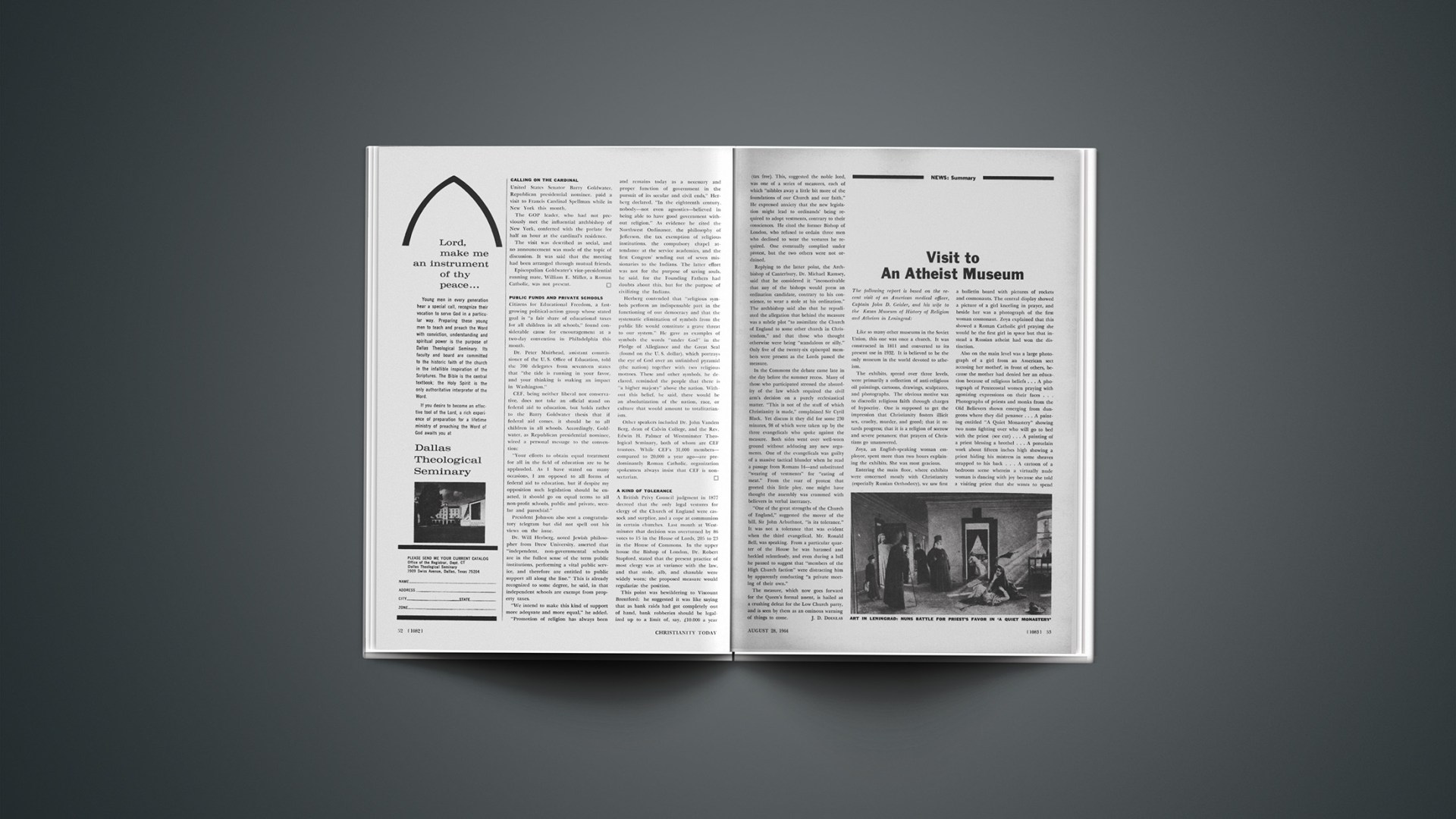
Visit to an Atheist Museum

The following report is based on the recent visit of an American medical officer, Captain John D. Geisler, and his wife to the Kazan Museum of History of Religion and Atheism in Leningrad:

Like so many other museums in the Soviet Union, this one was once a church. It was constructed in 1811 and converted to its present use in 1932. It is believed to be the only museum in the world devoted to atheism.

The exhibits, spread over three levels, were primarily a collection of anti-religious oil paintings, cartoons, drawings, sculptures, and photographs. The obvious motive was to discredit religious faith through charges of hypocrisy. One is supposed to get the impression that Christianity fosters illicit sex, cruelty, murder, and greed; that it retards progress; that it is a religion of sorrow and severe penances; that prayers of Christians go unanswered.

Zoya, an English-speaking woman employee, spent more than two hours explaining the exhibits. She was most gracious.

Entering the main floor, where exhibits were concerned mostly with Christianity (especially Russian Orthodoxy), we saw first a bulletin board with pictures of rockets and cosmonauts. The central display showed a picture of a girl kneeling in prayer, and beside her was a photograph of the first woman cosmonaut. Zoya explained that this showed a Roman Catholic girl praying she would be the first girl in space but that instead a Russian atheist had won the distinction.

Also on the main level was a large photograph of a girl from an American sect accusing her mother, in front of others, because the mother had denied her an education because of religious beliefs … A photograph of Pentecostal women praying with agonizing expressions on their faces … Photographs of priests and monks from the Old Believers shown emerging from dungeons where they did penance … A painting entitled “A Quiet Monastery” showing two nuns fighting over who will go to bed with the priest (see cut) … A painting of a priest blessing a brothel … A porcelain work about fifteen inches high showing a priest hiding his mistress in some sheaves strapped to his back … A cartoon of a bedroom scene wherein a virtually nude woman is dancing with joy because she told a visiting priest that she wants to spend eternity living sinfully and he has just accepted her point of view … A large painting of Christ blessing a Tsar family … A collection of iron chains and helmets allegedly used by the Russian Orthodox for penance … A very large painting depicting God and Christ helping the Tsar defeat the abortive 1905 Russian revolution … A life-size bronze sculpture of Christ, looking very sorrowful, humble, and helpless (Zoya explained that they do not consider humility a virtue) … A painting of a group of superstitious Russian peasants rolling a Russian Orthodox priest on the ground in the belief that this will produce fertile soil … A porcelain sculpture of a priest holding Mussolini and several other figures under his robe … A painting of eighteenth-century Russian peasants, bound and being led away to be slaves in an Orthodox monastery … A painting of the execution of heretics by burning in Red Square, Moscow, in the sixteenth century … A painting of a woman being dragged away to be murdered by a Christian monk in Alexandria. Egypt in the fourth century.

The lower floor was devoted mainly to exhibits against Roman Catholicism. We saw a wooden caricature of Christ on the Cross … A large model of a medieval, plague-infested French village, showing the pope and priests torturing people in the belief that their sins had caused the plague … A group of paintings of fat priests, one (labeled “Lust”) reading an obscene book, another (labeled “Gluttony”) flicking off a caterpillar from a piece of lettuce he is eating … Several cartoons of Inquisition atrocities … A cartoon entitled “The Real Master of the Vatican” showing a greedy Jesuit holding in his hand St. Peter’s Basilica … Several cartoons and paintings of drunken priests, including one reading a book with a wine glass hidden behind it … A painting of Galileo being condemned by the Roman Catholic Church for his views on astronomy … A bronze life-size sculpture of Bruno, a seventeenth-century astronomer, being burned at the stake during the Inquisition … A painting of the Roman Catholic Church hanging people during die Italian war of 1848 … A cartoon of the pope trampling under a mass of humanity … A greatly enlarged photograph of racial violence in the U. S. South, with police and their dogs attacking Negroes, and next to it the American flag with a Negro peering out from behind it, the stripes of the flag acting as prison bars … A photograph of an unemployment line waiting for food outside a Salvation Army building (our guide said this demonstrated how only the indigent turn to the church for help) … A paper-model exhibit of the U. S. Thanksgiving with healthy, colorful people parading in the street and dingy, crippled ones attending a nearby church for food being distributed there.

Also on the lower floor, at the end of a hall, was a full-scale model of an Inquisiting chamber. Several monks stood watching a torture weapon being heated in the fire, and a prisoner was lying with his feet in stocks. Nearby was a chair with protruding metal spikes.

The third floor, not nearly so spacious as the other two, was occupied with anti-Buddhist exhibits. It was here that we talked with Zoya about Christianity for about half an hour. She seemed to be in her mid-thirties and very intelligent. She was an ardent atheist, though she had obviously studied religion and read through the Bible at least once. I commented on the fact that the museum considered only adverse interpretations of religious faith and asked her why no favorable reflections were offered. Her answer was that there was simply no good in religion.

I asked her if she was aware, for instance, that Christian missionaries for the past two centuries have been teaching Africans to read and write and supplying their medical needs. Her reply was that it was simply not true, that it was ridiculous to say such a thing, and that she would discuss it no further.

Protestant Panorama

A five-day witnessing campaign by a band of 896 Southern Baptist laymen on the Pacific Coast produced 6,109 recorded decisions for Christ. Of this number, 1,205 made initial professions of faith.

Methodist-related Boston University won a S19,600 federal grant to develop training programs for community education against the danger of cigarettes to health.

United Church of Christ is distributing a do-it-yourself manual for expansion of Negro job opportunities. It gives detailed advice on methods by which the Church and its individual members can encourage and extend compliance with fair-employment provisions of the civil rights act of 1964.

Swedish Baptist young people are inaugurating a program of short-term missionary service in developing countries. The first group of six volunteers is headed for work in the Congo.

Deaths

DR. HUGH MARTIN, 74, noted British Baptist and ecumenical leader; in East Grinstead, England.

BISHOP EDWARD W. KELLY, 83, retired Methodist bishop; in Detroit.

DR. WILLIAM DAVID TURKINGTON, 71, retired dean of Asbury Theological Seminary; in Wilmore, Kentucky.

DR. HANFORD H. CLOSSON, 63, Methodist missions official; in Newtown Square, Pennsylvania.

Miscellany

A light plane pulling a banner advertising the Texas Baptists’ forthcoming Latin American evangelistic crusade crashed shortly after takeoff in San Antonio, killing the pilot.

Federal courts struck down laws requiring daily Bible readings in Idaho and Delaware, citing the 1963 U. S. Supreme Court decision.

The Greek Orthodox Archdiocese of North and South America issued sharp criticisms of Turkish action in Cyprus. The archdiocese also condemned alleged persecution of Greeks in Turkey.

Decision, published by the Billy Graham Evangelistic Association, now circulates more than two million copies of each issue. Among religious publications only The Upper Room has a larger circulation.

Personalia

Dr. Martin Niemöller is retiring as head of the Evangelical Church of Hesse and Nassau.

Dr. Gordon W. Blackwell will resign as president of Florida State University to become president of Baptist-affiliated Furman University.

Dr. F. Brooks Sanders resigned as dean of Gordon College.

Dr. Earl D. Radmacher was named faculty dean at Western Conservative Baptist Theological Seminary.

Dr. R. Laird Harris was appointed dean of graduate faculty of Covenant College.

The Rev. J. Allen Wright was named president-designate of the Baptist Union of Scotland.

Dr. Maurice E. Culver was named dean of Asbury Theological Seminary.

Dr. Robert S. Kreider was elected president of Mennonite-related Bluffton College.

About This Issue: August 28, 1964

How does the Soviet educational system combat Christian truth? A British clergyman-author surveys the Communist strategy to control the minds of youth (see the opposite page).

This issue, devoted to the area of education, outlines a vigorous program designed to confront contemporary pressures upon the Christian colleges (page 8).

Private boarding and day school suffer from an image that associates them either with well-do-to parents or with spoiled children. The survey of the independent school movement (page 11) not only dispels this notion but shows that many such institutions undergird the curriculum with Christian principles and spiritual concern.

World Council Faces a New Era

Sixteen years ago this week the World Council of Churches was formally constituted at Amsterdam. It has been steeped in controversy throughout its brief history, but its momentum as an omnibus ecclesiastical organization seems strong enough to propel it at least into another generation. Changes in administrative leadership that faced the World Council’s fourteen-member Executive Committee last month indicated that the movement is fast approaching a new era.

Chosen to succeed the venerable Dr. W. A. Visser t Hooft as general secretary was a Scottish Episcopal priest who had not yet been ordained when the WCC came into being in 1918. The Rev. Patrick C. Rodger, 43, has been executive secretary of the Faith and Order Department of the WCC since 1961. His baptism of fire into the ecumenical movement, however, did not come until last summer, when he served in the unrewarding role of secretary of the Fourth World Conference on Faith and Order in Montreal. Although many evangelicals consider the WCC more conservative theologically than the National Council of Churches in the United States, the Montreal conference was viewed with disappointment. It was widely reported to be Visser t Hooft’s special interest despite the counsel of ecumenical colleagues who noted that it might publicly lay bare the deep theological cleavages within the WCC rather than promote unity.

The Executive Committee, meeting for five days at the Evangelical Academy in Tutzing, Germany, asked Visser t Hooft to stay at his post until 1966. The recommendation of Rodger as successor must be approved by the WCC’s 100-member Central Committee at a meeting in Enugu, Nigeria, next January. Visser t Hooft, who will be sixty-four next month, has a chain of service as WCC general secretary dating back to 1938, when the organization had only provisional status.

Rodger is a graduate of Christ Church, Oxford University. He received theological training at Westcott House, Cambridge, and also studied at the University of Paris. He was rector of Episcopal churches at Milmacolm and Bridge of Weir, Scotland. Not least of his assets is his knowledge of Russian, which he gained while training as an interpreter with the Royal Corps of Signals in World War II.

As a number of ecumenical churchmen see it, one big task confronting the World Council is that of wooing theologically conservative Protestants who have thus far stayed aloof from inter-church organizational identification (non-aligned religious bodies embrace more than a third of U. S. Protestant church members). This goal seems quite dearly to have been in view in the Executive Committee’s selection of Dr. Eugene L. Smith, 52-year-old Methodist missionary executive, as head of the World Council’s bread-and-butter American division. Smith commands respect among evangelicals as a devout, sincere, and highly motivated ecumenist. He has become known to many evangelical leaders mainly through his initiative in bringing a number of them together in informal “consultations” to thrash out grievances against ecumenical of Churches. These unpublicized meetings have taken place annually for several years in an atmosphere designed to encourage candid discussion. Smith’s insight into the nature of the liberal-conservative cleavage was reflected in a definitive article that appeared in the Ecumenical Review and was widely reprinted (see CHRISTIANITY TODAY, August 30, 1963).

Some of Smith’s friends among independent evangelicals go so far as to say that he “speaks our language.” They even exchange prayer letters with him. Beyond that, however, they raise a caution flag. Some think that mutual understanding more than a formal alliance is a predictable outcome of the consultations, which have brought together influential men from a variety of non-NCC agencies and NCC spokesmen. The ecumenical participants have almost always been leaders of mild conservative views aggressively interested in evangelism.

Smith himself claims to shun theological labels, and evangelicals seem not to be over-optimistic about his theological views. One describes him as something of a “mystic,” another as a “semi-conservative.” Invited to outline his position, Smith spoke only of his “deep sense of biblical obedience” and a “high Christology” as a basic criterion.

Smith’s book God’s Mission—and Ours, published by Abingdon in 1961, indicates that he is disillusioned with theological liberalism and its contribution to the Christian mission. He does not believe, moreover, that neo-orthodox pessimism provides the proper antidote to liberalism, but his attitude toward fundamentalism is ambiguous. (CHRISTIANITY TODAY’S reviewer, mentioning a “theological softness,” expressed disappointment over the book’s doctrine of Scripture and declared that the author had not made clear whether he “distinguishes in principle between revelation in the canon and revelation after the canon.”)

Smith’s rapport with non-aligned churchmen, therefore, seems predicated on a recognition of evangelical vitality more than on common theological ground. He has seen this vitality in the overseas missionary program which has been his career specialty (evangelically oriented missionary boards sponsor more than two-thirds of the American missionaries abroad).

Smith was born in Rockwell City, Iowa, and attended Willamette University and Drew Theological Seminary. He also earned a Ph.D. degree at New York University and held pastorates in New York and New Jersey. He has been general secretary of the Division of World Missions of the Methodist Board of Missions since 1949.

Smith will assume his new job as executive secretary of the World Council of Churches in the United States on October 1, succeeding the ailing Dr. Roswell P. Barnes. Smith’s responsibility entails administrative leadership of the U. S. Conference of the World Council, which consists of the council’s thirty member denominations in the United States.

‘To Nations Beyond’

A slave boy who became the first African bishop south of the Sahara was honored in special ceremonies this summer in the Nigerian capital of Lagos. In a service commemorating the centenary of the consecration of Bishop Samuel Adjai Crowther, Christian leaders across West Africa gathered in the Cathedral Church of Christ, which overlooks the lagoon where young Crowther along with other pitiable slaves was herded on a slaveship in 1820.

The human cargo on that ship was intercepted along the coast by a British warship and taken to the freed slave colony at Freetown, Sierra Leone. Eleven-year-old Adjai became a Christian, took the name of a benefactor, and went to England.

Twenty-six years after being wrenched from his parents, Crowther returned as a free man and a missionary to his Yoruba people at Abeokuta, where he joyously found his mother. Anglican evangelism spread quickly under the leadership of this son of the soil, and Crowther took the Gospel to other parts of Nigeria. In 1864 he was consecrated the first Bishop of the Niger.

Having seen what Christ did for him and his people, Crowther was driven by missionary zeal to reach others. “We must send the Gospel to nations beyond us,” he often said. “Has not Christ, the great Shepherd of the Flock, sent us?”

Crowther would have rejoiced to see missionary vision partly fulfilled as delegates from the Anglican province of West Africa—stretching 2,000 miles along the coast—gathered for the centenary observance. In place of the lone churchman, eleven African bishops were on hand.

W. H. FULLER

Balancing Criticism

Former President Herbert Hoover, marking his ninetieth birthday this month, said that “criticism is no doubt good for the soul” but that Americans must beware “that it does not upset our confidence in ourselves.” He then gave some favorable reflections:

“On the moral and spiritual side,” he said, “we could suggest that we alone, of all nations, fought for free men in two world wars and asked no indemnities, no acquisition of territory, no domination over other peoples. We could point to a spirit of Christian compassion such as the world has never seen, and prove it by the tons of food and clothing and billions of dollars we have provided as gifts in saving hundreds of millions of people overseas from famine, and many governments from collapse.”

Hoover noted “an alarming amount of crime and youth delinquency” but blamed it largely on “the failure of our law enforcement after the police have made the arrest.”

On the race issue, he declared:

“Deeply as I feel the lag in certain areas which denies equal chance to our Negro population, I cannot refrain from saying that our 19 million Negroes probably own more automobiles than all the 220 million Russians and the 200 million African Negroes put together.”

The Mormon Surge

Each year the public gets a glimpse of the bizarre Mormon religious system in a spectacular festival that the New York Times has labeled “the most elaborate religious pageant in the world.” The 400-membcr cast acts out, on location, Joseph Smith’s alleged discovery in 1827 of holy scriptures etched on gold on a hillside near Palmyra, New York. This year’s pageant, held July 27 to August 1, drew some 182,000 persons, reflecting Mormonism’s remarkably steady growth rate and its bid for recognition as a major religious force.

Incredible as the Palmyra plot is to non-Mormon historians (Mormons believe in a Jewish migration to the Western Hemisphere in 600 B.C. and in Christ’s return and “repeat ministry” in the New World after his ascension in the Old), the current history of the Church of Jesus Christ of Latter-day Saints is nearly as dazzling. The LDS church, one of America’s few native religions, was its most persecuted faith in the years after Smith produced a translation of the golden plates. In the late nineteenth century, it practically went to war with the United States to maintain polygamy.

Yet today it has such prestige that President Johnson summoned the LDS Prophet-President, David O. McKay, 92, and one of his two counselors, N. Eldon Tanner, 65, to the White House last spring to discuss the nation’s moral and spiritual crisis. Michigan’s Governor George Romney—now running for a second term—and other famous Mormons also represent this latter-day acceptance.

There is an economic success story, too. In April, Fortune estimated the church’s annual income at $110 million—half from contributions, half from business profits. This is a guess: for many years, the ledgers have been “a military secret,” as one Mormon put it. Tanner, a magnetic personality and former Canadian oil magnate, said the church is de-emphasizing the business empire today, but the empire is still sprawling. A major outlet for the profits is building—300 new chapels a year, a $60 million office complex for the church in Salt Lake City, and a string of exquisite structures at Brigham Young University in Provo, America’s biggest church-run college.1BYU’s former president, Dr. Ernest L. Wilkinson, won the Republican nomination for the U. S. Senate this month.

The church grew by 150,000 last year, and it reports that only one-third of these were children of members. It had one million members in 1952, now has well over two million—nearly as many as the American Lutheran Church, currently the ninth-largest American Protestant denomination.

Besides zealous, door-to-door evangelizing, the Mormons use such unique ventures as tire Hill Cumorah pageant near Palmyra and a pavilion at the New York World’s Fair.

The revered 332-voice Tabernacle Choir, a subtle outreach, recently completed a two-week national tour. Its weekly radio broadcasts typify the moderate public image. The music rarely mentions LDS beliefs, and the “spoken word” by Richard L. Evans (a member of the Council of the Twelve Apostles, next in authority to McKay and his counselors) stresses universal truths. A top public relations staff has helped stem the violent anti-Mormon diatribes of old.

Yet the church believes itself the only legitimate organization set up by God to restore the true New Testament faith. In this super-Reformation doctrine, God had no spokesman on earth for 1,400 years as Catholics and Protestants twisted the faith at will.

Tanner stresses temperance in applying the one-church doctrine (“I wouldn’t attack other churches …”) and says the Bible is gaining new prominence, particularly in teaching youths and approaching potential concerts. If the Mormons use the three scriptures of their own at first, he said, people are less likely to listen.

Interestingly enough, William J. Whalen, author of the latest book on Mormons, says they are weakest at reaching people in predominantly LDS areas. And within the masses on church rolls are many inactive members. Whalen says in some regions less than half the members qualify to enter the temples for special ceremonies. The church claims to hold the allegiance of 70 per cent of Utah’s residents.

Protestants in Utah have yet to take advantage of this softness or to exert any marked inroads on the Mormon hold. Protestant leaders admit their ranks have been weak and divided. The only concerted effort in recent years was in an evangelistic crusade held on the steps of the state capitol last year.

Some Protestants expect that Mormons may soon enter rough times with their own intelligentsia. Perhaps the ultimate intellectual fortress for Mormons is the archaeology department at Brigham Young University, which was founded in 1946 and is attempting to substantiate the historical claims of the Book of Mormon. Such scholars as Ross T. Thristensen and M. Wells Jakeman have made a start toward fragmentary evidence of some claims. Jakeman, for example, contends there is a striking resemblance in attributes between the Israelite Jehovah and the life-and-rain god of the Central American Indians. But Jakeman also admits he knows of no non-Mormon archaeologist who holds that the Indians descended from the Jews, or that Christianity was known in the New World before Columbus.

A leading Protestant layman in Salt Lake City said the LDS church is making a real effort internationally “to establish itself as Christian” by such things as Bible emphasis. Dr. Robert Runnells, president of the Utah Council of Churches, said Mormons are developing “a more understanding attitude” toward Protestants and are “showing signs of turning from some of the nineteenth-century teachings of their forefathers.”

All this is too accommodating for the “fundamentalist” Mormons, who have formed dozens of splinter groups to hark back to the letter of the law in the days of Smith and Brigham Young, the second president, who led the persecuted pioneers to Salt Lake Valley in 1846.

“The Mormon Sunday schools brag that Protestants have been Mormonized,” complained Gordon Hackney. “It’s just the opposite.” Robert C. Newson said the church has compromised “to be in harmony with the trends of the day.”

The traditionalists worry about things like changes in priesthood ceremonies and temple garments, the church’s business involvements, and centralized authority. (McKay, like Smith and Young and unlike the pope, can announce direct revelations and commandments on anything.) Since most traditionalists maintain Young’s maxim that “the only men who become Gods, even the sons of God, are those who enter into polygamy,” they are underground and population estimates are elusive; but there are many thousands of them in Utah.

The largest schism is the 160,000-member Reorganized LDS church, which descends from those who stayed behind when Young’s band went west and lacks some of the more extreme teachings of other groups. It is centered in Independence, Missouri, which all Mormons believe will be the center of the Kingdom when Christ returns

The main LDS church has no clergy. Its leaders are businessmen, not theologians. And there is a belief that revelation is continuing and doctrine is evolutionary (even though written revelations, which came thick and fast in the early decades, have not appeared since 1890).

There are many examples of doctrinal change. One is that the gathering of Zion now need not take place physically in Utah, which has helped foreign missions. Another concerns Young’s description of Adam as being identical with Michael, the Ancient of Days, and “our Father and our God, the only God with whom we have to do”: the teaching is denied these days, although Adam is considered the third person present when the world was created and “a God to that extent,” in Tanner’s phrase. The Mormons have developed tritheism—a separated Trinity—with a flesh-and-bones God who progresses along with man.

The LDS temples are closed to all but the devout, but curious Protestants will be able to tour the new one in Oakland, California, before it opens, October 5 to 24. When the doors are closed, the rites will begin for sealing marriages into eternity and for salvation of the dead, in which living Mormons go through baptism and other ceremonies on behalf of blood ancestors in the spirit world, who then can decide whether they will accept or reject the work done for them.

The Mormons reject original sin and a single heaven and hell. There is a temporary phase of punishment in which the unfaithful are prepared for the Kingdom, but under universal salvation, even the Adolf Hitlers will be able to escape eternal punishment.

Then there is the oriental-type belief that human beings have an unremembered pre-existence in the spirit world. This is the basis for the most embarrassing LDS doctrine today, that Negroes’ skin is a brand of condemnation from God. They are thus prohibited from holding the priesthood (an elementary niche for men in the elaborate church organizational chart). The latest LDS book on the topic explains, “The circumstances of our birth in this world are dependent upon our performance in the spirit world.… The Negro and others of Negroid blood cannot hold the priesthood … apparently because of a lack of valor in the pre-mortal existence.”

The Mormons profess faith in Christ’s saving work but believe the grace mentioned in the New Testament must follow works. Salvation is a progressive phenomenon, achieved through good works. Thus, instantaneous conversion is impossible.

The catalogue of doctrinal innovations is the reason many Protestants dispute the Mormons’ claim to be Christians, but the critics admit the emphasis on works seems to work—the Mormons lead Christlike lives, they say.

Besides this, the Mormons believe their story and tell it with all the salesmanship of Avon. In recent decades, a two-year mission stint has become expected of the young Mormon (paid for by him and his family, not the church). Some 12,000—including older persons who have left their careers—are now out preaching. The work is lopsided, with heavy emphasis on British lands and only one of the seventy-six missions in Africa (Johannesburg)—for obvious reasons.

Gordon B. Hinckley, the apostle in charge of missions, says the operation works because the story is true. But he adds that the idea of revelations here and now has appeal. “It’s a practical religion—a happy religion,” he said. “We have a definite message.… There is no equivocation.… It’s precise.”

A high church official who did not want to be named said of missions: “We have strong men of ability and position in the world who can stand on their feet and declare that God lives, that Christ is the Saviour and Redeemer, and that God has spoken in our day. Nobody else is saying this. Go and tell your Protestant friends that”

‘Ecclesiam Suam’

Pope Paul VI’s first encyclical, issued this month, reaffirmed unequivocally the Roman Catholic tenet of the primacy of the pontifical throne.

Many non-Catholics were taken aback because the encyclical emphasized the papacy despite a Vatican announcement that theological issues would not he treated—in deference to forthcoming Vatican Council sessions. Orthodox spokesmen interested in the ecumenical dialogue have insisted that the nature and dignity of the papacy must be discussable and debatable and not taken for granted, if there is to be a genuine facing of ecumenical concerns.

In the encyclical, titled Ecclesiam Suam (His Church), the Pope referred to himself, in the English translation provided by the Vatican press office, as “the head of the Church of God.”

“We bear the responsibility of ruling the Church of Christ,” he said, “because we hold the office of Bishop of Rome and consequently the office of Successor to the Blessed Apostle Peter, the bearer of the master keys to the Kingdom of God, the Vicar of the same Christ who made of Him the supreme shepherd.”

Some leaders of the World Council of Churches have indicated privately their readiness to welcome ecumenical union with the Church of Rome if the Pope’s authority were defined as valid only for Roman Catholics.

Reflecting on reconciliation in Christendom, the pontiff said that “it distresses us to see how we, the promoter of such reconciliation, are regarded by many of the separated brethren as being its stumbling block, because of the primacy of honor and jurisdiction that Christ bestowed upon the Apostle Peter, and which we have inherited from him.

“Do not some of them say that if it were not for the primacy of the Pope, the reunion of the separated churches with the Catholic church would be easy?

“We beg the separated brethren to consider the inconsistency of this position, not only in that, without the Pope the Catholic church would no longer be catholic, but also because, without the supreme, efficacious and decisive pastoral office of Peter, the unity of the church of Christ would utterly collapse. It would be vain to look for other principles of unity in place of the one established by Christ himself.”

The Pope added that “this fundamental principle of the holy church has not as its objective a supremacy of spiritual pride and human domination. It is a primacy of service, of ministration, of love. It is not empty rhetoric that confers upon the Vicar of Christ the title of ‘servant of the servants of God.’ ”

The Pope referred to his historic January meeting with the Orthodox Patriarch Athenagoras but did not so much as express hope for a second confrontation.

Claims On A Rock

On the Jordanian side of the city of Jerusalem stands an ancient Islamic mosque at the site of a huge boulder traditionally regarded as sacred for Jews and Christians as well as Muslims. Known as the Dome of the Rock, the shrine was reopened this month following completion of a 82.000,000 restoration program made urgent by damage from Israeli mortar fire in 1948.

The rock’s largest dimensions are about forty by fifty-two feet, and it rises some seven feet out of the ground. It is supposed to be the place where Abraham prepared to sacrifice Isaac, where David erected an altar, and where Solomon built his temple. Some feel it was also the location of the temple where Jesus drove out the money-changers. In A.D. 135 Hadrian was said to have built there a temple to Jupiter.

Muslims give the rock the distinction of having been the one from which they say Mohammed ascended to heaven. The original Islamic shrine was completed in A.D. 691. The restoration program was designed to make the octagonal building appear much as it did then. Its dome, now made of an aluminum bronze alloy, measures about seventy-eight feet in diameter.

Schism In The South?

A dissident organization of Methodists in Mississippi is calling for a split in the denomination to protest racial, social, and political positions taken at the quadrennial Methodist General Conference in Pittsburgh last spring. The group, which calls itself the Mississippi Association of Methodist Ministers and Laymen, urged withdrawal of the Mississippi and North Mississippi annual conferences from the denomination, formation of a church in the state comprising local congregations of the two conferences, and “promotion of a new Methodist Church in the South.” Leaders of the group are planning a statewide meeting of Methodists who are in agreement with the withdrawal plan.

In South Carolina, meanwhile, thirty-two of the thirty-three congregations in the Harmony Presbytery voted to cut off contributions to the General Assembly of the Presbyterian Church in the U. S. until it withdraws its membership from the National Council of Churches.

Prayer Versus Prejudice

Billy Graham urged last month that President Lyndon Johnson proclaim a nation-wide day of prayer devoted to the race issue. Graham said that it would be “hard to feel prejudice and bigotry when all people are kneeling in prayer together.”

“Only a spiritual revival is going to save us from a blood bath,” he predicted.

Graham’s proposal was made in Rochester, Minnesota, where he was undergoing a routine examination at the Mayo Clinic, several days after the completion of his Central Ohio Crusade in Columbus.

An overflow crowd, averaging 28,800 a service, attended the ten-day crusade at Jet Stadium. They filled the bleachers and the 6,000 extra folding chairs provided, and overflowed onto the grass of the outfield.

Rain fell most of the first Sunday, stopping an hour and a half before meeting time. “The infield at Jet Stadium was a sea of mud, in which inadvertent footprints left miniature craters,” the Crusade News Bureau reported. People came prepared with blankets, quilts, canvas, and plastic sheets, and sat on the wet outfield grass. “Christ was crucified by ordinary people like you, like me,” Graham told the audience that day. “By your sin, your indifference, you are participating in the crucifixion of Christ.”

One of the more striking testimonies of the crusade came from a woman reporter, who left the press box at the top of the stadium and stood among the hundreds of inquirers on the infield to record her decision for Christ.

“I said to myself, ‘If your heart’s down there, what are you doing up here?’ ” she said.

Originally planned for “central Ohio,” the crusade ultimately drew people from the entire state and nearby parts of neighboring states. Over 12,000 people signed decision cards; about half of them were making first-time commitments. The aggregate attendance (not allowing for repeaters) was 316,500.

In New York this month it was announced that the number of visitors to the Billy Graham Pavilion at the World’s Fair has passed the one million mark, and that over one-third of these (383,000) had seen the Graham film, Man in the Fifth Dimension. The pavilion was also proving its international appeal; to date, people from seventy-six nations have signed the guest book.

Campuses For Sale

While the academic community continues to bemoan a shortage of educational facilities, at least two college campuses in the United States will lie idle this fall. Both are being abandoned and are up for sale.

A prize piece of real estate is the picturesque, 1,153-acre Skylands estate at Ring-wood, New Jersey, occupied until last spring by Shelton College, which is affiliated with the American and International Councils of Christian Churches. Shelton trustees, claiming that their plan to sell off some of the acreage to help to pay off the rest had been frustrated by zoning changes, decided to relocate the college at Cape May, New Jersey. There they will build on a thirty-acre tract adjacent to the Christian Admiral, an eight-story hotel purchased by the ICCC last year for use as a year-round conference center.

The Skylands tract, in the heart of the Ramapo Mountains an hour’s drive from New York City, has some ten buildings, including a luxurious forty-four-room mansion that resembles a medieval castle. There are wide areas of lawns and formal gardens, four miles of grassy walks and seven miles of bridle paths, and wooded hills and open fields dotted with springs, streams, and small lakes. The trustees are asking $2,750,000.

Also for sale are the fifteen acres and thirty-seven buildings of Carthage College, Carthage, Illinois, which was closed down by the Lutheran Church in America following a consolidation of educational institutions. The park-like grounds, used as a campus for more than a century, include an administration building, library, chapel, student union building, dining hall, field house, dormitories, and faculty residences. There are also a football field, tennis courts, and even a bird sanctuary. Carthage is in rich corn and cattle country 175 miles from St. Louis. The price is $1,500,000.

Dialogue In The Library

Casting about for earnest dialogue, evangelical scholars are probing the possibility of library centers in several key foreign cities.

The Hebrew University of Jerusalem apparently is ready to add its blessing to the establishment of an American Christian Holy Land Library by the American Institute of Holy Land Studies. Dr. G. Douglas Young, director of AIHLS, says that such a library could become “the research center in all Israel for the investigation of American Christian interest in Israel through the centuries.”

In a markedly different framework, a library-research center in Rome may also be in the offing. The possibility is being weighed by the National Association of Evangelicals in cooperation with Istituto Biblico Evangelico in Rome, affiliated with the American-based Greater Europe Mission. Some observers feel that the current ecumenical climate makes the time ripe for such a move.

Christian strategy embracing such library-research centers might eventually see their placement in other great cities such as Tokyo, Hong Kong, and Bombay—perhaps even Moscow and Shanghai!

Advances in the use of microfilm, motion picture film, tape recordings, and translation equipment give library facilities considerably more potential than they had just a few years ago. The fact that more books are being translated adds to the appeal of foreign libraries.

The success of the projects in Jerusalem and Rome would depend upon gifts of select books by evangelical Protestants. If the projects materialize, an appeal is contemplated for every minister and Christian worker to contribute an appropriate volume.

Young says his organization has been encouraged to spearhead establishment of the library in Jerusalem by Dr. Moshe Davis, head of the Department of Contemporary Jewry of Hebrew University. “It will be eminently useful to the training of our evangelical students,” he says, “and of real significance to Israel as well.”

Convention Circuit

Kansas City, Missouri—Delegates to the annual convention of the National Association of Free Will Baptists voted to terminate the use of uniform lesson outlines and to develop their own Sunday school curriculum. Although their denomination is not affiliated with the National Council of Churches, Free Will Baptists have used the NCC-sponsored uniform series.

The Rev. Roger Reeds, general director of the Free Will Baptist Sunday School Department, recommended the development of a Sunday school curriculum cycle to give a more systematic and complete study of the Bible. The proposal is to prepare a five or seven-year cycle to enable students to cover the entire Bible. Reeds said he said the new plan would also help to preserve doctrinal distinctives for Free Will Baptists, who espouse the Arminian viewpoint.

Delegates representing some 2,500 churches in thirty-two states and Canada adopted the proposal without dissent.

Ann Arbor, Michigan—Delegates to the forty-eighth convention of the Lutheran Synodical Conference of North America decided to continue the 92-year-old grouping of conservative Lutherans even though its membership has been reduced to one large and one small church.

Rather than disbanding—the main question before the convention—delegates voted to engage in closer contacts with sister churches overseas in the hope of “bringing all the churches in this fellowship into a closer association.”

The future of the Synodical Conference has been under discussion since last year, when two of its four constituent bodies—the 350,000-member Wisconsin Evangelical Lutheran Synod and the Evangelical Lutheran Synod and the Evangelical Lutheran Synod, with 14,000 members—withdrew.

The remaining constituents are the Lutheran Church—Missouri Synod, with some 2,684,000 members, and the 20,500-member Synod of Evangelical Lutheran Churches.

Both of the withdrawing churches charged the Missouri Synod with liberalism in doctrine and fellowship practices. A key factor in the split was the participation by both the Missouri Synod and the SELC in discussions with the liberal Lutheran Church in America and American Lutheran Church concerning formation of a new inter-Lutheran association for Christian service and theological study. The proposed new association would replace the present National Lutheran Council.

Sacramento, California—“Baptists to Fast for Missions,” read the news headline during the thirty-fourth triennial assembly of the North American Baptist General Conference. One thousand women out of the 54,000-member German Baptist body pointed the way up the path of concrete self-denial, pledging to forego one meal a week for the next three years in order to give the cost of the meal to a missionary bank.

The presence of twenty-two missionaries from Cameroon, Japan, and the Indian and Spanish-American stations on the North American continent was an inspiration in itself. The opening of a new work in the southern part of Brazil by 1966 was readily approved. Goals challenging churches with more than 300 members to launch extension projects were unhesitatingly adopted.

In the midst of the considerable denominational review at this centennial observance of the triennial conferences, Dr. William A. Mueller, professor of church history at the New Orleans Baptist Theological Seminary and author-designate of the history of North American Baptists, expressed disappointment at the “very little confession of sin” as noted in the sessions’ public prayers.

Dr. A. Dale Ihrie, pastor of the Grosse Pointe Baptist Church of Grosse Pointe Woods, Michigan, was elected moderator.

WILLIAM H. JESCHKE

Books

Book Briefs: August 28, 1964

What God Loves Most In Things

Religious Art in the Twentieth Century, by P. R. Régamey (Herder and Herder, 1963, 256 pp., $4.95), is reviewed by Calvin Seerveld, associate professor of philosophy, Trinity Christian College, Palos Heights, Illinois.

This recent translation of the French book, Art sacré au XXe siècle? (1952), is a disarming, sane apologetic for art that is contemporary, an exhortation for both the clergy and “the faithful” to bring their view of church art up to date. It is not so much a treatise on art as a devotional preamble for educating Christians to let art flourish. Its polemic is pastoral, charitable in tone; yet Régamey frequently calls a spade a spade:

Whether they be pseudo-Gothic (One could add, “pseudo-Colonial”) or pretentiously “modern,” in all cases these churches seem self-conscious and pathetic, like the pious mannerisms of the over-devout and the unctious tone of voice adopted by some preachers [p. 23].

The typical Romanish excrescence of adoring Mary as a guide for artists (pp. 74–77) is balanced by occasional frank self-criticism:

Protestants accuse us of idolatry, which is probably an exaggeration, but may not be so in every case. Any excessive attachment to devotional pictures and statues demands rectification [p. 41].

The overall point of the book is to show how art should be and can be, in the twentieth century, a “noble handmaid” in the service of divine worship (liturgy).

Specifically, Christian art is said to be art that with childlike earnestness lays hold upon what God loves most in things. Further, such art will “reveal the spiritual, the divine, by using the appearances of ‘carnal’ nature and things of the perceptible order” (p. 56), just as the Word revealed itself in carne. This plea for “realistic” art that corresponds to the order of the Incarnation (“mystical naturalism,” he calls it) leads the author to posit as most serviceable to the church art offering something familiar and recognizable. “Nonrepresentational art could not be a means for any large-scale communion between men” (p. 209).

Yet Régamey argues that nonrepresentational art, which is simply flesh of modern flesh, can indeed “create an atmosphere conducive to contemplation [in churches], and by doing this it will help remedy the great danger of representational art, which may make us stop short at the mere external appearance involved in the [Christian] mysteries …” (p. 220). He faults clergy and the run-of-the-mill public for staying stuck in the Renaissance and academic imitative art forms of yesteryear and for distrusting artistry that demands more response than mawkish devotion.

Much is made of art’s being a “free” language in which the artist to his own “inner voice” must be true. How then can sacred art, committed to function within a specific, dogmatically religious framework, ever be vital art? Art pressured by an external totalitarian control will be dead, suggests Régamey.

Nazi art, the Socialist realism of the U. S. S. R., and the art that we normally find in churches are the three most dreadful manifestations of art that our century has witnessed [p. 168].

And so far he is right. Only when that “dogmatic commitment” flows naturally into the art will it be living art.

But Roman Catholic Régamey trusts this free-flowing artistic intuition of everyman too much. “All art is fundamentally sacred …” (p. 96); all genuine artistic creations are naturally “religious” (English adaptation for sacré) in a good sort of way, he says, although they need corrective, supernatural informing to be truly Christian (p. 97). This is why non-Christian artists can be accommodated in the church: unbelievers can produce sacred art since “spiritual sensitivity more than faith” determines artistic expression (p. 188).

This tack, it seems to me, does not take seriously enough the effect sin has upon the unregenerated heart; it makes the line between faith in Christ and non-faith in Christ a dotted one; further, the scriptural, diametrical opposition of sin and grace is replaced with the theoretical opposition of nature and grace. Also, Régamey’s hope to revive Christian art in the twentieth century by appealing to the sensitivity of great artists estranged from the church, while attractive, seems to me misconceived. You may get famous artists under the church roof, but the flowering of Christian art can come only from a communion of saints who are also competent artists. Let us rather train and encourage sons of the church.

Maritain’s inspiration seems to underlie the general set to Régamey’s reflections; a lambent mystique runs through the book—there is talk about art as “transfiguring” and “transcending” the human rational situation. But evangelicals in America might learn from this Frenchman’s words:

… a Christian community is only ready for mature and living works of art, of course, when the priest has disbanded that little circle of right-minded people who always think they know simply because they happen to have one or two unshakable theories [p. 249].

Conservative Protestants may not proscribe too quickly what is novel in art, and orthodox theologians should not prescribe for art before they know what art is about: such constriction is like muzzling the ox while he treads out the corn. Even more than Régamey asks could be argued for in terms of Reformational Christianity and should be gently fostered: art’s fulfillment is not as an auxiliary to church liturgy; art itself is terrain for full-fledged witness to the glory of God.

CALVIN SEERVELD

Updating Easter

The Easter Message Today, by Leonhard Coppell, Helmut Thielicke, and Hans-Rudolf Mueller-Schwefe (Nelson, 1964, 156 pp., $2.95), is reviewed by David H. Wallace, professor of biblical theology, California Baptist Theological Seminary, Covina, California.

The authors of this book have assayed to restate the New Testament case for the Resurrection in three stages. Professor Goppelt reviews “The Easter Kerygma in the New Testament” in a learned discussion that is heavily weighted against Bultmann and his disciples. He rightly affirms that a severe injustice to the New Testament witness to the Resurrection is done in “demythologizing” the event and subjecting it to an existentialist reinterpretation. His conclusion of a lengthy discourse on the development of the kerygma is that the Resurrection is central to our faith in God, that it is neither marginal nor optional to faith, for the fact of the Resurrection in history is cognate with our salvation.

Next, Professor Thielicke, whose fame in this country rests chiefly upon his power as a preacher, scrutinizes the Resurrection kerygma through the glasses of the systematic theologian, the discipline in which he has earned his reputation in Germany. He is concerned for the factuality of the Resurrection in history, and, like Goppelt, he directs his fire against the existentialist theologians who dissolve the historical character of the Resurrection in the interest of self-understanding, against the rejection of the subject-object relation in historical research, and against the denial that faith owes anything to purely critical history. He consents to Martin Kaehler’s conclusion that history does not produce faith but that faith cannot ignore history.

Last. Professor Mueller-Schwefe considers the Easter sermon; i.e., how the findings of the technical New Testament scholar and the systematician undergo a “translation” into terms that are ethically and culturally meaningful to a congregation. The Resurrection is not a matter of pure objectivity, but it is to be expressed in terms of faith, which is its sole proper theological context of understanding, The Resurrection is best grasped as an eschatological sign of the free and sovereign act of God in Christ. The book closes with a cursory review of Easter sermons preached since 1918, when the demise of classical liberalism was felt.

How well have the authors achieved their goal of making the Resurrection credible to faith today? The answer can be made only in terms of the theological sophistication of the reader. The cogency of the argument is attenuated by at least three serious limitations. First, the theological sweep of the book is too narrow. Almost no English-language theologians are consulted (there is an understandable confusion on the Niebuhrs on p. 56, n. 1) on this crucial issue about which much has been written. Second, the reviewer confesses to a vague pettishness because Bultmann is the opponent in so much of the argument of the book. Admittedly he is at the epicenter of much contemporary theological earthquaking, but there are other issues and other theologians who also merit attention. Last, the volume is crippled by its ponderously Germanic style, which unfortunately persists in translation. Clarity, simplicity, and terseness fell hapless victims in the first paragraph. One sentence (p. 128) will illustrate: “And if the idealistic schema is correct, namely, that the subject-aspect is the authentic reality and the object-aspect is secondary, it necessarily follows: the essence of faith, of exceptional subjectivity, can emerge only at the very site where the external reality, reality as object, shatters.” By this time the reader’s patience is also shattered.

DAVID H. WALLACE

Habiru

The Patriarchs of Israel, by John Marshall Holt (Vanderbilt University, 1964, 239 pp., $5.95), is reviewed by Meredith G. Kline, professor of Old Testament language and literature, Westminster Theological Seminary, Philadelphia, Pennsylvania.

Not myth, not history, but legend—such is Holt’s basic estimate of the patriarchal narratives. Although he feels that the radically negative Martin Noth is overcautious when it comes to recognizing genuine historical reminiscences in these narratives, Holt’s own assessment of Genesis 12–50 is essentially closer to that of Noth than it is to the more positive verdict of the Albright school. In identifying the patriarchal accounts as legend, Holt means that they have “a certain degree of historical verisimilitude … at least that amount of historicity allowed historical fiction in general” (p. 206). As an irreducible minimum he magnanimously insists that the general schematism of the lives of the patriarchs must correspond to the wanderings of the tribes that they personify. Perhaps then a better title for this book would be “Legends about Early Hebrews.”

In his attempt to develop the historical significance of the Genesis narratives more precisely, Holt assigns considerable importance to the Habiru, who appear in so many ancient texts. He adopts the theory that the Hebrews were a segment of the Habiru and concludes that the story of the journeying of the Hebrew patriarchs (dated somewhere between 1900 and 1400 B.C.) is a miniature of the history of the Habiru. This whole thesis is unfounded. But quite apart from that, it is unfortunate that Holt’s extensive reconstruction of the matter relies on the older notion of the Habiru as some sort of inferior social class, whereas the more recent investigations recognize them as a professional group, whether militarists or merchants.

As for patriarchal religion, Holt finds that its uniqueness was nothing but that of potential, discernible only to the eye of evolutionary faith. In fact, he feels that “the practical polytheism” of the patriarchal Hebrews lagged behind the general monotheistic trend in the Near East.

The book includes chapters on the ethnic background of the patriarchal narratives, on patriarchal family life and religion, and on the patriarchs in Egypt. The presentation is on the whole characterized by a certain immaturity. Scholarly respectability is anxiously protected by repetitious denunciations of the orthodox doctrine of Scripture and by a hauteur of pronunciamento well in advance of the author’s control of his primary sources.

MEREDITH G. KLINE

How The Problem Changed

The Problem of God, by John Courtney Murray, S. J. (Yale University, 1964, 121 pp., $4.50), is reviewed by Dirk Jellema, professor of history, Calvin College, Grand Rapids, Michigan.

This slim volume by an eminent Jesuit theologian whose contributions to contemporary church-state theory earned him a cover story in Time should be read and discussed by evangelicals. Murray’s argument, originally given as a series of lectures at Yale, is that the “problem of God” appears in different forms and contexts in different eras, and that in our contemporary era it is appearing in a new context.

For the Hebrews, the problem was cast in existential fashion. There is God: how then is he with us day by day, existentially, in our life as individuals and as community? The final answer to this statement of the problem comes with Christ. For the early Church, in the patristic period (that “brilliant epoch”), the context is thus different, and the formulation of the problem changes. There is God: how are we to express our knowledge of God, our “theology”? For the “modern” era (roughly 1600–1900), with its “will to atheism,” the problem is still intellectual. There is no God: how then are we to understand the cosmos through Reason? (Most Christian apologetic is still directed against that context of ideas). For the contemporary era, the “post-modern” era, the formulation once more becomes existential. God is “dead” (irrelevant): how then must we act to build our individuality and our society?

While the book is full of thought-provoking observations, the early sections might be especially noted. The presentation of Hebraic thought as basically existential in concern (and thus “contemporary”) is provocative, and the attempt to make the patristic development of orthodox theology meaningful and even exciting is largely successful. Some points in the argument might be questioned (for a somewhat different view of the “post-modern mind,” see our remarks here. May and June, 1961), but the general thesis is convincing. If the thesis is true, it implies that evangelical apologetic—developed for a context of ideas now gone—needs drastic revision.

A final note: Murray is concerned about Protestant-Catholic dialogue and gives an able presentation of the argument (common among sophisticated Catholics since Newman) that accepting Trinitarianism logically implies accepting the development of doctrine, and thus Tradition, and thus Cathloicism. He sees the Eusebian anti-Nicene theologians as “fundamentalists” and biblicists, and the orthodox theologians as Catholic in approach. An article in CHRISTIANITY TODAY on this specific argument would be a contribution to dialogue.

DIRK JELLEMA

To Tap A Heritage

A History of Christianity, Vol. II: Readings in the History of the Church from the Reformation to the Present, by Clyde L. Manschreck (Prentice-Hall, 1964, 564 pp., $13.25), is reviewed by Frank Farrell, assistant editor, CHRISTIANITY TODAY.

In portraying the history of the Church down to the present day, this volume completes the story begun by a 1962 book, edited by Ray C. Petry, that covered the early and medieval periods. The two-volume set makes a substantial contribution to the churchman interested in benefiting from his rich heritage. Professor Manschreck has served us well not only in compiling the readings but also in supplying competent introductions to the various historical developments, thus setting the readings within meaningful context.

The selected materials are as broad in scope as church history itself, ranging from Luther’s Ninety-five Theses to documents of the liberal-fundamentalist clash and of the ecumenical movement. Also included, for example, are: excerpts from Loyola’s Spiritual Exercises, Milton’s poem on the Piedmont massacre of the Waldenses, the Scottish National Covenant of 1580, and selections from William Law’s A Serious Call to a Devout and, Holy Life.

Adding to the marked value of the volume are chronologies (events, rulers, popes), lists of suggested readings, and apt and vivid illustrations.

FRANK FARRELL

Heady Fare

Three Philosophical Novelists, by Joseph Gerard Brennan (Macmillan, 1964, 210 pp., $6.60), is reviewed by Henry ten Hoor, professor of English, Hope College, Holland, Michigan.

Professor Brennan, chairman of the Department of Philosophy at Barnard College, gives us in this book an excellent example of the enlightenment to be gained from interdisciplinary endeavor. The book takes its cue from Santayana’s work entitled Three Philosophical Poets, which discusses Lucretius, Dante, and Goethe. Professor Brennan’s starting point is his assumption of certain similarities between Lucretius and Gide as naturalists, between Dante and Joyce as logicians, and between Goethe and Mann as metaphysicians. However valid such comparisons may be, there is still the question, as the author concedes, whether his three subjects can accurately be thought of as philosophical novelists at all, or in the same way that we think, for instance, of Jean Paul Sartre.

The book becomes, then, not so much an exposition of the philosophical position of the three authors as a discussion of the intellectual influences evident in their work.

Joyce, who envisions the novelist as creator, appropriates ideas and attitudes from sources as widely scattered as Aristotle, Aquinas, Berkeley, Plato, Dante, Schopenhauer, Jung, Freud, and the Catholic Church. Joyce has, as the author comments, little philosophy in his base but a great deal in his superstructure. Even this philosophy, however, is the kind that observes and records rather than the kind that asks the basic question, “Is it true?” Joyce does not necessarily believe; he uses whatever suits his purpose.

Gide, besides being a “non-philosophic” writer, may not, by his own definition, even qualify as a novelist since none of his books except The Counterfeiters has the length and complexity that he believed the novel should have. Gide’s interest lies in the tension he evidences between the spirit and the flesh; between commitment as he understands it from the Bible, the Catholic Church, and Dostoevski, and mobility as he understands it from Bergson and the Nietzschean doctrine of strength and right.

Mann is perhaps the most genuinely philosophical of the trio. In almost all of his work, Schopenhauer’s Will-Idea dualism is made artistically functional. In fact, Art for Mann becomes the mediator between the will and the idea. He uses also a concept of time similar to Bergson’s and the idea of the emergent God of Whitehead and William James.

The author says the book was written with his undergraduate students in mind. The orderly development of his ideas is nicely suited to this audience, but one cannot suppress the suspicion that if this book is typical undergraduate fare at Barnard, then that school’s undergraduates are far and away superior to those in other colleges of the nation.

HENRY TEN HOOR

Fills The Gap

The Westminster Dictionary of Christian Education, edited by Kendig Brubaker Cully (Westminster, 1963, 812 pp., $6), is reviewed by Robert K. Bower, professor of Christian education, Fuller Theological Seminary, Pasadena, California.

Although this volume is called a dictionary, it is really a combination dictionary and encyclopedia. It contains material unique to Christian education and also much that is derived from psychology, sociology, philosophy, and public school education.

The wide array of scholars (more than 390) contributing to the book, representing as they do a variety of denominations, seminaries, and countries, is most impressive. A worthwhile feature of the book one might not expect in a dictionary is the extensive bibliography, with 1,277 entries arranged according to subject areas for convenient use. This item alone makes the book a valuable one.

In the opinion of the reviewer, this volume fills a long-existing gap in the armamentarium of Christian educators, ministers, and church leaders. It is accurate, contemporary, and both national and international in outlook. Its comprehensiveness is shown, for example, by a range of subjects from the National Association of Evangelicals, the Inter-Varsity Christian Fellowship, and the National Sunday School Association, to the National Council of Churches, the Religious Education Association, and the Student Christian Movement (SCM).

Missionaries involved in educational work will find this book of considerable help because of articles on such subjects as: Christian education in Africa and in Latin America (3½ and 2½ pages, respectively); the International Missionary Council; Buddhism, Confucianism, Hinduism, Islam, and Shintoism. There are also articles on the Roman Catholic Church, Seventh-day Adventists, Jehovah’s Witnesses, and the Latter-day Saints (Mormons).

In the fields of theology and philosophy, articles deal with all major schools of thought, from idealism to pragmatism, and from liberalism to fundamentalism. In psychology and sociology, the descriptions of theories of learning, theories of personality, counseling, role-playing, psychodrama, and psychological testing procedures will be very useful for one who has only limited knowledge in these fields.

In the area of church education, the material on the responsibilities of the general superintendent, the junior high and senior high school departments, adult education, workers’ conferences, lesson planning, and vacation church schools will provide orientation for both the new and the experienced worker seeking brief and to-the-point information.

Everyone engaged in the work of the church, whether he be an ordinary church worker or a paid church staff member, will find this volume a handy and dependable reference work.

ROBERT K. BOWER

A Look At Baptists

A Way Home, edited by James Saxon Childers (Holt, Rinehart and Winston, 1964, 235 pp., $3.95), is reviewed by W. Nigel Kerr, professor of church history, Gordon Divinity School, Wenham, Massachusetts.

The intent of this book is to introduce the Baptists by giving “something of their history, about what they do in community service, and about what they believe.”

The history of the Baptists up to 1845 is told in a lively manner by R. A. Baker and R. G. Torbet. This presentation of the Baptist story will undoubtedly create a desire for further exploration in this area. To satisfy this desire, a short bibliography is provided (pp. 233–35). In the chapter “1845: The Division,” the authors assert that pre-Civil War sectionalism was the root of denominational bifurcation and that slavery played only a small part.

The remainder of the book is a sample of Baptist opinion and practice. It does not by any means fulfill the ambition of the cover advertisement: “Readers … will gain a full knowledge of the denomination and an understanding of what Baptists believe.” The article, “Their Home Missions,” by Courts Redford, pictures only the Southern Baptist work, while the excellent study, “Their Foreign Missions,” by John E. Skoglund, is limited largely to the American Baptist effort. The extensive Southern Baptist foreign missionary work receives no treatment at all. This imbalance is evident throughout the sixteen chapters on such subjects as “The Training of Their Ministers” (Southwestern Seminary), “The Christian Campus” (Ottawa University), “They Tend the Sick” (Southern Baptist Hospital Board), and “Their Publications” (American Baptist Publication Society). Each of the sixteen authors reflects well the particular viewpoint that he represents, and someone well acquainted with Baptists in America could exercise his insight to garner some interesting data from these “case studies”; but it is doubtful whether a casual reader could draw a true picture of the several strands of Baptist tradition.

One would not expect a profound theological analysis of what Baptists believe in a book for the layman, but perhaps this effort bends to the other extreme. A layman writes “On My Baptist Faith” (pp. 160–64), and the non-Baptist reader might wonder what distinguishes Baptists from humanists. The treatment of polity, “Inside a Baptist Church,” is well-written but quite unbiblical in its approach. There is a refreshing Christological flavor to “What Makes a Baptist a Baptist?,” but the evangelical of any American denomination could wholeheartedly concur in four out of five characteristics, taking exception only to “baptism upon profession of faith.” In a number of the presentations there is the usual American Baptistic overemphasis on individualism and local independence as against the biblical emphasis on corporate unity in Christ. The ever-present Baptist battle cry against creeds is present with its diminishing of the importance of Baptist confessions of faith, but unfortunately that prime Baptist distinctive, “the New Testament is our only rule of faith and practice,” gets little space.

The work has an attractive format and is handily arranged. The material in the appendix should be very useful to the lay leader and teacher.

There seems to be a wistful longing in the volume for a more ecumenical spirit among Baptists. If any hope for Baptist unity is found here, it is expressed by Baker and Torbet, who see the several branches of the Baptists united in “the basic purpose and prayer that every man should come to a personal acknowledgment of Jesus Christ as Lord and Saviour, that every man through grace, shall find a ‘way home.’ ”

W. NIGEL KERR

Book Briefs

Apologia pro Vita Sua: Being the History of His Religious Opinions, by John Henry Cardinal Newman (Oxford, 1964, 439 pp., $3). Newman’s own story of his spiritual pilgrimage, which led him back to Rome. One of the truly significant books of the nineteenth century.

Calvin’s New Testament Commentaries: The Second Epistle of Paul the Apostle to the Corinthians, and the Epistles to Timothy, Titus and Philemon, translated by T. A. Smail (Eerdmans, 1964, 410 pp., $6). Volume X in a completely new translation of Calvin’s commentaries. A good translation, attractively bound.

Ideas

The Greatest Educational Force

The Greatest Educational Force

By any thoughtful estimate, education is a major function of our society. Speaking to representatives of land-grant and agricultural colleges President Johnson recently said, “The first work of these times and the first work of our society is education.” America is indeed education-conscious. It may well be true that no nation has ever spent more money on its schools and on its youth than ours.

Yet something is wrong. Deep-seated discontent and explosive unrest trouble the American soul. Along with material prosperity and a constantly advancing level of education, there are symptoms in our society that cannot be masked.

Among the ugliest of them is the criminality that afflicts American life. According to the FBI’s annual Uniform Crime Reports, released on July 20, serious crime in the United States rose 10 per cent in 1963 above the figure for 1962. Last year more than 2¼ million serious crimes were reported in the nation. Contrary to the common opinion that cities and slums are chiefly responsible for the upswing in crime, the figures show that crime is moving to the suburbs: rural areas registered a 6 per cent increase, cities a 10 per cent increase, but in suburban communities crime was up 13 per cent. And looking at the nation as a whole, it is shocking to realize that crime is outstripping our population growth fivefold. The rise of 8 per cent in population since 1958 has been left far behind by the 40 per cent increase in crime.

But what of juvenile criminality, to use the blunt word rather than the euphemistic “delinquency”? Arrests of youths under eighteen years of age for criminal acts rose 11 per cent during 1963. And this was the fifteenth consecutive year to register an increase. It is sobering that our young people are responsible for a disproportionate share of the national crime rate.

As one contemplates these facts, particularly those respecting juvenile delinquency, he is driven to ask, Why? Answers are manifold. But among them there is one that cannot be evaded. The problem of crime is intimately related to education. That all is not well with our schools is evident. Yet to place upon them the chief responsibility for moral slippage and mounting crime is neither fair nor accurate.

What is the greatest single educational agency? And by the same token, where does the greatest responsibility for youth rest? Some may point to the elementary and secondary school (public or private, secular or Christian) or the college and university (state-supported, private, or church-related). Others may attribute to the informal but all-pervasive molders of human personality—television, radio, stage and screen, newspapers, periodicals, and popular books of the day—the greatest educational influence. Still others will look, perhaps wistfully, to the Church.

But while all these are potent educational forces, none of them is the greatest single educational force. This distinction belongs to the home. The most influential teachers, whether they recognize it or not, are parents. To say this is not to belittle the vital importance of good schools and able teachers. It is not in any way to minimize the strategic place of Christian schools and colleges, which indeed are a dynamic spiritual minority in the great system of American education. But it is to place the emphasis educationally where the Bible places it—upon parents and upon the family. And the urgent, inescapable responsibility of teaching God’s truth to our children found throughout the Old Testament is summarized in Deuteronomy: “These words … shall be in thine heart: and thou shalt teach them diligently unto thy children, and shalt talk of them when thou sittest in thine house, and when thou walkest by the way, and when thou best down, and when thou risest up” (6:6, 7). The New Testament continues this emphasis, particularly in the Pauline epistles. Indeed, no book of the Bible is without some sort of reference to the family.

This is an age of revolution in race relations, in morality, and in technology. And perhaps the most important, though largely unrecognized, revolution has to do with the family and the home. The integrity of the American home, using the word “integrity” in its root sense of wholeness, has been breached. The God-fearing family that united parents and children in a common life in the home no longer characterizes our nation.

There are many reasons for this. They include the move from rural to urban society with the trend to megalopolis, a car for nearly everyone (teen-age children included), the vast number of alcoholics (many of them women hidden in the home), increasing divorce, preoccupation with show business and with having fun almost anywhere but at home. The paradox is that with greater leisure for true home life than ever before, we have less home life than ever before. What this may mean was put in one sentence by Carle Zimmerman, when he said, “If there were no A-bomb or H-bomb, we would have to recognize the fact that no civilization has ever survived the disintegration of its home life.”

For better or worse, the home wields more crucial influence upon youth than does school or college. The same is true of parents. No kindergarten teacher, grade school teacher, high school teacher, or college professor, however effective, can surpass the influence of a devoted Christian father or mother. Contrariwise, one shudders at the influence for evil that may be exercised by unworthy parents. The reason is that what psychologists call “feeling tones” are deeper and more pervasive in the emotional setting of the home than in the school. J. Edgar Hoover was right when he said in an article written expressly for teachers, “There is but one way to eliminate juvenile delinquency. That is by providing each child in America with competent parents.”

What does it mean to be a competent parent? Or, to put the question in another way, What does it mean to have a good and godly home? It means first of all to have a home where each parent is a Christian—not just a nominal Christian but a person who has by God’s grace experienced through faith in Jesus Christ the miracle of regeneration. It means also a home where parents are serving God, whatever their calling in life may be. In relation to the church, parents cannot stand on the sidelines as non-participants. Persons are saved individually, but Christianity is a social religion. Parental example is of prime importance. Young people are quickly able to penetrate unreality and pretense.

Again, no home can be effective for the nurture of its children in grace and character unless the Bible and prayer are at its heart. It is God’s plan for every Christian home to be a church that has an altar with the Bible upon it.

Christian parents no less than their secular neighbors need to be recalled to their inescapable educational responsibility. They are not exempt from the erosion of values in the materialistic and pleasure-obsessed society of today. Softness in discipline, lack of respect, self-indulgence, are just as damaging in Christian homes as in the homes of unbelievers. The greatest anchor that growing boys and girls may have is respect for parents based upon love. To say this is not to deny the basic necessity of saving faith in Jesus Christ. But Christian youth can fall into delinquency along with their secular companions. Accompanying the maturing child’s natural desire for independence, particularly in adolescence, there is a fundamental need for a firm structure of authority in the home. Without such authority, exercised in loving concern and responded to in respectful obedience, emotional maturity may be blighted.

To be an effective parent these days is not easy. It requires more love and faith and self-restraint to train up a child in the way he should go than to preach sermons and write books on theology. And if Christian parents ask with Paul, “Who is sufficient for these things?,” let them also say with him, “Our sufficiency is of God.”

The Church And Political Pronouncements

The Church as a corporate body has no spiritual mandate to sponsor economic, social, and political programs. Nowhere does the New Testament authorize the Church to endorse specific legislative proposals as part of its ecclesiastical mission in the world.

The propriety of individual Christian action in society is not in dispute. Every Christian according to his place and opportunity must bring his Christian faith to bear upon the problems and questions that arise in all areas of life. The parable of the Good Samaritan must never be far from the Christian’s consciousness. We do not support the position that the Christian’s only concern is the saving of men’s souls and that, for the rest, he may abandon the world to the power of evil.

Nor do we deny the Church’s scriptural right through the pulpit and through its synods, assemblies, and councils to emphasize the divinely revealed principles of social order and to speak out publicly against the great moral evils that arise in community life. The Old Testament prophets thundered against injustice, oppression, and other forms of social evil, and they did so in the name of the Lord. So too Christians must, if they are to be faithful to their calling, speak in God’s name against unrighteousness in society.

But the Church as a corporate body has no divine mandate to become officially involved in the approval of economic programs and political strategies. It is not the business of the Church to inform the federal government about matters of national defense and international policy. Nor is it the duty of the Church to consider the economic, military, and peacetime aspects of getting to the moon, and to advise the government whether this ought or ought not to be done.

Consider an example of a tendency evident in the councils and conventions of major denominations as well as of smaller groups today. At its 176th General Assembly in Oklahoma City (May, 1964), the United Presbyterian Church dealt with the United States’ conduct of world trade. Surely it is not irrelevant to ask how many of the more than eight hundred commissioners of the General Assembly knew what they were voting for when without any discussion they adopted a number of proposals recommended by one of their commissions urging the federal government to conduct its world trade to the advantage of underdeveloped nations. Or take another action of the assembly—its advising the government to plan now for the conversion of our military economy into a peacetime economy. Spirited voices from the floor urged that, though conversion might not be possible for fifty years, planning and retraining should begin now. Quite aside from the practical wisdom of retraining men and planning an economic conversion fifty years in advance in our fast-changing world, one wonders whether these hundreds of ministers and elders were really voting on something on which they were informed, or, assuming that they were informed, whether their offices require or allow them to take up such matters.

It is not the important and pressing nature of these matters that is in question but whether they are all within the corporate jurisdiction of the Church. On what basis do ecclesiastical leaders think they are qualified to speak on details of foreign affairs and international commerce just because they are part of the Body of Christ? One cannot but wonder whether the Church really knows the mind of Christ on government issues.

But if the Church has neither jurisdiction nor special competence as a congregation in such complex technical, social, political, and economic matters, why should it speak officially on them at all? Perhaps one should thank God that the children of this world are sometimes wiser than the children of light and be grateful that federal, state, and city governments often ignore the Church’s social and political pronouncements. The safety of the nation might sometimes be gravely imperiled were the federal government to heed advice given it by some churches.

There are other reasons why the Church should know its jurisdiction. Protestants have long objected to the inclination of the Roman Catholic Church to dominate the secular realm. If the American government followed all the social, economic, and political recommendations issued by many American denominations, both large and small, our society might become as ecclesiastically controlled as that of the Middle Ages.

Also at stake is the separation of church and state. It is not irrelevant to ask how the American churches can maintain in the eyes of the public the integrity of their stand for separation if they insist upon corporate involvement in governmental matters.

The Church can ill afford to compromise its reputation as an institution that speaks the Word of God, the Word upon whose truth men may faithfully trust their lives and their eternal destiny, by pronouncements—often erroneous—on ambiguous technical problems and issues. The Church must speak to the spiritual needs of men. Its voice must utter truth men can reject only to their hurt. When it speaks thus, it will rarely err. But when it steps outside its jurisdiction and speaks on matters beyond its competence, it will often err. The Church cannot afford to make many mistakes in what it says to the world. The current practice of some groups seems almost a presumption of infallibility in areas where fallibility is all too evident. When the Church speaks for God, it had better be confident of the truth of its utterances. When it lacks such confidence, then it must put its hand to its mouth and be silent.

The Church, moreover, should speak its corporate voice in witness to human society only when it declares the historic faith its membership believes, or what it has a right according to Scripture to summon its membership to believe. Only then is it confessing the faith of the Church. Specific social programs and detailed prescriptions on technological and political matters are not a part of the Christian faith. Rather, they belong to the religious liberty of the individual Christian. And it is of the essence of his ethical life that he retain the freedom himself to determine and apply under God the implications of the Christian faith to problems on all levels of his communal and civil life. That he must make this application is undeniable. The Church should summon him to live out his Christian faith in every area of life.

The complaint is often heard that, in the solution of its problems, the public pays scant attention to the Church. This situation will not improve so long as judicial church bodies and their leaders make pronouncements on matters beyond their competence and outside their jurisdiction.

Murder Is Murder—Anywhere

The shocking story coming out of Mississippi, confirming the deliberate, premeditated murder of three young men associated with the voter-registration program, has sickened us to the point of pain. We hope the perpetrators of this foul deed will be apprehended and punished to the law’s limit.

But the national spotlight on this tragedy may also be causing some to forget that murder is murder, whether in Mississippi or in New York State. The race issue is national, not sectional; whites and Negroes alike are involved in crimes stemming from race hatred.

The argument, “We have already waited too long,” may seem valid. But the Church’s attempt to bring about a forced integration is nonetheless unrealistic. Remove the segregation harriers and let the situation solve itself. So the slogan goes. But solution will emerge only when the worth of all men is admitted, and when courtesy, patience, and tact are exercised in inter-personal relations. The Christian approach for both Negro and white must somewhere include the humility and patience that Christ enjoined upon all who would follow him.

David Lawrence’s criticism of the Church seems fully justified: “Unfortunately, most of the churches have muffed the ball. Sincerely desirous of achieving ‘civil rights’ for all, the big church organizations have mistakenly chosen to operate by political methods and demonstrations. This has served in many cases only to intensify the situation. For preachers to argue that ‘civil disobedience’ is justified helps to encourage those who would resort to violence.” The loud voices of ecclesiastical programming may some day discover that the tragic murders in Mississippi may possibly have stemmed in part from the shift of the Church’s mission from persuasion to compulsion.

No less lamentable are political proclamations that race violence is inevitable. These amount to a justification, if not an encouragement, of lawbreaking. We regard as ill-advised and as poorly reasoned Robert Kennedy’s comment that major American cities can expect racial disturbances in the coming years “as long as there are injustices in housing [and] employment.” We deplore social injustice, but we simply do not think one kind of social injustice excuses another. Nor do we share Mr. Kennedy’s expectation of utopian erasure of all social injustice (upon which he apparently predicates the end of violence). Least of all is such a utopia to be expected from the compulsory political manipulation of man’s social environment. Above all, what Americans have a right to expect from their Number One law enforcement officer is an outright condemnation of all law-breaking.

Peace Corps Aids Sectarian Expansion

Despite placid public reassurances by Peace Corps administrators (see Director Sargent Shriver’s letter, CHRISTIANITY TODAY, July 31 issue), the program continues to pose serious problems for church agencies in West Cameroon. The spread of Big Government into more and more arenas tends either to create deplorable religio-political mergers or to penalize religious groups that conscientiously refuse to compromise with increasing government subsidy.

This fall in West Cameroon Roman Catholics are opening six new secondary schools staffed completely—teachers and principals—by U. S. Peace Corps personnel. This striking development goes far beyond the original availability of Peace Corps workers to religious schools as “supplementary” staff to reduce administrative and instructorial loads to normal levels. It exploits United States funds and personnel in a program of sectarian expansion.

The experience of Cameroon Baptist Mission in relation to the Peace Corps program has understandably given rise to anxieties. To remove reservations, mission board representatives were originally consulted about the moral atmosphere preserved on various fields to which volunteers were to be assigned, so that workers hostile to such ideals would not be sent there. In the next round of assignments, all mission preferences were disregarded. Finally Peace Corps pressures were exerted upon mission schools to accept personnel they did not even want.

While Roman Catholics are expanding their educational program with U. S. Peace Corps aid, Cameroon Baptists more and more are relying upon International Voluntary Service personnel from European lands. These workers seem generally more sympathetic with established mission ideals and are not directed by foreign political appointees.

But the Baptists are taking an even deeper look at the cumulative consequences of government involvement. If government funds were to cease, one-third of the Baptist missionaries in West Cameroon would have to return from the field because their educational or medical activities are now politically subsidized. If the sponsoring denomination proceeds with a proposal to send out only government-supported missionaries in the future, the Baptists—traditionally committed to separation of church and state—will outdo Roman Catholics in the bold use of public funds in sectarian programs.

A brighter side is the simultaneous projection by the North American Baptist Conference of God’s Volunteers for Cameroons, a Christian service effort sponsored by the denomination. Three volunteers go to the field next month for twenty-one months of teaching. If this trial effort succeeds, the denomination will expand it significantly in 1965.

The West Cameroon government has increasingly reflected Roman Catholic influence since the 1961 federation with East Cameroon, and the recent expansion program based on U. S. Peace Corps personnel seems to reflect this commitment. In the Kom grasslands region, which Catholics control, Baptist workers have been threatened with imprisonment or fine if they preach outside the churches in public places. The Baptist denomination has protested this infringement on religious liberty to the Cameroon government. In Achu-oku, after long delays, Baptists received verbal permission to build a church. After its erection, they were told they needed written permission from another source, and Baptists were forced to tear down their church. A Roman Catholic church is now being erected on the same site. At Ibal-Ashing, without even a permit from local tribal rulers Catholics are building a secondary school on a plot of land given to the Baptists. The Catholic school will stand a half mile from Baptist Mission area headquarters at Belo.

The religious rivalry and maneuvering so much deplored in polite ecumenical conversations has hardly disappeared at the practical level. It is doubly sad that public funds become a means for expanding sectarian competition. CHRISTIANITY TODAY sounded early warning that the mixing of government volunteers with sectarian endeavors was a venture full of risk and ambiguity. Some of these unhappy consequences are now beginning to emerge.

The Pope And World Peace

In his first encyclical, a massive 1,500-word document titled Ecclesiam Suam (His Church), Pope Paul VI this month repeatedly pointed mankind to God for satisfaction of basic human needs. Surveying the pressing problem of world peace, the Roman Catholic “Vicar of Christ” pointed to himself as a possible global peacemaker who would intervene for settlement of disputes. This was the part of his encyclical that caught the car of a fearful world, pushing its way into newspaper headlines and accosting men everywhere with yet another alternative in their search for peace:

Regarding the great universal question of world peace, we say at once that we shall feel it specially incumbent upon us not merely to devote a watchful and understanding interest, but also to entertain a more assiduous and efficacious concern.…

… we shall be ready to intervene, where an opportunity presents itself, in order to assist the contending parties to find honorable and fraternal solutions for their disputes.

The Pope’s manifest sincerity is backed up by his long years of diplomatic experience. The latter, plus Morris West’s best-selling novel (in which a Ukrainian pope becomes the go-between for the United States president and the Soviet premier) published shortly before Pope Paul’s coronation, led at that time to conjecture of enlarged Vatican participation in world affairs.

But if this is to come about, applause is not to be expected from everyone. For some, papal arbitration of international disputes would have a medieval ring. For others, it would carry overtones of messianic presumption. The unique position of the Vatican City, with its ambiguities in regard to church-state relations, raises questions whether the Pope would be acting as political or religious leader. He himself ruled out a strictly political role, and indeed one might question why he should intervene in world disputes at this level any more than, say, Prince Rainier, another ruler of a small state. If the Pope were to intervene in his religious capacity, Protestants, Eastern Orthodox, Jews, Muslims, and others might well inquire why the rest of the world should act upon a Roman Catholic presumption—the primacy of the Pope. Then again, if it is a matter of the prestige of the Pope in his dual capacity as head of both a church and a state, the many who hold to a separation of church and state would not be enamored of the implication.

The weight of world power today rests chiefly with Protestant and Communist countries. And neither Protestants nor Communists look to the Pope as a repository of wisdom nearly to the degree Catholics do. Nor are they anxious to contribute to the elevation of the papacy to the new powers inherent in the situation of great nations waiting for a Vatican solution. Time magazine recently commented on French President de Gaulle’s proposal of a loose federation of France and Germany, as an alternative to German Chancellor Erhard’s alliance with the United States. Favored within West Germany’s ruling Christian Democratic Union by Gaullists (mostly Roman Catholic in faith and cultural tradition, they are suspicious of the Anglo-Saxon Protestant world,” Time notes), the loose federation scheme is characterized as “mainly a convenient but thin disguise for what they really want.…”

Parts of Pope Paul’s encyclical seemed tentative and carried a reconciliatory tone with regard to liberal and conservative parties in the Roman church. But Pope John’s “opening to the left” seemed to be closing with Pope Paul’s strong denunciation of Communism. He termed it and other forms of atheism “the most serious problem of our time”:

[Various reasons] compel us … to condemn the ideological systems which deny God and oppress the Church, systems which are often identified with economic, social and political regimes, amongst which atheistic Communism is the chief.…

We commend the Pope for this statement. Its mood is in favorable contrast to that of some Protestant leaders who favor a soft line against Communism, whether in Cuba or Viet Nam. Some four years ago in these pages, Emil Brunner rebuked such leadership as was then reflected in (lie National Council of Churches’ Cleveland study conference, which advocated United States recognition and United Nations admission of Red China. His words bear repetition today:

We have to do with a fearfully dangerous, powerful and shrewd antagonist. Every concession immediately benefits the power growth of world Communism. That is why the Christian must hold fast with all those who have come to know the diabolical character of bolshevism, in order to guard mankind from this greatest of social evils: from this soul-destroying system of fundamental inhumanity.

If Pope Paul has a bold program for the restoration of freedom, the free world will be glad to hear it in detail; and the sooner its features are known, the better. But there should be no need to exact a price, in political prestige or ecclesiastical advantage, in exchange for its publication.

America’s policy of dealing gently with Communist imperialism has been costly through its postponement of a show of strength until too much is lost and even more is risked. In Southeast Asia, as elsewhere, a show of strength is better late than never, and it is far better in freedom’s cause than in the extension of tyranny. A firm reply to North Viet Nam’s aggressive posture was long overdue. But more is needed than a show of strength against aggressors. When President Kennedy tardily moved into the Cuban crisis to challenge the mounting of Soviet missiles against American shores, CHRISTIANITY TODAY commented that “if written into history” this revised policy could mark the first turn toward the reconstruction of freedom in the world gripped by Communist tyrants. But no student of recent world history has reason to think that American foreign policy has achieved much by way of such restoration of liberty. Instead, the complacent free world prizes a cold-war stalemate that gives as little ground as painlessly as possible.

Where Is ‘Peace’?

Peace is one of the most desired, most elusive, and most misunderstood of all things. Those who call for peace may be thinking of and longing for different and unrelated conditions.

The difference in the kinds of peace one may enjoy is illustrated by the fact that one may live in peaceful surroundings while experiencing utter turmoil within, or he may find himself in the midst of the destruction and bloodshed of war but enjoy unspeakable peace in his heart.

Isaiah laid his finger on the source of real peace when he wrote: “Thou dost keep him in perfect peace, whose mind is stayed on thee, because he trusts in thee” (Isa. 26:3, RSV). Our Lord also states the source of this peace: “Peace I leave with you; my peace I give to you; not as the world gives do I give to you. Let not your hearts be troubled, neither let them be afraid” (John 14:27).

The unbelieving world can neither receive nor understand this peace, because it is a work of the Holy Spirit that proceeds from a saving faith in the Son of God. Peace therefore is indivisibly linked with the redemptive work of Christ and can never be experienced apart from that work. While the world looks for “peace,” God’s redeemed have true peace, unaffected by outward circumstances.

Actually the “peace” for which the unregenerate world longs is a time of suspended hostilities during which it may serve the devil without inconvenience or interruptions.

Politicians have spoken often of “a just and durable peace,” so much so that this illusory carrot is dangled before an unsuspecting and gullible public that fails to realize that peace is a state of existence conferred by God on his terms and consistent with his conditions, and in no other way.

The Apostle James tells us: “What causes wars, and what causes fightings among you? Is it not your passions that are at war in your members?… You ask and do not receive, because you ask wrongly, to spend it on your passions” (4:1, 3).

The peace that counts is rooted in and proceeds from the Lord Jesus Christ and is wholly beyond the comprehension of those who are not Christians. Our Lord makes the difference clear: “I have said this to you, that in me you may have peace. In the world you have tribulation; but be of good cheer, I have overcome the world” (John 16:33).

An enigma to the world? Of course. Foolishness to the unregenerate? Certainly. The peace about which our Lord speaks is beyond the understanding of all but his own.

This peace is the result of unconditional surrender—surrender to him who is the Prince of Peace, to the One who demands all that he in turn may give all, to the One who alone has the power to confer peace.

This peace is one which knows that God never makes a mistake, that for the Christian, truly in everything God works for good. Such a peace stems not from fatalism but from unquestioning faith in the One in whom “all things were created in heaven and on earth, visible and invisible, whether thrones or dominions or principalities or authorities—all things were created through him and for him. He is before all things, and in him all things hold together” (Col. 1:16, 17).

Given a complete faith in and obedience to such an one, who should not have peace? Ignorance of Jesus Christ or indifference to him brings about insecurity, the very opposite of peace. Trust and obey him and there is given the peace that passeth understanding—and, as someone has rightly said, “the peace that passeth misunderstanding.”

The Psalmist knew the source of such peace: “Let me hear what God the Lord will speak, for he will speak peace to his people, to his saints, to those who turn to him in their hearts” (Ps. 85:8).

The indivisible link between the imputed righteousness of Christ and his peace is indicated in these words: “Surely his salvation is at hand for those who fear him, that glory may dwell in our land. Steadfast love and faithfulness will meet; righteousness and peace will kiss each other” (Ps. 85:9, 10).

Isaiah takes up the same theme: “And the effect of righteousness will be peace, and the result of righteousness quietness and trust for ever” (32:17).

This peace comes from a relationship with God from which flows an inner sence of his reality, his nearness, and his ability to provide the wisdom and strength needed for any contingency of life. In psalm 119:165 we read: “Great peace have them stumble.” It is the Prince of Peace with whom we have to do and who in his love and mercy confers peace on his own.

At the same time, there is no promise of peace for those who reject God. One has but to read any newspaper any day to see the turmoil and strife that exist in the world. Some have attempted to blur or eliminate the distinction between the “redeemed” and the “unredeemed”; but the Bible makes the distinction clear, and it was to establish this that Christ came.

“There is no peace, says my God, for the wicked.” This truth proclaimed by Isaiah 57:21 screams out in the headlines of every newspaper in the world.

But what about the innocent victims of those who disturb the peace of the world? That is the very point. Those who have committed their way to the Christ of Calvary have inner peace, the peace that lasts for eternity, now, regardless of outward circumstances.

One of the tragedies of each generation is those who preach peace when there is no peace. Both Jeremiah and Ezekiel denounced the false prophets who said all was well when the sword of God’s holy judgment was poised to strike. We too hear panaceas preached and a false optimism expressed that ignore the holiness of God while emphasizing his love. Such false teaching ignores both the reason for and the implications of the Cross. The “love” of John 3:16 is extolled, while the “should not perish” is ignored.

That there is a profound paradox in the person and work of Christ must be recognized. He said: “Do not think that I have come to bring peace on earth; I have not come to bring peace, but a sword” (Matt. 10:34), obviously indicating the division made by faith in him or rejection of him now and forever. But the divine legacy of inward peace is given to all who believe.

Peace is not an end in itself and never should be considered one. Rather, it is a sure corollary of a right relationship with God and can be found in no other way.

Look to man and find confusion. Look to God and find in him all the answers for the restless soul. The answer is found in the invitation, “Come unto me.” Surrender to him takes away the burden and replaces it with rest—the peace of God that is ours now and for all enternity.

Eutychus and His Kin: August 28, 1964

‘DE TROUBLE I’VE SEEN’

Most of us have about as much involvement in the troubles of our times as those people riding in the fourth car in a funeral procession. They make nice, comforting, clucking sounds and keep a serious mien on the way to the funeral; then, having performed the rites of a good American in an unobtrusive Christian way, they go home and take a nice shower and, I suppose, wash the whole thing “right out of their hair.”

We had a next-door neighbor one time who could sum up about any subject under discussion with the touching words, “Well, I just don’t want no trouble.” He was an easy man for a next-door neighbor as long as you never took the trouble to discuss anything serious with him. One day he asked me to lower my voice because I was talking to him about his union down at the factory. He apparently was a member in good standing in a democracy called the United States of America, and one of the “rank and file” in his very own union. But he was plenty scared about his own union leaders (elected to office, of course), so he told me to quiet down a little. “I don’t want no trouble,” he said. Freedoms are lost by default more often than by choice.

What do you think about the woman who was stabbed to death while a whole block of people shut their windows on her because they “didn’t want no trouble.” I remember a feeling of great relief in Steubenville, Ohio, one time when I was tied up in traffic just about three cars down the street, too far to help a woman who was being beaten and dragged up a staircase. “Maybe she had it coming to her,” I thought hopefully—and anyway that other time when I did try to protect a woman she and the man both turned on me.

It suddenly occurred to me last week (a little late, you say) that the big thing about the Good Samaritan was not only the time he took, which was more than the money he spent, but the fact that, with his money and his own beast, when he stopped to help the man along the roadside he too could have been conked. He “didn’t want no trouble” but he took the trouble, and I also think that is what made him good.

EUTYCHUS II

THE BIBLE AND THE CHURCH

Since the Apostles established no principles and purposes that need to be “restored,” it seems rather ridiculous and beside the point for the Directors of CHRISTIANITY TODAY to expect “to accomplish this objective,” by any reaffirmation of a “belief that the Bible is the very Word of God”.…

THOMAS D. HERSEY

The Methodist Church

Norway, Iowa

What a delight it brought to read “The Mission of the Church” in the July 17 issue.… The main source of delight to me was to read the statement “that the Bible is the very Word of God, inspired and infallible, and inerrant as God gave it.…”

In a day when we are hearing or reading much about infallibility and that inerrancy is not a tenable position, I trust that God will greatly use this statement to help and enrich the lives of all who read it.

ROBERT A. CRESSY

The Blue Church

Springfield, Pa.

It is excellent. I have made a number of copies thereof for dispatch to my relatives and friends.

LAWRENCE W. WAGLE

St. Petersburg, Fla.

It is encouraging to read a strong statement like this in a magazine of national circulation and influence.…

GEORGE L. WILLIAMS

Church of the Brethren

Myrtle Point, Ore.

I hope you are not advocating that the Church “hold her tongue” and never give an opinion in light of the love of God and the Christian message. Christians must not be relegated to a position of working beneath the issues at all times. It is true that the heart of man needs changing; but even changed hearts wreak havoc in society without continued salvation that can come only by the voice and action of enlightenment.

PAUL C. COLLINS

The Methodist Church

Brookfield, Mo.

With the world and the Church going in opposite directions already, I wonder how you are able to justify your position of “religious isolation.”

RICHARD DORRELL

Youth Director

Whaley Memorial Methodist Church

Gainesville, Tex.

Of course we believe that the Church must manifest and conduct herself in no other manner than that shown by Christ and taught by Scripture. But where in Scripture do you find that unholy dichotomy of “spiritual” and “secular”?…

DONALD K. BLACKIE

Calvary Reformed Church

Grand Rapids, Mich.

With real joy and a heart full of thanks I read [your] statement.…

MERLE WAY

Tucson, Ariz.

I must congratulate CHRISTIANITY TODAY on its pronouncement.… It is superb.

ROY STRICKLAND

Sterling, Va.

There are in the Protestant church today many who aspire to the image of the “executive.” They think it evangelism to locate the regional office of the church down the hall from the regional office of Mass Space, Inc. But have you noticed how fast the toga market changes today? If the Protestant church is to cross the Rubicon, it should be done in the light of day and not at night. We will conquer few tribes by merely wearing knee-length black socks. Lately there have been few triumphal marches into the capital city.

The Church is the Word in the world. It is the Word becoming flesh. If we cross the Rubicon let us not go unarmed. Let us fly our true colors—the white of the law and the red of the Gospel. And let us not be ashamed of that old two-edged sword that has served our fathers so well.…

WILLIAM A. EUBANKS

Ebenezer Lutheran

Pierson, Fla.

CHAPLAINS OBJECT

Your editorial “Religious Liberty and the Armed Forces Sunday Schools” (July 17 issue) struck a responsive chord. My most memorable joust with the … Office [of the Chief of Air Force Chaplains] stemmed from the thermofaxed letter inclosed. You will note that I was critical of content [of the Unified Curriculum]. The reply to the letter did not give much hope and need not be a part of this letter.

However, memories are long.… A group of civilian “specialists” on the Unified Curriculum with a military representative from the Chief’s Office came out to Japan for the purpose of “plugging” the Unified Curriculum. In the course of the meeting, I asked the Chaplain Representative from the Chief’s Office (who was also in charge of the Unified Curriculum) to what degree and extent the Unified Curriculum was “official” and “approved” material.… part of the answer which he gave me was this: “If you don’t like it, you don’t have to stay in the Air Force!” …

We need a stronger voice to tackle this problem. Quite frankly, a single chaplain can do no more than get it “off his chest” and then wait for the wrath of those in official position to descend upon him.

I send you this to let you know that there are those who object—although futilely.…

A PROTESTANT CHAPLAIN ON ACTIVE DUTY

• Seldom do we print letters without signatures. We do so in this case because of the nature of the letter and the author’s concern about reprisal. The author of the letter is known to us.—ED.

Do you not see the incongruity of citing Engel v. Vitale and Abington School District v. Schempp in support of your argument? Certainly both of these cases concerned situations in which attendance was completely voluntary. Did you think that we marched the troops to Sunday school in the Air Force? Nobody has to go if he doesn’t want to, and we have no Sunday school truant officers. You have made some good points in your editorial, but the reference to these two cases does not strengthen your position.…

Have you thought of the consequences if we were, as you suggest, to use the International Sunday School Lessons with “unhampered liberty of substitution”? Would you be happy with a Christian Scientist chaplain introducing his materials for the whole Sunday school? He certainly might exercise his “unhampered liberty” to do this. And a Christian Scientist chaplain is at present in charge of religious education at the second largest Air Force base in the country! Or have you not seen commentaries on the International Lessons published by denominations far to the left and far to the right?… Only those of us who tried to run Air Force Sunday schools before the days of UPSSC will remember with a shudder what a jungle we had when “the use of specific materials” was wholly voluntary, and the supplementing or substituting of materials did “not require official permission.”

FRANK M. ARNOLD, JR.

Ass’t. Command Chaplain

Headquarters, Continental Air Command

Robins Air Force Base, Ga.

• It does not seem to us incongruous to cite Engel v. Vitale and Abington School District v. Schempp in support of the argument. In our June 19 issue we had a long editorial on the Becker amendment. It makes clear that the Supreme Court ruled against government-sponsored promotion of prayer and Bible reading. This is the link between the decisions and the situation in military Sunday schools. We do not think that a chaplain, such as the Christian Scientist whom Chaplain Arnold mentions, should have the right of imposing just his own denominational literature. But regardless of administrative difficulties, the issue of religious liberty seems to us paramount.—ED.

GENERALLY LEFT UNDONE

I was pleased with the article by Robert N. Meyers in the July 17 issue on “The Christian Service Corps”.…

Such a program as Brother Meyers suggests seems to me a reasonable and desirable method for the churches in general to begin to do something in this line that has been generally left undone.

BEN CROUSE

Hinsdale, Ill.

It seems to me that Mr. Meyers has forgotten that God has a program in his Word for reaching the unreached. Have we forgotten that Christ founded, purchased, instructed, and empowered the Church to do his work? An organization is already set up to do his work—why need we establish any other?…

It seems to me that we have now such a multiplicity of organizations in the field of religion that to add one more is to confound the confusion and to further obscure the divine program of God’s Word. I can see all kinds of problems involved in attempting to get evangelicals to cooperate with liberals, Arminians to join hands with Calvinists, legalists to stand shoulder to shoulder with those who believe in salvation by grace plus nothing.

NORMAN I. EDWARDS

Hillside Baptist

Antioch. Calif.

LAW OF THE LAND

Re the [editorial] “Christian Responsibility and the Law” in the July 17 issue: I, too, think that Christians have a definite obligation to the laws of the land according to the Scripture. Ordinarily, I think that this obligation has been accepted and followed by the majority of Christians and Christian leaders. Yet, in this very area flagrant violation of law has been the rule by many of those who have been advocating further “civil rights.” Religious leaders have followed the lead of the NAACP and CORE in deliberately opposing established law in particular areas while at the same time the whole nation was struggling with the matter of a new law to give what was asked.…

CHARLES M. EMBREE

Christian Church

Athens, Ill.

You say, “For Christians, the principle of obedience to law is mandatory,” and quote Paul from Romans to substantiate your statement.

Isn’t it a fact that Peter and Paul, not to mention others, were constantly in trouble with the law, both ecclesiastical and political? Paul spent a great deal of time in prisons to be a law-abiding citizen. And Peter openly said one must obey God rather than man.

If you take Paul literally, without regard to the circumstances under which he wrote, then Martin Niemöller should have obeyed Hitler; and we should obey an officer if he were to forbid us to worship our God.

Man-made laws must be measured by the criterion of God’s teaching as portrayed in Christ’s life and teaching. It isn’t what law we like or dislike; it is whether the law is in harmony with God’s law.

J. HOOPER WISE

Gainesville, Fla.

• In Romans 13 Paul gives the norm for law-abiding Christian citizenship. It is true that when the state prohibits worship and witness to Christ or requires disobedience to God’s commandments, God rather than man must be obeyed. We consider the civil rights act within the norm of Christian citizenship and believe that obedience to it is mandatory even while its constitutionality is being debated.—ED.

INTERLAKEN, BUT NO JUNGFRAU

I have just read your article on our association meeting in the July 17 issue (News).… It is very well written.

There is one inaccuracy which crept in through a misunderstanding. The competition in which some of the young people had participated previously was in Interlaken, Michigan, not Switzerland. I wish, for their sake, that it had been Switzerland, for it is one of the most beautiful spots I have seen in the earth!

PAUL R. JACKSON

National Rep.

General Association of Regular Baptist Churches

Chicago, Ill.

JEFFERSON AND THE BIBLE

Thomas Jefferson is justly honored as the author of the Declaration of Independence and as President of the United States. But this does not justify taking a phrase from one of his personal letters, namely a wall of separation, and making this figure of speech into a legal maxim.

Likewise is Jefferson recognized by the theologians as a Deist who did not accept the miracles of the Gospels. But this fact ought not to be used to array him against the usage of the Lord’s Prayer. As a matter of fact Jefferson’s Morals of Jesus as published by the Government Printing Office in 1904 gives the Lord’s Prayer both in its longer form from Matthew and in its abbreviated form in Luke. And since this book gives the Greek, Latin, French, and English in parallel columns it may be said to have the Lord’s Prayer presented eight times.

Incidentally, this book shows Jefferson’s study of the Bible and indicates that he, like many Deists, was really more indebted to the biblical revelation for his concept of God than Deism admits.

Columbia Seminary

WM. C. ROBINSON

Decatur, Ga.

SHAKESPEARE’S WILL

Re: “Shakespeare and Christianity” (July 17 issue): Dr. Frye in his fine essay states, “But Shakespeare has left us no account of his own innermost convictions.”

A significant statement from the will of Shakespeare, which seems to say a good deal about the great man’s religious faith, is quoted by Augustus Strong in his Systematic Theology, as follows:

First, I commend my soul into the hands of God, my Creator, hoping and assuredly believing, through the only merits of Jesus Christ my Saviour, to be made partaker of life everlasting [p. 751, 11th edition, 1947].

ALBERT V. JOHNSON

Wheelock Parkway Baptist Church

St. Paul, Minn.

• Dr. Frye is correct in his statement. Impressive as the language of Shakespeare’s will is, scholars recognize that it is simply the formal legal language used generally by Anglicans of Shakespeare’s time in making their wills. Therefore it is not necessarily to be considered a statement of personal faith, as a statement of this kind might be taken to be in a will drawn today.—ED.

THE NEW BIRTH

It was like a breath of fresh air to read “How To Be Born Anew” in the July 3 issue. It incisively presented the imperative of the new birth experience in a magazine that seems too frequently to bog down in the doctrines and differences of biblical Christianity.

But … after masterfully demonstrating the why of the new birth the author proceeds to the titular purpose of the article—how to be born anew. Most of John 3, the central New Testament passage on the new birth, is devoted to an explanation of how to be born anew. Jesus made it crystal clear in his discussion with Nicodemus that the new birth is an act of God the Holy Spirit when the sinner believes on the Lord Jesus as his personal Saviour. Yet the author never even alludes to Christ’s own explanation but gives in its place an elaborate description of what sounds more like a doctrine of confession rather than the way to be born again. The author does not use the word “believe” once in his explanation. Jesus used the word five times in dealing with Nicodemus.

Isn’t it high time that we all returned to the “simple believism” of Jesus (John 3:15, 16) and Paul (Acts 16:31), particularly in sermons that are supposed to be evangelistic? Detroit Bible College

ROBERT F. RAMEY

Director of Admissions

Detroit, Mich.

• This “filler” was ineptly titled and represents only a portion of the sermon from which it was taken. It would be unfair to the memory of the late Dr. Shoemaker to infer on the basis of this brief excerpt that he did not understand the nature of the new birth. As Reader Ramey states, the new birth is “an act of God the Holy Spirit when the sinner believes on the Lord Jesus as his personal Saviour.”—ED.

WITNESS TO TRANSFORMING POWER

Re July 3 issue, “The Mission of the Church,” by J. Howard Pew:

As a minister of the Gospel of Jesus Christ, serving in the United Presbyterian denomination, I feel that Mr. Pew’s statements bring a warning to a wandering and confused church. There are many Presbyterians who are unhappy with the way in which our denominational leaders have replaced the primacy of evangelism with the materialistic, socio-economic needs of the individual.…

Only as individual Christians become active witnesses to the transforming power of the Gospel of love will our nation realize … equality among men.…

I would like to see copies of Mr. Pew’s article made available, and if you decide to reprint it I can use 1,000 copies for distribution to our congregation.

ROBERT C. ROVELL

First Presbyterian

Mount Holly. N. J.

• Reprints of Mr. Pew’s essay are available from CHRISTIANITY TODAY on request.—ED.

The “mission of the Church” is to announce the Gospel and call for social justice. The “Gospel” is the good news of God having acted for us in the death and resurrection of Jesus Christ and that we repent and participate in the new life in Christ; the “call for social justice” is the people of God expressing God’s (by the nature of his being) interest in justice for all men (Rom. 13; Mic. 6; Amos 5).

The Church should avoid seeking its own institutional ends, seeking sectarian advantage. This is perhaps where the Church of the Middle Ages erred. However, the people of God speaking as individuals or through institutional structures must express their concern when anybody is denied justice. We must try to be appropriate; in one setting we speak, on another we “put our body where our mouth has been” and act.…

GEORGE V. ERICKSON

Minister of Christian Education

Calvary Presbyterian Church

South Pasadena, Calif.

J. Howard Pew … uses Calvin in Geneva to help bolster his thesis. But there was surely more interplay between the Small Council of Geneva and the ministers and the Consistory than he is willing to grant.

In addition to the well-known fact that the Consistory often had the Council punish with the civil arm those convicted by the religious, one has only to open the Annales of Calvin in Volume XXI of the Calvini Opera to find numerous instances of church and state embracing in a most revealing manner. Turn, for example, to March and April of 1549 and read with growing embarrassment of “Calvin and the other ministers of Geneva against Philippe de Ecclesia,” as the former pastors go before the city council and charge a fellow pastor with false doctrine and usury. Then imagine the annoyance of the magistrates as they charge all the ministers to “have accord with each other,” and “to bring the matter to a conclusion so that they can live in peace as good brothers and ministers of the Word of God.”

Or, in a better light, turn to January 12, 1562, and read how Calvin goes before the secular authorities to complain about bad printing done in the city, the ease with which bad printers get licenses, and the faulty books that are thereby produced. So moving is Calvin’s plea that one printer, Jean Anastaise, has his license taken away, and is later accused of making too much profit on his bad books and tossed in jail. Here Calvin not only takes ecclesiastical matters to the civil authorities, but interferes in a man’s business!

The latter, of course, was necessary if Bibles, psalters, and commentaries (Anastaise printed the latter) were to be free from errors and present the gospel message clearly. This is why I say that this shows Calvin in a better light. But it also shows how difficult it is to separate the Gospel and civil affairs.

May it not be that just as bad printing made the gospel message short-circuit in 1562, just so “pockets of poverty” and other vicious social sins today have the same effect, and that the Presbyterian Church, like Calvin, is compelled to speak out?

Despite my disagreement with Mr. Pew, I cannot help admire a busy businessman’s knowledge of our history.

W. FRED GRAHAM

Department of Religion

Michigan State University

East Lansing, Mich.

As Mr. Pew so ably points out, ministers are not that well acquainted with the ramifications of such things as transportation, the everyday economics of the everyday lives of all of us that they should set themselves up as some sort of experts in such matters, or as judges, or as inquisitors. But rather, as the Apostle Paul taught and practiced, they should exhort men to good works.…

F. J. GAHAN

Philadelphia, Pa.

Since Mr. Pew is a member of the United Presbyterian Church, U. S. A., and holds the high position as president of the Board of Trustees of the United Presbyterian Foundation, I would like to recommend him as a candidate for moderator of the next General Assembly meeting of our church.…

HENRY JOHNSON

Ellsworth, Iowa

A SAVING OF $3.25

In the July 3 issue … one of the books listed (Books in Review) is Bruce Metzger’s An Introduction to the Apocrypha. The price is given there as $7.00, whereas the correct price of the book is $3.75.…

FON W. BOARDMAN, JR.

Advertising and Publicity Manager

Oxford University Press

New York, N. Y.

Apple PodcastsDown ArrowDown ArrowDown Arrowarrow_left_altLeft ArrowLeft ArrowRight ArrowRight ArrowRight Arrowarrow_up_altUp ArrowUp ArrowAvailable at Amazoncaret-downCloseCloseEmailEmailExpandExpandExternalExternalFacebookfacebook-squareGiftGiftGooglegoogleGoogle KeephamburgerInstagraminstagram-squareLinkLinklinkedin-squareListenListenListenChristianity TodayCT Creative Studio Logologo_orgMegaphoneMenuMenupausePinterestPlayPlayPocketPodcastRSSRSSSaveSaveSaveSearchSearchsearchSpotifyStitcherTelegramTable of ContentsTable of Contentstwitter-squareWhatsAppXYouTubeYouTube