Restructure or Restoration?

This year the World’s Fair is in New York, it has been sixty years since St. Louis held the spotlight, but it would have been hard to convince some 11,000 conventioneers of the North American Christian Convention that the lights were shining anywhere but there. They were part of a virile, evangelical force in Christendom all too often overlooked. For four days this month the front of Kiel Auditorium featured a cross, a crown, and the inscription: “Preach the Word.” Retiring convention president Leon H. Appel, minister of Lincoln Christian Church of Lincoln, Illinois, welcomed his listeners with the reminder that they had come not to pass resolutions but to give heed to the Word of God, and the major addresses revolved about this theme.

Who were these Christians? To answer is to thread one’s way cautiously among terminological pitfalls, for they wish to be called “Christians only,” a desire noble in intent but fraught nonetheless with semantic confusion for the inquirer. He is to speak not of a “denomination” but of a “movement.” He is allowed to refer to “conservative Disciples” only with reluctance, for identification purposes. There are no convention “delegates,” for nothing is delegated by the autonomous churches, which cherish their local freedom to a degree that affords a showcase of pristine Congregationalism rare these days even among Congregationalists and Baptists. Though the lower level of the convention hall included many exhibits telling of missionary, evangelistic, educational, publishing, and benevolent work, none of the agencies or institutions represented have any official relationship with the convention, nor do any of the churches whose members attend. The convention influences the churches simply by dissemination of ideas.

On the whole, it is safer to resort to the convention press releases, which describe the NACC as a “mass gathering of Christians … representative of that family of Christians known congregationally as Christian Churches and/or Churches of Christ. This family … numbers some 5,000,000 throughout the world. Its congregational polity makes possible a variety of theological and institutional expression. This variety is visible in a left, center and right wing spectrum.… Generally speaking 1,000,000 of these Christians are in the left wing, 1,300,000 in the center, 2,200,000 in the right and 500,000 overseas. The program has participants from all three, although the NACC is primarily the extension of the interests of the center.”

One must then proceed to identify the various segments. Holding down the right wing are the Churches of Christ (this term is also used to a lesser degree by the other churches), which are chiefly characterized by their opposition to instrumental music in the churches. These tend paradoxically to be very separatist despite the fact that the entire movement was founded on the nineteenth-century American frontier by Thomas Campbell for the unifying of believers. Observers close to the scene see a stirring toward fellowship between right and center, perhaps an incipient trend.

On the left wing are the Christian Churches, which also identify themselves as Disciples of Christ. These constitute the bulk of the churches reporting to the International Convention of Christian Churches (Disciples of Christ). The NACC has not formally seceded from the ICCC, and indeed cannot because of independent polity. But many individual NACC churches are ceasing to have anything to do with the older convention, a trend which is accelerating, partly because of theological liberalism (reaction against which is confessedly the raison d’être of the NACC), and partly because of Disciple moves to merge with other denominations such as the United Church of Christ. To gain enough control over their churches to effect a merger, the Disciple leaders are in the process of “restructuring the brotherhood” away from congregational autonomy. It is also moving away from early Disciple doctrines still held by NACC churches. Early followers of Thomas and Alexander Campbell promoted restoration of the New Testament order as the constitution of the church. Now, many Disciples repudiate the concept of New Testament as constitution. The means of attaining unity is changing from hope of dissolution of denominational loyalties to participation in denominational merger talks. Repudiation of creeds is giving way on the part of a few to advocacy of affirmations of faith. (President James A. Garfield, for some years a Disciple preacher, once affirmed: “The Christ is our only creed.”) And baptism by immersion, once a major emphasis, is now often seen as an ecumenical stumbling block.

Such departures from the faith of their fathers are anathema to NACC churches, and convention addresses manifested outcroppings of the controversy. President Appel (his elected successor: Russell L. Martin, pastor of First Christian Church, Miami, Oklahoma) warned against those “who want to reach ‘way out’ to satisfy their ecumenical aspirations. They are now talking about re-structuring this great movement into a full-fledged denomination. To achieve the goal, the authoritative role of the Word of God in the doctrine and life of the church is being repudiated. Indeed, the prophecy, ‘For the time will come when men will not endure sound doctrine,’ seems to be fulfilled in our time.” “The Restoration Movement,” said Appel, “is the oldest ecumenical movement in America. It was the intention of the fathers of this movement to take up the Christian faith at the point where the apostles left off, and to build on the foundations that had been laid.… Great hosts weary with denominational strife and the confusion of theological systems, were impressed with the wisdom of turning to patterns of apostolic faith and practice as a basis of Christian unity.”

Along similar lines, Alger M. Fitch, pastor of Los Angeles’ Alvarado Church of Christ, declared: “We never need nor dare to restructure the divinely given—the tradition of Christ.… Our greatest need as a brotherhood is … to get on with the restoration of New Testament Christianity.” ’

Some Disciple leaders, partly out of curiosity, have begun to appear in the audiences of NACC gatherings. For while the Disciples are lagging well behind the average Protestant growth rate these days, NACC church statistics are booming: Of thirty churches in St. Louis, twenty-two have been established within the past decade. The same is true of twenty of Chicago’s fifty churches. Last year in the United States NACC churches planted a new one every three days. Of 342 churches in the Philippines, 200 have been founded in the last ten years. NACC churches principally support 440 missionaries in comparison with 225 for the Disciples’ convention.

NACC churches are served by thirty-seven vocational colleges, a number of which are accredited by the Accrediting Association of Bible Colleges.

In the closing address in St. Louis, President Earl C. Hargrove of Lincoln (Illinois) Christian College summed up: “I am proud of the movement that was born in adversity, cradled in derision, plagued by indecision but now showing signs of maturing and, under the Lord’s banner, moving forward to become an effective witness to a lost world.”

Pittsburgh—The air-conditioned ballroom of the Pittsburgh Hilton Hotel provided the atmosphere for soul-searching and serious business of the second biennial convention of the Lutheran Church in America.

The 684 delegates quickly got down to work for their first convention since the denomination was formed two years ago in Detroit from a merger of the Augustana, American Evangelical, Finnish Evangelical, and United Lutheran churches. A proposal by one delegate to permit smoking during the business sessions went down to defeat after another delegate opposed the motion by saying:

“I am one of the heaviest smokers here. But I find it good discipline to stop smoking during these sessions.”

The unpolluted atmosphere seemed to be in conformity with much of the debate and reports the delegates pondered for eight days. Delegates seemed to be striving to keep the Gospel of Jesus Christ in a still relevant place in a fast-changing world. This was evident all through the convention. It was certainly apparent in the opening address of Dr. Franklin Clark Fry, president, who made his first report as head of the 3,227,000-member denomination. He called upon the Lutheran Church in America to meet the continuing challenge of the large metropolitan center.

“Protestant influence,” he warned, “and the evangelical spirit have been in a steep decline in the American megalopolis for fifty years and more. That trend needs to be halted. We in the Lutheran Church in America are conscience-bound to assist in doing so and, for the first time in our lives, to assume our full share in the evangelization of our whole society.”

Dr. Fry said that “hundreds and hundreds of Lutheran congregations have been rocked by sociological earthquakes, with the once stable communities of German and Scandinavian origin in which they had been built crumbling and collapsing around them. In not a few city neighborhoods,” he said, “the old residents have vanished altogether. Only the church building and, often heroically, the ministry of the Gospel remain. Here, as clearly as can be, the summons is renew or die.”

Without debate and by an overwhelming vote, the convention endorsed an Executive Council statement on prayer and Bible reading in public schools. The statement said: “We do not believe that much has been lost in … the recent decisions of the U. S. Supreme Court. The more we attempt as Christians or Americans to insist on common denominator religious exercises or instruction in the public schools, the greater risk we run of diluting our faith and contributing to a vague religiosity which identifies religion with patriotism and becomes a national folk religion.”

The Board of Social Ministry, speaking of proposed amendments to the U. S. Constitution, said: “The proposed amendments in their substance would give constitutional sanction to distinctively sectarian practices with all the risks involved of impinging upon freedom of conscience and belief and creating religious divisiveness in the community.”

In another convention meeting, delegates received a report from the Board of Parish Education recommending support of the public schools in preference to parish education. “We believe that, normally, effective preparation of a Christian for life and witness in a pluralistic society can best be attained when Christian education is provided by the home and parish, and education in general is provided by the public school.”

Nowhere during the convention was the struggle between liberal and evangelical concepts more pronounced than in debate over the master plan of location of seminaries submitted by the Board of Theological Education. The convention voted “that this Church express its preference for relating future developments in seminary life to a university environment.”

Dr. Conrad J. Bergendoff, retiring executive secretary of the board, said the action is to help avoid the development of “ecclesiastical business colleges.”

One delegate reminded the convention that Lutheranism started on a university campus. Another charged that the church was not to be confused with the intellectual atmosphere confined within the green fence of a country club. “Theological ills,” he told the convention, “come when we put theological seminaries in a university environment.”

Dr. Carl W. Segerhammar, Los Angeles, president of the Pacific Southwest Synod, charged that the church “lacks great preachers because we lack great thinking. I like to think of schools of theology as connected with other schools of thought.”

Three studies were recommended: (1) an assessment by the board of the training for LCA ministry in university and non-denominational schools of theology; (2) a study by the Conference of Synodical Presidents of the placement of graduates of seminaries; and (3) a study of opportunities now given to women “for study and contribution in the field of theology.”

In a stand aimed at an unadulterated Gospel in the Church, the convention adopted a statement on commercialism that invites church institutions “to move toward the development of other means of publicity and interpretation so commercial activities can be abandoned as rapidly as possible.” It said:

“Commercialism, the selling of goods and services in the name of the Church, with the purpose of securing funds for the operation and mission of the Church …, vitiates the clear relationship between the giving of the Christian and the mission of the Church.

“It fails to bear testimony to the mission of the Church and creates a false image of the Church. Commercialism further weakens the life of the Church and a true sense of stewardship.…”

The convention adopted a resolution on race relations that sanctions civil disobedience without actually using that specific phrase. Church officials and members are free to join in demonstrations to protest unjust laws and under certain circumstances to disobey laws which violate their obligations as Christians. Four days of intermittent debate preceded passage of the statement, which was supplemented by a resolution commending President Lyndon B. Johnson and the Congress for enacting the civil rights bill.

A statement on marriage was adopted with little debate. Concerning the remarriage of divorced persons, the document declares that “the divorced person seeking remarriage must recognize his responsibility for the breakup of the former marriage. He must give evidence of repentance.…”

On planned parenthood, the statement says that “irresponsible conception of children up to the limit of biological capacity and selfish limitation of the number of children are equally detrimental.”

The Lutherans rejected a proposal to encourage members to take part in private confession. Rising costs (3 per cent a year) prompted an increase in the biennial budget to $58,863,500.

Mankato, Minnesota—Following prolonged and spirited debate, delegates to the annual convention of the Evangelical Lutheran Church voted to allow synod-owned Bethany Lutheran College to apply for federal funds to erect new buildings. The college’s board of regents, however, was empowered to reject such aid if it determines that governmental aid stipulations run counter to the synod’s policy.

Rockford, Illinois—The Baptist General Conference went on record as opposing the so-called Becker amendment in a resolution approved after considerable discussion by delegates at its eighty-fifth annual meeting. The resolution said the First Amendment was “adequate.”

The delegates representing the 80,000-member denomination also voiced their opposition to narcotics, alcohol, and tobacco; called on radio and television to curb obscenity; and urged church members to exercise their right to vote and to participate in governmental activities by seeking public office or employment in government.

Montreat, North Carolina—The General Conference of the Advent Christian Church (constituency: 30,000 members), at its annual session, ended a separation of more than 100 years by effecting a merger with the three churches of Life and Advent Union.

Wichita, Kansas—The National Association of Congregational Churches formally organized a previously authorized Committee on World Christian Relations at its annual meeting. A $174,133 budget was approved.

The NACC consists of about 225 Congregational churches that declined to participate in a merger of the Congregational Christian General Council and the Evangelical and Reformed Church.
GOP Ticket: The Religious Factors

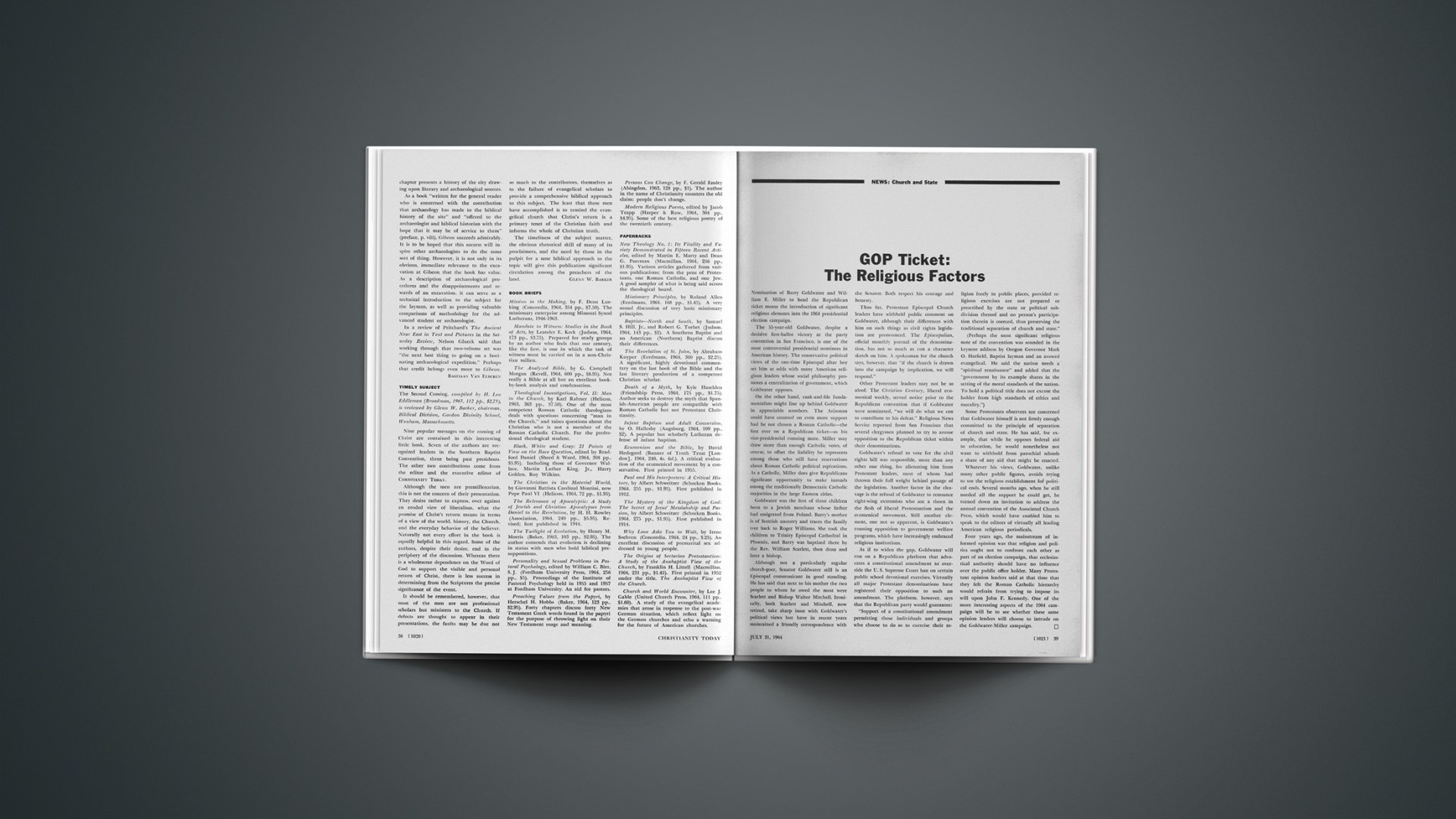
Nomination of Barry Goldwater and William E. Miller to head the Republican ticket means the introduction of significant religious elements into the 1964 presidential election campaign.

The 55-year-old Goldwater, despite a decisive first-ballot victory at the party convention in San Francisco, is one of the most controversial presidential nominees in American history. The conservative political views of the one-time Episcopal altar boy set him at odds with many American religious leaders whose social philosophy promotes a centralization of government, which Goldwater opposes.

On the other hand, rank-and-file fundamentalists might line up behind Goldwater in appreciable numbers. The Arizonan could have counted on even more support had he not chosen a Roman Catholic—the first ever on a Republican ticket—as his vice-presidential running mate. Miller may draw more than enough Catholic votes, of course, to offset the liability he represents among those who still have reservations about Roman Catholic political aspirations. As a Catholic, Miller does give Republicans significant opportunity to make inroads among the traditionally Democratic Catholic majorities in the large Eastern cities.

Goldwater was the first of three children born to a Jewish merchant whose father had emigrated from Poland. Barry’s mother is of Scottish ancestry and traces the family tree back to Roger Williams. She took the children to Trinity Episcopal Cathedral in Phoenix, and Barry was baptized there by the Rev. William Scarlett, then dean and later a bishop.

Although not a particularly regular church-goer, Senator Goldwater still is an Episcopal communicant in good standing. He has said that next to his mother the two people to whom he owed the most were Scarlett and Bishop Walter Mitchell. Ironically, both Scarlett and Mitchell, now retired, take sharp issue with Goldwater’s political views but have in recent years maintained a friendly correspondence with the Senator. Both respect his courage and honesty.

Thus far, Protestant Episcopal Church leaders have withheld public comment on Goldwater, although their differences with him on such things as civil rights legislation are pronounced. The Episcopalian, official monthly journal of the denomination, has not so much as run a character sketch on him. A spokesman for the church says, however, that “if the church is drawn into the campaign by implication, we will respond.”

Other Protestant leaders may not be so aloof. The Christian Century, liberal ecumenical weekly, served notice prior to the Republican convention that if Goldwater were nominated, “we will do what we can to contribute to his defeat.” Religious News Service reported from San Francisco that several clergymen planned to try to arouse opposition to the Republican ticket within their denominations.

Goldwater’s refusal to vote for the civil rights bill was responsible, more than any other one thing, for alienating him from Protestant leaders, most of whom had thrown their full weight behind passage of the legislation. Another factor in the cleavage is the refusal of Goldwater to renounce right-wing extremists who are a thorn in the flesh of liberal Protestantism and the ecumenical movement. Still another element, one not so apparent, is Goldwater’s running opposition to government welfare programs, which have increasingly embraced religious institutions.

As if to widen the gap, Goldwater will run on a Republican platform that advocates a constitutional amendment to override the U. S. Supreme Court ban on certain public school devotional exercises. Virtually all major Protestant denominations have registered their opposition to such an amendment. The platform, however, says that the Republican party would guarantee:

“Support of a constitutional amendment permitting those individuals and groups who choose to do so to exercise their religion freely in public places, provided religious exercises are not prepared or prescribed by the state or political subdivision thereof and no person’s participation therein is coerced, thus preserving the traditional separation of church and state.”

(Perhaps the most significant religious note of the convention was sounded in the keynote address by Oregon Governor Mark O. Hatfield, Baptist layman and an avowed evangelical. He said the nation needs a “spiritual renaissance” and added that the “government by its example shares in the setting of the moral standards of the nation. To hold a political title does not excuse the holder from high standards of ethics and morality.”)

Some Protestants observers are concerned that Goldwater himself is not firmly enough committed to the principle of separation of church and state. He has said, for example, that while he opposes federal aid to education, he would nonetheless not want to withhold from parochial schools a share of any aid that might be enacted.

Whatever his views, Goldwater, unlike many other public figures, avoids trying to use the religious establishment for political ends. Several months ago, when he still needed all the support he could get, he turned down an invitation to address the annual convention of the Associated Church Press, which would have enabled him to speak to the editors of virtually all leading American religious periodicals.

Four years ago, the mainstream of informed opinion was that religion and politics ought not to confront each other as part of an election campaign, that ecclesiastical authority should have no influence over the public office holder. Many Protestant opinion leaders said at that time that they felt the Roman Catholic hierarchy would refrain from trying to impose its will upon John F. Kennedy. One of the more interesting aspects of the 1964 campaign will be to see whether these same opinion leaders will choose to intrude on the Goldwater-Miller campaign.

About This Issue: July 31, 1964

AFRICA: CONTINENT IN CRISIS

With the help of a network of evangelical contacts, CHRISTIANITY TODAY has attempted a broad survey of the spiritual condition of the African population. A series of maps has been included to aid the reader in picturing for himself the vast potential of the continent for Christian impact.

Eutychus and His Kin: July 31, 1964

BRAIN SURGERY

As you must know (because I have told you very clearly before), the best columnist in the country is probably Bill Vaughn in Kansas City. He has had a hilarious time taking apart the television idea that any school boy would race all the way home from school, snuggle his dog with proper boyish sentimentality, and then run into the house to tell his lovely mother who has won out in the tooth-decay contest. How ridiculous could we get if we really believed any boy like that would run home with a message like that? I suppose they think we do believe it.

What ought we to think of the poor youngsters in the control experiment who were given the wrong toothpaste? Who has the right in our society to decide for the sake of “sales” some of our youngsters are to be forbidden the “right” toothpaste for their tooth-decay problem?

Almost anything today can be done in the name of science and justified because it is “experimental.” The word “experimental” is a good-sounding word, but we have to keep reminding ourselves that it lies at one end of the same spectrum that at the other end justifies some of the nauseating and blood-chilling experiments of the concentration camps during the last war.

I ask again, Who has the right to “experiment” on our children? We withdraw with a shudder from any experiment that might hurt our youngsters. This raises a question about the areas in which children may be hurt. If we cannot stand to have their bodies hurt, how can we stand to have their minds hurt? Are we extremely careful about who takes out their appendix and extremely careless about who “experiments” with their minds? What would you say about “experimental theology”? Is there a “Way” of life, and is the departure from it, however experimental, suicidal?

John Oman was a man of the sea who was at home in the little craft that traveled back and forth from the Orkney Islands to the mainland of Scotland. He said that every line on a good boat has been discovered by the sacrificed life of a good man. “Now,” he said, “for speed we have changed the lines, and we shall pay for this again in life.” Maybe some things should not be tampered with.

EUTYCHUS II

COURAGE OF A RARE KIND

George Long’s article, “One Nation, Under God,” in the July 3 issue, is prophetic and urgently needed by church members all over our nation. We are in the midst and have been for many months now of a period approaching anarchy in the thinking of many people. The widely expressed fear and hatred of the federal government, the attacks on the courts, and the branding of all individuals who do not agree as un-American, and un-Christian, simply express the state of illness in which we find ourselves. Thank you for publishing this splendid sermon.

WILLIAM M. DYAL, JR.

Director of Organization

The Christian Life Commission

Southern Baptist Convention

Nashville, Tenn.

If the Constitution of the United States of America definitely states that all powers not specifically delegated to the federal government are reserved to the various states, why should the Supreme Court consider itself competent to reach decisions that contradict this assertion. After all, the United States of America was one nation under God for a considerable period when the federal government and the rulings of the Supreme Court considered it to lie in keeping with both the letter and the spirit of the Constitution, that the various states be the final authority in certain matters. It would appear from across the border that if the original agreement is not now the desire of the parties concerned, that it be altered, not by courts twisting the meaning of words, but by congressional action.

R. KEITH EARLS

Cobden, Ont.

Congratulations.… The author shows intelligence and courage of a rare kind.

I must say I find it something of a mystery that professing Christians can be unconcerned about freedom and justice for all, or shut their church doors to those of a certain shade of skin, or honor those who defy our government, or encourage hate and murder, or seem to have no interest in seeking the Kingdom of God and his righteousness.

Apparently it is much easier to be conformed to this world than to put Christ above human customs and traditions.

DONALD T. KAUFFMAN

Westwood, N. J.

AMERICA

“The American Revolution: Revolutionary or Liberative?” in the July 3 issue was an excellent analysis of the religious foundations of the United States. The article, “Woodrow Wilson: Christian in Government,” raised many unanswered questions. My conclusion is that William J. Bryan was a far greater Christian witness in government than was Wilson. Bryan was one of the greatest Christian statesmen of the twentieth century. I felt the author’s reference to Bryan was discourteous and inaccurate.…

RAY ROWE

Edmonds, Wash.

S. Richey Kamm finds both the ends and the means of the American Revolution good—are they?

The ends are a “biblically oriented concept of freedom” with a “Calvinistic … separation of state and church.” Indentification is sought in the Israel of Moses, not of Christ. In Christ’s Israel, “vengeance is mine, I will repay saith the Lord”; “be not overcome of evil, but overcome evil with good”; “ye have heard that it hath been said … but I say unto you.…”

Is not “the final authority” (even for political function, if any) from the Creator for this new creation—“Submit yourselves to every ordinance of man for the Lord’s sake”.…

The means are “divine assistance in all of the colonies” and “the biblical psychology of emancipation.”

But the Bible says, “The weapons of our warfare are not carnal …” and “they that take the sword shall perish with the sword.” “My kingdom is not of this world therefore.…” The sword for the disciple resides now in the sheath for “not all things are put under him.”

The Bible says, “Peace I leave with you, peace I give unto you, not as the world giveth, give I unto you.” Abolition of war, though worthy, is not assured (Mark 13:5–10).…

Like teaching and health, government can be better. Is less than the best tyranny? What government is free of it? When is tyranny severe enough to call forth another with likewise some measure of tyranny? Where does the Word sanction “resistance to all forms of tyranny through responsible representatives by laws of God and the laws of nature”?

Therefore the third question: Are the ends and the means of the American Revolution (or any revolution) good? What one really wishes to know: How does God see it? The answer the evangelical believer gives determines how he fits into his society, into the citizenry, and into the local brand of patriotism.…

ELAM S. KURTZ

Lansing, N. C.

HIGHWAYS—UNHAPPY WAYS

Please accept my deep appreciation of your editorial “Peril on the Highways” (July 3 issue). Your frank and forthright stand on so many issues of public life that affect us all is to be commended.

But what can be done to get action? It is my honest opinion that a misguided leniency on the part of many of our traffic courts adds to the already frightening amount of irresponsible drivers.

While the violator does have (and should have) all protection under the law, the victim and the public should at least be entitled to equal protection. This seems to be missing in so many cases.…

GEORGE C. KREBS

St. Petri Evangelical Lutheran Church

Minneapolis, Minn.

VALIANT SERVANTS

I wish to thank Mr. L. Nelson Bell for his article (A Layman and His Faith, July 3 issue) on “The Forgotten Man”—the chaplain. I have had contacts with chaplains, and I know the trials they have. I am … a Gideon, and it is my privilege to hand out Testaments with other Gideons at the Induction Center here in Minnesota. This past year we gave out 13,300 Testaments to servicemen and women, and this is being done all over the United States at induction centers.… Many a boy never had a Testament before.… There is many a man who is preaching the Gospel, doing missionary work, teaching Sunday school, and so on, because [of] what a chaplain has done for him or what a Testament has done for him.… Pray for the boys.… As they leave home they step from childhood into manhood with greater temptations than ever before.…

VINCE HERMSTAD

Minneapolis, Minn.

The article … was excellent.

Churchmen of every denomination ought to thank God for the many valiant servants of the Lord who carry on so manfully in an often forgotten ministry.

ARTHUR M. WEBER

Armed Services Commission.

The Lutheran Church—Missouri Synod

Washington, D. C.

TEACHER FROM AFAR

When I read the announcement (The Minister’s Workshop, July 3 issue) concerning the retirement of Andrew W. Blackwood from [some of] his responsibilities with CHRISTIANITY TODAY, it was necessary that I write this letter.

Although I never sat in any of Dr. Blackwood’s classes, I can say that I studied under him and got as much from him as I did from any other one man. It was in 1946, upon my return from overseas and discharge from the Army Air Force, that I was introduced to … his writings. During the military service, I came into contact with a fine group of people in Nebraska, and it was in that state I completed my undergraduate education. I accepted an appointment with the Nebraska Annual Conference of The Methodist Church as a student pastor.…

When one has a church on his hands and two years of college yet to complete, he tries to find help. My help came from a number of books written by Andrew Blackwood. His Pastoral Work and Planning a Year’s Pulpit Work and others filled a gap and helped me through a very difficult time. Some years after that I wrote to him and thanked him. He took time out from his busy schedule to write a note to me. It was not until years later that I was able to meet him.…

ROBERT L. WENDT

Assoc. Prof. of Sociology and Economics

Salem College

Winston-Salem, N. C.

LOCATING THE SCANDAL

“Reunion and Reformation,” by Franz Hildebrandt (June 19 issue), was worth the one-year subscription price. It put the difference between Rome and the Protestant in the right perspective. May I quote one statement from the article: “The ecumenical lessons to be drawn from all this are obvious. First, the scandal of our divisions is not, as we are persistently told to believe, the mere existence of separate denominations as such.… The real scandal, right across all denominations … is the absence of the Gospel from our pulpits … that makes it impossible for men to hear what the Spirit says unto the churches.”

Who has not listened to sermons of men who seem to be blind leaders, who feed the church with stones instead of bread.

May all our hearts weep [over] this great scandal and [may we] do something about [it].

D. KORT

Oaklawn, Ill.

Reformation and reunion will truly be hastened as the people of God listen to the voice of the Spirit in the Word in the measure which this article suggests.…

WALDO J. WERNING

Exec. Sec. of Stewardship and Missions

Southern Nebraska District

The Lutheran Church—Missouri Synod

Lincoln, Neb.

HE WAS METHODICAL

I feel sure that Methodism would be pleased to own Charles E. Jefferson as one of its great preachers (“Have Ye Not Read?,” June 19 issue). Jefferson was not a Methodist, however. He was a Methodical Congregationalist.

JOHN LEWIS GILMORE

Miner Congregational Church

Wilkes-Barre, Pa.

THE BECKER AMENDMENT

I find that your cogent cognitive analysis compels respect when you deal with such an explosive issue as the Becker amendment, (Editorials, June 19 issue) even though I judge your conclusions to be unapplicable. You presuppose an honest, not a surreptitious, neutrality. Ambiguous decisions of the Supreme Court preclude a “true neutrality.”

ALEXANDER BODA

Cambridge, Md.

May one who has hitherto followed you with great appreciation question two of your statements in your editorial on the Becker amendment.

You state that the Supreme Court did not remove all prayers from the public schools. Is not that an ambiguous statement? Did not the court forbid all prayers in matters that were before the court? It is the hope of some of us that the court did not forbid prayers of a voluntary nature advocated by the local community. But if so, it was because the issue of such prayers was not before the court.

Again you state that in our history no amendment to the Bill of Rights has ever been adopted. But you well know that the Fourteenth Amendment has radically amended the Bill of Rights. Under the First Amendment as written prayers provided by a state could not have been ruled out by the federal Supreme Court. This was only possible because the First Amendment was amended by the Fourteenth. The Tenth Amendment has been virtually emasculated by the Fourteenth Amendment. The rights reserved to the states by the Tenth Amendment are being constantly absorbed by the federal government under the Fourteenth Amendment as interpreted by the current Supreme Court.…

WM. CHILDS ROBINSON

Columbia Theological Seminary

Decatur, Ga.

• In answer to Dr. Robinson’s first question, it does not seem ambiguous to us to say that the Supreme Court did not remove all prayers from the public schools. As we have studied the decisions, they seem to be directed at the practice of a state body’s writing a prayer and prescribing its use and state or other official authority’s prescribing devotional exercises.

We recognize the force of what Dr. Robinson says about the amendment of the Bill of Rights. Technically our statement was correct.—ED.

COLLEGIANS AND MORALS

Thank you for the presentation of “The Morals Revolution and the Christian College,” by David McKenna (June 19 issue). It was a pleasure to note that the president of a Christian college regards his students as more than uninformed and unimaginative graduates of nineteenth-century Sunday schools.

This revolution in morality presents problems that the Christian student must solve with his own spiritual and intellectual resources. His attitudes must be personal. Four years of indoctrination at the level of the Christian college and Bible school have often produced deplorable results. Let the college administration prepare a wholesome and complete environment, but then grant the students freedom of thought and expression to meet the challenge which is by far more their struggle than that of their parents, pastors, or professors.

ROGER W. BROBERG

Storrs, Conn.

The assumption is that the less restricted sexual expression of the present day is a much worse sin than the constricted and distorted sexual expression of Victorian times. The neglected fact is that both are sin and probably bring an equal amount of human suffering. Sex is neutral; what makes it good or bad like any other aspect of human behavior is the motivation behind it. What characterizes the “freer” sex of today is that it is extremely selfish. The emphasis is on the individual erotic pleasure with little regard for the immediate or long-term effects on the other person.

Though the author raises the essential question he comes no closer to solving it. How will he promote better self-initiated self-control in the adolescent who is confronted with social stimulation from without and a very forceful desire from within, and at the same time leave the individual with a mental set which allows him to thoroughly enjoy healthy sex in marriage? Sexual expression is a part of the whole person who is patterned mainly before the age of five. It seems unlikely that lectures to college students will help them very much. Done wisely they may become better parents and thus promote in the next generation healthy controlled sex.

The pendulum of society’s attitude to sex has swung from era to era and too often drawn Christian thinking behind it. The Christian attitude should be that sex is not only a necessary aspect of human biologic function but a joy and pleasure for which God should be thanked. It should never have been that sex was regarded as dirty and indecent by Christians, something hidden and feared. It should always have been something that within the bounds of marriage and under the law of love a Christian so enjoyed that he sang his praise to God and prayed his thanks while having intercourse.

P. G. NEY, M.D.

Montreal, Que.

BUT POLLSTERS ARE IN ILL REPUTE

I note with amusement that Elton Crowson, in his letter decrying the civil rights resolution recently passed by the National Association of Evangelicals, writes (Eutychus, June 19 issue): “No group of a few hundred individuals can fairly and honestly represent a nation-wide constituency on such a controversial secular matter and it was arrogant effrontery for them to pretend to do so.”

He then assures us personally that the Evangelical Methodist Church “does not join its voice in such an expression.”

I wonder if Mr. Crowson polled the entire membership of the Evangelical Methodist Church and received 100 per cent approval before he spoke with such certainty in its behalf.

Or, perhaps, the title “Publicity Chairman” gives him a special divine dispensation to speak in behalf of a church which is withheld from a council of churchmen.

DON MCEVOY

Decatur, Ga.

FOR THE MORMONS, LOVE

In your June 19 issue in the article on “The Latter-day Saints Today” (Books in Review), I noticed two errors that quickly indicate to a Mormon that someone is not very familiar with his subject:

1. Elder is not the lowest rank in the Aaronic priesthood; a deacon is. Elder is the lowest “rank” in the Melchizedek priesthood.

2. The issue on the baptism for the dead is found in First Corinthians 15:29, not 15:24.…

I am sure the author had the best of intent, but I am acutely aware that what is needed more than books about these people is godly love for them. In the years that I have been away from the L.D.S. Church I have yet to see one Mormon moved by the reasonings I was able to bring against him (even though I was one with them). Many have I seen touched by His love for them though.

JOHN W. KUTZ

Bellevue, Wash.

THE LIVING END!

Re: Current Religious Thought, June 5 issue. “The pastorate itself is the live end of the whole church enterprise.”

Really! There is the M. U., the men’s fellowship, the Sunday school teachers.

A little more humility, Mr. A. H. Leitch!

S. G. QUILTER

London, England

HOMILY PLUS HUMILITY

I found William Samarin (“A Layman Speaks to the Pulpit,” June 5 issue) admirably facing up to one of the most serious problems of the Christian Church today when he laments “that we often tolerate an abundance of nonsense to get a few specks of substance.”

We evangelicals have spent too much time and energy berating the emptiness of the preaching in liberal pulpits. Indeed one standard of “sound gospel preaching” has been that which does little but boast about how much better we are than the liberal church across the street. But more disturbing than this shallow form of evangelicalism is much of that which masquerades as “deep” and “Spirit-filled.” This preaching claims to be doctrinally sound and scripturally commanded but is, in the words of Samarin, “irrelevant today because, although biblicistic, it fails to be truly and powerfully biblical.” It appears to speak with the voice of authority but gives forth nothing but words, words of no relevancy to the real, daily spiritual problems of the members of the congregation. It often exhibits gross negligence in preparation, with less substance than one would get from a layman with no theological training. Worst of all is that, although it encourages the rustling of Bible pages during the sermon, its message is nearly as vague and unbiblical as that of the existentialists they claim to abhor.…

Certainly, most of us who are teachers by profession recognize that there is always room for improvement in our teaching, especially when a class doesn’t seem to come up to our expectations. Certainly we ought to expect at least this degree of humility from the man in the pulpit.

WILBUR L. BULLOCK

Professor of Zoology

University of New Hampshire

Durham, N. H.

He makes the statement: “The sheep, more discriminating than they are often given credit for being, are not responsible for the present situation.” I would like to disagree with this statement. All of us as pastors would like to preach better sermons. We would like to spend more time in the study, searching the Word of God and finding truths that are relevant to the present situation; but when our laymen and laywomen in the church keep us occupied with guilds, fellowships, committees, commissions, and an endless round of unnecessary calls, we find our time is greatly diminished. Many a faithful pastor I know wants to be a prophet in his pulpit, but he has to spend too much time “playing politics” with his church boards to get his program across.

WARREN W. WIERSBE

Calvary Baptist

Covington, Ky.

Permit … a few observations on the subject by a layman who agrees that “when preachers reject logic for the questionable purpose of getting their point across, they do an injustice to the Word of God, insult the intelligence of the audience, and fail in what they ought to do”!

Empty pews! Echoing wooden pews! The nightmare of the preacher, the despair of church boards, profitable copy for magazine writers, an economic waste! Some say it is the tendency of our day, the symbol of irresponsibility of a moving-picture and TV mentality. Christ crucified afresh each Sunday on hard, wooden, empty church pews, yards of them.…

Why do we have empty pews? Why does the multitude pass by? Is this not a challenge to ministers to improve the quality of their sermons?…

Too many sermons are blighted with a blasting and a mildew, are “sickl’d o’er with the pale cast of thought,” differing one from another by delicate shades of monotony.…

In general, preaching is not composed of certain pious commonplaces wrapped in a pleasing or catchy form. It is not merely telling an audience what they already know. If it were that, there is perhaps no office or function that would require less strain of intellect, less labor of preparation. It is something nobler. The sermon is meant to be arrestive, illuminative. It is meant to instruct men, to lead them into ever-enlarging views of truths that evoke richer life, truths that enclose the Gospel in its magnitude and majesty. It is meant to transform by the renewing of the mind. We have no belief in anything doing good except the truth. But it is quite absurd to expect that God’s Spirit will greatly bless superficial, unreasoned, feathery presentations of truth that lack a serious, substantial prophetic message!…

JOHN F. PALM

McGregor, Minn.

THE PEACE CORPS

The editorial … “Religion and the Peace Corps” … in the April 24 issue has been brought to my attention.

It has always been basic Peace Corps policy that Volunteers are not to engage in religious proselytizing. It has also been basic to the Peace Corps that Volunteers not be compelled, because of the nature of their assignments, to participate in religious observances contrary to their own faiths. We respect the freedom of a Peace Corps Volunteer to hold his own religious convictions. We insist, however, that Volunteers behave in a manner which will not violate the standards of the institutions to which they are assigned.

These policies are made clear to Volunteers in their training. They are discussed with Volunteers overseas. They are also discussed with the institutions which will be employing Volunteers. If a headmaster or mission head should object to the behavior of a Volunteer, the matter would be promptly investigated by the in-country Peace Corps Representative, who has the power to reprimand or remove the offending teacher.

It is quite true that some Volunteers are not committed to Christian truths as they are understood in the mission school where the Volunteer may be working. For example, some Volunteers may be Jewish or agnostic. To a missionary of one denomination a Volunteer of another church may not seem to be committed to Christian truths as the missionary understands them. It is out of this context that our Peace Corps policy of having no religious tests has come.

The service of every Volunteer in the Cameroon has been requested by the government of the Cameroon. These Volunteers are working under the supervision of the Ministry of Education to fill a critical teacher shortage. They are also helping the government to develop its corps of qualified teachers.

In West Cameroon, as in many parts of Africa, schools founded and operated by missionary groups constitute the major segment of the public school system. The government of the Cameroon supervises their curricula, helps direct their operations, and supports them financially. It prescribes examination standards. Each school is required to be open to all regardless of religious affiliation.

Peace Corps Volunteers are assigned to schools in the Cameroon by the Ministry of Education, in consultation with the individual school and the Peace Corps Representative. In no case is the religious affiliation of the school or of the Volunteer to be taken into account in making assignments. Many Volunteers are assigned to schools with religious affiliations, but there is no other way of responding to Africa’s urgent need for Peace Corps Volunteer teachers.

It is true that most of our Volunteers are young. Many indeed are teaching for the first time. But before they are assigned, the government of the Cameroon Republic is told of their qualifications and participates in their selection.

In no instance is a Peace Corps Volunteer holding a job that could be filled by a Cameroonian teacher deemed qualified by his own government. In reviewing the work of the Volunteers, the West Cameroon Director of Education, the Honorable A. D. Mengot, recently stated: “Their [the Volunteers’] arrival has permitted us to open ten new secondary and teacher training schools and greatly expand the enrollment of existing ones.”

For a Volunteer to hold a position that could be filled by a Cameroonian teacher deemed qualified by his own government would be a contradiction of Peace Corps purposes. The government of the Cameroon has formally requested the Peace Corps to supply more teachers to West Cameroon this year. Before sending this request to Washington, our field staff discussed it fully with school directors, mission officials, and members of the Cameroon government. It is difficult to see how responding to requests of this kind could be considered “dumping.”

I would agree that many Volunteers are “finding themselves” in Peace Corps service. I would suggest, however, that this is in keeping with one of the goals of the Peace Corps—that of getting to know peoples of other lands, acquiring a sense of another culture, and growing in the context of this learning.

SARGENT SHRIVER

Director

Peace Corps

Washington, D. C.

• The editorial to which Mr. Shriver refers was written by a member of our staff on the basis of on-the-spot interviews in West Africa. We appreciate Mr. Shriver’s enlightening comment on the problem in West Cameroon.—ED.

Ideas

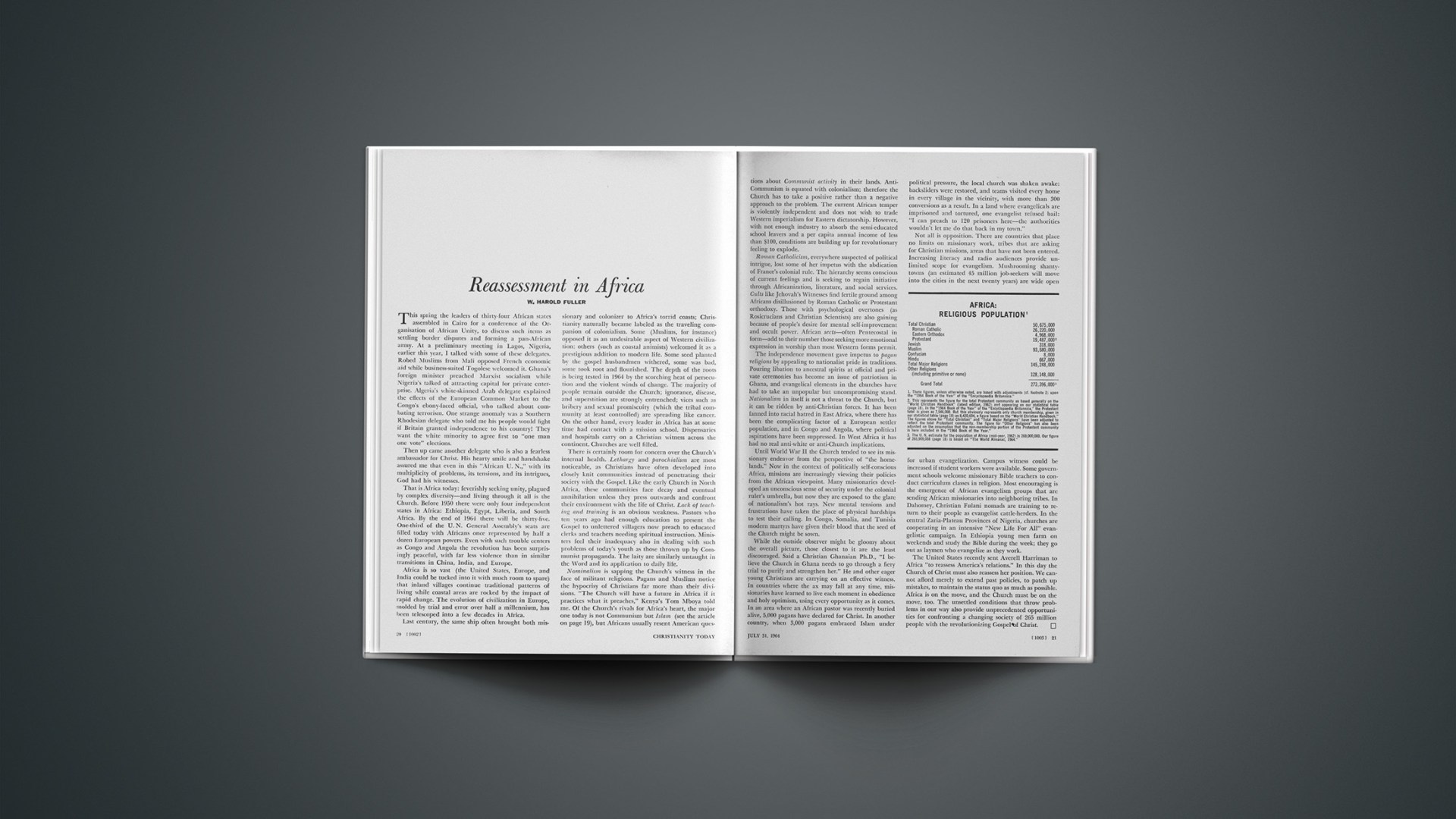
Continent in Crisis

The swift and bewildering changes in a continent nearly four times as large as the United States might well deter the observer from rash pronouncement on Africa’s future. Thirty-one new states within a mere fourteen years have brought a host of new and complex problems. An estimated 7,000 people lost their lives after Zanzibar became independent. On the other coast of the continent is a president who, regarding himself as an African Lenin, is trying to revise Marxism in the light of his country’s needs. In South Africa the policy of apartheid sanctioned a Cape Town advocate’s 168 days’ detention in solitary confinement without his having been charged with any offense. Further north is a country which achieved autonomy this month, and in which many people have already been killed through the enforcement of a one-party system of government.

What now is the Church’s role? Mr. Aston King, editor of Monrovia’s The Liberian Age, told Dr. Carl F. H. Henry of CHRISTIANITY TODAY: “The African continent is a ship without a rudder and compass. If it aspires only to material gains, and is not guided by Christian principles, it will be headed swiftly for the fate that overtook the Roman Empire. There are definite signs of moral deterioration. The Church of Christ is not aggressive enough in the life of the nation; especially does it lack a program for young people. But it is not too late for the churches. Their challenge is to reach the ordinary man with the understanding that Christianity is a way of life—not just a one-day-a-week affair, not merely a set of rules … but rather the finding of one’s complete self-fulfillment in Jesus Christ.”

A similar interview recorded some words of Mr. Ernest K. Martin, educational secretary of Cameroons Baptist Mission in Soppo, descendant of a Creole tribal chief, former member of the Cameroons Legislative Assembly, and a fourth-generation Christian. “Africa is in the balances,” he declared, “and which way it will go is difficult to say. But the only saving grace for Africa will be a strong commitment to Christian principles. Where Christianity is firmly rooted one finds stability and hope. The spread of Christianity holds the key to the future of the African continent. The missionaries should increase rather than relax their efforts.”

Such efforts are at present complicated by a number of factors. There is tension between evangelical missions and the ecumenists. The latter point up the divisions among churches (or missions) and their failure to accelerate Africanization. Their aim is to substitute for mission leaders the best ecumenical foreigners and carefully chosen nationals who are offered travel and study fellowships at certain centers abroad. The trouble is that most African leaders have not yet had to carry on doctrinal battle of any kind and therefore do not always see the need to contend for the faith. This discernment may come in time, but meanwhile in the wake of independence may ensue a confusing period when the strongest evangelicals are harassed by a rather reckless ecumenicity that disowns the missions, foreign bishops, and so on. This will be justified on the ground that Africans can best be reached through indigenous missionaries, and that Communism and Islam have already profited from having learned this lesson.

On the importance of trained African Christian leadership, Dr. Ben Marais of Pretoria University says: “In some African countries … leaders are drawing away from the Church … because the church leadership is not educated and alive enough to hold the interest of these men. This may increasingly happen if the leadership of the Church is not more informed and better equipped for its task. The Roman Catholic Church was quicker to grasp the significance of this.…”

A further snag stems front African Christian disappointment with the Church: that she has not trained her members in political action as one element in the life of citizenship and has tended to give the impression that Christianity is a simple alternative to political action in this world. In some oddly prophetic words thirty-eight years ago at a missionary conference in Southern Rhodesia, the Rev. John White said: “Have we nothing to say to our people about the right solution of these problems with which they are suddenly confronted? We have preached to them Jesus. Have we nothing to tell them about the spirit in which he would meet these difficulties and the implications of his teaching on their settlement? I think Paul would have considered any other interpretation of his ministry much too restricted.…”

This is not to deny the tremendous debt that Africa owes to missions. Many of the new national leaders are mission-trained. Independence for so many of these lands would not have been possible without the Christian teaching on the worth of the individual, his place in society, his direct relationship to God. But the Church must waste no time looking backward merely to point this out. New problems are waiting to be solved. The need is desperate. Dr. James Denney’s words on Asia half a century ago are relevant to the modern Africa: “What a frightful prospect it would open up,” said the Scots divine, “if the vast populations … should master the resources of Christian civilization and be left with none but pagan impulses to direct them!”

For two centuries ships have been bringing to Africa books from Europe. Apart from Scriptures in the vernacular, the type of books sent has often displayed a dismal lack of imagination. Even today in many parts of Africa, textbooks are being read laboriously in stifling hot classrooms, giving exercises in grammar concerned with snow and scarves. In history classes King Alfred is still burning the cakes; in nature study the sturdy old English oak gets frequent mention—and generations of pupils are hindered from gaining real understanding of their lessons. Most big secular publishers abroad are now sending textbooks written in Africa by those conversant with conditions there, but what Christian books are being unloaded from those same ships? They are the same books that have been written in England for English eyes, with few exceptions. The one who is Lord in the context of snow and scarves in Birmingham needs to be shown vividly as Lord also in an overpoweringly hot office in Lagos or in a kitchen in Mombasa. There is need to deal with the old traditional concepts in Africa about God and nature, man and the spirit world, which are deeply rooted in the minds of even Christian Africans. This calls for nothing less than African Christian thinking, and for research into actual situations in African social, economic, and political life today and their interpretation in the light of Scripture. These are the aims of the African Christian Press, recently established in Kumasi, Ghana.

Nowhere does money given to the Lord’s work go farther than in missions. For example, in America it would cost about $250,000 to endow a theological professorship; in Egypt it can be done for $15,000. Even a very modest library in America would cost about $75,000 or $100,000; in Cameroon it can be built for $7,500. Here is a list of eight practical needs on the mission fields of Africa whose fulfillment would help to set ahead the evangelical Christian witness:

1. Cameroon: $7,500 to build a library for Saker College, a secondary school for girls, with an expected enrollment of 350 by September of 1965. Location: Victoria, West Cameroon. Sponsor: North American Baptist Conference, 7308 West Madison Street, Forest Park, Illinois.

2. Egypt: $15,000 to endow the chair of theology for a fulltime national professor in the Evangelical Theological Seminary of Cairo, which is owned and administered by the Synod of the Nile under the Coptic (Egyptian) Evangelical Church. Sponsor: Commission on Ecumenical Mission and Relations, Presbyterian Church in the U. S. A., 475 Riverside Drive, New York, New York.

3. Kenya: $10,000 to provide transportation and meals for an East African pastors’ conference for the 300 ordained African ministers of Uganda, Tanganyika, and Kenya, to assist them in developing spiritual growth at grass roots. Location: probably Nairobi, Kenya. Requested sponsor: World Vision, P.O. Box 1, Pasadena, California.

4. Liberia: $10,000 for additional equipment and supplies for the newly dedicated hospital serving Liberian nationals at Radio Village, ELWA. Location: Monrovia, Liberia. Sponsor: Sudan Interior Mission, 164 West 74th Street, New York, New York.

5. French literature: $10,000 launching fund (buildings and equipment) for Champion, new French counterpart of Africa Challenge, aimed at evangelizing French readers among 60 million in French-African countries. Thirty-five thousand copies of an experimental issue have been distributed. Location: Niger-Challenge Press, Private Mailbag 2067, Lagos, Nigeria. Sponsor: Sudan Interior Mission, 164 West 74th Street, New York, New York.

6. South Africa: $15,000 for a revolving fund to build five churches for Eurafricans in specially designated colored townships. Location: outside Johannesburg, South Africa. Sponsor: Evangelical Alliance Mission, 2845 West McLean Avenue, Chicago 47, Illinois.

7. The Arab world: $15,000 for the translation and publication in Arabic of noteworthy evangelical theological works. Sponsor: Arabic Literature Mission (formerly Nile Mission Press), Box 5439, Beirut, Lebanon. Also $10,000 for Arabic evangelical magazine for Muslims in North Africa. Sponsor: Moody Literature Mission, 820 N. LaSalle Street, Chicago 10, Illinois.

8. Bible translation: $10,000 to assist in the completion of the translation and production of the Lingala Bible which together with Scriptures in other Congolese languages is urgently requested by the chief of chaplains of the Congolese armed forces. Lingala is the language most widely used by the army. Sponsor: American Bible Society, 450 Park Avenue, New York 22, New York.

Malawi: Another New Nation

The world’s population explosion is paralleled by an explosion in the birthrate of new nations. Since 1950 Africa alone has borne more than thirty new, free, independent nations. This month out of her social and political travail another independent country began life.

The thirty-first new nation is Malawi, the name given to what under seventy-three years of British rule was known as Nyasaland. Amid the din of cheers, stomping, and dancing, political control passed from the country’s minority of about 9,000 whites to over three million Negroes. Her first prime minister, Dr. H. Kamuzu Banda, has no illusions about the country’s difficulties stemming from “ignorance, poverty, and disease.” But he was confident she would act in freedom. Under what he termed a policy of “Discretionary Non-alignment,” he promised to follow now the East and now the West, whichever does what is right and good for his country.

The mysteries of the world’s population explosion remain shrouded despite scientific investigation. But while the explosive birth of free nations is a complex of social and political travail, the cause of the explosion is not hidden. For centuries most of Africa slumbered on the banks of world history, unperturbed by the stormy rush of world affairs. Much of the great continent had little awareness of the past and little sense of future destiny. Almost without past or future, great sections of Africa lived in a dreamlike present.

And then the disturbance came in the person of the missionary who proclaimed that man came from God and had been met by God in Jesus Christ, the Christ who delivers man from his past and opens for him an authentic future. This Gospel infused a dynamic into Africa’s present, and this dynamic accounts for her turmoil today. It was not from official pronouncements of ecclesiastical conventions that the African learned of human dignity and the right of men to be free, but from the missionaries of the Cross who proclaimed salvation through Jesus Christ.

Malawi is a case in point. According to the Encyclopaedia Britannica, Nyasaland was not open to Europeans until the arrival of the pioneer missionary, David Livingstone, on September 16, 1859. Although only 11 per cent of her population is classified as Christian, the yeast of the Gospel permeated her masses until today they have demanded their freedom and obtained their right of self-determination.

Having learned from the preaching and teaching of Christian missionaries about human dignity and the right of a people to self-determination, Africa awoke from her slumber and began to stir. None should understand the ferment of social and political unrest in Africa better than the Church. Awake to freedom, Africa sees her poverty, ignorance, and disease for what they are, something that free men can do something about.

We hope and pray that Malawi will recognize the source of her freedom. If she does, she will reject those offers for the elimination of her poverty and disease that, once accepted, would wither the roots from which her newfound freedom stems.

Value Is Where You Find It

In a society greedy for the external symbols of success, it is refreshing to hear of James J. Fahey, a suburban Boston garbage-collector. He has written a sensitive portrayal of the Pacific War as seen through the eye of a sailor. Published a year ago, the book is now going into a sixth printing; a paperback publisher plans a million paperbacks, and the author is being approached by motion-picture companies for screen rights.

Fahey’s book brought him to the White House and brings him a continual stream of invitations to literary teas on Beacon Hill and cocktail parties at Boston’s Ritz. He declines the invitations, not because he is a non-drinker—which he is—but because he is just too busy. Doing what? His job, collecting garbage. He claims that he is not an author and that his book was a “literary freak.” In spite of the carrot of success that dangles so temptingly before his eyes, he says, “I’ve been a garbage man for the city of Waltham for fourteen years. I still drive a garbage truck and, I guess, I always will until I retire with my civil service pension.” He lives on a take-home income of less than ninety dollars a week; his thousands of dollars in royalties have been donated for the erection of a Roman Catholic church in South India.

Fahey will soon go to New York to receive a special award as “Garbage Man of the Year.” He vetoed the proposed title of “Sanitation Man of the Year” on the ground that the kids on his route say, “ ‘Hey, Mom, here comes the garbage man.’ They don’t say, ‘Here comes the sanitation man.’ ”

The likes of such a man one does not often see. His recognition of the dignity of life’s common tasks would make him a good son of the Reformation, and his sense of values is considerably more perceptive than that of success-hungry people—certainly more perceptive than that of the fifteen publishers who rejected his manuscript. If the book reflects the values of this garbage man, it should be a good book. Value is where you find it, and that is often not where men think it is. Many a parent, and many a minister, wishes he could get this point across to young people before whose eyes our culture hangs so many symbols of value that are as phony as they are deceptively attractive.

Honest Before God

Christians need to be honest to God and honest before God. One of the best ways to determine one’s honesty before God is to examine one’s giving for the propagation of the Gospel to the ends of the earth. When this is done, it becomes woefully apparent that there is not much honesty before God in financial matters having to do with missionary endeavor.

According to the latest statistics published by the Department of Stewardship and Benevolence of the National Council of Churches, the per capita missionary giving of almost 41 million church members was $2.16 a year. This brought to almost $88 million the amount given by these church members for foreign missions in 1962.

The $2.16 figure means that the average church member gave approximately four cents a week for foreign missions. But this does not tell the whole story. The per capita average of the American Baptist Convention was $1.75. For the Southern Baptist Convention it was $1.87. The Methodist Church averaged $1.46. The United Presbyterian Church in the U. S. A. averaged $3.20. The giving of the Protestant Episcopal Church was $1.72 per member.

Some of the smaller denominations gave far more liberally. The Christian and Missionary Alliance per capita missionary giving was $55.26; the Evangelical Free Church, $32.36. The Evangelical Mennonite Church figure was $34.29, and the Free Methodist Church, $16.86.

Statistics can always be abused. But it seems that denominational bigness does not beget a corresponding bigness in giving for foreign missions. Almost without exception the small denominations outdid the large ones in foreign missionary giving. The large denominations might do well to ascertain the reasons for their small missionary giving and then do something about challenging their people to give more liberally for such an important cause.

There is no reason but apathy why missionary giving cannot be trebled in a few years. And if it is trebled, it will still be far from truly sacrificial giving by the Christian public. Perhaps the blessing of God is being withheld because of niggardliness about an essential part of the witness of the Church.

When Streets Are Unsafe

Public apathy toward a growing spirit of lawlessness in the United States is an appalling reflection upon the citizenry.

No informed person can deny that widespread disrespect for civil authority, a wholesale flaunting of established ordinances, and lagging law enforcement and judicial corrective are common to many American metropolitan centers. Habitual offenders openly taunt the public in general and police in particular. In Washington, D. C., recently, an alien from Albania shot a young policeman to death; the alien was under deportation orders reportedly unenforceable because the United States does not have diplomatic relations with Albania.

The cliché, “You can’t even walk the streets,” reminds the Bible student of ancient Israel, where “the highways were unoccupied, and the travellers walked through byways” (Judges 5:6) to escape violence. Yet the lack of concern over the crime rate is deeply distressing. The attitude attributed to the Laodiceans, “I am rich, I have prospered, and I need nothing” (Rev. 3:17), seems to underlie much of this lack of social sensitivity. A people lacking moral indignation and spiritual aspiration may have material abundance; yet they are not mere spectators of a declining culture but contributors to its decline.

In a democracy, one of the consequences of mass irresponsibility with offenders’ gaining the upper hand is loss of freedom as the public tends in desperation to take matters into its own hands. This is exactly what has happened in the Crown Heights section of Brooklyn, where crime became so rampant that the ultra-conservative Hasidic Jewish community organized a dusk-to-dawn citizens’ patrol.

We have some serious reservations about such an arrangement, particularly regarding the possibility of providing a bad precedent for taking the law into one’s own hands. But we command the motivation of the leader, the young Rabbi Samuel Shrage, and we believe it is to the credit of the contemporary “Maccabees” that the area has seen a 90 per cent reduction in muggings, assaults, and robberies. As additional police now in training are assigned, the citizens’ patrol plans to disband, and in this it is in contrast with such anti-social and sub rosa groups as the Ku Klux Klan. We shall hope that the new condition of peace in Crown Heights will continue.

Needed—A Third Voice

The broad direction of American politics in recent decades has occasioned mounting criticism and determined dissent. Only through awareness of such discontents can one understand the Republican nomination of Senator Barry Goldwater as a presidential standard-bearer. The Democratic nomination of President Lyndon Johnson, a foregone conclusion, promises a heated debate in months ahead on the very essentials of American political philosophy. Every four years American voters declare an “open season” on politicians and their parties. While the verbal pyrotechnics of a campaign usually astonish European neighbors, free exchange of conviction almost always effects a welcome catharsis.

Of the dire need of reformation of political life there can be little doubt. Nor may this need be confined to such features as centralization of political power, expansion of government bureaucracy, the evils of inflation, and a protective attitude toward moral corruption in office. These concerns are serious indeed, and sensitive leaders in both parties will be properly disturbed about them. But if an evangelical Protestant may speak his mind, the current critique of American political manifestations does not strike down to the roots. Both those who condemn extremists and the extremists themselves fail to go deeply enough.

The American political scene desperately calls for a renewal of commitment to those principles of enduring social morality that make for national greatness. We do not speak of a “Christian political party.” Nor do we have in mind advocacy of a “Christian amendment.” But neither has a political “hands off” policy anything to commend it. The political debate needs to be lifted to a higher level of social and ethical concern, and evangelical Christians who are politically informed are best equipped to do this. America’s two-party system exists neither through biblical necessity nor through historical inevitability, but through a highly serviceable political philosophy. Today it needs a third voice to speak out and remind all candidates that God wears no party button and that the Ten Commandments and the Sermon on the Mount were not drawn up by a platform committee.

Historically, our nation is rooted in the Judeo-Christian ethic. To render its highest and most ennobling service, this ethic must be taken seriously by a people and reflected honestly in the utterances and lives of her spokesmen, the politicians. Religious verbalism and professional piety are not enough. An infinite God cannot be contained within the postscript to a campaign speech.

Theology

Lost Perspective

The church is in dancer. In her zeal to make herself “relevant” to the modern world’s predicament she is becoming irrelevant to man’s greatest need. In her zeal to become “involved” in the secular order she has become involved in its disorder. In her zeal to “evangelize” she has lost sight of the Evangel. And in her concern for the needs of mankind she is offering a mess of temporal pottage rather than the Bread of Life without which no man can live.

Recently the writer spent nearly two months out of the country. During that time most of the major denominations held their annual meetings. Almost all of these meetings seem to have been primarily preoccupied with sociological matters.

We witnessed some of the student riots in Korea, sensed something of the tensions of Southeast Asia as we flew over South Viet Nam and Laos, and saw a little of the spiritual indifference that is part of a prosperous and secularized Europe.

Then we landed in New York to be confronted by glaring headlines telling of a virtual reign of terror, with rapings, muggings, stabbings, and murder so rampant that the police authorities have requested people to stay off the streets at night; so prevalent that citizens have organized patrols for the protection of those forced to be out after dark.

Nor is the violence confined to the streets of New York, the same picture is seen all over the country in varying degrees of intensity—demonstrations, mob violence, and more of the same promised.

The inevitable has happened; along with the pressures for civil rights that have involved street demonstrations, often leading to disorder and general disrespect for law, there has developed a parallel spirit of lawlessness in that segment of society which thrives on the atmosphere now prevalent in our nation.

We are aware of the contention of some that those humiliated and discriminated against can “no longer wait,” that the pent-up resentments and frustrations of a century are naturally finding expression in open revolt.

But the answer is not so simple. We write frankly and with a degree of boldness because for ten years we have advocated the elimination of all racial barriers within the churches (in the articles “Race Relations—a Christian Principle” and “Race Relations Must Be Natural, Not Forced” in the Presbyterian Journal, and in a symposium, “Morality and Segregation,” in the October 1, 1956, issue of Life magazine), and we are aware of and deeply sympathetic to the need for the establishing of race relations on a truly Christian basis.

With this background of sympathetic concern, we are forced to say that part of the problem with which our country is now faced is due to the Church’s great error of taking to the streets in an effort to promote civil rights. When we say the “Church” we refer to actions of church courts advocating or condoning this procedure, and of churchmen demonstrating in the name of “a Christian witness.”

We question neither the motives nor the zeal of those church leaders who have left their pulpits for the streets. But in all candor we question the wisdom of their actions, for Christian race relations are a matter of the heart; without a work of regeneration man’s relations with man are at best tenuous. Who if not the minister is to preach the way to a new heart? Who if not the minister has the words of reconciliation? Who if not the minister has the message of a balm to the soul—the love of Christ that is shed abroad in the hearts of men?

Burdened by a foreboding of lawlessness, violence, property loss, and bloodshed as the inevitable corollary of street demonstrations, we wrote the following several months ago under the title “Street Demonstrations—Playing with Fire” (Presbyterian Journal, April 8): “We do not believe there is a person in America more anxious for racial justice and harmony than are we. Without pride, but with assurance in our heart, we believe that at the local level and in personal dealings (where the only ultimate solution lies), we have earnestly tried, and in a real measure succeeded, in treating and being treated by those of other races as Christians should one another.

“This being true, we are deeply troubled at the means being used by some to promote civil rights, even if the proposals lead up to violence and tyrannies in reverse.

“That the Church should become identified in growing measure with demonstrations and civil disobedience is ominous.…

“One of the problems stems from those who have little idea of what is involved and who go into various areas with great fire and zeal but with a lack of judgment which results in increased tensions rather than the reverse. These men are playing with fire.

“The ‘liberal’ governor of North Carolina, Terry Sanford, has advised civil rights agitators that they have ‘gotten across their message’ and that the time has come to stop street demonstrations.

“There is a serious question about the wisdom of such demonstrations, for the right solution of race problems can never be achieved that way. Some of the warmest friends of racial justice are becoming concerned because of the tactics used.

“There is no merit in courting arrest for the testimony of having been in jail. As an illustration of these tactics, we note the activities of a group of Northern ministers in Hattiesburg, Mississippi. Permitted by the police to demonstrate for several days, they finally deliberately broke the law in order to incur arrest. These methods have been repeated in a number of places.

“We are concerned about continued demonstrations because they are adding to the spirit of lawlessness abroad in the world. One can hardly take up a newspaper without reading of street demonstrations, mob violence, destruction of property, and occasionally loss of life.

“We are convinced that behind some of these activities there are individuals whose primary interest is not civil rights but national disorder. The Church and her ministers, both Negro and white, should carefully shun a method of procedure which can lead, not to civil rights, but to anarchy and chaos.”

That which we foresaw is now coming to pass; there is danger lest the Church find in her hands, not the torch of a righteous cause, but the ashes of a lost spiritual opportunity. In taking up the sword of civil disobedience, the Church may perish in the resulting chaos of a nation without spiritual leadership.

The Church is in grave danger because she is losing her perspective, majoring in social revolution, and forgetting her primary message of personal redemption through the Christ of Calvary.

As was inevitable, the fine line separating legitimate protest from lawlessness and violence is being repeatedly breached—to the ultimate confusion of the Church.

What Does ‘Go Ye’ Really Mean?

Usually, we think of the Great Commission in geographical terms. Result: we think of a missionary as somebody who has been transplanted from one environment to another.

The Great Commission does have geographical implications. Because the Church has so understood it down through the years, Christ’s servants have risen up, left home and country behind, and gone to strange, far-off places for his sake and the Gospel’s.

But is this the only sense in which our Lord commissions us? A great host of witnesses rise up to cry “No!” These are men and women who have never been called to a strange land, have never been led out of their own profession and trade. Yet they are missionaries, conscientiously fulfilling the purpose and program of Christ. Christ has summoned them to go—not to a geographical location but to their fellow workers and friends, there to bear witness to the glory of his Gospel.

These are laymen, God’s redeemed children, called to salvation and called to service. Theirs is not what we usually call “full-time service”; but “full-time” it is, and “service” it is, because Christ has called them—and they have gone—to the factory, to the schoolroom, to the hospital, with the Gospel of Christ. And just as at the heart of Evangelism-in-Depth is the insistence that only through lay witness like this can the world ever be adequately evangelized, so here in the homeland, Christ will be fully present only when we learn that “Go ye” means something more than geography.

Here is a surgeon, known for his professional skill. The operating-room nurses have noted something different about him. They have become accustomed to the sudden hush that comes over the operating room just before the doctor begins the operation. His head is bowed; he is at prayer. There is no ostentation, but there is a clear confession of dependence on his Saviour. To nurses, patients, fellow doctors he is a man who loves Christ and is unashamed of his Lord. He has heard Christ’s “Go ye,” and he has gone—to the operating room. And the Gospel is known when it might not have been heard otherwise, because of his obedience.

An office worker quietly fives a holy life before his colleagues. He speaks a word for Christ whenever the Spirit gives him an opportunity, but he knows that this witness is valuable only as his life confirms it. He asks the Lord to use his witness for the glory of God. He is not very surprised, therefore, when one day a fellow worker says to him, “There’s something different about you! I’ve watched you for a long time, and I want what you’ve got!” And so the Gospel is heard in an area that might never have been reached had not one man known that “Go ye into all the world” means the office and the factory as well as the Congo or Argentina.

A group of retarded children are patiently, tenderly taught by an earnest young Christian. In their own way they know that he cares for them and loves them, and they respond to this love. He is motivated by something more than compassion; he is there because as a layman he has heard Christ say “Go ye,” and he has gone.

The room at the end of the hall in the university dormitory is a popular place. A graduate student lives there and serves as counselor for that floor. The other students find it a good place to visit; they get a hearing for their problems, sympathetic understanding, and often a word that points them to the only real Source of help. The graduate student is there, not just to earn some extra money toward his tuition, but because Christ’s “Go ye” meant for him a dormitory mission field.

These are not hypothetical cases. They are real people—laymen I have known. They are men (and there are women no less fruitful in similar service) who have heard the Great Commission and have responded. These are missionaries, whether or not the local church or anyone else recognizes them as such. They are part of a wonderful thing God is doing throughout the world today. He is saying “Go ye!”; and men and women who have never been to seminary, who will never know the ordination of men, are responding to the commission of God and going with the Gospel—to hospital, to homes, to factory, to college.

Are you one of them?

Horace L. Fenton, Jr., is associate general director of the Latin America Mission. He holds the degrees of A.B. and D.D. from Wheaton College and B.D. from Princeton Theological Seminary and has been associated with the Latin America Mission since 1948. Dr. Fenton prepared this article for the “Latin America Evangelist.”

Reassessment in Africa

This spring the leaders of thirty-four African states assembled in Cairo for a conference of the Organisation of African Unity, to discuss such items as settling border disputes and forming a pan-African army. At a preliminary meeting in Lagos, Nigeria, earlier this year, I talked with some of these delegates. Robed Muslims from Mali opposed French economic aid while business-suited Togolese welcomed it. Ghana’s foreign minister preached Marxist socialism while Nigeria’s talked of attracting capital for private enterprise. Algeria’s white-skinned Arab delegate explained the effects of the European Common Market to the Congo’s ebony-faced official, who talked about combating terrorism. One strange anomaly was a Southern Rhodesian delegate who told me his people would fight if Britain granted independence to his country! They want the white minority to agree first to “one man one vote” elections.

Then up came another delegate who is also a fearless ambassador for Christ. His hearty smile and handshake assured me that even in this “African U. N.,” with its multiplicity of problems, its tensions, and its intrigues, God had his witnesses.

That is Africa today: feverishly seeking unity, plagued by complex diversity—and living through it all is the Church. Before 1950 there were only four independent states in Africa: Ethiopia, Egypt, Liberia, and South Africa. By the end of 1964 there will be thirty-five. One-third of the U. N. General Assembly’s seats are filled today with Africans once represented by half a dozen European powers. Even with such trouble centers as Congo and Angola the revolution has been surprisingly peaceful, with far less violence than in similar transitions in China, India, and Europe.

Africa is so vast (the United States, Europe, and India could be tucked into it with much room to spare) that inland villages continue traditional patterns of living while coastal areas are rocked by the impact of rapid change. The evolution of civilization in Europe, molded by trial and error over half a millennium, has been telescoped into a few decades in Africa.

Last century, the same ship often brought both missionary and colonizer to Africa’s torrid coasts; Christianity naturally became labeled as the traveling companion of colonialism. Some (Muslims, for instance) opposed it as an undesirable aspect of Western civilization; others (such as coastal animists) welcomed it as a prestigious addition to modern life. Some seed planted by the gospel husbandmen withered, some was bad, some took root and flourished. The depth of the roots is being tested in 1964 by the scorching heat of persecution and the violent winds of change. The majority of people remain outside the Church; ignorance, disease, and superstition are strongly entrenched; vices such as bribery and sexual promiscuity (which the tribal community at least controlled) are spreading like cancer. On the other hand, every leader in Africa has at some time had contact with a mission school. Dispensaries and hospitals carry on a Christian witness across the continent. Churches are well filled.

There is certainly room for concern over the Church’s internal health. Lethargy and parochialism are most noticeable, as Christians have often developed into closely knit communities instead of penetrating their society with the Gospel. Like the early Church in North Africa, these communities face decay and eventual annihilation unless they press outwards and confront their environment with the life of Christ. Lack of teaching and training is an obvious weakness. Pastors who ten years ago had enough education to present the Gospel to unlettered villagers now preach to educated clerks and teachers needing spiritual instruction. Ministers feel their inadequacy also in dealing with such problems of today’s youth as those thrown up by Communist propaganda. The laity are similarly untaught in the Word and its application to daily life.

Nominalism is sapping the Church’s witness in the face of militant religions. Pagans and Muslims notice the hypocrisy of Christians far more than their divisions. “The Church will have a future in Africa if it practices what it preaches,” Kenya’s Tom Mboya told me. Of the Church’s rivals for Africa’s heart, the major one today is not Communism but Islam (see the article on page 19), but Africans usually resent American questions about Communist activity in their lands. Anti-Communism is equated with colonialism; therefore the Church has to take a positive rather than a negative approach to the problem. The current African temper is violently independent and does not wish to trade Western imperialism for Eastern dictatorship. However, with not enough industry to absorb the semi-educated school leavers and a per capita annual income of less than $100, conditions are building up for revolutionary feeling to explode.

Roman Catholicism, everywhere suspected of political intrigue, lost some of her impetus with the abdication of France’s colonial rule. The hierarchy seems conscious of current feelings and is seeking to regain initiative through Africanization, literature, and social services. Cults like Jehovah’s Witnesses find fertile ground among Africans disillusioned by Roman Catholic or Protestant orthodoxy. Those with psychological overtones (as Rosicrucians and Christian Scientists) are also gaining because of people’s desire for mental self-improvement and occult power. African sects—often Pentecostal in form—add to their number those seeking more emotional expression in worship than most Western forms permit.

The independence movement gave impetus to pagan religions by appealing to nationalist pride in traditions. Pouring libation to ancestral spirits at official and private ceremonies has become an issue of patriotism in Ghana, and evangelical elements in the churches have had to take an unpopular but uncompromising stand. Nationalism in itself is not a threat to the Church, but it can be ridden by anti-Christian forces. It has been fanned into racial hatred in East Africa, where there has been the complicating factor of a European settler population, and in Congo and Angola, where political aspirations have been suppressed. In West Africa it has had no real anti-white or anti-Church implications.

Until World War II the Church tended to see its missionary endeavor from the perspective of “the homelands.” Now in the context of politically self-conscious Africa, missions are increasingly viewing their policies from the African viewpoint. Many missionaries developed an unconscious sense of security under the colonial ruler’s umbrella, but now they are exposed to the glare of nationalism’s hot rays. New mental tensions and frustrations have taken the place of physical hardships to test their calling. In Congo, Somalia, and Tunisia modern martyrs have given their blood that the seed of the Church might be sown.

While the outside observer might be gloomy about the overall picture, those closest to it are the least discouraged. Said a Christian Ghanaian Ph.D., “I believe the Church in Ghana needs to go through a fiery trial to purify and strengthen her.” He and other eager young Christians are carrying on an effective witness. In countries where the ax may fall at any time, missionaries have learned to live each moment in obedience and holy optimism, using every opportunity as it comes. In an area where an African pastor was recently buried alive, 5,000 pagans have declared for Christ. In another country, when 3,000 pagans embraced Islam under political pressure, the local church was shaken awake: backsliders were restored, and teams visited every home in every village in the vicinity, with more than 300 conversions as a result. In a land where evangelicals are imprisoned and tortured, one evangelist refused bail: “I can preach to 120 prisoners here—the authorities wouldn’t let me do that back in my town.”

Not all is opposition. There are countries that place no limits on missionary work, tribes that are asking for Christian missions, areas that have not been entered. Increasing literacy and radio audiences provide unlimited scope for evangelism. Mushrooming shantytowns (an estimated 45 million job-seekers will move into the cities in the next twenty years) are wide open for urban evangelization. Campus witness could be increased if student workers were available. Some government schools welcome missionary Bible teachers to conduct curriculum classes in religion. Most encouraging is the emergence of African evangelism groups that are sending African missionaries into neighboring tribes. In Dahomey, Christian Fulani nomads are training to return to their people as evangelist cattle-herders. In the central Zaria-Plateau Provinces of Nigeria, churches are cooperating in an intensive “New Life For All” evangelistic campaign. In Ethiopia young men farm on weekends and study the Bible during the week; they go out as laymen who evangelize as they work.

The United States recently sent Averell Harriman to Africa “to reassess America’s relations.” In this day the Church of Christ must also reassess her position. We cannot afford merely to extend past policies, to patch up mistakes, to maintain the status quo as much as possible. Africa is on the move, and the Church must be on the move, too. The unsettled conditions that throw problems in our way also provide unprecedented opportunities for confronting a changing society of 265 million people with the revolutionizing Gospel of Christ.

Islam: The Continuing Threat

Born in Arabia thirteen centuries ago, the religion of Allah and his apostle Muhammad spread rapidly for the first hundred years, largely at the expense of Christianity. From its inception and throughout its history Islam has been anti-Christian, often violently so. All northern Africa was quickly overrun, and an enfeebled church there was doomed to extinction. From this vantage point Islam swept south, until now it is the predominant and most aggressive religion of the entire continent. Much of this advance has taken place during the past century. Active Muslim groups have sprung up everywhere, exercising an influence far beyond their numerical strength.

The threat of Islam in Africa faced Christian missions almost from the beginning. Already well entrenched in the north, with a new book to replace the Bible and a new apostle to replace Christ, Muslims defied every attempt of Christianity at a successful penetration. Over the years there was a constant overflow south across the Sahara by Muslim traders and teachers who found a ready welcome in this new territory. Early missionary strategy was to stem the southward spread of Islam by joining hands across Africa south of the Sahara. Moreover, some optimists concluded not many years ago that Islam was on the wane. In fact, however, a resurgent Islam is more active than ever and is making from three to five times as many converts as Christianity. The rise of several independent Muslim states in North and Central Africa since the last war is noteworthy evidence of the progress of Islam. But the Ahmadiya group, based in India and considered offbeat by the Sunni or orthodox Muslims, are more important still. They are especially active in urban centers and among students and are bent on seizing leadership in African religious and political affairs.

What factors have contributed to the amazing spread of Islam, and what can be done to counteract them? There seem to be two chief factors: Islam is both “African” and appealing. The initial approach of Islam to Africans south of the Sahara was made by Africans themselves. They moved into pagan villages and quickly became members of the community. There were no major racial or cultural barriers. By contrast, the European missionary was seen as a stranger at best and an intruder at worst. It was easy for the African to brand Christianity as Western and foreign, and admittedly the behavior of some missionaries strengthened this conclusion. Political developments in Africa in recent years have also fostered the idea that Islam is African. The rise of independent Muslim countries and the appearance of many national Muslim leaders elsewhere as against relatively few Christians in such posts is convincing. A general anti-Western sentiment has added further strength to the idea.

In addition, Islam has features that made it more readily attractive to the average African. Conversion to Islam from paganism means turning away from much of superstition and fear and entering a more sophisticated society with many appealing features. Furthermore, since Islam does not involve standards of morality comparable to Christianity’s it is all the more popular. Pageantry instead of purity and social amenities rather than spiritual principles favor Islam in African minds.

Corrective measures must begin with the Church. Christianity will never be popular, but it must be presented faithfully and consistently in love, with as few evidences of “Westernism” as possible. The unique message of Scripture must be maintained against suggestions that certain similarities in Islam commend it as a step toward faith in Christ. Theological clarity will point up weaknesses in Islam and emphasize Christian distinctives. The witness of a transformed life, however, carries more weight than the logic of argument. Above all else our mission must be supported by the believing prayer of God’s people everywhere.

Southern Africa: New Discovery Needed

This is the land of Livingstone. Here he fought lions and slavery, made discoveries, and brought the first Light to a darkened continent. Today his explorations would be stopped by rigid boundaries, and he would be a bewildered stranger. Nine countries divide the subcontinent, comparable in area and population with the western half of the United States. They are, with estimated populations: Northern Rhodesia, 2.55 million; Malawi (Nyasaland), 3.6; Southern Rhodesia, 3.9; Swaziland, 0.27; Basutoland, 0.71; Bechuanaland, 0.34 (all six with continuing links of varying kinds with Britain); the Republic of South Africa, 16.0 (which left the British Commonwealth in 1961); Mozambique, 6.6 (a Portuguese possession); and South-West Africa, 0.53 (a territory administered by the Republic of South Africa which denies the United Nations’ claim to trusteeship).

The Republic of South Africa is proposing to erect barbed-wire fences on its boundries, and traffic is checked at an immigration post at the site of Livingstone’s great discovery, the Victoria Falls. A Malawi (Nyasaland) government minister scorned Livingstone as “just a tourist.” Mozambique recently refused to grant a visa to the bishop who heads the American Methodist Conference in Rhodesia.

Geographically as diverse as the western United States, Southern Africa is also politically and socially divided, and fragmentation on racial lines continues. Governmental “color” ranges from all-black in the north of the area concerned (Malawi) to all-white in the south (Republic of South Africa).

Four Major Problems

Few mission fields have such a rich spiritual heritage. This is the land not only of Livingstone but of Robert Moffat, Francois Coillard, James Stewart, Robert Laws, Barnabas Shaw, and F. S. Arnot. Here Andrew Murray lived and wrote books that have blessed the whole Christian world. But despite the past success of missionary work, there are at least four frustrating problems today: racism, isolationism, paternalism, and rapid urbanization. Three are challenges to be met in the Church, the fourth by the Church.

Racism: What are evangelicals to say about the race problems? Most of them tend to dismiss such issues as merely political. A Nyasa Christian commented on “the glorious apathy of evangelicals to race issues,” A Christian convention in Southern Rhodesia uses as its motto, “All One in Christ Jesus,” but excludes Africans lest the whites be outnumbered. Race pervades church issues and has created deep spiritual problems. Many Africans view the church as simply a part of the colonial community. When a former Rhodesian prime minister proposed a convention of non-political bodies, he included churches. African reaction was summed up in a Salisbury daily newspaper in these terms: “They’re all dominated by whites, so we cannot expect anything except that which will safeguard white interests.” Even African ministers commonly regard themselves as in the service of whites, and church-mission relations are described in those terms.

Though South Africa is considered a citadel of racism, its Dutch Reformed Church has a growing evangelical group that is protesting racial division in the Body of Christ. Eleven leading professors and theologians of this denomination condemned the practice of racism by Christians in the dynamic book, Delayed Action. A former moderator of the church was forced to choose between his Dutch Reformed ministerial status and leadership of a Christian institute to further inter-racial cooperation. He chose the latter.

Such courageous action is causing improvement in the situation. A group of Nyasa pastors touring South Africa Dutch Reformed churches were well received. In the Afrikaans university town of Stellenbosch, interracial fellowship over tea is increasing—behavior that would have been unthinkable even five years ago. An all-white audience gave a ten-minute standing ovation to an African choir in Johannesburg after a stirring performance of Handel’s Messiah. Few were unmoved by either the performance or the ovation. Such breaches in the wall of racism do not come easily or quickly. But they are surely coming, though little change is yet evident in independent evangelical groups. Recent events have caused some Roman Catholic leaders to express publicly their dissatisfaction with the present civil policies.

Isolationism: For most evangelicals there is a sharp division between sacred and secular. The almost overwhelming problems of race, African poverty (in South Africa 67 per cent of Africans live below the breadline), immorality (nearly 60 per cent of all African babies are born out of wedlock), and drunkenness are deplored. But they are considered secular, political, and untouchable. This great divorce of secular and sacred is deeply disturbing to the African; traditionally for him there is no such distinction. With genuine perplexity a young Zulu said: “They told us of God and the Bible and how all men were equal and the same before God. But they do not treat us as equals. What can we believe, and what are we to do?”

Albert Luthuli, African Nobel Prize winner, is convinced that the Church must speak on so-called secular issues. “There is a seeming indifference to problems,” he comments, “a running shy of even meeting political leaders. The result is a schism between minister and political leader which harms them both.” Disillusioned by silence, Africans are increasingly indifferent to efforts of white missionaries. Materialism, Communism, nationalism, and traditional animism all seem more relevant. The basic religious desire of the people is met by a never-ending development of new sects. More than 3,000 different sects combining elements of Christianity, animism, and racism can be found in Southern Africa.

Paternalism: “At times we simply stand astonished at the motives causing us to cling to a position of power,” confessed a prominent minister of the Dutch Reformed Church. “Many missionaries in Africa today … would do the Kingdom of God a great service if they placed themselves at the disposal of the indigenous Church in an advisory capacity and accepted its leadership.” What is known as the “Indigenous Church Problem” is still warmly debated. Says the principal of a Bible institute in the republic: “The Church is regarded as a mission field, and one generation of missionaries succeeds another in the task of overseeing it and keeping the work going. It is true that all churches need supervision.… What is wrong is our insistence (by practice) that supervision must be white.” Virtually perpetual white supervision has resulted in a weakening of the Church. It is felt that the African church cannot develop as it should as long as there is an imposed missionary leadership. “The Church is paralyzed through being carried.”

In reaction to paternalism, independent movements are increasing rapidly. Missionaries, including evangelicals, are quietly being excluded in ever-widening circles. It is not our Gospel that Africans resent but our control. It may well be, remarks an American Methodist bishop, “that the best way for us whites to serve the African church is to get out of its way.” Nevertheless, Africans are quick to express their need for missionaries, if it means fellowship and not control. There is a wide conviction that missions without paternalism will be needed for a long time to come and that encouragement is also needed, but in a different way. What the non-whites wanted, said a Roman Catholic archbishop, was not white benevolence but white acceptance.

Urbanization: In 1939 less than 10 per cent of the people lived in cities. Today approximately 30 per cent live in cities, and over 70 per cent of the rural men have left for urban areas. Demographers predict that at least 75 per cent of the population will eventually be urbanized. Statistics do not show the moral and family breakdown that accompanies the shift. The urban masses are rootless; they cannot own land in most cities and are sheltered either in slums or in massive, impersonal housing projects. The African always found his purpose as part of a group, but he is now alone in the crowds. The evangelical is seldom there to help him. The Dutch Reformed Church leader quoted earlier says in this connection: “It would seem as though the churches are standing aloof from this great trek to the cities, not because they lack good will, but because the task seems overwhelming.”

Evangelical Strength

How strong are evangelicals in the face of such difficulties? At least twenty-five strongly evangelical societies work in Southern Africa, though most are numerically small in mission staff and church members. Initially they occupied the neglected, outlying areas. With diminishing evangelicalism in the older groups plus rapid urban growth, these missions needed to move into the mainstream of African life. Few societies have adjusted their work to do so.

But there are bright spots. Many thousands of lives have been transformed by the preaching of Jesus Christ. Evangelical churches are generally full in Swaziland, parts of Northern Rhodesia, and Malawi. Northern Mozambique is experiencing revival that has continued since the expulsion of missionaries. In the Republic of South Africa at least two groups report encouraging progress in urban evangelism, and one Bible college draws its nearly one hundred students both from evangelical bodies and from sects normally outside missionary influence. Underneath the problems it is abundantly evident that there is a general hunger for God.

Last century, when Stanley found him in the heart of Southern Africa, David Livingstone acknowledged: “You have brought me new life.” It is this same new life that is again needed, a view confirmed by the South African historian Edgar Brookes: “Quite literally and simply a personal devotion to God and an unswerving and prompt obedience to His leading is our greatest need.”

Malagasy: Africa’s Emerald Isle

The island Republic of Malagasy is often left off maps of Africa; yet its strategic relation to the continent is illustrated by the title of one of Africa’s power blocs—The Union of Africa and Malagasy.

Known as Madagascar until independence from sixty-five years of French rule came in 1960, Malagasy has a population of 5.6 million on a sub-tropical island of 228,000 square miles (about the size of Texas). Only 50 per cent of the population is of African origin; the remainder is from Indonesian and Arab stock. The people refer to themselves as Asiatics, not Africans. Their main occupation is coffee-growing, and the republic exports 60,000 tons per year.

The mission work of Protestants has been limited on this island where they are substantially outnumbered by Roman Catholics. Today, however, there is growing friendliness between the two, with some clergy meeting in joint study groups. A combined Bible translation committee has been formed.

Half of the population is still pagan, and hundreds of villages along the coast and in the forest belt remain unevangelized. There are also several nomadic tribes that have never been reached. The Norwegian Lutherans plan to open two new pioneer stations this year. The high rate of illiteracy on the island is a major drag on the forward movement of the Church.

While the island of Zanzibar, north along Africa’s eastern coast, has become Africa’s Cuba, Malagasy maintains strong ties with France and the West. She seems more concerned about Communist intrigues than most other members of the Organization for African Unity—a combination of the pro-West Monrovia Group and the pro-East or neutralist Casablanca Group.

In a recent press interview Malagasy’s president, M. Philibert Tsiranana, drew attention to Communist influence on his “doorstep”: “In Somalia, Russia is building a 60-million-dollar military base. Russians and Chinese have gone to Kenya, Tanganyika, and Zanzibar. There are 13,000 Chinese in Madagascar and more are arriving. They are agents of Chinese penetration. The French Army in Madagascar, as well as our own, must become more powerful.”

W. HAROLD FULLER

Apple PodcastsDown ArrowDown ArrowDown Arrowarrow_left_altLeft ArrowLeft ArrowRight ArrowRight ArrowRight Arrowarrow_up_altUp ArrowUp ArrowAvailable at Amazoncaret-downCloseCloseEmailEmailExpandExpandExternalExternalFacebookfacebook-squareGiftGiftGooglegoogleGoogle KeephamburgerInstagraminstagram-squareLinkLinklinkedin-squareListenListenListenChristianity TodayCT Creative Studio Logologo_orgMegaphoneMenuMenupausePinterestPlayPlayPocketPodcastRSSRSSSaveSaveSaveSearchSearchsearchSpotifyStitcherTelegramTable of ContentsTable of Contentstwitter-squareWhatsAppXYouTubeYouTube