Theology

Calvin the Man

In the ancient and honorable city of Noyon, almost under the shadow of its noble cathedral, Jean Cauvin, known to us as John Calvin, was born on July 10, 1509. His father, Gérard Cauvin, was a busy notary whose employments brought him into contact with prominent families of the city and included services to the cathedral chapter. This relationship enabled him to procure for John and his elder brother, Charles, during their boyhood, certain church benefices that were to provide funds for their education. Their mother, a devout and beautiful woman, died when John was three years old; a stepmother succeeded of whom virtually nothing is known. Calvin’s younger brother, Antoine, and his half-sister, Marie, were later to accompany him to Geneva.

Calvin’s formal higher education, at Paris, Orleans, and Bourges, extended from 1523 to 1533. From a good school at Noyon he was sent at fourteen to the University of Paris. At the Collège de la Marche he came briefly under the instruction of the eminent Latin teacher Mathurin Cordier, with whom he formed a lasting bond of friendship and mutual esteem. Calvin long afterwards attributed this brief association with a great Latinist to a kind Providence and saw it as the means by which all that he later achieved for the Church of God became possible. Too young to be allowed to make his own decisions, he was soon removed to the theologically renowned Collège de Montaigu, where the lectures were good with a strongly conservative accent, the meals notoriously bad, and the discipline severe. Laggards were flogged at Montaigu, but there is no reason to suppose that Calvin suffered under the scourge. It is more probable that his health was impaired at the hands of the cooks. He attended the lectures in dialectic (no doubt seasoned with theology) of Noël Beda, doughty champion of the old order against Erasmus and Luther; Beda had earlier led the attack on Lefèvre, the biblical humanist who had been driven from the university. Calvin was probably also in the crowded classroom of the eminent Scottish schoolman John Major, who would shortly afterwards write against Luther, and who must also have introduced his students to the theories of conciliarism and representative government for which he is well known. Calvin appears to have read Peter Lombard’s Sentences and to have made a beginning of his later unexcelled familiarity with Augustine. He can hardly have escaped some extracurricular reading of Erasmus, who despite the frown of the authorities was in favor among many of the students. But we lack evidence of his attitude to certain undergraduate excitements connected with the new stirrings in religion and centering around Louis de Berquin, whose approval of Luther would later bring him to the stake. At the time of his first known responses to the Reformation, Calvin, though still in his early twenties, was a graduate in arts and in law.

With every educational advantage young Calvin entered readily into the world of learning. Extraordinary gifts of understanding and memory, ready speech, and a passion for knowledge marked him out among students; and his many friends included world-renowned scholars and their sons.

Gérard Cauvin, having quarreled with the canons of Noyon, suddenly required of John a shift to the study of law (1528). During three fruitful years he pursued this study at Orleans and Bourges with good success, participated in a small controversy among lawyers, broadened his range of friends, and took beginner’s Greek under Melchior Wolmar, a Lutheran from Wurtemburg. He later expressed his warm gratitude to Wolmar but without reference to any religious influence. As he matured he must have decided clearly against a legal career, and after his father’s death in 1531 he felt free to follow his real bent. He entered eagerly on the study of the ancient languages and literatures under the Royal Lecturers lately established by Francis I at Paris. In this environment he produced his first book, the commentary on Seneca’s treatise On Clemency, a brilliant little work and a typical product of Christian political humanism with minimal concern for theology.

A Sudden Subduing

That which made the Calvin we know was an inner transformation by which all his intellectual and personal resources were directed to new ends. John Calvin was one of the great converts of history, and a convert who thereafter with singular intensity lived by his new convictions. From a number of passages in his writings, especially the preface to his commentary on the Psalms (1557), we learn something of the circumstances and the nature of this experience. He describes himself as “stubbornly addicted to the superstitions of the Papacy” until “God by a sudden conversion subdued my heart to teachableness.” He must have declared his new faith boldly, for he was soon surrounded wherever he went by ardent inquirers after the “purer doctrine.”

No statement of Calvin’s enables us to date this event with confidence, but we can infer from incidents otherwise known that it probably occurred in the early months of 1534. By his association with Nicholas Cop in the latter’s sensationally bold rectorial address in the university (November 1, 1533), he had become publicly identified with the party of Marguerite d’Angoulême and of Lefèvre, whose biblical humanism remained submissive to the hierarchy. The sentences from Luther and Erasmus in this discourse do not add up to an avowal of Protestantism; whether Calvin assisted in writing it or not, it is not a Protestant utterance. But he visited the aged Lefèvre, protected by Marguerite at Nérac, early in April, 1534, and promptly journeyed to Noyon, where he resigned his benefices on May 4. From that date Calvin’s every utterance unambiguously proclaimed him a recruit to the Reformation and an advocate of the evangelical cause in France and in Europe. It was his unquestioned conviction that God had claimed him for lifetime service in a sacred ministry. Thereafter, more than most Christians, he felt the constant presence of God, commanding him to faithful testimony and strenuous labor in the interpretation of the Word of God and the restoration of the purity and order of the visible Church. Calvin’s conversion was a dedication; he was expendable. He said little of this, but it is well expressed in his emblem, a flaming heart on an extended hand with the motto: Cor meum tibi Domine offero (“To thee, O Lord, I offer my heart”).

Already a trained scholar and a fluent writer, Calvin determined to give his fellow believers a book that would confirm and clarify their beliefs and at the same time serve as a manifesto to confute their detractors. For this he needed a time of retired study not possible for him in France, where persecution and death were now being inflicted on those of his persuasion. Early in 1535 he was in Basel, and by August of that year he gave to a printer there the manuscript of the Institutes of the Christian Religion. By the time it was published (March, 1536) Calvin was on his way to Ferrara, soon to return for a brief while to France. The book in this first edition was a compact, arresting summary of Christian doctrine and was intended for believers and inquirers rather than for academic readers. In the subtitle it is called a summa pietatis, not a summa theologica. Even in its enlarged editions and numerous reprintings, in the course of which it was vastly enriched in content and redesigned for the use of theological students, it retained something of its appeal to the lay public. In the Latin edition of 1559, with its French version of 1560, the book had expanded to five times its original bulk. In Latin it reached educated readers through all Europe, lay as well as clerical; and it was soon spread in translations to large numbers of the common people. The life of an influential writer is in a large sense the life of his books. Even while Calvin lived, those who felt the impact of his thought through reading what he wrote must have greatly outnumbered those who sat under his instruction.

Detour To Geneva

Calvin would have been content to serve the evangelical cause as a writer. More even than most scholars, he craved the peace of private study. But he was pressed into service in an unforeseen role of public responsibility. Traveling with a friend from Paris to Strasbourg and forced by military movements to detour by Geneva, he was subjected to an urgent plea by William Farel, zealous leader of the first stage of reform in the city, who solemnly in the name of God summoned Calvin to cooperation with him. “It was,” wrote Calvin afterwards, “as if God from on high had laid his hand upon me.” To such a call, he could offer no resistance.

The two Reformers labored in full harmony until, through the interference of Bern, which was ambitious to control Geneva, and a basic disagreement with the magistrates over church discipline, they were obliged to leave. In the crisis, Calvin, citing Chrysostom’s example, declared he would rather die than profane the sacrament by administering it to defiant offenders. Strasbourg now became the scene of his ministry of teaching and writing. But Geneva called again, repeatedly and importunately. “There is no place,” he wrote, “that I am more afraid of.” Farel, now at Neuchâtel, urged him on the highest sanctions to return; and many Reformed leaders joined in the effort to get him back. At length he consented, like a man going to martyrdom. Mutual tears were shed as he left Strasbourg, where he had profited much from the companionship of Bucer.

On his return to Geneva in 1541 Calvin had nearly twenty-three years to live, years of intense effort and almost continuous strife. Promptly with the other ministers he prepared, and the magistrates accepted with some revision, the Ecclesiastical Ordinances by which the church of Geneva was to be administered and to cooperate with the civil government. The constitution provided for a ministry consisting of pastors, doctors or teachers, elders, and deacons. Elders were chosen from the members of the three governing councils of the city and were associated with the ministers for discipline. The primary motive in the discipline was to provide a standard for admission to the Lord’s Supper and thus to protect the sacrament from profanation. Detailed prescriptions regulated the work of the different classes of ministers. The deacons were appointed to serve the sick and the poor. The consistory, the body of ministers and elders, exercised “fraternal correction” and claimed the right to exclude from Communion. Physical penalties were solely in the province of the civil authorities. The old morally restrictive laws of Geneva were revised (1543) under Calvin’s influence. The earlier reforms of Basel and Strasbourg furnished some elements of Calvin’s church order, but the consistency and permanence of the Geneva plan gave it a unique and commanding influence in the development of the Reformed churches.

As he had expected, Calvin soon after his return found himself and his reforms under attack. In the consistory there were tense scenes involving citizens of rank and members of their families and sometimes occasioning angry controversy in the city. Prior to 1555 there existed a more or less coordinated opposition party, the so-called Libertines. After their victory in the elections of February, 1547, Calvin expected to be once more thrust out of Geneva; but the real purpose of his enemies was to intimidate him and nullify the discipline. On one occasion he faced a riotous crowd and, baring his breast, exclaimed: “If you must shed blood, let mine be the first”; thus he won a hearing and quelled the turmoil. In such a role the naturally timid scholar was out of his element: “I wish God would grant me his discharge,” he wrote to a friend. But his wish was not granted, and he fought on.

The Ghost Of Servetus

Some of his opponents assailed his theology. Of these the most famous is Servetus, the Spanish anti-trinitarian. There are people who know almost nothing about Calvin except that he “burned Servetus.” They are unaware that Calvin was probably the only man in Geneva who made a plea to the council for a “more merciful” form of execution. Calvin was at a low point of influence with the magistrates when Servetus appeared, and there was reason to expect that his opponents would support the accused stranger against him. But in the end they failed to help Servetus and voted in the council for his death by fire. As for Calvin, he unquestionably sought a death sentence, and he afterwards defended the act. Had Servetus not escaped from prison in Vienne but suffered death there under the Inquisition that condemned him, his burning would have been little noticed. But ever since that deplorable scene in October, 1553, on the hill of Champel (where an expiatory monument, erected in 1903 by French and Swiss Calvinists, now stands), his ghost has dogged the reputation of Calvin.

The Geneva Libertines by their behavior were increasingly discredited, and the civic elections turned in Calvin’s favor. From 1555 the Reformer could rely on the general good will of citizens and magistrates. The dangers to Geneva, a Protestant outpost between France and Savoy, were now from these external enemies. Henry II of France was preparing to attack the city when his sudden death intervened in 1559. Later that year an agent of Savoy, seeking the submission of Geneva, was repulsed by a magistrate in the words: “For the sovereignty of God and for the Word of God we will adventure our lives.” During these years the city’s population was swollen by the coming of thousands of refugees, most of them already under Calvin’s influence. Calvin played an increasingly important part in civic affairs. He was influential in the adoption of statutes covering sanitary reforms, protection from fires, balcony railings to keep children from falling, and the introduction of manufactures to provide employment. With much forethought and labor he brought into existence the Geneva Academy, destined to be the alma mater of generations of trained Calvinists who came from, and returned to, all parts of Europe.

An Energetic Pen

Calvin’s labors as preacher, teacher, director of the church, and public servant were constant and exacting, and quite sufficient to keep a man of high ability busily employed. He lived with taut nerves and suffered frequent headaches. But with amazing mental energy he continued to produce works of distinction that endure in the esteem of millions today. A stream of commentaries and treatises flowed from his ready pen, all marked by sound learning, persuasive argument, and spiritual insight. His beloved wife, long an invalid, died in 1549, but his house remained a place of generous hospitality to refugees, as testified by their letters of gratitude to him. His extensive correspondence reached high and low in many countries, with admonition, encouragement, religious and political news, and friendly confidences. Numerous bodily disorders assailed him, and we may be sure that habitual overwork hastened his death (on May 27, 1564). With the fifty-nine volumes of his opera before us, it is hard to realize that he died before reaching the age of fifty-five.

Those who take the measure of Calvin by his severity toward opponents and his lapses in speech and writing into personal vituperation overlook what really distinguishes him among the men of his time, indeed of any age. In these days we do well not to forget that the guidance of God’s Church, through an understanding of Scripture, was the task to which Calvin had set himself. “All that we have attempted,” he declared in 1539, “has been to renew the ancient form of the Church.” And the last words he dictated bore a reminder to his first co-worker, Farel, that their union in service had been “useful to God’s Church.” Because he labored with distinction alike to interpret the entire Scripture and to revitalize the entire Church, his contribution is indispensable and his name imperishable. There will be other centenary celebrations.

John T. McNeill, formerly a faculty member at Queen’s University, Ontario; Knox College, Toronto; and the University of Chicago, is Auburn Professor Emeritus of Church History at Union Theological Seminary, New York. He edited Calvin’s “Institutes” for “The Library of Christian Classics.” Among the many books he has written is “The History and Character of Calvinism.”
The Minister’s Workshop: Five Marks of an Evangelical Preacher

The man whom God calls to be a minister or a missionary should look on himself as the most blessed of mortals, and on the pulpit as the place of his highest joys. Even so, once in a while, alone on his knees, he should take stock of himself as leader of public worship, including the sermon. Here follow five marks of an evangelical in the pulpit. First and most, he stresses—

I. The Divine. The most beloved verse in the Bible starts with God’s love for the world, centers around the Cross, and leads up to one person’s belief in life everlasting. All divine! The Apostles’ Creed first stresses God the Father, the Son, and the Spirit. In a day when preaching most often concerns man, why not assume that the friend in the pew comes to meet with God? Where but from the pulpit can he learn to put first “the manifold helpfulness of the Triune God” and to look at human sins and needs, starting with his own, in the light of the Cross?

II. The Bible. Other good books may help one to interpret life today, and thus provide a sermon with a portion of its woof. But God’s written Word alone should supply the basic warp. So the evangelical preacher begins a sermon with a portion of the Book and devotes himself to making that text clear and luminous, in its own setting. At length he brings every hearer face to face with the central truth or duty and leads everyone to ask himself: “How am I personally measuring up to this revelation of God’s holy will?” Ere long the hearer goes home with another illuminated text aglow in his heart, to guide him in doing the will of God here and now as it is ever done in heaven.

III. God’s Free Grace. When the churchgoer beholds the glory of God he becomes aware of his sin, along with the sins of others (Isa. 6:3–5). Every Lord’s Day he should likewise learn the heart of the Gospel: “By grace are ye saved by faith, and that not of yourselves; it is the gift of God” (Eph. 2:8). When such a pulpit master as J. H. Jowett looks back over all his past sermons, he finds that he has only one message: God’s free grace, with the ideal response in faith, love, and good works. From such evangelical preaching comes the most Christ-like character and the most effective service of the common good, both here and beyond the seven seas, as well as the most radiant assurance of life eternal.

IV. The Individual. In the public utterances of our Lord, the stress often falls on one sheep, one coin, one son. Even amid a multitude of outcasts today, God still saves and transforms sinful hearers one by one, enlisting them for service and preparing them for eternal life. “Whosoever will” In our day, perhaps more than ever, pulpit work tends to ignore the one sinner for whom the Redeemer died, and the one saint with a grief-stricken heart. Especially near the end of a message from God, why must his interpreter keep saying “we”? Is he addressing himself and other believers or the hearer most in need of God? “Thou art the man!”

V. Eternity. In the Gospels, “the center of gravity lies beyond the grave.” If so, much preaching now must be eccentric. In dealing with the future, God’s interpreter should pray for a sense of balance, lest he strive to make clear what God has not yet revealed (Deut. 29:29). Even so, every churchgoer should hear much about such holy mysteries as heaven and hell, the Final Advent, and the Judgment Day, so as to face the future in a holy spirit of “wonder, love, and praise.”

In view of such lofty ideals, spokesman for God, what do you feel? Surely a sense of shortcoming and shame! Then get down on your knees and tell God how you feel. When he assures you of pardon, thank him anew for the call to preach. Rededicate to him all your God-given powers, as well as your human limitations. Then out through you as his earthen vessel will shine “the light of the knowledge of the glory of God in the face of Jesus Christ” (2 Cor. 4:6b).

Theology

Current Religious Thought: May 8, 1964

Frequent repetition of a formula may secure for it an acceptance which its intrinsic value might never bring. This seems to be the case with the statement, so frequently made nowadays, that contemporary advancements in scientific exploration make it completely untenable and irrelevant to speak of a God who is either “up there” or “out there.” There is reason to think that multitudes are accepting such a contention without ever really coming to grips with the presuppositions behind it. Perhaps we do well, before we become hypnotized by the frequent repetition of such a cliché as “No God up there or out there,” to seek to discover upon what grounds the contention is made.

The theologian Paul Tillich, to whom reference is usually made in support of such a statement, seems convinced that a faith in God that rests upon any such theological presupposition as “transcendence” is doomed to disappear into the limbo of irrelevance in the light of the scientific orientation of today’s man, and before the psychological obstacles that his manner of thought places in his way. Such a claim ought not to be accepted without at least an attempt to discover whether or not the ground upon which it rests is unassailable.

When the plain man hears the wide range of explanations given in defense of the formula under discussion, and when he asks for some clear word upon which he can rest his spiritual confidence, he is confused, and wonders whether the theologian has understood his questions. If God is neither “up there” nor “out there,” then precisely where is he?

The answer that is given to him seems to be that there is a structural ground underlying all that is, and that it is in the submerged layers of deeper reality that there can be found that which corresponds to the historical concept of “God.” This assumes that there is somewhere an abysmal level that underlies our concrete existence, in which resides some metaphysical Ground of our being. This Ground defies definition; it expresses itself in myths and symbols. As objective statements, doctrines are merely pointers that seek to direct our thought to this hidden Ground of all being. But if the plain man is baffled at this, he is nevertheless assured that the term “God” is a symbol of the Unconditioned that promises to bring into resolution all the contradictions of our finite existence.

Such a form of theological thought cannot be attributed to mere perverseness: there must be a reason for it. Certainly Paul Tillich seeks to come to grips with a vast amount of data that is pushed aside as irrelevant by many theologians. But one is tempted to wonder whether he is not himself making some assumptions that are frequently kept out of sight.

There was a day in which the external vastness of the universe was a primary cause of wonderment. While the space age does command the attention of nearly all today, the more critical thinkers are intrigued by the new world of almost infinite smallness that the newer physics is opening up. The intricacy of this sub-microscopic world, together with its frighteningly great potential and its promise of offering an ultimate answer to the question of the world’s structure, causes it to be impressive. It is therefore not surprising that “the starry heavens above and the moral law within” have been compelled to move over and make room for this third source of awe. And should it prove to be true (as seems likely) that matter is simply congealed or clotted energy, then it does make some sort of sense, from one point of view, to look into this world of fantastically small structures for meaning.

What may be questioned is whether anything down in this world of Bausteine should be identified with God. There was a day in which the universe outside man came to be viewed as sufficient in itself for explanation and meaning. With the coming of the Newtonian physics, sophisticated man came to repeat the error of the primitive, who by his efforts to manipulate his environment witnesses to his basic exclusion of the living God from the world. When great strands of eighteenth and nineteenth-century scientific thinking seemed, upon the basis of examination of the structures of the universe itself, to make God irrelevant, it seemed that the mechanist had won his case.

With the discovery of the miniscule world, there came a movement, almost imperceptible at first, by which God was to be excluded from this world also. It seems now that the newer form of theology represented by Paul Tillich at the technical level, and by Bishop Robinson (notorious nowadays for his book Honest to God), may be seeking to salvage something for theology out of the wreckage of the newer scientific agnosticism. However, it remains to be shown that an identification of “God” with what is that robs him of any vital role—cither as Creator, or as Sustainer of the world, or yet as Redeemer of man—represents any substantial gain. In the process, “God” is depersonalized; he can no longer be thought to bring us under his judgment, or to demand from us personal commitment. At best he is an unknowable Ground of being, perhaps giving some intimations of his existence in the processes of my own psyche.

Thus the newer denial of a transcendent God seems to spring from three roots: first, a tribalistic desire to exclude God from effective participation in the affairs of the universe; second, a nouveau riche (and we think, gnostic) preoccupation with the new world opened up by nuclear physics; and third, the perennial desire of the natural heart to avoid the disarrangement of our human plans by One who sovereignly transcends us.

The Bible on the Beaches

Campus evangelism followed college students to Florida and West Coast beaches again this year during spring vacations. Inter-Varsity Christian Fellowship sponsored musical combos and hootenanies. The “All-American Caravan,” an interdenominational enterprise, put on beach performances with twenty-five Christian athletes, musicians, and show business personalities. Campus Crusade for Christ fanned out over the sands with clipboards and questionnaires.

Instead of relying on classic methods, these groups are using what might be called guerrilla tactics to penetrate alien, and often hostile, territory. This year at Fort Lauderdale, radio antennas on cars were stacked high with beer cans; at Daytona Beach, sweatshirts bore such slogans as “Help Stamp Out Virginity.” On Balboa Island, on tile West Coast, Campus Crusade hung out its sign at headquarters, while across the street someone hung out another sign bearing the legend, “Booze is the Answer.”

But the unorthodox methods have proved themselves, according to their proponents.

Inter-Varsity reported that sixty students and a nucleus staff talked to 2,000 students on Southern California beaches during Easter week, that 300 students expressed definite interest, and that several professed faith.

At Fort Lauderdale, IVCF Regional Director Burton Harding led workers in a variety of approaches, including beach forums, student surveys, hotel patio parties, and hootenanies.

The All-American Caravan worked the nine miles of seashore at Daytona Beach, relying heavily on Ed Beck, captain of Kentucky’s national basketball champions in 1958, and using jazz piano and chalk drawings.

Beck and Bill Peckham, leaders in the group, are both members of the Methodist General Board of Evangelism.

“We’re not here to judge anybody, to tell them not to smoke or not to drink,” said one member. “We’re here simply to tell them what the Christian faith means to us.”

At Newport Beach-Balboa Island, Campus Crusade teams of two strolled up and down the beaches with their questionnaires for a “religious opinion survey.” More than 1,000 forms were completed, and more than 400 young people accepted Christ as Saviour, according to Josh McDowell, a crusade director.

“No, we don’t convince everyone we talk to,” said McDowell, “but we give everyone a chance to hear the message.” Members talked to some 1,300 vacationers on the beaches, on the streets, and at twist parties.

“One to one” witnessing is not easy under such conditions, but the young people have impressed both vacationers and local townspeople with their earnestness.

“This is a new breed of teen-ager,” said a California resort resident. “For years kids have been coming down here at Easter vacation and tearing up our town; but these young people are different.”

Protestant Panorama

Presbyterian U. S. Board of World Missions plans to add Indonesia to its fields of service. The board also set a goal of 600 missionaries by 1970. The present force numbers 519.

Publication of the monthly magazine Methodist Layman will be discontinued with the June issue. An annual program guide will be issued by the Methodist General Board of Lay Activities to replace some material now carried by the publication.

United Church of Christ filed petitions with the Federal Communications Commission charging that two television stations in Jackson, Mississippi, fail to serve the interests of the area’s Negro population. A Mississippi NAACP official and a Negro minister in Jackson endorsed the petition, which could result in denial of license renewal by the FCC.

Baptists in Portugal are planning simultaneous evangelistic campaigns throughout the country October 18-November 1. All twenty-three churches of the Portuguese Baptist Convention are expected to take part.

German Protestants have launched a fund drive for a “repentance church” to be built on the site of the Nazi concentration camp at Dachau.

Three Lutheran free churches in Germany announced plans for a merger. The three represent a constituency of about 73,000 and are now associated in a loose cooperative organization. They are in formal fellowship with the Lutheran Church—Missouri Synod of North America.

German Protestant Bible Society plans to publish a New Testament in four versions: a counterpart of the New English Bible; the revised Luther translation of 1956: the Zuercher Bibel, a widely used modern translation; and a Roman Catholic translation by Fritz Tillmann.

Miscellany

Protestant, Roman Catholic, and Jewish leaders are cooperating in a survey of the religious preferences of exclusive apartment dwellers in Chicago. A spokesman for the group said such apartment dwellers, often “self-immured behind doormen and locked entrances, are too often impenetrable to evangelism,” but that united action can open their doors.

The Coptic Church in Egypt is planning a campaign to bring Christianity to millions on the African continent. The campaign will highlight celebrations of the nineteenth centenary of the church, which was founded in A.D. 45. It is the largest and oldest Christian church in Egypt.

Decision magazine, published by the Billy Graham Evangelistic Association, will hold its second annual School of Christian Writing June 29-July 1 in Minneapolis, Minnesota.

Chinese Catholics have been cut off from Rome and their bishops have been “brainwashed,” said Abbot Laurentius Klein, at the University of Minnesota last month. The German abbot told his audience that one plan under discussion proposes placing Catholics in Communist China under the protective spiritual care of the Russian Orthodox Church in Moscow.

The Sudanese government, after expelling 272 foreign missionaries last year, has now entered into a “friendly agreement” with the native Roman Catholic priests in the country, according to Mohamed Ahmed Irwa, Minister of the Interior.

DATA International Assistance Corps, an organization devoted to helping foreign missionaries with technical problems, says it will launch a joint program with the U.S. Junior Chamber of Commerce whereby more Americans abroad can avail themselves of DATA services.

A Bible said to have belonged to Martin Luther is currently being restored in the National Hungarian Archives in Budapest. It dates back to the year 1542.

Quaker-related Malone College of Canton, Ohio, won accreditation from the North Central Association of Colleges and Secondary Schools.

Personalia

Dr. Jared F. Gerig elected president of the National Association of Evangelicals. Gerig is head of Fort Wayne Bible College and a past president of the Missionary Church Association.

Dr. Paul L. Kindschi elected president of the National Holiness Association.

The Rev. John P. Donnelly will resign as director of the Bureau of Information of the National Catholic Welfare Conference to become Vatican correspondent for the NCWC news service.

The Rev. Norman Cummings elected president of the Evangelical Foreign Missions Association.

Dr. Ilmari Salomies submitted his resignation, effective September 1, as primate of the state church of Finland.

They Say

“Thus far, the movement toward overtly un-Christian and anti-Christian themes is more noticeable in foreign and independent films than in the product of the organized American industry. Nevertheless, in Hollywood production there are signs to justify concern. For the present it will be sufficient to cite the covert attempts to condone and even promote premarital sexual indulgence. In addition to the immorality of such a theme, these films are also fundamentally dishonest in their manner of presentation; the liaison of hero and heroine is surrounded by glamorized opulence and shielded from any probing of the very real personal and social implications of such behavior.”—American Roman Catholic Bishops’ Committee for Motion Pictures, Radio and Television.

Faith and Form

When does a church look like a church? How should a church look?

In a definitive address at the twenty-fifth National Conference on Church Architecture in Dallas last month, delegates were told to “get rid of the notion that we are glorifying God by building elaborate and magnificent churches.”

“We do not build a church to house God,” said Edward Anders Sovik, noted architect from Northfield, Minnesota. “We build it to be the house of God’s people. It is in serving them that we honor God.”

Sovik, a son of Lutheran missionaries, was a student of painting and theology before specializing in architecture. He belongs to both the Church Architectural Guild of America and the National Council of Churches Architecture Commission. The two groups jointly sponsored the conference.

He stressed that above all other considerations, the church building should be “good art, for if it is not it cannot properly represent the mystery of our faith.” And all good art, Sovik added, “becomes in a sense religious.…”

Church architecture has been strongly influenced, he said, by two groups—the “symbolists,” who emphasize the “theological imagery” of man’s encounter with God, and the “functionalists,” who base the form of church buildings on “the action that takes place within the church—the events that we will call liturgy.”

“When these functionalists speak about church design they speak a fairly lucid language. ‘Make the space fit the action contained in the space.’ If the action of worship finally centers at the altar, why then be reasonable—put the altar at the center, not half a block down against a remote wall.”

But function alone is not enough, he said; if it were “the essential value, we might as well complete the destruction of the Parthenon, because it has no further function at all.”

Sovik also declared that symbolism in itself is insufficient: “It doesn’t take an artist to make a cross-shaped building, a groined vault signifying hands joined in prayer, indirect lighting for mystery, or symbols of the apostles, and they don’t make good architecture.”

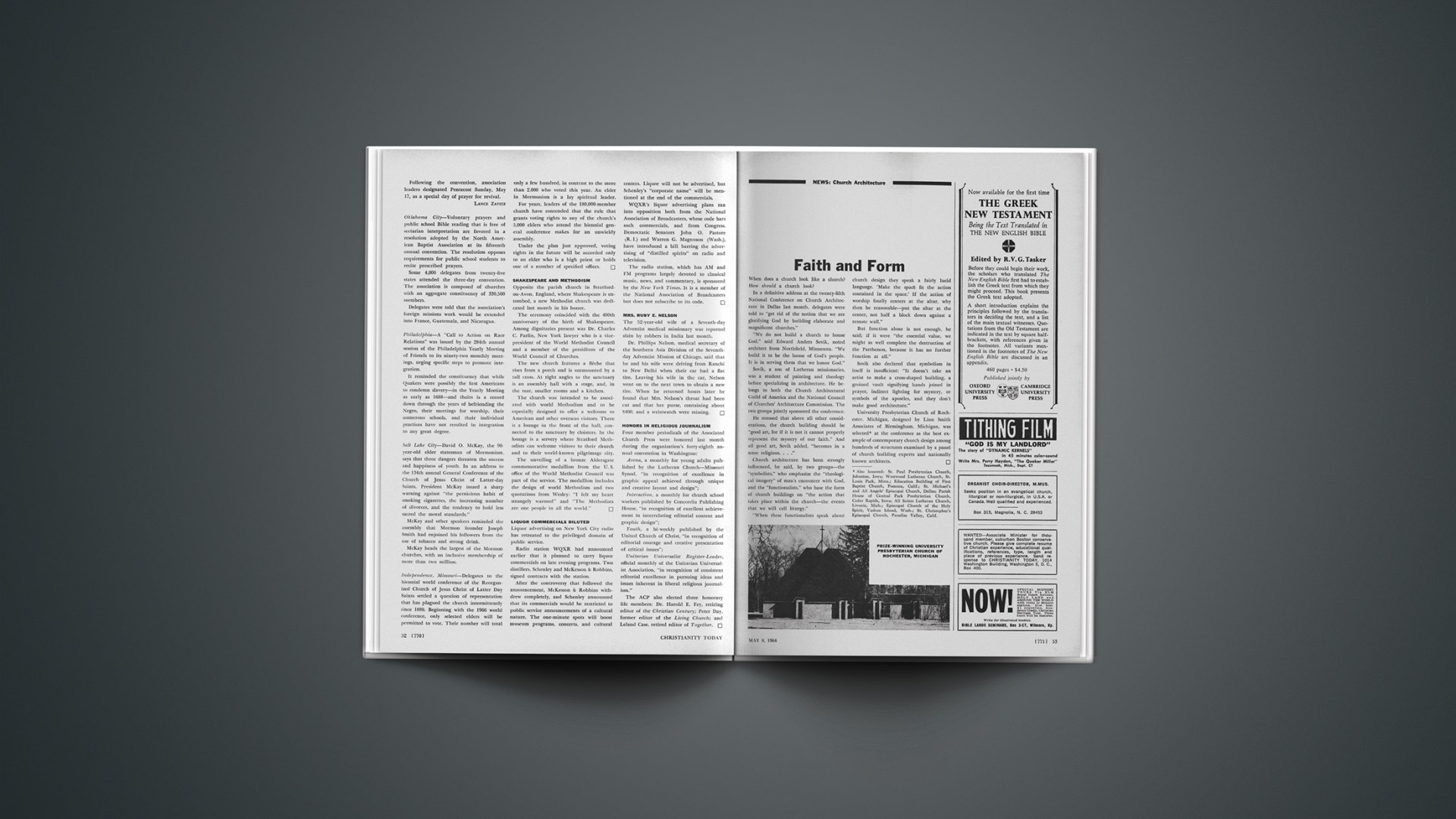
University Presbyterian Church of Rochester, Michigan, designed by Linn Smith Associates of Birmingham, Michigan, was selected1Also honored: St. Paul Presbyterian Church, Johnston, Iowa; Westwood Lutheran Church, St. Louis Park, Minn.; Education Building of First Baptist Church, Pomona, Calif.; St. Michael’s and All Angels’ Episcopal Church, Dallas; Parish House of Central Park Presbyterian Church, Cedar Rapids, Iowa; All Saints Lutheran Church, Livonia, Mich.; Episcopal Church of the Holy Spirit, Vashon Island, Wash.; St. Christopher’s Episcopal Church, Paradise Valley, Calif. at the conference as the best example of contemporary church design among hundreds of structures examined by a panel of church building experts and nationally known architects.

Evangelical Action in Chicago

For three crowded days in April more than 1,000 delegates thronged the Pick-Congress Hotel in Chicago for the twenty-second annual convention of the National Association of Evangelicals. The theme of the gathering, “Evangelicals Unashamed,” with its reference to Romans 1:16, was what might have been expected. The structure of the convention followed precedent with some twenty commissions, committees, and boards meeting separately and simultaneously; with general daily sessions and special luncheons; and with each day climaxed by large evening meetings (the one addressed by Dr. Billy Graham on the opening night overflowed the Great Hall of the hotel with an audience of some 1,800). As one passed room after room in which delegates sat hearing papers, debating issues, and sharing experiences, and as he heard the resolutions adopted, an impression of intense activity was unavoidable.

More significant, however, than these externals were the underlying mood of the convention and certain of its accomplishments. Along with the basic drive of the organization, new forces were at work. The slogan, “Evangelicals Unashamed,” began to come alive, as the convention moved forward. This 1964 gathering was not only “unashamed” of the Gospel of Christ; it was also “unashamed” of intensified social advance (symbolized particularly by the resolution on civil rights), openness to discussion of other views (manifest in thoughtful examination of ecumenism), and willingness to think about dialogue with other groups. It was as if NAE were coming out of a shell and, within its own conservative doctrinal framework, taking a stand on some matters about which it had hitherto said little.

It may well be that the association, as represented by its leadership at the convention, is in a period of honest soul-searching and realistic appraisal in the light of such developments as the “thaw” of Rome toward Protestantism and the present racial crisis.

At any rate, there were indications of a change in outlook. Among these a few may be mentioned. In discussing the sensitive subject of academic freedom in the Christian college, Professor Arthur Holmes of Wheaton said that “to deny academic freedom is suicide”; he pointed out that the evangelical public as he has met it “has yet to be sold on liberal arts education” and that “some [evangelicals] are … insecure in their faith, overly defensive and overly cautious.”

A lively session of the Evangelical Action Commission that dealt with the Roman Catholic ecumenical movement heard some plain talk from Dr. Herbert S. Mekeel, who warned that, despite its increased biblical emphasis, Rome’s intransigent insistence upon its own primacy remains unchanged. Dr. James DeForest Murch declared, “We have passed the day when we as evangelicals can be isolationists,” and proposed immediate steps for evangelicals to observe an annual week of prayer for Christian unity, to establish a permanent commission on Christian unity, and to initiate studies in the nature of the unity we seek.

Widening of outlook and sympathies was also evident through sessions devoted to such subjects as the relation of evangelicals to national ecumenicity on the mission fields, the spiritual needs on the home front of the inner city, the evangelical stake in the social welfare movement, and the training of Negro ministers. Theological concern was focused upon issues like the liberal misrepresentation of the evangelical commitment to biblical inerrancy and the dangers of universalism.

Regarding the racial problem, delegates heard some blunt words from the Rev. Howard Jones, a Negro minister associated with Billy Graham, and from Dr. Graham himself. Mr. Jones decried evangelical failures in segregated worship, lack of integration in higher education, retreat of churches when Negroes move into communities, and the continuance of some ministers to justify segregation by preaching “the curse of Ham.” Dr. Graham, also critical of evangelical failures in racial matters, joined with Mr. Jones in declaring that the ultimate answer to the racial question is in Christ and in the demonstration of his love.

Dr. Robert Cook’s presidential address referred to the infiltration of evil into evangelical life through accommodation to lowered standards. “It is my impression,” he said, “that a high percentage of high school young people that came from Christian homes lack moral fiber.”

Morning devotional meetings, though warm in spirit, were not largely attended. In contrast to Billy Graham’s crowded evening meeting, representatives of the two largest conservative, evangelical bodies in the nation, neither of which is a member of NAE—Dr. K. Owen White, president of the Southern Baptist Convention, and Dr. Oswald C. J. Hoffmann, preacher on “The Lutheran Hour”—spoke to a partially filled auditorium, a fact attributed to lack of local publicity.

The convention adopted a resolution supporting the military chaplaincy, calling for resistance to “efforts of the Civil Liberties Union or others who would in any wise hinder, subvert, or destroy the military chaplaincy,” and expressing concern “that military chaplains are required to use a particular type of Sunday School literature, that military personnel are required to attend chapel services without regard to their religious freedom and that informal Bible study groups are sometimes suppressed.”

In other resolutions, elimination of radio and television advertising of tobacco and liquor was advocated; an amendment to Public Law 480 was supported, restating the purpose of the act (that provides for agricultural surpluses to be given free to voluntary agencies for distribution abroad) as being the meeting of human need rather than the purposes of state policy; the present non-recognition of the Communist governments of Cuba and China was supported; and in a resolution on the Church and Welfare, “the clear responsibility” of “the Christian as an individual and the church as a group for the social and economic welfare of men, especially those of ‘the household of faith’ ” was affirmed not as “the church’s primary mission” but as “an integral part of her total Christian obligation.”

Discussion of the civil rights resolution, adopted unanimously, included lively debate on the description of Billy Graham’s Birmingham rally as “integrated” instead of “bi-racial,” with “integrated” being approved, and the defeat of an amendment supporting “reasonable demonstrations,” the convention apparently having felt that the resolution deals with principle rather than with method.

The appointment of Dr. Arthur M. Climenhaga as executive director completes a realignment of NAE leadership (see CHRISTIANITY TODAY News, February 14, 1964, p. 43). Dr. Climenhaga is a former missionary to Africa who has been serving as president of Messiah College, Grantham, Pennsylvania, a school operated by Brethren in Christ.

Congressman John B. Anderson of Illinois, a member of the Evangelical Free Church, who set the good example of staying by his legislative responsibilities, was honored in absentia as “the evangelical layman of the year.” The winner in the church design contest, sponsored jointly by NAE and Christian Life magazine, was Highland Covenant Church of Bellevue, Washington.

Minneapolis—The tendency of some Christians to equate holiness with passivism found no place in the program or procedures of the National Holiness Association at its 96th annual convention last month in Minneapolis. Speakers and delegates struck vigorous blows at attitudes and conduct that they regarded as unethical, immoral, or just plain sinful.

N. A. E. And Civil Rights

Following is the text of the resolution on civil rights adopted by the National Association of Evangelicals:

“The National Association of Evangelicals boldly asserts the relevancy of the Gospel of our Lord and Savior Jesus Christ to the critical problem of civil rights. We point with thanksgiving to Billy Graham’s integrated Easter Sunday (1964) rally in Birmingham.

“We believe that the Biblical solution to the problem of race prejudice is through the transformation of the individual by the power of the Holy Spirit resulting in a love for all men.

“Recognizing that not all men have thus been transformed, we call upon evangelicals everywhere in the name of the God who loved the world and our Savior who died for all men to support on all levels of government such ordinances and legislation as will assure all our people those freedoms guaranteed in our Constitution.

“Further, we call upon our churches to accelerate the desegregation of their own institutions both in spirit and in practice and we urge the opening of the doors of all sanctuaries of worship to every person, regardless of race or national origin.”

The association not only frowned on the Supreme Court’s ban on religion in the public schools but proposed to do something about it. The approved resolution states that reading of Scripture and the offering of nonsectarian prayers “in no way violates” the principle of church-state separation. The association also called on denominations, colleges, seminaries, mission boards, and other groups affiliated with it to “bring all possible pressure to bear upon Congress” to obtain enactment of a constitutional amendment that would remove any doubt about the legality of such religious exercises.

Corruption in public life and laxity in private morals were other targets. A resolution asserted that “sordid instances” of the former that have been publicized “are to be regarded not only as violating ethical principles but as jeopardizing our nation’s security; such things will bring the judgment of God upon our beloved country.”

At the other end of the scale, the association viewed “with repugnance” what it termed “the apparent willingness of many publishers and educators to regard the present laxity in private morals as being acceptable.”

Immorality that is allowed to pervade some churches drew the fire of the Rev. James C. Lentz of Marion, Indiana, Evangelical Methodist minister and missionary evangelist for World Gospel Mission, who charged that “too much energy has been expended in the defense of doctrine rather than in heralding the great truths of Christianity.”

“When the Christian message is presented positively by lives that can demonstrate its claims, it will meet the conditions of our nation and society today as the same message reached England in the day of John Wesley,” said Mr. Lentz.

The association also approved resolutions: deploring the use of the Scriptures in attempts to justify racial discrimination and praising civil rights leaders who “have steadfastly refused to forsake their programs of non-violence”; recommending that the tax exemption for religious institutions be retained; commending the Salvation Army for its rehabilitation program for city dwellers.

Professional boxing was denounced as having no place in civilized Christian society, and Christians were asked to “refrain from watching such brutal spectacles” on television.

The National Holiness Association is made up of fourteen denominations, including the Free Methodists, Wesleyan Methodists, Holiness Methodists, Salvation Army, United Missionary Church, and several yearly meetings of Friends (Quakers).

Following the convention, association leaders designated Pentecost Sunday, May 17, as a special day of prayer for revival.

Oklahoma City—Voluntary prayers and public school Bible reading that is free of sectarian interpretation are favored in a resolution adopted by the North American Baptist Association at its fifteenth annual convention. The resolution opposes requirements for public school students to recite prescribed prayers.

Some 4,000 delegates from twenty-five states attended the three-day convention. The association is composed of churches with an aggregate constituency of 330,500 members.

Delegates were told that the association’s foreign missions work would be extended into France, Guatemala, and Nicaragua.

Philadelphia—A “Call to Action on Race Relations” was issued by the 284th annual session of the Philadelphia Yearly Meeting of Friends to its ninety-two monthly meetings, urging specific steps to promote integration.

It reminded the constituency that while Quakers were possibly the first Americans to condemn slavery—in the Yearly Meeting as early as 1688—and theirs is a record down through the years of befriending the Negro, their meetings for worship, their numerous schools, and their individual practices have not resulted in integration to any great degree.

Salt Lake City—David O. McKay, the 90-year-old elder statesman of Mormonism, says that three dangers threaten the success and happiness of youth. In an address to the 134th annual General Conference of the Church of Jesus Christ of Latter-day Saints, President McKay issued a sharp warning against “the pernicious habit of smoking cigarettes, the increasing number of divorces, and the tendency to hold less sacred the moral standards.”

McKay and other speakers reminded the assembly that Mormon founder Joseph Smith had enjoined his followers from the use of tobacco and strong drink.

McKay heads the largest of the Mormon churches, with an inclusive membership of: more than two million.

Independence, Missouri—Delegates to the biennial world conference of the Reorganized Church of Jesus Christ of Latter Day Saints settled a question of representation that has plagued the church intermittently since 1880. Beginning with the 1966 world conference, only selected elders will be permitted to vote. Their number will total only a few hundred, in contrast to the more than 2,000 who voted this year. An elder in Mormonism is a lay spiritual leader.

For years, leaders of the 180,000-member church have contended that the rule that grants voting rights to any of the church’s 5,000 elders who attend the biennial general conference makes for an unwieldy assembly.

Under the plan just approved, voting rights in the future will be accorded only to an elder who is a high priest or holds one of a number of specified offices.

Shakespeare And Methodism

Opposite the parish church in Stratford-on-Avon, England, where Shakespeare is entombed, a new Methodist church was dedicated last month in his honor.

The ceremony coincided with the 400th anniversary of the birth of Shakespeare. Among dignitaries present was Dr. Charles C. Parlin, New York lawyer who is a vice-president of the World Methodist Council and a member of the presidium of the World Council of Churches.

The new church features a flèche that rises from a porch and is surmounted by a tall cross. At right angles to the sanctuary is an assembly hall with a stage, and, in the rear, smaller rooms and a kitchen.

The church was intended to be associated with world Methodism and to be especially designed to offer a welcome to American and other overseas visitors. There is a lounge in the front of the hall, connected to the sanctuary by cloisters. In the lounge is a servery where Stratford Methodists can welcome visitors to their church and to their world-known pilgrimage city.

The unveiling of a bronze Aldersgate commemorative medallion from the U. S. office of the World Methodist Council was part of the service. The medallion includes the design of world Methodism and two quotations from Wesley: “I felt my heart strangely warmed” and “The Methodists are one people in all the world.”

Liquor Commercials Diluted

Liquor advertising on New York City radio has retreated to the privileged domain of public service.

Radio station WQXR had announced earlier that it planned to carry liquor commercials on late evening programs. Two distillers, Schenley and McKesson & Robbins, signed contracts with the station.

After the controversy that followed the announcement, McKesson & Robbins withdrew completely, and Schenley announced that its commercials would be restricted to public service announcements of a cultural nature. The one-minute spots will boost museum programs, concerts, and cultural centers. Liquor will not be advertised, but Schenley’s “corporate name” will be mentioned at the end of the commercials.

WQXR’s liquor advertising plans ran into opposition both from the National Association of Broadcasters, whose code bars such commercials, and from Congress. Democratic Senators John O. Pastore (R. I.) and Warren G. Magnuson (Wash.), have introduced a bill barring the advertising of “distilled spirits” on radio and television.

The radio station, which has AM and FM programs largely devoted to classical music, news, and commentary, is sponsored by the New York Times. It is a member of the National Association of Broadcasters but does not subscribe to its code.

Mrs. Ruby E. Nelson

The 52-year-old wife of a Seventh-day Adventist medical missionary was reported slain by robbers in India last month.

Dr. Phillips Nelson, medical secretary of the Southern Asia Division of the Seventh-day Adventist Mission of Chicago, said that he and his wife were driving from Ranchi to New Delhi when their car had a flat tire. Leaving his wife in the car, Nelson went on to the next town to obtain a new tire. When he returned hours later he found that Mrs. Nelson’s throat had been cut and that her purse, containing about $400, and a wristwatch were missing.

Honors In Religious Journalism

Four member periodicals of the Associated Church Press were honored last month during the organization’s forty-eighth annual convention in Washington:

Arena, a monthly for young adults published by the Lutheran Church—Missouri Synod, “in recognition of excellence in graphic appeal achieved through unique and creative layout and design”;

Interaction, a monthly for church school workers published by Concordia Publishing House, “in recognition of excellent achievement in interrelating editorial content and graphic design”;

Youth, a bi-weekly published by the United Church of Christ, “in recognition of editorial courage and creative presentation of critical issues”;

Unitarian Universalist Register-Leader, official monthly of the Unitarian Universalist Association, “in recognition of consistent editorial excellence in pursuing ideas and issues inherent in liberal religious journalism.”

The ACP also elected three honorary life members: Dr. Harold E. Fey, retiring editor of the Christian Century; Peter Day, former editor of the Living Church; and Leland Case, retired editor of Together.

The Blake Proposal: Strides and Snags

The Battle of Princeton was the turning point of the Revolutionary War. Delegates to the Consultation on Church Union were reminded of this bit of American history last month as they gathered at Princeton Theological Seminary to engage in the third annual round of discussions of the Blake Proposal for eventual merger of certain major American Protestant bodies. This meeting was thought to represent a critical stage for the consultation, as it would wrestle with subjects that have traditionally proven difficult obstacles along the ecumenical road: the ministry and the sacraments. But the hope was that without a new Battle of Princeton there would be a decisive turning point in the direction of fairly imminent merger.

As it turned out, there was not a battle, but there was not a turning point toward merger either. “Setback” was the term used by the merger plan’s originator, Dr. Eugene Carson Blake, stated clerk of the United Presbyterian Church—one of the six church bodies participating in the talks, the others being the United Church of Christ, Methodist, Protestant Episcopal, Christian (Disciples of Christ), and Evangelical United Brethren churches.

In contemplating the formidable task of devising a church union plan acceptable to such diverse groups as the comparatively “high-church” Episcopalians and the “low-church” Disciples, one might have looked to the rather low-church but episcopally governed Methodists to provide a bridge. But in Princeton the bridge was raised to permit world Methodist traffic to sail through.

The report that had the heaviest repercussions in Princeton was one that was never submitted to the consultation nor intended for it. It was the report of the Methodist Commission on Church Union to this year’s Methodist General Conference, which began just ten days after the close of the consultation. Some of its contents were announced on the next-to-last day of the Princeton sessions. Far from suggesting that Methodism serve as a bridge, the report noted barriers separating the Methodist Church from denominations on either side of it. While granting that “Methodism may have no differentiating theology,” the report pointed to one “unique” contribution—“the Christian assurance that all men … are children of God, and can find Him through faith.” “Your Commission is unwilling to concede that Methodism has made its contribution and should, at this time, entirely disappear through mergers around the world into national or regional churches.…

“As of this time, … possibly the better means of ecumenical encounter would be for a world Methodism to confer with a world Anglicanism, rather than having separate conversations in each nation.”

Thus the commission recommended union conversations between American and British Methodists, with the hope of real progress during the 1964–1968 quadrennium. Also recommended was continued participation in the Consultation on Church Union, albeit without firm expectation of the drawing up of a plan of union within the next four years. Five “problems” were mentioned: (1) “There is the problem of the Anglican doctrine of the Historic Episcopate and of the Apostolic Succession being essential to a valid ministry and the resultant doctrine of the closed communion which it appears to bring. It seems unlikely that The Methodist Church is prepared at this time to abandon its traditional practice of the open communion table.” (2) The United Church of Christ and the Disciples have a “strong tradition that great authority should be vested in the congregation.” This contrasts greatly with the Methodist “strong connectional form of government and the strong and effective episcopacy with its power of appointment.” (3) Disciples hold “the doctrine of adult baptism and that the sacrament can be validly observed” only by total immersion. “Methodists practice infant baptism and recognize as valid any of the three practices”—sprinkling, pouring, or immersion, “although the former is used almost to the exclusion of the others.” (4) “As presently constituted, The Methodist Church is a world church. There are many unresolved questions as to future relationships with churches outside the United States.” (5) “The Methodist Church has taken strong stands on social issues, for example, alcohol and gambling, and in these stands differs in degree from one or more of the participating churches. Here again, no satisfactory compromise has come in view.”

The report went on to question the desirability of the proposed union, which would produce a denomination of more than 20 million members: “These six churches, in the aggregate, now contribute 80.4 per cent of the denominational support to the National Council of Churches … and 57 per cent of the total, world-wide support, of the World Council of Churches and over 66⅔ per cent of the funds for programs of the World Council.… There may be many advantages of such a church in America, but in world ecumenism is such a grouping in the best interests of the movement and how far are Methodists warranted in compromising their convictions, long held, to achieve such union?”

Adding to the mingled surprise and disappointment of strong proponents of merger was an announcement that the Episcopal Commission on Approaches to Unity would probably inform the denomination’s triennial General Convention, to meet in October, that it should not yet become involved in drafting a six-way merger plan. This was explained as a judgment on the consultation’s “time schedule,” not on its work and progress.

Disappointment was the stronger because of the progress made in this meeting on thorny issues, even if agreement had not yet penetrated to theological depths. Three reports were adopted: “One Ministry,” “One Baptism,” and “One Table.” Excerpts follow.

“One Ministry”: “We believe that in a servant church that is truly catholic, truly reformed, and truly evangelical, the ministerial orders should include the historic ministries of bishops, presbyters (elders) and deacons. We further believe that these ministries can be constituted for the united Church without prejudice to the existing ministerial orders in the several churches.” It was granted that further clarification was needed of the ministerial orders and their functions. This is to be the general area of study preparatory for next year’s meeting.

But consensus on inclusion of bishops was viewed as a major gain inasmuch as three of the churches do not now have an episcopacy. On the other hand, one member of the committee that drafted the report was not sure why it did not point out existing disagreements more clearly. Two of the Episcopal delegates made statements that pointed to vexing problems yet remaining. Professor William J. Wolf of Episcopal Theological School, Cambridge, Massachusetts, stressed that his delegation was under a mandate from the denomination’s General Convention and the Anglican Lambeth Conference not to enter into any discussion on the ministry except within the context of the historic episcopacy. He said this involved a threefold ministry of bishop, priest, and deacon. Bishop Richard S. Emrich of Detroit said that he believed Episcopalians would insist on “reordination in some sense” for ministers whose churches would be accepting the episcopate.

“One Baptism”: “Baptism is a divine ordinance or sacrament and forms the visible basis of our unity. By this we are united with Christ in His death and resurrection, and are born again of water and the Spirit, knowing ourselves to be taken up into God’s plan of salvation. We receive the washing away of sin, and incorporation as living members into the body of Christ.” The subject of baptismal regeneration did not become a matter of debate in plenary sessions.

Views for and against infant baptism were described. “In spite of tensions within our communions, and weaknesses of practice, infant baptism and adult baptism both seek to express and fulfill the same spiritual life. Both seek to include infants within the one fold of Christ’s Church, and both seek to nurture these little ones in the faith which thereby can reach mature, responsible expression.” “Neither infant baptism nor adult baptism would be imposed contrary to conscience.”

As to mode, the report said: “The New Testament does not lay great stress on the particular manner in which baptism is administered. It seems clear, however, from the Biblical record that immersion was usually practiced in New Testament times. We acknowledge that as early as the first part of the second century effusion (i.e. baptism by pouring water) was practiced by the Church, and since that time there has been variety in baptismal practices. In a united Church it would be possible to baptize by immersion, pouring, or sprinkling.” Deleted was a first draft plea that because of New Testament practice and “theological reasons we urge our participating churches to consider adopting” the mode of immersion. This mode was described by one supporter of the plea as “the ecumenical form” inasmuch as all churches recognize it as baptism. But the admitted “trial balloon” was exploded by objections to abandoning the other traditional modes.

“One Table”: “We believe it is not necessary in a uniting church that all parties be in complete agreement upon the total range of sacramental theology.” More than simply a memorial view of the Eucharist was described: “Christ is present as the Crucified who died for our sins and who rose again for our justification, as the once-for-all sacrifice for the sins of the world who gives himself to the faithful. His life and death and resurrection are not only remembered by the Church but also become, by God’s action in Christ, present and efficacious realities.

“The Church corporate and its members are renewed in the covenant of grace and participate in the forgiveness of sin and receive eternal life.”

When asked whether open and closed communion had been debated, a delegate told the press that one working group had discussed the problem without resolving it.

The same preamble was attached to all three of the reports to clarify their status: “The Consultation sets forth these statements as consensus on the points covered. They are not to be thought of as expressing the full doctrinal position of any of our Churches, nor as an exhaustive treatment of the subjects covered, nor as representing final conclusions of the Consultation.…”

In other action, delegates adopted a recommendation that calls for a nationwide exchange of pulpits among ministers of the six participating churches on one Sunday in January of next year, where this is feasible.

For the first time, the Roman Catholic Church sent “observer-consultants” to the sessions.

Delegates varied in private predictions as to the date of possible successful completion of merger talks. After Princeton, 1975 was considered optimistic. Some of the more cautious pointed to the year 2,000.

Revival Behind Bars

Religious News Service reported a revival among convicts in Fulton County, Georgia, last month.

The Rev. Bill Allison, county prison chaplain, said thirty-four convicts were converted. Fourteen of them were subsequently transported to a Baptist church in Atlanta for baptism.

Allison said questionnaires had been distributed among prisoners asking if they would be willing to attend a service each night for a week. “The response was overwhelming,” he declared.

Week-long series were conducted at the Fulton Tower Prison and at prison camps at Bellwood, Stonewall, and Alpharetta. The Rev. Herman Conley, a minister active in work among inmates, assisted in the services at Stonewall.

A Heart For The Urban Heart

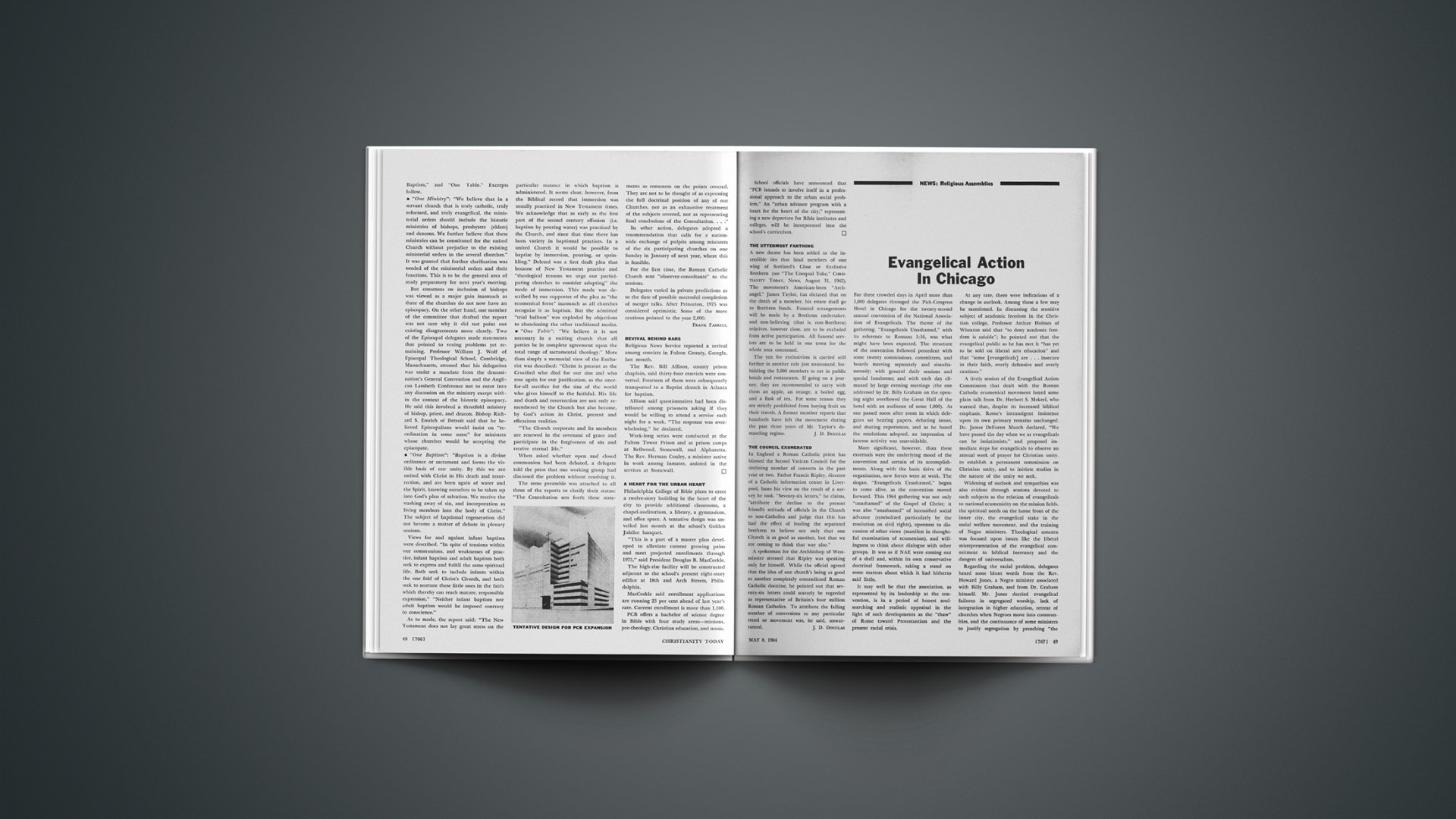
Philadelphia College of Bible plans to erect a twelve-story building in the heart of the city to provide additional classrooms, a chapel-auditorium, a library, a gymnasium, and office space. A tentative design was unveiled last month at the school’s Golden Jubilee banquet.

“This is a part of a master plan developed to alleviate current growing pains and meet projected enrollments through 1975,” said President Douglas B. MacCorkle.

The high-rise facility will be constructed adjacent to the school’s present eight-story edifice at 18th and Arch Streets, Philadelphia.

MacCorkle said enrollment applications are running 25 per cent ahead of last year’s rate. Current enrollment is more than 1,100.

PCB offers a bachelor of science degree in Bible with four study areas—missions, pre-theology, Christian education, and music.

School officials have announced that “PCB intends to involve itself in a professional approach to the urban social problem.” An “urban advance program with a heart for the heart of the city,” representing a new departure for Bible institutes and colleges, will be incorporated into the school’s curriculum.

The Uttermost Farthing

A new decree has been added to the incredible ties that bind members of one wing of Scotland’s Close or Exclusive Brethren (see “The Unequal Yoke,” CHRISTIANITY TODAY, News, August 31, 1962). The movement’s American-born “Archangel,” James Taylor, has dictated that on the death of a member, his estate shall go to Brethren funds. Funeral arrangements will be made by a Brethren undertaker, and non-believing (that is, non-Brethren) relatives, however close, are to be excluded from active participation. All funeral services are to be held in one town for the whole area concerned.

The yen for exclusivism is carried still further in another rule just announced, forbidding the 3,000 members to eat in public hotels and restaurants. If going on a journey, they are recommended to carry with them an apple, an orange, a boiled egg, and a flask of tea. For some reason they are strictly prohibited from buying fruit on their travels. A former member reports that hundreds have left the movement during the past three years of Mr. Taylor’s demanding regime.

J. D. DOUGLAS

The Council Exonerated

In England a Roman Catholic priest has blamed the Second Vatican Council for the declining number of converts in the past year or two. Father Francis Ripley, director of a Catholic information center in Liverpool, bases his view on the result of a survey he took. “Seventy-six letters,” he claims, “attribute the decline to the present friendly attitude of officials in the Church to non-Catholics and judge that this has had the effect of leading the separated brethren to believe not only that one Church is as good as another, but that we are coming to think that way also.”

A spokesman for the Archbishop of Westminster stressed that Ripley was speaking only for himself. While the official agreed that the idea of one church’s being as good as another completely contradicted Roman Catholic doctrine, he pointed out that seventy-six letters could scarcely be regarded as representative of Britain’s four million Roman Catholics. To attribute the falling number of conversions to any particular trend or movement was, he said, unwarranted.

J. D. DOUGLAS

Theology

The A B C of the Gospel

Text: “… the Gospel of God” (Rom. 1:1c).

The Bible is the most influential book in the world. No other writings have ever exerted so much power over mankind—a fact that any impartial observer can easily verify. In the Bible no book has been more influential for conversion than the Epistle to the Romans. Through it Augustine was converted, Luther was turned to Christ, and the heart of John Wesley was “strangely warmed.” In the history of the Church these were hinge men; because of their conversion experiences, doors swung open wide for new world epochs.

As a minister, I owe much to Romans. After I had been out of the seminary half a dozen years, I realized that I had not developed any simple technique for explaining the Gospel in a personal interview. In the city of Augusta, Georgia, where I lived, I looked about for help. My eyes inevitably rested on a Baptist minister in the city who was many years my senior. Knowing him to be a skilled winner of souls, I went to him and explained my plight. Never in the seminary had I learned anything so simple and so basic as that course he gave me in how to show another person the way to become a Christian.

My friend suggested a little run of verses from Romans. I memorized these verses and have used them in personal interviews many times. “All have sinned, and come short of the glory of Cod” (Rom. 3:23). “The wages of sin is death; but the gift of God is eternal life through Jesus Christ our Lord” (6:23). “Whosoever shall call upon the name of the Lord shall be saved” (10:13). “I beseech you therefore, brethren, by the mercies of God, that ye present your bodies a living sacrifice, holy, acceptable unto God, which is your reasonable service. And be not conformed to this world: but be ye transformed by the renewing of your mind, that ye may prove what is that good, and acceptable, and perfect will of God” (12:1, 2).

The theme of this great Book of Romans is the Gospel. My text is a phrase from the first verse of the first chapter that dominates all the rest of the chapter: “the Gospel of God.” This appears in verse nine, “the Gospel of His Son,” and later in the chapter: “I am ready to preach the Gospel”; “I am not ashamed of the Gospel.” Since with this text we are at the beginning of the epistle, let us consider the A B C of the Gospel.

Let A stand for Authorship. Long ago through his prophets God had promised his Gospel. Through Moses the Lord had said he would raise up unto the people a prophet like Moses, but greater than Moses. “Unto him ye shall hearken” (Dent. 18:15b).

In his Son, God caused the Gospel to become real and personal. According to the flesh, Jesus was made of the seed of David. According to the spirit of holiness, by the resurrection from the dead, he was designated the Son of God with power (Rom. 1:3, 4). That was all by the working of the Author of the Gospel. Those who receive the Good News are enabled to do so by God. The application of the Gospel also goes back to the Authorship of God. From him Paul received grace and apostleship, to bear witness to Christ. As the gift of God, the Roman Christians to whom he wrote had their fellowship in Christ. So that from beginning to end, with reference to its past, its present, and its future, we may say of the Evangel: It is all from God. It is promised of God, produced of God, and received by those called of God.

Often we speak of human beings as inventors, but such a statement must be relative. In the absolute sense, no human being can invent a single thing. The only true originator is God. Man’s highest destiny is to think God’s thoughts after him. When a person invents a particular thing, he is really discovering something God through of in the beginning and then put somewhere in his creation.

All of this holds true in what we vaguely call religion. Whenever in religion you get human invention, you get distortion or negation, or both. The only author of spiritual truth is God. Therefore when we come to the Evangel, our proper approach is to ask, “What does God say?” It is the Gospel of God. He is the Author. This is the A of the Gospel.

On the canvas of this first chapter in Romans the Apostle paints the Background of the Gospel, a background that is dark indeed, for it all has to do with sin. When we approach the subject of human sin, we have to reckon with far more than first meets the eye. From modern psychology has come a phrase full of meaning and suggestion. “depth psychology.” The phrase rightly suggests that deep down in human personality lie vast hidden areas that are subject to violent storms. Out on the ocean, when all underneath is calm, mighty storms may rage on the surface of the deep. But in matters of human personality and sin the opposite often holds true. The surface of life may seem tranquil, but underneath may rage the awful workings of sin. Countless persons endure their days and nights with desperation known only to God.

Sin has also its open manifestations, which stand out in the latter part of this first chapter in Romans. Here Paul shows the length to which sin will go, and the detestable forms with which it works in human society. He points our gaze to three sorts of basic disturbances that sin causes in mankind: in the relationship of man to God; within man himself; and between man and man.

The disturbances wrought by sin manifested themselves of old in three ways. One was perverted worship. Here you need only think of Sodom and Gomorrah, or of Pompeii and Herculaneum, which exchanged the truth of God for lies and for idolatry, which always debases. Again, there came perverted sexuality, wherein people exchanged the proper expression of marital love for unnatural relations that channeled the creative urges of life into dead-end streets of lust and frustration. Thirdly, there were perverted human relations wherein people exchanged the proprieties of justice and mercy for ways of passion and violence. In those societies, sin came to its bitter end. The Revised Standard Version sums up such sinners in these words: “foolish, faithless, heartless, ruthless” (Rom. 1:31).

In that old world, where sin went on unrestrained, society lost its head and its heart. The modern world is not better. Have you with shame read a typical magazine article entitled “Sweden and Sin”? Have you with disgust kept informed about the recent increase of homosexuality in England? Do you read your own newspapers that mirror vices and show how sin breaks out in the open, often with volcanic force? Deep down where you cannot see it, sin keeps working so terribly that often you can watch its outworking in shattered bodies, shattered nerves, and shattered lives.

Does anyone feel that I am overdrawing the picture? If so, I ask you to do this one thing: Watch yourself. If you are careless about your soul, if you think that all this teaching about the dark background of sin is not relevant to you, watch yourself through these coming years. For if sin is not checked, it always gets worse and worse. It produces a deepening entrenchment of prejudice against God and the things of God, a hardening of the heart, an increased grasping after the grosser things of life.

Sin is always sin. In human beings, one by one, and in human society, sin still rages. If Calvin Coolidge were here today, he would gain the impression that I am against sin. So I am. So is Paul. So is our Lord Jesus Christ. So is God our Father. So is the Holy Spirit. So is every Christian who has any discernment as to the root causes of all the disorders in the world today. In sin lies the dark background of the Christian Gospel.

Now we come to C, the Content of the Gospel. In imagination let us go into a classroom and take a test. Most of you have had a long course in the meaning of Christianity. You have come up through the Sunday school; you have attended many services; and, God bless you, you have listened to many sermons. Of course you know what the Gospel is. Even so, let each of us take a pencil and a piece of paper. We shall imagine that Paul is writing on a blackboard the question that constitutes our test, “What is the content of the Gospel?”

The person next to you says to himself, “This is easy!” Then he begins to write: “The Gospel is a code, a set of rules; it consists of God’s holy requirements. In the Old Testament these are found in the Ten Commandments; in the New Testament they stand out in the Sermon on the Mount, especially in the Golden Rule. We are supposed to live up to these requirements. To love God and love our fellow men, that’s the Gospel!” When the paper is finished Paul takes it up, reads it, shakes his head sadly, and marks it with a big zero. Then he says to the writer. “You got only to the edge of the Gospel.”

The person on the other side of you has even more confidence. He says to himself, “I know that the Gospel is more than a code of laws, with commandments and requirements. The Gospel is a philosophy; it’s an ideal; it’s the noblest of all teachings. We’re to try to aspire toward the realization of the fatherhood of God and the brotherhood of men. We are to follow such slogans as ‘Hitch your wagon to a star,’ ‘Follow the gleam,’ and ‘Ever onward and upward.’ That’s the content of the Gospel!” This person, too, has flunked the test. He has reached only the fringe of the Gospel.

Think about the matter in terms of a church building. It has front steps outside and other steps inside. The building itself may represent the content and heart of the Gospel, which is a message of forgiveness and deliverance from sin. The front steps may correspond to the law, the requirements of God. The inside steps may represent the ethical ideals that we strive to realize in our content. The front steps are not the church; the inside steps are not the church. The law of God is not the Gospel; the ethical ideals are not the Gospel. The Gospel is the Good News of what God has done, in his Son, Jesus Christ, to secure for us sinners the power to keep the law of God anti to realize the ethical ideals of the Bible.

The content of the Gospel is Christ. The inspired record tells of Jesus as made flesh here on earth: living among men, teaching them and doing many mighty works; dying on the Cross for our sins; and rising again in glory. The Gospel is the inspired record of how, when we receive Christ by faith, God accepts us as righteous and says, “Now I give you my Holy Spirit with power to keep the Bible law, and to realize in your own experience the ethical teachings of Holy Writ.”

If we know the Gospel, we have a twofold responsibility; to believe it and to share it. When Saul met the living Christ on the road to Damascus, that sinner believed in him and accepted him. For Saul that road meant the beginning of God’s forgiveness, favor, and power. Thereafter he could write: “I repudiate any righteousness of my own. I count it all as filthy refuse, that I may be found in Christ to have a righteousness which is of God in Jesus Christ” (Phil. 3:8, 9). In like manner God asks us to believe in Christ and thus to accept the Gospel. The effectiveness of the Good News depends on God, not on you. He says, “By faith receive it; believe that through my Son you can have my forgiveness, my favor, and my power.” Whether you are a Jew or a Greek, wise or unwise, the Gospel applies to you. If you have never before clearly understood the Gospel, receive it now. Through Christ you are free. Now live in his power.

As Christians we are also to share the Gospel. That is why Paul wished to go to Rome, to Spain, and to regions beyond. He declared: “I am a debtor to the Gospel. I am ready to preach the Gospel. I am not ashamed of the Gospel. I’ve got to go everywhere and tell this Good News: ‘You can be free, no longer a slave to Satan, no longer condemned because of sin. You may also have power, all the power you need; it’s here for you in Christ.’ ” Thus the Apostle kept saying, “I must tell the whole world about the Gospel of God.”

My friend, if you know and believe the Gospel, what of this compelling urge? In a little notebook do you have a prayer page where you list the names of persons who are not Christians, persons for whom you pray, one by one, and to whom you speak about Christ in terms of the Gospel? Do you have in your mind and on your heart a prayer page with the names of the unsaved whom you remember daily at the throne of grace? When did you last speak to someone about the Gospel? Not about the law, or about ideals, but about the Gospel! Or do you “clam up” whenever you have an opportunity to introduce Jesus Christ as your Saviour and Lord?

What a twofold responsibility] First to believe the Gospel, and then to share the Gospel. By the grace of God learn to say with Paul, “I am a debtor. I am ready. I am not ashamed of the Gospel.”—From Evangelical Sermons of Our Day, edited by Andrew W. Blackwood (New York: Harper & Brothers, 1959; used by permission).

About This Issue: May 08, 1964

Several essays stress Christian education in college and seminary. Out of his experience as Princeton chaplain, Ernest Gordon speaks of the need for proclaiming the Word to students today (page 4).… Bernard Ramm says that the fusion of biblicism, theology, and liberal arts that produced the Reformation is needed in Christian education today (page 6).

How is the Church to strike a balance between nurture and witness? David B. Woodward declares that evangelism still has priority (page 9).

News report on the third session of the Consultation on Church Union and the NAE Convention.

Books

Book Briefs: May 8, 1964

A Genealogy Of Violence

When the Word Is Given …, by Louis E. Lomax (World, 1963, 224 pp., $3.95), is reviewed by Glenn W. Samuelson, associate professor of sociology, Eastern Baptist College, St. Davids, Pennsylvania.

The subtitle, “A Report of Elijah Muhammad, Malcolm X, and the Black Muslim World,” summarizes the contents of this book. The purpose is set forth in the introduction: “The summer of 1963 saw the Negro Revolt move into full view; it also saw the Black Muslims reach an almost incredible peak of public concern and notice. The intent of this work is to provide information and insight as companions to that concern.”

The movement centers around three personalities: W. D. Fard, the founder; Elijah Muhammad, the present leader; and Malcolm X, the recently deposed spokesman for the Black Muslims.

Part One, “The Coming of the Prophet,” presents the historical development and the practices of this extreme segregationist Negro sect. It all began with W. D. Fard in the Negro ghetto of Detroit in the 1930s. Paid sold his silks and satins from door to door during the day and held house meetings at night. He skillfully described the black man’s history and the white man’s destiny, and expounded an amazing brand of Islam.

His followers hired a hall, the Temple of Islam, to accommodate the growing movement. Fard, “The Supreme Ruler of the Universe,” believed that he had been sent to alert “the black people of America to the unlimited possibilities of the universal black man in a world now usurped, but temporarily so, by white ‘blue eyed devils.’ ”

The movement became formalized, and prospective members were put through rigid examinations. Four years after the first temple was formed, the University of Islam, a combination elementary and high school, was founded. To put down any trouble with unbelievers and the police, Fard organized “The Fruit of Islam,” a quasi-military organization.

The second personality whom the author describes is Elijah Muhammad, one of Fard’s Detroit converts. Elijah Poole, a Negro from Sandersville, Georgia, was born in 1897 into a Baptist minister’s family of thirteen children. Years later, with only a fourth-grade education, he moved to Detroit with his wife and two children. But the lure of Detroit proved a nightmare. Poole worked in factories at several different jobs until the Depression hit in 1929. Then in 1930 he heard Fard at one of the house meetings. In Poole’s words, Fard took him “out of the gutters in the streets of Detroit and taught me knowledge of Islam.”

Elijah Poole was tapped by Fard as the first chief minister of Islam and was given the “original name” Muhammad. Soon Elijah Muhammad assumed a growing role of leadership. He went to Chicago and established what has since become known as Temple Number Two, which is now the headquarters of the Black Muslim movement. Trouble in Detroit caused Muhammad to return there to assist in the situation. Mysteriously Fard disappeared, and in 1933 Elijah Muhammad became the leader of the movement.

Muhammad shared with Fard an affinity for getting into trouble with the law. However, like other men with a messianic complex, Muhammad seemed to grow both in stature and spirit behind bars. After his prison experience, Elijah Muhammad began to shout bold statements to his throng, calling the white man a snake, a devil by nature, evil, incapable of doing right. But despite his boldness, the movement stagnated under Muhammad’s leadership.

Then in the mid-forties Malcolm Little, later elevated to Malcolm X, rejuvenated the movement. He was born in Omaha, Nebraska, in 1925. His father, a Baptist minister, was a follower of the Black Nationist, Marcus Garvey, who felt that all Negroes should return to Africa to escape the oppression of the white man.

Malcolm X reports that the Ku Klux Klan burned down the family home when he was six. Shortly after Malcolm’s father set out to enter business he was found “with his head bashed and his body mangled under a streetcar.” Malcolm X believes that his father was lynched by white people who resented even the prospect of a Negro’s gaining some economic independence.

After the death of the father, the eleven children had to be separated. Malcolm was sent to an institution for boys, where he was a good student. He had difficulty, however, because he was the only Negro in the school. Leaving school, he went to New York City and became involved in underworld activities. His income often reached two thousand dollars a month.

Eventually Malcolm X went to prison for burglary. It was in 1947, in the maximum security prison at Concord, Massachusetts, that he was converted to the teachings of The Honorable Elijah Muhammad by one of his fellow prisoners who was a member of the Detroit temple. From that moment Malcolm neither smoked, cursed, drank, nor ran after women.

Five chapters are devoted to Malcolm X’s appearances and spellbinding speeches at various university campuses, such as Harvard, Queens, and Yale.

Louis E. Lomax, one of the nation’s best-known social critics and lecturers and author of The Reluctant African and The Negro Revolt, has written this impressive third volume. In his appraisal of the Black Muslim movement are these words: “Chilling though it may be, the Black Muslims have erected their teaching on a group experience common to all American Negroes. Few of us concur in their conviction and sentencing of the white race. But none of us can question the accuracy of the indictment on which that conviction rests. These men are waiting for integration to fail. They will … make us continually aware of what can happen if white men don’t learn to love before black men learn to hate.”

Here is a well-written book on a timely subject. An extra chapter should be added giving details of Elijah’s suspension of Malcolm X for making critical statements of President Kennedy following his assassination, and of Malcolm X’s new movement, known as Muslim Mosque, Inc.

GLENN W. SAMUELSON

Missions Reassessed

Missionary, Go Home, by James A. Scherer (Prentice-Hall, 1964, 188 pp., $3.95), is reviewed by Peter C. Moore, associate director, The Council for Religion in Independent Schools, New York, New York.

The decline of western colonialism and the rise of militant nationalism to most analysts have spelled doom to the present structure of Christian missionary enterprise. Not all see this handwriting on the wall as unfortunate. Among those who do not is James Scherer, dean of the School of Missions at Chicago Lutheran Seminary. In Missionary, Go Home he views the twentieth century as the time for synthesis. The eighteenth-century pietistic “mission church” was the thesis, the nineteenth-century “indigenous church” its antithesis; and the twentieth century is the occasion for a synthesis of the best elements of each in a rebirth of genuine apostolic witness. This penetrating analysis of the virtues and vices of missionary activity from Paul to the present should be read by all who take the Great Commission seriously.

Scherer traces the history of missionary vices from the imperialistic mass conversions by early Christianized pagan rulers to the use of colonialism as a protective cloak for the reproduction of Western denominationalism, clericalism, and institutionalism on heathen soil. Today the false prophets and false apostles of these distortions are being told to go home by articulate non-Christians who view them as Western imperialists at prayer, and by emerging Christian leaders who view them as a hindrance to the task of evangelism.

A complete reappraisal of missionary motives and methods is needed, Scherer says. The scriptural pattern of witness to the Lordship of Christ through the life and words of Spirit-filled Christians has been replaced by the establishment and maintenance of impressive church-owned institutions. Foreign missionaries become the administrators, responsible for perpetuating the institutions, and local leadership is thus prevented from developing. The Spirit is quenched, and evangelism is replaced by “church work.” “The new situation summons us to return to Biblical and apostolic categories” (p. 151).

To some extent the eighteenth-century pietists, progenitors of modern missions (p. 85), and their successors in the evangelical awakening were on the right track. It is surprising that Scherer does not make more of this than he does. They were spiritually rather than institutionally oriented. They were genuinely ecumenical (e.g., The Royal Danish Mission to Tranquebar, which was authorized by the King of Denmark, staffed by German pietists, and supported by ranking Anglican bishops through the S.P.C.K.). But pietistic missions, he says, maintained a paternalistic attitude, fostered the illusion that mission was the responsibility of a spiritual hierarchy rather than of the Church as a whole, and for the most part fell into the denominationalism of the nineteenth century. The author seems unaware of the existence of interdenominational mission societies such as the China Inland Mission and the Africa Inland Mission.

Indigenization, generally considered to be that process whereby independent native churches become self-governing, self-supporting, and self-propagating, has largely been corrupted into institutionalism, professionalism, and sectarianism. True indigeneity for Scherer and the Willingen conference (1952) involves relatedness to the local culture, an adaptable and trained ministry, an inner spiritual life, and oneness in witness and obedience with other churches.

Three areas of criticism might be mentioned. First, Scherer finds the unity of the Church to be essentially that of a spiritual organism rather than that of an institutional organization but is unable to see grounds for encouragement in the very real interdenominational cooperation that does exist in many places. Secondly, in his reaction to the churchy activism and institutionalism, he makes the dangerously Nestorian assertion that “true Christian witness is always a divine work and never a human activity” (p. 24). The biblical pattern, for which he is such an able champion elsewhere, is rather the divine through the human. Thirdly, one wonders whether his plea for an international pool of missionary personnel and funds would not encourage more of the sort of over-bureaucratization to which he is so vehemently opposed.

The book does, however, deserve a wide audience. Its sensitivity to the critics of Christian missions, its description of the missionary needed today, its excellent reinterpretation of “to all nations,” its plea for a serving church, and above all its willingness to re-evaluate even the most cherished of missionary assumptions in the light of Scripture, make it a solid piece of work. It is unfortunate that there is no index.

PETER C. MOORE

Sit Down With Luther

Luther and the Reformation, by V. H. H. Green (Putnam, 1964, 208 pp., $5.95), is reviewed by Paul Woolley, professor of church history, Westminster Theological Seminary, Philadelphia, Pennsylvania.

Vivian H. H. Green is a fellow of Lincoln College, Oxford. So was John Wesley in his time. Three years ago Green published an attractive study of his predecessor, The Young Mr. Wesley. Now he has returned to the scene of his 1951 Renaissance and Reformation with this study of Martin Luther. It is a crashing success. One rises from it feeling that he has been sitting in the same room with Luther, listening to him talk and watching him work. He is here as a fellow human being, more penetrating, more vigorous, more courageous, more comprehending than we. Yet he is one of us—one who sees the abuses of life, who deplores the chicaneries and deceptions, but who, unlike the rest of us, is ready and willing to do something about it.

Fourteen years ago we had a great life of Luther in Bainton’s Here 1 Stand. Green does not tell us as much about Luther. He does not stand on Luther’s side as Bainton did. He does not commit himself to Protestantism. But he does something great. He puts us in a post of observation just above Luther’s shoulder at his desk, and as we watch Luther work he tells us what all this means in terms of the politics and economics of the day. Luther and the Reformation are put in column four, page one of the morning paper; and we can read all the other columns, too, and realize just what the problem is.

The book is written for the ordinary intelligent man. It is not encumbered with apparatus; there are, I think, three footnotes in the whole volume. Instead there is a glorious set of plates. Dürer, Lucas Cranach, Holbein, Titian, del Piombo are there. They say something about these actors of the Reformation in thrilling line.

Green has read the Freudian commentators on Luther. He uses them from time to time. He is not dogmatic about accepting their comments, and it is right to hear what they have to say. Life needs to be looked at whole.

Luther’s failure on church organization is not improperly excused or omitted. He was a genius, not a deity. He had not attained perfection. Green says so. Good.

If you want to know what it was like to live in Germany at the time of the Reformation and to cheer Luther on at his work, put this book under your arm, go to the fireside some evening, and start reading.

PAUL WOOLLEY

Matthew, The Theologian

Tradition and Interpretation in Matthew, by Günther Bornkamm, Gerhard Barth, and Heinz Joachim Held (Westminster, 1963, 304 pp., $6.30), is reviewed by Robert H. Mounce, associate professor of biblical literature and Greek, Bethel College, St. Paul, Minnesota.

Tradition and Interpretation in Matthew is the joint publication of two doctoral dissertations by German pastors Gerhard Barth and Heinz Joachim Held, together with the reworking of two previously published essays by their professor, Günther Bornkamm. It is part of a series edited by Alan Richardson, C. F. D. Moule, and Floyd Filson called “The New Testament Library,” in which they intend to publish scholarly works on the background and interpretation of the New Testament.

Beginning with the established conclusion of Synoptic research—that the first three evangelists were collectors and editors of the tradition—the investigations go on to show that Matthew treats the material in such a way as to reveal a specific point of view and theological understanding of his own. The entire work is a movement beyond the present position of form-critical research and develops a deeper understanding of the contributions of each of the Synoptists. The writers would agree that the “theologies of the Synoptists” are modest in comparison with the Fourth Gospel, but insist that the interpretative element is far more pervasive than has heretofore been recognized. In a sense the book does for Matthew what Conzelmann has done for Luke and Marxsen and Robinson have done for Mark.

In “End-Expectation and Church in Matthew,” Bornkamm shows that the link between the two consists in the understanding of the law. The motive for the series of antitheses in Matthew 5 is to break through a law that has been perverted into formal legal statements and at the same time urge obedience to the radical demand of the divine will. Matthew is held to deliberately insert his understanding of law as love of God and neighbor into the Jewish scribal tradition. The short essay, “The Stilling of the Storm in Matthew,” is offered as an example of Matthew’s independent treatment of the tradition.

Barth’s contribution centers in “Matthew’s Understanding of the Law.” Here we learn that in opposition to the anti-nomians, Matthew maintains the abiding validity of the law, and against the rabbinate he argues that the law must be interpreted from the principle established in the love-commandment.

Held writes on “Matthew as Interpreter of the Miracle Stories.” By showing how Matthew uses both abbreviation and expansion, Held demonstrates that the Synoptist must be understood as an interpreter of tradition who has a definite goal in mind. The leading thoughts of Matthew’s retelling of the miracle stories are found to be the themes of faith and discipleship, and the purpose is the instruction of the Church. An interesting discovery is that in Matthew the miracle stories take on the form of the paradigm rather than narrative—a conclusion that tends to break down the unreal categories of form criticism.

It is not easy to criticize a book of this nature. That it is the work of painstaking scholarship cannot be denied. While at a number of minor points one might like to restate the questions, few would be so bold as to argue against the conclusions in broad outline.

The translation, by Percy Scott, is well done, although the German shows through in such places as the 115-word sentence on page 37. It is distinctly a work for the Neutestamentlicher but would offer a fine challenge to the pastor who would like to become involved relatively early in a movement back to understanding the Synoptist as theologian rather than mere compiler.

ROBERT H. MOUNCE

Thielicke’S Ethics

The Ethics of Sex, by Helmut Thielicke (Harper & Row, 1964, 338 pp., $4.95), is reviewed by Orville S. Walters, director of health services and lecturer in psychiatry, University of Illinois, Urbana.

The realm of physical sexuality has been left largely without Christian guidance or has been put in a false light by traditional theology. Under the influence of Hellenistic hostility to the body, Paul was insensitive to eros. In a calamitous way, his attitude was handed along with the kerygma and became a mark of what Christianity was thought to be. In a new hermeneutical endeavor, the kerygmatic kernel must be separated from its original husk and be translated into our situation rather than transferred legalistically. Our historically changed situations, which cannot be found in direct form in the Bible, can be brought into relationship with the kerygma if we recognize that the original will of God is refracted as it passes through the medium of this aeon.

This is the groundwork upon which Thielicke has constructed his system of sexual ethics, a segment of his four-volume Theological Ethics, now in press. He acknowledges that this view of the kerygma became possible only through the breakdown of the doctrine of verbal inspiration and that Christianity is still suffering from this traumatic shock. He affirms, however, that such a concept enlarges both theological knowledge and the pastoral potential.

The Reformation disparagement of eros was overthrown by Romanticism. The awakening and vitalization of the individual eros is a realized fact in our time. Shall we give theological validity to the normative force of the factual, or denounce eros as the patron saint of eudaemonism? Unquestionably, when this development of individuality becomes idolatrous, the Christian pastor must oppose it. On the other hand, people in difficulty seek out secular counselors because they fear that the Church does not have sufficient flexibility to deal with the problems brought by modern individuality and eros. Pastoral care must be undergirded by a theology that will reach the person where he actually is today.

Thielicke begins the formulation of such a theology by contrasting eros anti agape. Eros is always egocentric, seeking self-fulfillment. Agape has as its object the imago Dei in one’s fellow man. He may not be worthy of love, but agape is a creative cause that produces loveworthiness. Where agape permeates the relationship, the happiness of the other person is sought in the whole breadth of common existence. Monogamy is the natural result of this attitude of “existence-for-the-other-person.”

Turning to the New Testament for guidance on the difficult problems of marriage and divorce, Thielicke finds Jesus declaring that in the sense of God’s original order of creation, marriage is indissoluble. Only two exceptions are allowed: the porneia of the wife and a mixed marriage in which the pagan partner takes the initiative. These provisions are not contradictory, in Thielicke’s view. Jesus’ citation of God’s original order is a call to repentance upon this age. The exceptions are allowed as an order of necessity, taking into account the real condition of man and the world in which he lives. Wrong is always inherent in the breakdown of a marriage, and divorce can never be looked upon as legitimate, even in historically changed situations. However, at times it may be necessary to conclude that it was not God who joined together two persons and that therefore the marriage itself was contrary to the order of creation. But even such a “justified” divorce violates the injunction of Jesus, which is immediate to every age.

Birth control is the first of several medical-ethical problems considered in the closing section on “Borderline Situations.” The order of creation demands that man act in responsible freedom rather than blindly follow the order of nature. While parenthood is intrinsic to the order of creation, personal companionship is the central emphasis of marriage. Either the large-scale adoption or rejection of birth control would naturalize the human relationship in marriage, rather than permit it to transcend nature as need might require.

Medical interruption of pregnancy, artificial insemination, and homosexuality conclude the section. Thielicke himself, in speaking of the “constitutionally predisposed” homosexual, exemplifies the doctrinaire prejudice that he deplores in this area. He pronounces the person with “endogenous homosexuality” as unsusceptible to medical or psychotherapeutic treatment and declares that the great majority of homosexuals belong in this classification. Building upon this doubtful premise, he reaches the grotesque conclusion that the person in this “irreversible situation” who cannot practice abstinence should “structure the man-man relationship in an ethically responsible way.” The Wolfenden report, which Thielicke quotes frequently, offers no support for such a view of homosexuality.

Despite a skillful translation, the book is beset by a difficult style and involved, discursive amplification. Thielicke constantly finds it necessary to “relativize” the sayings of Jesus and Paul to avoid transferring them “legalistically” to a changed historical situation. The modern worldview determines hermeneutic method.

The ethics is that of Thielicke, but the hermeneutics is the demythologizing of Bultmann.

ORVILLE S. WALTERS

Unpleasant Story

Race: The History of an Idea in America, by Thomas F. Gossett (Southern Methodist University, 1964, 512 pp., $6.95), is reviewed by Tunis Romein, professor of philosophy, Erskine College, Due West, South Carolina.

Perhaps the outstanding feature of this volume is its extensive documentation. Fairly bulging with paragraph-length quotations from original sources, it is a scholarly work of considerable magnitude (a final fine-print summary of references runs to forty pages).

The author’s aim is to give a running account of the development of the idea of race in America, and to show the close relation between theory and practice in this developmental picture.

What seems surprising is the present-day vigor of the theory that races are basically equal in the light of a solid historical conviction that they are unequal. And it is also interesting to note, from the author’s long-range picture of the problem, that the race issue is almost as old as America itself and that a great deal of the story, historically speaking, involves race relations other than Negro-white.

Nor are the complexities and paradoxes and inconsistencies associated with the present-day race problems new. The great Jefferson, for example, constitutional propounder of equality for all men, did not seem to believe that this principle applied in any practical way to the Negro. Another interesting paradox is seen in the account of a prominent slave owner’s arguing from scriptural authority that all men came from a single source, and Charles Darwin, the agnostic, proposing the same view from a scientific bias; this seems to support the conclusion that fundamentally all men are equal. Yet neither the theologically minded nor the followers of Darwin seemed inclined to come up with this conclusion. Both the Church and science shared the prevailing view that for practical purposes men are basically unequal. And by inequality was meant that the white American, especially of English or Northern European origin, was superior to the Negro, the Indian, the Mexican, the Japanese, and even to certain nationalities from Southern Europe who had migrated to America.

This was the unfortunate story, according to the author, until almost the middle of the twentieth century, when a first significant breakthrough occurred. This was led by the secular anthropologists of whom Dr. Franz Boaz is credited as “doing more to combat racial prejudice than any other person in history.”

Race: The History of an Idea in America tends to concentrate on the bigoted and negative aspect of race relations, and this is a justifiable contribution. But surely there must be another side: a story worth telling about the less newsworthy but tremendously important constructive contributions to better race relations in our history, without which there would be no breakthroughs today, scientific or otherwise.

TUNIS ROMEIN

Book Briefs

From Purge to Coexistence: Essays on Stalin’s and Khrushchev’s Russia, by David J. Dallin (Regnery, 1964, 289 pp., $6.95). Essays that deal with the issues of Soviet foreign policy by an author who was a Menshevik, not a Bolshevik.

To Pray or Not to Pray!, by Charles Wesley Lowry (University Press, 1964, 250 pp., $5; student edition, $2.75). The author posits his arguments against the recent Supreme Court decisions on religion in public schools and against the retired Bishop Angus Dun’s support of them.

Mary: A History of Doctrine and Devotion, Vol. I, by Hilda Graef (Sheed & Ward, 1963, 371 pp., $5.95). For Protestants who wonder about the place given Mary in Roman Catholicism.

Mastering Life with the Master, by Wesley H. Hager (Eerdmans, 1964, 105 pp., $2.50). How the Christian can live on a note of triumph and overcome sorrow, discouragement, doubt, loneliness, and other troubles of life, through faith in Jesus Christ.

365 Meditations for Teen-Agers, by Walter L. Cook (Abingdon, 1964, 222 pp., $2.50). Interestingly written, but religiously very lightweight, even for teen-agers.

The Eucharist in the New Testament, a symposium (Helicon, 1964, 160 pp., $3.50). For Protestants who want to know how Roman Catholics interpret the New Testament’s teaching on the Lord’s Supper.

Family Story, by Will Oursler (Funk & Wagnalls, 1963, 309 pp., $4.95). The story of the family of Fulton Oursler (author of The Greatest Story Ever Told, convert to Catholicism, onetime senior editor of Reader’s Digest, playwright, radio commentator), by a son, Will, who has written extensively on religion and crime.

Reformation Bible Pictures: Woodcuts from Early Lutheran and Emserian New Testaments, compiled by Kenneth A. Strand (Ann Arbor Publishers, 1963, 104 pp., $3.75). Woodcuts, story-telling pictures, found in Reformation-era Bibles, reflecting both the art and theology of the times.

Christoph Blumhardt and his Message, by R. Lejeune (Plough Publishing House, 1963, 242 pp., $3.75). Sermons and conversational-style essays by Christoph Blumhardt, with an eighty-seven-page introduction by R. Lejeune. Blumhardt played a significant role in the post-World War I theological development and deserves to be much better known.

Mind If I Differ?: A Catholic-Unitarian Dialogue, by Betty Mills and Lucille Hasley (Sheed & Ward, 1964, 210 pp., $3.95). Two women, one a Roman Catholic and one a Unitarian, without thought of publication exchanged letters expressing what their religion meant to them. The correspondence is extraordinarily lively, witty, and informative.

Revolutionary Theology in the Making: Barth-Thurneysen Correspondence 1914–1925, translated by James D. Smart (John Knox, 1964, 249 pp., $5). Selected correspondence from the 300 lively letters and cards that Barth and Thurneysen wrote each other discussing theology, sermon-making, parish work, and their early writings. The letters convey the warm friendship of the two men and open an intimate window, particularly on the development of Barth the man and Barth the theologian. Of considerable interest.

Christians Can Conquer: Challenging Messages for Challenging Times, by Robert Edward Humphreys (Exposition, 1964, 112 PP., $3).

Henry Sloane Coffin: The Man and His Ministry, by Morgan Phelps Noyes (Scribner’s, 1964, 278 pp., $5). The story of an outstanding liberal preacher and president of New York’s Union Theological Seminary, seen in the context of his times.

Great Sermons on the Resurrection of Christ, compiled by Wilbur M. Smith (W. A. Wilde, 1964, 289 pp., $4.50). By celebrated preachers of the past; with biographical sketches and bibliographies.

Religion Ponders Science, edited by Edwin P. Booth (Appleton-Century, 1964, 302 pp., $5.95). “Religionists” little known, and little identified in the book, speak their mind on the place of religion in a day of science, under the editorship of a man who believes the Decalogue should be rewritten according to demands of science, and that Nicea and Trent, Calvin and Luther should disappear in the mists of the past. A more apt title: The Blind Look at the Blind

Apple PodcastsDown ArrowDown ArrowDown Arrowarrow_left_altLeft ArrowLeft ArrowRight ArrowRight ArrowRight Arrowarrow_up_altUp ArrowUp ArrowAvailable at Amazoncaret-downCloseCloseEmailEmailExpandExpandExternalExternalFacebookfacebook-squareGiftGiftGooglegoogleGoogle KeephamburgerInstagraminstagram-squareLinkLinklinkedin-squareListenListenListenChristianity TodayCT Creative Studio Logologo_orgMegaphoneMenuMenupausePinterestPlayPlayPocketPodcastRSSRSSSaveSaveSaveSearchSearchsearchSpotifyStitcherTelegramTable of ContentsTable of Contentstwitter-squareWhatsAppXYouTubeYouTube