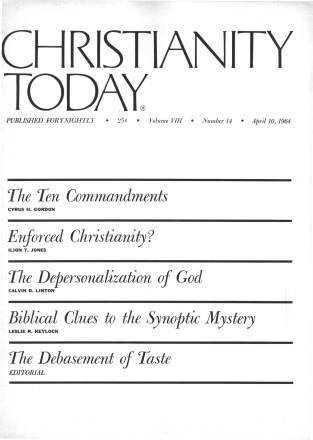
About This Issue: April 10, 1964

The internationally known orientalist Cyrus H. Gordon examines the meaning of the Decalogue in the light of modern linguistic and archaeological study (see the opposite page).

Dr. Ilion T. Jones, speaking out of years of experience as a Presbyterian minister and seminary professor, pleads for Christian action based on individual initiative and volition (p. 7).

The Dean of Columbian College of George Washington University shows the dangers of the tendency to depersonalize both God and man (p. 11), and a young scholar, Leslie R. Keylock, reflects on questions relating to the first three Gospels (p. 14).

Our lead editorial discusses Christian attitudes in relation to difficult problems posed by the shift in public taste resulting from the almost unrestricted freedom accorded writers and artists today.
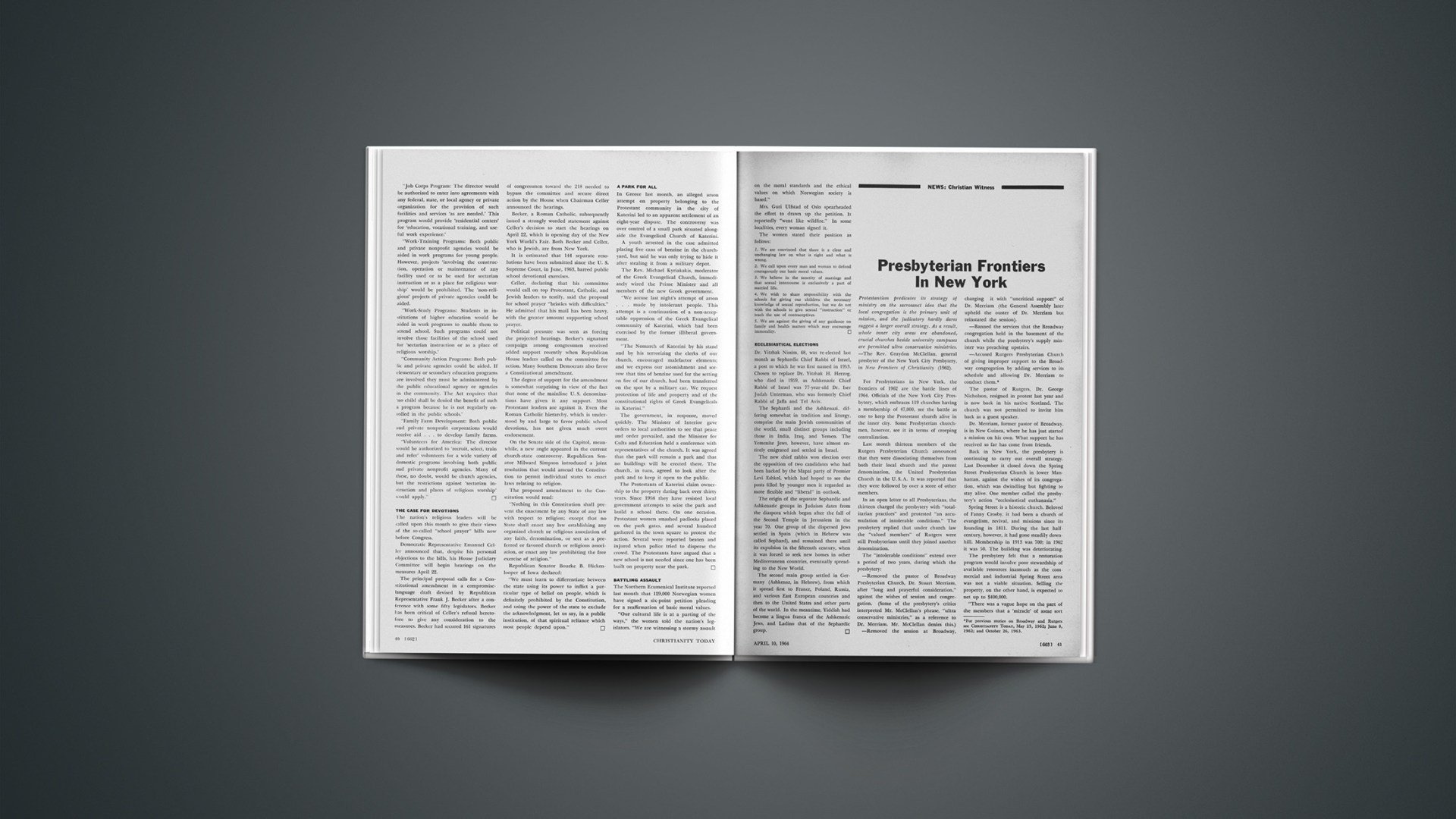
Presbyterian Frontiers in New York

Protestantism predicates its strategy of ministry on the sacrosanct idea that the local congregation is the primary unit of mission, and the judicatory hardly dares suggest a larger overall strategy. As a result, whole inner city areas are abandoned, crucial churches beside university campuses are permitted ultra conservative ministries.—The Rev. Graydon McClellan, general presbyter of the New York City Presbytery, in New Frontiers of Christianity (1962).

For Presbyterians in New York, the frontiers of 1962 are the battle lines of 1964. Officials of the New York City Presbytery, which embraces 119 churches having a membership of 47,000, see the battle as one to keep the Protestant church alive in the inner city. Some Presbyterian churchmen, however, see it in terms of creeping centralization.

Last month thirteen members of the Rutgers Presbyterian Church announced that they were dissociating themselves from both their local church and the parent denomination, the United Presbyterian Church in the U. S. A. It was reported that they were followed by over a score of other members.

In an open letter to all Presbyterians, the thirteen charged the presbytery with “totalitarian practices” and protested “an accumulation of intolerable conditions.” The presbytery replied that under church law the “valued members” of Rutgers were still Presbyterians until they joined another denomination.

The “intolerable conditions” extend over a period of two years, during which the presbytery:

—Removed the pastor of Broadway Presbyterian Church, Dr. Stuart Merriam, after “long and prayerful consideration,” against the wishes of session and congregation. (Some of the presbytery’s critics interpreted Mr. McClellan’s phrase, “ultra conservative ministries,” as a reference to Dr. Merriam. Mr. McClellan denies this.)

—Removed the session at Broadway, charging it with “uncritical support” of Dr. Merriam (the General Assembly later upheld the ouster of Dr. Merriam but reinstated the session).

—Banned the services that the Broadway congregation held in the basement of the church while the presbytery’s supply minister was preaching upstairs.

—Accused Rutgers Presbyterian Church of giving improper support to the Broadway congregation by adding services to its schedule and allowing Dr. Merriam to conduct them. (For previous stories on Broadway and Rutgers see Christianity Today, May 25, 1962; June 8, 1962; and October 26, 1963.)

The pastor of Rutgers, Dr. George Nicholson, resigned in protest last year and is now back in his native Scotland. The church was not permitted to invite him back as a guest speaker.

Dr. Merriam, former pastor of Broadway, is in New Guinea, where he has just started a mission on his own. What support he has received so far has come from friends.

Back in New York, the presbytery is continuing to carry out overall strategy. Last December it closed down the Spring Street Presbyterian Church in lower Manhattan, against the wishes of its congregation, which was dwindling but fighting to stay alive. One member called the presbytery’s action “ecclesiastical euthanasia.”

Spring Street is a historic church. Beloved of Fanny Crosby, it had been a church of evangelism, revival, and missions since its founding in 1811. During the last half-century, however, it had gone steadily downhill. Membership in 1913 was 700; in 1962 it was 50. The building was deteriorating.

The presbytery felt that a restoration program would involve poor stewardship of available resources inasmuch as the commercial and industrial Spring Street area was not a viable situation. Selling the property, on the other hand, is expected to net up to $400,000.

“There was a vague hope on the part of the members that a ‘miracle’ of some sort would save them and give them new life,” ran one report.

The congregation says that one hundred years ago the church did experience just such new life. At that time both congregation and presbytery had abandoned hope when a prayer meeting was started in a Negro woman’s basement, and for much of its subsequent history, the church prospered greatly.

One informed observer said that there was a “fair prospect” that large apartment houses would be built in the area. (A City Planning Commission official put the chances of future residential development at about 50–50.)

A presbytery official said that the church was closed with the specific aim of scattering its congregation, and that after, say, two years, it might be reopened with a congregation more in line with overall strategy. Both the moderator of the presbytery, the Rev. Eugene S. Callender, and the general presbyter denied this.

“That is ridiculous—completely untrue, false, and malicious,” said Mr. Callender. “There was no congregation—that’s the point.”

Mr. McClellan said that closing a church is always regrettable, but that Presbyterian law gives the presbytery the right to dissolve a church without the consent of its congregation, since “people never give up who love their churches.”

The presbytery’s critics are worried about what they consider clear evidence of centralization. “The Presbyteries have gradually grabbed, little by little, more and more power …,” wrote Dr. Nicholson.

According to Mr. McClellan, the presbytery’s view is that population shifts, race problems, and language problems require a tight rein. “Protestantism has a hard time staying in this city. We do all we can to help the churches get the right leadership.” He sees no creeping centralization and no issue. “Some people are waking up to the fact they are Presbyterians,” he said.

Examining Mission Hospitals

Mission boards and administrators of mission hospitals are constantly confronted with new and changing problems, among these being any appearance of competition with government or private hospitals where they exist. Another is the type of hospital to be maintained—teaching institutions where national interns and residents are trained and general hospitals run primarily to meet the needs of a particular locality. And at all times they must strive to uphold the high professional and Christian standards that commend the institution to the people of the land in which it operates.

This month, in a move to determine how their money might best be used, Presbyterians dispatched a fact-finding team of medical experts to scrutinize their seven hospitals in Japan and Korea.

The team consists of Dr. L. Nelson Bell, veteran of twenty-five years’ service as a missionary surgeon in China and a member of the Presbyterian (U. S.) Board of World Missions; Dr. Warfield Firor, president of the American Surgical Association, who recently retired as head of the surgery department of Johns Hopkins University’s Medical School; and Dr. Theodore Stevenson, medical director of the United Presbyterian Commission on Ecumenical Mission and Relations. Dr. Bell is executive editor of CHRISTIANITY TODAY.

Keeping In Step

A report presented to the second assembly of the East Asia Christian Conference asked world confessional groups to avoid acting unilaterally in dealings with Asian churches. The ecumenically oriented report cited a need for world confessional bodies to keep “in step with plans already made as a result of ecumenical consultation on both national and world levels.” The report was passed along to EACC member churches for “study.”

About 150 Protestant and Orthodox churchmen attended the assembly, held in Bangkok, Thailand. It was the first meeting of the EACC since the organizational conclave in Kuala Lumpur, Malaya, in 1959.

A Racial Pilgrimage

Methodists for Church Renewal, a newly organized group of Methodist ministers and laymen in Detroit, is planning “freedom rides” and other demonstrations to impress on the church’s General Conference the “urgency of racial justice and fellowship within the Church.” Special buses bearing integration banners and slogans will make a “Pilgrimage to Pittsburgh,” where the quadrennial General Conference opens April 26. The renewal group, which a denominational spokesman described as “totally unofficial,” will charter buses from Southern cities as well as from Northern metropolitan areas. An all-night rally is planned in Pittsburgh.

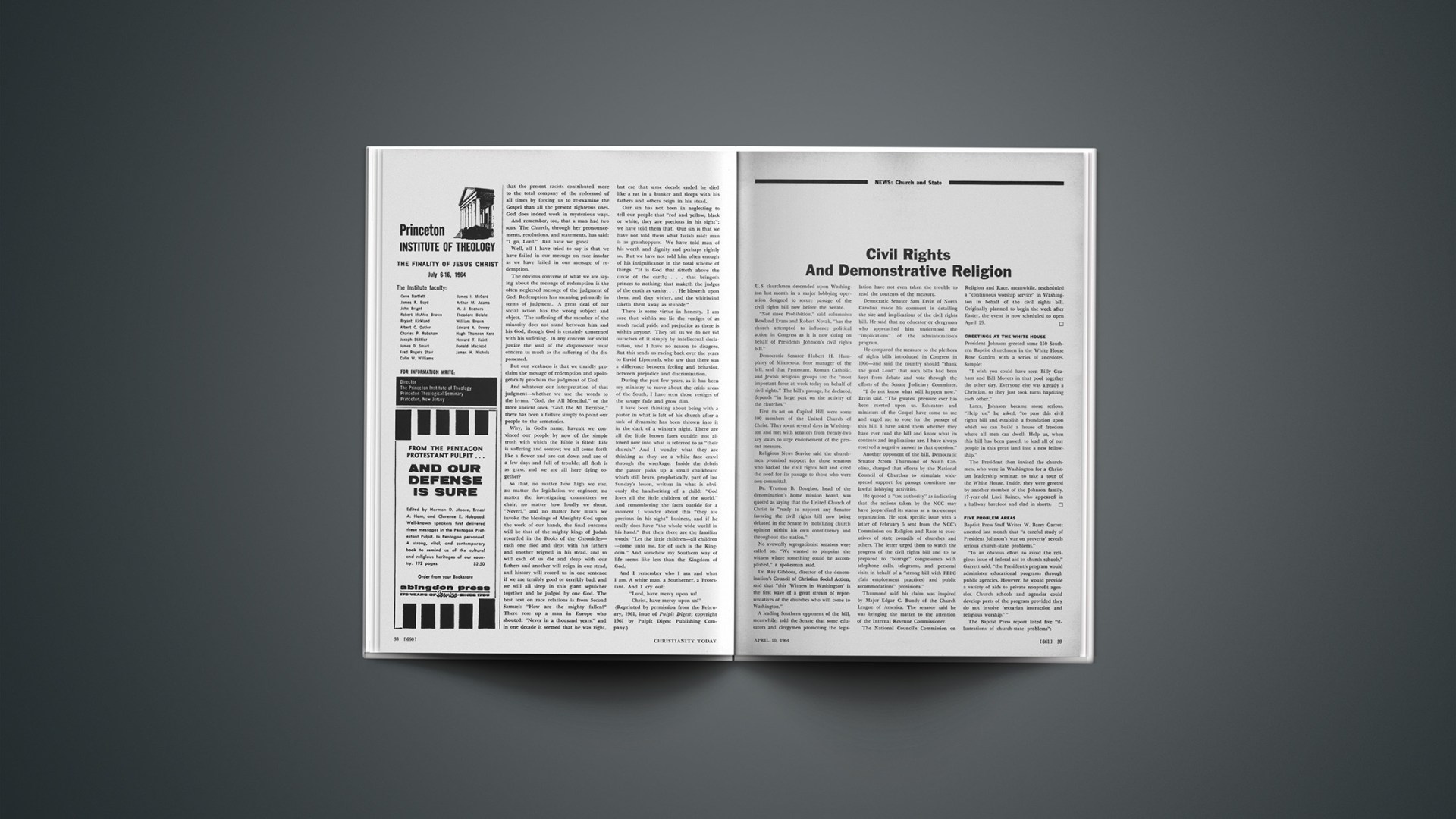
Civil Rights and Demonstrative Religion

U.S. churchmen descended upon Washington last month in a major lobbying operation designed to secure passage of the civil rights bill now before the Senate.

“Not since Prohibition,” said columnists Rowland Evans and Robert Novak, “has the church attempted to influence political action in Congress as it is now doing on behalf of Presidents Johnson’s civil rights bill.”

Democratic Senator Hubert H. Humphrey of Minnesota, floor manager of the bill, said that Protestant, Roman Catholic, and Jewish religious groups are the “most important force at work today on behalf of civil rights.” The bill’s passage, he declared, depends “in large part on the activity of the churches.”

First to act on Capitol Hill were some 100 members of the United Church of Christ. They spent several days in Washington and met with senators from twenty-two key states to urge endorsement of the present measure.

Religious News Service said the churchmen promised support for those senators who backed the civil rights bill and cited the need for its passage to those who were non-committal.

Dr. Truman B. Douglass, head of the denomination’s home mission board, was quoted as saying that the United Church of Christ is “ready to support any Senator favoring the civil rights bill now being debated in the Senate by mobilizing church opinion within his own constituency and throughout the nation.”

No avowedly segregationist senators were called on. “We wanted to pinpoint the witness where something could be accomplished,” a spokesman said.

Dr. Ray Gibbons, director of the denomination’s Council of Christian Social Action, said that “this ‘Witness in Washington’ is the first wave of a great stream of representatives of the churches who will come to Washington.”

A leading Southern opponent of the bill, meanwhile, told the Senate that some educators and clergymen promoting the legislation have not even taken the trouble to read the contents of the measure.

Democratic Senator Sam Ervin of North Carolina made his comment in detailing the size and implications of the civil rights bill. He said that no educator or clergyman who approached him understood the “implications” of the administration’s program.

He compared the measure to the plethora of rights bills introduced in Congress in 1960—and said the country should “thank the good Lord” that such bills had been kept from debate and vote through the efforts of the Senate Judiciary Committee.

“I do not know what will happen now,” Ervin said. “The greatest pressure ever has been exerted upon us. Educators and ministers of the Gospel have come to me and urged me to vote for the passage of this bill. I have asked them whether they have ever read the bill and know what its contents and implications are. I have always received a negative answer to that question.”

Another opponent of the bill, Democratic Senator Strom Thurmond of South Carolina, charged that efforts by the National Council of Churches to stimulate widespread support for passage constitute unlawful lobbying activities.

He quoted a “tax authority” as indicating that the actions taken by the NCC may have jeopardized its status as a tax-exempt organization. He took specific issue with a letter of February 5 sent from the NCC’s Commission on Religion and Race to executives of state councils of churches and others. The letter urged them to watch the progress of the civil rights bill and to be prepared to “barrage” congressmen with telephone calls, telegrams, and personal visits in behalf of a “strong bill with FEPC (fair employment practices) and public accommodations” provisions.”

Thurmond said his claim was inspired by Major Edgar C. Bundy of the Church League of America. The senator said he was bringing the matter to the attention of the Internal Revenue Commissioner.

The National Council’s Commission on Religion and Race, meanwhile, rescheduled a “continuous worship service” in Washington in behalf of the civil rights bill. Originally planned to begin the week after Easter, the event is now scheduled to open April 29.

Greetings At The White House

President Johnson greeted some 150 Southern Baptist churchmen in the White House Rose Garden with a series of ancedotes. Sample:

“I wish you could have seen Billy Graham and Bill Moyers in that pool together the other day. Everyone else was already a Christian, so they just took turns baptizing each other.”

Later, Johnson became more serious. “Help us,” he asked, “to pass this civil rights bill and establish a foundation upon which we can build a house of freedom where all men can dwell. Help us, when this bill has been passed, to lead all of our people in this great land into a new fellowship.”

The President then invited the churchmen, who were in Washington for a Christian leadership seminar, to take a tour of the White House. Inside, they were greeted by another member of the Johnson family, 17-year-old Luci Baines, who appeared in a hallway barefoot and clad in shorts.

Five Problem Areas

Baptist Press Staff Writer W. Barry Garrett asserted last month that “a careful study of President Johnson’s ‘war on proverty’ reveals serious church-state problems.”

“In an obvious effort to avoid the religious issue of federal aid to church schools,” Garrett said, “the President’s program would administer educational programs through public agencies. However, he would provide a variety of aids to private nonprofit agencies. Church schools and agencies could develop parts of the program provided they do not involve ‘sectarian instruction and religious worship.’ ”

The Baptist Press report listed five “illustrations of church-state problems”:

“Job Corps Program: The director would be authorized to enter into agreements with any federal, state, or local agency or private organization for the provision of such facilities and services ‘as are needed.’ This program would provide ‘residential centers’ for ‘education, vocational training, and useful work experience.’

“Work-Training Programs: Both public and private nonprofit agencies would be aided in work programs for young people. However, projects ‘involving the construction, operation or maintenance of any facility used or to be used for sectarian instruction or as a place for religious worship’ would be prohibited. The ‘non-religious’ projects of private agencies could be aided.

“Work-Study Programs: Students in institutions of higher education would be aided in work programs to enable them to attend school. Such programs could not involve those facilities of the school used for ‘sectarian instruction or as a place of religious worship.’

“Community Action Programs: Both public and private agencies could be aided. If elementary or secondary education programs are involved they must be administered by the public educational agency or agencies in the community. The Act requires that no child shall be denied the benefit of such a program because he is not regularly enrolled in the public schools.’

“Family Farm Development: Both public and private nonprofit corporations would receive aid … to develop family farms.

“Volunteers for America: The director would be authorized to ‘recruit, select, train and refer’ volunteers for a wide variety of domestic programs involving both public and private nonprofit agencies. Many of these, no doubt, would be church agencies, but the restrictions against ‘sectarian instruction and places of religious worship’ would apply.”

The Case For Devotions

The nation’s religious leaders will be called upon this month to give their views of the so-called “school prayer” bills now before Congress.

Democratic Representative Emanuel Celler announced that, despite his personal objections to the bills, his House Judiciary Committee will begin hearings on the measures April 22.

The principal proposal calls for a Constitutional amendment in a compromise-language draft devised by Republican Representative Frank J. Becker after a conference with some fifty legislators. Becker has been critical of Celler’s refusal heretofore to give any consideration to the measures. Becker had secured 161 signatures of congressmen toward the 218 needed to bypass the committee and secure direct action by the House when Chairman Celler announced the hearings.

Becker, a Roman Catholic, subsequently issued a strongly worded statement against Celler’s decision to start the hearings on April 22, which is opening day of the New York World’s Fair. Both Becker and Celler, who is Jewish, are from New York.

It is estimated that 144 separate resolutions have been submitted since the U. S. Supreme Court, in June, 1963, barred public school devotional exercises.

Celler, declaring that his committee would call on top Protestant, Catholic, and Jewish leaders to testify, said the proposal for school prayer “bristles with difficulties.” He admitted that his mail has been heavy, with the greater amount supporting school prayer.

Political pressure was seen as forcing the projected hearings. Becker’s signature campaign among congressmen received added support recently when Republican House leaders called on the committee for action. Many Southern Democrats also favor a Constitutional amendment.

The degree of support for the amendment is somewhat surprising in view of the fact that none of the mainline U. S. denominations have given it any support. Most Protestant leaders are against it. Even the Roman Catholic hierarchy, which is understood by and large to favor public school devotions, has not given much overt endorsement.

On the Senate side of the Capitol, meanwhile, a new angle appeared in the current church-state controversy. Republican Senator Milward Simpson introduced a joint resolution that would amend the Constitution to permit individual states to enact laws relating to religion.

The proposed amendment to the Constitution would read:

“Nothing in this Constitution shall prevent the enactment by any State of any law with respect to religion; except that no State shall enact any law establishing any organized church or religious association of any faith, denomination, or sect as a preferred or favored church or religious association, or enact any law prohibiting the free exercise of religion.”

Republican Senator Bourke B. Hicken-looper of Iowa declared:

“We must learn to differentiate between the state using its power to inflict a particular type of belief on people, which is definitely prohibited by the Constitution, and using the power of the state to exclude the acknowledgment, let us say, in a public institution, of that spiritual reliance which most people depend upon.”

A Park For All

In Greece last month, an alleged arson attempt on property belonging to the Protestant community in the city of Katerini led to an apparent settlement of an eight-year dispute. The controversy was over control of a small park situated alongside the Evangelical Church of Katerini.

A youth arrested in the case admitted placing five cans of benzine in the churchyard, but said he was only trying to hide it after stealing it from a military depot.

The Rev. Michael Kyriakakis, moderator of the Greek Evangelical Church, immediately wired the Prime Minister and all members of the new Greek government.

“We accuse last night’s attempt of arson … made by intolerant people. This attempt is a continuation of a non-acceptable oppression of the Greek Evangelical community of Katerini, which had been exercised by the former illiberal government.

“The Nomarch of Katerini by his stand and by his terrorizing the clerks of our church, encouraged malefactor elements; and we express our astonishment and sorrow that tins of benzine used for the setting on fire of our church, had been transferred on the spot by a military car. We request protection of life and property and of the constitutional rights of Greek Evangelicals in Katerini.”

The government, in response, moved quickly. The Minister of Interior gave orders to local authorities to see that peace and order prevailed, and the Minister for Cults and Education held a conference with representatives of the church. It was agreed that the park will remain a park and that no buildings will be erected there. The church, in turn, agreed to look after the park and to keep it open to the public.

The Protestants of Katerini claim ownership to the property dating back over thirty years. Since 1958 they have resisted local government attempts to seize the park and build a school there. On one occasion. Protestant women smashed padlocks placed on the park gates, and several hundred gathered in the town square to protest the action. Several were reported beaten and injured when police tried to disperse the crowd. The Protestants have argued that a new school is not needed since one has been built on property near the park.

Battling Assault

The Northern Ecumenical Institute reported last month that 129,000 Norwegian women have signed a six-point petition pleading for a reaffirmation of basic moral values.

“Our cultural life is at a parting of the ways,” the women told the nation’s legislators. “We are witnessing a stormy assault on the moral standards and the ethical values on which Norwegian society is based.”

Mrs. Guri Ulfstad of Oslo spearheaded the effort to drawn up the petition. It reportedly “went like wildfire.” In some localities, every woman signed it.

The women stated their position as follows:

1. We are convinced that there is a clear and unchanging law on what is right and what is wrong.

2. We call upon every man and woman to defend courageously our basic moral values.

3. We believe in the sanctity of marriage and that sexual intercourse is exclusively a part of married life.

4. We wish to share responsibility with the schools for giving our children the necessary knowledge of sexual reproduction, but we do not wish the schools to give sexual “instruction” or teach the use of contraceptives.

5. We are against the giving of any guidance on family and health matters which may encourage immorality.

Ecclesiastical Elections

Dr. Yitzhak Nissim, 68, was re-elected last month as Sephardic Chief Rabbi of Israel, a post to which he was first named in 1953. Chosen to replace Dr. Yitzhak H. Herzog, who died in 1959, as Ashkenazic Chief Rabbi of Israel was 77-year-old Dr. Iser Judah Unterman, who was formerly Chief Rabbi of Jaffa and Tel Aviv.

The Sephardi and the Ashkenazi, differing somewhat in tradition and liturgy, comprise the main Jewish communities of the world, small distinct groups including those in India, Iraq, and Yemen. The Yemenite Jews, however, have almost entirely emigrated and settled in Israel.

The new chief rabbis won election over the opposition of two candidates who had been backed by the Mapai party of Premier Levi Eshkol, which had hoped to see the posts filled by younger men it regarded as more flexible and “liberal” in outlook.

The origin of the separate Sephardic and Ashkenazic groups in Judaism dates from the diaspora which began after the fall of the Second Temple in Jerusalem in the year 70. One group of the dispersed Jews settled in Spain (which in Hebrew was called Sephard), and remained there until its expulsion in the fifteenth century, when it was forced to seek new homes in other Mediterranean countries, eventually spreading to the New World.

The second main group settled in Germany (Ashkenaz, in Hebrew), from which it spread first to France, Poland, Russia, and various East European countries and then to the United States and other parts of the world. In the meantime, Yiddish had become a lingua franca of the Ashkenazic Jews, and Ladino that of the Sephardic group.

A Man Had Two Sons

Scripture Reading: Matthew 21:28–31

“That race prejudice would cause trouble in the churches we know. It did this in apostolic days. Yet not once did the apostles suggest that they should form separate congregations for the different races. Instead, they always admonished them to unity, forbearance, love, and brotherhood in Christ Jesus.”

The casual observer of the reams of resolutions issued on the subject of the Church and race since 1954 might assume that those words came from the subversive presses of the various denominational houses; or from some Communist dupe preacher; or some left-wing easy bleeder of the north country.

If any of these was your guess, you were wrong. They were spoken by a man representing a group far from notorious for social liberalism. These are words of a Church of Christ evangelist. The place was Nashville, Tennessee. The year was 1878. The preacher was David Lipscomb, for whom the local Church of Christ college was named.

Ah, but haven’t we come a long way since 1878? Give us time, patience, understanding. Don’t pass repressive legislation against us or try to cram anything down our throats and we’ll work this thing out.

Now there are two rather remarkable things about this statement.

One: David Lipscomb did not appeal to harmony. He did not try to avoid conflict. Apparently he had the idea that Christian behavior had nothing to do with what people wanted to do or were ready to do. Apparently he had the strange notion that Christian behavior had to do only with the uncompromising demands of Almighty God.

Contrast this to our day, when cardinal virtues are harmony within the fellowship, peace, good will, program, and every-member canvass.

Almost a hundred years after David Lipscomb, laymen organize in church houses to tell the world and the bishop what the Church is and what their church will and will not do. What we are talking about is far more basic than desegregated schools. The churches have failed in this matter of race partly, and perhaps primarily, because we have failed in the matter of authority and the meaning of the pulpit.

The second remarkable thing about Mr. Lipscomb’s statement is that he made no appeal to law, to the courts, to democracy, to anything devised of man. His was a simple yet powerful proclamation of “Thus saith the Lord”—this despite the fact that the Emancipation Proclamation was as close to him and as controversial as the Supreme Court decision of 1954 is to us.

Some talked of the failure of the Church in Little Rock with regard to race. If we have failed, I am inclined to believe that it has nothing to do with what we have or have not done about race. Rather, it seems to me, it has to do with the manner in which we have dealt with the nature of God, with the redemptive power of Jesus Christ, and with the judgment of God. Further, it has to do with our failure to proclaim the essentials of the Christian Gospel and with our reluctance to proclaim categorically and with power and authority: “Thus saith the Lord … ‘I am the Lord thy God.… Thou shalt have no other gods.…’ ”

Our failure has to do, not with the Fourteenth Amendment but with the First Commandment; not with constitution but with idolatry. And in this process race has become identified, not as an element of our culture, but as an element of our faith.

This, I submit to you, is the greatest danger facing the Christian Church in the South today. The real danger, it seems to me, is not racism per se, but that racism becomes a part of faith. The Ku Klux Klan no longer exists in my community, but it has left its stamp on the minds and hearts of generations yet unborn. Its modern counterpart will also pass away. But the seedlings they are planting will grow and thrive for a long, long time.

And these seedlings are essentially religious in character. Most of what is written and distributed by those groups subverting the laws of church and country has a religious theme. And the segregationist man in the pew and pulpit who appeals to such support is not simply rationalizing. He defends white supremacy in God’s name. It is with Bible in hand and chapter and verse upon his lips that he offers his argument.

We can no longer fail to point out to our people the perpetuation of a whole array of subordinate gods. These gods may be racial pride or prejudice; they may be states’ rights; or they may be our own children, or our own selves.

A young white Presbyterian mother said to some of us in Little Rock recently that she could never again send her child to one of the schools built to evade the law as long as they were open to her child but not to another mother’s child because of degree of skin pigmentation. She could not do so, she said, and maintain her integrity as a member of a Christian church that stood for just the opposite of what it was doing. She reported with some emotion how it hurt her to sacrifice her son.

What do we say to a person like that? I don’t know what the right thing to tell her was, but I tried to converse with her in something of the following manner:

“Lady, you are in good company. You are in the tradition of one of our greatest fathers. ‘Take now thy son, thine only son Isaac, whom thou lovest, and get thee into the land of Moriah; and offer him there for a burnt-offering upon one of the mountains which I will tell thee of.’ ”

We talk about how we can’t obey what our country and our church tell us to do because it will hurt our little children! Maybe it will—I’m not prepared to argue the point. But this I do know and here say: This Little Rock mother was right!

“He that loveth … son or daughter more than me is not worthy of me,” said a man whom most White Council members call Lord. This is the issue before the Church: Do we believe in the God of Abraham, Isaac, and Jacob, or do we worship at the shrine of states’ sovereignty and color supremacy (today it is white; perhaps tomorrow it will be colored)?

The failure of the Protestant faith is not a failure to ask and answer the anthropological question: “What is race?” This question has been answered effectively and efficiently. Our failure, it seems to me, is in not answering the theological question: “What is the Church and what is the nature of the Christian faith?”

But, church people say, look at our amazing rate of growth. Look at the results of evangelistic crusades and the success of contemporary revivalists. Look at the souls we are bringing in. And it is so. Sometimes I wish it were not, for I see others, with no claim to being Christian, fighting for their very lives every step of the way, branded as Communist, involved in lawsuits for the right to exist while we are growing by leaps and bounds.

The Klan leader or White Council president is constantly forcing us to defend what we consider the Christian position against what he considers the Christian position. It is troubling that we who consider ourselves the children of light in regard to race in the South are being much better humanists than we are Christians. Examine our resolutions, our statements, our actions. They speak most often of law and order, of human dignity, of man’s rights, of democracy, of constitution, and at best of the principle of the brotherhood of man and the Fatherhood of God.

And we are finding that more and more this is our most vulnerable point. I believe we have left the door open for the attack of the segregationist Christian. This is not to quarrel with the humanitarian, for he has played his role more than well. But for the Christian Church to assume this same role is to bet on the wrong horse. For, as Dr. T. A. Kantonen has suggested, the Christian view of race does not rest on the principle that all of us are brothers and ought to act like it. The Christian view of race is not the universal principle of the Fatherhood of God and the brotherhood of man, as important as that is. If the segregationist is told that the gospel is to obey the law, accept the Supreme Court, or open his lunch counters, he can see no gospel, no “good news” here. It must be elsewhere, and he sets about to find it, for this is only bad news.

But if he is told, as he must be told, that the Christian Gospel was and is a message of redemption; that it was and is “God was in Christ, reconciling the world to himself”—God was in Christ breaking down the walls of hostility that separate man from man and man from his God—God was in Christ loving man, accepting him, forgiving him, even if he cannot love and accept his brother yet—tell him this and if he hears it, believes it, and accepts it, he is a lot closer to an integrated church in an integrated society than if he is told that he “ought” to be a good boy and obey the courts.

Some state there is no such thing as Christian race relations. Indeed there is! And it might be that the racist will force us to see it anew. But it has to do with grace, not law, not order. And by this grace we are no longer Greek, African, Asian; we are, in the words of the Pentecost story, “all together, in one place [yes, integrated], hearing the wondrous works of God.” And all our resolutions, petitions, strategies, all our human engineering will fail if we miss that simple point. We are the tertium genus—the third race. The Christian message on race is that race is irrelevant.

It would be ironic if history should prove that the present racists contributed more to the total company of the redeemed of all times by forcing us to re-examine the Gospel than all the present righteous ones. God does indeed work in mysterious ways.

And remember, too, that a man had two sons. The Church, through her pronouncements, resolutions, and statements, has said: “I go, Lord.” But have we gone?

Well, all I have tried to say is that we have failed in our message on race insofar as we have failed in our message of redemption.

The obvious converse of what we are saying about the message of redemption is the often neglected message of the judgment of God. Redemption has meaning primarily in terms of judgment. A great deal of our social action has the wrong subject and object. The suffering of the member of the minority does not stand between him and his God, though God is certainly concerned with his suffering. In any concern for social justice the soul of the dispossessor must concern us much as the suffering of the dispossessed.

But our weakness is that we timidly proclaim the message of redemption and apologetically proclaim the judgment of God.

And whatever our interpretation of that judgment—whether we use the words to the hymn, “God, the All Merciful,” or the more ancient ones, “God, the All Terrible,” there has been a failure simply to point our people to the cemeteries.

Why, in God’s name, haven’t we convinced our people by now of the simple truth with which the Bible is filled: Life is suffering and sorrow; we all come forth like a flower and are cut down and are of a few days and full of trouble; all flesh is as grass, and we are all here dying together?

So that, no matter how high we rise, no matter the legislation we engineer, no matter the investigating committees we chair, no matter how loudly we shout, “Never!,” and no matter how much we invoke the blessings of Almighty God upon the work of our hands, the final outcome will be that of the mighty kings of Judah recorded in the Books of the Chronicles—each one died and slept with his fathers and another reigned in his stead, and so will each of us die and sleep with our fathers and another will reign in our stead, and history will record us in one sentence if we are terribly good or terribly bad, and we will all sleep in this giant sepulcher together and be judged by one God. The best text on race relations is from Second Samuel: “How are the mighty fallen!” There rose up a man in Europe who shouted: “Never in a thousand years,” and in one decade it seemed that he was right, but ere that same decade ended he died like a rat in a bunker and sleeps with his fathers and others reign in his stead.

Our sin has not been in neglecting to tell our people that “red and yellow, black or white, they are precious in his sight”; we have told them that. Our sin is that we have not told them what Isaiah said: man is as grasshoppers. We have told man of his worth and dignity and perhaps rightly so. But we have not told him often enough of his insignificance in the total scheme of things. “It is God that sitteth above the circle of the earth; … that bringeth princes to nothing; that maketh the judges of the earth as vanity.… He bloweth upon them, and they wither, and the whirlwind taketh them away as stubble.”

There is some virtue in honesty. I am sure that within me lie the vestiges of as much racial pride and prejudice as there is within anyone. They tell us we do not rid ourselves of it simply by intellectual declaration, and I have no reason to disagree. But this sends us racing back over the years to David Lipscomb, who saw that there was a difference between feeling and behavior, between prejudice and discrimination.

During the past few years, as it has been my ministry to move about the crisis areas of the South, I have seen those vestiges of the savage fade and grow dim.

I have been thinking about being with a pastor in what is left of his church after a sack of dynamite has been thrown into it in the dark of a winter’s night. There are all the little brown faces outside, not allowed now into what is referred to as “their church.” And I wonder what they are thinking as they see a white face crawl through the wreckage. Inside the debris the pastor picks up a small chalkboard which still bears, prophetically, part of last Sunday’s lesson, written in what is obviously the handwriting of a child: “God loves all the little children of the world.” And remembering the faces outside for a moment I wonder about this “they are precious in his sight” business, and if he really does have “the whole wide world in his hand.” But then there are the familiar words: “Let the little children—all children—come unto me, for of such is the Kingdom.” And somehow my Southern way of life seems like less than the Kingdom of God.

And I remember who I am and what I am. A white man, a Southerner, a Protestant. And I cry out:

“Lord, have mercy upon us!

Christ, have mercy upon us!”

(Reprinted by permission from the February, 1961, issue of Pulpit Digest; copyright 1961 by Pulpit Digest Publishing Company.)

This sermon was preached by the Rev. Mr. Campbell, a Baptist minister, at Vanderbilt University, Nashville, Tennessee, in 1960.

The Minister’s Workshop: Preaching that Confronts the Times

When in 1949 Dr. Joseph Sizoo published his Preaching Unashamed he had behind him many years of experience in parish and pulpit ministry. He was by that time president of New Brunswick Seminary. The years, he tells us, had matured within him the “deep conviction” that a preacher must know at least these four things: (1) his times, (2) his Bible, (3) his Gospel, and (4) himself.

It is the first of these matters about which I want to speak.

To begin with, we must see Dr. Sizoo’s point in perspective. He assumes that our intelligence will tell us how impossible it is for the minister to know his times unless he knows his Bible. Even his knowledge of himself, as a person unable wholly to escape his age and therefore obliged to react to it, will be interlaced with his knowledge of the world in the midst of whose life his ministerial lot is cast.

Furthermore, we have no right to treat Dr. Sizoo’s observation with flippancy. There is insight as well as cleverness in the comment that “the Church which is married to the spirit of the age will find herself a widow in the next generation.” It is not, however, an identification with the manners and mores of the times for which one pleads; it is, rather, a perceptive awareness of the times and an identification with human need in terms of those forms it assumes that may indeed be peculiar to a certain age. The Zeitgeist is never the Church’s bridegroom; it is always the Church’s burden. It is not something to which the Church is to conform, but something that the Church, in the measure in which its redeeming Lord is relevantly proclaimed and honestly received, will transform.

It is relevance, however, that is crucial.

Let us take one facet of the matter and examine it. In his The Preacher-Prophet in Mass Society, Professor Jesse McNeil of California Baptist Seminary has a chapter entitled “Communicating with Mass Man.” Here he calls upon today’s preachers to take notice of the “many” who are freely saying that the Church is “irrelevant to the main and pressing concerns of our mass-produced contemporary life.” These people, whom the Church and its clergy leave cold, feel that “too long and too frequently has the Church emphasized man’s relation to the world to come and has offered little help in his struggle for a this-worldly mode and meaning of existence.”

A few days after reading Professor McNeil’s book I asked a friend about a young man of evangelical background who in late years has traveled widely, read considerably, and floundered pathetically. His reading and his personal associations have convinced him that the Church in the United States of America is ridiculously unimaginative, unprophetic, and unbiblical in its failure to lead its people boldly in the struggle for civil rights and for a Christian view of race. My friend told me that the young man asked a Christian dentist if any of his patients were Negroes. The dentist, an active churchman, told him that this would be quite impossible since he couldn’t use the same set of instruments on his white patients that he used on Negroes. The sheer irrationality of such thinking has turned him sourly against the Church. Preaching has no access to him because, when it did have his ear, it seemed to be unconcerned about any dimension of the Gospel that related it meaningfully and challengingly to one of the most disturbing human situations in which contemporary man finds himself.

This young man does not stand alone. Clichés will not satisfy him. Pious soporifics will not quiet him. Pseudo-scientific racist propaganda will not deceive him. Politically oriented evasions will only irritate him. He knows that politics has been defined as “the art of the possible,” but he also knows that the Gospel is supposed to have something to say about turning the impossible into the possible.

P. T. Forsythe once rebuked the liberalism of preaching that, as he put it, “seeks to be modern by the way of extenuation rather than realism, by palliation rather than penetration, by moral tenderness rather than by moral probing, by poetry rather than by prophecying, by nursing where surgery is required.”

By a devastatingly odd twist it is necessary at times to say that what passes for evangelical preaching is deserving of precisely the same indictment.

Making the Gospel respectable may hurt no lay feelings, threaten no ministerial salaries. Making the Gospel relevant may do both.

Books

Book Briefs: April 10, 1964

How Bultmann Set His Course

History of the Synoptic Tradition, by Rudolf Bultmann, translated by John Marsh (Harper & Row, 1963, 456 pp., $8.50), is reviewed by Lorman M. Petersen, professor of New Testament, Concordia Theological Seminary, Springfield, Illinois.

Several years ago, while preparing a doctoral dissertation on Bultmann, we plowed through this long volume on form criticism in the original German (Die Geschichte der synoptischen Tradition). The idea of “plowing” is quite fitting because the book, besides being encased in heavy “Bultmann German,” proved to be one of the most tedious and comprehensive works we had read in a long time. Now the English version is here, and we discovered that Bultmann is slow reading in any language. There is no doubt about its being a thorough, scholarly work. Bultmann knows the New Testament. It is also completely devastating. Speaking of “plowing,” Bultmann literally plows through the Gospels (and he plows deep), uprooting all the old familiar ground and leaving things in a terribly chaotic state, fully expecting the reader to smooth things out again. It is amazing that one man could impound so much negative criticism into a single volume.

Of course, New Testament study has moved on to other matters since Bultmann wrote this significant volume on form criticism in 1931; even Bultmann himself soon moved on to myth and demythologization. But Formgeschichte, now popularized, has penetrated to some degree almost all exegesis today, and this volume is still basic for the understanding of the method; as Robert Grant says on the jacket: “Form Criticism is evidently here to stay, and in this book it is encountered in the work of a master.” John Marsh of Mansfield College, Oxford, who was a student of Bultmann at Marburg back in the thirties, is to be commended for his excellent job of translating Bultmann’s difficult German. To render a work so heavily weighted with all sorts of footnotes, statistics, and unheard-of references had to be “a labor of love,” as he says in the preface.

Bultmann divides the volume into three major parts: The Tradition of the Sayings of Jesus, The Tradition of the Narrative Material. The Editing of the Traditional Material. Under these three headings he delineates what he assumes to be the various “forms” (apophthegms, sayings, miracle stories, legends, etc.) in which the gospel material circulated before it was committed to writing. His method is to divide the synoptic material (some of which does not fit his molds) into these categories and then proceed to analyze them piece by piece and thus to trace their history to the ultimate source. Such breaking up of the framework of the Gospels not only settles the Synoptic problem for Bultmann but also gives each unit its “proper interpretation.” In stating his task in the important introductory chapter he says that he leans on the previous work of Wellhausen and Gunkel in the Old Testament, and that of Wrede, Schmidt, Dibelius, and others in the New Testament, and that form criticism grew out of the inadequacy of the old documentary theories (p. 2). It is interesting to note, however, that Bultmann continues to build upon the documentary hypotheses. He works with Q, for example, as if it were an actual document like Mark. This leads him into the study of the life of the Christian community to see what influences shaped the forms (Sitz im Leben). At this point literary criticism becomes historical criticism, and Bultmann, a conscientious and honest scholar, admits a pronounced weakness of all form criticism—the argumentum in circulo:

It is essential to realize that form-criticism is fundamentally indistinguishable from all historical work in this, that it has to move in a circle. The forms of the literary tradition must be used to establish the influences operating in the life of the community, and the life of the community must be used to render the forms themselves intelligible [p. 5]

Then Bultmann takes the radical step for which he has been severely criticized, namely, passing value judgment on the historicity of the forms:

In distinction from Dibelius I am indeed convinced that form-criticism, just because literary forms are related to the life and history of the primitive Church not only pre-suppose judgments of facts alongside judgments of literary criticism, but also lead to judgments about the facts (the genuineness of the saying, the historicity of the report and the like).

He begins with the apophthegm, a term he borrowed from Greek literature. He says it is a saying of Jesus set in a brief context or story. The redactor often simply created a story or setting for these sayings in the interest of apologetics, polemics, teaching, or missionary preaching.

The sayings have produced the situation or context, not the reverse (p. 21). For example, regarding the inhospitable Samaritans (Luke 9:5 ff.), “the journey through Samaria is Luke’s construction” (p. 26). Not even all the dominical sayings (proverbs, wisdom-words, and the like) are genuine. “It is also possible for secular proverbs,” he says, “to have been turned into sayings of Jesus by the Church when it set them into the context of its tradition” (p. 101). Sometimes His prophetic words become a vaticinium ex eventu (a prophecy written after the event) (pp. 113, 122). Likewise, the miracle stories are not all historical, and it becomes a problem for Bultmann how they found their way into the tradition.

Perhaps the reader may understand Bultmann’s technique from a sample of the thorough and involved manner in which he dissects a text, of which there are many examples throughout the book. In the chapter entitled “Biographical Apophthegms” he treats “Jesus blesses the children” as follows:

Mk. 10:13–16 par: Jesus blesses the children. Here for the first time Dibelius’ theory of ‘sermonic sayings’ finds some support, for the logion in v. 15 could well be a secondary piece inside vv. 13–16. But whether it can be taken as an edifying expansion of v. 14 is in my view nevertheless very doubtful. The point of v. 14 is quite different from that of v. 15: v. 14 simply states that children have a share in the Kingdom of God, and the toon toioutoon in v. 14 ought not to be interpreted, as has been customary ever since Origen, in the light of v. 15. That means treating v. 15 as an originally independent dominical saying, inserted into the situation of vv. 13–16. It is certainly no use referring to Matt. 18 for this verse is clearly not an independent tradition, but is the Matthean form of Mk. 10:15 in another context. The other possibility is also improbable, that the setting in vv. 13–16 is made up on the basis of the saying in v. 15. For vv. 13–16 are a complete apophthegm without v. 15, and its point is stated in v. 14. The original unit, vv. 13, 14, 16 may well be an ideal construction, with its basis in the Jewish practice of blessing, and some sort of prototype in the story of Elisha and Gehazi (2 Kings 4:27) and an analogy in a Rabbinic story. But if so, the insertion of v. 15 only makes the ideal character of the scene quite unambiguous: the truth of v. 15 finds symbolic expression in the setting of the story.

Preachers and Bible teachers will be interested in learning that Bultmann designates the familiar narrative material of the Gospels as legendary. He defines a legend as those parts of the tradition which are not miracle stories in the proper sense, and instead of being historical are religious and edifying (p. 244). The Last Supper is a cult legend. The baptism of Jesus may be historical, “but the story as we have it must be classified as legend” (p. 246). The Temptation is a legend which perhaps goes back to the nature myths of the kind that tell of Marduk’s fight with the dragon of Chaos or to the tales of the “Temptation of Holy Men” like those told of Buddha (p. 253). (However, Bultmann shows his exegetical genius by the valuable insights he gives one of the temptations of Jesus.) The Transfiguration was once a resurrection story. The Triumphal Entry and most of the Passion history is legendary. He considers the death of Jesus as probably historical but says “it is strongly disfigured by legend.” The same is true of the Easter narratives (especially the story of the empty tomb) and the infancy narratives.

The reader should pay particular attention to Bultmann’s summary chapter, “Conclusion” (pp. 368 ff.) in which he says that while the gospel tradition had its origin in the primitive Palestinian church, it was shaped by the Hellenistic church. The tradition, in turn, can only be understood in terms of the Christian kerygma, which the Gospels merely illustrated and expanded. He epitomizes his views in the following paragraph, which should be read carefully for all of its implications:

The Christ who is preached is not the historical Jesus, but the Christ of faith and the cult. Hence in the foreground of the preaching of Christ stands the death and resurrection of Jesus Christ as the saving acts which are known by faith and become effective for the believer in Baptism and the Lord’s Supper. Thus the kerygma of Christ is cultic legend and the Gospels are expanded cult legends [p. 370].

Our assessment of Bultmann’s form criticism is mainly negative. One has to be frightfully uncritical to accept what Bultmann offers with so little evidence. It seems to be the old historical criticism in new dress. It is not only a solution of the Synoptic problem but also the dissolution of the Gospels themselves. It is true that we must face the fact that the first Gospel was oral, and form criticism may throw light on the oral period of the Gospel. If there were these pericopes perhaps they take us to the very headwaters of our Gospels; but these findings are prostituted by the radical example of Bultmann. For instance, the form of a story does not tell us whether it is true or false. Bultmann’s method is much more radical than any harmonizations of the Gospels have ever been. He wishes to rewrite the New Testament according to his own assumptions, and the Gospels become a patchwork. He assumes the role of a ghost writer redoing a posthumous novel. His method is not exegesis but geology of the text. Thus we believe that most of the criticism aimed at Bultmann has been justified. It is a very arbitrary method. Those who use form criticism to interpret Scripture should realize this. But perhaps our greatest disappointment in Bultmann is that the origin of the Christian religion takes place on a horizontal plane—never do we hear him speak of the influence of God’s Holy Spirit on the writers of the Gospels. The blessed Gospel is cut off from the dynamic of the Holy Spirit. We must ask, if faith created the Gospels, what created the faith? Thus it was but a stone’s throw for Bultmann to go from radical form criticism to demythologization. But that is another story. We would, however, appeal to pastors and teachers to study this volume and see for themselves. Fortunately, the barrier of the German is now gone, and many more will be able to do this.

LORMAN M. PETERSEN

Good On England

Anatomy of Britain, by Anthony Sampson (Harper & Row, 1962, 662 pp., $7.50), is reviewed by J. D. Douglas, British editorial director, CHRISTIANITY TODAY.

The publishers state that this book will give American readers a clear and penetrating picture of British leaders and institutions. Mr. Sampson, who calls himself “an enquiring journalist,” contradicts his title at the outset when he disclaims any intention of dealing with “the life of the ordinary people.” He is concerned only with the managers. With assurance and professional expertise he runs through such divergent subjects as royalty, advertising, the press, the law, insurance companies, and the much maligned honors system, which underlines that we are not all equal after all. He has one tremendous swipe at Harold Macmillan, who, he asserts, “looks down on people (like Hugh Gaitskell) who have never led a platoon of men into battle …” (p. 324).

American readers of Scottish or Welsh ancestry will quickly discover that, again despite the title, this volume is concerned almost exclusively with England, and that the writer has a quite inordinate preoccupation with Oxford and Cambridge, which seem to worm their way into chapters where they have no right to be. Only once is the English monopoly broken: in the somewhat gossipy chapter on churches, where twenty-eight lines are devoted to the Church of Scotland (nine pages to the Church of England). This is no unmixed blessing, for into this niggardly allocation Mr. Sampson has contrived to cram four major and five minor mistakes.

With true Anglican arrogance he calls the nonconformist churches “sects,” and for some reason finds it necessary to state that “there is no real Methodist aristocracy.” It would have been better had he defined his terms also in describing the present Archbishop of York as an “evangelical”—a designation sure to raise a few quizzical eyebrows. Welshmen will be delighted to learn from the index that universities have somehow sprouted up at Aberystwyth, Bangor, Cardiff, and Swansea. The reviewer wishes to complain that the name of his own university is spelled wrong every time, and to refute the canard that its students wear “multi-coloured gowns.”

Handled carefully, this could be a useful compendium, but he who seeks objectivity here will look in vain; at the end of the day the reader is left in no doubt about Mr. Sampson’s own interests and prejudices.

J. D. DOUGLAS

Light On Apostasy

The Disappearance of God, by J. Hillis Miller (Harvard, 1963, 359 pp., $7.50), is reviewed by Stanley Wiersma, associate professor of English, Calvin College, Grand Rapids, Michigan.

Since the Renaissance, God has been disappearing from the corporate consciousness of Western Man. Professor Miller limits his study to the nineteenth-century phase of God’s disappearance, tracing that phenomenon through the works of five English writers: De Quincey, R. Browning, E. Brontë, Arnold, and Hopkins.

Each of these writers believes in the existence of God, each is impressed with how far away God seems, and each is desperate to establish contact again. De Quincey attempts to establish contact with God’s infinity through total-recall opium experiences, through experience of the predetermined perfection of great musical forms, and through development of a writing style that is intended to be a human equivalent for God’s existence; but memory of lost joy by opium turns out to be painful, music is bound to time and space, and a prose style that reflects eternity becomes simply vapid. Browning keeps shifting his identity from dramatic monologue to dramatic monologue in a desperate attempt to be all mankind, to approach God’s infinity; but becoming all, Browning only becomes less himself. Emily Brontë sees her world as a kennel, for God has left man and man has reverted to bestiality; but even if a person’s union with another person, or with nature, or with God, can temporarily restore his humanity, such unions are not common. The loss of humanity (and divinity) is attributed to specific causes by M. Arnold: industrialism, science, and urbanization. While E. Brontë becomes dramatically violent, Arnold becomes passively despairing; himself a victim of modernity, he demands new, virile poetry but cannot produce it. Of the writers treated only Hopkins comes to be happily familiar with God, immediately after his conversion to Catholicism, but even he falls into the time’s despair in later poems—impatient with his own imperfections, impatient with his isolation from God, and impatient for the final judgment.

Literary students will admire the book’s careful, balanced approach. Dr. Miller avoids the one-sidedness of explicating works out of context on the one hand, and of providing historical background at the expense of explicating works on the other. Allowing that each literary piece has integrity by itself, Professor Miller nevertheless addresses himself primarily in this book to a consistent interpretation of each writer’s whole corpus. Only in terms of a writer’s whole lifetime of development are individual works given intensive explication. By this method Professor Miller again and again illuminates works that “everybody knows.” This reviewer, for instance, will return often to the careful analyses of Brontë’s Wuthering Heights and of Hopkins’s “Pied Beauty.” Professor Miller’s method deserves imitation.

A major value of the book to Christians will be its concrete demonstration that God’s disappearance is accompanied by man’s ignorance or willfulness in looking. God’s disappearance is inevitably man’s failure or refusal to see Him as he has revealed himself.

Clergymen will find the book useful because of its abundant supply of illustrations for various kinds and degrees of apostasy. One does so weary of Henley’s “Invictus.”

STANLEY WIERSMA

Sane And Useful

Three Crucial Decades: Studies in the Book of Acts, by Floyd V. Filson (John Knox, 1963, 118 pp., $3), is reviewed by James P. Martin, associate professor of New Testament, Union Theological Seminary in Virginia, Richmond.

This work by the professor of New Testament at McCormick Seminary, representing the Smyth lectures delivered at Columbia Theological Seminary, is a sane and useful guide to the study of the theology and historical understanding of Luke in the Book of Acts.

The author believes that Acts is indispensable to any consistent and convincing account of the emergence and expansion of apostolic Christianity and is, on the whole, a reliable guide to the history of the primitive Church. The title, Three Crucial Decades, provides a broad framework of a thirty-year period, but it does not describe the essential contents of the book, since the decades are not developed individually or together in any detail. This scheme appears to rest upon Gregory Dix’s use of three decades in his excellent work, Jew and Greek, but the similarity is purely formal.

In the material content of his studies, Dr. Filson treats first the scope, purpose, and impact of the Book of Acts. He is aware of the views of critical scholarship on Acts but does not spend his time debating directly with others; rather, his own purpose is to provide a synthetic result embodying his own critical opinions at many points. The theology of Luke is centered on Resurrection, Ascension (exaltation), and the Spirit. The speeches in Acts are not taped reproductions of what was said but summaries or frameworks of what was generally said. As an outline of Acts, Filson prefers C. H. Turner’s six-fold panel outline, with each panel concluding with a summary of the progress of the Gospel. He does not feel that Acts 1:8 or the Peter-Paul dichotomy provides the key to the structure of the book. He cautions us wisely that outlines do not give proper expression to the important role of the sermon summaries and speeches in the total book. After pointing out the curious amount of space (9½ chapters) given to Paul’s final journey to Rome, Filson concludes (in chapter 5) that this is in the nature of an apology. He emphasizes, furthermore, his opinion that for Luke it was Paul’s preaching, not Peter’s, that effectively established and directly attested the apostolic preaching in Rome. This may be an overdrawn conclusion not easily harmonized with the historical fact that the church at Rome is pre-Pauline (or non-Pauline) in origin.

C. H. Dodd’s work on the apostolic preaching, which has had such an influence in New Testament studies by showing that from the first the Church preached a Gospel of salvation that embodied a high Christology, is discussed at some length in chapter 2. Filson, on the whole, agrees with Dodd, but he disagrees at points. He thinks that Dodd’s distinction of preaching and teaching is not supported by Acts. Acts shows that the apostles taught, argued, disputed, discussed, and so on, and Filson uses this information to correct the Bultmannian over-emphasis on preaching as pure announcement that calls for a decision only and no questions!

Other chapters are devoted to Peter and the Twelve, James and Jewish Christianity, Paul and the Gentile mission. Filson finds no support at all in Acts for any practice of apostolic succession from the Twelve. Paul himself shatters any neat pattern of succession. There is no fixed polity laid down by the Twelve and so planned as to establish a “regular” ministry. “The theme of Acts is that the Spirit guided the church and its existing leaders to take the steps which enabled the church to express its witness and live a life of loyalty to Christ.”

Jewish Christianity is described in a way that does justice to only part of the “Jewishness” of the primitive Church. By restriction of the term to those Christians who included the keeping of the Mosaic law, the theological and historical significance of the origins of the Christian Church within Israel is somewhat reduced, so that traditional Protestant patterns of James vs. Paul are perpetuated. The suggestion (p. 83) that James’s real concern was the protection of Jewish Christians and not the coercion of Gentile Christians deserves to be elaborated. By assuming that James was consistently faithful to the ceremonial law, Filson concludes that, since this faithfulness is not reflected in the Letter of James, this letter is not from James and is therefore of no help in interpreting James. This conclusion will probably be contested. For, assuming that the letter reflects James’s true spiritual concern, one could use it to “correct” an interpretation that does not do justice to James’s interest for the true unity of the Church composed of Jew and Greek. Readers should consult Adolf Schlatter’s The Church in the New Testament Period for another view of James and Jewish Christianity.

This book is a worthwhile addition to literature on Acts and the apostolic Church. It should open up Luke’s historical work for many.

JAMES P. MARTIN

Book Briefs

Free in Obedience, by William Stringfellow (Seabury, 1964, 128 pp., $2.75). In essays that strike sparks, a layman theologizes about the demonic tyrannies in human life and institutions and about the freedom that comes in the Gospel.

The Bible Story Book, by Bethann Van Ness (Broadman, 1963, 672 pp., $4.95). A retelling of the whole biblical narrative in language the eight to twelve-year-old can read, and younger children can understand, marked by fidelity to the Scriptures. Large legible print, with art work and a valuable supplement explaining life in Bible times.

Justus Jonas, Loyal Reformer, by Martin E. Lehmann (Augsburg, 1963, 208 pp., $4). The story of the life and work of a collaborator of Luther who energetically helped shape and extend the cause of the Reformation.

Personalities around Jesus, by William P. Barker (Revell, 1963, 156 pp., $2.95). Fresh thought in sparkling style.

The Infertile Period, by John Marshall (Helicon, 1963, 118 pp., $2.95). All about how a woman can take her temperature, have sexual relations but not pregnancies. Beside the thermometer, she will need the mind of a mathematician and the memory of a computer. Success would seem contingent on a rare combination.

A Reader for Parents: A Selection of Creative Literature about Childhood, selected and edited by the Child Study Association of America, introduction and comment by Anna W. M. Wolf (W. W. Norton, 1963, 463 pp., $8.95).

Personalities around the Cross, by H. H. Hargrove (Baker, 1963, 138 pp., $2.50). Evangelical essays, theologically and organizationally careless.

Christ the Sacrament of the Encounter with God, by Edward Schillebeeckx (Sheed & Ward, 1963, 222 pp., $4.50). A Roman Catholic presents a personalistic interpretation of the sacraments. A translation from the original Dutch, Christus, Sacrament van de Godsontmoeting. For the professional scholar.

The Speaker’s Treasury of 400 Quotable Quotes, compiled by Croft M. Pentz (Zondervan, 1963, 159 pp., $2.95). Just what the title claims; the church school teacher and the man of the pulpit will often find it useful.

The Epistle of Paul to the Ephesians (from “The Tyndale Bible Commentaries”), introduction and commentary by Francis Foulkes (Eerdmans, 1963, 182 pp., $3). A concise, workable tool for laymen, teachers, and ministers.

The Miracles of Golgotha, by Homer H. Boese (Baker, 1963, 143 pp., $2.95). Informative, biblical essays that probe the religious meaning of the miracles surrounding the Cross and the Resurrection.

Christian Faith and Greek Philosophy, by A. H. Armstrong and R. A. Markus (Sheed & Ward, 1960, 162 pp., $3.50). Authors compare, contrast and evaluate those ideas where Christianity and Greek thought confront each other, such as eros, time, knowledge, and the like. Good reading for the student with philosophical curiosity.

Faith Is a Star, by Roland Gammon (E. P. Dutton, 1963, 243 pp., $3.95). The personal religious philosophies and contemporary achievements of prominent Americans of our day—originally expressed on the international radio broadcast, “Master Control.”

Over-Shadowed Journey, by Kazuo Kaneda (Hope Press [Tokyo, Japan], 1964, 159 pp., $2.50). Story of the wartime experiences of a Japanese minister.

Paperbacks

The Social Humanism of Calvin, by André Biéler (John Knox, 1964, 80 pp., $1.50). A short summary of the social ethics of Calvin by a lecturer at the University of Geneva. The reader will see faces of Calvin that sometimes differ from the inherited image.

The Death Penalty in America, edited by Hugo Adam Bedau (Doubleday, 1964, 586 pp., $1.95). Several essays by the author, who opposes the death penalty, plus several by authorities who favor it. A valuable study.

Mental Health and Segregation, by Martin M. Grossack (Springer, 1963, 247 pp., $4). An extensive collection of studies and writings on the effects of racial segregation on Negro mental health.

Constitution on the Sacred Liturgy, by the Second Vatican Council (Liturgical Press, 1963, 64 pp., $.50). A bilingual edition (Latin and English); highly informative for Protestants interested in the liturgical matters brought before the Second Vatican Council.

Persons and Places: The Background of My Life, by George Santayana (Scribner’s, 1964, 262 pp., $1.45).

Moll Ta-iu: “Man of Great Plans,” by Eva M. Moseley (Christian Publications, 1963, 224 pp., $1.50). The biography of Dr. Thomas Moseley, missionary-educator.

Facing Facts in Modern Missions, a symposium (Moody, 1963, 141 pp., $1.75). A discussion of missions in which answers are given to many of the questions currently under discussion within the ecumenical movement and mainline denominations. Profitable reading.

Roman Catholicism and the Bible, by Olivier Beguin (Association, 1963, 95 pp., $1.50). A factual survey of the Bible movement in Roman Catholicism, with detailed information about how the Bible is used in that church in many parts of the world. A valuable study. The author is general secretary of the United Bible Societies.

The Cambridge Greek Testament Commentary: The Gospel According to St. Mark, edited by C. F. D. Moule, commentary by C. E. B. Cranfield (Cambridge, 1963, 494 pp., $2.95). First published in 1959.

Ideas

The Debasement of Taste

To the American mind censorship is abhorrent. Unlike the totalitarian state, ours is a country in which men may speak, write, and publish as they wish and read and see what they want. Just as governmental requirements of religious and political conformity are intolerable, so censorship in literature and in the visual and performing arts is repugnant to our society. To be sure, there are legal limits to the exercise of free speech and artistic expression; the law prohibits obscenity that is utterly without social value, malicious libel, and subversion of national security amounting to “clear and present danger.” Yet we seem in principle to be moving toward a position in which it will be increasingly difficult to define and enforce the limits beyond which the spoken and written word and the various modes of artistic expression may not go.

Thoughtful observers of American society can hardly fail to recognize the almost Copernican revolution that has taken place in American standards of decency. What was a trend two or three decades ago has in the last five or ten years become a landslide. The daring plays or pictures of the late fifties seem tame in comparison with today’s “adult” entertainment. That a minister of a great denomination should place on the pulpit alongside the Bible a book denied free circulation since the eighteenth century because of its salaciousness ought not to be considered merely an individual aberration but should be seen for what it is—one of many signs of a changed climate of opinion that now stomachs what only a few years ago would have been spewed out as morally defiling. Of recent years the public sense of propriety has been chipped away under the ceaseless impact of literature, entertainment, and advertising that have gone further and further in unending exploitation of sex.

To turn to another field, the unanimous decision of the Supreme Court throwing out a $500,000 award in an Alabama libel suit against The New York Times has upheld the right of criticism of public officials (even though the criticism may be false) provided that it is not made “with actual malice.” The decision was doubtless necessary; in a democracy political discussion must at all costs be kept free from reprisal. However, two justices, Hugo L. Black and Arthur J. Goldberg, in concurring opinions, in which Mr. Justice Douglas joined, advocated the removal of the qualification regarding malicious intent. Mr. Justice Black’s call for “granting the press an absolute immunity for criticism of the way public officials do their duties” was consistent with his statement in 1962 that any and all libel and slander laws along with any prosecution whatever of spoken or written obscenity are ruled out by the First Amendment (interview with Professor Edmond Cahn, New York University Law Review, June, 1962), Though few would go so far as this, it is evident that the widening interpretation of the constitutional privilege of freedom of speech and the press carries with it a heavy obligation of self-restraint.

Censorship, self-restraint under liberty, or untrammeled freedom of expression in speech, the press, and the arts—which? This is the problem. There are no easy solutions. And for this reason and because no problem comes closer than this one to the springs of human conduct and welfare, it must be the subject of deeper Christian thought and concern. Certainly the present situation in which almost anything can be said, written, or portrayed may yet result in a reaction that will impose restrictions in default of the exercise by individuals and groups of socially responsible self-restraint.

Further questions need to be asked: Is the public taste descending to a point of no return through mass media that reach as never before practically all the population? The licentious Restoration drama in England led to reform through the middle class; but what if the general standard of propriety has been lowered throughout society? Or, looking at the problem from another side, is it reasonable, while assuming on the one hand that the only truly effective censorship or restraint is self-imposed, to suppose on the other hand that man in his alienation from the God of holiness and truth will exercise such self-restraint?

To such questions there are indeed no easy answers. But they must be asked; and as they are asked, the Christian position vis-à-vis the moral relativism of the day must be clearly and unashamedly stated. It is not the task of the Church to impose its convictions upon the world, but it is the obligation of the Church to declare its convictions to the world. In a day when multitudes have substituted a laissez-faire morality for the biblical ethic, Christians are responsible to live in a non-Christian world according to the teachings of their Lord and the Scriptures which testify of him.

This leads to the responsibility to practice Christian non-conformity in a society that is brimful of materialism and sensuality, and that widely repudiates the Gospel with its ethical corollaries. And this in turn entails a Christian critique of cultural values, based not upon withdrawal or isolation from culture but upon compassionate understanding of it in the light of biblical revelation.

What, then, are some principles of Christian action in a morally corrupt society? Scripture knows no such thing as a Christian world order short of the millennium; with utter realism it sees the Church and the believer as in the world and therefore with responsibilities to it but at the same time as generically different from it. As a new man in Christ, the believer has in spiritual reality an other-worldly origin, although he lives in a this-worldly environment.

The inevitable result is tension. “The world,” said Christ of his disciples, “has hated them because they are not of the world.” What he stated with such profound simplicity is developed throughout the New Testament, especially but by no means exclusively in the Pauline epistles. But this polarity between Christians and the world does not exempt them from their continuing responsibility to be “the salt of the earth” and “the light of the world.”

It is at this point of creative witness that ambiguities arise in respect to the Christian attitude toward the wide-open expression so characteristic of contemporary literature and the arts. Because these mirror the mood of the time with its restless search for meaning and escape by those who do not believe in the Gospel, many Christians feel that we must know what is being communicated. And so we must—within limits.

“But what,” it may well be asked, “are these limits?” Briefly they may be comprehended under three principles: that of Christian responsibility for the thought-life, that of Christian responsibility for one’s brother, and that of Christian non-conformity to the world.

Individual responsibility for the thought-life is implicit in the Sermon on the Mount, in which Christ searchingly equates sin in thought with sin in fact: “Whosoever is angry with his brother without a cause shall be in danger of the judgment.… Whosoever looketh on a woman to lust after her hath committed adultery with her already in his heart.”

To know what the world is thinking and saying does not mean willing capitulation to its obsessive preoccupation with illicit sexual activity. The argument that Fanny Hill with its descriptions of prostitution and perversion is a useful background for choosing virtue is as sensible as advocating visiting a brothel as an inducement to chastity. No Christian is obligated to reside in the brothels of the mind in order to know the world in which he lives. For those who feel obligated, as Milton says in Areopagitica, to “see and know and yet abstain” (italics ours), sampling under Christian conscience is sufficient acquaintance with the redundant portrayal of lust that fills so many pages and occupies such unending moving-picture footage. The inescapable principle that thought leads to action has not been canceled by dropping practically all reticencies in fiction and on the screen. It is still true that as a man thinks in his heart, so he is, and that “the pure in heart shall see God.”

“But what of the ‘erotic’ passages in the Bible?” To that question, frequently raised by defenders of morally questionable literature, the answer can only be that the attempt to equate the restrained way in which Scripture speaks of sex or the beautiful imagery of Solomon’s Song with a Tropic of Cancer or any other scatological novel is sheer intellectual dishonesty convincing only to those who are ignorant of Scripture.

A second responsibility relates to one’s brother. The glorious truth is that Christians have liberty of thought and action. They are under grace, not law. But their liberty has inherent limits. As the Apostle shows in his classic exposition of Christian liberty in Romans 14, liberty may not be exercised in such a way as to “put a stumblingblock or an occasion to fall in his brother’s way.” No reasonable Christian would distort this principle to the extent of subjecting all literature and art to bowdlerizing; there must be a place for honest and responsible portrayal of human life in the actuality, often unpleasant, of evil as well as good. Yet Christians cannot in the exercise of their liberty escape responsibility for youth. If promiscuity is rife among adolescents throughout the country today—including many church-going young people—the question of where they learned their “new morality” is in part answered by what paperbacks and magazines they are free to buy at the corner drugstores, what they read even in respectable periodicals, and what they see in their neighborhood theaters as well as on the television screen at home. Indifference to human welfare when responsibility for others demands restraint of personal indulgence, is a mark of our age; and it shows itself in lack of concern for what is happening to children through debasement of public taste.

A third responsibility is that of non-conformity. Christian protest is overdue. Making every allowance for contact with and understanding of the world, the call of both Church and believer is to non-conformity. Paul’s “be not conformed to this world: but be ye transformed by the renewing of your mind” has ample roots in the teachings of Christ. Samuel Rutherford of seventeenth-century Scotland put the principle in vivid words, “You will find in Christianity that God aimeth in all his dealings with his children to bring them to a high contempt of, and a deadly feud with the world”—words that echo the drastic statement of James the brother of the Lord, “Know ye not that the friendship of the world is enmity with God?”

What is needed is a resurgence of Christian responsibility expressed first of all in self-restraint and thoughtful discrimination of values. The easy answer of avoiding all modern literature and entertainment will not do. Not everything the world does is corrupt. Under God’s common grace unbelievers write great novels and plays, paint beautiful canvases, compose fine music, and produce worthy motion pictures. Yet when the world uses its abilities to degrade public morality and debase human life, then Christians are obligated not only to non-conformity but also to open protest.

In The Decline and Fall of the Roman Empire, Edward Gibbon gives as one of the main causes of the growth of the early Church in the decadent empire the pure morality of the Christians, who, by their steadfast non-conformity to the world around them, shone as lights in the darkness and worked as salt in a pagan society. The principle has not changed. Purity for conscience’ sake, goodness out of conviction, self-restraint motivated by love for God and man, have not lost their winsomeness. In this secular society, as in imperial Rome, Christlike living still has its ancient power.

Jerusalem And Times Square

A recent event in New York’s Times Square, modern “crossroads of the world,” seemed but to illustrate a timeless sermon of an ancient preacher in Jerusalem. Last month musty 1904 New York newspapers were removed from a copper box that had sealed them for sixty years in the former Times Tower. Their contents, The New York Times reported, showed that the tenor of the news has changed surprisingly little:

There was trouble in the Far East and in Panama. Commuters on the Erie Railroad complained of congestion. Broadway box-office practices were under fire.

The Brooklyn police were chasing the Mafia, with little success. There were bloody uprisings in Africa. Editorialists were writing about the perils of smoking cigarettes.

Long ago the Preacher said: “Vanity of vanities; all is vanity.… One generation passeth away, and another generation cometh … and there is no new thing under the sun.”

If indeed man is “born unto trouble as the sparks fly upward,” and if indeed his problems seem unending and beyond human solution, let him turn to the enduring New Testament for the answer: “Jesus Christ the same yesterday, and today, and forever.” From him flows eternal grace to meet the recurring temporal need.

The Return Of The Social Gospel?

A theology is being widely propagated in which the death of Christ on the Cross for the sin of the world is construed to mean that every man is already saved from sin, even though he may have no knowledge of this. The resurrection of Christ for man’s justification is construed as meaning that every man is already justified before God, even though he has never heard of the Resurrection. Christ has already saved all men and is thus Lord of all.

The mission task of the Church, according to this theology, is merely to announce the news of what God has already done in Christ for men. The task is not to call men to the decision of faith, but to inform them that they are saved. The Church must inform men that life is not as it seems to be. It must tell the lost that they are not lost, as they thought; that they are not subject to death, as they imagined, but have, unbeknown to them, already come under the decisive power of the Resurrection. Thus the decisive character of the Cross and the Resurrection dissipates the decisive, life-or-death character of faith.

On this understanding of what God actually accomplished in the Cross and Resurrection, this theology proceeds to erase the line of distinction between the Church and the world. The Church is no longer the company of the redeemed, since the world is also redeemed. It is distinguished from the world only in that it knows it is redeemed, and it seeks through Christian missions to bring the world to this same knowledge.

Spokesmen for this theology also deny that there is any distinction at all between the sacred and the secular. The Church is not sacred, the world secular; work is not secular, and prayer sacred or religious. Everything is said to be sacred, and every vocation an essentially religious one. Here too lies the cause of the recent blurring of the distinction between clergy and laymen. The theological basis for regarding the whole span of human life and action as religious and sacred is said to be the Lordship of Christ. Since Christ as Lord of history is active in all of human history, any proper action by anyone in any area of life is regarded as a religious action, as a sacred function of co-laboring with Christ. On this basis it is said that anyone marching in a picket line, or taking part in a civil rights demonstration, is engaging in an act of worship. This, so goes the claim, is to put the altar out of the Church and into the street where it belongs. From this theological perspective stems the claim that social legislation is a fulfilling of Christian mission, and working for better housing a fulfillment of the Great Commission. From this same point of view it can be easily understood that some churchmen urge that the Church’s task is not to preach for the salvation of individual men, but to save the social, political, cultural, and economic structures in which men live, and often suffer. For us to think we can bring souls to Christ is regarded as presumptuous. The Church’s great mission task is said to be that lesser function of saving those organizations and institutions in which we have structured our social life.

One churchman has pressed the trinitarian character of God, and thereupon urges that Christ the Lord of history and the Spirit of God who moves redemptively in history are always first on every mission field. Before the missionary arrives, Christ and his Spirit are there and at work, so that there is no wholly pagan man or wholly pagan situation. On this basis, he urges that the missionary must first listen to the pagan to hear what he has to tell the missionary, before the missionary can speak to him of Christ.

That God has wrought decisively in the Cross and resurrection of Jesus Christ on man’s behalf cannot be denied. Nor can it be denied that Christ is Lord of all history, and that he by his Spirit works in history. Yet all this is not the whole biblical truth, and a theology built on this restricted basis is bound to be profoundly unbiblical and dangerous.

In biblical teaching missionaries are sent to lost men, and sent, not with a message that is merely information about what has happened, but with a message that, by proclaiming Jesus Christ for acceptance and acknowledgment, creates an eschatological moment, a moment in which men stand between heaven and hell in the time of their salvation.

In the preaching of the Gospel, Christ himself confronts men and speaks to them. He summons them to become what they are not: new creatures in Christ. In the critical moment, precipitated by gospel proclamation, the hearer is not merely summoned to accept some new information. He is called to the decision of faith; his whole being is summoned to response. He is called to accept his very life, indeed his new self, from the hand of Christ. And on this biblical view, the Church is not essentially indistinguishable from the world, nor the sacred from the secular. The Church is God’s new creation, which the world is not, just as the Christian is a new creature, the man “in Christ,” which the nonbeliever is not. However difficult theologically it may be to integrate the decisiveness of the Cross and Resurrection with the biblically taught necessity of the decision of faith, in biblical thought the first is not without the second.

The theology that claims that all men are already saved and that nothing decisive remains to be done but to save life’s social structures, and that therefore urges men to get on with the act of worship by putting the altar in the streets, has the earmarks of a returning “social gospel,” this time grounded in neo-orthodoxy’s faulty understanding of the objective and decisive character of God’s redemptive actions in Christ.

Biblical Illiteracy And Public Education

Time has brought to the nation’s attention the biblical illiteracy so widespread today and one man’s effort to do something about it. To assess the effect of Bible-banning in the public schools, English teacher Thayer S. Warshaw of the high school in Newton, Massachusetts, subjected several classes of college-bound seniors and juniors to a Bible quiz. To those appreciative of the integral role the Bible has played in Western culture, the results could be termed stunning:

Several pupils thought that Sodom and Gomorrah were lovers; that the four horsemen appeared on the Acropolis; that the Gospels were written by Matthew, Mary, Luther and John; that Eve was created from an apple; that Jesus was baptized by Moses; that Jezebel was Ahab’s donkey; and that the stories by which Jesus taught were called parodies.

The pupils also fared very poorly when asked to complete familiar biblical quotations. Thus it was no surprise that biblical allusions in secular literature often held no meaning for the youngsters. To correct the situation, Warshaw devised a reading course in the King James Version, emphasis being upon literary influence and not theological implications. As a result, his students’ knowledge of the content of the Bible has been vastly improved.

We salute teacher Warshaw and encourage others to follow in his train. Such methods cannot replace religious teaching of the Bible to be found in varying degrees of effectiveness in the Sunday schools, but a large portion of our youth do not attend Sunday school. And their ignorance of the Bible is no small matter, for following hard on the heels of biblical illiteracy is moral deprivation.

An Income For All

That every American has the right to the guarantee of a sufficient income whether or not he works was the recommendation of what is called the Ad Hoc Committee on the Triple Revolution, in a document sent to President Johnson late in March. The committee is made up of thirty-two educators, writers, economists, and other leaders. According to this group, “the Triple Revolution” requiring drastic adjustments in American society comprises cybernation, the new nuclear weaponry, and the human rights conflict. The call for “an unqualified commitment” of government to give “every individual and every family … an adequate income as a matter of right” is based largely upon the development of cybernation, whereby machines needing very little human direction will be capable of vastly expanding production. But this almost unlimited output is being checked, the committee says, by the present “income-through-jobs link as the only major mechanism for distributing effective demand—for granting the right to consume.” The recommendation did not say how the suggested provision of an adequate income to all would operate.

While the suggestion represents an attempt to face future problems of the American economy, this kind of endeavor may well jeopardize one of the most basic of human rights—that of the individual to achieve fulfillment and dignity through work. Granted the real problems of unemployment resulting from the expansion of automation and cybernation, there must be a better solution than the bestowal of an income on those who will not work, as well as on those who cannot work. (The Apostle’s word, “If any would not work, neither should he eat,” is still relevant.) Certainly the present use of available free time causes one to ask how millions without the stimulus of working for a living would use their total leisure.

In any event, these momentous problems cannot be adequately discussed without reference to certain theological implications, among which the nature of man himself is paramount. Fundamental is the question whether fallen man can safely be placed in an environment that ignores God’s wise and merciful provision that man should eat his bread in the sweat of his face. Well meant though it is, the suggestion of excusing multitudes from earning their living may, if carried out, be a giant step toward dehumanization. Edenic conditions are hazardous for post-Edenic man.

Theology

Where Is Peace?

Man’s desire for peace and his frantic search for formulas and organizations that might further world peace often lead to false hopes.

Too often the peace mentioned in our newspapers and promised by politicians is actually a cruel hoax. Furthermore, as far as many are concerned, the desire for peace is merely a wish to eliminate war so they may continue to live as they please.

The cold war has taught us that an armed truce is not peace, nor is neutrality, while peace at any price is too big a price where righteous principles are at stake. Compromise only postpones, never solves, basic issues.

The Bible makes clear that peace is not a man-willed state of affairs; rather it is a God-conferred blessing on a man’s condition, often without reference to the world as such.

From the Scriptures we learn the varieties of peace that God gives and the sequence in which they come: peace with God, the peace of God, and peace with our fellow men.

That the world demands peace without the Prince of Peace is obvious. Only a minority recognize Christ as the giver of peace; and an even smaller number admit that without him there can be no real or lasting peace, either in the world or in the hearts of individuals.

Peace with God. This peace is a new dimension of living, a work of God’s love and mercy in which are involved regeneration, forgiveness, Christ’s imputed righteousness—all a part of his saving grace through faith on our part. Paul states it clearly in these words: “Therefore, since we are justified by faith, we have peace with God through our Lord Jesus Christ” (Rom. 5:1, RSV).

It seems pleasant to insist there is no separation from God that requires mediating work to bring about peace, but this is not true. There is both open and secret hostility on our part; and there is, for the unregenerate, God’s holy hostility to sin, a hostility that demands judgment and for which he made perfect provision.

Paul further states the case: “For the mind that is set on the flesh is hostile to God; it does not submit to God’s law, indeed it cannot” (Rom. 8:7); while James further defines the need for man’s peace with God: “Unfaithful creatures! Do you not know that friendship with the world is enmity with God? Therefore whosoever wishes to be a friend of the world makes himself an enemy of God” (Jas. 4:4).

Peace with God is a quality he transmits to believers. We read: “He is our peace, who has made us both one, and has broken down the dividing wall of hostility, by abolishing in his flesh the law of commandments and ordinances, that he might create in himself one new man in place of the two, so making peace, and might reconcile us both to God in one body through the cross, thereby bringing the hostility to an end” (Eph. 2:14–16).

Once man has made peace with God he experiences an amazing new kind of peace: The Peace of God. This peace is an inner quality of life derived from His presence in our lives. It is a peace that the world cannot understand, a peace that the world can neither give nor take away. To his troubled disciples our Lord spoke words that continued to be fulfilled for believers in each generation: “Peace I leave with you; my peace I give to you; not as the world gives do I give to you. Let not your hearts be troubled, neither let them be afraid” (John 14:27).

Later he amplified this truth: “I have said this to you, that in me you may have peace. In the world you have tribulation; but be of good cheer, I have overcome the world” (John 16:33).

Isaiah had this same concept of the peace of God: “Thou dost keep him in perfect peace, whose mind is stayed on thee, because he trusts in thee” (Isa. 26:3).

“The effect of righteousness will be peace, and the result of righteousness, quietness and trust for ever” (Isa. 32:17)—this has been demonstrated to Christians again and again.

This peace in the midst of danger has been the comfort and stay of many who otherwise could not have stood the pressures of the moment: “In peace I will both lie down and sleep, for thou alone, O Lord, makest me dwell in safety” (Ps. 4:8).

The Apostle Paul expresses this hope for the Christians in Rome: “May the God of hope fill you with all joy and peace in believing, so that by the power of the Holy Spirit you may abound in hope” (Rom. 15:13).

In every generation there have been false prophets crying, “Peace, peace, when there is no peace,” because the “peace” of which they speak has no reference to peace with God or his peace in the heart.

Peace with our Fellow Men. This peace is more than a new and right relationship with God through Christ; it is more than his peace within; it assumes a horizontal dimension, reaching out to those with whom we have daily contact. How often Christians dishonor the Lord they profess by a lack of love for others! And how important that the peace of God which passeth understanding shall operate where there is misunderstanding!

The writer of the Epistle to the Hebrews states this as a command: “Strive for peace with all men, and for the holiness without which no one will see the Lord” (Heb. 12:14). And Paul wrote the Thessalonian Christians: “Be at peace among yourselves” (1 Thess. 5:13b).

Basic to this aspect of peace is a spirit of forgiveness and love. If we are to exercise such an attitude to others, it must stem from a realization of what Christ has done for us: “For the kingdom of God does not mean food and drink but righteousness and peace and joy in the Holy Spirit; he who thus serves Christ is acceptable to God and approved by men. Let us then pursue what makes for peace and for mutual up-building” (Rom. 14:17–19).

Peace with our fellow men never means condoning evil: “But the wisdom from above is first pure, then peaceable.… And the harvest of righteousness is sown in peace by those who make peace” (Jas. 3:17, 18).

Peace among Christians is maintained by Paul’s admonition: “Do not look on him as an enemy, but warn him as a brother” (2 Thess. 3:15).

It behooves all Christians to think clearly about the meaning of peace. The voices at Babel—“Come, let us build ourselves a city”—have their counterpart today: “Come, let us build a warless world”; but it will not happen that way. God scattered the people of Babel abroad, and he will bring to naught every plan for world peace that ignores the One he has sent to be the Prince of Peace. God has given us the Way: “Rejoice in the Lord always; again I say, Rejoice.… Have no anxiety about anything.… And the peace of God, which passes all understanding, will keep your hearts and your minds in Christ Jesus” (Phil. 4:4–7).

God has a formula for peace, and it is ours for the asking.

Eutychus and His Kin: April 10, 1964

ALL POWER CORRUPTS

My friend Karl had something to do with the opening of a summer camp for some sector of the Church somewhere. They were about to have a dedication service, and he was supposed to give the invocation, which he was prepared to do. He was somewhat put out and subsequently led to meditate thereon when one of the “high officials” came running to him just before the service to say: “Are you ready with an invocation? You know the Superintendent of the Synod himself is here today.” One can see immediately that one’s prayers to Almighty God need a little extra refurbishing if there are any superintendents of synods around.

What I like to hear is the introduction of a man who is going to say the blessing at a big dinner. First of all it is fun to be at the head table, or even in the planning stages for the banquet, and hear discussion of the pros and cons of who ought to be asked. After all, these honors don’t come daily!

Now the banquet hour has arrived, and the chairman announces proudly, “We will be led in our invocation by the Reverend Dr. C. Leroy Bust, District Superintendent of the Hutchinson County Sunday School Association, District Six, and Past Moderator of Ebenezer Presbytery, and former Executive Vice-President of the Humble Rendering Company.” By this time there is more introduction than man. This may all please God and give a good feeling to the audience: it will certainly impress the man who gives the invocation (to ask him to “say the blessing” or “return thanks” would be too pedestrian).

The status symbols of the grand ministry, I suppose, are substitutes for money-making. Since we can’t all be rich, we can make up for it by titles, robes, hats, and letterheads. He that sits in the heavens shall laugh.

EUTYCHUS II

EVANGELISM AND THE ABC

Thank you for reporting the address of Dr. Jitsuo Morikawa at the NCC—DCE meetings in Cincinnati (News, Mar. 13 issue). And thank you for your insightful editorial dealing with Dr. Morikawa’s strange theology. He certainly appears to have abandoned evangelical principles. Your reporting and your editorial should help American Baptists to correct this situation in our Division of Evangelism.

I am sure that American Baptists have no intention of abandoning their social witness and responsibility. But I am also sure that they will have no witness to make unless it is founded on evangelical principles.

FRANCIS E. WHITING

Director

Dept. of Evangelism and Spiritual Life

Michigan Baptist Convention

Lansing, Mich.

Surely you aren’t serious when you imply separation of man into an “individual” being and a “social” being; into “soul” and “body”? I can’t believe that a biblically oriented journal such as yours would get involved in such an unbiblical dichotomy. The obvious message of Scripture is that man is a unity; the whole point of the Incarnation being that God became flesh.…

Morikawa is one of the few men in our time who, like the prophets, are trying to cast the message of personal salvation in a context where grace strikes with full impact on man’s total context. He is one of the few men in positions of executive leadership who want the Gospel to embrace and redeem the whole world and who are not willing that little clubs of ecclesiastical porch-sitters form and hide behind what they think is a biblical conservatism but which is nothing of the kind. They are suppressing, as if it were possible, the sovereignty of God to rule his world and to move mightily to save, and they are rendering themselves close to the brink of hell by being irrelevant.…

NORMAN R. DEPUY

First Baptist

Moorestown, N. J.

• We recognize that man is a social being, for if he were not, he could not be saved by another, namely Christ. And we believe that every Christian is called to bear witness to the Lordship of Christ in all spheres of life. But Dr. Morikawa says more—that salvation of the individual is contingent upon the salvation of the various social structures of life. With this, we are in hearty and profound disagreement.—ED.

As a pastor in the American Baptist Convention I agree wholeheartedly that many of Dr. Morikawa’s programs and theories are not only unscriptural but confusing.

Our failure to grow as a denomination certainly is due in part to Dr. Morikawa’s weird concepts of evangelism.

Fortunately, biblical evangelism or the seeking the salvation of individuals, and not “the evangelization of the structures of society,” is the position of a great majority of pastors in the American Baptist Convention.

STEWART H. SILVER

First Baptist

Seymour, Ind.

SILENT SUPPRESSION

I feel I must write to congratulate you on your article on “South Africa’s Race Dilemma” (News, Jan. 31 issue). I want only to express my appreciation that you managed to present all the principal facts and furthermore, you have got your facts right. It is to be regretted that in the emotionally charged atmosphere in which this subject is discussed, facts also seem to be suppressed.

ERIC HUTCHINGS

Hour of Revival Association

Eastbourne, England

AFTER INDEPENDENCE

Thank you for printing the article by Mr. R. Coggins concerning “Missions and Prejudice” (Jan. 17 issue).…

Being a second-generation missionary as well as having been born on the mission field, I have seen a lot of this. I know a pastor who is willing to, and has, come to Africa to preach Christ. But let a Negro get within a block of his church, and out comes the shotgun.

It behooves American mission boards to think [on] what one of the leaders of an African country which will be shortly receiving independence stated. He said that after independence they are going to look into the parent body of missions in that country and see if in the home churches segregation is practiced. The inference is that this mission might be asked to leave the country.

ERNEST G. JONES

The Assemblies of God Mission

Mzimba, Nyasaland

ON ECUMENICAL NEO-COLONIALISM

My attention has been drawn to your editorial comment (Jan. 17 issue) on “Ecumenism’s Neo-Colonial Compromises,” in which you accuse the World Council of Churches of employing “neo-colonial methods of purchasing ecumenical cooperation.” This general charge is supported by a specific reference to the Theological Education Fund, which is inaccurate and misleading.

It is alleged that the Near East School of Theology “has been exposed to a series of ecclesiastical pressures.…” The editorial then continues: “The Theological Education Fund offered $99,000 to assist in relocating the Near East School of Theology institution nearer the campus of the American University of Beirut.…” In the context of your editorial, this is clearly intended to create the impression that the T.E.F. is attempting to buy cooperation between these two institutions.

The facts are quite otherwise. The Near East School of Theology, which is a union institution, has maintained cooperative relations with the American University for many years. The proposal that the school should move from its present site to the vicinity of the university was made by the Board of Managers of the Near East School of Theology. The Theological Education Fund received a request from the Board of Managers for financial help. The Committee of the Fund (in 1962) declined the request on the following grounds: (a) that the purpose of the T.E.F. is the advancement of theological education; (b) that a change of locale would not, in itself, achieve this purpose: and (c) that the primary need of the N.E.S.T. (in the opinion of the committee) was an improvement in the quality of the teaching and administration of the school. In the light of these comments, the Board of Managers renewed the request in 1963, at the same time outlining plans for the reconstruction of the academic program and the administration of the school. On the basis of these assurances the T.E.F. Committee approved a grant of $99,000. Of this sum $9,000 is to be applied to the purchase of books, and the balance to the cost of relocation. It is difficult to see how this series of events can be construed as an attempt to purchase ecumenical cooperation by neo-colonial or any other methods. The fact is that in this, as in other cases, the Theological Education Fund has declined to use its resources merely to support cooperation, apart from serious plans for the strengthening of the training of the ministry. Moreover, the Theological Education Fund does not “offer” major grants to theological institutions. It responds (as its objectives and resources permit) to requests presented by such institutions, on their own initiative. It is the first policy of the fund to make grants only in support of proposals which have the responsible backing of the institution concerned and the constituency which it serves.

You state that the T.E.F. grant to the Near East School of Theology was made on two conditions, the first being “that $100,000 matching grants be assured by the United Church of Christ and by the Theological Commission of the United Presbyterian Church in the U. S. A.” The facts are that the T.E.F. Committee required “other contributions” amounting to $200,000; and it stipulated that these should be secured by June 30, 1965. There is no reference in the T.E.F.C. resolution as to the source of these contributions. It is not the business of the T.E.F. to tell the N.E.S.T. Board of Managers where to find its resources. It is its business, however, to ensure that its grants are given for undertakings which can, in fact, be carried out. The estimated cost for the relocation of the school in Beirut was $290,000. Towards this the T.E.F. has made an appropriation of $90,000, but the payment of the grant is conditional upon the ability of the school to find the additional resources necessary to implement the proposal.

You state that the second condition attaching to the T.E.F. grant is “that the school’s president (a national) be succeeded by a non-national.” The T.E.F. Committee laid down no such condition. In accordance with established practice, it merely stated that the grant would be available when satisfactory progress had been made in the carrying out of the plans submitted by the Board of Managers of the Near East School of Theology.

I regret, sir, that you did not verify your facts before printing a hearsay account of these matters, which can only cause embarrassment to an institution which, I must assume, you desire to help.

CHARLES W. RANSON

Dir.

The Theological Education Fund

New York and London

• Director Ranson’s factual data about T.E.F. proposals is correct, and CHRISTIANITY TODAY stands corrected in these details. In one respect he misinterprets our editorial, for there is no intention to “create the impression” that T.E.F. was attempting to buy cooperation between A.U.B. and N.E.S.T. CHRISTIANITY TODAY is aware that these two institutions have a history of cooperation.

What is stated in the editorial—and not conceded by Dr. Ranson—is that there were “ecclesiastical pressures” upon the N.E.S.T.; that T.E.F., the United Church Board, and the Presbyterian Commission were involved in these; and that they were directed toward the removal of the national president of the seminary in the interest of a supposed wider and more effective ecumenical service on the part of the seminary. CHRISTIANITY TODAY stands by its claim that there were such pressures, exercised not through written documents but under the surface in more personal ways. The pressure in the N.E.S.T. situation seems to have originated in the United Church Board and moved from there into the Presbyterian Commission, and through an overlapping membership has figured also in T.E.F. projections.

The intention of our editorial was not to discredit the T.E.F. Committee, which performs a useful service in aiding theological education in needy areas. It was rather a word of caution lest the committee undermine its own good work by allowing itself to be used in the manner indicated.—ED.

Your editorial … has just been brought to my attention.…

It seems a bit unfair to lift an example out of context to support your contention. I have been indirectly related with the Near East School of Theology in Beirut as a Fraternal Worker in Syria-Lebanon for the past ten years, and am well acquainted with the personnel and policies of the school.… With considered judgment and wise counsel the Presbyterian Church, U. S. A., officially took the stand to integrate its work into that of the National Evangelical Synod of Syria and Lebanon in the spring of 1959. Five years later there are only two secondary schools, out of ten, remaining under the guidance of “foreign” mission boards, the latest having been nationalized in November, 1963. I believe that it was a judgment of wisdom which prompted the Commission on Ecumenical Mission and Relations of the United Presbyterian Church, U. S. A., to adopt the approach that when a qualified and competent national, equal to, if not superior to, the missionary he was to replace was located, then and only then would the project in question be “nationalized.” Competency, therefore, was not to be judged on the basis of one’s race, creed, or national origin, but on the basis, as it rightly should be, of one’s experience, educational background, and knowledge of program he is to direct.

I am convinced that we now have this caliber of nationals in those institutions which have been “nationalized” over the past ten years. The individual to which you refer in support of your charge of ecumenical suicide is only the acting principle, suggesting that the Board of Directors is not yet ready to pass final judgment.…

W. G. GEPFORD

First Presbyterian Church

Boulder, Colorado

• The devolution noted by Mr. Gepford is the program, at least, of the United Presbyterian Church in the Near East. However, program and practice do not always coincide. CHRISTIANITY TODAY has noted a significant instance in which the commendable policy of devolution was “forgotten” temporarily in the interest of “wider ecumenical concerns.”

Mr. Gepford writes: “The individual to which you refer in support of your charge of ecumenical suicide is only the acting principle (sic), suggesting that the Board of Directors (sic) is not yet ready to pass judgment.” This statement is incorrect. The person in question is definitely the principal of the seminary and has been unanimously supported by his Board of Managers in the field in the face of ecclesiastical pressure to have him removed.—ED.

CHOOSING A CHANNEL

Your warm article on Clyde Taylor (“God’s Handyman in Washington”) in the February 14 issue (News) portrays what a tower of strength this man has been for the evangelical branch of Protestantism.

But there was a disturbing overtone in the piece—the shortage of competent leadership in the ranks of the NAE, the fading image and effectiveness of this organization, the honest doubts of many Protestants as to whether we really any longer need the NAE.

Many of us are not prepared to acknowledge that the National Council of Churches (or its parent WCC) provides the best channels through which to express ourselves and propagate our faith on an interdenominational level. There is too much concrete evidence that there exists in these organizations, from top to bottom, some elements that are fundamentally opposed to what we feel is important and vital.

The statement by a speaker at the recent triennial meeting of the NCC (that the aim of the churches is the “renewal of the social structure” … “not the saving of individual souls”) is hardly conducive to enlisting enthusiasm from evangelicals.

And this statement from a recent meeting of the WCC’s Division of World Mission and Evangelism at Mexico City is hardly the kind to bolster the viewpoint that the liberalism of the 1920s no longer exists. Said the statement: “Evangelism is a misused, misunderstood word. Most people think of it as the conversion of sinners, the more the better. Actually, it’s service. Look, if I take care of a dope addict because the city doesn’t have the facilities for him and because society considers him a criminal, why, I consider this evangelism.”

The argument that statements like these are unrepresentative and untypical is getting a little shopworn.

We wish the NCC warranted our confidence, for a two-Protestant approach to the mammoth problems of our age is something less than desirable. But church history and the Scriptures demonstrate, do they not, that there are some things worse than division.

Which brings the problem into focus. If the NCC and WCC cannot command our confidence, how is the evangelical wing of Protestantism to survive, much less push ahead, unless it be rooted in an institution like the NAE? Or something in its place? Any cause that is to remain healthy over the long pull of the years must be anchored in an organization—such as liberal Protestantism is anchored in the NCC. Thank God for evangelical magazines, such as CHRISTIANITY TODAY. Thank God for evangelical colleges and seminaries. Thank God for evangelical movements such as the Billy Graham Evangelistic Association. But programs cannot flow from editorial staffs or schools or evangelists. Programs flow from organizations, which is why the NAE—or something in its place—is sorely needed.

Leaders and denominations who only give lip service to the NAE and refuse to take its role seriously may some day regret that back in the 1960s when they had a chance to give force to this organization they let it go by the board.

GUNNAR HOGLUND

Youth Director

Baptist General Conference

Chicago, Ill.

AREAS OF CHALLENGE

I have been enjoying your editorials and many of the articles in recent issues … and was especially glad for your current editorial on “Evangelical Writing Today” (Feb. 14 issue) with its note of encouragement and hope that many evangelicals are beginning to take seriously this extremely important medium of communication.

There are still very weak areas, particularly in the field of creative or imaginative writing: fiction, poetry, and drama.…

J. WESLEY INGLES

Professor of English

Eastern Baptist College

St. Davids, Pa.

Theology

Some Biblical Clues to the Synoptic Mystery

Unsolved mysteries bring out the detective in man. Theology has its share of fascinating yet perplexing mysteries, none of which is more acute in the world of contemporary biblical scholarship than the so-called Synoptic problem. A glance at recent issues of almost any theological journal will show how important the problem of the relation between the first three Gospels has become since the advent of a new “quest” for “the historical Jesus” among such disciples of Rudolf Bultmann as Ernst Käsemann, Günther Bornkamm, and Hans Conzelmann.

The aim in this article, however is not to present the most recent views, but rather to look at three clues that lie within the pages of the New Testament itself. Those already versed in the mystery will find little here but the independent reflections of a “detective” who has yet to consult with many of his older and wiser colleagues.

The first clue to be found in the New Testament is the practice of certain Jews in the synagogue at Berea who, in response to the speech of Paul and Silas, “were more liberal-minded than those at Thessalonica: they received the message with great eagerness, studying the scriptures every day to see whether it was as they said” (Acts 17:11, NEB). Not only does this suggest that the Old Testament was read and explained in order to convert Jews to Christ; it also represents one example of the regular practice of primitive Christians (cf. also Peter’s exhortation about selecting Judas’s successor, Acts 1:15–22)—namely, searching the Old Testament for references to Jesus Christ and his Church.

Within any given local church two developments may be surmised: first, the number of references to Christ in the Old Testament would tend to become somewhat standardized in time and favorite verses would become prominent sources for reflection; secondly, various apostolic narrations from the life of Christ would attach themselves to these standardized lists of favorite verses. As Luke tells us elsewhere (Luke 1:1, 2, NEB), many “[accounts] of the events that have happened among us” came to circulate among the various early Christian communities.

The Exodus And The Gospels

Because the exodus from Egypt was for the Jews the most important event of the Old Testament, it may be suggested that these early accounts were based on “traditions” that might very well have been influenced to some extent by the order of the events related to the Exodus. Surely it is not difficult to conjecture that the crossing of the Sea of Reeds might have reminded the original eye witnesses of our Lord’s baptism, the wandering in the desert of his temptation in the wilderness, the account of the bitter waters at Marah of several episodes in Christ’s life in which water plays a prominent role, the miraculous manna and quail on the journey from Elim to Sinai of the bread and fish that fed the multitudes, the Ten Commandments of the Sermon on the Mount, Moses the lawgiver of Christ as the proclaimer of a new Law, and perhaps even the crossing of the Jordan and entry into the promised land of the crucifixion and ascension of our Lord. Such a framework might have existed prior to the composition of the first written accounts of Christ’s words and works. Only gradually did a concern for a more chronological framework appear; and when it did, it would appear to have been superimposed on the existing Old Testament framework. A quick look at the Gospel of Matthew will reveal the validity of this hypothesis.

A second clue to the Synoptic mystery occurs in a well-known passage in the Fourth Gospel. The author frankly confesses that “there were indeed many other signs that Jesus performed in the presence of his disciples, which are not recorded in this book,” and that the basis upon which he selected his contents was not primarily biographical, nor chronological, nor even historical, but “fiducial”: “Those here written have been recorded in order that you may come to believe that Jesus is the Christ, the Son of God, and that through this faith you may possess eternal life by his name” (John 20:30, 31 n., NEB). Thus to John at least the fiducial is really more important than the merely historical. As evangelicals we must beware of conveying the false impression that the Christians of the first century had a nineteenth-or twentieth-century conception of historiography. All four Gospels, in fact, have as their primary function the confirmation and deepening of the kerygmatic witness of the apostles.

This ultimate theological concern of the Evangelists makes more credible our earlier suggestion that some events in Christ’s life were originally fitted to a framework of Old Testament passages rather than to any chronological or sequential pattern, such as a contemporary historian might follow. On the basis of biblical evidence, no evangelical needs to quarrel with the words of F. C. Grant: “Nothing merely biographical or historical has a place here; the book was written ‘out of faith’ and ‘for faith’—i.e., the creation, or the confirmation, of Christian faith is all that matters” (“Mark,” Interpreter’s Bible, VII, 651). However, as F. F. Bruce says, such a conclusion “throws little light on the historicity of any particular incident or utterance” (“Biblical Criticism,” New Bible Dictionary, p. 153). When it is admitted that the primary aim of the Gospels is not a historical account, at the same time it must not be forgotten that historical accuracy as conceived by first-century standards was of tremendous concern to the early Church. At this point we have another clue to our mystery.

For ‘Authentic Knowledge’

The only other Gospel that states its own purpose is Luke. Luke’s famous preface (1:1–4) has much to say about the formation of the Gospels. The author apparently felt that extant accounts of the words and works of Christ were incomplete and lacking in important detail. He also hints that some accounts may have included inauthentic forms. He therefore emphasizes that he “[went] over the whole course of these events,” that he did so “in detail” for the purpose of giving “authentic knowledge” to Theophilus (Luke 1:3, 4, NEB). Thus, despite the fact that the date of the writing of the Synoptic Gospels is some three or four decades removed from most of the events narrated, biblical evidence would seem to suggest that certain exponents of the Formgeschichte method who attribute to the primitive community a high degree of creativity are giving Luke’s words far less emphasis than they deserve.

Karl Ludwig Schmidt, for example, in rejecting the essential historicity of the gospel framework would seem to be denying the very concern of the early Church for authentic knowledge that Luke’s preface reflects. When Bultmann says that “the study of the laws that govern literary transmission can be approached by observing the manner in which the Marcan material was altered by Matthew and Luke” (“The New Approach to the Synoptic Problem,” The Journal of Religion, VI [1926], 345), he would seem to be on solid ground. But when he goes on to suggest that the names given by Matthew and Luke to unidentified characters in Mark are the result of a pious imagination that “paints such details with increasing distinctness” (loc. cit.), we are surely required by objectivity to say that this is only one possible side to the coin of literary law. Equally possible is the conclusion that Matthew and Luke uncovered new information; and that this was actually the case, at least for Luke’s Gospel, would seem to be the prima facie implication of Luke’s preface.

Support From Modern Scholars

Much modern scholarship would seem to warrant and even underline such a view. Although Luke begins his Gospel as a classical Greek historian, we know that his essential conservatism results in a rather literal Greek translation that preserves the Aramaic flavor of the original gospel forms. Moreover, the work of the Scandinavian school at Uppsala, the conclusions of the Albright archaeological school, and the recent discovery of the Dead Sea Scrolls have done much to confirm the great reliability of materials transmitted both orally and in writing. Then, too, the very fact that the Gospels sound as if they are earlier than the Epistles, when in fact they were written later than many of the latter, should make us cautious about overemphasizing the creative role of the community of faith.

In any case, the early Church would appear to have had some concern for completeness, detail, and authenticity by the very fact that it chose Luke’s Gospel for popular use and eventually for its canon, and by the fact that it chose four Gospels only, not more nor less. That Matthew and Luke seem to have used versions of Mark quite similar to the one we now possess would seem to indicate that Mark, recognized as the fullest and most accurate of the early accounts of what was remembered of Christ’s life, came to have a semi-canonical status at a very early date, perhaps even in some Aramaic (oral?) original. The process of increasing completeness, order, and authenticity culminated with Matthew and Luke, whose additions were accepted by the early Church, not because of any pious and legendary accretions but because of the correspondence of their narrations with the facts as remembered by eyewitnesses who were still alive. So when we say that the Gospels are first and foremost Heilsgeschichte, we dare not thereby lose sight of the natural concern of the early Church for an authentic historical account as well.

The term Heilsgeschichte has been translated into English in many ways, none of them really satisfying. Perhaps when applied to the Gospels the word can most accurately be translated “conversion history,” despite the fact that many scholars question the fundamentally evangelistic purpose of the Gospels. This conversion history has undoubtedly been influenced by its evangelistic purpose; therefore we can with real validity look at each pericope of the gospel narrative and ask, “Why did the early Church feel this story would lead to faith in Christ, and how does the purpose influence the way in which the story is told?”

This “life situation” is technically called the Sitz im Leben and has played a large role in contemporary Synoptic study. A young American Roman Catholic scholar has suggested a three-fold distinction to lead to greater precision in discussion. He calls the event as it may have occurred in Christ’s own life, complete with details omitted by the evangelists as unnecessary for their purposes, the Sitz im Leben Jesu; the situation in the early Church that led to the preservation of any given narrative he calls the Sitz im Leben Ecclesiae; and the situation of each pericope within the Gospel as a whole he calls the Sitz im Evangelium (Richard Sneed, Catholic Biblical Quarterly, October, 1962, pp. 365 f). In many cases, admittedly, the three Sitze may be considered coincident on the basis of Luke’s preface.

The Difficulty Of Analysis

That the period of literary development was comparatively short for the Gospels in contrast to the Old Testament, even Bultmann, like Wrede and Wellhausen before him and like other prominent German form critics, of course admits. Therefore he does not deny that the task of literary analysis is extremely difficult, nor that the form critic must exercise great caution. Nevertheless he maintains that the various types of narrative in the Gospels can be identified and their original forms determined on the basis of laws that such stories tend to follow in all literature, and particularly in the Hellenistic literature of the first century.

But as F. F. Bruce points out (loc. cit.), the rather radical conclusions that many form critics reach concerning the historical trustworthiness of the Gospels often appear to be based more on their theological presuppositions than on the Formgeschichte method itself. A Roman Catholic scholar of the Albright school, Frederick L. Moriarty, cautions that “form criticism, in its widest sense, can neither prove nor disprove the historicity of the units it isolates.… As long as form criticism remains faithful to its own principles and methods, it is powerless to evaluate the historical value of the material transmitted by the documents” (“Gerhard von Rad’s Genesis,” The Bible in Current Catholic Thought, p. 38). He quotes Albright, who said in 1939: “The ultimate historicity of a given datum is never conclusively established nor disproved by the literary framework in which it is imbedded; there must be external evidence.”

Bultmann’s scholarship is vast, and we are not here evaluating his system as a whole. But it does seem that with his healthy emphasis on faith as the primary purpose for the writing of a Gospel, there is definitely room for a more frequent coincidence of the Sitz im Leben Ecclesiae and the Sitz im Leben Jesu. “A life-setting of one kind in the early Church does not necessarily exclude an original life-setting in the ministry of Jesus” (F. F. Bruce, loc. cit.). Or to use the words of C. F. D. Moule: “The Synoptic Gospels represent primarily the recognition that a vital element in evangelism is the plain story of what happened in the ministry of Jesus” (“The Intention of the Evangelists,” New Testament Essays, pp. 175 f.).

First-Century Perspective

This is, of course, by no means an exhaustive study of the clues to the Synoptic mystery contained in the pages of the New Testament. For example, no mention has been made of the remarkable insights that come from a study of the three Synoptic Gospels in parallel columns. No student of the Bible can appreciate the complexity or the joy of such biblical studies until he owns a “harmony” of the Gospels and asks himself why there are so many differences in wording and yet such a substantial identity in the three Synoptic narratives of any one event. A great deal may be learned by evangelicals from an application of the methods of form criticism to the various narratives. If each narrative is seen as nearly as possible through the eyes of the first-century believer, new areas of understanding open up, and we can gain some impression of why the individual narrative was so important to the early Christians. A close study of this kind will also unearth a treasure of insight into God’s Word that will otherwise remain buried, to the impoverishment of pastors whose sermons have become only superficially biblical.

Many scholars are convinced that the conclusions reached by form criticism need not be so disruptive and destructive as they appear to be in the hands of such disciples of Bultmann as Reginald H. Fuller, who, in a recent work entitled Interpreting the Miracles, views all the nature miracles of the New Testament as a product of the primitive scientific outlook of the early Christian world rather than as acts performed by Jesus Christ himself essentially as related in the Gospels. “Modern man is prepared to accept the healings of Jesus as due to his power of suggestion; the nature miracles … he can only dismiss as pious legend” (p. 121), Fuller says. Despite Luke’s preface, he claims that Luke’s alterations of Mark’s account of any narrative are “rarely of direct historical value” (p. 24). Many readers of such works as this will feel again and again that a more orthodox solution to the problem is not only equally credible but even more in harmony with the evidence.

In vain, however, will the evangelical student look for mature works on form criticism written by evangelical scholars. All he can do is pray that the Lord of the harvest will some day soon see fit to send into this field of scholarship laborers who are equipped to show the strengths of a more cautious criticism and the weaknesses of extreme radicalism. Unless such laborers are forthcoming from the ranks of orthodox Christians, it is likely that many will assume that the heterodox conclusions of some form critics have carried the day and that evangelical orthodoxy can be maintained only by a sacrifice of intellectual integrity.

Leslie R. Keylock, an alumnus of the University of Alberta (Canada) and of the Wheaton Graduate School of Theology, is a research assistant in religion at the State University of Iowa, where he is a Ph.D. candidate.

Apple PodcastsDown ArrowDown ArrowDown Arrowarrow_left_altLeft ArrowLeft ArrowRight ArrowRight ArrowRight Arrowarrow_up_altUp ArrowUp ArrowAvailable at Amazoncaret-downCloseCloseEmailEmailExpandExpandExternalExternalFacebookfacebook-squareGiftGiftGooglegoogleGoogle KeephamburgerInstagraminstagram-squareLinkLinklinkedin-squareListenListenListenChristianity TodayCT Creative Studio Logologo_orgMegaphoneMenuMenupausePinterestPlayPlayPocketPodcastRSSRSSSaveSaveSaveSearchSearchsearchSpotifyStitcherTelegramTable of ContentsTable of Contentstwitter-squareWhatsAppXYouTubeYouTube