Theology

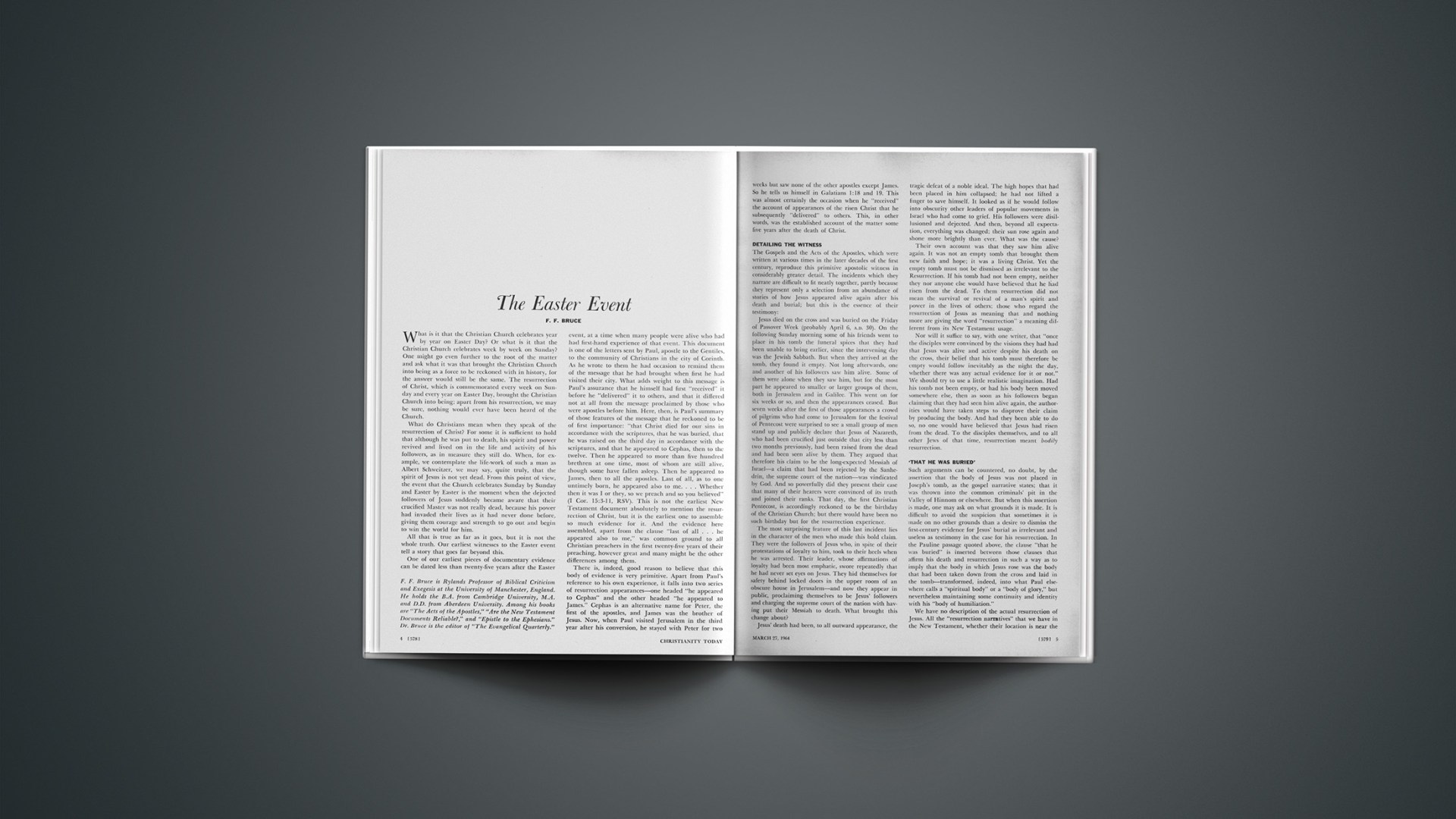
The Easter Event

What is it that the Christian Church celebrates year by year on Easter Day? Or what is it that the Christian Church celebrates week by week on Sunday? One might go even further to the root of the matter and ask what it was that brought the Christian Church into being as a force to be reckoned with in history, for the answer would still be the same. The resurrection of Christ, which is commemorated every week on Sunday and every year on Easter Day, brought the Christian Church into being; apart from his resurrection, we may be sure, nothing would ever have been heard of the Church.

What do Christians mean when they speak of the resurrection of Christ? For some it is sufficient to hold that although he was put to death, his spirit and power revived and lived on in the life and activity of his followers, as in measure they still do. When, for example, we contemplate the life-work of such a man as Albert Schweitzer, we may say, quite truly, that the spirit of Jesus is not yet dead. From this point of view, the event that the Church celebrates Sunday by Sunday and Easter by Easter is the moment when the dejected followers of Jesus suddenly became aware that their crucified Master was not really dead, because his power had invaded their lives as it had never done before, giving them courage and strength to go out and begin to win the world for him.

All that is true as far as it goes, but it is not the whole truth. Our earliest witnesses to the Easter event tell a story that goes far beyond this.

One of our earliest pieces of documentary evidence can be dated less than twenty-five years after the Easter event, at a time when many people were alive who had had first-hand experience of that event. This document is one of the letters sent by Paul, apostle to the Gentiles, to the community of Christians in the city of Corinth. As he wrote to them he had occasion to remind them of the message that he had brought when first he had visited their city. What adds weight to this message is Paul’s assurance that he himself had first “received” it before he “delivered” it to others, and that it differed not at all from the message proclaimed by those who were apostles before him. Here, then, is Paul’s summary of those features of the message that he reckoned to be of first importance: “that Christ died for our sins in accordance with the scriptures, that he was buried, that he was raised on the third day in accordance with the scriptures, and that he appeared to Cephas, then to the twelve. Then he appeared to more than five hundred brethren at one time, most of whom are still alive, though some have fallen asleep. Then he appeared to James, then to all the apostles. Last of all, as to one untimely born, he appeared also to me.… Whether then it was I or they, so we preach and so you believed” (1 Cor. 15:3–11, RSV). This is not the earliest New Testament document absolutely to mention the resurrection of Christ, but it is the earliest one to assemble so much evidence for it. And the evidence here assembled, apart from the clause “last of all … he appeared also to me,” was common ground to all Christian preachers in the first twenty-five years of their preaching, however great and many might be the other differences among them.

There is, indeed, good reason to believe that this body of evidence is very primitive. Apart from Paul’s reference to his own experience, it falls into two series of resurrection appearances—one headed “he appeared to Cephas” and the other headed “he appeared to James.” Cephas is an alternative name for Peter, the first of the apostles, and James was the brother of Jesus. Now, when Paul visited Jerusalem in the third year after his conversion, he stayed with Peter for two weeks but saw none of the other apostles except James. So he tells us himself in Galatians 1:18 and 19. This was almost certainly the occasion when he “received” the account of appearances of the risen Christ that he subsequently “delivered” to others. This, in other words, was the established account of the matter some five years after the death of Christ.

Detailing The Witness

The Gospels and the Acts of the Apostles, which were written at various times in the later decades of the first century, reproduce this primitive apostolic witness in considerably greater detail. The incidents which they narrate are difficult to fit neatly together, partly because they represent only a selection from an abundance of stories of how Jesus appeared alive again after his death and burial; but this is the essence of their testimony:

Jesus died on the cross and was buried on the Friday of Passover Week (probably April 6, A.D. 30). On the following Sunday morning some of his friends went to place in his tomb the funeral spices that they had been unable to bring earlier, since the intervening day was the Jewish Sabbath. But when they arrived at the tomb, they found it empty. Not long afterwards, one and another of his followers saw him alive. Some of them were alone when they saw him, but for the most part he appeared to smaller or larger groups of them, both in Jerusalem and in Galilee. This went on for six weeks or so, and then the appearances ceased. But seven weeks after the first of those appearances a crowd of pilgrims who had come to Jerusalem for the festival of Pentecost were surprised to see a small group of men stand up and publicly declare that Jesus of Nazareth, who had been crucified just outside that city less than two months previously, had been raised from the dead and had been seen alive by them. They argued that therefore his claim to be the long-expected Messiah of Israel—a claim that had been rejected by the Sanhedrin, the supreme court of the nation—was vindicated by God. And so powerfully did they present their case that many of their hearers were convinced of its truth and joined their ranks. That day, the first Christian Pentecost, is accordingly reckoned to be the birthday of the Christian Church; but there would have been no such birthday but for the resurrection experience.

The most surprising feature of this last incident lies in the character of the men who made this bold claim. They were the followers of Jesus who, in spite of their protestations of loyalty to him, took to their heels when he was arrested. Their leader, whose affirmations of loyalty had been most emphatic, swore repeatedly that he had never set eyes on Jesus. They hid themselves for safety behind locked doors in the upper room of an obscure house in Jerusalem—and now they appear in public, proclaiming themselves to be Jesus’ followers and charging the supreme court of the nation with having put their Messiah to death. What brought this change about?

Jesus’ death had been, to all outward appearance, the tragic defeat of a noble ideal. The high hopes that had been placed in him collapsed; he had not lifted a finger to save himself. It looked as if he would follow into obscurity other leaders of popular movements in Israel who had come to grief. His followers were disillusioned and dejected. And then, beyond all expectation, everything was changed; their sun rose again and shone more brightly than ever. What was the cause?

Their own account was that they saw him alive again. It was not an empty tomb that brought them new faith and hope; it was a living Christ. Yet the empty tomb must not be dismissed as irrelevant to the Resurrection. If his tomb had not been empty, neither they nor anyone else would have believed that he had risen from the dead. To them resurrection did not mean the survival or revival of a man’s spirit and power in the lives of others; those who regard the resurrection of Jesus as meaning that and nothing more are giving the word “resurrection” a meaning different from its New Testament usage.

Nor will it suffice to say, with one writer, that “once the disciples were convinced by the visions they had had that Jesus was alive and active despite his death on the cross, their belief that his tomb must therefore be empty would follow inevitably as the night the day, whether there was any actual evidence for it or not.” We should try to use a little realistic imagination. Had his tomb not been empty, or had his body been moved somewhere else, then as soon as his followers began claiming that they had seen him alive again, the authorities would have taken steps to disprove their claim by producing the body. And had they been able to do so, no one would have believed that Jesus had risen from the dead. To the disciples themselves, and to all other Jews of that time, resurrection meant bodily resurrection.

‘That He Was Buried’

Such arguments can be countered, no doubt, by the assertion that the body of Jesus was not placed in Joseph’s tomb, as the gospel narrative states; that it was thrown into the common criminals’ pit in the Valley of Hinnom or elsewhere. But when this assertion is made, one may ask on what grounds it is made. It is difficult to avoid the suspicion that sometimes it is made on no other grounds than a desire to dismiss the first-century evidence for Jesus’ burial as irrelevant and useless as testimony in the case for his resurrection. In the Pauline passage quoted above, the clause “that he was buried” is inserted between those clauses that affirm his death and resurrection in such a way as to imply that the body in which Jesus rose was the body that had been taken down from the cross and laid in the tomb—transformed, indeed, into what Paul elsewhere calls a “spiritual body” or a “body of glory,” but nevertheless maintaining some continuity and identity with his “body of humiliation.”

We have no description of the actual resurrection of Jesus. All the “resurrection narratives” that we have in the New Testament, whether their location is near the tomb or elsewhere, are narratives about what happened after Jesus rose from the dead. But no one saw him rise. Whether or not there is any probability in such a suggestion as that made by Dorothy Sayers in The Man Born to be King about the dissolution of the physical elements of Jesus’ body in the tomb and their reassembly outside is something on which a physicist is better qualified to pronounce judgment than the present writer.

The disciples’ claim did indeed receive powerful support from the evidence that was soon produced that the mighty works performed by Jesus were still being performed by his followers in his name. And that the claim was made in utter sincerity is clear from the readiness with which they staked their lives on its truth. That the “resurrection faith” is a firm historical datum is generally conceded even by those who find it difficult to accept the “resurrection fact.”

But what gave rise to the resurrection faith if it was not the resurrection fact? If the resurrection appearances were wholly subjective, they cannot be said to conform to the conditions that normally govern such experiences. Usually in such experiences people see something else and mistake it for what they expect to see. But the disciples did not expect to see Jesus alive again. And repeatedly when they did see him alive again, they mistook him for someone or something else—the gardener, or an unknown fellow traveler, or an apparition—and needed some convincing that it was really he.

The obvious suggestion that he had not really died on the cross but regained consciousness in the cool of the tomb will not account for the events that followed his appearances. One who had luckily survived several hours of crucifixion would have been a broken and pitiable object of a man, quite unable to fill those who saw him with new life and new confidence that he was the Conqueror of death and the Lord of life. The sequel to that kind of survival would have been the sort of thing that George Moore brilliantly relates in The Brook Kerith; but that masterpiece of imaginative fiction has nothing to do with the history of apostolic Christianity. It is not very profitable to set up one alternative explanation after another, only to knock them down like so many Aunt Sallies; but the history of apostolic Christianity, and the history of post-apostolic Christianity as well, demands an adequate cause. The New Testament offers us one: “Christ has been raised from the dead.” Need we look for another?

Most of the witnesses of the risen Jesus were his former disciples. But some were not. His brother James, for example, had not been a follower of his before the Cross. The family of Jesus had grave misgivings about his ministry, and when at last he was arrested and crucified, they probably felt with sorrow that their fears and warnings had been only too well founded. Yet James appears in later years as the trusted leader of the Jerusalem church, a man whose piety won him the esteem, moreover, of the non-Christian Jews of Jerusalem. What caused the change in James’s attitude to Jesus and his cause, at this precise juncture when his worst fears had been realized? Paul gives us the explanation he had probably received from James himself: “He appeared to James.”

“Last of all,” says Paul, “as to one untimely born, he appeared also to me.” Paul’s antecedents are well enough known; he, at any rate, was not psychologically predisposed to believe that Jesus had conquered death. Those who went about claiming that they had seen Jesus alive again had no more relentless opponent than Paul; and we have no reason to believe that during his persecuting activity he had any qualms of conscience, any inward doubts, about the rightness of his course. What was it that convinced such a man of the wrongness of his course, and led him so decisively to abandon his most passionately cherished convictions for the cause which he had so vigorously assailed, but for which he was henceforth prepared to sacrifice everything? Paul’s own account of the matter, that the risen Christ appeared to him personally, is an adequate explanation; it would be difficult to find another.

When we are dealing with a unique situation, generalizations and analogies are inapplicable. And the situation is indeed unique when we are confronted by the incarnate Son of God, divinest when he most was man. That the incarnate Son of God should die is wonder enough. But as the disciples looked back, they recognized more and more how impossible it was that their Master should stay dead, such was the impact he had made on them. It was not this impact that gave rise to the resurrection experiences. But when these experiences took place, the disciples realized their utter fittingness and inevitability. “God raised him up, having loosed the pangs of death, because it was not possible for him to be held by it” (Acts 2:24).

God’S Sword Thrusts

The feeling or disillusionment and emptiness that resulted from my undergraduate years led me to apply for advanced studies at the Graduate School of New York University. During these months of study, my awareness of spiritual impoverishment increased markedly; it was at its height when a member of the family subscribed to a Christian newspaper in my name and I began to read the Gospel.

At that time, the paper which I received included the story of a college boy who struggled against the persecution of unsaved classmates. He placed a Scripture plaque in his room that had on it the words from Philippians 1:21, “For to me to live is Christ.” This verse disturbed me and brought quick and unjustified criticism. As time passed, however, I found myself unable to forget these poignant words of Paul. They seemed to burn their message into my consciousness, at first bringing anger, later conviction to my heart. As I review the incidents leading to my acceptance of the Lord Jesus Christ as my Saviour, those wonderful words seem to have been prophetic; for now, truly—to me to live is Christ!—KENNETH A. MARKLEY, Camp Hill, Pennsylvania.

F. F. Bruce is Rylands Professor of Biblical Criticism and Exegesis at the University of Manchester, England. He holds the B.A. from Cambridge University, M.A. and D.D. from Aberdeen University. Among his books are “The Acts of the Apostles,” “Are the New Testament Documents Reliable?,” and “Epistle to the Ephesians.” Dr. Bruce is the editor of “The Evangelical Quarterly.”
The Day God Made

Day of Resurrection! “This is the day which the Lord hath made; we will rejoice and be glad in it.” Easter is God’s day, the day of his making. By raising Christ from the dead, God himself made this day of new freedom, new hope, and endless life.

Good Friday was the world’s dark night of sin, the “hour of the power of darkness.” It was the day that we made: Judas betrayed him, Pilate judged him, Peter denied him, his disciples forsook him, the Jews asked for his destruction and the Gentiles complied while men mocked or kept guilty silence. On Friday we had our day; in our freedom and time of opportunity we crucified him. It was the day of our folly, of our sin, the day to which we all contributed.

But God’s day followed ours, and hard upon it, as light follows the darkness. Without our help, God created this day of Easter. To it we made no contribution; such help as those who loved him would tender to him was for a proper embalming. Without our help, Christ arose. For us the day of Resurrection is something to accept as a gift; nothing else is required, except that we rejoice and be glad in it.

The day itself, without a sound of any human voice, is God’s public, cosmic announcement to all the universe that death has been defeated, that he who had the power of death has been destroyed. The Resurrection sounds through all the long reaches of space and history that life and death are not of equal power, and least of all that death is stronger and the last word about human existence. In making this day, God bears witness to Jesus Christ, declaring that he is the resurrection and the life, and that the final disposition of all things, including death, is determined by him. What chance has death, if it cannot hold its prey?

Where else can this be known? What other day announces that life is stronger than death? Surely none of our days, as the experiences of each day testify.

The world has many cynics, men who have seen and experienced so much of life’s diseases that they have concluded that life itself is a disease. They have no hope for what a day may bring forth; they have seen too much of sin and evil, greed and corruption, hatred and violence on every level of human life. These need to know of the day that the Lord has made, in which alone men can accept life and rejoice and be glad; for this day of Resurrection announces to all that where sin abounded, grace did much more abound. Easter announces that righteousness, decency, and kindness are stronger than sin, human corruption, and violence. Only God’s day proclaims this. Having done its worst, what chance has evil in the light of this day? The murdered returns to confront the murderer.

Easter, day of all the years the best. In it God justifies the sinner. To be justified means to have the right to be, the right to live. By this act of Resurrection God gives to those who made the day of Friday, the day of the murder of the Son of God, the right to forgiveness, the right to life and an authentic future, through belief on his name.

On Easter, God justified Jesus Christ, whom he had judged and declared to be worthy of death. He whom God made to be sin and thus made to be subject to death, is justified by God, for God raised him from the dead and gave him life forevermore.

On Easter, God also justified himself, showing to all the world his own righteousness, revealing that he was just and right in all his dealings with Israel, with Jesus Christ, and with us who yet stumble and stagger through the sufferings of this present time and cry, O Lord, how long? On Easter we are assured that sinners can be saved and that their salvation is just, for on this day of Resurrection God demonstrates that he can be righteous and yet justify the ungodly, that he can be “just, and the justifier of him which believeth in Jesus.” This is the “mystery of godliness,” the religious dimension that transcends mere morality and baffles every earthly jurist, the miracle of grace. And this is the day of grace that the Lord made when he raised Christ “for our justification.”

This day is our only sure defense against all the past and all the future. Since it is God who justifies, who can condemn us and take away our right to live? And since our justification involves God’s justification of himself and of all his ways with men, our justification is sure. Easter is God’s day—the day that the Lord made—as it is the day of his own justification. We are summoned only to share his justification and to accept his day, and to rejoice and be glad in both.

Theology

Easter: The Hidden Victory

But thanks be to God, which giveth us the victory through our Lord Jesus Christ (1 Cor. 15:57).

A life situation approach leads up to a striking motif: “Put that light back!” Here the light has to do with the Christian conviction that the crucified Lord was not held in the grave, that Christ has conquered sin and death and is alive forevermore. You come to worship either because you know that this is true, or because you wish it were. Let me tell you why I believe that this is “the masterlight of all our seeing,” and that this is a real victory we all can share.

I. An Integral Part of the Gospel. Easter does not mean merely that once upon a time a man rose from the dead. It means that this Man, Jesus Christ the Son of God, could not be held within the boundaries of the grave. To him the Resurrection comes as the climax of a life that is the miracle of all miracles—God manifest on earth.

The victory is not only of one piece with the whole Gospel; the Resurrection is the foundation of the entire New Testament. The infant Church is founded that Christ is really risen from the dead, and is now a living power in the world. (The text!)

II. The Outcome of a Real Struggle. The Easter message comes to us in the midst of our human agony, and speaks of a victory won, won here on this blood-stained earth, where we wrestle with our sins, know the fact of evil, endure suffering, and die. That is where the Light shines, not from an ivory tower, but from a Cross. (Text.)

A religion that leaps from Christmas to Easter is a mere skeleton of faith, a shadowy ghost that cannot bring conviction to our souls. Only when we know the Christ of flesh and blood, only when we have been touched by that hard Cross shaped from the wood of our own forests—only then can we know how true it is that Christ is risen from the dead. Only if somehow, somewhere, we have been with him in the prison-house of pain and sin, can we share the victory that liberates our souls.

III. The Hidden Victory of God. Where is the victory? That is what men ask. Show me the evidence that the power of sin is broken, and the menace of death removed. This is a hidden victory. To a group of very ordinary people it was made known in the quietest possible way. A tremendous demonstration of heavenly power, so universal and compelling that men would have had to believe, would have shattered human nature, and we should have ceased to be real, responsive, responsible men and women. To this day the evidence of the Resurrection is found in lives where Christ is King, lives that know the inner working of his Spirit, men and women who know what it is to say: “O death, where is thy sting?” (Here quote First Corinthians 15:55–57; also, after a moving paragraph of prose, a portion of John Masefield’s poem, The Everlasting Mercy.)

Here is the victory that the Christian Church offers you this morning: the knowledge that Christ is the Conqueror of sin and death, with the promise of his transforming power. In the midst of our ordinary tasks, where our anxious world crowds in on us from day to day, we listen with the inner ear to the trumpets of His victory. Let them sound again. Put that light back! For there at Calvary and in the Easter Garden the victory is won. And here in the sanctuary it is given to you. We have troubles enough to contend with and are often threatened with defeat in our souls. “But thanks be to God, which giveth us the victory through our Lord Jesus Christ.”—From I Am Persuaded, Scribner’s, 1962, pp. 149–57.

Theology

Current Religious Thought: March 13, 1964

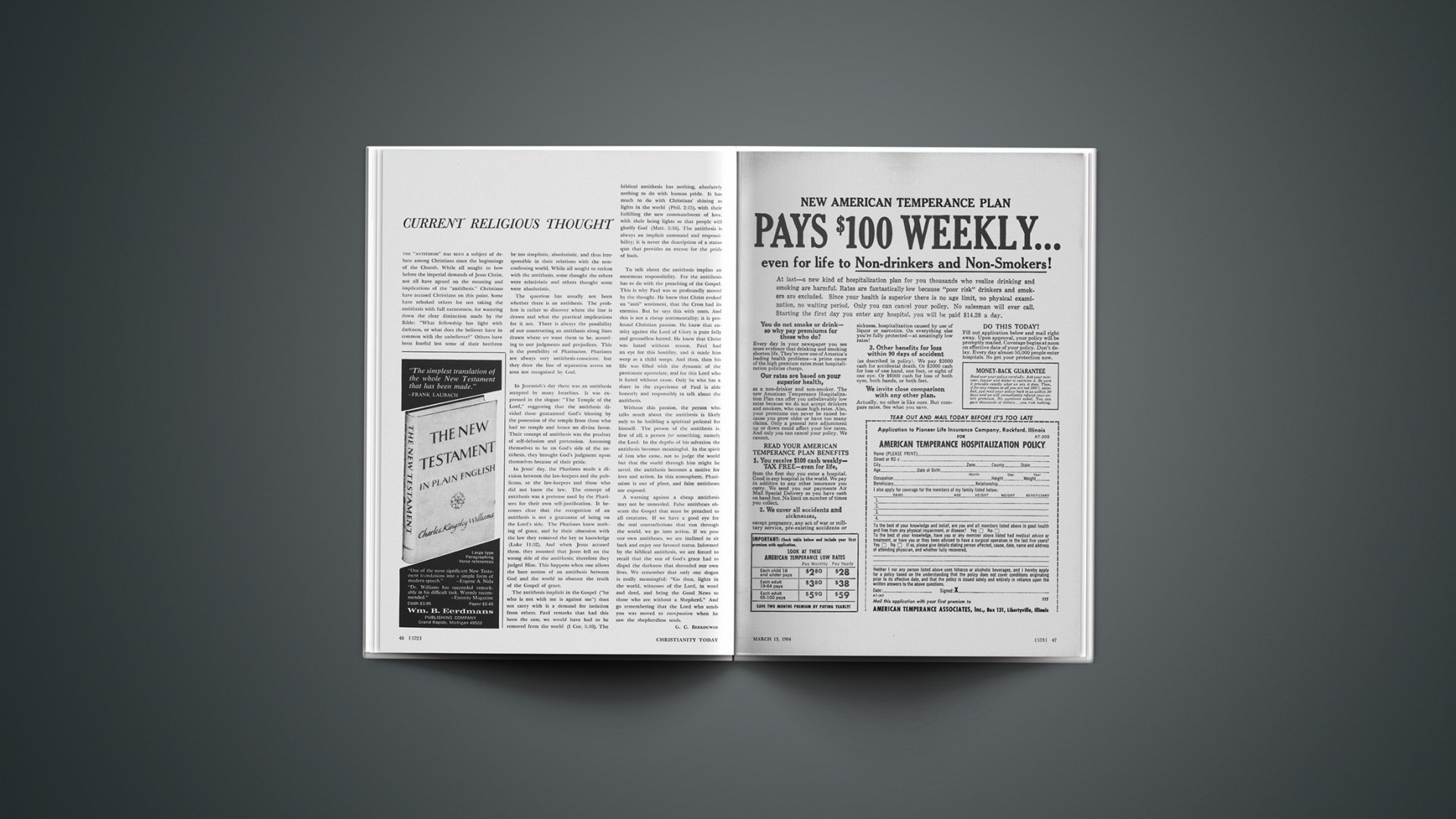
The “antithesis” has been a subject of debate among Christians since the beginnings of the Church. While all sought to bow before the imperial demands of Jesus Christ, not all have agreed on the meaning and implications of the “antithesis.” Christians have accused Christians on this point. Some have rebuked others for not taking the antithesis with full earnestness, for watering down the clear distinction made by the Bible: “What fellowship has light with darkness, or what does the believer have in common with the unbeliever?” Others have been fearful lest some of their brethren be too simplistic, absolutistic, and thus irresponsible in their relations with the non-confessing world. While all sought to reckon with the antithesis, some thought the others were relativistic and others thought some were absolutistic.

The question has usually not been whether there is an antithesis. The problem is rather to discover where the line is drawn and what the practical implications for it are. There is always the possibility of our constructing an antithesis along lines drawn where we want them to be, according to our judgments and prejudices. This is the possibility of Pharisaism. Pharisees are always very antithesis-conscious; but they draw the line of separation across an area not recognized by God.

In Jeremiah’s day there was an antithesis accepted by many Israelites. It was expressed in the slogan: “The Temple of the Lord,” suggesting that the antithesis divided those guaranteed God’s blessing by the possession of the temple from those who had no temple and hence no divine favor. Their concept of antithesis was the product of self-delusion and pretension. Assuming themselves to be on God’s side of the antithesis, they brought God’s judgment upon themselves because of their pride.

In Jesus’ day, the Pharisees made a division between the law-keepers and the publicans, or the law-keepers and those who did not know the law. The concept of antithesis was a pretense used by the Pharisees for their own self-justification. It becomes clear that the recognition of an antithesis is not a guarantee of being on the Lord’s side. The Pharisees knew nothing of grace, and by their obsession with the law they removed the key to knowledge (Luke 11:52). And when Jesus accused them, they assumed that Jesus fell on the wrong side of the antithesis; therefore they judged Him. This happens when one allows the bare notion of an antithesis between God and the world to obscure the truth of the Gospel of grace.

The antithesis implicit in the Gospel (“he who is not with me is against me”) does not carry with it a demand for isolation from others. Paul remarks that had this been the case, we would have had to be removed from the world (1 Cor. 5:10). The biblical antithesis has nothing, absolutely nothing to do with human pride. It has much to do with Christians’ shining as lights in the world (Phil. 2:15), with their fulfilling the new commandment of love, with their being lights so that people will glorify God (Matt. 5:16). The antithesis is always an implicit command and responsibility; it is never the description of a status quo that provides an excuse for the pride of fools.

To talk about the antithesis implies an enormous responsibility. For the antithesis has to do with the preaching of the Gospel. This is why Paul was so profoundly moved by the thought. He knew that Christ evoked an “anti” sentiment, that the Cross had its enemies. But he says this with tears. And this is not a cheap sentimentality; it is profound Christian passion. He knew that enmity against the Lord of Glory is pure folly and groundless hatred. He knew that Christ was hated without reason. Paul had an eye for this hostility, and it made him weep as a child weeps. And then, then his life was filled with the dynamic of the passionate apostolate, zeal for this Lord who is hated without cause. Only he who has a share in the experience of Paul is able honestly and responsibly to talk about the antithesis.

Without this passion, the person who talks much about the antithesis is likely only to be building a spiritual pedestal for himself. The person of the antithesis is, first of all, a person for something, namely the Lord. In the depths of his salvation the antithesis becomes meaningful. In the spirit of him who came, not to judge the world but that the world through him might be saved, the antithesis becomes a motive for love and action. In this atmosphere, Pharisaism is out of place, and false antitheses are exposed.

A warning against a cheap antithesis may not be unneeded. False antitheses obscure the Gospel that must be preached to all creatures. If we have a good eye for the real contradictions that run through the world, we go into action. If we pose our own antitheses, we are inclined to sit back and enjoy our favored status. Informed by the biblical antithesis, we are forced to recall that the sun of God’s grace had to dispel the darkness that shrouded our own lives. We remember that only one slogan is really meaningful: “Go then, lights in the world, witnesses of the Lord, in word and deed, and bring the Good News to those who are without a Shepherd.” And go remembering that the Lord who sends you was moved to compassion when he saw the shepherdless souls.

Victory for Italian Protestants

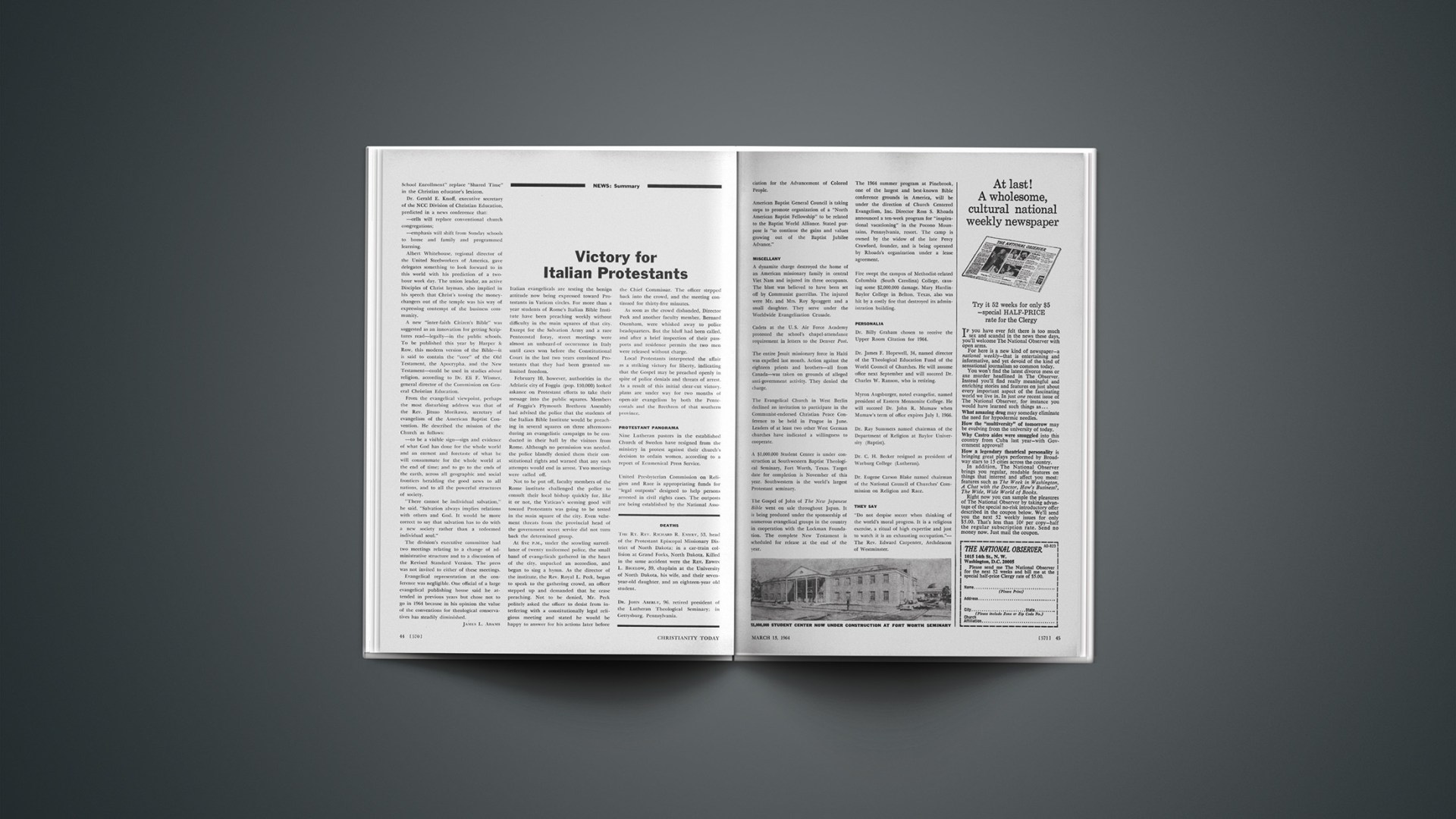
Italian evangelicals are testing the benign attitude now being expressed toward Protestants in Vatican circles. For more than a year students of Rome’s Italian Bible Institute have been preaching weekly without difficulty in the main squares of that city. Except for the Salvation Army and a rare Pentecostal foray, street meetings were almost an unheard-of occurrence in Italy until cases won before the Constitutional Court in the last two years convinced Protestants that they had been granted unlimited freedom.

February 10, however, authorities in the Adriatic city of Foggia (pop. 150,000) looked askance on Protestant efforts to take their message into the public squares. Members of Foggia’s Plymouth Brethren Assembly had advised the police that the students of the Italian Bible Institute would be preaching in several squares on three afternoons during an evangelistic campaign to be conducted in their hall by the visitors from Rome. Although no permission was needed, the police blandly denied them their constitutional rights and warned that any such attempts would end in arrest. Two meetings were called off.

Not to be put off, faculty members of the Rome institute challenged the police to consult their local bishop quickly for, like it or not, the Vatican’s seeming good will toward Protestants was going to be tested in the main square of the city. Even vehement threats from the provincial head of the government secret service did not turn back the determined group.

At five P.M., under the scowling surveillance of twenty uniformed police, the small band of evangelicals gathered in the heart of the city, unpacked an accordion, and began to sing a hymn. As the director of the institute, the Rev. Royal L. Peck, began to speak to the gathering crowd, an officer stepped up and demanded that he cease preaching. Not to be denied, Mr. Peck politely asked the officer to desist from interfering with a constitutionally legal religious meeting and stated he would be happy to answer for his actions later before the Chief Commissar. The officer stepped back into the crowd, and the meeting continued for thirty-five minutes.

As soon as the crowd disbanded, Director Peck and another faculty member, Bernard Oxenham, were whisked away to police headquarters. But the bluff had been called, and after a brief inspection of their passports and residence permits the two men were released without charge.

Local Protestants interpreted the affair as a striking victory for liberty, indicating that the Gospel may be preached openly in spite of police denials and threats of arrest. As a result of this initial clear-cut victory, plans are under way for two months of open-air evangelism by both the Pentecostals and the Brethren of that southern province.

Protestant Panorama

Nine Lutheran pastors in the established Church of Sweden have resigned from the ministry in protest against their church’s decision to ordain women, according to a report of Ecumenical Press Service.

Deaths

THE RT. REV. RICHARD R. EMERY, 53, head of the Protestant Episcopal Missionary District of North Dakota; in a car-train collision at Grand Forks, North Dakota. Killed in the same accident were the REV. EDWIN L. BIGELOW, 39, chaplain at the University of North Dakota, his wife, and their seven-year-old daughter, and an eighteen-year old student.

DR. JOHN ABERLY, 96, retired president of the Lutheran Theological Seminary; in Gettysburg, Pennsylvania.

United Presbyterian Commission on Religion and Race is appropriating funds for “legal outposts” designed to help persons arrested in civil rights cases. The outposts are being established by the National Association for the Advancement of Colored People.

American Baptist General Council is taking steps to promote organization of a “North American Baptist Fellowship” to be related to the Baptist World Alliance. Stated purpose is “to continue the gains and values growing out of the Baptist Jubilee Advance.”

Miscellany

A dynamite charge destroyed the home of an American missionary family in central Viet Nam and injured its three occupants. The blast was believed to have been set off by Communist guerrillas. The injured were Mr. and Mrs. Roy Spraggett and a small daughter. They serve under the Worldwide Evangelization Crusade.

Cadets at the U. S. Air Force Academy protested the school’s chapel-attendance requirement in letters to the Denver Post.

The entire Jesuit missionary force in Haiti was expelled last month. Action against the eighteen priests and brothers—all from Canada—was taken on grounds of alleged anti-government activity. They denied the charge.

The Evangelical Church in West Berlin declined an invitation to participate in the Communist-endorsed Christian Peace Conference to be held in Prague in June. Leaders of at least two other West German churches have indicated a willingness to cooperate.

A $1,000,000 Student Center is under construction at Southwestern Baptist Theological Seminary, Fort Worth, Texas. Target date for completion is November of this year. Southwestern is the world’s largest Protestant seminary.

The Gospel of John of The New Japanese Bible went on sale throughout Japan. It is being produced under the sponsorship of numerous evangelical groups in the country in cooperation with the Lockman Foundation. The complete New Testament is scheduled for release at the end of the year.

The 1964 summer program at Pinebrook, one of the largest and best-known Bible conference grounds in America, will be under the direction of Church Centered Evangelism, Inc. Director Ross S. Rhoads announced a ten-week program for “inspirational vacationing” in the Pocono Mountains, Pennsylvania, resort. The camp is owned by the widow of the late Percy Crawford, founder, and is being operated by Rhoads’s organization under a lease agreement.

Fire swept the campus of Methodist-related Columbia (South Carolina) College, causing some $2,000,000 damage. Mary Hardin-Baylor College in Belton, Texas, also was hit by a costly fire that destroyed its administration building.

Personalia

Dr. Billy Graham chosen to receive the Upper Room Citation for 1964.

Dr. James F. Hopewell, 34, named director of the Theological Education Fund of the World Council of Churches. He will assume office next September and will succeed Dr. Charles W. Ranson, who is retiring.

Myron Augsburger, noted evangelist, named president of Eastern Mennonite College. He will succeed Dr. John R. Mumaw when Mumaw’s term of office expires July 1, 1966.

Dr. Ray Summers named chairman of the Department of Religion at Baylor University (Baptist).

Dr. C. H. Becker resigned as president of Warburg College (Lutheran).

Dr. Eugene Carson Blake named chairman of the National Council of Churches’ Commission on Religion and Race.

They Say

“Do not despise soccer when thinking of the world’s moral progress. It is a religious exercise, a ritual of high expertise and just to watch it is an exhausting occupation.”—The Rev. Edward Carpenter, Archdeacon of Westminster.

Legal Showdown in Delaware

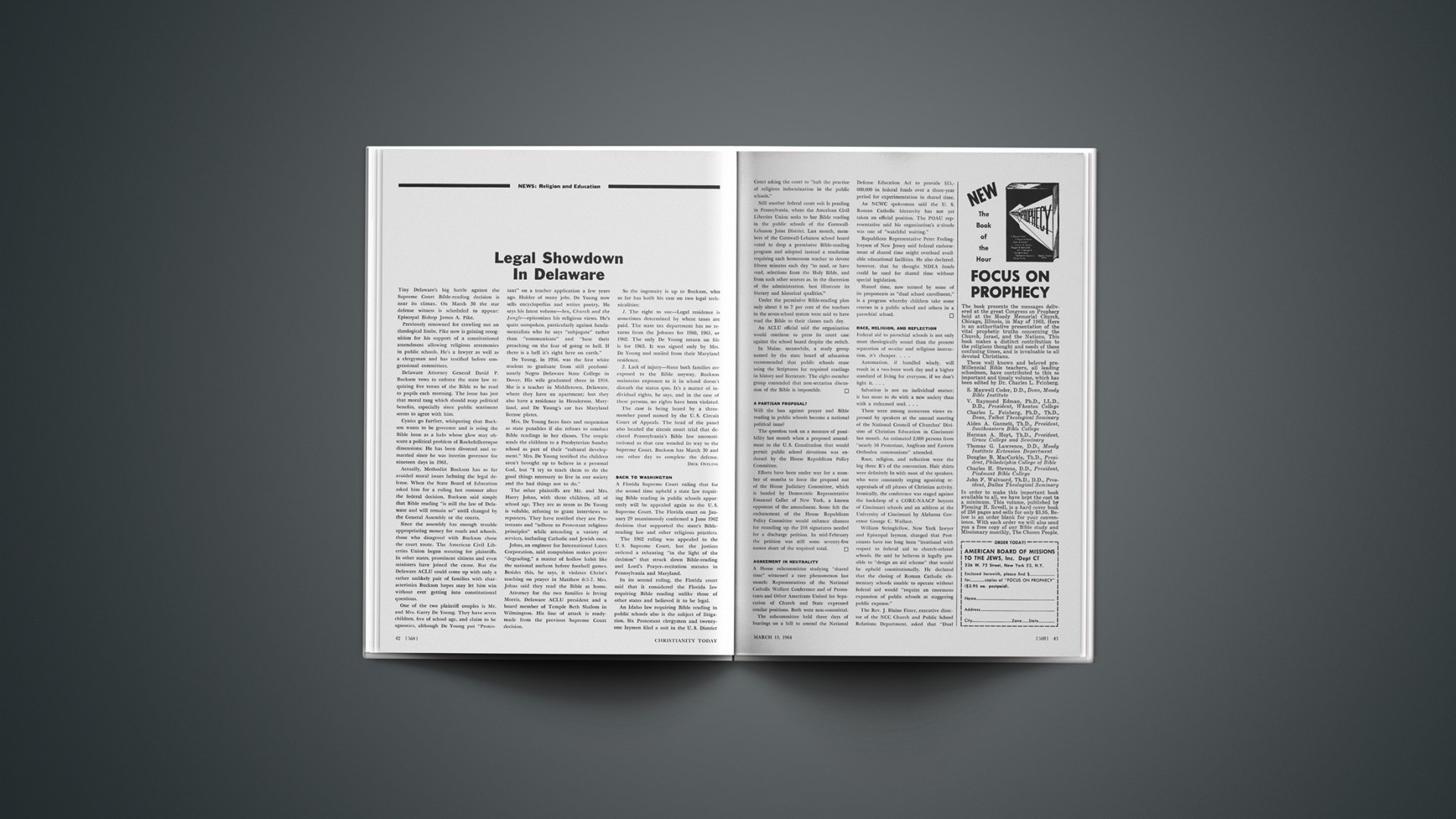
Tiny Delaware’s big battle against the Supreme Court Bible-reading decision is near its climax. On March 30 the star defense witness is scheduled to appear: Episcopal Bishop James A. Pike.

Previously renowned for crawling out on theological limbs, Pike now is gaining recognition for his support of a constitutional amendment allowing religious ceremonies in public schools. He’s a lawyer as well as a clergyman and has testified before congressional committees.

Delaware Attorney General David P. Buckson vows to enforce the state law requiring five verses of the Bible to be read to pupils each morning. The issue has just that moral tang which should reap political benefits, especially since public sentiment seems to agree with him.

Cynics go further, whispering that Buckson wants to be governor and is using the Bible issue as a halo whose glow may obscure a political problem of Rockefelleresque dimensions: He has been divorced and remarried since he was interim governor for nineteen days in 1961.

Actually, Methodist Buckson has so far avoided moral issues helming the legal defense. When the State Board of Education asked him for a ruling last summer after the federal decision, Buckson said simply that Bible reading “is still the law of Delaware and will remain so” until changed by the General Assembly or the courts.

Since the assembly has enough trouble appropriating money for roads and schools, those who disagreed with Buckson chose the court route. The American Civil Liberties Union began scouting for plaintiffs. In other states, prominent citizens and even ministers have joined the cause. But the Delaware ACLU could come up with only a rather unlikely pair of families with characteristics Buckson hopes may let him win without ever getting into constitutional questions.

One of the two plaintiff couples is Mr. and Mrs. Garry De Young. They have seven children, five of school age, and claim to be agnostics, although De Young put “Protestant” on a teacher application a few years ago. Holder of many jobs, De Young now sells encyclopedias and writes poetry. He says his latest volume—Sex, Church and the Jungle—epitomizes his religious views. He’s quite outspoken, particularly against fundamentalists who he says “subjugate” rather than “communicate” and “base their preaching on the fear of going to hell. If there is a hell it’s right here on earth.”

De Young, in 1956, was the first white student to graduate from still predominantly Negro Delaware State College in Dover. His wife graduated there in 1958. She is a teacher in Middletown, Delaware, where they have an apartment; but they also have a residence in Henderson, Maryland, and De Young’s car has Maryland license plates.

Mrs. De Young faces fines and suspension as state penalties if she refuses to conduct Bible readings in her classes. The couple sends the children to a Presbyterian Sunday school as part of their “cultural development.” Mrs. De Young testified the children aren’t brought up to believe in a personal God, but “I try to teach them to do the good things necessary to live in our society and the bad things not to do.”

The other plaintiffs are Mr. and Mrs. Harry Johns, with three children, all of school age. They are as mum as De Young is voluble, refusing to grant interviews to reporters. They have testified they are Protestants and “adhere to Protestant religious principles” while attending a variety of services, including Catholic and Jewish ones.

Johns, an engineer for International Latex Corporation, said compulsion makes prayer “degrading,” a matter of hollow habit like the national anthem before football games. Besides this, he says, it violates Christ’s teaching on prayer in Matthew 6:5–7. Mrs. Johns said they read the Bible at home.

Attorney for the two families is Irving Morris, Delaware ACLU president and a board member of Temple Beth Shalom in Wilmington. His line of attack is readymade from the previous Supreme Court decision.

So the ingenuity is up to Buckson, who so far has built his case on two legal technicalities:

1. The right to sue—Legal residence is sometimes determined by where taxes are paid. The state tax department has no returns from the Johnses for 1960, 1961, or 1962. The only De Young return on file is for 1963. It was signed only by Mrs. De Young and mailed from their Maryland residence.

2. Lack of injury—Since both families are exposed to the Bible anyway, Buckson maintains exposure to it in school doesn’t disturb the status quo. It’s a matter of individual rights, he says, and in the case of these persons, no rights have been violated.

The case is being heard by a three-member panel named by the U. S. Circuit Court of Appeals. The head of the panel also headed the circuit court trial that declared Pennsylvania’s Bible law unconstitutional as that case wended its way to the Supreme Court. Buckson has March 30 and one other day to complete the defense.

Back To Washington

A Florida Supreme Court ruling that for the second time upheld a state law requiring Bible reading in public schools apparently will be appealed again to the U. S. Supreme Court. The Florida court on January 29 unanimously confirmed a June 1962 decision that supported the state’s Bible-reading law and other religious practices.

The 1962 ruling was appealed to the U. S. Supreme Court, but the justices ordered a rehearing “in the light of the decision” that struck down Bible-reading and Lord’s Prayer—recitation statutes in Pennsylvania and Maryland.

In its second ruling, the Florida court said that it considered the Florida law requiring Bible reading unlike those of other states and believed it to be legal.

An Idaho law requiring Bible reading in public schools also is the subject of litigation. Six Protestant clergymen and twenty-one laymen filed a suit in the U. S. District Court asking the court to “halt the practice of religious indoctrination in the public schools.”

Still another federal court suit is pending in Pennsylvania, where the American Civil Liberties Union seeks to bar Bible reading in the public schools of the Cornwall-Lebanon Joint District. Last month, members of the Cornwall-Lebanon school board voted to drop a permissive Bible-reading program and adopted instead a resolution requiring each homeroom teacher to devote fifteen minutes each day “to read, or have read, selections from the Holy Bible, and from such other sources as, in the discretion of the administration, best illustrate its literary and historical qualities.”

Under the permissive Bible-reading plan only about 5 to 7 per cent of the teachers in the seven-school system were said to have read the Bible to their classes each day.

An ACLU official said the organization would continue to press its court case against the school board despite the switch.

In Maine, meanwhile, a study group named by the state board of education recommended that public schools cease using the Scriptures for required readings in history and literature. The eight-member group contended that non-sectarian discussion of the Bible is impossible.

A Partisan Proposal?

Will the ban against prayer and Bible reading in public schools become a national political issue?

The question took on a measure of possibility last month when a proposed amendment to the U. S. Constitution that would permit public school devotions was endorsed by the House Republican Policy Committee.

Efforts have been under way for a number of months to force the proposal out of the House Judiciary Committee, which is headed by Democratic Representative Emanuel Celler of New York, a known opponent of the amendment. Some felt the endorsement of the House Republican Policy Committee would enhance chances for rounding up the 218 signatures needed for a discharge petition. In mid-February the petition was still some seventy-five names short of the required total.

Agreement In Neutrality

A House subcommittee studying “shared time” witnessed a rare phenomenon last month: Representatives of the National Catholic Welfare Conference and of Protestants and Other Americans United for Separation of Church and State expressed similar positions. Both were non-committal.

The subcommittee held three days of hearings on a bill to amend the National Defense Education Act to provide $15,000,000 in federal funds over a three-year period for experimentation in shared time.

An NCWC spokesman said the U. S. Roman Catholic hierarchy has not yet taken an official position. The POAU representative said his organization’s attitude was one of “watchful waiting.”

Republican Representative Peter Frelinghuysen of New Jersey said federal endorsement of shared time might overload available educational facilities. He also declared, however, that he thought NDEA funds could be used for shared time without special legislation.

Shared time, now termed by some of its proponents as “dual school enrollment,” is a program whereby children take some courses in a public school and others in a parochial school.

Race, Religion, And Reflection

Federal aid to parochial schools is not only more theologically sound than the present separation of secular and religious instruction, it’s cheaper.…

Automation, if handled wisely, will result in a two-hour work day and a higher standard of living for everyone, if we don’t fight it.…

Salvation is not an individual matter; it has more to do with a new society than with a redeemed soul.…

These were among numerous views expressed by speakers at the annual meeting of the National Council of Churches’ Division of Christian Education in Cincinnati last month. An estimated 2,000 persons from “nearly 50 Protestant, Anglican and Eastern Orthodox communions” attended.

Race, religion, and reflection were the big three R’s of the convention. Hair shirts were definitely In with most of the speakers, who were constantly urging agonizing reappraisals of all phases of Christian activity. Ironically, the conference was staged against the backdrop of a CORE-NAACP boycott of Cincinnati schools and an address at the University of Cincinnati by Alabama Governor George C. Wallace.

William Stringfellow, New York lawyer and Episcopal layman, charged that Protestants have too long been “irrational with respect to federal aid to church-related schools. He said he believes it legally possible to “design an aid scheme” that would be upheld constitutionally. He declared that the closing of Roman Catholic elementary schools unable to operate without federal aid would “require an enormous expansion of public schools at staggering public expense.”

The Rev. J. Blaine Fister, executive director of the NCC Church and Public School Relations Department, asked that “Dual School Enrollment” replace “Shared Time” in the Christian educator’s lexicon.

Dr. Gerald E. Knoff, executive secretary of the NCC Division of Christian Education, predicted in a news conference that:

—cells will replace conventional church congregations:

—emphasis will shift from Sunday schools to home and family and programmed learning.

Albert Whitehouse, regional director of the United Steelworkers of America, gave delegates something to look forward to in this world with his prediction of a two-hour work day. The union leader, an active Disciples of Christ layman, also implied in his speech that Christ’s tossing the moneychangers out of the temple was his way of expressing contempt of the business community.

A new “inter-faith Citizen’s Bible” was suggested as an innovation for getting Scriptures read—legally—in the public schools. To be published this year by Harper & Row, this modern version of the Bible—it is said to contain the “core” of the Old Testament, the Apocrypha, and the New Testament—could be used in studies about religion, according to Dr. Eli F. Wismer, general director of the Commission on General Christian Education.

From the evangelical viewpoint, perhaps the most disturbing address was that of the Rev. Jitsuo Morikawa, secretary of evangelism of the American Baptist Convention. He described the mission of the Church as follows:

—to be a visible sign—sign and evidence of what God has done for the whole world and an earnest and foretaste of what he will consummate for the whole world at the end of time; and to go to the ends of the earth, across all geographic and social frontiers heralding the good news to all nations, and to all the powerful structures of society.

“There cannot be individual salvation,” he said. “Salvation always implies relations with others and God. It would be more correct to say that salvation has to do with a new society rather than a redeemed individual soul.”

The division’s executive committee had two meetings relating to a change of administrative structure and to a discussion of the Revised Standard Version. The press was not invited to either of these meetings.

Evangelical representation at the conference was negligible. One official of a large evangelical publishing house said he attended in previous years but chose not to go in 1964 because in his opinion the value of the conventions for theological conservatives has steadily diminished.

JAMES L. ADAMS

Something to Wave a Flag About

In the window of Follett’s Bookstore in Ann Arbor, Sex and the College Girl and racy Ian Fleming mysteries flanked Peace With God and My Answer in uneasy togetherness. In other stores near the University of Michigan campus, modest placards announced that Dr. Billy Graham would hold a three-day lecture series for students and staff. A much larger sign in front of the Michigan Union proclaimed National Negro History Week (and, ironically enough, Graham was destined to speak and answer students’ questions—some of them on race—from the same ornately carved hardwood lectern that Governor Ross Barnett of Mississippi used during a controversial appearance at Michigan last fall).

Billy Graham’s visit to Michigan, sponsored by a university agency and by the Michigan Christian Fellowship, was the first of several campus appearances in February. Later he traveled east to address students at Harvard, Radcliffe, and Wellesley. Typically thought of in the context of the overflow crowd in the largest stadium in town, Graham was deliberately planning for smaller audiences in order to get the university student alone with his peers and approach him on his own ground. There was no singing, no praying, and, at the main meetings, no invitation.

“I want to be all things to all men,” Graham said, and he laced his messages with heavy doses of Hemingway, Steinbeck, O’Neill, Einstein, and Toynbee—names students respect. Nicodemus was a “theological professor”; Paul’s Mars Hill address was a speech before a “university audience.” Words like “philosophical,” “psychological,” and “intellectual” were probably used many more times in Graham’s talks than in a typical university lecture hour, but the heart of the message was the same Graham has preached to 40 million people the world over. “Man has a moral disease,” he said. “There are more sophisticated names for it, but I’m going back to the original name. It’s called sin.”

“Joseph Goebbels got his Ph.D. at Heidelberg. What causes a Goebbels, an Eichmann, a Lee Oswald, to do the things they did?” he asked repeatedly. “What is it inside of people?”

To students seeking “commitment” of some sort, Graham presented Christianity as “something to march for … something to wave a flag about.”

“It involves the intellect, it involves the emotions, but primarily it involves the will,” he said.

The students in turn had questions for Graham, many more than could be anwered at the lectures and panel discussions.1Panelists at Michigan included Graham; Dr. Kenneth Pike and Dr. Gordon van Wylen, both professors at the university; Dr. Akbar Haqq of India, a specialist in comparative religion; and Dr. Merrill C. Tenney, dean of the Graduate School of Wheaton College. At Harvard, where there were fewer panels, questions were answered by Graham, Haqq, and Dr. John White, a Ph.D. from Oxford. Graham talked at length on the “moral problem,” and, predictably, sex was the subject of many questions. One card handed forward mentioned “extramarital relations,” which was pronounced “extramartial” by a flustered moderator.

Christian students and workers, who had been preparing for the meetings for about a year under the leadership of MCF President Bryan Mawhinney, estimated that 6,000–8,000 students and university affiliates (the student body numbers 27,000) had heard Graham. They reported a number of conversions and said that at least 325 inquiry cards (the basis of indigenous student follow-up work) had been turned in.

The spirit at Michigan, which had been friendly from the start, was carried over at Boston, where Graham flew in to speak at Sunday evening services at Tremont Temple and Park Street Church. More than 100 persons, mainly young people, responded to the invitation at Park Street. And at Wellesley the next day, Graham’s message to more than 1,300 students was followed by discussions in student houses.

But the reception at Harvard, the East’s monument to non-regimentation, was distinctly cooler. “Students here are different,” said Hans Schemer, a senior, who was chairman of the ad hoc committee that brought Graham to the campus. “Or at least they think they are, and that’s what counts.”

“I think the fun part is when he asks everybody to come up to the front of the room,” said one Harvard man on the way to the first meeting, and it was evident that some of the 800 students who had sloshed their way through ten inches of snow had come for laughs. A reference to the Holy Spirit drew a few titters. Students derided Graham’s use of Time, reportedly read at Harvard only for entertainment, not as a source of information. “The Bible in one hand—and Time magazine,” sniffed one student after one of the meetings.

But there were visible results, even on the first evening: eighteen students stood up at an “after-meeting,” held in another building, indicating commitment.

With a student population about half that of Michigan, Harvard did not turn out in great numbers. Some 800 to 900 students half-filled the auditorium at the three main meetings. The Boston area was hit with the two biggest blizzards of the winter during the week, and there were the inevitable minor mishaps. A Boston paper got the time of the first meeting wrong, and hundreds of Harvard and Radcliffe students followed the false lead. Even so, it was a “very good Harvard crowd,” said an Inter-Varsity staffer; it was also said to be the best-attended Harvard “mission” of the century.

During the question-and-answer period on the afternoon of the second day, there was some hissing of a student who tried unsuccessfully to get Graham rattled with a series of captious questions. And as the meetings progressed, it became evident that the ice was melting. The audience listened with hardly a move when Graham spoke the second evening. Attendance at the after-meetings increased from 150 on the first night to about 350 on the third, and Inter-Varsity leaders reported that at the end, over 100 inquiry cards, the majority of which indicated commitment, had been turned in.

Graham was also given an attentive hearing at a meeting of psychiatrists (Harvard has ten on its staff), deans, and masters.

In an eloquent introduction to the third evening talk, the chairman of the United Campus Ministry thanked Graham for “being yourself among us,” adding parenthetically that he wished that Graham would say “less about what the Bible says, and more about what Christ says.” When Graham rose to speak, he said, “I want to turn to the Bible, if I might [laughter], for a quotation of Jesus, because I do not know any quotations of Jesus outside the Bible [laughter and applause].”

In his message Graham quoted John Harvard, whose name the university bears, and whose conviction it was that Christ was “the only foundation for knowledge and learning.”

The climax came when Graham, introduced by Dean Samuel Miller, addressed some 200 students at the Harvard Divinity School, giving a plea for “that other voice,” the voice of God, in preaching today, and defending himself against various criticisms that have been leveled at his theology and methods. (To one questioner, who alluded to this magazine, Graham said drily, “I didn’t know anybody here read CHRISTIANITY TODAY.”) The applause at the end of the almost two-hour meeting was sustained.

“If he can be accepted here, he can be accepted anywhere,” said Dr. Harold Ockenga afterward. Ockenga, minister of Park Street Church, called the series of meetings “superb.”

The evangelist, also in Boston to prepare for the area-wide crusade this fall, outlined his plans at a meeting to which over 500 New England ministers came, despite icy roads. “There was great enthusiasm among these ministers,” said one observer.

Graham’s two-week tour was a milestone in his growing campus ministry. It reflects what the evangelist sees as the heightened religious inquiry on the part of students today. After Graham’s plans for an expanded campus ministry were picked up by the press last summer, over 300 invitations came in within a month from colleges and universities, one as far away as Hong Kong. Graham says that students’ questions today are no longer on science and the Bible, as they were five and six years ago, but are more existential—more “theological, philosophical, and psychological,” as he puts it.

Harassment In The Sanctuary

President K. Owen White of the Southern Baptist Convention complained publicly last month that his 3,588-member First Baptist Church of Houston was subjected to a campaign of harassment by the Congress on Racial Equality after he as pastor had refused to debate racial integration.

White, in a press conference at Columbia, South Carolina, told newsmen that his congregation began seating Negroes fifteen months before he was elected SBC head.

Shortly after the election, he said, a CORE official threatened to instigate “an all-out campaign of intimidation” unless White agreed to participate in a public debate.

“I replied that debating was not my approach to the work,” White declared, “and the intimidation began.”

“Every Sunday for several weeks from two to ten Negroes came to our services. Almost every Sunday at least one sought membership.”

White said he and other church leaders counseled with the seekers and concluded that unworthy motivations were involved. The church turns down white seekers on similar grounds, he added.

White’s church still has not admitted any Negroes as members.

White, a native of England, said the South needs sympathetic understanding: “It is hard to effect a revolution overnight,” he added.

A Calm Beginning

The Deputy, a young German’s play about six million murdered Jews and one silent pope, opened in relative quiet on Broadway last month.

In a year of performances of the play in Europe, people have hooted, thrown eggs, and climbed onstage to fight with the actors. Others have hailed it as one of the few real contributions Germany has made toward coming to terms with the past.

About 150 persons picketed the Broadway premiere, including members of the American Nazi Party, who came dressed as storm troopers and wore swastikas. When they arrived, someone shouted, “Come on, Jews, let’s get em. I hate swastikas.” But the crowd that then pushed forward turned out to be mostly reporters who wanted to see what would happen. Nothing did.

Another group of demonstrators, “mostly Catholic” according to a New York newspaper, called themselves the Ad Hoc Committee to Protest the Deputy.

The anti-Deputy faction waved placards reading “Ban Deputy Bigots,” “Anti-Christ Hate Killed JFK,” and “Anti-Christian Hate Show.” Others said “Hurray for Freedom of Speech,” and “Only Totalitarianism Would Ban the Deputy.

The play (also called The Representative and The Vicar), was written by 33-year-old Rolf Hochhuth, who arrived in New York last month in time to see the premiere.

Reaction in America so far has been mixed. One statement pleading for a fair hearing was signed by leading Catholics, Protestants, and Jews. Commonweal, national Catholic lay weekly, says that the questions raised are valid, but it denounces as “base calumny” Hochhuth’s portrait of Pope Pius XII as a man who kept silent out of unworthy motives.

Besides attacking the pope for not taking a strong stand on the Nazis’ treatment of the Jews, Hochhuth tells in detail how the Jews lived during the Nazi era and how they died.

Revising The Oath

Davidson College, the “Oxford of Southern Presbyterians,” is drastically altering its controversial faculty oath. Trustees, at their winter meeting, approved on first reading a new pledge that leaves out the professors’ affirmation of belief in evangelical principles and belief in the infallibility of the Bible.

Final reading is planned at a board meeting in May. No opposition is expected.

The proposal now before the trustees simply calls on tenured teachers to affirm acceptance of Jesus Christ and to consider teaching as a Christian calling. Proponents said the change means that a majority of the faculty will be obligated instead of a minority, as in the past. Until now, the oath has been taken only on assumption of the rank of full professor.

A Plea For Legislation

The United Church of Canada’s Board of Evangelism and Social Service asked the Canadian government last month to legalize birth control.

The board, authorized to speak for the whole church in its particular fields, called for abolition of that section of the Criminal Code banning the sale and advertising of contraceptives. The law has been enforced in recent years.

At an annual meeting in Toronto, the board said the present law offends the religious beliefs of a majority of Canadians and makes a criminal offense of contraception, regarded by some churchmen as a moral necessity nowadays.

A Landmark Case

The Supreme Court of Spain made legal history last month when it ruled against the government and authorized establishment of a Protestant church in Valencia.

The court held that the government, in 1961, had erred in barring Protestants from opening a house of worship. It said that the government ministry involved had issued an order “not consistent with law” and ruled the edict null and void.

Involved was a Protestant group whose spokesman was identified as Tomas Perez. Representing the appellants in court was Ernesto Vellve, who successfully opposed the government’s restriction after a three-year legal battle. He told newsmen that the church would be opened in Valencia.

Observers in Madrid said the court’s decision was of “the greatest importance” to Protestants in predominantly Roman Catholic Spain. Some noted that the ruling could be another phase of a trend indicating more liberal treatment of Protestants by the government.

The court’s action followed a report that the nation’s Roman Catholic hierarchy had approved a draft law that would give considerably more freedom to Protestants in Spain. According to the report, the first draft of the proposed law was endorsed in principle by the late Pope John XXIII in 1961. Observers said a revised draft, approved by the bishops, would be sent on to the Vatican for study. Approval is expected.

In providing Protestants greater freedom of worship, the law would define their legal position for the first time.

A Boon To Church Budgets

Churches in the United States should see immediate benefits as a result of the income tax reduction voted by Congress and signed into law by President Johnson last month. Giving to religious enterprises of all kinds is expected to increase appreciably.

Tax specialists say the new cut, largest in U. S. history, paves the way for an estimated $265,000,000 in additional itemized charitable contributions by taxpayers during 1964, barring unexpected setbacks in the economy. They say the extra for 1965 attributable to the tax cuts could be as much as $400,000,000. This indicates a boost of approximately 4½ per cent in giving, based on total itemized deductions of contributions of $8.5 billion (the current figure).

For the average church these totals in themselves indicate only a modest budgetary increase. But observers point out that in all likelihood the boost will be further enhanced by any additional expansion of the economy.

Americans are already getting more in their pay checks because of a decrease in the amount of income tax the government requires employers to withhold. Some increase in church giving, therefore, should be evident immediately. The full effect will come about gradually over a number of months, because it is based on the anticipated expanded economy.

Some observers see a possible adverse effect in the tax cut. They say that with the rate of taxation moving downward, the relative advantage of the deduction is lessened and, in turn, incentive for charitable contributions is reduced. But this factor is unlikely to be very important. Statistics show that during previous tax-rate cuts a stable relation between personal income and charitable giving was maintained.

The most important change in the tax law, as far as charitable contributions are concerned, is the ability of the individual donor to “carry over” his deduction in excess of 30 per cent of adjusted gross income for a period of up to five years. This will encourage donors in every income bracket who are in a position to make large contributions within a single year. What they are unable to deduct one year they can claim in following years.

Also in the new law is a provision that extends from 20 to 30 per cent the ceiling on contributions to certain charitable organizations. The 30 per cent limit had applied previously only to contributions to churches, hospitals, schools, and certain medical research organizations. Now it applies to contributions to all charitable, religious, and philanthropic institutions, with the exception of private foundations, in which case the 20 per cent limit still applies.

Private foundations also got a blow from another direction. Contributions to such foundations will not be allowed as a basis for the “unlimited deduction,” which applies to persons whose contributions plus their income tax liability amount to more than 90 per cent of their taxable income for the current year and eight of the ten previous taxable years.

Still another important change applies to corporate giving. The period of “carryover” for corporate contributions in excess of the allowable 5 per cent of annual earnings has been extended from two years to five.

DONALD H. GILL

About This Issue: March 13, 1964

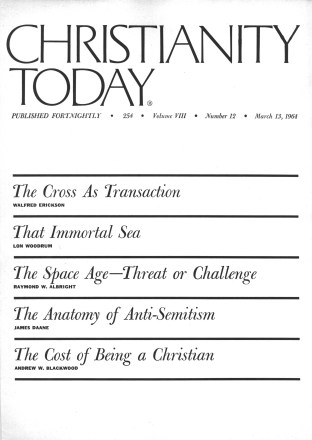
Christ died. The threshold article examines the how (see the opposite page), and author Walfred Erickson probes the why (page 4). Our lead editorial in this pre-Good Friday issue underscores the Cross-event as the focal point in the divine plan. And because of the relation of the Cross to the empty tomb, this issue also looks forward to the Resurrection (see “That Immortal Sea,” by Lon Woodrum, page 6).

Is it reasonable to ask who was “most responsible” for the crucifixion of Christ? Our editorial associate James Daane, commenting on a study being conducted by the Anti-Defamation League, lays down some important guidelines for combating anti-Semitism.

Theology

Calvary’s Armistice

Having made peace through the blood of his cross (Col. 1:20a).

Peace! What a beautiful word! When it comes after war, peace is a beautiful fact. The signing of the Armistice by the Allied and the German leaders brought to a close the most dreadful war the world had ever seen up to that time. But the treaty between God and man was signed on the Cross; signed not in ink, but in Immanuel’s blood.

Because of sin the whole human race is involved in this war. At war with God, man is at war with his fellow men, and at war with himself. In the midst of this war come tidings of peace for all men. An armistice has been signed on Calvary. In that peace Christ represented both God and man. “Couldn’t anyone else have died for me?” asked a seeking friend. No! “Why not?”

I. Christ Died for Us Sinners. For a friend, for a good man, to save him from danger and death, one might lay down his life. But the marvel of Christ’s death on the Cross was that he died for sinners. “God commendeth His love toward us, in that while we were yet sinners Christ died for us.”

He died that we might be forgiven;

He died to make us good;

That we might go at last to heaven,

Saved by His precious blood.

II. No One Else Could Be What Christ Was. He was, and is, God in Christ. Therefore what he did on the Cross has infinite value. As the Representative of men he took on himself all the responsibility of the war against God, and all the guilt of the sinner. As the Representative of God Christ had the authority to make peace. To do this work of reconciling man to God Christ came and died.

III. Nothing But the Cross Could Bring About this Reconciliation. Only the Cross can take away the guilt and the stain of sin. God is the Author of the Armistice signed by Christ on the Cross. When by faith and repentance you also sign it, then you have peace. This is the heart of the Gospel, the heart of Christianity, that Christ made peace by the blood of his Cross. Acquaint now thyself with God, and be at peace with him.

Are you at peace with God? Have you accepted his terms? Have you signed the Armistice? There is your Saviour’s name written for you in crimson colors of the Cross. Therefore I beseech you, be reconciled to God. When you accept the pardon that Christ holds out with his pierced hand, there is peace with God, with the world, and with self, the peace about which Christ speaks (“My peace I give unto you”), the peace that the world cannot give, or take away.—Used by permission of Channel Press, Manhasset, N. Y.

The Minister’s Workshop: Power in Preaching

God must give it, of course. “But you shall receive power,” said Jesus, “when the Holy Spirit has come upon you.”

Candidly, to make the bare assertion that God must give the preacher his power is at one time to say much and to say little: much because the statement is fundamentally true, little because it is facilely unexplored.

What is more, all the exploration in the world will not yield complete agreement on the elements of which this power is composed or the tests by which it is measured. Neither the “erg” nor the “megaton” has any exact homiletical equivalent. A preacher in authentic action is at once the beneficiary and the victim of the indefinable.

This allowed, much remains to be said, measured, assessed, learned. Nothing can alter the fact that power in preaching is channeled and conditioned. If the ineffable is there, so is the discernible and the verifiable.

At least we know where to look for the locus of this thing we call pulpit potency: in the minds that preaching informs and illumines, in the moods that it creates, in the motives it addresses and kindles, in the movement of total personality that under God it evokes to obedience.

Beyond this, there are specifics worth noting, though they must be set down here with far less than adequate treatment:

1. Sermon power is linked with content. We do but deceive ourselves if we think otherwise. It is the “truth”—the vital substance of the many-faceted Gospel—that sets men free. We who profess to be men of the Word need to be saved alike from the sham of a noisy quackery and from the shimmer of a rhetorically concealed superficiality. Many a sermon that sounded powerful in delivery, when reproduced in cold print proved to be so devoid of content that no charity could absolve the failure.

For the power of what is said there is no adequate substitute in the power of the way it is said.

2. Sermon power is linked with pertinence. In Quaker circles no higher compliment can be paid to a messenger of the Lord than for a member of the “meeting” to say to him, “Thee spoke to our condition.” Needs, burdens, perplexities, defeats, rancors, hopes, fears, sorrows, joys—these are there in the hearts, if not on the faces, of the listening people. And it is to just such people in just such living situations that the sermon must address itself. If it fails to “connect,” it is more impotent than potent.

3. Sermon power is linked with rapport. This is not a repetition of point two. The preacher may speak relevantly and still fall short of that high fusion between himself and his listeners in which it is as evident to them as to him that both have been caught up into a community of light and of love, of judgment and of mercy. A single sermon may have only two or three intervals when this singular mutuality reaches maximum level.

4. Sermon power is linked with conviction. It is this that gives preaching its “message” quality. God, who has spoken to the preacher in his preparation of the message, is now speaking through him in the enunciation of it. Cynics may smile at this; but unless we are prepared to believe it, and act on it, we better turn in our resignation. It is a man “possessed” who has power in preaching. What the pious call unction is the message using the man. When the man uses the message, the unction is bogus.

5. Sermon power is linked with overtones. The word is from the world of music. If we think of tones as being like a stream, the overtones, the “upper partial,” as technicians may call them, are like ripples and wavelets. Here is beauty, here is grace, here is wonder.

Preaching furnishes a parallel. There are moments when the sermon-created mood of the congregation is so overmastering that no technique can account for it: a joy so uncontainable that a thousand hallelujahs would not do it justice, a shame so shattering that only the Cross of God’s Son can bring hope and healing, a hush of sheer worship and adoring awe so profound that one’s own heartbeat seems audible.

Power!

The preacher is foredoomed who fancies he is its creator. He is not less foredoomed if he fails to toil with terrible, praying industry at being its instrument.

Apple PodcastsDown ArrowDown ArrowDown Arrowarrow_left_altLeft ArrowLeft ArrowRight ArrowRight ArrowRight Arrowarrow_up_altUp ArrowUp ArrowAvailable at Amazoncaret-downCloseCloseEmailEmailExpandExpandExternalExternalFacebookfacebook-squareGiftGiftGooglegoogleGoogle KeephamburgerInstagraminstagram-squareLinkLinklinkedin-squareListenListenListenChristianity TodayCT Creative Studio Logologo_orgMegaphoneMenuMenupausePinterestPlayPlayPocketPodcastRSSRSSSaveSaveSaveSearchSearchsearchSpotifyStitcherTelegramTable of ContentsTable of Contentstwitter-squareWhatsAppXYouTubeYouTube