Current Religious Thought: February 28, 1964

The theory of the transference of knowledge has been formally rejected by educators. At the same time the reading public continues, in many cases, to proceed on the hidden assumption that an author’s proficiency in one specialized area qualifies him to speak in other fields. In few cases has this principle been applied with more enthusiasm than to Arnold J. Toynbee. The massiveness of his historical research seems to have persuaded many readers (and perhaps Professor Toynbee himself) that he possesses a special capability in religion and theology.

Certainly his studies in history, to which he has recently added his twelfth volume entitled Reconsiderations, are impressive. Sections of this volume do, however, tend to raise the guards of the reader. With great forthrightness he expresses as a canon for his religious interpretations that the Incarnation must be rejected as being unworthy of God. To him, any loving overture made by God toward man would need a priori to be made in an unspecialized and universal manner. He rejects categorically any view of a unique (that is, given at one time or in one place) movement of God toward the human race.

This proposition involves Toynbee in other problems, to which Edward Whiting Fox calls our attention in “The Divine Dilemma of A. J. Toynbee” (Virginia Quarterly Review, Winter, 1963). The dilemma proves ultimately to be a multiple one. In this article we propose to draw attention to three of its aspects.

First, in his analysis of sainthood—an element to which he attaches great historical importance as well as great significance for man’s future—Toynbee observes that sainthood requires a belief in the perfectibility of the self. At the same time he notes that this element, involving as it does the belief that man is the highest in the scale of finite spiritual reality, represents the most damaging form of hybris or pride. This contradicts in principle the second element in sainthood, namely the denial of the self. Toynbee is thus faced with a vexing initial problem.

This turning back upon itself by humanism leads to yet more serious trouble. Toynbee sees springing from man’s innate capacity for self-centeredness the quality that leads to what he deplores as the pretension to uniqueness by religious systems. To him, this is a most objectionable feature of classical Judaism, of historic Christianity, and of militant Islam.

Despite earlier indications in his works that he estimated highly the creative role of Christianity in the development of the West, here is later evidence that he carries his dislike of the Christian claim to uniqueness to a point which causes him to minimize the manner in which the Church contributed to the culture of the first six or eight centuries of our era.

A second problem arises for Professor Toynbee from the relativism implied in his rejection of the category of uniqueness as valid for Christianity. Now it is quite possible that he believes that by demanding that the Christian abandon the claim to the once-for-allness of the Incarnation, he will save Christianity from inevitable conflict and consequent loss, as the shrinking of today’s world brings it into close touch with other religious systems. If he conceives his task in this way, he is not the first who felt it essential to come to Christianity’s rescue.

In reality, it is difficult to avoid the conclusion that Toynbee’s philosophy of history is very much akin to Hegel’s. Now if he hopes to serve as a saviour in the same way Hegel sought to be one, he will probably be disappointed. There will arise in our time, as in the early nineteenth century, some perceptive thinker who will, like Kierkegaard, ask no quarter and give none, and who will point out, in a manner so clear that all will be able to see, that relativism and synthesis have little in common with the Christian message. Such a voice will confront Toynbee’s desire for syncretism with a reassertion of the claims of the Unique and Unrepeatable One.

In his book, Christianity among the Religions of the World, he earlier (in 1957) assured us that since the consequences of Original Sin are now worldwide and since the world of modern technology is “small,” the Western world must approach other religions upon the basis of what all systems have in common (p. 92). Here he implies that for Christians to assert the uniqueness and potential universality of their religion amounts to religious tribalism. In the light of the currency of such claims, it is heartening in the extreme to note the voices raised against syncretism, particularly by such men as Hendrik Kraemer and Hans Küng.

Thirdly, Professor Toynbee creates for himself a king-sized dilemma in his own proposal for a substitute “Faith” that he feels might avoid the hybris he sees betokened by the claim to religious uniqueness.

In his development of this theme, Toynbee takes as established the older views of Old Testament criticism. To read his interpretation of the history of Israel’s religion, one would suppose that he felt that Wellhausen had spoken the last word in Old Testament scholarship. He appears never to have heard of the researches of such men as Walther Eichrodt or Oscar Cullmann.

Following the conventional trend of the older scholarship, Toynbee believes that in the “pure and undefiled religion” of Deutero-Isaiah can be found the system best capable of universal extension. Granting his thesis that there was a specific form of Deutero-Isaianic religion, and that it was the genial sort of system he seems to need if he is to eliminate the explosive element from the world religious scene, he is still inextricably involved in a problem. He admits that the behavior of the contemporary heirs of this religious tradition has shaken his faith in human nature as a whole. (See the article by Fox mentioned above, pp. 124 f.)

Professor Toynbee seems scandalized at the “chosenness” manifested by Zionism. Why, he seems to be asking, cannot this group of men who have inherited so much not share their treasure with all men? The poignancy of the dilemma now appears: he is asking a religio-ethnic group to sacrifice their “chosenness” as a whole, while elsewhere he emphasizes the crucial nature of individual human activities and achievements in the progress of societies.

Moreover, does he not, in his summary rejection of the Incarnation, actually reject the major creative role of the One who came to perform history’s most crucial individual task? And regarding his insistence that individual men and women “undertake sainthood,” is not the indispensable prerequisite to such an undertaking an act of personal faith in a unique act, performed by a unique Person? We submit that this can come, not through any supposed “loss of the self,” as theoretical Buddhism prescribes, but rather through an identification of the self with the One who is transcendently unique.
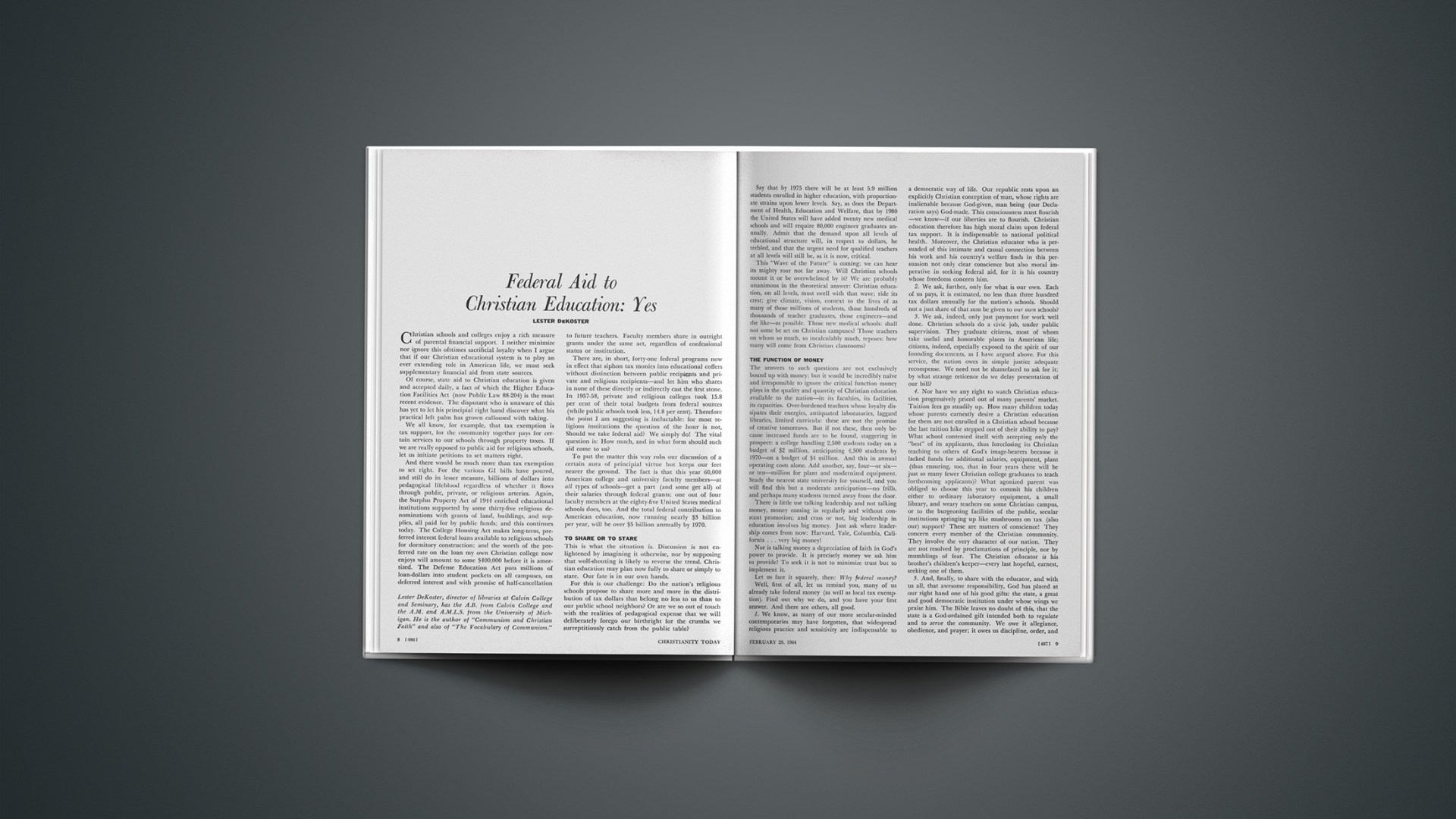
Federal Aid to Christian Education: Yes

Christian schools and colleges enjoy a rich measure of parental financial support. I neither minimize nor ignore this ofttimes sacrificial loyalty when I argue that if our Christian educational system is to play an ever extending role in American life, we must seek supplementary financial aid from state sources.

Of course, state aid to Christian education is given and accepted daily, a fact of which the Higher Education Facilities Act (now Public Law 88–204) is the most recent evidence. The disputant who is unaware of this has yet to let his principial right hand discover what his practical left palm has grown calloused with taking.

We all know, for example, that tax exemption is tax support, for the community together pays for certain services to our schools through property taxes. If we are really opposed to public aid for religious schools, let us initiate petitions to set matters right.

And there would be much more than tax exemption to set right. For the various GI bills have poured, and still do in lesser measure, billions of dollars into pedagogical lifeblood regardless of whether it flows through public, private, or religious arteries. Again, the Surplus Property Act of 1944 enriched educational institutions supported by some thirty-five religious denominations with grants of land, buildings, and supplies, all paid for by public funds; and this continues today. The College Housing Act makes long-term, preferred interest federal loans available to religious schools for dormitory construction; and the worth of the preferred rate on the loan my own Christian college now enjoys will amount to some $400,000 before it is amortized. The Defense Education Act puts millions of loan-dollars into student pockets on all campuses, on deferred interest and with promise of half-cancellation to future teachers. Faculty members share in outright grants under the same act, regardless of confessional status or institution.

There are, in short, forty-one federal programs now in effect that siphon tax monies into educational coffers without distinction between public recipients and private and religious recipients—and let him who shares in none of these directly or indirectly cast the first stone. In 1957–58, private and religious colleges took 15.8 per cent of their total budgets from federal sources (while public schools took less, 14.8 per cent). Therefore the point I am suggesting is ineluctable; for most religious institutions the question of the hour is not, Should we take federal aid? We simply do! The vital question is: How much, and in what form should such aid come to us?

To put the matter this way robs our discussion of a certain aura of principial virtue but keeps our feet nearer the ground. The fact is that this year 60,000 American college and university faculty members—at all types of schools—get a part (and some get all) of their salaries through federal grants; one out of four faculty members at the eighty-five United States medical schools does, too. And the total federal contribution to American education, now running nearly $3 billion per year, will be over $5 billion annually by 1970.

To Share Or To Stare

This is what the situation is. Discussion is not enlightened by imagining it otherwise, nor by supposing that wolf-shouting is likely to reverse the trend. Christian education may plan now fully to share or simply to stare. Our fate is in our own hands.

For this is our challenge: Do the nation’s religious schools propose to share more and more in the distribution of tax dollars that belong no less to us than to our public school neighbors? Or are we so out of touch with the realities of pedagogical expense that we will deliberately forego our birthright for the crumbs we surreptitiously catch from the public table?

Say that by 1975 there will be at least 5.9 million students enrolled in higher education, with proportionate strains upon lower levels. Say, as does the Department of Health, Education and Welfare, that by 1980 the United States will have added twenty new medical schools and will require 80,000 engineer graduates annually. Admit that the demand upon all levels of educational structure will, in respect to dollars, be trebled, and that the urgent need for qualified teachers at all levels will still be, as it is now, critical.

This “Wave of the Future” is coming; we can hear its mighty roar not far away. Will Christian schools mount it or be overwhelmed by it? We are probably unanimous in the theoretical answer: Christian education, on all levels, must swell with that wave; ride its crest; give climate, vision, context to the lives of as many of those millions of students, those hundreds of thousands of teacher graduates, those engineers—and the like—as possible. Those new medical schools: shall not some be set on Christian campuses? Those teachers on whom so much, so incalculably much, reposes: how many will come from Christian classrooms?

The Function Of Money

The answers to such questions are not exclusively bound up with money; but it would be incredibly naïve and irresponsible to ignore the critical function money plays in the quality and quantity of Christian education available to the nation—in its faculties, its facilities, its capacities. Over-burdened teachers whose loyalty dissipates their energies, antiquated laboratories, laggard libraries, limited curricula: these are not the promise of creative tomorrows. But if not these, then only because increased funds are to be found, staggering in prospect: a college handling 2,500 students today on a budget of $2 million, anticipating 4,500 students by 1970—on a budget of $4 million. And this in annual operating costs alone. Add another, say, four—or six—or ten—million for plant and modernized equipment. Study the nearest state university for yourself, and you will find this but a moderate anticipation—no frills, and perhaps many students turned away from the door.

There is little use talking leadership and not talking money, money coming in regularly and without constant promotion; and crass or not, big leadership in education involves big money. Just ask where leadership comes from now: Harvard, Yale, Columbia, California … very big money!

Nor is talking money a depreciation of faith in God’s power to provide. It is precisely money we ask him to provide! To seek it is not to minimize trust but to implement it.

Let us face it squarely, then: Why federal money?

Well, first of all, let us remind you, many of us already take federal money (as well as local tax exemption). Find out why we do, and you have your first answer. And there are others, all good.

1. We know, as many of our more secular-minded contemporaries may have forgotten, that widespread religious practice and sensitivity are indispensable to a democratic way of life. Our republic rests upon an explicitly Christian conception of man, whose rights are inalienable because God-given, man being (our Declaration says) God-made. This consciousness must flourish—we know—if our liberties are to flourish. Christian education therefore has high moral claim upon federal tax support. It is indispensable to national political health. Moreover, the Christian educator who is persuaded of this intimate and causal connection between his work and his country’s welfare finds in this persuasion not only clear conscience but also moral imperative in seeking federal aid, for it is his country whose freedoms concern him.

2. We ask, further, only for what is our own. Each of us pays, it is estimated, no less than three hundred tax dollars annually for the nation’s schools. Should not a just share of that sum be given to our own schools?

3. We ask, indeed, only just payment for work well done. Christian schools do a civic job, under public supervision. They graduate citizens, most of whom take useful and honorable places in American life; citizens, indeed, especially exposed to the spirit of our founding documents, as I have argued above. For this service, the nation owes in simple justice adequate recompense. We need not be shamefaced to ask for it; by what strange reticence do we delay presentation of our bill?

4. Nor have we any right to watch Christian education progressively priced out of many parents’ market. Tuition fees go steadily up. How many children today whose parents earnestly desire a Christian education for them are not enrolled in a Christian school because the last tuition hike stepped out of their ability to pay? What school contented itself with accepting only the “best” of its applicants, thus foreclosing its Christian teaching to others of God’s image-bearers because it lacked funds for additional salaries, equipment, plant (thus ensuring, too, that in four years there will be just so many fewer Christian college graduates to teach forthcoming applicants)? What agonized parent was obliged to choose this year to commit his children either to ordinary laboratory equipment, a small library, and weary teachers on some Christian campus, or to the burgeoning facilities of the public, secular institutions springing up like mushrooms on tax (also our) support? These are matters of conscience! They concern every member of the Christian community. They involve the very character of our nation. They are not resolved by proclamations of principle, nor by mumblings of fear. The Christian educator is his brother’s children’s keeper—every last hopeful, earnest, seeking one of them.

5. And, finally, to share with the educator, and with us all, that awesome responsibility, God has placed at our right hand one of his good gifts: the state, a great and good democratic institution under whose wings we praise him. The Bible leaves no doubt of this, that the state is a God-ordained gift intended both to regulate and to serve the community. We owe it allegiance, obedience, and prayer; it owes us discipline, order, and good. We owe it our taxes; it owes us a return upon that investment in services. Yea, more, in our great land, this “it” is in fact “we.” Demean the state and we demean ourselves. Fear the state and we cower before our own political poverty and ineffectiveness. This agent is our own. We thank God for it. Let us honor him, too, by using it as a supporting hand in Christian educational enterprise.

Nor need we blink the stock objections to so doing.

1. Why, once more, the federal government?

First, obviously, for an equitable distribution of support. Again, for an equitable collection of that support, for the federal income tax is as nearly just a system as can theoretically be devised. And, contrary to some popular delusion, federal monies are collected and distributed with remarkable efficiency. Finally, because we are one nation, one people, with one concern in the just availability of education in sufficient quantity and quality.

2. But to risk, then, federal control? What good to gain the world but lose the soul?

Let us neither ignore the possibility nor fear the shibboleth. He who pays the piper may wish to call the tune. Who pays our bills now? Must we not always be on guard against being obliged to pipe an alien tune? The price of liberty is always vigilance. But the forecasters of federal coercion must strain at the gnat and gulp down the camel to find any footing for their fears. Did not the GI bills pour their billions into education (including Christian education) with no hint of coercion? Federal grants in research total more than one-half of the current operating budgets of schools like M.I.T.—without any invasion of administrative initiative. Indeed, Howard University of Washington, D. C., subsists on federal funds but has an independent administration. No strings trail from grants in land, buildings, equipment; no student is warped or governed by his loan, nor is the student whose diet is enriched by the federal lunch programs. We need not speculate about the doom of tomorrow; let us simply study objectively the practice of today, when billions of dollars of federal money do flow into teaching, and leave (indeed, make) it free. And this pattern is not, in fact, unique to America: in England the state pays the piper, but governing local school boards freely set the tune; in the Netherlands the religious schools receive nine-tenths of their budget from the state, which they spend in complete autonomy. We give God small thanks, and display little faith, if because of magnified forebodings we reject the extended hand of government he has made to serve us. Be men of faith, indeed! Also in the matter of trusting that God gives not in vain.

Federal coercion is neither a certainty, a probability, nor a trend. It is simply a problem, nay more a challenge! Does anyone suppose that if our democratic state falls prey to tyranny, it will need the fact of tax support of schools to justify an invasion of educational integrity? On the contrary, the best antidote to tyranny is a flourishing panoply of Christian schools, feeding into American life graduates who know why they, and all men, are entitled to liberty! And such a panoply of Christian schools will never flourish more than if nourished by adequate funds, in generous measure from federal aid.

3. There is, though, the vexing question of constitutionality. This must finally be settled in the courts. All that we know now is that few cases seem to bear—and none conclusively—on direct federal grants to Christian schools. And we know that indirect grants, in many forms, now come into our hands. The problem is, it appears, not one of constitutional authority but one of method.

And is not this the essence of the whole matter?

How can we obtain tax assistance, the very dollars we pay to the state—on all levels—in such a way that the full integrity of our program is assured while at the same time the survival, let alone the extension, of that program is guaranteed?

If we can convert our abstract controversies about whether into concrete discussions of how this should be done, our schools, our country, our children, and our God will be well served.

View From An Apartment Window

The sun is coming up again.

Remember when it hid obscured by clouds and smog?

The combined efforts of men keep us from the full measure of spiritual strength, now realized once more by means of heavenly intercession.

Smell the foggy mist!

See the dissected rays of the eastern sun, pierced by grey streaks and yellow blotches and reflections!

Is there not hope in the brightness of that ball?

Will not the day bring forth new joys?

Man’s fickle, neon glimmer shrinks in contrast.

God arises this morning.

The dew of Hermon permeates the air.

The words of the Preacher echo in the morning sights and smells.

The vanity of hammering and roar is mute by divine intervention,

As the silhouette of a sparrow glides effortlessly in the oriental gold.

ROGER W. SHUY

Lester DeKoster, director of libraries at Calvin College and Seminary, has the A.B. from Calvin College and the A.M. and A.M.L.S. from the University of Michigan. He is the author of “Communism and Christian Faith” and also of “The Vocabulary of Communism.”

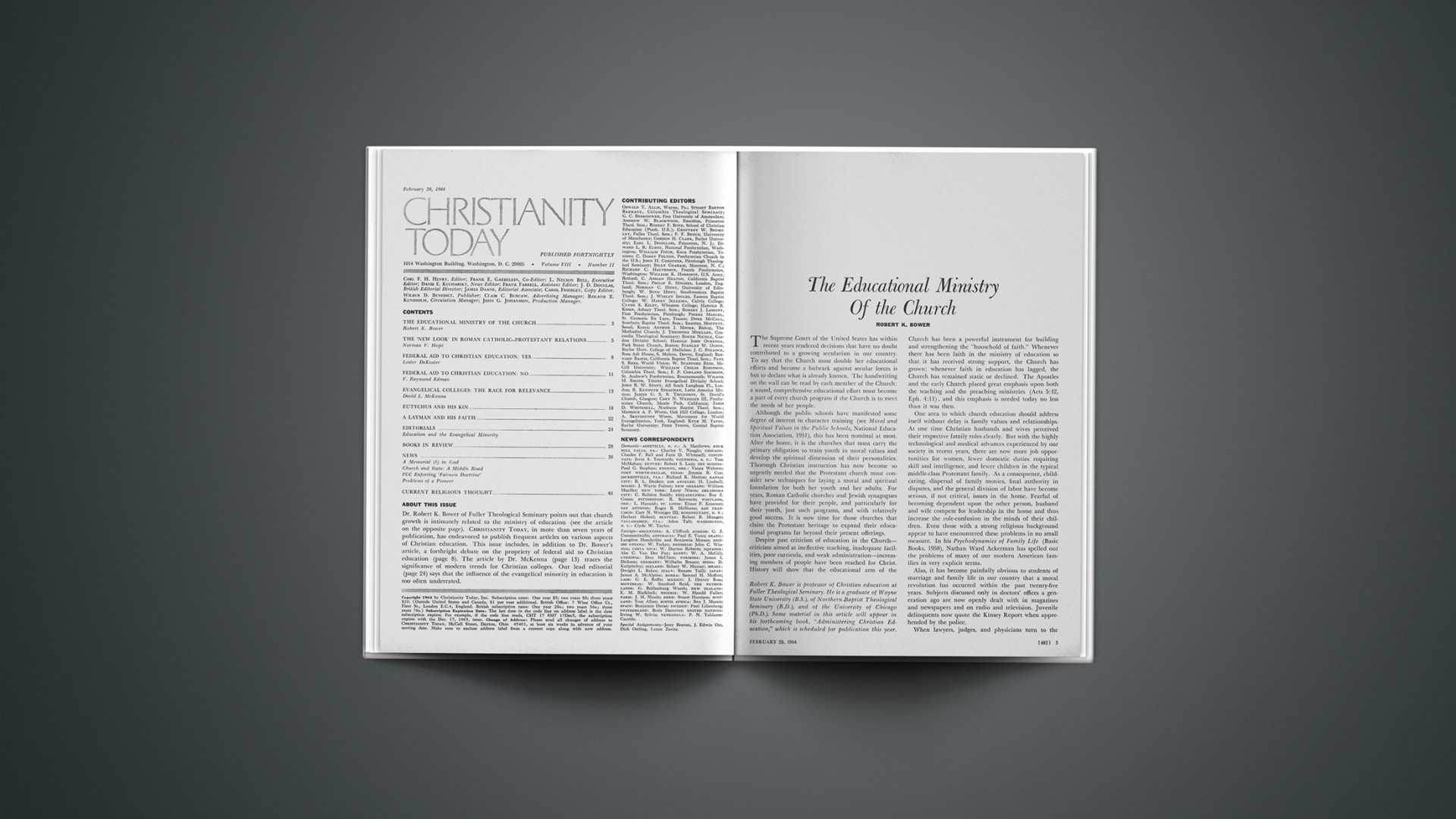
About This Issue: February 28, 1964

Dr. Robert K. Bower of Fuller Theological Seminary points out that church growth is intimately related to the ministry of education (see the article on the opposite page). CHRISTIANITY TODAY, in more than seven years of publication, has endeavored to publish frequent articles on various aspects of Christian education. This issue includes, in addition to Dr. Bower’s article, a forthright debate on the propriety of federal aid to Christian education (page 8). The article by Dr. McKenna (page 13) traces the significance of modern trends for Christian colleges. Our lead editorial (page 24) says that the influence of the evangelical minority in education is too often underrated.

Problems of a Pioneer

In the stillness of a spring morning, Carl A. Mortenson hopes to climb into the cockpit of his “Evangel 4500” and taxi across a private airstrip just west of Chicago. That in itself will make missionary aviation history, for the small, twin-engine plane is the first ever designed especially for missionary use. Beyond that lies a vigorous test program for the new aircraft with Mortenson as test pilot. If it proves successful, the “Evangel 4500” could make missionary flying safer.

Missionary aviation has had an admirable safety record, despite the fact that single-engine planes are used almost exclusively. Planes of the Missionary Aviation Fellowship, for instance, have traveled some 9,000,000 miles without a fatality. The fleet of planes operated by the air arm of Wycliffe Bible Translators also has escaped major tragedies.

The 29-year-old Mortenson, however, feels that missionary aviators ought not to rest upon their laurels. Serving to support this view is the fact that there have been at least three fatal accidents of missionary aircraft within the last nine months.1A Dutch Roman Catholic missionary was killed last spring when his plane creashed in West Irian. On June 29, 1963, Joel Robertson of Air Crusade, Inc., died in a crash in Guatemala (this accident was blamed specifically on engine failure). Last month, the Rev. and Mrs. John B. Woods, Presbyterian U. S. missionaries, were fatally injured when their plane struck a mountain in Mexico. All three were single-engine Cessna 180s, which are widely used in missionary aviation. At least one of the crashes was attributable to engine failure.

Mortenson hopes to reduce the risk with the development of his twin-engine “Evangel 4500.” The twin-engine feature is only one of a number incorporated into the design geared for use in remote areas. (See CHRISTIANITY TODAY News, May 10, 1963.)

Many missionary aviation experts are questioning the wisdom of Mortenson’s venture despite the fact that development of the prototype has been achieved in close liaison with aeronautical engineers and certification inspectors of the Federal Aviation Agency. He has received no official encouragement from MAF, from Wycliffe, with whom he served as a pilot-mechanic in Peru, or from Moody Bible Institute, where he received his aviation training.

MAF officials have traditionally relied upon commercial production-line models with minor modifications, and then only when these models have survived the “infant mortality rate” among new designs. To start from scratch with a fresh design is too risky, they feel, especially in view of limited budgets. Moreover, they feel that the extra engine in Mortenson’s plane may be more of a liability than an asset because it introduces so many more complexities.

But such arguments have not shaken Mortenson’s faith in the project. With the help of a special non-profit corporation headed by chemistry professor Paul M. Wright of Wheaton College, he has labored for over two years, even though he never had any guarantee of funds. The entire project has been financed by contributions. Biggest boost came when the “Back to the Bible” radio broadcast raised $10,000 to pay for the engines.

Mortenson originally had hoped to have the plane flying by the end of last summer. But work progressed at a slower pace than he had anticipated. He says that no major technical problems have been encountered, however, and that a maiden flight this spring seems fairly certain.

Protestant Panorama

Methodist Board of Missions voted a sweeping reorganization of its structure, designed to unify the administrative and promotional work of Methodist missions in the United States and forty-eight other countries.

United Presbyterian Board of National Missions will launch an intern program this summer that will put six seminary students to work for integrationist organizations in the South.

Athletes and spectators at the Winter Olympics did not have to look far to find a Protestant church. The newly completed Evangelical Church of the Resurrection in Innsbruck, Austria, stands midway between the Olympic village and the stadium. During the games it was staffed by an Austrian, a Swedish, an English, a Hungarian, and three German pastors.

Miscellany

Twenty-nine cardinals of the Roman Curia met with Pope Paul VI last month to discuss the possibility of summoning a “Pan-Christian Conference” that would be attended by religious leaders from East and West, with the pontiff presiding as “first among the bishops of the Catholic Church.”

A draft declaration calling for the elimination of religious intolerance was completed by a special United Nations study commission. An official of the World Council of Churches, however, termed the document “inadequate and disappointing.”

A report that President Johnson will propose federal aid for parochial as well as public schools in depressed areas drew a statement of criticism from Protestants and Other Americans United for Separation of Church and State. The organization, which was holding its annual meeting in Houston when the reports appeared, said “subsidies to parochial schools under any pretext are subsidies to the churches which own and control them.”

A purge of educators in Ghana included the arrest of Dr. Dennis Osbourne, a physicist who had been active in evangelical Christian work among students at the University of Ghana. Osbourne was well known for a series of pamphlets on Christian truth which he had written for undergraduates.

Sudan Interior Mission launched publication of a new French-language magazine for Africa. The editor of the periodical, to be known as Champion, is Mademoiselle Giselle Joly.

Scholars working on a new translation of the Polish Bible hope to conclude their work by 1966 in time for the thousandth anniversary of the Polish nation.

A new advertising sales organization to be known as Opinion Magazine Group is being established for The Christian Century, ecumenical Protestant weekly, America, a Jesuit weekly, and Commentary, a monthly sponsored by the American Jewish Committee. The group will offer advertising space in all three publications through a single order.

The first issue of a new Journal of Ecumenical Studies was due this month. The journal, scheduled for publication three times a year, is sponsored jointly by Roman Catholic, Protestant, and Orthodox scholars.

Philadelphia College of Bible will sponsor a Golden Jubilee Banquet April 17 as part of its fiftieth anniversary celebration.

Personalia

The Rev. Harry Rine De Young named chairman of the United Presbyterian Division of Evangelism.

Dr. John Laney Plyler is retiring as president of Furman University (Baptist).

Dr. Gordon G. Johnson nominated to be dean of Bethel Theological Seminary.

Professor Norman W. Porteous named principal of New College, University of Edinburgh.

The Rev. James Dunlop nominated moderator of the General Assembly of the Presbyterian Church of Ireland.

Bishop Robert Selby Taylor elected Anglican Archbishop of Capetown, South Africa.

John C. Eller named president-elect of American Protestant Hospital Association.

Richard C. Underwood named editor of Together, family magazine of Methodism.

The Rev. Jesse W. Myers resigned as United Presbyterian chaplain at the University of Maryland. He had been publicly rebuked by university officials for criticizing fraternities.

They Say

“Scotland Yard is searching for more space in which to store its embarrassingly large stock of obscene books and pictures, and HM Customs is forbidden to burn any more obscene books because they were breaking the rules of a smokeless zone by making black smoke.”—The Guardian of London.

Deaths

BISHOP CLARE PURCELL, 79, former president of the Methodist Council of Bishops; in Birmingham, Alabama.

DEAN ROSCOE WILSON, 81, noted Anglican churchman; in Melbourne, Australia.

THE REV. F. R. WEBBER, 76, authority on church architecture of the Lutheran Church—Missouri Synod; at Mt. Vernon, New York.

FCC Enforcing ‘Fairness Doctrine’

The Federal Communications Commission will soon issue a “primer on fairness” to radio and television stations. Although not specifically directed at religious programming, it implies stringent curbs ahead for ministers who use the air waves to make “personal attacks.” FCC sources say religious programs give them the most trouble.

Direct government censorship is forbidden by the Federal Communications Act. But the FCC feels that under its “fairness doctrine” it can require holders of radio and television station licenses to give any individual or organization subjected to a personal attack a reasonable opportunity to reply.

This means that stations, unless they want to donate extensive free time for such replies, will take the initiative to restrict personal attacks.

The FCC says it is merely restating a position taken in 1949. It was delineated in a public notice to all broadcasters July 26, 1963, in which the commission declared: “Whenever a controversial program involves a personal attack upon an individual or organization, the licensee must transmit the text of the broadcast to the person or group attacked, wherever located, either prior to or at the time of the broadcast, with a specific offer of his station’s facilities for an adequate response.”

The new primer will say that a station owner can rightfully demand to see the text of a sermon scheduled to be broadcast so that he can decide whether to risk it. Except in the case of political speeches, which are governed by a different code, stations are held responsible for knowing what they are putting out over the air. And if anyone is attacked and a complaint is received, the stations have the obligation to inform the person of the attack and to offer him time for response.

The time need not be equal, says an FCC spokesman, but the forthcoming document will indicate that an “adequate” opportunity is expected.

What the FCC is trying to get rid of is the type of presentation that easily degenerates into repeated name-calling. Stations may still broadcast any kind of program that they desire. But it is nonetheless obvious that programs involving extensive personal attacks will get the station into a string of red tape and the granting of so much free time for response as to make the operation uneconomical. If any station fails to abide by the new primer and listeners complain to the FCC, the station may not be able to get its license renewed. Station licenses granted by the FCC are valid only for three-year periods.

Some broadcasters may be eager to see how the new primer defines “personal attack.” Does reasonable criticism of a theologian’s viewpoint constitute such an attack? And what about adverse comments on people who are dead?

The broader question of liberal or conservative interpretation of theology comes under a different FCC policy, one in which the commission expects stations to present a balanced diet with respect to controversial issues. Listeners can complain to the FCC if, for instance, a station’s religious programming reflects a decidedly liberal bias. If the FCC then determines that the area served by the station includes a substantial population of theological conservatives it can raise the complaints at license renewal time. A severe bias can conceivably prompt the commission to withhold a license because the station in not serving its public adequately.

Free Time For Atheists?

Does the Federal Communications Commission require radio and television stations to be “fair” to atheists and Communists?

FCC Commissioner Robert E. Lee, in a statement to the first International Christian Broadcasters Convention, said no. He declared that the “fairness doctrine” of the FCC does not apply in the case of atheists who seek radio or television time for rebuttals to religious sermons.

“This country believes in God,” Lee said during a question-and-answer period, “and we do not consider this a controversial issue.”

The three-day convention combined the twenty-first annual meeting of the National Religious Broadcasters and the fourth triennial World Conference on Missionary Communications. Delegates saw the intensification of efforts to meet the challenge afforded by modern electronic media. NRB approved a plan to establish a permanent secretariat, and a spokesman said it would begin operating “in a matter of weeks.”

Capturing the fancy of many a delegate were reports of the effectiveness of commercial-type radio “spots” carrying a religious message. Use of such spots, usually paid for at commercial rates, seems to be growing rapidly. The most exhaustive test campaign thus far appears to be one sponsored by Mennonite Broadcasts, Inc., and carried out by a Washington, D. C., advertising agency. A representative of the American Bible Society also reported a campaign with spots. One delegate said that messages with a “word for the Lord” had been interspersed in a series of play-by-play accounts of college football games.

A research firm that conducted surveys in connection with the Mennonite campaign claimed that the spots had “brought one out of every four men in a predetermined age group (18 to 40) in Terre Haute, Indiana, from a condition of ignorance to awareness of a selected Christian truth” (see News, CHRISTIANITY TODAY, January 3, 1964).

Most controversial speaker at the convention was Dr. John Bachman, a Union Theological Seminary professor and noted authority on religious radio and television programming (and new chairman of the Board of Managers of the National Council of Churches’ Broadcasting and Film Commission). Bachman called for rapprochement among broadcasters with differing theological views. His appearance prompted the Presbyterian Journal to “wonder if Dr. Theodore Epp of ‘Back to the Bible’ fame will be invited to address the next NCC convention?”

A Middle Way

Christopher Columbus set sail for the Orient but landed in America. Early this month many churchmen set out for Columbus, Ohio, to attend a study conference on church-state relations which they believed would support the Jeffersonian doctrine of “absolute” separation of church and state. But like Christopher, the conference wound up on another continent. It had steered a middle course.

The four-day meeting was a precedent-setting one. It was the first study conference on church-state relations called by the National Council of Churches. It was the first time the NCC had invited non-member Protestant communions to send voting delegates, these representing conservative groups like the American Lutheran Church, the Lutheran Church—Missouri Synod, and several state conventions of the Southern Baptist Convention. And along with some 400 representatives of sixteen Protestant and Eastern Orthodox bodies came nineteen Roman Catholic and Jewish “participant-observers,” the first to share even indirectly in the formation of a major NCC document—as they took part in drawing up section reports used by a “findings committee” of delegates in preparing the final 3,000-word conference statement. Observers were named also by the National Association of Evangelicals and the First Church of Christ Scientist in Boston.

The delegates faced a complex and perpetually vexing problem area in Christian thought, and their findings, while not constituting an official NCC “policy statement,” were seen by observers as highly significant guidelines for continuing examination of church-state relations by the nation’s religious bodies. Delegates stated the rationale for their gathering in this way: “The necessity for new attention to the problems of church-state relations arises not only from the expansion of governmental programs into areas where churches and other voluntary agencies have served and continue to serve but also from the transition of this nation from a Protestant to a religiously pluralistic society.” The pluralism motif was stressed throughout the document though there were some who questioned the thesis and wished it stricken.

In qualifying the “complete” separation, or “wall of separation,” theory, the document points to the frequent “overlapping” of the functions of church and state, and thus the “interaction” of the two structures. Yet it asserts church-state separation to be a constitutional principle and declares “acceptance and support of Supreme Court decisions insofar as they prohibit officially prescribed prayers and required devotional reading of the Bible in schools.” An attempt to delete the word “support” was defeated. Opposition was asserted to “any proposal such as the so-called Christian Amendment which seeks to commit our government to official identification with a particular religious tradition.”

On the other hand, the document states that “government exceeds its proper authority if it shows hostility or even indifference to religion”: “While it is not the business of government to promote or support religion, it is government’s role and duty to further religious liberty. The clause of the First Amendment prohibiting an establishment of religion must be balanced against the clause prohibiting interference with the free exercise of religion.”

Going beyond this, the document asserts that “under some well-defined circumstances, government may legitimately support specific programs of church-affiliated health and welfare agencies. The sole purpose of any governmental policy in this respect must be the promotion of a clearly identifiable public interest as against a private interest of an individual or religious group.” It is also declared that such government aid should not be aimed “primarily” at the support of religious institutions or programs but should be “incidental” to large programs in the public interest. It should also be made certain, the document says, that agencies receiving aid do not discriminate on the basis of race, color, creed (this point was sharply debated), or national origin.

This brought the delegates to what proved the most controversial subject in their statement of findings—federal aid to parochial schools, which in general they opposed, but with certain exceptions. Following is the key passage: “Since parochial elementary and secondary schools are maintained by churches so that ‘religion permeates the entire atmosphere’ of the school, government funds should not be authorized or appropriated for overall support of such schools as distinguished from aid in support of specific health and welfare programs conducted by such institutions to meet particular needs.”

This section, adopted by a vote of 85–57, was a revised version of wording that would have approved federal aid for any “specific programs” of private and parochial schools that would meet a public need. As amended, it approves federal aid for such programs as school lunch projects and medical treatment while rejecting government funds for educational purposes.

There was lively debate over a proposed amendment that would have removed the word “overall’ in reference to government support for parochial schools, a revision that would have given the findings a more rigid separationist tone. The proposal died on a 79–85 vote.

The delegates acknowledged the parental right of choice of schools, but they denied that a choice of parochial or private schools “imposes on the state any obligation to support such choice through the granting of public funds in overall support of such schools.” They cautioned that such support “may well have the result of further fragmentation of the educational system and weaken the role and position of the public schools.”

But recognition was given to “the seriousness of the financial problem of the parochial schools.” In response, the conferees proposed “shared time as the most creative measure for solving this problem and [we] are willing to explore other legal methods for solving it.”

The study document passes very quickly over what is becoming an increasingly thorny problem for U.S. congressmen: the differences between education at primary and secondary levels on the one hand and college education on the other with regard to proposed federal aid. The document says simply that “these differences [undefined] with respect to the constitutional and policy questions involved in governmental support of non-public education enterprises remain to be explored.”

Summing up the conference, one leader said: “This is not the first or the last step in the quest. But I think it’s a significant step.”

Closing Up Shop

The major agency of cooperation among American Lutherans began a formal dismantling process this month. At its forty-sixth annual meeting, held in Charlotte, North Carolina, the National Lutheran Council took initial steps toward transferring activities to the proposed new Lutheran Council in the United States of America.

The LCUSA, as now projected, will embrace the Lutheran Church in America and the American Lutheran Church, both of which participate in the present NLC, as well as the Lutheran Church—Missouri Synod and the Synod of Evangelical Lutheran Churches, which do not belong to the NLC.

Planners have a target date of January 1, 1967, for establishment of the new agency.

Among key problems in the transition are those connected with the separation of the council’s regular program from its functions as the American committee for the Lutheran World Federation. The Missouri Synod and the SELC are not members of the federation.

Another problem is what to do with the campus ministry of the present NLC. An NLC news release noted that “the NLC bodies differ with the Missouri Synod in their philosophy and approach to this area of activity and lack of doctrinal agreement is a major obstacle.”

Sacred Precincts Picketed

Now and then Britain gets a reminder that old-time militant Protestantism, like Charles II, is an unconscionable time dying. In Scotland each July 12 it organizes noisy processions to celebrate King Billy’s victory over the Papists in 1690; in England it has all but forsaken vocal protests during Anglo-Catholic services, and witnesses chiefly through incisive little notices in the “Personal” column of The Times. Earlier this month, however, it took to itself a modern weapon when its supporters picketed the decently somber confines of Church House, Westminster.

Inside, the Church Assembly was debating a controversial measure that sought to regularize the use of eucharistic vestments. This has been a well-aired subject in recent times, and nothing new emerged from the discussion, though a prominent layman, Mr. George Goyder of Oxford, created a stir when he asked why if our Lord wanted them to wear vestments he did not dress up specially for the Last Supper. In the end all three houses, Bishops by 31–0, Clergy by 214–30, and Laity by 182–68, voted in favor of the measure, which now goes forward finally for parliamentary approval. Such approval would not make vestments mandatory; it would merely give official sanction to a practice which hitherto has been illegal.

Later in the week pacifist pickets took over and found the house more sympathetic to their cause. A resolution by the Bishop of Chichester, Dr. Roger Wilson, opposing Britain’s independent nuclear force, was carried with an addendum which stated, “believing that the use of indiscriminate weapons must now be condemned as an affront to the Creator and denial of the very purpose of the Creation.”

When the House of Laity met separately, evangelicals again received a setback when a move that would in effect have officially permitted non-Anglicans to communicate in parish churches on occasion, was defeated 101–84. Two things were significant about the voting, however: the minority vote on this issue was the largest so far; and the majority vote was cast very largely by older members of the house.

The whole assembly discussed the report on deployment and payment of the clergy (see “New ‘Pauline’ Document,” CHRISTIANITY TODAY, News, February 14) and agreed to receive it after an official assurance was given that such reception in no way committed the church. It seems certain, nevertheless, that many of the report’s recommendations will in the church’s own time be implemented. As one means of furthering them, the Archbishop of Canterbury, Dr. Michael Ramsey, pleaded for more clergymen to make a vocation of celibacy. This would help solve the problem of filling vacant parishes by allowing men without domestic ties to move from place to place, wherever the need was greatest. The Bishop of Woolwich, Dr. John Robinson, said the report would not bring in the Kingdom of God, but that the future would be “very grim” if its recommendations were not received.

J. D. DOUGLAS

Jeopardizing The Union

Despite the somewhat ostentatious support given by the upper echelons in both churches, opposition is growing to the proposed Anglican-Methodist merger in England. This month in London saw the inaugural meeting of the Voice of Methodism, a movement pledged to uncompromising opposition to certain proposals in the current report (the issue will probably be decided next year). It seems likely that if these are accepted there will be a split within Methodism with, suggested some of the speakers at the meeting, a majority of Methodists dissenting.

The new movement, which has already appointed a full-time secretary and is inundated with offers of voluntary help, is planning to publish a regular journal and a series of booklets, and is appealing for at least $55,000 from supporters. One of the elder statesmen of Methodism, noted Old Testament scholar Norman Snaith, was unable through illness to attend the inaugural meeting but sent a message pointing out that “the essence of the Gospel and of Protestantism was justification by faith alone,” and that acceptance of the report involved “denying this by agreeing to the unhistorical notion of apostolic succession.” He was backed by Dr. Leslie Newman, who is reputed to have the largest evening congregation in Methodism (he takes up an appointment in the United States this summer). Some people spoke very confidently about reunion as the will of God, said Dr. Newman, but “this age was not conspicuous for its concern for God’s will.”

Meanwhile the (Anglo-Catholic) Church Union, which perhaps hoped the merger proposals would founder on other rocks, has at last come out with a plain statement. This body, which makes wide use of such pejorative expressions as “separated brethren,” professes to welcome the merger report but says it is “not an adequate basis of communion.” The union finds the language equivocal at times and points out that “some important theological questions are left unresolved, others barely mentioned.” It cites two notable differences of discipline in the two churches: the problem connected with Holy Communion, and that dealing with admission to holy matrimony after divorce.

The union has reserves also about Methodist insistence on maintaining relations with other non-episcopal churches, and comments: “It does not appear from the report either that the theological implications of communion have been adequately considered, or that the respective relations and discipline have been reconciled. An Anglican attending Holy Communion in a Methodist church might find that the celebrant was, say, a Congregationalist minister.” What the union’s statement fails to add is that already an Anglican who attends communion in the Lutheran Church of Sweden (with which the Church of England is in communion) might find the celebrant is a minister of the Presbyterian Church of Scotland, whose orders are accepted by the Swedish Church but not by the Church of England.

J. D. DOUGLAS

‘One Man’S Way’

If anything can be an omen in the flickering world of Hollywood, the Protestant clergyman may be in for a new public image. After decades of movies that presented the Protestant minister as a confused and bewildered oozy sentimentalist whom no man in his right mind would take seriously, United Artists’ One Man’s Way presents a credible image of one of America’s best-known clergymen.

The film is the story of Dutch Reformed minister Norman Vincent Peale, played very satisfactorily by Don Murray. Born in the manse, the last thing Peale wanted to be was a minister, and he turned to journalism. But exposure to crime and human need awakened a compassion for people that sent the police reporter to the seminary. He wanted to meet human need with positive action, not simply write about it. Here lies the motif of Peale’s ministry.

When in a gas station his future wife met his back bumper with her front one—with a very positive impact—the romantic chase was on. The bumped became the pursuer, and the pursued the girl-who-is-never-at-home—for the last thing she wanted to be was a minister’s wife, which she thought could only be dull.

With the bright persistence of the original positive thinker, Norman refused to accept a negative answer. In the end, Ruth herself asked for what Norman wanted, and he complied by taking her to wife. Playing a starring role in her first motion picture, lovely Diana Hyland is no typical minister’s wife—but then neither is Peale a typical minister.

One Man’s Way is not the usual story of the minister’s struggle to coexist with the special attention of the congregation’s “unclaimed jewels” turned sour and with the usual cantankerous, immovable church boards. It is just what the title suggests: one man’s way of preaching. The script faithfully reflects Peale’s way of preaching down the years. At the first, he proclaimed a kind of do-it-yourself-with-God religion—a combination that makes all things possible. In the movie as in his life, there came—especially with his growing popularity—severe criticism, and even the charge that his message was blasphemous. Peale countered, in the movie as in life, that he was really preaching the God in Christ who so meets aching human needs that man, even in this world, can live on a note of optimism and in a mood of triumph. Here lies the key to Peale’s extraordinary appeal. He stresses what is often an unnecessary deficiency in preachers of more obvious orthodoxy.

Based on Arthur Gordon’s book, Minister to Millions, and produced by Frank Ross, One Man’s Way is certainly one of the best current religious movies. It is serious, warm, authentic, reverent, and always in good taste. May One Man’s Way become the way in which other religious movies are made.

JAMES DAANE

A Memorial (?) to God

President Johnson climbed out on a theological limb this month. Addressing nearly 1,000 guests at the twelfth annual Presidential Prayer Breakfast in Washington, Johnson proposed establishment in the capital city of a “memorial to the God who made us all.” It should be, he said, “a center of prayer, open to all men of all faiths at all times.” He suggested that International Christian Leadership, sponsor of the breakfast, round up necessary support.

The Chief Executive’s idea found no immediate groundswell of acceptance (see editorial on page 26), but if nothing else, it was noteworthy for its very daring. Seldom does any high-ranking politician, much less the President, have any suggestion to make to the religious community much beyond a variation of “keep up the good work.” Johnson at least showed that he wants to be a participant rather than just a spectator. Some observers felt his word choice was unfortunate; critics immediately drew the inference from the term “memorial” that “God is dead.”

Hundreds of government leaders, including Chief Justice Earl Warren, House Speaker John W. McCormack, six members of the Cabinet, and several state governors, were crowded into the grand ballroom of the Mayflower Hotel. Amidst notables at the head table was Los Angeles publisher William Jones, who each year picks up the entire tab for the Presidential Prayer Breakfast. Republican Senator Frank Carlson of Kansas presided.

Johnson said that “prayer has helped me to bear the burdens of this first office which are too great to be borne by anyone alone.” In remarks to the Congressional Wives’ Prayer Breakfast, held simultaneously in another room, he recalled “those first dark days of November, when the pressures were the heaviest and the need of strength from above the greatest.” “Lady Bird and I sat down together to eat a meal alone,” he said. “No word or glance passed between us, but in some way we found ourselves bound together, and I found myself speaking the words of grace that I had learned at my mother’s knees so many years ago.”

First public endorsement of the Johnson memorial plan came from the National Association of Evangelicals. Dr. Robert A. Cook, NAE president, noted in a letter to Johnson that “the Scriptures are replete with … references which make it plain that nations as well as individuals should acknowledge God, even as the founding fathers of our nation were careful to do.”

“The God of our American heritage is the Judeo-Christian God of the Bible,” Cook said, “and recognition of this fact can have great significance. An edifice for this purpose could serve as a testimony to the thousands who annually visit our nation’s capital, as well as to those who live and work here. It would stand in the same marked contrast with the idol of the godless dialectical materialism as does your confession of faith in God and His Son, Jesus Christ.”

The letter conceded “problems and difficulties” but added that “complete agreement on theology … is not necessary for the limited project under consideration.” Cook concluded by saying that “we are hopeful, therefore, that the International Christian Leadership, in accord with your suggestion, will take the lead in exploring the possibility and feasibility of implementing your splendid suggestion.”

Johnson was preceded on the breakfast program by Republican Governor Mark Hatfield of Oregon, who said that “the call for spiritual mobilization is a clarion call in this day,” and evangelist Billy Graham.

Graham cited a series of pressures that currently plagues the United States. He said that the nation is pressed demographically and psychologically, as well as by moral and social problems, by international crises, and by a pessimistic philosophy.

“The victory,” he said, “is found in a spiritual dimension, and I believe that the greatest need of America at this hour is a moral and spiritual awakening that will sweep the nation from coast to coast and put back into our society a moral fiber that we need, and a will to resist the forces of tyranny, and a will to maintain our freedoms at an hour when they are being attacked.”

Later that day, Graham and his wife, who had addressed the wives’ breakfast, went to the White House at Johnson’s invitation. Graham said he had telephoned Johnson several days before to assure the President that, press reports to the contrary, he had absolutely no presidential aspirations.

The President introduced his suggestion of a memorial as a “personal thought.” This is what he said:

“This Federal City of Washington in which we live and work is much more than a place of residence. For the 190 million people that we serve and for many millions in other lands, Washington is the symbol and the showcase of a great nation and a greater cause of human liberty on earth.

“In this capital city, we have monuments to Lincoln, to Jefferson, to Washington, and to many statesmen and soldiers. But at this seat of government, there must be a fitting memorial to the God who made us all.

“Our government cannot and should not sponsor the erection of such a memorial with public funds. But such a living memorial should be here. It should be a center of prayer, open to all men of all faiths at all times.

“If I may speak this morning as a citizen and as a colleague and as a friend, I would like to suggest to this group, which has done so much through all the years, that it undertake the mission of bringing together the faiths and the religions of America to support jointly such a memorial here in this Federal City—the Capital of the Free World.

“The world is given many statistics about the per capita vices of Washington, but the world knows all too little about the per capita virtues of those who live and labor here.

“I believe—and I would hope that you would agree—that the true image of Washington is not that of power or pomp or plenty. It is, rather, that of a prayerful capital of good and God-fearing people.”

Books

Book Briefs: February 28, 1964

What To Teach Teachers

The Education of American Teachers, by James Bryant Conant (McGraw-Hill, 1963, 275 pp., $5), is reviewed by Frank E. Gaebelein, co-editor ofCHRISTIANITY TODAYand headmaster emeritus of The Stony Brook School.

In 1910 Abraham Flexner, after extensive study under the auspices of the Carnegie Foundation for the Advancement of Teaching, published his Medical Education in the United States and Canada, a book that revolutionized the training of physicians in America. Last September James Bryant Conant, former president of Harvard University, U.S. High Commissioner of Germany and later ambassador to that country, published The Education of American Teachers, another in his series of studies of American public education made under grant of the Carnegie Corporation. The parallel is significant, for Dr. Conant’s most recent volume contains the potential of changing the face of teacher education as Flexner’s book changed medical education.

Like its predecessors, The American High School Today and Education in the Junior High School Years, this book is a refreshing example of what happens when a first-rate mind, unencumbered by the hazy professionalism that marks many educational theorists today, applies itself to the problems of public education.

Charles Malik, former president of the General Assembly of the United Nations and himself a teacher, said, “Find the good teacher and forget everything else.” This may sound extreme, yet it places the emphasis for education in the right place. Already the influence of Dr. Conant’s other books on the public schools is widely felt. But the proposals he has made in them will fall short of full effectiveness, as will every other effort toward educational reform, without drastic changes in the education of teachers.

This is not a superficial study. Assisted by nine outstanding educators and scholars, Dr. Conant gave two years to the project, during which he visited seventy-seven higher institutions in twenty-two states and studied the state regulations that limit the freedom of local school boards to employ teachers. His subject is complicated by a staggering variety of theory and practice. It is also a battleground of academic civil war in which the professional education establishment is arrayed against the advocates of the liberal arts and sciences. No one who has done his share of reading the writings of professors of education can fail to admire the fair-mindedness and incisiveness with which Dr. Conant works through tangled verbiage and the multiplicity of programs to the heart of the problem.

Compared with existing practices, his proposals for revision of teacher education are radical. The elaborate system of required credits in education courses prescribed for the certification of teachers by state departments of education and a number of the regional accrediting associations must go. “Except for practice teaching and the special methods work combined with it,” Dr. Conant declares, “I see no rational basis for a state prescription of the time to be devoted to education courses.…” In its place, he would empower college and university faculties to set up the teacher-education programs they consider adequate and to stand behind these programs by certifying that those completing them are satisfactorily trained to teach. He proposes only three requirements for state certification: (1) “a bachelor’s degree from a legitimate college or university,” (2) evidence of successful practice teaching under state-approved direction, (3) “a specially endorsed teaching certificate from a college or university which … attests that the institution as a whole considers the person adequately prepared to teach in a designated field and grade level.”

Essential to Dr. Conant’s proposals is his plan for clinical professors of education to supervise practice teaching. Such professors would be first of all superbly skillful teachers of youth or college students. Although they would not be expected to engage in research and publish papers, their academic rank and compensation would be equal to that of any other professor. They might serve full time or part time and would be required periodically to return to classroom teaching. (The analogy to medical education is not fortuitous but deliberate.) Dr. Conant’s study convinced him that the single most effective instrument for teacher education is supervised practice teaching. Certainly the clinical professorship that he describes should greatly heighten the value of the practice-teaching experience.

In all, The Education of American Teachers contains twenty-seven separate proposals. Yet the heart of the book lies in the points just cited. Not that the other proposals are unimportant; the program advanced has inner consistency and should be considered as a whole.

The implications of the book for Christian education, while not apparent on the surface (Dr. Conant says practically nothing about religious education beyond brief mention of private denominational colleges), are nevertheless significant. By and large, the Christian colleges are heavily involved in teacher education. This is particularly true of the conservative evangelical colleges, which probably graduate more prospective teachers than prospective members of any other professional group. Moreover, many of the newer conservative evangelical colleges have in recent years been seeking regional accreditation. And it may be that this praiseworthy concern for academic standing has made them vulnerable to some of the proliferation of education courses and over-emphasis upon method to which Dr. Conant objects. Perhaps in their uncritical acceptance of some less favorable trends in education programs and in their desire to gain status, they have been in danger of adding their own share to the multiplicity of courses by setting up too many specialized courses in Christian education, some of which though not unsound might be unnecessary. After all, the great strength of evangelical education should be the integration of the whole curriculum with biblical truth.

In relation to courses in the philosophy of education, Dr. Conant is caustic. “The word philosophy, as used by many professors of education, is,” he says, “like a thin sheet of rubber—it can be distorted and stretched to cover almost any aspect of a teacher’s interest.” And he refers to “the philosophical foundations of education, which today consist of crumbling pillars of the past placed on a sand of ignorance and pretension.” The chief distinction of Christian education lies largely in its own philosophy. Dr. Conant’s strictures on the usual philosophy of education courses, while warning against slipshod thinking and belaboring of the obvious, should stimulate Christian colleges to the disciplined presentation of the biblical world view as it applies to education.

Much of the material with which the book deals is technical and pedestrian, as in the sections that consider varying certification requirements and treat existing programs. But there is a genuine fascination in following a powerful mind in its unsparing examination of practices almost sacrosanct to the educational establishment. For the persevering reader there are some flashes of humor, many examples of blunt common sense, and occasional passages of real wisdom. Referring to the habit of taking courses without any clearly defined purpose aside from the reward of higher pay, Dr. Conant says: “Discussing this subject in a summer school with more than one group of teachers who were purring with pleasure at their continuing education, I felt as if I were talking to opium smokers who were praising the habit of which they had long since become the victims.” Or consider this: “As someone has said, the diploma should not be the death mask of the educational experience. Education in breadth and depth, rightly conducted, should lead to further self-education in greater breadth and depth.” And this also: “Among the many things our professors of arts and sciences have failed to accomplish is the inculcation of the idea that vast fields of knowledge and culture are wide open to anyone who can and will read.… I wish no one receiving a bachelor’s degree would carry away the belief that his alma mater has ‘educated’ him. The well-educated man or woman of the future must be primarily a self-educated person. And self-education requires years and years of reading and a desire to learn.”

Dr. Paul Woodring, editor of the Saturday Review Educational Supplement, has said that 2,000 reviews and editorial mentions of The Education of American Teachers have appeared since its publication in September. Nevertheless, this review, one more among so many, will not be superfluous if it leads Christian educators to think with Dr. Conant about the single most important aspect of education and to ponder critically the relation of his proposals to the training of Christian teachers.

FRANK E. GAEBELEIN

A Book Of Provocations

Church Unity and Church Mission, by Martin E. Marty (Eerdmans, 1964, 139 pp., $3), is reviewed by James Daane, editorial associate, CHRISTIANITY TODAY.

Marty’s thesis is that the churches have sufficient unity to resume and carry forward their mission to the world in new ways. He sees in the general rejection of proselytism (the conversion of the members of other churches to one’s own) “the informal recognition of other Christian traditions and confessions.” Here, as in so many other places in his book, a significant insight is immediately fogged over by his positing of conclusions not derivable from the insight. The rejection of proselytism surely has profound significance for denominationalism, but it has meant neither theologically nor historically the “informal recognition of other Christian traditions and confessions”; and Marty is misleading when he suggests that church unity on this score lacks only the courage of spirituality to face this fact. The idea inherent in denominationalism has never been that other churches did not and could not contain real Christians; the cessation of proselytism, therefore, does not possess the significance for church unity that Marty suggests.

Marty has a shrewd eye for the sociological factors that have made for denominationalism, and it is good that he points them out, for too many Christian churches prefer to close their eyes to this shaky underpinning of denominationalism. Yet Marty overstates and confuses matters when he asserts that “the denomination is basically a sociological category.” This is all too simple and too provincially American. The Church is worldwide, and there are many homogeneous national and sociological units that contain many denominations where sociological factors do not account for church disunity. Truth and confessional differences embodied in denominationalism have deeper, more theological roots than the author suggests.

Marty contends that the ecumenical movement has reached a “stalemate” because those within the movement are chiefly concerned about unity and those outside the movement are chiefly concerned about truth. He realizes that the ecumenical movement will achieve little indeed if it produces only an “organizationally-fulfilled, undergirding and overarching Christian unity.” He reminds us too that denominationalism as such advertises the disunity rather than the unity of the Church, and that denominations tend to exist for their distinctive truths rather than for the whole truth of the Gospel. And he contends that if we put either unity or truth first, the stalemate between the “unity-firsters” and the “truth-firsters” will continue, and the Church’s cause of mission to the world will continue to suffer. Yet even though denominationalism does place truth first, few will agree with his injudicious judgment: “Every poll we have seen, every common-sense observation we can make leads us to one conclusion: that anything Christians might try will do more justice to truth than the competitive system they now inhabit.” I find myself in agreement with many of Marty’s observations and criticisms about denominationalism, but I find myself as completely lost in his judgment that any form of church life would be better than denominationalism, as I find myself completely in the dark as to what he really means when he says the only “solution” to the problems of unity and truth is simply to get on with the mission of the Church to the world. The churches cannot move forward from the historic point where they are, in total disregard of that history which brought them to the point where they are, and made them what they are.

The provocativeness of this book stems as much from its weaknesses as from its strengths, and both of these from its greater sociological than theological concern. It is in many ways a book of sane and balanced judgments, and I heartily recommend that it be read; yet its strength and weakness stem from an essential dissociation from both the ecumenical movement and the reality of denominationalism. Marty sees the claims of these locked in stalemate and proposes that the stalemate can be overcome, insofar as this is possible at all within history, if the whole Church will get on with its mission to the world. Such a solution is to solve the problem of death by asking the dead to arise. The task confronting the divided Church is really not this hopeless, and the solution lies instead in another direction. Marty himself hints at it when he proposes what he calls a biblical counterpart to a “sociological Machiavellianism” in which each church member operates within his own denomination—as regards both truth and mission—as the nature of Christ’s one Church demands. Here I think he is on the right path, though it is not, I think, consistent with his statement that any new forms of church existence would be better than denominationalism. Marty’s book points up the dire need of a thorough theological and historical study of denominationalism, for it is in denominationalism that every segment of the Church posits its understanding and commitment to both unity and truth.

JAMES DAANE

Sunday School Lessons

Arnold’s Commentary, edited by Lyle E. Williams (Light and Life, 1963, 330 pp., $2.95); The Douglass Sunday School Lessons, edited by Earl L. Douglass (Macmillan, 1963, 475 pp., $2.95); Higley Commentary, edited by Knute Larson (Lambert Huffman, 1963, 528 pp., $2.95); The International Lesson Annual, edited by Horace R. Weaver (Abingdon, 1963, 448 pp., $2.95); Peloubet’s Select Notes, by Wilbur M. Smith (W. A. Wilde, 1963, 419 pp., $2.95); Standard Lesson Commentary, edited by John W. Wade and John M. Carter (Standard, 1963, 448 pp., $2.95); Tarbell’s Teachers’ Guide, edited by Frank S. Mead (Revell, 1963, 382 pp., $2.95); The Gist of the Lesson, edited by Donald T. Kauffman (Revell, 1963, 125 pp., $1.25); and Points for Emphasis, by Clifton J. Allen (Broadman, 1963, 214 pp., $.95), are reviewed by Lois E. LeBar, chairman, graduate Christian education, Wheaton College, Wheaton, Illinois.

The first seven titles are full-size book guides for teaching the 1964 uniform Sunday school lessons; the last two are pocket-size. The subjects covered are: first quarter—personalities around Jesus; second quarter—the Christian faces his world; third quarter—early Hebrew history; fourth quarter—letters to Christian leaders. At the beginning of each lesson, The International Lesson Annual and Tarbell’s Teachers’ Guide print the Scripture text in both the King James and Revised Standard Versions; the others use only the King James. All but the Tarbell’s Guide include daily devotional readings. The Douglass, Peloubet’s, International, Standard, and Tarbell’s lessons contain suggestions for correlated visual aids. Although the trend of Bible-centered lessons is to relate them more closely to life, three of these books are still called commentaries.

Arnold’s Commentary is geared for adults and youth. The Douglass lessons sometimes give different captions for intermediate-seniors and young people-adults. Peloubet’s gives topics for juniors and primaries also, and suggests different emphases for younger and older classes. Some of the more difficult of the uniform lessons for primaries and juniors are: man’s place in God’s universe, Christian principles in earning a living, the Christian looks at nationalism, the pastoral epistles, and qualifications of church officers.

Peloubet’s is distinctive for its quotations from outstanding evangelical scholars as well as for Dr. Wilbur Smith’s expositions of Scripture and his bibliographies. Each lesson concludes with a lesson in life, literature, or archaeology, and a truth for the class to carry home.

Arnold’s Commentary affords the teacher the most help in getting students personally involved in the lesson, because parts of the content are introduced through practical questions, enabling students to become participants rather than spectators. Both personal and factual questions motivate them beween Sundays to explore the next lesson. At the end of each lesson is a half page written from the viewpoint of a pastor, a half page by a layman, and a full page relating the lesson to life.

At the beginning of each lesson Tarbell’s Guide gives an overall personal question to launch the whole lesson and to stimulate inquiry. It is the only guide that has separate suggestions for teaching intermediate-seniors and young people-adults. For those teachers not content to “preach” to their classes, The International Lesson Annual adds an alternative teaching plan with well-worded questions for discussion and action.

The Higley and Standard Commentaries offer more specialized types of aid. Each week the Higley furnishes a paragraph on evangelistic and missionary application, a correlated superintendent’s sermonette to lead into the lesson, a simple illustration for the chalkboard, a teacher’s “pump primer,” and ten questions with brief answers to be cut out in advance and given to members of the class. The questions are factual, however, and tend to promote stereotyped recitation rather than personal interaction. The Standard Commentary is complete with introductory articles, lesson aims to “help the pupils to know this” and “lead pupils to do this,” quotable quotes, pithy points, personal questions for daily living, simple chalkboard illustrations, short factual quizzes, and correlated prayers.

In these seven guides differences in theological emphasis are evident in expositions of the same Scripture. For example, “… the man Christ Jesus; who gave himself a ransom for all …” (Tim. 2:5,6): Arnold’s—the one who paid the purchase price of salvation; Douglass’s—the only one who can reconcile an offended God and a sinful man; Higley’s—the idea of substitution for all; International—the need of translating the Christian faith into truly universal terms; Peloubet’s—that which is given in exchange for another as the price of his redemption; Standard—the substitutionary work of Jesus Christ as he died on the Cross to redeem men from their sins; Tarbell’s—therefore the one who is the only mediator between God and men.

The Gist of the Lesson and Points for Emphasis are pocket-sized condensations of the “seed thoughts” of the lessons for the year. “The Gist” was initiated many years ago by R. A. Torrey to provide practical evangelical treatment of lessons in concise form. In addition to Bible exposition. Points for Emphasis contains practical truths to live by and daily Bible readings. Although the authors of these small volumes make their words count, it is hoped that teachers will not consider these adequate preparation for teaching a lesson from the Book of books.

LOIS E. LEBAR

Paperbacks

Your Church & Your Nation: An Appeal to American Churchmen, by Paul Peachey (The Church Peace Mission [Washington, D. C.], 1963, 22 pp., $.15). A still very relevant discussion by pacifist Peachey; first published in 1950.

The Christian Conscience and War, a symposium (The Church Peace Mission, 1963, 48 pp., $.25). A statement on the problems of war and peace by theologians and religious leaders. First published in 1950.

The Challenge of the Ages: New Light on Isaiah 53, by Frederick Alfred Aston (self-published, 1963, 24 pp., $.40). An evangelical discussion to demonstrate that the Suffering Servant of Isaiah 53 is Jesus Christ crucified.

God’s Own Junkyard: The Planned Deterioriation of America’s Environment, by Peter Blake (Holt, Rinehart and Winston, 1963, 144 pp., $2.45; cloth, §4). Written in outraged fury against the wanton despoiling of the American landscape; with photography to show what was, and what Americans have done to it.

Professor in the Pulpit, edited by W. Morgan Patterson and Raymond Bryan (Broadman, 1963, 150 pp., §2.25). Twenty-two chapel sermons of high caliber, preached by the faculty members of Southern Baptist Theological Seminary in Louisville, Kentucky.

The Faith of Qumran, by Helmer Ringgren (Fortress, 1963, 310 pp., $1.95). Written in the conviction that before isolated beliefs and practices of the Qumran community are compared with those of the New Testament, the overall theology of the Qumran should be understood. Translated from the Swedish.

Ideas

Education and the Evangelical Minority

In an editorial introduction to a recent issue of Columbia College Today featuring the place of religion at the college, George Charles Keller tells how an undergraduate asked him one day what this alumni publication was going to discuss. When told that the subject would be “Religion on the Campus,” the student, obviously taken aback, exclaimed: “But, sir, there is none.” The young man went on to say that, while some students attended church services, took religion courses, or belonged to religious clubs, their motivation came from anything but “a deep sense that they owed reverence to a God who created the world and is still involved in everything men do or try to be.”

With this Mr. Keller expressed substantial agreement, saying, “Religion in the traditional sense of formally offering awe and gratitude to a mysterious, omnipresent being has departed for the most part from college campuses.… However, religion in a new sense is growing rapidly at American colleges.” And he defined religion as “mainly a personal quest by young men for some reasonable guidelines for their own actions and clues to the meaning of history.”

Unquestionably the place of religion in school and college is one of the livelier subjects of the time. The churches are probing it; witness Professor William Hordern’s articles published simultaneously in Presbyterian Life, The Lutheran, and The Episcopalian. In the “Survey of the Political and Religious Attitudes of American College Students” that appeared in the National Review Protestant students in comparison with Catholic students made a poor showing in stability of faith, and one Protestant church college had the highest rate of apostasy of any college polled.

As for the public schools, the religious discussion continues in the wake of the Supreme Court decision on Bible reading and prayer. When a parent visiting his child’s classroom in a Rochester (N. Y.) elementary school sees on the blackboard, “The heavens declare the glory of nature,” and is told by the teacher that the quotation of the Nineteenth Psalm was revised at the principal’s request, the role of religion in public education is still very much confused.

The instinct that leads Americans to be concerned about religion in education is a sound one. Few if any institutions in a nation influence its citizenry more than its schools; and in America, with education for all, this influence is especially pervasive. According to Francis Keppel, United States commissioner of education, more than one in every four in our 188 million population is enrolled in public and private schools and colleges, the total for 1962–63 being some 51.3 million. Only recently the Educational Policies Commission of the National Education Association announced as the new goal for the nation’s schools “universal opportunity” for all youth to have two years’ education beyond high school at “non-selective” public colleges on a tuitionless basis together with provision when needed of the expense of living away from home. Moreover, the rise in independent school attendance from 1899–1900, when 91 per cent of children were in public and 9 per cent in private schools, to 1962–63, when only 85 per cent were in public schools and 15 per cent in private schools (the vast majority of which are religious), underlines widespread parental concern for the spiritual training of youth.

Against this background, where does Protestant Christian education, particularly that of evangelical persuasion, stand? The first answer to the question is statistical. If the great majority of the 15 per cent minority (6.7 million in total) of elementary and secondary school pupils are in Roman Catholic parochial schools, as they are, and if only a comparatively small number of the remaining private schools are evangelical, then such schools are only a minority of a minority—and a tiny one at that. For the colleges, the situation is broadly comparable; Christian institutions are again in the minority and those that are evangelical are again a sub-minority.

But is Protestant Christian education in general and the drop-in-the-bucket evangelical minority in particular therefore negligible? Are evangelicals so far behind educationally that their influence may be written off? To both questions the answer is an emphatic No.

Look once more at the background: the increasing number of religion courses in many colleges, yet the undergraduate saying of religion on his campus, “But, sir, there is none”; the repudiation of supernatural religion, and its redefinition as a quest for guidelines and clues to the meaning of history—all this is far from authentic religion even according to the broad Judeo-Christian tradition, let alone its expression in the grand particularities of the historic evangelical faith. It is rather the search for a philosophy and the desire for purpose and for personal identification. And the result may be that, with all the meticulously objective study of religion, the student may merely work out his own philosophy of life which will be, as Canon Bryan Green said, only “My-anity” and not vital Christianity.

But what about authentic New Testament faith on the campus? To overlook its presence and to belittle its relevance betokens a kind of spiritual myopia. Not all practicing Catholics and Jews worship only by force of habit. Not all Protestants are superficial formalists. And there is on the American campus a committed minority (faculty as well as students) that crosses denominational lines and includes in a practical biblical ecumenism those who out of a personal, saving encounter with Jesus Christ recognize their oneness with all believers and who find the Bible essential spiritual food as well as the infallible rule of faith and practice. Measured against the millions in higher education, this minority is numerically insignificant. Measured against the little group of disciples who turned the world upside down, it is large. And it is worldwide. At Oxford, Cambridge, and other British universities, among college and university students in Europe, Asia, Africa, Australia, South America, and the Orient, there is a remnant of evangelical students and teachers. And where it is found, there even on the secular campus is religion in its worldwide, biblical aspect.

Protestant colleges are of two kinds: those that are church-related and those that, while independent of denominational control, yet maintain a thorough-going Christian position. In the first group are the colleges—and their number is considerable—that differ little from the private secular colleges. To be sure, they have departments of Bible and religion, chapel services, and religious emphasis weeks (a singularly patronizing term); but these are peripheral to an education in other respects indistinguishable from its secular counterpart. Here the adjective “church-related” betrays a kind of second-cousin-once-removed relationship quite different from whole-hearted commitment of administration and faculty to a denominational and theological position.

Yet there are also some church-related colleges that are unreservedly committed to the biblical world view and that, along with the group of evangelical but denominationally unaligned colleges, comprise institutionally a conservative Christian minority in higher education. For this minority, Christ and the Scriptures are central to the program and the unity of all truth in God is a major premise. For them the faculty is a fellowship of believers, not an eclectic company made up of Christians, adherents of non-Christian religions, and more or less benevolent unbelievers. In a day of doctrinal indifference they hold to the biblical doctrines of supernatural Christianity and know their position to be compatible with good scholarship. While the number of such colleges is small yet growing, their influence for the Kingdom far transcends their size. From them has come significant national and world evangelical leadership. They too are a part, and a not inconsiderable one, of the remnant in education today.

But any estimate of religion in education cannot be confined to the colleges and universities. It must also take account of the formative years of childhood and the crucial years of adolescence. Here the lines are sharply drawn. By constitutional interpretation public schools are secular. But independent schools are free to use their independence for Christian education as fully as they desire. The number of Christian day schools, both denominational and parent-controlled, is growing. Some boarding schools are thoroughly committed to the unity of education in Christ and the Bible. Would that more of the non-Roman Catholic independent schools might be like-minded!

As for public education, it would be a mistake to assume that because of its religious neutrality it is devoid of a believing remnant. Wherever a Christian who knows whom he has believed and trusts the Bible as the Word of God teaches in a public classroom, there is something of Christ. Such a teacher must adhere scrupulously to state-imposed limitations on sectarian religion in the schools. Yet no teacher, least of all a devoted Christian, teaches out of a convictionless vacuum. The feeling tones of his classroom are bound to reflect the One to whom the Christian in secular education belongs. And in his community he has full liberty to witness by word and life.

Yes, there is religion on the campus—college, secondary and elementary school, public and private. Through the believing remnant, Christianity is in education every day. It is there for the age-old purpose of witness and response. Let objective college courses in religion continue. They have their place in the academic program. But their upsurge on the secular campus is of lesser significance than the consistent witness of the believing remnant to the living God of the Scriptures and to his Son.

Youth seeks reality and responds to it. Youth penetrates pretense and sham. Christ is himself reality. Amid the sophistication, moral ambiguity, and longing for personal fulfillment, the unchanging Christ, when lifted up in his saving reality, still draws youth to himself.

One of the encouraging signs of our day is that American education, apart from the public school, is more ready to hear the Gospel of Jesus Christ than it was twenty years ago. And of those who are hearing it on the campus, some like C. S. Lewis are “surprised by joy.” The reception accorded Billy Graham at secular colleges and universities is genuinely significant; with commendable liberalism many a college chapel is more open to evangelical preaching than in the past. Organizations such as the Inter-Varsity Christian Fellowship and Campus Crusade for Christ that have opportunities parallel to those of the denominational student ministries should take full advantage of them.

Let the Christian remnant in education proclaim their Lord with conviction and by faithful word and consistent life. The God who brought out of academic communities in the past a Luther and a Calvin, a Wesley and an Edwards, a Drummond and a Mott, may be trusted to bring forth his leaders for today.

Christian Conscience And The Vote

The adoption of a new amendment (the twenty-fourth) to the United States Constitution, prohibiting poll taxes as a requisite for voting in federal elections, is a reminder of a basic civic duty. In signing the document on February 4 certifying ratification of the amendment by three-fourths of the states of the union, President Johnson said: “Nothing is so valuable as liberty and nothing is so necessary to liberty as the freedom to vote without bans or barriers.”

While the amendment will increase the voting record of the few states with poll taxes, the nationwide average (63.8 per cent in 1960) of participation in elections continues to need improvement.

A citizen who carelessly refrains from voting might be regarded as displaying inexcusable ingratitude for the liberty he enjoys under God. To vote or not to vote is certainly a matter of Christian conscience. Nor is the privilege of the franchise rightly exercised by going to the polls with only a sketchy knowledge of candidates and issues. Christians ought to be in the forefront of the informed electorate. This means day-by-day interest in public affairs rather than a last-minute scramble for information prior to an election. Consistent and considered participation at the polls will do more than increase the national voting average; as an expression of civic responsibility, it will help make for better government.

Look Before You Give

Not long ago a teacher at a Christian school received a “most pathetic appeal” from a missionary society he had never heard of. Funds were urgently needed, it said, for work in India and other far-off lands, where missionaries were seeing wonderful results. “Brother and his associates presented the Gospel so powerfully that many came forward weeping, accepting Christ as Saviour,” the appeal stated. “Rev.——, his pastors, evangelists and Bible women, are doing a magnificent job for the Lord.” There were sketches, statistics, and plenty of references to the Holy Ghost, prayer—and money.

This teacher did what most people do not do: he decided to investigate. A former missionary to India who lives near the alleged mission’s American headquarters was asked to do some checking, and other inquiries were made. Investigation failed to turn up any record of the preacher. The district in India given in the literature as a base of operations proved to be non-existent, and the American headquarters were found to be located in a wedding chapel.

Whatever the truth about this organization, its activities are at least highly dubious. Moreover, it is a fact that some so-called missionary societies are begun by people who have decided that the needy-works-in-the-distant-lands gambit can produce a very easy dollar. Some of these opportunists may even make a good living from their unctuously worded appeals, while managing to stay on the fringes of legality. When the news about them does get around, it tends to cast a shadow on the whole missions movement, especially on the relatively unknown but sound missionary society.

What can be done? Aside from the denominational boards, probably no other organizations know as much about missions, genuine and spurious, as the Evangelical Foreign Missions Association (EFMA) and the Interdenominational Foreign Mission Association (IFMA). Membership in either body amounts to a guarantee of reliability. If the mission in question is not listed by either one, the prospective giver can do his own checking. In a magazine article last year, Clyde Taylor, executive secretary of the EFMA, recommended securing a financial statement, a list of the board of directors, and some information about the mission’s policies.

What we have, we hold in trust. Our responsibility is not discharged simply by making out checks to any organization that calls itself a mission and spells “Saviour” with a capital S. Stewardship implies careful and thoughtful giving.

Another Memorial In Washington

In his remarks at the annual Presidential Prayer Breakfast in Washington on February 5 (see News) President Lyndon Johnson proposed that “a fitting memorial to the God who made us all” be erected in the capital city. This memorial, he said, might be “a center of prayer, open to all men of all faiths at all times,” and he suggested that International Christian Leadership, sponsor of the Prayer Breakfast, “undertake the mission of bringing together the faiths and the religions of America to support jointly such a memorial.”

The proposal raises two main questions: (1) In a city that already has several national denominational churches, including a great cathedral open as a house of prayer to all people, is such a memorial necessary? (2) Can a joint endeavor of the kind proposed by Mr. Johnson be carried out without the assumption that the various religions are but different roads to God? While Christian Americans recognize the inalienable right of their fellow citizens to worship God according to conscience, they cannot go beyond the words of their Lord, “I am the way, the truth, and the life: no man cometh unto the Father but by me.” This Lenten season reminds us once more that Christ’s arms which were stretched out on the Cross for the redemption of the world are still beckoning all who labor and are heavy laden to come to him. But his invitation is unique; “for there is none other name under heaven given among men, whereby we must be saved.”

If, however, the President desires a recognition of the historical Christian roots of the nation that go back to the Pilgrim fathers, and if the suggested memorial would clearly be a Christian place of prayer open to all, then the proposal might well be considered by the Christian churches of the country. Otherwise it would seem best to forget the memorial idea and to focus attention upon the opening of the President’s remarks in which he spoke movingly to his fellow believers of his need of prayer and of the way in which prayer has helped him “to bear the burdens of this first office which are too great to be borne by anyone alone.” Remembrance of the President in prayer is in itself a living memorial to God.

Church Schools: Symptoms Of Decline

Trends in two essential aspects of present-day Christian education—the Sunday school and the daily vacation Bible school—are cause for concern.

Although often criticized, the Sunday school is a major instrument of Christian education, and its health is of critical significance to the Church. Therefore, its present slow but steady decline in enrollment (1960–40,241,650; 1961–40,239,020; 1962–40,096,624) despite consistent increase in church membership is a symptom not to be overlooked. It must be taken seriously lest the Sunday school slip into a major slump in enrollment like that which took place between 1926 and 1947. The Sunday school is a lifeline of the Church not only in respect to membership but also in developing a biblically literate laity. Churches cannot afford to accept complacently any signs of retrogression on the part of this essential arm of their work.

The other trend relates to the daily vacation Bible school. Here the shift seems to be away from the traditional two-week pattern to a session of only one week. Various reasons for the shift are given, but they all spell one thing—lack of volunteer teachers. Surely it is strange that when parents have more leisure time than ever before, evangelical churches must go begging for volunteers to teach children for the usual two-week period. The demand for the shorter period of instruction does not come from the children; it is rather dictated by what is convenient for their teachers.

To be sure, half a loaf is better than no loaf, and no one argues that the one-week period of daily vacation Bible school is ineffectual. Still, retreat of any kind in Christian education cannot but be disturbing when secular education is steadily moving forward and when, because of the removal from the public schools of Bible reading and prayer, both Sunday school and daily vacation Bible school are more urgently needed than ever before.

The Road To Freedom

The road to freedom in the West does not always lead through Berlin. Since erection of The Wall, human ingenuity has more closely scrutinized other avenues. Recently there has been Innsbruck, scene of the ninth Winter Olympics. Overwhelming Soviet victories, to a large extent the result of a sort of “State professionalism” that proved too much for Western amateurs, did not seem sufficient palliative for loss of political freedom to some spectators and athletes from Iron Curtain countries, and they defected.

Another doorway has been Geneva, site of current disarmament talks and of a more spectacular defection. Requesting political asylum in the United States was Yuri I. Nossenko, 36, an expert of the Soviet delegation who told United States officials that he was a staff officer of the top Soviet security agency KGB and that he had been sent to Geneva on temporary duty from security headquarters in Moscow.

Inasmuch as Nossenko presumably had access to Soviet disarmament and defense secrets, Western intelligence agencies regarded him as a rare prize indeed. Initial Soviet reproach turned against Switzerland rather than the United States was interpreted as an indication that the Soviet Union did not wish the incident to poison the atmosphere of the disarmament talks. The Soviet request that the Swiss “take all necessary measures to return Nossenko” seemed to point to the high importance of the defector.

Western governments do not ask similar favors. And the fact that the East-West defection traffic is so largely one way bears a striking witness to the enduring desire for freedom God has implanted in the human heart.

Perhaps we should mention one further tribute to the virility of Western liberties as they relate to freedom of movement, which does have its liabilities as well as its glories. Take England’s Beatles (the verb is in the imperative mood). The United States State Department could not readily claim that these hirsute young men were subversive of American tastes, for there was obviously a certain adolescent taste ready and waiting on these shores—though we had taken comfort in the fact that rock and roll seemed to be dying here. Yet the ecstatic reception accorded the Beatles bears a rather appalling witness to the emptiness of youthful heads and hearts. But since America has already plagued Britain with many such exports, perhaps there is in the latest exchange a certain poetic justice.

An Overwhelming Response

Our issue of November 22 announced a new feature, “God’s Sword Thrusts,” which invited readers to tell briefly how a text or passage of the Bible has spoken to them. So prompt and abundant has been the response that, with sufficient material for many months already in hand, we are discontinuing this invitation until further notice.

The many who have through their response to the feature borne witness to the power of the Bible in their lives have confirmed this statement in the announcement: “Christians today, no less than yesterday and just as surely tomorrow, gain comfort, hope, guidance, and spiritual power from Bible passages made alive for them by the Holy Spirit.” Contributions have come from various parts of the country and from abroad, from young and old, from laymen and ministers. And the editors who have read the “Sword Thrusts” have recognized in them authentic evidence of the vitality of the written Word of God.

Theology

Frightening!

A ship headed toward the rocks is frightening to consider. A car rushing toward a washed-out bridge brings disaster to mind. A person poised in the act of taking poison makes one think of untimely death. In each case immediate action is indicated.

America as a nation is headed for certain disaster because the bridge of moral values and restraints has been washed away by lust and the banks all along the road are being eroded by carelessness and folly.

Some religious journals and Christian ministers have warned of the danger. Many parents are concerned, having found themselves and their homes enmeshed in the disintegrating process. Moral degeneration has continued to the point where in our society immorality is increasingly taken as a matter of course.

It has remained for a secular magazine (Time, January 24, 1964) to give an objective study of the changes that have taken place since World War I, when F. Scott Fitzgerald’s books spoke of the blossoming jazz age and alarmed mothers were told of “how casually their daughters were accustomed to being kissed.” Now we read: “In the 1920s, to praise sexual freedom was still outrageous; today sex is simply no longer shocking, in life and literature.” The explanation is that an entirely new set of values has emerged in which, for many, there are no moral or spiritual absolutes and the question is not God’s law but man’s choice.

We are frightened because yesterday’s parents (and today’s) permitted the sowing of the wind of unchallenged license and are now reaping the whirlwind of unrestrained lust.

We are frightened because God says, “Thou shalt not commit adultery” (and our Lord carried the prohibition to the inward thoughts and desires and the lustful look), but today adultery is only too often taken as a normal way of life. One woman recently boasted that her marriage had been saved by extramarital adventures.

We are frightened because the words of Jeremiah are being fulfilled in America: “How can I pardon you? Your children have forsaken me, and have sworn by those who are no gods. When I fed them to the full, they committed adultery and trooped to the houses of harlots. They were well-fed lusty stallions, each neighing for his neighbor’s wife. Shall I not punish them for these things? says the Lord; and shall I not avenge myself on a nation such as this?” (Jer. 5:7–9, RSV).

We are frightened because our young people can buy unspeakably lewd books at almost any newsstand; because promiscuity, adultery, and homosexuality are paraded before their eyes in many of the popular movies of today; because the Church and the Christian home have broken down in providing the standards and restraints without which any young person can be caught up in the maelstrom of sexual promiscuity.

We are frightened because the “new” morality (as old as evil itself) completely ignores God’s standards and accepts a code that man has devised. This is described as “ ‘permissiveness with affection’—which means to most people that: (1) morals are a private affair; (2) being in love justifies premarital sex, and by implication perhaps extramarital sex; (3) nothing really is wrong as long as nobody else ‘gets hurt.’ ”

We are frightened because we have permitted this situation to develop through parental folly and indifference. Young people have been prematurely pushed out into a social situation for which they were not prepared, for which they had had no spiritual or moral restraints provided, by either home or church. Cars, money, and unrestricted dating without chaperonage have given the opportunity; and now, for far too many, there is the bitter fruit of unrestrained passion.

Nothing is more frightening than the increasing number of churchmen, as well as non-Christian psychologists, who justify premarital and even extramarital sex, indulging in a rationalization that ignores God’s absolutes in favor of a devastating behaviorism stemming from personal desire and the accepted norms of a culture no longer loyal to the Judeo-Christian system of morality. Miami psychologist Granville Fisher is quoted as speaking for countless colleagues when he says: “Sex is not a moral question. For answers you don’t turn to a body of absolutes. The criterion should not be, ‘Is it morally right or wrong,’ but, is it socially feasible, is it personally healthy and rewarding, will it enrich human life?”

We are frightened because Dr. Fisher adds that many Protestant churchmen are beginning to feel the same way. “They are no longer shaking their finger because the boys and girls give in to natural biological urges and experiment a bit. They don’t say, ‘Stop, you’re wrong,’ but, is it meaningful?”

We are frightened because the very people to whom American youth should look for sound counsel based on divine principles too often are involved themselves or are at least taking a vicarious pleasure in licentiousness. The Apostle Paul has a word for them: “Though they know God’s decree that those who do such things deserve to die, they not only do them but approve those who practice them” (Rom. 1:32).

We are frightened because this article talks at length about the freedom of sex expression in many colleges and universities. In the past prostitutes hovered on the fringe of campuses, but now they are largely a vanishing group because of the acquiescent attitude of women students. Men students are looked at with scorn if they do not succeed in the conquest of a date, and women students regard a virgin as a “square.”

Has the author of this article overstated the situation today? He quotes Dr. Graham B. Blaine, Jr., psychiatrist to the Harvard and Radcliffe Health Service, who says that there has been a radical change in the last fifteen years and that sexual promiscuity is practiced by about 60 per cent of the boys and 40 per cent of the girls. True, these figures do not apply to all areas of America; but they do give a frightening picture of the change that is taking place at an accelerated rate. Young people are unprepared for life situations because the teachings of home and church have turned from God’s absolutes to man’s desires.

Moses looked down the ages and said to the children of Israel: “Lay to heart all the words which I enjoin upon you this day, that you may command them to your children, that they may be careful to do all the words of this law. For it is no trifle for you, but it is your life” (Deut. 32:46, 47a). And Paul speaks to our generation: “Let no one deceive you with empty words, for it is because of these things that the wrath of God comes upon the sons of disobedience” (Eph. 5:6).

We are frightened because a tide of evil has set in and because the forces of righteousness seem often to be paralyzed. Only the teaching, preaching, and living of righteousness according to faith in the power of the living and holy God can change the present course of history and stem the tide of certain disaster.

Apple PodcastsDown ArrowDown ArrowDown Arrowarrow_left_altLeft ArrowLeft ArrowRight ArrowRight ArrowRight Arrowarrow_up_altUp ArrowUp ArrowAvailable at Amazoncaret-downCloseCloseEmailEmailExpandExpandExternalExternalFacebookfacebook-squareGiftGiftGooglegoogleGoogle KeephamburgerInstagraminstagram-squareLinkLinklinkedin-squareListenListenListenChristianity TodayCT Creative Studio Logologo_orgMegaphoneMenuMenupausePinterestPlayPlayPocketPodcastRSSRSSSaveSaveSaveSearchSearchsearchSpotifyStitcherTelegramTable of ContentsTable of Contentstwitter-squareWhatsAppXYouTubeYouTube