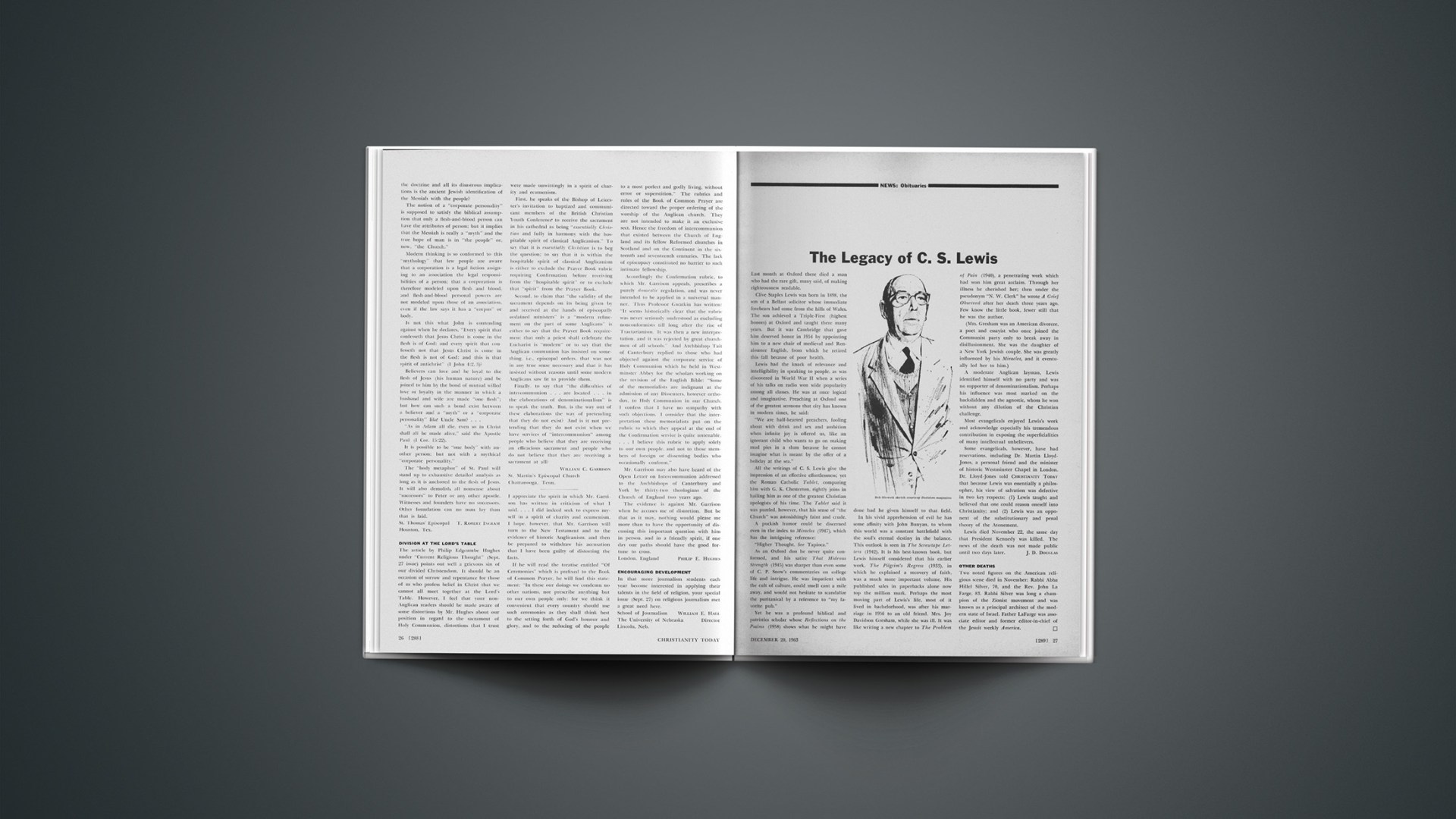
The Legacy of C. S. Lewis

Last month at Oxford there died a man who had the rare gift, many said, of making righteousness readable.

Clive Staples Lewis was born in 1898, the son of a Belfast solicitor whose immediate forebears had come from the hills of Wales. The son achieved a Triple-First (highest honors) at Oxford and taught there many years. But it was Cambridge that gave him deserved honor in 1954 by appointing him to a new chair of medieval and Renaissance English, from which he retired this fall because of poor health.

Lewis had the knack of relevance and intelligibility in speaking to people, as was discovered in World War II when a series of his talks on radio won wide popularity among all classes. He was at once logical and imaginative. Preaching at Oxford one of the greatest sermons that city has known in modern times, he said:

“We are half-hearted preachers, fooling about with drink and sex and ambition when infinite joy is offered us, like an ignorant child who wants to go on making mud pies in a slum because he cannot imagine what is meant by the offer of a holiday at the sea.”

All the writings of C. S. Lewis give the impression of an effective effortlessness; yet the Roman Catholic Tablet, comparing him with G. K. Chesterton, rightly joins in hailing him as one of the greatest Christian apologists of his time. The Tablet said it was puzzled, however, that his sense of “the Church” was astonishingly faint and crude.

A puckish humor could be discerned even in the index to Miracles (1947), which has the intriguing reference:

“Higher Thought. See Tapioca.”

As an Oxford don he never quite conformed, and his satire That Hideous Strength (1945) was sharper than even some of C. P. Snow’s commentaries on college life and intrigue. He was impatient with the cult of culture, could smell cant a mile away, and would not hesitate to scandalize the puritanical by a reference to “my favorite pub.”

Yet he was a profound biblical and patristics scholar whose Reflections on the Psalms (1958) shows what he might have done had he given himself to that field.

In his vivid apprehension of evil he has some affinity with John Bunyan, to whom this world was a constant battlefield with the soul’s eternal destiny in the balance. This outlook is seen in The Screwtape Letters (1942). It is his best-known book, but Lewis himself considered that his earlier work, The Pilgrim’s Regress (1933), in which he explained a recovery of faith, was a much more important volume. His published sales in paperbacks alone now top the million mark. Perhaps the most moving part of Lewis’s life, most of it lived in bachelorhood, was after his marriage in 1956 to an old friend, Mrs. Joy Davidson Gresham, while she was ill. It was like writing a new chapter to The Problem of Pain (1940), a penetrating work which had won him great acclaim. Through her illness he cherished her; then under the pseudonym “N. W. Clerk” he wrote A Grief Observed after her death three years ago. Few know the little book, fewer still that he was the author.

(Mrs. Gresham was an American divorcee, a poet and essayist who once joined the Communist party only to break away in disillusionment. She was the daughter of a New York Jewish couple. She was greatly influenced by his Miracles, and it eventually led her to him.)

A moderate Anglican layman, Lewis identified himself with no party and was no supporter of denominationalism. Perhaps his influence was most marked on the backslidden and the agnostic, whom he won without any dilution of the Christian challenge.

Most evangelicals enjoyed Lewis’s work and acknowledge especially his tremendous contribution in exposing the superficialities of many intellectual unbelievers.

Some evangelicals, however, have had reservations, including Dr. Martin Lloyd-Jones, a personal friend and the minister of historic Westminster Chapel in London. Dr. Lloyd-Jones told CHRISTIANITY TODAY that because Lewis was essentially a philosopher, his view of salvation was defective in two key respects: (1) Lewis taught and believed that one could reason oneself into Christianity; and (2) Lewis was an opponent of the substitutionary and penal theory of the Atonement.

Lewis died November 22, the same day that President Kennedy was killed. The news of the death was not made public until two days later.

Other Deaths

Two noted figures on the American religious scene died in November: Rabbi Abba Hillel Silver, 70, and the Rev. John La Farge, 83. Rabbi Silver was long a champion of the Zionist movement and was known as a principal architect of the modern state of Israel. Father LaFarge was associate editor and former editor-in-chief of the Jesuit weekly America.
Eutychus and His Kin: December 20, 1963

THE HOME STRETCH

This little gem is being written late in the day, and I have a feeling that the only solution to the way I feel right now is to go home and sleep for forty-eight straight hours. I contemplate sadly, however, that we have company for dinner, after which I have to drive forty miles to lecture for two hours, after which I shall drive forty miles again to come home jiggety-jog and face the company again, and we will be up all night, and there is the beginning and the ending of a day. Furthermore, tomorrow does not really promise to be a whole lot better, after which the week-end, as they say, looms.

Many people excuse bad behavior in youngsters by saying that they need more sleep. I am willing to go along with that in most cases if only to get the youngster out of circulation and into bed; but I would like to pursue sometime the question of what has been called “cumulative fatigue.” Why doesn’t some physiologist or psychologist work on a thesis to show the relation between lack of sleep and juvenile delinquency? I see no reason for believing that lack of sleep makes for bad behavior in infants and does not make for bad behavior in adolescents.

If my observations are sound, maybe we ought to start packing our adolescents off to bed and at least get the juveniles off the streets. I happen to know one boy who lowered his quarter-mile track record by almost four seconds after about two months of regular exercise, regular meals, and enough sleep. I am confident that for weeks at a time college students do not get enough sleep, and that their ragged dress, their careless habits, and their slovenly speech betray their sleep hunger at every turn.

Our times are out of joint, and there is something wrong in more places than Denmark. Probably the wave of the future belongs to some simple folk somewhere who can get enough sleep. I won’t fight em. I’ll join em.

EUTYCHUS II

SILENT CHURCH

Your editorial on “Cigarettes and the Stewardship of the Body” (Nov. 8 issue) is appreciated, but as a moral issue the problem of cigarettes is much broader than that of the stewardship of the body. It is true that defilement of the human temple is both a beginning and a fundamental consideration. But beyond are considerations like the utter worldly conformity inherent in the customs of smoking, the offensiveness to many of those who are free of the habit, the economic drain upon the poorer elements of our population, and the very binding nature of the habit.

It is largely futile to face this issue in piecemeal fashion, and the silence of the Church is ominous. It may be that there is too large a stake in the profits of the whole tobacco industry, including income from the growing, manufacture, and merchandising of tobacco in all its forms.

J. WARD SHANK

Mennonite Church

Broadway, Va.

If 1,000,000 present school children in this country will die of lung cancer before they reach the age of seventy, and if in 1962 there were 40,000 deaths, largely traceable to cigarette smoking, to a great degree the blame will have to be placed at the door of the Christian Church. The Church in all ages was meant to be God’s watchman upon the walls of Zion.… For decades now, the medical science has raised the red flag of danger over tobacco smoking. Yet the voice of the watchman—the Christian Church—has been silent or discouragingly feeble.

JEREMIA FLOREA

Pontiac Seventh-day Adventist Church

Pontiac, Mich.

It would seem appropriate now that some apologies be forthcoming to the “fanatical” (?) Christians who for at least a century have maintained the principle of stewardship of the body (to which you are now forced to agree by scientific evidence) by requiring that members of their church be non-tobacco users and teetotalers.

And perhaps a “Nobel Health Prize” or its equivalent should be given to Seventh-day Adventists for championing and practicing these truths shown them by the divine (they believe) counsel of the Spirit of Prophecy via Mrs. E. G. White.

CECIL A. PADEN

Vincennes, Ind.

It may interest you to know that the Baptist Church in Moscow does not permit anyone who smokes cigarettes to become a member of the church.

JEROME DAVIS

West Haven, Conn.

Your splendid editorial … was favorably discussed in last Sunday’s (Nov. 3) religious section of The Houston Chronicle.

Congratulations for taking such a courageous stand on this highly emotional and touchy subject!

With the lives, health, and happiness of so many people at stake, we need to be more forthright as Christian leaders, responsible before God for the training of our people.

W. D. KUENZLI

Webster Presbyterian Church

Webster, Tex.

APOSTOLICITY

A thousand thousand thanks for the gracious and insightful article by Dr. L. David Cowie on Dr. Graham’s “apostolic preaching in Los Angeles” (Oct. 25 issue). Dr. Adoniram Judson Gordon used to say that it is apostolic men that make an apostolic age.

FRANCIS E. WHITING

Director

Dept. of Evangelism and Spiritual Life

Michigan Baptist Convention

Lansing, Mich.

CHRIST AND THE CHURCH

It seems to me that Dr. Sasse’s article on “Rome and the Doctrine of the Church” (Oct. 11 issue) comes breathtakingly close to the heart of the matter. But why not go all the way?

Having shown that wide acceptance has been given to the statement that “the Church is Jesus Christ,” why not go on to show that the fundamental ground for the doctrine and all its disastrous implications is the ancient Jewish identification of the Messiah with the people?

The notion of a “corporate personality” is supposed to satisfy the biblical assumption that only a flesh-and-blood person can have the attributes of person; but it implies that the Messiah is really a “myth” and the true hope of man is in “the people” or, now, “the Church.”

Modern thinking is so conformed to this “mythology” that few people are aware that a corporation is a legal fiction assigning to an association the legal responsibilities of a person; that a corporation is therefore modeled upon flesh and blood, and flesh-and-blood personal powers are not modeled upon those of an association, even if the law says it has a “corpus” or body.

Is not this what John is contending against when he declares, “Every spirit that confesseth that Jesus Christ is come in the flesh is of God: and every spirit that confesseth not that Jesus Christ is come in the flesh is not of God: and this is that spirit of antichrist” (1 John 4:2, 3)?

Believers can love and be loyal to the flesh of Jesus (his human nature) and be joined to him by the bond of mutual willed love or loyalty in the manner in which a husband and wife are made “one flesh”; but how can such a bond exist between a believer and a “myth” or a “corporate personality” like Uncle Sam?…

“As in Adam all die, even so in Christ shall all be made alive,” said the Apostle Paul (1 Cor. 15:22).

It is possible to be “one body” with another person; but not with a mythical “corporate personality.”

The “body metaphor” of St. Paul will stand up to exhaustive detailed analysis as long as it is anchored to the flesh of Jesus. It will also demolish all nonsense about “successors” to Peter or any other apostle. Witnesses and founders have no successors. Other foundation can no man lay than that is laid.

T. ROBERT INGRAM

St. Thomas’ Episcopal

Houston, Tex.

DIVISION AT THE LORD’S TABLE

The article by Philip Edgcumbe Hughes under “Current Religious Thought” (Sept. 27 issue) points out well a grievous sin of our divided Christendom. It should be an occasion of sorrow and repentance for those of us who profess belief in Christ that we cannot all meet together at the Lord’s Table. However, I feel that your non-Anglican readers should be made aware of some distortions by Mr. Hughes about our position in regard to the sacrament of Holy Communion, distortions that I trust were made unwittingly in a spirit of charity and ecumenism.

First, he speaks of the Bishop of Leicester’s invitation to baptized and communicant members of the British Christian Youth Conference to receive the sacrament in his cathedral as being “essentially Christian and fully in harmony with the hospitable spirit of classical Anglicanism.” To say that it is essentially Christian is to beg the question; to say that it is within the hospitable spirit of classical Anglicanism is either to exclude the Prayer Book rubric requiring Confirmation before receiving from the “hospitable spirit” or to exclude that “spirit” from the Prayer Book.

Second, to claim that “the validity of the sacrament depends on its being given by and received at the hands of episcopally ordained ministers” is a “modern refinement on the part of some Anglicans “is either to say that the Prayer Book requirement that only a priest shall celebrate the Eucharist is “modern” or to say that the Anglican communion has insisted on something. i.e., episcopal orders, that was not in any true sense necessary and that it has insisted without reasons until some modern Anglicans saw fit to provide them.

Finally, to say that “the difficulties of intercommunion … are located … in the elaborations of denominationalism” is to speak the truth. But, is the way out of these elaborations the way of pretending that they do not exist? And is it not pretending that they do not exist when we have services of “intercommunion” among people who believe that they are receiving an efficacious sacrament and people who do not believe that they are receiving a sacrament at all?

WILLIAM C. GARRISON

St. Martin’s Episcopal Church

Chattanooga, Tenn.

I appreciate the spirit in which Mr. Garrison has written in criticism of what I said.… I did indeed seek to express myself in a spirit of charity and ecumenism. I hope, however, that Mr. Garrison will turn to the New Testament and to the evidence of historic Anglicanism, and then be prepared to withdraw his accusation that I have been guilty of distorting the facts.

If he will read the treatise entitled “Of Ceremonies” which is prefixed to the Book of Common Prayer, he will find this statement: “In these our doings we condemn no other nations, nor prescribe anything but to our own people only: for we think it convenient that every country should use such ceremonies as they shall think best to the setting forth of God’s honour and glory, and to the reducing of the people to a most perfect and godly living, without error or superstition.” The rubrics and rules of the Book of Common Prayer are directed toward the proper ordering of the worship of the Anglican church. They are not intended to make it an exclusive sect. Hence the freedom of intercommunion that existed between the Church of England and its fellow Reformed churches in Scotland and on the Continent in the sixteenth and seventeenth centuries. The lack of episcopacy constituted no barrier to such intimate fellowship.

Accordingly the Confirmation rubric, to which Mr. Garrison appeals, prescribes a purely domestic, regulation, and was never intended to be applied in a universal manner. Thus Professor Gwatkin has written: “It seems historically clear that the rubric was never seriously understood as excluding nonconformists till long after the rise of Tractarianism. It was then a new interpretation, and it was rejected by great churchmen of all schools.” And Archbishop Fait of Canterbury replied to those who had objected against the corporate service of Holy Communion which he held in Westminster Abbey for the scholars working on the revision of the English Bible: “Some of the memorialists are indignant at the admission of any Dissenters, however orthodox, to Holy Communion in our Church. I confess that I have no sympathy with such objections. I consider that the interpretation these memorialists put on the rubric to which they appeal at the end of the Confirmation service is quite untenable.… I believe this rubric to apply solely to our own people, and not to those members of foreign or dissenting bodies who occasionally conform.”

Mr. Garrison may also have heard of the Open Letter on Intercommunion addressed to the Archbishops of Canterbury and York by thirty-two theologians of the Church of England two years ago.

The evidence is against Mr. Garrison when he accuses me of distortion. But be that as it may, nothing would please me more than to have the opportunity of discussing this important question with him in person, and in a friendly spirit, if one day our paths should have the good fortune to cross.

PHILIP E. HUGHES

London, England

ENCOURAGING DEVELOPMENT

In that more journalism students each year become interested in applying their talents in the field of religion, your special issue (Sept. 27) on religious journalism met a great need here.

WILLIAM E. HALL

Director

School of Journalism

The University of Nebraska

Lincoln, Neb.

Ideas

Light Out of Darkness

Light Out Of Darkness

Since the darkness of Friday, November 22, when a great leader, President John Fitzgerald Kennedy, was struck down, our nation has lived and thought more deeply than in many years. Into the soul of a favored and self-indulgent society the iron of affliction entered. A people that has permitted itself to be torn by political and racial strife found unity in sorrow and strength in tragedy. A society far down the road to secularism turned in its hour of need to the God of its fathers.

In the words of the Chief Justice, “It has been said that the only thing we learn from history is that we do not learn. But surely we can learn if we have the will to do so.”

There is no more profound truth in Scripture than that God, who is over the whole of history, is able to bring light out of darkness and so to teach his people. From the beginning, when “darkness was upon the face of the deep … and God said, ‘Let there be light’; and there was light,” the living God has been bringing light out of darkness. Out of the fall of man, he brought the light of the protevangel with its promise of the Messiah; out of the deluge, he brought the rainbow. So also from Israel’s Egyptian bondage, he brought the passover deliverance; and when, in the Roman Empire, his people “walked in darkness,” he brought them “a great light,” even he who “still shines in the darkness, and the darkness has never put it out” (John 1:5, Phillips). And, following the most tragic hours in history, when “there was darkness over the whole land” and he who is “the light of the world” was put to death on the Cross, he “abolished death and brought life and immortality to light through the gospel,” thus making the greatest of crimes the greatest of blessings. Moreover, the Bible tells us that despite ultimate human failure, history will end in the triumph of Christ and that in the holy city “there shall be no night there.”

This truth, affirmed by both history and revelation, speaks to our need in a time of transition. Christian people, of whose heritage it is part, need to rest upon this truth and share it with their neighbors. Their duty is to be what they are called to be—“the salt of the earth”—and to “let their light shine before men.” This they must do by learning from the Lord of history, who is able to make even “the wrath of man to praise him.”

What, then, are some lessons that may be learned from the recent ordeal? Just as only the larger perspective of the years will assign the late President, whose great ability, courageous stand for civil rights, commitment to peace, and deep devotion to America have been justly extolled, his final place in history, so with the effect of recent events. Yet even now, certain lessons are coming into focus. As we consider some of them, let us ask whether we are clearsighted enough to see that this is a nation “under God” not because of our merits but through the heritage of our forefathers, and that only by grace has it been the recipient of his loving favor. Then let us remember that “whom the Lord loveth he chasteneth” and that out of darkness he still brings forth light.

Already the sense of confession and humiliation in the spirit of Daniel’s great prayer (Dan. 9:3–19) has been evident. Self-righteousness has been pierced by recognition that the spirit of lawlessness and extremism we have too easily tolerated was not unrelated to the tragedy. Now it is acknowledged that unconcern and neutrality that leave hate and fanaticism unrebuked are not blameless.

Yet confession is not by itself sufficient. We who have too long tolerated intolerance cannot afford the luxury of self-recrimination. Repentance with its about-face attitude must follow confession. The continuing lesson to be learned is a difficult and delicate one. At the heart of democracy is the freedom to dissent. Without opposition, democracy may slip into a kind of one-party government, if not worse.

Therefore, the reaction against hate and intolerance must not take the easy path of stifling loyal dissent that expresses conviction. The call is rather to responsibility. Now that the mask has been torn from the hideous features of fanaticism, we need to learn the lesson of the dissidence of maturity. This means learning how to disagree firmly, reasonably, and in love. The cost is not cheap. It includes the self-control of not being swept along with popular prejudice; it also requires the moral courage to speak up for conviction when the crowd abuses its liberty. And who more than Christians, who have the teaching and example of their Lord and the exhortation of the Apostle, “Don’t let the world around you squeeze you into its own mold” (Rom. 12:2, Phillips), are fitted to learn the dissidence of maturity?

This maturity also involves the ability to see that major problems generally stem from complex causes. And essential to it is the realization that prejudice and intolerance, even when there is a beam rather than a mote in another’s eye, are never dispelled apart from humble acknowledgment of whatever beam there may be in one’s own eye. Surely learning how to disagree through growth in the dissidence of maturity will help illuminate our way.

Another shaft of light in the darkness has been the innate sense of decency and decorum manifest in a mourning America. Cancellation of sports events, closing of places of amusement, drastic revision of television and radio programs—these point to the great doctrine of common grace. Too often have evangelicals, who believe that only the regenerate are spiritually the children of God and members one of another in Christ, forgotten the equally biblical truth that all men are by creation God’s children. The milk of human kindness is found in non-Christians as well as Christians; in his sovereignty God sheds his common grace upon the unsaved as well as upon the saved.

Light has also shone through the deeply religious mood of the nation and its leadership. Paradoxically, the people, despite the tides of secularism that have been running so strongly toward the disinheritance of the tradition of religion in national life, turned to religion in their days of bereavement. And a new President sought the daily prayers of his fellow citizens.

Again, one notes the prospect of renewed understanding of the scriptural obligation to respect the constituted authority that derives from the God whose word teaches us to pay “respect to whom respect is due, honor to whom honor is due” (Rom. 13:7, RSV).

After the seeds of hate and disrespect for authority bore fruit in the violent death of a postman on a country roadside, of a Medgar Evers at his home, and of four little girls in Sunday school, the lesson was too soon forgotten. Now, through a supreme act of lawlessness and also through such responses to that act as the unthinking applause of schoolchildren whose parents have so spoken the language of scorn for authority as to pass it on to their offspring—now we know once more what hate really is. And in the very depth of this new knowledge there is the hope, reinforced and ennobled by the late President’s widow, who brought to tragedy the clear light of selfless dignity, that the lesson may finally have penetrated the superficiality of our day.

In a national mood of self-criticism and contrition, good things are said and good resolutions made. Liberals speak of the need of matching liberty with discipline, conservatives admit the dangers of right-wing extremism, television looks critically at its preoccupation with violence, and it becomes popular to decry prejudice of all kinds. But the demons of hatred and intolerance, of self-righteousness and self-indulgence, are not exorcised by words alone or merely by transient emotion. Their removal requires concerted effort. As President Johnson said in his moving Thanksgiving Day address, “Let all who speak, let all who teach, and all who preach and publish, and all who broadcast, and all who read and listen, let them reflect upon their responsibilities to bind our wounds, to heal our sores, to make our society whole for the tests ahead of us.”

Whether we have really learned from the God of history, who “sits at the roaring loom of events,” will be determined only by the transformation of unity in sorrow into unity in respect for law and authority, and by the substitution of tolerance for prejudice and love for hate.

For us Christians this is a time of special and humbling responsibility. Ours is a faith of inextinguishable optimism. Believing in the Lord at whose coming the angels rejoiced yet who was born to die that men might live eternally, we know that our Lord conquered death and that he will have the ultimate victory. In biblical realism we know that Scripture teaches neither national nor world conversion. Yet we may never underestimate the outreach of God’s grace, knowing his promise to heal the nation that repents and returns to him. Understanding that salvation cannot be earned by keeping the law—not even the law of love Christ himself taught—we yet cannot refuse the claim of that law upon our own lives. We are obligated to follow in the steps of our Lord, not to be redeemed but because he has redeemed us. And only as we follow him, seeking first the kingdom of God and his righteousness, shall we be what he means us to be at a time when light is so greatly needed.

As It Would Look From The Wall

During the last days of November the American people had a singular opportunity to see what a wall of absolute separation of government and religion would be like in actual practice. What a cold and bleak thing it would have been if no religious act or sentiment could have come from men in high places of government!

In the academic halls of debate aloof from the actualities of life, the proponents of absolute separation of government and religion achieve a persuasiveness more doctrinaire than real. Had all religious expression been prohibited, how remote the government would have been from the deep grief of the Kennedy family, and how far from the hearts and feelings of the American people.

It is easy to theorize oneself out of existence. A heady reflection can propose positions that are credible only in the cool realms of abstractionism. Hegel was a worthy opponent in debate; yet a single fragment of existence could fell his system, as Kierkegaard annoyingly demonstrated when he pointed out that Hegel denied his system every time he reached for his handkerchief to cover a sneeze.

Had the proponents of absolute separation chosen to urge their interpretation of the First Amendment upon the American people while the late President lay dying in a Dallas hosiptal, they would have found an unsympathetic audience. Had they insisted that religion must be wholly excluded from government at the time President Johnson assumed the awful responsibilities of his office and on television requested Americans to pray God to sustain him, they would have put their position to the test where America lives. This is a question, not of sentiment, but of testing a theory in the realm where its supporters propose to make it operative.

Raise the question where Americans actually live and few would agree that a prayer in Congress, or a congressional appeal for prayer for a dying President, is something that the Constitution forbids.

Forty-five minutes on the afternoon of November 22 shattered the theory that the American people want every religious dimension shut off from government by an absolute wall of separation. When they respond out of the actualities of their national life, they do not believe that the Constitution requires absolute separation for the protection of the rights of those who believe there is no God.

It is rarely recognized that only atheists and those who deny the efficacy of prayer can urge an absolute separation of government and religion. He who believes that God hears and answers prayer, by his very prayer invites the Almighty to enter the area of government.

Christ Comes Twice

It will still be Advent when this year-end issue of CHRISTIANITY TODAY appears. And this season relates to a future certainty as well as to a past event. It looks back to the stupendous miracle of the incarnation of him who is the light of the world, inextinguishable amid all the darkness of human failure and sin. But it also looks forward to the return of this same Jesus, who was born in Bethlehem that he might die and be raised to save us from our sins and give us life everlasting. For just as the Bible tells of his First Coming, so it promises his Second Coming.

In the Book of Common Prayer, a devotional classic belonging to the broad heritage of English-speaking Christians, this Collect with its recognition of the two Comings is used throughout Advent: “Almighty God, give us grace that we may cast away the works of darkness, and put upon us the armour of light, now in the time of this mortal life, in which thy Son Jesus Christ came to visit us in great humility; that in the last day, when he shall come again in his glorious majesty to judge both the quick and the dead, we may rise to the life immortal, through him who liveth and reigneth with thee and the Holy Ghost, now and ever. Amen.”

To forget the Second Advent, as many do, or, while acknowledging it, to dissipate its reality by spiritualizing the plain promises of His coming or by adopting some extreme kind of “realized eschatology,” is to be deprived of what the New Testament calls “the blessed [literally, ‘happy’] hope.” The deprivation is serious, especially in this apocalyptic age when Christians so greatly need the assurance of the ultimate triumph of Jesus Christ. Yet honesty requires the admission that there are many who, while holding orthodox views of the Second Advent, do not really know it as the comfort and incentive it should be for every Christian. Granted that there are diverse interpretations of the Scriptures dealing with the Lord’s return—and such differences ought never to hinder Christian fellowship—still there are few doctrines about which there is more widespread ignorance than this one.

While some have fallen into such unbiblical errors as setting the date of His coming and while certain cults have distorted the doctrine of the Second Advent almost beyond recognition, it is well to remember that the misuse of a truth never invalidates that truth. Nor is this the only doctrine that has been distorted; church history records countless heresies about other great truths of the faith. To lose one’s grip on “the promise of his coming” or to be disinterested in it is to miss one of the great biblical sources of comfort, hope, and urgency for service.

Some years ago Bertrand Russell wrote an essay for The Atlantic Monthly (March, 1951) on the future of mankind. In it he predicted that before this century ends, “unless something unforeseeable occurs, one of three possibilities will have been realized … 1. The end of human life, perhaps of all life on our planet. 2. A reversion to barbarism after a catastrophic diminution of the population of the globe. 3. A unification of the world under a single government.…” But what for Lord Russell is “something unforeseeable” is a certainty for the Christian who believes in the Second Coming.

The ultimate key to human history is not in the hands of men with their nuclear weapons but in the pierced hands of the Prince of Peace. For the man of the world, Christ is indeed the unknown and unforeseeable factor. But everyone who believes the promises spoken by our Lord and the teaching of the prophets and the apostles should know that history is not circular but that with Jesus Christ crucified and risen as its midpoint it is moving on to the Parousia and the culmination of all things in Him. He knows on the authority of the Word that the same Lord who saved him is coming back, that in His presence there will be the inexpressible comfort of reunion with those who “sleep in Jesus,” that he must stand before the judgment seat of Christ, that this whole world order is to be judged, that Christ who is King of kings and Lord of lords will defeat Satan, and that in Christ the Kingdom will be fully realized. Differences of interpretation in these things, yes; but about the fact that history will come to its close in and through Christ there is no biblical ground for disagreement.

The Second Advent with its teaching of the end of this world order is repugnant to the modern mind. If, as C. S. Lewis puts it in “The World’s Last Night,” we live under the possibility that “the curtain may be rung down at any moment” on human history, then the pride of man is indeed shattered. But in a time when the destructive capacity of man has so dangerously outrun his moral control and when the prospect of lunar voyages and interplanetary travel contributes to the arrogant self-confidence of a generation that cannot live peacefully on this planet, the Second Advent has much to say. A society that, like those in the Lord’s parable, “will not have this man to reign over us,” and that as a consequence of this rejection is casting aside all moral restraints, almost inevitably falls into the Promethean spirit of challenging the Almighty himself. Even now what Communism is saying about the Lord and his Anointed sounds like a paraphrase of these words from the Second Psalm: “Let us break their bands asunder and cast their cords from us.” And let us remember that the secularism pervading our nation is little more than an indirect form of the same denial of God and his Christ.

Whenever a great doctrine of Scripture is overlooked or ignored, the Church suffers and its witness is weakened. Ours is a society that needs to hear not only the good news of the First Advent but also the certainty of the Second Advent. It needs to know that Scripture gives no assurance that God will put up with human sin and rebellion forever. It is part of the obligation of the Church to tell men and women that God has a plan for the world and that this plan culminates in Christ. Moreover, Christians themselves need to be taught the truth of their Lord’s return, because believing it leads to purity of life. As the beloved disciple said, “We know that when he appears we shall be like him, for we shall see him as he is. And every one who thus hopes in him purifies himself as he is pure” (1 John 3:2, 3, RSV). Not only so, but as our Lord said in the parable of the talent and in other of his teachings, the expectation of his coming brings urgency to service. Over and over he declared that he will come back. The time of his return is unknown, although the fact is sure. And today, as never before, “the fields are white unto the harvest.” Therein lies the urgency of the Second Advent. Very much remains to be done for him who is coming.

When Britain was about to grant independence to India, the viceroy, Lord Mountbatten, had a certain kind of calendar printed. One of the news photographs made in his office showed the calendar, which read at the time the picture was taken: “4 August. 11 more days left to prepare for the transfer of power.” In this way the viceroy reminded himself and the other servants of the crown of the coming transfer of power, when the subcontinent would pass from British to native rule. But the world is waiting for a vastly greater transfer of power, when the Son whose right it is to reign shall come and take the power and reign forever and ever.

No human calendar marks the time until he comes; only he with whom “one day is as a thousand years and a thousand years as one day” knows the day and the hour when the Son of man will return. But in the meantime there is work to be done in the name of Christ, there is the Gospel that is “a savour of life unto life and death unto death” to be proclaimed, there is life to be lived in accord with the will of the Lord and to his glory—and there is all this to be done in the expectation of his coming. Two Advents, and the second demands proclamation as well as the first!

C. S. Lewis

C. S. Lewis, who died at his home in England on November 22, will be remembered as the most effective Christian apologist of the twentieth century. A great scholar of English literature, he spent his life at Oxford, where he served for thirty years as a fellow and tutor of Magdalene College, of which he was at one time vice-president, and at Cambridge, where, since 1954, he was professor of medieval and Renaissance English. His scholarly achievements were of the very first rank; but it is upon his many religious books, familiar to multitudes who knew nothing of his university work, that his greater fame rests. (See News, page 27.)

Having moved in young manhood from atheism to orthodox Christianity, Professor Lewis had the outstanding merit of holding the reader’s interest while at the same time making crystal clear the great truths of the faith. This he did in a style of exemplary precision and impeccable taste. In his expository works, such as Mere Christianity and Miracles, and also in his allegories and novels, such as The Screwtape Letters, Out of the Silent Planet, and his children’s books, he wrote about Christian theology with the wonderful combination of transparent thought, vivid imagination, and penetrating wit that was his special gift. Himself an Anglican, his influence reaches far beyond the confines of that communion, and his books are read and will continue to be read by Christians of all persuasions.

As an apologist, C. S. Lewis was extra-biblical though not un-biblical. This was not a weakness but one of his strengths. By the sheer fascination of his logic and imagination he opened the minds of many who would not read the Bible to the great doctrines it contains and thus brought them to Scripture. Many Christians who have themselves been enlightened by reading him have learned to use his writings as a first step toward interesting skeptical or indifferent friends in the faith.

The death of C. S. Lewis is a major loss to the international Christian community. His books, which in paperback alone are approaching a circulation of one million, will continue to point many to the Lord whose joy was the dominant factor in his life and work.

Prayer And Protest

In his first address to the nation, President Lyndon B. Johnson expressed his dependence on Almighty God and requested the people of America to beseech God to help him in the execution of his new and high office. In so doing the President echoed what was to be the closing remark of the late President Kennedy’s speech that he did not live to make in Dallas: “Except the Lord keep the city, the watchman waketh but in vain.”

Christians were impressed by the humility of their new President and by his expressed need of their prayers and the help of Almighty God. When the occupant of the most powerful office in the world publicly acknowledges such reliance upon the One who is higher than he, the Christian heart is touched. Yet how often, when the sincere emotion of the moment is past, Christians forget in daily life to invoke the blessings of God upon those who rule over them. Too many churches rarely remember their government in congregational prayer. It is not only reassuring for Christians to hear the President of the United States ask their prayers; it is their duty to pray for him. Paul enjoins that “supplications, prayers, intercessions, thanksgivings, be made for all men,” and he singles out and specifically mentions “kings and all that are in high place” (1 Tim. 2:1, 2, ARV). The purpose of such prayer is “that we may lead a tranquil and quiet life in all godliness and gravity,” a state devoutly to be desired in our troublous times, when the patterns of our national and social life are threatened almost daily. Paul adds the reason such prayer should be offered: “This is good and acceptable in the sight of God our Saviour, who would have all men to be saved, and come to the knowledge of the truth.”

Christians who find it difficult to pray and even to make “thanksgivings” for presidents and administrations that they dislike or that are of another political party, should remember that when Paul thus exhorted Timothy, both lived under the tyranny of Nero.

American churches often pray little for their government because they lack a sense of solidarity with the nation, a sense of being America. Doubtless, immigrant origins help to account for this. But we do well to remember that such men as John Huss, Martin Luther, and Ulrich Zwingli were not only great churchmen but also great patriots. Many evangelical churches need to gain or to regain a sense of belonging to the country. Such a sense of identification will make praying for their presidents and congressmen, their governors and mayors an easier and more natural thing.

Not a little embittered criticism and hateful denunciation of the federal government has come from Christian sources. To protest and express critical evaluations of government is the right of every citizen. If, however, it is to be done responsibly, it must be done not out of a spirit of detachment but out of a sense of solidarity, a deep feeling that this is my government.

Christians too may exercise their right to criticize their President, his leadership and policies, their congressmen and courts; but they must do it in a mood that does not exclude the possibility of praying for what they criticize. Unless they can make “supplications, prayers, intercessions, thanksgivings” for the President, the Congress, the Supreme Court, they cannot render such criticisms as are “good and acceptable in the sight of God our Saviour.” He who “will have all men to be saved” will not tolerate critics who self-righteously detach themselves from the institutions and political personages they denounce. It is a shame of America, and a greater one of the Church, that some Christians criticize in a spirit that cannot intercede and that has no will to save. Unless Christians learn to pray for what they protest, they will not protest in a manner that becomes their high calling and promotes the country’s good. Like the ancient prophets, they must learn to denounce with tears in their eyes.

Let Christians of every political and religious affiliation respond to Paul’s exhortation and to President Johnson’s request.

Crucial Events In Venezuela

Nowhere in this hemisphere have Communists been more vicious than in Venezuela. They have destroyed millions of dollars in property and have terrorized that country’s 7,000,000 citizens. They have also stooped to the worst kind of tactics in an attempt to establish a significant Red beachhead on the South American continent.

It is gratifying, therefore, to see the courage exhibited by the Venezuelans in going to the polls on December 1. They went knowing that violations of the compulsory voting laws could bring fines and other penalties. But they went, too, in face of threats of death made by terrorists against those who voted.

It was reported that under these conditions an amazing proportion of nine out of ten qualified voters participated in the election. Their presidential choice was Raul Leoni, chief lieutenant of the present incumbent, Romulo Betancourt, who was debarred by Venezuela’s constitution from running for a second five-year term. The free world looks to President-elect Leoni to pursue a tough line against the Castro-supported terrorist organization which calls itself the Armed Forces for National Liberation (FALN).

The heartening results of the election and the release of U. S. Army Colonel James K. Chenault could mean the dawn of a new day not only for Venezuela but perhaps for all the South American continent. The Venezuelan people have been victims of revolutions and corrupt dictatorships for many decades. If Mr. Betancourt is able to stay in office until the inauguration of Mr. Leoni in March, he will become the country’s first popularly elected chief executive to serve a full term.

But the road ahead will not be easy. Communists probably will not relent. Improvement in economic conditions will not come quickly, considering the reluctance of foreign tourists, tradesmen, and investors to subject life and property to the risk of FALN violence. Venezuela needs sympathy and help.

The Great Counterfeit

Many of us have had the humiliating experience of being taken in by an imposition of one kind or another. There have been times when we thought we were getting a bargain only to find the article purchased was far from what we thought.

We have been deceived by people and by things. We have enthusiastically followed some individual or movement only to find that we had been duped.

That “all that glitters is not gold” is discovered by some early in life; others take longer.

In other words, everyone has a streak of credulity which can be costly and even disastrous.

We believe Christians are today confronted with a monstrous counterfeit, a deception not recognized and for that reason all the more dangerous.

Christianity’s greatest counterfeit is not Communism, nor is it the religions of the world, in all of which there are obviously elements of good.

The great counterfeit—the thing against which we in the Church must guard lest it deceive us and those outside—is the substitution of humanitarianism for Christianity.

That against which we must guard is the equating of compassion for mankind and concern for physical and material welfare with Christianity itself.

Concern for the welfare of the body is right, a duty of the Christian; but it is no substitute for concern for the souls of men.

Concern for temporal comfort for self or for others is no substitute for a concern for the eternal verities.

And yet, all of these things are being equated with the Christian faith, and humanitarians are being called “Christians,” even though they may deny God or his Christ.

Humanism is basically a preoccupation with mankind here and now. Such concerns are valid, but unless they are kept in proper perspective, the meaning of the Christian faith can be lost in an emphasis which has nothing to do with Christ and his Cross.

When our Lord spoke to his disciples of his coming death in Jerusalem and subsequent resurrection, Peter rebuked him, only to be told that his concept of Christ’s mission was of Satan. Then Jesus laid down the principles by which man must live in this world: bear his cross—follow Him—be willing to lose his life within the holy will of God, all with a realization that it is not this life that is final but the one to come.

Within this context Jesus then said: “For what is a man profited, if he shall gain the whole world, and lose his own soul? or what shall a man give in exchange for his soul?” (Matt. 16:26).

Humanitarianism, humanism, and all which proceed therefrom can become man’s greatest stumbling block if confused with, or substituted for, Christianity itself.

Christ came into the world to open the way into eternity. He came abounding in love and concern for the welfare of those with whom he came in contact. His miracles are a continuing evidence of his concern for the physical and material welfare of those around him.

But such concerns were evidences of a far greater and deeper emphasis—man’s eternal destiny. Repeatedly our Lord said, or it was said of him, that he came into the world to save sinners; that he came to give eternal life; that his Kingdom is not of this world; that there is an infinite difference between the flesh and the spirit, between time and eternity, between secular and spiritual.

This being the case, the great counterfeit has to do with anything that blurs the distinction and that makes optional that which is imperative.

The great counterfeit is also manifested in the field of education. The increase in knowledge is beyond the human mind to grasp. But knowledge without wisdom is a menace, not a blessing. Only as God gives wisdom can man use knowledge wisely. And yet, even in the realm of so-called Christian education too often the emphasis is on the secular and literary at the expense of spiritual insights.

Again, the great counterfeit is seen in social emphases which cater almost solely to human welfare. For many, racial integration is equated with the Christian Gospel, despite the fact that purely monetary considerations may be involved. By this token the most “Christian” teams in the major leagues are those with the largest number of Negro players.

Within the Church, ecclesiastical unity and a monolithic organizational structure are often equated with “true Christianity,” a fetish being made of organization at the expense of doctrinal integrity. Again, the most “Christian” congregation or denomination is the one with the largest number of members, regardless of what those members believe or do not believe.

The basic problem has to do with the demand that there be “fruit” without reference to the spiritual tree from which alone good fruit can be a reality. It is not that man’s welfare is unimportant. Rather, it is failure to admit that man’s eternal welfare must come first and is bound up in the preaching and believing of the Gospel.

What shall it profit the world if every social evil is abolished, every political oppression abolished, every economic problem solved, every racial tension relieved—without at the same time a saving faith in the soul’s redemption effected for man on the Cross of Calvary?

True, there must be social concern. There must be the cup of cold water for the parched throat while the balm of God’s love is preached to the hungry heart. But without the Gospel of redemption for the sinner there is no Christianity, and all that may be substituted is but a counterfeit which perishes when testing comes.

“Benevolent moralism” may smooth the path of those caught up in the toils of this dying world. But by itself it is a tawdry counterfeit of the Gospel of Jesus Christ given as man’s only hope for eternity.

A thirsty woman came to the well of Samaria. She wanted water for herself and her household. Our Lord did not deny the necessity of actual water, but he said: “Every one who drinks of this water shall thirst again, but whoever drinks of the water that I shall give him will never thirst; the water that I shall give him will become in him a spring of water welling up to eternal life” (John 4:13, 14). Our Lord here put the temporal and eternal in their proper perspective. Christianity must do no less today.

Even within the Church many are led to think only of those things which meet human needs at the material level. What a travesty on Christianity! How subtle a counterfeit which makes men satisfied with stones instead of bread, with scorpions instead of fish, with water that perishes with the using rather than that spiritual well from which man may drink for life eternal.

We do not discount secular and material needs. But if we settle for these and these only, we have become victims of Satan’s masterpiece—the great counterfeit.

What Is Liturgical Worship?

Recent articles in several religious journals have criticized the encroachment of a “liturgical movement” on the formerly “informal” denominations, such as the Methodist, Presbyterian, and Baptist churches. A careful reading of these articles reveals a widespread misunderstanding about what liturgical worship really is.

Consider first what it is not.

Liturgical worship is not “formalism.” It is true that we have too much of this and that churches once distinguished by a warm-hearted approach to the Gospel in which Christians are exhorted to love God, sinners are called to repentance, and sin is denounced in no uncertain terms, have become self-satisfied, immersed in mechanics, and absorbed in an attempt to “enrich” their services at the expense of fervent preaching and congregational participation. Worship, so called, has become formalized into a pattern which has no life; words are repeated without meaning, and exhibition pieces by the choir have replaced congxegational singing of familiar hymns. This is formalism, and it is a danger that must be met. But it is not liturgical worship—far from it.

In the second place, liturgical worship is not an attempt to “prettify” the service, to introduce new elements for the sake of novelty. The so-called Modern Creed has no connection with the liturgical, movement, which uniformly seeks to bring back the use of the historic creeds of Christendom, such as the Apostles’ Creed and the Nicene Creed; these have not only the merit of long usage, but also that of theological soundness. True, the Apostles’ Creed is couched in the language of ancient thought and does not say everything that we believe. It must be explained and interpreted if it is to mean much to the congregation. But it is much more satisfactory than a collection of propositions that are supposed to be readily believed by modern Christians. The creed is the ancient belief of the Church, not the affirmation of the individual.

Likewise, the various ancient collects and versicles need perhaps to be translated into modern speech, in order that we may realize just what they mean. When this is done, congregations soon come to love these little interchanges of Christian affection between minister and people. It may seem archaic to some when a pastor says, “The Lord be with you,” and the people respond, “And with thy spirit.” But put that in modern speech and you see what it means: “God bless you, my friends.” “God bless you, too, Pastor!”

Here is an example of the way in which simple little words of love have become stylized and formalized through the centuries. But shall we leave them off because they are old? Not at all. Rather, we should explain them, translate them, and even on occasion say them in their simplest modern form. The Negro congregations of twenty years ago had a much more liturgical service than do most of us, for their worship touched the heart, and the seeming informality was clearly in the tradition of the ancient Church. But with the average congregation today the use of such liturgical responses, written down and read, is the closest we can come to the ideal of Christian fellowship in worship.

In the third place, liturgical worship is not primarily concerned with ceremony. True, there must be, and always is, even in the most enthusiastic sect, a “program” to be followed, else there would be chaos. But the liturgical movement is not seeking to add more ceremony. On the contrary, it is always looking for a way to make worship more simple. In the Roman Catholic Church, for instance, the revival of liturgy has been responsible for the change in the position of the priest at Mass, from before the altar with his back to the congregation, to the ancient place, behind the Table and facing the people.

Likewise, this movement in Catholicism has led to the reforms that are now being discussed at the Vatican Council, reforms that would do away with almost all the often meaningless motions that so easily become confused with worship. A recent liturgical conference saw some 13,000 Catholics worshiping in a Mass in which all extraneous and outmoded ceremonial was reduced to a minimum. There was little evidence of the type of action usually required—no genuflection, little use of the sign of the cross—and, on the other hand, there was hearty singing of hymns and reading of prayers in English by the congregation.

In Protestant churches, the liturgical movement often seems to be quite different, for it brings pastors into contact with the ancient worship of the Christian Church and leads them into some practices that may seem odd to those accustomed to a kind of service modeled on the frontier revival. In many cases, congregations have soon learned that the minister is seeking to train them to worship God, and to do away with the former conception of “going to preaching,” where everything prior to the sermon is “preliminaries” and where the choir is asked “to oblige with a song,” after which it is complimented in fulsome words.

But the liturgical movement, while it tends to seek a certain uniformity of worship forms in which Methodists, Presbyterians, Lutherans, and others can join together in an ancient ritual, is more concerned with the spirit of worship. Liturgically minded ministers do not think that forms matter more than faith, nor do they put their trust in creeds and catechisms; but they find merit in them. Nevertheless, they believe that there must be room for the Holy Spirit in their services, and that the best form is only a vehicle, not a destination. If they can lead people to sing with understanding, to say Amen at the proper time—and that can be in the middle of the sermon, as well as at the close of a prayer—they feel that they have accomplished much.

The liturgical revival in Protestantism is running along a course parallel with that of the Roman Catholic Church; in both groups the movement is leading to a new appreciation of the Bible, of biblical preaching, of the pastoral ministry, of the need for truly converted people, and of the futility of form without substance. It leads in some cases to a stripping down of ceremonies; in others, to the addition of some simple and worshipful elements that have been neglected, such as a prayer of confession, responses by the people instead of by the choir, and the plainest kind of clerical garb in the pulpit and out of it. But the motive is always the same: to worship God in the face of Jesus Christ, to join in humble prayer, to make the sermon a message from God and not from the preacher.

Does this seem completely out of accord with the conception of “liturgy” common among many Protestants? No doubt; but it is the true definition of the liturgical movement today. This movement must not be confused with the aestheticism of the twenties, nor with the medieval multiplication of ceremonies. It is a movement forward, not a retreat to the cloisters. Growing by leaps and bounds in the various denominations, it is without much organization or promotion. There are a few groups with names, such as the Methodist Order of St. Luke, the Episcopal Associated Parishes, and several Lutheran Liturgical Societies; but they are, for the most part, content to study and pray together, and their leaders are too busy preaching, praying, and serving their congregations to become promoters of even such a cause as this.

Finally, the liturgical movement is evangelistic. It is concerned everywhere with the task of interpreting Christ to men, of presenting him as Saviour and Lord. All other things fade into insignificance before that motive.

If there is a church that seems to have gone “all out” for ceremony, a church in which services are cold and lifeless and the minister is not concerned with preaching from the Bible, one should not say, “There’s an example of what liturgy can do.” That church does not belong in the liturgical movement. And if one finds a minister who is more concerned with the correctness of ceremony than with the message of God, the liturgical movement ought not to be blamed. For as an eminent leader in the liturgical movement has said, “This is the thing—the essential thing—the evangelical Gospel: Christ, a Person we must know, we must worship, and in whom we live. We cannot separate doctrine, worship, and life.”

Preacher In The Red

WHOSE IDEA WAS IT?

It was my first wedding, and I was definitely nervous.

The young couple stood in front of me. They were not too highly educated or sophisticated, and that was a help. I had, so I thought, prepared them well.

“Dearly beloved …” I began, and cleared my throat. (I must not let them see that I was nervous.) I was concluding the exhortation: “Therefore if any man can show any just cause why they may not lawfully be joined together, let him now speak, or else for ever hold his peace.” The words were scarcely uttered when to my horror I heard someone say in a strong clear voice, “I will.” I looked up. It was the bridegroom himself. Then quick as lightning came a rebuke from his bride, “Shut up!”

Without the slightest trace of nervousness left, I stepped forward and continued: “John Jeremiah, wilt thou have this woman to be thy wedded wife …?”

A thin voice faltered, “I will.”—The Rev. R. W. BOWIE, minister, Old Mission Church, Calcutta, India.

For each report by a minister of the Gospel of an embarrassing moment in his life, CHRISTIANITY TODAY will pay $5 (upon publication). To be acceptable, anecdotes must narrate factually a personal experience, and must be previously unpublished. Contributions should not exceed 250 words, should be typed double-spaced, and bear the writer’s name and address. Upon acceptance, such contributions become the property of CHRISTIANITY TODAY. Address letters to: Preacher in the Red, CHRISTIANITY TODAY, 1014 Washington Building, Washington 5, D. C.

R. P. Marshall is pastor of the Summerdale Methodist Church, Summerdale, Pennsylvania. He has served as associate editor of The Christian Advocate. Mr. Marshall is national director of the Order of St. Luke (Methodist Liturgical Society). His articles have been published in a number of the religious periodicals.

Eternity, Our Responsibility

TEXT: Matthew 25:31–46

The space age has generated its own questions. One asked recently was, “What would astronauts do with the body of a crew member who died on a long voyage to a distant planet?” A scientist replied, “The body could be pushed out into empty space where it would dissolve into cosmic nothingness.” The prospect, while frightening, is obviously true. Yet even in this materialistic age, we remember the long Hebrew, Greek, and Christian traditions with the joyful hope that while the body may dissolve to “cosmic nothingness,” life continues.

We listen to Isaiah as he writes: “Awake and sing, ye that dwell in dust: for … the earth shall cast out the dead” (Isa. 26:19b). We view death with “the Preacher” and hear: “Then shall the dust return to the earth as it was: and the spirit shall return unto God who gave it” (Eccles. 12:7). We peer over the rim of eternity with Daniel and are stirred by his words: “Many of them that sleep in the dust of the earth shall awake, some to everlasting life, and some to shame and everlasting contempt” (Dan. 12:2).

When we turn to the pages of the New Testament, the words of Jesus lift our hopes to the stars: “I am the resurrection, and the life: he that believeth in me, though he were dead, yet shall he live.” “My sheep hear my voice … and I give unto them eternal life.” “In my Father’s house are many rooms.” He proved his words with his resurrection in triumph over the grave, and now, hope becomes assurance.

We turn the worn pages of an old philosophy book and hear the most venerable Greek philosopher, Socrates, say on the eve of his execution, “… when I have drunk the poison I shall leave you and go to the joys of the blessed.… Be of good cheer, then, my dear Crito, and say that you are burying my body only …” (B. Jowett, trans., The Works of Plato, New York: Tudor Publishing Co., III, 267, 268). Thus even a pagan writing four centuries before Christ encourages us to hope for more than “cosmic nothingness.”

Actually, for most men the question is not whether or not there is a life after death, but, What kind of life is there for men who seriously consider the future? How can a worthwhile future life be achieved? Jesus Christ, the only one who ever came back from the grave to prove his promises, clearly teaches that it is God’s gift given through himself. We hear him say again concerning his followers, “I give unto them eternal life.” The whole Protestant Reformation was a return to the simple teaching of Jesus and the New Testament doctrine that eternal life, salvation, is the gift of God, not the achievement of men. Furthermore, Christ, as well as the writers of Scripture, made it very plain that eternal life is conditional, that it must be accepted to be enjoyed.

Strangely enough, this need for commitment and decision to enjoy God’s gift of eternal life has often been denied, especially in America. From the time of the theologian Origen at the beginning of the third Christian century, some Christians have believed that God will ultimately save all men. Their viewpoint, called “universalism,” has many historic sources. However, in America it has until recently been almost home-grown rather than part of a long-standing minority tradition.

It was often the sincere response to a lurid presentation of the judgment of God in physical terms. Jonathan Edwards’s sermon on “Sinners in the Hands of an Angry God” was the best of this venerable tradition of preaching the judgment of God in such a way that it appeared that God delighted in the tortures of the damned. How memorable are his words:

The God that holds you over the pit of hell much as one holds a spider or some loathsome insect over the fire abhors you, and is dreadfully provoked. His wrath toward you burns like fire; he is of purer eyes than to bear you in his sight; you are ten thousand times as abominable in his eyes as the most hateful and venomous serpent is in ours [Mayo W. Hazeltine, ed., Orations, New York: Collier Publishing Co., V, 1811].

He had many crude imitators, some of whom still ply their trade. Men of good will immediately saw that this treatment of the judgment of God neither squared with the character of God presented by Jesus Christ in the New Testament, nor faced the truth that hell was prepared for spiritual beings, the devil and his angels. The reaction was complete, and “Universalists” denied that God judged anyone after this life.

Second, there is a sentimental “universalism” that has no establishment but many prophets and voices. Its source is in the native sentimentality of American Protestants, and its theology is that God is too loving to punish anyone. Even a liberal mind like that of Harry Emerson Fosdick revolted at theology based on such sloppy thinking, held together by the glue of sentiment. He declared that God judged the unrepentant out of love for all men rather than because of a defect in his own nature.

Theology Based On Emotion

The third source of our home-grown American universalism is a psychological one. It does not take an acute observer to discover that many preachers who preach hell-fire and damnation are motivated more by the needs of their own twisted personalities than by a simple desire to declare the whole word of God. This simple observation has often been extended to a universal principle. Recently I was discussing this subject with a well-known leader who finally asked me, “Why do you need a hell?” My answer was, “I don’t need one. However, Jesus Christ said that there is one. If we can’t believe that we have a true account of his teachings on this subject, how we can believe any other part of his recorded teachings?” Further reflection led me to see why this particular man needed that there not be a hell. For the concept of hell is rejected by some men because they clearly see that in proclaiming it some preachers are moved more by their own vindictive feelings than by the Word of God. Yet others reject the concept of hell because of a different emotional need. Rut emotion is a poor basis for a theology. Evangelical Christianity has been able to deal effectively with these viewpoints.

However, a new universalism now poses a threat to the clear-cut scriptural teaching. It is doubly dangerous because its source is in the teachings of the most distinguished ally of evangelical Christianity, Karl Barth. This world-famous Christian theologian has turned many leaders of thought from philosophical theology back to a biblical theology. His monumental treatises have done much to move the whole Protestant church away from its drift into scientific naturalism, the “modernism” of a former generation.

The situation has been made more complex because many Christian churches have been greatly influenced by his thought. The Gospel is simple, but it must be applied to a very complicated world. Few men have the ability or even the time to work out for themselves the application of the Gospel to their own generation. Most ministers and theologians depend upon the few geniuses of their age for the framework of their theology and the application of the Gospel to their day.

Applying The Gospel To The Age

There are three basic approaches which great thinkers have always used in defending and in interpreting the Gospel as well as in applying it. The first is that of capitulating to the thought-forms of their generation while trying to retain what they call the essential core of the Gospel. Rudolph Bultmann has been the foremost exponent of this method. The second is that of dialogue or conversation in which the theologian effects a synthesis of the most valid concepts of the age and of the eternal Gospel. Paul Tillich is the leader of this approach. Unfortunately he often sounds more like a humanist than a Christian theologian informed by biblical sources. The last approach is the biblical one. The theologian using this method judges the world and his age by biblical thought-forms. While he understands and appreciates the thought-forms of his age, he is not bound by them; rather, he brings them under the judgment of the Word of God. Karl Barth is the ablest and best-known leader of this method. It is because he has succeeded so well that many great gains in evangelical theology have been made in the last generation, and these strides are tributes to this great leader.

But two emphases of Karl Barth have opened the door to a new universalism: his emphatic declaration of the triumph of the sovereignty and the grace of God. His thesis is that in Christ, God chose death and rejection for himself and life and acceptance for mankind. He clearly teaches that the grace and the sovereignty of God cannot be thwarted by man but will triumph. At the same time, he tries to avoid the implications of this by saying that only human presumption leads us to say what God’s final disposition of man in eternity will be. However, it is apparent that if God cannot be resisted because he is sovereign and that if in Christ he has chosen life and acceptance for all men, then all men will be saved. This is simply the old universalism of Origen, clothed in twentieth-century dress. It transcends our own native universalism and is therefore acceptable to those who have long defended Christian theology against its onslaughts.

The new universalism is enormously attractive even to evangelicals. First, it is born and nurtured within the basic evangelical tradition of biblical theology and doctrine. Second, it gives a solution to the problem of sin that does not lessen the seriousness of sin while accepting a substitutionary view of the Atonement of Christ. Third, it gives hope, based upon the work of Jesus Christ rather than upon human sentiment or the silence of the Scriptures, for the three classic types of lost men. It gives hope for the salvation of those who have never heard the Gospel. It gives hope for another chance of salvation for those who in their lifetime heard only a garbled version of the Gospel. It also provides the blight hope of a second opportunity for those who have heard the Gospel but have rejected it. The last two enticing features of this viewpoint mean much to people who have lost unrepentant loved ones. Thus a speculative theology becomes an applied one.

Because the new universalism has an evangelical flavor, because it is rooted in biblical concepts, and because it is so attractive, its threat to the whole evangelical cause is increased. Its many dangers are common to all types of universalism.

The first danger is the implicit denial of man’s freedom to choose or to reject a relation with God. Once men believe that God coerces or manipulates man, the majority political or religious group feels free to use coercion and manipulation to gain compliance. Institutions and men have been known to confuse themselves with the Almighty, and so the views that they hold of God affect their relations to men.

The second danger to evangelical Christianity is in the area of authority. In the name of biblical concepts of sovereignty and grace, the explicit, particular teachings of Jesus Christ concerning salvation, grace, and the eternal judgment of the lost are rejected. To deny the validity of the statements attributed to Jesus Christ in the Gospels concerning sin and the judgment of the unrepentant is to reject either the authority of Christ or the accuracy of those who reported his teachings.

The third threat of the new universalism is that which it poses to the outsider. While few men today ever decide for Christ out of fear of eternal retribution, there is a sense of urgency to a choice that must be made now if eternal life is to be enjoyed. To assure all men that they are now redeemed is to remove any urgency in choosing for Christ. And this is the inevitable outcome of the doctrine. Listen to the words of a leader in evangelism from one Protestant denomination:

Do you have good news for all men, for the exploited and the unjust, for the saint and the sinner, for the religious and the irreligious, for the post-Christian man of unbelief? Or is it good news only to those who obey, only to those who decide, only to those who worship, so that your gospel is restricted in its goodness, confining within its breadth a new law rather than a new gospel, a religion of man’s works rather than God’s gracious workmanship?

The fourth major area of the life and work of Christians which is affected by the new universalism is that of evangelism. Universalism re-directs denominational programming from a search for the lost to a futile attempt to modify the social structure of society apart from individual conversions within that structure. Hear again the words of the above-mentioned leader:

Traditionally we have aimed at the response of individual men and women in faith and obedience to say yes to Jesus Christ and to join the church. But the call of evangelism is a response and a decision by a society in the world, a University of Mississippi, a U.S. Steel Corporation, the American Medical Association, a Theological Seminary in terms of their corporate life and “social ethics,” the way in which they function as a corporate power structure of inter-related people in relation to the rest of society.

Once all men are viewed as redeemed regardless of their decision on the subject, there is little left for the evangelist to do but to initiate social action. Ironically enough, if the new universalism is translated into a program long enough, the churches will be empty of people who should modify the structures of society out of love for Christ and for people.

Loss Of A Sense Of Urgency

Pastors and lay members of local churches will inevitably lose their sense of personal responsibility for the lost, if they accept the new universalism. With the loss of responsibility will also come a loss of urgency in reaching those who have never made a personal decision. In a rapidly moving society such as ours, many churches will be out of business within less than a decade if a sense of urgency is lost. If the new universalism becomes widespread in the historic Protestant churches in which it is finding its greatest welcome, the chief religious forces in American society will soon be the radical sects and Roman Catholicism. It will be interesting to see what will happen in the top ranks of denominational leadership when, as dwindling membership of local churches is expressed in the offering plate, the new universalism inevitably results in reduced denominational budgets.

Most men of good will are human enough to wish that there were no hell and no eternal judgment. Yet the teaching of Jesus Christ on both the eternity and the certainty of divine judgment for the unrepentant is just as clear as his teaching on the eternity and the certainty of the Beatitudes. In all of the known universe there is not one shred of eternal hope for man apart from repentance from sin and faith in Jesus Christ as the only Saviour sent by God. The tragedy is that so many of us who believe in the realities of eternal judgment fail to see or act upon our personal responsibility for the lost.

I heard Dr. Martin Niemöller of Germany tell how God had to give him a vision in a dream to make him aware of his personal responsibility for witnessing to others. He stated that he had felt no obligation to witness to his Nazi guards until he had the dream, during the seventh year of his eight-year imprisonment for defying Hitler. In his dream he saw Hitler pleading his case before the judgment bar of God. His excuse for his sins was that he had never heard the Gospel. Then Dr. Niemöller heard the voice of God directed toward himself: “Were you with him a whole hour without telling him of the Gospel?” Awakening, he remembered that he had been alone with Hitler for a whole hour without witnessing to him. Then he saw clearly that it was his duty to witness to all men, even his despised guards.

Must it take a vision from God to make us see that the eternal destiny of others is our responsibility? There is a God-given urgency to our witness. The Gospel of Jesus Christ is the only sure message of hope that can turn men away from the despair of a fate of “cosmic nothingness.”

This sermon was awarded first place in the contest sponsored byChristianity Todayfor sermons on universalism. Dr. Crow, a minister of the American Baptist Convention, is director of evangelism and public relations for the Southern California Baptist Convention.

Sermon Contest on Universalism

Last year CHRISTIANITY TODAY announced that more than $1,000 would be awarded for sermons preached sometime in 1962—“that (1) expose the fallacies of universalism and (2) faithfully expound the biblical revelation of man’s final destiny and the ground and conditions of his redemption.”

In response to this announcement we received 250 sermons from a majority of the fifty states and also from Canada, Mexico, Peru, Wales, Scotland, India, Japan, and the Philippines. The sermons were by preachers from many denominations. The following served as judges: Dr. Andrew W. Blackwood, professor of homiletics, emeritus, at Princeton Theological Seminary; Dr. Harold B. Kuhn, professor of the philosophy of religion, Asbury Theological Seminary; Dr. Robert J. Lamont, pastor, First Presbyterian Church, Pittsburgh; Dr. Harold John Ockenga, pastor, Park Street Church, Boston. They were aided by a panel of experts, working with the executive editor of CHRISTIANITY TODAY.

Now that the long task of reading and evaluating 250 sermons has been completed, we announce the results of the competition. (The winning sermon follows this page.)

First Place ($500 award)—The Rev. R. Eugene Crow, D.D., director of evangelism and public relations of the Southern California (American) Baptist Convention, for a sermon entitled “Eternity: Our Responsibility.”

Second Place ($250 award)—The Rev. Bruce J. Nichols, M.Th., Union Biblical Seminary, Yeotmal, Maharashtra, India, for a sermon entitled “The Great Encounter.”

Third Place ($125 award)—The Rev. John M. L. Young, D.D., missionary in Japan of World Presbyterian Missions and president of the Japan Christian Theological Seminary, Tokyo, for a sermon entitled “The Curse of Christ.”

Fourth Place ($75 award)—The Rev. Faris D. Whitesell, D.D., professor of preaching, Northern Baptist Theological Seminary, Chicago, for a sermon entitled “Reconciliation Requires Response.”

Fifth Place ($75 award)—The Rev. Fred D. Howard, Ph.D., professor of religion and philosophy, Wayland Baptist College, Plainview, Texas, for a sermon entitled “The Moral Necessity of Hell.”

Honorable Mention—The Rev. Calvin Niewenhuis, pastor, First Christian Reformed Church, Waupun, Wisconsin, for a sermon entitled “Christ’s Life for His Sheep.”

The fact that within a period of about six months 250 congregations throughout the nation and in a number of foreign countries heard—perhaps in some cases for the first time—a biblical discussion of the errors of universalism together with a presentation of redemption shows the significance of this venture.

Universalism may be briefly defined as the doctrine of the ultimate, eternal well-being of every person. As a Christian heresy, it goes back to the early years of the Church. St. Augustine strongly attacked it, and the doctrine is rejected by the general tradition of the Church—Roman, Eastern, and Protestant. Nevertheless it has persisted and influences many Protestant pulpits today. It has two chief forms—restoration to God at death and restoration to God after future punishment. Its modern expression implies that all men are already saved, although they know it not, or that the victory of Christ includes the final reconciliation of all to God.

Universalism in America goes back to the late eighteenth century. In 1961 the Universalist Church merged with the Unitarian Church. This merger shows that the universalist heresy can lead even to humanistic rather than theistic religion, as with some churches in the Unitarian-Universalist Association today.

More dangerous to the spiritual welfare of Protestantism than the openly universalistic churches is the hidden universalism found in practically every major denomination. Often unrecognized in evangelical Protestant churches, it is present by implication in failure faithfully to proclaim the judgment as well as love of God. For many a Protestant what the New Testament teaches about hell is vague and unreal, because he never hears the doctrine except perhaps in the Apostles’ Creed.

Yet those who preach universalism openly, covertly, or by default must reckon with the teaching of the Lord Jesus Christ. He who came to show us in his perfect humanity what God is, taught not only love but also judgment. The starkest words about hell were spoken by our Lord himself. The eternal lostness of the unsaved is hard to preach. But Christ, the Lord of love, taught it, and the Bible declares it.

God’s ministers are called to preach not what is congenial but what God has revealed in his Scriptures. For to preach so as to lead men to feel that somehow, somewhere, all will be well with their souls when they have never trusted Christ, is to lull them into a false security and to stultify evangelism and missions. Not that the biblical message about human destiny is only negative. On the contrary, it is gloriously positive, calling men to receive life more abundantly in Christ, inviting them to share in “the things that God hath prepared for them that love him.” Therefore, preaching of the awful possibility of hell must always be accompanied by the proclamation of redemption through Christ. The eternal destiny of the human soul is not a subject for speculation; it is truth revealed in the Word of God. As such, it must be preached in love for the lost and in hope of their acceptance of the Gospel of salvation.

Liberalism in Transition

As a theological force in America, Protestant liberalism is now open to increasing fragmentation. Liberal frontiers are in a fluid state; nobody seems able to chart lines of fixed differentiation authoritatively. A crumbling of positions, along with some realignment of loyalties, is setting in. The term “liberalism” is not self-definitive; its only common feature is a methodology; but the conclusions it draws from that methodology, which involves tentativeness, are constantly being revised. The one sure fact is that liberalism has less a character of its own than a settled temper of antipathy toward central aspects of biblical supernaturalism.

Plurality and variety have in fact marked liberalism since its beginnings. Under the banner of Schleiermacher there emerged in America, as H. Shelton Smith has noted, the traditions of (1) enlightenment (rational liberalism), both deistic and pantheistic, but Unitarian in either case; (2) transcendentalism (romantic liberalism), championed by New Englanders like Theodore Parker and Emerson, whose revolt against Locke was informed by Kant, Schelling, and Hegel in the direction of epistemological intuitionism; (3) Christocentric liberalism, which held a more radical view of sin and appealed to a Christological “norm,” as with Horace Bushnell, W. N. Clarke, W. Adams Brown, and Walter Rauschenbush; (4) empirical liberalism, which erected experience as the only norm and derived “truth” from process, as with James, Dewey, and Wieman.

The early 1930s proved a moment of judgment upon liberalism. Pressed from the right by the logic of evangelical stalwarts like J. G. Machen (in view of what liberalism wished to preserve) and from the left by the logic of naturalistic humanism (in view of what liberalism disowned), and pressed from behind by the pressures of post-war history, so-called post-modern liberalism sought to correct its positions. On the premise shared by Barth and by Machen, that “modernism is heresy,” both European neoorthodoxy and American evangelicalism called liberalism to higher ground, the former to an authoritative scriptural revelation and the latter to vertical divine confrontation. In these circumstances, liberalism was increasingly on the defensive, became less creative than its champions boasted, and espoused a guarded apologetic.

The emerging “realistic theology” halted short not only of evangelical positions but of Barthian commitment. The new note of realism in American liberalism was struck firmly within remaining liberal postulates. Reinhold Niebuhr, Robert L. Calhoun, Paul Tillich, H. Richard Niebuhr, Walter Marshall Horton, John C. Bennett, H Shelton Smith, and L. Harold DeWolf emerged as chastened liberals who refused to move to Barthian positions. At the time when Continental theology was most thoroughly influenced by neoorthodoxy and the impact of Barth and Brunner was at its height in Europe, a poll by CHRISTIANITY TODAYdisclosed that more American ministers still chose to be designated as liberal (14 per cent) rather than as neoorthodox (12 per cent). It was younger scholars studying abroad, much more than American theologians, who accounted for neoorthodox gains in America.

Barth’s supernaturalism (the Virgin Birth included) and his insistence on the absolute uniqueness of special revelation, and hence the rejection of general revelation, and a one-sided fideism (his denial of the necessity for any kind of philosophical apologetics for Christianity), were among the stumbling blocks. Instead of displacing liberalism in America, crisis-theology was welcomed simply as a form of liberal self-criticism. Every influential crisis-theologian on the American side not only began as a liberal, but also remains a liberal in methodology—not simply in the acceptance of organic evolution and biblical criticism, but in the rejection of special supernatural revelation and redemption. It is not surprising, therefore, to hear it said that Horton’s prognosis in the 1930s (“liberalism has collapsed”) was premature, and to learn that Niebuhr now considers many of his earlier broadsides against liberalism too sweeping.

After a generation of fermentive reflection and dialogue, the most prominent leaders in American liberal ranks are leaving the scene through either death or retirement—the two Niebuhrs, Tillich, Van Dusen, Shelton Smith, and others. The younger liberals acknowledge that no “new flag” is flying. It is a time for second thoughts, they say. Some, lacking a recognizable theology, are prone to substitute a conscience on political or sociological issues—particularly the race question. Their main excursion into dogmatic concerns, one is tempted to say, is simply a wild distortion or misrepresentation of evangelical views (the doctrine of original sin is made to mean that every man is “a bag of pus,” the doctrine of substitutionary atonement that God “becomes loving only when he sees blood sprinkled around,” and such calumnies).

It is clear that most liberals remain wholly out of touch with the massive works of evangelical orthodoxy—dismissed as irrelevant simply because the problems they addressed were of no immediate concern to liberals. While they grant the resurgence of “erudite evangelicalism,” some liberal denominational leaders maneuver to crowd the book tables at ministerial conferences with anything and everything but solid evangelical publications, as if to concede that liberalism today can survive only in a climate that is specially protected.

Among the regrouping liberal forces is a movement which H. Shelton Smith, one of the editors of American Christianity, designates as Christocentric realistic liberalism. Smith identifies himself with this wing, which he calls liberalism’s “reigning” type. Its emphases are on divine transcendence as well as immanence, divine revelation (general as well as Christian), God’s sovereign judgment in history, the sinfulness of man, the social gospel, and an ecumenical doctrine of the Church. Its methodology remains liberal, and it readily utilizes the accepted categories and beliefs of the ruling cultural milieu as a means of communicating Christian faith. It renounces any external criterion of truth (despite its claim to take revelation seriously), since this would lead to authoritarianism. It conceives of revelation in the form not of concepts and words but of subjective awareness. Its main claim to advance lies in its Christological affirmation: to be genuinely Christian, a theology must recognize the incarnation as the hinge of history. Jesus Christ is therefore not just another man; unitarianism is rejected, and Trinitarianism affirmed.

But when one examines this Christological ingredient at closer range, its real meaning is usually seen as much less than its apparent meaning. The Trinitarianism turns out to be not ontological but economic or Sabellian. The Chalcedonian formulation is rejected as based on a substance philosophy, and the Nicene formula approved. But this “Christocentric” view has other peculiar aspects. It does not embrace the Virgin Birth or the bodily Resurrection of Jesus Christ. Nor does it consider his teaching normative. At various points, it is said—Satan, angels, hell, eternal punishment, and so on—Jesus was simply the child of his culture. And while Jesus’ “vicarious existence” is emphasized, his death is viewed as simply the culminating event of a series of acts that rendered his death inescapable. (In the words of one spokesman for the Christological realists: “If Jesus had been strangled with a silk stocking, it would have meant just as much.”) Moreover, there is no doctrine of the imputation of Christ’s righteousness to sinners, but simply an emphasis on divine forgiveness and moral stimulus.

Insofar as Christological realism sees that, to survive as a Christian movement, liberalism must move from an empirical to a Christological norm and thus to incarnational and Trinitarian ground, its instinct is sound. But thus far this readjustment has been hesitant and half-hearted. In Europe liberal Protestants have already passed through this zone—on the way up, or on the way down. Karl Barth convinced Continental thinkers that to take Christianity seriously, one must take divine initiative and special revelation and incarnation seriously and realize that “modernism is heresy.” There are weighty objections to many aspects of Barth’s theology, but not at this point. The tendency of Christological realists to console themselves with Cornelius Van Til’s judgment that Barth’s methodology is after all liberal, despite his conclusions, is scant comfort, for it is liberalism’s conclusions that seem constantly to call for revision.

This plight of liberalism results, no doubt, from its methodological predicament. It has lost what Barth has sought to recover, a “Thus saith the Lord.” The weaknesses even of Barth’s exposition are well stated in the recent book, Karl Barth’s Theological Method, by Gordon H. Clark. And right here, in the recovery of the divine authoritative note in modern theology and a new recognition of the role of Scripture as the rule of faith and practice, lies the key to the fortunes of the religious movements of our age.

My Life in Preaching

It was in 1910, when I was transferred from Crossen on the Oder to Danzig, that I really found out what preaching meant.

I had gone to Danzig very reluctantly. The Reformed congregation to which I was assigned numbered barely 2,000 souls, scattered throughout the city and its suburbs. Of “reform” there was not a trace. People were prosperous and worldly, that was all. And the small congregation was lost in the huge church of SS. Peter and Paul. A magnificent musician, Professor Fuchs, sat at the powerful organ. But he was not interested in the service. During the sermon he read his Schopenhauer.

From the first day I realized that everything depended on the sermon. The members of the Reformed congregation were not to be counted upon—with a few exceptions, of course. Those who came to church did not come to take part in the religious life of the congregation. As for the non-Reformed, they would not so much as set foot in a Reformed church. They did not want to have their children confirmed there, and they definitely did not want to attend the Communion service. Those who came, came exclusively for the sermon. There were no workers among them, or members of the lower middle class, who went to their own parish churches. The only people who came were the well-educated, for whom membership in a congregation meant nothing, but who were looking for a preacher who had something to offer them. It was sheer coincidence if one of them happened to belong to the Reformed congregation.

I made few personal contacts. I had no idea who was at service. Some wrote to me after my sermons, and such letters occasionally led to contacts. But basically I was thrown back upon myself. I tried to put my time to good use. I began to learn to preach.

I always found preaching hard. Even as a student at Wittenberg I envied those of my fellow students who were glad when their turn came to preach in the Schlosskirche, over Luther’s tomb. I was never glad. I felt too inadequate to be able to hand on to the congregation, with authority, the word of the holy God—for that is what preaching really is. This sense I have retained right up to my old age.

It was easiest, of course, to preach to the kind of educated congregation that was slowly building up in Danzig, or the kind I later had in Berlin, at Heilsbronnen. Sermons before such congregations certainly required the most careful preparation, but nevertheless one was addressing communicants from the same world as the preacher. They lived with the same issues, even if they did not arrive at the same conclusions. They listened to the words of Holy Writ with the same assumptions. They understood quickly what the preacher meant, even if he did not always express himself with complete clarity.

Preparing a sermon was always hard for me. But once I began to speak from my pulpit at Heilsbronnen—with people standing all the way out to the vestibule, sitting on the altar steps, often on the steps leading up to the pulpit too, with the altar beautifully adorned, with many faces familiar to me from my Bible classes or from house visits—then it was easy to say what I had to say at the command of my God.

Nevertheless I would often go home from service depressed. For I could not preach as the strict Lutherans preached. Once, the president of the Westphalian church, who was a Lutheran of that stamp, was sitting in the sacristy during a festival service at which he was to preach the second sermon. He saw his young colleague who had preached the first sermon wiping the sweat from his brow as he descended from the pulpit. “You are sweating, my brother?” he asked in a tone of reproach. “Only falsehood brings out the sweat!” That was the Lutheran principle: God’s word is efficacious of itself; the preacher should not try to make it more efficacious by his own efforts.

I could not preach like that. I had to preach with body, mind, and soul, as the Apostle Paul says, in intimate contact with the congregation. I had to demand something of the congregation. I had to be able to see in their faces whether what I said in the name of my Lord Jesus Christ was reaching them or not. And from the way the congregation said the Amen I had to be able to sense whether the sermon had gone home. With the Amen I was released from the inner tension in which I had lived during the preceding twenty-four hours.

Today it is not uncommon to hear it said that the liturgy is more important than the sermon, and that a feeling for the liturgy should be reawakened in the Evangelical Church.

I do not deny that these liturgical endeavors have their significance. How often have I longed for purely liturgical services myself! For instance, at sessions of the synod, after four to six days of incessant talk from early morning to late evening, I often found it intolerable to listen to yet another sermon at the close of the proceedings. Could we not for once have an hour of reflection at a liturgical service without human speech?

But it is not my own wishes that I have to consult, least of all at services which I am conducting. I have to think of the congregation. I am the last to overestimate the imporance of sermons in the inner development of the church and in the practical application of the Gospel to the life of our people. It should not be imagined that anything decisive can be given to people in a fleeting half-hour on a Sunday, especially when attendance is irregular. Something effective can occasionally happen, but each time it is the result of a special grace of God.

As for “famous pulpit orators,” these are the worst, and their importance has been vastly exaggerated. In the 1880s, Berlin had more brilliant preachers than it ever had before, or since. There was nothing unusual, in those days, in seeing dozens or, rather, hundreds of people waiting before a closed church door an hour and a half before the beginning of the service in order to secure their places. And it was precisely at this period that parish life decayed and Berlin became a worldly city. The Rhineland, on the other hand, always had remarkably few pulpit orators. But parish life flourished, both inwardly and outwardly. The same is true of the Moravians. Famous preachers, whether they will it or not, gather an audience rather than a genuine congregation. They attract people who care more about the manner than about the matter of a sermon; people who in running after a famous preacher evade their duty to their own parish.

Power Of The Average Sermon

The important thing in the Evangelical Church is the sound, average sermon. But the average sermon requires diligence and concentrated spiritual power. That is the only kind of sermon which will carry conviction.

I was thankful that for years I could minister to quite unpretentious congregations. I was never tempted to try to preach like a Rittelmeyer, for instance, who always showered upon his congregation a veritable cornucopia of modern literary allusions and brilliant reflections, and made it quite clear that he was fully conversant with the problems of modern art and science. The rest of us, to be sure, might almost envy him the number of cultivated persons he drew to his pulpit. Yet the Gospel of Jesus Christ is a very straightforward affair, and it is this that everyone needs for his salvation, old and young alike and in every walk of life, however exalted and however lowly. I was happy if I chanced to notice a fourteen-year-old nudging his little brother at some point in my sermon as though to say: “Do you hear? That’s meant for you!”

When I was still a boy, a curious law suit took place in Berlin. A young officer had gone to church in Charlottenburg with a detachment of soldiers. They found themselves at a service conducted by Pastor Kraatz, a very liberal minister. The preacher’s critical comments on the Gospel shocked the officer, who came of a very strict religious family. Finally he could stand it no longer. He signed to his men and they all left the church together—and their departure, as is customary with soldiers, was not made altogether without noise.

The liberal church council initiated proceedings for disturbance of a public religious service. The pastor was called upon to testify. The judge asked him to state what he considered to be the purpose of a sermon. The pastor replied that the purpose was for the preacher to “discuss religious questions” with the congregation. To those of us young people who had not rallied to the standard of liberalism such a definition was shocking.

The advent of the National Socialists in 1933 marked the beginning of the Kirchenkampf (church struggle), and with it a turning point in the history of the sermon.

The pastors who had accepted National Socialism were, at Hitler’s behest, calling themselves “German-Christians.” Many of these German-Christians—and important ones among them—let themselves be carried away by their political enthusiasm, quite heedless of the scriptural text. For instance, on Good Friday, there would be a description of the arrest of Jesus. “Then all the disciples forsook him, and fled.” To which the preacher would add: “Such a thing could never have happened to Adolf Hitler!” and he would go on about German loyalty, about the fighting courage which National Socialism had restored, and so forth. Or again—this was a particular favorite with the German-Christians as a text for sermons in 1933—“But thanks be to God, which giveth us the victory!” The words “through our Lord Jesus Christ” were suppressed. And the fact that the whole verse deals with victory over sin did not trouble them. The victory, as they saw it, was Adolf Hitler’s victory of January 30, 1933, and the victory of the National Socialist movement.

Nor did they shrink from altering the text when it suited them. For instance, the opening words of St. John’s Gospel would now be cited as reading: “In the beginning was the people, and the people was with God, and the people was God!”

Getting To The Essentials

Now people began to open their eyes. Up till then they had felt unsure.

Now it was clear to everyone. When Karl Barth called upon the theologians to “get down to essentials,” his call found a resounding echo among both pastors and congregations. What people wanted to know was not what Pastor X thought about political, religious, or other problems, but what God’s eternal word had to say to them in their need and temptations. Quotations from modern poets stuck in pastors’ throats. Congregations no longer wanted to be told that they might believe this or that because Goethe or Wilhelm Raabe had said something of the sort—something more beautiful and impressive, even, than the New Testament. No, people now wanted to hear what the Church of Jesus Christ proclaimed to them as the word of God.

Overnight the collections of Rittelmeyer’s sermons, which previously had gone through edition after edition, were discarded and forgotten. It was the substance that mattered once more; and that, generally speaking, is how it has remained to the present day.

One result of this new frame of mind was the renewed popularity of what theologians call the homily. This is a sermon in which the text is analyzed sentence by sentence, rather than as a whole, and in which not much time is devoted to its practical lessons.

I have never used that form of preaching. To my mind a homily has a purpose only when the members of the congregation have the text open before them and can follow the exposition verse by verse. This occurs in some British congregations, but not here, unfortunately. And only rarely is the text so well known—the parables of the Good Samaritan or the Prodigal Son, for instance—that the congregation can follow the preacher point by point. In other cases the precision and acuity of the homily are lost on them. The homily is suitable for the Bible class, not for the parish service.

I have the impression, too, that with this type of sermon the pastor tends to stick too closely to the text itself and fails to make the connection with the practical life of the congregation. Even if he tries to relate the text to present-day reality he will often not get beyond generalities.

I have always regarded the sermon as a vehicle for pastoral care. It should reach the members of the congregation in their daily duties and needs. That is why it has to be practical. For the parish pastor, the substance of his sermon is constantly supplied by his daily work of pastoral counseling. The pastor who has no parish has to search further for a subject. But no sermon should be without pastoral impact on daily life. During the sermon the listener should form resolutions. “He who does not have a God to thread his needle, does not have a God to give him salvation either,” wrote Elise Averdieck in her old age. That is the spirit in which a sermon should be preached.

I remember an incident which took place at Lauenburg in 1913. We were having our big annual mission celebration. Dr. Axenfeld, the director of the Berlin Mission Society, was staying with us. In the morning I had to preach the regular Sunday sermon. It was certainly not a good sermon, for I had not had enough time or peace to prepare it. After the service Axenfeld put his hand in mine and said, “I was so happy; you demand something of the congregation.”

My principle regarding a sermon has always been quite simple and straightforward. When the wife comes home and her husband asks her (or the other way round, as the case may be): “What did he say?” she should be able to reply quite definitely: “He said this.” Perhaps the text was so simple that she can repeat it. That is good. Perhaps the preacher gave an illustration or told a story which she can relate in her turn. That is also good. And it is also helpful if the pastor organizes his sermon under clear headings and recapitulates those headings toward the end.

The pastor should prepare his sermon in writing. If he cannot do so because he is too busy, then he must make it an iron rule to write out at least every second or third sermon. Otherwise he will inevitably slip into monotonous chatter.

The art of preaching begins with the translation of the written word into living speech. The written and the spoken word are two fundamentally different things. The written word moves in relative clauses and paragraphs. The spoken word requires short sentences, clear associations. It uses emphasis to express many things which in the written word have to be explicitly formulated. Very few people have the gift of delivering a written text so that it comes alive. Sermons that are read are nearly always boring.

In our day, people will not tolerate the old-fashioned oratory in which every word was so polished that the text had perforce to be committed to memory verbatim. We have become too sober and realistic for that kind of thing. Today the only possible way to preach is to master both the over-all theme and the details of the written sermon, to memorize certain important phrases but to develop the sermon itself from the pulpit. It is an art that comes naturally to very few. Most preachers have to acquire it laboriously over the years. The preacher who prides himself on jotting down brief notes and then speaking freely will soon show his superficiality. A sermon is not an address before a meeting. It is bound by its scriptural text. It undertakes to proclaim eternal truth in the name of God. The man who treats it lightly is not fit to be a preacher.

The Glad Message Of Grace

This truth, be it added, is the glad message of the grace of God which in Jesus Christ has become final reality. It is a message which includes moral imperatives. But sermons on morals, unrelated to the Gospel, should never be preached from a Christian pulpit. And if this glad message also contains words about God’s judgments which man must ultimately face, it is still a message of joy, and that fact must emerge from every sermon. I rarely preached a penitential sermon. I could never get over what St. Paul wrote to the Corinthians: “lest that … when I have preached to others, I myself should be a castaway.” But the penitential sermon in which the preacher declares himself at one with those to whom he is speaking is actually no longer a penitential sermon, for it must of necessity end in a glorifying of God’s grace.

Let those who feel themselves called upon to be prophets preach penitential sermons! We simple servants of God should preach in such a way that those who listen to us may always feel: “We are the Saviour’s joyful people!”

Of my own sermons, I shall here mention three.

The first of these was the sermon of March 21, 1933, which the National Socialists and later the Communists held so strongly against me. To the end of my life in the ministry I abided by what I said at that time.

The second sermon relates to July 1, 1937, when Niemöller was arrested. The day was a Thursday. On Sunday I had to conduct the service in his place.

People streamed into the church. Two overcrowded services took place in succession. My text was from Second Timothy, where St. Paul speaks of the sufferings he has undergone. The text was not deliberately chosen but taken, I believe, from the Bible reading for the day. (The sermon is no longer in my possession.) In the sermon I adhered strictly to the text. Each word was carefully weighed. The congregation followed the sermon with palpable emotion. Niemöller’s name was not mentioned till the final prayer.

The church was swarming with agents of the Gestapo who were immediately conspicuous by their irreligious and sometimes boorish behavior. A couple of courageous women stopped some of these “Stapisten,” as we called them, after the service, and asked them what they had to say about the sermon. They could say nothing at all. They admitted that not a word could have been construed as hostile to the State—although of course everyone in the church sensed what was behind the words.

At first nothing happened. Ten days later I was arrested—for the third time. The sermon had been taken down by faithful members of the congregation and reproduced. They had meant well. They had not yet learned that under a totalitarian regime one should commit nothing to paper, at any rate not under the author’s name or without his permission. Inevitably the notes of my sermon fell into the hands of the Gestapo. Grounds for prosecution had been provided after all.

A couple of days later I was brought before the magistrate who was to determine whether the police custody should be followed by a bench warrant or not. To that extent judicial forms were still observed.

The judge had the sermon before him and now began to go through it sentence by sentence. “You refer to the Apostle Paul all the time,” he said, “but in fact you always mean Niemöller!” There was a grain of truth in what he said. This is the way the congregation had understood the sermon, and I had known that they would so understand it.

Nevertheless I could in good conscience give the judge a little lecture to the effect that a sermon belongs to the service and must be interpreted within the framework of the service. If a National Socialist trial judge subsequently goes through every word with a blue pencil, an interpretation will emerge which does justice neither to the preacher nor to the congregation.

This seemed to make some impression on the judge. After a half-hour’s talk, he suddenly informed me that he would not issue a bench warrant and that I was free. In a short while I was outside in the street and could telephone my wife to tell her of my release.

Later I learned that the news of this unexpected release aroused something of a storm within the Party. But this time they did not dare rearrest me, as they had already done once before.

The third sermon was delivered on May 20, 1945.

On April 25 the Russians had marched into Berlin. For two weeks we had had to live in cellars, constantly threatened by hostile visits by day and by night.

In the meantime we began to rebuild our ecclesiastical organization. On May 7 the Consistory was reconstituted in Dilschneider’s parsonage at Zehlendorf. We met every day. And one of our first decisions was to hold a big service in the church of St. Matthew in Steglitz on Whitsunday, May 20, at which the new church leadership would appear before the congregation. I was skeptical. Transportation facilities had not yet been restored. It was impossible to publish announcements. Who would come?

But as we made our way on foot from Lichterfelde to Steglitz, we saw our congregation flocking in the same direction—groups of people from Nikolassee, from Schlachtensee, from Zehlendorf, from the heart of Berlin. They were undaunted by the long trek, an hour, two hours through the ruins of Berlin. They could not all fit inside the church. But the building, after all, had no windows, and the doors would not close. So I preached my sermon to the packed congregation and beyond it, to the many whom I could not see.

I had never experienced such an atmosphere before or since. The people’s faces still bore the marks of the shock of the recent past. At the same time they were buoyed up by a new hope, a new resolve. Everything was destroyed. But the Church of Jesus Christ remained. With it and in it they were prepared to make a new beginning.

The text was taken from the second part of the Pentecost story: “This Jesus hath God raised up, whereof we all are witnesses.” We recalled the Whitsunday, twelve years before, when Pastor von Bodelschwing, newly elected Reich Bishop, had preached in the Zion Church in Berlin, and all the sufferings the church had undergone in those twelve years. And then I called upon the community of the faithful to help the new church leadership: “Help us to trust in the Holy Ghost. Help us to pray that the Holy Ghost may come upon us, too! Help us to do the deeds of the Holy Ghost!”

Dr. Otto Dibelius, Evangelical Bishop of Berlin, has spanned in his ministry two world wars and the division of his homeland. This article is reprinted from the forthcoming book, In the Service of the Lord: The Autobiography of Bishop Dibelius (Copyright © 1963 by Holt, Rinehart and Winston, Inc.), by permission of the publishers, Holt, Rinehart and Winston, Inc.

1963: Year of Frustrations

American churches suffered under a load of frustrations during 1963. Some thought they saw the flicker of a breakthrough, but the signs of frustration were more obvious. The Protestant establishment barely held its own in a year when availability of resources was at a peak. Then came the assassination of President Kennedy and the murder of the chief suspect. Ministers and laymen alike felt a sense of defeat.

For clergymen, a chief source of frustration was what to do with the latest variety in a historic strain of hearers-only Christians. The 1963 crop of professing believers whose lives reflect so little of New Testament teaching drew many a pastor into the lonely garden of perplexity.

One candid young minister came out of an experiment aimed at more meaningful Christianity with these words: “It’s been a flop. So far I’ve managed to reduce the congregation from 400 to about 50.”

He had tried modern music, jazz, dialogues, discussions, and plays. Next on the list was a plan to convert the church into an apartment house with the lobby as a chapel.

The heresy of universalism, implicit or overt, may be held responsible for lay indifference in some quarters. But what about lethargy in evangelical ranks?

The growth rate of most evangelical enterprises has leveled off markedly in recent years, and in 1963 many such efforts were pushing to maintain the status quo. Yet spiritual and physical need in the world is acute. Modern science offers the helping hand of amazing new developments in communications, air travel, medicine, and machinery, but lack of money and manpower keeps the most sophisticated of these means beyond the church’s grasp. Frustration thus seems inevitable.

“It’s like trying to climb Niagara Falls to meet these needs,” one evangelical leader said publicly.

Frustrations are especially apparent over the race question. Every major denomination has officially condemned racial prejudice, but action by the rank-and-file has hardly begun. The March on Washington with its wide religious support turned out to be a significant demonstration, but so far its effect on the churches seems to have been negligible. Most observers feel that if the organized American church were able to put its own 118,000,000-member house in order, the civil-rights issue would be resolved. The latest attempt at “enforcement” of top-echelon dicta is the offer of denominational funds to integrationist clergymen who get into trouble with the laity. It is at best a stop-gap maneuver, however, inasmuch as large lay defections could wreck denominational budgets.

The Christian Century published a letter from a minister who put his finger on the broader issue. “On the one hand,” the minister wrote, “we have the supposedly learned clergymen who are capable of saying what the Bible means but too fearful to tell laymen bluntly what they should be doing about it. On the other we have laymen of high intelligence, occupying strategic positions in the world, who do things all the time but generally refuse to study in depth so that they can learn God’s will for their lives.”

Likewise men of low estate have acted in ways which can point only to spiritual decline in “Christian America.” By what perverted philosophy does a man undertake to kill the leader of the free world? By what right does another seek amends through a second murder? What kind of examples have American Christians set that such attitudes can coexist alongside the teachings of Jesus Christ?

Today’s cultural patterns accentuate the problem of lay indifference. The man of the 1960s is subjected to so vast an assortment of daily messages that it is a wonder he takes anything seriously. The Sunday sermon becomes an ever smaller part of the total communications complex made up of television, radio, records, books, periodicals, signs, pamphlets, letters, and packaging. Americans are retreating to the isolation of high-rise apartments or secluded country homes, where they are sealed off from some of the clamor—and from the influence of the church.

Personal participation in the local church program is further discouraged by such developments as the weekend travel habit, now made so much more inviting by the rapidly expanding super-highway system. In short, the church is conspicuous by its absence in the emerging cultural patterns of the sixties.

But the laity is experiencing frustration, too. And some of the brethren in the pews are blaming their own disillusionment, curiously enough, on the clergy.

The chief clergy-produced irritant of 1963 was the wide ecclesiastical support for the Supreme Court’s decision against public school devotions. Take, for example, the statement by United States Senator Norris Cotton of New Hampshire: “The thing that disturbs me is that ministers and clergymen of many denominations are sanctioning this decision, insisting it is a sound one. This I cannot understand.”

Laymen are bewildered because they think it is the job of clergymen to foster rather than to discourage any form of prayer and Bible reading. They fail to see how the principle of separation of church and state can be stretched so far as to preclude public school devotions, particularly since the practice is well over a hundred years old in many localities.

Disparity of views between clergymen and laymen over the Supreme Court decision is underscored by the result of a Gallup poll published this past summer. It indicated that 70 per cent of the American public disapproves of the court’s decision. Only 24 per cent of those responding to the poll said they approved of the decision. Six per cent gave no opinion.

An Unfilled Void

Be that as it may, neither the clergy nor the laity has made a significant attempt to fill the void that some say was created by the court ruling. A nation-wide sample survey conducted by CHRISTIANITY TODAY failed to turn up any new movements to counter the school ban with new devotional forms. (There has been a grass-roots Bible study movement afoot for several years, but it saw no appreciable spurt.) Even the most vociferous critics of the court decision seemed not inclined to bow the knee any oftener themselves. Student prayer services in a Montpelier, Vermont, church were discontinued because of poor attendance.

Most ironic in this connection is the fact that the United States government has for the last ten years set aside a National Day of Prayer which is largely ignored by church people. Each fall, in accordance with an act of Congress passed in 1952, the President issues a proclamation naming a certain day to be observed as a day of intercession. Selection is usually made so late, however, that religious forces have little time to prepare. Most people never even hear of it.

If religious historians were to compile a list of the more perplexing events of 1963, nominations would surely include the failure of the Lutheran World Assembly in Helsinki to arrive at a definition of justification by faith.

“Considered from one point of view,” said a knowledgeable observer, “the charge of failure, while it is a gross oversimplification, is not entirely without foundation.” He then added that “one wonders … if the charge of failure does not arise as a result of a basic confusion concerning the purpose of the assembly and its responsibility in regard to the interpretation of justification.”

There also seemed to be a lack of understanding among the laity of the purpose of the Faith and Order Conference held at Montreal. Delegates did, however, engage in wholesome theological confrontation. On the other hand, some observers expected more. Ambiguous agreements left them disappointed.

More realistic was the hard-hitting manifesto put together by Anglican bishops and released at the congress of their communion in Toronto. The statement called for a “rebirth” of Anglicanism in terms of its worldwide relations. But again a gap between clergy and laity became apparent when the document was discussed at the Church Assembly in London last month. One layman, saying it heaped “inanity upon inanity,” proposed an amendment which was carried by his own house and the clergy only to be vetoed by the bishops.

The Church And The Future

How will the discontent of the laity affect the future? Some dare to suggest that the organized church is expendable, that it need no longer be considered as God’s chief station among men, that he could choose to work through an alternate cultural institution, and that men and women in secular employment might well be more effective apostles than religious professionals. The church, to put it bluntly, would be transcended.

A few observers might say such a transition is already taking place. For a long time governments have been more active in the expansion of educational and humanitarian enterprises, which traditionally were the churches’ forte. To cite one example, little has been done to step up the effectiveness of church-related rescue mission work in the inner cities; meanwhile, vast amounts of public money are being poured out to combat the ills of urban slums through secular means. The churches have the challenge of major new problem areas such as mental health and traffic safety, but little interest has thus far been apparent.

The trend suggests a fading sense of compassion, a preference on the part of the American religious establishment for more impersonal approaches. During 1963, the world saw two instances of refugees fleeing religious persecution: the thirty-two Siberians who vainly pleaded for help at the American embassy in Moscow and the twenty-nine Cubans who landed on the British island of Anguilla Key only to see more than half of their group seized by marauding Castro seamen and returned to Cuba. Not a single major religious denomination or organization raised a voice of protest over the inhuman treatment of these two groups.

But while other significant liabilities could be entered on the ledger of religious forces for 1963, there are important assets to be credited in the United States and Canada. The charismatic revival, controversial in its present state of development, may be a sign of spiritual renewal. Moreover, other manifestations of God’s Spirit in evangelism, Christian education, prophetic preaching, and a stronger sense of social and moral concern, could also reflect greater vitality.

The big topic of conversation at the moment is the new ecumenical climate. Evangelicals will surely err if they chose to ignore the movement, for it has already given the Gospel opportunities which were unthinkable a decade ago. Beyond that, it is clear that the people of the world now live too close together to be able to afford serious disputes. If the Gospel is going to be preached at all, it will have to be preached in an attitude of mutual respect. A line must be drawn, however, and the question of a more amicable posture toward atheistic Communism has serious implications.

A listing of the more important assets would also include the advancing linguistics-literature program, the interest in the Bible which has been given a boost by modern-language translations, and the vital faith exhibited by military personnel and their dependents in the face of often adverse circumstances.

By far the most heartening single development was the evangelistic crusade with Billy Graham conducted by the Christians of Southern California. Here was a case of believers clasping hands across denominational lines and submerging petty differences in the interests of proclaiming the saving Gospel of the Lord Jesus Christ. The evangelicals of California, so often thought more carnal by their Eastern brethren, pooled their efforts in sacrificial spirit and were used of God to give Los Angeles one of the most powerful evangelistic crusades any city has ever known.

These are restless years. The man of the sixties has an almost rocket-like energy, but the uncharted expanses of a revolutionary decade leave him uneasy. The booster of more obvious post-war opportunity is spent, and the path ahead demands creativity. A myriad of forces seek to influence his course. And through his dizzy flight he knows that the push of a button can terminate it.

The energy of the restless sixties can be harnessed to serve a Christian advance. The problem is how to tell modern man more effectively that only a response to the Gospel of Christ enables him to attain the orbit of godly living. Time, our most precious commodity, is uncertain. The necessity of a coordinated strategy for evangelical advance is urgent.

Apple PodcastsDown ArrowDown ArrowDown Arrowarrow_left_altLeft ArrowLeft ArrowRight ArrowRight ArrowRight Arrowarrow_up_altUp ArrowUp ArrowAvailable at Amazoncaret-downCloseCloseEmailEmailExpandExpandExternalExternalFacebookfacebook-squareGiftGiftGooglegoogleGoogle KeephamburgerInstagraminstagram-squareLinkLinklinkedin-squareListenListenListenChristianity TodayCT Creative Studio Logologo_orgMegaphoneMenuMenupausePinterestPlayPlayPocketPodcastRSSRSSSaveSaveSaveSearchSearchsearchSpotifyStitcherTelegramTable of ContentsTable of Contentstwitter-squareWhatsAppXYouTubeYouTube