How Resolve the Quarrel over Evangelism?

The Presbyterian denomination has always believed in evangelism, but it has had a continuously difficult time making up its corporate mind about it. It has split and nearly split over evangelism several times in its history, notably during the Great Awakening of early colonial times and on the Cumberland frontier about a century later. These controversies over evangelism have a way of dissolving themselves after time enough has passed for cooling off and clearer thinking. The reunions have been happy occasions with elaborate testimonials of regret over the unfortunate misunderstandings. Subsequent history is replete with thanksgiving over the reunions. But recurrently there are rumblings along the line of this same old earthquake fault. And again there are some rumblings today. Why is it so?

Somewhat in parallel, other denominations of Christians have also had their debates over evangelism. In some cases they have taken on distinguishing characteristics from their attitudes toward it. With some, evangelism has become almost their entire concern and program. With others, evangelism has been entirely or almost entirely eliminated—something considered of little or no value.

Why is this? Any activity which causes so much division in the “Body of Christ” should be investigated with concern. If evangelism is merely a bone of contention, a peculiar activity which is of interest to some Christians but distasteful to many others, should we not eliminate it once and for all? But if, on the other hand, evangelism’s constant resurgence and recurring demand for attention is indicative that it is a basic and indispensable part of a full-fledged Christian program, then we should study it in a comprehensive way and give it its proper place.

From The Early Years

Because I find myself “existentially” involved, I have been compelled during my half century of ministry to give this whole matter considerable thought. I happen to be one of those who love the word evangelism. It has played a considerable role in my Christian experience. At nineteen years of age I was first brought to a wholehearted consideration of the claims of Jesus Christ upon my life by what called itself evangelism. I was attracted by the changes I observed in the lives of some of my young contemporaries when they accepted the call of the evangelist and, as they said, “gave their hearts to Christ.”

During the days of my theological education in Chicago I set myself the task of observing and evaluating the different types of Christian service which were being carried on in that laboratory of human life. Along with other on-going Christian programs, I investigated the rescue missions and tabernacle evangelistic ventures. I saw and heard much—some that I liked and some that I did not like—but there deepened within me a sense of awe before what happens in a human personality, even a degraded personality, when the person is brought face to face with Jesus Christ and led to a genuine decision for Him. When I became a pastor I found myself turning at times to so-called evangelistic methods, and I have had many exciting experiences in “life changing,” as it has been called by one group of zealots. Through the years my heart has frequently been warmed when I have seen evident victories for godliness brought about by the “evangelists,” even those on the so-called “fringe” of the Christian enterprise.

Causes Of Timidity

It has not been hard for me to understand why some of my friends have decided they do not like “evangelism.” When they have backed up their attitudes with the reasons for them I have usually agreed in large measure. I have shuddered many a time on hearing of some of the methods employed and of some of the behavior which has gone on in so-called “evangelistic meetings.” My “shudder” has evidently been magnified in the feelings of these friends, to the point where they have denounced the whole affair as improper, irreverent, and worse than useless. The reason in depth for the negative attitudes toward evangelism has usually been some embarrassing experience when someone was taken advantage of by aggressive and obtrusive methods employed in “evangelistic meetings.” I confess there have been times when I have studied myself and asked whether I might be doing wrong by encouraging evangelism, because whereas my experiences with it have been largely happy ones, it seems to have been otherwise with many. But the end result with me has always been a still deeper conviction that evangelism rightly conceived and properly practiced is as basic as Christianity itself. The complex of negative attitudes toward it which exists today is, I believe, the result of flagrant misuse of the term evangelism. Charlatans have sometimes posed as “evangelists” and made easy money out of the deepest aspirations of trusting people. Other “evangelists” of obvious sincerity and noble intentions have dealt with sacred things in blundering and hurtful ways because they have not been properly trained to understand the things with which they were dealing.

The Evangelist’S Task

The “evangelist” in this specialized sense of the word is one who proves to have a God-given talent to “tell the good news” so effectively as to bring his hearers to understand and assent to it, for the good news must win a verdict of assent in the heart of the hearer before it becomes good news to him. Philip was selected by the early Church to be a deacon, but he turned out to be an evangelist. He had a heaven-born power to evangelize. Down through the Christian centuries there has been a notable procession of “evangelists” who have been used of God to turn multitudes of sinners from the error of their ways: Augustine, Savonarola, Whitefield, Wesley, Moody, and innumerable others. Sometimes, as in the case of Wesley (according to sober historians), the fruits of their evangelism have been so tremendous as to change the destiny of nations.

Thank God for these specialized “evangelists”; but there is no evidence that they have been the only preachers who have won converts to the Christian religion. Other more quiet servants of Christ, mostly unknown to fame, have done most of the evangelizing of the world, by methods and programs which were not so sensational. The fact to get hold of is that all of Christ’s ministers are “evangelizing”; only some are doing so in the more specialized sense of the term. It has been so from the beginning and so it is today. A faithful pastor who is making his whole church a life-changing force in the community is an evangelist par excellence, though he may never attempt “meetings.” But a zealot who is carrying the good news into the slums with his rescue mission or building a tabernacle to reach out to people who are church-shy is also at least trying to be an evangelist, and I hasten to confess that many of them function in areas where I am helpless. I never heard a more sincere and eloquent sermon than one by “Lucky Baldwin,” delivered in gutter slang to a congregation of human derelicts gathered in the State Street Mission of Chicago. They hung on his every word and knew what it meant. They knew that Lucky knew what ailed them, and they were almost persuaded to accept the medicine which he was recommending.

Jesus’ fishermen must fish in many different kinds of pools and use different lures according to the need. Their admonition from Him is to “catch men.” Once “caught,” it is amazing how even the lowest of the low will change from what they were to what God wants them to be. No method which is not honest, sound in doctrine, in keeping with Christian culture, and in the true spirit of Jesus Christ, should be tolerated, but within those limits the methodology of evangelism should be as varied as human nature is varied.

An Objectionable Dichotomy

I have listened in on arguments, especially among young Christians, which have pitted Christian education against evangelism. “I believe the way to make a Christian is to educate him in Christian truth,” says one side. “No, you must get him converted,” says the other side. According to Paul, John, Peter, and the other authors of the New Testament, both sides are correct. It takes both to make a Christian. Accept Christ; then grow up in Christ to spiritual maturity. Christian nurture is of supreme importance. But you must be born before you can grow up. There must be conversion. It may happen suddenly or gradually. Usually the latter. It may be a matter of crisis experience, or it may be so gradual and normal that the person is not aware of what is happening. But it must happen. You must be converted from sin to Christ Jesus.

It is because they believe so strongly in the reality of “conversion” and the necessity of it that some Christians become “evangelistic,” according to current usage of the term. They pursue “evangelistic” projects hoping for the conversion of people—as many as possible. They feel they owe it to their Lord and to all who do not know him as Lord and Saviour to encourage them to give Christ a hearing—yes, and to come to a decision for him. They feel that the supreme fact of Christianity’s impact upon the human race is that men must be converted, one by one, and then transformed by divine grace from what they are to what they ought to be. Therefore, to them the most exciting “good news” centers in “miracles of grace”: Saul the persecutor changed to Paul the chief of apostles; Jerry McAulay the crook transformed into God’s missionary to the down-and-outers; Toyohiko Kagawa, the confused son of an aristocratic Japanese polygamist family, converted to become the great Japanese evangelist, a blessing to the whole world. Allowing for all of the varieties of Christian experience, do we still believe in the reality and desirability of Christian conversion?

The final word which should be clarified and agreed upon in our study is “decision”—or shall we go back to John the Baptist and call it “repentance”? Whatever we call it, there is a human side to the sublime drama of conversion. God calls, but man must respond. Granted that salvation is of God; it is his Holy Spirit working within us that awakens us to newness of life and gives us the impulse to say “yes” to the call of the Christ. But however we explain it theologically, man must say “yes.” Man must decide for Jesus Christ and the Christian way. Otherwise nothing happens. “Whosoever ‘will,’ let him come.” Man must “will” to come. God, out of his infinite love, calls us, but he will not force us into the kingdom of heaven. We must decide for Jesus Christ and the Christian way of life against all of the varicolored alternatives which stand in opposition. It is within our power to say “no” to God, and if we do, the whole matter ends there. The Spirit departs. “Choose ye—whom ye will serve” is God’s challenge not only to Israel in Joshua’s time but to every generation and to every individual of the human race. It is almost impossible to say too much for the importance of Christian education, but Christian education must consummate in decision or it is a failure. The well-raised child of a Christian home, a pupil in a fine church school, may know much about the Christian religion; but it is only when, as an act of his own will, he accepts Jesus Christ as his Lord and Saviour that Christianity becomes vitally effective in his life. A Christian (“Christ-one”) is a person who not only knows about Christ but has chosen Christ as his Lord and Saviour.

The Burden For Souls

It is because my enthusiastic “evangelistic” friends believe these things—tremendously—that they act the way they do. They are trying to get “sinners” to “surrender” to God, “to make a decision for Christ”—in order that a “miracle of grace” may happen, the miracle called “conversion.” They know that the miracle is God’s work, but they believe that God respects human freedom and waits for human decision.

They also believe that God has chosen to use human witnesses to set up the conditions under which “decisions” are likely to be made. So they pray and work and experiment as John the Baptist did to prepare the way of the Lord into human hearts. Sometimes they fail; the answer is often “no” instead of “yes.” But sometimes they succeed. Multitudes of people have been thus led through “evangelism” to “taste and see that the Lord is good.” Whether the decisive “evangelistic service” was held in a cathedral or a barn or under the trees at a frontier camp meeting does not matter. Isaiah suddenly burst through the familiar temple ritual and for the first time saw the Lord high and lifted up in the old temple in Jerusalem. Billy Sunday sat on a curbstone in Chicago and heard the testimonies of the evangelizing zealots of Pacific Garden Mission. A group of young people in camp in the hills or huddled about a campfire on the lakeshore find a Pentecost transpiring in their midst. Peter Marshall tells of a solitary spot among the hills of Scotland where “God tapped him on the shoulder.” What matters the place or the method? God has appointed us who know him to serve as his witnesses to those who do not know him. We are his agents to perform the human acts which will lead people to be still before him until they know that he is God. Methods are of necessity varied, but whatever will impel human personalities to be still before the divine personality of Jesus Christ while they ponder his claims is evangelism.

William Booth, founder of the Salvation Army, at the close of a career which had gathered an army of human derelicts from the gutters of London and turned them into near saints, was asked how he did it. He said, “I don’t know; all I know is that Jesus Christ has had all there is of me.” That explained William Booth, and it also explained what he was striving to bring to pass in the lives of others. In fact, Booth gives us here a correct definition of the whole business of evangelism. Whether the participants be at the bottom or the top of the social ladder, it remains true that if Jesus can have all there is of them, wonderful things will happen—for them, in them, and through them. The key to it all, we repeat again, is decision. A discerning Negro preacher was asked to define the doctrine of election. He answered: God is holding an election to choose candidates for heaven. There are two votes to be cast—man’s vote and God’s vote. God always votes “yes.” When man votes “yes” the election is unanimous.

How can we set up conditions which will induce people to be still before God and give attention to his good news? That is the whole problem of evangelism. In my experience, when you do succeed in bringing a group of people, old or young, to be still before God, giving their wholehearted attention to his Gospel, they are likely to respond. Whatever methods are conducive to such stillness are worthy to be called evangelism.

Let there be more of it. “I heard a voice saying, ‘Cry—Whom shall I send and who will go for us?’ ” “The harvest is plenteous but the laborers are few.” And while we hesitate and argue among ourselves over methods, the preachers of atheism and despair fill the earth with their raucous propaganda.

We may be born again. Has it been so with us? All of us? We may grow up into the image and stature of Jesus Christ. Are we so growing up? That is the challenge of the Evangel. What a privilege it is to be an Evangelist!

Jesse Hays Baird is president emeritus of San Francisco Theological Seminary, San Anselmo, California. He served as moderator of the 160th General Assembly of what was then the Presbyterian Church in the U.S.A.

The Minister’s Workshop: Sermons about the Deity of Christ

While preaching from an Old Testament book, make ready to deal with John’s Gospel. Here good commentaries abound. I prefer Westcott, either the one based on Greek, or the one on English. After a devotional study, dodging no difficulties, prayerfully select from the gathered riches the paragraphs most certain to meet local needs today.

In December have the layman read Isaiah 28–35. Then preach on “The Repose of a Settled Faith” (28:16), and “The Christ of the Old Testament” (35:1). On the third Sunday, introduce “The Greatest Book in the Bible” (John 20:31). Then “The Christ Before the First Christmas” (1:1). In this wondrous verse let the stress fall on the nouns. Next, “The Heart of the Christmas Gospel” (1:14). At the National Museum in Cairo the curator once took up an inconspicuous vase with no historic value. Reaching inside he turned on a light that caused the alabaster vessel to shine with glory from God. So do here with the Incarnation.

“The Glory of Christ’s Personality” (2:11). At a wedding feast: The Glory of Christ’s Human Nature—Social Sympathies—Transforming Power. Glory here means the outshining of God’s goodness and grace. At the start waste no time in telling what the layman has prayerfully read at home, and has heard the pastor read. Preach about the Lord in present tenses. Not a post-mortem! “The Golden Text of the Bible” (3:16). Most ministers shy away from preaching about such a supreme text. Is this fair to the Book, or the hearer? Always choose the noblest text at hand, and treat it royally.

“The Eloquence of Christian Experience” (4:42). “Eternal Life Here and Now” (6:47). Our Lord says that life everlasting begins when a man is born again. “The Way to Know the Will of God” (7:17, first ten words). As in “Every Man’s Life a Plan of God,” by Horace Bushnell, stress the divine more than the human. Keep to the singular. “The Sinlessness of Our Saviour” (8:46a). A theme as neglected today as it is vital forever. This Gospel truth has been set to music: “There was no other good enough to pay the price of sin.”

“The Creed of Christian Experience” (9:25). “The Secret of Christian Usefulness” (10:10b, Moffatt). The translator once told a young friend never to read his version from the pulpit. Too colloquial! “Christ’s Concern for the Sick” (11:3b), a timely message in late winter. “The Christ of Magnetic Power” (12:32). Already too many suggestions for the time in view! Save Sundays for the still more important half of the Gospel (13–20), with an inspired postscript (21) by the Apostle John.

“The Gospel in a Towel” (13:4). Our Lord delighted to preach in terms of common things at home, such as bread, salt, and a towel. “The Secret of the Untroubled Heart” (14:1). Or else, “The Peace that Christ Bestows” (14:27). Be careful about the order here: Peace with God—With Others, One by One—With Yourself. The most important first, as the cause. What does first mean? As for climax, which of the three persons most interests the average man? In a group picture, which person do you look at first? Yourself! Human nature! For the average man, interesting, more interesting, most interesting. Climax! It is difficult to improve on Holy Writ!

“The Blessing of Friendship with the Lord” (15:15). “The Holy Spirit as Our Teacher” (16:13). “The Meaning of Life Eternal” (17:3). As in Deuteronomy and Hosea, in St. John to know God means to have had a transforming experience. Here, ideally, life everlasting has already begun, at least a little. Increasingly it ought now to mean knowing Him better, loving him more, and becoming more like him day by day, so as later to be with him where beyond these voices there will be everlasting peace in the presence of our God.

On Palm Sunday, “The Coming of Christ to Our City,” or community (12:13b). On this day preach about him as he appears in the Passion Play at Oberammergau. There the action all begins on Palm Sunday, under the deepening shadows of the Cross. Locally, some persons will not again appear in church until Easter. When will they hear the Gospel as it centers in Golgotha? As at the Passion Play, on Palm Sunday show the deepening shadows of the Cross. Then have five week-night sermons about the Christ of the Cross. Is there salvation and life everlasting in any other?

“The Gospel of Easter Triumph” (1 Cor. 15:57). So preach that everyone present will hear the sound of the trumpet in the morning, and live all day in the light of the blessed hope, with joy looking forward to the resurrection and the life everlasting.

After Easter, like Robert William Dale at Birmingham, preach in the afterglow of this triumphant day. All the while remember that as with the heat and the light of the sun, no one can separate the Resurrection glory from the Death of our Redeemer.

Review of Current Religious Thought: October 11, 1963

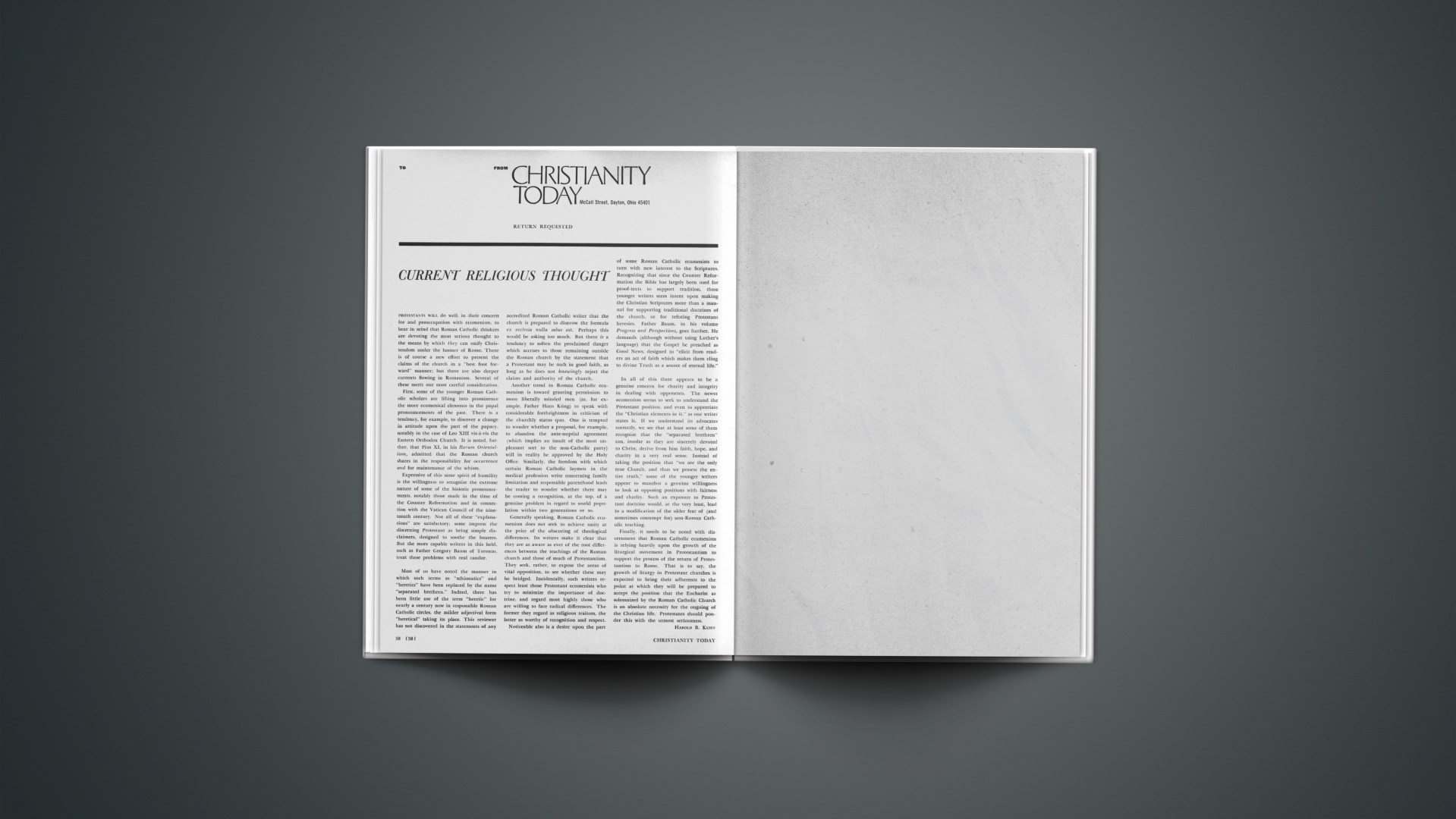
Protestants will do well, in their concern for and preoccupation with ecumenism, to bear in mind that Roman Catholic thinkers are devoting the most serious thought to the means by which they can unify Christendom under the banner of Rome. There is of course a new effort to present the claims of the church in a “best foot forward” manner; but there are also deeper currents flowing in Romanism. Several of these merit our most careful consideration.

First, some of the younger Roman Catholic scholars are lifting into prominence the more ecumenical elements in the papal pronouncements of the past. There is a tendency, for example, to discover a change in attitude upon the part of the papacy, notably in the case of Leo XIII vis-à-vis the Eastern Orthodox Church. It is noted, further, that Pius XI, in his Rerum Orientalium, admitted that the Roman church shares in the responsibility for occurrence and for maintenance of the schism.

Expressive of this same spirit of humility is the willingness to recognize the extreme nature of some of the historic pronouncements, notably those made in the time of the Counter Reformation and in connection with the Vatican Council of the nineteenth century. Not all of these “explanations” are satisfactory; some impress the discerning Protestant as being simple disclaimers, designed to soothe the hearers. But the more capable writers in this field, such as Father Gregory Baum of Toronto, treat these problems with real candor.

Most of us have noted the manner in which such terms as “schismatics” and “heretics” have been replaced by the name “separated brethren.” Indeed, there has been little use of the term “heretic” for nearly a century now in responsible Roman Catholic circles, the milder adjectival form “heretical” taking its place. This reviewer has not discovered in the statements of any accredited Roman Catholic writer that the church is prepared to disavow the formula ex ecclesia nulla salus est. Perhaps this would be asking too much. But there is a tendency to soften the proclaimed danger which accrues to those remaining outside the Roman church by the statement that a Protestant may be such in good faith, as long as he does not knowingly reject the claims and authority of the church.

Another trend in Roman Catholic ecumenism is toward granting permission to more liberally minded men (as, for example, Father Hans Küng) to speak with considerable forthrightness in criticism of the churchly status quo. One is tempted to wonder whether a proposal, for example, to abandon the ante-nuptial agreement (which implies an insult of the most unpleasant sort to the non-Catholic party) will in reality be approved by the Holy Office. Similarly, the freedom with which certain Roman Catholic laymen in the medical profession write concerning family limitation and responsible parenthood leads the reader to wonder whether there may be coming a recognition, at the top, of a genuine problem in regard to world population within two generations or so.

Generally speaking, Roman Catholic ecumenism does not seek to achieve unity at the price of the obscuring of theological differences. Its writers make it clear that they are as aware as ever of the root differences between the teachings of the Roman church and those of much of Protestantism. They seek, rather, to expose the areas of vital opposition, to see whether these may be bridged. Incidentally, such writers respect least those Protestant ecumenists who try to minimize the importance of doctrine, and regard most highly those who are willing to face radical differences. The former they regard as religious traitors, the latter as worthy of recognition and respect.

Noticeable also is a desire upon the part of some Roman Catholic ecumenists to turn with new interest to the Scriptures. Recognizing that since the Counter Reformation the Bible has largely been used for proof-texts to support tradition, these younger writers seem intent upon making the Christian Scriptures more than a manual for supporting traditional doctrines of the church, or for refuting Protestant heresies. Father Baum, in his volume Progress and Perspectives, goes further. He demands (although without using Luther’s language) that the Gospel be preached as Good News, designed to “elicit from readers an act of faith which makes them cling to divine Truth as a source of eternal life.”

In all of this there appears to be a genuine concern for charity and integrity in dealing with opponents. The newer ecumenism seems to seek to understand the Protestant position, and even to appreciate the “Christian elements in it,” as one writer states it. If we understand its advocates correctly, we see that at least some of them recognize that the “separated brethren” can, insofar as they are sincerely devoted to Christ, derive from him faith, hope, and charity in a very real sense. Instead of taking the position that “we are the only true Church, and thus we possess the entire truth,” some of the younger writers appear to manifest a genuine willingness to look at opposing positions with fairness and charity. Such an exposure to Protestant doctrine would, at the very least, lead to a modification of the older fear of (and sometimes contempt for) non-Roman Catholic teaching.

Finally, it needs to be noted with discernment that Roman Catholic ecumenism is relying heavily upon the growth of the liturgical movement in Protestantism to support the process of the return of Protestantism to Rome. That is to say, the growth of liturgy in Protestant churches is expected to bring their adherents to the point at which they will be prepared to accept the position that the Eucharist as solemnized by the Roman Catholic Church is an absolute necessity for the ongoing of the Christian life. Protestants should ponder this with the utmost seriousness.

The Basis of Our Redemption

Behold the Lamb of God, who taketh away the sin of the world (John 1:29b).

This word is the Evangelist’s contribution toward the solution of the biggest problem in history—who is Jesus Christ? It is not enough to say. “Behold the Man,” “the Teacher,” “the Martyr.” We do not reach reality till we say, “Behold the Redeemer.” We do not see him clearly till we see him in relation to sin. It was sin that crucified Christ. The Lamb of God means sacrifice; it foreshadows the Cross. How then does the sacrifice of Christ take away sin?

I. The Cross Awakens Men to the Reality and the Consciousness of Sin. That is the first step toward taking it away. The lurid forms of sin are not the worst. Such sins as pride, jealousy, greed, hatred, and envy keep life from its power and peace, and at last may wreck the world. These things coming to a head crucified the Son of God. There was no other way of awakening the world but for him to die, to let sin take its full course and come to its tragic culmination in the cross of Calvary. “Behold the Lamb of God”!

II. The Crucified Christ Sets Us Free from Sin. Christ thus reveals the utter love and forgiveness of God, and enables us to make forgiveness ours. In the heart awakened to the fact of sin there is something that makes it terribly hard to realize and accept the forgiveness of God. But the vision of the One on the Cross brings home the amazing reality of God’s forgiveness. Before that vision of love sin cannot survive. Before that vision of love sin cannot endure.

Just here many people fall short of full salvation: the deliverance that would set them free from sin. “Take away” is the same verb that John uses about the stone that hid the Lord and held him in the grave. The taking away of sin is nothing if it be not the beginning of a new life and a recovered fellowship with God. On the faces of the early Christians there was “a wonderful sort of gladness, the look of men in whom some all-subduing experience had wrought heroically, men who still remembered a great deliverance.” Here is the dynamic of all great service. There is no life except through death, no Resurrection save through Calvary.—From The Victory of God, 1921.

When he, the Spirit of truth, is come, he shall guide you in to all the truth (John 16:13a, ARV).

Our Lord is drawing to the end of the wonderful outpouring of teaching and consolation with which he soothes the pain of parting. Here he contrasts his own teaching—partial and to an extent not yet intelligible—with the complete, universal teaching of the Holy Spirit, in all things pertaining to salvation.

I. The Promised Teacher. By our growing clearness of understanding of the truth wrapped up in Christ the Spirit imparts to believers the best strength of God, with power for service. Note here that the Spirit is a Person, not merely an influence.

II. The Spiritual Lesson. The whole subject matter of this teaching is the life and work, the Person and the death of Jesus Christ. In a sense he is our lesson book. The history of our Lord cannot be unfolded at once. He thus clearly anticipates that after his death there will be a development of Christian doctrine, never by getting beyond Christ, but by getting into him more fully.

III. The Christian Scholars. The text refers, first of all, to the apostles, and after them, to ministers, missionaries, and Bible teachers. But every believing soul also has the Holy Spirit for his Teacher. The humblest of us may learn of Him and be led by him into profounder knowledge of our Lord. Herein lies the secret of Christ-like power, joy, and hope.

Jesus is the Christ for every age and for every soul. So amid the babble of tongues and the surges of controversy rest assured that all change will but make more clear the inexhaustible meaning of the infinite Christ, and that the humble and obedient heart will ever have the promised Teacher, and never cry in vain: “Teach me to do Thy will, for Thou art my God. Thy Spirit is good; lead me in the paths of uprightness.”—From The Holy of Holies, 1890.

God so loved the world, that he gave his only begotten Son, that whosoever believeth in him should not perish, but have everlasting life (John 3:16).

This great word of Scripture is the lens of the whole revelation. As the lens gathers up converging rays and blends them into a single stream of intense brightness, so this verse gathers up the prophecies and foregleams of the Gospel, and focuses them into a pure white beam of eternal light. If we take home to our hearts the truth of this text, no question will vex our minds and no sorrow will overwhelm our spirits. So let us look at this text through the eyes of Paul, with his daring imagination. He views the love of God in four dimensions. (Here quote Ephesians 3:18 f.: “[that ye] may be able to comprehend with all saints what is the breadth, and length, and depth, and height; and to know the love of Christ.…”)

I. The Breadth: “God so loved the world,” the world of sinning, suffering, sorrowing men and women. To love the world of men and women with their mean and sordid natures, their foul and degraded thoughts—that is the breadth of love. Robert Moffatt’s quick and tender heart beat for South Africa with an undying passion, but he confesses that he was almost moved to loathing by the brutal and sunken minds of the heathen villagers among whom he labored. This low and sunken state, this shameless evil and rebellion, God sees and knows and feels, as we do not, and yet God loves the world. Such love “passeth knowledge.”

II. The Length: “He gave his only begotten Son.” The test of love: to what length will it go? When God loves, he loves the world. When he gives, he gives his son. There is nothing more that even God can do to show his love. Before you can comprehend the length of his love, come and stand beneath the cross of Christ, and accept him as your Lord.

III. The Depth: “That whosoever believeth in him should not perish.” Whether the breadth or the length be the greater we do not know, but the depth most fills me with adoring wonder. God bestows his love on those whose wickedness he abhors. Such depths of love we can begin to understand only in the light of the Cross. “God commendeth his love toward us, in that, while we were yet sinners, Christ died for us.”

IV. The Height: “But have everlasting life.” What is everlasting life? Not merely length of days. Christian life is energy, blessedness, love, begun here and to be perfected hereafter. In glory we shall have our powers exalted and enlarged, with a service noble and full of delight, while we enter into a fellowship that shall raise us from glory to glory. As Paul says, “We shall be filled with all the fulness of God.”

Are these mighty certainties and immortal hopes anything to you? In our text a single word lifts the truth out of the sphere of things heard into the realm of things accepted by the heart. That word is “believeth.” Let each of you now give himself up to an adoring sense of God’s love. It is trust in God that makes a man a Christian. With all your burdens and sorrows, all your needs and sins, cast yourself on the love of him who knows them all, and yet loves you with an everlasting love, in the cross of Christ.—From The Cross in Christian Experience, 1909.

These are written, that ye might believe that Jesus is the Christ, the Son of God (John 20:31a).

The greatest book in the Bible was written mainly to present Christ’s Deity. Deity here means in part that we worship him as we worship no one but God. The same truth we gladly believe about the Holy Spirit as the Third Person of the Trinity.

One year in Columbus, Ohio, many pastors engaged in verbal battles about such beliefs. Our own congregation took no part in these battles. But we began reciting the Apostles’ Creed after the hymn preceding the sermon. During the period between mid-December and Easter all the morning sermons came from John. After a message about the Deity of our Lord we began to witness more professions of faith, often with adult baptism, than at any other stage of my pastoral experience. A good sermon on a great theme! A good sermon here means one that does good.

The next day after that simple message, it appeared word for word in the city morning newspaper. For the only time in its history the Ohio State Journal ran the first part of a Protestant message in the right-hand column on the front page, and the remainder elsewhere. While on a different text, and with another framework, that message, like this one, was simple enough for a boy or girl of ten or twelve to follow in the main, and thoughtful enough to hold the attention of many students and some professors from the Ohio State University nearby. What then are some such facts about Christ’s Deity as the doctrine appears in the Fourth Gospel? (In this sermon and the next, one purpose, revealed near the end, is to guide the hearer in reading at home the Gospel, both as a whole and by paragraphs.) The Fourth Gospel teaches the Deity of our Lord in at least three ways:

I. By Direct Statements: A Sevenfold Testimony. I should deal only with the first text, and ask the lay reader to single out at home six others, and then commit the seven to memory. “In the beginning was the Word” (1:1). In part the Word here means God’s way of making himself known in Christ. In him we have today the heart of the spoken Word, the written Word, and the Living Word. (The other six, not in the sermon: 1:14, 1:29; 3:16; 14:9; 20:28, 20:31.) Each might call later for a sermon.

II. By Indirect Statements: The Sevenfold I AM, all from the lips of our Lord. Here, indirectly, our Lord claims to be, to say, and to do what God alone can say, and be, and do. Here refer to I AM as a name of God (Ex: 3:14).

“I am the bread of life” (6:35): “The Gospel in Terms of Bread.” He alone can satisfy the heart-hunger of humanity, and he does so, here and now, for every person who becomes a believer. Note the practical stress on one person, one of an untold multitude. (The other six, not in the sermon: 8:12; 10:7, 10:14; 11:25; 14:6; 15:1.) In each of the seven note the lack of anything abstract; Bread—Light—Door—Shepherd—Life—Way—Vine. What an opportunity for an evening series: “The Gospel of the Sevenfold I AM”!

III. By Visible Teaching: The Sevenfold Demonstration. Here one might deal with seven miracles, but leave them for another evening series (2:1–11; 4:43–54; 5:1–9; 6:1–14, 6:15–21; 9:1–12; 11:1–44). In the sermon ask the home reader to look out for the beauty of Christ’s character—the perfection of his life—the wisdom of his teachings—the wonder of his miracles—the saving power of his death—the glory of his resurrection, with only enough comment in each item to increase the desire for reading at home.

Near the end, before a word of invitation to accept Christ now as Redeemer and King: “Starting today, and continuing until Easter, the morning sermons will all come from this Gospel, each time drawing nearer to the Day of the Cross. It will help me much in my study and help each of you far more in living if at home in private devotions and at the family altar you read this Gospel. Every week the bulletin will suggest which portions to read most often, ever in the spirit of prayer. Every Lord’s Day the suggested passages will include the one for the sermon the following Sunday morning.”

Pastor, if you spend months in making ready for this opening sermon, you will be more and more delighted with the number of laymen who do these home readings, and then come to church eager to learn more about Christ. Among Christians today what do we need more than a return to the reading of the Bible with understanding and joy?

These are written, that … ye may have life in his name (John 20:31b).

The Fourth Gospel was not written to prove the Deity of Christ. The Gospel provides us with the facts, but the proof, as with the early disciples, comes through personal experience; it may be after a person has been born again. So let us look at the latter half of the key verse in the Fourth Gospel. This part of the verse has to do with doctrine in the experience of us men and women, older boys and girls, one by one. When the apostle here says life, he means much the same as Paul means when he writes about salvation.

I. In the Day of His Flesh Our Lord Saved Men and Women Like You and Me. When Peter and John, Mary and Martha first knew the Lord, no one of them dreamed of his Deity. But little by little, each of them knew him better, loved him more, and grew more like him. At last every one of the apostolic band, except Judas, looked on him as we do today. If any one of us did not believe in Christ’s Deity, that one ought to read and pray over what the early believers wrote about Christ as the Son of God. In the Bible, to be God’s Son means that the latter belongs to the same divine family.

II. In the History of the Church Christ Has Continued to Save. In every age minority groups have refused to accept his Deity, perhaps because of the way the doctrine has been presented, harshly and belligerently, not with “sweet reasonableness.” Kindly but clearly let us note certain facts. For example, former President Eliot of Harvard, a Unitarian, used to deplore the absence of foreign missionary effectiveness among those who refused to worship Christ as God.

In the history of Christendom thus far every mighty soul-winning movement, such as that under John Wesley, has been among those who believed and sang and preached the Bible teaching about Christ’s Deity. So with every mighty people’s movement, as among our Baptist friends in the South, and every mighty movement for world missions, as among the Moravians or the Free Church of Scotland. “By their fruits ye shall know them.”

III. Throughout the World Today the Lord Jesus Still Redeems and Transforms. In the South Pacific certain islands that a hundred years ago were peopled by cannibals have now been changed into most Christlike communities. So testifies one of our ministerial sons, who during World War II served out there as a chaplain among the Marines. In the most nearly “God-forsaken communities” here at home Christ has saved and transformed. In Kansas I knew a community that formerly had been no fit place to rear a growing boy. In ten years, because of a small home missions church, that community was transformed into a God-fearing, law-abiding district worthy of praise for its lofty ideals. Perhaps best of all, Christ now waits to redeem and transform the weakest and worst of men and women here at home, even one by one. How can this be so? Because He loves the sinner with the grace of Almighty God.

“Very well,” someone says, “but what practical difference does Christ’s Deity make to me?” Thank you, sir, for the question. Let the reply also be frank and kind. Because of Christ’s Deity he is able and ready to save and rule, to comfort and bless. And if not, then not! He will also be able some day to serve as our Judge, a colossal task that no created being ever would dare to undertake.

Never argue or quarrel about this holy truth. Never throw stones or slime at any one who does not yet believe. Rather pray for such a person, that the Lord will open his eyes and his heart. All the while hold fast to this Gospel truth until at last in the other world you behold the Redeemer face to face. Then you will join with the angelic throng while they sing praises to the Lamb of God who taketh away the sin of the world. Hallelujah, Amen!

About This Issue: October 11, 1963

The opening of the Vatican Council’s second session is prodding many Protestant thinkers to review Roman Catholic history and theology. Several essays in this pre-Reformation Day issue point to the relevance of such recollections.

Twenty-five religious scholars contribute to the news department’s annual symposium.CHRISTIANITY TODAYpolls participants on a significant question, and tries to hold the answers to fifty words. For the results, see page 30.

Dr. Frank E. Gaebelein’s timely arrival as co-editor coincides with the beginning of Editor Carl F. H. Henry’s sabbatical leave. Dr. Henry and his wife fly to Lisbon October 13, spend six weeks in Africa, visit the Holy Land at Christmas, and then proceed to Europe, returning in mid-summer.

Book Briefs: October 11, 1963

Religion And The State: Some Pointed Questions

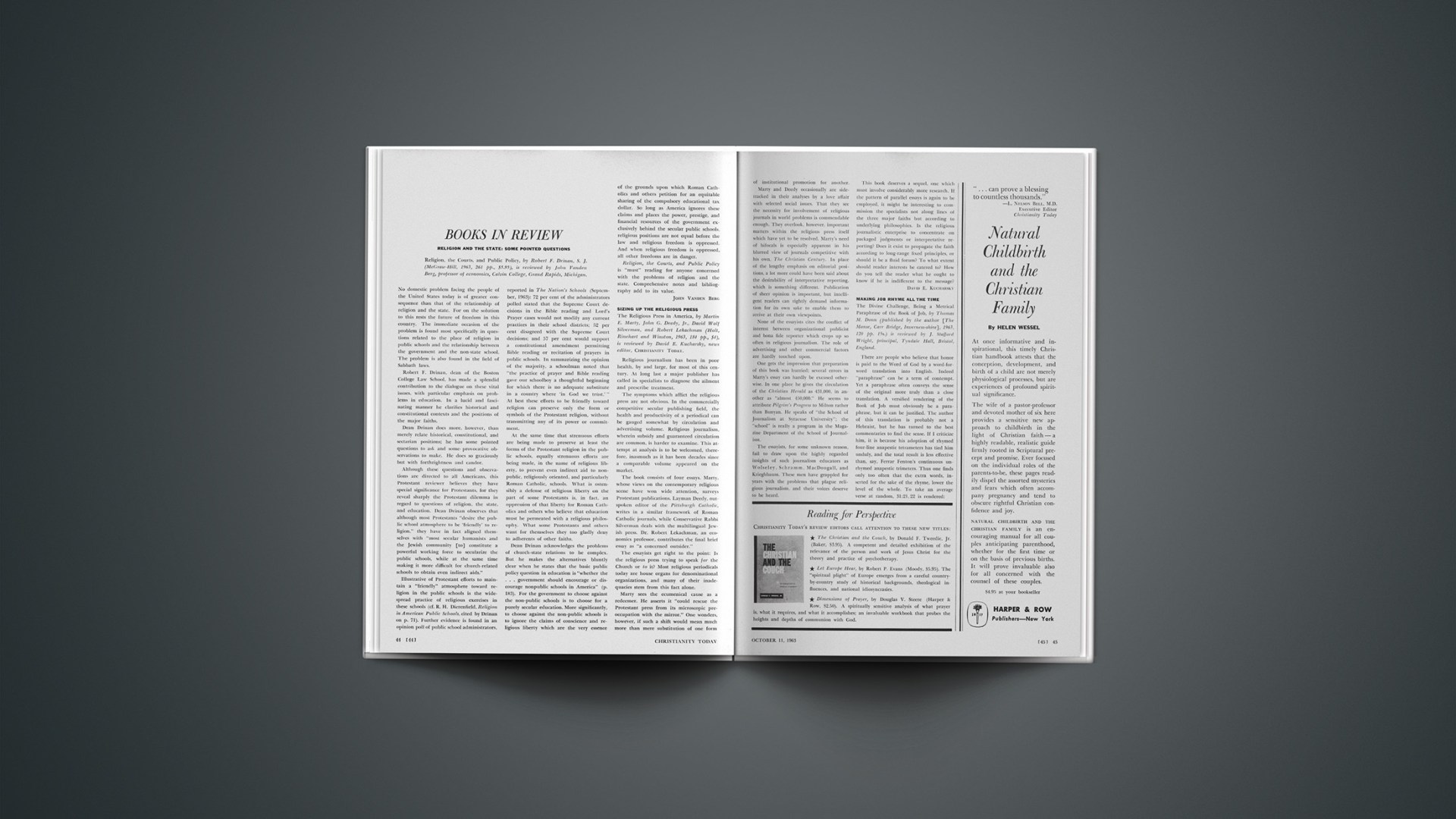
Religion, the Courts, and Public Policy, by Robert F. Drinan, S. J. (McGraw-Hill, 1963, 261 pp., $5.98), is reviewed by John Vanden Berg, professor of economics, Calvin College, Grand Rapids, Michigan.

No domestic problem facing the people of the United States today is of greater consequence than that of the relationship of religion and the state. For on the solution to this rests the future of freedom in this country. The immediate occasion of the problem is found most specifically in questions related to the place of religion in public schools and the relationship between the government and the non-state school. The problem is also found in the field of Sabbath laws.

Robert F. Drinan, dean of the Boston College Law School, has made a splendid contribution to the dialogue on these vital issues, with particular emphasis on problems in education. In a lucid and fascinating manner he clarifies historical and constitutional contexts and the positions of the major faiths.

Dean Drinan does more, however, than merely relate historical, constitutional, and sectarian positions; he has some pointed questions to ask and some provocative observations to make. He does so graciously but with forthrightness and candor.

Although these questions and observations are directed to all Americans, this Protestant reviewer believes they have special significance for Protestants, for they reveal sharply the Protestant dilemma in regard to questions of religion, the state, and education. Dean Drinan observes that although most Protestants “desire the public school atmosphere to be ‘friendly’ to religion.” they have in fact aligned themselves with “most secular humanists and the Jewish community [to] constitute a powerful working force to secularize the public schools, while at the same time making it more difficult for church-related schools to obtain even indirect aids.”

Illustrative of Protestant efforts to maintain a “friendly” atmosphere toward religion in the public schools is the widespread practice of religious exercises in these schools (cf. R. H. Dierenfield, Religion in American Public Schools, cited by Drinan on p. 71). Further evidence is found in an opinion poll of public school administrators, reported in The Nation’s Schools (September, 1963); 72 per cent of the administrators polled stated that the Supreme Court decisions in the Bible reading and Lord’s Prayer cases would not modify any current practices in their school districts; 52 per cent disagreed with the Supreme Court decisions; and 57 per cent would support a constitutional amendment permitting Bible reading or recitation of prayers in public schools. In summarizing the opinion of the majority, a schoolman noted that “the practice of prayer and Bible reading gave our schoolboy a thoughtful beginning for which there is no adequate substitute in a country where ‘in God we trust.’ ” At best these efforts to be friendly toward religion can preserve only the form or symbols of the Protestant religion, without transmitting any of its power or commitment.

At the same time that strenuous efforts are being made to preserve at least the forms of the Protestant religion in the public schools, equally strenuous efforts are being made, in the name of religious liberty, to prevent even indirect aid to nonpublic, religiously oriented, and particularly Roman Catholic, schools. What is ostensibly a defense of religious liberty on the part of some Protestants is, in fact, an oppression of that liberty for Roman Catholics and others who believe that education must be permeated with a religious philosophy. What some Protestants and others want for themselves they too gladly deny to adherents of other faiths.

Dean Drinan acknowledges the problems of church-state relations to be complex. But he makes the alternatives bluntly clear when he states that the basic public policy question in education is “whether the … government should encourage or discourage nonpublic schools in America” (p. 183). For the government to choose against the non-public schools is to choose for a purely secular education. More significantly, to choose against the non-public schools is to ignore the claims of conscience and religious liberty which are the very essence of the grounds upon which Roman Catholics and others petition for an equitable sharing of the compulsory educational tax dollar. So long as America ignores these claims and places the power, prestige, and financial resources of the government exclusively behind the secular public schools, religious positions are not equal before the law and religious freedom is oppressed. And when religious freedom is oppressed, all other freedoms are in danger.

Religion, the Courts, and Public Policy is “must” reading for anyone concerned with the problems of religion and the state. Comprehensive notes and bibliography add to its value.

JOHN VANDEN BERG

Sizing Up The Religious Press

The Religious Press in America, by Martin E. Marty, John G. Deedy, Jr., David Wolf Silverman, and Robert Lekachman (Holt, Rinehart and Winston, 1963, 184 pp., $4), is reviewed by David E. Kucharsky, news editor, CHRISTIANITY TODAY.

Religious journalism has been in poor health, by and large, for most of this century. At long last a major publisher has called in specialists to diagnose the ailment and prescribe treatment.

The symptoms which afflict the religious press are not obvious. In the commercially competitive secular publishing field, the health and productivity of a periodical can be gauged somewhat by circulation and advertising volume. Religious journalism, wherein subsidy and guaranteed circulation are common, is harder to examine. This attempt at analysis is to be welcomed, therefore, inasmuch as it has been decades since a comparable volume appeared on the market.

The book consists of four essays. Marty, whose views on the contemporary religious scene have won wide attention, surveys Protestant publications. Layman Deedy, outspoken editor of the Pittsburgh Catholic, writes in a similar framework of Roman Catholic journals, while Conservative Rabbi Silverman deals with the multilingual Jewish press. Dr. Robert Lekachman, an economics professor, contributes the final brief essay as “a concerned outsider.”

The essayists get right to the point: Is the religious press trying to speak for the Church or to it? Most religious periodicals today are house organs for denominational organizations, and many of their inadequacies stem from this fact alone.

Marty sees the ecumenical cause as a redeemer. He asserts it “could rescue the Protestant press from its microscopic preoccupation with the mirror.” One wonders, however, if such a shift would mean much more than mere substitution of one form of institutional promotion for another.

Marty and Deedy occasionally are sidetracked in their analyses by a love affair with selected social issues. That they see the necessity for involvement of religious journals in world problems is commendable enough. They overlook, however, important matters within the religious press itself which have yet to be resolved. Marty’s need of bifocals is especially apparent in his blurred view of journals competitive with his own. The Christian Century. In place of the lengthy emphasis on editorial positions, a lot more could have been said about the desirability of interpretative reporting, which is something different. Publication of sheer opinion is important, but intelligent readers can rightly demand information for its own sake to enable them to arrive at their own viewpoints.

None of the essayists cites the conflict of interest between organizational publicist and bona fide reporter which crops up so often in religious journalism. The role of advertising and other commercial factors are hardly touched upon.

One gets the impression that preparation of this book was hurried; several errors in Marty’s essay can hardly be excused otherwise. In one place he gives the circulation of the Christian Herald as 431,000, in another as “almost 450,000.” He seems to attribute Pilgrim’s Progress to Milton rather than Bunyan. He speaks of “the School of Journalism at Syracuse University”; the “school” is really a program in the Magazine Department of the School of Journalism.

The essayists, for some unknown reason, fail to draw upon the highly regarded insights of such journalism educators as Wolseley, Schramm, MacDougall, and Krieghbaum. These men have grappled for years with the problems that plague religious journalism, and their voices deserve to be heard.

This book deserves a sequel, one which must involve considerably more research. If the pattern of parallel essays is again to be employed, it might be interesting to commission the specialists not along lines of the three major faiths but according to underlying philosophies. Is the religious journalistic enterprise to concentrate on packaged judgments or interpretative reporting? Does it exist to propagate the faith according to long-range fixed principles, or should it be a fluid forum? To what extent should reader interests be catered to? How do you tell the reader what he ought to know if he is indifferent to the message?

DAVID E. KUCHARSKY

Making Job Rhyme All The Time

The Divine Challenge, Being a Metrical Paraphrase of the Book of Job, by Thomas M. Donn (published by the author [The Manse, Carr Bridge, Inverness-shire], 1963, 120 pp. 15s.) is reviewed by J. Stafford Wright, principal, Tyndale Hall, Bristol, England.

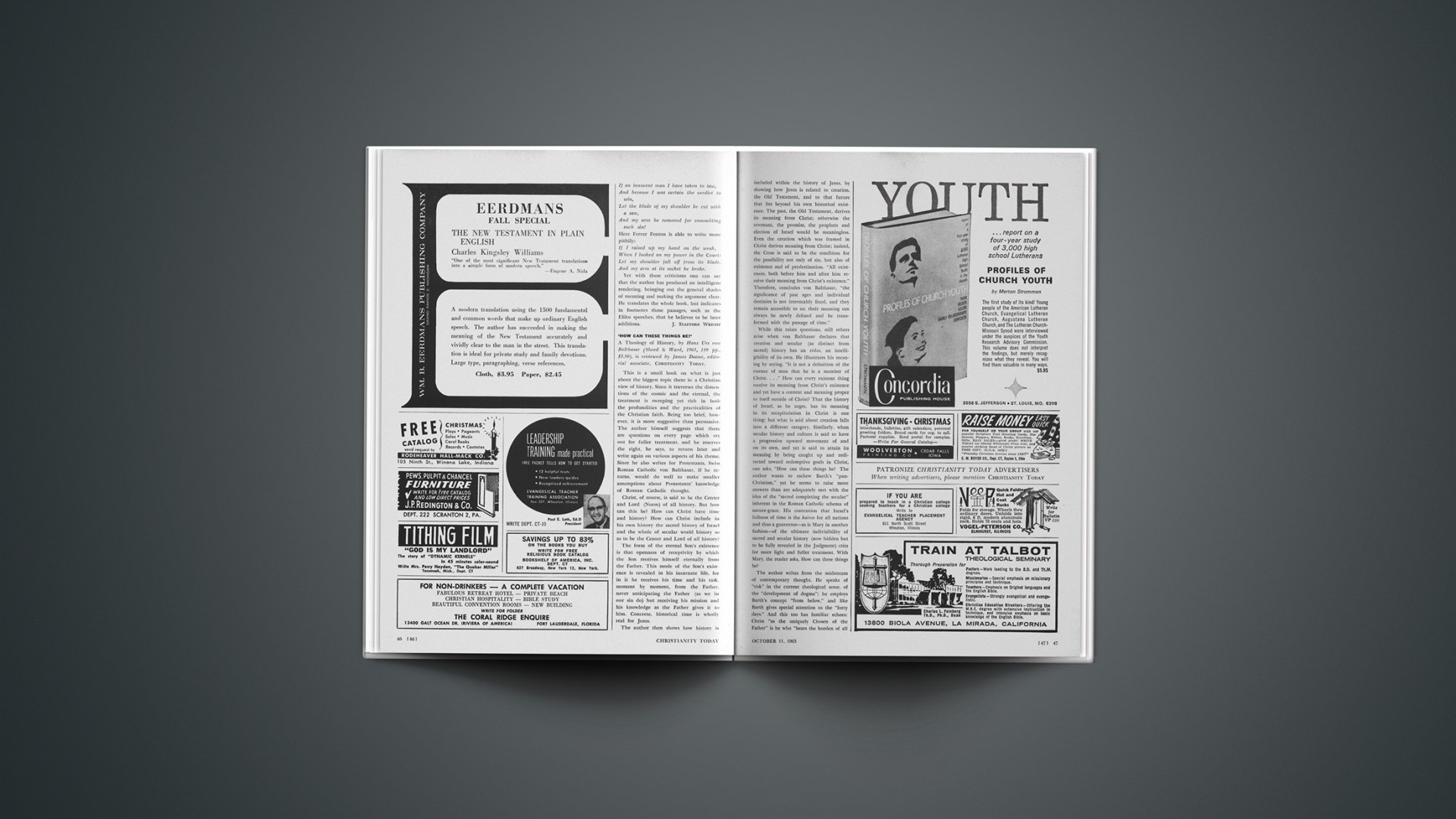
There are people who believe that honor is paid to the Word of God by a word-for-word translation into English. Indeed “paraphrase” can be a term of contempt. Yet a paraphrase often conveys the sense of the original more truly than a close translation. A versified rendering of the Book of Job must obviously be a paraphrase, but it can be justified. The author of this translation is probably not a Hebraist, but he has turned to the best commentaries to find the sense. If I criticize him, it is because his adoption of rhymed four-line anapestic tetrameters has tied him unduly, and the total result is less effective than, say, Ferrar Fenton’s continuous unrhymed anapestic trimeters. Thus one finds only too often that the extra words, inserted for the sake of the rhyme, lower the level of the whole. To take an average verse at random, 31:21, 22 is rendered:

If an innocent man I have taken to law,

And because I was certain the verdict to win,

Let the blade of my shoulder be cut with a saw,

And my arm be removed for committing such sin!

Here Ferrar Fenton is able to write more pithily:

If I raised up my hand on the weak, When I looked on my power in the Court: Let my shoulder fall off from its blade, And my arm at its socket be broke.

Yet with these criticisms one can say that the author has produced an intelligent rendering, bringing out the general shades of meaning and making the argument clear. He translates the whole book, but indicates in footnotes those passages, such as the Elihu speeches, that he believes to be later additions.

J. STAFFORD WRIGHT

‘How Can These Things Be?’

A Theology of History, by Hans Urs von Balthasar (Sheed & Ward, 1963, 149 pp., $3.50), is reviewed by James Daane, editorial associate, CHRISTIANITY TODAY.

This is a small book on what is just about the biggest topic there is: a Christian view of history. Since it traverses the dimentions of the cosmic and the eternal, the treatment is sweeping yet rich in both the profundities and the practicalities of the Christian faith. Being too brief, however, it is more suggestive than persuasive. The author himself suggests that there are questions on every page which cry out for fuller treatment, and he reserves the right, he says, to return later and write again on various aspects of his theme. Since he also writes for Protestants, Swiss Roman Catholic von Balthasar, if he returns, would do well to make smaller assumptions about Protestants’ knowledge of Roman Catholic thought.

Christ, of course, is said to be the Center and Lord (Norm) of all history. But how can this be? How can Christ have time and history? How can Christ include in his own history the sacred history of Israel and the whole of secular world history so as to be the Center and Lord of all history?

The form of the eternal Son’s existence is that openness of receptivity by which the Son receives himself eternally from the Father. This mode of the Son’s existence is revealed in his incarnate life, for in it he receives his time and his task, moment by moment, from the Father, never anticipating the Father (as we in our sin do) but receiving his mission and his knowledge as the Father gives it to him. Concrete, historical time is wholly real for Jesus.

The author then shows how history is included within the history of Jesus, by showing how Jesus is related to creation, the Old Testament, and to that future that lies beyond his own historical existence. The past, the Old Testament, derives its meaning from Christ; otherwise the covenant, the promise, the prophets and election of Israel would be meaningless. Even the creation which was framed in Christ derives meaning from Christ; indeed, the Cross is said to be the condition for the possibility not only of sin, but also of existence and of predestination. “All existences, both before him and after him receive their meaning from Christ’s existence.” Therefore, concludes von Balthasar, “the significance of past ages and individual destinies is not irrevocably fixed, and they remain accessible to us; their meaning can always be newly defined and be transformed with the passage of time.”

While this raises questions, still others arise when von Balthasar declares that creation and secular (as distinct from sacred) history has an eidos, an intelligibility of its own. He illustrates his meaning by saying, “It is not a definition of the essence of man that he is a member of Christ.…” How can every existent thing receive its meaning from Christ’s existence and yet have a content and meaning proper to itself outside of Christ? That the history of Israel, as he urges, has its meaning in its recapitulation in Christ is one thing; but what is said about creation falls into a different category. Similarly, when secular history and culture is said to have a progressive upward movement of and on its own, and yet is said to attain its meaning by being caught up and redirected toward redemptive goals in Christ, one asks, “How can these things be? The author wants to eschew Barth’s “pan-Christism,” yet he seems to raise more answers than are adequately met with the idea of the “sacred completing the secular” inherent in the Roman Catholic schema of nature-grace. His contention that Israel’s fullness of time is the kairos for all nations and thus a guarantee—as is Mary in another fashion—of the ultimate indivisibility of sacred and secular history (now hidden but to be fully revealed in the Judgment) cries for more light and fuller treatment. With Mary, the reader asks, How can these things be?

The author writes from the midstream of contemporary thought. He speaks of “risk” in the current theological sense, of the “development of dogma”; he employs Barth’s concept “from below,” and like Barth gives special attention to the “forty days.” And this too has familiar echoes: Christ “as the uniquely Chosen of the Father” is he who “bears the burden of all human rejectedness” and thus “reverses the course, throws the tiller across for good and all, and frees first those who were not chosen, the pagan nations, the Gentiles, and then, eschatologically, the first-chosen, the holy stock as well.”

The book is cast within the framework of Roman Catholic thought, yet it is richly rewarding reading for anyone interested in a Christian conception of history, for it is a book much bigger than its size or origin.

JAMES DAANE

One On Nine

The New Community in Christ: Essays on the Corporate Christian Life, edited by John P. Kildalh and James H. Burtness (Augsburg, 1963, 201 pp., $4.50), is reviewed by Bert Hall, professor of philosophy, Houghton College, Houghton, New York.

Nine young Lutheran theologians interpret the Christian life in terms of corporate living. The result is a mediocre interpretation of religion, colored by conclusions of liberalism and existentialism. The nine essays are of unequal value, but their general tone denies the heart of biblical faith and traditional Christianity.

The first. “The Corporate Character of the New Life” by Joseph M. Shaw, goes far beyond the New Testament emphasis on the balance between the individual and the community in an attempt to argue that the church is more important than the individual. His fine distinctions between the “individual” and the “person” (p. 30) and between “impersonal collectivism” and “personalistic collectivism” (p. 32) have little meaning. His denial of the second coming of Christ (p. 31) shows utter neglect of the Pauline hope in First Thessalonians.

The second essay. “Community and the Church” by Kent S. Knutson, suggests that modern Lutheranism is rapidly drifting away from conservative evangelicalism to confessionalism.

Roy A. Harrisville, writing on the “New Birth,” illustrates the modern attempt to overcome the scandal of the personal presence of Christ in the believer’s life. His esoteric explanation of the terms of the Gospel (p. 92) suggests one reason why many moderns are not aware of the personal working of Christ in man’s life. His unscriptural account of the New Birth neglects the personal implications of John 3; Romans 12; Titus 3:5–7, and Galatians 5 and 6.

In the fifth essay Carl E. Bratten engages in a theological hairsplitting not unlike that of the seventeenth-century Lutheran theologians, with their lack of emphasis upon biblical theology and their use of logical categories. There is little here that would commend the doctrine of justification by faith to lost men.

Two of the essays, “The Concept of Selfhood in the New Testament” and “The Secular: Threat or Mandate,” give clear insights into the predicament of our times. They are the best in the book. However, even Editor Kildahl, writing on “Emotional Health,” does not take into account the real power of Christ and what he can do for the individual personality.

Evangelicals will find little of interest in the book with its neglect of the Scriptures and drift to “church-ianity.”

BERT HALL

Book Briefs

The Greek-English Analytical Concordance of the Greek-English New Testament, compiled by J. Stegenga (Hellenes-English Biblical Foundation [Box 10412, Jackson, Miss.], 1963, 832 pp., $14.95). An elaborate volume which combines the features of a Creek word and analytical concordance, but is woefully outdated, based as it is upon the Greek text of Desiderius Erasmus, the contemporary of Martin Luther.

The Secular Meaning of the Gospel, by Paul M. Van Buren (Macmillan, 1963, 205 pp., $4.95). The author provides an empirical grounding for the language of faith which reduces Christianity to its historical and ethical dimensions; this, he contends, loses nothing of its essence.

A Woman’s World, by Clyde M. Narramore (Zondervan, 1963, 207 pp., $2.95). A popular Christian writer invades the world of the woman who is unloved, unmarried, wedded to the non-Christian man or to the boy who didn’t grow up, or caught up in the many conflicts and dilemmas of her woman’s world.

Life Can Begin Again, by Helmut Thielicke (Fortress, 1963, 215 pp., $3.75). A series of sermons which interpret the Sermon on the Mount on the premise that it can be rightly understood only as the words of Christ. Reflective and analytic, the sermons peel back the layers of the human soul and the life it leads in this twentieth century. The sermons were first delivered in crisis-torn postwar Germany. These are sermons that cannot be reproduced, but they can produce others in the soul of the preacher-reader.

A Miscellany of American Christianity, edited by Stuart C. Henry (Duke University Press, 1963, 390 pp., $10). Essays written in honor of H. Shelton Smith of Duke. The Great Awakening, the religious frontier, the witchcraft episode of Salem, the steel strike of 1919, and other great moments and men in American religious history make up this literary tribute.

The Art of Christian Living, by Ralph Heynen (Baker, 1963, 171 pp., $2.95). In a series of short, practical essays a chaplain in a psychopathic hospital discusses the emotional problems and conflicts, the tensions and fears of everyday people. Attractive jacket and a good cover, cover a format that seems wholly accidental.

The Catholic As Citizen, by John F. Cronin (Helicon, 1963, 176 pp., $3.95). The assistant director of the Social Action Department of the National Catholic Welfare Conference discusses the image of the Roman Catholic citizen in the United States: what he can do to improve it, what he cannot do to eliminate it, and how it looks to others. Though written for Roman Catholics, it will give Protestants an insight into the Roman Catholic mind.

The Spiritual Dilemma of the Jewish People: Its Cause and Cure, by Arthur W. Kac (Moody, 1963, 128 pp., $2.25). Largely a mosaic of quotations, and so put together as to create no clear picture.

How We Got the Bible, by Neil R. Lightfoot (Baker, 1963, 128 pp., $2.50). Popular, readable, thumbnail sketch.

The Churches and Christian Unity, edited by R. J. W. Bevan (Oxford, 1963, 263 pp., $4 or 25s.). Worthy essays on the problem of ecumenical unity by a Roman Catholic, an Anglican, an Orthodox archpriest, the general secretary of the Baptist Union, and other representatives of leading churches.

The Eastern Orthodox Church, by Ernst Benz (Aldine, 1963, 230 pp., §5; Doubleday, paper, $.95). A competent discussion of the liturgy, sacraments, dogma, constitution, and much more, of the Eastern Orthodox Church. For those who want to get to know Orthodoxy.

That Hearing They Shall Perceive, by Charles Duell Kean (Seabury, 1963, 92 pp., §2.50). Because men often hear but do not understand the Gospel, Episcopalian Kean probes for an understanding of life in the light of the Gospel. With a direct style and an erudition lightly worn, he shows that a true perception of ourselves and the world of others can occur only within a triangular relationship which includes Christ.

Paperbacks

What Every Christian Wife Should Know and What Every Christian Husband Should Know, by William W. Orr (Scripture Press, 1963, 32 pp. each, $.30 each). The first offers Christian advice to a wife—spoonfed, with a sticky maudlin (“May I whisper a secret?”) sentimentality. Chapters inform the wife, “You’re Specially Designed,” “Weddings Are So Delicious,” and about such matters as “God’s Beautiful Sex Plan” and “Keep Yourself A Pretty Package.” Advice is proffered on hair care but none on fixing a meal. Pamphlet for husbands is in the same key.

I Saw the Light, by H. J. Hegger (Presbyterian and Reformed, 1963, 169 pp., $2). A Dutch priest who left the Roman Catholic Church opens the window of his soul and with considerable introspection tells a story which is better than the average in this category.

The Letter to the Hebrews and Letters to Ephesians and Philemon, by Clarence L. Jordan (Koinonia Farm [Americus, Ga.], 1963, 15 and 7 pp., $.35 each). The principle of the Incarnation applied to the translation of the Bible on the level of the cottonpatch. Samples: Melchisedec was a “great guy” to whom Abraham gave a tenth of “his very best loot”; the reader is exorted to “tank up on the spirit”; the “Gentiles” of Ephesians 2:11 become “Negroes.” Written for cottonpickers, by the white promoter of Koinonia Farm in Georgia.

Introducing the Christian Faith, by A. M. Ramsey (Morehouse-Barlow, 1963, 95 pp., $.75). Brief, pithy essays in simple language on great Christian themes. First printed in 1961.

The Voices of Negro Protest In America, by W. Haywood Burns (Oxford, 1963, 88 pp., $1.95). The story of Negro protest in the past and an analysis of the legal-judicial approach of the NAACP, of the students’ sit-in and freedom-rides movement, and of the radical-separatist Black Muslim movement. The author is a Negro American, a Harvard graduate, and a good writer.

Education for Decision, a symposium edited by Frank E. Gaebelein, Earl G. Harrison. Jr., and William L. Swing (Seabury, 1963, 125 pp., $2). Brief addresses presented at the Seventh National Conference on Religion in Independent Education (Colorado Springs) by such men as Ernest Gordon. Elton Trueblood, and John Crocker. With reports of discussions.

Jesus Christ and History, by George Eldon Ladd (Inter-Varsity, 1963, 62 pp., $1.25). In crisp, sketchy fashion the author probes the meaning of Christian eschatology for the realm of historic life and takes critical glances at views that dissolve the second coming of Christ.

The Prayers of Kierkegaard, edited by Perry D. LeFevre (University of Chicago. 1963, 245 pp., $1.75). One hundred prayers of Kierkegaard, a chapter on Kierkegaard as a man of prayer, and an interpretation of his life and thought. First published in 1956.

News Worth Noting: October 11, 1963

A Question Of Audit

Six members seeking a court-ordered financial audit were expelled from the 4,000-member First Baptist Church of Fort Worth, Texas, last month. The court subsequently dismissed their suit against the church, ruling that since they were no longer members of the church they could not bring legal action against it. The court had initially restrained the pastor, the Rev. Homer G. Ritchie, from expelling the six. To avert defiance charges, Ritchie had his twin-brother associate conduct the congregational meeting in which they were removed from the rolls. The 36-year-old pastor previously was involved in controversies over his divorce from his first wife in 1959 and his remarriage this year to a 22-year-old member of his congregation. The church is affiliated with the Bible Baptist Fellowship.

Protestant Panorama

A plan for merging the Methodist and Evangelical United Brethren churches was adopted last month at the close of a two-day meeting of the commissions on church union representing the two denominations. The plan suggests calling the merged denomination “The United Methodist Church.” Consummation of the union cannot take place before 1968. Current U. S. Methodist membership is 10,234,986, while the EUB number 761,754.

A dedication service and cornerstone laying marked the opening of a new Southern Baptist college in Houston, Texas. The Houston Baptist College begins its first year with a faculty of thirty-one and about 400 students, on a 200-acre campus in the southwest section of the city.

The Japan Evangelical Lutheran Church is assigning its first overseas missionary. He is the Rev. Hiroshi Fujii, who with his wife and two children will be stationed in Sao Paulo, Brazil, where they will serve among people of Japanese origin.

Miscellany

President Kennedy’s nomination of Dr. John Austin Gronouski as Postmaster General gives the U. S. Cabinet three Roman Catholics, the most it has ever had.

The Religion and Labor Council of America announced last month that it had been granted tax-exempt status by the Internal Revenue Service. The organization’s initial request that gifts to it be deductible from the donor’s income tax was denied in 1958.

U. S. Secretary of State Dean Rusk and U. N. Secretary General U Thant headed a long list of dignitaries who participated in dedication ceremonies for the new twelve-story Church Center for the United Nations in Manhattan. The structure was built by Methodists and is being “programmed” by the National Council of Churches.

A suit to bar state aid to four sectarian Maryland colleges was filed last month by the Horace Mann League. The league, represented by New York lawyer Leo Pfeffer, indicated that the suit is aimed at testing the constitutionality of government aid to parochial education and probably will end up in the United States Supreme Court.

Some 10,000 persons witnessed the open-air dedication of the $3.4 million-dollar Air-Force Academy chapel at Colorado Springs, Colorado. The seventeen-spire chapel was erected amidst continuing controversy over its high cost and ultra-modernistic architecture.

More than 2,000 public decisions for Christ were reported in Brazil during an eleven-day evangelistic crusade conducted by Dr. Torrey M. Johnson. Negro singer Jimmie McDonald was featured soloist.

A new radio station designed to broadcast the Gospel went on the air in San Salvador last month. The station is the product of a cooperative effort among evangelicals from a number of denominations and missionary boards.

Deaths

DR. FRANKLIN I. SHEEDER, 68, head of publications work for the United Church of Christ; a suicide; in New York.

THE REV. JOHN GOWDY, 93, retired Methodist bishop and former missionary to China; in Winter Park, Florida.

GUY W. PLAYFAIR, 80, general director emeritus of Sudan Interior Mission; in Toronto.

Personalia

A Southern Baptist clergyman who preached against segregation and was asked to resign his pulpit announced plans to enter the Protestant Episcopal ministry. Dr. Henry J. Stokes, Jr., left as pastor of the First Baptist Church of Macon, Georgia, last year following a request from deacons.

Standing in the pulpit of his church before a large Sunday congregation in Johannesburg, the Rev. C. F. Beyers Naude, moderator of the Southern Transvaal Synod of the Dutch Reformed Church, announced his resignation from the ministry. His decision reportedly stemmed from his opposition to racial segregation.

Dr. Leon Morris appointed principal of Ridley College, Melbourne.

Dr. Park H. Netting named academic dean and professor of church history at Pacific Christian College.

Warren Allem appointed dean of the faculty at The King’s College.

The Rev. Irvin Elligan, a Negro minister, appointed associate secretary of the Division of Christian Action of the Presbyterian Church in the U. S. He will be given special responsibility in the field of human relations.

Dr. W. Harry Jellema named professor of philosophy at the newly opened Grand Valley State College, Allendale, Michigan.

The Rev. Arvid F. Carlson resigned as pastor of the Mission Covenant Church in Pasadena, California, to become minister of the First Covenant Church of San Jose, California.

Worth Quoting

“If the great truths of our faith are not worth defending, the laity cannot help but conclude they are not important enough to comprehend and believe.”—Dr. Wilbur M. Smith, professor of English Bible at Trinity Evangelical Divinity School.

“One should have a faith, and a very strong faith, something to lean upon through life.”—Donna Axum, Miss America of 1964.

“The defeat of segregation is not the end, and the mere destruction of discrimination does not render a people independent. For it is possible to win the battle against slavery and oppression and lose the victory of freedom.”—Dr. Joseph H. Jackson in his presidential address to the 83rd annual meeting of the National Baptist Convention, U. S. A., Inc.

Ministering to the Middle Class

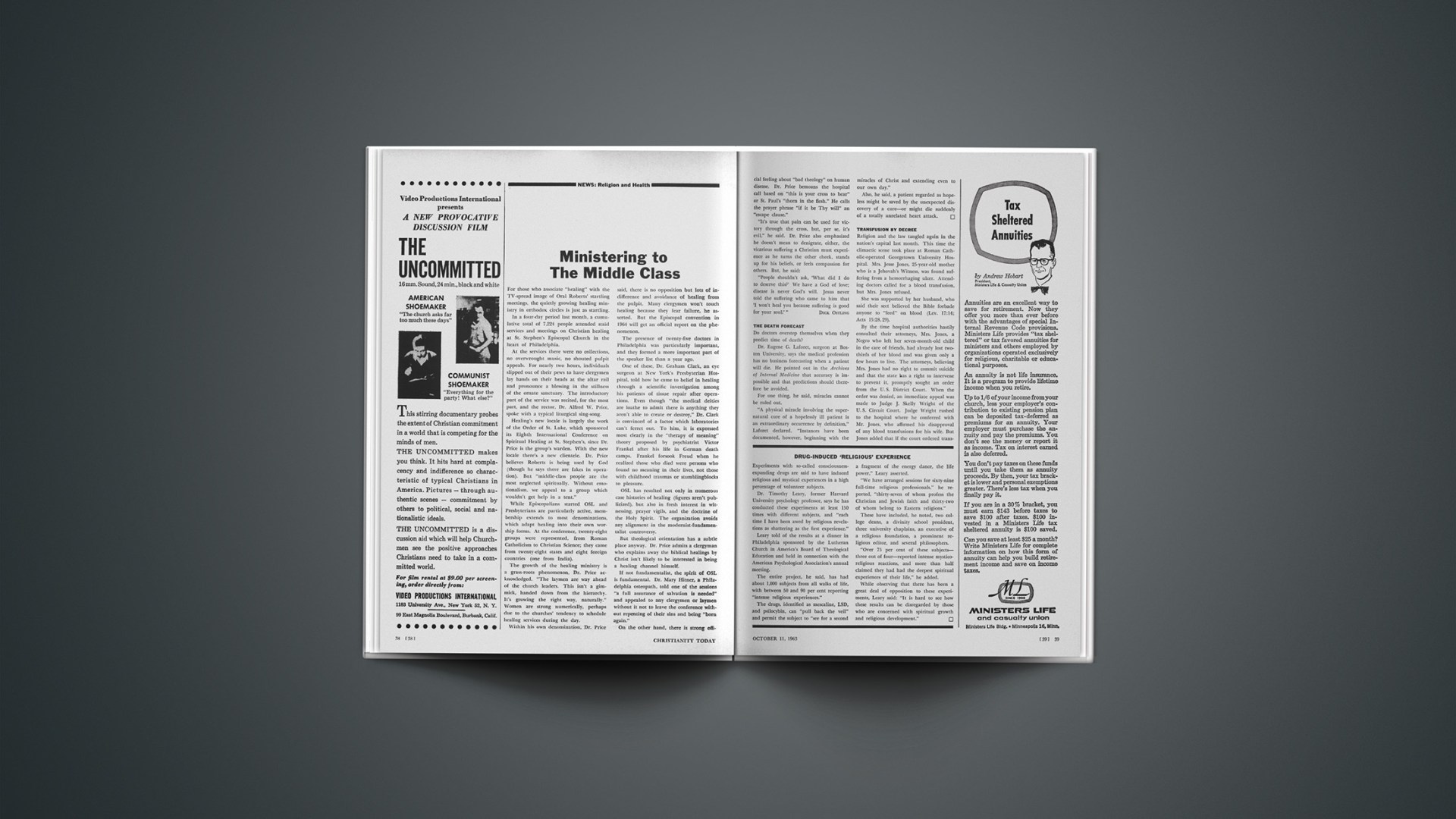
For those who associate “healing” with the TV-spread image of Oral Roberts’ startling meetings, the quietly growing healing ministry in orthodox circles is just as startling.

In a four-day period last month, a cumulative total of 7,224 people attended staid services and meetings on Christian healing at St. Stephen’s Episcopal Church in the heart of Philadelphia.

At the services there were no collections, no overwrought music, no shouted pulpit appeals. For nearly two hours, individuals slipped out of their pews to have clergymen lay hands on their heads at the altar rail and pronounce a blessing in the stillness of the ornate sanctuary. The introductory part of the service was recited, for the most part, and the rector, Dr. Alfred W. Price, spoke with a typical liturgical sing-song.

Healing’s new locale is largely the work of the Order of St. Luke, which sponsored its Eighth International Conference on Spiritual Healing at St. Stephen’s, since Dr. Price is the group’s warden. With the new locale there’s a new clientele. Dr. Price believes Roberts is being used by God (though he says there are fakes in operation). But “middle-class people are the most neglected spiritually. Without emotionalism, we appeal to a group which wouldn’t get help in a tent.”

While Episcopalians started OSL and Presbyterians are particularly active, membership extends to most denominations, which adapt healing into their own worship forms. At the conference, twenty-eight groups were represented, from Roman Catholicism to Christian Science; they came from twenty-eight states and eight foreign countries (one from India).

The growth of the healing ministry is a grass-roots phenomenon, Dr. Price acknowledged. “The laymen are way ahead of the church leaders. This isn’t a gimmick, handed down from the hierarchy. It’s growing the right way, naturally.” Women are strong numerically, perhaps due to the churches’ tendency to schedule healing services during the day.

Within his own denomination, Dr. Price said, there is no opposition but lots of indifference and avoidance of healing from the pulpit. Many clergymen won’t touch healing because they fear failure, he asserted. But the Episcopal convention in 1964 will get an official report on the phenomenon.

The presence of twenty-five doctors in Philadelphia was particularly important, and they formed a more important part of the speaker list than a year ago.

One of these, Dr. Graham Clark, an eye surgeon at New York’s Presbyterian Hospital, told how he came to belief in healing through a scientific investigation among his patients of tissue repair after operations. Even though “the medical deities are loathe to admit there is anything they aren’t able to create or destroy,” Dr. Clark is convinced of a factor which laboratories can’t ferret out. To him, it is expressed most clearly in the “therapy of meaning” theory proposed by psychiatrist Victor Frankel after his life in German death camps. Frankel forsook Freud when he realized those who died were persons who found no meaning in their lives, not those with childhood traumas or stumblingblocks to pleasure.

OSL has resulted not only in numerous case histories of healing (figures aren’t publicized), but also in fresh interest in witnessing, prayer vigils, and the doctrine of the Holy Spirit. The organization avoids any alignment in the modernist-fundamentalist controversy.

But theological orientation has a subtle place anyway. Dr. Price admits a clergyman who explains away the biblical healings by Christ isn’t likely to be interested in being a healing channel himself.

If not fundamentalist, the spirit of OSL is fundamental. Dr. Mary Hitner, a Philadelphia osteopath, told one of the sessions “a full assurance of salvation is needed” and appealed to any clergymen or laymen without it not to leave the conference without repenting of their sins and being “born again.”

On the other hand, there is strong official feeling about “bad theology” on human disease. Dr. Price bemoans the hospital call based on “this is your cross to bear” or St. Paul’s “thorn in the flesh.” He calls the prayer phrase “if it be Thy will” an “escape clause.”

“It’s true that pain can be used for victory through the cross, but, per se, it’s evil,” he said. Dr. Price also emphasized he doesn’t mean to denigrate, either, the vicarious suffering a Christian must experience as he turns the other cheek, stands up for his beliefs, or feels compassion for others. But, he said:

“People shouldn’t ask, ‘What did I do to deserve this?’ We have a God of love; disease is never God’s will. Jesus never told the suffering who came to him that ‘I won’t heal you because suffering is good for your soul.’ ”

The Death Forecast

Do doctors overstep themselves when they predict time of death?

Dr. Eugene G. Laforet, surgeon at Boston University, says the medical profession has no business forecasting when a patient will die. He pointed out in the Archives of Internal Medicine that accuracy is impossible and that predictions should therefore be avoided.

For one thing, he said, miracles cannot be ruled out.

“A physical miracle involving the supernatural cure of a hopelessly ill patient is an extraordinary occurrence by definition,” Laforet declared. “Instances have been documented, however, beginning with the miracles of Christ and extending even to our own day.”

Also, he said, a patient regarded as hopeless might be saved by the unexpected discovery of a cure—or might die suddenly of a totally unrelated heart attack.

Drug-Induced ‘Religious’ Experience

Experiments with so-called consciousness-expanding drugs are said to have induced religious and mystical experiences in a high percentage of volunteer subjects.

Dr. Timothy Leary, former Harvard University psychology professor, says he has conducted these experiments at least 150 times with different subjects, and “each time I have been awed by religious revelations as shattering as the first experience.”

Leary told of the results at a dinner in Philadelphia sponsored by the Lutheran Church in America’s Board of Theological Education and held in connection with the American Psychological Association’s annual meeting.

The entire project, he said, has had about 1,000 subjects from all walks of life, with between 50 and 90 per cent reporting “intense religious experiences.”

The drugs, identified as mescaline, LSD, and psilocybin, can “pull back the veil” and permit the subject to “see for a second a fragment of the energy dance, the life power,” Leary asserted.

“We have arranged sessions for sixty-nine full-time religious professionals,” he reported, “thirty-seven of whom profess the Christian and Jewish faith and thirty-two of whom belong to Eastern religions.”

These have included, he noted, two college deans, a divinity school president, three university chaplains, an executive of a religious foundation, a prominent religious editor, and several philosophers.

“Over 75 per cent of these subjects—three out of four—reported intense mystico-religious reactions, and more than half claimed they had had the deepest spiritual experiences of their life,” he added.

While observing that there has been a great deal of opposition to these experiments, Leary said: “It is hard to see how these results can be disregarded by those who are concerned with spiritual growth and religious development.”

Transfusion By Decree

Religion and the law tangled again in the nation’s capital last month. This time the climactic scene took place at Roman Catholic-operated Georgetown University Hospital. Mrs. Jesse Jones, 25-year-old mother who is a Jehovah’s Witness, was found suffering from a hemorrhaging ulcer. Attending doctors called for a blood transfusion, but Mrs. Jones refused.

She was supported by her husband, who said their sect believed the Bible forbade anyone to “feed” on blood (Lev. 17:14; Acts 15:28, 29).

By the time hospital authorities hastily consulted their attorneys, Mrs. Jones, a Negro who left her seven-month-old child in the care of friends, had already lost two-thirds of her blood and was given only a few hours to live. The attorneys, believing Mrs. Jones had no right to commit suicide and that the state has a right to intervene to prevent it, promptly sought an order from the U. S. District Court. When the order was denied, an immediate appeal was made to Judge J. Skelly Wright of the U. S. Circuit Court. Judge Wright rushed to the hospital where he conferred with Mr. Jones, who affirmed his disapproval of any blood transfusions for his wife. But Jones added that if the court ordered transfusions his responsibility would end. Judge Wright then conferred with the several doctors, who unanimously and strongly recommended transfusions, saying that with them Mrs. Jones would have a good chance of survival.

Judge Wright next conferred with the patient, who confirmed her opposition. He then asked whether she would refuse transfusions if the court ordered them. “She indicated, as best I could make out,” reports Judge Wright, “that it would not then be her responsibility.”

The Very Rev. Edward B. Bunn, president of Georgetown University, appeared on the scene and attempted to convince Mr. Jones that the Bible passages in question did not prohibit blood transfusions, but to no avail.

Judge Wright finally decided to sign the order allowing the hospital to transfuse “to save the patient’s life.” Following the transfusions Mrs. Jones’s condition steadily improved until doctors could pronounce her out of danger.

Dallas Wallace, overseer of Washington’s Jehovah’s Witnesses, stated that during World War II his sect—whose members are also conscientious objectors—adopted this principle of refusing to “feed” on blood, directly or indirectly, whether animal or human. He acknowledged that since then this interpretation has given rise to “hundreds” of cases among the sect’s million followers worldwide. Of these cases some resulted in death. A very recent one, in California, involved a nine-year-old vainly pleading with his father, who subsequently died rather than accept the transfusion.

Wallace believes this is the first time a court has issued an order in a case involving adults all of whom objected to the transfusion.

Judge Wright in his written order admitted unawareness of precise legal precedent for his action, but cited “persuasive analogies.” Many years ago the U. S. Supreme Court had said that a wife who religiously believed it her duty to burn herself on the funeral pyre of her husband may be prevented by the courts from so doing.

Introduction of judicial rulings into the arena of religion and medicine involves significant questions. Would a sectarian hospital be obligated to abide by court rulings which violate the hospital’s moral code?

The Washington Evening Star was highly critical. It editorialized: “Each person in a free society should have the right to exercise his convictions as long as they do not harm other people. The action … by Georgetown University Hospital officials and Judge Wright was an infringement of this basic right of individual choice.”

Compliance, Defiance, and Confusion

I am convinced that no liberty is more essential to the continued vitality of the free society which our Constitution guarantees than is the religious liberty protected by the Free Exercise Clause explicit in the First Amendment and imbedded in the Fourteenth.

—Potter Stewart

The lone dissenter in the Supreme Court’s disavowal of public school devotions, Justice Potter Stewart scolded his brethren on the bench for according to the Establishment Clause “a meaning which neither the words, the history, nor the intention of the authors of that specific constitutional provision even remotely suggests.” He predicted “many situations where legitimate claims under the Free Exercise Clause will run into head-on collision with the Court’s insensitive and sterile construction of the Establishment Clause.”

True to Stewart’s forecast, the two clauses collided head-on in thousands of classrooms all over the country this month. The result was largely compliance with the court’s decision that “the practices at issue and the laws requiring them are unconstitutional.” But there were still many schools where prayers and Bible reading echoed down the corridors during opening exercises.

At least eleven states have issued official statements allowing devotional exercises to continue or leaving the decision to local jurisdictions: New Hampshire, Idaho, Delaware, Oklahoma, Arkansas, Florida, North Carolina, South Carolina, Georgia, Tennessee, and Alabama (where Bible reading is mandatory).

Defiance in the South was not surprising in view of that area’s uncomfortable position following other Supreme Court decisions during the past decade. The measure of official opposition in the North had not been predicted.

The first legal action to halt defiance of the Supreme Court decision came in Hawthorne, New Jersey, where the state attorney general filed suit against a school board which voted retention of devotions.

In Tallahassee, Florida, the State Supreme Court is hearing new arguments prior to reconsidering whether a 1925 Bible reading law is constitutional. The reconsideration had been ordered by the U.S. Supreme Court. The state attorney general’s brief argued that it would be just as unconstitutional to prohibit voluntary religious exercises in the school as it would be to require them.

“Moments of meditation” are being used in some states as a substitute for prayer. In a few, “inspirational” material taken from history or literature has been added to the school day. There are differences of opinion as to whether it is proper to recite a stanza of the National Anthem, which recognizes trust in God (Illinois Governor Otto Koerner vetoed a bill that would have permitted public school teachers to lead daily recitations of the four stanzas).

Here and there local school boards defied both the U. S. Supreme Court and state educational directives. At least a dozen school boards in central Pennsylvania voted to retain devotional exercises.

At Fort Mitchell, Kentucky, students gathered off campus before the opening bell and had a brief Bible reading and prayer session. A group of churches in Montpelier, Vermont, began holding ten-minute worship services each morning for public school students. In Newport, Kentucky, some students staged a protest demonstration “because adults haven’t put up a fight.”

The lack of a more serious battle baffles some observers. Reaction to the Board of Regents’ decision in 1962 had been considerably more intense, despite the fact that the issue in that case was much narrower and more explicit. Why church leaders and the public at large took the broader 1963 decision more calmly deserves nomination for the mystery of the year.

According to established procedure, all U. S. courts decide cases by interpretation of existing law. It is fair to assume, however, that the Supreme Court kept a sensitive ear tuned to public opinion during its study of public school devotions. Justice William J. Brennan, Jr., in his printed opinion on the case announced and distributed June 17, 1963, quoted “the policy statement recently drafted by the National Council of the Churches of Christ.” The statement, attributed to a story which appeared in the Washington Post May 25, actually was a committee draft prepared for presentation to the NCC General Board during the first week in June, but released to the press beforehand. The proposed pronouncement produced the most intense board debate in years. Much of the statement, including that portion quoted by Brennan, had to be revised considerably prior to passage.

Brennan, to support his contention that “the notion of a ‘common core’ litany or supplication offends many deeply devout worshippers who do not find clearly sectarian practices objectionable,” quoted the following from the committee draft: “… neither true religion nor good education is dependent upon the devotional use of the Bible in the public school program.… Apart from the constitutional questions involved, attempts to establish a ‘common core’ of religious beliefs to be taught in public schools for the purpose of indoctrination are unrealistic and unwise. Major faith groups have not agreed on a formulation of religious beliefs common to all. Even if they had done so, such a body of religious doctrine would tend to become a substitute for the more demanding commitments of historic faiths.”

The corresponding section in the board-approved pronouncement read as follows: “… neither true religion nor good education is dependent upon the devotional use of the Bible in the public school program.… While both our tradition and the present temper of our nation reflect a preponderant belief in God as our Source and our Destiny, nevertheless attempts to establish a ‘common core’ of religious beliefs to be taught in public schools have usually proven unrealistic and unwise. Major faith groups have not agreed on a formulation of religious beliefs common to all. Even if they had done so, such a body of religious doctrine would tend to become a substitute for the more demanding commitments of historic faiths.”

In the churches, grass-roots action has contrasted in some cases rather sharply with advice from top ecclesiastical echelons. The Washington (D. C.) Presbytery of the United Presbyterian Church, for instance, “took exception” by a vote of 70 to 67 to the General Assembly’s stand against public school devotions. A resolution by the presbytery stated that “the loss of the reading of the Bible and the use of prayer in our public schools appears to be a concession to forces opposed to the Church of Jesus Christ.”

Court Calendar

Seven cases involving obscenity—three from California and one each from Ohio, Florida, Michigan, and New York—are up for review before the U. S. Supreme Court as it reconvenes this month. One of the California cases concerns Henry Miller’s Tropic of Cancer, declared obscene in a trial in which Dr. Raymond Lindquist, senior minister of Hollywood’s First Presbyterian Church, and the Rev. Clarence E. Crowther, senior Episcopal chaplain at the University of California at Los Angeles, testified against the novel.

Other cases scheduled to be heard include a conviction for unlawful assembly of ten Negro and white clergy “Freedom Riders” (see News, May 10 issue).

Freedom of religion is the issue in the case of a Minnesota woman, Mrs. Owen Jenison, who refused to serve on a jury and was held in contempt. Mrs. Jenison cites Matthew 7:1 (“Judge not, that ye be not judged”) as grounds for her refusal.

A Sunday blue law case before the court contests the conviction of an Ohio businessman.

Canada: Two Nations Or One?

A series of bombings in Quebec during the past year has marked an upsurge of French Canadian nationalism unknown since 1837. One man died, another was permanently maimed, and the entire province underwent a siege of fear before tough action by police quelled the violence—at least for the time being.

The violence has been blamed on an extremist group, Le Front Libre de Quebec (FLQ), but their cause is shared by many others who insist on a peaceful course. The cause is to revise the operation of the confederation so that in both theory and practice Canadians will recognize that their country really consists of two nations, French and English, more or less independent of each other.

In one sense this feeling of nationalism and separation has emerged only recently. The basis for the feeling, however, has never been very far below the surface. The departure of the late Premier Maurice Duplessis from the Quebec political scene in 1959 seems to have sparked the movement, for no one equally provincial and French Canadian has appeared to take his place, nor has anyone succeeded in gaining such control over the French Canadian’s thinking since his death. However, politicians of both the Union National Party (to which Duplessis belonged) and the Liberal Party have exploited the demands of nationalism to win votes and force the federal government to grant Quebec special concessions on such matters as taxation.

Principal cause of the rise of nationalism would seem to be the French Canadian’s frustration and humiliation at the fact that Quebec has fallen under control of Anglo-American capital and Anglo-Canadian administration. Canadians who do not know Quebec have tended to disregard French Canadian feelings and outlook, and many local companies depending upon Ontario or U. S. capital have often disregarded the French, and sometimes even the English Canadians of Quebec, in appointments to the highest positions. Furthermore, discriminatory treatment accorded to French Canadians in other provinces has hardly helped to strengthen the bonds of Anglo-French cooperation.

There have been some mitigating reasons for this, the most important being education. The educational system in Quebec is divided into two main confessional sections, Roman Catholic and (nominal) Protestant. The Roman Catholic tendency to stress religion, the classics, and the like has not encouraged technical training at highest scientific levels in science, engineering, and administration. This has caused problems for the French Canadian, as have his rather conservative ideas on investment.

Repeatedly the question has arisen: Is this nationalism fostered by the Roman Catholic Church? There is no simple answer.

Recently a national magazine, MacLean’s, published in both its French and English editions an account of an allegedly ecclesiastically inspired secret movement, L’Ordre de Jacques Cartier, whose objective was said to be the stimulation of French-Canadian nationalism and even separation from the rest of Canada. Some of those named have since publicly denied any connection with the order.

At the same time one must recognize that some of the Roman Catholic clergy, often trained under Abbé Groulx, a strong nationalist at the Université de Montréal, are vigorously anti-British. On the other hand, ever since the Quebec Act of 1772, the clergy have generally stood by the British connection as one of their bulwarks against the American concept of separation of church and state. More concrete evidence is necessary, therefore, before one may say that the movement is ecclesiastically motivated.

One reason for doubting the church’s dominance is that while some of the “separatistes” show themselves loyal sons of the Roman church, others take a rather anticlerical position. La Mouvement Laïque, fighting for a non-confessional educational system, seems to have connections with some of the four separatist groups. In fact, in one of the Quebec universities, so the story goes, the motto of the nationalists is: “Get the priests first and then the English.” This would hardly appeal to the clerical authorities.

What are the effects of this development? Politicians may be opening a Pandora’s box. The federal government has appointed a Royal Commission on Bi-culturalism to study the problems and suggest remedies for the real inequities. At the same time, some English-speaking Quebecers, both individuals and corporations, doubtful of the future, are beginning to liquidate their assets and move their money to other places. Not long ago a business leader in Montreal said privately that some European and American investors had begun to do likewise. Even some Eskimos in the far north, who have recently been handed over to the provincial government’s care, reportedly plan to move west from Quebec.

What lies ahead? At the present moment separatism would seem to be weak. Nationalism, however, is strong, and unless dealt with adequately might well turn to separatism. This means that both English-speaking Canadians and American investors must awake to the situation as it now exists. If they do not, the outcome may well be the distintegration of Canada as a nation, with Quebec going its own way. What would be the result for Protestantism is anybody’s guess, but one needs little imagination to prophesy that it would find its road being made very rough and difficult.

W.S.R.

Prayer Or Meditation?

The Japanese government’s first ceremony in remembrance of the country’s war dead was carried out amidst some confusion as to its religious significance. In reply to one Christian churchman’s protest, a government spokesman had said that “the mokuto of this ceremony is not to be done as a religious rite.” Some Christians were unconvinced, however, and continued to insist that mokuto means a religious act of prayer. Their pleas to substitute mokuso (silent meditation) for mokuto went unheeded.

Government officials who spoke at the ceremony, held at Hibiya Park adjacent to the emperor’s residence in Tokyo, used a typical Buddhistic phrase, meifuku o inoru, meaning to pray for the repose of the souls of the dead. Mrs. Kayo Katsumata, representative of the war-bereaved families, ended her address with, “Souls in heaven, sleep peacefully,” as if she were talking to living persons.

Modern Christianity’s Crucial Junctures

25 religious scholars cite important advances and losses in twentieth century

CHRISTIANITY TODAYannually poses a significant question to twenty-five religious scholars and publishes replies in its anniversary number. Here is this year’s query and the response:

What twentieth-century development represents the greatest gain for Christianity? What development represents the greatest loss?

STUART BARTON BABBAGE, visiting professor, Columbia Theological Seminary: “The greatest gain: The revival of biblical theology within the Protestant churches and the establishment of the Biblical Institute within the Roman church. The greatest loss: The intellectual failure of the churches to answer the questions posed by behavioristic psychology and to rebut the philosophy of logical positivism.”

ANDREW W. BLACKWOOD, professor emeritus, Princeton Theological Seminary: “The greatest gain has come through the growth and influence of ‘the newer churches’ or ‘conservative evangelicals,’ not least in missions overseas. The greatest loss, I think, has come through the increase of secularism, by which I mean trying to get along without God.”

EMILE CAILLIET, professor emeritus, Princeton Theological Seminary: “Almighty God knows of no such thing as favorable or unfavorable developments. He is the great Unconditioned.”

GORDON H. CLARK, professor, Butler University: “It appears to me that the great disaster which has overtaken Christianity in the recent past is the immense power regained by the papacy. I do not know of any greatest advance of Christianity.”

OSCAR CULLMANN, professor, University of Basel: “The greatest gain is the fact that Protestant theology in our century emphasizes the Bible, yet not in such a way as to become nearsighted, but rather properly universal in its outlook. This biblical emphasis (1) lays the foundation for action by the Church in the world and (2) advances the cause of ecumenical harmony among all Christian churches. The greatest loss and the greatest danger for Christianity is the influence of mass thought-patterns and mass psychology on theology and the Church. This influence shows itself in a false universalism: theology is enslaved by the latest theological and philosophical fashions, by theological slogans, by theological demagoguery. Special schools of thought arise, as well as personality cults centered on famous theologians (1 Cor. 1:12!). Today such dangers exist especially in theological circles in Germany and unfortunately are also spreading throughout America.”

FRANK E. GAEBELEIN, co-editor, CHRISTIANITY TODAY: “It could well be that the renaissance of evangelical scholarship, evident both in the number and in the quality of books by conservative scholars, is the greatest gain for Christianity. On the other hand, the greatest loss may be the creeping skepticism regarding the infallibility of the written Word of God. Long a characteristic of liberalism, this crumbling of faith in the full reliability of Scripture is now moving toward evangelicalism.”

JOHN H. GERSTNER, professor, Pittsburgh Theological Seminary: “The resurgence, however limited, of evangelical scholarship is Christianity’s most basic gain. Always less spectacular than other expressions of the faith, literature forms the indispensable basis of expression and the test of its authenticity. Where there is no vision (of the scholars), the people (and the preachers) perish. Possibly the greatest loss for Christianity is in the realm of strict doctrine and consistent discipline. The resultant ‘easy-believism’ leads to inert nominalism which is more of a disaster to true Christianity than Communism, Romanism, secularism, and sectarianism combined.”

CARL F. H. HENRY, editor, CHRISTIANITY TODAY: “In this age of secularism, scientism, and naturalism, the largest gain of Christianity has been the continuing spiritual conversion of men and women from all walks of life. The largest loss, and this in the churches themselves, has been modernism’s erosion of confidence in the Bible and in the Christian revelation of a supernatural God.”

W. BOYD HUNT, professor, Southwestern Baptist Theological Seminary: “The greatest gain for Christianity in the twentieth century is the renewal of biblical theology, with the attendant recovery of the primary authority of biblical categories for faith. The greatest loss has been the compromise of evangelistic thrust through the identification of institutional Christianity with limited nationalistic and provincial perspectives which deny Christ’s sovereign lordship of life and short-circuit the renewal of the church by the Holy Spirit.”

W. HARRY JELLEMA, professor, Grand Valley State College: “What is important is not the changes and developments as such (e.g., the waning of nineteenth-century liberalism; the staggering advances in scientific knowledge; the population explosion; the awakening of the Dark Continent; etc.). ‘Gains and losses’ are measured by the reaction of Christians to the new challenges and opportunities.”

HAROLD B. KUHN, professor, Asbury Theological Seminary: “Of great positive significance for evangelical Christianity has been the appearance of such phenomena as the Graham crusades and projects like CHRISTIANITY TODAY. On the negative side, one views with genuine concern the extension of the work of the judicial branch of our federal government into the religious affairs of the nation. This concern stems not so much from any specific decision rendered, as in the expanding areas in which the Supreme Court is assuming jurisdiction for itself. Disturbing also is the seemingly exaggerated sensitivity of the Supreme Court to expressions from small minority groups, some of whom express no significant affirmative religious concern.”

ADDISON H. LEITCH, professor, Tarkio College: “The accessibility of the whole world to the Gospel is the greatest gain for Christianity in our century. This same accessibility allows ease of movement for evil also, but the Gospel can be and is being preached in the whole world. The greatest loss has been the time and energy and cost of endless committees and commissions working towards a feasible, physical world church.”

CHARLES MALIK, professor, American University of Beirut: “The ecumenical movement with the push it was given by Pope John XXIII and the Second Vatican Council is probably the development of the twentieth century which represents the greatest gain for Christianity. The greatest loss has been the spread of atheistic materialism spearheaded by Marxism-Leninism-international Communism.”

LEON MORRIS, principal, Tyndale House: “I see the question of gain and loss in terms of the fundamental facts that God has chosen to reveal himself to man and that the record of this revelation is in the Bible. The greatest gain of this century in my judgment is the recent growth of interest in the Bible and its teaching as shown in the appearance of translations, commentaries, and works on biblical theology. The greatest loss is that too often this insight is neglected. Christian men stand in judgment on the Bible using human criteria to select what is divine, instead of submitting themselves humbly to what God says.”

J. THEODORE MUELLER, professor, Concordia Seminary: “The greatest gain for Christianity in our century is represented no doubt by the remarkable revival of conservative Christianity with its emphasis on the inerrant Scriptures and Christ’s vicarious atonement; the amazing spread of the Bible at home and abroad; the witnessing to the Gospel by radio and television as by the Lutheran Hour and others; the successful testimony by Dr. Graham and CHRISTIANITY TODAY; the ardent spread of the Gospel by Christian missions; in short, by the fulfillment of the Lord’s prophecy: ‘This gospel of the kingdom shall be preached in all the world for a witness unto all nations; and then shall the end come’ (Matt. 24:14). Christianity’s greatest loss is represented by the terrifying spread of unbelief and atheism in both Communistic and so-called Christian countries. But also this loss agrees with our Lord’s prophecy in Matthew 24:3–13.”

KENNETH L. PIKE, professor, University of Michigan: “Gained: in evangelistic breadth—international proclamation of the claim of Christ; in cultural depth—one or more academic disciplines, especially linguistics, re-savored with the salt of wide evangelical contributions (and concomitant tribal Bible translation) after a bleak century of divorce of research scholarship from the evangelical thrust. Lost: in evangelism—the open door to China; in culture—the reputation earned as leaders in service to the poor, the masses, the blacks.”

BERNARD RAMM, professor, California Baptist Theological Seminary: “I think the most unusual development of the twentieth century is the serious, scholarly study of the Bible by the Roman Catholic scholars according to the finest principles of Protestant exegesis. The greatest loss remains the one billion of people under Godless Communistic rulership.”

W. STANFORD REID, professor, McGill University: “To my mind the development of mass media of communication represents both the greatest gain and the greatest loss to Christianity. It’s the old story of something having a high potential for good and at the same time by perversion a high potential for evil. By the new mass media we can reach people as we have never been able to before with the Gospel, but at the same time other forces can use the same media and the same techniques for perverting and misleading. Consequently, it would seem that the Church must awaken to its present situation and endeavor to use that which God has given to it for the extension of his Kingdom.”

WILLIAM CHILDS ROBINSON, professor, Columbia Theological Seminary: “Externally, Christianity has grown on the foreign field, and at the same time has lost control of a large section of Christendom to Communism. Internally, she has regained her hold on the mighty acts of God in Christ Jesus, and lost by loosening her grasp on the Bible as God’s inspired interpretation of these acts.”

ANDREW K. RULE, professor emeritus, Louisville Presbyterian Seminary: “Within Christendom two things of very great importance have occurred in the twentieth century, both involving gains and at least potential losses; and I find myself unable to choose which is the greater. One is the rebuff to naturalism, which damaged the Christian proclamation through the so-called liberal theology, but which has now lost its sting through the regression of scientism and a more positive, believing approach to the Bible and to authentic Christian theology—that is the gain; but this has not yet penetrated to the level of college and high school teaching or to the common life of educated people so that secularism is still rampant—that is the loss. The other is the ecumenical spirit, which could be the greatest gain to Christianity in this century. But with it has gone a certain seeking of the common measure, indifference to great theological questions which still divide us, a feeling that the distinctive emphases of the various denominations are to be eliminated, and the development of a massive machinery that swamps the warm, personal relations that used to characterize the smaller de-dominational units. If that prevails, it will perhaps be our greatest loss.”

HERMAN SASSE, professor, Immanuel Theological Seminary of Adelaide, Australia: “The church historian will always be hesitant to answer such questions. Ancient Neoplatonism was equally helpful to paganism and to Christianity. It helped pagan superstition to survive, and it brought the greatest minds of that time, e.g. St. Augustine, into the Church. The fall of the Roman Empire terminated the history of the Church in Asia and opened the great history of Christian Europe. So it may be with the great developments of our century. The rise and the fall of the Church, the growth and the decay of the Christian faith are solely in the hands of him ‘that openeth and no man shutteth; and shutteth and no man openeth.’ ”

DR. WILBUR M. SMITH, professor, Trinity Evangelical Divinity School: “Perhaps the most significant phenomenon in the Church just now is the widespread renewed interest in the entire subject of the gifts of the Holy Spirit, which must, necessarily, lead to a reexamination of the teaching of the Holy Scriptures on this too-long-ignored theme. One of the major losses to the Church of Christ at this time is the silence of the authorities of our great denominations, in refusing to take any official action of condemnation and repudiation of literature published within their respective communions, in which the basic doctrines of the faith are denied.”

JAMES S. STEWART, moderator of the General Assembly of the Church of Scotland: “Positive: The new climate of understanding among Christians, created by the wind of the Spirit. Negative: The madness of the nuclear death race among the nations.”

MERRILL C. TENNEY, dean, Graduate School, Wheaton College: “The greatest gain for Christianity in the twentieth century lies in the rise of evangelistic movements such as the Billy Graham campaign, Youth for Christ, Young Life, and Inter-Varsity Christian Fellowship, and the increased development of the younger churches abroad. These have stimulated new interests and have brought many to the Lord. The greatest loss lies in the increasing secularization of the institutional church, the weakening of firm confidence in the reliability of the biblical revelation, and a decline in personal dedication and holiness in the professedly evangelical church.”

CORNELIUS VAN TIL, professor, Westminster Theological Seminary: “There is no one ‘twentieth-century development’ that I can think of as marking greater gain than others for Christianity. But I do think that the various aspects of the work of the World Council of Churches should indicate its existence to be ‘the greatest loss.’ Through the council’s effort human tradition is rapidly replacing the Word of God as final authority for truth and practice.”

Lessons In Love

What does a Christian father say when his only child has been killed in the racist-inspired bombing of a Sunday school?

One such father, Chris McNair, whose eleven-year-old daughter Denise was one of four Sunday school girls killed in Birmingham’s all-Negro Sixteenth Street Baptist Church, had this comment:

“While I would like to see the culprits … brought to justice, I believe their chief need is for repentance and Christian forgiveness. God has given man the intelligence to build a true democracy, and now it’s up to us to pray that the Spirit of Christ will move the hearts of people to act wisely. I firmly believe that the Gospel of Jesus Christ has the answer to our problems.”

The father, who operates a photographic studio in Birmingham, serves as Sunday school superintendent at St. Paul Lutheran Church (Missouri Synod). The daughter and mother, however, held membership in the Baptist church.

The lesson for the day was on the subject, “The Love That Forgives.” The memory text to be learned by the students was Matthew 5:44: “But I say unto you, love your enemies, bless them that curse you, do good to them that hate you, and pray for them which despitefully use you, and persecute you.”

Denise and three fourteen-year-old girls left the classroom to go to the bathroom. The bomb explosion brought down the walls and ceiling. It was one of the worst acts of violence against an organized religious activity in U. S. history.

Zealots In The Holy Land

On Tuesday afternoon, September 12, simultaneous raids were carried out against Christian schools in Israel’s three principal cities—Jerusalem, Haifa, and Tel Aviv-Jaffa. The attacks, attributed to ultra-orthodox religious students, were regarded as the most violent and carefully organized in the country’s fifteen-year history. Police arrested 104 of the religious zealots in Jerusalem, nine in Haifa, and seven in Jaffa. Government officials denounced the students’ methods, but implied endorsement of their motive: a campaign against all Christian missionary activity.

Screaming insults and blowing the shofar, attackers invaded a Scottish Presbyterian school in Jaffa, smashing tables and chairs and breaking windows. The headmistress said they beat up the smaller pupils and slapped and jostled the teachers. Attending the school are children from diplomatic and business families; about half the pupils are believed to be Israelis.

Melkite Rite Archbishop George Hakim, head of the largest Christian community in Israel, was visiting the school in Jaffa when the youths stormed in. He told newsmen he had been “molested and grossly insulted” during the assault.

In Jerusalem, the zealots broke into the outer courtyard by a Catholic convent and school. Dozens had to be carted away by police. Police also dispersed a mob at a Finnish Protestant school in Jerusalem, which had been the scene of a similar attack last January.

Earlier this summer, orthodox students stoned buses carrying tourists from Mandlebaum Gate on the Sabbath and clubbed a cripple with his own crutches for driving in a “forbidden” area on the Sabbath. One of the buses stoned was carrying a group of Baptist young people who were returning from the Baptist World Youth Conference in Beirut, Lebanon.

Following the incidents, the youth group thought to be responsible distributed pamphlets titled:

“The Cross Completes What the Swastika Left Unfinished.”

Israel’s attitude toward Christians promises to gain more world attention in coming months. While the population largely condemns violence, Christian-Jewish relations show some signs of deteriorating. The widely publicized case of Father Daniel, Jewish-born Carmelite monk who tried to obtain Israeli citizenship under the Law of Return, indicated the government’s unwillingness to recognize as a Jew anyone who in its view has become an “apostate.” Father Daniel was given Israeli citizenship a few weeks ago, but not under the Law of Return, which would have recognized him as a Jew.

A Senate For Catholicism?

Opening of the Vatican Council’s second session was accompanied by increasing speculation that the council will go on indefinitely as a continuing legislative body.

Father Edward Duff, S. J., special correspondent for Religious News Service, in an introductory dispatch from Vatican City, cited the following:

“Paul-Emile Cardinal Leger of Montreal has remarked that the council will never come to an end in the sense that the needs of the church and the facility of modern travel make possible regular meetings, every few years at least, of the representative archbishops and bishops from different parts of the world in extended consultation in Rome with the Pope.”

The current session was originally projected to run until the first week in December. A third session probably will not convene until next fall at the very earliest.

The first session of the council adjourned without a conclusive vote on a single item of its agenda. At the rate of the discussions of the first session, it is estimated that it would have taken the council thirty-two years to get through the agenda, the schemata, submitted to it.

The first topic announced for discussion at the second session was “the nature of the church.” A corresponding schema taken up at the first session had been referred back for basic revision.

The visit of Metropolitan Nicodim of the Russian Orthodox Church to Pope Paul VI early last month and his gesture of leaving flowers at the grave of John XXIII after reciting a prayer from the Orthodox ritual foreshadowed the assignment of representatives of the Russian church.

Apple PodcastsDown ArrowDown ArrowDown Arrowarrow_left_altLeft ArrowLeft ArrowRight ArrowRight ArrowRight Arrowarrow_up_altUp ArrowUp ArrowAvailable at Amazoncaret-downCloseCloseEmailEmailExpandExpandExternalExternalFacebookfacebook-squareGiftGiftGooglegoogleGoogle KeephamburgerInstagraminstagram-squareLinkLinklinkedin-squareListenListenListenChristianity TodayCT Creative Studio Logologo_orgMegaphoneMenuMenupausePinterestPlayPlayPocketPodcastRSSRSSSaveSaveSaveSearchSearchsearchSpotifyStitcherTelegramTable of ContentsTable of Contentstwitter-squareWhatsAppXYouTubeYouTube