Christian Race Relations

Christians should be at the forefront in demonstrating love and understanding and in trying to solve the racial tensions which can eventuate in the breakdown of law and order and still greater acts of aggravation and violence.

The situation is so electric with emotional reaction that the voices of moderation on both sides of the issue are being drowned out by the louder voices of “rights” without reference to the realities of the situation or the only way whereby they can ever be solved.

In September, 1956, the writer participated in a symposium on race relations sponsored by Life magazine. Near its conclusion we presented the following statement, which won a strong measure of approval and was later incorporated into a report of this meeting (Life, Oct. 1, 1956):

1. Christians should recognize that there is no biblical or legal justification for segregation. Segregation, as enjoined in the Old Testament, had to do with religious separation while the New Testament lends no comfort to the idea of racial segregation within the Christian Church. For these reasons it can be safely affirmed that segregation of the races enforced by law is both un-Christian and un-American.

2. It can be demonstrated with equal logic that forced integration of the races is sociologically impracticable and at the same time such forced alignments violate the right of personal choice.

3. The Christian concept of race may be expressed in the following way:

a. God makes no distinction among men; all are alike the objects of his love, mercy and proffered redemptive work.

b. For this reason, all Christians are brothers in Christ, regardless of race and color.

c. The inescapable corollary of these truths is that Church membership should be open to all without discrimination or restriction.

4. In the light of the basically Christian affirmations the church should implement them as follows:

a. All churches should be open to attendance and membership without reference to race or color.

b. Recognize that in so doing, in most areas and under normal conditions this will not result in an integrated church, for various races will prefer separate churches for social, economic, educational and other reasons.

c. But, this opening of the doors of the churches will break down the man-made and sinful barrier which stems from prejudice, and recognize the unquestioned Christian principle of man’s uniform need of God’s redemptive work in Christ, a need and a salvation which knows no distinction of race or color.

5. To aid in an honest and just solution of this problem on every level, the Church should frankly recognize that racial differences, implying neither inferiority nor superiority in God’s sight, are nevertheless actual differences which usually express themselves in social preferences and alignments which are a matter of personal choice, not related to either pride or prejudice. Because of this and because no Christian principle is involved, the Church should neither foster nor force, in the name of Christianity, a social integration which is neither desired nor desirable.

6. The Church should concentrate greater energy on condemning those sinful attitudes of mind where hate, prejudice and indifference continue to foster injustice and discrimination.

7. The problem of the public schools constitutes a dilemma in many areas which both the Church and the courts of the land should recognize and admit. Because these schools are tax-supported, they are in name and in fact ‘public’ schools.

“At the same time, because the ratio of the races varies in different localities the problem also varies from the simple in some areas to the apparently insoluble at the present time in others. Those who live where only 10 or 15 per cent of the population is of a minority race have no serious problem. Where the ratio is reversed the issue is one of the greatest magnitude and those who have to deal with it deserve the sympathetic concern and understanding of others.

“It must be recognized by both Church and State that at this time, and under present conditions, the problem involves social, moral, hygienic, educational and other factors which admit no immediate or easy solution, and the phrase, ‘with all due haste,’ must be interpreted on the one hand as requiring an honest effort to solve the problem, and on the other by the leniency and consideration which existing conditions demand.

8. Finally, the Church has a grave responsibility in this issue; a responsibility to proclaim love, tolerance and justice to all as basic Christian virtues, to be accepted in theory and practiced in fact.

“Basic to this concept is the urgent necessity of removing all barriers to spiritual fellowship in Christ, without at the same time trying to force un-natural social relationships.

“The Church has the responsibility of recognizing that more than spiritual issues are involved. While freely admitting full spiritual and legal rights to all, there are at the same time, social implications and considerations which involve the matter of personal choice, over which the Church has no jurisdiction and into which it should not intrude in the name of Christianity.”

We believe the above principles are still generally valid. That the situation has now gotten out of hand we all know. One reason is that many church leaders have themselves become confused and now defend, even participate in, civil rioting.

We are convinced that public places should be desegregated, thereby removing humiliation of and discrimination against a segment of our population. But we seriously question mob demonstrations as the right method to accomplish this end. Other people also have “civil rights.”

Our chief concern is the effect of these demonstrations on the young people involved, both Negro and white. Many white boys and girls, often encouraged by their parents, have participated in counter-demonstrations involving insults and violence. At the same time many Negro young people are being led into a psychological blind alley—the philosophy that “rights” can and should be secured by mob action. All of this is having a traumatic effect on a generation already showing little respect for law.

Furthermore, we have yet to see mention of those policemen in both the South and the North who have shown amazing restraint in efforts to maintain order.

We seriously question that “Christian” leadership which participates in demonstrations against the law (be that law just or unjust) and in so doing compounds the problem for all concerned.

We must take care lest under the guise of “civil rights” for one race, or religious freedom for atheists, a form of legalized tyranny is imposed on our country by a minority. Where civil rioting is used to get rid of unjust laws, the end can be oppression.
Eutychus and His Kin: July 19, 1963

Honorable Honorarium

This is a true story. The names are changed to protect the innocent. I am, of course, begging the question of whether any people associated with me are innocent or deserve protection.

For the sake of argument let us suppose that my name is Ernest Erstwhile. I have been invited to speak at a dinner in the Michigan Thumb area, or over in the Oklahoma Panhandle. The program chairman will not tell me whether to speak for twenty minutes or thirty-five minutes but does say, “Don’t make it too long.” To save a little money he has offered to pick me up in his car, and we have agreed on a time late in the afternoon of that day of rest and gladness called the Sabbath. At the last minute he feels that he must go early and wonders, “Do you mind going along? You can sit in on some of the afternoon discussions, which should prove interesting.” We, therefore, leave the house at two P.M., and I am to speak at a dinner at six P.M.—which eventually gets under way at seven P.M.

In the afternoon I sit in on a discussion group of “youth” who worry away at the subject of “boy and girl relationships,” giving time to such items as whether one should date a girl who wears glasses. At supper time (remember, this is a true story) we have escalloped potatoes, baked beans, and spaghetti, with apple pie for dessert, and church coffee. The program includes everything from a vocal solo to a high dive, and I then get up to deliver myself of my opus.

The following conversation comes at the close of the meal. Putting his left hand in his right inside pocket the chairman says, “Now, Mr. Erstwhile, you know that this is a charitable organization.” And I say, “Yes.” Then he says, “You know, of course, that we don’t have much money.” And I say, “Yes.” And he says, “Have you any charges for what you have done tonight?” And there is a strange lilt, giving the impression that I haven’t done much. So I say to him, “Just get me home again, and we will call it a deal.” His furtive face is wreathed with happy smiles.

There must be a good answer to this kind of treatment. I asked a friend of mine, and he said, “When they tell me, ‘We are a charitable organization,’ I say to them, ‘So am I.’ ”

EUTYCHUS II

Hour Of Sharing

The articles on preaching in the June 7 issue are apropos. Ministers and teachers need to read, think, and heed the numerous suggestions contained in them. There is one vital point in preaching which neither article discussed [although] the Rev. Peter H. Eldersveld touched upon it … that true preaching is the sharing of what God has done for one’s heart and life.… When there is no heart-throb in the minister’s delivery, when there is no tug at his heart, there will be no pull on the hearts of the listeners.… To see that this element is in the delivery of the message is exceedingly costly. It requires time, imagination, energy, vitality, faith, and the enduement of the Holy Spirit.

Evangelist

Dallas, Texas

Morgan And Methodism

Re “The Prince of Expositors” (June 7 issue): To say that Campbell Morgan’s association with the Methodists influenced him far more than the life and lip of his father is perhaps biting off too big a chunk. Surely such preaching as Morgan’s would have to have a more substantial foundation than Arminianism, and surely a boy’s life is molded by his father much more than by outside forces.

Skokomish Community Church Shelton, Wash.

Liturgical Revival

The appeal made by Glendon E. Harris (“Laymen, Spare That Preacher!,” June 7 issue) has value as most of us do need more time for study. But, he unfortunately does not understand the purpose behind the current revival of the liturgy. Our “hope of success” does not rest “on the concept that people may be vain enough to believe something will prove interesting if they participate.” We simply believe that the liturgy is not the liturgy unless it is the “work of the people.” When a congregation declares together, “We believe,” whether it be in a creed, in baptism, communion, or at other times, opportunity is given them to express as the people of God their beliefs. I would refer Mr. Harris to the Old Testament where he can see very clearly the participation of the congregation in many ways.…

Finally, I am not so sure that good sermons will necessarily be “attendance builders.” Somewhere I recall one preacher who, at times, could not even rely on his congregation of twelve to be on hand.

Union United Church of Christ Evansville, Ind.

What Glendon E. Harris says is all true and well said in its own way, but unfortunately it is all predicated on the wrong premise and leading to the wrong goals. What he is trying to receive and doubtless what he would have liked to give as a “preacher” and what he is training people to look for, is intellectual rather than spiritual food. A well-prepared sermon is important and does honor God. But the sermon grows out of the worship and leads back into deeper understanding of worship and participation in worship.

St. Mark’s Episcopal Church

Waterloo, Iowa

To Tell The Brothers

In view of our tremendous needs of spiritual reading materials for our present “Christian Library and Reading Center,” which is sponsored by “Christian Youth For Anti-Communist Movement,” I shall be very grateful if you would tell our brothers in Christ that we will appreciate any books, pamphlets, tracts, magazines, Bibles, and Bible commentaries they may wish to send us to help combat Communism and to win more souls for Christ.

President

Box 3 Bulatok

Pagadian, Zamboanga Del Sur, Philippines

Quest

In reply to your correspondent (Daniel L. Eckert, June 7 issue) who said, “… one must live with his documents,” does he mean by documents: JEPD or “Q” or “Proto-Mark,” etc? If so, it would be good if he could show us “his.” We were taught that they were imaginative and hypothetical. Does he mean: the Gospels themselves as well as the other texts we possess as a common heritage? If so, are the difficulties really so insurmountably great that they can destroy verbal inspiration? Sincerely, some of us would like to see the “documents,” for whenever we ask for them we are given the run-around. Perhaps our younger ministers and our lay people have been sold a bill of goods.

Hebron United Presbyterian Church

Pittsburgh, Pa.

For The Record

I felt that Dr. Frank Farrell’s report of the annual convention of the Independent Fundamental Churches of America (May 24 issue) was quite objective.… There is one point in particular, however, that has caused some misunderstanding.… The sentence is: “Even Dallas Theological Seminary came under attack, in literature circulated at the conference, for inviting speakers identified in some way with Neo-Evangelicalism.” The literature referred to was a single booklet published by an individual. The author gave away some copies of his booklet to individuals and placed other copies with the operator of the book table. The views expressed in this booklet were those of the author and are in no way to be considered to be officially the views of the IFCA. Some, upon reading the account in CHRISTIANITY TODAY, have put that construction upon the sentence quoted above. This is unfortunate, and it is our desire to keep the record straight.

National Executive Secretary

Independent Fundamental Churches of America

Chicago, Ill.

The manner in which you very fairly dealt with our business was exemplary of fine writing.

President

Independent Fundamental Churches of America

Rosemead, Calif.

The Civilians

As a retired Army and National Guard Chaplain, I want to commend your issue on “Ministering to the Military” (May 24 issue). I read every article with interest and approval. One thing, however, did not seem to me to be stressed enough. All too often the military is blamed for any adverse moral conditions among its personnel.… [But] who is it that uses every means to exploit the military man’s lower choices? The civilians.…

Campbell, Calif.

Serum For The Sleepy-Eyed

The closing remarks of Leslie R. Keylock (“An Evangelical View of Vatican II,” April 12 issue) should be formulated into a serum and injected into every sleepy-eyed Protestant and complacent Catholic, so that they may return to the health of the Gospel.

Reading, Mass.

Smoking

This is to say that the statement by Tom Allan (Eutychus, May 10 issue) was the most powerful thing I have read against smoking. God bless you for having published it.

Dean

School of Religion

Seattle Pacific College Seattle, Wash.

• For the best scientific evidence we know of, see the American Cancer Society’s free booklet Cigarette Smoking and Cancer, which came out this spring.

A Case Of Identity

Just after reading “What I Don’t Understand About the Protestants” (May 10 issue), in which the author says, “Well-intentioned Protestants have asked why we ‘worship statues.’ We do not, of course …,” I heard a Roman Catholic-produced radio story (St. Christopher’s Inn) in which the presence of a statue of St. Christopher supposedly saved a man’s life.

I have been unable to distinguish between the practice of Roman Catholics and Buddhists here in Japan except for the fact that the names of the statues differ. Both claim they do not worship the idol iself.

I wonder if Mr. Moran could give me a definition of idolatry which would fit the Buddhists, but not the Roman Catholics?

Ishinomaki shi, Miyagi ken, Japan

When the term “a Catholic” is used in the narrower sense of membership in a denomination which labels itself “Catholic,” we should remember that there are eighteen independent denominations in the United States alone which do so. Seven of these also use “Orthodox,” with or without “Apostolic”; one is “Apostolic” but not “Orthodox”; four are “Old”; two, “Liberal”; one, “Christian”; one, “Polish”; one, “Lithuanian”; and one, “Roman.”

Duluth, Minn.

To Halt Abuse

The title of “Reverend” is probably the least understood and the most abused of all titles. The dictionary defines it as “deserving reverence:—title or designation of the clergy.” Do those who are entitled to this designation fully comprehend its meaning and significance? The use made of the title by the clergy themselves in referring to themselves indicates that many have no real appreciation of the true significance of the term. Too often those that are the least deserving of this recognition are the most frequent offenders.

The use of the abbreviation “Rev.” on a calling card or in the signature to a letter virtually says, “Please take note that I am deserving of reverence.” Instead it would be much more appropriate if a person wanted to call attention to his ordained status to indicate his position as “Pastor, First Baptist Church” or “Evangelist,” or simply “Pastor.”

It is quite fitting and proper in addressing a minister of the Gospel by correspondence to address him as “Rev. John Doe.” In addressing him orally, however, it is inappropriate to refer to him solely as “Reverend.” In presenting him to an audience, it is inappropriate to say, “I present Rev. Doe,” since this would be the equivalent of saying, “I present Doe.” Instead it should be, “I present the Rev. John Doe.” If the first name is not used, it would then be appropriate to say, “I present the Rev. Mr. Doe” or “the Rev. Dr. Doe.”

May we suggest that the title or designation of “Reverend” is one to be accepted humbly as conferred by others but is not a title to be conferred upon oneself any more than one would designate himself as “the Honorable Mr. Smith.” May we suggest that humility is one of the traits of the man of God and he does not need to attempt to elevate his position by assigning to himself the title of “Reverend,” nor does he need to feel that his position is not entirely respectable if he does not possess the title of “Doctor.” To be a minister of the Gospel is one of the highest callings that can come to man. Let us not cheapen it by abusing or misusing the term “Reverend” or by seeking to “gild the lily”!

“Better it is to be of an humble spirit with the lowly, than to divide the spoil with the proud” (Prov. 16:19).

Registrar

Wheaton College

Wheaton, Ill.

The Soul

Re the article of Robert P. Roth (“Death Has No Shape,” Apr. 12 issue):

1. When we speak of the soul as the vital principle of the body, that which is shared by man and beast alike, we are, to be sure, making an assertion consonant with the biblical usage of the term soul. But now we come to the core of the matter which confuses me. The author writes, “The soul is not something distinct from the body; it is the body insofar as the body lives.… The soul does not have a substantial or essential being.…” Even though I believe that the unity of man should be emphasized, I cannot conceive of the soul as being the body. Neither can I conceive of the soul as not having a substantial being. Perhaps it all turns on what one means by the terms substance and being. Although man is a unity, yet it seems to me that the soul and the body are distinct from each other (Matt. 10:28).…

2. As to the subject of death and departed spirits, it is not clear to me that “the biblical conception of the place of departed spirits does not give credence to the concept of a substantial soul.” I believe that the soul is an immaterial substance, and I believe with Calvin, that it is immortal. The author’s reference to spirits as dwelling in some mysterious realm leads me to infer that he regards the spirit as something distinct from the body, since the spirit dwells as a shadow in some realm while the body is in the grave. However, the term flesh is used in contrast with spirit. Finally, the person is a shapeless shadow, although consciousness survives. What is the relation between spirit and person?

Grand Rapids, Mich.

More Than Lip-Service

You are doubtless familiar with the proposal that someone has recently made that Billy Graham should be nominated as a candidate for the next president of the United States. Such an idea will probably be regarded as fantastic by many of our citizens.

In view of the crying need that our president should be a man who is something more than an astute politician who gives lip-service to God and his program for the world through Jesus Christ, why not give us a thoroughgoing discussion of this whole matter in an early editorial in CHRISTIANITY TODAY? Some pertinent Scripture passages are Jeremiah 8:9; 2 Chronicles 7:14; Revelation 11:15; 21:23–26.

Scottdale, Pa.

Evangelical Surge in Latin America

WILTON M. NELSON

Modern church history offers no more dramatic upsurge of evangelical forces than the phenomenal growth of the Protestant community in Latin America. Already it has passed the ten million mark, with 90 per cent of this growth within the last thirty-five years.

This is the picture gleaned from three recent publications dealing with the subject: C. W. Taylor and W. T. Coggins, Protestant Missions in Latin America, A Statistical Survey, Evangelical Foreign Missions Association, Washington, 1961 (see “Books in Review”); H. W. Coxill and K. Grubb, World Christian Handbook, 1962 Edition, World Dominion Press, London, 1962; and W. S. Rycroft and M. M. Clemmer, A Statistical Study of Latin America, Office of Research of the Commission on Ecumenical Mission and Relations of the United Presbyterian Church, U. S. A., New York, 1961.

At far as we know, in 1800 there was not a single Protestant or evangelical—the two terms are used almost synonymously—in the lands south of the Rio Grande. This part of the world had been colonized by nations, particularly Spain, which were the worst enemies of the Protestant Reformation. King Philip II of Spain in 1569 established the “Holy Inquisition” to crush and to keep out “heresy.” His morbid fear and hatred of Protestantism provoked him to extend this hideous and blighting institution into the New World in a network of tribunals and subsidiary courts.

During the first decades of the nineteenth century the colonials threw off the Spanish-Portuguese political yoke, thereby removing the main obstacle for the entrance of non-Roman Christianity. Protestants were painfully slow in taking advantage of the new situation, however. At first only the Bible societies seemed to sense the need; they began a fruitful work of colportage that laid the foundation for future evangelism.

Not until mid-century did evangelicals from the Protestant missionary societies awake to the fact that Latin America was a large and needy field. And as late as 1910 the missions conference of Edinburgh refused to include Latin America on its agenda. Most churchmen disregarded it as a legitimate field of Protestant missionary activity.

The evangelical movement first progressed at snail’s pace. After seventy-five years of hard work, much sacrifice, and suffering, the Protestant community in the early 1920s numbered only seven or eight hundred thousand, and of these all but 250,000 were foreign colonists. (See Christian Work in South America I, a report on the Montevideo conference of 1925.)

About this time, however, Protestantism began showing signs of life. By 1936 the evangelical population of Latin America had reached 2,400,000, and the majority were Latins. From this point on the evangelical cause surged forward with tremendous momentum, reaching eight million in 1960 (according to Taylor and Coggins) or nine million in 1961 (according to Coxill and Grubb). Actually a careful filling of the gaps in both studies would put the total over ten million in 1960 (see “Catholics and Protestants in Latin America,” p. 8).

Rycroft and Clemmer calculate that the Protestant population in Latin America increased five times as fast as the civil population—the former increasing 15.7 per cent annually, the latter 3.15 per cent. Whether or not the statistical base for this generalization is entirely trustworthy, evangelical growth in some areas has indeed been astounding. Here are some examples:

How are we to explain this rapid growth? We believe the following factors are the most important:

1. The awakening of the world in general to the importance of Latin America, and of the Protestants in particular to the existence of a vast and needy mission field south of the Rio Grande. Until recent years a very small percentage of their personnel was sent by Protestant mission boards to Latin America. Today they are sending 30 per cent. It can no longer be called “the neglected continent.”

2. The rise of a more aggressive evangelism which the fiery and fearless Scotchman, Harry Strachan (founder of the Latin America Mission), pioneered in the dramatic campaigns which he organized and directed, especially during the years 1920 to 1934. Previous to this time it seemed that evangelical missions in Latin America had become institutionalized or had reached an impasse, and were suffering from an inferiority complex due to the strong popular prejudice and opposition they had suffered.

3. The Pentecostal movement, which had its origin in Chile (1909) and in Brazil (1911). This is unquestionably the most significant cause of the current dramatic church growth (see “News”).

Pentecostalism has grown rapidly in all Christendom during recent years, but in no other part of the world has it mushroomed so phenomenally. The World Christian Handbook places the Pentecostal population of Latin America at three million in 1961. One out of every three Latin American Protestants, therefore, is Pentecostal. A comparison of the Handbooks of 1952 and 1962 reveals these amazing jumps in the Pentecostal community:

Despite these phenomenal advances, it is sobering to realize that there are now twice as many non-evangelicals in Latin America as there were in 1925, when evangelicals began to come out of their doldrums:

Further, the anti-evangelical forces are growing. The Church of Rome, having finally realized that Latin America is Catholic more in name than in practice, has inaugurated a vigorous campaign for the “re-catholization” of Middle and South America. There are three times as many Catholic foreign missionaries in Latin America as Protestant missionaries. Spain alone has sent 18,000, and in 1961 there were 2,751 from the United States, comprising 38.5 per cent of the United States Catholics’ foreign missionary effort.

Mormons, Jehovah’s Witnesses, and other sects are multiplying rapidly as well. In all of Central America, for example, Mormon membership increased from 1,310 in 1957 to 4,720 in 1961, and as of that time 136 Mormon missionaries were at work on the isthmus.

There is no room for complacency, therefore. The tremendous growth of the evangelical church is only a start—but it is a good one.

END

FUNCTIONAL SURVEY OF PROTESTANT ACTIVITY IN LATIN AMERICA

(Adapted from a 1961 survey by Clyde W. Taylor and Wade T. Coggins)

(ESTIMATED AS OF 1960)

In a population of 34,625,903, Mexican Protestantism shows growing strength.… Mexico is now a center of Christian publications.… The world’s largest Spanish-speaking nation, its capital trails only New York in size in the Americas.

It is a long stretch of time since that gloomy day in 1574 when George Ribley, an Englishman, and Marin Cornu, a Frenchman, were hanged and burnt as Protestants by the Inquisition in Mexico City. For more than a century now, Mexico has enjoyed freedom of worship. The evangelical movement is firmly established and is in accelerated progress throughout the country. While the population has trebled since 1900, the Protestant constituency has increased a dozen times, from scarcely 50,000 to well over 600,000.

Conquered and ruled for three hundred years by Roman Catholic Spain, Mexico naturally experienced the church’s power as a major element in its social and spiritual background. Although it but thinly veils the heathen core of religious ideas and practices among the country’s 15 per cent Indian minority, Roman Catholicism is, at least nominally, their religion and that of the great majority of Mexico’s 74 per cent Indian-Spanish half-breeds, as well as of its 11 per cent native and foreign-born whites.

The development of the country, subsequent to its independence from Spain in 1821, has been difficult. It has been a painful quest for stability and prosperity, freedom and culture, in the midst of fierce internal struggles—a quest interrupted by two armed invasions, one by the United States in 1847, and another by France in 1862. A great social and economic revolution (1910–1917) embodied in a new constitution some advanced principles of national reconstruction and a program of reforms that is still under way. Liberal and democratic in its essence but earnestly seeking for social justice, this program has gotten the jump on Communism.

It was in the late sixties of the last century that evangelical Christianity began its advance in Mexico. After the downfall of the ephemeral empire of Maximilian, the country entered an active era of reconstruction. Its great Indian president, Benito Juárez, welcomed the advent of Protestantism as a creative moral and cultural force. He described it as “a religion that teaches to read,” and he especially wanted it to win over his own Indian constituency.

Evangelical Christianity made its early impact particularly in the moral, educational, and religious spheres. It stressed the inextricable unity of religious devotion and private morality, which had been traditionally divorced. For many decades the infant evangelical churches were easily identified by their relentless fight against alcoholism—a national scourge—as well as other social vices. Their emphasis on the Bible made them staunch champions of literacy, and the Protestant parochial school became the pioneer of rural education.

Forced to survive in a fanatically hostile environment, the evangelical congregations from the start were strongly evangelistic. To them, the winning of souls was a live-or-die necessity. They simply had to grow or perish. In a situation where religion was generally associated with a great deal of superstition and purely external practices, the acceptance of evangelical Christianity led to a deepening of spiritual life and a heightening of moral patterns. The centrality of Jesus Christ in faith and life had a strong appeal for many disillusioned souls and became the secret of evangelical Christianity’s growth and advance.

Up to recent times, persecution and more or less open hostility was the common lot of Protestants, especially new converts. The social and political influence of evangelicals under such circumstances could not be very large. The liberal atmosphere that came with the revolution gave them an opening, however. Evangelicals were generally in favor of the revolution’s objectives for the social, economic, and educational betterment of the masses. Jonás García, a Baptist, Moisés Sáenz, a Presbyterian, and Andrés Osuna, a Methodist, were outstanding among the leaders of Mexico’s great educational drive.

Evangelical relations with the Church of Rome have been marked by bitter antagonism up until the last few years. Significant changes, however, are now beginning to take place. Roman Catholic institutions, such as the Seminary of Missions, and dignitaries, such as the Bishop of Cuernavaca, have taken the initiative in a new deal towards the “separated brethren,” seeking cordial dialogue and a common interest rather than direct opposition as before. The most dramatic event in this area has been the elimination of images from the Cathedral of Cuernavaca and the promotion of the Bible in that diocese. Bibles—not medallions—went on sale in the churchyard, and one enthusiastic priest compared the revival of biblical interest to the great rediscovery of the Scriptures in the days of the prophet Ezra.

Through the life and work of the evangelical churches, the Gospel has had a notable impact on the lower and middle strata of society, while scarcely affecting the upper social levels. The higher intellectual class—universities, learned societies, the world of literature, art, and science—has not been properly reached.

On the other hand, although most of the evangelistic work has been carried among the masses, including the underdeveloped rural population, the churches’ program has been lacking in a concerted plan to assist people in facing poverty and sickness. Only meager and scattered projects have been undertaken, for instance, in the field of agricultural missions or industrial evangelism. Protestantism in Mexico still reflects middle-class attitudes. With the possible exception of the fast-multiplying Pentecostals, reportedly comprising nearly two-thirds of the capital’s Protestants, the Church has not successfully met the evangelistic challenge of a city that has tripled its size in twenty years and is approaching a population of five million.

Significant, although limited, success has been achieved in work among the Indians. Entire communities have been transformed as a result of the entrance of the Gospel. Perhaps the outstanding case is that of the Tzeltal Indians in Chiapas, which has attracted the attention of anthropologists and sociologists. Even so, these efforts are restricted to certain areas, and the churches as a whole do not have a well-rounded and systematic program of work among Indians.

All these factors point to the most acute and pressing need of evangelical work in Mexico—that of properly trained ministers and lay leaders. Theological education is mostly in an elementary stage. The country is undergoing great social, economic, and cultural changes, thus increasing opportunities for a wider and deeper impact of the Gospel on national life. But the evangelical churches are failing to take proper advantage of them. Working mostly in isolation, they lack a united, broad, energetic, imaginative approach to their common task of serving men and pointing them to Christ.

END

In Guatemala, El Salvador, Honduras, Nicaragua, Costa Rica, and Panama (aggregate population nearing 13,000,000), economic merger is producing closer political ties.… Significantly, 3.3 per cent of the people are Protestants.

For a few days in March, as six isthmian presidents met with President Kennedy in San José’s National Theater, the eyes of the world were on a little-known neck of land called Central America.

Discovered by Christopher Columbus on his fourth voyage and ruled by the Spaniards for three centuries, Central America achieved independence in 1821 by Spanish default. It was exploited subsequently by filibusterers and petty dictators. And it is still in popular image a tropical land of volcanoes and earthquakes, bananas and tramp steamers, barefoot soldiers and comic-opera revolutions, fleas, dust, illiteracy, and backwardness—the land of mañana sleeping in the misery of yesterday.

But no longer! The presidential gathering pointed up a significant fact: Central America, because of its rapid population increase, its dramatic progress towards economic and political integration, and its strategic position between the Americas, has become an important area of the modern world, with a new place and voice in the councils of the nations.

As nearly thirteen million Central Americans took a fresh look at themselves in the glow of the successful presidential conference, it was time for isthmian Protestants to look at themselves, too. What they saw was not entirely discouraging.

They had come a long way. In those early days when the Moravians had first landed on the Moskito coastland of Nicaragua (1849), when the Presbyterians had opened a church and a school in Guatemala City at the invitation of liberal President Justo Rufino Barrios (1882), and when the newly organized Central American Mission had sent its first missionary couple to Costa Rica (1891), the work was exceedingly slow and discouraging. Central America represented the most neglected area in a “neglected continent,” bypassed by missionaries as they pushed into South America and the Caribbean Antilles.

By 1920 the number of missionaries had increased to eighty-five, scattered among a population of nearly six million. Some seventeen years later it had jumped to 295 and the number of Protestant Christians to over 100,000. Along with other parts of Latin America, the isthmus benefited from the closing of doors to missionaries in the Orient during World War II, and the postwar spurt of missionary activity did not this time overlook Central America.

But as the presidents met in San José last March, the presence of known evangelicals on their staffs and among the reporters and radio broadcasters covering the event was a testimony to the imposing growth and stature of an evangelical community now approaching half a million (3.3 per cent of the total population)—a dynamic, progressive, and increasingly respected minority, identified with the life and future of the isthmus. In their proportion to total population, Central American evangelicals have outstripped all other Spanish-speaking countries except Chile and Puerto Rico. And in activity, institutions, enterprises, and national leadership, they are rapidly catching up and in some cases pushing ahead.

Indicative of the vitality of the evangelical movement is the number of churches in cities such as Guatemala (100) and San José (40); the Christian bookstores in every capital; and the evangelical hospitals in four countries. Outstanding among the thirty-three Bible institutes and theological training centers is San José’s Latin American Bible Seminary, whose enrollment this year includes sixty-five students from sixteen republics and twenty-seven denominational groups, the majority of whom are working toward theological degrees.

In the field of radio, the situation in Central America is like that in no other single region of the world: the antennas of gospel stations can be seen rising on the outskirts of every capital, all the way from Guatemala City to Panama—a powerful chain of voices for the Gospel. Notable among these is YNOL of Managua, Nicaragua, with 15,000 watts long-wave, the first truly indigenous gospel radio station overseas.

Central American Protestantism is divided roughly into three nearly equal parts: the historic denominations, the independent or fundamentalist groups, and the Pentecostals. Among the Spanish-speaking population, the independent groups are the strongest, but the fastest-growing church bodies are those stressing the ministry of the Holy Spirit.

Occupying a unique place in the hearts and gratitude of the Central American Christians is the American Bible Society, which during its seventy years on the isthmus has been responsible for the distribution of over ten million Bibles and other portions—more than six million of them in the last ten years!

Much has been done for inter-mission harmony and cooperation throughout the continent by the establishment in Costa Rica of the Spanish Language Institute, where every year hundreds of new missionaries learn Spanish and rub shoulders with their colleagues from other fields and societies. Strictly interdenominational in its function and outlook, the school is sponsored by the United Presbyterian Church. Another cohesive factor has been the presence and help of the varied ministries of the interdenominational Latin America Mission, and particularly its Division of Evangelism.

In large degree the striking growth of Protestantism can be attributed to the readiness of Central American believers to engage in evangelistic activity. Illustrative of this zeal was their enthusiastic response to the recent nation-wide movement of Evangelism-in-Depth in Guatemala. Approximately 50,000 Guatemalan evangelicals—a full 50 per cent of the total adult Protestant population of the country—were active in one way or another.

Joining together in over 6,000 prayer cells, training by tens of thousands, visiting from house to house, parading down the main streets of Guatemala’s cities, singing their witness in spite of rain and revolution, they gave a tremendous demonstration of the potential of the Central American Christians mobilized for all-out evangelism. It is doubtful whether Christians in any other part of the world have demonstrated such valor and zeal. The inevitable result was an enormous harvest that is still being reaped.

To Central American Christians the future is spelled out in capital letters of opportunity. From Guatemala to Panama they have come of age. They are on the march for Christ.

END

“The Caribbean,” as defined here, includes a total population of some 20,000,000, distributed in five major cultural segments: Spanish, French, French-Creole (Haiti), English, and Dutch, with wide differences in local conditions.

The Caribbean is to the New World what the Mediterranean is to Europe—cradle, crucible, and sometimes, cross. Here Columbus found America. Here pirates and conquistadores fought to extend their empires until the Monroe Doctrine established an uneasy peace and ushered in the era of local dictators and the Yankee “big stick.” Here in significant degree the future course of the continent will be determined.

No longer is the lazy palm tree the symbol of the Caribbean. To the North American, Cuba now means Russian rockets under the watchful camera of the U-2. Haiti and the Dominican Republic speak of voodooism and tyrants. Puerto Rico embodies the industrial revolution of “Operation Bootstrap.” And the British islands continue their dignified march toward inexorable, grinding poverty. The palm tree, if indeed it still stands, must bend with the hurricane.

In many ways Puerto Rico is on the margin of the economic storm. Its Spanish American traditions exist within a framework of United States economic theory and Yankee business methods. Its commonwealth status, its tax-free development, and the United States citizenship (since 1917) of its population provide economic benefits unshared by other Latin American areas. It is an ideal situation in which to wed North American acumen to Spanish American culture.

In this propitious atmosphere the Gospel has prospered. While Pentecostal groups are growing faster than other denominations, all Protestant churches are moving ahead significantly under the leadership of a well-prepared Puerto Rican ministry which out-numbers the missionary force (of both sexes) by more than two to one. Puerto Rico is about 7 per cent Protestant.

The repressive atmosphere of the Trujillo dictatorship in the Dominican Republic has been less favorable to new ways and the new message of Protestant Christianity. But religious liberty has been enforced, and the result is a Protestant community that today approaches 50,000 (1.5 per cent of the population). Politically this republic, only recently freed from the despotism of “The Great Benefactor,” Generalissimo Rafael Trujillo, seems unimportant to the United States. But United States policy here has done great harm to continental harmony. And the political price of peace in the Caribbean has been high.

At the other end of Hispaniola Island, the French-speaking, mostly Negro republic of Haiti is struggling to free itself from one of the few dictatorships remaining in Latin America. Sooner or later, economic pressures will succeed where idealists have failed. Haiti lives in abysmal poverty and backwardness. Its densely packed population of more than three million is isolated from the rest of the world by culture, caste, and economy.

Despite these problems, the Gospel has flourished in Haiti, where the influence of the Protestant churches is felt through schools, literacy programs, dispensaries, small hospitals, and evangelism. Largest denominational groups include the Baptists, the Episcopalians, and adherents won by the West Indies Mission.

The Gospel was introduced to Cuba not by missionaries but by Cuban nationals who were converted in the United States and returned to the island after its independence from Spain. Through their influence, several denominations began working there. In the twenties and thirties evangelical missions came to reinforce the excellent work being done by the denominations. Prior to the Castro revolution, the Cuban Church had attained a high degree of strength and influence.

A well-educated national leadership had helped the Church make an impact on middle as well as lower classes. The evangelical pastors outnumbered the Catholic priests, and there were more evangelical churches than Catholic. Of the total population, 3.2 per cent were evangelicals while practicing Catholics were placed at as low as 8 per cent. Evangelical schools (eighty-six primary, thirteen secondary, one college) extended the influence of the Church Far beyond her own community. Evangelicals pioneered in literacy campaigns and showed great social concern.

And then … came Fidel Castro! The Cuban Church almost unanimously joined the frantic acclamation given to Castro by the Cuban people. Many evangelicals had taken part in the revolution, and some were named to important posts in the government.

But as Castro turned From pink to red, slowly the great majority of the evangelicals have awakened to the sad realities of the new era imposed upon the Church: all educational institutions taken over by the government; street meetings not allowed; all social work taken away from the Church; practically all missionaries gone; many able leaders in exile; financial help from outside cut off; suspicion of counter-revolutionary activities on every hand; some Protestants carried away by the Communist whirlwind.

How is the Cuban Church doing in the midst of these most difficult times? There are definite signs that in spite of it all, the Church is not only holding up but is moving on. Sunday services and other meetings are well attended (Associated Press reported overflow crowds at Easter services). Campaigns, conventions, camps are being held. Three seminaries and four Bible schools are in operation, all under national direction. Laymen are moving into places of leadership. A new sense of stewardship, resourcefulness, and spiritual revival is taking hold of many Christians. It is, indeed, a trial “as by fire.” But the Lord is on his throne, and the Cuban Church is proving herself loyal to his Lordship.

Retaining colonial links with their European father-lands are the British West Indies (of which Jamaica and Trinidad are the most important), the British mainland colonies of Honduras (Central America) and Guiana (South America), French Guiana and a few French islands of lesser significance, Surinam (Dutch Guiana), and the “ABC” islands of the Netherlands Antilles—Aruba, Bonaire, and Curaçao. As might be expected, the British West Indies are culturally closer to Canada than to the United States, but with the disintegration of the abortive West Indies Federation, economic ties are drawing these areas increasingly into the United States—Latin American “family.”

Because of their traditional—although sometimes superficial—Protestantism, the British areas have a significant role to play in the development of Latin America, especially among the English-speaking coastal populations of Nicaragua, Costa Rica, and Panama. How they solve their own problems of illiteracy, poverty, and immorality will be decisive.

Evangelical work in Surinam and the Netherlands Antilles is relatively new, although Protestant congregations from the Old Country have long been established. Radio is playing a key role in evangelism.

The Caribbean is a paradise or a poorhouse, depending upon one’s point of view. It seems clear, however, as one leader expressed it, that “there must be a long program of patience, determination, dedication and redemptive activity on the part of the Church.… God will bring in the harvest as he has always done and is doing now.”

END

Gospel forces are weak in Venezuela (population, 6,607,000) and in Ecuador (population, 4,298,000), despite strong Indian and radio ministries there. Evangelicals in Colombia (population, 13,824,000) are vigorous but persecuted.

Simón Bolívar, liberator of five nations, dreamed of a unified government for all of them. His genius made possible the organization into one political unit of Venezuela, Colombia (including Panama at that time), and Ecuador. This was called “Greater Colombia.” His accomplishment lasted only a few years, however. Internal political differences plus the vastness of a territory sundered by mountains, rivers, and jungles soon made necessary its division into three independent republics.

The Gospel came early to Greater Colombia. During the War of Independence in the first quarter of the nineteenth century, a foreign legion of British volunteers came to fight under Bolívar’s leadership and made a decisive contribution to the cause. Chief of the Protestants among them was Colonel James Fraser, who became minister of war and was instrumental in bringing to Colombia in 1856 the first Protestant missionary, Dr. Henry B. Pratt.

In 1825, Joseph Lancaster came to Caracas at Bolívar’s invitation and spent some months there as a guest of the city, providing orientation for the new school system. James Thompson, a representative of the British Bible Society and also of the Lancastrian Schools Society, arrived in Bogotá at the same time and founded a Colombian Bible Society to publish and disseminate the Scriptures. Minister of Foreign Affairs Pedro Gual was elected president of this society, which unfortunately did not last long. Conservative Colombian soil was hostile to the Gospel seed.

Today it is estimated that there are at least 150,000 evangelicals in these three countries, ministered to by nearly 1,500 pastors and workers of whom approximately half are nationals. The number of evangelicals is small in comparison with the total population of 25,000,000—one evangelical for every 166 non-evangelicals—but the current growth rate is 16 per cent per year in Colombia proper and is nearly as high in Ecuador and Venezuela.

Work is carried on by more than thirty-three missions. In addition to direct evangelism, educational, medical, and literacy work is fairly strong. Radio in Ecuador has made an outstanding contribution. Some experiments in agricultural education are receiving attention. Work among the Indians is noteworthy in Ecuador and is beginning in Colombia. Today the Aucas and the head-shrinking Jívaros are as well known in the United States as the Navajos and the Senecas, thanks to the intrepid missionary witness of the five martyrs of the Ecuadorian jungle and the equally effective witness of their widowed wives.

Because of its inferior educational facilities and low literacy rate, Colombia has become a proving-ground for Protestant schools. Some of the long-established Presbyterian secondary academies, usually called Colegios Americanos, have exerted a strong liberalizing influence on the country and have contributed in noteworthy fashion to the preparation of such Christian leadership as the country now enjoys.

The evangelical church has unlimited opportunities for growth and service, and the Protestant minority is a dedicated, intrepid group. Nevertheless, the Church works under several handicaps. First of all, it lacks trained national leadership: pastors, teachers, nurses, social workers, literacy experts, sociologists, specialists in young people’s work and in journalism, radio, and television. Leadership in all these areas could enable the Church to meet the varied challenges of today. Sending to the field more missionaries could also help the national Church perform the many tasks that remain undone for lack of personnel.

A second handicap seems to be a limited understanding of the social changes taking place. The Latin American believer knows that Christ is the answer to all the problems facing the world today. His faith is commendable. He is unable, however, to communicate this faith in terms of present-day situations. Christianity appears too often to the outsider as a respectable, Puritan way of life, but it does not appeal to him as the possible solution for poverty, ignorance, disease, underdevelopment. This may be because the Church is seldom able to show any real accomplishments in these areas which are so close and so tangible to the common man, thanks in part to yesteryear’s short-sighted policy of considering social action something apart from the message of the Church.

A third difficulty is the strong Catholic opposition, especially in Colombia, where the evangelical church has been sorely persecuted. One hundred and seventeen believers have been murdered, more than two hundred Protestant schools closed, and about fifty churches destroyed or attacked since 1948. Control of the public education system and an absolute religious monopoly in over two-thirds of the territory of Colombia (called “Catholic Mission Territory”) was given to the official church by former dictator Rojas Pinilla. The constitutionality of this treaty could be logically contested, but there is no sympathy in the present government towards any such action.

Even under its conservative administrations Ecuador has enjoyed religious freedom, although clerically sponsored acts of persecution and violence are not uncommon, especially in the rural mountainous areas. Venezuela is generally more liberal.

Although Communism has not made a serious impact upon church members as a whole, anti-American feeling is often played up so cleverly by extremists that even some evangelicals fall for it. Replacement of the old paternalistic pattern of missionary work by a more dynamic program which integrates missionary forces within the national Church will help tremendously to convince nationals of the fraternal workers’ sincerity and Christian love.

In spite of these limitations and shortcomings, the evangelical church in the countries which once were “Greater Colombia” is forging ahead in dependence upon our Lord and Saviour Jesus Christ. It is a force to be reckoned with.

END

Peru, Chile, and Bolivia are known as the West Coast Republics. Their population totals more than 21,000,000, over half Indian. Mining and agriculture are the principal industries. Pentecostal growth in Chile has been phenomenal.

Latin America is no longer the stronghold of Romanism that it was once imagined to be. Catholic author Albert Nevins describes Catholicism as stagnant in Chile and Peru, moribund in Bolivia, and rates South America as the best and most urgent mission field in the world (“How Catholic is America?,” The Sign, Sept., 1956).

“We find,” says a Peruvian bishop, “that religion, even among the most pious, consists of vulgar external manifestations, completely unspiritual and valueless, and divorced from the practice of the simplest virtues and obedience to the law of God. We can only lament the proven existence of superstition in such worship” (pastoral letter of the first Bishop of Abancay, Peru, Feb., 1963). The hierarchy is truly alarmed and, faced with the reluctance of youth to respond adequately to the call for priests, is endeavoring to make good the deficiency with a constant stream of imported clergy.

Chile, in 1945, was the first of the West Coast republics to admit evangelical missionaries. Peru followed in 1888, and Bolivia ten years later. Chile also led the way in removing religious disabilities in 1880, followed by Bolivia in 1905 and Peru in 1915. Chile went even further in 1925 by separating church and state. The Roman church, in its hostility to the Gospel, has lately abandoned physical violence in favor of more subtle methods.

The evangelical cause has moved ahead at a faster pace in Chile than in the neighboring republics; its membership there increased between 1951 and 1961 from 227,178 to 803,140 (World Christian Handbooks, 1952 and 1962). This represents a 350 per cent increase in ten years. Pentecostal groups account for 75 per cent of the 1951 figure and 88 per cent of the 1961 total. In spite of the extravagances of this movement, which had its origin in The Methodist Church at the beginning of the century, it would seem to owe its success to three principal factors: it aims at the heart rather than at the head, does not quench the Spirit with rigid forms, and permits the active participation of all in its worship. Pentecostalism is strong also in Peru, where it is almost as large as all other groups taken together, and it is making good progress in Bolivia. In all three countries it is an indigenous movement.

In these latter republics, however, Adventist work has also been outstandingly successful, especially among the Indians of the Titicaca altiplano. Its success would seem largely due to its vigorous educational and medical program and its special emphasis on indoctrination and training of leaders.

Church growth has been much slower in Peru and Bolivia than in Chile, the overall gains in membership during the last decade being 150 per cent and 170 per cent respectively. The fastest-growing groups stress the training of workers, an adequate teaching ministry, and a vigorous Sunday school program. In all three countries the impact of the Gospel has been almost exclusively among the poorer classes.

Among non-Pentecostals, foreign missionary vision is nonexistent. Enthusiasm for soul-winning is generally not so strong as it should be, and with few exceptions, solid instruction in the Scriptures is weak. Emphasis is on the preaching of the Gospel to the detriment of the teaching of the Word. Save in Chile, national leadership is not strong, and the churches have produced scarcely any theologians at all, although theological training programs are improving.

There is a marked tendency to division among Pentecostals, the most prolific causes of dissention being personalized leadership and “the freedom of the Spirit.” Such division, however, does not seem to retard multiplication.

Evangelical bookshops are on the increase, as are also local gospel radio programs. Bolivia has had a good evangelical radio station for more than a decade, and the Evangelical Alliance Mission inaugurated an excellent and powerful station in Lima, Peru, last February.

B’hai, Christian Science, Jehovah’s Witnesses, and Mormonism are strongly represented and are fast penetrating into the smaller towns of all three republics. The spearhead of the latter two groups is systematic house-to-house visitation.

The prevailing theology may be described as orthodox evangelical. Denominations holding a liberal theology have made comparatively little impact. The general attitude of the churches toward the ecumenical movement is one of distrust, largely on account of its association with liberal leadership and the fear of a Romeward trend. The policy of evangelical national councils is to abstain from affiliation with international bodies, but without obliging their member bodies to do so. Two Chilean Pentecostal groups have recently joined the World Council of Churches.

Politically, the outlook of all three republics is uncertain to a degree never before experienced, but for the evangelical churches it is as bright as the promises of God.

END

Argentina, Paraguay, and Uruguay share a river and a heritage. There the resemblance stops.… Total population is 25,032,000.… Protestants are finding harmony in evangelistic outreach. Graham crusade was highly successful.

The River Plate estuary provides access to the Atlantic for three South American nations: Argentina, Uruguay, and Paraguay. Both river and history join these three countries, which share in their heritage the same Spanish conquerors and the same crusading liberators, but whose subsequent development has manifested three different and peculiar concepts of democracy and of religion.

Paraguay has chosen the path of a military strongman to check disorder and avoid anarchy. Uruguay is governed by a Swiss-style council and has developed the most stable democracy in Latin America, although economic and political tensions are building up.

Argentina, traditionally the leader, has had its political self-confidence badly shaken by ten years of Perón dictatorship and is presently passing through a dark period of unrest and economic brinkmanship. Although top-heavy militarism is one of Argentina’s major social problems, the present interim military regime is seen as the only safe bulwark against a Perón putsch or Communist chaos. Elections have been promised, and the nation hopes soon to return to constitutional democracy.

To this political outlook we must add the continued intervention, especially in Paraguay and lately in Argentina, of the Roman Catholic Church. Usually the church manages adroitly to put itself on both sides of the major political fences in a desperate effort to recover strength and prestige. As it loses ground spiritually with the masses, the church turns to political affairs, labor parties, social efforts, schools, universities, radio, television, and the press in an effort to regain public support.

Toward evangelicals, Romanism has adopted different attitudes. Paraguay is plagued by an intolerant Catholicism, Uruguay’s is circumspect, and the church in Argentina is astute, liberal, and fractioned. Some Catholics are reflecting the current spirit of “renewal”; they would welcome Protestants to join with them in a “united front against the common enemy: Communism.” Others remain intolerant and reactionary. But Protestantism is nowhere persecuted in Argentina.

Protestants, too, are changing their methods and are manifesting a new spirit of unity, at least in the preaching of the Gospel. The recent Billy Graham crusade in the River Plate republics enlisted the support of evangelical groups as diverse as the Anglican church, the Assemblies of God, the Plymouth Brethren, the Salvation Army, the Disciples of Christ, and New Tribes Mission.

The crusade left a strong impact on the people and on civil authorities, and its results surpassed expectations, as witnessed by the well-attended press conferences and crowded stadiums. For 60,000 people in Buenos Aires to turn out on a Sunday afternoon—the time usually dedicated to sports—shows very clearly that a ripe harvest is waiting for an aggressive evangelistic outreach.

Organized cooperation is less conspicuous. The ecumenical movement is not strong, since the largest groups—the Brethren, the Southern Baptists, and the Pentecostals—are not WCC-oriented.

The River Plate area is blessed with more leadership than most other parts of Latin America. Buenos Aires is the seat of the eighty-year-old Facultad de Teología, a union seminary of liberal emphasis, but of considerable prestige. It is also the greatest producer of evangelical literature. Both the WCC-related publishing house and the Baptist publishing house are in Buenos Aires. The Brethren carry on a publishing program in Córdoba and lead in producing many excellent radio and television programs.

The area is not without its grave social problems. About one-third of the Paraguayans—some 500,000 of them—prefer to live outside Paraguay for political or economic reasons. Although moderately benevolent, as dictatorships go, the Stroessner regime suffocates liberty and throttles political initiative.

Uruguay, which underwent a true social and economic revolution in 1905 under the great José Batlle, has been described as a sick welfare state with “demographic megalocephaly”: its citizens have come to prefer socialism to productive hard work, and its population is largely centered in the capital city of Montevideo, leaving the rural areas sparsely populated and impoverished.

Argentina, too, is close to the end of its financial resources and has yet to recover from its binge of Perónstyle spending and social legislation. Despite its high literacy rate and its conspicuous success in assimilating waves of European immigrants, Argentines today face mounting inflation, rising costs of living, and increasing unemployment, causing strikes and labor unrest. The ship of state will need a firm hand for some time to come.

These conditions simply reflect the basic needs of the human heart, for which the Gospel of Jesus Christ is the only answer. Many years ago the spark of political freedom first shone in the River Plate area. Let us pray that the spark of spiritual revival and freedom from sin may also shine in this strategic area of the South American continent.

END

Brazil, like Texas, specializes in superlatives.… Latin America’s largest nation, its population is 70,000,000.… There are over 5,000,000 Brazilian Protestants. The Gospel is gaining fast, but the spread of Spiritism and cults is alarming.

In a radiant land lives a sad people.” This is the opening line of Pablo Prado’s incisive interpretation of Brazil. He might have said with equal accuracy, however, “In a rich land lives a poor people,” or “In a lush land lives a vigorous, exuberant people.” Or, more simply still, “Brazil is different.”

For one thing, it is the largest country in South America. Its vast area includes huge forests, immense rivers, and no deserts. Its population has now passed 70 million; experts say that by the end of this decade it will reach 100 million. They live in a mild climate.

Only thirty years after it had been discovered in 1500 by Cabral, a Portuguese navigator, the first settlers arrived in the new land. During the sixteenth and seventeenth centuries Portuguese colonizers came to Brazil, organizing different capitanías, or provinces, under a strong united government.

Differences from the Spanish colonization of the rest of Latin America were striking. While the Spaniards created many autonomous states, which are now the modern Spanish-speaking nations, the various Portuguese colonies became one big nation. In the Spanish American countries, large proportions of the population still speak Indian languages. In Brazil, Portuguese is spoken from the north to the south, with only slight variations. The Brazilian Indians keep their dialects, but they number only about 200,000, or less than 3 per cent.

In most of the Spanish-speaking nations, the Spaniards were called conquistadores, or conquerors, and a feeling of animosity against them remained. In Brazil, the Portuguese were always called colonizadores, or colonizers, and were viewed with friendliness.

In many other parts of Latin America, the Indian racial characteristics predominate. Not so in Brazil. The Brazilian Indians never submitted to the hard work imposed by the Portuguese. They were killed, or they fled from the colonizers, moving westward. The Portuguese then imported Negro slaves en masse from Africa, and as they mixed easily with the Negro slave women, thousands of mulattoes appeared in Brazil. When the the slave traffic was stopped, many whites were brought as immigrants: Italians, Germans, Portuguese, Central Europeans, and Asians. The result was the formation of a new race, not yet completely amalgamated, but with strong sentiments of brotherhood and virtually no racial prejudice.

Gradually in the Portuguese colonies there emerged nationalistic sentiments and the formation of Brazilian ideals, which culminated in the declaration of independence from Portugal in 1822. Again in sharp contrast with the other Latin American nations, which became republics, when Brazil gained its freedom it became an empire. Characteristically, it did this bloodlessly, not by fighting against the Portuguese monarchy but by absorbing it. The empire lasted until 1889, when a republic was proclaimed. During this long period only two emperors ruled over the nation: Peter I and Peter II. It was a rule characterized by political unity, a strong agricultural economy, military power, religious tolerance, a low level of education, and Negro slavery (which was not ended until 1888).

In the current century, Brazil has forged ahead dramatically in a process of industrialization. Large automobile factories (European and American) have been established, along with big steel mills, electric power systems (two of them bigger than the TVA in the United States), and plants for the manufacture of such products as refrigerators, radios, television sets, electric shavers, and irons. Brazil now boasts a large new network of paved roads and a very good aviation system.

Communism is one of the most serious problems now afflicting Brazil. It started timidly, after Vargas’ revolution, and has increased seriously in the last fifteen years. When Vargas came into power, the workers had no legal protection. He created the labor unions, a progressive labor code, and a political party—the Partido Trabalhista (labor party). The climate was favorable to leftist ideas: misery was on the increase among the workers, especially in the farms and other interior zones; illiteracy was high (around 50 per cent) in most of the states; no official help was forthcoming to control disease and to help the sick; and the population was increasing rapidly.

The Communist party was outlawed some fifteen years ago. But every Brazilian above eighteen years of age is legally required to vote. The Communists consequently joined different parties. They publish several daily papers, many books, and some magazines for the orientation of the upper classes in Communist doctrine.

When President Janio Quadros resigned last August after six months of government, Vice-President Joao Goulart became president under a new parliamentary regime, instituted by Congress for fear of his leftist ideas. But in January, 1963, the regular presidential regime was reestablished by a significant referendum. Goulart is the chief of the Labor party, and some of his cabinet members are considered “leftist.” In Brazil this word does not always mean “Communist,” however; all those who desire basic reforms in favor of the poor call themselves “leftist.” Many pastors and clergymen, therefore, as well as rich industrialists and farmers, are also called leftist.

One of Goulart’s most progressive ministers is “leftist” Celso Furtado, whose Three-Year Plan for Economic and Social Development, approved by the government, proposes, among other things: (1) to increase the national income at a rate compatible with the expectations of the Brazilian people; (2) to reduce progressively the inflationary pressures, stabilizing prices; (3) to create conditions for distributing the profits of development in a more equitable way; (4) to intensify government action in the fields of education, scientific and technological research, and public health; (5) to direct a survey of natural resources and the placement of economic activity for the purpose of developing rural areas and reducing regional discrepancies in the standards of living. There is good hope that this plan can he fulfilled by 1965.

The Roman Catholic Church came to Brazil with the first colonizers and became increasingly stronger, both in moral force and in political power. As in most Latin American nations, Catholicism became the official religion. According to the first Criminal Code of Brazil (1830), it was a crime for members of other religions to build temples for their worship. Non-Catholic religions were merely tolerated. But never did the violent clericalism and anti-clericalism of the Hispanic countries develop in the Luso-Brazilian culture, and in the republic, church and state were separated.

The Roman Catholic Church has been remarkably alert to the opportunities for propagation of its beliefs afforded by radio broadcasting. Eighty-two Catholic stations, together with seventy-one additional affiliates, are joined for concerted effort in RENEC (National Association of Catholic Radio Stations). These have established over 4,000 “radio schools,” have distributed more than 14,000 pre-tuned receivers, and count an enrollment of 89,000 students, mostly in rural areas. Their literacy and educational work is patterned on the system of Radio Sutetanza in Colombia.

The Second Vatican Council has had a profound effect on both laymen and clergy within the Roman church. Renewed interest in Bible study, dialogue with evangelicals, and an emphasis on preaching missions have emerged.

Protestant missionary work began early in the second half of the nineteenth century. By 1855 a Presbyterian minister from England had founded the Congregational Church of Brazil. In 1859 the first American missionary arrived in Rio de Janeiro, then the nation’s capital. He was the Rev. Ashbel Green Simonton, sent by the Presbyterian Board of Foreign Missions, and he established the Presbyterian Church of Brazil, one of the largest in the country today.

By the end of the century and early in the twentieth, other missionary work had started: the Baptists and the Methodists (from the United States), the Pentecostals (from Sweden via the United States), the Brethren and the Christians (from the British Isles). The Lutherans, who came in the nineteenth century with the first immigrants from Germany, established the largest Protestant church now existing in Brazil.

The evangelical churches have increased enormously, both in numbers and in influence. Statistics show that in Brazil evangelical work is growing faster than anywhere else in the world. An authoritative estimate put the Protestant community at five million in 1960, nearly half of them Pentecostals.

But other religions grow rapidly, too. Spiritism (invocation of the souls of the dead) has become the second religion in several states of Brazil, claiming as much as 20 per cent of the population in some areas. Fringe sects have appeared in the last twenty years and are growing fast.

On the credit side, Brazilian Christians have been quicker than most to manifest a foreign missionary vision. Presbyterian missionaries, for example, have been sent to Portugal, Venezuela, Chile, and Argentina, and have been lent to the United States. An evangelistic spirit is very evident, and pioneering in the use of audio-visual materials has been rewarding. Within the past year an association of about a dozen high-level theological seminaries has been organized. Brazil boasts many evangelical bookstores and several publishers. Social concern—especially for the underprivileged Northeast and for the thousands of internal migrants—is spreading, and the Protestant church has shown a maturity and responsibility commensurate with its new size and position.

The immensity of Brazil is reflected in the dimensions of the problems and opportunities facing God’s children there. Expansion, innovation, progress—Brazil is blessed with an extra dose of these ingredients of the pioneering spirit. As this exuberance becomes subject to the compulsion of the Gospel, the nation’s vast reaches can be won to the kingdom of our Lord.

END

THE ROLE OF GOSPEL COMMUNICATIONS

Gospel radio overseas (once known as “missionary radio”) got its start in Latin America, where HCJB, “The Voice of the Andes,” broke ice, followed years later by TIFC (San José, Costa Rica) and fifteen other full-time gospel stations. The first overseas gospel network was also organized in Spanish-speaking America, and during the last ten years broadcasting has become a significant factor in the growth of the Church.

All this is not an accident. Radio is a unique means for getting behind closed doors. People whose prejudices would not allow them to enter an evangelical chapel feel perfectly free to listen in the privacy of their homes.

Vital also to the growth of the Church is gospel literature—both to nurture the Christian and to provide him with tools for witness and evangelism.

Not many years ago much of the evangelical literature available in Spanish was drab, poorly translated, unattractive to read. Now the Latin writer is emerging, typography and jackets have been spruced up, and circulation is climbing, despite widespread illiteracy and poverty. In Spanish America alone there are 25 major publishers, 229 retail Christian bookstores, and 250 Protestant magazines.

Newest addition to the family of gospel communications media is television. HCJB operates a Christian TV station in Ecuador; Christians are on the air regularly in Argentina, Costa Rica, and elsewhere; Christian TV dramatic films are being prepared in a studio in El Salvador; and many gospel telecasts are presented sporadically. However, the surface has barely been scratched.

Much of the progress in Christian communications has been stimulated by cooperative functional organizations which cut across denominational lines: Radio-TV: DIA (Inter-American Broadcasters) and CAVE (Evangelical Audio-Visual Center, Brazil); Literature: LEAL (Evangelical Literature for Latin America) and CLEB (Brazilian Chamber of Evangelical Literature).

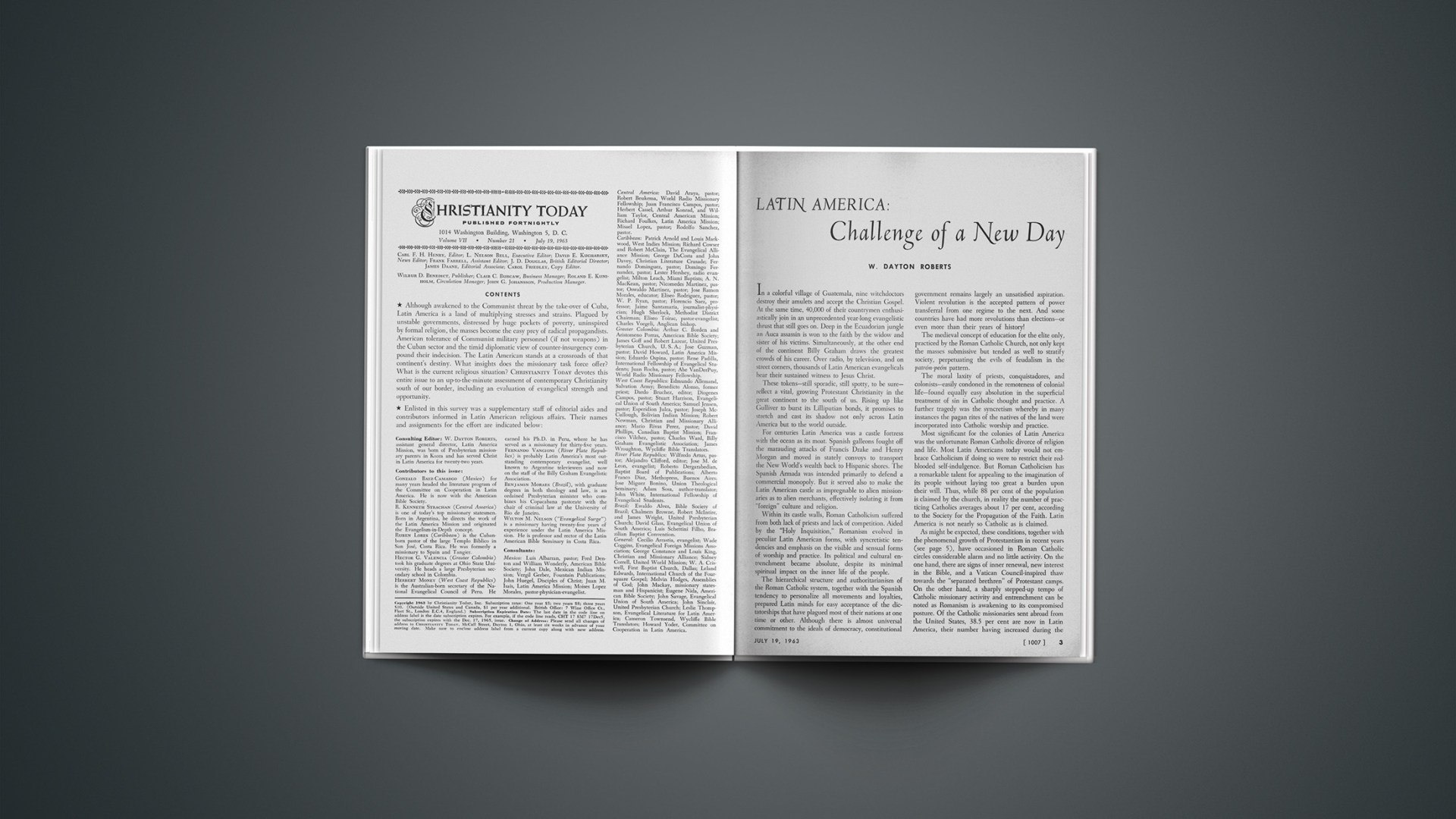
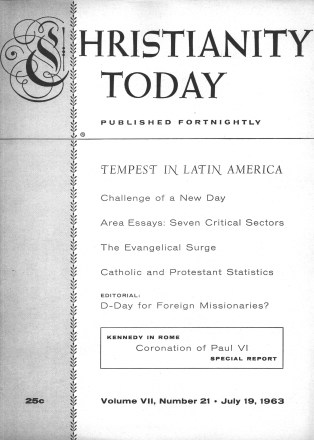
Latin America: Challenge of a New Day

In a colorful village of Guatemala, nine witchdoctors destroy their amulets and accept the Christian Gospel. At the same time, 40,000 of their countrymen enthusiastically join in an unprecedented year-long evangelistic thrust that still goes on. Deep in the Ecuadorian jungle an Auca assassin is won to the faith by the widow and sister of his victims. Simultaneously, at the other end of the continent Billy Graham draws the greatest crowds of his career. Over radio, by television, and on street corners, thousands of Latin American evangelicals bear their sustained witness to Jesus Christ.

These tokens—still sporadic, still spotty, to be sure—reflect a vital, growing Protestant Christianity in the great continent to the south of us. Rising up like Gulliver to burst its Lilliputian bonds, it promises to stretch and cast its shadow not only across Latin America but to the world outside.

For centuries Latin America was a castle fortress with the ocean as its moat. Spanish galleons fought off the marauding attacks of Francis Drake and Henry Morgan and moved in stately convoys to transport the New World’s wealth back to Hispanic shores. The Spanish Armada was intended primarily to defend a commercial monopoly. But it served also to make the Latin American castle as impregnable to alien missionaries as to alien merchants, effectively isolating it from “foreign” culture and religion.

Within its castle walls, Roman Catholicism suffered from both lack of priests and lack of competition. Aided by the “Holy Inquisition,” Romanism evolved in peculiar Latin American forms, with syncretistic tendencies and emphasis on the visible and sensual forms of worship and practice. Its political and cultural entrenchment became absolute, despite its minimal spiritual impact on the inner life of the people.

The hierarchical structure and authoritarianism of the Roman Catholic system, together with the Spanish tendency to personalize all movements and loyalties, prepared Latin minds for easy acceptance of the dictatorships that have plagued most of their nations at one time or other. Although there is almost universal commitment to the ideals of democracy, constitutional government remains largely an unsatisfied aspiration. Violent revolution is the accepted pattern of power transferral from one regime to the next. And some countries have had more revolutions than elections—or even more than their years of history!

The medieval concept of education for the elite only, practiced by the Roman Catholic Church, not only kept the masses submissive but tended as well to stratify society, perpetuating the evils of feudalism in the patrón-peón pattern.

The moral laxity of priests, conquistadores, and colonists—easily condoned in the remoteness of colonial life—found equally easy absolution in the superficial treatment of sin in Catholic thought and practice. A further tragedy was the syncretism whereby in many instances the pagan rites of the natives of the land were incorporated into Catholic worship and practice.

Most significant for the colonies of Latin America was the unfortunate Roman Catholic divorce of religion and life. Most Latin Americans today would not embrace Catholicism if doing so were to restrict their red-blooded self-indulgence. But Roman Catholicism has a remarkable talent for appealing to the imagination of its people without laying too great a burden upon their will. Thus, while 88 per cent of the population is claimed by the church, in reality the number of practicing Catholics averages about 17 per cent, according to the Society for the Propagation of the Faith. Latin America is not nearly so Catholic as is claimed.

As might be expected, these conditions, together with the phenomenal growth of Protestantism in recent years (see page 5), have occasioned in Roman Catholic circles considerable alarm and no little activity. On the one hand, there are signs of inner renewal, new interest in the Bible, and a Vatican Council-inspired thaw towards the “separated brethren” of Protestant camps. On the other hand, a sharply stepped-up tempo of Catholic missionary activity and entrenchment can be noted as Romanism is awakening to its compromised posture. Of the Catholic missionaries sent abroad from the United States, 38.5 per cent are now in Latin America, their number having increased during the last two years by 24 per cent in Central America and 27 per cent in South America. Yet even these 2,751 American Catholic missionaries represent only 7 per cent of the total Catholic missionary force in Latin America. From Spain alone there are more than 18,000. And the cry is for still more.

Protestant Christians (or “evangelicals,” as they are synonymously called in Latin America) likewise reflect their environment. As a natural reaction against the traditional Romanism of his pre-conversion period, the Protestant tends thereafter to be anti-ritualistic in his worship, puritanical in his ethic, and democratic in his exercise of the priesthood of all believers. More thoughtful evangelicals find in their own convictions and ministry the fulfillment rather than the contradiction of Rome. They see themselves as heirs of the great tradition of the sixteenth-century Spanish mystics, whose evangelical flame was snuffed out by the Inquisition, and of Fray Bartolomé de las Casas, immortal missionary to the Indians.

Into this heritage the evangelicals have introduced positive elements of their own. First and foremost, they are biblical in their theology and evangelistic zeal. This spiritual vigor stems from the pioneering work of the Bible societies and from the fact that Protestant work in Latin America was sired by either Pentecostals, evangelically oriented “faith” missions, or evangelical elements in the historic denominations. Except for a few small “pockets,” theological liberalism is absent.

Apart from its tremendous unfulfilled task of evangelism, the Church’s principal problem today is to effect a successful transition from a tiny minority group to a self-reliant and responsible segment of Latin American society. This process involves adoption of continually expanding evangelistic goals, for this is why the Church exists; its purpose is redemptive. It also involves the achievement of self-support and self-direction. But it includes something more: the assumption of social responsibilities hitherto neglected, and the definition of attitudes towards other social sectors and movements long ignored. Protestant Christians cannot in scriptural conscience wash their hands of the enormous social problems facing Latin America:

Poverty. Two out of every three Bolivians, for example, have never touched money. Only 1 per cent of the population of Latin America is affluent, and 65 per cent live in what we would call extreme poverty.

Ignorance. José Figueres says that there are seventeen million school children of primary-school age in Latin America who are not in school. More than half the adults cannot read or write.

Sickness. Average life expectancy is between thirty-five and forty years (as compared with about seventy in the United States). One who is living on less than half the daily required minimum of calories is especially prone to parasites, tuberculosis, and other diseases. More than half the population goes to bed hungry every night.

Illegitimacy. Nearly 80 per cent of the births in El Salvador are outside wedlock. Jamaica and many other countries are not far behind.

Economic feudalism. In Chile 1 per cent of the property owners possess 43 per cent of the land in cultivation. In Bolivia, 6.3 per cent own 91.9 per cent. More than 50 per cent of Latin American wealth is in the hands of 2 per cent of its population.

Militarism. Latin America spends $967,000,000 annually—more than 50 per cent of the aggregate national budgets—to maintain armed forces. Argentina has not fought a war since 1870, but has a well-armed force of 150,000 which controls the government.

To these could be added an interminable list of other problems: industrialization, slums, inflation, alcoholism, prostitution, governmental corruption, bribery, an antiquated penal system, inequitable taxation, and the like. These clamor for attention. And while they must never supplant the primacy of evangelism, the Latin American is discovering that he cannot be unmoved by the problems of social justice.

Equally urgent is the need for defining evangelical attitudes towards Romanism, Communism, and the Protestant ecumenical movement.

As long as evangelicals were a small and persecuted minority, they were forced to fight for their lives. Now they find themselves caught in the Roman Catholic thaw, and they are insecure. Should they continue to indulge in polemics and present an embattled front to Rome? Or should they try a more positive witness?

In the light of lessons learned in Cuba, what attitude should evangelicals take towards Communism and the social benefits it purports to espouse? Can they help prevent the anarchy of another Red revolution?

Within the fold of Protestantism itself, an issue of growing significance is the “ecumenical movement,” whose agencies and representatives show increasing interest in Latin America. Will Latin American Protestants react against the divisiveness of their brethren in the United States by welcoming the ecumenical embrace? Or will they continue to import a doctrine of “separation” that builds lines and divisions where now there exists fraternal unity and doctrinal harmony? Or is there a third way?

The Latin American evangelical church has come of age. The scale of priorities which it establishes in the areas of evangelism, social action, and religious relationships will, in God’s hands, determine to what extent the present phenomenal growth of the Gospel can be projected into the future. The essays in this issue trace the Church’s development to the present and its current posture in facing new responsibilities.

END

Review of Current Religious Thought: July 05, 1963

Wherever we turn we breathe the atmosphere of ecumenicity nowadays. There is an eager market for books on the theme of reunion, judging by the steady flow of such books from publishing houses on both sides of the Atlantic. The World Faith and Order Conference to be held in Montreal this month is almost certain to be an important milestone in the history of the ecumenical movement. And next month there is to be a Reformed Ecumenical Synod in Grand Rapids. The latter may be intended as in some sense a counter-balance to the World Council of Churches, but it is nevertheless a step forward from the divisiveness of denominationalism.

A manifestation of highly organized denominationalism will be seen, also next month, when the Pan-Anglican Congress assembles in Toronto. Given denominationalism, it is understandable, in this era of rapid travel, that representatives of the same allegiance from all over the world should find it advisable to meet together in consultation from time to time. Thus we find the far-flung Anglican communion and its assemblage matched by the Lutheran World Federation, the Baptist World Alliance, and others.

But I venture to inquire, with great reticence, what possible justification there is in Scripture and in Christian principle for the construction of these global denominational empires. There are all kinds of evils attendant on them, since, in the very nature of the case, they tend to complexes of superiority or inferiority, to arrogance, rivalry, head-hunting and head-counting, and comparisons that ought never to be made among Christians. Is not denominationalism just the modern way of saying, “I am of Paul; and I of Apollos; and I of Cephas; and I of Christ”?

In the sixteenth century Cranmer, Calvin, Melanchthon, and other Reformed leaders were anxious to promote a spirit of genuine ecumenicity. Cranmer’s plan for convening an international conference of Reformed Christians was frustrated only by his martyrdom. Calvin said he would not shrink from crossing ten seas to attend such a gathering.

It is a good thing for fellow Christians to meet together and, in the light of Holy Scripture, seek to heal their divisions. That light will show certain things very clearly.

It will show that while we should ever be zealous for the purity of the Church, we must not expect to find or to form a perfect Church here on earth. Even as the New Testament churches were mixed, deplorably so, both in faith and faithfulness (see Paul’s epistles!), so also are the denominations of our day.

It will show, none the less, that the only proper basis for Christian unity is agreement in the truth which the New Testament proclaims and obedience in the holiness which it enjoins.

It will show that departure from the truth as it is in Christ Jesus and from his obedience is departure from the faith once delivered to the saints and therefore from the community of God’s people.

It will show that at first there were no denominations competing with each other in the same society, but only the church in Corinth and the church of the Thessalonians, and so on.

The Reformers did not plan a unification of national or regional churches. Their grasp of biblical principles would not allow them to do that. What they desired was a unanimity of such churches in the cardinal doctrines of the faith, which would be a powerful witness to the world. Nor did they plan a uniformity of the churches. They recognized the right of every national or regional church to organize its own ecclesiastical structure according to its peculiar needs and circumstances, always with the provision that nothing be done contrary to Scripture.

The scandal today is our myriad denominations—blatantly displayed, very often in streets where a dozen rival fanes jostle for custom. In this age of the church mixed and the church militant, some degree of denomination is inevitable. In its origins denomination is a reaction against error or persecution. The church that is true is always coming out from, or being driven out by, the church that is false. And that requires denominating the true and the false.

But the question immediately confronting Christians is: Can we remove the scandal of the multitude of our denominations? Can we recapture the perspective of regional or national churches? This will be achieved only on the basis of unanimity in the faith of the apostles and flexibility on secondary issues of ecclesiastical administration.

The Church of South India has given a bold lead in this very matter. Imperfect and open to criticism though it undoubtedly is, it has found the method advocated in this article to be a road to blessing and the recovery of fellowship, and thus to effectiveness instead of fragmentation of witness. Its venture, however, is still a lonely one. It is still seeking for “recognition,” which means that it is being treated by others as though it were just another denomination instead of as the church of the saints which are in South India.

Finally, can we not, at least as a preliminary step, discard the habit of speaking of people as belonging to this or to that “communion”? The term itself, used in this limiting sense, is a blasphemy, swelling with the spirit of division and of separateness and of judgment against those of other “communions.” The communion of Christians is a sacred reality. It bespeaks their complete oneness and their free fellowship in Christ. It be speaks the union of the many at the sacrament of the Lord’s Table. Christianly speaking, then, a denominational “communion” is a contradiction in terms. Is Christ divided? Was Methodism crucified for you? Or were you baptized into the name of Episcopalianism?

Alas, it is easier to diagnose these ills than to cure them. And it is harder to see them in ourselves than in others. Before God, however, there is but one communion: the Communion of the Saints, which we profess in the creed but deny by the plurality of our “communions.”

Response to Bible-Prayer Ban

A DRAG ON HOME AND CHURCH—The Supreme Court ruling against prayer and Bible reading … marks a sad departure from this nation’s heritage under God. Far from putting the government in a position of neutrality toward religion, this ruling is another step in creating an atmosphere of hostility to religion. Rather than serving to protect against the establishment of religion, it opens the door for the full establishment of secularisim as a negative form of religion.… If this interpretation of the First Amendment is allowed to stand, it will make it far more difficult for the home and church to put fibre and build character into the lives of our children in this time of national peril and, thus, will have grave consequences.—Robert A. Cook, president, National Association of Evangelicals.

MORE, NOT LESS—I am shocked at the Supreme Court’s decision. Prayers and Bible reading have been a part of American public school life since the Pilgrims landed at Plymouth Rock. Now a Supreme Court in 1963 says our fathers were wrong all these years.… At a time when moral decadence is evident on every hand, when race tension is mounting, when the threat of communism is growing, when terrifying new weapons of destruction are being created, we need more religion, not less.—Billy Graham, evangelist.

ENCOURAGEMENT TO RELIGION—Public school religious exercises have tended toward an officially enforced religion which violates the rights of persons of minority faiths.… This decision is not a blow at religion.… It is an encouragement to religion since it takes religious leadership out of the hands of public officials where it does not properly belong and restores it to the church, synagogue and home where it does properly belong.—Glenn L. Archer, executive director of Protestants and Other Americans United.

OUT-MANEUVERING OURSELVES—I take my stand with the dissent, with Justice Stewart. I believe that eventually and overwhelmingly the American people will dissent. Is it not possible that in an effort to support separation of church and state we may maneuver ourselves into the position of supporting irreligion against religion? Separation should not be exclusion. Our Founding Fathers did not write exclusion into the Constitution. This republic was not so founded. It has not survived and grown great by excluding religion from public education. The distinguished Jewish rabbi, Dr. William F. Rosenblum, of Temple Israel in New York City, once said that the minorities should recognize the fact that majorities also have rights.—Daniel A. Poling, editor, Christian Herald.

TWO BASIC ERRORS—The decision carries forward the two basic errors of the New York prayer case last year, namely, a misinterpretation of the meaning of the words “establishment of religion” and the application of the due process clause of the Fourteenth Amendment to state laws on the subject of prayers in public schools.—Sen. A. Willis Robertson (D-Va.).

DILUTED AND DEPARTED—The more we attempt, as Christians or Americans, to insist on common denominator religious exercises or instruction in the public schools, the greater risk we run of diluting our faith and contributing to a vague religiosity which identifies religion with patriotism and becomes a national folk religion.… The decision … opens an era in which Christianity is kept separate from the state in a way that was foreign and would have been repugnant to the minds of our ancestors at the time when the Constitution was written and ever since. It signalizes the fact that the United States of America, like many other nations, is past the place where underlying Christian culture and beliefs are assumed in its life.—Franklin Clark Fry, president, Lutheran World Federation.

ECCLESIASTICAL DEFEATISM—When the newspapers … headlined … “Presbyterians oppose prayer in the public schools” the United Presbyterian Church confessed to the world a policy of defeatism.… Now the United Presbyterian Church is reluctant to declare: “Blessed is the nation whose God is the Lord” (Ps. 33:12).—Jacob J. Vellenga, minister, Brunswick United Presbyterian Church, Gary, Indiana.

PREDICTED CHURCH COUNTERACTION—The court ruling penalized the religious people who are very definitely in the majority in the United States.… The decision will encourage a new movement among Protestants and Catholics for parochial education simply to protect their children from a growing secularism which now seems to have invaded the courts.—Fred Pierce Corson, president, World Methodist Council.

DOOR NOT COMPLETELY SHUT?—It seems to me that where pupils decided on the issue by democratic process, and the majority feel that they would like to do something, there would be nothing wrong with that under this present decision.—James G. Stockard, chairman, School Board of Arlington County, Virginia.

HERE AND THERE—Arthur Lichtenberger, presiding bishop of the Protestant Episcopal Church: “The Court’s action is not hostile to religion”; General Board of the National Council of Churches: “Neither true religion nor good education is dependent upon the devotional use of the Bible in the public school program”; Patrick A. O’Boyle, Roman Catholic Arch bishop of Washington, D. C.: “disappointing”; Strom Thurmond, Senator (D-S. C.): “another major triumph for the forces of secularism and atheism which are bent on throwing God completely out of our national life”; Leonard J. Kerpelman, attorney for William J. Murray III: “insignificant compared with the other cases decided by the Supreme Court today”; Albert G. Minda, president of the Central Conference of American Rabbis: “We are gratified”; Jesse Anderson, South Carolina superintendent of education: “South Carolina will continue to feel free to do in each school or classroom the normal thing which the teacher feels should be done”; Carl McIntire, president, International Council of Christian Churches: “All Christians [should] work immediately for an amendment to the Constitution which will permit the reading of the Bible and the Lord’s Prayer”; The Washington Post: “not a prohibition of prayer but a protection of prayer”; The Evening Star (Washington, D. C.): “Will the baccalaureate service and Christmas carols be the next to go? Don’t bet against it.”

The Lure of Lucidity

The Lure Of Lucidity

“Gentlemen,” said Principal James Denney to a classroom of young preachers, “the first thing in a sermon is lucidity; the second is lucidity; and the third is lucidity.” Here, obviously, is a manner of speaking in which one employs a kind of guileless exaggeration in order to score a neglected point.

Clarity of sound and speech is one thing. Clarity of thought and syntax is quite another thing. The first is achieved by giving attention to enunciation. The second is the product (in combination) of logic, rhetoric, and illustration. If we fail here, the most flawless diction is no atonement. It is possible to call a sermon profound when it is merely opaque.

If we are to preach lucidly, there are certain procedures so fruitful that disregard for them is costly:

1. Go for a goal. How shall I word my subject? Admittedly, this is important. What is also important is to ask: How shall I state my object? We may or may not state it to our listeners; we should insist on stating it to ourselves. There is truth in the hoary quip, “Some sermons aim at nothing, and hit it!”

Perhaps we are tempted to reply, defensively, that this is a matter taken for granted, since the aim of all preaching is the proclamation of the Gospel. Such defense is not enough, for what is under discussion is a sharper, tighter concept of the preacher’s aim. Every sermon (evangelistic as well as pastoral) would be the better for it if at the beginning of his preparation the preacher asked himself: What is it that I want this sermon to do?

Let us say that it is in fact an evangelistic sermon. Let us say that its text is Romans 4:5: “And to one who does not work but trusts him who justifies the ungodly, his faith is reckoned as righteousness.” To himself, at least, if not to another soul, let the preacher say something like this: “In this sermon I intend to show the sense in which faith rather than works is the principle on which the righteous God accepts and justifies unrighteous men.”

This settled, he will want, both in preparation and in delivery, to keep the target steadily before him. Deviation from aim contributes to obscurity.

2. Strive to be simple. In analysis of preachers and preaching two opposites may be found, each as remarkable as the other: the skill with which some can take the profound and exhibit it with edifying simplicity and the sheer genius with which some can take the simple and twist it into dark obscurity. Sangster once told of a pastor who, called upon to thank the ladies for the tea they had served, expressed appreciation to them for “socializing our intellectual intercourse.” And there was the preacher whose oddity of mind was his tendency to reverse the law of reduction by which one passes from the complicated to the simple. One day, in an illustration that called for the simplest narrative style, he let fly with, “The man’s head was cut off; in other words, he was decapitated.”

In general, simplicity is achieved by avoiding the following: long words, complicated sentences, theological and pietistic jargon, rhetorical ornateness. As for jargon, one minister asked twenty-five people of average education to list words and phrases they often heard from preachers but did not understand. In the list were “dayspring,” “husbandman,” “heir of salvation,” “washed in the blood,” “balm in Gilead,” and “things of the flesh.” Used in an interpretive setting, these expressions have their place. Thrown out as isolated phrases, they may contribute nothing to comprehension.

3. Cultivate the concrete. Let this be done in both substance and style. When the lawyer asked, “Who is my neighbor?” Jesus could have given him a definition. He didn’t. Instead, He described for him a situation. Result? The figure of the Good Samaritan etched with a vividness that twenty centuries have been powerless to fade.

Be ye therefore followers [Greek, imitators] of God, as dear [beloved] children (Eph. 5:1; read vv. 1–17).

God is a good Educator. He has given us in Christ a perfect Example to imitate. God does not look on our walk as the means, but as the result of our acceptance. He wishes us to imitate him because we are his children, and know ourselves to be among his beloved. In order to prove ourselves his acceptable children, God would have us imitate him in three ways:

I. In Love, as Children of Love (5:2). The wonder of our regeneration is that we now can love somewhat as He loves. Love constitutes being like God in character and in action. When imitating God in love we strive to be like our Lord. To be like our Lord means to love souls, and to give ourselves that they may be saved. Thus for our brother’s good we must surrender ourselves. So begin your imitation of God by walking in love.

II. In Light, as Children of Light (5:8). The Lord Jesus is the Light of the world. And through belief in him we may become children of the light. Willingness to walk in the light calls for constant cleansing through the blood of Christ. Being children of the light means that we imitate our Lord, and do only those things that are pleasing in his sight. By contrast men walk in darkness. So our Lord wishes us who believe in him to lead others out of darkness into his blessed light.

III. In Wisdom, Understanding the Will of God. We are to imitate God in his wisdom, which one receives by re generation in Christ. When through response to the Gospel one receives wisdom, light comes, darkness recedes. Growth begins, and Christian fruit will soon appear. These are days when we have an opportunity to worship, to serve, and to live as God wants us to live. We still have time to prepare ourselves to live with him forever. What a paradox it is for people to think little about God now and yet believe that they will live with him forever!

There was never a greater need than now for imitating God. From this standpoint can you profess to be God’s child? If you answer the question affirmatively, this means that you are joined to Christ by faith, through a definite act of repentance, committal, and obedience. Only as such can you begin to be an imitator of God in love, in light, and in wisdom.—From Faithful in Christ Jesus: Preaching in Ephesians (Westwood, N. J.: Fleming H. Revell Company, 1958, pp. 200–207).

The Bible is full of this quality of concreteness. Jeremiah, for example, de scribes God as “rising up early and sending” the prophets to Israel and Judah. A theologian would discourse about “prevenient grace.” Jeremiah calls up the picture of God getting up early in the day, taking the initiative, always being out there in front, acting to give grace long before men can act to receive it.

4. Plan for progression. Dr. James Stewart of Edinburgh has a Christmas sermon in which he takes an Old Testament text, “What shall we do unto the child that shall be born?” (Judges 13:8), and then finds three representative replies in the story of the Nativity:

a. The answer of hostility:

Herod said in effect, “Let Him be destroyed.”

b. The answer of indifference:

The inn-keeper said in effect, “Let Him be ignored.”

c. The answer of commitment:

Simeon said in effect, “Let Him be accepted.”

In such a structure there is a logic-one might say a rhythm—of progression.

Clarity is enhanced if the preacher treats his topic and states his points in such fashion as to lead the listener to say to himself, “Ah, this is making sense.”

5. Ask for application. Ask it of yourself as the preparer of the sermon. Ask it of the man in the pew as the listener to the sermon. Put is in the form of a searching question: What will you do about it? Couch it in the language of ardent appeal: This I am asking of you—because I believe God is asking it. Cast it in the mold of an illustration: Here is how it happened in one man’s case. Whatever form it takes, make it! After listening to a listless, targetless sermon, John Wesley remarked, “As there was no application, it is likely to do as much good as the singing of a lark.”

The lure of lucidity! Let it seize the preacher. Let it have an endless place in his discipline. He will never make the truth plain to everyone. But let him follow these five guidelines, and he will have some reason to rejoice that truth’s arrow reached its mark.

PAUL S. REES

Have mercy upon me, O God, according to thy lovingkindness (Ps. 51:1a; read vv. 1–17).

Think of the mightiest man you know. One like David at his peak. A man of middle age, highly gifted and most effective. A leader in church and state. All at once he falls into the worst of sins, sins for which the law provides no sacrifice. At last he repents and prays. Listen!

I. A Prayer for Pardon. Without excuse or evasion he casts himself on the mercy of God. Note his words: “Out of bounds”—“Crookedness”—“Missing the mark”—“Being unlike God.” This mighty man has wronged others. He has fallen far below his best self. But he knows that his sin rests between him and God. Even if not so deadly, so does every man’s sin concern him and God. Are you enough of a man to acknowledge your guilt and pray to God for pardon?

II. A Plea for Cleansing. God waits, not only to pardon a man’s guilt, but also to cleanse his stains. God alone can make a sinner’s soul as white as snow—full of health and vigor—as clean as a new slate—as free from chosen evil as a newborn babe. What a Gospel! And what a God! As elsewhere, this Gospel is “the gift of God to the imagination”!

III. A Promise to Serve. After such a transforming experience, how can a pardoned sinner keep silent? Like a loyal member of Alcoholics Anonymous, this mighty man rises from his knees and goes out to find others, one by one, who sorely need the pardon, cleansing, and peace that God alone can give and no one on earth can take away.

Whenever the church bells ring out a call for the worship of God in his house, the changed one rejoices to sing praises and pray with others who have been born again. He finds joy in giving money as a vital part of public worship, not grudgingly but with gladness, out of gratitude for grace that would not let him go on in sin, but set him free to worship God and serve his fellow men.

Thank God for what the Gospel can do for a man or a woman of middle age! Thank him also for what a man or a woman of middle age, once having tasted the goodness of God, can do in bringing others to God, one by one, to find the same sort of pardon and cleansing, peace and joy.

My friend, have you had such a personal encounter with God? Have you confessed your sins and thrown yourself on his mercy? If so, you have abundant reason for bringing others to Christ, one by one, for joining with them in worship, and for giving in the spirit of the Cross.

Upon the first day of the week let every one of you lay by him in store as God hath prospered him (1 Cor. 16:2a).

The Gospel centers in giving. One-sixth of the New Testament concerns a man’s possessions and his God. From Him they all come; to Him as gifts to the church they should largely go. Don’t raise God’s money—there is a better way: give!

I. The Manner. Paul’s first readers are poor folk, plagued by war, burdened with taxes. Yet they give far beyond their means, and gladly. For an example now turn to Korea. Along a rural lane American tourists took a picture of a boy dragging a plow guided by an old man. Later a missionary said that the family had sold its only ox for money to help erect a village church. This is the kind of giving that pleases God, who loves a “hilarious giver” (2 Cor. 9:7, Greek).

II. The Method. First, the readers gave themselves to God. Supremely desiring to honor him they dedicated their all: time, energy, possessions. Our giving should be systematic. Starting with the tithe, gladly give thanks offerings. When we first give ourselves to God, this duty becomes a delight. Not until we come to such a method do we begin to give as Christians. If not, every challenge for investment of self, time, or substance may seem an intrusion, even a hardship, and may cause resentment. As believers one by one we need to catch a vision of the Cross as the supreme example of God’s way for us believers in Christ to give.

III. The Motive. Here Paul bases his appeal on the resurrection of Christ: “Therefore, my beloved brethren, be ye stedfast, unmovable, always abounding in the work of the Lord.… Now concerning the collection for the saints.…” Elsewhere Paul turns to the Incarnation (Phil. 2:6–8), and most often to the Cross as the supreme motive for our Christlike giving. Thus our most difficult duty springs directly from the most wondrous Christian doctrine, which has everything to do with God’s love for us sinners, as made known supremely on the Cross (1 John 4:10).

In the way of doctrine set to music, truth sings out from one of our most beloved hymns, which voices God’s kind of stewardship:

Were the whole realm of nature mine,

That were a present far too small;

Love so amazing, so divine,

Demands my soul, my life, my all.

In all giving let your supreme motive be the grace of God. How does He give, and why? If church folk would think first about His way of giving, what a transformation would come, both in habits of giving and in the amount! “See that ye abound in this grace also.”—Pastor, United Presbyterian Church, Newton, Massachusetts

Dedicated to assisting the clergy in the preparation of sermons, the feature titled The Minister’s Workshop appears in the first issue of each month. The section’s introductory essay is contributed alternately by Dr. Andrew W. Blackwood and Dr. Paul S. Rees. The feature includes, also, Dr. Blackwood’s abridgments of expository-topical sermons, outlines of significant messages by great preachers of the past, and outlines or abridgments of messages presented by expository preachers of our own time.—ED.

One thing have I desired of the Lord (Ps. 27:4a; read vv. 4–6).

Often we wonder what sort of vision fills the heart of a saint when he is on his knees before God. In the psalm before us we can hear such a saint of old. Thus anyone can see what forms the all-attractive goal of his devotional life.

I. The Quest for God. This believer prays that he may ever abide in the presence of his God. The suppliant knows that the Lord is ever near, and asks that His believing servant may constantly feel aware of God’s presence and of His readiness to bless.

The believer also asks that he may continually behold the beauty of the Lord and that he may find his highest joy in the worship of his God. In terms of today, what does all of this mean? Simply that in his prayers a saint keeps putting God first. What an ideal for us now!

II. The Blessing from God. What of the issues from such a life of devotion? A. A Spirit of Restfulness. Whatever the gale that rocks the surface of the deep, such a believing heart finds rest in the peace of God. B. A Sense of Security. In the midst of storm and disaster, the man who feels sure of God keeps calm and serene. “The Lord is my Rock.” With such a foundation for his faith, what can cause a saint of God to fear?

C. A Feeling of Elevation. The things that once caused a saint to tremble he now keeps under his feet. Out of the old worries, irritations, and perplexities the Lord lifts up the soul of his servant and sets him firmly upon a rock, above the reach of his old-time foes. What an ideal! Also, a fact of experience, and a sign of growth into the likeness of God.

In view of such a saint on his knees, what shall one conclude? Surely this: “Lord, teach me to pray, and in all my prayer life lead me to honor thee.”—Adapted from Brooks by the Traveller’s Way, n. d., pp. 163–73.

Approaching the Bible

SOME IMPLICATIONS OF A SOUND SCIENTIFIC APPROACH:

1. This approach offers a tremendous challenge to the study of the Bible itself. If the Bible is what it claims to be, and what Jesus and his apostles assert it to be—the fully inspired, infallibly authoritative Word of God written—this view enhances the importance of the Sacred Oracles, features the significance of textual criticism, gives impetus to the cultivation of minute exegesis of the Hebrew and Greek Scriptures, and spurs linguistic and archaeological research and any other pertinent studies which help in understanding the Bible better on the human plane.

On the other hand, subjectivist treatment of the Bible, to the degree that human reason sets aside the Word of God, tends toward a drastic reduction of interest in the biblical languages and minute exegesis of the original text. In fact subjectivist criticism tends toward study about the Bible rather than study of the Bible itself; its interest frequently stops short at the means to the end (studies relating to the Bible) rather than going on to the end itself (the study of the message and the meaning of the Bible in the light of these studies). Or if the study is applied to the Bible itself, the message and meaning are often explained away or largely set aside.

2. This approach fosters the spiritual understanding of the Bible as a unified revelation. Viewing Scripture as verbally in spired and fully authoritative calls forth faith, challenges Spirit-directed human reason, inspires intellectual humility, arouses holy expectations of the panoramic scope and consummation of sacred history and prophecy, and provokes scientific inductive study that, in turn, nurtures sound exposition based on solid exegesis, which furnishes the basis of an exhaustive biblical theology that is worthy of the name.

The subjectivist approach, to the degree that it denies scriptural authority, forfeits these benefits. Instead it inspires doubt, shies away from reliance upon the Spirit of God to guide human reason, engenders intellectual pride, quenches expectation of the fulfillment of prophecy in its panoramic scope, and is incapable of doing justice either to biblical exegesis or to the creation of an adequate biblical theology. This is conspicuously true of the old-line liberalism of the nineteenth and early twentieth centuries. It is still true to a degree of neoorthodoxy and the “biblical theology” movement of today, which, although it strives at all costs to be biblical, nevertheless still clings to the unbiblical methods of criticism which the heretical liberals of the last century worked out under the false impression they were scientific.

An example of the inadequacy of the new liberalism’s theological content is Gerhardt Von Rad’s conclusion on the person of Moses. Following Martin Noth, Von Rad concludes that “the figure of Moses had no place in a great number of the Pentateuchal traditions.… But even those who believe that the historical element can be regarded as broader and more firmly founded than this are, for all that, far from gaining the picture of Moses as the founder of a religion so urgently sought by the modern reader. In every case they only reach very ancient individual traditions which are difficult to reconcile with one another” (Old Testament Theology, I, 14, 1962).

If this is true of Moses, a type of the Great Prophet to come (Deut. 18:15–18), what sort of a biblical theology may be expected under such a subjectivist approach? This is intellectual anarchy run riot, the result of the assumption that historical inquiry is only “scientific” when it is divorced from Christian presuppositions. If the biblical theology movement is to produce sound and exhaustive biblical theology, it will not do so until it realizes that Scripture is studied “scientifically” and “objectively” only when it is approached in full recognition of its character as Scripture, the infallible Word of God, and not assumed to be a maze of discordant traditions, with scholarly activity devoted to proving this and dedicated to rescuing a modicum of theological truth from the resultant debris.

But the scholar who is willing to approach the Bible on the basis of faith rather than unbelief, and who is willing to give it a chance to prove it is what it claims to be, a verbally inspired divine revelation, rather than starting out to prove it a fallible and faulty tradition, will be rewarded with a wealth of spiritually and intellectually compensating exegesis of the original text that will furnish the basis by inductive study for an exhaustive, coherent biblical theology. Moreover, such a reverent scholarly approach, using all the legitimate findings of modern biblical research plus the gains in textual criticism, will be in a position to see in detail as well as in panoramic perspective God’s plans and purposes of the ages. Fullness of detail and clarity of scope will characterize all of theology.

3. This approach encourages the highest and most God honoring type of interpretation. This, we believe, is the grammatical-historical-critical method that takes into account all the advances in Hebrew and Greek syntax, Bible history, geography, and archaeology, as well as the conclusions of sound criticism, both higher and lower. This sort of interpretation takes the full gamut of Scripture as equally inspired and regards all phases of the divine revelation as important. It seeks to deal with all and to interpret all as a unified system of truth. It seeks to reconcile seeming discrepancies and difficulties on the basis of rigid inductive logic. Never does it deductively superimpose doctrinal conclusions on the Bible; it allows the particulars to produce the generalizations. This is but saying that the Bible is to produce its own theology instead of having man’s theology imposed on it; in other words, the Bible is to be interpreted scientifically.

A correct and workable system of interpretation that harmonizes many difficult and seemingly conflicting passages is needed as a vital part of the apologetic for the truth of full scriptural authority. Part of the reason for the wholesale rejection of verbal inspiration is the refusal of many evangelicals to rise to a system of interpretation worthy of the Bible as a fully authoritative revelation from God. If unbelief is manifested in an unscientific rationalistic criticism that refuses full scriptural authority, unbelief may also be manifested by those who, although subscribing to this truth in theory, yet reject it in practice by refusing to interpret its teachings by a literal, grammatical, historical, critical, rigidly inductive method that believes the Bible says what it means and means what it says, and take all that Scripture says on a subject in its exegetical, expository, and theological systematizations.—Dr. MERRILL F. UNGER, professor of Old Testament, Dallas Seminary.

Book Briefs: July 5, 1963

We Here Read Augustine

The Word of God According to St. Augustine, by A. D. R. Polman (Eerdmans, 1962, 242 pp., $5), is reviewed by Addison H. Leitch, professor of philosophy and religion, Tarkio College, Tarkio, Missouri.

Not since the days of MacKinnon in his volumes on Luther and Calvin have I run into the mastery of mass material which is to be found in Polman’s book. He assures us in his introductory remarks that whatever else we read in the book, we will read Augustine, and this we do. But, in addition to long quotations, we also have Polman’s artistry by which great portions of Augustine are paraphrased or digested. The impact of direct quotation and paraphrase is very impressive.

The Word of God According to St. Augustine is the first volume in Polman’s major work on the theology of St. Augustine and gives us great promise of riches ahead. Other volumes in the proposed series are on the doctrine of God, Christology, and Church and sacrament. Each volume, moreover, is to be complete in its own right; this is certainly true of the present volume.

Augustine’s theology is not systematic (“Augustine frequently corrected his out bursts of zeal,” p. 101), and thus far no one has made a systematic study of his doctrine of Scripture from his unsystematic material. “Significantly enough, though the Word of God took so important a place in St. Augustine’s life and thoughts, no comprehensive study on this subject has been published.… We shall make a point of letting St. Augustine speak for himself” (p. 11). Both of these things the author has done very well. The book is also a rich source of material on some of Augustine’s opponents, the argument with Faustus being a classic portion of this volume.

The strongest chapter is “The Word of God as Proclamation.” This is refreshingly new material, not only on the Protestant position but on the usual discussion of the Roman Catholic position. The most disappointing is “The Word of God in Holy Scripture”—possibly because we are looking in Augustine for more than he is giving us on the conservative view of Scripture. One is impressed again with Augustine’s strangeness of allegory. Impressive also are the differences of emphasis in the Church of Augustine’s day as against what we think is important today.

The author sums up the last chapter in a climax of profound devotional material from Augustine himself.

ADDISON H. LEITCH

Treason Yet

Apologetics and Evangelism, by J. V. Langmead Casserley (Westminster, 1962, 186 pp., $4), is reviewed by C. Gregg Singer, professor of history, Catawba College, Salisbury, North Carolina.

In its concern for the mutual relevance of the sociological, philosophical, and theological disciplines, this study, by the professor of philosophical theology at Sea-bury-Western Theological Seminary (Evanston, Ill.), is a far cry from the usual evangelical approach to Christian apologetics. Although the author, an Episcopal clergyman, emphasizes the mutual relevance of these three disciplines, his main thrust is in the direction of a sociological apologetic. Thus for his basic thesis he adopts the sociological dictum that in a given society, the “consecrated elite will serve the mass culture and the mass life loyally because it knows that this mass life is its inevitable and proper context” (p. 16). He then assumes that what is true for society at large is also true for the Church, and thus “the main task of elite thought … is to understand and express the virtues of mass thought, with a view to rending culture and society sufficiently conscious of them to be able to defend and preserve them” (p. 23).

Proceeding on the basis of this assumption, Casserley indicts the Reformation because it failed to realize this sociological duty of theology; he says that the Reformers “had not sufficient understanding of the characteristic excellencies of the church’s traditions to succeed in such a venture … namely to help the church where it has been right so that it may continue to be right with greater integrity than in the past” (p. 37). He also accuses CHRISTIANITY TODAY of the same kind of treason to mass culture.

Although he shows a certain sympathy with Bultmann, and admits that there are myths in the Scriptures, he nevertheless holds that liberalism has sinned against God, the Bible, the historic faith, and reason.

What solution, then, does he offer to the problem of formulating a meaningful apologetics for the masses in contemporary society? He finds the answer in a return to the system of Thomas Aquinas because he represented the “elite mind achieving not only a mastery of its own proper elite material, but also a sympathetic understanding of the implicit mass thought underlying the whole structure of the mass life” (p. 37).

There is in this book no real apologetical system worthy of the name, and there is even less evangelism. In fact, apart from the title, evangelism is hardly mentioned. This reviewer is at a loss to understand how a press bearing the name “Westminster” can publish a book which presents Calvin and Luther as sincere but grossly mistaken in their theology, and then offers, in place of their Reformation theology, an apologetical system which is the bulwark of the Roman Catholic system of thought. It seems almost as if the presses of the major Protestant denominations are engaged in some kind of a crusade, or even conspiracy, to destroy our Reformation heritage in a vain effort to find some kind of ecumenical substitute which lacks both the content and authenticity of the historic faith once delivered to the saints.

C. GREGG SINGER

It Opens Windows

Before the Bible, by Cyrus H. Gordon (Harper and Row, 1963, 319 pp., $6, or 35s.), is reviewed by K. A. Kitchen, lecturer in Egyptian and Coptic, Liverpool University, Liverpool, England.

In this book the professor of Near Eastern studies at Brandeis University seeks to demonstrate that the “Greek and Hebrew civilizations are parallel structures built upon the same East Mediterranean foundations” (pp. 9, 302) of the second millennium B.C.—that, in other words, the peoples of the Aegean and of Syria-Palestine shared an appreciable number of social and religious attitudes and conventions, and characteristic forms and topics in epic (or epic-like) literature at that period.

This shows up when a comparison is made of data from the Homeric epics (reflecting the world of the Mycenaean/Achaean Greeks), from the Old Testament record down to David’s time, and from the North-Canaanite literature from Ugarit in Phoenicia. Many of the parallels drawn by Gordon between these three sources seem to reflect a common stock of attitudes and usages which cannot normally be shown (so far) to have been borrowed from any one source by the other cultures. Various parallels are probably the result of “convergence,” i.e., the human mind’s arriving at the same result in similar circumstances. Then some items probably are cases of cultural “transference” or borrowing. But Gordon’s comparisons reach beyond the Aegean and the Levant, out into Mesopotamia, Egypt, and Asia Minor (Hittites) for parallels. Very often, the Mesopotamian and Egyptian sources used are older than our Aegean or Hebrew material, and cultural diffusion from the older to later is either likely or certain.

Gordon’s book is an organic treatment of his theme. After the Introduction, in which the thesis is stated and illustrated, comes “Channels of Transmissions,” an important chapter that rightly emphasizes the multiplicity of contacts (trade, conquests, migrations, “colonies,” traveling “professionals,” and so on) that facilitated fruitful intercourse between the peoples of the Ancient Near East at various social levels. Then in successive chapters Gordon adduces his parallels from the literatures of Mesopotamia and the Hittites, of Egypt, and especially of Ugarit, in each case giving brief notes on the historical setting. In Chapter VI, he introduces the ancient scripts of Crete together with his decipherment of the Linear A script as containing a Northwest Semitic language. In the two final chapters, he gives further parallels between Homer and the Orient and between the Old Testament and early Greek data, ending with a postscript on his Semitic decipherment of the Eteocretan inscriptions.

The whole is eminently readable, fascinates from start to finish, and helps to open one’s mind to all manner of new possibilities. Orientalist Gordon’s emphasis (p. 20) is rightly on the primary source-material from antiquity itself—and not on the futile citation of others’ subjective opinions that so largely blights Old Testament scholarship. His brief remarks on attitudes acquired in learning are salutary (pp. 11, 12, 127).

Gordon’s main thesis of a large measure of common cultural background for the Aegean and Levant in the second millennium B.C. may safely be conceded; both here and in his Homer and Bible (1955) he gives in outline enough weight of varied comparative data to amply justify his point. The only overall objection one can voice is that his treatment is so much in outline only; a fuller collection and more detailed weighing of data is desirable in order to see more clearly just how much is established. Gordon’s parallels are not all of equal scope or weight. In the Introduction, the triads-of-heroes parallel is valuable; the chapters on channels of transmission and Egypt contain many good points, as does the literary part of chapter III. In the long chapter on Ugarit, comparisons with the KRT-text are often very useful; the same can be said for much of chapter VII (Homer and Orient) and parts of VIII. It would be easy to add to, and reinforce, not a few of Gordon’s items.

Reading for prespective

CHRISTIANITY TODAY’S REVIEW EDITORS CALL ATTENTION TO THESE NEW TITLES:

The Church and Its Ministry, by David Belgum (Prentice-Hall, $6.60). A solid study of the ministry of the Church in the wide areas of its pastoral concerns.

Man in the Struggle for Peace, by Charles Malik (Har per & Row, $5). Prominent Christian statesman lays strategy for a distinctively Western revolution which will prepare the world for peace as well as for war.

Things Most Surely Believed, edited by Clarence S. Roddy (Revell, $3.95). The faculty of Fuller Theological Seminary in a fifteen-voice symposium declares its understanding of and commitment to the great affirmations of the Christian faith.

The reviewer is as averse to needless emendation as anyone, but Gordon’s ex planation of First Samuel 13:1 is too forced for its context (pp. 228, 229); the suggestion about Psalm 23:5 (p. 187) will raise with most of us simply a laugh or a gasp, but not conviction in context. Two points on the patriarchs are very dubious. The evidence for Ur of the Chaldees being Ur of the Sumerians (rather than in North) and the sheer unreality of Abraham’s ever having been a state-controlled tamkarum-merchant of the Hittite realm have been clearly shown by H. W. F. Saggs in Iraq (22 [1960], pp. 200–209).

The space-limits of this review exclude any real comment here on the lively debate about the validity of Professor Gordon’s Semitic decipherments of Minoan Linear A and Eteocretan (chapters VI and VIII, end). His solution is very attractive, and if true would certainly strengthen the main line of this book.

Here is a real contribution to study of the Ancient Near Eastern background of the Old Testament; some points will fall by the wayside, but many others are worthy of more detailed study. Professor Gordon is ever an independent investigator of the original Oriental source-data, and the reviewer, for one, always learns something of value from his publications.

K. A. KITCHEN

Testament Of Life

A Private and Public Faith, by William Stringfellow (Eerdmans, 1962, 93 pp., $3), is reviewed by John Feikens, attorney, Detroit, Michigan.

This is a personal testament. Its author is a practicing lawyer, thirty-five years of age, a member of a New York City law firm.

Lawyers customarily draft testaments for others. This lawyer has made one for himself. Testaments drawn for others contemplate the passing at death of the testator’s personal property to others. This testament speaks of life—what it means from a Christian’s viewpoint and how it may be shared.

Because it is a testament, it is subjective, a personal testimony. But this subjectiveness does give one a feeling that it is too much a spontaneous outpouring. A lawyer might say—too much conclusion and not enough fact.

I think Mr. Stringfellow is at his best in the too few instances in which he relates conclusions he bases on his own concrete experiences. He has a wealth of background for this, practicing as he does in New York City. Had the private faith of this lawyer, already a prominent Episcopal layman, been demonstrated in terms of his multiple actual experiences as a lawyer-layman, the book would have had greater depth. While Mr. Stringfellow has a solid capacity for exegesis, one would like to read more about his Christian faith in actual practice.

As we work out God’s will in our own time, we need strong direction both from the pulpit and from informed laymen. Because of Mr. Stringfellow’s conviction and dedication we will undoubtedly hear more from him, and it will probably be in this area. For this is the goal to which I sense he is moving, and his insight into the central issues of Christianity will cause its realization.

JOHN FEIKENS

Bishop, Make Room

The Christian in Society, by Jeremiah Newman (Helicon, 1962, 208 pp., $4.50), is reviewed by Earle E. Cairns, chairman of the Department of History and Political Science, Wheaton College, Wheaton, Illinois.

The role of the Christian in society and its theological rationalization are occupying Protestantism increasingly. This Roman Catholic writer faces the added problem of controlling social action by the hierarchy. Thus the book involves discussion of the role of the laity in the church as well as in civil society.

History is canvassed in a scholarly fashion to show how healthy lay participation in the Apostolic and the Old Catholic Churches gave way in the medieval institutional church to a clerical reaction against lay intrusion into clerical concerns. This intrusion and monasticism led to an unhealthy bifurcation of clergy and laity and to the opposite evil of clerical domination of the laity. This in turn brought about the democratic reaction of conciliarism and, according to Newman, the democratic Reformation. The author seeks to restore the laity to its proper place in his church.

Theology is next enlisted to justify an apostolate of the laity. This is done by a distinction between the powers of the hierarchy in the institutional church and the laity as an essential part of the Church conceived as the community of Christians in the world. The lay apostolate is conferred in Baptism and Confirmation as a unified rite of initiation into prophetic service. This lay apostolate of witness in the Church and to the world and the “Christianizing” of social institutions must always be united with, and sub ordinate to, the hierarchial apostolate (pp. 71, 106). The writer pleads for more consideration of the Church as Community.

He then discusses a positive approach to a theology of social action to counter the humanism of nineteenth-century democratic liberalism and the Industrial Revolution. The consequent withdrawal of the Church to preach only transcendent personal salvation must give way to a social theology which deals with present life.

This involves the juridical question of a legal framework in canon law for such a lay apostolate in which the bishop might set apart laymen for spiritual and social service. Thus the Catholic Social Movement in Christian Democratic parties would be given sound juridical, theological, and historical foundations.

EARLE E. CAIRNS

Magnum Opus

New Testament Introduction: Hebrews to Revelation, by Donald Guthrie (Inter-Varsity, 1962, 320 pp., $4.95), is reviewed by Ronald A. Ward, professor of New Testament, Wycliffe College, Toronto, Canada.

Thirty years ago the students of a conservative evangelical seminary approached their principal with objections to the study of A. S. Peake’s Critical Introduction to the New Testament. They were told, sympathetically but firmly, that until evangelicals bestirred themselves and wrote the books there was no alternative. In those days it was, almost, Peake or nothing.

Times have changed, and Dr. Guthrie’s work is a massive indication of this fact. The companion volume on The Pauline Epistles was published in 1961, and we eagerly await the final one on the Gospels and Acts. Already this magnum opus is being compared with similar products of Zahn and Moffatt. The author deals comprehensively and exhaustively with questions of date and destination, author ship and purpose. Problems which many had thought to be settled are found to be still unsettled; “closed” questions are found to be wide open. Dr. Guthrie’s learning is immense, as a study of the footnotes and the bibliographies will prove. Discussion is detailed, courteous, and fair. The author gives both sides of disputed matters—yet it is not the complete objectivity of an F. C. Baur, with no trace of personal needs. Scrupulously fair, Dr. Guthrie is a believer with a conservative sympathy and an evangelical experience. (“Spiritual quality is not a matter of skill, but of inspiration.”)

It is not given to every scholar to avoid mental indigestion, but the author has assimilated his reading well; his knowledge is a unity. Has the more polished Greek of Jude been marred in Second Peter? It is the opposite with Mark and Matthew: it is generally thought that Matthew polished Mark. A man immersed in writing twenty-five pages of concentrated scholarship on Jude’s epistle might be forgiven for forgetting even the existence of the synoptics.

Dr. Guthrie is an authority on pseudonymity, and his mastery in this field is apparent though not obtrusive. He challenges the current view which holds the pseudonym to be a harmless device and an accepted literary convention. In con sequence of this—and of the book as a whole—we can hold fast to many a traditional view with academic integrity. There is a useful analysis of the “contents” of each New Testament book considered. The format is excellent and the misprints few.

The author is to be congratulated—and thanked. This will be a standard work for a generation.

RONALD A. WARD

Around And Back

Full Circle, by Grace Lumpkin (Western Islands [395 Concord Ave., Belmont 78, Mass.], 1962, 312 pp., $4), is reviewed by Bastian Kruithof, associate professor of Bible, Hope College, Holland, Michigan.

If truth is stranger than fiction, good fiction can present truth. In this novel Grace Lumpkin has done that very thing. Her story is a challenging one, all the more so because it is in large part her own.

A mother and her daughter, left stranded by a clergyman husband and father, dedicate themselves to the Communist cause. Years of cell meetings and planning go by with dedication there to the nth degree. But one day the daughter is ousted from the party. The blow affects her to the extent of shattering her mind. In quiet Bethel, far away from New York, the mother devotes herself to nursing her child back to normal life. She is disturbed by the thought that her daughter had been found on the steps of a church by a policeman. A Christian Negress and a converted Jew slowly but certainly influence the mother to surrender to the Christian faith. In the end the derelict husband and father returns as a sodden alcoholic. The daughter revives and reaches out her hand to her father and the reunion takes place. At least two lives have come full circle, with the promise of a third.

Grace Lumpkin writes well. In past years one of her novels won the Maxim Gorky Award for the best proletarian novel. Full Circle should win her another award in the hearts and minds of Christians and of those who are reaching for the light. It is an exposé of the ruthless ness and hopelessness of Communism and a firm presentation of the Christian faith with all its implications. For it is love, not hatred and violence, that is still the greatest of these.

Put Full Circle next to To Kill A Mockingbird. It ranges above it in positive Christian conviction.

BASTIAN KRUITHOF

Book Briefs

Strength to Love, by Martin Luther King, Jr. (Harper & Row, 1963, 146 pp., $3.50). Sermons whose background is the evils of war and of economic and racial injustice. Each sermon has been preached in the pulpit; three written from Georgia jails.

Evangelism in the Early Church, by Stan ley C. Brown (Eerdmans, 1963, 73 pp., $2). A handbook for individual or group study of evangelism in the light of Acts.

Neurotics in the Church, by Robert James St. Clair (Revell, 1963, 251 pp., $4.50). The author deals with the neurotic church and church member and shows that the clergyman is often a distressing element to the neurotic personality. The book hits hard, though it is sometimes hard to see just what it is trying to hit.

The Bible and the Church, by Samuel Terrien (Westminster, 1963, 95 pp., $1.50). An approach to the Bible which predetermines its significance in a manner that will set many theological teeth on edge. But for all of that, highly readable and highly revelatory of modern views concerning Scripture.

Biblical Archaeology, by G. Ernest Wright (Westminster, 1963, 291 pp., $10.95). Re vised and expanded by the demands of recent excavational discoveries. With drawings, photographs, reconstructions, and maps. A book of fine craftsmanship.

New Testament Aprocrypha, Vol. I: Gospels and Related Writings, edited by Wilhelm Schneemelcher, English translation by R. McL. Wilson (Westminster, 1963, 531 pp., $7.50). Collection of the gospels of Truth, of Mary, of The Twelve, of Philip, of Thomas, of Judas, and a host of others: with a general discussion of the subject, and guidance on using the book.

Christian Priorities, by Donald Coggan (Harper & Row, 1963, 172 pp., $3.50). Twenty short essays deal lucidly and forcefully with Christian truths which should be given priority of thought and action in the world of today.

The Asians, by Thomas Welty (Lippincott, 1963, 344 pp., $4.95). Introducing the people of Asia: their religions, their women, their family and social life, their politics and economics. Clear, informative.

Creeds and Confessions, by Erik Routley (Westminster, 1963, 159 pp., $3.50; Duck worth, 1962, 15s.). Seven of its ten chapters treat some but not all of the classic confessions of the sixteenth and seventeenth centuries. The author, with an eye on ecumenics, provides a background of inter-confessional relationships for a better understanding of present interchurch relations.

Called to Teach, by Charles D. Spotts (United Church Press, 1963, 111 pp., $2.50). A book which urges the delights, satisfactions, demands, temptations, and opportunities of those who teach in the educational department of the church. Excel lent for teachers.

A Nation Needs to Pray, by Robert B. Anderson (Thomas Nelson, 1963, 112 pp., $3.95). An artistic production; more than 90 striking photographs combine with written text to spell out the reasons America should be a nation that prays.

The Psychology of Christian Experience, by W. Curry Mavis (Zondervan, 1963, 155 pp., $3). A book which says many interesting things but establishes little more than a surface relationship between psychology and the Christian faith.

The Lord’s Prayer: An Interpretation, by Charles L. Allen (Revell, 1963, 64 pp., $2). Originally included in the author’s God’s Psychiatry, it now appears as a special class edition, with some fine art work. A nice gift.

The Heretics, by Walter Nigg (Knopf, 1962, 422 pp., $6.95). The stories and struggles of heretics, such as Pascal, Luther, Hus, Origen, Abelard, and many others. “Young Turks” will find this interesting reading, and dull conformists will find it also disturbing.

The Pastor’s Counseling Handbook, by James L. Christensen (Revell, 1963, 181 pp., $3.95). A concise, practical, popular presentation.

Life Is Forever, by Glenn Alty Crafts (Abingdon, 1963, 93 pp., $2). A no-quarter-asked-or-given discussion from the Christian perspective of life and death.

Sermons on Bible Characters, by John A. Redhead (Abingdon, 1963, 144 pp., $2.75). Short, practical, evangelical.

Sermonic Studies: The Standard Epistles, Volume II, The Trinity Season (Concordia, 1963, 616 pp., $7.50). Thirty-one sermons, preceded by their outlines and by the study and reflection which went into their making.

Paperbacks

Church and State in Your Community, by Elwyn A. Smith (Westminster, 1963, 90 pp., $1.25). A rounded, non-technical study of church-state relations.

Studies in Church-State Relations (P.O. A.U., 1963, 71 pp., $1). Brief, popular series of studies on the American tradition of church-state relations, by Protestants and Other Americans United for Separation of Church and State.

Christian Responsibility in Society (Faith and Life Press, 1963, 18 pp., $.35). What is Christian responsibility beyond evangelism? Answer: Christ’s work of creation, redemption, and consummation is the “biblical-theological basis for a total ministry to the total man, individual and social.”

Jean-Paid Sartre: The Existentialist Ethic, by Norman N. Greene (University of Michigan, 1963, 214 pp., $1.75). A study of Sartre’s existentialism measured against Roman Catholicism, liberalism, and Marxism.

Catholicism, edited by George Brantl, Hinduism, edited by Louis Renou; Islam edited by John Alden Williams; Judaism, edited by Arthur Hertzberg; Protestantism, edited by J. Leslie Dunstan (Washington Square Press; 1963; 277, 226, 242, 261, 257 pp.; $.60 each). A well-organized compilation of definitive writings; with an objectivity sometimes purchased at the expense of depth. First printed in 1961.

Jonah, Jesus, and You, by Mariano Di Gangi (The Bible Study Hour [12 Spadina Road, Toronto 4], 1963, 66 pp., $.25). Eight short essays interpret the book of Jonah.

Our Faith, by Emil Brunner (Scribner’s, 1963, 153 pp., $1.25). A simple account of basic Christian truths in language crisp and clean. Written in 1936, and dedicated by Brunner to his sons.

The Cost of Discipleship, by Dietrich Bonhoeffer (Macmillan, 1963, 352 pp., $1.45). Revised edition of Bonhoeffer’s attack on “easy Christianity,” with some new material added. A heady treatment by the young German theologian martyred by the Nazis in 1945.

The School of Prayer, by Olive Wyon (Macmillan, 1963, 192 pp., $.95). A very substantial and perceptive study of Christian prayer; as helpful for the pastor in his sermonizing as for the layman in his practical religious life.

Hector Simul Justus, by Paul E. Schuessler (obtain from author: 1935 St. Clair Ave., St. Paul 5, Minn.; 1963; 24 pp.; $.25). The doctrine of justification by faith explained with few words and numerous cartoons.

Christian Perspectives 1962 (Guardian Publishing Co. [Hamilton, Ontario], 1962, 258cpp., $2). Scripturally oriented critical lectures on evolution, philosophy, and politics. Not for amateurs.

The Baptismal Encounter, by Gabriel J. Fackre, and An Estimate of the Reformation, by Bard Thompson (Lancaster Theo logical Seminary, 1962, 52 pp., $1). The first essay attempts to overcome “thingification” of baptism by a personal “existential” understanding of it. The second analyzes the Reformation, contrasts Lutheran and Reformed traditions, and warns us not to idolize the Reformation. Both are worth reading.

Der Sonntag, by Willy Rordorf (Zwingli Verlag [Stuttgart, Germany], 1962, 336 pp., 26 German Marks). An interesting and informative historical investigation of the Christian day of rest and worship from its earliest beginnings to the time of Constantine the Great, with one eye on the relevance of this history for the place of the Sabbath in the modern world.

Zwingli: A Reformed Theologian, by Jaques Courvoisier (John Knox, 1963, 101 pp., $1.75). The Annie Kinkead Warfield lectures delivered at Princeton Theological Seminary in 1961. A very lucid and quite Christological presentation of Zwingli’s theology.

The Old Testament in the New Testament, by R. V. G. Tasker (Eerdmans, 1963, 160 pp., $1.45). A substantial study, clear, informed, and informative. First published in 1946; revised in 1954.

Religion, Interviews by Donald McDonald with Robert E. Fitch, John J. Wright, and Louis Finkelstein (Fund for the Re public [Box 4068, Santa Barbara, Calif.], 1962, 79 pp., free). Highly interesting and informative interviews with a Protestant, a Roman Catholic, and a Jew on the role of their religions in American life.

Preaching in Perspective

Frankly, a lot of vague pomposity rises from many pulpits just before Sunday dinner. The speakers would be hard put if they were required to give a clear purpose for any particular sermon, and even harder put to show any results from it. A business never advertises just because it is supposed to; it periodically evaluates its advertising to see if its efforts are producing. I propose that the preacher evaluate his preaching.

The old ideal of the preacher’s being “hidden behind the cross” is, I’m afraid, seldom achieved. Up there in the pulpit he is on display before everyone; it is difficult to ignore the tone of his voice, color of his tie, condition of his hair, formal or informal attitude toward worship. The problem then becomes simply one of determining how much these factors help or hinder the worship service. Regardless of its importance, the message will accomplish nothing if the preacher stands in its way.

An effective preaching ministry must come from a sharp analysis of the congregation’s needs and capabilities. Has the church a core of well-grounded leadership? Has it a wide field of opportunity? If so, then evangelism is undoubtedly a definite need. Is it an old-line church in an area already largely enlisted in some church or churches? Then perhaps Bible study and/or missions is the greatest need. Is the church on the fringe of a changing racial and/or economic situation? Then Christian understanding may be especially called for. These are but samples of the many possible situations. No pastor will preach effectively until he knows clearly just what his church’s needs are.

But more than this is necessary. The pastor must also know his people’s ability to understand their own needs. I believe that it was Hyman Appleman who recalled his experience as a young fire-eater in a student pastorate. After months of impassioned preaching with no results, he finally asked an old farmer in the congregation what was wrong. The wise member replied, “Chickens love corn, but they’ll run if you throw it at their heads.” Your congregation may show an abysmal ignorance of the Book of Romans. But if you throw your seminary course at them, heavily larded with quotations from the original Greek and the church fathers, they’ll tune out very fast! An author’s advice to young writers seems appropriate here: “Don’t overestimate a reader’s knowledge nor underestimate his intelligence.” Your congregation probably has little knowledge of the Bible but wants more. It has no knowledge of Greek, and what’s more, couldn’t care less (unless, of course, the people just like to hear their preacher sound learned!). While the latest social theories or the relevance of the Dead Sea Scrolls may interest you, I doubt if many congregations will lap up this sort of thing. There is nothing wrong with a preacher’s utilizing such resources in his sermon preparation, but they should certainly not be the main substance of his preaching.

So far I have said little about the preacher’s own preaching interests. Actually, they are of secondary importance; he is first of all to minister not to his own ego but to the needs of his congregation. Personal interests ought not to be completely ignored, of course, as they can enrich his pattern of preaching. What’s more, the minister who continually preaches only from a sense of duty soon loses the feeling of enthusiasm or urgency that should enliven his work. But his main choice of subject matter, vocabulary, illustrations, and so on, must be dictated by the academic level, the professional and social status of his real congregation.

Is planning sermons around the needs and receptive abilities of our congregations all that is necessary? By no means. Many an earnest sermon has failed because the preacher neglected to anticipate his congregation’s reactions. A debater’s method of preparing his constructive speech is an excellent one for the preacher to use. The debater continually asks himself just what his opposition is going to reply to this or that point. By anticipating possible objection he eliminates irrelevancies, gets further evidence to support unfamiliar or controversial points, and clarifies his main thesis. He might even omit certain points which he feels are right but which he cannot really support. No one has ever objected to your sermons, you say? Oh, they may give you the usual treatment at the door even though they muttered many a “phooey” earlier. Congregations aren’t ignorant; they just look that way sometimes. Ask yourself what that deadpan businessman might be thinking about your comment concerning the sacredness of Sunday—that you are a bluenose? Got an answer? What might be that soldier’s reaction to your denunciation of the friendly drink—an observation that you were never left alone in the barracks when the rest went out on the town? Got an answer? You’d better have, and in advance.

There is no easy road to preaching. I don’t think many pastors want one. But I do think that the weekly agony of sermon preparation can become very rewarding to both pastor and congregation if the pastor sharpens his perspective.—The REV. HORTON PRESLEY, assistant professor of English, Ottawa University, Ottawa, Kansas.

Apple PodcastsDown ArrowDown ArrowDown Arrowarrow_left_altLeft ArrowLeft ArrowRight ArrowRight ArrowRight Arrowarrow_up_altUp ArrowUp ArrowAvailable at Amazoncaret-downCloseCloseEmailEmailExpandExpandExternalExternalFacebookfacebook-squareGiftGiftGooglegoogleGoogle KeephamburgerInstagraminstagram-squareLinkLinklinkedin-squareListenListenListenChristianity TodayCT Creative Studio Logologo_orgMegaphoneMenuMenupausePinterestPlayPlayPocketPodcastRSSRSSSaveSaveSaveSearchSearchsearchSpotifyStitcherTelegramTable of ContentsTable of Contentstwitter-squareWhatsAppXYouTubeYouTube