One Thing We Lack

Mankind stands at a crossroad in history. Those words are no longer just the urgent cry of the evangelist. They are also the unforgettable text of the scientist, the politician, the militarist, and the philosopher.

In fact, they are quoted above from a spokesman for the Bulletin of the Atomic Scientists.

“In one direction lie the all-consuming flames of thermonuclear warfare; in the other, the full and peaceful utilization of science for the benefit of all the peoples of the world.” These are the alternatives, according to the nuclear scientists.

“In one direction, a totalitarian world ruled by atheistic Communism; in the other, a democratic society premised on human rights.” So the militarists and politicians chart modern man’s central concerns.

“In one direction, a secular or sensate society sunk in the mires of relativism and subjectivism; in the other, rediscovery of changeless truth and ethical values, a rebirth of moral earnestness and the ardent pursuit of justice.” So the philosophers and sociologists define the major issues.

These alternatives are awesome indeed. That the multitudes in the free world would prefer a future in which human rights are assured, and in which science concentrates on peaceful pursuits, goes almost without saying. But these same multitudes are much less eager to repudiate subjective preference and desire in the name of objective truth and morality.

We are blind. Nothing demonstrates our blindness so clearly as our willingness to reduce the world predicament to the foregoing alternatives, and our efforts to resolve the dilemma within the bare dimensions noted above.

Stated in this stark manner, each of these alternatives becomes a way of rejecting a connection between the crisis of our times and the deeper problem of sin and death. The contemporary crisis is so affirmed by modern man mired in spiritual unbelief and moral rebellion that he simultaneously denies that the ultimate crisis of the human race is linked to this generation’s relationship to Jesus of Nazareth. “Now is the crisis of this world; now shall the prince of this world be cast out. And I, if I be lifted up from the earth, will draw all men unto me” (John 12:31, 32). If the Christian religion is sure of anything, it is that the dethronement of Satan is inseparably related to the exaltation of the Crucified Redeemer.

This means that the Cuban crisis, the Laotian crisis, the Berlin crisis, are all sub-crises. It means, moreover, that the alternatives of “a just and peaceful world” or thermonuclear war or Communist expansion are all sub-alternatives. Since they really depend upon something more fundamental for their validity, they lose their validity when removed from this larger context.

The reality of the eternal and the transcendent character of truth and right are central concerns that no society genuinely interested in justice and peace dare neglect. Not even political democracy nor scientific progress can be sheltered from exploitation by anti-Christian philosophies in a society that champions these cultural forces while it evades the question of the abiding or transitory nature of truth and right. Upon what does Communist theory rest if not upon the notion that truth and morality are changing and developing conceptions, and that the one and only fixed axis of life is economic?

In our time almost everyone hungers and thirsts for economic betterment, and the supreme desirability of more material possessions is reinforced by the creative genius of Madison Avenue. Ours is a propaganda world in which everyman must cope with the overwhelming power of mass media. The Soviet bloc skillfully gains the reputation of being less militaristic than Red China and of advocating peaceful coexistence, while she remains devoted to world revolution, practices deception while planting missiles in Cuba, and establishes the first Communist base in North America—which she still maintains and supplies. The United States thinks the necessity for dealing with Khrushchev rather than Castro over Cuba is a gain for peace and coexistence; Presidential Assistant Arthur Schlesinger, Jr., voices “long-run hope” because the world, instead of developing into a Communist monolith, is developing into “a pluralistic society based on a wide variety of systems and faiths”; and some American economists propose to assimilate the Soviet bloc to Western Europe and the Common Market, hoping thereby to moderate and transform the Communist outlook!

If Communism is congenitally blind—a blindness inherent in the deadly naturalism of Marxist philosophy—then the free world’s blindness lies in the self-deception that it adequately knows the truth and is dedicated to the right, that it is truly free, and that hence it is intrinsically “better” than the rest of the world and on that account merits survival. The circumstantial darkness of the once predominantly Christian West now lies in its ambivalence. “We try to walk with God and the devil, and we fall in the middle,” a government career man remarked privately to a group of intellectuals. “We have lost our way. We are not faced with one problem—serious as the Communist menace is. We have 180 million problems—for in respect to ultimate things the United States is blind.”

The sting of this indictment is as sharp as that which Jesus leveled at the Pharisees when, upon healing the man blind from birth, he told them that the miracle dramatized their own blindness. The point of his indictment was their lack of any conscious sense of destitution. While Jesus could tolerate the blindness of ignorance, he could only pronounce final doom upon a blind self-satisfaction that prevents men from seeking and seeing the truth. The Americans who as tourists mirror the material benefits of free enterprise, or who in serving the military or the diplomatic corps publish the mighty potency of the armed forces against aggressors, or who as Peace Corpsmen travel to the edges of the Communist world as bearers of good will, are far from ugly. They have much to offer that multitudes around the world welcome and covet. But everywhere we go we talk weapons (which are indispensable enough) and forget that persons—redeemed persons—are the ultimate weapon in a fallen society. We lack one thing: in our living, we lack a hunger for abundant life; in our hostility to the Communist lie, we lack a passion for the truth that sets men free.

THE SUPREME RESOURCE

Our world today needs men who can think straight about life’s values, about human relationships, and about divine design.

Moral stability, integrity of character, and meaningful living—which military people need, no less than others—have a basis in spiritual resources.

The supreme resource available to men is Jesus Christ.

By his life and teaching he taught men how to live with one another and with God.

By his death on the cross he reconciled men unto God.

By his resurrection from the grave he made us pilgrims of the heavenly hope.

Life’s deepest questions—who am I? where am I going? what am I doing here? what is the meaning of it all?—find their response in the Christ who invited all men to “Follow Me.”

Those who try to save the nation and the world by methods aimed to compensate for the vanishing awareness of Christian truth and for the vanishing sense of Christian responsibility are engaged in a hopeless task. Trying to save a people on the assumption that the Gospel of redemption is dispensable is the one sure way to insure their doom.

END

The End Of The Road For 25,000 Americans

Every 2½ minutes someone in the United States tries to commit suicide. Most of them fail. Yet each year 25,000 Americans are successful—a strange but necessary usage of the word!

Although suicide is called the “West Coast weakness,” every West Coast clergyman knows the troubled people who come West because they found life in the East intolerable. The “West Coast weakness” is simply the end of the road for many who have traveled a long way. And when the golden symbols of a new life in the West grow pale, restricted by the forbidding vast Pacific, they then and there abandon all hope—and finally life itself.

The suicide of Marilyn Monroe—young, beautiful, affluent, and a symbol of pleasure—has done much to throw the spotlight on this grim national problem and to arouse the medical profession to give it special attention.

Although the medical profession tends to call it a “health” problem, its incidence is highest among the successful and well-to-do who can afford medical help. The facts here are startling. According to reports, practically all of the 25,000 suicides in the United States are white, and the overwhelming majority, Protestant. It would be easy to draw conclusions from this, but safer to ask questions. Is the Negro’s psychology special protection against suicide? If so, whites might profit from the study. Or, is the Roman Catholic confessional pastorally more effective than the counseling of the Protestant clergyman? And if so, why? Since suicide is a matter of life and death, we ought not to be squeamish about any sources that will throw light on the problem.

It would seem safe to infer from the relatively high incidence of suicides among white Protestants that suicide occurs more frequently among the “haves” than the “have-nots.” The suicide is frequently a person who has gotten out of life what he wants, only then to find that he no longer wants life. He has learned from experience what others have heard but do not believe—that success, fame, wealth are not themselves able to make life desirable.

Life without God and without the transcendent and supra-personal affirmations of the Christian faith—even in Beverly Hills, Nob Hill, or Chevy Chase—becomes the stuff out of which suicide is made. Those who have drunk from the golden goblets and find themselves still tortured by indefinable thirst, seeing no solution, come to regard existence as a disease, and suicide as a cure.

An intellectual assault has long been waged by academic institution and stage, author and playwright, positivist scientist and moral relativist, against the central affirmations of the Christian faith. But alongside this sophisticated attempt to discredit Christianity is the grim, chilling, existential demonstration by thousands of Americans whose suicide argues, in a language hard to be refuted, that unless the God of Christianity is in heaven, life is hell and suicide a successful redemption.

END

The Vatican And The Kremlin And The Italian Elections

The countenance which Pope John shows to the Kremlin is softer than that of his predecessor, and it is evoking considerable speculation among political and ecclesiastical pundits. This has not been diminished, to say the least, by the recent Italian elections. Premier Amintore Fanfani’s “opening to the left,” which involved an alliance between his Christian Democrats and the Marxist but non-Communist Socialist Party, received a setback. The Christian Democrats polled their smallest share of the vote since World War II, while considerable—and surprising—gains were registered by the Communists and the free enterprise Liberal Party.

Commenting on the observation made by some that the Roman Catholic Church was at least partly responsible, The Wall Street Journal had this to say:

In previous years, Church leaders had equated voting for the Communists with sin, and have also generally disapproved of most parties other than the Christian Democrats. This year, Pope John stressed tolerance and even met with Soviet Premier Khrushchev’s son-in-law. The Communists attempted to use this incident as proof that the Church no longer condemned political support of the far left. The large Italian Communist vote is generally considered a protest vote against current politicians and economic conditions—whoever or whatever they may be—rather than evidence of widespread ideological support of Marxism. Many Italian Communists also consider themselves good Catholics.

“The Communist total made it the largest Red vote in the free world. Worried one diplomat here, ‘It is something for the whole Western world to be concerned about when Communists can gain substantially in a free election.’ ”

That the free world’s largest Red vote should take place in the shadow of the Vatican is an embarrassment to Christendom in general and the Roman church in particular. But some Protestant observers have pointed to a growing ecumenical interest between Rome and Protestantism, and then between the two of them and Soviet Russia. They have pointed to a shocking possibility that Mater et Magistra could be preparation for a Roman move to the Soviet side if it should appear Communism would win the struggle for the world. Fitting this pattern, they say, there is in Pacem in Terris the call for (or at least the acceptance of) the idea of a centralized world power to bring about peace. Ecumenists once urged their movement as a means of combating Rome, then for combating Communism. Now, the interpretation goes, it is for neither of these purposes but simply for the nebulous aim of getting together so that hopefully there will be peace.

A Vatican-Kremlin rapprochement would constitute a revolution which would shake up the planet not a little, but such surmises indicate the seriousness with which recent Vatican moves with regard to Communism have been taken in some quarters.

The evangelical confronts the ethical tension of loving the Communist and hating the system he espouses. The distinction should be made plain enough to preclude love’s resulting in the promotion of a system of hatred.

Color Is Skin Deep, Evil As Deep As The Heart

“Send me a letter, send it by mail; send it in care of Birmingham jail.” This old wail indicated the safest method to Americans embarrassed not by ugly Americans abroad, but by those at home. The President described Birmingham as “an ugly situation.” And it is. As ugly as the arrest and jailing of a seven-year-old girl; as ugly as the use of water pressure strong enough to strip bark from trees, and the use of dogs against human beings. For what? For wanting such simple rights as eating in a cafeteria, attending a school.

“Ugly” is the appropriate word. For it was a truly ugly folly which employed animal fury against men in a situation in which the very rights and dignity of man were at issue. It was an ugly stupidity in an explosive social situation to employ a means that could only inflame an already threatening violence. The widely published picture of a Negro, one arm in the grip of a policeman, the other in the teeth of a dog, will doubtless be answered by future bloody retaliatory violence. For a month stars fell in Alabama, throwing a foreboding light on James Baldwin’s theme: God gave Noah the rainbow sign; no more water, the fire next time.

The issue is bigger than Birmingham, as big as all America; it is deeper than color, as deep as evil in the human heart. In Birmingham’s riots, men saw themselves. They saw how thin is the veneer of their everyday decency, how dark the hatred and how raw the violence in the deeper chasms of the human soul. Christians saw that personal regeneration is not enough to solve our social evils, for not all the guilty were non-Christians. And any man not blinded by twisted prejudice could see that Nazi Germans were not special sinners, for morally nothing distinguishes anti-Semitism from Birmingham’s racism. In the ugly clash of American against American, one could see the common human nature we all share, and the common judgment under which we all stand. He who looked hard at the social ugliness in Birmingham saw not special sinners who fight for state’s rights but trample on human rights; he saw the human nature we all share. He saw a time to weep, to repent, to remember—“inasmuch as ye have done it unto me.”

END

Our University Faculties: Need For Christian Penetration

We hear often these days that the university campus is a great mission field. This is true. The problem is felt everywhere, even in countries where theological faculties are still maintained within the framework of the university. These faculties do not play a great role for those students under other faculties. What influence remains is waning due to growing student population and the mushrooming of the fields of science. Hence the great missionary task for Christian student organizations. And experience has shown that this task can be performed effectively only where Bible study is regarded as the center of the student work. In some countries the old Student Christian Movement is being superseded by evangelical groups. But as good as the work of the latter is, it will always reach only a fraction of the students.

The great question is: Shall we have in our necessarily secular universities Christian professors? It is an open question whether there is and can be a single Christian philosophy, but there is no question as to whether there can be Christian philosophers, physicists, chemists, and so on. A great need of our universities is for a real philosophy which will not shrink back from metaphysics. Some note a stronger sense for metaphysics in America than in Britain. They attribute the progress being made here by Thomism among non-Catholic philosophers to the new interest in metaphysics; Thomism offers the Greek variety. Signs of this awakening interest are seen among the younger scientists of America and Europe—and even in Russia, where every physicist knows that the concept of matter which he, as a Marxist, has to confess with his lips is a myth, untenable in view of established scientific facts of the structure of the universe. There seems to be a real longing for a new metaphysics, for a Weltanschauung which science itself cannot give in view of the rapidly changing views of the universe and the inability of the human mind to embrace the many branches of modern science. But where are the philosophers we need? And what can be done to train them?

One of the reasons for the decay of philosophy, of metaphysics, is the inability of the present generation to read the classical philosophers. Our secondary schools are too poor in languages. If this goes on, we shall leave classical studies and the knowledge of the great thinkers of the past to the Roman church. One should note the papal document “Veterum Sapientia,” a touching call to save the knowledge of Latin and the biblical languages. Protestant clergy are weak in Latin, and this militates against their understanding of the classical formulas of the Reformation.

It is obvious that though set in civilized milieu, the mission field of the university campus contains staggering challenges worthy of darkest Africa. One of the greatest lightbearing ministries the Church could perform today is to thrust forth able Christian scholars into the various faculties of the universities, rather than being content simply with trying to counteract the impact of the secularistic professor through student groups, laudable though these may be.

END
Faith and Obedience

The indissoluble connection between faith and obedience is only too often overlooked or rationalized away.

We rightly emphasize “faith,” for without it man cannot be saved; without it no man can please God.

But the faith which saves, the faith which pleases God, is an obedient faith. “Not every one who says to me, ‘Lord, Lord,’ shall enter the kingdom of heaven, but he who does the will of my father who is in heaven”—this contains a warning all need to ponder.

The Bible stresses man’s faith unto salvation. The watchword of the Reformation was, “The just shall live by his faith.” But all of this recognizes that the expression of faith by the lips must be coupled with obedience to the divine command.

We have known individuals who stoutly affirmed their belief in the Bible “from cover to cover,” but whose “faith” was belied by the lives they lived.

Samuel challenged Saul with these words: “Behold, to obey is better than sacrifice, and to harken than the fat of rams.” This is a principle we find reiterated again in the Scriptures, that profession of faith must be associated with obedience of mind and will.

Abraham is cited as the father of the faithful, and he was. But Abraham demonstrated with his faith an obedience at which we can but marvel.

Commanded to leave his homeland and people, Abraham exercised a blind obedience which inspires and humbles us today. We only too often demand of God that we see the ending before we obey. But the writer of the Epistle to the Hebrews (11:8b) tells us that when Abraham was commanded to leave his home in Haran, “he went out, not knowing where he was to go.”

Was this blind faith? Perhaps it may be so interpreted, but most important, it was obedient faith. He trusted the One who gave the call, confident that He would not lead him astray.

This same Abraham was later confronted with a greater crisis. God had given him a son in his old age. The covenant promises were wrapped up in the boy, and the father’s love for this lad was overwhelming.

But one day God told him to take the boy and go to a distant mountain, there to offer him as a sacrifice. “Take your son, your only son, whom you love”—with every word there was a deeper thrust into Abraham’s heart. Surely in circumstances such as this he would have been justified in temporizing, in asking questions, in offering an alternative.

None of this took place. We are told that Abraham obeyed without question, leaving early the next morning on his sad pilgrimage. But coupled with his forthright obedience there was also a sublime faith. “God will provide himself the lamb for a burnt offering,” he told the questioning boy.

Nevertheless, how sorely was that faith tested and how marvelous the will to obey. The altar was prepared, the son bound, the knife raised. As far as God was concerned, Abraham did offer up his son, and because of that faith, coupled with unswerving obedience, God renewed his covenant promises—“because you have obeyed my voice.”

Sin came into the world because of disobedience and continues today, causing world chaos and our own personal predicaments.

God has commanded us to love one another, but we disobey him. He has commanded us as individual Christians, and the Church as such, to go into all the world and preach the Gospel, but this is a secondary interest, not a consuming one, with most of us.

At the personal level we Christians often live in disobedience to God’s specific demands on us. We rationalize his commands and equivocate in our reactions to them so that with our lips we draw near but in our hearts we are far from him.

There are times when God does demand of us blind obedience, when our faith should impel us to courses of action the end result of which we cannot foresee; but where there is faith combined with obedience there is also rich blessing.

The entire question of obedience is closely coupled with our prayer lives. Only too often we pray for guidance with the mental reservation that if we like the prospects we will go ahead. What a travesty on true faith! We cannot fool God. He knows the thoughts and intents of our hearts. He knows those reservations and often refuses to hear because we are actually putting him to a test of our own devising.

Never forget, the prayer of faith includes a willingness to obey, and this is not always easy. It is a lesson hard to learn but one we must not evade.

Even our Lord, we are told, divested himself of his inherent rights as the Son and “learned … obedience by the things which he suffered” (Heb. 5:8).

Paul tells us that the judgment of God will fall on those who “obey not the gospel of our Lord” (2 Thess. 1:8).

Where disobedience to law prevails, a nation falls into chaos. Where obedience to parents is not required, juvenile delinquency is one result.

If earthly rulers and parents have the right to require submission to authority, how much more does God have the right to require obedience!

This in no way detracts from the reality of God’s love; it merely demonstrates the orderliness of his rule. If there is disobedience, disorder results inevitably.

God does not exact obedience as a tyrant; he calls for it as an evidence of the reality of our faith. On the one hand, this is his rightful due; on the other, it is a demonstration for all to see that our faith is the “assurance of things hoped for, the conviction of things not seen” (Heb. 11:1, RSV).

When our Lord said to the man with the withered hand, “Stretch forth thy hand,” the reaction was one of faith, and of obedience. When he said to the paralytic, “Take up your bed and go home,” there was this same demand for faith coupled with obedience.

Why should anyone question man’s obligation to obey God’s holy and just commands? But this is not the problem of the average Christian. Our problem is the desire to see the end from the beginning. We believe God, his truth, his Word. But only too often obedience is held in reserve until we think we can see farther down the road. And in this reservation and delay there is neither spiritual blessing nor actual fulfillment.

To put it in the simplest terms possible: faith, to be valid, must be associated with obedience to God’s revealed will. This does not mean obedience in all of its perfection, for on this side of eternity no man either has a perfect faith or exercises perfect obedience. But unquestionably God expects of us a faith which believes and an obedience which complies without question.

Eutychus and His Kin: May 24, 1963

‘Blithe Spirit’

Now that spring has come along some very nice things will be said about skylarks and nightingales, and I am not such a one as would oppose these freshening thoughts. In all honesty, however, I must point out that the most beautiful sound in the springtime is the crack of the bat on the horsehide (although a good word can be said also for the whack of the number three wood on the fairway). There are friends of mine who are enthusiastic about the ballet, but they have missed grace at its finest if they have failed to appreciate the pivot and throw of a second baseman when the spikes are flying in high on a double play. I have always felt that there are some arts which the artists miss.

Once at the Polo Grounds I had a chance to see the great Carl Hubbell warm up before he began to pitch. I was surprised to see him sent into the game before I thought he was ready, but he was ready all right. He was just so smooth that he was doing what he had to do so well that the grace and ease covered up his power.

“Everything God does,” says Tertullian, “is marked by simplicity and power.” I never get over how God moves tons of water around in perfect quietness and beauty as the clouds float by. The stars in their courses are matters of mass and distance, and they move in silence through eternity—unless the ancients were right when they thought they heard “the music of the spheres.”

Too many of the unobserved wonders of life can get away from us because in our days of din they hardly have a chance to be heard, and it is hard to look up past the neon signs to the skies. Some of the grandest truths of our holy faith disappear because of their quiet simplicity. It’s a shame, isn’t it, to miss the best things in life because we are submerged in so many other things.

EUTYCHUS II

In Search Of Damascus

Re James Wesley Ingles’ excellent, scholarly, provocative article “Masefield’s Poem of Conversion” in the April 12 issue: it is obvious that neither “The Everlasting Mercy” nor “The Western Hudson Shore” is much good, either as verse or as doctrine. I cannot agree that Masefield here—or at any time, as far as I know—“caught perfectly the psychology and the experience of Christian conversion.”

Students of the British Poet Laureate might well read or reread his “Truth,” “The Passing Strange,” and “Sea Fever,” to which Dr. Ingles does refer; “On Growing Old”; a half dozen Masefield sonnets; and, of course, “Lollingdon Downs: XV.” Masefield here reads more like the brothers James (William and Henry—no! no! I do not mean the Missourian James Brothers) and like Thomas Hardy; less like Paul (Saul) of Tarsus-after the Road to Damascus—than anybody I know.…

(The late Dr. Henrietta C. Mears of Hollywood, memorialized by CHRISTIANITY TODAY on page 38, was one of the greatest women of all time.…)

Unitarian Minister (ret.)

Hollywood, Calif.

Hope For Sunday Evenings

Thanks for the challenge expressed in “What’s Happened to the Singing?” (Apr. 12 issue).

… We have doubled the evening attendance in July and August for the last two summers in this 108-year-old downtown church by having a 30-minute sing-a-long each Sunday evening. We conclude by doing Malotte’s “Lord’s Prayer” in unison. I’m looking forward to the Sunday evening service this summer!

First Baptist

Portland, Ore.

Showers And Flowers

The article “Spring Thaw for Baptists” (Apr. 12 issue) was much appreciated. Not only because it told of Northern Seminary (of which I am a graduate, and former part-time teacher in the college department), but also the plain delineation of universalism on the part of some in places of convention responsibility.

Osburn Community Baptist Church

Osburn, Idaho

Your article appears to me to be biased and irresponsible.… Your attacks upon our evangelism director appear to be founded upon hearsay and rumor, and upon a few isolated quotations. Dr. Morikawa has told me personally that he does not hold a universalist position, and that if he did, he would want to be the first to admit it.… Morikawa is one of the most authentic Christian men that I know.

Exec. Sec.

Kansas Baptist Convention

Topeka, Kan.

There is every reason to doubt the accuracy of the statement attributed to “One observer” in the article “Spring Thaw for Baptists” that states, “Only two of the Convention’s state secretaries are said to favor Dr. Morikawa’s retention as the Convention evangelism director”.…

The charge of universalism is hardly an honestly critical evaluation of Dr. Morikawa’s teaching. Let those who accuse him of such read him fully, and they will find the thrust of his work sourced in the teachings of Jesus Christ. Dr. Morikawa has let some fresh air into the Church. American Baptists will be wise to keep the windows open.

First Baptist

Rochester, N.Y.

There are far more than two who would support Dr. Morikawa’s continuation in his present position, and not necessarily because we agree with every detail of his Christian belief.

Ex. Sec.

New Jersey Baptist Convention

East Orange, N.J.

I much appreciated your excellent write-up of Northern Baptist Seminary’s Evangelism Conference. I felt it was a positive presentation of the “good news” of evangelism for those who love the Gospel.… There was a natural opposition to “universalism,” as there always is when the full Gospel is presented.

Foster Park Baptist Church

Chicago, Ill.

To Reinsert The Negative

Your Book Review section in the April 12 issue (p. 44) made an unfortunate misprint. The sentence should read: “Kepler views the resurrection of Jesus as a real, but not bodily, etc.” You … left out the negative and it reads now: “Kepler views the resurrection of Jesus as a real, but bodily, etc.”

Golden Gate Baptist Seminary

Mill Valley, Calif.

Ten In All, But Not King

In your April 12 issue I read the column “straws in the Wind” (p. 5). I really believe the writer is in error when he says that “young clergymen were conspicuous by their absence. Rev. Martin Luther King was the rare exception.” I can recall this issue of Life, and remember at least three Episcopal priests among the 100.…

St. Gregory’s Episcopal Church

Muskegon, Mich.

I hope more of this commentary type of column can be included.…

The weekly paper in this town of c. 35,000 has just discontinued running the Church Directory. Protestant, Roman Catholics, Jews—we’ve all been dropped! Secularism rapidly advances. D. T. Niles said a year ago, “Christians in the U.S. are in for a hard time of it.”

Fewsmith Memorial Presbyterian Church

Belleville, N.J.

James, Sartre, Tillich

Shortly after the turn of the century, William James returned to America from Germany and wrote Varieties of Religious Experience. The book was not considered “heavy” enough for denominational seminaries, but it did appear in the colleges and became required reading for many of the colleges in their departments of religion.

Recently I picked up the book again, after an interval of fifty years, and was amazed to discover the word “existential” and counted the use of it to be forty-eight times. James equivocated it to “empirical” and “pragmatic,” but only in a religious sense.

Going over my seminary notes, both in England and America, I did not find the word “existential” used in any sense or in any place, nor do I remember ever having heard the word used. Bethune-Baker was my tutor at Cambridge, and I have my notes from the lectures of Oman, Tennant, Skinner, and Sorely.

All through the twenties, thirties, and World War II, I have no recollection of ever having heard or read of the word being used. It was not until I attended the summer school at Princeton in 1946 that “existential” was brought to my attention. One day I had lunch at the Princeton Inn with the younger Farmer from Westminster College (I had known his father at Cambridge), and Dr. Farmer explained to me that existentialism was a subjective theory of knowledge whereby we know what we know through our own experience, and denied any objective intrinsic [quality] of God apart from our experience of him.

Hromádka, from Prague, was lecturing at Princeton that summer and also had a good deal to say about the existential in Christianity as the norm of authority.

It was also during that summer that Professor Lowry brought out his book on Kierkegaard and magnified the word existential.

Imagine my surprise upon returning home to read of the Parisian Existentialists, led by one Jean-Paul Sartre, who in the bistros of Paris was conducting a strange atheistic movement through such plays as “Let the Chips Fall.” Sartre’s main contention consisted of a denial of any objective seat of authority in any category of thought. “One must depend upon his own existence-experience to postulate any true epistemology” (“Let the Chips Fall”).

In the spring of 1947 the newspapers were full of the “goings on” of the existentialists in Paris, which were highly irregular.

Upon further investigation of William James’s sojourn in Germany in the late nineties, I discovered he had come in touch with Heidegger and Jasper at Marburg and Tübingen, where James had picked up the religious implications of existentialism—as corresponding to the general pragmatism of Pearce, which James had developed in his own book Pragmatism.

William James gave a good deal of credit, in explaining his pragmatism, to the empiricism of John Locke—away back in the seventeenth century. Locke, however, never denied an epistemology of an intrinsic value of God. Locke quoted Jesus, “Where two or three are gathered together in my name, there am I.” A multiple experience of Christ would postulate His objective being. This led to the “great awakening” in England and America. George Whitefield, Jonathan Edwards, and later the Wesleys were inspired to mass evangelism by Locke’s multiple empiricism.

Without an objective seat of authority one finds an incredible variety of religious experiences. It is not so much in what men affirm as it is in what they deny that irregularities creep in.

Of course we must have an empirical Christ. “For me to live is Christ,” wrote the Apostle Paul, but in this great affirmation there was no denial of his knowledge of Christ as an intrinsic value. “In him dwelt the essence of the Godhead bodily.”

We can go along with the existentialists, such as Paul Tillich, in their affirmations of the living Christ, but we cannot entertain their negations of an objective epistemology of Christ. We do know “Him in Himself” and not just our experience of Him.

Stated Supply

Harmon Presbyterian

Montgomery County, Md.

1925 In Dayton, Tennessee

The strong weapons of William Jennings Bryan, John Roach Straton, and other fundamentalists of the early 20s, were the books by George McCready Price.

Corresponding with Professor Price a few months before his recent death, I asked him about Bryan’s “failure” at the Tennessee evolution trial. In England at the time and unable to respond to Bryan’s urgent request that he be on hand for the trial, Price did offer him some advice, which, if heeded, might have changed the whole story of the Scopes trial. In substance the advice was:

If scientific testimony is admitted, take the offensive and hit hard at evolutionary geology’s prime weakness—shuffling of fossils and strata into a chronological arrangement on assumption that evolution is true, and trying to prove evolution is true by pointing to the “convincing evidence” as contained in the chronological arrangement.

Go armed with such statements as Le Conte’s that evolution “effects profoundly the foundations of philosophy … (and) determines the whole attitude of mind toward nature and God” (Evolution and its Relation to Religious Thought, pp. 3, 4).

Produce the available historic proofs that the philosophy of evolution originated with the Ionic Greeks as a pagan rival of supernaturalism.

Take a firm position that, because of its undeniable religious implications, the teaching of the theory of evolution in tax-supported schools must be stopped under a corollary of the Bill of Rights, which demands on the part of public institutions an attitude of neutrality in religious concernments.

But Bryan ignored all this advice and allowed the Darrow-Hays-Malone trio to pull a diversionary tactic. Boasting that he was “not afraid to be cross-examined by Darrow,” he walked into an irrelevant defense against the warmed-over mouthings of soap-box skepticism.

As for the attitude of the atheistic and theological evolutionists toward Price and his “New Geology,” they raised a quibble about his “scientific standing” and blinded their eyes to his devastating exposé of the circular reasoning undergirding the geological case for evolution.

Reseda, Calif.

Cost Of Worship

I am very much impressed by Mr. Blackmore’s arguments (“A Plea for Fasting,” Jan. 18 issue) and entirely agree with him. Our Protestant shortcomings in the respect of fasting are obvious.… We shall not be able to meet the challenge of this turmoil-age with its countless embarrassments without a revival of this religious exercise. Think of the hungry millions of the world! Think of the martyr-churches of our days behind the Iron Curtain and elsewhere! They have to carry on without so many comfortable things of modern civilization. Today I read a letter of a member of the Lutheran church still living east of the river Oder/Neisse. Before, millions of Protestants were living and worshiping there. Most of their churches have been closed down or handed over to the Polish Roman Catholics. Only a very, very few Lutheran Christians still are living there in extremely poor conditions. Now an old lady is writing from that part of the world: “Through God’s grace I had a chance to take part in a harvest-thanksgiving service in—. Two weeks my husband and me, we did not eat any butter, in order to save the money for the trip.…”

As a matter of fact, the next church and service for these people are so far away, that they have to make an expensive journey in order to reach them. But they make the journey, and they keep a certain fasting, so that they may be able to make it.

Cloppenburg, Germany

The Cross And The Tomb

It has just been brought to my attention by the Reverend Gerald Leo Borchert that in the March 16, 1962, issue of CHRISTIANITY TODAY he had called attention to an inaccuracy in an article that appeared in the Journal of Biblical Literature, 74 (1955), pp. 277 ff., concerning crucifixion procedure. In that article I had amplified details in the thesis of the distinguished Alsacian scholar, Guillaume Baldensperger (Le Tombeau Vide …, Paris, 1935) in support of a twofold burial of the body of Jesus.

Mr. Borchert seems correct in saying that the death consequent on breaking the legs of the crucified was “because of respiratory failure.” In the article I had assumed it was from shock in consequence of intensified pain. Physicians consulted support Mr. Borchert’s view as regards the majority of victims; my view applies only to a minority. For five years I have been making this correction in presentation offprints, but I may have omitted it from the copy given to Mr. Borchert. I thank him for publishing the correction and herewith formally retract my error.

At the same time I must call attention to the irrelevance of his establishing “the trustworthiness … of the Johannine account” in this very minor detail to the article’s central thesis. There remains the untrustworthiness of the Evangelist as regards the pertinence of the empty tomb to the resurrection appearances. The “tomb” seen by the women, in which the bodies of the three executed persons had been placed by the soldiers prior to the hour of sacrificing the Paschal Lamb (that year, 1:30 P.M.), had nothing to do with the secret grave to which Joseph took the body of Jesus that evening. To Paul, rather than to the Evangelists, we must look for the historical resurrection appearances. The Church is not founded on a violation of natural law but on Peter’s triumphant faith in his living Lord.

Kendall Park, N.J.

J. Spencer Kennard is at present engaged in writing a four-volume work which will amount to a complete rewriting of the Gospel records of the life of Jesus. Accordingly, I shall delay further criticism of most of his views in anticipation of Kennard’s complete statement. With respect to the Resurrection, however, I would point out that Kennard has considered it necessary to set the Gospel accounts of the Resurrection over against the account of Paul in 1 Corinthians 15. Accordingly, he would make the Pauline statement normative for interpreting the Gospel records. In fact, following Kirsopp Lake he would undoubtedly make Paul’s experience of the risen Lord the standard for all resurrection experiences. Such a view is of course tempting, but it neglects the fact that even though Paul had an experience of the risen Lord it may not have been identical with those experiences of the earlier Apostles because Paul himself states that the appearance of Christ was as to one untimely born (to ektromati). Moreover, Kennard would relegate the story of the empty tomb in the Gospels to the category of a shrine myth because of the fact that it amounts to “a violation of natural law.” In Kennard’s view, therefore, the resurrection appearances become little more than appearances of a ghost. It seems that he is not very far from splitting the Jesus of History from the Christ of Faith!

Kennard has also given a new face to an old theory in which he proposes that the last ending of Mark contained heretical material, and he seeks to support this theory by a questionable parallel to the non-canonical Gospel of Peter. Such a theory is built on nothing more than hypothesis and is an attempt to make silence speak!

Now when it comes to the tomb itself, Kennard attempts to turn back the pages of history and completely reconstruct the site in and around Jerusalem in order to show that Joseph of Arimathaea would never have had a tomb close by the place of crucifixion. Moreover, Kennard proposes to reconstruct the road which Jesus used on the way to the crucifixion. Now Kennard may be quite correct in questioning the Roman Catholic reconstructions of the sites of the crucifixion, the tomb, and the via dolorosa, but despite all of his interesting arguments his own reconstructions are hardly of more value than those proposed by Roman Catholic tradition. Accordingly, such reconstructions should be employed only with the greatest amount of caution and especially so when judging the historicity of the Gospel records, because the area in and around Jerusalem has been subjected to so much alteration that contemporary reconstructions of first-century Jerusalem prior to the destruction (pre A.D. 70), although useful, are yet open to serious question.

Princeton Theological Seminary

Princeton, N.J.

Revelation In History

I am very much interested in the article “Eschatology and History” which appeared in the September 28 issue. Although I come out of a liberal tradition, I find myself in quite close agreement with your insistence that revelation occurs both in history (in the usual sense of that word), but that it provides a new kind of history, particularly in the church. These problems deserve much more careful treatment than they have so far received in American theology.

Trinity College

Hartford, Conn.

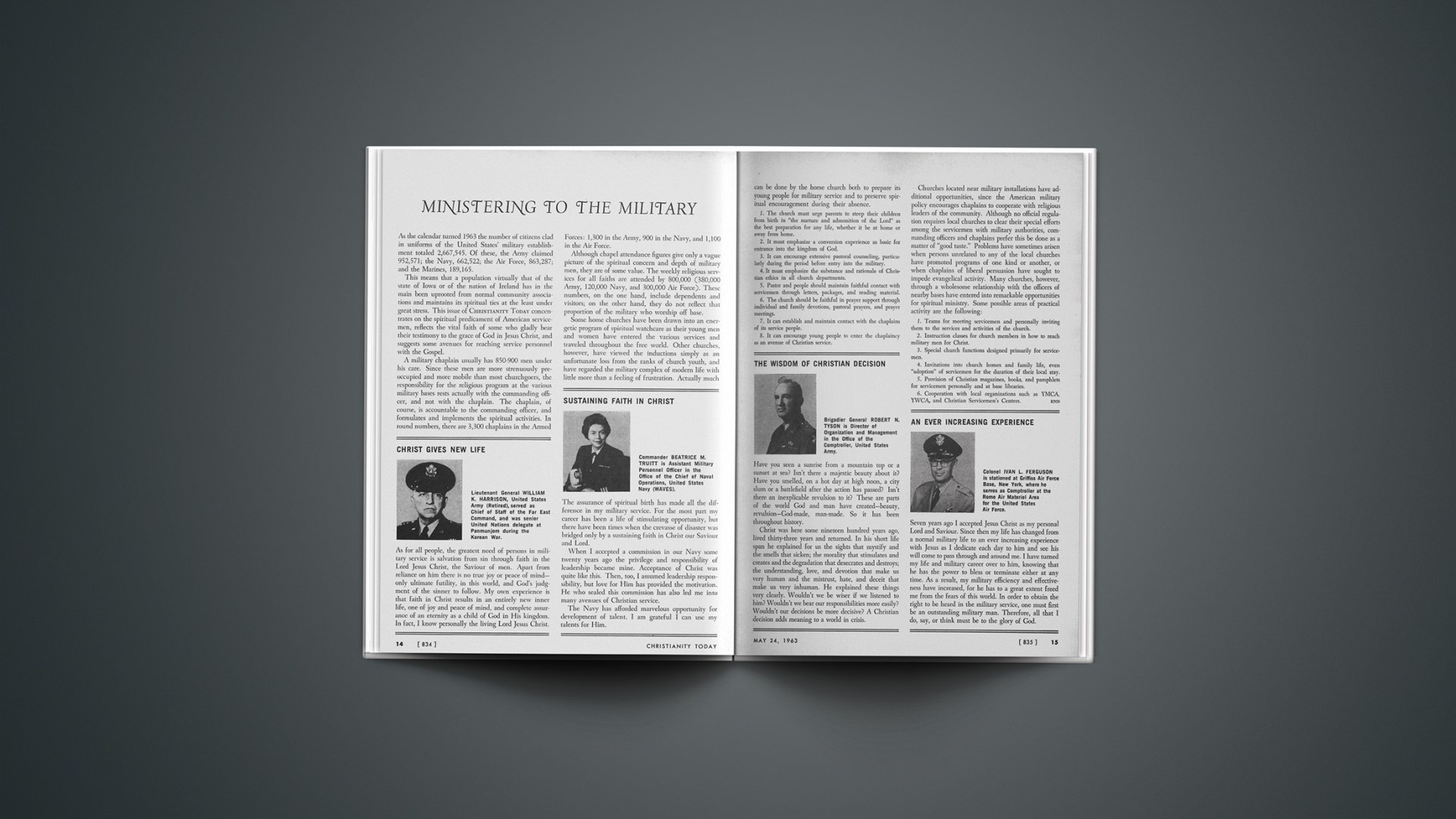
Ministering to the Military

As the calendar turned 1963 the number of citizens clad in uniforms of the United States’ military establishment totaled 2,667,545. Of these, the Army claimed 952,571; the Navy, 662,522; the Air Force, 863,287; and the Marines, 189,165.

This means that a population virtually that of the state of Iowa or of the nation of Ireland has in the main been uprooted from normal community associations and maintains its spiritual ties at the least under great stress. This issue of CHRISTIANITY TODAY concentrates on the spiritual predicament of American servicemen, reflects the vital faith of some who gladly bear their testimony to the grace of God in Jesus Christ, and suggests some avenues for reaching service personnel with the Gospel.

A military chaplain usually has 850–900 men under his care. Since these men are more strenuously preoccupied and more mobile than most churchgoers, the responsibility for the religious program at the various military bases rests actually with the commanding officer, and not with the chaplain. The chaplain, of course, is accountable to the commanding officer, and formulates and implements the spiritual activities. In round numbers, there are 3,300 chaplains in the Armed Forces: 1,300 in the Army, 900 in the Navy, and 1,100 in the Air Force.

CHRIST GIVES NEW LIFE

As for all people, the greatest need of persons in military service is salvation from sin through faith in the Lord Jesus Christ, the Saviour of men. Apart from reliance on him there is no true joy or peace of mind—only ultimate futility, in this world, and God’s judgment of the sinner to follow. My own experience is that faith in Christ results in an entirely new inner life, one of joy and peace of mind, and complete assurance of an eternity as a child of God in His kingdom. In fact, I know personally the living Lord Jesus Christ.

Although chapel attendance figures give only a vague picture of the spiritual concern and depth of military men, they are of some value. The weekly religious services for all faiths are attended by 800,000 (380,000 Army, 120,000 Navy, and 300,000 Air Force). These numbers, on the one hand, include dependents and visitors; on the other hand, they do not reflect that proportion of the military who worship off base.

SUSTAINING FAITH IN CHRIST

The assurance of spiritual birth has made all the difference in my military service. For the most part my career has been a life of stimulating opportunity, but there have been times when the crevasse of disaster was bridged only by a sustaining faith in Christ our Saviour and Lord.

When I accepted a commission in our Navy some twenty years ago the privilege and responsibility of leadership became mine. Acceptance of Christ was quite like this. Then, too, I assumed leadership responsibility, but love for Him has provided the motivation. He who sealed this commission has also led me into many avenues of Christian service.

The Navy has afforded marvelous opportunity for development of talent. I am grateful I can use my talents for Him.

Some home churches have been drawn into an energetic program of spiritual watchcare as their young men and women have entered the various services and traveled throughout the free world. Other churches, however, have viewed the inductions simply as an unfortunate loss from the ranks of church youth, and have regarded the military complex of modern life with little more than a feeling of frustration. Actually much can be done by the home church both to prepare its young people for military service and to preserve spiritual encouragement during their absence.

1. The church must urge parents to steep their children from birth in “the nurture and admonition of the Lord” as the best preparation for any life, whether it be at home or away from home.

2. It must emphasize a conversion experience as basic for entrance into the kingdom of God.

3. It can encourage extensive pastoral counseling, particularly during the period before entry into the military.

4. It must emphasize the substance and rationale of Christian ethics in all church departments.

5. Pastor and people should maintain faithful contact with servicemen through letters, packages, and reading material.

6. The church should be faithful in prayer support through individual and family devotions, pastoral prayers, and prayer meetings.

7. It can establish and maintain contact with the chaplains of its service people.

8. It can encourage young people to enter the chaplaincy as an avenue of Christian service.

THE WISDOM OF CHRISTIAN DECISION

Have you seen a sunrise from a mountain top or a sunset at sea? Isn’t there a majestic beauty about it? Have you smelled, on a hot day at high noon, a city slum or a battlefield after the action has passed? Isn’t there an inexplicable revulsion to it? These are parts of the world God and man have created—beauty, revulsion—God-made, man-made. So it has been throughout history.

Christ was here some nineteen hundred years ago, lived thirty-three years and returned. In his short life span he explained for us the sights that mystify and the smells that sicken; the morality that stimulates and creates and the degradation that desecrates and destroys; the understanding, love, and devotion that make us very human and the mistrust, hate, and deceit that make us very inhuman. He explained these things very clearly. Wouldn’t we be wiser if we listened to him? Wouldn’t we bear our responsibilities more easily? Wouldn’t our decisions be more decisive? A Christian decision adds meaning to a world in crisis.

Churches located near military installations have additional opportunities, since the American military policy encourages chaplains to cooperate with religious leaders of the community. Although no official regulation requires local churches to clear their special efforts among the servicemen with military authorities, commanding officers and chaplains prefer this be done as a matter of “good taste.” Problems have sometimes arisen when persons unrelated to any of the local churches have promoted programs of one kind or another, or when chaplains of liberal persuasion have sought to impede evangelical activity. Many churches, however, through a wholesome relationship with the officers of nearby bases have entered into remarkable opportunities for spiritual ministry. Some possible areas of practical activity are the following:

1. Teams for meeting servicemen and personally inviting them to the services and activities of the church.

2. Instruction classes for church members in how to reach military men for Christ.

3. Special church functions designed primarily for servicemen.

4. Invitations into church homes and family life, even “adoption” of servicemen for the duration of their local stay.

5. Provision of Christian magazines, books, and pamphlets for servicemen personally and at base libraries.

6. Cooperation with local organizations such as YMCA, YWCA, and Christian Servicemen’s Centers.

END

AN EVER INCREASING EXPERIENCE

Seven years ago I accepted Jesus Christ as my personal Lord and Saviour. Since then my life has changed from a normal military life to an ever increasing experience with Jesus as I dedicate each day to him and see his will come to pass through and around me. I have turned my life and military career over to him, knowing that he has the power to bless or terminate either at any time. As a result, my military efficiency and effectiveness have increased, for he has to a great extent freed me from the fears of this world. In order to obtain the right to be heard in the military service, one must first be an outstanding military man. Therefore, all that I do, say, or think must be to the glory of God.

Reaching Servicemen for Christ

Is the heart of the serviceman harder to penetrate with the Gospel than that of the civilian? The situation on one Naval vessel might so indicate, for of its 3,000 men, reports an officer, less than 5 per cent attend Sunday church services.

There are chaplains and Christian servicemen, however, who consider the man in uniform just as open to the message of salvation as his civilian counterpart. The serviceman has basically the same needs and wants, and the Spirit who convicts of sin, of righteousness, and of judgment is no less active among the military than among any other group.

According to a survey reported by Lieutenant Commander Floyd Robertson (USN, ret.), executive secretary of the National Association of Evangelicals’ Commission on Chaplains, the young serviceman’s interest in spiritual matters is actually twice that of a civilian person of the same age. For this reason, believes Robertson, the military “is one of the greatest mission fields on earth.”

A serviceman is more receptive to a call to repentance at certain times, however, and certain kinds of presentation have been found more effective than others.

Said Chaplain A. D. Prickett (now with the U.S. Naval Hospital in Jacksonville, Florida) after nineteen years of duty: “I have found more conversion experiences among those in boot camp than in any other place.” A possible reason for this situation, he suggests, is a greater receptiveness at this time to “new thoughts and ideas.” Another reason, according to a Marine Corps officer, is that “there is much passive social pressure working against a man who begins attending church after a past of non-attendance.” Major Jesse J. Johnson of the First Training Regiment, Fort Dix, New Jersey, gives a third reason: “The training is hard and new to him. He is homesick, lonesome, and in real need of a good solid friend. What better friend could he find than the Lord Jesus Christ?”

This need for a real friend, of course, may continue throughout a serviceman’s entire military stint so that he is always open in some measure to this approach. The number of opportunities for the Christian serviceman to evangelize, therefore, is equal to the number of unsaved men within his barracks or unit. According to Edward E. Gotts (Capt., USAF, ret.), unconverted servicemen are “most readily reached” by Christian servicemen with “sincere personal interest” in them.

The same factors favorable for reaching military men and women with the Gospel when they enter the service to some extent operate also when assignments change. There is sufficient break with former associates and activities to facilitate the “about face” which Jesus Christ requires of those who would follow him. Sometimes, too, a change of status brings a change of heart. An enlisted man may become an officer, a bachelor may become a husband, or a married man, a father; whatever the new responsibility, it brings new awareness of inadequacy. Naval Lieutenant (j.g.) Roger K. Gulick of the U.S.S. “Aeolus” reported that “a large percentage” of those who come to the weekly Bible study class do so “because they feel ‘religion’ is needed to help raise their children.”

An overseas assignment has both advantages and disadvantages. Absent are the restraining influences of church and society in general which prevail around a military base in this country. Present, on the other hand, are greater temptations to profligacy and godlessness. As with Augustine, however, falling into deep sin sometimes works to a man’s salvation. Yet the number of such cases is rather limited, and on the whole, “it is most difficult to get overseas personnel interested in a spiritual program” (Lieutenant Colonel Richard L. McCoy, commanding officer, Third Reconnaissance Squadron, 14th Armored Cavalry). At such times the military becomes one of the most difficult mission fields in the world.

Succumbing to gross sin and suffering its consequences and at the same time desiring a better life is an experience that can overtake a serviceman at any time. “After extended periods of this distorted way of life,” observes Lieutenant Commander Eric A. Nelson, Jr., executive officer of the U.S.S. “Darter,” “there is often an inward sense of shame. With the sudden realization of sin in the life, there is an open opportunity to present the claims of Jesus Christ, and his power to save, keep, and satisfy, even in the service.”

SHOW GOD’S OTHER FACE

The problem of the servicemen is different. People who are blind, lame, maimed, hungry, persecuted, and threatened flock to Jesus because they know they have need of something. But this approach will not work on a healthy, well-heeled professional warrior who apparently knows no need. We in the service have given this much thought. The general opinion among those Christians I know as to how to approach them is: Show God’s other face. This can be done only by a preacher unafraid, who doesn’t have itching ears or a crowd-pleasing personality. One need wake up only a few. The rest takes care of itself.—Lieutenant Colonel ROBERT G. LEMAY, Clinton Sherman Air Force Base, Oklahoma.

Any time of trouble—be it serious illness, marital difficulty, loss of a loved one, or landing in the brig (stockade)—is a time of special openness to spiritual ministration. The crisis must be of such magnitude, however, that everything else seems secondary; then, as John W. Kolb (Capt., U. S. Army, ret.) says, a person finds he “can no longer cure his ills, either physical or mental” and “in desperation … turns to God.”

What is the big obstacle to conversion at other times? Apparently it is fear of what others will think and how they will react. This fear, of course, ought not to be so formidable since military associations for the most part are cursory and temporary. And yet often they prevent the serviceman from entering the kingdom of heaven. Lieutenant Stanley B. Huss (USNR, ret.) gives this summary of the situation: the serviceman is “a conformist who is not open to the Gospel when in company with his fellows except in a time of overwhelming crisis.”

SALVATION IS GOD’S GIFT

The United States maintains military forces for the defense of our country. Anyone in the military must be prepared to give his life, if necessary, in the execution of his duties. Thus, the probability of life and death makes a greater impact on the serviceman than on the civilian.

A personal decision concerning Jesus Christ becomes very important. So many of us are working our way to heaven by being honest, moral, and ethical. I was one of those until I learned that Jesus Christ said, “I am the Way, the Truth, and the Life; no man cometh to the Father but by me” (John 14:6). That verse taught me that my salvation is a gift from God, and that a personal relationship with Jesus Christ is the only answer.

FACING LIFE WITH COURAGE

Modern communications today make possible the bombardment of unsuspecting citizens with ideas of every possible shade of authenticity. What to believe and what not to believe is an ever present dilemma.

This condition is made more trying by the deliberate effort of forces that would destroy our belief in our government, our fellow men, and our God so that free people immobilized by confusion may be made vassals.

If we are to resolve these dilemmas and realize the abundance which surrounds us, we must seek God’s guidance in our daily lives. World War II and Korea found our military chapels filled on every possible occasion. Communion with God is a necessity for those who face with courage the reality with which the battlefield, and life in general, confronts them.

For many a serviceman that time of crisis does not come until he actually faces the possibility of death. “I recall,” said Samuel I. Wells, Jr. (Lt. [j.g.], USNR, ret.), “that on an LST after a hurricane I observed a number of Bibles made their appearance, thus giving me an opening to talk of things eternal.” Surrounded by the live possibilities of fatal explosions, collisions, and other accidents, the serviceman always lives on the edge of eternity; it is quite proper to remind him then to be ready for death and the life beyond.

Chaplains bear the major burden of reaching military men for Christ. In some instances they have an advantage over their civilian counterparts. But they depend for success on far more than favorable opportunities. A good chaplain, in the opinion of one Army captain, should be “an active, strong, persuasive, driving Christian”; according to another, he should be “one of the boys” in interest and sympathy. Above all, says a third, he should “be acquainted with the Lord Jesus Christ.”

Besides being a certain kind of man, the chaplain must bring a certain kind of message. He must be aware of present-day living. He will not merely moralize, but evangelize. He will speak not on his own authority but on that of the Bible.

One Air Force major feels that servicemen are “most accessible … through the preaching of the Word.” The natural man resists the Word, however, and its demands. As a result many chaplains “are so anxious not to offend anybody,” notes Air Force Colonel William N. Boaz, Jr., with the 314th Air Division in Korea, “that their message is usually milked pretty dry.”

But the man in uniform may be confronted with the living Word by other means, too. Christian literature is one, especially if its format is attractive and its content interesting. Every ship should have a good supply of Bibles, Scripture portions, and well-chosen magazines and tracts because “at sea men read almost anything.”

The Bible study group is an excellent means of reaching the serviceman because the average adult wants a better knowledge of the Bible and its teachings. Testifies Major Ronald E. Black, stationed at Westover Air Force Base, Massachusetts: “Although I was active in the church and had a thirst for the things of the Lord, I was a religious illiterate until a fellow officer persuaded me to come to his house for a weekly Bible Study … led by a young Air Force chaplain … who led me to a saving knowledge of the Gospel of Jesus Christ.” One commanding officer reports that Bible study groups attract everyone—both enlisted men and officers, as well as their wives. In addition to affording opportunities for military personnel to be “born again,” they also deepen spiritual knowledge and provide Christian fellowship.

Some servicemen respond to another kind of approach. “I personally trusted the Lord with my life as a result of a visit by ‘sermons from Science,’ ” testifies Albert T. Lauer, GAM Systems Branch Supervisor at Loring Air Force Base, Maine. Elsewhere these Moody Institute of Science films have had excellent reception, also.

If evangelistically oriented, servicemen’s organizations also play a vital role. Groups like the Christian Servicemen’s Fellowship, Officers’ Christian Union, Navigators, Christian Business Men’s Committee, YMCA, and YWCA have done their share in reaching the military for Christ. So have various religious radio broadcasts and television presentations.

FOUNDATION OF OUR HERITAGE

The most important attribute of a military man, or of any other public servant, is a high moral character developed by a devout belief in the teachings of Christ and a practice of the Christian virtues which form the very foundation of our heritage. Let us never allow their importance to be diluted or the strength of our character softened by substituting conformity for conviction, philosophy for performance, or principal for principle.

The day we become the meek comrades of moral compromise marks the beginning of the decline of our effectiveness.

CONSULTING THE ‘MASTER GUNNER’

Technical and tactical competence are important considerations in battlefield success. Spiritual strength has equal if not greater importance. In critical battles, there is always a very fine line between the victor and the vanquished. In these borderline cases, almost invariably the decisive factor will be the determination and the will to win of the victor. For me, that determination grows out of an overriding belief in a Supreme Being—in Almighty God. Anyone who has heard the whine of a bullet fired in anger is aware of the presence of what I call the Master Gunner, who safeguards each of us. Learn to consult with and take counsel from your God.

Unusual opportunities of service exist for churches located near military installations. Invitations to church services, to church socials, to dinners in Christian homes offer strategic ways of ministering to service people. Church families sometimes “adopt” a serviceman for the duration of his stay in their community. Certainly there is no wisdom in commiserating with the serviceman or treating him as if he were an unfortunate prisoner of some kind.

The consensus is that servicemen are won to the Lord largely by personal contact and individual witness. But an effective witness must be winsome. Above all, if the serviceman “can see Christ living in the life,” says Captain Richard E. Fitts of Griffiss Air Force Base in New York, “then he will respond.”

This Christ-likeness means not only maintaining a high level of personal morality and piety, but also manifesting top-flight proficiency as a soldier. One cannot be a good Christian and at the same time a poor soldier. Christ-likeness also involves compassion for lost souls and a spirit of self-giving and self-sacrifice.

Rank seems to pose special problems. In general, enlisted men respond more readily to evangelistic efforts than do officers. Then, too, superiors have greater influence on others than do men of equal status on one another. Observes Chaplain Howard D. Cole of the 40th Infantry Division: “I found that most men were affected the greatest by the officers and NCOs in their units who were dedicated Christians … led by the Holy Spirit and living witnesses to the Gospel.” Efforts of an enlisted man to lead a superior, especially an officer, to Christ face special difficulties because the difference in rank hampers establishment of spiritual rapport.

For these and other reasons the witnessing serviceman needs the Spirit’s direction in approaching another. If he truly desires opportunities, they will come. Then, as one Marine Corps lieutenant suggests, he must give “a manly, hearty, down-to-earth presentation of Christ.”

Servicemen, no less—perhaps at times even more—than civilians, want answers to life’s basic questions. Why are we here? Where are we going? They have questions, too, about the Bible. The message of repentance and remission of sins need not come only from pulpits and chaplains; it often comes from a Christian serviceman in an informal setting when the opportunity is propitious.

Besides a spirit of compassion, the effective Christian witness must exercise abundant prayer. Remarked one Air Force major: “There are too few prayers offered for any one individual in the service to bring him to his Saviour.” And another officer said this: “I feel there are only two ways to have a profound impact on these men: pray and then pray more that Christ will work in their hearts.…”

In surveying the military, one is reminded of our Lord’s observation that the fields are white unto harvest but the laborers are few. The average number of men under a chaplain’s care is around 850 to 900—a far greater number than even the most dedicated chaplain can effectively minister to. And in those instances where a chaplain is not evangelical, the entire flock is officially without one who can lead them into eternal life and keep them from going astray. Pertinent, therefore, is Jesus’ remedy for this situation. To his disciples he said: “Pray ye therefore the Lord of the harvest, that he will send forth laborers into his harvest.”

If those who stand in proximity to service personnel are obedient to Christ’s command, chances are their experience will be that of His disciples: they will be the first to be called and to be empowered to speak in His name.

END

Sin and Virtue in Military Life

The sins which American society has visited upon her youth are in many respects the very sins which American servicemen in turn tend to visit upon society.

To catalog the virtues and vices of military personnel authentically presupposes an omniscience which we surely cannot and would not claim. In a very real sense each man—including the serviceman—is the responsible guardian of his own soul and decides his moral destiny. The assessment offered here is based, rather, on hundreds of replies from personnel at military bases at home and abroad to an inquiry by CHRISTIANITY TODAY. The findings are instructive and illuminating.

The American serviceman, insists Lieutenant Commander Frank C. Collins, Jr., U.S. Navy, executive officer aboard the U.S.S. “Shields,” is not “some peculiar creature conceived for a life of immorality as portrayed in the paid killer and ravager of social decency. Rather, he is the high school football hero, the serious science student, or the kid who drops out of school in his junior year due to lack of aptitude or interest. He is a person who enlists because of a sincere patriotic desire, or in order to learn a trade, or to fulfill his bent for adventure, or perhaps to complete his military obligation and thus clear the path for further education or a career.… He struggles to maintain individualism in a sea of uniformity.”

Patriotism is ascribed more frequently than any other virtue to U.S. military personnel. This fact is highly significant; it gives wholesome perspective to the easy ascribing of sagging moral and spiritual ideals to those who regard military service as “a necessary evil” due to compulsory draft, or who enlist only to escape civilian frustration. Despite those who are merely “putting in time” to fulfill their military obligation, many serve conscientiously in a dedicated professional way with the ideal of public service. Although the serviceman seldom enunciates patriotism as the first motivation for his role in the military, he reflects love of country in numerous ways. The great majority of men are willing and proud to be in the services. The career officer, asserts Captain James W. Wold, March Air Force Base, Riverside, California, “feels he is generally last man on the totem pole in pay raises and legislation in contrast with other government employees, and realizes he will never be a rich man, but finds compensation in the nature of his duty; he is somewhat humble in the opportunity to serve his country.” Nor are those who make a career of the military the only ones “quite dedicated to the defense of their country,” although First Lieutenant John Boaz, U.S. Air Force police officer stationed at Niagara Falls, N.Y., would single out this group especially. “A patriotic youngster,” says Lieutenant (j.g.) Mike Bishop, Protestant lay leader for the staff of the Seventh Fleet and for the U.S.S. “Providence,” is a tribute that applies to the American serviceman generally. “On the surface he is skeptical about patriotism,” writes Chaplain Robert T. Deming, attached to Headquarters of the First Air Base Group at Selfridge Air Force Base, Michigan, “but he will make real sacrifices if called on to do so.” Naval Reserve officer Lieutenant Commander George E. Howell of Arlington, Virginia, presently on inactive duty, declares American servicemen to be “capable, should the need arise, of defending this country or carrying its share of responsibility in standing up for the rights of the free nations in this greedy and very dangerous present world.”

Another chaplain, attached to an Air Force reconnaissance squadron but preferring anonymity, volunteered that the sense of patriotism is threatened often by the serviceman’s disposition to do “only what he has to, or can’t escape from doing.” But more serious as a diluting factor to the quality of patriotism, as we shall note later, is what Chaplain Philip N. Smith (Maj.), a Conservative Baptist pastor in Colorado Springs also serving a mobilization assignment at Ent Air Force Base, pictures as the serviceman’s ideological lack: “Well cared for by the government, he doesn’t appreciate his benefits, freedoms, and liberties; he lacks understanding of patriotism and of the principles on which our country was founded.”

Next to patriotism the trait most frequently ascribed to American service personnel is self-reliance. It is popular to caricature the military as a realm wherein buck privates suspend all personal decision until they resume civilian life. But Colonel Thomas I. Edgar, U.S. Army (ret.), of Roanoke, Virginia, inverts the picture: it is “the average civilian who has developed the ‘herd instinct’ to a high degree in recent years and lives in pretty much of a rut of conformity. I sincerely believe that the average serviceman is more inclined to think for himself and to display greater initiative and to be more self-reliant.” A Naval lieutenant who maintains an alert Christian witness on a Pacific fleet flagship of 1,100 men adds that “independence, self-reliance, and deep love for country” are qualities cherished by many servicemen today.

The spirit of self-reliance is widely threatened, however, by the many conforming pressures that characterize military life. The desire to be “accepted by his peers” leads in many directions. As Captain Arthur E. Dewey, stationed with the First Aviation Company in Korat, Thailand, comments: “The man of draft age is seldom sure of where he is going. In military life, as in most group experiences, he will follow the road the group seems to be traveling, whether it leads to a bar or to a house of worship. The group norm tempts him to do less than his best and often places individual excellence under suspicion. This man tends to take on the image of his leaders. The question of whether this image is right or wrong is subordinate to an instinctive feeling that this is the easiest way to get along.” Chaplain James H. Morrison (Capt.), U.S. Army, now on the staff of First Presbyterian Church of San Diego, California, reinforces this emphasis after three years with the parachute “jump school” of the 101st Airborne Division: “The young paratrooper is not unlike the usual high school graduate, for most of them are just that. It is my firm conviction that the large majority of them do the things they would do at home if it were not for the social restraint and mores of the society in which they grow up. Many who would not normally do these things in civilian society and yet do them in the Army are subject to tremendous pressure from their peer group to be promiscuous with women, in drinking, and in other ways. Frequently it is ‘go out on the town with the boys’ or remain behind and be bored (there is little to do, and most posts are not near large cities) and receive the disapproval of their ‘buddies.’ ” “Aboard our ship,” writes Ensign James D. Prout of the U.S. Coast Guard’s “Eastwind,” “ ‘public opinion’ has prevented many from taking part in activities at which the Gospel is heard,” despite the fact that “a very large percentage come from church backgrounds and church groups.” Even the maintenance of spiritual values is thus jeopardized by negative group pressures. Much depends, as Major John A. Foster of Langley Air Force Base, Virginia, notes, on how determined the serviceman is “not to fit in with the crowd by doing something that sets him apart as being different.” If he wants more than anything else to be “one of the gang” and willingly sacrifices deeply inculcated principles to gain acceptance by his peers, he is easily headed for a break with all that he has cherished in life. This rejection is then rationalized, as a chaplain aboard the U.S.S. “St. Paul” mirrors it, in the notion that “the rapidly changing world scene along with the growing materialism and deteriorating ethical standards make it nigh impossible for his parents (the older generation) to really understand him and his needs. He longs to be understood by the older generation—believes he has tried every way possible to communicate his beliefs and feelings—but often thinks the barrier between generations is too great to penetrate.” Young non-career personnel away from home for the first time, and who seemingly have no goals and purpose in life, are the most vulnerable target for pressures to shun spiritual emphases. The basically immature and insecure youngster, who searches only for acceptance in his new environment and who has no dedication to permanent values of any kind, will do even what he knows is wrong just to become a member of the group. Conformity is part of his training—“a mill of group dynamics,” Lieutenant S. A. Fink of the Navy calls it, in which “he is disciplined to do things in concert: marching, dressing, responding to commands in unison.” Conformity will define his credo as well. He “despises discipline, detests authority, desires a military democracy (but does not understand what democracy involves)” adds Chaplain Paul P. Everett (Capt.), with the U.S. Army’s First Missile Battalion, 60th Artillery, in Gary, Indiana. “Morally he responds like a jack-in-the-box when released from the environment of home and church and becomes involved with wine, women, and song.”

THE MAGNITUDE OF MANHOOD

The serviceman’s image: pleasure-seeking, somewhat immoral and irresponsible while off duty—but ready and capable of fighting to the death to preserve his homeland and fulfill his duties. He is covertly religious normally, openly so when he seeks strength for himself and his buddies—basically a good average American boy trying to adjust to what may be a trying life away from home. Servicemen often wrongly feel that overt expression of religious beliefs conflicts with the magnitude of their manhood. In time of battle they often realize the truth—it takes a better man to be a Christian, and a Christian is a far better and greater man.—First Lieutenant DAVID A. HENRY, student officer, U.S. Army Reserve School, Spokane, Washington.

Alongside the industry, competence, initiative, and dedication that characterize American service personnel, therefore, must be ranged that whole gamut of weaknesses to which they are easily vulnerable in the face of temptation. Separation from home and family exposes our young servicemen to moral letdowns despite the fact that America is a church-going nation and many young people have some training in or at least knowledge of Christianity. The great majority of draftees for whom outwardly “anything goes” nonetheless retain “inner qualms about the things they were brought up not to do,” says David R. Reid of Williamstown, Massachusetts, First Lieutenant, U.S. Army Reserve. On the other hand, he does not “discipline himself the way he disciplines others,” comments a Marine Corps captain. There remains therefore the sense of violated conscience, alongside the shattered framework of an inherited morality and the obvious duality in any demonstration of the Christian ethic and the American Creed.

In this context of moral compromise, however, one also finds a sense of compassion in the military man who has not discarded all his Christian influences. “One may indeed be proud of the ease with which integration of the Armed Forces is being accomplished,” notes Commander William H. Hibbs, U.S. Navy (ret.), of Tucson, Arizona. The American serviceman is basically friendly and honest. One Navy chaplain describes him as “one of the most honest persons in our society.” He is thoroughgoing in what he does—“when he works, he works hard; when he plays, he plays hard.” Physically fit and virile, he enjoys athletics and respects the true athlete. He enjoys land or sea maneuvers, but seldom admits the fact. He has an uncanny way of rising to a situation when the pressure is on. On his serious side he studies hard to improve technical skills, hopes for promotion, and takes off-duty educational courses to further his career even when in doubt whether that career will be military or civilian. He looks forward to self-support, security, and a family.

It is significant, however, that these traits no longer emerge as a conscious reflex of Christian commitment; they co-exist, rather, as a diluted aspect of Christian heritage in a nebulous framework of ideals. Thought of in terms of median, suggests Commander Hibbs, the serviceman is “sincere, dedicated, and realistic, with a pragmatic orientation.” Therefore, while he is “respectful of authority,” as noted by Captain Richard B. Stuart of White Sands Missile Range in New Mexico, he has no sure sense of ultimate authority in life, so that even the soundest convictions he shares about the treachery of the Communist philosophy tend to float about on a sea of concern with no fixed anchor. As a result, according to Staff Sergeant Henry W. Elliott, U.S. Army, of the Headquarters Battery of the 212th Artillery Group in Hanau, Germany, the remaining regard for customs, traditions, or authority is inconstant and often wobbly, since it lacks discipline and control. While he is usually well informed on international situations, says Lieutenant (j.g.) James R. Bair, U.S. Navy, of Norfolk, Virginia, he completely accepts “the relative truth philosophy in morals and ethics; therefore, he embraces a double standard in these areas.” The “standards” that determine his life tend to become nothing more than the impulses of his group. He may be fully dedicated, as Second Lieutenant Howard Graves, a U.S. Army engineer attending Oxford University, comments, to “resisting Communism and to the preservation of our country,” and is wholly confident of our nation’s ability to cope with any crisis on a large scale. But, complains Chaplain Paul P. Everett of Gary, Indiana, this same serviceman “prefers a vague philosophy to a personal commitment to God.” “Typical of young America, he doesn’t know what he wants or where he is going,” says Captain William Armerding of Burlington, Massachusetts, now in the U.S. Army Reserve. “He lacks background,” adds Lieutenant (j.g.) William Robert Porter, Jr., U.S. Naval Reserve, of Muncie, Indiana, formerly assigned to the U.S.S. “Bexar,” “in different religious, moral, social, political, and economic concepts.… He has been spoon-fed an ill-defined concept of loyalty to God and country and a ‘worldly’ concept of what it is to be a man. The result is a lack of firmly established values for his life. God is not a relevant being to him, but someone to be considered at a later date.”

DEDICATED BUT SPIRITUALLY SHALLOW

The current serviceman is a civilian who has put on a uniform. Any recruit brings with him spiritual training his church and family life have given him. A cross-section sampling of servicemen will show a startling ignorance of spiritual things. Some can witness, as John Glenn has, to a firsthand experience with God. Too often, however, the serviceman is the product of a confused, increasingly materialistic society. He is often given unbelievable responsibilities and is often called upon to make sacrifices that would not be expected of him in civilian life. The outdated concept of the military man who “cannot face life on the outside” is now being replaced by one of technological genius fighting a cold war with digital computers and space vehicles. He is tense, overworked, yet surprisingly often a dedicated public servant.—Captain ROY N. MINOR, missile officer, Little Rock Air Force Base, Arkansas.

It is this lack of ultimate spiritual commitment that in turn jeopardizes the stability and certainty of personal dedication in the life of the military, and which makes the serviceman a vulnerable defender of national ideals and an unstable bearer of traditional values. Today’s serviceman is young and impressionable, and for the most part has led a life that demanded little discipline and loyalty. In the service he becomes the target of every conceivable vagrant view of life.

The Army usually sends its more intelligent soldiers to service schools for training as technicians; the “laboring type,” on the other hand (most of whom did not finish high school), are sent to combat units. First Lieutenant J. C. Hood, combat engineer platoon leader at Tompkins Barracks, Schwetzingen, Germany, therefore describes the “typical GI” as “a two-fisted young man who has finished ten or eleven years of schooling. He thrives on excitement.… In garrison, he tends to go stale and looks for excitement in alcohol and women, especially overseas where women are easy and alcohol is part of the national diet. His money is spent three to five days after payday.”

Lack of discipline leads, in turn, to lack of restraint. Detachment from earlier ties means detachment also from moral patterns. Immature and impressionable, the young serviceman is “easily swayed by leaders within the unit or barracks,” reports Major John T. Derrick of the 35th Artillery Group Headquarters in West Germany. On the lookout for enjoyment, says Chaplain Harry W. Holland, Navy Auxiliary Air Station, Saufley Field, Pensacola, Florida, “the serviceman making his decisions without the help of whatever character-building influences and strong persons he may have depended on prior to entering the service, is easily influenced by older servicemen and civilians who seek to involve him in drinking and immoral acts.” “Away from home and lonely, he is easy to sway,” comments Major Richard E. Slater of Geiger Air Force Base in Spokane, Washington, “and he will experiment with evil never attempted near his family.” Those who have never been out on their own are “easily influenced by associates,” and most “follow the crowd to avoid being an ‘outcast’ or ‘different,’ ” says Lieutenant (j.g.) F. E. Phillippi, Jr., gunnery officer aboard the U.S. Navy’s U.S.S. “Orleck.” “They find it ‘necessary,’ ” remarks Chaplain C. Gordon Kyle (Capt.), attached to Headquarters of the Sixth Missile Battalion, 61st Artillery, U.S. Army, “to use the occasional oath and indulge in the questionable thing in order to get along.” The drift away from religion is abetted by those “who are afraid to stand up for their beliefs and do not attend church or chapel services,” notes Lieutenant Colonel Robert K. Schmitz of the Iceland Defense Force.

Pleasure-seeking, then, becomes a ruling passion for the serviceman. He reaches for companionship in ways that “wouldn’t have entered his mind in the home environment,” comments Lieutenant Commander Philip A. Roe of the Ninth Naval District, Great Lakes, Illinois. He seeks excitement and fun through a diversity of activities usually involving girls, automobiles, and alcohol. The outward sins then multiply. Drinking becomes routine, marital vows are broken, spendthrift habits are formed. An officer aboard the U.S.S. “Sellers” thinks it no exaggeration to say that aboard his ship “about 75 per cent of the enlisted men chase women (the married men are often the worst offenders)” and that among the officers “about 30 per cent are unfaithful to their wives, about 60 per cent chase other women when away from home.” Along with a fondness for alcohol and drinking in excess goes the frequenting of houses of prostitution. Carefree and spendthrift, this type of serviceman is often financially depleted at mid-month and is looking for something to do with his free time.

TO BE ONE OF THE CROWD

Very few claim to be atheists or agnostics. Most admit they know what they should do; however, they are usually speaking from a legal or moral rather than biblical point of view. Most have not studied enough to understand Christ’s teachings. The parable of the sower and the wheat still separates each into his class. Perhaps the real trouble is that each wants pleasure, each wants to be one of the crowd, and the crowd follows the wide path. I am happy to say that those who do take a stand for Christ generally make it a firm stand out in the open. Those others who have done little studying of the Scriptures usually try to shy away from the subject. A surprising number like to argue dogmas, wresting Scripture out of context—anything to keep away from the main theme of conversion!—Lieutenant CORBIN WOODWARD, U.S. Navy, supply officer aboard the U.S.S. “Rankin.”

For the young draftee trying to be “a man of the world,” says First Lieutenant Edward M. Blight, Jr., of the U.S. Army Reserve, Tripler Army Hospital, unrestrained sexual activity, alcoholic excesses, and smutty language come to imply general lack of restraint. Hypocrisy is then almost forced upon him, notes Lieutenant James I. Wilson of the U.S. Naval Reserve: his degeneracy is outwardly concealed because the service requires him to be well dressed, well groomed, and physically fit, and the refusal of parents at home to recognize his immorality constrains him to sustain the illusion of decency. In the spirit of Kipling’s lines, he welcomes a foreign culture where the immoral seems moral:

O ship me somewhere east of Suez

Where the best is like the worst;

Where there ain’t no Ten Commandments

And a man can raise a thirst.

When he has exhausted the pleasures of the flesh, and discovered their inadequacy, he is not on that account ready to face up to the responsibilities of balanced living. He is an over-confident individual unskilled in the art of solving the maze of problems, observes First Lieutenant Thomas G. Smoak of the U.S. Air Force in Miami, Florida. He finds refuge in a sense of self-sufficiency that springs from his job security, education, or general understanding. Selfish rather than spiritual motivations now contend for mastery. Despite a basic anxiety and unhappiness he is not seriously interested in Christianity—not hostile, adds Lieutenant Thomas J. Manetsch of the U.S. Naval Reserve, Corvallis, Oregon, but indifferent. Self-centered, he remains most interested in the material and physical rewards life can offer him. Rank, station in life, social status, money, and worldly goods remain the dominant ideals. Beyond this there seems little purpose and initiative.

Undeniable, however, are the unexplainable void that vexes the serviceman’s life, the recurring insecurity that springs from the uncertainties of his assignments, and the additional uncertainties that always shadow the serviceman’s career. Under such circumstances his ignorance of spiritual things can be disconcerting; in self-pity he may think that nobody cares about him as an individual. His distress is worsened because, while indeed he may be subjected to more temptations than the average civilian, he nonetheless has the irrefutable conviction—as notes Lieutenant James R. Evans, personnel officer at the Naval Air Station in Brunswick, Maine, that “it is not the service that causes the man to yield; it is the man.” In a sudden confession of inadequacy he acknowledges to himself, as comments Colonel W. M. Tisdale, U.S. Army (ret.), now assistant president of State University College, Albany, New York, that as a man in the military “he needs God perhaps more than the average citizen. His responsibilities in wartime will be tremendous, and he must be prepared to meet his Maker on short notice.”

Proper military guidance and leadership have been able to shape the rough timber of millions of men into a well-hewn military force. There can be little doubt, therefore, that under proper spiritual and moral controls American youth could “turn the world upside down” in terms of ethical principles and religious values. The tragedy is that service personnel can always point to worse elements in civilian society against which the man or woman in uniform compares quite favorably. Addiction to alcohol, sexual indulgence, and gambling in American society are not limited to any one economic or social level. And the serviceman knows that transient groups (particularly show people and salesmen) tend to practice moral compromises to a greater extent than do more permanently settled persons. “The American serviceman pictures himself as being morally upright in his society; this, he believes, is accounted unto him for righteousness,” remarks Major Russell O. Barney of Kirtland Air Force Base, New Mexico. Within walking distance of a chapel where he may learn of the remission of sins and receive new life in Christ Jesus, he commits the cardinal sin of Western society in our time: he refuses to embrace the Saviour and Redeemer of fallen and needy souls. He professes to “believe” in some concept of God, but worships none; he “believes” in prayer, but practices it only when in trouble; he “believes” the Bible, but seldom reads it; and except on very special occasions or “holy days” he doesn’t go to church. Sunday services aboard a Navy aircraft carrier at sea, with 3,000 to 4,000 men aboard, may draw 50 to 100 Protestants, with attendance at Catholic mass somewhat higher. “The Protestant’s information about Christ and His Gospel is tragically fuzzy,” comments First Lieutenant Douglas K. Stewart, U.S. Marine Corps, of Kaneohe, Hawaii; “he generally believes in a sort of salvation by good works, and a ‘hope for the best when it’s all over’ philosophy, if he is concerned about spiritual matters at all.”

THE SAVING BLOOD

One day on Iwo Jima I knelt beside a wounded Marine whose lips were blue. As I held a bottle of whole blood and the flow continued, the faint throb in his temple grew stronger. Color came back to his lips; he opened his eyes and smiled. Souls of servicemen may become shattered by sin, but the sacrificial love of Jesus will bring new life to those who trust in him.—Chaplain JOHN H. CRAVEN (Capt.), National Naval Medical Center.

Finally then, find your strength in the Lord, in his mighty power. Put on all the armour which God provides, so that you may be able to stand firm against the devices of the devil. For our fight is not against human foes, but against cosmic powers, against the authorities and potentates of this dark world, against the superhuman forces of evil in the heavens. Therefore, take up God’s armour; then you will be able to stand your ground when things are at their worst, to complete every task and still to stand. Stand firm, I say. Buckle on the belt of truth; for coat of mail put on integrity; let the shoes on your feet be the gospel of peace, to give you firm footing; and, with all these, take up the great shield of faith, with which you will be able to quench all the flaming arrows of the evil one. Take salvation for helmet; for sword, take that which the Spirit gives you—the words that come from God (Ephesians 6:10–17, New English Bible).

The Image of America’s Serviceman

The character of the American serviceman is an important concern for the entire nation. For one thing, the possessors of military force are never free from the temptation to use authority and power in an arbitrary way. History depicts only too clearly how almost in a single night certain representative governments have been transformed by military coup into military dictatorships, how in the span of a single day some nations have fallen into chaos because of unworthy military leaders. If the mission of governments is to preserve justice and restrain evil, and if military enforcement is an effective means to these ends in times of crisis and war, then the character of servicemen is of utmost importance. America has always honored and respected military service. Despite the misuse of military power by many nations of the earth, America, the mightiest power in the late twentieth-century world, is nonetheless eager to set this power in the service of justice and freedom.

The American armed forces no less than the citizenry are concerned with the image of the military. Lawyers tell us that civilian law books have no statute similar to Article 134 of the Uniform Code of Military Justice, under which a man in the military is chargeable and punishable for bringing discredit upon the military establishment. The military is ever trying to improve its own image through character building.

Cross Section Of America

The civilian finds it difficult to think of the professional military personnel as a special class. As Chaplain R. W. Odell (Lt. Comdr., USN) reminds us: “The image of the American serviceman is really the son, brother, father, or husband image of the cross section of our average civilian community—only with uniform on! And even the inclination to judge the military man as a group member rather than as an individual runs its risks.”

The valor and self-sacrifice of the American armed forces are beyond reproach; almost every frontier of World War II spoke eloquently of their magnificent heroism. And the intellectual caliber of enrollees in the military academies and officer training schools is highly gratifying. A visit to the special war colleges which ready military leaders for command posts around the world leaves no doubt about the technical competence of such personnel.

Yet World War II disclosed some glaring weaknesses in our armed forces. How can we account for them? Are they by-products of military life? Are their roots in American society? Does the American home prepare young people for life in these times? What needs to be done?

Here, for example, is the “average” Marine recruit. He is nineteen years of age (many are seventeen); he has not gone beyond the tenth grade and has a general classification test score of 105. Two-thirds of such recruits are from the city; most of them have never before fired a rifle or worn a uniform. Upon entry to the Marine Corps the luxuries of civilian life become but a memory, and the recruit soon is stripped of all individuality. His hair is shortened, his civilian clothes are sent home. Garbed in a new utility uniform, he reports to a drill instructor whose job it is to remake him into a Marine. He becomes a member of a team; he must think first no longer of himself, but of his platoon. In eleven weeks this groping and uncertain lad will have become a proud and competent Marine.

Whatever their branch of service, enlisted men actually are an “above average” group, since the recruiting process eliminates those known to be physically, mentally, and morally unfit. In this sense the American serviceman is truly “a selected civilian in uniform, away from home, and under military discipline.”

Since recruits in all branches of service are now exceedingly well trained in technical matters, they understandably desire and merit appreciation of their abilities and talents. Today’s serviceman is a technician and specialist, fully abreast of the scientific advances of the times, and considerably more skilled in many areas than his counterpart at the outbreak of World War II.

In his new and changed way of life, the serviceman becomes desperately lonely. “The temptations to moral and social experimentation in his new environment—away from close scrutiny of family and home community,” observes Chaplain G. Paul Keller (Comdr., assistant division chaplain, USNR), “are similar to those encountered by young men who leave home for the greater freedom of college and university. His resistance (or vulnerability) to such temptation, like that of his college counterpart, is largely the result of prior training (or lack of training) in the home, school, church, and home community. Even the reactions to the obedience and subordination demanded by military discipline are largely determined by prior training.”

Just as no community can screen out all its misfits, the military too harbors its complement of maladjusted personnel—in fact, sometimes inherits those shunted from community life. The small number who enlist because they lost civilian jobs or met difficulty in school or home are those who account for the highest percentage of trouble in military life. About 80 per cent of Naval and Marine brig inmates come from broken homes.

But the most significant and distressing factor about American military personnel is their lack of a sense of ultimate values and fixed standards. Although dedicated to the service of their country, they seem to have no awareness of any distinctive national purpose and of its bearing upon individual decision and commitment. This weakness, moreover, is rampant at a time when the American heritage is a special target of Communist attack and subversion. Reflecting the “civilian’s civilization,” says Chaplain Bobby G. Allen of New Orleans, the soldier has “little concept of morality, discipline, duty, goal in life, and what his country stands for.”

THE STRUGGLE OF A SOUL

The American serviceman finds maturity thrust upon him. This situation causes him at times to rebel, perhaps to succumb, but in the main to adjust. He discovers appetites long suppressed by social mores awakening and somewhat easier to satiate free of close parental and neighborhood supervision. He is susceptible to temptation but also responsive to counseling. He desperately wants to be accepted by the military community. Herein lies the importance of a solid Christian background; if he has one, social pressures seldom cause permanent damage; if he lacks this background, he may suffer damage to his moral tissue. He frequently feels overwhelmed by the weight of responsibility assigned to him. His reaction to this responsibility is generally a good index to his background. He is little different from his civilian contemporary except for his greater respect for discipline and orderliness.—Lieutenant Commander FRANK C. COLLINS, JR., U.S. Navy, executive officer, U.S.S. “Shields.”

The aftermath of World War II witnessed a general decrease in the sense of loyalty, moral responsibility, and spiritual values among enlisted personnel. This trend was evident from increased numbers of disciplinary problems, AWOLs, and court-martials. In 1958, to reemphasize and revitalize the inspirational, technical, and moral aspects of Naval leadership, the Secretary of the Navy issued General Order Number 21. According to Lieutenant Commander Eric A. Nelson, Jr., executive officer aboard the Navy’s U.S.S. “Darter,” this program has met with “considerable success”; it has yielded fuller dedication to American ideals.

Service personnel are notoriously and necessarily nomadic. Since assignments are flexible and subject to swift and frequent change, the impression is encouraged that military life accommodates no deep roots nor fixed values. When the influence of family and friends is missing, personal decisions issue only from one’s inner complex of convictions and standards. Among the persistent problems in the military, reports Base Chaplain Bruce C. Herrstrom (Capt.) of the 126th Air Refueling Wing, Illinois Air National Guard, are “teen-agers who have little or no concept of discipline and responsibility. They come into military life with no respect for authority and seem to thrive on a philosophy of relativism. For them there are no absolutes.” The young man without strong religious foundations, adds Lieutenant Winslow B. Oakes of U.S. Fleet Weather Control, USN, Suitland, Maryland, “will be found trying out foul language and dabbling in common ‘liberty’ practices—that is, drinking, and to a lesser extent, illicit sex. He is out to prove himself a man to his buddies, after having just left home where he was probably still a boy to his family and friends.” From Hancock Field, Syracuse, New York, Chaplain Elliot Robinson reports that “we see very few of the very young servicemen in chapel.” First among the reasons for this situation he lists the lack of previous “basic Bible and church-centered indoctrination.” Even some single men in the National Guard—veterans of World War II or Korea among them—reports another chaplain, seem often to live “only for the immediacies of life since the future is uncertain. They want everything that life has to offer right away. And some simply want a handout from Uncle Sam when retirement comes.” But under any circumstances the “boys in the barracks” remain the most difficult to reach spiritually. According to another Protestant chaplain, “Evangelical services are not sought after by the unmarried serviceman.”

That married personnel are for the most part more responsible and more spiritually concerned is noted by several observers. A helpful factor is that since World War II, the American services have placed greater emphasis on the family unit. It is evident, observes Base Chaplain Raymond Pritz (Maj.) of the U.S. Air Force in Freising, Germany, that the married serviceman “more readily makes the chapel his home church, while the single man is more often on vacation from his home church and family influence.” Major Robert E. Graf, U.S. Army, The Pentagon, makes a further distinction.

A very high percentage of those who have made the military a career, rather than a temporary interlude, he notes, are married and quite mature, and reflect a pattern of responsibility, religious conviction, and activity much like that of the average adult American of thirty years of age and older.

The dearth of spiritual vitality is reflected, too, in the unfavorable ratio between chapel attendance and the total personnel stationed at military bases. For Protestant Christians—and America traditionally has been predominantly Protestant—the “assembling together of believers” is a New Testament imperative, while for Catholics, deliberate absence from mass is a mortal sin. The neglect of chapel attendance is all the more disconcerting when it is conceded that because of the selectivity of the enlistment process the general moral level of military personnel at the time of enlistment is superior to that of society as a whole.

Former Air Force chaplain in the Korean War, the Rev. Ken Hutcheson, now pastor of Lakeview Baptist Church in San Antonio, Texas, pleaded before the Texas Baptist Day School Association for more Baptist elementary schools by recounting the conduct of American servicemen abroad: “The number of babies fathered by American military men is simply appalling. During my active duty tour in the Korean War and also during the years I have spent as an active reserve chaplain, I have talked with many men who had been stationed in Europe and the Far East.… According to their own admission, from 95 to 98 per cent of them both married (whose wives did not go with them) and single lived in shameful adultery.… In the Korean War it became so deplorable … a leading churchman … who was touring Korea called the chaplains together in one area and lectured them, urging them to do something.…” It is probably true that the farther American servicemen travel from home, the farther many of them drift from their inherited ideals as well.

Doubtless the circumstances of entering the military have much to do with servicemen’s attitudes. Commander George F. Masin, electronics engineer at the U.S. Naval Ordinance Laboratory in Corona, California, affiliated also with the Naval Reserve Officers School, thinks that many who wait for a compulsory draft “consider military service as a time of ‘treading water’ until they can resume their normal civilian occupation or return to school, and do not take the military training period seriously.… For many this means a let-down of moral standards.” First Lieutenant Edward P. Lyman of the U.S. Marine Corps Reserve in Clarkesville, Tennessee, likewise thinks “the young high school graduate and pre-college man who is ‘just serving his time, just waiting until he is free’ is a candidate for group conformity and tends to unreliability and recklessness.”

Those who flee to the military to escape distasteful aspects of civilian life soon find their problems enlarged to include the desire to escape from military demands as well. Comments Chaplain A. D. Prickett of the U.S. Naval Hospital in Jacksonville, Florida: “All too often he joined up to get away from some unpleasant situation at home or at school—or that he considered unpleasant—and now the service confronts him with problems also. Thus he can hardly wait to finish his tour and get out. Most of the ones I see have no clear-cut idea or plan of what they want to do beyond that.” Lieutenant Lionel F. Gardiner, instructor in the U.S. Army Chemical Corps School at Fort McClellan, Alabama, adds that under such circumstances enlisted men are not likely to rise above the surrounding pressures to avoid an interest in spiritual matters.

The military career man is not necessarily exempt from a somewhat similar, if more subtle, vagabond attitude toward life. “Many of those who join the armed forces intending to make the military a career, and who see no immediate return to civilian life, feel”—a Naval officer comments—“that they might as well ‘live it up’ and let the future take care of itself.” Another Naval education and training officer adds that “early retirement and security are for many the chief motivations for Naval careers.” But the older “career” men, it is widely noted, are more settled mentally and more readily accept civilian functions and responsibility in the community.

Yet one fact is sure: the character of the officers both consciously and unconsciously influences many of their subordinates. As Corbin Woodward, supply officer aboard the U.S.S. “Rankin,” puts it, “the officers and senior petty officers usually set the pace, and the new men follow.” Commander Charles H. Hoke, weapons officer at the U.S. Naval Submarine Base in New London, Connecticut, states that “the happiest sailor at sea is one who knows that his commanding officer and his other officers are morally strong, competent, and dedicated—who has faith that he can do his special job capably. Under these conditions he is ingenious beyond imagination, skilled beyond all previous appearances, hardworking and loyal under extremely adverse conditions. In the absence of these conditions, he is sloppy, unskilled, and reticent.”

Chaplains are continually astonished over the spiritual apathy of draftees who regard themselves as “Protestant.” A distressing number cannot repeat the Ten Commandments or the Lord’s Prayer, nor identify Abraham, Moses, or Paul. A survey by chaplains in the U.S. Armed Services attests a wide range of spiritual illiteracy concerning the content of the Christian faith. At a time when national goals are in doubt, it is a matter of great concern that the guardians of our frontiers are unsure of our heritage.

END

Like a Good Soldier

“Take strength from the grace of God which is ours in Christ Jesus.… A soldier on active service will not let himself be involved in civilian affairs; he must be wholly at his commanding officer’s disposal.… Remember Jesus Christ, risen from the dead …” (the Apostle Paul to Timothy, 2 Tim. 2:1 ff., NEB).

Here and there in the New Testament gospels and epistles soldiers and their commanding officers touch the life of Christ and now and again enter into the new life of the Gospel. It was soldiers who placed the crown of thorns upon his brow (John 19:2); soldiers who mocked him on the cross (Luke 23:36); soldiers who crucified Jesus, then divided his garments and tossed lots for his tunic (John 19:23). A soldier speared Jesus’ side with a lance (John 19:34); soldiers accepted the chief priests’ bribe to obscure the true facts about the empty tomb (Matt. 28:12 ff.). In the first days of the apostolic age it was sixteen soldiers who kept constant watch on the imprisoned Peter. Apprehended by King Herod (outspoken foe of the Christian movement), Peter was not only held fast by two chains, but even while he slept was secured against escape by a soldier on each side. Beyond his cell, sentries guarded the prison door and the iron gate. Peter’s angelic deliverance therefore not only was astonishing, but also excluded any fabrication that disciples had absconded with his body. The “consternation” that followed “among the soldiers” was abruptly cut off only by the embittered Herod’s execution of the military guard (Acts 12:18 f.).

On another occasion fanatical Judaists sought to take the Apostle Paul’s life just outside the temple. Together with a considerable number of troops the Roman commandant stopped the mob violence, put Paul under arrest, and escorted him to the military barracks. There, by invoking his Roman citizenship and appealing for a proper hearing, Paul frustrated the order for examination by flogging.

If soldiers appear in the Bible in the service of injustice, they appear, too, in search of grace, and since they are servants of the state their cause is ideally set in the context of justice (Rom. 13). When forty Jews vowed to starve unless they murdered the Apostle Paul, and waited in ambush for him, the commandant ordered two centurions to take Paul to the governor under an escort of two hundred infantrymen, seventy cavalrymen, and two hundred lightly armed troops (Acts 23:23). When the sailors decided to abandon the storm-tossed ship, Paul exposed their deception to the centurion and to the soldiers (Acts 27:30 ff., 42 f.). During the Acts journeys Paul was closely bound to Luke the physician; in Rome he was lodged in the custody of a soldier (Acts 28:16).

It was a centurion in Capernaum who pleaded with Jesus to heal his paralyzed son: “You need only say the word and the boy will be cured. I know, for I am myself under orders, with soldiers under me” (Matt. 8:9, NEB). Nowhere, not even in Israel, had Jesus found a comparable faith (Luke 7:9). While Pilate’s soldiers mocked Jesus, crucified him, and took a bribe to discount the empty tomb, on that same watch a centurion and his men were impelled by the awesome events to exclaim: “Truly this was the Son of God” (Matt. 27:54). And it was a centurion—Cornelius, of the Italian contingent—with whom God began the spiritual baptism of the Gentiles (Acts 10:1, 22). Thus it was a soldier’s confession of Christ that inaugurated the revelation of the universality of the Gospel of Christ, the recognition that membership in the Christian church was open to Gentiles who “feared God” and not only to Jews.

Endure hardness as a good soldier of Christ, Paul exhorted young Timothy. From personal experience the Apostle fully appreciated the physical and mental stamina of men in the military. He recognized, too, that a soldier’s life in the service of justice is not incompatible with the Christian’s life in the stream of redemptive grace. The man who puts his ultimate trust in God has at his disposal defensive and offensive spiritual weapons. The most frequently mentioned weapon in the Bible is the sword, which in both Old and New Testaments frequently symbolizes the Word of God (Ezek. 21:28; Eph. 6:17). It is the omnipotent God who stands above all earthly powers, to whom all men and nations are answerable. Even in the heavenlies is “the host of the Lord,” that spiritual army which even now does the bidding of the holy Lord of creation. Yet to come is that great and final conflict between good and evil: then shall appear the Risen Christ to lead the “armies of heaven” (Rev. 19:14) and to defeat utterly the armies of the beast and of the kings of this earth (Rev. 19:19).

Review of Current Religious Thought: May 10, 1963

In view of the claim of modern Communists to possess an interpretation of reality and of history which makes them infallible guides to the processes of social change, and in view of Communism’s avowed purpose of supplanting all existing political and social forms, thinking persons are perplexed by the term peaceful coexistence as currently employed by the Soviet masters. The hopeful seize upon Mr. Khrushchev’s reiteration of the term as evidencing a possible alteration of the fundamental strategy of the Communist world. Can it be, some inquire, that the men of the Kremlin have “seen the light” and have turned from dogmatism to pragmatism, from their iron-clad and doctrinaire doctrine of the inevitable destruction of Western civilization by Marxist conquest to something approaching, at least, the procedures of fair competition and of international behavior based upon some form of mutually accepted rules?

Much is at stake—more than most persons in the West realize. It is therefore prudent to take a long, searching look at the term “peaceful coexistence” to see, first, what it indicates about Soviet planning for international strategy, and second, what if any implications it has for the Christian man and woman in the free world.

The term “peace” means, it goes without saying, something vastly different to the Communist verbalizer than it means to us. Stripped of its supporting verbiage, it indicates an absence of opposition to the expansionist aims of the U.S.S.R. from without, and of course the suppression of any resistance to the mandates of the regime from within the Soviet super-state.

Running through the speeches of Nikita Khrushchev is the theme that while war on a worldwide scale is now unthinkable (since it would mean, at a minimum, the incineration of his great heartland), the Soviet masters reserve the right to foment, foster, and support “wars of national liberation.” This means, in blunt terms, that any internal uprising in any land outside the Red Empire will receive not only encouragement, but every possible form of assistance from Moscow. In effect, it means that wide-scale war (certainly abhorrent to all of us!) is to be eliminated on pragmatic (as opposed to humane) grounds, so as to offer an unlimited opportunity for Soviet subversion in the part of the world which is presently free.

Seen from this angle, “peace” means the absence of forms of war which are inimical to the present, pragmatic interests of the Soviet Union. In other words, times of relative freedom from armed conflict afford, in the judgment of the masters of the Kremlin, an optimum set of factors within which war can be waged at other levels. This is the lesson which we ought to learn from the semantic juggling of the word “peace”—that to the Communist masters, no proximate peace is peace at all.

We forget all too easily that the Communist leaders of today seek to exploit every factor for their own advantage. Diplomacy is not utilized as a means to effecting compromises for the sake of achieving justice. Rather, the Soviet masters mold it into an instrument by which cheap conquests are made, and by which maps are redrawn in such a manner as to extend Communist hegemony and/or secure the imperialist and expansionist interests of the super-state. The monolithic control by the state of the raw materials, the labor potential, the means of production, and the means of distribution enables this system to lend itself to the most systematic and ruthless forms of commercial warfare. Trade becomes a weapon by which manufactured goods from within the Soviet state can be priced abroad, not with respect to their intrinsic value, but with a view to demoralizing the economies of other nations. It goes without saying that patents and copyrights are infringed with a high hand, with no thought of observation of civilized codes concerning royalties.

More could be said along these lines; but the prudent do well to realize that by “peaceful coexistence” the masters of the Kremlin do not envision any form of civilized competition with the free world upon the basis of recognized and stated ground rules. Any talk of respecting the usages of other nations, or of allowing to their systems anything more than a de facto and temporary legitimacy, means no more than Stalin’s verbal tribute to the “self-determination of peoples” at the peace tables following World War II.

It is fashionable in some quarters to suggest that any person who speaks or writes in such a fashion with respect to the Communist world is a member of “the radical right” or to regard him as a hopeless conservative. While we deplore the excesses of some forms of rightist protest, we hold that there is a proper regard for the lessons of the past; certainly a perusal of the lessons which the Communist world has handed the West yields some shocking data. And as Santayana once wrote, “He who will not learn from the past, will have to re-live it.”

In the light of the foregoing, it may be noted that the Christian man and the Christian church may well derive some lessons from the current use of the term “peaceful coexistence.” Two deserve brief mention in closing. First, it may be well to be on guard against any romantic notions of the “freedom” of the Church within the U.S.S.R. If the past has any word for the present at this point, it is that the Russian church would not be permitted to participate in the councils of world Christianity until the masters of the Kremlin felt it “safe.”

Second, it is inconceivable that any ecclesiastical delegation which speaks for “from 30 to 50 million Christians in Russia” will permit any world ecclesiastical body to be prophetic where the subversion of free nations is concerned. It should be borne steadily in our minds that the Russian church is permitted to be “prophetic” in one point only, that of “peace.” It cannot be shrugged off as irrelevant that it is precisely this point which is the cutting edge of the “velvet glove” phase of Soviet imperialism.

Book Briefs: May 10, 1963

Barth’S Election Explains Too Much

Alpha and Omega: A Study in the Theology of Karl Barth, by Robert W. Jenson (Nelson & Sons, 1963, 175 pp., $4), is reviewed by James Daane, Editorial Associate, CHRISTIANITY TODAY.

This book is deceptively simple. It’s short; its language is clear and uncluttered, and not without a touch of easy-going, straight-faced humor. Yet it exposes and evaluates the core of Barth’s theology. It demonstrates that Barth’s theology is truly systematic—ruled throughout by a single motif—so that it can be neither identified with any traditional theology, nor accepted or rejected in part. One can, however, without doing either, learn much from Barth’s thought, and I suspect that Jenson has.

The current slogan, “Christianity is a historical religion,” says Jenson, is a tired cliché; yet its very relevancy has made it a cliché. The slogan means that God has acted redemptively in history and thus disclosed that true reality which determines our lives and the meaning and goal of history. He then smokes out the central core of Barth’s theology by asking it three questions: How does God do this? In what sense does God have a history? And, What is that historical reality that God has wrought, and to which the Church bears witness?

Barth’s answer to all three questions is: Jesus Christ. With this, every traditional theology would agree. But Barth defines Jesus Christ in a quite new way. According to Barth, Jesus Christ is God’s eternal decision, the beginning and end of all God’s ways and works. Jesus Christ is the form in which God wills to exist, namely, as man, with man, and for man.

But this divine decision involves a negative aspect. It posits not only what God wills, but also a negative shadowy existence to what he does not will, i.e., what he rejects. By saying “yes” to creation, God says “no” to chaos, to the threat of nihility; yet thereby chaos has negative reality as something which God does not will. Similarly, when God says “yes” to the good, i.e., to his purpose to live with man in covenant fellowship, he rejects the possibility of the opposite, namely, sin; yet thereby sin obtains a negative reality as that which God rejects.

Yet God, according to Barth, has made provision from eternity that chaos be defeated and sin rendered an ontological impossibility, for his eternal decision to exist for and with man in Jesus Christ, means Jesus Christ as crucified. Thus, Jesus Christ exists eternally both as creator and as reconciler. Indeed, Christ is first reconciler and then creator, for God’s eternal decision is gracious; sin is always opposition to redemptive grace, even creation is an act of such grace (the eternal ground of God’s gracious covenant), and grace is the internal purpose and presupposition of creation.

Thus Jesus Christ is God’s history (Urgeschichte). What then is revelation? It is the disclosure of this transcendent divine history in our time and history in Jesus of Nazareth. And faith is the knowledge of his transcendent, divine history, a knowledge which occurs by the action of the Spirit and through the witness of the Church.

Whereas in the traditional view of Christ, God acts through Christ in our time and history, in Barth’s view, God’s redemptive and creative action occurs within Christ; it occurs not so much between Jesus Christ and mankind, but between God and Man as they eternally exist in the form of Christ.

Thus, the disclosure in history of God’s history with man in Christ constitutes the decisive reality within our history, and the determination of history’s goal.

From this it appears that Barth is a predestinarian, more specifically, a supralapsarian—but of a new variety. The weakness of traditional supralapsarian thought is its seemingly engrained notion that reprobation is the equally valid counterpart of election, and its seemingly inbuilt tendency to account for the fact of sin as something God willed, in order that.… It appears to this writer that Barth has not escaped the essential weakness of traditional supralapsarianism. Reprobation, i.e., what God rejects, is in Barth’s thought the necessary opposite side of the coin of election as it relates to Christ as both elect and reprobate, as it relates in him in this double fashion to all men, and even as it relates to chaos and sin. Each of these is a counterpart of God’s electing choice and as such has a negative, though finally defeated, reality. In Barth, as in traditional supralapsarianism, election via rejection accounts for too much.

Traditional supralapsarianism, moreover, has never been able to find a place in its scheme of sequence for a genuine historical moment of transition from wrath to grace. The same problem emerges in Barth, as Jenson clearly points out, for in Barth’s thought redemption precedes creation and sin; indeed, the very purpose of creation is to provide a finite, temporal external ground for the covenant of God’s gracious redemption. Barth, urges Jenson, has no genuine moment of “before and after” for either creation, sin, or redemption.

Similarly, it is Barth’s understanding of Jesus Christ as God’s eternal decision of election to be for and with man which accounts for the fact that this Urgeschichte, this Word of God, can never be more than a secondary, broken witness in our ordinary time and history.

Jesus Christ is God’s act of election, but the revelation of this in history is always refracted and enmeshed in that which God rejects (namely, chaos, the threat of nihility, sin, wrath) by the very fact that is revealed in history; the very purpose of history, according to Barth, is redemptive, i.e., to reveal in a progressive movement that God’s non-election—that is, what God rejects—is overcome and defeated.

Jenson has made a worthy contribution to our study of Barth. He appreciates many aspects of Barth’s contribution to Christian theology, but he finds Barth less than acceptable at the very center of his theology—and that center is Barth’s unique understanding of Jesus Christ as God’s act of election.

JAMES DAANE

Rich In Promise

The Idea of a Secular Society, by D. L. Munby (Oxford, 1963, 91 pp., $3), is reviewed by C. Gregg Singer, Professor of History, Catawba College, Salisbury, North Carolina.

This book presents the thirty-fourth series of the Riddell Lectures delivered at King’s College in the University of Durham in March, 1962. The author, an economist and a fellow of Nuffield College, Oxford, has attempted to set forth what he feels is the meaning and significance of a secular society for contemporary Christians. The title of these lectures is rich in promise, but the lectures themselves fail to live up to the promise. Munby frankly repudiates the concept of a Christian society as it has been propounded by T. S. Eliot in his The Idea Of A Christian Society and the earlier views of Coleridge on the proper relationship which should exist between church and state.

The author clearly feels that a secular society is highly desirable and that the Church has nothing to fear from such a situation; however, this reviewer could not escape the impression that Munby means that the Church has nothing to fear from a society which gears its economic life to the teachings of Lord Keynes. Whether he does or not is not important. He fails to prove his point, and the book suffers from a lack of any real appreciation of the Church as the Body of Christ, and of the role of the Scriptures and theology in its life and work. Its social values are seen too much in terms of the role of the clergy and what the author regards as the failure of the clergy of the Church of England to adjust to the demands of life in twentieth-century England. In short, the book is most disappointing.

C. GREGG SINGER

A Heritage Under Survey

The Work of the Holy Spirit, by Lycurgus M. Starkey, Jr. (Abingdon, 1962, 176 pp., $3), is reviewed by Harold B. Kuhn, Professor of the Philosophy of Religion, Asbury Theological Seminary, Wilmore, Kentucky.

It is refreshing to read a work which professes to be inductive and objective, and which then proves to be true to its stated task. Professor Starkey has surveyed the literature of the Wesleyan movement as that literature touches the person and work of the Holy Spirit and has, in most points at least, both understood clearly and stated objectively what has been historically taught upon this vital subject.

Several points are made clear: the Holy Spirit is a person, and is divine, is a constituent in the triune Godhead, and is the one who “applies the work of Christ to the soul of man and initiates and administers the Christian life” (p. 37). This summary statement is followed by a breakdown of the ministry of the Holy Spirit in personal redemption, in the assurance of the believer, in the inspiration and application of the Holy Scriptures, in his application of the “means of grace,” and in his empowerment of the Christian. Least incisive is his treatment of the historical Wesleyan conception of Christian Perfection as taught by John Wesley in his Plain Account of Christian Perfection.

Dr. Starkey seeks, within the context of the major purpose of the work (to survey the Wesleyan literature), to relate the Wesleyan message to the total Reformation tradition. He feels that the areas of affinity between Wesley and George Fox and the Quakers were numerous and significant, and he relates the two traditions at both the doctrinal level and that of empirical righteousness. His final chapter, “Wesley and the Contemporary Theological Enterprise,” seeks to relate the work of the Holy Spirit to “the unity which we seek” in today’s Christendom and lays down a pattern which, if followed seriously, would without doubt bring a “new Reformation” into today’s Protestantism. The emphasis upon social sanctification is quite other than that “easy sanctification of society” against which Niebuhr has warned us so eloquently.

This volume spells out no social creed nor specific social program. Rather, it pleads that men make a place for the inner dynamic of the Holy Spirit within their own lives as they share in the common life of man. Avoiding the modalism which so frequently vitiates such studies, this work has a great deal to say to those segments of the Church that would reconsider their heritage.

HAROLD B. KUHN

The Roots Are Deep

Roman Hellenism and the New Testament, by Frederick C. Grant (Scribner’s, 1962, 216 pp., $3.95), is reviewed by Glenn W. Barker, Professor of New Testament, Gordon Divinity School, Beverly Farms, Massachusetts.

The publication of this very fine little book on Hellenistic backgrounds of the New Testament has once more placed the serious student of New Testament exegesis in the debt of Dr. Grant. Again, with the style which has marked his more than thirty volumes, the author has succeeded in sorting through a voluminous accumulation of technical data and ordering it in such a way that it becomes readily available to the seminary student and minister of the Gospel. The readability of the material and the application of certain facets of the investigation to twentieth-century conditions are doubtless due to the fact that the book’s contents served as substance for extensive lectures given at numerous institutions both here and abroad.

In the first three chapters the book surveys the Hellenistic heritage of the first century, particularly in terms of religion, education, and philosophy. Chapter IV gives a vivid picture of Hellenism as the first Christians found it in the Early Roman Empire. The next chapter presents the unique and all-important function of the Septuagint in the emergence and spread of Christian doctrine. Chapter VI deals briefly with the documents of the New Testament, which Dr. Grant holds must be understood primarily as the “sacred writings of a religion read in its liturgy.” Chapter VII has to do with the Apostle Paul, who, he asserts, “was a Pharisee—always.” The last chapter is largely a presentation of the author’s own philosophy of the origin and validity of Christian truth. The book concludes with a note on Religio Licita, a helpful chronology of the Hellenistic world with more than 200 entries, and twenty-one pages of valuable bibliography carefully subdivided according to subject matter.

Reading for Perspective

CHRISTIANITY TODAY’S REVIEW EDITORS CALL ATTENTION TO THESE NEW TITLES:

* The Last judgment, by James P. Martin (Eerdmans, $4). A historical study to discover whether respect for biblical authority—or something else—determined the understanding of the Last Judgment in Christian thought.

* Faith Victorious, by Lennart Pinomaa, translated by Walter J. Kukkonen (Fortress, $4.75). An assessment of Luther’s view of major theological themes supplemented by resumes of other recent leading studies.

* The Church’s Use of the Bible, edited by D. E. Nine ham (S.P.C.K., 21s.). Eight English scholars investigate the way the Bible has been viewed and handled at various periods in the history of the Church.

The publication of this book is timely on two counts. First, since the advent of the Dead Sea Scrolls Jewish studies have dominated New Testament research. This book will be a useful reminder for students that a serious interpretation of the New Testament should take into account also its deep roots in Hellenism. Secondly, the book is dedicated to the late Arthur Darby Nock. It is fitting that Harvard’s great Hellenistic scholar should have been so honored prior to his sudden death.

GLENN W. BARKER

New Framework?

The Theology of the Older Testament, by J. Barton Payne (Zondervan, 1962, 554 pp., $6.95), is reviewed by David W. Kerr, Professor of Old Testament Interpretation, Gordon Divinity School, Beverly Farms, Massachusetts.

Originality is often refreshing. It is particularly so in the work of a conservative biblical scholar, since much of the effort of conservatives has been spent on defending old positions rather than defining new ones.

Dr. J. Barton Payne, associate professor of Old Testament at Wheaton College Graduate School of Theology, has presented many older views within a new framework. He not only advocates using the term “testament” in the place of the theologically time-honored “covenant,” but he also uses the later Greek or western concept of a last will or testament to provide the structure for his work. The word “covenant” is reserved for the relationship between God and man prior to the fall into sin, which was, according to the author, more synergistic than the later dispositions of divine grace. The reviewer feels that in modern usage “testament” is subject to just as much misunderstanding as “covenant” and that the use of the Greek term diathēkē in Hebrews 9:15–17 to mean a will or testament does not justify its wholesale application to the divine dealings with men.

Chief among the other original features of this work is the devotion of a final chapter to the “testament of Peace,” a period to follow the second coming of Christ which most Christians would call the millennium. The biblical reference for the use of this distinctive term is Ezekiel 34 and 37. A study of Ezekiel seems to show that the covenant of peace and the everlasting covenant described by the prophet refer to the same situation and that both of them point to the period of the new covenant or testament foretold in Jeremiah 31:31 ff. The Epistle to the Hebrews describes the blood of our Lord Jesus Christ as the blood of the new covenant and also of the everlasting covenant. A premillennial eschatology may be defended from a more solid bastion than Ezekiel.

The very detailed presentation of certain topics may at times leave the lay reader with a sense of bewilderment. The initiated, however, will discover in this book a fine breadth of acquaintance with all the important writings on Old Testament theology and a keen discernment of the issues involved between orthodoxy and views which are less biblical. The author supports his own positions ably and is anxious that these positions agree with the revealed Word of God.

The book closes with a series of appendices, most of which are polemical in character, and a complete bibliography in which each title listed is evaluated on the basis of its theological viewpoint. The Theology of the Older Testament is the only work of its kind to be produced by an American conservative scholar in two generations.

DAVID W. KERR

Useful And Usable

The Family in Christian Perspective, by C. W. Scudder (Broadman, 1962, 167 pp., $3.50), is reviewed by Glenn W. Samuelson, Associate Professor of Sociology, Eastern Baptist College, St. Davids, Pennsylvania.

As the title indicates, this book on the family is written from a theological frame of reference. The nature of man and the purposes of God are the two main concerns throughout the study.

The author, professor of Christian ethics at Southwestern Baptist Theological Seminary, Fort Worth, Texas, utilizes the information and insights from the fast-growing disciplines of sociology, psychology, and anthropology which are in harmony with the Christian ethic.

Thus the first chapter, “A Theological Approach,” sets the stage and is followed by chapters on “Sex and Marriage,” “Preparation for Successful Marriage,” “Responsible Parenthood,” “Responsible Family Relationships,” “Provision for the Elderly,” “Ruptured Family Relations” and “The Church and the Home.” Careful thought, clear expression, definite convictions, and short quotations from the theologians and social scientists characterize this stimulating volume.

It will be valuable for use in marriage and family courses and beneficial as a sourcebook for pastoral counseling and preaching. Also, young couples planning their marriage can profit from this book.

GLENN W. SAMUELSON

A Philosopher’S Lament

The Spirit of American Philosophy, by John E. Smith (Oxford, 1963, 219 pp., $5), is reviewed by Carl F. H. Henry, Editor, CHRISTIANITY TODAY.

The chairman of the Department of Philosophy at Yale University laments the predicament of American philosophy since pragmatism fell from its dominant position. In the aftermath philosophy has been widely viewed as simply a matter of technical analysis using a technical vocabulary for problems far removed from life, and American thinkers have become overly dependent on the British (particularly in respect to analytical thinking) at the expense of originality and independence.

Dr. Smith makes no prediction about the future of American philosophy, which has traveled far afield since the theism of Jonathan Edwards. He finds signs of hope in a revival of interest in the perennial problems, in widening student interest in philosophy, ethics, and religion, and in the relating of philosophy to practical concerns. But he thinks American professional philosophers will recapture their independence only if they insist that (1) experience comprehensively defined is a genuine and trustworthy disclosure of reality, and (2) reason is an actual power in the world, with its own constitution, and is irreducible to a mere conjunction of facts. These emphases on broad definition of experience, and on the role of reason, are welcome; what would be equally welcome would be more of Jonathan Edwards’ comprehension of the larger context which makes both human reason and human experience intelligible.

CARL F. H. HENRY

The Place Counts

The Architectural Setting of Baptism, by J. G. Davies (Barrie & Rockliff, 1962, 192 pp., 42s.), is reviewed by Henry R. Sefton, Minister at Newbattle, Midlothian, Scotland.

There is a close connection between the architectural setting of Baptism and the place of the sacrament in the life and thinking of the Church. This is the conviction of the author of this profusely illustrated and richly informative book.

The greater part of the work is given to a survey of the different settings in which Baptism has been administered through the centuries. During the apostolic age, Baptism was performed in natural surroundings, but in the third century baptisteries made their appearance. Professor Davies shows how the doctrine and practice of Baptism in the early Church can be inferred from the archaeological remains of baptisteries, fonts, and inscriptions. The survey is continued down to the present time and includes the main Reformed traditions in both Europe and America. The author outlines the way in which differing ceremonial needs and doctrinal emphases have been reflected in the accommodation provided for Baptism in sanctuaries of the various communions.

Professor Davies rejects the assumption that a church should be built primarily for the celebration of Holy Communion with only incidental provision for the administration of Baptism. He puts forward three principles to be borne in mind when planning a church: (1) Provision should be made for congregational part-participation in the ministration of Baptism. (2) The setting of Baptism should be given a visual importance that accords with the celebration of the first Gospel sacrament. (3) The setting should have a shape and décor symbolizing the meaning of the rite.

This is a closely argued and stimulating book.

HENRY R. SEFTON

BOOK BRIEFS

Meditations on the Psalms, by Bernard C. Mischke, O.S.C. (Sheed & Ward, 1963, 298 pp., $4.95). Warm, spiritual meditations by a Roman Catholic father, based on the Psalms which are addressed to God.

The Idea of the Church, by B. C. Butler (Helicon, 1962, 236 pp., $4.95). The author traces the history of the Church’s idea of herself from New Testament times to establish the thesis that the Church is not an invisible, but a visible single community, and gently suggests that on the basis of history there can be no doubt that history points to the Roman Catholic Church as the one. Good reading.

Beyond Tomorrow, by Raymond F. Cottrell (Southern Publishing Association, 1963, 380 pp., $1). Seventh-day Adventism’s missionary book of the year, though not identified as such.

The Pastoral Epistles, by C. K. Barrett (Oxford, 1963, 151 pp., $2.50). A volume of the New Clarendon Bible series—a commentary concise and broadly evangelical on the pastoral epistles in the New English Bible. An introduction challenges the Pauline authorship.

Thirteen for Christ, edited by Melville Harcourt (Sheed & Ward, 1963, 271 pp., $5). Interesting verbal portraits of men for Christ—some so designated rather for their lives than for their theology. Peter Kirk does the sketch of T. S. Eliot, J. S. Bonnell that of Billy Graham, J. H. Griffin that of Martin Luther King, and Alan Paton that of Trevor Huddleston. Good reading about interesting people.

Guidelines to Courageous Living, by Arnold H. Lowe (T. S. Denison, 1963, 178 pp., $3). Homespun Christian observations about life and its problems by a Christian minister who speaks to his reader with an over-a-cup-of-coffee directness.

Difficult Sayings of Jesus, by Gordon Powell (Revell, 1962, 119 pp., $3). Simple but provocative and perceptive explanations of some of the difficult, paradoxical statements of Jesus. Good reading.

Reflections, by Harold E. Kohn (Eerdmans, 1963, 190 pp., $3.95). A Christian muses on the world of men and nature; pleasant reading for that hour with no demands. With restful drawings.

Encounter with Spurgeon, by Helmut Thielicke (Fortress, 1963, 283 pp., $4.75). The enthusiasm of Thielicke (German university professor and Lutheran theologian) for Spurgeon brings selections from the latter’s homiletical lectures, and two of his sermons, back into the stream of our homiletical thinking. With a fine 45-page introduction by the author.

Love and the Facts of Life, by Evelyn Millis Duvall (Association, 1963, 352 pp., $4.95). A detailed discussion of the whole gamut of teen-age sex, with no religious orientation, and a sometimes too-relaxed morality.

Master Sermons Through the Ages, edited by William Alan Sadler, Jr. (Harper & Row, 1963, 228 pp., $3.95). Sermons by 30 of Christianity’s famous Protestant preachers, including Calvin, Spurgeon, Wesley, Jowett, F. W. Robertson, MacLaren, and H. S. Coffin.

Power for Witnessing, by A. F. Ballenger (Bethany Fellowship, 1963, 256 pp., $3). More an exhortation to do than an exposition for intellectual comprehension. First published more than 60 years ago.

Family Living in the Bible, by Edith Deen (Harper & Row, 1963, 274 pp., $4.95). A kind of catalog of whatever the Bible says directly or indirectly about family life. With little theological interpretation—which is good, because much of what little there is, is bad.

Wounded Spirits, by Leslie D. Weatherhead (Abingdon, 1963, 173 pp., $3). Actual case histories of people spiritually and physically ill; related by an author who believes God’s will for his children is health of body, mind, and spirit, and who becomes “angry as well as sad when some poor soul is told that illness is the will of God.”

The Idea of Prehistory, by Glyn Daniel (World, 1962, 220 pp., $4.50). The jacket claims the book is the first real history of prehistory; the book claims that no authoritative history of prehistory has yet been published. Some discussion and philosophizing about origins on the basis of archaeology, fossils, and the like.

Meet the Bible, The New Testament, by John J. Castelot, S.S. (Helicon, 1963, 240 pp., $4.95). The third and final volume of Father Castelot’s popular introduction to the Bible. A highly readable, scholarly, yet uncluttered treatment of the composition of the books of the New Testament.

Despotism: A Pictorial History of Tyranny, by Dagobert D. Runes (Philosophical Library, 1963, 269 pp., $12.50). An angry exposé of persecution and cruelty by any and all, including the Church, with almost total silence about that inflicted upon Christ, the apostles, and the early Christian martyrs. The book reveals the bias out of which persecution comes.

Jesus As They Saw Him, by William Barclay (Harper & Row, 1963, 429 pp., $5). A sustained study of the names and terms (Lord, God, Door, the Lamb, and many others) applied to Jesus in the New Testament. The “as they saw him” of the title is significant in view of the author’s insistence that in only one biblical text is Jesus said to be God; for the rest the New Testament, he contends, saw Jesus’ unity with God not in metaphysical terms but only in terms of personal love. Barclay contends that we may say Jesus is God in devotional language but not in precise theological language.

Paperbacks

What We Can Do About Communism, by Russell V. DeLong (Avon Book Division, 1963, 94 pp., $.50). Lightweight, pocket-size version of the history, goals, and techniques of Communism, and some suggestions on how to arrest it.

The Heidelberg Catechism with Commentary, by Allen O. Miller, M. Eugene Osterhaven, and André Péry (United Church Press, 1963, 224 pp., $3). 400th anniversary; a new translation, plus a commentary for laymen.

Sex in Childhood and Youth, by Alfred Schmieding (Concordia, 1963, 149 pp., $1.50). A guide for parents, teachers, and counselors. First published in 1953.

Christianity and Sex, by Stuart Barton Babbage (Inter-Varsity, 1963, 59 pp.,

$1.25). Competent, readable discussion that is far better than most. Recommended, especially for college students.

Church and State in the New Testament, by J. Marcellus Kik (Presbyterian and Reformed, 1962, 46 pp., $.75). An exposition of church-state separation deploring ecclesiastical concern with civic, social, and economic matters.

Our Mission Today, by Tracey K. Jones, Jr. (World Outlook Press, 1963, 158 pp., $1, cloth $3.50). A simple yet scholarly little book which concentrates on the problems facing the mission of the Church in a day of world revolution.

Principle and Practice, by Henry Stob (Calvin Theological Seminary, 1962, 30 pp., $.50). A discriminating, lucid essay which seeks to relate principle and practice properly and avoid both practice without principle, and an abstract application of principle without concern for the actualities of life.

Reprints

Education for Christian Living, by Randolph Crump Miller (Prentice-Hall, 1963, 462 pp., $10.60). An author dissatisfied with a Christian education which serves up morsels of moralism, tidbits of theology, and hors d’oeuvres of biblical texts, contends that Christian education should train the young “to be the Church.” This is a provocative book for professional educators (they will need a dash of theological sensitivity). First published in 1956.

Apple PodcastsDown ArrowDown ArrowDown Arrowarrow_left_altLeft ArrowLeft ArrowRight ArrowRight ArrowRight Arrowarrow_up_altUp ArrowUp ArrowAvailable at Amazoncaret-downCloseCloseEmailEmailExpandExpandExternalExternalFacebookfacebook-squareGiftGiftGooglegoogleGoogle KeephamburgerInstagraminstagram-squareLinkLinklinkedin-squareListenListenListenChristianity TodayCT Creative Studio Logologo_orgMegaphoneMenuMenupausePinterestPlayPlayPocketPodcastRSSRSSSaveSaveSaveSearchSearchsearchSpotifyStitcherTelegramTable of ContentsTable of Contentstwitter-squareWhatsAppXYouTubeYouTube