Invitation to Insight

Self-understanding is more important than our understanding of machines, even in a technological age. Voices, both secular and religious, are telling us that the way to effective living starts with authentic self-knowledge.

Psychiatrists say that growth towards one’s best follows a personal knowledge of his worst. One of the primary aims of psychiatry is to help people to see themselves. Psychotherapists spend numerous hours over a period of many months in assisting a single person to gain self-knowledge. They know that many of their patients became ill because they could not look at themselves, and they believe that these people must get personal insight in order to recover.

Philosophy has long emphasized the importance of self-knowledge. Socrates gave us the dictum, “Know thyself.” We cannot outlive his words, because they are always contemporary. The philosophers have always emphasized that “the unexamined life is not worth living.”

Religion calls for self-examination. St. Paul urged the Corinthians to look at themselves in relation to their faith. “Examine yourselves, to see whether you are holding to the faith. Test yourselves. Do you not realize that Jesus Christ is in you?—Unless you indeed fail to meet the test” (2 Cor. 13:5). All Paul’s epistles are portraits of the Christian pattern so that his readers might see themselves in the light of that pattern.

Jesus urged men to look at themselves. His personal interviews were invitations to insight. He helped Nicodemus, who wanted to talk about theology, to see his need of spiritual rebirth. He started the Samaritan woman at Jacob’s well on the spiritual quest that ended in personal salvation. His parables were graphic word pictures that dealt with the motives and longings of men. All of his messages were mirrors of truth into which he urged men to look.

Contemporary experience confirms Jesus’ words. A young professional woman, trained in the behavioral sciences, recently said, “I made no progress spiritually until I came to see myself. Before that I was always blaming those about me for my failures.”

Adventuring In Insight

Santayana once said, “Nothing requires a rarer intellectual heroism than willingness to see one’s equation written out.” All of us agree. We recall times when we subtly feared to look at our real selves, to look honestly within and observe areas of weakness intermingled with areas of strength.

David found that the adventure of personal insight was more difficult than fighting a battle. After his sin with Bathsheba, he finally carried out the adventure, goaded by the prophet Nathan. Discoveries of his spiritual exploration are recorded in Psalm 51.

Saul of Tarsus, confronted by the risen Lord on the Damascus road, carried on a spiritual adventure of the first magnitude as he examined his arrogant and pharisaical heart. He found the task difficult. He too was goaded: “It is hard to kick against the pricks.” It was a demanding venture because it required a complete life reversal.

The adventure for self-knowledge is not a one-time campaign in life as, for instance, in pre-conversion confession. It is a lifelong pursuit. One needs often to assess the quality of his faith. A man who maintains his religion casually will find it worthless in the hours of stress and need. Such a man in the tumult and anguish of life “looks for his religious faith to cover his nakedness against the tempest, and he finds perhaps some moth-eaten old garment that profits him nothing …” (Josiah Royce, Religious Aspects of Philosophy [New York: Houghton Mifflin, 1913], p. 13). Royce says further, with a strain of effective sarcasm, that a man with an unexamined faith would find that “any respectable wooden idol would have done him much better service, for then a man could know where and what his idol is” (ibid.).

Wearing Ego Armor

The ego wears psychological armor to protect itself against feelings of guilt, shame, and anxiety which result from personal insight. It has a persistent disposition to protect itself against spiritual and mental pain as surely as the organism has a disposition to protect itself against physical pain. The mind has an impulse to maintain self-esteem as surely as the organism has an impulse to maintain life. Perhaps both are rooted in the drive for self-preservation.

The defense processes are largely unconscious. They are not intentionally acquired, and they operate automatically, without voluntary inception or control. Their operation is usually not recognized, or at least not clearly known, to the conscious mind. They often demand a heavy toll of psychic energy, like carrying a heavy armor.

Rationalization constitutes an important part of the ego armor that is worn to protect oneself from unpleasant insights. Rationalization is the process of justifying one’s own behavior in terms of accepted motives. It is to regard one’s acts as the outcome of good intention in combination with events over which he has no control (Bert R. Sappenfield, Personality Dynamics [New York: Alfred A. Knopf, 1954], p. 381). Rationalization is an exercise in self-deception, the giving of plausible but irrelevant and erroneous reasons for behavior. It is a type of compromised reason. It is reason that has surrendered to wishful thinking. It constructs an image of oneself as a virtuous person doing his best against unfavorable odds.

Jesus gave a superbly fine account of rationalization. He told of a group of persons who sought entrance into heaven (Matt. 7:21–23). These people, having given themselves to rationalization, confidently expected to enter heaven when they said, “Lord, Lord.” They argued sincerely for their entrance when they said, “Did we not prophesy in your name, cast out devils in your name, and do many mighty works in your name?” (Matt. 7:22). They had rationalized successfully, convinced themselves that they were righteous because of their religious performances. Jesus did not call them hypocrites. Nothing seems clearer in the account than their unaffected surprise when rejected by the Master. A man may be lost and not know it.

Projection is another part of the psychic armor that the ego uses to protect itself against personally disturbing insights. Its operation is largely involuntary and unconscious. One rarely checks himself short by saying, “Aha! I’m projecting.”

Projecting is the process of unknowingly attributing one’s traits and attitudes to others, particularly the unwanted ways and dispositions. Being unwilling to look at the faults in his own soul, he believes he sees them in others.

Projection is an everyday affair. It is found in every aspect of life. The selfish person, inwardly protesting his selfishness, sees his selfish spirit reflected in an exaggerated form in an associate. The vain person, ambivalently desiring humility, magnifies the vanity he sees in another, perhaps a rival or competitor. The ecclesiastically ambitious minister, with a sense of guilt about his secret ambition, believes that he sees an extravagantly ambitious spirit in some of his fellow ministers.

Moreover, one may project his sins on society. The drinking man, feeling guilt over his alcoholic compulsion, exaggerates the drinking habits of the populace. The unscrupulous man, with a repressed desire to be honest, views society as composed of dishonest people, usually worse than himself. The sexually immoral person, troubled in conscience, sees society as sexually immoral. Perhaps that was one of the reasons the Kinsey reports had wide acceptance!

Furthermore, projection may even be exposed in the “good work” of blaming the devil for his meanness. This is an age-old practice, particularly of the would-be pious. It helps give relief from a sense of responsibility. It offers an explanation for the inconsistencies of “sainthood.”

Repression is another part of the psychic armor. It is “the exclusion of specific psychological activities or contents from conscious awareness by a process of which the individual is not directly aware” (English and English, Comprehensive Dictionary of Psychological Items [New York: Longmans, Green and Co., 1958], p. 458). Repression is a type of “protective forgetting.” It is forgetting on a selective basis. It is a psychic concealment of those experiences that cause mental and spiritual stress.

The human mind welcomes with warm hospitality those thoughts that bring inner peace and self-esteem. On the other hand, it is inhospitable to the recall of experiences that occasion embarrassment, guilt feelings, and anxiety. It is reticent to admit to consciousness such annoyers of inner peace just as a man dislikes to admit into his home an ill-tempered neighbor who calls for the purpose of criticizing him. Psychic annoyers are as unwelcome as cantankerous neighbors.

Not only does the conscious mind thrust the unpleasant thoughts into forgetfulness, but it undertakes to keep them there. This process is usually known as resistance, which is, to be more specific, the unconscious opposition to any effort at recalling the repressed experiences or ideas. The unconscious sets a guard, sometimes called a censor, at the door of consciousness; its purpose is to prevent re-entry of the rejected thoughts.

Psychiatrists report that they often observe the phenomenon of resistance. In such cases their patients are unable to recall rejected experiences without assistance. In the process of recalling these experiences, the patients are often tense and anxious. Sometimes they break off their psychiatric treatments, like a convicted sinner who stops going to church. At other times they become mentally combative, like a spiritually convicted man fighting against the truth of God. The psychological idea of repression throws light on the religious concepts of the hardness of the human heart and resistance to God. The Bible speaks of this condition when it says, “The heart is deceitful above all things and desperately wicked: who can know it?” (Jer. 17:9).

To change the figure of speech, repression makes the search for self-knowledge a game of hide-and-seek. Sins, always loving psychic concealment, hide in the dimness of repressed forgetfulness. Only the mind set on finding the truth about itself, assisted by the Spirit of God and, perhaps, a counselor, can succeed in attaining self-knowledge.

Looking At Ourselves As Individuals

Our generation presents some persistent difficulties to the man who undertakes to attain a high degree of self-knowledge.

1. Our way of life makes reflection difficult. We have very little time for thought. Reflection is a habit of the past for most people. We are not really busier than our grandfathers; we are more distracted. As T. S. Eliot has said, we are “distracted from distraction by distraction.”

Our whole life situation is unfavorable to personal reflection. There is little time for introspection in office or shop in a socially complex and technological age. Moreover, our homes become places where there is a great deal of hubbub and distraction. The little despots of modern communication invade our quiet times. The telephone demands immediate attention even though one is reading a great book or thinking a great thought. The newspaper commands us to read about society’s misdeeds and deeds. Radio and television plunder hours with trivia. If a man is what he does with his solitude, as Hocking says, some of us have little chance of doing much with ourselves because we take little time alone.

2. The spirit of the age is unfavorable to insight and personal individuality. Secularism is creating man in its own image. It is producing a new type of person, a “patternized, passive, pressurized product of mass society.” It is producing a “mass man,” conforming him to his own secularized pattern of existentialism and leaving his spiritual potential dormant.

There are many in our generation who have abandoned the arduous task of developing an authentic selfhood. They do not live by “inner direction,” based on personally authenticated principles. They are “other-directed,” in Riesman’s classic words.

3. The Church, sometimes unwittingly, has discouraged personal self-examination indirectly by permitting itself to be regarded by many as “an ark of salvation” that bears all of its passengers to eternal felicity. Large segments of Christendom have permitted their adherents to assume naively that they were Christians when there was little objective evidence in their lives to certify that assumption. The Church has not been sufficiently explicit, as Kierkegaard says, and it is hard to be Christian when everyone thinks himself a Christian.

The Church has also discouraged self-examination inadvertently by permitting a tendency on the part of many to overly rely upon their ministers for the benefit of salvation. There are those who seem to have actually relinquished all personal responsibility for their relationship to God, having confidently committed that matter to their minister.

Insight provides a personal basis for “creative individuality.” It enables a man to be his true self. It fortifies him against contemporary pressures that tend to make him “sanforized, pre-shrunk, and tailored to fit any standardized, uniform group.”

Insight helps a person to maintain a sense of authentic selfhood in an age of easy-going conformity. It protects the feeling of individual integrity from being dulled by the crowd. It keeps alive a sense of personal destiny amid distractions. It makes a man’s eternal spirit alert to the surfeiting influence of sensate pleasures. Insight enables one to maintain a sense of inner personal dignity in the face of theories about human nature that tend to degrade him. It keeps hope and aspiration alive when suffering would narcotize him and anxieties would overwhelm him. A man commits treason against himself and his God when he turns from the pursuit of self-knowledge.—W. C. MAVIS, Professor of Pastoral Care, Asbury Theological Seminary, Wilmore, Kentucky.
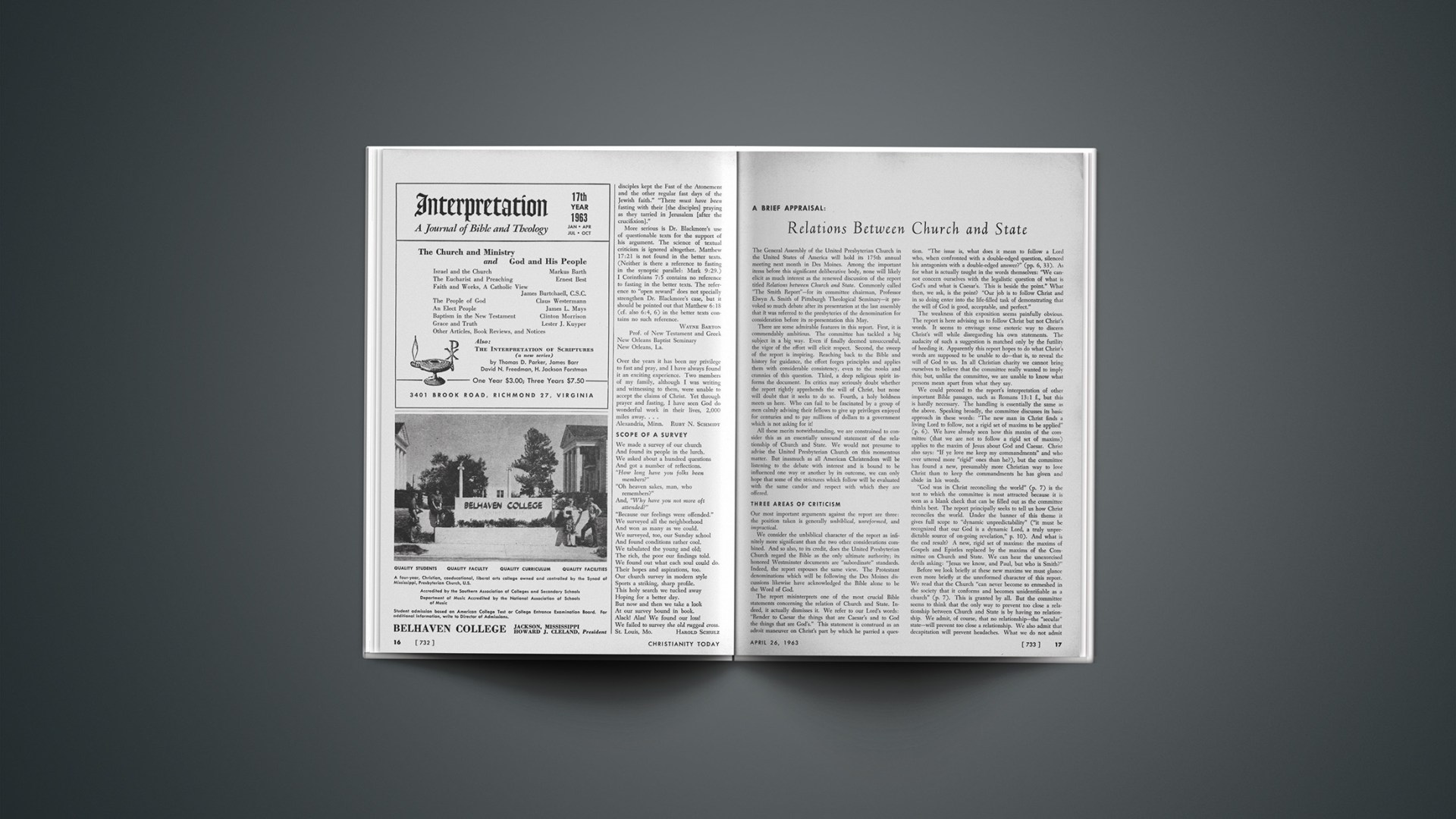
A Brief Appraisal: Relations Between Church and State

Considerable interest has been aroused by the publication of a series of recommendations advocated by a Special Committee on Church and State, in a report given to the 1962 General Assembly of the United Presbyterian Church in the U.S.A. (Relations between Church and State, Office of the General Assembly, Philadelphia). This report has caused a division of opinion and inspired debate among laity and clergy.

The committee recommended that there be a cessation of celebration of religious holidays, Bible reading, and prayer in public schools; that Sabbath laws be made less stringent; that there be no tax exemptions for religious agencies; and that there be no special exemption from military service for clergymen. The report also questioned whether the clergy should serve as military chaplains, paid by the State.

The recommendations lead us to think of the danger to which Philip Schaff called attention in his excellent monograph, Church and State in the United States. Schaff, a truly great church historian who taught at Union Theological Seminary in New York City, accused the Liberal League of attempting “to heathenize the Constitution and to denationalize Christianity.” He quotes from the organ of the Liberal League, The Index (Jan. 4, 1873), as follows:

The Demands of Liberalism

1. We demand that Churches and other ecclesiastical property shall no longer be exempted from just taxation.

2. We demand that the employment of chaplains in Congress, in State Legislatures, in the navy and militia, and in prisons, asylums, and all other institutions supported by public money, shall be discontinued.

3. We demand that all public appropriations for sectarian, educational, and charitable institutions shall cease.

4. We demand that all religious services now sustained by the government shall be abolished; and especially that the use of the Bible in the public schools, whether ostensibly as a text-book, or avowedly as a book of religious worship, shall be prohibited.

5. We demand that the appointment, by the President of the United States or by the Governors of the various States, of all religious festivals and feasts shall wholly cease.

6. We demand that the judicial oath in the courts, and in all other departments of the government, shall be abolished, and that simple affirmation under pains and penalties of perjury shall be established in its stead.

7. We demand that all laws, directly or indirectly, enforcing the observance of Sunday as the Sabbath shall be repealed.

8. We demand that all laws looking to the enforcement of “Christian” morality shall be abrogated, and that all laws shall be conformed to the requirements of natural morality, equal rights, and impartial liberty.

9. We demand that not only in the Constitutions of the United States and of the several States, but also in the practical administration of the same, no privilege or advantage shall be conceded to Christianity or any other special religion; that our entire political system shall be founded and administered on a purely secular basis; and that whatever changes shall prove necessary to this end shall be consistently, unflinchingly, and promptly made.

Schaff then proceeds to some general thoughts on the liberal program in the following fashion:

To carry out their program, the Free-thinkers would have to revolutionize public sentiment, to alter the constitutions and laws of the country, to undo or repudiate our whole history, to unchristianize the nation, and sink it below the heathen standard (Church and State, p. 45).

Little did he dream that a segment of his own denomination would seek to give reality to what he termed an “infidel program.”

The general thrust of the Presbyterian committee’s recommendations is to secularize the government and its institutions. The direction is towards “unchristianizing” the nation. The report states: “More important, history warns that the conception of the ‘Christian State’ is as dangerous for true religion as for civil liberty” (Relations Between Church and State, p. 6). The State is required to remain absolutely neutral as far as religion is concerned (ibid., p. 8). This thrust in the report’s introduction and appendices is even more revealing than the startling recommendations.

Most disconcerting to modern theologians who treat the question of church-state relations is the “otherworldly” attitude of Christ revealed in the Gospels. The committee seeks to overcome this attitude of Christ by “freeing” the Church from his teachings:

The new man in Christ finds a living Lord to follow, not a rigid set of maxims to be applied (ibid., p. 6).

The church commits a great error when it treats the teachings of Jesus as if they had a significance unto themselves. Jesus Christ was not a second Moses; to say that his teachings embody a new law is profoundly misleading. Legalism and moralism in the church are de facto denials of the confession of the Lordship of Christ (ibid., p. 33).

The Lord did give a set of maxims which he expected to be obeyed. His authority impressed his listeners, for he did not speak with the uncertainty, vacillation, and ambiguity of the scribes. But now modern scribes tell us that to follow the Sermon on the Mount and other precepts of Christ is “legalism and moralism” and a virtual denial of the Lordship of Christ. We are puzzled. How can obedience to the revealed Word of Christ be a virtual denial of his Lordship?

Unique and novel is the committee’s attempt to nullify the import and relevance of the classic text of church-state relations: “Render to Caesar the things that are Caesar’s, and to God the things that are God’s” (Mark 12:17; cf. Matt. 22:21; Luke 20:25). The report affirms that the New Testament denies an application of this statement to the church-state question. And why? “Because Jesus’ hearers were amazed by the saying!” and “Luke’s account explicitly indicates that the saying served the function of silencing those who sought to trap Jesus” (ibid., p. 33). In other words, the saying has no significance because it silenced his opponents! Jesus’ hearers were also amazed at the Sermon on the Mount; does that remove its relevance?

“Dynamic unpredictability” seems to be the substitute for the “rigid set of maxims” and for the authoritative revelation. The Church’s deliverance from the revealed teachings of Christ issues in freedom. “This freedom contains an element of dynamic unpredictability which should be present in our approach to church-state relations” (ibid., p. 7). However, Christ’s teaching impressed people because he spoke not simply with “dynamic unpredictability” but with authority.

For the authoritative Word of Christ in Scripture, the committee would substitute an uncertain source of revelation: “It must be recognized anew that our God is a dynamic Lord, a truly unpredictable source of on-going revelation” (ibid., p. 10). What the Lord revealed as truth yesterday may not be what he reveals as truth today or tomorrow. To call the Lord “an unpredictable source of on-going revelation” is to dishonor him who is “the same yesterday, and today, and forever.” The great historical denominations have always been against such fanatical groups who claim to receive revelation from God apart from Scripture.

Contextual ethics is the substitute for universal principles. Seemingly there is not a permanent set of ethics or values that can be applied to concrete realities of time and circumstance. The committee states:

The ethic which gives point and direction to the witness of the church to its risen Lord is contextual in that it is meaningful to man only in terms of the concrete realities of his own time.… This is why the Christian ethic can never be understood in terms of universal principles to be applied in all situations and under all circumstances (ibid., pp. 35, 36).

In other words, because of change of situation or circumstance, a “thus saith the Lord” in America may not be politic or expedient in Africa. A “thus saith the Lord” in the first century may be out of date in the twentieth. Our Lord, certainly, does not give the impression that the ethic code he instituted was contextual and could be changed by time and circumstance.

That we have not misunderstood the intent of the committee is seen in their approval of another term: middle axioms. These are defined as “not binding for all time, but are provisional definitions of the type of behavior required of Christians at a given period and in given circumstances” (ibid., p. 39). Christian ethics are as chaff which the winds of time can blow away!

Although the committee desires to separate the State and its institutions from the Christian religion, nevertheless it encourages the Church to use the coercive power of the State to establish the Christian ethic. In effect, the Church must resort to legalism. Legalism is the attempt to reform life by legislative acts. In the report such statements as these appear: “only action through civil law could remedy the social crisis on a national scale”; “the Christian must advocate national reform by legal measures”; “the solution must be found in state actions”; “American Protestants now had to find how they could relate themselves to state power as the instrument by which the Christian responsibility for economically depressed persons could be met” (ibid., pp. 25–27). No longer the power of the Holy Spirit but state power is to be the instrument of the Church. No longer Christian charity but the welfare state is the answer. No longer the persuasive power of the Gospel but the coercive power of the State is the instrument of Christian responsibility.

Separation, for the committee, is a one-way street. The State must not in any way become involved with religion or the Church, but must remain absolutely neutral. At the same time, to the Church is reserved the right to judge the affairs of the State: “This does not rule out strong expressions of judgment by churches and churchmen on public affairs” (ibid., p. 30).

The committee would base the superiority of the Church and her right to sit in judgment over the State on the peculiar Barthian dogma “that in Christ, God and the world are reconciled” (ibid., p. 7). However, no biblical proof is advanced that the State has been placed under the direction and critique of the Church. Certainly, Christ has not given that mandate to the Church but has clearly indicated that Caesar has an independent jurisdiction in relation to the Church.

The report states on page 33 that “the issue before the General Assembly is not “What is Caesar’s and what is God’s?’ Caesar has no autonomy as over against God, whether he knows it or not.” Caesar has no autonomy as over against God, but Caesar does have autonomy as over against the Church. The State is amenable to God. So is the Church. But it does not follow nor is it true that the State is amenable to the Church. The Bible view is a free church in a free state.

To equip the Church for the task of supervising the affairs of the State, the committee gives the Church this impossible task: “to know our state and its problems as critically as possible” (ibid., p. 7). How can the Church evaluate correctly the domestic and foreign affairs of the State without the avenues of information open to that body? Even now the feeble and amateurish efforts of the Church to become “worldly wise” have diverted her from the main task of saving souls through the proclamation of the Gospel of grace.

One cannot help wondering why the report, in its historical summation, failed to signify the most impressive feature of church-state relations during the hundred-year period after the adoption of the federal Constitution: the fact that the churches did not meddle in civil affairs nor seek to exert political pressures. This was so striking that the French historian Alexis de Tocqueville wrote:

There is no country in the whole world in which the Christian religion retains a greater influence over the souls of men than in America.… They [clergy] keep aloof from parties and from public affairs. In the United States religion exercises but little influence upon the law and upon details of public opinion; but it directs the customs of the community, and, by regulating domestic life, it regulates the state (Democracy in America, I, 314, 315).

In other words, it was not by meddling in civil affairs and not by political pressures that the American Church became such a powerful influence for moral good, but by keeping strictly to her spiritual sphere and by the employment of the persuasive power of the Gospel.

The report declares rightly that the question as to whether the Church should proclaim its Gospel is unthinkable, and then adds: “Likewise unthinkable is the possibility that the proclamation can be limited in scope so as to leave the political and social realm undisturbed” (Relations Between Church and State, p. 37). Christ took no direct concern in the political, social, and economic functions of the State; yet the influence of his Gospel disturbs them all. This was accomplished not by taking over the functions of the State nor by directing the affairs of the State, but by the influence of redeemed men.

The report speaks of tactics. Why not follow the tactics of Christ and the apostles and confine the work of the Church to spiritual weapons rather than political? The Church actually intensifies her influence on society by keeping herself separate from civil affairs and concentrating on the affairs of the Kingdom.

History gives evidence of bad effects when the Church dominates civil affairs, as abundantly illustrated in the history of many European nations. But a state whose laws and institutions are influenced by Christian life and principles is a blessing for true religion and civil liberty. And the greatest illustration of this is (or has been) the United States of America.

END

A Brief Appraisal: Relations between Church and State

The General Assembly of the United Presbyterian Church in the United States of America will hold its 175th annual meeting next month in Des Moines. Among the important items before this significant deliberative body, none will likely elicit as much interest as the renewed discussion of the report titled Relations between Church and State. Commonly called “The Smith Report”—for its committee chairman, Professor Elwyn A. Smith of Pittsburgh Theological Seminary—it provoked so much debate after its presentation at the last assembly that it was referred to the presbyteries of the denomination for consideration before its re-presentation this May.

There are some admirable features in this report. First, it is commendably ambitious. The committee has tackled a big subject in a big way. Even if finally deemed unsuccessful, the vigor of the effort will elicit respect. Second, the sweep of the report is inspiring. Reaching back to the Bible and history for guidance, the effort forges principles and applies them with considerable consistency, even to the nooks and crannies of this question. Third, a deep religious spirit informs the document. Its critics may seriously doubt whether the report rightly apprehends the will of Christ, but none will doubt that it seeks to do so. Fourth, a holy boldness meets us here. Who can fail to be fascinated by a group of men calmly advising their fellows to give up privileges enjoyed for centuries and to pay millions of dollars to a government which is not asking for it!

All these merits notwithstanding, we are constrained to consider this as an essentially unsound statement of the relationship of Church and State. We would not presume to advise the United Presbyterian Church on this momentous matter. But inasmuch as all American Christendom will be listening to the debate with interest and is bound to be influenced one way or another by its outcome, we can only hope that some of the strictures which follow will be evaluated with the same candor and respect with which they are offered.

Three Areas Of Criticism

Our most important arguments against the report are three: the position taken is generally unbiblical, unreformed, and impractical.

We consider the unbiblical character of the report as infinitely more significant than the two other considerations combined. And so also, to its credit, does the United Presbyterian Church regard the Bible as the only ultimate authority; its honored Westminster documents are “subordinate” standards. Indeed, the report espouses the same view. The Protestant denominations which will be following the Des Moines discussions likewise have acknowledged the Bible alone to be the Word of God.

The report misinterprets one of the most crucial Bible statements concerning the relation of Church and State. Indeed, it actually dismisses it. We refer to our Lord’s words: “Render to Caesar the things that are Caesar’s and to God the things that are God’s.” This statement is construed as an adroit maneuver on Christ’s part by which he parried a question. “The issue is, what does it mean to follow a Lord who, when confronted with a double-edged question, silenced his antagonists with a double-edged answer?” (pp. 6, 33). As for what is actually taught in the words themselves: “We cannot concern ourselves with the legalistic question of what is God’s and what is Caesar’s. This is beside the point.” What then, we ask, is the point? “Our job is to follow Christ and in so doing enter into the life-filled task of demonstrating that the will of God is good, acceptable, and perfect.”

The weakness of this exposition seems painfully obvious. The report is here advising us to follow Christ but not Christ’s words. It seems to envisage some esoteric way to discern Christ’s will while disregarding his own statements. The audacity of such a suggestion is matched only by the futility of heeding it. Apparently this report hopes to do what Christ’s words are supposed to be unable to do—that is, to reveal the will of God to us. In all Christian charity we cannot bring ourselves to believe that the committee really wanted to imply this; but, unlike the committee, we are unable to know what persons mean apart from what they say.

We could proceed to the report’s interpretation of other important Bible passages, such as Romans 13:1 f., but this is hardly necessary. The handling is essentially the same as the above. Speaking broadly, the committee discusses its basic approach in these words: “The new man in Christ finds a living Lord to follow, not a rigid set of maxims to be applied” Cp. 6). We have already seen how this maxim of the committee (that we are not to follow a rigid set of maxims) applies to the maxim of Jesus about God and Caesar. Christ also says: “If ye love me keep my commandments” and who ever uttered more “rigid” ones than he?), but the committee has found a new, presumably more Christian way to love Christ than to keep the commandments he has given and abide in his words.

“God was in Christ reconciling the world” (p. 7) is the text to which the committee is most attracted because it is seen as a blank check that can be filled out as the committee thinks best. The report principally seeks to tell us how Christ reconciles the world. Under the banner of this theme it gives full scope to “dynamic unpredictability” (“it must be recognized that our God is a dynamic Lord, a truly unpredictable source of on-going revelation,” p. 10). And what is the end result? A new, rigid set of maxims: the maxims of Gospels and Epistles replaced by the maxims of the Committee on Church and State. We can hear the unexorcised devils asking: “Jesus we know, and Paul, but who is Smith?”

Before we look briefly at these new maxims we must glance even more briefly at the unreformed character of this report. We read that the Church “can never become so enmeshed in the society that it conforms and becomes unidentifiable as a church” (p. 7). This is granted by all. But the committee seems to think that the only way to prevent too close a relationship between Church and State is by having no relationship. We admit, of course, that no relationship—the “secular” state—will prevent too close a relationship. We also admit that decapitation will prevent headaches. What we do not admit is that this is the only way, nor that such a preventative is not worse than the ailment.

Furthermore, history will bear out that the committee’s way is not the Reformed way. From the days of Calvin in Geneva, the seventeenth- and eighteenth-century Reformed theologians of the Continent (cf. Heppe’s Reformed Dogmatics, pp. 691–94), not to mention the Scottish Reformed tradition, have advocated the closest possible relationship compatible with the principle that the Church must not become identified with the State. Granted, the American Way has been the way of separation—Jefferson’s “wall of separation” indeed—but walls with some carefully guarded gates by means of which a controlled traffic between Church and State is possible. As one leader is cited as saying, America is not a church-state, but it is a religious state. This is easily proven from a study of official government deliverances.

The impracticality of this report we may attempt to show by a couple of specimen citations. First, “Bible reading … tend(s) toward indoctrination or meaningless ritual and should be omitted for both reasons.” Such a statement is self-contradictory since the same thing cannot “tend” in opposite directions, namely, to meaninglessness and to indoctrination. Actually it is meaningless only when students are inattentive; otherwise, we admit, it tends toward indoctrination. Is that bad? Inasmuch as the civilization of this country, as of the West generally, is based more upon the Bible than on any other cultural source, indoctrination in its principles would appear to be highly desirable even for the student who does not believe them.

A Theological Ground

Probably the most impractical and daring of all proposals in the report is this: “The church has no theological ground for laying any claim upon the state for special favors” (p. 19). Special favors include tax exemption (pp. 19, 20). But, there is a “theological ground” on which the favored position of the Church has rested for centuries. Briefly it is this: on the one hand, the Church is an invaluable aid to the development of good citizens, and, on the other hand, of itself it depends entirely on freewill offerings with all the precariousness attached thereto. Since, therefore, the State reaps great advantages from the moralizing work of religious institutions, it is to the State’s advantage to help preserve them in any way legitimately open to it, whether it be a specifically “Christian state” or not. If in a specific case the State is satisfied that the Church is such an asset and does favor the Church by exemptions, this has no tendency in itself to become a hindrance to the Church. The report does not explain why it supposes that it does. We assume the fear is based upon the admitted possibility that the Church’s zeal may flag when her temporal needs are relieved, more or less, by the government. We do not for a minute deny that this may happen and often has. We simply contend that it need not happen and that there seems to be next to no imminent danger of its happening in this country, where the healthy rivalry of many different denominations would tend to prevent it. In any case, this is an argument against abuse again and not against use. The same danger always faces any church when it is the recipient of large amounts of money or land from any source, yet no one seriously advocates the refusal of all such religious contributions. When we remember, on the other hand, that were this maxim to be followed, literally millions of dollars would be diverted from their present use in the evangelization of the world, we see an alien theological principle giving birth to a monstrous child.

Eutychus and His Kin: April 26, 1963

‘How’S That Again’?

While jetting along but not in the jet-set setting, I was racing through a paperback edition of modern memoirs, and I read the following:

“ ‘By the way, did you ever read Le Chant de Maldoror?’

“ ‘By Lautreamont?’ I said. ‘No, I haven’t read it. Wasn’t Lautreamont an early surrealist or something?’

“ ‘Oh, yes. Almost a century ago he was like the Hieronymus Bosch of the writing fraternity. He had a real nutsy streak, but was undoubtedly gifted, too.’ ”

And then, I continued on down the page until my subconscious caught up with my conscious. All those words which I had read with such satisfaction didn’t mean a single thing to me.

Coupled with the fact that I really didn’t know what the author was talking about (I can’t even translate Le Chant de Maldoror nor define surrealism) was the awareness that my mind acted as if I did understand. I had really entered into amiable conversation with these enlightened ones. “Oh, yes,” said I. “That Hieronymus Bosch had a real nutsy streak, but he was undoubtedly gifted too.” How had I been completely taken in by unreal, and for all I know untrue, but very clever talk? Worst is, I think I am surrounded by that kind of talk.

Have you heard any theological conversations recently—the existentialists and the relativists and their kin who darken counsel with words without knowledge? We can be sure of only one thing they tell us, and that is, we can be sure of no thing.

Language is a tool and an instrument, and some people will use it on us as a bludgeon or as a rapier or just frightfully for giving us a needle shot in one of our control centers.

I’m going now, and if I should return during my absence, keep me here till I get back.

EUTYCHUS II

The Cretan Frontier

I am convinced that Dr. Gordon is on the right track and that his work must be taken seriously. He is calling to our attention an entire new field for study, and if we neglect it, we are the losers. The Bible believer has nothing whatever to fear from new discovery and new ideas, for all truth is from God, and the truth of archaeology will agree with the truth of special revelation.

Without question Dr. Gordon is a pioneer, but I do not think that he has overstated the case for the importance of Minoan. His evaluation of the significance of the Qumran manuscripts is essentially the same as my own. I regard his work as very valuable.

Prof. of Old Testament

Westminster Seminary

Philadelphia, Pa.

Brooklyn And Broadway

I have recently run across something which seems … to be significant … re New York’s Broadway Presbyterian Church case.… It is a recent article in Look magazine (Mar. 26 issue) titled “Rebel in a Brooklyn Pulpit.” The Spencer Memorial Church of Brooklyn, pastored by the Rev. William Bell Glenesk, seems to be doing things that make Dr. Stuart H. Merriam’s actions appear as child’s play: “… Glenesk sounds his weekly battle cry against religion by rote. For help, the handsome Canadian-born minister often calls upon ballet performers to dance at vespers. He sermonizes on Picasso, plays spirituals by Odetta and has himself donned black tights to dance the Doxology.” He is pictured hailing vespers with the clash of cymbals.… Merriam (who awaits the verdict of the forthcoming General Assembly) preaches the Gospel of salvation and had a growing congregation and income, while apparently Glenesk has lost members. At any rate, since this church is now a part of the New York Presbytery, it is evident that if he is tolerated, Merriam’s only “crime” is that of being an evangelical!… If it were not for the fact that the New York Presbytery has acted very vindictively in destroying a fine congregation, it would be ludicrous, but as it is it is actually quite heartbreaking to every conservative Presbyterian.… Spencer Memorial membership, according to our statistics books, has gone from 212 in 1956 to 158 in 1961. Church school membership has gone from 37 to 21.

The First Presbyterian Church

Spencer, N. Y.

Listen

If the Holy Spirit is guiding Pope John and Cardinal Bea, it behooves the rest of us to prepare to hear His voice, not only when He speaks to us, but when He speaks to them!

The National Conference of Christians and Jews

New York, N. Y.

The Defended

Ernest Kinoy’s script titled “The Heathen,” dramatized on the March 23 “Defenders” TV program, was a flagrant attempt to convince us that the atheist not only has the private right to deny God but that such denial should not affect his status in a society where most people believe in God.… At the risk of intolerance from the atheists, I must maintain, even after seeing the program, that I would not prefer my child being taught by one who believes that “God is not relevant to human behavior.”

Church of Christ

England, Ark.

Tale Of Two Nations

Whatever may be the situation in the Church of England, Geoffrey W. Bromiley’s article “Evangelicalism and the Anglican Articles 1563–1963” (Mar. 15 issue) does not reflect conditions in this country.… There may be a few scattered “evangelicals” as the author uses the term, but there is no real evangelical element.

St. Columba’s Church

Inverness, Calif.

For Felicity In Funerals

The Session of our church is in the midst of a comprehensive study of ways in which we can best discover how funerals can best be determined by and proclaim Christian convictions.

If it would be possible for you to aid us in our attempt by inviting your subscribers to send materials to me, it would be greatly appreciated. We would be glad to share a résumé of the information received and conclusions reached with persons who request it.

We would be happy to receive information from members of any Christian denomination concerning resolutions, recommendations, booklets, articles, seminar results, policy statements, experiences, and actual practices of which they know or have been involved in as they relate to death, funerals, and burial in the Christian fellowship.

Calvary Presbyterian Church

Wilmington, Calif.

Open Door In Ottawa

Your article “A Ransom For the Siberians” (News, Feb. 1 issue) was very timely.… I for one am glad to do my share in helping those poor people that suffer for righteousness’ sake and if there is a chance that they could come out of Russia, I am willing to sponsor one family, i.e., pay their traveling expenses either to Europe or this continent and help them to get settled.

Ottawa, Ont.

By No Means A Hostelry

Re the heading “The Inn is Out” (Eutychus, Mar. 1 issue), all readers may be interested in observing the comment on this passage from Luke 2 by a Greek scholar now passed on and with the Lord. From notes taken on the spot by the undersigned, the late Dr. G. Campbell Morgan had this to say: … “The inn was in Greek tongue kataluma, a place for travellers to rest in, merely a rough shelter. No host, no entertainment. Your cattle could be tied up there and yourself if you like. It was by no means a caravansery or a hostelry”.…

Bloomington, Calif.

Partition

Mr. Raymond E. Weiss’ letter (Feb. 15 issue) denouncing Israel would appear to justify every effort expended by Israel and her friends to keep the record of her establishment correct so that her existence will not wantonly and violently be challenged by surrounding states.…

He apparently is not aware, or if aware doesn’t care, that in 1947 the United Nations General Assembly—after months of study and debate—established a Jewish and an Arab state in Palestine. The surrounding Arab states rejected that decision and chose war—war to destroy Israel and “to drive the Jews into the sea.” Those displaced, whether Jews or Arabs, were made refugees by that war.

To make the Middle East crisis into one caused by “Jewish Zionist terrorists” is to bear false witness to the truth and to the very Christian Gospel Mr. Weiss is committed to uphold.…

Garden City, N. Y.

A Rabbi’S Rejoinder

Re the editorial “What About the Atheists?” (Feb. 1 issue):

I share your conviction that there seems something wrong when a Jewish state will accept as a Jew one who is a pronounced atheist and deny the Jewishness of one who thinks of himself as a “Jew fulfilled.” However, Israel is not discriminating against the Jewish Christian, Brother Daniel, by offering him citizenship as an alien rather than under the Law of Return. The Law of Return favors Jews who for centuries have been disfavored in other lands. It does not, however, discriminate against or disfavor non-Jews who would seek Israeli citizenship. In contrast to the reception Jews endured in other lands, Israel holds its door open to any and all who would wish to come and settle in that land. The citizenship process calling for a waiting period of three years is quite benevolent and liberal if contrasted with the immigration and citizenship laws of other lands. I think you have a good insight in pointing to the fact that, religiously, the Jew ought hold to a closer identification with the Christian than with the atheist. That he does not, in fact, represents the intervention of history. Only as Christians will be Christian in their relation to the Jews, will it be possible for Jews to rediscover how Hebraic are the roots of Christianity.

The National Conference of Christians and Jews

New York, N. Y.

Toothsome Undertaking

In this day of bulging waist lines, and the practice of what has been called “digging our graves with our teeth,” it is refreshing to read Jim Blackmore’s article on the Bible teaching of fasting (Jan. 18 issue). My soul feasted on this article.

I especially like what he said about an occasional fast that others might know the taste of food.…

Clinton, N. C.

“A Plea for Fasting” was quite provocative. However, the weakest part of his argument is his scriptural interpretation. There is too much argument from silence. Here are several examples. “In secret, our Lord must have fasted.” “We have no reason to doubt that Jesus and his disciples kept the Fast of the Atonement and the other regular fast days of the Jewish faith.” “There must have been fasting with their [the disciples] praying as they tarried in Jerusalem [after the crucifixion].”

More serious is Dr. Blackmore’s use of questionable texts for the support of his argument. The science of textual criticism is ignored altogether. Matthew 17:21 is not found in the better texts. (Neither is there a reference to fasting in the synoptic parallel: Mark 9:29.) 1 Corinthians 7:5 contains no reference to fasting in the better texts. The reference to “open reward” does not specially strengthen Dr. Blackmore’s case, but it should be pointed out that Matthew 6:18 (cf. also 6:4, 6) in the better texts contains no such reference.

Prof. of New Testament and Greek

New Orleans Baptist Seminary

New Orleans, La.

Over the years it has been my privilege to fast and pray, and I have always found it an exciting experience. Two members of my family, although I was writing and witnessing to them, were unable to accept the claims of Christ. Yet through prayer and fasting, I have seen God do wonderful work in their lives, 2,000 miles away.…

Alexandria, Minn.

Scope Of A Survey

We made a survey of our church

And found its people in the lurch.

We asked about a hundred questions

And got a number of reflections.

“How long have you folks been members?”

“Oh heaven sakes, man, who remembers?”

And, “Why have you not more oft attended?”

“Because our feelings were offended.”

We surveyed all the neighborhood

And won as many as we could.

We surveyed, too, our Sunday school

And found conditions rather cool.

We tabulated the young and old;

The rich, the poor our findings told.

We found out what each soul could do.

Their hopes and aspirations, too.

Our church survey in modern style

Sports a striking, sharp profile.

This holy search we tucked away

Hoping for a better day.

But now and then we take a look

At our survey bound in book.

Alack! Alas! We found our loss!

We failed to survey the old rugged cross.

St. Louis, Mo.

Theistic or Secular Government?

What is the underlying issue in the current debate on church-state relationship in this country? It is not, though it sometimes is made to sound that way, between those who believe in a state church and those who do not. The first amendment settled that. It is rather over what the first amendment means. The two positions which have developed are the historic interpretation and a new interpretation which is still somewhat fluid. The historic interpretation is that our government recognizes the existence of God and is favorable to the cause of religion generally. The new interpretation asserts that our government is entirely neutral, that it is neither for nor against religion.

The Issues Before Us

Let us look at the scene in the United States to see if we have correctly stated the issue that our people and our courts are trying to solve. Last year, the Supreme Court struck down as unconstitutional a general prayer composed by officials of the public school system in New York State, and recited with their approval. When President Kennedy was asked in his press conference for his reaction, he replied, “We can pray a good deal more at home and attend our churches.” This was excellent advice, but it does not deal with our problem. People in Russia can also pray at home and in their churches. Francis B. Sayre, dean of Washington Cathedral, said, “I thought President Kennedy missed the point when he advised us to pray at home, for this nourishes only our private lives as individuals, but what of our corporate life as a nation?”

Now this seems to highlight the question: Does our government as a government have any religious quality? It has had such a quality in the past. The assertion that it now does not is a novel theory, and the burden of proof is on those who assert it. Justice Douglas, in a concurring opinion, writes, “I cannot say that to authorize this prayer is to establish a religion in the strictly historic meaning of these words.” This is a frank admission, and we would do well to think about it. What does the statement in the first amendment (“Congress shall make no law respecting an establishment of religion or prohibiting the free exercise thereof”) mean in its historical context?

A somewhat similar issue arose in connection with the relationship of the Constitution to slavery at the time of the Douglas-Lincoln debates. The issue then concerned the extension of slavery to the territories, and, as Lincoln feared a new interpretation of the Constitution would permit, to the free states themselves. Senator Douglas expressed indifference to the moral questions involved and stated that he personally did not care whether the question was “voted up or down.” In reply Lincoln appealed to the original intent of the Constitution and of the Founding Fathers; he appealed to history to confirm his view and to refute that of Senator Douglas and of the Dred Scott decision of the Supreme Court. He said, “I always believed that everybody was against it (slavery) and that it was in the course of ultimate extinction. The adoption of the Constitution and its attendant history led the people to believe so, and such was the belief of the framers of the Constitution itself, else why did those old men, about the time of the adoption of the Constitution, decree that slavery should not go into new territory?”

Now, let us try to do what Lincoln then did, to discover what meaning the first amendment had for those who wrote it and for the government that enforced it. Our first president, George Washington, not only was enormously influential in adopting the Constitution, but, in enforcing its provisions, believed most strongly in the necessity of religion for our national health and future prosperity. In his farewell address, the father of our country wrote: “Religion and morality are the indispensable supports of political prosperity. Let us with caution indulge the supposition that morality can be maintained without religion. Reason and experience both forbid me to expect that national morality can prevail in the exclusion of religious principle. Morality is a necessary spring of popular government. Who that is sincere friend to it, can look with indifference upon attempts to shake the foundation of the fabric?”

But let us ask Thomas Jefferson, generally and rightly regarded as the chief architect of the idea of separation of Church and State, how he understood the relation of faith in God and the government. Jefferson was a Deist, and he was opposed to any church, such as the Episcopal, being established as the official church, but judging from his own actions he knew nothing of a secular government. In the Declaration of Independence he plainly speaks of God as the Creator of all men and the Author of our lives, our liberties, and the right to pursue happiness. He closes this document which declared us to be a nation with these words: “with a firm reliance on the Protection of Divine Providence, we mutually pledge to each other our Lives, our Fortunes, and our sacred Honor.” Does our government recognize God today? It certainly did in the hour of its birth.

Since the adoption of the Constitution and of the first ten amendments shortly thereafter, the Congress has recognized the existence of God in various actions and has been friendly to religion generally as held by our citizens. It has been not indifferent to, nor neutral to, but friendly to religion. This is what we should expect if our government is “of” and “by” and “for” the people, for our people have ever been, what a recent decision of the Supreme Court has recognized, “a religious people.” The Congress has employed chaplains to open the business of both houses regularly with prayer. Chaplains have been employed to serve in the armed forces of our nation. The Bible has been used in our courtrooms to enforce the oath, and the Supreme Court has regularly opened with a prayer. In the public school system, which was accepted by our country when the Protestant churches held the balance of power, it was understood that while narrowly sectarian religion would not be taught, the great moral truths of religion would be. Horace Mann, who at the very least is one of the fathers of public school education, believed that the two great commandments of love to God and love to neighbor would be part of public school education. Tax exemption to the churches was granted by a friendly government which confidently expected that good churchgoers would be good citizens. In short there was a religious consensus on the part of the great mass of our citizens which caused our government to recognize the presence of God in our national affairs.

This is the point at which those in favor of the new secular attitude on the part of our government speak up. We now live, they say, in a pluralistic society; no religious agreement any longer exists, and therefore the government must assume the attitude of strict neutrality. But is this really true? We are no longer as strongly Protestant as in the past, but the growing strength of Roman Catholicism is not hostile to the expression of faith in God on the part of our government. The proportion of Jews is larger than in colonial days, but it was a Jew who wrote, “Blessed is the nation whose God is the Lord.” The forces of secularism are larger or at least more aggressive than in the past, but they existed then also. If when we were born as a nation we could express a reliance on “the Protection of Divine Providence,” can we not do so today? Statistically today we have more people formally united to religious organizations than we did then. In various sample religious polls taken to establish the religious beliefs of our nation, the results are startlingly similar. Over 95 per cent of our population regularly profess to have some sort of faith in God, and less than 5 per cent assert that they do not. In a republic such as ours, since we cannot at the same time please both of these groups, whom should we please—the great majority or the minority? In 1865 our government caused the motto “In God We Trust” to be stamped on our coinage. So the right of men to disbelieve is granted, but the right of the majority of our citizens to express their faith in God has also been granted.

There are various minorities in our nation. A minority of our citizens believe in socialism. They have a right to do so and to try to persuade others to their point of view, but they do not have the right to inhibit the great majority of our citizens from expressing faith in capitalism through appropriate actions of our government. So the convictions of a minority of our citizens should not be allowed to coerce our government into a false and harmful neutrality to the One whom Jefferson called “Creator,” nor towards that religious life that Washington thought indispensable for our political institutions.

But an even more important consideration should be borne in mind by our people. We are engaged in a life-and-death struggle with Russia. We head up the free world, and Russia heads up the world of Communism. Each side has enormous armies, navies, and air forces, hundreds of millions of people, and atomic power. Each side thinks it should win. Russia has said that it will bury us. Which side should win? Is it not evident that the scales will be tipped by some outside power? The power that will decide is God, for he has promised the victory to those who serve him. In the past our government has publicly acknowledged God, at our birth and in every great struggle. But if the secular view of the first amendment wins, this will no longer be so. The issue then will be between Russia, which is hostile to God but permits worship, and the United States, which officially is indifferent to God but allows liberty. How much difference is there between hostility and indifference?

All of our presidents have invoked divine aid, and President Kennedy has in this year asked for “God’s help.” May our nation, as a nation, ever do so in the great arena of our national and international life.

END

God’s Hand on Men and Movements

The lecture hall at the university rang with new ideas as the thirty-three-year-old monk continued introductory remarks to his new commentary: “… all good works are but an outward indication of the faith from which they proceed; … Where faith is of the right type, all … qualities [such as] peace, happiness, love toward God and everybody … follow naturally on account of the immeasurable blessing which God has bestowed upon us in Christ.… Therefore we own that faith justifies without any work whatsoever” (quoted in Adolf G. H. Kreiss, D. Martin Luther’s Preface to the Epistle of St. Paul to the Romans, p. 29).

There was no uncertainty in his voice. Had he not struggled through the years just for this hour? Known for singular piety, devotion, and monastic zeal, his life nevertheless had been filled with unhappiness. He had had no peace in his heart.

But as he studied the Scriptures the light dawned upon his troubled soul. Now there was no longer any doubt in his mind about the meaning of the third chapter of Romans, that letter of Paul which has been called the “Acropolis of the Christian faith.” In his studies Doctor Martin had noted especially verse 25: “Mark this, this is the chief point and the very central place of the epistle and of the whole Bible.”

From that lecture hall at the University of Wittenberg the learned monk went out into the world with a newfound faith. He did not know then that he had left the Middle Ages behind him and stood on the threshold of a new era, that he had shaken the world intellectually, politically, and religiously.

But God’s hand had been placed upon his shoulder, and the fire which had smoldered for centuries suddenly burst into flame. “His doctrine of justification by faith was the decided step toward the emancipation of the individual from the absolute authority of the hierarchy” (Henry C. Sheldon, History of Christian Doctrine, Vol. II, p. 5). Today at least one-third of the Christian world stands with Martin Luther on the doctrine he proclaimed, sola scriptura, the Scriptures as the only authority for sinful man in seeking salvation.

History has shown that it is difficult to keep a fire going. People get into the habit of things. The fire dies down, and formalism creeps in. Where is the flame, the inspiration, the life?

Not far away. God’s hand is stretched out. It touches another seeker after truth and holiness. He has wrangled with Hebrew and Greek syntax for many a year. He has met every week with other likeminded men. At least once every week he has “gone to Communion.” He has even served as a missionary to the American Indians. But to no avail. No peace, no happiness. Then one day, in the spring …

And again we see the hand of God moving among men. It makes little difference where in the world. He moves men in one country, and men become aware of his calling in other countries or upon other continents. Here, at a time when John Wesley is seeking after light and holiness, the heads of the Moravian Church in Germany are making arrangements to send a pious and gifted evangelist (who later became a bishop) to America, directing him to pass through London. Little do they realize what great consequences will come out of this journey!

The man chosen for this service was Peter Böhler, who after his arrival in London met John and Charles Wesley; to them he gave of his rich evangelical experience. Böhler believed in a complete self-surrendering faith, an immediate conversion, and a joy in believing. These things John Wesley did not have. He worked at them, but seemingly to no avail. Then one day he went to the extremes. During the day he attended a service in St. Paul’s Cathedral; in the evening he “went unwillingly” to a prayer meeting in a simple house on Aldersgate Street. And it was there he heard Luther speak. “Faith is a living and bold trust in God’s grace, so sure of itself that it would defy death a thousand times. Such trust and reliance upon God’s grace makes a man cheerful, courageous, and friendly toward God and all …” (quoted in Kreiss, op. cit., p. 19). Wesley’s spirit leaped for joy. He recognized that at long last he had found what he had sought. From that prayer meeting in Aldersgate Street, Wesley came out a changed man. From then until his death fifty-three years later, he could preach from his own experience a dynamic Christian faith. Aldersgate was to him a most wonderful experience which led to a most active life. In half a century Wesley with his followers broke up the cold formalism of English church life, made Christianity the transforming power for hundreds of thousands of working people, and set in motion philanthropic and reform impulses that led to John Howard’s crusade against prison horrors, William Wilberforce’s against slavery, and Robert Raikes’s Sunday schools.

In speaking of Wesley’s attendance at the prayer meeting in Aldersgate Street, we said that “it was there he heard Luther speak.” But was it really Luther who spoke? Was it not another, to whom also the words of life had come after a period of suffering in heart and soul—one who wrote, through the Holy Spirit, what John Knox called “unquestionably the most important theological book ever written”? From it we quote:

For no human being will be justified in his sight by works of the law since through the law comes knowledge of sin. But now the righteousness of God has been made manifested apart from law … the righteousness of God through faith in Jesus Christ for all who believe. For there is no distinction; since all have sinned and fall short of the glory of God, they are justified by his grace as a gift, through the redemption which is in Christ Jesus, whom God put forward as an expiation by his blood, to be received by faith (Rom. 3:20–25, RSV).

We believe God had put his hand upon Saul even when he “laid waste the church, and entering house after house … dragged off men and women and committed them to prison” (Acts 7:54–8:3, RSV). And God’s hand was upon him from the moment he became Paul, when God showed him “how much he must suffer for the sake of my name” (Acts 9:16, RSV).

We have mentioned these three: Paul, Luther, and Wesley. There is an interesting chain reaction in the impact of the words of Paul in Luther’s life, and then of the words of Luther upon the life of John Wesley, who in return gave impetus to religious movements which have lasted for two centuries.

Did God then have nothing to say to other people through the intervening centuries? Of course he did! It was Paul’s Letter to the Romans which gave abiding importance to the life of Augustine, whose influence on the Church has been tremendous.

Centuries roll by. A man is on a journey when a vision of his departed saintly mother comes to him. It is the climax of that mysterious inner change in a person’s life which is called conversion. Before the altar of a nearby church this man gives himself, in a flood of tears, irrevocably to God. God honored his servant, and Bernard of Clairvaux became the greatest religious force of the twelfth century. His “love to Christ … in spite of extreme monastic self-mortification, found so evangelical expression as to win the hearty approval of Luther and Calvin.… Men admired in Bernard a moral force, a consistency of character … which added weight to all that he said and did …” (Williston Walker, A History of the Christian Church, p. 246).

Then there was Francis of Assisi, of whom it is said that when he heard the Lord’s words recorded in Matthew 10 read in the church, he understood them as a personal call for him to give up all for his Master. So he did. He “entered into marriage with poverty” and gave the Gospel to the common people, the poor, the downtrodden, the forsaken. In so doing, in accord with the Word, he became the greatest of medieval saints.

“And what more shall I say? For time would fail me to tell of …” Yet we must not forget Peter Waldo and the “poor men of Lyons” who began the Waldensian movement and suffered much persecution for following Christ; finally they were nearly all destroyed except for a few in the northwest corner of Italy, where the group today is the oldest member of the Protestant family and more vigorous than ever.

Or how can we fully estimate the life of John Wycliffe, the “Morning Star of the Reformation”? In the Bible he found the one criterion for Christian faith and action, and therefore began to translate the Word into English so that it would be available to every man. His ideas were popularized by his Poor Preachers, and later by the Lollards, who spread his teachings especially to Bohemia and nearby countries in Central Europe. There they took root through the preaching and writing of John Huss, that great martyr who so influenced Luther that the latter admitted at the Leipzig debate that his positions were those of Huss and that the Council of Konstanz had erred in condemning the Bohemian reformer. Out of the Hussite movement grew (from the time of the fall of Constantinople to the Turks) the Unitas Fratrum, which absorbed most of what was vital in the Hussite movement and became the spiritual ancestor of the Moravians, who in turn greatly influenced John Wesley at his time of dire spiritual need. Thus we see how God through “spiritual chain reactions” leads in the movements of the centuries.

The “link” between Pietism in seventeenth-century Germany and the great Wesleyan revival movement in eighteenth-century England was formed by the work of two men who came out of the Pietistic movement: August Hermann Francke and Count Ludwig von Zinzendorf. The former experienced what he regarded as a divine new birth while writing a sermon on John 20:31. He later laid the foundation of his famous institutes, which were located in Halle and known as Franckesche Stiftungen. Under Francke this place became also a center for missionary zeal. From here Schwartz, Plütschau, and Ziegenbalg went to India. During the eighteenth century no fewer than sixty missionaries went forth from Halle to far-off peoples.

Zinzendorf was more interested in “heart-religion” in the Pietistic sense than in the barren Lutheran orthodoxy of his time. His was an intimate fellowship with Christ, who completely dominated his theology.

Zinzendorf opened his estate to the refugees from Bohemia and nearby Moravia, where the persecution which had begun with the Thirty Years’ War had lasted for a hundred years. He later became the leader of this group of sorely tried Christians.

During their journeys to and from the American continent, Moravian preachers came into contact with John Wesley and greatly influenced him, as has been related above. The Moravians carried on great missionary activity in many places—in Surinam, Guiana, Egypt, and South Africa, as well as among the American Indians in Georgia and Pennsylvania. Their missionary passion could only inspire others, who were given the holy flame and became zealous evangelicals both in England and on the Continent.

The fire spread to the New World, mainly through the efforts of George Whitefield, an associate of John Wesley. Whitefield emerged from a crisis in his religious experience in joyous consciousness of peace with God and began to preach the Gospel of God’s forgiving grace, peace through the acceptance of Christ by faith, and a consequent life of joyous service. “Dramatic, pathetic, appealing, with a voice of marvellous expressiveness, the audiences of two continents were as wax melted before him” (Walker, op. cit., p. 511).

While Whitefield went about preaching on this side of the Atlantic, he was witness of and a coworker in the Great Awakening, which was really the counterpart of Pietism in Germany and Methodism in Great Britain. It broke out in the church served by Jonathan Edwards and spread like wildfire, especially in New England. The movement did not last very long, however, mainly because of the political situation in the colonies.

While Methodism already had been introduced in the American colonies, it was Francis Asbury who carried the torch. This he did on horseback as he rode 270,000 miles over roadless swamps, pathless forests, untraveled wilderness. Having ordained more than 4,000 preachers, he could well be called “the maker of Methodism in America.” He did all this because from the time of his conversion at the age of thirteen he never forgot that it was “through faith in Christ” that he had accepted his Lord and Master.

Concerning all these men, the words of Scripture surely hold true: “Blessed are the dead who die in the Lord … that they may rest from their labors, for their deeds follow them” (Rev. 14:13, RSV). Their deeds went with them into the nineteenth century. In this land the holy flame touched the life of a lawyer, who immediately experienced a wonderful conversion. From that time on Charles G. Finney gave up his practice and went out preaching the Word, always holding forth the importance of his listeners’ coming to immediate decision. It is estimated that those converted through his ministry exceeded half a million (Elgin S. Moyer, Who Was Who in Church History, p. 144).

The hand of God also touched the life of a Boston shoe clerk, and Dwight L. Moody left a good living to give himself in unstinted service to his God for a new life in the Spirit. Though not an ordained minister, he became a very effective preacher and evangelist who, together with the singer Ira D. Sankey, conducted many evangelistic campaigns both here and in Great Britain. It is said that Moody personally dealt with nearly 750,000 individuals in his eagerness to win them to Christ. He became a noted educator and left the Northfield schools in Massachusetts and the Moody Bible Institute in Chicago as a witness of enduring value. It would not be too much to say that through these institutions he, though gone from the scene of his labors, has influenced thousands of people.

A contemporary with Moody was Charles Haddon Spurgeon, who felt God’s call in a little chapel among the Primitive Methodists in England (although he soon joined the Baptists). Immediately he became famous as a “boy preacher,” and that fame followed him throughout his life. His ministry as an evangelist was different from others in that he stayed in one place, and people came to his great tabernacle. His writings had an enormous circulation.

In England a branch of the Wesleyan church touched the life of William Booth, who felt that he had to go outside of the church, out “into the highways and byways,” to seek the lost whom the Saviour loved. This compulsion to go anywhere in order to seek out men and women and give them the Gospel came to Booth and his wife after they both had been led into a deeper Christian experience through the influence of John Wesley’s teachings on sanctification. Booth’s Salvation Army came into being in London’s East End. He lived to see its work in fifty-five countries where the Army continued to be active in street preaching, personal evangelism, and practical philanthropy.

The working of God seems to have its heights and its valleys. We leave the centuries behind us. Men and women of God have come and gone. One can truly say with the Lord of the harvest: “One sows and another reaps. I sent you to reap that for which you did not labor; others have labored, and you have entered into their labor” (John 4:37, 38, RSV).

Where are we in this latter part of the twentieth century? There is much to make Christians pessimists, but there are also signs of encouragement. Such efforts as, for instance, those carried on by Billy Graham and his associates in evangelism, and the response given on every continent, could point to a world revival far superseding anything we have seen before.

So the influence spreads when man responds to God. It’s like a fire, spark to spark, from century to century, leaping across continents. There is persecution and suffering in response to the call, but there is also the endless march of splendor of Spirit-filled coworkers with God.

END

The Law’s Third Use: Sanctification

In 1528—only a decade after the posting of the Ninety-five Theses—Erasmus asserted that “the Lutherans seek two things only—wealth and wives (censum et uxorem)” and that to them the Gospel meant “the right to live as they please” (letter of March 20, 1528, to W. Pirkheimer, a fellow humanist). From that day to this Protestants have been suspected of antinomianism, and their Gospel of “salvation by grace through faith, apart from the works of the Law” has again and again been understood as a spiritual insurance policy which removes the fear of hell and allows a man to “live as he pleases.”

Sanctification Twice Desanctified

The claim that Protestantism is essentially antinomian seemed to have an especially strong basis in fact in the nineteenth century. Industrialization and urbanization brought about social evils which were overlooked and rationalized by many professing Protestants. Inevitably a reaction occurred, and in the social-gospel movement of the late nineteenth and early twentieth centuries one encounters a textbook illustration of what Hegel called the antithesis. In its fear that Protestantism had become ethically indifferent, the social-gospel movement of Washington Gladden and Walter Rauschenbusch identified the Christian message with social ethics. From an apparent justification without sanctification, the pendulum swung to a “sanctification” which swallowed up justification. In their eagerness to bring in the kingdom of God through social action and the amelioration of the ills of the industrial proletariat, the social gospelers generally lost track of the central insight of the Reformation: that the love of Christ must constrain the Christian, and that we can experience and manifest this love only if we have personally come into a saving relationship with the Christ who “first loved us” (1 John 4:19) and gave himself on the cross for us (1 Pet. 2:24).

World War I burst the optimistic bubble of the social gospel; no longer did there seem to be much assurance that human beings had the capacity to establish a sanctified society on earth. But the reductionist biblical criticism with which the social-gospel movement had allied itself did not die as easily. So loud had been the voices of modernism against a perspicuous, fully reliable Scripture that in the most influential Protestant circles it was believed that a return to a propositional biblical ethic could never take place. The result was (and is, for the movement is by no means dead) an existential ethic.

The Protestant existentialists do not of course go to the length of the atheist Jean-Paul Sartre, who says in Existentialism and Human Emotions, “There are no omens in the world.” But when Sartre follows this assertion with the qualification that even if there were omens (as the Christian believes), “I myself choose the meaning they have,” he comes very close to the approach of the contemporary Protestant existentialist. The latter, unable to rely (he thinks) on a biblical revelation which is objectively and eternally definitive in matters ethical, must himself “choose the meaning” of Scripture for his unique existential situation. In practice he agrees with Simone de Beauvoir when she says that man “has no need of any outside guarantee to be sure of his goals” (The Ethics of Ambiguity). Right or wrong is never determined absolutely in advance; the Bible is not a source of ethical absolutes—it is rather the record of how believers of former times made ethical decisions in the crises of their experience. What distinguishes the Christian ethic from the non-Christian, in this view? Only the motivation of love. The Christian has experienced God’s love, and so is in a position to bring that love to bear upon the unique existential decisions he faces. This existential approach, at root highly individualistic, has in recent years been given a “group discussion” orientation by such writers as A. T. Rasmussen, who, in his Christian Social Ethics (1956), asserts that existential decision should take place in “the higher community of God,” where “Christian discussion” serves as “the channel through which the Holy Spirit moves in the dialectic or give-and-take of genuine spiritual intercourse to provide ethical guidance.”

The contemporary existential ethic in Protestantism is a second instance of desanctifying sanctification, for it inevitably devolves into ethical relativism. Sartre, when asked advice by a young man who, during World War II, was torn between a desire to join the Free French Forces and a feeling that he should stay in France to take care of his mother, could only say, “You’re free, choose, that is, invent.” Likewise, the Protestant existentialist can never appeal to absolute law; he can only say, “You’re free, choose to love.” But what does this mean in concrete terms? Theoretically it can mean “anything goes”—an antinomianism indeed—for each existential decision is unique and without precedent. Thus the housemother in Tea and Sympathy who committed adultery out of self-giving (agape?) love in order to prove to a student that he was not incapable of heterosexual relationships, cannot be condemned for her decision. As for Rasmussen’s ethic of social existentialism, one can see that it merely compounds the problem on the group level. George Forell has well characterized this approach as “inspiration by bladder control,” for the person who stays longest in the group discussion is frequently the one whose “responsible participation” determines the “contextual and concrete” ethic of the moment. The absence of an eternal ethical standard either in individualistic or in social existentialism totally incapacitates it for promoting Christian holiness.

Answer Of Classical Protestantism

In the Protestantism of the Reformation, antinomianism is excluded on the basis of a clear-cut doctrine of the Law and a carefully worked-out relation between the Law and the Gospel. The Reformers assert, first of all, that no man is saved on the basis of Law. As the Apology of the Augsburg Confession puts it: Lex semper accusat (“The Law always indicts”). Whenever a man puts himself before the standard of the Law—whether God’s eternally revealed Law in the Bible or the standard of Law written on his own heart—he finds that he is condemned. Only the atoning sacrifice of Christ, who perfectly fulfilled the demands of the Law, can save; thus, in the words of the Apostle, “by grace are ye saved through faith; and that not of yourselves: it is the gift of God: not of works, lest any man should boast” (Eph. 2:8, 9).

But God’s Law, as set forth in Scripture, remains valid. Indeed, the Law has three functions (usus): the political (as a restraint for the wicked), the theological (as “a paidagogos to bring us to Christ”—Gal. 3:24), and the didactic (as a guide for the regenerate, or, in Bonhoeffer’s words, “as God’s merciful help in the performance of the works which are commanded”). Few Protestants today dispute the first and second uses of the Law; but what about the third or didactic use? Do Christians, filled with the love of Christ and empowered by His Holy Spirit, need the Law to teach them? Are not the Christian existentialists right that love is enough? Indeed, is it not correct that Luther himself taught only the first two uses of the Law and not the tertius usus legis?

Whether or not the formulation of a didactic use of the Law first appeared in Melanchthon (Helmut Thielicke [Theologische Ethik] and others have eloquently argued for its existence in Luther’s own teaching; cf. Edmund Schlink, Theology of the Lutheran Confessions), there is no doubt that it became an established doctrine both in Reformation Lutheranism and in Reformation Calvinism. One finds it clearly set out in the Lutheran Formula of Concord (Art. VI) and in Calvin’s Institutes (II, vii, 12 ff.). It is true that for Luther the pedagogic use of the Law was primary, while for Calvin this third or didactic use was the principal one; yet both the Lutheran and the Reformed traditions maintain the threefold conceptualization.

An Essential Doctrine

The Third Use is an essential Christian doctrine for two reasons. First, because love—even the love of Christ—though it serves as the most powerful impetus to ethical action, does not inform the Christian as to the proper content of that action. Nowhere has this been put as well as by the beloved writer of such hymns as “I Heard the Voice of Jesus Say” and “I Lay My Sins on Jesus”; in his book, God’s Way of Holiness, Horatius Bonar wrote:

But will they tell us what is to regulate service, if not law? Love, they say. This is a pure fallacy. Love is not a rule, but a motive. Love does not tell me what to do; it tells me how to do it. Love constrains me to do the will of the beloved one; but to know what the will is, I must go elsewhere. The law of our God is the will of the beloved one, and were that expression of his will withdrawn, love would be utterly in the dark; it would not know what to do. It might say, I love my Master, and I love his service, and I want to do his bidding, but I must know the rules of his house, that I may know how to serve him. Love without law to guide its impulses would be the parent of will-worship and confusion, as surely as terror and self-righteousness, unless upon the supposition of an inward miraculous illumination, as an equivalent for law. Love goes to the law to learn the divine will, and love delights in the law, as the exponent of that will; and he who says that a believing man has nothing more to do with law, save to shun it as an old enemy, might as well say that he has nothing to do with the will of God. For the divine law and the divine will are substantially one, the former the outward manifestation of the latter. And it is “the will of our Father which is in heaven” that we are to do (Matt. 7:21); so proving by loving obedience what is that “good and acceptable, and perfect will of God” (Rom. 12:2). Yes, it is “he that doeth the will of God that abideth forever” (1 John 2:17); it is to “the will of God” that we are to live (1 Peter 4:2); “made perfect in every good work to do his will” (Heb. 13:21); and “fruitfulness in every good work,” springs from being “filled with the knowledge of his will” (Col. 1:9, 10).

Secondly, the doctrine of the Third Use is an essential preservative for the entire doctrine of sanctification. The Third Use claims that as a result of justification, it is a nomological fact that “if any man be in Christ he is a new creature: old things are passed away; behold, all things are become new” (2 Cor. 5:17). A man in Christ has received a new spirit—the Spirit of the living God—and therefore his relation to the Law is changed. True, in this life he will always remain a sinner (1 John 1:8), and therefore the Law will always accuse him, but now he sees the biblical Law in another light—as the manifestation of God’s loving will. Now he can say with the psalmist: “I delight in Thy Law” and “O how I love Thy Law!” (Ps. 119; cf. Ps. 1 and Ps. 19). Only by taking the Third Use of the Law—the “law of Christ” (Gal. 6:2)—seriously do we take regeneration seriously; and only when we come to love God’s revealed Law has sanctification become a reality in our lives. Ludwig Ihmels made a sound confession of faith when he wrote in Die Religionswissen-schaft der Gegenwart in Selbstdarstellungen: “I am convinced as was Luther that the Gospel can only be understood where the Law has done its work in men. And I am equally convinced that just the humble Christian, however much he desires to live in enlarging measure in the spirit, would never wish to do without the holy discipline of the tertius usus legis.” The answer to antionomianism, social-gospel legalism, and existential relativism lies not only in the proper distinction between Law and Gospel, as C. F. W. Walther so effectively stressed, but also in the proper harmony of Law and Gospel, as set forth in the classic doctrine of the Third Use of the Law.

END

WE QUOTE:

RELIGION IN AMERICA—We see great increases in religious attendance, increases in the treasuries of religious organizations—but do we find the power, the manifestation of God’s will in the lives of our people?… Nothing in our Judeo-Christian faiths tells us that we are to isolate God into a little compartment.… Jesus Christ himself went out where the people lived and walked, where the people worked and played.… The apostles stood in the market places of that day and performed their tasks and enunciated their gospel.… They may be the real need of America … not the perfunctory following of a faith, but the performance of that faith within the daily walk, seven days a week, not one.… We have been caught up in American life, in my opinion, by words, words, words. We sometimes talk a problem to death. You know the old saying, “Anytime three Americans get together they elect officers”—we are so organization minded! But the words of our faith must take meaning and become rooted in action.—Governor MARK HATFIELD of Oregon to the Fourteenth Anniversary Dinner of “Religion in American Life.”

Lessons from Wesley’s Experience

It has been shrewdly said that true greatness grows. It not only endures, but actually increases. The stature of those whose greatness springs from goodness (as the highest always does) is enhanced as the years go by, and succeeding generations recognize more and more of significance in their character and influence. This is a principle clearly distinguishable in the case of those whom God has chosen to be lights of the world in their several generations. “The path of the just is as the shining light, that shineth more and more unto the perfect day” (Prov. 4:18). It is so for him, as that Scripture suggests, but where greatness is allied to righteousness it seems as if that illumination is conveyed to after-ages.

Certainly this has happened with John Wesley. He has always been known as an outstanding figure in the history of the Christian church. But his stock improves as the march of time takes us further from his century, and it can be said that never was he more appreciated than today. We are beginning to realize the measure of his greatness. The judgment of Augustine Birrell that he was “the greatest force of the eighteenth century” is widely accepted. A recent editorial in The Times Literary Supplement has reaffirmed this conviction. “No historian can miss the immense raising of the nation’s spiritual temper by Wesley in his own movement and through its effects in the Church of England. When we review the nineteenth century we find the evils which we criticize in our own, sometimes in worse shapes, but we see a high seriousness and far less confusion of mind. The recovery of the national mind and character started with Wesley.”

This acclaim is not confined to Great Britain, of course. Wesley’s fame is universal. In the language of Gladstone, his “life and acts have taken their place in the religious history not only of England, but of Christendom.” It is from this broad standpoint that Professor Martin Schmidt has penned the latest biography. He sees in Wesley a man who lived and acted as an ecumenical Christian. He regards him as belonging to the whole of Christendom, since the last of the major ecclesiastical organizations to have come into being in the development of Christianity originated with him.

Amidst this deepening volume of applause, we must not overlook the fact that Wesley became the man he is now hailed as being through the intervention of God. No doubt many of his qualities already lay hidden within his personality, but it was only at the touch of the Spirit that they sprang to life and received their necessary integration. All that Wesley was and did can be traced back to a transforming experience on a never-to-be-forgotten day. If the Damascus road explains Paul the Apostle, if the Milanese garden accounts for Augustine of Hippo, if the Black Tower at Wittenberg gave birth to Martin Luther as the pioneer reformer, then Aldersgate Street, London, produced John Wesley as the world knows him today.

On May 24, 1738, as a young Anglican clergyman in much distress of soul, Wesley went very unwillingly, like Shakespeare to school, to a predominantly Moravian society meeting. There someone (probably William Holland) was reading from Luther’s preface to Romans. “About a quarter before nine,” recorded Wesley in his famous journal, “while he was describing the change which God works in the heart through faith in Christ, I felt my heart strangely warmed. I felt I did trust in Christ, Christ alone for my salvation; and an assurance was given me that He had taken away my sins, even mine, and saved me from the law of sin and death.”

Dr. Henry Bett succeeded in tracing the precise passage from Luther’s introduction to Romans which must have so warmed Wesley’s heart. Here is how it runs: “Wherefore let us conclude that faith alone justifies, and that faith alone fulfills the law. For faith through the merit of Christ obtains the Holy Spirit, which Spirit makes us new hearts, exhilarates, excites and influences our heart, so that it may do those things willingly of love, which the law commands.”

It was the signal contribution of Wesley to the age in which he lived that he set experience in the foreground of Christianity. It is virtually a new term in the theology as it appears in his writings. He restored the element to the primacy it occupies in the Scriptures. “Wesley brought the whole Christian world back to religion as experience,” declares Professor George Croft Cell; “in religion, experience and reality come to the same thing.”

Some Significant Emphases

It must not hastily be supposed, however, that Wesley’s emphasis upon experience amounted to mere subjectivism or that he can rightly be regarded as the precursor of Schleiermacher and his school in this respect. Wesley was too scriptural to fall into such imbalance. His experiential theology was safeguarded at every point from subjectivistic deviation by counteracting features which derived from his own dramatic conversion in Aldersgate Street.

1. Experience was interpreted in terms of a divine-human confrontation. For Wesley, experience stood at the receiving end, so to speak, of God’s sovereign grace. He insisted, as much as Calvin ever did, that the divine will and the divine deed are alone determinative of man’s salvation. God takes the initiative. “It is plain that God begins His work at the heart. God begins His work in man by enabling us to believe in Him. Out of darkness He commands the light to shine.”

It is at the heart that God begins and continues his work, and not in a vacuum. He deals with sinners, and all Wesley means by experience is the reaction produced in the personality when God quickens it through his Spirit. It is his way of describing the new birth leading to the new life. Wesley preached regeneration as unremittingly as Whitefield. “It is the great change which God works in the soul when He brings it into life; when He raises it from the death of sin to the life of righteousness. It is the change wrought in the whole soul by the almighty Spirit of God when it is ‘created anew in Christ Jesus.’ ”

2. Experience was never divorced from the authoritative Word of God. Wesley was homo unius libri. The Bible was his criterion. A thorough study of his doctrine of Scripture has yet to be made, though in differing contexts both Professor G. A. Turner and Dr. H. D. MacDonald have made excursions into this field. Concerning the Scriptures, Wesley wrote: “Every part thereof is worthy of God; and all together are one entire body, wherein is no defect, no excess.” And again: “According to the light we have, we cannot but believe the Scripture is of God; and … [thus] we dare not turn aside from it, to the right hand or to the left.”

It is significant that the Word of God, through the exposition of Romans, was instrumental in Wesley’s conversion. He could conceive of no Christian experience apart from the Bible. As Colin Williams has correctly observed, “in Wesley experience is not the test of truth, but truth the test of experience,” and that truth is equated with the revelation of Scripture.

3. Experience was regarded not as static but as a growth in grace. Determinative and seminal as was the Aldersgate Street conversion in Wesley’s spiritual biography, he refused to fix experience at this single point. Rather he saw it as the bursting of the rock from which the life-giving stream was to flow throughout the remainder of his career. With justification there came assurance, though Wesley recognized that this simultaneity is not apparent in every case. The witness of the Spirit is not always immediately realized. But this phenomenon is a factor of Christian experience, nevertheless, at some point, and normally not far removed, if at all, from conversion.

But for Wesley assurance itself was only a step on the highway of holiness. “Let none ever presume to rest in any supposed testimony of the Spirit, which is separate from the fruit of it.” The major objective was holiness of heart and life, and Wesley made it the main plank in his platform. “This doctrine is the grand depositum which God has lodged with the people called Methodists; and for the sake of propagating this chiefly He appeared to have raised us up.” Although Wesley left room for a crisis in spiritual experience beyond regeneration in which a more complete consecration allowed a more conscious appropriation of the Spirit, he was careful to insist on the relativity of such expressions. Sanctification is basically a process extending from the moment of new birth to the redemption of the body. “Sanctification begins when we begin to believe,” he said, “and in proportion as our faith increases, our holiness increases also.” But the expansion of faith is itself a work of the Spirit; hence Charles Wesley’s prayer, which is always relevant: “Stretch my faith’s capacity.”

“All that the Wesleys said of permanent value to the human race came out of their evangelical experience,” affirmed Dr. J. E. Rattenbury. “All their distinctive doctrine was discovered in that realm of the Spirit—which had been supernaturally revealed to them in May 1738.” But this vital theology of experience was not disconnected from its essential rootage in the sovereignty of God, the authority of Scripture, and the energizing of the Spirit which has as its goal the reproduction of Christ’s image in the heart. As such it is relevant to our situation today as we seek to steer an evangelical course between the Scylla of synergistic subjectivism and the Charybdis of formalized orthodoxy.

END

Aldersgate: An Epoch in British History

Every student of Methodist, and indeed of modern church history, is familiar with the famous passage in which John Wesley describes the striking experience which he underwent on May 24, 1738: “In the evening I went very unwillingly to the society in Aldersgate Street, where one was reading Luther’s Preface to the Epistle to the Romans. About a quarter before nine, while he was describing the change which God works in the heart through Christ, I felt my heart strangely warmed. I felt I did trust in Christ, Christ alone for salvation; … assurance was given me that He had taken away my sins, even mine, and saved me from the law of sin and death” (Journal, I, 475, 476).

How important was this experience in John Wesley’s spiritual life? Attempts have been made, especially during the present century, to play down its significance. For example, the Belgian Franciscan priest, Father Maximin Piette, in his book John Wesley in the Evolution of Protestantism, says this (p. 306):

This famous conversion, which has been called upon to play so prominent a part in the doctrinal life of the Methodism of the nineteenth century, enjoyed but a very modest role in the founder’s life and in that of his companions. In fact, whether it be considered in its preparation, or be studied in itself and its results, it would seem to have been merely a quite ordinary experience whose effects time was quickly to dull. Had it not been entered in the first extract of the Journal, it is quite possible that Wesley would have entirely forgotten all about it. In any case, subsequent appraisals, made after the lapse of many years, reduce to pitiable proportions the song of praise and victory which first accompanied it.

But concerning this opinion there are two things to be said. First, Wesley himself never had any doubt as to the crucial significance of the Aldersgate experience. For instance, writing to his brother Samuel in October, 1738, he said this:

With regard to my own character, and my doctrine likewise, I shall answer you very plainly. By a Christian I mean one who so believes in Christ as that sin hath no more dominion over him; and in this obvious sense of the word I was not a Christian till May 24 last past. For till then sin had the dominion over me, although I fought with it continually; but surely then from that time to this it hath not, such is the free grace of God in Christ. What sins they were which till then reigned over me, and from which by the grace of God I am now free, I am ready to declare on the housetop, if it may be for the glory of God. If you ask by what means I was made free (though not perfect, neither infallibly sure of my perseverance) I answer “by faith in Christ by such a sort or degree of faith as I had not till that day” (Letters, I, 262, 263).

Seven years later, when, so to speak, the emotional dust had settled and Wesley could view the matter dispassionately, he said this to a correspondent who has been identified as Thomas Secker, Bishop of Oxford, and subsequently Archbishop of Canterbury:

It is true that from May 24, 1738, wherever I was desired to preach, salvation by faith was my only theme.… And it is equally true that it was for preaching the love of God and man that several of the clergy forbade me their pulpits before that time, before May 24, before I either preached or knew salvation by faith (Letters, II, 65).

Second, most evangelically-minded students of Wesley’s life have accorded to this Aldersgate experience a place of equally high importance in Wesley’s spiritual development. For example, the Englishman Henry Bett says:

Whatever you call the experience of 1738, it was that which made Wesley the man he was and enabled him to do the work he did. It really does not matter whether you call it his conversion or not. On any and every possible interpretation of it, it was a spiritual event that gave Wesley quite a new sort of religious experience, with an assurance and a power and a peace and a joy he had never known before, and it was this change which made him into the Apostle of England. Apart from it he might have been an eighteenth century clergyman of the best type, with a perfectly sincere religion of a rather formal, ecclesiastical and intolerant kind; but he would never have been the man who led the Evangelical Revival (The Spirit of Methodism, p. 35).

And the American W. R. Cannon agrees:

If conversion be defined in the sense in which Wesley understood and defined it—God’s own act in which a man is turned away from his former self, made to pass from darkness into light, delivered from the power of Satan unto God, made over in mind and spirit—then the experience at Aldersgate Street … must stand without dispute as the date of Wesley’s conversion (The Theology of John Wesley, pp. 67, 68).

But exactly what was the nature of this Aldersgate experience? Dr. Umphrey Lee contends that “attempts to interpret that experience as an evangelical conversion which transformed Wesley from a sinner to a saint, or from a naturalistic humanist to a Christian, are in contradiction to Wesley’s own judgment and misreadings of the facts” (John Wesley and Modern Religion, pp. 101, 102). Certainly there can be no doubt that Wesley had been devoutly religious, at least since 1725. He not only had become an ordained clergyman of the Church of England but also had lived a life which was in many ways exemplary in devotional practice. For example, at Oxford University he was a member of the so-called Holy Club, whose practices included regular attendance at public worship and weekly partaking of the Lord’s Supper, regular meetings for prayer and Bible study, visitation of the sick and prisoners, and the organization of classes for poor children. And in 1735 he had volunteered to go out to Georgia as a missionary of the Society for the Propagation of the Gospel. What difference, then, did Aldersgate make to Wesley’s spiritual life? Dr. Maldwyn Edwards gives this answer:

Despite the exceptional quality of his Christian living he did not (before this event) know peace of mind or release of spirit. Consequently he had neither a sense of acceptance with God, nor a sense of power. Upon his conversion, however, he had deliverance and assurance and strength. He expressed it in his own words as he ruminated on his conversion experience. “Herein I found where the difference between this and my former state chiefly consisted. I was striving, yea fighting, with all my might under the law, as well as under grace. But then I was sometimes, if not often, conquered: now I am always conqueror” (Journal, I, 477) (The Astonishing Youth, pp. 81, 82).

What Edwards says is undoubtedly true. But perhaps a more intelligible explanation is this: whereas before Aldersgate Wesley had known God only at secondhand, now he knew him at firsthand, in personal encounter and living experience. What had hitherto been a matter of intellectual belief now became a living reality, renewing Wesley in his inmost being and giving him both an assurance and a power which hitherto he had lacked. This helps to explain Wesley’s own description of this experience, namely, that he had passed from the state of a slave and a servant to that of a son. Bishop Francis J. McConnell rightly says that “this is the heart of it all, and this is the heart of the Gospel” (John Wesley, p. 63). This kindling and renewing experience Wesley simply could not keep to himself: he had to tell it abroad far and wide so that as many others as possible might be persuaded to enjoy it for themselves. Hence the great missionary crusades which Wesley conducted for the rest of his life, which changed the face of England religiously and founded the great Methodist Church. So the secular historian W. E. H. Lecky is not exaggerating when he says that “the scene which took place at that humble meeting in Aldersgate Street forms an epoch in English history” (England in the 18th Century, II, 558).

END

Review of Current Religious Thought: April 12, 1963

Sydney Smith, canon of St. Paul’s Cathedral, did not like Methodists. A few months before he died in 1845 he said: “I feel so weak both in body and mind that I verily believe, if the knife were put into my hand, I should not have strength or energy enough to slide it into a Dissenter.” Precisely 100 years later, I was present when another Church of England clergyman (the only chaplain in the area) refused Communion to two young RAF men on active service in North Africa—because both were “Dissenters.” The Church of England still discourages its members from taking Communion in a Methodist chapel, allows Methodists to communicate in parish churches only in exceptional circumstances, and insists on reordaining Methodist ministers who enter its ranks.

All that will be changed and a 224-year-old division healed if the two churches implement the proposals made in a report published jointly by the Church Information Office and the Epworth Press (see CHRISTIANITY TODAY, News, March 15). Acceptance of the proposals in principle will commit both churches ultimately to full organic union. Until 1965 the question stands open: “if any man can shew just cause, why they may not lawfully be joined together, let him now speak, or else hereafter for ever hold his peace.” The four distinguished Methodists who entered the minority report have already spoken, pointed up the tensions, and supplied a basis for discussion. I mention only three of the points they have raised.

1. Scripture and Tradition. It is ecumenically fashionable at present to talk about a revival of biblical theology in the church of Rome, and about an increasing realization by Protestants that the Bible can be understood only in the context of the Church’s life, i.e., within Tradition. Because these two streams have come together, we have the basis for true ecumenical dialogue. This is plausible if you say it quickly without defining terms, and a similar criticism is made of the current report which, says the Methodist minority, does not sufficiently acknowledge Scripture’s preeminent place over Tradition. We children of the Reformation tend too facilely to reject Tradition and all its works.

The souls of now two thousand years

Have laid up here their thoughts and fears

And all the earnings of their pain—

Ah, yet consider it again!

But the Anglicans and Methodist majority do not stop at showing the value of Tradition—they are at great pains to defend it, and one must ask why this is necessary. As Principal Rainy put it: “The Church of Christ has no liberty to become the slave even of its own history.” This report is a perilous guide in that it tries to subordinate both Scripture and Tradition to “the living Word of God.”

2. Episcopacy. Anglicans are asking Methodists to assent to a version of the “historic episcopate” which has no New Testament warrant and is acceptable only to the Anglican three per cent of Christendom. Some seventy years ago Bishop J. C. Ryle of Liverpool said: “We never will admit that the acts and doings and deliverances of any Bishops, however numerous … are to be received as infallible.”

3. Ordination. In the Service of Reconciliation proposed by the report, there is episcopal laying on of hands, and a form of words employed remarkably similar to that used in the ordination of Anglican clergy. The Methodist minority sees reordination in this rite, a view confirmed by the Church Times: “We shall be surprised if the rite here proposed is not found to contain all the essentials of Catholic order.” Thereafter the declaration of the absolution and remission of sins is to be regarded as “part of the priestly and ministerial office.” The report denies that this is a rejection of a Methodist’s previous ministry, and points out that Methodists later in the service lay hands on Anglicans. Lady Playfair, in the London Daily Telegraph, wrote succinctly: “Anglicans, by laying on of hands, believe themselves to be conferring an indelible sacramental mark by their part of the ceremony, while (presumably) the laying on of hands by the Methodists can do no harm if it can do no good. Only a very devious-minded Christian will be able to find edification in such a scene.”

Apart from the astonishing omission from the report of any systematic discussion of the nature of the Church, the other major problem highlighted is the “established” nature of the Church of England. Bishops are appointed by the State (twenty-four of them are members of the House of Lords), which has also the oversight of matters of doctrine and worship. Many Anglicans down the centuries have warmly approved this arrangement, and the Victorian Dean Stanley asserted explicitly that “the religious expression of the community should be controlled and guided by the State.” The less traditional Sydney Smith was, indeed, regarded as living up to his reputation when he said: “If experience has taught us anything, it is the absurdity of controlling men’s notions of eternity by acts of Parliament.” Contemporary evangelicals, who might have been expected to agree with this, are apprehensive lest the powerful High Church party use the Methodists as a bargaining point to obtain freedom from parliamentary control in order to raise the ceiling of the Church.

Church merger reports are peculiarly vulnerable things. In one sense they are not constructed to withstand close scrutiny, calling as they do for compromise. Whenever striking and imaginative variations are played around a familiar theme, the strident cry of heresy is heard in the land, and dark allusions are made about building new boats to founder on old rocks. But this present report is the work of twenty-eight men over six years, and it would be mean and dishonest to condemn it unread, as many did with the Anglican-Presbyterian report in 1958. On the other hand, an exciting document like this might prove to be heady wine and a subtle temptation to rash, unthinking activity. Like moving on when the cloud is still.

Apple PodcastsDown ArrowDown ArrowDown Arrowarrow_left_altLeft ArrowLeft ArrowRight ArrowRight ArrowRight Arrowarrow_up_altUp ArrowUp ArrowAvailable at Amazoncaret-downCloseCloseEmailEmailExpandExpandExternalExternalFacebookfacebook-squareGiftGiftGooglegoogleGoogle KeephamburgerInstagraminstagram-squareLinkLinklinkedin-squareListenListenListenChristianity TodayCT Creative Studio Logologo_orgMegaphoneMenuMenupausePinterestPlayPlayPocketPodcastRSSRSSSaveSaveSaveSearchSearchsearchSpotifyStitcherTelegramTable of ContentsTable of Contentstwitter-squareWhatsAppXYouTubeYouTube