Eutychus and His Kin: April 12, 1963

Some Visual-Audios

“To whom,” said Elbert, “because he had went to night school.” Dorothy Sayers says somewhere that you can tell a man’s education by how self-conscious he is when he says “whom.” It is an odd twist; we ought to say whom, but our problem is to escape that prissy overtone. Like Churchill’s saying “This is the kind of arrant nonsense up with which I will not put.” I like the little boy who kicked everything away when he asked, “Why did you bring the book I didn’t want to be read to out of up for?” How do we speak good English without “putting it on”?

I have had a long and running fight with the language of public-relations experts. I know that they are trying to be polite, but I keep seeing them sitting around a conference table grinding out the awful word they finally choose. This is not to say that I could think of better ones, but I must say that I am getting sick of “motion sickness” for whatever it is that afflicts me in a plane, and “turbulence” for what makes us go ups-a-daisy, and “custom-coach” for what I know is cheaper seating, strictly second-class.

“Should the pressure system malfunction …”—who dreamed up that word “malfunction”? I do wish air hostesses would quit telling me they were glad to have me aboard, which in many cases they definitely were not. And closing off our trip with “good-bye now”—that extra word “now” bothers me for the next hour. One bright young thing said, “Bye-bye, now,” and we had reached the end of the line.

Balliett has written a marvelous review of Henry Miller’s Tropic of Capricorn (in passing he calls Miller a “surrealistic Edgar Guest”—isn’t that wonderful?) in which he defines H. W. Fowler’s word “genteelism” as “the substitution in self-conscious circles of antimacassar synonyms for daily bread words.”

It will take no great detective work to dig up the antimacassar words on your own local church scene—not to mention a few in your own vocabulary. They are especially rich and fervent in table blessings, sentence prayers, introductions of moderators, and so on.

EUTYCHUS II

Regarding Walhout, Fallout

Re Edwin Walhout’s article (“The Liberal-Fundamentalist Debate,” Mar. 1 issue): … How is it possible for a movement which denies the inspiration of the Word and its consequent historicity and authority to have an “emphasis … solidly rooted in God’s command”?…

We shall not properly harness the “resources of the Church” by attempting to combine or synthesize the “glory” of liberalism and fundamentalism. The power of the Spirit is most fully expressed where men disown liberalism, move beyond fundamentalism, and bring themselves into obedience to the whole Word of God and all its implications.

Trinity Chapel

Broomall, Pa.

Liberalism has, by deceptive infiltration and subversion, largely wrecked the Protestant denominations—some attack on evil! On the other hand, it is the downgraded “Fundamentalists” who are trying to raise a standard against the “be soft on Communism” policy of the NCC; and who are most concerned about religious, political, economic, national and racial integrity. Let’s quit calling the subverters of Christianity promoters, in any sense, of the biblical ethic.

Artas and Herreid Reformed Churches

Artas, S. Dak.

Jesus and the Apostles were not politicians. They did not lobby at Jerusalem and Rome for slum clearance, for the end of slavery, for tax reform, for the end of the social and political evils of their day. They preached the Word of God. They called men to faith and repentance, to a commitment to Jesus Christ. They stressed the spiritual.… The liberals preach the message of the Sadducees.…

The teacher might as well teach without books and the doctor might as well practice without medicine and the lawyer … without laws. The liberal seeks the byproducts of Christianity without Christ. We cannot have brotherhood, equality, social justice, Christian education, elimination of evils, until the heart is right and until the person is converted to Jesus Christ and indwelt and taught by the Spirit.… Get millions of converts all over the world and in all walks of life, and we will have salt, and we will have Christian ethic, we will have an impact on the ills of the world.… Liberalism would perish if God’s people stopped supporting it.

Lakebay Community Church

Lakebay, Wash.

What struck me was the subtle way he had of getting across his liberal ideas.…

I would like to quote from an article … in the March issue of Moody Monthly [discussing] the false millennium that the great deceiver is bringing about through the efforts of misguided men, who “by education, ventilation, sanitation, legislation are going to bring in the new earth.…”

“Better environment is not enough. Adam was in Paradise when he fell! If better conditions were the answer Adam would never have sinned.…”

Sayler, Calif.

The Doctrine Of Christ

Your issue for March 1 presents Dr. Harold Lindsell’s review of my book, Another Look at Seventh-day Adventism. Its third paragraph contains two serious errors, one relative to Adventist doctrine, and the other to my own.

First, Lindsell says that I “establish that there are Adventist writings which teach … the incompleteness of Christ’s work because of the investigative-judgment sequence and Adventist eschatology.” His words, “the incompleteness of Christ’s work” are indefinite, but I suppose him to mean “the incompleteness of Christ’s work on the cross.” If this is his meaning, he is mistaken in his assertion, for I have said, instead, that “in no case does Adventism formally deny the perfection of Christ’s sacrifice for sin” (p. 114). It does, indeed, teach the incompleteness of Christ’s atonement on the cross, but it commonly uses the word “atonement” for the effect rather than for the act of atonement, and it would be unfair for us to read our meaning of words into their use of them.

Secondly, Lindsell says that I fail “to distinguish Christ as one person in two natures.” What he means, I suppose, is that I fail “to distinguish two natures in Christ’s own Person.” Accordingly, he adds that I had “better reflect on the Monophysite and Monothelite controversies of the early church centuries”—inasmuch as these heresies taught, respectively, that Christ’s two natures were blended into one, and that He did not have two wills.

Lindsell bases this criticism on my words: “Inasmuch as it is the personality that is the responsible agent in sinning, then seeing that the personality of Christ is Divine, to say that He could have sinned is to say that Deity could have done so” (p. 50). But these words merely say that the divine personality of Christ could not sin. They do not say, nor do they even remotely imply, that Christ’s two natures are not forever distinct. Moreover, my very next paragraph consists of confirmatory quotations from Edersheim and Moule, wherein the truth of the one person and the two natures is plainly declared. Finally, in the first full paragraph on the same page appear these words: “The correct view of Christ’s Person grows out of a correct view of human nature. Since human nature consists of a rational spirit as well as of a physical body and its vital principle, Christ’s Person consisted of these same elements in conjunction with His eternal personality and the divine nature.”

East Lansing, Mich.

Life Is An Art

It is with a profound sense of gratitude that I express appreciation for the issue of March 1. The deeply moving and perceptive article “Art as Incarnation” by James Wesley Ingles alone would have made the issue distinguished. The irenic article by Edwin Walhout “The Liberal-Fundamentalist Debate” and “Biblical Faith and History” by Bernard Ramm make the issue memorable.…

[Ingles] grasps the inner core of religion from within and art becomes a form of revelation as it surely is if God is creator. He is the true reconciler of those who range themselves in the spent battle between liberalism and fundamentalism.

God has his own way of saying things to every age. Imperative as science is, life is an art and the inner core of things must become flesh. God must be bored with our silly pretensions and posturings. Were it not for His infinite mercy we would be dust. The age calls for a rebirth of spiritual insight that is a form of art expressing God’s intention and purpose in service as compassionate love.

Calvary Baptist

Lowell, Mass.

While I do not always agree with the theological stance of CHRISTIANITY TODAY, I do read it with profit. This last issue was excellent. The analysis of the liberal-fundamentalist debate was objective, creative, and abundantly documented.

There was some solid biblical and theological thinking in the other articles. There was little sentimental pietism, but a healthy effort to help your readers know and confront the issues. I particularly appreciated the discussion of the creative arts in our total culture. And then, how disappointing to find an entire page devoted to selling a book whose title is blasphemy and a contradiction of the Gospel: “Soul Winning Made Easy.”

Hyde Park Community Methodist

Cincinnati, Ohio

Garbc And Bgea

Your issue … for February 1 … carries a duo of letters from a Ramon Baker and a Robert Greaves writing about the GARBC versus Dr. Graham.…

I deny categorically that they or anyone else … have heard Graham criticized from this pulpit “many times.” Graham presents neither problem nor concern to me.…

In discussing polemical subjects I may have referred to ecumenical versus biblical evangelism. If so, I have undoubtedly mentioned his name as the popular exponent of the former. Even so, I have no apologies to make, and especially since he … [gives] plenty of space to criticizing those who identify with the separatist movement of our times.

First Baptist

Johnson City, N. Y.

… What they both fail to do is to distinguish between a personal attack against Mr. Graham as an individual, and an attack against … his methods.…

I too attended the chapel services at the seminary, but never once did I hear Dr. Graham attacked as a person. In fact, frequently, when anything was said about Mr. Graham either in the chapel services or from the First Baptist Church pulpit, it was made very clear that the issue was over principles rather than personalities.…

Calvary Baptist Church

Massillon, Ohio

It must be noted that Dr. Jackson stated that it is GARBC policy not to attack Dr. Graham. This is a true statement. That some men ministering in GARBC churches and schools have “attacked” Dr. Graham may be true (I, myself, have regretted hearing of isolated cases), but policy in a loose fellowship of churches is not equivalent to or even remotely related to an absolute command issued in a religious autocracy.… Certainly the GARBC differs with Dr. Graham in regard to methods and would like to have him “come … apart and join us,” and prayer is offered with that result in view. How foolish it would be not to pray according to conviction!

North Baptist

Indianapolis, Ind.

I, as Mr. Greaves and Mr. Baker, am a graduate of Baptist Bible Seminary.… While I was in seminary it was the policy and also the practice not to attack Billy Graham.

South Haven, Mich.

I want to go on record as a pastor of a GARBC church who is too busy serving the Lord to waste his time running down Billy Graham. I do not agree with him on the issue of separation, but he is a servant of the Lord and, as such, my prayer is that God may continue to use him to win souls. No preacher of the Gospel is without fault, but “to disagree” does not have to be interpreted to mean “to attack” by any stretch of the imagination.…

Grace Baptist Church

Sioux City, Iowa

Chaplain’S Response

I have just read the article by the Rev. Lon Woodrum on “Give Him the Word!” in the February 1 issue.…

While I cannot contend I did the right thing for Richard Cooper during those last minutes of his life, I suspect that he had the “Word” thrust at him by aggressive evangelists repeatedly during his earlier years. This is possibly the reason he had developed an antipathy to “religion” which restrained him from a surrender of his life to the undergirding arms of God. Having this avenue of salvation closed off by the harsh, judgmental denouncements of self-righteous proclaimers of “the Word,” he had taken refuge in the tavern and became an alcoholic who strangled two women during a drunken orgy.

Not all who say “Lord, Lord” are proclaiming “the Word.”

Richard Cooper ministered to me as much as I to him during those last minutes.… His dignity, his calmness, his humor and his acceptance of me comforted and consoled me in a lonely hour. God speaks in unexpected places and through unexpected lips and by unexpected words.

Chaplain

San Quentin Prison

San Ouentin, Calif.

Lon Woodrum … chose a very vivid situation to drive home a sense of urgency and the basic purpose for which we live. Truly, God’s Word is exactly what we need to speak, and Mr. Woodrum said so, pointedly and enthusiastically.…

Church of God

Fairfax, Va.

Promotion

I would appreciate your advising me where I may obtain a copy of the brochure Called to Responsible Freedom: The Meaning of Sex in the Christian Life written by William Graham Cole, as mentioned in the editorial section of your February 15 issue.

Also, you made some reference to another publication of the National Council of Churches promoting the reading of obscene literature. I would appreciate your advising the name of this, too, and where it may be obtained.…

Ingleside Methodist Church

Baton Rouge, La.

• The pamphlet The Negro American, as well as Called to Responsible Freedom: The Meaning of Sex in the Christian Life, has been available from The National Council of Churches, 475 Riverside Drive, New York 27, N. Y.—ED.

It is time someone commented objectively upon the fact that the National Council of Churches has promoted reading of obscene literature. However, why did you not go on to give the reader the facts in the case? The facts should be known by the Christian public particularly since the NCC purports to speak for some 34 million Protestants.

In 1957 the NCC’s Department of Racial and Cultural Relations published The Negro American—a reading list designed “to supplant … fictions with the facts about” one-tenth of their number who are Negro (p. 5). The foreword indicates that the recommended books were selected because in the NCC’s opinion they are “books which might benefit church people” (p. 4). The list was also recommended for distribution to “children’s teachers and to librarians.” The NCC also suggested the Christians “share your copy of this list with friends … urge church, PTA and other organizations to circulate copies” (p. 5).

This NCC endorsement of the list Would be virtually unimportant if all the literature were decent and truly representative of the American Negro in the context of our Republic. But it is not. From the standpoint of decency and morality for example the book Without Magnolias which appeared on the list was classified as “obscene and unmailable” under section 1461, title 18, U.S. code governing the distribution of filthy literature. The book Color Blind also contains obscene passages but for sheer unmitigated pornography Without Magnolias qualifies nicely. This is literature the NCC recommended to churches, PTA and “your friends”!

In addition, 34 books recommended by the list were written by either Communists or Communist front authors.

Langston Hughes (membership in about 50 Communist front organizations) wrote nine of the books, yet admitted in 1953 that some of his works reflected Communist influence and should not be in U.S. Information Service Libraries in foreign countries.

W. E. DuBois and Shirley Graham wrote seven books recommended on the list. He is an admitted “fellow traveler with the Communists,” and she was identified as a Communist party member. DuBois defended the Rosenbergs (convicted Communist spies), the Communists in North Korea and in 1953 received the Stalin prize ($7,000) for his efforts.

Are books by people like this truly representative of the American Negro? Will they help Americans to “know the facts” as the NCC foreward to its list maintains?

Recognizing that they would not, and that there can be no excuse for a professedly Christian council recommending obscene, filthy and Communist-influenced literature to the public, the late Dr. Donald Grey Barnhouse determined to deal with this. Shortly before his death in 1960 Dr. Barnhouse authored an article for publication in Eternity magazine titled “The National Council and Obscene Literature”; it was a devastating critique of the NCC’s action and called for the resignation of those responsible for the list’s publication and an apology from the Council. It was one of Dr. Barnhouse’s best efforts and demonstrated that he was not so committed to the ecumenical movement that he could see no wrong in its actions. In fact he told me his article reflected that he was appalled by it.

For reasons unknown the article unfortunately was never printed. My request for a copy promised to me by Dr. Barnhouse was ignored. However, I still have all the research notes I compiled and upon which it was based.

The NCC’s publication of such unbiblical works as Called to Responsible Freedom upon which your editorial was based confirms Dr. Barnhouse’s judgment. He strongly felt that unless the public was made aware of “The NCC Reading List Fiasco” as he termed it, other such perversions would be forthcoming and he was certainly correct, as your editorial demonstrates.

Assistant Professor of Biblical Studies

The King’s College

Briarcliff Manor, N. Y.

Could you be more specific …? I would also need to know your definition of “obscene.”

I realize that your theological point of view differs from that of many of the churches in the National Council. But does this make it right to make such allegations? And is this done in the name of Christ?…

Harvey, Ill

The National Council of Churches, in a printed booklet, distributed by them and recommended by them, called The Negro American, lists books containing the filthiest, most obscene and pornographic material ever printed and these books are in public school libraries all across the nation.

One such book … The Last Temptation of Christ … portrays Christ as a whoremonger and Mary and Martha as whores.

Committee of Christian Laymen

Savannah, Ga.

This sounds a little incredible to me. Can you give me the name of this pamphlet?

Berkeley Springs Methodist Church

Berkeley Springs, W. Va.

Your editorial … sounds an alarm on a topic which has been bothering me for some time. Would it be possible for you to give me complete ordering information …?

Presbyterian Churches

Chateaugay, Burke Center and North Burke, N. Y.

O.K., I give up. What publication of the National Council of Churches promotes the reading of obscene literature?

First Baptist Church

Inglewood, Calif.
Eloquent Easter

“Do people die with you? Have you no charm against death?”

This sad question of the natives gathered around David Livingstone in deep Africa many years ago voiced the query in every heart.

To the darkskinned man of that occasion, the white man who had come from across the rolling seas represented a new possibility for an answer to the problem of death. This same expectancy gripped the people with whom Jesus walked in days long gone. To them he seemed as one from a far country. But then he died on a cross.

On the day of the Crucifixion, what happened to the long-desired charm against death?

The answer to the cry of all hearts is found in one word—EASTER! This term has become the amulet of the spirit and the assurance of immortality.

The empty tomb (the exact location of which has been lost in the scurryings of time) has become both the proof and the symbol that the fear and power of death concern us no more. Death had taken and buried a man in a massive, rock-hewn sepulcher; callous soldiers had closed the corpse in with a huge door-stone; and across the face of the unyielding surface the soft days of sunset and sunrise had passed twice. In the meantime, hopeless mourning was creasing the souls of the deceased’s family and friends for the third day.

But on that third day …!

On that third day the empty tomb took its place in history. Early morning visitors to the burying place found the ponderous boulder rolled away and no signs of the erstwhile dead man. They found, instead, a messenger with a word for them and all mankind. “He whom you seek is not here—he is risen.”Easter had come into the world!

And how shall we describe Easter? It was that astounding, disturbing, inescapable event of the long ago and the now … the time when time was not and eternity was … that dawn when death was melted away in the morning sun, and life pulsed out from a stone-walled prison.

Dating from Easter, life took on a newness which made it a different kind of life not known before, life that is contagious and will not be content until all the world comes alive. Despair is death, and despair faded from the minds of men who believed; fear is death, and fear no longer invaded the still hours; cowardice is death, and cowardice ceased to be a part of those who knew Easter.

This strange transformation came to pass first among immediate followers of the living Lord. Out from rooms where they had hidden themselves for fear, out from fishing boats where they had fled to forget, out from the old and arid haunts they swarmed around the world to tell the Good News. “He is risen. The Lord is risen!” became the rallying cry to which gathered the generations. This is our charm against death; no longer do men die among us.

Even so, after centuries of the eloquence of Easter, men pause once a year to question the bearers of such good tidings. It happened on the third day? But it could not have happened on the third day, on the thirtieth day, on the three-millionth day—that a man choked by death breathed again. And a man dead by such a death: death that was inexorable, horrible, exulting—death that held its victim fast to a cross and drained his life through the cross pieces and the upright and the drying rays of a hot sun and the spears of the guard. How could this be?

Yes, we pause to doubt and wonder, but we accept the great gift. We do not know how it can be, but we know it is. Even the careless deck themselves in new clothes, and walk with a new joy, and sing new songs, and go among men with new faces of hope. Unworthy sharers of the Resurrection, men, women, and young people respond in the depths of their beings to the liberating mystery of Easter.

Perhaps our halfway doubt can be forgiven when we remember that the intimate companions of Jesus doubted, too. Had he not said to them that if his temple was destroyed he would rebuild it in three days … that he must walk today and tomorrow and the third day be perfected? They did not receive this, and the empty tomb surprised them as men ill-prepared for that which had been foretold. Even after the empty tomb Thomas continued to doubt until he could put his fingers in the wounds.

Happily, to us as to them, the tomb is proof, the testimony of the many is proof, the power that attends the preaching of Easter is proof, and—greatest of all—the meeting up with the Saviour who has gone before us is proof. Death has been swallowed up in victory. The proof has fortified the martyrs of the arena, the cross, the stake, the firing squad, who have known that their vulnerability was of the body only. Paul was the spokesman as he kneeled for the headsman’s axe and murmured, “For me to live is Christ, but to die is great gain.”

Fortified as the martyrs were fortified, we look across the landscape of the world and are stricken with puzzlement. Why, after the many birthdays of the empty tomb, do we find men bent on destroying one another, threatening to take the lives of millions, building up weapons stores and machines of frightfulness, considering even the erasure of mankind from the shores of time? Has Easter no power in this year of our Lord?

Oh, Easter is the same. No one can shut the tomb. No one can kill the Lord again and put him into the dark place sealed with a Roman seal. What has been done is done forever. Death has no legions to rally to turn the tide of battle decided once and for all. Where, then, lies the difficulty?

Could it be that the racing eagerness of the early disciples to tell men of the great thing that had happened for them has cooled to a desultory word whispered from our comfortable habitations? Could it be that the hatred of the young Church for darkness has changed to a slight distaste? Could it be that love for this world is choking out love for a better world?

Let us refresh our souls at the fountain of the first Easter joy.

In our turn we pause at the empty tomb. The messenger is there as ever; the word is the same … go and tell.

In our day, also, the man next door, the man around the corner, the man across the seas is asking:

“Do people die with you? Have you no charm against death?”

—GLENN H. ASQUITH, Editor-in-Chief of the American Baptist Publication Society.

God’s Man in Today’s World

That the man of God may be perfect, thoroughly furnished unto all good works (2 Tim. 3:17).

God’s man is never a priest of the cult of contemporaneousness. God’s man must always have a sense of past, present, and future to be enabled to give stability, purpose, direction, and even a sense of destiny to an age characterized by the withering feeling that it is a cut flower with no roots in the past, radically discontinuous with earlier generations, and uncertain about the future. God’s man can never speak to the present without knowing what God has done in the past, and how God’s prophets have related revelation to the life of the people, and without having the assurance that no matter what the future holds, he knows who holds the future. Special characteristics of any particular time are never as new, as distinctive, or as significant as we like to suppose.

Actually the man of God is confronted with the necessity of applying ancient principles and long-effective solutions to the modern version of the problems with which human nature has always struggled. One of these problems is pride, which makes every generation want to feel that it is the pivotal point of history, that it will unquestionably be the most honored to stand before God because of what it has endured.

Indeed one of the things most desperately needed by Christians today is a sense of being instruments in God’s plan of the ages rather than prima donnas. Too often we feel that the spotlight of God’s special interest must follow us wherever we move across the stage of human experience. Humility bids us to become aware of all that God is doing in our world through all of his people and to rejoice in the dignity of linking our lives with God’s plan of the ages.

In his conclusion of the ten-volume A Study of History, Arnold J. Toynbee asked, “Why do people study history?” and answered, “The present writer’s personal answer would be, An historian … has found his vocation in a call from God to ‘feel after him and find him.’ ” He could also say, “We are right in seeing in history a vision of God’s creation on the move.…” In the religious realm the cult of the contemporary tends to identify God with the achievements of a specific era and a specific area. We are therefore inclined to think of God in terms of the mid-twentieth century, Western civilization, the United States of America, and our particular denomination. Only the historian could conclude that, whereas a clear majority of the assemblage of civilizations is already dead, every civilization, including our own, can die without that disaster’s proving that God has lost control of the universe like a careless teen-ager driving a hot rod on a crooked road. Our Western Christian civilization may die with all of its political, economic, social, and scientific achievements. Indeed the latter may be the cause of its death. This is the generation which produced DDT to kill bugs, 24D to kill weeds, Formula 1080 to kill rats, and E = MC2 to wipe out cities.

There is truly a place for the man with the Word of God in today’s world. It is precisely because he is not primarily concerned with today’s world that he is so needed by it. Indeed, it is precisely because he is not primarily concerned with improving or even saving today’s world that the man with the Word of God may turn out to be the saving salt in our society.

The minister is to preach and teach in such a way that the children of this world shall become the children of God. Such a statement may be simply a retreat from grappling with what it means to preach the Gospel in today’s world, or it may be a profound prescription for the ills with which we are beset. The Gospel is never communicated at all unless it transforms individuals by faith in Christ Jesus, makes new creatures through the sacrifices of the Cross, and imparts a new destiny through the power of the Resurrection. A gospel, however, which is designed only to provide people with a magic formula to be repeated on the Judgment Day as the password for heaven is just hocus-pocus. What we are trying to communicate is a present-tense experience with the eternal God which transforms an individual so that he becomes a new creature in Christ. This experience is more than an idea or information about the historical Jesus. It is more than a doctrinal formula well memorized. It is more than a cheap insurance policy taken out by those who figure that at that price—“a free gift”—they can’t lose much if it turns out to be an unnecessary precaution against the flames of hell. It is an encounter in time with the eternal God whereby ordinary men whose lives would otherwise be defined by two dates on a tombstone become in this world the embodiment of what God is doing in his plan of the ages.

These are not clichés. The most damning thing in today’s world is the willingness of men of God to resort to stratagems, promotional devices, theological rationalizations, and ecclesiastical machinery to get people into the church who yet remain outside the kingdom of God.

Today’s world is far too desperate to be satisfied long with hocus-pocus. If religion does not come up with some clear and effective answers to the fears and frustrations of today, the tide will soon turn, and people will seek refuge in some new messiah. I predict that even in the United States he will turn out to be a political messiah with an American brand of Nazism, Fascism, or Communism. The scientist has had his day and has provided his best gifts to humanity, but without answering men’s deepest needs. The economist has had his day and, at least in our own land, has provided his best gifts in material prosperity beyond the wildest dreams of the power of Aladdin’s lamp, but he has not answered the deepest needs of the people.

The sociologist has wrought mighty ideas, particularly in our own land, but a member of the British House of Parliament described his weakness: “You cannot make the golden age out of leaden men.” Currently in our own land people are turning to the psychiatrist and the preacher. As a result, we have broken out with the cult of peace of mind and tranquilizing drugs. There are many examples of successful ministers and psychiatrists, but across the land there is not yet a general cure. This is illustrated by the fact that while there is a revival of religion, there is a decline of morality. While more Bibles are being sold, more salacious literature is being consumed.

One of the characteristics of today’s world with which the man of God must deal is the evaporation of optimism about the individual. While the rugged individualism of the pioneer era of American life persists in many places, it is becoming increasingly a minority attitude as the people are swallowed up in the urbanization of American life. They lose self-confidence in awareness that economic tides ebb and flow. They become aware that distant international events may reach into their home to change every relationship through world conflict. Big unions, big business, and big government create a sense of impotency.

Peter’s Narrative

Acts 11:1–18

It’s not the first time roosters called my name,

Tearing the day to ribbons with their shrill

Incisive cries—like daggers in the heart.

And I remember dogs a’whine, and swine

Squealing the depth from cliff to sullen sea.

But bear! And someone’s cat; adder and mice,

Gazelle and antelope all clasped in one

Great square of sail cloth! Tell me, would you eat?

I loathed the sight of crawling, creeping fare

For mealtime. Three times did I stare and hear

The order, “Kill and eat.” Three times the air

A’quiver with the breath of God. Three times?

Lord, will that triplet always be my fear?

Three lies, three questions; even then three men

Calling in Joppa for a Simon who

Also replied to Peter. How they knew,

Had but one answer, so I went along

And saw God work his miracle of grace

On heathen, pagan, Gentile—pick your name,

The fact remains the same Christ died for all.

Don’t you remember Pentecost? And flames

Twisting their tongues of brilliance on each brow

In that locked upper room? I’d have you know

Our petty grievances bring back to mind

Old Jonah, whimpering when fellowmen

Accepted pity. Need we have the vine

To wither up our shade to scorching lines

Of dimness on the burning clay? Our God

Is wide enough, and wise and true, and great

As any net that scoops up trout and bass

And pickerel—if they will. To think I found

The Master’s stay in Sychar something strange

When eagerly they heard, and all because

One woman—not the kind I’d choose,

Or you, or you, or even you, I’m sure—

Heard out his message “spirit and in truth.”

What other way to worship is there left?

And these in Caesarea were the same;

I felt the Spirit working, moving, sure

As any tongues or doves could prove. And they

Received no less a gift than fired our souls.

I dare not be the one to block their way.

CHARLES WAUGAMAN

The answer to this problem is both a new emphasis on the dignity of the individual in the sight of God, his infinite worth and value, his capacity to encounter the ultimate, and also a new emphasis on the church as a fellowship in which individuals can warm their spirits with others of common spiritual experience.

Another characteristic of today’s world is what Eric Fromm has called the “escape from freedom.” Men have found that freedom is sometimes both a lonely and a dangerous thing. Thus it is that today many are eager to trade freedom for security, to get out from under the responsibilities of freedom by shifting that responsibility elsewhere. It is this combination of devaluing the individual and despair with freedom that causes one to feel that unless churches come up with eternal answers to today’s questions, the United States stands just one world conflict or one major depression from a political dictator.

To resort to familiar terminology, Christ is our only hope. But never say that with despair—our only hope! What wonderful hope, what assurance is here!

Again it was Arnold Toynbee who pointed out that real progress in any civilization is always the product of a great challenge which “releases the energies of the society to make responses to challenges which henceforth are internal rather than external, spiritual rather than material.”

How then shall the man of God deal with these two characteristics of our day—his disillusionment with individualism and with freedom?

First, the man of God must point out that the individual has never been the measure of all things. He has never been the ultimate good or the ultimate standard. The individual in isolation has never been sufficient. Then he must show that freedom is not anarchy, that freedom is not the absence of discipline, that freedom is not the absence of controlling principles. Freedom is not doing what one pleases but doing what is right. Freedom is not just the possibility of error but also the possibility of correcting error. Freedom is given the individual not as an end but as a means whereby he may responsibly pursue an understanding of truth.

Jesus took account of the shifting historical scene, but he set his Word as more permanent than the North Star to guide us. “Heaven and earth shall pass away: but my words shall not pass away.” He spoke eternal truth that should stand the test of time. He launched that truth in human experience by his words. He spoke them not in the ordered procession of a philosopher but released them at random, wherever someone in need would give them ear. He sought no auspicious setting for profound pronouncements; rather, an audience of one worthless woman and the curbstone of a well provided the occasion for a discourse which the marching feet of time can never drown out. His words belonged not to his day but to all the tomorrows. Yet he wrote them in no book but sowed them in the lives of those who would listen. Careless did he seem with the truth he spoke, for he sought to perpetuate it in no school or political organization. He simply bade his friends pass on his word.

Now his words are echoed in the languages of all the earth. They have become the breath of hope to millions. They have become the guide of life to those who are perplexed. Comfort have they been to the sorrowing. Courage have they brought to those in fear. They have enchanted us and changed us, for whenever and wherever they are repeated, these words of Jesus lead men through faith to identify themselves with him who is the Way, the Truth, and the Life.

His words are old with the passing centuries, but they leap from their setting to become as fresh as reflected sunlight on the dew of the morning, for they speak the way of redemption. They are the language of faith by which the death and resurrection of Christ are mediated as the personal possession of all who would have life abundant and eternal.

The words of God need no editing by the minds of men. The truths of God need no retouching by the hands of men. They need only to be set to the music of our heart’s rejoicing that God so loved us and loves us now.

END

First Love

Revelation 2:1–7

Oh Church of Christ,

Of native love bereft,

Come back again

To that first love you left.

Your prudent works

You have not failed to do,

But you have left

The love which once you knew.

Your purity,

And zeal for truth and right,

Your patient care

Are worthy in His sight.

But all is vain

Unless impelled by love,

Thrice-pledged, to Him

Who lives and reigns above.

Repent, Oh Church,

And seek again to know

That first constraining love

Of long ago.

DAVID G. GANTON

The Saving Cross

The world can be smugly tolerant of the virtues of Christianity as well as of the vices of Christians, but it cannot tolerate the New Testament message of the Cross. The Cross exposes the blackness of the human heart and the perverseness of man’s will. But at the same time it is the sacrificial act of God for our salvation. The Cross says: God alone saves and in his way only. In the face of Calvary men dare not erect their own righteousness. They must fall prostrate, acknowledging that by the Cross God is both just and the justifier of him who believes in Christ (Rom. 3:26).

But, why the Cross? It seems such an unlikely thing. It is unlovely and apparently irrational and impotent as the means to salvation. The world is not opposed in principle to the conception of the divine, and it willingly concedes the importance of the religious quest. As the Stoics of old, men today find it easy to accommodate new gods to old ideas or to bring old gods up to date. Why the Cross?

The offence of the Cross is its claim to finality. The Cross was no accident of history. Neither was it marginal to the divine purpose. It was not simply an expression of human resentment, nor was it the regrettable climax to a saving life. The Cross was not a divine expedient, nor an afterthought by a deity caught off guard. Calvary was and continues to be central to the divine purpose. Of the Cross the Gospel says, “This and not that is God’s Word; this and not some other is God’s Way.”

Without the Cross we fail to comprehend the meaning of Christ’s life and work. He “must needs” die. He was “delivered by the determinate counsel and foreknowledge of God.” In the Cross we join the will of God and unite ourselves to the saving historical events (Mark 8:31; 9:31; 10:32–34; Acts 2:23). Only in this way can we save ourselves from the madness of determinism or the notion that history is a series of meaningless, kaleidoscopic happenings. God decreeing his plan from eternity and working it as Creator and Redeemer is the key to the meaning of the world.

The death of Christ for our sins is the supreme expression of God’s love for us. It is no bare, uninterpreted historical event that we view, because no such thing exists for us. Event and interpretation go together. The Christian Gospel is the apostolic interpretation given by the Holy Spirit: that in Jesus Christ God condescended to our estate. His coming, however, has to do with more than a condescension to suffering amongst us and with us. The Passion was more than the proof of love, and more than the demonstration of how to suffer injustice. Such emphases stop short of the vicarious element of the apostolic message and of the connection the apostles and our Lord made between His death and the forgiveness of our sins.

More than a symbol, the Cross was in fact the climactic divine act for the world’s salvation. It was no mere gesture. Something was done, something that was not the case before. The Cross dealt with evil and sin. To put the matter pointedly, we grasp the meaning of the Cross only when we see the love in which it originated on the one hand and the sin with which it dealt on the other. Paul declares that “God commended his love toward us in that while we were yet sinners Christ died for us” (Rom. 5:8).

Calvary has the world’s sin in view as real, heinous, and culpable. All theological systems can be characterized by their doctrines of sin. Sin is individual, but its consequences and responsibilities are solidaric in the life of the race. The divine judgment of sin in the biblical revelation is real and terrifying. Because of their sinning “the wrath of God cometh upon the children of disobedience” (Col. 3:6; cf. also Rom. 1:17, 18, 32; 2:9). The divine judgment is vindicative and retributive: vindicative in the sense of vindicating the righteousness of God and retributive in the sense of visiting the evil-doer with the just deserts of his deeds.

His Death And Our Life

The Bible knows nothing of a mere verbal solution of the problem of sin and guilt. The law of God and the judgments of God are the possibilities of freedom. The relations between God and man in Scripture always are viewed as personal, but they can be personal only if they are moral. That is what law, grace, and atonement mean for us and the eternal holy God.

Originating in the love of God for sinners, the Cross deals with the judgment of sins where Christ bears them away in his own body (1 Pet. 2:24). This is why the death of Christ stands out so prominently in Scripture, and this is the meaning of the blood of Christ. The four Gospels all look to Calvary as the climax of our Lord’s life and work. To the New Testament writers the unity of the Old and New Testaments rests heavily upon the Messianic interpretation of Isaiah 53. The central theological truth of the New Testament is that there is an immediate and direct connection between the death of Christ and the forgiveness of sins. All doctrines that bypass atonement finally break their teeth on this fundamental, irreducible biblical truth. The cross of Christ registers for us not the notion of love against wrath, nor of love without wrath, nor of love eclipsing wrath, but of love doing its perfect work in the judgment-death of sin that Christ the Saviour died.

This connection between the death of Christ and the forgiveness of sins can be documented voluminously from the New Testament (cf. Matt. 26:28; Mark 10:45; Acts 5:29–32; 10:39–43; Heb. 9:14, 26, 28; 10:12).

A Classic Passage

But nothing stands out more prominently than the brief, direct, and authoritative word of Paul in 1 Corinthians 15:3—Christ died for our sins. Every word bears pondering.

1. It is “Christ” who died. Thereby the Apostle rejects any bifurcation of the historical Jesus from the eternal Christ. The one Lord Jesus Christ was made the sacrifice for sins.

2. He “died” for our sins. That his life cannot have saved us apart from his death is the thrust of the New Testament. He died our death and in that death we died (2 Cor. 5:14).

3. He died “for” our sins. Thus the vicarious aspect of our Lord’s work is forever established. “For” means both “in the interests of” and “in the place of.” If his death has any relation whatever to our sin, then substitution is involved. He did for us what we were incapable of doing for ourselves. The Death of the Cross was judicial in relation to the penalty of sin and vicarious in relation to its regenerating power in our lives. It is true that we may do something for one another and that Christ may do something for us without involving substitution. But, how can this be true of Christ’s death as related specifically to the guilt of our sins? (cf. Matt. 20:28; Rom. 5:8, 10).

4. He died for “our” sins. It is for men as individuals and for men as a race that Christ died (1 John 2:2).

5. It was for our “sins” that He died. When sin is seen to be sin against God, the relevance of Christ’s cross to the need of humanity will be apparent. God accomplished a once-for-all atonement as the ground of the new relations between himself and the world (Rom. 5:2). We stand on redemption ground. God has done something in Christ that we by faith receive.

Just as a poet or artist must along with his artistry generate a capacity in men to appreciate his work, God does not do a work out of the world but within it. The Cross is tailor-made to human need. It is marvelously relevant to the peril of sinful men. God has loved and God has given. Our part is to believe and have the forgiveness of sins that he has won for us.

END

Masefield’s Poem of Conversion

It has not been the fashion in recent years for poets to be tellers of tales. The experimenters with the poetic art have broken words and thoughts into twisted fragments and symbols, often grotesque and cryptic, perhaps in order to simulate the vast confusion of our time. The gift of poetic song has almost passed from us. But in all generations there have been some bards who have been constrained to tell in memorable cadence their tales of high adventure, of noble triumphs of the human spirit or of tragic loss.

One of that ageless breed of poets is John Masefield, since 1930 poet laureate of England. Probably his name will always be associated chiefly with ships and the men who go down to the sea in ships, but his poetry covers a wide range of human experience on the good green earth of England as well as on the rolling deep.

It was natural that in the beginning he should have drawn his poetry from the sea he loved and from the lives of the common men he knew. Born in Herefordshire in 1878 and orphaned early in childhood, he was brought up by an aunt. At thirteen he began to prepare for the merchant marine service aboard the training ship “Conway.” Two years later he was in the service, sailing before the mast, a sensitive and artistic boy among hardened seamen. The record of his experiences at sea he wove eventually into a long narrative poem, Dauber, which is the finest account in English poetry of the lovely grace of sailing ships, of the beauty and terror of the sea, and of the courage and cruelty and inarticulate pity of seamen.

Here in the tale of a young artist tormented by callous sailors and overwhelmed by the sea’s violence, and again in such a tragic story as The Widow in the Bye Street, Masefield demonstrates his profound compassion for human suffering. He has heard “the still sad music of humanity” and voiced its aching aspirations and its dumb and pitiful bewilderment.

Oppressed by the limitations of life at sea, he left his ship in New York and did odd jobs in the city for a time until he secured employment in a carpet factory in Yonkers up the Hudson. While working there, he first read Chaucer with eager delight and decided to become a poet. It was a fortunate decision for English poetry, for there is something of Chaucer’s earthy tang in his work and much of his love for people, and a similarly faithful delineation of a great variety of characters.

Christianity At A Distance

But of all his many narrative poems, one of the earliest is likely to survive longest. When he wrote in 1911 The Everlasting Mercy, a poem about the conversion of a tough and godless fighter, he produced the finest poem on the rebirth of a soul in English poetry. Although Masefield is not essentially a religious poet, and although he can hardly be considered a Christian poet in the orthodox sense of the term, yet in The Everlasting Mercy he caught perfectly the psychology and the experience of Christian conversion. Here realistic dialogue, graphic description, swift and tense action all combine to make a narrative of great power and beauty.

When the story opens, Saul Kane (the name is doubly significant) has double-crossed his poaching friend and has challenged him to fight out their disagreement. When the appointed hour arrives, he longs to confess his fault and put it right, but pride and concern for what his backers would think prevent him. The story is narrated by Saul himself, and the simple power of natural speech heightens the dramatic intensity of the tale.

The grueling bout itself is narrated with bloody and brutal realism all the way to the eighteenth round, when Kane finally wins because Bill’s previously sprained thumb is out again and his whole hand has become a swollen lump of pain. Kane’s backers then escort him to “The Lion” for drinks, and there—

From three long hours of gin and smokes

And two girls’ breath and fifteen blokes,

A warmish night, and windows shut,

The room stank like a fox’s gut.

Kane opens the window and hears the clock strike three; a cock crows somewhere, and he begins to think, “If this life’s all, the beasts are better.” There is a moment of self-loathing and of despair. He thinks—

For parson chaps are mad, supposin’

A chap can change the road he’s chosen.

And he considers throwing himself down and ending it all. But a madness seizes him to go out and tell the whole sanctimonious, hypocritical town what he thinks of them. Out into the sleeping village he goes, ringing the fire bell and racing about like a demon out of hell. He wakes up the whole place with his wild carousal, but eventually escapes his pursuers and creeps back to “The Lion,” where he sleeps through the morning.

When he goes out in the afternoon again, reinforced by food and more liquor, he meets the parson and tells him what he thinks of the Church. Into this diatribe Masefield has worked a serious challenge against the social injustices which the Church has permitted to continue, but he also puts an effective counter-challenge into the cleric’s reply:

You think the church an outworn fetter;

Kane, keep it till you’ve built a better …

Then, as to whether true or sham

That book of Christ, whose priest I am;

The Bible is a lie, say you,

Where do you stand, suppose it true?

Goodbye. But if you’ve more to say

My doors are open night and day.

Meanwhile, my friend, ’twould be no sin

To mix more water in your gin.

But this reaction only increases Kane’s madness and his desire to show his contempt for church and priest. He moves on, but the girl with whom he had made a date stands him up, further increasing his rage. Later he discovers a little fellow crying outside a store window where his mother had left him. Kane shows him sympathy and tells him a story, but the mother coming out berates Kane as—

The lowest sot, the drunkenest liar,

The dirtiest dog in all the shire.

It is a cruel tirade, and yet something of her charge carries the first arrow of conviction into his heart.

But this old mother made me see

The harm I done by being me.

Being both strong and given to sin

I ’tracted weaker vessels in.

So back to bar to get more drink,

I didn’t dare begin to think.

And there, back at the pub, Masefield creates one of the most tensely dramatic scenes in English poetry. A saintly Miss Bourne, one of the Society of Friends, has a custom of making the rounds of the pubs to speak to the drunkards, and no one of them ever gives her a dirty word. But this night when she comes to “The Lion,” Kane greets her sneeringly and calls on the boys to join him in a bawdy song. “Miss Bourne’ll play the music score,” he says.

The men stood dumb as cattle are,

They grinned but thought I’d gone too far;

There come a hush and no one break it,

They wondered how Miss Bourne would take it.

She up to me with black eyes wide,

She looked as though her spirit cried;

She took my tumbler from the bar

Beside where all the matches are

And poured it out upon the floor dust,

Among the fag-ends, spit, and saw-dust.

“Saul Kane,” she said, “when next you drink,

Do me the gentleness to think

That every drop of drink accursed

Makes Christ within you die of thirst,

That every dirty word you say

Is one more flint upon His way,

Another thorn about His head,

Another mock by where He tread,

Another nail, another cross.

All that you are is that Christ’s loss.”

The clock run down and struck a chime

And Mrs. Si said, “Closing time.”

The wet was pelting on the pane

And something broke inside my brain …

And for a long silent minute they confront each other.

Miss Bourne stood still and I stood still,

And “Tick. Slow. Tick. Slow.” went the clock.

Finally she says, “He waits until you knock.” (Masefield must have meant “until you open,” for the traditional imagery and other references in the poem require it.) Then she goes swiftly out. Kane considers a drink-drop rolling to the floor and has the consciousness of “someone waiting to come in.” And the great surrender is made and the miracle happens. He goes out into the night, into the wind and the rain.

I did not think, I did not strive,

The deep peace burnt my me alive;

The bolted door had broken in,

I knew that I had done with sin.

I knew that Christ had given me birth

To brother all the souls on earth.

And as he walks through the darkness, his eyes are opened.

O glory of the lighted mind.

How dead I’d been, how dumb, how blind.

The station brook, to my new eyes,

Was babbling out of Paradise.

The waters rushing from the rain

Were singing Christ has risen again.

He walks until the dawn comes, and all earthly things that blessed morning become symbols of truth to his newly opened sight.

Then he hears the jingling of a team and sees old Callow at his autumn plowing, sees him working with God to cultivate the stubborn clay. And then he recognizes that he too must devote himself to some useful work. His new life demands a new creative expression.

I knew that Christ was there with Callow

That Christ was standing there with me,

That Christ had taught me what to be,

That I should plough and as I ploughed

My Savior Christ would sing aloud,

And as I drove the clods apart

Christ would be ploughing in my heart.

And with the boundless joy of the reborn soul, he jumps the ditch and takes the hales from farmer Callow.

An Enduring Religious Poem

This is certainly one of the great and enduring religious poems of our century, and it embodies the central message of hope that runs throughout Masefield’s poetry. He has closed his eyes to nothing that is low and mean and sordid in life, but neither has he failed (as some of the materialistic writers of our time seem to have failed) to see the beauty and the glory that are also possible within our human lot. He is one of those whom he describes in his poem “The Seekers,” ever seeking the City of God, for him the unattainable Ideal, “the haunt where beauty dwells.” In “The Ending” he says, “Go forth to seek.… The skyline is a promise, not a bound.” But he does not have the assurance of faith. He can only hope that there is life beyond. Yet in his hope there is the spirit of the glad adventurer.

Perhaps the nearest approach he makes to the great affirmations of the Christian faith is found in his poem “A Masque of Liverpool”:

And know that He who walkt upon the waves

Will befriend sailors, and at Death and Wreck

Stand by them ever with the Hand that saves

Even as the roller thunders on the deck,

And guide both ship and sailor to the blue

Bay of more peace than any living knew.

One of the most prolific of poets, Masefield has probably written too much. But out of the great harvest of his life Time will winnow the chaff, and there will be much of the precious grain of beauty and wonder to feed the minds and hearts of men in years to come.

Will the Old Book Stand?

Not long before he died Sir Walter Scott called out, “Bring me the book.” “What book, Sir?” asked John Lockhart. “There is but one book,” replied the great Scotsman, “the Bible.” It is the Book and no other is like it in its appeal, its satisfying message, its gripping power. No other will stand such rereading and study; it is different.

But Scott lived long ago. Surely a book so popular then is out of date now. Yet this book is the oldest with which I am acquainted. I know very few books that are even four hundred years old, while this book is many centuries old.

The Bible must have something living and vital about it or we would not be so concerned about it. We do not kick a dead horse, nor criticize a worthless book. Robert Ingersoll, going into Denver in 1876, prophesied that in fifty years there would not be fifty Bible believers left in that city. Yet during recent years 100,000 Bibles have been sold annually in Denver. I wonder if the world is going to the bad as rapidly as we might think. Thirty million copies of the Bible or portions of it are sold every year. The Bible was the first book on the printing press and has never been off. More copies of it are bought each month than all the copies of Main Street ever sold.

It is never out of date, is always ahead calling, “Come on!” The scientific books of a few years ago are mostly superseded today, but this book on the unfolding revelation of God to man, this book on the Art of Noble Living, has been tried, is ever up to date and even ahead of the times. Age is in its favor as is true of no other book. Truly it has been tested enough to prove its value. It does not need to be defended; it is wholly competent to defend itself. It is intrinsically adequate to make its own way in every generation. As long as it can do these things it needs no press agents, no defense societies, no worry from me. Criticism reminds one of a pygmy trying to destroy Gibraltar.

Arthur Brisbane, the famous journalist, suggested: “A writer or editor should know the English language. The Bible is the best teacher of English. Job and Isaiah could do more to correct the deplorable weakness and carelessness of newspaper English than all other teachers combined. Read the Old Testament with its magnificent power for inspiration and the New Testament for consolation.”

The Bible pierces me, finds me in my deepest depths; it is a picture of human nature, reveals the best and the worst. In it we hear universal man as he prays and swears—similar language but opposite spirit—curses and hates, loves and adores. It is real; it does not whitewash nor make lame excuses for the faults of its characters; it cuts to the bone and reveals the dark secrets of the soul; it comforts and consoles, awakens and inspires, condemns and leads to forgiveness; it brings God to lives sunken in sin, implants hope in the hopeless, sheds light upon life’s darkest enigmas, and indeed puts a shout of triumph upon the lips of weakness.

In the Bible we see ourselves as we are—life’s blueprint. We see as in a mirror the innermost secrets of the soul: “Cleanse thou me from hidden faults, suffer them not to have dominion over me.” It finds us, discovers our real selves, condemns the unrighteous, beckons to the heights.

When reading the Bible we should be as wise as when eating a finely roasted fowl. Do not emphasize the bones, nor try to choke yourself, but enjoy the finely flavored meat, taste it, masticate it well, lay the bones aside that you cannot use. Take all you can of this book by reason and the rest by faith, and put the truth to work. Plant it in the soil of your heart, your mind, your intelligence, and your feelings. There it can grow. Place it in the memory. Like a great song it can sing itself all through the days, and life will tend to accommodate itself to the same high rhythm and noble melody. There will accrue uplifting, enriching emotion, carrying life higher and higher on the plane of choice and decision. It is sweeter than honey and the drippings of the honeycomb.

Jeremiah was given a roll, the scroll of truth, and he ate it and found it palatable, sweet to his taste. It entered into his system of thought; it changed his outlook, transformed his attitudes and feelings, heightened his ideals, purified his loves, and encouraged him on to great spiritual service. Put this light, this guide, this chart into the mind and heart, and it will become no less than the power of God unto salvation.

Put it into the home of motive, where the affections are, where reason governs, where we feel, believe, and love—there it will become a spring of majestic action, a living power for righteousness. A biblical phrase, an incident, a verse of truth, is like a lighted torch falling into a heap of resinous wood; flames burst forth, the whole heap is alive.

If it is kept in the heart it will keep the heart, strengthen the nerves and spirit, and reveal the pathway of duty. It will make you strong, optimistic; it will ennoble, purify, and fortify. It will be a guard in the house of life, a sentinel in the City of Mansoul watching diligently against the attacks of temptation. Read, study it, digest it, muse upon its teachings, catch its wonderful spirit there set forth—and lo, the best in you is awakened.

I believe in the Bible because of the God there revealed, the truths set forth that are verifiable in daily experience, the leadership it gives to my soul, the hope held out, the spirit that pervades all. I believe in the Bible as I believe in the sun. It awakens me, it gives me light and health, it enables me to live and thrive, it helps me to see and to do and to achieve. I do not know enough to ask for anything better. It is enough. Forget not that it is composed of sixty-six books, written by thirty-six authors in three languages and over a period of 800 years. Many of the writers did not see the other writings; marvel of marvels, what a unity and what an agreement! Does this point to inspiration? Let us not seek to pick flaws in it while it picks so many flaws in us. We have committed much of it to memory—now let us commit it to life.

We can find in the Bible the old familiar things—sunrise and sunset, calm and storm, love and laughter, broken hearts and open graves lifted up against the skyline of eternity. It glorifies the commonplace, makes life endurable, dignifies every human creature, encourages every struggling soul, provides a blueprint for right living, plants our feet in the way of advance, leads to a blessed immortality.—GEORGE D. OWEN, retired Congregational minister, Tarrytown, New York.

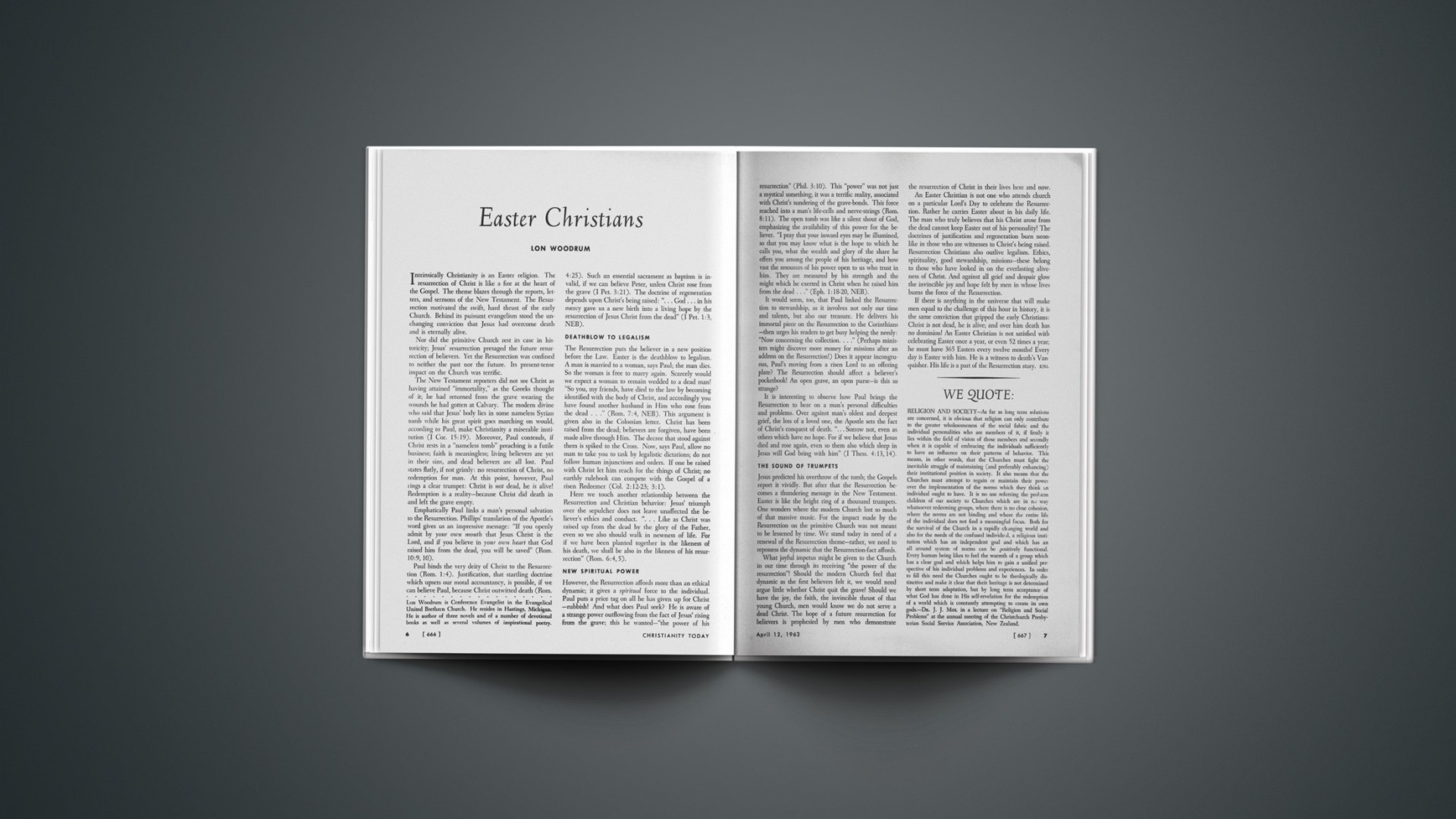
Easter Christians

Intrinsically Christianity is an Easter religion. The resurrection of Christ is like a fire at the heart of the Gospel. The theme blazes through the reports, letters, and sermons of the New Testament. The Resurrection motivated the swift, hard thrust of the early Church. Behind its puissant evangelism stood the unchanging conviction that Jesus had overcome death and is eternally alive.

Nor did the primitive Church rest its case in historicity; Jesus’ resurrection presaged the future resurrection of believers. Yet the Resurrection was confined to neither the past nor the future. Its present-tense impact on the Church was terrific.

The New Testament reporters did not see Christ as having attained “immortality,” as the Greeks thought of it; he had returned from the grave wearing the wounds he had gotten at Calvary. The modern divine who said that Jesus’ body lies in some nameless Syrian tomb while his great spirit goes marching on would, according to Paul, make Christianity a miserable institution (1 Cor. 15:19). Moreover, Paul contends, if Christ rests in a “nameless tomb” preaching is a futile business; faith is meaningless; living believers are yet in their sins, and dead believers are all lost. Paul states flatly, if not grimly: no resurrection of Christ, no redemption for man. At this point, however, Paul rings a clear trumpet: Christ is not dead, he is alive! Redemption is a reality—because Christ did death in and left the grave empty.

Emphatically Paul links a man’s personal salvation to the Resurrection. Phillips’ translation of the Apostle’s word gives us an impressive message: “If you openly admit by your own mouth that Jesus Christ is the Lord, and if you believe in your own heart that God raised him from the dead, you will be saved” (Rom. 10:9, 10).

Paul binds the very deity of Christ to the Resurrection (Rom. 1:4). Justification, that startling doctrine which upsets our moral accountancy, is possible, if we can believe Paul, because Christ outwitted death (Rom. 4:25). Such an essential sacrament as baptism is invalid, if we can believe Peter, unless Christ rose from the grave (1 Pet. 3:21). The doctrine of regeneration depends upon Christ’s being raised: “… God … in his mercy gave us a new birth into a living hope by the resurrection of Jesus Christ from the dead” (1 Pet. 1:3, NEB).

Deathblow To Legalism

The Resurrection puts the believer in a new position before the Law. Easter is the deathblow to legalism. A man is married to a woman, says Paul; the man dies. So the woman is free to marry again. Scarcely would we expect a woman to remain wedded to a dead man! “So you, my friends, have died to the law by becoming identified with the body of Christ, and accordingly you have found another husband in Him who rose from the dead …” (Rom. 7:4, NEB). This argument is given also in the Colossian letter. Christ has been raised from the dead; believers are forgiven, have been made alive through Him. The decree that stood against them is spiked to the Cross. Now, says Paul, allow no man to take you to task by legalistic dictations; do not follow human injunctions and orders. If one be raised with Christ let him reach for the things of Christ; no earthly rulebook can compete with the Gospel of a risen Redeemer (Col. 2:12–23; 3:1).

Here we touch another relationship between the Resurrection and Christian behavior: Jesus’ triumph over the sepulcher does not leave unaffected the believer’s ethics and conduct. “… Like as Christ was raised up from the dead by the glory of the Father, even so we also should walk in newness of life. For if we have been planted together in the likeness of his death, we shall be also in the likeness of his resurrection” (Rom. 6:4, 5).

New Spiritual Power

However, the Resurrection affords more than an ethical dynamic; it gives a spiritual force to the individual. Paul puts a price tag on all he has given up for Christ—rubbish! And what does Paul seek? He is aware of a strange power outflowing from the fact of Jesus’ rising from the grave; this he wanted—“the power of his resurrection” (Phil. 3:10). This “power” was not just a mystical something; it was a terrific reality, associated with Christ’s sundering of the grave-bonds. This force reached into a man’s life-cells and nerve-strings (Rom. 8:11). The open tomb was like a silent shout of God, emphasizing the availability of this power for the believer. “I pray that your inward eyes may be illumined, so that you may know what is the hope to which he calls you, what the wealth and glory of the share he offers you among the people of his heritage, and how vast the resources of his power open to us who trust in him. They are measured by his strength and the might which he exerted in Christ when he raised him from the dead …” (Eph. 1:18–20, NEB).

It would seem, too, that Paul linked the Resurrection to stewardship, as it involves not only our time and talents, but also our treasure. He delivers his immortal piece on the Resurrection to the Corinthians—then urges his readers to get busy helping the needy: “Now concerning the collection.…” (Perhaps ministers might discover more money for missions after an address on the Resurrection!) Does it appear incongruous, Paul’s moving from a risen Lord to an offering plate? The Resurrection should affect a believer’s pocketbook! An open grave, an open purse—is this so strange?

It is interesting to observe how Paul brings the Resurrection to bear on a man’s personal difficulties and problems. Over against man’s oldest and deepest grief, the loss of a loved one, the Apostle sets the fact of Christ’s conquest of death. “… Sorrow not, even as others which have no hope. For if we believe that Jesus died and rose again, even so them also which sleep in Jesus will God bring with him” (1 Thess. 4:13, 14).

The Sound Of Trumpets

Jesus predicted his overthrow of the tomb; the Gospels report it vividly. But after that the Resurrection becomes a thundering message in the New Testament. Easter is like the bright ring of a thousand trumpets. One wonders where the modern Church lost so much of that massive music. For the impact made by the Resurrection on the primitive Church was not meant to be lessened by time. We stand today in need of a renewal of the Resurrection theme—rather, we need to repossess the dynamic that the Resurrection-fact affords.

What joyful impetus might be given to the Church in our time through its receiving “the power of the resurrection”! Should the modern Church feel that dynamic as the first believers felt it, we would need argue little whether Christ quit the grave! Should we have the joy, the faith, the invincible thrust of that young Church, men would know we do not serve a dead Christ. The hope of a future resurrection for believers is prophesied by men who demonstrate the resurrection of Christ in their lives here and now.

An Easter Christian is not one who attends church on a particular Lord’s Day to celebrate the Resurrection. Rather he carries Easter about in his daily life. The man who truly believes that his Christ arose from the dead cannot keep Easter out of his personality! The doctrines of justification and regeneration burn neonlike in those who are witnesses to Christ’s being raised. Resurrection Christians also outlive legalism. Ethics, spirituality, good stewardship, missions—these belong to those who have looked in on the everlasting aliveness of Christ. And against all grief and despair glow the invincible joy and hope felt by men in whose lives bums the force of the Resurrection.

If there is anything in the universe that will make men equal to the challenge of this hour in history, it is the same conviction that gripped the early Christians: Christ is not dead, he is alive; and over him death has no dominion! An Easter Christian is not satisfied with celebrating Easter once a year, or even 52 times a year; he must have 365 Easters every twelve months! Every day is Easter with him. He is a witness to death’s Vanquisher. His life is a part of the Resurrection story.

END

WE QUOTE:

RELIGION AND SOCIETY—As far as long term solutions are concerned, it is obvious that religion can only contribute to the greater wholesomeness of the social fabric and the individual personalities who are members of it, if firstly it lies within the field of vision of those members and secondly when it is capable of embracing the individuals sufficiently to have an influence on their patterns of behavior. This means, in other words, that the Churches must fight the inevitable struggle of maintaining (and preferably enhancing) their institutional position in society. It also means that the Churches must attempt to regain or maintain their power over the implementation of the norms which they think an individual ought to have. It is no use referring the problem children of our society to Churches which are in no way whatsoever redeeming groups, where there is no close cohesion, where the norms are not binding and where the entire life of the individual does not find a meaningful focus. Both for the survival of the Church in a rapidly changing world and also for the needs of the confused individual, a religious institution which has an independent goal and which has an all around system of norms can be positively functional. Every human being likes to feel the warmth of a group which has a clear goal and which helps him to gain a unified perspective of his individual problems and experiences. In order to fill this need the Churches ought to be theologically distinctive and make it clear that their heritage is not determined by short term adaptation, but by long term acceptance of what God has done in His self-revelation for the redemption of a world which is constantly attempting to create its own gods.—DR. J. J. MOL in a lecture on “Religion and Social Problems” at the annual meeting of the Christchurch Presbyterian Social Service Association, New Zealand.

Light on Our Destiny: Death Has No Shape

Christ is the first fruits of our resurrection. By understanding what happened on the first Easter morning we gain insight into the meaning of our eternal destiny. Because it is this way and not the other way around, the same may be said concerning the meaning of death. We cannot understand Jesus’ death by looking at our own death, but we can gain comprehension of our own death from the death on the Cross.

In talking about death we are talking about what happens to the life of the creature. The life of the creature is the soul, but since the body has life we necessarily ask what happens to the body in death and how the body is related to the soul both in life and after death. In a little book called The Shape of Death Jaroslav Pelikan exhibits the views of some early church fathers in terms of neat geometrical figures. He begins with the observation that since there is no Christian doctrine of the soul, theologians have had to borrow conceptual tools from non-Christian thought. Taking the concept of the soul as life substance, the ancient fathers described the path of the soul as it travels through death in various ways. Thus Tatian saw its course as an arc, Clement viewed its path as a circle, Origen described a parabola, and Irenaeus saw a spiral. Besides being an artificial over-simplification, this scheme is misconceived because the original question was formulated wrongly. Pelikan is right when he says there is no Christian doctrine of the soul, but Christian theologians need not borrow non-Christian metaphysical categories to provide one, nor have they always done so in the past. Pelikan asked what the shape of death is because he thought of the soul as a thing. Things have shape and form, and if the soul is a thing or substance it must be defined (since it cannot be described) in distinction from other things, particularly in distinction from the body.

This then raises other questions, such as what happens to the body in death—and all this means for funeral practices. Was man made mortal or immortal? Was he made mortal in body and immortal in soul? Did man in Adam have the possibility of living forever and does this mean in time or out of time? Or finally must we infer that originally man did not have immortality because God sent Adam and Eve out of the garden “lest he put forth his hand and take also of the tree of life, and eat, and live forever”?

These are all wrong questions because they assume that the soul is a substantial thing distinct from the body, a thing which can have a life and shape of its own. Such was the view of ancient man. Modern man is a positivist and an existentialist, and to him only that which is concrete is real; hence all questions about the soul are meaningless.

Paul Tillich, however, makes a monumental effort to retain an essential conception of the soul in the midst of modern existentialism. For him the soul is the real being of man. It is created in essence finite and mortal. In its fallen existence, however, it becomes estranged from its real being and confounds its ontological anxiety with a fearful and sinful anxiety which brings a sting to death. The decision for Christ involves release from this sinful anxiety, giving man once more the courage to be—that is, the soul can rise above its estranged existence in a new being made possible by the vertical dimension of the eternal Christ intersecting the broken line of our horizontal existence. This intersection brings the Moment between the moments, the life eternal which transcends the narrowed transitoriness of temporal existence. There is no future resuscitation of the flesh in a personal resurrection; there is rather a new quality of existence in the new being realized in the eternal moment of the present. There is no redemption from the annihilation of death; there is rather release from the sting of anxiety in death. Hence the shape of death for Tillich is a broken line intersected by a vertical dimension between the segments.

I submit that both ancient and modern man have views diametrically opposed to the Christian view set forth in the Bible. The Bible, it is true, does not have a metaphysic of the soul, for the soul is simply the life of the creature. The soul is not something distinct from the body; it is the body insofar as the body lives. Man is not a soul which has a body, nor is he a body which has a soul. He is a creature who comes into existence by the Word of God and continues in existence only as long as God speaks. He has neither mortality nor immortality in himself, but he has life insofar as God says so. The soul does not have a substantial or essential being which could conceivably be either preexistent or immortal. The soul has a given existence from the creative Word and Spirit of God, an existence which depends for its life each moment on the gracious divine locution. But because of man’s rebellious disobedience this existence has been separated from God. The existence itself is not in jeopardy. If it were, suicide might be a way out. Since it is not, suicide only widens the separation. This is the meaning of death: separation from God the source of life. Death is not annihilation, not the passing from being to nothing, not the fall from essence to estranged existence. Death is the fall away from God, the separation of the creature from the creative and comforting Word of life.

Death In Three Stages

Since the creature is a unity and not a duality of body and soul nor a trichotomy of body, soul, and spirit, death means separation of the whole man from God. Hence Paul can speak of the man who is still breathing as walking in death: “You he made alive while you were yet dead in the trespasses and sin in which you once walked following the course of this world.” Death as separation from God then has various stages. The Bible speaks of death accordingly in three ways:

1. There is the death which we share with the whole of fallen creation and in which we now walk as sinners even though we still breathe.

2. There is the death which we experience as the cessation of our earthly functions. Because we see the decay of physical death we tend to think of it as a passing into oblivion. We fight against this by embalming the deceased and buying expensive concrete vaults to extend the semblance of physical life as long as possible. While an expensive ointment may be rightly used to perfume a corpse for its burial, this should never degenerate into a fearful disbelief in the new heaven and new earth in which all things are made new. But what does the Bible mean when it speaks of the place of departed spirits? Does death after all bring a rending of the flesh from the spirit such that while the flesh molders in the grave the spirit dwells as a shadow shape in some mysterious realm of the dead? This is precisely the idea: in death the flesh is returned to dust and the real person is shorn of his shape. Although personal consciousness survives, the person becomes a shapeless shadow. But the work of Christ in regeneration is to give us bodily shape until the final resurrection, when we shall be raised with incorruptible bodies. Paul affirms this in Ephesians when he speaks of Christ’s leading a host of captives out of the captivity of death. Peter also speaks of Christ’s preaching to those imprisoned in death. And to the Corinthians Paul speaks of the flesh as an earthly tent which he longs to put off so that he can put on Christ. Actually the biblical conception of the place of departed spirits does not give credence to the concept of a substantial soul. It deepens the meaning of the splitting separation of death which now is seen to be a separation not only from God and our fellows but even from ourselves.

3. Finally there is the “second” death or the death of the last judgment, which is an ultimate separation in outer darkness. Even here there is no indication in Scripture of extinction, though this is not completely unthinkable. Thus death in all three senses has a double dimension: it is the wage of sin and it is the mark of our estranged transience. Death is both a judgment and a willful separation. God did not create us with mortality. This would be to say that God created us separated from himself. Death is an enemy that intervened between us and God, and the path of the soul is to return to fellowship with God when that enemy has been vanquished. This has been accomplished by Christ, and it is effective for us when we are joined to him as members of his body in the Church. We can pass through death with him and rise in newness of life even as he is the first fruits of the resurrection.

And the marvel of our faith is that we have a sacrament (guarantee) of this already in this present stage of our journey. The symbol of the Christian understanding of the life and death of the soul is a broken line which is intersected in one of its moments (not between the moments) where Christ became flesh, and the moments of my life are joined to that redeeming moment through the re-presenting of Christ in the moment of the Eucharist in which Christ gives himself both to God in continuous intercession and to us, the celebrating congregation. As the broken moments of historical time are united in the eternity of Christ’s intercession, so the broken bits of bread join my flesh and guarantee the restoration of my real self with the real presence of Christ.

If we wish to understand the meaning of death and the destiny of the soul, we must look to the death and resurrection of Christ. For him death was an enemy of both God and man. Socrates found death to be a friend, and he drank the poison hemlock gladly because he thought it would release him from the fetters of his flesh. Jesus fought death with all his might. His soul was anxious, troubled, heavy with sorrow. He met death crying out bitterly in the night: “Father, if it be possible let this cup pass from my lips.” But then from the cross with a final loud shout he refused to give death the victory, saying: “Father, into thy hands I commit my spirit.” Not into the hands of the enemy death does Jesus give his forsaken spirit, but into the hands of his Father.

Just as in death the whole man dies, not just the body of flesh as Socrates thought, so likewise the whole man rises in the resurrection, not just the soul. This is the meaning of the Empty Tomb, and hence we confess in our creed that we believe in the resurrection of the body. But this is not to say, as some might think, that Jesus’ flesh was merely resuscitated. This is what Lazarus experienced, only to die again. In the resurrection a new creature is made with a body that is clothed in incorruptibility instead of in corruptible flesh. Thus the risen Lord was quite different from the raised Lazarus. He was not limited by the simple location of space and time. He appeared not to all, but only to those chosen by God (Acts 10:41). Yet he had bodily shape, and he ate and drank with his disciples.

On this model we may say that in the separation of death our flesh becomes a corpse and returns to the dust of the earth. Our tombs become empty, too, and our spirits go to the place of the departed spirits. But if we in faith belong to Christ, then we shall be with him in paradise. Without flesh, since our flesh is moldering in the grave, we wait for the last day when we will be raised with all the dead and given new bodies which are holy. In the meantime we rest with Christ in paradise clothed with the body of Christ. We are hid with Christ in God, as Paul says. We are not naked disembodied spirits. We are dressed in the goodness of Christ, and we walk with him from glory unto glory.

END

STRAWS IN THE WIND

THE WINDS ARE BLOWING—You might call these “straws in the wind,” little indicators of which way the religious winds are blowing.

The first of these “straws” appeared in Life magazine last year when they presented the pictures of the one hundred outstanding young men in America. Young clergymen were conspicuous by their absence. Rev. Martin Luther King was the rare exception. One wonders what this augurs for the Church in years ahead.

The second “straw” was called to our attention a few days ago by Casper Nannes of the Washington Star. He observed that in listing the Ten Top News Stories of 1962 no religious event was considered of major importance to break into this listing. Yet he mentioned that 1962 saw the Supreme Court hand down its ruling on the New York Regents’ prayer in school, a decision that had terrific reactions everywhere in America. 1962 also saw Pope John XXIII call the first Vatican Council in over one hundred years, and Time magazine had featured Pope John as The Man of the Year. Both of these stories were missing from the Top Ten.

The third “straw” is the President’s tax reform program. It has been pointed out that whereas presently up to 30 per cent of income can be deducted for contributions to church and charitable organizations, the pending tax reform “proposes a 5 per cent floor on itemized deductions to non-profit groups.” This would deal a blow to church support that would be devastating. Particularly would this be so, coming at the same time when the churches must face the probability of the removal of exemption from taxes on their property.

The fourth “straw” is the Monday morning report of the sermons in the Washington Post which is usually consigned to the obituary page. This is an affinity that is not very flattering, and furnishes another insight as to the place the Word of God has in the eyes of an influential newspaper.

I am not sure just what all these things say, but it would be hard to argue from them that we put much of a priority on the Church.—Dr. LEE SHANE, Minister, National Baptist Memorial Church, Washington, D. C.

SPECKS ON A STAR—Five nations lead the world in alcoholism, a high divorce rate, juvenile delinquency, and mental illness. These are the United States, Switzerland, Britain, Denmark, and France. These are the western nations which have it made. None of us are starving. But not all is well with us. What we are going through is a religious conflict. Physically, we are advancing. Every day there is a better chance we will live longer. We have improved social skills. And we are intellectually gifted. Any generation that can invent something to wipe out civilization isn’t stupid.

With all this the prevailing mood is that we are specks thrown on a third-rate star, and life is empty and without meaning or purpose. The ultimate thing about a culture is its religion. What does it believe? What are its values? What is its faith?—Bishop GERALD KENNEDY, Past President, The Methodist Council of Bishops.

LAST ON THE LIST—In medieval times they debated whether an archdeacon, involved as he necessarily was with matters of property and finance, could hope to be saved. Today also, there are many who would question whether a man who occupies an archbishopric and who is thereby plunged into a whirl of organizations and public appearances, can hope to exercise an evangelistic ministry.—PAUL JACKSON in Outlook, London.

WHO COULD ASK FOR MORE?—Based upon the latest archaeological research, this illuminating book by a distinguished editorial board contains over 100,000 words of text. The entire work is non-theological.—Advertisement for Our Living Bible, quoted in Prism, London.

Review of Current Religious Thought: March 29, 1963

On the night of October 27, 1955, I was delivered of an inauguration address when I became President of Pittsburgh Xenia Theological Seminary. This address was called “Theological Conflict.” It is not my purpose to commend or recommend either my inauguration or the erstwhile effort of my address. Very briefly the plot was this, quoting William Temple (Douglas MacArthur, et al.), “All our problems are theological ones.” I tried to draw up a series of conflicts in the general areas of philosophy, world religions, and Christianity, and I finally zeroed in on Protestantism itself. I quote: “We come now to conflict within Protestantism itself. Who shall number our sects and who shall assay our differences? Some conflicts among us are fundamental. One I hold to be absolutely basic is how we shall construe our Bible as the word of God?” I still think now as I thought then that the basic conflict in Protestantism has to do with authority and that the question of authority for us is the question of our interpretation of our creedal statements on the Bible. Do we hold the Bible to be the Word of God or to contain the Word of God? Or to serve as a channel for the Word of God in the total existential situation? Every seminary professor and almost every seminary student has known (a) what his own creed said; (b) what he has really thought about this statement; (c) the differences between the seminary approach and the “grass roots” approach; and (d) the very real strain which exists in the Church as men move along the spectrum from “so-called liberal” to “so-called fundamentalist” positions regarding this problem.

The Presbyterian Outlook, a magazine published by Outlook Publishers, Incorporated, but believed by most to be the voice of a great many members of the so-called Southern Presbyterian church and certainly the voice of Aubrey N. Brown and to some extent Ernest Trice Thompson, finally has opened up in a very vivid way this whole great question. For weeks now letters have been appearing in the Outlook, and one could guess more letters have come in to their office than have appeared in their columns. What is perfectly evident from these letters and the articles on which they are based is that the issue is a live one and is indeed “a theological conflict” which has needed open action for a long time and may now begin to get it. A considerable straw in this theological wind has been the discussion raised among the Southern Baptists over the interpretation of Genesis. The Presbyterian Outlook has swung into action again with a front-page treatment in the issue of February 25, quoting, I presume with agreement, from Iris V. Cully’s article “Imparting the Word.”

At least two questions within the question will have to be faced. The first is the relationship between the Word and the words. We can evade the problem of infallibility or verbal inspiration by insisting that it doesn’t matter too much what form the writings take so long as the Word comes through. The question which will not down is the question of how sure we can be of that Word if we are indifferent to the words. Can the content of the message be correct if the form of the message is incorrect? The Chuang Tzu makes a helpful statement: “Words are for holding ideas; but when one has got the ideas one need think no more about the words”; but until one has the idea are not the words then of definitive importance?

We are not surprised when a church committee haggles incessantly over the wording of a motion. We expect a diplomatic note to a foreign government to be couched in absolutely exact words. Court trials involving great sums of money will turn on the wording of a phrase so that a very careful legal language has arisen to protect wills and contracts, and yet we presume that in the eternal issues set before us in Scriptures we need not concern ourselves with the words so long as we get the “general” idea. Companion to this kind of thinking is the belief (and you can refer to the Iris Cully article again) that we can pick out matters of faith and practice and eliminate the rest and expect that we will have an authoritative word for some of the material and not for the rest, assuming we know which material is which. This approach has been worked over so long in theological circles that I am surprised that the Outlook thought it was front-page news.

In the December 29, 1962, issue of The New Yorker there is an advertisement for Saturday Review (now you know I am “with it”—The New Yorker and the Saturday Review in one sentence!). Here is what they say: “Try for example, paraphrasing the Declaration of Independence. What happens to the ideas when they are restated outside the dimension and authority—which is to say outside the tone of the original language? Diminish the language and you diminish the idea.… The dimension of the language is inseparable from the dimension of the idea. If a mind is keyed to tinny language, the greatest ideas will emerge from it as tinny as the mind itself.” This, it seems to me, is the issue. Can we really talk about the ideas of Scripture without the words of Scripture? All exegesis assumes that the words themselves determine the meaning.

The other problem we will have to face comes under the general heading of hermeneutics, and much of our confusion regarding the Bible as the Word of God is a failure to distinguish between what the text says and what the text means. For example, our Baptist friends may be arguing with their brothers over hermeneutics in the early chapters of Genesis while both sides are accepting the material as absolutely authentic.

We can assume that the story of the Good Samaritan never happened, which still leaves us with the truth embedded in the story and still leaves us with the possibility of varied interpretations. The parable, however, in the form in which it appears is still the Word of God even though it is in parable form. By the same token it is possible that the third chapter of Genesis is an allegory the wording of which is inspired and the Word of which requires some interpretation.

Bultmann raises an even more basic question, that is: what parts of the Bible are to be accepted as the text for either the words or the Word? But all that is another long story.

Book Briefs: March 29, 1963

He’S There Before He Gets There

Upon the Earth, by D. T. Niles (McGraw-Hill, 1962, 277 pp., $4.95), is reviewed by Harold Lindsell, Vice-President, Fuller Seminary, Pasadena, California.

Niles has written a fascinating and important book. He evidences tremendous gifts, writes interestingly, and has amazing insights in many instances. This book should be read by all who are concerned with the missionary task of the Church. Niles represents that branch of the Church involved in the WCC, or what is called the ecumenical movement.

Niles argues that Jesus is there before the Gospel arrives. The Holy Spirit is at work accomplishing the reconciliation of the world. The kingdom of God has come, is here, and God’s design for all creation will be achieved. The Church is here until Christ comes and has for its business the proclamation of Christ. The believer is part of the Church, has a discipleship, and is called to obedience.

The Church itself has a selfhood, and has an identity which includes Romanism, Russian Orthodoxy, and Pentecostalism. This Church is bound to the younger churches, and the problems of this relationship are delineated. Niles pleads for new financial arrangements between the younger and older churches. He argues that the younger churches must also engage in missions, and that despite outward appearances of defeat, victory is at hand. He concludes by dealing with the encounter of the Church on the religious and the secular frontiers.

Niles’s book suffers from at least one glaring theological defect. This defect, part of a growing problem in missions, has to do with universalism. The author declares that in his judgment the Bible does not say whether all men will or will not be saved ultimately (p. 96). But then he proceeds to imply universal salvation again and again. He unfortunately speaks of all men as being in Christ (p. 40) and concludes that we need to bring out the Christ who is already in men. Niles says: “All those to whom I am privileged to speak about my Lord are already one with me within His saving ministry. I believe Him and confess Him, they do not: and yet the essential facts of the Gospel remain true for them as for me. God made us. God loves us. Jesus died for us. Our trespasses are not counted. When we die we shall go to Him who will be our Judge. These affirmations are true of all men and for all men whether they know them or not, like them or not, accept them or not” (p. 104, italics mine).

Here, as in many other places, Niles seems to say that all men, here or hereafter, will be redeemed. In this he shares the view of Ferré, Neill, and others. It is the opinion of this reviewer that a universalistic theology which does away with the eternal sanctions of life and death, heaven and hell, has three significant results: (1) it emasculates portions of the Scriptures, treating them in a cavalier fashion; (2) it cuts the nerve of missions and vitiates precisely the objectives which Niles professes to believe in passionately; (3) it inevitably cancels out the differences between Romanist, Protestant, Buddhist, and atheist—all of whom ultimately arrive at the same place and receive the same salvation.

Niles’s practical universalism should not keep anyone from profiting from his able treatment of many aspects of the missionary enterprise nor from coming to grips with many of the problems he discusses. But he must be read against the background of this serious theological defect and the implications which spring from it.

HAROLD LINDSELL

Feet Or Seat?

While I’m on My Feet, by Gerald Kennedy (Abingdon, 1963, 208 pp., $3.50), is reviewed by C. Philip Hinerman, Minister, Park Avenue Methodist Church, Minneapolis, Minnesota.

Someone has said that no one can write an autobiography but an egotist. Is this not the kind of cynical but clever word that makes the modest ones smile and nod their heads? But do the modest ones possess the ability to write? Or is there anything in their life sufficiently interesting to write about? Would it really sell?

Bishop Kennedy has evidently decided to throw caution and critics to the wind. Everything else has come early to him in life (a wife, a Ph.D., a world tour, big churches, and a bishopric)—why not an early biography? Once a soured bishop warned Kennedy that he had been elected to the episcopacy too early, and that the latter years of his life would be anti-climax. Gerald Kennedy says that he took a dim view of the warning, but what is interesting is that he has remembered the warning, and printed it. Perhaps he has now decided to do the autobiography (is it his nineteenth book?) before the lean years set in.

The man knows how to write, and this book contains much guidance and help for the parish minister who has always promised that someday he will write “something.” Chief among the exhortations of the book is the command to simply “write!” And do it now. Do not put it off. Do some of it every day, whether you feel like it or not. For, like doing one’s daily dozens, he who never gets around to writing is also the man who arrives at the end of middle age with nothing to show for his busyness except middle-age spread.

The best part of the book for this reviewer was the passage on preaching; it reminded him of Kennedy’s first book (and his best?), His Word Through Preaching. It makes the spirit both sing and soar, and makes one not be ashamed of that which was once called the High Calling. Perhaps the poorest part of the book is that which resorts to a kind of travelogue reporting of places visited and seen, churches pastored, and prejudices held. But the greatest lack in the book is the person of Gerald Kennedy. An autobiography, to be justified, ought to reveal the author, not merely things about him. For this reader the real Gerald Kennedy did not stand up.

What psychological damage did he suffer all of his life because he was the son of an unlearned, fundamentalist, local preacher, whom he neither admired nor greatly loved? Why his present antipathy to things psychological, when psychology would attempt to probe the depths of a man’s being? Who is the woman to whom he is married? And what more than a “very beautiful relationship” exists between them? These and many other questions, whose answers might have told us much about the man, remain, after 200 pages, unresolved.

But the style is there, and the book carries the reader along in spite of its blank spaces. There is something terribly alive about this most unconventional of modern Methodist bishops, and he will not permit you to be long bored with his own story. For whatever is hidden, much is also reported, (although truthfully not much is revealed that has heretofore been unknown). But if this hiddenness is the book’s weakness, the vigorous style of the man and his apparent joy in living are the book’s strength.

C. PHILIP HINERMAN

Adam’S Sons

Palestine Before the Hebrews, by Emmanuel Anati (Knopf, 1963, 495 pp., $8.95), is reviewed by William Sanford LaSor, Professor of Old Testament, Fuller Theological Seminary, Pasadena, California.

In 1952 the Israel Department of Antiquities assigned a young man to escort us over the important archaeological sites in the land. His name was Emmanuel Anati, and we have many fine memories of those days. I lost contact with him until recently, when his publications began to come to mv attention. With the publication of his book Palestine Before the Hebrews, he has once more put me in his debt. This is one of the few books that can be called “monumental.”

Anati (pronounced uh-nah′tee) first sketches the geographical setting and the cultural areas, and then the geology and the changing environment. He follows this with “A Bird’s-eye Look at Cultural Evolution.”

Part Two is concerned with “The Age of Hunting and Gathering,” or the Paleolithic Age, in which the various stone cultures are explained and the progress of Stone Age man is traced. This occupies the period from c. 600,000 to 14,000 or 12,000 B.P. (before the present). Part Three is concerned with “The Transitional Cultures” (often called Mesolithic or Middle Stone Age), which in the Middle East lasted until c. 9,500 B.P. It is a constant source of amazement how numerous and how widespread are the remains of the Early and Middle Stone Ages. Certainly we can no longer claim that the Stone Age man is composed of “a tooth, a leg bone, and imagination.”

Part Four deals with “The Age of Early Farming,” and Part Five with “The Urban Age.” These chapters, about half of the book, will be most useful to the Bible student, since biblical man is portrayed entirely within the cultural framework that begins with the Neolithic or food-producing stage. Adam’s sons, let us not forget, domesticated cattle and cultivated cereals. Anati has offered a new system of terminology—as have a few other scholars recently—and it is constantly necessary to make correlations with the standard system. The Age of Early Farming includes both the Neolithic and the Chalcolithic, and The Urban Age is subdivided as follows: Proto-Urban (transitional), Early Urban I, II, and III (approximately equivalent to Early Bronze I, II, and III, respectively), Intermediate I and II (Early Bronze IV and Middle Bronze I), Middle Urban I and II (Middle Bronze II and III), and Late Urban I and II (Late Bronze I–III, or [according to others] I-A, I-B, and II). The terminology is at least an improvement over some that have been suggested, but I still see no urgent reason to forsake the well-established terminology.

Chapters on the Hebrew Patriarchs and the Hyksos Period are particularly valuable.

The book is lavishly illustrated with photographs, line drawings, maps, and charts. Anati has the splendid ability of being able to keep his reader interested and informed in technical matters, and he has summarized each division. A good bibliography is included, and there is an index—but one wonders why both the Introduction and the Index are paginated with duplicate sets of Roman numbers.

WILLIAM SANFORD LASOR

This Is It

The Coming of the Kingdom, by Herman Ridderbos, translated by H. de Jongste and edited by Raymond O. Zorn (Presbyterian and Reformed, 1962, 556 pp. $8.95), is reviewed by Richard C. Oudersluys, Professor of New Testament Language and Literature, Western Theological Seminary, Holland, Michigan.

In the face of an already sizable literature on the subject, some readers may view with apprehension the notice of another book on the Kingdom. This is, however, not the kind of book that can be polished off easily in an hour. But if one is interested in one of the most comprehensive and scholarly expositions of the Kingdom available in the English language, this is it. Here is a study of the theme in theological depth by a scholar of international reputation who obviously possesses the skills in exegetical and biblical theology requisite for the task. It is a discussion that makes the word “definitive” more than a cliché. The nature of the Kingdom in its present and future dimensions, its bearing on the related themes of salvation, Church, commandments, Lord’s Supper, are laid out with consummate skill and thoroughness. The stress falls on the message and meaning of the Kingdom in the preaching of Jesus as reported in the Synoptic Gospels. Texts of long-standing difficulty are freshly studied, and some eminently sensible interpretations are given to the abused parables and miracles of Jesus and the little apocalypse of Mark 13.

Throughout his discussion Ridderbos enters into lively dialogue with Barth, Bultmann, Cullman, Dodd, and others, and one is quickly made aware of the author’s courage and competency in establishing positions of scriptural validity in an area where speculative and tendentious interpretations are rife. The exposition is of such comprehensive character that it provides a fundamental reference work not only on the Kingdom concept, but on the theology of the Gospels as well. A full compend of notes and extended comments together with three indices enhance the work for those who delight in scholarly exactness.

The importance of the subject in contemporary theological discussion and the quality of the work fully justify the publishers’ courage and investment in making it available in English translation. Perhaps some form of financial subsidy should be provided for books of scholarly scope such as this one, in order that their price tag may not prevent them from reaching the ever widening audience of which they are indeed worthy.

RICHARD C. OUDERSLUYS

Riches For Sermons

The Second Epistle to the Corinthians, by Handley C. G. Moule (Pickering & Inglis, 1962, 165 pp., 20s.), is reviewed by R. Peter Johnston, Vicar of Islington and President of the Islington Clerical Conference.

The late Bishop Handley Moule’s great-nephew has gone to great pains to compile this devotional commentary from various sources.

Those familiar with Bishop Moule’s commentaries on other Pauline Epistles will at once recognize the general approach. There is an original translation of the text given in heavy type, and connections of thought are printed in lighter type. Comments of varying length come between the paragraphs. The text is taken straight from the Bishop’s lecture notes, but for the accompanying comments the compiler often had to turn to other sources. As a result the treatment of various passages seems somewhat unsatisfying.

Despite the inevitable deficiencies which result from this method of compilation, the careful reader will find here some rich spiritual treasures, and the preacher suggestive sermon material. There is, in the comment on chapter 4, an interesting suggestion regarding the state of the believer between death and resurrection. The Bishop’s gift of homely illustration comes out in the same section: the one in whose heart Christ dwells is “not only kept going, somehow maintained in some sort of tolerable working order, beating like an old clock not quite worn out … [but] filled ever afresh with a strong, bright, life.”

The appendices include an interesting and suggestive section entitled “Coalescent Inspiration,” in which the author develops a suggestion made by Canon T. D. Bernard.

R. PETER JOHNSTON

Relief For Dialectitis

What Is the Incarnation? (Vol. 24, Sec. II of the Twentieth Century Encyclopedia of Catholicism), by Francis Ferrier, translated from the French by Edward Sillem (Hawthorn, 1962, 176 pp., $3.50), is reviewed by L. B. Smedes, Associate Professor of Bible, Calvin College, Grand Rapids, Michigan.

Anyone suffering intellectual distress from prolonged indulgence in the dialectics of certain Protestant theologians can find temporary relief by taking up this unparadoxical and unequivocating study on Christology by French Catholic Francis Ferrier. Ferrier knows that the Incarnation of our Lord is the Christian mystery, but believes that it can be made “intelligible and thinkable” to anyone willing to try to understand what the Church has tried to say. When the Church confessed that Jesus Christ was a concrete, historical being with two utterly distinct natures united in One Person, it was not talking nonsense or paradox. Understand that by person is meant a “metaphysical source or foundation of a man’s whole being,” an entity distinct from a man’s self-awareness or moral consciousness, the suppositum which any nature must have in order to exist as an individual thing, and you have the materials for an intelligible Christology. The human nature created by God was united with the preexistent Divine Person who became the suppositum or “metaphysical foundation” for that nature and thus the basic Ego of Jesus Christ. But, what if one simply believes that such a suppositum or “metaphysical foundation” is not required for the existence of things—indeed, that this suppositum exists only in the mind of the theologian and nowhere else? Ferrier would answer that such a man, if he be theologian, is going to have a hard time with Christology and would likely tend either to heresy or to confusion.

At any rate, Ferrier writes a fine book, covering the ancient Christological controversies with verve and clarity, discussing the problems of Christ’s human knowledge, the “beatific vision,” and the communication of properties, as well as the hypostatic union as such. If the volume is not as forceful an apologetic as Karl Adam’s Christ of Faith and if it does not enter the lists against contemporary heresy, it does set out in clear and unequivocal language the doctrine of the Catholic Church. And this reviewer is always grateful for the faith in the Divine Lord that he discovers in Catholic theology. The book is one in the vast series of minor Catholic works published as the Twentieth Century Encyclopedia of Catholicism. None in this series is likely to be controversial or trailblazing in Catholic circles, but every one that I have seen is well written and edited, and most probably a reliable source of Catholic thought for the Protestant reader.

L. B. SMEDES

Poetic Probings

Images of Eternity: Studies in the Poetry of Religious Vision, from Wordsworth to T. S. Eliot, by James Benziger (Southern Illinois University Press, 1962, 324 pp., $6), is reviewed by Calvin D. Linton, Professor of English and Dean of Columbian College, The George Washington University, Washington, D. C.

This is a work for the professional student of literature rather than the lay reader. But when one has said so, a problem at once emerges: while the weight of scholarship, the technical nature of the vocabulary, and the meticulous use of footnotes clearly aim it at the professional, the lengthy sections devoted to summarizing the content of well-known poems would seem to be useful chiefly to the amateur. The section on T. S. Eliot, for example (seven pages), does little more than touch on the most familiar peaks of religious meaning in the chief poems. On the other hand, the sections dealing with the Romantics and with Browning are substantial and filled with keen insights into the working of the poetic imagination.

The term “religious vision” in the subtitle is taken broadly to mean any use of the creative imagination to probe beyond the world of sense, whether the channel used be Platonism, pantheism, mysticism, Christianity, or some other transcendental philosophy. The emphasis, therefore, is upon romantic writers (with a small r), who have traditionally depended upon the inner light (or intuition, or Imagination—in the Coleridgean sense—or whatever the capacity for spiritual insight may be called) to produce a “natural religion” of wonder and reverence. The Christian orientation of the author may be hinted at (though perhaps partially and unfairly) by a quotation: “The historic fact is that the long emergence of the human race is more like a rise [than a fall], and that most of the rise occurred before the advent of Christianity.” And again: “In the presence of the figure of Christ as portrayed in the New Testament, even the most mature may still feel themselves transcended.”

Mr. Benziger, who took his bachelor’s and doctor’s degrees at Princeton, has taught at Southern Illinois University since 1950. His book, born out of ten years of work devoted to the metaphysically oriented imagination of the chief poets from Wordsworth to the present, amply attests to his wide reading and painstaking scholarship.

CALVIN D. LINTON

A Unique People

Jews, God, and History, by Max I. Dimont (Simon and Schuster, 1962, 463 pp., $7.50), is reviewed by Carl S. Meyer, Professor of Historical Theology, Concordia Theological Seminary, St. Louis, Missouri.

Jews, God, and History are three factors with which any Christian theologian will have to reckon. The Jews were God’s chosen people, the people of the Covenant. That Jesus Christ Was Born A Jew is the title of a pamphlet by Luther (1523) which expresses a historical fact and a factor in Christian theology. Mr. Dimont—who is neither a professor nor a doctor, but a personable St. Louis businessman with a facile pen and a flair for history—has linked these three factors together in the title of a work which pulls together 4,000 years of Jewish history.

It is a “popular” work, and scholars will find errors. There are generalizations that come off too easily and “facts” that cannot be substantiated. Too often the author simply states several interpretations of an event or a movement and then lets the reader decide which to adopt, or even tells the reader he must choose for himself. He holds, he says, “with the psychoanalytic, philosophical, and existentialist interpreters of history, that ideas motivate man and that it is these ideas which create history.”

“It Happened Only Once in History!” No other people has had a continuous living history for 4,000 years, and for 3,000 years the Jews have been an intellectual force. They preserved their ethnic identity among alien and often hostile cultures. Six major challenges confronted them during these millennia, and they survived.

Apikorism, with its “baited pin-up culture,” challenged the Jews. Centuries later, after their slaughter by the Romans and the coming of Christianity, the “ ‘Ivy League’ Yeshivas” preserved Jewish culture. The ghetto and the yellow star of ignominy helped them maintain their identity.

Ganz schrecklich is the murder of the Jews by the Nazis, estimated at about 4,500,000. Dimont does not tell the tale in maudlin fashion, but his telling will not leave consciences unpricked.

The strength of the volume is its veer and freshness. Its weaknesses will vary for various classes of readers. Few, however, will miss its excitement; some will even see for themselves the covenant people of the God of History, “beloved for the sake of their forefathers.”

CARL S. MEYER

Book Briefs

In Spite of Dungeon, by Dorothy C. Haskin (Zondervan, 1962, 150 pp., $2.50). Interesting stories of modern men and women who suffered, and sometimes tasted death, for Christ in the Orient.

Representative Verse of Charles Wesley, ed. by Frank Baker (Abingdon, 1962, 413 pp., $11). 335 poems selected to show Wesley’s representative verse. With 50 introductory pages by the editor.

Jungle Doctor’s Progress, by Paul White (Paternoster, 1962. 215 pp., 16s.). The author of the famous Jungle Doctor series highlights more than a quarter-century of progress in African missions, medicine, and nationhood, and discusses current developments and problems.

14 Africans Vs. One American, by Frederic Fox (Macmillan, 1963, 171 pp., $3.95). A minister, onetime Eisenhower White House staff member, tells what the new African thinks of himself and of us.

War and the Gospel, by Jean Lasserre, translated from French by Oliver Colburn (Herald Press, 1962. 243 pp., $3.75). A serious, scholarly defense of pacifism in the name of Scripture.

Daily Life in the Time of Jesus, by Henri Daniel-Rops (Hawthorn, 1962, 512 pp., $6). The author conveys the detail and spirit of Jesus’ times and the land where he lived.

The Dawn of Modern Civilization, edited by Kenneth A. Strand (Ann Arbor Publishers [Ann Arbor, Mich.], 1962, 422 pp., $7.50). A series of essays on diverse aspects of the Renaissance and the Reformation in honor of Albert Hyma, recently retired professor of the University of Michigan.

The Better Part of Valor, by Robert P. Adams (University of Washington, 1962, 363 pp., $7). Study of humanist (More, Erasmus, Colet, and Vives) attempts by satirical and other methods to undercut the scholastic view of a just war. The author is associate professor of English at the University of Washington and a specialist in Renaissance literature.

Paperbacks

Shorter Atlas of the Classical World, by H. H. Scullard and A. A. M van der Heyden (Thomas Nelson, 1962, 239 pp., also 112 pp. of illustrations and 10 pp. of maps, $3.95 or 15s.). Polished account, fine maps, and excellent photographs convey the spirit of ancient Greece and Rome.

Audio-Visual Resource Guide 1963 (National Council of Churches, 1963, 450 pp., $2.95). Classified evaluations of more than 3,750 current, church-related A-V materials; for use in religious education.

The Beginning of History: Genesis, by Bernhard W. Anderson (Abingdon, 1963, 96 pp., $1; Lutterworth Press, 5s.). Genesis is interpreted as the story of “the formation of Israel,” parts of the story being regarded as non-historical. Brief, readable.

Outposts of Medicine, by Steven and Mary Spencer (Friendship, 1963, 126 pp., $1.25). A heartwarming story of medical missionaries grappling with disease in distant lands.

The Medieval Church, by Roland H. Bainton (Van Nostrand, 1962, 192 pp., $1.45, Canada $1.75). The story of the role of the medieval Church in the formation of Western civilization, told by a competent historian. Brief, readable.

Africa at the Crossroads, by James H. Robinson (Westminster, 1963, 83 pp., $1.25). Writing calculated to unsettle the American and bring him to a mature, Christian understanding of Africa and its modern problems.

The Unity We Seek, ed. by William S. Morris (Oxford, 1963, 150 pp., $1.75). Short lectures delivered by Roman Catholic, Baptist, Lutheran, Anglican, Greek Orthodox, and other writers, on the kind of church unity we should be looking for.

Young Married Couples in the Church, by Wayne Saffen (Concordia, 1963, 87 pp., $1.25). Advice for starting and maintaining an effective “couples’ club” in the church.

The Use of the Bible in Teaching Youth, by Charles M. Laymon (Abingdon, 1962, 175 pp., $1.50). An author with a faulty view of the Bible shows how it should be used.

One Life to Live, by Arndt Halvorson (Augsburg, 1963, 93 pp., $1.75). Five Sunday-evening, after-church lectures; readable and helpful for both Christian and non-Christian.

The Methodist Church in Urban America, by Robert L. Wilson and Alan K. Waltz (Board of Missions of The Methodist Church, 1962, 94 pp., $1). A book of sociological facts. Valuable for reference.

Sermons from the Upper Room Chapel (The Upper Room, 1962, 149 pp., $.75). Short sermons from such men as John Knox, Brooks Hays, Kenneth Scott Latourette, and many others.

Dating Tips for Christian Youth, by Robert A. Cook, Clyde M. Narramore, Mel Larson, and Jim Smith (Back to the Bible Publishers [Lincoln, Nebr.], 1962, 63 pp., $.15). A wide range of practical advice by evangelical youth leaders.

The Church and Social Welfare, by Alan Keith-Lucas (Westminster, 1963, 84 pp., $1.25). A brief but substantial discussion of the Church’s stance toward the wide spectrum of social welfare. Provocative material for group study.

Apple PodcastsDown ArrowDown ArrowDown Arrowarrow_left_altLeft ArrowLeft ArrowRight ArrowRight ArrowRight Arrowarrow_up_altUp ArrowUp ArrowAvailable at Amazoncaret-downCloseCloseEmailEmailExpandExpandExternalExternalFacebookfacebook-squareGiftGiftGooglegoogleGoogle KeephamburgerInstagraminstagram-squareLinkLinklinkedin-squareListenListenListenChristianity TodayCT Creative Studio Logologo_orgMegaphoneMenuMenupausePinterestPlayPlayPocketPodcastRSSRSSSaveSaveSaveSearchSearchsearchSpotifyStitcherTelegramTable of ContentsTable of Contentstwitter-squareWhatsAppXYouTubeYouTube