News Worth Noting: March 29, 1963

DEATH IN THE SNOW—A Colorado minister and his two daughters were swept to their death by a snowslide this month. The Rev. Marvin Hudson, a Congregational minister and teacher at the Silverton, Colorado, high school, had stopped his car along Red Mountain Pass to fasten tire chains. A snow plow stood nearby, its driver watching helplessly, as the avalanche struck. Hudson and his daughters were en route to Sunday morning church services.

PROTESTANT PANORAMA—The second in a series of theological talks between Lutheran and Reformed representatives was described as “constructive and promising.” Closed-door conversations in Chicago served to clarify issues “revealing significant areas of agreement and also pointing up differences in position regarding which further study will be required,” according to a statement released by participants.

A steering committee embracing Episcopalians, Presbyterians, Methodists, and members of the United Church of Christ is laying the groundwork for a new church-related, four-year liberal arts college on the Hawaiian island of Oahu. Planners of the $6,000,000 school hope to see classes meeting by 1965.

Arrival of the first Protestant missionary on the island of Tahiti 100 years ago was commemorated with a series of celebrations. It was in February, 1863, that Pastor Thomas Arbousset of the Paris Mission landed at Papeete at the request of the legislative assembly of Tahiti made to Emperor Napoleon III. Today about 70 per cent of the population of French Polynesia are said to be Protestants.

Congregations of the Lutheran Church—Missouri Synod have ratified a constitutional amendment providing for biennial, instead of triennial, General Conventions.

Disciples Board of Higher Education will probe “new standards and procedures” for distributing church funds among its universities, colleges, and seminaries.

MISCELLANY—Mrs. Sara Bartholomae, who recently won a 4.5-million-dollar divorce settlement, says she will build a one-million-dollar Mercury Space Capsule Chapel in tribute to Astronaut John Glenn, Jr. The shrine would overlook Brea Canyon, 30 miles east of Los Angeles.

President Kennedy became the 31st U. S. Chief Executive to visit St. John’s Episcopal Church, thus preserving its tradition as the “Church of the Presidents” which dates back to 1816 when it was built. Kennedy’s visit this month came on the Sunday on which the church’s new rector, the Rev. John C. Harper, was installed. He signed a historic prayer book used in the President’s pew but did not stay for the service.

Roman Catholic bishops in West Germany strongly criticized a German play that portrays the late Pope Pius XII as having failed to denounce Nazi crimes against Jews. They said that the drama entitled Der Stellvertreter (The Vicar of Christ), written by Rolf Hochhuth, 31-year-old Protestant, misrepresented the work of Pius XII and debased his memory.

British and Foreign Bible Society won Spanish governmental approval to resume operations in Spain. Activities had been suspended since 1956. A government announcement said Enrique Cardinal Ply y Deniel, primate of Spain, had notified the Spanish Foreign Ministry that the Spanish metropolitans had given their approval for the society to operate again.

Awards “in recognition of total design including special design features” were presented to four churches during this month’s National Conference on Church Architecture in Seattle. Winners are Newport United Presbyterian Church, Bellevue, Washington; St. Patrick’s Catholic Church, Oklahoma City, Oklahoma; Greek Orthodox Church, Belmont, California; and Broadmore Community Church, Colorado Springs, Colorado.

A fire in downtown Macon, Georgia, swept through the abandoned campus of historic Old Wesleyan College. Buildings had been readied for demolition following sale of the property to the federal government for a post office. The new school is now located about five miles away.

U. S. Supreme Court rejected appeal of Navajo members of the Native American Church to use the drug peyote in religious ceremonies.

Internal Revenue Service revoked the tax-exempt status of Fellowship of Reconciliation, religious pacifist organization. The ruling declared that “the pursuit of peace, disarmament, and reconciliation of nations is not religious activity, but political.”

A bill authorizing civil marriage was approved by the Maryland state legislature after being considered “dead” in committee. Until now, Maryland has been the only state in the union to bar civil ceremonies.

Trustees of Davidson (North Carolina) College are weighing a proposal to abolish a statement of faith required of full professors. In a secret ballot, two-thirds of the Presbyterian school’s faculty voted opposition to the required oath.

A hospitality center for American servicemen, sponsored by the National Christian Council of Japan, was formally opened last month in Yokosuka, home port of major units of the U. S. Seventh Fleet.

PERSONALIA—Dave Hyatt, director of public information of National Conference of Christians and Jews, begins three-year leave of absence to join U. S. Information Agency overseas as cultural affairs officer.

Dr. Carl J. Bihl elected president of Youth for Christ International, succeeding Dr. Ted C. Engstrom, who will retire April 1.

The Rev. Carl R. Key named executive director of the Louisville Area Council of Churches. Key has been executive secretary of the West Virginia Council of Churches since 1958.

The Rev. John W. Sanderson named dean of the faculty at Covenant College, St. Louis.

Dr. Caradine R. Hooton, retiring general secretary of the Methodist Board of Christian Social Concerns, named national director of the National Temperance League.

Dr. C. H. Dickinson, general manager of Ryerson Press (United Church of Canada publishing house), elected president of the Protestant Church-Owned Publishers’ Association.

Dr. William Toth, professor of history at Franklin and Marshall College, named executive director of Foundation for Reformation Research.

The Rev. Halleck N. Mohler named pastor of the American Protestant Church in Brussels.

Pastor Klaus Wilm named director of the “Token of Repentance Action” of the Evangelical Church in Germany. The group seeks to work abroad as an expression of contrition for suffering caused by Nazis.

WORTH QUOTING—“Protestants should abandon religious exercises in the public schools which combine the Lord’s Prayer with readings from the Protestant King James version of the Bible, and Roman Catholics should drop their drive for tax funds for parochial schools. Both programs are unconstitutional.”—Paul Blanshard.

“It is perfectly true that the First Amendment forbade Congress to pass any law ‘respecting an establishment of religion or prohibiting the free exercise thereof.’ These are great provisions, of great sweep and basic importance. But to say that they require that all trace of religion be kept out of any sort of public activity is sheer invention.”—Dean Erwin M. Griswold of Harvard Law School.

Deaths

DR. SPRIGHT DOWELL, 84, president emeritus of Mercer University (Southern Baptist) and former president of Alabama Polytechnic Institute (now Auburn University); in Macon, Georgia.

DR. WILLIAM AXLING, 89, retired American Baptist missionary to Japan and one of the founders of the Japan National Christian Council.

DR. SHERWOOD EDDY, 92, retired leader of the Young Men’s Christian Association; in Jacksonville, Illinois.

THOMAS H. WEST, 74, prominent Methodist layman and ecumenical leader; in Winnetka, Illinois.
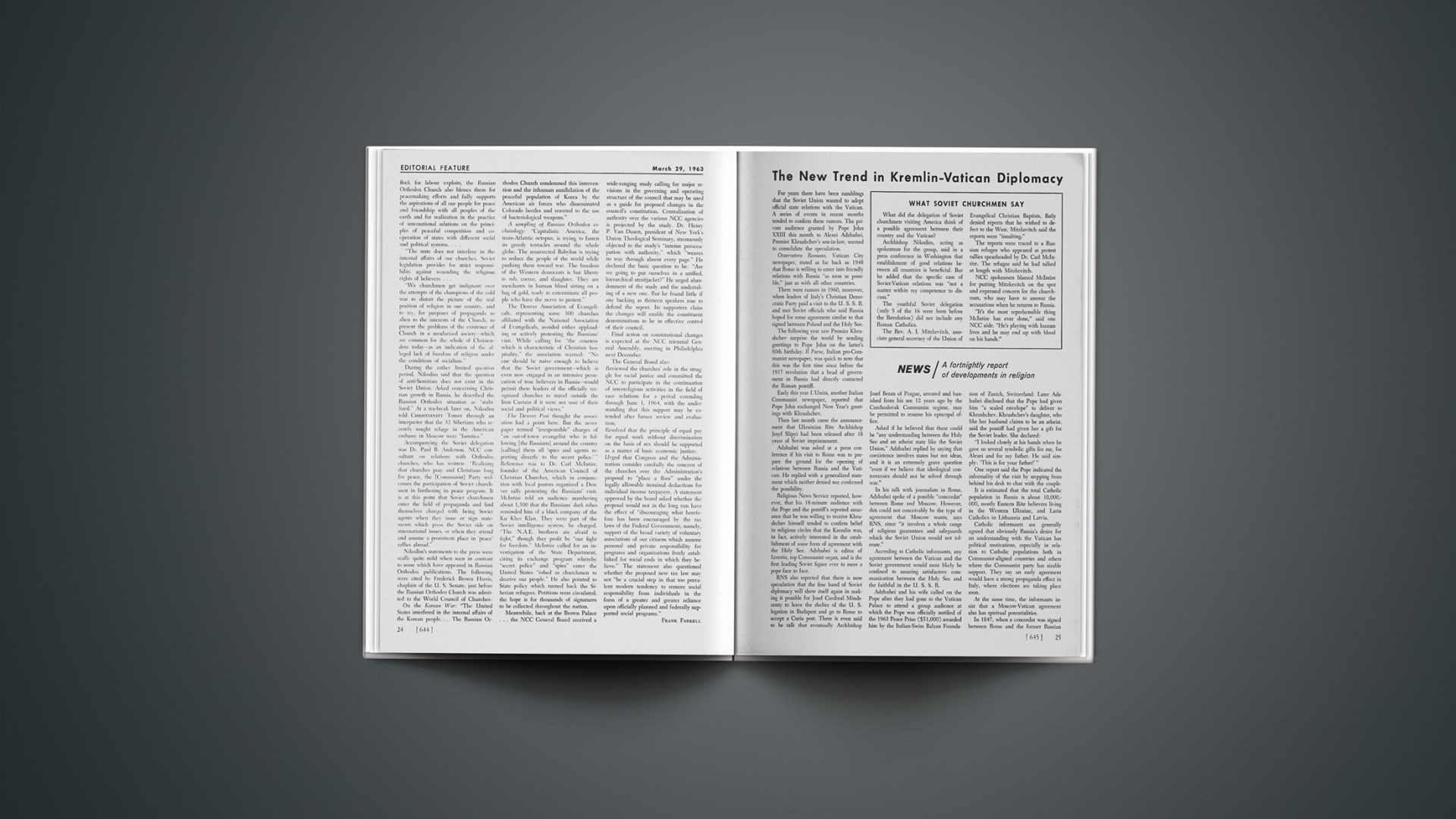
The New Trend in Kremlin-Vatican Diplomacy

For years there have been rumblings that the Soviet Union wanted to adopt official state relations with the Vatican. A series of events in recent months tended to confirm these rumors. The private audience granted by Pope John XXIII this month to Alexei Adzhubei, Premier Khrushchev’s son-in-law, seemed to consolidate the speculation.

NEWS / A fortnightly report of developments in religion

WHAT SOVIET CHURCHMEN SAY

What did the delegation of Soviet churchmen visiting America think of a possible agreement between their country and the Vatican?

Archbishop Nikodim, acting as spokesman for the group, said in a press conference in Washington that establishment of good relations between all countries is beneficial. But he added that the specific case of Soviet-Vatican relations was “not a matter within my competence to discuss.”

The youthful Soviet delegation (only 5 of the 16 were born before the Revolution) did not include any Roman Catholics.

The Rev. A. I. Mitzkevitch, associate general secretary of the Union of Evangelical Christian Baptists, flatly denied reports that he wished to defect to the West. Mitzkevitch said the reports were “insulting.”

The reports were traced to a Russian refugee who appeared at protest rallies spearheaded by Dr. Carl McIntire. The refugee said he had talked at length with Mitzkevitch.

NCC spokesmen blamed McIntire for putting Mitzkevitch on the spot and expressed concern for the churchman, who may have to answer the accusations when he returns to Russia.

“It’s the most reprehensible thing McIntire has ever done,” said one NCC aide. “He’s playing with human lives and he may end up with blood on his hands.”

Osservatore Romano, Vatican City newspaper, stated as far back as 1948 that Rome is willing to enter into friendly relations with Russia “as soon as possible,” just as with all other countries.

There were rumors in 1960, moreover, when leaders of Italy’s Christian Democratic Party paid a visit to the U. S. S. R. and met Soviet officials who said Russia hoped for some agreement similar to that signed between Poland and the Holy See.

The following year saw Premier Khrushchev surprise the world by sending greetings to Pope John on the latter’s 80th birthday. Il Paese, Italian pro-Communist newspaper, was quick to note that this was the first time since before the 1917 revolution that a head of government in Russia had directly contacted the Roman pontiff.

Early this year L’Unita, another Italian Communist newspaper, reported that Pope John exchanged New Year’s greetings with Khrushchev.

Then last month came the announcement that Ukrainian Rite Archbishop Josyf Slipyi had been released after 18 years of Soviet imprisonment.

Adzhubei was asked at a press conference if his visit to Rome was to prepare the ground for the opening of relations between Russia and the Vatican. He replied with a generalized statement which neither denied nor confirmed the possibility.

Religious News Service reported, however, that his 18-minute audience with the Pope and the pontiff’s reported assurance that he was willing to receive Khrushchev himself tended to confirm belief in religious circles that the Kremlin was, in fact, actively interested in the establishment of some form of agreement with the Holy See. Adzhubei is editor of Izvestia, top Communist organ, and is the first leading Soviet figure ever to meet a pope face to face.

RNS also reported that there is now speculation that the fine hand of Soviet diplomacy will show itself again in making it possible for Josef Cardinal Mindszenty to leave the shelter of the U. S. legation in Budapest and go to Rome to accept a Curia post. There is even said to be talk that eventually Archbishop Josef Beran of Prague, arrested and banished from his see 12 years ago by the Czechoslovak Communist regime, may be permitted to resume his episcopal office.

Asked if he believed that there could be “any understanding between the Holy See and an atheist state like the Soviet Union,” Adzhubei replied by saying that coexistence involves states but not ideas, and it is an extremely grave question “even if we believe that ideological controversies should not be solved through war.”

In his talk with journalists in Rome, Adzhubei spoke of a possible “concordat” between Rome and Moscow. However, this could not conceivably be the type of agreement that Moscow wants, says RNS, since “it involves a whole range of religious guarantees and safeguards which the Soviet Union would not tolerate.”

According to Catholic informants, any agreement between the Vatican and the Soviet government would most likely be confined to assuring satisfactory communication between the Holy See and the faithful in the U. S. S. R.

Adzhubei and his wife called on the Pope after they had gone to the Vatican Palace to attend a group audience at which the Pope was officially notified of the 1963 Peace Prize ($51,000) awarded him by the Italian-Swiss Balzan Foundation of Zurich, Switzerland. Later Adzhubei disclosed that the Pope had given him “a sealed envelope” to deliver to Khrushchev. Khrushchev’s daughter, who like her husband claims to be an atheist, said the pontiff had given her a gift for the Soviet leader. She declared:

“I looked closely at his hands when he gave us several symbolic gifts for me, for Alexei and for my father. He said simply: ‘This is for your father!’ ”

One report said the Pope indicated the informality of the visit by stepping from behind his desk to chat with the couple.

It is estimated that the total Catholic population in Russia is about 10,000,000, mostly Eastern Rite believers living in the Western Ukraine, and Latin Catholics in Lithuania and Latvia.

Catholic informants are generally agreed that obviously Russia’s desire for an understanding with the Vatican has political motivations, especially in relation to Catholic populations both in Communist-aligned countries and others where the Communist party has sizable support. They say an early agreement would have a strong propaganda effect in Italy, where elections are taking place soon.

At the same time, the informants insist that a Moscow-Vatican agreement also has spiritual potentialities.

In 1847, when a concordat was signed between Rome and the former Russian Empire, there were about 11,500,000 Catholics in Russia. Some 7,000,000 belonged to that part of Poland absorbed into the empire. The concordat remained in effect until 1863, when the Poles rose in revolt against Emperor Nicholas I and Russia severed all diplomatic relations with the Vatican.

G. Bromley Oxnam

Retired Methodist Bishop G. Bromley Oxnam, 71, a leading liberal churchman of the twentieth century, died March 13 in White Plains, New York.

Oxnam had undergone surgery in December. His death was the result of complications arising from the surgery—a rare brain operation employing a freezing technique to relieve symptoms of Parkinson’s disease.

Oxnam was president of the Federal (now National) Council of Churches and was the first U. S. co-president of the World Council of Churches.

He drew wide attention in 1953 when a member of the House Un-American Activities Committee cited Oxnam’s association with a long list of Communist front organizations. The bishop demanded the right to be heard by the committee and was subsequently cleared of all charges of Communist membership or affiliation.

Sidelined Again

For the third time in four years, illness has interrupted the crusade schedule of evangelist Billy Graham.

In 1959, when Graham suffered an eye ailment, the opening of a major campaign in Melbourne, Australia, was delayed for a week to enable him to recuperate fully.

Another disabling illness struck on the eve of a crusade in Manchester, England, in the spring of 1961. Graham remained bedridden with a throat infection while associate evangelist Leighton Ford preached for the first several days of the crusade.

This month, as he prepared for an extensive evangelistic tour of the Far East, Graham found himself in a hospital in Honolulu.

Doctors diagnosed his affliction as a severe intestinal infection accentuated by overwork.

It was decided that the Far Eastern crusade would go on as originally scheduled, using associate evangelists.

Graham had arrived in Honolulu February 13 to recuperate from an attack of bronchitis and pneumonia. Taken ill once more, he entered St. Francis Hospital for five days of tests.

Editorial Dialogue

High over Manhattan this month, an ecumenical breeze parted the paper curtain which divides the U. S. religious press. Representing a comprehensive assortment of theological, denominational, and social views, 33 editors met to compare notes on their role(s) in a pluralistic society. In the well-appointed 31st-floor penthouse of the St. Moritz, overlooking Central Park, discussions roamed far and wide and agreements were sparse. But every participant went home with new insights. And as one young priest-editor quipped, “It’s always harder to insult a person once you’ve met him.”

The inter-faith editorial meeting, financed entirely by the National Conference of Christians and Jews, was said to be a first in American religious history. Notwithstanding journalism educator Roland E. Wolseley’s jocular crack that of the thirteen Protestant periodicals represented nine were “modernist or left-wing,” the overall scope of the conclave was indeed diverse. Protestant representation did embrace evangelically oriented publications such as Christian Herald and CHRISTIANITY TODAY along with the liberal Christian Century, Christianity and Crisis and several denominational periodicals, including the Seventh-day Adventist These Times. The Brooklyn Tablet and Commonweal represented the far right and far left, respectively, for the Catholic press. Jewish editors from Orthodox, Conservative, Reconstructionist. and Reform ranks also were on hand.

Missions Swindlers

Missionary swindlers are mulcting evangelical churches of thousands of dollars a year.

Dr. Clyde W. Taylor says a recent round the world trip disclosed that some mission stations which U. S. churches thought they were supporting “simply do not exist.”

Taylor, executive secretary of the Evangelical Foreign Missions Association, issues a warning in the March number of United Evangelical Action, published by the National Association of Evangelicals.

He urged that evangelical churches check carefully the credentials of all independent mission agencies that do not have direct affiliation with a recognized denomination or interchurch organizations such as EFMA or Interdenominational Foreign Mission Association.

Most solemn warning came from NCCJ President Lewis Webster Jones:

“Our society depends on a very delicate balance. The frustrations of contemporary pressures are so great that we face a dangerous situation.”

Jones called for “a viable public philosophy which would restrain all of us.”

By design, the three-day program included general debate on current social issues, mostly on aid to education and related matters. Some participants expressed disappointment that the debate did not focus more on the role of the religious press in reflecting these issues responsibly. The editors did manage some extensive discussion on one solid journalistic issue: Do publications speak to their constituents and sponsors, or for them? Every editor defended the degree of his independency, so much so that the tone of the discussion became somewhat unrealistic. A Catholic editor appropriately emphasized, however, that the teaching authority of bishops was involved.

Among journalistic ideas promoted at the meeting were suggestions for formation of a religious press association, for publication of a religious periodical index, and for more editorial seminars.

The meeting was the second in a broad series conducted by the 35-year-old NCCJ, which has taken a new lease on life with the current ecumenical spirit and a $325,000 Ford Foundation grant. The meetings are part of a long-range NCCJ project, “Religious Freedom and Public Affairs,” spearheaded by the brawny Rabbi Arthur Gilbert, who is aptly equipped for the role with an affable spirit and diplomatic candidness.

An increasing number of evangelical leaders are recognizing the potential of expounding their biblical views in ecumenical dialogues. They are realizing that in this context their witness will strike into minds and hearts otherwise unreachable.

Textbook Aid

The state of Rhode Island enacted legislation last month providing for textbook aid to private and parochial school children.

Spokesmen for the American Civil Liberties Union and for Protestants and Other Americans United for Separation of Church and State indicated they may support a court test of the constitutionality of the new law.

Governor John H. Chafee signed the Democratic-sponsored bill, which passed the House, 67–8. It had earlier passed the Senate on a voice vote with no audible dissent and no debate.

Out Of Controversy, Affirmation Of Faith

Against a backdrop of denominational controversy and unrest, a special committee of the Southern Baptist Convention released a 4,500-word “Statement of Baptist Faith and Message,” which was offered with the hope that it would serve as a rallying point for harmonizing differences within the convention.

To be presented for approval to the denomination at its annual sessions in Kansas City, Missouri, May 7–10, the document is a development from a controversy which has rippled through the entire convention since 1961 when its Sunday School Board published a book, The Message of Genesis, by Professor Ralph Elliott of Midwestern Baptist Theological Seminary. Some conservatives declared the book heretical on the doctrine of biblical inspiration, and it provoked hostile resolutions at last year’s San Francisco convention, which unanimously voted creation of a committee composed of state convention presidents to study the possibility of rewriting or adding to a statement of faith and purpose adopted by the 1925 convention.

Chief concern in 1925 was with naturalistic liberalism. A preamble to the present document says: “The 1925 Statement recommended ‘the New Hampshire Confession of Faith, revised at certain points, and with some additional articles growing out of certain needs.…’ Your present committee has adopted the same pattern. It has sought to build upon the structure of the 1925 Statement, keeping in mind the ‘certain needs’ of our generation.… In no case has it sought to delete from or to add to the basic contents of the 1925 Statement.”

Included was the caution that Baptist statements “have never been regarded as complete, infallible statements of faith, nor as official creeds carrying mandatory authority.” On the other hand, while Baptists “emphasize the soul’s competency before God, freedom in religion, and the priesthood of the believer,” this emphasis “should not be interpreted to mean that there is an absence of certain definite doctrines that Baptists believe, cherish, and with which they have been and are now closely identified.”

The statement itself, intended to “serve as information to the churches, and … as guidelines to the various agencies” of the denomination, contains 17 sections of Baptist convictions on the Scriptures, God, man, grace, salvation, the Church, Baptism and the Lord’s Supper, the Lord’s Day, the kingdom of God, last things, evangelism and missions, education, stewardship, cooperation, the Christian and social order, peace and war, and religious liberty. Hundreds of Bible references are included.

The first section is on the Scriptures, crucial area in the present controversy: “The Holy Bible was written by men divinely inspired and is the record of God’s revelation of Himself to man. It is a perfect treasure of divine instruction. It has God for its author, salvation for its end, and truth, without any mixture of error, for its matter. It reveals the principles by which God judges us; and therefore is, and will remain to the end of the world, the true center of Christian union, and the supreme standard by which all human conduct, creeds, and religious opinions should be tried. The criterion by which the Bible is to be interpreted is Jesus Christ.” Italics indicate statements not included in the 1925 document.

Midwestern Seminary’s dismissal of Professor Elliott served to intensify already existing debate on the question of academic freedom. In the new document’s section on education, the following statement has been added to that of the 1925 declaration: “In Christian education there should be a proper balance between academic freedom and academic responsibility. Freedom in any orderly relationship of human life is always limited and never absolute. The freedom of a teacher in a Christian school, college, or seminary is limited by the pre-eminence of Jesus Christ, by the authoritative nature of the Scriptures, and by the distinct purpose for which the school exists.”

In an era of increasing ecumenism, the statement on cooperation remained substantially the same as in 1925. Part of it: “Christian unity in the New Testament sense is spiritual harmony and voluntary cooperation for common ends by various groups of Christ’s people. Cooperation is desirable between the various Christian denominations, when the end to be attained is itself justified, and when such cooperation involves no violation of conscience or compromise of loyalty to Christ and His Word as revealed in the New Testament.”

Following are excerpts from the sections on the social order and on religious liberty:

“Means and methods used for the improvement of society and the establishment of righteousness among men can be truly and permanently helpful only when they are rooted in the regeneration of the individual by the saving grace of God in Christ Jesus.”

“The state has no right to impose taxes for the support of any form of religion. A free church in a free state is the Christian ideal.…”

Chairman of the committee was Dr. Herschel H. Hobbs of Oklahoma City, president of the Southern Baptist Convention.

F.F.

Dramatic Departure

The entire 13-member faculty of Baylor University’s Drama Department resigned this month, charging “a lack of confidence in us and our work.”

Their protest stemmed from the cancellation last December of Eugene O’Neill’s prize-winning play, Long Day’s Journey Into Night.

Dr. Abner V. McCall, president of Baylor, largest Southern Baptist school, had charged that the play’s profane language “is not in keeping with the university’s ideals.” His views won the support of the state Baptist convention leadership.

Within an hour of the resignations at Baylor, Trinity University, a United Presbyterian School in San Antonio, announced that Paul Baker had been named chairman of its Speech and Drama Department. Baker had been the chairman of the Drama Department at Baylor.

“Long Day’s Journey” had six more nights to run when it was cancelled. At the time, McCall said his objection was not to the “general message of the play, but to the excessively strong profanity used to convey the message.” Earlier, it was reported that the university had received complaints that the play contained “vulgar, profane and blasphemous language.”

In a statement issued after the resignations, McCall said he had sent Baker a letter explaining that it was “the policy of the university that plays containing vulgar, profane or blasphemous language should not be produced by the Drama Department without deletion of the offensive language.”

Baker had been on the Baylor staff for 28 years, and McCall observed that “this was but a reiteration of the policy under which Mr. Baker has been operating for 28 years … often producing plays after deleting objectionable language.”

“We are not in favor of profanity,” a resignation statement said, “and by presenting Long Day’s Journey Into Night we were not endorsing profanity any more than murder is endorsed by the presentation of Hamlet.”

Canadian Conflict?

Evangelist Billy Graham and his team will not be able to count on official endorsement from the United Church of Canada if they choose to hold a dominion-wide crusade. The United Church’s Board of Evangelism and Social Service voted last month to withhold official approval.

Dr. James R. Mutchmor, United Church moderator and a staunch supporter of Graham’s evangelistic efforts, stressed that local churches and presbyteries may still be free to participate on an individual basis.

Mutchmor said the denomination is planning a three-year evangelistic effort of its own to be climaxed in connection with Canada’s centenary in 1967. The board, he declared, felt that the denominational effort might “conflict” with the Graham crusade if official support had been pledged.

Wheat And Tares

The 100th Archbishop of Canterbury has done it again.

In October, 1960, when he was merely the 92nd Archbishop of York, he crossed the border to Edinburgh. The General Assembly of the Church of Scotland was about to hold a special session to celebrate the fourth centenary of the Reformation in Scotland. The Queen was present, and representatives came from many churches throughout the world—but not, significantly, from the Church of England. “The bishops, I know not where they are,” murmured one minister; “they are the Kirk Invisible.” Dr. Ramsey’s destination was the Episcopal cathedral; there he preached a sermon lamenting the loss of much sacramental life, the Apostolic Succession, and the Christian Year. “Good and evil, wheat and tares being so mixed,” he mourned, “is it conceivable that 1560 gives us the ground on which to build truth and unity in the future?” It was not regarded as a model of timely utterance, nor was the statement of a local rector who gained some notoriety by publicly proclaiming that the Queen’s presence was “an unhappy blunder.” Presbyterian reaction was sharp.

In June of this year, a great ecumenical Communion service is planned for the island of Iona, to commemorate St. Columba’s landing there in 563. The celebrant is Bishop Lesslie Newbigin of the Church of South India. Representatives from many churches plan to attend, including one sent by Dr. Donald Coggan, Ramsey’s successor at York. Ten days later, the Scottish Episcopal Church (56,000 communicant members) will hold its own service on the island. The preacher: Arthur Michael Ramsey.

Comments a correspondent in Prism this month: “Those of us who, as loyal Anglicans, have worked and prayed for a new spirit of understanding in the Christian Churches can only gape, sad and uncomprehending. Our friends of other denominations may be forgiven if their reactions are more violent.”

J. D. D.

Our Servant The Bishop

The British Labor Party, it is sometimes said, owes more to Methodism than to Marx, and the Church of England is the Tory (Conservative) Party at prayer. While such alignment is not now so obvious, some still determine social status by allegiance to “church” or “chapel.” This is one of the facts illuminated by the mass of newspaper material resulting from the release last month of an Anglican-Methodist merger plan in Great Britain.

The Times of London in a somewhat frigid editorial doubted if “even the infusion of over a million Methodists” would alter a situation which features “empty churches, clergy who accept that they are fighting a losing battle, a society that pays religion lip-service and little else.…” This pessimism (but not the inaccurate statistics) was shared by the Roman Catholic Universe, which characteristically added that “there may well be some who will now reconsider and come to accept, however ruefully, the Holy See’s condemnation of Anglican Orders.”

Generally, however, the British press, religious and secular, gave the plan a good send-off. According to the London Daily Mail, acceptance would exorcise the “snobberies, prejudices and misunderstandings” in the typical English village: “At the centre is the old parish church, dreaming away the ages. Down the road, or in a side street, is the plain Methodist chapel, dating from 1800-and-something.” Professor T. F. Torrance of Edinburgh, writing in the British Weekly, described it as “a document of very far-reaching importance that may well transform the entire ecumenical picture all over the world.” He added: “It will be up to the Methodists in the intervening period to show the Anglicans, and the world, what an unpretentious bishop in the form of a servant really means”—an intriguing remark which landed the professor in some controversy. On the theological issues of the proposal the evangelical English Churchman objected that the proposal seems to advance the doctrines of baptismal regeneration and eucharistic sacrifice, and concluded: “All of us want to take ‘a step forward in Church relations.’ But is this the right step?”

At a press conference in London questions were dealt with genially but sometimes evasively by Dr. H. J. Carpenter (Bishop of Oxford) and Dr. Harold Roberts, joint chairmen of the committee which drew up the merger document. To a question about why there was a Methodist, but no Anglican, dissentient view, Carpenter neatly countered that perhaps the Church of England was more united than many think. Asked about how this union would affect Methodist relations with other non-episcopal churches, Roberts first promised that these would be safeguarded, but then pointed out that such inter-communion could “never be an end in itself,” and should be the consummation of a unity extending over the whole of church life.

Official wariness was most noticeable when Carpenter and Roberts failed to face squarely questions around the “establishment” issue (i.e., whether the new Anglican-Methodist denomination would be the state church), and one about how Anglicans could accept this report unanimously and yet reject a merger plan for Ceylon—the proposed United Church of Lanka. Both proposals include a mutual having on of hands in a service of reconciliation.

A certain touchiness was also evident in the Church Times. Denying that disestablishment is involved in the report, it admits the necessity for “a drastic alteration in the relations of Church and State.”

When all the wild geese have been chased and the red herrings cleared away, it is clear that the battle will be fought not merely around three or four major issues raised by the four dissentient signatories, but also around the subtle and complex domestic problem of the Church of England as at present “established.” The next chapter will be written by neither church, but by the British Parliament, which is shortly scheduled to take up routine discussion of suggested ecclesiastical amendments needing civil sanction.

J.D.D.

A Church In Crisis

A wave of resentment swept across Greece following reinstatement of former Archbishop Iakovos of Athens and All Greece in his diocese of Attica and Megaris. This was the post he had held at the time of his election to the primatial see of Athens in January, 1962. He resigned after facing charges for “unmentionable actions.” Last March, a special ecclesiastical court cleared him of the charges, and the Holy Synod said he could return to his former diocese. The Holy Synod’s ruling, however, still needed ratification from all bishops.

A special meeting of the hierarchy was called early this year to consider clergy salaries and the nomination of a home mission director. After 12 days in session, the bishops reported that they had not acted on either matter. The only thing they had done was to reinstate Iakovos as bishop of his former diocese under the title of the “President of Attica and Megaris and former Archbishop of Athens.”

In the resulting turmoil the state expressed its dismay in no uncertain terms and suggested study of the case by a legislative committee preparing a new constitutional charter for the Greek church.

A number of leading Greek newspapers criticized the church in front-page articles. A leading member of the hierarchy, Metropolitan Germanos of Mantinea, suggested that Iakovos enter a monastery to avoid further distress in the church. Sympathy of the Greek populace was undeniably on the side of the state.

Another factor in increasing church-state tensions is the hierarchy’s attempt to ease restrictions on transferability of bishops. Early ecumenical councils have been interpreted as stipulating the marriage of bishops to their respective dioceses (a bishop’s desire to leave a diocese, therefore, has been considered adultery).

According to the present constitutional charter of the church, transfer of dioceses is prohibited except among the dioceses of Athens, Piraeus, and Thessaloniki. The hierarchy has asked the Greek Minister for Cults to modify the charter to allow transfer. Meanwhile, the church delays appointment of new bishops to nine dioceses where deaths have created vacancies. The state has refused to make any changes in the charter until the new charter plan is unveiled by the special legislative committee.

Cleared Again

Angered at the persistence of four newspapers in Kalamata which continue to publish the Rev. Spiros Zodhiates’ weekly Gospel messages as paid advertisements, Greek Orthodox Bishop Eustathios asked the district attorney to launch a suit. The charge: conspiracy to proselyte the Greek Orthodox population of his diocese to Protestantism, a criminal act under present state church laws.

After months of investigation, the district attorney asked the bishop to produce evidence from Zodhiates’ messages that he was attacking the state church and endeavoring to proselyte. No such evidence was forthcoming, and charges were dismissed.

Zodhiates, general secretary of the American Mission to Greeks, has been publishing his Gospel advertisements for four years. They appear in nearly every newspaper and magazine in Greece. Advised of the dismissal of charges, Zodhiates observed:

“This is to the honor of Greek justice and the Greek Orthodox Church. I was tried once before in Thessaloniki, once in Crete and once in Halkis, and was exonerated in all three cases. Even if the case were to be heard in court, justice and freedom would have triumphed once more and I would have been given a renewed opportunity to preach in court and witness to the saving grace of Christ. My effort is not to change the religion of any people but to bring them to realization of their need of a Saviour.”

Ruffled Relations

Thus far, 1963 has been the crisis year for Christian elements in Israel. It all began when a band of Yeshiva (Jewish Talmudic school) students attacked missionary institutions along Jerusalem’s Street of the Prophets. While denouncing violence, numerous apologists for Jewish religious domination in Israel argued that some Protestant groups had brought it on themselves by engaging in unscrupulous missionary activities. There was talk of a possible anti-missionary law.

Dr. Zerah Wahrhaftig, Minister of Religious Affairs, was quoted as favoring anti-missionary activity on a voluntary basis—without violence. Several hundred rabbis and Orthodox lay leaders attended a “Council to Combat Missions” in Tel Aviv. Wahrhaftig told the group that he was disturbed by proselytizing activities of missionaries. He called on Jews to overcome a public indifference toward “danger” inherent in some Christian-supported activities involving youth. He emphasized, however, that there was not much prospect that the government would outlaw missionary activities. The government, he said, was vitally interested in retaining the sympathy of the Christian world.

Last month, another incident brought on more tension. Bishop Pier Chiappero, O. F. M., Latin Rite Patriarchal Vicar in Israel, sharply criticized what he charged were police efforts to cover up an assault on a Franciscan priest in Acre. Father Gaetano Pieri, 45, was wounded in what the police described as “a quarrel between neighbors.” His alleged assailant was Yitzhak Elmaleh, who recently purchased a store adjoining the Franciscan monastery in the Old City area of Acre.

Subsequently, a nun was attacked in Jerusalem by young hoodlums while she was chaperoning a group of children. She was rescued by a Jewish shopkeeper, who, when he attempted to pursue the attackers, was reportedly blocked by other persons on the scene.

One priest said lie is often jeered when he passes through the Orthodox Jewish quarter. He said he frequently hears cries such as “Jesus is dead.”

In New York, meanwhile, the Rev. William L. Hull hailed an Israeli Supreme Court ruling requiring registration of a mixed marriage of an Israeli Jew and a Belgian Christian woman.

“It is the first break in the solid wall the Orthodox have built up in the Knesset,” said Hull, veteran Canadian missionary to Israel who tried to convert war criminal Adolf Eichmann before his execution.

Hull is retiring after 28 years in Jerusalem. He and his wife indicated that mounting Orthodox-sponsored pressure against proselytizing activities was one factor in their decision to leave Israel. Prior to going to Israel in the thirties, Hull was a buyer for the Eaton department store in Winnipeg. He left to become an independent missionary supported by individual contributions from evangelical friends.

Viet Cong Victims

Viet Cong guerillas opened fire on a group of missionaries at a roadblock 66 miles northeast of Saigon this month. Four persons were shot to death. Another was seriously wounded.

Two families who served with Wycliffe Bible Translators were traveling along the Saigon-Dalat highway in South Viet Nam when they came upon the roadblock and were ordered to climb out of their Land Rover. The two fathers, Elwood Jacobsen of the Malmo Evangelical Free Church of Isle, Minnesota, and Gaspar Makil, a Filipino married to the former Josephine Yvonne Johnson of La Junta, Colorado, were killed on the spot. One of the Makils’ four-month-old twins died the following day. A three-year-old son was seriously wounded.

Wycliffe spokesmen said the victims were shot down “without apparent reason or provocation.” They said they regarded the highway as one of the safer highways in the country.

Mrs. Makil had been in Saigon for medical treatment and was returning with her family to an outpost at Dran.

From Dalat, Viet Nam, meanwhile, came reports that three American missionaries taken captive by the Viet Cong last May 30 were seen alive. The leader of a Viet Cong group which raided the Christian and Missionary Alliance leprosarium at Banmethuot is said to have been captured and interrogated about the safety of the three missionaries. One of the three is Dr. Eleanor Vietti, a surgeon who served as administrator of the leprosarium. The others are the Rev. Archie E. Mitchell, a veteran Affiance missionary, and Dan Gerber, a Mennonite medical assistant.

Early this year, in neighboring Laos, three pioneer Japanese missionaries were taken captive by Pathet Lao forces while on an evangelistic tour in the province of Champassac. Yutaka Baba, Fumio Ito, and Akira Nagahra had established a home base at Muong Kao, on the right bank of the Mekong River, and were on a four-day trip to nearby villages. When they failed to return, a Japanese colleague set out to find them and learned that they had been taken into custody by the Pathet Lao. Baba, his wife, and their one child make up the only family in the group of Japanese working as independent missionaries in south Laos. In addition, there are three single women and six single men, representing a loosely associated group of evangelical churches in Japan.

Laos is currently in a transition period. Overt hostilities ceased with the adoption of an agreement worked out in Geneva last year. General elections have been promised.

The present situation, however, is not the most conducive to missionary activity. Missionaries find it difficult to travel about. On the other hand, relocated native refugees have been concentrated in several large centers, and opportunities for Christian witness have been enhanced.

Working Against Time

Lutheran missionaries in New Guinea, realizing that their days may be numbered, are trying to set up a united indigenous church. Representatives of the Lutheran Church—Missouri Synod and a sister church in Australia appealed to the Lutheran Mission New Guinea, reputed to be the largest Protestant mission in the world, for joint negotiations.

Reactions in the Rockies: Soviet Church Leaders Visit America

The place was Denver. The occasion was the February business meeting of the policy-making General Board of the National Council of Churches. On opening day a block away from the meeting site, the barbershop gossip went something like this:

BARBER: “New in town?”

REPORTER: “Yes [edited from ‘yeah’], here to report the National Council meeting at the Brown Palace Hotel.”

BARBER: “I read where some Russians are coming to the meeting.”

REPORTER: “That’s right. Sixteen Soviet church leaders are returning a visit of American churchmen sponsored last year by the National Council.”

MANICURIST (working on someone else): “I didn’t know they had churches in Russia.”

REPORTER: “They do, but their activities are pretty limited.”

BARBER: “I see that some fella from New Jersey is coming out here to protest the visit.”

REPORTER: “Oh? First I’ve heard of it.”

So much for the tonsorial topography of the NCC meeting. Yet, in this humble session of mutual hairline education were sketched the rudiments of a situation which would involve in some way all three of the major U. S. church councils and/or associations and would reveal something of the political and emotional posture of each.

Despite Republican Governor John Love’s plea for hospitality toward the Soviet churchmen, their arrival at the Denver airport provoked a picket-line response which included signs like “Wolves in Sheeps’ Clothing.”

Soon after, black beards glistening under flashbulbs, the clerics sat patiently in the Silver Plume room of the Brown Palace, awaiting their initial press conference. Beginning a three-week tour of the U. S. by observing NCC sessions, they represented the Russian Orthodox Church, Georgian Orthodox Church, Armenian Church, Evangelical Lutheran Churches from Estonia and Latvia, and the Union of Evangelical-Christian Baptists.

Dr. Eugene Carson Blake, stated clerk of the United Presbyterian Church in the U.S.A., introduced them as professing Christians who enjoy a limited amount of freedom under the Soviet constitution. He pointed out that “all freedom is limited.”

Youthful Archbishop Nikodim of Jaroslavl and Rostov (35), pink cheeks glowing above full beard, read a prepared statement in Russian which included the following optimism:

“We have come to you from a socialist state where our people, seized by labour enthusiasm, are creating a new dynamic society.… While blessing its flock for labour exploits, the Russian Orthodox Church also blesses them for peacemaking efforts and fully supports the aspirations of all our people for peace and friendship with all peoples of the earth and for realization in the practice of international relations on the principles of peaceful competition and cooperation of states with different social and political systems.…

“The state does not interfere in the internal affairs of our churches. Soviet legislation provides for strict responsibility against wounding the religious rights of believers.…

“We churchmen get indignant over the attempts of the champions of the cold war to distort the picture of the real position of religion in our country, and to try, for purposes of propaganda so alien to the interests of the Church, to present the problems of the existence of Church in a secularized society—which axe common for the whole of Christendom today—as an indication of the alleged lack of freedom of religion under the conditions of socialism.”

During the rather limited question period, Nikodim said that the question of anti-Semitism does not exist in the Soviet Union. Asked concerning Christian growth in Russia, he described the Russian Orthodox situation as “stabilized.” At a tea-break later on, Nikodim told CHRISTIANITY TODAY through an interpreter that the 32 Siberians who recently sought refuge in the American embassy in Moscow were “fanatics.”

Accompanying the Soviet delegation was Dr. Paul B. Anderson, NCC consultant on relations with Orthodox churches, who has written: “Realizing that churches pray and Christians long for peace, the [Communist] Party welcomes the participation of Soviet churchmen in furthering its peace program. It is at this point that Soviet churchmen enter the field of propaganda and find themselves charged with being Soviet agents when they issue or sign statements which press the Soviet side on international issues, or when they attend and assume a prominent place in ‘peace’ rallies abroad.”

Nikodim’s statements to the press were really quite mild when seen in contrast to some which have appeared in Russian Orthodox publications. The following were cited by Frederick Brown Harris, chaplain of the U. S. Senate, just before the Russian Orthodox Church was admitted to the World Council of Churches:

On the Korean War: “The United States interfered in the internal affairs of the Korean people.… The Russian Orthodox Church condemned this intervention and the inhuman annihilation of the peaceful population of Korea by the American air forces who disseminated Colorado beetles and resorted to the use of bacteriological weapons.”

A sampling of Russian Orthodox eschatology: “Capitalistic America, the trans-Atlantic octopus, is trying to fasten its greedy tentacles around the whole globe. The resurrected Babylon is trying to seduce the people of the world while pushing them toward war. The freedom of the Western democrats is but liberty to rob, coerce, and slaughter. They are merchants in human blood sitting on a bag of gold, ready to exterminate all people who have the nerve to protest.”

The Denver Association of Evangelicals, representing some 300 churches affiliated with the National Association of Evangelicals, avoided either applauding or actively protesting the Russians’ visit. While calling for “the courtesy which is characteristic of Christian hospitality,” the association warned: “No one should be naive enough to believe that the Soviet government—which is even now engaged in an intensive persecution of true believers in Russia—would permit these leaders of the officially recognized churches to travel outside the Iron Curtain if it were not sure of their social and political views.”

The Denver Post thought the association had a point here. But the newspaper termed “irresponsible” charges of “an out-of-town evangelist who is following [the Russians] around the country [calling] them all ‘spies and agents reporting directly to the secret police.’ ” Reference was to Dr. Carl McIntire, founder of the American Council of Christian Churches, which in conjunction with local pastors organized a Denver rally protesting the Russians’ visit. McIntire told an audience numbering about 1,500 that the Russians’ dark robes reminded him of a black company of the Ku Klux Klan. They were part of the Soviet intelligence system, he charged. “The N.A.E. brethren are afraid to fight,” though they profit by “our fight for freedom.” McIntire called for an investigation of the State Department, citing its exchange program whereby “secret police” and “spies” enter the United States “robed as churchmen to deceive our people.” He also pointed to State policy which turned back the Siberian refugees. Petitions were circulated; the hope is for thousands of signatures to be collected throughout the nation.

Meanwhile, back at the Brown Palace … the NCC General Board received a wide-ranging study calling for major revisions in the governing and operating structure of the council that may be used as a guide for proposed changes in the council’s constitution. Centralization of authority over the various NCC agencies is projected by the study. Dr. Henry P. Van Dusen, president of New York’s Union Theological Seminary, strenuously objected to the study’s “intense preoccupation with authority,” which “weaves its way through almost every page.” He declared the basic question to be: “Are we going to put ourselves in a unified, hierarchical straitjacket?” He urged abandonment of the study and the undertaking of a new one. But he found little if any backing as thirteen speakers rose to defend the report. Its supporters claim the changes will enable the constituent denominations to be in effective control of their council.

Final action on constitutional changes is expected at the NCC triennial General Assembly, meeting in Philadelphia next December.

The General Board also:

Reviewed the churches’ role in the struggle for racial justice and committed the NCC to participate in the continuation of interreligious activities in the field of race relations for a period extending through June 1, 1964, with the understanding that this support may be extended after future review and evaluation;

Resolved that the principle of equal pay for equal work without discrimination on the basis of sex should be supported as a matter of basic economic justice; Urged that Congress and the Administration consider carefully the concern of the churches over the Administration’s proposal to “place a floor” under the legally allowable itemized deductions for individual income taxpayers. A statement approved by the board asked whether the proposal would not in the long run have the effect of “discouraging what hereto-fore has been encouraged by the tax laws of the Federal Government; namely, support of the broad variety of voluntary associations of our citizens which assume personal and private responsibility for programs and organizations freely established for social ends in which they believe.” The statement also questioned whether the proposed new tax law may not “be a crucial step in that too prevalent modern tendency to remove social responsibility from individuals in the form of a greater and greater reliance upon officially planned and federally supported social programs.”

Ideas

Every Road Leads to Calvary

At Calvary the path of every man crosses the path that God has chosen to walk in this world. At this point of convergence God will do business with every man and every man will contact his God. No man can avoid this confrontation with his Maker and Redeemer, for at Calvary God was in Christ reconciling the world unto himself. Here God accomplished his greatest work, greater than which even God can do nothing. Here he took upon himself the sin of the world and his own curse upon that sin. This, his most wondrous work, he will not allow to go unnoticed, not even by a single man. What he did, he did for all, and all must come to Calvary to see this thing that God has done, to approve or disapprove.

God wills to be seen and known as he truly is, and nowhere is he more fully revealed in his heart of hearts and inmost being than on that hill outside Jerusalem where the Son of God died in love for those who did not love him. Here is the act which declares that God is love; here is revealed a love that knows how to satisfy justice within a continuing love. To this place of Calvary God will bring every man to behold and see his God—and to approve or disapprove.

As Jesus moved closer toward the Cross, the people moved away from him, and left him alone. Multitudes forsook him, turning him to his disciples with the heart-rending question, “Will ye also go away?” They all answered that they would not, but as the Cross approached they all, as Jesus predicted, forsook him and left him alone. The song is right: “It was alone my Saviour died.”

Momentarily the movement away from him is reversed. As his own people abandon him, Greeks come and say, “Sir, we would see Jesus.” In a most significant response Jesus tells his disciples that the coming of the Gentiles does not mean what it seems. I am, he says, like a seed, which abideth by itself alone unless it fall into the ground and die. Only by dying will it bear fruit, and be no longer alone. Jews may go and Gentiles come, but I go my nonetheless lonely way to the Cross, for unless I die, like the seed, I shall abide alone. But, says Jesus, “I, if I be lifted up from the earth, will draw all men unto me.” As he moves toward the Cross, he walks more and more alone. But once crucified, he will as the Crucified attract all men to himself. Not without but by means of the Cross every foot will be turned to climb the hill where Jesus had his rendezvous with death, because there every man who ever lived must have his rendezvous with God.

Drawn to the Cross, each man stands in the time of God’s judgment and salvation. Standing between heaven and hell, he must make a decision, react to what God has done. As he stands before the revelation of the inmost being of God, his own inmost being is revealed. Here every secret thought of his heart is disclosed. Here he must either accept such a God with thanks and praise, or turn his back upon Him and spurning and rejecting His love go his way, proudly asserting that he can go it alone. At the Cross he cannot avoid deciding whether God’s greatest deed was necessary—or quite unnecessary; whether the Son of God died for any good or necessary reason. Response is inescapable; approve or disapprove he must. Refusal to respond, even utter indifference, is in fact a response and a decision. It is a response that declares the death of the Son of God to be a thing of no significance, a decision that God’s greatest work of love and grace is an indifferent thing.

They who are willing to allow God to bear the Cross for them find release from sin, death, and hell, and discover freedom to live, the freedom of a blessed future.

They who reject the Cross—and many do—do not escape, for they are doomed to carry their own. Under it they will stagger, and finally be broken by it. Judas refuses the Crucified, who was nailed to the Tree for him—but how lonely he goes to select his own tree on which to hang.

Friedrich Nietzsche had a promethean defiance for the Cross. It was, he averred, a symbol of weakness, unworthy of a real man. In his defiance he went mad, but in the last days he lived by the tender ministrations of a woman, a Christian nurse. Significantly—and tragically—he who rejected the Crucified signed one of his last letters “The Crucified.”

He who will not accept the Son of God set at nought will himself be set at nought. He who will not accept the Crucified will himself be crucified. All roads lead to the Cross; beyond the Cross the paths of those who reject Calvary exhibit the folly and futility of dying on self-chosen crosses—beyond which there is no Resurrection and no Light.

Either one accepts the Cross and is crucified with Christ, or one goes his lonely way to his own crucifixion. He who rejects the Cross selects his own. There are no alternatives.

END

The Role Of Religion In Civic Life

The nation now awaits the Supreme Court’s ruling on Bible reading and recitation of the Lord’s Prayer in the public schools. The verdict may not be given until June (controversial decisions often are not announced until just before the Court’s adjournment). Like other recent decisions, the ruling is likely to reflect not the nation’s past character and traditions but rather the growing pluralism of American society. In defining the kind of nation the United States shall be, the Supreme Court more and more conforms its pronouncements to the temper of the times rather than to the heritage of the past.

A number of American theologians, ironically enough, are promoting a secular non-theistic view of the state due to a misunderstanding of the nature and content of divine revelation. This misunderstanding is a baneful fruit of Karl Barth’s theology, which denies the reality of any general revelation and considers all divine disclosure to be saving revelation. The proper emphasis that all divine disclosure is revelation of the Logos (be it the redemptive revelation of the incarnate Logos or the general revelation of the cosmic Logos) is distorted to mean that all revelation is Christocentric and hence always redemptive or saving. On the basis of this error these theologians oppose all religious affirmation in civic life and in the public schools; these they consider to be either necessarily sectarian acknowledgments and therefore contradictory to church-state separation, or meaningless incantation.

This theological misconception underlies some of the support given the controversial study on “Relations Between Church and State” which will come before the General Assembly of the United Presbyterian Church in the U.S.A. in May, and for which some denominational leaders now predict endorsement despite the wide flurry of earlier hostility. In properly opposing the disturbing American trend toward “multiple establishment” in national life, the report commits the egregious error of promoting an objectionably secular state which in its public functions will tend to act as if there were no God.

There is, of course, the constant danger that theistic affirmations under civic auspices will become either a meaningless routine, or the uncritical pronouncement of a divine benediction upon national policy, or an opportunity for sectarian exploitation. There are those, too, who oppose religious elements in civic life simply on anti-Catholic grounds: what if the Methodist chaplain of the Senate or the Presbyterian chaplain of the House of Representatives in another decade were to be a Roman Catholic priest? It is always pertinent to ask how much of our program springs from genuine church-state concerns, and how much from sectarian bias that is dignified with the motive of pluralistic sensitivity.

The far greater danger, however, is the possibility that through its neglect of civic recognition government may lose also its sense of civic obligation to the transcendent God and to objective justice.

Voluntary prayer by congressmen and by citizens is not only highly desirable, but is indispensable if the nation is not to sag into the gutters of expedience. But the plea for voluntary religion does not demand a conformity of public institutions to secularism. The contention that the United States might well dispense with the rule that requires each legislative day to begin with prayer, as long as prayer is pursued individually on a voluntary basis, deserves penetrating scrutiny. What are the implications of “free exercise” of religion in civic life and in public schools? Is it possible that negation by the Supreme Court may constitute an unjustifiable “free exercise”? Is not the tradition of religious devotion in public life which the founders approved and encouraged alongside their repudiation of religious establishment a sounder guide to the distinctive character of the United States than the pressures for obliteration brought by some expositors of a pluralistic society? The concept of a pluralistic society itself is susceptible of varied definitions, and ought not be summarily equated with the ambitions of atheistic crusaders who renounce unchanging morality and objective justice.

It is true, of course, that theistic emphasis in national life opens a door to inter-religious cooperation that is not specifically Christian. A possibility even arises thereby among the higher religions for an inter-faith ethos working for world peace. Wherever religion recognizes something beyond mere national interest it poses a problem for the totalitarian state; every recognition of an eternal order of morality and justice is therefore to be welcomed. This kind of cooperation need not necessarily lead to religious syncretism, since the promotion of justice is not the only dialogue in which Christianity must engage, particularly if it is true to its claim of being the religion of redemptive revelation.

Among church leaders there is growing interest in an inter-faith congress to promote world peace. More than twenty Protestant, Jewish, and Catholic leaders outlined such ambitions recently to Secretary of State Dean Rusk. Dr. Dana McLean Greeley, president of the Unitarian Universalist Association, asserts the effort springs from a conviction that “the various religious bodies should not lag behind the nations in a cooperative or concerted effort” but insists it has “no ready-made answer and no ideological axe to grind.” The effort could be worthwhile if it really promotes justice as the foundation of peace. But if it reflects the mood of “peace-at-any-price,” propagandists inevitably will exploit it for partisan ends.

The founders of our nation guarded against the dangers of religious establishment, whose perils we are prone to overlook. At the same time, by their emphasis on the supernatural source and sanction of man’s inalienable rights they guarded also against the dangers of naturalism. To erase this theistic affirmation and recognition from the nation’s civic life and public schools leads just as surely to national chaos as does the path of religious establishment, be it pluralistic or otherwise.

Footnote On Glory: Who Is Mr. K.?

Low-flying planes discovered a religious community in the remote Siberian swamplands of Soviet Russia. Its members had never heard of Premier Nikita S. Khrushchev. The moral is not that many people could wish as much. It is rather that a world figure who works in season and out—shoes off, shoes on—at prestige must find it disconcerting to discover that some of his own people can get along without him, and do not even know that he exists.

Christians honor one name above all and take a dim view of trying to make oneself world-famous. They know the futility and ambiguity of such efforts. They remember that one of the best-known Roman emperors, Caesar Augustus, derived his fame from an infant in Bethlehem, and that another, Nero, derived his from his persecutions of the followers of Christ. And who, they ask, would know anything of Pontius Pilate had not the early Church mentioned him as the Nazarene’s crucifier in their apostolic confession of faith in Christ? In more ways than one, men borrow their glory from Him to whom alone glory belongs!

Some names thought imperishable are reduced to footnotes in biblical history—others are remembered only by becoming such footnotes.

The Passing Of Winter And A Lingering Lesson

Winter was rough all over. (This is simply a generalization, and our Australian readers should not take it as a prophecy.) Some scientists relate worsening winters to the H-bomb, and a theologian has said that our generation should be reminded of the tower of Babel.

The British have been sorely beset by angry weather, but a cheering word came a while back from a London correspondent:

We’ve had more snow these past few days, and many football teams have not had a game for the best part of two months. Villages are isolated in Western England (and, naturally, in Scotland), and they are calling it the worst winter since records began to be kept (1875). It’s still rather cold, but parts of the country are thawing. London’s buses have kept running most of the time, happily, and there’s been a return generally of that wartime spirit of good fellowship. The Postmaster of Lynmouth in Devon has stated that people who have not spoken to one another for years are now chattering away with the greatest camaraderie because flooding has threatened this low-lying little town.

We hope that the coming of spring and the voice of the turtle will not mean the resurgence of a measure of human silence in lovely Lynmouth, which has heard the praises of Shelley and Southey. But it is curious how adversity can bring out the best in men (as well as, at times, the worst). Centuries ago, Thomas a Kempis in commenting on the “fewness of the lovers of the cross of Christ” observed that “many love Jesu when no adversity happeneth.” He added:

But they that love Jesu for Jesu, and not for any consolations, they bless him in every tribulation and anguish of heart as in the highest consolation; and if he would never give them consolation vet would they ever praise him and ever thank him.

And, again curiously, in the midst of this thanksgiving in tribulation comes the highest joy, the most profound consolation.

END

Secondary Concerns Blur Missionary Vision

The Church of Jesus Christ in its worldwide mission is suffering for want of men and women who are willing to place themselves under the complete Lordship of Christ and, having done so, to serve him in his way and under the conditions of his choosing.

The sense of missionary urgency is often lost in a maze of unwarranted speculation, wishful thinking, and attenuated conviction. The clearly stated alternatives of the Bible have become blurred so that absolutes are willfully rejected in favor of a relativity which is nowhere to be found in the divine revelation. The lostness of men outside of Christ has only too often been rejected in favor of a neo-universalism which substitutes “knowing” for “believing” so that men need merely to be informed that they (supposedly) are already saved. Repentance and faith towards Christ as a part of the Gospel message are thereby lost, and the holiness of God is easily forgotten as men think their sin no longer separates them from God.

Oswald Chambers has put his finger on that need by which all should be confronted: “The key to the missionary call is the absolute sovereignty of the Lord Jesus Christ. We must get into real solitude with Him, feed our soul on His Word, and He will engineer our circumstances.” Few of us know what it is to bow in humble and complete surrender to the sovereign will of our Lord. We temporize, compromise, and seek to dictate the terms on which we will serve him, and nothing happens.

We live in a world where the biological birthrate exceeds the spiritual birthrate by at least four to one. Certainly part of the reason lies with us who refuse to surrender to the divine will. Too many of us who consider ourselves churchmen are playing around the periphery of Christianity, concerned chiefly with secondary matters.

These have their rightful place but only after the central message of the Gospel is believed and preached—Christ crucified, dead, buried, and risen from the dead, the only hope of the individual and the only hope of a lost world.

END

Decline Of The Role Of Truth In The Quest For Togetherness

The ecumenical mood muddies the waters of religious discussion with a great deal of confusion about unity and diversity. Some of its spokesmen deplore a monolithic church structure in the interest of diversity. What this comes to mean is not that denominations really have an ultimate right to survival alongside the growing ecumenical monopoly, but rather that heresy has a right to respectability within the framework of ecumenical inclusivism. Dean Robert E. Fitch of the Pacific School of Religion declares that “the continuity of Protestantism is not, in a clean-cut sense, a doctrinal continuity” but “rather a continuity of faith, hope and love as defined by St. Paul in the famous passage in 1 Corinthians, 13 …” (Religion, a pamphlet issued by The Fund for the Republic).

Now to most students of the New Testament, 1 Corinthians 15 and Romans 1–8 are as famous as, and no less authoritative than, 1 Corinthians 13. Dr. Fitch concedes that for Protestants “historically, our authority is the Bible. Then the question arises: who has the correct interpretation of the Bible?” (Since Dr. Fitch is able to discriminate the truly definitive passages, ought he so modestly to refrain from nominating himself?)

Dr. Fitch speaks of “the preponderance of the members of the student body and faculty” of Pacific School of Religion as coming from non-creedal churches. But, he insists, “they have a faith; and they have articulated and defined … their faith and hope and love in God and Christ, and in the Scriptures, and in the destiny of man within that framework.” By this time the reader, no doubt, will he thoroughly confused by the way in which Scripture is invoked whenever it can lend sanction to notions not derived from an authoritative Scripture in the first place, but which are happily invested with the authority of Scripture when that is serviceable to the articulation of private recombinations of beliefs. If this process somehow seems to do violence to logic, Dr. Fitch is prepared for the final tribute; of his students and colleagues he adds: “They do not define their doctrine with rationalistic precision; in fact, they are very skeptical of that approach.”

Verily; one can say that again! Dr. Fitch’s rationalism seems in fact to avoid precision of any kind (rationalistic or otherwise) in the definition of essential Christian doctrines.

END

Look Inside

Some years ago the head of the department of radiology of a great medical center complained of indigestion. One of his associates on the staff urged him to have a series of X-rays. This he did.

At that time all patients went through the clinic by number, not name. The following day the series of films was on his desk with a large number of others taken the previous day.

When the radiologist looked at his own films (not knowing to whom they belonged), he immediately said, “Inoperable carcinoma (cancer) of the stomach.” And it was.

In the spiritual world man lives in a state of ignorance, self-deception, or God-given humility. Not until he sees himself in the light of God’s perspective is he in a position to yield himself.

All of us are tempted to compare ourselves with others, especially those in whom we see glaring faults. Paul makes this foolish attitude very clear: “For we dare not make ourselves of the number, or compare ourselves with some that commend themselves; but they measuring themselves by themselves, and comparing themselves among themselves, are not wise” (2 Cor. 10:12).

God has given us one perfect Example, and before him we see ourselves for what we really are.

One of the curses within Christendom is that we inordinately compliment each other, instead of giving glory to God. For one motive or another we build up each other, forgetting the One who should be the center of our adulation. Only of Christ can it be said: “For he hath made him to be sin for us, who knew no sin; that we might be made the righteousness of God in him (2 Cor. 5:21).

Christian courtesy demands credit where it is due, but on a number of occasions we have read or heard words of praise which should be given no man. What are man’s accomplishments compared with the perfect interposition of Christ for our sins? “For we have not an high priest which cannot be touched with the feeling of our infirmities; but was in all points tempted like as we are, yet without sin” (Heb. 4:15).

Only as we see ourselves in comparison with the One of whom it is said, “who did no sin, neither was guile found in his mouth,” are we ready to say from the heart: “God be merciful to me a sinner.”

It takes some of us a long time to realize God’s omniscience. We think we can hide from the One who knows our words before we utter them, our thoughts before we ever think them. “Shall not God search this out? for he knoweth the secrets of the heart,” says the Psalmist (44:21). In Jeremiah God says, “The heart is deceitful above all things, and desperately wicked: who can know it? I the Lord search the heart, I try the reins, even to give every man according to his ways, and according to the fruit of his doings” (Jer. 17:9, 10).

Because of self-deception so many of us are weak Christians. Because of spiritual illiteracy we fail to grow in the things of the Spirit. That which we need to do with humble hearts is pray with the Psalmist. “Search me, O God, and know my heart: try me, and know my thoughts: and see if there be any wicked wav in me, and lead me in the way everlasting” (Ps. 139:23, 24).

We experience a revelation of self when the X-ray of the Holy Spirit—the Holy Scriptures—discloses our true nature, for they search out and convict: “The word of God is quick, and powerful, and sharper than any twoedged sword, piercing even to the dividing asunder of soul and spirit, and of the joints and marrow, and is a discerner of the thoughts and intents of the heart. Neither is there any creature that is not manifest in his sight: but all things are naked and opened unto the eyes of him with whom we have to do” (Heb. 4:12, 13).

“A discerner of the thoughts and intents of the heart”! What a disclosure and how hard to take—and how good for our souls!

All of us fully “manifest in his sight”! Humiliating, but necessary for spiritual diagnosis and acceptance of God’s cure.

“Him with whom we have to do”! Once man comes to acknowledge that it is God with whom he has to do—that it is God who redeems, and also God who judges—he is ready to cry out, “God be merciful to me a sinner.”

Then it is that David’s words to Solomon take on significance for us: “For the Lord searcheth all hearts, and understandeth all the imaginations of the thoughts: if thou seek him, he will be found of thee; but if thou forsake him, he will cast thee off forever” (1 Chron. 28:9b).

The effect of such searching of heart—of permitting the clear rays of God’s Word to probe and convict—is to sense the need of God’s mercy. Like the trembling criminal before the judge who on being assured that he would “receive justice” cried out, “What I need is not justice, but mercy,” we too come to realize there is nothing we can do except rest in that which Christ has done for us.

Overwhelmed by the enormity of our sins and their offense against a holy God, we receive for the first time some inkling of the meaning of the Cross.

Out of such a confession and the wonder of God’s redeeming love in Christ, there comes a peace unspeakable, an assurance that all is well, not because we are good but because our Saviour and his divine sacrifice are all-sufficient.

The Apostle Paul describes this change in the seventh and eighth chapters of his letter to the Roman Christians. On the one hand he cries out, “O wretched man that I am!”—only to lead on to the completeness of God’s love in Christ, from which nothing—and he means Nothing—can separate us.

We live in a world of turmoil and flux. Our own personal problems are many, but once we have passed through that period of self-recognition and have accepted God’s terms of surrender and salvation, the uncertainties disappear and we begin to understand the meaning of “peace which passeth understanding.”

Once we admit the “inoperable cancer” of sin and accept the divine remedy, we have passed from death to life, from darkness to light; the “sacrifice of a broken and contrite heart” becomes a reality, for we have God’s promise: “If we confess our sins, he is faithful and just to forgive us our sins, and to cleanse us from all unrighteousness” (1 John 1:9).

Why write all of this? Because we try to deceive ourselves and others. But we cannot deceive God, and the sooner we take a look at ourselves by means of God’s diagnostic unit—the Word of God—the sooner we will be led to capitulate, to acknowledge ourselves as lost sinners and trust in his redeeming grace.

Such an experience, activated by faith, brings healing and peace of mind and soul—and a heart of worship, praise, and obedience to the Great Physician.

Why I Stayed IK the Ministry

“Don’t enter the ministry if you can possibly do anything else and be happy.” Young men often hear this kind of advice from working preachers. I myself have tried to quit a hundred times! During the sleepless gray hours after many a Sunday I have worked countless letters of resignation to be read the following week to what I hoped might be a stunned congregation. But the letters have never been read, never even been written.

One day, perhaps, the gnawing sense of personal inadequacy and the mounting pressure of humanly insoluble problems may be too much, and I will write and deliver such a pronouncement.

I’ve been in the ministry twenty-seven years now. I started preaching my first sermon while a sophomore in college. The vision began, however, at a Christian youth camp when I was sixteen. Never have I forgotten the vigor and enthusiasm of several young ministers who at the time stimulated a burning and abiding idealism.

My father died suddenly when I was eleven, and I was deeply impressed with what I can only call a “God-consciousness.” My attitude toward church became less casual. One summer the usual interests in sports and girls and the long hours of after-school work in a grocery store were capped by a special climax. In those depression days one week of camp in a rented fairgrounds was all either the church or the church families could afford. During such a week came my crucial decision. Standing alone under the stars on a warm, sweet summer night, I knew I had to preach. Unsophisticated as it may sound, I was aflame with the desire to spend my life in sharing with all whom I could reach the transforming power of Christ that I had come to know.

My courageous widowed mother sold everything, and we moved to the state capital college town so I could secure a good liberal arts education. Ten dollars a week from my paper route sustained us for months, until mother got work. Then at nineteen I preached my first sermon. I hitchhiked to and from a small open-country church, occasionally arriving just after the benediction! My “salary” was the offering, usually about five dollars.

But I really got ever so much more. These saints were patient and encouraging, long-suffering with my crude sermons and pastoral ministrations. Slowly in the course of several student pastorates my illusions took on more realistic form. I learned that quarreling, hypocrisy, and sheer evil can infiltrate any congregation.

After graduation I moved to the smallest county seat in our state, a town of 1,200 population. There a preacher’s daughter, who had said the parsonage was not for her, gave up her teaching career and joined me in a ministry that has continued in that small town for twenty-four years.

Ours is hardly a typical town or ministry in these days of crushing cities and sprawling suburbs. Yet America still has thousands of towns like ours—population now 1,300—and countless congregations like the discouraged handful that welcomed me in a damp dungeon of a building here twenty-four years ago. From such churches people flow into distant colleges, factories, and offices. Too often such churches have no relevance for daily living, too often are not even respected. Too often, too, success-mad seminarians have abused and trodden them under foot in their ambitious ministerial climb. Realizing this despicable fact I vowed, by the grace of God, to bring relevancy and respect to at least one such church.

This, I suppose, is one reason I have remained in the ministry, and for so many years in a given pastorate. The adolescent dream of sweeping the world with the love of Christ has admittedly grown dim at times. But the conviction has remained, and grown stronger, that the small towns with their neglected churches are a vital key to America’s overall religious, social, and moral condition.

We have seen changes in our small church. Three major building programs have replaced the little crumbling concrete-block structure with a striking edifice of semi-modern design. The brilliant young architect was a boy in the Sunday school when we came. We have seen the baker’s dozen of discouraged people blossom into a strong congregation of over four hundred. The once ineffective Sunday school has grown into an educational organism whose young superintendent last year was selected “Superintendent of the Year” by a national Christian education magazine. We have seen young men and women go into medicine, teaching, business, and the arts with a mature Christian faith. We have seen new families firmly established, and older families reestablished. I say “we” because these results came through the work of many God-empowered people who found joy and vigor in their Christian faith.

One of my teachers used to say that “God made the country, man made the city, but the Devil made the small town.” Wife-trading, alcoholism, secret dope addiction, stone-cold indifference to even the simplest spiritual truth are no strangers to the small town and to its churches. Small towns present unique problems of survival, too. Our first baby died at nine months of age with spinal meningitis; his strong little body, nearly ready to walk, was not equal to the stove-heated, outhouse-supplied, cold-water shack we rented for ten dollars a month.

But when I faced the decision of moving to a better church, leaving the ministry, or finding part-time employment to augment the seventeen dollars a week from the church, I decided to apply for work in a steel foundry. Steel foundries were busy in the early forties, and I went to work almost immediately; there was no chance to consult with the men of the church. The next Sunday, before I could call the board together, the church treasurer, who worked in the payroll department of the foundry, handed me my weekly preacher’s check which he had reduced to fourteen dollars. The board upheld his action, a gesture that sorely threatened my loyalty to the ministry. For six months I divided my energies between foundry and church. Now, nearly twenty-five years later, the men on that board have grown in Christian spirit no less than the church and I have grown.

Yes, the Church is full of human weakness, and spiritual progress is agonizingly slow. Yet it is an important finger in the dike against the chaos that threatens our very existence. Carl Jung has said, “Among all my patients in the second half of life … there has not been one whose problem in the last resort was not that of finding a religious outlook on life.” And according to Rollo May, the question “Who am I and what is the meaning of my existence?” most tersely reveals the basic anxiety of our time. Who but Christ can be the answer for mankind and for the Church?

How else except through Christ and his church can we adequately meet the problem of race relations? Or take the matter of nuclear power: can a small congregation in a small town somewhere do anything about this monstrous horror? It was General MacArthur himself who said the world’s only hope lies in “spiritual recrudescence.” The only power that can control man, any man who in turn controls the released atom, is found in Jesus Christ, the Head of the Church.

I remember the successful salesman who hit my doorbell very late one winter night and blurted out, “I don’t know what I’m living for!” Drinking, divorce, debauchery were not his problems—just the stark meaninglessness of life without God. He was a victim of today’s unbalanced emphasis upon scientific progress. Even if we escape nuclear annihilation, we still face the concept that life has no purpose, a theme which modern literature hurls at us from every side. It is precisely here that the Church, despite its faults, alone can offer healing and creative power. The young salesman, we ought to add, is now entering the ministry, for all my warnings! God still works through the Church, still changes people’s lives!

The Apostle Paul knew something about incest, drunkenness at the communion service, and general debauchery in the church at Corinth. Yet his letters to the Corinthians are an important reminder that to desert the Church because of its moral weakness is to beg the question. God still changes human life through the witness and influence of the Church.

Remaining in the same small church for twenty-four years lets one observe these changes which occur only in God’s own time. Recently a handsome young basketball coach met with his boys before a game for prayer. For these kids who live in the moral jungle of a modern high school this coach, who twenty years ago was a little thief and liar, is a moral guideline. I remember the time when we seriously thought of banishing him from our Sunday school and youth meetings! Slowly through the influence of the church youth program, summer camps, a good, church-supported liberal arts education, plus marriage to a fine Christian girl, this onetime delinquent became an excellent coach and Christian leader.

Let me share only one more of countless experiences that have encouraged me to stay in the ministry. Five years ago a baby was born to an older couple in our town. The father, a retired state trooper, was slowly drinking himself to death. The mother, a county official, active in politics, capable at her job, was surprised at this late motherhood. The baby, as babies will, brought changes into this home. Listen to the mother’s own words before the congregation just a few Sundays ago:

“I’m happy to tell you of my faith, and I would gladly shout it to the world!

“A little over five years ago we received one of the greatest blessings of our lives. The birth of our little girl was a near miracle, and I was sure she was a gift from Heaven. I felt that I wanted to do something about it, but I didn’t know what to do or where to go.

“I shall always be grateful to the young man from the church who came to our home and gave us a warm and personal invitation to attend the services. Without this, I might still be sitting at home wondering what to do.

“A year ago this Sunday my husband and I made our confessions of faith and were buried with Christ in baptism, and it was a true rebirth to a new life! I couldn’t have believed the difference it can make in one’s life. It has been a wonderful year.

“I used to sleep late in the mornings trying to put off having to face the burdens, troubles, and worries of another day. I still have troubles.… I think we are supposed to, but I find that by getting up a little earlier and having a period of quiet meditation and prayer before beginning each day, the troubles are not nearly so big and, with God’s help, not nearly so hard to meet.…”

Her husband has lost the shakes, and is slowly conquering the drinking.

Teacher Annie Sullivan, after weeks of bleak failure in trying to reach the imprisoned mind of Helen Keller, has been quoted as saying: “It is my idea of original sin, giving up!” Perhaps with something of the same conviction I have remained in the ministry, often in spite of myself and often wanting to quit. I remember once during my years as an army chaplain in World War II writing to Harry Emerson Fosdick. Whatever our theological differences might be, I knew his ministry had been far-reaching. Could he recommend a book, I asked, that would help me solve some of the hundreds of counseling problems I faced in the chaplaincy? His wry response said, in essence, “Son, if you find such a book, please let me know. I need it too!” I called him recently to indicate that the fact of his long ministry and rich life had encouraged me to keep on in the ministry, especially as I grew older. “How old are you, son?” he asked. “Forty-five,” I answered. “Well, I’m eighty-eight. But I must hang up now and get back to a book I’m working on!” What book? A life of Saint Paul for teen-agers!

In a recent biography of his artist father, Jean Renoir tells about one day when the painter was confined to his room by a lung infection. The seventy-six-year-old master needed someone to place the brushes in his arthritis-stiffened hands while he worked on what was to be his last painting. “I think,” said Auguste Renoir, looking at his work, “I am beginning to understand something about it.” After these years of struggling with what is always too big a job for any man without the grace of God, I am beginning to understand what the old painter meant.

Let me close with a story that expresses the feelings of most of my friends who have remained in the ministry. A veteran missionary to China was approached by an American businessman to accept a position with his corporation. The firm would pay him well for his knowledge of the country’s language and culture. Salary offers grew to $25,000 as the missionary refused each successive proposition. With some exasperation the corporation man finally asked, “Well, just how much would it take to get you?” “Oh,” said the missionary, “your first offer was more than enough. The salary is fine, but your job is too small.”

Perhaps a few more men like that in China might have changed the course of history and of the Christian faith in that part of the world. Men with that kind of faith might well turn the tide in the present terrifying crisis. To the young men who may read this story of the old missionary, let me just say this: If his words strike you with a peculiar force, if you cannot forget their challenge, then do not enter the ministry if you can do anything else and be happy.—DOUGLAS A. DICKEY, Minister, First Christian Church, Williamsport, Ind.

Eutychus and His Kin: March 29, 1963

A Man For All Seasons

If you know anything about the Book of Job, you know that he went through times of troubles, and in J.B., Archibald Macleish creates a character you might not think about in the Book of Job—the man who keeps running onto the stage telling about all the troubles. I must confess that I resisted this character all the way through the play, but after the play was over I had to agree that somebody has to report in with all the troubles and it might as well be the same man; at least this was Macleish’s solution.

In A Man for All Seasons we have the creation of a more fulsome character; he is the sort of a man who is always there. Before the play is over he is pretty close to being the most important character on the stage and is beginning to look deadly familiar—like some of my friends or even my friend me. At one time he is a kind of general stagehand; at another time he is a jailor or a headsman (a man who chops off heads), a butler or a valet, and in and around everything he does he is a kind of endless gossip. Chief among his gifts is his ability to evade decisions, especially those which might put him “in the middle.” He is a great hand-wringer over the dismal conditions which surround him, but he never quite puts his hand to resolving any. He looks a little like the women on the road to Golgotha who threw dust into the air and beat on their breasts and probably thought it was a pity that such a nice man was being crucified. He also looks a little like the men who nailed Jesus to the cross: it Wasn’t their business to inquire into the niceties of the legalisms around the crucifixion. There was always someone else to blame for their dirty work.

I think the character in J.B. is really outclassed by that wonderful “common man” in A Man for All Seasons. That “common man” gets most of us where We can hurt. Too many of us are “viewers with alarm” or “thunderers of judgment” or “exhorters of righteousness”; we have lots of insight about the troubles of the world and not much lift. You preachers can name a lot of people in your congregation who fit the pattern—but maybe you are the pattern.

EUTYCHUS II

God And The Universities

Occasionally an issue of CHRISTIANITY TODAY towers above the other peaks of your publications. The recent one devoted to “God and the Universities” (Feb. 15 issue) was one of these. I had just returned from Religious Emphasis Week at Oregon State when my issue arrived. It captured a great many of my impressions and helped to fortify me for another appointment at Colorado State College.… The article “The Peril of the Plausible” was particularly striking.…

Asst. Prof. of Church History

Conservative Baptist Seminary

Denver, Colo.

In Charles H. Troutman’s article on “The Gospel and the Collegiate Mind,” I am afraid he has confused the Gospel with the “gospel according to Inter-Varsity.”

He says, first of all, that “the message which we proclaim is the message of the Bible” and “as a consequence, it carries unmistakable authority.” I have yet to meet a group of thinking college students who would accept the authority of anything merely because the Bible is supposed to have said so! And furthermore, I question whether [it] “is the message of the Bible” or whether it is a “neo-conservative” (!) interpretation of certain over-emphasized portions of the biblical message.

Secondly, we are told that the person Inter-Varsity preaches is “Jesus Christ, very God of very God.” But searching college students today are looking for a God who is so relevant to the struggles of our life in this world that he is very Man of very Man … who lived and sweated and suffered and struggled as men do in this world.

The third thrust declares “the core of the Gospel” to be “Christ’s sacrificial and atoning death for us” which is an expression of “God’s love in response to human need by his free provision of his Son, the Redeemer”.… My argument is against the over-simplification and lopsidedness of a “gospel” which cannot see the atoning death of Christ in its proper perspective: as the extremely significant culmination of a life that is the core of the Gospel.…

The fourth and final thrust is “the demand of Christ” for “commitment to total personal relationship with the triune God through the abiding presence and reality of the Holy Spirit.” If college students find Christ at all demanding today, I doubt if it will be in terms of a narrowly personal relationship with a third-century theological explanation of the nature of God. The reality of the Holy Spirit in the midst of life will demand the commitment of their lives (and ours!) to serve man in every area of human need, and to do so as a part of the people of God, who are more concerned about the realities of this world and its needs than about perpetuating an interpretation of God and his good news which is inadequate for the restless and seeking young generation of today.

Minister of Christian Education

The Packanack Community Church

Wayne, N. J.

The university number was especially appreciated.… I am convinced that penetration of the modern campus by students with an extracurricular passion to personally share Christ is the most effective plan of assault upon our educational fortresses.

Here at South Dakota State College the frontal attack of religious emphasis week is as nothing in comparison with the effectiveness of a single ex-Marine football player whose principal “elective” consists in belonging to other students for Christ’s sake.

Bethel Baptist Church

Brookings, S. Dak.

One issue did it!… The February 15 issue stressing Christian education in the universities was such an outstanding contribution and challenge to an awakening spirit of scholarly conservatism that I want to subscribe for three years.…

Department of Education

Pacific Union Conference of Seventh-day Adventists

Glendale, Calif.

I thank God for the wonderful issue … dealing with testimonies for Christ at the university level. To me these spoke the greatest message I have ever received in CHRISTIANITY TODAY.…

May I suggest more such issues …? The very fact that these testimonies came from professors and university students alike will give greater emphasis. How about an issue giving testimonies from business people, then one from professional people, and so on?

St. Mark-Oak Hill Methodist Charge

Tupelo, Miss.

The service you have done in dealing with Christianity and higher education today is most difficult to praise adequately. This is the finest thing of its kind that I have ever seen.…

East Glenville Church

Scotia, N. Y.

I would encourage more good articles and critiques of this problem facing today’s youth in our institutions of higher learning.…

Mennonite Central Committee

Akron, Pa.

I want you to know that I was profoundly impressed by the testimony of the “cloud of witnesses” presented in the … issue.

Chaplain

Skaalen Sunset Home

Stoughton, Wisc.

Re “The Task of Educated Leadership”: … Were we not born, like Thoreau, in the very nick of time to be part of this resurgence? The day has returned, it seems, when we evangelicals are willing again to allow the intellectual community to hear the Message too, and in its own language! We had done as much long since for the African and the Auca.…

Dean

Cascade College

Portland, Ore.

I made a very pleasant discovery today. Our one-year-old has found that it tastes delicious and is a most satisfying means of littering the living room. This solves a question which has been bothering me for several years, namely, what earthly use the thing could be.

Secretary

New York East Annual Conference of The Methodist Church

Bayville, N. Y.

This issue is by far the top point as yet. The article by Professor Blaiklock on “The Task of Educated Leadership” is a masterpiece and alone worth a year’s subscription.… It is indeed encouraging to read the sane and balanced testimonies of so many people whom God has led to Christian service on the campuses throughout our country.…

Assistant Professor of Chemistry

West Virginia University

Morgantown, W. Va.

I think CHRISTIANITY TODAY is the most important religious publication today. I believe it is having a significant influence in bridging the gap between the spiritual and intellectual worlds. This most recent issue devoted to Christian education and religion on the campuses has been most helpful and enlightening.…

Professor of Bible

Oklahoma Baptist University

Shawnee, Okla.

I found the image of the collegian to be true to life. How is it to be counteracted? I tried a year at the Nation’s “neoevangelical” seminary and came out where I went in—unconvinced, “bugged.” Get your experts to answer the second question and a significant contribution will be made.

Los Angeles State College

Los Angeles, Calif.

As a graduate student in a secular university, I wish to express my appreciation.… It is encouraging to know of the growing network of academic, evangelical witness.

President

Alpha Kappa Delta

University of Kentucky

Lexington, Ky.

Peppermint And Calvinism

On “Knowing When to Quit” (Editorial, Jan. 18 issue): Sharp biting peppermints are still being used in the Netherlands! As a child, my mother would give us our “church money” with two peppermints. While in Holland again last summer we were treated with strong peppermints in church, and when we made a remark about it a church member said: “The sharper the peppermint, the stronger the Calvinism.”

Philadelphia, Pa.

Thank you for the editorial.… I can vouch for the effectiveness of the peppermints.

It brought back memories of my early childhood … in a Holland Reformed Church in New Jersey.… To fall asleep in church was a disgrace, and we had to devise ways and means to stay awake during a sermon which lasted at least an hour and a half, all of this in the Holland language which was difficult for us to understand! Counting the pipes in the organ, studying the stories depicted in the stained glass windows, and perhaps following the flight of a fly on a hot summer afternoon helped, but the strong peppermints, passed to us rather surreptitiously by an indulgent grandmother, really did the trick.…

East Northfield, Mass.

The Ecumenical Road

“A Layman and His Faith” (Jan. 18 issue) mapped out the ecumenical road along spiritual lines as distinct as could be tolerated by this wayward generation. We hope that Dr. Bell will be prospered in his (seeming) endeavor to remind the clergy of their necessary identification with the laity—the whole assembly of believers being one in Jesus Christ.…

Vancouver, B. C.

Carbon 14

In spite of even many conservative notions for the dating of the Gospel of John, I have felt strongly for some time, on purely critical grounds, that the book betrays an immediacy that precludes any late and retrospective authorship. Also may I say that the new Albright (Jan. 18 issue) is a far cry from the Albright of the 1940s whose interpretations annoyed me considerably back in my University of Chicago days when I was working on the problem of the Exodus.

The Exodus problem, of course, involved a good deal of delving into the eighteenth and nineteenth dynasties of Egypt and the consequent problem of dating the whole complex of elements from the Amarna letters to the uproar at Jericho triggered by Garstang. At that time Dr. Libby was working on Carbon 14 at Chicago and Dr. Wilson (then head of the Oriental Institute and the professor under whom I did some of my work) ventured the opinion that the new technique would mark the first real breakthrough in the area of archaeological dating. His own reservation was that the calibration of the “yardstick” would be a ticklish problem, and that a reliable scale of dating might be very difficult to develop.

Having fallen heir to this initial skepticism I find that in my own mind the attitude has not diminished over the intervening years. The basic assumption on which the dating system rests is that the assay of Carbon 14 has been uniform for the past 20,000 to 30,000 years. This seems to be an entirely gratuitous assumption; and, increasingly, continued research in paleomagnetism and geophysics is bearing out a suspicion that was turned up in archaeology over 60 years ago, that the constancy of the earth’s magnetic field (upon which the uniformity of Carbon 14 depends), even in recent historic times, is anything but an established fact.

A Carbon 14 dating for the eighteenth dynasty that was published in the early fifties was so far at variance with the known astronomically based calendar dating that the whole system will remain seriously discredited until the problem can be cleared up. (Further tests on eighteenth dynasty material have not been forthcoming in spite of an appeal from the late Dr. Einstein.)

Dr. Albright’s skepticism of Carbon 14 (or, for that matter, any other system of isotope dating) could very well be based on the problem of the eighteenth dynasty. However, it is refreshing to note that he simply concurs with Dr. Libby in the latter’s initial statement in 1955 (Radiocarbon Dating, W. F. Libby, University of Chicago Press): “We have had no experience with bone, as such, and believe that it is a very poor prospect for two reasons: the carbon content of bone is extremely low, being largely inorganic; and it is … in its porous structure likely to have suffered alteration. It is barely conceivable that measurements on bone might reveal that some reliability could be obtained. However, because the quantities required are so large, and there usually are other acceptable materials associated with a find of bone, it does not seem to be an urgent matter to pursue.” One wishes that the myriad of enthusiastic paleontologists would be as scholarly in their approach to the dating problem in which this technique is limited in application, and where the variables are still far from being reconciled.

Sacramento State College

Sacramento, Calif.

From The Wrong Column

You state that the Protestant Episcopal Church showed a net loss in membership for 1961 (News, Jan. 4 issue). I realize that you are quoting the 1963 Yearbook of American Churches, published by the National Council of Churches, but I would like to point out that there is a statistical error here. Evidently someone copied figures from the wrong column. The first figure in question gave the Episcopal Church membership including our churches beyond the continental limit of the United States, and the second figure used the membership figures for the congregations within the 50 states. In the period under discussion, the church increased its membership from 3,200,763 to 3,269,325 within the 50 states. This is a gain of a little over 2.1 per cent.…

General Division of Research and The Field Study

National Council

Protestant Episcopal Church

Evanston, Ill.

Bargain Days

“Vatican Council: End of the First Phase” (News, Jan. 18 issue) … is the type of report that makes me feel that I am getting a bargain as a contributing subscriber. Your journal carries a high tradition of alert reporting and incisive comment.…

Assoc. Prof. of History and Religion

Brigham Young University

Provo, Utah

What Does The Law Say?

As an attorney, and a Christian, I am simply amazed at the incredible letter by Professor Gordon H. Clark of Butler University in the December 21 issue (Eutychus).

He refers to Chief Justice Warren as one “who favors homosexuality on the same day he opposes prayer,” and also notes the Chief Justice’s “perverted moral opinions.”

The truth is, of course, as any high-school civics student should know, that neither the Chief Justice nor any other member of the United States judiciary is supposed to use his own moral standards in deciding what the law is or should be. The judicial oath is to faithfully interpret the Constitution and the laws as enacted by the legislature. There is simply no question for the judiciary as to whether prayer is “right” or homosexuality “wrong”; the question is: What does the law say on these subjects?

Professor Clark’s letter is tantamount to calling every defense attorney, every juror who votes for acquittal, and every judge who sustains a defense objection, “in favor” of crime and “opposed” to keeping the law!

San Diego, Calif.

‘Logic’ Of A Sort

In a recent book review (“Barth in the Balances,” Dec. 21 issue) editor Dr. Carl Henry takes exception to the rigid “either or” of his good friend the author of the book under consideration. The author holds that either one takes Christ from the Bible as infallible revelation, or “one has to project his Christ from his own self-sufficient self-consciousness.” Dr. Henry points out that there have been men who have accepted Christ, while not being convinced of the infallibility of the Bible.

Dr. Henry is right, though, as he says, such men “thereby sacrifice an objective, authoritative theology.” But “the surviving biblical elements in their thought should be recognized for what they are, and should be welcomed and reinforced in the light of scriptural truth.”

Now the sad part of the story: The editor of the Christian Beacon, after quoting from Dr. Henry the very words quoted above, charges that one who thus speaks “is not making the Scriptures his only infallible rule of faith and practice. He has abandoned that platform.”

This is “logic” of a sort! If I recognize that Luther believed in Christ, but did not see the infallibility of the Epistle of James, I am accused of abandoning my stand for the infallibility of the Bible!

Personally, I take second place to no one in defending the doctrine of the inerrancy of the Bible, but this attack on the editor of CHRISTIANITY TODAY is a plain violation of the ninth commandment.

Dean of Graduate Faculty

Covenant College and Seminary

St. Louis, Mo.

The First And Fourteenth

Mr. Wagner seems to run far afield as rejoinder to my [letter] on action of the Supreme Court in banning prayer (Eutychus, Dec. 7 issue)—accusing me of misleading my readers in the following statement, “Even this does not in the least debar individual states from doing it.”

He should have known this statement was part of the First Amendment. In justification for his remarks he vainly resorts to the Fourteenth Amendment, “No State shall make or enforce any law which shall abridge the privileges or immunities of citizens of the United States; nor shall any State deprive any person of life, liberty, or property, without due process of law; nor deny any person within its jurisdiction the equal protection of the laws.”

This, I must protest, does no violence to the First Amendment, neither does it make provision for the action of the Supreme Court on the subject of prayer, but was instituted only because of a racial crisis.

The law is good, but the misuse of it is where the danger lies.

Free Will Baptist Temple

Detroit, Mich.

Christianity and Judaism

TRADITION ABOVE TESTAMENT—In Judaism, authority lay in this required Law, in the rabbinic “tradition” which interpreted the Old Testament.… For Jews, the New Testament is not and cannot be a literature sacred to us.—SAMUEL SANDMEL, A Jewish Understanding of the New Testament, Hebrew Union College Press, 1956, pp. 310, 321.

NO NEED OF SALVATION—Man is not born with taint of sin. He is endowed with potentialities for good or for evil. He need not be “saved,” for he is not “damned.” He can indeed lift himself toward God through his deeds. The Jew’s purpose in life is not to seek salvation but to do mitzvot, good deeds. His life is the response not to the question “How may I be saved?” but “How may I serve?”—ABRAHAM J. KARP, The Jewish Way of Life, Prentice-Hall, 1962, p. 187.

IGNORING CHRIST’S APOSTLES—No Jew could possibly admit these claims, which involve: (1) his right to abrogate the Divine Law; (2) his power to forgive sins; (3) the efficacy of his vicarious atonement; and (4) his ability to reveal God, the Father of man, to whomsoever he will.—GERALD FRIEDLANDER, The Jewish Sources of the Sermon on the Mount, Block, 1911, p. 265.

JEWRY AND MESSIAH—Orthodox Jews, of course, believe in the coming of a Messiah, but only in the form of a man—not a God—who will serve as the “anointed one”—the king of Israel—to lead his people as the “light of the nations.” The Messiah, they believe, will not come until Israel is restored to its place as the Messiah-people, to become a moral example to the world of the teachings of the Lord. Until the Messiah comes, Jews surely must remain Jews! Indeed, they contend, he will not come until all Jews become better Jews—until they scrupulously observe the Law, thus becoming worthy of their special role as the teachers of the nations.—STUART E. ROSENBERG, Bridge to Brotherhood: Judaism’s Dialogue With Christianity, Abelard-Schuman, 1961, p. 157.

WHAT JEWRY REJECTED—What they rejected was the Messianism of Jesus, Paul’s onslaught on the Law, his gospel of redemption through the atoning death and resurrection of Jesus, and the doctrine of God incarnate in man.—ABBA HILLEL SILVER, Where Judaism Differed, Macmillan, 1956, p. 85.

ORTHODOX AND LIBERAL JEW—There is a strange affinity between orthodox and liberal Judaism in their attitude to Jesus Christ: they both tend, with slight variations, to the same conclusions.… Judaism rejects, and rejects categorically, the specific Christology of the Church which removes the Man of Nazareth from his natural environment and from the causality of history. While there is a growing conviction amongst Jews that there ought to be assigned a place of prominence to Jesus in their spiritual history, all are agreed that “there can be no place for Jesus in the religion of Israel.” In this Paul Goodman, an orthodox Jew, and Claude Montefiore, a liberal, stand united.—JAKOB JOCZ, The Jewish People and Jesus Christ. S.P.C.K., 1949, pp. 129 f.

GOD’S DISCLOSURE—It is important to bring the Jew face to face with the fact that there have been actual appearances of God on earth.… Since God has appeared to His people Israel in the past, this at least presupposes the possibility of future appearances. That there will be such appearances is clear from the Scriptures: Psa. 50:1–6; Isa. 33:17–24; 40:3–5; 9–11; Joel 3:12–14 (4:12–17); Mal. 3:1–3.… Since God has appeared and will yet appear, there can be no contradiction in the claim that the Messianic appearance is a Theophany, God manifest in the flesh.… The testimonies of these Scriptures [Col. 1:26, 27; Eph. 3:5, 6; Luke 1:67–79; John 1:29, 36; Acts 3:18; 1 Pet. 1:11, 12; Acts 2:30–34; John 7:42; Num. 24:17] should be quite sufficient to prove that Old Testament believers knew about the person and work of Christ and understood the meaning of such passages as Genesis 3:15; Psalm 22; Isaiah 53 and Daniel 9.… One of the most important Scriptures in connection with the faith which the believers had before Christ came is Ephesians 1:12b. In the American Revision this reads “we who had before hoped in Christ.”—HENRY J. HEYDT, Studies in Jewish Evangelism, American Board of Missions to the Jews, 1951, pp. 126 f., 140, 142.

ESSENTIAL FOR ATONEMENT—No day in the Jewish religious calendar is of greater importance and of more solemn significance than the Day of Atonement. The Talmud, the teachings of the rabbis through the centuries, has an extended treatment on the day and its observance.… The amount of space given to the matter of the blood of the sacrifice in chapters 16 and 17 [of Leviticus] is quite revealing.… In Yoma, the Talmudic section on the Day of Atonement or Yom Kippur, the rabbis said, “There is no atonement except by blood”.… But where is the blood in the Jewish Day of Atonement now?—CHARLES L. FEINBERG, The Day of Atonement—But Where Is the Blood?, Emeth Publications, n.d.

MEANING OF ONE GOD—The entire philosophy of Judaism rests upon that word [echod]. We were taught by the Rabbis, and have been taught for ages that that word echod means absolute unity, and I always took it for granted that it meant absolute unity.… I began to study it. I found that the word echod in the Hebrew does not mean an absolute unity, but a composite unity.… For instance: God created Adam and Eve, and the two became one flesh. The Hebrew word for “one Flesh” is bosor Echod. Instead of being an absolute unity it is a composite unity.…—MAX WERTHEIMER, From Rabbinism to Christ, Wertheimer Publications.

WHO IS DAVID’S SEED?—Some of our orthodox Jewish friends believe the Messiah will come any day in fulfillment of the Messianic hope. Is it possible for Him to be born today? No, because He must come from the seed of Abraham, from the house of David, and from the Tribe of Judah.… Since the destruction of the temple in A.D. 70, all authentic genealogies (of genuine origin) respecting the twelve tribes of Israel have been lost. No one today could prove his identity authentically.—COULSON SHEPHERD, Jewish Holy Days: Their Prophetic and Christian Significance, Loizeaux Brothers, 1961.

ON LEAVING JUDAISM—Baptism is an almost insurmountable obstacle to a Jew in accepting Jesus as the Mo-chi-ach (Messiah) for baptism cuts him off effectively from the Jews. Were it not for baptism, I would have embraced Christianity [sooner].… When a Jew is baptized, he becomes a renegade, traitor, an outcast, and is depicted in the darkest colors as a mortal enemy to his former co-religionists.—STEPHEN D. ECKSTEIN, From Sinai to Calvary, Eckstein, 1959, pp. 83 f.

PERSONAL DISCLOSURE—Judaism had been for me a matter of mere tradition, sacred because it is a great tradition, with a great and wonderful history behind it. But Christianity I have experienced for myself by the help of Christ, and it has become my personal conviction of religious truth as Judaism never was, and, for lack of the Personality of God as manifested in Jesus Christ, never could be.—GEORGE BENEDICT, Christ Finds a Rabbi, The Bethlehem Presbyterian Church, Philadelphia, 1932, p. 396.

ISAIAH 53—When she read the history of Christ’s crucifixion, and I pointed out to her the many prophecies that were accomplished in the space of those few memorable hours; and when He who caused the light to shine out of darkness shone into her heart she clearly saw it was the true Messiah—the Lord Jesus Christ, who was wounded for her transgressions, bruised for her iniquities, and by His stripes she had been healed. When once she was convinced by the Spirit of God that this was so, she was anxious to confess Him before men.—J. P. COHEN, The Conversion of Lydia Montefiore, Aunt of the late Sir Moses Montefiore, Morgan & Scott, n.d., pp. 32 f.

PROMISES TO THE JEW—The Gospel of Christ … is the power of God unto salvation to everyone that believeth; to the Jew first, and also to the Greek. For therein is the righteousness of God revealed from faith to faith: as it is written, The just shall live by faith [Habakkuk 2:4].… For there is no difference between the Jew and the Greek: for the same Lord over all is rich unto all that call upon him. For whosoever shall call upon the name of the Lord shall be saved (Rom. 1:16, 17; 10:12, 13).

RELUCTANCE TO WITNESS—In the matter of our responsibility under the Great Commission of including the Jews among all others in the universal gospel witness of the Church, the great deterring factor again has been popular opinion. The witness to the Jew’s has been regarded a violation of the traditional boundaries between Roman Catholics, Protestants, and Jew’s.… Any violation of these boundaries is regarded as un-American and as an act of bigotry.—HAROLD FLOREEN, “The Great Commission and the Proclamation of the Gospel to the Jew’s,” The Church Meets Judaism, Augsburg, 1960, pp. 62 f.

APOSTOLIC RENEWAL—Whatever method or machinery, the great problem is, “How shall we reach the heart of the Jew and constrain him to accept Christ as Saviour and Lord?” In the days of the Apostles this could be done only by messengers filled with the Holy Ghost. The work has been no easier in the nineteenth than it was in the first century. If there has been a lack in the last century, it has not been in devices, but in power. If there be a need in the twentieth century, it is not for new methods, but for missionaries filled with the Spirit and with power, who can meet innumerable and almost insurmountable difficulties, with unwavering faith, undaunted courage, undiminished zeal and unfailing love.—A. E. THOMPSON, A Century of Jewish Missions, Revell, 1902, pp. 84 f.

CHRISTIANITY’S DEBT TO THE JEWS

The world-famous statesman Benjamin Disraeli (Lord Beaconsfield) was Queen Victoria’s Prime Minister and chief counselor. A Christian Jew, his policies brought the British Empire to its greatest glory during the latter half of the last century.

Here are Disraeli’s comments on Christianity’s indebtedness to the Jews:

In all church discussions we are apt to forget that the second Testament is avowedly only a supplement. Jesus came to complete the “law and the prophets.” Christianity is completed Judaism, or it is nothing. Christianity is incomprehensible without Judaism, as Judaism is incomplete without Christianity.

The law was not thundered forth from the Capitolian mount; the divine atonement was not fulfilled upon Mons Sacer. No, the order of our priesthood comes directly from the God of Israel; and the forms and ceremonies of the church are the regulations of His supreme intelligence.

Rome indeed boasts that the authenticity of the second Testament depends upon the recognition of her infallibility. The authenticity of the second Testament depends upon its congruity with the first.

I recognize in the church an institution thoroughly, sincerely Catholic; adapted to all climes, and to all ages. I do not bow to the necessity of a visible head in a defined locality; but were I to seek for such, it would not be at Rome. I cannot discover in its history, however memorable, any testimony of a mission so sublime.

When Omnipotence deigned to be incarnate, the ineffable Word did not select a Roman, but a Jewish frame. The prophets were not Romans but Jews; the apostles were not Romans but Jews; I never heard that she, who was blessed above all women, was a Roman maiden.

The first preachers of the gospel were Jews, and none else; the historians of the gospel were Jews, and none else. No one has ever been permitted to write under the inspiration of the Holy Spirit, except a Jew. For nearly a century no one believed in the good tidings except Jews. They nursed the sacred flame of which they were the consecrated and hereditary depositaries.

And when the time was ripe to diffuse the truth among the nations, it was not a senator of Rome or a philosopher of Athens who was personally appointed by our Lord for that office, but a Jew of Tarsus.

And that greater church, great even amid its terrible corruptions, that has avenged the victory of Titus, and has changed every one of the Olympian temples into altars of the God of Sinai and of Calvary, was founded by another Jew, a Jew of Galilee.

Christians may continue to persecute the Jews and Jews may persist in disbelieving Christianity, but who can deny that Jesus of Nazareth, the incarnate Son of the most high God, is the eternal glory of the Jewish race.

END

A Test of Tolerance

The case of Father Daniel, the Roman Catholic monk of Jewish origin who was refused a plea to be counted as a Jew by an Israeli Court, is now widely known. The writer of this article is therefore not prompted by a taste for the sensational. By the time this reaches his readers they will have had ample opportunity to reflect on the case for themselves. Naturally, many are puzzled because this is an unusual case and full of complexities. As far as Hebrew Christians are concerned, especially those in Israel, they are more than puzzled; they are perplexed, and with good reason. It is in an effort to sort out the tangle of this case that this article is written.

Hebrew Christians have been aware for some time of the precariousness of their position in Israel. The International Hebrew Christian Alliance has had occasion to consult Israeli officials and seek clarification on some important issues. There was, however, understandable reluctance on their part to embarrass the government before world opinion, particularly because of the internal political complications which tie the hands of the more liberal elements. But since the case of Father Daniel, which received wide publicity abroad, we face a new situation. There is now nothing to hide, and we are able to speak plainly, though without rancor.

It is a feat of providence that the test case should involve no less a man than Oswald Rufeisen (Father Daniel). He was referred to by one of the judges as “this remarkable man,” and with good reason. The man who was refused the right to the Law of Return which applies to every other Jew except the Christian, is a war hero. He has shown a quality of courage during the time of persecution by the Nazis which is seldom equaled (for details see “The Amazing Father Daniel,” Jewish Chronicle, Oct. 4, 1957). Hundreds of Jews now in Israel owe their lives to his daring exploits. If Oswald Rufeisen has been declared an alien because of his faith, there is little hope for the other Hebrew Christians.

The refusal to count Father Daniel as a Jew before law cannot easily be understood against our Western standards. It is only in the complex Jewish situation with the whole burden of the past that the case must be viewed.

When Oswald Rufeisen asked the Israeli court to call upon the Minister of the Interior (Home Secretary) to show cause why he should not be granted Israeli citizenship on the basis of the Law of Return, his appeal was to a secular court. Had it been a religious court which gave a negative answer there would be no surprise. In fact the presiding judge, Moshe Silberg, insisted that the court is guided by secular law, but the verdict was founded upon a religious motive. Here lies the reason for the ambiguity. In this respect the fault is not with the judges but with the law. The government decision which defines a Jew as a person “who declares himself in good faith to be a Jew and is not a member of another religion” is not a secular law, though it is left to a secular court to administer it. The fault on the part of the judges is in trying to rationalize it. In this respect the Minister of the Interior, Mr. Bar Yehuda, acted with greater honesty. In his personal letter to Father Daniel he frankly admitted that in his own opinion Father Daniel was fully entitled to be recognized as a Jew but that he was powerless to grant him the certificate he sought in view of a decision of the government. Mr. Bar Yehuda explained to Father Daniel that a minister cannot act according to his own opinion but rather must act within the limits of the law, though he may press for its amendment (cf. the document presented by the WCC, “Committee on the Church and the Jewish People,” Newsletter No. 1, 1963). The only dissenting judge, Justice Cohn, had all the force of both logic and legal justice on his side when he contended that the question of who is a Jew “is irrelevant to the interpretation of the Law of Return.” He based his view on the fact that in the State of Israel “religious laws are applicable to matters of marriage and divorce only.”

If our contention is justified, then a secular court which administers a religious law acts as a religious court. Here lies the other ambiguity: the court by setting itself the task of deciding whether an “apostate” can be a Jew has already approached its task upon the wrong presupposition. By calling Father Daniel an “apostate” prior to the verdict, it has not only passed a religious judgment but has already prejudiced the case. Justice Silberg could not have been unaware of the difficulty, as can be seen from his appeal to the popular meaning of “Jew” which “precludes the inclusion of an apostate.” But in a civilized country such an appeal is inadmissible. The norm of justice cannot depend upon popular prejudice. This is the very point which Jews have upheld during the time of the dispersion. They asked to be treated not according to the popular image of the populace but according to the laws of equity.

Justice Silberg went on to say that “whatever the theological outlook of a Jew in Israel may be—whether he be religious, irreligious or anti-religious—he is bound by an umbilical cord to historic Jewry, from which he draws his language and his festivals and whose spiritual and religious martyrs have nourished his national pride.” Implied in this sentence is the assumption that these marks of Jewishness cannot be predicated of Hebrew Christians. This brings us to the next aspect of the case.

‘Galut’ Psychology

The case of Father Daniel has taken Jewry by surprise. Jews have been reared in the tradition that “apostates” are ashamed of their Jewishness, that the Church induces them to sever all connections with their people, and that the motive behind conversion is to escape the stigma of being a Jew. Jews thus still think in terms of the Middle Ages and are unable to grasp that they are faced with a completely new situation. The modern Hebrew Christian, both Roman Catholic and Protestant, is not a “career meshummad” (apostate). He suffered at the hands of the Nazis, he has been counted among his people, he identifies himself with them and is proud of being a Jew. Insofar as it does not interfere with his religious convictions, he keeps festivals and holidays and is more Jewish in the religious sense than the secularized Jew.

If Father Daniel were not “bound by an umbilical cord to historic Jewry” he would have remained in Poland and would have tried to hide his Jewish origin. His settling in Israel and his plea for recognition bluntly contradict the judge’s contention.

In fairness to the Jewish people we must be prepared to recognize that inhibitions acquired through centuries of suffering are not shed within a few years.

In the dispersion the Jewish people was engaged in a whole-time fight for survival. Judaism served as the main bulwark against assimilation (cf. Leon Simon, Studies in Jewish Nationalism, 1920). But the Jewish situation has undergone a radical change, and Judaism is not anymore the bond it was in the past. Israel itself is the best example of this change. What keeps Jews together today is not religion but the memory of the past, the historic sense of a common destiny and ethnic loyalty. Justice Silberg exposes himself to grave criticism when he says that “only the very naïve could possibly believe or think that we are creating a new culture in Israel.” Admittedly, there is a vital connection between past and present; yet that connection is in terms of constant transition. Indeed, Israel is creating a new culture, and it is not a religious culture, whether the judge knows it or not. This transition from a religious to a secular culture can hardly be called a “new edition” of the past; it is rather a break with the past. The fact that Justice Silberg and his colleagues are not aware of this shows the extent of their imprisonment in galut mentality.

The problem of Israel lies in the ambiguity of a psychological attitude. On the one hand it is trying to organize itself on democratic principles as a modern state, but on the other hand it is tied hand and foot by ancient taboos and prejudices. The dilemma has been well expressed by Herzl Rosenblum, editor of the Tel Aviv Yediot Aharonot, in a comment which reveals the ambivalence of the situation; “If the court decides he is a Jew, it will be a catastrophe for world Judaism. If the court decides against him, the Gentile public will regard us as a theocracy” (cf. Time, Dec. 7, 1962). Apparently the worthy editor would like to have the cake and eat it, too. At least he is aware of the contradiction. This cannot be said of other writers. Mr. Justus, of the daily Maariv, is an interesting example. In an article entitled “A Brother in Trouble” he says:

Perhaps this is against the principles of tolerance and against the foundations of progressive society, but we do not “love” meshummadim (apostates). Probably our attitude is narrow-minded but we confess without blushing, in this respect we lack broadness of heart. There is no cosy corner for this meshummad in our heart. All the strings of our heart retract in abhorrence. There is only one sentiment there, a sense of outrage.

At the same time the writer avers his faith in democracy and boasts that Israel is a democratic country (Maariv, Nov. 30, 1962).

The Jewish press abroad has been more restrained. The editor of the Toronto The Jewish Standard makes a gallant effort to distinguish between Judaism and Jewishness and admits that logically it should be possible for a Jew to retain his Jewishness in terms of culture while at the same time professing “another religion in place of Judaism.” But he doubts whether such a person could make “an effective contribution to the enrichment of Jewish life,” as if a man’s status as a Jew depended upon such a contribution. (Cf. The Jewish Standard, Toronto, Dec. 1, 1962. Oddly enough the other Canadian Jewish journal, The Canadian Jewish News, sees in the court’s decision an expression of Israel’s adherence to the principle of democratic society—by some remarkably complicated process of reasoning [cf. The Canadian Jewish News, Dec. 14, 1962].)

The extent of Jewish prejudice was revealed to this writer when the most outstanding liberal Jew in Canada took sides against Father Daniel. Rabbi Abraham Feinberg is known as a fearless fighter for human rights and as an upholder of high ideals. But his liberal views break down on the point of Hebrew Christians: a converted Jew can no longer be a Jew; the Israeli court is right (cf. The Toronto Star, Dec. 7, 1962).

A Source Of Embarrassment

There is an understandable reluctance on the part of the Jewish press to advertise the case of Father Daniel. Western culture is sustained by the principles of freedom of conscience, freedom of speech, and freedom of worship. Israel as a Western state is culturally committed to these values. Herzl, though recognizing the religious bond which kept Jewry together, allowed the right of the individual to believe as he liked. In spite of persecution, the founder of Zionism held to European ideals. Writing of the future Jewish State, Herzl professed: “We have learned tolerance in Europe; and I say this without irony” (“Wir haben Toleranz in Europa gelernt. Ich sage das nicht einmal spöttisch” [Theodor Herzl, Der Judenstaat, 6th Auflage, p. 84]). Ben Gurion remained loyal to the Zionist ideal when he promised: “The State of Israel will not be a State of halakha but a State of law” (quoted by Shalom Yaron, counsel for Father Daniel; cf. Jerusalem Post, Nov. 20, 1962). Unfortunately, political expediency has forced the hand of the majority party. Because of the coalition with the orthodox it had to compromise with an ideal. We thus have a situation in which principles of democracy and religious fanticism are in daily conflict.

For the Jewish communities abroad the uneasy compromise achieved in Israel is a source of obvious embarrassment. The reason for this is near at hand. Western Jewry in order to exist has to uphold principles which stand in contradiction to the life and practice of the State of Israel. In the West, especially in the United States, Jewry champions the cause of complete separation of state and church. It does this because it knows from experience that only in a secular society can Jews exist without restrictions (cf. David Danzig, “The New Map of Christianity,” Commentary, Sept., 1961, particularly p. 226). But in Israel the position is reversed. Here, the most vital aspect of life, personal status, is surrendered to the jurisdiction of rabbinic courts.

Further, because of its minority position Jewry in the West upholds the ideals of freedom of conscience and freedom of worship. But in Israel not only Hebrew Christians but even liberal Jews are a persecuted minority.

In the West, especially in the United States, Jews go out of their way to emphasize the “Judaeo-Christian heritage.” But in Israel even counsel for the defense of Father Daniel could speak of a man’s right “to believe in other gods” as if Christians did not profess the God of Israel (cf. Jerusalem Post, Nov. 20, 1962). The moving spirit behind Brotherhood Week, a characteristic feature of American life, is the Jewish community. The purpose is to emphasize our common humanity in spite of differences of creed and race. But in Israel creed is a divisive factor which creates second- and third-class citizens.

It is obvious that what is wrong in one country cannot be right in another.

Hebrew Christian Reaction

Hebrew Christians have known about the precariousness of their position in Israel from the beginning. At the end of the British mandate many left the country, and for this they were bitterly criticized by Israeli officials. Admittedly some left for selfish reasons, but others did so because they knew that there was no room for them in Jewish society. They have been proved right. But this will in no way alter our attitude to the State of Israel and to our people. There is no ill feeling on our part, no bitterness. The price we have to pay for our loyalty to Jesus Christ is part of our Christian profession. Those of us who thought that the 2,000 years of galut have made a difference to the Jewish attitude are better disillusioned. The Master told us that the disciple is not above his teacher (Matt. 10:24 f); if they reject Him they will reject us. We will rather have it that way than be met with indifference. But the main issue is still unresolved. Jesus complained of sinat hinnam—“they hated me without a cause” (John 15:25)—and this applies to us as well.

Causeless hate is a grievous sin. The Talmud tells us that because of it the Temple was destroyed (Yoma 9b). Indeed hatred is a destructive force; this Jews know better than anyone else. The outbursts against Hebrew Christians in the Israeli press are ample evidence of such hatred. The question arises whether the Hebrew Christian will now become what the Jew was in Gentile society—the scapegoat and the whipping boy. Will there be a manhunt for Hebrew Christians who have entered Israel under false pretenses now that they are outlawed citizens? There is no doubt that the ultraorthodox will attempt to promote such a search.

We pray that our Hebrew Christians in Israel will have the courage to persevere not only for their own sakes but for the sake of the Jewish people. It would be a tragedy if Israel became a state ruled by orthodox bigots. It is for this reason that we have to reject Rabbi David Greenberg’s contention that because Father Daniel will become a citizen of Israel anyway, though not on the basis of the Law of Return, there is no need to get excited (cf. Time, Jan. 4, 1963).

This is a curious disregard of facts. The present definition of who is a Jew is only an administrative regulation by the government. In the strict sense of the word it is not yet law. But there is a bill before parliament to give it legal sanction. When this happens all Hebrew Christians who entered the country as Jews will find themselves illegal immigrants. But even now, to all intents and purposes, they are already without legal status. Rabbi Greenberg writes as if Father Daniel were the only Hebrew Christian in the land.

Now, he will perhaps appreciate the reason for “excitement.”

It is my contention that a country which discriminates between man and man, a country which takes a child from his mother because the father was a non-Jew, a country which forces a couple to live out of wedlock because the wife is a Christian, a country which deprives a woman of her citizenship because she was discovered to be baptized—this is a country in danger of losing its soul, which God forbid!

As the Jew was the acid test of Western Christianity, so the Hebrew Christian has become the acid test of Israeli society. As long as we are not allowed to profess our faith without let or hindrance, Israel is not yet a democracy.

The International Hebrew Christian Alliance reiterates the resolution passed by the Executive in 1958 and hopes for better days:

That this Committee, representative of Hebrew Christians throughout the world, emphatically declares that Jews who have accepted Jesus Christ as Saviour and Lord and have been baptized into the Christian Church, have not thereby ceased to be Jews, but remain an integral part of their people. Every member of the International Hebrew Christian Alliance regards himself as a Jew, loving the nation of which he is proud to have sprung, and pledged to its service. In particular Hebrew Christians in Israel declare themselves loyal in every way to the State in which they live and to which they belong.

The Nature of Atonement: The Cross and the Theologians

When writing to the Trallians the martyr Ignatius said, “You are not living as ordinary men but according to Jesus Christ, who died for us that you might escape death through faith in his death.” What do the contemporary theologians say of Christ’s cross?

The Crisis Theologians

The foremost names in modern European theology are those of Karl Barth, Emil Brunner, and Rudolph Bultmann. The first two insist that the Atonement is an act in history appropriate to the Holy God himself. Barth says that the Father “gave effect to His (Christ’s) death and passion as a satisfaction for us, as our conversion to God, and therefore as our redemption from death to life” (Church Dogmatics, IV/I, p. 157). The obedience and self-humiliation of the Son Barth develops by indicating four respects in which Jesus Christ was and is for us: (1) Jesus Christ took our place as Judge. (2) He took the place of us sinners. (3) He suffered, was crucified, and died. (4) He accomplished this before God and has therefore done right. Further, the Cross and the Resurrection are necessary one to the other. They witness together to the Christian’s death in Christ’s death and to his resurrection life in Christ’s resurrection.

Brunner attacks those who divide the meaning of Christ’s person and teaching from His work; they are one, says Brunner. The “must” element of Christ’s death (which, the theologian claims, is missing in the Abelardian view) is inescapable in the apostolic witness (The Christian Doctrine of Creation and Redemption, pp. 278–81).

As the active love-fulfillment of the Law, Christ’s obedience to death involves five considerations: (1) The shed blood of Christ means that his life was forfeited to the judgment death of sin. (2) Christ’s sufferings were penal. (3) Christ canceled our debt. (4) God triumphs over evil powers. And, (5) the true Pascal sacrifice establishes the New Covenant (p. 283–86). Forgiveness without atonement is claimed only by those, says Brunner, who believe this truth is one they can discern for themselves (p. 294).

Our appreciation for Barth and Brunner must be tempered with reserve, however, because of certain philosophical tenets that underlie their opinions. First, both Barth and Brunner seem to exhibit an uneasy tension between the historical and the suprahistorical, between fact and events that command faith. Was the Resurrection a reportable event to Barth? Why the Cross if not the Fall? To say, as does Brunner, that the Cross is the one point where historical revelation is possible, is to concede that revelation is more than encounter. Despite Brunner’s five points one may well ask, “Does Dr. Brunner intend these as images only of the one truth or as statements that describe the nature and conditions of the divine life and the human in the Atonement?” To his faith they appear to be very real, but in his theology, they seem to be myth. Faith, however, can rest only on fact; the events must be not only meaningful but true in the ordinary sense. Once and for all let it be believed that the New Testament writers do not talk in the air but speak of reality.

Second, is God’s wrath a function of love? Is grace the essence of wrath (Barth, pp. 533–35) or does wrath remain wrath still, not only where God himself meets it on the Cross, but also upon the sinful world? Further, in regard to the relationship of the Cross to the inner life of God these men seem to come either to a modalistic trinitarian concept or to an unresolved tension in the divine action. Brunner rejects the doctrine of the Trinity as kerygmatic (The Christian Doctrine of God, p. 217), and Barth makes obscure statements that God exists as an above and a below, an apriori and an aposteriori (pp. 201, 202); such concepts do not allow one to speak of the divine action in the same way as do the essential personal distinctions of the New Testament. We, too, claim that God himself acted in the Cross; the New Testament says, however, not only that God came and acted, but that God also sent and gave his Son.

Finally, even aside from the disappointing development of faith’s vitalities (is faith not more than venturesome leap and genuine but comforted despair?) one senses an incongruity between the theological perspective of these men and our situation (the value of their work on the Continent notwithstanding). The English-speaking tradition has been blessed by theologians whom Barth and Brunner seem not to have known. (Brunner shows touches of Forsyth, however, who apparently influenced the young Swiss during his two-year stay in England.) Forsyth had developed the cosmic relevance of the Atonement more fully prior to the work of either Barth or Brunner. Barth’s concept of Judge and Judged had been strongly urged by R. W. Dale in The Atonement (1875), a book that went through 22 editions and enjoyed an enormous circulation; Dale also had probed the moral implications of the atoning act. Who can read Barth on substitution without recalling the brilliant exposition of Dr. Denney in The Death of Christ (1902) where, too, on 2 Corinthians 5:14 he develops far more richly than Barth the concept that we died in the death of Christ, that the Cross achieves something specific that changes the situation created by evil and sin? Moreover, one senses in the English writers a more realistic handling of the historical data of the New Testament; in short, they display a basic faith born of fact that seems to have escaped German theology generally since the time of Immanuel Kant.

Rudolph Bultmann, the New Testament scholar, has attracted attention by his attempt to separate the essential Gospel from what is allegedly peripheral to it (the pre-scientific world-view) through a process called Entymythologisierung, or demythologizing. We are not concerned, he says, with certain historical saving events such as the Atonement and the Resurrection (only primitive mythology could construct these) but with a message of saving history attested to in the sacraments and in the present concrete spiritual perfecting of life.

How then do we decide what is myth and what is not? In Jesus and the Word (1958) Bultmann says that Jesus did not come to atone; nor did he come to win forgiveness, but rather to proclaim it. Why then the Cross, we ask? The Church is wrong, he claims, to see “the event, the decisive act of deliverance, in the death of Jesus, or in his death and resurrection,” insofar as they are regarded as “given facts of history which may be determined or established by evidence” (pp. 212, 213). But do not the events and their interpretation stand together in the New Testament? Paul’s “Christ died for our sins” and “we thus judge” are that kind of statement (1 Cor. 15:3; 2 Cor. 5:14). Any explanation, R. W. Dale reminds us, that fails to grasp the necessary connection between the death of Christ and the forgiveness of sins is a grotesque distortion of New Testament doctrine. Bultmann’s basic and prior premise is that no historical event or fact can be the ground of faith or of the highest spiritual reality. Is it possible to dispose of troublesome scriptures so easily? Bultmann’s “events” bear little resemblance to the full-blooded factuality of the New Testament.

A contrasting perspective by the Swedish theologian Anders Nygren (Agape and Eros, 1932–1938) is based on a restudy of love in the New Testament. It restates the “moral influence” theory of Abelard and, more recently, of Hastings Rashdall (The Idea of the Atonement in Christian Theology, 1915) and R. S. Franks (The Atonement, 1934) in Britain, and of Nels F. S. Ferré in this country.

Nygren attempted to demonstrate the theological unity of the New Testament in the concept of agape (spontaneous love) as against that of eros (self-seeking love). As the nature of God, agape “hallmarks the new way of fellowship with God that Christianity brings” (p. 108). Many scholars, however, resist Nygren’s claim that all that the Law stood for in Israel and for Paul is of the flesh. Nygren seems to confuse the “law-works” idea with the Law of God. If God is love he is also holy, we maintain. Thus when he says that “fellowship with God is no longer for Paul a legal relationship, the only question is whether it is a relationship of love,” it may be noted that a love relationship must in that right be moral also. Unless the Cross meets the issue of condemnation we miss the “must” element of Calvary, as Brunner puts it.

Nygren says that “the agape of the Cross” is a “love that gives itself away, that sacrifices itself, even to the uttermost … it is God’s way to man.” Did the agape need this kind of passion for its proof? While claiming this much, objective views have always demanded more as well—divine action dealing with sin, condemnation, and judgment. But this emphasis is totally missing in Nygren. Calvary, as we know, does more than clear up a misunderstanding about the divine love; it is God’s act to save the world and men on the cosmic scale (Rom. 8:22; Col. 1:20–22). Nygren’s view is too anthropocentric. Leonard Hodgson has pointed out that while the moral influence theory has value, it is blind to those effects of sin which operate outside the sinner’s soul.

The Cross And Propitiation

C. H. Dodd has encouraged those who resist the idea that propitiation means averting divine wrath (therefore undercutting the judgment-bearing and substitutionary aspects of the Cross). According to Dodd hilaskesthai and its cognates should read expiation (of sin) and not propitiation (of God). His findings (Journalof Theological Studies, July, 1931; see also Dr. T. W. Manson, Jan.-Apr., 1945) have been widely adopted by theologians on both sides of the Atlantic. Curiously, scholars have been slow to grapple with critics of Dodd’s thesis, notably Leon Morris (The Expository Times, May, 1951; The Apostolic Preaching of the Cross, 1955; The Biblical Doctrine of Judgment, 1960) and Roger Nicole (Westminster Theological Journal, May, 1955), also E. K. Simpson and Professor R. V. G. Tasker.

The theological claim in Dodd’s system is that we cannot think of God as the God of wrath but of love, something which requires close reexamination in the light of what sin must mean to God. The older studies show this clearly; for example, R. W. Dale, The Atonement; James Denney, The Death of Christ; and P. T. Forsyth, The Work of Christ. Denney (as well as Dale, Simpson, and Morris) has said that the idea of propitiation “is not an insulated idea.… It is part of a system of ideas” (pp. 197, 198); therefore such a vital word cannot be applied at will in new ways without jeopardizing the whole of New Testament theology.

The piacular elements of the Atonement together with those that declare the love and grace of God form a unity. What possible attitude can God take to sin but wrath and judgment? There is no meaning to the universe unless its moral structure is reflected in the righteous dealing with sin in the judgment-death of the Cross. The real question is, “If not propitiation then why expiation?”—for if God’s dealing with sin is a reality then this fact is but part and parcel of the prior reality that God’s wrath comes upon both the sinner and his sin. We dare not banish normative morality from the universe. Only if God cares enough to be angry can we say he cares enough to redeem. If someone rejects words like “anger” and “wrath,” let him choose other terms, but maintain the vital realities of the life of God and of the nature of the world.

The Cross As Sacrifice

The foregoing question ought not obscure the “Back to the Bible” movement in recent studies of the Atonement. In broad terms, this movement stresses that Christ made final and indispensable sacrifice for sin. Scholars working with this approach may be grouped for convenience’ sake as follows:

First, those who stress the vicarious element. These include Oliver Quick, Doctrines of the Creed (1938); Vincent Taylor, Jesus and His Sacrifice (1951) and The Cross of Christ (1956); and F. C. N. Hicks, The Fullness of Sacrifice (1938). The moral quality of Christ’s act of self-offering and the power of this vicarious act to forgive, restore, and heal are in view.

A second more recent perspective comes from those who stress the sacramental character of Christ’s sacrifice. The work of Austin Farrer and of Father Lionel Thornton is deeply sensitive here. In America Robert S. Paul (The Atonement and the Sacraments, 1960), a non-conformist, has probed the relation of the Atonement to the Gospel and the sacraments in a manner reminiscent of P. T. Forsyth.

Third, many have emphasized the Cross as the victory over the powers of darkness; this emphasis is due chiefly to the influence of Gustaf Aulen’s Christus Victor (1931), which tried to resurrect a viewpoint held by certain fourth-century Fathers and later by Martin Luther. It should be noted that McLeod Campbell (The Nature of the Atonement) made creative use of this idea over a century ago.

Finally, some have made a vital attempt to recapture the theological realities of the New Testament as seen in A. M. Hunter (The Unity of The New Testament, 1943) and in D. M. Baillie (God Was In Christ, 1948). Christ’s life and death are a unity in Scripture, they urge, and exhibit God’s purpose to redeem. Hunter sums up this unity as follows: “The Atonement originates in the gracious will of God; it has to do with sin; its means is the crucified Christ whose death is vicarious, representative, and sacrificial; and the spiritual end which it secures is reconciliation or renewed fellowship with God based on a forgiveness of sins” (p. 102).

While the value of these studies is great, one senses, first of all, a tendency to distinguish sharply between representation and substitution. Are not both essential to New Testament theology? we would ask. Why does Hunter discuss huper as the “representative” idea, but ignore anti, the term that conveys the idea of “substitution”? We cannot overlook the fact that Christ did something for us as in our place, something that we could not do for ourselves. Further, to interpret “shed blood” as the offerer’s sharing in the life that is released rather than in the victim’s death tends to disallow the piacular elements of the Atonement. The “sharing-in-the-life-released” idea goes back to William Milligan and Bishop Westcott, though they conceded the penal element of the Cross. Surely the point is that our redeemed life can be only the issue of His saving death.

In the case of the victor idea and of the vicarious element we need to investigate more deeply the theological realities involved. What is the victory according to Dr. Aulen? His explanation might suggest that the principalities and powers are myths; if so, the actual nature of the victory remains unidentified. Similarly, what is a vicarious act? How does the vicarious act of one life bear upon that of another as far as forgiveness, reconciliation, and regeneration are concerned?

It is heartening to note the resurgence of interest in New Testament theology. The work of a generation ago, however, like that of Dale, Denney, and Forsyth, bearing as it did upon both the biblical and theological realities, ought still to command our attention. Much of what is being said today was said by them. The recent book by J. S. Whale (Victor and Victim, 1960) is an excellent, evangelically conceived study, but introduces Paul Tillich’s ontology in such a fashion as to undercut freedom rather disappointingly. Mack B. Stokes’s work (The Epic of Revelation, 1961) shows a balance of Bible exposition and philosophical penetration. The Doctrine of the Atonement (1951) by Leonard Hodgson is a noteworthy volume. Hodgson says that as an objective work, the Atonement deals with evil and sin as radical surd elements of the world. The law is the very condition of personal, moral life; thus the Atonement as God’s act vindicates righteousness and judges the evil. God aims to fashion in creation and to win by redemption a race of free human beings who voluntarily out of love seek and do the will of God expressed in Jesus Christ through the power of the Holy Spirit.

No verbal cure for evil and sin can suffice, nor can any solution that does not take seriously the predicament of sinful men under the wrath of God. As the act of God, the Atonement stands in logical relation to the Incarnation (which is how Christ’s work is relevant to us) and to the Trinity (which is the life to which we are called). We must accept and comprehend, therefore, the double reality that God sent his Son and that God was in Christ reconciling the world to himself. This double reality is what the biblical images declare—each part as an insight generated by the truth contributes to the unity of the whole, namely, that the Cross is the issue of the love of God accomplishing redemption. Certainly it is true that Christ sacrificed himself for us, that he died the death of sin, that he made satisfaction for sin expiating it, that he was the propitiation tor sin, that he died as the substitute for sinners and as the representative of the race, that his blood is the precious ransom price of our salvation that seals the covenant of grace. We need to comprehend these concepts in their bearing on the life of the triune God and upon the race.

Despite the intricacies of the doctrine of the Atonement, that the straightforward preaching of the Cross has the power to save men (1 Cor. 1:18) should be central to faith and theology. Seminarians have the curious habit of studying the Atonement comparatively, like some problem in logic, and sometimes forget to make the Cross the vital spiritual datum that it was to New Testament Christians. Our profession is not that of theological cowboys who rope ideas into theological stalls; rather we are to herald the apostolically interpreted fact that “Christ died for our sins.” Happy is he who believes and has the forgiveness God won for mankind through Jesus Christ the Lord.

END

Apple PodcastsDown ArrowDown ArrowDown Arrowarrow_left_altLeft ArrowLeft ArrowRight ArrowRight ArrowRight Arrowarrow_up_altUp ArrowUp ArrowAvailable at Amazoncaret-downCloseCloseEmailEmailExpandExpandExternalExternalFacebookfacebook-squareGiftGiftGooglegoogleGoogle KeephamburgerInstagraminstagram-squareLinkLinklinkedin-squareListenListenListenChristianity TodayCT Creative Studio Logologo_orgMegaphoneMenuMenupausePinterestPlayPlayPocketPodcastRSSRSSSaveSaveSaveSearchSearchsearchSpotifyStitcherTelegramTable of ContentsTable of Contentstwitter-squareWhatsAppXYouTubeYouTube