
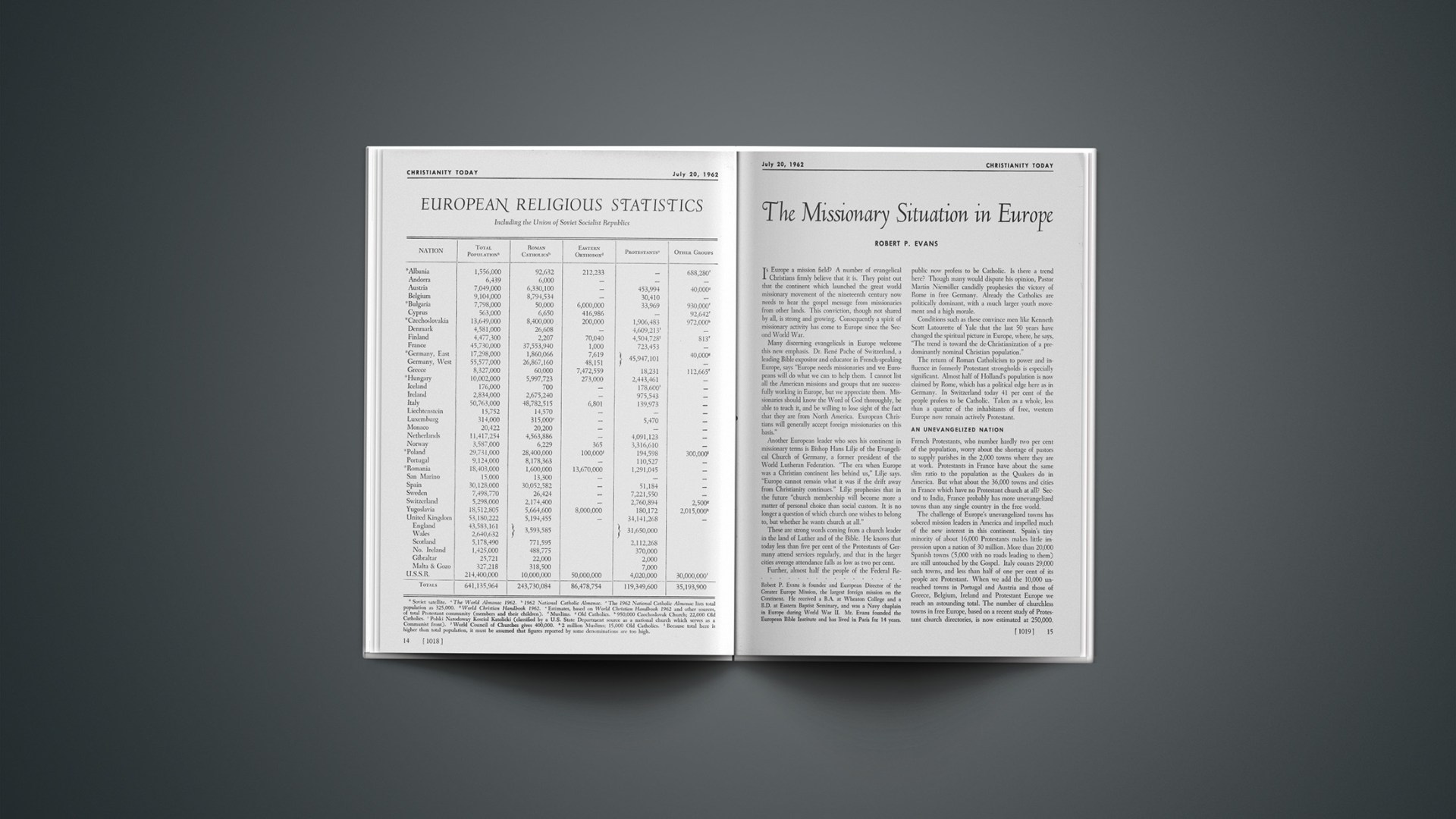
Including the Union of Soviet Socialist Republics
European Religious Statistics


Advancing the stories and ideas of the kingdom of God.




Including the Union of Soviet Socialist Republics
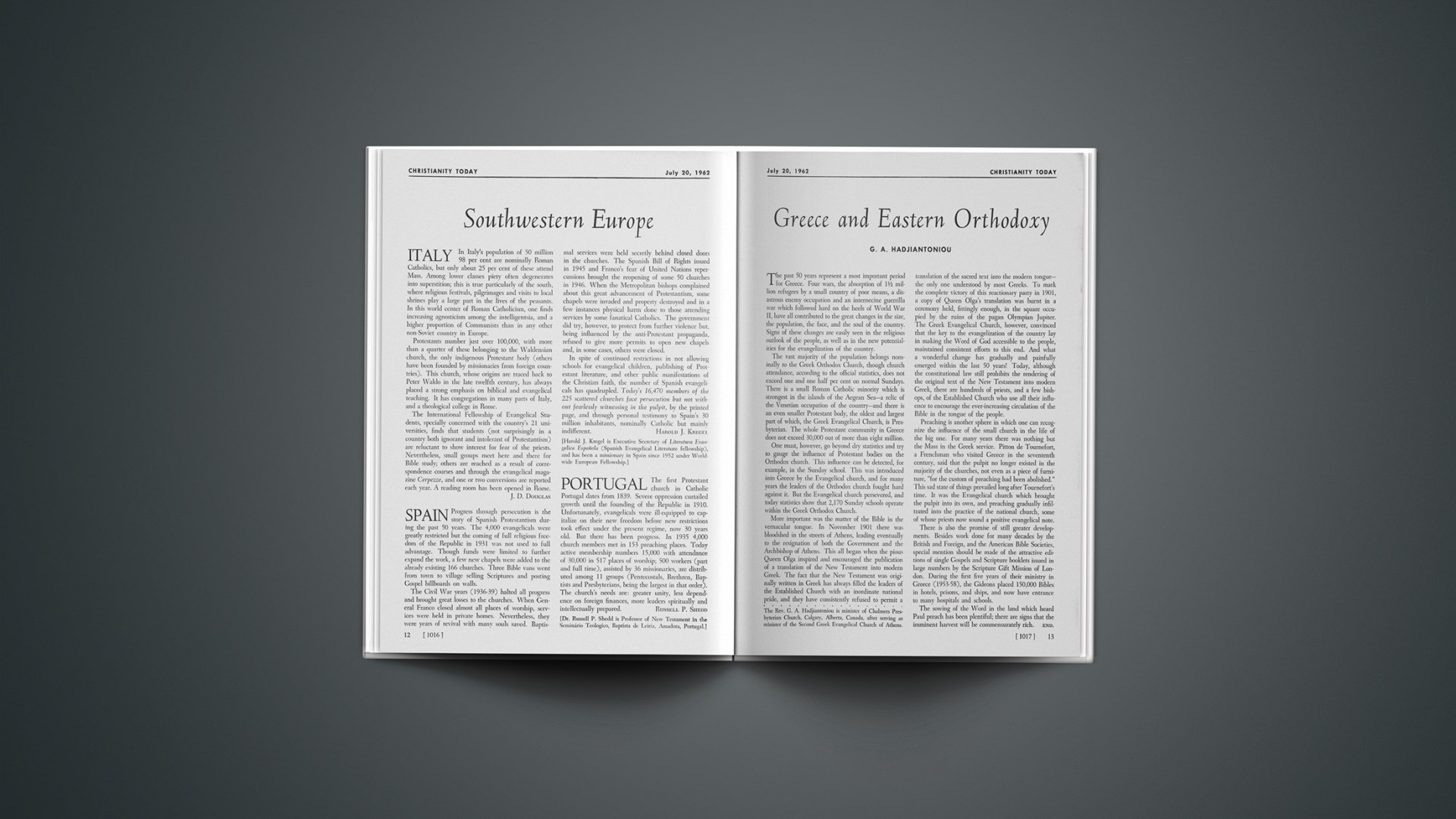
The past 50 years represent a most important period for Greece. Four wars, the absorption of 1½ million refugees by a small country of poor means, a disastrous enemy occupation and an internecine guerrilla war which followed hard on the heels of World War II, have all contributed to the great changes in the size, the population, the face, and the soul of the country. Signs of these changes are easily seen in the religious outlook of the people, as well as in the new potentialities for the evangelization of the country.
The vast majority of the population belongs nominally to the Greek Orthodox Church, though church attendance, according to the official statistics, does not exceed one and one half per cent on normal Sundays. There is a small Roman Catholic minority which is strongest in the islands of the Aegean Sea—a relic of the Venetian occupation of the country—and there is an even smaller Protestant body, the oldest and largest part of which, the Greek Evangelical Church, is Presbyterian. The whole Protestant community in Greece does not exceed 30,000 out of more than eight million.
One must, however, go beyond dry statistics and try to gauge the influence of Protestant bodies on the Orthodox church. This influence can be detected, for example, in the Sunday school. This was introduced into Greece by the Evangelical church, and for many years the leaders of the Orthodox church fought hard against it. But the Evangelical church persevered, and today statistics show that 2,170 Sunday schools operate within the Greek Orthodox Church.
More important was the matter of the Bible in the vernacular tongue. In November 1901 there was bloodshed in the streets of Athens, leading eventually to the resignation of both the Government and the Archbishop of Athens. This all began when the pious Queen Olga inspired and encouraged the publication of a translation of the New Testament into modern Greek. The fact that the New Testament was originally written in Greek has always filled the leaders of the Established Church with an inordinate national pride, and they have consistently refused to permit a translation of the sacred text into the modern tongue—the only one understood by most Greeks. To mark the complete victory of this reactionary party in 1901, a copy of Queen Olga’s translation was burnt in a ceremony held, fittingly enough, in the square occupied by the ruins of the pagan Olympian Jupiter. The Greek Evangelical Church, however, convinced that the key to the evangelization of the country lay in making the Word of God accessible to the people, maintained consistent efforts to this end. And what a wonderful change has gradually and painfully emerged within the last 50 years! Today, although the constitutional law still prohibits the rendering of the original text of the New Testament into modern Greek, there are hundreds of priests, and a few bishops, of the Established Church who use all their influence to encourage the ever-increasing circulation of the Bible in the tongue of the people.
Preaching is another sphere in which one can recognize the influence of the small church in the life of the big one. For many years there was nothing but the Mass in the Greek service. Pitton de Tournefort, a Frenchman who visited Greece in the sevententh century, said that the pulpit no longer existed in the majority of the churches, not even as a piece of furniture, “for the custom of preaching had been abolished.” This sad state of things prevailed long after Tournefort’s time. It was the Evangelical church which brought the pulpit into its own, and preaching gradually infiltrated into the practice of the national church, some of whose priests now sound a positive evangelical note.
There is also the promise of still greater developments. Besides work done for many decades by the British and Foreign, and the American Bible Societies, special mention should be made of the attractive editions of single Gospels and Scripture booklets issued in large numbers by the Scripture Gift Mission of London. During the first five years of their ministry in Greece (1953–58), the Gideons placed 150,000 Bibles in hotels, prisons, and ships, and now have entrance to many hospitals and schools.
The sowing of the Word in the land which heard Paul preach has been plentiful; there are signs that the imminent harvest will be commensurately rich.

In Italy’s population of 50 million 98 per cent are nominally Roman Catholics, but only about 25 per cent of these attend Mass. Among lower classes piety often degenerates into superstition; this is true particularly of the south, where religious festivals, pilgrimages and visits to local shrines play a large part in the lives of the peasants. In this world center of Roman Catholicism, one finds increasing agnosticism among the intelligentsia, and a higher proportion of Communists than in any other non-Soviet country in Europe.
Protestants number just over 100,000, with more than a quarter of these belonging to the Waldensian church, the only indigenous Protestant body (others have been founded by missionaries from foreign countries). This church, whose origins are traced back to Peter Waldo in the late twelfth century, has always placed a strong emphasis on biblical and evangelical teaching. It has congregations in many parts of Italy, and a theological college in Rome.
The International Fellowship of Evangelical Students, specially concerned with the country’s 21 universities, finds that students (not surprisingly in a country both ignorant and intolerant of Protestantism) are reluctant to show interest for fear of the priests. Nevertheless, small groups meet here and there for Bible study; others are reached as a result of correspondence courses and through the evangelical magazine Cerpezze, and one or two conversions are reported each year. A reading room has been opened in Rome.
J. D. DOUGLAS
Progress through persecution is the story of Spanish Protestantism during the past 50 years. The 4,000 evangelicals were greatly restricted but the coming of full religious freedom of the Republic in 1931 was not used to full advantage. Though funds were limited to further expand the work, a few new chapels were added to the already existing 166 churches. Three Bible vans went from town to village selling Scriptures and posting Gospel billboards on walls.
The Civil War years (1936–39) halted all progress and brought great losses to the churches. When General Franco closed almost all places of worship, services were held in private homes. Nevertheless, they were years of revival with many souls saved. Baptismal services were held secretly behind closed doors in the churches. The Spanish Bill of Rights issued in 1945 and Franco’s fear of United Nations repercussions brought the reopening of some 50 churches in 1946. When the Metropolitan bishops complained about this great advancement of Protestantism, some chapels were invaded and property destroyed and in a few instances physical harm done to those attending services by some fanatical Catholics. The government did try, however, to protect from further violence but, being influenced by the anti-Protestant propaganda, refused to give more permits to open new chapels and, in some cases, others were closed.
In spite of continued restrictions in not allowing schools for evangelical children, publishing of Protestant literature, and other public manifestations of the Christian faith, the number of Spanish evangelicals has quadrupled. Today’s 16,470 members of the 225 scattered churches face persecution but not without fearlessly witnessing in the pulpit, by the printed page, and through personal testimony to Spain’s 30 million inhabitants, nominally Catholic but mainly indifferent.
HAROLD J. KREGEL
[Harold J. Kregel is Executive Secretary of Literatura Evaugelica Española (Spanish Evangelical Literature fellowship), and has been a missionary in Spain since 1952 under Worldwide European Fellowship.]
The first Protestant church in Catholic Portugal dates from 1839. Severe oppression curtailed growth until the founding of the Republic in 1910. Unfortunately, evangelicals were ill-equipped to capitalize on their new freedom before new restrictions took effect under the present regime, now 30 years old. But there has been progress. In 1935 4,000 church members met in 153 preaching places. Today active membership numbers 15,000 with attendance of 30,000 in 517 places of worship; 500 workers (part and full time), assisted by 36 missionaries, are distributed among 11 groups (Pentecostals, Brethren, Baptists and Presbyterians, being the largest in that order). The church’s needs are: greater unity, less dependence on foreign finances, more leaders spiritually and intellectually prepared.
RUSSELL P. SHEDD
[Dr. Russell P. Shedd is Professor of New Testament in the Seminário Teologico, Baptista de Leiria, Amadora, Portugal.]

Most French people belong nominally to the Roman church, but the number of practicing Catholics is possibly not more than 15 per cent in a population of 46 million. The strong and sometimes bitter anticlerical movement, which in 1905 led to a total separation of church and state, has cooled down to a large extent, despite the Communist increase. Roman Catholicism is more enlightened in France than it is in Spain or Latin America. Apparent at present is a kind of biblical renewal, and this is coupled with a great interest in the ecumenical movement.
Protestants comprise less than two per cent of the country. The recovery of Alsace-Lorraine in 1918 meant an addition of about 300,000 to the 500,000 who could be counted before World War I. 400,000 Protestants are members of the Reformed Church, 300,000 are Lutherans, and the remaining 100,000 represent Evangelical Reformed, Free churches, Methodists, Baptists, Pentecostalists, Mennonites, Plymouth Brethren, and Salvation Army. There are, however, large areas totally devoid of evangelical ministry.
In 1938 two groups of Reformed churches (except for a minority who remained Evangelical Reformed), many Free churches, and the majority of Methodists joined and created the new Reformed Church of France, with no strictly enforced creed, so that the union displays various theological tendencies. Today there are those who would like to unite the different branches of the Protestant family in one church, but most evangelicals look with some suspicion upon this project. The things most needed today are:
1. A loyal stand for the Gospel, combined with a clear vision of the dangers of compromising with Romanism and modernism.
2. An enthusiastic proclamation of the Gospel. Although, apart from Baptists, Plymouth Brethren and Pentecostalists, no large increase in numbers is to be noted, the French public is ready to listen to the Good News of Jesus Christ, as has been seen in various evangelistic campaigns in recent years.
Fact and Faith Films are now available in France, and through this medium hundreds of people not normally accessible are being reached.
J. M. NICOLE
[Jules Marcel Nicole is currently Associate Director of the Nogent Bible Institute and Professor at the Evangelical Seminary, Aix-en-Province.]
Astride the weld uniting Flemish and Walloon Belgians, Brussels is emerging from the struggles of two conflicting cultures as a symbol of the will to unite, and the probable capital of the European Economic Community. In a country it has dominated for centuries, the Roman church is reversing its field in the face of major losses to materialism. If Protestants could hardly hold a job or rent a house in many towns a generation ago, in 1962 a Roman Catholic weekly speaks of them as “separated brethren,” regrets the excesses of the past, and prays for their return to the fold. Evangelicals are uniting on the practical level as never before; nothing like the Hutchings campaign had been seen in Brussels since the Reformation. Participating were a few churches whose ministers 40 years ago repudiated the Gospel. Today evangelicals find ministerial gatherings warm but lacking in discernment. On four occasions recently Protestant ministers told a converted priest what a pity it was he left the Roman church. Since Protestants still do not make up half of one per cent, Belgium’s unbelieving millions rank high, as a wide open mission field.
JOHN C. WINSTON
[John C. Winston is Principal of Brussels Bible Institute and Director of Belgian Gospel Mission.]
With over one million inhabitants French-speaking Switzerland has a slight Protestant majority, most of which are members of the official Presbyterian Church and follow the tradition of the great reformers Calvin and Farel. There are also various other denominations, some very active. Swiss Protestantism has a great influence in all the countries where French is spoken—much greater than would be supposed from the country’s size—international church organizations in Geneva, theological literature, missionary and social action. Rapid expansion in Lausanne and Geneva attract many Roman Catholic Italian and Spanish workers employed in the erection of new buildings. But the church is alive to evangelistic opportunities: Billy Graham and Maurice Ray have led successful crusades here. Many persons lead an intense religious life, but the high living standard requires watchfulness and boldness.
BORIS DECORVET
[Boris Decorvet is a native of Switzerland and holds the B.D. in France and Switzerland (currently in Versoix).]

In Germay the centuries-old tradition of church government by secular princes survived until 1918, when the individual territorial churches adopted their own constitutions. Before this time, moves towards unity had resulted in the establishment of the Committee of the German Evangelical Churches in 1903, but a closer bond was made in May 1922 with the formation of the Federation of German Evangelical Churches, with a permanent office in Berlin. (“Evangelical” in the German context usually signifies the indigenous non-Roman churches.) The confessional status of the various constituent bodies (Lutheran, Reformed, Union) was untouched, but from this time the Federation represented all of them in common affairs, such as overseas work.
By 1933 the tendency towards unity became stronger, partly under the pressure of the so-called “German Christian” movement and the Nazi government, and this led in that year to the constitution of the German Evangelical Church. The encroachments of the Nazis on the confession of the churches soon resulted, however, in what was described as the Struggle of the Church (Kirchenkampf), in the course of which such fellowship as had been achieved was virtually destroyed.
After the German defeat in 1945 it was found necessary to begin anew, and a conference was called at Treysa, with the aim of reorganizing the whole church which was renamed the Evangelical Church in Germany (Evangelische Kirche in Deutschland=EKD). This is, strictly speaking, a federation of churches rather than a church, and has no confession of its own. It is regarded as the realization of a fellowship between the two Reformation churches (Lutheran and Reformed), not easily expressed in legal terms, but closer than the usual relationship between these two bodies in other parts of the world, and stronger because of the period of trial and persecution during World War II. Theological and ecclesiastical problems still arise, particularly in connection with such subjects as intercommunion and mutual eligibility of ministers, and though it has not solved them, the united church has learned to live with such questions.
On a broader scale EKD is a member of the loosely organized Cooperative Fellowship of Christian Churches in Germany—an organization similar to the ecumenical National Councils. Other members of this body are Baptists, Open Brethren and some Elim churches (which three groups are united in the Federation of Evangelical Free Congregations), the Evangelical Fellowship, The Methodist Church, the Old Catholic Church, the Mennonites and the Moravian Church. EKD is also a member of the World Council of Churches; its member churches belong partly to the Lutheran World Federation, partly to the Presbyterian World Alliance.
According to the census of 1950 (the latest available), in a total population in the Federal Republic of some 48½ million, just over 24½ million were members of the various Evangelical churches or other non-Roman Christian groups; 22¼ million were Roman Catholics; 94,000 professed other religions (including Jews, whose numbers dropped astronomically and tragically under the Nazi regime); and rather more than 1½ million were members of other groups or professed no religious affiliation. To these should be added the respective figures for West Berlin (population over two million): more than 1½ million Evangelical Christians; less than ¼ million Roman Catholics; 8,000 of non-Christian religions; and 327,000 others.
There are danger signs in the Federal Republic, with many reacting strongly against what they regard as an increasingly dictatorial ecclesiastical system characterized by a barren orthodoxy. In some areas the complaint is made that the younger clergy especially are “removed from life” and are failing to speak to the condition of the people, and this is having its inevitable effect. It is estimated that the number of Unitarians has increased alarmingly (to 100,000), particularly in Schleswig-Holstein, and great success is claimed also for the efforts of organized atheism.
Yet true evangelical preaching is meeting with its customary response. In 1954 a single Billy Graham meeting brought out 25,000 in Düsseldorf, 80,000 in Berlin. In 1955 similar meetings in Mannheim, Stuttgart, Nuremberg, Dortmund and Frankfurt had attendances varying from 25,000 to 60,000. In 1960 three one-week crusades in Essen, Hamburg and Berlin were attended by crowds averaging about 25,000 to 30,000 each night for the entire period. The final meeting in Berlin brought an attendance of 100,000. Bishop Otto Dibelius wrote a letter to his entire clergy urging them to participate in these meetings; Bishop Hans Lilje appeared on the platform and spoke most enthusiastically about the whole venture.
In all of these efforts the original invitation to the Graham team came from relatively small evangelical groups, but with growing support from the broader church in Germany. For a return visit in 1963, the Evangelical Alliance is again extending the invitation; this time, however, with the cooperation of the German Conference of Bishops and other church leaders. Meetings will be held for one week each in Stuttgart and Nuremberg, with a two-day visit to Berlin. It is expected that by that time German-language versions of “The Heart is a Rebel” and “Africa on the Bridge” will be available. Dr. Graham has said that he finds the response to the preaching of the Gospel in Germany greater than that in almost any other place in the world.
J. D. DOUGLAS
[Some of the background material for the essay on Germany has been used by permission from Dr. Heinz Burnotte, author of the book Die Evangelische Kirche in Deutschland.]
In 1952 the Lutheran and Reformed Church of Austria still included those parts of the former monarchy which since 1918 belong to Poland, Romania, Czechoslovakia, Yugoslavia and Italy. In 1945 some of them became part of Russia. 169,208 of the 588,686 church members were geographically within the present Austria. 28 congregations with 37,000 members were added in 1921 when German-speaking Burgenland became part of Austria.
Resistance against political Catholicism and the Catholic marriage laws caused many conversions. By 1938 the number of members had increased to 342,308.
Between 1938 and 1945 41,000 left the church under Nazi pressure. This cleansed and purified the church. After 1945 political ambitions of the church yielded first place to a stronger faith in Christ in Protestant terms. 55,000 refugees from southeastern Europe increased the number of members. 65,000 other people had joined by 1961, while 30,000 dropped out. Today the Protestant Church has 420,000 members, 405,000 of which are Lutherans organized in 160 congregations and six superintendencies, while 15,000 in eight congregations belong to the Reformed Church. 230 ministers and 400 religion teachers serve the 800 preaching stations and 4,500 places of religious instruction. Since 1947 the growing church had to build 78 churches and 56 church centers. The theological department of the University of Vienna and two special schools train the ministers and female church workers. The church administers hospitals; homes for children, youth and old people; nursing and convalescent homes; two university extentions; an academy; a teacher’s college; and three schools.
In 1949 the Church got a new constitution which in 1961 was supplemented by the state “law on the external legal status of the Protestant Church” which grants complete autonomy regarding jurisdiction, direction and management as well as an equal status with the other officially approved churches.
D. GERHARD MAY
[Bishop May is the Bishop of the Evangelical Church Augsburgian Confession (Lutheran Church) in Austria, and President of the Evangelical Executive Church Council Augsburgian and Helvetic Confession in Austria. He has served in this position since September 1944. He is a graduate of Vienna, Halle, and Basel Universities and holds the Th.D. from Heidelberg.]
In 1959 a test census covering 10,000 families out of the country’s total population of some 11 ½ million gave what is considered a reasonably accurate indication of religious affiliation. The statistics showed the Roman Catholic Church with 40 per cent; Dutch Reformed 29 per cent; Free Reformed 9 per cent; other groups 4 per cent; and those with no religious tie 18 per cent.
Still seen among Protestants is the influence of men like Groen van Prinsterer and Abraham Kuyper who were associated last century with the old Calvinist traditions: notably those concerning spiritual theocracy, devotion, emphasis on church order, and confessional loyalty. Thus in the Netherlands the Revival movement was directed along ecclesiastical lines. An opportunity was given to the laity to make their contribution to the spread of the Gospel in Christian organizations within such fields as education, workmen’s unions, newspapers, charitable bodies, academic circles, and (latterly) broadcasting and television.
Since 1940 the Dutch Reformed Church (Nederlandse Hervormde Kerk) has known a significant recovery. Before that time it was primarily an administrative union which gave responsibility for preaching the Word to local congregations. During and after World War II the church, under the influence of Karl Barth and of those elements in the Reformed tradition not associated with Kuyper and his colleagues, revealed itself as a Christ-confession, assuming responsibility for preaching and pastoral care of the people, in obedience to Holy Scripture and in close connection with the historic creeds of the Reformed Church.
In Dutch Christianity generally the following tendencies are at present noticeable: A desire for ecumenicity; a new emphasis on the understanding of the Bible (in 1952 there was a new Protestant Bible translation; in 1961 a new Roman Catholic translation); in theology an attempt to keep the best elements of the dogmatic tradition in a continuing confrontation with responsible exegesis; a liturgical movement which will serve the exercise of devotion. Over all there is a tendency for Christianity to become dogmatic, certainly less rationalistic, and more biblical and personal, and often service-and missionary-minded. Together with all this there is apparent a greater receptivity for that which is experimental.
Smaller churches which are not indigenous have had relatively little influence in the Netherlands; similarly with sects such as Jehovah’s Witnesses and Mormons. One poignant reminder of recent history concerns the number of Jews: 106,409 in 1909, but only 14,346 in 1947. One possible reason for the comparatively small inroads made by “international” churches in the country is that they are not easily oriented into the general pattern of Dutch Protestant Christianity, in which there is always a seeking for harmony between ecclesiastical institutionalism and spiritual power.
R. SCHIPPERS
[R. Schippers is Professor of New Testament in the Free Reformed University of Amsterdam, which awarded him the D.Th. degree in 1938.]
That the German-speaking section of Switzerland could produce the two most influential theologians of their generation is evidence of a vitality in the churches. However, the theology of Karl Barth of the University of Basel, and Emil Brunner of the University of Zürich, has not yet led to a revival of Christian devotion among the people. Church membership for many Protestants means little more than the payment of taxes to support the Reformed Church of their canton. There is little opposition to the church, and it plays an important role in the life of the nation; the problem is lack of widespread personal concern about Christianity, a problem which is inherent in the Volkskirche (people’s church) today.
Some 2,857,600 of Switzerland’s 5,429,100 inhabitants are Protestants. As the Italian-speaking section of the country is almost wholly Roman Catholic, Protestant strength lies in the other areas, though some sections of these also are largely Roman Catholic. In the most populous Swiss canton, Zürich (927,000), 65 per cent are Protestants and 32.4 per cent Catholics. But only 2.6 per cent were Catholics in 1850, 21.7 per cent in 1930, 24.9 per cent in 1950. Part of this growth is attributable to the influx of Italian workmen, but among the Swiss themselves the Catholic proportion has increased from 22.2 per cent in 1950 to 25.8 per cent in 1960. In the Protestant cantons of Switzerland, as indeed in other Protestant countries, Catholicism is gaining strength fast.
Each canton is free to regulate its own religious affairs, except that the federal constitution guarantees religious freedom. In some cantons the Reformed Church receives state support; in others the Catholic Church is the official one; and in still others both are supported financially by the government, or neither is. Free churches are gaining respect, but their membership is small. Baptists, for example, have gained less than 400 new members in 40 years, and now number about 1,500. Methodists and some others are larger. The Reformed Church of Zürich reports that for several years its greatest losses have been to the New Apostolic Church which claims a reestablishment of the apostleship in preparation for the end of time.
Protestantism has contributed much to the character of the Swiss people and the culture of the nation. Through Zwingli, the Anabaptists and other leaders of the past and present, Switzerland has had an influence far out of proportion to its size. Still vigorous but losing ground, Swiss Protestantism faces the challenge of making the Gospel relevant to more than a small minority of the population.
J. D. HUGHEY
[J. D. Hughey is President of the (international) Baptist Theological Seminary of Rüschlikon, Switzerland. He has been a member of the faculty since 1952 and teaches church history. He holds the A.B. degree from Furman University, Th.M. from Southern Baptist Theological Seminary, and M.A. and Ph.D. degrees from Columbia University.]
A CRITICAL SITUATION—We see European civilization breaking up into anarchy before our eyes, because the economic, social, and political forces have developed freely without regard for one another. The traditional values of civilization are no longer moulding civilization today; they are no longer taken into account. There is, therefore, a serious lack of balance, and we have reached a definite crisis.—JACQUES ELLUL, professor in the faculty of law, Bordeaux, from the report of the First Assembly of the World Council of Churches.
UPHEAVAL IN HISTORY-Conventional notions of private and public morality have been steadily atrophied in the last ten or fifteen years by the exposure of treason in government, corruption in labor and business, scandals among the mighty.… Orthodox religion’s conception of good and evil seem increasingly inadequate to explain a world of science fiction turned fact, past enemies turned bosom friends, and honorable diplomacy turned brink of war.—J. C. HOLMES, “The Philosophy of the Beat Generation,” Esquire Magazine.
THE TURN IN FRANCE—What is truly new today is that there is a new religion. In a few words, it is the general feeling that no one is really healthy without a fully developed sex life.—Time, quoting from France’s Esprit.
UNCONCERN IN SWITZERLAND—Everywhere too one saw the church existing, but saw no evidence of its existing significantly. Symptoms were most unmistakable in southern Italy, where crime, immorality and human degradation swarmed horribly around a church which seemed blind alike to their presence and their tragic implications. But it was in Switzerland that a loyal churchwoman responded to my disturbance about an instance of abject but removable poverty with an assurance which only increased my perturbation: “You should not feel that way about it. It is not sad at all! These people are not being deprived of what they need. They do not go hungry. They steal.”—Dr. ROY PEARSON, Dean of Andover Newton Theological School, in a report to The Christian Century (June 14, 1961).
DECLINE IN ENGLAND—Prosperity and righteousness do not go hand in hand. As material standards climb ever higher, moral standards are on the decline. Crimes of violence are on the increase; juvenile delinquency, the break up of home life, mental sickness all plague the community and present bewildering problems to the State.… There is no reason to believe that this decline is likely to be halted, unless disaster overtakes us, or revival rescues us.—TALBOT MOHAN, “The Situation in England Today” from The Churchman.
MORAL NEEDS IN SPAIN—There remains a grave need for human and moral reforms. Human relationships are often still poor. Often the economically weak resent a lack of understanding, of human cooperation, of confidence, of interest in family and factory relationships, more than they resent a low wage. Many can—and willingly do—reject any salary, high or low, to show their resentment against incorrect treatment.—Commerce Minister of Spain Ullastres, discussing the miner’s strike at Barcellona, New York Times Magazine (July 1).
SOVIET PRESSURE—The largest Baptist Church in Riga, known as the Hagensburg Church, has been converted by the Soviet Russians into a TV studio and production center.… Already in 1940 when Latvia was annexed by the Soviets this Baptist congregation was compelled to cede the building to the State; but they were permitted to use it until 1961. Only three of the eight Baptist churches in Riga remain open for divine worship, the Alliance says. When the Russians in 1940 occupied Latvia there were 104 Baptist churches with a total membership of 11,000. Although many churches in the meantime have been forced to close, the membership of the Baptist churches during the last years, despite persecution and repression from the Communists, has increased.—The Gospel Call.

The Evangelical-Lutheran Church is the national Church of Norway, is administered by the State’s Church department, and represents some 96 per cent (3.6 million) Norwegians. The remainder include 30,000 Pentecostalists, 17,000 Free Church Lutherans, 12, 000 Methodists, 9,000 Baptists, and 5,000 Roman Catholics. Most of the dissenters sprang originally from Reformed groups in the United States or in Great Britain.
For generations there have always been some convinced nonbelievers in the State Church, and during the last decade a few skeptical intellectuals of the older age group have demonstratively left the Church in favor of a bare “human ethical way of life.” Many talented young students, on the other hand, are showing great interest in the thorny problems of human thought and life, and not a few are eagerly seeking religious solutions. Most notable in the last 40 years is the great expansion of Studentlaget (Christian Student Association) which has won a dominating influence in academic circles. Its marked emphasis on the preaching of the Gospel has resulted in college and university students becoming warm adherents to the Christian faith and to evangelical Lutheran confession. This student work is now associated with the Inter-Varsity Fellowship.
The life, activities and opinion of Norwegian Church members are usually assumed to be very individualistic compared with those in Sweden and Denmark, and criticism has arisen from their unwillingness to cooperate if their Christian conviction argues against it. Certainly internal theological controversy has been more of a burning issue in the Church of Norway than in most other parts of the evangelical world. Large numbers of church people were involved in these periodically blazing battles fought out in journals and newspapers. As a result of controversies at the beginning of this century the Independent Faculty of Theology (Det teologiske Menighetsfakudtet) in Oslo came into existence in 1908. After it gained university status, this faculty became responsible for training a majority of the Norwegian clergy (the figure over the past few years is estimated at 80 per cent).
Christian activity has clearly increased in Norway over the last half century during which it has been found necessary to increase the number of dioceses from six to nine. Most significant, however, is the growing concern in the ranks of the free Christian organizations for missionary ends; the great and comprehensive work of these organizations is a characteristic trait of Christian life in Norway. All of them are wholly independent of the state church, and all are motivated by the firm resolve of pastors and people alike to live and act wholly for the Gospel of Jesus Christ. One result of this has been that missionary organizations, with their 850 missionaries throughout the world, have all enlarged their incomes and added to their commitments in an almost sensational way. Yearly contributions to missionary work, which amounted to rather less than two million kroner in 1911, now amount to more than 20 million kroner (about $2,800,000).
Within the ordinary working groups of the Church a new spirit of initiative has appeared, inspired to some extent by the encouraging example of the stewardship-adjustment in the evangelical churches of the United States. Conspicuous representatives of this new movement are the Institute of Christian Education (Instituttet for Kristen oppseding, IKO), the Institute of Congregational and Parish Work (Menighetsinstituttet), and the Egede Institute of Missionary Study and Research (Oslo).
JOHN NOME
[John Nome is Professor of Systematic Theology and Dean of the Free Faculty at Oslo.]
Toward the end of the nineteenth century a radical view of life based on materialistic and socialistic foundations became more and more common in Sweden. In 1882 Uppsala University students founded a society to work for a “modern” outlook on life; early Laborites, influenced by Marx, had generally a critical or hostile attitude to the Church; in literature and among the intelligentsia there were increasing signs of a negative or indifferent attitude to Christianity. Such a view was justified by reference to the advance and implications of scientific discoveries.
The Swedish Church (Evangelical-Lutheran) about the turn of the century was weakened also by sectarian separatism, but then there appeared a series of church leaders who succeeded in rekindling the dying enthusiasm. One of these was Archbishop Nathan Söderblom, whose great passion was the ecumenical movement. In 1925 his efforts were rewarded with the opening in Stockholm of the “Ecumenical Conference on Life and Work” attended by representatives from most Protestant and Greek Orthodox bodies. (It must be added, however, that in 1962 only the national church and the Mission Covenant Church among Swedish bodies are members of the WCC.)
The liberal theology which at the end of last century gained ground at Uppsala allied itself to the Young Church Movement, and thus acquired a stronger influence within the Church, but from the 1920’s there can be traced an organized opposition to modern biblical criticism, originating from “low-church” and “old-church” circles. Here the Evangelical National Missionary Society, a body formed in 1856 by Lutheran groups loyal to the Church of Sweden, took the lead. In addition, there has arisen, chiefly influenced by the Anglican Church, a high-church movement which since the 1940’s has spread to many clergymen and divinity students. These attach great importance to the external form of divine worship: robes, the sign of the cross, genuflection, and so on.
In Sweden the Freedom of Religion Law (1951) makes it possible for anyone to leave the Church without becoming a member of another religious body, but only about 30,000 persons (less than 0.5 per cent of the population) have taken advantage of this. The latest statistics show that 85.52 per cent of children are baptized in the Church, and 86.65 per cent are confirmed. Of marriages, 91.35 per cent are solemnized by a church ceremony; of burials, 96.11 per cent are church-performed. National church members total over 95 per cent of Swedes.
These figures alone do not measure the intensity of religious life, but they evidence the strong grip which the church has on the life of the nation. The most important Free churches are: Swedish Baptist (32, 000), Methodist (11,000), Mission Covenant (96, 000), Salvation Army (41,000), and Pentecostal (92, 000).
In spite of all secularization the kingdom of God is steadily developing. The high standard of life is not enough to satisfy the soul’s yearning for eternal truths. To some extent the young generations appears to have lost all contact with the Christian faith and Christian norms, but at the same time it is obvious that just here there is an unquenchable thirst for spiritual values. The Gospel still shows that it is the “power of God unto salvation.” The irresistible power of the love of Christ appears particularly in the strong interest of Swedish Christians in the propagation of the Gospel in many missionary fields, and in the extensive and specialist work maintained in the so-called underdeveloped countries.
NILS RODEN
[Nils Rodén is lector at the Secondary School of Västervik. Sweden. An ordained minister in the Church of Sweden, he received the Th.D. degree in 1941.]
Fifty years ago the spiritual life of Denmark was characterized by a certain calm. True, the development towards secularization was under way, and people were led both by their optimistic faith in civilization and by their confidence in a “good, safe world” to conclude that they could do without God. The atheism of Georg Brandes was affecting many of the intellectuals. Yet the population for the most part wished to retain the externals of traditional Christianity, and worried little about what the minister had to say. In the churches by and large a true Gospel was being preached, but there, too, optimism was becoming noticeable: nobody was being made to feel uncomfortable! This imperturbable, superficial attitude to the grave questions of damnation and eternal salvation was naturally a cause of constant concern to true believers. “Watchman’s cries” of warning came particularly from groups such as the Home Mission and Lutheran Mission, but they were little heeded outside their own circles.
Then the First World War dealt a grave blow to men’s trust in civilization, and a definite, albeit only temporary, improvement was evident. But post-war prosperity brought a desire to enjoy life without any restraints from tradition or Church. This is where a true, powerful word of God was needed, but at this very time liberalism began to exercise its crippling effect by usurping the university teaching posts. Believing parents could not but be greatly concerned when their children chose to read theology; and soon young priests and teachers were bringing the poison of liberalism out to the people as well. Barth’s theology brought an improvement, but the situation is still far from satisfactory. Perhaps today nobody wants to be labeled “liberal,” but generally speaking the Divine authority of the Bible is not recognized.
Also as a result of the development of the last 20–30 years the so-called “pietistic” circles, i.e., those who have joined themselves together in groups such as the Home Mission, the “Grundtvigians” (followers of the evangelical Bishop Grundtvig) and the Lutheran Mission, are despised as being behind the times, philistine and pharisaical. Harshest in its criticism is the thirty-year-old “New Era” movement. Many young theologians are counted among its adherents, and it exercises a regrettable influence under the leadership of Professor Lindhardt of Aarhus. Lindhardt calls any form of piety pharisaical subjectivism, and undermines trust in the Bible in such a shameless fashion that one wonders that he still desires to remain a minister in the Danish Church.
Thus the battle for the truth in Denmark has increased in intensity. The Lutheran Church still comprises 95 per cent of the population, but her teaching is far removed from the confessions of faith of her Reformers. But God has preserved a remnant of true believers, and recently even increased its numbers among students also, grounding it still more firmly on the heritage of the Lutheran confession.
O. BÖRLÖS JENSEN
[O. B. Jensen is a teacher in Holte, on the Danish island of Sjaelland.]
Last year a poll on religious views was taken at the Military Academy for Reserve Officers at Hamina in Finland. Only 7.4 per cent of the men answered “no” to the question, Do you believe in the forgiveness of sins through Jesus Christ? In Finland by government order four days are set aside each year for national prayer, on which occasions all public entertainments are forbidden. This would suggest an essentially religious country.
In a population of just under 4½ million, about 94 per cent belong to the Evangelical Lutheran Church, 1.7 per cent to the Orthodox Church, while no other church has more than 8,000 members. Finland’s turbulent history and intense nationalism are such that people and church are virtually inseparable. Thus the birth of Finnish literature stemmed from the Reformation; and those pietistic revivalist movements, which in other countries broke away from the church, did not do so in Finland, and remain the real characteristic of the indigenous church there. Though persecuted as recently as last century, the pietistic movement is found today in many key ecclesiastical posts, and its summer conferences attract large numbers. The movement is not obscurantist, and its main emphasis is on the claims of Jesus Christ and the necessity for decision.
During the first half of this century some social groups became estranged from Christianity, but recently there has been a sharp drop in the number of critics (apart from those on the extreme left) belonging to the educated classes. Church attendance is naturally highest where revivalist movements are strongest, but the church is continually seeking new ways of taking the old Gospel to those who are farthest away from it.
A characteristic feature of Finnish Christianity is its stress on personal spiritual experience, explicable in terms not only of pietism, but of the introspective, meditative nature of the people. Like other Western churches the Church of Finland is challenged by industrialization and urbanization, bringing a sense of boredom and life futility. Ties with the West are close, and American Lutheran churches and American Friends after World War II gave much appreciated assistance toward the reconstruction of war-destroyed churches and rectories in Northern Finland. Finnish Christians are eagerly looking forward to the summer of 1963 when they will be hosts to the Fourth Assembly of the Lutheran World Federation, the theme of which is CHRIST TODAY.
J. D. DOUGLAS
[The report on Finland was compiled by CHRISTIANITY TODAY’S British Editorial Director, who has spent an extended summer in Northern Finland.]
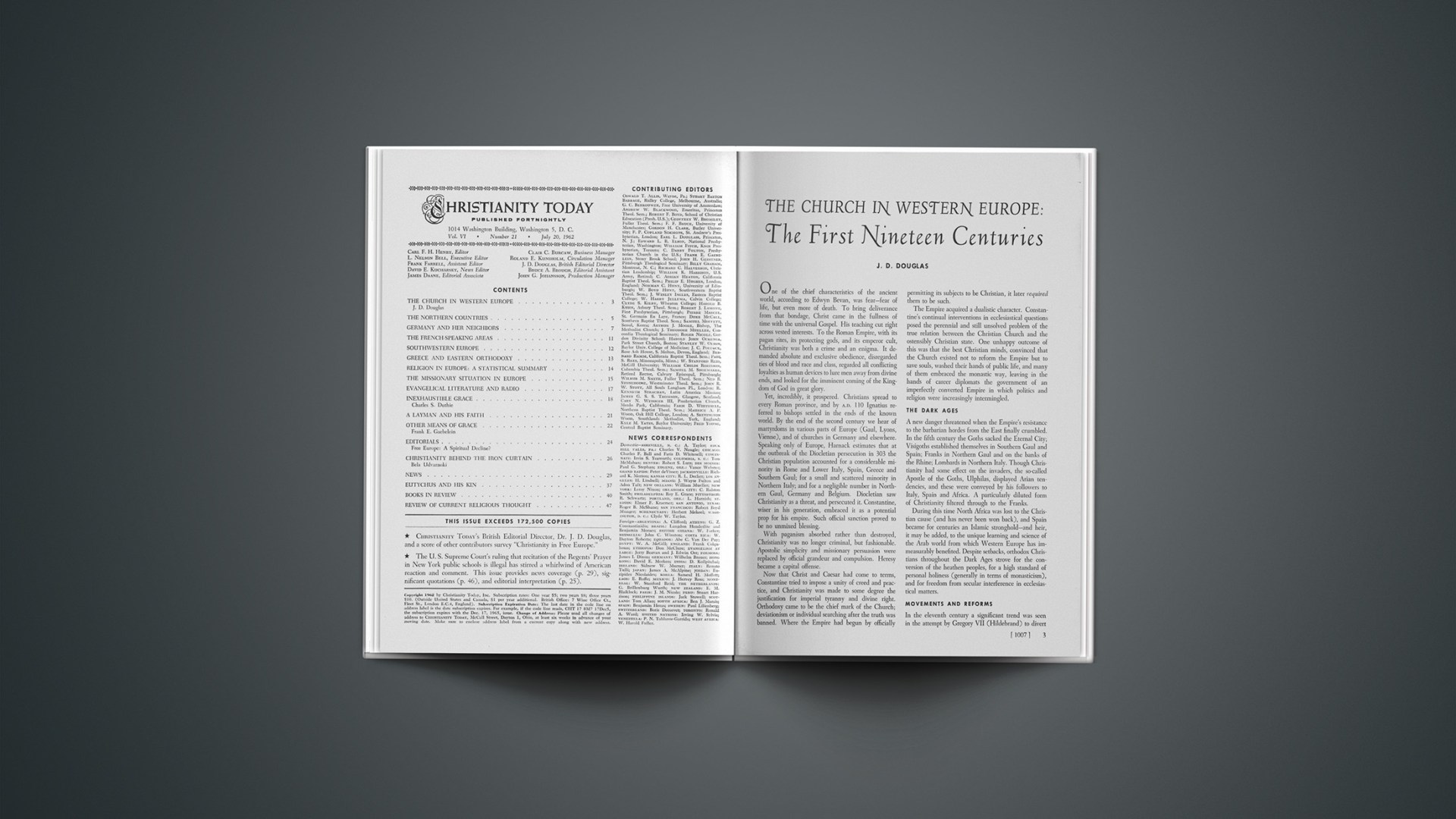
One of the chief characteristics of the ancient world, according to Edwyn Bevan, was fear—fear of life, but even more of death. To bring deliverance from that bondage, Christ came in the fullness of time with the universal Gospel. His teaching cut right across vested interests. To the Roman Empire, with its pagan rites, its protecting gods, and its emperor cult, Christianity was both a crime and an enigma. It demanded absolute and exclusive obedience, disregarded ties of blood and race and class, regarded all conflicting loyalties as human devices to lure men away from divine ends, and looked for the imminent coming of the Kingdom of God in great glory.
Yet, incred`ibly, it prospered. Christians spread to every Roman province, and by A.D. 110 Ignatius referred to bishops settled in the ends of the known world. By the end of the second century we hear of martyrdoms in various parts of Europe (Gaul, Lyons, Vienne), and of churches in Germany and elsewhere. Speaking only of Europe, Harnack estimates that at the outbreak of the Diocletian persecution in 303 the Christian population accounted for a considerable minority in Rome and Lower Italy, Spain, Greece and Southern Gaul; for a small and scattered minority in Northern Italy; and for a negligible number in Northern Gaul, Germany and Belgium. Diocletian saw Christianity as a threat, and persecuted it. Constantine, wiser in his generation, embraced it as a potential prop for his empire. Such official sanction proved to be no unmixed blessing.
With paganism absorbed rather than destroyed, Christianity was no longer criminal, but fashionable. Apostolic simplicity and missionary persuasion were replaced by official grandeur and compulsion. Heresy became a capital offense.
Now that Christ and Caesar had come to terms, Constantine tried to impose a unity of creed and practice, and Christianity was made to some degree the justification for imperial tyranny and divine right. Orthodoxy came to be the chief mark of the Church; deviationism or individual searching after the truth was banned. Where the Empire had begun by officially permitting its subjects to be Christian, it later required them to be such.
The Empire acquired a dualistic character. Constantine’s continual interventions in ecclesiastical questions posed the perennial and still unsolved problem of the true relation between the Christian Church and the ostensibly Christian state. One unhappy outcome of this was that the best Christian minds, convinced that the Church existed not to reform the Empire but to save souls, washed their hands of public life, and many of them embraced the monastic way, leaving in the hands of career diplomats the government of an imperfectly converted Empire in which politics and religion were increasingly intermingled.
A new danger threatened when the Empire’s resistance to the barbarian hordes from the East finally crumbled. In the fifth century the Goths sacked the Eternal City; Visigoths established themselves in Southern Gaul and Spain; Franks in Northern Gaul and on the banks of the Rhine; Lombards in Northern Italy. Though Christianity had some effect on the invaders, the so-called Apostle of the Goths, Ulphilas, displayed Arian tendencies, and these were conveyed by his followers to Italy, Spain and Africa. A particularly diluted form of Christianity filtered through to the Franks.
During this time North Africa was lost to the Christian cause (and has never been won back), and Spain became for centuries an Islamic stronghold—and heir, it may be added, to the unique learning and science of the Arab world from which Western Europe has immeasurably benefited. Despite setbacks, orthodox Christians throughout the Dark Ages strove for the conversion of the heathen peoples, for a high standard of personal holiness (generally in terms of monasticism), and for freedom from secular interference in ecclesiastical matters.
In the eleventh century a significant trend was seen in the attempt by Gregory VII (Hildebrand) to divert power from the Emperor to the Pope—in which policy he was partially successful, but only partially, for later in the century Urban VI saw the necessity for recouping the flagging fortunes of the Papacy. On the principle that nothing unites men so much as a common antagonism, he launched the Crusades. “The Welshman left his hunting; the Scot his fellowship with lice; the Dane his drinking party; the Norwegian his raw fish.” The idea of the Holy War caught the European imagination, and whole cities migrated, “hungering and thirsting only after Jerusalem.” It was a magnificent failure which both enhanced and corrupted the Papacy. It began with the Christian invasion of the Holy Land; it ended with the Ottoman Turk empire established along the shores of the Danube.
The Papacy survived a period of internal dissension and emerged triumphant over conciliar attempts to limit its power, only to encounter its greatest ordeal of all time. The Reformation was nothing less than a revolution—from works to faith, from tradition to scripture, from a whole system of intermediaries and sacerdotalism to the universal priesthood of believers. It was, in fact, a rediscovery of the true nature of the Gospel which split both Germany and Switzerland in two, completely captured England, Scotland and the Scandinavian countries, and created sizeable minorities in countries once considered immovably Catholic. In other lands, however, it made little or no impression, and merely served to effect a closing of the Catholic ranks, notably in Spain where Protestants now constitute only a tiny minority.
Reaction set in, so that by the eighteenth century in Luther’s Germany the deficiencies of Pietism, which deprecated reason and even common sense, contributed to a rationalism which in deistic trappings came from England.
The latter imported also to France a brand of rationalism which led to the French Revolution. The interests of monarchy and Church were identified, and Diderot fairly reflected the current philosophy when he said that the world’s salvation would come only when the last king was strangled with the entrails of the last priest.
In Italy, home of the Vatican, we see during this period an increasing secularism unparalleled in any other country in Western Europe, and soon to make it a fruitful breeding-ground for a godless philosophy which during the latter nineteenth century was being planned by Marx and Engels in Christian England.
Yet, paradoxically, the Vatican which for centuries had looked beyond the Italian States and across the Alps to Germany for support (a fact fraught with historical significance) not only maintained but consolidated its power. Pius IX (d. 1878) offset the loss of some temporal possessions by assuming autocratic powers, particularly in the dogma of Papal infallibility, which would have impressed even Hildebrand or Boniface VIII, and which resulted in the Old Catholic schism and the Kulturkampf in Germany.
The nineteenth century closed with Protestants and Roman Catholics moving further away from each other, despite the efforts of Pius’ enlightened successor, Leo XIII, and with church-state relations in precarious plight in Italy and France.
In nineteen centuries Christianity had come a long way. In the process the message had become blurred in parts—but the vested interests which opposed it were oddly unchanged.
In this issue CHRISTIANITY TODAY deals particularly with the Christian Church in countries of Western Europe, but there is universal significance in their problems and needs, their temptations and triumphs. Many of these on close examination are found to center around that relationship between church and state which Leopold von Ranke called the content of history. The period covered in the following articles is roughly the last 50 years, a period which has seen two world wars and unparalleled changes on the map of Europe.
Benito Mussolini called this the century of the State; Otto Dibelius calls it the century of the Church. It is an age in which newly-discovered wonders bear eloquent testimony to the Infinite Workman who fashioned it all “in the beginning,” yet one in which men’s imaginations have been fixed on godless ideologies. It is an age in which people need security so desperately that they have committed their destinies to strong-arm men; yet an age in which a famous Swiss theologian repudiates “that false certainty of faith which knows God’s Will in every condition of life as accurately as if man, Bible in hand, had sat with Him in the heavenly councils.” It is an age in which many people no longer ask “Is Christianity true?,” but rather “What is Christianity?” During this half-century the worldly wisdom which whispers compromise with a materially successful state has often prevailed in a church which should have known its history better: between Tertullian’s resolve to have no truck with “black error” and the futile concordats of Pius XI is a gulf immeasurably greater than eighteen centuries.
Oswald Spengler forty years ago in The Decline of the West predicted the triumph of the secular state. The wheel would then have gone full circle back to the Roman Empire, days when men were mortally afraid of the unknown, before Christ came. Who knows but that the universal fear abroad in the world today is the harbinger of his return.
It is, i think, worthy of remark that meetings between the pope and the heads of Protestant churches are always the result of a one-way traffic, for this fact is symptomatic of the shape of things to come should reunion with Rome ever become a reality. The pope sits in the Vatican and waits for others to make their way to him: so too in the wider sphere of the ecumenical movement Roman Catholicism ever speaks in terms of a return to the papal fold. It conceives of a movement in one direction only. This at least is comprehensible in view of the insistence of the Roman church on the irreversibility of her position, in accordance with which it is Protestants who are outside the one true church, being guilty of schism and heresy. At the same time we should remember the claim of the Reformers that it was they who were returning to the apostolic standard of truth from which the papal church had departed, and that it was the unwillingness of the latter to reform herself once her errors had been pointed out to her which was the cause of the disruption of the sixteenth century.
By the creation of a Secretariat for Unity and the convoking of a Vatican Council for the latter part of this year the pope and his church have in a manner of speaking entered into the ecumenical arena. What may be expected from these new developments? Not any significant change of direction on Rome’s part. The January issue of the Roman Catholic periodical The Month contains an article by Cardinal Bea, who has become well known through his appointment as head of the Secretariat, on “The Council and the Protestants: Possible Contributions to Church Unity,” in which he significantly speaks of Protestants as “our separated brethren, cut off from the Church for several centuries past,” and advocates, as a legitimate ecumenical activity, “fraternal collaboration with our separated brethren in any work that does not directly involve Catholic doctrine.” It is constantly apparent that Rome is under no circumstances prepared to entertain the possibility of reform of her doctrine. Thus Cardinal Bea approvingly observes that “the most authoritative modern historian of the Council of Trent”—a reference to Professor Hubert Jedin of Bonn—“notes very well that its teaching requires not reformation but completion.”
This is confirmed by Professor Jedin in an article on “The Council of Trent and Reunion” in the January number of The Heythrop journal. On the ground that the definitions of that council are “the official Catholic answer to Protestantism” he declares that “after the Council of Trent Catholics knew exactly what to believe and teach on Scripture and tradition, original sin and justification, the sacraments and the veneration of saints. Trent, which is accepted by Rome as one of the authoritative General Councils, condemned with its anathemas the distinctive doctrines of the Reformation. Affirming that there is “an unbridgeable gulf” between Roman Catholics and Protestants “in their views on Council and Church,” Professor Jedin will not countenance “revision of Trent” as a “possible way towards rapprochement and reunion.”
So, too, Professor Hans Küng of Tübingen, in his book The Council and Reunion, is emphatic that Roman Catholics “cannot speak of any ‘deformation’ in the Church’s dogma,” and therefore that, although in one sense there is such a thing as a development of dogma, “dogmatic definitions express the truth with infallible accuracy and are in this sense unalterable.” Diagnosing that “the Petrine office” is “the great stone of stumbling,” he asserts that “the question ‘Do we need a Pope?’ is the key question for reunion.” He freely admits that it is a “gigantic claim” of the popes to be the vicars of Christ; but this is the core of the papal system. Maintaining, however, that the utterance of the pope is “the voice of Christ through the voice of him who during the time of His absence is to shepherd the flock,” he concludes that “what is needed … is for Protestants to hear the voice of the Good Shepherd”—that is to say, by submitting themselves to the papal rule.
It is evident, then, that Rome does not intend to budge in any consequential manner. So far as she is concerned, the traffic will be in one direction only. Professor Küng, it is true, addresses himself to Protestants in the most amiable and conciliatory tones. To be able to speak to each other frankly and respectfully is all to the good. But all alone it is plain that Protestant and Roman Catholic conceptions of what it means to be reformed differ fundamentally from each other. Thus, despite the official condemnation of the Reformation by the Council of Trent, Dr. Küng contends that the council “became an epoch-making, universal expression of the Church’s reform of herself from within.”
The reforms which he calls for in his own church at the present time—for example, services in the vernacular, worship that is congregational, communion in both kinds, the abolition of the index—would indeed afford points of contact, for Protestantism reformed herself in these and other respects long since. But they affect the branches rather than the roots. On it is the radical reformation of Roman Catholicism which Protestants should demand as the sine qua non for reunion. This is the only realistic alternative to the absorption which Rome requires, and which is implicit in her kindly talk about a “homecoming.” We must not allow ourselves to be blinded to the fact that truth is truth and error is error in the twentieth no less than in the sixteenth century. At the same time, however, we should do all that we can to encourage movements of reform within the ranks of Roman Catholicism, and especially the setting of an open Bible before the people; for the Word of God is ever the principle of genuine reformation within the church. And we must not cease to pray that God in his sovereignty and grace will perform a mighty reviving work in our day, not only amongst Roman Catholics but also amongst Protestants, so that multitudes may be blessed and enabled to rejoice in His goodness.
Here am I; send me (Isa. 6:8c; read 6:1–8).
Everyone here today feels much concern about the so-called young people’s problem. From the Bible learn to think of it all as an opportunity. Here in Isaiah look at a case. Deal with it as it concerns one young man, all in the present tense, giving the first place to God. Whenever a young man comes to our church, he should:
I. Behold His God. What else is our church for? Think of the setting for the worship of God: the sweet light of painted windows, the quiet music from the organ, and the hush of needy hearts. Also the opening words: the call to prayer—the song of adoration to God as holy—the invocation of his Presence.
II. Respond to God. With words humbly confess sins: sins of self and sins of the people, mayhap in a time of prosperity. As with the man chosen to become God’s prophet, the confession may chiefly concern the past use of the lips.
III. Get Right with God, purely through his grace. As with Isaiah, pardon, cleansing, and peace come only through the shedding of innocent blood. The coal that touched the lips came from the altar of burnt offering. The burning coal teaches that cleansing may come through pain when appointed and blessed of God.
IV. Volunteer for God, in life service. After a personal experience of redeeming grace, a young man now present ought to hear the inner call of God. And then, in view of the world’s dire need today, resolve to invest his life where it will bring most glory to his God, and most largely meet the needs of human beings, one by one.
Minister of the Lord, is this the way you plan for an hour of worship? In choosing the morning hymns, do you inwardly follow some such order? Whatever the pattern, whenever you make ready to lead in the public worship of God, bring every young hearer, and older one, too, face to face with God through Christ and his Cross. Then move the listener to accept him, here and now, as Saviour and King.
THE ONLY SAVIOUR—“How can man be saved from himself?” Can science help man save him from himself? Is this a scientific problem? How would you scientifically go about even beginning to tackle that problem? There is no way science can get at it. You can’t even begin to formulate it in a way tractable to any kind of scientific investigation.
Don’t think the threat to humanity isn’t just as big a threat to communist man as it is to free-world man. This is a threat to all humanity. The threat is to human civilization. Both the free world and the communist world would go under in nuclear war. The threat is to humanity, to the planet, not to any given nation or system or scheme of national government.
The threat lies solely within man. Apart from man there wouldn’t be any threat. There we face the great dilemma of our time.
Modern man cries out for a savior. A Saviour has been given and yet nobody will accept this. Man desperately seeks for some other kind of savior, for science, or sociology or psychology, for wise political statesmen, for wise negotiators, for a ban or some scheme or anything to save us.
They simply can’t believe the great astounding truth, the great central event in the whole history of this planet, the great cosmic turning point: that at a particular moment in this history, about 2,000 years ago, He became man, and lived to the full a human life among us—Him by Whom the whole Milky Way, by Whom the hundred-billion hydrogen bombs came into existence, by Whom all space and time and matter, by Whom all these vast energies were brought into being in the physical universe, Him by Whom all things were made, things visible and invisible, everything that is, and apart from Whom nothing that exists entered upon any kind of existence. Everything that is owes its existence to Him and He came to this little earth. God carries out a vast rescue operation on our behalf. Once one knows Him and knows the vast significance of this central act in history, one knows the saving power and grace of it, and the strength of it. There is the only Saviour man has ever been given. Our Saviour, the incarnate Son of God Himself came to us and died a horrible death for us men, for our salvation, and is risen and lives and ascended and is a central power. The living Lord, the living Christ is there. By Him all of these energies owe their existence. In Him is to be found the source of all being, of all matter, of all energy, of all power, and the source of our existence and life, and the Saviour for us, too, the Saviour to eternity. And this is the key.
Now I don’t expect modern man to receive it. He thinks it’s old, it’s passé, it’s irrelevant. But whatever modern man thinks about it, however universally it’s disclaimed, it remains the central truth of human history and of the history of the universe. This saying act of God on man’s behalf in Christ. And there isn’t any other power capable of saving man from himself, of liberating man from the threat to humanity which man alone poses.—DR. WILLIAM G. POLLARD, Executive Director of Oak Ridge Institute of Nuclear Studies, in an address at Keuka College, Keuka Park, New York.
SCIENCE AND ATHEISM—Science and Religion, one of the top Soviet anti-religious organs, warned readers that many professional people in Russia are not only baptized Christians, but openly practice religion. It claimed that most of them were … in the ranks of the Baptists, which makes this denomination—from the point of view of atheistic propagandists—the “most dangerous” of any religious group in the U.S.S.R.
The publication did not give statistics on the percentage of believers with higher education.…
It published an article by N. Barykin, who drew particular attention to a physician in Kuibyshev … an “ardent Baptist” and very active in the local church. Barykin conceded that … “it is difficult to reproach him for any professional blunders,” but he asked, in indignant vein, “How is it possible to cure people in the daytime and go to church in the evening?”
He noted that any person who fails the philosophy examination is dismissed from the university or institute in which he is a student, and “that is why all people with higher education in the Soviet Union are supposed and expected to be atheists”.… He accused professors of being negligent about educating students in “a really atheistic way.”—Religious News Service from Moscow, May 3, 1962.
LATEST BULLETIN—Much has happened in this area of science [anthropology] since 1955.… In the book [The Epic of Man by the editors of Life Magazine and Lincoln Barnett], earliest recognized man (Zinjanthropus) is still given an antiquity of only 600,000 years (the new figure is 1,750,000 years), whereas the modern variety of man is said to go back nearly half that far (the evidence is very poor). Also, Neanderthal man, who lived until 45,000 years ago, is pictured as a bull-necked, bent-kneed creature, a concept certainly no longer held by many of the authorities.…—THOMAS DALE STEWART, Department of Anthropology, United States National Museum, in Science, February 9, 1962, issue.
WORLD POPULATION GROWTH—We are able to quote the following from an article by William Fuchs, “Über die Zahl der Menschen die Bisher Gelebt Haben” (Number of People Who Ever Lived on Earth Up to the Present Time), Zeitschrift für die Gesamte Staat S. Wissenschaft (Government Sciences Journal, Volume 117, No. 3, 1951). Fuchs reported that according to his calculations between 60.7 and 80.4 billion persons have been born since 1 Million B. C., and that these numbers represent between 20 and 35 times the total world population today. According to other estimates prepared by Wellemeyer and Lorimer, births have totaled 77 billion, and today’s population of approximately three billion is about 4.0 per cent of that number. The latter estimates appear in Population Bidletin, Volume XVIII, No. 1, February 1962, published by the Population Reference Bureau, Inc., 1507 M Street, N.W., Washington, D. C. A copy of the bulletin may be obtained for 50 cents from that organization. The Bureau of the Census has made no attempt to verify the numbers quoted above or to take any independent estimates.—Letter from the Chief of the Population Division, Bureau of the Census, United States Department of Commerce, in reply to an inquiry about the relative growth of world population.
The grace of God which bringeth salvation hath appeared to all men (Tit. 2:11; quote 2:11–14).
Such an occasion calls for a royal text. This you will find in the creed of the Apostle Paul. Here he addresses a young man as dear to Paul’s heart as his own son. The text shows the substance of what a young man should proclaim and the hearers believe. The creed of the Apostle Paul
I. Begins with the Mercy of God in the Past. With his orderly mind the apostle here puts the first thing first. In our holy faith everything flows from the attractive goodness of God. He has shown all men how they can be saved from sin and death and hell. Saved to holiness and abundant life, all to issue in heaven’s glory.
II. Includes the Duties of Believers Today. Here is Christian “truth in order to goodness.” The doctrine calls for daily self-denial, and that with joy. Also, for godly living, so as ever to be right with God, with others, and with self, after the likeness of our Lord.
III. Leads up to the Return of Our Lord in the Future. Among all the hopes of believing hearts the most wondrous have to do with the Final Return. In the Early Church the saints rejoiced in His Final Appearing more than in all things else to come. And so today the glory of the Christian faith lies chiefly beyond the grave.
IV. Centers in the Death of Our Redeemer, Once for All. What an unexpected order! What a queer climax! Evidently, guided by the Holy Spirit, the apostle would have everyone today center both thinking and hope in Christ and the cross.
He died that we might be forgiven,
He died to make us good,
That we might go at last to heaven,
Saved by His precious blood.
Young friend, God has called you to the highest, the holiest, the hardest, and the happiest work in the world. He wishes you to proclaim the creed of the Apostle Paul, preferably with one aspect in a sermon. If you lead the lay friends, one by one, to accept this truth and adorn this doctrine, God will send a blessed revival soon.
