The Minister as a Student

Many people think the pastor is doing nothing unless they see him doing something. Nevertheless, “The things of a man for which we visit him were done in the dark and the cold.” To be upon all occasions a “minister of the divine word” requires solitude, prayer, and—studying. How can one do it all?

Set A Pattern

First: Keep the forenoon to yourself. You need not be a scholar, but you must acquire scholarly habits. In three or four seminary years you have undoubtedly left some gaps. You need those morning hours.

You must know your Bible and hymnal. The Psalms, Isaiah 40–66, Jeremiah will give you the hallowed language that inspires good pulpit prayers, as will the hymnal. Three chapters daily plus five on Saturday will carry you through the Bible annually.

You must know theology. You need not read the endless volumes that stream from today’s presses. “New” theories come and go continually, none loyal to the Scriptures. But you do need a working hold on systematic Bible teachings. Assimilate thoroughly the contents of a work such as H. Bavinck’s Our Reasonable Faith. It is surprisingly contemporary, and will provide background to all your pulpit work.

Should you read commentaries? Yes, to get the meaning of your text in its setting. It is not true that “you need not explain texts that people already understand.” In 50 years the writer has never preached on a text in which further study had not revealed something unseen before.

However, should you read commentaries only, you would probably become as the scribes of old, dry as dust. Avoid “homilies” and sermon outlines; you would only become another stereotyped pulpiteer, a copy of this man today, of that one tomorrow.

Read a few sermons by the masters of yesterday and today; not to repeat these, but to discover how they became great, namely, by letting Scripture speak. Broadus, recently reprinted, is good; but a modern and excellent work is Simon Blocker’s The Secret of Pulpit Power Through Thematic Christian Preaching (Eerdmans, 1951). It will teach you to vary approach and method in letting God’s Word speak, while always dismissing your people with one central biblical thought. Exegetical and expository preaching were never more needed than today, and that because of the widespread unprecedented ignorance of the Bible. Also, the flourishing churches and crowded sanctuaries are where God’s Book is honored, and preaching is the proclamation of divine truth through consecrated and Bible-nourished personality. Attentive reading will also convince you that the Bible is ever at once theoretical and practical.

During the first ten years write out your sermons: this will improve your vocabulary and your ability to express yourself lucidly and briefly. It is not too time-consuming, for you can develop your own shorthand or abbreviations.

Brevity though is not the same as shortness. It is the opposite of verbosity, longwindedness. Your sermons may well take 25 or 30 minutes in delivery: how could you express the Spirit’s deep things in a fifteen-minute “effort”? Just so you hold your hearers’ attention.

Remain in your first charge some four years, to lay a foundation for your entire future ministry. Upon leaving you will have a small “barrel of sermons.” In your second manse discard the duds that were made under inevitable stress and strain.

Use the others again. Have you outgrown them? Good! Your reading and human contacts have resulted in mental growth. Occasionally a passage of Scripture will leap at you as though it had been written for you today. Tackle it at once, and let the congregation share in your inspiration.

Secondary Reading

You must understand the times in which we live so far as this is possible today. Time, Newsweek magazine, or U. S. News and World Report plus the editorial page of a cosmopolitan daily are part of your diet. Change subscriptions occasionally to get a different slant.

You need also one or more strictly religious journals. Your own denominational paper comes first, for you must be at home in your ecclesiastical home, and know what is going on there.

However, this is not sufficient. You are extremely fortunate. During most of the writer’s ministry, neither Luther’s nor Calvin’s works were available in English, nor were Keil-Delitzsch’. I had to read Lange and Meyer in German. Several publishers who during the last decades have come out with tons of evangelical literature and reprints of standard works were not yet in the field. There were no paperbacks. For general interdenominational information I have long had to depend on The Christian Century, long on ethics, short and inadequate on theology, on Christendom and, later, also on Theology Today (still very helpful). Today’s young minister can keep posted by reading CHRISTIANITY TODAY and build an adequate library from its annual issues, “The Year in Books.”

Browse also occasionally through the journals in a public library. You may find a suggestive and helpful article. Keep your finger on the pulse of today’s thought; as the world thinks so will your people, and you are to remain their leader in thought.

Those Spare Minutes

One periodical studied and digested will do more for you than half a dozen unread on your desk. However, more has been recommended than can be taken care of in those precious morning hours. Yet, to teach our religiously ignorant and television-trained generation to think scripturally, you must yourself be so saturated with a Christian outlook on life that it oozes out of your very pores. What of those odd half hours and quarter hours most men are so careless with?

Perhaps you have more time than money. It is well, for time is man’s greatest asset, his chief talent. You have 24 hours in each God-given day. Let us say: eight hours for sleep, two for the daily meals, three for calling on your parishioners, four for the morning study, three for evening meetings. This leaves four hours unaccounted for. What becomes of these?

They need not go down the drain of bowling, golfing, or similar pleasant but unproductive occupations. You can get your exercise and sunshine by visiting the sick and delinquent “on the hoof.” But take your wife out for dinner periodically and in charming surroundings: it will do more for her than a new hat, and it will cement marriage bonds that are coming loose because both of you are “too busy” for each other’s good. Nothing is easier than being busy, nothing more difficult than hard work; and the hardest work is thinking. Therefore, let your life’s partner share in the best of your thought over the coffee cup. Thus you will make her your companion and raise her self-respect and prestige.

By all these means you should keep your mind so active and thirsting for information that it comes natural to pick up a book in odd moments. Is it true that the average pastor reads but 10 or 12 books a year? If so, what an indictment!

One man told this writer that he was “so busy” building a new church, preaching twice on Sunday, speaking daily over the air, running after “special music” for this program, that he could not find time to finish the thesis for his doctor’s degree. “It takes me two hours,” he complained, “to get to the point where I can concentrate.” Surely there is no profit in spreading oneself too thin. Learn, then, to say “No” occasionally.

Your Reward

What will be your reward for so doing with your might whatsoever your hand (mind) finds to do?

1. You will enrich your personality and usefulness. Booker T. Washington said that he could accomplish so much because he had learned to do himself only the things others could not do just as well for him.

2. All this discipline will result in a more and more sanctified personality. Others may leave behind more of the world’s goods, but you will be able to say with the Greek philosopher fleeing from his burning house: “All that is mine I carry with me.” “Their works follow with them” (Rev. 14:13). In departing you will leave behind your footprints in the sands of time.

3. You will rejoice in the consciousness of divine approval. Remember, He had you ordained to be a dispenser of the unsearchable riches of His grace.

4. You will increase in stature, impact, and appreciation. It may take time, but God will fulfill his promise, “They that honor me I will honor.”

5. Your memory will outlast that of the man who has scattered his powers trotting around in circles. O how this floundering humanity is grateful to those who nourish minds and set hearts at rest!

6. All along you will enjoy the richest delight.

My mind to me a kingdom is,

Such present joys therein I find.

That it excels all other bliss

That earth affords or grows by kind.

7. When you meet your Master, you will hear the welcome words: “Well done, good and faithful servant.” What could compare with the rapture of that hour?

So then: “Bring the books, especially the parchments.”

“Till I come, give heed to reading.”
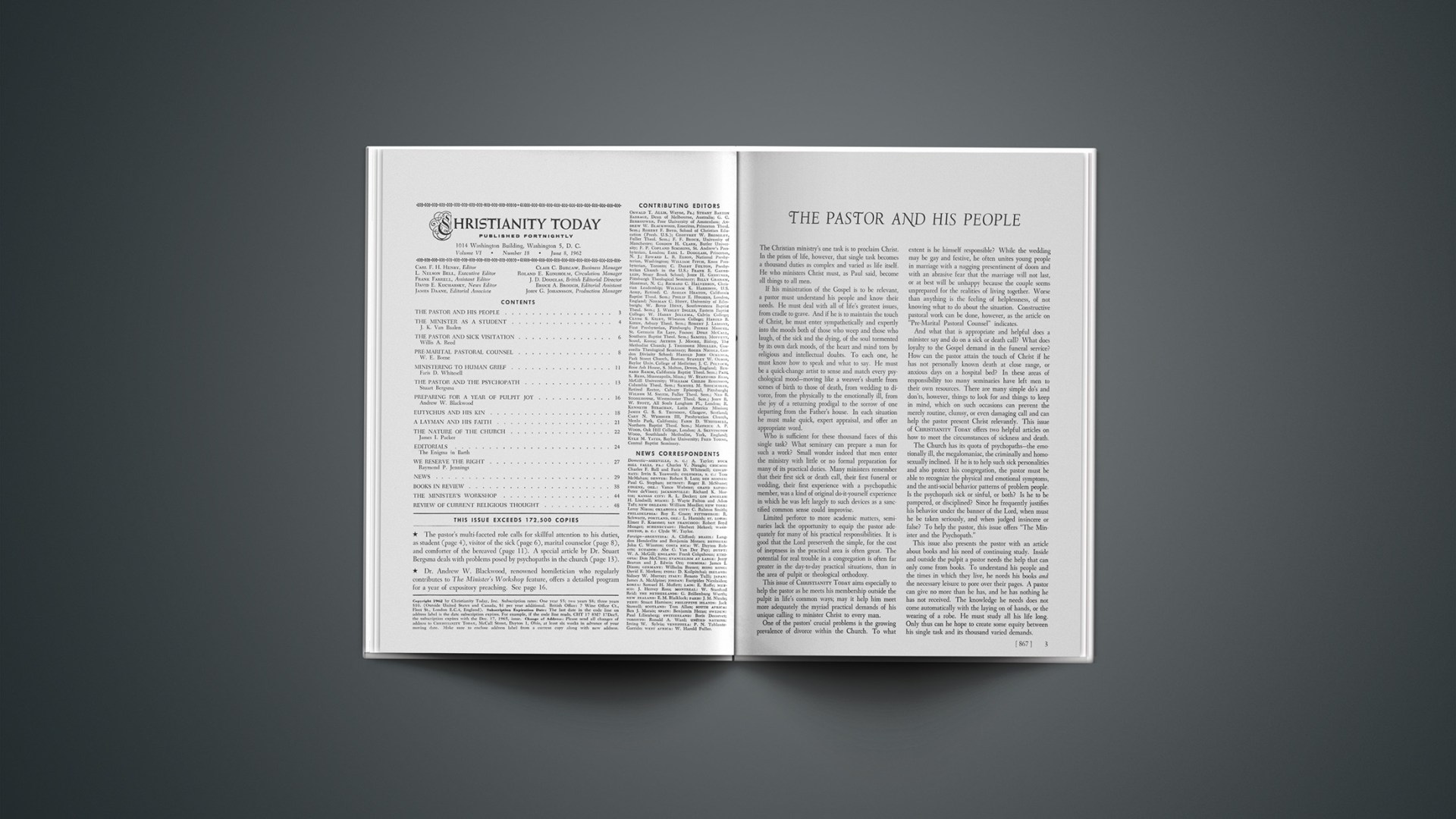
The Pastor and His People

The Christian ministry’s one task is to proclaim Christ. In the prism of life, however, that single task becomes a thousand duties as complex and varied as life itself. He who ministers Christ must, as Paul said, become all things to all men.

If his ministration of the Gospel is to be relevant, a pastor must understand his people and know their needs. He must deal with all of life’s greatest issues, from cradle to grave. And if he is to maintain the touch of Christ, he must enter sympathetically and expertly into the moods both of those who weep and those who laugh, of the sick and the dying, of the soul tormented by its own dark moods, of the heart and mind torn by religious and intellectual doubts. To each one, he must know how to speak and what to say. He must be a quick-change artist to sense and match every psychological mood—moving like a weaver’s shuttle from scenes of birth to those of death, from wedding to divorce, from the physically to the emotionally ill, from the joy of a returning prodigal to the sorrow of one departing from the Father’s house. In each situation he must make quick, expert appraisal, and offer an appropriate word.

Who is sufficient for these thousand faces of this single task? What seminary can prepare a man for such a work? Small wonder indeed that men enter the ministry with little or no formal preparation for many of its practical duties. Many ministers remember that their first sick or death call, their first funeral or wedding, their first experience with a psychopathic member, was a kind of original do-it-yourself experience in which he was left largely to such devices as a sanctified common sense could improvise.

Limited perforce to more academic matters, seminaries lack the opportunity to equip the pastor adequately for many of his practical responsibilities. It is good that the Lord preserveth the simple, for the cost of ineptness in the practical area is often great. The potential for real trouble in a congregation is often far greater in the day-to-day practical situations, than in the area of pulpit or theological orthodoxy.

This issue of CHRISTIANITY TODAY aims especially to help the pastor as he meets his membership outside the pulpit in life’s common ways; may it help him meet more adequately the myriad practical demands of his unique calling to minister Christ to every man.

One of the pastors’ crucial problems is the growing prevalence of divorce within the Church. To what extent is he himself responsible? While the wedding may be gay and festive, he often unites young people in marriage with a nagging presentiment of doom and with an abrasive fear that the marriage will not last, or at best will be unhappy because the couple seems unprepared for the realities of living together. Worse than anything is the feeling of helplessness, of not knowing what to do about the situation. Constructive pastoral work can be done, however, as the article on “Pre-Marital Pastoral Counsel” indicates.

And what that is appropriate and helpful does a minister say and do on a sick or death call? What does loyalty to the Gospel demand in the funeral service? How can the pastor attain the touch of Christ if he has not personally known death at close range, or anxious days on a hospital bed? In these areas of responsibility too many seminaries have left men to their own resources. There are many simple do’s and don’ts, however, things to look for and things to keep in mind, which on such occasions can prevent the merely routine, clumsy, or even damaging call and can help the pastor present Christ relevantly. This issue of CHRISTIANITY TODAY offers two helpful articles on how to meet the circumstances of sickness and death.

The Church has its quota of psychopaths—the emotionally ill, the megalomaniac, the criminally and homosexually inclined. If he is to help such sick personalities and also protect his congregation, the pastor must be able to recognize the physical and emotional symptoms, and the anti-social behavior patterns of problem people. Is the psychopath sick or sinful, or both? Is he to be pampered, or disciplined? Since he frequently justifies his behavior under the banner of the Lord, when must he be taken seriously, and when judged insincere or false? To help the pastor, this issue offers “The Minister and the Psychopath.”

This issue also presents the pastor with an article about books and his need of continuing study. Inside and outside the pulpit a pastor needs the help that can only come from books. To understand his people and the times in which they live, he needs his books and the necessary leisure to pore over their pages. A pastor can give no more than he has, and he has nothing he has not received. The knowledge he needs does not come automatically with the laying on of hands, or the wearing of a robe. He must study all his life long. Only thus can he hope to create some equity between his single task and its thousand varied demands.

Review of Current Religious Thought: May 25, 1962

In 1588 some sailors from the fleeing Spanish Armada are said to have been shipwrecked off a Scottish coastal town. The inhabitants gave them food and shelter; proved to them from Scripture that the pope was Antichrist; and arranged a treaty with the Spaniards whereby the said town gained commercial advantages over the rest of Britain. The modern Scot is as hospitable (and would have you believe that his commercial instinct is still as highly developed), but he no longer goes around smelling out Jesuit plots and hurling indelicate epithets at an elderly Italian ecclesiastic. The Scottish policy, indeed, might now be summed up by slightly amending Thomas Boston’s words: “Remember, I pray you, this is a very ill-chosen time to live at a distance from Rome.”

How has this developed? In April 1961 some 35 Church of Scotland ministers and elders attended as individuals a day-conference with Roman Catholics in Sancta Maria Abbey, Nunraw. This was not known till two months later. A further meeting took place in Edinburgh in January this year. In March the moderator visited the Vatican. In April representatives of Glasgow Presbytery met with Roman Catholic delegates in a Glasgow convent.

The historic question naturally arises. Stands Scotland where she did? “The theological gulf between Rome and Protestantism,” writes Anglican scholar J. I. Packer, “remains just as great as it was four centuries ago, if not, indeed, greater (for papal infallibility and the Man-doctrines have been promulgated since then).” True, but is this sufficient reason for us to retreat into our “citadel of spiky Presbyterianism” and refuse to give the other side a hearing?

Rome is anxious to explain to “separated brethren” where Protestants have misconstrued Roman doctrine and practice. “For ourselves,” comments the Free Kirk Monthly Record, “we have read and heard Rome’s ‘explanations’ and find that … they are very much what we had always understood them to be … the complete contradiction of the teaching of Holy Scripture.” A more revealing insight is afforded by the Scottish Catholic Herald: “At one time the reconversion of Scotland was a meaningful phrase only for Catholics. But now that the Christian faith no longer means anything to the majority of Scots, the reconversion of Scotland has become the common concern of all sincere Christians.”

Looking at the Church of Scotland position, the impression is given that someone backstage has put in a tremendous amount of homework to build up an atmosphere of sweet reasonableness which made it seem churlish to criticize the inter-church meetings and the moderatorial call on the pope (“what is wrong with one old man wanting to shake hands with another?”). However, after the professional Protestants had dashed into battle and ruined their case by typical overstatement, the clerk to Glasgow Presbytery issued an unhappily-worded pronouncement on the convent visit: “If anyone feels that he cannot do it, I would suggest it is not his function as a Presbyterian, but his function as a Christian that he ought to look at with great care.”

Many Presbyterians are applauding these interchanges for the wrong reason. Looking for a theological lowest common denominator, they shift the emphasis to let’s-believe-it-together and let-sleeping-dogmas-lie. Somewhere they lose sight of the fact that the quest for unity is justifiable only as one manifestation of the quest for spiritual revival. Without the desire for all-round holiness, a man could discover the ecumenical trail to be a dangerous diversion which demands and saps his energies to no purpose.

An unhappy feature of these developments is that the moderator who crossed the continent to go to Rome did not take the opportunity last May of crossing the street (literally) on a similar courtesy mission to his fellow-moderator in the Free Kirk which claims descent from the Disruption of 1843. One-way ecumenicity leads to misunderstanding.

It is clear that Rome is leading on points—she has not budged an inch, has acquired much effective propaganda, and has acted as host at all four known meetings. The Convener of the Church and Nation Committee of the Kirk is reported as having expressed the hope that this would mean official recognition by Rome of the place and standing of the Church of Scotland! Yet, as a Scotsman editorial points out, the Church of Rome’s attitude to the ecumenical movement is too candid to arouse false hopes, and (significant words) “a similar clarity of thinking elsewhere would be helpful.”

A further issue is that Rome is seen at her best in Scotland (as in England and North America); but because she claims to be a universal church she should be judged on the basis of a world view which includes Colombia, Spain and Malta. It will then be seen that Protestantism is a two-time loser, for as the French Louis Veuillot put it last century: “Where we Catholics are in the minority, we demand freedom in the name of your principles; where we are in the majority, we deny it in the name of our principles.”

It is two years since Scotland celebrated the fourth centenary of the Reformation; two years since the Roman Catholic archivist for Scotland boasted that though John Knox had banned the Mass for ever, 1,000 Masses were now daily said in the country. Even peaceful coexistence is a myth in the face of this determined well-organized army (all one body they) bent on securing nothing less than unconditional surrender and making no bones about it.

Despite these semi-secret conclaves, there is no danger as long as the Church of Scotland continues to profess the Westminster Confession of Faith as her subordinate standard. Even diluted as it is by sundry Declaratory Acts, it commits the Kirk to a position irreconcilable to that of Rome. When that fact is reluctantly grasped by those who should have known it all along, a word from Thoreau might not be out of place: “We are in great haste to construct a magnetic telegraph from Maine to Texas; but Maine and Texas, it may be, have nothing important to communicate.”

Book Briefs: May 25, 1962

Christian Missions In Biblical Perspective

An Introduction to the Science of Missions, by J. H. Bavinck (Presbyterian & Reformed, 1960, 323 pp., $4.95), is reviewed by Harold Dekker, Associate Professor of Missions, Calvin Theological Seminary, Grand Rapids, Michigan.

The author of this work (originally published in the Dutch language in 1952) has had extensive experience as a missionary in Indonesia, has taught missions subjects at several schools in the Netherlands and presently is Professor of Practical Theology at the Free University in Amsterdam. During the fall quarter of 1960 he served as Visiting Professor of Missions at the University of Chicago and gave lectures at various American schools, including a series at Calvin Theological Seminary.

The publishers have rendered a distinct service in making Dr. Bavinck’s ripe experience and scholarship available to English readers. Although not quite ideal as a textbook, in the opinion of this reviewer, we have here the best book on the market for primary use in connection with a college or seminary course in Principles of Missions.

The first part consists of a survey of the biblical foundations for a science of missions. Perspectives on the place of nations in the Old Testament are especially suggestive and, linked by successive steps to the eschatological element in the New Testament, provide a helpful biblical-theological background for what follows. This splendid expository material would have been more successfully used if tied more directly into subsequent systematic constructions.

The strongest chapters for the average student are those on the missionary approach. The author’s sensitive understanding of the relationship between the Christian mission and its cultural context, deeply grounded in Scripture and experience, is most instructive and challenging. Bavinck effectively distinguishes between the kerygmatic and the comprehensive approaches, but leaves no doubt that the deed communicates the Gospel in its own right and is not a mere auxiliary to the word. Regarding what has traditionally been called adaptation or accommodation, he makes a telling case for a more positive and dynamic concept which he calls possessio. This part on approach may be recommended not only to the special student of missions but also to the Christian in the Peace Corps, military service or any kind of overseasmanship.

Dr. Bavinck presents the Church in its duality as institution and organism, a distinction which cuts through much of the confusion found in current treatments of church and mission. Although he finds Hendrik Kraemer’s claim that the Church exists for the world to be inadequate, Bavinck is in essential agreement with the many voices which today declare that missions belong to the essence of the Church. In dealing with the relationship between the mother church and the church on the field he is particularly perceptive.

A short section on the essence, place and task of the history of missions as a subject for study is promising but little more than suggestive. More effective is a comparatively brief but tight-knit piece on Christianity and other religions. This subject Bavinck calls elenctics. Here he offers a convincing alternative to the polarity of the Hocking-Kraemer debate, a polarity which remains in most recent discussions of this problem.

The publisher would serve us well by producing an additional volume of Bavinch in translation, carefully culled from his other missions writings, especially those on elenctics. Or better yet, let Dr. Bavinck be encouraged to write in English, of which he is sufficient master, so that his recent and present scholarship may reach the ever-widening audience of which it is indeed worthy.

HAROLD DEKKER

Through The Prism Of War

Messages from God’s Word, by Hanns Lilje (Augsburg, 1961, 196 pp., $3.95), is reviewed by Ross F. Hidy, Pastor, St. Mark’s Lutheran Church, San Francisco, California.

Five meditations, originally published separately in German, express the dynamic faith of a world Christian leader, the Dr. Hanns Lilje, Bishop of Hannover, Germany.

The five devotional meditations are based on great Scripture characters or Scripture stories. “Abraham, the Father of Faith” is the first. “The Praise of God” includes meditations on the songs of Mary, Zechariah and Simeon. “Instruction for Life” is a series of meditations on the Sermon on the Mount “which we can understand only when we realize that here is a God speaking who is not made after the image of man.” “Wanderers on the Way” is based on the Emmaus experience, and the last of the five is “Christ at the Lake,” meditations on Peter’s conversation with the Risen Lord.

These meditations are almost conversational in style. If the reader has heard the bishop preach, he will almost hear the sound of his voice. Nothing is lost of the devotional depth that marked their writing during the war years, one of which was written during the author’s imprisonment. The meditations are marked by reverence and by a rare quality of Christian devotion. Through each, one catches the challenge of the sentence, “Real forgiveness is completed by being called into the service of the Lord.”

ROSS F. HIDY

Acute And Chronic

Paternalism and the Church, by Michael Hollis (Oxford University Press, 1962, 114 pp., $1.55; 9s. 6d.), is reviewed by Elton M. Eenigenburg, Professor of Historical Theology, Western Theological Seminary, Holland, Michigan.

It must have taken considerable courage for Bishop Hollis to write this book and let the world see what he had written. He knows there have been grave faults in the Church of South India, and still are, and he wants to do something about them while he’s still on hand to lend assistance.

Bishop Hollis tells right out what is so often hidden from the eyes of the public. In chapter after chapter we are made to see how by a whole catalog of human failings, of missionary and Indian alike, the work of the Kingdom is sadly hindered and the Holy Spirit is grieved. The coming of the indigenous church to South India has not cured the old ills, but put them in a new setting. The old “mission mentality” of the nineteenth century (the “paternalism” of the title), with its attendant evils, has not yet been overcome. When one reads how the pride and avarice of the human heart connive, though unconsciously, against the Kingdom, one may well wonder how the Lord gets his work done at all.

The remedy for current ills, and the true basis of an effective future for the church, are to be found in a return to New Testament patterns both of individual Christian living and service, and of a genuine unity in Christ. Bishop Hollis’ analysis and remedy are applicable far beyond the geographical limits of South India. The whole church of Christ may well give heed.

ELTON M. EENIGENBURG

Over-Playing The Evidence

Fathers of the Victorians, by Ford K. Brown (Cambridge University Press, 1961, 569 pp., 55s.; $9.50), is reviewed by Bryan E. Hardman, Research Student, Selwyn College, Cambridge, England.

This book makes entertaining, informative, and—for the Evangelical—very uncomfortable reading. The author’s thesis is, that “no social institution as such gave the Evangelicals a moment’s concern. They were concerned solely with the best interests of the English people” (p. 28); or in Wilberforce’s own words, “the salvation of one soul is of more worth than the mere temporal happiness of thousands or even millions” (p. 383).

Mr. Brown illustrates his main theme, that the Evangelicals were concerned with philanthropy solely as a means to propagating the Gospel, with special reference to the work of Hannah More. Mrs. More had no interest in educating her poor Somerset people, and her schools were in fact little more than disguised conventicles where the pupils were taught to read just sufficient to enable them to use the Bible, and understand it in an Evangelical manner. None of her pupils was taught to write (pp. 193–195). In his full description of the strife this caused between the More sisters and the clergy, as well as in the detailed study of the founding of a branch of the Bible Society at Cambridge, we are given a very distasteful picture of Evangelical casuistry at work, justifying all kinds of unsavory means by the great end in view.

The Evangelicals did not, as Wesley and Whitefield had done, address themselves to the poor, but to the rich; it was this factor which made for their success, for as Amos Barton said, “Net a large fish, and you’re sure to have the small fry” (p. 450). It is on this count that the Methodists come in for some rough handling from our author who states that Wesley’s work considered as a reform of the moral and religious life of the nation was obviously a failure (p. 4), because it was designed to appeal to the wrong people (p. 45). It is therefore wrong to lump the Evangelicals and Methodists together into something called “the Evangelical Revival,” for this wholly misses the nature and accomplishment of the Evangelical reform movement (p. 5). But if the Methodists are given some hard knocks, the Evangelicals will find the implications of this appeal to the rich a bitter pill to swallow, for it involved our forefathers in the accommodation of the truth to the tastes of the rich. If vices had to be condemned they were the vices of the poor and not those of the rich.

Reading for Perspective

CHRISTIANITY TODAY’S REVIEW EDITORS CALL ATTENTION TO THESE NEW TITLES:

* Frontiers of the Christian World Mission, edited by Wilbur C. Harr (Harper, $5). An up-to-date report on development and changes in the missionary situation since World War II in key areas of Asia, Africa, and the Pacific.

* The New Testament Octapla, edited by Luther A. Weigle (Thomas Nelson, $20). For the first time, eight English versions of the New Testament in the Tyndale-King James tradition, all on facing pages for easy comparison and study. A major publishing event.

* The Church and the Older Person, by Robert M. Gray and David O. Moberg (Eerdmans, $3.50). A timely exploration of how the Church can help older people to adjust to the peculiar problems of their later years.

It is not possible to do justice to so large a work, comprising so many different strands, in a brief review. It is a pity that such a book has been written by an author who is not sympathetic to the Evangelical standpoint, for though his main thesis is sound, he seems to have overplayed his hand on more than one occasion.

Nevertheless this is a work which narrates an old story with a new insight, and it is good for us to know that our heroes were men and women of this earth and therefore partook of its frailties. The narrative should at least impress on its readers two basic truths; that it is more important to distribute the heavenly bread than earthly bread, though the latter is also important in its right context; and secondly, that the weapons of our warfare are not carnal, but mighty through God. Our fore-fathers had a firm grasp of the first truth but held too lightly to the second truth. Perhaps we may be in danger of reversing the emphasis, or of failing on both counts.

BRYAN E. HARDMAN

The People’S Amen

On Consulting the Faithful in Matters of Doctrine, by John Henry Newman (Sheed & Ward, 1961, 118 pp., $3), is reviewed by Ian Rennie, Minister, The Presbyterian Church, Petawawa, Ontario.

In every quarter of the Christian church there seems to be a renewed emphasis upon the laity; a matter which gives great encouragement to all evangelicals. One of the forerunners of this development in Roman Catholicism was John Henry Newman, who wrote this essay in 1859, 14 years after his conversion from Anglicanism.

In Newman’s day the widespread attitude to the laity within Roman Catholicism appeared to be expressed in Msgr. Talbot’s famous phrase: “What is the province of the laity? To hunt, to shoot, to entertain, but to meddle with ecclesiastical matters they have no right at all.…” Newman realized that such a policy would drive the educated layman to indifference and the poor to superstition. His was the noble ideal of uniting the intellectual inquiry of the educated laity to the devotional strength of the church.

Newman’s patristic studies had propelled him toward Roman Catholicism, where he believed he found the universal agreement—the fullness of the church. Now Newman contended that the laity should be recognized—not as definers of doctrine—but as one of the constituent elements in the fullness of the church which bore witness to the consensus of the infallible church.

Newman’s view of the laity was not a product of his Evangelical Anglican phase, but was dictated by the more liberal strands in his thinking. Roman Catholicism had stressed that doctrine never changed. The only development was enlargement; truth known by few was gradually shared with all. But Newman was a humanist as well as a Roman Catholic, and well aware of the stresses which contemporary thought were placing upon traditional belief. To preserve doctrine he believed a measure of accommodation was necessary. So he posited a new form of the development of doctrine, which included modification and change. Before these evolutionary modifications could be defined, however, the mind of the church would have to be discovered. The necessity of consultation brought the idea of the fullness of the church to the fore once again in Newman’s mind, and with it the place of the laity.

No one can leave Newman without a word about his literary and dialectical style. Although a nineteenth-century romantic in many ways, Newman’s prose belongs to the Augustan age of the previous century. It is expository and intellectual, and its clarity could surely serve as a model for anyone planning to participate in theological dialogue.

IAN RENNIE

From The Ozarks

The Gospel of John, by Paul T. Butler (College Press 1961, 267 pp., $3.95); Romans Realized, by Don De Welt (270 pp., $3.95); Guidance from Galatians, by Don Earl Boatman (200 pp., $3.95); The Glorious Church: A Study in Ephesians, by Wilbur Fields (207 pp., $3.95); Helps from Hebrews, by Don Earl Boatman (457 pp., $4.95); The Church of the Bible, by Don De Welt (431 pp. $3.95); The Greatest Work in the World, by Willie W. White (255 pp., $3.95); The Bible Student’s New Testament, by Paul Meherns (288 pp., $3.95); are reviewed by James DeForest Murch, Christian Church (Disciples) minister, author, and lecturer.

College Press, a new publishing venture in the Ozarks, is making a sincere and earnest effort to produce a “student-participation” Bible Study Textbook Series in which it will seek to include volumes on the whole Bible and on the fundamental doctrines of the Christian faith.

Eight volumes have been published so far, five on the books of John, Romans, Galatians, Ephesians and Hebrews. They are designed as textbooks, workbooks and teacher’s manuals. Based on the text of the American Standard Revised Version, they present paraphrases, comment, outlines, tests and questions. Two of the volumes are topical studies on the Church and the fundamentals of the faith. The eighth proposes a unique, popular plan for the study of the New Testament.

There is little evidence of editorial planning, or uniformity in style or quality. With one or two exceptions the authors give small indication of scholarly background, of critical, classical or historical study. The series is characterized by no systematic theological unity. Interpretation of mooted doctrines follows a pattern reminiscent of the views held by conservative Churches of Christ (Disciples).

All the studies are biblical and practical and have been used effectively in many local churches, Sunday schools, midweek Bible classes and Bible institutes. Their appeal is to the uncritical layman who is seeking a practical working knowledge and understanding of the Scriptures. All writers exhibit a complete, even passionate, commitment to the authority and all-sufficiency of the Word of God in matters of doctrine and life. They manifest a deep desire to inculcate this loyalty to Bible truth.

These books are “first steps” toward the objectives of the College Press. If men do not take first steps, they will never take second steps. The Bible Study Textbook Series may well be helpful in many ways in the areas of service for which they were designed.

JAMES DEFOREST MURCH

Self-Conscious To Breezy

Livingstone’s Missionary Correspondence 1841–1856, ed. by I. Schapera (Chatto and Windus, 1961, 341 pp., 42s.), is reviewed by J. C. Pollock, author of Hudson Taylor and Maria, and Contributing Editor of CHRISTIANITY TODAY.

Adding to his now famous series of Livingstone sources, Professor Schapera presents the correspondence with the London Missionary Society between the arrival in South Africa and Livingstone’s amicable withdrawal after his first great transcontinental journey. The letters are edited with an introduction, full footnotes and index.

What lengthy letters missionaries and their directors could write in those days! Livingstone’s early ones have a tone somewhat self-conscious. By the close several are quite breezy. They reveal the high measure of confidence between Livingstone and the L.M.S., and the degree of control they sought despite the weary months that elapsed between letter and reply.

Livingstone saw “no hope” for the “large masses of immortal souls” in the interior of Southern Africa “except in native agents.” If his was not a true indigenous policy as understood today, since he regarded them as substitutes for white missionaries, it was an advance, criticized by his local committee but encouraged by his enlightened Home Board. There were not enough whites serving in the uncolonized hinterland, yet the “Colonial market is literally glutted with missionaries.… With such an overflowing supply from Europe, will the Hottentots ever bestir themselves to become preachers?” Livingstone always “felt an intense desire to carry the Gospel to the regions beyond.” The thought of their eighteen centuries without a single visit “to make known the light and liberty and peace of the glorious Gospel,” of souls eternally lost, weighs upon him, while travelling alone in distant parts gives “a greater disgust at heathenism than ever before.”

J. C. POLLOCK

To Each His Own

Our Churches and Why We Believe in Them. A symposium (Seeley, 1961, 251 pp., 10s. 6d.), is reviewed by J. Stafford Wright, Principal, Tyndale Hall, Bristol.

It would be fascinating to have this book reviewed by a young convert who knew little of our denominations. Which of the churches described here would make the strongest appeal to him? I fancy that he would be much attracted by the Rev. Rupert Davies’ presentation of the Methodist Church, because he writes so persuasively, and yet so disarmingly when he admits how far short the reality falls from the ideal. Moreover he does not have to plough through such heavy history as does Principal Burleigh in treating of the Church of Scotland, or Dr. Erik Routley with the Congregational Church.

Dr. L. G. Champion presents the Baptist position, and the Society of Friends is described by George H. Gorman.

The publishers realize that there are members of the Church of England who take its Protestantism seriously! Thus, alongside of Canon N. S. Rathbone’s Anglo-Catholic case, there is the Evangelical chapter by Archbishop Gough of Sydney.

This plan of letting church leaders speak for themselves is a useful one. One can see what each considers to be the strong and vital points, and can thus have a fuller understanding of what counts, theologically and emotionally, when our churches try to come together.

J. STAFFORD WRIGHT

Taylors In China

Hudson Taylor and Maria, by J. C. Pollock (McGraw-Hill, 1962,207 pp., $4.95), is reviewed by J. Gordon Jones, Pastor, The First Baptist Church, Vancouver, British Columbia, Canada.

This is a fresh approach to the life story of Hudson Taylor. It paints a colorful word picture of courage and adventure on behalf of Christ in Imperial China of the last century. It describes how a Yorkshire youth made his way from Barnsley in England to Shanghai in China where he met Maria Dyer, and how their acquaintance ripened into mutual admiration and affection. Together they became the first Protestant missionaries to reach the interior of China, where they founded the China Inland Mission. If your mind was stimulated by reading about the Moffats in Africa and the Judsons in Burma, you will be equally inspired by this carefully written and spiritually exciting description of the Taylors in China. This is more than a biography; it is another chapter in the story of Christianity’s outreach in modern times.

J. GORDON JONES

The Nimble Dane

A Kierkegaard Critique, ed. by Howard A. Johnson and Niels Thulstrup (Harper, 1962,311 pp., $6), is reviewed by James Daane, Editorial Associate, CHRISTIANITY TODAY.

This is the most scholarly and incisive critique of the thought of Sören Kierkegaard available in English, and perhaps in any language. A team of 17 international scholars combine to put the brilliant, slippery, elusive, dialectical and poetic thought of Kierkegaard through the fine comb of critical evaluation in the hopes of clarifying what this nimble Dane is trying indirectly to communicate to us.

Kierkegaard predicted that men would come to him for help when the times became sufficiently serious. He also predicted with a shudder that he would eventually fall into the hands of the Herr Professor. Both predictions have come true.

No one ought to go to Kierkegaard to get a theology. He is rather a sharp and brilliant corrective, especially for those for whom Christianity is merely an impersonal system of truth, a canon by which to judge heretics, or an aesthetic object of intellectual contemplation.

As the tide indicates, this book is not an introduction to Kierkegaard. It is for those who have read, agonized, and sweated their way through much of his writing. For such it is invaluable.

The book faces the crucial aspects of Kierkegaard’s authorship: the paradox, the concept of dread, subjectivity, faith, the offence, and most of the rest.

Few men can be more easily misrepresented by “quotations” than Kierkegaard. The purpose of his authorship, and the nature of his thought no less, required the use of indirect communication; that is, the devices of pseudonym, poetic expression, humor, irony, sarcasm, and satire. This writer could wish that the book had given special treatment to this “acoustical device” since it is precisely here that the knotty problems of Barth’s idea of revelation, and Bultmann’s idea of history and encounter, relate to the thought of Kierkegaard.

No book is perfect—but this one is the best of its kind. Howard A. Johnson deserves our gratitude for this critique of the man who perhaps more than any other shapes the mind of the Western world today.

JAMES DAANE

A Good Work

Japan’s Religious Ferment, by Raymond Hammer (Oxford, 1962,207 pp., $2.95), is reviewed by Harold Lindsell, Vice-President, Fuller Theological Seminary, Pasadena, California.

The author is a professor at St. Paul’s University and Central Theological College in Tokyo. He is an Anglican priest. This volume is the third in the Christian Presence Series, having been preceded by volumes on Islam and Buddhism. The author traces the backgrounds of Japanese religious life with a survey of Shinto, Buddhism, Christianity and competing sects. He relates the religious past to recent Japanese history at the time of, and subsequent to, World War II. His review of the new religions and the varieties of old ones which have sought the allegiance of the Japanese since the war is penetrating, succinct and profitable. His final chapter on Christianity in relation to the Japanese picture is excellent. He does not accept a syncretistic view but regards Christianity as unique. The Appendices, Table of Dates, Word-List and Bibliography serve to make the volume more understandable and worthwhile. It is a good short work of usefulness to laymen and students alike.

HAROLD LINDSELL

This Is Sanity

The Nature of Man in Theological and Psychological Perspective, ed. by Simon Doniger (Harper, 1962,264 pp., $6), is reviewed by Emile Cailliet, Stuart Professor of Christian Philosophy Emeritus, Princeton Theological Seminary, Princeton, New Jersey.

There admittedly is hidden away in stacks of periodicals a wealth of first rate papers that should be rescued from what Lord Macaulay called, “the dust and silence of the upper shelf.” Publishers are well inspired when they turn their attention to such a need amid the dearth of truly great writings that characterizes these days of printed matter inflation. Harper and Brothers accordingly deserve credit for having bestowed their blessing upon the undertaking at hand, even as Simon Doniger’s occasional leniency in the matter of selection reveals him as an editor plenteous in mercy.

While the present volume is meant to multiply contacts between the psychological and the theological sciences, a certain amount of enmity or suspicion occasionally promotes alienation, or perhaps exposes a degree of incompatibility. Thus Carl R. Rogers takes to task Reinhold Niebuhr’s assumed predilection for the formulations of others as “absurd,” “erroneous,” “blind,” “naive,” “inane,” and “inadequate.” He finds himself “offended by Niebuhr’s dogmatic statements and feels ready to turn back with fresh respect to the writings of science, in which at least the endeavor is made to keep an open mind.” The incisive thrust of Hans Hofmann’s comments leaves him irresponsive and more puzzled still. All he can see is that Hofmann lives in a world in which the scientist searches for the truth in the scientific area and the theologian has the truth in the theological area. “This must indeed be a comfortable world in which to live,” he concludes, “but unfortunately for me, it is not the world I live in. Mine does not contain this built-in division, and I can see why he (Hofmann) views me as an ‘outsider’.” Meanwhile Bernard M. Loomer and Walter M. Horton have hurried to the rescue of Niebuhr, appealing to the witness of works which Rogers has not read. Somewhat mollified, Rogers confesses to his need for more home work on the subject—incidentally the only case of genuine conversion to be found in the book, a symposium on “Human Nature Can Change” not withstanding. (In all fairness I should add that same symposium had been held under the auspices of the Auxiliary Council to the Association for the Advancement of Psychoanalysis.)

To those readers on each side of the fence who greet each other without being on speaking terms, the most valuable papers may prove to be such as written within the sphere which is proper to them—objective, essentially informative presentations of views pertaining to the author’s field. Particularly rewarding in this respect are chapter 1, “The Psychoanalytic View of Human Personality,” by Edith Weigert, M.D.; chapter 2, “Know Thyself: The Biblical Doctrine of Human Depravity,” by James I. McCord; chapter 11, “Emotional Maturity,” by Franz Alexander, M.D.; chapter 12, “The Attainment of Maturity,” (with special attention to college students and their growth) by Elliott Dunlap Smith; and Margaret Mead’s paper, “The Immortality of Man,” (written from the point of view of the cultural anthropologist) which opens up the symposium in chapter 17.

Constructive criticism arises when specialists familiar with the other’s field of research are motivated by a genuine concern for the other’s problems. Thus, Paul Tillich in chapter 4, “Existentialism, Psychotherapy and the Nature of Man,” and the late Dean Willard L. Sperry in his pungent, penetrating four pages on “A Credible Doctrine of Man,” with a rich sense of humor to boot. In a class by itself is the original, much needed contribution of Valerie Saiving Goldstein, “The Human Situation—A Feminine Viewpoint,” an overall consideration of the fact that theology has been almost exclusively written by men.

Yet it is only when fields are related internally that the theological understanding of man is immediately affected by the findings of the psychological sciences. This is the case for chapter 9, “Modern Psychology and Moral Values,” by Noel Mailloux, and particularly for chapter 10, “Pastoral Psychology and Christian Ethics,” by Seward Hiltner who has undeniably become the leading American scholar in the field of pastoral counseling. The chapter here under consideration draws the best of its information from a masterly case study in that very field. This study of a single pastoral contact is a beauty. Deserving special attention also is Karl Menninger’s chapter 16, “Hope,” which reveals the possibilities of psychiatric contributions to the understanding of Scripture. Richly illustrated, it brings out the sustaining function of hope in life—hope being distinguished from expectation as well as from sheer optimism, and ultimately construed in terms which echo 1 Corinthians 13: “But hope is humble, it is modest, it is selfless.” Kept alive in hope, this is our human condition. And so Menninger singles out love, faith, hope, these three—in that order.

I am still old-fashioned enough to read from cover to cover the books I rereview, and the present one has proved no exception. What has finally impressed me is the fact that in spite of its title, this volume does not offer more of a perspective than does the unincorporated area where I live. The so-called “chapters,” of course, are no chapters in the current acceptation of the word. They mostly correspond to so many papers written by scholars on their own. Neither does the casting of chapters into three sections suggest more than convenient artifice. Indeed Seward Hiltner, who is the true hero of this undertaking, has done his best to elicit some kind of perspective from this vast accumulation of parts. It is noteworthy, however, that what should normally have been a summation at the end of the book, has been turned by him into a preview of what each of the papers is about. And when the end of the publication is reached, Hiltner again provides a “conclusion” which actually constitutes an “introduction” to the dialogue he is longing for, between psychologists and theologians. Then, and only then, does a perspective appear, one envisioned by a pioneering prophet of goodwill. This perspective owes hardly anything to the 18 papers which precede. Hiltner does not hesitate to say so in his humble way. He makes “the honest confession that comparatively little true dialogue has taken place or is now going on, and that even most of the book itself falls short of genuine dialogue.” The “conclusion,” then, is admittedly Hiltner’s own. Not the conclusion of the book, but paper no. 19—and an outstanding paper at that.

It is Hiltner’s perspective on the subject at hand which confronts us in the last analysis. Now a perspective, in this context, is made to appear from a presentation of facts or matters with regard to their proportional importance. That which lends such relative importance to facts or matters, is conditioned by a special point of view. What, then, is Hiltner’s point of view? To him, the psychological sciences, besides being seen as autonomous disciplines in their respective spheres, also provide a psychological branch destined to become a proper branch of theology. This branch he views as dialectical interaction both with the other branches of theology and related cultural disciplines. Does this not mean that the resulting perspective is that of a psychological approach to Christianity?

However heterogeneous they may be, the 18 papers which make up the body of the book suggest a different outlook, as may already have appeared from this review. The autonomy of both the sciences once for all acknowledged, it is only when internally related that they can derive from each other a helpful understanding of their own problems. Even so, the dialectical tension between them remains unrelieved, until the psychologist becomes a Christian or the Christian a psychologist; until a man be given eyes to see—to see what is there. And mind you, Mr. Psychologist, this is sanity.

EMILE CAILLIET

No Other Way

I Am Persuaded, by David H. C. Read (Scribners, 1962, 182 pp., $3), is reviewed by William Childs Robinson, Professor of Historical Theology, Columbia Theological Seminary, Decatur, Georgia.

Here are twenty sermons by the popular Scottish pastor of Madison Avenue Presbyterian Church in New York. They are rich in Scripture, Christian experience, telling illustrations, and literary allusions. In a sermon titled Rational Religion he distinguishes between a rational and a rationalistic religion. In another he reminds us that one can be Alone but not Lonely. Adam and the Astronaut is timely and helpful as it anchors even one who flies to the uttermost bounds under the wings of the Saviour who has all power in heaven and on earth. It does not seem to us, however, that Read really meets the question whether God has given to man interstellar space, or only that realm where the birds of the heaven, the beasts of the field, and the fish of the sea roam. Speaking of The Inevitable Cross, Read rightly concludes: “He came to die.… Because there was no other way in which He could reach to the depth of the human agony He came to share, could ‘bear our griefs and carry our sorrows.’ And because there was no other way in which He could draw upon Himself the hopeless weight of our sins, and expose and absorb the evil that blocks us from the holiness of God, ‘The Lord hath laid on him the iniquity of us all.’ The only way a God of perfect peace and joy can reach His suffering family is in this amazing way to share that suffering. The only way a God of perfect purity and goodness can reach His disobedient people is to offer Himself (as) the sacrifice for sin.”

WILLIAM CHILDS ROBINSON

Paperbacks

The Book of Mormon—True or False?, by Arthur Budvarson (Zondervan, 1961, 63 pp., $1). Documented evidence that the teachings of the Mormons are contrary to the Book of Mormon and to the Bible. First printed in 1959.

Discipleship; Life’s Problems; Simple Things of the Christian Life, by G. Campbell Morgan (Revell, 1961, about 90 pp. each, $.95 each). Guidance for the Christian life from the extraordinary Morgan. Reprints.

The New English Bible: New Testament (published jointly by Oxford University Press and Cambridge University Press, 1962,447 pp., $1.45). New translation from the original in language neither antiquated nor self-consciously modem. Complete New Testament with footnotes.

Darwin, Evolution, and Creation, ed. by Paul A. Zimmerman (Concordia, 1961, 231 pp., $1.95). Well-written survey of Darwinism and creation. Second printing; first published in 1959.

The Meaning of justification by Faith, by Frank Colquhoun (Tyndale, 1962, 32 pp., Is.). A brief discussion of a basic doctrine from an evangelical standpoint; intended for students.

The Essene Writings from Qumran, by A. Dupont-Sommer, tr. by G. Vermes (World Publishing Co., 1962,448 pp., $1.95). The most complete translation of the Dead Sea literature, prepared by one of its foremost interpreters.

Liturgies of the Western Church, ed. by Bard Thompson (World Publishing Co., 1962,448 pp., $1.95). Each liturgy is accompanied by an introduction elucidating both the liturgy and the tradition in which it stands. An original.

A Preface to Metaphysics, by Jacques Maritain (New American Library, 1962, 144 pp., $.60). A philosophical journey into the nature of Being with brilliant Thomistic Maritain as guide. First printed in 1939.

Temperament and the Christian Faith, by O. Hallesby (Augsburg, 1962, 106 pp., $2). Description of the role played by the sanguine, melancholic, choleric, and phlegmatic temperament in Christian life. First English translation of Norwegian book of 1940.

Can A Christian Be A Communist?

In many corners of the world, a number of Christians are being deceived by the Communist propaganda that a Christian can be a Communist.

By “Christian” we mean … one who believes in a personal God and accepts Christ as his Saviour, and who takes the Bible as the supreme criterion of his faith and conduct. By “Communist” we mean one who believes in Marx (Leninism) and who endorses, supports and encourages the Russian system of Communism.

Here are reasons why a Christian cannot he a Communist:

1. Communists replace a personal God with the deification of dialectic materialism, supported by a firm conviction, a system of philosophy, and a strict organization.

2. Based on dialectic materialism which is absolutely atheistic, Communists offer a comprehensive and systematic world view, which conflicts with the Christian view in the creation of the universe, the origin of man, the purpose of life, the problem of sin, the way of salvation, the value of the individual, the ethical standard, the means to attain social justice, and human destiny.…

3. Communism makes Marx as interpreted by Lenin the infallible authority of belief. Marx and Lenin have the last and final word on everything. The Christian believes in the infallibility of the Bible as the inspired Word of God. Christ has the last word. A Christian cannot have two conflicting infallible authorities; he has to take one or the other.

4. Communism teaches a different purpose of life. Matter is reality, the Communist believes, and it works inevitably through dialectic toward a classless society. The purpose of life for an individual is to be part of that historical movement. But the Christian believes that the chief end of man is to glorify and to enjoy Him forever.

5. Communism deduces morality from the needs of the class struggle of the proletariat, therefore any means to further the cause of the proletariat is justifiable. The Christian deduces his ethics from the nature and will of God.

6. Communism teaches that the proletariat (free from sins as a class) will inevitably work for the good of humanity when in power, as the destined savior of the world. In other words, the proletariat will through its dictatorship bring redemption from all sins and social evils in the classless society, the Heaven on earth. The Christian believes Christ to be the only sinless One who died on the cross for our sins and that He is the only Redeemer and Saviour and that sins cannot be removed except through his blood.

7. Communism depends on hatred as its driving force. Since they believe that “the history of all hitherto existing society is the history of class struggles” and since hatred is the dynamic force of classless struggles, the Communists have to fan up and keep up hatred as the dominant emotion among man. The Christian believes that love is the driving force of Christian living and it is to be sought after through the Holy Spirit as the greatest of all gifts.

8. Communism demands a complete and ultimate allegiance. This explains why the Communists have such a strict and militant party organization with conscious discipline. It allows no deviation whatsoever in thought or action. The Christian, while loving his country and being subject to the higher powers, owes his ultimate allegiance to God and to God alone.

9. Communism’s ultimate hope is the materialistic and atheistic classless society when production reaches perfection and all religions are liquidated. The Christian believes in the personal return of the Lord Jesus Christ, who will reign on earth in love and righteousness with all men bowing before his throne.

10. Communism in its very nature requires world revolution for its final success. The Communists believe in the inevitability of their success. It is with fanatic faith in their ideology and its success that the Communists are working in every corner in the world today. The Christian is committed to the Great Commission, to preach the Gospel to every creature unto the end of the earth. He believes that the great task of the church, the body of Christ, is to preach the Gospel of salvation till the coming of the Lord Jesus Christ.

These are the basic differences between Communism and Christianity.… The Communist International in the sixth World Congress in 1928 declared: “One of the most important tasks of the Cultural Revolution affecting the wide masses is the task of systematically and unswervingly combating religion, the opium of the people.” It is more than pitiful that some Christians try to rationalize the “contradictions” which the Communists realize to be irreconcilable. But a real Christian remembers the closed doors of the many churches behind the iron curtain and the thousands of Christians being persecuted from day to day. Fully convinced of the ultimate victory of Jesus Christ, he follows Christ and Christ alone. He knows human ideologies come and go, but the Word of God will last forever.—CALVIN CHAO, summary (here abridged) of a forum held by Chinese For Christ, Inc.

THE STRUGGLE FOR FREEDOM—Events today in both Eastern and Western lands fully and tragically … prove that wherever belief in God and His creation of man in his own image is abandoned political freedom perishes. The validity of the struggle for freedom in which the Anglo-Saxon democracies are now engaged against Soviet and Chinese Communism rests ultimately upon the Christian evaluation of human personality. And the pursuit of that struggle for freedom by liberal democrats is rendered perilously precarious if the Christian valuation of human personality is banished from the scene. That peril is apparent in many contemporary social trends. It is apparent in the dilemmas of the welfare State. In pursuing the liberation of our poorest citizens from the frustrations of poverty, insecurity and ill-health, the Governments of the Provinces and States, and of Canada and America, now find themselves regimenting the lives of Canadians and Americans to an extent which the liberalism of a few decades ago would have found intolerable.… In all these cases we are on the verge of a denial of what the State, education and work have meant in liberal society, and the cause of this denial lies in the more fundamental denial that man is created in God’s image.—The Rev. E. L. H. TAYLOR, Rector, St. James Anglican Church, Caledon East, Ontario, to the Annual Convention of the Christian Labour Association, on “The Cross of Christ and Human Freedom.”

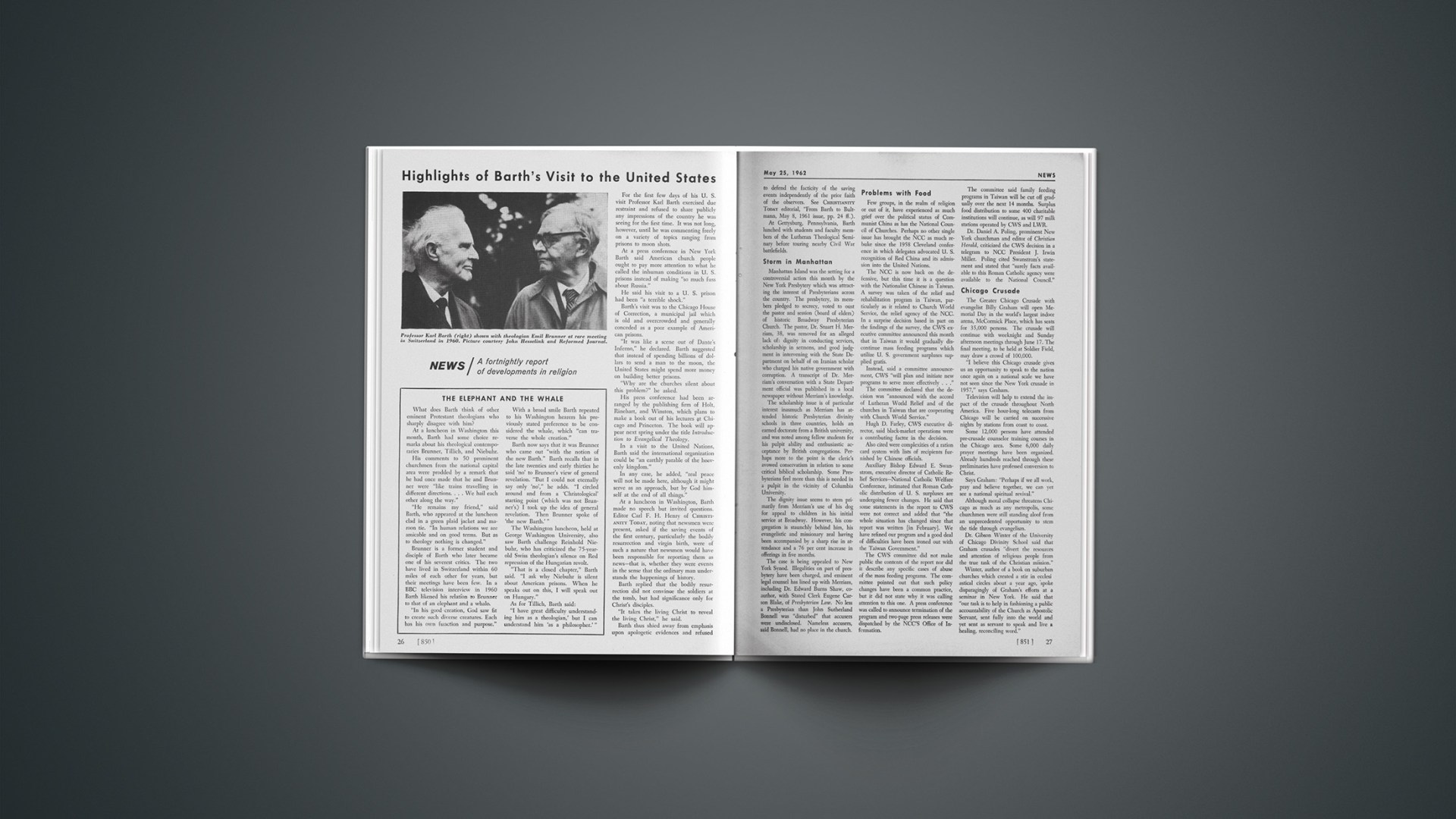
Highlights of Barth’s Visit to the United States

A fortnightly report of developments in religion

For the first few days of his U. S. visit Professor Karl Barth exercised due restraint and refused to share publicly any impressions of the country he was seeing for the first time. It was not long, however, until he was commenting freely on a variety of topics ranging from prisons to moon shots.

The Elephant And The Whale

What does Barth think of other eminent Protestant theologians who sharply disagree with him?

At a luncheon in Washington this month, Barth had some choice remarks about his theological contemporaries Brunner, Tillich, and Niebuhr.

His comments to 50 prominent churchmen from the national capital area were prodded by a remark that he had once made that he and Brunner were “like trains travelling in different directions.… We hail each other along the way.”

“He remains my friend,” said Barth, who appeared at the luncheon clad in a green plaid jacket and maroon tie. “In human relations we are amicable and on good terms. But as to theology nothing is changed.” Brunner is a former student and disciple of Barth who later became one of his severest critics. The two have lived in Switzerland within 60 miles of each other for years, but their meetings have been few. In a BBC television interview in 1960 Barth likened his relation to Brunner to that of an elephant and a whale.

“In his good creation, God saw fit to create such diverse creatures. Each has his own function and purpose.”

With a broad smile Barth repeated to his Washington hearers his previously stated preference to be considered the whale, which “can traverse the whole creation.”

Barth now says that it was Brunner who came out “with the notion of the new Barth.” Barth recalls that in the late twenties and early thirties he said ‘no’ to Brunner’s view of general revelation. “But I could not eternally say only ‘no’,” he adds. “I circled around and from a ‘Christological’ starting point (which was not Brunner’s) I took up the idea of general revelation. Then Brunner spoke of ‘the new Barth.’ ”

The Washington luncheon, held at George Washington University, also saw Barth challenge Reinhold Niebuhr, who has criticized the 75-year-old Swiss theologian’s silence on Red repression of the Hungarian revolt.

“That is a closed chapter,” Barth said. “I ask why Niebuhr is silent about American prisons. When he speaks out on this, I will speak out on Hungary.”

As for Tillich, Barth said:

“I have great difficulty understanding him as a theologian,’ but I can understand him ‘as a philosopher.’ ”

At a press conference in New York Barth said American church people ought to pay more attention to what he called the inhuman conditions in U. S. prisons instead of making “so much fuss about Russia.”

He said his visit to a U. S. prison had been “a terrible shock.”

Barth’s visit was to the Chicago House of Correction, a municipal jail which is old and overcrowded and generally conceded as a poor example of American prisons.

“It was like a scene out of Dante’s Inferno,” he declared. Barth suggested that instead of spending billions of dollars to send a man to the moon, the United States might spend more money on building better prisons.

“Why are the churches silent about this problem?” he asked.

His press conference had been arranged by the publishing firm of Holt, Rinehart, and Winston, which plans to make a book out of his lectures at Chicago and Princeton. The book will appear next spring under the title Introduction to Evangelical Theology.

In a visit to the United Nations, Barth said the international organization could be “an earthly parable of the heavenly kingdom.”

In any case, he added, “real peace will not be made here, although it might serve as an approach, but by God himself at the end of all things.”

At a luncheon in Washington, Barth made no speech but invited questions. Editor Carl F. H. Henry of CHRISTIANITY TODAY, noting that newsmen were present, asked if the saving events of the first century, particularly the bodily resurrection and virgin birth, were of such a nature that newsmen would have been responsible for reporting them as news—that is, whether they were events in the sense that the ordinary man understands the happenings of history.

Barth replied that the bodily resurrection did not convince the soldiers at the tomb, but had significance only for Christ’s disciples.

“It takes the living Christ to reveal the living Christ,” he said.

Barth thus shied away from emphasis upon apologetic evidences and refused to defend the facticity of the saving events independently of the prior faith of the observers. See CHRISTIANITY TODAY editorial, “From Barth to Bultmann, May 8, 1961 issue, pp. 24 ff.).

At Gettysburg, Pennsylvania, Barth lunched with students and faculty members of the Lutheran Theological Seminary before touring nearby Civil War battlefields.

Storm In Manhattan

Manhattan Island was the setting for a controversial action this month by the New York Presbytery which was attracting the interest of Presbyterians across the country. The presbytery, its members pledged to secrecy, voted to oust the pastor and session (board of elders) of historic Broadway Presbyterian Church. The pastor, Dr. Stuart H. Merriam, 38, was removed for an alleged lack of: dignity in conducting services, scholarship in sermons, and good judgment in intervening with the State Department on behalf of on Iranian scholar who charged his native government with corruption. A transcript of Dr. Merriam’s conversation with a State Department official was published in a local newspaper without Merriam’s knowledge.

The scholarship issue is of particular interest inasmuch as Merriam has attended historic Presbyterian divinity schools in three countries, holds an earned doctorate from a British university, and was noted among fellow students for his pulpit ability and enthusiastic acceptance by British congregations. Perhaps more to the point is the cleric’s avowed conservatism in relation to some critical biblical scholarship. Some Presbyterians feel more than this is needed in a pulpit in the vicinity of Columbia University.

The dignity issue seems to stem primarily from Merriam’s use of his dog for appeal to children in his initial service at Broadway. However, his congregation is staunchly behind him, his evangelistic and missionary zeal having been accompanied by a sharp rise in attendance and a 76 per cent increase in offerings in five months.

The case is being appealed to New York Synod. Illegalities on part of presbytery have been charged, and eminent legal counsel has lined up with Merriam, including Dr. Edward Burns Shaw, coauthor, with Stated Clerk Eugene Car-son Blake, of Presbyterian Law. No less a Presbyterian than John Sutherland Bonnell was “disturbed” that accusers were undisclosed. Nameless accusers, said Bonnell, had no place in the church.

Problems With Food

Few groups, in the realm of religion or out of it, have experienced as much grief over the political status of Communist China as has the National Council of Churches. Perhaps no other single issue has brought the NCC as much rebuke since the 1958 Cleveland conference in which delegates advocated U. S. recognition of Red China and its admission into the United Nations.

The NCC is now back on the defensive, but this time it is a question with the Nationalist Chinese in Taiwan. A survey was taken of the relief and rehabilitation program in Taiwan, particularly as it related to Church World Service, the relief agency of the NCC. In a surprise decision based in part on the findings of the survey, the CWS executive committee announced this month that in Taiwan it would gradually discontinue mass feeding programs which utilize U. S. government surpluses supplied gratis.

Instead, said a committee announcement, CWS “will plan and initiate new programs to serve more effectively …”

The committee declared that the decision was “announced with the accord of Lutheran World Relief and of the churches in Taiwan that are cooperating with Church World Service.”

Hugh D. Farley, CWS executive director, said black-market operations were a contributing factor in the decision.

Also cited were complexities of a ration card system with lists of recipients furnished by Chinese officials.

Auxiliary Bishop Edward E. Swanstrom, executive director of Catholic Relief Services—National Catholic Welfare Conference, intimated that Roman Catholic distribution of U. S. surpluses are undergoing fewer changes. He said that some statements in the report to CWS were not correct and added that “the whole situation has changed since that report was written [in February]. We have refined our program and a good deal of difficulties have been ironed out with the Taiwan Government.”

The CWS committee did not make public the contents of the report nor did it describe any specific cases of abuse of the mass feeding programs. The committee pointed out that such policy changes have been a common practice, but it did not state why it was calling attention to this one. A press conference was called to announce termination of the program and two-page press releases were dispatched by the NCC’s Office of Information.

The committee said family feeding programs in Taiwan will be cut off gradually over the next 14 months. Surplus food distribution to some 400 charitable institutions will continue, as will 97 milk stations operated by CWS and LWR.

Dr. Daniel A. Poling, prominent New York churchman and editor of Christian Herald, criticized the CWS decision in a telegram to NCC President J. Irwin Miller. Poling cited Swanstrom’s statement and stated that “surely facts available to this Roman Catholic agency were available to the National Council.”

Chicago Crusade

The Greater Chicago Crusade with evangelist Billy Graham will open Memorial Day in the world’s largest indoor arena, McCormick Place, which has seats for 35,000 persons. The crusade will continue with weeknight and Sunday afternoon meetings through June 17. The final meeting, to be held at Soldier Field, may draw a crowd of 100,000.

“I believe this Chicago crusade gives us an opportunity to speak to the nation once again on a national scale we have not seen since the New York crusade in 1957,” says Graham.

Television will help to extend the impact of the crusade throughout North America. Five hour-long telecasts from Chicago will be carried on successive nights by stations from coast to coast.

Some 12,000 persons have attended pre-crusade counselor training courses in the Chicago area. Some 6,000 daily prayer meetings have been organized. Already hundreds reached through these preliminaries have professed conversion to Christ.

Says Graham: “Perhaps if we all work, pray and believe together, we can yet see a national spiritual revival.”

Although moral collapse threatens Chicago as much as any metropolis, some churchmen were still standing aloof from an unprecedented opportunity to stem the tide through evangelism.

Dr. Gibson Winter of the University of Chicago Divinity School said that Graham crusades “divert the resources and attention of religious people from the true task of the Christian mission.”

Winter, author of a book on suburban churches which created a stir in ecclesi astical circles about a year ago, spoke disparagingly of Graham’s efforts at a seminar in New York. He said that “our task is to help in fashioning a public accountability of the Church as Apostolic Servant, sent fully into the world and yet sent as servant to speak and live a healing, reconciling word.”

New Delhi In Retrospect

While brush fires on distant hills colored the warm night, some 200 churchmen assembled at rustic Buck Hill Falls Inn in Pennsylvania’s Pocono Mountains for the annual meeting of the U. S. Conference for the World Council of Churches. The mood was warm and convivial. Many delegates met each other for the first time since New Delhi.

Purpose of the conference was to discuss the third assembly of the WCC and evaluate its successes and failures. In the light of this purpose the meeting was a success.

Although his opening address was marked by provocative and epigrammatic assertions, D. T. Niles stirred no theological fires. Niles pleaded for a concrete rather than an abstract missionary approach. The missionary must recognize that he meets Hindus, not Hinduism—which, Niles said, exists only in libraries—and he must not evaluate the Hindu abstractly in terms of what he is not. It is no more significant, asserted Niles, to describe the Hindu as an “unbeliever,” or “unbaptized” person, then to describe the archbishop of Canterbury as a non-Baptist. Missionaries were admonished not to evaluate the Hindu in terms of his own religion but in terms of the Christian religion. Seen from this perspective, the missionary must approach the Hindu as one for whom Christ came, lived, died, arose and who is therefore his Lord and his Saviour. The missionary will then discover that on meeting the Hindu or Buddhist, he is confronted by a person in whom the Spirit of Christ is already present and working.

In a press release prepared beforehand Niles was quoted as saying, “We cannot find the Christian truth imbedded in Hinduism, but we do find Jesus Christ imbedded in people.… The task of evangelism is to bring out Jesus Christ in every man not to put him in.”

Even this Socratic midwife understanding of the function of Christian missions did not so much as elicit a single question or comment. Why not? Does it take more than this to excite American Christians to theological discussion? Or was this a kind of Christian courtesy which deems it impolite to argue about religion, the kind of insipid good manners which so often renders ecclesiastical meetings so innocuous and pointless?

Perhaps it was just a matter of getting started, for the remainder of the conference was marked by free and open expression.

Criticized was the small ratio of laymen at New Delhi: 18 per cent, compared with 20 per cent at Amsterdam, and 27 per cent at Evanston (the WCC constitution calls for 33 per cent). Delegates also contended that laymen were allowed but a small role and that the WCC is largely run by the clergy. The lack of women, and their small role, came under similar criticism. Charles C. Parlin, Methodist lawyer and a president of the WCC, pointed out that this was the laymen’s greatest hour since religious discussion between Protestants, Roman Catholics, and Orthodox was now generally regarded as a proper and accepted activity.

W. A. Visser ’t Hooft asserted that a genuine and fruitful dialogue between the various branches of the divided church was finally getting under way. The monological, he said, is being displaced by the dialogical; churches are now talking to each other, not simply to themselves. He hailed as a happy and wholesome sign that the various Orthodox churches, after centuries of merely talking to themselves, are now talking to each other. Niles urged that churches which had long practiced the grace of giving had now to learn the grace of listening to and receiving from other churches.

Visser ’t Hooft, the sturdy, shrewd Dutchman who has long been the energetic General Secretary of the WCC, assured delegates that no mistake had been made in accepting the Russian Orthodox Church into the Council. He told them that all the contacts and conversations of the Orthodox Church had been religious and ecclesiastical, not political.

Without explanatory preface or postlude, Visser’t Hooft departed from his script to assure the delegates that D. T. Niles was not a syncretist seeking to wed Christianity and the non-Christian religions.

Visser ’t Hooft said that it is “not yet clear” whether the Roman Catholic Church is ready to participate in a “genuine ecumenical dialogue.”

Dr. Raymond E. Maxwell, former secretary of Orthodox Churches and Countries for the WCC, observed that communities in the Near East, in crossing the frontier into the modern world, are thrusting the clock forward 1,000 years in one generation. Maxwell cited the fact that Orthodox churches that had almost no contact with each other for 1,500 years crossed their dividing frontiers and met together for the first time last September at Rhodes, Greece. As regards the frontier between Eastern and Western churches, Maxwell asserted that Eastern peoples still remember with bitterness the “plunder and brutality of the Christian Crusades.”

Dr. Franklin Clark Fry, chairman of WCC Central and Executive Committees, urged that the ecumenical movement must give a definition of the specific unity it seeks. He also insisted that the WCC must face the question of the finality of Jesus Christ and its relation to non-Christian religions. He charged that New Delhi was weak and ambiguous in its understanding of Jesus as the Light of the world, vacillating between Christ as the light, and the light of a pre-incarnate Christ.

Dr. George W. Carpenter, another WCC official, reported on a study which asks whether present patterns of the ministry are effective.

Doubtless the WCC’s greatest problems are theological. In July of 1963 about 350 of the world’s top theologians will meet at McGill University, Montreal, to discuss the theological differences which divide the churches. Many observers feel that in this area the WCC will make or break itself.

Dr. O. Frederick Nolde, Director of the Commission of the Churches on International Affairs, declared that nuclear weapons testing without international consent or control must cease. A public statement issued by officers of the WCC asserted, “We must ask whether any nation is justified in deciding on its own responsibility to conduct such tests, when the other people of other nations in all parts of the world who have not agreed may have to bear the consequences.” Some sources wonder whether the Commission realizes that when people the world over consent, such testing will not be needed.

J. D.

Fuel For A Feud?

The Education of Jonathan Beam, a new novel written by the publicity director of Wake Forest College, may become part of the theological controversy now taking shape among Southern Baptists.

Trustees of the Southern Baptist school have voted 16 to 4 not to censure publicity director Russell Brantley, but the novel may still figure in the theological debate which is expected next month at the annual sessions of the Southern Baptist Convention in San Francisco.

Many Baptist leaders are charging that theological liberalism has made inroads into seminary faculties. The book that has drawn the most fire thus far is The Message of Genesis, written by Professor Ralph H. Elliot of Midwestern Baptist Theological Seminary.

Brantley’s novel, which is set at a mythical “Convention College,” is alleged to be critical of fundamentalism and questions the prohibition against dancing at the mythical college.

The North Carolina Baptist State Convention, which controls Wake Forest, has refused to permit dancing on the campus and a few years ago forced college trustees to rescind a decision to permit supervised on-campus dancing.

Presbyterian Center

A new $2,000,000 Presbyterian Center is planned in Atlanta. The six-story structure will provide offices for eight agencies of the General Assembly of the Presbyterian Church in the U.S. (Southern) and for officers and personnel of the Synod of Georgia and the Presbytery of Atlanta.

The new structure will be built in the same area as the current Presbyterian Center, which is established in converted houses and school buildings. Construction probably will begin in the spring of 1963, officials said.

A major part of the financing will come from a $12,000,000 capital funds crusade to be conducted by Southern Presbyterians in 1963. The Presbyterian Center, Inc., a non-profit corporation formed to administer the property, is due to receive $1,500,000 from the funds. The remaining $500,000 will come from donations from individuals and churches.

Catholic Membership

U. S. Roman Catholic membership is reported to have increased by 771,765 in 1961. The gain was considerably less than the 1,233, 598 reported in 1960 and the 1,366, 827 in 1959.

The Official Catholic Directory for 1962, published this month, says that Roman Catholics in the 50 states numbered a record 42,876, 665 on January 1.

The directory reports 128,430 converts to Catholicism in 1961, 1,352, 371 infant baptisms, and 356,878 deaths.

‘They Were Ten’

As the state of Israel marked the 14th anniversary of independence, Jewish leaders gathered in Washington this month for a premiere showing of the first full-length Israeli produced motion picture, “They Were Ten.” The spirit of Israeli pioneers, not pursuing God as much as fleeing from oppression, yet concerned for moral uprightness, supplied its mood.

Meanwhile, Rabbi Elmer Berger, in a speech to the 18th annual conference of the American Council for Judaism, deplored the action of the Israeli Knesset in delegating to the World Zionist Organization the responsibility “to forge the Jewish people into one.” Berger, an anti-Zionist, is executive vice president of the council, which met in Chicago.

C.F.H.H.

Paul’S Pertinent Plea

A world full of disagreeing people reminds us of the somewhat neglected text “I beseech Euodias, and beseech Syntyche, that they be of the same mind in the Lord,” said the Rev. R. J. Coates, addressing the Bible Churchmen’s Missionary Society meeting in London. Despite this need for spiritual unity, it is wrong to suppose that nothing would happen unless there was a huge crowd, and Mr. Coates warned against despising the day of small things, adding: “We should agree together on a plan of prayer, and such agreement would spring out of a realization of the spiritual need.”

J.D.D.

‘Friends, Romans …’

The largest official meeting of Protestants and Roman Catholics in post-Reformation Scotland has taken place in a Glasgow convent (see “Review of Current Religious Thought”). Addressing some 200 priests, nuns, ministers and laymen, the Abbot of Nunraw pointed out that the main purpose of the meeting was to explain the Second Vatican Council to be held later this year. “This is part of the ecumenical dialogue,” he said. “A dialogue used to be thought of as a conversation between two or three people, and an ecumenical dialogue is just a general conversation. Each and every one of us is interested in unity.… That does not necessarily mean that there is unity in doctrine.… All of us are united in that we are all disciples of Christ, gathering together to discuss ways and means of overcoming prejudices and suspicions and of showing the love of Christ in the world.” Though others have been held, this was the first formal meeting between Roman Catholic and Church of Scotland representative bodies.

J.D.D.

Henry Ford On Sunday

“If you want to destroy the Christian religion,” said Voltaire, “you should first destroy the Christian Sunday.” Quoting this at the annual meeting of the Lord’s Day Observance Society in London, Sir Cyril Black, Member of Parliament, pointed out that though the 131-year-old Society had been much maligned, ridiculed and derided, the case for its existence had never been stronger than today.

Sir Cyril significantly suggested that it was not even good business to work on Sunday. Henry Ford had found this, for he once asserted that it took six months longer to produce his first car because they often had to spend the rest of the week unraveling the mistakes the engineers had made on Sunday.

Missionary Shortage

Only one student leaving the Church of Scotland’s divinity halls this spring has offered himself as a missionary—and he will not be available for two years, according to a church spokesman.

The official disclosure followed an appeal for missionaries made at a synod meeting in Edinburgh.

Wef Milestone

Headquarters offices of the World Evangelical Fellowship are being moved from Muscatine, Iowa, to London, England, and plans are under way to set up area offices in Asia, Africa, and Latin America.

The decision to move was made at a meeting of the WEF’s General Council in Hong Kong. Twenty-seven delegates were on hand for the meeting held April 25-May 2.

The Rev. Gilbert Kirby of Great Britain was named director of the new London office. He succeeds the Rev. Fred Ferris, who operated out of Muscatine as international secretary. Dr. Everett Cattell was elected as council president.

A Victim In Berlin

Reports dispatched by Religious News Service indicate that a visiting Austriaborn Greek Orthodox priest was slain by secret police in East Berlin.

Communist officials informed relatives of Father Georg Reichhart that he had “committed suicide” because of legal steps taken against him on charges of “criminal acts.” However, additional reports confirmed suspicions he had been killed to prevent him from moving into West Berlin, according to RNS.

Reichhart, of the Orthodox Patriarchate of Antioch, had been held in detention by Soviet Zone security police for six weeks.

On April 9, Reichhart telephoned his mother in Austria, who told him she had sent money to West Berlin so that he could return to his homeland. The conversation, according to reports, was overheard by security police. Later the same day Reichhart telephoned a brother in Vienna to report to could not leave East Berlin because police had confiscated his Austrian passport.

On April 11, the priest’s parents received a telegram from an East Berlin hospital announcing that he had died on the morning of April 9. The time of death given was several hours before the priest had called his mother.

The parents flew to East Berlin, where they were told at the hospital that nothing was known there about their son. They were subjected to harsh interrogation by the security police, who refused to let them see Reichhart’s body or to enter the apartment in which he had stayed.

Later the parents were told their son’s body had been cremated.

Sources in West Berlin said the priest was regarded as an expert observer of Russian Orthodox Church programs in the Soviet Zone. They also said that on several occasions he had rejected contacts between the Soviet Zone’s foreign ministry and authorities of the Antioch Patriarchate, a move apparently designed to strengthen the Communists’ Near East policy.

Apartheid And Heresy

Professor Albert S. Geyser, minister of the Dutch Reformed Church of Africa and professor of theology in Pretoria University, was found guilty of heresy this month by a synod commission on charges stemming from his opposition to the church’s apartheid policies.

He was deposed as a minister, but it was not immediately known whether this also meant his expulsion from church membership.

Almost Oracular: Reflections on Karl Barth’s Lectures

This overview of Barth’s visit to America is by Dr. H. Daniel Friherg, teacher of theology in the Lutheran Theological College of Makumira, Tanganyika, who is currently on furlough.

Professor Barth’s lectures in the Divinity School of the University of Chicago and in Princeton Theological Seminary undoubtedly staged the best-attended week-long courses in theology ever given on this continent. Professor Barth announced that he had never lectured to so many people in his life. About 2,000 people crowded into Chicago’s Rockefeller Memorial Chapel at every session, while Princeton University Chapel was filled to its 2,200 capacity.

The lectures were of an hour’s length—almost with Swiss stop-watch accuracy—but evening discussions continued longer. Many of the audience sat through almost three hours of what was for some of them, including myself, a very tight accommodation, in order to catch every word of two hours of theological speech. Barth’s hold on the crowd, particularly on some occasions, was terrific, almost mesmeric.

It was said in one introduction that we now had Barth “with us in the flesh”—a venerable flesh, with a look and a comportment at once grandfatherly and magisterial. Jaroslav Pelikan, Professor of Historical Theology, referred to Barth as a Church Father now veritably present. Accentuating his interestingness of person is his manner of speech. Barth speaks English perfectly, but very slowly and very deliberately. His delivery, with its strongly German accent, deliberative pace, and uncommonly sensitive management of voice inflection—particularly a circumflection of tone at the critical point which gave his speech a certain ingenuousness that pulled the hearer into acquiescence—was extraordinarily effective and had an almost oracular character. And good as Barth is at extended address, he is even better at the free play of dialogue.

Content of the Addresses

The title of the series was “An Introduction to Evangelical Theology.” True to his post-Römerbrief history Barth struck hard from the opening minutes for the autonomy of evangelical theology. Whereas all other theologies start out from man, evangelical theology is unique as a science dealing with the response of faith to the speaking of the God of Abraham, Isaac, and Jacob. Having its origin thus solely in the action of God, evangelical theology must recognize no other rule than that of the Word. Since it consists exclusively of study of the response of faith that is given and evoked by the Word it derives its procedures exclusively from the character of that Word and consequently has no reason for squaring itself with the many systems that start out with man. It is to stand totally aloof to them; its justification and commendation are from God and not from man.

God’s Word is the course of his saving action. This was initiated in the form of a covenant with Israel. But Israel turned out to be an intractable contender, and God’s covenant with him was saved from failure by being accomplished in Jesus Christ. One of Barth’s great qualities is his capacity for reaching out across the whole complex totality of presentations and picking out the factors that stand in complementary relation to one another and then illuminating the character of each without obliterating or extenuating the relation of mutual complementation. This quality gives comprehension and balance to what he says, and he exhibited it beautifully in his insistence that God’s dealings with the Jews cannot be understood apart from fulfillment in the new contender who was all obedience and perfect obedience; nor can God’s delivering work in Christ be understood apart from the work of which it is the culmination. This saving work is for all men, and because of it, God, who apart from the fulfillment in Christ would have to deal with man in terrible judgment, now comes to him as father, brother, and friend. [See editorial, “Concessions to Universalism Blunt Evangelistic Urgency,” p. 22—ED.]

Of this saving work the Community of Believers—a term Barth commends to us in preference to “Church” (as emphasizing a fellowship of responders in faith rather than a system of doctrine apart from the believers)—is to bear continual witness before all men by word and by every appropriate kind of stance and deed, including the compassionate care of the needy. But this witness needs incessant correction in order that it may be a true testimony to God’s Work and Word. For God’s Word which is that saving work completed in Christ cannot nowadays be known immediately but only by means of the prophets and apostles, to whom it was spoken directly. Their witness, both the oral and the written, to God’s saving work which they encountered in the very performance of that work by God—in Israel and in Christ—attested itself to their contemporaries as authentic and authoritative, and being so received by them was in this character commended to succeeding generations. One of Barth’s many luminous statements was that the Community in a sense made its first confession of faith by adopting these original witnesses as authentic and true testimonies. Their voice, he asserted, is crystal-clear, simple, and unambiguous. Theology’s task thus becomes the squaring of our, secondary, witness with these primary and authoritative witnesses. For not only is there the obligation to witness, there is also the craving to know and understand the witness (Credo ut intelligam), and there is an obligation of fulfilling this craving. It should be fulfilled in the instance of the whole Community of believers and in that sense all Christians are obligated to be theologians. But on the other hand there are those placed in special positions to carry on such inquiry, and on these the obligation rests more heavily. Woe to the highly placed churchman who excuses himself from theology in order to administer the Community.

In our evaluation of the congruence between present witness to God’s Word and that Word as witnessed to by the primary testimony we are helped by the formulations of past generations of believers. But since these formulations are not primary witnesses, their understanding itself of the Word must be critically evaluated, though in optimam partem et in bonam fidem. And the primary witnesses themselves, that is, the Scriptures, though the Word is completely unambiguous, must be studied with all the help of the linguistic, historical, and other relevant disciplines.

In the concluding lecture, entitled “Spirit,” Professor Barth conceded that all the leading statements of the preceding lectures, even while they were all consistent with one another, must nevertheless to an outsider appear as a concatenation hanging in mid-air. But of this complete lack of external support he made a capital virtue. For when evangelical theology observes the categorical prohibition against seeking any external authentication—when she does not vainly hope that the impossible will become possible, as Barth would put it—she is in a position to give forth witness continuously to God’s word and then the proper and utterly adequate authentication is abundantly produced by that very ongoing action of testimony, and great gladness is thrown in to boot. Barth denominates evangelical theology the “happy” theology, and he wore an air of ease and grace and gladness that declared itself to be of a high origin. Continuing with his theme of “Spirit,” Barth then very imaginatively turned the alleged liability of suspension in mid-air into the great asset of unmitigated freedom to be blown upon from every quarter by the fresh and moving air that is the Spirit of God. In the course of the next twenty minutes or so he presented a remarkable compendium of biblical teaching on the Holy Ghost, alluding to perhaps a score of Bible passages and illuminating by each some character or ministry or gift of that Spirit. Barth’s gift for sensing the nerve of discreet passages and for their grandly and even artistically structured synthesis is quite extraordinary. The closing note of the lectures was a warning to theology against presuming to manage the Spirit and an admonition to cry earnestly and incessantly, Veni, Creator Spiritus, and to submit daily to His cleansing and renewing ministry.

Assessing Barth’s Theology

That final lecture on “Spirit” was delivered in the context of a University Convocation, and after the sublime music of Barth’s favorite composer, Mozart, sounded forth from the high choir loft in the nave, the degree of Doctor of Divinity Honoris Causa was conferred by President George W. Beadle of the University upon “Karl Barth, Professor Emeritus of Dogmatics, University of Basel, Switzerland. Profound scholar, churchly dogmatician, fearless fighter against totalitarianism, whose work inaugurated a new epoch in Christian theology.” Alas! The honored Doctor had not converted everyone to his system. One graduate student of divinity told me he thought President Beadle’s misreading (immediately corrected) of “dogmatist” for “dogmatician” hit the nail on the head.

The whole series was given with remarkable adherence to traditional themes and terminology together with a considerable simplicity of speech. Starting each time with a staccato and high-pitched “Ladies and Gentlemen”—just that (there was no opening funny story or even an allusion to the introduction)—Barth covered in his own way a terrific scope of theology.

I should remark on his use of “Evangelical” in the title of the lectures. He claimed that the theology he expounds is evangelical in two senses, that of the original Gospel as well as that which came anew to the fore in the Reformation of the sixteenth century. It has been customary in many of the churches that welcomed the insights and emphases of the great Reformation of the Church to mean by evangelical that which emphasizes salvation by faith apart from works. In Barth’s use of the term in the present series of lectures the distinction is not from legalistic theologies possessing nevertheless some biblical orientation but from humanistic theologies. For him in the present context the Gospel is not that which stands in contradistinction to the Law but that which including the latter denotes the whole of God’s saving act; so that Gospel is simply equivalent to the Word. Evangelical theology here means theology of the Word.

Questions from Theologians

The panel discussions created special interest. Six “young theologians” of widely divergent views had been assembled as interrogators. They were Prof. Edward John Carnell, Fuller Theological Seminary; Prof. Bernard Cooke, S. J., Marquette University; Prof. Hans Frei, Yale University; Prof. Schubert Ogden, Southern Methodist University; Prof. Jakob Petuchowski, Hebrew Union College; William Stringfellow, Lawyer, New York City. The method followed was the reading of a question (previously shown to Dr. Barth), Barth’s speaking in answer to the question, and the questioner’s commenting on the answer.

To Professor Ogden’s inquiry as to the criterion by which Professor Barth would exercise the ecclecticism he professes in regard to critical materials in the study of Scripture, the latter replied that it was a matter of choosing world views—of which none must be absolutized—and not of specific materials, and that the criterion was consonance with an exaltation of Christ as the light and truth and way.

One of Barth’s vigorously declared principles is that theology can derive nothing substantive from philosophy; that the latter teaches the forms of correct thought and speech but offers nothing of content to theology except examples of traps to be avoided. Professor Frei after noting that Dr. Barth had in a book entitled Fides Quaerens Intellectum declared that Anselm had furnished in the Ontological Argument of the Proslogion a kind of proof—“an analogical circumscription of God’s name”—by “faith’s rational exploration of itself as divinely given,” asked if St. Thomas Aquinas’ five ways of the Cosmological Proof might not offer a similar circumscription of God’s name by a reflecting explication of God’s self-revelation. Professor Barth answered that he did not know exactly St. Thomas’ own intention in setting up these five ways, but that as for himself he saw a virtue in them similar to the one he had asserted to be in Anselm’s argument. Professor Frei now drew in his line and I thought Dr. Barth was on his hook by having conceded something inconsistent with his general principle of the incapacity of philosophy to render any substantive service to theology. But Barth shook a magisterial finger and cried: “Take care!”

In his first question Father Cooke asked Barth if the fact of man’s encounter with God did not imply that man was capax Dei, possessing a potentiality to know or experience God. Dr. Barth replied that de jure man had, by creation, such capacity, but that de facto it was lost, in the Fall. Herein man resembled an individual who, though born with legs, has had them broken. The restoration or the healing unto use again was itself a gift of God. Nor is faith that of the Holy Ghost believing in man and for man but truly of man believing through the Spirit. And as to whether natural knowledge of God and the knowledge which is in response to God’s speaking cannot somehow be brought together, Barth made a categorical denial; the God we know by any human power is never identical with the God of the Patriarchs who addresses us.

Professor Carnell asked Barth how he would reconcile the statement of the Kirchliche Dogmatik that there are mistakes, even theological, in the Scriptures, with his strong insistence on squaring our secondary witness with them as primary. (Since I cannot believe that the Spirit of Truth would inspire the writing of what, taking into account the linguistic resources available to the writer, must be regarded as false, I was sorry to hear Dr. Barth reassert the presence of mistakes, even theological, in the Scriptures.) Barth spoke of tensions and contradictions, and even allowed the term “errors,” and ascribed them to the limitations of the humanity of Scripture.

Carnell also asked Barth whether the latter subscribes to universalism. In reply Barth asked whether there is genuine freedom in sinning, since freedom is a gift conferred only by the Son. I take it Dr. Barth took this line of argument in order that by it an eternal hell might seem too heavy a penalty for that in the commission of which one had no real freedom. But if this is the case Dr. Barth might well be asked if any punishment, even the lightest, is just. He claimed neither implication of an eternal hell nor exclusion of its possibility by his argument; he denied that God was either required to save all men or limited from ultimately saving all men. But he asked whether one who had experienced what Barth as a Calvinist called the irresistible grace of God could believe that grace to be resistible by others. (It seems to me that the issue of universalism is closed by the Bible’s plain teaching that there is an everlasting hell and that Judas, for instance, has gone into perdition. And as to limiting God, surely it is not a matter of any creature’s holding Him back but of His abiding by His own Word.)

Rabbi Petuchowski’s questions had the pathos of coming from one reading the Scriptures while still wearing the veil of which St. Paul speaks in Romans. He confessed to finding a grandeur in Barth’s work which sets him off from so many other Christian writers, one stemming from his immense Christological emphasis. This sense of a towering culmination in Christ of God’s covenant with the Jews he could himself understand, he said, as a consequence of Barth’s presuppositions, but he was concerned to know how Barth would seek to communicate with the Jews, to whom the Incarnation of the Word is impossible. Barth denied that recognition of the fulfillment of the Judaic covenant in Christ was the result of any special presuppositions: all he asked was that the Jews join him in reading the prophetic account of the end of God’s dealings with the Jews and the evangelists’ account of what God accomplished in Christ. This encounter of the rabbideliberate and friendly even while clinging to and serving the shadow—and the Christian dogmatician—sincerely welcoming a genuine dialogue while declaring the Substance—was a moving sight.

Mr. Stringfellow complained that our political organization favored only innocuous activity on the part of religious institutions—or else sanctification of such national vices as self-aggrandizement. He requested Dr. Barth to give American pastors as specific political guidance as he had given German pastors during the Hitler regime. The distinguished visitor declined to make any such pronunciamento. But he made it audible all over the great building that he was “whispering” his consensus with his interlocutor.

Perhaps Dr. Barth’s finest deliverance of the whole week came in the form of a homily in reply to Mr. Stringfellow’s request to have the biblical “principalities and powers” defined, their relation to death described, and the method of their conquest indicated. He started out quietly and somewhat casually by naming some such powers: any ruling ideology, sport, tradition, fashion (men’s and women’s), religion in all its forms, the unconscious within us, also reason. And, “Don’t forget sex.” This was certainly a list charged with relevance!

But being the comprehensive theologian that he is Dr. Barth immediately referred all these “human possibilities” to creation and asserted that as parts of that creation they were all good in themselves. However, as a fallen creature man is now set in array against himself and against his neighbor; and as for the aforesaid powers, he now finds them all drawn up against him. Moreover as enslaved to them he must now serve these emperors, these führers of all kinds.

Dr. Barth then warmed up to the theme, “Thy Kingdom Come!” Jesus is king. With him as Lord man is set free from the dominion of all these powers. Christ died, and in his death man dies to all these pseudo-lords. Christ rose, and in his rising man rises as God’s new creation and as a beginning of the new heaven and new earth that will be fully revealed at the last parousia of our Lord. Is the question then one of practical and effective freedom? To look to Christ as having come and as coming again constitutes our freedom! For looking to him our spirits are made potent and mighty to contend with these ghosts.

After the moderator’s expression of thanks Dr. Barth delivered a brief valedictory. He declined an invitation from the Divinity School students to meet with them the next forenoon in order to visit Chicago’s jail, for on his return to Switzerland he must report to the inmates of Basel’s prison what he would find. (This announcement revealing Barth’s interest in prisoners touched my soul in an intimate way: my father was a faithful visitor of prisoners in China.) [See news section—page 26—for Barth’s remarks on prison conditions.—ED.]

He then announced what he would do on the delightfully imaginative supposition that he was an American Christian theologian. He would work out a theology of freedom. The freedom he envisaged was for humanity in the sense of liberty to be real persons, real human beings. The desideratum is not liberty but freedom, and the freedom that is freedom indeed is given only by the Son.

Some Disquieting Factors

I was given to understand that Professor Barth had asserted his faith in the Virgin Birth before a group of scholars in Chicago but that he had also described this expression as a sign and that he had in this connection deplored the absence from the English language of the distinction which is made in German between that which is historisch and that which is geschichtlich. This distinction, as is well known, has been made by other theologians with regard to the historicity of Christ’s Resurrection. (It seems to me that resort to any distinction of this kind is a specious way of saying both “Yes” and “No” to the happenedness of events that the primary witnesses and their contemporaries understood as having taken place in the ordinary sense and so intended that they should be understood. Whatever unplummeted mysteries the Virgin Birth and the Resurrection of Christ may signify, it seems to me that any reservations about their having taken place in the sense in which items pass out of the unrealized future into the realized past and are so ticked off by the most unsophisticated reporter in the Chicago Daily News or the Basler Nachrichten are a sign that the maker of these reservations is out of step with Scripture and the original believers. After all, the intentions of virginity, of birth, of death, and of a grave emptied of its corpse but in no way by men, are such that the remotest community of mankind can well make them out either singly or in combination even if at a loss to understand the cause.)

I was also given to understand that in the same group Professor Barth had made known that his quarrel with Bultmann is not over demythologizing but rather over the existentialist use which Bultmann makes of his alleged findings.

Ideas

Uncle Sam or Big Brother?

The United States has its Uncle Sam and England its John Bull. These personifications of government are innocent enough as long as they are merely affectionate symbols. But matters take a serious turn when a republic is regarded, consciously or unconsciously, as a person. At this point, affection turns into a dangerous sentimentalism threatening the character of the government it personifies.

When a government is a person, the government may be a king, a benevolent dictator, or a malevolent tyrant, but never a republic or democracy. A democratic government has only one legitimate mode of existence: under law; it is thus an instrument for the administration of the law. In contrast, a personal government is not under law; the person is himself the law.

This impersonal character of democratic government is so much of its essence that whenever a republic or democracy is personalized, it ceases to be democratic.

A democracy can be personalized and lose its democratic character by individual seizure of power. The same thing occurs—and with the same consequences—when a government feels that it must comply with the personal Christian ethics of the New Testament in formulating government policy.

When it is urged that the U.S. government ought to be a welfare state because it thereby implements the Christian Love Command, it is erroneously assumed that the U.S. government is a person, and that its ethical obligation as a person is to love its neighbor.

What in a time of emergency a government ought to do for its citizens and for the peoples of the world is a matter for which no blanket rule can be laid down. The ethical requirement will always have to be determined within the context of such emergency. Recognition of this is, however, something quite other than urging that a government is obliged by the Love Command to be inherently a welfare state.

The legitimate function of government is to maintain justice and order, and order for the sake of justice. As an instrument functioning under law, it is capable of such performance, no violence being done to its essential character. Its task, however, is not to “love its citizens” and in general to “perform as a Christian.” A democratic government is not a person, and therefore not under the demands of the Love Command. Christians may and in deed must insist that government be not anti-Christian, but let them not be so naïve as to think that it ought therefore to be Christian.

The thinking Christian does not want his government to regard itself as a person under obligation to practice the Love Command toward the neighbor. Nor does the non-Christian American. Neither wants the U.S. Army confronted by treason to turn the other cheek. Nor do they want the courts of our land to say to the criminal, “go thy way and sin no more.” Each wants the courts of the land to administer justice, not kindness and love; each wants the courts to prosecute the criminal, not forgive him. Each wants the neighbor treated by the Internal Revenue Department in terms of justice not leniency; each wants the Department to get its lawful pound of flesh from the neighbor and the last legal tax dollar. In short, he wants his government to deal with its citizens in terms of justice, an equal justice for all.

It makes no more sense to urge that the U.S. government should be a welfare state because this is the Christian thing to do, than it is to Urge that the Internal Revenue Department ought to act on the Christian principle that if the dishonest taxpayer takes away its coat, the Department ought to let him have its cloak also.

The average American instinctively feels that the government is obliged to do justice rather than to fulfill the Love Command. It is the Christian, however, who is most likely to succumb to the sentimental argument (with its hidden fallacious assumption) that the government ought to behave as a Christian. He is more susceptible because of his personal loyalty to Christ, and because religious leaders are usually the ones who press the claim that the government ought out of love for the neighbor be a welfare state. We may thank God for the restraint which issues from the children of darkness who in this matter are often wiser than the children of light.

Here, as in the matter of pacifism, a soft-bellied theological liberalism which knows neither the stark evil character of sin nor the true nature of justice, falls into an unchristian sentimentalism by pleading for a welfare state in the name of the New Testament demand that a person love his neighbor.

If it is true that the government ought to act like a Christian and become a welfare state, then it ought always to act as a Christian! It is obliged then actively to support the Christian religion and the Christian church, extend federal aid to parochial schools, and in many other ways foster and further the Christian cause. The claim that the U.S. government ought to act like a Christian is in fact a violation of the First Amendment. It is also a violation of the biblical teachings that the state’s obligation is to justice.

God alone can deal in terms of both justice and love. When he did so, it necessitated the Cross, where justice is satisfied and divine love revealed. The state, however, and it alone, can deal with the temporalities of life (welfare programs, war, taxation, and so on) only in terms of justice. If it attempts to deal with these also in terms of love, it must first fallaciously conceive of itself in personal terms, a self-deception which is a pretension to deity and a movement away from democracy toward dictatorship. In such an attempt it violates justice and turns love into sentimentalism (which is by definition love which is less than just). What is there of that Christian love of voluntary self-denial and self-sacrifice for the neighbor in a welfare state that by coercion takes taxes from its citizens and, in that highly impersonal manner which it cannot avoid, doles them out to its citizens?

A republican or democratic form of government is essentially impersonal; when personalized in something other than a mere affectionate symbol, it loses its democratic character. In view of the growing tendency to view government as a person (Paternalism!) a sure knowledge of the Scriptures will keep us from serious political error and confusion. In biblical thought the only government which can be personal and administer both justice and love, is Jesus Christ. “The government shall be upon his shoulders” (Isa. 9:6). But for this we must wait—until then let us retain government “under law,” a government which seeks the welfare of its citizens in the only manner in which it is capable: by doing the things of justice.

If we refuse to wait, we will experience the consequences of an inexorable logic: a welfare state built on the personal ethic of the New Testament turns into a farewell to democracy.

When the state decides how the government and its citizens must love one another, Uncle Sam turns into Big Brother.

Theologians Revive Interest In Doctrine Of The Trinity

Revival of interest in Trinitarianism is a noteworthy feature of contemporary theology. Since affirmation of God’s triunity stands at the heart of the Great Commission, the Church’s witness and mission in the world are inseparably related to the fact of the Trinity.

On the continent of Europe Karl Barth was the first to stimulate interest in Trinitarianism among reconstructed modernists. In Great Britain the foremost champion of the doctrine of the Trinity for a generation has been Leonard Hodgson, Church of England theologian and, like Barth, a Gifford Lecturer. Among Dr. Hodgson’s standing complaints is the inadequacy of Barth’s Trinitarianism when judged by the requirements of the Christian religion.

In short, Barth rejects the coexistence of three centers of self-consciousness in the one God. Much of Barth’s difficulty comes from his triad of Revealer, Revelation and Revealedness (in which, curiously enough, Revelation becomes associated not with the Father but with the Son). “We come to the doctrine of the Trinity by no other way than by that of analysis of the concept of revelation” (Church Dogmatics, I/1, p. 358). Many of Barth’s critics disagree that the Early Church reached its Trinitarian doctrine this way; they doubt as well the apostolicity of Barth’s theory of revelation.

Dr. Hodgson’s standing call for an acceptable exposition of Christian Trinitarianism over against the modalistic tendencies in modernistic religion is commendable. We value his suggestion that discussion of the nature of God start from the three persons and seek the unity, rather than start with the unity and try to find the three persons. It is refreshing to find so stalwart a champion of Trinitarian truth. Dr. Hodgson’s volume on The Doctrine of the Trinity remains a contemporary classis, worthy of a place in every minister’s library. His essay in this issue of CHRISTIANITY TODAY may be expected, however, to rally some evangelical criticisms as well as commendations.

Dr. Hodgson emphasizes that in the eternal being of God exist all the elements necessary for a fully personal life. Further, the idea of personality implies a plurality of persons. Therefore the Christian revelation of God requires a monotheistic faith by which Father, Son and Spirit are eternally engaged in a life of personal communion. Moreover, Dr. Hodgson considers the doctrine of the Trinity a product not of a priori philosophical speculation, but of empirical evidence supplied in the religious experience of the Early Church.

Evangelical readers are likely to differ from this position on the extent to which the authoritative teaching of Jesus Christ, and then that of the apostles, rather than the experiences of several generations of Christians down to A.D. 325, became an objective guide in constructing the Trinitarian doctrine. Dr. Hodgson agrees that without the biblical revelation we should have no real ground for Trinitarian theology. He thinks, however, that the doctrine was merely implied in what Christ and the disciples were and did and that it was left to their successors under the guidance of the Spirit (in line with John 16:12–14) to discern and formulate the theological implications.

No one would contend that the doctrine of the Trinity is systematically expounded in the New Testament. But more can be said, we think, to establish the doctrine itself more firmly as New Testament doctrine and hence as normative and authoritative for the religious life of the Early Church. Particularly in view of the difficulty of discriminating the three persons experientially in spiritual communion is it important to place adequate emphasis on that authoritative teaching which guided believers from the very outset. No doubt they did not fully comprehend its implications and in those first transition years Jewish Christians, in enlarging their monotheistic commitment to a trinitarian content, no doubt had to expand and revise theological concepts alongside their religious experience. But the finality and objectivity of that revision, we think, rested—to a greater extent than Dr. Hodgson seems to allow—upon authoritative teaching, first orally and then in the sacred writings.

The solid basis of trinitarian teaching is to be found not only in Christ and the Spirit, but in the biblical statements concerning them. Dr. Hodgson has “event” and “experience of it” (documented in the Bible) but no authoritative, normative statements as the essential basis of the later Chalcedonian development. Great texts like Matthew 16:16; 28:19; 2 Corinthians 13:14; and Romans 1:4, which speak of the Trinity or the deity of Christ or the Spirit, are decisive for Christian doctrine.

One may also call attention to the anthropocentric or Christianocentric elements in Dr. Hodgson’s presentation. This raises the basic problem Professor Barth deals with, whether we can make the three persons of Chalcedon into three personalities according to modern usage. If God is viewed imago hominis, we then end up with tritheism, which is fully as unscriptural as modalism (“modes of existence”).

Dr. Hodgson’s final emphasis is good, that we should finish the discussion of the Trinity, not in intellectual mystification but in doxology—not paradox but doxa! In this spirit the early post-Chalcedonian church produced great hymns to the triune God.

Compulsion, Not Compassion—That Is The Question

Almost unanimously the press, radio and television have censured the medical profession in general and a group of New Jersey doctors in particular for “inhumanity” and “refusal to care for the elderly needing medical aid.”

In keeping with election year temper, factual distortions and vivid generalities were called into play by politicians trying desperately to meet hastily conceived campaign promises. Welfare Secretary Abraham Ribicoff publicly deplored the New Jersey group’s “violation of professional oaths,” and his carefully worded blasts found a favorable “slant” at the hands of sympathetic newswriters and broadcasters. President Kennedy and Labor Secretary Goldberg made similar statements.

In attacking the doctor’s threatened “boycott,” the New Frontiersmen ignored the key promise contained in the doctors’ statement which stressed one point: Rather than accepting payment from patients who would receive taxpayers’ money under the King-Ander-son bill, “we will treat them free of charge.” Whether this is all virtue or part propaganda might be questioned. There can be little doubt, however, that by ignoring this part of the statement some politicians are practicing an age-old law of propaganda: “Repeat a half-truth loud enough and long enough, and it will gain general acceptance as fact.” Is it justifiable to attack the motives of an entire profession without objective presentation of all the facts?

A recent editorial in The National Observer states, “The problem of medical care for the aged deserves careful attention. It’s not going to be solved overnight by an ill-considered election-year scheme …”

Concessions To Universalism Blunt Evangelistic Urgency

The heresy of universalism—the doctrine that Christ’s redemption automatically embraces all men—continues to show its face on the theological scene, despite all protestations that Protestant theologians now view sin and salvation seriously.

Although Karl Barth has repeatedly denied the charge of universalism (as taught by Origin), Emil Brunner’s criticism—that Barth’s doctrine nonetheless eliminates judgment, condemnation and hell as real possibilities—needs to be heard. If all men are already embraced in the election of Christ, as Barth contends, then they lack only the removal of ignorance that they are saved, not faith and decision for Christ.

Recently Dr. D. T. Niles of Ceylon, general secretary of the East Asia Christian Conference, told the U.S. Conference for the World Council of Churches in Buck Hill Falls that “the task of evangelism is to bring out Jesus Christ in every man, not to put him in.” He assailed the common Christian characterization of adherents of other religions as “unbelievers.” Proceeding to Princeton Theological Seminary, Dr. Niles said that invitations to “accept Jesus Christ and be saved distort the Gospel.”

Even after the collapse of classic liberalism many modern theories of the mercy and righteousness of God reflect speculative adjustments of scriptural positions rather than authentic biblical theology. The Apostle Paul would have been greatly surprised to learn that his invitation to the Philippian jailer distorted the Gospel. Indeed, would he not have firmly established the counterpoint that the distortion is taking place further down the line?

35: The Perseverance of the Saints

Perseverance is a key idea in the Christian revelation. God’s unique love is known as a steadfast love. Jesus, having loved his own, loved them to the end. Paul’s ultimate word is that the love which the believer learns at the Cross “endures all things.” Judas betrayed his Lord. Demas forsook Paul. But in Revelation those who endure to the end are robed in white. Small wonder that Shakespeare calls perseverance a “king-becoming” grace.

In theological discussion, however, perseverance is used not in this ordinary sense but in a technical sense for the Calvinistic doctrine that God preserves to final salvation each of the elect whom he calls and regenerates. Popularly expressed, this is the doctrine of “once saved—always saved.”

Perseverance and Apostasy. In its technical sense perseverance stands opposed to the idea of apostasy, or the doctrine that it is possible for believers to fall from grace, either temporarily, so as to alternate from a state of grace to a state of lostness and back to a state of grace again, or finally, so as to have been once saved and yet finally be damned. Those who insist on the possibility of apostasy do not entirely eliminate the idea of perseverance. But they use the term in its ordinary sense only, thinking of perseverance as an obligation resting on the believer to persevere in believing. They deny its technical use.

Each of these doctrines claims to be rooted firmly in Scripture. Perseverance points to the passages underscoring the believer’s sure persuasion that God takes the initiative in perfecting as well as originating man’s salvation: he who has begun a good work in the believer performs it to the end (Phil. 1:6; cf. 1 John 3:6–9; 4:4); God keeps his own (John 10:28, 29; Col. 2:2 [note the strong expression, “full assurance”; cf. Heb. 6:11; 10:22]; 2 Tim. 1:12; 1 Pet. 1:5); nothing can separate the believer from the love of God (Rom. 8:34; Heb. 7:24; 1 John 2:1; cf. Luke 22:31, 32; John 17:11–15); and the Holy Spirit seals the believer to the day of redemption (2 Cor. 1:22; 5:5; Eph. 1:13, 14; 4:30). From the perspective of the perseverance doctrine the mere initiation of a process without its consummation (e.g., Mark 4:16, 17; 2 Pet. 2:20; 1 John 2:19) should not be called salvation, since there is no salvation apart from endurance (Matt. 10:22; 24:13; Mark 13:13; 1 Cor. 15:2; Col. 1:23; Heb. 3:6, 14; 10:38; Rev. 2:7, 10, 11, 17, 25, 26; 3:5, 11, 12, 21). Yet it is possible for believers to retard God’s work (1 Cor. 3:1–3; Heb. 5:12–6:8) and hence the repeated warnings and exhortations to Christians (Matt. 5:13; 1 Cor. 3:11–15; 9:27; 10:12; Gal. 5:4; Phil. 2:12, 13; Heb. 2:1–3; 3:12–14; 6:4–6, 9–12; 10:26–29; 2 Pet. 1:8–11). Defenders of this view, instead of interpreting such passages as Hebrews 6:4–6 and 10:26, 27 as teaching apostasy, understand these passages as referring either to a hypothetical possibility (see W. Manson, The Epistle to the Hebrews, p. 15), or to the failure of those who were never genuinely converted. There is no easy interpretation of many of these passages.

In the history of doctrine the perseverance-apostasy issue is best understood not merely as a difference between Calvinists and Arminians, but more fundamentally as a difference between Protestants and Catholics, whether Roman or Greek, and hence, broadly speaking, as a difference between Augustinians and Pelagians.

Pre-Reformation Views. Patristic thought (roughly A.D. 100–500) was largely an anticipation of or a practical agreement with Pelagius (ca. 360–420), the British monk who, in opposition to Augustine (354–430), minimized sin and overemphasized man’s freedom. By and large the possibility of apostasy was an assumption common to the earliest writers.

It was left to Augustine to speak a clear word for perseverance in pre-Reformation times. Starting with predestination, he saw that election to eternal life inevitably involves final perseverance. Since salvation is always God’s gift, he entitled his work on perseverance, On the Gift of Perseverance. He denied, however, that the believer can have any assurance of his final salvation.

Medieval Romanism was the heir, not of Augustinian predestinarianism, but of a semi-Pelagian optimism regarding man’s freedom and ability. According to the Canons and Decrees of the Council of Trent (1563), man freely cooperates with justifying grace. God does not forsake those who have been once justified by grace “unless he be first forsaken by them.” This leads to a doctrine of apostasy, “By every mortal sin grace is lost,” and of restoration, “Those who, by sin, have fallen from the received grace of Justification, they may be again justified.” Believers “ought to fear for the combat which yet remaineth.” On the latter point J. S. Whale says, “The medieval Church came to trade on this insecurity” (The Protestant Tradition, p. 67).

Reformed Views. Against this semi-Pelagianism of Rome, the Reformers rediscovered the Augustinian and Pauline stress on grace. Luther (1483–1546), carrying out only partially the implications of this rediscovery, failed to develop a doctrine of perseverance (see Martin Luther, “The Greater Catechism,” ed. and trans. by Henry Wace and C. A. Buchheim, Luther’s Primary Works, pp. 141 f.). Lutheran symbols are agreed in allowing for the possibility of apostasy (The Augsburg Confession [1530], Art. XII; The Formula of Concord [1576], Art. IV, Negative III; The Saxon Articles [1592], Art. IV, III). Melanchthon’s (1497–1560) synergism, or his teaching that the human will cooperates with the divine will in salvation, reflects a more semi-Pelagian emphasis within Lutheran theology.

Calvin (1509–1564) worked out the Reformation stress on grace with greater logical consistency. He may be said to be the first to develop a full doctrine of perseverance. Subscribing to “the inflexible constancy of election,” he affirms the believer’s sure persuasion of present and future salvation (Institutes, Beveridge translation, III. xxiv. 10; III. ii. 16, 40). Strict Calvinistic orthodoxy received its classical definition at the Synod of Dort (Netherlands, 1618–1619). In answer to the moderate Calvinism of the Arminian Remonstrance (1610), Dort formulated its position in five canons: unconditional election, limited atonement, total depravity, irresistible grace, and the final perseverance of the saints. Under the last or fifth head of doctrine, which follows logically from the first, Dort summarized in fifteen articles the definitive statement of perseverance. Strict Calvinism tended to dwell on the mystery and the theological, as over against the inner or psychological, certainty of the divine preservation. According to the Westminster Confession (1647), “This perseverance of the saints depends, not upon their own free-will, but upon the immutability of the decree of election,” etc. (Chap. XVII, II).

The most significant development of an Arminian or moderate type of Calvinism was the original Wesleyanism. Repelled by the antinomian extremes of some hyper-Calvinists, John Wesley (1703–1791) stressed the necessity of human perseverance and allowed for the possibility of apostasy. Yet he more than any other recaptured the New Testament emphasis on the believer’s joyous inner or psychological certainty of salvation. Wesley even allows that a full conviction of future perseverance is possessed by some (see The Letters of the Rev. John Wesley, ed. by John Telford, 1931, Vol. III, pp. 305 f.). Later Methodism tended toward semi-Pelagianism, as indicated in its neglect of grace and preoccupation with freedom (see R. E. Chiles, “Methodist Apostasy: From Free Grace to Free Will, Religion in Life, XXVII [Summer, 1958] pp 438–49). By an irony of history Arminianism came to stand for this later semi-Pelagianism rather than for a moderate type of Calvinism.

Modern Developments. Until about the third decade of the twentieth century the Calvinistic-Arminian controversy dominated the theological scene within Protestantism, particularly in America. On the Calvinistic side ranged the Reformed, Presbyterian, Free, Puritan, Congregational, and most of the later Baptist groups. On the Arminian side, in the limited sense of defending the possibility of apostasy, stood the Lutheran, Anabaptist (Mennonite), General and Free Will Baptist, Methodist, Holiness, and Disciple groups. The position of the Anglican communions remained ambiguous.

Today many of the older issues are being superseded. As P. T. Forsyth foresaw, “The centre of majesty has passed, since Calvin, from the decrees of God to his Act of redemption in Christ” (Faith, Freedom, and the Future, p. 277).

The Need for Restatement. Some suggestions pointing toward a contemporary restatement of the doctrine should include the following. (1) The urgency of reconsidering the problem can hardly be overemphasized. Seen in its biblical perspective, the perseverance issue strikes at the heart of one of the most dire problems of Christendom, the tragedy of uncommitted church members. When perseverance is conceived in its ordinary sense as heroic, self-sacrificing constancy in the face of bitter opposition and despairing discouragements, how can we speak of the perseverance of today’s saints?

This is obviously no light matter. Nor is there significant evidence that nominal Christianity is any less an inadequacy of either the Calvinists or the Arminians. Presbyterians are hardly more or less courageous than Methodists. Baptists are hardly more or less inwardly confident of God’s certain victory over all his enemies than Lutherans. Puritan hyper-Calvinists agonized over assurance of personal salvation, while it was Luther, with his belief in the possibility of apostasy, who wrote “A Mighty Fortress Is Our God.”

As evangelicals we glory in our freedom in Christ. But is it really the liberty we have in Christ, Forsyth asks, “when we feel more free than obedient, and more released than ruled?” (op. cit., p. 291).

(2) Christian experience involves both the divine initiative in grace and man’s free response, and in this order. Because of the former, Christian theology affirms that though hypothetically man can fall from grace, since he remains free as a Christian, experientially the grace of God prevents it. A biblically grounded faith is confident that God’s faithfulness prevails over our faithlessness. We have assurance, J. S. Whale says, because “God is trustworthy and unchanging.… The grace of God is not capricious, and therefore intermittent and precarious; it abides, even though we still fail and fall” (op. cit., p. 83; Whale calls the assurance that our salvation is untouchable by human weakness the glory of Protestantism and describes it as “fatal to all papal, hierarchical and sacerdotal pretensions” [p. 144]).

Yet because Christian experience is also man’s free response, this security is always the security of the believer. God secures through man’s faith, not without it.

(3) Since there is no state of final perfection in this life, it follows that neither is there any final inner security. The believer can never simply sit back as though the full experience of his faith were already realized. He has Christ, yet he needs Christ. He has salvation, yet he needs salvation. On the one hand, his confidence in Christ is intimately real.

Martyrs have sung triumphantly as they faced torture and death. On the other hand, his confidence needs repeatedly to be re-won. Man is never freed from the causes of anxiety and the threats to his security, a fact contemporary existentialists have helped us to see more clearly. But as a believer, man no longer faces these threats alone. Now there is Another who stands with him.

(4) Two other aspects of the doctrine of perseverance can be only mentioned. First, God honors the believer’s perseverance with an increased spiritual capacity for receiving the divine blessings. This is Jesus’ principle that to him who has is given. Second, perseverance as preservation has its corporate aspect. As God preserves the individual, so he preserves the church as the fellowship of believers in the Holy Spirit. Again and again God resurrects the church to a new life of victory over its would-be destroyers. (According to Roman theology the church cannot apostatize but believers can. According to Calvinistic theology the institutional church can apostatize but individual believers cannot.)

In conclusion, perseverance is no easy doctrine. God preserves, the believer perseveres. God preserves through the believer’s perseverance. The believer’s perseverance is God’s gift.

It is not an easy doctrine, nor is it a soothing doctrine. It probes the soul that is at ease in Zion with a holy disquiet, asking whether a believer has been to the Cross, whether he knows the quality of love that is there laid bare, whether he has learned the basic fidelity that in the end includes all other marks of Christian character, until he has persevered.

Speaking of the quality of the dedication of the men and women who lived from Peter to Polycarp (c. 69–155), Guy Schofield declares that no triumph has been like their triumph, and then he explains: “They were clothed in flesh no less sensitive than is our own to heat and frost and blade and whip. But they endured all things and never quit the field” (It Began on the Cross, p. 244).

Bibliography: G. C. Berkouwer, Faith and Perseverance, trans. by R. D. Knudsen; J. F. Green, Jr., Faith to Grow On; G. S. Hendry, The Westminster Confession for Today; R. Shank, Life in the Son; J. S. Whale, The Protestant Tradition; A. S. Yates, The Doctrine of Assurance.

Professor of Theology

Southwestern Baptist Seminary

Fort Worth, Texas

Peace

The intensified propaganda for peace, dramatized by groups of pickets, by articles in secular magazines and religious periodicals, in resolutions by organizations both secular and church, and highlighted in political pronouncements on both sides of the iron curtain, may not be identical in motivation or objectives, but does indicate the yearning desire of many to be freed from the fear of potential atomic devastation.

Christians should study the meaning of true peace—its origin and its objectives. We say this because the word “peace” is one of the most abused and misunderstood of all words today.

It is our profound conviction that peace is a blessing conferred by God, on his terms, and available in no other way. It must be sought and defined in accordance with the divine revelation or it will prove but an elusive mirage, ever evading those who seek it.

Any movement for peace should beware of the spirit shown by the “wicked tenants” in our Lord’s parable, who, seeing the heir, rejected him and sought to seize the “inheritance” for themselves. Peace is one of God’s gifts. Can mankind seize this gift and at the same time reject the Prince of Peace? Here there may be a basic principle we all need to ponder.

Should not we heed the words of the Prophet Isaiah, ‘ “There is no peace, says the Lord, for the wicked’ ”? And, “But the wicked are like the tossing sea; for it cannot rest, and its waters toss up mire and dirt. There is no peace, says my God, for the wicked.”

In judgment God took away peace from Israel. Through the Prophet Jeremiah, he says: “… for I have taken away my peace from this people, says the Lord.” There is no reason to think that nations are more righteous today than then. We must beware of seeking peace on terms of human endeavor rather than through the God of Peace.

One must soberly envision what a man-devised peace could mean to the world; not peace with God and the peace of God, but the peace of death—spiritual death—where men would have even greater opportunities for indulging their appetites and lusts in the service of Satan. To tamper with or ignore God’s conditions can lead to disaster.

But why, some may say, did our Lord pronounce his blessing on the “peacemaker” if Christians are to refrain from participation in the peace movements current today? The answer is simple. Wherever peace is sought on God’s terms Christians should be found at the forefront. But, where peace is sought in any other way, ignoring God, the giver and sustainer of peace, and his righteousness as the sole basis of a godly peace, they should beware.

The Church has a glorious alternative: the Gospel, whereby men find peace with God through faith in his Son, and the peace of God through his indwelling presence.

The Psalmist makes a distinction between the righteous and the wicked which no man should seek to bridge. “Depart from evil, and do good; seek peace, and pursue it. The eyes of the Lord are toward the righteous, and his ears toward their cry. The face of the Lord is against evildoers, to cut off the remembrance of them from the earth.” To claim for the wicked the blessings of the righteous is to deny the redemptive work of Christ in favor of a man-made salvation.

The relationship between righteousness and peace is stated by the Psalmist: “Mercy and truth are met together; righteousness and peace have kissed each other.” To the world, peace is the absence of war; the atmosphere of nonhostility between nations. But in God’s sight these things have eternal significance only if based on the imputed righteousness of our Lord Jesus Christ.

Is the Christian then to ignore all efforts for world peace? Shall we let the unregenerate world seek after peace while we sit idly by? Of course not; but the Christian should center his main efforts on the divine basis of peace—man’s right relationship with his Creator.

This position assumes practical focus when we look at the Church’s obligation to evangelize, both at home and abroad. Who are America’s greatest ambassadors for peace? Not our diplomats, businessmen, or members of the Peace Corps, as such, but those Christians, be they diplomats, businessmen or others, who preach and live the redemptive work of Jesus Christ. This group is most consistently exemplified by Christian missionaries, who take the message of salvation and reconciliation and in so doing lay the foundation for true peace.

The whole issue of world peace becomes confused when it is projected on any terms other than the divine prescription for peace. Peace is a fruit of the Holy Spirit, not a product of human endeavor. True, open warfare may be averted at times by conferences and compromises but an armed truce is a far cry from a peace based on God’s righteous precepts.

To the worldling peace means one thing, to the Christian something entirely different. Our Lord gives peace to his own, a peace in no way related to time, place or circumstances. One may have perfect peace in the midst of chaos and destruction. “I will both lay me down in peace, and sleep: for thou, Lord, only makest me dwell in safety,” becomes a precious reality.

When God is given his rightful place in our lives peace is one result. “Great peace have they which love thy law: and nothing shall offend them,” speaks of cause and effect, of a peace of which the world can know nothing.

Our Lord, about to leave his disciples, spoke to them, and in like terms speaks to us today: “Peace I leave with you; my peace I give to you; not as the world gives do I give to you. Let not your hearts be troubled, neither let them be afraid.” To claim this peace for an unbelieving world makes a travesty of Christ’s redemptive work. Until he is acknowledged as King and Lord his peace is not available, nor can we claim it for the world.

There is a divine sequence in the attainment of peace. The Apostle James tells us: “But the wisdom from above is first pure, then peaceable.” Our Lord offers peace to a world weary of the threat of war, and of sorrow and oppression. “Come unto me,” he says, “all ye that labor and are heavy laden, and I will give you rest.”

Finally, the Christian should pray for peace and for those national leaders on whom rest those decisions which can make for peace. Unbelieving men are still under the sovereign power of God. “The king’s heart is in the hand of the Lord, as rivers of water: he turneth it whithersoever he will” is an affirmation on which Christians should lay hold, praying for peace that the Gospel may yet be preached at home and abroad.

Hot and cold wars may be held in abeyance but outside of Christ there can be no permanent peace. In him there is peace, regardless of what may happen.

It is this message which the Church must preach.

Eutychus and His Kin: May 25, 1962

Punctured Puff

Can book jackets be demythologized? Even cereal boxes now profess to “give it to you straight”—what about the puffed blurbs on the back flap of the books you read at breakfast?

A shot has been fired which will be heard around the world. The first author has taken his stand on the Common against the red-jacketed line of publishers. Alban G. Widgery is the minute-man; his tocsin is a single sheet, printed in black ink on white paper, and mailed recently to librarians and book dealers. The announcement lacks all trace of layout men and copywriters. It looks like this:

“OBJECTIONABLE ADVERTISING

The T.Y.C. Co.

in its 1961 Fall Announcement of

A PHILOSOPHER’S PILGRIMAGE

by Alban G. Widgery

made misrepresentations which the author asked to be corrected publicly in a satisfactory manner. As the publisher has not done that, the author here does it at his own expense.…

“It was asserted that the author had ‘achieved fame’ on three continents. Nothing in the book justifies such a statement. If it is supposed that he consented to it, he might rightly be exposed to ridicule. He knows, as others do, that he has achieved fame nowhere.

“It is said that the author ‘rubbed shoulders’ with Dr. Arnold Toynbee. He has never even met him.”

There is more, including a dust jacket description of which the author did approve, where we learn that he is a senior citizen of seventy-four, has studied in England, Germany, France, Scotland, India, and admires the people of Scotland.

Perhaps British understatement explains Mr. Widgery’s factual modesty; perhaps he has Scottish scruples. In any case, his courage should achieve fame for him on three continents.

Eutychus Associates wish to analyze representative “puffs” on dust jackets and in book announcements. Clip samples from your new book jackets and send them to us. We are particularly interested in the art of excerpting adjectives from book reviews.

EUTYCHUS

Evolution And Immortality

In reference to “the naturalistic evolutionary view of origins that undergirds dialectical materialism” (Editorial, Apr. 13 issue), I am as opposed to social Darwinism as you are, but I do not think that the solution lies in the rejection of modern science and a return to the theology of the Dark Ages. The assumption that immortal spiritual personalities cannot be produced by an evolutionary process is not a scientifically proven fact, but a … dogma inherited from Christianity itself. All the findings of parapsychology and psychical research indicate that animals have a psychical constitution similar to that of man, and there are several very well authenticated and documented cases of animal ghosts in the journals and proceedings of the American and British societies, as well as numerous unofficial reports.

Evolution, so far as it involves progress at all, implies, by very definition, a movement away from, not toward the animal, in beings higher than the animal, and evolutionists are as fully aware of the danger of retrogression as any fundamentalist.…

Evolution does not exclude sin and need for a Saviour if the requirements of the Divine law are higher than can be reached by any evolutionary process.

THEODORE B. DUFUR

Los Angeles, Calif.

The Church has, up till now, … been altogether too lenient toward evolution.… That is an odd position in the light of Him who died for truth, and never cut a corner for anyone.… He said God made humans in the beginning, male and female (Mark 10:6). That would not be a making of reptiles, for example, or asexual amebae, or algae, or worms, which lowly creatures then “evolved higher” till Darwin, Shakespeare, Marx, Christ, Caesar, Marconi, Ford, Huxley, and Khrushchev “arrived.”

L. VICTOR CLEVELAND

Canterbury, Conn.

Re A. M. Watts’ implications of a continuing creativity (Eutychus, Mar. 30 issue) … it need not be added that the “evolutionary process of creation” no longer stands regarded as a valid theory—either by secular or divine authority; that no man can “accept” that that is not; and that CHRISTIANITY TODAY is the medium neither of “traditional fundamentalist interpretation” nor of compromise in any fashion.

The end of the creative summary effects, in the Hebrew, a most emphatic assertion of the completedness of that creation: “Thus the heavens and the earth were finished.…” The Hebrew verb kalah is rendered in the Puàl case: to the non-Hebraist it might be explained that the Puàl is an intensive passive; our Lord’s purpose in using an intensive here is evident.…

Verse three follows with … “ceased from all his works which he had made.…” “Had made” [signifies] a completed action.

There is not space to even make mention of the numerous scriptural evidences that could be brought to bear on the hypothesis of a continuing creation.…

HENRY A. GOERTSON

Vancouver, B. C.

Front Page Of The Worker

Now that CHRISTIANITY TODAY (News, Mar. 30 issue) has reported on the United Presbyterian General Council’s … attack against conservative anti-Communist groups, will [you] also report the other side of the picture?

One of the aims of the Communist Party, U.S.A., is the destruction, abolition or reduction of anti-Communist groups.… They do not care if others transmit their line. In fact, all Communists deliberately try to get respectable groups to transmit their propaganda.… The Communist paper, The Worker, in a recent issue has congratulated these Presbyterians in a front-page editorial!…

ROGER MILLS

Paramount, Calif.

Toward Consensus—How?

How can the Christian church arrive at a consensus of conviction that will enable it to speak a prophetic and biblically valid word of witness on current issues?

The answer is fairly simple when one thinks of a local congregation where Christians can gather together for face-to-face discussion and prayerful study of the Word of God as it relates to a particular issue. The problem becomes more difficult the further one moves from the congregational situation toward the corporate agencies of church cooperation. What are the processes of brotherly admonition, correction, and counsel within the structures of inter-church cooperation?

While living in Washington, D. C., in 1954–1957, I noted that this problem was unresolved by both the National Council of Churches and the National Association of Evangelicals. The NCC Washington office was almost reduced to silence on any current issue because of their reluctance to speak without having a clear mandate from the regularly constituted channels of action within the organization or without checking back with their constituent groups.

On the other hand the NAE spokesmen in Washington sometimes made statements and public testimony about which they assumed the support of their constituency but which had not arisen out of any carefully considered consultation or staff work among the constituent groups. (Examples would be NAE statements on immigration and UMT legislation which certainly did not have the support of their Brethren in Christ and Mennonite Brethren constituents.) It seems to me that in both cases there was, and still is, a weakness in the procedures by which Christian concerns and biblical authority are made part of the actual dynamics of policy formation by interchurch groups. There is, of course, a similar problem for any denomination which tries to arrive at a consensus of conviction among the variety of congregations and area conferences, or synods.

EDGAR METZLER

Akron, Pa.

Don’T Marry The Daughter!

It seems to me that the great and good men of the last 50 years were not only evangelical but were scholarly: Machen, Riley, Gaebelein, Moorehead, Schofield, Chafer, Newell, Pierson, Torrey, Ironside, Thomas, Scroggie, Dixon, Hinson, Brooks, Fausset, Kelly, Darby, Seiss, Edersheim, Ryan, Nicholson, Liddon, Grant, Peters, Maclaren, Moule, Ryle, Anderson MacNeil, Orr, Robert Dick Wilson—surely these men were evangelical and scholarly. Yet some of our young intellectuals seem to be trying to give the impression that we have had no scholars and that the truth has not been defined and stated and clarified and classified. Somewhere there is a blind spot of arrogant pride, it seems to me. How naïve can our “New Evangelicals” get?…

I greatly fear that many of our new champions of compromise of principle and truth want the good conscience of being true to God and to the Bible but they also want that popularity, favor, fellowship and dignity that comes from the liberal camp of so-called intellectuals. There is a world of difference between being friendly, cordial, Christian and neighborly with the unenlightened modernists, and marrying their daughter and giving them that feeling and sanction that they can serve the Devil and enjoy divine favor.…

My quarrel with the New Evangelicalism is that they are no more scholarly than the leaders in the fundamental movement. Secondly, because some fundamentalists were not loving and wise and judicious, is no proof that the whole movement is false.…

MEROLD E. WESTPHAL

Lakebay Community Church

Lakebay, Wash.

Church And The Alcoholic

For the past seventy-five years and more, in the skid row sections of great cities and small towns, rescue missions have struggled to keep doors open, and extend a helping hand. What tremendous effect these could have had in the fight against alcoholism if churches had determined to provide them with proper facilities, assisted them with their finances so that trained personnel could have been brought in to take some of the load off the over-burdened superintendents, and by this shown the world that they believe Christ is the answer.

I believe there has existed a “great gulf” between these institutions and the churches. The rescue mission feels the Church just “doesn’t care.” And the churches aren’t interested, or feel that any assistance they would offer would be unwelcome. The lack of interest in some cases, without doubt, stems from conditions which the Church feels should, and could, be improved. I would remind those who feel that all missions are mere “flop houses” that we now have some great institutions, headed by qualified and dedicated men of God, that are reaching the alcoholic with the only remedy, the Gospel.

I must confess that I believe the Church has taken the easy way out. We have decided to turn the job to A.A. and others, and concern ourselves with more pleasant tasks. Since this is obviously a moral issue, how can we shirk the responsibility of dealing with it? Of course the alcoholic is an emotionally disturbed individual, but doesn’t it sound reasonable that to get him grounded in the faith is an important basic step toward helping overcome this problem? Regeneration is the only foundation upon which rehabilitation can be successfully carried out.

One of the latest problems we who are directly connected with the work among alcoholics are being confronted with results from the fact that he is now being convinced that he has an “incurable disease.” He has “tried religion” (by this he usually means he belonged to a church, or had asked God to help him). In fact, there are so many conflicting views as to the cause and cure of this problem that there is little wonder it is becoming more difficult to deal with.

Someone has summed it up in this manner: The alcoholic himself says he is “the world’s most misunderstood individual.” The professionals say he is “a maladjusted and very sick person.” Society says he is “a nuisance.” The Bible says he is “a drunkard.”

There is now strong evidence that A.A. and the Salvation Army are teaming together. The tragedy is that it is simply A.A.’s program and the Salvation Army’s facilities. I attended one of these sessions and if some of the Salvation Army workers of years gone by could have witnessed this scene, their hearts would have been broken. The room was so filled with cigarette smoke, one could hardly breathe. The guest speaker used language suited to the barroom.

A.A. is now planning to increase its public relations activities. However, it is still the same A.A. program, with an occasional mention of “The Man Upstairs,” but totally devoid of genuine spiritual help. John 14:6 speaks for itself in this connection.

However, they have put such effort into assisting these individuals, even “babysitting” with them throughout entire nights and days, that they have made those of us who profess the name of Christ bow our heads in shame over our indifference.

It is not too late to do something about this problem. Many have died a drunkard’s death in cheap hotels, alcoholic wards and flop houses across the nation. Statistics prove that the next generation will be faced with the problem of dealing with more of these individuals than we today. Raising the drinking age limit and other related laws is not the answer, but 2 Corinthians 5:17 is, for then the defeated victims of drink can say with Paul: “I can do all things through Christ which strengtheneth me.”

ROY E. HATFIELD

Superintendent

City Mission

Niagara Falls, N. Y.

Apple PodcastsDown ArrowDown ArrowDown Arrowarrow_left_altLeft ArrowLeft ArrowRight ArrowRight ArrowRight Arrowarrow_up_altUp ArrowUp ArrowAvailable at Amazoncaret-downCloseCloseEmailEmailExpandExpandExternalExternalFacebookfacebook-squareGiftGiftGooglegoogleGoogle KeephamburgerInstagraminstagram-squareLinkLinklinkedin-squareListenListenListenChristianity TodayCT Creative Studio Logologo_orgMegaphoneMenuMenupausePinterestPlayPlayPocketPodcastRSSRSSSaveSaveSaveSearchSearchsearchSpotifyStitcherTelegramTable of ContentsTable of Contentstwitter-squareWhatsAppXYouTubeYouTube