Ideas

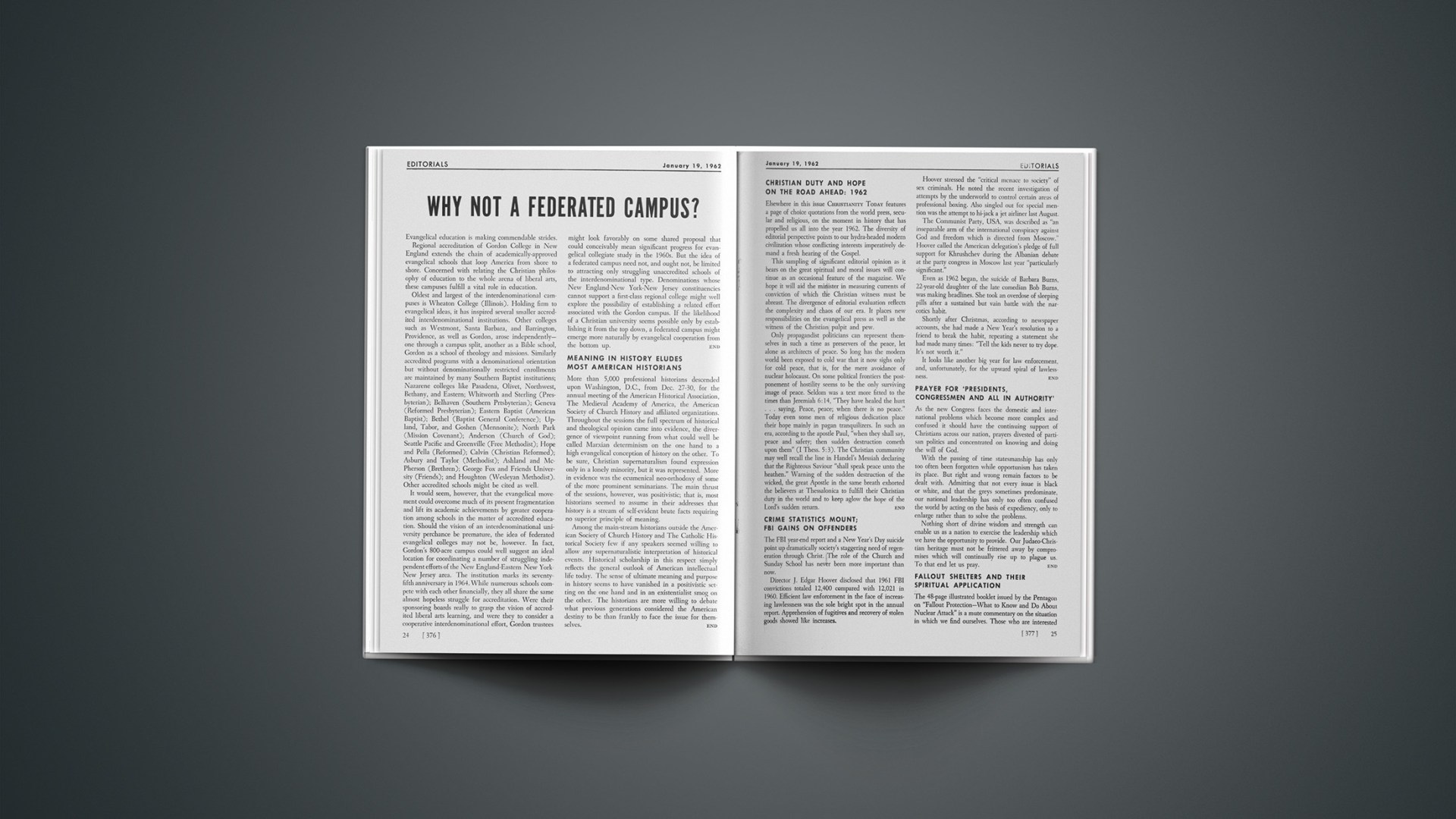
Why Not a Federated Campus?

Evangelical education is making commendable strides.

Regional accreditation of Gordon College in New England extends the chain of academically-approved evangelical schools that loop America from shore to shore. Concerned with relating the Christian philosophy of education to the whole arena of liberal arts, these campuses fulfill a vital role in education.

Oldest and largest of the interdenominational campuses is Wheaton College (Illinois). Holding firm to evangelical ideas, it has inspired several smaller accredited interdenominational institutions. Other colleges such as Westmont, Santa Barbara, and Barrington, Providence, as well as Gordon, arose independently—one through a campus split, another as a Bible school, Gordon as a school of theology and missions. Similarly accredited programs with a denominational orientation but without denominationally restricted enrollments are maintained by many Southern Baptist institutions; Nazarene colleges like Pasadena, Olivet, Northwest, Bethany, and Eastern; Whitworth and Sterling (Presbyterian); Belhaven (Southern Prtsbyterian); Geneva (Reformed Presbyterian); Eastern Baptist (American Baptist); Bethel (Baptist General Conference); Upland, Tabor, and Goshen (Mennonite); North Park (Mission Covenant); Anderson (Church of God); Seattle Pacific and Greenville (Free Methodist); Hope and Pella (Reformed); Calvin (Christian Reformed); Asbury and Taylor (Methodist); Ashland and McPherson (Brethren); George Fox and Friends University (Friends); and Houghton (Wesleyan Methodist). Other accredited schools might be cited as well.

It would seem, however, that the evangelical movement could overcome much of its present fragmentation and lift its academic achievements by greater cooperation among schools in the matter of accredited education. Should the vision of an interdenominational university perchance be premature, the idea of federated evangelical colleges may not be, however. In fact, Gordon’s 800-acre campus could well suggest an ideal location for coordinating a number of struggling independent efforts of the New England-Eastern New York-New Jersey area. The institution marks its seventy-fifth anniversary in 1964. While numerous schools compete with each other financially, they all share the same almost hopeless struggle for accreditation. Were their sponsoring boards really to grasp the vision of accredited liberal arts learning, and were they to consider a cooperative interdenominational effort, Gordon trustees might look favorably on some shared proposal that could conceivably mean significant progress for evangelical collegiate study in the 1960s. But the idea of a federated campus need not, and ought not, be limited to attracting only struggling unaccredited schools of the interdenominational type. Denominations whose New England-New York-New Jersey constituencies cannot support a first-class regional college might well explore the possibility of establishing a related effort associated with the Gordon campus. If the likelihood of a Christian university seems possible only by establishing it from the top down, a federated campus might emerge more naturally by evangelical cooperation from the bottom up.

Meaning In History Eludes Most American Historians

More than 5,000 professional historians descended upon Washington, D.C., from Dec. 27–30, for the annual meeting of the American Historical Association, The Medieval Academy of America, the American Society of Church History and affiliated organizations. Throughout the sessions the full spectrum of historical and theological opinion came into evidence, the divergence of viewpoint running from what could well be called Marxian determinism on the one hand to a high evangelical conception of history on the other. To be sure, Christian supernaturalism found expression only in a lonely minority, but it was represented. More in evidence was the ecumenical neo-orthodoxy of some of the more prominent seminarians. The main thrust of the sessions, however, was positivistic; that is, most historians seemed to assume in their addresses that history is a stream of self-evident brute facts requiring no superior principle of meaning.

Among the main-stream historians outside the American Society of Church History and The Catholic Historical Society few if any speakers seemed willing to allow any supernaturalistic interpretation of historical events. Historical scholarship in this respect simply reflects the general outlook of American intellectual life today. The sense of ultimate meaning and purpose in history seems to have vanished in a positivistic setting on the one hand and in an existentialist smog on the other. The historians are more willing to debate what previous generations considered the American destiny to be than frankly to face the issue for themselves.

Christian Duty And Hope On The Road Ahead: 1962

Elsewhere in this issue CHRISTIANITY TODAY features a page of choice quotations from the world press, secular and religious, on the moment in history that has propelled us all into the year 1962. The diversity of editorial perspective points to our hydra-headed modern civilization whose conflicting interests imperatively demand a fresh hearing of the Gospel.

This sampling of significant editorial opinion as it bears on the great spiritual and moral issues will continue as an occasional feature of the magazine. We hope it will aid the minister in measuring currents of conviction of which the Christian witness must be abreast. The divergence of editorial evaluation reflects the complexity and chaos of our era. It places new responsibilities on the evangelical press as well as the witness of the Christian pulpit and pew.

Only propagandist politicians can represent themselves in such a time as preservers of the peace, let alone as architects of peace. So long has the modern world been exposed to cold war that it now sighs only for cold peace, that is, for the mere avoidance of nuclear holocaust. On some political frontiers the postponement of hostility seems to be the only surviving image of peace. Seldom was a text more fitted to the times than Jeremiah 6:14, “They have healed the hurt … saying, Peace, peace; when there is no peace.” Today even some men of religious dedication place their hope mainly in pagan tranquilizers. In such an era, according to the apostle Paul, “when they shall say, peace and safety; then sudden destruction cometh upon them” (1 Thess. 5:3). The Christian community may well recall the line in Handel’s Messiah declaring that the Righteous Saviour “shall speak peace unto the heathen.” Warning of the sudden destruction of the wicked, the great Apostle in the same breath exhorted the believers at Thessalonica to fulfill their Christian duty in the world and to keep aglow the hope of the Lord’s sudden return.

Crime Statistics Mount; Fbi Gains On Offenders

The FBI year-end report and a New Year’s Day suicide point up dramatically society’s staggering need of regeneration through Christ. The role of the Church and Sunday School has never been more important than now.

Director J. Edgar Hoover disclosed that 1961 FBI convictions totaled 12,400 compared with 12,021 in 1960. Efficient law enforcement in the face of increasing lawlessness was the sole bright spot in the annual report. Apprehension of fugitives and recovery of stolen goods showed like increases.

Hoover stressed the “critical menace to society” of sex criminals. He noted the recent investigation of attempts by the underworld to control certain areas of professional boxing. Also singled out for special mention was the attempt to hi-jack a jet airliner last August.

The Communist Party, USA, was described as “an inseparable arm of the international conspiracy against God and freedom which is directed from Moscow.” Hoover called the American delegation’s pledge of full support for Khrushchev during the Albanian debate at the party congress in Moscow last year “particularly significant.”

Even as 1962 began, the suicide of Barbara Burns, 22-year-old daughter of the late comedian Bob Bums, was making headlines. She took an overdose of sleeping pills after a sustained but vain battle with the narcotics habit.

Shortly after Christmas, according to newspaper accounts, she had made a New Year’s resolution to a friend to break the habit, repeating a statement she had made many times: “Tell the kids never to try dope. It’s not worth it.”

It looks like another big year for law enforcement, and, unfortunately, for the upward spiral of lawlessness.

Prayer For ‘Presidents, Congressmen And All In Authority’

As the new Congress faces the domestic and international problems which become more complex and confused it should have the continuing support of Christians across our nation, prayers divested of partisan politics and concentrated on knowing and doing the will of God.

With the passing of time statesmanship has only too often been forgotten while opportunism has taken its place. But right and wrong remain factors to be dealt with. Admitting that not every issue is black or white, and that the greys sometimes predominate, our national leadership has only too often confused the world by acting on the basis of expediency, only to enlarge rather than to solve the problems.

Nothing short of divine wisdom and strength can enable us as a nation to exercise the leadership which we have the opportunity to provide. Our Judaeo-Christian heritage must not be frittered away by compromises which will continually rise up to plague us. To that end let us pray.

Fallout Shelters And Their Spiritual Application

The 48-page illustrated booklet issued by the Pentagon on “Fallout Protection—What to Know and Do About Nuclear Attack” is a mute commentary on the situation in which we find ourselves. Those who are interested may secure a free copy at the nearest U. S. post office.

Christians and the Church can well make this the occasion of a spiritual application needed by men everywhere—the universal fact of sin with its fallout of evil and the Divine Shelter to be found in the cleansing, protecting and comforting work of Christ.

Christians should exhibit for all the world to see a serenity and a peace the world does not have—the peace of God in the human heart. They should also exhibit an impelling concern for those who do not possess this peace which “passeth understanding.”

There is deep spiritual significance in poetic expressions to be found in the Bible.… “Keep me as the apple of the eye, hide me under the shadow of thy wings, from the wicked who despoil me, who compass me about,” or, “The eternal God is thy refuge, and underneath are the everlasting arms.”

Citizens should act with prudence but Christian citizens should do more—they should show for all to see that their ultimate trust goes beyond shelters which man may build.

The Role Of The Church In Unrelated Business Activity

Mounting interest in CHRISTIANITY TODAY’S discussion of special tax benefits enjoyed by churches operating unrelated business activities is no surprise. The fact is that no country can long tolerate laws that give churches engaged in commercial ventures special competitive advantages over secular business establishments.

A leading executive recently pinpointed the situation. If he were 30 years younger, he told us, president of a religious foundation, and availed himself of present tax exemptions, he could take over several companies, soon put all competitors out of business, and ultimately control a given industry.

Consider the facts. A good business earns six per cent after taxes. Exempt from such taxes, a church could profit twelve rather than six per cent. Since this higher return offers an attractive loan investment, the sponsoring church can borrow money at lower interest rates. If, for example, it borrows at four per cent to engage in business, the church can realize eight per cent on its investment.

Suppose a church buys a one-million-dollar business that in view of tax exemptions shows an annual profit of $120,000. It can borrow $800,000 to purchase the business at the preferred loan rate of four per cent, or $32,000. Hence, on an investment of $200,000, the church will net $88,000 or 44 per cent.

Suppose, however, the net were only 25 per cent. Even an investment of 25 per cent compounded doubles in less than three years, quadruples in six, in 30 years will multiply itself one thousand times. Starting with a million dollars and encouraged by the present tax exemptions for religious bodies engaging in unrelated business activities, any church by this procedure could own America in 60 years!
26: Common Grace

In a surprising remark our Lord once told a group of his disciples that “the children of this world are in their generation wiser than the children of light” (Luke 16:8). Although the latter might wish to dispute that judgment, it is too often only too true. But how can it be, if we assume the truth of the biblical doctrines of sin and of salvation? The “children of this world,” Scripture teaches, have had their minds blinded by “the god of this world,” whereas the children of light have received “the light of the knowledge of God in the face of Jesus Christ” (2 Cor. 4:4 ff.). How then can worldlings carry on so admirably, sometimes, by canons of common sense and decency, and appear to be superior to those whose God is the Lord? This is the question to which the doctrine of common grace addresses itself. It seeks a rationale for the phenomenon of heathen, afar or in our midst, being such “nice people.” For if sin is the corrupting influence which Scripture portrays it to be, there must be some explanation for the curbing of its devastating effects where the Gospel of salvation is unknown.

Augustine, that intellectual giant whose influence has been so long felt in the Church, saw the problem when his Pelagian adversaries reminded him of the virtues of the heathen. He had struck gold in his exploration of the Scriptures when he wrought out the evangelical doctrines of sin and saving grace. The laudable deeds of the heathen, however, were an enigma to him unless they were understood to be nothing other than splendid vices motivated by love of glory and praise or a desire to avoid difficulty (The City of God, V, 12–20; On Marriage and Concupiscence, I, 4). After Augustine, medieval theology substituted the antithesis of nature and grace for that of sin and grace, with a resulting minimization of the exceeding sinfulness of sin. Man’s nature was considered to be still largely intact. There was then no theological problem in the virtues of the heathen or in the accomplishments of the “natural man.” Such men do good deeds because their nature is not vitiated by sin, as Augustine had believed it to be, and because considerable health remains in them. The recovery of the biblical doctrine of sin brought the problem back to the Reformers of the sixteenth century. John Calvin, in particular, dealt with it frequently in his writings and the answer that he gave has entered the broad stream of Reformed theology to become a permanent part of its corpus of the faith.

Definition. Common grace is understood to be the unmerited favor of God towards all men whereby (1) he restrains sin so that order is maintained, and culture and civil righteousness are promoted; and (2) he gives them rain and fruitful seasons, food and gladness, and other blessings in the measure that seems to him to be good. It is evident from this definition that the doctrine of common grace is closely related to a number of other important matters of theological interest. It is directly related to the doctrine of God, for it is concerned with his attitude towards all men, sinners outside his saving grace as well as those within. It is concerned with the problems of philosophy of history and of culture, for it addresses itself to the progress of history and the personal and social development of mankind. It is a part of the broader problem of revelation, for it has to do with God’s communication of himself to mankind and the relation of special to general revelation. Moreover, it is interested in the knotty problem of the relation of the Christian to the world about him, and of God’s general blessings to mankind in relation to saving grace. Most of these intriguing areas of investigation can only be mentioned here without elaboration.

A prime consideration in the doctrine of common grace is the restraint of sin in the lives of individuals and of society. Augustine had failed to perceive this truth in spite of his usual perceptiveness. “Sins are not really restrained,” he writes, “but some sins are overpowered by other sins” (On Marriage and Concupiscence, I, 4). With clearer insight, Calvin wrote that history demonstrates there have been persons in all ages who have lived laudably by the guidance of nature (natura duce). This, in view of the corruption of humanity through sin, he avers, is a question which must be resolved. The answer, he adds, is to be found in the fact that human nature is not totally corrupt (in totum vitiosam) because in the midst of the corruption of nature “there is some room for Divine grace, not to purify it, but internally to restrain its operations (intus cohibeat). For should the Lord permit the minds of all men to give up the reins to every lawless passion, there certainly would not be an individual in the world, whose actions would not evince all the crimes, for which Paul condemns human nature in general, to be most truly applicable to him.… Some by shame, and some by fear of the laws, are prevented from running into many kinds of pollutions, though they cannot in any great degree dissemble their impurity; others, because they think that a virtuous course of life is advantageous, entertain some languid desires after it; others go further, and display more than common excellence, that by their majesty they may confine the vulgar to their duty. Thus God by his providence restrains the perverseness of our nature from breaking out into external acts, but does not purify it within” (Institutes, II.iii.3). In a variety of ways, internally and externally, God checks human sin (1 Sam. 16:14; 2 Kings 19:27 f.; Acts 7:42; Rom. 13:1–4; 2 Thess. 2:6 f.). In some instances he ceases his restraining activity and gives men over to a reprobate mind in order that their sin may work itself out in its utter godlessness and corruption (Rom. 1:24, 26, 28). Even this, however, shows that previously he had prevented their sin from running its natural course and that he had held it in abeyance.

In their description of fallen man in the state of corruption the Canons of the Synod of Dort read: “There remain, however, in man since the fall, the glimmerings of natural light, whereby he retains some knowledge of God, of natural things, and of the difference between good and evil, and discovers some regard for virtue, good order in society, and for maintaining an orderly deportment” (III–IV, 4). Herein is described a second characteristic of the grace which God gives all men. Although they are “dead in trespasses and sins … by nature the children of wrath … aliens … strangers from the covenants of promise, having no hope, and without God in the world” (Eph. 2:1, 3, 12), they are not utterly forsaken by him. God continues to give them abundant evidence of his compassion and benignity. By his restraint of sin he enables science, government, and human culture to develop and flourish. Moreover, he gives men an appreciation for the good, the true, and the beautiful, and a desire to live meaningfully. He enables them to desire and to perform works of civil righteousness. The Heidelberg Catechism, like other Reformation statements of faith, declares the natural man to be unable to do any good and inclined to all wickedness (questions 8, 91), but in his commentaries on the same its chief author allows for “some traces and remains of moral virtues” and for a “civic” good whose works “promote our temporal welfare” (Z. Ursinus, Commentary on the Heidelberg Catechism, question 6; Schat-Boeck, Lord’s Day III; in the latter, he distinguishes a threefold good the last of which, “spiritual and supernatural good,” he declares is meant in the catechism; “In the other an unconverted man can even far excell a regenerated person although he has these [as a common gift] from God”). The Westminster Confession declares that conversion enables the sinner to will and to do that which is spiritually good with the implication that the unconverted can do good of an inferior quality (chap. IX, 4; cf. The Canons of Dort: “All men are … by nature … incapable of any saving good” [III–IV, 3; italics mine]). This justitia civilis does not spring from faith, is not performed with respect to the law or will of God, and is not done to his glory. Hence it falls short of the scriptural requirement of that which is pleasing to God. Yet it is good of a kind and it is possible because of the general benevolence and blessing of God towards all men. Even sinners can do good, says Jesus (Luke 6:33), and the sin-cursed world yet retains something of the goodness of him whom it should, even though it refuses to, acknowledge as its rightful Lord.

A third evidence of common grace is the natural blessings which God showers on all men (Ps. 145:9; Matt. 5:44 f.; Luke 6:35 f.; Acts 14–16 f.; Rom. 2:4; 1 Tim. 4:10). Every good gift is from the Father above (Jas. 1:17) and is an evident token of his constant faithfulness and goodness towards all creatures. Not only believers but all men receive and benefit from these gifts from day to day. God means them as blessings which men should recognize as such so that the goodness of God will lead them to repentance (Rom. 2:4). That they are not received as such is not due to any lack in gift or giver but because of impenitent and hard-hearted men who are treasuring up for themselves wrath against the day of wrath and revelation of the righteous judgment of God (Rom. 2:5 ff.).

Relation to Special Grace. The relation of common grace to special grace requires treatment inasmuch as there are those who claim for both essential similarity, with difference only in degree. Both, it is said, are a part of the saving intention of God; common grace enables a man to repent and believe if he only will, while special grace, working with the will, constrains him to do so. It appears, however, that common grace and special grace are not to be understood as essentially similar; rather, there is essential difference between them. The one merely restrains sin and promotes outward order and righteousness; the other renews the heart and sets man free from sin to know and to serve the living God. The one retards the destructive power of evil and gives men and society the semblance of moral respectability, goodness and beatitude; the other is profoundly spiritual in nature and is a resurrection from death to life. Common grace, God’s benevolence towards all mankind in spite of sin, does not bring a person to faith in Jesus Christ. As God commanded the light to shine out of darkness, he must sovereignly illumine human hearts if they are to have the light of the knowledge of the glory of God in the face of Jesus Christ. Such illumination is one aspect of what theology knows as special grace.

In spite of their essential difference common grace and special grace are related to each other. Both flow from the bountiful loving kindness of God; both come to men through the only mediator between God and men, the man Christ Jesus. Moreover, there is a sense in which common grace is related to the saving work of Christ, for God’s gift of salvation is of such magnitude that its blessed effects reach far and wide into human society. This is another way of saying that the beneficent effects of special revelation are not limited to the elect. All in the community of men to whom the message is given benefit from it in some measure. An eminent Scottish divine has rightly said that “important benefits have accrued to the whole human race from the death of Christ, and that in these benefits those who are finally impenitent and unbelieving partake.” These benefits, he avers, come from Christ even to unbelieving men “collaterally and incidentally, in consequence of the relation in which men, viewed collectively, stand to each other” (W. Cunningham, Historical Theology, vol. II, pp. 331 f.; cf. L. Berkhof, Reformed Dogmatics, p. 483; A. A. Hodge, The Atonement, p. 358). There is a general reference—to all men—as well as a particular reference—to the elect alone—in the scriptural teachings concerning the benefits of the atonement of Jesus Christ.

The Church and the World. In their attitude towards the world and its culture the early Christians were, in general, pessimistic. They could expect little from it but persecution and scorn. This attitude gradually changed, however, when the thinking of the Church matured. It has been said that this change demonstrates the defection of the early Church from the simplicity and glory of the original Gospel. Rather it should be said that the Church had learned that “the earth is the Lord’s, and the fullness thereof,” and that his children were to try all things and to “hold fast that which is good.”

What the early Church discovered when it adopted what Herman Bavinck calls the “eclectic procedure in its valuation and assimilation of the existing culture” (“Calvin and Common Grace,” Calvin and the Reformation, p. 101; cf. C. N. Cochrane, Christianity and Classical Culture, pp. 213 ff.), the church of today adopts as the legitimate and biblical position. In full recognition of the reality and power of evil it remains confident of Christ’s presence in its midst and of the assurance of final victory over the powers of darkness. The world in which it lives may be no friend to grace but it is heartened by the apostolic assurance: “All things are yours; and ye are Christ’s: and Christ is God’s” (1 Cor. 3:22 f.). God has not left the world, even in its lostness, without witness. He is still in it and with it, and he offers as proof of his benevolence the manifold evidence of his common grace.

Bibliography: H. Bavinck, De Algemeene Genade; “Calvin and Common Grace,” Calvin and the Reformation: Four Studies by Emile Doumergue and Others, W. P. Armstrong, ed.; L. Berkhof, Reformed Dogmatics; J. Calvin, Institutes; C. Hodge, Systematic Theology; H. Kuiper, Calvin on Common Grace; A. Kuyper, De Gemeene Gratie; C. Van Til, Common Grace.

Professor of Systematic Theology

Western Theological Seminary

Holland, Michigan

The Mysteries of Redemption

There are repeated references in the Bible to the mysteries of God’s plan, and to things only revealed after the Author of salvation had come into the world and completed his redemptive work.

Today there is yet much which we must accept by faith, believing the statements of fact, but not knowing how God has worked out his perfect will.

In Deuteronomy we read: “The secret things belong to the Lord our God; but the things that are revealed belong to us and to our children for ever, that we may do all the words of the law.”

God has reserved to himself mysteries which will be explained when the redeemed stand in his eternal presence. But he has revealed to us glimpses of eternal truth which we are to believe and act upon and which lead into his presence forever.

After the resurrection our Lord called his disciples’ attention to Scriptures fulfilled by his death and resurrection and which before were an enigma to them, “for as yet they did not know the scripture, that he must rise from the dead.”

The Prophet Amos exclaimed: “Surely the Lord God does nothing, without revealing his secret to his servants the prophets,” but these same prophets often spoke without knowing the meaning of their words. Peter tells us: “The prophets who prophesied of the grace that was to be yours searched and enquired about this salvation; they inquired what person or time was indicated by the Spirit of Christ within them when predicting the sufferings of Christ and the subsequent glory. It was revealed to them that they were serving not themselves but you, in the things which have now been announced to you by those who preached the good news to you through the Holy Spirit sent from heaven, things into which angels long to look.”

Speaking to his disciples our Lord said: “Unto you it is given to know the mystery of the kingdom of God: but unto them that are without, all these things are done in parables.”

That God’s plan of redemption was determined in the councils of eternity reveals to us something of his love, wisdom, and power. Before the creation he knew man would choose to sin, continue in sin, and that nothing less than the death of his Son could effect atonement.

Paul refers to this repeatedly in his epistles. To the Corinthian Christians he wrote: “But we speak the wisdom of God in a mystery, even the hidden wisdom, which God ordained before the world unto our glory.”

To the Christians in Ephesus he wrote: “How the mystery was made known to me by revelation, as I have written briefly. When you read this you can perceive my insight into the mystery of Christ.… To me, though I am the very least of all the saints, this grace was given, to preach to the Gentiles the unsearchable riches of Christ, and to make all men see what is the plan of the mystery hidden for ages in God who created all things.… This was according to the eternal purposes which he has realized in Christ Jesus our Lord.”

Writing to the church in Colossae he says: “… I became a minister according to the divine office which was given to me for you, to make the word of God fully known, the mystery hidden for ages and generations but now made manifest to his saints.”

There are many mysteries in redemption. The New Birth is a mystery. Men may deny it, rationalize or try to explain it away but it continues an imperative for eternal life. Supernatural? Yes, but so is the work of sanctification.

The Trinity is a mystery no man can explain. The Incarnation is a mystery and wrapped in that mysterious intervention of God into the stream of human life is to be found God’s plan of redemption.

The Gospel is itself a mystery—foolishness to the unregenerate but God’s power of salvation to those who believe. Paul prayed for the ability to preach it boldly: “… that utterance may be given me in opening my mouth boldly to proclaim the mystery of the gospel,” and in another place he speaks of the effect of understanding this mystery: “That their hearts may be encouraged as they are knit together in love, to have all the riches of assured understanding and the knowledge of God’s mystery, of Christ, in whom are hid all the treasures of wisdom and knowledge.”

Speaking of the office of a deacon Paul asserts: “They must hold the mystery of the faith with a clear conscience” and he then affirms: “Great indeed, we confess, is the mystery of our religion:” following this with a vivid sketch of our Lord’s work: “He was manifested in the flesh, vindicated in the spirit, seen by angels, preached among the nations, believed on in the world, taken up in glory.”

Running parallel to the mystery of God’s redemptive work is the mystery of iniquity. Satan is active and lawlessness abounds, but countering this mysterious force of evil is the unending grace of God so that, “where sin increased, grace abounded all the more.”

Many have tried to explain the mysteries of God’s redemption in natural terms and in so doing brought confusion to themselves and to those influenced by them. Redemption is a supernatural act of God’s grace and it cannot be defined in any other than spiritual terms. The Church and Christ’s relationship to her are profound mysteries, explained in human terms as a Bridegroom and his bride.

The Cross is a mystery, for on that instrument of punishment and death there took place the central drama of all history—God, in human form, dying for sinners, and in that supreme act in which are to be found the love, mercy, and grace of God combined with his holiness and justice, there is atonement for sin, forgiveness for the penitent, and access into the presence of God himself.

Can we explain it all? Of course not, nor should we try to do so. When God acts man should respond, not asking the hows and the whys of his love hut rejoicing in the privilege of believing, and the blessings which flow from faith.

But some day the mystery will be clarified by the glorious presence of the Christ for whom we look.

John saw this final denouement and in the Revelation he declares: “And the angel … swore by him who lives for ever and ever, who created heaven and what is in it, the earth and what is in it, and the sea and what is in it, that there should be no more delay, but that in the days of the trumpet call to be sounded by the seventh angel, the mystery of God, as he announced to his servants the prophets, should be fulfilled.”

At the moment we see as in a glass darkly, but some day we shall see him face to face and the mystery will vanish in the revelation of his presence.

When the mysteries of redemption are fully known, our hearts will thrill with praises to the One in whom are centered all the secrets of God’s redeeming love.

Revival for the Evangelical Press?

While flying across the Atlantic, three Protestant editors recently shared their convictions on the current role of the religious press. The informal remarks of Dr. Kenneth L. Wilson, executive editor of Christian Herald; Dr. Sherwood E. Wirt, editor of Decision; and Editor Carl F. H. Henry ofCHRISTIANITY TODAYare reproduced below.

DR. HENRY: No age has been as preoccupied as ours with the importance of communication. We are aware of the great potential of words and ideas for human good or ill. What special responsibility in the closing decades of this century does this fact impose on the evangelical press as a vehicle for God’s Good News?

DR. WILSON: In many different respects the Church and the voices of the Church have been prodded and stimulated by advances elsewhere. We cannot afford to let ourselves be outread, outpublished while there is a mood for reading, and while that mood is being not only catered to but exploited by others who have ideas to sell.

DR. WIRT: I believe our special responsibility is to Truth. This is the golden age of lies. Men use words not as tools for reasoning but as weapons for throwing. The adjective no longer describes; it either fawns or vilifies. Justice Holmes and Joseph Stalin died assuring us truth was whatever men made it. More than at any time since the Canon was closed, evangelical writers need to be men who proclaim and defend the truth; who “paint the truth as they see it for the God of things as they are.”

DR. WILSON: But the truth must be presented with technical skill and, if I may use the word, imagination. Message is bedrock, of course. But communication requires a reader as well as a writer. I think that too often the evangelical press has, in its rightful zeal, neglected reader cultivation.

DR. HENRY: The fact that God’s Spirit is the divine Communicator of truths and life really heightens the necessity for our effective and artful relay of his message in the modern war of ideas. What does this imply for evangelical publishing—of books, magazines, Sunday school literature?

DR. WIRT: I read the Bible every day. Right now I’m in Joshua, Psalms, Ezekiel, and Matthew. I do not find these books dull; the styling is artful, the imagery superb. Then I read what someone says about the Bible and it is as dull as dishwater. Perhaps we should farm out our writers for special training in the use of vital language. Let them study Job one day, Alan Paton the next day, Dickens the next, Graham Greene the next.

DR. WILSON: Let’s take books. There is a tremendous revival in book reading and book buying. The New English Bible was on the best-seller lists. Through Gates of Splendor must have come close. Better or best-sellers are produced by a combination of circumstances, but one essential is that a book tap an interest sensed by a writer. Through Gates of Splendor, for example, caught up the missionary heroism which many people supposed had gone out decades ago. Sensing spiritual hungers and meeting them is our job.

DR. HENRY: Isn’t there somewhat of an awakening interest in serious evangelical theological writing? Fifteen years ago a work like Wilbur M. Smith’s Therefore Stand!, selling 50,000 copies, was a monumental exception. Now a symposium like Revelation and the Bible is in almost that many homes, and is appearing in British and German editions. The whole of Berkouwer’s Studies in Dogmatics is being translated from Dutch to English in 20 volumes. Some major New York houses are almost as open to first-rate conservative works as are evangelical publishing houses. The annual lists of choice evangelical books register noticeable gains in quality.

DR. WIRT: I think you are too sanguine. Through Gates of Splendor and Shadow of the Almighty were not just missionary hero rewrites; they were skillfully told, true, contemporary stories, loaded with talent. They were monumental exceptions, if you please, to the potboilers that fill the Sunday school papers. I agree the publishing houses are receptive. But the material we are offering them is pitiful. A man wrote me the other day, “God has given me a mighty pen!” I only wish he had! Even church publications now are slashing their fiction sections because the supply is so poor. There has not been an evangelical novel worthy of the name in decades.

DR. WILSON: Why not? Contemporary talent is not developed by the reprinting of Pilgrim’s Progress. Talent seldom appears full-blown. It must be nurtured, cultivated by publishers and by the Christian colleges. I think our schools have downgraded anything that might be construed as “popular,” that is to say, readable, in an attempt to promote what is “literary,” that is to say, opaque. The great books have been first of all readable. Where are future great books coming from?

DR. HENRY: Are not the publishers somewhat lax? The era of evangelical reprints seems largely to have outlived its usefulness. The time is now overdue for creative contemporary literature. Our cause would be set ahead by a major strategy meeting of evangelical publishers. A measure of comity need not stifle competition, but would eliminate some unnecessary duplication and chart special areas of interest and responsibility without jeopardizing trade secrets. The general paperback market has not as yet been effectively penetrated, and cooperative planning would be helpful. No systematic approach has been made to the textbook field. Too many publishers remain at the mercy of hit-and-miss inquiries and have not projected a comprehensive publications program. I would not of course minimize the indebtedness of the evangelical cause to our publishing houses, nor deny that some have made sacrificial investments in worthy works.

DR. WILSON: I would wish for a definition of “evangelical literature” broad enough to take in more than commentaries, theological treatises, and the like. Evangelicals have been lax at the point of social awareness and here is a ripe field for writing, especially fiction. Must we—and must publishers—be timid in our evangelicalism?

DR. HENRY: Why haven’t great novels come from evangelical sources in our era? Is it simply that the reading public demands smut? Or is it also that the evangelical remnant is so withdrawn from the mind-set of the day it artificially handles modern life, proposes solutions too hurriedly and therefore does not “speak” to our times?

DR. WILSON: Perhaps we have been too habitually concerned with the “moral” of the story. The story was simply the excuse for what we thought was really important. Then, to make sure everyone recognized the moral when they saw it, characters became caricatures. Not until we are willing to let our novels stand or fall on their own qualities as “story” will we have great novels.

DR. WIRT: This hurts. I am now writing a “Christian” novel and my aim is frankly to describe—principally through dialogue—a conversion. Call it a glorified tract if you will—it is as artistic as I can make it. What should I do—invert the plot to make it “realistic”?

DR. WILSON: Not at all! My point is simply that calling a book a “Christian novel” does not necessarily make it either. I am sure that Dr. Wirt’s will be both. One gets the impression that writers think Christian literature is either (1) a story about a “religious” subject—that is, a clergyman, a church, the chairman of the ladies aid, or (2) a story with a sermon or moral tacked on at the end after a suitable amount of window dressing of plot and interest. In a “Christian novel,” Christianity must be of the essence. Whether the characters are bad or good, wise or stupid, arrogant or gentle, the story must be of itself, by itself, the “message.”

DR. WIRT: The real problem is that in order to appear to be aware of the “changing social situation,” the Christian writer is being pressured to mix filth into his work. It is, in fact, almost mandatory today for a responsible work of art to include some lurid realism if it is to be considered seriously. Thus Alan Paton’s latest volume crosses the line into four-letter words.

DR. WILSON: It seems to me we could hope for at least three possibilities: (1) that we can develop writers so competent that no crutches are “mandatory”; (2) that evangelical readers can find moral strength even in the writings of nonevangelicals and possibly even the nonreligious; and (3) that Christian writers (and the Church itself) cultivate a boldness of faith that gives leadership in the changing social order and does not forever wage Johnny-come-lately, Johnny-come-safely crusades.

DR. WIRT: No doubt all these possibilities exist, but I doubt they will ever be fulfilled until we deliberately cultivate the gifts and talents of younger Christian writers by prizes, awards, scholarships, and fellowships, as well as courses, seminars, and summer workshops. It is one thing to dream about a garden, another to plant and cultivate it.

DR. HENRY: Let’s use a bit of historical imagination. What a remarkable treasure the first apostles would have discovered in the many resources already at our disposal: publishing houses, magazines, Church school literature, and so on. Would they not also have viewed the secular traffic in words—the world’s reading—as an opportune medium of witness. For evangelicals, the word business offers a channel for the ministry of the Word—and we who know the Word ought to be most proficient of all in marshalling words in the service of the true, the good, and the beautiful.

The Road Ahead: 1962

1961 IN RETROSPECT—Well, 1961 was different, anyway. It was the year of The Wall, and The Twist, and The Shelter, and the electric toothbrush.… There were new styles in almost everything: girls, politics, art, houses and hair dos.… Some little country was always telling some big country to go climb a tree. Cuba defied the United States, Albania defied the Soviet Union, Algeria defied France, Formosa threatened to invade China, and Katanga thumbed its nose at the whole United Nations.—JAMES RESTON, Washington correspondent, in The New York Times.

THE TWIST—It’s extraordinary how a thing like that can sweep the world. But rather that than the atom bomb.—HAROLD FIELDING, the theatrical impresario, quoted in the Sunday Telegraph, London.

THE WORLD’S LEGACY—The legacy bequeathed by 1961 still leaves us with problems and challenges, hopes and fears that have been with us … ever since the end of the Second World War.… It consists of an ever-accelerating armaments race; torment and political catastrophe in the Congo; the threat of a Communist take-over in … Laos and south Viet Nam; the weakened condition of the United Nations and the danger that the General Assembly may become a kind of Tower of Babel.… Here is a picture of a world that could suddenly be plunged, either by miscalculation or deliberate intent, into an almost unimaginably destructive atomic-hydrogen war—a war in which there could hardly be any victors, excepting possibly the ants, or the worms, or some other form of insect life.—Editorial, “Text for 1962,” in The Evening Star, Washington, D. C.

LUTHER’S APPLE TREE—Bold would be the prophet, in the midst of the world’s many crises, who would dare to say that 1962 will be a Happy New Year. It takes no grim catalog of catastrophe to make it plain that mankind travels alongside a fearful abyss.… For the leaders of the world, the burden of this danger must be ever present. For millions of others it is less oppressive only for the reason that they can do little about it. The healthiest philosophy they can have is that of Martin Luther who said that though he knew the world were to end tomorrow he would plant his apple tree today. It is a proper attitude to take into a year in which the world as man has known it for centuries indeed may end tomorrow.—Editorial, Washington Post.

ONE STEP TO DOOMSDAY—If one note can be said to have pervaded a meeting as varied as that of the American Association for the Advancement of Science, that note was fear bordering on despair. The optimists among the thousands of scientists here seemed to believe there is one more chance of avoiding doomsday. The pessimists think that chance is already past.—WILLIAM HINES, Staff Writer, Washington Evening Star, reporting on the Denver meeting of A.A.A.S.

DELUSION AND DECLINE—There is one whole set of delusions that has bedevilled American thinking for years.… Unless we can shake it right off, you, and your children, and the whole Western world are in for disappointments and shocks that no great society has ever known.…

Delusion 1 (held by British engineers): British engineers are the best in the world.

Delusion 2 (held by American engineers): American engineers are the best in the world.

Delusion 3 (held by some American non-scientists): The Soviet space flight did not take place.

Delusion 4 (held by non-scientists in the United States and Britain in 1945): The Communist world would be many years in catching up with the atomic-bomb discovery.

Delusion 5 (held by many Britons until the time of the Suez crisis): The sun will never set on the British Empire—Britain is invulnerable; its wealth, power and glory will never fade.

Delusion 6 (held by many who ought to know better): The coloured races are inferior in all ways to the white.

Delusion 7 (held until 1957 by most Americans and many Europeans): The U.S. is invulnerable.

I believe that Britain in the nineteenth century and the U.S. in the twentieth have let technology go to our heads. One after the other, we have become stupefied by a kind of technological conceit. In our case, it made us sleepy, self-indulgent, self-congratulatory for nearly a century—so much so that we have declined faster than we needed to.

So will the U.S. decline, unless you learn from our delusions. You can see where we went wrong—how we congratulated ourselves instead of discovering why, for a short space, we were on top of the world. If we had found the real reasons for our being there, we might have stayed there longer. It would have meant education, discipline, self-criticism. If the United States wants to stay there, it will mean the same for you.—C. P. SNOW, “The Great Delusions,” The Sunday Times magazine section, London.

FOR THE LONG PULL—If the American people refuse to be deceived, they will find plenty of grounds not, indeed, for the old happy confidence, but for a sober belief that, in the long run, the better cause will win. And I have found few if any Americans who doubt that theirs is the better cause. If that doubt creeps in, then the question of national morale will be really serious!—D. W. BROGAN, British historian, in The New York Times Magazine.

TO BE COUNTED—“Better Brave Than Slave!” This is Freedom’s true answer to all those who have been chanting “BETTER RED THAN DEAD”—or vice versa. These words … give us the courage, the manly gift, to stand up and be counted on the side of right, as God gives us to see the right.—WLLIAM I. NICHOLS, editor and publisher of This Week.

CHRIST’S MANDATE—Now is the Armageddon between faith in a Supreme Being and materialistic agnosticism.… Those of us of the Christian faiths will renew our courage and determination that moral victory can yet come to mankind.… The hunger for peace lies deep in the human heart, and we can hope and pray that the mandate of Christ will not be denied to mankind by the forces of evil.—Former President HERBERT HOOVER.

Instability of Liberal Social Ethics

Peace and War (Part II)

The peaceful decade of the 1920s provided a hospitable platform for liberal Protestant preachments on international cooperation devoid of force or threat of force. But these blueprints of peace would soon be rendered obsolete by the warring thirties which transformed peaceful international cooperation into a collective security that carried with it the risk of war. The optimism of one decade had not foreseen the brutality of the next. For those Americans to whom the thought of U. S. engagement in another war was intolerable, there was an alternative—isolationism. Even while rejecting the label, The Christian Century turned in this direction in the second half of the thirties, a period which would see Protestantism badly split as it confronted the hazardous choice.

During this period there was widespread belief that economic factors almost alone were responsible for U. S. involvement in World War I. Cocking a disillusioned eye at these factors, the Century did its best to prevent repetition of such an occurrence. An editorial titled “Taking the Profits Out of War” concluded, “For if war actually comes, profit or no profit, civilization will die” (May 1, 1935, p. 568). Thus the Century crusade against capitalism in that period was fought not only with the weapons of domestic politics, but rather the issue was broadened to embrace humanity’s hopes for peace, which perhaps awaited the “dethronement of the twin gods of capitalism and absolute national sovereignty” (Aug. 23, 1933, p. 1055).

As the League of Nations was entering its mortal agonies in Geneva and the Pact of Paris was becoming a fast-fading memory, the Century, in accents of economic determinism, declared: “With each year the doubt increases that any peace plan can succeed … until the world’s economic problem moves into a wholly new phase. Behind all our political governments there stands an invisible government which controls them. Our governments are not free; they are bound by the economic system. In undertaking to keep peace—that is, in joining the league or in signing the Kellogg pact—they have probably undertaken more than they can deliver. Governments are helpless agencies in the hands of national economic self-interest. From now on, it will probably be increasingly confessed by peace lovers that their work for peace must go behind political governments and deal radically with the economic system which governs them” (Sept. 11, 1935, p. 1137).

In an article, “Behind the Fleet Maneuvers,” Harold E. Fey, present Century editor but then secretary of the pacifist Fellowship of Reconciliation, charged “those shortsighted men who represent the only statesmanship that our capitalistic system has produced” with trying to halt democrary short of providing equitable distribution of economic privilege. “… These intellects look to fascism to provide the one remaining hope of capitalism, and they know that the easiest method to lead this country into fascism would be through becoming involved in the dictatorship which is inevitable in a modern war.” Danger of war in the Orient “lies in a capitalism which refuses to distribute wealth to the people who produce it and which therefore must constantly seek out new fields for dumping surplus goods and the investment of capital” (May 22, 1935, pp. 697 f.).

(In 1917 those who called the war “a war for Wall Street” were charged by the Century with “a lamentable ignorance of historic movements” in allowing “economic prejudices” to obscure the fact that the war was “in behalf of democracy” [May 17, p. 5].)

The Century fought a running battle against Franklin Roosevelt’s moves toward “preparedness to wage war.” It saw “the appeal to violence” as the “destruction of democracy.” “The development of the war spirit is the development of the effective and indispensable instrument of dictatorship. Those who look that way, look toward fascism” (July 24, 1935, p. 959). Fey warned in Century articles that conscription would mean fascist dictatorship (Jan. 27, 1937, pp. 107–109; May 31, 1939, pp. 698–700).

When Hider announced German rearmament in 1935, the Century opposed any increase of U. S. military and naval establishments (Mar. 27, p. 392). Roosevelt’s peace policy was attacked as “military preparedness to the uttermost possible farthing” (May 27, 1936 p. 757), and the Century therefore desired replacement of “the present weak neutrality laws with legislation of an inclusive and mandatory character” (Jan. 6, 1937, p. 8). As war drew near, the “President’s demand for a supernavy” was opposed (Mar. 9, 1938, pp. 294–296; May 4, 1938, pp. 550 f.).

The Century earlier had called for a U.S. guarantee of economic (as well as military) neutrality with an embargo on every form of help to make war, applying to all nations, Britain included. If such a peace plan were followed, “… we believe that the danger of a new world war would be almost done away” (Mar. 28, 1934, p. 412). By 1939 desire for such legislation remained—alongside pessimism as to the possibility of attaining it (May 17, p. 632).

In 1937 the Century acknowledged that the Kellogg Pact had broken down. It also admitted that American isolation was a chief factor in preventing the collective system (embodied in the League) from functioning, but after all, the League was seen as a means of perpetuating the Versailles treaty and of developing a balance of power, both undesirable to the Century (Sept. 15, 1937, pp. 1127–29).

Memory Of The First World War

Helping to push the Century toward isolationism was the memory of World War I and the “element of shame” in the churches’ support of that war (Jan. 20, 1937, pp. 72–74). Morrison pointed to the heavy financial burdens of the magazine which took much of his time until 1919 when three men gave him adequate financial support. “I have no illusion that The Christian Century would have taken a radically different position had the financial release come earlier. The idea that war was a religious issue, a test of religious reality, in the way we now conceive it, was too vague to do more than haunt my conscience ineffectually.” As for his 1937 position on war, he noted the Century had never taken the pledge of absolute pacifism but declared that the philosophical differences were “academic.” He took satisfaction in its pioneering contribution to the “volume of Christian conviction against war” developed since World War I (Mar. 31, 1937, pp. 409–411).

On the eve of war, the churches were told they could not in good conscience leave Christian conscientious objectors in doubt as to church support since their decisions were made on the basis of the churches’ teaching on “the sinful nature of war” (June 7, 1939, p. 729). The churches were also repeatedly urged to withdraw from the military chaplaincy program (Dec. 21, 1938, pp. 567–569; Jan. 16, 1935, pp. 70–72).

However, Fey’s advocacy of the proposed Ludlow amendment to the Constitution, making declaration of war dependent upon a national referendum, was opposed by the Century as increasing “the danger of resort in crisis to a fascist dictatorship” (Jan. 5, 1938, p. 8; cf. Dec. 29, 1937, pp. 1617 f.).

Pacifists often seem impelled by their own interests to draw a nicer picture of the enemy than warranted by the facts. Aggressions tend to be rationalized. Conversely, the weak points of their own society tend to be exaggerated. In an article, “Cancel the Naval Maneuvers!” Fey declared: “… the recent attitude of our government toward Japan has been aloof, hostile and is now verging on the provocative.” “What is needed now is … organization to make the provocative actions of our government unpopular … and to prepare a continuing method of opposition to war should war occur” (Mar. 6, 1935, pp. 298, 300). R. M. Miller cites as pacifist intolerance the Century’s terming “Albert Einstein’s defection from absolute pacifism (after his experiences in Nazi Germany) an unworthy deed indicating the scientist was not made of stern stuff” (American Protestantism and Social Issues, 1919–1939, p. 339).

The Century was determined not to be provoked by aggression into support of war. Though detesting the Franco revolt in Spain, democracy in Spain was declared destroyed whatever the outcome of the conflict. Thus the Century opposed liberals who advocated sending American volunteers to fight for the Spanish government: “America has already been betrayed into one European war over this faked issue of saving democracy” (Jan. 27, 1937, pp. 104–106).

The May 19 issue of 1937 contained an editorial, “Japan Turns Toward Peace,” which noted some soft Tokyo words toward China and concluded the prospect for peace in eastern Asia to be the brightest in a generation, with Japanese imperialist thought beginning “to pass into eclipse” (pp. 640–642). But in July Japan launched a full scale attack upon China. The Century called for application of the neutrality law, declaring U. S. involvement “in the tragic events by which Asiatic peoples will work out their fates” would be folly (Aug. 11, 1937, pp. 989–991).

The journal favored invoking the neutrality law not only in Asia but also against Italy, Germany, Russia, and the “ostensible combatants in Spain” (Aug. 11, 1937, p. 991). It denounced Anthony Eden’s toughness toward dictators and expressed hope that Premier Chamberlain’s pre-Munich concessions to them would bring peace (Mar. 2, 1938, pp. 262 f.). Austria’s annexation was taken lightly (Mar. 23, 1938, p. 358).

The Century noted the recession of pacifist sentiment in the American churches in reaction to Hitler and his Munich gains. Racial arrogance made clear the “unregenerate and brutish instincts of human nature despite Christianity’s long acceptance in Western civilization,” and was a further challenge to pacifist faith (Dec. 28, 1938, p. 1600).

On the Munich settlement, the Century vacillated from week to week between condemning Germany on one hand and Britain and France on the other. Munich, it was said, was possibly no more immoral than Versailles (Sept. 28, 1938, pp. 1150–1152; Oct. 12, pp. 1224–1226; Nov. 30, pp. 1456–1458). There was no ideological crisis—“Munich Europe” had simply reverted to the old game of power politics (Feb. 15, 1939, pp. 206 f.).

Among those who followed this line of thought, the bogy of Versailles seemed to blot from memory the harsh treaty of Brest-Litovsk dictated by Germany to Russia in 1918 (see D. B. Meyer, The Protestant Search for Political Realism, 1919–1941, pp. 378–380).

From Munich to Pearl Harbor, the Century was determinedly and vociferously isolationist. Coming of war in Europe did not change this stand save to intensify it. American morality, it was urged, demanded it.

The month before the war, President Roosevelt was excoriated for hoping to “extricate the nation from its economic difficulties” by making munitions available to European nations in time of war. Speaking in accents of the America Firsters, the editorial went on: “Why should the United States enter another general European war?… No nation could win a major war today, either in Europe or Asia, and have enough strength left to contemplate invasion of the Western hemisphere for a generation” (Aug. 2, 1939, pp. 942 f.). But the old pacifist internationalism expressed itself in a call by C. C. Morrison and others for a world economic conference to turn aside the threat of war. European churchmen replied that the crisis had moved beyond the economic phase, but at American insistence, leaders of the World Council of Churches finally suggested a small unofficial meeting of churchmen. Thirty-four persons gathered and produced a statement. By the time of its publication in the Century, war had already been declared (Meyer, op. cit., pp. 372 f.).

With the return of war, the Century prophesied the possible end of civilization, applauded Roosevelt’s, pledge to attempt preservation of America’s peace, urged maintenance of the arms embargo, and expressed lack of concern for Poland’s fate because of that country’s “record of persecuting its minorities” (Sept. 13, 1939, pp. 1094 f.; Sept. 20, pp. 1126–1129).

In “Not America’s War” the Century set its goal for the next two years in stressing the necessity of guarding the American mind “at the point of its sentimental prompting” to go to the aid of the Allies.

“When the war is stripped of its pretensions it stands forth in its naked motivation as a war of empires. It is not England’s war. It is the British empire’s war. This fact, seen steadily, should be enough to deflate the appeal to America to come in and help save democracy. For democracy and imperialism are incompatible.…

“There is not room in the world for two imperialisms such as Britain is and Germany wants to be … The United Kingdom, consisting of England, Scotland, Wales and Ulster, would be, apart from the empire, in no more danger from Germany or any European power than is Norway or Sweden or Denmark.… It is the existence of the British empire which, together with imperial France, has produced Nazi Germany.… Great Britain must be made to know that America will not come to the defense of the British empire.…” (Nov. 22, 1939, pp. 1431–1433).

This sort of interpretation roused the ire of many Protestant leaders. Names like Niebuhr, Oxnam, Van Dusen, Dulles, Sherrill, Mott, and Mackay appeared under a declaration that “an interpretation of the present conflicts as merely a clash of rival imperialisms can spring only from ignorance or moral confusion. The basic distinction between civilizations in which justice and freedom are still realities and those in which they have been displaced by ruthless tyranny cannot be ignored” (Jan. 31, 1940, pp. 152 f.).

French Disaster And Yet Hope

In commenting on the fall of France, the Century looked to Hitler with a little hope. It reminded its readers that Hitler had “proclaimed this war as a crusade on plutocratic capitalism” and that his national socialism had brought about a social revolution which had driven capitalism out of control of Germany. “We Americans have minimized the reality and importance of this revolution because we have been revolted by its hideous brutalities and disgusted by the personalities of its leaders.… Can Hitler give the rest of the world a system of interrelationships better than the tradestrangling and man-exploiting system of empire capitalism? We have small hope that he can, but hope must not be given up entirely until it is known what he intends to do with this victory” (June 26, 1940, p. 815).

An attempted probing of Europe’s future sought to reassure anxious Americans that France’s fate would not really be so bad after all:

“In a united Europe governed from the German center, with a unified planned economy covering the continent, France will be able to find compensations in terms of human values. A France which has thrown off the artificial structure of empire and of capitalistic dominion in industry, together with the intolerable burden of the vast military establishment which goes with them, may experience a new emancipation, a genuine and creative revival of economic freedom. Such a France may be the first great modern society to pass through the gate of disillusionment concerning those values clustering about the mythical concept of the “economic man” which have hypnotized and perverted Western civilization for centuries” (Sept. 25, 1940, p. 1166).

France was expected to emerge from subjection before too long. “A France that is a product of schools which have been swept clean of secularism will be at least a France with a faith—and a faith which is incompatible with the faith of nazis” (ibid., p. 1167). Meyer graphically describes the Century ordeal:

“The ‘at least’ was a pressure point, betraying the terrible costs Morrison was having to pay: the new schools he was describing were the schools into which Roman Catholicism had been returned. The political structure he thought might follow Hitler was an Italian-French-Spanish bloc, a “Latin Catholic totalitarianism.” In the man who had fixed sharply upon the ‘short-run’ issues in 1928 [A1 Smith’s presidential campaign], … who had protested the Taylor mission to the Vatican, it was apparent that for him to down such bitter potion—the thirst for neutrality burned the soul” (op. cit., p. 381).

Roosevelt Toward Fascism

On the home front, the Century was fighting against conscription and a third term for Roosevelt: “If to the cohesive strength of the selfish interests which constitute the party in power is now added conscription, the President’s power, having broken the two-term limitation, will be essentially the same as that of any European dictator” (Aug. 28, 1940, p. 1047). “The party in power, unable to unify the national life at the level of its economic well-being, now turns to the war as a unifying substitute.” The one-party system was seen as the essence of fascism. “[Mr. Roosevelt] is the Führer of this inchoate fascism” (July 31, 1940, pp. 942 f.). Conscription was seen as increasing the danger of war rather than contributing to America’s defense (Sept. 25, 1940, pp. 1168–1170).

Meyer points out that Morrison’s peace apology “colored with bitterness” as he both suffered the excruciation of his own “inner rationalizations” and became the object of “the most withering of the fire of the interventionists” (op. cit., pp. 381 f.). In answer to the question, “What can America do for peace?” the Century proposed the President send a delegation of American statesmen to Europe’s neutral capitals to convene a peace conference to sit until war’s end and plan a new Europe (May 15, 1940, pp. 630–632). In a Century article, “Irresponsible Idealism,” Union Seminary’s Henry P. Van Dusen flayed the Century for grossly misleading Christians to think a peace conference would have the slightest chance of success. He charged: “resolute unwillingness” to face known facts, “falsification of issues,” unforgivable escapism, and “betrayal of truth” (July 24, 1940, pp. 924 f.). The Century in turn described Van Dusen’s mind as one of “the war’s intellectual casualties” (ibid., p. 919).

Reinhold Niebuhr saw in the conference proposal “a completely perverse and inept foreign policy,” a search for a “simple way out” (May 29, 1940, pp. 706 f.). He charged forgetfulness of: Germany’s “pagan religion of tribal self-glorification,” its intention to “root out the Christian religion,” its defiance of universal standards of justice, its “maniacal fury” toward the Jews, its declared intention of enslaving the other races of Europe “to the ‘master’ race.” “If anyone believes that the peace of such a tyranny is morally more tolerable than war I can only admire and pity the resolute dogmatism which makes such convictions possible.” Niebuhr felt uneasy in the security he possessed while others were dying for principles in which he believed. The question of American intervention was “not primarily one of the morals but of strategy in the sense that I believe we ought to do whatever has to be done to prevent the triumph of this intolerable tyranny.” The Century’s type of neutralism was characterized as “pitiless perfectionism, which has informed a large part of liberal Protestantism in America” and which was wrong not only on the war issue but “wrong about the whole nature of historical reality,” for it failed to see that justice had always been established through tension between various forces and interests in society. Niebuhr allowed a place for a thoroughgoing pacifism resigned to martyrdom and political irresponsibility, “but we have precious little of it in America because most of our pacifism springs from an unholy compound of gospel perfectionism and bourgeois utopianism, the latter having had its rise in eighteenth century rationalism.” This “sentimentalized Christianity” “is always fashioning political alternatives to the tragic business of resisting tyranny,” but “no matter how they twist and turn, the protagonists of a political, rather than a religious, pacifism end with the acceptance and justification of, and connivance with, tyranny” (Dec. 18, 1940, pp. 1578–1580).

But still, the Ministers No War Committee of 1941 embraced far more names of eminent liberal Protestant clergymen than were found on the letterheads of any interventionist organization (Meyer, op. cit., p. 374). Responding to a Niebuhr criticism of pacifists, the Century described it as an illustration of an “evil spirit,” threatening the unity of the Church (July 2, 1941, pp. 853 f.). Niebuhr notwithstanding, the Century, though apprehensive at the prospect of a Hitler victory, also voiced “grave misgivings” as to the effect of a British victory (Jan. 8, 1941, p. 49) and declared that if Britain won, the British empire would “be extended to include the continent of Europe” (Feb. 5, 1941, p. 175). There was room for doubt, it was affirmed, that U. S. interests would be better served by British monopoly of the seas than by German (Dec. 12, 1941, p. 1537—to press before Pearl Harbor). Even though a Nazi victory would mean virtual slavery for Europeans not of the “master race,” on the positive side it would: probably lift the living standard in some regions; “establish socialism of a sort, at least to the extent of forcing a transfer of power from the capitalist classes”; and, additionally, “break the power of the international bankers” (Feb. 19, 1941, pp. 248 f.).

The Century actually did not wish victory for either side but kept pronouncing stalemate at various stages of the war and repeatedly demanded a negotiated peace, the treaty to provide for codification of international law by a world league. The cornerstone of such a juridical structure was to be the principle of outlawry of war. Believing that a “victor’s peace” could not even approximate justice, the Century called upon “the Christian forces of the world” to “rally their strength” for the achievement of a “peace without victory” (Mar. 12, 1941, pp. 353 f.).

When Congress passed the Lend-Lease bill, the Century saw the American form of government becoming one “not of men, but of a man,” hence taking a “long stride” toward Nazism (Mar. 19, 1941, p. 385). It had censured Roosevelt’s “arsenal of democracy” speech as “a trumpet call to war” (Jan. 1, 1941, pp. 47–49), but with Hitler’s attack on the Soviet Union, the Century advocated aiding the Soviets and China as well as Britain (July 2, 1941, p. 856).

Yet in the last issue before word of Pearl Harbor, the Century maintained: “Every national interest and every moral obligation to civilization dictates that this country shall keep out of the insanity of a war which is in no sense America’s war” (Dec. 12, 1941, p. 1538).

It is hardly necessary to say that Charles Clayton Morrison and many of the host of clerics who stood with him worked strenuously for what they sincerely believed to be the best for church, country and world.

But historian Miller cites the verdict of many historians from present perspective:

“… clerical pacifism debilitated the moral conscience of America and gave encouragement to the dictators. By insisting upon peace at any price, ministers blinded themselves to the enormity of the crimes of the dictators, risked the destruction of Western Europe, and cut their nation off from the democracies. Many churchmen overestimated the economic motivations for war, underestimated the demoniac element in man, minimized the necessity of coercion in international relations, and placed the pleasures of peace over the demands of justice” (op. cit., p. 344).

The judgment has obvious theological implications as to the optimistic liberal doctrine of man.

As in Thy Sight

And Jesus sat over against the treasury, and beheld how the people cast money into the treasury (Mark 12:41).

A charge to keep I have,

A God to glorify,

A never-dying soul to save,

And fit it for the sky.

To serve the present age,

My calling to fulfill,

O may it all my powers engage,

To do my Master’s will.

Arm me with jealous care,

As in Thy sight to live,

And, Oh, Thy servant, Lord, prepare

A strict account to give.

—Charles Wesley

As in Thy sight to live! Let the high meaning of that line take hold of you. Rightly understood, it contains the whole of stewardship. For stewardship, be it remembered, is far more than money. Stewardship is manhood. It is all of life regarded as a happy and a holy trust, for which at last we must give account. In a shining word of personal witness, Martin Luther summed it all up when he said: “I believe that Jesus Christ is my Lord who redeemed me, a lost and condemned creature … in order that I might be his son, live under him in his kingdom, and serve him in everlasting righteousness.”

Note the words—“live under him in his kingdom.” That is responsible living, with his eye ever upon us.

Now this truth is sharply, dramatically, and beautifully pointed up for us in the incident with which our text is connected. Let us picture the scene. It is in Herod’s temple, in the court of women which would hold roughly 15,000 persons. One section of the court is set aside for the receiving of gifts from the people. Here are 13 large, brazen receptacles, sometimes called “trumpets,” because of their wide trumpet-shaped mouths. Nine of them are for the temple tax and for those money gifts that serve in place of sacrifices. Four are for contributions toward the purchase of such things as incense, temple decorations, and burnt offerings.

A Big Gift

Only copper coins can be used in these offerings, which means that in the case of the wealthy many pieces of money are thrown in by each giver, and resounding announcement is thus made that here is a big gift!

All this is going on under the observant eye of the Lord. Now there approaches a woman out of whose life has gone the supporting hand of a husband and breadwinner. Her widowhood is compounded of loneliness and poverty. Surely she is to be excused from giving. Or is she? What is to be done about it if somehow she cannot excuse herself?

At the moment her entire earthly estate consists of two lepta, a lepton being the smallest copper coin in the currency of the day, worth about one quarter of a cent. When both of those coins drop from the hand of the woman into the collection box, Jesus notices this, and, signaling to his disciples to come close, he says to them, “This poor widow cast in more than all they that are casting into the treasury.”

“For you see,” he continues, according to Phillips’ rendering, “they have all put in what they can easily spare, but she in her poverty who needs so much, has given away everything, her whole living!”

These are the broad outlines of the scene. What now are the details? What exactly did Jesus take note of that day?

For one thing, he saw in the stewardship of living and giving that motives are more important than measures. A friend of mine is right when he says, “God is not impressed with large amounts, but by a sacrificial spirit of devotion.” When you talk about “amounts” you are in the field of measures, but when you think of the “spirit of devotion” you are in the area of motives.

The man just ahead of this widow let fall a gift one hundred times bigger than hers, but he gave chiefly to produce an effect, to achieve or maintain a reputation. The woman behind her also gave a sum far larger than hers, but the motive behind it was purely a sense of duty, a dull, even irritating thing.

But “this poor widow” was obviously motivated by a spirit as high as the sky—her love for God and his house! The words St. Paul was later to write would have disqualified many contributors that day, but not this widow: “Though I bestow all my goods to feed the poor, and though I give my body to be burned, and have not love, it profiteth me nothing” (1 Cor. 13:3).

Meaning And Dignity

How urgently we need to have our whole thinking elevated and Christianized at this point! It is the “why” of life, the “why” of stewardship, that gives meaning and dignity to the “what.”

When we can honestly say, “As in thy sight to live,” we shall begin to realize that, while measures are concerned with the quantity of life, motives are concerned with the quality of life.

There is something else this watchful Christ saw. He observed that universals are more meaningful than particulars.

If you say, “Wait a minute, that sounds airy and abstract,” I shall have to agree with you. Still, its meaning can be made reasonably plain. It is this: you do not find a woman making such a costly gift as this unless she is living by the basic conviction that God has first claim on her and on whatever she has, be it much or little.

We have arrived at a time when millions of Americans are living, or trying to live, without any universals in their lives, any broad and basic convictions that give dignity to their existence and control to their conduct. They live in particulars: a particular truth in a particular situation if the particular situation seems to them to call for it; and a particular lie in a particular situation if either the situation or their mood seems to call for that; but, in any case, no admission of a higher and universal obligation to truth and, therefore, no uncompromising commitment to truth.

Carry this thought over into the life of the Christian and the area of his giving. How many of us are governed in our giving by particulars far more than universals? We give a particular amount if in a particular situation we feel a particular impulse. If we happen to be “flush,” the church is fortunate, for our gift can be a pretty big one. But if the bank account is low and the future looks gray, the church and the Lord had better make some other provisions because in this situation little or nothing is going to be contributed.

The late Bishop Edgar Blake prepared a sermon on the Parable of the Good Samaritan in which he suggested that the robbers, the priest and the Levite, and the Good Samaritan represent three different views of life and life’s possessions. The philosophy of the robbers was: “What’s yours is mine, I’ll take it.” The philosophy of the priest and Levite was: “What’s mine is my own, I’ll keep it.” The philosophy of the Samaritan was: “What’s mine is yours, I’ll share it.”

It is a good outline, and it moves us in the right direction, but it fails to put around life the binding persuasion it needs. It fails to reach the height of genuine Christian stewardship. A charitable pagan might say: “What is mine is yours, I’ll share it;” whereas an informed and dedicated Christian will say; “What is God’s is mine, I’ll administer it.” It is not mine to do with as I please. It is his for me to employ as shall please him.

Can you doubt that this widow was deeply and ungrudgingly committed to such a universal truth as that? I cannot. It was this, in part, that Jesus saw as he watched the worshipers in the court of women.

He saw something else: that not even economic disadvantage can thwart spiritual dedication.

Again we see the picture. “Many rich people put in large sums” (v. 41 RSV).… “A poor widow came and put in two copper coins” (v. 42). Then the excitement (is not the word justified?) of Jesus, as he tells his disciples, “This poor widow has put in more than all those who are contributing to the treasury.” Mark that word “more.”

Then the explanation: “For they all contributed out of their abundance; but she out of her poverty.…” Williams translates it, “out of their surplus,” and Weymouth, “what they had to spare.”

If ever a worshiper had an excuse for saying, “I can’t give; I have nothing,” it was this woman. But she gave anyway. She gave what would have gone for her next meal. Her piety, spoken even in penuary, drew the glowing praise of Christ.

We must not conclude that Jesus was saying every good steward must quite literally put all his material wealth in the offering place. We do not know all the circumstances surrounding this incident.

If we are to be saved from making a mockery of this tremendous lesson, one point must be thrust home to us. The givers who made a minimum use of their economic advantage got no compliment from Jesus, while the woman who made a maximum use of economic disadvantage drew his abounding approval.

You may wonder at this, but I believe it would be difficult to disprove: 95 per cent of all the religious giving done by Americans today is out of our “surplus.” Perhaps you say, “I can’t accept that. In my family, we don’t have a surplus. What we set aside in tithes for the kingdom of God sometimes pinches us.”

How well I know it! Because, you see, I am in the same boat with you. But the catch is that this “surplus” we are thinking about, and which we solemnly affirm we don’t have, is something that only enters the picture with us Americans after we have taken our cut of the luxuries of life. To be sure, after the money is all spent (or at least contracted for), then we are feeling the pinch of it all, and can’t be expected to go through with anything like a systematic and liberal scheme of Christian stewardship.

Sobering Figures

If you take any standard book of statistics, such as World Almanac or Information Please, you can dig out some sobering figures. In recent years the total giving through all American religious bodies has come to roughly 2 billion dollars. At the same time, however, our spending for tobacco has been running around 5 billion, our spending for vacations over 9 billion, our indulgence in recreation and sports about 17 billion, and money set aside in the form of “savings” has totaled over 19 billion annually.

Add to all this the fact that while we Americans account for only seven per cent of the world’s population, we own almost 50 per cent of its wealth. Am I wrong in saying that practically all of our giving to Christian causes has been out of our “abundance?”

It is time we did some sober self-analysis as members of the Church of Christ. Perhaps you are not among the wealthy, nor even among the “better off.” But take the challenge from the example of a woman whose spiritual devotion leaped over the wall of economic disadvantage and gave in spite of it. Christ has set his seal upon this truth: “The gift that counts is the gift that costs.” What a woman she was! She turned scarcity into a sacrament. She took financial handicap and fashioned it into a halo.

Givers And Gifts

One last thing that Jesus saw, sitting there against the treasury: givers are more to be desired than gifts.

The fact that God got her coppers was not the most significant thing about this incident. It was the higher fact that God had her.

When St. Paul wrote his second letter to the Corinthians, he chided them for being meager and miserly in their giving of their substance to Christian work. He set before them the magnificent example of the Christians up in Macedonia who had no wealth but gave with joyous and sacrificial abandon. But Paul does not end his illustration without giving the key to this generous stewardship. He says of these Macedonian Christians that “they first gave their own selves to the Lord” (2 Cor. 8:5).

No giving short of this ever meets God’s test or gladdens the heart of his son. We have Christians who are willing to give the Lord all the marginal things—bits of time, bits of church going, bits of Bible study, bits of everything but the central thing: themselves!

A businessman said to a minister: “My self says to me 20 times a day: I’ll do this, I’ll do that, I’ll give up this and I’ll give up that, but please let me stay at the center!” To this he added: “I’m trying to live the Christian life, but I’m having a hard time of it.”

Of course he was! For behind all true stewardship is a cross. That cross spells death—the death of this grasping, wretched ego which needs nothing quite so much as to be cancelled out in the full enthronement of Jesus Christ as sanctifying Lord of our lives. The minister and the businessman knelt together while the full, central surrender was made and the full control of the Holy Spirit was accepted. Has this taken place in our lives?

When it has, we shall find that stewardship is more than giving. Stewardship is living. It is living under the eyes of One who still sits over against the treasury—watching. So:

Give as you would if an angel

Awaited your gift at the door.

Give as you would if tomorrow

Found you where giving is o’er.

Give as you would to the Master

If you met His loving look.

Give as you would of your substance

If His hand your offering took.

God’s Trumpet and the Passing Parade

This is an age of conformity, but I do not think it is the only one the world has ever known. Today’s state of lethargy, however, seems to issue from certain specific factors. Foremost among them are man’s deification of technical and material things, his desire for self-gratification and satisfaction, and his devotion to peers and society rather than to God.

Apparently in every man’s heart is a “lonely crowd” and at every breakfast table an “organization man.” We are sick, but are unperturbed by the diagnosis. We are tied to our machines, but think them indispensable to produce “the good life.” “The tragedy is,” says Joy Davidman, “that we really know better. We know happiness is a spiritual state, not to be achieved by piling up wealth or seizing power …” (Smoke on the Mountain, Westminster, 1954, p. 36).

The Prisoner of Chillon is our prototype; after many years in the dungeon he says:

My very chains and I grew friends,

So much a long communion tends

To make us what we are.…

C. S. Lewis points out this same truth of environmental narcissism in The Last Battle. Here he describes persons so fooled by their own ways that they believe themselves to be partaking of the heavenly banquet when all the while they are actually eating dung.

Anyone who severs the chains of conformity quickly becomes tagged with some unpleasant sobriquet, even as was Jesus—that “winebibber.” Those in modern society who do not mind speaking out for a much-needed “change of pace” are ridiculed as a “repugnant” minority. We cannot brook either irregularity or dissension! Nonconformists are swiftly “cut down” by those who cherish the comfort of “cacoon existence.” The words of those who try to rouse us from fat-bellied contentment usually fall on deaf ears (Isa. 6:9–10). The shock treatment Nathan used on David (1 Sam. 12) and which Jesus used in the story of the Good Samaritan and in the incident involving the woman taken in adultery meets without success in our day. Modern man is like him who “observes himself in a mirror and goes away and at once forgets what he was like” (Jas. 1:24). We see nothing but the blur of homogeneity, and think this to be the normal state of things. In his book, The Outsider (Houghton Mifflin, 1956, p. 154), Colin Wilson pictures the situation like this:

These men travelling down to the City in the morning reading their newspapers or staring at advertisements above the opposite seats, they have no doubt of who they are. Inscribe on the placard in place of the advertisement for cornplasters, Eliot’s lines:

We are the hollow men

We are the stuffed men

Leaning together

and they would read it with the same mild interest with which they read the rhymed advertisement for razor blades, wondering what on earth the manufacturers will be up to next. Some of them even carry identity cards—force of habit—that would tell you precisely who they are and where they live.

They have aims, these men, some of them very distant aims: a new car in three years, a house at Surbiton in five.… They change their shirts every day, but never their conception of themselves.… These men are in prison.… They are quite contented in prison—caged animals who have never known freedom.

The constant pressure “to conform” has produced a new ethic of life, the social and bureaucratic ethic, “that body of thought which makes morally legitimate the pressures of society against the individual. Its major propositions are three: a belief in the group as the source of creativity; a belief in “belongingness” as the ultimate need of the individual; and a belief in the application of science to achieve the belongingness” (William H. Whyte, The Organization Man, Doubleday Anchor, 1957, p. 7). Not merely the surface uniformities of American life are responsible for the problem, although television and station wagons and hi-fidelity are certainly no deterrent. It is beneath the surface of our lives, in the motives and frustrations, where lie the roots of our problem. On one hand our students who no longer wish to think for themselves: on the other are young organizational trainees who are so preoccupied managing others they “would sacrifice brilliance for human understanding every time” (ibid., p. 152). Though they are encouraged to search for the truth few persons are encouraged to experiment or to express themselves to the point of disagreement. Consequently we are becoming interchangeable robots. There is no longer such a thing as charismatic leadership.

Life Every Saturday

Furthermore, our society now hinges upon “events.” We simply live only for Saturday night. As Thomas Wolfe says in You Can’t Go Home Again (p. 464):

Saturday night arrives with the thing that we are waiting for. Oh, it will come tonight; the thing that we have been expecting all our lives will come tonight, on Saturday! On Saturday night across America we are waiting for it, and ninety million Greens go mothwise to the lights to find it. Surely it will come tonight! So Green goes out to find it, and he finds—hard lights again, saloons along Third Avenue, or the Greek’s place in a little town—and then hard whiskey, gin, and drunkenness, and brawls and fights and vomit.

The worker lives for the beer-with-the-boys after work, or for the Tuesday night bowling game. The wife looks forward to the arrival of the Ladies’ Home Journal, or the next bridge game, dance, or party. When the event is over, life is over—that is, until the next “event.” Were there no “events,” there would be no life at all for most of us. We have tied ourselves to idols, rhythms, and routines. We get along quite well so long as the newspaper and milk keep being delivered and the office is still there at the dawn’s early light. We have made the temporal absolute and the absolute temporal. Who among us ever heard of the Event?—the one involving the Man of Galilee?

The Washed-Out Man

Inevitably we are caught up short when we see that this routine-cycle-of-life-existence is really quite meaningless by itself, or at least in our distortion of it into the ultimate. What’s more, those who get fed up with the “raw end of burnt out days” and realize the deadness of life that lies all around them are often no better off for recognizing the predicament. They may see their sickness—which is better than being sick and not even knowing it (Matt. 9:10–13 and parallels) but they do nothing about it. So despair sets in, or what we so often call “anxiety.” With the author of Ecclesiastes they say: “What gain has the worker from his toil? All things are full of weariness; a man cannot utter it; and there is nothing new under the sun” (Eccl. 3:9; 1:8a, 9b). Sartre says, “L’homme est un passion inutile.” T. S. Eliot calls us “Hollow Men.” Though man sees his predicament and knows he is being crammed into a mold, he is unable to break free. And he is apathetic about his situation. Why is a person like Meursault in The Stranger, by Albert Camus, so passionless? When his mother dies he does not weep. He cares not at all about the girl who loves him. And his job means nothing to him. Even after he commits murder and goes through his trial he is content with his “stoical” life. His attitude is not so much that of carpe diem as that of a washed-out man who cares not a whit about life. He feels no passion, no concern, no self-condemnation.

Select any city in America and pause there long enough to examine it. Drive toward the city from a distance: ponder its magnificence, the intricate lines of communication that funnel in and out of it, the highways, the railroads, the trailer trucks, the speed and efficiency that radiate from its very atmosphere. As this vast incarnation of power and prosperity looms before you, think for a moment how utterly irrelevant Christ seems to be to the whole situation. What has Jesus Christ to do with bricks and cement and hurrying secretaries; with heavily-loaded trucks, tabulating machines, road-side stands, wheels, and smoke; with the endless amalgam of life and inanimate stuff that composes our American scene?

What Room For Christ?

To put Jesus Christ into the contemporary age where he belongs seems almost as incongruous as placing a Rembrandt beside an array of abstract expressionist paintings or like injecting a Beethoven symphony among the “Top Twenty Rock and Roll” numbers of the afternoon radio musicale. Do you see what we have made? Do you see what we have literally manufactured with our own scrawny little hands? Do you see how many minds have cowered before as many drawing boards; how many bricklayers have labored through as many union-encased restrictions to make as many stale buildings in as many towns and cities? Do you see how many men have centered their lives in these man-made businesses, how many families depend completely upon the functioning of these many boards of directors? To stop someone in the hall to speak of “Christian hearts in love united” would be totally out of step with the design of the hall and with the speed and purpose of the man, and even with the color of his regulated suit! To encounter someone—were such a thing possible—with the “simple words like those who heard beside the Syrian Sea” is a faux pas, something one just does not do; it’s like a red silk tie of the old broad style in the middle of solemn gray conformity. To speak to Jesus Christ in the middle of America, in the middle of the morning, in the middle of the week—where life is supposedly lived—is simply not done. Somehow, it does not fit.

Truly, the sickness has struck deep, and pervades us from within and from without. What can we do? Fortunately there is a biblical solution for our predicament. We can begin by gleaning some advice from the Old Testament. I personally prefer the world-life view of the Hebrew in the days of the Old Covenant. I would pause, like him, to drink from the Brook Kidron; I would sleep under the stars like the shepherds; I would rise early in the morning to go apart to pray—these things would I do before I ushered the beauty of the world from my heart. Life is not meant to be splintered by the wedges of bureaucratic pigeonholing, by organizational mediocrity, and by deceptive advertising lures. We are a totality. We cannot allow the pressures that compose our existence to dissect our being.

Indeed, while I would make the world my stomping ground I would let my steps descend to earth from God. To do this will give me a different perspective on life. It is one thing to avoid the lure of side-show attractions along the narrow Way; it is quite another to realize we traverse this strange land with and for a purpose. To have a purpose; to wander like an Aramean toward the heavenly City; to set our minds on God even while we wear the coat of this world; to love the earth and its fullness—these expressions are the first taste of our “sealed orders”—orders which shall be revealed in the fullness of time.

The things we love so much: autumn leaves, cheese on rye, the warm sand of summer, an adolescent’s blue-eyed love, the aroma of hickory smoke and the touch of frost in the meadow—are we to bypass, to deny these things, these powerful and pungent things of the earth and of those who live and die there? If we have the Old Testament perspective, we need not forego these God-given gifts.

Beyond Conformity

The world, the very earth, is necessary as the playing field for knowledge. To rise to the level of an earth-worshiper, then, is at least a step in the right direction. After all, “in the country of the blind, the one-eyed man is king” (The Outsider, ibid., p. 45). Certainly there must be those who justly enjoy and love this world without conforming to it. Let us not misjudge these who have a “different drummer’s beat.” Our real danger and enemy is our dedication to the passing parade: to vanity; to the gout of self-destruction; to the tyranny of devotion to pettiness and pomposity; to tea and gossip, to hollow and empty laughter.

In short, the world-life view of the Hebrews is a firm step toward the Christian interpretation of our secular cell. The Old Testament gets us above our serpentine preoccupation with the false artifacts of life and shows us that the earth is “good” when related to God. The New Testament carries us further to a divinely-oriented understanding of the world. Through Jesus Christ we learn both that the world will eventually pass away and that we ought therefore to deny it. We learn, also, that the world is divinely willed as the framework of the present stage of redemptive history and that we ought therefore to affirm it (one of the themes of Oscar Cullmann’s Christ and Time, Westminster, 1956).

We can either carry or be carried by two very powerful weapons in our fight against the age of conformity and all its components. One weapon is Christ himself in his incarnation, death, and resurrection. The other weapon is participation in the “real community” which Christ fashions, the regenerate Church.

Because of His total action on our behalf we may have these weapons for our struggle against conformity and mechanistically-controlled existence. Individualism per se cannot overcome these “elemental spirits”; although Christ has vanquished them, these “elemental spirits” still annoy us. Nor can the Church per se achieve any more than just a harmonious “tie-in” with the social system. What we need to do, therefore, is to unite the “rare individual’s” I-Thou relationship and the Church’s divinely-inspired fellowship of believers.

Somehow we must transmute our beautiful words and academic descriptions of Christ and his Church into an expression of love that cuts to the very core of our being. We must replace the enigma of ritual with the reality of Christian devotion. Somehow we must overwhelm our impending “Ozymandias” with “Christ and Him crucified.” Then lethargy shall become urgency. Then the daily walk shall become a race toward Him who long ago beckoned us from Golgotha.

Against Cowardice

Isaiah 13:6–7

THE PREACHER:

Otto Dibelius is Bishop of the Evangelical Church diocese of Berlin/Brandenburg which includes both Lutheran and Reformed congregations. Born in Berlin in 1880, he studied at the Universities of Berlin and Edinburgh, then ministered to parishes in Prussia and Pomerania. A former President of the World Council of Churches, he denounces Communism as he once did Nazism. This sermon, abridged by permission from his book Call to a Divided City, was translated by Prof. J. W. Winterhager.

THE TEXT:

Howl ye; for the day of the LORD is at hand; it shall come as a destruction from the Almighty. Therefore shall all hands be faint, and every man’s heart shall melt.

THE SERIES:

This is the first sermon in a series in which CHRISTIANITY TODAY presents messages by notable preachers of God’s Word in Britain and on the Continent. Plans for future issues include sermons by Professor James S. Stewart of Edinburgh; Professor Jean Cadier of Montpellier, France; the Rev. J. R. W. Stott of London; Professor G. C. Berkouwer of Amsterdam; Dr. Leon Morris of Cambridge, and Dr. Charles Duthie of the Scottish Congregational College.

Every prominent visitor to Berlin has said that he marvels at the bravery of the Berliners.

A Berliner naturally likes to hear this. But a question mark remains. Indeed, there are brave people on this side and the other. I salute all those who during the vacation period were in West Germany and had the opportunity, which may never recur, to stay in the West—but did not stay. They went back to the East Zone and do not know when they will ever again be able to leave it. I greet the parents who sent their children to Western schools and had to decide whether to take them to the East or move themselves to the West in order to stay together—and then have decided, in the face of a separation of indefinite duration, that the children shall remain in their Western schools, come what may.

There certainly are brave people among us in Berlin! There are others too. More than one has sat in my room completely filled with doubts, completely broken down. And I know how many there are in the Zone or in East Berlin with whom I cannot meet under present circumstances and who look into the future with the worst doubts and fears. Where, however, fear arises and where courage is lost, there all is lost.

In our text the prophet Isaiah has a word about the destruction of Babylon by the hosts of the Lord; in the light of that passage, I would like to say a word against cowardice. One kind of cowardice is a natural fear against which one can scarcely do anything. That begins in childhood. There are children who cannot sleep alone. There are others, perhaps their own brothers and sisters, who are quite different. There are singers who can hardly utter a note when they first stand up in public. That is part of our make-up.

Some of these inborn fears are found in every man. If anything is characteristic of our times, it is that today fear plays a very great role in our thinking and feelings. Anyone who has seen Sartre’s Flies knows how uneasily the whole theater audience is made to tremble. The classical drama with which I grew up seldom or never mentioned fear. Today a system of philosophy like that of Heidegger views fear as the “basic condition” of human life.

The Carrot And The Whip

Is it a coincidence that just at this time the totalitarian states have come into being, all of them operating with fear and exploiting the cowardice of human beings? Every totalitarian state proclaims night and day: “Enemies all around! If we don’t employ our ultimate strength in our defense, we shall be lost the day after tomorrow.”

In reality it is nonsense that enemies lie in ambush all around. But the propaganda machine needs that: men should be afraid. The state must use this fear, in their cowardice people will do everything the state demands. They will make every sacrifice, intensify their labors—everything for the deity of the state whose power they regard as their only protection.

Then the carrot is added to the whip. The carrot is the eschatological gospel of the glorious paradise which unfortunately lies in the unattainable future. But first the whip! The whip of fear.

And then the individual is approached. Our totalitarian state has huge, carefully-maintained index files containing all names known in any connection. A notation is made on everyone concerning any aspects in his past which are regarded as shady. One day they come and say: “If you don’t do what we demand, then we will dig that up, and then you will go to court.” Then people grow afraid and, cowards as they are, they yield. That is the method: Just keep every individual in a state of fear!

I know that from my own experience: The Eastern attorney-general starts an investigation procedure. He does nothing further, but—they say this quite openly—it is good to have such a weapon in hand for pressure. Therefore, watch out! They succeed with many people. With others, thank God, they don’t succeed.

When a police patrol walks through a restaurant in a country under totalitarian rule, all conversations cease. No one is aware of having committed an unlawful act, of having spoken any critical words against the regime. But so what? Someone might have denounced him anyway. Terror is always effective where it meets with cowardice. Thus fear is systematically cultivated.

Anxiety can attack a man like a robber from an ambush. But it can also be overcome—not just “repressed” as the modern psychologists put it, but overcome through the ultimate depths of faith. The reports of the New Testament tell us that in unmistakable language. The inborn fearfulness of the first disciples is frankly admitted. They were afraid in the storm. They were afraid of arrest. They were afraid of death. But when the faith of Easter came over them, their fears were wiped away. At first not entirely. But ultimately courage and joyfulness determined their entire lives.

Lack Of Moral Courage

But there are other types of cowardice. There is a cowardice of character, which can be bound up with a bravery under certain peculiar circumstances. Bismarck often said of his German countrymen: “They are characteristically brave in the attack. What they lack, however, is moral courage.” Moral courage, the courage of one’s convictions, is the heart of the matter! Men reveal themselves as soon as they see pressure being brought against them.

I know children from superb home backgrounds who did not know what a lie was until they were six years old. And then they go to school and learn to tell lies. They lie because of lack of civil courage.

We know the fearful superior who, if something happens for which he himself is at fault, has an uncanny capacity to transfer the blame to some subordinate.

Often there is also fear of the future. This plays a prominent role on the current scene. “What will become of me?” a poor, half-crippled pastor’s wife from the East said to me. “As long as the ties existed with the West, my parents could still help me. I cannot carry on my tasks alone. And now I am cut off from every help!”

This was the answer of men and women in thousands of cases even in the time of the Confessing Church’s war against the Nazi tyranny: “I would gladly work with and be a member of the Confessing Church. But—I fear they will cut off my pension.” Similarly with the war against the so-called Youth Consecration, the Communist substitute for Confirmation. The youth want a Christian Confirmation. Their parents ring their hands: “What will happen? You’ll get no decent employment. You won’t be accepted for advanced schooling or university. You can’t spend your whole life as a road maintenance workman or in the lowest grade white collar employment!”—Fear of the future!

Lack of moral courage is a characteristic weakness of the German people. Since the Second World War we have enjoyed closer relations with the Anglo-Saxon peoples than ever before. The flood of help which we have continued to receive from America has made a deep impression upon the inner life of the German people. But we have not yet learned from them what they have by way of inner human freedom and powerful response which they assert against other men who threaten their condition. We will learn this when fresh impetus in the Christian faith overcomes the efficient and fundamental atheism which we all have to face. But this new impetus will not come before the totalitarian system which surrounds us is overcome.

For cowardice is no harmless character weakness. It ruins the inner life through and through. He who is fearful also lies. He who fears will be ineffective in every genuine contribution toward a great cause. The totalitarian state knows this. Hitler often said that the state “needs only two types of man: a small minority who rule as dictators, and the great majority who unconditionally obey.” Individuality in the masses is only a hindrance to the state. The Christian conscience is too consistent and must be suppressed. Obey—that’s all!

It requires superhuman efforts to oppose this ideology. It cannot be straightened out by moral suasion. The lever which is applied must really be superhuman, unconditional, and transforming. Only when Christian faith completely takes hold of an individual as the sole driving force in his or her life, can cowardice be overcome as a selfish trait. It is simply inconceivable that the majority of German teachers and philosophers still have no antennae for these simple truths—after thirty years of experience with the totalitarian state. To cite Adolf Hitler once more; he often said that one could “achieve everything with systematic terror, once it had been applied long enough and effectively enough.” He knew the Germans. But we know them too. We know that the Church of Christ has taken roots in our people, and we know that genuine Christian faith cannot be broken, not even by terror. We know it after many experiences in Germany.

Even in our German nation, in which there is such a lack of moral courage, there is bravery. I am not now referring to shallow foolhardiness. Nor to the person who says: ‘Whatever will be will be.” That is not bravery. And if someone puts a chip on his shoulder and says: “I dare anyone to tell me what I can do and cannot do,” that is foolish insolence.

But there is bravery. We now have several churches and fellowship halls in Berlin which bear the name of Paul Schneider. I knew Paul Schneider, the young Reformed pastor, who was murdered in bestial fashion in a concentration camp. When he saw a group of prisoners marched by his window, he did not hesitate. He called out a Bible-saying to them, although knowing full well each time that he would be terribly beaten for it. He persisted until his death. I must also mention our friend Provost Grueber, who became known in his concentration camp because he shared whatever was sent him from home, even though such brotherly sharing was forbidden by the camp authorities. I must mention Martin Niemöller—not actually because of his detention in a concentration camp, where he was kept under wholly different circumstances, but rather because of his verbal exchange with Adolf Hitler, in which he expressed his concern frankly and openly and thereby became Hitler’s personal enemy and later his personal prisoner. He would never say, “I was brave.” No Christian says that. On the contrary! He afterwards blamed himself for having talked only about his concern for Germany and not having seized the opportunity to confront him with the essence of the Christian message. But brave he was, nonetheless.

There are superiors in Germany who, when some irresponsible act is committed, will say, “I take the blame,” in order to protect the others. I here are youths of upright character in our churches out there in the East Zone who shy away from nothing. According to press reports there was a young girl who, when she went for the first time to her class on composition, was assigned to write a special theme on the subject, “Why I do not go to the Communist Youth Consecration.” She related why she did not go to that Communist ritual and went on to write down “… and as for you, teacher, I regard it as a vile thing that you would assign such a theme, knowing full well what I would write and what consequences would come therefrom.” There are brave Christian men and women!

Where Faintheartedness Leads

It can be moving to see the struggle between bravery and the lack of courage of conviction. I was called to the office of the chief prosecuting attorney in 1937. I was informed that a criminal complaint was filed against me because I had attacked Nazi minister Hanns Kerrl in a widely-publicized letter by making certain “false observations.” I was speechless, because everything I had written was true to the last word, and I could prove it by a dozen witnesses! I sensed that the chief prosecuting attorney, deep down in his heart, was of the same opinion as I was, but he lacked the courage to throw out a complaint of a Nazi state minister. At the court hearing the chief prosecuting attorney made a speech in which he abused me in loud generalities along these lines: The Fuehrer has united the German people. But then a handful of pastors have broken down the fence with a “church war”—and so forth, just like the clichés of the Nazi Ministry of Propaganda. He demanded six months’ imprisonment. Lack of moral courage was manifest in every word.

In contrast was the conduct of the presiding judge. He was drawn into the Nazi party in some way, so that he was considered politically safe. The press of the whole world had been called upon to report the punishment meted out to “Otto Dibelius, an enemy of the State.” Despite this the court set me free. The judge died shortly afterward as a result of a serious nervous breakdown, for he was dismissed from his post. The attempt of a totalitarian state—not then fully totalitarian—to subjugate what was clearly right was prevented by the conscience and endurance of that one Christian man.

And finally it is moving to see fear and conscience struggle with each other within a human heart.

I shall never forget that moment in the struggle of our Confessing Church when Nazi Minister Kerrl summoned the three Lutheran bishops (D. Marahrens of Hanover, D. Meiser of Munich and D. Wurm of Stuttgart) and said, “If you do not now announce that you are disassociating yourselves from the Confessing Church, I will send commissars into each of your regional churches. They will take the control out of the hands of the Church and make them fully conform to the National Socialist pattern.” After a grievous inner struggle, they signed. When I visited them in the evening of the same day [here in Berlin’s Wilhelm Street Hospice], they were sitting there together, deeply distressed that in this hour, at any rate, they had the feeling that they had failed. Theirs was the responsibility to see to it that their Churches remained free from the dictates of National Socialism. But the fact that they had signed and renounced the difficult struggle of the Confessing Church distressed them. But then there was creative faith to overcome that distress. All three found opportunity later to disavow their signatures. So these Lutheran bishops proved the courage of their convictions. There can be situations in every man’s life when the decision between faintheartedness and bravery nearly tears out one’s heart.

In the first meeting of the Reichstag in 1933 Hitler pushed through his Statute of Authorization. This required a two-thirds majority. The Nazis did not have even a straight majority, so everything depended upon how the other parties would vote. Hitler calculated that once he had come to power, no one would have the civil courage to oppose him. His cunning calculation was almost correct, though not completely. The only ones who dared to place themselves in opposition were the Social Democrats. I am no Social Democrat, but I shall never forget that act of this party. The other boats were all capsized.

The leader of the then Conservative Party, Mr. A. Hugenberg, was considered a brave man by the entire world. One day after the voting he wrote to his friend Dr. Goerdeler (then Mayor of Leipzig, who came to be the spiritual leader of the July 20th plot against Hitler’s life in 1944), “You must come. I need your help. Yesterday I committed the greatest blunder of my life. I raised my hand for the worst demagogue in the history of the world and helped him push through his authorization statute.” Now, 24 hours later, he knew where his lack of endurance had led his people.

Firmness Of Heart By Grace

Bravery, the courage of our conviction, will be demanded of us if this, our divided city, is not to be destroyed like ancient Babel!

Perhaps bravery will not outwardly alter matters at this moment. But principally it will mean a rebirth of our faith; it will inwardly transform each of us. For brave resolve, even if it should later prove to be untenable, gives one freedom and strength within. Today, one of our large newspapers carried a headline “Total Mobilization of the Moral Courage of the German People.” This should not be merely a manner of speaking. Mobilize the moral courage of the German people! Do it in fact! There is only one way to move from cowardice to moral courage, that faith on which everything depends.

Count Moltke, who was hanged for his part in the July 20 plot against Hitler’s life, immediately before his death wrote a final letter to his wife in which he described the court proceedings before the dreaded Nazi judge: “The entire room could have roared like Judge Freisler, and all the walls could have trembled—it would have meant nothing to me. It was actually true what is said in Isaiah 43, When you pass through the waters, they shall not overwhelm you; when you walk through fire, you shall not be burned, and the flame shall not consume you. For I am the Lord your God, and I will be with you.” That was written in faith, and this is the only way to arouse courage of conviction in our people.

It is written in Hebrews 13 that it is a precious thing that the heart be firm, “which happens through grace.” For the revival of that grace we can pray. Indeed, I see no way to help the people of our divided city to new moral courage in these decisive days except for someone to take the lead by setting the example and saying, “I pray.” This can only happen through grace. Therefore, I pray to God each day for grace in order that my own heart and the hearts of others may become firm and brave. Because I do this, I now call upon others to do this with me. If we pray together, a miracle can happen in this city. Then from an agitated people and a threatened city with a lack of courage of conviction can come a people and a city of which others can rightfully say, “You are brave people!” We could then answer, “We know not whether we are brave, but we realize that God has given us much grace.” I close with this thought tonight as I closed yesterday: Brethren and Sisters, pray, pray, pray! Amen.

Ambassadors, Not Diplomats

Aprominent American clergyman, concerned at the increasing number of semi-secular demands on a pastor’s time, said recently: “The time has come to remind ourselves that preaching is the Lord’s work too.” Thus oriented, the pulpit will flash its holy message in truer and sharper perspective.

Three centuries ago, when the Scottish Covenanters were fighting for religious liberty, passions were stirred to white heat. One minister stood aloof from it all. Finally, some of his colleagues asked Robert Leighton why he did not “preach up the times.” “Who does?” he asked. “We all do.” “Then,” replied Leighton, “if all of you are busy preaching up the times, you may forgive one poor brother for preaching up Christ Jesus and His eternity.”

Even a quick glance at week-end church notices shows no lack of preaching up the times. Eye-catching titles guarantee to set the worshiper straight on the fatal folly of pacifism or the ethical problems posed by fall-out shelters. While we may need guidance on such subjects, steady preoccupation with them betrays a certain Neronic detachment at a time when men desperately need the words of eternal life.

To whom shall they go, when with secular progress has come an international flair for sowing tares in neighboring fields, when a state of near-war seems normal and inevitable, when life may be short and death sudden? That the pulpit has lent itself to so many “fringe” subjects and to the spell-binding flights of men whose trade is fooling around with words, is not the least component of our bedeviled world.

Convinced that the modern situation spotlights deep needs and limitless opportunities, CHRISTIANITY TODAY begins in this issue a series of sermons by men whose public proclamations have been greatly blessed. This is a time when the preacher must show himself indeed a faithful steward of God’s mysteries, one who rightly interprets his commission and fully understands life’s terms of reference.

“We are sent,” Hugh Thomson Kerr once pointed out, “not to preach sociology but salvation; not economics but evangelism; not reform but redemption; not culture but conversion; not progress but pardon; not the new social order but the new birth; not resuscitation but resurrection; not a new organization but a new creation; not democracy but the Gospel; not civilization but Christ. We are ambassadors not diplomats.”

The true preacher feels an apostolic compulsion to preach each sermon as though it were his last, and in divine singlemindedness rejects the lure of deceptive contemporary byways in order to set forth the gospel of Jesus Christ. Not the Gospel for this or that age; not the Gospel for a completely unparalleled world situation, half-hinting that God has momentarily been caught off his guard but that all will yet be well; not the Gospel to combat this or that bogey, whose greatest ultimate danger is its obscuring of the real issues—these concerns are not the distinctive hallmark of the Evangel. Man needs rather that Gospel which not only pierces his very soul and shows him his pitiable inadequacy, but which offers also unique rescue when he is on the brink of despair. “When all my hope in all men was gone,” cried George Fox, “nor could I tell what to do; then, oh then, I heard a voice which said, ‘There is One, even Christ Jesus, can speak unto thy condition.’ ”

This, then, is the Gospel which alone can pluck us from the depths, alone can steel us to look long and incisively at the crumbling cosmos, and alone can send us out with an eternally relevant message to a world that fell many centuries before the nuclear age. Such a Gospel continually projects new vistas of Christian living where we may apprehend untried horizons of the breadth, the length, the height, and the depth of Christ’s love, and its meaning for the redeemed. The Gospel is for such a time as this, because it is the Gospel for every time. It is the only Gospel, because in no other is salvation. The Gospel is for all, because Jesus invited all.

This confidence calls for preaching, then, which is, as even Adolf von Harnack felt constrained to picture it, “in the midst of time, for eternity by the strength and eye of God.” We need preachers who believe in the Gospel’s power, who will speak with authority, and point a distracted but still skeptical world to the one true God, and to Jesus Christ whom He has sent.

He touches the sightless eyes,

Before Him the demons flee;

To the dead He saith, “Arise!”

To the living, “Follow Me!”

And that voice still soundeth on

Through the centuries that are gone

To the centuries that shall be.

Living truths for dying times! Is the preacher’s task under God anything else essentially than bringing together a needy world and a God who cares?

Review of Current Religious Thought: January 05, 1962

The lovely lady who was about to introduce me to the Women’s Association luncheon was chatting away at me and I was answering “Oh?” and “Yes, Yes” because I was more interested in what I was about to say to the Women’s Association than I was in what she was about to say to me. But there was an abiding residue to her remarks, and it occurred to me that she had told me her brother had just written a book and that she was going to send me one for a gift and that she hoped I would read it. So she sent it to me and I read it and I’m glad. I think you ought to read it too.

The book, The Crossroads of Liberalism (Oxford University Press, 1961), is by Charles Forcey. Charles Forcey has been Assistant Professor of History at Columbia University and has become a member of the Graduate School faculty of Rutgers University and Douglass College this year. He apparently has liberal leanings, liberal in politics and economics, because I don’t know where he leans in theology, and he has the skill as a writer and the grasp as a thinker to rank him, in my opinion, with men of the stature of Arthur Schlesinger, who, as you know, also takes the liberal tradition in politics and economics for his field of operation. Forcey’s book is beautifully written and bounds in insights and asides which light up characters and movements.

For a sometime and somewhat theologian to venture into another discipline is, of course, dangerous, but I am of the notion that one of the great values of the book to me was that, just because of my amateur standing in politics and economics, the book was an opening of many areas of thought which are not my normal fare. Apart from the thesis of the book, to which we shall soon turn, there is a remarkably fine treatment of three men: Croly, Weyl, and Lippmann and many briefer sketches on such men as Woodrow Wilson and Theodore Roosevelt; there are shorter forays into the doings of men like Learned Hand and franklin D. Roosevelt. Surprisingly, for liberal, Forcey gives the back of the hand to F.D.R. more than once, but with Learned Hand he is all respect. We are due for a good biography on Judge Learned Hand, whose impact on a whole generation of scholars is just beginning to be appreciated by the general public. Forcey, with his gifts in handling biographical material, as illustrated in his book, is the man to take up the task. To know Judge Hand, apparently, was to worship him. Much of the book is centered also on the fortunes of The New Republic, founded by and given flavor by the aforesaid Croly, Weyl, and Lippmann. This strand of the book is also delightful as it is instructive.

The crossroads of Liberalism was forced on the Liberals by two traditions, the Jeffersonian and the Hamiltonian. Jefferson, the darling of all liberals, believed in political action from the ground up and Hamilton believed in political action from the top down. Jefferson would be on the side of pure democratic action, the town meeting, the pressure of the local P.T.A., the individual man standing on his hind feet and hollering for his rights, whereas Hamilton would be for a strong centralized government in which savvy political aristocrats would work out affairs for the good of the country because they would know just what was good for the country. The contest between Jefferson and Hamilton is the contest between a strong centralized government and a lively and responsible local citizenry. The discovery of the liberals, and Forcey places it between 1912 and 1920, was that they must learn to accomplish their Jeffersonian ends by Hamiltonian means, that is, there is no hope for labor, race, housing and the conservation of the local oil supply, on the grass roots level, apart from strong action by a strong centralized government. Thus we see the strange twist by which the Democrats drag along their old beliefs in states rights while trying to operate for liberalism in economics and politics from the national capital. F.D.R., according to Forcey, had his strong centralized power and then failed to follow through in establishing the dreams of the liberals. But that is another story.

All this is instructive for the church. There is much hue and cry from the grass roots and considerable suspicion of such things as the World Council, the National Council, a Methodist Center in Chicago or a National Presbyterian Church in Washington, Bishops by the Housefull and Presbyters in Councils, centers for curricula, organization men up and down the ladder of ecclesiastical success. All these seem to submerge the church in the valley by the wildwood where religion is pure and men are sturdy and upright. The question is: in this complex day can we as a church accomplish our Jeffersonian ends by any other than Hamiltonian means? Are we at our own crossroads? Can those lovely grass roots really be protected? Ought they to be? By accident or design the theological liberals are employing the Hamiltonian means and perhaps can be met only with a similar centralized force. Forcey’s instruction book would make good required reading at every ecclesiastical level.

Apple PodcastsDown ArrowDown ArrowDown Arrowarrow_left_altLeft ArrowLeft ArrowRight ArrowRight ArrowRight Arrowarrow_up_altUp ArrowUp ArrowAvailable at Amazoncaret-downCloseCloseEmailEmailExpandExpandExternalExternalFacebookfacebook-squareGiftGiftGooglegoogleGoogle KeephamburgerInstagraminstagram-squareLinkLinklinkedin-squareListenListenListenChristianity TodayCT Creative Studio Logologo_orgMegaphoneMenuMenupausePinterestPlayPlayPocketPodcastRSSRSSSaveSaveSaveSearchSearchsearchSpotifyStitcherTelegramTable of ContentsTable of Contentstwitter-squareWhatsAppXYouTubeYouTube