Eutychus and His Kin: November 24, 1961

Sheltered Life

After a hard day spent painting a picture window in my basement shelter, I dropped in on Pastor Peterson. I wanted to end our falling out on the issue of shelter ethics.

“Come in, Eutychus,” he called. “Any casualties yet in defending your cellar?” I ignored this. “I thought we might bury our differences,” I began.

“And not our neighbors,” he said. “Did you hear about the new book on shelter etiquette? Suppose you are entertaining when the bombs hit. Do you know the polite way to withdraw to your shelter and dismiss your guests into the fallout?” I was relieved when the doorbell rang. But Miles Underwood entered. I knew he had been active in Vernal Vistas, the cemetery association, but I hadn’t heard of his new connection. It was with Conrad Helter, a construction company specializing in the conversion of swimming pools into split-level shelters.

“I’ve just been talking to Dr. Eugene Ivy in Deepwell Heights,” said Miles. “The crypt at All Souls is magnificent. With air-conditioning it will make a fine shelter. I have suggested a promotion for expenses—a series of Cryptograms stressing the survival potential of All Souls.” Peterson glanced at me. “What steps will All Souls take to secure the crypt against Presbyterians or Methodists in the event of an attack?” he asked.

Miles smiled. “There can be no panic in a community saturated with Helter Shelters. Each can survive in the church of his choice.”

The pastor abruptly proposed a “Shelter Text”—Isaiah 26:20: “Come, my people, enter thou into thy chambers, and shut thy doors about thee: hide thyself as it were for a little moment, until the indignation be overpast.”

He added that a shelter from wrath and destruction is a biblical figure for God’s salvation. But God’s shelter is a city founded on the rock, and the survivors are not cowering in caves but feasting on the mount of God. Church basements may have new appeal, but church pulpits need the old appeal. Death has new forms, but one Conqueror. Not catacombs but Christ saves his church.

EUTYCHUS

The New Birth

[The title of] Dr. Frank Stanger’s article, “The Way into the Kingdom” (Oct. 13 issue) … promises more than it fulfills. Indeed, something less than the Gospel of grace is given to readers when the author is content to show the importance and necessity of the new birth (based on John 3:3), but neglects to show its sheer impossibility as a human achievement (as seen in John 3:5–12), and utterly fails to give the answer which Jesus Christ gives (as in w. 12–15).…

Like much contemporary evangelism, the new birth is construed as a condition which must be met on the part of man rather than a gift that is to be received from God. At bottom this is to put the Gospel on a reward/punishment basis and it becomes only another refined form of self-justification. This individualistic and conditional way into the Kingdom misses altogether the Pauline conception of substitution and incorporation as reflected in his letter to the Romans.

ROBERT K. MERRITT

Bethel Presbyterian Church

Wichita, Kan.

Cathedral Pinnacle

Professor Ingles has given a concise treatment of the religious significance of T. S. Eliot’s poetry (Oct. 13 issue); … perhaps the fullest and clearest expression of Eliot’s “Christian Elements” is found in Murder in the Cathedral.…

PETER B. STEESE

English Dept.

Pennsylvania State University

University Park, Pa.

Boy Scouts Overtaken

Although several of your readers (Eutychus, Oct. 13 issue) took issue with the first sentence in your report “Wisconsin Lutherans Break With Missouri Synod,” permit me to assure you that many of us in the Missouri Synod sadly admit that you reported correctly when you stated that “Creeping liberalism within the Lutheran Church—Missouri Synod constituency was dealt a dramatic rebuke …” when the Wisconsin Synod suspended fellowship.

As I understand it, the major issue between our Missouri Synod and its sister synods is no longer Boy Scouts or army chaplains but the doctrine of Holy Scripture itself. Both the Wisconsin and Norwegian Synods have protested against a statement on the Bible recently adopted by the Concordia Seminary faculty in St. Louis. Pastors and professors in the Missouri Synod are now permitted to deny the real inerrancy of the Bible and to teach such destructive higher critical views that Moses did not write the Pentateuch.

AUGUST KORFF

New Haven, Mo.

Shortages

The statement of Robert Ericson (Eutychus, Oct. 13 issue) to the effect that belief in the virgin birth of Jesus Christ “is not absolutely essential to a positive Christian faith” is reminiscent of this story.

An inmate of an insane institution who had heard of the scarcity of food and the practice of planting gardens by the wayside was found digging at the foundation of one of the buildings. When asked his reason, he replied, “To produce food.”

“If you tear out the foundation, where will you live?” asked the enquirer.

“Oh,” said he, “I’ll live upstairs.”

PASCAL BELEW

Hoopeston, Ill.

Ericson errs.… He bewails the “attack” on Bishop Oxnam, unaware of the fact that the esteemed bishop was an A-1 “attacker” himself.…

Secondly, … when will intelligent Christians understand that no miracle will satisfy a scientist? If it did, it wouldn’t be a “miracle”.… You would not have a faith, but a science.… This conservative, retired 77 year-old Methodist minister is no obscurantist.…

PAUL L. GROVE

Minneapolis, Minn.

For many years it has been my great privilege to bring that wondrous message of God’s love as revealed in his Word to many thousands of Africans in almost every part of the Congo.… Many willingly gave up their idols, burned their fetishes, and were delivered from their fears.

Now back in these United States one finds that there are some “Bible scholars” and “Bible teachers” who vigorously criticize this great revelation of God and cast doubt upon its authority.… Thank you, Dr. Wilbur Smith, for your splendid article “The Holy Bible, ‘Verdun’ of Triumphant Christianity” (Aug. 28 issue).

HARRY M. PUNT

Vincennes, Ind.

Shakespeare’S Testament

The article titled “Shakespeare and Christianity” (Sept. 25 issue), is very interesting. In regard to the question of whether William Shakespeare was a Christian, I find it difficult to understand how the author … could have overlooked one rather important piece of evidence, namely the man’s personal testimony, expressed so clearly in the opening sentences of his will:

“In the name of god Amen I William Shackspeare of Stratford upon Avon in the countie of warr gent in perfect health and memorie god be praysed doe make and Ordayne this my last will & testament in manner & forme following That is to saye First I Commend my Soule into the handes of god my Creator hoping and assuredlie believing through thonlie merites of Jesus Christ my Saviour to be made partaker of lyfe everlastinge. And my bodye to the Earth whereof yt ys made.…”

S. R. LOIZEAUX

Redlands, Calif.

Not only do the works of Shakespeare contain the basis of a most comprehensive system of Christian doctrine (and this although he was born only 28 years after Tyndale was martyred for making the New Testament available in English), but the very point of his most impressive dramas is to emphasize some of the teachings of Christ which those of us who glibly accept Christianity often ignore.

HUBERT V. LITTLE

Baptist Manse

Shaftesbury, Dorset, England

I confidently look forward to meeting the Bard of Avon when the Lord calls me home where the entire host of the redeemed rejoice in the marvelous grace of our loving Lord.…

ROBERT E. MILLARD

Portland, Ore.

For Divine Deportation

In your article on “The Christian Witness in Israel” (Aug. 28 issue) you referred to the Messianic Assembly of Israel.… Brother Kofsmann was “Pentecostal” before coming to Israel. He is no longer “Pentecostal.” In Israel, and especially in the Messianic Assembly, all denominational-belonging is shed. We do not wish the blight of denominationalism to disturb the harmony and unity of Jewish believers in Israel. Here we are Messianic Jews minus the identifications of “Anglican,” “Baptist,” “Pentecostal,” “Presbyterian,” and the like.…

The missionaries … seek not only to evangelize and Christianize but also de-Judaize. They place Judaism on the same level as paganism, and are not satisfied or content with a believing Jew until he eats pork or does some other thing in contravention of the Law of Moses. They are not interested in free and independent Messianic Congregations in Israel. They are a disturbing element not only in an ethnic-national way but also in a spiritual.… The state and rabbinic leaders of Israel are not the only ones wishing the missionaries to “leave us alone.” Many of us Messianic Jews fervently pray that God may send them back home, and would support a state law prohibiting what Christians call “missionary work.”

M. I. BEN-MAEIR

Haifa, Israel

Rejoinders To Rejoinders

I take exception to unwarranted charges such as those expressed in the letter by Edwin Vrell (Sept. 25 issue).… He cites Roberts, Allen, and Osborne as little dictators whose position is quite untenable in the light of I Corinthians. That’s like judging every Baptist by Norris, every Presbyterian by McIntyre and every Methodist by Oxnam.…

He says, “Very few Pentecostals are Christians away from the mass meeting.” This constitutes an unwarranted attack against tens of thousands of Spirit-filled believers who have never thought of questioning the absolute authority of the Scriptures, the Lordship of Jesus Christ, and scores of other truths assailed by churchmen today.…

DANIEL E. JOHNSON

Pleasant Valley Assembly

Wichita, Kan.

Mr. Vrell in speaking of the Holy Spirit asks, “Can you imagine, asking for a gift???” The Scripture certainly admonishes us to ask—“Ask and it shall be given you.” Jesus said, “How much more shall your heavenly Father give the Holy Spirit to them that ask him?”

Mr. Vrell’s sarcasm toward the Pentecostal movement causes me to wonder if he has not had some unpleasant experiences on the fringes … and is judging the entire movement accordingly.…

I am convinced that … there is a love for God, for the Lord Jesus Christ, and for the Holy Spirit that I have not seen excelled in any other movement.

TALMADGE F. MCNABB

Chaplain

Chaplain’s School, U.S. Army

Ft. Slocum, N. Y.

If Pastor Huth (Eutychus, Oct. 13 issue) will consult Luther’s sermon on the first Sunday after Trinity, 1522, he will readily see that the Reformer regarded prayers for the departed as an open question.

A. C. M. AHLEN

Dean and Prof. of Philosophy

Northwestern Lutheran Seminary

Minneapolis, Minn.

Summons For Undertaker

One tip of the hat to Dr. Dale Moody (“Hoax or Heresy,” News, Aug. 28 issue) for his courage in standing up to the heretical doctrines of closed communion and alien immersion, both of which should have been buried with Dr. J. R. Graves.

JAMES ROHNE

Louisville, Ky.

Bow Toward Glasgow

In my article on the Church of Scotland in your July 31 issue, a number of the statistical items were formulated by Dr. John Highet of Glasgow University. I inadvertently omitted to mention this fact and would be glad of the opportunity to express now my indebtedness to one who is a leading authority in this field.

JAMES D. DOUGLAS

Cambridge, England

To Amplify A Ministry

If each of the 200,000 Protestant pastors currently active in the United States wins four others to the ministry during his lifetime, there will be 800,000 pastors in the generation to come.

Growth of population calls for some such increase in full-time religious workers. God is always calling people to his ministry. All we need do is offer whatever gifts we have to his discipline and use. We pastors lead others into the pastorate when our own commitment is deepening and growing. Our commitment grows if we are always taking some new step forward: reading the New Testament in Greek, losing weight during the middle years, wrestling through Hegel, taking a hard parish with many churches and through physical, moral, and spiritual effort bringing it out of the doldrums, reflecting daily on the perennial perplexities of theology, having a conception and experience of the “divine” which is unchanging but in flux, to mention only a few avenues of a growing pastoral commitment.…

Our ministry is sterile if we are not the means whereby at least four other persons, during our lifetime, enter upon the dramatic road of total Christian commitment.

HENRY RATLIFF

First Methodist Church

Great Barrington, Mass.

Library Ministry

Many librarians will be very co-operative in aiding the public by taking suggestions from ministers about recommended books.… It has occurred to me that the outreach of the Church of Christ could extend to placing in the public libraries … such works as Bible encyclopedias and Bible dictionaries. These could be donated at the expense of the church if the funds of the library are too limited.…

DONALD A. LAM

St. Thomas Reformed Church

St. Thomas, Virgin Islands

• Many ministers are also discovering that the local library will include CHRISTIANITY TODAY among its religious peridicals when suggested, because of the demand for it among library users.—ED.
U. S. Church Membership Shows Smaller Gain

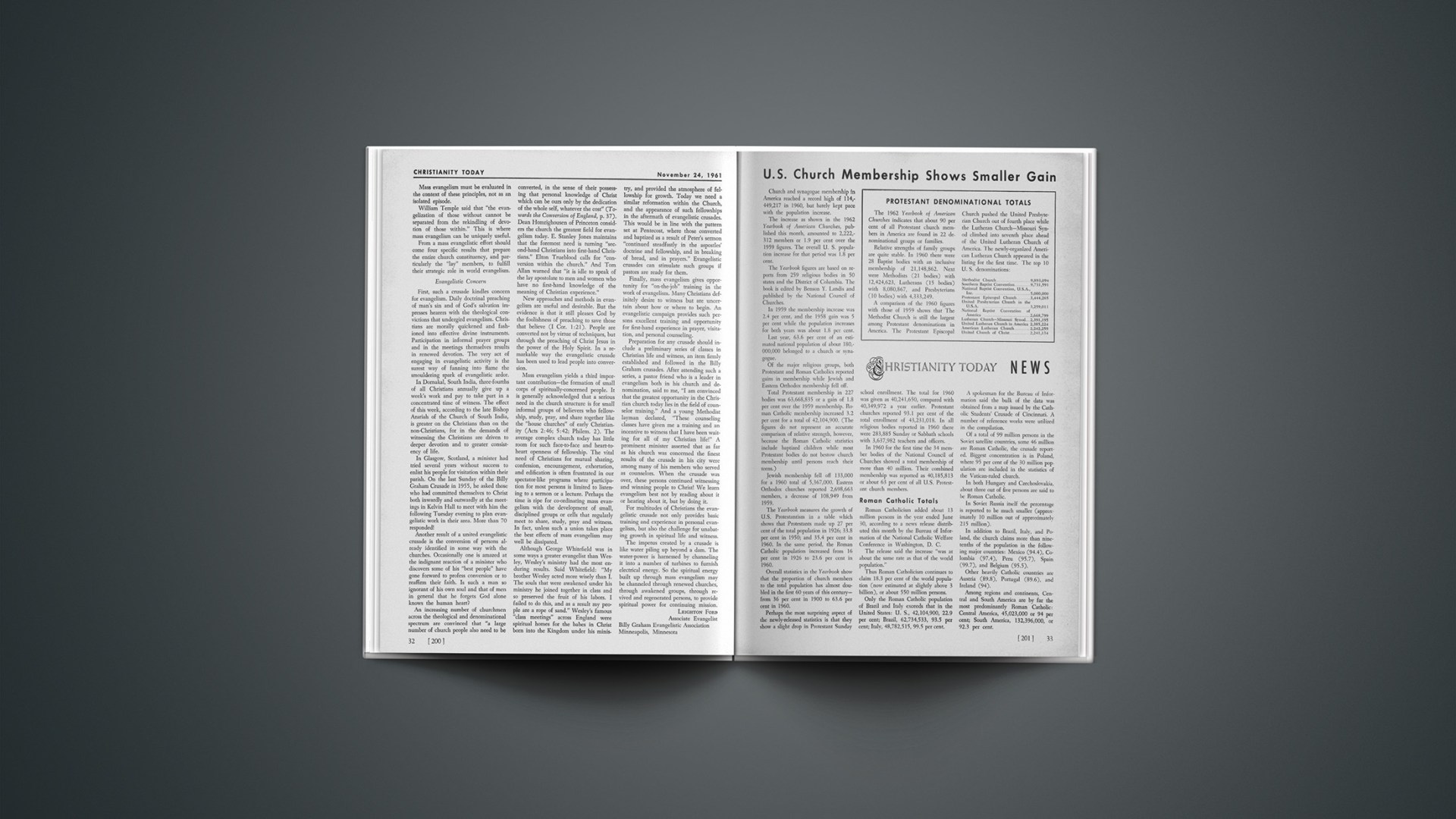
Church and synagogue membership in America reached a record high of 114,449,217 in 1960, but barely kept pace with the population increase.

The increase as shown in the 1962 Yearbook of American Churches, published this month, amounted to 2,222,312 members or 1.9 per cent over the 1959 figures. The overall U. S. population increase for that period was 1.8 per cent.

The Yearbook figures are based on reports from 259 religious bodies in 50 states and the District of Columbia. The book is edited by Benson Y. Landis and published by the National Council of Churches.

In 1959 the membership increase was 2.4 per cent, and the 1958 gain was 5 per cent while the population increases for both years was about 1.8 per cent.

Last year, 63.6 per cent of an estimated national population of about 180,000,000 belonged to a church or synagogue.

Of the major religious groups, both Protestant and Roman Catholics reported gains in membership while Jewish and Eastern Orthodox membership fell off.

Total Protestant membership in 227 bodies was 63,668,835 or a gain of 1.8 per cent over the 1959 membership. Roman Catholic membership increased 3.2 per cent for a total of 42,104,900. (The figures do not represent an accurate comparison of relative strength, however, because the Roman Catholic statistics include baptized children while most Protestant bodies do not bestow church membership until persons reach their teens.)

Jewish membership fell off 133,000 for a 1960 total of 5,367,000. Eastern Orthodox churches reported 2,698,663 members, a decrease of 108,949 from 1959.

The Yearbook measures the growth of U.S. Protestantism in a table which shows that Protestants made up 27 per cent of the total population in 1926; 33.8 per cent in 1950; and 35.4 per cent in 1960. In the same period, the Roman Catholic population increased from 16 per cent in 1926 to 23.6 per cent in 1960.

Overall statistics in the Yearbook show that the proportion of church members to the total population has almost doubled in the first 60 years of this century—from 36 per cent in 1900 to 63.6 per cent in 1960.

Perhaps the most surprising aspect of the newly-released statistics is that they show a slight drop in Protestant Sunday school enrollment. The total for 1960 was given as 40,241,650, compared with 40,349,972 a year earlier. Protestant churches reported 93.1 per cent of the total enrollment of 43,231,018. In all religious bodies reported in 1960 there were 283,885 Sunday or Sabbath schools with 3,637,982 teachers and officers.

Protestant Denominational Totals

The 1962 Yearbook of American Churches indicates that about 90 per cent of all Protestant church members in America are found in 22 denominational groups or families.

Relative strengths of family groups are quite stable. In 1960 there were 28 Baptist bodies with an inclusive membership of 21,148,862. Next were Methodists (21 bodies) with 12,424,623, Lutherans (15 bodies) with 8,080,867, and Presbyterians (10 bodies) with 4,333,249.

A comparison of the 1960 figures with those of 1959 shows that The Methodist Church is still the largest among Protestant denominations in America. The Protestant Episcopal Church pushed the United Presbyterian Church out of fourth place while the Lutheran Church—Missouri Synod climbed into seventh place ahead of the United Lutheran Church of America. The newly-organized American Lutheran Church appeared in the listing for the first time. The top 10 U. S. denominations:

In 1960 for the first time the 34 member bodies of the National Council of Churches showed a total membership of more than 40 million. Their combined membership was reported as 40,185,813 or about 63 per cent of all U.S. Protestant church members.

Roman Catholic Totals

Roman Catholicism added about 13 million persons in the year ended June 30, according to a news release distributed this month by the Bureau of Information of the National Catholic Welfare Conference in Washington, D. C.

The release said the increase “was at about the same rate as that of the world population.”

Thus Roman Catholicism continues to claim 18.3 per cent of the world population (now estimated at slightly above 3 billion), or about 550 million persons.

Only the Roman Catholic population of Brazil and Italy exceeds that in the United States: U. S., 42,104,900, 22.9 per cent; Brazil, 62,734,533, 93.5 per cent; Italy, 48,782,515, 99.5 per cent.

A spokesman for the Bureau of Information said the bulk of the data was obtained from a map issued by the Catholic Students’ Crusade of Cincinnati. A number of reference works were utilized in the compilation.

Of a total of 99 million persons in the Soviet satellite countries, some 46 million are Roman Catholic, the crusade reported. Biggest concentration is in Poland, where 95 per cent of the 30 million population are included in the statistics of the Vatican-ruled church.

In both Hungary and Czechoslovakia, about three out of five persons are said to be Roman Catholic.

In Soviet Russia itself the percentage is reported to be much smaller (approximately 10 million out of approximately 215 million).

In addition to Brazil, Italy, and Poland, the church claims more than ninetenths of the population in the following major countries: Mexico (94.4), Colombia (97.4), Peru (95.7), Spain (99.7), and Belgium (95.5).

Other heavily Catholic countries are Austria (89.8), Portugal (89.6), and Ireland (94).

Among regions and continents, Central and South America are by far the most predominantly Roman Catholic: Central America, 45,023,000 or 94 per cent; South America, 132,396,000, or 92.3 per cent.

Protestant Panorama

• Evangelicals in the Anglican communion are forming a world-wide fellowship—“not partisan in any narrow or negative sense, but positive and ironical”—under the presidency of the Most Rev. H. R. Gough, Primate of Australia. Sponsors hoped to hold the first informal meeting during the World Council of Churches assembly in New Delhi this month.

• Soviet authorities have taken over and closed the Agenskalna Baptist Church in the capital city of Riga, Latvia, according to a report in the Baptist World. Only three Baptist churches out of eight in Riga remain open, the report said.

• Some 8,000 Koreans made professions of faith during an evangelistic mission conducted this fall by 13 American Methodists. The mission was directed by Dr. Harry Denman, director of the Methodist General Board of Evangelism.

• Representatives of 11 missionary societies from four countries met for two days in Kobe last month and came up with a “declaration of intent” to organize a united Lutheran church in Japan. Plans were approved to hold a constituting convention next October 31—Reformation Day, with the formal merger to take effect in January of 1963. The new church, expected to consolidate five missions from the United States, three from Norway, two from Denmark, and one from Finland, will consist of some 10,000 members in 200 congregations and preaching places served by 100 Japanese pastors and 100 missionaries.

Decision, monthly publication of the Billy Graham Evangelistic Association topped the 1,000,000 mark in circulation with its November issue. Meanwhile, the evangelist’s eight-night television crusade was reported to have produced the biggest mail response that association offices in Minneapolis have ever handled.

• The Lutheran Foundation for Religious Drama will sponsor December performances of “A Cradle of Willow,” a Nativity play by English playwright Dorothy Wright.

• Government should not “use the churches” to promote political programs and ideologies, says a statement from the Baptist Joint Committee on Public Affairs. The statement was adopted at a semi-annual session of the committee in Washington last month.

• The first Protestant church built in Israel since its establishment as a state in 1948 was dedicated last month in Nazareth. It will house a congregation of the Church of the Nazarene. Officiating at the dedication was Dr. Hardy C. Powers of Dallas, Texas, a general superintendent of the Church of the Nazarene. The new church seats about 200.

• White Temple Methodist Church of Miami received Guideposts magazine’s annual Church Award for its three-year-old program of spiritual and material aid to Cuban refugees.

• Central Baptist Theological Seminary of Kansas City, Kansas, is recipient of a bequest valued at some $260,000 from the estate of the late Leo Kull of Topeka. Kull’s will provides for a 20-year trust with a monthly income to the seminary. A nursing home eventually will be deeded to the seminary as well.

• “Two Offerings,” a sermon by Thomas B. Peake, Jr., of Dallas, Texas, won first place in the 1960–61 Stewardship Sermon Contest sponsored by Unified Promotion of the Christian Churches (Disciples of Christ). The sermon was given from the pulpit of Dallas’ Highlands Christian Church.

• The Evangelical Alliance Mission plans to begin operation of a new radio station in Lima, Peru.

• Canadian Bible College of Regina, Saskatchewan, affiliated with the Christian and Missionary Alliance, was granted accreditation last month by the Accrediting Association of Bible Colleges at the group’s 15th annual meeting in Chicago. Admitted to associate membership were Kentucky Christian College of Grayson, Kentucky, and Southern Pilgrim College of Kernersville, North Carolina.

Lutheran Ecumenicity

A new “Lutheran inter-church agency for common theological study and Christian service” was proposed this month.

The new agency, embracing 8,000,000 or more U. S. Lutherans, would replace the present National Lutheran Council and would include the Lutheran Church—Missouri Synod, which cooperates in certain phases of NLC work but which has steadfastly refused to become a member.

As late as February, 1959, the Missouri Synod had turned down a membership bid from the NLC. Missouri Synod President John W. Behnken at that time said there was a “state of flux” in the doctrinal positions of NLC churches and called attention to the work of the Lutheran Synodical Conference of North America toward “greater Scriptural harmony in doctrine and practice.”

Three months ago, however, the back of the Synodical Conference was broken when the Wisconsin Evangelical Lutheran Synod, charging liberalism, severed relations with the Missouri Synod. The two churches had been the conference’s two principal members.

The move for a new agency was announced in the following statement released by representatives described therein:

“The third of a series of consultations between representatives of the Lutheran Church-Missouri Synod and the National Lutheran Council regarding the issue of Lutheran cooperation was held at the Lake Shore Club of Chicago, October 31–November 1, 1961. This meeting was the final one of a series of three held during 1960–61. The earlier conversations centered around the subject ‘Doctrine of the Gospel’ and ‘The Significance of Confessional Subscription.’

“Papers prepared by Dr. Martin Franzmann of Concordia Seminary, St. Louis, Mo., and Dr. Alvin Rogness, president of Luther Seminary, St. Paul, Minnesota, on the subject ‘What Kind of Cooperation is Possible in View of Discussion to Date?’ were read and discussed by the participants of whom 14 represented the Lutheran Church-Missouri Synod, and 18 represented the National Lutheran Council.

“It was the unanimous judgment of the participants that the papers and discussions revealed a consensus on the doctrine of the Gospel and the meaning of confessional subscription sufficient to justify further exploration regarding the possible establishment of a new cooperative Lutheran agency to replace the National Lutheran Council. The successor agency would have as one of its major functions the continuing of theological study with the objective of achieving ever greater unity.

“The representatives of the two groups are to take appropriate steps whereby resolutions will he submitted to the next conventions of the churches involved which would authorize negotiations looking toward a possible future cooperative association of Lutheran churches in America. If the proposal is approved by the churches involved all Lutheran church bodies in the United States will be invited to participate in planning and formation of the new association, which would serve as a Lutheran inter-church agency for common theological study and Christian service.”

Boycott Of Television?

A Lutheran editor proposes a “great American TV strike” as a protest against the quality of television programs.

“Turn the thing off and leave it off until the networks can come up with a new plan,” Dr. G. Elson Ruff, editor of The Lutheran, said in an editorial published in the November 8 issue of the weekly news magazine of the United Lutheran Church in America.

Ruff was commenting on two articles dealing with television which appeared in the magazine.

The only way to “rescue” TV, he said, is to “take it away from advertisers and give it to the authors.”

He asserted that “TV at present is at least 50 per cent a device of businessmen to push the sale of cereals, detergents, cathartics.”

“They are cooperating in a deceptive racket,” he charged.

In an article tided “Save Our Children from TV,” Mrs. Eleanor D. Mora, a church school teacher from Marlton, New Jersey, said television “may be extremely harmful to the spiritual growth of our Christian families.”

Dr. Robert E. Huldschiner, assistant editor of the magazine, came to the defense of the medium in a “memo to a frustrated church school teacher.”

Huldschiner is also a writer of TV scripts.

He argued that there is a “lot of good in TV” and that there would have been more if many of the best writers had not left TV after the first few years.

“One of the reasons why they did,” he said, “is because so many well-meaning people courtmartialed TV after a brief hearing and placed it out of bounds for the educated and discerning audience.”

‘In God We Trust’

Beginning next month, all new U. S. one-dollar bills will bear the words “In God We Trust.” Congress voted that the motto be applied to currency some six years ago, but old engravings have continued in use. Bills of all denominations eventually will carry the motto.

Historic Churches

Two more American colonial churches are being added to the Registry of National Landmarks by the U. S. Department of the Interior.

Holy Trinity (Old Swedes) Church of Wilmington, Delaware, and the Dutch Reformed (Sleepy Hollow) Church of North Tarrytown, New York, were given the distinction in an announcement made this month by Secretary of the Interior Stewart L. Udall.

The Old Swedes Church, according to Udall, was erected in 1698 and is “the oldest surviving Delaware Valley Swedish Church.”

“No other structure so closely related to Swedish settlement contains such architectural integrity,” he said.

The Sleepy Hollow church was hailed as a “distinguished relic of Dutch America.” Architects believe it was erected about 1690. A new church was built as an extension of the first about 1840, and since then the old church has been used only on infrequent occasions for worship services. It has, however, been maintained in good condition. In its adjacent burial ground lies the famous author, Washington Irving, who wrote “The Legend of Sleepy Hollow.”

Each new historical site is identified with a marker from the National Park Service, but the buildings continue to be maintained by their owners without cost to the government.

A Family Plea

President Kennedy’s Thanksgiving proclamation called upon Americans to observe the day “with reverence and with prayer that will rekindle in us the will and show us the way not only to preserve our blessings, but also to extend them to the four corners of the earth.”

“I ask the head of each family,” he said, “to recount to his children the story of the first New England Thanksgiving, thus to impress upon future generations the heritage of this nation born in toil, in danger, in purpose, and in the conviction that right and justice and freedom can through man’s efforts persevere and come to fruition with the blessing of God.”

Mennonites And Society

Mennonites are doing an about-face in their relationships with society, according to a report from their General Conference News Service.

The report was one of several covering a four-day fall “Study Conference on the Church and Society” held in Chicago and attended by Mennonite leaders from the United States and Canada.

“The last generation has turned up new facts about Anabaptist-Mennonite history,” the report said. “The original roots of this Reformation group lie imbedded not in withdrawal but in a bold witness to society. This boldness came from a simple acceptance of biblical imperatives.”

The report noted how Mennonite history has been marked by continual moves in search of isolation, but added that the Mennonite church is now “facing the world that it once regarded as evil to the point of hopelessness.”

Among topics discussed at the Chicago conference: international relations, civil defense, labor-management, race, church-state, capital punishment, alcohol, urbanization, and agriculture.

Canadian Evangelism

In Halifax, Nova Scotia, a crowd of 10,000, said to have been the largest Protestant gathering in the city’s 212-year history, witnessed the closing service November 3 of a three-week “Mission in Evangelism” by the Rev. Tom Allan.

Allan, minister of St. George’s-Tron (Presbyterian) Church in Glasgow, Scotland, has now held a number of successful evangelistic crusades in Canada. His ministry is highly esteemed among Canadian evangelicals of many denominations.

Allan met area ministers in a week-long “School of Evangelism,” appeared before 5,000 public school children and teachers, conducted a campus mission at Dalhousie University, and preached at noon-day meetings in St. Paul’s Anglican Church, oldest Protestant church in Canada.

Thirteen evening meetings were held at the Halifax Forum, with 770 recorded decisions for Christ. Sunday services were broadcast over a local station as well as through a short-wave outlet. One was telecast throughout the province.

General chairman of the Halifax mission was the Rev. Ronald C. MacCormack, a Baptist pastor.

Social Welfare And The Churches

The National Council of Churches held its second National Conference on Social Welfare in Cleveland, October 23–27. More than 2500 delegates and 600 social welfare specialists from 40 major Protestant and Eastern Orthodox communions grappled with the momentous problems of the handicapped and unemployed, the blind and ill, and those incapacitated by narcotics, alcoholism, and injury. The parley sought to implement goals and policies growing out of the first conference in 1955 and the policies formulated at a strategy conference in Atlantic City in 1957. Yet throughout the week-long discussions it was evident that progress was hampered by the divergencies of basic positions held by the delegates regarding the ways, means, goals, and purposes of welfare service.

The parley was consistently concerned with the welfare needs of all members of the civil community. There was no desire to serve only its own membership, or to first determine whether the man in need were a brother in Christ. The conference was moved by a Christian compassion to visit the sick, feed the hungry, and clothe the naked of whatever creed, color or race.

The parley also appeared to be governed by the consensus that the Church is obliged to serve men in need and thus administer to them the mercy of Christ.

It was widely held that the diakonia—the service rendered by the traditional deacon—belongs to the very heart of the Church’s task. What, it was asked, would the Church be if the hearts of its members were not stabbed by the pain of the neighbor’s need?

Yet this very Christian concern for all men in need, and the awareness of the obligation to reveal the suffering servant form of her Lord in social concern, constantly threatened in the floor discussions to thin into something more shadow than substance.

A substantial number of voices urged that when governmental or other secular agencies could equal or better the Church’s concern and provision for the needy, the Church should turn the service over to them and concern itself with other areas of social need. The feeling was that the obligation to feed the hungry and clothe the naked rests upon the State rather than upon the Church, the Church being obliged to do so only in an emergency situation in which government lags behind its duty. According to this view, if the community and State did its whole duty, the Church could be freed of a duty which really did not belong to it.

Other voices—again not in the majority, but of sufficient number to be disturbing—asserted that the Christian’s act of social service carries no distinctive quality that renders its service better or more desirable than acts of such service accomplished by secular or governmental agencies. Social service rendered by the Church had no “plus value.” And other floor voices contended that the Church’s social welfare action need not be employed as a witness to the redemption that God has accomplished in Christ.

The willingness to hand the task of social service to the secular or governmental agency, the denial of any “plus value,” and the willingness to sever Christian social action from the Church’s redemptive concern, are all ideas which stem from an obliteration of the difference between Church and world.

While these floor voices which seemed to threaten the dissipation of the distinctive character and purpose of Christian social service seemed not to be in the majority—and were indeed often strongly rejected—yet it is significant that the verbalized formulations of the expressions of the delegates often echoed those sentiments heard on the floor.

The Section on Government and Social Welfare declared that the American people enjoy the special asset of having “a form of government which is designed to be an instrument of the community to promote the general welfare.” The draft also asserted, “We believe that the American people should make full use of their government in meeting welfare needs.” Government was described as “one of the instrumentalities which the community may use to discharge its responsibilities for meeting all the welfare needs of all the people.” This same report stated, “The provision for social welfare is the responsiblity of the total community functioning through the channels of government.” Thus what seemed to be the minority view is the view presented in the written formulation to be sent to the churches for further study. Whether the various churches of the National Council are willing to buy the idea that Americans should make full use of the government—even where no large scale emergency exists—in meeting welfare needs; whether they are willing to buy the idea that the provision for social welfare is the responsibility of the whole community “functioning through the channels of government,” remains to be seen.

The presuppositions, discussions, and tentative conclusions of the conference suffered from blurred ambiguities stemming from the failure of the delegates to make clean-cut, recognizable distinctions between Church and community, Christian and non-Christian. The result was a lack of clarity and the unhappy situation where a Christian observer feels obliged to both agree and disagree with so many of the conference’s significant utterances.

Meeting at a time when the country was discussing as never before the need for fallout shelters, the Cleveland conference was strangely silent on the problem.

Many observers felt that such social welfare conferences are surely needed. Equally needed, they felt, is an admixture of hard-headed leadership and clean-cut thinking with the traditional American’s compassion for the needy.

J. D.

Church Shelters

A suburban Denver church is being designed to double as a community fallout shelter, first such in the nation. Two underground levels of the Green Mountain Christian Church will accommodate 800 persons for a two-week period.

Civil defense officials in Washington say every U. S. church eventually will be inspected to determine its suitability as a shelter.

The Latin Protestants

There are now at least 3,441,415 baptized Protestant church members in Latin America, according to a new reference work published by the Evangelical Foreign Missions Association.

The figure still represents a small minority in the Latin American population, estimated at some 190,000,000. It is a conservative figure, however, inasmuch as data compilers were unable to secure statistics from a number of independent groups. Even so, it represents an eightfold growth over the 1937 figure of 422,395.

The new reference work, Protestant Missions in Latin America, consists of a 314-page cloth-bound book and 30 maps, each measuring 28 by 36 inches. It is the most comprehensive survey of Protestant impact in Latin America ever produced. Editors are Dr. Clyde W. Taylor and the Rev. Wade T. Coggins.

Among agencies which assisted in the collection of data were the Interdenominational Foreign Mission Association, the Committee on Cooperation in Latin America, and the Evangelical Missions Association (England).

Scholarly Conservatism

A five-day conference in Cordoba marked the first time in Argentine history that Protestant leaders of conservative and liberal persuasion had ever assembled together for joint prayer and study.

On hand for the September 25–29 conference were 450 pastors, lay leaders, and missionaries from 20 denominations in Argentina and Uruguay. It was organized by the Federation of Christian Churches of Argentina and held under auspices of World Vision. Speakers included World Vision President Bob Pierce, Dr. Bernard Ramm, and Dr. Paul Rees.

The Latin Americans took special note of Ramm’s unusual ability to present profound theological terms in simple terms, well illustrated and seasoned with humor. Conservatives as well as liberals expressed appreciation for his thorough understanding of ancient and modern theology.

Such scholars as Ramm, who is well-known in the United States as a leader of evangelical thought, are still obscure in Latin America. Union seminaries and publishing houses related to the Committee on Cooperation in Latin America have presented the liberal theological viewpoint in thorough, scholarly terms. Serious evangelical books, on the other hand, are practically unknown. Even some of the leading evangelical works have not yet been translated. The void has resulted in the conservative position being associated with theological obscurantism.

Using The Church

The ruling Convention People’s Party of Ghana is setting up party branches in all churches, as well as in industrial and cultural organizations, cooperative farms, and factories.

The CPP paper Evening News declared that formation of party branches in churches “would help chase away unnecessary suspicions, promote peace and happiness in Ghana and forever stabilize the churches with their music and sense of mission as an important wing in Ghana’s move to create work and happiness for all.”

As unfavorable reaction became apparent, the party’s official organ hastened to assure the public that the CPP had no intention of interfering with the religious life of any church.

“The party needs the friendship of the churches in the great national task of furthering Nkrumaism,” an editorial stated. It asserted that Nkrumaism is “a beautiful and impressive comradeship that is almost biblical, expressing the unity of man in a society that knows no class or creed.”

Establishing Dates

An archaeological expert in Israel claims that 64 first-century documents unearthed last winter constitute the greatest find of that type since the discovery of the Dead Sea Scrolls.

Yigael Yadin, professor of archaeology at Herbrew University of Jerusalem, said in a press conference that the primary importance of the find is that the documents “are absolutely dated—many of them triple-dated with the year, month, and day.”

The Last To Leave

The Dutch Reformed Church of the Cape Province decided by an overwhelming majority at its synod meeting this month to withdraw from membership in the World Council of Churches.

The decision came in the wake of earlier synod action repudiating the findings of a WCC-sponsored conference in Johannesburg last December which criticized the apartheid (racial segregation) policies of South Africa.

All direct links between the South African Reformed churches and the WCC have now been severed, two other bodies having already withdrawn their memberships.

The Strategic Role of Mass Evangelism

The recurring debate over mass evangelism always raises questions about financial policies, emotionalism, sensationalism, follow-up procedures, public invitations, and other techniques. Though important, these tactical concerns are far less significant than the basic strategic issue: Does mass evangelism have a legitimate and an effective place in the overall evangelistic strategy of the Church?

Any church or pastor contemplating the support of an evangelistic campaign must face this problem. “Will this pay off?” is one approach. “Does God will it?” is quite another. Surely we must grant that in the work of God’s kingdom not success but obedience is the only valid criterion for action.

Yet the pastor faces a quandary. “I cannot do everything demanded of me. Shall I do this particular thing? Shall I do it now? What spiritual dividends can I rightfully expect from the invested time, money, and effort? Would God’s cause benefit more if we applied our energies at this time in some other direction?”

Like the pastor, the evangelist has his questions also. “Is this work the will of the Lord for me? Or could I more effectively devote myself to some other task?” Such probing involves frequent, agonizing re-appraisal.

What, in truth, are the values of mass evangelism? Actually, an evangelistic crusade helps a church both directly and indirectly. First of all the stir and impact made by the collective effort of Christian churches can break through the spiritual indifference of a community. Reports of great crowds, talk of spiritual things, widespread publicity, the news value of a religious event in the mass media, the power of united prayer, and the hovering of the Spirit of God—all these factors cut a deep swath into apathy. A God-conscious atmosphere may overtake a community, may give local Christians unusual opportunity to talk about the things of Christ with their fellows.

Mass evangelism also highlights the essential unity in Christ of many Christian groups. The beneficial effects of such oneness in purpose cannot he overestimated. Cynical unbelievers who usually scorn divisions among Christians now see such groups standing shoulder to shoulder in efforts to call men to faith in their one Lord. Many Christians, aware of their limited spiritual influence in the neighborhood, or on the job, or through their little church, return from the meetings with a new perspective of the wider fellowship of Christ’s people.

And certainly evangelistic campaigns have their indisputable conversions—some thrilling and exciting, some quiet but just as real. Many “harvested” for Christ through a crusade have been prepared by the more regular ministries of the church.

While such results bring joy they do not, however, meet the fundamental question: “What is our strategy in evangelism, and what place, if any, does mass evangelism play in it?”

Principles of Evangelistic Strategy

Three strategic principles must underlie any program:

1. The evangelization of the world is the goal.

2. The whole Body of Christ is the instrument of evangelism.

3. Convincing and equipping the “layman” to meet his responsibility as soul-winner and witness is the most immediate and urgent task.

Mass evangelism must be evaluated in the context of these principles, not as an isolated episode.

William Temple said that “the evangelization of those without cannot be separated from the rekindling of devotion of those within.” This is where mass evangelism can be uniquely useful.

From a mass evangelistic effort should come four specific results that prepare the entire church constituency, and particularly the “lay” members, to fulfill their strategic role in world evangelism.

Evangelistic Concern

First, such a crusade kindles concern for evangelism. Daily doctrinal preaching of man’s sin and of God’s salvation impresses hearers with the theological convictions that undergird evangelism. Christians are morally quickened and fashioned into effective divine instruments. Participation in informal prayer groups and in the meetings themselves results in renewed devotion. The very act of engaging in evangelistic activity is the surest way of fanning into flame the smouldering spark of evangelistic ardor.

In Dornakal, South India, three-fourths of all Christians annually give up a week’s work and pay to take part in a concentrated time of witness. The effect of this week, according to the late Bishop Azariah of the Church of South India, is greater on the Christians than on the non-Christians, for in the demands of witnessing the Christians are driven to deeper devotion and to greater consistency of life.

In Glasgow, Scotland, a minister had tried several years without success to enlist his people for visitation within their parish. On the last Sunday of the Billy Graham Crusade in 1955, he asked those who had committed themselves to Christ both inwardly and outwardly at the meetings in Kelvin Hall to meet with him the following Tuesday evening to plan evangelistic work in their area. More than 70 responded!

Another result of a united evangelistic crusade is the conversion of persons already identified in some way with the churches. Occasionally one is amazed at the indignant reaction of a minister who discovers some of his “best people” have gone forward to profess conversion or to reaffirm their faith. Is such a man so ignorant of his own soul and that of men in general that he forgets God alone knows the human heart?

An increasing number of churchmen across the theological and denominational spectrum are convinced that “a large number of church people also need to be converted, in the sense of their possessing that personal knowledge of Christ which can be ours only by the dedication of the whole self, whatever the cost” (Towards the Conversion of England, p. 37). Dean Homrighousen of Princeton considers the church the greatest field for evangelism today. E. Stanley Jones maintains that the foremost need is turning “second-hand Christians into first-hand Christians.” Elton Trueblood calls for “conversion within the church.” And Tom Allan warned that “it is idle to speak of the lay apostolate to men and women who have no first-hand knowledge of the meaning of Christian experience.”

New approaches and methods in evangelism are useful and desirable. But the evidence is that it still pleases God by the foolishness of preaching to save those that believe (1 Cor. 1:21). People are converted not by virtue of techniques, but through the preaching of Christ Jesus in the power of the Holy Spirit. In a remarkable way the evangelistic crusade has been used to lead people into conversion.

Mass evangelism yields a third important contribution—the formation of small corps of spiritually-concerned people. It is generally acknowledged that a serious need in the church structure is for small informal groups of believers who fellowship, study, pray, and share together like the “house churches” of early Christianity (Acts 2:46; 5:42; Philem. 2). The average complex church today has little room for such face-to-face and heart-to-heart openness of fellowship. The vital need of Christians for mutual sharing, confession, encouragement, exhortation, and edification is often frustrated in our spectator-like programs where participation for most persons is limited to listening to a sermon or a lecture. Perhaps the time is ripe for co-ordinating mass evangelism with the development of small, disciplined groups or cells that regularly meet to share, study, pray and witness. In fact, unless such a union takes place the best effects of mass evangelism may well be dissipated.

Although George Whitefield was in some ways a greater evangelist than Wesley, Wesley’s ministry had the most enduring results. Said Whitefield: “My brother Wesley acted more wisely than I. The souls that were awakened under his ministry he joined together in class and so preserved the fruit of his labors. I failed to do this, and as a result my people are a rope of sand.” Wesley’s famous “class meetings” across England were spiritual homes for the babes in Christ born into the Kingdom under his ministry, and provided the atmosphere of fellowship for growth. Today we need a similar reformation within the Church, and the appearance of such fellowships in the aftermath of evangelistic crusades. This would be in line with the pattern set at Pentecost, where those converted and baptized as a result of Peter’s sermon “continued steadfastly in the aspostles’ doctrine and fellowship, and in breaking of bread, and in prayers.” Evangelistic crusades can stimulate such groups if pastors are ready for them.

Finally, mass evangelism gives opportunity for “on-the-job” training in the work of evangelism. Many Christians definitely desire to witness but are uncertain about how or where to begin. An evangelistic campaign provides such persons excellent training and opportunity for first-hand experience in prayer, visitation, and personal counseling.

Preparation for any crusade should include a preliminary series of classes in Christian life and witness, an item firmly established and followed in the Billy Graham crusades. After attending such a series, a pastor friend who is a leader in evangelism both in his church and denomination, said to me, “I am convinced that the greatest opportunity in the Christian church today lies in the field of counselor training.” And a young Methodist layman declared, “These counseling classes have given me a training and an incentive to witness that I have been waiting for all of my Christian life!” A prominent minister asserted that as far as his church was concerned the finest results of the crusade in his city were among many of his members who served as counselors. When the crusade was over, these persons continued witnessing and winning people to Christ! We learn evangelism best not by reading about it or hearing about it, but by doing it.

For multitudes of Christians the evangelistic crusade not only provides basic training and experience in personal evangelism, but also the challenge for unabating growth in spiritual life and witness.

The impetus created by a crusade is like water piling up beyond a dam. The water-power is harnessed by channeling it into a number of turbines to furnish electrical energy. So the spiritual energy built up through mass evangelism may be channeled through renewed churches, through awakened groups, through revived and regenerated persons, to provide spiritual power for continuing mission.

LEIGHTON FORD

Associate Evangelist

Billy Graham Evangelistic Association

Minneapolis, Minnesota

Ideas

Unity: Quest and Questions

The search for an outward, visible unity of God’s people is nothing new. Recent endeavors like the World Council of Churches actually result from a long history of efforts by Christians to get together. The nineteenth century had many movements with ecumenical dimensions. In 1838, for example, Samuel Schmucker, a Lutheran, proposed a plan to unite Protestant churches on a federated basis. Implemented by Philip Schaff, the eminent church historian, Schmucker’s idea eventuated in establishing national federations of churches. Organizations like the American Bible Society, the American Tract Society, the Evangelical Alliance, the YMCA and YWCA, as well as the rise of interdenominational foreign mission boards, of interdenominational theological seminaries and of ecumenical missionary conferences as at Toronto (and at Edinburgh in 1910) were other indications of activity and concern beyond sectarian limits. It should be quite obvious, then, that the present ecumenical thrust in America and around the world is only continuing an attitude and perspective that reaches back more than a century.

In dealing with ecumenicity our concern here is limited to the visible church. We do not include the invisible church with its broader fellowship of saints already departed and of those saints yet to come. In their expositions men like Augustine, Luther, Calvin, and Wycliffe have clearly defined the biblical concept of the invisible church; its unity is indivisible because its membership is a united fellowship that centers in the living Christ, the head of the church. The unity of this invisible church in heaven should find its logical projection in the visible church on earth. Instead the visible church displays discord, schism and division.

Serious Bible students realize that the unity of the body of Christ in its visible manifestations is the will of God. Whether this unity can be expressed only in one great church organization or whether it can be attained spiritually without organic union is something else again. But the absence of unity, whatever Scripture may mean by that term, is cause for sorrow, not for rejoicing. Therefore today’s deep concern everywhere over the disunity of the body of Christ is really something wholesome. In the days ahead this concern undoubtedly will increase rather than diminish. This is as it should be.

Except for a few scattered belligerents (sometimes even at odds with themselves), no earnest believers vote against true unity. Many persons, however, sharply disagree about the nature and the implementation of that unity. The National Council of Churches is one expression of unity at work, The National Association of Evangelicals another. The American Council of Christian Churches represents still another. The very existence of these organizations is, in itself, a vote for unity. Each favors it, but each means something different by the word.

Denominationalism has not caused the present disunity of the Christian church, as evidenced by one important but frequently overlooked fact. The average lay person shows greater active interest in his local church, than in his denomination as such. When he moves from one area to another, therefore, he often transfers his membership to a church of another denomination because he favors the program and preaching of that particular local church. More and more he seems willing to sacrifice denominational ties in order to obtain what is spiritually vital to him. A theologically conservative Presbyterian, for example, can be found worshipping in a conservative Baptist church when the local Presbyterian church is liberal; and a liberal Congregationalist can be found in a Unitarian church when the local Congregational church is in the conservative evangelical tradition.

If denominationalism does not cause disunity, where else may lie the major hindrances to some better expression of visible church unity before an unbelieving world? Two problems undoubtedly concern faith and order, issues which even the modern ecumenical movement finds crucial in its discussions. Totally apart from the vexing fact of human contrariety, the questions posed by faith and order are of such magnitude that any unity which bypasses or inadequately answers them can only produce some sort of pseudo-unity behind whose facade crowds a Babel of confusion.

What then needs to be said about faith and order? Calvin stressed an “indivisible connection which all members of Christ have with one another.” This conviction is undoubtedly valid. The problem comes in trying to define “members of Christ,” a consideration that involves faith and doctrine. In effect, the World Council of Churches declares a “member of Christ” as one who believes that Jesus Christ is God and Saviour. Around this theological pronouncement (whether it be thought of as testimony or as creedal statement) the Council seeks to establish unity. Certain dissenting voices claim that this statement, while true, is inadequate. Calvin himself would have had to agree with this objection. The very church he declared not to be a church, and from which he disassociated himself with no qualms of conscience, could and would endorse the theological platform of the World Council of Churches. But how could Calvin justify leaving the Roman church which affirmed, then as now, that Christ is God? He could withdraw only because such an affirmation was insufficient to sustain one of the two marks of a true church, a church where “we see the Word of God purely preached and heard.” Surely the absence of essential truth should cause concern no less than the presence of perverted, hence corrupted truth. At the second assembly of the WCC at Evanston in 1954 the Orthodox Church pointed out the theological inadequacy of the Council by saying: “It is not enough to accept just certain particular doctrines, basic as they may be in themselves, e. g., that Christ is God and Saviour. It is compelling that all doctrines as formulated by the Ecumenical Councils, as well as the totality of the teaching of the early, undivided Church, should be accepted.”

Since doctrinal consensus is essential, the question then follows: “What minimal testimony, confession of faith, or creed, is required in order to preserve the ‘purely preached Word of God?’ ” On this basis the problem of the World Council of Churches is not that it has said too much, but that it has said too little. Immediately, however, one must recognize the danger of the opposite approach; those who “say too much” by defining the particulars of the faith in microscopic detail may thereby exclude everyone but themselves from the “unity” of fellowship. Both extremes must be avoided. Surely one should appreciate the plight of the World Council as it tries to determine the major affirmations of the Christian faith. But one cannot restrain the thought that a doctrinal confession of faith ought certainly to precede and to undergird the Council’s organizational manifestation; absence of proper foundation jeopardizes any superstructure. Moreover the World Council should investigate all aspects of a minimal confession of faith. Such a confession must be broad enough to include all true believers, but narrow enough to exclude all those who are outside the family of the faithful. As it now stands the World Council’s confession is sufficiently latitudinarian to embrace those who ought to be excluded. Strengthening of the present affirmation would be welcome indeed and cause for rejoicing.

If the WCC operates on an inadequate doctrinal foundation, the Roman Catholic Church has moved in the opposite direction. To the ecumenical creeds she has added concepts like the immaculate conception and the assumption of Mary, the infallibility of the pope, and five sacraments. All these tenets are regarded a part of the church’s essence; to deny them assertedly means loss of redemption. Thus the Roman church has severed herself from a continuity of witness to the apostolic tradition. And she has added the word of man to the Word of God with the insistence that man’s word be acknowledged on an equality with the Word of God. Actually some modern Protestant theologians have erred in the same direction so that the word of man has overshadowed the Word of God, and the continuity of witness to the apostolic tradition has been undermined. Therefore, while a minimal statement like that of the WCC has its dangers, an improper extension of doctrine is likewise hazardous.

The ecumenical dialogue, moreover, all too often has espoused a unity based on love, a love, however, whose definition falls short of theological adequacy. Whether or not “doctrine divides, love unites,” to use love as an umbrella to cover doctrinal differences and deficiencies, however hopefully, does not solve the basic problem. Indeed the principle of togetherness might conceivably be extended to cover Unitarian, Mormons and similar groups, too. Doctrine does divide. It always has and it always will. And indeed it must, even as the Bible does, in order to separate truth from error. On the other hand the kind of doctrinal jealousy that drives men to strain out a gnat while they swallow a camel is most unfortunate. The quarrel is not with the emphasis on love, but with the implication that since doctrine divides it should be avoided like a plague, and with the idea that doctrine and love in themselves are mutually incompatible. Actually both doctrine and love should be emphasized.

Genuine biblical love is impossible apart from sound doctrine. Since God is love, all love issues from his being. Love is the fruit of the Holy Spirit created in the heart of man by the Spirit (Rom. 5:5; Gal. 5:22). The same God who is love is also truth. Therefore love must correspond to truth. Thus if it is not grounded in sound doctrine, love is not true love even though called by that name. Conversely, sound doctrine cannot be loveless; the Christian is commanded to love as an expression of the doctrinal framework of the faith.

The second problem that vexes the ecumenical movement is the question of order. Certainly order more than faith keeps the Roman Catholic Church from fruitful conversation with the ecumenical movement. One might predict with some accuracy that were the present membership of the World Council of Churches to submit to Roman Catholic order, i.e., papal supremacy, there could be an immediate reunion of Western Christendom even though the Reformers viewed the papacy as the height of human pretension and disavowed the Roman Catholic Church as a true church. The episcopacy, or the right of holy orders, stands at the center of the problem of church order. Supporters of episcopacy cannot honestly acknowledge that those without benefit of ordination by bishops who stand in apostolic succession from the days of the apostles are to be accepted as ministers of the Gospel. And since the validity of the sacraments is inextricably bound to the person who superintends them there can be no valid baptism or celebration of the Eucharist by one who has not received holy orders via apostolic succession. For those in the tradition of apostolic succession to concede at this point would be to deny the heart of their establishment. Contrariwise for others to embrace the episcopal view would be to stress what they declare to be non-essential, if not opposed, to their views of the Christian faith. Whether the non-episcopal forces will bow to the episcopal view by way of concession rather than principle, and whether even this gesture would bridge the gap are still moot questions.

Discussions of church order, moreover, lead naturally to the question as to whether, on this subject, God’s Word lays down principles which are binding upon the churches. The importance of this question is obvious. If the Word of God specifically supports Congregational, or Presbyterial, or Episcopal ecclesiology, then any others must be in error and do not reflect the biblical norm. Furthermore, the people who embrace other ecclesiologies must be sinning and should therefore change. On the other hand, if the Word of God does not prescribe one particular form of church order but allows for free expression according to the genius and spiritual needs of God’s people, then denominations as we know them are not sinful. They are, rather, creative expressions of the sovereign working power of the Holy Spirit.

The future of unity depends in some measure at least, then, on the answers given to the aforementioned questions. Obviously the problems of faith and order will not be solved readily, for no one person or group has all the truth. But contemporary theology with its confusion and contradiction hardly provides as secure a basis for Christian togetherness as does faith rooted in God’s authoritative Word. However limited the perspective of any group or individual may be, certain conclusions cannot be disputed. 1. Because they have been baptized by the same Spirit those who are in Christ are indivisibly united. 2. Because they are thus joined they ought to be able to worship, pray, live, and love together regardless of ecclesiastical affiliation. 3. Anything that divides the true people of God and prevents their demonstration of essential unity before a hostile world is sin.

Watching The Crucifixion For The Pleasure Of It

While in Cleveland to promote the film “King of Kings,” Ron Randell recently took the opportunity to chatter to the press about the film’s critics. “It’s chic for critics to tear apart a religious movie,” he protested, “but they’re not students of the Scriptures.” Randell plays the role of the Centurion, a role not spelled out in the New Testament but created for the movie by Philip Yordan.

Since his role stems from the script of Yordan, his appeal to the Holy Scriptures loses considerable force. And it is equally “chic” to assume that all the film’s critics are strangers to the Scriptures.

Randell’s own canons of criticism? According to the Cleveland Press Randell declared, “The movie carries a Christian message, but it should not be judged for that but rather as entertainment and as a money-making enterprise.”

“King of Kings” has received the most unfavorable comment given a religious film in a long time. But Randell outdoes the critics when he urges that the film should be evaluated not in terms of whether it conveys the factual story of Christ, but whether or not it entertains and makes money. His defense is so damning as to make it doubtful whether the film will achieve either objective.

Communism’S Religious Slip Was Showing

G. K. Chesterton once made the shrewd observation that to swear effectively men must make reference to God. Imagine, he said, an atheistic evolutionist trying for a blood-curdling oath by swearing in the name of natural selection, or by the slimy, primeval amoeba.

Chesterton spotlighted the truth that all men so truly live and move and have their being in God that without him they cannot think, act, or even swear. Men curse and reject God only by appealing to him.

This need for reference to the ultimate which compels an appeal to God in order to deny him—this use of the religious to be irreligious—the Communists have demonstrated. They boast of their atheism and materialism; they loudly deny man’s immortality and God’s existence. Spiritual values and ethical standards are said to exist only in the minds of corrupt capitalists who use them to dope the poor into a docility that accepts pie in the sky. That these ideas have been used to exploit people, the Communists unfortunately can show. But that these ideas have no existence except in Western capitalistic minds, they have not demonstrated. On the contrary, in their “moments of truth” off-moments, to be sure, the Reds have demonstrated just the opposite.

A classic example of this fact is the way the Communists brought Stalin to dishonor. To destroy his image and the cult of his personality by little Albania and big Red China, Khrushchev and the 22nd Party Congress had to number Stalin among the sinners. They condemned him as a mass murderer and criminal abuser of countless honest Russian people, then proceeded to voice a kind of public repentance for the moral failures of the long-honored leader of the Soviet government.

Only by appealing to those moral standards whereby the Christian West has long known what the Communists just lately discovered, could the Party Congress justify its degrading removal of Stalin from a place of honor in the Lenin Mausoleum in Moscow’s great Red Square. This not only uses religion to exploit, it also demonstrates that even Communists must appeal to ethical standards of right and wrong to separate the sheep from the goats.

But there are further instances where the Communists have verified Chesterton. While in America, Khrushchev referred to both God and Jesus, and even quoted Scripture. Mikoyan on U.S. television proudly professed his atheism, but needing something greater than himself to lend force to his words, he appealed to the devil.

But only recently, in the fantastic speech made by Darya Lazurkina before the 22nd Party Congress, the latest, most bizarre appeal of atheistic communism to the supernatural occurred. Imprisoned by Stalin for almost 20 years, she survived by spiritualistic communications with Lenin, who recently informed her, she said, that he did not enjoy occupying the same bedroom with Stalin. Darya told the Congress, “I always had Lenin in my heart and asked him what to do. Yesterday I consulted Lenin again, and he seemed to stand before me as if alive, and said, ‘It is unpleasant for me to lie next to Stalin, who caused the party so much harm.’ ”

The West could well learn that although the specific character of evil is manifold, the overall pattern of Soviet behavior is predictable. By its own explicit avowal communism is intent on the destruction of the Christian tradition and the remaking of the world on Communist lines. If the West were more conscious of her Christian heritage she would recognize that the form of the Communist rebellion must necessarily be derived from the tradition they intend to destroy.

22: Jesus Christ: Prophet, Priest and King

Christ is Prophet. Christ is Priest. Christ is King. This three-fold division of the mediatorial work of Jesus Christ has become traditional in Protestant theology. The offices declare the righteousness of God in Christ, the mediation of God for our salvation, and the sovereignty of God in the world.

One of the earliest clear references to the offices in the patristic literature occurs in Eusebius (though the work of Christ in each role was evident to the Church from apostolic days): “We have also received the tradition that some of the prophets themselves had by anointing already become Christs in type, seeing that they all refer to the true Christ, the divine and heavenly Logos, of the world the only High Priest, of all creation the only king, of the prophets the only archprophet of the Father. The proof of this is that no one of those symbolically anointed of old, whether priests or kings or prophets, obtained such power of divine virtue as our Saviour and Lord, Jesus, the only real Christ, has exhibited … that until this present day he is honoured by his worshippers throughout the world as king, wondered at more than a prophet, and glorified as the true and only High Priest of God …” (Historia Ecclesiastica, I.3).

John Calvin made the offices a point of special attention in The Institutes where his discussion though brief is characteristically lucid (II, 15). He remarks that while the concept was not unknown to the papists of his time, they used it frigidly without the accompanying knowledge of the end of the offices nor their use in the exposition of the Gospel. Succeeding theologians, especially of the Reformed tradition, have used it with varying emphasis. For example, Charles Hodge, A. H. Strong, and Louis Berkhof devote but scanty space to the prophetic and kingly offices (the substance of the latter doctrine is usually reserved for elucidation in eschatology), but each expands the priestly role to include a comprehensive statement of the doctrine of the atonement.

The idea of the offices also figures in Eastern theology. For example, in answer to the question “Why, then, is Jesus, the Son of God, called The Anointed?” The Longer Catechism of the Orthodox, Catholic, Eastern Church (1839) says, “Because to his manhood were imparted without measure all the gifts of the Holy Ghost; and so he possesses in the highest degree the knowledge of a prophet; the holiness of a high priest; and the power of a king.” The offices set forward the divine-human nature of the Mediator, proclaiming thus not only his uniqueness but also his prerogatives (1 Tim. 2:5).

Christ the Anointed One. In the early stages of biblical history, the three offices seem to have been joined in the role the patriarch assumed in the family. Each was in effect prophet, priest, and king to his own household, but under God. Later the division of these roles seems clear, but whether earlier or later the idea generic to each is that of divine anointing to the office. This was as true of prophets and kings as of priests (1 Sam. 16:3; 1 Kings 19:16; Ps. 105:15). Further, Israel’s hope was that, in the Messiah all three offices would be fulfilled perfectly and joined harmoniously for the inauguration of the kingly-redemptive rule of God. The claim of our Lord upon such prophetic anticipations is both authoritative and revealing (Isa. 61:1–2; Luke 4:18–19). Prominent figures in the Old Testament point to Christ whether they were anointed prophets, priests, or kings. The Coming One was to be both Jehovah’s anointed and a personal deliverer. The revelation at each point of history was revelation, discrete, concrete, actual, and sating, but together the words and events heralded the antitype Jesus Christ.

For this reason sight must not be lost of the fact that the offices interpenetrate. Christ fills them all at once and yet successively in the achievement of his mission for the world in history. His proclamation of the righteousness of God (Rom. 3:21–26; Matt. 11:27; John 3:34) was fulfilled when he purged our sins (God justifying the sinner justly, as Paul says) and then sat down upon the throne of heaven in regal glory (Heb. 1:3), and this trilogy has been seen by Christians everywhere in Scripture, for example, Isaiah 53. Christ comes as the personal word of God, the personal redeemer of the world, and the personal center of the kingdom of God.

The Theological Footing. Mediation raises the question of its rationale. This should be seen jointly in terms of righteousness and grace, wrath and love, judgment and mercy. Now the revelation of the divine love in Jesus Christ is an important emphasis in contemporary theology, but not infrequently judgment and wrath are reduced to a definition of love that evacuates them of their common meaning. The love of Christ is God’s self-giving (John 3:16) and sight must not be lost of its recreating and reconciling power. Certainly the loving concern of God in Jesus Christ for wayward man and an evil-infected world is the dominant note of the Christian revelation. But that note is no monotone, rather, it is the harmonious chord that sin deserves wrath, that grace is in view of impending judgment, and that the divine love is revealed redemptively active not over but through judgment.

The relations between God and man are personal, and to say this is to say that they are moral. Both of these realities bear upon the mediatorial offices of Christ. To say that God loves sinners without saying that God will judge un-atoned for and unforgiven sin is a saccharine conception of the divine love that squares neither with the biblical revelation of God’s character nor the plain facts of human experience. The judgment of God is real and he claims this both as his prerogative and duty. Personal and moral categories are the highest we know. Here the freedom of God and man is preserved and righteousness vindicated in the judgment of evil. The work of Christ is addressed to these two sides of the issue, and we ignore either one at our peril. The theology of the offices takes account of both and this is a salutary corrective of certain contemporary trends.

Christ as Prophet. It has been said popularly that the prophet spoke for God to men while the priest acted on behalf of men before God. As the prophets of old, Jesus Christ did proclaim the Word of the Lord, but more than that, he himself was the living embodiment of that Word. The idea of the prophet to come who would sum up both the prophetic ideal and the prophetic message dominated Israelitish thinking from the times of Moses (Deut. 18:15). Our Lord clearly identified himself with the prophetic office in its preaching, teaching, and revelatory functions, as well as with the rejection borne by and sufferings inflicted upon the ancient men of God (Matt. 23:29 f.; Luke 4:24 ff.; 13:33 f.). He called himself a prophet (Luke 13:33); he claimed to bring a message from the Father (John 8:26–28; 14:10–24; 17:8, 26); and people recognized him to be a prophet (Matt. 21:11, 46; Luke 7:16; 24:19; John 3:2; 4:19).

Primarily he epitomized the righteousness of God which he proclaimed, and his presence as incarnate joins together mysteriously the working of righteousness and grace for our salvation. A poignant manner of expressing his prophetic role as both proclaiming and being the righteousness of God is the figure of the pierced ear in both testaments of Scripture (Exod. 21:5–6; Ps. 40:6–10; Heb. 10:5–7). His humanity sums up the perfection of the divine ideal for men and in his righteousness and obedience our response is taken up and made actual. He is the true sui generis: the one who loves righteousness because he is righteous. The Scriptures forever join the noetic and moral elements of human experience which contemporary positivism and naturalism perpetually try to bifurcate. What a man knows and what he does depends upon what he is, and this moral judgment is what Christ brings to bear upon the race. He can say “Lo! in the volume of the book it is written of me I come to do thy will, O God” and “I have preached righteousness in the great congregation … I have declared thy faithfulness and thy salvation.” This is precisely because the divine law is within his heart, and our calling is to the same freedom in righteousness.

Christ as Priest. The surpassing worth of Christ’s priestly work over the Aaronic priesthood is the theme of the epistle to the Hebrews. The forgiveness of sins in Scripture is peculiarly attached to sacrifice for sin (John 1:29) and, as the prophetic word is the word of righteousness, Christ’s priestly act is the fulfillment of righteousness, under judgment, for the world’s salvation. The conception of his life given for our lives dominates the biblical revelation (Mark 8:31; 9:31; 10:33–34, 45).

The analogies and contrasts between the Aaronic priesthood and Christ’s priesthood are clear. He as sinless needed not to offer up sacrifice first for himself as the other priests did; his blood could take away sin whereas the blood of bulls and goats could not; his work was final while theirs must be repeated (Heb. 7; 9; 10). Christ is both priest and victim, both punisher and punished, and herein lies the profoundest mystery of Christianity touching the doctrines of the Trinity, Incarnation and Atonement. The fact is that Christ’s sacrifice does not buy divine love but is the gift of that love where he submits to the judgment of our sin. The relation we sustained to God because of sin was death, and Christ entered fully into that (1 Cor. 15:3; Rom. 4:25; Gal. 1:4; 3:13). This atoning act is his high priesthood where he joins himself to us and makes reconciliation for sin (Heb. 2:17; 3:1), and, now having entered into heaven he continues his intercessory ministry for us (Heb. 4:4; 4:15; 9:11–15, 24–28; 10:19–22). He is a kingly priest glorified with the full splendor of the throne of God and by the distinctive glory of a finished saving work (Heb. 10:10–14; Rev. 1:13; 5:6, 9, 12). He bore our judgment and he died our death; he carried our sorrows and he lives now to succour us.

But a further analogy is drawn, namely, between the Melchizedec priesthood and Christ’s in contrast to the Aaronic, because Melchizedec typifies the eternal and kingly character of Christ’s work (Heb. 7). The work Christ did had to do not with sprinkling animal blood in an earthly tabernacle where the priest passed beyond the embroidered veil shielding the Holiest place but with presenting His own sacrifice in the very “temple” of heaven, the antitype of the earthly (Heb. 8:2). This priestly order, priestly service, and sacrifice are celestial, eternal, supra-national, and final. It is the prerogative of God in Christ not to receive but to make sacrifice. What God demanded he provided. This is grace not over but through judgment.

Christ as King. The reign of God among his people was the ideal of the theocratic kingdom witnessed to continually even in the failings of the Israelitish monarchy. The promise of Messianic kingship is clear in the Davidic covenant (2 Sam. 7:12–29), in the expectation of the prophets (Isa. 9:6–7; 11:1–10; 42:1–4), in the ejaculation of Nathaniel (John 1:49), in the care with which our Lord guarded himself from the impetuous crowd (John 6:15), and in the ironic superscription of the Cross (John 18:37; 19:19). He was thought of as a king (Matt. 2:2; Acts 17:7), declared a king (Heb. 1:8; Rev. 1:5), and expected to return in regal power and splendor (1 Tim. 6:14–16; Rev. 11:15; 19:16).

This kingship has been taken commonly to be spiritual over the hearts of men in the manner of our Lord’s speaking to Pilate, and many theologians have held that the Sermon on the Mount is the declaration of the Kingdom principles and its institution. No ministry, no administration of ordinance or sacrament, no work or gift of the Spirit can be conceived of as operating under less than the suzerainty of Jesus Christ (Matt. 28:19–20; John 16:13–14). The Great Commission proclaims not only the standing orders of the church but the lordship of its author. Indeed, Paul, led by the Holy Spirit, advances from the truth that “Jesus is Lord” for every Christian to the declaration of Christ’s sovereignty in the universe (Col. 1:16–17; Heb. 1–3).

Thus the Christian hope moves along two planes of comprehension: Christ’s kingdom is the kingdom of truth and righteousness bought by his own blood, and the prerogatives he possessed and vindicated in the Cross and Resurrection and now exercises in the Church and the world point to his final assumption of power. His enemies will become his footstool (Heb. 10:13); he will yet judge the world (Matt. 25:31).

Upon the Cross as at his temptation he could not be corrupted by evil. “The prince of this world comes,” he remarked in the night of his passion, “and hath nothing in me.” Evil is borne and overcome, and the finality of Christ’s prophetic, priestly, and kingly work becomes translated into an actual victory in life for the Christian. Sin “shall not have dominion over us” because it “can not” do so any longer. Who shall lay anything to the charge of God’s elect? It is God that justifieth.

This is our priesthood, our prophetic ministry, and our victory. As he was in the world so are we. There is for the Christian the suffering for Christ and the suffering with Christ. And the certainty of the Christian is this, that he is the only soldier in history who enters the field of battle with the victory already behind his back.

Bibliography: L. D. Bevan, “Offices of Christ,” International Standard Bible Encyclopedia, J. Orr, ed., Vol. I; R. L. Ottley, “The Incarnation,” Dictionary of the Bible, Vol. II; E. Brunner, Dogmatics, Vol. II; T. Watson, A Body of Divinity; The Larger Catechism of the Westminster Confession.

Associate Professor of Theology

New Orleans Baptist Seminary

New Orleans, Louisiana

The Futile Day

It is late in the afternoon, or bedtime has come and there is a deep sense of frustration as we look back on the day.

Everything has gone wrong, even things which often have been easy have been hard, while unexpected problems have brought with them a sense of aggravation and futility.

A harsh word has led to unpleasantness, even with a dear one. The people with whom we work have seemed unusually irritating and the daily task has been a burden, not a pleasure.

The news has been bad and the outlook for the future seems unusually foreboding. Some incidents of the day have struck home with unusual force and one approaches the remaining hours with a deep feeling of dissatisfaction.

That this is a picture of the cultured pagans around us is often obvious. But why did this happen to me, a Christian? We know that it is far more than the trite saying that we “got out of the wrong side of bed.” Nor can we blame it on a feline of midnight hue which crossed our path on the way to work; or the ladder we walked under. We may have spilled the salt at breakfast, or passed a funeral procession, or been the victims of any one of a thousand other silly superstitions.

Down in our hearts we know there is something wrong inside, something we have missed, some turn we have taken to the left when we should have gone to the right, some intervention of the vagaries and perversities of human nature of which we have been the victim.

What has happened? What is wrong? Remember, we are speaking to Christians not to pagans, to people who should know better but who so often live as beggars when they should live as kings.

The trouble is that no proper foundation has been laid for the day, no turning to the Fountain of Life, no drinking from the wellsprings of eternity, no use of the means of grace God has made available to all who will look to him.

In other words, a Christian who starts his or her day without first turning to God in prayer and to his Word for truth and guidance has taken the sure step towards a day of frustration and ineffectiveness.

Many Christians live lives devoid of power, purpose, understanding, security, assurance, and victory because they are starved for spiritual food, and such food is not found in the daily newspaper or in the casual conversations of normal daily intercourse.

Why do we presume to walk without a lamp to guide our feet, a light to lighten the way?

Why do we go on in willful sins when our hearts may be fortified by the Word of the living God?

Why do we settle for inward chaos when for the asking we may have the peace of God which passeth understanding?

Why do we look at the panorama of unfolding history and cringe in fear at the things we see coming on the earth when it is our privilege to know and rest in the God of history?

Why do we walk blindly, stumbling over the adverse circumstances of life when it is our privilege to walk in the conscious presence of the God who gives light and understanding?

Why do we perversely insist on our own way when we should know that such a course may be the way of death while there is a certain way which leads to life eternal?

Why do we often complain against the providences of God when in those acts we find his perfect will and his unlimited blessings for us?

Has the god of this world blinded our eyes? As Christians surely not! Then what is the matter? The answer is clear and the way is sure. God expects his children to take advantage of privileges open to no one else, namely, to live by his wisdom, his power, his guidance, and in the light of his loving favor.

When the day goes wrong, things turn sour, and we find ourselves no longer conscious of the joy of our Lord in our hearts it is high time to stop and take inventory. The Holy Spirit will show us that the fault lies within us, for God has neither forsaken us nor has he voided his promises.

Engaged in an unending battle with the enemy of souls we have but one weapon against which he cannot stand—the Sword of the Spirit, which is the Word of God.

Strange how we seem willing to remain ignorant of what God has said! Strange that we are willing to start even one day without the comfort, hope, and guidance that can be found in Holy Scriptures! Strange that we will start out to do anything without first talking to the One who sees the past, the present, and the future all at one glance and who holds all in his loving hands!

To those who say, “But I do not understand the Bible” the reply is, “Of course not.” But when Christ enters our hearts and the Holy Spirit sheds on heart and mind his illuminating power the mere words of the past become the glowing written Word of the living God, supremely relevant for today and geared to our immediate needs.

Living in a dying world order, a transient speck in the panorama of eternity, men need the steadying and clarifying truth of the God of eternity, a perspective which takes the unseen into account, the heavenly rather than the temporal.

We also need something better than the frailties and fallibilities of human wisdom and speculation; we need something which is certain in the midst of uncertainties, something which is revealed from heaven rather than merely that which man himself can discover.

The Apostle Paul, writing to his spiritual son, Timothy, said: “And that from a babe thou hast known the holy scriptures, which are able to make thee wise unto salvation through faith which is in Christ Jesus.”

Are we neglecting the Scriptures today? Is our “Bible reading” done with a hasty and undisciplined mind and life? Do we approach it as a fetish, or as an Aladdin’s lamp thinking that there is a magic which may do us good?

Or, do we recognize that God has spoken and that it is our privilege and duty to find out what he has said?

The Bible is not a book on which we sit in judgment. Rather it is a book which speaks to us in clear and unmistakable terms, judging us in every thought and motive. Here we find doctrine (Christian truth), instruction in righteousness, reproof, correction, and above all else, God’s revelation in the person of his Son.

To start the day without the help God is so anxious to give is to court disaster. To lean upon our own understanding is to walk in darkness rather than in the light. To neglect the Bible is to live in ignorance when we should be living in the way of divine revelation.

We owe it to ourselves and to our profession as Christians to follow the example of the Berean Christians who “examined the scriptures daily,” taking them for what they are: God speaking to man.

Beyond Bultmann, What?

The hermeneutical question and the relation of kerygma and history are probably the major problems to be resolved if New Testament theology is to move beyond the Bultmannian consensus. Bultmann is correct in asserting that the basic problem is hermeneutics, because Protestantism cannot exist apart from the principle of the authority of Scripture. How do we interpret a historical document so that it is relevant for our life? We may agree that there is such a thing as a Vorverständnis (a pre-understanding), an interest and a question which impel us to come to Scripture. But we cannot, as Bultmann does, narrowly define what this must be, and ignore the complexities of the Church’s conviction that the Bible is Holy Scripture. Awareness of a “pre-understanding” does not allow the privilege of interrogating Scripture as though the only questions worth asking were already known. The fundamental concern is to say to the Bible, “Teach me.” It was not the business of Jesus to answer questions but to ask them. Existential theology is arrogant in assuming that philosophy knows what the right questions are. Unless we are willing to face the questions the Bible puts to us we cannot claim that it is the authority which we formally confess it to be. The Bible is a means of grace and God is able to speak to us through it in spite of as well as because of whatever Vorverständnis we may bring to the text. It is not possible to bring a Vorverständnis as to what the action of God must signify or wherein it must be distinct from the action of man or the events of nature. To so define the possibilities of the action of God in terms of existential philosophy before we ever come to the Bible is to assume a restrictive and arbitrary superiority over the Word of God. Understanding of the action of God and of the will and purpose behind it is so important for biblical theology that we must seek out the biblical categories and allow them a normative role in interpretation. Although there will always be an existential aspect in biblical interpretation, the Bultmannian question as to the “understanding of the self,” controlled as it is by the categories of Heidegger, is too restrictive to comprehend the fullness of the biblical message. In endeavoring to go beyond Bultmann at this point, the Church is challenged once again to get beyond the ancient gnosticism (e.g., the Gospel of Truth) which also interpreted the Gospel in terms of self-understanding and thus got rid of the realistic eschatology of the New Testament, especially that of the Fourth Gospel. Such a starting point necessarily leads to demythologizing. But if we redefine the starting point we may be able to validate the apocalyptic imagery in the New Testament. This new starting point should be the understanding of the self in history—in the history to which the Bible bears witness. This will allow us to retain the realistic eschatology of the Bible, and also to face without evasion (demythologizing) the biblical witness to the nature of evil in its trans-subjective aspects. Bultmann can do nothing with the Satanology of the New Testament. But the Gospel and trans-subjective evil are inextricable, and adequate interpretation must be able to do justice to this fact.

Bultmann’s understanding of the self has not, at least as far as he has developed it, gotten beyond the basic pessimism of the early Heidegger. But this existential pessimism is no norm for biblical interpretation. There is a weakness here which runs through all forms of existentialism. It is not at all certain that the disquiet in Dasein (as defined by Heidegger) is really anxiety for God, and that therefore this anxiety has the legitimacy of a critical principle by which we know what faith should assert and what it should reject in the biblical message. Beyond this pessimism there is a word to proclaim about the kingdom of the dead and the relation of the resurrection of Jesus to the resurrection at the last day. The Church has always proclaimed Christ as alive. On this question and its corollary of life after death we wish to hear a clearer word from the existential theologians. Or do they after all really avow an ultimate existentialism which leaves death the complete victor? If so, then existentialism and scientism have combined to mute the true message of the resurrection of Jesus. This has to do with much more than the existential faith of disciples.

It is necessary then to get beyond Bultmann’s restriction of the center of Christian faith to Christ in nobis or pro nobis. The New Testament is concerned also with Christ in himself. Here is where existential eschatology and the realistic eschatology of the Bible diverge. Concern with Christ in himself leads to understanding of the place of Creation, Incarnation, Christian history (in a total sense), and vocation in this world by the Church. In addition, the imperative “walk by the Spirit” means more than “walk by your own existential decision.” Here we must retain the language and meaning of Paul and confess the Spirit to be a personal power extra nos.

The radical dichotomy between Bultmann’s interpretation of Scripture and of the Word of God must be overcome by resolving the ambiguities in his view of history. The restrictive character of the “understanding of the self” is one with his rejection of the possibility of any meaning of history. Bultmann’s Gifford Lectures (History and Eschatology, 1957) show his existentialist despair of history as a meaningful whole. He is left with an idea of meaning in history, but not history in its common sense. He rejects (total) history in favor of an individualistic historicity. This approach, which really governs his existential interpretation, is in striking contrast to the strongly positivistic view of history he had earlier employed in his historical, especially form-critical, studies of the New Testament and its world. But it is not legitimate to destroy the historical worth of the gospels with one definition of history only to try to rehabilitate the Gospel (the value of the kerygma) by means of an entirely different understanding of history. Historical understanding must (unlike Bultmann) allow for the witness of the Old Testament to history, the problem Paul treats in Romans 9–11, and the questions of historical continuity with which the New Testament writers wrestled. This material will not submit to existential historicity. It is doubtful whether we should use the term history for the life of an individual. It belongs better to the life of a group and to a public process. It is possible to say that man is an agent of history, but the Christian man is an agent of the eschatological process insofar as he is a member of the Body of Christ living in obedience to the purpose for which God called this Body into being. God and Satan as agents of history are never alone.

The rigid differentiation of Dasein from Vorhandenheit in existentialism supports this ambiguity in Bultmann’s historical understanding. It also supplies a cause of offense at myth, since myth seems to blend the two aspects of existence. But the structure of the two ages which underlies the New Testament eschatological view of history cannot be compressed into Dasein, nor can it be dissociated from the time process. Behind the time process is the biblical view of the personal God who pursues a goal in history, and not only in the existence of the individual.

History And Meaning

We shall be helped here also if we refuse to make too much of the distinction between Historie (mere history as an object of scientific study) and Geschichte (the event and its effects on present and future). The nineteenth century’s overemphasis on Historie is not corrected by a twentieth-century overemphasis on Geschichte which is dissociated from the problems of the time process. The problem is met in interpreting the ephapax, the once-for-allness of the saving event in Christ. Bultmann has shifted this completely to the realm of Geschichte, of the existential decision which results in eschatological existence. But the New Testament describes the once-for-allness of the death of Christ as, in these terms, an event as much in Historie as in Geschichte. We must either redefine Geschichte in order to allow the emphasis on the pastness of the event or conceive of a co-existence of Geschichte and Historie. When Bultmann says that the cross of Christ is not salvation event because it is the cross of Christ, but that it is the cross of Christ because it is salvation event, he is expressing as an either/or what can only be a both/and. The once-for-allness of Christianity has something to say about Christ in himself, not merely about the moment by moment of existential meditation. The event of Jesus Christ is datable. The difference between Incarnation and Resurrection is not a matter of my decision but a matter of about 30 years on our time scale.

Cullmann accuses Bultmann of neglecting in the biblical view of history the idea of oikonomia as a temporal succession of events. Bultmann retorts that Cullmann’s view of Heilsgeschichte (holy history) provides no criterion by which to distinguish its events as Divine in contradistinction to the events of secular history. Certainly the definition of Heilsgeschichte and its relation to general history require more precise delimitation, but this can only be done where there is an acceptance of the New Testament proclamation of the revelation of the goal of all history. This is revealed now in Jesus Christ, yet in its consummation it is still future to the time of his Resurrection and Ascension.

The Parousia As Center

In giving the central place to the Cross rather than to the Parousia, Bultmann continues the trend of the older pietism (and orthodoxy). This is of a piece with his rejection of the goal of history. The result is the same egocentricity characteristic of the forms of pietism, which show no sense of belonging to a history of salvation which transcends my existential decision, my experience, and the limits of my Geworfenheit (thrownness) in this world. But the Cross attains its significance only in light of the goal of the revelation of the glory of Christ in the future. The Parousia is the center of the New Testament theology and represents the goal of the divine purpose. The Cross is the event in our history which reveals the attainability of that goal and guarantees its realization in a yet future kairos (the time of God’s action). Apart from the knowledge of the goal, the means which God uses to attain his goal cannot be understood. As Löwith (Meaning in History, 1949) points out, we cannot speak of meaning of history unless we have some idea of a goal. The Parousia means also the victory over evil symbolized in the inseparable events of Resurrection of the dead and the Last Judgment. Salvation in the New Testament is ultimately a future reality, and this future is temporal and not restricted to the “possibilities” resultant upon existential decision. Only as we give adequate emphasis to the necessity of the Parousia can we possibly interpret the complexities of futurism in New Testament soteriology and eschatology. New Testament soteriology is eschatological and New Testament eschatology is soteriological. Both are centered in Jesus Christ who came and is yet to come. This tension has its existential aspect but basically it has to do with history in its larger sense. The Church needs today to recapture her sense of history, her confidence in the future, her assurance of knowing the goal of history, for her life and work depend on these. It is ironic that what was once the Christian birthright is now perverted in the form of communism with its faith in history and its outcome.

Kerygma And History

The problem of the relation of kerygma to history involves the question of the historical Jesus. Although Bultmann wishes to deliver faith from the vagaries of historical criticism, his method cannot achieve this except at the cost of separating the kerygma from the historical events behind it, and giving the kerygma an objectivity which does not belong to it alone. Objectivity resides also in the events which the kerygma affirms. We must get beyond the confusion that the Cross is historic fact while the Resurrection is mythical. The Resurrection has to do with Jesus himself before it has anything to do with the faith of the disciples. It is more than an expression for the liberating value of the Cross. Only the historical event of Jesus’ resurrection from the grave can make a cross liberating.

The indissolubility of kerygma and history prevent us from transposing the Jesus of history into a Christ of faith who is usually the “Christ” of our preconceived notions of faith defined in terms of human need. Some Bultmannians, dissatisfied with the extreme skepticism of radical form-critical methods, have already called for a new enquiry for the historical Jesus. But this Jesus does not, at least as yet, appear to be more than a moral Superman. The New Testament first of all is not concerned with man, but with him who is more than man, who is Lord of man, and of the Universe. Bornkamm’s Jesus of Nazareth (1960) contains remarkable insights but betrays an existential interpretation of eschatology. James Robinson (A New Quest of the Historical Jesus, 1959) bases his plea for a new quest on the shift from nineteenth century historicism to the twentieth century view of history as encounter (thoroughly geschichtlich). But we must beware lest we assume too easily that the twentieth century view of history is identical with that of the New Testament. The New Testament itself must provide the norm for historical understanding. The problem is not simple, because the existentialist view of history and the self has been conditioned by Christian ideas.

The difficulties and the challenge emerge clearly in one of the major problems demanding resolution if we are to get beyond Bultmann (and a few others as well), namely, the relation of Heilsgeschichte and eschatology in the question of the “delayed” Parousia. A supposed antithesis between Heilsgeschichte and eschatology (Hans Conzelmann, The Theology of St. Luke, 1960), demythologizing, historical and literary criticism have all been employed to rid us of the Parousia. But any attempt to get rid of the historical-realistic eschatology also involves New Testament soteriology and Christology.

In the problem of kerygma and history, we must go beyond Bultmann and assert the theological and historical priority of the gospels. It is not proper to reject the gospels by a radical form-criticism and then go to the epistles for our theology. Neither can we, as too many conservatives do, relegate the gospels to naïve history and then go to the epistles for our theology. Pietism, Protestant Paulinism and Bultmannian existentialism agree in their ultimate disdain for the theological primacy of the gospels in the New Testament canon. This is why Bultmann can get away with his ambiguous view of history, and why Paulinists (misunderstanding Romans) can individualize salvation to the detriment of the Heilsgeschichte Paul proclaims. The categories of the Synoptics do not easily fit the frame of existential historicity. Nor does the kerygma of Jesus about the kingdom of God fit the frame of individualistic pietism. Rather the kerygma of Jesus with his awareness of an interval between Passion and Parousia points to a larger concept of the history of salvation in keeping with the Old Testament background.

The gospels confront us with the ultimate of New Testament theological questions, the self-consciousness of Jesus. We cannot solve this by taking away everything from Jesus and handing it all over to a fantastic community of early Christians. If anything needs to be demythologized it is the myth of the creative community of the early Church consisting, it seems, of theological faculties, each out to demonstrate its own brilliance, originality, and superiority to all others (strangely like modern theological faculties). The confessions of the early Church: Jesus is Christ, and Jesus is Lord, indicate a ‘biographical’ concern with Jesus; why he and not John the Baptist, for example, is the Messiah. Luke’s birth narratives show this difference had something to do with Jesus and John in themselves. The message and life of Jesus cannot be only a presupposition of New Testament theology but must be its prior and thoroughly legitimate concern.

The Spirit and the Word

The Bible, as we all know, is the book of Jesus Christ. Open its pages where you will, begin to read, and before long the figure of the Saviour will rise up before you. Old Testament and New in their several parts: law, history, poetry, prophecy, gospels, epistles—Christ is the key to them all. We have only to recall that arresting comment in Luke’s Gospel which describes how our risen Saviour walked with the two travelers to Emmaus that first Easter afternoon and, “beginning with Moses and all the prophets, he interpreted to them in all the scriptures the things concerning himself.” That was the Master’s method of understanding the Scriptures, and only as we make it ours shall we understand them too. From Genesis to the Revelation, the Bible is the book of Jesus Christ.

Important as that is, we must never forget that the Bible is also the book of the Holy Spirit. Paul called it “the sword of the Spirit.” Our present study explores the special relationship between the Holy Spirit and the Scriptures.

We see it first with respect to the inspiration of the Scriptures. With one voice the biblical authors claim a divine character for their writings. Although their distinctive powers of personality were fully employed in producing the sacred volumes, a divine influence energized and presided over them. We must not, however, limit this inspiration to the authors, for it extended beyond them to their writings as well. “All Scripture is inspired by God.” Although we may speak of the sacred historians, prophets, poets, and apostles as inspired men, we fall short of the truth until we see that the Scriptures themselves were directly inspired by God. To His sovereign influence we must ultimately attribute not only the thoughts and ideas of Scripture but the words in which they are clothed. The Word of God consists of the words of God.

Now the Scriptures identify the Holy Spirit as the agent of their inspiration. When the apostle says, “All Scripture is inspired by God” or “God-breathed,” he traces the origin of the Scriptures to the Spirit of God, for in the original breath and spirit are the same word. To the Third Person of the Trinity in particular we owe the production of the Bible. He revealed the hidden thoughts of God to men, then directed and controlled the writing of his revelation. Thus Paul again declares, “What no eye has seen, nor ear heard, nor the heart of man conceived, what God has prepared for those who love him, God has revealed to us through the Spirit.… And we impart this in words not taught by human wisdom but taught by the Spirit, combining the truths of the Spirit with the words of the Spirit.” Peter testifies, “No prophecy ever came by the impulse of man, but men moved by the Holy Spirit spoke from God.” Notwithstanding our inability to theorize dogmatically on the method of the Spirit’s inspiration, the fact stands plainly enough before us for our acceptance.

Although we have no desire to depreciate or neglect the human element in the Bible, we firmly contend that this is a secondary factor. To read the various books in the light of the individual personalities who produced them—their temperaments, circumstances, experiences, and so forth—is a legitimate and profitable discipline. We esteem the authors as men of unique spiritual genius and insight. Yet we do neither them nor their works any injustice when we confess that we reverence these books not so much because of their human authorship, as their divine authorship. It is no discredit to Paul, for example, that we cherish and study his epistle to the Romans primarily because of its inspiration by the Holy Spirit, and not just because we recognize the apostle’s superior spiritual and intellectual stature. Indeed, only on this basis can we justly appreciate and evaluate any of the biblical books. And the writers themselves would all agree that herein lies their sole right to be heard and heeded by the Church.

We cannot stress too strongly the importance of this fact. The authenticity of the Bible as the Word of God depends entirely on its inspiration by the Spirit. Likewise its supreme authority. Likewise its divine inerrancy or accuracy in all matters whereof it speaks.

Less apparent to many of us is the Holy Spirit’s preservation of the Scriptures. The Bible has come down to us from high antiquity. Portions of the Old Testament are 3,500 years old, dating from the early ages of civilization. The latest books of the New Testament have been in circulation for nearly 1,900 years. Throughout most of this time the Scriptures were transmitted by scribes and copyists, the printing press being a comparatively recent invention. You can readily imagine how easy it would have been for the sacred text to have become hopelessly corrupt and its divine message blurred beyond recognition in this process. Every one of the countless copyists involved in the work of transmission was liable to make serious mistakes, not to mention the desire of wicked unbelievers deliberately to tamper with the divine Word. It is therefore startling to learn the verdict of modern scholarship.

Take the Old Testament. After painstaking study of the wealth of ancient manuscript evidence, the best Hebrew scholars assure us that our Old Testament is entirely reliable. Although there are many different readings, they give us no cause for concern, for they affect no major doctrine. Each new discovery reaffirms this verdict. The Dead Sea Scrolls of Isaiah, for example, uncovered only a few years ago, and dating from before the birth of Christ, substantially corroborate the text of that prophecy as it appears in our English Bibles. One of my seminary professors, a distinguished Old Testament expert who held a low view of biblical inspiration, told us that scholars are more certain of the Old Testament text than of the works of the great sixteenth century dramatist and poet, William Shakespeare.

The same is true of the New Testament. Two of the foremost authorities on the Greek New Testament within the past century, Bishops Westcott and Hort, said: “If comparative trivialities such as changes of order, the insertion of the article with proper names, and the like are set aside, the words in our opinion still open to doubt can hardly amount to more than a thousandth part of the whole New Testament.”

In all essential matters of faith the biblical text through the centuries has remained trustworthy and true to the original inspired autographs. In the words of an outstanding contemporary British scholar, “the Bible text has come down to us in such substantial purity that even the most uncritical edition of the Hebrew or Greek … cannot effectively obscure the real message of the Bible, or neutralize its saving power.”

What is the explanation of this marvelous preservation of the Scriptures? The only reasonable, logical answer is that this is the work of the Holy Spirit. He, as the Third Person of the Trinity, is now active in the world, and by his “singular care and providence” he has kept his Holy Book trustworthy through the centuries. As he guards the seed of divine grace planted in the soul of every believer till it blossoms into the full fruition of life everlasting, so he guards the seed of the divine Word till it brings forth the full harvest of God’s eternal purpose.

Confirmation Of The Scriptures

Consider next the Holy Spirit and the confirmation of the Scriptures. We are not hard put to find ample objective reasons for believing that the Bible is the very Word of God. Over and over again we hear in the Scriptures this august phrase, “Thus says the Lord.” The biblical authors unhesitatingly equate their writings with the utterances of the Eternal. Our Lord so regarded the canonical Old Testament, and promised that the same divine character would permeate the New.

To these open claims we must add supporting evidences from within the Scriptures themselves. The unity of the books, the uniqueness of their redemptive theme, the sublimity of their style, and the fulfillment in detail of scores of prophecies all alike authenticate the inspiration of the Bible.

Then there are also outside evidences. History, archaeology, the survival of the Scriptures despite persistent attempts to destroy them, their universal appeal to the human heart in every age, and not least their unique power to transform both individuals and entire societies from sin to righteousness, further attest their supernatural origin.

Certainly the doctrine of the Bible as the inspired and inerrant Word of God is not wanting in sufficient objective evidence. Indeed the evidence is so overwhelming that we might suppose it would compel every rational man to bow before it. Nevertheless, we know that this is by no means the case. We are distressed to find multitudes of intelligent people, even within the Christian Church, who repudiate this doctrine on what they believe to be rational grounds. Why is it, then, that equally intelligent people on examining the same objective facts arrive at the opposite extremes of faith and unbelief? To answer that some have the will to believe, while others do not, is no real answer. It only poses the deeper question: Why do some have the will to believe, while others do not?

This brings us to one of the profoundest principles of Christian faith. Paul explains it by saying that the natural man, the unregenerate man, the man who does not have the indwelling Spirit of God, does not receive the things of God. Indeed, he cannot. His mind and heart and will are so perverse and steeped in rebellion against God that no amount of objective testimony will ever convince him of divine truth. He must be born again, or he cannot see the kingdom of God, much less believe the book of the Kingdom. Only by the inner witness of the Holy Spirit in our hearts can any of us accept the Scriptures as the Word of God. Without this internal confirmation we can only continue in blind rejection and unbelief. After carefully listing various objective arguments whereby the Bible abundantly evidences itself to be the Word of God, the Westminster Confession of Faith wisely adds: “notwithstanding, our full persuasion and assurance of the infallible truth and divine authority thereof is from the inward work of the Holy Spirit, bearing witness by and with the Word in our hearts.”

By this inner testimony of the Spirit to the Word and through the Word the Church at first endorsed the sacred canon and formulated the orthodox doctrine of Scripture. To stand in the line of historic Christian faith we must have the same unchanging witness.

Interpretation Of The Scriptures

Now if the Holy Spirit is necessary for the confirmation of the Scriptures, no less is he necessary for their interpretation.

Perhaps on occasion you have listened to an Italian or German opera. You may have been moved by the beauty of the musical score and the skillful artistry of the performers, but unless you knew the language the meaning of the opera completely escaped you. No matter how attentively you listened, you could not understand it. But if someone who spoke the language had translated the words for you, then you would have understood.

The same thing is true when we approach the Word of God. It is written in the language of heaven, but we speak the language of earth. Its vocabulary is the vocabulary of holiness, but we know only the vocabulary of sin. It reveals the mind of the Spirit, but we have the mind of the flesh. By nature we cannot understand it. The Bible reads to us like a book in an unknown foreign tongue. While we may appreciate its grandeur and beauty, its spiritual truth is as unintelligible and unmeaningful to us as an encyclopedia to a newborn infant. We not only reject it, we cannot even begin to make sense out of it. The apostle says, “the natural man does not receive the things of the Spirit of God, for they are folly to him, and he is not able to understand them because they are spiritually discerned.” In short, we must have Someone to interpret the Word, if we are to step out of our darkness into its marvellous light.

The Author of the Scriptures therefore becomes their infallible Interpreter. He not only objectively reveals the thoughts of God in the Word; he also personally opens our minds and instructs us so that with saving understanding we can grasp them. “The Holy Spirit … will teach you all things,” promised Jesus. And again, “When the Spirit of truth comes, he will guide you into all the truth.” Paul declared, “No one comprehends the thoughts of God except the Spirit of God. Now we have received … the Spirit who is from God, that we might understand the things freely given to us by God.” Thus Calvin referred to the Bible as the school of the Holy Spirit. He is the teacher whose illumining powers enable us to comprehend the otherwise incomprehensible Word.

So it happens that humble, unlettered believers taught by the Holy Spirit are often far in advance of their intellectual superiors in their knowledge of the Bible. They feed on its spiritual meat; whereas, brilliant scholars with all the historical, linguistic, and literary facts surrounding a biblical passage at their fingertips sometimes starve their souls with spiritual husks. A professor in the Sorbonne, the principal theological college of France, admitted he never understood the doctrine of the apostle Paul until it was explained to him by a cobbler in Lyons.

We must never disparage education, study, and scholarship where the Bible is concerned, but we must always subordinate them to the teaching of the Holy Spirit. For to understand the Holy Scriptures we must have the Holy Spirit as our Interpreter.

Transforming Power Of The Scriptures

Finally, think of the Holy Spirit in relation to the transforming power of the Scriptures.

Like a chain of miracles across the centuries are the changes wrought in human life by the power of the Word of God. We cite but two: one ancient and one modern.

In his Confessions, Saint Augustine tells how he heard a voice bidding him take and read the Pauline epistles he had recently been studying. He says: “I read in silence the first place on which my eyes fell (Romans 13:13, 14, ‘Let us conduct ourselves becomingly as in the day, not in reveling and drunkenness, not in debauchery and licentiousness, not in quarreling and jealousy. But put on the Lord Jesus Christ, and make no provision for the flesh, to gratify its desires’). I neither cared, nor needed, to read further. At the close of the sentence, as if a ray of certainty was poured into my heart, the clouds of hesitation all fled at once.” In that moment by the power of the written Word the youthful profligate, the heartbreak of his godly mother Monica, was lifted forever out of his vice into the sweet purity of a life of Christian devotion.

Now for a more modern incident. In the late eighteenth century the mutineers on the British ship, Bounty, landed on Pitcairn Island in the South Seas. With some of the native women they established a settlement which rivaled Sodom and Gomorrah for its iniquity. Sometime later while rummaging through a sailor’s chest, the sole survivor of the mutineers, Alexander Smith, came across a Bible. He made it the textbook and standard of conduct for the community. When an American whaler landed there in 1808, the crew found an ideal commonwealth governed by Smith. No illiterates, thieves, liars, drunkards, profaners, adulterers, or murderers cast their stigma on the community, but righteousness and its fruits of happiness blossomed everywhere. A single copy of Scripture transformed that tropical cesspool into a moral paradise.

In all the world of sacred books there is none with a power like this. What is its secret? Whence does it come? Do not say the power resides in the written Word itself. That is a mechanical, idolatrous view.

Suppose Jesus had written the words “Lazarus, come forth,” on a piece of papyrus, and somebody finding them had hurried to the dead man’s tomb with them. He might have read the words of Jesus from dawn to midnight and shouted them with gusto into the yawning darkness of the tomb, but never the slightest would the corpse have stirred. The power that brought forth Lazarus from the grave lay not in any magical words, but in the Person of the Son of God.

Likewise the power that through the centuries has brought forth multitudes from the granite tombs of spiritual death by the words of Holy Writ is the power of the Spirit of God. We must not imagine that the Scriptures have any independent miraculous power of their own. They are channel, not source. If the Spirit did not continually energize them, they could do nothing. Peter’s words, “You have been born anew … through the living and abiding Word of God,” must be coupled with Paul’s, “He saved us … by the washing of regeneration and renewal in the Holy Spirit.”

The transforming power of the Holy Scriptures is the transforming power of the Holy Spirit. The divine Author is as present in and with his Word forever.

The Bible is the book of the Holy Spirit. To gain eternal profit from its pages we must be men and women of the Spirit. We must be born of the Spirit, indwelled by the Spirit, controlled by the Spirit, taught by the Spirit. And our Lord has promised that the Father will give the Spirit in all the fullness of his ministry to everyone who asks him.

Dead Ashes and Solitary Religion

An unnamed “serious man” once reminded John Wesley that “the Bible knows nothing of solitary religion.” He was right. God’s antidote for loneliness is Christ-created fellowship, life in the Church.

The doctrine of the Church, however, stirs an uneasy conscience among many evangelicals who hesitate to support the ecumenical movement but who appreciate the serious study of the nature of the Church within that movement. They are aware that this fresh interest in the Church set churchmen searching their Bibles with new vigor. And those acquainted with denominational history recognize that a specific doctrine of the Church fathered various Protestant communions. Remaining convinced of the merits of their own distinctive witness, they feel constrained to safeguard its uniqueness while attempting to relate it to the contemporary scene.

At the same time many evangelicals zestfully support the work of certain Christian movements which are not related to church supervision. Because of their witness to the need of repentance, the merits of Christ’s sacrifice, and the offer of forgiveness of sins through faith in Christ, independent movements have gained support from hundreds of denominational churches. But some evangelicals confess to mounting frustration over the attempt to reconcile independency with their doctrine of the Church. The major features of the doctrine of the Church, they feel, are taught in Scripture as clearly as the plan of salvation. They also observe widespread misunderstanding of the Church which produces an individualism foreign to the Bible, and movements lacking responsible ties to the churches.

Religious Individualism

The importance of the doctrine of the Church is disclosed when we remember that our conceptions, including those of the Church, govern our actions. They control such practical matters as our gifts, our associations, and our witness to the world. Is it not tragic, for example, to send out scores of zealous young people to the earth’s mission fields with little understanding of God’s purposes for the Church? Then dare we neglect the doctrine of the Church or fail to let the New Testament have its say?

Why, we could ask, is so much evangelism and Christian work today content with what the “serious man” called “solitary religion?” In some cases, “solitary religion” may be traced to deficiencies in local churches. Where the Gospel and personal salvation were no longer announced with clarity or where apostasy was not only imagined but real, Christian movements stepped forth and restored the means of new life. The history of churches reveals the threat of the slow death of institutionalism. Exhibit “A” of this trend is the church of Rome. Not a Protestant polemicist but a widely-read Roman writer, Karl Adam, acknowledges that “in the functioning of the Church, the human self, the human personality, the individual as such, falls wholly into the background” (The Spirit of Catholicism, p. 21, Image edition). How does Rome arrive at a position which seems so foreign to the New Testament? Does not the New Testament declare that the individual, as well as the Church, is the temple of God (1 Cor. 6:19)? Does Rome really do justice to the New Testament declaration of the priesthood of every believer (1 Pet. 2:9; Rev. 1:6) when she declares that the fundamental and absolutely indispensable structure of the Church is in the pope and bishop (Adam, op. cit., p. 104)? Rome arrives at her position by carrying to an extreme what others do also to a degree, that is, permitting extraneous voices, whether denominational, historical, or personal, to muffle the biblical witness.

Too often both in Catholicism and Protestantism, we have seen the fire die down because of such institutionalism and failure to hear God’s life-giving Word. But, as J. S. Whale writes, “We complain that the fire is low and looks like going out, forgetting that we have probably done little or nothing for some time to rake out the dead ashes and put on more coal” (The Right to Believe, p. 53). We overlook the fact that we are the Church, implicitly by our personal trust in the Head of the Church or explicitly by public identification with the local community of God’s people. Therefore, we must share responsibility for whatever shortcomings exist in the churches. After all, consciousness of sin in the churches gives us no green light for an irresponsible individualism.

No Disembodied Unity

Salvation is personal but it is not individualistic, since, from the biblical perspective, union with Christ and union with the brethren are inseparable. Becoming a Christian is like taking a husband; in both cases we gain “in-laws.” It is simply impossible to have God as Father and remain unrelated to His other children.

Seeing this essential spiritual oneness some people conclude that all Jesus intended was to bring individual men into a meaningful relation to God. The Church as an institution, they assert, was far from his thoughts. Actually New Testament evidence warrants no such conclusion.

“The roots of the conception of the ecclesia,” Newton Flew reminds us, “lie deep in the religion of Israel” (Jesus and His Church, p. 35). From Israel’s rich past Jesus drew a number of parallels to his own mission of calling a new people of God. Did he not speak of a “new covenant” (Matt. 26:28)? And a “new commandment” (John 13:34)? Did he not call twelve apostles and compare them to the tribes of Israel (Matt. 19:28) and frequently refer to the “little flock” (Luke 12:32; Matt. 26:31; John 21:16), in a way reminiscent of the ancient prophets (Isa. 40:11; Jer. 13:17)? Add to all this the message of forgiveness and the ordinances which he committed to his followers, and little doubt remains that he laid the foundation of the Church. If the building was not complete, certainly plans were drawn and the cornerstone laid.

After his ascension, his indwelling Spirit sustained the profound unity between Christ and his ecclesia (1 Cor. 3:16; Rev. 1:13). The apostles compared it to the harmony between the body and the head (Col. 1:18) or to union in God-ordered wedlock (Eph. 5:23). But our familiarity with these figures may blind us to other New Testament evidence. Think of Paul’s conversion experience. Seeking to suppress this cult of “the Way” (Acts 9:2) his zeal drove him to a city six days distant. When he approached the city a light dazzled him and a voice broke the silence, “Saul, Saul, why persecutest thou me?” Do not miss that! “Me,” said the voice. Had not he been harassing the Church? Later, as a servant of the Church, Paul’s memory kept this humiliating experience fresh by watering it with tears (Phil. 3:6; 1 Cor. 15:9). But once revealed the unity of Christ and the Church remained a compelling motive for Paul’s suffering (Col. 1:24). From his letters we can discern scarcely any differences between Christ and his Body. He suddenly shifts from an expected reference to the Church to a reference to Christ: “As the body is one and hath many members … so also is Christ” (1 Cor. 12:12). Or he will use identical attributes of Christ and the Church (Col. 2:9; Eph. 1:23.

In the New Testament, however, this spiritual unity is not abstracted. The Church, first persecuted then served by Paul, was as earthly as tears and fatigue. The ideal was not lost in a distant heavenly expectation; it was found in closely-knit groups of believers surrounded by a pagan world. The New Testament assumes that every Christian will give outward evidence of his relationship to Christ and His Church by joining with others who know the same Lord.

Of course, once the Church is brought down to earth the imperfections begin to appear. Admittedly these earthly organizational characteristics—a written authority, visible ordinances and a human ministry—have occasioned strife and schism but we need to remember that churches, just as individual believers, are simultaneously saint and sinner. Church history is replete with evidence of fallibility, pride, and sin in the Church, but the Bible reveals that Christ is working in the church of Demas, Ananias, and Diotrephas no less than that of Paul, John, and Stephen. Here as in salvation faith is not sight. “The Church,” Winthrop Hudson writes, “does not live according to the flesh but it does live in the flesh. Organization is not the essence of the church, but organization there must be” (The Story of the Christian Church, p. 4).

The Chartered Way

In the light, then, of this church-centered fellowship in the New Testament, what can we say about those evangelical movements which are less than church related? History cautions against haste in anathematizing movements which do not fit our accustomed pattern of Christian work. Jesus and his followers were considered innovators and several of today’s accepted denominations were once considered “deficient” or “heretical” in their doctrine of the Church. If Christ is truly at work in these movements, we should acknowledge the Church in essence and remain open to the possibility of a divinely-sent rebuke for our evangelistic failure. At the same time we may remain convinced that converts of such groups need church-centered nurture. And for their part these movements could recognize that firm theological and biblical reasons support practices in the churches and that the New Testament fails to encourage a “spiritual” Christianity which reduces to irresponsible individualism.

Avoiding both a blind fruitless conformity to traditional church life and an unwholesome individualism is no easy matter. How long shall we fan dead ashes and when shall we light new fires for God? The need for spiritual pioneers persists. But let the pioneer know that as to fellowship the way has been charted.

What Ministers Think of Mergers

Our age cherishes bigness and monolithicity. This fact is true in business and is becoming increasingly true in religion. The denominational trend toward consolidation has taken two specific forms. First, there have been mergers of “next of kin” churches similar in faith and practice (such as the recent union of the United Presbyterian Church and the Presbyterian Church, U.S.A., and the earlier union of Methodist bodies); and second, mergers between remotely-related groups unlike in faith and practice (such as the recently-organized United Church of Christ which now embraces many of the Congregational Christian Churches and the Evangelical and Reformed Church).

Merger Gains Momentum

The urge to consolidate was dramatically underscored recently by the proposal of Dr. Eugene Carson Blake, Stated Clerk of the U.P.-U.S.A. He suggested that the United Presbyterian Church, U.S.A., the Protestant Episcopal Church, The Methodist Church, and the United Church of Christ form one church of more than 18 million members. The idea was carefully nurtured, then presented in strategic circumstances calculated to gain for it the widest publicity. No sooner had Dr. Blake advanced his case than it was seconded by Bishop James A. Pike of the Protestant Episcopal Church. Whether this support hindered or helped the Blake proposal is difficult to determine, since the bishop had earlier enunciated what many considered heretical views concerning such doctrines as the Trinity and the Virgin Birth. Dr. Blake promptly took his proposal to the General Assembly of the United Presbyterian Church, and along with it several overtures from local presbyteries supporting the project. The General Assembly “by an overwhelming voice-vote majority” agreed to approach the three other denominations to commence negotiations looking toward merger.

Dr. Blake’s proposal is quite consistent with the objectives of the modern ecumenical movement and commands the enthusiastic support of some eminent ecclesiastics. But it also faces the unqualified opposition of some who have neither patience with nor use for organic union of churches in any shape or form. Since Dr. Blake’s suggestion is in the nature of an exploratory conversation and cannot lead to immediate merger, we can discuss its ramifications without opposing or approving it. Evaluation of the relevant factors may nurture mature conclusion as to whether such merger is wise and good.

One way to form an opinion is to find out what other people think. To this end CHRISTIANITY TODAY mailed a questionnaire to more than 100 leading ministers and denominational officials vitally involved in the ecumenical movement. Fifty other leaders were queried, from groups either hostile to the ecumenical movement as presently expressed in the NCC and WCC, or neutral but not involved. These latter persons were to serve as a “control group” against which to measure the results garnered from those in the ecumenical mainstream. Such a survey, of course, need not be definitive for rather apparent reasons: First, a questionnaire may be drawn up ineptly, or it may be so slanted as to assure certain desired results. Second, the persons polled may not be truly representative of their denominations. These risks, however, were taken into account in CHRISTIANITY TODAY’S questionnaire. Whatever its shortcomings, the survey was intended sincerely to discover the broad thinking of key men on this subject of church merger.

Results Of A Survey

The results show general unanimity on some points and substantial disagreement on others. Moreover, minority opinions shed considerable light on the pitfalls of church union. What do leading churchmen think of the Blake plan for merging the four major bodies into one church? A review of questions and replies is in order.

Do you think that the “overwhelming voice-vote approval” of the Blake proposal by the General Assembly of the United Presbyterian Church is representative of the opinion of the whole Church? Most replies to this question were in the negative. A number of men indicated they did not know, or had doubts, or were unconcerned because they are not Presbyterians. It was rightly pointed out by several that approval by the General Assembly was not a vote to endorse merger but simply to “study” and to “confer” on the question. Some felt that the vote was a fair reflection of what the church wants; others considered the whole affair as ecclesiastically contrived by a small number of clergymen and denominational leaders. One Presbyterian thought that the General Assembly’s affirmative vote was secured only because the proposal was a motion “to pursue” the possibility of merger, and not a motion approving merger with specific terms and conditions.

Unity And Creed

One matter evinced complete unanimity. The question Do you feel that the essential message of the Church, based on biblical revelation, should be played down for the sake of ecclesiastical unity? brought not a single affirmative reply. This response clearly suggests that no church union of lasting value can be based upon a defective message. It is the writer’s opinion that, should there be a merger ultimately, any accompanying creedal formulation would not expressly violate the historic message of the Church. Debate is more like to center in what should be omitted than in what should be included. Like the World Council of Churches, whose minimum statement leaves room for vast differences of opinion on questions like the Virgin Birth, the physical Resurrection, and the Atonement, the creedal basis of the projected new church could be equally broad. On the other hand, the problem of message could conceivably be solved by using the Anglican Thirty-nine Articles, the Westminster Confession of Faith, the Methodist Articles of Religion, or a combination of all of them. To adopt one of these, however, still would not solve the acute problem that right now plagues some denominations which already have satisfactory creedal affirmations, namely, how to eliminate those who do not believe the present creeds.

Half of those polled thought it possible to conserve in a great united church those essential Christian doctrines and convictions that have always characterized a strong Christian witness. Many others added qualifying statements. Some thought it “possible but not probable.” Others thought such a united church would be similar to what churches already are, that is, mixed in theological perspective, some more conservative, some less, and some liberal and neo-orthodox. Some felt that bigness makes conservation of essential doctrine and conviction impossible while others thought that size is of no consequence here. “It seems that ‘unity’ always demands the widest latitude in doctrinal statement, with a resulting thinness that says very little,” was one comment. Another said, “The presuppositions are not valid. Size and strength of conviction are not mutually exclusive as the question indicates.”

Faith And Order

Protestant Episcopal and Lutheran sources particularly objected to any bifurcation of message and organization. They argued that faith and order are inseparable; one does not exclude the other. Most respondents, however, understood the question the way it was intended. They replied that the message is of greater import than the organization since it is possible to have an organization without a message. A true message will get through to men even though the organization is defective.

In connection with these questions on faith and order a most significant fact emerged. Several bishops in the Protestant Episcopal Church asserted that no union should occur which is not based on an acceptance of the historic episcopate. Thus one wrote, “… if there is any question of union, it seems to me that it has to be based on the presupposition that what we want is re-union not just union.… It seems to me that this is the only way in which we can proceed, otherwise we end up with a Pan-Protestantism on the one side and various forms of Catholicism on the other, and this is not re-union. I think we ought to deal with this fact in the very beginning because certainly if we don’t, later on there is going to be trouble.” A recent editorial in The American Church Quarterly plainly spelled out this idea by stating, “The episcopate is organic to the Church.” This same editorial argued for re-union not union; for catholic re-union not ecumenical re-union. Therefore if Episcopalians insist upon the historic episcopate as an essential element of union this insistence spells either death of the union under consideration or acceptance of Episcopalian terms by the United Presbyterian Church and the United Church of Christ, with the Methodists already in the fold of episcopacy.

On The Road To Rome?

Two questions looked beyond the union inherent in the Blake-Pike proposal: Do you think the unity Christ prayed for can be secured, or necessarily must be secured, through mergers leading to one visible Church? and Is unity to be equated with structural and organizational forms such as that expressed in the unity of the one Roman Catholic church? The replies were almost all negative. The implications here are plain enough. While these answers do not speak against church mergers, their opposition to the idea of one church is evident. Moreover, the respondents believe genuine unity is possible apart from one church.

The few who considered visible oneness essential said: “I doubt if the unity Christ prayed for will ever be achieved by the denominational divisions we now have.” “General and complete fulfillment of Christ’s prayer would be more clearly visible to the world through one visible church.” “Yes, Christ prayed for visible unity that the world may believe.” “I believe that the type of unity Christ prayed for would result in such mergers. It will not necessarily be secured by them.” “We must take the prayer seriously and work toward oneness. Ecclesiastical barriers do not make for sharing of love or life in Christ our common Lord.” Opponents pungently said: “I think that the use of that verse in John 17 as a proof text for this coerced unity is a grotesque perversion of Scripture. The exegesis which comes to such an interpretation is shallow and shoddy.” “I find nothing in John 17 which would indicate that Christ had in mind ecclesiasticism, but rather a spiritual unity which is not directly related to, or dependent on, visible organization.”

Again looking toward the future, CHRISTIANITY TODAY asked if the proposed merger could be interpreted as a movement aimed ultimately at rapprochement with the Roman Catholic church. Answers were about evenly divided.

The great majority felt that such a merger would indeed dilute or destroy the historic distinctives of the combining denominations. They also thought the loss of their own distinctives would be unfortunate; very few would regard that loss with indifference.

The proposed union raises questions about ecclesiasticism. It was asked, therefore, if such union would lead to greater central authority and power at the expense of grass roots participation in the work of the Church. A great majority said “Yes.” This, of course, is not to say that union would necessarily be either good or bad. The response does reflect, however, the expectation that union would lead to a centralization of power and authority; controlled by fewer individuals, the Church would become more monolithic. Some feared that the people in such a united church would tend to occupy a position somewhat similar to the Roman Catholic laity who have neither voice nor vote in the operations of their local parishes or in what Rome does and says; others took an opposite view. One churchman said, “It might conceivably mean more ‘local’ autonomy—that depends on many factors.” Another replied, “More local initiative and diversity may be possible in the larger church where different traditions would forward their own seminaries and emphases.” Still another felt that “there would be more centralization. The ‘grass roots’ would also gain new areas of witness.” Another replied, “No. If the denominations involved in such a merger remain true to the best in their heritage there should be no danger of this. However, it is a present-day danger in the ‘organization church’ even within denominations.” Some elaborated their fears. One said, “There is no question about this coming to pass. Our own church is a classic example of this very thing, with a heavy-handed hierarchy of a few chairborne soldiers bossing the whole army.” One Presbyterian replied, “Yes. It has already done so in the United Presbyterian Church.” Another respondent felt that “it would substitute for the voice of Christ speaking by his Spirit through the Word (Bible) the voice of the ecclesiastical organization.”

The Hesitant Laity

CHRISTIANITY TODAY also tried to discover the minister’s impression of the layman’s idea about mergers by asking Do you think that the lay people of your church are anxious for a merger of this (the Blake) type? About 90 per cent who answered the question said “no.” Others qualified their answers. One stated that his denomination is divided on this issue. Another said, “The University students, those who are thinking and reading and circulating among people, are anxious for a change. The Committed Core are hesitant.” Another added, “I think laymen in the majority have become disenchanted with the rigid denominational lines. The proof of this is the frequent crossing of denominational boundaries.” In this vein one said, “Probably the majority do not care, because we are in a day when most people join a church, not for convictions, but for convenience.” One respondent believed that Episcopalians, except those trained in the Anglo-Catholic parishes, are in favor of merger. One answer whose larger overtones cannot be expanded here was, “Few are in favor of merger, but isn’t this beside the point? Does not the church exist to aid people to see and to be what they ought to see and be?” His reply suggested that most of those who disapprove of merger simply need to be educated in favor of merger. The auxiliary question What per cent of your people are in favor of merger? elicited 10 per cent or less as the most usual answer. Two estimated 60 per cent, another 50 per cent, five 25 per cent, several 20 per cent, and a number replied “negligible,” “scant,” “low,” “very few,” “indifferent,” “small,” “don’t know any.”

Controlled Literature

Denominational literature is a strategic area of witness. Of the denominations included in the Blake proposal none has been attacked more severely for its church school literature than The Methodist Church. Critics have deplored its literature as in the main theologically liberal, and politically and economically leftist. Therefore those polled in the questionnaire were asked if the literature of the proposed church would represent the highest and the best in each tradition or the lowest common denominator on which all could agree. Several respondents said the question appeared “loaded.” A substantial majority thought the literature would most likely be pitched at the lowest common denominator rather than being representative of the best and highest in each denomination. Some suggested the policy would depend entirely upon the editors and their efforts, on the terms of the merger, and on what the leadership thought best for the people. Others thought a merged church might have different curricula available to various elements within the church. One felt the Presbyterians stood to lose rather than to gain. One churchman commented that the lowest common denominator idea “has long ago been abandoned by all leaders of the ecumenical movement.” Another, in a similar vein, said, “I think, for example, of the study booklet of the World Council of Churches on ‘Christ the Light of the World.’ I don’t think this bears out the oft-expressed prediction of watered-down witness. But the danger is there—certainly.” Contrariwise, another wrote that “This has been one of the most sensitive spots in our own experience. Evangelical Christianity has been sabotaged many times in the literature of our denomination. Suave, sophisticated agnostics have been secured as authors, and rebuttal has been eliminated by ‘lack of space’ or ‘limitations of an editorial schedule.’ ” The survey indicates that literature apparently will be a controversial topic in any merger, and that many fingers will probe this issue if merger talks proceed seriously.

Are Denominations Wicked?

The division of the Church of Jesus Christ into denominations has often been called a scandal and a sin. The poll included a question that checked reactions to such an idea. About 85 per cent of those polled do not regard denominations as a scandal and a sin. Important qualifications were added by some respondents. Several stated that while denominations per se are not sinful some divisions are sinful because they came about for basically unsound reasons and were occasioned by questionable motives. However, divisions truly aimed at preserving the true Christian faith are justifiable, they said. Those which perpetuate “outworn human creedalisms, traditions, national and sectional prejudices, and encourage ecclesiastical rivalries, prides and ambitions” are wrong, however. Where “human traditions and viewpoints are absolutized” division is sin, said one. In favor of union, one argued that, “the biblical unity is oneness in Christ but this is to be manifest in life. Just try and explain divisions to a non-Christian. I think the most cogent reason for union is evangelistic to demonstrate we are one.” Another explained that “divisiveness, not division, is sin. Unfortunately, denominational separateness and exclusiveness are good breeders of the divisive spirit.” Still another called divisions a stumbling block; “… to be happy with this seems to me to be a sin. We should seek to arrive at greater unity, eliminating barriers and division when this can be done without sacrificing convictions or doctrinal truth.” Others argued that denominationalism has some excellent benefits and is in the plan of God. “There was only one door into the Ark,” said one, “but there were several rooms.” Another wrote that “the body has hands and feet. It’s the relationship to the one and only head of the Church (Jesus Christ) that is important.” And another stated that denominations are “a historic development resulting from the earnest endeavors of conscientious men to know and express Christian truth. It is unfortunate, but not a scandal or a sin.” The replies indicate it will be unfruitful to argue for merger on the ground that present divisions are sinful until a much greater number of people are convinced that they really are.

The foregoing summaries represent replies from prominent denominational churchmen whose churches are deeply implicated in the ecumenical movement. As previously noted, 50 other church leaders outside the ecumenical movement were surveyed as a “control group” to test the replies from ecumenical sources. On the whole, the answers of the control group paralleled the other. The differences between groups were at the level of percentages rather than at the level of basic conviction. Thus if 80 per cent of the first group responded affirmatively to a question, the control group normally responded with a higher percentage. But findings indicate no startling differences even in the most strategic areas of investigation.

Conclusions From The Survey

This poll suggests the following conclusions: 1. The message of the Church is considered essential in any merger; 2. the merger impetus comes largely from high level ecclesiastical sources and not from the grass roots of either clergy or laity; 3. while Christians are gravely interested in Christian unity, there is no general consensus of what true unity is or how it can be implemented; 4. the pathway to merger has many pitfalls and very substantial roadblocks; 5. many who have grave reservations concerning merger remain to be convinced that the Blake proposal is the real answer to disunity.

Since Dr. Blake has proposed a plan he believes will solve disunity among the churches, we should certainly examine the situation further. First, we should study the reasons that favor organic union and by investigating those mergers already consummated discover whether they have accomplished their objectives. Second, we should offer some guidelines of those methods whereby unity has already been sought and delineate what we consider a sound solution to the problem of unity. To these questions we shall address a forthcoming essay.

Apple PodcastsDown ArrowDown ArrowDown Arrowarrow_left_altLeft ArrowLeft ArrowRight ArrowRight ArrowRight Arrowarrow_up_altUp ArrowUp ArrowAvailable at Amazoncaret-downCloseCloseEmailEmailExpandExpandExternalExternalFacebookfacebook-squareGiftGiftGooglegoogleGoogle KeephamburgerInstagraminstagram-squareLinkLinklinkedin-squareListenListenListenChristianity TodayCT Creative Studio Logologo_orgMegaphoneMenuMenupausePinterestPlayPlayPocketPodcastRSSRSSSaveSaveSaveSearchSearchsearchSpotifyStitcherTelegramTable of ContentsTable of Contentstwitter-squareWhatsAppXYouTubeYouTube