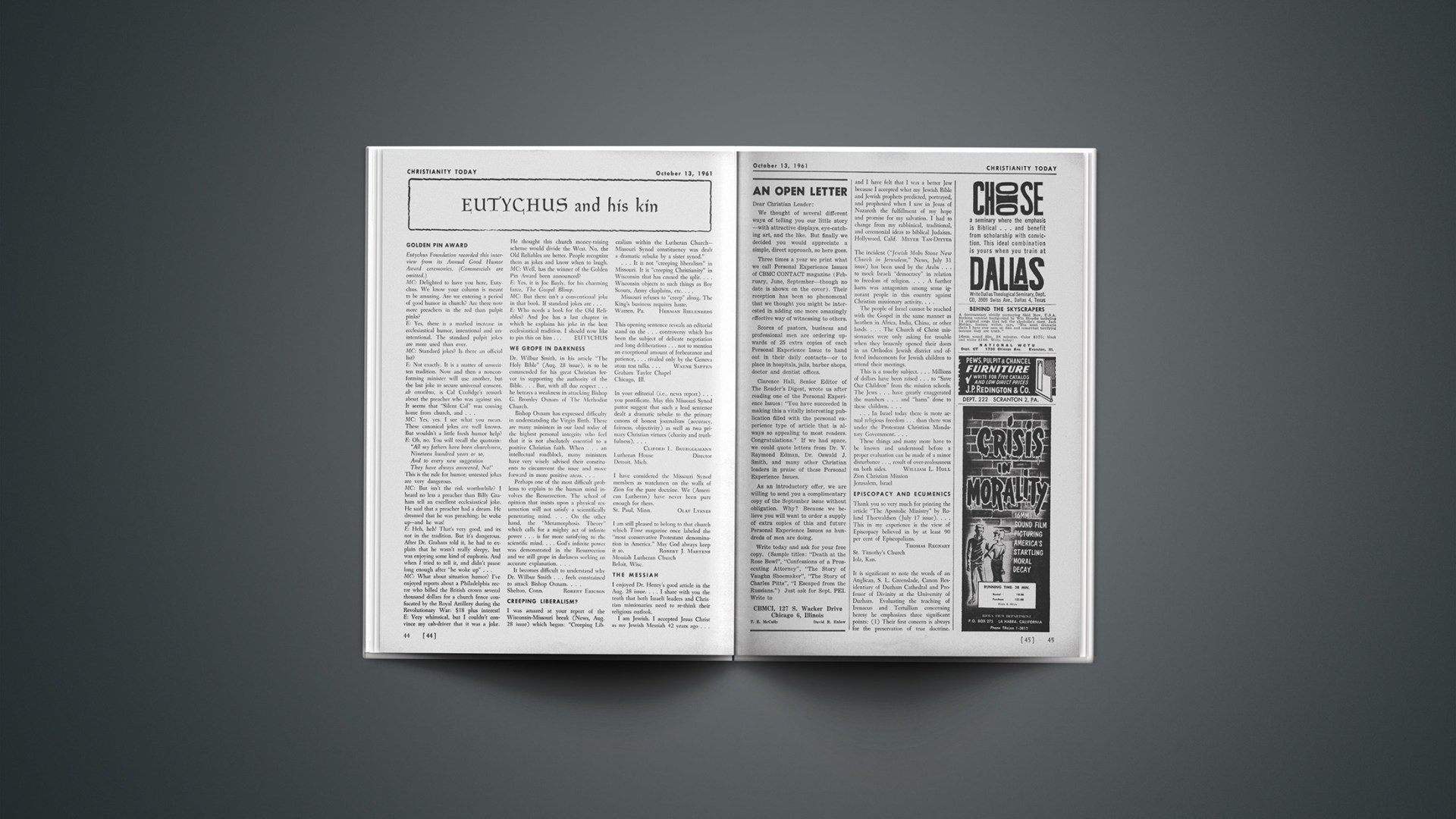
Eutychus and His Kin: October 27, 1961

Halloween Fantasy

Double, double toil and trouble—

The witches have flown to the moon (Where they should, for a spell,

Form a communist cell,

Since Russians will join them there soon).

Double, double toil and trouble—

They’ve left us a witch legacy

Of mascara-ed eye-lids,

Masquerading small kids,

And bubbling brews on TV—

(Bubble, bubble; less toil, no trouble—)

This legacy seen on the screen

Shows a lather enriched

With a charm that’s bewitched—

Commercials are pure Halloween.

Double, double bowls of stubble—

The world is de-witched, air-conditioned,

And when Hecate mocks

From a cereal box

Her face is a mask for nutrition.

Double, double trick or treat—

Three rubber-faced witches are there;

Little goblins with bags

Clutch the skirts of these hags,

Unnerved by the masks that they wear.

Double, double, all the trouble

Since witches have turned to thin air,

Is the hunt that goes on

When the witches are gone,

The witch hunt which hunts what’s not there.

Pastor Peterson thought my poem had a point, but he is not so sure we are free of witches. “Perhaps Macbeth’s trio has gone, but what is meeting modern Macbeth’s in the night?” He added a stanza:

Double, double, triple trouble—

In crisis we mustn’t decry sense …

Is there not enough reason

To declare open season,

And bag a few hags with a license?

EUTYCHUS

Remonstrant Riposte

All of us who are interested in the Christian college are indebted to Professor C. Gregg Singer for the sober and generally well reasoned warnings in his article “Why Evangelical Colleges Die” (Sept. 11 issue). But the section on “Theological Weaknesses” reminds one of finger paintings with mixed paints, and leaves us evangelicals of the Wesleyan tradition gasping for breath.…

Perhaps the real trouble where modernism has made inroads in both Reformed and Arminian circles is a defection from simple willingness to accept the Bible as God’s written Word and man’s final authority.

STEPHEN W. PAINE

President

Houghton College

Houghton, N. Y.

It is apparent … that he does not believe colleges with an Arminian emphasis have the theological strength to survive.… We are glad to rise to Dr. Singer’s challenge. I am sure there are many others who join us.

MERNE A. HARRIS

Vice-Pres. and Dean

Vennard College

University Park, Iowa

May I suggest that the cause of evangelism is not well served by a kind of infighting between Calvinists and Arminians? In two recent articles … the authors are biased in favor of Calvinism.

MILO C. ROSS

President

George Fox College

Newberg, Ore.

Arminianism is not humanistic nor sub-biblical.… Maybe evangelical colleges die, but it is not due to an Arminian Achilles heel—rather, … failure to be truly regenerated, … failure to tarry until filled with the Holy Spirit.…

W. J. YOUNG

Grace Church of the Nazarene

Yuma, Ariz.

Has Dr. Singer never read that statement in the Methodist Discipline: “The Holy Scriptures contain all things necessary to salvation, so that whatsoever is not read therein, nor may be proved thereby, is not to be required of any man, that it should be believed as an article of faith, or be thought requisite or necessary to salvation.” Is that sub-biblical?

J. B. CAIN

Memorial Methodist Church

Bolton, Miss.

It seems that Calvinism would say, “It was decreed to die anyway” … we would say we must be on guard to prevent our schools from death.

A. REUBEN HARTWICK

First Pentecostal Church

Coraopolis, Pa.

Christian, Jew And Arab

My effort to evangelize my Jewish dentist has shown me the wisdom of your comment (Aug. 28 issue) “… when a Jew comes to the Messiah, he does not cease to be a Jew.” I am sure such a strategy is even more urgent in Israel.…

I feel that the evangelization of Israel and the dialogue between Jewish and Gentile Christians is even more important than the dialogue among Protestant churches or between Rome and Protestantism.

HAROLD WHITE

Belvidere, N.C.

It is a tragic fact that the very people who will liberally give to a Jewish mission in some far-off place make no attempt to witness to the Jews of their own neighborhood or community.

BELDEN MENKUS

Nashville, Tenn.

We must never lose sight of our opportunities and privileges as Christians in Israel, but the distinct and unique contribution that Baptists and other evangelicals can make to this young state just celebrating her Bar mitzvah this year is the Christian concept of religious freedom. Democracy has always enjoyed greater security when the tasks of the watchman on the wall were shared by evangelicals.

In many ways I feel that we are near our goal. The young people, the intellectuals, and the self-styled free-thinkers are completely fed up with Israel’s creeping theocracy. They are convinced that reformation and not reform (small ‘r’) is the only solution. There are also increasing pressures from world Jewry to break the strangle hold of the Orthodox on the jugular of Israel.

DWIGHT L. BAKER

Baptist Church

Nazareth, Israel

I’m afraid I am not able to see the Arab situation quite the same way (Sept. 11 issue). By official British census, in 1947, the number of refugees is nearer 600,000 than 1,000,000. Thirty-eight of the 40 million world refugees (the Hong Kong and Palestinian being the exceptions) had been resettled in the lands that received them. This is standard procedure. In no case have they gone back to the point or points of origin. There is a three million dollar UN fund held in escrow for this resettlement. Arab leaders will not permit it, however, preferring to “use” the refugees in the game of propaganda politics. The Israelis have already taken back, to reunite families, a considerable number of these persons. They are prepared to take back up to 100,000 more when the Arab states are ready to call off their war and sign a peace treaty (in spite of the fact that this is not the way of dealing with this kind of problem anywhere else). Furthermore, two factors: (1) Israel has taken in 400,000 Jewish refugees from Arab countries coming with only the shirts on their backs (bank accounts frozen and goods confiscated), but no one seems concerned to make a fuss about this, and (2) the refugee movement out of Israel-Palestine was at the initial instigation of Arab military leaders (even if “atrocities” some genuine, some trumped up, were used to encourage it). I think we have to admit to these facts along with others that might be pro-Arab.

G. DOUGLAS YOUNG

Director

Israeli-American Institute of Biblical Studies

Evanston, Ill.

You may find the following material specially helpful in rounding out … general conclusions:

Who Knows Better, Must Say So, by Elmer Berger (American Council for Judaism, 201 E. 57th St., New York 22, N. Y., 50¢)—Jewish, but anti-Zionist. (Many Jews feel the Zionists have gone too far in their propaganda and moneyraising, and have really hurt the Jewish cause.)

Olive Trees in Storm, by Morris S. Lazaron (American Friends of the Middle East, Inc., 225 E. 46th St., New York, N. Y., paperback ed., $1)—analysis of Jew-Arab situation in Egypt-Syria-Jordan-Iraq-Lebanon-Israel. Largely pro-Arab and anti-Zionist.

Exodus—A Distortion of Truth (35¢, Strife in the Holy Land (15¢), and many other publications (Arab Information Center, 120 East 56th St., New York 22, N. Y.)

For enlightened Christian attitude, write (1) Dr. Joseph P. Free, professor of archaeology at Wheaton College, and founder. Near East School of Archaeological and Biblical Studies—on Mount of Olives, Jerusalem, Jordan (Dr. Free’s address: Free Haven, Park Rapids, Minnesota; Dr. Free can supply many other helpful titles and information); and, (2) Dr. G. Douglas Young, professor of Bible, etc., Trinity College, Chicago, and founder, Israel-American Institute of Biblical Studies (Street of the Prophets, Jerusalem, Israel). Dr. Young’s address is 1046 Ridge Avenue, Evanston, Illinois.

PETER STAM, JR.

Covenant College and Seminary

St. Louis, Mo.

To Repair The Damage

In the recent article by Eugene Peacock, “New Life for Christian Colleges?” (Aug. 28 issue), some very worthwhile things are said. However, permit me to make two remarks.

I am pleased with the fact that he recognizes that no one is without a world-view, and that a church-related college is committed to a Christian world-view. The assumption is that this is desirable for higher education. But I would ask is this not also true on the primary and high school level? We give our children 12 years of secular education and then expect the Christian college to repair the damage.

Another statement of the writer puzzles me. After telling us that in church-related colleges there are men without faith, he assures us that he is not asking for witch hunts or heresy trials.… If our church-related colleges are to continue to be Christian, should not such men be removed, even though it should take a heresy trial to do it?…

RALPH J. BOS

Willmar Christian Reformed Church

Willmar, Minn.

He Prefers A Both-And

As an individual member of the Conservative Baptist Association of America, I take exception to the letter (August 28 issue) from B. Myron Cedarholm, General Director of Conservative Baptist Association of America, in which he states, “Many of us feel that CHRISTIANITY TODAY’ is more concerned about being courteous and scholarly than they are in being biblical and positive.” … I fail to see the “either-or-ness” of Dr. Cedarholm’s statement. Cannot a dedicated, Holy Spirit-born Christian be courteous, scholarly, biblical and positive all at the same time?

GEORGE A. COLE, JR.

Calvary Baptist Church

Bristol, Pa.
The Messianic Concept in Israel

THE EDITOR

Third in a Series (Part II)

The year 1960 marked the hundredth anniversary of the birth of Theodor Herzl, father of modern Zionism. In an illuminating commemorative address that restated Zionism’s philosophy and goals, Rabbi Ira Eisenstein of New York City recalled:

“When Herzl appeared upon the scene, with the publication of his Judenstaat (1895), he did not create ex nihilo. Wherever Jews lived, and the Jewish tradition was honored, the Land of Israel was regarded as the place to which, ultimately, all Jews would be regathered. All other countries were considered to be places of ‘exile,’ to which the Jews had been consigned by God in punishment for their sins. In the theological system to which Jews were committed before modern times, the ‘redemption’ from ‘exile’ would be accomplished by an act of divine intervention; the Messiah would come to initiate a new order of things, and the first act in this new order would be the ‘ingathering of the exiles.’ ”

As Eisenstein put it, traditional Judaism taught, 1. the dispersion was an expiation; 2. the end of exile would occur in God’s own time; 3. this release would be the work of a divine agent; 4. the restoration of Zion would introduce a messianic age; and 5. any attempt to “force the hand of God” by initiating redemption through human effort is blasphemy.

Breakdown of this integrated theological system, Eisenstein noted, began with emancipation of the Jews of Western Europe and America. Modern scientific thought weakened the foundations of a literal belief in some of Judaism’s basic postulates; and modern states, offering citizenship to Jews regardless of their creed, posed even more basic dilemmas. Jews no longer needed to regard themselves in “exile.”

Two new conditions, however, precipitated creation of the Zionist movement: 1. anti-Semitism reminded Jews that their “emancipation” was by no means complete, and 2. assimilation aroused concern that—despite anti-Semitism—“emancipation” might succeed only too well. Thus fears for security of the Jews and for the future of Judaism spurred men like Herzl to action.

Paradoxically, the action they undertook smacked of the very blasphemy their tradition had always decried. By taking matters into their own hands, the Jews were not waiting for the Messiah to restore them to the land. The Enlightenment had weakened their adherence to the orthodox interpretation of Jewish destiny, but not enough to destroy all continuity with the past.

The consequences, succinctly summarized by Eisenstein, were far-reaching. Of the five premises mentioned above, 1. was retained in a somewhat revised form, namely, that the dispersion was a calamity, particularly when it subjected Jews to persecution as a minority group; view 2. was rejected entirely, and 3. was reinterpreted in naturalistic terms. The “divine agent” was now conceived not as a personal Messiah but as a passion for justice to a people that had been wronged throughout a long history. Most of the early Zionist leaders were not “religious” in the conventional sense. Indeed, their tendency to reject anything theological as such might label them even “anti-religious.” Only in the broad cultural sense were they spiritual, dedicated, and self-sacrificing. They burned with a vision of a restored Zion from which “Torah” would go forth. Concept 4. was integral to this vision. Zionists as a whole truly believed that the age that righted an historic wrong to the Jews would initiate a new order of society. Those known as Labor Zionists went even further; they resolved to establish in the coming new state a utopian society that would incorporate the ancient ideals of the Prophets into the modern machinery of statehood. View 5. obviously met with complete rejection. Those who clung to tradition scorned the movement entirely; those in “neo-orthodox” groups compromised by saying that settlement in Israel had always been regarded as a mitsvah (commandment).

Thus from its very inception Zionism recognized religious tradition, even though that tradition underwent partial reconstruction in terms of modern political and intellectual tenets. In fact, religious Zionists insist that, had the movement been merely “patriotic,” it would not have won universal support in the Jewish community.

But to accomplish its first objective, namely, to establish a legally-secured and publicly-recognized home for Jews who needed or wanted to come, Zionism took recourse to political activity. Therefore Western Zionism became identified for many as essentially political; since Nazism produced a mammoth refugee problem, Zionism represented a political cum philanthropic movement. In eastern Europe, more emphasis was given self-realization and cultural creativity as Zionist methods.

This survey helps explain why Israelis regard the emergence of the state as a “messianic token,” but also bypass the traditional understanding of Messiah (in the Orthodox sense of waiting for a personal Messiah). Messianism today is simply belief that history is purposively directed, that creation is the beginning of history, and its end the messianic age. Some identify this age simply as the climax of history, others as the world transformed into God’s kingdom.

In this historical movement the Jews assign themselves a special mission. However universal its vision may be, Jewish messianism retains a nationalistic basis; only through Jewish national restoration will come the world’s restoration to super-national moral realities. As the meaning of messianism becomes secularized, then “the belief in Messiah” deteriorates to mere trust in enlightenment, in liberal ethical goals, even in socialism. In its wake, therefore, Zionism has left a mere moralizing of orthodox theological concepts and a disintegration of orthodox messianism. Emphasis on messianic character and messianic era lacks the reality of a personal Messiah. History is permitted its “messianic movements,” “messianic events,” “messianic moments,” and ultimately a “messianic age.” Ironically, therefore, current Zionist motivations for return to his homeland in effect have exiled the Jew from the orthodox Messiah; he misunderstands the kingdom of God as a national socio-political crisis instead of a spiritual-personal crisis. Human establishment of the new state and national sovereignty has derailed to marginal consideration the traditional expectation of the coming personal Messiah.

This modern spirit of self-sufficiency dispenses with special reliance on the Old Testament. To vindicate the state’s emergence as an act of divine providence, some Jewish interpreters specially emphasize nature and history and not simply the Torah as God’s avenues of self-revelation. Religious Zionists attribute Divine authorship to apparently natural causality. Israel therefore claims a redemptive mission that envisions perfection of the world, it is said, and not just fulfillment of a prophetic promise. Regathering the Jews in the new state can materialize an authentic Jewish civilization and culture to channel Israel’s mission among the nations. For the first time in 2,000 years Hebrews manifest in one locale all the prerequisites for shaping their own institutions and mode of life. Even if Israel cannot compete with the great powers technologically, she can offer ethical inspiration to the world by restoring her own historical values.

It should be observed, however, that alienation from the Old Testament prophets involves more than loss of hope in a personal Messiah; it threatens also the historic Jewish sense of divine covenant. After all, the crowning glory of Hebrew history is its early heritage of revealed monotheistic religion. If the Jews are to confront the world with more than modern social ideals, if they are to urge a renewal of old and respected values, presumably from Jerusalem as a spiritual center for international Judaism, then the validity of God’s covenant with their forebears requires more than mere inference from general history. Indeed, it requires vital faith in the prophetic word, in Scripture that commits Judaism to much more than the social present and demands new investigation of the messianic question. To represent Zionism as a direct successor of the historic messianic vision, or as bearer of the historic messianic motive has only short-lived and limited appeal. The unique divine claim upon the Hebrews springs from God’s self-revelation of “I, the Lord God.” That they are “a chosen people” the Hebrews cannot abstract from purely politico-social considerations. The consciousness of Jewish unity and mission can only prosper, therefore, on a deepening acceptance of the Old Testament vision of redemption.

What Of Jesus Christ?

The turn of Jewish expectation against a personal Messiah, and exposition of messianism in post-biblical terms, may lead to fresh rejection of Jesus of Nazareth. Many Jews indeed consider Jesus a good man. But they seem unaware that such appraisal was impossible in the first century when commitment was either for the Messiah or against a messianic pretender. Scholars who debate the question of Messiah express their hostility in two significant ways: either they attack Christian sacraments by labeling their foundations as idolatrous, or they may reveal opposition to Jesus Christ by aligning themselves with some figure wholly alien to Judeo-Christian history. Professor R. J. Zwi Werblowsky, for example, reveres Buddha as the greatest of all religious figures.

One factor in this rejection stems from refusal to approach the messianic question except in relationship to national sovereignty. This issue in fact already influenced the first-century rejection of Jesus when the Jews still expressed messianic expectation in personal terms (“Art thou he that should come, or do we look for another?,” Matt. 11:3; cf. John 1:19–25). According to Zwi Werblowsky, “Israel’s attitude toward the Church was automatically determined by the fundamental Jewish decision in favor of national continuity and history.” He considers this explanation of the rejection of Jesus more accurate than that “Judaism was confronted, in the person of Jesus, with a crise de conscience and finally decided against him.” That is, Jewish expectation so linked Messiah and national sovereignty that Israel’s concrete renewal on the world historical scene was to be “the sign” Werblowsky contends that Jesus himself recognized this link in affirming that “this generation shall not pass away” except the kingdom of God come (Matt. 24:34 actually reads “till all be fulfilled”). “Not only ‘this generation,’ ” adds Werblowsky, “… but many other generations passed by and saw nothing.” Jesus’ claim of fulfillment, he insists, is “denied by the sober consciousness of historical realities.”

Approach To The Jew

The Christian view, it should be emphasized, does not ignore or rule out Israel’s political renaissance. Even Roman Catholics, whose church traditions have bound them to nonbelief in the restoration of the state of Israel, are now rethinking this issue. The Greek Orthodox church, too, has insisted for centuries that the rejection of Jesus of Nazareth forever plunged Judaism into a sorry meaninglessness. Any implication that all 19 centuries of Jewish history since Jesus’ death have been insignificant makes Hebrew spokesmen bristle. Except for amillennial thought, Protestantism finds providential and theological importance in Jewish developments. Protestant Christianity does not of course assimilate post-biblical Jewish history into saving or redemptive history. It tends, however, to interpret the return of the Jews and the restoration of the nation (even if in spiritual unbelief concerning the Christian Messiah) as an end-time development of prophetic significance. Since, however, many evangelicals couple this interpretation with an anticipated spiritual change of heart, certain Israelis consider this evangelical verdict a mixed blessing. Chaim Wardi, for example, thinks it “only to be regretted that this interest and sympathy are conditioned by the desire or the expectation of a more or less wholesale conversion of the Jews to Christianity. One should expect on the part of friends … a more disinterested interest.” One senses here the peculiar suspicion that explicit Christian concern for awakening among the Jews is something less than spiritual, and, perhaps an acceptance of evangelical overtures simply for their “prophetic bolstering” to recent Palestinian developments.

The foregoing discussion should indicate, therefore, that the Christian approach to the informed Jew should not be confined, as so often in the past, to whether Jesus of Nazareth fulfills the Old Testament prophecies, and whether certain Old Testament emphases conflict with rabbinic Judaism. Many Jews, no less than pagan Gentiles, need help simply as fallen creatures in need of redemption. The Jew in Tel Aviv like the Jew in New York may be totally out of touch with Old Testament religion, since modern liberal ideals may represent the only spiritual context he knows. Quite different, however, is the spiritually-minded Jew. He wants to know what bearing the question of Messiah has on Israel as such, what it signifies for the Hebrew return to Palestine and for national restoration. To discuss Christianity only in terms of individual commitment with no reference to God’s operation in the human community of faith troubles the serious Hebrew. As Professor Simon has said, “Christianity is founded on the biography of a sacred personality. It is easy for the Christian personally to become a Christian, and difficult subsequently to become really identified with the community of faith. But the Hebrews began as a community at Sinai, and they are not disposed to inquire into the question of personal salvation independently of the question of the community.”

This word, of course, does not fairly express the New Testament concept of the believer’s relationship to the Christian community. It does indicate, however, that to address effectively many Jews requires more prongs of discussion than have ordinarily characterized recent Hebrew-Christian dialogue. Such conversation must re-explore the meaning of 19 centuries of Jewish suffering among the nations, must re-study New Testament intimations of God’s purpose for the Jew and of Israel’s place in the divine plan. Many Jewish leaders today deplore what both Orthodox Judaism and Christianity believe, namely, that the suffering of the Jews is punishment for sin and spiritual unbelief. “If there has been a ‘Christ’ among the nations of the world,” said one prominent Israeli, “the Jews have been the innocent who bore the sufferings of the guilty.” To concede that dispersion and persecution are a divine penalty for revolt against light carries the hard implication that Christianity is right. To deny juridical interpretation of Jewish history leads simply to the notion that by educating the dispersed Jew in all the wisdom of the Gentiles God was preparing him for an ulterior purpose, a national regathering for a Hebrew mission to the world. Jews who study the Talmud, however, cannot overlook the connection between punishment and past sin, a principle applied both to individuals and to the nation. The Prayer Book of the Hebrew holy festivals declares: “Because of our sins we have been driven from our land.…” The Christian witness must indeed affirm that no man can see the kingdom of God unless he is spiritually reborn, as Jesus warned the rabbi Nicodemus (John 3:3, 5). But it must also include the Lord’s reference to “times or seasons which the Father has put in his own power.” Christ s answer to the disciples’ query about the restoration of the Kingdom to the Jews (Acts 1:7), and Paul’s discussion concerning the place of the Jew in God’s plan are increasingly significant.

Another method of attacking a messianic claim for Jesus of Nazareth is to discredit him as destructive of the Old Testament Law. Professor Werblowsky willingly concedes that Jesus was not “simply one Jewish teacher among others” but stands out as qualitatively different. In this way (argues Werblowsky) Jesus gave not merely a different interpretation of the Law, but he destroyed the Law. Thereby Werblowsky does not mean (as Christianity asserts) that by His sacrificial death Jesus himself met the claims of the Law and so nullified its power over those who trust him. Rather, Werblowsky charges Jesus’ teaching with a revolutionary element that implicity leads to rejection of Jewish religion. Werblowsky calls Jesus a messianic pretender with a messianic message typical of Jewish sectarian tendencies in his day. The Nazarene, he says, opposes sanctification through details of the Law, whereas Jewish life is totally regulated by these sanctifying disciplines. Even if there have been no sacrifices for 2000 years because of the destruction of the temple, the Jews recognize no distinction between moral and ritual law. Yet when Jesus justifies the disciples’ plucking grain on the Sabbath, Werblowsky charges him with acting on a non-Jewish premise: sanctification by the Spirit, and not by the Law. According to Werblowsky this vague Spirit-religion (or Christianity!) really dispenses with the Law, or reduces it to vague abstraction. By “destroying” the Law, Christianity thus threatens the Jewish organization of human life in which keeping the law is the service of God.

Even allowing for antinomian tendencies that have frequently plagued the Christian Church and allowing for modernism that repudiates law-religion in any form as sheer legalism, the fundamental misunderstanding of Jesus as one who abolished rather than fulfilled the Law (cf. Matt. 5:17) is still apparent. It recalls the Jewish insurrection against the apostle Paul and the charge before Gallio that “this fellow persuadeth men to worship God contrary to the law” (Acts 18:12 f.). Rabbi Silver long ago granted however, that Jesus’ attitude ‘was expressed within the framework of the law” and that he sought “the correct ‘intensive’ attitude toward the existing law” (Messianic Speculation in Israel, p. 10).

It disturbs the modern Jew nonetheless that even at 19 centuries’ distance Jesus of Nazareth must constantly be reckoned with. Unlike the false messiahs, Jesus has not passed into oblivion. The alternatives proposed by Gamaliel when Jews in the first century resorted to violence to suppress the apostles remain on record as an embarrassment. How is the continuing power of Jesus’ name explained? Since the modern Jew faces this question only in the context of ecclesiastical persecutions of his people, he is not disposed to ask if the Church after all is right. Most scholars, recognize, however, that to explain the vitality of Christianity involves more than merely the psychological readiness of the pagan world, or the genius of Paul. Hence debate focuses ever more clearly on Jesus of Nazareth himself. In this context, and in view of Jesus’ messianic claim, any Jewish intellectual tendency to call Jesus of Nazareth simply a good man appears an evasive tactic.

We Quote:

THE WORLD CRISIS—The character of the Communist challenge consists, first, in a conception of matter, man, society, history, government, and the supreme being radically different from and opposite to anything you and I and our ancestors have known for the last four thousand years; second, in the existence of a superbly organized political party … with an absolutely dedicated membership all over the world … actively working to bring every people on earth under the bondage of this philosophy …; third, in this party’s use of every conceivable means—war, revolution, subversion, infiltration, propaganda, intimidation, dictatorship, manipulation of the masses, smear tactics, character assassination, exciting the basest instincts in man, playing up differences and grievances between nations and peoples and races and classes—to attain its unalterable ends of world domination; fourth, in the fact that this world revolutionary thrust is backed by one of the most powerful military establishments in the world …; and fifth, in the fact that this world revolutionary force … has succeeded in extending and consolidating its iron hold upon at least a third of the human race.…

The classical Western values of freedom, personality, excellence, rank, objective truth, faith in God, and the primacy of the spirit, are subverted both by Communist infiltration from without and by doubt and criticism by some of the best Western minds from within.… There are many influential people who preach, or at least are taken by, “peaceful coexistence,” and who appear to be prepared to settle for peace at any price and for what is falsely called “mutual accommodation,” where accommodation turns out upon analysis to come only from one side.…

Only as the total arsenal of political, moral and spiritual values are brought to bear … is there any hope of winning in this tremendous struggle.… If you are already converted to the materialistic standpoint of your opponent you will talk only in terms of … economic security and social benefits. The Communists lore to confine you within that round of ideas.… The greatest weakness of the Western strategy is its relative neglect of the intellectual and spiritual dimension. This is strange, because intellectual, moral, and spiritual matters are the greatest point of strength in the Western arsenal.…—CHARLES MALIK, former President of the United Nations and a Greek Orthodox layman, in an address to the Second National Conference of Southern Baptist Men in Memphis, Tennessee.

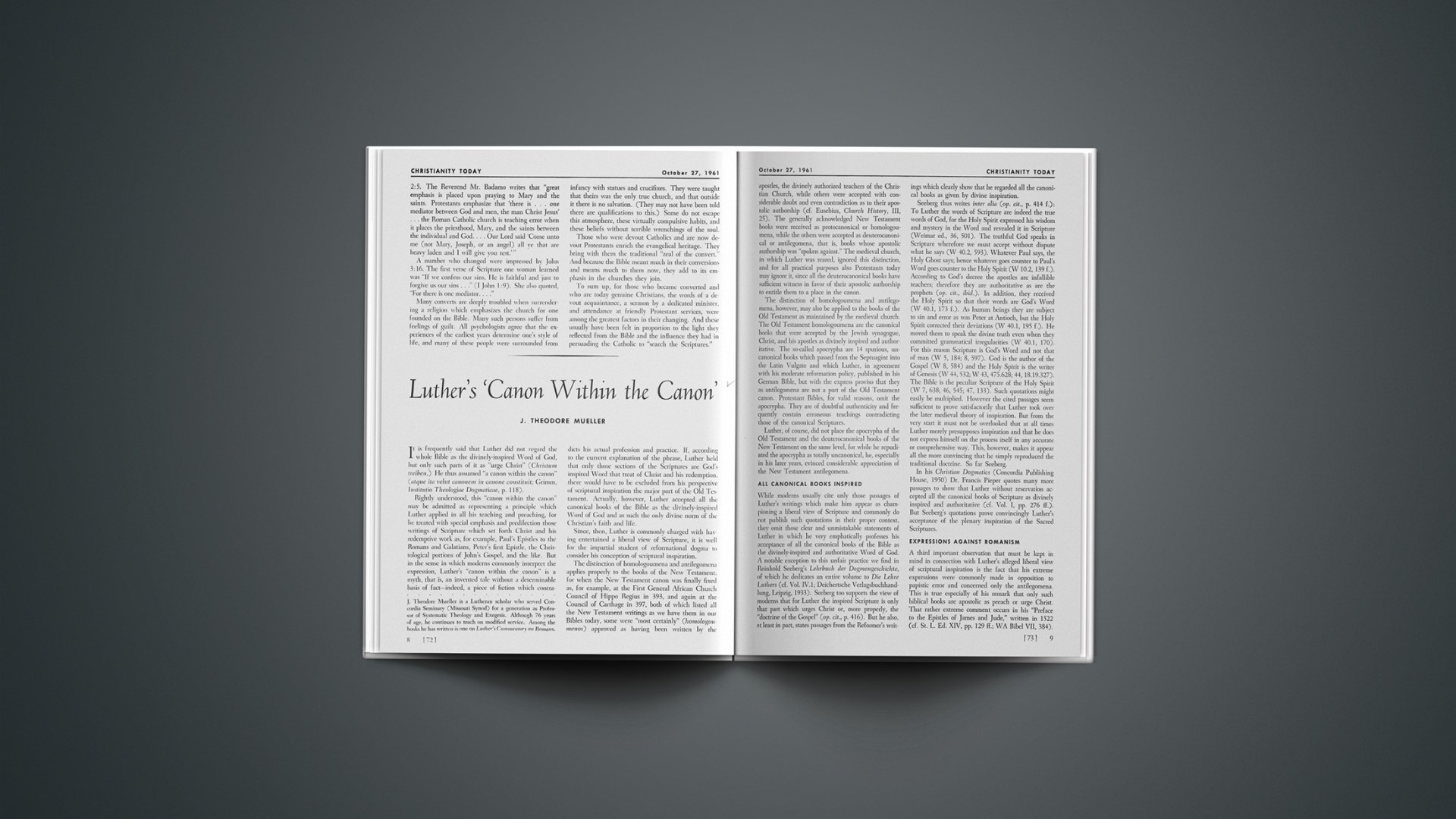
Luther’s ‘Canon within the Canon’

It is frequently said that Luther did not regard the whole Bible as the divinely-inspired Word of God, but only such parts of it as “urge Christ” (Christum treiben.) He thus assumed “a canon within the canon” (atque ita velut canonem in canone constituit; Grimm, Institutio Theologiae Dogmaticae, p. 118).

Rightly understood, this “canon within the canon” may be admitted as representing a principle which Luther applied in all his teaching and preaching, for he treated with special emphasis and predilection those writings of Scripture which set forth Christ and his redemptive work as, for example, Paul’s Epistles to the Romans and Galatians, Peter’s first Epistle, the Christological portions of John’s Gospel, and the like. But in the sense in which moderns commonly interpret the expression, Luther’s “canon within the canon” is a myth, that is, an invented tale without a determinable basis of fact—indeed, a piece of fiction which contradicts his actual profession and practice. If, according to the current explanation of the phrase, Luther held that only those sections of the Scriptures are God’s inspired Word that treat of Christ and his redemption, there would have to be excluded from his perspective of scriptural inspiration the major part of the Old Testament. Actually, however, Luther accepted all the canonical books of the Bible as the divinely-inspired Word of God and as such the only divine norm of the Christian’s faith and life.

Since, then, Luther is commonly charged with having entertained a liberal view of Scripture, it is well for the impartial student of reformational dogma to consider his conception of scriptural inspiration.

The distinction of homologoumena and antilegomena applies properly to the books of the New Testament; for when the New’ Testament canon was finally fixed as, for example, at the First General African Church Council of Hippo Regius in 393, and again at the Council of Carthage in 397, both of which listed all the New Testament writings as we have them in our Bibles today, some were “most certainly” (homologoumenos) approved as having been written by the apostles, the divinely authorized teachers of the Christian Church, while others were accepted with considerable doubt and even contradiction as to their apostolic authorship (cf. Eusebius, Church History, III, 25). The generally acknowledged New Testament books were received as protocanonical or homologoumena, while the others were accepted as deuterocanonical or antilegomena, that is, books whose apostolic authorship was “spoken against.” The medieval church, in which Luther was reared, ignored this distinction, and for all practical purposes also Protestants today may ignore it, since all the deuterocanonical books have sufficient witness in favor of their apostolic authorship to entitle them to a place in the canon.

The distinction of homologoumena and antilegomena, however, may also be applied to the books of the Old Testament as maintained by the medieval church. The Old Testament homologoumena are the canonical books that were accepted by the Jewish synagogue, Christ, and his apostles as divinely inspired and authoritative. The so-called apocrypha are 14 spurious, uncanonical books which passed from the Septuagint into the Latin Vulgate and which Luther, in agreement with his moderate reformation policy, published in his German Bible, but with the express proviso that they as antilegomena are not a part of the Old Testament canon. Protestant Bibles, for valid reasons, omit the apocrypha. They are of doubtful authenticity and frequently contain erroneous teachings contradicting those of the canonical Scriptures.

Luther, of course, did not place the apocrypha of the Old Testament and the deuterocanonical books of the New Testament on the same level, for while he repudiated the apocrypha as totally uncanonical, he, especially in his later years, evinced considerable appreciation of the New Testament antilegomena.

All Canonical Books Inspired

While moderns usually cite only those passages of Luther’s writings which make him appear as championing a liberal view of Scripture and commonly do not publish such quotations in their proper context, they omit those clear and unmistakable statements of Luther in which he very emphatically professes his acceptance of all the canonical books of the Bible as the divinely-inspired and authoritative Word of God. A notable exception to this unfair practice we find in Reinhold Seeberg’s Lehrhuch der Dogmengeschichte, of which he dedicates an entire volume to Die Lehre Luthers (cf. Vol. IV.1; Deichertsche Verlagsbuchhandlung, Leipzig, 1933). Seeberg too supports the view of modems that for Luther the inspired Scripture is only that part which urges Christ or, more properly, the “doctrine of the Gospel” (op. cit., p. 416). But he also, at least in part, states passages from the Reformer’s writings which clearly show that he regarded all the canonical books as given by divine inspiration.

Seeberg thus writes inter alia (op. cit., p. 414 f.): To Luther the words of Scripture are indeed the true words of God, for the Holy Spirit expressed his wisdom and mystery in the Word and revealed it in Scripture (Weimar ed., 36, 501). The truthful God speaks in Scripture wherefore we must accept without dispute what he says (W 40.2, 593). Whatever Paul says, the Holy Ghost says; hence whatever goes counter to Paul’s Word goes counter to the Holy Spirit (W 10.2, 139 f.). According to God’s decree the apostles are infallible teachers; therefore they are authoritative as are the prophets (op. cit., ibid.). In addition, they received the Holy Spirit so that their words are God’s Word (W 40.1, 173 f.). As human beings they are subject to sin and error as was Peter at Antioch, but the Holy Spirit corrected their deviations (W 40.1, 195 f.). He moved them to speak the divine truth even when they committed grammatical irregularities (W 40.1, 170). For this reason Scripture is God’s Word and not that of man (W 5, 184; 8, 597). God is the author of the Gospel (W 8, 584) and the Holy Spirit is the writer of Genesis (W 44, 532; W 43, 475.628; 44, 18.19.327). The Bible is the peculiar Scripture of the Holy Spirit (W 7, 638; 46, 545; 47, 133). Such quotations might easily be multiplied. However the cited passages seem sufficient to prove satisfactorily that Luther took over the later medieval theory of inspiration. But from the very start it must not be overlooked that at all times Luther merely presupposes inspiration and that he does not express himself on the process itself in any accurate or comprehensive way. This, however, makes it appear all the more convincing that he simply reproduced the traditional doctrine. So far Seeberg.

In his Christian Dogmatics (Concordia Publishing House, 1950) Dr. Francis Pieper quotes many more passages to show that Luther without reservation accepted all the canonical books of Scripture as divinely inspired and authoritative (cf. Vol. I, pp. 276 ff.). But Seeberg’s quotations prove convincingly Luther’s acceptance of the plenary inspiration of the Sacred Scriptures.

Expressions Against Romanism

A third important observation that must be kept in mind in connection with Luther’s alleged liberal view of scriptural inspiration is the fact that his extreme expressions were commonly made in opposition to papistic error and concerned only the antilegomena. This is true especially of his remark that only such biblical books are apostolic as preach or urge Christ. That rather extreme comment occurs in his “Preface to the Epistles of James and Jude,” written in 1522 (cf. St. L. Ed. XIV, pp. 129 ff.; WA Bibel VII, 384). It is well known how assiduously Roman theologians used James 2:17–26 against the sola fide-doctrine of the Reformation. While it is not within the scope of this article to go into exegetical detail on Romans 3:20–28 and James 2:17–26, it may be said that Protestant theologians long ago have pointed out that between the teachings of Paul and James there is perfect agreement, though they differ in orientation.

In 1522, however, Luther was wholly unaware of this perfect agreement between Paul and James just as also later he did not solve the problem of the seeming discrepancy. He therefore wrote in the introductory paragraph of his Preface: “This epistle of St. James I praise, though it was rejected by the ancients, and I regard it as commendable because it does not teach human doctrine, but earnestly inculcates the divine law. But if I may express my opinion, without, however, putting anyone else to a disadvantage, I do not consider it to be the writing of an apostle, and that for the following reason.”

Luther then states his twofold objection to the epistle, namely, first, that, contrary to Paul’s letters and all other Scriptures, it ascribes justification to works, and, secondly, that it does not mention at all the suffering, resurrection, and the Spirit of Christ. While James does mention Christ several times, he does not teach anything definite about him, but speaks merely of the common faith in God. Then Luther goes on to say that it is the office of a true apostle to testify of Christ’s suffering, resurrection, and office and so to lay the foundation of the Christian faith, as the Lord himself says: “Ye shall bear witness” (John 15:27). After that he comments: “And all true sacred Scriptures agree in this that they with one accord preach and urge Christ, since the whole Bible teaches Christ (Rom. 3:21) and St. Paul is determined not to know anything save Jesus Christ (1 Cor. 2:2). Whatever does not teach Christ is not apostolic, even though St. Peter or St. Paul should inculcate it. Again, whatever does preach Christ that would be apostolic even though Judas, Annas, Pilate, or Herod should teach it.”

Luther concludes his preface to the epistle of James with the words: “In short, he [the writer] wanted to restrain those who relied on faith without works, but in trying to do this, he proved himself too weak and so he endeavored to accomplish by legal stress what the apostles bring about by urging Christian love. Therefore I cannot classify the letter among the true chief Scriptures. But this is not to prevent anyone else from placing or exalting it as it pleases him, for it contains many fine passages.” This is the shorter form of the conclusion; there is one somewhat longer though it does not add anything that is essential.

From these words it is obvious that in 1522 Luther did not understand the relation of James to Paul. Nor did he later acknowledge the letter as one written by an apostle. But it is clear that the suggested criterion, that only those are true apostolic books which preach or urge Christ, was declared in opposition to the papistic error of work-righteousness, and that it was to apply only to the antilegomena or uncanonical writings whose apostolic authorship had been doubted or even denied by the ancient church. By accepting the homologoumena or canonical books of the Old and the New Testament as divinely inspired and authoritative, Luther himself exemplified the limitation of this criterion of judging biblical books. Within the acknowledged canonical Scriptures he did not accept “a canon within the canon” in the sense in which the phrase is commonly, but erroneously, interpreted.

Judging Luther In Context

It cannot be denied that Luther, in blazing a trail through the labyrinth of papistic biblical confusion, at times made extreme statements and voiced extravagant opinions. That was quite in agreement with his impulsive, emotional nature, for, unlike Melanchthon or Calvin, he often was excessively frank in his judgments especially when they concerned opponents who bitterly opposed him. Nor did Luther later revise, carefully and critically, his printed works since for this chore he had neither leisure nor inclination. An exception, of course, was his German Bible which he painstakingly edited and revised till shortly before his death. To the end of his life Luther was an extremely busy man, ceaselessly writing, lecturing, preaching, and doing odd ecclesiastical chores which really should have been delegated to others. So it happens that moderns may find in his writings statements that might make it appear as though he inclined to a liberal view of scriptural inspiration. But had Luther desired to lecture only on books that preach or urge Christ, he never would have accepted the Wittenberg professorship of the Old Testament on which he lectured practically throughout his life. And always he declared the canonical books of the Bible to be divinely inspired and authoritative. In his sermons and lectures he treated even the deuterocanonical books of the New Testament, some of which he later rated rather highly, as, for example, the striking differences between his earlier and later prefaces to the Apocalypse, namely, those of 1522 and 1545, show (cf. St. L. Ed., XIV, 141.130; WA Bibel VII, 404.406). In short, moderns cannot claim Luther for their liberal view of Scripture. As a matter of fact Luther’s view of biblical inspiration, so far as the canonical books of the Old and the New Testament are concerned, differs very little from that of John Calvin. As Seeberg rightly remarks, he took over the medieval doctrine of biblical inspiration; but so also did the learned Genevan Bible scholar.

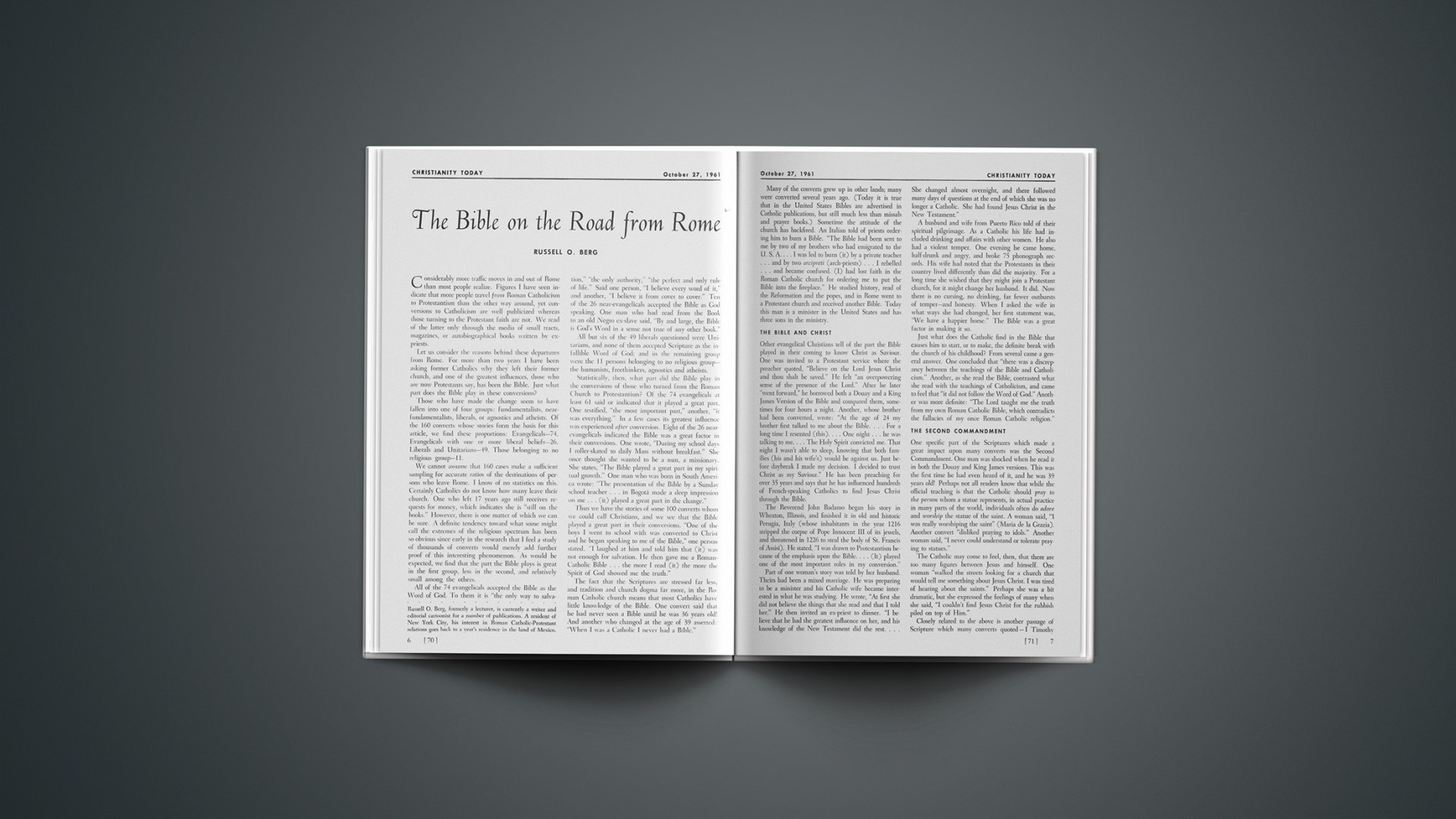
The Bible on the Road from Rome

Considerably more traffic moves in and out of Rome than most people realize. Figures I have seen indicate that more people travel from Roman Catholicism to Protestantism than the other way around, yet conversions to Catholicism are well publicized whereas those turning to the Protestant faith are not. We read of the latter only through the media of small tracts, magazines, or autobiographical books written by ex-priests.

Let us consider the reasons behind these departures from Rome. For more than two years I have been asking former Catholics why they left their former church, and one of the greatest influences, those who are now Protestants say, has been the Bible. Just what part does the Bible play in these conversions?

Those who have made the change seem to have fallen into one of four groups: fundamentalists, near-fundamentalists, liberals, or agnostics and atheists. O! the 160 converts whose stories form the basis for this article, we find these proportions: Evangelicals—74. Evangelicals with one or more liberal beliefs—26. Liberals and Unitarians—49. Those belonging to no religious group—11.

We cannot assume that 160 cases make a sufficient sampling for accurate ratios of the destinations of persons who leave Rome. I know of no statistics on this. Certainly Catholics do not know how many leave their church. One who left 17 years ago still receives requests for money, which indicates she is “still on the books.” However, there is one matter of which we can be sure. A definite tendency toward what some might call the extremes of the religious spectrum has been so obvious since early in the research that I feel a study of thousands of converts would merely add further proof of this interesting phenomenon. As would be expected, we find that the part the Bible plays is great in the first group, less in the second, and relatively small among the others.

All of the 74 evangelicals accepted the Bible as the Word of God. To them it is “the only way to salvation,” “the only authority,” “the perfect and only rule of life.” Said one person, “I believe every word of it,” and another, “I believe it from cover to cover.” Ten of the 26 near-evangelicals accepted the Bible as God speaking. One man who had read from the Book to an old Negro ex-slave said, “By and large, the Bible is God’s Word in a sense not true of any other book.”

All but six of the 49 liberals questioned were Unitarians, and none of them accepted Scripture as the infallible Word of God; and in the remaining group were the 11 persons belonging to no religious group—the humanists, freethinkers, agnostics and atheists.

Statistically, then, what part did the Bible play in the conversions of those who turned from the Roman Church to Protestantism? Of the 74 evangelicals at least 61 said or indicated that it played a great part. One testified, “the most important part,” another, “it was everything.” In a few cases its greatest influence was experienced after conversion. Eight of the 26 near-evangelicals indicated the Bible was a great factor in their conversions. One wrote, “During my school days I roller-skated to daily Mass without breakfast.” She once thought she wanted to be a nun, a missionary. She states, “The Bible played a great part in my spiritual growth.” One man who was born in South America wrote: “The presentation of the Bible by a Sunday school teacher … in Bogotá made a deep impression on me … (it) played a great part in the change.”

Thus we have the stories of some 100 converts whom we could call Christians, and we see that the Bible played a great part in their conversions. “One of the boys I went to school with was converted to Christ and he began speaking to me of the Bible,” one person stated. “1 laughed at him and told him that (it) was not enough for salvation. He then gave me a Roman-Catholic Bible … the more I read (it) the more the Spirit of God showed me the truth.”

The fact that the Scriptures are stressed far less, and tradition and church dogma far more, in the Roman Catholic church means that most Catholics have little knowledge of the Bible. One convert said that he had never seen a Bible until he was 36 years old! And another who changed at the age of 39 asserted: “When I was a Catholic I never had a Bible.”

Many of the converts grew up in other lands; many were converted several years ago. (Today it is true that in the United States Bibles are advertised in Catholic publications, but still much less than missals and prayer books.) Sometime the attitude of the church has backfired. An Italian told of priests ordering him to burn a Bible. “The Bible had been sent to me by two of my brothers who had emigrated to the U. S. A. … I was led to bum (it) by a private teacher … and by two arcipreti (arch-priests) … I rebelled … and became confused. (I) had lost faith in the Roman Catholic church for ordering me to put the Bible into the fireplace.” He studied history, read of the Reformation and the popes, and in Rome went to a Protestant church and received another Bible. Today this man is a minister in the United States and has three sons in the ministry.

The Bible And Christ

Other evangelical Christians tell of the part the Bible played in their coming to know Christ as Saviour. One was invited to a Protestant service where the preacher quoted, “Believe on the Lord Jesus Christ and thou shalt be saved.” He felt “an overpowering sense of the presence of the Lord.” After he later “went forward,” he borrowed both a Douay and a King James Version of the Bible and compared them, sometimes for four hours a night. Another, whose brother had been converted, wrote: “At the age of 24 my brother first talked to me about the Bible.… For a long time I resented (this).… One night … he was talking to me.… The Holy Spirit convicted me. That night I wasn’t able to sleep, knowing that both families (his and his wife’s) would be against us. Just before daybreak I made my decision. I decided to trust Christ as my Saviour.” He has been preaching for over 35 years and says that he has influenced hundreds of French-speaking Catholics to find Jesus Christ through the Bible.

The Reverend John Badamo began his story in Wheaton, Illinois, and finished it in old and historic Perugia, Italy (whose inhabitants in the year 1216 stripped the corpse of Pope Innocent III of its jewels, and threatened in 1226 to steal the body of St. Francis of Assisi). He stated, “I was drawn to Protestantism because of the emphasis upon the Bible.… (It) played one of the most important roles in my conversion.’

Part of one woman’s story was told by her husband. Theirs had been a mixed marriage. He was preparing to be a minister and his Catholic wife became interested in what he was studying. He wrote, “At first she did not believe the things that she read and that I told her.” He then invited an ex-priest to dinner. “I believe that he had the greatest influence on her, and his knowledge of the New Testament did the rest.… She changed almost overnight, and there followed many days of questions at the end of which she was no longer a Catholic. She had found Jesus Christ in the New Testament.”

A husband and wife from Puerto Rico told of their spiritual pilgrimage. As a Catholic his life had included drinking and affairs with other women. He also had a violent temper. One evening he came home, half-drunk and angry, and broke 75 phonograph records. His wife had noted that the Protestants in their country lived differently than did the majority. For a long time she wished that they might join a Protestant church, for it might change her husband. It did. Now there is no cursing, no drinking, far fewer outbursts of temper—and honesty. When I asked the wife in what ways she had changed, her first statement was, “We have a happier home.” The Bible was a great factor in making it so.

Just what does the Catholic find in the Bible that causes him to start, or to make, the definite break with the church of his childhood? From several came a general answer. One concluded that “there was a discrepancy between the teachings of the Bible and Catholicism.” Another, as she read the Bible, contrasted what she read with the teachings of Catholicism, and came to feel that “it did not follow the Word of God.” Another was more definite: “The Lord taught me the truth from my own Roman Catholic Bible, which contradicts the fallacies of my once Roman Catholic religion.”

The Second Commandment

One specific part of the Scriptures which made a great impact upon many converts was the Second Commandment. One man was shocked when he read it in both the Douay and King James versions. This was the first time he had even heard of it, and he was 39 years old! Perhaps not all readers know that while the official teaching is that the Catholic should pray to the person whom a statue represents, in actual practice in many parts of the world, individuals often do adore and worship the statue of the saint. A woman said, “I was really worshiping the saint” (Maria de la Grazia). Another convert “disliked praying to idols.” Another woman said, “I never could understand or tolerate praying to statues.”

The Catholic may come to feel, then, that there are too many figures between Jesus and himself. One woman “walked the streets looking for a church that would tell me something about Jesus Christ. I was tired of hearing about the saints.” Perhaps she was a bit dramatic, but she expressed the feelings of many when she said, “I couldn’t find Jesus Christ for the rubbish piled on top of Him.”

Closely related to the above is another passage of Scripture which many converts quoted—1 Timothy 2:5. The Reverend Mr. Badamo writes that “great emphasis is placed upon praying to Mary and the saints. Protestants emphasize that ‘there is … one mediator between God and men, the man Christ Jesus’ … the Roman Catholic church is teaching error when it places the priesthood, Mary, and the saints between the individual and God.… Our Lord said ‘Come unto me (not Mary, Joseph, or an angel) all ye that are heavy laden and I will give you rest.’ ”

A number who changed were impressed by John 3:16. The first verse of Scripture one woman learned was “If we confess our sins, He is faithful and just to forgive us our sins …” (1 John 1:9). She also quoted, “For there is one mediator.…”

Many converts are deeply troubled when surrendering a religion which emphasizes the church for one founded on the Bible. Many such persons suffer from feelings of guilt. All psychologists agree that the experiences of the earliest years determine one’s style of life, and many of these people were surrounded from infancy with statues and crucifixes. They were taught that theirs was the only true church, and that outside it there is no salvation. (They may not have been told there are qualifications to this.) Some do not escape this atmosphere, these virtually compulsive habits, and these beliefs without terrible wrenchings of the soul.

Those who were devout Catholics and are now devout Protestants enrich the evangelical heritage. They bring with them the traditional “zeal of the convert.” And because the Bible meant much in their conversions and means much to them now, they add to its emphasis in the churches they join.

To sum up, for those who became converted and who are today genuine Christians, the words of a devout acquaintance, a sermon by a dedicated minister, and attendance at friendly Protestant services, were among the greatest factors in their changing. And these usually have been felt in proportion to the light they reflected from the Bible and the influence they had in persuading the Catholic to “search the Scriptures.”

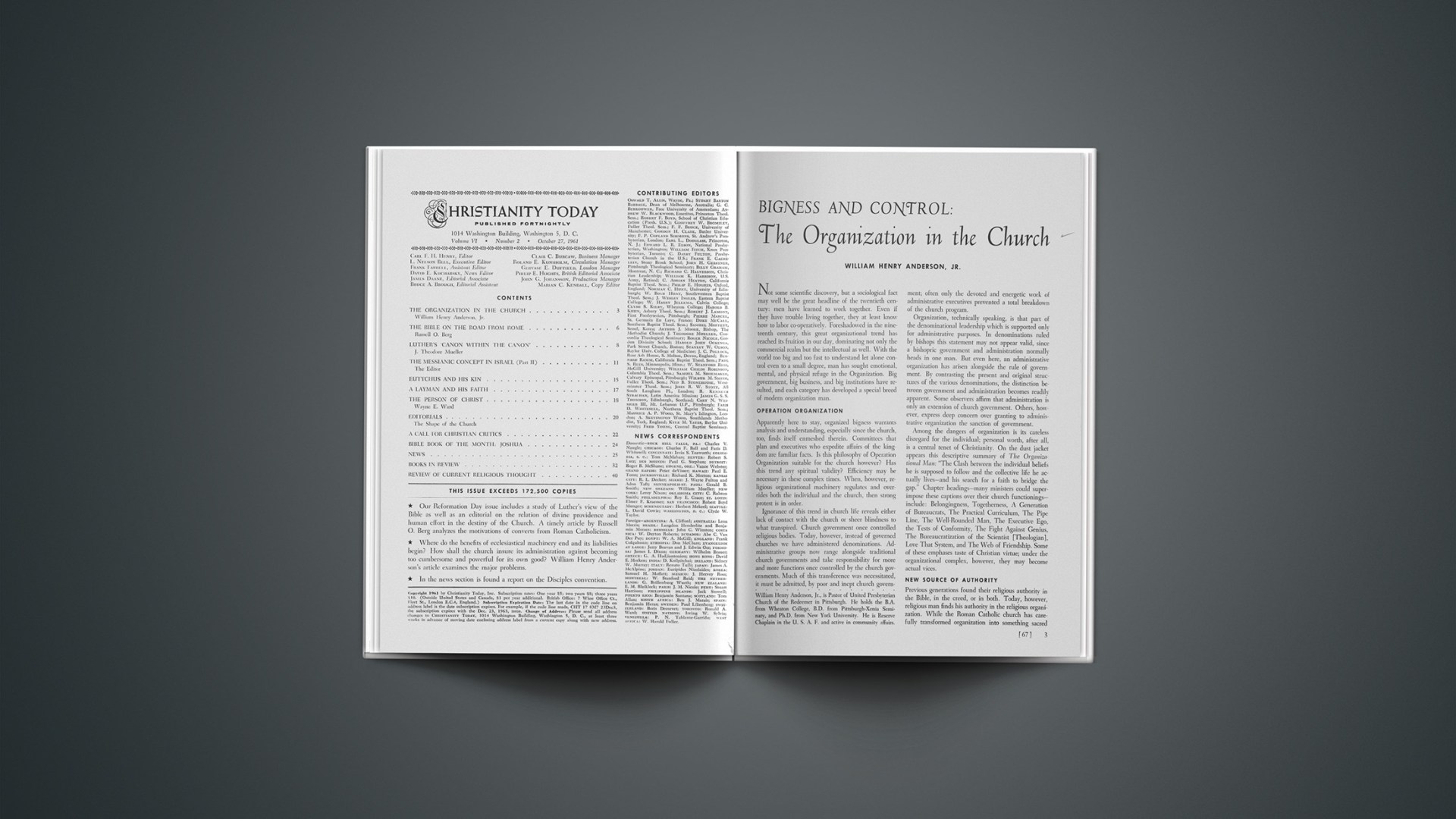
Bigness and Control: The Organization in the Church

Not some scientific discovery, but a sociological fact may well be the great headline of the twentieth century: men have learned to work together. Even if they have trouble living together, they at least know how to labor co-operatively. Foreshadowed in the nineteenth century, this great organizational trend has reached its fruition in our day, dominating not only the commercial realm but the intellectual as well. With the world too big and too fast to understand let alone control even to a small degree, man has sought emotional, mental, and physical refuge in the Organization. Big government, big business, and big institutions have resulted, and each category has developed a special breed of modern organization man.

Operation Organization

Apparently here to stay, organized bigness warrants analysis and understanding, especially since the church, too, finds itself enmeshed therein. Committees that plan and executives who expedite affairs of the kingdom are familiar facts. Is this philosophy of Operation Organization suitable for the church however? Has this trend any spiritual validity? Efficiency may be necessary in these complex times. When, however, religious organizational machinery regulates and overrides both the individual and the church, then strong protest is in order.

Ignorance of this trend in church life reveals either lack of contact with the church or sheer blindness to what transpired. Church government once controlled religious bodies. Today, however, instead of governed churches we have administered denominations. Administrative groups now range alongside traditional church governments and take responsibility for more and more functions once controlled by the church governments. Much of this transference was necessitated, it must be admitted, by poor and inept church government; often only the devoted and energetic work of administrative executives prevented a total breakdown of the church program.

Organization, technically speaking, is that part of the denominational leadership which is supported only for administrative purposes. In denominations ruled by bishops this statement may not appear valid, since a bishopric government and administration normally heads in one man. But even here, an administrative organization has arisen alongside the rule of government. By contrasting the present and original structures of the various denominations, the distinction between government and administration becomes readily apparent. Some observers affirm that administration is only an extension of church government. Others, however, express deep concern over granting to administrative organization the sanction of government.

Among the dangers of organization is its careless disregard for the individual; personal worth, after all, is a central tenet of Christianity. On the dust jacket appears this descriptive summary of The Organizational Man: “The Clash between the individual beliefs he is supposed to follow and the collective life he actually lives—and his search for a faith to bridge the gap.” Chapter headings—many ministers could superimpose these captions over their church functionings—include: Belongingness, Togetherness, A Generation of Bureaucrats, The Practical Curriculum, The Pipe Line, The Well-Rounded Man, The Executive Ego, the Tests of Conformity, The Fight Against Genius, The Bureaucratization of the Scientist [Theologian], Love That System, and The Web of Friendship. Some of these emphases taste of Christian virtue; under the organizational complex, however, they may become actual vices.

New Source Of Authority

Previous generations found their religious authority in the Bible, in the creed, or in both. Today, however, religious man finds his authority in the religious organization. While the Roman Catholic church has carefully transformed organization into something sacred with an absoluteness geared to winning modern man, it has done so without taking administrative authority from church government. Protestant churches have not yet effected such a union of the sacred and human, although there may he administrative authorities who hope in this direction.

If the religious organization man is more specialized in the humanities or perhaps a better public speaker than the organization man of commerce or government, he nonetheless differs from him in motivation and value judgment only by great personal effort. A minister disinterested in organization is considered somewhat suspect, for everyone is supposed to become involved in regional and national activities promoting the organizational program. If the organization offers a minister some special responsibility he feels honored. Acceptance means facing the problems of the organization. Pressure for organizational conformity comes through communication media, education, social pressure, and possibilities of professional advancement.

Fortunately almost everyone in the religious organization espouses personal faith, and usually men of great personal integrity have moved to the top administrative posts. Even integrity, however, is inadequate to correct the foibles of human nature in an organization. Organization demands conformity. A leader surrounds himself, therefore, with those indebted to him and accordingly compliant to his will. As men build their own parts of the organization, they engage in occasional power struggles. And they may display an alarming disregard for the Christian doctrine of the priesthood of believers. Lacking, too, may be administrative faith in the common man, the local church, and in the local pastor. While awaiting directives from higher echelons, pastor and people in the local church, therefore, may soon lose heart and initiative.

Service Or Control?

In addition to its threat to the individual, the organization poses two major problems for the church: first, its tendency to control the church, and second, the organization’s tenacious determination to perpetuate itself.

The first problem is a clear case of the tail wagging the dog. The administrative organization properly exists to serve the church, but the fine line between serving and controlling is easily blurred or altered in the course of operations. By straddling most lines of communication the organization soon has undue power to influence the affairs of the church.

Whether in Congregational or Episcopal churches, organizational problems are very similar. This similarity may explain why most pressure in favor of ecumenicity comes from men in the administrative organization. In the different denominations, administrative structure is very much alike and, as far as the administrators are concerned, often much more vital and vigorous than church government. The religious organization man finds similarities in organization far more important than differences in government.

For its work the organization seeks the best and ablest men and sometimes literally robs the church of great and strategic talent. It importunes them through men already in the organization, or on the basis of the task to be done. To recruit the best is only natural since the organization’s problems are difficult and challenging, and the church’s support for its program is really quite meagre.

Tendency To Self-Perpetuation

The second danger of the organization is its tendency to self-perpetuation. The 20 per cent of the ordained ministers of the United Presbyterian Church who soon will be employed outside the pastorate are an example. Since most of these nonpastoral positions are at least partially in or under the organization, the organization thus assures itself a high degree of continuation.

To guarantee this self-perpetuation the organization has largely captured the theological education of the church. However unobtrusive the pressure may be, the organization nonetheless urges seminaries to reflect the dominant theological views of the denomination, be they liberal, neo-orthodox, or evangelical. Securing conformity is difficult enough, without battling an additional complication of theological diversity. Individual faculties, too, should preferably be of the same persuasion; and in the larger denominations all seminaries are expected to be the same theologically. In the eyes of the organization, seminaries are to produce interchangeable cogs to maintain smooth operation of its machinery. Original independent teachers and unique leaders may be the joy of a denomination; to the organization such persons portend only trouble. “Don’t give the church Luthers or Wesleys,” says the organization to the seminaries. “We can’t use such men.”

Expansion of the administrative organization is quite inevitable. “Work expands so as to fill the time available for its completion,” says the professor in his humorous book, Parkinson’s Law. Almost any active organization, he notes, will grow about five per cent in any given year even with no increase in output. While Professor Parkinson’s book is hilariously funny, it is sadly apt in describing what is actually happening in the churches.

The religious organization follows a pattern. After a group of concerned ministers or laymen has performed some task for several years as a labor of love, the work inevitably becomes a payroll operation. Then as soon as an executive finds himself with several different types of responsibility, the temptation comes to employ assistants who can be supervised since an administrator’s work ideally should be logical, coherent, and compact. With no check on its Topsy-like growth, such expansion of the organization swallows tremendous material resources.

What can be done about these dangers to the church? Obviously the present mania for organization experiences little opposition in the church. Fundamentalists have no essential quarrel with the concept itself; their discontent centers rather in not having control of the organizational machinery. Both the theologically more conservative denominations and the more liberal communions share similar organizational woes. In their groups, the organization and the organization man operate almost unchecked. In national government Democrats and Republicans look over each other’s shoulders. In business the corporation executive answers to stockholders in his annual statement. If a group in the church, however, tries to organize opposition to the religious organization, it may be accused of opposing either the church or the church government, and is labeled schismatic.

Actually the organization has devised a unique procedure for dealing with any possible critics. Such persons receive all sorts of honors. Those with prestige are placed on committees, named on letter heads and mastheads, and occasionally assigned some prominent responsibility. They may also be delegates to workshops, seminars, and meetings in distant cities or beautiful resorts. While these techniques require large expenditures of money, they often neutralize potential trouble and discontent.

Some Possible Correctives

Although it seems quite impossible to revert to some simpler period of church life, the present situation is certainly not beyond control. Several persistent questions indicate both the complexity of the situation and also the possibility of its correction.

The central problem is that of the organization’s purpose. Where a church acknowledges Christ as Lord and is governed through the agency of the Holy Spirit, what shall be the function of an administrative organization? Church government arose from a need for doing things decently and in order, but is this need a valid reason for administrative control? How necessary is a centralized executive function and program agency to a church? Can a distinction be made between administration and government in the church? Can administration and government be separated? If the two can be separated, the possible loss of which one would be least detrimental to the church? If there is to be executive organization, shall the church or the organization determine its purpose?

Other related questions quickly follow. How much of the organization exists to support the mission of the church and how much exists to support the organization itself? Is not rigid austerity in stewardship of church money important? Has modem administrative organization effected an improved spiritual condition in local churches? Does the organizational method conform to the discipline of the school of Christ, or does it simply adapt the management principles of industry to the church? Are the values of the marketplace to be the values of the church? Can an obsession with public relations honestly reflect the image of Christ? Does the spirit of competitive self-aggrandizement found in secular business have a rightful place in the Kingdom?

The organization would probably answer these questions by urging the strengthening of the executive and program agencies of the church to secure greater efficiency and more energetic accomplishment of work. Certainly the church’s work needs prodding; the Christian solution, however, may be not in the organization but in affirming Christ’s kingship in the church.

It is easy but wrong to charge the administrators with the present situation. If there is blame, the whole church is at fault. Even if some may have overreached themselves, administrators as a whole cannot be blamed for aggressively doing their church-appointed tasks. It is the organization rather than its men that is at fault. To change the personnel would provide only temporary improvement; the system itself needs alteration.

How churches should meet this problem is difficult to say because they represent so many differences in church government. Generally speaking, organizations need to be streamlined. Duplication of function should be eliminated and organization policy determined not by its own administration but by church government. Local churches can certainly exercise some initiative in program areas rather than parrot all that arrives in the mail from headquarters. Surely each denomination has areas where its own creative imagination can effect church improvement.

Can the church survive, if it does not control its organization? After all, tremendous resources of material and energy are consumed by the organization. It could therefore provide some of its best service to the church by instituting a self-limiting device for itself. On the other hand, the organization can inspire the government of the church to maintain itself as the Ecclesia semper reformanda.

Review of Current Religious Thought: October 13, 1961

Some startling events have taken place recently in Scotland, a land which takes its religion seriously. In 1957, for example, when the “Bishops’ Report” was issued and an irresponsible press campaign raised the alarm that Presbyterianism was to be sold down the river, a story was told of two university lecturers discussing the crisis. “Why are you so worked up?” asked one, “I thought you were an atheist.” “So I am,” replied the first, “but I’m a Presbyterian atheist.” On a lower level, the bi-annual matches between Scotland’s two most famous football teams are often made the occasion of pseudo-religious partisanship leading to thuggery and mob violence. The past months have seen the religious issue brought into even sharper focus:

1. The Pope has set up a Secretariate to help non-Romans follow the work of the impending Vatican Council, and to help other churches arrive at unity with Rome. This brought significant comment from the magazine of the normally irenic United Free Church: “The argument that union has become a necessity in order to combat Communism is specious. Communism is stronger in Catholic Italy than in any Protestant country in Europe. The followers of Christ are not pledged to combat this or that political ideology, but to preach Christ.…”

2. A majority of this year’s Church of Scotland General Assembly evidently approved the suggestion that when he goes to Rome next year for anniversary meetings of the Scottish congregation, the Moderator might call on the Pope. This proposal, unthinkable 30 years ago, was received typically by the Free Presbyterian Church’s official organ. “To those of us,” it says, “who have known the downgrade movement in the Modernistic, Scoto-Catholic, Arminian and Antinomian Church of Scotland … it has caused no surprise.…” (The F.P.’s, it should be added, regard the Roman hierarchy as a kind of cosmic swindle, while that hierarchy’s local representatives profess sorrowful amazement that, despite alleged common aims, “this little church on the Western seaboard of Scotland is … the Catholic Church’s most unrelenting antagonist.”)

3. Three Scottish dailies somewhat sensationally published details of a “secret meeting” about Church unity between Church of Scotland “leaders” and representatives of the Roman Catholic church. What in fact happened was not worthy of blaring headlines. About 35 ministers and elders were invited as individuals to attend for a day the annual conference of the Superiors of Roman Catholic religious orders in Scotland. One purpose of this was that the conference should hear Presbyterian views on such subjects as papal infallibility, the Mass, and the place of Mary in Roman worship. These were made with complete freedom and frankness, and received with great patience and courtesy. There was no debate. Not surprisingly, many in the country felt that such an invitation should not have been accepted. Others, like Sir Thomas Taylor felt a duty to discuss agreements and differences.

Public reaction to these three developments naturally raises the question, how strong is the Roman church in Scotland? The Roman Catholic archivist for Scotland, writing in the Glasgow Herald during last year’s fourth centenary celebrations, pointed out that while it was the aim of the Scottish Reformers to abolish forever the Mass in Scotland, 1000 Masses were daily said in the country four centuries later. In the light of this a Scottish Protestant, looking back to John Knox’s “uproar for religion,” might be tempted to rueful remembrance of Southey’s words from another context:

“But what good came of it at last?”

Quoth little Peterkin.

“Why that I cannot tell,” said he,

“But ’twas a famous victory.”

Since achieving legal toleration under the Catholic Emancipation Act of 1829, Roman Catholicism has grown steadily in Scotland (members estimated at 50,000 in 1860, nearly 800,000 in 1960). There is no historical justification for the romantic fiction that in the Western Isles persisted “a pious Catholic populace who maintained their faith undisturbed by the Reformation,” and modern Scottish Catholics are largely the result of Irish immigration. Last year for the first time the Roman Catholic school population of Glasgow rose to one-third of the whole, and if the process continues at the same rate, the fifth centenary of the Reformation may be celebrated by a minority.

Other signs are not lacking. The United Free Church’s General Assembly recorded the increasing influence of the Roman Catholic church in civic affairs in certain areas, and strongly recommended to all church members a deeper interest in local government and a consideration of individual responsibility as a vital part of Christian witness and service. The education committee of a Scottish county refused to allow an essay competition in its schools in connection with the Reformation celebrations, prizes to be provided by the local Church of Scotland presbytery. The Committee’s refusal provoked a pertinent comment from a former moderator of the presbytery who voiced the growing uneasiness of many in Scotland. “In view of what has happened in this county,” he said, “I congratulate the Roman Catholic Church on its wisdom in limiting the power of the Education Authority.” A few years ago, only the efforts of a single far-sighted theological professor prevented the Roman church from acquiring as a seminary for its priests a building overlooking the Martyrs’ Monument in St. Andrews, the nursery of the Scottish Reformation. Finally, a rare event in the Church of Scotland, in the past 12 years two of its ministers, one of them with long service in the most rigidly Calvinistic of the Hebridean islands, have become Roman Catholics.

“We live in a very different world from that which the Reformers knew,” says the 1960 Church of Scotland Year-Book, “but the battle is still the same.” No one is likely to be misled into thinking that this is a battle peculiar to Scotland only.

Book Briefs: October 13, 1961

Current Mood Of Our Century: Alienation

Modern Thinkers Series, edited by David H. Freeman (Presbyterian and Reformed Publishing Co., 1960, 8 paperbacks): Nietzsche, by H. Van Riessen (51 pp., $1.25); Sartre, by S. U. Zuidema (57 pp., $1.50); Kierkegaard, by S. U. Zuidema (50 pp., $1.25); Barth, by A. D. R. Polman (68 pp., $1.50); Bultmann, by Herman Ridderbos (46 pp., $1.25); Niebuhr, by G. Brilenburg Wurth (41 pp., $1.50); Dewey, by Gordon H. Clark (69 pp., $1.50); and Van Til, by Rousas J. Rushdoony (51 pp., $1.25), are reviewed by Robert D. Knudsen, Assistant Professor of Apologetics, Westminster Theological Seminary, Philadelphia, Pennsylvania.

Our century has been witness to a profound shift of mood. This shift is not very apparent in public life in America, but it has had a very deep influence on our world of letters, particularly in theology. Generally the newer mentality is spoken of as a departure from the optimistic idealism of the nineteenth century. It involves an unhinging of earlier antitheses, or at least the placing of them in new settings. There has been a change of moral values, and even of the evaluation of morality itself, as epitomized in Nietzsche’s “beyond good and evil.” In place of the feeling of being at home in one’s universe, there has come a sense of alienation from one’s world and from oneself. The innovators take a stance against the Enlightenment and the conceptions of human reason, will, and technical progress which they attribute to it. The shift of sentiment has of necessity involved a criticism, as in Oswald Spengler, of our humanistic Western culture, and of some of its most hallowed traditions. It may fairly be said that today the philosophy of existentialism most clearly expresses this change of mood and that it tries to answer the problems of our time on a level which it feels has yet been little explored.

How is the evangelical mind to assess this shift? This question is especially challenging because the newer mind has itself interpreted the shift as being unfriendly to orthodoxy. For instance, Paul Tillich, who shares this point of view, has associated evangelical thinking with the spirit of the Enlightenment, and in criticizing the latter has set the Reformation in what must seem to the orthodox Christian to be an altogether strange light.

Fortunately the orthodox Christian is not altogether without help in making this assessment. The above Modern Thinkers Series, for instance, in the volumes presently available and those yet in the planning stage, should offer considerable aid. Each of the contributions presently available deals either with a thinker who is symptomatic of this shift or who has wrestled with it.

Professor Van Riessen, of the Institute of Technology in Delft, Holland, vividly portrays the saga of a man, Friedrich Nietzsche, who tried to set himself uncompromisingly against God (“God is dead”) and the bourgeois culture which he thought was the product of the decadent influence of Christianity. Faced with the resulting nihilism, he proclaimed the supremacy of the will to power of the superman as the meaning of life, only to fall into meaninglessness again as his ultimate became the law of eternal recurrence. Nietzsche was a conscious opponent of Christ; nevertheless, he was forced to admit his admiration for him, and he framed a philosophy that has been said to be unthinkable apart from the influence of the man from Nazareth.

In this series the thinker who most closely approximates Nietzsche is Jean-Paul Sartre. Professor Zuidema, of the Free University of Amsterdam, finds in Sartre’s thought a radical freedom philosophy in which man elects himself as sovereign in place of God, and creates himself in negation of the world and of his own past. For this view of freedom, says Zuidema, Sartre must pay the price of isolation and nihilism, eventuating in a philosophy of frustration.

In the two preceding thinkers there is the fruit of a methodical elimination of God. The result is the radical encounter with nothingness or meaninglessness which is one of the hallmarks of existentialistic thinking. In the following treatise, Kierkegaard, Professor Zuidema portrays the so-called “father of existentialism” who sought to incorporate the encounter with nothingness into the experience of God.

Zuidema’s monograph is organized around the question of the relationship between Kierkegaard’s analysis of human existence and the absolute Paradox, God manifest in the flesh. He concludes that in Kierkegaard there is already a secularization of Christian concepts; human existence is understood apart from the revelation in Christ. There is in Kierkegaard himself a point of contact both for the existentialists who desire an existential analysis of man apart from the Incarnation and for the dialectical theologians who desire to elaborate on the revelation in Christ apart from any reference to human existence. Zuidema concludes that as Kierkegaard’s thought moves between these two poles he emerges with an untenable and contradictory synthesis of a distorted Christian faith.

It is, of course, Karl Barth who has increasingly sought to interpret Christianity in Kierkegaard’s spirit without any reference to an existential analysis of the human situation. Professor A. D. R. Polman of the theological seminary of the Reformed Churches in the Netherlands, Kampen, sets Barth’s Romans in an unusual light and then proceeds to expound and discuss his views on the Word, predestination, and creation, as presented in the Church Dogmatics. Polman sees in Romans a book whose teachings are not simply to be affirmed or denied but whose conscious exaggerations are intended to arouse a lethargic Christendom and to battle immanence theology. After a sympathetic and sometimes even irenic exposition of each of the doctrines under consideration, Polman proceeds to a confrontation of Barth’s views with the Word of God, as understood by orthodoxy. In each case, he discovers that Barth has approached the Word of God with a pre-established framework. Throughout, Polman has an eye for Barth’s actualism, which he discovers as Barth’s attempted answer to nihilism. He could, however, have made this theme more central both in his expositions and criticisms.

It is, on the other hand, Rudolf Bultmann who, of all New Testament scholars, seeks to understand the Christian message in terms of an existential analysis of man’s situation, after having relieved it of the supposedly mythical form in which it has been transmitted to us by the biblical writers. As Professor Ridderbos, Professor of New Testament at Kampen, sees it, the problem for Bultmann is whether a person who no longer thinks in mythological terms can find divine redemptive proclamation within the redemptive act, described in the New Testament as a mythical event, and within the person of Jesus, conceived of as a mythical divine person. In what is one of the clearest expositions of the entire series, Ridderbos presents a respectful analysis of Bultmann’s existential position; nevertheless, he concludes that Bultmann’s reconstruction of the New Testament message is a failure and is itself a greater unlikelihood than the supposed mythical world view he is intent on eliminating.

Another thinker who has busied himself with myth is Reinhold Niebuhr. Instead of relinquishing so-called “mythical” expression altogether, he developed what he earlier presented as a “mythical theology.” Professor Brilenburg Wurth, also of Kampen, traces Niebuhr’s development from his early break with liberalism to his mature theological expression, especially with regard to the redemptive work of Christ and the revelation of the kingdom of God. The monograph concludes with a general evaluation. Wurth finds that Niebuhr lacks a clear-cut biblical starting point, and misunderstands such doctrines as the creation; instead, he is influenced by existentialism, and thinks within the framework of the Kierkegaardian dialectic of time and eternity. In Wurth’s presentation there are lapses in detail; however, he is one of the few who in their evaluation of Niebuhr have subjected the basic dialectical structure of his thought to scrutiny.

The next volume, Dewey, by Professor Gordon H. Clark of Butler University, is of a different genre. It is, first of all, an original contribution to the series, the treatises mentioned heretofore having appeared in Dutch as chapters of a symposium, Thinkers of Our Time. Furthermore, it deals with pragmatism or instrumentalism, which is one of the main objects of attack by the existentialists. But as Clark passes Dewey’s philosophy under review and analyzes his views of science, values, and logic, he concludes that Dewey is also an irrationalist. Dewey eliminates eternal ideals and attempts to base values on a scientific experimental basis. Clark argues that science offers no basis for establishing ultimate values. Thus Dewey’s sense of values must depend upon nothing more than his own personal preferences. Not even the law of contradiction is safe when descending into the maelstrom of Dewey’s philosophy of flux. Clark’s presentation, on his Christian rationalistic presuppositions, is more technical as it gathers momentum; but everything except the last section is understandable for one who does not have a specialized philosophical training.

The last essay deals with one who has set the Christian world and life view sharply against both the older idealism and the newer pragmatic and existentialistic thought. In his essay, Van Til, Rousas J. Rushdoony, minister of the Orthodox Presbyterian Church of Santa Cruz, California, and editor of another series in the same International Library of Philosophy and Theology, presents us with a clever chapter, “The Emperor Has No Clothes,” taken from a larger work on the philosophy of Van Til. He has preceded this with an introduction in which he presents a more general approach to the background and the present crisis of Western thought. In contrast to classical Greek thought, modern man has made time central, but failing to see it on the background of God’s counsel and his covenant, it has fallen into irrationalism. With broad and sometimes bold strokes Rushdoony pictures contemporary philosophy as a flight from reality. He is correct that there is a crisis and that this crisis is connected with the inability to solve the problem of reality, to cope with the threat of nothingness; but his discussion throws especially the existentialistic philosophy into a perspective that is somewhat alien to me. He is aware that the existentialistic position demands the encounter with nothingness, if one is to come to himself or to God. He is, however, apparently little aware that for the existentialists nothingness and man’s alienation from himself and from his world are problems with which they start and which they try mightily to overcome. To my mind this is a forlorn and hopeless effort on their part, since they first of all give autonomous man full sway, and then and only then seek to reconstruct a new foundation of meaning beyond nihilism. As Rushdoony points out, the school of Christian philosophy developed by Abraham Kuyper points out a different way which challenges autonomous man at the outset and demands that philosophy be built upon the only true foundation, the message of the Scriptures.

Though brief and necessarily fragmentary in treatment, these treatises should nevertheless provide stimulating reading, especially for the Christian college student who is faced by the need to find his balance intellectually in a perennially difficult world. This is particularly so, since the authors to a man have a high view of the inspiration of the Scriptures and seek, with whatever nuance of approach their particular methods may entail, to found their thinking and their evaluations of contemporary trends firmly on the unfailing Word of God.

ROBERT D. KNUDSEN

From Mary To Titus

Great Personalities of the New Testament, by William Sanford LaSor (Revell, 1961, 192 pp., $3), is reviewed by F. F. Bruce, Faculty of Theology, University of Manchester, Manchester, England.

We give a hearty welcome to this companion volume to Dr. LaSor’s earlier work, Great Personalities of the Old Testament. The New Testament is not a whit behind the Old in biographical interest, and Dr. LaSor makes the principal characters of the New Testament live again before our eyes in these pages.

A preliminary chapter on “The Fullness of Time,” which sketches the historical and cultural setting of the New Testament narrative, is followed by a study of John the Baptist. Dr. LaSor is well acquainted with the new background which recent years have supplied for the ministry of John, but he reminds us of the important features which distinguish him from the ascetics of Qumran.

Three New Testament personalities are sufficiently important to receive two chapters each: one (of course) is our Lord (“Jesus the Son of Man” and “The Triumphant Christ”), the second is the leader of the Twelve (“Simon Bar-Jonah” and “Peter the Rock”), and the third is the Lord’s chief herald among the Gentiles (“Saul of Tarsus” and “Paul the Apostle”). Without the slightest modification of the historic Christian faith about the person of our Lord, Dr. LaSor brings out impressively the reality of His manhood. The chapter-heading “Peter the Rock” reminds us of the New English Bible rendering of Matthew 16:18; Dr. LaSor’s exposition of that text holds “that Jesus was designating Peter as the Rock on which He was beginning the building of His Church” (p. 73). With regard to Paul’s ministry it is good to note the espousal of the south Galatian interpretation: “travel in Galatia will convince all but the most stubborn” (p. 109, n. 2). Dr. LaSor is also undoubtedly right in his view that Paul spent the 10 years of obscurity before Barnabas brought him to Antioch “preaching in the province around his home town” (p. 123).

Other chapters deal with the Virgin Mary, Andrew, the family at Bethany, Stephen, Barnabas and Mark, Luke, Priscilla and Aquila, Timothy and Titus, Thomas, “John the Theologian” (apostle, evangelist, and seer). Each chapter is full of points of interest, frequently occasioning surprise and sometimes disagreement, but always provoking thought and fresh reference to the sacred text. It is a pleasure to commend this book unreservedly.

F. F. BRUCE

Edworth And Oxford

The Young Mr. Wesley, by V. H. H. Green (Arnold, 1961, 342 pp., 35s.), is reviewed by A. Skevington Wood, Minister, Southlands Methodist Church, York, England.

Of books on John Wesley there seem to be no end, and only an author with something genuinely new to disclose can justifiably claim attention. Dr. Green, Fellow and Senior Tutor of Wesley’s own college at Oxford (Lincoln), establishes this right and has, indeed, filled a considerable gap in our understanding of Wesley’s pre-conversion years. He has utilized not only the researches of Léger and Schmidt, which are unavailable in English, but also, and more significantly, Wesley’s unpublished Oxford diaries.

The result is a volume of exceptional interest to the historian, presented in a choice literary style which will appeal to general readers. The background of Wesley’s university career is greatly illuminated by Dr. Green’s specialist knowledge, and the home life of Epworth Rectory is depicted with unusual insight. We are not certain, however, whether Dr. Green fully appreciates what is involved in an evangelical conversion, and it is with evident reluctance that he concedes that this crisis did at least make “some difference to John Wesley (p. 287). His conclusion must rank as a classic understatement.

This failure to penetrate the secret of Wesley’s warmed heart leads Dr. Green almost to regret the concentration of his interests on the God-given mission of evangelism. Leisure and he had parted company, and he no longer possessed either the time or the inclination to pursue the social round in which he had formerly participated. Indeed, what we learn here concerning the pleasure-loving Wesley prior to 1738 points up rather than minimizes the change of direction effected by his conversion, although Dr. Green does not seem altogether to realize this fact.

He comes nearest to it when he speaks of Wesley’s dissatisfaction with his former way of life (p. 80). Yet he suspects such autobiographical confessions, particularly if made under the stress of emotional experience (p. 81), and “too abundant religious zeal, more especially in its extreme Evangelical forms” (p. 171), as likely to produce a lack of balance. It is this basic antipathy which prevents Dr. Green from doing full justice to the work of grace in Wesley.

A. S. WOOD

To Start A Sermon

Proclaiming the New Testament, a series of homiletical comments and ideas covering the New Testament and edited by Ralph G. Turnbull (Baker, 1961, first three vols.): The Gospel of Matthew, by Herschel H. Hobbs (135 pp., $2.50); The Gospel of Mark, by Ralph Earle, (119 pp., $2.50); and The Book of Acts, by Ralph G. Turnbull, (161 pp., $2.75), are reviewed by Charles W. Koller, President, Northern Baptist Theological Seminary.

Each author follows the prescribed pattern for the series and discusses every passage under the following heads: I. Historical Setting, II. Expository Meaning, III. Doctrinal Value, IV. Practical Aim, and V. Homiletical Form.

For the biblical preaching and teaching which the present generation so greatly needs, these volumes offer real help in terms of sound interpretation and stimulating flashes of insight.

The volume on The Gospel of Matthew, by Dr. Hobbs, contains 28 studies, one on each chapter of this Gospel. It is intended to be “neither a commentary nor an exposition, nor a book of sermons, but an aid in sermon or devotional preparation, designed to save many precious hours of research.” To this purpose, the book is admirably adapted. The notes on the “Historical Setting” and the “Expository Meaning” should prove exceedingly helpful along with the doctrinal, practical, and homiletical values. Generally three or four verses are covered in each study. The homiletical hints are fresh and stimulating with occasional instances of slight straining to achieve parallelism in the homiletical phrasing of points.

The volume on The Gospel of Mark, by Dr. Earle, is pleasingly fresh and crisp in style, with no words wasted. It contains 35 studies, with one to four studies based on each chapter of this Gospel. From each selected passage the author takes a text and develops it in the light of its context, with careful attention to exegesis and historical setting. The result is, to a degree, both textual and expository, and provides a good starting point from which the reader may proceed to his own homiletical or devotional development of the passage. It would be an added convenience if the verses included in each study had been expressly indicated. These studies are not intended to be sermons but sermon starters. And since they are not sermons, the thesis, application, and illustrations are generally omitted. Each study is developed around three points, and these, with considerable ingenuity, are brought into alliterative parallelism. As is usual in such a structural pattern, there is, at times, a slight stretching of words to fit the pattern, though not enough to mar the value of the studies.

Dr. Turnbull’s studies in The Book of Acts cover all the 28 chapters. There are 29 studies in all, calculated to stimulate thought, at the same time supplying sound interpretation and helpful flashes of insight. They are more in the nature of expository analysis than sermon outlines; hence, there is generally no expressed thesis or proposition and no transition from the introduction to the body of the discussion. Illustrations are appropriately left for the individual to supply from his own experience, observation, and reading. The “Historical Setting” of each passage is carefully worked out, as is the “Expository Meaning,” with the aid of the Greek text. Persons and places are clearly identified, and relationship explained, along with the circumstances and the timing of events treated. There are many fresh touches, not elaborated but expressed in metaphor or apt phrasing such as will stimulate homiletical thinking.

CHARLES W. KOLLER

Response To Toynbee

The Intent of Toynbee’s History, edited by Edward T. Gargan (Loyola University Press, 1961, 224 pp., $5), is reviewed by C. Gregg Singer, Professor of History, Catawba College.

It was to be expected that a work of such broad sweep and ambitious hopes as Toynbee’s A Study of History would be subjected to searching criticism. But since the appearance of the first volume of this study, Professor Toynbee has been the object of a continuous storm of criticism seldom accorded to the most controversial of historians.

Some of these criticisms have their origin in the deep-seated antagonism of many historians to any attempt to study history as a whole rather than as national states and their political development. Still other historians objected to the details of the plan which Toynbee adopted, and to his use of analogy. They also rightly pointed out that in a work of such magnitude there were errors of factual detail. Another source of criticism lies in the fact that there have been major shifts in Toynbee’s own thinking since he began his work, and, as a result, there are fundamental cleavages between his earlier and later volumes.

This co-operative study of Toynbee reflects these various sources of opposition to his work. But underlying the critical approaches there is, on the part of all the contributors, a genuine appreciation for Toynbee’s tremendous scholarship and his imaginative use of historical data in a serious effort to find meaning in history. Perhaps the two most searching chapters in this work are those by Edward Rochie Hardy dealing with Toynbee’s conception of universal churches, and Eric Vogelein who gives a penetrating discussion of Toynbee’s Study as a search for historical truth. In these two chapters the basic deficiencies of his position are set forth, and all of his writings should be studied in the light of these penetrating analyses. Although Toynbee emphasizes the tremendous role which universal churches play in civilizations, he refuses to accord to Christianity and the Church their unique place in human history; he thus misses the key which makes available the only clues we have to the meaning of the historical process.

C. GREGG SINGER

Criticism In Chaos

The Bible and the Ancient Near East, edited by G. Ernest Wright (Doubleday, 1961, 409 pp., $7.50), is reviewed by Oswald T. Allis, formerly Professor of Old Testament at Westminster Theological Seminary.

This volume of “essays in honor of William Foxwell Albright” was presented to him on his 70th birthday after a lecture which he delivered at the Hebrew Union College-Jewish Institute of Religion in Cincinnati. The presentation was made by the editor.

Most of the essays are by former pupils of Dr. Albright. They are the following: “Modern Study of O. T. Literature” (John Bright); “Biblical History in Transition” (G. E. Mendenhall); “The Hebrew Language in its Northwest Semitic Background” (W. J. Moran); “The Achaeology of Palestine” (G. E. Wright); “The Textual Criticism of the O. T.” (H. M. Orlinsky); “The Development of the Jewish Scripts” (F. M. Cross, Jr.); “The Chronology of Israel and the Ancient Near East” (D. N. Freedman and E. F. Campbell, Jr.); “South Arabian History and Archaeology” (G. W. Van Beek); “Sumerian Literature, a General Survey” (S. N. Kramer); “Formative Tendencies in Sumerian Religion” (T. Jacobsen); “Egypt: Its Language and Literature” (T. O. Lambdin); “Egyptian Culture and Religion” (J. A. Wilson); “Hittite and Anatolian Studies” (A. Goetze). The titles indicate the contents of the articles as biblical and archaeological in varying degrees. The names of the authors are a sufficient guarantee of the superior and expert quality of their contributions. As an appropriate conclusion the volume also contains an essay by Dr. Albright himself, titled “The Role of the Canaanites in the History of Civilization” (first published in 1942), and also a 27-page bibliography of his writings which indicates the amazing productivity of this indefatigable archaeologist.

The first two articles will be of especial interest to the readers of CHRISTIANITY TODAY. They may be said to set the stage for all that follows since they describe the present state of biblical criticism in the light of archaeology. The authors agree that Old Testament criticism is in a state of “flux” (pp. 13, 27) or even “chaos” (p. 33). We learn that one of the two pillars of Wellhausenism, the Development Hypothesis, has fallen (p. 14), that “Wellhausenism in its classical form has almost ceased to exist (pp. 18, 34), and that the Documentary Hypothesis which underlay it, while widely accepted and generally adopted, has been under severe attack, especially from the Upsala School, and has lost much of its importance. The position of the writers appears to be that progress may be expected along the lines of the Form Criticism, according to which the documents dealing with the pre-exilic period all represent the crystallization of oral traditions the original form of which is dependent on the findings of the archaeologists, among whom they assign Dr. Albright an almost unique eminence. Hence the importance of the essays which follow and form the bulk of this volume.

Like many others, this volume raises quite insistently the question of the relation between the Bible and the Ancient Near East. There are two very different answers. If, as we are told in the first two essays, biblical criticism is in a state of flux which might be called chaos, if the biblical sources for the early history of Israel are late and more or less unreliable, if it is true that “Perhaps the most important gap in the field of O. T. history is the lack of an adequate hypothesis to replace that of Wellhausen” (p. 38), then the Bible student will turn naturally and gladly to the archaeologist for light and leading and will accept his findings, even if they are uncertain, even if they contradict the statements of the Bible. But if he believes the Bible to be the Word of God, if he believes the Pentateuch to be Mosaic, if he believes that holy men of God spake as they were moved by the Holy Ghost, then, while welcoming all the new light which archaeology has thrown on the history of ancient times and rejoicing that it has slain his great enemy Wellhausenism, he will claim the right to test the present findings of both critics and archaeologists by the Scriptures to determine whether these findings are true. Enthusiasm over these findings, valuable as they undoubtedly are, should not blind us to this fact that it is as idle to try to discover the true history of Israel, that redemptive supernaturalism which is its very essence, by digging in the ruin-heaps of ancient civilizations, as it is for the medical student to seek to discover the soul of man in the dissecting room. The soul of Israel is not to be found within the mounds of ancient cities, but within the pages of that Book committed to Israel as “the oracles of God.”

OSWALD T. ALLIS

Preacher And Theologian

Preaching and Biblical Theology, by Edmund P. Clowney (Eerdmans, 1961, 122 pp., $2.50), is reviewed by William Childs Robinson, Professor of Historical Theology, Columbia Theological Seminary.

Jesus came preaching, the Christian kerygma is a preachable theology. It is a pleasure to welcome this evidence that the Westminster Professor of Homiletics is a theologian, even as we welcomed D. Ritschl’s Theology of Proclamation as evidence that Austin’s theologian was a preacher.

The author shows himself a thorough scholar, at home in current thought as in the Bible, a master of words and sounds, a practical and helpful teacher in his field of service. The first section lays the foundation in great principles the first of which is that God speaks as well as acts, that his written Word is norm as well as source for our preaching. Then in the later sections of the book he brings out the practical application using a deep understanding of biblical theology to give the background for preaching.

The pragmatic pastor or rushed professor of homiletics may get engrossed in this helpful work by first reading the treatment of David and Goliath, of Abraham offering Isaac, of the Good Samaritan, or of Mary’s Anointing of Jesus and then return to the foundations from which such rich ore is quarried.

Professor Clowney insists that Holy Scripture is consistent. We agree that it is consistent from God’s point of view and that we can find rich treasure by recognizing and seeking this consistency. From our viewpoint, some of His wisdom is inscrutable so that we often face paradox and mystery—where reason staggers but faith worships.

WILLIAM CHILDS ROBINSON

For Ethics, Three Pillars

Ethics and the Gospel, by T. W. Manson (Scribner’s, 1960, 109 pp., $2.75), is reviewed by George Eldon Ladd, Professor of Biblical Theology, Fuller Theological Seminary.

Manson finds the fundamental structure of New Testament ethics in a Jewish rabbi, Simeon the Righteous, who taught that the world is based on three things: the law, worship, and the “imparting of kindnesses.” The rabbis taught that proper observance of the law included an undivided loyalty to God and full respect for human personality; and the final governing motivation for all ethical action must be a desire to please God and to do the right for its own sake with no ulterior motive whatever.

These three pillars form the outline of the Sermon on the Mount: the New Law (chap. 5); the New Standard of Worship (chap. 6); and the New Standard of Corporate Solidarity (chap. 7). Jesus’ ethics did not transcend Jewish ethics in their emphasis upon inwardness or motivation but primarily at this point: the quintessence of Jewish ethics was that one should love his neighbor as he loves himself, while the differentia of Christian ethics is that we should love our neighbor as Christ has loved us (John 13:34; 15:12). This alone is completely unselfish love. The same three pillars appear in the life of the earliest Christian community in Acts 2:32—the apostles’ teaching (the law), the prayers (worship), and the fellowship and the breaking of bread (kindnesses).

In the final lecture, Manson makes an interesting use of the claim of form criticism that much of the Gospel material, especially the parables, has lost its original historical setting and has been placed in the setting of the life of the church instead of in the life of Jesus. Parables which historically in Jesus’ teachings were concerned with an imminent eschatological crisis have become parables of good advice for Christian conduct in the church. Manson finds in this process of transformation an important principle. The early Church was not satisfied to retain an accurate historical memory of Jesus’ teachings; rather it was concerned to apply these teachings to its own life and needs.

Manson considers the biblical ethic from beginning to end to be an ethic of the kingdom of God—the ethic of Christ’s reign in the world. The living and reigning Christ will help us through his spirit to understand and apply the will of God today. “The springs of relevation are not dried up. The living Christ is there to lead the way for all who are prepared to follow him” (p. 68).

GEORGE ELDON LADD

In The Pulpit, Peerless

The Making of a Minister, the Autobiography of Clarence E. Macartney, edited by J. Clyde Henry (Channel Press, 1961, 224 pp., $3), is reviewed by G. Hall Todd, Pastor, Arch Street Presbyterian Church, Philadelphia.

Addressing a large company of ministers near the end of his distinguished career, Clarence E. Macartney declared that a minister can learn much as well as discover much that is useful homiletically in every autobiography. His dictum concerning autobiography in general is no less true of this moving document, replete with human interest and manifesting the wide sweep of the author’s reading as well as his interests, the vigor of his theological and moral convictions, and his singular powers of narration and depiction.

Broad is the scope of this life story which commences in ancestral Scotland, Northern Ireland, and the Ohio frontier, and describes a boyhood spent on a western Pennsylvania college campus, a southern California college town, and a Colorado ranch. It is a story of education in public and private schools, a Methodist college, a state university, Princeton University and Theological Seminary, with many telling vignettes of his teachers; it is the account of a succession of pastorates, a student ministry in a Wisconsin village, a venerable church in the business section of Paterson, New Jersey, the classic splendor of Philadelphia’s Arch Street Presbyterian Church with a cultivated type of constituency and a long procession of students; the historic and cathedral-like church in downtown Pittsburgh, where he spent a quarter of a century.

Sections of this readable volume are devoted to the author’s role as polemicist and moderator of the Presbyterian General Assembly during the stirring days of the Fundamentalist-Modernist controversy and the Princeton Seminary disruption, and also to his literary and historical activities, especially in the field of Civil War research, his far-ranging travels, and pilgrimages.

Here is his own life story by a man of great reserve yet profound human interest, a peerless pulpit orator, an intellectual who as historian and litterateur could have it commented concerning him as the late Dr. George Johnstone Jeffrey of Glasgow wrote of James Denney that he knew his Boswell quite as much as he knew his St. Paul, and a thrilling and cultured herald of the everlasting Gospel.

The book has been ably edited by Dr. Macartney’s longtime assistant, Dr. J. Clyde Henry who, in a masterful introduction, pens for the reader a delightfully sympathetic and appreciative portrait of a man who was known by most persons solely through pulpit and published utterances.

G. HALL TODD

Lundensian Theology

The Faith of the Christian Church, by Gustaf Aulén, translated from the fifth Swedish edition by Eric H. Wahlstrom (Muhlenberg, 1960, 403 pp., $6.95), is reviewed by Ralph A. Bohlmann, Assistant Professor of Systematic Theology, Concordia Theological Seminary.

This second English edition of Bishop Aulén’s widely-used textbook in systematic theology has been thoroughly revised. Fourteen of the fifty-two chapters have been either completely rewritten or largely reworked. These include important chapters on the relation between Scriptures and tradition, the communion of saints, the Word of God, and the Lord’s Supper.

Aulén sees the task of theology as the analytical and critical elucidation of the content and meaning of the ecumenical Christian faith. The content of this faith is defined by the act of God in Christ and the message about this event. The necessary biblical validation of doctrine should not take place in a formal or legalistic manner, but rather by the standard of the Christ-event which is central in the biblical message. In Christ, the divine acts of victorious reconciliation and forgiveness have established man’s new God-relationship. God’s love continues today in the Spirit’s activity of creating the communion of saints and remains the basis for the life and hope of the Church.

This extensively-revised edition of Aulén’s significant work will continue to serve English readers as the best guide to understanding the techniques and emphases of Lundensian theology. Careful readers will appreciate the author’s Christocentricity, his keen analysis of the basic motifs of the Christian faith, and his deep sense of the oneness of the Church. But they will often miss the normative use of Holy Scripture which one expects from a Lutheran theologian.

RALPH A. BOHLMANN

Eutychus and His Kin: October 13, 1961

Golden Pin Award

Eutychus Foundation recorded this interview from its Annual Good Humor Award ceremonies. (Commercials are omitted.)

MC: Delighted to have you here, Eutychus. We know your column is meant to be amusing. Are we entering a period of good humor in church? Are there now more preachers in the red than pulpit pinks?

E: Yes, there is a marked increase in ecclesiastical humor, intentional and unintentional. The standard pulpit jokes are more used than ever.

MC: Standard jokes? Is there an official list?

E: Not exactly. It is a matter of unwritten tradition. Now and then a nonconforming minister will use another, but the last joke to secure universal consent, ab omnibus, is Cal Coolidge’s remark about the preacher who was against sin. It seems that “Silent Cal” was coming home from church, and …

MC: Yes, yes. I see what you mean. These canonical jokes are well known. But wouldn’t a little fresh humor help?

E: Oh, no. You will recall the quatrain:

All my fathers have been churchmen,

Nineteen hundred years or so,

And to every new suggestion

They have always answered, No!

This is the rule for humor; untested jokes are very dangerous.

MC: But isn’t the risk worthwhile? I heard no less a preacher than Billy Graham tell an excellent ecclesiastical joke. He said that a preacher had a dream. He dreamed that he was preaching; he woke up—and he was!

E: Heh, heh! That’s very good, and its not in the tradition. But it’s dangerous. After Dr. Graham told it, he had to explain that he wasn’t really sleepy, but was enjoying some kind of euphoria. And when I tried to tell it, and didn’t pause long enough after “he woke up” …

MC: What about situation humor? I’ve enjoyed reports about a Philadelphia rector who billed the British crown several thousand dollars for a church fence confiscated by the Royal Artillery during the Revolutionary War: $18 plus interest! E: Very whimsical, but I couldn’t convince my cab-driver that it was a joke. He thought this church money-raising scheme would divide the West. No, the Old Reliables are better. People recognize them as jokes and know when to laugh.

MC: Well, has the winner of the Golden Pin Award been announced?

E: Yes, it is Joe Bayly, for his charming farce, The Gospel Blimp.

MC: But there isn’t a conventional joke in that book. If standard jokes are …

E: Who needs a book for the Old Reliables? And Joe has a last chapter in which he explains his joke in the best ecclesiastical tradition. I should now like to pin this on him …

EUTYCHUS

We Grope In Darkness

Dr. Wilbur Smith, in his article “The Holy Bible” (Aug. 28 issue), is to be commended for his great Christian fervor in supporting the authority of the Bible.… But, with all due respect … he betrays a weakness in attacking Bishop G. Bromley Oxnam of The Methodist Church.

Bishop Oxnam has expressed difficulty in understanding the Virgin Birth. There are many ministers in our land today of the highest personal integrity who feel that it is not absolutely essential to a positive Christian faith. When … an intellectual roadblock, many ministers have very wisely advised their constituents to circumvent the issue and move forward in more positive areas.…

Perhaps one of the most difficult problems to explain to the human mind involves the Resurrection. The school of opinion that insists upon a physical resurrection will not satisfy a scientifically penetrating mind.… On the other hand, the “Metamorphosis Theory” which calls for a mighty act of infinite power … is far more satisfying to the scientific mind.… God’s infinite power was demonstrated in the Resurrection and we still grope in darkness seeking an accurate explanation.…

It becomes difficult to understand why Dr. Wilbur Smith … feels constrained to attack Bishop Oxnam.…

ROBERT ERICSON

Shelton, Conn.

Creeping Liberalism?

I was amazed at your report of the Wisconsin-Missouri break (News, Aug. 28 issue) which began: “Creeping Liberalism within the Lutheran Church—Missouri Synod constituency was dealt a dramatic rebuke by a sister synod.”

… It is not “creeping liberalism” in Missouri. It is “creeping Christianity” in Wisconsin that has caused the split.… Wisconsin objects to such things as Boy Scouts, Army chaplains, etc.…

Missouri refuses to “creep” along. The King’s business requires haste.

HERMAN BIELENBERG

Warren, Pa.

This opening sentence reveals an editorial stand on the … controversy which has been the subject of delicate negotiation and long deliberations … not to mention an exceptional amount of forbearance and patience, … rivaled only by the Geneva atom test talks.…

WAYNE SAFFEN

Graham Taylor Chapel

Chicago, Ill.

In your editorial (i.e., news report) … you pontificate. May this Missouri Synod pastor suggest that such a lead sentence dealt a dramatic rebuke to the primary canons of honest journalism (accuracy, fairness, objectivity) as well as two primary Christian virtues (charity and truthfulness).…

CLIFORD L. BRUEGGEMANN

Director

Lutheran House

Detroit, Mich.

I have considered the Missouri Synod members as watchmen on the walls of Zion for the pure doctrine. We (American Lutheran) have never been pure enough for them.

OLAF LYSNES

St. Paul, Minn.

I am still pleased to belong to that church which Time magazine once labeled the “most conservative Protestant denomination in America.” May God always keep it so.

ROBERT J. MARTENS

Messiah Lutheran Church

Beloit, Wisc.

The Messiah

I enjoyed Dr. Henry’s good article in the Aug. 28 issue.… I share with you the truth that both Israeli leaders and Christian missionaries need to re-think their religious outlook.

I am Jewish. I accepted Jesus Christ as my Jewish Messiah 42 years ago … and I have felt that I was a better Jew because I accepted what my Jewish Bible and Jewish prophets predicted, portrayed, and prophesied when I saw in Jesus of Nazareth the fulfillment of my hope and promise for my salvation. I had to change from my rabbinical, traditional, and ceremonial ideas to biblical Judaism.

MEYER TAN-DITTER

Hollywood, Calif.

The incident (“Jewish Mobs Stone New Church in Jerusalem,” News, July 31 issue) has been used by the Arabs … to mock Israeli “democracy” in relation to freedom of religion.… A further harm was antagonism among some ignorant people in this country against Christian missionary activity.…

The people of Israel cannot be reached with the Gospel in the same manner as heathen in Africa, India, China, or other lands.… The Church of Christ missionaries were only asking for trouble when they brazenly opened their doors in an Orthodox Jewish district and offered inducements for Jewish children to attend their meetings.

This is a touchy subject.… Millions of dollars have been raised … to “Save Our Children” from the mission schools. The Jews … have greatly exaggerated the numbers … and “harm” done to these children.…

… In Israel today there is more actual religious freedom … than there was under the Protestant Christian Mandatory Government.…

These things and many more have to be known and understood before a proper evaluation can be made of a minor disturbance …, result of over-zealousness on both sides.

WILLIAM L. HULL

Zion Christian Mission

Jerusalem, Israel

Episcopacy And Ecumenics

Thank you so very much for printing the article “The Apostolic Ministry” by Roland Thorwaldsen (July 17 issue).… This in my experience is the view of Episcopacy believed in by at least 90 per cent of Episcopalians.

THOMAS REGNARY

St. Timothy’s Church

Iola, Kan.

It is significant to note the words of an Anglican, S. L. Greenslade, Canon Residentiary of Durham Cathedral and Professor of Divinity at the University of Durham. Evaluating the teaching of Irenaeus and Tertullian concerning heresy he emphasizes three significant points: (1) Their first concern is always for the preservation of true doctrine. “They are only secondarily concerned with the means by which the institutional Church is maintained in being.…” (2) “… the apostolic succession in question consists in the line of bishops in each local church, not a chain of consecrator and consecrated.…” “Apostolic succession always means (this) in the early Church.” (3) There is no particular stress on their being bishops. “The argument does not stand or fall by episcopacy.…” “The essential point,” as Greenslade observes, “is that there should be an orderly succession of responsible ministers in each local church” (Early Latin Theology, ed. by S. L. Greenslade, Library of Christian Classics, Vol. V, Westminster Press, 1956, pp. 28–29).

So far as any hope for a greater unity (not necessarily organic union) among various Protestant communions … is concerned, the view Calvin held of the ministry of the Church is far more helpful.… It may be briefly summed up … as follows: The ministry is Christ’s gift to His Church, of which he is both her foundation and only head. The ministry is validated by the apostolic marks of preaching and teaching the Word (canon), and administering the Sacraments according to the institution of Christ. Christ is the Church’s true Bishop; all ministries derive from his and are corporately held in his. The Church’s unity depends upon union with Christ himself, and not upon a monarchical bishop, though he may be a useful instrument. The apostolic succession of the ministry is dependent upon Christ’s gift to the Church and his secret call to men, and their exercise of their calling (Word and Sacraments). Ranks, administration, are political only, not divinely ordained. Therefore, the Church must employ that polity which will in no way obscure the headship of Christ to his Church. The form, obeying this principle, will vary according to the circumstances and by what will best exalt Christ.

Such an understanding of the ministry to the Church would permit mutual recognition of ministries and intercommunion of members … the two great stumbling blocks between Anglicans and Presbyterians.

ROBERT K. GOODWIN

Westminster Presbyterian Church

Burbank, Calif.

All talk of reunion must begin with a common faith in one Redeemer.… What are the God-chosen means of preserving and spreading this faith among men? The Bible is one of these. The effective signs of Baptism and Communion, specifically commanded by our Lord, are another. To the vast majority of those believing in the divinity of Christ (Orthodox, Roman Catholic, Anglican Old Catholic, etc.) there is yet another, and this is the apostolic ministry. Long before our present canon of Scripture was fixed the biblical titles of bishop, priest (presbyter), and deacon were given to those who through the scriptural rite of laying on of hands were set apart to carry on the evangelical and disciplinary work of the Apostles.… As a preliminary to reunion, is it too much to ask the brethren-in-the-minority to receive once again that safeguard which they have lost?

EDWIN C. WEBSTER

Church of St. Margaret, Episcopal

Margarita, Canal Zone

Right And Left

Couldn’t help laughing at the actions of some of the ministers withdrawing from the Louisville Area Council of Churches in protest against its retention of Dr. Magruder as executive director (News, July 17 issue).

Were I a gambler I would wager heavy odds that these righteous Pharisees have never attempted similar action over a leftist member of their holy council.

MORRIS J. REDDOUT

Arkport, N. Y.

For The Record

We are more than ever convinced that “all” is a rather large word in spite of its only having three letters. In the July 17 issue (News) it was stated that “All Evangelical and Reformed congregations became a part of the new church automatically” (United Church of Christ).

For the sake of the record, we … know two of these congregations have remained outside of the union, keeping their property.… Both of these are in Ohio—one at Xenia and the other at Akron.

HAROLD V. KUHN

Presbyterian Church

Spencer, W. Va.

Prayers For The Dead

Professor A. C. M. Ahlen makes the statement that “The Apology to the Augsburg Confession specifically states that prayers for the dead are not forbidden” (July 17 issue). As the sentence stands, it is very misleading. No doubt Prof. Ahlen refers to Article XXIV “Of the Mass,” specifically to section “Of the Mass for the Dead” (De missa pro defunctis). There it says in section 94: “Now, as regards the adversaries’ citing the Fathers concerning the offering for the dead, we know that the ancients speak of prayer for the dead, which we do not prohibit.” However, if he will read the preceding paragraph, he will note what is meant: “It appears therefore that the Greeks made an offering as thanksgiving, and do not apply it as a satisfaction for punishment.” Every time a member in our congregation dies, we have a prayer, thanking God for having brought him to faith in Christ and beseeching Him to comfort the survivors. This is something quite different from what the Roman Catholic church understands under praying for the dead.

L. W. FAULSTICK

Highland Park Lutheran Church

Los Angeles, Calif.

It might be well to note that in the Smalcald Articles Luther is supposed to have made this question of prayers for the dead debatable (II, ii). A thoughtful study of his words in the Smalcald Articles ought to convince anyone that it was not Luther’s intention to make this point debatable any more than it was his intention to make another point in the immediate context debatable—namely, whether Augustine without Scripture could establish articles of faith! Luther merely indicates that if his adversaries abolished “the traffic in masses” he would then discuss these other two points with them, too; but it is an entirely unsupported assumption that he therefore considered these matters debatable. It would, no doubt, require a whole volume such as Dr. H. Martinsen-Larson wrote to defend this practice among Lutherans; but a mere careful reading of the few passages in our Lutheran Confessions which refer to this matter will make it evident at once that prayers for the dead, in the sense in which President Kennedy urged them, find no approval in our Confessional writings.

H. A. HUTH

Holy Cross Lutheran

Minneapolis, Minn.

Modern Assyrians

A report in the March 27 issue (News) states, “After 40 years of wandering in a ‘modem’ wilderness, 48 refugee families who still speak Christ’s native language of Aramaic will be given new, permanent homes this summer by the World Council of Churches.” It continues, “They are a group of refugees from Armenia.…”

While there are large numbers of Aramaic-speaking Armenians, most people whose natural language is that of Christ are Assyrians.… The 195 men, women, and children in the 48 families are … Assyrians.

HERBERT B. QUOYOON

Forest Hills, N. Y.

Scholars’ Panel Identifies Contemporary Idols

Each year, in the anniversary issue ofCHRISTIANITY TODAY,the news section features a panel of the world’s foremost religious scholars asserting their views on a significant, timely question. This year’s question is:

What are the most prevalent false gods of our time and how do you assess their relative significance?

KARL BARTH, professor, University of Basel: “Today, and at all times, precisely the church is the place on which false gods are established and worshipped. For the church has succumbed to the temptation to believe in the goodness and power of her own tradition, morality, and religious activity. So the church has come to believe in images of man, of the world, and of God, which she has fabricated of her own means. She believes in the excellency of the Christian and in the depravity of the indifferent, the atheists, and the Communists. Thus she does exactly the same as those believing in money, in sports, in technics, in sex, or simply in the glory of affluent and comfortable living. It is the church’s high calling to demonstrate that she believes in that God who has redeemed man from all false gods.”

ANDREW W. BLACKWOOD, professor emeritus, Princeton Theological Seminary: “In America today false gods abound. They call for perversion of things ideally good. In an order of descending prominence: self, money, pleasure, sex, romance (as in marriage), amusements (commercial), sports (professional), education (secular). Collectively, secularism and humanism. We need a return to the First Commandment, in the light of the Cross.”

F. F. BRUCE, professor, University of Manchester: “The most prevalent false gods of our time are the ‘status symbols’ cherished by Christians and non-Christians alike. On the personal level some of them may seem harmless enough, but their pursuit absorbs much of the energy which should be devoted to the extension of Christ’s kingdom. On the national and international level they are too often the very things that threaten the annihilation of mankind; yet their fatal attraction obscures a proper recognition of the things which belong to our peace.”

EMILE CAILLIET, professor emeritus, Princeton Theological Seminary: “The false gods of our time are born of a pride of life that now pervades some of our oldest seminaries, so that the Christian proclamation is poisoned at its source. Our most immediate concern should be for that source, that is, for the kind of seminary a dedicated Christian should support.”

EDWARD JOHN CARNELL, professor, Fuller Theological Seminary: “Power and pleasure, or the vanities of self-sufficiency and self-gratification—just as they have always been. Each assumes that man can complete his life by his own resources. The god of power draws on science’s penetration into the elemental forces of nature, while the god of pleasure thrives on the traditional fruits of material prosperity and a general decay in moral standards.”

GORDON H. CLARK, professor, Butler University: “The phrase ‘false gods’ suggests polytheism; and indeed modern society has many gods. One of the most powerful is the secular, anti-Christian welfare state. No other modern god or demon so nearly controls all of life. Totalitarianism is today’s rival of the sovereign God.”

FRANK E. GAEBELEIN, headmaster, The Stony Brook School: “Speaking of the false gods of our time, I believe that prominent among them are the gods of materialism and self-indulgence set up by advertising, the entertainment world, and the popular press. The present slippage in morals reflects an ominous removal of restraints of good taste and moral standards. Through the stimuli of advertising, films, and the press, the false gods of materialistic glamor and sensual pleasure have invaded all areas of our society. America has already traveled far down the road of secular materialism. Unless there is repentence, judgment may be in store for our nation.”

JOHN H. GERSTNER, professor, Pittsburgh Theological Seminary: “There is and ever has been one and only one I-dol. The things or images which pass for idols are what I have made for Me. The civilized man, unlike the ‘primitive,’ dispenses with the intermediary image and makes himself directly the sole object of his own concern. ‘Deny thyself’ is the first sign of the new man in Christ.”

CARL F. H. HENRY, Editor, CHRISTIANITY TODAY: “The false gods of our age are scientism, communism, and political democracy. All trust man’s warped passions to shape a paradise on earth. One thing sure about these gilded idols is that Christ will scatter their broken fragments in judgment and fill the vacuum left by their unkept promises.”

W. BOYD HUNT, Professor, Southwestern Baptist Theological Seminary: “In the West the most influential false gods are a secularized form of education—the delusion of man’s ability to save himself; materialism—the practical atheism which confuses immediate wants with ultimate needs; nationalism—the provincial obsession which denies the oneness of the world; and conservatism—the inordinate worship of what one already has. At the heart of each of these false religions is the effort to achieve a cheap security—the chiefest of the false gods, and the self-destroying refusal to accept the venture of biblical faith.”

W. HARRY JELLEMA, professor, Haverford College: “Detached from the judgment and grace of God, idolatrous reverence for the self in its solitary and hopeless subjectivity. Two major modes of narcissistic worship then present themselves: Either indulgence of the naturalistic drives toward temporal security, power, and pleasure; or the more sophisticated indulgence in the pathos of the self’s aloneness and inability to find life worth living.”

HAROLD B. KUHN, professor, Asbury Theological Seminary: “In today’s world of the West, the most tempting absolute is ‘our Western way of life’ or ‘life in the free world’, or ‘the best standard of living man has ever known,’ or simply ‘our liberties.’ Taken within a theological frame of reference, there is much to be said for these ‘values’—but taken as absolutes, they serve only to further our confusion. Not one of them can stand alone; none can survive, save among a stable core of persons whose lives are lived according to principle. Such a core of persons can be produced only through the dynamic of the Gospel of Christ. Take this away, and within a few generations, even the character-values will disappear.”

ADDISON H. LEITCH, professor, Tarkio College: “There are many gods—money, status, security, health, and even social adjustment. They become objects of idolatry when we confuse the creature with the creator, the gift with the giver. Their falsity lies in their being limited to this world and finite goals. The false god, therefore, is this world as an end in itself. We have lost the dimension of infinity, the hope of eternity. We forget that we are pilgrims and that we have no final place of abode here.”

CALVIN D. LINTON, dean, Columbian College of Arts and Sciences, George Washington University: “From the point of view of one educator, the prevalent false gods are: 1. The cult of automatic human progress. The belief that all environments tend inevitably toward perfection, with consequent search for the novel and the attendant neglect of ancient wisdom. 2. The cult of egalitarianism. The belief that not only are all men equal before God and under the law, but that all are equally deserving of reward, honor, and certificates of achievement 3. The cult of scientism. The belief that all human experience is ultimately reducible to instrumentation and technology.”

CHARLES MALIK, professor, American University, past president, United Nations General Assembly: “I would put them in the following order: Secularism—nature, man and history are self-sufficient, without any reference whatsoever to God as a righteous creator who really cares and who is above all nature, all history, and all men and without whom these things have no meaning and issue in absolute despair. Materialism—the derivation of man from and his reduction to material, economic, social and sensuous conditions with no independence whatsoever and no originality for his mind and spirit. Relativism—no absolute, objective truth valid for all, but each culture, each people, each tradition, each individual his own free judge of what is right and what is wrong, what is true and what is false, what is ultimate and what is evanescent.”

LEON MORRIS, principal, Tyndale House: “Men’s ideals today are various, but a good sermon might be worked out on the three S’s, success, security, and sputniks. Our generation has an almost pathological fear of failure, and success (variously interpreted) is the dominating passion of many. Others set all else aside in a single-minded pursuit of security. The ideal of scientific achievement attracts multitudes to its shrine. And these gods are failing us. No generation ever felt less successful than does ours. No generation ever felt more insecure. No generation had as much to fear from the results of scientific research.”

J. THEODORE MUELLER, professor, Concordia Seminary: “Perverted human nature never changes and so also the false gods of corrupt mankind never change. John describes them briefly but strikingly as the ‘lust of the flesh, the lust of the eyes, and the pride of life.’ These lusts today manifest themselves in the whole world, outside of Christ’s kingdom of grace, in atheism, materialism, voluptuousness, arrogance, rejection of the divine Word and the precious Gospel of Christ, both among liberal theologians and laymen, as also in the gross outbursts of crime and the constant threat of war and tyrannical oppression.”

REINHOLD NIEBUHR, professor, Harvard University: “What can one do but ‘hold the candle light of the obvious to the daylight of common experience’? The false gods are obvious. The primary one is physical power and comfort.”

KENNETH L. PIKE, professor, University of Michigan: “In a system of abstract ideas the intellectual can put his trust; on it base his actions; out of it develop his worldview; through it get his deepest emotional thrust. Secularism (or naturalism, or behaviorism) is such a system. Trust here squeezes out—replaces—trust in God and the worldview which he gives us. Secularism becomes, therefore, the most prevalent false god in our modern academic community—more deeply rooted, perhaps, than is covetousness (or riches? or security?), ‘which is [also] idolatry’ (Colossians 3:5).”

W. STANFORD REID, professor, McGill University: “The principal false god of our time in this land is our standard of living. We are so concerned with material possessions that we forget they are the gift of God and that there are other things more important. We may yet have to lose our standard of living or surrender a large part of it before we become aware that there are much more important values. After all, man’s chief end in life is to glorify God and to enjoy him forever, not to have a house with a swimming pool.”

WILLIAM CHILDS ROBINSON, professor, Columbia Theological Seminary: “In considering false gods, may I raise three questions: Are we worshipping visible success instead of holding on with Job, ‘Though he slay me, yet will I trust in him’? Are we insisting on decoding the faith into philosophical systems or mythological symbols rather than admitting mystery and refusing to let the things we do not know upset our confidence in the Christ we do know? Are we bowing to bigness rather than witnessing to the Word and waiting upon God to vindicate his Gospel?”

MERRILL C. TENNEY, dean, Graduate School, Wheaton College: “Prestige, possessions, power, and pleasures are the false gods of modern man. They represent a tragic devotion to material gain rather than to spiritual good, to transient gratification rather than to eternal values. They are as futile and unsatisfying to the spirit as any idol of wood or stone.”

Protestant Panorama

• Merger of the Baptist Missionary Training School of Chicago with Colgate Rochester Divinity School was approved last month by the boards of both. Resources of the two American Baptist institutions will be combined to develop a new graduate program of church vocations for women at Colgate beginning next year.

• The Beaver-Butler (Pennsylvania) Presbytery plans to petition the United Presbyterian General Assembly to take a more deliberate stand on the problem of alcohol. The presbytery has criticized “social drinking” and has asked that abstinence be reiterated as the standard of the church.

• Dr. Oswald C. J. Hoffmann was honored this month for 25 years of service to the Lutheran Church—Missouri Synod. Hoffmann is director of public relations for the church and speaker on “The Lutheran Hour.”

• Four Pentecostalist leaders in the Ural Mountain region of Russia face possible jail terms after being convicted of engaging in activities “of a character hostile to humanity,” according to Moscow radio.

• The American Bible Society is appealing for $250,000 to supply Bibles for Indonesia before an embargo takes effect December 23.

CORNELIUS VAN TIL, professor, Westminister Theological Seminary: “The historian Toynbee thinks that Christianity first observed the comprehensive character of the general cosmic law ‘proclaimed by Aeschylus’ that learning comes through suffering. Toynbee thinks he does justice to the uniqueness of the work of Christ by asserting that He first recognized the universal character of this law. Thus Christ is made to illustrate Truth which is above Him. This is idolatry.”

GUSTAVE WEIGEL, S.J., professor, Woodstock College: “There is only one God. He is always the same. The gods are many, but no matter how they are called, Zeus or atomic power, Venus or Libido, Mars or war, they are natural powers and they are always the same. They cannot save, no matter in what era their aid is sought.”

WARREN C. YOUNG, professor, Northern Baptist Theological Seminary: “The most serious idol of today is the status quo. Our Christian witness is ineffective because we are trying to witness conventionally to an age which is not conventional. Our evangelical churches are failing to meet the challenge of this changing culture because they have idolized the pattern and program of the dead past. Thus our method prevents us from making contact with the message of the Gospel. Christians and churches must learn again the unconventionality of Christ if they are to break the idol of contemporary conventionality.”

Baptist Men In Memphis

More than 7,000 clergymen and laymen gathered at Memphis, Tennessee, for the second National Conference of Southern Baptist Men held September 13–15, heard Charles Malik, past president of the United Nations General Assembly, plead that communism be recognized as “a total challenge.”

Calling the present world situation “in its deepest dimension a spiritual crisis,” he said that “anything less than total response to it is a fraud.”

Malik stressed the futility of the Peace Corps and similar responses against “forty million dedicated people (Communists) working day and night in every nation in the world … using every conceivable means, to attain its ends, world domination.”

He challenged the Church to pursue its particular part of the struggle: To convict of sin by confronting mankind with the Cross; to wield the weapons of the Spirit in the face of all that is spiritually neutral; and to remain absolutely faithful to Christ. “If—God forbid—the world should go up in smoke,” he said, “let the name of Christ remain above every name, and the Cross above every symbol.”

Keynote speaker, the Rev. Roy McClain, pastor of First Baptist Church of Atlanta, spoke on the conference theme “That the World May Know.”

“Militant Christianity is beating a cowardly retreat to the safe shelter of organized religion,” he said. “If the present trend continues, it is not unthinkable that the organized church could become Christianity’s greatest enemy.”

Calling the redeeming love of Christ a weapon that has never failed when properly and wholeheartedly launched, he stressed that “the best argument for genuine Christianity is not a sermon, song, service or statistic, but a Christian.”

The Rev. Louis Evans, minister-at-large for the Board of National Missions, United Presbyterian Church, declared, “We are too busy burning incense to the Goddess Production.… Now we must be at His work all the time—at the bench, in the field, shop and forest, on the campus and on the run.

“The church is running scared,” Evans said. “But the right sort of fear does not end in paralysis or panic, but in a new’ passion and a program.”

Seminars on timely and timeless topics from “Separation of Church and State” to “Effective Christian Witnessing” were held throughout the conference.

The following report was prepared forCHRISTIANITY TODAYby the Rev. T. Robert Ingram, rector of St. Thomas’ Episcopal Church and School in Houston:

Working with unruffled precision, the 60th triennial General Convention of the Protestant Episcopal Church at Detroit, September 17–29, solidly endorsed every move put before it deemed at “the goal of unity of the church of Jesus Christ.” No voice raised the profound question whether ultimate defection from Christ’s sovereignty may also be inherent in visible unity.

The convention turned down a resolution introduced in its House of Deputies asking that it withdraw from the National Council of Churches of Christ, accepted the invitation of the United Presbyterian Church in the U.S.A. to join in an invitation to The Methodist Church and the United Church of Christ “to explore the establishment of a united church,” and did what was necessary to extend recognition or encouragement to a myriad of churches around the world, either in existence or on the planning boards, in the expectation that they will participate in the “coming great church.”

The convention moved under the ubiquitous eye of Bishop James A. Pike of California, whose public endorsement of the Presbyterian invitation as put forth by Eugene Carson Blake had caused the proposal to become known as the Blake-Pike plan. The names of Blake and Pike were deliberately dissociated from the invitation for propaganda purposes, and the convention was told to refer to it as “the Presbyterian invitation.”

Pike himself has been under fire for months for his questionable stand on fundamental doctrines of the Christian faith and was expected to be faced with charges instigated by other bishops, who alone can take such action. When it became clear that Pike’s dominant influence in the House of Bishops would prevent any such action, an effort was made in the House of Deputies to pass a resolution “that this house reassure the faithful that the belief and teachings of this church have not changed.” The resolution was tabled in what was clearly regarded as a personal victory for Bishop Pike.

A resolution originated in the House of Deputies endorsing the NCC’s stated purposes and reaffirming the Protestant Episcopal Church’s intention to remain in it was also approved by the bishops without change.

The resolution took note that “serious questions have been raised in some parishes about the manner in which certain pronouncements and statements on controversial topics have been issued from the office of the [NCC] with the authority therefore of the General Assembly and the General Board not made clear; and that certain of these pronouncements and statements have seemed to many to have been issued as if they carried the endorsement of the several constituent churches; when in fact they did not.

“Now be it resolved, the House of Bishops concurring, that this convention recognizes the importance of having the [NCC] speak to the churches about the Christian implications of contemporary, social, economic, and political issues, but also declares that no pronouncement or statement can, without action by this church’s authority, be regarded as an official statement of this church.”

The Episcopalian Joint Commission on Ecumenical Relations was asked to make a study of the structure, program, and finances of the NCC.

Further spelling out the fashion of the convention for unity, the House of Bishops originated and the House of Deputies endorsed two resolutions frankly interpreted in the press as “a two-headed club” against its own lay members who had voiced vigorous objections to the NCC, unity, and communism through an unprecedented wave of letters, telegrams and pamphlets. One “head of the club” was a resolution condemning “Marxist communism,” and the other cautioning against “extremist groups, and oversimplified appraisal of our situation which they promote, lest fear and suspicion destroy honest public debate and silence the expression of Christian faith in human affairs.”

The second resolution was beamed at the work of a group of laymen and a few clergymen who distributed tracts and pamphlets in opposition primarily to the NCC but also to communism generally. It had been falsely linked with the John Birch Society. The influence of this group, led by a Grosse Point housewife, was indicated by the venom and heckling turned on them in the booth which they manned. They were cursed, called anti-Christian and one priest flung a pamphlet in the face of a man working in the booth. The bishops thus posed “Marxist communism” as one extreme against opponents of church unity in the opposite extreme.

Concern over bitterness aroused by the unity movement was voiced in the House of Deputies by several speakers who had deplored such high feelings from 1937 to 1946, when conversations were underway looking toward uniting with Presbyterians. They feared it would reappear as unity talks were revived, and one deputy told the House it already had in his diocese.

Integration, or “unity” of race, was put before the Episcopalians in convention at Detroit as a dramatic phase of the overall drive toward totalitarian unity. A group of clergy who had gathered at New Orleans hound for Detroit to pray in mixed groups, managed to get themselves arrested in a Jackson, Mississippi, restaurant. They received their due in headlines, but the issue was soon lost in the tension of more immediate and pressing issues connected with church unity. An effort to have the convention favor mixed marriages was tabled.

A Vote Of Confidence

Does membership in the John Birch Society disqualify a person from interchurch leadership.

The executive board of the Louisville (Kentucky) Area Council of Churches, which reviewed charges of “weak and ineffective leadership” made against Executive Director N. Burnett Magruder, thinks not.

The board declared last month that it found “no justification” to the charges, brought by a group of United Church of Christ ministers who demanded Magruder’s resignation.

“I don’t see how a person who espouses the ideas of the John Birch Society can be an effective leader,” said the Rev. Robert S. Mathes.

Magruder acknowledges the Birch membership but asserts that there is nothing within the society’s principles that would deter him in his council work.

The Louisville council embraces some 250 churches and is one of the most representative councils in the nation. Its member churches range from the Pentecostal to the high-church Episcopal.

Magruder is a Southern Baptist minister. While studying at Yale Divinity School, he won the top scholarship in his class, which enabled him to go on to Columbia University and earn an M. A. in labor economics. He has served as the Louisville council’s executive director for three years. The controversy over him began some 18 months ago with the appearance of a magazine article in which he contended that some Protestant clergy were tinged with “the Marxist virus.”

Fighters Without A Cause?

Rampant chiliasm was one reason advanced by observers for the September launching of a new “pre-millennial Baptist mission society” by leaders of the Conservative Baptist Fellowship, a group noted for stronger separatist views than those generally held by leaders of the Conservative Baptist Association with which all leaders of the new society are also identified. The two bodies are independent. The permanent form of the society is expected to be effected by the time of the next meeting of the Conservative Baptist Association in May, 1962. Both home and foreign missions are to be combined under a single board.

Already in the field are two independent missionary agencies, the Conservative Baptist Foreign Mission Society and the Conservative Baptist Foreign Mission Society, both noted for remarkable vigor of outreach. The former body, for example, has some 380 foreign missionaries on the field after only 18 years of existence. It broke off from the American (then Northern) Baptist Convention in protest against liberalism. With its constituency of some 300,000 Conservative Baptists, its program compares favorably with that of the 1,555,360-member American Baptist Convention which supports some 391 foreign missionaries.

Introduction of a new mission society at this time highlights a division within the Conservative Baptist movement which has outwardly revolved about an eschatological question: the extent to which pre-millennial views shall be required of Conservative Baptist staff and convention “messengers.” Practically all Conservative Baptists are pre-millennial anyway, and those working for reform are generally those of dispensational convictions who believe in a secret rapture of believers before the tribulation.

Enthusiasm for the new society on the part of the two general directors of the existing societies was notably lacking. Said Vincent Brushwyler of the Conservative Baptist Foreign Mission Society: “I don’t think a new missionary society is needed. Ours for all practical purposes is a pre-millennial society.”

Said Rufus Jones concerning the Conservative Baptist Home Mission Society: “I believe it remains true to the basic doctrine and ideology which brought the movement into being, and it is my opinion that those who are forming the new society would be able to find other missionary agencies already existing which share their ideology.”

Degree of separatism is another point of division among Conservative Baptists. The declaration of purpose of the society now forming reads: “… the impact of Neo-Evangelicalism and its twin evil of ecumenical evangelism has had a divisive and deteriorating effect on the schools, societies and churches of our movement …” Key issue here is whether Billy Graham’s evangelistic campaigns merit support. Also, some are opposed to co-operation with the National Association of Evangelicals.

Some observers both inside and outside the movement sadly read the division in terms of underlying personality clash and power struggle. They speak of “fighters without a cause” and see the doctrines of soul liberty and the priesthood of believers imperiled by factional strife. Said one: “I don’t believe in unbiblical inclusivism, but neither do I believe in an unbiblical exclusivism.”

A Baptist Split

Controversy among North Carolina’s Original Free Will Baptists resulted in a split in the denomination last month when 61 delegates, refusing to accept a “statement of faith and discipline” at the 49th annual convention of the North Carolina State Association of Original Free Will Baptists, walked out and formed another state association.

That organization—to be known as the Conservative Fellowship of the North Carolina State Convention of the Original Free Will Baptists—claims it represents an estimated 18,000 of the 40,000 Original Free Will Baptists in the state. The Rev. Frank Davenport of Goldsboro was elected moderator.

The walkout climaxed a controversy involving the ouster of the Rev. Donald Creech as pastor of a church in Durham over doctrinal differences and against the wishes of what was claimed to be a majority: of his congregation.

The focal point of controversy in North Carolina has been the question of whether a denominational conference has the right to intervene in serious local disturbances.

Subsequently, a history teacher at Mount Olive (North Carolina) Junior College, which is supported by the Free Will Baptist Church, resigned his post, admitting he had “made use of the Fifth Amendment and other constitutional privileges protecting individual rights against governmental encroachment.”

The resignation of William McKee Evans followed an investigation at the college which was made after a protest was voiced on the floor of the state convention.

18-Month Respite

Among the last bills passed by the 87th Congress before its adjournment Sept. 27 were measures extending (1) the school aid program for federally-impacted areas and (2) the National Defense Education Act of 1958. Enactment of the legislation likely means that federal aid to parochial schools, opposed by most Protestants, will not again be a live option for 18 months or more.

The debate over parochial school aid was the most intense to come before the first session of the 87th Congress. President Kennedy stood his ground in opposing such aid, even in the face of intense pressure from Roman Catholic party colleagues, but the price he paid was his own proposal for federal aid to public education, which was defeated along with parochial aid plans.

The extension of the National Defense Education Act for two years did not entail any amendments. Some observers charge that the program violates the principle of church-state separation when appropriated for scholarships for seminarians.

Baptists In Government

Dr. Paul F. Geren, former Baptist missionary and educator, is now second in command of the U. S. Peace Corps operation. His appointment by President Kennedy to the office of deputy director was announced last month.

Geren succeeds Bill D. Moyers, another Baptist clergyman, who now becomes associate director for legislative relations. Moyers is an ordained Southern Baptist minister and a graduate of Southwestern Baptist Theological Seminary who was on the staff of Vice President Lyndon B. Johnson when appointed to the Peace Corps earlier this year.

Geren, who was executive vice president of Baylor University, a Southern Baptist institution, from 1956 to 1958, has been serving in the State Department as deputy director of the Office of International Finance and Development. The son of an Arkansas Baptist minister, he attended Baylor as a student and later received a master’s degree at Louisiana State University and a Ph.D. in economics from Harvard University.

In 1941, Geren went to Judson College in Rangoon, Burma, as a missionary and economics teacher for the American Baptist Convention. His work there was cut short by the Japanese invasion of Burma.

He then joined the staff of Dr. Gordon Seagrave, famous Burma surgeon.

Peace Corps Problem

Peace Corps volunteers were already at work in Ghana and ready to begin in several other countries, but back in Washington the administration was still tussling with a principle: Should the Peace Corps sign contracts to work through sectarian agencies?

As of late September, the Peace Corps had not as yet signed such a contract, but policy makers were known to be toying with the idea.

President Kennedy has already signed into law the bill which establishes the Peace Corps as a permanent agency, but Congress did not specify any safeguards against intrusion upon the principle of separation of church and state.

The Hard Way Home

The only home he ever knew was the Baptist orphanage at Petah Tiqva and Edward Salim Zoumut, now 16, wanted to return. But authorities in Jordan took a dim view of allowing the boy to cross the Jerusalem border to get back into Israel. So, for more than eight months since he came to the Old City to pay his refugee parents a Christmas visit, the young Arab has been stranded. What’s more, he had been placed in a Roman Catholic boarding school, where, according to Religious News Service, “he complained of being unhappy.”

The Israel Baptist Convention, meanwhile, sought desperately to have the boy returned legally, but to no avail. The situation took a strange turn one day last month when Jordanian police picked up two men who had been seriously injured in a land mine explosion in no man’s land. One was Dr. Robert Lindsey, a highly-respected Southern Baptist missionary from Norman, Oklahoma. The other was Edward Salim Zoumut.

Lindsey was arrested on charges that he had tried to smuggle the boy back to Israel. He was placed in the prison ward of a government hospital, where subsequently one of his feet was amputated. The boy suffered an eye injury.

Lindsey, a noted Bible scholar, has served as a missionary to Israel for the past 16 years. He had been translating the New Testament into modern Hebrew and had served as a judge in the international Bible contest held in Jerusalem in 1958. With his wife and six children, Lindsey lived in Tiberias.

Israeli authorities requested officials in Jordan to return Lindsey to Israel. They indicated they would not prosecute him for the illegal crossing in view of “his sincere motives.”

People: Words And Events

Deaths: Dr. Conrad Arthur Moehlman, 82, retired professor of church history at Rochester Theological Seminary (now the Colgate-Rochester Divinity School); in Avon Park, Florida … Herman Fisk Bell, 81, author of three books on religion and theology; in Brooklyn, New York … G. Sidney Phelps, 86, former YMCA executive in the Far East; in Greenwich, Connecticut.

Appointments: As dean of Illinois Wesleyan University, Everette L. Walker … as director of graduate studies at the Southern Baptist Theological Seminary in Louisville, Kentucky, Dr. Ray Summers … as professor of Old Testament literature at Princeton Theological Seminary, Dr. James Barr … as faculty members for the initial term of the Near East School of Archaeological and Biblical Studies in Jerusalem, Dr. Bastiaan Van Elderen, Dr. R. Laird Harris, Dr. Stanley Horton, and Dr. Joseph Free … as professor of Christian education, English, and drama at Pacific Bible Seminary, Miss Mary Harding … as editor of the Scripture Union publication, Every Girl’s Magazine, Mrs. J. Hills Cotterill.

Resignation: As executive secretary of the Associated Church Press, the Rev. Alfred P. Klauser, a Reserve Army chaplain whose unit began a tour of extended active duty October 1. Klauser was recently promoted to the rank of full colonel.

Retirement: Dr. Ralph W. Sockman, minister of Christ Church, Methodist, New York, effective December 31. Sockman has served the church for more than 44 years—and thereby holds a record among Methodist ministers.

Election: As president of the House of Deputies of the Protestant Episcopal Church, Clifford P. Morehouse, New York publisher of literary materials for the church.

The Protestant Stake in British Guiana

In a cooperative effort,CHRISTIANITY TODAY, The Sunday School Times, and Eternity sent Alan M. Fletcher, managing editor of the Times, on a fact-finding tour of British Guiana, which many believe offers the Communists a toe-hold on the continent of South America. Fletcher was chosen for the task because of the knowledge he gained of the country in previous visits. Here is his report:

My visit last month to the lush jungle land of British Guiana convinced me anew that it deserves the attention of Christians everywhere. This Idaho-sized colony on the northeast coast of South America abounds in natural beauty, including waterfalls four times taller than Niagara, but its current ideological inclinations are of far greater import. In elections held on August 21, the People’s Progressive Party (PPP) gained a substantial majority of legislative seats under a strong new constitution that guarantees absolute control of British Guiana’s internal affairs. The PPP and its premier, 43-year-old Dr. Cheddi Bharatt Jagan, an American-educated dentist, have been widely accused of Communist orientation. The religious implication is that British Guiana could become the first nominally Protestant country to go into the Communist orbit.

The refined-appearing Jagan was scheduled to visit the United States this month in a hid for aid. He is a mahogany-skinned East Indian, a native of British Guiana. (Nearly 50 per cent of the population are East Indians, who were brought in when the British abolished slavery in 1834; another 35 per cent are Negroes.) He is married to the former Janet Rosenberg, a known Communist whom he met in Chicago. His early education in Anglican and Church of Scotland schools apparently had little spiritual effect on him for he took his oath of office on a Hindu holy book.

British Guiana’s first attempt at self-government ended in December, 1953, when the Royal Welsh Fusiliers marched in to enforce Britain’s suspension of the infant constitution after a drift to communism had become all too evident.

Jagan’s PPP was the ruling party at that time. It is the ruling party today, under the new constitution, with complete independence perhaps only a year away.

British Guiana is in the center of an area originally called Guiana, discovered by Columbus and explored by Sir Walter Raleigh. Here was sought El Dorado, the city of gold, now thought to be a fabrication of the Spanish aimed at keeping European powers out of richer territories. The portion of Guiana now known as British Guiana changed hands between the Dutch and the English several times in its early history.

Since 1803 it has been the property of Great Britain.

Four-fifths of British Guiana is forest. About 95 per cent of the population lives in a 10-mile-wide strip of coast line. Most of the interior is inaccessible. Georgetown, the principal city and capital, has a population of 125,000. The colony’s welfare is linked with two agricultural crops: sugar and rice. Chief mineral exports are bauxite and manganese.

In addition to the PPP, there are two other political parties in English-speaking British Guiana, the People’s National Congress (PNC) and the United Force. All are divided very closely along racial lines, the PPP being the party of the East Indians, the PNC drawing its support from Negroes, with minority nationality groups such as American Indians, Europeans, and Chinese backing the United Force. The PPP and the PNC are both socialist, with similar platforms. The United Force is democratic, supporting the free enterprise system.

Members of both the PPP and PNC at times sound suspiciously communistic, but the people of British Guiana are neither Communist or socialist. The working people know little of any ideology, despite a literacy rate which is rather high for an underdeveloped country (one source says 70 per cent).

When a middle-class housewife asked her East Indian maid if she planned to vote for Jagan’s party, the maid replied, “Yes, mistress.”

“But don’t you know that Mrs. Jagan is a Communist?”

“Oh, no, mistress,” said the maid. “She are no common woman.”

The close racial nature of the PPP and the PNC has created an ugly tension between the East Indian and Negro population. A recently-organized “African Society for Racial Equality,” led by two school teachers, sees the future for Negroes one of subjection to the more business-minded East Indians. Rallies under the motto “Equality or Partition” are enjoying enthusiastic support.

The PPP has been the majority party continuously since 1957. Its manifesto calls the plantation system under which sugar is produced “anachronistic and … it should be the subject of reform.”

The PPP plans to allow “importation from any source so that the country can benefit from purchasing in the cheapest market.” “Control of prices is essential.”

I heard Jagan say, “So far as I am concerned, so long as any individual is willing to come and work with us, and live with us, we will welcome him with open arms.”

The government plans to establish industries, apparently in some cases in competition with private enterprise. Jagan’s party has already established its own newspaper, with printing plant, and has announced plans to establish its own radio station.

In international affairs, the PPP says it “will pursue a neutralist policy of friendship with all countries and will not permit our country to be used as a military base by any nation.”

British Guiana has always been free picking for all kinds of religious groups. The net effect has been to make the majority of the citizenry fall somewhere within the Protestant spectrum. The Saturday church directories of Georgetown’s newspapers list several Anglican churches, three Presbyterian, several Congregational, and many Methodist. There are also churches and chapels which are Canadian Presbyterian, Lutheran, Moravian, Salvation Army, Assemblies of God, Pentecostal, Pilgrim Holiness, Church of God, Christian Catholic, Christadelphian, Christian Science, Bahai, Seventh-day Adventist, Plymouth Brethren, plus the Jehovah’s Witnesses. The Unevangelized Fields Mission has several churches and does extensive work among primitive tribes in the interior. The Christian Literature Crusade sponsors an attractive book store in Georgetown. Gideons also are represented.

In discussions with many Protestant leaders I learned that many churches are nominally orthodox, but I saw little evidence of zeal. Churches are well attended, but the motive seems to be largely status rather than spiritual strength.

Sober estimates indicated that within 10 to 15 years the “Christian” population will become the minority, for three reasons: The sluggish churches are scarcely holding their own, the predominantly pagan East Indian population has a growth rate far greater than the rest of the population, and the rise in racial feeling has caused increased interest in Hinduism and Islam.

Education of the colony’s children has always been the domain of the churches, which operate some 300 schools, but clergy leaders are worried. Through the years the government has subsidized the schools, paid teacher salaries, and often picked up the tab for construction of educational buildings. Shortly before the August elections, the government seized 51 church schools that had been bought and built with government funds. Church leaders have been protesting vigorously, but to no avail.

Education, says the PPP manifesto, is “the greatest liberating force in the struggle against ignorance, reaction, bigotry, superstition, and economic exploitation.… The system of dual control of schools whereby denominational bodies control the appointment and promotion of teachers on a denominational basis, while the government pays the salaries of the teachers and makes large grants to these schools will be eventually abolished.”

One thing is sure: Guiana needs revival. A Billy Graham crusade could kindle the flame. Graham is already well known in British Guiana through his radio broadcast, and nearly all the ministers with whom I spoke are eager to have him pay a visit.

Christian leaders in British Guiana urge that no additional religious groups from the United States establish permanent work. Some observers feel that missionary personnel from India would be the most welcome of any foreigners and would command the greatest audience for the Gospel.

Apple PodcastsDown ArrowDown ArrowDown Arrowarrow_left_altLeft ArrowLeft ArrowRight ArrowRight ArrowRight Arrowarrow_up_altUp ArrowUp ArrowAvailable at Amazoncaret-downCloseCloseEmailEmailExpandExpandExternalExternalFacebookfacebook-squareGiftGiftGooglegoogleGoogle KeephamburgerInstagraminstagram-squareLinkLinklinkedin-squareListenListenListenChristianity TodayCT Creative Studio Logologo_orgMegaphoneMenuMenupausePinterestPlayPlayPocketPodcastRSSRSSSaveSaveSaveSearchSearchsearchSpotifyStitcherTelegramTable of ContentsTable of Contentstwitter-squareWhatsAppXYouTubeYouTube