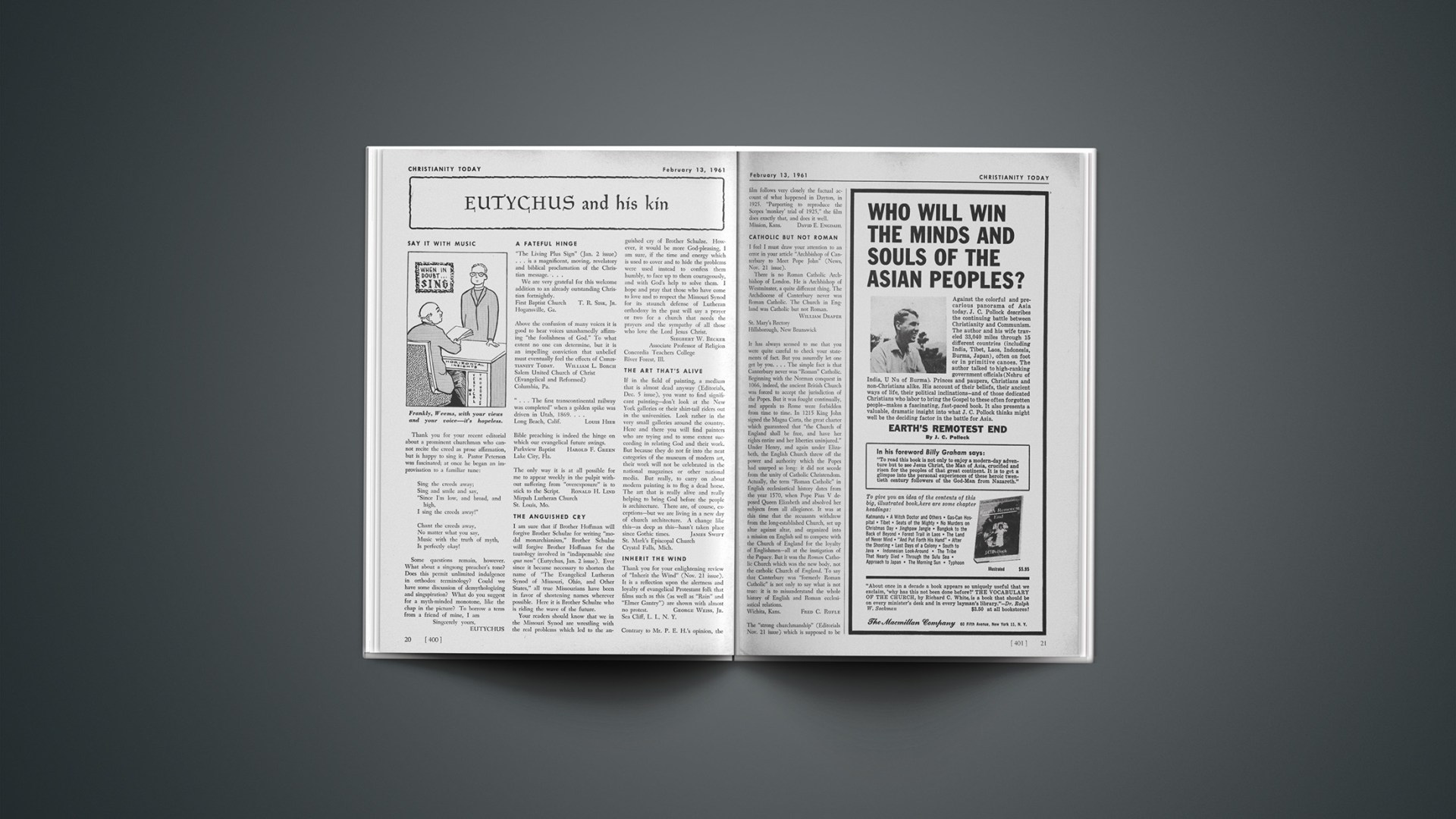
Eutychus and His Kin: February 13, 1961

SAY IT WITH MUSIC

Thank you for your recent editorial about a prominent churchman who cannot recite the creed as prose affirmation, but is happy to sing it. Pastor Peterson was fascinated; at once he began an improvisation to a familiar tune:

Sing the creeds away;

Sing and smile and say,

“Since I’m low, and broad, and high,

I sing the creeds away!”

Chant the creeds away,

No matter what you say,

Music with the truth of myth,

Is perfectly okay!

Some questions remain, however. What about a singsong preacher’s tone? Does this permit unlimited indulgence in orthodox terminology? Could we have some discussion of demythologizing and singspiration? What do you suggest for a myth-minded monotone, like the chap in the picture? To borrow a term from a friend of mine, I am

Singcerely yours,

EUTYCHUS

A FATEFUL HINGE

“The Living Plus Sign” (Jan. 2 issue) … is a magnificent, moving, revelatory and biblical proclamation of the Christian message.…

We are very grateful for this welcome addition to an already outstanding Christian fortnightly.

T. R. SISK, JR.

First Baptist Church

Hogansville, Ga.

Above the confusion of many voices it is good to hear voices unashamedly affirming “the foolishness of God.” To what extent no one can determine, but it is an impelling conviction that unbelief must eventually feel the effects of CHRISTIANITY TODAY.

WILLIAM L. BORCH

Salem United Church of Christ

(Evangelical and Reformed)

Columbia, Pa.

“… The first transcontinental railway was completed” when a golden spike was driven in Utah, 1869.…

LOUIS HIEB

Long Beach, Calif.

Bible preaching is indeed the hinge on which our evangelical future swings.

HAROLD F. GREEN

Parkview Baptist

Lake City, Fla.

The only way it is at all possible for me to appear weekly in the pulpit without suffering from “overexposure” is to stick to the Script.

RONALD H. LIND

Mizpah Lutheran Church

St. Louis, Mo.

THE ANGUISHED CRY

I am sure that if Brother Hoffman will forgive Brother Schulze for writing “modal monarchianism,” Brother Schulze will forgive Brother Hoffman for the tautology involved in “indispensable sine qua non” (Eutychus, Jan. 2 issue). Ever since it became necessary to shorten the name of “The Evangelical Lutheran Synod of Missouri, Ohio, and Other States,” all true Missourians have been in favor of shortening names wherever possible. Here it is Brother Schulze who is riding the wave of the future.

Your readers should know that we in the Missouri Synod are wrestling with the real problems which led to the anguished cry of Brother Schulze. However, it would be more God-pleasing, I am sure, if the time and energy which is used to cover and to hide the problems were used instead to confess them humbly, to face up to them courageously, and with God’s help to solve them. I hope and pray that those who have come to love and to respect the Missouri Synod for its staunch defense of Lutheran orthodoxy in the past will say a prayer or two for a church that needs the prayers and the sympathy of all those who love the Lord Jesus Christ.

SIEGBERT W. BECKER

Associate Professor of Religion

Concordia Teachers College

River Forest, Ill.

THE ART THAT’S ALIVE

If in the field of painting, a medium that is almost dead anyway (Editorials, Dec. 5 issue), you want to find significant painting—don’t look at the New York galleries or their shirt-tail riders out in the universities. Look rather in the very small galleries around the country. Here and there you will find painters who are trying and to some extent succeeding in relating God and their work. But because they do not fit into the neat categories of the museum of modern art, their work will not be celebrated in the national magazines or other national media. But really, to carry on about modern painting is to flog a dead horse. The art that is really alive and really helping to bring God before the people is architecture. There are, of course, exceptions—but we are living in a new day of church architecture. A change like this—as deep as this—hasn’t taken place since Gothic times.

JAMES SWIFT

St. Mark’s Episcopal Church

Crystal Falls, Mich.

INHERIT THE WIND

Thank you for your enlightening review of “Inherit the Wind” (Nov. 21 issue). It is a reflection upon the alertness and loyalty of evangelical Protestant folk that films such as this (as well as “Rain” and “Elmer Gantry”) are shown with almost no protest.

GEORGE WEISS, JR.

Sea Cliff, L. I., N. Y.

Contrary to Mr. P. E. H.’s opinion, the film follows very closely the factual account of what happened in Dayton, in 1925. “Purporting to reproduce the Scopes ‘monkey’ trial of 1925,” the film does exactly that, and does it well.

DAVID E. ENGDAHL

Mission, Kans.

CATHOLIC BUT NOT ROMAN

I feel I must draw your attention to an error in your article “Archbishop of Canterbury to Meet Pope John” (News, Nov. 21 issue).

There is no Roman Catholic Archbishop of London. He is Archbishop of Westminster, a quite different thing. The Archdiocese of Canterbury never was Roman Catholic. The Church in England was Catholic but not Roman.

WILLIAM DRAPER

St. Mary’s Rectory

Hillsborough, New Brunswick

It has always seemed to me that you were quite careful to check your statements of fact. But you assuredly let one get by you.… The simple fact is that Canterbury never was “Roman” Catholic. Beginning with the Norman conquest in 1066, indeed, the ancient British Church was forced to accept the jurisdiction of the Popes. But it was fought continually, and appeals to Rome were forbidden from time to time. In 1215 King John signed the Magna Carta, the great charter which guaranteed that “the Church of England shall be free, and have her rights entire and her liberties uninjured.” Under Henry, and again under Elizabeth, the English Church threw off the power and authority which the Popes had usurped so long: it did not secede from the unity of Catholic Christendom. Actually, the term “Roman Catholic” in English ecclesiastical history dates from the year 1570, when Pope Pius V deposed Queen Elizabeth and absolved her subjects from all allegiance. It was at this time that the recusants withdrew from the long-established Church, set up altar against altar, and organized into a mission on English soil to compete with the Church of England for the loyalty of Englishmen—all at the instigation of the Papacy. But it was the Roman Catholic Church which was the new body, not the catholic Church of England. To say that Canterbury was “formerly Roman Catholic” is not only to say what is not true: it is to misunderstand the whole history of English and Roman ecclesiastical relations.

FRED C. RUFLE

Wichita, Kans.

The “strong churchmanship” (Editorials Nov. 21 issue) which is supposed to be one of the blessings of liturgical worship as seen in the Church of England, is of dubious value as exemplified by either Dr. Fisher or the church which quietly permits him to open the door to unity without consideration of truth.…

ROBERT OVERGAARD

Immanuel Lutheran

Eugene, Ore.

RACIAL DISCRIMINATION

In regard to Reinhold Niebuhr’s pronouncement of some time ago frowning upon the preaching of Christ to the Jews, … since Jesus Himself was a Jew, it was wrong for God to make Him the Christ. It was wrong for Christ to preach or proclaim Himself as Christ to the Jews.

MEYER MARCUS

Staten Island, N. Y.

RELIGION AT HARVARD

I fail to see any connection between the religious controversy at Harvard and the failure of Harvard to invite conservative American preachers to the Memorial Church pulpit (Editorials, Dec. 19 issue). I think it is rather the sincere thought on the part of the Board of Preachers that most conservative preachers either have little to offer an intellectual community or else would arouse much antagonism to the cause of Christ.

JAMES H. HORNSBY

Harvard College, ’61

Cambridge, Mass.

The regrettable thing about the situation at Harvard is that so much of what passes for Christianity bears little resemblance to the teaching of Christ and the preaching of the Apostles. Much effort is expended by professors, section men, et al. in demolishing what they take to be the Christian position. Students whose critical armament is insufficient to enable them to distinguish the true doctrine, on which the Christian faith must stand or fall, from fallacious or fanciful embellishments, often lose their footing in the deluge of witty but frequently irrelevant invective.

Unfortunately … only the exotic are welcome here. Even the Harvard Christian Fellowship went (Stott in 1957) and goes (Prior in 1961) abroad to find a preacher to bring the Gospel to Harvard.

The stumbling block for Christianity in Harvard’s religious revival is the widespread willingness to be interested in religion, opposed to a considerable fear of becoming personally involved. Since personal involvement is the heart of Christianity, no amount of “religious interest” will really further the cause of Christ. Memorial Church wants auditors, but not converts. Dr. Buttrick did convert several people during his tenure, and was rather at a loss as to what to do with them, since the Church really has no sacraments or fellowship life.

HAROLD O. J. BROWN

Second Congregational Church

North Beverly, Mass.

EXISTENTIALIST’S PRAYER

Source of all being, Who art the basis of reality, Hallowed be Thine objectification. Thy dominion enfold us. Thy will permeate existence, till existence realize its purest essence. Grant us daily sustenance. Accept us despite our essential distortions, as we accept those whose essential distortions tend to repel us. And lead us not into the objective-subjective dilemma, but deliver us from negation. For Thine is dominion, potential and actualization, forever. Amen.

PAUL B. BEATTY, JR.

St. Paul’s Evangelical Lutheran Church

Hamlet, N. C.

REPORT FROM TORONTO

Katherine Jansen says that nuns are teaching in public schools in some States “because the State has no schools in those communities” (Eutychus, Oct. 24 issue). This, surely, is strange reasoning. The schools in which the nuns’ teaching has been objected to are public schools paid for by the taxpayers. Since the R. C. church does not operate public schools, it must be that the schools operated “in those communities” are the state public school. What does she mean that the “State has no schools”?…

Beyond this queer argument is a more serious statement, which, for blind bigotry is hard to surpass. The same writer, in referring to orphanages, says: “Any knowing non-Catholic would know that they have no dedicated people to run orphanages.” In refutation of this undeserved insult, may we quote from a news report in The Toronto Globe and Mail of Oct. 3 covering a meeting of The Canadian Conference on Children. Five of nine provinces (Quebec did not report) had “an over-supply of Roman Catholic infants … and a shortage of Roman Catholic homes … an over-supply of Protestant homes willing to adopt children.” This reveals that there are more R. C. children (either illegitimate or from broken homes) and/or R. C. citizens prefer to have the State (including Protestant taxpayers) care for the products of Roman Catholic homes. This situation prevails in every large city, as in Toronto, where children’s aid work is twice as heavy for the R. C.’s as their proportion of the population would warrant; but how their church will exert legal and other influences to snatch a child of a mixed-marriage, while they have “an over-supply of their own infants and a shortage of homes for them.” Toronto, Ont.

LESLIE H. SAUNDERS

Rome’s real threat is religious, not political. While I fully agree with the many Protestants who continually point out the political threat of Rome and the danger of mixing Church and State, I believe that Rome’s false life and practices stem basically from false doctrine.

JAMES G. MANZ

Chicago, Ill.

In all the Protestant debate on the issue of a Catholic president, it seems to me that the most obvious point has been overlooked. That is, that the New Testament never suggests that the church of Jesus Christ can expect the political authority to show it any special favor.… The early church grew and flourished in spite of political hostility that often erupted into open violence.

ROBERT W. MEARS

Chicago, Ill.
Religious Boom and Moral Bust

Romans 1:21

The Preacher:

Howard G. Hageman was President in 1959 of the General Synod, Reformed Church in America. He was Lector at New Brunswick Seminary (Liturgics) from 1952–57, and Exchange Lecturer in Theology to the Union of South Africa in 1956. He holds the A.B. from Harvard University, B.D. from New Brunswick Seminary, and was awarded the honorary D.D. by Central College, Pella, Iowa, in 1957. He is author of two books, Lily Among the Thorns and We Call This Friday Good, published this year. Dr. Hageman is also an amateur organist. He has traveled twice to Europe, in the summers of 1950 and 1953.

The Text:

Because that, when they knew God, they glorified Him not as God, neither were thankful; but became vain in their imaginations, and their foolish heart was darkened.

Heidelberg Catechism #86

Q. Since then we are redeemed from our misery by grace through Christ, without any merit of ours, why must we do good works?

A. Because Christ, after He hath redeemed us by His blood, also reneweth us by His Holy Spirit in His own likeness, that with our whole life we may show ourselves thankful to God for His blessing and that He may be praised by us; then also that we in ourselves may be assured of our faith from its fruits, and by our godly walk may win our neighbors to Christ.

Even the casual observer of the American scene is struck today by a strange fact. America seems to be on a religious boom and a moral bust! Pick up the daily paper and on one page you will read of crowded churches, bigger budgets, and new buildings. All the statistics will clearly indicate that never before in history has the American Church been so prosperous or commanded the allegiance of so large a percentage of the population. But turn to the next page in the same paper and you will read of mounting crime, increasing disrespect for law and order (and that often on the part of respectable people). Even the advertisements will tell you, if you did not know it already, that lust and obscenity no longer need to hide in our society. A religious boom and a moral bust … is this not a hard thing to account for?

Paul would not have thought so! Indeed, he would not have found this apparent contradiction nearly so strange as we do. For he had seen exactly the same situation in the society to which he sought to bring the Gospel. The Roman Empire of the first century was an extremely religious place. The number of cults and sects was almost impossible to determine. Yet there were always those who were anxious to try another when it came along. Every city was crowded with temples and shrines. Men of high degree and low sought to ease their troubled spirits by sharing in religious practices of an almost fantastic character. Could one of Dr. Gallup’s assistants have polled the man in the street in ancient Rome, he would have found that as large a percentage of them believed in God as in present day America. It was a very religious age.

But it was also a very immoral age. As one of its own observers said, it was a time that was eaten out at the heart. Responsibility, family loyalty and solidarity, integrity—these solid virtues which had once made the Roman republic feared and honored throughout the known world had all but disappeared, having been swept away in a vast flood of lust and lying, immorality and indulgence. The same fascination with obscenity, the same lack of reliable responsibility, the same selfish pursuit of comfort and convenience that we know today, Paul knew too. He was well acquainted with the phenomenon of a religious boom and a moral bust.

And in the opening words of his letter to the Christians in Rome, among whom he is soon to come, he seeks to analyze the reasons for the situation. How can you account for this strange paradox? How can religious intensity go hand in hand with the vain imagination and the darkened heart? How can men believe in God and produce such a moral mess? How? The flaw, as the Apostle clearly sees, is in their religion. Yes, it is their religion that has produced their immorality. “Because that, when they knew God, they glorified Him not as God, neither were thankful.”

Now certainly there is a word here for present-day America. For if ever there was a nation which kidded itself religiously, it is ours. Face to face with an opponent that scoffs at and derides all religion, we point with pride to our statistics (99 per cent of our people believe that there is a God!) and feel safety in them. Sweeping under the rug, as it were, our mounting moral failure, we pride ourselves on our religious boom, believing that it will guarantee us against any future. After all, can any other nation produce the same impressive religious statistics? After all, will not the good God look after his own?

But here is Paul to remind us that such reasoning is not only false but dangerous. Here is Paul to remind us that there is a kind of religion which can prove our undoing. Here is the Apostle to witness that religion of that kind can destroy a nation, a civilization. Here he says that it is not enough to believe in God. A nation can believe in God 100 per cent and still go to hell. After all the devils also believe that (which indicates they have better sense than some of us)—and what good does it do them? At least, when they believe, they tremble. Religion which believes in God but refuses to glorify him as God is not only foolish but fatal. And the time is here when we must ask ourselves whether in wide areas this is not the religion we have. “Because that, when they knew God, they glorified Him not as God, neither were thankful: but became vain in their imaginations, and their foolish heart was darkened.”

There can be danger in religion, fatal danger. Whenever a man says, “I believe in God” and then proceeds calmly to order the affairs of his life, his business, as though there were no one but himself to consider, though he knows God, he is not glorifying him as God—and the result can only be disaster. Whenever a woman piously sings, “More love to Thee, O Christ, more love to Thee” and then shuts her heart against a neighbor or gossips maliciously, though she knows God, she is not glorifying him as God—and the result can only be disaster. Whenever anyone prays “Forgive us our debts as we forgive our debtors” and then rises from his knees, looks at the brother who has wronged him, and says, “But I cannot forget what you did to me,” though he knows God, he is not glorifying him as God—and the result can only be disaster. Multiply this kind of thing by the thousands and you will begin to understand the reason for our religious boom and our moral bust.

It would be easy to answer an inquiry into the reason behind this failure to practice to match profession by saying, “Hypocrisy.” That answer, so often flung at the Church by the world, does not go deep enough, however. Paul saw more deeply into the reason. The real reason men, though they know God, fail to glorify him as God is their lack of gratitude. Neither were they thankful.

Here is the Christian motivation for righteous and godly living—the only way in which God can be glorified: gratitude. We have lots of people who say, “I must be good because I am afraid”; lots of people who say, “I must be good because I want God to be good to me”; lots of people who say, “I must be good because I want my neighbors to think well of me.” We have all too few who say, “I must be good because I am grateful.” Yet when we stop to consider all that God has done, is doing, and is yet to do for us, what else can we say?

Who of us when he stops to consider the Manger in Bethlehem, the Cross of Calvary, the Empty Tomb in Joseph’s lovely garden; who of us when he feels the constant and abiding presence of the Spirit in his life; who of us when he hears again the trumpet sound of the promised final victory; who of us when he realizes that all this was for him can fail to be thankful? Who of us will not cry out with the Psalmist, “What shall I render unto the Lord for all his benefits to me?”

I have always been interested in the way in which the Heidelberg Catechism deals with the Ten Commandments. That Catechism, as you know, is divided into three parts; of man’s misery; of his redemption; and of thankfulness. What is striking is that the consideration of the Ten Commandments occurs in the third section under the heading “Of Thankfulness.” Think of it—those same commandments which have inspired men with fear and awe placed under the heading of thankfulness!

But where else could you put them? Since God has done all this for me, here is how I shall show my gratitude to him, by living all of my life, every moment of its existence, according to his will. What else can I do but offer myself as a living sacrifice which is my reasonable service? And how shall I make that living sacrifice except by walking gratefully in the way of his commandments? Before his grace touched my heart, the law was a terror, but now it is my delight. By the law I seek to glorify God, because I am grateful. That kind of religion will never know a moral bust.

It is all summed up in the question with which the Catechism introduces the topic of thankfulness. “Since then we are redeemed from our misery by grace through Christ,” it asks in its 86th question, “without any merit of ours, why must we do good works?” Notice the language of the answer. “Because Christ, after he hath redeemed us by his blood, also reneweth us by his Holy Spirit in his own likeness, that with our whole life we may show ourselves thankful to God for his blessing and that he may be praised by us.” That’s what it means to believe. Not merely to nod the head in assent and then pick up life where we left it, not merely to fasten upon a Creator as the most logical explanation for the mystery of the universe, not merely to guess that “Somebody up there likes me,” but to bring every thought, every deed, every act, every word into obedience to the mind and spirit of Christ. Faith is one part gratitude and one part obedience.

You will notice that the Apostle calls attention to at least two results of this false religion that knows God without glorifying him as God. “They became vain in their imaginations, and their foolish heart was darkened.” When a man has only this selfish and cheap religion, he begins to imagine all sorts of things. He is terrified by all kinds of fears and questionings, haunted day and night by shadows. Life becomes strange and difficult. He becomes vain in his imagination.

Furthermore, his foolish heart is darkened. He can no longer think straight or see straight. The whole picture of life and the world is distorted, out of perspective. He no longer sees the Father above nor his brother man around. He sees only himself. That means that his decisions are crooked because his perspective is poor. Having banished God to the outermost margin, how could the picture be right? Small wonder that his foolish heart is darkened.

We could spend a good deal of time emphasizing that here is the real reason for much of the world’s mistaken outlook, its unreasoning panic. It is the natural and inevitable result of a false religion, a religion that knows God but rejects the necessity of glorifying him as God. Whenever a man toys with God in this way, saying “Yes, I believe, but I want to be let alone to enjoy my own life,” vain imaginations and a darkened heart are always the result.

But I cannot forbear pointing out the two results which the Catechism lists for the life that seeks to show itself thankful to God in every way. The first of them is assurance. “That we in ourselves may be assured of our faith from its fruits.” When a man is seeking to glorify God with his whole being, he does not have to ask himself nervously about God nor timorously wonder what God thinks of him. Walking in the way of gratitude, offering every action of his life to God’s glory, he has no time for vain imaginations. He has nothing to fear. Secure in his confidence in his Redeemer, he finds that love has cast out fear.

The second result is a life that attracts. “By our godly walk we win our neighbors to Christ.” The darkened heart sees nothing but itself. But the heart which is daily glorifying God sees the world as God means it to be. And that clear vision is compelling. That integrity of purpose, that steadfastness of mind, that purity of heart wins and attracts. Yes, it wins and attracts those same foolish and darkened hearts that are sick of the shadows and longing to find the light. With all due deference to the preacher in his pulpit, here is the sermon that really grips and holds—the sermon that is quietly preached by ordinary men and women whose daily living is an offering to the glory of God, swelling up from the gratitude which has filled their hearts.

You have all known people like that, I am sure. But why should the whole congregation of Christ’s people not be like that? Why indeed, unless even in our midst there are those who, though they know God, refuse to glorify him as God, those who hold back in a mistaken sense of their own importance. Foolish and darkened hearts, haunted by the vanity of your own imaginations, the assured and attractive life is yours! Christ came to give it to you. Why not stop fooling yourself about your religion? Unless not just in church on Sunday but tomorrow in the office, the school, the home, over the coffee cup, you are seeking to glorify Him, your religion is false and dangerous. It will not save you; it will destroy you.

For the faith of the nation we are not responsible. But we are responsible for the faith of the Church. If the Church is indeed the Church, a congregation of men and women whose faith is not only knowledge but gratitude and obedience, we need not fear for the faith of the nation. The compelling witness of such a Church will speak to the heart of the weary world around it. Do you believe enough to be grateful? Then show your gratitude not only with your lips but with your life! Amen.

Comment On The Sermon

The sermon “Our Religious Boom and Moral Bust” was nominated forCHRISTIANITY TODAY’SSelect Sermon Series by Dr. Henry Bast, Professor of Practical Theology at Western Theological Seminary in Holland, Michigan, and radio preacher since 1952 on the Temple Time broadcast supported by the Reformed Church in America. Dr. Bast’s overcomment follows:

We were in hearty agreement with CHRISTIANITY TODAY’s expressed desire that the sermon be “an authentic reflection of the denominational tradition from which the sermon is chosen.” Our denomination stems directly from the Reformation and has had a strong tradition in doctrinal preaching. A catechism sermon best reflects our distinctive tradition.

The constitution of the Reformed Church states: “Every minister must explain to his congregation at an ordinary service on the Lord’s Day the points of doctrine contained in the Heidelberg Catechism, so that the exposition may be completed within the term of four years.” This does not put the catechism on a level with the Bible, for the same constitution states that the Bible is the only rule of faith and practice of the Church. But the Reformed Church is a confessional church and this constitutional provision is made so that the doctrines of the Church will be preached. This is a good thing. It keeps the preachers from riding hobbies. It means that the flock will be fed with the whole counsel of God. It means that both Law and Gospel will be preached. It also requires preaching on the meaning of the Sacraments, thus keeping the Word and the Sacraments together.

The sermon is introduced by a “life situation.” The preacher briefly discusses a serious fault in our national life and exposes a major weakness in the church. Then with true homiletical skill he moves from the problem to its only solution by bringing the text to bear on it. One of the sermon’s strong points is relevance. The preacher not only speaks in the language of the day but speaks to a problem of the day. In facing that problem, he does not speak in despair, or wring his hands, or merely lament that it exists. He looks at it as the Word of God does, realistically, and then points to the solution for all who are ready to hear.

Another homiletical point is the preacher’s use of the catechism in relation to the text. The text teaches us that gratitude is an essential mark of true religion. Now, at this point, a preacher could move in a number of directions. But this preacher with the Bible and the catechism before him moves in a true direction, in fact, in the ultimate direction that the letter to the Romans takes, for he expounds this gratitude or thankfulness in terms of obedience to the Word of God. This is the catechism exposition of the text and it is biblical.

My concluding observation concerns application, and the note on which the sermon ends. Spurgeon used to say that the sermon begins where the application begins. One real weakness in modern preaching is that there is little applicaton. This sermon creeps up on you; you feel the application coming the moment the text is applied to the situation, but in the end you are faced with a clear alternative. You are either for Christ or against him; and, if for Christ, you must walk in his way in true obedience. And there is something we can do: “We are responsible for the faith of the Church.” Finally, here is the note of hope which ought to be in every true Christian sermon. You cannot do this yourself; but in Christ, crucified and risen, you can do this now.

Samuel M. Shoemaker is the author of a number of popular books and the gifted Rector of Calvary Episcopal Church in Pittsburgh. He is known for his effective leadership of laymen and his deeply spiritual approach to all vital issues.

British Old Testament Study

To appreciate the present situation in the field of Old Testament study in England one must go back to the beginning of the century, when the Graf-Wellhausen school was making so profound an impact upon Western thought. At that time, while British New Testament scholars, notably Lightfoot, were refuting the theories of the Tübingen scholars, their Old Testament counterparts looked with distinct favor upon German higher criticism.

They did not, however, espouse the precise forms in which the latest evolutionary doctrines were presented to the academic world. The British have a way of modifying anything of foreign origin which is to be incorporated into their pattern of living. Since they already had considerable experience of their own with evolutionary theory in the biological field, it was not too difficult for such leading scholars of the day as W. Robertson Smith in Scotland and S. R. Driver in England to modify German criticism to a point tolerably acceptable to British tastes.

This objective was accomplished most effectively by Driver’s Introduction to the Literature of the Old Testament. A prolific writer, Driver’s Introduction was by far his most significant literary production. No other book of its kind has exercised anything like the influence which it has wielded in England up to the present time. Driver’s work established the “standard of orthodoxy” in Old Testament liberal circles. While minor variations were permitted, an individual’s academic respectability depended to a large extent upon the closeness with which he adhered to the pattern set forth by Driver. Thus there sprang up a curious liberal-conservatism which is still in evidence today in British scholarship, and which has been recognized by both Continental European and American scholars.

Some gifted individuals such as James Orr attacked the newer views vigorously and continued to maintain a conservative position on the Old Testament. But no actual conservative school arose in England, although many theological seminaries continued to espouse a somewhat modified conservative position. After Orr’s death the standard of conservative writing dropped abruptly. Lesser champions of the traditional position were quickly relegated to the ranks of “fundamentalists” and dismissed with unconcealed contempt.

PRESENT-DAY TRENDS

Today there is an increasing respect for the few who advance conservative views in scholarly circles in England, although there has been no noticeable move in a more conservative direction by the majority of Old Testament scholars. Despite the fact that the shortcomings of old-fashioned liberalism are being increasingly recognized, no scholarly “conversions” in the Old Testament field correspond to that of Professor R. V. G. Tasker in the area of New Testament studies.

Nevertheless the last two decades have seen a resurgence of conservative evangelical scholarship, led in the Old Testament field by such men as F. F. Bruce, H. L. Ellison, W. J. Martin, and D. J. Wiseman. This revival of literary activity on the part of evangelical scholars has been viewed with misgivings in some quarters, and described as a “resurgence of fundamentalism” in others. Those who are uneasy about this state of affairs need only examine the Bible commentaries and other literary productions of English evangelicals to realize that the workmanship compares favorably with the best anywhere in the world.

The majority of Old Testament scholars in England continue to be of liberal persuasion. In spite of the increasingly severe attacks from archaeological sources on the Graf-Wellhausen literary analysis of the Pentateuch and similar strongholds of the liberal position, they appear indifferent to the fact that the approach adopted by the liberal critic is becoming increasingly difficult to maintain satisfactorily. Part of the reason for this attitude may be that most British Old Testament scholars have had little or no first-hand experience of archaeology, being trained almost exclusively in literary analysis. They do not attach due importance to archaeological findings. A few years ago G. P. Driver disputed the dating assigned by Albright, Burrows, and others to the early Dead Sea manuscript discoveries. While he did not go to the extreme position adopted by Zeitlin, Driver dated the material several centuries after the beginning of the Christian era. If certain reports are to be believed, one of his principal reasons for rejecting the Maccabean era date of some of the scrolls was that his father’s eloquent demonstration of a Maccabean date for the Book of Daniel would thereby be gravely undermined. Driver is primarily a philologist, and from this standpoint he viewed the material from Qumran. He continued to discount the significance of the archaeological evidence despite the insistence of American and British scholars. Only when the cumulative weight of archaeological discoveries demonstrated beyond any reasonable doubt the untenability of his position did he adopt a dating considerably nearer the beginning of the Christian period.

Apart from a very few individuals such as S. H. Hooke and H. H. Rowley, British Old Testament scholare have not been conspicuous for their originality of thought or presentation of subject matter. Rightly or wrongly, my countrymen are more influenced by ideologies than many of them care to admit, and this is particularly noticeable in the area of Old Testament studies. Consequently British writings in this field often reflect a close, frequently uncritical, adherence to trends of thought in circulation on the Continent. Where some of these might appear inimical to the conservatism of British liberal scholarship they are either repudiated as reactionary by the nervous, or modified to suit the local taste by the more resolute.

This harking back to the traditional delineation of the situation is a curious phenomenon to say the least. Its most recent manifestation occurred in a book by Professor G. W. Anderson of Durham titled A Critical Introduction to the Old Testament (Duckworth, 1959). This work is a careful and judicious survey of critical orthodoxy, and furnishes good summaries of the positions adopted by the Scandinavians as well as the views maintained by older scholars such as Welch, Kennet, and Volz. However, the author concluded his survey by finding recent theories deficient in one way or another, and expressed a decided preference for the views advanced by Driver in 1891, which, one would judge, he regarded as definitive.

Pertinent to this general situation is the fact that Driver’s Introduction has recently been issued in paperback form under a well-known imprint. My first reaction was one of pleasure in seeing the title of the book superimposed upon a fragment of a Qumran scroll. My delight was speedily dispelled, however, when I discovered that the contents were virtually unchanged from the 1897 edition. A preface contained the statement that archaeology had revealed nothing which was in conflict with the generally accepted conclusions of critical scholars. While this remark may have been true in 1897, the situation today is vastly different, and the person who picks up this classic document in its new cover may be beguiled, at least temporarily, into thinking that this comment represents the consensus of up-to-date opinion.

ENCOURAGING TURN

When Edward Robertson was Professor of Semitics in Manchester he took serious issue with the Graf-Wellhausen position, and wrote at some length on the subject. While his views differed somewhat from the conservative position, his standpoint was a welcome change from the dull, unimaginative productions of his contemporaries. Robertson’s views were reflected in part in a work by one of his students, R. Brinker, dealing with the influence of sanctuaries in early Israel.

This work broke new ground in showing that the testimony of the Samaritan Pentateuch was fatal to the Graf-Wellhausen theory. However, it was oriented strictly in terms of literary criticism, and failed to take any cognizance of contemporary archaeological discoveries. How anyone can discuss pre-exilic Israelite religious institutions without any reference to Ugaritic culture is beyond this writer’s understanding.

Brinker’s book was written in 1946, and it could be argued in charity that the war had prevented the author from drawing upon the work of European archaeologists to any extent. However, I had graduated three years before the book appeared in print, and I clearly remember reading extensively about the discoveries at Ras Shamra while I was a student. Quite obviously Brinker had no appreciation of the significance which archaeology has for modern discussions of the critical hypothesis. His select bibliography does not include the work of one modern archaeologist. Eclectic scholarship of this kind is just not good enough, however well-intentioned it may be.

The most attractive product of recent British scholarship is the N. H. Snaith edition of the Old Testament in Hebrew, published in 1958 by the British and Foreign Bible Society. Snaith began work in 1933 on a text to replace the Society’s Letteris edition of 1866, and he drew considerably on Spanish Hebrew manuscripts in an attempt to represent the true Masoretic text of Ben Asher. The resultant product agrees closely with the researches of Professor Paul Kahle, who edited the text of the third edition of the Kittel Bible, published in 1937. The Snaith text follows the Masoretic traditions as to spacing, notes, Sedarim and Haftaroth, the result of which has been to furnish the student with an attractive and serviceable Hebrew text which enshrines the diligence and application characteristic of British scholarship.

Samuel M. Shoemaker is the author of a number of popular books and the gifted Rector of Calvary Episcopal Church in Pittsburgh. He is known for his effective leadership of laymen and his deeply spiritual approach to all vital issues.

Choice Evangelical Books of 1960

The best evangelical contributions of 1960, in the judgment ofCHRISTIANITY TODAY’Seditorial staff, are listed below. The selections propound evangelical pesrpectives in a significant way, or apply biblical doctrines effectively to modern currents of thought and life. These are not the only meritorious volumes, nor do they in every case necessarily reflect the convictions of all evangelical groups.

BASS, CLARENCE: Backgrounds to Dispensationalism (Eerdmans, 184 pp., $3.50). An historical outline and evaluation of dispensational views.

BEEGLE, DEWEY M.: God’s Word into English (Harper, 178 pp., $3.50). Vivid presentation for laymen of the problems of Bible translation.

BERKOUWER, G. C.: Divine Election (Eerdmans, 336 pp., $4.50). Timely reassessment of the Reformed doctrine.

BLACKWOOD, ANDREW W.: The Growing Minister (Abingdon, 192 pp., $3). Practical biblical patterns for the Christian ministry.

BUSWELL, II, JAMES OLIVER: A Christian View of Being and Knowing (Zondervan, 214 pp., $3.50). A concise evangelical introduction to the study of philosophy.

CAIRNS, EARLE E.: Saints and Society (Moody, 192 pp., $3.25). A survey of the social impact of the life and thought of evangelical churchmen.

CLOWNEY, EDMUND P.: Eutychus (and his pin) (Eerdmans, 102 pp., $2.50). Theological reflections in rare humorous vein.

DOOYEWEERD, HERMAN: In the Twilight of Western Thought (Presbyterian and Reformed, 195 pp., $3.50). Christian evaluation of philosophical trends.

GERSTNER, JOHN H.: Steps to Salvation: The Evangelistic Message of Jonathan Edwards (Westminster, 192 pp., $3.95). Systematic analysis of Edwards’ theology of conversion.

HALL, VERNA M., compiler; MONTGOMERY, JOSEPH ALLEN, ed.: Christian History of the Constitution (American Christian Constitution Press, 532 pp., $7.50). A compilation of historic documents bearing on the Christian character of the U. S. Constitution.

HARRISON, EVERETT F., ed.: Baker’s Dictionary of Theology (Baker, 566 pp., $7.95). A comprehensive source book defining key theological terms.

HENRY, CARL F. H., consulting editor: The Biblical Expositor (3 vols.) (Holman, 1300 pp., $6.95 each). Expositions of the books of the Bible by distinguished international scholars.

LEWIS, C. S.: The Four Loves (Harcourt, Brace and Co., 192 pp., $3.75). Provocative ideas on Affection, Friendship, Eros, and Charity.

LOANE, MARCUS L.: Archbishop Mowll (Hodder and Stoughton, 287 pp., 35s.). A biography of a great evangelical archbishop of Sydney.

MCDONALD, H. D.: Ideas of Revelation (St. Martins, 300 pp., $6.75). An appraisal of modern views (1700–1860) of divine revelation.

MOUNCE, ROBERT H.: The Essential Nature of New Testament Preaching (Eerdmans, 168 pp., $3.50). A survey and analysis of the New Testament concept of preaching.

MURRAY, IAIN, ed.: George Whitefield’s Journals (Banner of Truth Trust, 595 pp., 15s.). A supreme preacher’s record of his own life and ministry.

NEILL, STEPHEN: Christian Holiness (Harper, 134 pp., $3). A bishop’s counsel for practical Christian living.

NIDA, EUGENE A.: Message and Mission (Harper, 253 pp., $5). Refreshing emphasis on the biblical message in the church’s mission.

RAMM, BERNARD: The Witness of the Spirit (Eerdmans, 140 pp., $3). A study of the Spirit’s internal testimony.

SCHULTZ, SAMUEL J.: The Old Testament Speaks (Harper, 488 pp., $7). A positive exposition of the spirit and purpose of the Old Testament.

SHOEMAKER, SAMUEL M.: With the Holy Spirit and With Fire (Harper, 127 pp., $2.50). A fresh and moving treatise on the Spirit.

THOMSON, JAMES, G. S. S.: The Old Testament View of Revelation (Eerdmans, 107 pp., $2.50). Survey of the nature and purpose of the revelation of God.

WHITE, R. E. O.: The Biblical Doctrine of Initiation (Eerdmans, 392 pp., $6). The best apologetic for the Baptist position since Carson.

WOOD, A. SKEVINGTON: The Inextinguishable Blaze (Eerdmans, 256 pp., $3.75). Eighteenth century spiritual renewal and advance.

New Testament Studies in 1960

Let first place in this survey be given to the third volume of The Biblical Expositor (Holman), produced under the consulting editorship of Carl F. H. Henry—for this volume contains expository studies of all the books of the New Testament, with introductory essays on New Testament Backgrounds, the Gospels, and the Epistles. Twenty-four authors have contributed to the volume, which aims (like the two companion volumes devoted to the Old Testament) at bringing “the living theme of the great book” home to the general reader of the Bible.

NEW TESTAMENT STUDIES

A new series of “New Testament Tools and Studies,” edited by Bruce M. Metzger, has been inaugurated with an Index to Periodical Literature on the Apostle Paul by the editor of the series, followed by a Concordance to the Distinctive Greek Text of Codex Bezae, by James D. Yoder (Eerdmans).

A volume of New Testament Sidelights (Hartford) has been presented to A. C. Purdy on his seventieth birthday; it is introduced by a contribution from Rudolf Bultmann titled “A Chapter in the Problem of Demythologizing” and includes a discussion by H. K. McArthur (editor of the Festschrift) on the “Gospel according to Thomas.” A number of other studies deal with this “Gospel” and other Gnostic literature recently found along with it. Indeed, much of the public interest which was attracted by the Dead Sea Scrolls a few years ago has now been diverted to the Gnostic manuscripts from Upper Egypt, and we can only be thankful that most of the popular literature on these is free from the eccentricities that marked much of the popular literature on the Dead Sea Scrolls. Thus, despite the ambiguity of its title, The Secret Sayings of Jesus, by R. M. Grant and D. N. Freedman (Collins), is a splendid introduction for the general public, not least when it discusses the bearing of the “Gospel according to Thomas” and companion literature on the beginnings of Christianity. Wider issues are discussed by R. M. Grant in Gnosticism and Early Christianity (Oxford). The Egyptian finds as a whole are described by J. Doresse in The Secret Books of the Egyptian Gnostics (Hollis and Carter); they are also described by W. C. van Unnik in Newly Discovered Gnostic Writings (SCM)—a more sober work, subtitled “A preliminary survey of the Nag Hammadi finds.” Another of these writings, the Velentinian Gospel of Truth (Black), is translated and annotated for English readers by Kendrick Grobel. These may not be New Testament studies, but they deal with matters closely related to early Christianity.

F. C. Grant has given us another background study in Ancient Judaism and the New Testament (Oliver and Boyd)—and not background study only, for it is full of wise and healthy observations on modern tendencies in the teaching and learning of the New Testament. E. A. Judge approaches our field from another angle in The Social Pattern of the Christian Groups in the First Century (Tyndale); as a classicist and ancient historian he has devoted this monograph to what he calls “prolegomena to the study of New Testament ideas of social obligation.” We can never have too many contributions to New Testament studies from classical scholars. Another classical scholar, E. M. Blaiklock, gives us a shorter monograph on Rome in the New Testament (Inter-Varsity); among other thought-provoking features, Paul is here described as “the first European.” With Archaeology and the New Testament (Eerdmans). J. A. Thompson completes a trilogy on biblical archaeology.

An important aspect of New Testament theology is treated at length in a scholarly volume by R. E. O. White, The Biblical Doctrine of Initiation (Eerdmans), which ought not to be ignored by any side of the baptismal and confirmation controversies.

When we come to Jesus and the Gospels, first mention must be claimed by two German translations: E. Stauffer’s Jesus and His Story (SCM) and G. Bornkamm’s Jesus of Nazareth (Hodder and Stoughton). While superficially Stauffer’s book may be hailed as much more conservative than the other, further reflection may suggest that Bornkamm shows greater insight into the heart of the Gospel. Bornkamm’s book is the first direct treatment of the historical Jesus by a member of Bultmann’s school since Bultmann’s own work Jesus appeared a generation ago. Bornkamm’s estimate of the historical evidence is less skeptical than his master’s, and he does not see such a hiatus as Bultmann does between the ministry of Jesus and the message of the primitive Church. Bornkamm is certainly more biblical in placing the shift from the old age to the new between John the Baptist and Jesus, and not (with Bultmann) between Jesus and Paul. Stauffer stands outside the main stream of German New Testament scholarship, but he brings to his subject the information he has acquired in his other fields of interest, notably numismatics, and gives us a fascinating study of our Lord’s life and times, viewed rather from the outside. Jesus in the Twentieth Century, by H. G. Wood (Lutterworth), brings together a number of papers written at various times by this veteran Quaker scholar who has devoted many years both to academic study of the Gospels and to their application in private and public life.

In 1957 an international congress on the Four Gospels was held in Oxford; many of the papers read there were published in the latest volume to appear thus far of the famous Berlin series Texte und Untersuchungen. In 1960 a shorter selection from these papers has been published under the title The Gospels Reconsidered (Blackwell). Among the other contents of this volume, special attention should be directed to Kurt Aland’s paper on “The Present Position of New Testament Textual Criticism” and to two papers on the Fourth Gospel by W. C. van Unnik and J. A. T. Robinson.

The historical nature of the Gospel record is examined by T. A. Roberts in History and Christian Apologetic (SPCK). Vincent Taylor’s little textbook, The Gospels: A Short Introduction (Epworth), has appeared in a ninth edition. R. H. Mounce presents a fresh study of the Kerygma in The Essential Nature of New Testament Preaching (Eerdmans), in which he subjects C. H. Dodd’s work to criticism at three points. G. E. Ladd in The Gospel of the Kingdom (Paternoster) utilizes his scholarly studies in this field to give fresh emphasis to the perennial missionary challenge of Christ. The second volume of D. M. Lloyd-Jones’s Studies in the Sermon on the Mount (Inter-Varsity) continues to provide a superb example of the best kind of expository preaching. R. S. Wallace, who gave us a preacher’s work on the Gospel parables five years ago, has now produced a companion work on The Gospel Miracles (Oliver and Boyd). Restricting himself to the miracles in the Synoptic records, he shows how each of them sets forth some essential aspect of the Gospel. A. M. Hunter has added to his series of works on New Testament interpretation a volume on Interpreting the Parables (SCM); while obviously indebted to Dodd and Jeremias, he maintains his independence of thought, and in particular does not feel bound by the dogma that no element of allegory should ever be admitted to the interpretation of the parables. This last point receives wise discussion from Matthew Black in The Parables as Allegory (Rylands), a reprint from the Bulletin of the John Rylands Library.

When we come to works on the individual Gospels, we welcome F. V. Filson’s volume on The Gospel according to St. Matthew (Black) in the New Testament Commentaries published by Harper; it leaves us, however, with the feeling that a really satisfying account of the origin, structure, and purpose of this Gospel has yet to be given. C. E. B. Cranfield’s volume, The Gospel according to Mark, in the Cambridge Greek Testament Commentary series admirably realizes the purpose of that series—“the elucidation of the theological and religious contents of the New Testament”—but at the same time pays due regard to textual, linguistic, and other critical questions. Cranfield makes his allegiance to the Reformed tradition plain. His commentary is mercifully free from the current devotion to “patternism.” This cannot be said of Archbishop P. Carrington’s According to Mark (Cambridge). This “running commentary” (as the subtitle calls it) contains many valuable insights, but we cannot see that the sections into which this Gospel was divided for lectionary purposes at an early date throw much light on the Evangelist’s own scheme. An important German work, Hans Conzelmann’s The Theology of St. Luke (Faber), has appeared in English dress.

On the Fourth Gospel the first place must be given to Aileen Guilding’s The Fourth Gospel and Jewish Worship (Clarendon), a first-rate piece of research which relates the sequence of events and discourses in this Gospel to the Old Testament readings prescribed in the triennial lectionary of the Palestinian synagogues. Time and again event and discourse are shown to constitute a commentary on one or more of the readings assigned to the relevant season of the year. Her thesis adds powerful support to the case for the Palestinian authorship of the Gospel. R. V. G. Tasker, general editor of the Tyndale New Testament Commentaries, has contributed the volume The Gospel According to John (Tyndale) to the series; he takes the witness whose authority stands behind the Gospel to be John the son of Zebedee, but considers that the writer was a disciple of John’s who bore the same relation to him as Mark did to Peter. Walter Lüthi’s St. John’s Gospel (Oliver and Boyd) consists of expository sermons preached to his Basel congregation, “on the edge of the crater,” in the dark days between 1939 and 1942. M. F. Wiles in The Spiritual Gospel (Cambridge) has given us a study of the interpretation of the Fourth Gospel in the Early Church, especially in the commentaries by Theodore of Mopsuestia and Cyril of Alexandria. This study reminds us forcibly that no one can hope to comment adequately on this Gospel unless he is in sympathetic rapport with the mind of the Evangelist. This sympathy is evident in R. H. Lightfoot’s St. John’s Gospel: A Commentary (Oxford), first published in 1956 and now reissued in a new series of “Oxford Paperbacks.” A. J. B. Higgins reaches a high estimate of The Historicity of the Fourth Gospel (Lutterworth); he maintains its independence of the Synoptic tradition and its right to be regarded as a witness of at least equal authority. Leon Morris discusses The Dead Sea Scrolls and St. John’s Gospel (Westminster) in the twelfth Campbell Morgan Bible Lecture, and finds that a comparative study of the two leads to three conclusions: the uniqueness of Christianity, the Palestinian character of the Fourth Gospel, and the centrality of Christ. In a Tyndale monograph J. N. Birdsall examines The Bodmer Papyrus of the Gospel of John (Tyndale) and makes a notable contribution to textual criticism.

PAUL AND THE EPISTLES

Paul continues to attract the attention of Christian scholars. Paul: His Life and Work, by Walther von Loewenich (Oliver and Boyd), has been written in order to provide Christian readers with something which will help them to a better understanding of Paul; his approach is the classic Lutheran one. From the Roman Catholic side Alfred Wikenhauser has given us a study of Pauline Mysticism (Nelson), by which he means the experience of direct union between the believer and Christ. The reading of this book brings a fresh reminder of the increasing interaction between Protestant and Roman Catholic work in the field of biblical exegesis.

In last year’s survey it was noted that John Murray’s study of The Imputation of Adam’s Sin (Eerdmans) made one look forward all the more eagerly to the appearance of his commentary on Romans in the New International Commentary on the New Testament. The first volume of this commentary (covering Romans 1–8) has now been published, and our eager expectations are not disappointed. The Reformed school of Pauline exposition is worthily represented in our day by such a work as this. But we are brought to the very fountainhead of the Reformed School of Pauline exposition by the appearance in a new English translation of John Calvin’s commentary on First Corinthians. A series of expository addresses on I Corinthians has been made more widely available with the publication of The Royal Route to Heaven, by Alan Redpath (Pickering and Inglis).

The Tyndale New Testament Commentary on Philippians has been written by R. P. Martin. The same scholar pays more detailed attention to one passage in that Epistle in a Tyndale monograph titled An Early Christian Confession (Tyndale), a study of Philippians 2:5–11. He agrees with the common description of the passage as an early Christian hymn, but describes it further as an early Christian creed, characterized by an impressively high doctrine of the person and work of Christ, composed by Paul himself at an earlier date and incorporated by him in his letter to the Philippians. H. M. Carson has contributed the volume on Colossians and Philemon to the Tyndals series. He concludes that both Epistles were written from Rome, he deals satisfactorily with the problems of the Colossian heresy, and includes a useful section on the New Testament attitude to slavery.

In “The Authorship of the Pastorals” (The Evangelical Quarterly, July–September 1960) E. Earle Ellis gives a résumé and assessment of current trends. The “Torch” commentary on these Epistles, written by A. R. C. Leaney, continues to find in them genuine Pauline passages embedded in non-Pauline material.

The volume on Hebrews in the Tyndale series has been written by T. Hewitt. He acknowledges his indebtedness to William Manson’s work on this Epistle. On Hebrews 5:7 he has an unusual suggestion to make about our Lord’s prayer in Gethsemane, but it is not so new as he may think. The main lessons of the Epistle are lucidly and powerfully brought out. In Reading Through ‘Hebrews’ (Mowbrays) R. R. Williams, Bishop of Leicester, has published six lectures on the Epistle which he delivered from the episcopal throne in Leicester Cathedral during Lent 1959—a wholly admirable example of ex cathedra teaching.

Faith is the Victory, by E. M. Blaiklock (Paternoster) reproduces in book form a series of Bible readings in I John given at the Keswick Convention; the author’s classical scholarship is here put to good use in promoting the devotional application of the Epistle.

Lastly, we have two practical expositions of Revelation—The Apocalypse Today, by T. F. Torrance (Eerdmans), and Preaching from Revelation, by A. H. Baldinger (Zondervan). Both authors see clearly the Christocentric emphasis of the book, and communicate it to their public. Exposition like this, based on careful and scholarly exegesis, is a welcome change from the sensational nonsense that too often passes for exposition of Revelation.

Samuel M. Shoemaker is the author of a number of popular books and the gifted Rector of Calvary Episcopal Church in Pittsburgh. He is known for his effective leadership of laymen and his deeply spiritual approach to all vital issues.

Survey of New Testament Literature 1961

The year 1960 saw a diversity of works dealing with the Old Testament. To examine all of them would, of course, be impossible; therefore we shall only look at a number of volumes which represent different types of study of the Old Testament.

THE ENTIRE OLD TESTAMENT

Two works covering the entirety of the Old Testament call for special mention:

In The Biblical Expositor (Holman) of which Carl F. H. Henry is Consulting Editor, we are dealing not with the product of one author but of many. Each writer seeks to bring out the message of the Old Testament book with which he is dealing. Each treatment begins with an outline which is followed by a development of the message of that particular book. To include so much material in two volumes is indeed an accomplishment, and what is pleasing is the high character and quality of most of the comments. The work is a good one to place in the hands of a person who does not know much about the Old Testament, for it really turns him to the sacred text itself. The writers are men who believe in the truthfulness of the Scriptures and their comments are in line with this basic conviction.

Explore the Book is the work of one man, J. Sidlow Baxter. In a series of six volumes (two devoted to the New Testament) Zondervan has issued this challenging study which is designed to introduce the reader to the Old Testament itself. The books contain many outlines, charts, and helps to aid the reader in his exploration. Dr. Baxter loves the Old Testament as the Word of God and there is no question as to his loyalty to the Scriptures. His work follows the lines of some of the great teachers among the Plymouth Brethren and leans toward a dispensational position.

One who wishes to become proficient in the study of the Old Testament must know the tools that are indispensable. These tools are books, but what books should one purchase? So much is written that one cannot keep up with it all and, indeed, much of it is of little genuine value for a student of the Old Testament. There are, however, certain necessary helps which one ought to have. A fine service has been rendered by Frederick W. Danker in his Multipurpose Tools for Bible Study (Concordia): he discusses in an interesting way the books which every serious student of the Old Testament must own, and also includes New Testament materials. Although he presents a remarkable amount of material, there are surprising omissions, and some of his comments are disappointing, as for example, the consideration of the pioneering grammar of G. Douglas Young. Dr. Danker discusses Young’s work but does not mention its uniqueness, which is its treatment of the Hebrew vowel system. In the discussion of commentaries, we wish that the theological presuppositions which underlie the volume in question had more frequently been pointed out. Too many works are listed as helps which do not regard the Scriptures as the inerrant Word of God. This section could have been strengthened by calling the reader’s attention to more genuinely conservative works. There is, however, much valuable and helpful material in the book, and it should prove of use to those for whom it was intended.

Another type of help is found in the Lists of Words Occurring Frequently in the Hebrew Bible, by John D. W. Watts (Eerdmans). This list has been taken from Harper’s Hebrew Vocabularies and revised in comparison with the Lexicon of Kohler-Baumgartner. It is an excellent piece of work. In the learning of a foreign language, the study of vocabulary is all important, and one of the quickest ways we may obtain a reading knowledge of a language is through constant learning of new words and repeating those we have already learned. Dr. Watts has provided an admirable manual for such a purpose and has made all students of the Hebrew language his debtors.

He who loves the Old Testament cannot help but have a deep and profound interest in those lands in which the wondrous events of redemption took place. There are many books written on Palestine itself, but those on Transjordan are not so numerous. Indeed, Transjordan is not so well known to the average Bible reader as Palestine proper. A real need is therefore fulfilled in G. Lankester Harding’s The Antiquities of Jordan (Crowell): it is one of the most interesting geographical studies the reviewer has had in some time. The book is well illustrated with photographs and maps and gives a clear and biblically related discussion of the land in question.

A distinct service has been rendered by G. P. Putnam’s Sons in making available in paperback edition (Capricorn Books) the Ancient Semitic Civilizations, by Sabatino Moscati. It is time that someone gave us a popular, readable account of the nations which surrounded the Israelites, such as, the Egyptians, Babylonians, Canaanites, and others. The discussions are clear and readable as well as extremely interesting. A consideration of the Hebrew nation is also included which, to the present writer, is the most disappointing part of the book, for it does not do full justice to the uniqueness of the Hebrew religion as a special revelation from God. For its treatment of the other peoples of antiquity, however, the work may be confidently recommended.

SERMONS AND COMMENTARIES

Good sermons on Old Testament subjects are always welcome, and when the preacher is Charles Haddon Spurgeon we may be sure that the sermons are good. Two volumes of his sermons, Men of the Old Testament and Sermons on the Psalms, have been issued by Zondervan.

The past year can hardly be said to be characterized by the appearance of many commentaries. Possibly this is significant, for it is a sad day for the Church when she is not engaged in deep exposition of God’s Word. Zondervan however, has reissued the Ellicott Commentaries on the Old Testament under the title Laymen’s Handy Commentary Series. Ellicott’s works are well known for their devotion to Scripture and their concise and lucid expositions. They are now in print in handy, pocket-size volumes, and can be recommended as good interpretative helps in the study of the Old Testament.

The Epworth Press has published a work of J. Yeoman Muckle, Isaiah 1–39 which embodies the fruits of modern scholarship. The comments are lucid, but a negative criticism characterizes the work. The Isaianic authorship of the entire prophecy is abandoned and some of the interpretations seem far removed from what Isaiah proclaimed. To take two examples, the treatment of Isaiah 7:14 is disappointing as is also that of 9:6. But in its study of historical and geographical detail, and as a faithful representative of a certain type of modern critical scholarship, the book may well receive commendation.

SPECIAL STUDIES

In much modern Old Testament study the question of myth is prominent. What is myth and to what extent does it appear in the Scriptures? The great impetus to modern considerations of the question stems in large part from writings of the late Hermann Gunkel. In a small work, Myth and Ritual in the Old Testament (Alenson), Brevard Childs deals with the question. His work shows the influence of modern writers such as Gerhard von Rad. Although he has many useful things to say, he is under the influence of a negative type of criticism which does not regard the Old Testament as the specially revealed Word of God. At times there appears to be too much reading into the text, as when, for example, the Helal of Isaiah 14:13 is said to be a Canaanite deity, the chief god of the pantheon (p. 69). And it is difficult to be satisfied with the following statement concerning our Lord: “Not just in his teachings or in particular actions, but in the total existence of the Jew, Jesus Christ, the entire Old Testament receives its proper perspective” (p. 104). Is Jesus Christ simply the Jew, or is he the eternal Son of God? Childs has included much valuable information, but the basic standpoint from which he writes would not be acceptable to an evangelical.

Of an entirely different nature is the little volume The Old Testament View of Revelation, by J. G. S. S. Thomson (Eerdmans). This work is written with full awareness of what modern scholarship has to say. Indeed many modern scholars are quoted, although for the most part they really adopt a viewpoint different from that of the author. But here is a serious consideration of the Word of God. And it is particularly refreshing to be told that Isaiah 7:14 and 9:6, for example, contain names given to the Messiah, and that these names are not distinguishing labels but expressions of nature, attribute, function, and office (p. 45). Thomson’s book will repay thoughtful reading.

For those who know little or nothing about the Old Testament, Howard Hanke’s From Eden to Eternity (Eerdmans) should prove helpful. As its title indicates, the author carries the reader through the pages of biblical history and explains various questions and matters as he proceeds. He writes so as to strengthen one’s faith in the trustworthiness of the Sacred Oracles, and his attitude toward the Bible is never open to question. This is altogether a useful book.

HISTORY AND PROPHECY

American scholarship may be truly proud of the achievement of John Bright, A History of Israel (Westminster). So far as scholarship goes, we would rate this work above that of Noth without question. Dr. Bright possesses many peculiar qualifications for writing a history of Israel. He has already distinguished himself by his treatment of the views of history of certain modern scholars, namely, Alt, Noth, and Kaufmann. He is fully aware of modern trends in Old Testament studies and is thoroughly at home for instance in the work of Alt. Some of the discussions in this volume show a remarkable grasp of the subject. For example, I have in mind the excursus which treats of the problem of Sennacherib’s campaigns in Palestine (pp. 282–287). In future studies of the problems of Old Testament history, Professor Bright’s opinions will have to receive a hearing.

At the same time, we regret that the author has alligned himself with those who have rejected the time-honored view of the Scriptures as the infallible Word of God. To adopt the documentary hypothesis of the Pentateuch (pp. 64–66), the view that there is a second and a third Isaiah, or the late date of Daniel is in reality to place oneself in a position where it is impossible to do justice to the Old Testament. His work, therefore, must be used with caution, and where it deviates from Scripture itself its views cannot be accepted.

Works on the prophets of Israel usually prove to be of interest, and the translation of Curt Kuhl’s The Prophets of Israel (John Knox) is no exception. It surveys the entire subject and discusses the nature of the prophetic phenomenon and the teaching of the individual prophets themselves. But does it really help us to understand the prophets? The views of a certain type of modern criticism abound throughout with the result that we are told, among other things, that Isaiah 7:14 probably has reference to the prophet’s own wife. If this is the case, why in 7:14 does the mother name the child, whereas in 8:3 the prophet gives the name? Throughout the book we have to listen to the views of modern criticism. Here again are second and third Isaiah. Daniel’s depiction of the future is said to be poor and jejune (p. 185). In painting a picture of the theophany of the Lord, Micah, through his lack of poetic power, is said to come to grief at the outset (p. 91). We cannot see that this book has made any genuine contribution to the understanding of the prophets. The appended bibliography is particularly one-sided in its omission of conservative works.

Perhaps mention should be made of the second volume (written in German) of Gerhard von Rad’s Theology of the Old Testament. The same cautious scholarship which characterized the first volume is found here also. Dr. von Rad has given a thorough treatment of the whole prophetic movement. Like the first volume, this one is filled with keen insights and exegetical suggestions, but it is based upon a view of the Old Testament which is out of accord with what the Bible teaches concerning itself. For our part we tire of hearing of a “deutero” Isaiah and of other “critical” axioms as though there were no question concerning their correctness. One of the weakest positions of the negative critical movement is its partition of the book of Isaiah into at least three works, written by different authors. We wish that modern scholarship would examine its foundations in the light of the Word of God and submit itself to that Word rather than seek to compel the Word to submit itself to what the minds of twentieth century men may happen to be thinking. Hence, we are disappointed with von Rad’s work as with all books which do not do full justice to the Bible as the Word of God.

THE OLD TESTAMENT MESSAGE

It is refreshing to turn from the often repeated shibboleths of negative scholarship and examine a book that does accept the Bible as the infallible Word of God. Samuel J. Schultz has written The Old Testament Speaks (Harper), and the best thing to be said about the book is that it is true to its title. Here it is the Old Testament which speaks and not a modern reconstruction and reshuffling of the Old Testament. For that reason we may heed what Dr. Schultz says.

The work is not an introduction as such, although it contains much material of introductory nature. It is not a history of Israel, although it contains much history. It is not a biblical theology of the Old Testament, although it contains biblical theology. It is what its name implies—a volume which seeks to present the message of the Old Testament. The book takes the reader through the pages of the Old Testament and permits him to hear what the Scriptures have to say. What is striking and so out of line with much modern writing on the subject, but what is at the same time so pleasing, is that one is brought face to face not with what the ancient Hebrews supposedly thought about their god but rather with the living God himself. In other words, his work leads one to God, the true God.

From a scholarly standpoint, the work can match anything that has appeared in the Old Testament field during the past year. It is a credit to conservative, Bible-believing scholarship, and should be hailed as such. It is written with full awareness of what the modern “critical” school has to say and yet with complete loyalty to the Scriptures.

Here then is a challenge to the evangelical: we need more scholarly writing on the Old Testament. Perhaps as never before, there is a need for a positive exposition of the depths and riches of this portion of God’s Word. In the deep study of the Sacred Scriptures there is great reward indeed.

Samuel M. Shoemaker is the author of a number of popular books and the gifted Rector of Calvary Episcopal Church in Pittsburgh. He is known for his effective leadership of laymen and his deeply spiritual approach to all vital issues.

The Year in Books: Church History and Theology

It is in many ways a healthy sign that the past year has been especially fruitful in the historical and theological fields. In a survey it is inevitable that only a selection should be given out of the great number of titles, and even selection is difficult in view of the many significant works. Here, however, are some which seem to make a real contribution in the different areas.

CHURCH HISTORY

In church history, the 400th anniversary of the Scottish Reformation naturally produced some interesting work, and it was a particular pleasure that Principal J. H. S. Burleigh, Moderator of the Church of Scotland for the year, should publish his Church History of Scotland (O.U.P.). In addition, Gordon Donaldson, Reader in Scottish history at Edinburgh, made a twofold contribution from the Episcopalian angle with his valuable Scottish Reformation (CUP) and a more popular general history, Scotland: Church and Nation through 16 Centuries (SCM)

In the more general field, Professor Kenneth Latourette pursues his massive series on Christianity in a Revolutionary Age, and Volume III on The Nineteenth Century Outside Europe (Harper) is on the present winter list. Another valuable study in a complicated area is William R. Cannon’s History of Christianity in the Middle Ages (Abingdon). More specialized studies which deserve notice include Franklin Hamlin Littell’s The German Phoenix (Doubleday), in which an account is given of the results of the church struggle against Hitler, and a fresh account of the history of Bible translation into English in God’s Word Into English by Dewey M. Beegle (Harper). The latter is especially timely in view of the impending publication of the new British revision. Nor should we forget to mention Professor Herbert Butterfield’s International Conflict in the Twentieth Century (Harper) as an attempted Christian evaluation of modern history by a historian of real Christian conviction.

Various useful texts have been printed or reprinted during the past year, and although some of these are primarily for students or specialized readers, there are others of more general appeal. Thus, together with additions to larger series, we may take note of the Centuries by Thomas Traherne and Selected Letters of Francois de Sales (both Harper), as also of the Bridlington Dialogue, a twelfth century commentary on the rule of St. Augustine (Mowbray). The Latin text of Ambrose On the Sacraments (Mowbray) has also been edited, and a fine new addition to our knowledge of eighteenth century German thought is made in the strange but pregnant utterances of J. G. Hamann, the famous Magus of the North, as presented in the English Selections of Ronald Gregor Smith of Glasgow (Harper). Perhaps this is the point where we might also mention a new edition of the monumental Patrology of B. Allaner (Nelson).

CHRISTIAN MISSIONS

Two books of particular interest may be noted out of the growing literature on Christian missions. First, there is a new edition of the established Progress of World-wide Missions by Robert Glover (Harper). Second, the well-known English writer J. C. Pollock, a contributing editor of CHRISTIANITY TODAY, has given us a vivid and informative account of a recent tour of mission fields in Earth’s Remotest End (Macmillan).

BIOGRAPHY

Larger biographies are not perhaps so popular as they ought to be, but some notable additions have been made in the biographical field which readers would be foolish to ignore. Students of church history in its earlier stages will be grateful for a fresh account of Eusebius of Caesarea by Wallace Hadrill (Mowbray). Anglican evangelicals in particular will welcome an account of that great stalwart Bishop Mowll (Hodder and Stoughton), the late archbishop of Sydney and primate of Australia; and indeed, evangelicals of other persuasions might profit from this story as unfolded by Marcus Loane. Mention of Australia reminds us that there is an informative story of Billy Graham’s Australian Crusade in Light Beneath the Cross by Stuart Babbage and Ian Siggins (Doubleday). The famous gloomy dean of a previous generation is depicted in the Dean Inge of Adam Fox (John Murray).

PRACTICAL THEOLOGY

Turning to practical theology, we may note that to the recent prison sermons of Karl Barth (Deliverance to the Captives) there have now been added sermons by Emil Brunner, I Believe in the Living God (Westminster), and Rudolf Bultmann, This World and the Beyond (Scribner’s). It is well that our theologians should be preachers as well as academic instructors, and, whatever we may deduce from it, the preaching is in general better than much of the instruction. Other notable sermons are found in the volume Our Heavenly Father by Helmut Thielicke (Harper) and Stand Up in Praise to God by another contributing editor, Paul Rees (Eerdmans). Essays in applied theology are to be found in The Providences of God by Georgia Harkness (Abingdon) and the present writer’s Christian Ministry in the useful Pathway Series of Eerdmans. Perhaps we should put in the same category the rather different and challenging new book of J. B. Phillips, God Our Contemporary (Macmillan).

SYSTEMATIC THEOLOGY

More systematic theology has also added its quota. Continuing interest in the neglected doctrine of the Holy Spirit is reflected in Lindsay Dewar’s provoking study, The Holy Spirit and Modern Thought (Harper). Stephen Neill, who has also written engagingly on some great ecumenical leaders in Brothers of the Faith (Abingdon), has given us an interesting work on Christian Holiness (Harper). A warm welcome will be given to the new edition of Bishop Lesslie Newbigin’s Reunion of the Church (SCM). Another small but valuable work contains two reports of the Faith and Order Commission under the title One Lord, One Baptism (SCM). To those who know the ecumenical movement mostly at the Life and Work level, these reports will offer a new aspect of theological work at the deepest level which deserves the most careful study and assessment. Sacramental theology is represented by R. S. Paul’s The Atonement and the Sacraments (Abingdon), and the doctrine of predestination is the subject of lively discussion in a welcome translation of Pierre Maury’s Predestination and Other Papers (SCM)

More generally, we may note a new edition of L. Harold de Wolf’s Theology of the Living Church (Harper), though unfortunately the revision brings no beneficial shift in perspective. An attempted evaluation of the modern position is found in New Accents in Contemporary Theology by Roger Hazelton (Harper). A more basic note is sounded in the translation of the Dogmatics of Herman Diem of Tübingen (Westminster), and we again welcome an evangelical symposium in The Word for the Century: Evangelical Certainties (Oxford), to which many well-known evangelical scholars have contributed.

Rather strangely, there is little new from the pen of Karl Barth, who is now hard at work on the last part of Volume IV and on Volume V of his Church Dogmatics. In English, the volume on anthropology (III, 2) made its appearance during 1960 (T. & T. Clark), and the volume on providence, angels, and demons should be ready early in 1961 (III, 3). At long last, a rendering of Barth’s Anselm has now become available to the English-speaking world. Whatever its value as an exposition of Anselm, this is a critical work in Barth’s own turning from Kierkegaardian subjectivity to the attempted objectivity of the Dogmatics.

There remain the great Reformation and evangelical reprints and new editions, and in this area 1960 was a truly magnificent year. Addition was again made to the great Luther translation, this time in the form of the Lectures on Genesis. The Banner of Truth Trust and the Sovereign Grace Book Club have continued their excellent work in reproducing older classics, more particularly in the Puritan range. Above all, however, the new Calvin translations have now made their appearance. In two volumes of the Library of Christian Classics (XX and XXI, Westminster) we now have a completely new and far more scholarly rendering of the Institutes which no serious theologian can afford to ignore. In addition, we also have the first fruits of the revision of the Calvin Commentaries (Eerdmans) in which the obscurities, errors, and crudities of the original translation are finely corrected. In both these ventures there has been a brilliant deployment of scholarship to produce English texts which are both more accurate and more readable, and which should serve to introduce Calvin to a wider circle of readers who have not yet learned to appreciate his greatness.

Sometimes we take a gloomy view of the progress of the faith in our age. Certainly there is no cause for complacency. Even some of the books mentioned give grounds for uneasiness. On the other hand, there are obvious compensations in the growing works of true academic and evangelical worth, and we certainly need not be too pessimistic in relation to a year which can produce the scholars, the publishers, and, we hope, the readers for such great new editions as those of the Calvin Institutes and Commentaries.

Samuel M. Shoemaker is the author of a number of popular books and the gifted Rector of Calvary Episcopal Church in Pittsburgh. He is known for his effective leadership of laymen and his deeply spiritual approach to all vital issues.

Review of Current Religious Thought: January 30, 1961

Herman Dooyeweerd’s name is not as well known in the English-speaking world as, in view of the significance of his thought for our day, it deserves to be. A man of phenomenal erudition and gracious personality, Dooyeweerd, now 65 years of age, is not only one of the most distinguished Dutchmen but also one of the profoundest thinkers now living. For more than a third of a century he has been Professor of the Philosophy of Law in the Free University of Amsterdam. There, as intellectual heir of Abraham Kuyper the famous founder of the Free University and one-time Prime Minister of the Netherlands, Dooyeweerd has developed a specifically Christian philosophy which is exerting an extensive influence in Western Europe.

Of Dooyeweerd’s numerous published works, the one of greatest interest to the world of Christian thought is his three-volume Philosophy of the Idea of Law (Wijsbegeerte der Wetsidee), published in Holland in 1935–36, an English translation of which appeared in America under the title A New Critique of Theoretical Thought between the years 1953 and 1958. Two smaller books, which in measure may serve as an introduction to Dooyeweerd’s thought, have appeared in America in English, namely, Transcendental Problems of Philosophic Thought (1948) and In the Twilight of Western Thought (1960).

No student of philosophy can fail to acknowledge the plain fact that there is profound disagreement between the different schools of thought even with regard to the most fundamental principles of philosophy. The multiplicity of divergent philosophical “isms” is itself testimony to the fact that they cannot result from a genuinely critical attitude of thought. Indeed, we are here confronted with the undeniable confutation of the common belief in the autonomy and self-sufficiency of natural (fallen) reason.

The mainspring of philosophy, as such, is the desire to provide a theoretical total-view of reality which will show the coherence of the universe and the meaning of existence. Dooyeweerd contends that “we can only escape from the crag of fundamental relativism if the transcendental critique has an absolute standard of truth, by which every subjective presupposition, at least in so far as it touches the absolute truth, can be tested.”

The key to the solution of the problem concerning the nature of the true starting-point of man’s theoretical thought and the systems it constructs is to be discovered in self-knowledge. This has been admitted since the earliest times. And self-knowledge is, as Dooyeweerd insists, always correlative to the knowledge of God, or to whatever idea of God man may adopt and set up as his absolute. It follows that if a man’s idea of God is wrong, then both his knowledge of himself and his philosophical starting-point will also be wrong. Hence not only the variability but also the vulnerability of the different philosophical systems. They proceed from incompatible and erroneous governing concepts. If, however, man has a right knowledge of God, and therefore of himself, the ground motive of his thinking will also be right.

Man’s self is the heart, the religious center, of his being. It is the starting-point not only of his theoretical thought but of all his activity. Every sphere of his being is governed by it; none is independent of it. Man in his true selfhood is revealed in Holy Scripture. Here his fundamental constitution is shown to be that of a finite created being whose moral and rational faculties reflect the image of God in which he was made. He is shown, further, as a fallen creature, in rebellion against his Creator, suppressing the truth about himself and God, pretending to an autonomy which he does not and cannot possess. He is shown, moreover, as a redeemed creature, his true selfhood restored and reintegrated through the grace of God made available to him in Christ Jesus. This creation-fall-redemption ground motive revealed in God’s Word is the only starting-point of a philosophy which is true and right. It constitutes also the transcendental criterion whereby all other philosophies may be tested and their errors exposed. It is the only governing concept which is thoroughly self-consistent; whereas all others are crippled by irreconcilable internal contradictions.

Dooyeweerd discerns three religious ground-motives in particular which, apart from the biblical one, have dominated the development of Western philosophical thought. In contrast to the biblical ground-motive, these are essentially dialectical in character, that is, they are compounded of “two religious motives, which, as implacable opposites, drive human action and thought continually in opposite directions, from one pole to the other.” There is, firstly, the dialectical matter-and-form ground motive by which Greek thought was shaped and governed. Secondly, there is the ground-motive of nature-and-grace, characteristic of medieval scholastic philosophy and Roman Catholicism, which resulted from an illegitimate attempt to produce a synthesis of the Greek and the biblical ground-motives. And, thirdly, there is the distinctively humanistic ground-motive of nature-and-freedom which has largely governed the development of modern systems of thought, and which has sought to weld into a dialectical synthesis the conflicting concepts of scientific determinism and human autonomy.

Dooyeweerd’s objective, in brief, is nothing less than an inner reformation of philosophy in accordance with the principles of the revelation of God’s Word. This means that it is radically and ultimately an evangelical objective, though this may not be immediately apparent on every page of his learned and often difficult writings. His work flows from an evangelical heart and a reformed mind, in which the desire is to bring every thought into captivity to the obedience of Christ. Thus Herman Dooyeweerd testifies that “the precarious and changing opinion of our fellow-men is not even comparable with the inner happiness and peace which accompany scientific labour when it is based upon Christ, who is the Way, the Truth, and the Life.”

Bible Book of the Month: I Timothy

The first epistle to Timothy is one of the three writings of St. Paul which are known as the Pastoral Epistles. This title was first applied to these Epistles in the eighteenth century. The name is very appropriate, since the aim of the Epistles was to give advice on matters of church organization to those who were in positions of responsibility in the church, and to whom the pastoral care of the various classes in the Christian community was entrusted. In a very real sense we have in I Timothy a short minister’s manual which treats of the office, qualifications, and duties of the Christian pastor.

HISTORICAL SETTING

The historical situation to which I Timothy refers merits some attention. Paul and Timothy had been working together for some time in Ephesus. Paul left for Macedonia (1:3) but hoped to return soon (3:14). Timothy had been left at Ephesus to organize the church, to refute false teachers who had been busy there, and to care for the well-being of “the house of God, which is the church of the living God, the pillar and ground of the truth” (3:15). According to the Letter to Titus, Paul had been to Crete and had left Titus there to “set in order the things that are wanting, and ordain elders in every city” (Titus 1:5); later on Titus had to come over to Paul at Nicopolis, where Paul had determined to stay for the winter (3:12). According to II Timothy, Paul was a prisoner in Rome (1:8, 16–17; 2:9). He had already answered before the tribunal once, being forsaken by his friends, but God had delivered him “out of the mouth of the lion” (4:16–17). Only Luke was with him now. Titus had departed from Rome to Dalmatia (4:10), and Tychicus had been sent to Ephesus. Trophimus had been left sick at Miletus (4:20). This, in short, was the historical background from which the Pastoral Epistles were written.

None of the situations described here, however, fits in the picture of the life and travels of Paul as we know them from Luke’s description in the Acts, or from the other Pauline writings. This has given occasion to some scholars to deny the Pauline authorship of the Letters, and to doubt their authenticity. According to the Acts, Paul had been at Ephesus with Timothy, from which place he sent Timothy to Macedonia, and did not leave him at Ephesus after his own departure to Macedonia (see Acts 20:1 f.; 19:21, 22). This could not, therefore, be the same occasion to which 1 Timothy 1:3, 4 referred. According to Titus, Paul had been at Crete and Nicopolis for extended missionary work, of which Acts, however, makes no mention. According to II Timothy, Paul had been at Corinth, Troas, and Miletus, but his visits there cannot be the same as recorded in Acts 20:2, 5, 15 f. According to Acts 21:29, Trophimus left for Jerusalem together with Paul, but in 2 Timothy 4:20 he is mentioned as being left sick at Miletus.

Are we driven to the conclusion that these letters are not from Paul? There is another and more satisfactory solution. The pastoral writings were composed during a major missionary enterprise of Paul, of which the Acts, which take place after his release from imprisonment in Rome, following his appeal to Caesar, make no mention. The journeys and work of Paul mentioned in the Pastoral Epistles cannot be dated in the period covered by Acts, but took place between his “first” and his “second” imprisonment to which II Timothy refers (1:8, 16–17).

That such was the case is borne out by the almost unanimous patristic testimony and tradition. Clemens Romanus, for instance, writing from Rome to Corinth (95 A.D.), asserts that Paul, after instructing the whole world (Roman empire) in righteousness, “had gone to the extremity of the West (was that Spain? compare with Romans 15:28) before his martyrdom.” The Canon of Muratori (170 A.D.) alludes to “the journey of Paul from Rome to Spain”; and Eusebius (beginning of the fourth century) clearly formulates the tradition as follows: “After defending himself successfully, it is currently reported that the Apostle again went forth to proclaim the Gospel, and afterwards came to Rome a second time, and was martyred under Nero.”

If this was so, and facts seem to bear it out, then the Pastoral Epistles reflect the historical situation in which they were written as belonging to the period after 62 A.D., and before the Apostle’s martyrdom in 66 or 67 A.D.

AUTHENTICITY

The internal evidence, that the writer calls himself Paul (1 Tim. 1:1; compare with 2 Tim. 1:1; Titus 1:1), and that there are many personal references contained in the Epistles, is confirmed by the external evidence that Paul was the author. The witness of the early Church to Pauline authorship of these particular Epistles and their place in the canon of the New Testament, is early, clear, and as unhesitating as that given to other Epistles of Paul. With the exception of the Canon of Marcion, the heretic, in the second century (which omits the Pastoral Epistles along with three Gospels and several other canonical N. T. writings), the Pauline authorship is endorsed by the Canon of Muratori (170 A.D.) as well as by Clement of Rome, the Epistle of Barnabas, Clement of Alexandria, Tertullian, and so on. And it was not before the nineteenth century that the authenticity was doubted or questioned.

Objections to the Pauline authorship were based on the ground, firstly, that the Letters could not be fitted into the history of Paul’s travels as recorded in the Acts; secondly, that they reveal a more advanced church organization than we find in the rest of the New Testament, and presumably too advanced for Paul’s day; and thirdly, that the language of these Epistles differ in many respects from that of Paul’s other recognized Epistles.

We need not go into much detail here. The first point has already been treated in our discussion of the historical setting. As to the second, the ecclesiastical objection is based on the fact that the Letters make mention of bishops or overseers, and elders or presbyters, and deacons in what seems a firmly established church organization of a later day. However, already on his first missionary journey Paul was ordaining elders in every city (Acts 14:23); in his Letter to the Ephesians he refers to pastors and teachers (Eph. 4:11); in Philippi bishops and deacons were serving the church (Phil. 1:1); and, after all, it was a very simple organization with these few offices in which bishops and elders were interchangeable terms (Titus 1:5, 7), not yet reflecting any sort of episcopal hierarchy as was the case in later ages.

The linguistic objection to the Pauline authorship is based on differences in style and vocabulary with the usually recognized Pauline writings. This has been regarded as a strong evidence against the authenticity and genuineness of the Pastoral Epistles. Harrison (in his The Problem of the Pastoral Epistles) mentions 175 hapax legomena (words occurring only once in the New Testament) in the Pastoral Letters of which I Timothy alone has 96. This however cannot be a conclusive criterion. The statistical method for proving or disproving authenticity of writings cannot be regarded as convincing. The Letters of Paul differ largely from one another according to subject and mood. Vocabulary as well as style are determined by a large number of personal factors. A man’s vocabulary may change with the passing of years, or a writer’s amanuensis may be a different person each time. Statistically speaking, a similar objection to authenticity can be launched against any of Paul’s Letters. Each has a significant number of hapax legomena: I Corinthians has 100, II Corinthians has 91, Romans has 94–461 in all for his first ten recognized Epistles. Moreover, there is no contradiction in any of the Pastoral Letters against anything Paul has written in his other Letters. All are true to the spirit and genius of the great missionary apostle.

CONTENT

The key word of this Epistle seems to be in 3:15: “That thou mayest know how thou oughtest to behave thyself in the house of God, which is the church of the living God, the pillar and ground of the truth.” This practical motive is obvious throughout the Epistle. The Letter can be divided into three parts:

1. Duty towards vindication of the sound doctrine in the church against error and heresy (1:3–20).

2. Regulations for the organized life of the church (2:1–3:16) as regards public prayer (2:1–8), the place and duties of women in the church (2:9–15), and the qualifications for office-bearers in the church, bishops and deacons (3:1–16).

3. The walk and work of the minister in the church (4:1–6:19) as exemplary servant of Jesus Christ (4:1–16), in his relation to individual members of his flock—older people, widows, elders, slaves, and the rich (5:1–6:2 and 6:17–19), and his duty toward the evil and also his calling to a holy walk (6:3–16, 20–21).

TEACHING

The Letter focuses attention on three main subjects. The first is church organization. The church is the house of God (3:15). The offices therein are those of bishop, elder, and deacon. Bishop and elder seem to signify the same office, for the duties assigned to each are identical (compare 1 Tim. 3:2–7 with Titus 1:5–9). There are various fixed places of worship where prayers are offered (2:1, 8), the Word is read, and preaching is done (4:13, 16). Some elders are entitled to preach (5:17), whereas all bishops have to watch over the interests of the church, combat error and heresy, and see that discipline is enforced (3:2; 5:20).

The second subject is false teaching or heresy within the Church. There seems to have been some Jewish error allied with Gnosticism which presented a grave danger to the Church, which stood in contrast with the apostolic teaching, the doctrine according to godliness and true faith. The seducers are false teachers of the law (1:7), given to fables and genealogies (1:4–7); and as gnostics they teach a rigid ascetism, renounce marriage and the use of certain foods (4:3, 7–8), and profess a science (gnosis) falsely so-called (6:20), thereby departing from the faith and inclining to evil (4:1–2). The warning is sounded against this sinful heresy on several occasions in I Timothy and the other Pastoral Letters.

The third subject concerns qualifications for office-bearers. Special emphasis is laid on the spiritual nature of offices held in the church of God. Only holy men may exercise holy offices. A high standard of spiritual life and consecration to the cause of God is required. The aspirants must first be proved (3:10). Bishops must be blameless, vigilant, sober, of good behavior, not given to wine or covetousness, monogamous, apt to teach, having a good report from them that are without (3:1–8). Deacons likewise must lead irreproachable lives, and their wives must be of the same caliber (3:8–13). These are high demands for a high calling! Yet especially in church service must God be honored in sincerity.

COMMENTARIES

The following commentaries on the Pastoral Epistles will be found useful: Calvin, New Testament Commentaries (1833); Alford, The New Testament (ed. 5, 1863); Ellicott, The Pastoral Epistles (ed. 4, 1864); Plummer, Expositor’s Bible (1888); Wohlenberg, in Zahn’s Kommentar zum N.T. (1906); White, in Expositor’s Greek Testament (1910); M. Dibelius, in Lietzmann’s Handbuch zum N.T. (1913); Parry, The Pastoral Epistles (1920); Lock in International Critical Commentary (1924); Bouma, De Brieven van Paulus aan Timothëus en Titus (in: Komm. op het N.T.) 1942; Jeremias, Die Briefe an Timotheus und Titus (in: Das N.T. Deutsch) 1953; Simpson, The Pastoral Epistles (1954); Guthrie, The Pastoral Epistles (in: Tyndale N.T. Comm.) 1957.

JAC. J. MULLER

Theological Seminary

Stellenbosch, South Africa

Book Briefs: January 30, 1961

The Scottish Reformation In Retrospect

A Church History of Scotland, by J. H. S. Burleigh (Oxford, 1960, 456 pp., $5.88); The Story of the Scottish Reformation, by A. M. Renwick (Eerdmans, 1960, 176 pp., $1.25); and The Scottish Reformation 1560, by Gordon Donaldson (Cambridge, 1960, 242 pp., $4.20), are reviewed by W. Stanford Reid, Professor of History, McGill University, Montreal.

The year 1560 was in a very special sense the year of the Protestant Reformation in Scotland, for in August the Scottish Estates rejected the ecclesiastical superiority of the pope, forbade the celebration of the Mass, and established a church with a Reformed Confession. Because of the significance of these events, during 1960 English-speaking Reformed Churches throughout the world have, in various ways, commemorated the Scottish Reformation. As one might expect, numerous books and articles dealing with the topic have appeared on the market both to enlighten and at times confuse the reading public.

As one surveys the crop of publications dealing with the Scottish Reformation, one cannot but feel uncertainty owing to the wide divergence of point of view and interpretation. Indeed, even the Roman Catholics have assumed a role in the act with, as one might expect, a hardly sympathetic approach to the movement, and in particular to John Knox (cf. The Innes Review, Glasgow, 1959, vol. 10). On the other hand, Protestants of various stripes have produced a good many works with varying emphases. One might mention for instance the work of Dr. Geddes MacGregor formerly of Scotland but now of Bryn Mawr, titled The Thundering Scot (Philadelphia, 1959), in which the author spends much of his time discussing Knox’s political views, but never once mentions the doctrine of justification by faith. Three works which have appeared in 1960, however, present in a sense a conspectus of all the others. They are the books of Professor J. H. S. Burleigh, New College, of Professor A. M. Renwick, the Free Church College, and of Dr. Gordon Donaldson, the Department of Scottish History, all of Edinburgh.

Taking the last-mentioned work first, one quickly finds out that while Dr. Donaldson (The Scottish Reformation 1560, Cambridge 1960) possesses a broad knowledge of his subject, he wishes above everything else to prove that the Scottish Episcopal Church is the true heir of Knox and his colleagues. In a sense this makes his work one of the most interesting to appear during the memorial year. Taking the evidence, or at least some of it, which has already received one interpretation from Presbyterian historians, he endeavors to show that the Scottish Reformers felt that episcopacy alone provided a proper form of church government. Such an order had guided the church during the preceding five hundred years, if not longer, and the Reformers naturally assumed its validity and propriety. Yet with all Dr. Donaldson’s scholarship and ingenuity, the reviewer feels that he failed to prove his case. There is another side to the question which one must consider.

This other side Professor Renwick provides in his short, popular The Story of the Scottish Reformation, originally published by the Inter-Varsity Fellowship and appearing on this continent with the imprint of Eerdmans. As a member of the Free Church of Scotland, Professor Renwick whole-heartedly favors the Reformation and holds that Scottish Presbyterianism rather than Scottish Episcopalianism is in the true succession to the Reformers. At times one feels that the author has by no means sought the objectivity desirable in historians, but one also feels that his sympathy with and understanding of Knox’s faith and strivings enable him to understand the Scottish Reformer’s outlook better than does Dr. Donaldson. One wishes on occasion that Professor Renwick had shown himself a little more critical and that he had identified the sources of some of his quotations. But on the whole this is a useful little book (p. 174).

In many ways more impressive is Professor J. H. S. Burleigh’s A Church History of Scotland (Oxford, 1960) which attempts to give a much wider picture than the other two works. Nevertheless, the Reformation occupies a large amount of space. Professor Burleigh takes up a middle position between that of Donaldson and that of Renwick, for in a sense he at times resembles the eighteenth century “moderates” in his somewhat detached attitude to the whole event. For instance he draws a distinction in the Scots Confession of 1560 between that which is Calvinistic and that which is truly “Catholic” (p. 155). No doubt he is endeavoring to relate this along with some of his other conclusions and inferences, to the present discussions going on between the churches of England and Scotland. On the whole, one finds his dealing with the Reformation uninspiring. Indeed, one almost feels it necessary to ask why the Reformation took place at all. Would not Erasmus’ plans for reform have sufficed? Professor Burleigh has a book here that is well-written, factual, and objective in a way, but he fails at times to come to grips with the problems.

To look back, to commemorate such events as the Scottish Reformation is good for the church as it points to the rock whence it has been hewn. Each of these works, therefore, have performed a useful service. They have all missed some points, particularly that of the influence of the social situation on the Reformation, but then no historian is divinely inspired. More interpretation and reinterpretations is assuredly needed, but these works should help to stimulate if only negatively, not only the readers of today but also future historians of the Scottish Reformation.

W. STANFORD REID

A Scientist’S Viewpoint

Modern Science in the Christian Life, by John W. Klotz (Concordia, 1961, 125 pp., $1.75), is reviewed by Arthur F. Holmes, Associate Professor of Bible and Philosophy, Wheaton College (Illinois).

A Lutheran scientist on the faculty of Concordia Senior College, Fort Wayne, Indiana, appeals to Christians for respect and support for today’s scientific enterprise. Science, he ably contends, is itself amoral; it may be used either for good or for evil. The Christian is responsible to God and society for seeing that it is used for good; he of all people would appreciate God’s blessings bestowed both directly in nature and indirectly through science’s wise use of nature’s resources.

Professor Klotz touches on the problems involved, whether apologetic questions such as evolution, miracles, and evil or moral issues such as overpopulation and euthanasia. As one would expect of a scientist, he is more acute, precise, and satisfying when expounding science’s contributions than when discussing theological or sociological problems. The reader will find refreshing the recurrent thesis that “The church ought never to be afraid of learning.… There can be no difference ultimately between truth as it is revealed in nature and truth as it is revealed in Scripture.… For the Christian to disparage, vilify, and minimize the contributions of scientific research is to admit that his faith may not ultimately be truth after all. If he is convinced that he has the truth, he will want to promote scientific research …” (Chap. 7).

The book will serve neither to solve nor to raise problems, but rather to stimulate the Christian social conscience to constructive thought and action.

ARTHUR F. HOLMES

The Russian Church

Christ in Russia: The History, Tradition, and Life of the Russian Church, by Helen Iswolsky (Bruce Publishing Co., 1960, 213 pp., $3.95), is reviewed by Georges Florovsky, Professor of Eastern Church History, Harvard Divinity School.

The author disclaims any personal scholarly ambition. Instead she claims internal “familiarity” with her subject. Her thesis is that the Church has survived in Russia and kept, or regained, her hold on the people. The aim of her work is “to explain how all this happened and why Christ protected the Russian people.…” Indeed, it is a strange aim, for who knows the ways of the Lord and his “whys”? Does he not protect his faithful, and even the whole of mankind? In point of fact, Miss Iswolsky gives no answer to her pretentious question. Her book is badly organized. Part I of the book, The Russian Church in History, is grossly disproportionate. About a hundred pages is given to the ancient period, up to Peter the Great, in which much of the writing is quite irrelevant for the main purpose, and there is a clumsy and sketchy chapter on “the New Era,” that is, the two formative centuries of modern Russia up to the Revolution.

The author shows no “familiarity” with that particular subject and apparently had no guide to follow, or rather she followed an incompetent guide. It is enough to quote one instance. “The Protestant Bible Society of England established headquarters in Petersburg and was permitted by the Holy Synod to distribute cheap editions of the King James Bible in Russian translation” (p. 118). This is a sheer phantasy. The Russian Bible was first published only in the early seventies of the last century, almost fifty years after the Bible Society had been suppressed in the twenties, and translation was made under the direct authority of the Holy Synod itself, by professors of theological faculties, from the original languages. Translations of the Four Gospels and the Psalter, made in the twenties, were made from Hebrew and Greek. Now, this is not just a minor lapsus calami on the part of the author. It betrays a lack of knowledge about the true story of the Russian Bible, one of the greatest achievements of the Church in the last century, and one of the strongest proofs of her vitality. The author says nothing about Russian theology; the name of great Philaret of Moscow is not mentioned at all in the book. Furthermore, nothing is said about Russian missions, and the names of such great missionaries of wide vision as Innokenty of Alaska, Nicholas of Japan, or Father Macarius Gloukharev are missing entirely.

Part II of the book is no better. The author speaks of “Great Devotions of the Russian People” but nothing about the teaching of the Church. It is a nicely printed volume and written in lively journalistic style. It may arouse curiosity, and even sympathy, but the work will not increase knowledge nor help the understanding. The bibliography appended to the book is incomplete. The great work of the late Father Ivan Kologrivoff, Essai sur la Saintete en Russie (1953), is not indicated. Yet, this book by the Jesuit writer shows more “familiarity” with the subject than do the scattered remarks of Miss Iswolsky.

GEORGES FLOROVSKY

Men Are Not God

Radical Monotheism and Western Culture, by H. Richard Niebuhr (Harper, 1960, 144 pp., $2.75), is reviewed by Edward John Carnell, Professor of Ethics and Philosophy of Religion, Fuller Theological Seminary.

When human beings think too highly of themselves, they tend to make gods out of their arts and sciences, their ideologies, and their social, political, and religious institutions. Niebuhr is making a prophetic attack on this tendency. His thesis is (a) that life itself forces man to have faith in some order of goodness and (b) that the only faith which can preserve man from idolatry, and thus from the possibility of self-destruction, is the faith which acknowledges that all being is good because it is being-in-God. This faith is called “radical monotheism.” Niebuhr feels that idolatry is the only consistent alternative to radical monotheism. Idolatry supports its pretenses by absolutizing some form of relative being. The outcome of this selectivity can be disastrous, as witnessed by the demonic racism of National Socialism in World War II.

Orthodoxy may be disappointed by Niebuhr’s cultivated disparagement of propositional revelation, but it ought to feel nothing but sincere gratitude for his profound attempt to remind human beings that they are men and not God. Since modern idolaters can back up their claims with atomic bombs, we face the sober prospect of seeing civilization offered up on the altars of human pride. Niebuhr has taken a courageous stand in this global ideological struggle. He deserves a wide hearing.

EDWARD JOHN CARNELL

A Manual For Ministers

Premarital Counseling, by J. K. Morris (Prentice-Hall, 1960, 240 pp., $5.25), is reviewed by Hugh David Burcham, Pastor of First Presbyterian Church, Oakland, California.

This is a volume that will prove valuable to clergymen, and particularly to any clergyman who tends to take his responsibility in marriage counseling casually or to justify no counseling program at all on the grounds that he is “too busy.”

The author makes a strong case for the importance of the role of the average parish minister, at the time of a marriage, in the establishing of strong Christian homes. At least eight separate premarital interviews are proposed as essential in each counseling series. The early chapters of the book are occupied with the suggested approach and content of these interviews. Particular areas of difficulties in adjustment between parties to a marriage are accorded special treatment in later chapters. The last 40 pages of the volume constitute appendices which set forth the position of several major Communions on the meaning of Christian marriage and the relationship of a minister-counselor to couples seeking to be united under conditions approved by these churches.

The author is an Episcopal clergyman, and this orientation is evident on virtually every page. Some ministers coming from churches considerably different from the Episcopal church in polity and in principle with respect to ecclesiastical canons governing marriage may find this fact a limiting one in the usefulness of the book. No one can argue easily that the author flounders in his convictions or is not definite in the procedures his church makes possible to him in following a strong and consistent premarital counseling routine.

As a non-Episcopal parish minister, the reviewer has been stimulated and instructed by this book. It is already on his shelf convenient to his desk where it may be referred to in preparation for a premarital interview. Because it is so practical and bears the marks of long experience, its value to him will probably increase with repeated use.

HUGH DAVID BURCHAM

Introducing Big Themes

A Christian View of Being and Knowing, by James Oliver Buswell, II (Zondervan, 1960, 214 pp., $3.50), is reviewed by H. D. McDonald, Visiting Professor of Theology and Philosophy of Religion, Northern Baptist Seminary.

Here we have an introduction to philosophy in a Christian key. The question is asked at the beginning: What is philosophy? Definitions are then given for the most general terms, and a chapter on “The Categories” follows. Against this background the problems of ontology and epistemology are discussed. Buswell shows how materialism and idealism fail to give an adequate account of ultimate reality. He then argues convincingly for dualistic realism. There is a chapter on the relation between ontology and epistemology. After a summary of a priori theories of knowledge come the concluding pages under the title “Constructive Suggestions.”

The strength and weakness of this volume arises directly from its avowed purpose. It is stated to be “An Introduction to Philosophy,” and it well fulfills this intention. The student should find himself well equipped after a careful study of what is written here to continue his philosophical reading. He will also be encouraged with the knowledge that a thorough understanding of philosophy is not necessarily inconsistent with an equally hearty belief in the great Christian doctrines. Dr. Buswell introduces his readers to the big themes which throughout the ages have challenged thinkers, and he has indicated the lines along which a Christian view of Being and Knowing can be maintained.

But it must be remembered that a book of this size is an Introduction only, which, we assume, is the reason why some subjects of far-reaching importance are either left out altogether or merely lightly touched upon. The question with which the work begins, What is philosophy? could have been amplified and illustrated for the sake of the student if he is to be adequately oriented. The chapter on materialism is excellent but there are in it sweeping generalizations and insufficient proofs. There is more to be said than Dr. Buswell allows, for example, for a dialectic movement in history. There are, besides, statements which one finds hard to reconcile. For example, on one page it is argued that the soul is known only through its effects while later it is declared that the data of my consciousness correlate to indicate that results are obtained by the purposive activity of which I am “intuitively conscious.”

It is hard to understand Dr. Buswell’s declaration of belief in the validity of the arguments for the existence of God and, at the same time, his criticism of those who hold that “the Anselmic deductive ontological argument is the only argument for the existence of God which has any validity.” It is a serious question whether, in the end, all the theistic proofs are not ultimately based on the ontological. The reviewer, at any rate, is convinced that they are. There are other points which deserve comment.

These observations, however, must not be taken as in any way detracting from the usefulness of this book for the student. It is a valuable volume. The question which bothers some of us is, Have we too many “Introductions?” The answer would seem to be “Yes.” Many of them cover so closely the same ground that they need not have been written. This book has a merit of its own and should remain.

H. D. MCDONALD

Lutheranism

Luther and the Lutheran Church, by Altman K. Swihart (Philosophical Library, 1960, 703 pp., $7.50), is reviewed by Ross F. Hidy, Pastor of St. Mark’s Lutheran Church, San Francisco.

The highlights are here: the sweep of Luther’s life, teachings, and the Church which came into being from Reformation times to the present day. Obviously many vital details are omitted, but a surprising number of them are packed into this single volume. Key personalities of national churches are pictured and their influence noted. The transplanting of European Lutheran seedlings of linguistic groups into American soil is described. The present trend toward mergers is outlined.

Some readers will find certain sections too sketchy; historical specialists will protest at omissions. Certain historic gatherings like the Minneapolis Assembly of the Lutheran World Federation receive very little space. But the author of this type of volume must do what has been done here.

Finally, in one volume the reader can discover not only basic material on the Lutheran family of the Christian Church, beginnings, and later developments, but even church polity and liturgy, modern trends, and the ecumenical movement. Valuable interpretation is given to explain the isolation of some Lutheran groups, the cooperative spirit in others and a better understanding about future trends. Even if some Lutherans might not find much new material here, at least they now find all these matters in one volume.

ROSS F. HIDY

Sociology In Religion

Popular Religion, by Louis Schneider and Sanford M. Dornbusch (University of Chicago, 1958, 174 pp., $4.50), is reviewed by James D. Robertson, Professor of Preaching, Asbury Theological Seminary.

The fact that books of salvation and inspiration are playing an increasingly significant part in American culture arouses curiosity as to their quality. Authors, seeking an answer to this question, now present their findings—the result of the first systematic study of American inspirational literature. Forty-six best sellers, selected according to specific criteria, were examined intensively (paragraph analysis for the majority) and used as a basis for this study of sociology in religion. The list of writers, showing considerable spread, includes Hannah W. Smith, Harry Emerson Fosdick, E. Stanley Jones, Emmet Fox, Henry C. Link, Elton Trueblood, Norman Vincent Peale, Georgia Harkness, and Thomas Merton.

The analysts find that this literature is unquestionably geared to the world and its affairs, and that its changes of emphases reflect changes in American cultural outlook rather than in religious thinking. The primary design of these religious best sellers seems to be that of instructing society in the pragmatic values of religion. They evidence, it is reported, a pronounced antidogmatic strain with one exception—the dogma of God as a beneficent force is powerfully present throughout. God frequently appears as peculiarly immanent; rarely as “Wholly Other.” With their heavy stress on the use of God it is not surprising that these books are found to reflect in large measure a kind of “spiritual technology,” an instrumental attitude toward religion involving an emphasis on techniques. Other findings tend to be consistent with these general trends. For instance, man is almost always seen as inherently good; the conception of God as judge receives little attention; Protestant writers show small eschatological concern; and teleological views of nature are weak and subdued.

That the content-analysis technique involved the researchers in some difficulty is evident when at times they feel the need of singling out for special treatment Fosdick, Jones, Trueblood, and the Roman Catholic writers. The study will contribute to a better understanding of the contemporary American culture pattern. The preacher who reads this volume will find it hard to refrain from alluding to it in his next sermon.

JAMES D. ROBERTSON

Baptist Preaching

Southwestern Sermons, compiled and edited by H. C. Brown, Jr. (Broadman, 1960, 212 pp., $3.75), is reviewed by Andrew W. Blackwood, Professor Emeritus, Princeton Theological Seminary.

In celebrating the fiftieth year of the largest Protestant theological seminary in America, Professor Brown has issued 32 messages from his colleagues at Fort Worth. He has done his work unusually well. In substance and form the sermons show loyalty to Scripture and doctrine, zeal for evangelism and nurture, and ability to preach “popularly” to people like those who heard the Master gladly.

The book combines biblical truth with current materials, and shows variety and balance with reliance on divine power and human persuasiveness. These men preach the Gospel to meet current needs and in thought-forms of today. Such seminary ideals go far to explain the past progress of the Southern Baptist Church.

In his Memoirs, former President Sampey of Southern Baptist Theological Seminary at Louisville wrote that up to date (1945) “with the possible exception of four men, all the members of the faculty have been primarily preachers.… Dr. Broadus went so far as to say that no one was qualified to be professor in a theological seminary unless he preferred to preach.” This is the Southern Baptist spirit!

ANDREW W. BLACKWOOD

Catholic Candor

The Papal Princes, by Glenn D. Kittler (Funk & Wagnalls, 1960, 358 pp., $4.95), is reviewed by Walter M. Montaño, President, Western Hemisphere Evangelical Union and LEAL (Evangelical Literature for Latin America).

The anticlerical denunciations of the French Revolution era, and the vitriolic writings against the scandalous abuses perpetrated by the hierarchy of the Roman Catholic church in the Middle Ages, all seem to be exceedingly mild and opaque compared with the disclosures that this book contains.

The most interesting aspect of Glenn Kittler’s book is that in 1960, his critical commentary is still appropriate and applicable. It is not written by a hostile anti-Catholic writer, but amazingly by a loyal son of the Roman Catholic church, and it bears the official endorsement of that church as well as the Imprimatur of Cardinal Spellman.

It takes us to the age when maneuvers and schemes among cardinals and popes were the order of the day, when the preferential position in which the illegitimate sons of some of the popes were placed only contributed to the decadence of the Roman Catholic system. Far from convincing the reader that the popes were elected by the Holy Spirit, the author describes the political craftiness and simoniacal practices which bred even the excesses of crime and murder by cardinals and popes.

“Example: Cibo, as Pope Innocent VIII, gave the red hat to the thirteen-year-old son of Lorenzo de Medici.… He invited his two illegitimate children to move into the Vatican.… The moral state of the cardinalate was now at its nadir.… They were a fast crowd, devoted more to parties, luxury, supporting humanists and selling papal bulls than to their ecclesiastic duties. The Pope’s bastard son was in the midst of it all.… Much of this was responsible for the moral decay that swamped the country.… Alexander VI had six illegitimate children, two born after he became pope. He was very fond of his children and heaped honors on them.… Caesar Borgia, the Pope’s third son, was made a cardinal and appointed to command the papal armies.… What Caesar could not acquire by combat he acquired by treachery. A vile, conniving, unscrupulous man, he became the epitome of crookedness for all time” (pp. 205, 206, 209, 210).

In a burst of intellectual honesty, the author declares that this state of things demanded a change, a reformation, and, “Martin Luther was to be a thorny problem for many years. And yet he was the best thing that could have happened to the Catholic church, in terms of the internal changes he indirectly effected” (p. 218).

Unlike most Roman Catholic writers, the author of this book presents an impartial picture of Luther’s personality.

“He was an intelligent, clever, well-read young man, and extremely capable. Although he was of peasant stock, his family could afford to educate him.… He attended excellent schools and won good grades” (pp. 214–215).

With the exception of a few statements that cannot be documented, such as the writer’s effort to establish a papacy derived from Peter, the book is not only instructive but enlightening and faithful to historical facts.

At a time when we hear clamoring from neo-Protestant circles to reach avenues of communication with the Roman Catholic church, with the ultimate aim of reunion with Rome, this book should be illuminating to Protestants and Roman Catholics alike.

WALTER M. MONTANO

Calvin And Barth

Calvin’s Doctrine of the Knowledge of God, by T. L. Parker (Eerdmans, 1959, 128 pp., $3), is reviewed by Professor Knudsen, Instructor in Philosophy, Westminster Theological Seminary.

The controversy of the early 1930’s between Barth and Brunner is not dead, at least in the mind of T. H. L. Parker. In the above interpretation of Calvin’s doctrine of the knowledge of God, Parker discovers that the Reformer is congenial to Barth’s position on natural theology. In an appendix he criticizes the Calvin interpretation of Edward A. Dowey (The Knowledge of God in Calvin’s Theology, Columbia University Press, 1952), for allowing, in line with Brunner, too great a place to nature.

Like Dowey, Parker organizes his discussion around the duplex cognitio domini, dealing first with the knowledge of God as Creator and then with the knowledge of God as Redeemer. He desires, however, to see a more intimate connection between them. From nature it is impossible to gain a knowledge of God. The light of nature is sufficient only to render man without excuse. God is known only by way of his own supernatural self-revelation.

Parker has many excellent things to say about revelation. He sees that the problem of the knowledge of God is that of revelation (p. 70). There are solid discussions of faith in the context of revelation. Unlike Dowey, he commends the formal principle of the Reformation, the sole authority of Scripture (p. 44). He allows for the verbal character of revelation (cf. p. 45), and he stresses sound teaching (p. 45) and doctrine (p. 47). Though he speaks of the hiddenness of God in his revelation, by which he means that all revelation is analogical and sacramental, he does not deny that God can speak directly to man (p. 81).

We also agree with Parker’s stress on the self-authentication of the Scriptures and the continual witness of the Holy Spirit. To insist on these points is itself good. A sound view will not hold that the Scriptures, once having been inspired by the Holy Spirit, are now understood apart from his continual testimony to them. Furthermore, the Word of God, as the final court of appeal, is self-authenticating (autopistos).

But just at these points we discover that Parker has not decided clearly between the position of Calvin and that of some of Calvin’s contemporary interpreters. Parker quotes profusely from Calvin, and his comments on the Reformer are often very apt; but at times his interpretation reflects a spirit more like that of Barth than that of Calvin himself.

According to Barth, revelation and the content of revelation are self-authenticating, carrying their evidence in themselves. But for Barth faith hears the Word of God in the merely human words of the Bible, which though merely human and subject to error, are nevertheless the vehicle for God’s revelation.

Parker himself appears to take a higher view of inspiration than Barth. He quotes Calvin with approval when the Reformer says of Scripture that “… it obtains the same credit and authority with believers when they are satisfied of its Divine origin, as if they heard the very words pronounced by God himself” (p. 97). Parker further quotes Calvin when he says that God’s true messenger must be received with as much reverence as God Himself. “The teaching, then, which is put forward in the name of God, ought to be as authoritative … as if God Himself had revealed His majesty before our eyes” (p. 97).

It is surprising that Parker then takes a position concerning the witness of the Spirit that undermines Calvin’s views. Calvin is said to teach that the Spirit has such a relation to the Word that the Scriptures become the Word of God through his activity (cf., pp. 48, 48–49, 92, 93, 107, 114). In a way that is currently fashionable, Parker says that all revelation is redemptive (p. 70) and he speaks of preaching as a possible medium of divine revelation (p. 98). Do we not discern the influence of Barth when Parker says that it is by the power of the Holy Spirit that the words of men become the Word of God (p. 98)?

We believe that it is the outstanding fault of a book with many fine qualities, that there is an oscillation between the exposition of Calvin and a dependence upon Barth. In the reviewer’s eyes this clash of Calvin and Barth is all too apparent.

Calvin relates how the Israelites were chided by Moses, when they had not listened to his teaching, for having been rebellious against the mouth of God. It is clear from Parker’s own exposition of Calvin’s statements that Calvin equates the words of Moses with the Word of God. This was the case because Moses did not speak the “words of men,” or a figment of the human imagination, but the oracles of God. Thus Calvin writes, “So we see how God wishes His Word to be received in such humility when He sends men to declare what He commands them, as if He were in the midst of us” (p. 97). It is therefore strange when Parker, in an effort to expound Calvin’s position, says, “… the words of the preacher must not be taken to be synonymous with the Word of God. The distinction between God and man must not be blurred” (p. 97). But this is to read a typically Barthian problematic into Calvin. Indeed Calvin was interested in not blurring the distinction between man and God. But Calvin’s problem here is not that of distinguishing between God and man; it is of distinguishing the divine words uttered by men, that is, the words which are the oracles of God, from the “human” words uttered by man, that is, the words which are the product of human imagination. It is therefore misleading to represent Calvin as holding that words spoken by man, from whatever source, become the Word of God only through the sovereign activity of the Holy Spirit. Calvin only says that the oracles of God spoken by man should be received as if God were speaking them himself. It is certainly misleading when Parker reorients Calvin’s problem and talks as if Calvin meant that what man says is the Word of God, only if the Spirit sovereignly chooses to use these human and fallible words as his instrument, transforming them into revelation.

In discussing the relationship of Calvin to the new Reformation theology of Barth and Brunner, Dowey shows clearer vision. Even more than Parker he would see in the new Reformation theology a rediscovery of the true Calvin. But Dowey clearly recognizes that if Barth and Brunner are to be regarded as having brought to light the true genius of Calvin’s theology, this true genius must be distinguished from another line of thinking in Calvin himself which provided a foundation for Calvinistic orthodoxy and its view of verbal inspiration. Thus Dowey forcibly chooses for the new Reformation theology and against the formal principle of the Reformation and verbal inspiration (cf. Dowey, op. cit., pp. 161, 163). It is only by way of inconsistency that Parker desires to see in Barth a worthy interpreter of Calvin’s thought (cf. p. 43, note), while he nevertheless quotes freely and with approval the very orthodox views of Calvin himself.

Another general criticism of Parker’s book is also in place. The book is a theological one, and not an especially popular one at that, which quotes from the Greek, Latin, and Old French without translation. Because of its brevity, however, one misses in it the elaborate support of the author’s position which one would expect. If the book had been longer, the author might have considered certain problems more extensively.

ROBERT D. KNUDSEN

Fact Of Revelation

The Old Testament View of Revelation, by James G. S. S. Thomson (Eerdmans, 1960, 107 pp., $2.50), is reviewed by G. Douglas Young, Dean and Professor of Old Testament Literature and Interpretation, Trinity Theological Seminary.

This is a clear, simple, readable discussion of the fact of Revelation and the media through which it was given, together with a treatise on “The Word of the Lord” and “The God of Revelation.” It is good to be able now and again to pick up a brief concise positive statement on these topics. Little of a polemic nature is included in this volume. It is not apologetic but declarative. “And all of man’s unaided efforts to arrive at a knowledge of the invisible God end in failure. If God does not reveal himself to man he remains unknown to man.” The two chapters which discuss some of the attributes of God might be considered devotional literature at its best. All chapters are well enforced with references to Scripture.

G. DOUGLAS YOUNG

Biblical Inspiration

Explore the Book, by J. Sidlow Baxter (Zondervan, 1960, 6 volumes, 1600 pp., $19.60), is reviewed by Wilbur M. Smith, Professor of English Bible, Fuller Theological Seminary.

When one who believes in the full inspiration of the Scriptures, after engaging for some 30 years in effective Bible teaching and biblical preaching on both sides of the Atlantic, gives us a work of some 1600 pages, setting forth the basic theme of each of the books of the Bible, we may expect something of value, and that is certainly what we have in this six-volume work by the well-known Dr. J. Sidlow Baxter, for many years minister of Charlotte Chapel, Edinburgh. The work varies in value; for the Old Testament his treatment of Zechariah is the best, at least of the prophetic books, and his discussion of the principal subjects of Ephesians is the best of his New Testament studies. In addition he has given us an excellent chapter, for example, on the different aspects of the humanity of Christ as set forth in the Gospel of Luke, and a very satisfactory treatment of the Apostolic Benediction in 2 Corinthians 13:14. The gifted writer frankly faces the problems of the first chapter of the Book of Ezekiel, and in the eight pages he devotes to this he has brought forth some excellent truths.

There are, however, some shortcomings in this work. Now and then the headings are incorrect. The larger part of Ezekiel 25–39 is of course devoted to the restoration of Israel, and therefore is not accurately titled “Future Destinies of the Nations.” Few would agree that the subject of I Corinthians is “The Gospel and Its Ministry,” for, as everyone knows, this Epistle has reference to the church and some of its problems. The author devotes six pages in an attempt to prove what cannot be proved, that the “days” of the first chapter of Genesis are 24-hour periods, and in his treatment of the Epistle to the Hebrews, of a little over 20 pages, one regrets that six of these pages are given over to a defense of Pauline authorship, when the identity of the author of the Epistle, really unknown, makes little difference in its interpretation.

There are some amazing disproportions here. Why should as much space be given to the five chapters of the Book of Jonah as to the total amount of space assigned to the 20 chapters of Amos, Obadiah, Micah, and Nahum? More space is given to discussing the unity of Isaiah than to the exposition of the entire book! One may expect very little help in understanding the profound subjects of the Book of Daniel, when out of 28 pages of text, 21 of them are devoted to matters of authorship and historicity! More space is given to the interpretation of the little Epistle to Philemon than to the 15 chapters of Revelation 6–20. There is a great deal of repetition in the discussion of the Epistle to the Romans. Why should three pages be given to Gideon in the discussion of Judges, and none to Samson? What amazed the reviewer most was that while Dr. Baxter has eight good pages on the parables of Matthew 13, he has absolutely nothing on the great Olivet Discourse, to which the synoptics devote 170 verses.

In spite of these criticisms, these books will be found helpful for Bible students, especially those who are just beginning a more serious study of the Scriptures for their own personal edification. Many of the outlines are most suggestive.

WILBUR M. SMITH

Book Briefs

Devotion, by Virginia Ely (Revell, 1960, 128 pp., $2.50). Twenty-five interpretations of the Christian way of life for use in personal and group worship.

Heinrich Schutz, His Life and Work, by Hans Joachim Moser (Concordia, 1959, 756 pp., $15). Definitive biography of a noted German Christian composer (1585–1672).

Apple PodcastsDown ArrowDown ArrowDown Arrowarrow_left_altLeft ArrowLeft ArrowRight ArrowRight ArrowRight Arrowarrow_up_altUp ArrowUp ArrowAvailable at Amazoncaret-downCloseCloseEmailEmailExpandExpandExternalExternalFacebookfacebook-squareGiftGiftGooglegoogleGoogle KeephamburgerInstagraminstagram-squareLinkLinklinkedin-squareListenListenListenChristianity TodayCT Creative Studio Logologo_orgMegaphoneMenuMenupausePinterestPlayPlayPocketPodcastRSSRSSSaveSaveSaveSearchSearchsearchSpotifyStitcherTelegramTable of ContentsTable of Contentstwitter-squareWhatsAppXYouTubeYouTube