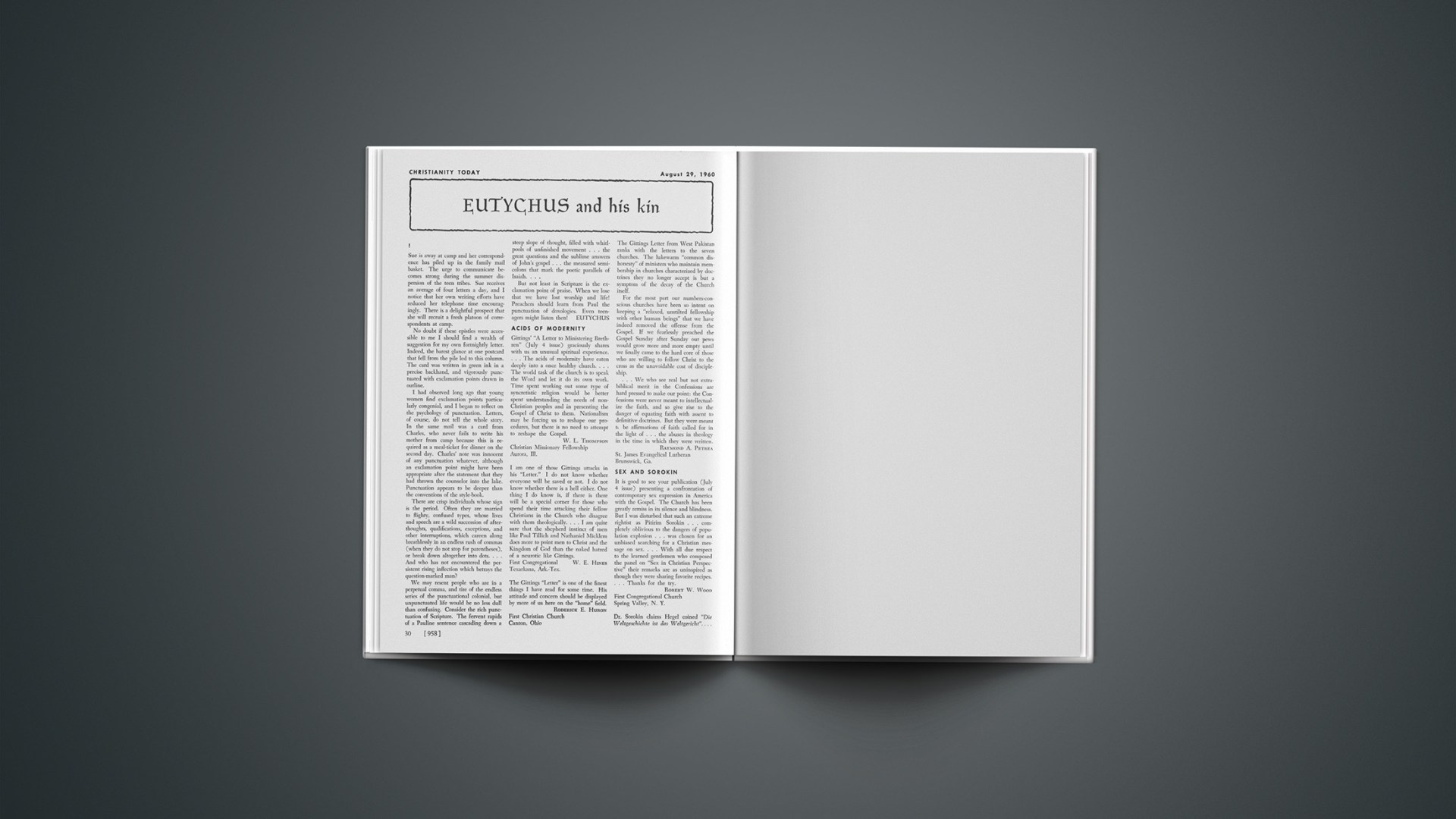
Eutychus and His Kin: August 29, 1960

!

Sue is away at camp and her correspondence has piled up in the family mail basket. The urge to communicate becomes strong during the summer dispersion of the teen tribes. Sue receives an average of four letters a day, and I notice that her own writing efforts have reduced her telephone time encouragingly. There is a delightful prospect that she will recruit a fresh platoon of correspondents at camp.

No doubt if these epistles were accessible to me I should find a wealth of suggestion for my own fortnightly letter. Indeed, the barest glance at one postcard that fell from the pile led to this column. The card was written in green ink in a precise backhand, and vigorously punctuated with exclamation points drawn in outline.

I had observed long ago that young women find exclamation points particularly congenial, and I began to reflect on the psychology of punctuation. Letters, of course, do not tell the whole story. In the same mail was a card from Charles, who never fails to write his mother from camp because this is required as a meal-ticket for dinner on the second day. Charles’ note was innocent of any punctuation whatever, although an exclamation point might have been appropriate after the statement that they had thrown the counselor into the lake. Punctuation appears to be deeper than the conventions of the style-book.

There are crisp individuals whose sign is the period. Often they are married to flighty, confused types, whose lives and speech are a wild succession of afterthoughts, qualifications, exceptions, and other interruptions, which careen along breathlessly in an endless rush of commas (when they do not stop for parentheses), or break down altogether into dots.… And who has not encountered the persistent rising inflection which betrays the question-marked man?

We may resent people who are in a perpetual comma, and tire of the endless series of the punctuational colonial, but unpunctuated life would be no less dull than confusing. Consider the rich punctuation of Scripture. The fervent rapids of a Pauline sentence cascading down a steep slope of thought, filled with whirlpools of unfinished movement … the great questions and the sublime answers of John’s gospel … the measured semicolons that mark the poetic parallels of Isaiah.…

But not least in Scripture is the exclamation point of praise. When we lose that we have lost worship and life! Preachers should learn from Paul the punctuation of doxologies. Even teen-agers might listen then!

EUTYCHUS

ACIDS OF MODERNITY

Gittings’ “A Letter to Ministering Brethren” (July 4 issue) graciously shares with us an unusual spiritual experience.… The acids of modernity have eaten deeply into a once healthy church.… The world task of the church is to speak the Word and let it do its own work. Time spent working out some type of syncretistic religion would be better spent understanding the needs of non-Christian peoples and in presenting the Gospel of Christ to them. Nationalism may be forcing us to reshape our procedures, but there is no need to attempt to reshape the Gospel.

W. L. THOMPSON

Christian Missionary Fellowship

Aurora, Ill.

I am one of those Gittings attacks in his “Letter.” I do not know whether everyone will be saved or not. I do not know whether there is a hell either. One thing I do know is, if there is there will be a special corner for those who spend their time attacking their fellow Christians in the Church who disagree with them theologically.… I am quite sure that the shepherd instinct of men like Paul Tillich and Nathaniel Micklem does more to point men to Christ and the Kingdom of God than the naked hatred of a neurotic like Gittings.

W. E. HINES

First Congregational

Texarkana, Ark.-Tex.

The Gittings “Letter” is one of the finest things I have read for some time. His attitude and concern should be displayed by more of us here on the “home” field.

RODERICK E. HURON

First Christian Church

Canton, Ohio

The Gittings Letter from West Pakistan ranks with the letters to the seven churches. The lukewarm “common dishonesty” of ministers who maintain membership in churches characterized by doctrines they no longer accept is but a symptom of the decay of the Church itself.

For the most part our numbers-conscious churches have been so intent on keeping a “relaxed, unstilted fellowship with other human beings” that we have indeed removed the offense from the Gospel. If we fearlessly preached the Gospel Sunday after Sunday our pews would grow more and more empty until we finally came to the hard core of those who are willing to follow Christ to the cross as the unavoidable cost of discipleship.

… We who see real but not extra-biblical merit in the Confessions are hard pressed to make our point: the Confessions were never meant to intellectualize the faith, and so give rise to the danger of equating faith with assent to definitive doctrines. But they were meant it be affirmations of faith called for in the light of … the abuses in theology in the time in which they were written.

RAYMOND A. PETREA

St. James Evangelical Lutheran

Brunswick, Ga.

SEX AND SOROKIN

It is good to see your publication (July 4 issue) presenting a confrontation of contemporary sex expression in America with the Gospel. The Church has been greatly remiss in its silence and blindness. But I was disturbed that such an extreme rightist as Pitirim Sorokin … completely oblivious to the dangers of population explosion … was chosen for an unbiased searching for a Christian message on sex.… With all due respect to the learned gentlemen who composed the panel on “Sex in Christian Perspective” their remarks are as uninspired as though they were sharing favorite recipes.… Thanks for the try.

ROBERT W. WOOD

First Congregational Church

Spring Valley, N. Y.

Dr. Sorokin claims Hegel coined “Die Weltgeschichte ist das Weltgericht”.…

The author is the German poet Friedrich Schiller.

T. W. BAULDER

Zion American Lutheran Church

Eureka, S. D.

BRUNNER ON COMMUNISM

The article by Emil Brunner (Apr. 25 issue) is a major landmark in the ever growing struggle for freedom. I am sure that it will have great impact among our churches in the United States.…

HERBERT A. PHILBRICK

Rye Beach, N. H.

The article is being prepared for insertion in the Congressional Record.

DONALD L. JACKSON

Congress of the United States

House of Representatives

Washington, D. C.

• The article has since appeared in the Congressional Record for June 28, 1960, pp. A5619, A5620. CHRISTIANITY TODAY reprints are also available at five cents each or $2.50 per hundred.

—ED.

ON UNIVERSALISM

With respect to “universalism,” you employ it generally as a diversionary channel through which you can send to oblivion any idea that might entail consideration of God as the Saviour of all men. Because this associates “universalism” with obscurantism, I eschew the term, and substitute therefore the appellative Christusaviorism—from Christ, the universal Savior.… For anyone who can discern that the Scriptures depict God as infinite in every respect, nothing less than universal regeneration can possibly serve as a measure of His will and power to turn the blasphemy of men into the mighty chorus of praise that His majesty demands.

F. S. DONN

San Luis Obispo, Calif.

STEWARDSHIP AND STAMPS

If there is a pauper-sized fund anywhere to be found, in the church, it is hiding in the gingham apron pocket of the Ladies Missionary Society. Our tithes do the great work of Christ, but the small leftovers that find their way into the Ladies Missionary basket have their job to do, also. If we do not want it to be a potluck job we have to put our thinking-chef-caps on and come up with a new recipe.

Recently some ladies in our missionary aid did just that. We do not claim the originality of the idea, only its ingenuity. Hoarding every penny of our prayed-for monies for the spreading of the Gospel, and [desiring] … a silver tea set which would be perfect for fellowships, we searched for a new solution.

Someone suggested trade stamps and the idea spread like virus. We brought them in: red, blue, green, any kind. If they were the wrong kind our resourceful committee exchanged them with other stamp collectors. Frequent announcements were made as to our progress and here and there a pep talk to remind us of our goal.

Today, it was on display, smug and shiny, reminding us that we didn’t have to use one cent of the Lord’s money. Why, it’s almost too beautiful to soil with the pouring of tea.

ROMAYNE ALLEN

Detroit, Mich.

WHAT THEY DIDN’T TEACH

After a second reading, the full impact of … “Spiritual Training of the Pastor” (July 18 issue) came upon me. So obvious it is that one wonders why it has not dawned on those responsible for teaching the future ministers of the Church.… Those who trained me were conscientious, dedicated and sincere men, earnestly attempting to train students for the ministry. Yet such disciplines as personal prayer and group fellowship were not insisted upon.

… I’m wondering why … the author … left out the … discipline which was most prominently used by our Lord—… that of field training.

THOMAS D. HERSEY

Methodist Church

Popejoy, Iowa

I owe much to my own seminary instructors. They taught me many things, but they did not teach me how to grow spiritually. The basic purpose of any seminary should be to train its students to lay hold of the great verities of our Christian faith in such a way that they become living realities in their lives, rather than intellectual concepts.

ROLAND J. BROWN

Clarendon Hills, Ill.

CONGRATULATIONS!

Heartiest congratulations on articles by Malik and Schaeffer in June 20 issue of CHRISTIANITY TODAY.

RALPH W. SOCKMAN

Christ Church (Methodist)

New York, N. Y.

Because of your fair coverage of the Methodist General Conference (May 23 issue) and your more usable articles recently you may renew my subscription.

EARL E. JOSTEN

First Methodist

Coon Rapids, Iowa
Ideas

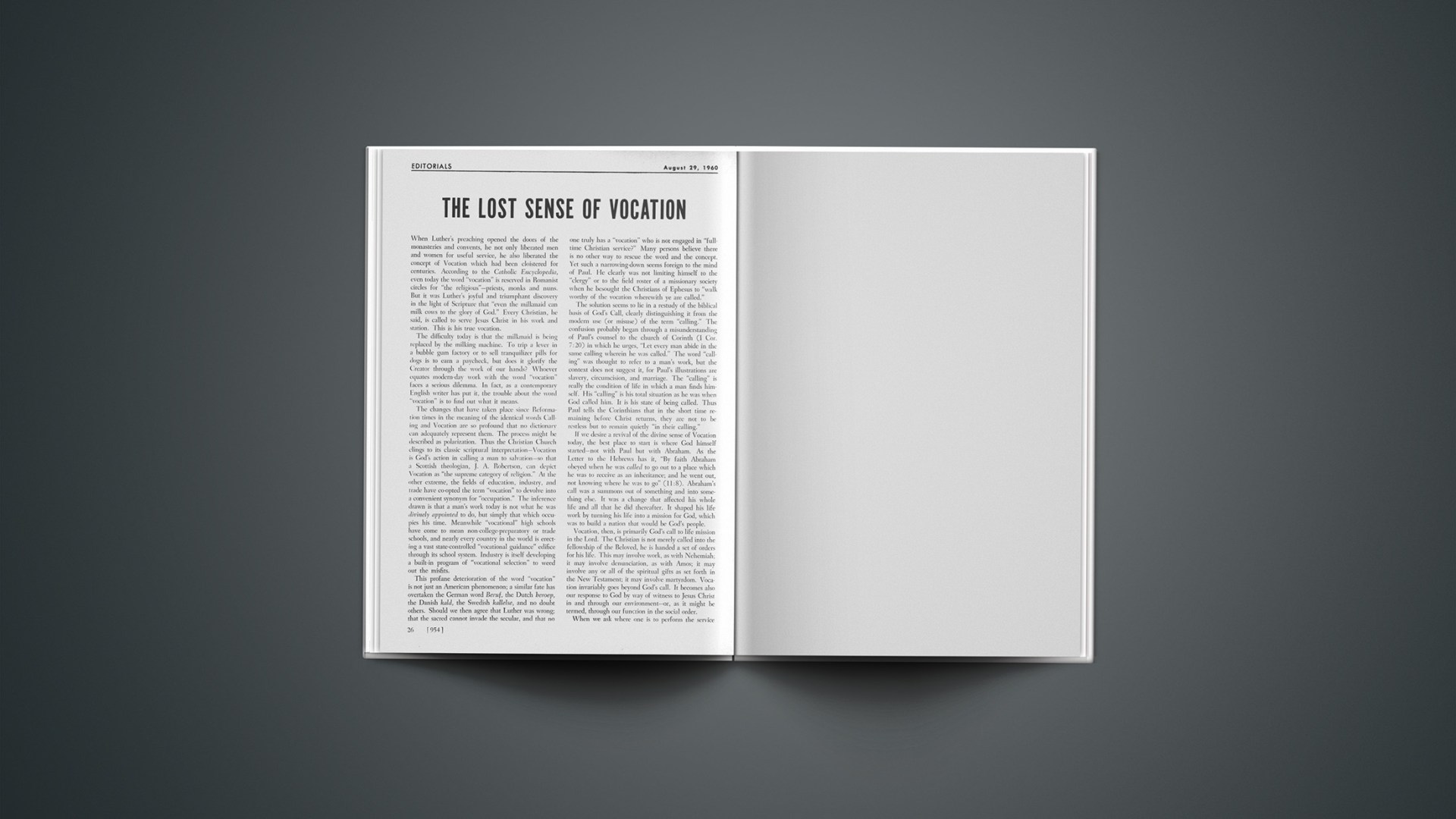
The Lost Sense of Vocation

When Luther’s preaching opened the doors of the monasteries and convents, he not only liberated men and women for useful service, he also liberated the concept of Vocation which had been cloistered for centuries. According to the Catholic Encyclopedia, even today the word “vocation” is reserved in Romanist circles for “the religious”—priests, monks and nuns. But it was Luther’s joyful and triumphant discovery in the light of Scripture that “even the milkmaid can milk cows to the glory of God.” Every Christian, lie said, is called to serve Jesus Christ in his work and station. This is his true vocation.

The difficulty today is that the milkmaid is being replaced by the milking machine. To trip a lever in a bubble gum factory or to sell tranquilizer pills tor dogs is to earn a paycheck, but does it glorify the Creator through the work of our hands? Whoever equates modern-day work with the word “vocation” faces a serious dilemma. In fact, as a contemporary English writer has put it, the trouble about the word “vocation” is to find out what it means.

The changes that have taken place since Reformation times in the meaning of the identical words Calling and Vocation are so profound that no dictionary can adequately represent them. The process might be described as polarization. Thus the Christian Church clings to its classic scriptural interpretation—Vocation is God’s action in calling a man to salvation—so that a Scottish theologian, J. A. Robertson, can depict Vocation as “the supreme category of religion.” At the other extreme, the fields of education, industry, and trade have co-opted the term “vocation” to devolve into a convenient synonym for “occupation.” The inference drawn is that a man’s work today is not what he was divinely appointed to do, but simply that which occupies his time. Meanwhile “vocational” high schools have come to mean non-college-preparatory or trade schools, and nearly every country in the world is erecting a vast state-controlled “vocational guidance” edifice through its school system. Industry is itself developing a built-in program of “vocational selection” to weed out the misfits.

This profane deterioration of the word “vocation” is not just an American phenomenon; a similar fate has overtaken the German word Beruf, the Dutch beroep, the Danish kald, the Swedish kallelse, and no doubt others. Should we then agree that Luther was wrong; that the sacred cannot invade the secular, and that no one truly has a “vocation” who is not engaged in “fulltime Christian service?” Many persons believe there is no other way to rescue the word and the concept. Yet such a narrowing-down seems foreign to the mind of Paul. He clearly was not limiting himself to the “clergy” or to the field roster of a missionary society when he be sought the Christians of Ephesus to “walk worthy of the vocation wherewith ye are called.”

The solution seems to lie in a restudy of the biblical basis of God’s Call, clearly distinguishing it from the modern use (or misuse) of the term “calling.” The confusion probably began through a misunderstanding of Paul’s counsel to the church of Corinth (1 Cor. 7:20) in which he urges, “Let every man abide in the same calling wherein he was called.” The word “calling” was thought to refer to a man’s work, but the context does not suggest it, for Paul’s illustrations are slavery, circumcision, and marriage. The “calling” is really the condition of life in which a man finds himself. His “calling” is his total situation as he was when Cod called him. It is his state of being called. Thus Paul tells the Corinthians that in the short time remaining before Christ returns, they are not to be restless but to remain quietly “in their calling.”

If we desire a revival of the divine sense of Vocation today, the best place to start is where God himself started—not with Paul but with Abraham. As the Letter to the Hebrews has it, “By faith Abraham obeyed when he was called to go out to a place which he was to receive as an inheritance; and he went out, not knowing where he was to go” (11:8). Abraham’s call was a summons out of something and into something else. It was a change that affected his whole life and all that he did thereafter. It shaped his life work by turning his life into a mission for God, which was to build a nation that would be God’s people.

Vocation, then, is primarily God’s call to life mission in the Lord. The Christian is not merely called into the fellowship of the Beloved, he is handed a set of orders for his life. 1 his may involve work, as with Nehemiah; it may involve denunciation, as with Amos; it may involve any or all of the spiritual gifts as set forth in the New Testament; it may involve martyrdom. Vocation invariably goes beyond God’s call. It becomes also our response to God by way of witness to Jesus Christ in and through our environment—or, as it might be termed, through our function in the social order.

When we ask where one is to perform the service to God set forth as the Christian vocation, the only answer can be “everywhere.” Yet in reality the average Christian has only a limited number of places in which he moves: his home, his church, the homes of friends, occasional public gatherings, a few streets, one or two centers of leisure time activity, and his work. In all of these areas he can and should be witnessing to his Risen Lord. So far the greatest uncharted, unexplored region remains the place of work.

Work today has become the most important thing in life for millions of people. An industrial society tends to gravitate increasingly about the factor—the house of the machine. The machine does not ask a worker’s philosophy, it only demands the output of effort. The worker is required to bring to his labor the full scope of his efficient powers. A Christian witness at work is at a great advantage. Many Christians do not realize that there are thousands of workers who have almost no social intercourse outside of their work. It would never enter their heads to attend a church; yet they will discuss the claims of Christ with a fellow-employee.

The Christian, too, can be seen at work for what he is, and not for what he says he is. His vocation takes on new significance when his fellow-workers watch him react to the conditions they may face: temptation, corruption, danger, ennui, abuse, and all the rest. The Christian’s spoken testimony is gauged by his conduct. For many, the value of his witness in leisure hours and in church will depend upon the way in which he pursues his Vocation at the place where he works.

Taking Christ into the world of work raises many issues for the believer which cannot be dodged or winked at. If we are to follow the biblical injunction, “Whatsoever thy hand findeth to do, do it with thy might” (Eccl. 9:10), our work must validate itself before God. If we do not believe that God is interested in the work we do—if we believe that work has nothing to do with Vocation—we are playing not only into the hands of the medievalists, we are also abandoning the whole field of labor to the Communists. For Marxism has a carefully-thought-out doctrine of work which is designed to turn a man into a slave of the state, while brainwashing him until he is unaware of what has happened to him. One quotation from Vyacheslav Molotov, made at the Stakhanovite conference of 1936, will illustrate the point:

Counting minutes and seconds during one’s work means introducing a rhythm … means introducing culture in one’s work. It is therefore not a question of overstrain on the part of the worker but of a cultured attitude towards work (quoted in Koestler, The Yogi and the Commissar, p. 162). Such a comment indicates how hypocritical are the Marxist complaints about the “inhumanity” of the “capitalistic” machine age.

Communism, in fact, poses a warning threat to the Church of Jesus Christ. Unless the Church quickly reclaims her doctrine of Vocation, preaching and teaching the direct Call of God to every child of His, she will find herself without the real answer to the questions raised by the worker today. The twentieth century has seen men rise to power—perhaps for the first time since barbarian days—with a truly demonic sense of vocation. These men believe themselves to be chosen by the inexorable forces of historical destiny to rule the world. They merely underscore the fact that the task of winning the world for Christ is deadly serious work.

The enduring Labor Day message of the Church is therefore this: Whatever the particular task at which we labor, we must be prepared to use it, together with every other aspect of our lives, in the cause of the Saviour. The Call of God is not one that brooks an uncertain or half-hearted response. God makes no “deals.” He deals with men only at the Cross. Every committed heart finds its true Vocation at Calvary.

TIME TO QUIT PLAYING AT SUNDAY SCHOOL

The need for a living, vital Christianity has never been more urgent. In the nation there is a definite breakdown in morality and spiritual conviction; in the world atheistic communism threatens both faith and freedom. Education with Christian ends in view has new significance as a means of maintaining, strengthening, and advancing all that is best in American life.

There is no more effective agency of Christian Education at the grass roots of our society than the Sunday School. One of its foremost advocates is J. Edgar Hoover of the Federal Bureau of Investigation. His recently released 1959 crime chronicle reveals “an alarming 7 per cent increase in the number of crimes against the person … as compared with crime figures for the previous year reported by cities over 25,000” and that 5 per cent of this rise must be attributed to juveniles. The most significant increase was a 21 per cent jump in the number of murders in cities in the 500,000 to 750,000 grouping. Here again juveniles were the chief offenders.

It is Hoover’s conviction growing out of years of experience that

The Sunday school is a citadel of real spiritual influences. Religion to a boy or girl becomes a reality based on love and not on fear. Youngsters come to know that God asks more than mere lip service to His commandments; that He asks us to live under His guidance and love.

The Sunday school teaches the power of prayer and the need to make God an intrinsic part of our daily lives. The Sunday school teaches the child to “rule his spirit” and to place a reliance upon God which will not be shaken in later years. It stands as a strong bulwark against the angry waves of evil presently sweeping across our nation. It is a powerful medium in materially reducing the army of youthful offenders and delinquents.

The emphasis on Christian education in the local church in this issue of CHRISTIANITY TODAY corroborates and enlarges this view. In the midst of the profoundly disturbing events of our generation we need with new imperative to turn the minds of our youth to the Word of God and to Christ as Lord and Saviour. We have been playing at this task too long. We have downgraded the Sunday School and the Sunday School teacher and failed to provide the money and equipment essential to their effectiveness. Greater attention needs to be given to the development of a valid philosophy of Christian education, an adequate curriculum and competent professional workers to direct the teaching of the Scriptures with an incisive relevance to our crisis times. This is a task of staggering proportions but we must needs be about it with all our might. The night is far spent. The day is at hand.

LABOR DAY AN OCCASION FOR RECOGNIZING RESPONSIBILITY

All men stand under the judgment of God. All are objects of his preferred redemption. But sinful nature prompts men to resist this realization.

The labor movement could find no better way to observe this time of year when it is singled out for particular recognition than to affirm awareness of its responsibility before God.

Neither labor nor management can be confronted by the Church on terms other than those of the Christian ethic. God’s laws which apply to the one always apply to the other.

Labor-management rapprochement can never endure under the immoral stress of minority exploitation, coercion, or the perpetuation of inequities or injustices, regardless of the source from which they come.

The Christian community commends management and labor leaders who recognize the evils of our day and seek their eradication. Such men deserve our full support, and their deeds ought to be publicized and emulated.

There is but one Gospel. This gospel applies to labor and management. The warfare that exists between these two social elements must yield to enlightened realism.

STRATEGY FOR DISASTER: BURN THE FIRE TRUCK

In our rightful concern over the gradual spread of communism abroad we may prove to be like the man who vigorously fought a grass fire in a neighbor’s yard while his own house was ablaze.

The wide-spread revulsion against the late Senator McCarthy’s wholesale charges has resulted in apathy, indifference, and fear in respect to the exposure of subversive activities today. It is still highly popular to denounce Communist aggressions abroad. We are almost unanimously indignant over Moscow’s aggravating of the situation in the Congo. We view Khrushchev’s rocket-rattling in Cuba with alarm.

But what about subversive influences at home? What about the philosophies closely paralleling those of Marx advocated in the class rooms of our schools? What about atheism, the Siamese twin of Communism, espoused and taught in leading institutions?

We have before us a letter describing the sorrow of a man well advanced in years, one who for a long time has been an active Protestant churchman. His two grandsons were brought up in the church but succumbed to non-Christian influences in high school and now, in college, have become atheists and at the same time speak favorably of communism. Is there not some line of action against such things? Do Christians and taxpayers have to sit by idly while unworthy men and women subvert their children?

We know that academic freedom must be maintained. Tenure must be preserved. But neither academic freedom nor tenure should permit the unchallenged indoctrination of biases which strike at the very foundation of the life of the nation. Changes cannot be effected over night. Injustice must never be used as a tool to eradicate imagined wrongs. But every institution is governed by responsible citizens who owe it to the institution and to students to see that subversive teaching is not a covert part of the curriculum.

Equally responsible are the pulpits and Sunday School classes of America. A strong faith in God is the greatest single enemy of communism, and where such faith is fostered a bulwark is set up against materialism in all of its manifestations.

All of us need to recognize communism for the monstrous evil that it is. Posing as humanitarian, it is inhuman in application. While speaking of freedom, it enslaves. Catering to the material, it destroys the spirit. Denying God, it makes a god of itself.

Christian citizens should be the bulwark against which the designs of the international conspiracy of communism founder. To accomplish this, Christians must be informed as to the true nature of communism. They must recognize it in its various garbs and take the remedial action necessary.

While we fight brush fires in other lands we are in grave danger of ignoring the slow burning conflagration in our midst. Concerned over Communist aggression in other nations we ignore the termites of infiltration here at home. Some even fatalistically assume that communism will eventually dominate the world and shrug their shoulders in apathetic indifference. While we fight the fires of communism abroad let us beware of the Red-inspired pyromaniacs here at home.

WHAT CHRISTIAN INFLUENCES REACH 3 MILLION COLLEGIANS?

Three million future leaders are being trained in the colleges of our land. We are told that the number will more than double in a decade. Will the nation on that account be in more competent hands?

The present university training of these future leaders is seldom reassuring. The classroom emphasis at Harvard, a typical Ivy League school preparing many students for career service in government, is reflected by a student evaluation in the Harvard Crimson: “Economic proposals that might have sent people to jail not long ago and are still denounced as dangerously radical find remarkable acceptance within the college community.” The article points out that students are quietly absorbing the economic and political beliefs of the “left wingers.” One third of the students interviewed favor government ownership of basic industry, and socialization of all medicine. The same individuals are for the abolition of atomic tests, and an overwhelming number of students favor admission of Red China into the United Nations.

What of “religious revival” at Harvard, of which President Pusey has spoken from time to time? The Crimson is aware of no such “revival.” A random survey on the Harvard campus of the ethical views of 319 undergraduate students from leading homes in America discloses that 62 per cent of the students have no objection on religious grounds to extra-marital relations, and 78 per cent have no objection to premarital intercourse, homosexuality, divorce, or legalized abortion. Some students question the advisability of these activities only because of social consequences.

Do Christian students stand up under such pressures? In many cases they do not. An evangelical from a fine Christian home stated that the fellows in his group, meeting for prayer and Bible study, are sure only that they are certain of nothing. The pressure of lectures keyed to the norm “reject everything before accepting anything,” and reading lists generally slanted against more conservative views (according to the Crimson), softens up less stable students and exposes the woeful ignorance of many Christian students of the historic doctrinal and apologetic formulation of basic Christianity. Still others so superficially appropriate the life of Christ that faith does not stand the test, and they fall before the onslaught of secular education. One is left to wonder just how much faith they really had to lose.

If the foundations are destroyed, what can the righteous do? They must seek to rebuild these foundations, no matter how costly, no matter how difficult. How can this be done most effectively in student work?

First, we must re-evaluate our priorities in the outreach of evangelism and missions. We popularize such clichés as “Win the Student Today; Win the World Tomorrow,” “The Campus—America’s Greatest Mission Field,” “America’s Most Strategic Mission Field.” Tragically enough, the Church is not doing enough.

Because Paul said that “Not many wise, not many mighty” are won to Christ, evangelicals have allowed the intellectuals by default to remain outside the circle of evangelistic outreach. The Communists have not made this mistake. Witness the infiltration of university centers around the world.

Efforts such as Inter-Varsity Christian Fellowship, Campus Crusade for Christ, and International Students need our support; as well as every denominational student work that centers its ministry in the proclamation of the Gospel and the whole counsel of God. But the local church also must do more. Less than one per cent of our students on the campus are now being reached by evangelical causes. A Harvard survey of religious beliefs of students disclosed the local church to be one of the least significant influences in their lives. Of more than 300 students interviewed, 74 per cent had nothing to do with any church while in college. The local church must prepare its prospective collegians for the onslaught of secularism. It must equip them with an apologetic, giving a sure reason for the hope within.

Moreover, we need to make the Gospel relevant to the student mind. Too many students today feel the Church is behind the times, and in many cases they are correct. Not only the language we speak, but the problems we face, must be contemporary. The Word of God, through the Holy Spirit, is relevant to the needs of our generation for its message is still the sovereign power unto salvation, even for moderns.

Furthermore, there must be cooperation, both church with church, and church with the local campus Christian groups. Students are the first to discern if our Gospel draws us in love to fellow believers of other denominations, or if we are factious and sectarian in outlook. Nor can we expect the blessing of God on these human failures. In Greater Boston, where groups such as Inter-Varsity Christian Fellowship, Campus Crusade for Christ, and International Students have united with each other and with local evangelical churches in an unprecedented way for campus outreach, this cooperation has made a constructive impression on both students and college administrations.

Finally, the local church needs the on-campus students. The outreach of the local church must be campus-centered, for here is the great mission field to be reached. The indigenous emphasis of evangelism is still the basic New Testament teaching. Students make the best evangelists and missionaries in an effort to reach other students.

Teaching–Methods and Message

TEACHING—METHODS AND MESSAGE

Christian education has now become a highly specialized science with ever-increasing emphasis on methods and communication.

Many has been the Sunday School class that has gone through the boredom of a period of “teaching” which reflected the ignorance and ineffectiveness of the teacher.

That the curriculum and methods of the Church School are now under careful study is certainly to the good—provided that the biblical message is honestly and clearly presented.

With the increased concern for the Sunday School, the scientific methods of teaching being carried over from the secular to the religious field, and with new concepts of communication, it becomes imperative that these and other advances or improvements he anchored to the divine revelation and not become a clever means of substituting human opinions for the clear affirmations of Scripture.

To be an effective teacher of a Sunday School class, beginner or adult, he or she must know the Bible, not books about the Bible but the Bible itself. This is a basic requirement, and such knowledge is not acquired in a short time; rather it comes solely through the reading, studying, pondering, and obeying the Word of God in our personal lives.

To expound the opinions of men is only a matter of research, but to be able to teach the Holy Scriptures is a matter of faith and experience.

We need very much to guard against coldness or legalism, while at the same time we guard against every tendency to rob the Bible of its clearly indicated meaning.

With the increasing emphasis on methods of communication there goes hand in hand the question—What is it we are trying to communicate? It is possible to communicate untruths so effectively that they appear to be facts. It is possible to be pedagogically perfect and at the same time a menace to those whom we teach.

I mention these things because there is in the realm of Christian faith a great volume of truth to be imparted. And in many areas of doctrine there is no room for speculation or argument. An honest teacher of Christianity for instance, stands without equivocation on the deity of Christ and will support that fact along with its many implications.

Therefore while discussion, questions, yes even arguments may have their place in a class, they all must find their solution in an authority and wisdom which is above man, namely, the authority and wisdom of the Holy Scriptures.

Many is the “discussion class” that has foundered on the rocks of individual opinion because the leader, moderator, or teacher has failed to prove a worthy pilot, and because the course was not charted by the Bible itself. The same can be said for many things done in the name of “group dynamics.”

As important as methods and effective communication are, however, the primary concern in a Church School is the message. And it is here that many modern curriculae fail. Writers, giving often a lavish lip service to “biblical content,” leave people cold and uninstructed because their pious references to Scripture are lost in a miasma of rationalistic unbelief.

Of what use is teaching which results in unbelief rather than belief? What spiritual food can a little child, or adult, get from clever “explanations” which in effect deny the clear affirmations of Scripture? What is gained by explaining away the miraculous and making light of the supernatural? What has a method, coupled with adroit techniques of communication, accomplished when it leads people to question rather than believe the Bible which is supposed to be the heart of Christian instruction?

These are very relevant questions—not in all major denominations but in some, and not in all issues of materials but in some.

In the imparting of Christian truth there is an element not present in the secular realm, and this is spiritual. Also, in Christian teaching there is a supernatural Person without whom all is in vain—the Holy Spirit.

Methods may be perfect. The art of communication may be superb. But unless God’s Holy Spirit takes the message and makes it clear and applies it to the heart of the individual, no permanent good has been accomplished.

It is the spiritual phase which places the Church School in a class by itself. It is the need for supernatural help that places both teacher and pupil in a position unknown in the secular field.

Not only must the teacher in a Church School depend on the presence, illumination, and power of the Holy Spirit, but his efforts must be bathed in prayer. Prayerlessness is an affront to God and at no time more so than in presuming to teach of Him without adequate preparation and looking to Him for guidance and empowering.

Nor can the Christian teacher do his or her work effectively if one’s personal life gives the lie to the spiritual truths he is teaching. Consistency of words and life are nowhere more important than at the level of the teacher.

Much emphasis is also placed on making the lesson relevant to our times. This is of course good provided that divine revelation is applied to current problems on the basis of the principle involved. For instance it is imperative that the Christian’s obligation to love his neighbor be affirmed and taught with all the vigor at one’s command. But the enforcement of various concepts or programs by governmental intervention may transfer the problem to a category entirely separated from divine revelation. The man who demanded of Christ that he speak to his brother about an undivided inheritance did not get his wish because Christ saw through to the covetousness of his heart.

The inequity of an undivided legacy would appeal to any of us, yet Christ’s judgment of covetousness was the matter of prime importance.

Does not our Lord give us an example of placing emphasis on the things that are not seen rather than on things material? Is this not a principle on which Christian teaching should stand? We see the injustices and inequities of the world around us. With great zeal and enthusiasm we go out to correct social problems, but we fail to grasp the Christian principle that all of these things are symptoms of a disease which is sin in the hearts of the men and women making up society.

Those who teach in Church Schools have a glorious opportunity to go to the source of our problems and to the Fountain Head of their solution. Once those whom we teach come to know Christ as Saviour and make Him the Lord of their lives, all other things fall into their proper place and perspective, as promised in Matthew 6:33.

L. NELSON BELL

Bible Book of the Month: Job

Classed with the poetic books of the Old Testament, Job is a book of deep philosophy which deals with some of the basic problems of life. It is cast in the form of a dramatic poem. There is a prose beginning which explains the situation and a prose ending which concludes the story. A rich man of antiquity, Job was noted for his righteousness. Satan was allowed to test him by deep suffering. The major discourses with the comforters are about the problems of suffering and of life itself. In rounds of conversation Job speaks three times with each of three friends, with the exception of the third speech of the last comforter which is given by a newcomer, Elihu. After this, God himself speaks to Job and in humility Job accepts God’s reproof. The book ends with Job’s restoration.

OUTLINE

Introduction, Job’s calamities, chapters 1:1–2:13.

Job’s nine speeches, chapters 3; 6–7; 9–10; 12–14; 16–17; 19; 21; 23–24; 26–31.

Eliphaz’ three speeches, chapters 4–5; 15; 22.

Bildad’s three speeches, chapters 8; 18; 25.

Zophar’s two speeches, chapters 11; 20.

Elihu’s speech, chapters 32–37.

Jehovah’s reproof and Job’s submission, chapters 38–41.

Conclusion, chapter 42.

Some have argued that the first two and last chapters which are written in prose, were by an author different from the writer responsible for the body of the work which is poetry. But Terrien, speaking on Job in the Interpreter’s Bible, calls attention to the fact that other ancient pieces also exhibit such a structure (Interpreter’s Bible, vol. 3, p. 879). Actually, the argument of the book really depends on the setting as given in chapters 1 and 2.

Job is a theodicy. It faces the problems of why the righteous suffer and offers an answer or answers justifying the ways of God with men. Job has ever since been an example of integrity (Ezek. 14:14, 20) of suffering and of patience (Jas. 5:11).

THE NARRATIVE

The record of Job’s experiences is given with great artistry. The first chapter, though in prose, attains by a simple recitation of the staggering facts a climax of tragedy. Job is bereft of all. Unknown to Job but given to the reader is the information that his misfortunes have occurred under the permission of God at the instigation of Satan.

Now what should be Job’s reaction?—despair?—rebellion?—abandon? No, his attitude is one of absolute submission to the will of God (1:21). It should be noted that this is not only Job’s reaction, it comes with the approval of the inspired author (1:22). Job, having passed the test, is attacked by Satan, again with God’s limitation that Job shall not be killed. Again Job had no way of knowing that God had set these limits. Indeed, Job knew no more of the divine purposes in his trials than we do in ours. He could not sense that he was just then the special arena of Satanic forces contending with the divine, while angels watched to see the supporting power of the grace of God. God never let Job go. In all his affliction He was afflicted, and as his eye is upon the sparrow so Job was the object of God’s loving care even when God seemed to be most withdrawn. Satan has great power over Job and over us, but God speaks the last word.

In Job’s further trial his wife turns against him. But again Job expresses submission (2:10), and again this attitude is the one approved by the author, “In all this did not Job sin with his lips.”

Now absolute submission to the will of God is the proper attitude for a Christian to take. And this is neither fatalism nor irrationalism. It is not fatalism because the will of God is the will of a personal Father rather than a blind impersonal force. It is not irrational because the Christian has adequate reason to know that in the long light of eternity the will of God is best.

Inability to understand this is one of the failures of the current play J. B., by Archibald MacLeish. The play cleverly reproduces Job’s suffering in terms of present society. It sharply poses the problem of how to know the chief end of man and can God himself be known. But the play offers no answer to either question. It lamely ends that all our answer is “we are” and that what suffers can love. Love on earth and the fact of existence are apparently all the play leads to. This is merely the road to despair. The play ends in a blank. But existence without God is a terrible blank (Eph. 2:12). The end of Job is very different as James 5:12 assures us. Job meets God and is satisfied and God blesses Job at the last.

The answer of Job to suffering is, however, no easy and superficial answer. Job in his person and in his thought plumbs the depth of suffering. At first, as we have said, he declares that his confidence is anchored in the rock of sublime trust in the ultimate goodness of God. But in the following chapters he is shaken by the extent of his anguish. Here the so-called “comforters” play their part. The book does not call them comforters, though it does say they came to comfort their friend in his disasters (2:11). Their function in the book is to discuss the “why” of suffering. Apparently the answers of the three men are all alike and make no great progress. They claim that Job has greatly sinned and therefore his great suffering is penal. If he will repent and reform, all will be well (4:8; 8:3–7; 11:6, 13–16). Some of the remarks of these men are in a measure true. God does punish sin; repentance and reform are commanded by God; He does do unsearchable things beyond man’s wisdom. But these limited answers do not fit Job’s cause. Why do the righteous suffer? How can we explain the inequalities of life?

Job at times falls into blank despair. He sees no answer. He curses his day. He sees nothing beyond the grave (7:9; 10:21, 22) and longs for death in a passage as poignantly beautiful as it is spiritually hopeless (3:17–19). These thoughts are not recommended by the author nor are they to be considered as divine instruction any more than Asaph’s preliminary observations on a similar theme (Ps. 73:13–16). They are the anguished questions which at last bring forth the epochal advances in God’s revelation to Job.

Job never loses sight of two points, first that he is guiltless of the grievous sins charged against him, and second that God is righteous. An important verse is 13:15, “Though he slay me, yet will I trust in him.” Unfortunately, there is a dispute here on the reading. The Hebrew “lo” (preposition l plus him) is vocalized by some of the Jewish witnesses as “lo” (not) and is read, “He will slay me, I have no hope” (RV and RSV). But all the older translations, the Greek Septuagint, the Syriac Peshitta, the Jewish Targum, and the Latin Vulgate take it as does the King James, and in the Hebrew grammar the verb hopeor trust needs the preposition I to compliment the meaning. The King James reading is preferable. Job retains his faith in God.

And he concludes that present injustice is remedied hereafter. The force of the passage in 14:7–14 is missed in most translations, but it clearly considers the hereafter. The argument is that even a tree when cut down sends up a second growth. “It will sprout again” (yachlîph). But how about man? Can it be that the summit of creation, a sentiment being of moral possibility is of less consequence to God than a tree? “If a man die, shall he live again?” Job answers his plaintive cry by the affirmation of an abiding faith, “I will wait till my second growth (chalîphah) come. Thou shalt call and I will answer thee. Thou shalt have a desire to the work of thy hands” (14:14, 15). The word chalîphah comes from the root “chālaph,” meaning to pass away or succeed (hence our word Caliph). In this context there is doubtless an allusion to the second growth of a tree as symbol of resurrection mentioned in verse 7.

The affirmation of Job forms the background of the famous passage in 19:23–27. Through his groping Job sees the possibilities of an ultimate answer. His sufferings cannot now be justified. But they will be justified at last. In a solemn appeal to the future Job declares his confidence that his “vindicator” (more accurately than “redeemer”) lives and shall at last appear. Verse 26 is difficult. The words “after my skin” hardly makes sense. After can be a preposition of time (as after two days) or of place (as behind the tree’), but “after my skin” is inappropriate. But the root “ ‘wr” (skin) is identical with that of the verb awake used of resurrection in 14:12. It would fit the Hebrew grammar much better to translate “after my awaking.” This is the marginal reading of the King James translators. The RSV reading “after my skin has been thus destroyed” is impossible. It would require the preposition after to be used with the infinitive of the verb destroy and the word skin to follow. The Hebrew does not read this way. The next phrase “worms destroy this body” is more difficult still. The Hebrew lacks worms and body. Perhaps it means “when this (suffering) is struck off (or finished).” The verse would then read, “After my awaking, when this misery is over in my flesh shall I see God.” It is debated whether the phrase should read “in (i.e. out from) my flesh” or “apart from my flesh.” The Hebrew “min” (from) could mean either one, but inasmuch as the following verse emphasizes that Job himself with his own eyes shall see God, it seems that the reading “in my flesh” is fully justified. Consideration of these details is necessary to show that the above suggested translation of the crucial verse does full justice to the Hebrew and considers the verse in relation to Job’s triumphing faith in his eventual blessing in a future life.

The above concepts are carried on in Job’s recognition that the wicked, though they may prosper in this life nevertheless can expect God’s condemnation at last (21:7–30; 24:19–24; 27:13–23). Job, however, declares his firm trust in God (23:10; 28:28) and his innocence before his accusers (31:1–40).

Elihu, a fourth comforter enters the picture at chapter 32, but seems to add nothing new to what has previously been said. He too alleges Job’s guilt (34:7) and declares that God would bless if he would return from sin (36:12, 16).

At last the trial of Job is over. God himself speaks. In highly poetic form he shows Job (and we should take the lesson to heart) how little of the ways of God are known to man. How complete then should be our submission to His will.

In the speech of the Almighty, Job is reproved for lack of perfect trust in God (40:7, 8), and Job at last finds full satisfaction in meeting God face to face (42:1–6). God then reproves Job’s companions, accepts Job’s sacrifice and intercession, and finally restores his possessions. It is beautifully remarked that he was given twice as many possessions as before, but only an equal number of children. Yet he had not really lost his former children—those he would meet again in heaven.

DATE

The date of Job has been much discussed. In one sense it makes little difference when the book was written for nowhere is it dated in the Old Testament or New. Conservatives have often dated it in the general time of Moses, as it mentions Abraham’s nephews, but omits all reference to the worship of the tabernacle or temple. This is a sound argument. Other conservatives have suggested the time of Solomon. Critics have claimed that the language is late and a few have held that the book is as recent as 200 B.C. The latter date is now impossible to sustain as fragments dating from that time have now been found in the Dead Sea caves. Parts of Job are among the earliest fragments found. Surely a date in the prophetic period, that is, from Moses to Ezra, is most logical. One reason for conservative zeal for an early date is that usually the critical considerations arguing for a later date of Job would indicate too late a date for other books such as Proverbs, some of the Psalms, portions of Isaiah, and so forth. It is true that the style of the body of the book of Job is unique. This may be due not so much to a late date as to the mixed non-Hebraic dialect of the area where Job was written. Affinities of the language with both Aramaic and Arabic have been pointed out. More significant are affinities with the old Canaanite language of Ugarit. Indeed it is likely that some items in the peculiar dialect of Job are marks of antiquity rather than of lateness. As to the ideas of Job, they are not a sufficient guide to dating for we do not know the ideas of hinter-Palestine in antiquity. Some have supposed that the concept of the resurrection in Job marks it as late. This is begging the question for we do not know how early the idea was revealed to Israel. Others have denied that Job teaches the doctrine of the resurrection at all! The fact is that as far as we can tell, Job’s doctrine of the resurrection cannot be denied to early Israel. The book of Job itself may well have been a milestone in God’s revelation of this truth.

LITERATURE

The standard commentaries of Keil and Delitzsch and Lange are helpful. The work of E. S. P. Heavenor in the New Bible Commentary (IVCF, London, 1953) is also good, but does not go into detail on the crucial passages in chapters 14 and 19. Works on introduction and critical questions are fully covered in Edward J. Young, An Introduction to the Old Testament (Eerdmans, 1949). For the mass of literature on Job, mostly critical, compare the treatment of Samuel Terrien in the Interpreter’s Bible (Abingdon, 1954).

R. LAIRD HARRIS

Professor of Old Testament

Covenant College and Theological Seminary

Uniform Lessons: An Evaluation

Uniform Lessons are not without limitations. They are not a perfect panacea for the religious illiteracy and moral ills of our nation. But strong evidence could be marshaled to support the statement that Uniform Lessons, the most widely used curriculum materials in the Sunday Schools of America, have been the foremost factor in the Christian culture of the nation during the past 75 years.

QUESTIONS AND CRITICISMS

Vigorous criticism of Uniform Lessons is not new. Such criticism, from the early years of this co-operative effort among Sunday School leaders in America, has led to improvements in Uniform Lessons and to the development of other needed curriculum materials. But questions continue to be raised, and even charges of the most grievous nature are leveled against this plan of Bible study. Most of these questions and charges arise from misunderstanding and lack of information. Some of them spring from deep concern for the cause of Bible teaching in the churches. Unfortunately, some criticisms are inspired by pure prejudice and a desire to embarrass the groups responsible for Uniform Lessons.

The more frequent questions and criticisms are the following: 1. Uniform Lessons seem to follow a hop, skip, and jump plan—why not study the Bible book by book and chapter by chapter, straight through? 2. There are too many passages in a given lesson—we get confused and can never cover all the ones listed. 3. Much of the Bible is left out—why not study all the Pentateuch, all the Psalms, all the Old Testament prophecies, all the New Testament epistles, and all of Revelation? 4. The lessons are too topical, about some moral problem or some current situation in human relations—why not concentrate on the Bible and learn what it means? 5. The lessons major on the “social gospel”—why not leave politics and race relations to the modernists? 6. After a lifetime in Sunday School, people are hopelessly ignorant about the Bible. They don’t know whether Noah built the Temple or preached on Pentecost, whether Peter betrayed Jesus or was stoned to death on the Damascus road, or whether Ruth was the mother of Moses or the wife of David. Why cannot Sunday School lessons major on Bible knowledge instead of moralizing about how to get rid of worry or how to treat your neighbor? 7. Uniform Lessons repeat the same historical material cycle after cycle—why do we not provide for the study of fundamental doctrines? Protestants are amazingly ignorant of what they believe. 8. The lessons are all from the Bible but never about the Bible; there is no clear-cut facing of critical problems about the Bible. Do not people need to know how we got the Bible and what it is as the Word of God? 9. The lessons never seem to come to grips with social issues, with the critical problems in modern society—Bible study means little unless we get guidance for living in our time. 10. Why are Uniform Lessons copyrighted by the National Council of Churches? Why do we have to study something handed down by the National Council?

BASIC PRINCIPLES

The confusion and false implications indicated by most of these questions is evident. Often the question is an indictment rather than a request for information. Let me undertake to answer them by calling attention to some basic principles underlying Uniform Lessons.

Uniform Lessons are designed to provide a plan for Bible teaching and Bible study suitable for groups, primary through adult. These lessons are meant to be used in churches of varying sizes with varying levels of trained leadership. It is expected that Sunday School teachers and officers will be voluntary workers, seriously committed to the importance of Bible teaching but not specialists in theology or education. It is further understood that attendance at Sunday School is voluntary, often being interrupted by change of residence, which is a fact that must be faced, and which imposes inevitable limitations on what curriculum materials can be. Uniform Lessons, designed for reaching multitudes of people for Bible study, cannot be conceived or developed as a formal course in biblical studies. Some highly desirable outcomes in biblical knowledge, Christian understanding, and matured social insights cannot be achieved in such a plan of study. This does not reflect on the validity of Uniform Lessons, but simply means that they cannot serve all the needs for Bible study. Their genius, their basic values as a program of Bible study suitable for people generally, must be understood.

It follows, therefore, that the units of study and the lesson materials must have variety for the sake of interest. The average Sunday School constituency is not prepared for sustained study of abstract truths, of consecutive portions of the Bible, or of the more profound theological concepts of the Hebrew prophets or the letters of Paul. Provision must be made for materials that have value in spite of irregular attendance, in spite of persons moving from one community to another, and in spite of the shortcomings of inadequately equipped or dedicated teachers. And, especially, a plan of study must be provided that lends itself to participation by the unreached multitudes which churches should strive to reach, not just at the beginning of courses but week by week throughout the year. Some plan, at least similar to Uniform Lessons in their basic characteristics, must be followed if churches are to accept their divine commission and responsibility to teach the Bible to all the people.

STRENGTHS AND WEAKNESSES

Some of the questions and criticisms of Uniform Lessons point to strengths in what might be considered weaknesses. The lessons do have in some instances a collection of passages for study. This is necessary in drawing upon the most relevant biblical material about given topics. A study of topics is just as sound educationally—and in some cases far more fruitful spiritually—than the study of continuous chapters. Such passages reveal the truth of God about the topic or problem being studied. And students are thus helped toward more familiarity with the content of Scripture as it bears on the experiences of life.

Some units and some particular lessons do place major emphasis on social issues. The Bible is God’s revelation for man’s living in relation to the society around him as well as for his redemption from sin. The Gospel of Christ contains the clearest kind of teaching about the Christian’s social responsibility. A plan of Bible study that omits this teaching would be untrue to the Bible. It remains to be said, however, that a study of any given cycle of Uniform Lessons will indicate a conscious effort to balance the units with stronger social implications with those of historical, doctrinal, missionary, and inspirational character—of which the latter certainly have the strong predominance.

The builders and users of Uniform Lessons have never thought of these lessons as being the only curriculum materials for use in the churches. There are many other media in the educational mission of a church. To blame Uniform Lessons for a low level of biblical knowledge—and it ought to be understood that questionnaires and generalizations often exaggerate this with false conclusions—ignores responsibility and opportunity at many points. Homes ought to teach the Bible. Preaching ought to provide instruction in biblical knowledge and indoctrination in Christian truth. Training in churchmanship and Christian living is a sacred responsibility of churches in addition to what is undertaken through the Sunday School. Nearly all denominations provide a variety of teaching and training activities for children, youth, and men and women designed to supplement the Bible study program in the Sunday School. All of these must share the responsibility for developing Christians with fullness of knowledge and maturity of faith.

The criticism is sometimes made that Uniform Lessons are controlled by the National Council. In recent years Uniform Lessons have been prepared by the Committee on the Uniform Series. The committee is sponsored by the Division of Christian Education of the National Council of Churches. The majority of the denominations choose to co-operate through this medium. Participation in the work of the committee is not restricted to denominations affiliated either with the Division of Christian Education or the National Council. Thus, I have served on the committee, along with other representatives of the Southern Baptist Convention, a denomination which is not a member of the National Council of Churches. I have shared in the work on the same basis as any other person. The committee does its work in a democratic process. Its work is restricted to developing the plan for the Uniform Lessons—planning the cycle, selecting the Bible material, selecting titles and age-group topics, and preparing a list of Home Daily Bible Readings. All of it is subject to review by denominational curriculum committees for criticism and suggestions, and then denominations are free to modify the outlines to meet their own needs. The lesson materials proper are of course the product of denominational writers, editors, and publishers. It is misleading to say that Uniform Lessons are “controlled” or “handed down” by the National Council of Churches. I have served on the committee since 1943 and recall no instance when pressure was brought to bare on the committee. When the committee completes its work, outlines are released under the copyright of the Division of Christian Education, National Council of Churches. This is done to protect the interests of the co-operating denominations.

I should like to emphasize some positive values in Uniform Lessons. These need to be seen in the perspective of the basic principles which guide in the development of this plan for Bible study.

First, Uniform Lessons place major emphasis on the Bible. Every lesson is a study of a Bible passage. The importance of biblical content is recognized. In each six-year cycle, effort is made to cover as much of the entire Bible as is deemed practical for study in the Sunday School situation when the program aims at reaching as many persons as possible for Bible study. Lessons are intended to encourage Bible study and to develop understanding of, love for, and obedience to the Scriptures as the Word of God.

Second, Uniform Lessons recognize the supremacy of Christ. It is a fixed principle that the lessons for at least one quarter each year will be devoted to a study of the life of Christ or to his teachings as set forth in the Gospels. Other units include material directly related to Christ and his work and to what he means as the Saviour of the world. Persons are confronted again and again with his invitation to salvation, with the demands of his lordship, and with the hope of mankind in his Kingdom.

Third, Uniform Lessons provide a practical plan for Bible study that lends itself to effective use by churches and denominations. It is the mission of the Church to minister to all classes of people, to reach the lost and spiritually illiterate and the saved and spiritually maturing. Even so, churches themselves differ widely. Their Bible teaching mission calls for lesson materials that can be used in widely varying situations, with the central objective of helping persons to find in the Scriptures the way of salvation and guidance in Christian duty. It is just here that we have the key to the tremendous impact of Uniform Lessons on the Christian culture of our nation. Small churches by the thousands, for the past six or seven decades, found these lessons a medium for gathering people together to study the Word of God. Large and strong churches found the lessons adaptable to serving masses of people. The simplicity of the plan, with the Bible at the center, captured the minds of evangelical Christians, and it became a medium of witness and growth. It helped to start churches, hold thousands of struggling churches together, and build thousands of them into strong units of Christian work. It is doubtful if there is any parallel with what Uniform Lessons have contributed to the warp and woof of Christian faith and Christian ideals in American life.

Fourth, Uniform Lessons contribute to Christian unity. The major evangelical denominations of America and Canada have participated in developing and using this plan of Bible study. Their representatives have become acquainted in a fellowship around the Holy Scriptures and have come into deeper insights and taken on greater concern for their common mission. The people of varying denominations and distinctive forms of worship have deepened their sense of kinship with other Christians as they have followed a uniform plan of Bible study. Thus Christian unity has been strengthed without compromise of Christian conviction.

Fifth, Uniform Lessons aim at supreme Christian objectives. This plan of Bible study seeks to help persons know and understand the message of the Bible that they may relate its truth to life. The lessons are adapted to the several age groups. Thus Bible truth is related to life experience, and to the moral and spiritual needs of individuals. Furthermore, the problems of personal Christian living and Christian social responsibility are dealt with normally and naturally—whenever the Bible material being studied bears on these matters. The aim of Uniform Lessons is not biblical knowledge per se. It is knowledge that makes one wise unto salvation, that equips the Christian with insights and attitudes and convictions that lead to good works, and that motivates the highest level of loyalty and service in the Kingdom of God.

Granting the positive values in this plan for Bible study, let me emphasize two further points. First, Uniform Lessons call for improvement. The work of planning in the initial stages can be improved. The lessons as published by the denominations can be improved. Second, Uniform Lessons alone are not enough. There must be improved teaching. And there must be a new dedication on the part of competent Christians to the supreme importance of the educational mission of the churches. The Word of God is adequate. The power of the Gospel is sufficient. But the commission to teach the whole counsel of God for the whole of life must be carried out with greater zeal and greater skill if our nation is to be blessed with salvation and established in justice.

Preacher In The Red

PENALTY

Many years ago, I went to preach in a popular church on the south coast of England. In the vestry, before the service, the vicar spoke very severely to the choirboys whose behaviour he said had been disgraceful. Then he turned and said to me, “As a rule the choirboys are taken into the vestry during the sermon and somebody reads them an interesting book, but today as a punishment, they are to listen to the sermon.”

—The Rev. P. R. P. BARKER, Woolpit Rectory, Bury St. Edmunds, Suffolk.

Jacob J. Vellenga served on the National Board of Administration of the United Presbyterian Church from 1948–54. Since 1958 he has served the United Presbyterian Church in the U.S.A. as Associate Executive. He holds the A.B. degree from Monmouth College, the B.D. from Pittsburgh-Xenia Seminary, Th.D. from Southern Baptist Theological Seminary, and D.D. from Monmouth College, Illinois.

Guiding the Preschool Child

It is common knowledge in educational and psychological fields that the formative years, the most impressionable years of one’s life, are preschool years when the child’s basic life pattern is formed and attitudes are shaped that affect the rest of his life.

DETERMINING YEARS

Testimonies are easily gathered from sources concerned with mental health, juvenile delinquency, and divorce—the social problems of our day—as to the root importance of the first years of life in such areas. For example, according to Parents’ Magazine (Aug., 1952), “Modern psychologists and psychiatrists are convinced that the chances for healthy mental development are largely determined during the first six years of a child’s life.” In the magazine Say, put out by Roosevelt College (Spring, 1955), “It is a well-established fact that the seeds of insanity are sown from the ages of one to six.” International Journal of Religious Education (Oct., 1951) asserts: “By the time a child is five or six, his emotional pattern and his habit structure are fixed. Of course, variations in development can be expected in one direction or the other, but in general the pattern has become permanently set.… It is surprising that the Protestant Church has not kept pace with what we know to be true about the sensitivity and receptivity of these younger children. Preventative treatment is better than remedial medicine.”

Says Parents Magazine, “Still another recurring stereotype … is that juvenile delinquency mysteriously blossoms out among teen-agers. The truth is: It begins very early! Citing the famed Sheldon and Eleanor Glueck study of 500 delinquents, nearly half were noticeably delinquent before they were eight years old. Judge Joe Glasser in Link (Feb., 1957) makes this observation: “It is important for parents to concentrate upon the family environment. This is especially true during the first six years while basic behavior patterns are being established.… I am firmly convinced that almost 95 per cent of the juvenile delinquents are such because of environmental factors and improper parental guidance during the critical age above set forth.” Dr. C. W. Hall, Director and Professor of Bible and Religious Education, University of Texas, in his dissertation at Yale said: “A study of the home backgrounds of 300 happily married individuals and of 300 divorced individuals reveals the fact that the atmosphere of the home during the early impressionable years of a child’s life determines his later success or failure in marriage. In other words, a successful or unsuccessful marriage is usually made in childhood.” And Time Magazine (Feb. 13, 1956), reporting a gathering of leaders from industry at the Menninger Foundation in Topeka, said that some of the businessmen “boggled over the immense importance attached by the experts to the preschool years in character formation.” Dr. Roy Burkhart of Columbus, Ohio, declared he was more concerned with what went on in the nursery of his church than what went on in the pulpit. One director of education in a large wealthy church explained to a visitor that all teaching in the Sunday School was done by volunteers from the church membership with the exception of the nursery department. “This age needs such specialized training and is so important that we hire a professional.”

How much weight does the average church attach to such knowledge? If most church members come through the Sunday School, as is widely stated, church leadership ought to be concerned with the basic training that future church members are receiving. Can we say that the best teachers are being chosen to teach the two through five year olds? Is there insistence that teachers be trained for such specialized work? Or is any willing individual being urged to perform a babysitting service? Perhaps some zealous soul is seating little children in rows and preaching at them diligently each week to “give their hearts to the Lord.”

MISLED CHILDREN

Look briefly at the kind of training that goes on in the average church. Take the matter of prayer, for instance. Here is a concrete situation: Mrs. S. tells her group of two and three year olds, “Now we’re going to pray. Close your eyes. Bow your heads.” She stands before them, closes her eyes, and proceeds to pray. She prays for the pastor and the missionaries, the young men in service, the events of the coming week, and for the whole Sunday School. This is a good prayer to utter when she is home alone, but with two and three year olds, it is not, for none of them are praying. As the teacher continues, they open their eyes and begin enjoying their moments of “freedom.” Some even get up and walk around till an assistant corrals them, while others play with any object at hand or with each other.

Unfortunately the situation is not one of “no learning.” Children are constantly learning. They are learning that prayer is meaningless, long, tiresome—something to avoid when possible. They are forming attitudes that will militate against their being in prayer meeting when they grow up. Perhaps the point sounds stretched, but those who waive aside adult rationalizations for motives will find that early attitudes are most determinative. Such attitudes may be changed, of course, but they are always harder to break once they are established, and many never are changed.

As to sermons and the reading of God’s Word, we may ask what attitudes are engendered in young children toward learning Bible verses and having the Bible taught to them? Do teachers “assign” verses for parents to teach at home? And how do parents “teach” verses? Are children understanding what each verse means, or are they being told to repeat words, the truth of which they will need years later? We would hardly teach algebra to first graders on the grounds that it will be so useful when they get to high school! God’s own laws of learning and remembering are against the system so widely used in churches to justify some of the material given to small children.

Nonetheless, the child still learns something about Scripture. It is meaningless, it is a chore, verses are something to be said for adult approval, a star, or a prize. The Bible has no relevance to life, and so he forms a habit of sitting and outwardly “listening” to get adult approval with his mind turned off. He repeats glibly, “Let us love one another,” and forthwith proceeds to hit the child next to him. The teacher scolds him but makes no connection between the Bible verse and the deed; neither, of course, does the child. Pastors grieve over the unchanged lives of adults who sit Sunday after Sunday through biblical sermons. But early in life the people learned to let pious truth and daily living run in parallel courses.

RIGHT GUIDANCE

Children are so pliable, easily led, open to suggestion, and ready to love what we made lovable to them. Good training is available, not only in secular schools and Bible schools which give educational insights even by correspondence, but in easily available books. Curricula for nursery and beginner departments have methodology and helps for the untrained teacher in recognition of the usual local church situation. Bible materials suitable for the young child and ways of teaching to make truth vital and relevant to his life may be obtained from evangelical publishers. Would that churches insisted that teachers follow such material. Within the lessons, verses and Bible stories are carefully selected, carefully used, and repeated to make them a part of the child’s thinking and living. Short verses are repeatedly used in conversation, rather than formally taught in parrot-like repetition. Activities are so geared into Bible teaching that the child, from his first years in the nursery department, learns he is responsible to live what he knows. Real teaching involves helping the child to understand the truth and to put it into action.

In regard to giving, it is certain that good habits of bringing money to church will begin long before the child has much appreciation for the value of money. The time when he does come into such appreciation varies from child to child, depending upon his experiences. His offering should be called “money,” not “pennies,” and should be brought for the valid motive of love for the Lord. It is not “to give to Jesus,” but “to help in Jesus’ work.” “Giving to Jesus” is taken too literally by the nursery child to render it a clear expression for him. That is, he is likely to identify the Sunday School secretary who collects offering envelopes as “Jesus,” as some little children have done. The generalization, “Jesus’ work,” may be defined, even in the nursery, as buying pictures and chairs, or paying for the lights and the heat.

Prayer also may be real and a delight for children two and three years old. One idea is enough for one prayer, which must be offered when the child is prepared and feels thankful or ready to confide in the Lord something of interest to him. Expression must be short and pointed. Posture is perhaps the least important thing, although even a small child can feel the helpfulness of closing his eyes so he does not see other children while he talks to God.

TRAINING FOR TOMORROW

Were pastors and church leaders to look into the preschool departments of their own churches and see how few of them operate with understanding and skill, they would begin to show concern for the foundational training that is being given. Children will continue to grow up with habits that defeat what the pastor is trying to accomplish. And pastors will continue to grieve over the hardness of the human heart. Adults will act as they have been trained to act, for the laws of human development are God’s laws.

Jacob J. Vellenga served on the National Board of Administration of the United Presbyterian Church from 1948–54. Since 1958 he has served the United Presbyterian Church in the U.S.A. as Associate Executive. He holds the A.B. degree from Monmouth College, the B.D. from Pittsburgh-Xenia Seminary, Th.D. from Southern Baptist Theological Seminary, and D.D. from Monmouth College, Illinois.

Fine Arts and Christian Education

In viewing a piece of classical art of literature, we often say, “What a beautiful portrayal in art that picture is,” or “What a masterpiece of dramatic literature that story, drama, or poem is!” Why do we say this? Because the painting, poem, story, drama, or music arrests our attention and so moves us intellectually and emotionally that we are constrained to acknowledge the beauty and truth which the particular piece of art contains for us.

Art in any form, whether in pictures, poetry, stories, drama, or music, portrays truth in a form of beauty, but only the quality of inherent beauty and perfection earns for a subject the title of fine art.

THE MODERN TREND

Never in the history of the Church has the educational value of great religious art been more widely recognized than it is today. This is due partly to modern “scarcity” of time, and art masterpieces being timesavers serve a valuable purpose. They present to the eye that which would require a much longer time to say. The Chinese express the truth accurately when they say, “One picture is worth ten thousand words.”

Psychologists tell us that sense impressions received through sight are of a higher order than those received through any other sense perception. The use of great art in teaching religious concepts, therefore, rests upon the sound educational principle that truth reaching the mind through the eye-gate and the eargate at the same time doubles the impression. Therefore, if teachers of children, young people and adults, want to reach the minds and hearts of their pupils, they may sow that truth through use of the major fine arts, namely, pictures with their interpretations, stories, poetry, drama, or music. Truth thus sown and grown will never die.

For nearly two decades it was my privilege to handle the poetry trail, art trail, or story trail in young people’s summer conferences which reached annually hundreds in their teens and early twenties. Attendance at the afternoon trails was elective, not compulsory, which meant that the leader of each trail had to be able to make truth live through skillful use of one of the arts in order to inspire continuing attendance. After many years, young adults, now active with children or young people in their own churches, or young men serving as army chaplains, have written to me for a certain story, picture, or poem I had used as an illustration in one of the fine arts’ trails. Such interest verifies the teaching power of the fine arts in Christian education.

TRUTH IN BEAUTY

Truth portraved in a form of beauty, which is what the fine arts are, never dies. It is relived in the memory of others especially in times of need.

One reason Jesus was followed so eagerly and persistently by the multitudes during his earthly life and ministry was that he is and was God’s truth in human form and spiritual beauty. The Gospels say of him, “He was full of grace and truth.” The memory of the marvelous parables that fell from his lips on mountain sides and by lake shores has changed the destiny of man throughout the centuries. “Truth crushed to earth will rise again.” It has within it the seeds of immortality. The fine arts are the most effective means, I believe, of presenting God’s eternal truths to human hearts.

There have been many long and involved discussions of art in religious publications and journals. Notable was the Fine Arts issue (Feb. 1959) of the International journal of Religious Education. However, most of such publications have limited the discussions wholly to Christian painting. Let me stress the fact that pictures (and any masterpiece of art) are only one of the art forms accessible to religious leaders.

POETRY AND MUSIC

Poetry is also a fine art. Richard Le Gallienne said: “Poetry is that impassioned arrangement of words, whether in verse or prose, which embodies the exhaltation, the beauty, the rhythm, and the truth of life.” And Edwin Markham said: “Poetry is the expression—under the light of the imagination—of the unfamiliar beauty in the world, the beauty that is ‘the smile upon the face of truth.’ Poetry is the revelation of the strange in the familiar, of the eternal in the transitory. It is the impassioned cry of the heart in the presence of the wonder of life.”

The poet comes into our life to judge the world as it is, in the light of what it ought to be. He comes to infuse into the hearts of men the loftier courage of life, to create for their consolation and joy that nobler “wilder beauty than earth supplies,” in poetry that faces the sordid, tragic facts of life in the light of the spiritual forces available for its purging and renewal. If such be the function of poets and poetry, no program of Christian education would be complete that did not include the fine art of poetry in its curriculum.

Music is a fine art. Religion has much to learn from music, for music is the most perfect symbol of life:

God is its author, and not man; he laid

The keynote of all harmonies; he planned

All perfect combinations, and he made

Us so that we can hear and understand.

Before men developed the art of either oral or written language for communicating with one another, it is probable that they sang imitatively. The first articulate sounds by which mind communicated with mind were probably musical echoes or imitations of melodious sound heard in nature. Language and the art of music grew from the same common stem; and, as with all other arts, music was born out of the attempt to express what was strongly and pleasantly felt.

The songs of a people keep alive their spiritual aspirations. They cheer, refine, comfort, and elevate. They furnish the atmosphere and wings by which mortals can rise to the realm of pure beauty. Thus by the aid of music, they may be lifted, if they will, nearer to God.

Recently I visited a newly dedicated church auditorium in Los Angeles that seats 5,000 people. A choir of 90 voices, under the leadership of a true musician, sang the great hymns of the church with such richness of modulation, resonance, and enunciation of words that the universally loved hymns came alive again. There is no need for operatic music in the local church to fill pews.

MASS SINGING

Worshipers who know deep in their hearts that Jesus Christ is “King of kings and Lord of lords” will sing because the fine art of sacred music regularly testifies to this universal truth.

Out of mass singing of the magnificently beautiful hymns of the church, a religious yearning for a better and cleaner life surges up from the hearts of those who listen and those who sing.

STORIES AND DRAMA

Stories and drama are also fine arts, because they express truth in forms of beauty and are therefore worthy to live forever in the memories of those who enjoy and participate in them. A knowledge only of the facts of the Bible will never conserve the values of the Christian religion. Religious ideas and ideals must be diffused with emotion, which is the driving power in human behavior. Nobody ever accomplishes anything worthwhile until they feel tremendously that something must be done. We ought never to underestimate the power of human emotions in Christian education. Whether great stories or dramatic literature are to be vital and become great moral teachers depends not only on the character or message of the story but the ability to make truth live and touch the heart.

No book in all the world contains or has inspired more great stories and dramas than the Bible; and, when presented realistically, they can convey to children, young people, and adults the true meaning of what the mind and heart of God is like, as they see him incarnate in Jesus Christ. Stories and dramas help us to see and feel what the friendship and companionship of Jesus did for people. A story is not only what one says, but what one sees; not merely what one hears, but what one feels. It is the best method of sharing experiences with others, because it is about the only painless process of teaching known. If a person can be taught at all by any method, he is taught by the time he comes to the end of a story, for whatever he has seen and felt in the deepest recesses of his heart as a result of the shared experience is the permanent, abiding, spiritual enrichment which he can share with you.

I believe that if one lives with the story he is planning to present to others, until that story fairly lives in him, he will be able to tell it with the emotional response that was living experience for the personalities in the story. An audience will see and feel only what you see and feel as you share experience through intelligent use of great stories and dramatic literature.

There are many things one may do to become an outstanding Christian leader with children, young people, or adults. Perhaps the greatest task is to master in one’s own personality the ability to make truth live through the artistic use of the fine arts; for in and through them one is privileged to sow the seeds of immortality in the lives of those with whom he comes in contact. Armored not only with a knowledge of the fine arts but with the ability to make them live in others in beautiful and rugged simplicity, one may become a torch-bearer even to unborn generations.

Jacob J. Vellenga served on the National Board of Administration of the United Presbyterian Church from 1948–54. Since 1958 he has served the United Presbyterian Church in the U.S.A. as Associate Executive. He holds the A.B. degree from Monmouth College, the B.D. from Pittsburgh-Xenia Seminary, Th.D. from Southern Baptist Theological Seminary, and D.D. from Monmouth College, Illinois.

The Gospel in the Great Hymns

Not long ago a radio speaker declared that a good Bible hour is better than a dozen sermons. One may be justified in saying also that a good evangelical hymn is better than much of the preaching one hears these days. People soon forget a sermon, but a good hymn is sung again and again, and its words become fixed in one’s memory, even to the point of shaping religious opinions. A devout Christian knows that men are sinful creatures in need of a Saviour. His Bible tells him that all have sinned and come short of the glory of God, that the wages of sin is death, and that the Son of Man came to seek and to save that which was lost. But even a less ardent Christian, careless in his Bible study, may nevertheless be aware of his sinful nature, for from childhood onward he has sung, “Chief of Sinners Though I Be” and “I Lay My Sin son Jesus.” Both are hymns in the evangelical tradition.

One may spend a few months overseas attending church services every Sunday and hear very little definite evangelical preaching. At the same time one may find among the lowly classes a simple, devout Christian faith that puts the American visitor to shame. When he considers the noncommittal type of preaching in many of these churches and chapels, neither marred by false doctrines nor noteworthy because of its clear teaching of sin and salvation, he may wonder from whence comes the simple faith of the humbler people. It may well be due to the fact that in the Scottish, Welsh, Cornish, English, German, and Dutch churches the people sing the truths of God’s Word into their hearts by means of their rich evangelical hymns. Furthermore, they recite in their congregational prayers: “We have erred and strayed from Thy ways like lost sheep, We have followed too much the devices and desires of our own hearts, We have offended against Thy holy laws;” or “We poor sinners confess unto Thee that we are by nature sinful and unclean and that we have sinned against Thee by thought, word, and deed.” Then, of course, they hear two Scripture lessons at every service.

INDOCTRINATION THROUGH HYMNS

Church people the world over love their old hymns, and these doubtless keep alive in them an awareness of their sin and the saving merit of the Lord Jesus. This is true even in the case of the man who judges a hymn by its tune rather than its words. Religious journals now and then ask readers to submit a list of their favorite hymns. In such public opinion polls it is evident that the musical setting is the thing by which many people do judge a hymn. While popular hymn tunes come and go, hymns that proclaim definite Bible truths have a way of surviving. “Come, Thou Almighty King” is sung as fervently today as it was 200 years ago; and “Holy, Holy, Holy,” stirs a congregation today no less than it did our forefathers 130 years ago. Both hymns are soundly evangelical.

A good hymn is Trinitarian. As Christians we worship not merely a Supreme Being, but the Triune God. Vague, deistic hymns do not satisfy the true Christian. “Come, Thou Almighty King” is a sturdy hymn of four stanzas, the first addressed to the Father, the second to the Son, the third to the Holy Ghost, and the fourth to the Holy Trinity. Charles Wesley’s “Father, in Whom We Live” follows exactly the same pattern, and is even more definite, for the Father’s work of creation, the Son’s work of redeeming grace, and the Holy Spirit’s work of sanctification are specifically mentioned. “Holy God, We Praise Thy Name” is a fine, stirring hymn that deserves a place in all our hymnals. It is a metrical version of the ancient Te Deum, and it is Trinitarian. Unfortunately most people know its fine melody in an abridged form with its solid harmonies thinned down, and the tune adapted to “Sun of my Soul,” a good devotional piece.

A good evangelical hymn is definitely Christian. This is a truism, and yet the fact remains that some hymns rated high in popularity contests are not especially Christian. “Lead Kindly Light,” for instance, is popular but vague. It speaks of gloom, night, a distant scene, a garish day, fears, past years, moor, fen, crag, and torrent, but there is no specific mention of the Saviour, nor of sin, repentance and the saving grace of Jesus Christ. It is rather a wealth of hazy imagery. “Jesus, Lover of my Soul” also has its imagery, but it is much more definite. Waters, tempests, and havens are mentioned incidentally, whereas the Lord Jesus is mentioned repeatedly, sin is confessed, the sinner’s inability to save himself is acknowledged, and God’s grace in Jesus Christ is proclaimed as the sinner’s only hope. These truths are more definitely Christian in their content than “Nearer my God to Thee” with its sketchy references to a song, a wanderer, the sun, darkness, a stone, dreams, steps and angels, but no mention of the Son of God.

An evangelical hymn will be Christ-centered and Redemption-centered. Hymns of praise to God the Father are excellent, but they do not go far enough. Those that speak only of rosy dawns, rising suns, hills tipped with gold and singing birds, may contain the element of joy, but they are secular songs, not evangelical hymns. The same is true of the type of evening hymn that goes no farther than setting suns and deepening shadows. Thomas Ken was aware of this, and in his excellent evening hymn, “All Praise to Thee, my God this Night,” he thanked the Lord for the blessings of the day, prayed for forgiveness of his sins, and asked for the Lord’s protection during the night. It is more than likely that Ken’s original hymn contained a stanza thanking the Lord for the gift of Redemption. In its closing stanza, his hymn has given to Christendom the words so familiar to believers everywhere: “Praise God from Whom all Blessings Flow.” Matthew Bridges’ “Crown Him with Many Crowns” sets forth the truth of Redemption. Lenten hymns are especially Christ-centered and Redemption-centered. “When I Survey the Wondrous Cross,” “Glory Be to Jesus,” “There is a Fountain Filled with Blood,” “Stricken, Smitten and Afflicted,” “Alas! and Did my Saviour Bleed” and “O Dearest Jesus, What Law Hast Thou Broken” are but a few of a long list of treasures of Christian hymnody. “What a Friend We Have in Jesus” violates almost every canon of the hymnologist and the church musician. Such men tell us that it is superficial, yet most church people place it at the head of the list of favorite hymns. Its Christ-centered character outweighs whatever technical defects it may contain, although it is not a Redemption hymn. The gifts for which it asks are largely those of the peace-of-mind kind.

UNWORTHINESS OF TRIVIALITY

An evangelical hymn will not be trivial. Sixty years ago a noted hymn writer gave us the following: “A downy little duckling went waddling off one day; He didn’t like the other ducks; With them he wouldn’t play,” etc. The fourth stanza begins, “He caught a great big June bug, As fat as fat could be.” The same hymn writer composed another hymn which begins: “Once a trap was baited with a dainty piece of cheese; It tickled so a little mouse it almost made him sneeze.” These two nonsensical things were included in a hymnal that was a best seller in its day. It was hymns of the trivial type that led Dr. Frank E. Gaebelein, in his Patterns of God’s Truth (1954), to say that much evangelical music is cheap, vulgar, and false. He asks whether the time has not come to admit that such things are nothing but ear-tickling devices, unworthy of association with the grand truths of our Redemption.

A good Christian hymn will contain teachings and imagery that are in accord with the Bible. Some hymns include false ideas. They give the impression that when a Christian dies he becomes an angel and plays upon a harp. Angels are created beings, and not redeemed men, women, and children. They are of a fixed number, and their glorious company is never increased by the birth of infant angels nor by the constant arrival of redeemed Christians who have been transformed at death from human beings to angels. They are sinless, sexless, and they never die. It was the painter, the designer of stained glass, the maker of cemetery memorials, and the hymn writer who created the pictures of beautiful young ladies with long golden hair, white feathery wings, and harps of gold. Four such celestial beings, in stone, used to stand guard on a church tower on New York’s Fifth Avenue, and another has stood for several decades on the apse of one of our most famous American cathedrals.

Incorrect teachings concerning death and the future life are often to be found in hymns. “Beautiful Isle of Somewhere” and “Somewhere a Voice Is Calling” are bewildered laments of uncertainty. “I Know that my Redeemer Lives” is a hymn of positive assurance. “The Strife is O’er” has been sung for 850 years, and it is the joyous hymn of the Christian who has no fear of death and no misgivings with regard to future life. “Jerusalem the Golden” was written some 820 years ago, and is still a favorite hymn of assurance.

Isaac Watts’ “The Law Commands and Makes Us Know” is a remarkable hymn. It is a metrical summary of the uses of Law and Gospel. This is a subject upon which much confusion exists, not only in hymn writing but often in preaching. An American hymn writer, Matthias Loy, wrote two hymns, “The Law of God Is Good and Wise” and “The Gospel Shows the Father’s Grace.” Each of these hymns contains six L.M. stanzas in which the distinction between Law and Gospel is stated much more fully than in Isaac Watts’ brief summary.

Many soundly evangelical hymns are colorless today because of unpardonable alterations. Why must our hymn committees persist in mutilating Williams of Pant-y-celyn’s excellent “Guide me, O Thou Great Redeemer,” and making of it a deistic thing? Baring Gould protested emphatically because his hymns were not only set to music that irritated him, but because their words were altered so as to “wash all the color and the definiteness out of them.” Modernists at civic functions have gone so far as to change the closing words of Ken’s famous Doxology to “Praise God, from whom all blessings flow; Praise Him, all creatures here below; Praise Him above, for all that’s good: Praise Him for human brotherhood.” Other Modernists, rejecting the Virgin Birth, have not hesitated to tamper with the beloved “Silent Night,” and at public functions have actually caused it to be sung: “Silent night! Holy Night! All is calm, all is bright, Round you valleys and hillsides afar, Shines the light of many a star,” and so forth. At the recent funeral of a famous man, the words “through our Lord Jesus Christ” were deleted from 1 Corinthians 15:57. Men who intentionally omit the Saviour’s name from hymns, Scripture verses, and prayers would do well to read carefully the words of the old hymn, “Jesus, and Shall It Ever Be, A Mortal Man Ashamed of Thee.”

In such a brief discussion, only a few representative hymns have been mentioned, and they have been considered from the standpoint of text, rather than music. Hundreds of good hymns might be mentioned: morning hymns, evening hymns, opening hymns, closing hymns, Advent hymns, Christmas hymns, Easter hymns, hymns in praise of God’s Word, metrical Psalmody, revival hymns, and many others. The subject is controversial. A noted Scotsman who occupied a prominent New York pulpit for many years used to tell of a village overseas where controversy over burgher’s oaths, hymns, Psalmody, and musical instruments became so strong that there was left only one half dozen churches of the same denomination in the small village, and one of those reported having two members. Unanimity can never be achieved in this world, but at least one may be careful to select hymns that contain definite evangelical truth.

A Sound of Weeping

“… he beheld the city, and wept over it …”

His agony of weeping

Reverberates

Through long, spent centuries;

Reiterates

Afresh the tragedy of human waste.

He scanned the age, the heart

And wept to see

The things that make for Peace

Denied; for He

Knew unrequited love, saw hope debased.

He wept …

And surely weeps!

MILDRED R. BENSMILLER

Jacob J. Vellenga served on the National Board of Administration of the United Presbyterian Church from 1948–54. Since 1958 he has served the United Presbyterian Church in the U.S.A. as Associate Executive. He holds the A.B. degree from Monmouth College, the B.D. from Pittsburgh-Xenia Seminary, Th.D. from Southern Baptist Theological Seminary, and D.D. from Monmouth College, Illinois.

Music in the Church Today

New and significant developments are taking place in church music today. To evaluate some of the trends, CHRISTIANITY TODAY, brought together three authorities for a candid panel discussion of the relation of sacred music to the local church. Participants were the Rev. Dr. Leonard Ellinwood of Washington Cathedral, author of A History of American Church Music; Mr. Tedd Smith, RCA recording artist and pianist-organist for the Billy Graham Crusades; and Mr. Stephen H. Prussing, director of music, New York Avenue Presbyterian Church, Washington, D. C. Dr. Sherwood E. Wirt, editorial associate, served as moderator. Questions were proposed by the participants themselves in advance of the interview.—ED.

WIRT: Let’s begin with a practical question: How strict should a musical director be in choosing members for his choir?

ELLINWOOD: In the modest parish church with a few hundred members, and a potential volunteer choir of 20 or 30 voices, I think he should be very strict.

SMITH: First of all, each choir member should know the Lord about whom he is singing, if he is really to sing to His glory.

ELLINWOOD: Yes. We look upon the ministry of music as a real vocation, not as a social affair. Our aim is to worship through song and to lead the congregation in worship. If two or three members are so weak that they have to be drilled by rote, they hold the others back and detract from the whole.

PRUSSING: My experience is that people who sing badly at rehearsals seem to hold back enough during performance so that their voices are not too audible. This is in a choir of 50 to 70 members. I believe that choir is as much for the singers’ benefit as it is for the congregation’s.

WIRT: Isn’t this “hard on the music,” as Dr. Ellinwood suggests?

PRUSSING: We still go after Bach and Mozart and Schubert. The poor voices go right along with us as far as they can, dropping into the background and so becoming lost in the whole effect.

SMITH: Those in the church who have good voices, but who shy away from the choir because they lack musical training, should be encouraged to learn how to read music in the choir repertoire by attending a director’s class before the regular choir rehearsal. In fact, a large part of the existing choir can profit from this same training.

WIRT: How can a director get desirable voices into his choir, and undesirable voices out of it?

ELLINWOOD: Well, people have dropped out after our choir has rehearsed for two and one-half hours without stopping. They just didn’t want to work that hard. If a person is detrimental to the choir, he ought to face up to this situation and do something about it.

SMITH: The director must have discipline and the respect of his choir. Sometimes he just has to have the courage to go to an individual privately and be honest with him.

PRUSSING: The funny thing is that I have done this with people. I have been honest with them, saying that their voices were sharp or flat or too loud, and were throwing their section off. You can tell them right to their faces and they still don’t understand because when they are in the act of singing they don’t really know it.

ELLINWOOD: I have seen the same problem from another view point: the choir director who has outlived his potential. The whole choir wants to get rid of the director, but they love him at the same time.

WIRT: The task of the director and choir, you have said, is to lead the congregation in worship. What does this involve?

ELLINWOOD: There is an open leadership in the hymns as the choir literally leads the worshipers along. There is also a silent leadership that is nonetheless real, when the congregation listens to special music. In our church more than half of the hour of worship is in the hands of the musicians.

PRUSSING: I feel that the way to a true spirit of worship is through the heart. Music softens the hard person and cloaks him with the garb of worship.

ELLINWOOD: And brings a man out of himself upward toward our Lord.

SMITH: But so much music today appeals more to the intellect than to the heart. Musicians gear their music to other musicians’ ears, and the person in the pew is left out. We give the average worshiper credit for too high a musical intelligence.

WIRT: Should a choir sing music it does not respect, in trying to communicate a Christian sentiment to the congregation?

PRUSSING: We have done this on a number of occasions. Someone in the church has written a piece, in the spirit of the amateur, and the choir sings it with all its awkward and even corny parts. But strange to say it has reached the congregation and made it aware of its worship.

WIRT: How did the choir react?

PRUSSING: Some said they would put up with it, and others were really in love with the piece.

WIRT: What do you think of the “Lorenz” type of anthem music? Is it to be considered beneath the average congregation?

ELLINWOOD: We would not use it in one of our larger choirs or congregations, but in some humbler missions with limited resources it is very useful.

SMITH: The music used depends primarily on the standards adopted by the individual Church, and also perhaps by the denomination.

ELLINWOOD: I am sure there should be standards in the church. I don’t think the denomination would necessarily make a difference.

WIRT: Are our present standards meeting the spiritual and cultural needs of the churches?

SMITH: On the whole, no. Music in our churches today is either too highbrow or it has swung to the other extreme. A lot of it is going completely over the heads of the people because they do not know what is being sung by the choir. They may listen and say the music is beautiful, but so often the message is completely unintelligible and unless the words of the anthem are printed in the bulletin, the person in the pew never does know what the choir is trying to communicate.

On the other hand, in some churches where only the Gospel song is used, there is a desperate need for a better balance in the church music. If you mention singing sacred classics, many in the congregation throw their hands up in horror. The people need to be educated to a better-balanced music program.

PRUSSING: Whether we sing a Negro spiritual, a Gospel song, a Bach chorale, or a Mozart mass movement, I have found that if the choir itself has studied the music and is much taken with it and loves it, the choir is able to communicate and project meaning through its singing.

ELLINWOOD: If the congregation has the words of the hymn or anthem before it, in the order of service, the communication is that much easier.

PRUSSING: There is another reason for printing the words. Many church bulletins are so full of announcements that there is room for little else. But visitors to a church like to take something away with them, and the words of their choir anthem may be the only poetic and memorable thing for them to cherish.

ELLINWOOD: But choirs themselves can easily destroy the words unless you keep right after them to enunciate clearly. Some churches of course, have poor acoustical situations.

WIRT: What do you do when you sing traditional church music in a strange tongue—a Gregorian chant, or the Agnus Dei? How do you communicate?

PRUSSING: I think a choir can project the great feeling of music—say, Schubert’s Mass in A flat—whether or not the congregation can specifically understand the words. After all, they do know a few of the phrases.

ELLINWOOD: We use a good deal of Latin, but we make it a point to have a printed translation.

WIRT: Mr. Smith has suggested that our music lacks balance. Do you agree?

SMITH: It would probably be more true of our evangelistic churches.

WIRT: But considering the richness and variety of the Church’s musical tradition, is there not a tendency to groove our churches into a particular musical style?

ELLINWOOD: It’s a mistake to stick exclusively to any one period. Yet it does seem to me that if you have a heritage you ought to hang onto it.

PRUSSING: The temperament of the choir and congregation at any one time will help determine this.

SMITH: I would like sometime to see a choir just take an ordinary hymn, something with deep truth, and sing it in straight four-part harmony; using it in place of the anthem.

ELLINWOOD: Are you familiar with the hymn anthems that have developed lately? Ralph Vaughan Williams, for instance, did a wonderful setting of Old Hundredth with trumpets in which the entire congregation sings in unison, while the choir takes a four-part setting in one stanza, the soprano takes a descant in another, and so on.

WIRT: What are your impressions of congregational singing today?

ELLINWOOD: I believe that the congregations in the Protestant denominations are singing better than they ever have.

WIRT: I would like to ask Mr. Smith if he felt that the singing at the Graham Crusades in Britain and Australia, where the great traditional hymns and Welsh tunes were used, was more inspiring than in our American Crusades.

SMITH: Very definitely. Here you hear mostly unison singing, but when we struck the first chord in those countries, they began to sing in four-part harmony—and it was thrilling to hear.

WIRT: You mentioned the trumpets in Vaughan Williams’ work. Just what is the role of musical instruments in the church service?

ELLINWOOD: Well, Eastern Orthodoxy to this day forbids the use of any instrument; all singing is unaccompanied. In Calvinistic, colonial New England only the Episcopal churches dared to have an organ. But the other churches were using flute, the oboe, the clarinet, the bassoon, and the cello. They even called the cello the church fiddle, but would not permit the violin in church because it was the dancing master’s fiddle. Yet the Psalmist says to praise Him with timbrels and dancing! Every so often I get a call from an outlying church wondering if it would be all right to use extra instruments during the Easter service. They feel the organ is the sacred instrument, and yet if you read our Psalms, what are you to believe? As for using some other instrument for a solo, it is in the evangelistic tradition, is it not? I remember Rodeheaver’s trombone well in the Billy Sunday services.

SMITH: Of course evangelistic meetings are different from Sunday morning worship services. But in any case the majority of people who use instruments in churches are doing so for the glory of God, and I think that God honors their ministry and, furthermore, that it is in good taste.

ELLINWOOD: I agree with you wholeheartedly and look back with great pleasure on the use of instruments in many situations. I think that even the electric organ has its own proper place in a small church. But I can’t see a violin or instrumental solo with no connotation of text. We have profited in the present generation by increased use of choral preludes based on hymns and played on the organ, before and after the service. They are meaningful to a congregation as a fantasy is not.

PRUSSING: The choral preludes of Bach were based on chorales well known to the Germans, but not familiar to us. Therefore they become a kind of fantasy. This brings up the question, what makes music sacred? It has always seemed to me that a composer’s symphony is as sacred as his mass, because he draws upon his highest self to create both. If you play a violin solo in church, it could be offered up as something worshipful. It wouldn’t be a secular subject then; it would be a sacred sonata. Mozart wrote church sonatas. (Laughter.)

ELLINWOOD: Mozart’s church sonatas were written mostly to entertain the congregation while the priest was saying mass at the altar.

WIRT: Isn’t it true that much of what we call sacred music was adapted originally from secular tunes?

PRUSSING: True. O Sacred Head Now Wounded was originally a song of unrequited love.

ELLINWOOD: But wait a moment. Mendl in The Divine Quest in Music traces spiritual elements in absolute music and in operas from the beginning of the seventeenth century to the present time. In Wagner, Beethoven, Liszt, and other composers whose works we classify as basically secular, he points out the presence of the divine.

WIRT: Then in some of the secular composers a divine gift is already present?

ELLINWOOD: Oh yes, it must be.

PRUSSING: If they were great men, it certainly was.

ELLINWOOD: There is considerable difference of opinion as to how far we should go in using “secular” tunes as hymn melodies. For instance, many Protestant hymnals today use the hymn melody from Finlandia or from Beethoven’s Ninth Symphony. Perhaps it could be done successfully, but I believe that so long as the worshipers think of Finlandia when they are singing, it’s not good.

PRUSSING: I recall during a Christmas hour the organist at our church was playing Green Sleeves as a Christmas carol and our minister, who is from Scotland, called between services and said, “Will you please ask the organist not to play that bawdy street tune?”

WIRT: When our organist would lapse into Lemare’s Romance which carries the theme of Moonlight and Roses, it would really throw me off my sermon. What about using jazz in our churches?

PRUSSING: I enjoy jazz, but I have never connected it with our church service and I don’t think it would communicate to the average church member. Even Father Beaumont in his famous “jazz mass” composed mostly familiar sounds of beguines and waltzes, rather than downright jazz.

ELLINWOOD: To take a dance band piece and to say that it would be our morning anthem would be as absurd as to read from Boccaccio for one of the lessons.

PRUSSING: If someone is going to write jazz church music and have it be meaningful, he is going to have to be so full of this particular culture that it comes out of him naturally, as his way of worship, just as George Gershwin, who grew up with popular songs, could write concertos and operas in that idiom. He communicated to us so convincingly because he wasn’t trying to paste something on top. This was the man himself, and he expressed what he was.

ELLINWOOD: Like the juggler of Notre Dame.

WIRT: May I ask another question? What is your spiritual evaluation of the Gospel song?

SMITH: Gospel music is real heart music. I have studied it extensively and played it for many years. There are, of course, different types of Gospel music, but when a composer has experienced the saving knowledge of Jesus Christ in his own life and is able to communicate it through the Gospel song, I have seen it bring others to that same knowledge time and again.

ELLINWOOD: Do you feel that there has been any significant creative work in the idiom in the past 30 or 40 years—since Charles Gabriel?

SMITH: We have many fine Gospel hymn writers today, but I don’t sense much permanence in their work. Unfortunately, too much of the music falls into the pattern of the popular song. The tune is sung everywhere for six months and then shelved.

ELLINWOOD: San key, Gabriel, Stebbins, and Fanny Crosby had a distinct idiom and contribution, but I haven’t seen any comparable new material.

SMITH: I feel the Gospel-chorus type of song is used too much as a basis for composing Gospel music today. The result is a sing-song effect, short-lived, and never rising very high.

PRUSSING: The Gospel songs that we have used as anthems have been the old ones, southern tunes that we have discovered, or new settings to old tunes, like Virgil Thompson’s setting of My Shepherd Will Supply My Need.

ELLINWOOD: We have used that as an anthem.

PRUSSING: John Powell of Richmond, Virginia, has written some beautiful settings to the old Gospel songs, and we have enjoyed them because they express God’s dignity and beauty.

WIRT: You do not feel, then, that the Gospel song is a “blot on the musical landscape?”

SMITH: Hardly.

ELLINWOOD: By no means. You would be surprised to find how many Gospel hymns are scattered through the Episcopal hymnbook.

PRUSSING: A true Gospel hymn has the Gospel in it. Many commercialized Gospel songs do not have the Gospel.

SMITH: It has always bothered me to listen to Gospel choruses where the name of God or Jesus is never mentioned. We are told that.… “He’s my Lover,” or “He’s the One I Adore,” but “He” could be anybody.

WIRT: Why are no great evangelical hymns being written today?

SMITH: There may be some being written, but I question whether many will last through the years.

ELLINWOOD: I disagree. Do you know, And Have the Bright Immensities Received Our Risen Lord, by Howard Chandler Robbins? There is a hymn for the atomic age, and as evangelical as Charles Wesley.

PRUSSING: Lee Hastings Bristol of Bristol-Meyers has written some very lovely hymns in odd times like 5/4, and folklike.

SMITH: I suppose it is a matter of getting them before the people. Songs we don’t attach too much importance to today could become a vital part of the Church 20 years from now.

ELLINWOOD: Baring-Gould’s Onward Christian Soldiers in his own day had nothing of the popularity it attained a generation later.

WIRT: Perhaps God right now is endowing some artist composer with a great gift that will express the spiritual hunger of our own time.

ELLINWOOD: This has been a pleasant surprise to us all. We have found three musicians with quite diverse backgrounds and traditions, yet with unanimity of thought and purpose. We are agreed that serious musicians everywhere, whether in evangelistic meetings or in lofty cathedrals, are united in seeking to praise God with the best means possible, and to lead their fellow men to a better knowledge of and a closer walk with our Lord and Saviour Jesus Christ.

Review of Current Religious Thought: August 01, 1960

A little over a hundred years ago, 1858 to be precise, a directory of the clergy of the Church of England was published by a certain Edward William Cox, who was a barrister of the Middle Temple, London. Since he enjoyed the official status of a sergeant-at-law, it was not permissible for him to give his own name to the directory, and so he issued it in the name of his managing clerk, John Crockford. Such was the origin of the now well-known Crockford’s Clerical Directory, the 78th edition of which has just been published. It is a bulky and expensive, though much consulted, work of reference, now published every other year. One of its features is an anonymous Preface, which is by custom written by a person of distinction in the Church of England who, by reason of his anonymity, is able to express outspokenly and pungently his view of the current situation in that church.

The Preface to the 1959–60 edition of Crockford will not disappoint those who look for a provocative survey. I wish only to draw attention to some of the things the author has to say concerning episcopacy. He speaks with approval of the preservation by the Protestant Episcopal Church of America of the ancient prohibition against translating a bishop from one diocese to another—a practice not unusual in England, and which “became common at a time when the incomes of the various sees differed widely, and it was possible to arrange a cursus stipendiorum which began with one of the Welsh sees or the see of Hereford and worked upwards to plums such as Ely and Winchester.” Now that the incomes of diocesan bishops are comparatively uniform, financial consideration scarcely come into the picture, but it would seem that the question of prestige, associated with the more ancient bishoprics, plays a part; or one diocese may be regarded as more important than another because it is larger and more populous.

Such a view of things the writer of the Preface finds objectionable, and he contends that “as little as possible should be done to suggest that one diocese is less or more important than another. Particularly is this so as between old and new sees. The newer dioceses have generally come into being because there have grown up big new areas of population. In them the Church has the task of establishing itself as an integral part of the community, traditions have to be formed, local patriotism developed. None of this is likely to happen if a diocese is used as a rung on the ladder to promotion. There is need, in these dioceses above all, for bishops who will stay and devote the rest of their life’s work to the development of the Church in the new urban areas. The two obvious exceptions to such a rule, if it were to be enforced, would be the archbishoprics of Canterbury and York.

In England we also have what are known as suffragan bishops (44 of them) whose function is to aid the diocesan bishops in their various episcopal duties, administrative and ministerial. Their position is, however, far from satisfactory: they are subservient to their respective diocesans and, apart from having received episcopal consecration, have no proper authority or status. It is likely that none are more conscious of the anomalous position in which they are placed than the suffragan bishops themselves.

Suffragan bishops exist today “only because the Church lacks the courage to break with feudal ideas and divide its dioceses on a rational basis,” says the Preface. “It may happen from time to time that for some special and temporary reason it is desirable for a diocesan to have some episcopal assistance, but,” the unknown writer criticizes, “the modern creation of suffragan bishops has quite outrun theological sense, and it is a degradation of the episcopal office that we should now have a class of episcopal curates some of whom expect in due course to become episcopal incumbents.” The criticism is cogent as well as pungent.

The author of the Preface boldly addresses himself to the question of the qualities which should be sought when a new Archbishop of Canterbury has to be appointed—which may very possibly be before the next General Election. (It is the prerogative of the Prime Minister to nominate new archbishops and bishops to the Queen.) Tribute is paid to the efficient manner in which the present Archbishop has remodeled the Lambeth administration; but “the Church does not want a colorless, quiet efficient administrator.” The new archbishop “must, of course, have a reasonable competence at business, but he need not have more, and it would indeed be a disaster if he were thought of as primarily an administrator.” Again: “He need not be a popular speaker, broadcaster, or television figure, but he must be a man who, when he speaks, commands respect because he has something of worth to say.” The judgment that “it is doubtful whether more than one or two members of the present episcopate answer these requirements” reflects unfavorably but not, perhaps, unjustly, on the composition of the English bench of bishops.

Last year a new episcopal figure arrived on the English scene. It was Bishop Stephen Bayne, formerly a bishop of the Protestant Episcopal Church of America, who now has been appointed to the newly created post of Executive Officer of the Anglican Communion. The appointment is an outcome of the 1958 Lambeth conference of bishops, normally held every 10 years in London at the invitation of the Archbishop of Canterbury. As the Preface remarks, “it is doubtful whether anyone can say precisely what the duties of the new office will be, and much will depend upon the insight and initiative of its first holder.” Hope is expressed that “he will not attempt to introduce into Anglican affairs those aspects of American organization which have been so much criticized in the affairs of the World Council of Churches, and it is perhaps important,” adds the writer, “that Dr. Fisher’s successor at Lambeth should be a man whose sympathies do not lie in that direction.”

Apple PodcastsDown ArrowDown ArrowDown Arrowarrow_left_altLeft ArrowLeft ArrowRight ArrowRight ArrowRight Arrowarrow_up_altUp ArrowUp ArrowAvailable at Amazoncaret-downCloseCloseEmailEmailExpandExpandExternalExternalFacebookfacebook-squareGiftGiftGooglegoogleGoogle KeephamburgerInstagraminstagram-squareLinkLinklinkedin-squareListenListenListenChristianity TodayCT Creative Studio Logologo_orgMegaphoneMenuMenupausePinterestPlayPlayPocketPodcastRSSRSSSaveSaveSaveSearchSearchsearchSpotifyStitcherTelegramTable of ContentsTable of Contentstwitter-squareWhatsAppXYouTubeYouTube