Book Briefs: August 1, 1960

The Person And Work Of Christ

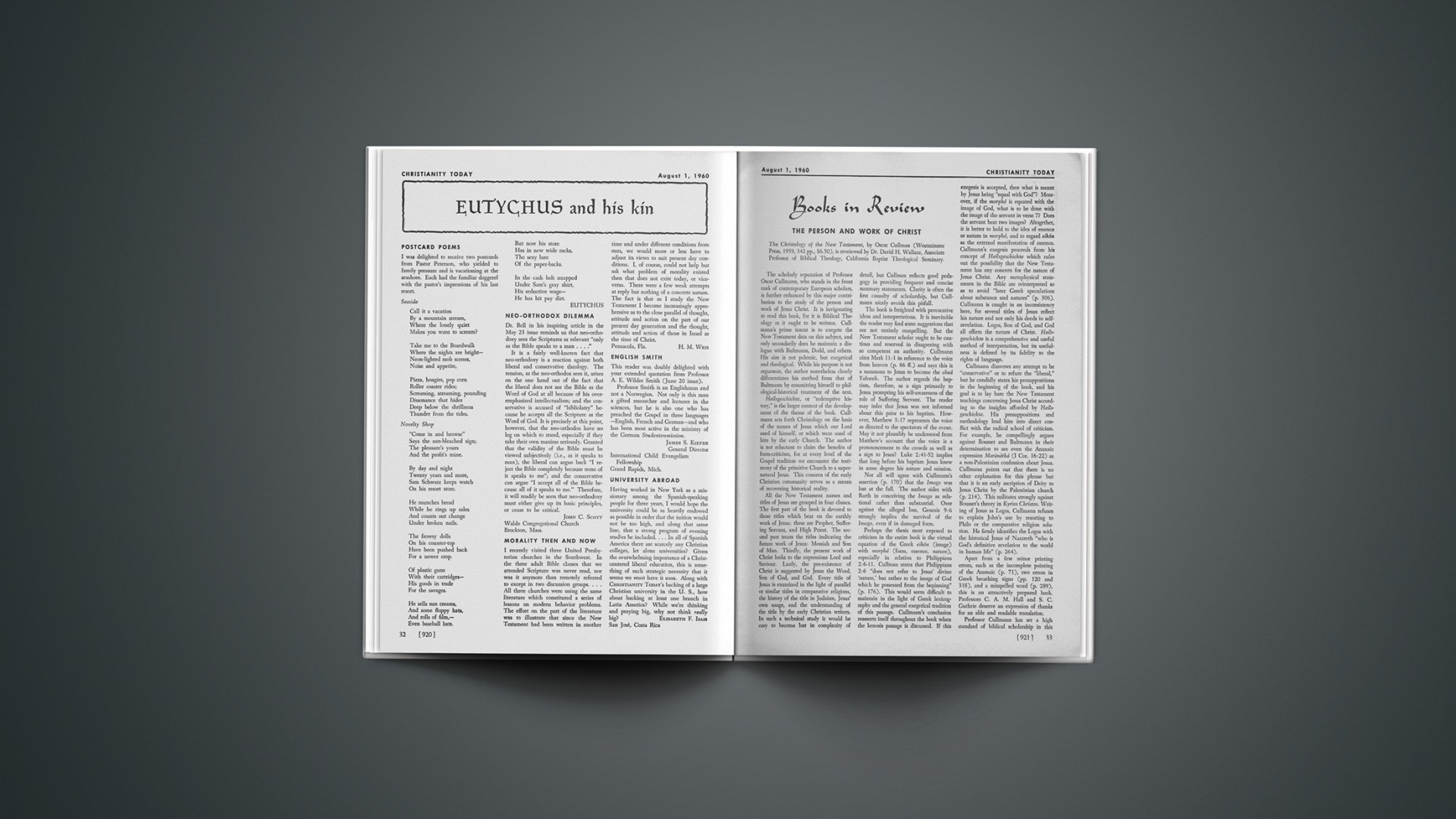
The Christology of the New Testament, by Oscar Cullman (Westminster Press, 1959, 342 pp., $6.50), is reveiewed by Dr. David H. Wallace, Associate Professor of Biblical Theology, California Baptist Theological Seminary.

The scholarly reputation of Professor Oscar Cullmann, who stands in the front rank of contemporary European scholars, is further enhanced by this major contribution to the study of the person and work of Jesus Christ. It is invigorating to read this book, for it is Biblical Theology as it ought to be written. Cullmann’s prime intent is to exegete the New Testament data on this subject, and only secondarily does he maintain a dialogue with Bultmann, Dodd, and others. His aim is not polemic, but exegetical and theological. While his purpose is not argument, the author nonetheless clearly differentiates his method from that of Bultmann by committing himself to philological-historical treatment of the text.

Heilsgeschichte, or “redemptive history,” is the larger context of the development of the theme of the book. Cullmann sets forth Christology on the basis of the names of Jesus which our Lord used of himself, or which were used of him by the early Church. The author is not reluctant to claim the benefits of form-criticism, for at every level of the Gospel tradition we encounter the testimony of the primitive Church to a supernatural Jesus. This concern of the early Christian community serves as a means of recovering historical reality.

All the New Testament names and titles of Jesus are grouped in four classes. The first part of the book is devoted to those titles which bear on the earthly work of Jesus: these are Prophet, Suffering Servant, and High Priest. The second part treats the titles indicating the future work of Jesus: Messiah and Son of Man. Thirdly, the present work of Christ looks to the expressions Lord and Saviour. Lastly, the pre-existence of Christ is suggested by Jesus the Word, Son of God, and God. Every title of Jesus is examined in the light of parallel or similar titles in comparative religions, the history of the title in Judaism, Jesus’ own usage, and the understanding of the title by the early Christian writers. In such a technical study it would be easy to become lost in complexity of detail, but Cullman reflects good pedagogy in providing frequent and concise summary statements. Clarity is often the first casualty of scholarship, but Cullmann nicely avoids this pitfall.

The book is freighted with provocative ideas and interpretations. It is inevitable the reader may find some suggestions that are not entirely compelling. But the New Testament scholar ought to be cautious and reserved in disagreeing with so competent an authority. Cullmann cites Mark 11:1 in reference to the voice from heaven (p. 66 ff.) and says this is a summons to Jesus to become the ebed Yahweh. The author regards the baptism, therefore, as a sign primarily to Jesus prompting his self-awareness of the role of Suffering Servant. The reader may infer that Jesus was not informed about this prior to his baptism. However, Matthew 3:17 represents the voice as directed to the spectators of the event. May it not plausibly be understood from Matthew’s account that the voice is a pronouncement to the crowds as well as a sign to Jesus? Luke 2:41–52 implies that long before his baptism Jesus knew in some degree his nature and mission.

Not all will agree with Cullmann’s assertion (p. 170) that the Imago was lost at the fall. The author sides with Barth in conceiving the Imago as relational rather than substantial. Over against the alleged loss, Genesis 9:6 strongly implies the survival of the Imago, even if in damaged form.

Perhaps the thesis most exposed to criticism in the entire book is the virtual equation of the Greek eikón (image) with morphé (form, essence, nature), especially in relation to Philippians 2:6–11. Cullman states that Philippians 2:6 “does not refer to Jesus’ divine ‘nature,’ but rather to the image of God which he possessed from the beginning” (p. 176). This would seem difficult to maintain in the light of Greek lexicography and the general exegetical tradition of this passage. Cullmann’s conclusion reasserts itself throughout the book when the kenosis passage is discussed. If this exegesis is accepted, then what is meant by Jesus being “equal with God”? Moreover, if the morphé is equated with the image of God, what is to be done with the image of the servant in verse 7? Does the servant bear two images? Altogether, it is better to hold to the idea of essence or nature in morphé, and to regard eikón as the external manifestation of essence. Cullmann’s exegesis proceeds from his concept of Heilsgeschichte which rules out the possibility that the New Testament has any concern for the nature of Jesus Christ. Any metaphysical statements in the Bible are reinterpreted so as to avoid “later Greek speculations about substance and natures” (p. 306). Cullmann is caught in an inconsistency here, for several titles of Jesus reflect his nature and not only his deeds in self-revelation. Logos, Son of God, and God all affirm the nature of Christ. Heilsgeschichte is a comprehensive and useful method of interpretation, but its usefulness is defined by its fidelity to the rights of language.

Cullmann disavows any attempt to be “conservative” or to refute the ‘liberal,” but he candidly states his presuppositions in the beginning of the book, and his goal is to lay bare the New Testament teachings concerning Jesus Christ according to the insights afforded by Heilsgeschichte. His presuppositions and methodology lead him into direct conflict with the radical school of criticism. For example, he compellingly argues against Bousset and Bultmann in their determination to see even the Aramaic expression Marànàthá (1 Cor. 16:22) as a non-Palestinian confession about Jesus. Cullmann points out that there is no other explanation for this phrase but that it is an early ascription of Deity to Jesus Christ by the Palestinian church (p. 214). This militates strongly against Bousset’s theory in Kyrios Christos. Writing of Jesus as Logos, Cullmann refuses to explain John’s use by resorting to Philo or the comparative religion solution. He firmly identifies the Logos with the historical Jesus of Nazareth “who is God’s definitive revelation to the world in human life” (p. 264).

Apart from a few minor printing errors, such as the incomplete pointing of the Aramaic (p. 71), two errors in Greek breathing signs (pp. 120 and 318), and a misspelled word (p. 289), this is an attractively prepared book. Professors C. A. M. Hall and S. C. Guthrie deserve an expression of thanks for an able and readable translation.

Professor Cullmann has set a high standard of biblical scholarship in this book, and all students of sacred Scripture are in his debt. His ability as a scholar is combined with a sure sense of reverence for the text. Repeatedly he evinces his capacity as an analytical theologian of the Bible and early Church history. That he does not stand detached from the object of his study is persuasively demonstrated in these words: “Only when we ourselves become ‘sons’ by accepting in faith Jesus Christ’s witness to his sonship, and by doing his divine will, can we know that Jesus is the Son. Only in this way can we ever be able to testify with the apostles that the Father has sent his Son as the Saviour of the world (1 John 4:14)” (p. 303).

DAVID H. WALLACE

Niebuhrean Apologetic

The Thought of Reinhold Niebuhr, by Gordon Harland (Oxford, 1960, 298 pp., $6.00), is reviewed by Edward John Carnell, Professor of Ethics and Philosophy of Religion, Fuller Theological Seminary.

Edgar Sheffield Brightman once observed that Niebuhr is majestically indifferent to his critics. I should say that as long as Niebuhr is flanked by dedicated disciples, such as the author of this book, he can well afford to be indifferent. The author has drawn a head on most of Niebuhr’s major critics. He has charged them with lifting a teaching out of its context, or with neglecting some counterbalancing element in the vast Niebuhrean literature.

Despite the Niebuhr-can-do-no-wrong approach, this is a pleasing book. It sets forth the manner in which Niebuhr defends Christian love as a limiting ideal which simultaneously inspires and judges all partial attainments of justice in history. Another strong point is its artistry in showing how some of Niebuhr’s thoughts have been enriched or discarded in time’s passing parade.

The sparkle of concise writing is lost, however, by the author’s habit of quoting long passages from Niebuhr, only to turn around and summarize what Niebuhr has already said so effectively. Moreover, the reader looks in vain for any serious attempt to evaluate Niebuhr’s thoughts by the precise claims of Scripture. The author is content to judge Niebuhr from an existential, rather than an exegetical, viewpoint.

All in all, this is a worthy book, for it helps us appreciate how one of the great thinkers of our day has applied the Christian faith to prevailing social, political, and economic issues. Niebuhr may not say the last word on a subject, but what he does say is authentic, germane, and arresting.

EDWARD JOHN CARNELL

Christian Culture

The Historic Reality of Christian Culture, by Christopher Dawson (Harper, 1960, 124 pp., $3), is reviewed by C. Gregg Singer, Professor of History at Catawba College.

Christopher Dawson, distinguished guest professor of Roman Catholic Theological Studies at Harvard University, and eminent Catholic spokesman, has set forth in a compelling manner the Thomistic concept of the relationship that should exist between Christianity and culture at all times. He freely and rightly admits that the great secularization of culture which took place during the nineteenth century is the great scandal of modern Christendom. Dr. Dawson fully recognizes that our contemporary civilization is not only not Christian but actually the product of 200 years of progressive secularization, during which the distinctively Christian institutions and social standards have been gradually eliminated. Although he is able to find in both Europe and America certain vestiges and marks of culture that was at one time distinctly Christian, he believes that we are now living in what is essentially a post-Christian world, and that our present vague attachment to Christian moral ideals is temporary. He feels that unless there is a definite restoration of a Christian culture, modern civilization will become more positively and aggressively secular in its character and will show a great hostility to the Gospel.

The only hope for the West in its present dilemma is found in the historic reality of Christian culture, and in this concept lies the way to a renewal of human life. Dawson clearly rejects the idea of a return to the old alliance of Church and State to restore this Christian culture, and declares that it is the very nature of Christianity to be a world-transforming movement. Although Christianity for Dawson is to be interpreted in terms of the encyclicals of Pius X and Leo XII, he nevertheless accords to Calvinism a greater role in our cultural heritage than is customary for Roman Catholic apologists.

There is a great deal of value in this book for the evangelical reader, and the reviewer is impressed with the fact that Professor Dawson comes much closer to a true delineation of the cultural issue confronting us today than do contemporary liberal attempts in this direction. It is unfortunate that the author seems to imply that the Reformation, as well as the Renaissance, was the cause of the secularization of Western civilization, but it is not a major point in his thesis and should not blind the reader to the many merits of the book.

C. GREGG SINGER

The Small College

The Small College Meets the Challenge, by Alfred T. Hill (McGraw-Hill, 1959, 215 pp„ $4.95), is reviewed by James Forrester, President-elect, Gordon College.

The past decade has been famous for predictions of the doom of the small colleges in America. But the vitality and the missionary zeal of small college leadership were not appraised by the pessimists as factors of such relevance as Dr. Alfred T. Hill, executive secretary of the Council for the Advancement of Small Colleges, has proved them to be.

The Small College Meets the Challenge is the story of the Council since its organization in Chicago, April, 1956. It is more than mere history, however; it is a document breathing the vital air of creativity and courageous initiative at a strategic point for American culture. The book is dedicated to Dr. Wilson Compton whose counsel has been widely sought in college program improvement. His encouragement has enabled these “forgotten colleges” to “increase their visibility.”

The potentialities of small colleges are now important to the higher educational future of America. Individual colleges have had difficulties attracting support, but as a group they have been highly successful.

The importance of smallness is apparent. The real pioneering has been done where there has been no need “to buck an idea through the departmental organization” (p. 26). The potential of the small college has already been demonstrated through the response from those sources of help which have heard the Council’s messages. As a group the small colleges can meet the challenge of “diversity and independence” in American education.

The Council has used the workshop technique in arriving at an answer to the question “What should the small liberal arts college be?” Criteria for self-evaluation emerged from these discussions to which all church-related college administrators could profitably give attention. Each school must have a special character and affirm it in the “jungle of pressures” (p. 42) if it is to merit support and survival. The Council’s workshops have led to the achievement of mutual insights and common effort which might not have been possible out of such diversity as is represented in their membership.

The philosophy of the Council is embodied in the author’s words: “When you consider the controls of bureaucracy manifested in state and Federal government and the red tape of big business today, the trend toward conformity is so impressive that you wonder if there is any place left for ‘rugged individualism.’ … One place to look is in the small colleges. There are challenging opportunities for trustees and presidents in these institutions which are not hindered by tradition but are free to experiment boldly with both the content and form of the academic program.”

The CASC has been practical in its approach and has obviously motivated corporation and foundation executives to rally to the cause. Methods provide factual information rather than appeal based on self-pity. The appendix of the volume is an up-to-date revision of The Directory of Small Colleges which appeared in 1958.

The function of CASC is clearly spelled out in the book. It is to serve the small colleges in research, coordination of effort, public relations, and fund raising. The results, in so short a period, have validated the basic hypothesis of the value of the small American college. The gains can be interpreted in terms of great encouragement for the small evangelical colleges. The spirit and substance of the volume are a strong antidote to the prevailing “other-directedness” of higher education.

JAMES FORRESTER

Christian Science

Christian Science Today, by Charles S. Braden (Southern Methodist University Press, 1958, 432 pp., $5.95), is reviewed by Harold Lindsell, Dean of the Faculty and Professor of Missions at Fuller Theological Seminary.

Braden, in retirement after having served as a missionary and later as professor at Northwestern University, has authored this latest volume on Christian Science. The effort is a noble one. Much research has gone into it and the resultant product is one of which he can be proud. By way of background for the uninitiated, he has two valuable introductory chapters on Mary Baker Eddy and the organization of the Church of Christ, Scientist, up to the time of the founder’s death.

The bulk of the book deals with the internal and external struggles of the cult since Eddy’s decease. Braden carefully delineates the internal battle waged when conflicting factions sought to control the organization. The numerous law suits are recounted. For an organization that denies the reality of matter, the legal warfare of the cult fully bears out the paradox of its unsound philosophical presuppositions. The acounts of schismatic, heretical, and nonconformist Christian Scientists are fascinating. The ultimate emergence of a monolithic, totalitarian structure and its rigid and unyielding use against dissidents is documented carefully. The control of thought, publication, teaching, and personal conduct over the individual staggers the imagination.

On page 10 Braden says, “Any group which makes the Bible the basis of its faith and makes Christ so central as Christian Scientists do can hardly be refused the name Christian.” This value judgment certainly does not represent the consensus of the Christian Church today as witnessed by the fact that Scientists are excluded from every evangelical organization as being non-Christian.

This book is a first class piece of work and worthy of study.

HAROLD LINDSELL

Import Of Betrothal

Engagement and Marriage, by the Family Life Committee of the Lutheran Church—Missouri Synod (Concordia, 1959, 207 pp., $3), is reviewed by E. P. Schulze, Minister of the Lutheran Church of Our Redeemer, Peekskill, New York.

Studying betrothal in its relation to marriage, the authors trace the history and implications of engagement from the ancient Hebrews down to the present time. They deny the older Missouri Synod view that Christian engagement is substantially the same as Hebrew betrothal, that consent constitutes the essence of marriage and that engagement is tantamount to marriage in binding force. They make concessions to current mores in seeming to agree that engagement nowadays means that a couple is “partly but not completely committed,” and in stating that ordinarily young people should not be disciplined ecclesiastically for breaking engagements.

Luther insisted that engagement, to be valid, must have the consent of the parents of the parties, and most Lutherans are, no doubt, in staunch agreement with his opinion. “Lutherans hold that marriage must be entered into by mutual promise of contracting parties, given with the full knowledge and consent of the contracting parties’ parents. Neither children nor parents may make exception to this rule, which is based upon biblical example and ethical teaching” (Lutheran Cyclopedia, 1954, p. 655). If young people nowadays would follow that wholesome principle with consecrated hearts and full awareness of all that is implied, the likelihood of broken engagements would hardly exist, and many a young person would bless his pastor for pointing this out.

E. P. SCHULZE

Biblical Criticism

A Light to the Nations: An Introduction to the Old Testament, by Norman K. Gottwald (Harper, 1959, 615 pp., $6.50), is reviewed by Clyde T. Francisco, Professor of Old Testament Interpretation, Southern Baptist Theological Seminary.

There is an old saying, “What you are speaks so loud that I cannot hear what you say.” This book will have the opposite effect upon many evangelicals. What the author says will so antagonize them that they will not appreciate the positive values that belong to the work. The author makes it quite clear at the beginning that those in the group to which he belongs “not only reject the premises and conclusions of verbal inspiration,” but also seek the overthrow of a theory about the Bible that is historically untenable and religiously deceptive” (pp. 7–8). These are fighting words.

People who cultivate the attitude of reverence toward the Bible, not because it is a god but because here God speaks to man, are strongly offended when reading Professor Gottwald’s descriptions of biblical passages. He remarks concerning the account of Genesis 6:1 ff. that there are “no other equally blatant Hebrew examples of myth” (p. 26). He accuses the Deuteronomist of being guilty of a “blatant overstatement” (p. 159). The tower of Babel account is branded as “hopelessly childish” (p. 229), and the principal claim of the book of Joshua a “jaundiced view” (p. 252). His use of the term “renege” (familiar to card players), is strangely anachronistic when describing the career of Abraham (p. 253). The Chronicler is guilty of “a grievous error in chronology” (p. 432), and the story of Esther is “symmetrically contrived” (p. 515). Holding up for ridicule the biblical description of Moses passing up and down Mount Sinai “with Herculean disregard of the climb” (p. 112), he concludes that in the Pentateuch, “instead of a biography of Moses we have a biography of Israel” (p. 113). Alt’s work is said to do “great service by stressing the fact that Joshua cannot be taken at face value” (p. 155). One of his strongest statements is found on page 151: “The superiority of Israel’s faith was not something patent at the start by which she rejected the Canaanites and obliterated them; her faith was as much something that only became ‘superior’ in the course of conflict with Canaanite religion.” In fact “the Canaanites became Israelites under the kingdom of David” (p. 160). The author’s lack of respect for much of the Old Testament writings is demonstrated in his explanation of the reason for the canonization of Old Testament books, due, he says, to the “national and historical impotence” of the post-exilic Jews and accordingly to their “need for stanch authority” (pp. 30–31).

When one can calm his aroused indignation at the carnage left after this “holy war” upon traditional Christianity, he discovers that Professor Gottwald has written a comprehensive and very helpful work. It is a veritable storehouse of information. The treatment of the history of the text is thorough, and the description of the contemporary world of the Hebrews most enlightening. The inclusion of a glossary and pertinent Ancient Near Eastern texts (including the Enuma Elish and The Gilgamish Epic, as well as others) makes the study an invaluable reference book. Not only is the source material valuable, but in the exposition of particular passages of the Old Testament the author has a profound respect for the revealed truths to which the Scriptures give witness. His lack of respect for many of the Old Testament writings is not reflected in his evaluation of the eternal truths of Israel’s faith. These he proclaims with all the fervor and insight of a true evangelical.

CLYDE T. FRANCISCO

Stories And Paintings

Behold My Glory, by William Purcell (Hawthorne Books, Inc., 1957, 160 pp., $8.95), is reviewed by Thea B. Van Halsema, Author of This Was John Calvin.

As its subtitle indicates, Behold My Glory is a handsome volume combining “great stories from the Bible and the masterpieces they have inspired.” British clergyman-author William Purcell retells the stories, and the 32 full-color illustrations are beautifully reproduced from great paintings. “The emphasis is on the life of Christ and His teaching.”

Mr. Purcell is an able story teller. His language is both striking and reverent. He uses many direct quotations from Scripture, particularly in reproducing conversation. For descriptions of places, people, and customs, he draws freely from his own knowledge and imagination and thus produces an expanded version of biblical incidents. While this creates vivid unforgettable pictures in the mind of the reader, it also obliges him upon occasion to distinguish between the fiction of Purcell and the fact of the Bible. For example, we do not know from the Word that in the Garden of Eden before the fall “the beasts of the field had the power of speech,” or that the plague of water turned to blood resulted from flood water of “red marl brought down from the Abyssinian mountains.”

On the other hand, one appreciates anew, particularly in the Gospel stories, each place, character, and event because of the author’s vivid word sketches. While Mr. Purcell pays attention to biblical verses concerning the Virgin Birth, the significance of Christ’s death, his resurrection and ascension, it is as a gripping portrayal of the human nature of our Lord that Behold My Glory makes its impact.

THEA B. VAN HALSEMA

Book Briefs

Handbook of Church Finance, by David R. Holt, II (Macmillan, 1960, 201 pp., $5)—A practical, spiritually-oriented guide for financial planning in the local church.

Elizabeth I and the Religious Settlement of 1559, by Carl S. Meyer (Concordia, 1960, 182 pp., $4.95)—A graphic account of events and issues surrounding the establishment of the Anglican Church.

Faith is My Fortune, by Richard L. Clark and Jack W. Bates (Pepperdine College Press, 1960, 316 pp., $3.75)—The life story of George Pepperdine, one of America’s leading businessmen who had an overmastering faith in God.

The Hymn and Congregational Singing, by James R. Sydnor (John Knox Press, 1960, 192 pp., $4.50)—A practical and non technical consideration of the factors that make for more effective Christian worship in song.

Strictly Personal, by Eugenia Price (Zondervan, 1960, 180 pp., $2.50)—Opens the door to realistic adventure in the personal discovery of God.

J. G. Hamann: A Study in Christian Existentialism, by Ronald Gregor Smith (Harper, 1960, 270 pp., $5)—An introduction to the thought of a great German liberal theologian, who was highly regarded by Kierkegaard.

How to Get Along with People in the Church, by A. Donald Bell (Zondervan, 1960, 159 pp., $2.50)—A practical manual for pastors and local church leaders by a professor of psychology in a leading theological seminary.

Nature and History, by Bernhard Erling (CWK Gleerup, Lund, 1960, 286 pp., $4)—A study in theological methodology with special attention to motif research.

God’s Son and God’s World, by A. A. Van Ruler (Eerdmans, 1960, 79 pp., $2)—Meditations on the person of Christ and the wide scope of God’s creation by a University of Utrecht professor.
Eutychus and His Kin: August 1, 1960

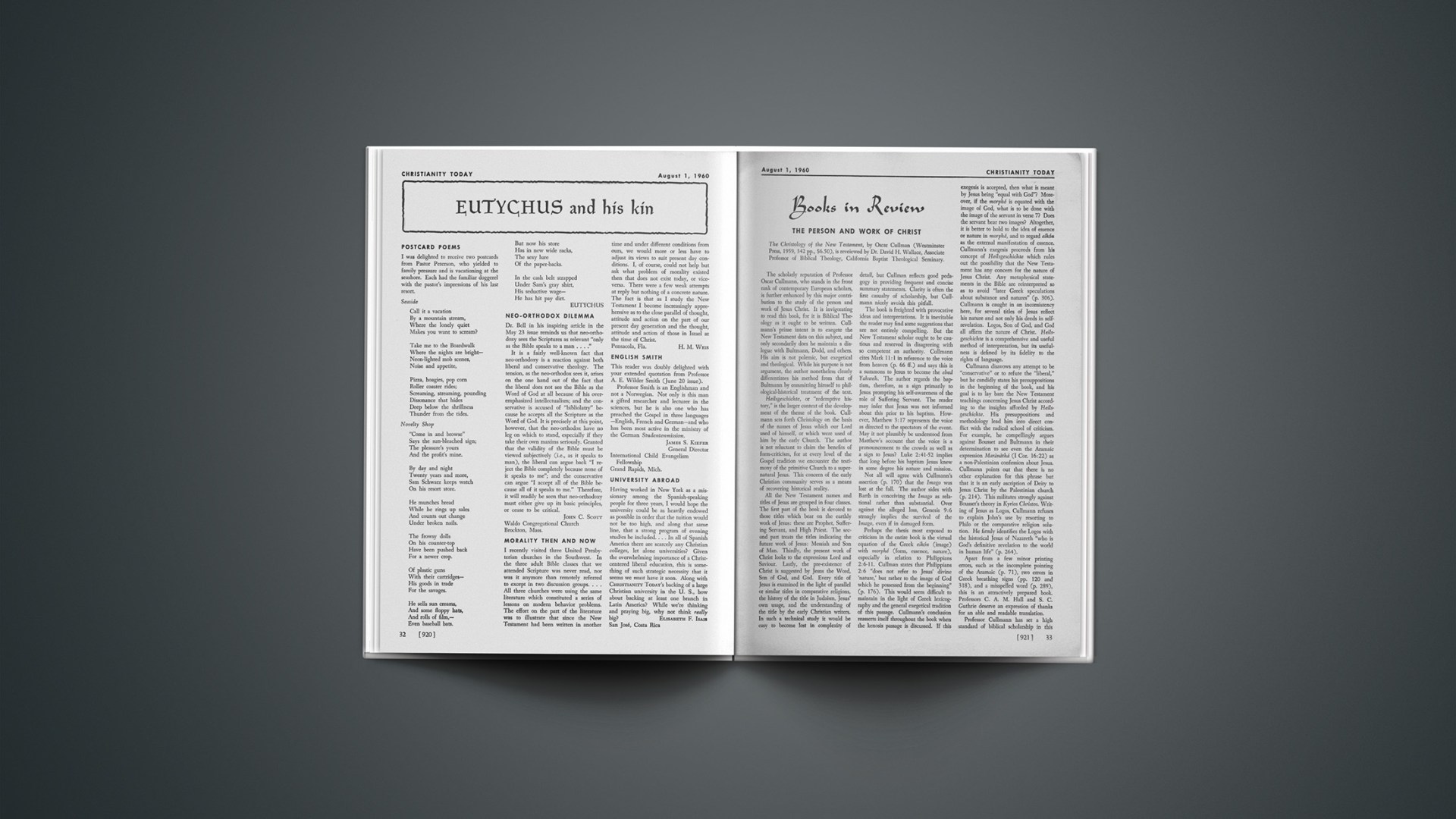
POSTCARD POEMS

I was delighted to receive two postcards from Pastor Peterson, who yielded to family pressure and is vacationing at the seashore. Each had the familiar doggerel with the pastor’s impressions of his last resort.

Seaside

Call it a vacation

By a mountain stream,

Where the lonely quiet

Makes you want to scream?

Take me to the Boardwalk

Where the nights are bright—

Neon-lighted mob scenes,

Noise and appetite,

Pizza, hoagies, pop corn

Roller coaster rides;

Screaming, streaming, pounding

Dissonance that hides

Deep below the shrillness

Thunder from the tides.

Novelty Shop

“Come in and browse”

Says the sun-bleached sign;

The pleasure’s yours

And the profit’s mine.

By day and night

Twenty years and more,

Sam Schwarz keeps watch

On his resort store.

He munches bread

While he rings up sales

And counts out change

Under broken nails.

The frowsy dolls

On his counter-top

Have been pushed back

For a newer crop.

Of plastic guns

With their cartridges—

His goods in trade

For the savages.

He sells sun creams,

And some floppy hats,

And rolls of film,—

Even baseball bats.

But now his store

Has in new wide racks,

The sexy lure

Of the paper-backs.

In the cash belt strapped

Under Sam’s gray shirt,

His seductive wage—

He has hit pay dirt.

EUTYCHUS

NEO-ORTHODOX DILEMMA

Dr. Bell in his inspiring article in the May 23 issue reminds us that neo-orthodoxy sees the Scriptures as relevant “only as the Bible speaks to a man.…”

It is a fairly well-known fact that neo-orthodoxy is a reaction against both liberal and conservative theology. The tension, as the neo-orthodox sees it, arises on the one hand out of the fact that the liberal does not see the Bible as the Word of God at all because of his overemphasized intellectualism; and the conservative is accused of “bibliolatry” because he accepts all the Scripture as the Word of God. It is precisely at this point, however, that the neo-orthodox have no leg on which to stand, especially if they take their own maxims seriously. Granted that the validity of the Bible must be viewed subjectively (i.e., as it speaks to man), the liberal can argue back “I reject the Bible completely because none of it speaks to me”; and the conservative can argue “I accept all of the Bible because all of it speaks to me.” Therefore, it will readily be seen that neo-orthodoxy must either give up its basic principles, or cease to be critical.

JOHN C. SCOTT

Waldo Congregational Church

Brockton, Mass.

MORALITY THEN AND NOW

I recently visited three United Presbyterian churches in the Southwest. In the three adult Bible classes that we attended Scripture was never read, nor was it anymore than remotely referred to except in two discussion groups.… All three churches were using the same literature which constituted a series of lessons on modern behavior problems. The effort on the part of the literature was to illustrate that since the New Testament had been written in another time and under different conditions from ours, we would more or less have to adjust its views to suit present day conditions. I, of course, could not help but ask what problem of morality existed then that does not exist today, or vice-versa. There were a few weak attempts at reply but nothing of a concrete nature. The fact is that as I study the New Testament I become increasingly apprehensive as to the close parallel of thought, attitude and action on the part of our present day generation and the thought, attitude and action of those in Israel at the time of Christ.

H. M. WEIS

Pensacola, Fla.

ENGLISH SMITH

This reader was doubly delighted with your extended quotation from Professor A. E. Wilder Smith (June 20 issue).

Professor Smith is an Englishman and not a Norwegian. Not only is this man a gifted researcher and lecturer in the sciences, but he is also one who has preached the Gospel in three languages—English, French and German—and who has been most active in the ministry of the German Studentenmission.

JAMES S. KIEFER

General Director

International Child Evangelism Fellowship

Grand Rapids, Mich.

UNIVERSITY ABROAD

Having worked in New York as a missionary among the Spanish-speaking people for three years, I would hope the university could be as heavily endowed as possible in order that the tuition would not be too high, and along that same line, that a strong program of evening studies be included.… In all of Spanish America there are scarcely any Christian colleges, let alone universities? Given the overwhelming importance of a Christ-centered liberal education, this is something of such strategic necessity that it seems we must have it soon. Along with CHRISTIANITY TODAY’S backing of a large Christian university in the U. S., how about backing at least one branch in Latin America? While we’re thinking and praying big, why not think really big?

ELISABETH F. ISAIS

San José, Costa Rica

Gigantic Rally Highlights Baptist Congress

The Baptists’ tenth World Congress turned out to be a historic display of strength, all the more remarkable because it occurred in the world’s largest predominantly-Catholic country: Brazil.

Highlight of the eight-day conclave in Rio de Janeiro was a climactic rally with evangelist Billy Graham, who described his audience as the largest he has ever addressed. Most conservative estimate of the crowd at Maracana Stadium was 130,000. Others gave it as nearer (one report said another were turned away). Time says an estimated 50 per cent of the audience was Catholic. The turnout and the overall reception given the Baptists exemplified the current Protestant surge in Latin America.

Graham preached an evangelistic sermon, ending with his customary appeal for decisions. Perhaps as many as 20,000 stood to their feet to indicate faith in Christ. About 12,000 of these had the benefit of a subsequent counselling session.

Brazilian observers had high praise for Graham’s interpreter, the Rev. João Soren, 52, newly-elected president of the Baptist World Alliance, which represents more than 23,000,000 Baptists in 107 countries and which sponsors the quinquennial congress. Soren, a native of Rio, has been pastor of the city’s 2,800-member First Baptist Church since 1935.

Rain and wintry mists plagued early sessions of the congress, which nonetheless drew 12,500 official delegates representing at least 67 countries. The delegate total matched highs reached at previous congresses in Atlanta (1939) and Cleveland (1950).

Theme of the congress, taken from Philippians 2:11, reflected its international flavor: “Every tongue should confess that Jesus Christ is Lord, to the glory of God the Father.”

Even Soviet Russia and its satellites were represented. Delegates honored their Baptist brethren behind the Iron Curtain by electing the Rev. Jakob I. Zhidkov a BWA vice president. Zhidkov of Moscow is president of the All-Union Council of Evangelical Christians (Baptists).

Other vice presidents elected, nine in all: William R. Tolbert, vice president of Liberia; Dr. Joseph H. Jackson, president of the National Baptist Convention, U. S. A., Inc.; Dr. V. Carney Hargroves, pastor of Philadelphia’s First Baptist Church; Lam Chi Fung, president of Hong Kong College; the Rev. Alfonso Olmedo of Buenos Aires; Mrs. Louise Paw of Rangoon; the Rev. Alan C. Prior of Sydney, Australia; and Dr. Henri Vincent of Paris.

Elected general secretary of the BWA was Dr. Josef Nordenhaug, president of the International Baptist Theological Seminary near Zürich, Switzerland. He succeeds the retiring Dr. Arnold T. Ohrn.

Keynoter was W. D. Jackson of London, who reaffirmed Baptist belief in “one Lord, one faith, and one baptism.” “We Baptists accept the Lordship of Christ,” he said. “We say to earthly rulers that they are mortal men who have no power over the immortal souls of their subjects. We respect Martin Luther and the reformers. Yet we wish that they had broken away from the state churches.”

Pronouncements adopted by the delegates called for (1) world-wide acceptance of the principles of religious liberty, (2) an end to the arms race, (3) elimination of racial injustice, (4) feeding the hungry, and (5) strengthening of the United Nations as a means of achieving world peace.

Delegates also approved a proposal sponsored by Sunday School leaders of the Southern Baptist Convention that an international Baptist convention for Bible study and membership training be held in 1965.

Here are reports from other religious meetings of the late spring and early summer:

At Cleveland—Because Cleveland is populationwise one of the nation’s most heterogeneous cities, its Sheraton-Cleveland Hotel seemed to provide an appropriate setting for a significant development in the attempted merger of the Congregational Christian Churches and the Evangelical and Reformed Church as the “United Church of Christ.” If this merger seemed to lack the finality (and fluidity) of nearby Cuyahoga’s union with Lake Erie, one was reminded that a fusion of “two diverse forms of church organization and government” was a task which had “never before been attempted in American Protestant circles.”

The latest chapter of a rather fascinating 19-year-old story was written July 7 during the three-day Adjourned Meeting of the Second General Synod of the UCC. In a climactic mid-afternoon action, delegates voted unanimously to accept a constitution. When searching eyes saw no dissenter rise, the assemblage stood to applaud, sang the Doxology, and were led in a prayer of thanksgiving.

Jubilation was heightened by the fact that only a year ago in Oberlin delegates had sharply divided over parts of the constitution presented then, thus necessitating this adjourned meeting. In the meantime, a 30-member commission sent the proposed draft to the 5,506 Congregational Christian and the 2,742 Evangelical and Reformed churches, then considered more than 500 resulting communications while preparing the revised draft which was passed by this session.

While still following lines laid down by the Basis of Union—agreed upon in 1957 by the E&R Church and the General Council of the Congregational Christian Churches—the revised draft met with far less opposition than its predecessor. Delegates proved ready to listen to proposed amendments and just as ready to vote them down. Less than nine hours of deliberation saw 22 rejected while 12 minor changes were accepted.

General Synod rights of representation are divided equally between CC and E & R churches until such time as the merger may be consummated. Since CC outnumber E&R members 1,419,171 to 810,007, theirs is expected to be the preponderate influence, depending on whether they vote to enter the union in sufficient numbers. However, enough Congregationalist delegates showed up in Cleveland to outnumber their E & R counterparts 436 to 261.

An E & R delegate rose to voice a sentiment he said was shared by others: “I feel we’ve adopted a Congregational polity.” That many Congregationalists feel their polity has been sacrificed in the interests of merger only highlights the elusiveness of an Hegelian masterpiece—synthesis of Congregational and Presbyterian polities.

In a stormy session in Oberlin last year, Congregationalists were in full cry after certain portions of the constitution. Commission Chairman Dr. Gerhard W. Grauer remarked in Cleveland that the chief areas of revision in this year’s document were in underscoring the autonomy of the local church and altering the board and agency structure of UCC. The question of how responsive the boards should be to General Synod desires aroused debate which was resolved when church leaders presented a united front. But some Congregationalists voiced uneasiness with their missionary showing, pointing to a “national standing of 51st in per capita giving for foreign missions” in relation to their purported standing as first in per capita wealth of their membership.

The constitution asserts the “autonomy of the local church” to be “inherent” and denies to General Synod, conference, and association the right to abridge this autonomy “at any future time.” There was opposition to this sort of “legislating for future generations,” but one delegate expressed unconcern either way inasmuch as the constitution may be amended.

A move to allow the church president to be designated “presiding bishop” was drowned in laughter.

The local church retains the right to “formulate its own covenants and confessions of faith,” not being bound to accept the statement of faith approved by General Synod in Oberlin last year. When the attempt was made to assure compatibility of local church confessions with Trinitarian statements elsewhere in the constitution, one delegate warned his fellows: “If you want a merger, then lay off this paragraph.” Some were opposed to the constitution’s owning the faith “expressed in the early creeds,” while others were wary of leaving the churches free to adopt Unitarian confessions. Delegates voted against restricting local autonomy at this point.

An attempt to amend the constitution on baptism to make room for Quakers who believe only in spiritual baptism received little support.

The synod approved United Church by-laws, with minor editorial changes, for submission to next year’s synod. Opposition was roused by stipulation that ministerial students are expected to graduate from seminaries approved by the Council for Church and Ministry. A commission member in an aside said he believed this stricture referred to academic standards rather than the theological complexion of a given seminary, though a “very fundamentalist school could be ruled out.” Yale Divinity School’s Dean Liston Pope compared the “close control” by association over students as outlined in by-laws to the Anglican system, but was assured that the bylaws are in any case not “mandatory,” though “normative.”

Before the constitution may be declared in effect by the Third General Synod meeting July, 1961, in Philadelphia, it must be approved by two-thirds of the E & R synods—where no difficulty is expected—and two-thirds of the CC Churches which take part in the voting. This latter balloting holds the key to the future of the United Church of Christ. It is reported that thousands of CC ministers and laymen, led by United Church Co-President Fred Hoskins, will “hit the road” to urge approval of the constitution. Dr. Hoskins expects no abatement in the opposition of three organizations which are actively resisting merger. He identified them as: the Continuation Committee of Congregational Christian Churches, with headquarters in Chicago; the League to Uphold Congregational Principles, Hartford, Connnecticut; and the National Association of Congregational Christian Churches, Milwaukee, Wisconsin.

Dr. James Wagner, the other UCC co-president, seemed unable to impute worthy motives to opponents of the merger, the achievement of which he felt had originally required only some intelligence and Christian grace. “Rather … we have had always to labor under a shadow which was not a healing shadow, a shadow of dissent, of doctrinaire opposition, of litigation and the threat of litigation … under the constant haunting of this ill-dispositioned spectre of the litigious spirit.”

Wagner reported 11 instances where local churches of the two merging denominations have already united.

Hoskins pointed out that while the E & R church is technically in the UCC by virtue of its more centralized polity, CC churches must vote their way in. Until the constitution is approved, UCC agencies are technically not functioning.

Soaking Songfest

“Singing on the Mountain” is a great tradition in western North Carolina. Hundreds of families annually set aside an early summer Sunday for a trek to Grandfather Mountain, where in song and sermon they echo the Gospel message across the laurel-crowned Blue Ridge heights.

This year the dawn-to-dusk songfest was marred by continuous rain, so that an estimated 15,000 men, women, and children were obliged to stand under dripping trees. Some 2,000 families had arrived the day before and had pitched tents in an adjoining meadow.

“Singing on the Mountain” began as a Bible class outing 36 years ago. The 1960 edition proved that Appalachian country people are more loyal than ever to the tradition founder, 89-year-old Joe Lee Hartley, who owns Grandfather Mountain.

Just before going home, delegates heard a hopeful report on a federal lawsuit challenging the merger’s property rights in the church boards. No further developments are expected until October, and it was hoped churches would not on this account delay approval of the constitution.

Many look hopefully upon this merger as but one step in the organizational unification of Protestantism. This thought tempered some of the floor debate. Delegates left unchanged a constitutional provision granting General Synod power to “encourage conversations with other communions and when appropriate to authorize and guide negotiations with them looking toward formal union.” They defeated an amendment requiring concurrence of two-thirds of all UCC local churches for any future denominational merger. They also overrode a plea of the E & R’s Magyar Synod representatives for continued identity in the new church as violation of UCC’s geographical principle of organization.

It was reported that both the Christian Churches (Disciples of Christ) and the Council of Community Churches have gone on record in their national deliberative sessions favoring union with the United Church. Said Chairman Grauer: “Today marks another step on the road toward the reunion of the Body of Christ.” But apart from other doubts, many were waiting to see the reaction of local Congregational churches to the new constitution.

At Virginia, Minnesota—Delegates to the 70th annual convention of the Finnish Evangelical Lutheran Church (Suomi Synod), which is negotiating a merger with three other Lutheran bodies, voted preliminary approval of constitutions to be employed in the projected new church. A referendum scheduled for next February will determine whether the 36,000-member synod definitely goes through with the merger.

At Long Beach, California—“Bible-believing Christians” are urged to dissociate themselves from the National Council of Churches in a resolution adopted by the 29th annual conference of the 126,000-member General Association of Regular Baptists. The resolution charged that Communists or Communist-front authors wrote at least 34 books of 260 which appear on a recommended reading list issued by the NCC’s Department of Racial and Cultural Relations. Nine are attributed to Communist poet Langston Hughes.

Another resolution, which calls upon the Defense Department to consider a reissue of a controversial Air Force manual, said critics of the text are falsely describing it as a slanderous attack on faithful churches and clergy in general.

Dr. Paul Jackson was named to succeed Dr. R. T. Ketcham as National Representative of the GARB.

At Champaign, Illinois—Plans were unveiled for the relocation of Bethany Biblical Seminary at the 174th annual conference of the Church of the Brethren. The 200,000-member denomination’s only graduate theological school, now located in Chicago, will be moved to a 60-acre site at suburban Lombard, Illinois.

At Cape May, New Jersey—Discussions of economic problems and needs of senior citizens highlighted the biennial meeting of the Religious Society of Friends (General Conference). A number of economists addressed the meeting in connection with round-table discussions.

At Mankato, Minnesota—Strained relations in the Lutheran Synodical Conference of North America was the chief concern of delegates to the annual convention of the Evangelical Lutheran Synod. A special convention in November is to determine whether the synod remains a member of the conference. Many of its ministers are critical of alleged “un-scriptural” practices by the Lutheran Church-Missouri Synod, which also belongs to the conference.

Elmer Gantry

It was cool and comfortable in the theater, and I was short of sleep. The leading character of the movie, posing as a priest, seemed to be deceiving a nun in the dark before the high altar of his church. Two reels later he was framed by a prostitute-with-photographer, and as the picture ended he threw off his robe with the announcement that he was putting away childish things.

A second feature came on, and now the hero was a Communist agitator, the son of a rabbi. He used knockout drops to lead astray his lady commissar boss, and two reels later was framed by a prostitute into giving away atomic secrets. At film’s end he renounced the teachings of Marx-Lenin, saying he had put away childish things.

By this time I knew I was dreaming; after all, Hollywood knows how to avoid sacrilege! So I awoke and found on the screen, thanks to United Artists, a Protestant evangelist betraying a deacon’s daughter and turning her into a prostitute. A couple of reels later she framed him (there is more brothel than church footage in this picture). The camera pans back to the tabernacle to survey the unordained Rev. Mr. Gantry (Burt Lancaster) serially seducing the evangelist-healer (Jean Simmons) and her choir director (Patti Page) with the techniques he learned as a traveling salesman.

Hollywood is quite indignant about this “mockery of Christian beliefs” and unlike author Sinclair Lewis (who wrote the book in 1927) decides such villainy requires judgment. Scripter Richard Brooks (or is it God?) thereby arranges a cigarette butt to burn down the tabernacle and consume the hypocritical tootlers of “Onward Christian Soldiers.” Caught in the blaze with all her cheesecloth is Sister Falconer (Miss Simmons) who receives her divine revelation from shooting stars, and who preaches by rolling her eyeballs, causing children to see the “virgin mother” on the roof.

Virtue, represented by a doddering parson and a doubting-drinking newshawk who dictates his copy at 164 words a minute, triumphs. As for Gantry, he decides that the Bible is the real instigator of all the muck and char, and puts it away with other “childish things.”

Only twice does Mr. Lancaster seem natural: once when brawling with hoboes in a boxcar, again when smashing a small man and pitching him unconscious downstairs. For the rest, he not only acts a phony part, he looks phony acting it. It is not all his fault. While his sermons are delivered with incredible sloppiness, they are scripted by someone who apparently never got inside the flap either of a revival tent or a New Testament.

Technically, much is lacking: the sound track fails to synchronize, dramatic scenes are contrived and unnatural, details are handled with consummate ignorance. More serious, the film is a patent attack on the whole Church of Jesus Christ. As celluloid it is even more unbelievable than the book it distorts, except to those who live where truth is in chains. Moscow will queue up for Elmer, and Ehrenberg’s raves will match the New York critics’.

The Church is not invulnerable. She welcomes social treatment from responsible quarters, and deserves better than a “low blow” purportedly aimed at someone else. Christians are human beings, not dessicated Hollywood corpses who look as if they would sell their souls for gin or orange juice.

S.E.W.

A. H. Ackley

The Rev. Alfred Henry Ackley, a Presbyterian minister who was one of the most noted of contemporary Christian composers, died last month at Whittier, California. He was 73.

Ackley was best known for Gospel songs such as “He Lives,” “Heartaches,” “God’s Tomorrow,” “Song of the Soul Set Free,” and “At the End of the Road.” He had teamed with his late brother, B. D. Ackley, in more than 5,000 compositions.

Once associated with evangelist Billy Sunday, A. H. Ackley had more recently been writing for the Rodeheaver-Hall Mack Company, publishers of church music. He is survived by his wife and two sons.

‘This Is Death’

Mrs. Helen Frazee-Bower, Christian poet, died at Campbellsville, Kentucky, June 25.

A prolific writer for many years, Mrs. Frazee-Bower more recently devoted herself to penning words for hymns and Gospel songs. She developed 38 such selections in the last two years of her life, nine of which have already been set to music by her composer husband, William M. Bower, formerly of the Los Angeles symphony and philharmonic orchestras.

Several of Mrs. Frazee-Bower’s poems have already appeared in CHRISTIANITY TODAY. The following, hitherto unpublished, was one of her last:

THIS IS DEATH

This is not death, but triumph and reward:

To walk by faith through all life’s little day

And then, at eventide, to meet the Lord

And hand in hand with Him to go away.

This is not death—this is abundant life,

Eternal life, the freeing of the soul

For bliss beyond earth’s time of toil and strife.

This is not death, but the immortal goal.

But this is death: In trespasses and sin

All through life’s journey carelessly to roam;

To find the Door—and never enter in;

To see the Truth—and never take it home.

Unmindful of the Christ, to draw each breath

As though this world were final. This is death.

People: Words And Events

Deaths:Dr. Thomas J. McCrossan, 95, retired Presbyterian minister; in Los Angeles … Dr. Benjamin L. Olmstead, editor of Free Methodist Sunday School literature; in Chicago.

Retirement: From the presidency of Messiah College, Dr. C. N. Hostetter, Jr.

Elections: As bishops of The Methodist Church (North Central Jurisdiction), Dr. T. Otto Nall, editor of the Christian Advocate; Dr. Ralph T. Alton, pastor of the First Methodist Church in Appleton, Wisconsin; and Dr. Edwin R. Garrison, church headquarters administrator in Indiana … as president of the Lutheran Laymen’s League, Harry G. Barr … as moderator of the Church of the Brethren, Dr. Charles E. Zunkel … as moderator of the Reformed Presbyterian Church in North America, Dr. Richard W. Gray.

Appointments: As acting administrative officer at Northern Baptist Theological Seminary, Dr. Benjamin P. Browne … as executive secretary of the United Presbyterian Department of Chaplains and Service Personnel, Navy Chaplain (Captain) Harry C. Wood … as president of Taejon (Korea) College, the Rev. John E. Talmage, succeeding Dr. William Linton, founder and first president of the Southern Presbyterian mission school, who now retires from the mission field after 48 years of Korean service … as United Presbyterian commission representative in Korea, Dr. Samuel Hugh Moffett … as head of the department of Christian education at Manhattan Bible College, Dr. Charles R. Gresham; as professor of humanities and missions, Dr. James G. Van Buren.

Awards: To the four chaplains of the sunken U.S.S. Dorchester, known for one of the most heroic acts of World War II (forcing their life jackets upon men without them), specially-designed Congressional Medals of Honor.

Congo: 2,000 Protestant Missionaries Imperiled

Caught in the turmoil of the newly-independent Republic of Congo were some 2,000 Protestant missionaries including 1,200 Americans and 250 Canadians.

At stake was a century or more of Christian missionary effort.

As turbulence in the Congo approached the proportions of a grave international crisis, most missionaries were obliged to evacuate at the advice of diplomatic officials. A few courageously stayed behind, most of them key personnel, to look after the interests of mission boards. Others stood by in bordering countries, hopeful of re-entry once the government had stabilized and tensions had subsided. U.S. military airlift missions gave priority to women and children in effecting evacuations.

Christians around the world fell to their knees in behalf of the missionaries’ safety. Prayers appeared to be answered in the fact that not a single missionary casualty was reported in the first three weeks of independence. Some Americans, however, did tell of being slapped and kicked by mutinous Congolese soldiers.

Arrival of U.N. troops raised hopes of mission boards that order could be restored and missionaries could return to their posts. At times there was confusion over the extent of the strife. Some missionaries were filing back into the country even as others were being evacuated. But as word spread of possible Red intervention, mission executives grew anxious to evacuate personnel as soon as possible.

It appeared that the Congolese had no resentment against missionary work as such. The danger to missionaries lay in the fact that they had been stranded in a chaotic situation where law and order had been abandoned. Their evacuation spelled a severe blow to the productive investment of life, time and money in the Belgian Congo missionary enterprise.

Observers watched developments closely, but few were willing to predict how soon missionary activity could resume. Returning missionaries told of how they had, insofar as possible, assigned responsibilities for spiritual leadership to their nationalist colleagues.

Roman Catholics are said to number some 5,500,000 of the Republic of Congo’s 13,600,000 inhabitants. Soon after independence became effective, Archbishop Gastone Mojaisky-Perrelli, Apostolic Delegate to the Congo and Ruanda Urundi, was received in formal audience by Premier Patrice Lumumba. In a speech welcoming the archbishop, who was accompanied by a group of high-ranking ecclesiastics, Lumumba thanked the Catholic church for its help to the Congolese and voiced appreciation of the assurances of cooperation which, he said, the church has given the new government. This was viewed as a significant development, inasmuch as Lumumba is known to have had serious differences with Catholics.

Fruits Of Christian Missions

The Belgian Congo, now the independent Republic of Congo, has been one of the most productive evangelical mission fields in the world. It is known for its strongly biblical stand and rapid growth. Its protest against ecumenical inroads based on an inclusive theology was demonstrated in a decision two years ago to withdraw from the International Missionary Council rather than to participate in the IMC’s merger with the World Council of Churches.

The Protestant community as a whole numbers nearly 2,000,000, or about 15 per cent of the population, according to the Missionary Research Library in New York.

An MRL report gives the following breakdown of approximate adult membership in Protestant groups in what was formerly the Belgian Congo.

Other groups, says the report, include Assemblies of God, Free Methodists, Reformed, Friends, Mennonites, Independent Baptists, Salvation Army, and churches founded by interdenominational and independent missions.

The Republic of Congo’s chief of state, Joseph Kasavubu, is a staunch Roman Catholic, having been educated in parochial schools.

Another top figure in Congo politics, Premier Moise Tshombe, whose province of Katanga seceded from the republic and asked the United Nations for recognition as an independent nation, is a product of Methodist schools.

Retired Methodist Bishop John M. Springer, 86, a pioneer missionary to Katanga for more than 50 years, refused to heed an evacuation plea from the American consulate at Elisabethville, it was reported.

In the worst danger, according to Religious News Service, were missionaries of the Presbyterian Church in the U. S. in Kasai province. The church’s Board of World Missions held a special meeting to meet the emergency. It was decided to recall all missionary families who are due furloughs within a year or who have children of school age. A special contingent was assigned to neighboring countries with the understanding of subsequent re-entry efforts.

Two Southern Presbyterian missionary pilots, Dr. Mark Poole and John Davis, spearheaded the airlift rescue.

Missionaries returning to the United States cited inflammatory political promises by native leaders and Communist agitation as chief reasons for the Congo uprisings.

First missionaries to be evacuated by the U. S. Military Air Transport Service were flown to Washington in a pair of giant C-124 Globemasters. Most of the 133 missionaries and dependents aboard were affiliated with the American Baptist Foreign Mission Society.

Congolese Christians were praised for their loyalty and were credited with protecting the missionaries. Lack of effective leadership in Congolese ranks was blamed for the turmoil which forced missionaries to leave.

“We left the dishes half done,” said Orville R. Chapman of the ABFMS, who with his wife and three children was rescued by helicopter. Chapman said his family, like most others, had to leave behind virtually all personal belongings.

Protestant Panorama

• Construction of a huge new office building for the American Baptist Convention is under way. Groundbreaking ceremonies for the $8,500,000 circular structure, located on a 55-acre site at Valley Forge, Pennsylvania, were held July 5.

• World Vision plans a month-long crusade in Tokyo next May. According to President Bob Pierce, an invitation to hold such an evangelistic series came from 90 per cent of the churches in the world’s largest city (population: 9,312,000) and was signed jointly by moderators of the National Christian Council and the Evangelical Federation.

• Dublin got its first Protestant lord mayor in 60 years last month. 52-year-old Maurice E. Dockrell.

• Dr. James M. Bulman, dismissed from a pastorate in East Spencer, North Carolina, is starting a new Baptist church in the same town. Bulman has repeatedly clashed with Southern Baptist Convention officials over local church autonomy … A judicial commission appointed by the Presbyterian Church of Canada’s General Assembly relieved the Rev. A. Ian Burnett of his responsibilities as minister of St. Andrew’s, largest Presbyterian church in Ottawa. The commission cited failure to fulfill ordination vows. Tensions have arisen within his congregation since Burnett became separated from his wife two years ago.

• Eighty-seven per cent of Episcopal clergymen responding to a survey by Living Church, denominational weekly, say they accept literally the statement in the Apostles’ Creed that Jesus was “born of the Virgin Mary.” Of 539 responses, 39 do not believe in this traditional concept of the Virgin Birth and 30 are undecided. Every Protestant Episcopal candidate for the clergy must indicate, before ordination, that he accepts the creed.

• Ten young Anglicans from England are spending the summer supervising recreational programs for slum children on New York’s lower East Side. They are part of an English-American exchange program in social work.

• Dr. Arthur E. Hanson, district president-elect of The American Lutheran Church, officiated last month at the ordination of the fourth of his sons to enter the Lutheran ministry. The Rev. John Hanson, 25, has accepted a call to become associate pastor of Olivet Lutheran Church in Fargo, North Dakota.

• A Pentecostal congregation in Reykjavik, Iceland, is erecting a new church to accommodate 1,000 worshippers. The building will be one of the largest in Iceland.

• Five rifle shots were fired into the home of the Rev. C. B. Studstill, pastor of the First Methodist Church in Darien, Georgia, last month. Studstill has been preaching against gambling in his country and had received anonymous threats.

• The General Conference Mennonite Church is extending invitations for greater fraternity among Mennonite bodies. The invitations came out of a special study conference held in Donnellson, Iowa, last month in connection with the church’s 100th anniversary.

• The Virginia Methodist Conference plans to build a $3,000,000 home for the aged in Alexandria.

• The Oral Roberts Evangelistic Association is asking Federal Communications Commission approval for a 65,000-watt FM broadcasting station in Tulsa, Oklahoma.

• Old Bergen Reformed Church of Jersey City, New Jersey, is marking its 300th anniversary. The church, founded by Dutch settlers, has had only 10 pastors in its history.

• A pilgrimage to Aylmer, Quebec, highlighted Christian Endeavor’s Citizenship Convocation in Ottawa last month. Delegates visited the birthplace of the founder of Christian Endeavor, Dr. Francis E. Clark … A team of teen-agers from the Moline, Illinois, area won Youth for Christ’s annual Bible quiz competition. Finals were held in conjunction with the group’s 16th annual convention in Winona Lake, Indiana, last month.

Exit Eden

Promoters of California’s proposed Bible Storyland amusement park say they will yield to Protestant objections in abandoning plans for such “rides” as “Garden of Eden,” “Ride to Heaven,” and “Dante’s Inferno.”

Curbing Obscenity

A bill designed to strengthen the Postmaster General’s fight against the mailing of obscene materials was signed into law by President Eisenhower last month. The new law enables the post office to secure a court order to impound the mail of a suspected smut peddler, pending the outcome of legal proceedings against him.

Reactivating Religion

The University of Southern California is reactivating its Graduate School of Religion.

Named to head the seminary was Dr. John Geddes MacGregor, professor of philosophy and religion at Bryn Mawr (Pennsylvania) College, and a member of the Church of Scotland (Presbyterian).

Southern California’s initial School of Religion was founded by Methodists, who subsequently moved it to a campus of its own at Claremont, California.

Phillips Old Testament

J. B. Phillips, Anglican vicar responsible for the highly-popular New Testament in Modern English, is working on a new translation of Amos, Micah, Hosea and Isaiah 1–39.

“Whether this will be successful or not,” says Phillips, “it is too early to judge.” He estimates that it will be another two years before a translation of the four prophets can be completed and published.

Phillips has genuine reservations about even an attempt at Old Testament translation.

“The Hebrew of the Old Testament is ‘literary and polished’ for the most part,” he explains, “while the Greek of the New Testament is written in rather commonplace and ‘unliterary’ language. It may therefore be that my particular gifts for New Testament translation would not be particularly useful for rendering the Old Testament in today’s language.”

According to Phillips, “there would be many who would agree with me that many of the fine old tales in the Old Testament and books of poetry such as the Psalms and Job would lose more than they would gain if they were rendered into contemporary English.”

New Task

Dr. Sherwood Eliot Wirt, Presbyterian minister and author of Crusade at the Golden Gate, is taking up duties as editor of Decision, the Billy Graham Evangelistic Association’s new periodical scheduled to make its debut in the fall.

For the past six months, Wirt has been Editorial Associate on the staff of CHRISTIANITY TODAY.

His account of Graham’s 1958 crusade in San Francisco was written while he was minister of Hillside Presbyterian Church in Oakland, California. Wirt is now penning his first novel.

End of the World?

Predictions of a small Italian spiritualist sect that the end of the world would come July 14 set off reactions of fear and repentance that were felt in many corners of the globe.

When the day passed without incident, members of the sect gathered high up on Mont Blanc in the Italian Alps for an emergency meeting with their leader, who explained that he must have misinterpreted voices of “the Logos, that is, the Supreme Authority.”

The prediction nonetheless caused waves of fear in Italy, Holland, Israel, Greece, and even as far as Mexico, Malaya, and Formosa. It had been prophesied that a mercury bomb explosion would blow the earth off its axis, sending ocean waters roaring over all but the highest mountain peaks.

In Greece, many Orthodox believers engaged in long prayers. Villagers in one area publicly forgave each other.

In Mexico, great numbers of Roman Catholics crowded into churches despite assurances by Archbishops Miguel Dario Miranda and Luigi Raimondi (the latter is apostolic delegate to Mexico) that the prophecies of the Italian mystics were “absurd.”

Reports from Singapore said students there abandoned classrooms to participate in demonstrations in which slogans were displayed which read, “The world must be given another chance.”

Lutheran Talks

Top representatives of the National Lutheran Council and the Lutheran Church—Missouri Synod explored the theological implications of inter-Lutheran cooperation at a historic closed meeting in Chicago last month. The three-day sessions marked the first time that the two groups have ever come together for an exchange of viewpoints. Presiding was Dr. Norman A. Menter, NLC president and American Lutheran official.

Following the meeting, participants said the sessions were “profitable and would lead to better understanding and closer relationships between the two groups.”

A chief item on the agenda was a “comparison of interpretations” of an article in the Augsburg Confession dealing with church unity. This article declares in part: “And to the true unity of the Church, it is enough to agree concerning the doctrine of the Gospel and the administration of the sacraments. It is not necessary for the true unity of the Church that ceremonies instituted by men should be observed uniformly.…”

The Nominations

Senator John F. Kennedy, the Democratic nominee for president, is generally regarded as being closer to the nation’s highest office than any Roman Catholic has ever been. He is given a much better chance of election than Al Smith had in 1928.

United Press International and Religious News Service, who sought clergy reaction to Kennedy’s nomination, found a number of Protestant leaders refusing immediate comment. Other churchmen indicated they would stand by their original positions which expressed anxiety about a Catholic in the White House.

Kennedy’s running mate, Majority Senate Leader Lyndon B. Johnson, is a member of a Disciples of Christ church in Johnson City, Texas.

Technically, Kennedy is the third Catholic presidential nominee in U. S. history, according to RNS. Besides Smith, there was Charles O’Conor, a states-righter from New York and the son of an Irish immigrant, who was the candidate of insurgent Democrats in 1872. O’Conor drew 29,489 votes; Ulysses S. Grant was elected with a popular vote of 3,597,132.

Summer Brainwashing

Unsuspecting teen-agers attending a “World Affairs Seminar” in Richmond, Indiana, found themselves subjects of a pacifist-socialist brainwashing session.

The seminar was sponsored by the American Friends Service Committee and was one of 29 such “community projects and work camps” scheduled across the United States this summer. It was held on camp grounds leased from a local YMCA and attendance was open to teen-agers of all faiths.

“They said we attacked ourselves at Pearl Harbor,” said the daughter of a newspaper publisher who exposed the seminar, Edward H. Harris of the Richmond Palladium-Item.

The YMCA camp director took issue with seminar leaders who, he said, asserted that the United States wanted war and that other countries wanted peace.

Among seminar speakers was the Rev. Maurice McCrackin of Cincinnati, pacifist minister who has served a jail term because he refuses to pay income taxes.

Officials at nearby Earlham college stressed that the extreme views expressed at the seminar were not representative of Quaker thought and practice.

The American Friends Service Committee is a social action agency organized by Quakers which gets support from many yearly meetings of Friends. It is independently supervised, however, and includes among its constituents numbers of non-Quakers.

Cutting Ties

The 4,300-member First Baptist Church of Wichita, Kansas, voted last month to withdraw from the American Baptist Convention.

By a vote of 739 to 294, the congregation—one of the largest in the ABC—chose to cease affiliation in protest against the convention’s continued membership in the National Council of Churches.

Last March, the congregation had endorsed action by its board of deacons withholding financial support from the convention because of its NCC ties.

Proponents of the withdrawal declared that the NCC’s “policies and plans are not in accordance with the faith and practices” of the congregation. Also cited was (1) alleged Communist influence among NCC leaders, (2) the ecumenical movement’s advocacy of a “universal church,” and (3) NCC pronouncements on social, political and economic issues in violation of the Baptist principle of Church-State separation.

Ideas

From ‘Mission’ to ‘Missions’

Because of today’s emphasis on the missionary’s changing role and methods, the Church abroad may neglect her divinely entrusted task, may even overlook the unchanging validity of her God-given message. As never before, missionaries are involved in consultations and negotiations with government; in literacy and educational programs for nationals; and in changing socio-economic structures with heavy organizational and administrative pressures. Their prime responsibility remains, however, to assess all men and nations and cultures, from the perspective of Christian revelation, and to relay the evangelistic message of redemption in Christ Jesus. Small wonder that, over against a delinquent tendency to dismiss missions as an adjunct of the Church, as merely an optional concern, the clarion cry “the Church is mission” is now widely echoed.

If history’s next major event is not the Lord’s return—which believers in every generation hopefully anticipate—then the Church’s vast task becomes more awesome than ever. Not only the exploding world population, but mankind’s woefully misplaced loyalties as well, confront the missionary venture. Godless communism lunges for global conquest. Pagan religions are on the march. Mohammedanism in fact now claims to have in Africa alone more missionaries than Protestantism has in all the world. Buddhists are expanding and adapting their program, setting Buddhist doctrines to Christian hymnody (for example, “Buddha loves me, this I know”). By systematic revision the Hindu sacred writings are being made intelligible to the masses. Already building bigger shrines, Shintoism in the next decade hopes to restore emperor worship to Japan. Roman Catholicism with all its aberrations is maneuvering again to speak for a reunited Christendom. The cults Jehovah’s Witnesses and Mormonism are surging ahead with new life.

Ecumenical rethinking of mission procedure and projection has therefore gained new urgency at midcentury. A comprehensive notion of world mission now widely replaces the centuries-old orientation to foreign missions (see “From Missions to Mission” p. 21). Is this shift a proper development? Does it betray ecclesiastical tampering and manipulation of the priorities of the Christian task force in the world? Is this a time when, first and foremost, the Church should view her mission in terms of missions? (see “Mission and Missions” p. 23).

The unity of the Church implies the unity of her mission. The Christian thrust in the world includes proclamation (kerygma), service (diakonia), fellowship (koinonia), teaching (didache). To neglect any of these imperatives is to jeopardize all.

Yet the Church exists in the world always as a divinely forged beachhead sheltering wicked men otherwise exposed to the wrath of a holy God. Unless she bums with the realization of a world in spiritual revolt and doomed to judgment, having no guarantee of survival, let alone of the good life and eternal bliss, apart from a saving relationship to Jesus Christ, the Church easily misconceives and miscarries her mission. To lose the priority of the Great Commission as the defining force of the witness and work of the Church would mean transfer of trust by the Christian community for the renovation of society from foreign missions to foreign aid, from Christian benevolence to social welfare, from proclamation of the Gospel to legislative programs, from a called-out fellowship of twice-born believers constituting a spiritual body whose authoritative head is the crucified and exalted Christ to the declarations of allied nations or to a global strategy of ecclesiastical leaders. The Apostolic Church fulfilled its comprehensive mission as a way of saying always that Jesus Christ is Saviour and Lord; to the unrepentant world, all the while persisting in the rejection of Christ Jesus, it offered no secondary option for hopeful survival.

No doubt the world dilemma of the closing decades of the twentieth century forces a new crisis upon Christian missions and requires major revisions of statesmanship and strategy. The Church of Christ as never before must have global perspectives. Rivalry between denominations, whose message exalts love and peace as fruits of the Christian religion, while some of their representatives discredit each other’s work on the field, is a sorry spectacle at a time when civilization is sorely fragmented and the world awesomely exposed to the terror of anti-Christian movements. The Church’s mission truly belongs to the Church, and not to isolated missionary societies (whose founders, even if not always moving with the full support of the Church, nonetheless were convinced that soul-winning is the task of the Church). One can sympathize, therefore, with the effort to recover the missionary movement for the whole Church, and to rescue it from the particularity of denominational competition.

“Every member a missionary” and evangelical fellowship with some from “every tribe and nation” are vital goals to which the Church must indeed rise with new urgency. Bishop Lesslie Newbigin notes that many leaders still hesitate accepting that “the home base of foreign missions is not now just America or Europe or Australia—it is right round the world.… We do grievous harm to the younger churches if we think of them as trainees under our supervision, and not as equal partners in the task of evangelization.… And the world must be able to recognize that the fellowship into which we are inviting men is a universal fellowship, not just one segment of the human race.”

Some ecumenical anxiety exists, however, that the top-level success of recent ecumenical amalgamation may dull the real cutting edge of the Church’s world mission. “Now that ecumenism is here,” they overhear some churchmen say, “we need no longer be concerned with mission, for ‘ecumenical get-together’ will save the world.” Much of the drive for WCC-IMC merger is spurred, in fact, by certain ecumenists convinced that the rescue of the ecumenical movement from preoccupation with structural and organizational concerns depends upon shifting emphasis from unity of doctrine or order (highly provocative as these themes are) to unity in mission. Not truth, not structure, but saving deed or act (“the Church is mission”) is thought to hold promise of unity in depth. In the apostolic age, however, the Christian community was taught to glory simultaneously in “one Lord, one faith, one baptism,” and not simply in her world mission.

The new emphasis on mission is therefore a corollary of ecumenical stress on church unity. Its controlling assumption, regrettably, seems to be that the modern ecumenical movement (the soon-to-be integrated WCC and IMC) supplies the framework within which Christian activity becomes proper and legitimate (and perhaps even exclusively authentic). Intentionally or not, it casts suspicion upon missionary activity unidentified with WCC agencies and unrelated to WCC goals, the Church’s task in the world being justified only in organizational relation to WCC as the authorized Protestant fountainhead. Because of the organizational skill of ecumenical forces, in not a few lands government leaders today recognize their framework exclusively as the official Protestant clearinghouse in those lands. Despite many thousands of non-affiliated missionaries, the movement thus enhances its claim to speak as a pan-Protestant voice in matters relating to government.

Ecumenical leaders are distressed by the growth, at home and abroad, of what they call non-ecumenical agencies and non-cooperating churches. More properly, we think, these are to be designated simply as non-WCC affiliated, since the great bulk of these efforts are in no sense isolationist-independent. Most are associated with larger denominational or interdenominational effort engaged in a cooperative evangelical thrust. The number of missionaries sent out by these bodies still exceeds the number from churches related to the Division of Foreign Missions of the NCC. This is not, as is sometimes thought, a quite recent development; the new framework of ecumenical mission is actually the “Johnny-come-lately” to the missionary scene.

Ecumenical leaders disclaim any reflection on the authentic character of non-related activity. They stress, however, that the mission situation today differs from that of a century ago in this respect: “Not a single nation is without a church”; today there is “a worldwide Church.” The implications are, first, that nowhere can an autonomous missionary or church now be recognized; second, “sending” agencies must now clear with “receiving” lands (that is, the ecumenical organization in those lands). Yet in territories where non-affiliated evangelicals have long labored, having long precedence and numerical majority, ecumenical forces, assuming the superior status of their organization, seek (sometimes by intense propaganda and pressure) to bring unrelated efforts within their orbit. Promoting “the indivisible mission and strategy of the one Church,” they spur local and state councils of churches to new activities in home missions (frequently paralleling non-related efforts) and have multiplied ill will on numerous foreign fields as evidenced by the divisions provoked through the WCC-IMC merger drive in Ghana.

Has the New Testament concept of the Church as a body of regenerate believers whose head is the Risen Christ, and whose commission is to preach the Gospel of supernatural redemption to sinful men, given way to the ecumenical concept held by some that the true Church is WCC-affiliated? Overt identification with a twentieth century movement ought hardly to be made a criterion of continuity with the first century Church.

Beyond the proposed integration of IMC and WCC, does this movement look to a monolithic ecumenical Church? If we are really addressing the indivisible unity of the Church in biblical dimensions, is it permissible to call only for the transcending of “competitive” evangelical movements, and to assume the biblical justification for the National Council of Churches or World Council of Churches? If we really wish to recapture biblical perspectives, do we not need to transcend all peculiarly modern organizations and structures (what biblical basis is there, for example, for local councils of churches?) and return to the New Testament pattern—a regenerate Church united in spirit and doctrine, and concerned to fulfill its divine mandate to preach the Gospel to lost sinners? Given these facts, is not the enlargement of evangelical interrelationships to be welcomed rather than resented from a genuinely evangelical point of view? Is the goal of complete world evangelization actually achieved or necessarily advanced by merging of mission boards and organizational structures?

The cliché the Church is mission (itself objectionable, since mission is the task rather than the essence of the Church) unfortunately may serve so to revise the evangel that no longer does it center in the offer of supernatural regeneration to lost sinners, but accommodates a reliance (as especially in the National Council of Churches) on socio-political pronouncements and legislative programs as primary means of social change. The NCC by its related agencies has defended detailed pronouncements of social policy (involving such debatable commitments as support for Red China in the U.N.). Its record on doctrinal priorities has been ambivalent, however, and church councils show (as in Chicago and Philadelphia) a notable disinterest in mass evangelism. Some ecumenical spokesmen welcome the weakened link between a “sending” Church and a “receiving” country as detaching Christian mission from the political conflicts of our time, and urge the Church to “rise above” the conflict between East and West. The “revolutionary gospel” not infrequently is invoked in approval of revolutionaries who confiscate private property to rectify social injustices, or who support pacifism to frustrate military alliances with the West (as in Japan), or who scorn legal restrictions to force social reforms. Uneasiness therefore mounts at grass roots lest “from missions to mission” implies a basic reorientation of the nature and task of the Church in its bearing on socio-cultural issues.

The ecumenical ideal is by no means identical with the ecumenical movement in its current form, even though constructive criticism of the movement is often deplored by ecumenists as merely the ill wind of independency. The modern ecumenical movement assuredly offers us a theological interpretation of the world predicament. But is its interpretation adequately biblical? Or is it too much framed on prior assumptions that justify the inclusivist objectives of contemporary ecumenism, often more concerned with organization than with doctrinal integrity? Granted an adequately evangelical basis requires partnership between missions of different nations and races to reflect the universal character of the missionary operation; granted also that ecumenical spokesmen in 1960 reject as absurd and impossible the idea of “a global mission board which would undertake world-wide missions as one colossal operation,” does it follow that current ecumenical perspectives and structures mirror the realities of the Apostolic Church in the modern world? While the Church is going global in our day, it is not discernibly becoming more biblical. The word “ecumenical” has indeed become a symbol for theological conversation, ecclesiastical merger, programs of social action, but not for a biblical thrust in theology, evangelism, and missions. The great need is to recover the ecumenical ideal in biblical dimensions: to rise above the movements of modernity, to go even beyond the Church, and to find that Body’s true virtue and power and glory in her Risen Head.

From Missions To Mission

Ecumenical developments that led from the traditional Protestant strategy in foreign missions to the present emphasis that “the Church is mission”:

1910. The World Missionary Conference in Edinburgh, Scotland, under John R. Mott’s leadership, was mainly concerned with interdenominational cooperation in evangelizing the world in a generation. Continuation planning conferences were held (1912–13) in India, Burma, Singapore, China, Korea and Japan. Two types of agencies developed: 1. national conferences of missionary societies, and 2. national councils in which churches and missions cooperated for common action. This development resulted in new impetus for evangelical missions and an amazing increase in conversions on foreign fields.

1921. An all-inclusive International Missionary Council was formed at Lake Mahonk, New York. Later it sponsored influential world missionary conferences, beginning in 1928 in Jerusalem.

1928. At Jerusalem distressing compromises were made. Non-Christian religions were recognized as collaborators in a common battle against evil and were advised to “remain firm” in their “eternal battle” against secularism. Critics characterized its findings as “allying Christianity with the forces that have been guilty of oppression.” At Herrnhut in 1932 European delegates considered withdrawal from IMC, complaining of leftist theological and social views. Their “Memorial” said in part: ‘We feel under obligation to declare that the views on foreign missions prevalent in the Northern Countries are on several points at variance with the tendencies which seem to receive increasing support on the part of the International Missionary Council.… We believe that the preaching of the Gospel must always center in the New Testament message of salvation for sinners.…”

1932. The Laymen’s Foreign Missions Inquiry (Rockefeller-financed) made its report in the volume titled Re-thinking Missions. It abandoned the traditional evangelical concept of Christian missions, called for deeper knowledge of the love of God for a theological truce, for cooperation with non-Christian religions to seek more adequate fulfillment of the divine possibilities of personal, social and cultural life, and for the creation of an over-all missionary agency superseding all denominational mission boards and societies. The Christian Century hailed the “laymen’s” report as the signal that:

“The period of silent and uncritical acquiescence in the status quo has passed.… Since the transition of Protestantism from the traditions of old-school theology began in the late years of the 19th century, this is the first time that modernism has acted explicitly, and upon its own initiative, to effect the reconstruction of any primary function of the Christian Church. It can mean only one thing, namely, that modern ideals have so far permeated the church’s effective leadership that uncritical acquiescence in the established routine of church life is no longer morally possible.… The Laymen’s Report which challenges many aspects of traditional missionary policy and offers constructive principles for its revision, reflects the new sense of responsibility which Christian modernism feels for the fate of Christianity in the modern world.”

1920–1940. Growing conflicts between liberals and evangelicals in major denominational missionary agencies over this new concept of “world mission” provoked many independent evangelical agencies. Serious divisions resulted, particularly among the Disciples of Christ, the Northern Baptists and the Northern Presbyterians.

1950. The Foreign Missions Conference of North America (established 1893), major source of world missions personnel and financial support, was split in a vote to join the National Council of Churches. The largest board to withdraw was that of the Southern Baptist Convention. Liberal leadership now became predominant in the new NCC Division of Foreign Missions.

1954. In a ten-day unofficial conference at Wagner College, Staten Island, N. Y., prior to the Evanston Assembly of the World Council of Churches, liberal and inclusivist missionary leaders made preliminary plans looking toward eventual merger of the IMC with the WCC.

1958. The Ghana, Africa conference of the IMC voted merger with the World Council of Churches and plans were laid for a new official strategy of “ecumenical world mission.” The action led to withdrawal of several evangelical boards including the large Congo Protestant Council.

1959 Under the slogan “From Missions to Mission,” the first joint assembly of the Divisions of Home and Foreign Missions of the National Council of Churches encouraged the elimination of the traditional American Protestant mission boards, creating new ecumenical world mission machinery which will operate through the World Council of Churches. Among denominations already acting in harmony with the policy are the United Presbyterian Church in the USA, the International Convention of Christian Churches (Disciples of Christ), and the Evangelical United Brethren Church.

Mission And Missions

We have to begin making some verbal distinctions if we are going to have our thinking clear. The first is between mission and missions. When we speak of “the mission of the Church” we mean everything that the Church is sent into the world to do—preaching the Gospel, healing the sick, caring for the poor, teaching the children, improving international and interracial relations, attacking injustice—all of this and more can rightly be included in the phrase “the Mission of the Church.”

But within this totality there is a narrower concern which we usually speak of as “missions.” Let us, without being too refined, describe this narrower concern by saying: it is the concern that in the places where there are no Christians there should be Christians. And let us narrow the concern down still further and say that within the concept of missions there is the still narrower concern which we call—or used to call—Foreign Missions—which is the concern that Jesus should be acknowledged as Lord by the whole earth.

Now I am aware of the fact that what I am doing is unpopular at present. People say “Why make this artificial distinction? Why separate the foreign missionary from any other Christian doing any other job? Why not see the whole work of the Church as Mission? Let’s drop the old language about missions and missionaries and simply talk about the total Mission of the Church.”

There are two answers to this:

1. The first is that it is equally possible to take other words besides Mission and use them in the same way. It is possible to say that the whole work of the Church can be brought under the head of service (diakonia), or one can say that it is all evangelism, or that it is all stewardship, or that it is all worship. It is even possible to say that it is all education. A very good case can be made out of using every one of these words to cover the whole range of Christian existence. But when you have done so you have destroyed any possibility of dividing up the different functions in the economy of the Church for the practical purposes of its day-to-day life.

2. The second reason is that any progress in thought and action depends on being able to discern and state both the relation between things and the distinction between things. Or to put it another way, it depends upon being capable of looking at one thing at a time without thereby falling into the illusion of thinking that it is the only thing that exists.

Now it is my plea that if ecumenicity is not to mean Christianity without its cutting edge, one of our needs today is to identify and distinguish the specific foreign missionary task within the total Mission of the Church understood in ecumenical terms. Let me put my case in staccato form:

1. The foreign missionary task is the task of making Christ known as Lord and Saviour among those who do not so know Him, to the ends of the earth.

2. This task is not the whole of the Church’s Mission, but it is an essential part of it.

3. It is essential because the confession that Jesus Christ is Lord of all, and that His coming is the coming of the end of history for the whole human race, requires as its practical implicate the endeavor to make this faith known to the ends of the earth.

4. The home base of this foreign missions enterprise is wherever in the world the Church is. Every Church in the world, however small and weak, ought to have some share in the foreign missions enterprise. No Church adequately confesses Christ which is content to confess Him only among its own or immediate neighbors.

If there were time I could elaborate some of what these theses will mean in practice.…

It will mean—I think and hope—that we shall not be afraid to recognize and honor the vocation of the foreign missionary as a distinct calling among the many which God may address to us.… These recent years have been years of perplexity for the younger generation of foreign missionaries. The old simplicity and direction of the missionary call of the 19th Century has become confused. There are only a very few points of the world now where the missionary goes out simply to preach the Gospel to the heathen. He goes first to become part of the young Church and to help it in its witness. But what does he bring? What is his place? For a good many years now the answer has been that he brings some special qualification which the local Church is unable to provide. He is thus a kind of ecclesiastical analogue to the technical aid expert lent by one nation to another while the latter trains the men it needs. He is in fact a personalized form of inter-church aid and obviously he is temporary.

The conclusion would then seem to be that in a few years’ time we could withdraw all missionaries from India. The logic is impeccable. What is wrong is the starting point. The argument goes wrong because it starts from the Church and not from the world. While 97% of India remains non-Christian, and probably 80% out of touch with the Gospel, what is the missionary logic that can permit us to say “the task is done and missionaries can be withdrawn?”

It is the India Church itself which is challenging this way of thinking. More and more Indian Christian leaders are saying: the thing the missionary should bring us is not primarily his technical expertness; it is his missionary passion. We want missionaries above all to help us to go outside ourselves and bring Christ to our people.

This then is the picture of the missionary’s task today.… He is the indispensable personal expression of the duty and privilege of the whole Church in every land to take the whole Gospel of salvation to the whole world, and to prepare the world for the coming of its sovereign Lord.—From an address by the Right Reverend LESSLIE NEWBIGIN to the 172nd General Assembly of the United Presbyterian Church in the U.S.A.

CHRISTIAN RESPONSIBILITY IN POLITICAL AFFAIRS

In view of the spreading lament over the drift from sound government and political morality, it is not amiss to remind the Christians of America of their citizenship in two worlds and their consequent civic responsibility.

Unless major political parties undergo continual ethical purification, they become corrupt. Spiritually-minded citizens ought to furnish the catalyst for the realignment of political interests around principle, and to spearhead the opposition to liberalizing views that dissolve national distinctives.

The problem is not simply that of the shameful indifference of the masses in our republic, but of leadership. To some of our politicians, a devout spiritual commitment seems a liability in a pluralistic society. The tendency to confine the significance of Christianity to the sphere of private devotion, moreover, blurs out the socio-political implications of biblical religion. And the absence of an organized constituency supportive of statesmen of a dedicated point of view often leaves such spokesmen vulnerably exposed to the machinations of organized pressure blocs.

We are going to need a comprehensive approach to the political drift in America. A good beginning is for each and every Protestant churchgoer to get active in one of the 150,000 precincts and learn how politics operates so he or she can become a factor in good government.

Needed is a depth of understanding, clarity of thought, and an evaluation of implications far beyond what is usually involved in a political campaign.

History, religious concepts, behind-the-scenes pressures, long-range plans of cohesive groups—all are a part of the issue, and in their rightful interpretation can lie the destiny of our nation. Blind partisan politics must yield to a higher allegiance.

CUBA SITUATION BECOMES A BATTLE FOR THE HEMISPHERE

While American foreign policy pursues its Antaean role of seeking strength by falling on its face, a little man who “plays the rumba on his tuba down in Cuba” has whipped up a Grade-A threat to our national security. Fidel Castro is now threatening to turn the Caribbean sea into a red lake.

We cannot help wondering what James Monroe or Teddy Roosevelt would have done in such circumstances. Can the United States tolerate, 90 miles off shore, a deadly enemy, bent on bringing in foreign powers that would destroy us? It is Castro’s evident design to turn the Western hemisphere into a Communist empire. There is no need to belabor the point; brother Raul did not go to Moscow for his health.

Fidel’s love affair with communism reminds one historically of the romance of the Stuarts with Roman Catholicism. Unswervingly they moved toward their goal, until England rose up and rebelled. Does the strategy of patience now require us to wait and watch while Castro carries out his design?

There are many people in Cuba today who have withstood the television barrage of hate, who know that we still regard them affectionately as friendly neighbors. How other Cubans could be mesmerized by an Animal Farm Napoleon into distrusting America is a tragic mystery, but it is also a fact facing every free man in the hemisphere. We have no designs on Cuba or any other part of the world. Neither do the American people intend to let Castro leak communism into the Caribbean. As Kipling would have said,

“The end of that game is oppression and shame,

And the nation that plays it is lost!”

Two Concepts of the Church

TWO CONCEPTS OF THE CHURCH

When we think of Church divisions we usually think in terms of ecclesiastical organizations (Roman Catholic and Protestant), or of the theological division usually labeled “conservative” or “liberal.”

Such divisions exist, but the differences are not always constant, nor are they confined to particular denominations.

There is a determining influence, not often recognized, which lies at the heart of many of the divisions of the Church.

I am speaking primarily of American Protestantism and of the effect which two different concepts of the nature and mission of the Church are having on the work and witness of the Church in our day.

Many people who hold divergent viewpoints are unaware of having them, and they are not always consistent in acting upon them.

The situation may be defined briefly. To some people, the Church is in the world primarily to witness to God’s redemptive act in Jesus Christ; to others, the Church is an ecclesiastical organization which will eventually conquer the world.

Some will affirm their belief in both concepts and insist that they are not mutually exclusive. But undue consideration for one or the other side inevitably affects a person’s whole attitude and reactions to a number of matters.

Where it is believed that the Church’s primary task is witnessing to the redeeming and sanctifying power of Jesus Christ as embodied in the Gospel message, we find that particular emphasis is placed upon the nature and content of the message itself.

But where it is thought that participation in the work of organization will ultimately conquer the world for social righteousness, we find people naturally promoting and taking advantage of every movement, authority, and power that will advance humanitarian and social revolution within or outside of the organized Church.

In the first concept the emphasis is on the witness of the message itself. Men trust in the power of the Holy Spirit to change lives and produce righteous fruit.

In the second, the emphasis is placed on ecclesiastical organizations, resolutions, pronouncements, lobbying, and even the arm of the law itself to affect the social changes envisioned for a world where the Church shall be the dominating influence.

One might illustrate the nature of the problem with the story of the Prodigal Son. As to the ultimate welfare of the Prodigal, was it vital that he be made comfortable in the “Far Country,” or that he be brought to realize his miserable condition and return to his father?

From the pronouncements of some in the Church (viewed in the light of their silence on matters having to do with the Gospel itself), one would think that the Church’s major task is making the Prodigal comfortable and happy where he is.

It is a matter of record that the machinery of most major Protestant denominations is in the hands of those who apparently look at the influence and mission of the Church in terms of social reformation. Annual pronouncements of conferences and General Assemblies on matters having to do with disarmament, Federal aid to education, birth control, the United Nations, federal housing, minimum wage laws, and any number of socio-political issues come as a result of the social reformation concept and its leadership.

Those of us who believe that the witness of the Church is of primary importance do not minimize the need for the implementation of Christian principles in the social order. May God forgive any Christian who ignores his responsibility to live and act as a Christian in his dealings with his fellow men!

But we do not believe that the social order can be changed in depth without the presence and influence of redeemed men and women, and we do not believe that redemption comes apart from conversion to Jesus Christ. Thus we insist that first things must be kept first. What good does it do to tell non-Christians to act like Christians? How much more important it is that the Church concentrate on winning men to Christ and leading them to live for him in the environment in which God has placed them!

Here we are confronted with the insidious temptation to substitute for the presence, power, and work of the Holy Spirit the more obvious and often compelling program of “social engineering.”

There is also the temptation to confuse Christianity with personal attitudes that embody social awareness. According to many, one is or is not a “Christian” depending upon his particular slant on a burning issue. Ghandi was considered by some to be a “great Christian” because he was a pacifist. According to others, a man noted for his humanitarian work is “Christian.” A “social consciousness” about race, money, or politics may be utterly divorced from Christianity and yet still be labeled so. In the confusion the distinctive nature of Christianity becomes blurred by biases and preoccupations of all sorts.

Some Christians have been accused of being “so heavenly minded that they are of no earthly use.” The accusation may be true, but it is also possible to be so earth-centered that we ignore the eternal values that constituted the primary reason for our Lord’s coming into the world.

Looking at the matter purely from the standpoint of a task to be performed, we are forced to ask where, if the Church does not espouse and further the preaching of the Gospel, shall men turn for salvation?

Again, if the larger denominations become involved in social reformation, while neglecting their primary task, are they not in danger of finding themselves laid aside in favor of obscure groups who recognize and perform this vital work?

What shall it profit us if every social change now ardently advocated by some people should become a reality without the transforming work of the living Christ in the hearts of those receiving the benefits?

It is a disservice to all to deny or pervert the content of the Christian message. Those concerned with this message believe that out of Christ all men are lost for eternity, and they believe it to be a perversion of truth to espouse a universalism not supported by Scripture.

Those within the Church who hold allegiance to the biblical content of the Christian message and trust the Holy Spirit to make it alive and relevant at the personal level are realistic for the present and wise for the future.

The changes we all desire can come only from the work of the Spirit of God in the hearts of men. Laws may coerce and change the conditions under which men live, but God alone can change hearts and make them conformable to the likeness of his Son. It is this gospel which the world so desperately needs.

To us that is the primary task and message of the Church.

L. NELSON BELL

Where Is the ‘Third Force’ Going?

Some five years ago theologians were introduced to a new definition for a host of world-influencing sects, cults, and small church movements. The definition, “Third Force in Christendom,” was coined for a 20-million-strong group by Dr. Henry Pitney Van Dusen, president of Union Theological Seminary. Since that time theologians, scholars, and writers by the dozen have recognized the influence of the “force,” some with disdain, others with question. None has attempted to explain it and few have speculated on its future. In fact, no one has separated the varied and in many cases diametrically-opposed segments into like parts, theologically speaking. The original grouping was correct only in terms of relatively recent historic origin, evangelistic zeal and socio-cultural appeal. To illustrate, the theological beliefs of the 17 churches mentioned in a Life Magazine article in June, 1958, vary all the way from the deviant position of the cult to beliefs closely resembling those held by the historic Christian churches.

Basically the 17 churches can be grouped in three bodies: (1) Holiness churches associated with the National Holiness Association; (2) Pentecostal churches holding membership in the Pentecostal Fellowship of North America; and (3) “Others,” a segment independent of any association and varying widely, in some cases even bordering on the status of cults. Churches found in the first two divisions are strongly represented in the National Association of Evangelicals. Seven out of 13 denominations, comprising a large percentage of the churches, have clearly cast their lot with the evangelical side of Christendom in contradistinction to ecumenical inclusivism.

UNTOUCHED STRATA

How these groups originated, their past growth, and prospect in the future, have attracted the attention of both the conservative and liberal forces in Christendom. Many of the churches have reached social strata of the world’s population never touched by other forces in Christendom, and are now touching people sometimes “assigned” to the historic church. While some in the past have thought of these groups as cults, or at best sects on the fringe of the historic, the churches on Main Street (the “first” and “second” forces) are now having to move over to make room for the sociological, educational, and economic advance of the “third force.”

Some may still be classed as sects so far as their theological pattern is concerned. Such categorizing is not necessarily to be interpreted as being derogatory. The late Dr. William Warren Sweet, dean of American church historians, once pointed out that “in the minds of many people the term sect implies an ignorant, over-emotionalized, and fanatical group; an ephemeral, fly-by-night movement that is here today and gone tomorrow.” This all-too-often accepted position, he explained, cannot be applied to many churches found in what Dr. Van Dusen calls the “third force.”

Dr. Sweet’s “rule of thumb” for distinguishing a sect from a church or cult may partially explain the astonishing growth of the “third force.” Here are his criteria for categorizing some churches as sects: “(1) They reject the “State Church” principle, (2) they oppose creeds and confessions of faith, (3) they reject infant baptism, (4) they accept religion as a way of life (exclusive of membership), and (5) they follow a simple polity.” As opposed to this standard, he defines a church as an organized body which accepts “(1) creed or confession of faith, (2) infant baptism and automatic membership, and (3) an elaborate church polity.”

The word “cult” has often been used as a label for any group which does not follow historic thinking in religion, but Dr. Sweet disagrees. He classifies a cult as a religious group which looks for its basic authority outside Christian tradition. “Generally cults accept Christianity, but only as a halfway station on the road to greater ‘truth,’ and profess to have a new and additional authority beyond Christianity,” Dr. Sweet wrote. As examples of cults he suggests the Latter-Day Saints who stress the Book of Mormon, and Christian Scientists whose beliefs center on Science and Health.

Most of the “third force” falls into the sect classification, we judge by Dr. Sweet’s standard. One or two groups would be on edge of becoming churches, while two or three might be typed as cults or near-cults. Such organizations as the Christian and Missionary Alliance, Pentecostal Holiness, and similar groups he would call sects. The Church of the Nazarene, Dr. Sweet suggests, is an example of a body changing from sect to church status. Many Baptist groups have moved or are moving into the church category. The Jehovah’s Witnesses might be classed as a cult—certainly they are commonly recognized as such by evangelicals.

Of the 17 organizations mentioned in the Life Magazine article by Dr. Van Dusen, three are Holiness churches. They include the Church of the Nazarene, the Church of God of Anderson, Indiana, and the Christian and Missionary Alliance. Ten of the 17, by far the largest segment, fall into the Pentecostal group. They include the Assemblies of God, Church of God of Cleveland, Tennessee; United Pentecostal Church, International Church of the Foursquare Gospel, Pentecostal Church of God in America, The Church of God, Pentecostal Assemblies of the World, the Pentecostal Holiness, and two Negro groups, the Church of God in Christ, and the Apostolic Overcoming Holy Church of God. Falling into the “other” classification and varying all the way from near cults to fundamentalists are the Church of Christ, Seventh-day Adventist, Jehovah’s Witnesses, and Independent Fundamental Churches of America.

THE STRENGTH OF THE SO-CALLED ‘THIRD FORCE’

NOTE: These figures cover a 10-year period from 1949 to 1960. The information above was taken from the 1949 and 1960 volumes of the Yearbook of American Churches.

BACK TO THE CHURCH?

What is the future of the “third force?” Dr. Van Dusen gave a partial answer when he wrote, “No one can foretell whether this “third force” will persist into the long future as a separate and mighty branch of Christianity, or whether it will ultimately be reabsorbed into classic Protestantism as many spokesmen of the latter prophesy.…” While “spokesmen” prophesy and perhaps indulge a bit of wishful thinking, the growing strength of the churches in the “third force” certainly would not suggest the deterioration which usually drives smaller movements to merge with larger ones. Dr. Van Dusen enumerated six contributing factors to the vitality of the third force which are likely to keep it alive and active for many years to come: “(1) They have great spiritual ardor, (2) they commonly promise an immediate, life-transforming experience of the living God-in-Christ, (3) they directly approach people, (4) they shepherd their converts in an intimate sustaining group-fellowship, (5) they place strong emphasis upon the Holy Spirit, and (6) they expect their followers to practice an active, untiring, seven-day-a-week Christianity.” All six of these are accepted in varying degrees by evangelicals, and intense devotion to none of them in itself renders an individual unorthodox.

One writer recently spoke of Christians who accept these beliefs as “fringe,” and “centrifugal” types, but biblically speaking they are actually centripetal, pulling men back to Jesus Christ and back to the center of early Church theology rather than away from it. Many theologians and churchmen have recognized this truth. Speaking recently to a gathering of leaders of his own denomination, Dr. Edward L. R. Elson, pastor of the National Presbyterian Church and President Eisenhower’s minister, said, “… the rising pneumatic sects, with their radiant evangelistic appeal, have something we need.”

Dr. Elson’s speech was reported in the Pittsburgh newspapers on March 5. He was quoted as saying of the “third force” churches, “They have the authentic, New Testament expression more than some of our comfortably-established denominations.” Continuing, Dr. Elson asked his fellow-churchmen, “Is it not tragic that to be Spirit-filled is associated with fanaticism?” Such sentiment has been echoed by many who have awakened to the fact they may have missed the road. Various periodicals throughout the United States, almost simultaneously, have expressed such a feeling. The February, 1958, issue of Coronet carried an article entitled, “That Old-time Religion Comes Back.” The April, 1958, issue of Eternity published an essay titled, “Finding Fellowship with Pentecostals,” while Christian Life and similar publications have issued articles on the influence and spread of parts in the “third force.” Statistics will also bear out progress of the movement.

Information released in the 1960 Yearbook of American Churches shows denominations of the “force” have a membership in the United States of more than 4½ million, with more than 50,000 churches. Ten years ago, in 1949, these same churches listed a membership of only slightly more than 2 million, with only 33,000 churches.

It is not possible to say where all of the “third force” is going, for it varies too widely in theology; but for the most part its members are found solidly in the National Association of Evangelicals and are moving with it. The United States membership of the partial list of Pentecostal churches mentioned by Dr. Van Dusen has more than doubled during the past 10 years—jumping from just over 800,000 to more than 1,630,000. Churches in the Holiness group have increased from 341,881 members to more than 480,000 (not including many churches not mentioned by Dr. Van Dusen). Churches in the “other” group have increased from 960,000 (figures not available for the Jehovah’s Witnesses in 1949) to two and a half million.

The reason for growth and the future could be interpreted many ways. Certainly members of the “third force” would not agree that they are headed back to the old-line churches, nor would its leaders plead guilty to abandoning its evangelistic verve. There is permanence in the “third force,” and the evangelistic outreach of a major part of it is sufficient to bring increasing growth in the years ahead. More important, any heaven that makes no room for a major part of the “third force” is likely to be a suburb rather than the main city.

The First Encounter

Never in human history have two opposing powers had a sharper encounter than Christianity and ancient Heathenism, the Christian Church and the Roman State. It is the antagonism between that which is from above, between natural development and the new creation, between that which is born of the flesh and that which is born of the Spirit, while behind all this, according to the Scriptures, is the conflict between the Prince of this world and the Lord from heaven.

Two such powers could not exist peaceably side by side. The conflict must come, and be for life or death. Every possibility of a compromise was excluded. This contest might be occasionally interrupted; but it could end only in the conquest of one or the other power. Christianity entered the conflict as the absolute religion, as a divine revelation, as unconditionally true, and claimed to be the religion of all nations, because it brought to all salvation. A religion coexisting with others the heathen could have tolerated, as they did so many religions. The absolute religion they could not tolerate. Diverging opinions about God and divine things could be allowed, but not the perfect truth, which, because it was the truth, excluded everything else as false. A new religion for a single nation might have given no offence. It would have been recognized, as were so many heathen cults, and monotheistic Judaism as well. But a universal religion could not be thus allowed. The conflict was for nothing less than the dominion of the world. From its nature it could only end in the complete victory of one side or the other.

Christianity entered the field conscious through the assurances of our Lord, that the world was its promised domain. Its messengers knew that they were sent on a mission of universal conquest for their Lord, and the youthful Christianity itself proved that it was a world-subduing power by the wonderful rapidity with which it spread. After it had passed beyond the boundaries of the land and the people of Judaea, after the great step was taken of carrying the Gospel to the heathen, and receiving them into the Christian Church without requiring circumcision or their becoming Jews, it secured in Syrian Antioch its first missionary centre; and from this point Paul, the great Apostle of the Gentiles, bore it from city to city through Asia Minor to Europe, through Greece to Rome, the metropolis of the world. His line of march was along the great roads, the highways of travel, which the Romans had built.

—DR. GERHARD UHLHORN, in The Conflict of Christianity with Heathenism.

Jacob J. Vellenga served on the National Board of Administration of the United Presbyterian Church from 1948–54. Since 1958 he has served the United Presbyterian Church in the U.S.A. as Associate Executive. He holds the A.B. degree from Monmouth College, the B.D. from Pittsburgh-Xenia Seminary, Th.D. from Southern Baptist Theological Seminary, and D.D. from Monmouth College, Illinois.

The Great Strategic Cities

Roland Allen, in Missionary Methods: St. Paul’s or Ours, finds the secret of Paul’s missionary strategy on the human side in his concern for “strategic centres.” Every city in which Paul did major work was a center of Roman administration, Greek civilization, Jewish influence, and world commerce. From these centers the Christian witness radiated outward until it permeated the nations.

In projecting his essay on biblical missionary principles and practices, in the 20th Century, F. Dale Bruner nominates these as “the great cities of our time … eminent centers of government, culture, religion and business”:

Tokyo: The Japanese are Asia’s imperialists—in the precise sense of the word. A land area equivalent to Montana embraces nearly 100 million people packed together like dynamite. The fuse is Tokyo, world’s largest city. In this capital metropolis are all but one of Japan’s top universities, most of its preparatory schools, 90 per cent of the nation’s publishing houses, and 60 per cent of the business headquarters.

Seoul: In the battered capital city of Korea, 160 Presbyterian church spires rise like praying hands. Surrounded by stronger and politically more formidable nations, it nonetheless represents a site where God has chosen to fructify his seed and build his church as nowhere else in East Asia, with the exception of New Guinea. Perhaps Korea is destined to be spiritually what she is geographically, an appendix of Asia which will erupt and spread through all the East the beneficent bacteria of God’s Word.

Peking: Red China’s 650 million people represent the equivalent of three Russias or four Americas, and the population is said to be increasing at the incredible rate of more than 15 million a year. At the heart of the empire lies the stolid, mysterious capital city of Peking—the city forbidden to all but God.

Singapore: The key to Southeast Asia, Singapore lies on the principal trade route between the harbors of the Far and Middle East. It is three-fourths Chinese, dynamic, and growing so rapidly that it is estimated that by 1980 half of its population will be teen-age and under. Capital of one of mankind’s great races, this youthful city sitting at the crossroads of the new Asia cannot be ignored.

It is unfortunate that we must skip over so many cities of significance. One is Hong Kong, precarious and swollen parasite clinging to the Chinese mainland. Another is Djakarta, capital of Indonesia, whose 88 million make it the world’s sixth largest nation.

Delhi: Seat of power and government in the world’s second largest nation, Delhi presides over great possibilities—and great hunger. More than 80 million in India chronically starve, and look to Delhi for relief. If soundly evangelized and established with a living Church, the city could become the hope capital of the world. Indian Christians say that India’s greatest blight is not hunger, but hunger’s chief causes, inertia and pessimistic fatalism. They are moods that feed on the husks of Indian caste religion.

Our next great city must be somewhere in the Middle East, or perhaps in the Arab world which stretches from the Atlantic seaboard along the northern rim of Africa to the eastern borders of Iran. The vast majority of some 80 million Arabs live in poverty and suspicion of one another. They share a common language (Arabic); a common religion (Islam); a common race (Hamitic); and a common hatred (Israel).

Tel Aviv: A few years ago Tel Aviv would have been hard to find on the map. Today it is in the eyes of the world. Whatever one’s prophetic convictions, there seems to be little doubt that Tel Aviv will assume more prominence in the years to come.

The importance of Israel should not be underestimated. The three great revolutions of our time, as has often been remarked, are the products of Jewish minds. Behind the current scientific revolution is the brain of Albert Einstein; behind the political and economic revolution of communism is Karl Marx; and behind the modern psychological revolution is Sigmund Freud. A most challenging, difficult, and demanding mission in the world today is the mission to the Jew—our own spiritual ancestor—from whose heritage we have taken the Torah and Scriptures, and, most beneficially, their Messiah and our Lord.

The strategic city for Africa does not appear at this time. One might have suggested Cairo, but Cairo may be more part of the Middle East than of Africa. Perhaps Leopoldville, or Johannesburg. The most vigorous current leadership in Africa is apparently being exercised by Nkrumah of Ghana and Mboya of Kenya, but their leadership seems to flow more from personal power than from geographical advantage.

Moscow: Nerve-center of international communism, Moscow has come to be a living symbol to one-third the world’s land surface and one-half its population.

Berlin: Divided Berlin speaks for a divided nation which perhaps more than any other stands at the crossroads of our century. Einstein, Marx, and Freud, to whom reference has been made, were of Germanic origin as well as Jewish. The direction Germany takes in the last half of the twentieth century may be as portentous for the world as the direction she took in the first half. What the Germans do, they tend to do with extreme thoroughness. Could that great zeal be harnessed for Christ, Germany might well lead the world in spiritual awakening.

Paris: Recently a leading U.S. publisher declared that Paris is still the fashion-setter of the world—setting the pattern in everything from wearing apparel to morals. Many believe that the rise of Charles de Gaulle may have been the harbinger of a new “vogue of virtue” throughout France, in place of the vogue of the sensual. In this enigmatic city where the intellect is worshiped and the body is served, it may be too much to hope that Christ could ever become the fashion, but Paris remains one of the world’s key cities.

Rome: The center of loyalty of a score of countries is Rome, crucial because it is the site of the Holy See of the Roman Catholic church. The responsible missionary statesmen of our time must study Romanism as assiduously as he studies communism, for a mixture of reasons. There are segments of Romanism where a true witness to the Saviour is borne, yet the authentic Gospel is often overlaid with so many accretions of Roman tradition and practice that the Gospel is scarcely discernible. There remains the possibility that the seeds of primitive and pure truth can be revived and the church recalled to its ancient task by faithful witnesses without and within.

London: Great Britain, shrinking in population and in world-wide influence, is no longer mistress of the seas nor queen of a far-flung empire. Yet deposits of diplomatic wisdom and international skill are not lost in a generation. London is still at the heart of the Christian world mission. Great Britain has been the home of many of the greatest of missionary pioneers and statesmen: William Carey, Alexander Duff, Robert Morrison, Hudson Taylor, David Livingstone, Mary Slessor.

São Paulo: In 34 years the population of São Paulo has gone from 750,000 to more than 3 million. United Nations experts have marked Brazil as the one nation in our time with the potential of graduating into the great power status. A recent estimate shows the rate of growth of evangelical Christianity in Brazil as three times the rate of growth of the population as a whole. A century ago there was in Brazil one Protestant for every 250,000 Roman Catholics. Today there is one Protestant for every 39 Roman Catholics. If the industrial key city of Brazil could be won for Christ, all Latin America would feel the effect.

New York: Here is Wall Street, the wallet of the world. Here is Madison Avenue, one of the three or four opinion-setting centers. Here is America’s largest airport and the world’s largest seaport. Here is the seat of the United Nations Organization. Here is the world’s melting pot and the world’s second largest population. As someone has said, New York may not be a capital city—of either a state or a nation—but she is well on her way to becoming the capital of the world.

Here are the high potential centers of the modern world. The goal of modern missionary strategy is to occupy and inform these cities with churches and Christian leadership in key places. If from such cities the manifold gifts of God, as seen in Japanese dynamite, Korean grit, Chinese wisdom, Indian spirituality, Jewish genius, Russian virility, German industry, Roman organization, British statesmanship, Latin zeal, and American ingenuity, could all be marshalled in the power and enabling of the Holy Spirit, there would be evident in our own day a surging, genuinely ecumenical movement in and through the nations.

We Quote:

Whatever method of evangelism may be employed, the message itself cannot be altered. I have preached this message on every continent, under almost every conceivable circumstance. A quiet hush has come over almost every audience when I expound the cross and the resurrection.… There are many factors that contribute to these crusades but the underlying factor is the content of the message.—Evangelist Billy Graham, to the WCC Consultation on Evangelism in Geneva, Switzerland.

Asia: Index to the Church’s Future?

Of all continents Asia offers the greatest challenge, yet it poses the deepest enigma. The land in which Jesus Christ was born is at the heart of the “population explosion.” It threatens to engulf the world with sheer numbers. According to a United Nations study, The Future Growth of World Population (1958), “With the present rate of increase, it can be calculated that in 600 years the number of human beings on earth will be such that there will be only one square metre for each to live on.” Nobody expects such a development to take place; but if it did, most of the people would be Asians.

Between now and the end of the century the population of Asia is expected to triple. From this fact alone a revival of the non-Christian religions of Asia (Hinduism, Buddhism, Mohammedanism, Jainism, Sikhism, Confucianism, Taoism, Shinto, and others) would appear inevitable. That revival is in fact already taking place; under the pressure of nationalism the old gods are being renovated and the discarded writings are being re-translated. What is the Christian mission doing to meet this new world development? What strategic steps are being taken to evangelize the Asian world in the next generation?

Because of Asia’s size, our Index is divided into seven sections to present a clear statistical picture of the present religious situation. The Middle East, India, Southeast Asia, Australasia, China and Japan are natural groupings. Korea is considered separately because it fits into none of these bounds, and has a significant sacred history of its own. Japan’s population is not expected to grow as rapidly as other Asian nations. UN reports indicate that Japan’s rate of growth has been radically cut in post-war years by many factors, including government legalizing of abortions.

THE MIDDLE EAST

From the Hellespont to Afghanistan, including Arabia, Syria, Iran, Iraq and other nations.

INDIA

SOUTHEAST ASIA

Pakistan to the Philippines and Formosa

AUSTRALASIA

including Indonesia, New Guinea, Oceania, Australia, New Zealand

CHINA

JAPAN

KOREA

North and South

Africa: Beachhead amid Unrest

Amid all the tumult and unrest in modern Africa, one astonishing fact emerges: a vigorous evangelical Christian community of nine million persons bears its witness between the Sahara desert and the Union of South Africa. Those who predict the demise of the African Church in the turbulence of the struggles for independence may have dismissed too quickly the faithful labors of missionaries since the days of Moffat and Livingstone.

Two-thirds of a billion persons may inhabit the erstwhile “Dark Continent” and Madagascar by the end of the century. The question is, “How many will be Christian?”

For convenient study, the continent of Africa has been arbitrarily divided into the area north of the Sahara desert, where Mohammedan influence is strongest; central Africa; and the Afrikander-controlled Union of South Africa. The Union of South Africa has its own strong national Reformed church with a program of evangelistic outreach, and does not encourage the entrance of missionaries who do not support the government policy of apartheid. Population here as elsewhere is indicated by the most recent figures available.

NORTH AFRICA

CENTRAL AFRICA

UNION OF SOUTH AFRICA

Apple PodcastsDown ArrowDown ArrowDown Arrowarrow_left_altLeft ArrowLeft ArrowRight ArrowRight ArrowRight Arrowarrow_up_altUp ArrowUp ArrowAvailable at Amazoncaret-downCloseCloseEmailEmailExpandExpandExternalExternalFacebookfacebook-squareGiftGiftGooglegoogleGoogle KeephamburgerInstagraminstagram-squareLinkLinklinkedin-squareListenListenListenChristianity TodayCT Creative Studio Logologo_orgMegaphoneMenuMenupausePinterestPlayPlayPocketPodcastRSSRSSSaveSaveSaveSearchSearchsearchSpotifyStitcherTelegramTable of ContentsTable of Contentstwitter-squareWhatsAppXYouTubeYouTube