Book Briefs: May 9, 1960

Prophet In Celluloid?

Cecil B. DeMille Autobiography (Prentice-Hall, 1959, 465 pp., $5.95) is reviewed by Richard C. Halverson, Pastor of Fourth Presbyterian Church, Washington, D. C., and Associate Executive Director, International Christian Leadership.

Was Cecil B. DeMille a “prophet in celluloid … who brought the Word of God to more people than any other man” … or “an apostle of sex, sin, and salvation, who used these commodities as a gimmick to sell synthetic religion” (Cue, Nov. 21, 1959)?

Probably neither, certainly not the latter. He was a man of conviction and vision who worked harder than most because of his conviction. He believed that the theatre, more particularly motion pictures, would get the right message to the most people most effectively.

(According to Y. Frank Freeman, vice-president of Paramount Pictures, DeMille films have been seen by more than four billion people, one and a half times the present population of the world. The latest release of “The Ten Commandments, which cost 13¼ million dollars to produce and grossed over 83½ million, has been seen by more than 98,500,000 people.)

DeMille exploited with unusual success the finest tool of mass communication ever possessed by man. He never pretended disinterest in the commercial opportunities. Nevertheless, he had a sense of calling which he shared with his father who, though trained for the Episcopal priesthood, never accepted ordination because he felt his ministry was to write for the theatre.

Describing the primitive circumstances under which they were forced to live while shooting the Mt. Sinai scenes of the Ten Commandments, he wrote, “the rigors seem well worth while. We are bringing to the screen of the world for the first time, in all their awesome grandeur, the very places where Moses talked with God and received the Law by which mankind must learn to live or perish” (p. 426).

DeMille sensed, as perhaps no other man, the potential power of motion pictures, and he was dedicated to the finest use of the medium. At the time of his death, he had projected an article for CHRISTIANITY TODAY, on the subject of the moral and spiritual responsibility of Hollywood. He detested commercialism and compromise. Speaking of the depression’s effect on the industry he wrote, “Some producers began to inject into their pictures more and more elements which caused the menace of censorship to rumble again. Perhaps they thought that it was the cheapest way to hold a dwindling audience. It was cheap, in every meaning of the word” (p. 298). He wrote, “The problem of morality in films remains. Despite the fact that the most successful pictures of all time have been films to which anyone could have taken his children without having to brainwash them afterward, there will always be a few producers who mistakenly believe that dirt will necessarily turn out to be pay dirt” (p. 240).

While working on “The Ten Commandments” in Egypt in 1954, DeMille had a heart attack. Ordered to complete rest for weeks, he was at work next day. “I did not tell the doctors what I was thinking,” he wrote (p. 429) “that if my motives in making the film were what I thought they were, I would be given the strength to finish it. I was 73 years old. That was a lifetime long enough for a man to have learned something of the ways and power of God; and long enough to make it not so very important if one’s greatest effort turned out to be his last.”

DeMille gives little evidence of an evangelical understanding of the Bible in his book or films. If he knew the Gospel, he did not communicate it, unless “King of Kings” be considered the exception. One wishes he might have had the perception to produce a distinctly Christian picture such as others have done with exceptional results in spite of ridiculously low budgets.

This fascinating story is not so much about one man as it is a chronicle of an era and an industry. It introduces the outsider to a most intimate view of the Hollywood which evangelicals tend to repudiate carte blanche. There are many more important books for the earnest Christian reader, but this well-written volume ought to challenge the evangelical who understands the motion picture to be a business, a science, an art, and a strategy by which the Good News of Christ may be told. God grant that Christians may find a way to exploit this exceptional medium with ever-increasing effectiveness. Communism will!

RICHARD C. HALVERSON

Unfolding World View

Not Disobedient unto the Heavenly Vision, by Harold Paul Sloan (Herald Press, 1958, 166 pp., $2.25), is reviewed by Harold B. Kuhn, Professor of the Philosophy of Religion, Asbury Theological Seminary.

It is only occasionally that an eminent pulpiteer is able, after formal retirement, to bring the thoughts which have been for a long time maturing in his mind into a readable compass. Dr. Sloan’s volume seeks to elaborate the impact which the initial starting point of Christian faith may have for the unfolding of a world view. The work assumes that there is a grand design in history which God unfolded “in its basics” in the incarnation and cross of Christ, and which is moving toward a triumphant fulfillment.

Not Disobedient unto the Heavenly Vision traces a series of questions which are pertinent “along the way”: human moral freedom, the origin of evil, the extent of redemption, the moral relative and the moral absolute, and the Christian understanding of the Person of our Lord. The author sees fit, for the sake of discussion, to leave more issues open than many others would do. Perhaps this is because his own grasp upon Christian essentials is so strong. Not all will agree upon some details of his metaphysics, and certainly not all will follow his venture at explanation of the question of eternal punishment. However, no one can read the volume without being stimulated to thought and to a deepened conviction at many key points in Christian theology.

HAROLD B. KUHN

Pitfall Of The Cliche

The Doctrine of Grace in the Apostolic Fathers, by Thomas F. Torrance (Eerdmans, 1959, 150 pp., $3), is reviewed by Lewis B. Smedes, Professor of Bible at Calvin College.

Almost every student has wondered at the big step he takes downward in evangelical perception when he takes the short step in time from the Apostles to the Apostolic Fathers. Even the non-specialist cannot fail to be impressed that the fervent moralism which pervades the writings of the Apostolic Fathers is markedly different from the Pauline doctrine of grace. Dr. Thomas Torrance of Scotland determined some years ago to find the key that would explain the Fathers’ failure to sustain the theme of grace so clearly taught by Paul. His thesis, published this year by Eerdmans, is that the Fathers failed to continue the theology of grace because they failed to find the center for their thought where the Gospel finds it, in the person and work of Christ. Torrance makes his point with historical scholarship and theological discernment. The point, however, is more than a footnote to theological history; it is a warning to theologians and preachers of every age.

The Apostolic Fathers were not ignorant of the meaning of Christ’s death. Clement wrote that Christ’s blood was “given on behalf of us.” Ignatius, in whom Torrance finds more Gospel than in most of his contemporaries, wrote that Christ “endured all His sufferings on account of us, that we might live in Him.” Barnabas spoke of the Lord giving himself to death for us that we might be cleansed by the remission of our sins. But, as J. N. D. Kelly observed (in his Early Christian Doctrines), these and like statements have the ring only of conventional clichés in the Fathers and fall short of being at all central to their thought.

To the Apostolic Fathers, Jesus Christ was primarily a lawgiver, whose death awakens in us a repentance for sin, which in turn motivates us to follow in his law of life. Jesus was for them also the giver of new knowledge by which we can find better the true way in which he urges us to walk. Grace was present in this setting, but primarily as divine assistance in man’s striving to follow the way Christ marked out for him. Grace was not the brand new relationship created by God for man in the event of the Cross. Hence, the Christian life was for the Fathers not so much a response to the declaration that God had reconciled the world to himself in Christ as it was a response to the imperative implied in Christ’s new law of life.

There were, writes Torrance, many factors that contributed to the Fathers’ failure to carry into the second century the clear message of grace that formed the heart of first century proclamation. One of these was the influence that Judaistic thought had on the Church in spite of Paul’s heroic efforts to stifle it. Another was the influence of the Hellenistic patterns of thought from which the converted Greek seemed never quite able to free himself. Both of these, having something religiously in common anyway, were unable to grasp the centrality of grace because they were unable to grasp the centrality of the person and work of Jesus Christ. It was not so much that they understood it and decided instead for Christian moralism. They never seemed to sense that they were teaching something variant from Paul’s doctrine. To them, the person and work of Christ always remained secondary to the divine teacher. Hence, grace was secondary to ethics, man’s humble acceptance of the Atonement was second in importance to man’s valiant struggle for obedience.

Dr. Torrance has without doubt read the Apostolic Fathers thoroughly and correctly. He has with this book made a genuine contribution to the historical study of theology. My only reservation is the fear that the truth of Dr. Torrance’s thesis about the Apostolic Fathers may contribute further to an already common evangelical assumption that there is little in any of the ancients to teach the children of today. Be that as it may, this book has a message for contemporary evangelical theology. When what is central to the Gospel becomes a conventional cliché rather than the determinative theme for all theologizing, we are likely to lose sight of the powerful truth hidden in the cliché.

LEWIS B. SMEDES

Roman Catholic Mirror

Protestantism by Georges Tavard, translated by Rachel Attwater (Hawthorn, 1959, 139 pp., $2.95), is reviewed by Earle E. Cairns, Chairman of the History and Political Science Department, Wheaton College (Illinois).

A growing literature indicates that Roman Catholics and Protestants are trying to understand each other. Protestants have interpreted Protestantism to Roman Catholics. In this book a Roman Catholic interprets Protestantism to Roman Catholics ironically, sympathetically, and accurately as a sincere but, from his viewpoint, illegal break with the infallible teaching of the Church guarded by bishops and the Pope (p. 7).

After a brief but helpful historical survey of Protestant groups in chapter one, essential differences between Rome and Protestantism are examined. Justification by faith and the authority of Scripture are not alien to the Roman tradition of subjective faith, but the examination of objective faith (doctrine) by Scripture is condemned. Greater differences exist in the views of the number and essence of the sacraments and the nature of the Church. Protestants err, he writes, in separating the spiritual priesthood of believers from the institution of hierarchy (p. 47). Chapters five through eight examine revivalistic Protestantism which puts Scripture or the inner light above the Church, liberal Protestantism which reduces the Gospel to pragmatic philanthropy, neo-orthodoxy which is a reaction from subjective liberalism, and Anglicanism with Protestant theology in an episcopal framework in which bishops are “fathers” rather than “teachers” (pp. 100, 105). Finally he suggests that these groups are being oriented to Protestant unity in the World Council of Churches alongside Roman Catholic unity (p. 131). Protestants must examine tradition and Roman Catholics scrutinize justification by faith as both face the problem of de-christianization of the masses.

Tavard will not admit that Protestantism is more than a split in the cultural and spiritual unity of Christendom (p. 133), and he ignores papal infallibility in a manner which seems to make Roman Catholicism only a deeper Anglicanism. Nevertheless, Protestants will profit by seeing themselves in this Roman Catholic mirror.

EARLE E. CAIRNS

Holy Land Guide

The Antiquities of Jordan, by G. Lankester Harding (Thomas Y. Crowell, 1960, 206 pp., $4.75), is reviewed by G. Douglas Young, Director of Israel-American Institute of Biblical Studies, Inc.

This is a fascinating double-duty book, half travelogue and half history and description of archaeological sites. Professor W. F. Albright says of it: “His book is by far the best guide to the splendid cities of Eastern Palestine—Petra, Gerasa, Philadelphia, and others—but it can be read at home with enjoyment and it contains a wealth of new material for the specialist and the student of Bible times.”

The geography, history, climate, and archaeological sites are described in detail. Thirty-one excellently-chosen plates illustrate the text. There are also 10 maps and site plans.

Particularly interesting are the chapters on Jerash, Petra, Jericho, and Qumran, the site of the Dead Sea Scrolls. The sound archaeological and historical references and the interesting horney autobiographical touches make the reading fascinating. Little is lacking in his description of the important sites. The description of Petra is beautifully done. The description of the community of Qumran with its numbered map makes a visit to the site very meaningful.

There is little to criticize in the book. Some would not agree with the dating of the destruction of Jericho in the thirteenth century. That is the typical view of most archaeologists today, however.

This is the kind of book that would make any trip to a part of the Bible Land more meaningful.

G. DOUGLAS YOUNG

Bright On Israel

A History of Israel, by John Bright (Westminster Press, 1959, 500 pp., $7.50), is reviewed by James L. Kelso, Professor of Old Testament History and Archaeology, Pittsburgh Theological Seminary.

John Bright’s A History of Israel will supersede all other works in that field. There is nothing else in condensed form that is as exhaustive and exacting as this book. The footnotes alone are a unique collection of the most important research data in this field whether published at home or abroad. Dr. Bright is one of the most brilliant scholars of the Albright school and is well qualified both as a linguist and archaeologist to handle the data involved. Lie insists on the historicity of the Old Testament, even in the Pentateuch, where scholars such as Noth will not yet allow Israel a true history.

The average reader should work his way slowly through this book because of the wealth of new data which is given, even though in highly condensed form. This is an interpretative history and the author insists that the Bible be read alongside his interpretation. The author is limited by space and must omit some features, but he tries to be consistent with the overall picture of each period.

The prologue of the book is an excellently condensed resume of the history of the ancient Orient up to about 2000 B.C. Then comes a detailed picture of the Near East out of which came the patriarchs. His conclusion is that the patriarchal narratives are truly rooted in history and that the patriarchs themselves are historical persons.

The periods of the Exodus and Conquest are illustrated with both Egyptian and Palestinian archeological data. A special chapter is devoted to the constitution and faith of early Israel which stresses the covenant concept. Beginning with the Kingdom phase of Israel, Bright follows something of the general pattern of other historians but always adds new material and often reinterprets earlier information. His archeological training enables him to handle this material well. If any reader thinks the theological emphasis is slighted in this history, let him remember that Bright’s book on The Kingdom of God has already stressed this feature. The closing chapters show something of the inter-Testament material which sets the stage for the New Testament and Christ.

At first reading one may be tempted to hurry through the book as a glance at the page ahead usually suggests green pastures. But all the while the reader will resolve to return and go over the data with closest scrutiny. The footnotes are virtually a syllabus for a graduate course in Old Testament history, and they cover the field magnificently. It is only after one has double-checked this cross reference material that he begins to appreciate the phenomenal labor, the fine judgment, and the gracious spirit of Professor John Bright. Scholars will naturally not go along with him at all points, but each will be the better for having worked with Bright. This is one of the few great books in the field of Old Testament study.

JAMES L. KELSO

Two Voices

The Prophetic Voice in Modern Fiction, by William R. Mueller (Haddam House, 1959, 183 pp., $3.50), is reviewed by Calvin D. Linton, Professor of English Literature, Dean of Columbian College, George Washington University.

Modern secular fiction, says Professor Mueller in this book, provides the perceptive reader with a rich and stimulating introduction to such great biblical themes as the Fall, Judgment, Suffering, Vocation, and Love. In the midst of a civilization made complacent by manifest technological victories, the literary artists, with remarkable acuteness, echo the Old Testament prophets and cry warnings of spiritual sickness beneath material health. (The word “prophetic” in the title denotes the prophet’s diagnostic role, not his predictive one.) True, the messages are oblique and cryptic; also true, the messages are often not in accord with biblical teaching; but for the reader able to search out the spiritual values beneath the allegory, the metaphor, and (above all) the symbol, there emerges what Professor Mueller calls a “rewarding dialogue between the Bible and the secular work.”

His purpose, then, is somewhat similar to that of Virgil in The Divine Comedy. He guides the Dante-reader through the nether and upper regions of six works of modern fiction (by Joyce, Camus, Kafka, Silone, Faulkner, and Graham Greene), and points out the spiritual meanings en route.

Professor Mueller, who teaches English at the Women’s College of the University of North Carolina, is a recognized scholar in sixteenth- and seventeenth-century English literature. His articles have appeared in publications ranging all the way from the Journal of English Literary History to Psychonalysis: Journal of Psychoanalytic Psychology. He is the possessor of what is clearly a deep Christian faith. Why, then, is the book not entirely satisfying?

There are, I think, two reasons. First, it seems to have been very hurriedly written (the volume’s dedication refers to it as the product of a “summer ‘vacation’ ”), with the usual consequences: loose logical linkage, repetitiousness, and a mixture of the overexplained and the underexplained. It reads almost as if it were an early draft of a dictated manuscript—dictated, it is true, by a learned and perceptive scholar. His organizational plan is clear and sensible (each of his six chapters is divided into three parts, one to summarize the work of fiction under study, one to summarize the biblical teaching on the theme, and one to show the relationship between the two), but the parts are not put together with coherence and unity. As a consequence, we have not so much the promised “dialogue” between modern fiction and the Bible as two monologues standing side by side. The third parts of each chapter, which should reveal the intermeshing, often point out little except that both voices have touched on the same theme.

The second reason why unqualified praise cannot be given is that Professor Mueller seems not to have decided to what group of readers he is writing. Generally he expects little knowledge of his reader, and this may be perfectly reasonable since the book is one of a series published for young college students under the sponsorship of the Hazen Foundation and the YW and YMCA organizations. It may be proper, therefore, to define fairly elementary terms (“prelapsarian,” for example), to explain simple biblical texts (we are carefully told that the naming of Peter is important because “the Greek word petra means rock”), and to re-tell, in words of one syllable, the story of Adam and Eve; but the tone is not consistent, and many difficult terms and concepts are left unglossed.

In sum, it is unfortunate that a book on so significant a theme, written by a scholar so notably qualified, has not received the benefit of the additional thought and work needed to turn a pleasant and often informative two hours of reading into a real intellectual experience.

CALVIN D. LINTON

Aid To Parents

The Child in the Christian Home, by Margaret Bailey Jacobsen (Scripture Press, 1959, 200 pp., $4.50), is reviewed by James DeForest Murch, Author of Christian Education and the Local Church.

Parental responsibility for the child’s moral and spiritual growth is a Judeo-Christian principle of major importance for our modern day. Because trustworthy Christian aids to an effective discharge of that duty are all too few, the Jacobsen book is thrice welcome. Soundly scientific in its assumptions and factual information, it is written in simple and practical language. It is applicable to the growing child’s intellectual, social, and spiritual capacities and will help establish durable Christian standards of individual and social life. The volume should be in every home.

JAMES DEFOREST MURCH

The Big Debate: A Catholic President?

The advent of the West Virginia primary May 10 saw the religious issue take on wholesome new meaning within the U. S. political scene.

Whatever the outcome, this much was clear: Candid debate about the political ramifications of Senator John F. Kennedy’s Catholicism marked a significant step forward in American Church-State understanding.

“Some very calm and respected national voices are saying that the open discussion of the religious issue is a sign of progress,” reported The Christian Science Monitor, “far better than the whispers which accompanied the 1928 presidential campaign.”

The spontaneous origin of the 1960 debate at grass roots may indicate that there has developed a fuller sensitivity to the role of religion in politics.

Some observers even dare to hope that discussions may permanently lay to rest the notorious notion that only bigots raise the religious issue.

As the Catholic hierarchy watched quietly, Kennedy began to speak freely of the religious issue even while discrediting its importance (as did other presidential contenders: Nixon, “inexcusable”; Stevenson, “irrelevant”; and Humphrey, “divisive”).

Pivotal point in the Kennedy strategy was his April 21 address to the American Society of Newspaper Editors. It marked the first time he had gone out of his way to discuss religion. He scolded the press so severely that not a single editor of the 400 present took up his offer to answer questions.

“The great bulk of West Virginians paid very little attention to my religion—until they read repeatedly in the nation’s press that this was the decisive issue in West Virginia,” Kennedy said. “I do not think that religion is the decisive issue in any state.”

“I do not speak for the Catholic church on issues of public policy,” he added, “and no one in that church speaks for me. My record on aid to education, aid to Tito, the Conant nomination and other issues has displeased some prominent Catholic clergymen and organizations; and it has been approved by others.”

“The fact is,” he asserted, “that the Catholic church is not a monolith—it is committed in this country to the principles of individual liberty—and it has no claim over my conduct as a public officer sworn to do the public interest.”

Senator Kennedy became less convincing when he endeavored to cast doubt on the existence of Catholic bloc voting. Columnist Doris Fleeson promptly dug out a 3,000-word memorandum prepared for the 1956 Democratic National Convention under the direction of Theodore C. Sorenson, a Unitarian who was and still is Kennedy’s chief of staff. The memo spelled out in detail the “Catholic vote” which was drifting to the Republicans but which could be lured back by a Catholic vice presidential nominee.

Questioned privately of how he would define his primary allegiance, Kennedy initially described it to a CHRISTIANITY TODAY reporter in terms of the “public interest,” then indicated that it would be better expressed as a “composite” which includes “conscience.”

Did he feel that only a bigot would cite religious grounds for opposing a presidential candidate? No, but he said he found it hard to understand what intellectual anxiety there would be when one has answered in the negative (as Kennedy has) the all-important question: Would you be responsive to ecclesiastical pressures or obligations that might influence you in conducting the affairs of office in the national interest?

The Burning Issue

“The most burning issue of modern times is the race question.”

So began a statement by evangelist Billy Graham released to United Press International from his home in Montreat, North Carolina. It was one of many such commentaries currently heard from prominent clergy as a result of increased racial tension in the United States, in South Africa, and elsewhere.

In Cape Town, Anglican Archbishop Joost de Blank was criticized by a bishop of his own church for a statement chiding the Dutch Reformed church in South Africa, which accepts largely the government’s apartheid policy.

“I believe,” said Bishop Basil W. Peacey, “there are many Anglicans who disassociate themselves from Archbishop de Blank’s latest attack.”

Peacey said de Blank’s statement tended to “create a situation undermining fundamental Christian charity.”

From Rochester, New York, came a major policy statement on the race and and other issues by Dr. Eugene Carson Blake, Stated Clerk of the United Presbyterian Church in the U. S. A.

“We have no right to criticize South African churches for their derelictions,” said Blake, “unless the corporate church in the United States continues to make it clear that the gospel requires us everywhere as Christians to stand for a non-segregated church in a non-segregated society, thus encouraging ministers and members everywhere to support all peaceful efforts by racial minorities to win proper respect and status even to the point of technical violation of the law when the law stands in the way of the right.”

Blake’s remarks were made at the Colgate-Rochester Divinity School, where he delivered the Rauschenbusch Lecture, perpetuating the memory of Dr. Walter Rauschenbusch (1861–1918), most eminent proponent of the “social gospel.”

Graham said he was convinced that “ ‘Jim Crow’ must go,” but that forced integration will never work. He also expressed the anxiety that “some extreme Negro leaders are going too far and too fast.”

“I am also concerned,” he added, “about some clergymen of both races that have made the ‘race issue’ their gospel.… Only the supernatural love of God through changed men can solve this burning question.”

Pope and Persecution

The Easter message of Pope John XXIII expressed a note of sympathy for persecuted Roman Catholics.

The Pontiff told tens of thousands gathered in the rain outside St. Peter’s Basilica that “many of our brethren do not enjoy any kind of real freedom, personal or civil, or religious; but for year after year have been enduring restraint and violence, and perfecting a sacrifice wrought in silence and in continuous oppression.”

“Our sorrowing gaze,” he added, “turns also to the other children of God everywhere, suffering because of race and economic conditions … or through limitation on the exercise of their natural and civil rights.”

‘Protecting’ the Baptized

Police seized three children from a Presbyterian school in Medellín, Colombia, last month and turned them over to their Roman Catholic uncle.

The children—ages 12, 11, and 9—were removed under judicial warrant secured by the Roman Catholic archdiocese of Medellín. Action was taken in accordance with Roman Catholic teaching which obliges the government to “protect” baptized children when their parents “apostatize.”

Father of the children is 56-year-old Juan Osorio, a widower who was converted three years ago and subsequently enrolled his children in the Presbyterian school over his Roman Catholic brother’s protests. Initial attempts to recover the children from their uncle’s custody were unsuccessful.

Secret Cardinals

The identities of the Roman Catholic hierarchy’s three cardinals in petto may never be known.

According to current canon law, to be a cardinal one must first be a priest. The Pope, however, is not necessarily bound by canon law. There is some speculation that precedent-setting Pope John XXIII may have named a layman.

It is not known whether the pontiff has shared with anyone the identities of the three secret cardinals. They may never be known.

The Pope announced that he had created three cardinals in petto following the elevation of seven whose names were announced earlier.

Protestant Pioneers

In a historic and precedent-shattering conference at Buck Hill Falls, Pennsylvania, 14 leading U. S. evangelicals gathered April 20–22 for a frank discussion of Roman Catholicism. They called for friendly conversations with Rome based on “mutual Christian respect.”

Motive for seeking the conversations, the evangelical leaders declared, was “the shared danger posed by growing secularism and revived paganism.” Goal to be sought was “that unity in truth which is demanded by the Word of God.”

Meeting in council with nearly 100 specially-invited guests under sponsorship of Christ’s Mission, Inc., of New York, conferees heard their discussions described as a “pioneering venture” in a “difficult field.” The Rev. Stuart P. Garver, new executive director of the mission, keyed discussions to a note described as quiet, irenic, serious and Christian.

The leaders were reminded that evangelicals and Roman Catholics are not only facing common problems in American secularism and materialism, but that they share a common belief in the inspiration of the Holy Scriptures and the validity of the ecumenical creeds of the first five Christian centuries. At the same time they admitted “the complexity of the differences between Protestantism and Roman Catholicism” and “the deep cleavage at certain most vital points.”

Some “signs of encouragement” were brought out at the sessions as well as “differences and cleavages.” These were among opinions expressed:

• The Christian intention of Roman Catholicism was acknowledged, invalidating the argument of some Protestants that there is little to choose between Romanism and communism.

• Dissemination of radical anti-Catholic literature is unworthy of Protestants.

• Many Roman Catholic laymen and even clergymen in Latin America have a concept of liberty and freedom that compares with the best concepts to be found in Protestant communities in America.

• Rediscovery of the Bible in the Roman Catholic church and its increasing vernacular use among the laity are healthy and hopeful signs.

• Mixed marriages are being increasingly frowned upon by both Protestant and Roman Catholic clergy.

• In many countries the Roman church’s primary thrust is political, contradicting St. Paul’s premise that “the weapons of our warfare are not carnal.”

• Roman Catholics have moved into our national government until they now occupy key positions in every department and dominate agencies of promotion.

• The Roman Catholic hierarchy is demanding parity in the choosing of chiefs of chaplains, although they are not supplying their quota of chaplains for the armed services. They insist that Roman Catholics alternate as chiefs of chaplains, which means in effect that the incumbent arranges the promotion of his Protestant successor and also picks the Roman chaplain who will be the next chief.

• When Protestants seek to counter the propaganda measures of the Knights of Columbus newspaper advertisements with dignified and temperate statements, the editors who publish Protestant advertising receive threats of boycott from the hierarchy if such “offenses” are repeated.

• Protestant businessmen who have defied the boycott threat and have stood on principle, have been surprised to find the threat gesture to be hollow and meaningless, and that the Roman Catholic laity itself has often repudiated the pressure tactics of clericalism.

• Martin Luther was able to stand up to Rome because of the years of study during which he had “saturated himself in Scripture.”

• Roman Catholic tradition used to mean “that which has been handed down from the past.” Today it means rather “the self-consciousness of the Church.”

• Protestants have 12 serious objections to Roman Catholic teaching regarding the sacraments, and are alarmed at the recent “promotion” of Mary in the Roman celestial hierarchy to the status of co-Redemptrix with Jesus Christ.

• Pressure from the American hierarchy upon a Roman Catholic president, while undoubtedly light at first, would tend to increase during the tenure of office.

• Protestants need to enter more vigorously into public affairs, piety being something that is not exhausted with cultivation of the inner life: it is also exercised in obedience.

• The American tradition of separation of Church and State has proved its value as a principle, and Protestants must be vigilant in maintaining the liberty within which spiritual truths operate.

• The classic weapons of Protestantism are spiritual. The evangelical thrust comes from the supernatural dynamisms of evangelism and revival, Christian education and Christian vocation. The reality of Christian experience remains the most powerful rebuke to the Roman Catholic mutilation of the grace of God; and the demonstration of the meaning of sainthood through Christian vocation is still the best refutation of error in Roman teaching.

While not all the conferees were unanimous in agreeing with opinions expressed at Buck Hill Falls, they joined in recognizing that fresh ground had been broken at high level in Protestant discussions of Roman Catholicism at long, medium and short range.

Shaken Loyalties

Uprisings in Korea indicate shaken loyalties among Protestants for the Liberal Party led by outgoing President Syngman Rhee.

Although Protestants are well represented in both of Korea’s major political parties, the majority have traditionally sided with Liberals. But the bloody demonstrations in April showed that many of Rhee’s Protestant supporters were indignant over the mishandling of elections, though they still distrusted the Roman Catholic influence in the Democratic Party.

Amidst demands for drastic national reforms, the resignations of Rhee and his cabinet were largely welcomed.

Active in the demonstrations were a number of Christian college students, two of whom were among those killed.

The Korean Council of Churches issued a statement asking that the March elections be declared void. The statement also called upon Christians to rise above partisan party conflicts in seeking a just solution to the country’s problems.

HLKY, Christian radio station, won wide public praise for broadcasting the first impartial news of disorders.

An Evangelist’s Travels

U. S. evangelist David Morken, whose headquarters are in Hong Kong, plans meetings in Ethiopia this summer before returning for furlough.

Morken’s most recent crusade was in Kerala. Said to be the most Christian of India’s 14 states, Kerala nonetheless chose Communist government for nearly two years.

The meetings by Morken began shortly after the Communist governors were defeated at the polls in February. Some 2,000 Indians were reported to have made decisions for Christ during week-long crusades in Kottayam, Trivandru, and Alleppey. Counseling teams trained by Navigator representatives aided the evangelist.

Morken also addressed conventions of the Mar Thoma Syrian Church, which drew some 40,000 persons. He had been invited to Kerala by the Rt. Rev. Bishop John of South India.

Baptists in Cuba

Three Southern Baptist observers say evangelicals in Cuba now enjoy, for the first time, complete separation of church and state.

Cuban Baptists in particular, responding to the “most favorable conditions in history,” are said to be pursuing an aggressive mission program.

The observations come from W. C. Fields, public relations director for the Southern Baptist Convention’s executive committee, who attended a Baptist convention in Cuba last month with Loyd Corder and Glendon McCullough of the Southern Baptist Home Mission Board.

In a statement issued upon their return to the United States, the three observers agreed that the overwhelming majority of the people support the revolution.

Evangelical denominations, they said, are enjoying complete separation of church and state for the first time, which prompts a more aggressive spirit.

They reported that government favoritism has shifted from the top 10 per cent to the bottom 90 per cent of the people.

Corder warned, however, that “there are indications that many fear the growing influence of communism.”

Herbert Caudill, superintendent of Southern Baptist mission work in Cuba, was quoted as having said that “conditions have never been more favorable than now for mission work.”

Mormon Gains

Delegates to the 130th General Conference of the Church of Jesus Christ of Latter-day Saints, world’s largest Mormon body, learned of modest gains within their constituency.

World membership now totals 1,616,088, a net gain of 60,289 over last year, delegates to last month’s conference in Salt Lake City were told.

A key speaker at the conference was U. S. Agriculture Secretary Ezra Taft Benson, a member of the church’s “Council of the Twelve Apostles,” who had some solemn words of warning about Communist objectives:

“The major Communist objective, make no mistake about it, is to destroy any society that adheres to the fundamentals of spiritual, economic and political freedom—the integrity of man.”

Communism, Benson asserted, has brought more people under its control in 40 years “by trickery and force” than the total number of Christians now living in the entire world.

Another group of “Latter Day Saints” met at Independence, Missouri, last month: The Reorganized Church of Jesus Christ of Latter Day Saints, a much smaller body (current membership 150,000) which dates back to a division of Joseph Smith’s followers at his death in 1844, conducted its biennial conference in the Independence Auditorium, which serves as a world headquarters building. The conference rejected a proposal to change the organizational name to Restored Church of Jesus Christ of Latter Day Saints.

Toward Peaceful Economy

Raymond Wilson, secretary of the Friends Committee on National Legislation, urged Quakers last month to help create a climate of public opinion whereby adjustment could be made to a “peace economy.”

Wilson told delegates to the 280th annual session of the Philadelphia Yearly Meeting of Friends that achievement of either partial or total disarmament will not throw the nation’s economy out of gear if government, business, and industry “adjust themselves to a peace economy.” His remarks were in response to a question as to whether a sharp cutback in defense production would create widespread unemployment and a stock market crisis.

Wilson reasoned that a lack of confidence in the ability of the nation’s economy to adjust quickly stands behind the hesitation of some Congressmen to work for total disarmament, especially those lawmakers whose districts represent concentrations of defense contracts. The problem is also the concern of labor unions, he said, and may explain their silence as well as that of many national organizations regarding total disarmament.

Honors for the Press

The National Religious Publicity Council, a fellowship of some 450 religious publicists and an assortment of other interested individuals, bestowed honors on three secular newspapers and one magazine at its 31st annual convention in Philadelphia last month.

In addition, a special citation was given Religious News Service for “outstanding service rendered to organized religion through the pursuit of impartial journalism, and as a testimonial to its continued efforts in behalf of all faiths to advance the spiritual life of the nation.”

“Awards of merit” were given the Ladies Home Journal, the Chicago Daily News, the Miami Herald, and the Seattle (Washington) Times.

The Journal was singled out for a series of articles on religion and sex.

The religion editors of the three dailies were made “NRPC Fellows”: the News’ David R. Meade, the Herald’s Adon Taft, and the Times’ Lane Smith. (Meade and Taft also are RNS correspondents.)

People: Words And Events

Deaths:Dr. Toyohiko Kagawa, 71, noted Japanese Protestant leader; in Tokyo … Dr. William Wright Barnes, 77, emeritus professor of church history at Southwestern Baptist Theological Seminary; in Fort Worth, Texas … Dr. George W. Davis, 57, professor of theology at Crozer Theological Seminary; in Chester, Pennsylvania … Dr. Jesse Dee Franks, 76, founder of the Southern Baptist seminary in Zürich, Switzerland; in Hopkinsville, Kentucky … the Rev. A. J. Thorwall, 69, retired field representative and director of evangelism of the Evangelical Free Church; in Minneapolis … the Rev. J. Chauncey Linsley, 101, believed to have been the oldest Episcopal clergyman in America; in Warren, Connecticut.

Appointments: As executive director of the Lutheran Church—Missouri Synod, Dr. Albert G. Huegli, Jr. (who did not immediately indicate whether he will accept the newly-created post) … as secretary general of the Congo Protestant Council, the Rev. Peter Shaumba … as minister emeritus of Marble Collegiate Church, New York, Dr. Daniel A. Poling … as president of The College of the Ozarks (United Presbyterian), Dr. William S. Findley … as professor of religion at Yale University, Dr. Erwin R. Goodenough … as professor of philosophy of religion at Seabury-Western Theological Seminary, Dr. J. V. L. Casserley.

Citations: To the Rev. Leonard H. Chatterson, veteran Presbyterian missionary, the Merite Camerounais, First Class, highest honor of the government of Cameroun … to Dr. Otto A. Piper, professor of New Testament at Princeton Theological Seminary, the Cross of Merit, First Class, highest honor of West Germany.

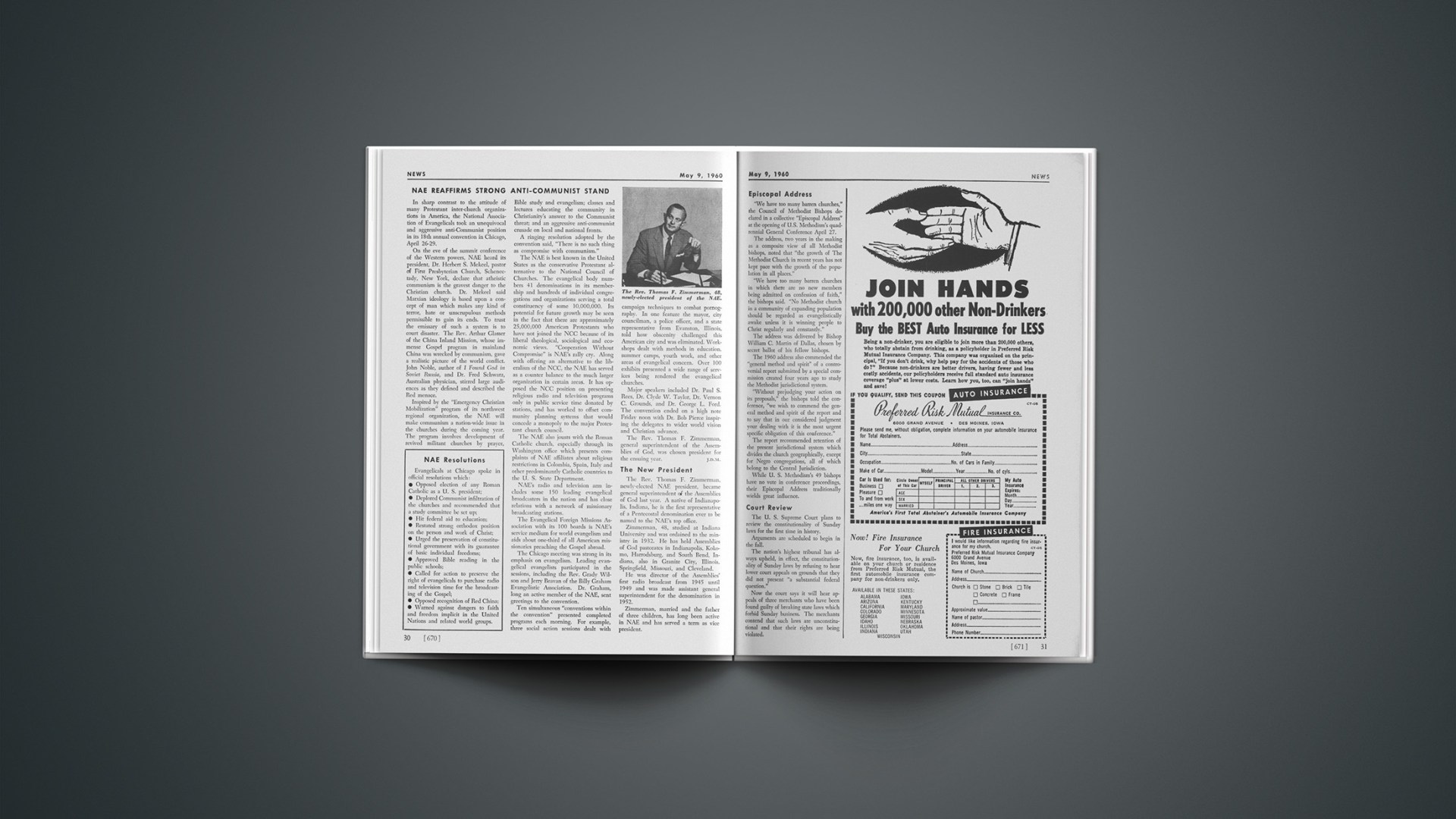
NAE Reaffirms Strong Anti-communist Stand

In sharp contrast to the attitude of many Protestant inter-church organizations in America, the National Association of Evangelicals took an unequivocal and aggressive anti-Communist position in its 18th annual convention in Chicago, April 26–29.

On the eve of the summit conference of the Western powers, NAE heard its president, Dr. Herbert S. Mekeel, pastor of First Presbyterian Church, Schenectady, New York, declare that atheistic communism is the gravest danger to the Christian church. Dr. Mekeel said Marxian ideology is based upon a concept of man which makes any kind of terror, hate or unscrupulous methods permissible to gain its ends. To trust the emissary of such a system is to court disaster. The Rev. Arthur Glasser of the China Inland Mission, whose immense Gospel program in mainland China was wrecked by communism, gave a realistic picture of the world conflict. John Noble, author of I Found God in Soviet Russia, and Dr. Fred Schwarz, Australian physician, stirred large audiences as they defined and described the Red menace.

Inspired by the “Emergency Christian Mobilization” program of its northwest regional organization, the NAE will make communism a nation-wide issue in the churches during the coming year. The program involves development of revived militant churches by prayer, Bible study and evangelism; classes and lectures educating the community in Christianity’s answer to the Communist threat; and an aggressive anti-communist crusade on local and national fronts.

A ringing resolution adopted by the convention said, “There is no such thing as compromise with communism.”

The NAE is best known in the United States as the conservative Protestant alternative to the National Council of Churches. The evangelical body numbers 41 denominations in its membership and hundreds of individual congregations and organizations serving a total constituency of some 10,000,000. Its potential for future growth may be seen in the fact that there are approximately 25,000,000 American Protestants who have not joined the NCC because of its liberal theological, sociological and economic views. “Cooperation Without Compromise” is NAE’s rally cry. Along with offering an alternative to the liberalism of the NCC, the NAE has served as a counter balance to the much larger organization in certain areas. It has opposed the NCC position on presenting religious radio and television programs only in public service time donated by stations, and has worked to offset community planning systems that would concede a monopoly to the major Protestant church council.

The NAE also jousts with the Roman Catholic church, especially through its Washington office which presents complaints of NAE affiliates about religious restrictions in Colombia, Spain, Italy and other predominantly Catholic countries to the U. S. State Department.

NAE’s radio and television arm includes some 150 leading evangelical broadcasters in the nation and has close relations with a network of missionary broadcasting stations.

The Evangelical Foreign Missions Association with its 100 boards is NAE’s service medium for world evangelism and aids about one-third of all American missionaries preaching the Gospel abroad.

The Chicago meeting was strong in its emphasis on evangelism. Leading evangelical evangelists participated in the sessions, including the Rev. Grady Wilson and Jerry Beavan of the Billy Graham Evangelistic Association. Dr. Graham, long an active member of the NAE, sent greetings to the convention.

Ten simultaneous “conventions within the convention” presented completed programs each morning. For example, three social action sessions dealt with campaign techniques to combat pornography. In one feature the mayor, city councilman, a police officer, and a state representative from Evanston, Illinois, told how obscenity challenged this American city and was eliminated. Workshops dealt with methods in education, summer camps, youth work, and other areas of evangelical concern. Over 100 exhibits presented a wide range of services being rendered the evangelical churches.

Major speakers included Dr. Paul S. Rees, Dr. Clyde W. Taylor, Dr. Vernon C. Grounds, and Dr. George L. Ford. The convention ended on a high note Friday noon with Dr. Bob Pierce inspiring the delegates to wider world vision and Christian advance.

The Rev. Thomas F. Zimmerman, general superintendent of the Assemblies of God, was chosen president for the ensuing year.

Nae Resolutions

Evangelicals at Chicago spoke in official resolutions which:

• Opposed election of any Roman Catholic as a U. S. prcsident;

• Deplored Communist infiltration of the churches and recommended that a study committee be set up;

• Hit federal aid to education;

• Restated strong orthodox position on the person and work of Christ;

• Urged the preservation of constitutional government with its guarantee of basic individual freedoms;

• Approved Bible reading in the public schools;

• Called for action to preserve the right of evangelicals to purchase radio and television time for the broadcasting of the Gospel;

• Opposed recognition of Red China;

• Warned against dangers to faith and freedom implicit in the United Nations and related world groups.

The New President

The Rev. Thomas F. Zimmerman, newly-elected NAE president, became general superintendent of the Assemblies of God last year. A native of Indianapolis, Indiana, he is the first representative of a Pentecostal denomination ever to be named to the NAE’s top office.

Zimmerman, 48, studied at Indiana University and was ordained to the ministry in 1932. He has held Assemblies of God pastorates in Indianapolis, Kokomo, Harrodsburg, and South Bend, Indiana, also in Granite City, Illinois, Springfield, Missouri, and Cleveland.

He was director of the Assemblies’ first radio broadcast from 1945 until 1949 and was made assistant general superintendent for the denomination in 1952.

Zimmerman, married and the father of three children, has long been active in NAE and has served a term as vice president.

Episcopal Address

“We have too many barren churches,” the Council of Methodist Bishops declared in a collective “Episcopal Address” at the opening of U.S. Methodism’s quadrennial General Conference April 27.

The address, two years in the making as a composite view of all Methodist bishops, noted that “the growth of The Methodist Church in recent years has not kept pace with the growth of the population in all places.”

“We have too many barren churches in which there are no new members being admitted on confession of faith,” the bishops said. “No Methodist church in a community of expanding population should be regarded as evangelistically awake unless it is winning people to Christ regularly and constantly.”

The address was delivered by Bishop William C. Martin of Dallas, chosen by secret ballot of his fellow bishops.

The 1960 address also commended the “general method and spirit” of a controversial report submitted by a special commission created four years ago to study the Methodist jurisdictional system.

“Without prejudging your action on its proposals,” the bishops told the conference, “we wish to commend the general method and spirit of the report and to say that in our considered judgment your dealing with it is the most urgent specific obligation of this conference.”

The report recommended retention of the present jurisdictional system which divides the church geographically, except for Negro congregations, all of which belong to the Central Jurisdiction.

While U. S. Methodism’s 49 bishops have no vote in conference proceedings, their Episcopal Address traditionally wields great influence.

Court Review

The U. S. Supreme Court plans to review the constitutionality of Sunday laws for the first time in history.

Arguments are scheduled to begin in the fall.

The nation’s highest tribunal has always upheld, in effect, the constitutionality of Sunday laws by refusing to hear lower court appeals on grounds that they did not present “a substantial federal question.”

Now the court says it will hear appeals of three merchants who have been found guilty of breaking state laws which forbid Sunday business. The merchants contend that such laws are unconstitutional and that their rights are being violated.

Protestant Panorama

• World Council of Churches headquarters in Geneva dispatched its associate general secretary, Dr. Robert S. Bilheimer, to South Africa last month to inquire into the effects of racial strife upon church relations. Bilheimer met with leaders of churches which are WCC members and which have been at odds over attitudes toward apartheid.

• The newly-appointed Treasury Minister of the West German Republic, Dr. Hans Wilhelmi, is a noted leader of the state Lutheran church. He is currently president of the Synod of the Evangelical Church of Hesse and Nassau.

• The signatures of 18 bishops of the Old Order Amish Mennonites appear on a petition which asks enactment of legislation to exclude their sect from participation in the social security program. The Old Order Amish oppose insurance because they feel it implies lack of faith in God’s judgments and that it yokes them with the unbelieving world.

• Three women were ordained last month by the state Lutheran church of Sweden despite persistent opposition from an element within the clergy. They became the first women ministers in the church’s history.

• A 90-ton vessel belonging to the Melanesian Anglican Mission was wrecked beyond salvage last month in an earthquake and tidal wave which hit the Solomon Islands area.

• The Minnesota Council of Churches plans to erect an $800,000 Protestant center in Minneapolis.

• Washington’s interdenominational Church of the Saviour opened a public coffee house last month as an “experiment in evangelism.” Workers from the church will staff the coffee house each evening and offer spiritual counsel upon request.

• A fire which destroyed Russwood Park, Memphis baseball stadium, also knocked out 300 windows of the 920-bed Baptist Memorial Hospital, located across the street. All patients escaped injury.

• A new library on the campus of the Southern Baptist Theological Seminary in Louisville, Kentucky, contains a room devoted to preserving mementoes of the crusades of evangelist Billy Graham. Graham was scheduled to present the mementoes officially at a baccalaureate service May 9.

Fellowship, official publication of the Fellowship of Reconciliation, interdenominational pacifist group, marked its 25th anniversary by publishing a double-sized issue May 1.

• A chapel-recording studio for “The Lutheran Hour,” largest private broadcasting operation in the world, was dedicated in St. Louis last month at the new headquarters building of the Lutheran Laymen’s League, which sponsors the program.

• Howard University’s School of Religion plans a $2,000,000 fund-raising drive to expand facilities on its Washington, D. C. campus.

• Seamen’s Church Institute of New York will construct a recreational and spiritual center this fall near Port Newark, New Jersey.

• Protestant ministers are joining Roman Catholic and Jewish clergymen in protesting curtailment of public library services in Boston. The curtailment grew out of drastic reductions in the municipal budget.

• Ground was broken April 30 for a $600,000 dormitory on the campus of Pittsburgh Theological Seminary. The Presbyterian seminary, product of a merger of Pittsburgh-Xenia and Western theological seminaries, plans a long-range expansion program costing some $13,500,000.

• Representatives of the National Lutheran Council and the Lutheran Church—Missouri Synod joined hands last month in placing a wreath at the Tomb of the Unknown Soldier in Arlington National Cemetery. The ceremony took place during simultaneous meetings of the NLC’s Bureau of Service to Military Personnel and the Missouri Synod’s Armed Services Commission.

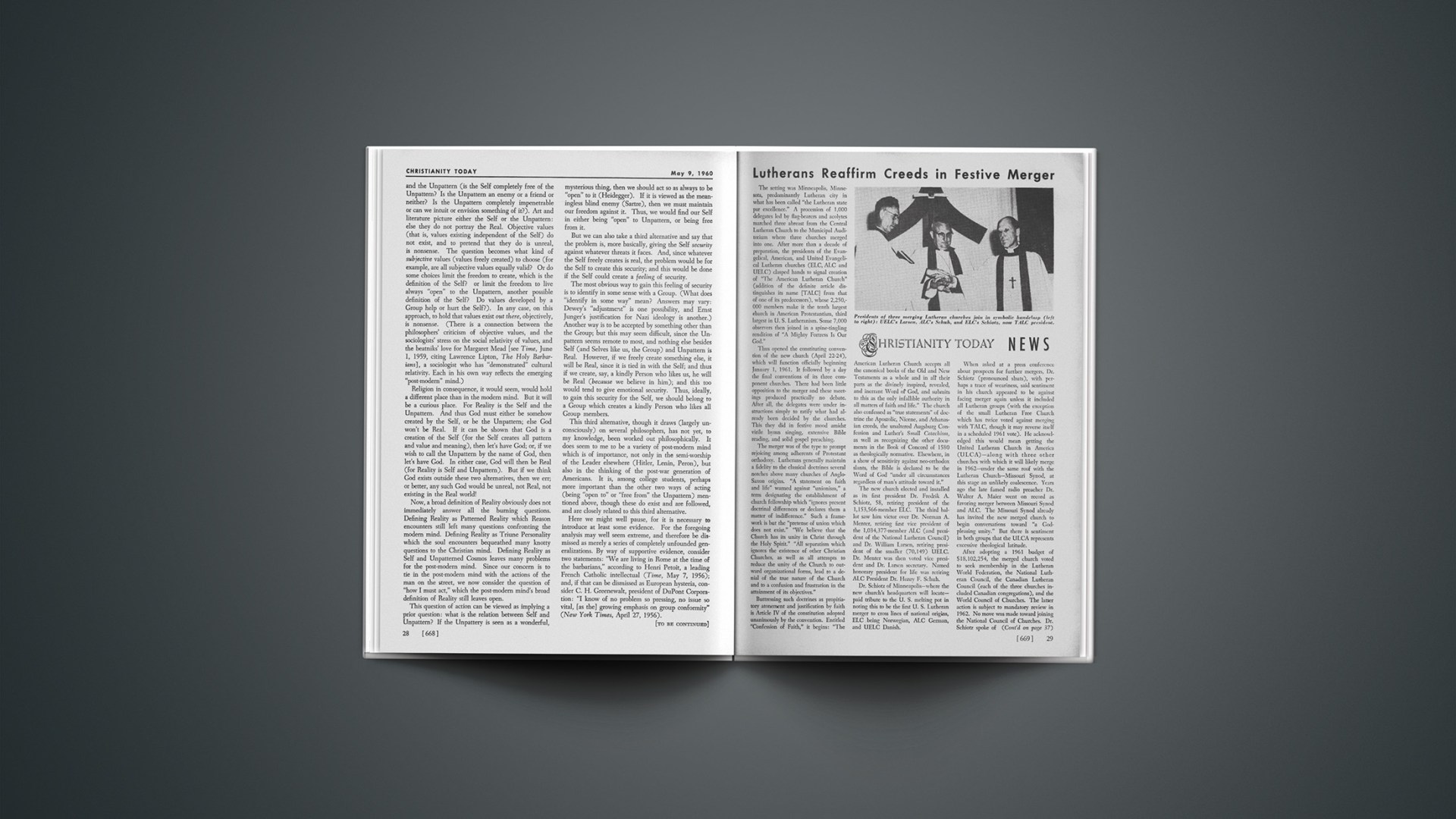
Lutherans Reaffirm Creeds in Festive Merger

The setting was Minneapolis, Minnesota, predominantly Lutheran city in what has been called “the Lutheran state par excellence.” A procession of 1,000 delegates led by flag-bearers and acolytes marched three abreast from the Central Lutheran Church to the Municipal Auditorium where three churches merged into one. After more than a decade of preparation, the presidents of the Evangelical, American, and United Evangelical Lutheran churches (ELC, ALC and UELC) clasped hands to signal creation of “The American Lutheran Church” (addition of the definite article distinguishes its name [TALC] from that of one of its predecessors), whose 2,250,000 members make it the tenth largest church in American Protestantism, third largest in U. S. Lutheranism. Some 7,000 observers then joined in a spine-tingling rendition of “A Mighty Fortress Is Our God.”

Thus opened the constituting convention of the new church (April 22–24), which will function officially beginning January 1, 1961. It followed by a day the final conventions of its three component churches. There had been little opposition to the merger and these meetings produced practically no debate. After all, the delegates were under instructions simply to ratify what had already been decided by the churches. This they did in festive mood amidst virile hymn singing, extensive Bible reading, and solid gospel preaching.

The merger was of the type to prompt rejoicing among adherents of Protestant orthodoxy. Lutherans generally maintain a fidelity to the classical doctrines several notches above many churches of Anglo-Saxon origins. “A statement on faith and life” warned against “unionism,” a term designating the establishment of church fellowship which “ignores present doctrinal differences or declares them a matter of indifference.” Such a framework is but the “pretense of union which does not exist.” “We believe that the Church has its unity in Christ through the Holy Spirit.” “All separatism which ignores the existence of other Christian Churches, as well as all attempts to reduce the unity of the Church to outward organizational forms, lead to a denial of the true nature of the Church and to a confusion and frustration in the attainment of its objectives.”

Buttressing such doctrines as propitiatory atonement and justification by faith is Article IV of the constitution adopted unanimously by the convention. Entitled “Confession of Faith,” it begins: “The American Lutheran Church accepts all the canonical books of the Old and New Testaments as a whole and in all their parts as the divinely inspired, revealed, and inerrant Word of God, and submits to this as the only infallible authority in all matters of faith and life.” The church also confessed as “true statements” of doctrine the Apostolic, Nicene, and Athanasian creeds, the unaltered Augsburg Confession and Luther’s Small Catechism, as well as recognizing the other documents in the Book of Concord of 1580 as theologically normative. Elsewhere, in a show of sensitivity against neo-orthodox slants, the Bible is declared to be the Word of God “under all circumstances regardless of man’s attitude toward it.”

The new church elected and installed as its first president Dr. Fredrik A. Schiotz, 58, retiring president of the 1,153,566-member ELC. The third ballot saw him victor over Dr. Norman A. Menter, retiring first vice president of the 1,034,377-membcr ALC (and president of the National Lutheran Council) and Dr. William Larsen, retiring president of the smaller (70,149) UELC. Dr. Menter was then voted vice president and Dr. Larsen secretary. Named honorary president for life was retiring ALC President Dr. Henry F. Schuh.

Dr. Schiotz of Minneapolis—where the new church’s headquarters will locate—paid tribute to the U. S. melting pot in noting this to be the first U. S. Lutheran merger to cross lines of national origins, ELC being Norwegian, ALC German, and UELC Danish.

When asked at a press conference about prospects for further mergers, Dr. Schiotz (pronounced shuts), with perhaps a trace of weariness, said sentiment in his church appeared to be against facing merger again unless it included all Lutheran groups (with the exception of the small Lutheran Free Church which has twice voted against merging with TALC, though it may reverse itself in a scheduled 1961 vote). He acknowledged this would mean getting the United Lutheran Church in America (ULCA)—along with three other churches with which it will likely merge in 1962—under the same roof with the Lutheran Church—Missouri Synod, at this stage an unlikely coalescence. Years ago the late famed radio preacher Dr. Walter A. Maier went on record as favoring merger between Missouri Synod and ALC. The Missouri Synod already has invited the new merged church to begin conversations toward “a God-pleasing unity.” But there is sentiment in both groups that the ULCA represents excessive theological latitude.

After adopting a 1961 budget of $18,102,254, the merged church voted to seek membership in the Lutheran World Federation, the National Lutheran Council, the Canadian Lutheran Council (each of the three churches included Canadian congregations), and the World Council of Churches. The latter action is subject to mandatory review in 1962. No move was made toward joining the National Council of Churches. Dr. Schiotz spoke of opposition to such a move within the new church. None of the three churches which merged to form TALC were members of the National Council of Churches.

Pentecost Sunday, June 5, will mark the beginning of a “Year of Jubilee” celebrating the merger. To be read in all worship services that day is the constituting convention’s “Message to the Churches.” It cautions: “… these days which consummate our union mean little if they do not initiate much.” It also exults: “In one sense we have reached a new height in our journey to the heavenly Jerusalem.”

“Our message to the Church is a simple one: Pray for the peace of Jerusalem. And our confidence is equally sure: They shall prosper that love thee. As we face the future before us, let each one pray and labor that there may be ‘peace within her walls and prosperity within her palaces.’ ”

Ideas

The Scandal of Bogus Degrees

The United States Office of Education commendably has publicized a list of so-called “degree mills,” institutions which grant academic distinctions without the recipient’s fulfillment of reputable requirements. If the exposure of these practices enhances the worth of sound education, and puts an end to the parading of bogus degrees by a small segment of the American clergy as well as by other persons, it will greatly serve both God and man.

Degree mills either receive fees from “students” on the basis of fraudulent misrepresentation, the government contends, or they enable recipients of such degrees to defraud the public.

Because such racket operations often confer divinity degrees of one kind or another, government leaders are proposing a conference with religious leaders and the Federal trade and justice departments to cope more effectively with violations of the law. The inquiry extends not only to degree mills now operating, but to “alumni” of defunct institutions whose continuing activities constitute a problem. Some schools are entangled in foreign complications also, having moved their operations from the United States to other lands.

That a false scale of values makes degree mills attractive to some ministers is a stark reminder that the depth of sin does not exempt the clergy, for whom pride remains a real temptation. Why do preachers, even if a tiny minority, seek out “bargain counter” degrees? Doubtless important strides in ministerial education have placed some pressure upon candidates lacking opportunity for earned degrees, but in these days of “status seeking” the worship of degrees has gone entirely too far. Degrees do not really tell the measure of a man, except perhaps when they are bogus. Even the criteria used by some evangelical institutions in conferring honorary degrees need to be re-examined. The Christian cause is worthy of sound scholarship and intellectual integrity. To sport a pseudo-doctorate in theology or philosophy, while deploring the false front of human pride from the pulpit, is shameful hypocrisy. The vast majority of ministers who have earned their degrees the honorable way, the hard way, will not only welcome this cleanup of degree mills, but will pity the poor cleric who, seeking a shortcut to academic distinction, actually lowered his stature in the sight of God and brought embarrassment to the Church.

The first list of active degree mills released by the government contains institutions in nine states, offering as many as six degrees, at prices ranging from a “free will offering” to $500. Some have no academic buildings or library; another, with 14 buildings and 10,000 volumes, recommends (but does not require) a year’s residence. The Office of Education has released the following information on institutions offering divinity degrees which it considers “diploma mills:”

ALABAMA: Institute of Metaphysics, 1250 Indiana St., Birmingham 14. President: Joseph Truman Ferguson (President-Archbishop-Founder). Incorporated: August 2, 1947, as tax-exempt, non-profit, religious-educational. Purpose: “To teach Philosophy, Psychology, Metaphysics, Bible, all of which are taught as Metaphysics and/or Scientific Truth …”

Facilities: No information. Faculty and students: No information. Degrees, requirements, costs: Doctor of Psychology (Ps. D), Doctor of Metaphysics (Ms. D), Doctor of Divinity (D.D.), Doctor of Philosophy in Metaphysics (Ph.D.M.); no information re requirements; conferred on “non-commercial basis.”

CALIFORNIA: The Church of Light, P. O. Box 1525, Los Angeles 53. President: Edward Doane. Incorporated: In California, New York, and Canada. Purpose: To teach, practice and disseminate the religion of the stars.

Facilities: 2 houses and 4 lots. Faculty and students: No information. Degrees, requirements, costs: Master of Hermetic Sciences (to member passing successfully all 21 final examinations); “no fee is charged … but in view of the labor of correcting examination papers, the candidate is expected to express his appreciation to the extent he is financially able.”

COLORADO: Burton College and Seminary, 41 Lincoln Avenue, Manitou Springs. President: Fred E. Stemme. Incorporated: Chartered under laws of State of Colorado, incorporated September 17, 1927. Purpose: “To provide courses for busy pastors and Christian leaders thru the Extra-Mural method, with a minimum amount of residence work.”

Facilities: “Administration” building (probably residence of president); Facilities of Hotel Grand View, Manitou Springs, to provide for housing and classes during 11-day 1960 summer seminar. Faculty and students: President Stemme and Dean Douglass (no further information about faculty); 2000 graduates reported in current announcement (“strapping the globe”). Degrees, requirements, costs: The 1956 and the 1957 programs of graduating exercises report the awarding of the following degrees: Bachelor of Theology, 4 (1956), 9, (1957); Bachelor of Arts, 0, 8; Bachelor of Science (in Education), 1, 0; Master of Arts, 3, 0; Master of Theology, 3, 10; Master of Christian Education, 0, 1; Doctor of Theology, 20, 24; Doctor of Education, 1, 0; Doctor of Philosophy, 5, 8. Costs depend upon number of “semester hours” of work to be done. “Ample credit is also allowed for books written, articles of academic value, Educational Tours, Foreign Travel, and any activity which has contributed to one’s intellectual growth.… Ministerial courses for correspondence study from various schools will be considered for credit.… Most of our students will read a text, taking copious notes on same, and then write a manuscript review from the notes.… This is ‘Extra-Mural Recitation.’ … Most texts will carry from four to six semester hours of credit.”

The Divine Science Church and College, 1400 Williams Street, Denver 18. President-Minister: Irwin E. Gregg. Incorporated: Chartered and/or incorporated October 24, 1898, Colorado. Purpose: “To preserve and perpetuate the teachings of Divine Science basic principles.…”

Facilities: 1 building, 1,000 volumes in library. Faculty and students: 9 faculty, 27 students. Degrees, requirements, costs: Divine Science Bachelor (D.S.B.), $150, 9 awarded 1959; 2 residence-2 correspondence courses required, 20 lessons per course. Divine Science Doctor (D.S.D.) awarded as honorary degree “in recognition of outstanding work over a period of years in the cause of Divine Science.” Ordination certificates also.

FLORIDA: American Bible School, 192 North Clark Street, Chicago 1, Illinois; American Divinity School, Pineland, Florida. President: G. W. Hyatt. Incorporated: As tax-exempt in Florida and Illinois. Purpose: “To train ministers, missionaries, and Christian workers for the American Evangelical Christian Churches.”

Facilities: 5 buildings (reported in questionnaire, but accompanying material contains five pictures: American Bible Church and Gra-Mar Boy’s Center in St. Petersburg, Florida, the Ogden Building in Chicago which houses the American Bible School offices, a one-story building at Pala Mar, Florida, labeled as present administration building, and an artist’s sketch of a new administration building “now under construction”). Faculty and students: 12 faculty, 500 students in 1959. Degrees, requirements, costs: Graduate in Theology, Bachelor of Theology, Master of Theology, Doctor of Theology. Questionnaire states requirements of high school graduation for undergraduate work and Bible college or seminary for postgraduate work, but catalog reports that practical experience may be submitted in lieu of entrance credits. Honorary degrees awarded: Doctor of Divinity, Doctor of Literature, Doctor of Laws and Letters, and Doctor of Humanities. Tuition in all courses by donation.

ILLINOIS: American Bible School, 192 North Clark Street, Chicago 1 (see Florida).

College of Universal Truth, 22 E. Jackson Blvd., Suite 1506, Chicago 4. President: The Rev. R. C. Spaulding. Incorporated: Chartered and/or incorporated in Illinois. Purpose “To teach Spiritual Psychology, Metaphysics, Philosophy, and the Bible.”

Facilities: No building, no laboratories, 200 volumes in library. Faculty and students: 10 faculty members, 160 students in 1959. Degrees, requirements, costs: No residence required. Doctor of Metaphysics, $110, 20 awarded 1959, 2 courses; Doctor of Psychology in Metaphysics, $150, 11 awarded, 3 courses; Doctor of Divinity in Metaphysics, $205, 6 awarded, 5 courses; Doctor of Philosophy in Metaphysics, $295, 4 awarded, 7 courses; Doctor of Universal Truth, $350, none awarded in 1959, 8 courses.

Kondora Theosophical Seminary, P.O. Box 718, Chicago 90. Dean of Instruction, Secretary, Treasurer: K. B. Dokas. Incorporated: October 28, 1948, by the Secretary of State of the State of Illinois. Purpose: “To prepare workers for the Religion of Modern Spiritualism” (letter, 2–29–60); “to provide, impart and furnish opportunities for all departments of higher education … the seminary is now offering a residential and home study academic course of instruction to all persons, who may apply and qualify for matriculation leading to academic degrees, providing the student qualifies for same.”

Facilities: Report having purchased land in Florida where seminary will be built and where instruction will begin again in 1963 after suspension in 1961 (to reorganize “coriculum” [sic]). Faculty and students: No information. Degrees: B.A., M. A., B. Ps. Sc. (Bachelor of Psychic Science), M. Ps. Sc., Ps. D., Ms. D., B. D., D. D., Ph. D., and special degrees. The student receives one lesson per week, pays $5 down and $5 per month per subject. The length of program for degrees is not stated. Regarding supervision the catalog states: “At this point may I caution the student that the moment he is enrolled in the seminary for the purpose of unfolding his psychic centers, a cosmic teacher is assigned to him by the eternal ruler to guide him through the course of instruction. He keeps an accurate record of his progress in like manner as a teacher in the academic schools here on earth.”

Pioneer Theological Seminary, 122 Concord Avenue, Rockford. President: No information. Incorporated: State of Illinois (“since 1890”). Purpose: “Providing opportunity to study Theology to people handicapped by age or finances, who cannot return to a resident school.”

Facilities: Undated leaflet received March 4, 1960, reports a disastrous fire which resulted in much loss to institution’s facilities; fund raising campaign in progress. Faculty and students: No information. Degrees, requirements, costs: Th. G., Th. B., Th. M., Th. D., D. S. L. (Doctor of Sacred Literature), and Ph. B. D. (Doctor of Bible Philosophy). Regarding cost, the application carries this statement: I fully understand that in place of the usual tuition, I am to make a contribution of not over $25.00 for books and supplies for the course, and send a free-will offering as I can with lessons during my enrollment. The amount of these contributions are to be governed by my ability to give as God has prospered me.

INDIANA: Central School of Religion, 6030 Lowell Avenue, Indianapolis 19. President: Mr. Carl L. Svensen. Incorporated: Under the laws of State of Indiana, September 23, 1896. Purpose: For teaching by correspondence and for residence study, chiefly religious.

Facilities: No buildings, no laboratories, no library. Faculty and students: 9 faculty, 26 students in 1959. Degrees, requirements, costs: Bachelor of Theology, Master of Theology, Doctor of Theology, and Bachelor of Arts in Religion; Matriculation fee, $2 for undergraduates, $5 for graduates; Tuition, $15 per undergraduate course, $20 per graduate course; diploma, $10. Minimum requirement, 10 units or courses. Course outlines for three courses are furnished: The Intertestamental Period, Social Pathology, and Old Testament Theology. These are individually typed “as students are not numerous and this enables revisions to be made from time to time.” (Note: Text of diploma states that the recipient “is entitled to our highest consideration, together with all rights and privileges usually granted to those advanced to said title and degree, here and elsewhere.” Federal cease and desist order in 1947 resulted in change of name from Central University.)

College of Divine Metaphysics, 2811 North Illinois St., Indianapolis 8, with Eastern United States Branch at Greenwood Lake, New York. President: Ruth M. Hurley. Manager of Eastern Branch: Dr. Dorothy B. Arnheiter. Incorporated: Under the laws of the State of Indiana (formerly in Missouri). Purpose: To aid its students in their … understanding of (psychological and metaphysical) laws and principles.

Facilities: No information. Faculty and students: No information. Degrees, requirements, costs: Doctor of Psychology (Ps.D,), Doctor of Metaphysics (Ms.D.), Doctor of Divinity (D.D.). The catalog lists ten courses ranging from 15 to 53 lessons, and costing from $35 to $125. For two of seven courses the Ps.D. is awarded; for three of the same seven the Ms.D. and the Ps.D.; and for the $120 course and four others, the D.D. is offered.

Trinity College, 325 Bankers Trust Building, Indianapolis 4. President: No information. Secretary: Signature not legible. Incorporated: No information.

Facilities: No information. Faculty and students. No information. Degrees, requirements, costs: Bachelor of Science, Master of Science, Doctor of Philosophy, etc. Tuition $195 cash or $50 down and six monthly installments of $27 each. Majors offered in: Accounting, art, biology, business administration, chemistry, economics, engineering (aeronautical, civil, chemical, electrical, general, industrial, mechanical and sanitary), education, English, French, general studies, geology, German, Hebrew, history, Italian, journalism, Latin, literature, mathematics, music, philosophy, physics, political science, psychology (with optional specialty in hypnosis), public health, secretarial studies, sociology, Spanish, theology.

MISSOURI: Neotarian Fellowship, Pickwick Building, Kansas City 6. Offers by correspondence the “degrees” of Doctor of Psychology (Ps. D.), Doctor of Metaphysics (Ms. D.), Doctor of Divinity (D. D.), and Doctor of Philosophy (Ph. D.). The “degree” is conferred after a series of lessons by mail, and the time required can be as short as 15 weeks. For most of the “degrees” no formal educational requirements are imposed. A price list, which is not carried in the announcement of courses but on the application form, quotes prices ranging from $100 for the Ps. D. to $250 for the Ph. D.

TEXAS: Four States Cooperative University, Jefferson. President: Mr. Walter Scott McNutt. Incorporated: Chartered and incorporated in Texas. Purpose: To give higher education to high school graduates of the nation.

Facilities: 14 buildings, 3 laboratories, 10,000 volumes in library. Faculty and students: 8 faculty, 30 students. Degrees, requirements, costs: Bachelor of Arts, $25, 36 courses, 10 lessons per course; Bachelor of Science, $25, 36 courses, 10 lessons per course; Master of Arts, $25, 45 courses, 10 lessons per course; Doctor of Philosophy, 1 awarded 1959, $25, 18 courses, 10 lessons per course, thesis. Re residence, the following statement is made: “Not any required but the last year on the campus recommended for the best results.” Fields of study: arts and sciences leading to A. B., B. S., and M. A., and Ph. D. in social studies, philosophy, and psychology.

Texas Theological University, 2800 N. W. 27th Street, Fort Worth 6. President: Mr. E. Bryan Clemens, Pastor, Metropolitan Baptist Church (same address). Incorporated: Secretary of State of State of Texas. Purpose: Religious training.

Facilities: 1 building, 2,000 volumes in library. Faculty and students: 3 faculty, 38 students in 1959. Degrees, requirements, costs: Graduate of Theology, 3 awarded 1959, $110, 1 course of 320 lessons required; Master of Theology, $110, 1 course of 640 lessons required; Doctor of Theology, $110, 1 course of 1,040 lessons required. No residence study required.

VIRGINIA: Belin Memorial University, Route 2, Box 116, Manassas. “American Legion University (in process of formation).” “Chillicothe Business College (renaissance).” Sole proprietor: Mr. Donald E. Hare. Mr. Hare refused to answer questionnaire but reported: “I am issuing all standard degrees with full legal and ecclesiastical [sic] authority. Upon request I shall submit proof of this.… Our methods are entirely informal. We do private tutoring by first class mail and we give suitable recognition when the pupil is prepared. Our standard fee for a doctorate is $500 and our agents get $200.” Enclosed were letters from correspondents thanking Mr. Hare for awarding them the D. D. degree. Letter to prospective student from Mr. Hare reads: “Your work with us will be largely correspondence. But you can get a Professorship right now, to conduct a local Study Group. That is the best way for you to learn” (2–26–60).

STATING THE CASE FOR RELIGION IN PUBLIC SCHOOLS

The relation of religion to public education in America continues to be a live issue. For several years the National Council of Churches has been laboring to draft a document which would state the view of its constituency. An honest effort has been made to secure a comprehensive and representative expression of opinion and a valid consensus. The latest study document issued by the Council shows encouraging improvements over previous drafts.

A Preface has been added which states certain basic theological convictions normative to any credible Christian consideration of the problem. Its thrust is a notable improvement on the NCC’s constitutional statement of belief. It boldly states that the primary task of the church is to proclaim the gospel that the world may believe. It recognizes the fact that Americans are a religious people whose institutions presuppose a Supreme Being. It calls upon the schools to recognize the function of religion in American life and maintain a climate friendly to religion, at the same time assuring every individual the freedom to choose his own beliefs.

Part I, “Some Convictions which Influence our Thinking,” has been strengthened. There is the unequivocal statement that “God is the ultimate reality of the universe … and the source of truth and values.” In its latest form it eliminates a former apologetic for certain theories of “progressive education” and reinforces expressions of principle involved in the relation of religion to education.

The document’s weakness lies in its acceptance of the theory that a pluralistic society determines Christian conscience in the matter of public school policy. Such a syncretistic view leads to compromise on religious and moral standards. A good word about the Judeo-Christian heritage of America appears in Part II but it is weakened by subtle admissions that changing sociological mores may modify standards of morality.

Evangelicals who have doubts about the values of public as against private education will find fault with the idea that Christian teachers should suppress their personal testimony and refrain from leading pupils to Christ, that Bibles or Scripture portions should not be distributed, and a score of similar “compromises” with the principle of “religious freedom.” But it should be clear that such concessions to Protestants would inevitably open the door to proselyting by other religious groups.

All told, the new Study Document is an encouraging advance in the drafting process. We strongly urge that our readers who are interested in the relation of religion to public education request copies for examination. Address, The Secretary of the Committee on Religion and Public Education, National Council of Churches, 475 Riverside Drive, New York 27, New York, enclosing 10 cents in stamps. The Committee will welcome constructive reactions to the present document and suggestions for improvement.

REVOLUTION IN KOREA BRINGS AGONY AND HOPE

Korea, the “Hermit Kingdom” of a past generation, has now become the scene of a revolution so important that our government has been forced to take an unprecedented interest. The State Department has acted with dispatch and clarity, with the result that a major disaster may have been averted.

America has a grave responsibility in Korea. An American president shared in dividing a small, helpless people, just released from over forty years of domination by Japan. Another American president took quick and positive steps to defend South Korea when attacked from the North. A yet-to-be-explained policy led us to fight a war in Korea which we never intended to win, our forces being handicapped by restraints imposed from Washington which even today rankle men who know something of our diplomacy during those trying years.

Standing in the breach with a militant patriotism has been the granite-hard figure of Syngman Rhee. His strong will has been the symbol of a new nation and he is the revered father of modern Korea.

While Korea owes much to Rhee’s determination in recent years she has also been handicapped by his intransigent attitude. His refusal to come to any kind of a workable agreement with Japan has been unrealistic, harmful to his country’s economy and symbolic of his own stubbornness.

More serious have been his growing dictatorial tendencies. The Assembly has become increasingly a rubber stamp in his hands. Legitimate opposition has been crushed again and again until there has been a seething undercurrent of resentment. Not content with certain reelection in March, he permitted (to say the least) repressive measures against the opposition party and its candidates, which fact became an open scandal.

Meanwhile America for strategic reasons has been bolstering the Rhee regime with military, technical and economic assistance; not only as an aid to Korea, but also as a deterrent to Communist expansion in the Far East.

The extremes of Rhee’s repressions have now backfired in a nation-wide series of student demonstrations. The police on a number of occasions have fired into student mobs, killing some 200 and wounding many additional hundreds. The toughness of the Korean character has been demonstrated by the willingness of the students and their professors to come back for more. Rhee’s resignation and the calling of new elections are welcome developments, although riots and violence do not presage early stability, as the tragic murder-suicide of the vice-president-elect and his family indicate.

An ominous note was sounded when Communist students in the northern capital of Pyongyang demonstrated in sympathy with their fellow students in the south. Fortunately, there is no evidence that the movement in south Korea was Communist-inspired, but anyone familiar with Red techniques knows that every effort is being made to take advantage of the unrest south of the 38th parallel and to turn it to their ends.

The present unrest in government is reflected within the Korean Christian church by dissension, schisms and illegal actions. It is to be hoped that Christians will now unite in a leadership which will channel the clamor against repression and dishonest government into a constructive movement in a land which has already suffered so much through division, invasion and corruption.

Money

MONEY

The many references in the Bible to material possessions—money, treasure, things—indicate a divine recognition of their importance, not only from the standpoint of economics, but also because of the bearing they have on the spiritual life of the individual.

Money itself has no spiritual significance. Wealth means nothing, for it cannot be taken out of this world. Poverty has no claim to merit; it too is a transient condition.

But man’s attitude to the material is of the gravest importance. Where in the scale of values do we rank money? Is it our master or our slave? Do we desire it for what it can do for us or for what it can do for others if placed in our hands? Is money a first consideration in our lives or merely incidental to our living for the honor and glory of God?

The Bible makes it plain that money can be either a curse or a blessing; a menace or a means of grace; a lubricant to grease the skids to hell or incense to perfume the way to heaven.

Nowhere does the Bible say that money is the root of evil. But it does say that the love of money is a root of evil.

Love of money becomes an obsession, for within the human heart there is a strange acquisitiveness which is never satisfied. Get one hundred dollars and we immediately want two; secure five hundred, and the desire for one thousand wipes out that satisfaction. The Chinese have an old proverb which expresses this truth: Ren hsin puh choh—“The heart of man is never satisfied.”

The heart of man can be satisfied, but only when material and spiritual things are placed in their proper perspective and we are more concerned about things unseen than with things seen.

The Christian philosophy of money is very important. Many is the Christian who has lost his peace and his witness to others because the love of money has come between him and his Lord. Speaking of this, the Apostle Paul says: “But they that will be rich fall into temptation and a snare, and into many foolish and hurtful lusts, which drown men in destruction and perdition. For the love of money is the root of all evil: which while some coveted after, they have erred from the faith, and pierced themselves through with many sorrows.”

What should the Christian’s attitude to money be? How can we honor God with material possessions, great or small?

A Trust

Money is a trust from God. It is something which he places in our hands to be used for his glory. The farthing which the poor widow cast into the treasury of the temple was, in our Lord’s eyes, a large and precious gift because it represented great sacrifice on the part of the giver. A million given from many millions is less in His sight.

Stewardship bears not only on the work of God’s kingdom but also heavily upon the spiritual life of the steward.

During the Great Depression, a friend of the writer was financially destitute. He remarked to another friend: “All that I have saved is what I have given to the Lord’s work. I have just one thousand dollars in cash left.”—And he gave that to the cause of world missions.

This man had a deep sense of Christian stewardship. Little wonder that since those days God has prospered him greatly and today he continues to give most of his income to the work of the Church.

A Danger

Even a casual study of the Scriptures will show that money is also a grave danger to those who possess it. In fact money shuts the gates of heaven to those who become its slaves. Our Lord exclaimed, “How hardly shall they that have riches enter the kingdom of God!”

Christ put the test of desire for possessions to the rich young ruler, and he went away sorrowing.

Our Lord told of the man whose wealth increased and, seeing it all, he became selfish and boastful. But God said to him, “Thou fool, this night thy soul shall be required of thee.”

From beginning to end the danger of money is one of attitude, not of dollars, Does desire for it possess us, or do we demonstrate at all times that it is more blessed to give than to receive?

An Opportunity

God has ordained that the work of his kingdom shall be carried on by men and women who give of themselves and their means to that end.

The entire work of the Church rests, from a practical standpoint, on the gifts of God’s people. It is through the use of money that Christian enterprises of every nature are carried on. The spread of the Gospel across the world depends on money given by those who have themselves received God’s greatest Gift and who know that this entails a responsibility to make Him known to others.

In our day no Christian need lack for avenues of Christian work to which he may give—they are legion. It is not a question of whether one should give but how one should take advantage of the multiplied opportunities for giving.

A Power

The power of money is an awesome thing. For coveting this power to buy things and gratify the desires of the flesh, men will kill, lie, steal, and break every law of God and man in order to obtain.

But the power of honestly gained wealth is also awesome. How best can it be used for the glory of God and the welfare of mankind? How can it be dispensed without injuring those who receive it? How can it be administered lest it become a weapon for evil?

Many have used wealth to further evil causes. Others have used it to bring untold blessings to millions. However, the problem confronting the average Christian is not the use of great sums of money, for few of us are confronted with that problem. Rather, the question is what we should do with that which God has placed in our hands.

In First Corinthians 15, we have the thrilling treatise on the Resurrection. It is of more than minor significance that immediately after this discussion Paul turns to the subject of money: “Now concerning the collection for the saints … Upon the first day of the week let every one of you lay by him in store, as God hath prospered him …”

It has been stated that the extent of a man’s conversion is often indicated by its effect on his pocketbook. There is a truth in this. Certainly the grace of giving is a grace to be cultivated by every Christian. “The Lord loveth a cheerful (or hilarious) giver,” probably because such a person senses the privilege of giving and because in a very real sense it is an act of worship.

The temptation, power, opportunity, trust, danger, and privilege of money are things from which none of us can escape.

Some day each of us will hear one of two pronouncements: “Well done,” or “Thou wicked and slothful servant.”

The time to lay up riches where they can never be disturbed or lost is now.

L. NELSON BELL

Eutychus and His Kin: May 9, 1960

REMEMBER

The memory course I am taking will soon make me the envy of Cloverleaf Vista. Already I have mastered my telephone number, my car license, and Lincoln’s Gettysburg address. No longer will I have to stage violent coughing fits on those dismal occasions when I stand between two life-long acquaintances who have not been introduced. Names will pop up like toast at fellowship breakfasts, alumni dinners, and business luncheons.

I know it will work this time, because the course was written by a psychologist who won fame on a quiz show through sheer concentration and association. After all, it doesn’t help to get the answers in advance if you can’t remember them in front of the camera.

There are still a few wrinkles to be ironed out. It was disconcerting to greet Dr. Pike so warmly as Bill Mackerel. Understandably, the proper fish slipped off my memory book, but the switch from Doctor to Bill was more disturbing. Unfortunately, I had visualized a pill to associate Pike with his profession. However, the course has three more days to go and by then I should be ready to develop applied mnemonics for pastors. If your minister can’t remember your name at the church door, and has forgotten the date of the Sunday School picnic, just send his name to me.

I have already approached Pastor Peterson on the subject. He has agreed to try it out if it works for me.

He says that memory is very important in the Bible, but the scriptural emphasis has more in common with Memorial Day than with memory systems. God remembers his people in his covenant faithfulness and calls on them to remember him. The aids to memory in the Bible are the memorials of God’s promises, among them the rainbow and God’s own memorial Name. Scripture itself is a memorial record of God’s purposes, a book of remembrance pointing to Christ. In the Lord’s Supper the death of the Saviour is commemorated in our memorial feast.

There was much more that the pastor said, but I don’t remember it all. It was so fascinating I almost forgot why I had come.

EUTYCHUS

WESLEY’S ANSWER

In “Jazz in the Churches” (March 28 issue), CHRISTIANITY TODAY reported that one jazz setting was to accompany John Wesley’s “Order for Morning Prayer.” It is then asked, “Would Wesley’s heart be warmed anew to hear the syncopated accompaniment to his service, or would it leave him cold?”

We need not wonder. John Wesley’s own observation was, “I have no objection to instruments being in our chapels, provided they are neither heard nor seen.”

T. R. HUTCHESON

Superior, Neb.

If there is this sincere desire to witness and worship with such accompaniment, why not conduct these services where these combos usually perform—night spots, clubs, and bars? They may be serving the church more effectively in these neglected areas than in the quiet beauty and dignity of the sanctuary.

R. A. MACASKILL

The Presbyterian Church

Gettysburg, Pa.

I have been asked, “How come?” appertaining to [the] picture which … appeared.… The question arises because of the obviously incorrect position of the altar boy in relation to the missal; and the notable absence of the sacred vessels.… The fact is that I am not involved in a celebration of the Holy Eucharist. The picture was taken during a concert during which we sang the Beaumont “Twentieth Century Folk Mass” as one half, and our traditional musical setting of the Mass as the other half. I vested, used an acolyte, and sang the priest’s part in both versions in order to demonstrate how they work out in actual practice.

ALAN HUMRICKHOUSE

Trinity Episcopal Church

San Francisco, Calif.

NCC AND THE AIR FORCE

Congratulations for your editorial of March 14 regarding the National Council of Churches and the Air Force manual. I want to underline your statement that “What NCC needed was self-examination, not self-justification”.…

Much of the leadership of the National Council, time and again, has attacked the free enterprise system, directly or indirectly, through speeches, books, etc. Ironically, the money to finance this propaganda was provided through the American free enterprise system—the system under which ours has become the world’s most prosperous nation and the nation from which nearly all others are seeking help in one way or another.

… The NCC … makes little or no effort to keep the Church free of Communist pastors and appears to be vehemently opposed to anyone who even suggests that it should, or that smaller church organizations should. It has been my observation over a period of years that, more often than not, the positions of the NCC on matters of national and international policy coincide with those promoted in The Worker (a Communist weekly) and encouraged on Radio Moscow. Of course, this does not prove that the leadership contains Communists, but it does prove that a very influential organization, to an alarming degree, has aligned itself with the Communists to promote their line and to work for their objectives. For the time being, what more could they ask?

STUART W. EPPERSON

Ararat, Va.

Let Rep. Walter be summoned before the National Council for investigation of demagoguery in Congress, and let it be ascertained whether the Air Force is soft toward communism since it has permitted communism to forge ahead in the missile race.

HENRY RATLIFF

Hartford, S. Dak.

Does as much as six weeks go by without Air Force scandal erupting in the News?… I have 22 years of service in the Federal Civil Service and the two years I was in the Air Force was like being in a foreign country, so greatly did they ignore all Civil Service and state regulations.

LEON H. KELSO

Washington, D. C.

In comparing the text of the Air Force Manual with the letter of Associate General Secretary Wine, I noticed that the Secretary completely avoids the issue. The manual does not say there is a relationship between the R.S.V. and Communism, but that there is or was a relationship between some of the translators and Communism. This is something he cannot deny for some of them were members of “front organizations.”

ROBERT B. DEMPSEY

Carlisle Congregational Church

Carlisle, Mass.

I would like to see the [author of] the manual promoted.

FRANK P. STELLING

Oakland, Calif.

Now the member churches of NCC as well as that organization are flooding us with materials through which we are to instruct our people and make them believe that it is the “hate-mongers” and Communists who are causing all this trouble, etc., etc.

S. MCMASTER KERR

First Presbyterian Church

Onarga, Ill.

An investigation into the NCC would reveal that what the manual gave was not too far off.

FRANCIS M. BRILL

Summit Mills Brethren Church

Meyersdale, Pa.

Obviously, not every minister who swallows the Communist line is a Communist—or even a fellow-traveler. Neither is the RSV Bible a Kremlin manual. But it is high time that the “inviolability of the church” was set aside. A thorough, careful, responsible investigation of Communist infiltration of the churches is long overdue.

NED E. RICHARDSON

Center United Presbyterian Church

Slippery Rock, Pa.

CHURCH TAX

CHRISTIANITY TODAY has performed a service by opening discussion on issues raised by the tax exempt status of the churches. Full treatment of the problem would demand that our whole tax structure be scrutinized for inequities, and perhaps overhauled. But as a first step one is led to ask just what it means for churches to claim tax exemptions.…

The churches in this country alone count their property in the billions of dollars. This includes land and buildings used primarily for worship and education, and also stocks, bonds and other property held mainly for income. By their specially privileged position, tax-wise, churches are beneficiaries of indirect financial assistance from local and state governments, as well as from the national government. Their properties escape local taxation, and contributions to the church are deductible for income tax purposes. Such privileges as these are undoubtedly reflected in the large budgets of today’s churches, and more visibly, in the impressive church architecture rising in all parts of the country. But some questions arise. Is this the high level of stewardship we are entitled to expect from an institution claiming divine sanction? Does the church impair its spiritual power by a too-calculating concern for its material advantage?

The proper use of material possessions is an important part of Christian duty; men are stewards of their income and property. Legally, a man may claim exclusive possession of an economic good but, the Christian has an obligation to use it for the glory of God and the service of man. What the churches preach they must also practice. No one, I am sure, believes it ideal that churches are given preferential position in the government’s treatment of their income and property. Everyone would be happier if churches, and colleges as well, could remain financially solvent without the help of political grants of economic advantage—which is what their tax-exempt status amounts to. But we must, as we say, be realistic.

My mind goes back to an incident recounted by Edward Gibbon in his history. A certain Prelate of Cologne gloats over the results of two of his vows. “My vow of obedience has made me a Prince Bishop,” he says, as Gibbon translates him, “my vow of poverty has given me an income of thirty thousand crowns.” Gibbon’s savage comment had better be read in the original, but every earnest Christian must at times have wished that he didn’t have to defend his faith against institutional corruptions—secular power, wealth, a privileged position in the state, and the like.…

Churches are not producing-units as are factories and stores. Therefore, it is argued, tax exemption is justified. But if “no production-no taxation” as a principle is to be applied across the boards it will exempt many homes from the assessments now levied on them.…

When is a religious body not a church? Such a question rarely arises, of course, but, when it does, it is unfortunate that it is decided by the tax collector. Government, under the American scheme, is not supposed to be in the “religion defining” business. But if the state grants any kind of tax exemption it must set itself up as the final arbiter of who is to receive the privilege. This is just what it did, in a limited way, in the District of Columbia Tax Court in a suit filed October 22, 1956. The petitioner was the Washington Ethical Society, the respondent, the District of Columbia.… Leaders of the Society perform weddings and conduct funeral services. They hold Sunday morning services and otherwise conform to many of the practices of the more common religious bodies. The court, nevertheless, decided that the Washington Ethical Society did not qualify for tax exemption. This decision was hardly epoch making, but it does give one pause: The power we have allowed to the state to tax or exempt from taxation is the power to penalize, if not destroy, deviations from the orthodoxy it accepts.…

In the matter of tax exemption, as elsewhere, the churches are certainly abiding by the law. But does this fully discharge their obligations? Is something more required?

EDMUND A. OPITZ

Irvington-on Hudson, N. Y.

THE LAST DAYS

One thing disturbed me both as I saw the movie and read the book [about Peter Marshall]. It seemed to me that, in the final analysis, Peter Marshall committed suicide. Not death by a gun, or poison, but death that came by deliberately disregarding his doctor’s advice and working himself into an early grave. Was Peter Marshall such a martyr?… Or was he just a totally selfish and thoughtless man, paying no regard to anything but his own personal interests, however noble these were, neglecting his family …?

The years have passed. Times have changed. I have grown older (“more mature” is the expression I prefer). Now it seems to me that Peter Marshall was right. Now I see what the alternatives were. Had he heeded the doctor’s advice and lived, he probably would have been a permanent burden to his family, only half a man in the pulpit, unable to work more than a few hours a day, terribly discontented at his inability to do everything he thought necessary, living constantly in the shadow of hundreds of bottles of vari-colored pills, and dreaming at night about doctors with stethoscopes shouting, “Watch your blood pressure! Watch your blood pressure!”

I have watched many people, particularly the aged, for whom just hanging onto life is a full-time job. It is sad to see human beings turn into vegetables. That way of living is not for me. I want to go down swinging, not just standing there when the third strike is called. To do this, I will some day have to make a hard and dangerous decision. The day will come when, as I observe doctor and medicine bills mounting like inflation and listen constantly to the advice which says, “Slow down! Cut this out! and that,” I will say:

“To hell with the medicine! The doctors have done the best they can for me. I’m grateful to them. But now I’m going to forget all of this and walk out of life like a man!”

After all, as Paul writes, “We arc of good courage, and we would rather he away from the body and at home with the Lord …” and, “For me to live is Christ, and to die is gain.”

LINDSAY RONALD

St. Louis, Mo.

THE MODERN TEN

Sentimentalism and a lack of appreciation for the authority of the Word of God have wrought some changes in modern attitudes toward principles for living covered by the Ten Commandments. The commandments come out something as follows in our day:

I. Thou shalt have no other gods before me. “Religion is all right, but you can’t be fanatical about it.” II. Thou shalt not make unto thee any graven image. “Every man has his own religion; it is all right just so long as he is sincere about it.” III. Thou shalt not take the name of the Lord thy God in vain. “I’m sure the Lord knows how vexed I was, for it was enough to make anyone say something.” IV. Remember the Sabbath day, to keep it holy. “You ought to go to Church when you can, but I need rest and relaxation and this is the only day I can get them.” V. Honor thy father and thy mother. “Parents shouldn’t force their children to do something; they may warp their children’s personalities for life.” VI. Thou shalt not kill. “It’s a big world that runs fast and hard; so, someone’s bound to get hurt.” VII. Thou shalt not commit adultery. “Love will triumph in the end.” VIII. Thou shalt not steal. “Everyone else is getting his. You have to make it for yourself any way you can; just be sure you don’t get caught.” IX. Thou shalt not bear false witness. “We were all just sitting around and talking. You know how one word brings on another. No one meant anything by what he said.” X. Thou shalt not covet. “As soon as we can trade for a new hardtop and move into that new ranch house, then people will have to look up to us too.”

RUSSELL L. JABERG

The Westminster Presbyterian Church

South Bend, Ind.

The Rise of the Post-modern Mind (Part I)

It is becoming evident that Christianity in the Western world is going through some sort of change or crisis. New patterns of spirit are rising. The state of religion in America at mid-century has been discussed recently and excellently by Will Herberg (Protestant, Catholic, Jew, 1955) and by Martin Marty (The New Shape of American Religion, 1959). Both use a sociological approach. The gist of their message is that a new religious outlook is rapidly emerging, based essentially on conformity to “the American way of life,” and that this new outlook poses many problems for any vital religious message.

These new patterns, we would suggest, seem to imply a general shift of values, a change in man’s view of Reality, so far-reaching in nature as to reflect the emergence of a “new mind,” a new outlook on man and the cosmos. Its startling significance may be gauged from a remark by C. S. Lewis: “Christians and Pagans had more in common with each other than either has with a post-Christian” (Time Magazine, May 2, 1955).

Those who subscribe to this “post-modern” mind do not always do it consciously; nevertheless, their behavior and half-formulated assumptions make sense only in terms of it. A philosopher like Jean-Paul Sartre will explicitly formulate his view of why man is not bound by history; a novelist sympathetic to the “beat” position, like Norman Mailer, will approvingly define a hipster as “a man who has divorced himself from history, who does not give a (blank) about the past” (Cleveland Plain Dealer, Jan. 28, 1960); the teen-ager will seriously look with contempt upon history as neither true nor valuable.

This “post-modern” mind, however it appears, does indeed pose new problems for the Church, and problems with which it is ill-equipped to deal. The average evangelical can perhaps bring forward several arguments against atheism; can he, however, answer a man who seriously argues that all religions are true?

BASIC SHIFTS OF PERSPECTIVE

There have been such shifts of mind before; for example, around 300 A.D., when the classical or Graeco-Roman mind yielded to the Christian mind; or, around 1650 A.D., when the Christian mind expressed in the Middle Ages and the Reformation gave way to the “modern mind”—which, if our suggestion is correct, is now in its turn dying. The mind of a society does not, of course, shift all at once. Many classical influences carried on into the Middle Ages and Reformation; many Reformation influences extended on into the modern mind; and many modern influences doubtless will carry over to the “post-modern” mind. Nor does the mind of a society change completely. Augustine’s contemporaries were, many of them, pagans, though they lived in a “Christian” society. Darwin’s contemporaries were, many of them, Christians, though they lived in a secular society.

What, then, is meant by “mind” here? We use the term for the ideas which shape society, or the outlook which shapes society’s institutions, or the basic assumptions which form a “way of life,” or the world-outlook which is reflected in the real goals of a society. Ethics reflects metaphysics; and the aims of a society reflect a view of Reality which the society has formulated.

Thus, if a society view’s Reality as “that which Reason contacts,” then it will be concerned to encourage the free play of Reason. If one of the ideas shaping society is, say, that freedom is a basically important thing, then freedom will be part of that society’s way of life, and that society’s institutions will be set up so that freedom will be gained. Or, if one of the basic components of the society’s outlook is the idea that salvation is essential, then that society’s institutions will be set up so that salvation is available. Or, if one of the basic assumptions of a society is that a high standard of living is highly valuable, then a high standard of living will become a primary goal. In this sense, then, we can suggest that the classical mind was different from the Christian mind, which was different in turn from the modern mind, which is different from the new mind now emerging. And that fact means, among other things, that: the classical outlook is different from the Christian outlook, and so forth; that the classical institutional patterns are different from Christian, and so forth; that the basic assumptions are different; that the goals are different; and that the view of Reality is different. And, using “mind” in that sense, we can repeat our suggestion: the modern mind is dying, and a “post-modern” mind is emerging with which the Church must reckon.

EARLY MODERN ASSUMPTIONS

The modern mind flourished from around 1650 to 1950, more or less, or loosely from 1600 to 1900. It was not born overnight, obviously, but emerged only after centuries of gestation. While it flourished, it shaped many dramatic developments: science, representative democracy, religious toleration, factories, capitalism, colonialism, nationalism, socialism, a vast increase in knowledge, great wars, and much more. Their modern development was no accident; they are tied into the basic assumptions and consequent goals of the modern mind. Aquinas could hardly hold, for example, religious toleration; Huxley could hardly avoid advocating it. What, then, were some of the controlling assumptions of the modern mind?

Reality in the basic sense, independent of ourselves so the modern mind held, is the Patterned Reality of nature. This Patterned Reality can be found by Reason, and Reason is therefore that in man which defines him, which puts him in touch with Reality as no animal can be. “I think, therefore I am”; I am defined by my Reason—which contacts the Patterned Reality “out there,” which shows me the Patterns; which shows me the scientific laws that govern Reality. Reason comes to mean the use of the scientific method. Science gives an “ever-increasing understanding” of Reality, so that man is progressing constantly. Progress means an advance towards greater knowledge, more science, more understanding, and more use of understanding to gain ever-increasing control over Reality, nature’s Patterned Reality. Reason obviously implies an efficient and rational government, and it probably implies, further, a rational democracy as the best form of government, and that the State’s concern should be in areas such as progress, advancement of science, education for all along rational lines.

Religion, in the modern outlook, played a minor role. Any educated modern would view it with suspicion unless it was accommodated to the modern mind. And this, of course, could be done. If God was viewed, say, as the rational Watchmaker and Creator who started the universe and set up its scientific laws (as by Franklin), or as the cosmic Spirit revealing Itself in history (as by Hegel); and if Jesus was looked on as a great Teacher, worthy to be ranked with Socrates and Buddha—then there would be no objection. If God was viewed as nonexistent, that was all right too. In any case, God lost any significance for decision-making in the areas of politics or economics or education or science or, indeed, anything important.

Such, in oversimplified form, was the modern mind (now dying). Protestant orthodoxy had a difficult time with it. Giving up the notion of a “Christian society” in the older sense (its last supporters were perhaps the Puritans), the churches generally either adopted the modern mind and salvaged what religion they could (roughly the “modernist” answer) or, while accepting many modern assumptions, tried to hold emotionally to personal salvation (roughly the “fundamentalist” answer). Catholic orthodoxy retreated behind its Roman bastions and hurled excommunications, anathemas, and fulminations (freedom of conscience was “madness” flowing from the “corrupt fountain of indifferentism,” as Gregory XVI put it). But the modern mind did not listen.

The modern mind, with its view of Reality as the Patterned Reality which Reason and science contact, with its natural laws governing the physical world, and its rational laws of human nature governing all men, came under increasingly severe attack after 1850 from thinkers who may be regarded as transition figures to the post-modern mind: Marx, Freud, Nietzsche, and many others. Today, we would hold, the post-modern mind has actually begun to emerge—not only in the ivory towers, not only in Europe, but in the assumptions of the American man on the street.

What is this “post-modern” mind? It has, in brief, a different view of Reality. If the Christian mind held that the highest Reality is the Triune God, and that the Self is defined in terms of relation to Him; and if the modern mind held that the highest Reality is the Patterned Reality of nature, and the Self is defined by its having Reason and contacting that Patterned Reality; then the post-modern mind, denying both the Triune God and Patterned Reality, holds to the Self and the Unpatterned Reality. The Self creates whatever value and meaning there is; the mysterious Unpattern lies outside, impenetrable and awesome.

Many things follow. The task of philosophy becomes the task of considering the relation between the Self and the Unpattern (is the Self completely free of the Unpattern? Is the Unpattern an enemy or a friend or neither? Is the Unpattern completely impenetrable or can we intuit or envision something of it?). Art and literature picture either the Self or the Unpattern: else they do not portray the Real. Objective values (that is, values existing independent of the Self) do not exist, and to pretend that they do is unreal, is nonsense. The question becomes what kind of subjective values (values freely created) to choose (for example, are all subjective values equally valid? Or do some choices limit the freedom to create, which is the definition of the Self? or limit the freedom to live always “open” to the Unpattern, another possible definition of the Self? Do values developed by a Group help or hurt the Self?). In any case, on this approach, to hold that values exist out there, objectively, is nonsense. (There is a connection between the philosophers’ criticism of objective values, and the sociologists’ stress on the social relativity of values, and the beatniks’ love for Margaret Mead [see Time, June 1, 1959, citing Lawrence Lipton, The Holy Barbarians], a sociologist who has “demonstrated” cultural relativity. Each in his own way reflects the emerging “post-modern” mind.)

Religion in consequence, it would seem, would hold a different place than in the modern mind. But it will be a curious place. For Reality is the Self and the Unpattern. And thus God must either be somehow created by the Self, or be the Unpattern; else God won’t be Real. If it can be shown that God is a creation of the Self (for the Self creates all pattern and value and meaning), then let’s have God; or, if we wish to call the Unpattern by the name of God, then let’s have God. In either case, God will then be Real (for Reality is Self and Unpattern). But if we think God exists outside these two alternatives, then we err; or better, any such God would be unreal, not Real, not existing in the Real world!

Now, a broad definition of Reality obviously does not immediately answer all the burning questions. Defining Reality as Patterned Reality which Reason encounters still left many questions confronting the modern mind. Defining Reality as Triune Personality which the soul encounters bequeathed many knotty questions to the Christian mind. Defining Reality as Self and Unpatterned Cosmos leaves many problems for the post-modern mind. Since our concern is to tie in the post-modern mind with the actions of the man on the street, we now consider the question of “how I must act,” which the post-modern mind’s broad definition of Reality still leaves open.

This question of action can be viewed as implying a prior question: what is the relation between Self and Unpattern? If the Unpattery is seen as a wonderful, mysterious thing, then we should act so as always to be “open” to it (Heidegger). If it is viewed as the meaningless blind enemy (Sartre), then we must maintain our freedom against it. Thus, we would find our Self in either being “open” to Unpattern, or being free from it.

But we can also take a third alternative and say that the problem is, more basically, giving the Self security against whatever threats it faces. And, since whatever the Self freely creates is real, the problem would be for the Self to create this security; and this would be done if the Self could create a feeling of security.

The most obvious way to gain this feeling of security is to identify in some sense with a Group. (What does “identify in some way” mean? Answers may vary: Dewey’s “adjustment” is one possibility, and Ernst Junger’s justification for Nazi ideology is another.) Another way is to be accepted by something other than the Group; but this may seem difficult, since the Unpattern seems remote to most, and nothing else besides Self (and Selves like us, the Group) and Unpattern is Real. However, if we freely create something else, it will be Real, since it is tied in with the Self; and thus if we create, say, a kindly Person who likes us, he will be Real (because we believe in him); and this too would tend to give emotional security. Thus, ideally, to gain this security for the Self, we should belong to a Group which creates a kindly Person who likes all Group members.

This third alternative, though it draws (largely unconsciously) on several philosophers, has not yet, to my knowledge, been worked out philosophically. It does seem to me to be a variety of post-modern mind which is of importance, not only in the semi-worship of the Leader elsewhere (Hitler, Lenin, Peron), but also in the thinking of the post-war generation of Americans. It is, among college students, perhaps more important than the other two ways of acting (being “open to” or “free from” the Unpattern) mentioned above, though these do exist and are followed, and are closely related to this third alternative.

Here we might well pause, for it is necessary to introduce at least some evidence. For the foregoing analysis may well seem extreme, and therefore be dismissed as merely a series of completely unfounded generalizations. By way of supportive evidence, consider two statements: ‘We are living in Rome at the time of the barbarians,” according to Henri Petoit, a leading French Catholic intellectual (Time, May 7, 1956); and, if that can be dismissed as European hysteria, consider C. H. Greenewalt, president of DuPont Corporation: “I know of no problem so pressing, no issue so vital, [as the] growing emphasis on group conformity” (New York Times, April 27, 1956).

Jacob J. Vellenga served on the National Board of Administration of the United Presbyterian Church from 1948–54. Since 1958 he has served the United Presbyterian Church in the U.S.A. as Associate Executive. He holds the A.B. degree from Monmouth College, the B.D. from Pittsburgh-Xenia Seminary, Th.D. from Southern Baptist Theological Seminary, and D.D. from Monmouth College, Illinois.

Philosophy in the Sixties

The year 1959 was one of philosophic celebrations. Many volumes, monographs, and papers marked the centennial of John Dewey. France, rather more than the United States, similarly celebrated Henri Bergson’s birth. And all over the world scholars commemorated the publication of Charles Darwin’s Origin of Species. One is tempted to see in all this the end of an era and to expect new beginnings in the next decade.

However, the fortunes of philosophy do not change with football game rapidity. No evidence exists to support predictions of any great upheaval. Provided that the political situation permits a continuance of civilized living, the sixties will not differ much from the fifties. No doubt an old era has ended; but it did not end abruptly in centenary celebrations. Somewhat of a new era may well be upon us; but it did not commence January 1, 1960. Rather, the situation calls for an estimate of the coming success or failure of philosophic trends already under way.

To dispose of some preliminary matters, I would say that neo-realism, despite the protests of its aging exponents, as well as the older neo-Hegelianism, has no future. Marxism is indeed a serious political threat, though not an intellectual one. The movements now in existence that promise to exert influence in the next decade are instrumentalism, logical positivism, existentialism, and neo-orthodoxy. The first two are definitely secular, the fourth is clearly religious, while existentialism, though sometimes atheistic, is so closely related to neo-orthodoxy that it fits better into the second classification.

INSTRUMENTALISM

John Dewey was fundamentally disturbed by the nineteenth century scientism which reduced the universe to “nothing but” atoms in motion. Since atoms alone were real, the real world was devoid of colors, sounds, enjoyments, and human values. Traditional philosophy, with its theory of values based on medieval metaphysics and theology, was unable to meet the scientific viewpoint. According to Dewey therefore the main problem of modern philosophy is to formulate a single method by which both the values of daily life and the advances of modern science can be harmoniously handled.

Dewey’s solution begins with the instrumental role of ideas. Despite common sense and almost universal acceptance, the Newtonian view that science gives knowledge of the real world is discussed as thoroughly mistaken. Ideas are not descriptions of what is or has been; they are plans for future actions. Science does not discover antecedent reality; it constructs new realities. To give an example: water is wet, water is good to drink, but water is not H2O. The chemical formula is part of a laboratory method for producing wet water or explosive hydrogen. In other words, scientific concepts do not define natural objects; they specify laboratory operations.

Therefore science cannot render void the real world of colors, sounds, wet water, and human values.

Just as chemical concepts are the directions for experimental procedure, so the same scientific methods can be used to formulate moral concepts for moral experimentation. The concepts of physical science change decade after decade. So too, according to Dewey, moral concepts must change when we want new results. There are no fixed, absolute, divinely given norms. New moral principles must ever be devised to manage new problems.

What is true of physics and morality is also true of logic. The Aristotelian law of contradiction was based on Aristotelian science and must with it be discarded. The laws of logic are like civil laws. They are devised to meet specific problems and as the problems change, quickly or slowly, so must the laws of logic.

LOGICAL POSITIVISM

The technical nature of logical positivist publications makes brief discussion difficult and misleading. Logical positivists are much more interested in the details of science than Dewey was, and their contributions in these special areas are correspondingly better. For this reason it seems likely that logical positivism, even if its most general theses are untenable, will continue in existence for a longer period of time than Dewey’s philosophy. Both schools, for example, accept the opertional definition of concepts. But Dewey’s system tends to fall apart because the connection he makes between science and morals is not firm. Logical positivism, on the other hand, with its tendency to dismiss morality as emotive nonsense can tie its future to operationalism in scientific isolation.

Similarly both schools are behavioristic. Dewey traces all knowledge back to sensori-motor co-ordinations; mind, he says, is a complex of bodily habits formed in the exercise of biological aptitudes; and “knowledge … lives in the muscles, not in consciousness.” Logical positivists assert, “Methodological physicalism and operationism are part of a general positivistic tradition. Their psychological counterpart is the school of behaviorism” (International Encyclopedia of Unified Science, Vol. I, Part II, pp. 671–672).

Now, although behaviorism is untenable wherever found, it can maintain itself longer as a narrowly scientific method than as a part of a general system. Then too, at the expense of some consistency, Herbert Feigl accepts the “methodological outlook of behaviorism but … certainly not with any unqualified rejection of introspective techniques.” Philosophically objectionable as this may be, it is scientifically more viable.

Where logical positivism extends beyond the confines of science and ventures into the realm of epistemological generality is in its theory of meaning and verification. Propositions that cannot be verified by sensory observation are meaningless. Therefore moral principles are emotive nonsense. There is, however, one important exception to this theory of verification. Logical and mathematical principles are neither meaningless nor verifiable. They are formal, definitional, tautological; they are stipulated methods of procedure. Although Dewey is not in complete accord with the logical positivists (cf. Dewey, Logic, pp. 284–289), their view of logical and mathematical principles is similar to Dewey’s position that we must alter the laws of logic as our problems change.

EXISTENTIALISM AND NEO-ORTHODOXY

If Marxism has a bright future because of subversion backed by military might, neo-orthodoxy to a lesser extent depends on nonintellectual factors. These are chiefly the social power of the large Protestant denominations, and, with existentialism, the great fear which the international situation excites. If this fear subsides, existentialism most certainly and neo-orthodoxy most probably will lose ground to a more reasonable viewpoint. At the same time, the latter can count on the growing influence of Karl Barth, who may yet overshadow Brunner, Niebuhr, and Tillich.

Specific theological details are not within the scope of this article. Attention is directed rather to the philosophy which neo-orthodoxy and existentialism have taken in common from Sören Kierkegaard. Its distinctive feature is the repudiation of reason and logic.

Throughout the history of Christianity there has always been a certain amount of anti-intellectualism. An extreme form is found in the negative theology of mysticism. Less extreme forms are found in devout and well-intentioned (but mistaken) distinctions between our poor finite human logic and God’s transcendent thought. “Rationalism,” of course, has always been opposed by the most learned and orthodox theologians; but a misunderstanding of what they meant by rationalism has aided the rise of irrationalism.

In contrast with the statement of the Westminster Confession that “The whole counsel of God … is either expressly set down in Scripture, or by good and necessary consequence may be deduced from Scripture,” the neo-orthodox (for example Brunner) assert that faith must curb logic and that “straight-line” implication will lead us astray. In other words, we may accept certain statements but we must reject their necessary consequences. Not all the neo-orthodox are so explicitly radical as Brunner, yet the Kierkegaardian—neo-orthodox—existentialist complex must be judged to be basically anti-logical.

CRITICISM

When the repudiation of necessary implication is pointed out and the consequent inconsistencies of detail are listed, the straight-line path that criticism will follow hardly needs explanation.

The indispensability of logic for all intelligible communication is also the basis of criticism against Dewey and the logical positivists. They are all wrong when they allow for a replacement of the law’ of contradiction. This law is not a formal stipulation that can be changed by mutual consent. It does not grow out of scientific procedure in such a way that a different procedure would produce a different logic. On the contrary it is eternally a fixed requisite to rational thought and intelligible speech.

Against Dewey it might be added that he never shows how scientific procedure can generate his human values; while against logical positivism there is the particular point that its principle of verification is self-destructive. For there is no sensory observation that would verify the assertion that sensory observation is the only gateway to knowledge. Either then it is nonsense, or it is a stipulation and definition. But in the latter case there is no compelling reason for stipulating it. Surely we can all the more dispense with the verification principle, if we can dispense with logic.

For similar reasons, those linguistic theories, often conjoined with the four philosophies under discussion, also fail which hold that language (or only religious language) is all symbolic and never literal. The exclusion of literal meaning guaranteed by the law of contradiction precludes a rational decision as to the significance of the symbol. A cross could be the symbol of the crucifixion; the crucifixion could be the symbol of the wrath of God; but then the wrath of God would have to be a symbol of nobody knows what.

These philosophies with their inherent difficulties, all so briefly explained, must pass away—Dewey’s perhaps first. They will probably survive the decade and neo-orthodoxy may last even longer. But insofar as there will always be some desperate people, and insofar as a nonmetaphysical science of verifiable fact will always have an appeal, similar types of philosophy will continue to occur. And, insofar as all men are by nature prejudiced against the biblical concepts of revelation and free grace, the passing of instrumentalism and neo-orthodoxy will not inaugurate the millennium.

Jacob J. Vellenga served on the National Board of Administration of the United Presbyterian Church from 1948–54. Since 1958 he has served the United Presbyterian Church in the U.S.A. as Associate Executive. He holds the A.B. degree from Monmouth College, the B.D. from Pittsburgh-Xenia Seminary, Th.D. from Southern Baptist Theological Seminary, and D.D. from Monmouth College, Illinois.

The Word of God in Education

A careful look at our subject, “The Word of God in Education,” will provide a clue to the manner in which it ought to be treated. Quite evidently, two things are placed side by side—the Word of God and education—one in relation with the other. The first of the two, “The Word of God,” needs close definition; the second, “education,” must be brought to focus upon the particular kind of education with which we are here concerned, namely, the Bible college or Bible institute. This is a specific type of institution, to be sure, but the principles that will be discussed apply as well to other fields of education.

Consider the first phrase, “The Word of God.” Though a synonym for the Bible, this by no means exhausts the meaning of the phrase. In a Supreme Court opinion, Justice Holmes once wrote this sentence: “A word is not a crystal, transparent and unchanged; it is the skin of a living thought, and may vary greatly in color and content, according to the time when, and the circumstances under which, it is used.” Here we have one of the first principles of exegesis of any book, the Bible included.

Viewed then in its scriptural usage as “the skin of a living thought,” we may identify three aspects of “the Word of God” in its relationship to education. They are: first, the written Word of God, the Bible; second, the Word of God manifest in creation; and third, the Word of God incarnate in our Lord Jesus Christ.

THE BIBLE AND AUTHORITY

We begin with the Word of God as Scripture. Among Christians in general and evangelical Christians in particular, the Word of God is synonymous with the Bible. The equation is fully justified because it is made again and again in the Old and New Testaments. Here, as the names “Bible college” and “Bible institute” imply, is the central point of integration. But why so? Why not theology, as in many seminaries? Or why not the officially sanctioned philosophy of a great doctor of the church, as in the Roman Catholic institutions with their Thomism?

Before dismissing the question as being so obvious as not to require an answer, let us look beneath the surface to see some reasons why this Book, and no other, must be central in Christian education.

The first reason is the sheer, unapproachable greatness of the written Word of God. Considered just as a book, it holds the first place by reason of the criterion voiced in the classic treatise On the Sublime, in which Longinus declares, “That is really great which bears a repeated examination and which it is difficult or rather impossible to withstand and the memory of which is strong and hard to efface.… For when men of different pursuits, lives, ambitions, ages, languages, hold identical views on one and the same subject, then the verdict which results, so to speak, from a concert of discordant elements makes our faith in the object of admiration strong and unassailable.” This is the doctrine of literary criticism known as the Law of Universal Consent and it applies to the Bible as literature. It is a fact that over and above any other piece of world literature from Homer down through Virgil, Dante, Cervantes, Shakespeare, Milton, and Goethe, no book has been more fully acknowledged as great simply as a book than the Bible.

Let no Christian educator ever apologize to the sophisticated of the educational world for such a designation as “Bible College.” It should be for all who are committed to this kind of education a badge of honor. To take as the center of the curriculum the one book to which alone the superlative “greatest” can without challenge be applied—this is neither narrow nor naive. It is just good judgment to center on the best rather than the second best.

But there is a deeper reason why the written Word of God must be at the heart of our schools and colleges, and that is its authority as the inspired, inerrant Word of God. At this point plain speaking is in order. The current movement to express in contemporary, understandable terms the eternal verities of the faith, so that the people whom we must reach for Christ will know what we are talking about, deserves support. We should rejoice at the renaissance of good and enlightened scholarship among evangelicals which is sometimes called neo-evangelicalism. But at the same time we must not blink the evidence that there is current among some evangelicals a subtle erosion of the doctrine of the infallibility of Scripture that is highly illogical as well as dangerous.

It is illogical for this reason. We live in a day when archaeology has come into conformity with Scripture to such a degree that the number of alleged discrepancies used by destructive critics of the past in their effort to discredit Scripture has been greatly reduced. Today scholars are writing such chapters as “Reversals of Old Testament Criticism” and “Reversals of New Testament Criticism” (see the recently published symposium, Revelation and the Bible). Those who over the years have held a suspended judgment regarding Bible difficulties, while still adhering to the inerrancy of the Book, have found question after question cleared up by new knowledge. Therefore, with all our openness of mind and emphasis on scholarship, we need to be careful to maintain the historic, Reformed view of a Bible infallible in the autographs (a view not to be equated with the dictation, mechanical theory of inspiration, but one held by our Lord and the apostles). And we need to maintain this position against neo-orthodox views of the Bible that may infiltrate even the Bible college and Bible institute. Let us by all means redefine and restate the evangelical position, but never at the cost of yielding any essential part of the authority of the Bible.

CRITICISM AND EDUCATION

The second reason why Scripture must be at the heart of education concerns its indispensable critical function. In a day of debased values and satisfaction with the second and even third rate, education requires a standard and point of reference by which the cheapened standards of our day may be judged.

Writing at the beginning of the industrial revolution in England, the poet Wordsworth declared: “… a multitude of causes, unknown to former times, are now acting with a combined force to blunt the discriminating powers of the mind, and, unfitting it for all voluntary exertion, to reduce it to a state of almost savage torpor.” And he went on to speak of the literature of violence and sensationalism of his day. But now, under the impact of far greater changes and forces than any industrial revolution, and beset with the debasement of plain, everyday decency, this violent age in which we live has far more need of discriminating judgment than that of Wordsworth.

No other book can fulfill this critical, discriminating function like the Word of God. As the writer of Hebrews put it, “the word of God is quick, and powerful, sharper than any twoedged sword, piercing even to the dividing asunder of soul and spirit, and of the joints and marrow, and is a discerner [Greek, kritikos] of the thoughts and intents of the heart.” In a time which Sir Richard Livingstone has rightly called “The Age without Standards,” the Bible alone qualifies as the supreme critic of life and thought.

Dr. H. Langmead Casserly has called our world “The Bent World.” The “bent” refers to the distortion of sin that stems from the fall and runs through all of life. And from this “bent,” even Christian education is no exception. We do not always realize that this distortion affects areas of knowledge and education to different degrees. As Emil Brunner has pointed out, the twist resulting from sin is most marked in the humane subjects like theology, philosophy, history, and literature. It is less marked in areas like physics and chemistry, and in mathematics it approaches zero. Thus there is Christian theology, Christian philosophy, or Christian literature, but not Christian mathematics. It is in the humanities that the curricula in our schools and colleges have their strongest emphasis; and it is here that the critical, penetrating, revealing function of the Bible is most needed.

Now true as this principle is in practice it needs care and courage. Let us in Christian education be fearless enough in our reliance on Scripture as the critic to subject even our cherished formulations of the Bible to its own divine, discriminating judgment. Let us see in searching scrutiny of the Bible that some of the neat and pat outlines and schemes we taught a former generation may need revision. For God has yet more light to break forth from his Word. Let us therefore seek to the glory of God to develop in our students a proper critical-mindedness that subjects all the thinking and formulations of men to the ultimate principles and judgments of the divine kritikos, the Word of God.

Acts chapter 17 gives us a significant example of this function of Scripture. The Christians at Berea, we are told, “were more noble than those at Thessalonica, in that they received the word [in this case doubtless the kerygma or proclamation of the Gospel] with all readiness of mind, and searched the scriptures daily, whether those things were so.” In other words, these Christians subjected even the apostolic preaching to the test of the Scriptures. And, it should be pointed out, there is an extension of this Berean principle beyond even doctrine. I am not saying that technical knowledge in science or any other field must be checked point by point with the Bible, but that in respect to ultimates, to the comprehensive frame of reference in Christ by whom (Col. 1:17) “all things consist [hold together],” the Bible is the final critic.

There is a third reason why the Bible must be at the heart of Christian education. This relates to the all-important matter of knowing and finding the truth. The natural tendency of man (very evident in secular education) is to go it on his own. He is prone unwittingly to slip into the error of assuming that human effort, working independently, leads to the truth. Thus man tends to become in relation to knowledge what Emile Cailliet calls “a pseudo-maker,” with truth coming at the end of a process of human rationalization.

TRUTH IN EDUCATION

On the contrary, the whole thrust of the Bible is different. It does not give us truth by way of rationalization but by way of revelation. Truth is not something worked out by men; it is received by faith and then acted upon. Here the biblical method of knowledge is what Anselm of Canterbury expressed in three great words—“Credo ut intelligam” (“I believe that I might know”)—a principle voiced also by Augustine some six hundred years before Anselm, when he wrote, “Nisi crederitis, non intelligetis” (“Unless you believe you will not come to know”). This great insight, so thoroughly biblical, is not, as Professor J. Harris Harbison of Princeton University points out, any “advocacy of blind faith, but the testimony of one of the greatest minds in Christian history to the fact that truth can never be grasped by man’s mind alone.” Going back to Solomon, we must add this: “The fear of the Lord is the beginning of wisdom;” for there can be no “fear of the Lord” without humble belief and reverential trust.

Moreover, basic knowledge in any field, including scientific insight, has this ultimate revelational factor. As Cailliet in his recent book, The Recovery of Purpose, again reminds us, reality was “there in the first place and then literally happened” to man. Witness, among many instances, Archimedes with his unexpected discovery of the principle of hydrostatics and Newton’s experience that led to a comprehension of the law of gravitation. In the deepest sense, knowledge is something that “happens to man” by way of faith acting upon faith; it is not “spun out of the human self.” And the Bible is the book of faith leading to truth.

THE WORD AND NATURE

But the great phrase, “The Word of God,” has two other meanings aside from Scripture itself. These also must be seen in relation to the Bible college. Consider creation as the Word of God, or nature as God’s other book. The Psalmist says: “By the word of the Lord were the heavens made; and all the host of them by the breath of his mouth.… For he spake, and it was done” (33:6, 9). And the prologue of John’s Gospel declares: “In the beginning was the Word.… All things were made by him; and without him was not any thing made that was made.” So also, “The heavens declare the glory of God” (Psa. 19:1); and, looking about us in the natural world, we may see “the invisible things of him … even his eternal power and Godhead” (Rom. 1:20).

Now this aspect of “The Word of God” has its clear implications for the curriculum of the Bible college or Bible institute. We are living in an age of science and mathematics. Therefore, we must, if we are to communicate with those about us, speak their language. For obvious reasons the schedules of most Bible colleges are preponderantly loaded in the direction of Bible, theology, language, philosophy, music, and the like. However, must not room be made for science and mathematics, not so much in the way of technical laboratory courses (most Bible colleges have neither equipment nor time for such) but rather through setting up good survey courses in these fields so that Bible college graduates will be to some degree literate in contemporary, world-changing concepts of science and mathematics?

Caution should be given at this point. The Bible college must be a Bible college. Even though the trend towards its becoming a liberal arts college is clearly discernible, a Bible college should never be regarded as just a half-way house to the regular college. It is an institution in its own right, and it has its own distinctive contribution to make. The crying need to include in the curriculum something of science and mathematics should not be pressed to the extent of making the Bible college only an attenuated form of the liberal arts college. If God leads a school towards liberal arts, well and good; let it cease being a Bible college. Otherwise let it stay what it is.

I have one other comment about broadening the curriculum. There are those who charge Christian education, centered in the Bible, with narrowness and provincialism. In his book, Christian Faith and Higher Education, Nels Ferré says, “Some writers … advocate the teaching of the Bible as central to the Christian curriculum. When this suggestion is understood … namely, that the Bible is the source book and standard of all other truth, the Bible is wronged and higher education is imperialistically attacked. This is parochialism of the first order.” But if Dr. Ferré had read his reference, Christian Education in a Democracy, carefully, he would have seen that nowhere is the Bible set up as the source book of all other truth. Instead he would have seen that the Bible invites Christian education “to range over the realm of science in all its forms, over the treasures of literature, the mansions of philosophy and theology, and the beauty of music and art; according to its [the Bible’s] warrant, all the best that has been thought and said and done by men through the ages … comes within the province” of Christian education. By this token, the Bible college has a right and obligation to graduate men and women with some degree of literacy in fields of science and mathematics.

We look again at the phrase, “The Word of God,” to see its third meaning. While the Bible is assuredly “the Word of God” and while creation is God’s other book, the Word of God is something even greater than these. As every Christian knows to his soul’s salvation, the Word of God is also Christ. To the first two meanings of the phrase, “the Word of God,” He sustains an indissoluble and pre-eminent relation. In Hebrews 4:12–16, we see the writer’s thought moving from what most commentators take to be the written Word, to the Son of God, the incarnate Word. The plain fact is that Christian education must always see the Bible not as an end in itself but as pointing to Christ who is its theme and subject from Genesis to Revelation.

THE INCARNATE WORD

The moment we lose sight of the fact that the incarnate Word, the eternal Son of God, is greater than and above the written Word which with all its inspiration and infallibility, is still a product of the Holy Spirit, we are in danger of bibliolatry. As Adolph Saphir said, “By bibliolatry I understand the tendency of separating in the first place the Book from the Person of Jesus Christ, and in the second from the Holy Spirit, and of thus substituting the Book for Him who is alone the light and guide of the church.”

For a school to be called a college or school of the Bible is in itself no guarantee of power. It is even possible for the orthodox to become so devoted to technicalities of biblical scholarship as to lose sight of Him whom the Bible is all about. Said D. L. Moody in his forthright way, “The key to the whole Bible is Jesus Christ. You remember that on the way to Emmaus with those two disciples, ‘beginning at Moses and all the prophets, he [Jesus] expounded unto them in all the Scriptures the things concerning himself.’ Notice those two ‘alls.’ The one theme of the Old Testament in type and prophecy is the Messiah; and the New Testament deals with his life on earth, and with the Church which is his body, and with his coming glory.”

When the Bible is really at the center in education, the one chief subject is not just the Bible in its linguistic and historic or even doctrinal sense. It is, over and above this, Jesus Christ. As Professor T. W. Manson remarked in a comment on Ephesians 4:20 (where Paul says by way of exhortation, “You have not so learned Christ”), “The writer speaks of learning Christ as you might learn algebra or French. It is an extraordinary statement and one, I think, that goes to the heart of the matter.” Spencer Leeson, Bishop of Peterborough in England, in his Bampton Lectures at Oxford, titled Christian Education, heads his chapter on “The Content of Christian Education” with the eighth verse of Hebrews 13: “Jesus Christ the same yesterday, and today, and forever.” And how does a Bible college or any educational institution teach Christ? In the classroom, yes, but also by the kind of administration and teachers it has. By its ethical, disciplinary, and social tone, and by all that it is and stands for, it teaches Christ.

THE CURSE OF MEDIOCRITY

In conclusion, consider the implications of what we have been discussing. The implications for the Bible college, as well as for all Christian education, commit us in one direction, namely, toward the continuing obligation of excellence. At the Fiftieth Anniversary of the Cum Laude Society in 1956, one of the country’s distinguished educators, Dr. Claude Fuess, Principal Emeritus of Phillips Academy at Andover, Massachusetts, spoke on the subject, “The Curse of Mediocrity.” In his comment on the prevailing satisfaction with the average and second rate in our schools and colleges he quoted this evaluation: “Dismal and hopeless mediocrity is the most serious menace to present-day primary and secondary education in America.” And, we might add, it is the most serious menace to college education also. If mediocrity will not do for public and secular education, it is doubly a curse, even a scandal, for evangelicals contentedly to tolerate it in education that is committed unreservedly to the Word of God with all the depth of meaning that accompanies such commitment.

Someone will say, “But we in Christian education just do not have resources in equipment and endowment that secular institutions have.” That is true. In this world’s goods Christian education is comparatively poor. But good taste and excellence and high personal standards and lofty intellectual achievement are not confined to the rich. Granted that the quest for excellence is a continuing one and that humility forbids anyone a feeling that he has arrived, the Bible college, along with every other part of Christian education, cannot evade the unremitting pursuit of excellence to the glory of God.

Hudson Taylor once said: “Every work for God has three states—Impossible, Difficult, Done.” Most Christian schools and colleges have been through the “Impossible” stage, when it hardly seemed that they could ever begin. All of them are in the “Difficult” stage right now, and here they stay; to make the Word of God central in education, and to do this without mediocrity and with a growing attainment of excellence, is a day by day adventure. Only at the final time of accounting, when we stand before the throne of him whose Name is called “The Word of God,” will “Done” be written over our endeavors to make the Word of God the center of education.

Jacob J. Vellenga served on the National Board of Administration of the United Presbyterian Church from 1948–54. Since 1958 he has served the United Presbyterian Church in the U.S.A. as Associate Executive. He holds the A.B. degree from Monmouth College, the B.D. from Pittsburgh-Xenia Seminary, Th.D. from Southern Baptist Theological Seminary, and D.D. from Monmouth College, Illinois.

Apple PodcastsDown ArrowDown ArrowDown Arrowarrow_left_altLeft ArrowLeft ArrowRight ArrowRight ArrowRight Arrowarrow_up_altUp ArrowUp ArrowAvailable at Amazoncaret-downCloseCloseEmailEmailExpandExpandExternalExternalFacebookfacebook-squareGiftGiftGooglegoogleGoogle KeephamburgerInstagraminstagram-squareLinkLinklinkedin-squareListenListenListenChristianity TodayCT Creative Studio Logologo_orgMegaphoneMenuMenupausePinterestPlayPlayPocketPodcastRSSRSSSaveSaveSaveSearchSearchsearchSpotifyStitcherTelegramTable of ContentsTable of Contentstwitter-squareWhatsAppXYouTubeYouTube