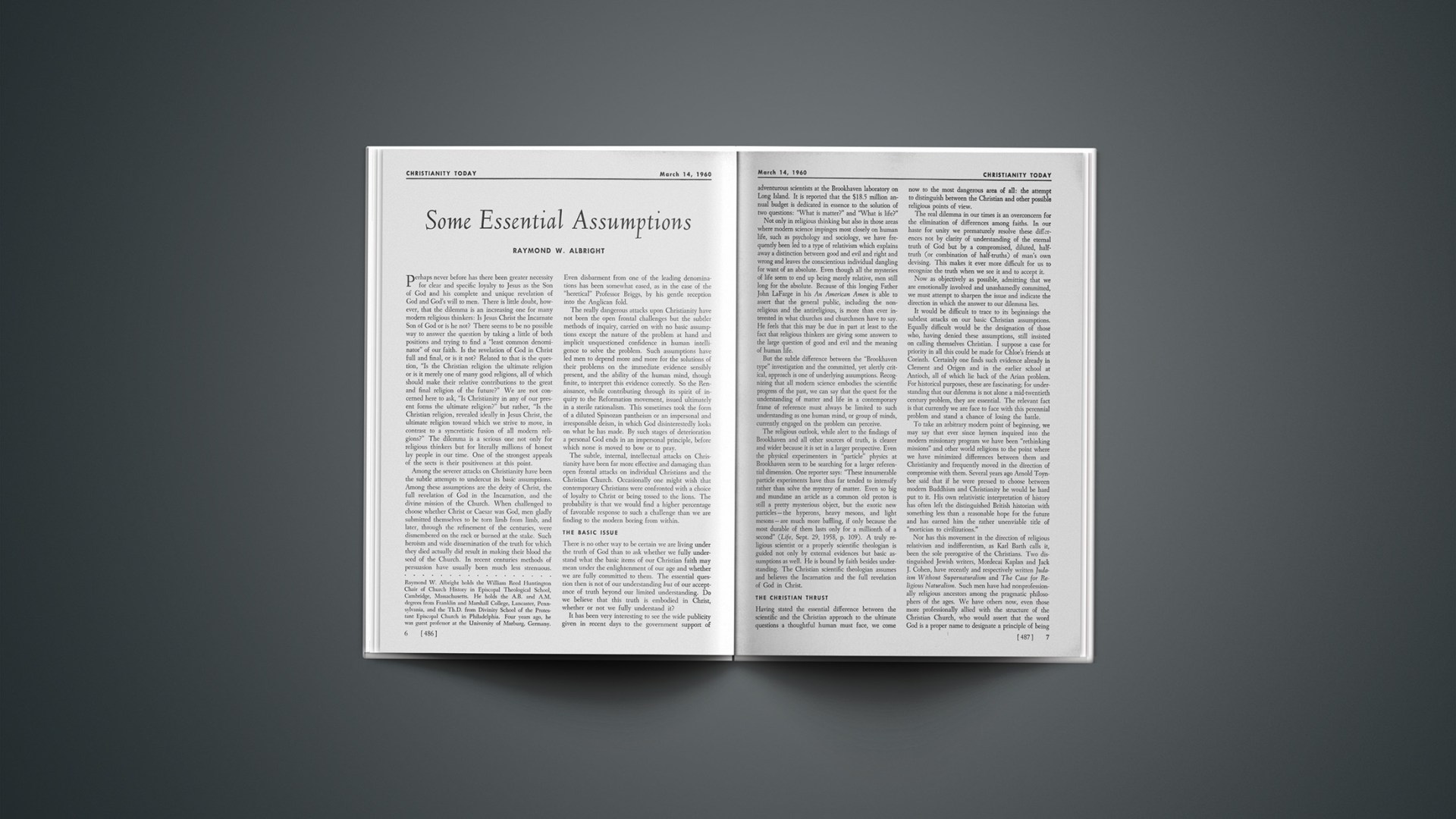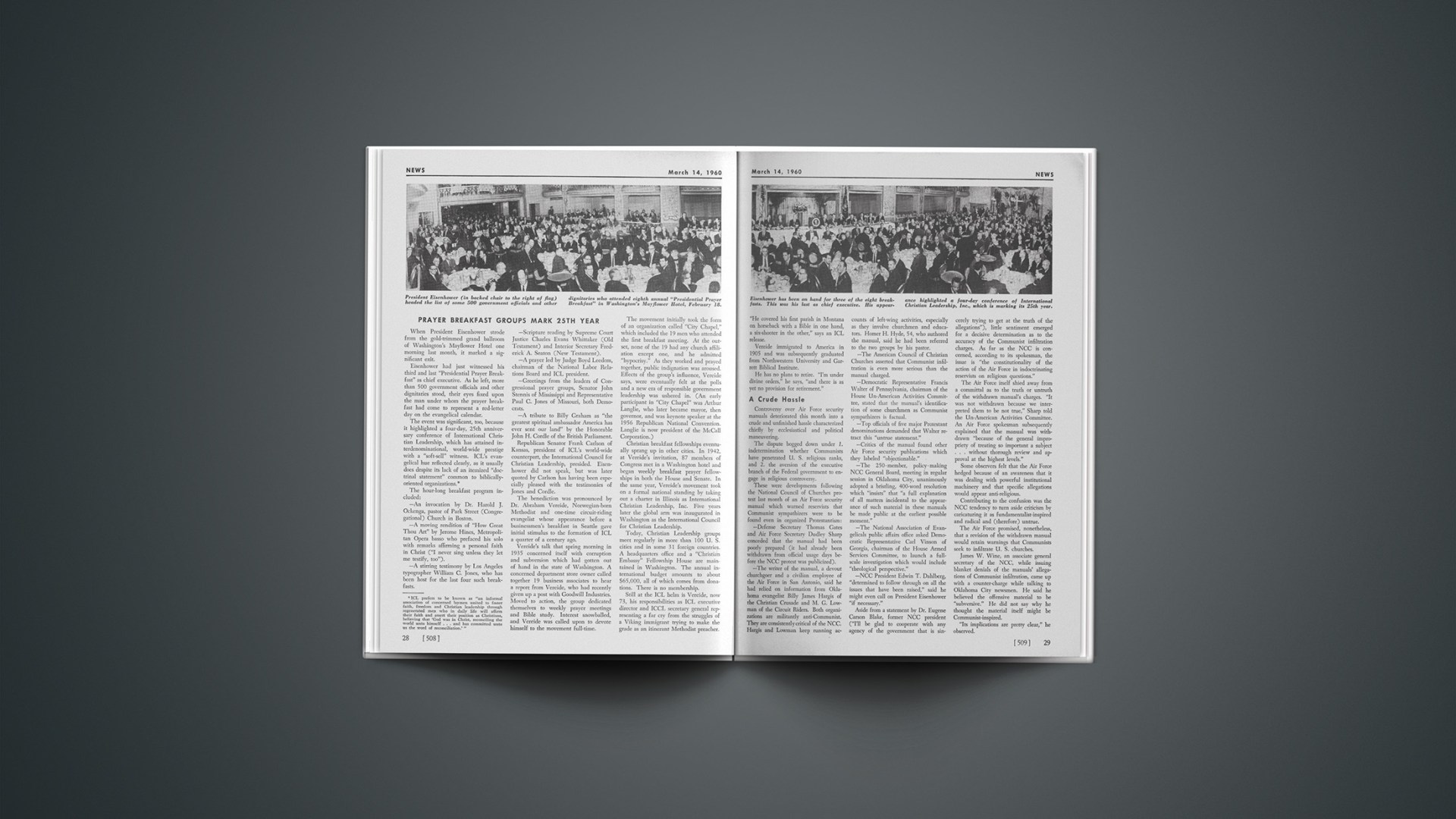
Prayer Breakfast Groups Mark 25th Year

When President Eisenhower strode from the gold-trimmed grand ballroom of Washington’s Mayflower Hotel one morning last month, it marked a significant exit.

Eisenhower had just witnessed his third and last “Presidential Prayer Breakfast” as chief executive. As he left, more than 500 government officials and other dignitaries stood, their eyes fixed upon the man under whom the prayer breakfast had come to represent a red-letter day on the evangelical calendar.

The event was significant, too, because it highlighted a four-day, 25th anniversary conference of International Christian Leadership, which has attained interdenominational, world-wide prestige with a “soft-sell” witness. ICL’s evangelical hue reflected clearly, as it usually does despite its lack of an itemized “doctrinal statement” common to biblically-oriented organizations.1ICL prefers to be known as “an informal association of concerned laymen united to foster faith, freedom and Christian leadership through regenerated men who in daily life will affirm their faith and assert their position as Christians, believing that ‘God was in Christ, reconciling the world unto himself … and has committed unto us the word of reconciliation.’ ”

The hour-long breakfast program included:

—An invocation by Dr. Harold J. Ockenga, pastor of Park Street (Congregational) Church in Boston.

—A moving rendition of “How Great Thou Art” by Jerome Hines, Metropolitan Opera basso who prefaced his solo with remarks affirming a personal faith in Christ (“I never sing unless they let me testify, too”).

—A stirring testimony by Los Angeles typographer William C. Jones, who has been host for the last four such breakfasts.

—Scripture reading by Supreme Court Justice Charles Evans Whittaker (Old Testament) and Interior Secretary Frederick A. Seaton (New Testament).

—A prayer led by Judge Boyd Leedom, chairman of the National Labor Relations Board and ICL president.

—Greetings from the leaders of Congressional prayer groups, Senator John Stennis of Mississippi and Representative Paul C. Jones of Missouri, both Democrats.

—A tribute to Billy Graham as “the greatest spiritual ambassador America has ever sent our land” by the Honorable John H. Cordle of the British Parliament.

Republican Senator Frank Carlson of Kansas, president of ICL’s world-wide counterpart, the International Council for Christian Leadership, presided. Eisenhower did not speak, but was later quoted by Carlson has having been especially pleased with the testimonies of Jones and Cordle.

The benediction was pronounced by Dr. Abraham Vereide, Norwegian-born Methodist and one-time circuit-riding evangelist whose appearance before a businessmen’s breakfast in Seattle gave initial stimulus to the formation of ICL a quarter of a century ago.

Vereide’s talk that spring morning in 1935 concerned itself with corruption and subversion which had gotten out of hand in the state of Washington. A concerned department store owner called together 19 business associates to hear a report from Vereide, who had recently given up a post with Goodwill Industries. Moved to action, the group dedicated themselves to weekly prayer meetings and Bible study. Interest snowballed, and Vereide was called upon to devote himself to the movement full-time.

The movement initially took the form of an organization called “City Chapel,” which included the 19 men who attended the first breakfast meeting. At the outset, none of the 19 had any church affiliation except one, and he admitted “hypocrisy.” As they worked and prayed together, public indignation was aroused. Effects of the group’s influence, Vereide says, were eventually felt at the polls and a new era of responsible government leadership was ushered in. (An early participant in “City Chapel” was Arthur Langlie, who later became mayor, then governor, and was keynote speaker at the 1956 Republican National Convention. Langlie is now president of the McCall Corporation.)

Christian breakfast fellowships eventually sprang up in other cities. In 1942, at Vereide’s invitation, 87 members of Congress met in a Washington hotel and began weekly breakfast prayer fellowships in both the House and Senate. In the same year, Vereide’s movement took on a formal national standing by taking out a charter in Illinois as International Christian Leadership, Inc. Five years later the global arm was inaugurated in Washington as the International Council for Christian Leadership.

Today, Christian Leadership groups meet regularly in more than 100 U. S. cities and in some 31 foreign countries. A headquarters office and a “Christian Embassy” Fellowship House are maintained in Washington. The annual international budget amounts to about $65,000, all of which comes from donations. There is no membership.

Still at the ICL helm is Vereide, now 73, his responsibilities as ICL executive director and ICCL secretary general representing a far cry from the struggles of a Viking immigrant trying to make the grade as an itinerant Methodist preacher. “He covered his first parish in Montana on horseback with a Bible in one hand, a six-shooter in the other,” says an ICL release.

Vereide immigrated to America in 1905 and was subsequently graduated from Northwestern University and Garrett Biblical Institute.

He has no plans to retire. “I’m under divine orders,” he says, “and there is as yet no provision for retirement.”

A Crude Hassle

Controversy over Air Force security manuals deteriorated this month into a crude and unfinished hassle characterized chiefly by ecclesiastical and political maneuvering.

The dispute bogged down under 1. indetermination whether Communists have penetrated U. S. religious ranks, and 2. the aversion of the executive branch of the Federal government to engage in religious controversy.

These were developments following the National Council of Churches protest last month of an Air Force security manual which warned reservists that Communist sympathizers were to be found even in organized Protestantism:

—Defense Secretary Thomas Gates and Air Force Secretary Dudley Sharp conceded that the manual had been poorly prepared (it had already been withdrawn from official usage days before the NCC protest was publicized).

—The writer of the manual, a devout churchgoer and a civilian employee of the Air Force in San Antonio, said he had relied on information from Oklahoma evangelist Billy James Hargis of the Christian Crusade and M. G. Lowman of the Circuit Riders. Both organizations are militantly anti-Communist. They are consistently critical of the NCC. Hargis and Lowman keep running accounts of left-wing activities, especially as they involve churchmen and educators. Homer H. Hyde, 54, who authored the manual, said he had been referred to the two groups by his pastor.

—The American Council of Christian Churches asserted that Communist infiltration is even more serious than the manual charged.

—Democratic Representative Francis Walter of Pennsylvania, chairman of the House Un-American Activities Committee, stated that the manual’s identification of some churchmen as Communist sympathizers is factual.

—Top officials of five major Protestant denominations demanded that Walter retract this “untrue statement.”

—Critics of the manual found other Air Force security publications which they labeled “objectionable.”

—The 250-member, policy-making NCC General Board, meeting in regular session in Oklahoma City, unanimously adopted a bristling, 400-word resolution which “insists” that “a full explanation of all matters incidental to the appearance of such material in these manuals be made public at the earliest possible moment.”

—The National Association of Evangelicals public affairs office asked Democratic Representative Carl Vinson of Georgia, chairman of the House Armed Services Committee, to launch a full-scale investigation which would include “theological perspective.”

—NCC President Edwin T. Dahlberg, “determined to follow through on all the issues that have been raised,” said he might even call on President Eisenhower “if necessary.”

Aside from a statement by Dr. Eugene Carson Blake, former NCC president (“I’ll be glad to cooperate with any agency of the government that is sincerely trying to get at the truth of the allegations”), little sentiment emerged for a decisive determination as to the accuracy of the Communist infiltration charges. As far as the NCC is concerned, according to its spokesman, the issue is “the constitutionality of the action of the Air Force in indoctrinating reservists on religious questions.”

The Air Force itself shied away from a committal as to the truth or untruth of the withdrawn manual’s charges. “It was not withdrawn because we interpreted them to be not true,” Sharp told the Un-American Activities Committee. An Air Force spokesman subsequently explained that the manual was withdrawn “because of the general impropriety of treating so important a subject … without thorough review and approval at the highest levels.”

Some observers felt that the Air Force hedged because of an awareness that it was dealing with powerful institutional machinery and that specific allegations would appear anti-religious.

Contributing to the confusion was the NCC tendency to turn aside criticism by caricaturing it as fundamentalist-inspired and radical and (therefore) untrue.

The Air Force promised, nonetheless, that a revision of the withdrawn manual would retain warnings that Communists seek to infiltrate U. S. churches.

James W. Wine, an associate general secretary of the NCC, while issuing blanket denials of the manuals’ allegations of Communist infiltration, came up with a counter-charge while talking to Oklahoma City newsmen. He said he believed the offensive material to be “subversive.” He did not say why he thought the material itself might be Communist-inspired.

“Its implications are pretty clear,” he observed.

Protestant Panorama

• Representatives of four merging Lutheran bodies agreed last month to name the projected denomination the “Lutheran Church in America.” The Joint Commission on Lutheran Unity originally had suggested “Lutheran Evangelical Church in America.”

• East Berlin’s public prosecutor announced last month that he would initiate preliminary proceedings for a trial of Bishop Otto Dibelius on charges of advocating disobedience to the Communist Soviet Zone regime.

• Dr. Martin Luther King, Jr., Baptist pastor, author and noted integration leader, faces a May trial on perjury charges. An indictment by a Montgomery County, Alabama, grand jury accuses King of failing to report $31,000 of personal income in state tax returns for 1956 and 1958. He is free under bond.

• Wheaton College President V. Raymond Edman is recuperating in a Chicago hospital following surgical removal of cataracts.

• Six Protestant groups plan cooperative sponsorship of a new seminary to be erected in Elisabethville, Belgian Congo. Classes are scheduled to begin this fall in temporary quarters while a $300,000 campus is being built. The sponsoring groups are The Methodist Church, the Disciples of Christ, the American Baptist Convention, the British Baptist Church, the Presbyterian Church in the U. S., and the Belgian Mission Society (Reformed).

• Westmont College plans to erect a prayer chapel in memory of Nancy K. Voskuyl, 18-year-old freshman who was killed in an auto accident in December. Miss Voskuyl was the daughter of Westmont President Roger J. Voskuyl.

• The Evangelical Free Church organized a new congregation in Arlington, Virginia, last month, its first in the national capital area.

• The Far East Broadcasting Company dedicated a new, 50,000-watt transmitter in Manila last month. Philippines President Carlos P. Garcia gave the dedicatory address.

• The Israel Baptist Convention last month dedicated a church at the site where, according to tradition, Christ performed his first miracle by transforming water into wine. Kafr Kana (or Cana, as it is known in English), is now an Arab village of 3,000 inhabitants; half are Christians and half Moslem.

• The Lutheran Church—Missouri Synod is purchasing the Milwaukee Bible College at a cost of $400,000. The school’s two-acre campus and four buildings adjoin the synod’s Concordia College.

• The Rev. Rika Nagase is the first Japanese woman ever to be ordained by the Church of the Nazarene. She now pastors a church in Hiroshima. Her husband died in 1946 after suffering shock and radiation in the first atomic bombing.

• The Christian Medical Society says it will soon move into a newly-purchased headquarters building in Oak Park, Illinois.

• Quaker-operated Earlham College plans to open a School of Religion in the fall of 1962. The seminary will be the first in history for the Society of Friends.

• The Christian Research Foundation is offering prizes totalling $2,950 for essays and dissertations on early church history by seminary students. Deadline is June 15.

• Lester F. Heins, ordained Lutheran minister who is religion editor of the Toledo Blade, is embarking on a 25,000-mile air trip through Africa, Asia, and the Middle East to report on the progress of American foreign missions.

• The Ministers Life and Casualty Union is distributing free to seminaries a new periodical devoted to current problems in practical church economics. Editor of the publication, titled Seminary Quarterly, is William P. Sahlsteen.

• The Lutheran Literature Society dedicated a new publishing center in Tokyo last month.

Rhodesia Report

Last year marked the centenary of organized missions in Southern Rhodesia. Pioneers led by David Livingstone’s father-in-law, Robert Moffat, worked 25 years before cracking the solidarity of tribal life with a single convert. Last month the Graham team reaped where the pioneers had sowed. More than 6,000 inquirers were counted in the evangelist’s Rhodesia meetings which attracted an aggregate attendance of some 100,000.

The multi-racial character of the rallies gave rise to the hope that the racial partnership vision of Cecil Rhodes, after whom the Rhodesias were named, might yet be made to work in an area where material progress is astounding.

Two camps of extremists challenged Billy Graham’s campaign in Northern and Southern Rhodesia. Some Europeans objected to the use of translators. A handful of African nationalists attempted an organized boycott of the copper belt meeting in Kitwe, tossing a few stones in the process. Neither episode materially affected the meetings, although nationalists may have trimmed somewhat the size of the Kitwe crowd.

Graham offered no detailed solution to the tangled web of race, culture, and economics that combine to make Central Africa a prime testing ground in the century of the common man. He did press the conviction that individual conversion is primary to any social advance, pointing out that Wilberforce’s discovery of the love of God provided the moral impetus for the abolition of slavery.

The tiring evangelist, who now moves on to the Holy Land for Lenten meetings in key Israeli cities, also stressed that the real hope of the Church does not lie merely in the human sphere nor in conversion of the world. He said it lies rather in the Second Advent, when God again will intervene in history to make the world’s kingdoms his own.

The influence and enthusiasm of the Rhodesian meetings extended far beyond centers where record crowds amazed crusade sponsors, many of whom doubted that mass evangelism would click in sparsely-settled Africa. At Livingstone, where Graham had hoped to rest for three days, he was importuned into addressing on two days’ notice a gathering which overflowed Victoria Hall. The result was 40 inquirers in a city where evangelical church attendance averages about 100 a week out of 4,000 Europeans.

In the Northern Rhodesia capital of Lusaka, a hastily-arranged airport meeting drew 700. Dozens of hands were lifted as a token of surrender to Christ.

The gathering storm of African nationalism was sensed everywhere if one probed even slightly below the placid surface. Most Europeans, however, still relaxed in a luxurious standard of living which appeared to exceed even that of the average American. Africans, underpaid, chafe at Southern Rhodesian restrictions on land ownership and housing. Many Europeans consider the mission field a distant project and thus overlook the Negro houseboy whose fumbling service often proves exasperating.

Church attendance in the cities is poor. Graham’s challenge attacked the citadels of Satan in a way which may stimulate a more aggressive program in lands where evangelism heretofore was regarded as mass hysteria.

The big problem of the African church is a dearth of trained leadership, causing many intellectuals to scorn the pulpit. There are no major obstacles, however, to evangelizing the sprawling African urban centers. Segregated housing presents a favorable contrast to West African and American slums, but overcrowded conditions contribute to the deplorable moral conditions. There is no organized paganism.

Ten per cent of the Africans in Southern Rhodesia belong to evangelical churches, compared to 20 per cent of the Europeans. Roman Catholicism claims five per cent of the Africans. The strongest European communions are the Anglican, Methodist, Presbyterian, and Dutch Reformed. Among Africans, the evangelical thrust is led by these plus Brethren in Christ, Salvation Army, Southern Baptists, Churches of Christ, Plymouth Brethren, South African General Mission, and Assemblies of God.

Northern Rhodesia has a united church of 15,000 strong composed of Presbyterians, Congregationalists, and Methodists.

One observer said African nationalism probably will throw out the baby with the bath water if churchmen oppose any crucial point. He added that European missionaries and pastors must be careful lest the government detain or deport them for challenging prevailing racial or economic policies.

Rounding out the picture is a laissez faire economy in which, some say, big business exploits Africans mercilessly. Others point out that new businesses are training more Africans, thereby upgrading wages.

Graham said repeatedly that the total commitment to Christ of even a small minority would inject a new spirit of dedication and would help to create a new atmosphere of love in which problems could be solved.

Top governmental and business leaders saw a real hope in the results of the meetings. Graham was careful to point out that his own role was minor compared to that of the mobilized church which gave him almost total support.

Tanganyika Trip

Billy Graham’s trip into Tanganyika provided the most spectacular meeting of his African tour.

At Moshi, near the base of 19,565-foot Mt. Kilimanjaro, more than 5,000 inquirers stepped forward from a crowd of 35,000. Perfect weather provided a full view of the famous snow-capped peak.

Tanganyika is the most relaxed East African country in view of the progress toward self-government and the lack of a white settler issue. Nearly 10 per cent of Tanganyikans are Protestants. Another 10 per cent are Catholic. Lutherans account for nearly half the Protestants.

Many climbed trees to hear Graham. The meeting was held across the road from a mosque. It was the biggest religious gathering ever seen in Tanganyika and left a marked impression in favor of the Christian community which is rapidly becoming indigenous.

Articles Antiquated?

Dr. W. R. Matthews, dean of St. Paul’s Cathedral in London, says the Church of England’s historic Thirty-nine Articles should be revised because they are now “worthless as an ordination test.”

All Anglican clergymen are required to subscribe to the Articles. Until the nineteenth century, members of the universities of Oxford and Cambridge also were required to subscribe.

In a sermon at Cambridge last month, Matthews characterized the sixteenth-century document as a summary of Anglican dogmatic tenets in relation to theological controversies of that time which does not represent the present mind of the church.

Theology Fellowships

The American Association of Theological Schools announced last month 31 fellowship grants for the academic year 1960–1961. The grants, made possible by the Sealantic Fund, are issued annually to faculty members of AATS member schools.

Chief aim of the fellowship program is improvement of theological education through advanced faculty study. It also serves to strengthen sabbatical leave policies in member schools. Fellows must be nominated by their schools and are chosen by a Commission on Faculty Fellowships of the AATS.

This year’s grants range up to $4,000. They enable fellows to be on leave from eight to fifteen months in various study centers in the United States, England, Germany, France, the Near East, and the Orient. The 1960–61 fellows:

Waldo Beach, Duke Divinity School; David R. Belgum, Northwestern Lutheran Theological Seminary; John B. Cobb, Southern California School of Theology; Walter B. Davis, Eastern Baptist Theological Seminary; Pope A. Duncan, Southeastern Baptist Theological Seminary; George W. Frey, United Theological Seminary; Daniel P. Fuller, Fuller Theological Seminary; Lee J. Gable, Lancaster Theological Seminary; Langdon B. Gilkey and J. Philip Hyatt, Vanderbilt Divinity School; Norman K. Gottwalt and Roy Pearson, Andover Newton Theological School; Holt H. Graham, Protestant Episcopal Theological Seminary of Virginia; Van Austin Harvey, Perkins School of Theology, Franz Hildebrandt and Carl Michalson, Drew Theological School; Harland Hogue and Robert C. Leslie, Pacific School of Religion; Walter Holcomb, Boston University School of Theology; Franz Hildebrandt and Carl D. Williams, Union Theological Seminary of New York; Winthrop S. Hudson, Colgate Rochester Divinity School; Robert F. Johnson, Episcopal Theological Seminary of the Southwest; Johannes Knudsen, Chicago Lutheran Theological Seminary; Neely D. McCarter, Columbia Theological Seminary; E. Clifford Nelson, Luther Theological Seminary; Wayne E. Oates, Southern Baptist Theological Seminary; Benjamin L. Rose, Union Theological Seminary of Richmond; C. W. Scudder, Southwestern Baptist School of Theology; Dwight E. Stevenson, College of the Bible; Henry J. Stob, Calvin Theological Seminary; H. G. Van Sickle, Iliff School of Theology; and Gibson Winter, Federated Theological Faculty of the University of Chicago.

People: Words And Events

Deaths: Dr. Henry Wade Dubose, 75, noted minister of the Presbyterian Church in the U. S. and former president of the General Assembly’s training school in Richmond, in Sweet Briar, Virginia … Dr. C. K. Irwin, former Bishop of Connor (Ireland) … Mrs. Ira Landrith, 93, retired Presbyterian missionary to Japan, in Duarte, California … Dr. Joseph W. Schmidt, 38, president of Grace Bible Institute … the Rev. G. F. Hedstrand, 74, retired editor-in-chief of publications for the Evangelical Covenant Church, in Chicago … Mrs. E. H. Cressy, 79, retired American Baptist missionary, in Manila.

Election: As Bishop Coadjutor of Sydney, Australia, the Rev. A. W. Goodwin Hudson.

Appointments: As dean of Colgate Rochester Divinity School, Dr. Milton C. Froyd, who will also serve as senior professor of pastoral theology … as dean of the University of Southern California’s new School of Religion, Dr. Geddes MacGregor … as executive secretary of the Board of Women’s Work of the Presbyterian Church in the U. S., Miss Evelyn L. Green.

Retirement: As president of the American Evangelical Lutheran Church, Dr. Alfred Jensen, effective at the end of the year.

Citation: As 1960 “Chaplain of the Year,” Roman Catholic Chaplain Colonel John K. Connolly, by the Reserve Officers Association.

WCC Withdrawal Reunites Korean Presbyterians

The Presbyterian Church in Korea, reunited on February 17 after a four-month schism, subsequently voted to withdraw from the World Council of Churches as part of the price of its reunion.

The vote represented a voluntary compromise on the part of the ecumenical party in the church who control the assembly and who still favor membership in the WCC but who accepted the withdrawal as a necessary step to bring the anti-ecumenical minority party back into the fellowship of Korea’s largest Protestant denomination.

Official commissioners reuniting at the February 17 assembly numbered 230 at the opening roll call. By the end of the three-day meeting the number had risen to 251, or 87 per cent of the attendance at the ill-fated Taejon General Assembly in September where ecumenical and anti-ecumenical commissioners split into two rival assemblies. Of the original 286 Taejon commissioners, 198 were present at the reunion.

A rough estimate of the relative strength of the reconciled parties in the reunited assembly is: ecumenical 150, non-ecumenical 50, and neutral 50.

Considerable debate preceded the vote to withdraw from the World Council of Churches. Since the more radical opponents of the ecumenical movement had rejected reunion and retained control of their own divided minority (anti-ecumenical) assembly, it was suggested that it might not be necessary for the united assembly to withdraw. But the commissioners finally agreed to honor the terms of the plan of reunion which brought them together and which included the promise of WCC withdrawal. There was only one dissenting vote.

They added, however, a statement declaring that the World Council of Churches was neither pro-communist, nor organized to promote theological liberalism or a super-church, and that the sole cause of withdrawal was for the sake of the peace and unity of the Presbyterian Church in Korea.

Korean Presbyterians are still suffering from two earlier schisms which resulted in the formation of the 140,000-member Koryu Presbyterian Church in 1951 and the 200,000-member Presbyterian Church in the ROK in 1954. The parent body, the Presbyterian Church in Korea, had 536,000 members at the time of the September schism.

Commissioners, by voting to label their reuniting assembly as the 44th, ignored the two rival assemblies held subsequent to the breakup at Taejon. The Taejon meeting had convened as the 44th General Assembly.

The united assembly elected as its moderator 74-year-old Rev. Chang Kyu Yi, moderator of the former majority (ecumenical) assembly, and chose as vice moderator the Rev. So Joo Oh, white-bearded moderator of one of the largest presbyteries in the former minority assembly. Recognition was given neutrals by the election of a Seoul pastor, the Rev. Sei Chin Kim, as stated clerk.

Presiding at the assembly until the elections were held was the Rev. Kyung Chik Han, pastor of Seoul’s 6,000-member Yong Nak Presbyterian Church. The assembly was held in the historic Seimoonan Presbyterian Church, oldest Protestant congregation in Seoul.

Three days of pre-assembly special meetings led by Dr. L. Nelson Bell, Executive Editor of CHRISTIANITY TODAY and a member of the Board of World Missions of the Presbyterian Church in the U. S., brought commissioners into the reuniting assembly in a quiet, earnest mood far removed from the turbulent spirit that had disrupted the Taejon assembly. All three cooperating missions, United Presbyterian, Southern Presbyterian, and Australian Presbyterian, strongly supported a reconciliation call.

Only the rejection by a small group of anti-ecumenical extremists prevented a complete healing of the schism. The extremists, encouraged by the leadership of the International Council of Christian Churches to promote the breach, may form a new, organized faction within Korean Presbyterianism.

Legal difficulties still face the reunited assembly. The dissident party is pressing a civil suit which asks that a rival assembly held in November be declared as representative of the Presbyterian Church in Korea. Also involved in the issues of the suit is the Presbyterian seminary near Seoul, which suffered disruption of classes as a result of the schism.

The assembly confirmed the status of the 45-member seminary board of directors who had been registered with the government’s Ministry of Education prior to the split. A seven-member committee was appointed to select a president for the seminary, largest in Asia.

Reports from the seminary described the situation as “most encouraging.” Some 230 students were said to have returned to classes, and more were on their way. About 70 are attending a rival seminary operated by the anti-ecumenical extremists.

Ideas

The Challenge of the Lenten Season

Lent constitutes both a challenge and an embarrassment to Protestantism. Each year as the season approaches it brings with it the temptation to equivocate. We do not know where we stand because our feet seem to be stuck in both camps.

On one side, our conscience serves to remind us that (if we are the practicing Christians we claim to be) we had better “do something” about observing the most sacred season in the Christian calendar. We are reminded further of what we know all too well, namely, that we have been over-indulgent, and that it would be an excellent idea to place ourselves under some kind of spiritual and physical discipline. It would not hurt us to “give up something for Lent.” On the level of personal habits we could stand a more rugged Christian discipleship.

Furthermore, the world in its own careless way seems to expect something of Lent. It is a time when the claims of Jesus Christ appear to enter the scope of legitimate inquiry. Publishers issue books of sermons and devotions dealing with the cross of Christ; pastors preach messages on the events surrounding Calvary, with the confidence that even the most liberal members of their congregation will hardly criticize the subject matter; motion picture theaters cater to the seasonal fashion by endeavoring to book “religious” films, even if these turn out to be sextravaganzas like “Solomon and Sheba” and “Demetrius and the Gladiators.”

For the minister to ignore Lent then would seem to be almost as wrong as for the minister to ignore Christmas. A rich opportunity for making Jesus Christ and his salvation real to sinners will have been neglected. The priest and Levite pass on the other side.

On the other hand, a sense of indignation stirs within the Protestant breast, even to the pitch of revolt, at what the Church has done with Lent in the past. When we see how the priesthood has used Lent to manipulate and exploit the faithful; when we survey the fuss and feathers it has raised over dietary prescriptions, and the way it has proclaimed its manifold regulations, specific demands, and sacrificial requirements, we are left wondering what it is all about. We want to draw the line with Luther and cry out, “Hier steh’ ich; ich kann nicht anders!,” and postulate the principle that every day is Lent for the Christian who lives every day in the shadow of the Cross. We are ready to cheer when Zwingli stands before the cantonal council of Zürich and defends his printer’s claim that the typesetters need to eat solid meat to do their work; and why in heaven’s name shouldn’t they have it?

Furthermore it is certainly patent that Lent is nowhere observed as a sacred season in the New Testament; hence it must be a development of later Church tradition. (The same may be said, of course, of Christmas and Easter.) As if to forewarn against such eventualities, Paul specifically cautions the Galatians against observing “days, and months, and times, and years,” and against returning in bondage to “the weak and beggarly elements.” Why then should not evangelical Christians forget about Lent altogether, and “stand fast in the liberty wherewith Christ hath made us free”? Why not stand alone in blazing nonconformity, and love God, and do as we please?

Such being the situation, we have our choice of the horns of the dilemma. Understandably, there will be a strong temptation to straddle. For example, when the clerk-stenographer complains to her pastor that she is the only girl in her office who did not wear a smudge of ashes on her forehead on Ash Wednesday; that she, who says her prayers daily and disciplines her life and sings in the choir and tithes, is being singled out during Lent as apparently the only non-Christian on the staff, what will the minister do? Will he open the Book of Galatians or will he put in a supply of ashes? Or will he do both? Or neither?

Many ministers prefer not to go as far as prescribing the eating of fish during Lent. But they will patronizingly throw a fish, so to speak, to the whole Lenten idea. That is, they will make some occasional references to Lent here and there during the worship service; they will hold a special series of midweek meetings; and they will recommend certain Lenten reading. But the basic concept of Lent as a time of prayer and fasting in memory of our Lord’s passion and death will receive only lip service. And our Roman Catholic friends, who by and large take the Lenten season rather seriously, will smile gently at clumsy Protestant attempts to mark the occasion, and will murmur, “Father, forgive them, for they know not what they do.”

As a first step toward solution, we could refer to certain Scripture passages (Eccl. 3:1; Luke 22:19; Acts 20:16, and so forth) which indicate that the Christian’s observance of certain sacred periods is not wholly inappropriate. A basis for such observance may even be found in the divine order of Creation (Gen. 2:1 ff.). Surely it is not by accident that God established a rhythm in the universe, so evident in the natural order. Man is part of his universe; and just as our Lord had his seasons of prayer upon the mountain, so it is meet for us to spend time in contemplation of our Saviour and of his vicarious sacrifice in our behalf. And what better time is there for such sustained reflection than during the sacred days prior to the celebration of His resurrection?

Lent can become a time when material things are put again in their proper secondary position; when we see in the spiritual the unconquerable forces of life. It can become a time of self-examination, when we reflect upon our present position in the pilgrimage and check our directions. It can become a time of personal readjustment, not through mental resolutions to do better but through yielding ourselves afresh to the God who demands to be obeyed. And it can become a time when, by following the battered path to Calvary, we identify ourselves once again with the Saviour who makes all things new.The task of the Church during Lent is to make this experience real to the people who are Christ’s body. The form is unimportant and may well vary from group to group and from taste to taste. What is all important is that the form support, not obstruct, the way of the Holy Spirit of God who brings life to ritual and free worship alike, and who turns ashes into new men.

Laymen–Wake Up!

LAYMEN—WAKE UP!

Too few laymen realize the responsibility that is theirs as members of the Church. For the most part they have the tendency to sit passively in the pew and leave to the minister not only the preaching responsibility but the task of directing every other phase of the church’s activities.

But even more than that there is lacking in many laymen a vital experience with the living Christ, and this makes church membership more a matter of social contacts than of knowing and surrendering to the will of the Saviour.

The early Church was really founded by laymen, and we can learn much by looking at them, studying their backgrounds, and discerning what it was that sent them out to turn the world right side up and bring into reality the church of the risen Lord.

These were ordinary men who performed an extraordinary task.

Matthew had come from the Internal Revenue Service—he was a tax collector who actually levied taxes for a foreign government.

Mark was a lay companion of Paul and Peter and also Barnabas his cousin who had thought so much of Christ that he sold all that he had and submitted it to the common good.

Luke, one of the best educated of these laymen, was a physician and also a historian and writer. To him we owe the clear and factual books of Luke and the Acts.

John was a fisherman who became the beloved companion of our Lord and who wrote one of the four gospels, three epistles, and to whom was given the revelation of things yet to come—the last book in the biblical canon.

Peter, Andrew, and James, also fishermen, left their nets and under the hand of God went out to preach the story of the Cross and the empty tomb.

Paul, the brilliant university graduate, could have become a rabbi but he met Christ on the Damascus road and from that day was a man transformed by the Spirit of the living God, to receive special revelations of divine truth, and to impart this truth by word of mouth and by pen.

These men were all laymen, many of whom in the course of events went on to assume ecclesiastical posts, but as we are today had the same original handicaps and potentialities.

They were not supermen. They did have characteristics, however, that we would do well to study, for these may be ours on the same conditions.

First they had had a personal experience with Christ. “Now when they saw the boldness of Peter and John, and perceived that they were unlearned and ignorant men, they marvelled; and they took knowledge of them, that they had been with Jesus” (Acts 4:13).

Religion for too many of us is a matter only of church membership. Lacking in vital personal experience with Christ, many have never recognized themselves as lost sinners, dependent on the cleansing, forgiving, and redeeming work of Christ. They have never had the sense of a tremendous change, a reversed destination, or a new perspective.

The 1959 national Freedoms Foundation “George Washington Honor Medal” award was recently presented to Dr. L. Nelson Bell for his regular CHRISTIANITY TODAY feature, “A Layman and His Faith.” The citation commended Dr. Bell for “an outstanding achievement to bring about a better understanding of the American Way of Life.” This is the fourth time Dr. Bell has been similarly honored by the national Freedoms Foundation.

Little wonder that those with whom we rub shoulders in business, or meet casually on the street, see no difference between us and the other cultured pagans about us. There is no aroma of the presence of Christ, no evidence of his transforming power, no word from our lips to indicate that we are not our own but belong to him who has bought us with the greatest price in the annals of eternity.

Secondly, these early laymen were filled with the Spirit. They had experienced his wonderful infilling.

Dumbfounded but thrilled over seeing the resurrected Christ with whom they had spent three years, they were not yet ready to witness for him. “Tarry ye in Jerusalem” was the command. “Ye shall receive power,” was the promise. “And they were filled with the Holy Ghost, and they spake the word of God with boldness” was the fulfillment.

Testimony to experience of such spiritual power is pitifully uncommon today. We are afraid of being fools for Christ’s sake. We do not want to become “emotional” or “take our religion too seriously.”

It is this absent recognition of absolute need of the Holy Spirit that is handicapping seriously the witness of laymen in the Church today.

The Holy Spirit will be given to us in response to prayer and surrender. Without his presence and power there can be no effective witness.

The early Christians were men of prayer. They knew the privilege and blessing of prayer. We read: “And when they had prayed, the place was shaken where they were assembled together.” “These all continued with one accord in prayer.” “Peter went up to the house top to pray.” “And when they had fasted and prayed, and laid their hands on them, they sent them away.”

Prayerless laymen are useless laymen. When God has placed such a glorious privilege and power at our disposal, why do we so constantly neglect it?

The laymen of the early Church had the Old Testament Scriptures. Following the example of their Lord they knew, believed and used the Scriptures.

Again and again they resorted to the Bible, to Moses, the prophets, and the Psalm writers who had foretold Messiah, and that Christ was this One.

They accepted the full integrity and authority of the Word, and in their hands it was the Sword of the Spirit.

Laymen today cannot afford to be spiritual illiterates; they too must steep themselves in this God-breathed literature. In so doing they become effective witnesses for the Christ revealed therein.

These early laymen talked, preached, and lived Christ. They had a consuming desire to tell others who he was and what he had done, even in their own lives. They were assured in their hearts that the hope of salvation rested in none other than Christ, and the responsibility of telling the story was their own.

How different it is with us today! Christian laymen have the same wonderful Saviour to know—the same infilling of the Holy Spirit can be theirs—the same privileges of prayer are available—the Bible in its entirety is an open Book—the whole world needs their witness.

What are we going to do about it?

L. NELSON BELL

Eutychus and His Kin: March 14, 1960

CHAMPIONSHIP PLAY

Now I saw in my dream, that as Christian toiled up a steep road in the evening, he came to a city set on a hill, and there was a great church there, and Christian quickened his weary pace to seek rest. As he entered a hall he met a man with shorn head.

DR. IVY: Good evening, friend. What a convincing costume! The stage lights are operating again. We’ve added another circuit. Will you be through with the play rehearsal in time to drop in on the bowling?

CHRISTIAN: But sir, I thought this was a house of worship—have I come again to Vanity Fair?

DR. IVY: I beg your pardon, I thought you were in the cast of Dark Pilgrimage. The sanctuary is open for meditation. This is the fellowship hall. Glad to have you watch the bowling, though. It’s a match for the championship—the Men’s Bible Class against the Usher’s Association.

CHRISTIAN: A Bible class at the game of bowls? Do you thus redeem the time in evil days? And do you speak of stage plays in this place?

DR. IVY: You seem tense, friend. Perhaps we should talk this over. Here, step into our counseling room.

Now as I dreamed, I saw Christian enter a darkened room and lie upon a couch. Dr. Ivy began to converse concerning Christian’s childhood, but Christian forthwith fell asleep. After a time Dr. Ivy left him. When Christian awakened he sought to leave, but hearing shouts, he entered a hall where men rejoiced at sport.

DR. IVY: There you are! The match is nearly over. This is the league champion about to roll. Has five consecutive strikes. Watch his follow-through! There it is! A strike!

CHRISTIAN: Would that such zeal were found among pilgrims to the celestial city! Alas, like Joash at the bed of Elisha, we smite but thrice when we should strike again and again till the victory is gained.

DR. IVY: The last one—a seventh strike! The ushers defeat the Men’s Bible Class! What a victory!

Now in the tumult Christian slipped away and traveled on singing this song: When saints fellowship at bowling pins, Their mirth may cover many sins; But guttered are their life-score tallies Who seek the Kingdom first in alleys!

EUTYCHUS

ROME AND THE PRESIDENCY

Your pitiable editorial (Feb. 1 issue) in opposition to the election of a Catholic president … gives to an intelligent reader a picture undoubtedly more clear than you realize of your own psychological status.… It has been said that prejudice, hatred, bigotry—all synonymous—are definite indications of, at the very least, incipient mental illness.

Now, to be sure, you meet in advance … the to-be-expected interpretation of your views as “Romish smear.” The very fact that you do so may well indicate your guilt feelings, which, even though they were suppressed, probably instigated and accompanied the writing of your editorial. Well … I think you will find that few Catholics who try to imitate Christ will even remotely attempt to “smear” you. ELIZABETH J. MUNNEGLE Providence, R. I.

Your [editorial] is a direct affront to the teaching of Christ and his Church.… You must be a follower of Henry VIII who is described in history as a murderer, adulterer, hangman, brute, and savage, and the most inhumane monster that ever cursed the earth.

J. FITSIMMONS

St. Paul, Minn.

I am a Roman Catholic, a voter who had no idea of voting for Sen. Kennedy … but on second thought the writer and hundreds and hundreds of other Roman Catholics may accept your challenge re the verbal garbage dished out by one of your barfly pinks.

JACK MCNULTY

New York, N. Y.

How stupid can you get—one should be told to vote for the man, not his religion. St. Petersburg, Fla.

HELYNE MCGRATH

You poor, bewildered thing.

M. DONNELLY

Rantoul, Ill.

• CHRISTIANITY TODAY is glad to reflect the views of its (growing number of) Roman Catholic readers, as well as of Protestant clergy and laity, on the issue of a Roman Catholic in the White House.

—ED.

YOU ARE TO BE CONGRATULATED FOR YOUR STAND AND FORTHRIGHT PRESENTATION WHICH IS SO HELPFUL IN DEVELOPING A REALIZATION THAT THE CHURCH OF ROME WILL BE JUDGED … BY ITS PRACTICES RATHER THAN BY ITS TEACHING.

WILLIAM H. WORRILOW, JR.

Lebanon, Pa.

Please let me compliment you.… Protestants and all others who do not give allegiance to the Pope must unite as one to see that no Roman Catholic occupies the White House.

BYRON O. WATERMAN

Baptist and Congregational Parish

Greene, R. I.

We are a hundred per cent with you in the position which you take. The rapidly growing power of Rome in our country is one of the greatest menaces to the fundamental principles of separation of church and state, and liberty of conscience and freedom of speech and of the press. Wherever Rome has the power these disappear. Already the press, radio, and television are under virtual censorship, and the truth about the papacy is deleted from our histories and textbooks.

Unfortunately many Protestant leaders have gone soft, and are blind to the dangerous trends.

W. C. MOFFETT

Columbia Union Conference of Seventh-day Adventists

Hagerstown, Md.

I commend [the editorial] as a … fair, courageous, and timely presentation of the truth. No doubt mud, brickbats, and what-not have already been hurled your way. Continue the good work. Our prayers are with you.

GROVER KIMBERLIN

Free Methodist Church

Morgantown, W. Va.

I am in agreement.… It is illogical for Protestants to vote themselves into second-class citizenship by voting for a Catholic U. S. president. A Protestant cannot work for the government in Spain. I read that a Protestant in Spain cannot be employed at a U. S. military base in Spain. Since these conditions exist today, one does not need to go back to the Middle Ages to find injustice under Catholic rule or domination.

C. POLLARD

Sacramento, Calif.

I am a Catholic.… As long as a man is morally and physically capable of assuming the duties of a high office, that is all that matters.

RUTH ASHLEY

Rochester, N. Y.

The history of the Catholic hierarchy … is so black that it makes me see red.…

A Catholic President could be subject to take orders from the Vatican, or perhaps be excommunicated and disgraced.

T. F. SHANKEL

San Francisco, Calif.

I agree and go farther because he has pledged his first allegiance to the Pope of Rome and would be dictated to by him and if he didn’t obey he would be excommunicated and that is what every Catholic fears.

JOHN MOHRING

Ellsinore, Mo.

This type of thing can only do harm to our country. May God forgive you.

LEWIS B. EATES

Brunswick, Me.

I want to express my sincere appreciation. I wish that every voter in these United States could be provided with a copy of that editorial.

A. PRESTON GRAY

Kingsport, Tenn.

I feel the printing of such editorials is a direct approval by you of intolerance, prejudices, and false ideas against the Catholic church.

I also feel it would be well for all concerned to sit down and take note of your own teachings and beliefs and to leave governmental problems up to the people who have shown themselves capable.

Informed Protestants as the author stated would do well to disregard your magazine before they are filled with the uncharitableness which was written into every word of the editorial. Informed Protestants would also do well to become a little more informed about Catholicism before they write material which strays so far from the Truth.

(MRS.) NEAL R. OLSON

St. Louis, Mo.

It was encouraging to read … that one publication was courageous enough to take a position against election of a Roman Catholic as President.

After reading in the press announcements by [Episcopal and Methodist bishops] that there was no reason why a Roman Catholic wouldn’t make a good president of the United States, I thought perhaps I should re-evaluate my faith and that my limited historical understanding of the Reformation was in error and we should all become Roman Catholic converts.

(MRS.) HOMER C. STEVENS

Franklin, Pa.

The Vatican, if I may inform you, has no intention and no need to control the United States because it is the head of an organization which strives for spiritual goals, not material goals.

MARY GRAHAM

Chicago, Ill.

I would like to question your reference to a foreign, earthly power.… In the Roman Catholic Church the Pope is well versed in philosophy and God’s teaching and he is in charge of interpreting this. In fact, he is similar to the President of the United States, whose function it is to uphold the Constitution of the United States.

(MRS.) JOHN MAGINOT

Berwyn, Ill.

The Catholics [also] have alert and well planned thinking to see that the successor to J. Edgar Hoover of the FBI will be a Catholic.

It would pay the Protestants to become very concerned as to the preponderance of the number of Catholics appointed to West Point and Annapolis recently. The Catholic politicians who make these appointments are appointing nothing but Catholics.

F. C. ANDERSON

Chicago, Ill.

You rendered again a most essential service to America by calling our attention to the actual meaning of bigotry; it has always been the enemy of Christ, of America, and of freedom everywhere. I accept your dictionary’s definition of a bigot as “one who is obstinately and irrationally, often intolerantly, devoted to his own church, party, belief or opinion … unreasoning attachment to one’s own belief.”

As you point out it is the classic technique of bigotry to call every critic a bigot (if not anti-Semitic). For example, could it not be the same unscientific evaluation by the Roman Catholic hierarchy which condemns Galileo’s scientifically sound position in one century and birth control in another? Does this same religion not practice, while it condemns it, birth control in its most unholy form by outlawing the marriage of its own priests and nuns? Has it not been humanly ruled, falsely ruled, that God’s divine command “Be ye fruitful and multiply” does not apply to a certain class? What unbiblical, therefore unethical, error this is! What a defeating of human happiness and what encouragement to unnatural sex practice! And in the name of infallible “truth”!

Then comes the Roman Catholic attempt to muzzle American doctors and citizens, denying us our American constitutional right of freedom of speech on this subject of planned parenthood. Even the Presbyterian President of the United States whom I deeply respect has fallen for this blackout of freedom of speech and religion by denying government agencies abroad the right of freedom of speech in this area. How dare we aid such unscientific religious bigotry in the name of American freedom or Christian ethics? This could be like Rome’s condemnation and persecution of the great Roman Catholic Galileo for espousing the Copernican truth that the sun, not the earth, is the center of our planetary system.

And secondly, what sort of un-American bigotry is it in Rome, New York, Pittsburgh, Chicago and Los Angeles that makes it wrong for Roman Catholic Americans everywhere to enter the Baptist, Methodist, Lutheran, Presbyterian or Episcopal churches? Is the aim to protect Romanists from God’s holy truth lest they defect? This is how it appears, and this is as un-American as any Russian containment of human beings by threat and reprisal.…

These two forms of bigotry Americans dare not encourage by silence if constitutional America is to be America instead of Spain, Colombia or Russia: 1. The religious bigotry that denies freedom of speech about the scientifically and morally acceptable information about birth spacing to married couples. 2. The bigotry that denies freedom of religion to Roman Catholic American citizens.

ROBERT W. YOUNG

North Presbyterian Church

Pittsburgh, Pa.

BAPTIST AUTHORITY AND POWER

In regards to the new book by Paul M. Harrison, Authority and Power in the Free Church Tradition, I have a few comments I feel impelled to make. You are quite right in your review (Dec. 21 issue) to predict this book may “explode among Baptists.” However, for the sake of the many non-Baptist readers I would like to clarify one or two points touched on in your review. 1. In the American Baptist Convention which I serve as a minister there is complete autonomy for the local church. We are not told in any way what we have to do, either in matters of church polity, or in our missionary giving. Obviously, any American Baptist church would want to support to the fullest of their ability American Baptist missionary projects, and they are encouraged to do so, but not forced or coerced in any way. While American Baptists are a part of the National Council of Churches, none of our Unified Budget goes to its support. Only the churches which designate funds (as ours does) for National Council support, have their money used for this purpose. A Baptist church is not dictated to by any agency in the selection of a pastor; much needed help is offered by our State Conventions in the area and the wise church will use this help, but they are in no way forced to accept it. Our State and National Societies exist only to provide central cooperative agencies through which our Baptist witness may be more effectively communicated. They are the servants of the churches and their officers are elected at our annual Conventions. 2. The implication that our seminaries are trying to turn out “wholly loyal Alumni” is misleading.… To have “disloyal” ministers in churches, who will eventually either pull the entire church out of the denomination, or will split the church is very poor economy for any denomination. American Baptists saw this happen not in merely hundreds of cases but in over a thousand. This type of thing will breed denominational loyalty!

E. ALEXANDER LAMBERT

North Topeka Baptist Church

Topeka, Kans.

I still believe … that the local churches in the early period of Christianity were independent and interdependent. There is no difficulty today in the Baptist denomination with regard to the independency of the local church. Our denominational agencies are taking care of work which is cooperative and in that way we show that we still are interdependent. There is no difficulty with the method of work today. Difficulties arise when individuals in the agencies forget that they are supposed to be servants of the local churches and not their masters.

P. STIANSEN

Northern Baptist Seminary

Chicago, Ill.

Jesus: Leader or Saviour?

I believe in the Fatherhood of God, the Brotherhood of Man, and the Leadership of Jesus.

This was almost a creed with Unitarians until recent years when they abandoned all statements of belief in favor of “absolute freedom of belief.” This descent from Channing’s Arianism to a relegation of God himself to the personal idiosyncrasy of each individual, as is now the case, was quite logical. Commenting on the growth of Unitarian theories among Methodists and Congregationalists in particular, a New England minister once said: “We are now where Channing was. In 50 years we will be where Unitarians are now—in humanism.” It seems to me he was right.

More than 10 years ago, after serving 22 years as a Unitarian minister, I returned to the church of my ordination. On that first Sunday after my restoration to the priesthood, I stood at the altar and recited with the congregation the Nicene Creed. Its articles to which I was bearing witness included this:

I believe in one Lord Jesus Christ …

God of God, Light of Light, Very God

of Very God, being of One Substance

with the Father.…

There the issue is struck: Jesus as the ideal, good man, the world’s supremely ethical and spiritual leader, yet a product of his time; or God having taken upon himself our flesh so that he might do for us what no mere human leader could do. My experience as a Unitarian clergyman convinced me that there was no halfway house between those two positions.

SHUDDERING CLERGY, APPLAUDING LAITY

At interdenominational meetings, I had heard clergymen pile adjective upon adjective in glorification of Jesus, and yet the speaker was talking about one whose difference from the rest of us was only one of degree, not of kind. Our denomination was largely made up of refugees from what we called, with a shudder, “orthodoxy.” Higher criticism of the Bible, scientism, liberalism in general (and Walter Lippmann’s “acids of modernity”) had rendered their former position odious. When singing the old hymns and administering the ordinances and sacraments, they felt like hypocrites. And they often paid a high price for their “leap over the wall.” As one man told me, “I could have gone right on preaching Unitarianism in my Baptist church before Sunday congregations of a thousand and more. Now that I bear the Unitarian label the same sermons bring in a congregation of barely one hundred.” Unitarianism was a despised word among his former parishioners, whereas the thing itself was unrecognized and therefore accepted.

What might have been my own future had the Unitarians stuck to their Unitarian “theology” I do not know. But as I saw every trace of theology washed away and repudiated within 20 years time, I knew I had to consider theism as a matter of personal choice—not so much lest I deny God, as lest I belittle him—or else look over again the grounds for belief in the theology I had quit. I was not imaging that the demise of Unitarianism was proof of the theology of Chalcedon. If I were ever again to acknowledge Christ as God incarnate and second Person of the Trinity, I must now have evidence to justify it.

REBUILDING A LOST FAITH

Thus I began the slow process of rebuilding a lost faith. At first the New Testament ranked in my eyes like other ancient literature. Why had any of it been written? Who had gathered it together, pronounced its authenticity, and declared it to be inspired by the Holy Ghost? Surely it had not been let down out of heaven on a string. What did the first Christians have for written authority while the New Testament books were in the making? All such questions ran through my mind until one by one the answers came to me. Humanly speaking I saw that the New Testament was the product of the faith “once for all delivered” in oral form by Christ. Paul makes that clear when he says, “I delivered unto you what I myself received.”

This knocked out completely an old Unitarian and liberal Protestant claim that the Church, and particularly Paul, had taught a religion about Jesus rather than the religion of Jesus. All the world knows that the religion of Jesus has been given it by that same Church with her religion about Jesus. If the Church had been worshiping Jesus, she would never have stultified herself by declaring as inspired books that would have turned her worship into sheer idolatry and blasphemy. Christianity then, I saw, had never been Unitarian. And a re-reading of the New Testament, freed from the false suppositions of liberalism, verified it. The Gospels were not biographies in the modern sense—they were propaganda. Their purpose was to bring men to accept Christ so that through him their separation from God since the Fall might be healed. The powers he exercised to forgive sin were divine. The Jews were quick to see the blasphemy involved and to seek his downfall. He might have saved himself before Pilate by denying that he was other than human. These were the things I could see without yet accepting the New Testament as Scripture. St. Anselm’s words struck me as being absolutely true: Aut deus, aut non bonus. If, as the liberals claimed, he was the perfect human being, he had also to be God.

Then I thought of the crucifixion. Why had the Jews been so insistent on doing away with him? I recalled the washed-out teaching of a Congregational minister friend of mine: “Wipe out all the Bible,” he said. “All we need is the Sermon on the Mount and the thirteenth chapter of First Corinthians.” I could see that that would never stand up, for it implied that Jesus had been crucified for teaching the Golden Rule. Is it not a Jewish boast that nothing in the Sermon goes beyond the Prophets?

ON TO THE ATONEMENT

From then on the going was easy. It remained for me to find a bishop who would take me in. I could see that it had taken time for the Church to define the full dogma of Chalcedon—that Jesus had two natures, one human and one divine, united in one Person. I could see that no mere leader could bring about the reconciliation of mankind with God. It took me a year after my restoration to accept the full doctrine of the Atonement. That too came as I reflected on the frightful mountain of human sin. As for the inspiration of Scripture, what I took at first on the authority of the Church has more and more become a matter of personal conviction. I have found that which for long I sought, namely, a solid ground between acrid literalism and arid liberalism.

Jacob J. Vellenga served on the National Board of Administration of the United Presbyterian Church from 1948–54. Since 1958 he has served the United Presbyterian Church in the U.S.A. as Associate Executive. He holds the A.B. degree from Monmouth College, the B.D. from Pittsburgh-Xenia Seminary, Th.D. from Southern Baptist Theological Seminary, and D.D. from Monmouth College, Illinois.

The Meaning and Goal of History (Part I)

The twentieth century has witnessed mounting interest in the meaning of history on the part of scholars and laymen alike. This is not a wholly new development, for man has always been inclined to seek the meaning of his own past in order to shed light on the present. But the intense interest of present day man in historical interpretation has not always characterized either scholarship nor the popular mind. The catastrophic events of the first half of the present century have given to the quest for meaning in history a new significance and urgency reflected in the increasing number of formal studies of both historians and philosophers devoted to the problem of historical interpretation.

While a philosophy of history may have been implicit in their systems of thought, it did not receive in the writings of Descartes, Leibniz, Spinoza, and Locke, that explicit treatment which has characterized so many of the great philosophies of the nineteenth and twentieth centuries. Indeed, one may well conclude that nineteenth century philosophers showed a greater concern for the interpretation of history than did many of the more prominent historians who were seemingly content, under the influence of Ranke, to let “the facts speak for themselves.” It would thus seem that the current interest in the philosophical approach to the meaning of history has been inspired and nurtured by thinkers such as Hegel and Marx who claimed the field as their own.

Until quite recently the average graduate student in American universities received in the area of historical interpretation very little formal training which was truly philosophical in nature. Ranke’s influence was dominant to such an extent that few professors in graduate schools felt the necessity of, or had the preparation to cope with, philosophical issues in the interpretation of history. What little there was proved to be hardly more than a thinly disguised Marxianism or an “Americanized” version of materialism taking the form of the Frontier thesis of Frederic Jackson Turner or the economic interpretation of American political issues in the works of Charles A. Beard. On the whole American historiography was so concerned with the acquisition and verification of historical data that it had little time left for problems of interpretation. Few American historians were disposed to look beyond Turner, Beard, or Social Darwinism to metaphysics or theology for the meaning of history; and it must be admitted that relatively few of their graduate students would have been prepared for such an approach had it been offered them. As a result the cult of scientific history with its accompanying emphasis on letting the facts “speak for themselves” continued to dominate both the writing and teaching of history in this country until well into the present century.

THE IDEALIST VISION

But even during the nineteenth century a school of philosophy emerged to challenge the assumptions of Ranke and his followers and which teachers of history as a formal discipline could not ignore. Convinced of the possibility of a meaningful philosophy of history grounded on metaphysical presuppositions, German Idealists insisted that physical and historical phenomena must be interpreted in the light of the metaphysical. In a manner unknown to modern philosophy, they claimed history as their legitimate sphere of study. The initial inspiration for this development was to be found in the writings of Kant, but it came to its own in the Hegelian system, for no other philosopher of the modern era can rival Hegel in the blindness of his attempt to bring the whole of human history within the confines of his philosophy. In his History of Philosophy and his Philosophy of History, Hegel consciously sought to set forth the meaning of the whole stream of human events in terms of his dialectical logic.

The many legitimate criticisms which can be made of this attempt must not blind us to its importance in his own age and particularly for historiography for the ensuing 100 years. It not only caught up those aspirations of the Enlightenment but also offered for the first time a conception of the historical process which foreshadowed the evolutionary concepts of Darwin and the Social Darwinists. Within the framework of his idealism Hegel made philosophy the mode for the expression of the yearnings of humanity for perpetual progress and identification with deity. Thus philosophic evolution as an interpretation of history preceded its scientific counterpart in Darwinism as a vehicle for expressing man’s faith in himself and in his ability to realize his own destiny. Hegel gave a new impetus to the conviction that history not only has a meaning but a goal as well; that progress is not only possible but necessary to the historical process.

Lying at the heart of Hegel’s conception of history was the dialectical process, and it is this which distinguished his from all previous philosophical approaches. This process is immanent in the stream of events. The casual force in history is not something above or beyond it, but in the process itself. Necessarily the introduction of the dialectical approach so obliterated the distinction between God and man and God and history, that Hegel’s God is both captive to his logic and to his history as well. He is no longer transcendent to it but achieves His own self-consciousness by means of the ongoing of the historical process. Thus the ultimate meaning of history is not transcendent to the human order but is to be found within it. And because God is history and history is God, there is no goal beyond it to which it looks. Theoretically the only goal is nothing more or less than the infinite extension of the dialectic which also supplies the dynamic for history at the same time. History thus supplies its own meaning, but not in the sense that the facts speak for themselves; rather are they to be metaphysically interpreted.

THE MARXIST REVOLT

In genuine contrast to this Hegelian approach and yet developing from it is the Marxian approach. In the philosophy of Karl Marx the Hegelian dialectic is no longer the metaphysical clue to history for he asserted that the only reality is matter in motion. Yet in spite of this profound difference, there are at the same time remarkable similarities between the two systems of thought. For Marx as for Hegel, history has a discoverable and definite meaning and a goal which is realized in a dialectical manner. But Hegel’s insistence on self-conscious freedom as the ultimate end was rejected in favor of progress portrayed as material betterment and the emergence of the classless society of the proletariat. The Communist Utopia of Karl Marx is economic rather than intellectual and metaphysical.

For Marx as for Hegel, both the goal and the meaning of history are to be found within the confines of the process itself as it unfolds according to the dialectical pattern. But the pantheistic metaphysics of Hegel gave way to the dialectical materialism of Marx, and the Marxian rejection of God was but the logical outcome of Hegel’s reduction of Him to the human self-consciousness. If for Hegel God was simply the ongoing of the historical process, Marx could logically deny His very existence—since the former had already denied to Him a divine personality and an infinite sovereignty. Hegel’s flagrant modification of the biblical view of God must be regarded as the vestibule for the entrance of materialism, Marxian or otherwise. The historical process is self-sustaining, pantheistically for Hegel and materialistically for Marx.

The Marxian view, however, far more accurately reflected later eighteenth century thought than did the Hegelian view. Sharing with Idealism an optimism as to the course of events, it couched its evolutionary approach to history in terms of economic materialism rather than in terms of an abstract Idealism. Marx gave to the aspirations of the Enlightenment a new and seemingly more sure foundation in an evolutionary interpretation of natural law. There are those scholars who insist that Marx looked to the laws of physics for his naturalism while Herbert Spencer and his followers turned more consciously to Darwin’s evolutionary interpretation of natural law for their historical and social philosophies. I seriously question this generality, for I am convinced that Marx owed as much to Darwin as he did to the physicists of the day, and that he was conscious himself of the support which Darwin presumably had given to his own system.

If this view seems to place undue emphasis on Hegel and Marx as chief formulators of philosophies of history during the nineteenth century, it is not with the intention of denying that other strains help to make up the stream of historical thought. Historicism appeared in Wilhelm Dilthey and others, and there was also the beginning of the contemporary insistence that history is simply what the present—any present—declares it to be and what it thinks of its own past. But these strains were not dominant, and moreover before 1900 historiographers were generally agreed that a body of objective truth or data was available to historians and that its meaning could be ascertained. There was also a general acceptance of the principle that the historical process reflected a kind of progress from lower to higher levels of human achievement. The same evolutionary thinking with its optimism concerning man and his future which dominated the nineteenth century social, political, and economic thought also colored much of its historical scholarship. Few historians were disposed to question the assumption that history had an objective meaning, and fewer still dared to doubt that it spoke in behalf of progress.

Jacob J. Vellenga served on the National Board of Administration of the United Presbyterian Church from 1948–54. Since 1958 he has served the United Presbyterian Church in the U.S.A. as Associate Executive. He holds the A.B. degree from Monmouth College, the B.D. from Pittsburgh-Xenia Seminary, Th.D. from Southern Baptist Theological Seminary, and D.D. from Monmouth College, Illinois.

Jesus in His Own Gospel

According to Harnack, the essence of Christianity is Jesus’ preaching of the Father. The Son had no place in the Gospel as Jesus preached it. This “liberal” construction of the Gospel which Jesus preached about the Father differs substantially from the Gospel which Paul preached about Jesus. This thinking finds two religions in the New Testament, one in the Sermon on the Mount and the other in the Epistle to the Romans. In this vein, Professor Kirsopp Lake kept telling the Harvard students that every time he read Mark he was the more convinced that Jesus had nothing to say about himself. On the other hand, even Bultmann now says, “In any case Jesus’ preaching was taken up into Christian preaching and became a part of the proclamation in which the Proclaimed is at the same time present as the Proclaimer.”

Mark begins the gospel of Jesus Christ with Old Testament prophecies concerning the preparation of the Lord’s coming. John, the preparer, gathers these and points them directly to Jesus who is to baptize with the Holy Spirit. At Jesus’ own baptism the heavens are opened, the Spirit descends upon him, heaven’s Voice identifies him as God’s Son, and the Spirit drives him into the wilderness to be tempted of Satan.

ACTIVITY IN GOD’S STEAD

Following these things, Jesus begins his ministry, announcing the day of salvation, for he, the Saviour, is present. His mission is to be the Redeemer of his people, the Shepherd to gather the lost sheep of Israel, the Physician to heal the sick, the Messenger to summon guests to the banquet of salvation, the Fisherman to appoint fishers of men. He is fundamental to the revelation of God, to the coming of the Kingdom, and to the life of the Church.

From a study of Christ’s preaching, it is evident that his conduct is that of one who dares to act in God’s stead by calling to himself sinners who, apart from him, would have to flee from God. The parables are not primarily examples of timeless truths; they issue from the concrete situations of Jesus ministry in which he reveals the presence of salvation and God’s mercy to sinners. They describe God’s goodness, the goodness that is made effective by Jesus. When our Lord is attacked by the Pharisees for receiving sinners and eating with them, he defends himself by telling in parables (Luke 15) of the joy that there is in heaven when sinners come to repentance (v. 7). Jesus explains his behavior by drawing an analogy between his and God’s activity. His defense implies his heavenly origin and Deity; his conduct therefore cannot be reproved (v. 10), and his mission is to reveal to the sons of men the Heavenly Father.

The parable of the creditor and the two debtors in Luke 7 indicates that Jesus himself had offered forgiveness to sinners earlier that day. The woman of the city had received forgiveness and at the Pharisee’s feast poured out her thankfulness upon him who saved her. When challenged, Jesus proclaims that his forgiveness is nothing less than God’s forgiveness, and that God has forgiven her of her sins and the ointment is a sign of her thankfulness. The same truth is seen in Jesus’ forgiving and healing the paralytic (Mark 2).

In Matthew 20, the owner of the vineyard represents God graciously dealing with those whom he hires at every hour of the day who need work. This parable vindicates Jesus’ own Gospel of receiving publicans and sinners. In Luke 11 we read that as parents, being evil, give good food to their children, so the Heavenly Father gives the Holy Spirit to Jesus for his work of casting out demons, and also to those who, like Him, ask the Father for the Spirit.

According to Matthew 11:2–3, John’s disciples ask Jesus, “Art thou he that should come, or do we look for another?” And in verse 6 Jesus answers, “The blind receive their sight, and the lame walk … the poor have the gospel preached to them.” In the light of Isaiah 35 and 61, these words mean that the long-awaited day of God’s salvation has come. It is the Synoptists who record the first two trophies of salvation won by the Cross, namely, the penitent thief and the confessing centurion. Jesus, in his ministries of mercy, reveals the fatherly goodness of God.

It is quite in keeping with these Synoptic accounts that John records Jesus as saying, “I ascend to my Father, and your Father; and to my God, and your God” (20:17), and that the Epistles identify our Creator as “the God and Father of our Lord Jesus Christ.” The whole New Testament declares that Jesus Christ, in making himself our gracious Lord, made God to be our merciful Heavenly Father.

Jesus’ ministry is principally the ushering in of the kingdom of God, himself the center of its proclamation. When a parable speaks of the Kingdom, then Jesus is hidden behind the word Kingdom as its secret content. Likewise, his Blitzkrieg of mercy banishes disease and death from Galilee during the days of his ministry and brings to Judea the first rays of the Kingdom before whose dynamis the basileia of Satan must yield. The kingdom of God is the whole new activity of God which was proceeding in the life and work of Jesus. He is the center of that field of heaven-sent force before which Satan must ultimately yield.

JESUS AND THE KINGDOM

The Gospels use the kingdom of God reciprocally with Jesus himself, his name, and his message. In the triumphal entrance into Jerusalem, Mark records the praise of the coming kingdom of David, while Matthew and Luke give the praise to the person of the Messiah. “For my sake, and for the gospel’s” (Mark 10:29), or “for my name’s sake” (Matt. 19:29), becomes in Luke 18:29 “for the kingdom of God’s sake.” The preparation for this reciprocity is found in Daniel 7 where the Son of Man stands for the kingdom of the saints of God. While Mark 9:1 and Luke 9:27 speak of the coming of God’s kingdom in power, the parallel passage in Matthew 16:28 has the coming of the Son of man in his kingdom.

Accordingly, the Synoptists as well as John knew the reign of God in indissoluble relation with the person of Jesus, who revealed to them the mystery of God’s abundant grace. The kingdom of God is embodied in the Messiah himself. It is never an impersonal thing. It comes as Jesus performs God’s will for the salvation of men in a way of humiliation that only God’s grace could have wrought. It is not that the Kingdom could dawn somewhere and be severed from Jesus who brings it. Only in him can it be observed and met. Jesus has not only proclaimed the kingdom of God, he has created it. He is not only its Prophet but its King. The Kingdom is nowhere except where Jesus enters among us (Luke 17:21). Origen properly recognized that Christ is the Kingdom, autobasileia. And even Marcion had the insight that “in the Gospel Christ himself is the kingdom of God.” When, in his gracious love, the King became the obedient servant, the reign of God was present.

In the Epistles, the terminology changes with regard to the Kingdom. What is the kingdom of God or of heaven in the Gospels becomes the Lordship of Jesus by the pen of the Apostle. And here, with respect to the Kingdom, embodied in the Messiah, wrought out for men in his death for our sins and resurrection for our justification, and to be established in glory at the Parousia, current students of the kerygma are finding the true connection between the Gospel on the lips of Jesus and in the writings of Peter and Paul. Lake’s liberal contrast between the so-called gospel of Jesus and the gospel about Jesus vanished into thin air. Jesus sums up in his own person and work the meaning of the kingdom of God—that the message and the messenger are one. God has graciously translated us from the thralldom of Satan into the kingdom of the Son of his love, and there he has given us the blessed hope of his glorious appearing.

JESUS AND THE CHURCH

Moreover, the Church is not to be separated from the Jesus of the Gospels, as the liberals on the one hand and the dispensationalists on the other have done. Jesus as Messiah is central to the Church as he is the Kingdom. He builds his Church on that revelation of his own Messiahship which the Father makes to Peter. The messianic expectation of the Old Testament included the formation of a faithful new Israel. In Christ, the God of the Old Testament so speaks that the New Testament Church is the fulfillment of the Old Testament congregation.

As Jesus preaches repentance for the coming of the Kingdom, he draws disciples to himself, forgives them their sins, and heals their diseases. Those who accept him as the Messiah become the nucleus of the new Israel. As the shepherd leads the flock, as the hen gathers her chickens under her wings, as the Servant of the Lord justifies many, and as the Son of Man represents the Kingdom of the saints of the Most High, so the Messiah, the King, has the twelve disciples who shall judge the twelve tribes of Israel, and the Lord has his Church. The Messiah and his people belong together, for in him they are a royal priesthood. Jesus directed the disciples not to the Torah of the rabbis nor to the ideas of Socrates but to himself.

Not only did Jesus, as John, come preaching, but like the Jewish rabbis each also instructed his disciples. The disciples learned by heart such things as their Teacher’s prayer. With a common prayer, a common meal with united praise, a common purse, an esoteric exposition of the parables, the school of Jesus and the Twelve was a worshiping community in which the Master’s teachings were “holy words.”

The formation of the new Israel of God includes the gathering of the sheep about their Shepherd, the confession of Peter and Christ’s declaration to him, the Last Supper, the kerygma as Jesus proclaimed it publicly and as he expounded it to the Twelve, the Cross and the Resurrection, Pentecost and the sending out of the apostles as eyewitnesses of Jesus’ resurrection and as teachers to those who should believe. While we give all honor to the exalted Lord for the Holy Spirit which he gave to us at Pentecost, let us not neglect fellowship in his life of ministering when “he began to do and to teach.” It is in the interrelationship of the Spirit and the Word, or the exalted Christ as Prophet, Priest, and King, that the Church lives.

SUMMARY IN JESUS’ WORDS

Jesus’ Gospel may be recapitulated in his own words. To be reviled “for my sake” is to stand beside the prophets who were persecuted causa Dei. As Jesus’ parables, defending his conduct in receiving sinners and eating with them, are “a witness to him,” so the account of his miracles concludes with the beatitude, “blessed is he who is not offended in me.” Jesus’ promise assures, “Everyone therefore who shall confess ME before men, him will the Son of man [or I] also confess before the angels of God; but whosoever shall deny ME before men, him will I also deny before the angels of God.” His woe condemns those who cast a stumbling block before the least of these little ones “who believe on ME.” In the light of Jahwe’s revelation of himself as I AM WHO [THAT] I AM (Exod. 3:14; cf. Isa. 43:10), and the Jewish festal usage of I AM GOD, I AM JAHWE, I AM HE, Jesus answers the High Priest’s question, “Art thou the Messiah, the Son of the Blessed?” with the theophany formula, I AM HE (Mark 14:62; cf. 13:6 and Jesus’ usage of “the sovereign I” in each Gospel and in every strata of his teachings—Matt. 5:22; 8:7; 10:16; 11:28, 30; 12:27 f.; 14:27; 20:22; 21:27; 23:34; 25:27; 26:39; 28:20; Mark 9:25; 14:58; Luke 8:46; 21:15; 22:32; 24:49; John 8:58; 4:25, 26; 13:19; 6:20; 8:21–28; 14:29).

Here is his architectonic plan for the Church: On this rock of disciples confessing MY Father’s revelation of MY Messiahship I will build MY Church and the gates of hades shall not prevail against it. As MY words are taught, as men are baptized into MY Name, I carry onward MY Church through the nations, for “Lo, I, even I MYSELF, am with you always, until the completion of the age” (Matt. 16:17 f.; 28:18–20).

To those on his right hand, the King shall say: “Come ye blessed of MY Father, inherit the Kingdom prepared for you from the foundation of the world, for as ye ministered to the least of MY brethren ye ministered unto ME.” Here is Jesus’ own estimate of his unique height and his humble heart: “All things have been delivered unto ME of MY Father, and no one knows thoroughly the SON except the FATHER, neither does anyone know thoroughly the FATHER except the SON and him whom the SON wills to reveal him.” “Come unto ME all ye that labor and are heavy laden, and I will give you rest. Take MY yoke [of the Kingdom] upon you and learn of ME, because I am meek and lowly in heart and ye shall find rest for your souls. For MY yoke is easy and MY burden is light.”

Jacob J. Vellenga served on the National Board of Administration of the United Presbyterian Church from 1948–54. Since 1958 he has served the United Presbyterian Church in the U.S.A. as Associate Executive. He holds the A.B. degree from Monmouth College, the B.D. from Pittsburgh-Xenia Seminary, Th.D. from Southern Baptist Theological Seminary, and D.D. from Monmouth College, Illinois.

Some Essential Assumptions

Perhaps never before has there been greater necessity for clear and specific loyalty to Jesus as the Son of God and his complete and unique revelation of God and God’s will to men. There is little doubt, however, that the dilemma is an increasing one for many modern religious thinkers: Is Jesus Christ the Incarnate Son of God or is he not? There seems to be no possible way to answer the question by taking a little of both positions and trying to find a “least common denominator” of our faith. Is the revelation of God in Christ full and final, or is it not? Related to that is the question, “Is the Christian religion the ultimate religion or is it merely one of many good religions, all of which should make their relative contributions to the great and final religion of the future?” We are not concerned here to ask, “Is Christianity in any of our present forms the ultimate religion?” but rather, “Is the Christian religion, revealed ideally in Jesus Christ, the ultimate religion toward which we strive to move, in contrast to a syncretistic fusion of all modern religions?” The dilemma is a serious one not only for religious thinkers but for literally millions of honest lay people in our time. One of the strongest appeals of the sects is their positiveness at this point.

Among the severer attacks on Christianity have been the subtle attempts to undercut its basic assumptions. Among these assumptions are the deity of Christ, the full revelation of God in the Incarnation, and the divine mission of the Church. When challenged to choose whether Christ or Caesar was God, men gladly submitted themselves to be torn limb from limb, and later, through the refinement of the centuries, were dismembered on the rack or burned at the stake. Such heroism and wide dissemination of the truth for which they died actually did result in making their blood the seed of the Church. In recent centuries methods of persuasion have usually been much less strenuous. Even disbarment from one of the leading denominations has been somewhat eased, as in the case of the “heretical” Professor Briggs, by his gentle reception into the Anglican fold.

The really dangerous attacks upon Christianity have not been the open frontal challenges but the subtler methods of inquiry, carried on with no basic assumptions except the nature of the problem at hand and implicit unquestioned confidence in human intelligence to solve the problem. Such assumptions have led men to depend more and more for the solutions of their problems on the immediate evidence sensibly present, and the ability of the human mind, though finite, to interpret this evidence correctly. So the Renaissance, while contributing through its spirit of inquiry to the Reformation movement, issued ultimately in a sterile rationalism. This sometimes took the form of a diluted Spinozan pantheism or an impersonal and irresponsible deism, in which God disinterestedly looks on what he has made. By such stages of deterioration a personal God ends in an impersonal principle, before which none is moved to bow or to pray.

The subtle, internal, intellectual attacks on Christianity have been far more effective and damaging than open frontal attacks on individual Christians and the Christian Church. Occasionally one might wish that contemporary Christians were confronted with a choice of loyalty to Christ or being tossed to the lions. The probability is that we would find a higher percentage of favorable response to such a challenge than we are finding to the modern boring from within.

THE BASIC ISSUE

There is no other way to be certain we are living under the truth of God than to ask whether we fully understand what the basic items of our Christian faith may mean under the enlightenment of our age and whether we are fully committed to them. The essential question then is not of our understanding but of our acceptance of truth beyond our limited understanding. Do we believe that this truth is embodied in Christ, whether or not we fully understand it?

It has been very interesting to see the wide publicity given in recent days to the government support of adventurous scientists at the Brookhaven laboratory on Long Island. It is reported that the $18.5 million annual budget is dedicated in essence to the solution of two questions: “What is matter?” and ‘What is life?”

Not only in religious thinking but also in those areas where modern science impinges most closely on human life, such as psychology and sociology, we have frequently been led to a type of relativism which explains away a distinction between good and evil and right and wrong and leaves the conscientious individual dangling for want of an absolute. Even though all the mysteries of life seem to end up being merely relative, men still long for the absolute. Because of this longing Father John LaFarge in his An American Amen is able to assert that the general public, including the nonreligious and the antireligious, is more than ever interested in what churches and churchmen have to say. He feels that this may be due in part at least to the fact that religious thinkers are giving some answers to the large question of good and evil and the meaning of human life.

But the subtle difference between the “Brookhaven type” investigation and the committed, yet alertly critical, approach is one of underlying assumptions. Recognizing that all modern science embodies the scientific progress of the past, we can say that the quest for the understanding of matter and life in a contemporary frame of reference must always be limited to such understanding as one human mind, or group of minds, currently engaged on the problem can perceive.

The religious outlook, while alert to the findings of Brookhaven and all other sources of truth, is clearer and wider because it is set in a larger perspective. Even the physical experimenters in “particle” physics at Brookhaven seem to be searching for a larger referential dimension. One reporter says: “These innumerable particle experiments have thus far tended to intensify rather than solve the mystery of matter. Even so big and mundane an article as a common old proton is still a pretty mysterious object, but the exotic new particles—the hyperons, heavy mesons, and light mesons—are much more baffling, if only because the most durable of them lasts only for a millionth of a second” (Life, Sept. 29, 1958, p. 109). A truly religious scientist or a properly scientific theologian is guided not only by external evidences but basic assumptions as well. He is bound by faith besides understanding. The Christian scientific theologian assumes and believes the Incarnation and the full revelation of God in Christ.

THE CHRISTIAN THRUST

Having stated the essential difference between the scientific and the Christian approach to the ultimate questions a thoughtful human must face, we come now to the most dangerous area of all: the attempt to distinguish between the Christian and other possible religious points of view.

The real dilemma in our times is an overconcern for the elimination of differences among faiths. In our haste for unity we prematurely resolve these differences not by clarity of understanding of the eternal truth of God but by a compromised, diluted, half-truth (or combination of half-truths) of man’s own devising. This makes it ever more difficult for us to recognize the truth when we see it and to accept it.

Now as objectively as possible, admitting that we are emotionally involved and unashamedly committed, we must attempt to sharpen the issue and indicate the direction in which the answer to our dilemma lies.

It would be difficult to trace to its beginnings the subtlest attacks on our basic Christian assumptions. Equally difficult would be the designation of those who, having denied these assumptions, still insisted on calling themselves Christian. I suppose a case for priority in all this could be made for Chloe’s friends at Corinth. Certainly one finds such evidence already in Clement and Origen and in the earlier school at Antioch, all of which lie back of the Arian problem. For historical purposes, these are fascinating; for understanding that our dilemma is not alone a mid-twentieth century problem, they are essential. The relevant fact is that currently we are face to face with this perennial problem and stand a chance of losing the battle.

To take an arbitrary modern point of beginning, we may say that ever since laymen inquired into the modern missionary program we have been “rethinking missions” and other world religions to the point where we have minimized differences between them and Christianity and frequently moved in the direction of compromise with them. Several years ago Arnold Toynbee said that if he were pressed to choose between modern Buddhism and Christianity he would be hard put to it. His own relativistic interpretation of history has often left the distinguished British historian with something less than a reasonable hope for the future and has earned him the rather unenviable title of “mortician to civilizations.”

Nor has this movement in the direction of religious relativism and indifferentism, as Karl Barth calls it, been the sole prerogative of the Christians. Two distinguished Jewish writers, Mordecai Kaplan and Jack J. Cohen, have recently and respectively written Judaism Without Supernaturalism and The Case for Religious Naturalism. Such men have had nonprofessionally religious ancestors among the pragmatic philosophers of the ages. We have others now, even those more professionally allied with the structure of the Christian Church, who would assert that the word God is a proper name to designate a principle of being at the heart of our universe, but that to admit that he exists as a person, though infinitely greater in all dimensions than our personality, is an impossible proposition. In such a system the identification of Jesus with God becomes only symbolic and the Incarnation a major “myth of the dogmatic theologians.”

The very procedure and choice of words describing methods used by modern critical scholars sometimes obscures the end in view. Now Formgeschichte is probably a neutral word, yet many serious-minded persons would probably hope that it would not happen to their best friends. The word “myth” is an emotional and colored word and by its overtones connotes something fanciful and possibly untrue about the faith to be demythologized. Using better discretion we could well be zealous in our critical approaches to the proper reconstruction of historical backgrounds of biblical history and form and yet leave the faithful with their faith unharmed or even supported by our description of our procedures. Is it any wonder that there are thoughtful people who are more concerned about their admission to exclusive clubs than they are about their admission to the no-longer-very-mysterious church?

There may be another straw in this wind to be observed when one considers the matter of fine arts in recent decades. One of Boston’s most promising artists says that while religious writers have been concentrating on the rational and minimizing the mystery of faith, painters, at one time much more photographic and realistic in their efforts, have now become enamored with depicting the numinous. Modern music has also attempted to invade this sphere. Finding no longer the external challenge of the mysterium tremendum, men have been willing to settle for the mysterium moderatum. That there is mystery in life, not understood but full of meaning, men are willing to give a lifetime to prove and describe. And here we are back at our beginning. We are seeking to know ultimate answers: What is matter? What is life? What is back of all being?

There are two possibilities of approach, the religious and the nonreligious. If one chooses the religious, he has before him many possibilities. And even if one chooses the Christian approach to find the solution to these questions, there are varieties of emphasis. But if it is a Christian approach, certain basic assumptions or convictions must be assumed. We do not have to choose these assumptions, but if we are truly Christian we cannot begin our quest without first assuming a personal God (greater in every dimension than our own person), his incarnation in Jesus Christ, and the full and final revelation of God’s truth in Christ, which, although we may not now fully understand it, remains for us the major and ultimate quest and its achievement the source of our strength.

Jacob J. Vellenga served on the National Board of Administration of the United Presbyterian Church from 1948–54. Since 1958 he has served the United Presbyterian Church in the U.S.A. as Associate Executive. He holds the A.B. degree from Monmouth College, the B.D. from Pittsburgh-Xenia Seminary, Th.D. from Southern Baptist Theological Seminary, and D.D. from Monmouth College, Illinois.

The Bleak Harvest of the Liberal Protestant World Thrust

With an eye on Protestant Christianity’s great adventure of missionary expansion, K. S. Latourette, noted historian of this expansion, proudly characterized the nineteenth century as a glorious one: “Never had any other set of ideas, religious or secular, been propagated over so wide an area by so many professional agents maintained by the unconstrained donations of so many millions of individuals.… For sheer magnitude it has been without parallel in human history.” In the past 150 years mission work was significantly successful in the Pacific islands, the East Indies, Ceylon, Burma, Korea, coastal China, Japan, India, Madagascar, South and Central Africa. By the end of World War II there were believed to be approximately one million Protestant Christians—half of whom were active Christians—in China.

This wave of predominantly British and American missionaries started from very scattered and humble beginnings. William Carey, a British Baptist shoemaker, and a self-educated teacher and preacher, set the spark in an effective tract in 1792. His efforts led to the formation of a Baptist Missionary Society. By the turn of the century the Church Missionary Society and the London Missionary Society were paralleling his efforts. Similar organizations arose in Scotland, then in America. The missionary society structure was paralleled by Bible Societies for the translation, printing, and distribution of the Christian Scriptures.

THE LOWER CLASSES

British and American Protestant missionaries began work in China at the beginning of the nineteenth century. This work was begun and supported by humble people who had generally been deeply affected by the evangelical revivals which rejuvenated Protestantism through most of the nineteenth century. These revivals were sessions of public prayer and preaching in which people who had not been Christians publicly committed themselves to Christianity, or people who had been nominal Christians committed themselves more deeply and sincerely—the type of religious activity that Billy Graham is doing in our generation. Much of the stimulus for mission work, volunteering or contributing, can be traced to this source.

As in the case of William Carey, many people who undertook the work lacked formal education but had genuine religious convictions. Some of those who had finer education disassociated themselves and scorned such tasks. To use Marxist terminology, the class-status of those who supported the new work most strongly was lower class. A rather convincing portrayal of this type of missionary is found in The Inn of the Sixth Happiness. The constant improvement of the wealth and power of this class all through the nineteenth century made this missionary expansion possible. The work was scattered and directed by various denominational or independent agencies. The thing that made it a movement and not simply a series of unrelated activities was this common religious motivation.

MARX WAS WRONG

The capitalist-merchant class not only withheld financial help but tried to suppress missionary work. The British East India Company was afraid that Christian missionaries would introduce religious strife and interfere with their trade. As long as possible they resolutely barred all missionary activities. Thus Marxist claims that missionary activity was the cultural arm of British-American imperialism is simply a wild attempt to discredit what they dislike.

But the temper of the times, which most Christian missionaries shared with their secular contemporaries, did greatly stimulate missionary activities. The twentieth century was the century of the common man. There were drives toward universalism in many areas of society. Napoleon’s introduction of conscription to raise national armies was a violent rejection of the old idea that only certain classes could bear arms. This idea lasted very late in Japan where only samurai had the right to a horse and sword. So it was with universal education and then universal suffrage. Old barriers and old distinctions fell. This was the “equality” of the French Revolution. It appeared, too, in a Christian context. Old ideas that Christianity was the private possession of certain classes or certain nations were doomed. Christianity was the common right of all.

APPROACH TO CULTURE

The twentieth century was full of optimism and confidence. Great changes were taking place; there were new horizons and challenges. This confidence had a great deal to do with the way missionaries attempted to do their work. Missionaries tended to see the growth in wealth and strength of their home countries as God’s just reward for their religious faith. The benefits of modern civilization were the reward of Christian perseverance; indeed, the two went hand in hand. Thus it never occurred to these missionaries to make adequate studies of Chinese culture, or to worry about preserving certain elements in Chinese culture. In the West, the Middle Ages were gray; but there was no need to worry about them, for they were gone. In the present, the clouds are rising and the future looks gloriously bright. China also has a gray past extending into the present, but that doesn’t matter; we will all share the same glorious bright future.

No one thought very critically about this, but the early missionaries did not make any clear distinction between religion and culture. The “Christian culture” of the future would be universal; no clear-cut distinctions would be necessary. Those who did study Chinese culture studied Confucianism and Buddhism in order to refute and discredit them. Therefore, these early missionaries started English schools; they just assumed that English was the language of a Christian culture. They taught Chinese poorly or not at all. They began schools for girls as well as boys, and taught their Chinese audience the necessity of universal education and democratic processes.

The Communist charge that they despised Chinese culture is unfair. They just did not take it seriously. They did not despise it any more than they despised their own Middle Ages; they considered it irrelevant. On the whole they had a much less violent antagonism toward it than Communists have for “the feudal past.”

IMPACT OF SOCIAL GOSPEL

The growth of liberalism and especially the social gospel in churches at home directly affected the mission picture. Major Protestant denominations sent more and more people for social service than for purely religious motives. There is a subtle but important difference in the religion-culture alliance of the social gospelers. The early missionaries owed a political-religious alliance to the Western world, as it was. But, like most socialists, the social gospelers were disaffected with the status quo; they owed their allegiance to the Utopian socialist constructs of the future. This disaffection with the present enabled them to criticize the “narrow nationalism” of their missionary antecedents. But it must be clearly kept in mind that they held the same narrow nationalism wherever the socialist future was concerned.

Social gospel disaffection meant that now the modern West was just as gray as the Middle Ages or China. Since they are all gray, they are equal. This judgment made it possible for missionary agencies to launch drives for “indigenous Christianity.” Efforts were made to set up national churches using the national language. Now foreign language study and the study of foreign cultures assumed a new importance. The West, as such, was no longer an enchanted land; the enchantment all lay in the common future.

It is necessary to keep a record of disaffection clear. Liberals discarded their religious heritage in an effort to be modern. They felt miserable in their nakedness. The social gospel taught them to blame their inner poverty on the status quo, and to make the crusade to socialism their religious raison d’être. Though the cause of socialism has been beset by difficulties, in general the pilgrimage presses on.

In terms of missionary activities in modern China this means that many who come as missionaries have a desire to render social service to the Chinese people. They are interested in schools, hospitals, and other humanitarian works. They are partially disaffected politically with the Western world and with the Chinese government. They blame the United States for speaking belligerently about socialism, for being intransigent in dealing with Russia, and threatening to resort to force to resolve its conflict with Russia. The Republic of China shares the same onus. They believe China has dragged her feet in terms of socialist development, has made her peace with internal reactionary elements, and has obstinately refused to make peace with the Chinese Communists who have simply taken a different road to socialism.

“Modern liberals” feel that Nationalist China has tried the impossible task of stopping the clock. Since the future belongs to socialism, the future belongs to the mainland. When they are in Formosa, they are on the island as a second choice (since the mainland is denied them). They believe that as Christians they have a moral imperative to criticize the status quo. They are deterred only by prudence from criticizing ruthlessly the Nationalist government on Formosa at every opportunity. Often they champion “Formosan nationalism” as a possible opportunity to destroy or discredit the Chinest National government “from behind.”

SOCIALISM AND COMMUNISM

To this point I have failed to make any clear distinction between socialism and communism. This is deliberate. The suggestion that socialism seeks political control by parliamentary processes, not by revolution or subversion, seems to me a pathetic attempt to protect socialism from the onus of revolutionary violence that haunts communism.

I think Marxism is best understood as a forced freeze of a certain period of Western intellectual history imposed and maintained by force and coercion or by fanatical fervor. It is a very sorry interpreter of the past and an incompetent guide to the future. It is reactionary in the truest sense of the word, for it is a part of the past that will never live again.

Liberal Christianity and the social gospel have shared so many of Marxism’s suppositions and taken it so seriously as a religion that one must criticize them together in the same terms. Neither one has any real understanding of man. They have a wishy-washy idealized picture which proves impracticable as a working hypothesis. Marxism idealizes man in theory, but in practice finds it necessary to control him like an animal. Both have no understanding of evil (simply change the environment), and a weak understanding of history (a record of upward achievements). The type of society they expect and naively promise is hopelessly Utopian, utterly unrelated to anything that has ever existed on earth. With this crude understanding of themselves and the world, they have the temerity to be “social engineers,” and manufacture their way forward into accumulating social disasters.

The great strength of socialism is in the West, for there it is a live religion. People sacrifice and plot, betray and despoil, for the future that is on the threshold but just not quite here. The God that Failed is a very perceptive picture of socialist religion in action.

The one thing socialism cannot stand is success. For when it succeeds people try to redeem their promissory notes, only to find that the bank is bankrupt and someone has absconded with the money. I have known the burning hatred that people nurse against an ideology that has deceived them. The disillusionment with socialism in Communist countries is simply appalling. Communist leaders are usually forced to fill this vacuum in faith with a crude, crusading nationalism; and herein lies the real threat of war in our generation.

Western leaders prefer to ignore this disillusionment with socialism for fear it will discredit their own political programs and their own politico-religious loyalties. A devout believer and a person who thinks the religion in question is just a cheap fake find very little in common. This is the psychological gulf between communism and the free world, and it is a much bigger barrier than the iron curtain itself. Many Communist subjects and many Western citizens have a curious longing to change places. The Communist longs to return to a “reactionary past”; many liberals to push into the socialist Utopia of the future. What could they have in common? Those who live into the New Age of Communist control are rapidly disenchanted; those on the outside have a thirst whetted by denial; they are bewitched by socialist enchantment.

For many modern religious leaders, “socialism” plays the same role that “heaven” did for their grandparents. It is that goal to be pursued above all others, the endpoint of their religious affections. In a manner well known to all religions, they stimulate widespread dissatisfaction with the status quo. They foster disaffection; they dispose people toward change. This is a political parody of the conviction of sin and the offer of salvation.

Unfortunately, however, the churches cannot offer political salvation. While they try to lobby and engage in political action in a rather feeble way, the public will not permit them to play a purely political role. In the field of pure politics they have neither the intelligence nor resources of the Communist Party. Thus, in many cases, liberal Christianity scatters the seed and the Communist Party reaps the harvest. Liberal church leaders are amateur politicians; the Communists are professionals. This is why the Chinese with Western education were more disposed to accept communism than unlearned peasants. The social gospel has been a virtual “tutor unto communism.”

Those who have eyes to see are witnessing a marvelous demonstration of how false gods destroy their devotees. The liberal Christian West has cemented an alliance with political and social forces dedicated to its destruction. Wherever the Communists gain political control, they forcefully suppress Christianity as an opiate of the people. Liberal Christianity uncritically collaborates in its own destruction.

In Communist China, Christian activities are severely repressed. Thousands of missionaries have been driven away from their fields of endeavor. On the other hand, in the Republic of China, both Christian and missionary activities continue with some official encouragement, certainly no repression. We can only conclude that political programs meant more to the Cleveland Conference of the National Council of Churches than religious ones, that politics is dearer to them than religion. They have chosen their supreme loyalty; they have cemented their alliances. With inexorable justice, those whom they have chosen will destroy them.

Jacob J. Vellenga served on the National Board of Administration of the United Presbyterian Church from 1948–54. Since 1958 he has served the United Presbyterian Church in the U.S.A. as Associate Executive. He holds the A.B. degree from Monmouth College, the B.D. from Pittsburgh-Xenia Seminary, Th.D. from Southern Baptist Theological Seminary, and D.D. from Monmouth College, Illinois.

Apple PodcastsDown ArrowDown ArrowDown Arrowarrow_left_altLeft ArrowLeft ArrowRight ArrowRight ArrowRight Arrowarrow_up_altUp ArrowUp ArrowAvailable at Amazoncaret-downCloseCloseEmailEmailExpandExpandExternalExternalFacebookfacebook-squareGiftGiftGooglegoogleGoogle KeephamburgerInstagraminstagram-squareLinkLinklinkedin-squareListenListenListenChristianity TodayCT Creative Studio Logologo_orgMegaphoneMenuMenupausePinterestPlayPlayPocketPodcastRSSRSSSaveSaveSaveSearchSearchsearchSpotifyStitcherTelegramTable of ContentsTable of Contentstwitter-squareWhatsAppXYouTubeYouTube