Cover Story

The Common Heritage of America and Europe

“Western civilization,” “North Atlantic community,” “the unity of the free world”—such phrases are employed nowadays by our publicists and our politicians so frequently and loosely that, to a good many of us in America, the words have ceased to signify much. Yet the United States of America is engaged in a tremendous defense of an ancient culture in which our country participates. We sense that, in this time when the fountains of the great deep are broken up, we are resisting as best we can a barbarous force: the power of a totalitarianism which would put an end to our civilization. It is high time, I think, that we began to come to a better understanding of the cause which is ours.

Nearly a generation ago, in “The Revolt of the Masses,” José Ortega y Gassett wrote that American civilization could not long survive any catastrophe to European society. Ortega was right. American culture, and the American civil social order, are derived from principles and establishments that arose in Europe. We are part of a great continuity and essence, bound up with an ancient culture. In conscience and in self-interest, we dare not abandon our fellow-sharers in that cultured inheritance.

THE CHRISTIAN RELIGION

The principal elements of this common patrimony of American and European civilization are the Christian faith, the Roman and medieval heritage of ordered liberty, and the great body of Western literature. It is a legacy of belief, not a legacy of blood. So far as race and nationality are concerned, the continuity between Europe and America is very confused and imperfect.

The most valuable thing in our common inheritance is the Christian religion. As one of the most perceptive of American philosophers and critics, Irving Babbitt, wrote more than two decades ago, economics moves upward into politics, politics into ethics, ethics into theology. This is no less true in the United States of America than in ancient Egypt or modern India. And the United States is a Christian nation, notwithstanding the opinion to the contrary expressed by Thomas Jefferson in his message to the Bey of Tunis. The church attendance figures seem to confirm this, in our time; but it is not the statistics which really signify. What matters, so far as the civil social order is concerned, is that the great majority of Americans voluntarily subscribe to the faith we call Christianity. In the things which most nearly concern the private life and the public good, they draw their moral and intellectual sustenance from the Old World. The prophets of Israel, the words of Christ and His disciples, the writings of the fathers of the Church, the treatises of the Schoolmen, the discourses of the great divines of Reformation and Counter-Reformation—these are the springs of American conviction on the most important of questions, as they are of European conviction. They underlie even the beliefs of those Americans and Europeans who deny the validity of Christianity.

In its immediate influence upon culture, perhaps the most important aspect of the genius of Christianity is its account of human personality: the doctrine of the immortal soul, the belief in the unique character of every human person, the concept of human dignity, the sanction for rights and duties, the obligation to exercise Christian charity, the insistence upon private responsibility. Both European and American civilization have been erected upon the foundation of the dignity of man—upon the assumption that man is made for eternity, and that he possesses dignity because he has some share in an order more than temporal and more than human.

Christianity has always been an immense moving force among Americans. The student who endeavors to ignore the role of Christianity in European and American culture is as foolish as a physician would be if he endeavored to ignore the patient’s personality. Christianity, with its Judaic and Greek roots, is the core of our civilization—its vitality, indeed. Even the virulent totalist ideologies of our century are influenced by Christianity—inspired by a misunderstanding of Christian doctrines, or a reaction against Christian principles; hate it though they may, the ideologues cannot break altogether with the Christian religion.

LAW AND JUSTICE

The second article in our common patrimony is our theory and practice of ordered liberty: our system of law and politics. This is derived from Roman and from medieval Christian sources—and more remotely, through both the Roman and Christian traditions, from Greek philosophy. To the Roman and medieval ideas of justice, and to the Roman and medieval experience of society, there has been added a modern body of theory and experience—although too often we moderns, including the scholars among us, exaggerate the importance of “liberal” contributions of the eighteenth and nineteenth centuries, some of which latter contributions have not very stoutly withstood the severe tests of our twentieth-century time of troubles. The doctrines of natural law; the idea of a polity, a just and balanced commonwealth; the principle of a government of laws, not of men; the understanding that justice means “to each his own”; the whole complex of reverence for the reign of law—these passed directly from Europe into American theory and practice. Cicero, more than any other single figure, influenced the theory of both European and American politics—and through theory, our political institutions. The fact that Cicero is little read in our schools nowadays does not destroy the work his writings accomplished over the centuries.

To this general European heritage, the English added their common law and their prudent, prescriptive politics; and the English experience became directly part of the American social order. The founders of the American Republic, especially the lawyers and colonial representatives among them, took for granted this English pattern of politics, only modifying it slightly to suit the new nation—and even then modifying it not in favor of some newfangled obstract scheme, but rather on the model of the Roman Republic. So America has in common with Europe a coherent legacy of justice and order and freedom, a balancing of things public and things private, derived from Greek and Roman philosophy. Roman jurisprudence, Judaic moral law, and the Christian and medieval understanding of personal freedom and personal responsibility. The principle that power must be effectively counterbalanced and curbed and hedged, for instance, exists throughout Western Europe and America, however much it may be violated in practice from time to time. It has been so in America since the beginning of civilization in this continent.

A NOBLE LITERATURE

The third principle article in our common heritage is the body of literature of our European-American civilization. The great works of imagination and reason join us in an intellectual community. They, far more than the endeavors of the United Nations Organizations, transcend the barriers of nationalism. The philosophers and the poets of 3,000 years have formed the mind and the character of Americans as well as Europeans. The most influential of all books, of course, has been the Bible. Homer, Thucydides, Plato, Aristotle, Virgil, Cicero, Plutarch, Marcus Aurelius, St. Augustine, the Schoolmen, Dante, Erasmus, Shakespeare, Montaigne, Bossuet, Cervantes, Milton, Johnson, Goethe, Coleridge, and all the rest are the general property of civilized people in the West. The best of American letters is part and parcel of the achievement of European literature. Novelists like Hawthorne, and historians like Henry Adams, though possessing characteristics distinctly American, nevertheless stand in the grand tradition of our common Western literature.

CIVILIZATION IN DOUBT

In all essential respects, Europe and America have a common faith, a common history, a common system of law and politics, and a common body of great literature. They make one civilization. Until the terrible events of our own century, at least, a native of Romania and a resident of Alaska, let us say, had more in common than two Indian villagers—supposing one to be a Hindu and the other a Moslem—living within a few yards of each other. The general assumptions of the Romanian and the Alaskan concerning the nature of things, the character of man, and the principles of justice have been, in essence, much the same.

So it was in the Western world for some centuries: these cultural ties outlived dynasties, empires, and even philosophies, injured now and then by war or fanaticism, yet rising with renewed vigor after each period of violence. We cannot be confident, nevertheless, that our common civilization will endure forever. It is possible to exhaust moral and intellectual capital; a society that relies entirely upon its inheritance soon finds itself bankrupt. With civilization, as with the human body, conservation and renewal are possible only if there is healthful change regularly. It is by no means certain that our present common civilization is providing for its own future. We moderns pay a great deal of attention to material and technological means; we pay very little to theological, moral, and social ends, or to the cultural instruments by which any generation must fulfill its part in the contract of eternal society. Twentieth century man, in Europe and in America, tends to be contemptuous of the past; but he contributes little enough of his own, except in applied science and technology, toward the preservation of culture, let alone its improvement.

Here, then, I venture some words of misgiving as to the future of our common inheritance of civilization. The facile optimism of the nineteenth and early twentieth centuries is much diminished in Europe and America nowadays; but this does not mean that naive notions of inevitable Progress have been replaced by much serious reflection on the problem of how to conserve and renew our common cultural patrimony. The present threat to our civilization comes as much from indifference, apathy, and selfishness as it does from the totalist powers; and pessimism for pessimism’s sake is as bad as optimism for optimism’s sake. It seems to me that there are grim symptoms discernible of an absolute decline of the higher culture in both America and Europe; and also symptoms of a decay of the ties that join together the civilizations of Europeans and Americans.

AMERICAN IDEALS

Although for a good while it has been the fashion of European intellectuals to sigh or snarl over the allegedly increasing barbarism of America, I doubt very much whether the decay of the higher culture is proceeding faster in America than in Europe; indeed, in a number of respects the contrary seems to be true. The average American workingman, for instance, has much more knowledge of, and respect for, religious teachings than has his English or French counterpart. The average American scholar is less liable to be swept away by ideology than is the European intellectual. The American people at large, in our time, are much more strongly attached to their inherited political institutions than are any other people in the world, even the English.

In any age, there are a good many people in rebellion against their cultural inheritance. In our time, the number of such persons has become alarming. A spirit of defiance or harsh criticism which may be healthful, when confined to a creative minority, can become perilous if it is taken up by a popular majority. To the people who rebel against their cultural inheritance, that legacy seems a burden, rather than a foundation. I doubt whether there are more of these rebels in America than elsewhere in the world; but cultural restoration, like charity, begins at home; and so I venture to touch here upon some signs of the American neglect of the common inheritance of civilization.

So far as our Christian heritage is concerned, there exists little danger that Christianity may cease to be popular in America. The peril, rather, is that Christianity may become altogether too popular for its own good. As Alexis de Tocqueville observed, there is a tendency in the American democracy to re-fashion religion on a “democratic” pattern—to deny all intermediary powers between God and man, and to emphasize the social virtues of religious faith at the expense of salvation through grace. Atheism, agnosticism, and anti-clericalism, even at the height of their nineteenth-century vogue, never exercised much real influence in America. These attitudes now are confined principally to eccentrics and to certain members of university and college faculties of the sort that the Irish call “sp’iled praists” and the Scots call “stickit ministers.” And financially, at least, the American churches are in a healthy condition.

THE QUALITY OF FAITH

Yet the quality of American religious faith is another matter. Many of the clergy tend markedly toward a sentimental and humanitarian application of religious doctrines to the reform of society, at the expense of the supernatural element in religion and the personal element in morality. There also exists a tendency toward making the church into a club and a means of communal self-praise. Christian hope and Christian charity both suffer under this attitude. Yet a healthy reaction against this sentimental and convivial excess seems to have set in: there is a revival of orthodox theology and Christian discipline in the seminaries. America never will build her equivalent of the Gothic cathedrals of Europe, nor will the American churches ever be so much the center of all life as were the medieval churches. But Christian theology and Christian morals probably are not going to yield much more ground to twentieth-century indifference and apathy and vulgarization.

DECLINE OF LAW

As for our legacy of ordered liberty, however, I think there is cause for misgiving among us. I do not refer to the laments of the anti-anti-Communists, nor to certain foreign criticisms of American politics. Representative government and civil rights are in no really immediate danger. The disturbing symptoms which I have in mind are a growing disregard of the first principles of justice and jurisprudence, even among judges and lawyers; and the tendency toward concentration of power in Federal and state executive branches and bureaucracies.

The cause of this drift may be found, in part, in the gradual substitution of “practical” standards for the doctrines of natural law, in jurisprudence, and in political theory. Our schools of law, with few exceptions, have encouraged this tendency. We may yet see the triumph of what Professor Eric Voegelin calls “theoretical illiteracy.” This affliction exists at every level of American society, and the ascendancy in this century of the bodies of doctrine called instrumentalism and positivism has something to do with the trouble. With this is joined a tendency of our jurists to substitute their own notions of social expediency for the reign of authority and precedent. Certain recent criticisms of Supreme Court decisions by Judge Learned Hand and Dr. Edwin S. Corwin describe this latter drift better than I could.

According to a lawyer-friend of mine, passion, prejudice, and private interest exert an increasing influence upon our courts. These are the consequences of theoretical illiteracy and lack of respect for precedent and tradition. This decay of understanding of the reign of law extends to obscure quarters. A university student of considerable natural intelligence recently inquired of me why all American checks and balances in politics were desirable. Why could we not simply train up an elite of governmental administrators, he asked, trust to their good-will and ability, and let them manage the concerns of the nation—diplomatic, domestic, and economic?

This growing naivete, which amounts to an ignorance of the essence of European and American political theory, too often is unchallenged by the pragmatic and technical approaches popular in many of our schools of public administration and governmental research at our universities. It also reflects a wondrous ignorance of human nature and statecraft. It is the attitude which the late Lord Percy of Newcastle called “totalist democracy”—a trust in an abstraction called The People combined with an unquestioning faith in The Expert. It amounts to the negation of many centuries of historical and political experience.

Our theoretical illiteracy in politics and jurisprudence, produced in part by the failure of twentieth-century American schooling, is paralleled by a decline of appreciation of humane letters. We have not succeeded in reversing this drift: not by the “Great Books” movement (which has serious faults of its own), not by the amorphous “survey of humanities” and “world literature” and “survey of civilization” courses in our colleges and universities.

DETERIORATION OF LEARNING

The study of great literature, in our Western culture, has aspired to an ethical end through an intellectual means. The improvement of the private human reason for the private person’s own sake, and the incidental improvement of society thereby, was the object of the traditional literary disciplines. Both the aim and the discipline itself are badly neglected in twentieth-century America. An obsessive vocationalism has done mischief to the higher learning—and, for that matter, to secondary schooling; while the “Progressive” aims and methods injured in other ways the old disciplines. Such slogans as “education for living,” “learning by doing,” “schooling for social reconstruction,” “life adjustment,” and “schools to serve the community” have been employed for a generation as weapons against any genuine training of imagination and reason. Among the consequences has been the steady reduction of leadership—moral and intellectual talent—in America. The founders of the American Republic learned the first principles of human nature and society from the Bible, Cicero, Plutarch, and Shakespeare. But the present generation of school children is expected, instead, to “learn to live with all the world”—through a rash of scissors-and-paste “projects.”

When poetry is replaced by “communications skills,” and narrative history by doctrinaire social generalizations, the whole intricate inheritance of general culture is threatened. There are professors of education who seriously argue that no young person ought to read a book more than fifty years old. The imaginative and rational disciplines, so painfully created over centuries, can be immeasurably injured by a generation or two of neglect and contempt.

I repeat that these disquieting signs of the decay of our common culture are not peculiar to the United States. Despite our American liking for material change, we never have had much taste for novelty in morals, politics, and the fabric of civilization. An able Scottish editor writes to me that in his opinion—and he had traveled in this country—America still is characterized by vitality, diversity and simplicity of life. I think this is true, and that we need not despair for our culture.

CHANGE AND CONTINUITY

Yet we live in an age in which the expectation of change seems to be greater than the expectation of continuity. The patrimony of a civilization can be lost at the very moment of that civilization’s material triumph. In any culture worthy of the name, men must be something better than the flies of a summer; generation must link with generation. Some men among us are doing whatever is in their power to preserve and reinvigorate our common heritage. This is not a work that can be accomplished through positive law or the creation of international commissions. Yet if a people forget the ashes of their fathers and the temples of their gods, the consequences soon will be felt in the laws and in international affairs. Without cultural community between America and Europe, there is little point in political alliance. If we have no real civilization, no enduring cultural bonds, to unite us against Soviet totalism, we may as well let the alleged Communist culture have its way with us.

Russell Kirk is Editor of Modern Age, author of The Conservative Mind and The American Cause, and is known internationally as a lecturer. He is a direct descendent of Puritan ancestors who landed in 1623 in Massachusetts, and lives in Mecosta, Michigan, in a home built by his great-grandfather. He holds the B.A. from Michigan State College, M.A. from Duke University, and Litt.D. from St. Andrews. This essay is taken from a lecture series at Alabama College.
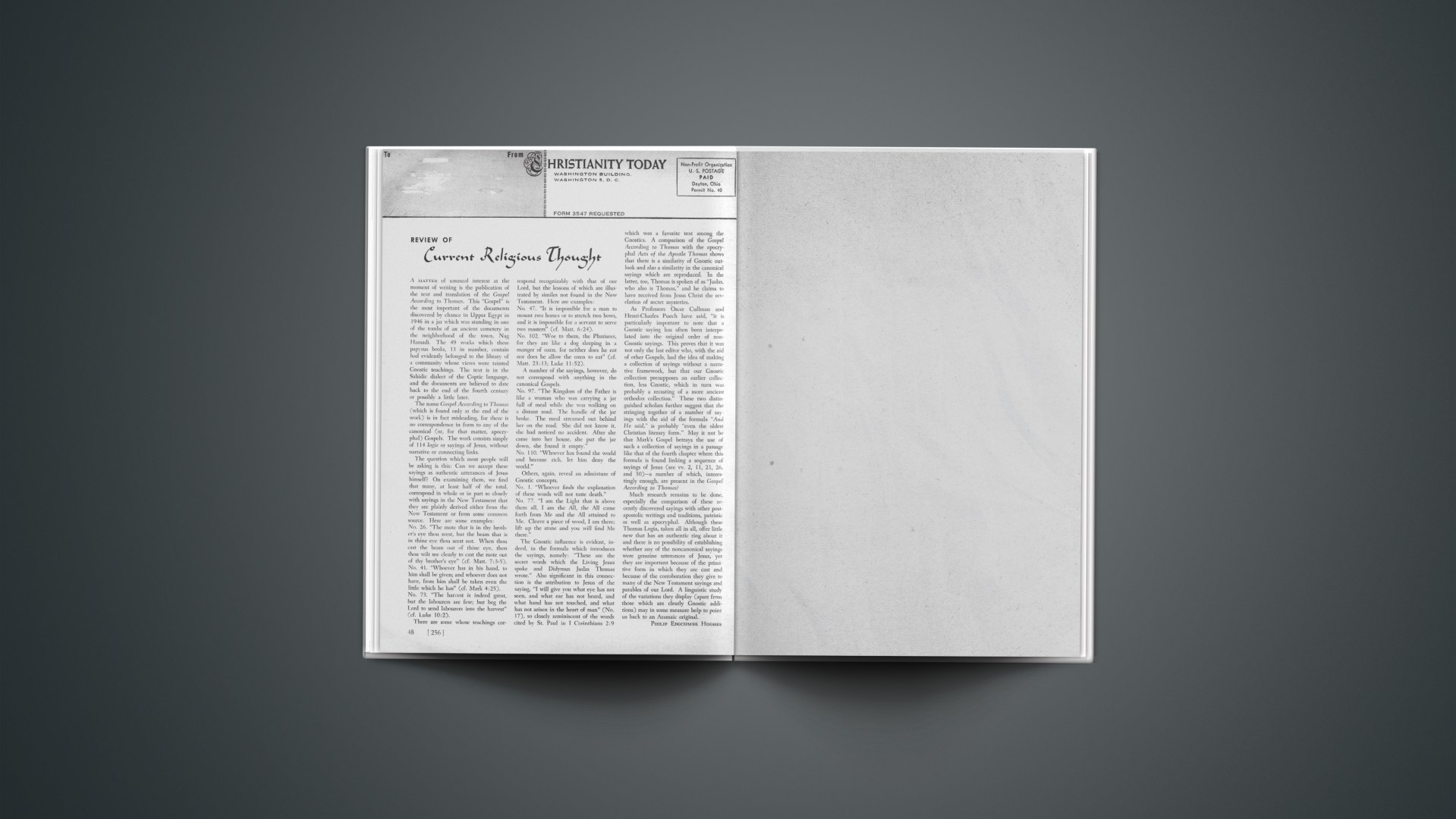
Review of Current Religious Thought: December 21, 1959

A matter of unusual interest at the moment of writing is the publication of the text and translation of the Gospel According to Thomas. This “Gospel” is the most important of the documents discovered by chance in Upper Egypt in 1946 in a jar which was standing in one of the tombs of an ancient cemetery in the neighborhood of the town, Nag Hamadi. The 49 works which these papyrus books, 13 in number, contain had evidently belonged to the library of a community whose views were tainted Gnostic teachings. The text is in the Sahidic dialect of the Coptic language, and the documents are believed to date back to the end of the fourth century or possibly a little later.

The name Gospel According to Thomas (which is found only at the end of the work) is in fact misleading, for there is no correspondence in form to any of the canonical (or, for that matter, apocryphal) Gospels. The work consists simply of 114 logia or sayings of Jesus, without narrative or connecting links.

The question which most people will be asking is this: Can we accept these sayings as authentic utterances of Jesus himself? On examining them, we find that many, at least half of the total, correspond in whole or in part so closely with sayings in the New Testament that they are plainly derived either from the New Testament or from some common source. Here are some examples: No. 26. “The mote that is in thy brother’s eye thou seest, but the beam that is in thine eye thou seest not. When thou cast the beam out of thine eye, then thou wilt see clearly to cast the mote out of thy brother’s eye” (cf. Matt. 7:3–5). No. 41. “Whoever has in his hand, to him shall be given; and whoever does not have, from him shall be taken even the little which he has” (cf. Mark 4:25). No. 73. “The harvest is indeed great, but the labourers are few; but beg the Lord to send labourers into the harvest” (cf. Luke 10:2).

There are some whose teachings correspond recognizably with that of our Lord, but the lessons of which are illustrated by similes not found in the New Testament. Here are examples: No. 47. “It is impossible for a man to mount two horses or to stretch two bows, and it is impossible for a servant to serve two masters” (cf. Matt. 6:24). No. 102. “Woe to them, the Pharisees, for they are like a dog sleeping in a manger of oxen, for neither does he eat nor does he allow the oxen to eat” (cf. Matt. 23:13; Luke 11:52).

A number of the sayings, however, do not correspond with anything in the canonical Gospels. No. 97. “The Kingdom of the Father is like a woman who was carrying a jar full of meal while she was walking on a distant road. The handle of the jar broke. The meal streamed out behind her on the road. She did not know it, she had noticed no accident. After she came into her house, she put the jar down, she found it empty.” No. 110. “Whoever has found the world and become rich, let him deny the world.”

Others, again, reveal an admixture of Gnostic concepts. No. 1. “Whoever finds the explanation of these words will not taste death.” No. 77. “I am the Light that is above them all, I am the All, the All came forth from Me and the All attained to Me. Cleave a piece of wood, I am there; lift up the stone and you will find Me there.”

The Gnostic influence is evident, indeed, in the formula which introduces the sayings, namely: “These are the secret words which the Living Jesus spoke and Didymus Judas Thomas wrote.” Also significant in this connection is the attribution to Jesus of the saying, “I will give you what eye has not seen, and what ear has not heard, and what hand has not touched, and what has not arisen in the heart of man” (No. 17), so closely reminiscent of the words cited by St. Paul in 1 Corinthians 2:9 which was a favorite text among the Gnostics. A comparison of the Gospel According to Thomas with the apocryphal Acts of the Apostle Thomas shows that there is a similarity of Gnostic outlook and also a similarity in the canonical sayings which are reproduced. In the latter, too, Thomas is spoken of as “Judas, who also is Thomas,” and he claims to have received from Jesus Christ the revelation of secret mysteries.

As Professors Oscar Cullman and Henri-Charles Puech have said, “it is particularly important to note that a Gnostic saying has often been interpolated into the original order of non-Gnostic sayings. This proves that it was not only the last editor who, with the aid of other Gospels, had the idea of making a collection of sayings without a narrative framework, but that our Gnostic collection presupposes an earlier collection, less Gnostic, which in turn was probably a recasting of a more ancient orthodox collection.” These two distinguished scholars further suggest that the stringing together of a number of sayings with the aid of the formula “And He said,” is probably “even the oldest Christian literary form.” May it not be that Mark’s Gospel betrays the use of such a collection of sayings in a passage like that of the fourth chapter where this formula is found linking a sequence of sayings of Jesus (see vv. 2, 11, 21, 26, and 30)—a number of which, interestingly enough, are present in the Gospel According to Thomas?

Much research remains to be done, especially the comparison of these recently discovered sayings with other post-apostolic writings and traditions, patristic as well as apocryphal. Although these Thomas Logia, taken all in all, offer little new that has an authentic ring about it and there is no possibility of establishing whether any of the noncanonical sayings were genuine utterances of Jesus, yet they are important because of the primitive form in which they are cast and because of the corroboration they give to many of the New Testament sayings and parables of our Lord. A linguistic study of the variations they display (apart from those which are clearly Gnostic additions) may in some measure help to point us back to an Aramaic original.

Book Briefs: December 21, 1959

Baptists In The Wilderness

Authority and Power in the Free Church Tradition, by Paul M. Harrison (Princeton University Press, 1959, 248 pp., $5), is reviewed by Carl F. H. Henry, Editor of CHRISTIANITY TODAY and one-time Professor of Systematic Theology at Northern Baptist Theological Seminary.

This is a bold, provocative book. If it does not explode with atomic fury among Baptists—especially in the American Baptist Convention—we may assume that Baptists no longer cherish their denominational distinctives.

The author’s analysis of Convention power blocs yields must reading for every Baptist minister and lay leader, and for every Baptist seminarian. This book (fruit of a doctoral study at Yale) ought to be discussed at congregational meetings, urged on delegates to Baptist assemblies, and evaluated openly on the convention floor. For Baptists must now either reaffirm and reapply their historic distinctives, or they may lose their identity as Baptists.

Dr. Harrison demonstrates that denominational patterns and power structures in principle compromise the classic Baptist emphasis on the “autonomy of the local church” and in practice repudiate it. His documentation will grieve many hopeful Baptists, even if it does not totally surprise them. Baptist leaders maintain the semblance of democratic polity (p. 192), he contends, but “the original function of the Convention—to serve the churches and help them achieve their common goals—has been drastically altered. The preservation of the organization and program has now become an ultimate purpose of the denomination” (p. 206).

This predicament faces Baptists with two options: 1. A recovery of Baptist distinctives (which apparently disinterests Dr. Harrison); or, 2. gradual loss of the Baptist image through (a) continued indifference to existing power blocs, or (b) revision of Baptist polity along new (pro-ecumenical?) lines.

Historically, Baptists championed the individual’s competence to discern the mind of Christ in the community of worship, and the local congregation’s freedom to govern its affairs apart from direction by church councils or associations. Delegates now influence Convention affairs only indirectly and the churches are no longer “the ultimate power” in the Convention (p. 15). Not only have denominational agencies today reduced the significance of the local churches, but leaders have acquired informal (unofficial and nonlegal) power—“considerably more power than was necessary for the performance of their tasks.” Only one in three or four delegates now attends annual conventions. Once less than 500 delegates approved a $7 million budget. “In many important respects the American Baptist Convention is a bureaucratic organization” (p. xi).

When the Convention was formed in 1907, Baptists insisted that it must gain no authority to direct church affairs, and that its officers and professional executives possess no ecclesiastical authority. Not the executives but boards of managers were to shape missionary policy; not intermediaries but delegates from local churches were to instruct missionary agencies; neither Convention nor local associations were to promulgate legislation binding upon churches. The American Baptist Convention still declares verbally “the independence of the local church and … the purely advisory nature of all denominational organizations.”

The original Convention function has “subtly changed” (p. 15). The Convention has no formalized authority but now has great power and influence, and has become the actual locus of authority. Professional executives exercise a pragmatic rather than rational-legal authority. They broadly interpret formalized authority and exercise power not expressly extended by official organizational bylaws (pp. 81 f.). The General Secretary of the Convention (whose office could still be eradicated in the event of a bid for more power, p. 131) has had representation on 27 boards and agencies. In half a century the executives have gained a power which, though admittedly not derived from either biblical precepts or historic Baptist principles, is prized rather than feared both by Convention leaders and many pastors. “Convention officials gained greater power over the activities of the churches than has ever been recognized as legitimate” by Baptist apologists. They pressure for conformity (pp. 69 f.) and control deviants (p. 71) by economic sanctions and propaganda (p. 72), or by persuasive personal power (p. 74).

Dr. Harrison includes an empirical analysis of executive influence. Chapter Five shows how their power exceeds formal limited authority. The executives are “an informally organized Baptist elite, a group of leaders whose authority has never been fully legitimated” (pp. 86 f.). While officially confined to policy implementation, executive secretaries and their staffs are now also policy originating (pp. 91 f.). Although an informed constituency is a prerequisite of democratic order, there is no way for an uninformed constituency “to know who has the power” (p. 92). Chapter Six details their tremendous executive control over denominational and local church activity. Chapter Seven examines disposition of leaders to expand agencies beyond goals for which they were created. This organizational pattern is now so strong that even the few fundamentalists attaining executive rank conform to it (p. 143).

In Dr. Harrison’s view, and that of most Baptist executives he depicts, fundamentalists are almost always a nasty breed of cats (cf. pp. 74 f., 84, 145 ff.), interested in power more than doctrine (p. 148); disruptively vocal (p. 152); “packing” annual meetings (pp. 154, 161); even cooperating for the sake of retirement benefits (p. 203). The Convention majority is represented (by implication, at least) as antifundamentalist if not actually liberal (pp. 150 f., 154). Despite the fact that Baptist theory pledged fundamentalists full rights, they sometimes were controlled by counter-charismatic personalities using oblique propaganda approaches (p. 75), enthralling conservative one day and liberals the next (p. 94). Fundamentalists were denied even a minority share of national executive positions, and inclusivist leaders dealt insincerely with them (pp. 84, 86), restraining them by political machination (p. 153) and unjust economic controls (p. 154).

Despite his caricature of fundamentalists, Harrison rightly deplores the Baptist failure to find a means “to permit their own minorities to gain a voice in the Convention” (p. 223). But he fails to correlate this injustice with another, control of a “democratic” Convention by a mere 300 persons, and his admission of the “substantial truth” of the late W. B. Riley’s protest that these are mostly “salaried servants, many of them cogs in the machine” (p. 191).

Dr. Harrison holds that minimizing the power and authority of denominational leaders would threaten the achievement of common Baptist goals (p. x). Some Baptists are urging “recognition and acceptance” of the power of denominational leaders. “The Baptists have not succeeded in their program to check authority or to balance power.… It is a contradiction to give the executive official responsibility but no official authority” (p. 78). “But it is extremely difficult to make a formal change in the polity system without altering the doctrine of the church.” Therefore, a significant change legitimating present patterns of authority is unlikely “unless … preceded by a reinterpretation of doctrinal formulas” (p. 7).

Harrison is interested in revising rather than in preserving Baptist ecclesiology. He seemingly details ABC practical compromises in behalf of supra-Baptist views of the Church. “Already many Baptist leaders are asking critical questions about the Baptist theology of the church” (p. 6). Denominational leaders in general admit that “the local church has lost much of its cherished autonomy, and … significant power as the initiator of policy” (p. 100). For Baptists now “insist upon allegiance to a doctrine of the church which they do not follow in their actual polity” (p. 9). “Ideas about the nature of the church” are undergoing change “as a result of adjustment to new situations” (p. 14; cf. p. 63). In 1954, an American Baptist Theological Conference Committee [did the executives select the participants?] “observed that authority extends beyond the limits of congregational membership” (pp. 57 f.).

“Although the officials of the Convention theoretically possess no ecclesiastical authority, their actual power is great enough to exert tremendous pressure upon the traditional beliefs of the Baptists” (p. 13). There are signs, in fact, that the informal power of the executives is gradually becoming formally legitimated. Mimeographed semi-official literature, emerging from theological and organizational conferences, contains “realistic appraisals of the situation of the local church, that is, dependent upon the Convention for its meaningful existence” (p. 100).

The inherited Baptist view of local church autonomy, Harrison thinks, is indebted to the seventeenth century cultural milieu (p. 11). The basic Free Church tenets were shared by early Presbyterianism, we are told (p. 21), whereas American Baptists have “absolutized” local autonomy (p. 26). The reader will note that the Baptist view of autonomy is overdrawn by Harrison’s implication that it necessarily obscures the unity of the body of Christ (pp. 219, 222).

It is not surprising that, with an eye on ecumenical patterns, Dr. Harrison then dissolves Baptist distinctives and bridges to Presbyterianism (pp. 218 f.). We are told that historic Baptist “democratic polity” expects more from regenerate believers than traditional Christian doctrine supports (p. 60). “Baptists have been seeking in vain for a valid and rational locus of ecclesiastical authority under God” (p. 217). Some younger men in the denomination look hopefully toward a representational (Presbyterian) polity, and “most Baptists seem in agreement that this method is “second best” (p. 99). The veiled power of denominational leaders is often already “considerably greater than the official ecclesiastical authority of the Episcopalian or Methodist bishop, or the Presbyterian moderator” (p. 92). The “autonomy” of the various denominational societies is already “more fictional than real” (p. 123). Many leaders think “the general council must assume a more significant role” (p. 121), that of coordinating head, although the Council on Missionary Cooperation also holds much power (p. 128). Reorganization toward greater central authority has been discussed along several lines by the denominational publication Crusader (p. 122).

Professor Harrison grants to separationists that “organized Christianity” represents a “compromise of the Gospel” (p. 204). But anybody can invoke the Bible to bulwark his own prejudices, he says, and “inroads into the authority of the Bible” by biblical criticism demand “a more sophisticated understanding of biblical authority” (p. 217). It is not apparent what comfort these assumptions should afford Dr. Harrison in projecting an alternative polity.

His own proposal is: “If local churches are to be free from domination by a secular power or from the authority of an ecclesiastical oligarchy, they must associate with one another, each recognizing the authority of the other, none claiming absolute autonomy or authority, and all recognizing the temporal but pre-eminent authority’ of the association of churches so long as they wish to derive the advantages of associational membership” (p. 220). But his argument for associational polity is not merely pragmatic. Baptists of the past would find headline news (probably carrying an Amsterdam or Evanston dateline rather than a New Testament text) in word that: “From the doctrine of the priesthood of all believers and the doctrine of original sin it follows that no single unit of the church can discern the mind of Christ in its fullness if separated from all other local units as well as from the associations and from the American Baptist Convention” (p. 224). Is not the next stop on this ecclesiastical expressway, we may ask, the National Council of Churches, and then the World Council? And perhaps Rome? (When the Convention was first projected, many Baptists feared a “first step on the road to Rome.” A professor at Newton, J. B. Thomas, even thought it necessary to emphasize that Baptists alone had resisted the Presbyterian tendency to “take the authority from the mass of the people and give it to an official body.”)

The “containment” of professional executives along lines suggested by Dr. Harrison seems actually to involve the substitution of one non-Baptist polity for another, and to be dictated by an eye on ecumenical trends rather than on Baptist distinctives. Dr. Harrison looks expectantly in the direction of “new apprehensions of the faith” and “new and more adequate social forms” (p. 224). “Until these are developed it appears that the Baptists must return to some kind of associational discipline. If the congregations were united in associations … the association would legitimately proclaim the Word as discerned by the united churches” (p. 224, ital. sup.). This may offer some dispersal of ecclesiastical power (while assimilating Baptists to Presbyterians). But does it not also dissolve the Baptist distinctives of soul competence and local church autonomy? Dr. Harrison nowhere proposes tenure for professional executives (now often positioned to assure their own permanence by determining the personnel of the very boards who nominate and elect them), nor a curtailment of powers to legal limits. He simply tells us that ecclesiastical policy formulation on traditional Baptist premises is impossible (p. 94). He proposes to narrow the gap between authority and power, not by minimizing the power of leaders, but by widening official authority (p. 177).

The survey discloses a distressing evasion of theological issues by Convention leaders (pp. 145 ff.). “Theology became … a symbol of denominational conflict” (p. 148); as a result, many executives are theologically indifferent, and interested primarily in Convention support (p. 149). Whatever hinders the promotional program is viewed as divisive (p. 179). Yet for six years, after 1950, the American Baptist Convention lost a member an hour, more than 10,000 members a year.

Dr. Harrison does not detail the longstanding tensions between the executives (promoting centralization of power) and the denominational seminaries (promotive of decentralization, at least in evangelical schools, by emphasis on classic distinctives and the illegitimacy of liberalism as an authentic expression of Christianity). In the past decade, however, conservative seminaries have yielded more and more ground, if not through neo-orthodox theological concessions, then through appeasement of Convention pressures for the production of “wholly loyal” alumni, and through direct financial dependence upon the Convention.

What Baptists most need, to justify their survival, is a theological and evangelistic awakening. Too long have they served the wrong kind of “power from above.” Whether they can recover from this idolatry, or whether they will lose identity as Baptists, may be decided more quickly than most Baptists dream. If denominational leaders respect free and mutual criticism as a basic element of Baptist polity, they have boundless potential for it in this exposition of discrepancy “between the Baptist doctrine of the church and the polity of the American Baptist denomination.” Dr. Harrison’s study could supply incentives for earnest probing of Baptist doctrine and practice. If Baptists shun this duty, or timidly repress their convictions, the death rattle of a great denomination may sound in the silences.

CARL F. H. HENRY

The People’S Archbishop

William Thomson, Archbishop of York, by H. Kirk Smith (S.P.C.K., London, 190 pp., 35s.), is reviewed by T. G. Mohan, Secretary, Church Pastoral Aid Society, London.

This well-written biography, which holds one’s attention from beginning to end, is of special interest and importance because it provides a measure by which we can assess the drift of the Church of England during the last 100 years backwards to the pre-Reformation pattern.

The churchmanship and spiritual outlook of Archbishop Thomson appears to be much like that of a “Conservative Evangelical” today, in fact like that of the Book of Common Prayer and the Thirty Nine Articles which are still the official formularies of the Church of England. Had he been Archbishop of York at the present time he would no doubt have been called a “fundamentalist”; indeed we are told that “Thomson’s attitude to biblical study was fundamentalist” (p. 35). We are left in no doubt about his greatness—his commanding appearance, his powerful voice, his administrative ability, his gifts as a preacher, his tireless energy, and his faithfulness as a pastor. But all this seems to the author to be overshadowed by Thompson’s evangelical bent of mind which was “man-centered rather than God-centered. He believed that the primary function of the Church was not to worship her Creator through Jesus Christ in the power of the Holy Spirit, but rather to gather in the harvest of lost souls” (p. 31). Or again: “It was what Christ had done for him, was doing for him, and would do for him, rather than the all-consuming desire to offer worship and adoration to the Sovereign Lord of all creation, which formed the basis of his religion. It was, in a sense, self-centered rather than God-centered” (p. 168).

His attitude to the Bible is defective we are told, because he accepts its sole authority; his doctrine of the church is defective because he does not consider its primary purpose as worship (i. e. acts of worship in church); his doctrine of the sacraments is defective because they are not, for him, central in the scheme of man’s redemption; his doctrine of the ministry is defective because he does not believe in apostolic succession, consequently the sacrament of penance is distasteful to him. A striking illustration of his defective churchmanship is his permission given to 400 Salvationists to receive Holy Communion in St. Paul’s, York—described by the Church Times as “one of the saddest spectacles seen in the Church of England for a long time” (p. 32).

The author seems to accept the modern view that a trend which persists until it becomes popular must therefore be accepted as progress. Refusal to accept is a failure to move with the times. “It was Thomson’s tragedy,” he says, “… that his theology did not develop with his experience” (p. 30). Though it is admitted that his attitude to the Oxford Movement “was in line with the general Anglican position in the middle of the nineteenth century,” yet he “fell behind the best spirit of the age,” he was “unable to keep abreast of the times.” (This was no doubt the complaint made of Athanasius by his contemporaries!) Of his attitude to another danger—the spread of radicalism and materialism—it is said that his “penetratingly shrewd and essentially practical outlook enabled him to grasp the true significance, and trend, of events” (p. 65).

Perhaps he was equally farsighted in being able to see where the trend of ritualism would lead the church, and the danger of drifting with the tide under the guise of moving with the times. In one respect, at least, he was proved correct, namely in his belief that “ritualism was unacceptable to the broad mass of the laity, and to the common sense of the nation” (p. 40). It is a fact that the period during which ritualism and its teaching have spread their influence in the church has also been the period during which the nation, which could be described as one of the most religious the world has ever seen, has ceased to be a worshiping people. It is also perhaps significant that “Thomson’s greatest triumph was the way in which he changed the attitude of the working classes in the large towns of his diocese towards the office he held, and so to the church” (p. 152). The working men of Sheffield took him to their hearts. He is described on a memorial in the Cathedral as “The People’s Archbishop.” It is also perhaps worth mentioning that, like the great evangelical whom our author calls “the bigoted Shaftesbury,” his death was mourned by the common people. “Sixteen Sheffield working men carried his (Thomson’s) body to its resting place.”

One final comment may be made on the significance of the times in which we live. It is that this book is written by one who himself has been identified with the evangelical school of thought.

T. G. MOHAN

Preaching Christ

Ruth, by Charles E. Fuller (Revell, 1959, 123 pp., $2), is reviewed by the Reverend Frank A. Lawrence, Minister of Graystone United Presbyterian Church, Indiana, Pa.

The founder of the “Old-Fashioned Revival Hour” has collected 10 of his sermons on the book of Ruth which he has given to his world-wide radio audience. Dr. Fuller subtitles his book, “A Life of Love and Loyalty,” but it would be more accurate to call it, “How to Preach Christ from the Book of Ruth.” Here is a good example of the type of preaching suggested by the honored axiom, “Wherever I land in the Scripture I strike cross-country for the Cross.” That is what Dr. Fuller has done.

He will be open to the charge of allegorizing. Certainly weak points consist in his omission of the historical aim of the book (tracing the ancestry of David), and his failure to show that from the beginning God was supranational. But it is a rich volume of meditations on Christ by type in Ruth, and could be an ideal invitation to the lost. It is compact, attractive, easy to read, and on target.

FRANK A. LAWRENCE

Subjective Hermeneutics

Interpreting the Bible, by J. C. K. von Hofmann, translated by Christion Preus, (Augsburg, 1959, 236 pp., $4.50), is reviewed by F. R. Webber, of Mount Vernon, N. Y.

The man who teaches dogmatics in a great university commands respect. If he has a heavy, gutteral accent he is, like Caesar’s wife, beyond reproach. Thus say many people. Perhaps this is why we have had a rash of books by and about theologians of the German-Swiss way of thinking. Were these the writings of the great dogmaticians of the Age of Orthodoxy (1517–1713), all might be well. That period produced such great names as Luther, Chemnitz, Hunnius, Hutter, Gerhard, Koenig, Calovius, Quenstedt, Baier, and Hollaz among the Lutherans, and Zwingli, Calvin, Bullinger, Keckermann, Wolleb, Alsted, Alting, Maccovius, Maresius, Voetius, Heidegger, and Leydecker among the Reformed. When David Hollaz died in 1713, orthodox Lutheranism died. When Melchoir Leydecker died eight years later Reformed orthodoxy came to an end. After an interval of pietism, theology lapsed into doctrinal indifference, then into the age of rationalism, although by the grace of God, bright theological lights appeared from time to time and proclaimed evangelical truth in the theological twilight.

It was the age of rationalism that laid out the red carpet for Schleiermacher, Hofmann, Frank, and the Erlangen Ich-theologie school. What is Ich-theologie? Other names for it are the Ego-theology, subjective theology, and “pious self-consciousness.” There are four attitudes toward the source of Christian doctrine. Theologians of the pre-Reformation period found the fountain head of all Christian doctrine in the Church and its popes and councils. The rationalists looked for it in man’s reason. Schleiermacher, Hofmann, and Frank declared it to be in the Ich-theologie of the theologian. The true theologian finds it solely in the Scriptures.

Johann C. K. von Hofmann (1810–1877) was professor at Rostock and Erlangen. He is often called the father of the Erlangen school and founder of modern subjective religious thinking. This is not correct. F. D. E. Schleiermacher (1768–1834) was proclaiming that Christian doctrine is drawn from man’s inner consciousness, and not from the Scriptures, while Hofmann was yet a schoolboy. Where the theologians of the Age of Orthodoxy searched the Scriptures for Christian truth, the Ego-theologians searched their own hearts. They scoffed at those who made an idol of an infallible Book, and then they straightaway made an idol of fallible man.

While Hofmann’s Biblische Hermeneutik, of which interpreting the Bible is a translation, is concerned with the principles that govern the understanding of the Scriptures, Hofmann’s thinking is colored by his previous writings like Der Schriftbeweis (1852–56) and his works on prophecy. In these books he betrays the fact that he is neither a gnesio-theologian nor was he conservative. He denies verbal inspiration, original sin, the vicarious atonement, justification by grace through faith, sola Scriptura and the pre-incarnation existence of the Lord Jesus.

Hofmann’s book contains the same ambivalence that one finds in De Wette and Ritschl who were skilled in expressing their new teachings in the old language of orthodoxy. Hofmann cites many portions of Scripture whose integrity he frankly questions, and at the same time he professes to believe that the Bible is God’s Word, miraculous in origin and content, and a witness to the saving truth. His hermeneutical method is based upon the theory that one must not begin with Scripture passages that pertain to sedes doctrinae, or individual doctrines. Rather he must begin with the Scriptures as a whole. This is a familiar device of those who would leave room for human rationalizing. It recalls Schleiermacher who said, “Quoting individual Scripture passages in dogmatics is dangerous, yea, in and by itself unsatisfactory” (Glaubenslehre I:30). Frank and Ihmels were others who favored Hofmann’s procedure.

Dr. George Stoeckhardt calls this method “nothing but a new style of rationalism, rationalism in a churchly dress … which by its own authority passes judgment in matters of faith and truth, which fabricates and sets up doctrines, which from within constructs God, heaven, earth, and everything in an arbitrary manner, and is at bottom the ‘I,’ the ‘spirit,’ the ‘inner light’ of the enthusiasts” (Lehre und Wehre, 42:74).

Dr. Christian Preus, translator of the Hofmann book, is one of a far-flung relationship of Norwegian ancestry. They have produced a number of theologians, professors, and parish clergymen. He has succeeded well in translating Hofmann’s crabbed, ponderous sentences into pleasing English.

F. R. WEBBER

Religious Brain-Washing?

Conversions, Psychological and Spiritual, by D. Martyn Lloyd-Jones (London: The Inter-Varsity Fellowship, 40 pp., 2s.), is reviewed by Owen Brandon of The London College of Divinity.

There is no doubt that the publication of Dr. William Sargant’s book, Battle for the Mind, in 1957, caused a stir in informed circles. Dr. Sargant described his work as “a physiology of conversion and brain-washing,” and in it he showed the similarities, from the purely human point of view, of the mental processes involved in political brain-washing, in psychoanalysis, and in religious conversion.

The little book now under review is written as a critique of Battle for the Mind. It is the substance of an address to Christian ministers given under the auspices of the Evangelical Alliance at High Leigh, Hoddesdon, Herts. Dr. Martyn Lloyd-Jones felt impelled to write this critique because of Christian men and women, some of them undergraduates, who had been “profoundly disturbed” by Dr. William Sargant’s book, and who were beginning to wonder whether, after all, their own conversion could have been but the result of the religious use of psychological techniques.

Dr. Lloyd-Jones’ critique is in three parts. First, he outlines Dr. Sargant’s main thesis, which he (Dr. Sargant) had built up on a study of religious conversion against the background of his own knowledge and experience as a practicing psychiatrist. His thesis is that conversion follows the general pattern of conditioning, anxiety, collapse and reorientation. These are the processes common also in political brain-washing and much psychological treatment. In the second part of the work, Dr. Lloyd-Jones examines Dr. Sargant’s thesis. In this he attacks Dr. Sargant at the weakest points of his book, namely, in his exposition of biblical passages; and he also challenges Dr. Sargant’s expositions of the conversion experience of John Wesley. In the last part of his critique, Dr. Lloyd-Jones turns to the positive value of Dr. Sargant’s study. Here our author has some strong and positive words to say about some contemporary methods of evangelism. Dr. Lloyd-Jones agrees with Dr. Sargant that it is possible, by various means and methods and mechanisms, to influence the human mind, even in the religious sphere; and he raises the question: Is it not the case that some of our methods and approach to evangelism arouse suspicion? There are dangers, he says, in too great an eloquence, or too strong an appeal in evangelism. He deprecates a direct appeal either to the emotions or to the will. The appeal must be to the mind. “The normal course is for the emotions and the will to be affected by the truth after it has first entered and gripped the mind.” Thus, Dr. Lloyd-Jones uses the validity of much of Dr. Sargant’s argument to call for a serious reconsideration on the part of evangelicals in regard to their motives and their methods of evangelism.

This is an interesting critique of the thesis of one Doctor of Medicine by another Doctor of Medicine who is also a Christian minister. But I think that its significance can be appreciated only by those who have read the bigger work by Dr. Sargant. Elsewhere I have maintained that Dr. Sargant’s Battle for the Mind should be read by all ministers and evangelists. Dr. Lloyd-Jones’ little book may well be read alongside it, but the reading of the critique is no substitute (for the serious student) for the reading of the larger work.

OWEN BRANDON

The Paraclete

Emblems of the Holy Spirit, by F. E. Marsh (Kregel, 257 pp., $2.95), is reviewed by Eric Edwin Paulson, Minister of the Lutheran Free Church.

Although millions of Christians confess every Lord’s Day their belief in the Holy Spirit, only a scant fraction possess adequate knowledge of the divine Executive of the Church. This volume furnishes a detailed explanation of the symbols of the Holy Spirit found in the Scriptures. This is done with a freshness and originality seldom excelled, plus sound exegesis.

It is plain that the author’s knowledge has been gained through daily living and serving in the power of the Holy Spirit, as well as through painstaking scholarship. The book is attractively illustrated and should prove to be useful to every young preacher and student of the Word of God.

ERIC EDWIN PAULSON

Sunday School Lesson Helps

Standard Lesson Commentary 1960 International Sunday School Lessons, edited by John M. Carter (Standard Publishing Company, 1959, 448 pp., $2.95); The Douglass Sunday School Lessons for 1960, by Earl L. Douglass (Macmillan, 1959, 475 pp., $3.25); Broadman Comments 1960, by H. I. Hester and J. Winston Pearce (Broadman Press, 1959, 433 pp., $2.95); The International Lesson Annual 1960, by Charles M. Laymon and Roy L. Smith (Abingdon, 1959, 448 pp., $2.95); Tarbell’s Teachers’ Guide—1960, by Frank S. Mead (Revell, 1959, 384 pp., $2.95); and Peloubet’s Select Notes for 1960, by Wilbur M. Smith (W. A. Wilde Co., 1959, 423 pp., $2.95), are reviewed by Milford Sholund, Director of Biblical and Educational Research, Gospel Light Publications, Glendale, California.

Millions of Christians continue to use the International Sunday School Lessons and the International Bible Lessons for Christian Teaching. Comments on the Outlines of the International Bible Lessons for Christian Teaching and the Uniform Series are cherished by Bible students in Sunday schools, homes, hospitals, prisons, schools, and pastors’ studies everywhere. Since 1872, when the uniform lessons were first devised as a practical way of teaching Sunday School, billions of words have been written and printed for teachers of pupils of all ages.

Sunday School teachers in 1960 will find plenty of material to consider for their classes in the six volumes reviewed.

There are four sections of 13 weeks with the following topics: First quarter: The Acts of the Apostles; second quarter: Sermon on the Mount and Parables; third quarter: Century of Great Prophets; fourth quarter: Passages of Spiritual Power.

If you buy all six volumes, you will invest $18. Each volume is $2.95 with the exception of Douglass which is $3.25.

With these six volumes lying open before you, what do you expect to find? First of all, these are substantial books in size. Only one has less than 400 pages (Mead, 384 pp.). Second, you will be impressed with the format or the layout of the printed page. There is a uniformity about the massive amount of printing on each page. Carter comes closer to giving variety by including pictures, boxes with outlines, charts, sketches, and a three-column page. It is easier to read a shorter line.

Four authors use the King James version as the printed text, while two authors, Mead and Laymon, use both the King James and the Revised Standard versions in parallel columns. It is interesting to note that the King James version continues to be a favorite among users of the comments on the International Uniform Lessons.

There is an interesting mixture of the old and new in these six commentaries. Smith draws heavily on ideas of expositors of the nineteenth and early twentieth centuries. There are quotations from Spurgeon, Hengstenberg, Morgan, Delitzsch, and others. Mead tends to quote from contemporary sources including Robert McCracken, Reader’s Digest, J. R. Sizoo, and James C. Worthy, vice-president, Sears Roebuck Company. The reader can find pretty much what he likes in the six volumes.

All of the comments are limited to a given biblical text for a particular lesson. There is a wide divergence, however, in the way this text is explained, developed, and related to life today. Laymon, Mead, and Smith have more direct development of the text. Douglass, Carter, and Hester seem to be more aware of the need for getting the teacher and student involved in the significance of the biblical truth for today.

Audio-visual materials to be used with the development of the lessons are featured by Douglass, Mead, and Smith. These materials include films, filmstrips, flat pictures, and supplimentary materials. There are some excellent lists of films and filmstrips that could be deposited in Sunday School libraries for general use.

The value of these six commentaries is not limited to lay-teachers. Pastors and instructors in seminaries, colleges, and Bible institutes will find a wealth of material condensed on these pages.

MILFORD SHOLUND

More Than Appendage

He Ascended into Heaven, by J. G. Davies (Association Press, 1958, 224 pp., $4.75), is reviewed by Walter W. Wessel, Professor of New Testament, North American Baptist Seminary, Sioux Falls, S. D.

Bampton Lectures are usually scholarly and competently written. This one is no exception, and it has the added attraction of being concerned with a strangely neglected subject, the Ascension of our Lord. So rare are books on the Ascension that the last definitive one in English, H. B. Swete’s The Ascended Christ, appeared back in 1910, and much of it was not concerned with the Ascension proper! The neglect of this doctrine over the past half-century has been largely due to the scientific spirit of our age. The Lukan account with its pre-Copernican cosmology caused many to refuse to take it seriously. Adolf Harnack’s contention that not only the cosmology of Luke was suspect but also the account itself, came as a welcomed relief and apparently stifled reinvestigation of the subject for many years. Davies now comes with a fresh and thorough study of the Ascension.

The problems which surround this doctrine are many and formidable. What is the theological significance of the Ascension? Is there any doctrinal distinction between the Ascension and the Resurrection? Was the Ascension an historical event or is the New Testament account a pictographical means of conveying the idea of transference from one condition of being to another? Are the New Testament accounts at variance with one another, particularly in relation to the time of the event?

To find answers to these questions Dr. Davies begins in the Old Testament where the Ascension is prefigured and predicted, works through the New Testament passages which bear witness to the event, and concludes with a study of the history of the doctrine from the earliest fathers of the Church to the writers of the eleventh and twelfth centuries. The entire study is conducted in the best tradition of biblical scholarship.

The real strength of this book lies in the author’s exposition of the New Testament passages (far more numerous than one might suppose) and his clear statement of the theological significance of this doctrine. The Ascension is rescued from being a mere appendage to the great saving events of our faith. Dr. Davies rightly asserts that “if it is through the Ascension that Jesus entered upon the office of Son of Man, became no longer Messias designatus but Messiah indeed, and received the regal dignity and title of ‘Lord,’ then the Ascension belongs not to the periphery but to the heart and substance of the Gospel” (p. 169).

Many will disagree with some of Dr. Davies’ conclusions, for example, that the Ascension actually took place on Easter night and that the account of a 40 day interval in Acts is a deliberate accommodation for typological reasons. However, every student of the New Testament will welcome the forthright manner in which Dr. Davies faces up to the problems associated with the Ascension, and will commend the scholarly competence by which he searches for solutions. These factors make this book a truly significant one in the area of biblical theology.

WALTER W. WESSEL

A Son Of Thunder

Minority of One, by Clyde S. Kilby (Eerdmans, 1959, 219 pp., $3.95), is reviewed by Henry W. Coray, Author of Son of Tears.

This delightful biography of the founder of Wheaton College coincides with the institution’s one hundredth anniversary. The book could be labeled fittingly, Man on a Soapbox. For Jonathan Blanchard was at once a preacher of the Gospel, a fierce abolitionist and temperance worker, an almost fanatical antagonist of secret societies, an able educator (he fathered Knox College as well as Wheaton), and a militant journalist. The man was a walking paradox: he declared himself to be both premillennialist and postmillennialist; he brushed shoulders with Stephen A. Douglas, Whittier, Salmon P. Chase, Thaddeus Stevens and Owen Lovejoy, and yet loved to be with derelicts and slaves; and he was a warmhearted friend, and the most intolerant of foes. Once on a train he planted a beautiful haymaker on the jaw of an insulting individual, pleaded guilty to assault in court, and cheerfully paid the three-dollar fine.

Mr. Blanchard’s convictions brought him into collision with large segments of the political and educational worlds of his day. Conflict was his normal diet. His tempestuous career, like Paul’s, was marked by evil report and good. Dr. Kilby has etched his profile in clean sharp lines. The effect: a nineteenth century son of thunder testifies to a mid-twentieth century that is in danger of going to sleep under the soft strains of a Hearts-and-Flowers epistemology that has in reality set itself unremittingly against the Lord. A friend described Jonathan Blanchard as “a modern Cromwell, a true iconoclast ‘smiting the godless shrines along his path’,” and added, “I loved him as a man, an instructor, a hero. He did not know the first rudiments of fear.”

HENRY W. CORAY

Bible Exposition

God’s Wrath, by Donald Grey Barnhouse (Eerdmans, 1959, 286 pp., $3.50), is reviewed by Harry Buis, author of The Doctrine of Eternal Punishment.

Dr. Barnhouse has been preaching on the epistle to the Romans each week for over eight years. This book is one of a series of five which has appeared thus far as a fruit of this preaching. The volume covers Romans 2:1–3:20. Each chapter expounds in order one, two, or occasionally more verses. The jacket describes the series as an “Exposition of Bible Doctrines taking the Epistle to the Romans as the point of departure,” which is true; but fortunately the departure from the text is not nearly so great as that of many who do not so warn us that they plan to depart!

These messages are sound biblical expositions, which is not to say that all evangelicals will fully agree with the interpretation of every passage. With a note of authority which ought to characterize all Christian preaching, the author drives home the theme of this section of Scripture: Men are utterly lost in sin and therefore their only hope is to come to Christ. The short but very clear illustrations scattered throughout these messages are most helpful, as are the occasional word studies.

H. BUIS

NCC Board Decries Right-to-Work Laws

Meeting in Detroit’s Statler Hilton Hotel, December 2–3, the policy-making General Board of the National Council of Churches manifested all the self-consciousness of an auto executive caught driving last year’s model. Public reaction to Cleveland Conference pronouncements on Red China appeared to have induced in some of the 250 board members a case of headline shock. The occasion: a pronouncement called “Ethical Issues in Industrial Relations of Concern to Christians” which opposed, among other things, right-to-work laws. In a board not noted for vigor of debate, and where committee reports nearly always enjoy smooth sailing, this was the one issue which produced lively exchanges. The pronouncement was adopted by a vote of 73 to 16, with 12 abstentions. But the minority was vocal.

Southern Presbyterian John V. Matthews, a lawyer, opposed such pronouncements in principle: “The most prevalent criticism we face is that the Church speaks mostly on all sorts of things on which it is not qualified to speak, while it remains silent on matters where it qualifies as an authority.” Others opposed the pronouncement on grounds that it was divisive and that the NCC should speak only when it has a “Thus saith the Lord.” The rejoinder: “Christ cleansed the temple” and thus attacked the “big business” of the day—religion.

Then the debate descended to arguments about the type of headlines this pronouncement would produce. Before grinning reporters, one board member suggested that a paragraph condemning “featherbedding” would be more apt to capture headlines than “right-to-work.” In a singular display of public relations sensitivity, a reluctant officer of the General Public Interpretation Committee was called upon to gauge the “timeliness” of such a pronouncement. For him, propriety dictated a noncommittal stance, though he voiced respect for the pronouncement’s framers and suggested the need of an appraisal of “the whole matter of pronouncements.”

Several expressed “profound regret” for the impression that headlines had assumed priority over God’s will. United Lutheran Dr. F. Eppling Reinartz reminded his fellows of the costliness of their right to speak: alienation and “good solid dollars.” He estimated cost of their recent convictions at a possible $100,000.

The 1960 budget of $19,374,420 was down from 1959’s $21,565,450. Expressions of anxiety were met by assurances that no reduction of program was involved, but rather the termination of certain work projects. Some were not satisfied. Dr. Glenn Moore pointed to potential curtailment of race relations work.

Despite fears that the NCC was rushing into an economic area “several hundred yards ahead of the angels,” the board voted unanimously to offer the council’s services to the two sides in the strikebound steel industry, “to be of any assistance within its power.” A special committee is expected to prepare a report on the facts of the strike and ethical implications involved. “In view of the difficulty resulting from Cleveland,” request was made for specific reference as to whom the report would represent.

The NCC has not yet taken a stand on the lively birth control issue, though a report is in the works. But Dr. R. Norris Wilson, executive director of Church World Service (a “central department” of NCC) stated to the press his opposition to President Eisenhower’s declaration that our government should not provide birth control information to other nations. Church World Service maintains workers in overpopulated areas who give instruction in family limitation.

In a telegram of good wishes to President Eisenhower on the eve of his trip abroad, NCC President Edwin T. Dahlberg made a pertinent point: “We note that your visit to the Vatican is construed as a visit to the head of a church rather than the head of a state, and we trust that it will in no way be interpreted as promoting official United States diplomatic representation at the Vatican.” He suggested the President also visit Eastern Orthodoxy’s Ecumenical Patriarch.

Turning to problems of foreign missions, board members heard Dr. Virgil A. Sly tell them their denominations should yield more power to the International Missionary Council and World Council of Churches as well as to the NCC “to carry forward the mission of God.” He noted that this decade has seen for the first time “boards not associated with the National Council” sending out more missionaries than those so related.

Methodist Dr. Eugene Smith had some healthy words of self-criticism for the ecumenical movement: “It isn’t sufficiently ecumenical. The most rapidly growing churches are not members of our group. Historically, these groups exist because of our own theological and spiritual failures. The real problem is not their intransigence but our indifference.” He indicated that conservatives were not missed when absent from conferences and drew a picture of a “small group of professionals” figuring out plans in an office with the larger group “on the front slugging it out.” To overtures from conservatives, “we’ve responded with massive immobility, being too busy with our own machinery.” “We must have theological study with them.”

Widened Wedge

A large minority group, which split the Presbyterian Church in Korea by walking out of its general assembly in September, widened the wedge last month by holding its own assembly and rejecting a reconciliation proposal.

Elected moderator of the “National Association of Evangelicals” group (not affiliated with the American NAE) was the Rev. Yang Hwa Suk, a vice moderator before the split. The Rev. Mr. Yang thus becomes the dissident counterpart of the Rev. Chang Koo Yi, who was elected moderator of the so-called “Ecumenical” faction when it reconstituted the September assembly.

A peace plan laid before the “NAE” assembly provided for compromises on key issues which divide the two groups. It was rejected despite pleas from 12 missionaries who drafted it in behalf of the United Presbyterian Church, U. S. A., the Presbyterian Church, U.S., and the Presbyterian Church of Australia.

Mediation Mission

Two missions executives of the Presbyterian Church in the U. S. flew to Korea this month for two weeks of meetings with dissident nationals.

Dr. L. Nelson Bell, Executive Editor of CHRISTIANITY TODAY, and Dr. S. Hugh Bradley made the trip at the urgent request of their church’s Korean Mission. They sought to effect understanding and reconciliation between two major factions of the schism-riddled Presbyterian Church in Korea.

Bell and Bradley were officially dispatched on their mission of mediation by the Board of World Missions of the Presbyterian Church in the U. S. Bell is a member of the board and Bradley is its field secretary for the Far East.

Student Stirring

A total of 2,208 baptisms were recorded during a Methodist evangelistic mission in Korean high schools and colleges last month. The two-week mission was conducted by Dr. Harry Denman, general secretary of the Methodist General Board of Evangelism, and five other Americans.

Ike at the Vatican

President Eisenhower’s call on Pope John XXIII caused embarrassment in Protestant circles in Italy and other countries, according to the Federal Council of Protestant Churches in Italy.

The council expressed concern that the visit might be interpreted as a personal act of homage to the pontiff as a religious leader and he exploited for “propaganda purposes” in some segments of Catholicism.

Eisenhower rose early on Sunday, December 6, to attend the 8 a. m. service at St. Paul’s Episcopal Church in Rome conducted by the Rev. Gerardus Beekman. He left after Communion.

The President was received by the Pope on the threshold of his private library at 9:30 a. m. For their private conference, Eisenhower was ushered into the papal red damask-walled studio by Domenico Cardinal Tardini, Vatican Secretary of State. With John XXIII also were Archbishop Antonio Samore, secretary of the Sacred Congregation for Extraordinary Ecclesiastical Affairs, who acted as interpreter for him and Lt. Col. Vernon Walters, who was the President’s interpreter.

The only report to be released on the nature of the topics discussed was a statement from the Vatican press office which said that “the President explained to the Pope the spiritual values on which he bases his action for peace—values that safeguard human dignity and liberty and therefore lead to peace.”

Despite the significance of Eisenhower’s Vatican visit (Woodrow Wilson’s call on Benedict XV in 1919 was the only other time a U. S. president and a pope have met), only one reporter, a Roman Catholic, “covered” the story within the Vatican for all American news media. He was the “pool” man, Edward T. Folliard, correspondent for the Washington Post and Times-Herald and a contributor to the Jesuits’ America. The other 83 members of the presidential press party were already on their way to Ankara, the President’s next stop.

Unity and Orthodoxy

A “Pan-Orthodox” meeting, the first since 1921, is scheduled for next July at a site along the Mediterranean Sea.

Participants will seek to draft a statement on Christian unity, according to Archbishop Iakovos, head of the Greek Orthodox Archdiocese of North and South America.

Besides bringing together many Eastern Orthodox bodies, Archbishop Iakovos stated, the meeting is expected to attract representatives of Armenian, Jacobite, Coptic, Ethiopian and Old Catholic churches, including those in Red lands.

The unity statement, he said, will be sent to the World Council of Churches before it holds its next General Assembly and to the Vatican before the Ecumenical Council convenes.

“We are going to tell both we are ready and willing to participate in any universal attempt to restore church unity,” he added. “I am convinced we can have union without doctrinal unity. There can be union based on cooperation in matters of moral order, however.”

Confessional Hope

Leaders from 10 world confessional bodies representing some 250 million Christians held a two-day meeting in Geneva last month. Speaking only for themselves, the leaders expressed joint hope that the coming Vatican-convened Ecumenical Council will “speak clearly on the question of religious liberty.”

This is “highly important,” said a statement prepared by the attendants, among whom was Dr. David J. du Plessis, past general secretary of the Pentecostal World Conference.

In addition to du Plessis, there were representatives of the Lutheran World Federation, the World Alliance of Reformed (Presbyterian) Churches, the World Methodist Council, the Church of England, the Baptist World Alliance, the International Congregational Council, the World Convention of Churches of Christ, the Friends World Committee for Consultation, and the Ecumenical Patriarchate of the Orthodox Church.

Major Stories

Major story of the year, according to Associate Editor Albert P. Stauderman of The Lutheran, was Pope John XXIII, his call for an ecumenical council and the Roman church’s wooing of Eastern Orthodoxy.

Other top stories on Stauderman’s list include the tensions between church and state in East Europe, the issue of a Roman Catholic for president, court action on prayers and Bible reading in public schools, Sunday closing laws, growth in church membership, the rise of liturgical movements and religious reaction to Nikita Khrushchev’s visit to the United States.

Christmas Quotas

Government quotas provided for about 3,000 persons, mostly Christian Arabs, to cross armistice lines to the Old City of Jerusalem for Christmas Eve observances in Bethlehem this year. It was reported that about 10,000 had applied.

Faith and Freedom

“There exists in Mexico absolute freedom of belief,” President Adolfo Lopez Mateos declared this month. It was one of a few times a Mexican president has spoken publicly of religion since the stringent anti-clerical decrees imposed by Plutarco Elias Calles in 1927.

Mateos was reassuring a textile labor leader who claimed that his union was being discriminated against because of religious beliefs. Mexico is overwhelmingly Roman Catholic.

Biblical Stamp

Proclaim liberty throughout the land to all its inhabitants.

The Liberty Bell, which bears the above inscription taken from Leviticus 25:10, will appear on a new 10-cent U. S. stamp for overseas air mail to Latin America. The stamp will go on sale June 10 in Miami.

‘Mine Eyes Have Seen’

Dr. Daniel A. Poling tells in his newly-published autobiography how Sen. John F. Kennedy cancelled a scheduled appearance at an inter-faith meeting under pressure from the late Dennis Cardinal Dougherty. According to the Christian Herald editor’s book, Mine Eyes Have Seen, the cancellation occurred in 1950 prior to a Philadelphia banquet marking the end of a financial drive for building the “Chapel of the Four Chaplains.”

Told of the published account this month, Catholic Kennedy’s initial reaction was a “no comment.”

Accreditation Intact

The American Association of Theological Schools’ Commission on Accrediting voted this month to continue accreditation of Southern Baptist Theological Seminary, whose academic standing was threatened following dismissal of 13 professors. A special AATS committee which visited the seminary this fall reported that “adequate steps” had been taken by the seminary to repair “damage” caused by the dismissals. The school had rescinded the dismissals and asked resignations instead.

Year-End Roundup of Religious Developments

Here is a roundup of significant religious developments during 1959, compiled through the combined efforts of editors of CHRISTIANITY TODAY, its correspondents around the world, and news agencies which serve the magazine:

EVANGELISM: Billy Graham’s popularity continued to rise. His crusade in Australia and New Zealand won unparalleled response … An outdoor rally in Munich climaxed the ninth Kirchentag by drawing 400,000 persons.

THEOLOGY: The 171st General Assembly of the United Presbyterian Church in the U. S. A. confirmed appointment of Dr. Theodore A. Gill as president of San Francisco Theological Seminary despite his denial of the Virgin Birth … A United Church of Canada committee published a doctrinal study disavowing hell and Christ’s second coming … The Southern Baptist seminary at Louisville, fearful of losing accreditation in the firing of 13 professors, asked for resignations instead, an action which apparently mollified the accrediting agency (see page 33) … Scholars asserted that Gnostic influences pervade the so-called “Gospel of Thomas,” post-war archaeological recovery.

MORALITY: Signs of U. S. moral bankruptcy were evident in continuing disclosures of payola and fixed quiz shows … The Senate Rackets Committee held 63 days of hearings. The corruption they have turned up prompted passage of a new federal law aimed at labor union irregularities … Preliminary crime figures for 1959 showed increases in the incidence of murder and rape.

ECUMENICITY: Pope John XXIII said he would summon an Ecumenical Council (latest target date: late 1962 or early 1963) … Preliminary talks between Roman Catholic and Eastern Orthodox theologians were shelved indefinitely … Plans were announced for a Pan-Orthodox meeting, first since 1921, next July … Among U. S. church union drives which gained momentum were two within Lutheranism, another between Unitarians and Universalists, and still another which joins Congregational Christian and Evangelical and Reformed churches … The Interchurch Center in New York, a 19-story office building was opened for occupancy.

MISSIONS: The Missionary Research Library released figures showing a total of 25,058 U. S. and Canadian missionaries abroad, 10,000 more than in 1950. Two in three were women … Mrs. Elisabeth Elliot, wife of one of five missionaries slain by Ecuadorian savages in 1956, spent much of the year making friendly contacts with the very tribe which killed her husband. Several other missionaries lent aid in a joint effort to present the Gospel … The Presbyterian Church in Korea, once one of the most productive of foreign missions enterprises, suffered its third schism in eight years.

COMMUNISM: While Nikita Khrushchev was making pious pronouncements in America, the Soviet government was making new attacks on religion. Latest tool is a new magazine which cites scientific data in an attempt to discredit faith … Communists in East Germany promoted their own state rituals to replace Christian baptism and confirmation … Red brutalities in Tibet were climaxed with the flight of the god-king Dalai Lama into India.

CHARITY: As a wave of natural disasters brought suffering to millions, more fortunate Christians responded with clothes, food and relief monies … United charity drives stirred controversy in American cities and some observers wondered whether almsgiving ought not be brought back under the canopy of churches.

PUBLISHING: New translations of the Bible in modern English sold briskly. Nearly a half million of Zondervan’s Amplified New Testament have been printed.

ANNIVERSARIES: John Calvin (450th of his birth and 400th of the university he founded and of the publication of his Institutes) … Organization of U. S. Methodism (175th) … Japanese Protestantism (100th) … Wheaton College (100th) … Evangelical Free Church (75th) … Wycliffe Bible Translators (25th).

CHURCH-STATE: President Eisenhower became the second U. S. chief executive to visit a pope … Federal funds became available to American seminaries via the National Defense Education Act.

Aid for Missionaries

Dr. Albert Holt, chief surgeon of an Evangelical Alliance Mission hospital in India, was turning away patients, not for lack of beds or medicine, but because there was not enough water on the compound. The solution lay in the installation of the right kind of a pump, but what does a medical missionary know about plumbing?

Holt’s problem eventually landed in the lap of a fledgling organization created to lend a hand in such technical crises which confront missionaries.

Only a week before receiving this request for help, the Development and Technical Assistance office in Palo Alto, California, heard that the production manager of a local pump company was willing to file his specialty with DATA’s 75-member “Technical Fellowship,” which includes engineers and scientists who stand ready to help missionaries.

An outline of Holt’s needs was forwarded to the pump company, where selection of the right type was made and installation and operating instructions forwarded. It turned out, moreover, that the company had outlets in India which enabled Holt to pick up his pump in a nearby city with the added assurance that parts would be available there, too.

Since its incorporation a year ago, Data and Technical Assistance has completed more than 150 such transactions with missionaries and mission boards across the globe. A doctor in Colombia wanted to know how to grow drug-producing plants. A missionary in Africa asked about transistor radios. Another in Honduras sought a formula for turning limestone into lime.

DATA got its start when Wil Rose of Moody Institute of Science made a survey tour of 30 missions stations in 18 countries. He found only four missionaries who knew where to get technical help. Others deluged him with questions, only a few of which he could answer. But he knew people back in the States who could!

Establishment of DATA was the outcome, an organization to channel missionaries’ technical questions to U. S. specialists who know the answers.

DATA is one of several U. S. agencies offering such services (another: Technical Assistance to Missions in Tennessee). Their efforts represent attempts to apply great scientific advances of our day to more effective Christian witness. Rose describes DATA as “evangelical in conviction” and invites home and foreign missionaries to make use of its service.

Global Tie

An organization representative of Conservative Judaism in 22 countries was formally established during a biennial convention of the United Synagogue of America last month.

The World Council of Synagogues bring together for the first time Conservative Jews in America and elsewhere.

A World Union of Progressive Judaism, was organized by the Reform Jewish movement several years ago. There is no comparable body among Orthodox Jews.

The United Synagogue is a federation of Conservative congregations representing some 1,000,000 members in North America. Conservatism is a middle-of-the-road branch of Judaism between Orthodoxy and Reform which represent another 2,000,000 Jews.

Jewish Record

The 45th General Assembly of the Union of American Hebrew Congregations, which drew some 3,000 delegates to Miami Beach, Florida, last month, was the largest convention in the history of American Jewry.

People: Words And Events

Deaths: Methodist Bishop Titus Lowe, 81, in Indianapolis … Dr. Andrew R. Bird, 79, minister of the Church of the Pilgrims (“gift of the Presbyterian Church in the U. S. to the nation’s capital”), in Washington, D. C. … Dr. Charles E. Perry, 51, an American who taught oriental history at St. Paul’s (Anglican) University in Tokyo (following a beating by two drunken students) … Dr. David R. Gordon, 92, retired United Presbyterian missionary to India and Pakistan, in Duarte, California.

Retirement: As executive secretary of the Southern Baptists’ Christian Life Commission, A. C. Miller.

Appointments: As dean of the Cathedral of St. John the Divine in New York City, Dr. John V. Butler … as chairman of the Pentecostal Fellowship of North America, the Rev. Walter E. McAlister … as professor of Old Testament at the Methodist Theological School of Ohio, Dr. C. Everett Tilson … as executive editor of Together, Glenn S. Hensley.

Evangelicals Face up to Birth Control Issue

There was little startling about a statement last month from the Roman Catholic hierarchy in America recording its opposition to public assistance for promotion of artificial birth prevention. The declaration was only a logical extension of Catholicism’s well-known stand against use of contraceptives. But timed for release on Thanksgiving morning, the 1,516-word statement (formulated a week earlier at the 41st annual meeting of U. S. Catholic bishops) won headlines across the country.

Within hours birth control had become a major U. S. controversy which soon took a political turn. Senator John F. Kennedy, leading Catholic presidential aspirant, said he thought it would be a “mistake” for the United States to advocate birth control in under-developed countries. President Eisenhower said this would never happen while he is in office.

Reaction from Protestant quarters found a division of opinion on the morality of birth control itself.

Among evangelicals, the hullabaloo perhaps served to crystallize some convictions. Prodded by controversy, many went anew to the Bible for a re-examination of views on the legitimacy of sex severed from its procreative role. Most evangelical leaders were willing to state beliefs even when these conflicted with convictions of fellow Christians.

Catholic Practice

What advice do Roman Catholic physicians give to married women who request contraceptives?

Among 244 U. S. Catholic physicians who responded to a survey, 29 per cent flatly disagree with the dogma of their church and say they recommend contraceptives.

Another 24 per cent say they agree with Catholic teaching that such methods of birth control are immoral but will give advice to a patient who asks.

The remainder—47 per cent—say they refuse to give the patient, even if she be a non-Catholic, any advice on avoiding conception by means other than continence and the “rhythm method.”

The survey was conducted by Drs. Sydney S. Spivack and Jerald T. Hage of the Bureau of Applied Social Research at Columbia University. Their report was presented to the 1959 convention of the American Sociological Society.

Dr. Herbert E. Mekeel, president of the National Association of Evangelicals, said he is “firmly against any form of birth control.”

“God has never revoked his great command to ‘be fruitful and multiply,’ ” Mekeel declared.

Dr. Oswald C. J. Hoffman, speaker on radio’s “Lutheran Hour” (Missouri Synod-Lutheran Laymen’s League), stated:

“It is a moral issue of such consequence that people have to decide for themselves on the basis of their own conscience and on the teachings of the Word of God.”

Dr. P. Kenneth Gieser, president of the Christian Medical Society, also left it “entirely up to the individual.”

“Some use of contraceptives is necessary,” he added. “I do not see that they are harmful or unscriptural.”

Professor Merrill C. Tenney of Wheaton College asserted that birth control must be a personal matter of “prayerful agreement and self-control rather than promiscuous use of chemical or mechanical aid.”

Professor Bernard Ramm of California Baptist Theological Seminary characterized birth control as part of the “rational control of nature which involves risks and responsibilities.”

He said man exerts similar control in such acts as the amputation of a limb or the damming of a stream, either of which can be done rightly or wrongly.

Professor Edward J. Carnell of Fuller Theological Seminary agreed that contraceptives have their place in the Christian home:

“I hold that the end of marriage is the total creative work of two lives that have been joined together to glorify God and to enjoy one another. The whole question of the marital relation is evaluated from within this created relation and no one from the outside of this relation can dictate by simple law how lovers can govern themselves. The question of contraceptives is simply one expedient within the creative possibilities of love.”

Dr. Harold J. Ockenga, minister of Boston’s Park Street Church, declared that “I don’t think there’s anything wrong with birth control per se.”

Ockenga fears that in international sharing of birth control information, however, the data might get in the wrong hands. He sees the problem as one of “getting the information to the people who need it in order to check the “population explosion.”

Dr. Samuel M. Shoemaker, rector of Calvary Episcopal Church in Pittsburgh, said: “As it would be wrong to foist birth control upon unwilling people, it is also wrong to keep the knowledge from ignorant people who seek this information to insure smaller families.”

The Scriptures do not discuss birth control (avoidance of parenthood was unheard of in biblical times), so the position of evangelicals is one of the liberty of a good conscience before God.

Interestingly, the birth control controversy flared as the Christian world prepared once again to mark the Bethlehem birth of the Saviour. God’s sovereignty over the human reproductive process, exhibited nowhere more strikingly than in the incarnation, fell into the background, however, as the debate wore on.

In Honor of Darwin

A brilliant array of scholars responded to beckonings of the University of Chicago for its Darwin Centennial Celebration, November 24–28, and the resulting galaxy was perhaps the most memorable feature of the gathering. Numbered among approximately 2,500 attendants from 27 countries was another Charles Darwin (grandson of evolution’s bright light), who dolefully predicted that over-population and resulting complications would cause a return to hard conditions of life and the diminishing of human intelligence.

But it was another grandson of a famous British scientist who ran off with the headlines, and he did it with an old, old story. Sir Julian Huxley, scion of Thomas Huxley, predicted the disappearance of religion—a product of evolution like everything else—from earth, through “competition with other, truer, and more embracing thought organizations.” He saw no “need or room … in the evolutionary pattern of thought … for supernatural beings capable of affecting the course of events.”

There were many rejoinders. Dr. Jaroslav Pelikan of the University of Chicago’s Federated Theological Faculty said that theologians now believe so deeply “in the task of science that they will not let scientists pose as theologians.” Other indictments of Sir Julian from church spokesmen: “naive” and “old-fashioned.”

Unfortunately the rebuttals seemed to come chiefly from religious leaders (who accepted evolution but not atheism—as did a participating Roman Catholic scientist) and not from science professors.

Christians tremble for the West as they see unbelief ensconced in high places of influence in their supposedly “Christian” society. Given a mushrooming of this influence through educational institutions, and who could question the divine indictment: “A plague on both your houses!”

F.F.

Protestant Panorama

• Sunday church attendance in Sweden averages little more than three per cent of the entire population, according to a newly-released report from the state Lutheran church to which 95 per cent of Swedes belong.

• The American Tract Society is distributing a new tract featuring the personal testimony of Gov. Mark O. Hatfield of Oregon.

• The executive committee of the Greater Seattle Council of Churches says it is against proposed licensing by the City Council of a commercial service designed to provide dine-and-dance companions for men.

• The National Labor Relations Board last month dismissed a petition by a Teamsters local to organize employees of the Baptist Sunday School Board in Nashville.

• A thief who broke into Baptist Editor Floyd Looney’s car during a session of the Southern Baptist General Convention of California took not only a wardrobe of clothes but a 40-year collection of sermons.

• The Canadian Lutheran Council, at an annual meeting last month in Winnipeg, adopted a record budget of $71,000 for 1961.

• The life of Dr. Norman Vincent Peale will be the topic of a movie slated by Hollywood producers.

• The National Association of Evangelicals is sponsoring a “Universal Week of Prayer” January 3–10.

• The Board of Education of the Presbyterian Church in the U. S. turned down last month an offer of $250,000 cash plus land for a new building in Charlotte, North Carolina, if it would relocate there from Richmond, Virginia.

• The Assemblies of God Home Missions Department is mapping plans for 400 rallies throughout the United States in 1960 to promote organization of new churches.

• Gerald W. Dillon, chairman of the Association of Evangelical Friends, and Everett Heacock, Quaker businessman, completed a three-month, 40,000-mile tour of Friends missions this fall.

• Bishop Otto Dibelius of Berlin will visit England next month.

• A Baptist Press survey shows that most colleges and universities related to the Southern Baptist Convention are taking part in the student loan program established by the National Defense Education Act of 1958. Only three colleges said they would not seek loans because of possible church-state entanglements.

• A new school for evangelical missionaries’ children is scheduled to open in Mexico City December 28.

• A group of Nashville Negro ministers protested last month the Tennessee Baptist Convention’s refusal to lift racial bars in its three hospitals.

• Ground was broken last month for a science laboratory on the campus of Gordon College.

• Protestants in New York City are organizing vigorous opposition to Mayor Robert F. Wagner’s proposal to legalize off-track betting.

• Asked for his formula for long life, Dr. Arthur Judson Brown, Presbyterian minister celebrating his 103rd birthday, quipped, “Don’t die.”

• The Delaware County Christian School won accreditation last month from the Middle States Commission on Secondary Schools.

• Publication of The Chronicle, student newspaper at Methodist-affiliated Duke University, was suspended by school officials following appearance of a fictional article about the Virgin Birth which “mingled the actuely obscene with the offensively sacrilegious.” The officials said publication would resume after a staff reorganization.

• A modern, two-story “Center for the Study of World Religion” will be built by Harvard University near the institution’s Divinity School.

Eutychus and His Kin: December 21, 1959

FAVORITE GREETING

If Nancy had not fallen into the Christmas tree, I might never have noticed. I was quietly reading a back number of Time (when I recover my copy from the boys’ wastebasket or under the All in the laundry, it is always a back number); I was reading, I say, Time (and don’t think there is any payola in my plugging that magazine or mentioning a detergent; sometimes I wish I were not so anonymous). I’ll begin again. I was quietly reading when Nancy fell into the Christmas tree. It was a routine holiday accident, Nancy, age four, was crying because she couldn’t touch the star on the top of the tree, and Willie was lifting her up so that she could, and Charles was lying on the floor watching television, and Sue was practicing a dribble and lay-up shot with an imaginary basketball. Sue stumbled over Charles and clipped Willie, who windmilled wildly before catapulting Nancy into the middle of the tree. The whole incident didn’t take more than five seconds, and everything was set right in two or three hours, including replacing the tree lights and getting three stitches in Nancy’s chin.

However, I recalled, while I was searching for the magazine again, that I had been reading about the success of Mr. Hall of Hallmark Cards (remember, I don’t receive even a complimentary get-well assortment out of this). I had just come to the sentence that stated what the alltime best selling card was when the catastrophe struck. What was that alltime bestseller? The question became important. Here was an image of an age. This is the kind of thing a budding sociologist takes seriously. No doubt the bestseller would be seasonal. Perhaps a wise men design, symbolizing the yearning of modern man for his dimly remembered faith.

Three days later, I found the right magazine in the public library. I finished the article. The alltime bestselling card shows a cart loaded with pansies.

I walked home through the sleet. Am I, too, a beatnik at heart? What’s wrong with pansies? Perhaps they will become the national flower. Or does this account for the “time wounds all heels” variety of cards that are taking over at the drug store? Is this the revolt of existentialism against the old liberal optimism of the pansies? Does the elderly Mr. Hall have the same sure touch in selecting designs for these wierdies?

There was a get-well greeting for Nancy in the mailbox from Aunt Sally. Yes, a cartload of pansies.

EUTYCHUS

FOURTH YEAR FRONTIER

Thank you for your continuing high standards, even after … three years of publication.

HAROLD MARR

St. David’s Presbyterian Church

Campbellville, Ont.

Personally I find immense profit in reading your paper and would not be without it.

C. H. ZEIDLER

President

Northwestern Lutheran Seminary

Minneapolis, Minn.

We regard CHRISTIANITY TODAY as an outstanding religious magazine providing scholarly and conservative articles which constitute wholesome reading for our seminary students as they face the responsibilities of the ministry. I am particularly grateful for the evangelical tenor of the articles and for the calibre of men whom you invite to write for the magazine.… Your editorial staff is to be congratulated most heartily on the production of this splendid religious magazine. It is rendering a distinct service in American Christianity today.

E. E. FLACK

Dean

Hamma Divinity School

Wittenberg University

Springfield, Ohio

I hope all of … our students … eventually become subscribers.

GILBERT L. GUFFIN

Eastern Baptist Seminary President

St. Davids, Pa.

We have high regard for your splendid periodical, believing that it is the best paper of its kind on the market.

BURTON L. GODDARD

Dean

Gordon Divinity School

Beverly Farms, Mass.

Let me take this opportunity … of expressing my … appreciation for the paper.… I have been a subscriber for some time and always read the paper with interest.

GEORGE G. HORN

Dean of the Seminary

Bloomfield College and Seminary

Bloomfield, N. J.

Only today I quoted at length from an editorial … in our chapel talk. We thank God for CHRISTIANITY TODAY.

HOWARD W. FERRIN

President

Providence-Barrington Bible College

Providence, R. I.

It has been my pleasure to receive the magazine from the first issue.… Our entire student body and faculty and staff are committed to the evangelical principles promoted by your magazine. We are all for it!

ROY S. NICHOLSON

Bible Department

Wesleyan Methodist College

Central, S. C.

I am sure, from my own experience, that the reading material in this magazine is of high caliber and is of informational and inspirational value to seminary students and others in the ministry.

FRANK R. BROWN

Dean

Hood Theological Seminary

Salisbury, N. C.

May the Lord continue to bless abundantly in the testimony you are exercising for Him in CHRISTIANITY TODAY.

JOHN F. WALVOORD

President

Dallas Seminary

Dallas, Texas

We of the staff of Azusa College consider this magazine one of the finest Christian periodicals we have.

EDWARD PETERMAN

Librarian

Azusa College

Azusa, Calif.

We appreciate your informative magazine as it serves to stimulate the thinking of all students of the Word and the contemporary scene.

S. BRUCE WILSON

Pres.

Reformed Presbyterian Seminary

Pittsburgh, Pa.

We certainly intend to continue subscribing to it, for we find it to be one of the very finest of all evangelical magazines published today, offering much meat for mind and much inspiration for soul and spirit.

HERBERT GIESBRECHT

Librarian

Mennonite Brethren Bible College.

Winnipeg, Man.

We have found CHRISTIANITY TODAY to be a Christian journal of exceptionally high merit and it is used and discussed by a number of our faculty members.

Ross J. GRIFFETH

President

Northwest Christian College

Eugene, Ore.

CHRISTIANITY TODAY is a very popular magazine at South-Eastern Bible College among our faculty and staff.

ANDREW E. SPENCE, JR.

Pres.

South-Eastern Bible College

Lakeland, Fla.

CHRISTIANITY TODAY is one of the most used periodicals in our library, and almost every instructor sends his class to the bound copies, as well as to the current issues, for reading assignments.

ANDREW W. MILLER

Dean

School of Theology

Anderson College and Seminary

Anderson, Indiana

I have personally been a subscriber … from [the] very first edition. I am sincerely grateful to almighty God that the magazine has progressed so rapidly to the point that it is undoubtedly the authoritative voice of evangelical Christendom.

LEWIS J. WILLIS

Editor

The Lighted Pathway

Cleveland, Tenn.

I must thank you for the profit and pleasure I have gained from the top-notch articles contained in every issue of CHRISTIANITY TODAY. At the first I was a bit suspicious of a new magazine or the need for it. I am now completely convinced that I was wrong in not giving the first few issues my wholehearted praise without mental reservations.

ROBERT JAMES DEVINE

St. Paul, Minn.

We appreciate the contribution CHRISTIANITY TODAY is making. It has certainly achieved its objective thus far in forging into a place of leadership in Christian publications.

THEO SOMMERKAMP

Asst. Director

Baptist Press

Nashville, Tenn.

I’m sorry, but I am not interested in Christianity in such a conservative vein. Rather than maintain the status quo of conservatives, I am more interested in pushing into new areas of Christian challenge.… That anyone who is a “seminary trained minister” should feel constrained to hold the physical resurrection as a literal fact is missing the main challenge of today. We must not think that the New Testament stories are to be thought of as contradicting one of our most advanced sciences today (medicine).… I am a professor of church history and historical theology, and a Congregationalist in denominational affiliation.

[Name withheld]

Cambridge, Mass.

I enjoy every minute I spend with CHRISTIANITY TODAY.

W. L. MARGARD

Calvary Evangelical and Reformed

Crestline, Ohio.

I have read your paper both with interest and with real profit ever since the first issue was published, and am sure that it can greatly increase in its service as a weapon for truth in the Christian church as it falls into the hands of more and more Christian laymen.

HERBERT W. DALE

Stanley, N. C.

I would like to say that I have come to regard CHRISTIANITY TODAY as the very best magazine in the field of evangelical publications. So far as I am personally concerned, I would not willingly exchange your magazine for any other religious publication in the United States.

J. M. NICHOLSON

Blairsville, Ga.

I am so antipathetic to all that you stand for that … you will do better by yourselves if I just don’t know you still exist.

EDWARD CHANDLER

St. Michael and All Angels Episcopal

Cincinnati, Ohio

My wife agrees that we have received no magazine so daring, so frank, and so scriptural and clear in stating difficult and usually unclarified religious ideas.

F. C. WUNDER

St. Matthew’s Parsonage

Allentown, Pa.

Congratulations on a paper which, while it often provokes disagreement, is almost always well worth reading.

J. HARVEY BROWN

Holy Trinity Vicarage

Surrey Hills, Victoria, Australia

It is … a helpful publication to a good Protestant … but does not satisfy or meet the need of an Anglo-Catholic like myself.

A. G. VAN ELDEN

Blue Ridge Summit, Pa.

Your magazine, of which I still have every single issue, is like an oasis to an ex-Romanist like me.

WILLIAM J. BROWN

Detroit, Mich.

May I compliment you on the standard of the articles in your journal … well-written, enjoyable, and helpful in their field … despite their pronounced Protestant bias.

B. A. KNOX

University of Queensland

Brisbane, Australia

Your magazine is good for those with low blood pressure, but mine is high.

MYLES D. BLANCHARD

Universalist Church—New York State

Auburn, N. Y.

I … find it useful in my ministry, primarily because it is an irritant and a stimulation which arouses my thinking. Park City Methodist

DONALD KRIBBS

Knoxville, Tenn.

I have enjoyed CHRISTIANITY TODAY very much, but I cannot swallow everything.

J. A. CARPENTER

Monverde, Fla.

I have been time and again refreshed by the reading of CHRISTIANITY TODAY and consider it a vital link … [with] my co-workers in the States as well as elsewhere.… Sometimes I get riled up and sometimes an ‘amen’ wells up within. I might even react on paper some day.

DANA LAWSON

North Lakhimpur, Assam, India

Your magazine is by far the best that I have ever read and God forbid that my subscription will ever lapse again.

ARCHIE SHOWEN

Grantsville, W. Va.

I … feel that I ought to begin to pay my own freight. I think you will be interested to know that while I probably have a completely opposite theological position from you and your magazine, I find it stimulating and rewarding. While many of the articles do not reach me at all and tend to make me place barriers in our communication with each other, now and again there is an article which really reaches me. This does not mean that your magazine is in any way an agent which converts me. However, it does speak to me, and it does enable me to know your position. I have come to respect you and your position, although I find in major instances I am of completely the opposite mind.… I join the list of your subscribers with the thought that it’s always good to know what the opposition is saying and with the humble prayer that occasionally you may speak to me, an unrepentent liberal.

L. WILSON KILGORE

Lakewood Presbyterian Church

Lakewood, Ohio

I am glad to notice how many individuals, who do not consider themselves conservative or evangelical, regularly read CHRISTIANITY TODAY to find out what the “other side” is thinking. And it seems to me that more and more scholars willingly listen to what the conservatives say, admitting that “they may be right after all.”

RICHARD E. TAYLOR

St. Mary’s College

St. Andrews, Scotland

Certain articles have been of such tremendous help to me that I cannot … help … but continue subscribing.

WALDO LEPP

Hague, Saskatchewan

Modest pension—but must include CHRISTIANITY TODAY.… [I am] a Lutheran pastor (emeritus) who loves your Word-centered, Christ-centered spirit.…

JOHN F. FEDDERS

Maitland, Fla.

I am superannuated. I do not know how superannuation works out in your country, but here it has by no means kept pace with inflation. Indeed our superannuation was fixed a generation ago, and though there has been a slight increase it has not been proportional. Superannuation has increased by 12 per cent and inflation by 300 per cent.… Much as I value and use CHRISTIANITY TODAY, if I have to do without it, I shall miss it and regret the deprivation, but must look upon its loss as one which cannot be helped.

DONALD BAKER

Olinda, Victoria, Australia

I find myself most often in disagreement with your paper. When you do take a stand … on Christian social action …, it seems to me you usually take the wrong side.

F. CLYDE HELMS

Charlottesville, Va.

I feel it meets a real need in the life of a pastor.… You cover a wide variety of subjects, and generally you cover them well.

SIDNEY DRAAYER

Trinity Chapel—Christian Reformed

Broomall, Pa.

I am one of those few who did not greet with enthusiasm your venture into religious journalism with an economic, political, and religious conservatism masquerading as the voice of American Protestantism.… It’s a free country: you have every right to say whatever you care to say. But don’t for a minute pretend you are conducting a crusade: most of the sources of information, and most of the money, will be found to be on your side.

ROBERT B. PERRY

South Hamilton, Mass.

CHRISTIANITY TODAY is certainly filling a great need of our day: Christian scholarship untinted by skepticism and unbelief. Many shall be your hecklers, but many more, I feel, shall be your prayerful supporters.

R. F. GATES

Shreveport, La.

It offers me no challenge to face the day in which we live.

DONALD T. ROWLINGSON

Boston, Mass.

Enjoy the magazine very much, and since we believe that personal, individual conversion is the only real hope for the survival of Christianity today, we are glad that your magazine is in existence and that we are privileged to be able to receive it.

CHARLES J. D. MCVEIGH

Stanhope, N. J.

Never have I been so enthused over a religious periodical. To read CHRISTIANITY TODAY is like cheering for one’s own team. The articles include such a wide variety of appropriate subjects that the value of such a publication is immeasureable.

MILTON H. ALLEN

Chaplain

New York, N. Y.

All your magazine does, is raise a lot of questions of doubt about Christianity. There are enough secular magazines doing this.

CHARLES M. PHILLIPS

Daly City, Calif.

We appreciate so very much the great ministry of CHRISTIANITY TODAY and pray for your continued success.

GEORGE L. FORD

National Association of Evangelicals

Wheaton, Ill.

I … am convinced that it is of little value to me.

JAMES S. MEAD

Eugene, Ore.

I feel that denominations still have their place and serve their purpose, provided Christ is given the pre-eminence. I do not believe that the time is ripe, nor that it is a sound step, to disregard all denominational identity. However, I do believe that it is high time for evangelical Christianity to unite on a co-denominational basis. I hope that under the guidance of the Spirit of God your publication … will help to achieve this unity for the Christian witness’ sake.

P. A. UNGER

Calgary, Alta.

Many religious journals come to my desk, but frankly, I think this one to be the most valued of them all.

AUSTIN G. MCCOIG

Northside Methodist Church

St. Petersburg, Fla.

I find your paper informing in many fields and theologically dependable.

HUGH M. MILNE

Carlisle, Iowa

I … do not believe that the position the paper takes will rescue Christianity from the slough of unbelief into which it is fallen and in which it is floundering around.

J. GORDON HOLDCROFT

The Independent Board for Presbyterian Foreign Missions

Philadelphia, Pa.

It is refreshing to receive a paper whose theology can be trusted.

ROBERT H. MILLER

Franklin, Pa.

Your unbiased coverage of news and your inclusion of all Protestant groups is gratifying. Most of all your clear and sharp evangelical witness to the inspiration of the Scripture is so much needed in this day of apostasy and dead or neo-orthodoxy.

AXEL GUMMESON

Radisson, Wise.

You are doing more good to the world conservative position than you either know of or could possibly estimate. Could an editorial stress the crying need of incessant prayer by conservatives for each other throughout the world? It could add ‘overdrive’ to the present conservative momentum. Above all, keep it up and never lose heart!

A. F. WARNER

Chingola, N. Rhodesia

You are doing the nation, and all of us who read your paper, a great service in this publication. I shall pray that its circulation and influence shall be multiplied many times over. Without such witnesses as yours, the future of our nation would be darker than it is. God grant also, that we may have a resurgence of genuine New Testament, Christ-centered Christianity. Without it, we perish.

CLAUDE O. TUCKER

St. Johns Methodist Church

Sarasota, Fla.

Bible Book of the Month: II Peter

The right of II Peter to a place in the canon of the New Testament has been more widely disputed than that of any other book. No direct quotation from it can be found in the patristic literature prior to the beginning of the third century. Eusebius, in the fourth century (HE V, i, 36, 45, 55) classes it explicitly among the antilegomena or doubtful books rather than among those that were accepted as of apostolic origin.

AUTHORSHIP

External testimony to its Petrine origin, however, is not totally lacking. There are occasional allusions in the Shepherd of Hermas (c. 140 A.D.), 1 Clement (95 A.D.), the pseudo II Clement (140 A.D.), and the Didache (c. 150 A.D.) which resemble it, although there is no convincing proof that any one of these is quoting II Peter directly. Eusebius quoted Origen (c. 220 A.D.) as saying: “Peter … has left one epistle undisputed. Suppose also the second one left by him, for on this there is some doubt” (HE VI, xxv, 8). Origen’s language does not exclude the Petrine authorship, but merely indicates that it was not universally acknowledged.

The internal evidence is stronger. The writer claims at the outset to be “Simon Peter, a servant and an apostle of Jesus Christ” (1:1). He announces that the time has come for him “to put off this my tabernacle even as our Lord Jesus Christ hath shewed me” (1:14), a statement which accords with Jesus’ prediction that Peter would die a violent death (John 21:18). He claims to have been present at the Transfiguration when the “power and coming” of the Lord Jesus Christ was exemplified, and when the divine Voice said, “This is my beloved Son, in whom I am well pleased” (1:16, 17; cf. Mark 9:5–7; Matt. 17:4, 5). The words “decease” [Gr., exodus] and “tabernacle” (1:13–15) appear also in the accounts of the Transfiguration (see Luke 9:31, 33). He identifies himself as one of the apostles of the Lord (3:2). In speaking of the writings of Paul, he calls him “our beloved brother,” a title that would hardly have been used by anyone who did not know Paul personally, and as an equal.

The problem of authorship is further complicated by the relation of the second chapter of II Peter to the epistle of Jude. In content and in language there is a resemblance between the two that is too strong to be accidental, though there are marked differences as well. If one is dependent on the other, which is the original? Since Jude’s epistle is briefer and more compact, its priority is usually taken for granted. In that case, II Peter must be later than Jude, and therefore too late to belong to the apostolic writings of the first century.

Ernest F. Scott has stated the critical dilemma succinctly and boldly (The Literature of the New Testament, New York: Columbia University Press, 1936, p. 227): “Thus we have no choice but to regard II Peter either as a genuine writing of the Apostle, or as a later work which was deliberately composed in his name.” Scott and many others solve the dilemma by assigning II Peter to the subapostolic writings of the second century, but their conclusion is not the only possible answer to the problem. It seems incredible that so barefaced a forgery should have been foisted on the Church without any protest. This document has not simply taken Peter’s name, but it has professed to grow out of his experience. Even granting the fact that the apocryphal Gospel of Peter and Apocalypse of Peter bear some resemblance to the second epistle and were accepted by segments of the Church, they did not enjoy such wide acceptance, nor are they mentioned as equal candidates for a place in the canon.

If the internal evidence be taken at face value, it is plain that the epistle was written near the close of Peter’s life, when persecution was threatening both him and the churches to whom he wrote (cf. 1 Pet. 4:14–19). In writing his first letter he had the aid of Silvanus [Silas] (1 Pet. 5:12), who could smooth out his style, and who perhaps made several copies for general circulation, thereby insuring a wider knowledge of the epistle in the churches. The second epistle, if written without such aid, would show the cruder Greek style of a Galilean fisherman, and would have a narrower distribution.

The allusions to the life of Christ (1:14–18; 3:2) can best be explained by admitting that they are the testimony of an eyewitness. Peter was one of the three disciples present at the Transfiguration, and was deeply impressed by the phenomena that he observed. The Gospels say that he reacted immediately to the situation (Matt. 17:4; Mark 9:5; Luke 9:33), and it must have been stamped ineffaceably upon his memory.

One may account for the likeness to the book of Jude by reversing the theory stated above. Jude uses the Petrine phrase “put in remembrance” (Jude 5; 2 Pet. 1:13); he refers to “the words spoken by the apostles of our Lord Jesus Christ” (17) of whom the writer of II Peter claims to be one (2 Pet. 3:2), and he employs the very words of 2 Peter 3:3 in a quotation from them. Since Jude asserts that he is quoting from the apostles, while the writer of II Peter makes this statement as his own, it is hard to avoid the conclusion that Jude is quoting Peter rather than vice-versa. If so, Jude becomes an external witness for the early date of II Peter rather than making it a late reproduction of Jude.

If II Peter is genuine, it was probably written by Peter from Rome between 64 and 67 A.D. for some group of people who did not publicize the letter widely, perhaps because they were afraid to acknowledge the possession of it.

SETTING

The second epistle of Peter claims to be a sequel to another epistle written to the same destination (3:1). If it can be rightly paired with I Peter, it was directed to the Christians of northern Asia Minor, among whom Peter had ministered at some previous time. Between the writing of the two epistles, a change had taken place in their circumstances. The first epistle was written to forestall the external danger of trial, probably by governmental oppression. The uncertainty of the Roman attitude toward the growing sect of the Christians, and the contempt in which they were held made them apprehensive of persecution (1 Pet. 1:7; 2:12–15, 20; 3:14–17; 4:3, 4, 12–16; 5:8–10). The warnings of the second epistle concern the internal danger of apostasy, which Peter feared more than the cruelties that might be inflicted by the jealous and ignorant heathen.

CONTENT

As the central theme of I Peter is suffering, so that of II Peter is knowledge. The words know and knowledge occur 16 times in three chapters, six of which refer to the knowledge of Christ. This knowledge is not academic, but is fundamentally spiritual, based on a growing experience with Christ (3:18). It is the source of peace and grace (1:2), the cause of fruitfulness (1:8), the means of liberation (2:20), and the sphere of Christian growth (3:18).

The epistle can be divided into three main sections. The first (1:1–21) deals with the nature and the ground of spiritual knowledge. The gift of the knowledge of Christ provides all that is needed for the attainment of glory and virtue, and the promises of God afford escape from the carnal lusts that would hinder progress (1:2–4). That knowledge increases by growth in experience, which promotes the addition of spiritual qualities to the mature believer and the assurance of entrance into the kingdom of Christ (1:5–11). The source of this knowledge is the personal manifestation of Christ which the apostles had witnessed, plus “the more sure word of prophecy” inspired by the Holy Spirit and recorded in the Scriptures (1:19–21).

The second division of the epistle contains a warning against apostasy (2:1–22). Peter predicted the rise of error within the ranks of believers. These false teachers are not pagans who invade the Church from without, but are traitors who bore from within with “feigned words” (2:3). Peter illustrated their judgment by the doom of the angels that sinned (2:4), by the overthrow of the antediluvian world (2:5), and by the destruction of Sodom and Gomorrah (2:6). Their error, which is essentially the repudiation of Christ’s lordship (2:1), is arrogant (2:10), wanton (2:13), adulterous (2:14), covetous (2:14), pretentious (2:17), boastful (2:18), and enslaving (2:19). The danger of their error is that it will lead them straight back into the spiritual bondage from which they had presumably escaped.

The last section of the epistle (3:1–18) refers the reader to the voice of prophecy as an antidote to apostasy. The threat of persecution and the influx of unbelief had aroused doubt as to whether the promises of the Lord’s coming would be fulfilled. Cynical persons, observing that the apostles were dying and that the signs of the Lord’s coming were not evident had begun to wonder whether he would come at all. They argued fallaciously that because nothing cataclysmic had happened since the creation, nothing would happen in the future. Peter reminded them that just as the flood was unannounced and sudden, so will the coming of the Lord be. Natural phenomena have not always followed a uniform course in the past, nor need they do so in the future. “The day of the Lord” will come suddenly; the material universe will pass away; and a new heaven and earth will take its place.

The challenge to new depths of experience, the threat of defection, and the impending consummation of all things are an incentive to holiness. “What manner of persons ought ye to be in all holy conversation and godliness?” (3:11) is the supreme question, and the answer is: “… be diligent that ye may be found of him in peace, without spot, and blameless” (3:14).

TEACHING

The second epistle of Peter offers some teaching that is not presented elsewhere with the same explicitness. The statement that “prophecy came not in old time by the will of man, but holy men of God spake as they were moved by the Holy Ghost” (1:21) is one of the most definitive passages on inspiration in the New Testament. It asserts unmistakably that the message of the Old Testament Scriptures is the authoritative voice of God which must be interpreted in the light of the total revelation.

The eschatological teaching of II Peter is an explanation of the seeming delay of the Lord’s return. Peter had been one of the group who questioned Jesus concerning the time of his coming (Mark 13:3, 4), and he had heard the answer which Jesus gave. The allusion to a thief in the night (3:10) is taken directly from Jesus’ own words (Luke 12:39, 40). Undoubtedly many of the second generation Christians were disappointed that the Lord did not come in their lifetime. Others were skeptical because they could not conceive of any interruption in the orderly process of nature. Peter answered their objections by pointing out that once before God had intervened by a flood which had made a sharp break in the uniform progress of the past. The delay of Christ’s return was not the result of a mistaken prediction, but was rather a sign of God’s desire to give man a longer opportunity to repent.

COMMENTARIES

For a general introduction to II Peter, see Paton J. Gloag, Introduction to the Catholic Epistles (Edinburgh: T. & T. Clark, 1887). Among the better critical commentaries are C. Bigg, The Epistles of St. Peter and St. Jude in the Inter-Critical Commentary (Edinburgh: T. & T. Clark, 1901); Joseph B. Mayor, The Epistle of Jude and the Second Epistle of Peter (London: Macmillan & Co., 1907); J. W. C. Wand, The General Epistles of St. Peter and St. Jude (London: Methuen & Co., 1934). Some excellent biographical background and exposition are available in A. T. Robertson, Epochs in the Life of Simon Peter (New York: Charles Scribner’s Sons, 1933) and W. H. Griffith Thomas, The Apostle Peter (Eerdmans, 1946).

MERRILL C. TENNEY

Graduate School of Theology

Wheaton College (Illinois)

Is Christianity Unique?

Religious leaders who are not strongly attached to biblical Christianity have on occasion recommended a so-called “universal” religion synthesized from elements of all the world religions. This proposal can be buttressed by the allegation that Christianity itself is a synthesis of borrowings from earlier systems of worship. The idea of the Virgin Birth, it is said, has been copied from the story of Buddha’s birth or from Greek mythology, and the doctrines of Paul are explained as adaptations from the Greek mysteries. Macchioro even asserts that Paul was an initiate to the pagan rites. Conservative Christians, on the other hand, maintain that Christianity is unique.

For example, J. Gresham Machen in his monumental work, The Virgin Birth of Christ, produces evidence to show that the original account of Buddha’s birth contains no extraordinary factor, and that only after Christianity had come on the scene were those stories altered in the direction of a virgin birth. The same author in The Origin of Paul’s Religion, and other authors as well, explode the theory that Paul borrowed from the pagan mysteries. Thus Christianity has been defended as unique.

Such studies are all to the good. Christianity would be compromised if it could be shown to be a mosaic of borrowings. Yet, the fact that Christianity is unique is subject to an exaggerated evaluation. For, when one analyzes the situation, it will be discovered that every religion is unique—Buddhism and Islam as well as Christianity. In fact, failure to recognize this results both in a misunderstanding of Christianity and in a false philosophy of religion as well.

THE ERROR OF SYNCRETISM

Nearly all volumes on the philosophy of religion assume that there is a common, universal phenomenon, religion, which may be the subject matter of a single science. William E. Hocking in Living Religions and a World Faith commences by asserting—“In its nature religion is universal and one.” The same author in a later volume, The Coming World Civilization (p. 149), emphasizes and elaborates the same idea. Other authors are in essential agreement on this point.

The unity of religion is sometimes sought in an experience of conversion, an integration of personality, or some sort of emotion. The present article cannot discuss extensively this point of view except to say that it is entirely too broad a definition of religion. Any selected emotional experience (abstracted from intellectual or doctrinal content) can be found in politics, marriage, business success, and in aesthetic experience as often as in religion. Here the topic must be restricted to religious ideas.

TRUTH THE DECISIVE CRITERION

The reason every religion is unique is that each one is a particular complex, and the several factors are interdependent. If it were not so technical, a comparison might be drawn with Euclidean and noneuclidean geometries, or even with plans and spherical geometry. They may all use the word triangle, but the word does not mean the same thing in the several cases. In plane geometry a triangle is a figure that necessarily contains 180 degrees. A spherical triangle must contain more. Both triangles are bounded by straight lines, but “straight lines” do not mean the same thing. So it is in religion, and even more so: a common word may be used in two or more religions, but not a common idea. For example, Christianity, Islam, and orthodox Judaism all talk about God. Indeed, they all talk about the God of Abraham, Isaac, and Jacob. Notwithstanding this striking identity in phraseology, the three religions do not mean the same thing. Obviously the triune God, whose second Person is Jesus Christ, is not the God of Judaism or Islam. The disparity is still more obvious if one analyzes the ideas of sin, salvation, or the future life. Each of these ideas is formed in relation to each of the others within a single religion. Clearly heaven is not the same in all. When further we add Buddhism to this list of religions, the situation becomes still more complex—or, rather, still more clear and simple. Nirvana and heaven (either the Christian one or the Mohammedan) are not the same thing at all. One form of Buddhism, possibly it is the purer form, is definitely atheistic. All plausibility therefore that heaven, or God, or any other idea is the common definitive element in a universal religion is lost. And it is virtually rubbing an author’s nose into it to ask: Is communism a religion? Does one say that communism is antireligious? If so, it is none the less zealously and religiously so.

From a systematic point of view the inductive attempt to find a common element in all religions involves a hysteron-proteron; that is, it requires at the outset the knowledge it professes to obtain in the end. Let us take a parallel case. If Lewis Carroll tells Alice to examine all Snarks to find their common nature, Alice, at least in her waking moments, would not know whether all the objects before her were snarks or even whether any of them were. The philosophy of religion is in the same perplexity with Alice. The objects before it are Christianity, Buddhism, Confucianism, and so on. Are they religions or are they not? This question could be answered only after we knew the common element in all religions—only after a list of religions had been drawn up. But to draw up the list requires the knowledge that induction from the list is supposed to provide. Thus it is that so many volumes on the philosophy of religion or on comparative religions proceed on an impossible foundation.

The attempt to consider religion as a common, universal phenomenon ought really to be abandoned. There are religions, but there is no religion. Christianity is unique. Neither the Virgin Birth nor the Pauline theology was borrowed from other religions, and to try to merge these ideas in some syncretistic religion is to destroy Christianity. There would remain neither sin, heaven, nor Jesus Christ. But of course Islam is unique too and would equally be destroyed in a merger. The more important question therefore is not whether Christianity is unique, but whether Christianity is true.

Gordon H. Clark is Professor of Philosophy at Butler University in Indianapolis. From his pen have come such significant works as Thales to Dewey, A Christian View of Men and Things, and Readings in Ethics, T. V. Smith, co-author.

Ideas

God’s Countdown: 1960

Emerging from the horrors of World War II, men wondered whether another cycle of uneasy peace would smoulder into further world conflagration, or whether somehow, through the purging of affliction, they had unknowingly passed through darkness toward the dawn. Since the first postwar flush of victory, the latter possibility seems less live than ever. Whatever purging or cleansing effects war may have, they lack enough potency to accomplish the desirable end. Social evils are such that some evangelicals find themselves wondering whether there yet remains on earth the equivalent of “ten righteous in Sodom.” But the so-called “prophets of doom” are not confined to the pulpit. Eminent physicist Edward Teller predicts Russia’s unquestioned world leadership in science ten years from now and sees the world modeled after Russian ideas rather than Western by the end of the century. Men are asking, “For earth, what time is it? Are these still her evolutionary birth pangs, or are we hearing the final cadence of God’s countdown for her history?”

In such an hour CHRISTIANITY TODAY’S 50 contributing editors, scattered around the globe, have been asked to assess the past year’s impact of a purifying Gospel laboring within the toils of a world system with a vast capacity for evil and to relay portents for the immediate and more distant future.

Light shimmers from a distant corner as several contributors rejoice over the signal triumphs of grace manifest in Billy Graham’s Australasian crusades. From the antipodes, Principal Stuart Barton Babbage, of Melbourne’s Ridley College, sounds an apocalyptic note: “In Australia, through the Billy Graham Crusade, we have seen afresh the power of the Gospel, and we have seen the citadels of unbelief challenged and shaken. We thank God and take courage. We believe that, in God’s own time, the kingdoms of this world will become the kingdoms of our Lord and of his Christ: that he will reign for ever and ever (Rev. 11:15).” Kansas Professor Fred E. Young, speaking from America’s heartland, sees evangelistic cooperation behind Billy Graham producing for evangelicalism a “status that must be recognized by all groups—secular and religious.” Boston’s Harold John Ockenga writes, “The impact of mass evangelism under the phenomenal leadership of Billy Graham has had its effect upon all camps.”

Dr. Ockenga notes other causes for optimism: “Evangelicalism, after falling into obscurity because of the proliferation under decades of fundamentalist bickering, is emerging to challenge the theological world. A new respect is being gained for its position by the efforts of the younger scholars. Publishing houses like Harper, Macmillan and Scribners, which formerly shied away from evangelical work, are now courting evangelical scholars.…

“There is a change in the intellectual climate of orthodoxy. The present tendency is to repudiate the separatists’ position … to re-examine the problems facing the position of orthodoxy, to return to the theological dialogue and to recognize the honesty and Christianity of those who hold views other than our own.… There is a patent willingness on the part of the new evangelicals to acknowledge the debt to the old fundamentalist leaders who maintained the orthodox position during a time of persecution and discrimination.… There may be a difference of attitude but there is no difference in the creedal content of their Christianity.”

Professor Faris D. Whitesell discerns two evangelical gains: frustration in enlisting church workers to man the “multiplicity of programs and gadgets” has led to greater dependence upon the Holy Spirit; and the forbidding world conditions have influenced evangelical preaching toward a “more serious and biblical mood.” “There has never been so much real Gospel preaching throughout the world as there has been since World War II,” declares Professor J. Theodore Mueller. Dr. Andrew W. Blackwood, author of many books for ministers, writes, “There is among many laymen an increasing desire for preaching from the Bible and for pulpit use of doctrine. Among pastors there is a dawning sense of need for pulpit use of Bible ethics, both for one person and for various groups. As soon as ministers can reserve sufficient time for hard study and private prayer, many of them will learn how to use God’s Written Word in meeting the heart needs of men today. What a golden opportunity for non-belligerent evangelicals!”

Dr. Paul S. Rees believes the past year to have witnessed a growing maturity in evangelical self-awareness and responsibility. “CHRISTIANITY TODAY has more than pulled its weight. Slowly we in the United States are learning the difference between confronting issues and cuffing ears, between informed apologetics and indiscriminate personal attacks.” Dr. Richard C. Halverson points encouragingly to the “spontaneous generation of the fellowship, Bible study, and prayer group movement, with or without organizational sponsorship.” “Many things show that the hosts of the Lord are actively at work,” summarizes Dr. Oswald T. Allis. “Printing press, radio, and television are carrying the Gospel to the ends of the earth; the evangelist with his challenge, ‘The Bible says,’ is reaching the ears of multitudes; age-old injustices of man to man are being righted. God is at work!”

From Great Britain too come heartening reports of evangelical advance. Indeed, ecclesiastical anxiety has been voiced in the British Council of Churches over the resurgence of “a very evangelical form of the Christian faith.” The Archbishop of York recently complained that the Graham crusade in Britain had strengthened fundamentalism. As Moderator of the Presbyterian Church of England, the Rt. Rev. F. P. Copland Simmons has travelled thousands of miles about England and spoken in churches of all the major Protestant denominations the past year. His impression is that “a quiet but vitally important revival” is taking place within the British churches. Though church membership figures remain fairly constant, attendance has been much improved, “finances have doubled, trebled, and (in some cases) quadrupled” and “offers of Christian service have come … in embarrassing numbers.…” “To some of us, this is a real answer to prayer and God’s clear guidance to his Church in the battle with secularism and apathy. The thousands of Bible study and prayer groups, which have arisen lately, are sending men and women back to the reading and study of God’s Word.” Also heartening is the appointment of Contributing Editor F. F. Bruce as Rylands Professor of Biblical Criticism and Exegesis on the University of Manchester’s faculty of theology. The Rev. Maurice Wood, President of the Islington Clerical Conference, has been named to a new permanent “Committee on Evangelism” constituted by the Church Assembly of the Church of England. He writes, “The Church of England is remembering once again that if it is to be the Church of the Nation, it must, under God, increasingly become the evangelizing agent of God to the nation.”

Methodist W. E. Sangster sees “no signs yet of wide revival” in Britain, “but evangelicals are taking the growing agnosticism in our land with more seriousness and giving more time to pre-evangelism than they did. Direct evangelism can run both concurrently with it—and consecutively.”

From France, Pierre Marcel writes of a complete change in the fortunes of Calvinism in France—more than a third of the Protestant pastors are members of the Calvinist Society, of which he is vice-president. He is also director of publications of the Reformed Church of France and reports the release of 15 volumes in two years with heartening acceptance by the French public. He notes deficiencies in stewardship and evangelism—“We do not know how to fashion genuine evangelists.”

Dr. Halverson, recently returned from the Orient, sees solid evangelical gains in the Asian churches’ “new awareness” of their evangelistic mission, with “their assumption of its obligation upon the withdrawal of Western dominance,” and also in the “awakening in the Church in Japan coincident with its centiennial.”

But the contributing editors are not oblivious to evangelical shortcomings. Dr. Ned B. Stonehouse, Guest Professor this academic year in the Faculty of Theology at the Free University of Amsterdam, observes: “To a large extent evangelicals continue to be impeded by tendencies toward sectarianism, ecclesiasticism and traditionalism. But even where these are largely left behind, the forces at work often appear to be precisely those which are operative in the larger realm of Christendom: tendencies to vagueness or latitudinarianism with regard to the Christian faith, including especially the doctrine of Scripture and that of the Church. Schism and self-righteous isolationism are heinous sins, but unless evangelicalism shows greater evidence of growth in perception of and commitment to the truth, it can hardly hope to meet the threat of secularism to engulf the Church.” Professor Gordon H. Clark hears “no great voice … proclaiming total depravity, election, the atonement, justification, perseverance, and the other major Reformation themes.” Dr. Clyde S. Kilby feels that “some vital element is missing: there is no strong basic intensity, no underlying will to Christian witness.…”

In the area of social responsibility, Dr. Rees charges theological conservatives with being too willing to settle for negations and meek acquiescence in the status quo. “Robust belief in Christ’s coming again needs to be married to an informed concern in the minds of Christians with regard to their citizenship responsibilities.” Director R. Kenneth Strachan, of the Latin America Mission, calls for greater effectiveness in evangelism and education on the part of evangelical missions as they confront communism, Romanism, and nationalism—“they must develop a keener understanding of the social tidal wave.…”

Dr. Ockenga declares the contemporary church’s greatest need to be revival within, for the purification of its life and testimony. Ecclesiastical weaknesses are mirrored in the body politic. Political leaders decry the lack of purpose in American life but are loathe to grapple with spiritual solutions. The London Timesrecently commented on the American substitution of morality-concern for religious interest. Dr. Stonehouse points to the inordinate American preoccupation with science, chiefly motivated by fear of what Russia may do next. He sees the two nations racing “in this process of secularization.” “Is not the Western world moving rapidly away from Christianity?” “The Church’s witness has become largely vague …, doctrinally indifferent, if not blatantly heretical. The widely affirmed disjunction between loyalty to Christ’s person and to ideas about Christ springs from an utterly heretical, non-Christian philosophy. The inclusive church tends to be as broad as the world, and thus a society which is only nominally Christian may be as worldly as one in open allegiance to secularism.”

Dr. Clark looks with disapproval upon certain government trends: “An autocratic state is always a danger to the free propagation of the gospel, and such a tendency in the United States advances with governmental interference in the steel strike (not only by present injunction, but more by previous legislation), with Dr. Blake’s proposal to tax churches, and with the candidacy of John Kennedy for President.” “Khrushchev’s too cordial reception has still further weakened America’s already weak resistance to communism.…”

The contributing editors list many American societal ills stemming from spiritual deficiencies; among others: juvenile delinquency, overemphasis on sex, blatant dishonesty in entertainment, and the continued growth of crime. Professor William Childs Robinson asks: “Have violence and murder become our entertainment and our practice? Has truth fallen in the street, in television and in sport, in our relations one to another?”

Professor Harold B. Kuhn laments the fact that coincidently with the Soviet Union’s appeal to uncommitted peoples through space achievements, “our creative artists—on canvas, on the stage, on the screen, and on the printed page”—are “ingraining decadence at home, and demeaning the United States abroad. One is tempted to ask how long we can afford the ‘luxury’ of this abuse of freedom for the sake of royalties and box office receipts.”

Scientists wonder out loud how long a nation can come in second and still hold first place. What makes a power first class? Intellectuals muse that perhaps a totalitarian nation with a hard core of false convictions may possess greater dynamic than a democracy of varied philosophies. Dr. Rees offers as one description of 1959: “the year when the West was humbled.” “Hidden in the mystery of God’s judgments is the stark fact that in the technological conquest of space those who deny him are out-pacing those who do him lip service. Still, the Hebrew prophets faced something similar. The philosophy of history God taught them needs recovery now: the ‘more wicked’ are used to shatter the pretensions of the ‘less wicked’ who have, nevertheless, more light for which they are accountable.” Speaking of the weakness of the Christian witness, Professor Geoffrey W. Bromiley bemoans the fact that “a nation like the U.S. can still pursue on a large scale wrongly conceived educational policies, and that there is no answer either in the preaching or the lives of Christians to the theoretical or practical materialism which threatens to engulf both East and West.”

Some of the contributing editors tentatively agree with Professor Teller’s predictions as to Russia’s future dominance, although notably Frenchman Pierre Marcel looks for the ultimate supremacy of the U.S. over the U.S.S.R. He accords a strategic role in determining the future course of world history to the faith and works of American Christians. Barring an atomic war, Dr. Earl L. Douglass feels that communism and democracy will greatly modify each other within 50 to 100 years.

General William K. Harrison sees social evil and the anti-biblical nature of much that passes for Christianity both calling forth the wrath of God. “This time I believe that wrath will be the Great Tribulation so clearly prophesied in the Bible.”

Professor Bernard Ramm is daily confronted with two items: the mystery of iniquity and the triumph of the Gospel. Despite communism and anti-missionary nationalism, he expects to see fully “as much triumph of the Gospel as there is evident mystery in iniquity. The fiery furnace, the blooded sword, and the imperial decree have never yet extinguished the gospel or the Church; and I do not expect them to do so in our generation.”

Dr. Bromiley is “not unhopeful” that by the end of the century “we may see the fruition” of many evangelical movements now in early stages. “God may confound our present estimate of their inadequacy as he takes our little and makes it much.”

Dr. Cary N. Weisiger, III, sets the present task within its eschatological orientation. “With the world’s population multiplying at a frightening rate and the possibility of world evangelization seemingly more difficult, we can pray, witness and serve courageously if we keep looking for that blessed hope, the glorious appearing of Jesus Christ.” Anglican Maurice Wood sees the combination of shallowness within a “mixed church” (wheat and tares, Mt. 13:24–30) along with increasing missionary endeavor as indicative of the nearness of Christ’s return. He pleads for a greater evangelistic effort as does Dr. Sangster, who describes this as our plain duty regardless of the lack of unanimity among British evangelicals (he could have added American) as to “whether the world will soon end in a holocaust or continue for many centuries.”

When a man stands in the arid Kidron Valley, he is on apocalyptic ground. Both Jews and Moslems believe this to be the site of the Last Judgment. Moslem tombs are on one side, Jewish tombs on the other. The Valley of Hinnom, or Gehenna, is but a continuation of Kidron. In one direction the observer looks up to see the tawny wall of Jerusalem, city of history’s most horrifying event. But happily he may turn and lift his eyes to the Mount of Olives, scene of the Ascension with its steeling words: “Go ye therefore, and teach all nations …: I am with you alway, even unto the end of the world.” And the white-robed men said, “This same Jesus … shall so come in like manner as ye have seen him go into heaven.”

Whatever the hour on God’s clock, the ultimate triumph is secure. But the countdown is not yet ended … and there is yet work.…

READING REQUIREMENTS IN SOUTHEAST ASIAN SEMINARIES

The Christian theological institutions of Southeast Asia have been presented with a preliminary and tentative listing of books for guidance in stocking their libraries. The work of Dr. Raymond P. Morris, professor of religious literature and librarian at Yale University, the list aims to suggest “a good collection of books,” and an up-to-date research library will do well to give heed to it.

Fortunately, however, the compilation disowns any intention of selecting the “best” or definitive books, or even of proposing a core library. It simply provides a “prompter” sheet (of 154 pages), highly useful as such, but not without deficiencies in its reflection of historic evangelical Christianity.

This defect becomes the more apparent if one keeps an eye on the volumes designated by an asterisk as “books considered by the compiler as of unusual value for the purposes of this list.” Apart from the omission of distinctively evangelical works worthy of inclusion (B. B. Warfield’s writings are excluded, as is the five-volume International Standard Bible Encyclopedia edited by James Orr), the section on “Christianity and Other Religions” seems woefully weak. Under “Dictionaries and Encyclopedias” Southeast Asian librarians are prophetically informed that “the forthcoming Interpreter’s Bible Dictionary … and the forthcoming revised Dictionary of the Bible by Hastings, may be expected to supersede older English Bible dictionaries.” No mention is made of the forthcoming Dictionary of Theology by evangelical scholars. The section on the “Authority of the Bible” is marked by its absence of volumes defending the high and historic view. The Interpreter’s Bible is specially commended. The listings seem frequently to defer to critical schools of thought now widely under challenge in scholarly circles. One will search the recommended list of commentaries on specific Old Testament books almost in vain for a reference to consistently evangelical works, although in the New Testament sections some older works survive from previous generations, while contemporary evangelical scholarship is virtually ignored. J. Gresham Machen’s classic works on The Virgin Birth of Christ and The Origin of Paul’s Religion do not appear. In the few places where evangelical works are included, the theological standpoint of the list apparently requires special indicia of caution; F. F. Bruce’s The Acts of the Apostles gains the explanation: “Conservative.” Liberal and neo-orthodox works are not specially designated.

We are not suggesting that the Yale list is valueless. A competent library reference room must consider the great bulk of these works if it is shelved with care. Nor do we charge that the list is anti-evangelical. Some evangelical works are included, even in the section on contemporary theological thought, and these selections are worthy. But the list is heavily weighted in the liberal and neo-orthodox directions, and it does not really reflect the weight of evangelical scholarship in our century any more than it does full justice to historic biblical Christianity. The kindest verdict would be that the list lacks objectivity. One may hope that it will not serve finally as a basis for approving theological libraries of Southeast Asia as adequate for “accredited institutions,” since it weights essential reading matter in the direction of theological bias at the expense of the evangelical heritage to which the foreign missions enterprise owes its very life.

From an additional standpoint the Yale list, in its present form, seems regrettable. In our generation evangelical schools have been striving more and more to reflect alien points of view with fairness and accuracy, and not simply to condemn them on bias. An examination of evangelical institutions will disclose that their libraries incorporate proportionately more literature reflective of modern theological deviations than theologically-inclusive centers include of the competent evangelical literature of the day. Evangelical institutions have awakened to the fact that historic Christianity has nothing to fear from any quarter, and that the critical assaults upon it are soon deflated. But it would hardly serve the cause of Christian unity in our day were the theological seminaries of the Occident to be reinforced at the expense of evangelical Christianity. What is needed is not simply a grudging supplementation of the Yale list. Perhaps some agency like Evangelical Theological Society could be invited to designate competent evangelical literature worthy of inclusion in the reference reading of Southeast Asians in a time of growing evangelical concern and evangelistic urgency.

Apple PodcastsDown ArrowDown ArrowDown Arrowarrow_left_altLeft ArrowLeft ArrowRight ArrowRight ArrowRight Arrowarrow_up_altUp ArrowUp ArrowAvailable at Amazoncaret-downCloseCloseEmailEmailExpandExpandExternalExternalFacebookfacebook-squareGiftGiftGooglegoogleGoogle KeephamburgerInstagraminstagram-squareLinkLinklinkedin-squareListenListenListenChristianity TodayCT Creative Studio Logologo_orgMegaphoneMenuMenupausePinterestPlayPlayPocketPodcastRSSRSSSaveSaveSaveSearchSearchsearchSpotifyStitcherTelegramTable of ContentsTable of Contentstwitter-squareWhatsAppXYouTubeYouTube