U. S. Methodists Celebrate 175th Anniversary

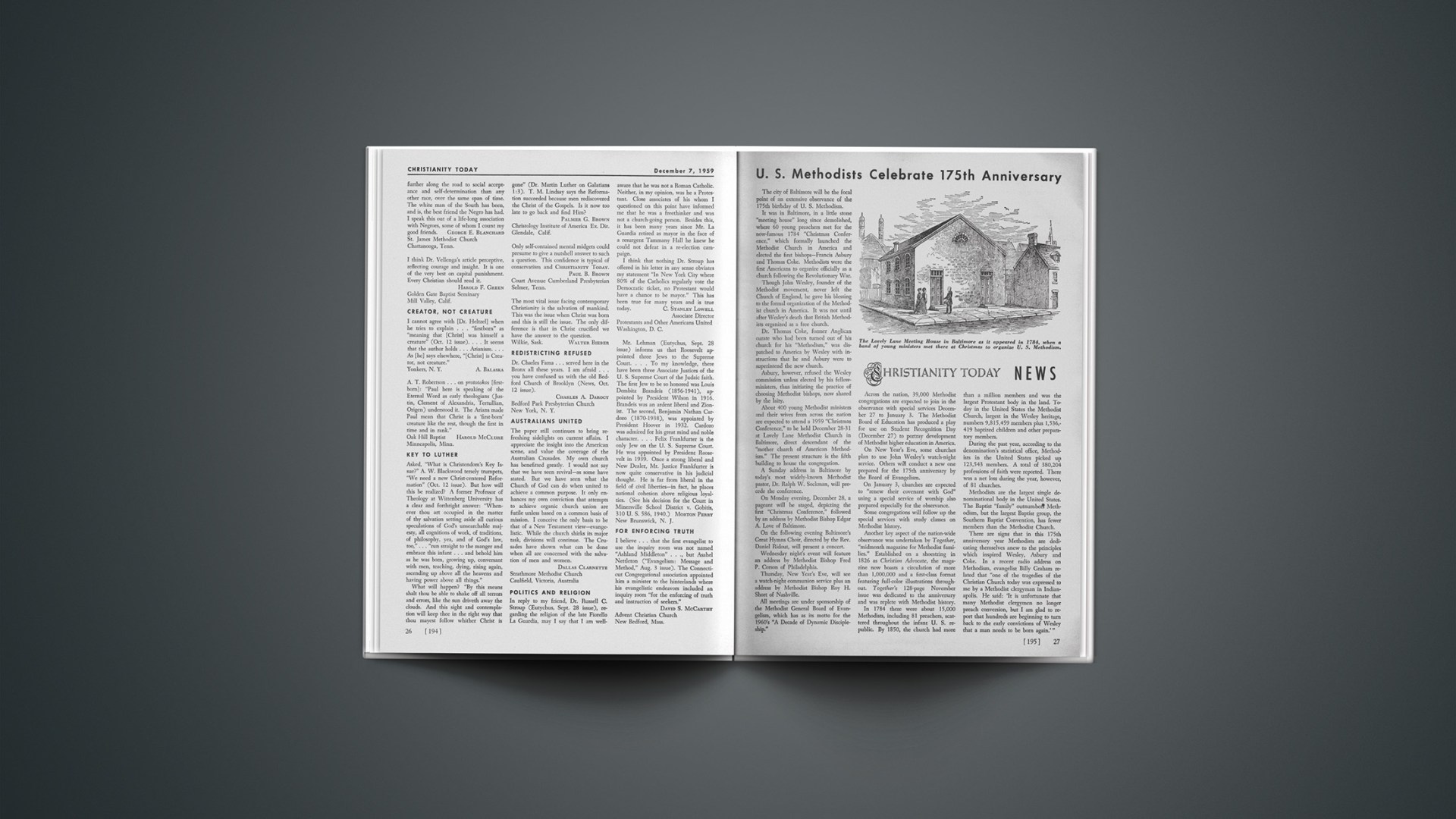
The city of Baltimore will be the focal point of an extensive observance of the 175th birthday of U. S. Methodism.

It was in Baltimore, in a little stone “meeting house” long since demolished, where 60 young preachers met for the now-famous 1784 “Christmas Conference,” which formally launched the Methodist Church in America and elected the first bishops—Francis Asbury and Thomas Coke. Methodists were the first Americans to organize officially as a church following the Revolutionary War.

Though John Wesley, founder of the Methodist movement, never left the Church of England, he gave his blessing to the formal organization of the Methodist church in America. It was not until after Wesley’s death that British Methodists organized as a free church.

Dr. Thomas Coke, former Anglican curate who had been turned out of his church for his “Methodism,” was dispatched to America by Wesley with instructions that he and Asbury were to superintend the new church.

Asbury, however, refused the Wesley commission unless elected by his fellow-ministers, thus initiating the practice of choosing Methodist bishops, now shared by the laity.

About 400 young Methodist ministers and their wives from across the nation are expected to attend a 1959 “Christmas Conference,” to be held December 28–31 at Lovely Lane Methodist Church in Baltimore, direct descendant of the “mother church of American Methodism.” The present structure is the fifth building to house the congregation.

A Sunday address in Baltimore by today’s most widely-known Methodist pastor, Dr. Ralph W. Sockman, will precede the conference.

On Monday evening, December 28, a pageant will be staged, depicting the first “Christmas Conference,” followed by an address by Methodist Bishop Edgar A. Love of Baltimore.

On the following evening Baltimore’s Great Hymns Choir, directed by the Rev. Daniel Ridout, will present a concert.

Wednesday night’s event will feature an address by Methodist Bishop Fred P. Corson of Philadelphia.

Thursday, New Year’s Eve, will see a watch-night communion service plus an address by Methodist Bishop Roy H. Short of Nashville.

All meetings are under sponsorship of the Methodist General Board of Evangelism, which has as its motto for the 1960’s “A Decade of Dynamic Discipleship.”

Across the nation, 39,000 Methodist congregations are expected to join in the observance with special services December 27 to January 3. The Methodist Board of Education has produced a play for use on Student Recognition Day (December 27) to portray development of Methodist higher education in America.

On New Year’s Eve, some churches plan to use John Wesley’s watch-night service. Others will conduct a new one prepared for the 175th anniversary by the Board of Evangelism.

On January 3, churches are expected to “renew their covenant with God” using a special service of worship also prepared especially for the observance.

Some congregations will follow up the special services with study classes on Methodist history.

Another key aspect of the nation-wide observance was undertaken by Together, “midmonth magazine for Methodist families.” Established on a shoestring in 1826 as Christian Advocate, the magazine now boasts a circulation of more than 1,000,000 and a first-class format featuring full-color illustrations throughout. Together’s 128-page November issue was dedicated to the anniversary and was replete with Methodist history.

In 1784 there were about 15,000 Methodists, including 81 preachers, scattered throughout the infant U. S. republic. By 1850, the church had more than a million members and was the largest Protestant body in the land. Today in the United States the Methodist Church, largest in the Wesley heritage, numbers 9,815,459 members plus 1,536,419 baptized children and other preparatory members.

During the past year, according to the denomination’s statistical office, Methodists in the United States picked up 123,543 members. A total of 380,204 professions of faith were reported. There was a net loss during the year, however, of 81 churches.

Methodists are the largest single denominational body in the United States. The Baptist “family” outnumbers Methodism, but the largest Baptist group, the Southern Baptist Convention, has fewer members than the Methodist Church.

There are signs that in this 175th anniversary year Methodists are dedicating themselves anew to the principles which inspired Wesley, Asbury and Coke. In a recent radio address on Methodism, evangelist Billy Graham related that “one of the tragedies of the Christian Church today was expressed to me by a Methodist clergyman in Indianapolis. He said: ‘It is unfortunate that many Methodist clergymen no longer preach conversion, but I am glad to report that hundreds are beginning to turn back to the early convictions of Wesley that a man needs to be born again.’ ”

Exploratory Talks

Plans are being laid for exploratory talks on the theological implications of present and future cooperative activities between the National Lutheran Council and the Lutheran Church—Missouri Synod. Informal discussions are scheduled for next July in Chicago.

Epitome of Mariolatry

Baltimore, where U. S. Methodism was organized [see page 27], also holds historical significance for Roman Catholics. For it was at the Council of Baltimore in 1846 that U. S. Roman Catholic bishops invoked the Virgin Mary as “special patroness” of the American church under the title of the Immaculate Conception. Last month, some 40 miles south of Baltimore, the largest Catholic church in the United States was dedicated as the National Shrine of the Immaculate Conception.

Though its architectural grandeur stands as a tribute to the perseverance, sincerity, and sacrificial spirit of many American Catholics, the National Shrine in Washington nonetheless epitomizes the Mariolatry promoted by their hierarchy.

Archbishop Joseph E. Ritter spent much of his dedicatory sermon in a defense of Mary’s “divine motherhood,” inserting an ecumenical twist: “may it [the shrine] stand as a symbol of the union [his stress] of all men under the headship of Christ. There can be no surer or more direct road than by Mary for uniting all men in Christ.”

Appeal to Koreans

An appeal to Presbyterians in Korea to heal their division was sent last month by representatives of the Commission on Ecumenical Mission and Relations of the United Presbyterian Church in the U. S. A. jointly with representatives of the Board of World Missions of the Presbyterian Church in the U. S.

“We are resolved to take no precipitate action,” the appeal said, “but to wait patiently for the enlightenment and guidance of the Spirit of God, praying that He may remove the misunderstandings and restore the mind of peace among his children.”

What caused the division which broke up Korean Presbyterian assembly in September? Said a prominent church woman in Korea: “The shame of this split is that it was not caused by deep theological conviction, but by a few corrupted and unscrupulous church leaders seeking for more power.”

Protestant Panorama

• The triennial Synod of the Southern Province of the Moravian Church in America (Unitas Fratrum), held last month in Winston-Salem, North Carolina, took a strong stand against “the evils of alcoholic beverages.”

• Four Salvation Army officers, two of them Mexicans, toured 1,200 miles of Arkansas back roads this fall in witnessing and distributing Christian literature to Mexican migrant farm laborers.

• The Lutheran Church—Missouri Synod plans to locate a new $6,000,000 junior college near Pontiac, Michigan … The synod has scheduled its first church-wide Sunday School convention for next July to be held in St. Louis.

• Mrs. Catherine Marshall, best-selling author and Christian Herald staff member, was married to Leonard E. LeSourd, executive editor of Guideposts, in Leesburg, Virginia, November 14.

• Heading the list of speakers who accepted invitations for the 150th anniversary dinner of the New York Bible Society in the Waldorf-Astoria Hotel, December 4, was Governor Nelson A. Rockefeller.

• The sixth assembly of the World Convention of Churches of Christ (Disciples) will be held in Edinburgh, Scotland, August 2–7, 1960. A U. S. contingent is expected to make up about half of the 3,000 delegates expected.

• The Church of God ordained last month its first native-born pastor in Alaska. He is the Rev. Fred Mamaloff, half-Russian and half-Indian, who is building a new congregation in Kodiak.

• Clear Creek Baptist School of Pineville, Kentucky, dedicated a $300,000 furniture factory in October. The plant employs 70 church furniture craftsmen who are studying for the ministry at the Southern Baptist school.

• The Latin American Bible Seminary in San Jose, Costa Rica, dedicated a new building last month. The seminary was established in 1924.

• Protestants and Other Americans United are expanding their Washington, D. C. headquarters. A newly-acquired four-story building which adjoins the present headquarters on fashionable Massachusetts Avenue will house a growing legal staff.

• The Planned Parenthood Federation of America is organizing a “Clergymen’s National Advisory Committee” to promote birth control information. Protestant Episcopal Bishop James A. Pike, who will head the committee, says it will have about 30 members from major Protestant and Jewish groups.

• Two more churches were admitted to the Federation of Independent Evangelical Churches of Spain at its October meeting in Tarragona. The group, organized three years ago with nine churches, now has 27. It voted to affiliate itself with the International Federation of Free Evangelical Churches.

• Pro-management forces strengthened their control of Lutheran Brotherhood, billion-dollar fraternal life insurance society, at its quadrennial convention in Minneapolis this fall. After defeating an opposition effort to enlarge the society’s board of directors, a record turnout of delegates elected four new directors pledged to support management.

• The Unitarian Fellowship for Social Justice is opening a national headquarters in Washington, D. C.

• Merger of Danish free churches under the name of “The Danish Confessional Church” was proposed at the Evangelical Free Church Council in Copenhagen last month.

• The British and Foreign Bible Society office in Belgrade is reported to be experiencing difficulty in importing Bibles. Informed sources say the whole country is feeling the pinch as a result, for the office has been the only supplier of Bibles since printing of the Scriptures was banned in Yugoslavia during World War II.

Clergy Protection

A new law in Pennsylvania exempts clergymen from testifying or being compelled to give any information they obtained in confidence.

“Rarely, if ever, have clergymen been required to divulge such confidential communications,” said Governor David L. Lawrence in signing the bill. “However, this act spells out the immunity given to such persons.”

Muslims on Graham

Maulvi Naseem Saifi, head of the Ahmadiyya Muslims in West Africa, wants the Christian Council of Nigeria to arrange a meeting between Muslim leaders and Billy Graham when the U. S. evangelist visits there early in 1960.

Told of the overture, Graham commented: “I will be happy to meet with them, or any others to whom I may present the claims of Christ.”

The Winner

A 68-year-old retired physician who emigrated from Russia 35 years ago is the winner of Israel’s second annual Bible knowledge contest, held last month in Tel Aviv.

Top among 12 finalists was Dr. Yehoshue Yeivin, who took his medical degree at the University of Moscow. Yeivin claims to have known the book of Isaiah by heart at the age of eight.

The contest gained such popularity last year that it has been made a permanent feature of Israeli culture. The 1958 national tournament was followed by an international contest (now scheduled to be held every three years).

Yeivin won $1,800. The last question posed to him: “What was the first diplomatic mission from Israel to another nation; and what was the last mission from another nation to reach the Kingdom of Judah?” The answer: “Israel’s first mission was sent by Moses from Kadesh to the King of Edom, and the last foreign mission to Judah was in King Zedekiah’s reign from the Kings of Edom, Moab, Tyre, Sidon and of the Ammonites.”

In a speech congratulating winners, Prime Minister David Ben-Gurion referred to the Bible as “the Israeli’s second homeland.”

Luther’s Bible

A new German revision of Luther’s translation of the New Testament will soon be in print. The revision was completed in 1957 after 30 years work.

Last year the Evangelical Church in Germany named a 15-member commission to start work on a new revision of Luther’s Old Testament translation.

Protestants in Germany have always used Luther’s translation of the Bible as their standard. The version now in use was issued 60 years ago.

How Christian?

The Communist-sponsored “Christian Peace Council” met in Warsaw this fall to plan its third “peace congress” to be held in 1961.

The preparatory committee for the congress, expected to be attended by proregime Protestant and Eastern Orthodox churchmen in Poland and other Communist countries, is headed by Professor Miklos Palfy, dean of the Lutheran Theological Seminary in Budapest, Hungary.

Centennial Climax

Rallies and special church services and conferences climaxed observance of the centenary of Protestant missions in Japan.

Last month, nearly 15,000 people packed Tokyo’s Metropolitan Arena for a “united worship service” sponsored by the National Christian Council of Japan.

Others highlighted their commemoration in large rallies arranged by the Japan Protestant Centennial, a specially-organized group which claims support of some 1,030 Japanese ministers and 800 missionaries (out of a reported total of 2,359 ordained ministers and 2,413 missionaries now working in the country). Basis for “participation”: belief in scriptural infallibility.

Dr. W. A. Visser ’t Hooft, general secretary of the World Council of Churches, was among visitors on hand for the national council observance. The council includes the largest Protestant denomination in Japan, the United Church of Christ (Kyodan), with more than 250,000 members.

Visser ’t Hooft called upon churches to take “a common stand against isolationism and self-centered confessionalism.”

“The Church must demonstrate that Christ actually overcomes the walls of separation, class, nation, race and denomination,” he declared. “This must manifest itself in our willingness to have fellowship across all national, racial and ideological frontiers.”

The ecumenical leader also asserted that common obedience to the divine calling is “a manifest unity.” He said that “invisible unity is not enough. We must overcome our fear of unity.”

In lining up supporters, for its own observance, Japan Protestant Centennial leaders had asked affirmation of faith in the Bible as “the fully inspired, infallible Word of God, the only rule of faith and practice.” Centennial-related activities included:

—A September 16-October 4 crusade in the Fukuoka Sports Center with evangelist David Morken which saw more than 1,000 decisions for Christ despite adverse circumstances (e.g., a young musician was diagnosed as having cancer a week before the meetings began; the first of two typhoons cancelled the opening service and the second came 10 days later; the wife of a crusade planner died).

—A campaign in Nagoya, third largest city in Japan, from September 11 through 20 with the Rev. Koji Honda, a leading national evangelist.

—Climactic conferences in October featuring overseas guests such as Dr. Oswald J. Smith, pastor emeritus of The Peoples Church in Toronto, Professor Roger Nicole of Gordon Divinity School, Professor Edward J. Young of Westminster Theological Seminary and Mr. Roy LeCraw, former mayor of Atlanta and a leading Presbyterian layman. The North American team spoke in meetings in Tokyo, Yokohama, Sendai, Nagoya, Osaka, Kyoto, Kobe, Fukuoka, Hiroshima, Okayama, Shikoku and Kyushu. Following a six-day meeting in Tokyo, the Japan Protestant Centennial adopted a resolution which (1) repented of “idolatry,” (2) pledged to try to “guard against the mistake of introducing the elements of pagan religion into any state-related affairs,” (3) endorsed the national constitution, and (4) vowed to “ ‘fight this good fight of faith’ unitedly on the basis of our common belief in the Bible.” It was also decided to plan a translation of the Bible into modern Japanese and to explore possibility of foreign missionary work.

Said Smith: “I believe the Church in Japan, for the first time, is catching the vision of world evangelism and that it will launch out as this second century opens and do its part in obeying the command of Jesus Christ to go into all the world.”

He observed, however, that Japanese “are a proud nation and difficult to reach,” adding, “Missionary casualties are very heavy; about 50 per cent never return for the second term.”

Smith asserted that “the Christian forces in Japan are characterized by division. It is very difficult to secure cooperation even among the evangelicals.… It is a pity that evangelical missionaries who have come to evangelize Japan cannot work together in a great evangelistic campaign to do the very work for which they came.”

LeCraw, retired U. S. Air Force colonel, raised a storm of protest when he was quoted as predicting that Japanese militarism will rise again and that the United States may have to fight the Pacific war all over again.

“The Japanese are rankling underneath from a hurt pride and cannot forget that America was the first nation ever to defeat them in war,” he was reported to have said in Tokyo.

People: Words And Events

Deaths:Dr. Earle V. Pierce, 90, president of the American Baptist Convention in 1938–39, in St. Paul, Minnesota … the Rev. William P. Nicholson, noted Irish evangelist, in Cork, Ireland … Dean Charles L. McGavern of St. John’s Episcopal Cathedral in Jacksonville, Florida (he and his wife were among those killed when a National Airlines plane plunged into the Gulf of Mexico).

Elections: As moderator-designate of the Presbyterian Church of New Zealand, the Rev. J. S. Somerville … as president of the Fellowship of Evangelical Baptist Churches in Canada, the Rev. R. E. J. Brackstone.

Appointments: As dean of the faculty and professor of New Testament at Western Conservative Baptist Theological Seminary, Dr. Arthur Whiting … as federal secretary of the Church Missionary Society in Australia, A. Jack Dain.

Nomination: For moderator of the American Unitarian Association, Dr. James R. Killian, Jr., former president of the Massachusetts Institute of Technology and special assistant for science and technology to President Eisenhower.

Resignation: As editor of the weekly Baptist Digest, state paper of Kansas Baptists, Joe Novak.

Consecration: As Anglican Bishop of Tokyo, the Rev. David Makoto Goto.

‘Biblical Zoo’

The Israel Embassy plans to present to the National Zoological Park more than 50 plaques which will identify animals mentioned in the Old Testament.

The plastic plates to be installed for temporary display on cages and dens in the Washington zoo resemble those used in the unique “Biblical Zoo” in Jerusalem. Other U. S. zoos will get the plates subsequently.

Engraved in Hebrew and English on weatherproof surfaces are such quotations as “The lion which is mightiest among beasts,” “the little foxes that spoil the vines,” and “the turtle (dove) whose voice is heard in our land.”

Nucleus of the famous “biblical” menagerie in Jerusalem came into being seven years before the establishment of modern Israel, according to the National Geographic Society. First exhibits in 1941—a few monkeys, rabbits, lizards, a vulture, and an eagle—were penned in a yard off a crowded downtown street. Later, more spacious quarters were provided in the suburbs.

Ideas

Our Lord’s Virgin Birth

Among the issues raised by the unfortunate and continuing controversy over the Virgin Birth, the implied dismissal of the biblical testimony naturally claims much of our attention. It is right that this should be so. For, while the biblical evidence is small, and attempts have been made to weaken it by emendation, variant readings, and literary dissection, even a theologian of Karl Barth’s stature tells us that “no one can dispute the existence of a biblical testimony to the Virgin Birth” (Church Dogmatics, I, 2, p. 176). Thus, denial of the miracle entails direct and conscious rejection of the authority of Scripture and the apostolic teaching which it embodies. And the seriousness of such rejection is incontestable and incalculable.

Yet while this is true, there are also important theological implications which may be missed even by those who contend for the Virgin Birth on biblical grounds. A main argument used against it is in fact its supposed insignificance and even irrelevance. Many theologians, like Schleiermacher, have thought that they could accept a supernatural work of God without the Virgin Birth. Many others have tended to agree with Brunner that it is an unnecessary and inquisitive biological intrusion. Many would argue that they can confess the true deity and incarnation of Christ without it. Evangelicals often leave the impression that it is a kind of embarrassment which they are prepared to accept because it is in Scripture but which they do not find to be particularly significant or meaningful.

Now if this is indeed the case, it might be asked why the issue has been given such prominence in recent discussion. To be sure, any denial of the biblical record is a serious matter. But why should this particular denial be singled out as compared, for example, with the denial of some of the miracles performed by Jesus? On the other hand, may it not be that, in addition to its implications for the authenticity and authority of Scripture, the Virgin Birth does in fact have a wider theological significance which its opponents are quick to ignore and its proponents too slow to perceive? This, at any rate, has been the way in which dogmatics understood the matter prior to the rise of liberal Protestantism, and it is perhaps the way in which it must always be understood in truly dogmatic thinking.

It may be admitted, of course, that the Virgin Birth is not flatly identical with the Incarnation, just as the empty tomb is not flatly identical with the Resurrection. The one might be affirmed without the other. Yet the connection is so close, and indeed indispensable, that were the Virgin Birth or the empty tomb denied, it is likely that either the Incarnation or Resurrection would be called in question, or they would be affirmed in a form very different from that which they have in Scripture and historic teaching. The Virgin Birth might well be described as an essential, historical indication of the Incarnation, bearing not only an analogy to the divine and human natures of the Incarnate, but also bringing out the nature, purpose, and bearing of this work of God to salvation. Hand in hand with its biblical attestation as a fact, it thus has a theological necessity which not only supplies its vindication but also warns us that its repudiation will almost inevitably be accompanied by a movement away from truly evangelical teaching.

Thus, from the fact that Jesus is “born of the Virgin Mary,” it may be seen that the work of Incarnation and Reconciliation involves a definite intervening act on the part of God himself. As Luther saw, a new beginning has to be made, a new creation initiated. It is not a beginning out of nothing. The role of Mary shows us that it is the old order which is the object of this creative work. The new man, Jesus Christ, is true man. In the words of Barth, “he is the real son of a real mother” (ibid., p. 185). There is no question of a mere semblance of humanity, nor of a humanity which bears no relation to the original work of God. What God now does, he does in and on the old, natural man. Yet it is strictly and properly the creative work of God himself. There can be no pretense of an achievement or theory of man. By the exclusion of the male it is made quite clear that what is to be done is something which man of himself cannot do, not even though his work is sanctified for the purpose by God. There is a part which has to be played by man as represented by the virgin; but the active initiative is necessarily with God.

The inadequacy of man for this work is linked, of course, with the sinfulness of man. Hence the Virgin Birth carries with it not only the implication of the initiative of grace but also that of the hopeless sin and guilt of man. To be sure, this is not to be identified exclusively with the sexual act, as though this were the essence of sin and the problem of original sin would be solved by its evasion. Mary is no less a sinner than Joseph, and, while the sexual act is affected by sin like all others, the original sin of the race extends to every act as to each individual. No, the point is that though the Son of Mary as such stands in solidarity with sinners, yet his real birth is directly from God, so that unlike all others he is not himself a sinner, but has come to bear their sin in God’s own work of salvation. A man born in the normal way could have been one with sinners, but he could not have been the sinless sin-bearer. The sinless sin-bearer comes into the world in such a way that he is also one with man, yet there is a decisive break with the old humanity as well as continuity with it. He is not sinful man accomplishing in a more worthy representative his own salvation. He is the second man, the Lord from heaven, the Son of Man who is also the Son of God incarnate for us men and for our salvation.

In this connection it is important to consider the importance of the fact that the human part is played by the female rather than the male. In a sense this is self-explanatory, for by nature the female is always present at generation. It is also theologically apt, for, as divines have pointed out from at least the time of Leo, Jesus has neither a mother in heaven nor a father on earth. There is also the further point, however, that it is the male who plays the active, initiatory role in generation, and therefore in a work in which the initiative necessarily lies with God “the whole action of man, the male can have no meaning” (ibid., p. 194). On the other hand, it must be emphasized that, though the female provides the link with humanity, this is not because either by sex or in person she has innate qualities alien to the male, nor because she is free from sin, nor because there is a special female Mary herself immaculately conceived and destined to represent human glorification as the queen of heaven, but because she can fulfill the essentially passive role as the one in and on and through whom God acts in accomplishment of his gracious salvation.

The fact that in the life and work and person of Jesus Christ we are genuinely concerned with God in his saving action is positively emphasized by the second, or more strictly primary, element in the Virgin Birth, namely, the fact that Jesus was “conceived by the Holy Spirit.” This does not, of course, give rise to the same offense as the “born of the Virgin Mary,” since it may be conveniently “spiritualized” and linked with a normal human birth in various ways. Yet in conjunction with the “born of the Virgin” it has its own positive witness, first, that in the coming of Jesus we have neither a mythological marvel nor a natural possibility, but a true work of God, and second, that, as Jesus was born from above, so all members of the new humanity must be born again to newness of life in him by the sovereign action of the Spirit. In this respect there is truth in the statement of the older divines that the proper organ of conception in Mary was the ear, by which there came to her the Word of God and therefore faith. In other words, Christians are all born again by grace and faith in analogy to the birth of Jesus Christ himself as conceived by the Holy Spirit and born of the Virgin Mary. To become a Christian is no more a natural possibility than the Word’s becoming flesh. It is the regenerative work of the Spirit in those who receive Christ, that is, who believe in his name.

It may be contended, of course, that these doctrines implicit in the Virgin Birth may still be held even where the factuality of the birth is rejected. In point of fact, however, it is noticeable that denial of the Virgin Birth almost invariably accompanies, or is accompanied by, a more basic theological defection in which the divine initiative, the inadequacy of man, the reality of original sin, the miraculous nature of regeneration, the primacy of the Word of God, and the importance of the faith which it brings are either abandoned in whole or part or drastically reinterpreted. Even in Roman Catholicism, which obviously retains the Virgin Birth, it is striking that the distortion of evangelical doctrine has almost inevitably produced a corruption of the biblical witness to the Virgin Birth in and by an unfounded, exaggerated, and basically Pelagianizing Mariology. In itself the abandonment of the scriptural testimony may seem to many to be of little account. But quite apart from the serious impugning of the written Word, it is a conditioning and resultant sign of more widespread abandonment of evangelical doctrine. For the Virgin Birth itself carries by implication the sum and substance of the Gospel.

We may close on an irenical note. Christmas has come again with its testimony to the Incarnation and atoning work of Christ without which there is no Gospel, faith, nor Church. All who claim the name of Christian will be turning afresh in public and private to the ancient and well-loved records: “Now the birth of Jesus Christ was on this wise …”; “And it came to pass in those days, that there went out a decree from Caesar Augustus.…” All will be pondering afresh the tremendous reality and meaning of the incarnation of the Son of God. May we not make it our business to see that the records and the reality are in fact more intimately and irrevocably related than some ecclesiasts today assume? May we not ask ourselves whether we can really have the one without the other, whether we shall not necessarily lose the one if we deny the other, whether the substance of the Christmas Gospel and the purity of the Christmas faith are not an issue in this whole matter? May we not make it our concern to commit ourselves afresh to the reality and wholeness of the Christmas Gospel as the very carols sung from our own lips attest it, and with this Gospel humbly accept the holy miracle of the birth of Jesus which in the wisdom and power of God is so apt to denote the significance of his saving action as the incarnate Mediator, the first-begotten of the new creation and family of God?

PRESIDENT AND POPE IN PERSONAL DIPLOMACY

Despite their reservations about “personal diplomacy,” most men of good will are hopeful that President Eisenhower’s international mission will contribute constructively to man’s vexing search for a just peace in our tense world. The “Spirit of Camp David” will carry the President to a strange conglomerate of personalities—including Premier Khrushchev, Pope John XXIII, and heads of many nations shading in sympathy from neutralism to westernism.

The junket has troublesome religious as well as political facets. President Eisenhower is political leader of a predominantly Protestant land. A visit to the Pope, as well as to St. Peter’s, has satisfied the curiosity of more than one roving Protestant who has had no intention of kneeling and kissing a papal ring. Not questioning the President’s liberty to call on the Pope, many Protestants wish he had clarified the motivations of the visit. Was it ventured because the Pope is head of a foreign state, or head of a church, or as a matter of political expedience?

The fact is that the Pope heads a foreign state, although U. S. State Department officials constantly evade this issue when periodic pressures arise to require American representatives of that foreign power (especially cardinals and bishops) to register as such.

If the President’s visit is projected because the Pope heads a church, would he not profit from further instruction in classic Presbyterian insights? Because of the authority which the papacy arrogated to itself (during the course of history) to impose doctrines unfounded in Scripture as articles of faith, the Westminster Confession (Chapter XXV, Section VI) affirms: “There is no other head of the Church but the Lord Jesus Christ; nor can the Pope of Rome in any sense be the head thereof; but is that Antichrist, that man of sin and son of perdition, that exalteth himself in the Church against Christ, and all that is called God.” The Lutheran Church—Missouri Synod and many other Lutherans share the same view, expressed in the Smalcald Articles: “The Pope is the very anti-Christ, who exalted himself above, and opposed himself against Christ, because he will not permit Christians to be saved without his power, which, nevertheless, is nothing, and is neither ordained nor commanded by God …” The Common Confession adopted by the American Lutheran Church and The Lutheran Church—Missouri Synod states: “Among the signs of (our Lord’s) approaching return for Judgment, the distinguishing features of the Anti-Christ, as protrayed in the Holy Scriptures, are still clearly discernible in the Roman Papacy, the climax of all human usurpations of Christ’s authority in the Church” (XII, 2). The force of these passages is to identify the institution of the papacy (not the Roman church and its people or the person of the Pope) as the Antichrist.

Holding an office that imposes no religious test, the President may justify his papal conference on the ground of Rome’s support of man’s freedoms in opposition to Communistic tyranny. But Protestants and Other Americans United has urged President Eisenhower to ask Pope John and Generalissimo Franco of Spain why they jointly suppress religious freedom for non-Catholics in Spain. The British government has not hesitated to raise the religious liberty issue with the Spanish Foreign Minister. American Protestants think that Mr. Eisenhower’s concern for basic freedoms should extend to the Roman as well as to the Russian sphere. Not only are Protestants prohibited from building regular churches, but publication and distribution of Protestant literature are forbidden, and Protestant chaplains in the U. S. Armed Forces in Spain are even disallowed contact with Spanish Protestants.

If the President’s visit to Rome aims to promote a sort of Romanist-Republican good will, the venture may be as costly among Protestants as it is productive among Catholics. Personal diplomacy between a pope and a Catholic president would have intriguing possibilities indeed, and if Mr. Eisenhower’s visit unwittingly reminds us of these it will accomplish some good. A presidential visit to the papal residence seems to call for a papal visit to the White House. Where separation of Church and State is a prized heritage, such a turn could signal a triumph not so much for religious tolerance as for religious indifference.

WHY SHOULD ECUMENISTS DISOWN A SUNDAY SCHOOL CONVENTION?

The Ohio Council of Churches went out of its way to “disown” the fourteenth annual convention of the National Sunday School Association, held recently in Columbus. In a release to its constituency and to press and radio news services, the Council stated: “(This Convention) is not sponsored by, nor does it have any connection with, the National Council of Churches or the Ohio Council of Churches, nor most of the member denominations of the stated Councils.”

What prompts this oblique reference? Surely NCC spokesmen cannot be alarmed about spiritual concerns of the NSSA. When liberal Protestantism had dissolved the vitality of many church schools, NSSA was organized interdenominationally in 1946 for the objective of “revitalizing the American Sunday School” and in 14 years has accomplished some remarkable evangelical results: The Bible has been made central in curriculum and in determining Sunday School principles and methods; evangelism is being restored to its rightful place in the objective of the school; and spiritual power emphasized as an essential dynamic in Christian growth. The NSSA serves 28,000 evangelical churches in 100 denominations with a constituency of some 10,000,000. It has more than 40 related metropolitan and regional Sunday School associations. NSSA conventions draw thousands because of their spiritual uplift and their practical service through workshops, clinics and conferences. This year there were some 5,000 registered delegates in the annual tri-cities convention despite Council disparagement.

The “unpardonable sin” of NSSA, apparently, is that it is not sponsored by the National Council of Churches. By their publicized attitude toward NSSA’s convention, some professed champions of interdenominational ecumenism provide another indication of a higher loyalty than revitalizing the Church’s evangelical dynamisms, even than promoting evangelical cooperation. Some organization men seem more and more to make an idol of a twentieth century movement, identification with which is regarded as the badge of authentic Christianity.

This approach to the unity of the body of Christ in terms of “organizational salute” reflects some dangerous prejudices. Its implications are evident already on far-flung mission fields. A new phenomenon has arisen in our century: the world-wide Church; while many virgin fields remain, not a single nation exists today without a church. The “sending” agency for missionaries must no longer be identified simply with a remote mission board in New York or London; the established Church’s approval is now regarded as essential with a view to collective leadership. In principle there is much to commend this approach to missions. But when it becomes a device for organizational discrimination and control, rather than for spiritual unification of the scattered churches, it must be disputed. Some ecumenists today mean by “the Church is mission” that the World Council of Churches (or the National Council in the United States) is the only legitimate source and sanction of authentic Protestantism. Whatever does not have its approval, and wear its badge of identification, is therefore viewed, if not as spurious, at least as “off brand.” But discerning Christians will sense that addition of a twentieth century test to evidences for genuine Christianity tampers with first century criteria.

We think the Ohio Council’s sniping at the NSSA convention regrettable, and we would like to encourage an apology in the interest of Christian brotherliness. NSSA has many strides yet to make, but it is restoring to the Sunday Schools of America an evangelistic concern and biblical interest that are commendable. We think ecumenists would help the cause of church unity more by commending spiritual gains than by deploring organizational unaffiliation. Otherwise churchgoers are apt to gain the impression that ecumenical identification means detachment from evangelical priorities. The ecumenical movement need not be that way, but some of its organization men convey the unfortunate impression that it is.

Sonnets for the Space Age

I

These words of violence are not my own: In wheeling clouds of light God came to me. O son of man, He said, behold and see, Then cry aloud like cymbals striking stone. This pinch of dust, this narrow chain of bone, Has made himself the measure of all things, Has crowned himself as lord and king of kings, And thinks with fragile fist to shake my throne. He boasts that he will conquer earth and sky, But every boast is made with borrowed breath. I hold the only key to life and death. O son of man, why will these people die!

They speak of peace but peace will never be Until men turn with humble hearts to me.

II

I trembled at the words and was dismayed: I knew my own conceit and bent the knee. Then I heard angels sing His majesty, Their silver wings the harps on which they played. With whirlwind voice God spoke: Man’s searching brain Has split apart the atom’s mighty sphere, Has harnessed speed till distance holds no fear, And seeks now to control the moon’s white plain. There is no answer on a distant star. The continent of heart is deep and wide, Who conquers this and learns to vanquish pride Has made a conquest that is greater far.

I am the Lord Thy God. O sons of men, Discover first the star of Bethlehem.

MILDRED ZYLSTRA

Life

LIFE

Woe to men and to nations when they assume that life is their most precious possession! On this premise the preservation of life is said to be the first law of nature. But such is not the case in the realm of the spirit, for there may come a time when choice must be made between life and death, and the right choice is death.

Many years ago a missionary and his wife were confronted with a decision in which their own lives and the lives of two small children were involved. During those crucial days they came across an article in which there was this statement:

“If for truth man should die,

’tis his perdition to be safe.”

The unknown author of those lines expressed a truth, the philosophy of which is based on the eternal words of our Lord: “He that findeth his life shall lose it: and he that loseth his life for my sake shall find it.”

These words, of course, have a spiritual application. They also make it clear that there are things more precious than life itself.

Here in comfortable, satisfied America, we are prone to forget that even in our own day there are men and women dying for their Christian faith. In areas controlled by unrestrained communism, thousands have died rather than deny their Lord. Even as this is written such incidents continue to transpire.

What would you do if you were confronted with the choice of life or death, and this hinged on one spoken word of denial or repudiation of your Christian faith?

Church history is replete with the stories of those who suffered the loss of everything: who went to the lions, the flames, the guillotine, or the wrack with praise on their lips.

Life is a wonderful thing and its ending seems tragic. But life is a transient phase of man’s existence, and that one who is so engrossed with the present that he fails to see what lies beyond is to be pitied.

The “heroes of faith,” enumerated in the eleventh chapter of Hebrews, were men to whom life was a matter of secondary importance. How our own generation needs a renewed sense of those values by which alone man looks up and beyond the immediate and sees with the eyes of faith the eternal, which changeth not and fadeth not away!

We are prone to view the tragedies of our world in terms of human suffering and want; and in so doing we tend to look for their solution at the humanistic level. By this we may bring some measure of relief to the body and superficial comfort to the mind, but we fail to bring that hope for the soul which is to be found alone in the death and resurrection of our Lord.

This preoccupation with bread and with the secular is insidious because, while it is right to be concerned about such matters, the danger is that our concern will end there.

Satan’s taunting accusation against Job: “Skin for skin, yea, all that a man hath will he give for his life,” is true wherever materialism prevails. But when Christian ideals dominate one’s philosophy of life, an adjustment takes place and these ideals become more precious than life itself.

The writer of Proverbs says: “There is a way which seemeth right unto man, but the end thereof are the ways of death.” The more man centers his affections on the material, the more he looks on life as an end in itself. He forgets that man shall not live by bread alone, nor can his soul be satisfied with those things which are certain to perish with the using.

It is at this point that we all need to evaluate the social implications of the Gospel. They are not an end in themselves, but are certainly the fruits of Christian love.

The humanitarian claims and social needs of mankind must be viewed in the light of the total man.

It is all too easy to see humanity in terms of this life alone. But what shall it profit us if we help to alleviate need and establish justice and peace, and then neglect man’s spiritual life which is not only for today but for eternity.

Furthermore, as Christians, it is our primary duty to point all men to the One who said, “I am the way, the truth, and the life: no man cometh unto the Father, but by me,” for the life of which He speaks begins now and lasts forever.

The inevitability of death should lead man to a proper evaluation of his present life in terms of eternity. That it does not do so is but additional evidence of the folly and blindness of unregenerate thinking. Life beyond the grave is a clear affirmation of the Holy Scriptures, and the empty tomb of our Lord is the assurance of hope to all who will believe. Even so, our primary concern is, more often than not, centered upon those things which never reach beyond the grave.

How few of us take seriously our Lord’s admonition: “Surely life is more important than food, and the body more important than the clothes you wear.” It is our preoccupation with living that beclouds our horizon and keeps us from looking to that city, the maker and builder of which is God.

Moses chose to renounce the privileges of Egypt that he might please the One who is invisible. Later, with the courage that comes only to those who are faithful, he stilled the terror of the Israelites with these words: “Fear ye not, stand still, and see the salvation of the Lord, which he will show to you today.”

In secular literature we often read of a bravado that laughs at death, but this is not the Christian’s way. To the Christian this life is but the entrance hall into a glorious eternity. Life is something to be cherished, to be used for God’s glory, to be expended in accord with divine plan. Because of this there are many times when we must be careful to distinguish between immediate ends and eternal gain.

Poor indeed would this world be had there not been men and women through the centuries who saw life and ideals in their proper perspective. To these men and women who “loved not their lives unto death” we owe more than we can ever repay.

Our Lord said, “Fear not them which kill the body, but are not able to kill the soul: but rather fear him which is able to destroy both body and soul in hell” (Matt. 10:28).

Now that, to moderns, hell is no longer a place of torment and separation from God, and Satan is no longer a personality but only the incarnation of evil influences life is often regarded as man’s most precious possession. But to God faithfulness is infinitely more important. To those who are faithful unto death, He has promised a crown of life.

L. NELSON BELL

Eutychus and His Kin: December 7, 1959

SEASON’S GREETINGS

If the Christmas mail was once a Christian post, it is now overwhelmingly post-Christian. The saint who replaced the Saviour in our greetings is a secular Santa, a nylon-bearded imposter in whose lap we place our children that they may be taught to pray selfishly. Of course our adult Santa-cult moves on a higher plane. We have the sticky Santa-mentality which appears in this litany from a would-be popular song: “May Santa fill our hearts this Christmas with love for ev’ryone ev’rywhere.…”

Such gush almost invites the off-beat and off-color cards that will make a beatnik out of Saintnik, with bongo drums under his beard.

Other cards in the best of taste also avoid any Christian sentiments. A series designed by international artists for UNICEF cautiously restricts its greetings to “Happy New Year” in the five languages of UN. Purchasers who want to say “Merry Christmas” may have this personal message imprinted for an extra charge.

One set of designs links Christmas Eve in Canada with the Devali feast in India; international understanding finds a “Time of Joy” in every culture. After looking up the Devali lamp festival, I must admit it has features that could be much admired here. There is spectacle in scores of lamps floating down the rivers. A forthright ceremony known as Sharada puja might be even more popular. Since the feast honors Lakshmi, the goddess of wealth, this ceremony centers on the businessman’s account-book, which is put on a stool, given various marks and sacred inscriptions, then topped with a rupee while a lamp is waved before it. The closing incantation is to secure a thousand profits in the coming year.

This sort of thing might close out the Santa season beautifully. It could be adapted, I suppose to IBM machines. Soon Krishna cards, with lucky rupees, could join the season’s greetings.

It is about time for Christians to contribute to world understanding a reason for the hope that is in them. Our age has got past Christianity without ever meeting Christ. It has accepted the Hindu doctrine that all religions are paths to the same goal without hearing the Word of God that there is none other name under heaven given among men whereby we must be saved. It is too late for the vague benevolence of Christmas. It is time for the greeting of the Gospel, in the name of Jesus Christ.

EUTYCHUS

PROTESTANT WITNESS

I am particularly interested in Dr. Elson’s criticism of Protestant methods in public expression (Oct. 26 issue). I think it is a timely word, even if long overdue. However … how can there be a Protestant witness when any expression has to surmount the hazard of sectarian walls? Roman Catholicism is heard and listened to because it speaks from the ramparts of a united church.

H. LINCOLN MACKENZIE

Cardigan, Prince Edward Island

In terms of what approach Christians may use responsibly, I find that his pastoral solicitude first and issues second has only succeeded in separating private from public morality.

W. THOMAS APPLEBEE

Community Congregational Church

Manchester, Iowa

Clear-speaking article.… [Dr. Elson] voices what a number of us have been feeling. It is time that Protestantism changed from a negative approach to a positive one, to one of protesting for those things in which we believe. I hope and pray that his article will do much good in helping to crystalize opinion in favor of a more positive approach to national problems by Protestants.

GALEN E. RUSSELL

Mont Clare Congregational Church

Chicago, Ill.

THE TRUE CATHOLICS

Your October 26 issue was especially enjoyable, expressing so many of my convictions.…

I disagree radically with many of the ideas put forth in CHRISTIANITY TODAY. On the other hand, I am happy that there is such a paper as yours, endeavouring to get Protestants to think and to consider the fundamental teachings of Christ. There has been too much prejudice on the part of “fundamentalists” and too much wishful and sloppy thinking on the part of the so-called “liberals.” Such a periodical as you represent ought to pave the way for a more dynamic and effective Christianity in these United States.

Professor Geoffrey W. Bromiley in his article “Who Are the True Catholics?” refers to the old Anglican Bishop Jewel and his refutation of Roman heresy on the basis of the “old fathers … many doctors … many examples of the Primitive Church,” Holy Scripture and the Councils. This is somewhat typical of Hooker and the famous Carolingian Divines of the Church of England. It is certainly typical of the Orthodox Church’s thinking. As the various Protestant, Anglican, Roman and Orthodox scholars (clerical and lay) study carefully and reverently the writings of the Fathers of the Early Church together with the “many examples of the primitive Church” and the Holy Scriptures, laying aside local customs and petty prejudices, the Holy Spirit will grant to them the precious gift of unity. There must be a serious and reverent return to the “ancient landmarks” before real progress can be made, in my opinion.

May God bless you all as you strive for holiness and righteousness and the application of God’s truth to every situation.

GREGORY ROWLEY

St. George Orthodox Church

Terre Haute, Ind.

May I commend the article by Geoffrey W. Bromiley. At this time when Roman Catholicism, according to its statistics, is growing so rapidly and so many Protestant leaders consider it simply as another Christian church—a bit conservative and liturgical, perhaps, but one of the branches of the Vine, it is good to read an article like that. The Reformers had a clear vision of what they had come out of.…

Bishop Fulton J. Sheen is quoted … as saying, “The hardest thing to find in the world today is an argument. Because so few are thinking, naturally there are few to argue.… Never before, perhaps, in the whole history of Christianity has [the Catholic Church] been so intellectually impoverished for want of good, sound, intellectual opposition as she is at the present time. Today there are no foemen worthy of her steel. And if the church today is not producing great chunks of thought, or what might be called ‘thinkage,’ it is because she has not been challenged to do so.… The church loves controversy, and loves it for two reasons: because intellectual conflict is informing, and because she is madly in love with rationalism. The great structure of the church has been built up through controversy.”

Is not this a challenge from the Roman Catholic Church for Protestants to challenge her? Should not the spiritual sons of the Reformation be as courageous as was Jewel. Or have we lost the conviction of our spiritual forefathers?

HENRY F. BROWN

Watsonville, Calif.

NORTH OF THE BORDER

Your editorial, “Canadian View,” (Oct. 26 issue) is true, discerning and well written.

W. GORDON BROWN

Dean

Central Baptist Seminary

Toronto, Ont.

If you knew what a tremendous step forward the booklet is, considering the very liberal stand the United Church of Canada has taken in the past, you would not have been so eager to “quench the smoking flax.” In fact, in all Christian love you ought to have rejoiced.

JEAN THORPE

Windermere, Ont.

It should be noted that this “study” does not represent the membership of the United Church of Canada as a whole; the evangelical people within the United Church certainly would not agree with this hook, and from what we can gather, the church head office in Toronto has been flooded with calls since its publication of Life and Death from concerned people who disagree with the views expressed. You are correct in the conclusion that it would have been better to return this book to the committee for further Bible study, but we doubt if that would have done much good. It is not so much the study of the Bible that would make the difference, but rather the attitude towards the Bible: You either accept it on face value as the Word of God, or you don’t. In the latter case you are not expressing yourself regarding God’s Word, but simply regarding what you believe to be a collection of human writings about God and universe. Life and Death seems to be a result of thinking based on this latter view of Scripture. And that is why its content is mere confusion.

H. J. AAFTINK

St. Andrew’s United Church

Kaslo, B. C.

APOSTOLIC MINISTRY

I sincerely believe that Dr. Bell’s articles are the most valuable of them all. I have cut most of them out and filed them for several years.… I was particularly interested in his article “Foundations” (Sept. 28 issue) and naturally, being a priest of the Anglican or Episcopal Church, I wondered why you did not mention the Apostolic Ministry as held by all the so-called “historic churches” such as the Roman, Anglican, Orthodox, and the Lutheran in the old country.… While not mentioned by our Lord, for he had no reason for doing so during his time on earth, his apostles and those who followed certainly carried on what we now know as laying on of hands in succession. It was the practice of New Testament teaching, and so much so that Protestant ministers are continually applying for Anglican ordination. As chaplain to the Episcopal Bishop of Los Angeles, I am with him and assisting in all ordinations, and every year the Bishop is ordaining men from other ministries, particularly from Baptist, Presbyterian, Methodist, and Congregationalist, seemingly more from the latter. I feel sure this would not be done if these communions possessed the Apostolic Ministry.

SAMUEL H. SAYRE

St. Barnabas’ Episcopal Church

Los Angeles, Calif.

The statement in “A Layman and his Faith” (Oct. 26 issue) is superb. I am convinced that modern theological scholarship has almost committed the unpardonable sin. I am preaching a sermon this Sunday night on the subject “The Power of Conviction” and the material is a great help to me.

W. O. VAUGHT, JR.

Little Rock, Ark.

ON CAPITAL PUNISHMENT

In … Jacob Vellenga’s … “Is Capital Punishment Wrong?” (Oct. 12 issue) … there are … things with which I take exception.… It is not my … object either to deny or affirm Mr. Vellenga’s position for certainly the problem is a moot one.

It is not only for taking human life that the Old Testament demands capital punishment but also as the penalty for other offenses: idolatry, adultery, incest, cursing of parents. To be consistent then, Mr. Vellenga must also insist on the death penalty in these other areas.… If … the answer is made that we no longer believe in the death penalty for witches, then the dam is opened. If, as theologians of old have been wont to do, we distinguish … [among] the moral law and the ceremonial law and the forensic law of the Old Testament, and then claim that only the Old Testament moral law is now binding, we have to face the possibility of its being said that the death penalty is part of the ceremonial or forensic law and also not binding for us today.

This problem now carries itself into the New Testament area, the second area of Vellenga’s proof. Jesus says he came to fulfill the law and the prophets. And yet what law? Did he intend to fulfill the law killing witches and others convicted under the Old Testament law? If so how [do we] explain the story of Jesus and the woman taken in adultery (John 8:1–11)? Clearly this is an instance of Christ abrogating the Levitical and Deuteronomic codes. In fact if you want to you can say it’s an example of Christ suspending capital punishment. Of course there is the possibility of denying the authenticity of John 8:1–11 as is done by many scholars. The only trouble with this method is that it opens again the possibility of denying the authenticity of other areas of the New Testament and ultimately the whole New Testament itself.

I certainly further take exception to the equation of “judgment” in Matthew 5:21–22 with capital punishment. Judgment could well imply a futuristic judging by God in that context. If we equate “judgment” with capital punishment, then it would seem no less spurious to further equate the verb “to judge” in a like manner. Thus, “Judge not that ye be not judged” could also be made to fit the argument.…

If the early Christians did not meddle … with laws against wrongdoing … it was only because they were not strong enough to meddle.… Around the time of Constantine, they did “meddle”.…

Not having a real position of my own, I must commend the author for being on one side of the fence. My thoughts are, however, that accepting the canonical authority of Scripture does not force anyone to the side of capital punishment. Where they do force one I am not sure.

C. F. PAULING

Jacksonville Beach, Fla.

That Mr. Vellenga is actually associate executive of the Synod of Illinois is incidental. What needs to be clarified is the fact that the views expressed by Mr. Vellenga are not in agreement with the representative conscience of the church as expressed by its highest judicatory in a social deliverance adopted by the 171st General Assembly which states: …

The 171st General Assembly

Declares its opposition to capital punishment,

Calls upon the judicatories and members of the United Presbyterian Church in the United States of America to work for the abolition of the death penalty in their respective states,

Urges the judicatories to seek the improvement of our various penal institutions and systems to the end that society may be protected and persons convicted of crime be rehabilitated, and

Encourages the Department of Social Education and Action to continue its study of other aspects of crime prevention and correction.

HOWARD C. MAXWELL

Associate Secretary

Dept. of Social Education and Action

United Presbyterian Church in the USA

Philadelphia, Pa.

Thanks for publishing Dr. Vellenga’s article.… He is absolutely correct—according to the Bible.

E. W. L. LEHNE

Brownton, Minn.

I have personally known of too many miscarriages of “justice” in our civil courts to be willing to give them the right of life and death. The question raised by Dr. Vellenga has two sides, and the answer he suggests is not the biblical answer, but is only his interpretation of the Word of God on this matter.… It is probably true that the Church should not “meddle” with capital punishment since we obviously cannot “legislate” morals, [but] we had better remember that we are not merely Christians, but are Christian citizens. Our citizenship … implies a responsibility for the justice, mercy, and integrity of government and civil law.…

ROBERT HALDANE, JR.

Arbor Grove Congregational Church

Jackson, Mich.

I am convinced that the Old Testament is no longer valid for either religious or moral law for the Christian, and that the New Testament was never meant to be an Apostolic or Divine Constitution. The new humanity in Christ is dead to sin and dead to the Law. He who would argue for obedience to even one moral law because it is given to man in the Law, would deliver us back to the bondage of the Law.… The Holy Scriptures point us to Christ. When they become the basis of authority, then they make denominations and not Christians. This is for me the teaching of St. Paul, and I hope that he understood Jesus, and that I understand Paul.

OVERTON LOVE TURNER, JR.

Presbyterian—Christian Church

Tishomingo, Okla.

It is ridiculous to see a supposedly well educated man quote the Old Testament as a rule and guide on morals when some of the greatest heroes in it were murderers in their own right.

MYLES D. BLANCHARD

Universalist Church—New York State

Auburn, N. Y.

While I certainly cannot agree with his basic thesis, I find some very interesting food for thought.

WILLIAM VOGEL

Ganado Presbyterian

Ganado, Ariz.

There may be cases in which man cannot see any alternative to killing his fellow man in defense of others for whom he bears an overriding responsibility—as in the case of a madman who must be stopped from slaughtering a group of innocent people—but when society has taken such an offender into its custody, there can be no Christian excuse for killing him. Although I am a member of the Executive Committee of the New York State Committee to Abolish Capital Punishment, I do not see in abolition any panacea. It is rather only a first step toward a system of penology which would have as its purpose the spiritual and moral redemption of offenders.…

WILLIAM ROBERT MILLER

Managing Editor

Fellowship

Nyack, N. Y.

God is more interested in the rehabilitation of any criminal than he is in the senseless murder by society … of an emotionally unstable sinner.

G. H. FISHER

St. Johns-Immanuel Parish

Bancroft, S. Dak.

Punishment is a wrong word. I have read about forms of execution with plenty of [pain] to them. Today in this country executions take a few seconds. If there is any [pain], the time is too short for it to be noticed.…

EATON R. BURROWS

Newfield, N. J.

I am appalled to think that a journal of the Christian faith would carry such an article.…

C. DANIEL MATHESON

Danforth Avenue United Church

Toronto, Ont.

The article … was needed and … good.

WILLIAM SUTHERLAND

Indiana, Pa.

I am so concerned that I shall not be able to sleep until I write you.… We who live lawful lives can only enjoy this freedom of breaking laws through others who do the actual lawless acts.… After [they have] been punished and our super ego is satisfied, then we can begin to love the person.… This is sin.…

DANIEL P. MATTHEWS

Holy Comforter Episcopal Church

Monteagle, Tenn.

Thank you.… In these days of increasing disorder among citizens, I think the article and its conclusions are most timely. I was in the correction field for nearly five years … as a state prison chaplain and this subject is of particular interest to me, as it well should be to all citizens.

CLARENCE M. LUTHER

West Newton, Mass.

Such reasoning affirms that there is a difference between “nice” sins and “dirty” wanton sins. We sin “nice” sins and live until the judgment of God. The murderer commits “dirty” sins and is judged by man and put to death. Since when is sin anything but sin? Now I’m not implying that anyone sinning against society should go scot free until the judgment of God, but as long as they live there is hope.

LOUIS EVERT

Hasson Heights United Presbyterian

Oil City, Pa.

I … object to the statement: “Capital punishment should not be classified with social evils like segregation, racketeering, liquor traffic, and gambling.”

To place segregation alongside … the other items mentioned is unthinkable.… Multitudes of honest and sincere Christians with a sincere appreciation of the worth and ability of peoples of all nationalities and colors well know that the present drive for “integration” is not a surface matter of sitting together in schools, restaurants, etc., but has a much deeper significance that would eventuate in intermarriage to the detriment of everyone. Too many folk are endeavoring to unchristianize any who do not all at once … throw aside age-old relationships and understandings which have brought the colored race further along the road to social acceptance and self-determination than any other race, over the same span of time. The white man of the South has been, and is, the best friend the Negro has had. I speak this out of a life-long association with Negroes, some of whom I count my good friends.

GEORGE E. BLANCHARD

St. James Methodist Church

Chattanooga, Tenn.

I think Dr. Vellenga’s article perceptive, reflecting courage and insight. It is one of the very best on capital punishment. Every Christian should read it.

HAROLD F. GREEN

Golden Gate Baptist Seminary

Mill Valley, Calif.

CREATOR, NOT CREATURE

I cannot agree with [Dr. Heltzel] when he tries to explain … “firstborn” as “meaning that [Christ] was himself a creature” (Oct. 12 issue).… It seems that the author holds … Arianism.… As [he] says elsewhere, “[Christ] is Creator, not creature.”

A. BALASKA

Yonkers, N. Y.

A. T. Robertson … on prototokos [first-born]: “Paul here is speaking of the Eternal Word as early theologians (Justin, Clement of Alexandria, Tertullian, Origen) understood it. The Arians made Paul mean that Christ is a ‘first-born’ creature like the rest, though the first in time and in rank.”

HAROLD MCCLURE

Oak Hill Baptist

Minneapolis, Minn.

KEY TO LUTHER

Asked, “What is Christendom’s Key Issue?” A. W. Blackwood tersely trumpets, “We need a new Christ-centered Reformation” (Oct. 12 issue). But how will this be realized? A former Professor of Theology at Wittenberg University has a clear and forthright answer: “Whenever thou art occupied in the matter of thy salvation setting aside all curious speculations of God’s unsearchable majesty, all cognitions of work, of traditions, of philosophy, yea, and of God’s law, too,” … “run straight to the manger and embrace this infant … and behold him as he was born, growing up, conversant with men, teaching, dying, rising again, ascending up above all the heavens and having power above all things.”

What will happen? “By this means shalt thou be able to shake off all terrors and errors, like the sun driveth away the clouds. And this sight and contemplation will keep thee in the right way that thou mayest follow whither Christ is gone” (Dr. Martin Luther on Galatians 1:3). T. M. Lindsay says the Reformation succeeded because men rediscovered the Christ of the Gospels. Is it now too late to go back and find Him?

PALMER G. BROWN

Christology Institute of America Ex. Dir.

Glendale, Calif.

Only self-contained mental midgets could presume to give a nutshell answer to such a question. This confidence is typical of conservatism and CHRISTIANITY TODAY.

PAUL B. BROWN

Court Avenue Cumberland Presbyterian

Selmer, Tenn.

The most vital issue facing contemporary Christianity is the salvation of mankind. This was the issue when Christ was born and this is still the issue. The only difference is that in Christ crucified we have the answer to the question.

WALTER BIEBER

Wilkie, Sask.

REDISTRICTING REFUSED

Dr. Charles Fama … served here in the Bronx all these years. I am afraid … you have confused us with the old Bedford Church of Brooklyn (News, Oct. 12 issue).

CHARLES A. DAROCY

Bedford Park Presbyterian Church

New York, N. Y.

AUSTRALIANS UNITED

The paper still continues to bring refreshing sidelights on current affairs. I appreciate the insight into the American scene, and value the coverage of the Australian Crusades. My own church has benefitted greatly. I would not say that we have seen revival—as some have stated. But we have seen what the Church of God can do when united to achieve a common purpose. It only enhances my own conviction that attempts to achieve organic church union are futile unless based on a common basis of mission. I conceive the only basis to be that of a New Testament view—evangelistic. While the church shirks its major task, divisions will continue. The Crusades have shown what can be done when all are concerned with the salvation of men and women.

DALLAS CLARNETTE

Strathmore Methodist Church

Caulfield, Victoria, Australia

POLITICS AND RELIGION

In reply to my friend, Dr. Russell C. Stroup (Eutychus, Sept. 28 issue), regarding the religion of the late Fiorello La Guardia, may I say that I am well-aware that he was not a Roman Catholic. Neither, in my opinion, was he a Protestant. Close associates of his whom I questioned on this point have informed me that he was a freethinker and was not a church-going person. Besides this, it has been many years since Mr. La Guardia retired as mayor in the face of a resurgent Tammany Hall he knew he could not defeat in a re-election campaign.

I think that nothing Dr. Stroup has offered in his letter in any sense obviates my statement “In New York City where 80% of the Catholics regularly vote the Democratic ticket, no Protestant would have a chance to be mayor.” This has been true for many years and is true today.

C. STANLEY LOWELL

Associate Director

Protestants and Other Americans United

Washington, D. C.

Mr. Lehman (Eutychus, Sept 28 issue) informs us that Roosevelt appointed three Jews to the Supreme Court.… To my knowledge, there have been three Associate Justices of the U. S. Supreme Court of the Judaic faith. The first Jew to be so honored was Louis Dembitz Brandeis (1856–1941), appointed by President Wilson in 1916. Brandeis was an ardent liberal and Zionist. The second, Benjamin Nathan Cardozo (1870–1938), was appointed by President Hoover in 1932. Cardozo was admired for his great mind and noble character.… Felix Frankfurter is the only Jew on the U. S. Supreme Court. He was appointed by President Roosevelt in 1939. Once a strong liberal and New Dealer, Mr. Justice Frankfurter is now quite conservative in his judicial thought. He is far from liberal in the field of civil liberties—in fact, he places national cohesion above religious loyalties. (See his decision for the Court in Minersville School District v. Gobitis, 310 U. S. 586, 1940.)

MORTON PERRY

New Brunswick, N. J.

FOR ENFORCING TRUTH

I believe … that the first evangelist to use the inquiry room was not named “Ashland Middleton” …, but Asahel Nettleton (“Evangelism: Message and Method,” Aug. 3 issue). The Connecticut Congregational association appointed him a minister to the hinterlands where his evangelistic endeavors included an inquiry room “for the enforcing of truth and instruction of seekers.”

DAVID S. MCCARTHY

Advent Christian Church

New Bedford, Mass.

Bible Text of the Month: Matthew 2:2

Where is he that is born King of the Jews? for we have seen his star in the east, and are come to worship him. (Matthew 2:2)

We see here heathen wisdom led by God to the cradle of Christ. It is futile to attempt to determine the nationality of the wise men. Possibly they were Persian magi, whose astronomy was half astrology and wholly observation, or they may have travelled from some places even deeper in the mysterious East; but, in any case, they were led by God through their science, such as it was. The great lesson which they teach remains the same, however subordinate questions about the nature of the star and the like may be settled. The sign in the heavens and its explanation were both of God, whether the one was a natural astronomical phenomenon or a supernatural light, and the other the conclusions of their science or the inbreathing of His wisdom. ALEXANDER MACLAREN

KING OF THE JEWS

Born King of the Jews—Not obtaining regal power by conquest or political craft, but appointed to his sovereignty by God, being king from his very birth.

JOHN J. OWEN

The Kingdom was not ready for the King, so a reception for him was not arranged and organized by those who should have been waiting for him. They were in rebellion. The King’s advent was heralded by a star, and a few subject souls of a nation other than the chosen were guided by it to the King, and, notwithstanding the poverty of his earthly surroundings, they poured out their gifts—gold, frankincense and myrrh.

G. CAMPBELL MORGAN

Jerusalem understood the Magi’s question perfectly. There was no doubt as to what king of the Jews was meant. The Magi, too, did not look upon Him as an ordinary ruler of the Jewish people; that aspect of Him would have had little or no appeal for them. But the new-born king concerned them, and when the star had announced his coming, they drew inference from the fact that they were to go and pay him their homage. He was the Son of David to whom the nations were promised as inheritance and the wide earth as his possession (Ps. 2:8).

HERMAN J. CLADDES

King of the Jews—The title applied to the Messiah in the New Testament by Gentiles (27:29, 37; John 18:33), while the Jews themselves called him “King of Israel” (27:42; John 1:49; 12:13). After the downfall of the kingdom of the ten tribes, and particularly after the return from exile, the whole nation being merged in Judah, the name Jew became a general one, especially with foreigners, and is applied in the New Testament, not only to the people of Judea in the strict sense, but to those of Galilee, in reference both to their religion and their national descent (Luke 7:3; John 2:6; Acts 10:28).… As the throne of David had been vacant now for ages, the inquiry of the wise men had respect not to the actual sovereign, who was not an Israelite at all, but to the hereditary rightful sovereign who had just been born.

J. A. ALEXANDER

GUIDANCE OF THE STAR

In what way might the minds of the Magi be led to connect the appearance of the star with the birth of the King of the Jews? We are not told, and we need not pry. But we learn from verse 12 that God was in supernatural communication with them; and thus the greatest difficulties are removed. Most likely they were pious men, whose minds had ascended from nature to nature’s God.

JAMES MORISON

Doubtless, the sages found many obstacles in their way; but they persisted to the end; and never ceased from their labour, till they had found Him whom they sought. Thus, let us resolutely seek the Lord Jesus, till we have found Him. He is pointed out to us, not by a star, but by “the more sure word of the Gospel.”

CHARLES SIMEON

Doubtless, these Magi, whatever outward phenomenon or luminous substance they saw in the air, had some express revelation, that the bright object portended the great light of the world. A tradition might have informed them, that a Star was to arise out of Jacob, and that its splendid rays would peculiarly be shed over the land of Israel; but it was some better light only which could have pointed them to its great antitype, Jesus, and induced them to worship him with divine adoration, in a stable, in the lowest poverty, and appearing with all the littleness and inability of a babe.

HORAE SOLITARIAE

Be our sins never so many for number, never so heinous for nature, never so full for measure; yet the mercy of God may give us a star, that shall bring us, not to the babe Jesus in a manger, but to Christ a king in his throne.

THOMAS ADAMS

If the sight of a star had so powerful an effect on the Magi, woe to our insensibility, who, now that Christ the King has been revealed to us, are so cold in our inquiries after him!

JOHN CALVIN

WORSHIP OF THE MAGI

The wise men were not content with having “seen his star,” they must see himself; and, seeing they must adore. These were not in doubt as to his Godhead: they said, “We are come to worship him.” Lord, I pray thee, make all wise men to worship thee!

CHARLES SPURGEON

Observe their faith: they come to the priests made acquainted with the oracles of God, to inquire of this King. The priests resolve the place of his birth from the prophet; but though told of his star, they will not stir a foot towards him. Perhaps it might cost them their honours or lives by the king’s displeasure; therefore they will point others, but disappoint their own souls. Truth guides the magicians, unbelief blinds the priests. They that were used to necromantic spells and charms begin to understand the truth of a Saviour; while they that had him in their books lost him in their hearts.

THOMAS ADAMS

The question assumes as certain that the birth has taken place; ho textheis, the aorist passive participle, is for the past fact. The Greek is content with this, not indicating that the fact occurred quite recently. “King of Jews” may recall to us the superscription on the cross, also Nathanael’s exclamation: “King of Israel” (John 1:49). “King” is one of the Old Testament Messianic titles, and that the Messiah would reign was every Jew’s expectation. “King of the Jews” marks these Chaldeans or “wise men” as Gentiles, though it betrays nothing of the source from which they drew this title.

R. C. H. LENSKI

Beyond Calvary

In the New Testament and in Christian history the sacrificial death of Christ is of central importance. The Cross is as crucial in the Christian message today as it was when the Lord’s own apostles first proclaimed the Gospel. Christ’s gospel is a cry from the Cross that all is finished. The New Testament view of man’s sin and guilt requires, and its conception of forgiveness and salvation explicitly provides, adequate propitiation through the merits of the divine Saviour’s sacrificial death. How eternally appropriate that the cross of Christ has become the universal symbol of our faith.

But we err in our day when we consider the Cross chronologically. We must look backward to the death of Christ at Calvary. Only as we look in retrospect on Calvary and view it through the Resurrection do we have proper perspective. The sacrifice of the Cross is meaningful only in the light of the triumph of the Resurrection. Beyond death is life. Beyond sacrifice is glorious victory. Beyond the Cross is the risen Christ. Beyond Calvary is the central fact of human history: He “is risen indeed” (Luke 24:34)!

CHRIST IS ALIVE

In his very helpful volume Christ Is Alive! Professor Beasley-Murray relates an intriguing incident from the travels of W. Y. Fullerton. Fullerton was visiting the mimic Calvary in the tiny Swiss village of Dono d’Ossala. The shrine there consisted of a series of chapels in memory of various scenes in our Lord’s Passion. The first depicted Christ before Herod; the second, Christ receiving the cross; the third, Christ taking the cross on himself; the fourth, Christ bearing the cross, and so on. Beasley-Murray writes:

The climax of the scenes was in the Church itself where there was a great picture of the cross raised, with Christ upon it, and in the skies astonished angels gazing down at the tragedy of human sin and divine love. Up to this point the path was well worn by the feet of the devout pilgrims. For years they had come to witness anew the sufferings of their Saviour, and doubtless had mourned and wept at the sight of His agonies. But there they stopped. Their Christ was dead. “Beyond the church there was another shrine,” wrote Fullerton; “but the singular thing was that the path, well worn up to this point, now became grasscovered. Evidently nobody went any further. Though it was a wet day, and the grass was long, I went to the summit, and there, behold! was found the chapel of the Resurrection! The builders of Calvary … did not stay with the dead Christ, but the people, the worshippers, never got any further.… The grass-grown path was a witness that could not be disputed.”

Professor Beasley-Murray feels, and many of us believe he is correct, that this incident is a “perfect reflection of the mind of the CHURCH of the ages.… The Resurrection which was at first a germane and essential part of the Christian message has often been of little importance to the average Christian. “It is not talked about, it is not preached on, it is not even wondered at; it is simply ignored.” Beasley-Murray is correct when he asserts that the effect of this oversight on Christian thought has been tremendous. “It has affected the whole gamut of theology.… It somehow seems to have been overlooked that the resurrection is an integral part of our Lord’s works for us, so that salvation is essentially a deliverance from living death in sin to a new life of righteousness in God” (G. R. Beasley-Murray, Christ Is Alive!, Lutterworth Press, London, 1947, pp. 11–12).

OBSCURING HIS RESURRECTION

That the Church’s neglect of the doctrine of the Resurrection has affected its own life deeply is beyond question. The doctrine of the Church itself is a vital doctrine only when the Church is headed by the risen Christ. Eschatology hinges on this doctrine completely. The practical, applied side of Christian truth is rendered insipid and negative without the truth of the Resurrection. Christian hope is vain, as Paul was at pains to point out, except Christ be risen (1 Cor. 15:14). Christian theology in general and the doctrine of salvation in particular suffer most when the Resurrection is forgotten.

The decisive importance of the Resurrection to the theology of the Atonement is actually only a part of a larger truth, that Christ’s entire career was a soteriological career. Every event relates to his saving purpose. Thus it is that the evangelist records Christ’s words to the Baptist on the occasion of his baptism. “Suffer it to be so now: for thus it becometh us to fulfill all righteousness” (Matt. 3:15). The miraculous and divine conception and birth, the sinless life, the perfect teaching, the sacrificial death, and the victorious resurrection of Christ must be taken together or we strip the Gospel of its glory, its power, and its adequacy. “As by one man’s disobedience many were made sinners, so by the obedience of one shall many be made righteous” (Rom. 5:19). The obedience of Christ was his conformity to the Father’s will at every point in his career. Calvin interprets:

When it is asked then how Christ … removed the enmity between God and us, and purchased a righteousness which made him favourable and kind to us, it may be answered generally, that he accomplished this by the whole course of his obedience.… In short, from the moment when he assumed the form of a servant, he began, in order to redeem us, to pay the price of deliverance (Institutes, II, xvi, 5).

Let not those who have isolated the death of Christ despise those who have isolated other epochs, be they Incarnation, teaching ministry, or some other, to the exclusion of all else. For the first Christian preachers, the Gospel was primarily a declaration of Christ’s resurrection. Peter proclaimed it at Pentecost and said he and the other preachers were primarily witnesses of the Resurrection (Acts 2:24, 32, 36). All the apostles preached it (Acts 4:33). Christ himself commissioned his apostles to bear witness to his resurrection (Luke 24:45–48). In the early Church a witness of the resurrected Christ was peculiarly obligated to preach. The Apostle Paul defended his authority to preach on the basis of his encounter with the risen Christ. Peter attributed the death of Christ to the Jews under God’s foreknowledge, but he plainly attributed the resurrection of Christ to God (Acts 2:23, 24; 3:14, 15; 4:10). In 1 Corinthians 15:1 and following, Paul gave his summation of the Gospel. His exposition of the Gospel (vv. 5 ff.) centered on the veracity of the Resurrection.

A simple look at the Passion Week will reveal that the Crucifixion put Jesus’ disciples to flight. They were discouraged, distraught, despairing. How different was the effect of the discovery He was alive. It transformed them into zealous, fearless, and tireless witnesses. It is no wonder the Christian message was early called a “gospel,” for it was indeed “good news.”

The Resurrection was good news, for it convinced the disciples and declared to the world that he was no ordinary man they hung on the cross between two criminals. He was the very Son of God. Throughout the New Testament, the principal support of the deity of Christ is the reality of his resurrection. The apostolic preachers viewed the death of Christ through his resurrection and knew he was the “Lamb of God, which taketh away the sin of the world” (John 1:29). Without the Resurrection the Cross seemed to be the work of cruel men; with the Resurrection it became gloriously evident that it was the supreme work of God to redeem many from sin. Paul spoke of the “gospel of God” which concerned “his Son Jesus Christ our Lord,” who was “declared to be the Son of God with power … by the resurrection from the dead” (Rom. 1:1–4). He declared, “If Christ be not risen, then is our preaching vain, and your faith is also vain” (1 Cor. 15:14). The death of Christ is bereft of revelance and meaning apart from his Resurrection from the dead.

The Resurrection was good news because it fulfilled innumerable promises and prophecies by Christ himself that he would be raised in power (e.g., Matt. 16:21 and John 2:18–22). The entire episode on the Mount of Transfiguration was a dramatic prediction of Christ’s triumphant resurrection.

The Resurrection was good news because it combined logically with the sacrifice on the Cross to complete the divine assault on sin. The soteriological career of Christ must be seen as a cosmic struggle between goodness and evil, light and darkness, life and death, God and the forces of wickedness. The Resurrection turned seeming defeat into consummate victory for the forces of righteousness. The great Apostle declared, “If Christ be not raised, your faith is vain: YE ARE YET IN YOUR SINS” (1 Cor. 15:17). The final victory over sin was not at Bethlehem where the Word “was made flesh” (John 1:14), nor did it occur at Golgotha where God judged sin “in the flesh” (Rom. 8:3), but victory was won at the tomb in the Resurrection of the flesh. The Cross paid for man’s sin. The Resurrection defeated sin and abolished death, sin’s victory (Rom. 6:9, 10).

The Resurrection was good news because it assured the believers of their own victory over sin and death. “But now is Christ risen from the dead, and become the firstfruits of them that slept” (1 Cor. 15:20). “But thanks be to God, which giveth us the victory through our Lord Jesus Christ” (1 Cor. 15:57; see also John 11:25, 26). “Now if we be dead with Christ, we believe that we shall also live with him” (Rom. 6:8).

The Resurrection was good news because it disclosed that there were new powers, new resources for life available in the living Christ. Life-giving bread and life-giving water, which Christ had spoken of in cryptic terms, were now accessible to all who would receive (Rom. 5:10; 6:4–6; Phil. 3:10). The powers of the age to come were now in reach of all. Resurrection power was to the disciples power for a new life in Christ, infinitely rich and infinite in duration.

Eugene H. Stockstill is Associate Professor of Religion at Judson College, Marion, Alabama. He holds the B.A. degree from Mississippi College, and the B.D. and Th.D. from New Orleans Baptist Theological Seminary. Formerly he was Pastor of Calvary Baptist Church at Hattiesburg, Mississippi.

Have We Outmoded Chalcedon

Of the great ecumenical creeds of the Christian Church, the Chalcedonian Formula is perhaps least familiar to the rank and file of its members. While it does not contain any Christological tenet other than what has already been set forth in the Apostles’ Creed and that of Nicaea, its particular emphasis rests upon the doctrine of two unconfounded and undivided natures in the person of Christ.

THE CHALCEDONIAN FORMULA

The Formula was adopted by the fourth ecumenical council held in 451 A.D. at Chalcedon, a city in Bithynia on the Bosporus, opposite Constantinople. Today the town is a Turkish bathing resort, known as Kadiköy. After the conquest of Constantinople in 1453, the magnificent Chalcedonian cathedral was torn down by Moslem invaders and used as building material for the erection of the so-called “Blue Mosque,” which is generally regarded as the most beautiful Mohammedan temple in the world. No doubt the many Christological controversies in the fifth century gradually paved the way for the Islamic view that reduced Christ to a merely human and rather subordinate prophet. The Chalcedonian Formula reads:

Following the holy fathers, we all with one voice teach men to confess that the Son and our Lord Jesus Christ is one and the same, that he is perfect in godhead and perfect in manhood, truly God and truly man, of a reasonable soul and body, consubstantial with the Father as touching his godhead and consubtantial with us as to his manhood, in all things like unto us, without sin; begotten of the Father before all worlds according to his godhead; but in these last days, for us and for our salvation, of the Virgin Mary, the Theotokos, according to his manhood (humanity), one and the same Christ, Son, Lord, only-begotten Son, in two natures, unconfusedly immutably, indivisibly, inseparably; the distinction of natures being preserved and concurring in one person and hypostasis, not separated or divided into two persons, but one and the same Son and Only-begotten, God the Word, the Lord Jesus Christ, as the prophets from the beginning have spoken concerning him.

The Chalcedonian Formula, which moderns may find somewhat wordy and repetitious, directs itself above all against two antipodal errors which for a long time greatly troubled the Christian Church: Eutychianism and Nestorianism. Of these two heresies the former confounded the two natures in Christ (the divine and the human) into a new nature, while the latter ultimately separated them into two distinct persons. Against them, as Augustus H. Strong, in his Systematic Theology (Vol. II, p. 673), points out, the Formula asserts with great emphasis the reality and integrity of the two natures and at the same time also their intimate union in the one person of our Lord. Thus the Christian doctrine forbids men either to confound the natures or to divide the person, since Christ is the God-man.

EUTYCHIANISM AND NESTORIANISM

Eutychianism, so named after the Alexandrian presbyter and archimandrite Eutyches, apparently in the interest of our Lord’s divinity, denied the distinction and coexistence of the two natures in Christ and averred a mingling of the two into a tertium quid. The human nature, as he taught, by the Incarnation, was changed into the divine and, ignoring our Lord’s true humanity, he maintained that it was the Logos who was born, and who suffered and died on Calvary’s cross (cf. Charles Hodge, Systematic Theology, Vol. II, 102 ff.).

Eutychianism was an extreme view to which its founder was moved by the opposite extreme of Nestorianism, so called after Nestorius, patriarch of Constantinople. This prominent church leader, perhaps in the interest of opposing the ever-increasing trend toward Mariolatry, affirmed a twofold personality of Christ and represented the divine Logos as dwelling in the man Christ similar to the Spirit’s indwelling in the believer. Thus Nestorianism endangered the true divinity of our Lord. While Eutyches mingled the two natures, Nestorius divided the divine person. Mary, he contended, should not be called the “Mother of God” but only the “Mother of Christ.” To safeguard this expression the Formula designated Mary as the “Theotokos” according to Christ’s humanity. Though Nestorius deprecated many conclusions that were deduced from his premise, Nestorianism ultimately denied the reality of the Incarnation, its Christ being a deified man rather than God incarnate (cf. Strong, op. cit., p. 671 f.). In passing, we may add that Nestorianism gradually spread throughout Arabia and then toward the East as far as India and China. Despite fierce persecution by many enemies, in modern times especially by the Turks, Nestorianism still counts about three thousand adherents in Kurdistan, Persia, and other Eastern countries.

THE MYSTERY OF THE INCARNATION

Eutychianism and Nestorianism were attempts at solving the “mystery of godliness” of which Paul writes: “And without controversy great is the mystery of godliness; He who was manifested in the flesh” (1 Tim. 3:16). These attempts began with Ebionism (about 107 A.D.) which denied the reality of Christ’s divine nature and regarded him as a mere man. At the same time Docetism (influential from 70 to 170 A.D.) denied the integrity of our Lord’s human nature, and asserted that Christ was only seemingly a human being and not one in reality. Arianism (about 325 A.D.) denied Christ’s deity by holding that he was not true God but merely the first and highest of created beings. Apollinarianism (about 381 A.D.) denied the integrity of Christ’s human nature by teaching that he indeed had a human body and soul but not a human spirit, the place of which was filled by the Logos. Monothelitism, closely related to Eutychianism, denied Christ’s human will and held that he possessed only the divine will. Against all these doctrinal deviations the Chalcedonian Formula defends the scriptural doctrine of Christ’s two natures coexisting in the one divine person without confusion or division. The mystery of the Incarnation cannot be solved by finite man; it is either believed or rejected.

MODERN CHRISTOLOGICAL ABERRATIONS

Modern attempts at solving the mystery of Christ’s incarnation have resulted in the same heretical reduction of our Lord to a mere man. H. R. Macintosh, in his well-known work, Types of Modern Theology, accuses Schleiermacher, commonly known as the “father of modernism,” of coming close to Docetism because he denied the reality of his temptations (op. cit., p. 69). But Schleiermacher also denied Christ’s essential deity, as a careful study of his Christlicher Glaube shows. According to his teaching Christ is divine only inasmuch as in him was found the highest consciousness of God. No wonder that he denied also our Lord’s supernatural conception, vicarious atonement, resurrection, ascension, and second advent.

From a somewhat different viewpoint, but nevertheless just as emphatically, Albrecht Ritschl denied Christ’s essential deity by negating his eternal pre-existence. Ritschl regarded the confession of our Lord’s godship as a mere value-judgment based on moral perception (Macintosh, op cit., p. 69). J. L. Neve, in his valuable History of Christian Doctrine, says of him: “He effected the transfer of Christ into an ideal man who was made by divine providence to be the perfect revealer of God’s love” (Vol. II, p. 151).

Ernst Troeltsch, one of the founders and the chief dogmatician of the religio-historical school, went still further by placing Christ on the same level with other human religious teachers and so paving the way for religious humanism which ultimately ended in complete agnosticism, if not atheism.

We mention these men as outstanding liberal leaders in the modern age who left their theological imprint upon scores of modernists in Great Britain and our own country. No matter how greatly they may differ from one another, they all agree in rejecting the Chalcedonian Formula in its central affirmation that Christ is true God and true man in one person. Nor has neo-orthodoxy stemmed the trend of denying Christ’s deity; in fact, also existential theology has failed to return to a clear and unmistakable confession of Christian orthodoxy as set forth in the ecumenical creeds of the Christian Church. When, for example, Brunner ventures the utterly unwarranted statement that “Jesus said nothing openly about his eternal being with the Father” (The Mediator, p. 192), his departure from Scripture and the Chalcedonian Formula becomes apparent.

CHALCEDONIAN FORMULA NOT OUTMODED

As long as men seek to solve the mystery involved in the undivided yet also unconfounded union of the two natures in the person of our Lord, the Chalcedonian Formula stands as a warning that we are here dealing with a divine mystery which reason cannot fathom, but which faith must proclaim. That is the great task of the Christian Church.

Our perishing world needs a Savior who is both God and man: man, in order that he might be our substitute and atone for our sins; God, in order that we might be purchased with God’s own blood (Acts 10:28). Unless the Christian Church teaches the divine-human Christ of Scripture it has no Saviour who can save that which is lost. It is this very Gospel which the Chalcedonian Fonnula seeks to guard and preserve. Anchored in Scripture, it can never be outmoded because it proclaims the central message of Scripture in answer to the ever-existential question: “What think ye of Christ?” The Chalcedonian Formula stands as the Church’s official and final reply to that paramount query.

J. Theodore Mueller is one of the “grand old men” of the Lutheran Church—Missouri Synod. Now in his 74th year, he continues on modified service at Concordia Seminary, St. Louis, where he has been Professor of Systematic Theology and Exegesis. Among his books is Luther’s Commentary on Romans.

The Virgin Birth of Christ

The Bible says that Christ was born of a virgin, but it does not say why. This silence has encouraged theologians to compose reasons of their own. These reasons, at times, are more ingenuous than wise.

SOME EFFORTS AT EXPLANATION

Some theologians say Christ’s deity required the Virgin Birth, but the effort is wide of the mark. Christ is divine because he is one with the Father and the Spirit. The Trinity is an eternal order of being.

Other theologians say Christ’s incarnation required the Virgin Birth, but the effort overlooks the sovereignty of God. Since God is omnipotent, he could have united divine and human nature in any way he elected. The mode of Christ’s birth is part of the economy of redemption.

Many theologians say Christ’s sinlessness required the Virgin Birth, but the effort is weak on several counts. First, a “traducian” theory of the soul is required; a theory, namely, that the soul of a child is not immediately created by God, but is derived from its parents by ordinary generation. Such a theory is pure speculation; the Bible nowhere tells how the soul is formed. Second, the apostles trace Christ’s sinlessness to his holy life, not to his miraculous birth; and the judgment of the apostles is normative for the Church. Third, the science of genetics has found that hereditary traits come from the mother as well as the father. Thus, the Virgin Birth would not, of itself, secure Christ’s human nature from pollution.

Roman Catholicism tries to relieve the last difficulty by declaring Mary free from original sin. But the Roman expedient, taken out consistently, would imply a denial of the fall of man. Not only must Mary be immaculately conceived, but likewise her parents, her grandparents, and so on, until we reach Adam and Eve.

Protestants say Mary was conceived in sin, and in saying so they void any casual connection between the sinlessness of Christ and the Virgin Birth. Just as God protected Christ’s human nature from the pollution of Mary, so he could have protected it from the pollution of Joseph; in which case Christ would have been born of ordinary generation, yet without sin.

CHRIST THE PROMISED BLESSING

Theologians would be on much safer ground if they rested the case for the Virgin Birth on the manner in which God dealt with his covenant people in the Old Testament. Let us develop this.

When Adam sinned, he and all his seed incurred the just displeasure of God. Yet, grace triumphed over law in that very hour of woe. When all appeared lost, God said that the seed of the woman would bruise the head of the serpent (Gen. 3:15). The comfort of this prophecy was only surpassed by its mystery; for how could man, a willing servant of Satan, defeat the counsels of Satan?

God removed part of the mystery when he made a covenant with Abraham. God promised to bless all nations through the seed of Abraham. Abraham did not know how this would come to pass, but he believed God and it was reckoned to him as righteousness.

God removed more of the mystery when he instituted the Mosaic system of bloody sacrifice. The seed of Abraham would bless all nations by assuming the guilt of punishment into and upon himself. The Lamb of God, who takes away the sin of the world, was foreshadowed by the Mosaic system.

The Old Testament prophets concluded the economy of preparation by citing the name of the Saviour, the place and mode of his birth, and the manner of his life, death and resurrection. The Saviour would be born of a woman, and thus suffer the limitations of human nature. Yet, he would bear titles befitting his Messianic office: Wonderful Counselor, Mighty God, Everlasting Father, Prince of Peace (Isa. 9:6).

THE THREAT OF INVOLUNTARY UNBELIEF

Let us go one step further. Since God’s promises were greater than man’s capacity to receive them, God always accompanied his promises with special signs. The spirit is willing, but the flesh is weak. For example, when Abraham inquired how he might know that God would bless him, God ratified the covenant by a smoking furnace and a flaming torch. When Moses feared Pharaoh’s court, God gave him a rod of power. And when Gideon shrank before the Midianite hordes, God honored the fleece. These signs, in each case, were aimed at subduing the threat of involuntary unbelief.

When we see why God gave signs to his people, we can see why Christ was born of a virgin; for if the great heroes of the faith required signs when they looked forward to the Saviour’s coming, how much more were signs required by those into whose house the Saviour would be born? The signs of Christ’s appearance had to admit of no doubt. Yet, the signs had to be secret, lest the foes of righteousness begin their nefarious work before Christ’s hour had come.

SIGNS OF CHRIST’S APPEARANCE

When the angel told Mary that God had chosen her to be the mother of the Saviour, she found the tidings awesome. “And Mary said to the angel, ‘How can this be, since I have no husband?’ ” (Luke 1:34) The angel allayed Mary’s fear by naming two specific signs: first, her own child would be conceived of the Holy Spirit; second, Elizabeth would bear a child in her old age.

In due time Mary was able to confirm both of these signs. When she felt life stirring in her body, she knew that her child was a miracle sent from God. And a happy visit to the home of Elizabeth confirmed the second sign.

As time passed, however, a new cloud of difficulty gathered; for when Joseph found that Mary was with child, he “resolved to divorce her quietly” (Matt. 1:19). Joseph’s Hebrew piety, let alone his male ego, prompted this resolve. Not only had Mary brought shame on Israel by conceiving out of wedlock, but she had deliberately concealed her condition. This, at least, is how Joseph viewed the matter.

The cloud of difficulty did not lift until God dispatched an angel of light. “Joseph, son of David, do not fear to take Mary your wife, for that which is conceived in her is of the Holy Spirit; she will bear a son, and you shall call his name Jesus, for he will save his people from their sins” (Matt. 1:20–21). Convinced by this sign, Joseph took Mary to be his wife. Mary was now free to tell all that was on her heart. Mutual pardon was sought and forgiven. The holy couple then waited for God to give his gift to the world.

This pious vigil, however, did not end with the advent of Christ. The time of waiting, in fact, had hardly begun. Let us appreciate this as we ponder the Virgin Birth. Some 30 years elapsed between Christ’s birth and his manifestation to Israel. During these years Joseph and Mary had no other proof of Christ’s divinity than the signs surrounding his birth. Mary prophesied wonderful things about her Son, but she prophesied more than she understood. This is proved by the way she chided Jesus when he tarried in the temple at the age of 12. “Son, why have you treated us so” (Luke 2:48)? Jesus replied to this query with divine authority, “How is it that you sought me? Did you not know I must be in my Father’s house” (2:49)?

Now few Christians are disturbed by the silence of the early Church, for neither the book of Acts nor the Epistles make any explicit reference to the Virgin Birth of Christ. The difficulty, however, is easily resolved.

The mode of Christ’s birth forms no part of the “one act of righteousness” by which Christ reconciled God to the world. When Christ died on the cross, he offered up the fruit of a perfected human nature. He earned this fruit by loving God with all his heart and his neighbor as himself. Conscious, voluntary energy was required; an energy that Christ did not have as an infant, for his human faculties were undeveloped.

When the apostles preached the Gospel, therefore, they had no more reason to refer to the mode of Christ’s birth than they did to his legal parents or the street on which he lived. The Gospel draws on the public ministry of Christ, a ministry that began with the Baptism and ended with the Resurrection.

The Virgin Birth is precious to the household of faith because it plays a major role in connecting the promises of the Old Testament with their fulfillment in the New Testament. “All this took place to fulfill what the Lord had spoken by the prophet: ‘Behold, a virgin shall conceive and bear a son, and his name shall be called Emmanuel’ ” (Matt. 1:22–23 RSV). Scripture is inspired of God and has the force of law in the Church.

At this happy Christmas season, when we thank God for his inexpressible gift, let us renew our faith in the appointed means by which God made this gift to the world. God not only promised to bless all nations through the seed of Abraham, but he accompanied his promise with special signs. One of these signs was the Virgin Birth. If we disregard the Virgin Birth, we offend a confessional element that has united Christians from the first century until now.

Edward J. Carnell is Professor of Apologetics at Fuller Theological Seminary. He is the author of many books, including Christian Commitment and The Case for Orthodox Theology.

It Won’t Be Yours Again

Hustle this moment to yourself and hold it close, and warm it with your flesh. But do not spoil the new and uncut cloth of time around yourself, enhancing you. Turn it gently, fit it, give it shape. And do not overstrain the weave. You want it perfect, strong, unmended, whole. It won’t be yours again.

GLADYS VONDY ROBERTSON

Cover Story

Brownings ‘Christmas-Eve’

In the latter half of the nineteenth century, Matthew Arnold in his “Dover Beach” said that he could hear only “the melancholy, long-withdrawing roar” of the tide of faith that had once been at the full. Many a thoughtful mind and earnest spirit were swept away by the receding tide, caught in the undertow of rationalism and skepticism.

Robert Browning, now generally recognized as the greatest English poet of his time, and one of the chief celebrities of English poetry, stood like a pharos-tower against these forces that were weakening the hold of the Christian faith upon many of the great minds of the age. William Lyon Phelps called him “of all true English poets, the most definitely Christian, the most sure of his ground.”

Brought up in an evangelical home by a devout mother and a highly intelligent father, Browning, after a period of youthful skepticism and rebellion, was to turn the great combined powers of his penetrating intellect and brilliant imagination to the defense of the Christian faith, and to expressing again and again in his poetry the centrality of Christ, whom he adored as very God and very man, in whom he found the key to all this unintelligible world, as he has the aged Apostle John say in “A Death in the Desert:”

I say, the acknowledgement of God in Christ,
Accepted by thy reason, solves for thee
All questions in the earth and out of it
And has so far advanced thee to be wise.

And he ends that poem with the heart-wrung cry:

“Call Christ, then, the illimitable God,
Or lost!”

Browning’s poetic method is generally that of the dramatist, communicating ideas through his characters objectively rather than directly and didactically in his own person. However, in 1850, influenced perhaps by his wife’s earlier prompting to speak out unequivocally in his own voice some of his great convictions, he published a pair of poems on the two supreme holy days in the Church’s calendar, “Christmas-Eve and Easter-Day.”

It is unfortunate that Browning’s poetry in general and this work in particular are so little known among ministers and theological students in our time. There is no poet of his stature more fitted to challenge the indifferent, to strengthen the faltering, to guide and quicken the bewildered. He sounds no uncertain trumpet. And in the hands of the intelligent preacher, his instrument can sound a rallying call to those who halt between two opinions.

ONE STORMY NIGHT

“Christmas-Eve” is a first-person narrative. It purports to give us an account of an experience the poet had one stormy night. Whimsey and fantasy are combined with an almost Dickensian realism. In dream-like sequence the poet is transported from a little Nonconformist, Congregational Chapel to the great basilica of St. Peter’s in Rome, and from thence to a lecture-hall in Göttingen—and in these three experiences, so dramatically juxtaposed, we see represented three very different approaches to the mystery of the Incarnation: the evangelical (albeit here in its most primitive and least attractive form); the ritualistic or liturgical (in its most majestic display); and finally the rationalist (in its most pathetic and sterile self-assurance).

It was a cold, rainy night that imagined Christmas-Eve when the poet made his way to the lath-and-plaster entry of the ugly little Zion Chapel. The gathering congregation pressed by him, somewhat contemptuous of the stranger. Browning sketches a few of the characters with the skill of a cartoonist. There was a “fat, weary woman, panting and bewildered;” a “little old-faced sister-turned-mother” with a sickly babe; “a female something” with lips too white and streaks of red on each hollow cheek; “a tall yellow man, like the Penitent Thief, with his jaw bound up in a handkerchief.” Each gave him the same questioning glance, as if he were a spy among the elect. He—

… soon had enough of it,
The hot smell and the human noises,
… the pig-of-lead-like pressure
Of the preaching man’s immense stupidity …

pouring his doctrine forth, handling the Word with a fine irreverence, making a patchwork of chapters and texts in severance. But the flock “sat on, divinely flustered.”

Eventually the poet could stand no more and escaped from the stifling atmosphere of the little chapel. Outside there was a lull in the storm and a moon struggling in its cloud-prison. He walked on, his mind full of the scene he had left, “the placid flock, the pastor vociferant,” reflecting on the pathos of the mangled truth, the text-proving zeal of the earnest but ignorant preacher. “The zeal was good and the aspiration,” but to one of his trained intelligence the fantastic allegorizing was intolerable, proving “by Pharaoh’s baker’s dream of Baskets Three the doctrine of the Trinity.”

He began to think it better to worship God in Nature. And across the night sky, he saw “a moon-rainbow, vast and perfect, from heaven to heaven extending.” All at once he looked up with terror.

He was there,
He himself with his human air.

But the poet could see only the back of the mystical Figure of the Lord as he passed. No face, only “a sweepy garment, vast and white” with a hem that he could recognize.

And he realized that the Lord had been there in the little chapel as he had promised to be “where two or three should meet and pray.” And he pressed toward the vesture’s hem and cried out:

“But not so, Lord! It cannot be
That thou, indeed, art leaving me—
Me, that have despised thy friends!…
Folly and pride o’ercame my heart.
Our best is bad, nor bears thy test;
Still, it should be our very best.
I thought it best that you, the spirit,
Be worshipped in spirit and in truth,
And in beauty, as even we require it—
Not in the forms burlesque, uncouth …
I have looked to thee from the beginning …
But if thou leavest me—”

The whole wondrous Face turned upon him full then, and, caught up as it were in the vesture’s amplitude, he is upborne, yet walking too. And the Lord seems to say to him:

“God who registers the cup
Of mere cold water, for his sake
To a disciple rendered up,
Disdains not his own thirst to slake
At the poorest love was ever offered.”

And because the poet’s heart was “with true love trembling at the brim,” he is allowed to follow the great Figure across the world. They stop before the marvel of St. Peter’s in Rome,

The whole Basilica alive!
Men in the chancel, body and nave,
Men on the pillars’ architrave,
Men on the statues, men on the tombs …
All famishing in expectation
Of the main altar’s consummation.
For see, for see, the rapturous moment
Approaches, and earth’s best endowment
Blends with heaven’s; the taper-fires
Pant up, the winding brazen spires
Heave loftier …
The incense-gaspings …
Suspire in clouds; the organ blatant
Holds his breath …
At the silver bell’s shrill tinkling …
Earth breaks up, time drops away,
In flows heaven, with its new day
Of endless life, when He who trod,
Very man and very God,
This earth in weakness shame and pain,
Dying the death whose signs remain
Up yonder on the accursed tree,—
Shall come again, no more to be
Of captivity the thrall,
But the one God, All in all,
King of kings, and Lord of lords,
As his servant John received the words,
“I died, and live forevermore!”

But the poet is left outside the door, meditating on the magnificent display of the Christmas mass. He recalls the errors and perversities under Rome’s yoke which had brought on the Reformation, but above the error he sees the love, here too amid the beauty, pomp and pageantry, just as it was in the unsightly little chapel. But in each, while his heart was warmed by the human devotion, his intellect was left unsatisfied, and he longs for something that will meet the need of the whole man.

TEMPER OF RATIONALISM

He is caught up again in the vesture’s fold and left alone at the entrance to a lecture-hall in Göttingen where people are sitting expectantly. There is a buzzing, and “a hawk-nosed, high-cheekboned Professor” ascends to the lecture-desk. He utters a kind of “cough-preludious” and stands, surveying his audience “with a wan pure look, well nigh celestial.” He bows, arranges his notes, pushes higher his spectacles, and begins his lecture.

Since, where could be a fitter time
For tracing backward to its prime
This Christianity, this lake,
This reservoir, whereat we slake
From one or other bank our thirst?
So, he proposed inquiring first
Into the various sources whence
This myth of Christ is derivable;
Demanding from the evidence,
(Since plainly no such life was livable)
How these phenomena should class?
Whether ’twere best opine Christ was,
Or never was at all …
’Twas obviously as well to take
The popular story—understanding
How the ineptitude of the time,
And the penman’s prejudice, expanding
Fact into fable fit for the clime,
Had, by slow and sure degrees, translated it
Into this myth …
and left for residuum,
A Man! a right true man, however,
Whose work was worthy a man’s endeavor,
Work that gave warrant almost sufficient
To his disciples, for rather believing
He was just omnipotent and omniscient …

When the lecturer came to a pause, coughing and clearing his throat, the poet took the opportunity to escape. Outside once again, he meditates on the way in which both Dessenters and Papists set the pure air seething; one, by his “daily fare’s vulgarity, its gust of broken meat and garlic;” the other with “the frankincense’s fuming and vapors of the candle starlike.”

But the critic leaves no air to poison;
Pumps out with ruthless ingenuity
Atom by atom, and leaves you—vacuity.

The poet ponders in a long passage the faulty logic of trying to retain the reconstructed figure of a man as the greatest teacher and best of men who yet made such tremendous claims, monstrous if untrue. And the poet asks a significant question:

What is the point where himself lays stress?
Does the precept run “Believe in good,
In justice, truth, now understood
For the first time?”—or, “Believe in me,
Who lived and died, yet essentially
Am Lord of Life?”

There seems to be only a ghost of love in the lecture-room.

And when the Critic had done his best,
And the pearl of price, at reason’s test,
Lay dust and ashes levigable
On the Professor’s lecture-table …
He bids us when we least expect it
Take back our faith, if it be not just whole,
Yet a pearl indeed …
“Go home and venerate the myth
I thus have experimented with—
This man, continue to adore him,
Rather than all who went before him,
And all who followed after!”

This sort of logic reminds the poet of boys riding a cockhorse, really carrying what they say carries them. It is the sort of a system which is ultimately powerless to support itself.

For some time then he sat brooding over the various modes of man’s belief, sure that there must be one true way and wondering if God would bring all wanderers back to a single track.

IN THE HUMBLE CHAPEL

Suddenly he finds himself in the little Dissenters’ chapel again, as if he had never left it (as probably he had not actually!). The same simple and rather ignorant people are there: the sallow man with the wen, the old fat woman, the girl with the painted cheeks. The preacher was speaking through his nose, the thought lacked theological meaning and logic, and the English was ungrammatic.

But now he concludes that it is better to drink the Water of Life even when mingled with taints of earth.

For the preacher’s merit or demerit,
It were to be wished the flaws were fewer
In the earthen vessel, holding treasure
Which lies as safe in a golden ewer,
But the main thing is, does it hold good measure?
Heaven soon sets right all other matters!

His heart goes out compassionately, not alone to the little Dissenting minister, but to the Pope, when he may weary of “posturings and petticoatings.” But his most moving prayer is reserved for the Göttingen professor:

Nor may the Professor forego its peace
At Göttingen presently, when, in the dusk
Of his life, if his cough, as I fear, should increase …
When thicker and thicker the darkness fills
The world through his misty spectacles,
And he gropes for something more substantial
Than a fable, myth or personification,—
May Christ do for him what no mere man shall,
And stand confessed as the God of salvation!

Here, in this poem, Browning seems to be suggesting by his usual method of indirection that the one eternal God, incarnate in his Son, deserves the best of which our minds and hearts are capable—worship in beauty and truth and holiness and sincerity. Nothing less than the highest upreach of the human spirit is worthy of him who gave himself for our redemption. But, at the same time, no advance in the high and holy arts of worship should blind us to the simple and fervent devotion in the hearts of the lowliest of his people; nor should it permit us to be satisfied with the loftiest liturgical splendor apart from the simple truths of the Gospel, salvation by faith in the Son of God and a passionate love for him.

James Wesley Ingles is Professor of English and Head of the English Department at Eastern Baptist College. He is the author of five novels: The Silver Trumpet, Fair Are the Meadows, Blind Clamour, A Woman of Samaria, and Test of Valor. He holds the A.B. from Wheaton College, Th.B. from Princeton Theological Seminary, M.A. from Princeton University, and D.D. from Eastern Baptist Theological Seminary.

Cover Story

Born of the Virgin Mary

A former student, strongly conservative in his theological views, was undergoing examination before a presbytery. He was asked, “Do you believe that the doctrine of the Virgin Birth is an essential doctrine?” He replied that he did not. Further questioning revealed his essential orthodoxy, but his incautious reply to that carelessly framed question very nearly led to a refusal to ordain him. The negative thesis of this paper is that such carelessness is all too typical of the handling of this doctrine both by those who accept it and those who question or reject it.

The student under examination should have requested further definition of the question. “Essential? For what?” Essential for salvation in the sense that one who believes all the doctrines of the creed and is personally committed to Jesus Christ as Lord and Saviour but has some doubts about the validity or importance of this one doctrine cannot hope for heaven? Surely no one would maintain that. The student was really saying that he did not accept the doctrine as essential in that sense, yet he failed to say so explicitly. The presbytery, on the other hand, misunderstood him but did not define it either. Obscure thinking about this doctrine seems to be so widespread that one might almost describe it as typical. But a sweeping generalization such as this requires at least some illustration.

SOME INSECURE DEFENSES

In the New Schaff-Herzog Encyclopedia, Beckwith begins his excellent presentation of this doctrine by pointing out that the Virgin Birth was the unchallenged conviction of the Church until the eighteenth century, and that the first to attack it then were such “free thinkers” as Voltaire and Thomas Paine. Historically his statement seems to be unimpeachable, but one asks whether it justifies any inferences as to the validity of the doctrine; and, if it does, how firmly may they be drawn? Surely the fact that so many Christian people, great and small, learned and ordinary, wise and simple, found this doctrine to fit into their understanding of the Christian faith would suggest that it ought not to be rejected lightly. On the other hand, one cannot forget that beliefs even more universally adhered to have at one time been abandoned.

Again, the fact that disbelief in this doctrine came late has been used by some as an argument in favor of the Virgin Birth and by others as an argument against it. One group seems convinced that antiquity proves validity, while the other would hold that the newer is the truer. The fact seems to be that chronological considerations are quite irrelevant to questions of validity. And the contention that this must be a valid doctrine because those who first attacked it were such “unsavory” people has no logical standing. To argue thus is to commit the well-known fallacy of argumentum ad hominem—surely even the devil may sometimes tell the truth. In any case, if it be granted that the estimate of those free thinkers was irresponsible and despicable, we have to remember that many a subsequent thinker, who cannot so readily be condemned, has agreed with their criticism of this doctrine.

Another way in which the Virgin Birth doctrine has been loosely attacked and defended has been in pointing to certain birth claims in nonbiblical sources. For instance, it is pointed out that in the past there was a widespread tendency to account for outstanding people like Alexander the Great in terms of supernatural paternity. The case of Jesus of Nazareth is said to be another example; and some have even suggested that such a claim was deliberately made on his behalf so that early Christianity might have miracles to match those of its rivals. Thus the implied argument is that no sensible person today would accept the supernatural paternity of Alexander, and no such person would believe this of our Lord. Whatever one might say for that conclusion, the argument itself is rather worthless.

In the first place, the cases of Alexander and of Jesus are not parallel. No one in a rigidly monotheistic setting ever suggested that an eternally-existing divine person became incarnate in Alexander the Great; yet that is exactly the claim made with regard to Jesus. In the second place, this argument can be simply turned around and still have the same force. One might contend that as Alexander was not born of supernatural paternity, neither was Jesus; and another could argue that since Jesus did have supernatural paternity, then Alexander did also.

For the present we are rejecting both arguments as arguments. We are convinced that in point of fact Jesus had supernatural paternity and Alexander did not; but one cannot argue from the one case to the other because the parallel is not valid. It may be that the tendency to claim supernatural paternity for great heroes, great benefactors of humanity, does carry slight implication in support of the actual supernatural paternity of Jesus. It is a Christian belief, supported by Scripture, that God has not left himself without a witness among any people. The suggestion is that in harmony with this universal witness thoughtful people have known that the real benefaction needed by fallen humanity could come only through one who enjoyed supernatural paternity, and that those who made such a claim for people like Alexander wrongly identified that benefactor. Had they been able to identify him with Jesus they would have been correct.

Would-be defenders of the doctrine of the Virgin Birth have also appealed to alleged examples of “natural” virgin birth in order to support their argument that Jesus could have been born of a virgin mother. They have claimed as a medically proven fact that virgin births do occasionally occur naturally. The writer has never seen evidence sufficient to convince him of this, but if it proves anything, it proves the very opposite of the conclusion it tries to support. Advocates would prove that Jesus may have been naturally born of a virgin, without any paternity whatever, yet what they really want to prove is his supernatural paternity! Why do they not see the folly of such reasoning? Perhaps they have their minds on something else. Their real concern is to maintain the full deity and competent saviourhood of Jesus, and for this they are sure that his supernatural paternity is essential. We agree. But then they take it for granted that there can be no supernatural paternity without virgin birth—an assumption which still remains to be examined. Furthermore, they blindly go on to argue for the Virgin Birth as a possibility without any paternity whatever. The truth is not served—it is rather betrayed—by such inconsequential reasoning.

A similar judgment must be passed on many who seek to prove the virgin birth of our Lord on the basis of his claim to sinlessness. Their interest also is in the full deity and adequate saviourhood of Jesus, for which sinlessness would seem to be essential. Again we agree, and we believe that each of these doctrines can be well established. The question is, does the sinlessness of Jesus, once granted, commit us to a belief in his virgin birth? Let us sharpen the question. We fully accept his deity, his all-competent saviourhood, his sinlessness, and his birth of a virgin. The question is, if you know of his sinlessness but had never heard of his virgin birth, could you logically deduce the latter doctrine from the former?

This has been attempted. Some have argued that virginity is a morally pure state, while natural motherhood apparently is not, and so a sinless saviour must have been born of a virgin mother. But is virginity morally superior to motherhood in lawful wedlock? We would deny it emphatically. Even if it were, however, a virgin would have to be sinless herself in order to give sinless birth.

It has sometimes been argued that the elimination of a human father, in the case of Jesus, broke the otherwise unbroken chain of original sin and so brought about his sinlessness; but who would seriously maintain that original sin descends only through the human father? If sin did not descend to Jesus, then the reason must have been either that there was no human father and his virgin mother was sinless (which is what the Roman Catholics maintain) or the supernatural agency of the Holy Spirit broke the chain. Could there have been such a supernatural agency, and could it have broken that chain, only if Jesus was born of a virgin? That is what would have to be proved by those who contend that the Virgin Birth is a logical inference from the sinlessness of Jesus. But no man knows enough to make such claims. We may believe that that is how it came about, but because we do not know what options were open to the power and wisdom of God we cannot maintain it was the only way it could have happened. The same is true of the argument that were he not virgin born, he was not God incarnate. We believe he was virgin born and that he was and is one theanthropic person; but no man knows enough to argue that he could not have been the latter if he were not also the former.

THE BASIS OF BELIEF

What then is the basis of our belief in the Virgin Birth? It rests mainly on our conviction that the Holy Spirit is the real author of the Scriptures, and that the Virgin Birth is adequately affirmed therein. Secondarily, it rests on the perception that while no man knows enough to contend that this doctrine is tied to the other doctrines of Christology and Soteriology by irrefragable logical connections, there is a beautiful harmony between the various doctrines. We cannot maintain that because Jesus is very God of very God, our sinless Saviour, he could have become incarnate only through a virgin birth. But we do believe that God himself has told us this was the way it happened, and on this basis we are bound to believe it. We can be sure that there was good reason on the part of God why he chose this manner rather than some other; and as we see it at this end, the divinely chosen way fits in beautifully with all the other basic doctrines of revelation.

Again, however, we are confronted by a view widely debated and with a surprising amount of loose thinking on both sides. Immediately involved in this discussion is the doctrine of revelation and the field of biblical criticism. What lies in back of the controversy is the problem of naturalism and supernaturalism. Many of the arguments used in questioning, rejecting, or rendering unimportant the doctrine of the Virgin Birth would appeal only to those who either do not recognize the Holy Spirit as the real and effective author of Scripture or who question the authenticity of the birth stories in Matthew and Luke. This latter problem seems to me to have been dealt with in masterly fashion by Dr. Machen in his book, The Virgin Birth of Christ. Nothing which has since been written seems to weaken his contention that these stories belong to the earliest tradition of the Church and formed part of the original Gospels.

Particularly since the discovery of the Dead Sea Scrolls, there has been a marked tendency to date all the Gospels early. The widespread contention that Matthew is unreliable seems to be increasingly subject to suspicion, and in any case it relates to Matthew’s treatment of the law, not to these birth stories. Luke’s competence, however, in recording facts is becoming more and more recognized. That he was a very able historian, whose record of the virgin birth of Jesus was early and carefully sifted from written and oral sources, is shown in that he has never yet been proved mistaken in his judgments of fact. He also was intimately acquainted with the teachings of Paul, and it seems inconceivable that he would have recorded the mode of Jesus’ birth without defending his doing so had he not known that it formed part of the belief of that apostle.

THE GENEALOGICAL PROBLEM

The great difference between the genealogies in Matthew and Luke has, of course, created difficulty. There is an explanation which seems at least plausible, and it is that Joseph was the legal, not the natural, father, and that Matthew, the “legalist,” gives us the legal genealogy while Luke, the historian and doctor, gives us the genealogy through the real mother. To reject that explanation, unless it can be shown to be utterly without chance when the alternative is so forbidding, seems to me to be possible only for those who have “an axe to grind.” The alternative is not one which ordinarily decent critics would lightly accept. Aside from the fact that it involves denying that these authors were moved to record this story by the agency of the Holy Spirit, it also contends that the authors of the first and third Gospels irresponsibly commended the person and work of Christ by claiming for him a birth which could only have raised very serious questions in the minds of Jesus’ followers and relatives (who were in a position to know if the stories were false) and to cause the unsympathetic to misrepresent his parentage (as we know that they actually did). It seems to me that modern writers who accept this alternative would feel very much aggrieved—and justly so—if, without any more evidence than is here available, their own competence were similarly reflected upon. Why then do some lightly accept such a reflection on the competence of the authors of the first and third Gospels? Even modern scholars have some obligation to be gentlemen.

THE UNITY OF SCRIPTURE

What must be said of the doubt thrown on the Matthew and Luke birth stories that the Virgin Birth is not clearly and directly referred to in the Epistles? Even if one ignores the position that the Holy Spirit is the real and effective author of the Scriptures, the argument for the doubt does not carry much weight unless it can be shown that, without such mention, the author could not have accomplished his purpose. For example, had there not been a serious abuse of the Lord’s Supper in the Church at Corinth, there would have been no occasion for reference to it in any of Paul’s Epistles. But to infer from such silence that Paul did not observe that Sacrament, and did not believe that it was instituted by our Lord himself, would be completely erroneous. Can it be shown in the Epistles that there was any occasion which could not have been dealt with, apart from reference to the Virgin Birth, if the writer had believed in it? I think not. It is understandable that such a doctrine would not have been discussed unless it was absolutely necessary.

The case for the Virgin Birth is of course stronger if one believes that the Holy Spirit was the real author of the Scriptures. He saw to it that this doctrine was related twice. How many times does He have to say something before some people will believe it? Furthermore, if the Holy Spirit thought this doctrine important enough to see that it was twice spoken of, what right have certain theologians to assert that they are downright uninterested in it?

The question finally boils down to this. Are we or are we not willing to accept the supernaturalistic claims of the Scriptures? If we are, then the doctrine of the virgin birth of Jesus will seem to us to be on solid ground. If we are not, then despite anything we may tell ourselves or others—albeit sincerely—we are sitting in judgment of the Scriptures and employing as our basis of judgment a philosophy more naturalistic than that of the Scriptures themselves.

Andrew K. Rule is Professor of Church History and Apologetics at Louisville Presbyterian Seminary. He holds the M.A. degree from University of New Zealand, the B.D. from Princeton Seminary, and Ph.D. from University of Edinburgh.

Apple PodcastsDown ArrowDown ArrowDown Arrowarrow_left_altLeft ArrowLeft ArrowRight ArrowRight ArrowRight Arrowarrow_up_altUp ArrowUp ArrowAvailable at Amazoncaret-downCloseCloseEmailEmailExpandExpandExternalExternalFacebookfacebook-squareGiftGiftGooglegoogleGoogle KeephamburgerInstagraminstagram-squareLinkLinklinkedin-squareListenListenListenChristianity TodayCT Creative Studio Logologo_orgMegaphoneMenuMenupausePinterestPlayPlayPocketPodcastRSSRSSSaveSaveSaveSearchSearchsearchSpotifyStitcherTelegramTable of ContentsTable of Contentstwitter-squareWhatsAppXYouTubeYouTube