Missouri Synod Lutherans Reaffirm Doctrines

NEWS

CHRISTIANITY TODAY

Religious Assemblages

Climaxing 100 years of California Lutheranism of the Missouri Synod variety, some 900 delegates and 300 board and committee members and advisers descended upon San Francisco’s Civic Auditorium for their 2,500,000-member denomination’s triennial national convention June 17–26. The City of St. Francis, boasting about as much color as one city can bear, gave a warm welcome to heirs of Martin Luther with floral decorations and excellent press coverage despite headline competition from offshore sharks and the National League’s pennant-aspiring Giants. Nature’s own air conditioning startled some of the thinly-clad Midwesterners representing the heartland of Missouri Synod Lutheranism, but the traditional fog obligingly trod lightly to allow a Golden Gate envisioning of the Oriental setting of the greater part of the synod’s foreign missionary work. Mayor George Christopher was on hand and President Eisenhower wired acknowledgement of the synod’s “concern for the welfare of mankind.”

This is the Western Hemisphere’s largest Lutheran group, yearly adding more members than any other. This is the “Church of the Lutheran Hour,” world’s most widely-broadcast, regularly-scheduled radio program, which for a quarter of a century has been “bringing Christ to the nations.” One hundred and fifteen nations contribute weekly some 20,000,000 listeners.

From the impressive liturgical Communion service which opened the convention and on through the proceedings, an observer could not miss the dual emphasis—sound doctrine and impassioned outreach. The orthodoxy found here was not the sort against which a Sören Kierkegaard might inveigh from his European state church setting. But these Lutherans are well aware of the ravages of the rationalism and destructive higher criticism on loose in the land of their fathers. On the other hand, they avoid the European reaction to this, all the while manifesting a warm devotional spirit, by guarding against the vapid results of an undefined pietism.

Setting and sustaining the mood was convention President John W. Behnken who followed Isaiah in urging the church as a tent to “lengthen thy cords and strengthen thy stakes.” Intensive evangelism, to be distinguished from “sophistry” and “rationalism” of many “modern pulpiteers,” must be properly grounded through driving “the stakes supporting God’s tent ever deeper into the divinely inspired and inerrant Word of God.”

Giving scholarly support to this ideal was Professor Paul M. Bretscher of Concordia Seminary, St. Louis, who delivered four lectures on the theme “Take Heed unto the Doctrine.” He spoke of widespread modern Protestant indifference to doctrine, warning against this but also against “dead orthodoxy.”

The convention produced one long debate around doctrinal matters, but its crux appeared to be functional rather than strictly doctrinal. In question was a resolution reaffirming the content of a “Brief Statement” of Lutheran doctrine adopted by the Missouri Synod in 1932 (likewise by The American Lutheran Church)—to be “public doctrine in Synod.” Pastors and professors would be held to teach them, or consult with appropriate church officers concerning a contrary conscience on any of the doctrines included. Among these were: the verbal inspiration and inerrancy of Scripture, the Trinity, creation as against evolution, “single” rather than Calvinistic “double predestination,” and the fulfilment of the prophecies of anti-Christ in the papacy.

Fears were expressed as to the careers of certain professors, but assurance was given that a “club” or “sword” was not intended. The aim was rather a unity of conviction upon historic Lutheran doctrine. The “Brief Statement” was not elevated to the level of the Lutheran Confessions.

The resolution passed easily, as did the “Statement on Scripture” which also attested the verbal inspiration and authority of Scripture (while opposing “mechanical dictation”). This doctrine was reaffirmed many times in the course of the convention, leaving no doubt as to the historic stand of the Missouri Synod.

The convention also: invited representatives of The American Lutheran Church (TALC) to meet with its doctrinal unity committee “for the purpose of seeking a God-pleasing unity and fellowship”; reaffirmed its opposition to lodges; and spoke out against racial discrimination.

Much convention time was taken up with education, inasmuch as congregations of the Missouri Synod maintain the largest system of parochial schools in U.S. Protestantism—1,418 elementary and 16 high schools. It was voted to build a new six-million-dollar junior college in the Detroit area. College and seminary expansion alone in the next six years will cost about $30,000,000. The synod’s programs for that period will cost $144,500,000 apart from congregational expenditures.

The Missouri Synod has more foreign missionaries than any of the world’s Lutheran bodies. The stress is upon indigenous church growth. Medical missions are prominent. Perpetuating the missionary emphasis, the convention voted to begin new work among Moslems of the Middle East.

And in early 1960, the 112-year-old Missouri Synod anticipates “what will probably be the largest single evangelism effort by any church body.”

F.F.

Lutherans And Ecumenism

The San Francisco convention of the Lutheran Church—Missouri Synod “may prove to be one of the few great ecumenical events of our day.” Such a statement provokes demand for explanation in several quarters, for the Missouri Synod had declined invitations to become a member of the National Lutheran Council, which embraces about two-thirds of U. S. Lutherans, and the Lutheran World Federation, composed of 50 million of the world’s 70 million Lutherans.

But an explanation was readily forthcoming from the author of the statement, Dr. Herman Sasse, formerly a professor at the University of Erlangen, and now a professor of the United Evangelical Lutheran Church seminary in Adelaide, Australia. An eminent scholar in the field of historical theology, Sasse was addressing the Missouri Synod convention on “The Ecumenical Movement in Lutheranism.”

“True ecumenicity,” he asserted, is a “quest for truth, for the true church.”

“The ecumenical movement is essentially not a union movement as it is being interpreted, though it may become such in the future.” He cited the Lausanne Conference of 1927 which was confessedly concerned with truth and not with church reunion.

Describing broad, historic movements which sweep across church borders, Sasse pointed to the pietism and rationalism of the seventeenth and eighteenth centuries, the nineteenth century’s Great Awakening, and the twentieth century’s ecumenical movement, which is “penetrating all churches, including Rome and Eastern Orthodoxy.” Its effects may be as “far-reaching as those of the sixteenth-century Reformation.” The great post-Reformation era “seems now to be drawing to an end.” The ratio between Christians and non-Christians is rapidly changing in favor of the latter. “Old Christian countries” are becoming “mission fields.” Asiatic religions revive and atheistic communism grows, Protestants and Roman Catholics enjoy friendlier relations in some areas. The “Pilgrim church” of the United States disappears into a united church. Sects grow rapidly.

The prominent position occupied by ecumenism on the present scene, Sasse attributes to American church life, and cites two formative factors. The first of these is the federation programs of Reformed Protestantism. A nineteenth-century Lutheran, Samuel Schmucker, considered all Protestant churches “as essentially one,” but confessionalism was then too strong for his move toward unity to succeed. Likewise, the Disciples of Christ effort failed. “You can’t reduce the number of denominations by adding a new one.”

But a change has taken place, Sasse avers. The Protestant Episcopal and United Lutheran churches had not been able to join the Federal Council of Churches but subsequently joined the National Council. The crucial change was not within the councils but within the churches. “I cannot understand how a Lutheran leader could participate in the inauguration of the NCC with only the formula, ‘We believe in Christ as Lord and Saviour’ ”—this is subject to “such varied interpretations.”

Sasse cautioned his listeners against pharisaism, suggesting that non-creedal groups such as Baptists, Disciples, and Quakers could not understand the Lutheran position. And Presbyterian and Episcopal creeds have a “different content and function,” while the standards of the Church of South India allow for contradictory doctrines of the sacraments. For the Lutheran, his historic confessions “express the eternal truth of the Gospel.”

The other big boost to ecumenism has been, said Sasse, the Anglican insistence upon the visibility of “one holy ecumenical church,” this idea being found in “The 39 Articles” and affirmed by the Lambeth conferences. For the Lutheran, the “only holy church” is hidden. The visible church was divided even in “ancient Christendom.” Origen tried to explain the divisions to Celsus, not deny them. The New Testament gives evidence of false church leaders as well as the existence of Greek and Hebrew churches.

The pagan in Rome had to make up his mind as to which church was the true church as claimed. The Lord’s prayer for the oneness of believers “included the different churches of all ages, not just one.”

Sasse called the Missouri Synod “perhaps the last fortress of world Lutheranism,” and counseled hard study of the Scriptures and Confessions of the fathers.

Toward this end, Missouri Synod theologians had gathered with Lutherans of like conviction from many countries in a pre-convention theological conference, which will probably be repeated.

The Missouri Synod was represented at the 1957 Lutheran World Federation meeting but could not endorse a confessional statement prepared there due to lack of “clear-cut Scriptural statements on such important issues as the Word, the Lord’s Supper, the total depravity of man, and other basic doctrines.”

Improved relations with the synod’s fellow members in the Synodical Conference—the Wisconsin Synod, Slovak Church, and Norwegian Synod—were reported.

The convention voted to invite the National Lutheran Evangelical Church (of Finnish origins) to unite in the Missouri Synod.

First-named objective in the constitution of the Missouri Synod is: “The conservation and promotion of the unity of the true faith (Eph. 4:3–6; 1 Cor. 1:10) and a united defense against schism and sectarianism (Rom. 16:17).”

A 25-Year President

During its 112-year history, The Lutheran Church—Missouri Synod has known only six presidents. But despite the commonplace of lengthy tenure, President John W. Behnken still managed to shatter all precedent as the 1959 convention elected him to serve a ninth three-year term.

Capably presiding over convention activities. Behnken appeared to carry his 75 years lightly. His margin of victory was not overwhelming as formerly, due in part to a previously-announced decision not to seek reelection, which he later reversed. But he saw the delegates bury a resolution to limit tenure of the presidential office.

Synod elections for president and four vice-presidents feature a wide-open primary ballot with no advance nominations. In subsequent balloting a majority of votes constitutes election. Chosen to be first, second, third, and fourth vice-presidents, respectively, were: Dr. Oliver R. Harms, Houston; Dr. Roland P. Wiederanders, Corpus Christi, Texas; the Rev. George Wittmer, St. Louis; and the Rev. Arthur C. Nitz, San Francisco.

Behnken defeated Harms for the presidency by a vote of 377 to 311 on the fourth ballot.

Only one other man has completed eight terms as president of the Missouri Synod. He was the late Rev. Frederick Pfotenhauer, whom Behnken defeated for the office 24 years ago.

A native of Texas, Behnken was pastor of Trinity Church in Houston from 1908 until 1935.

Decision: Study

Delegates to the 153rd annual General Synod of the Reformed Church in America went on record against committing themselves, for the time being, on whether Red China is entitled to diplomatic recognition from the United States and the United Nations.

The delegates decisively defeated a move to repudiate the Red China recommendations of last November’s Fifth World Order Study Conference, sponsored by an agency of the National Council of Churches. (The Reformed Church in America in an NCC constituent.) Instead, they adopted an overtures committee recommendation that the denomination “give serious consideration to the issues and make a concerted study of the matter throughout the Church before coming to any official decision.”

Delegates to last month’s synod at Buck Hill Falls, Pennsylvania, defeated an overture which would have forbidden the body from making public pronouncements “involving the entire Church, especially on non-ecclesiastical matters,” before submitting them to the denomination’s classes (regional groups) for approval by two-thirds majority.

The synod approved a six-point statement on the “theological basis for Christian concern and action.” Here are beliefs expressed in the statement, which was written by Dr. Jerome De Jong, chairman of the church’s Christian Action Commission:

“1—Absolute sovereignty of God. 2—Man was created in the image of God. 3—God’s sovereign love and concern for man is clearly revealed in the person of Jesus Christ. 4—Man was created to live in community. 5—The Redeemed community (the Church) stands within a paradox. Scripture indicates that Christians are to separate themselves from the world and also indicates God’s love for the world, and the Christian’s duty to witness. 6—The authority of the Church is rooted in the authority of Christ Who rules as sovereign Lord today through the Word and Spirit.”

In other action, the synod: (1) called for extension of minimum wage legislation to include groups not now covered; (2) reaffirmed its position of voluntary total abstinence for the denomination; (3) defeated a proposal to change the denomination’s constitution so that women could be ordained or hold congregational offices; (4) disapproved a proposal that the church’s office of evangelism be moved from Holland, Michigan, to New York; (5) put off creation of an executive council for the denomination (a proposal which had won approval of last year’s synod and two-thirds of the church’s classes); (6) formed a national youth organization as a church agency to be known as the “Reformed Church Youth Fellowship”; and (7) authorized Western Theological Seminary in Holland, Michigan, to explore the possibility of developing its curriculum so that it could grant masters degrees in theology and Christian education.

Delegates were told that the membership of the Reformed Church in America increased by 3,338 in 1958 for a record total of 219,131. Out-going President Marion DeVelder said the membership gains were “not impressive.” He interpreted the figures as pointing up needs for “complete commitment and inner revival in the local congregation and person-to-person lay witnesses and evangelism.”

A record benevolence budget of $4,334,870 was adopted for 1960, an increase of $519,670 over the previous year.

A ceremony held in connection with the synod marked the 175th anniversary of the denomination’s New Brunswick (N. J.) Theological Seminary, oldest Protestant theological school in North America.

Later, the synod established the John Henry Livingston professor of theology chair in honor of the seminary’s founder. The professorship will be held only by presidents of the school. First occupant is Dr. M. Stephen James, soon to be succeeded by Dr. Justin Vander Kolk.

Another ceremony commemorated the 400th anniversary of John Calvin’s Institutes of the Christian Religion.

True Destiny?

President John Stensvaag urged before the 63rd annual conference of the Lutheran Free Church a “special effort to deepen the inward life” of members.

“Stress needs to be placed on group Bible study, prayer fellowship, witnessing to others, and private and family devotions,” he said. “The call to repentance, faith and dedication needs to be constantly sounded.”

Stensvaag’s plea to the conference, held June 10–14 in Minot, North Dakota, also had an ecumenical twist. He reported that he had become “more convinced than ever” that “the true destiny” of the denomination lies in becoming part of a proposed Lutheran merger. Two previous referendums have defeated such a move.

At Stensvaag’s urging, delegates adopted a recommendation that congregations pay their pastors a minimum salary of $4,600 to $4,800 annually plus parsonage.

Marking 75 Years

Among greetings addressed to last month’s 75 th anniversary convention of the Evangelical Free Church were words of congratulation from President Eisenhower. The greeting was conveyed to the delegates by Dr. Arnold T. Olson, president of the church. A few days before the convention, Olson had visited the White House to present the President with a copy of a newly-published history of the denomination which Mrs. Eisenhower’s grandparents, Mr. and Mrs. Carl Carlson, helped to found in Boone, Iowa, in 1884.

The parents of Mrs. John Sheldon Doud, Mrs. Eisenhower’s mother, whose maiden name was Elivera Carlson, were present at Boone when the Swedish Evangelical Free Church of America was organized. This church merged with the Norwegian-Danish Evangelical Free Church in 1950 to form the Evangelical Free Church. Founders were Scandinavian immigrants who had broken away from state Lutheran churches over ritual and doctrine.

Olson spent 25 minutes with the President. He was accompanied by Representative Elford A. Cederberg, lay member of the Evangelical Free Church of Bay City, Michigan.

Cautious Optimism

Canadian Presbyterians met in a mood of cautious optimism last month, feeling that a financial crisis aggravated by the recent recession was passing, but that greater liberality and deeper commitment to Christ were necessary for fulfilment of the church’s mission.

The 85th annual General Assembly of the Presbyterian Church in Canada, held in Toronto, asked presbyteries to study within the coming year a reorganization plan for the denomination prepared by a special committee and based on the survey of a firm of management consultants. After studying the financial and administrative structure of the church, the committee had recommended top-level consolidation and creation of a “Church Council” representative of all the denomination’s departments. The church had a deficit of $31,261 last year despite increased revenue.

For the first time since 1925, the assembly named a full-time executive secretary for the church’s Board of Evangelism and Social Action, the Rev. A. J. Gowland. Chairman of the board is the Rev. Mariano DiGangi.

The assembly rejected an overture asking a reversal of the church’s position which recognizes the right of a civil magistrate to impose capital punishment.

Appointment of women to standing committees of presbyteries was recommended by the assembly. Commissioners adopted a report which asked that women be given increased responsibility in administrative work. The Presbyterian Church in Canada does not ordain women either as clergy or elders.

A lay delegate, Justice A. M. Manson of the British Columbia Supreme Court criticized clergymen whose lack of conviction and other pulpit faults “put their congregations to sleep.” Loud applause greeted Manson’s call for graduate homiletics courses for preachers.

Protestant Panorama

• Education Minister Geoffrey Lloyd told the English House of Commons last month that the government is introducing a bill to increase state aid for financially hard-pressed confessional schools. Of 29,145 primary and secondary schools in Britain, 8,210 are run by Anglicans and 1,964 by Catholics.

• A new law authorizes clergymen in Guatemala to perform civil as well as religious marriage ceremonies. Supporters of the law say that previously, when only mayors and notaries could effect civil weddings, a great percentage of Guatemalan children were born out of wedlock.

• Louis de Rochemont Associates, producers of the most widely-distributed film on Martin Luther, plan a motion picture on the struggle of East German Christians against communism.

• At its annual meeting last month, the American Baptist Convention presented citations to Roy Rogers and Dale Evans (for identifying themselves “with the Christian way of life on radio and television”) and to Eugene W. Roddenberry, writer for “Have Gun, Will Travel” (“for skillfully writing Christian truth and the application of Christian principles into commercial, dramatic TV scripts”). An award also went to the Rev. John DeBrine, associate pastor of Boston’s Ruggles St. Baptist Church, “for producing ‘Songtime,’ a radio program unique in its presentation of a Christian message through the disc jockey technique.”

• The North American Baptist General Conference is erecting a $225,000 national headquarters building in Forest Park, Illinois.

• Archaeologist Joseph Free of Wheaton College returned from Jordan last month with a trove of relics, some of which date back 3,000 years. A staff of nine from Wheaton made up Free’s exploration team.

• Boston’s Tremont Temple Baptist Church is sending five young people for 10 weeks of missionary service in Latin America this summer.

• Cornerstone-laying ceremonies were held last month for the Methodists’ $5,000,000 Southern California School of Theology in Claremont.

• The Birmingham chapter of the Southern Negro Improvement Association of Alabama, which claims to represent 15,000 Negroes, adopted a resolution last month which criticizes “self-styled Negro ministers abandoning the gospel and substituting integration and other social doctrines.”

• A Southern Baptist group is holding its first services in Rochester, New York. The services are classified as a mission work of the Ohio Baptist Convention. Area missionary Arthur L. Walker is spearheading the project.

• The Evangelical Welfare Agency now holds a child placement license in California.

• A “Christian Writing Center” was dedicated at Green Lake, Wisconsin, early this month. The building is located on a site where summer conferences have been held for the past twelve years for Christian writers and editors.

• Allen C. Thompson, former engineer and program director for the Voice of America, was ordained to the Lutheran ministry last month. Thompson, 42, plans to go to Africa to set up and maintain a radio station for the Lutheran World Federation.

• KHOF, Christian FM outlet in Los Angeles, has Federal Communications Commission approval to operate on 100,000 watts which makes it the second most powerful station west of the Mississippi River.

• The Protestant Council of the City of New York will move its West 46th St. headquarters to the $20,000,000, 19-story Interchurch Center now being built for occupancy this fall. The council has a 45-member staff.

• The United Presbyterian Church in the U. S. A. dedicated a new “Ecumenical Training Center” for overseas mission candidates last month. The four-building center is located on Long Island.

Gains And Losses

U. S. Illegitimacy

Newly-released figures show U. S. illegitimate birth rates at a record high. Nearly one out of every 20 babies are born out of wedlock, according to Department of Health, Education and Welfare figures for 1957 (the latest available because of time required to compile and analyze birth statistics).

The statistics show that at least 201,700 unmarried mothers in this country gave birth to live babies in 1957. The total was said to represent an increase of 8,200 over the previous high set in 1956.

Here is a breakdown of the ratio of illegitimate births per 1000 registered live births (from figures of states1Not all states report illegitimate births. In the case of these states, the Federal government makes estimates in formulating national figures.):

The illegitimacy rate climbed in 1957 for both white and non-white mothers. It was more than ten times higher for the Negro population than the white.

A total of 70,800 children were born to unmarried white mothers, and 130,900 to non-white mothers in 1957. This represented a rate of 19.6 per 1,000 births for white mothers, or about one in 50, and a rate of 206.7 for non-white mothers, more than one birth in five.

The total rate for the U. S. population was 47.4 per 1,000 births, or nearly one in 20. This compares with 39.8 per 1,000 births recorded in 1950.

The increase in the rate of illegitimacy since 1950 amounts to slightly more than 10 per cent for both Negro and white.

More than 80,000 illegitimate babies were born to teen-age mothers in 1957, the government reported. Some 4,600 babies were born to unmarried mothers 14 or under, 60,000 to those 20 to 24, nearly 30,000 to those 25 to 29, and 28,000 to those 30 to 39.

Highest rate of illegitimacy was in the District of Columbia, with 188.1 children per 1,000 born.

A Session’S Reply

From New Jersey last month came one of the first internal reactions to business conducted by the 171st General Assembly of the United Presbyterian Church in the U. S. A. The session of the First Presbyterian Church of Lambertville unanimously adopted resolutions which said: (1) “We deplore the action of the [assembly] in confirming a man in a high ecclesiastical and educational position who is unwilling or unable to give an unequivocal statement of his belief in the Virgin Birth of Jesus Christ.” (2) “We dissociate ourselves from our Christian brethren who call upon our government to recognize Communist China and urge that it be admitted to the United Nations.”

Worth Quoting

“He has not denied the virgin birth … he has not abrogated his ordination vows … he stands in the center of Reformed theology.”—Dr. W. Paul Ludwig, chairman of Standing Committee on Theological Education, United Presbyterian Church in the U.S.A., to the 171st General Assembly during discussion of the theological views of Dr. Theodore A. Gill, president of San Francisco Theological Seminary.

“After the wrangle, the assembly went ahead and decisively confirmed Dr. Gill in his new job. Back in California, he willingly explained his firm stand. ‘I cannot pledge allegiance to the doctrine of the virgin birth,’ he said. ‘I believe in the Incarnation of God in Christ. You cannot discuss the fact that He was Christ, but you can discuss the how of the fact that He was in Christ.’ “—Newsweek, June 8, 1959, issue.

Visit From Moscow

Two representatives of the Moscow Patriarchate of the Russian Orthodox Church came to Geneva, Switzerland, last month for two weeks of talks with officials of the World Council of Churches.

The visitors were Archpriest Vitalii M. Borovoi, described as a lecturer in early church history at a Leningrad theological academy, and Viktor S. Alexeev, lay worker with the patriarchate.

Metropolitan Nikolai, second-ranking prelate of the Russian Orthodox Church, went on record in favor of joining the WCC after a meeting with ecumenical leaders in Utrecht, The Netherlands, last summer. The Russian church in 1948 turned down an invitation to join the WCC at its organizational meeting at Amsterdam, The Netherlands.

Religious Honors

A Jewish clergy leader was selected last month as “clergyman of the year” by a national organization which seeks to promote, on an inter-faith basis, the concept that America is undergirded with a strong religious foundation.

Rabbi Maurice N. Eisendrath, president of the Union of American Hebrew Congregations (the national congregational body of Reform Judaism) was cited by Religious Heritage of America, Inc., as a “dedicated prophet of the Holy One.”

The group also honored former Democratic Representative Brooks Hays, immediate past president of the Southern Baptist Convention, as “lay churchman of the year”; Mrs. Theodore O. Wedel, wife of the Canon of Washington Cathedral, as “church woman of the year”; Willmar Thorkelson, religion editor of the Minneapolis Star, as “the year’s outstanding journalist in the field of faith and freedom”; Life magazine, for “comprehensive presentation of major religious faiths of the world, keen perception of the basic principles of the religious life of America, and faithful attention to events of ethical and spiritual significance which add to our national religious heritage.”

The awards were presented at a dinner sponsored by Religious Heritage of America as part of its annual “Washington Pilgrimage.” The “pilgrimage” brought to the nation’s capital 250 Religious Heritage associates representing 27 states for a sightseeing tour and participation in ceremonies hailing “this nation under God.” Supreme Court Justice William O. Douglas was honorary chairman of the pilgrimage.

Eutychus and His Kin: July 6, 1959

OUT OF SEASON

All the “season control” of air conditioning, automatic heating, and refrigeration has not made us forget the seasons. No aboriginal American tribe followed seasonal game more diligently than we follow our seasonal games. We dutifully conform to the rites of the Vacation Pilgrimage, and any unseasonal behavior is promptly squelched by the combined forces of suburban opinion, teen-age scorn, and retail advertising.

We are also increasingly sensitive to the climate of opinion. Psychology has replaced astrology in determining the auspicious moment for political moves and business ventures. Instead of reading livers to discover when the Fates are propitious, it is now the custom to consult a market analyst to estimate consumer motivation. Both merchandise and propaganda must be moved at the psychological moment. A preseason clearance has its place, but the basic principle is, sell it in season!

The Preacher in Ecclesiastes is often quoted in support of seasonal living. He asserts roundly that there is a time for everything. The difficulty is that he also concludes that the changing seasons cancel each other out, so that the grand total is zero: all is vanity! Opportunism is the name for the way of life that has no value above timeliness.

The Apostle Paul preached with timely relevance. Yet it is remarkable that he charges Timothy to be urgent in season and out of season. God’s time of grace does not wait for the sinner’s convenience. Judas found a suitable time to betray Christ, but Felix never found his “convenient season” to accept Him.

Seasonal preaching may mean none at all, especially in the summer! We need more preaching out of season, and against the climate of opinion—outlandish preaching about death and the judgment.

This was Paul’s perspective when he charged Timothy to urgent preaching. He knew that the time of his departure was “at hand,” and he uses the same term in urging Timothy to be “at hand” with the Gospel. We can’t be leisurely and seasonal when the Judge of the living and the dead is standing at the door!

BARRIERS TO REUNION

Your editorial entitled “Rome’s Unity Plea”, etc. (May 25 issue), contains a quotation to which I must take exception: “Jesuits had noted that … the Greek Church accepts church tradition alongside the Bible, and also the immaculate conception of the Virgin.”

While tradition has a very important place in Orthodox thought and practice, the Church does not accept it “alongside the Bible,” and most certainly has not elevated tradition into dogma as the Latin Church has done.

Definitely the Orthodox Church has never taught that the Blessed Virgin was without sin, original or actual. On the contrary they condemn the Latin dogma of the Immaculate Conception as heretical.

It is also misleading to say that the Filioque controversy “had old political and theological facets now reconcilable.” The Orthodox Church holds that the unauthorized inclusion of the filioque clause in the Nicene Creed is a definite barrier towards reunion with any of the Western Churches.

This priest in reciting the Nicene Creed has always repeated the filioque clause with a mental reservation, and hopes it will one day be omitted from our Anglican service books.…

The Church of St. John the Baptist

Dunkirk, N. Y.

THIS SIDE OF ATHEISM

The position taken in “The Case for Orthodox Theology” and “Anchored … or Adrift” (Apr. 27 issue), if applied to other fields, would render any kind of organized knowledge impossible. The whole vast edifice of modern science and scholarship is based on the assumption that an infallible authority is not needed to supply objective and dependable knowledge. Truth shines by its own light.… There are many possible stopping places this side of atheism. For example, nearly all the miracles of the New Testament have been observed or reproduced under rigorous test conditions by the psychical research societies. And guidance, supply, answers to prayer, etc., are among the most stubborn of scientific facts. Couldn’t money being spent trying to promote a lost cause be better devoted to research in these fields?

There are many liberals with a very vital and positive Christian experience—men like Kagawa, C. F. Andrews, Leslie Weatherhead, Albert Schweitzer, etc. And there would be many more if such forms of research were more emphasized.… Very few atheists come from liberal homes.… Many … people … regain their faith through contact with some liberal church.

Los Angeles, Calif.

Of United Presbyterian (USA) persuasion and chronically perplexed by some of the hypercriticism among my brethren of their “cousin” “fundamentalists” in the fold, I was relieved to read the deft countercritic’s statement of Dr. Carnell … where he expresses the view that “the critics of fundamentalism often manifest the very attitudes that they are trying to expose.” To my mind this is a remarkable analysis of the liberal bias and the equally dogmatic attitude of the brethren who feel they have “seen the light.” Conservatives are by and large accorded the “narrow” label, yet it is high time that being “broadminded” has the taint of narrowness also.…

In conclusion, let me say how much the magazine has meant to me since its inception. The articles have been intellectually honest, thoughtfully prepared, courageous, and concise. Not that I have catered to everything printed therein, but what has grated against my stripe has been abundantly valuable in thinking through my own faith and experience.… Your articles of social concern have avoided the usual liberal platitudes and the Gospel has been foremost in grappling with paramount issues of state.

Lakewood, Calif.

UNCLAIMED RESEARCH

You mention a new Doubleday book by Dr. Franklin Loehr (News, April 27 issue).… He was ordained by the Presbyterian Church in the U.S.A. over 20 years ago, but he has not been listed in our “minutes” for several years, and he was in the employ of the First Congregational Church of Los Angeles when he did his “research.” We do not claim him or his work in this field!

First Presbyterian Church

Palmdale, Calif.

NCC AND RED CHINA

I have been greatly pleased with the fine and fair treatment you have given to the repercussions across the country with regard to the amazing recommendation of the Cleveland group so far as Red China is concerned. That action—which has not been repudiated by the officials of the National Council—has done, and is doing, the National Council of Churches irreparable harm.

The good that has come out of it is to make it unmistakably clear that the great bulk of church people in America, irrespective of denomination, do not share the decidedly leftist attitudes of some who are at the forefront in the officialdom of the National Council.

The ringing repudiation of this most unfortunate action of the Cleveland group by the Session of the National Presbyterian Church here in Washington is echoed by thousands of churches in all parts of the nation.

The response to the survey of the “Committee of a Million” against the recognition of Red China is proving, beyond the shadow of a doubt, that the National Council cannot get away with any such unchristian program as it proposed. Those who backed this movement ought to hang their heads in shame at what their action has already done in discouraging our wonderful missionaries on the front lines of this global battle—in Korea, in Taiwan, and in the Philippines. No wonder that their agonizing query is, “how could any Christian group in America even consider recognizing the murderous highwaymen in China in any such way?”

Unless the National Council desists from such policies, it is doomed as an organization supposed to mobilize the various divisions of the Christian Church in this divisive day.

Chaplain

United States Senate

Washington, D. C.

The Study Conference on World Order of the NCC, and the articles supporting its deliverances concerning Red China, leave at least two major impressions. Its Report seems to have been drafted amidst a general feeling of frustration and confusion. Relations in the Far East are bad and evidently deteriorating: something must be done, and quickly. The Conference seemed convinced that it was the task of ecumenical Christianity to suggest what was to be done.… The Report seems to lack any worthy controlling idea. Expediency, not principle, is its underlying note.

Liberal publications which feel duty bound to defend the action of the Conference with respect to Red China show a similar lack of any profound basis. The touchiness which these periodicals show toward criticism do little to inspire confidence. The editors equate criticism with an attack upon the right of free speech. Now, not the right of the Conference to speak is in question, but the wisdom of what has been said.

The editor of The Christian Century admits that Red China is still treading the path of unprovoked aggression in Tibet, and that she is today violating her pledge of April 29, 1954, with respect to Indo-China. The major defense of the proposal to recognize the dictatorship of General Mao, and to admit the Peiping regime to membership in the United Nations is that if once she were “in” we could watch her and presumably lecture her. The editor of Nation (April 11 issue, p. 305) suggests that if she were in U. N. membership, she “could have been pilloried on the issue [of Tibet].” The same editorial admits that Red China is “an offender,” and suggests that the present situation is equivalent to “barring an offender from the courtroom.” It would be more to the point to say that it is equivalent to barring a criminal from a place on the jury.

How little insight into the communist mentality this editorial reflects! Has the editor forgotten how the representatives of the U.S.S.R. can not only themselves walk out of a U.N. session in which they are criticized, but how they take with them delegations from other nations?

We are told that there is a “hate America” movement in China. At all costs, we are told, we must inhibit this; and diplomatic recognition is held to be the answer. No one has yet demonstrated that recognition of the Soviet Régime in Russia has built one iota of friendship for America.… The Study Conference demands that we compound our blunders and allow Red China to open an embassy and a series of consulates and trade organizations upon our soil. The Conference would do well to ponder the fact that they propose a course which will ultimately bring us a diplomatic defeat which may rival that which we sustained at Yalta.

This writer wonders whether the key to much of this confused thinking is not to be found in the National Study Conference’s abandonment of clear moral principles as a basis for their deliverances. What if the Conference had itself adopted a bold program toward Red China, a program morally based, and which would put American Christianity on record before the Free World in general, and before the eight free countries of the Far East in particular? We suggest some possible features of such a program.

With respect to recognition of Red China by the United States, why did not the Conference set forth some minimum ethical requirements to be met by the men of Peiping before recognition should even be considered? First: demand that Peiping consent to a reunification of the Korean nation upon the basis of free elections. Second, demand that Red China indemnify, in acceptable currency, the families of the American dead in the Korean War, with special indemnity to those who died in communist prison camps. Third, demand that Red China secure from a committee of neutral nations a fair estimate of the costs to the Free world of the Korean War which she aggressively waged, and that she set up a fund, under U. N. control, to be administered for the rehabilitation of Korea. Fourth, demand that she retract, through effective channels, her charge of germ warfare against the United States, this retraction to be made explicit both within and outside China.

With respect to admission to the United Nations, why did not the Conference propose for Red China a bold program which should be fulfilled as a minimum requirement for any possible discussion of admission? The following might have been embodied in such a program: in addition to permitting the reunification of Korea by free elections and to the public repudiation of the charge of germ warfare against U.N. troops, there should be a program of indemnification of relatives of United Nations’ troops killed in the conflict sparked by Peiping and maintained by her ‘volunteers,’ and the establishment of a fund for the reparation of damages done to U. N. forces in the Korean conflict. The fulfilment of these demands might also put the men of Peiping in a mood to consider some decent approach to the question of Taiwan.

Such platforms as these would have put the Study Conference on World Order of the National Council of Churches upon a basis which would command the respect of the entire civilized world. It would have entitled them to speak with a prophetic voice, rather than with the voice of an impoverished and ad hoc expediency. It would have raised the voice of Amos at the point of world justice, rather than a voice like that of Aaron as he excused the casting of Israel’s calf.…

Asbury Theological Seminary

Wilmore, Kentucky

EVOLUTION OR CREATION

Your … article “Evolution or Creation?” (May 11 issue) is one of the best … ever … written upon this vital subject.

Loma Linda, Calif.

For any good Calvinist who believes God has ordered the seemingly fortuitous events of cultural history, it should not be difficult to discern his providence in the natural history of life (not only in the “major … instances of organization,” but in the “minor” ones too!) as best elucidated by modern evolutionary theory. By all means, let us “take the evidence at its face value,” and with alacrity acclaim in ardent accord with Dr. Clark that “God created the heaven and earth.”

Concord, Mass.

Clark is a thinker, and is on the side of the angels.

Loma Linda, Calif.

He did deny the theory of evolution, but was weak on the doctrine of creation. What we need for our generation is a positive, firm structure as to the questions of origins based on the opening chapters of Genesis.

Desert Highlands Baptist Church

Palmdale, Calif.

Dr. R. E. D. Clark’s article on evolution is well done. He has the clearest statement of the entropy argument I have seen. Also the “systems” argument is handled rather nicely. One could think of many more illustrations from the “evolution” of modern missile systems: the ladder of progress is climbed by major redesigns, not gradual changes (and by hard work and taxpayers money, not magic).

The Johns Hopkins University Applied Physics Laboratory

Silver Spring, Md.

Chance, God, Nature, Life Principle—one is neither more difficult nor easier to grasp or comprehend than the other with man’s meagre intellect. Ultimately, he must say only, “I believe,” and become either a victim or a possession of faith. He becomes a believer in a force of some sort and finds a certain mental peace or he believes no answer possible and tosses and struggles in the darkness of not knowing.

It may seem “natural and sensible … to believe that God created the heaven and the earth” to Dr. Clark, but there are many sincere and honest people for whom it is not this easy. They are not aided by such an anthropomorphic view of God as appears in this article which intimates that God rested because he was tired.…

Delridge Chapel, Free Methodist

Seattle, Wash.

He builds his basic argument on two misconceptions. One, entropy or morpholysis does not apply in the biological world, per se. The total effect of the biosphere is one of productivity, of energy storing. A great deal more energy is stored by the process of photosynthesis than is consumed by subsequent food chain requirements, and a great deal more radiant energy reaches the earth’s surface than is stored. Hence, there is sufficient energy for creativity.

The other misconception is the argument concerning natural selection. The present view is that there is selection of the fit, not necessarily of the fittest. Or conversely, natural selection eliminates the unfit. Modifications due to mutations may have no adaptive significance whatever and still be maintained. That is, certain changes in the organism may make it neither more fit or less fit. Such changes need serve no purpose, but will still occur in individuals carrying the proper genes for such characteristics. Tongue-curling and tasting PTC (phenylthiocarbamide) are popular examples.

To speak of “magic” does not elucidate the principle being discussed, it seems, because the underlying problem is much deeper. We must resort here to a recognition of the role of assumptions or presuppositions. We assume we are able to observe and see what we look at. We assume that we can classify the information we gain. We, as Christians, assume God created the universe. This is not magic, but a basic postulate. If nothing in our experience strongly counters our assumptions, we retain them, we build upon them. Conclusions (interpretation of observations) based upon different presuppositions often differ. This is why the Christian and the materialist, and even the evangelical and the liberal so often clash. The conflict is not of fact but of theory.

It seems to me that R. E. D. Clark is speaking in the realm of theory rather than fact and is forgetting that explanations of universal phenomena are often enlightening if considered from the “both … and” basis rather than the “either … or.” Why can not one of God’s creative mechanisms be natural selection according to his plan?

North Dakota Agricultural College

Fargo, N. Dak.

There is a difference between the entropy law, as applied only to energy, and the morpholysis law which includes the entropy law but has a wider scope. Dr. Cassel confuses them and then argues that “there is sufficient energy for creativity.” But energy is not creative. A few million horsepower will not invent a typewriter or create a literary masterpiece. Energy merely enables an already existing arrangement to be duplicated endlessly, as in factory or printing press. The problem of evolution, as ordinarily understood, is not one of duplication but of creativity—how did new types arise?

I was well aware that natural selection might sometimes select the fit rather than the most fit, but it was hardly possible to allude to all modern biological theories in a short article. Of course, purposeless characters (such as the ability to taste phenylthiocarbamide as bitter) will sometimes be present. But when a series of individually purposeless enzyme syntheses turn out, when the last link of the chain has been (purposelessly?) added, to be very purposeful indeed, the force of my remark is surely relevant: “Common sense revolts against the suggestion that all cases could be explained along these lines.”

Cambridge Technical College

Cambridge, Eng.

IN SEARCH OF AN ANTHEM

In conjunction with the celebration of its 150th anniversary, the congregation of the Park Avenue Christian Church, New York City, is hoping to locate an original anthem for use in 1960, their sesquicentennial year. The composer of the anthem judged best suited to their needs will be awarded a prize of $200.00.

Additional information and entry blanks are available to composers wishing to submit material, and may be obtained by writing to “Anthem,” Park Avenue Christian Church, 1010 Park Avenue, New York 28, New York. The deadline for entries is midnight of December 31, 1959.

New York, N. Y.

Ideas

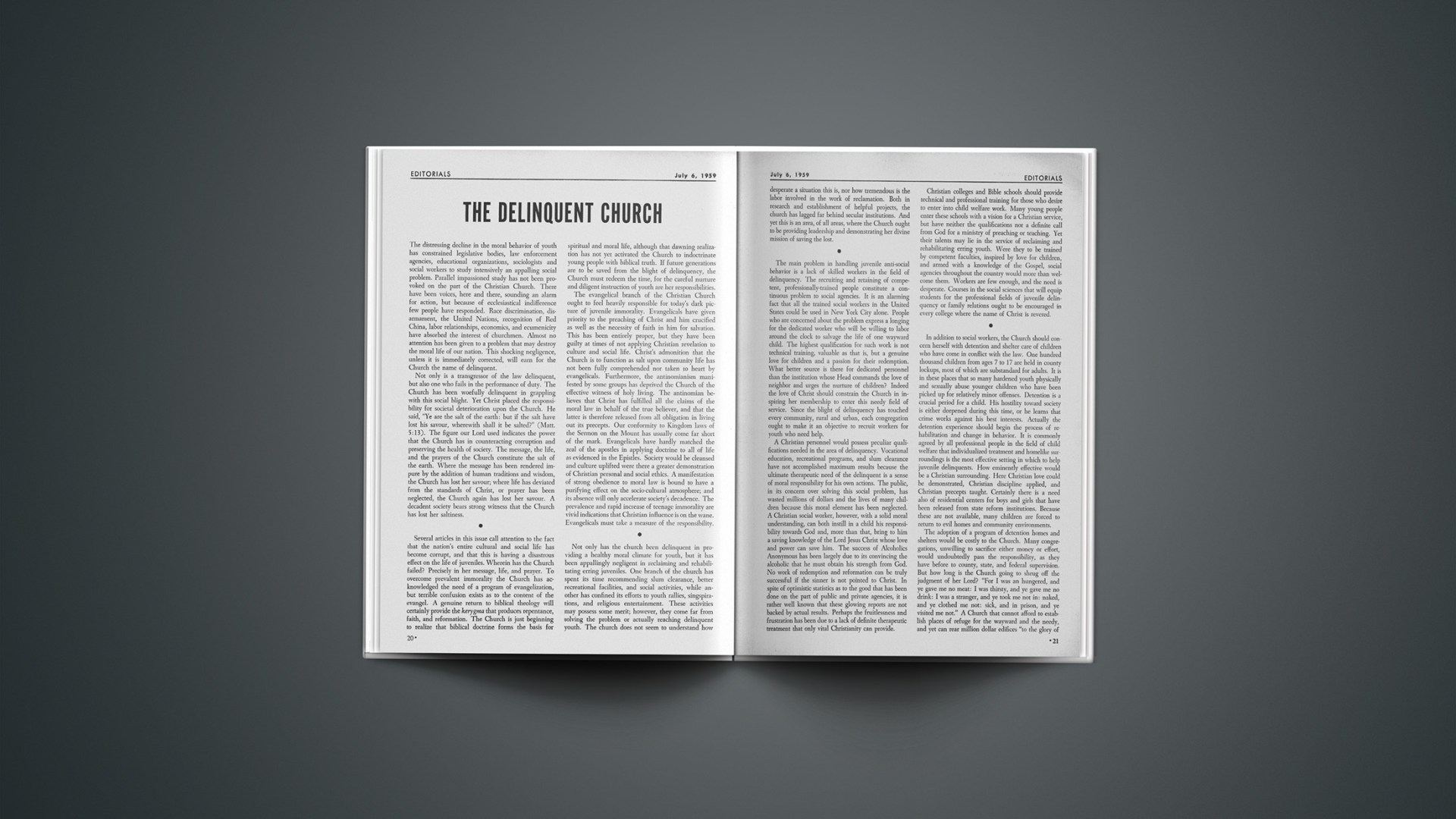
The Delinquent Church

The distressing decline in the moral behavior of youth has constrained legislative bodies, law enforcement agencies, educational organizations, sociologists and social workers to study intensively an appalling social problem. Parallel impassioned study has not been provoked on the part of the Christian Church. There have been voices, here and there, sounding an alarm for action, but because of ecclesiastical indifference few people have responded. Race discrimination, disarmament, the United Nations, recognition of Red China, labor relationships, economics, and ecumenicity have absorbed the interest of churchmen. Almost no attention has been given to a problem that may destroy the moral life of our nation. This shocking negligence, unless it is immediately corrected, will earn for the Church the name of delinquent.

Not only is a transgressor of the law delinquent, but also one who fails in the performance of duty. The Church has been woefully delinquent in grappling with this social blight. Yet Christ placed the responsibility for societal deterioration upon the Church. He said, “Ye are the salt of the earth: but if the salt have lost his savour, wherewith shall it be salted?” (Matt. 5:13). The figure our Lord used indicates the power that the Church has in counteracting corruption and preserving the health of society. The message, the life, and the prayers of the Church constitute the salt of the earth. Where the message has been rendered impure by the addition of human traditions and wisdom, the Church has lost her savour; where life has deviated from the standards of Christ, or prayer has been neglected, the Church again has lost her savour. A decadent society bears strong witness that the Church has lost her saltiness.

Several articles in this issue call attention to the fact that the nation’s entire cultural and social life has become corrupt, and that this is having a disastrous effect on the life of juveniles. Wherein has the Church failed? Precisely in her message, life, and prayer. To overcome prevalent immorality the Church has acknowledged the need of a program of evangelization, but terrible confusion exists as to the content of the evangel. A genuine return to biblical theology will certainly provide the kerygma that produces repentance, faith, and reformation. The Church is just beginning to realize that biblical doctrine forms the basis for spiritual and moral life, although that dawning realization has not yet activated the Church to indoctrinate young people with biblical truth. If future generations are to be saved from the blight of delinquency, the Church must redeem the time, for the careful nurture and diligent instruction of youth are her responsibilities.

The evangelical branch of the Christian Church ought to feel heavily responsible for today’s dark picture of juvenile immorality. Evangelicals have given priority to the preaching of Christ and him crucified as well as the necessity of faith in him for salvation. This has been entirely proper, but they have been guilty at times of not applying Christian revelation to culture and social life. Christ’s admonition that the Church is to function as salt upon community life has not been fully comprehended nor taken to heart by evangelicals. Furthermore, the antinomianism manifested by some groups has deprived the Church of the effective witness of holy living. The antinomian believes that Christ has fulfilled all the claims of the moral law in behalf of the true believer, and that the latter is therefore released from all obligation in living out its precepts. Our conformity to Kingdom laws of the Sermon on the Mount has usually come far short of the mark. Evangelicals have hardly matched the zeal of the apostles in applying doctrine to all of life as evidenced in the Epistles. Society would be cleansed and culture uplifted were there a greater demonstration of Christian personal and social ethics. A manifestation of strong obedience to moral law is bound to have a purifying effect on the socio-cultural atmosphere; and its absence will only accelerate society’s decadence. The prevalence and rapid increase of teenage immorality are vivid indications that Christian influence is on the wane. Evangelicals must take a measure of the responsibility.

Not only has the church been delinquent in providing a healthy moral climate for youth, but it has been appallingly negligent in reclaiming and rehabilitating erring juveniles. One branch of the church has spent its time recommending slum clearance, better recreational facilities, and social activities, while another has confined its efforts to youth rallies, singspirations, and religious entertainment. These activities may possess some merit; however, they come far from solving the problem or actually reaching delinquent youth. The church does not seem to understand how desperate a situation this is, nor how tremendous is the labor involved in the work of reclamation. Both in research and establishment of helpful projects, the church has lagged far behind secular institutions. And yet this is an area, of all areas, where the Church ought to be providing leadership and demonstrating her divine mission of saving the lost.

The main problem in handling juvenile anti-social behavior is a lack of skilled workers in the field of delinquency. The recruiting and retaining of competent, professionally-trained people constitute a continuous problem to social agencies. It is an alarming fact that all the trained social workers in the United States could be used in New York City alone. People who are concerned about the problem express a longing for the dedicated worker who will be willing to labor around the clock to salvage the life of one wayward child. The highest qualification for such work is not technical training, valuable as that is, but a genuine love for children and a passion for their redemption. What better source is there for dedicated personnel than the institution whose Head commands the love of neighbor and urges the nurture of children? Indeed the love of Christ should constrain the Church in inspiring her membership to enter this needy field of service. Since the blight of delinquency has touched every community, rural and urban, each congregation ought to make it an objective to recruit workers for youth who need help.

A Christian personnel would possess peculiar qualifications needed in the area of delinquency. Vocational education, recreational programs, and slum clearance have not accomplished maximum results because the ultimate therapeutic need of the delinquent is a sense of moral responsibility for his own actions. The public, in its concern over solving this social problem, has wasted millions of dollars and the lives of many children because this moral element has been neglected. A Christian social worker, however, with a solid moral understanding, can both instill in a child his responsibility towards God and, more than that, bring to him a saving knowledge of the Lord Jesus Christ whose love and power can save him. The success of Alcoholics Anonymous has been largely due to its convincing the alcoholic that he must obtain his strength from God. No work of redemption and reformation can be truly successful if the sinner is not pointed to Christ. In spite of optimistic statistics as to the good that has been done on the part of public and private agencies, it is rather well known that these glowing reports are not backed by actual results. Perhaps the fruitlessness and frustration has been due to a lack of definite therapeutic treatment that only vital Christianity can provide.

Christian colleges and Bible schools should provide technical and professional training for those who desire to enter into child welfare work. Many young people enter these schools with a vision for a Christian service, but have neither the qualifications nor a definite call from God for a ministry of preaching or teaching. Yet their talents may lie in the service of reclaiming and rehabilitating erring youth. Were they to be trained by competent faculties, inspired by love for children, and armed with a knowledge of the Gospel, social agencies throughout the country would more than welcome them. Workers are few enough, and the need is desperate. Courses in the social sciences that will equip students for the professional fields of juvenile delinquency or family relations ought to be encouraged in every college where the name of Christ is revered.

In addition to social workers, the Church should concern herself with detention and shelter care of children who have come in conflict with the law. One hundred thousand children from ages 7 to 17 are held in county lockups, most of which are substandard for adults. It is in these places that so many hardened youth physically and sexually abuse younger children who have been picked up for relatively minor offenses. Detention is a crucial period for a child. His hostility toward society is either deepened during this time, or he learns that crime works against his best interests. Actually the detention experience should begin the process of rehabilitation and change in behavior. It is commonly agreed by all professional people in the field of child welfare that individualized treatment and homelike surroundings is the most effective setting in which to help juvenile delinquents. How eminently effective would be a Christian surrounding. Here Christian love could be demonstrated, Christian discipline applied, and Christian precepts taught. Certainly there is a need also of residential centers for boys and girls that have been released from state reform institutions. Because these are not available, many children are forced to return to evil homes and community environments.

The adoption of a program of detention homes and shelters would be costly to the Church. Many congregations, unwilling to sacrifice either money or effort, would undoubtedly pass the responsibility, as they have before to county, state, and federal supervision. But how long is the Church going to shrug off the judgment of her Lord? “For I was an hungered, and ye gave me no meat: I was thirsty, and ye gave me no drink: I was a stranger, and ye took me not in: naked, and ye clothed me not: sick, and in prison, and ye visited me not.” A Church that cannot afford to establish places of refuge for the wayward and the needy, and yet can rear million dollar edifices “to the glory of God” and for the sole satisfaction of comfortable worshipers, is unable to come clear of the Lord’s judgment on delinquency: “Verily I say unto you, Inasmuch as ye did it not to one of the least of these, ye did it not to me.”

Delinquent children, irresponsible parents, and a decadent society point ultimately to a delinquent Church. Wherewith shall society be preserved from corruption if the Church has lost the savour of her revealed Gospel, moral example, and divine zeal? If the dark and dread reality of one million juvenile delinquents cannot rouse the Church from her apathy, lethargy, and indifference, then the Church has become a part of the callousness and decadence of her own generation. If she does not change, future generations will judge her delinquent. If she awakens and comes alive under the power of God with a strong proclamation of the Gospel, she can cleanse society and save the young people of our nation. Then will future generations call her blessed.

END

Red China Remains A Missionary Objective

Headlines in the daily press are still recording critical reactions of churches and churchmen to the Red China pronouncement of last November’s Cleveland World Order Study Conference. One of the most recent registered the vote of the American Baptist Convention supporting U. S. policy which denies diplomatic recognition and opposes admission to the United Nations.

The basic fault with the Cleveland thrust was its commitment of corporate Protestantism to a specific course of political action. The New Testament Church has no divine mandate for official political programs—whether leftist or rightist. Political action is not the divine mission of the Church.

We are as deeply interested as the Cleveland conferees that Christian principles of justice be honored in the case of China and that she soon recover the mutual respect and recognition of the world family of nations. We have an abiding affection for the Chinese people. The Christian people of America displayed a desire for their salvation through missionary endeavors long before the Communists came as their “liberators.” Possibly when Red promises run out we can again minister both to the spiritual and material needs of this great Oriental people. We cannot believe that political recognition of a godless regime that is the avowed enemy of true Christianity and the suppressor of individual freedoms is the best means of showing Christian affection and goodwill.

We believe that a valid concept of the mission of the Church and a true Christian concern underlay the recent critical actions of the American Baptist Convention, the Presbyterian Church in the U. S., the Baltimore Conference of the Methodist Church, and many other church bodies in and out of the orbit of the National Council.

It is unfortunate that the Cleveland pronouncements, so widely disseminated by the press and other media, left an impression that Protestants favor the recognition of Red China. Smeared with this implication, churchmen and churches had no other recourse than to publicly air their views. This might have been avoided had the NCC sought a more representative constituency for the Cleveland meeting, set that conference in the perspective of the Church’s true mission, and given the press a clear understanding of its nature and aims. Furthermore, there is no necessity for following Cleveland with propaganda for acceptance of its findings in the churches. When any Protestant group irresponsibly assumes quasi-official status as the spokesmen of American Protestantism and seeks to propagandize its views in the churches for political ends, it is altogether proper and right that protests be made. Indeed, if there were no reaction we would despair for the free spirit of Protestantism.

Sooner or later in a free America and a free Protestantism the will of God’s people must find expression. For a time it may be ignored or suppressed but, as with truth, “the eternal years of God” are ours.

END

The Moral Irresponsibility Of Snubbing A Speedometer

The most common evil peculiar to automobile travel is also the most condoned.

Were a preventable holocaust suddenly to wipe out an entire congregation, the Christian community would rise up in unanimous indignation. Yet we continually disregard 300 traffic deaths in holiday-weekend slaughter—the equivalent of a fair-sized church audience.

The sin that invariably figures in this toll is speeding.

Particularly disturbing in the speed craze is the fact that “professional” drivers seem to be among the worst offenders. Not uncommonly tractor-trailers roar down hills at obviously unlawful speeds presumably to make up time lost on the upgrades. Speeding buses are familiar sights as well. (Fatality rates in commercial U.S. transit rose sharply last year, says the National Safety Council.) When the Sunday School teacher hurtles by traffic on the hilltop, or the parson rushes the pedestrian lane, indignity is added to impropriety.

Speeding is one of the most shameful wrongs of our time. Christians ought to realize its moral evil—be it in violation of posted limits or in disregard of adverse road conditions. Little can be said in defense of irresponsibility with an accelerator. It is selfish and contradicts the Bible’s “Love thy neighbor” commandment.

END

Do We Worship the Bible?

A reader of this page chides the writer for worshipping the Bible. Frequently we have heard individuals disparagingly spoken of as “bibliolaters.”

In the many years that I have lived and worked with Christians, I have yet to see such an individual. That such may exist is certainly possible. That they constitute any appreciable number of persons, however, I am certain is untrue.

There are, on the other hand, millions in our own generation, as well as those of the past, who respect the Bible for good reason. These men and women trust the written Word because it has been pragmatically justified. Wherever it can be tested it has proved itself in experience to be what Christ and the apostles represent it to be, namely, the Word of God. Neither respect nor trust can in any sense be confused with worship.

To trust the Bible is not to worship it. In respecting the Scriptures we do not ascribe homage to its pages.

How can it be said then that those who have this regard for the written Word worship it? In part the reason is it is not held with corresponding trust or respect by others.

Part of the difficulty of those who may appear to follow the Bible blindly is due to a lack of objectivity on their part. This in turn can lead to an inflexibility which is no credit to anyone. That this may also hold for many who question parts of the Bible is equally true.

There are portions in the Scriptures which were vigorously questioned in past generations because of seeming contradictions, but which are now accepted because archaeological discoveries have proven them true.

On the other hand a rigid literalism has often led to unwarranted dogmatic assumptions which fall as the rug is pulled from under them in the face of more accurate scholarship. Often a preacher has had to revise a sermon on some favored text when more careful research proved that its meaning was different from what he had thought.

By some strange legerdemain of reasoning, those who inveigh most against bibliolatry are the very ones that exhibit in their churches an open Bible flanked by burning candles!

What then is the attitude of those who turn to the Holy Scriptures with confidence and honestly believe them to be the “only infallible rule of faith and practice?” What about those who have tested the Word and found it true?

There are two questions involved here: one of inspiration and the other revelation. We believe that all Scripture is inspired of God, but not everything contained therein is equally important or relevant for daily living. We believe that in God’s Word we have revelations of truth that come through the Holy Spirit, truths which man could never have discovered for himself unless the Holy Spirit had imparted them to those willing to receive. Furthermore, we believe these revelations of truth to be God-breathed and accurate regardless of whether men believe and accept them or not.

In other words, the authority of Scripture is in no way jeopardized by man’s acceptance or rejection of its contents; it is man who stands in judgment before the Book, not the Book which stands in judgment before man.

At the same time, the message of the Bible becomes operative in the hearts and lives of men as the Holy Spirit takes the written Word and applies it to the individual. It is perfectly accurate to say that the Bible becomes relevant to a person only as he accepts and acts on it; however, it is true that this relevance is there at all times, and man rejects it only at infinite loss to himself.

One of our greatest hindrances to an accurate and fruitful attitude to the Bible is reading books about the Bible rather than the Bible itself. There are thousands of men in the pulpits and in pews today who are thoroughly conversant on the opinions of other men about the Bible but dangerously ignorant of the Bible itself. Many of these show an almost pathological fear of letting the Bible speak for itself. To follow the example of the Laodicean Christians in examining the Scriptures is to these opponents of the Word anathema. To Paul it was an “honorable” procedure.

Again, to say that only those parts of Scripture which speak to the individual heart are, for that person, inspired is to transfer the basis of authority from the Bible to subjective intellectual or emotional reactions.

On what ground, therefore, do we Christians exhibit such confidence toward the Word of God?

This can be answered in one sentence: We have tested it and found that it is in fact what it claims to be, a Book inspired by God. In it we have found an unfailing source of comfort, hope, assurance, wisdom, warning, admonition, guidance, and truth.

Even on a cold scientific basis the Bible stands the test. Let it speak for itself and we find it true. Let it speak to our hearts and we hear God speaking.

We have found that the God of the Bible is our own God and loving heavenly Father. We have found the Christ of the Scriptures to be God’s Son and our own Saviour and Lord. We have found the Holy Spirit, whose loving ministrations are revealed in both Old and New Testaments, to be the comforter of our hearts and the illuminator of our own spirits.

In answer to the smug assertion of some that “we worship God, not the Bible,” or “we trust Christ, not a book,” we reply with hearty “amen.” Of course it is God whom we worship. Of course it is Christ in whom we put our trust for salvation. And the God we worship, the Christ we believe, and the Holy Spirit who makes our faith possible is the triune God revealed to us in the Scriptures and known experimentally by faith.

In expressing faith in the written Word, we know by experience that it is true. In matters of faith, doctrine, and practice it speaks of and for God. In the realm of daily living it shows us the way to make our Christian faith effective and relevant. Its promises have reached across the centuries and apply to our own needs. Its warnings to men of old are found to apply to these days as well.

When the Bible becomes a daily source of spiritual food and drink, when its story is woven into the warp and woof of our minds and hearts, we find that God gives us those answers without which no man can live aright.

With the Bible as our guide, we get the proper perspective between this life and the next, a right evaluation of the things which are temporary and those that are eternal, and an unshakable philosophy for living and a confidence which satisfies the question of this life and the life beyond the grave.

No, we do not worship the Bible. But we honor and trust it as a precious revelation of God’s eternal truth; and in our doing this, we have found it never to fail.

Pastoral Counseling

It is a common impression that Pastoral Counseling is something new—a new dimension in the work of the ministry. In some ways it is new, but essentially it is as old as the Church. Pastors have always been concerned about the problems of their individual congregants. The minister occupies a unique position in the lives of his people. He is a significant person at many important stages of their lives, from birth and baptism, through confirmation and marriage, to their last sickness and death. His office and function are conducive to the establishment of an intimate bond with his people on the deeper level, and it is quite natural that they should turn to him when troubles arise, when sickness brings anxiety, when guilt burdens the heart, when a marriage becomes shaky, when children cause parental concern, and so many more “natural shocks that flesh is heir to.”

Fast Tempo And Isolation

Several reasons may be given for a growing emphasis on pastoral counseling. Most commonly suggested is the tempo of modern life. We are living at too fast a pace, life is anything but leisurely, and we are caught in a mad whirl. The individual is moving so fast and is distracted in so many ways that the bond with his fellow man, which makes for greater stability, is weakened. His fast pace isolates him, gives him less opportunity for interpersonal living, less opportunity for the discipline and growth inherent in community with others. The individual is less a concern of society because society itself has lost so much of its cohesion, being composed of fast-moving individuals.

A person may feel less social restraint, may feel more of what he calls “freedom to live his own life,” but the result is also more isolation. An unwed mother or a divorcee may be less censured in modern society not because society has learned to be more compassionate, but rather because society cares less, has less compassion, has not learned the unstrained quality of mercy, and has no genuine concern for the individual. More hospitals, clinics, social agencies do not necessarily mean that society has a greater concern for its members as human beings. Its motivation may be economic. It is cheaper to help people before or in the early stages of their breakdown than to have them as permanent unproductive burdens. It is a characteristic of modern Western culture that greater individual freedom has also brought greater individual isolation. Interpersonal relations have broken down, and the result is loneliness. Our materialistic hopes, too, are shaky as we think of increasing inflation and greater longevity, if a catastrophe does not destroy us. A person still has to live with himself, and it is there in his inner conflicts that the need for counseling exists. Our divorce rate, alcoholism, juvenile problems, anxieties of every sort, the census of our prisons and mental hospitals all tell the story of the individual’s struggle in the complex society of this generation.

Influence Of Freud

Another reason for the growth of Pastoral Counseling are the new insights and techniques of psychology and psychiatry. Careful study and research are directed toward a better understanding of man and his society, the way a human personality develops, the interaction with his culture, the tension inherent in growing up, the meaning of behavior, and the influence of unconscious forces. Much of the impetus for this study of the human psyche is undoubtedly due to the influence of Sigmund Freud. While his views were unacceptable to his scientific colleagues as well as to the Christian community of his day, they have stimulated a great deal of thought and research in the study of man. His avowed irreligion and his “discoveries” of infant sexuality met insurmountable barriers in the moral tone and thought patterns of his time. But it is now generally recognized by religious leaders as well as those in the psychiatric professions that Freud made important contributions to the understanding of man and his problems in life.

Psycho-analysis does not have all the right answers, nor can it solve all problems (many cannot afford this type of service anyway), but it does have some answers and has taught some techniques for helping man in trouble with himself. Freud modified both his own theories and techniques, and this modifying process is continuing after Freud. Orthodox analysis with its sexualized unconscious, Oedipus complex, analyst’s couch, and so forth, is gradually giving way to new theories and techniques. The minister can learn some things from the analyst, especially the importance of listening, of trying to understand a fellow man, to feel with him, to make available to him an accepting heart, a warmth to which he can relate and with which he can feel community, a bond to decrease his isolation and loneliness, and a “healthy” human ally who enters the struggle with him.

Era Of Social Gospel

Another reason for the new emphasis on Pastoral Counseling is the continuing shift away from preaching. In former times preaching was the minister’s first duty. His primary calling was the preaching and teaching of the Bible, the infallible Word of God. While he was always the pastor, the shepherd of souls, this function was subordinate to his authoritative declaration of the truth of God in the tradition of the prophets and apostles. At the turn of the century, under the influence of a new vogue in philosophy and theology, the church and the minister began to develop a greater interest in man’s present life situation. It was the era of the social gospel, and it is still very much with us. The shift in emphasis was away from theology toward sociology. The slogan was, “Christianity is a life, not a doctrine.” The church became less concerned with the cleansing power of the Gospel, and more concerned with the cleansing power of a good broom. The slums, saloons, and other areas of social filth had to be cleaned up so that man would have a chance to develop his “natural potential as a child of God.” The “kingdom of God” was defined in terms of the earthly good life, and it was to be built here and now. This interest in community betterment is good in itself but, from an evangelical viewpoint, it is evil insofar as it becomes a substitute for the preaching of the Gospel.

It is only a small step from this interest in the community as a whole and its problems to an interest in the individual of the community and his problems. In fact, this step is inevitable as a further implimentation of the social gospel; and with the new developments in psychology, this dealing with the individual has become a big new field for pastoral activity. Of this, too, it must be said that it is good insofar as it is not a substitute for the preaching of the Gospel.

Mental Illness

It is well known that many patients who come to a physician do not have a physical disorder as the primary cause of their symptoms. While the physical symptoms, such as peptic ulcer, colitis, asthma, and migraine need medical treatment, the real cause of trouble is inner conflict, emotional upheaval, and immaturity. These patients need more than medicine or surgery. Then there are those who are sure they have cancer, tuberculosis, or some other dread disease, who go from one doctor to another, and cannot be convinced by clinical evidence that they have no disease. Add to such people the multitude who are “maladjusted,” “nervous,” and “neurotic,” who are in constant conflict with their social group, family, school, or job, the neurotic parents, delinquent children, alcoholics, and so forth—and we see that mental illness is an immense field, no longer the exclusive domain of doctors and psychiatrists. A team approach, interdisciplinary therapy, is more and more being recommended in which several professionally trained people contribute the insights of their own field—psychiatry, psychology, medicine, anthropology, sociology, and religion. This has led to a greater use of ministers as chaplain-counselors in both general and mental hospitals, counselor training for military chaplains, and a closer cooperation generally between doctor and pastor.

Proper Boundaries

The whole situation raises the problem of professional boundary lines. The minister is not a psychiatrist and will do damage if he attempts to be an amateur one. On the other hand, the psychiatrist may not assume that guilt feelings are neurotic per se, and that Christian moral standards are too rigid for healthy living. People turn to their minister because he is their religious leader and represents spiritual forces which they believe can help them with their troubles. Their “image” of the doctor or psychiatrist is a different one; he represents the knowledge and skills of medical science. These two are not mutually exclusive, but complementary and must cooperate in the closest possible way. From an evangelical point of view this cooperation is very difficult, if not impossible, with many psychiatrists and psycho-analysts because of their non-Christian preconceptions, and this is the primary reason for the existence of Christian mental hospitals. The pastor-counselor should know enough about mental health to distinguish between normal and neurotic manifestations of anxiety, guilt, grief, and so forth, between symptoms which indicate the need for psychiatric treatment, and those which can yield to a counseling program. He must also guard against the assumption that the religious or moral problem presented by his counselee is necessarily the real one. The unique contribution of the minister toward personality wholeness, integration, and purposeful living is to relate his counselee to God who has made man to live at full capacity in total commitment to Him.

Objectives In Treatment

The problem is also raised with regard to goals in treatment and counseling. The minister must maintain his pastoral function and direct his efforts toward the goals associated with his office, training, and personal commitment. The psychiatrist and psychoanalyst are concerned with helping a patient to achieve such equilibrium and stability that he can function reasonably well in his own setting, family, job, social, and cultural milieu. The social worker is similarly interested in the client’s human relationships, his ability to adjust to his own situation, and to affect changes in his situation to ease tension. Ostensibly these professions are not concerned with religio-philosophical matters. They claim to be neutral and permissive not only in the counseling interview but also with respect to the counselee’s Weltanschauung (at least insofar as it does not interfere with acceptable behavior).

The scope of this paper does not allow for a discussion of such alleged “neutrality,” but it should be borne in mind that no one is neutral, least of all in a counseling situation where one person tries to relate to another. This is not to say that a pastor-counselor must force his own ideals, moral standards, tenets of faith, and ultimate goals on the person who comes to him with emotional problems. He must still use good counseling techniques. But this means that the pastor may not, indeed cannot, abandon his religion’s concepts of mental health and personality wholeness, as these are bound up with God-relatedness. In the last analysis this is what the office of the minister exists for—to help man achieve and maintain his most fundamental and significant relationship, his bond with his Maker; to help man to be what God made him and wants him to be in this life upon earth.

Lack Of Literature

Precisely at this point the evangelical pastor finds a lack in much writing on modern psychology and counseling. To many the goal of pastoral counseling seems no higher than that of the psychotherapist who helps the patient to understand himself enough that he can function in his own setting, and so that he can relate acceptably to his fellow man and to his own conception of Deity. In this scheme the related human beings and cultural milieu are real enough, but God is an abstraction, a symbol, or projection. An example of the modern concept of “wholeness” or “mental health” without reference to man’s relation to God is a recent study, Current Concepts of Positive Mental Health, by Marie Jahoda. Its potential influence may be surmised from its Foreword: “This is the first of a series of monographs to be published by the Joint Commission on Mental Illness and Health as part of a national mental health survey that will culminate in a final report containing findings and recommendations for a national health program.” Various criteria for mental health are discussed at some length, but there is only a passing reference to religion, “A Unifying Outlook on Life,” as a “sign of maturity.”

Modern psychology studies the “existential” man who is assumed to know truth only in his own experience and action. But existentialism and phenomenology, while they claim to be ontological and genuinely interested in “being, have no interest in real Being, the Absolute, the Triune God, the Urwelt, and therefore have no ultimate reference or relationship for man. They cannot understand Augustine’s statement that “the heart of man is restless until it rests in God.” But this is precisely the “rest” that is the pastor’s concern. If he can help a man be a better husband, if he can help a husband and wife lift their marriage to a higher and more stable level, if he can help an alcoholic to stay sober, he has done a worthwhile job in terms of the present socio-cultural situation. The psychoanalyst attacks these problems on a deeper level of instinctual drives, infantile experience, interpersonal relations, and self-awareness. But the pastor goes still deeper, or higher, in his attempt to relate a person to his source and reason for being as a creature and child of the Triune God. The evangelical pastor’s efforts are directed to this life and beyond, to man’s eternal “health,” to his salvation, and “peace with God through our Lord Jesus Christ.” Depth psychology assumes that the resources for healthy life are inherent in man. The evangelical pastor believes in scientific technique and therapy, but he also believes in “miracle,” in direct divine intervention for the redemption of man, for new motivation and direction. He holds with the biblical imperative, “ye must be born again,” and that in the radical biblical sense men may become “new creatures in Christ.” A new principle of “being and becoming” must be implanted from outside of man by the Holy Spirit in order for man to have “rest” and “wholeness.” The “becoming,” growth, maturing, sanctification still involves many problems and normal anxiety, and the need for deep soul searching, for the exposure of personal hypocricies and neurotic defenses. But the frame of reference must be established in which a man can find health in the fullest sense.

Faith Healing

Pastoral counselors must take divine intervention much more seriously than they have done. The charismata, the special healing gifts of the early Church, may no longer be in our possession, but that does not limit the power of God to heal today as he did then. It is a lesson of church history that when a particular doctrine or practice is neglected by the Church, that doctrine or practice becomes the occasion for a new sect which takes it out of context and raises it to a position of central importance. That has happened with “faith healing.” There is a biblical faith healing which some have perverted to a sensationalism and quackery. Prayer for the sick is not a sentimentality or futile ritual; it is thoroughly biblical and we must do it with the same confidence of faith with which we pray for bread. The bond between body and soul is so intimate that the distinction is actually formal. Man is a whole, and healing influences are never limited to a part. Health is wholeness, and in a real sense prayer ministers to the whole man more directly than medicine.

A word of caution is needed at this point. A sick person, somatic or psychic, saved or unsaved, is not necessarily a greater sinner than a healthy person. Illness is not necessarily due to personal wickedness, not necessarily and basically a personal moral problem. Job’s friends thought so but God said they were wrong. It is true that sinlessness is health, wholeness, heaven. But earthly “health” exists in spite of sin, even gross sin. One person becomes “sick” because of dishonesty involving 10 dollars, while another stays “healthy” in spite of dishonesty involving thousands. One breaks down under emotional tension occasioned by masturbation, while another is a “healthy” fornicator. Sin and sickness are connected in the life of mankind and often in the individual. But individual health is no proof of virtue, and individual sickness is no proof of sin. It may be that the sick one is more sensitive, more easily affected by his sin; that the healthy one is more hardened, indifferent, better able to cover his sin, a more clever hypocrite.

Analysis Of Self

Psychoanalysis has taught us, among other things, the health-inducing power of honesty, realism, and the importance of searching below man’s confessions and professions for the springs of personality. It has taught us to think dynamically when dealing with human problems, to probe into the reasons for behavior, to uncover the deep motivations of which a person is mostly unconscious. To prepare himself for such analysis of another human being, the analyst is required to undergo personal therapy. He must be made aware of his own deep motivations and neurotic defenses, and to achieve the maximum “health” for himself. He has to know his own “blind spots” which could limit the effectiveness of his therapeutic practice. “Physician heal thyself” is a proverb taken seriously by the analyst, and the pastor-counselor can do no less. He should be rid of any illusions of his own omnipotence and perfection. He must be thoroughly and honestly human, while at the same time knowing “rebirth” and conversion as a genuine personal experience. He must be honest and realistic with himself before he can help others.

END

Theodore J. Jansma is Chaplain-Counselor of the Christian Sanatorium of Wyckoff, New Jersey. He holds the A.B. degree from Calvin College in Grand Rapids and the Th.B. degree from Westminster Theological Seminary in Philadelphia. He is also a minister of the Reformed Church in America.

Cover Story

Combating Juvenile Delinquency

A great challenge before the Christian Church is the awful and terrifying blight of juvenile delinquency. In the last several years over 1,250,000 children between the ages of 10 and 17, on an average per year, have come to the attention of the police, and approximately half of these appear before juvenile courts. The pace of juvenile crime is increasing at a tremendously rapid rate and J. Edgar Hoover estimates that by 1962 one million of our teenagers will be arrested each year if the present rate continues. In the eight-year period from 1948 through 1956, juvenile court cases more than doubled, while the child population of that age group increased only 19 per cent. Out of this amazing harvest of youthful offenders against the law, society will continue to reap for years to come a bigger and tougher crop of adult criminals. The cost to society in money, moral degeneracy, and violence defies the imagination. Yet the Christian Church pays little more attention to morally sick youth than the priest and Levite did to the wounded man in the story Jesus used to define the concept of neighbor.

The popular concept that delinquent conduct is limited to slum areas or places on the “wrong side of the tracks” is not true. Juvenile delinquency has had its greatest rate of increase in rural areas. This perhaps is due to the penetration of mass media. But economically well-to-do communities are also producing many delinquents, and the reason is often that parents have wealth. These children do not appear before juvenile courts, but are sent quietly to private psychiatrists or boarding schools. Even children from Christian families have not escaped wrongdoing.

A distressed and perplexed society is seeking a scapegoat on which to place the blame for all this. Sin in the human heart and a decadent culture are certainly the basic causes of lawless conduct on the part of the young. Nevertheless many other factors enter into the dark picture. Progressive education, lack of discipline, horror and obscene comics, pornographic literature, TV programs, movies of violence and sex, excessive drinking, broken homes, delinquent parents, stringent labor laws, materialism—these are all further factors that contribute to the moral downfall of children. Society has had a tendency of alternately blaming one or several of these for influencing behavior for evil. Each, however, has been in some measure responsible for the terrible situation of our day. Whatever evil lies within these factors must be fought if our youth is to be saved.

The public, of course, is anxious to find some panacea that would eradicate the problem. Society has already indicated that it is willing to spend huge sums of money to find and apply the cure. Slum elimination, recreation facilities, bigger and better schools, teenage clubs, stricter police action and more drastic punishment, summer camps, and work projects are some of the things that have been suggested and tried. Why is it then that juvenile delinquency is on the increase? A materialistic society has sought material means to eliminate the problem. While these things are good and necessary in some instances, they are not the answer to the grave problem confronting the nation.

Sin within the human heart is the basic cause. Man’s sinful nature is susceptible to many influences from within and without. Sin can either be restrained or awakened to greater activity. If society is to be saved, means must be sought to control juvenile crime; and whatever is feeding the sin of youth must, if at all possible, be eliminated.

Community Climate

The potential delinquent child is especially vulnerable to the materialistic, violent, and immoral climate around him. The rapid increase of youthful offenders reflects a lowering of standards in adult society. This is actually the distressing index of a deteriorating community. Progressive decadence in adult society is paralleled by a progressive delinquency among teenagers. Impressionable youth becomes victim to the “fashion” of dissolute living manifested in excessive drinking, gambling, racketeering, bribery, violence, dishonesty in business and public life, prurient entertainment and other evils daily publicized. These are communicable diseases that are more apt to corrupt impressionable youth.

A more subtle corrupting influence is the constant pressure upon youth to give themselves at the altar of materialism. Almost from infancy, children are threatened by mass manipulators of the mind and imagination who steer young people to believe that material luxury is the summum bonum of life. Advertisers are not above using children as instruments in commanding parents to buy what may be beyond their means. They have created a materialistic Eden of false values wherein the child feels he must enter to really live, and in order to gain entrance he may have to commit crime. A powerful impression is stamped upon the soul of youth that this materialistic “American way of life” is his rightful inheritance, and if his family cannot provide the luxuries to which he feels entitled, then frustration, dissatisfaction, and covetousness possess his soul. He is tempted to obtain what he wants by unlawful means, and this brings him in conflict with the law.

Sin, evil environment, and materialism must be combated by the Church—the only institution, above all others, which the Lord has established as the preserving salt of the community. One cannot expect an unregenerate and pleasure-mad adult society to be moved to change its evil ways for the sake of the oncoming generation. Rather, the Church must gird herself for a major assault on the evils prevalent in society. The first area to be assailed in public conscience which has lost feeling and sensibility is the sphere of morality. Our nation’s conscience is in need of lashing and scourging by the preaching of God’s law. Men must be made sensitive to the fact that prevalent immorality not only contributes to the degenerate state of many juveniles but also is an affront to a righteous and holy God. Only after the conscience has been thoroughly aroused and quickened will the public be ready for the message of forgiveness and healing that is found only in Christ. The pulpit must forget its moral lectures and political pronouncements and get down to its main task of smiting the conscience through the law and saving the soul through the Gospel.

The Church herself has yielded to materialism and secularism and must reform before she can hope to change the damaging climate that engulfs our young people. The Church should have bowed her head in shame at the rebuking Easter editorial in Life magazine. In raising the question why God was not real to Americans, the editorial answered, “partly because of the blight of secularism in the churches, which have become just another valued branch of American democratic culture instead of its center. What used to be the minister’s study is now his office, and as a busy agent of the social gospel he is less a spokesman of God than a useful citizen, making East Overshoe ‘a better place to live.’ ” The terrible tragedy of the social gospel is that in its major concern for better environment, it has forgotten the soul of man. And what shall it profit the Church before God if she gain the riches of the world for man but lets him lose his soul?

Better wages, better working and living conditions, better housing, better recreational facilities—these are the cardinal doctrines of the social gospelers. They have exchanged an “other worldly” religion for a “this worldly” one, little realizing that secularism is the belief that this world is all there is, or all there need be, and forgetting that “the kingdom of God is not meat and drink; but righteousness, and peace, and joy in the Holy Ghost” (Rom. 14:17). They have not heeded the Lord’s admonition that “a man’s life consisteth not in the abundance of the things which he possesseth” (Luke 12:15). We cannot imagine these advocates using for a text John the Baptist’s admonition to greedy soldiers, “be content with your wages.” They emphasize the peripheral or by-product of the Gospel, and in so doing have helped to create a secular climate that blights the souls of children who place not the Kingdom first but “what shall we eat? or drink? or, where withal shall we be clothed?” Without the restraint of the Gospel this secularism has devolved on the part of some children into theft, vandalism, violence, sadism, murder, drug addiction, adultery, rape, and sodomy.

The Church, then, must rid herself of secularism and the one-sided social gospel that has produced it. Returning again to the preaching of the Gospel as defined by Christ and the Apostles, she must create a spiritual climate in which the young may move and have their being. J. Edgar Hoover lists as a major step in the prevention of juvenile delinquency a restoration of the firm moral precepts of our forefathers. These moral precepts were not snatched out of the air but were obtained from the written revelation of God and activated in regenerate lives.

The Family

The disorganized family is another major contributing factor to the increase of juvenile lawlessness. It is the incubator of emotional insecurity and stress that incline a child to delinquent behavior. The working mother, the irresponsible father, the home broken by internal strife, divorce or desertion, drunkenness, promiscuity and marital discord—all these have their part in inciting youth to rebel against the decent laws of society. Flaunted rules of conduct by parents are emulated by children. Only in sound and happy family living does one find the genuine preventive of juvenile misconduct. This truth has been stated frequently but very little has been done to correct unhealthy homes.

Scripture places the responsibility for moral training of the child upon the parent, but this responsibility must be further inculcated by the Church. Those that have oversight in the Church should see that parents fulfill their God-given duties in respect to the training of the young, even admonishing parents as did Paul in the Ephesian church. Further, the Church should instruct children to have proper respect for parental authority. Upon the Fifth Commandment is based all proper and healthy social relationships, and the teaching of it needs to be impressed on the mind and heart of the child. Where there is no respect for parental control, there will be no respect for any duly constituted authority.

Progressive Education

Next to the influence of Church and family is that of the school. The tragic breakdown in family discipline is little counteracted in school life. The late Reverend Canon Bernard Iddings Bell wrote this once to Senator Estes Kefauver: “Let it suffice for me to say that our educational system breeds moral irresponsibility—the result of intellectual responsibility. Our schools create in many of their students, perhaps most of them, a sense that the world belongs to them without necessary preliminary labor. Those brought up in such a system learn to regard themselves as entitled to everything that they can lay their hands upon without doing any real work in order to get it. You can scarcely wonder that people brought up to think in this fashion … seldom develop into responsible citizens.

One of the first symptoms of delinquency is truancy among school children. This has often gone on without punishment; and as the student feels that he can flaunt school regulations with impunity, he is the more likely to violate laws of society. The full weight of the school’s authority should be invoked upon truant youngsters that they may learn that breaking laws brings punishment. Rather than depending, as some do, on psychiatrists and social workers to remedy the moral breakdown of children, each schoolteacher should claim the job of moral strengthening as her own.

Pornographic Literature

The increase of illegitimate births, rape, and sexual deviancy among teenagers may be attributed to much of the mass communication media that exploits sex. Law enforcement agencies contend that juvenile delinquency stems in measurable part from obscenity conveyed through books, comics, magazines, newspaper stories, advertising, movies, and television shows. It is an almost insurmountable problem to control pornographic literature, for it pervades practically all mass media. Even the New York Times, which boasts that it prints all the news decent to print, allows its advertising department to arouse prurient interest with lurid statements like these: “Undertones of emotional masochism as well as a curious intertwining of paternal with sexual love”; “Easily the peep-showiest of all Bardot pictures”; “the heat and humanity are oppressive and sex is rampant and raw”; “Steaming with tropical heat, sizzling sex, violence and passion”; “The super-heated carnal scenes are sufficiently passionate to deserve an exclamation point!; astonishing frankness! As though the camera were aimed through a key hole!” (New York Times, May 15, 1959).

One measure of control is that of censorship which undoubtedly will invoke anguished cries from those who see a danger to the freedom of the press. However, the Supreme Court ruled in 1956 that obscenity is not protected under the First and Fourteenth Amendments of the Constitution. In a recent address Arthur E. Summerfield, Postmaster General of the United States, said, concerning purveyers of filth: “They are also experts at raising a hue and cry about ‘censorship,’ ‘freedom of the press,’ and ‘civil liberties.’ And all too often they are able to find willing pawns to take up their cry and carry on their slimy battle for them. This, of course, is utter nonsense. I would only ask any such misguided person these questions: Is it a violation of civil liberties to deny the sale of liquor to a ten-year-old boy? Is it censorship to prosecute those who sell narcotics to junior high schoolgirls? Are we abridging civil liberties when we do not permit children to drive a car?” We have laws prohibiting the sale of products that harm the body, and the public gives no cry of protest. Cannot the nation prohibit the sale of pornographic material that poisons the souls of our youth?

Alcohol And Switchblades

The subcommittee on juvenile delinquency of the United States Senate has found a definite connection between juvenile drinking and acts of delinquency. There was also discovered a direct relationship between the vigor with which liquor laws were enforced and the amount of drinking among juveniles. For instance, beer parties have led to sex orgies and acts of vandalism and theft. In spite of this recognized relationship, liquor interests continue to bombard our youth with their vivid propaganda. Neither the public nor our legislators seem to be sufficiently aroused to combat this corrupting influence. A bill to limit alcohol advertising over radio and television has never been able to come out of the committee stage in either the House or the Senate. Yet a law was passed with great speed against the manufacture of switchblade knives. No one would seriously argue that switchblades constitute a greater incentive to acts of violence than alcohol. One wonders at the rapidity that the manufacture of switchblades was eliminated by law and the inactivity in regard to the influence of liquor advertising.

Conflict With Labor

Society is beginning to recognize that young people who are jobless, idle, and without funds are vulnerable to delinquency. Because of stringent labor laws teenagers are being prevented from gainful employment. Young people, who are no longer in school, are unable to obtain jobs in the present labor market. One cannot doubt that there have been far-reaching benefits from child labor legislation; however, conditions have changed so radically in past decades that much of that legislation could be liberalized in the greater benefit of youth. One Washington, D. C., leader in the field of youth employment asserted that the proponents of child labor legislation, anxious to correct the abuses of the past, have sometimes taken an overprotective, even emotional attitude about changes in legislation. Nonetheless, the time is certainly at hand for legislators to review and amend labor laws that affect our youth. Work is one of the most stabilizing influences in people’s lives, and there are children, physically strong and mentally alert, who are being deprived of an outlet for their energies. An anomaly of the present situation is that the mother who is needed in the home is working to provide for teenagers whose energies are being absorbed in antisocial deeds.

Attack On All Fronts

The most pressing problem in our fight against juvenile delinquency is purifying the environment in which our youth live. The material emphasis of the social gospel has accomplished little in restraining the tide of teenage crime. What is needed are the spiritual weapons found in the dynamic Gospel of historic Christianity. Youth cannot live by the bread of materialism alone, “but by every word that proceedeth out of the mouth of God.” A proper spiritual and moral climate can only be brought about by a Church that feels a keen responsibility in creating happy families in which children are brought up in the nurture and admonition of the Lord. Delinquency will never be curbed and eliminated until parental responsibility and filial obedience are firmly inculcated in the minds of our people.

The Church must also sensitize the public conscience to the evil factors that demoralize youth. An apathetic public is a major obstacle to the removing of pornographic business that corrupts the minds of children with filth and smut. An indifferent public allows the liquor industry liberty to use mass media to entice teenagers in drinking. An aroused public, on the other hand, sees to it that bills curbing interstate advertising of alcohol would come before Congress and not be allowed to die in committees. This would be a tremendous help in the battle against delinquency.

The factors that contribute to the moral downfall of youth are many and varied. Their elimination demands all the effort, skill, and leadership that the Church can provide. To save our youth is a tremendous task. It is a work to which the Church has been called by her Lord. May she be found in the vanguard of combat!

END

Cover Story

A Judge Speaks

Lord, fill my mouth with worthwhile stuff and ‘nudge’ me when I’ve said enough.” That was a quotation the writer recently saw on a wall at the Pennsylvania Junior Republic at Grove City, Pennsylvania. With it in mind I trust that I may write from my heart those innermost convictions concerning juvenile delinquency that have come to me from my 12 years’ experience as judge of the juvenile and domestic relations court at Birmingham, Alabama.

My only qualifications for holding such a position are that I have a law degree from the University of Alabama, am happily married and the father of three children and, as the law requires, am a person of “high moral standards with some understanding of children and family problems.” It became apparent to me after I first began my work that legal training was not sufficient for me to carry out my responsibility. I therefore went to night school for over three years and studied psychology, sociology, criminology, and philosophy, and received a B.S. from Howard College in the social sciences 20 years after I had received my law degree. Thus equipped, I thought I knew all the answers—that I was now thoroughly qualified to be judge of a court such as this. I joined all of the professional organizations of social workers and took an active part in them; but as the months and years passed by, I realized more and more that neither the law nor the social sciences held ultimate answers to the problems with which I dealt.

Of course I knew all of the usual pat answers for the cause of delinquency: “broken homes,” “inadequate housing,” “low economic conditions,” “poor recreational facilities,” “racial prejudices,” “alcoholism,” “world-wide unrest,” “rapid increase in population,” so-called “mollycoddling of young criminals,” and many others. Please do not misunderstand me. I know that all of these reasons are good and valid, and there are many cases of delinquency that do arise from them. There is also no question in my mind that legal training and social work training are important to people in the professional field of juvenile delinquency and family relations. I can say without fear of contradiction that more than 70 per cent of the 5,000 cases (adult and juvenile) which this court handles each year stems directly or indirectly from alcoholism. Sometimes I lose patience when I see the effort and money being spent in trying to rehabilitate alcoholics, and then look at some of our “best magazines” extolling “men of distinction” who drink such and such a particular brand of liquor. If we knew what caused cancer we would eliminate it regardless of the cost or labor. We know the deadliness of alcoholism, and yet we in the great United States of America continue to advertise it.

Moral Sensitivity

In any age of “easy expediency,” we have lost somewhere our ability to distinguish right from wrong. Often the dividing line is so thinly drawn that the Executive Assistant to the President on down to the garbage collector compromise their convictions. In another century Dr. Charles H. Parkhurst, pastor of a Presbyterian church in Philadelphia, said, “I believe in progress but I think some progress is backwards. The family is one of the few institutions that has an unchanging ideal in the mind and the Word of God and no hand of man can improve it and God will never alter it.” Dr. Parkhurst believed and wrote that “some things are so inherently true, whether we like them or not … that they will continue to be true until destiny ends and God dies.” My own pastor said about the same thing one time: “You can no more repeal the Ten Commandments than you can repeal the law of gravity.” A hard-boiled newspaperman of the Cleveland Press once asked the question in an editorial: “What has taken away the capacity for indignation that used to rise like a mighty wave and engulf the corrupters—the corrupters of public office, the corrupters of business, of youth, of sports, of almost every mentionable phase of American life?” Certainly I believe in tolerance, but I often think that we as a people have become so composed that we have lost the capacity to tell right from wrong. Several years ago the seniors of a large high school were asked to write down the questions in their lives that caused them the most concern. From the statements made, most of them wanted to know, “how can we tell what is right and what is wrong?” This is an indictment of the moral fiber of our churches and our family life.

I know that we live in a changing world. Some call it the atomic age, some the space age. Distance may in the meantime have shrunk into insignificance, but certain fundamentals like truth, honesty, integrity, and decency, right, and wrong have never changed and never will change.

Source Of Morality

Juvenile delinquency is on the increase. It is going to continue increasing until somehow each of us as individuals finds, believes, and obeys the blueprint of a successful, happy, law-abiding life as found only in God’s Word. These are some of the truths that we discover there: “Train up a child in the way he should go and when he is old he will not depart from it”; “Honor thy father and thy mother that thy days may be long upon the earth”; “Children, obey your parents in the Lord, for this is right”; “Parents, provoke not your children to wrath but bring them up in the nurture and admonition of the Lord”; and then that great commandment, “Thou shalt love the Lord thy God with all thy heart, and with all thy soul, and with all thy mind.… And the second is like unto it, thou shalt love thy neighbor as thyself.” These are the definite and positive instructions that must take the place of any magic words or legal Mumbo Jumbo that we professionals try to use to cleanse human hearts.

To me there is no complete or final answer to the problems of the family except a change of hearts. This can only be done through careful study and deep belief in the requirements of our Creator.

We are very happy with the spiritual emphasis that is being given to children while detained in our Shelter Home. It bears fruit. Proof of this is the following excerpt from a letter written by a runaway boy to his father in Atlanta:

… I am sorry I run away and worried you so. Sunday School and church at this place sure has changed me. I got saved in church last Sunday. I am coming straight home in a few days, and I am never going to worry you again. Satan led me a bad life but I broke loose from him and took Jesus Christ as my Saviour. Daddy when you get well [sober] will you go to church with me? I am never going to get into no more trouble.… All my love, BOBBY.

I used to say that juvenile delinquency was about like Ivory soap—99 44/100 per cent pure parental delinquency. As years have gone by, I realize that parental and juvenile delinquency can best be expressed in the three-lettered word—sin. Now I do not mean to oversimplify problems, but I do believe that when you cut through all of the drunkenness, looseness, and easy expediency, our family and juvenile problems go back to man’s violation of God’s commandments. Of course it is trite to say that “The family that prays together stays together,” but this is true.

Back To The Bible

What can concerned Christians do to help reduce these problems? Surely we can uphold the fundamental truths of the Bible, live our professed Christian convictions every day of the week, and guide our own children in the admonition of the Lord. It may sound old-fashioned, but I believe if our parents would have in their homes family prayer and Bible reading, they would by precept and example instill in their offspring at an early age an abiding respect for God’s laws and man’s laws. A famous child psychologist is old-fashioned enough to write: “A child who has not been taught the meaning of the word ‘No’ by the time he is four years old has spent four years in the academic school of crime.” Ministers in our churches ought to go beyond “God is love” and teach their flock that God is also a God of law and order and that always “the wages of sin is death.” I find that some young people are crying for knowledge and are sick and tired of the “milk-toast” that is regularly parceled out to them in sermonette style through some of the literature from our religious presses.

What I am trying to say is best expressed in an old poem:

The Anvil and the Hammers

I paused in passing the blacksmith door,

and heard the anvil ring, the vesper chime,

And looking in I saw upon the floor

Old hammers, worn with beating, years of time.

“How many anvils have you had?” said I,

“To wear and batter all these hammers so?”

“Just one,” he answered, then with twinkling eye,

“The anvil wears the hammers out you know.”

And so I thought, the Anvil is the sacred Word of God.

For ages skeptics’ blows have beat upon it,

But though the rain of falling blows were heard

The anvil is unchanged,

The hammers gone!

(Author unknown).

Yes, there needs to be sounded a clarion call to parents, in this age of change and shifting standards, to realize that truth and righteousness and basic moral values do not change. Let each of us search our own hearts and know that as the home stands or falls, so will the nation and the world. Let each of us go back to God’s Word and live according to his will in our daily life. We have the noblest task that God gave to men.

END

Judge Talbot Ellis is an Elder of the South Highlands Presbyterian Church, Birmingham, Alabama, and has acted as Judge for 12 years at the Juvenile and Domestic Relations Court of Birmingham. He is a member of American Bar Assoc.

Cover Story

“For They Have Sown the Wind”

For they have sown the wind, and they shall reap the whirlwind.… (Hosea 8:7)

The most appalling thing about the crime news today is that so many offenses are being committed by people who ought to be on the front line of delinquency prevention! Here are some stories that appeared in a recent edition of a New York newspaper. A city policeman was sent to Sing Sing for selling police uniforms to two former convicts who were planning a holdup. Seventeen parents, including a mother of 12 children, were arrested in relief frauds. The controller of a city hospital was ousted for failure to “carry out properly” the responsibility of his office. A commissioner of jurors in Ulster County was accused of lying to a grand jury investigating alleged kickback practices in purchases of road equipment. A 26 year-old Brooklyn school teacher was guilty on vice charges.

There was other crime news in that edition. The state’s attorney general told housewives to be on guard against fraudulent business firms. A front page story told of a juke box industry leader whose life was threatened by hoodlums using union fronts. The governor was preparing a special message to the legislature on “the method for the handling of organized crime in New York State.”

Day after day newspapers all over the country are carrying this kind of news. We have indeed a serious situation, and we cannot minimize it by saying that these cases of policeman, parents, and public officials are isolated incidents. They are the leaven that leaveneth the whole lump.

The pathetic aspect, of course, about this crime picture is not the hoodlums, racketeers, and gangsters that figure into the scene, but the wanton disregard for law by men and women in high places who have daily and intimate contact with children, and whose jobs in one way or another involve law enforcement.

Climate For Delinquency

We read of further instances. A New York City youth board counselor was recently fired for supplying a teenager with narcotics. A social worker for a private agency was dismissed for giving a boy liquor. The mayor of a small town was picked up in a subway restroom on a morals charge. By giving a “bottle” to the right person, a lawyer got a client off jury duty. A well-known hotel executive and trustee for a social agency was indicted for evasion of $80,000 in income taxes.

These are the people whose graft, greed, and gross offenses are making a favorable climate for juvenile delinquency. These are the men and women whose sin, cynicism, and insincerity are creating an atmosphere in which our children must live and breathe and have their being. These are the individuals whose chiseling, cheating, and chicanery cause today’s boys and girls to become confused, incorrigible, or criminally inclined.

Adult Example

What then is juvenile delinquency? It is but the reflection of adult modes, morals, and methods. Actually, there is no form of juvenile vice, violence, or viciousness that does not have its counterpart on the adult level.

High school boys, even girls, extort money from younger and weaker children. But does not this same practice flourish, often with the tacit blessing of public officials, among racketeers and unscrupulous union leaders?

Sex crimes among teenagers are increasing. But recently the papers told about businessmen who landed lush contracts with the lure of beautiful call girls. That Brooklyn school teacher was supposed to have been one of them. Arrests in New York for prostitution and commercialized vice rose from 2,304 in 1957 to 2,374 in 1958.

Often we find juvenile gangs organized along national and ethnic lines. The newspaper that was mentioned before also carried this headline: “Virginia Area Backs All-White Classes.” Will we not face it? Our children live and breathe in the air of injustice, intolerance, and indifference. We have not solved the racial problem at the adult level. Men and women have their hate groups; and boys and girls have theirs. Children are simply the imitators of adult behavior.

Most adults in our communities belong to some kind of organization, whether it be for prestige, privilege, or profit. The majority of these groups use pressure, propaganda, and politics to gain their ends. Some even resort to violence and strong-armed methods. “Scabs” are beaten. Labor leaders are abused. Plants and machinery are damaged. But, they say, it is all for the cause. After the same manner, boys and girls band together for what at their level of thinking and understanding constitutes “legitimate” ends too. Teenagers often join gangs under duress or for self-protection. Yet, are not these the very same reasons men and women join unions and political clubs?

I do not believe that children today need the stimulus of television, tabloids, or theatres to become delinquent. Nor do they need to be goaded or prodded into violence by Hollywood, horror comics, or headlines. So long as adults live the loose, lax and lewd lives that they do, we can hardly expect boys and girls to be different. And so long as men and women chisel on tax returns and show racial discrimination, the children will cheat in school examinations and reinforce their juvenile gangs. What a lot of us are trying to do, I am afraid, is have two standards—one for adults and one for children. But boys and girls are not going to let us get away with it. According to the latest juvenile delinquency statistics, our children are more than determined that we shall reap the whirlwind.

New York Crime

Let us look at New York City’s police department report for 1958 and observe this whirlwind that is beginning to reach hurricane proportions. There were 11,570 arrests during that year for juvenile delinquency as compared to 9,886 during 1957, making an increase of 17 per cent.

Most alarming is the fact that juvenile arrests rose higher in the categories of murder, felonious assault, rape, burglary, grand larceny of autos, and dangerous weapons. In the 16 to 20 year-old age group there was a total of 18,760 arrests compared to 15,317 arrests in 1957—an increase of 22.5 per cent.

Major crime as reported to the Federal Bureau of Investigation increased 6.7 per cent in New York City. In 1958 there were 116,235 crimes as compared to 108,919 for the previous year. FBI Director J. Edgar Hoover said recently that crime jumped an “appalling” eight per cent in United States cities last year. Most significant is the fact that small towns and rural areas showed sharper rises in juvenile crime than metropolitan sections.

So much for the wind and the whirlwind. Where do we go from here? What is our way out? Everyone seems to have an answer. But what is the answer?

Inadequate Remedies

Early one morning a man phoned me and excitedly told me about his plan to end all delinquency. “Put every kind on a horse” was the way he put it. His idea was to develop a chain of ranches for “bad boys” all over the country in carefully chosen locations.

Another fellow urged me to promote a campaign whereby boys and girls would go from door to door selling soap. This was a variation on the “idle hands breed mischief” theme. An athletic director of a large eastern university proposed solving the problem by turning every vacant lot into a baseball field.

Certainly our children need recreation. But let us face the important fact that recreation is not solving the delinquency problem. We have today more community centers, boys’ clubs, neighborhood houses, settlements, and canteens than we ever had. And yet last year delinquency rose 17 per cent in New York City, and this has been a steady rise in the last 10 years.

More and more social agencies in New York City are giving up or curtailing summer camp programs. Strange as it may seem they are having difficulty giving away “free” camping. Authorities in delinquency are finding that maladjusted or delinquent children often shy away from supervised recreation.

Another cry in answer to the problem is “Get rid of the slums, and you’ll get rid of delinquency.” In New York City alone billions of dollars have been spent on housing projects and slum clearance programs. Yet juvenile arrests continue to rise. And because there has been so much delinquency with these areas, the housing authority has had to employ extra police.

We hear answers on every side. Pay higher salaries to teachers and social workers! Build more elaborate school buildings! Expand the system of vocational education! Put psychologists and psychiatrists in every school! Erect more comfortable prisons! Build more playgrounds! Have special courts for children! Change the labor laws so that 14 and 15 year-olds can go to work! Punish the parents! These are the solutions of the “experts” who would lick our nation’s delinquency problem. We have even called in public relations specialists for gags, gadgets, and gimmicks; and they have dreamed up all sorts of stunts, slogans, and special weeks to get people “prevention conscious.” These are the things we have done, and still are doing.

A lot of money has been spent. We have done everything possible in a material way to prevent and combat delinquency, and the problem is still with us—and to a greater degree. This is not to say that we should retain slums or become indifferent to the building of new schools and playgrounds. It is to say, however, that material considerations are not enough. We cannot buy our way out.

We have tried all kinds of approaches: aggressive casework, psychiatric treatment, institutionalization, police saturation in high delinquency areas, total mobilization of community resources and crash programs. We have held thousands of conferences, conventions, committee meetings, and even cocktail parties. Investigations and surveys are going on around the clock. All this effort has been exerted, and we have not made a dent in deterring delinquency.

In the cliché clique we have heard them say “There’s no such thing as a bad boy,” or all they need is “love and affection.” Others say it is all on account of the “cold war,” or the “sick society” in which we live.

The Preventative

There is an answer to the child crime problem, and it is not in more cash, conferences, or clichés. It lies in a complete commitment to Christ on the part of men and women everywhere.

A juvenile delinquency prevention program does not begin in Madison Avenue’s advertising agencies. It does not begin in courts, camps, or clubs. It does not start with a PTA committee or a congressional investigation-fine and useful as these may be.

Delinquency prevention begins in the hearts and minds of fathers and mothers before their children are born. It begins the day parents dedicate their lives to Christ.

Dedication to Christ involves more than church attendance, memorizing Scripture, tithing, or strict adherence to ritual. It is more than sectarian loyalty or denominational zeal. These things are fine, and they should be encouraged. But they are not enough.

Dedication to Christ goes much deeper. It involves day to day living according to his precepts. This includes a dedication to one’s job and devotion to one’s family, a recognition of the humanity in every man regardless of race, and doing it constantly “unto the least of these.”

The best delinquency preventive is the exemplary life of parents. It means the integrity of the policeman, the public official, the businessman, the labor leader, and the school teacher. A complete commitment to Christ is not easy. But it is the only answer.

Senator Jacob K. Javits of New York pointed out recently that since 1952 the nation’s juvenile population has increased about 22 per cent while juvenile arrests have shot up 55 per cent. “At this rate, a million youngsters may be arrested by the year 1961, if not sooner,” he said.

A million delinquents a year is certainly not a pleasant prospect. What is more we have no assurance that a million is the maximum. By 1970 we might have five million boys and girls in trouble. Here is the greatest challenge ever faced by the Christian Church. The need for complete commitment to Christ has never been so manifest. The need for Christian living in our daily lives has never been so evident.

Dark and desperate as it may seem the situation is not in any sense hopeless. There is hope, and that hope is in Christ.

END

Russell J. Fornwalt has been Vocational Director, Big Brothers, New York City, since 1943. He holds the B.S. degree from Lafayette College and M.Ed. from Pennsylvania State College. He has published many pamphlets on juvenile delinquency and was Editor of the Juvenile Delinquency Digest.

Cover Story

Will Alcohol Destroy Our Youth?

About two years ago a 14 year-old boy—Bill we will call him—was brought before me for drunkenness. I was sitting in the juvenile session of our district court. For several years Bill had been what social workers call a latch-key child. Both of his parents worked: his father was a taxicab driver and his mother worked as a waitress in a tavern. Bill had the key to the house and could come and go as he wished. Beer was available to him in the refrigerator, and so he drank when he desired and treated his friends, the neighborhood children, with it. Bill was not the only child who became intoxicated.

Both parents came to the court with Bill. Neither seemed unduly disturbed that he had been brought into session for drunkenness, and they could not see why they should discontinue to drink themselves or keep beer in their homes.

Parental Neglect

The results of a survey on drinking among teenagers, some years ago in Nassau County, New York, showed that 90 per cent of them drank to some extent, although most of them said they drank only “moderately.” The ages that these young people began drinking were under 16. It was found that most of the parents drank also. The child of abstaining mothers and fathers tended to abstain, and the child of parents who drank moderately or excessively was inclined to follow suit. Such findings would seem to contradict the notion that children of parents who are teetotalers and who forbid drinking are most likely to drink to excess.

When we realize that today’s alcoholic was most likely yesterday’s social drinker, and that alcohol is to many people a habit-forming beverage, how can intelligent and wise parents set an example that encourages sons and daughters to drink?

J. Edgar Hoover states that at FBI headquarters crime statistics from all over the United States are collected and analyzed. They show that in small towns as well as in big cities there is a disturbing increase in juvenile delinquency and that curative measures must be devised and applied immediately. In Hoover’s opinion, parents in almost every case are to blame for the development of young criminals. Investigations show that neglect, unhappiness, insecurity, parental conflict, drunkenness or other bad influences in the home are usually the cause of children getting into trouble.

One morning two boys, one 18 and the other 19, stood up in the dock of the criminal session of our court and pleaded guilty when their names were called. They had been arrested on the Newburyport turnpike the night before for driving perilously and under the influence of liquor. Their heads were bandaged and their faces swollen. But the occupants of the car into which they had crashed were lying in the hospital in a serious condition. After having stopped to drink at a wayside tavern they had got into their car and had driven off. With super confidence and a great desire to speed, coupled with lessened ability for quick reaction, they collided with another car at an intersection. The outcome was tragedy.

Examining the probation officer’s cards at the bench, I discovered that both of these boys had piled up long juvenile records before they were 17. Their case histories showed that there was drinking in the home, and that there was no proper supervision of the boys as to companions, the movies they saw, the comics and literature they read, the hour they came home at night, or questions asked as to where they had spent their time. No wonder we must ask ourselves, “Is it a matter of delinquent children or delinquent parents?”

Prohibition A.D.

In a survey made by the American Businessmen’s Research Foundation of Chicago, which is neither “wet” or “dry” but concerned with discovering and publishing the truth, figures showed that 1. “Crimes induced by or directly related to drinking alcoholic beverages have increased 28.6 per cent in the 25 years since the repeal of the Prohibition Amendment. Arrests for drunkenness have increased from 1,490 to 1,939 per 100,000 population; arrests for drunken driving have soared 207 per cent. Crime not basically stemming from the use of alcohol rose only 9.6 per cent. 2. Insanity attributable to alcohol increased in this period three times more than that of other mental disease cases. 3. The number of dependent children cases have doubled, rising from 15 per 100,000 to 30. 4. Alcoholism has increased. The number of those who cannot drink unless they drink to drunkenness has increased 68 per cent since repeal.… In 1934 there were 2,808 alcoholics per 100,000 adult Americans: in 1956 there were 4,718.”

During the 27 years I have been judge in the criminal and juvenile sessions of our district court, I have had hundreds of cases brought before me where the husbands have deserted their wives and children. I would say that in a great majority of these cases liquor has been the chief cause of difficulty.

Broken Homes

The National Desertion Bureau gave testimony to the Senate subcommittee to the effect that there are over 4 million estranged mothers and children who are not being adequately supported by the absent fathers. Aid to Dependent Children, commonly called ADC, was being given to 936,000 mothers and children at an approximate cost of 252,000,000 dollars annually in federal, state, and local funds.

The cost to our state and nation, however, cannot be reckoned in money alone. Fatherless homes are not normal homes, and frequently they produce children who add to the juvenile delinquency rate of our communities. Although the exact percentage cannot be accurately determined, sociologists have said that 85 per cent of our delinquents come from broken homes.

One has only to visit the sessions of the divorce court in his county to learn how frequently liquor is given as the cause of abusive treatment, the ground on which the libelant is seeking to secure a divorce from her husband. Almost countless divorce actions are brought on the ground of “gross and habitual use of intoxicating liquor.”

The increase in mental conflict and divorce during the last 20 or 30 years was emphasized by Richard Glendennen, executive director of the Senate Subcommittee on Juvenile Delinquency. He said that the situation arising as the result of broken homes is one of the major causes of the delinquency of our youth. Boys who were deprived of their fathers during the war years often became delinquent. The Gluecks have found that a large percentage of boys falling into serious trouble have had no real father in their lives. Today the Big Brother Movement is doing fine work in trying to be of help in such cases. The same may be said of the Big Sister Movement. We are appalled at the figures that show the increase in liquor drinking among women. Children need the loving care and protection of both a mother and a father.

I remember the imploring and terrified face of a 10 year-old girl who had been brought into the juvenile session with her five younger brothers and sisters as neglected children. The father was in jail for drunkenness, the mother was spending time with her drinking cronies in taverns, and the little 10 year-old “mother” had been trying to hold the family together. Because conditions became so serious, neighbors finally reported the case to the police. The children were taken away from the mother temporarily which gave her a sufficient jolt that she began to mend her ways.

Liquor Propaganda

A fairly recent survey showed that traffic in alcoholic liquors was spending at the rate of 250 million dollars a year in the most deceptive and glamorous advertising of liquor, wine, and beer ever conceived by the mind of men. More and more this advertising is aimed at the home. When I look at the fascinating appearance of the young people in magazine ads as they are portrayed sipping their wine, beer, or cocktails, I remember the drunk in the dock who had to be hurried downstairs because he had the DT’s and continued making hideous outcries. I recall, too, the blowsy-looking young woman who, sitting beside the woman probation officer in front of the bench, had been picked up by the police from the floor of her apartment the night before, drunk. I would judge that once she might have looked glamorous, even a “lady of distinction” as Calvert distiller company would say.

Why right-thinking parents do not boycott the product of TV, radio, and magazine advertisers who put money above human welfare, I certainly do not know. Do these advertisers forget that we take with us when we die only what we have given to God and in service to our fellow man?

We all know that there are some people who are capable of drinking in moderation. With others alcohol is a habit-forming drug, and for reasons either physical or psychological they are in danger of the lost weekend. I heartily agree with Professor Roland H. Bainton of Yale Divinity School who says that for the sake of such people, those who can drink without excess should abstain and create a social environment where abstinence is not an act of courage but accepted behavior.

Temperance?

My experience as a probation officer for women and girls in western Massachusetts and later as associate justice of a district court in criminal and juvenile sessions has instilled in me a firm conviction that alcohol is very dangerous stuff to tamper with. Because it is habit-forming in a tremendous number of cases, why should sensible persons talk about being temperate? No one knows whether he or she is a potential alcoholic.

As a general rule, the desire or urge to drink liquor builds up in one over a period of time. With some people, however, a craving for alcohol starts immediately. For example, a woman member of AA who has helped me in my work had never taken a drink of alcohol until she was 45. At that time she went on a week’s trip to Bermuda with a party of friends. Refusing all drinks at first, she finally consented at their insistence. The first drink, she told me, set up an insatiable thirst for more, and in a short time she became an alcoholic. Rescued through AA, she has been of inestimable help to many unfortunates since her own reclamation.

Ann Landers, noted columnist for a nation-wide newspaper syndicate, has helped thousands of people through her “Advice” column. Recently she made this statement: “Most women who say they must take a drink to be sociable are only kidding themselves. You will have to go a long way to find one who is more sociable than I am. Yet I have never needed liquor as a crutch. When I attend cocktail parties, as I often do, I merely say, ‘ginger ale, please!’ And I am not the least bit uncomfortable. A woman, young or old, who is able to say ‘no’ so that it sounds like ‘no’ and not ‘maybe’ should have no problems.”

Prohibition may have been a failure, but not such a dismal one as was its repeal. Wayne D. Williams pointed out in his article on alcoholism in the Christian Century (Nov. 5, 1958) that “there is a job of moral instruction to be done if the Nation’s drinking habits are to be changed. There can be no surrender to alcoholism. The worsening problem of liquor can be solved if law, school, and church join in a positive approach to it.”

Dr. Gerald O. McCulloh of the General Board of Education of the Methodist Church clarifies the entire matter for the Christian: “Any indulgence of self which obstructs the Christian life is destructive of the human spirit.”

It is our duty as parents to build a Christian home and to put religion into the lives of our children. In these days of stress and strain it is glaringly obvious that all of us, young and old, need God in our lives. We need the Rock to cling to. Children brought up in today’s world without the solace and strength which religion gives them are cheated of their birthright. Members of Alcoholics Anonymous have learned that in moments of temptation they must turn to a Higher Power for help and that they must then thank that Power in recognition of the sustaining strength they have received.

END

Judge Emma Fall Schofield, 27 years an Associate Justice of the First District Court of Eastern Middlesex County, Massachusetts, was the first woman in New England to sit on the bench and the first to serve as Assistant Attorney General. She holds the degrees of A.B., LL.B. cum laude, and LL.M. from Boston University. She received the Ed.D. from Calvin Coolidge College and the J.D. from Portia Law School.

Cover Story

Demoralization of Youth: Open Germs and Hidden Viruses

Some fifty million pieces of obscene advertising annually mailed mainly to our teenagers, and a five hundred million dollar a year pornographic business in this country certainly contribute a tangible share to the growth of juvenile delinquency, to the too early and too erratic sexual life of the “wild” portion of our youth, and to the cult of cynicism, vandalism, and sterile rebellion of our Beatniks.

If the total production of the lewd poison were limited to this prurient stuff, and if it were the main factor of these defects of our young generation, it would be easy to eliminate this obscene poison from our nation, as well as its disastrous effects from the life of our youth. A rigorous prosecution of all manufacturers and peddlers of this smut, assisted by the aroused public opinion and by an active cooperation of the family, religious, civic, and educational agencies, would have been sufficient to cut out this cancerous growth from our culture and social life.

Unfortunately, the real situation is very different from this hypothetical picture. This situation is such that a complete elimination of the prurient stuff can, at best, only slightly decrease the mentioned defects of our youth, but it cannot either radically cure these diseases or stop an increase of the rates of juvenile delinquency, of erratic-premarital and extra-marital-sexual experiences, and of other mental, social and moral disorders in the behavior of teenagers and adults.

An Infectious Culture

The main reason for this diagnosis is that the viruses of obsessive sexuality, violence, and crime are by no means confined within the explicitly pornographic garbage. They infest and infect not only the young but the adult generation of our population. In a disguised form they are virulent in all compartments of our culture, system of values, and social life. They are in the supposedly decent literature and fine arts, in our free press, movies, radio, and television, in our alluring advertising, prosperous economy, and power policies, and even in our modern science, “rational” philosophy, and “Freudianized” religion. Hidden in the “normal”—cultural and social—milieu in which we live, these viruses reach practically everyone of us, are incessantly and unsuspectedly absorbed by us, and continuously affect us. And they do these things much more effectively than the openly prurient stuff consumed only sporadically and by a limited part of our population. For this reason these hidden viruses are more dangerous for our well-being than the visible viruses of the undisguised pornography. For the same reason, a relentless prosecution of the smut dealers and consumers, even a merciless destruction of the total obscene garbage, is not enough to eliminate the pathological processes discussed. This result can be achieved only if this operation is supplemented by a thorough disinfection of our cultural, social, and personal life from the bulk of the hidden viruses of demoralization, stultification, and falsification of the real and perennial values in favor of the evanescent sham values.

The virulence of the hidden viruses is greatly helped, first of all by the exceedingly tenuous boundary line between the obscene and the decent realities, or the demoralizing and the morally ennobling values in our culture and life. The boundary line is so uncertain that even our courts have often passed contradictory decisions in regard to the obscenity or unobscenity of the same literary or artistic work (for instance, in regard to several magazines like “Sunshine and Health” and “Sun Magazine,” or in regard to works like Lady Chatterley’s Lover, Garden of Eden, Lolita, and others). Similar contradictory verdicts have been passed by the special judicial, governmental, and parliamentary committees of other countries. This uncertainty of what is obscene and what is not permits the hidden viruses to circulate freely in our national and personal life in the role of healthy cultural vitamins. Believed to be such, they are avidly swallowed by millions of unsuspecting people anxious to improve their vital, mental, and moral forces. As a result, instead of improvement, the absorbed viruses progressively poison the integrity of millions of young and adult consumers.

Virus In Literary Veneer

The attraction and effectiveness of these viruses are greatly enhanced by the fact that they are often served with all the refined trimmings of polished literary style, artistic skill, or excellent technical rendering. Whether served on a plate of skillful literary or artistic work, or in the form of a sensational scientific, philosophical, or ethical theory, or within the covers of the widely-read magazines and papers, these viruses easily pass for the real (cultural and social) values, for “fabulous,” “magic,” and “most modern” creative achievements. Absorbed as such by millions, they indefatigably “bore within” and successfully undermine the vital, moral, and mental well-being of their addicts.

In the prevalent atmosphere of our sensate culture and mores, many of such skillful and supposedly decent write-ups, pictures, music, plays often are more effective in arousing the illicit sex-impulses or in inciting a violation of legal and moral rules of conduct than the explicitly prurient smut. Nobody has proved as yet that the extensively circulating best sellers like Lady Chatterley’s Lover, Garden of Eden, Lolita, Anatomy of Murder or Peyton Place are less erogenous and demoralizing than the smut published in Cabaret, Modern Man, Gent, Scamp, Adam, Gala, Follies, Paris Life, Dare, Monsieur, Frolic, After Hours, and similar publications found objectionable for sale, distribution, and display for youth by special government commissions and civic organizations of many states. Lolita or Lady Chatterley’s Lover are certainly more artistic than Peyton Place or Forever Amber; and the eroticism of Esquire is more polished than the vulgar obscenity of the pornographic garbage. However, the finer artistic merits of Lolita or Esquire do not necessarily make them less sex alluring and demoralizing than the ugly smut. If anything, the skillful rendering of the illicit sex adventures in the high grade literary and artistic works makes their eroticism more infectious than the raw sexuality of vulgar pornography.

Cathartic Or Erogenic?

This does not mean that sexual topics, even illicit love, should be excluded from the fine arts, or science, or other fields of creative activity. Since Homer’s Iliad and Odyssey to Tolstoi’s Anna Karenina, and Flaubert’s Madame Bovary, this sort of topic has provided main themes for great literary and artistic works. And yet, these great classics have been able to treat them without arousing illicit sexual passions. If anything, their superbly masterful treatment of these problems regularly produces moral and mental catharsis in their readers, in the audiences of the great tragedies of Aeschylus, Sophocles, Shakespeare, and the like, in the listeners of great music expressing love in its multifarious forms and, in the onlookers of great paintings and sculptures dealing with the same topic. Exactly the difference between the cathartic and the erogenous effects upon the readers, listeners, viewers, and generally the absorbers marks the profound contrast between the immortal masterpieces dealing with heterosexual love in all creative fields and the just skillful erogenous best sellers infected by the destructive viruses and, in their turn, infecting their numerous consumers with bodily, moral, and mental diseases.

What has been said about the “decent”, polished, high-grade erogenous literature can be said of the bulk of today’s “decent cultural food” with which the public is fed by our press, radio, television, theater, movies, music, advertising, and other channels of communication and “education.” With few exceptions, the bulk of the mental, moral, and aesthetic food they supply represents a sort of “intellectual chewing gum” heavily infested with erogenous and criminalizing germs. Sex, murder, violence, and mental disease are their main topics. And despite an excellent technical rendering of these themes by the best-selling magazines, papers, music, records, plays, movies, and radio-television programs, their fine-looking, mental and moral “food” is often about as poisonous as the ugly concoctions of the openly pornographic stuff.

Their sex-appealing advertisements of bras, cosmetics, cigarettes, and what not; their seductive and curvacious females in extra-Bikini suits or no suits at all decorating the covers of most of our national magazines; the lascivious scenes of sex-exuding females and males incessantly presented by our movies, magazines, television, and papers; the juicy descriptions of sex scandals and “romances” of various stars in almost every copy of our newspapers; sensational plays alluringly displaying “the third sex” and other sex abnormalities; sex-exuding crooners, rock-rollers, and dancers ceaselessly glamorized by all these means of communication and “education;” moronishly monotonous sexy records of yelling, bleating, mewing, and noisemaking voiceless “singers” sold by the millions; superabundant numbers of articles on how to date, kiss, copulate, or to have orgasm published in our national magazines for men, women, youth, and for everyone; popular and immense production of allegedly “scientific” publications on sexual behavior of the American or the African male and female, of the savages and the civilized, of the homosexuals and the heterosexuals, of the partisans of the genital, the anal, the cutaneous, and other forms of sexuality; sensational success of the Freudian fantasmagorias about the Oedipus, the Narcissus, the Tetanous complexes, about “the envy of penis” in females and “the fear of castration” in males—these and millions of similar “productions” are the main mental, moral, cultural, and educational food served to all of us by our powerful and supposedly “decent” means of communication, recreation, information, and education. They are as effective in stimulation of the lusty sex adventures as the openly obscene smut. For any sexually obsessed person, there is no need to look for the “censored and prohibited” pornography. The hidden viruses of these “decent,” “respectable,” “free,” “cultural,” and “educational” instrumentalities can successfully serve the prurient interests of such persons; and they do serve indeed such quests for millions of their consumers in a much more polished way than the ugly and vulgar pornographic concoctions.

Further Demoralization

The hidden viruses of these instrumentalities are tangibly responsible not only for sex obsession and sex delinquency of our population but also for the other non-sexual forms of delinquency, demoralization, and stultification. Murder, sadistic assault and battery, and other forms of crime are the second main topic of our popular literature, press, radio, television, movies, and other means of entertainment and “education.” Beginning with the westerns and detective stories where people are killed, beaten, and mutilated by the dozens, and ending with the more sophisticated stories and pictures of human bestiality, these “productions” successfully educate the public into tolerating and accepting this sort of behavior as perfectly normal, as something that may happen with anyone and that should be taken without worry, regret, and remorse. By glamorizing the best killers and creating the heroic sagas of their murderous exploits, these productions liberally contribute to the depreciation of human life and dignity, and effectively induce and habituate especially children to this sort of conduct.

Besides these instrumentalities, the young generation is coercively conditioned and officially trained in the difficult art of mass murdering of innocent people, including children, women, and the old folks, and in a merciless destruction of anything and anybody that happens to be an obstacle to the realization of goals of private persons, groups, or the military and public policies of existing governments. Two world wars and innumerable small wars of this century, in which all parties carried on indiscriminate mass-killing of combatants and the noncombatants; expansion of drafted armed forces where youth is intensely trained, brainwashed, and conscience-washed for the business of effective murdering and remorseless destroying of whole cities and villages of “the enemy”; the pitiless wars of the gangs, of business concerns, and labor unions with their opponents; all forms of violence used by antagonistic groups (racial, political, and economic) in their incessant struggle with each other; feverish preparation for a next world war in which existing rulers unblushingly boast to wipe out millions of lives and turn the planet into “an abomination of desolation”—these and thousands of similar lessons of merciless killing, mutilating, and mistreating man by man, and of the wantonest destruction of anything, including the greatest values of mankind, for the realization of perfectly temporary, parochial, often worthless, purposes relentlessly and systematically aim to demoralize the young generation, and to eradicate from its moral conscience the eternal verities of right and wrong. They indefatigably teach the young generation the cynical rules that “might is right,” and that “everything is permitted, if you can get away with it.”

Being born, reared, and trained in this murderous atmosphere of our age, a considerable part of the young generation is unavoidably affected by it. It would be a miracle if in these conditions juvenile (and adult) delinquency were not increasing, and if all the teenagers were to remain sound and innocent, free from cynicism, wanton violence, senseless destructiveness, mental disorders, and other defects. The really surprising fact is a comparatively modest rate of increase of the discussed diseases.

If we really want to stop their further increase, we must fight not only their visible germs but also their invisible viruses. Otherwise, we cannot eliminate even the open pornography and its consequences: they will be incessantly generated by the hidden sources of infection.

A disinfection of our life and culture from the invisible viruses means not so much a prosecution and punishment so much as a basic revaluation of our main values and a strenuous realization of the disinfected values in our life and activities. In concrete terms this difficult process means a basic reconstruction of our culture, social institutions, and personal life.

Since the older generation is infected with these diseases as heavily as the young generation, adults must first cure themselves from their infections and stop giving bad examples to youth. Parents must do this in regard to their children. Leaders in various walks of life must perform this operation upon themselves and in regard to the led. All cultivators of the hidden viruses must cease this cultivation, and must thoroughly disinfect their “decent” productions from these viruses. If and when this basic operation is performed, the visible germs of obscenity will die by themselves. Otherwise, despite the severest crusade against these germs, they will be generated again and again by the hidden agencies of demoralization virulent now in all compartments of our “decent” culture and social life.

END

Pitirim A. Sorokin, Professor of Sociology at Harvard University since 1930, was born in Touria, Russia. He holds Soc.D. and Ph.D. degrees, and was formerly member of the faculties of the University of St. Petersburg (1910–22) and University of Minnesota (1924–30). President of the International Congress of Sociology (1937), his many books in this field include Social and Cultural Dynamics (4 volumes) and Forms and Techniques of Altruistic Spiritual Growth.

Apple PodcastsDown ArrowDown ArrowDown Arrowarrow_left_altLeft ArrowLeft ArrowRight ArrowRight ArrowRight Arrowarrow_up_altUp ArrowUp ArrowAvailable at Amazoncaret-downCloseCloseEmailEmailExpandExpandExternalExternalFacebookfacebook-squareGiftGiftGooglegoogleGoogle KeephamburgerInstagraminstagram-squareLinkLinklinkedin-squareListenListenListenChristianity TodayCT Creative Studio Logologo_orgMegaphoneMenuMenupausePinterestPlayPlayPocketPodcastRSSRSSSaveSaveSaveSearchSearchsearchSpotifyStitcherTelegramTable of ContentsTable of Contentstwitter-squareWhatsAppXYouTubeYouTube