Cover Story

Albright’s Thrust for the Bible View (Part I)

(Part II will appear in the next issue)

Archaeology is today one of the most important fields of scientific research. Digging up the past and interpreting the findings are the chief occupations of many scholars; and in no part of the world is archaeological interest more concentrated than on the lands of the Bible. Consequently, the results of this intensive activity are of great interest and concern. To what extent has archaeology confirmed the biblical record?

No archaeologist now living has rendered more conspicuous service in this important field than Dr. William F. Albright of Johns Hopkins University. Biblical archaeology has particularly claimed his interest and enthusiasm. His contributions have been varied and highly important; his word is for many the last word. He has trained a number of able men who, forming what may be called the Albright School, are assuming more and more leadership in this field.

In a recent article in The Christian Century, Dr. Albright deals at some length with the “Return to Biblical Theology.” He describes himself as a scientist and historian and claims that “It is misleading to insist on any fundamental difference between the nature of historical and scientific knowledge.” This is followed by such statements as: “In the center of history stands the Bible”; “There has been a general return to appreciation of the accuracy, both in general sweep and in factual detail of the religious history of Israel”; “To sum up, we can now again treat the Bible from beginning to end as an authentic document of religious history.” Declaring that “Christianity stands today at one of the most critical junctures of history,” he concludes: “There is only one way out of the apparent impasse: we must return again to the Bible and draw new strength from the sources of Judeo-Christian faith.”

Such statements will lead many readers to conclude that Dr. Albright has freed himself from the toils of negative criticism and become a thoroughgoing Bible believer. The January issue of Eternity singles out this article as “the magazine article of the year” and describes it as “a devastating attack on the failure of biblical criticism and a return to a far more conservative position. While it does not accept the complete inspiration of the Bible, Albright’s scholarship destroys the old modernism.…”

Truthfulness And Uniqueness

No one would rejoice more than the writer of this article if he could believe that Dr. Albright has destroyed “old modernism.” Unfortunately, the evidence does not bear out this claim. Dr. Albright’s article itself contains statements which make us pause: “It must be emphasized, however, that vindication of the historicity of the Bible and clarification of its meaning do not involve a return to uncritical belief in ‘verbal’ inspiration and do not support an ‘orthodoxy’ which insulates the Bible from the real world of today.” If we understand Dr. Albright correctly, he is referring to two matters which are closely related. These are the truthfulness of the biblical record and the uniqueness of the history which it records.

Biblical history as it lies before us is pervaded by redemptive supernaturalism. The Bible declares God’s mighty acts for the salvation of mankind; and the uniqueness of his dealings with ancient Israel is expressed in the words of the psalmist, “He hath not dealt so with any nation: and as for his judgments, they have not known them” (Ps. 147:20). We are concerned to know whether Dr. Albright is prepared to do full justice to the supernaturalness and uniqueness of the Bible.

Dr. Albright has written a vast number of articles on matters relating to the Bible and several important books. The most important of the latter is From the Stone Age to Christianity, which appeared in 1940. It has been reprinted three times with minor revisions and translated into German, French, and Hebrew. Since 1946 there has been no change in the text of the English edition. But the latest printing (The Anchor Edition of 1957) is provided with an “Introduction” (23 pages) designed to cover the most important developments since 1946. We have the right to assume that where the Introduction makes no comment and the statements of the present text agree with the text of 1940, there has been no significant change in the author’s position in the interval, nearly a score of years, since this volume first appeared.

In referring to the advances which have been made between 1940 and 1956, Dr. Albright assures us that “none of these discoveries has in any way changed my attitude with regard to the basic positions taken in 1940 and maintained ever since.” What are these basic positions?

Albright And Wellhausen

It has been frequently claimed that Dr. Albright has broken with the Wellhausen tradition. There is some basis for this claim. He has insisted since 1940, as he reminds us, on “the primacy of archaeology in the broad sense” and “on the primacy of oral tradition over written literature” (p. 2). He now insists on “the substantial historicity of patriarchal tradition” and he has grown “more conservative” in his attitude to Mosaic tradition. Yet he tells us that “The oldest document in the Bible which has been preserved to us in approximately its original form is the Song of Deborah” (Recent Discoveries in Bible Lands, p. 90)—a statement which might be quoted from Wellhausen or one of his school. This is remarkable in view of the fact that it is now generally recognized that alphabetic writing goes back at least to the time of Moses, while writing is referred to nearly forty times in the Pentateuch. It is decidedly significant that the proof of the early use of alphabetic writing has been followed by a vigorous assertion of the superiority of oral tradition.

Dr. Albright considers the date of the pentateuchal documents “a very important question” (p. 251). He believes that J and E were separately transmitted “being written down not later than 750 B.C.” (p. 250). He dates D (Deuteronomy) in the time of Josiah, but insists that it was not “a pious fraud” but an earnest attempt to recapture and express the Mosaic tradition (p. 319). He holds that the Priestly Code “can hardly be pre-exilic.” This indicates that Dr. Albright still accepts in general the Documentary Analysis of the Wellhausen School, modified, as we have indicated, by the oral-tradition emphasis of the Form Critical School.

Reliability Of Early History

But we are particularly concerned with the question of historicity. The revelation at Sinai is the great theme of four books of the Pentateuch. Is it reliable history? Dr. Albright tells us: “In spite of the four centuries or so during which stories of Moses’ life were transmitted orally before being put into fixed from, they ought, accordingly, to be at least as historically reliable as the accounts of Zoroaster and Gautama (Buddha) which were transmitted much longer by oral tradition” (p. 252). Elsewhere he has said: “At present the whole early history of the faith established by Zoroaster is obscure; we do not know where or when he lived, what the nature of his teachings was, or how much of the Avesta is his” (Recent Discoveries, p. 57). This would seem to indicate that Zoroaster is not a strong analogy for the historicity of Moses! He argues strongly that Moses was a monotheist. But he tells us: “We are handicapped in dealing with this subject by the fact that all our literary sources are relatively late, as we have seen, and that we must therefore depend on a tradition which was long transmitted orally” (p. 257).

How reliable was this tradition? According to repeated statements in the Pentateuch (for example, Gen. 46), all the sons of Jacob and their families went down into Egypt. Dr. Albright tells us that “not all the Hebrews from whom later Israel sprang had participated in the Exodus under Moses” (p. 277). According to the census in Numbers 2, the Israelites who left Egypt and journeyed to Moab under Moses numbered 603,550 adult males. These figures are given with much detail and are carefully checked by the figures for the half-shekel ransom money (Exod. 38:25–28; cf. Exod. 30:11–16). The census of Numbers 26 gives a slightly smaller total. According to Dr. Albright, these counts have been proved to be “recensional doublets with a long manuscript tradition behind them” and the original must have belonged “to the United Monarchy and probably to the time of David (2 Sam. 24)” (p. 253). This means that these two registrations which are definitely stated to have been taken by Moses must be regarded as two variants of the one census ordered by David centuries after Moses’ time. Certainly this does not indicate appreciation of the “accuracy” of the biblical record in its “general sweep.” As to what we may call the “factual detail”—the 603,530—Dr. Albright gives no reason for rejecting these figures. By accepting the late date of P, Dr. Albright is able, despite his insistence on the reliability of oral tradition, to transmute the two Mosaic numerations into two recensions of a single Davidic census, and thereby make possible the reduction of the figures to proportions which the secular historian can readily accept. This is one way of getting rid of the supernatural in the biblical records.

The Miracles And History

Another way to accomplish this is to relegate the supernatural to the sphere of the “super-historical.” Dr. Albright apparently does not use this word, but his treatment of the outstanding miracles of the New Testament—the Incarnation and the Resurrection—seems to imply it. He assures his readers that while the historian cannot and should not deny these biblical “facts,” yet they belong to a domain which the historian may not enter. “The historian qua historian, must stop at the threshold, unable to enter the shrine of the Christian mysteria without removing his shoes, conscious that there are realms where history and nature are inadequate, and where God reigns over them in eternal majesty” (p. 399).

Such a conclusion is, of course, utterly contrary to the statements of Scripture and the claims which Christians have always made on the basis of them. The Resurrection is, indeed, a miracle, a mystery, and that God should raise the dead seems to many “a thing incredible.” But Paul, after referring to the evidence from prophecy and history for the fact of the Resurrection (1 Cor. 15:1–8), declares, “But now is Christ risen from the dead and become the first fruits of them that slept.” It was not the proclamation of the philosophical doctrine of a future life, but the historical fact of the Resurrection, an event by which the crucified Jesus was declared to be the Son of God, with all that this implied, which turned the ancient Greco-Roman world upside down and made the Gospel the power of God unto salvation to a sin-cursed world.

Dr. Albright does not reject the supernatural as such but his attitude is that the supernatural is either what we may call sub-historical, due to “empirico-logical” thinking and explainable as legend, myth, or folk-lore, or supra-historical, belonging to a domain which the historian cannot enter. This makes it quite clear, we regret to say, that Dr. Albright’s thinking along archaeological lines is, to say the least, unfriendly to the pervasive supernaturalism of the Bible. We may rejoice with him that the names of the midwives said to have served Israelite women at the time of Moses have been proved (1954) to be good Northwest-Semitic women’s names in the Second Millennium B.C., and we may hold with him that “This is a minor detail, but since some of the most eminent scholars have declared these names to be fictitious, it is significant.” But if the amazing increase of Israel in Egypt has no historical basis, this detail does not help us much.

We are living in an age which is pervaded by “scientific” naturalism. It is most important, therefore, that Christian people everywhere face up to the fact that the “religious history” of the Bible is supernatural to the core and that the supernatural events which it records are its most important and most precious content. In the last analysis, the attitude of higher criticism is anti-supernaturalistic. Dr. Albright assures us that “vindication of the historicity of the Bible and clarification of it do not involve a return to uncritical belief in verbal inspiration.” What here concerns us is simply the question whether vindication of the “historicity” of the Bible means the proof that the Bible is trustworthy and true. Unless we are greatly mistaken, Dr. Albright’s objection is not to the doctrine of “verbal inspiration” as such, but to any doctrine as to the trustworthiness of Scripture which in his judgment brings it into conflict with what he considers to be the assured results of archaeology.

We Quote:

VANCE PACKARD

Author and Journalist

At the bottom of the professional scale are clergymen. Protestant ministers are paid less than factory workers (but many of them have housing provided without charge).—In The Status Seekers, p. 101.

C. DARBY FULTON

Executive Secretary (since 1932), Board of World Missions, Presbyterian Church, U.S.

Our salaries do not necessarily have to conform to those of the business world. There is an element of dedication peculiar to the work of the church which I am loathe to surrender. If the salary is sufficient for a livelihood, that is enough for me. Personally, I have always thought that I was overpaid.—During General Assembly consideration of a report that salary scales of the assembly’s boards and agencies are too low.

Oswald T. Allis, Ph.D., D.D., formerly professor of Old Testament at Princeton Theological Seminary and Westminster Theological Seminary, is the author of The Five Books of Moses, Prophecy and the Church, The Unity of Isaiah, and a number of articles for religious periodicals.
Cover Story

The Old Testament and Its Critics

For the last 80 years the study of the Old Testament has been characterized by certain well-recognized methods which have become known collectively as the “critical approach.” An analysis of this methodology shows that there are three major forms of criticism, namely, textual or “lower” criticism, literary or “higher” criticism, and historical criticism.

The first of these has as its chief task the responsibility of establishing a correct text. It goes without saying that this form of criticism is of fundamental importance to the student of Scripture, regardless of the particular “school” to which he may claim allegiance. Despite scrupulous care on the part of the Jewish scribes, occasional obscurities have crept into the Hebrew text. Biblical scrolls from the Dead Sea region have demonstrated the high degree of fidelity with which the Old Testament text was transmitted, and incidentally have given some indication of possible emendations which reflect the original more accurately.

Among biblical students of a more conservative bent, the second form of criticism has acquired the greatest notoriety over the years. The Graf-Wellhausen Pentateuchal analysis furnished a mechanical system of criticism that gave impetus to a wide range of literary analyses of Old Testament books. The highly subjective nature of this pursuit became evident in the writings of scholars, and there were numerous occasions where subjectivism was pushed to extreme lengths.

The third form of criticism was actually the means of changing the attitude of many scholars with regard to the Old Testament. It introduced a new emphasis, namely that of the historicity of events mentioned in the Old Testament. For example, as successive archaeological discoveries demonstrated the essential historicity of such peoples as the Hittites, and showed that the personages of the Patriarchal period fitted firmly into the historical background of early Mesopotamian life, it became clear that the appraisals of Wellhausen were no longer adequate to the situation.

It is almost a commonplace today for Old Testament scholars to admit that recent archaeological discoveries have demonstrated the essential historicity of events mentioned in the Old Testament. While we would probably agree that Wellhausen and his followers would not have published the devastating critical opinions attributed to them had they been in possession of present-day archaeological knowledge, it is equally true to say that they did not make full use of the archaeological material which was available for study in their own generation, and which, if considered, would have modified their opinions at the very outset.

The modern writer who approaches the Old Testament from a background of liberal scholarship will be forced to concede that the critical picture has altered beyond description in the last 20 years. Even in the early thirties, Dr. S. A. Cook was proclaiming to his English contemporaries that Old Testament studies were “in the melting pot” once again. His prophetic foresight was amply vindicated by the discovery of the Qumran scrolls some 15 years later.

Nowadays a liberal scholar is forced either to maintain positions which have been long outmoded, or else to adopt a more conservative attitude towards his task than his earlier training furnished. That many scholars of liberal persuasion have taken significant steps in this direction is testimony to the manner in which the critical climate has altered in recent years.

Obscurantism And Obstinacy

Of course there are still those who continue to view the Old Testament from the standpoint of a criticism which has changed but little since its inception. This is an obscurantist attitude which is unworthy both of the name of scholarship and of Old Testament study alike. An eminent British scholar in a recent review of a book on Hebrew history, which had been written by a German professor, complained that the author had approached his task with almost complete disregard for the archaeological achievements of recent years. While the reason for this may be understandable, it is certainly not commendable.

Among biblical scholars who have lately departed this life, R. H. Pfeiffer has furnished an example of this kind of obscurantism which is so unbecoming to a gifted scholar. To the best of the present writer’s knowledge and belief, Pfeiffer never conceded that the relationship between Belshazzar and Nabonidus had been cleared up satisfactorily by the discovery that the former was regent in Babylon while Nabonidus was living in semiretirement in Arabia, as indicated by R. P. Dougherty in 1929. But whether it is considered good form for a Harvard man to acknowledge the validity of research which proceeds from Yale is not for the present writer, an Englishman, to say.

Even a casual perusal of recent studies dealing with the Old Testament from a critical standpoint will reveal a striking poverty of new ideas and an allegiance to opinions which were expressed several generations ago and which in many instances have been challenged successfully. Dr. E. J. Young in the introduction to his study of the book of Daniel stated how noticeable was the way in which successive writers had incorporated earlier critical notions about Daniel into their own work with monotonous repetition and an almost complete disregard for later researches.

Positive Role Of Criticism

In all biblical study, and not least in the perusal of the Old Testament, it must be remembered that there is a positive side to “criticism” which can never be gainsaid. Despite all that has been written about the negative results of biblical criticism, this movement of thought presented a new approach to the study of the Bible. It is true that the methodology itself was open to serious objections, and that in irresponsible hands it produced extreme and fanciful results. But at the same time it proclaimed that Holy Scripture was a proper object of inquiry on the part of the human mind. The fact that intellectual treasure has ever been contained in earthen vessels was in no small part responsible for the abuse of the privileges and responsibilities connected with such an inquiry.

The exercise of Old Testament criticism must consequently never be interpreted as the prerogative of any one school of thought. Even the most conservative Old Testament scholar should be, and indeed must be, a critic if he is to achieve a measure of success in his intellectual and spiritual goal. An act of inquiry is a basic necessity if an occidental scholar is to begin to understand the subtleties of the oriental semitic mind. The plain fact is that the Hebrew scriptures did not have the twentieth century man in their purview. Consequently they need to be studied carefully in the light of their historical, social, and religious background.

Such considerations ought to pay particular attention to the nature of contemporary semitic and non-Semitic sociological factors in an attempt to determine the significance of the social and moral undertones which in all ages help to shape the literary productions of the day. The desirability of such an approach has been amply vindicated by the new light shed on the Patriarchal narratives through a careful study of contemporary social structures at Mari and Nuzu.

The kind of criticism that we are advocating, therefore, will result in a deeper appreciation of what the Old Testament actually has to say to us. So often scholars have imagined that the sole function of criticism was to impose some form of artificial occidental scheme upon ancient oriental writings. This kind of methodology is completely false to the historical situation, and in consequence is hardly calculated to attune the ear to the deeper message of the Old Testament.

I like to think of biblical criticism in terms of the old Greek phrase akribos exetazein which conveys the idea of “careful scrutiny” of the subject under survey. The importance of a text which corresponds as nearly as possible to the original autograph cannot be overemphasized since it is basic to all other aspects of Old Testament study. As we have already noted, the Qumran biblical manuscripts have furnished striking testimony to the consistently high degree of accuracy maintained in the transmission of the traditional Hebrew text, and at the same time they have provided a few rather attractive variant readings which may well help to clear up obscurities in the original. These manuscripts are in general accord with the tenor of other archaeological discoveries over the years, which confirms rather than denies the traditional witness of the Old Testament and reinforces the testimony of the Christian Church to the inspiration and authority of Holy Scripture.

Old Testament criticism of the kind just mentioned is by no means a facile matter, however. It demands long hours of study involving original languages, obscure religions, and apparently irrelevant historical and social data. For it is only as we have a comprehensive picture of the situation from the standpoint of the original writers that we can begin to appreciate the significance and value of their contributions to spirituality, a result which will not be achieved by a rather casual perusal of some English translation of the Old Testament.

It is in the nature of the situation that fashions in criticism come and go. But there must always be criticism of an interpretative kind if Western man is to discover the riches hidden in the Old Testament. The Bible, as Gladstone long ago observed, does not need to be defended. It merely desires a proper opportunity for proclaiming its undying message to man. This, it seems to me, is the particular responsibility and the peculiar joy of the Old Testament critic.

END

R. K. Harrison has been head of the Department of Hebrew at University of Western Ontario, and Hellmuth Professor of Old Testament at Huron College since 1952. He holds the B.D., M.Th. and Ph.D. degrees from University of London, and is author of three books, two of which are Teach Yourself Hebrew and A History of Old Testament Times.

Cover Story

Will Science Destroy the World?

For nearly fourteen years the world has been living with a force which was thrust upon it in most dramatic and devastating circumstances. These circumstances have never left the consciousness of the public, even though the force itself and the understanding of nature which it involves has long since been turned to the good of mankind in diverse areas such as food, health, and power. It is indeed unfortunate that all of the scientific energy could not have been directed to these peacetime uses of nuclear energy. However, because of the circumstances of its first use, and because of the lack of understanding about the nature and potential benefits of this force, a vague fear remains that this tremendous power may either get out of control or may give rise to some unknown insidious danger. (Even Einstein publicly remarked about this possibility.) Although the fear of an uncontrolled explosion and the fear of radiation are quite nebulous, perhaps the level of fear and anxiety is directly related to its nebulosity. The difficulty lies not only in the presumed possibility of a completely incomprehensible explosion but in the fears of radiation—invisible, unheard, unsmelled, untasted, and unfelt—a force apparently infinitely powerful, yet coming from an almost infinitely small source and apparently uncontrollable.

Anxiety In The Pulpit

The pulpit reaction to these problems has doubtless varied as greatly as in any other forum of discussion, but certain predominate themes are observable.

One of these recurring ideas, both in pulpit and in popular discussions, has to do with the possibility of a nuclear chain reaction set off by the simultaneous explosion of either an undetermined number of ordinary fission or fusion weapons or the potential development of such a powerful weapon that an error in the scientists’ calculations could lead to a global holocaust and man’s extinction. This situation is frequently described in terms of 2 Peter 3:10–13 in which the universe is envisioned as “melting with a fervent heat.” One theological point of view considers this verse a direct prophecy of a possible man-made nuclear catastrophe bringing about the end of the universe.

Part of the reasoning leading to this point of view lies in the succession of “improvements” in nuclear weapons. The A bomb, the H bomb, the so-called C bomb or a “Z” bomb have caught the fancy of many writers and speakers. Many misconceptions exist in the popular mind, however, as to what is involved in these “improvements.” For example, the cobalt bomb has been discussed widely as a more powerful weapon that could obliterate great portions of the world. But the cobalt bomb in 1951 was not suggested as a super-powerful weapon, only as the ultimate in “dirty” weapons, that is, a weapon with tremendous quantities of radioactive fallout. It is doubtful if this weapon has ever been seriously considered by any military planner, since it would involve as much hazard for the delivering as for the recipient groups. Another popular misconception is that if the power of a weapon becomes, say, a thousand times greater than before, the damage in turn would extend a thousand times farther. Actually the damage would increase by ten times. There is no mistake that a powerful nuclear weapon delivered on a large city would kill and maim millions of people. However, the prevailing belief that we are concerned with direct destruction on entire continents with any type of nuclear weapons conceivable is not scientifically acceptable. The emphasis on military work at the present time is the preparation of “clean” weapons.

It is clearly impossible to assess all facets of the weapons problem even if we possessed the proper information. One fact which stands out among all others is that scientifically the possibility of an uncontrollable conflagration which could give rise to the symbolism in II Peter has, as Dr. Eugene Rabinowitch, editor of the Bulletin of the Atomic Scientists, says in the issue of September 1957, “ceased to be controversial.”

Cursory examination of current discussions makes it evident that other aspects of the problem have not lost their controversial character and appear to be confused in the public mind with the atomic bomb anxiety. These have to do with the radioactivity produced in nuclear weapons tests. In a pamphlet issued by the World Health Organization there is the statement that since the “fear of the physical chain reaction has been proved groundless, the nonscientific public has fostered another fear—the fear of the biological chain reaction” (“Mental Health Aspects of the Peaceful Uses of Atomic Energy,” World Health Organization Technical Report Series No. 141, Geneva, 1958). This involves the introduction of radioactivity into various parts of the biological life chain and gives rise to fears not only as to the individual’s own safety but also his children, and hence there may be a loss of a sense of self-perpetuation.

Views Of Radioactivity

Since it is impossible to do more than mention the problem here, an outline of areas of agreement and disagreement among scientists concerned with this field may be helpful. These have been summarized by Dr. Rabinowitch. Here are the areas of general agreement relative to biological hazard of radiation:

1. The present level of radiation from natural sources (e.g. radium in the earth and building materials, cosmic rays, the normal radioactive carbon and potassium in the body) may be several hundred times the radiation levels produced from the present rate of weapons tests.

2. The possibility of genetic damage due to radiation exists.

3. Unless bomb testing rates increase by a large factor, the genetic consequences for humans will be slight.

4. The possibility of physical (somatic) damage due to radiation exists.

5. An all out nuclear war could have truly alarming biological consequences.

There are also areas of disagreement among scientists relative to biological hazards of radiation (chiefly relative to somatic damage) which may be summarized as follows:

1. Is the number of potential malignancies (e.g. cancer and leukemia) proportional to the radiation dose down to a zero radiation dose? One group (primarily geneticists and biophysicists) believe the rate of the occurrence of malignancies to be directly proportional to the radiation received, and that there is no “safe” level of radiation. The other group (chiefly cancer specialists) believe that there is a “threshold” below which no significant number of malignancies would be produced. (This might correspond, for example, to the minimum number of TB germs required to give a person the active disease.)

2. What effect does this potential radiation damage have on the human race? One group estimates the number of possible malignancies which could be produced in the world in some time interval. Another group estimates the percentage of such cases over the globe and determines it to be difficult if not impossible to recognize this specific effect because of a thousandfold higher natural incidence.

3. What should the attitude of scientists, thinking people, and governments be toward the potential radiation hazards? One group believes that deliberate action of governments to produce this hazard is indefensible. Another group believes that the consequences, even if established beyond doubt, must be weighed against national defense requirements. One group sees no reason to deal differently with this problem than with other man-made dangers such as industrial contamination, tobacco, automobiles, or X-rays. The other group sees a difference in that these factors are largely localized and voluntary.

These points of disagreement bring two factors sharply into focus. The first of these is that we just do not have available as yet the scientific information to answer the technical questions posed, although a tremendous amount of work is being done both by the Atomic Energy Commission and other agencies. The present status of the scientific aspects of this problem are covered in excellent fashion in the Bulletin of the Atomic Scientists for January 1958. (One can easily select data to bolster either position.) The other observation is that the real problems in this area are not scientific but are those involving value judgments, and values are determined by individual factors and identifications and not by scientific processes.

The Bible And Man’S Dilemma

To those of us who take our Christianity seriously the Bible has much to offer in helping us determine the relative values of different courses of action. If one believes that fear is an acceptable motivation for producing a desirable course of action, the fear of weapons—such as nuclear and biological weapons—makes a logical point of departure. If God is holy and if he is at least as powerful in relationship to us as these weapons, one may take the point of view that a man in his sins should rightly tremble in the presence of the living God. From such a point of view, these circumstances would drive a man to the Cross and to the forgiveness of his sins. If this point of view is accepted, it should certainly be divorced from an appeal to an assumed threat of the world’s physical destruction by nuclear means. It seems that whatever the divine eschatology may be, there is no scientific reason to believe that man will contribute to it in a physical manner. This point of view might be based on the belief that the “fear” of the numinous aspect of God is equivalent to a fear of the ominous threat of nuclear weapons. My personal belief is that we do man a disservice to exploit his fears and anxieties in an attempt to bring him to what we have experienced as a better and more mature way of life. We are told that “perfect love casteth out fear.” This should include the fears and anxieties of temporal life as well as future life. This need not be a denial of the realistic problems that confront us and the use of both our minds and prayers in reaching a solution. It does mean that it is possible to gain a dynamic serenity in the realization that the destiny of the universe is in the hands of God and not man. Our responsibility in a physical sense lies in showing the love of God by giving to men the myriad benefits of nuclear power and radiation, and thus promoting physical health and welfare. Most of all we must show this love by dynamic interaction with our fellow man in revealing the power of our salvation to resolve the fundamental problem of human sin. The resolution of this problem comes only through a personal experience with God through Christ Jesus.

END

Ralph T. Overman has been Chairman of the Special Training Division of Oak Ridge Institute of Nuclear Studies since 1948. Previously he served as Senior Research Chemist at the Oak Ridge National Laboratory. He holds the Ph.D. degree in Physical Chemistry from Louisiana State University and is a member of the First Baptist Church of Oak Ridge.

Review of Current Religious Thought: May 11, 1959

Critics of the Billy Graham Crusade have been surprisingly few. Support for the Crusade from church leaders and church members has been widespread and substantial. But there have been some isolated voices raised in querulous criticism and angry protest.

It began during the Melbourne Crusade. Letters appeared in the daily press attacking the subject matter of Dr. Graham’s addresses. It soon became clear, however, that many correspondents had little understanding of the Christian faith, and that their real quarrel was not with Graham but with the Apostle Paul.

This point was well made in an editorial published in the Roman Catholic newspaper, The Advocate (Feb. 26, 1959). The tribute is so generous in its praise and irenical in its spirit that it deserves full quotation:

“We feel, however, that, in the name of Christian brotherhood, a tribute should be paid to the great missionary effort which Dr. Graham and his collaborators have undertaken with a view to awakening their world to the vital truth and all-importance of spiritual reality, and to the challenge which is offered to every individual by the Divine Person and Message of Christ Our Lord. In this ‘post-Christian’ era, in which the vigour of Protestantism has been undermined by modernistic compromises until much that is styled ‘Christianity’ is secularism faintly tinged with emotion, it is heartening to hear a strong voice raised to assert the truth of Scripture, the binding force of God’s Law, and the Redemption of the world through Jesus; and to hear so much of the traditional moral code of Christendom stoutly upheld.

“Dr. Graham stands for a way of living which is completely ‘God-centered’; and he is, therefore, a sign of contradiction in a world which has become very largely unconscious of the idea that religion deals with an order of Actual Facts, and the most important facts in life. From the standpoint of the Catholic Christian, the most notable reflection to be made about many of the evangelist’s critics in the Press is that they appear never to have read the New Testament at all; and that they are incapable of conceiving of ‘salvation’ as something different from social betterment, the spread of humanitarianism, or freedom from the fear of an awful nuclear war!

“Many may be disposed to dismiss Protestant evangelism lightly as ‘superficial emotionalism’ or even to condemn it as harmful. But, while recognizing the shortcomings of these men and their ‘Bible-Christianity,’ it is also necessary to realize that the weight of a man, in God’s sight, is measured by his love; and that those who truly love Him and desire to serve Him can become instruments of great good in His Hand—as was John Wesley—despite errors and defects of doctrine.

“The Catholic has no need to ‘get religion’ from Dr. Billy Graham and cannot resort to him without sinning against his own greater light, as well as violating the religious law by which he is bound. But there are very many who cannot be reached with the Church’s voice, or whom inveterate prejudice would prevent from listening to it. If these can be aroused from their moral lethargy, or receive a partial light from this sincere man concerning Divine Truth, we have every reason to praise God and be thankful for it.”

It is a cause for sad and serious reflection that the most bitter criticism came from certain Protestant ministers. This criticism was often ill informed and in some cases ill natured. The Reverend G. D. Griffith, Librarian of St. Mark’s Library, Canberra, (and a former Fellow and Tutor of the General Theological Seminary, New York) saw fit to publish a booklet (in a series sponsored by the Anglican Truth Society) titled, Anglicans and Billy Graham. Mr. Griffith was undeterred by the fact that he had not heard Billy Graham; without hesitation he undertook the self-appointed task of defining the attitude which Anglicans should adopt to the Crusade. This was the more temerarious in view of the fact that the invitation to conduct the Crusade was issued by the Archbishop of Sydney and Primate of Australia, the late Howard W. K. Mowll.

Mr. Griffith criticizes the vast organization and expense involved in the conduct of the Crusade. The objects to the whole concept of mass evangelism, forgetting that we have the highest precedent for addressing crowds in the open air. He is critical of the message as well as the methods. It becomes clear that this is the real subject of complaint: not merely the practice of mass evangelism, but the proclamation of evangelical truth. “The Billy Graham movement is the spearhead of a world-wide fundamentalist or evangelical revival.” Says Mr. Griffith: “It is significant that responsive (sic) critics of the British campaign, and in particular the Bishop of Southwell and the present Archbishop of York, criticized not the evangelist himself but what he stood for, viz., a revival of fundamentalism which they consider a retrograde step in the history of the Church.”

Mr. Griffith is concerned to stress the purity of his motives: “People do not oppose Billy Graham for the heck of it or for the fun of it, but because they have the interests of the Church and the Good News very much at heart. They acknowledge the indisputable fact that he is sincere, but feel bound to say that he is sincerely wrong—both in the content of his message and in the methods he uses to put it across.”

And what is the alternative which is offered? It is the psychiatrist’s couch for the penitent form; and the technique of group dynamics for the experience of conversion. “The education program … through Church and Group Life Laboratories, Parish Leaders’ Institutes, Parish Life Missions, and Parish Life Conferences, offers a new way of evangelism which has produced startling effects.”

Mr. Griffith is clear that Billy Graham is not the answer: “he is likely to set back the cause of real Christianity by decades.” Mr. Griffith, however, can give us the answer: “the Church is the chosen instrument by scriptural authority, and it is through ‘the travail of her corporate life’ that people can take hold of the redemption that has been won.” Presumably this means something: the New Testament states—without ambiguity—that “it pleased God by the foolishness of preaching to save them that believe.”

Book Briefs: May 11, 1959

Education And Character Building

Public Schools and Moral Education, by Neil Gerard McCluskey (Columbia, 1958, 315 pp., $6), is reviewed by James DeForest Murch, author of Christian Education and the Local Church.

One of the most crucial problems in American public education lies in the field of the philosophy of values. There has been much debate among educators as to what values should govern the school in its efforts to form character and inculcate value judgments. The problem has been complicated because of the shifting and highly dynamic religious pluralism of American society.

In the absence of any clear cut philosophy and policy and because of the growing secularism and scientism in American thought, morality and religion are at an all-time low in the public system.

Dr. McCluskey, although a Roman Catholic, traces with eminent fairness the trend from early commitment to the Judeo-Christian code of morality as basic to character formation to the present-day amoral and secular concept of education. His treatment of the theme centers about three prominent educators whose lives span the history of the American public school: Horace Mann (1796–1859), William Torrey Harris (1835–1908), and John Dewey (1859–1952).

Mann, often called “the father of the American public school,” was a member of the Christian Church and deeply religious, although often characterized by his enemies as a supernaturalist-rationalist. He believed that God and God’s law were normative and that they are found in two books, the book of nature and the Holy Bible. There was never any question in Mann’s mind that religion belonged in the school as the fundamental basis for the formation of character and that moral instruction is indispensable to an effective curriculum. Mann felt that all religious elements in American life could agree upon a synthesis of essential doctrine as foundational to moral instruction with the understanding that the home and the church were primarily responsible for education in the distinctives of religion. Despite the bitter attacks made upon him by hyper-Calvinists and Arminians, he was able to enlist popular support for the public school idea from all sectors of the religious community, and establish it firmly as an effective American institution.

Harris won his educational spurs in the Saint Louis public school system. He was a disciple of Hegel and maintained that Hegelian idealism was the foundation of faith in God, freedom, and immortality and the strong wall to preserve the public schools from the inroads of agnosticism and determinism. He opposed religion per se in the Saint Louis schools, even to the reading of the Bible. In many masterful essays and addresses Harris defended Hegel’s institutional morality and ridiculed Mann’s concept of a morality firmly based on religion. Strangely enough Harris clung to surface symbolic Christianity which he was wont to state in Hegelian terms. His influence proved to be decidedly on the side of a complete separation of religion from public school education, both on primary and secondary levels.

Dewey, a close friend of Harris, and in his earlier years a member with him of “The Saint Louis Movement” in the field of philosophy, completed the trend toward godlessness in the public schools and the disappearance of Judeo-Christian morality as basic in character building. Dewey developed an instrumentalist philosophy upon which modern “progressive education” was built. Dr. McCluskey characterizes Dewey’s religious philosophy as an utter rejection of a super-natural world with a transcendent deity and personal immortality. He says “it wrests its values and ideals from concrete social experience. Its hope lies in the unlimited individual and social perfectability of the race through the medium of science, and its charity is found in the bonds uniting it to the fecund nature from which mankind is constantly evolving” (p. 219). Dewey recognized no fixed set of moral values but believed that they arise out of experience and flow naturally in meaningful directions. Ultimate moral motives and forces, he says in The Challenge of Democracy to Education, are to be found in social intelligence at work in the service of social interests and aims. Faith in these capacities of human nature is Dewey’s foundation of social integrity. His tremendous impact on modern public education has resulted in an increasing secularism and an amorality that borders closely on immorality.

This book is “must” background for all who would deal intelligently with the question of morality and religion in the public schools. Some Protestants would evaluate it as a subtle plea for Roman Catholic parochial education. It may be that, but a great host of evangelicals who see the Judeo-Christian way of life as irresplaceably central in any valid educational theory and practice would agree with the author that the present American public school does not reflect American society as it is and that unless there is serious effort to give adequate consideration to religion and morality as important in education “the American public school will of necessity become increasingly secular.” The time has come for us to face this problem.

JAMES DEFOREST MURCH

Objective Reality

Risen Indeed, by G. D. Yarnold (Oxford University Press, New York, 1959, 134 pp., $2.25), is reviewed by W. Boyd Hunt, Professor of Theology, Southwestern Baptist Theological Seminary.

This is a book written more for the careful exegete than for the theologian. The subtitle, “Studies in the Lord’s Resurrection,” indicates the nature of the volume. In addition to six chapters interpreting the narratives of the principal resurrection appearances, there are chapters on introductory matters, the empty tomb, the ascension, and the risen life of the Christian community as the body of Christ. The volume concludes with 12 pages of helpful appendices (on such subjects as “Communication of the Miraculous” and “The Ending of St. Mark’s Gospel”) and an index. The author is identified as “Warden of St. Deiniol’s Library, Hawarden.” The volume was originally published in Great Britain.

In the introduction Dr. Yarnold positionizes himself with reference to some of the critical issues related to the interpretation of the resurrection narratives. We read that “the view is gradually gaining recognition in critical quarters that the tradition embodying the life and teaching of Christ, so far from being a product of the community, ever increasing both in volume and in supernatural content, was preserved by the early Church with scrupulous care,” and “is to be trusted” (pp. 1–2). Towards Bultmann’s demythologizing “our attitude will be cautious and conservative” (p. 3). Wherever the difficulty in harmonizing the resurrection narratives is insuperable, “critical analysis may properly give way to theological interpretation” (p. 8).

The biblical interpretation is reverent and suggestive, as the following references will indicate. The resurrection faith was born at the empty tomb, before the risen Jesus had been seen (p. 12). In fact, the disciples had begun to think of the Cross as a victory even before the Resurrection had taken place (p. 14). Mary Magdalene was not able to recognize the risen Christ because her mind was on herself (p. 27). The visible presence of the Lord was withdrawn after the Emmaus disciples had recognized Jesus in order to prepare them for the Lord’s final withdrawal of his visible presence in the ascension (p. 41). Since Thomas “uses to the Lord words which sum up the devotion of the whole Christian Church” he is unjustly labeled “the doubter” (p. 63). We are probably on safe ground if we do not attempt to distinguish the different Greek words “to love” which are employed in John 21 (p. 75). As Christians we are to “become in practice what we already are in principle” (p. 114).

As would be expected there are places where some readers will disagree with the author. He is skeptical for instance, of the appearance of angels: “Not all that the gospels appear to record as outwardly occurring fact is necessarily to be taken as such. An instance of symbolic presentation, which can hardly be disputed, occurs in the passages which refer to the visible manifestation of angels, and their communication with the women in the empty tomb” (p. 49). There also seems to be here and elsewhere a disparagement of the value of the women’s witness (pp. 21, 37). Prophecy is not history written several hundred years before it happens (p. 38). Each believer is said to be grafted into the Church to become a sharer of its life through sacramental experience.

On the whole, however, it is refreshing, in view of current tendencies to minimize the objective aspects of our Lord’s resurrection, to read that “at the central point of the Christian faith it must be possible to assert that objective events occurred, which carried absolute conviction for the eleven.… [The narratives we are considering] are totally devoid of significance unless they are records of an historic, objective, encounter with the Risen Christ” (p. 50).

W. BOYD HUNT

Expository Material

Luther’s Commentary on Genesis, by J. Theodore Mueller (Zondervan, 1958, 2 vols., 766 pp., $11.90), is reviewed by F. R. Webber, Author of The Small Church.

This is not a part of the 55 volume set of Luther’s writings, in the process of publication by Concordia and Muhlenberg. It is a separate undertaking and was prepared several years ago; but due to the schedule of the publishers, it was only released last year.

Editor J. Theodore Mueller is well qualified for the task of translating Luther’s famous Commentary on Genesis from the original Medieval Latin into English. In 1920 he became professor of systematic theology at Concordia Lutheran Seminary, St. Louis, and is still on the faculty of this institution as professor of Christian doctrine and New Testament exegesis. Among his writings are a Commentary on Romans (1954), The Lutheran Confessions (1954), and an unabridged translation of Luther’s Commentary on Genesis (1956).

These two volumes on Genesis are somewhat abridged in order that the average reader may get what is essential in Luther’s well-known lectures on Genesis which he delivered between June 1535 and January 1544.

Dr. Mueller’s translation places into the hands of clergymen a wealth of expository material. For those whose studies require the same material in greater detail, the superb Weimar edition of Luther’s writings, in 80 volumes, will provide them with the full Latin text plus copious critical notes.

Luther had the happy gift of combining careful exposition with homiletical, practical, devotional, and doctrinal material. His Commentary on Galatians has been available in English to many generations of clergymen in all denominations, and now we have a good English translation of his Genesis. Luther deals admirably with the prophecies of man’s salvation through Jesus Christ. He shows, for example, that the Hebrew original of Genesis 4:1 reads: “I have the Man, the Lord.” Eve believed the first Messianic prophecy, and when her first son was born, she actually thought that he was the Man, the promised One, sent to bruise the head of the serpent Satan, and she praised God.

This treatment particularly of the Messianic prophecy should suggest an excellent sermon.

Dr. Mueller has translated Luther in good, lively English, and has used the familiar Authorized Version for quoting texts.

F. R. WEBBER

Significance Of Suffering

From Tragedy to Triumph, Studies in the Book of Job, by H. L. Ellison (Paternoster Press, 127 pp., 10s. 6d.), is reviewed by J. A. Motyer, Vice-Principal at Clifton Theological College, England.

Readers of earlier books written by H. L. Ellison will find in these studies all those elements of shrewd and perceptive comment which they have learned to expect and appreciate. These studies in Job are like the earlier studies in Ezekiel—they are far too short to satisfy the appetite they have created.

Originating as contributions to the Hebrew Christian Quarterly, this book still manifests the same form, containing the full Revised Version text of Job in sections and interspersed with comments. Seeing that the reprinted text takes up about 40 of the total of 127 pages, it may be seen how justifiable is a lament over the brevity of the commentary.

None can fail to be benefited by reading this, however. Even those familiar with the book of Job will gain many illuminating insights into its meaning and relevance. Those who are new to it will gain even more. This is exactly the book to stimulate interest in a part of the Bible that presents an exterior of forbidding obscurity to the new convert.

Ellison accepts the historicity of the story of Job. He holds that the book as we have it is not “a verbatim report” but “a poetic transformation of the original prose narrative … not that ‘Job’ is a mere invention … or that the author has so transformed his hero that he would not have recognized himself”, but that just as David in the Psalms told his individual experience in a way that could express the experience of the godly man of all ages, so “the sufferings and strivings of Job … have been touched with a gold that makes them speak to all generations.” It will be apparent, therefore, that he has no time for attempts to sunder the poetical from the prose parts of the book, such as W. B. Stevenson has suggested. However, smaller dislocations of the text are wisely admitted, as in chapters 25–27, even where no solution can be offered. Contrary to the practice of many, the speeches of Elihu are regarded as integral. The crux of chapter 19:25–27 is frankly faced and the author finds these verses to teach the blessed hope of life after death. This is a topic which is further subtly introduced later in the book in that, while Job’s earthly possessions are doubled, “by giving him only ten new children God assured him that he would yet meet those he had lost beyond the grave.”

This is a fine and beautiful study of Job. Would that the book were twice as long!

J. A. MOTYER

Warmly Devotional

Thine Is My Heart, Devotional readings from the writings of John Calvin, by John H. Kromminga (Eerdmans, 1958, 360 pp., $3.95), is reviewed by G. Aiken Taylor, Minister of First Presbyterian Church, Alexandria, Louisiana.

Here are 366 selections from John Calvin, arranged for daily devotional reading. The material is taken from the entire field of the Reformer’s writings.

Calvin is not here being cast in the role of a second Catherine of Sienna, and these are not hitherto undiscovered treasures, exhibiting a new Calvin. Dr. Kromminga, president of Calvin College, has sought to show how warmly devotional are the writings we already know.

This reviewer can remember how pleasantly surprised he was when he first discovered how readable the Institutes were. This book will convey similar pleasure to all who read it.

G. AIKEN TAYLOR

For Our Day

Jerome’s Commentary On Daniel, by Gleason L. Archer, Jr. (Baker Book House, 1958, 189 pp., $3.95), is reviewed by Edward J. Young, Professor of Old Testament, Westminster Theological Seminary.

A genuine service has been performed by Dr. Archer in this excellent translation of Jerome’s commentary on Daniel. Anyone who has had experience in translating Jerome will realize and appreciate what a difficult task it is for a translator and will also agree that here is a translation well done.

Jerome has much to say that is of use for our own day. We feel satisfaction when we read his comments on Daniel 10:4: “Therefore those critics should leave off their foolish objections who raise questions about the presence of shadows and symbols in a matter of historical truth and attempt to destroy the truth itself by imagining that they should employ allegorical methods to destroy the historicity of rivers and trees and of Paradise” (p. 112).

Refreshing indeed is Jerome’s attitude toward Porphyry. He did not regard Porphyry as a man who was making “contributions” and having “insights.” Nor did he think that in the light of Porphyry’s novel approach he as an “evangelical” should rethink the Christian faith. Rather, with an earnestness that reminds one of Luther, Machen, and other heroes of the faith, he roundly condemned Porphyry and his Scripture-destroying views.

There is a most interesting discussion of the seventy sevens of Daniel in which Jerome makes clear one point, namely, that he does not believe in a millennium. We could wish that he himself had had more of a positive nature to say on the interpretation of this passage. But he does permit us to see what the Fathers said.

Among evangelicals there is a tendency to neglect older works. A serious student of Daniel, however, should derive much profit from Jerome’s comments. And this work will also serve for devotional reading.

EDWARD J. YOUNG

Virgin Birth Debate Stirs Presbyterians

Special Report

American Presbyterianism edged closer this month to a doctrinal test on the virgin birth involving the presidency of one of its major schools, San Francisco Theological Seminary in suburban San Anselmo, California. The issue may reach the floor of the 171st General Assembly of the United Presbyterian Church in the U.S.A., in Indianapolis, May 20–27.

In the background of the dispute stands the famed Westminster Confession, which states: “The Son of God … did … take upon him man’s nature, … yet without sin: being conceived by the power of the Holy Ghost, in the womb of the Virgin Mary, of her substance.”

Immediate occasion of Presbyterian concern is an editorial by president-elect Theodore A. Gill, in which he asks, “What of us who make the Virgin Birth no part of our personal confession, however often liturgical obedience involves us in its public repetition …?” (April 2, 1958, issue of The Christian Century, which Gill served at the time as managing editor). The editorial is unsigned, but Gill acknowledges its authorship (see an appraisal in “Review of Current Religious Thought,” CHRISTIANITY TODAY, April 13, 1959, issue).

Glendale (California) Presbyterian Church, distinguished for its benevolences and missions support, has memorialized the General Assembly, by unanimous action of its session, to deny confirmation of Dr. Gill’s appointment. The memorial is being circularized to the 200 churches of Los Angeles Presbytery urging them to take similar action. The session’s Committee on Christian Education had threatened to withhold financial support from the San Anselmo seminary until doctrinal uncertainties were resolved. The church has a membership of 3,150. Its minister, Dr. Clarence Kerr, recently retired after 16 years service, had interrogated Gill about his theological views. Kerr regards Gill’s appointment as a grave threat to the “peace, unity, and purity” of the church.

The Glendale memorial states: “This session has heard with great concern the statements made in print and otherwise by the present acting president of San Francisco Theological Seminary … We particularly refer to the editorial … entitled ‘A Choice of Miracles.’ … We find that no one could possibly recite the Apostles’ Creed with honesty and still agree with the expressed liberal beliefs of Dr. Gill; and the thought of subjecting our ministerial students to such bizarre biblical interpretations is extremely objectionable. We therefore request the General Assembly to deny the confirmation of Dr. Gill to such a position in our denomination.”

Dr. William D. Livingstone, whose First Presbyterian Church of San Diego is the second largest in the denomination (membership: 5,121), voiced anxieties over the San Anselmo situation in a Sunday sermon heard by a radio audience and three morning congregations.

“I feel compelled,” said Livingstone, “to express my own concern over the allegedly doubtful views of one of our new seminary presidents regarding the virgin birth of Christ. Now this may not mean anything to you. You may not be a Presbyterian or perhaps the problem doesn’t interest you. But surely no president of a Presbyterian seminary with the responsibility of training our young ministers ought to hold any other than the fullest and most affirmative view of the virgin birth of our Lord Jesus.”

He called it a “strange thing when the debate of scholars is set over against the authority of the Bible itself.”

Other ministers discussed the matter with lay leaders, and some commissioners to the General Assembly were prepared to cast protest votes against any ratification of Gill’s appointment.

Gill conceded that the “peace and harmony of the church are at stake.” For this reason, he said, he is reluctant to answer charges against him. He says he welcomes discussion on the virgin birth, but stipulates that any exchange of views be in accordance with established procedures within his denomination. “The church,” he asserted, “says what is discussable.” Gill’s critics, in turn, claim that it is he who originally stirred up the controversy by publication of an editorial which differed with the Westminster Confession.

Gill was asked by a reporter if he believed that Jesus Christ had a human father, a question which he had answered previously to Kerr’s dissatisfaction. The president-elect refused to answer the question, noting that he would not be drawn into discussion of the “mechanics” of the doctrine. “I draw a curtain of reverent mystery around the birth of Christ,” he said.

Through personal contacts Gill is known recently to have convinced a number of strongly evangelical ministers that he holds the historic doctrines.

Southern Presbyterians Challenge NCC Study

NEWS

CHRISTIANITY TODAY

North America

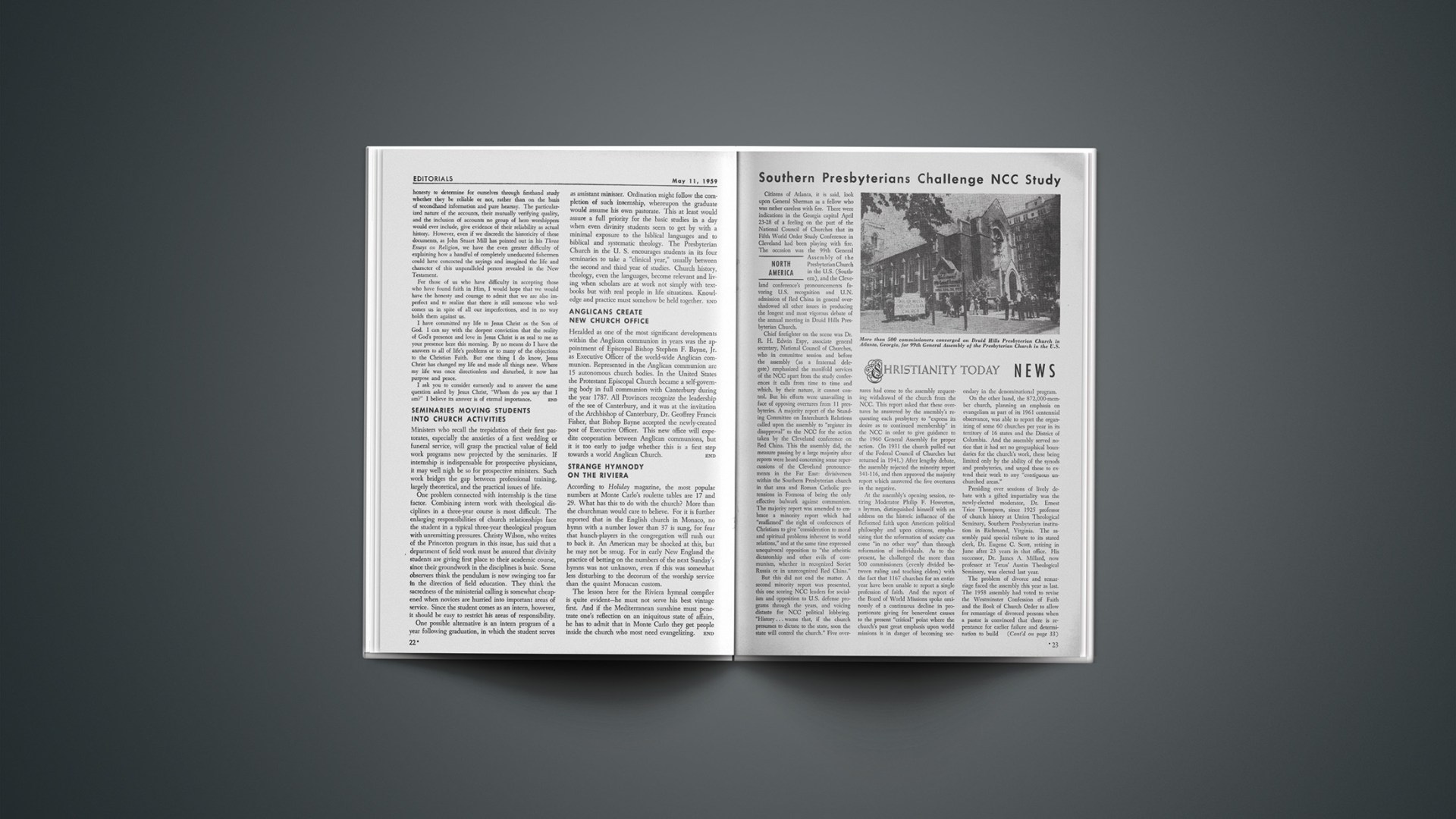
Citizens of Atlanta, it is said, look upon General Sherman as a fellow who was rather careless with fire. There were indications in the Georgia capital April 23–28 of a feeling on the part of the National Council of Churches that its Fifth World Order Study Conference in Cleveland had been playing with fire. The occasion was the 99th General Assembly of the Presbyterian Church in the U.S. (Southern), and the Cleveland conference’s pronouncements favoring U.S. recognition and U.N. admission of Red China in general overshadowed all other issues in producing the longest and most vigorous debate of the annual meeting in Druid Hills Presbyterian Church.

Chief firefighter on the scene was Dr. R. H. Edwin Espy, associate general secretary, National Council of Churches, who in committee session and before the assembly (as a fraternal delegate) emphasized the manifold services of the NCC apart from the study conferences it calls from time to time and which, by their nature, it cannot control. But his efforts were unavailing in face of opposing overtures from 11 presbyteries. A majority report of the Standing Committee on Interchurch Relations called upon the assembly to “register its disapproval” to the NCC for the action taken by the Cleveland conference on Red China. This the assembly did, the measure passing by a large majority after reports were heard concerning some repercussions of the Cleveland pronouncements in the Far East: divisiveness within the Southern Presbyterian church in that area and Roman Catholic pretensions in Formosa of being the only effective bulwark against communism. The majority report was amended to embrace a minority report which had “reaffirmed” the right of conferences of Christians to give “consideration to moral and spiritual problems inherent in world relations,” and at the same time expressed unequivocal opposition to “the atheistic dictatorship and other evils of communism, whether in recognized Soviet Russia or in unrecognized Red China.”

But this did not end the matter. A second minority report was presented, this one scoring NCC leaders for socialism and opposition to U.S. defense programs through the years, and voicing distaste for NCC political lobbying. “History … warns that, if the church presumes to dictate to the state, soon the state will control the church.” Five overtures had come to the assembly requesting withdrawal of the church from the NCC. This report asked that these overtures be answered by the assembly’s requesting each presbytery to “express its desire as to continued membership” in the NCC in order to give guidance to the 1960 General Assembly for proper action. (In 1931 the church pulled out of the Federal Council of Churches but returned in 1941.) After lengthy debate, the assembly rejected the minority report 341–116, and then approved the majority report which answered the five overtures in the negative.

At the assembly’s opening session, retiring Moderator Philip F. Howerton, a layman, distinguished himself with an address on the historic influence of the Reformed faith upon American political philosophy and upon citizens, emphasizing that the reformation of society can come “in no other way” than through reformation of individuals. As to the present, he challenged the more than 500 commissioners (evenly divided between ruling and teaching elders) with the fact that 1167 churches for an entire year have been unable to report a single profession of faith. And the report of the Board of World Missions spoke ominously of a continuous decline in proportionate giving for benevolent causes to the present “critical” point where the church’s past great emphasis upon world missions is in danger of becoming secondary in the denominational program.

On the other hand, the 872,000-member church, planning an emphasis on evangelism as part of its 1961 centennial observance, was able to report the organizing of some 60 churches per year in its territory of 16 states and the District of Columbia. And the assembly served notice that it had set no geographical boundaries for the church’s work, these being limited only by the ability of the synods and presbyteries, and urged these to extend their work to any “contiguous unchurched areas.”

Presiding over sessions of lively debate with a gifted impartiality was the newly-elected moderator, Dr. Ernest Trice Thompson, since 1925 professor of church history at Union Theological Seminary, Southern Presbyterian institution in Richmond, Virginia. The assembly paid special tribute to its stated clerk, Dr. Eugene C. Scott, retiring in June after 23 years in that office. His successor, Dr. James A. Millard, now professor at Texas’ Austin Theological Seminary, was elected last year.

The problem of divorce and remarriage faced the assembly this year as last. The 1958 assembly had voted to revise the Westminster Confession of Faith and the Book of Church Order to allow for remarriage of divorced persons when a pastor is convinced that there is repentance for earlier failure and determination to build a new marriage upon Christian foundations. Remarriage of divorced persons has previously been permitted only for the innocent parties in cases of infidelity or willful and irremediable desertion.

To the surprise of many, the individual presbyteries over the past year voted 69–13 to approve the revision. To be finally enacted as church law, it needed only the approval of this year’s assembly, which it got despite notable opposition.

The Rev. Robert Strong of Augusta, Georgia, eloquent in defeat, moved the appointment of a committee to restudy and rework the revision, charging ambiguity of statement and lack of adequate consideration of certain relevant Scriptures. It was not worthy, he said, of inclusion in the “marvelous piece of Bible study” which is the Westminster Confession.

In rejoinder, the Rev. E. L. Stoffel of Charlotte, North Carolina, saluted the revision as “containing the forgiving spirit of Christ” and being a great element in “evangelism and reclamation.” He suggested that the Southern Presbyterians were thus raising the Standard “much, much higher” than the level set by the Westminster divines on this matter.

The possibility of further revision of the Confession was requested by the Presbytery of Charlotte in relation to the subject of double predestination. The overture called for appointment of a committee to study the matter, and this was approved.

Another overture called for assembly reaffirmation of the church’s adherence to its doctrinal standards. This was prompted by critical statements on the floor of the 98th assembly, the extent of which some declared to be unprecedented. However, reaffirmation was declared superfluous.

But two other overtures asked appointment of a committee to prepare a “contemporary statement of faith,” with relegation of the Westminster Confession to the role of “historic statement.” These were answered in the negative.

But it would seem that dissatisfaction with the church Standards in some presbyteries extends beyond questions of divorce and double predestination. For a big jump is involved in moving from attempted revision of certain points in the Confession to a desire for a new statement of faith. Even the mightiest leap is unable to span a non sequitur.

F.F.

Anglican Communion

Number 2 Episcopalian

Delegates to last summer’s Lambeth Conference agreed on a bold, new bid for more centralized authority among the world’s 40,000,000 Anglicans. As made public last month, the bid provides for appointment of an “executive officer” for the global Anglican communion. The position is to be filled by appointment of the Archbishop of Canterbury, Dr. Geoffrey Francis Fisher. Fisher’s first choice: The Right Rev. Stephen F. Bayne Jr., bishop of Olympia diocese in Washington.

Bayne will thus become the second most influential Anglican figure, according to church spokesmen. Anglicans have no international hierarchy. Fisher is respected as Anglicanism’s top spiritual leader, but he has no formal power outside the Church of England.

Lambeth delegates, it is now evident, felt that church ties across national borders need to be strengthened.

“The bishops came to a united mind,” Bayne says, “that unless our Anglican communion learned how to work together far more closely than we now do—work together, think together, plan together—we must increasingly fall short of the vocation with which we are called.”

Bayne added that if the Anglican communion “is to bring to the world the witness to Christ and his truth with which we are entrusted, we need far more than a meeting every ten years.”

“We need to learn to act together more and more as a world church rather than merely as a group of national churches of the same tradition,” he said.

The Lambeth Conference, a decennial meeting of the world’s top Anglican churchmen, cited especially the need of more coordination in missionary strategy.

Bayne’s specific tasks in his new post will include administration of the Advisory Council of Missionary Strategy, which serves as the central planning group for world-wide Anglican missionary work, and the Consultative Body of the Lambeth Conference, the organization behind the decennial meetings.

Presiding Bishop Arthur Lichtenberger of the Protestant Episcopal Church (U. S. arm of Anglicanism) said Bayne will also serve as head of the Convocation of American Episcopal Churches in Europe. In that office he will be bishop-in-charge of 11 Episcopal congregations in France, Germany, Italy, and Switzerland. In addition, Bayne will retain membership in the National Council of the Protestant Episcopal Church and his chairmanship of the council’s Christian Education Department.

Bayne, a native of New York City, will be 51 May 21. He holds a bachelor of arts degree from Amherst College and bachelor and master of sacred theology degrees from General Theological Seminary. He was rector of Trinity Church in St. Louis from 1934 until 1939, then went to St. John’s Church at Northampton, Massachusetts. After that he served as chaplain of Columbia University for four years and two years as a naval chaplain. He became bishop of the Episcopal Diocese of Olympia, Washington, in 1947.

Bayne will resign from the Olympia diocese as of December 31 and will move with his family to London, headquarters of the new post. He will assume his new duties early in 1960.

Roman Catholicism

Warning From The Vatican

The Vatican hierarchy is warning Catholics that they may not vote in elections for Communist fellow-travellers.

Vatican Radio said the decision was drawn up by the Sacred Congregation of the Holy Office on March 25 and approved by Pope John on April 2 during an audience granted to Alfredo Cardinal Ottaviani, pro-secretary of the congregation, which is Roman Catholicism’s supreme tribunal in matters of faith and morals.

“In the choice of the people’s representatives,” the ruling said, “it is illicit for Catholics to vote for parties or candidates who in actual fact join the Communists and favor them with their action, although they themselves do not profess principles in contrast with Catholic doctrine and even describe themselves as Christians.”

The Vatican station said the decision of the Holy Office was taken on the basis of a previous decree of July 1, 1949, which replied to the question: “Is it lawful (for Catholics) to become members of Communist parties or to support them?”

“The most eminent and revered fathers,” the station said, “have decreed that the answer should be in the negative. Communism, in fact, is materialistic and anti-Christian. The leaders of communism sometimes declare that they do not fight religion, but in fact and theory and by action they show themselves to be hostile to the true religion and to the church of Christ.”

Vatican Radio said the latest decree is a move to block votes for “collaborators” of the Communists who, “while outwardly pretending to be everything but Communists, secretly and in many ways support them in election campaigns.”

Violation of the decree will be considered a sin, but there have been no threats of excommunication.

Time magazine called the situation that brought on the decree “essentially a local one.”

“In Sicily,” the magazine said, “an aggressive, spectacled politico named Silvio Malazzo had broken away from the mainland Christian Democrats to lead an alliance of Christian Democrats, Communists, Socialists and Fascists. He is facing his first electoral test in June, and Sicily’s Ernest Cardinal Ruffini had asked the Vatican for ammunition.”

Subsequently in Rome, the Italian Communist party tabled for debate in the Chamber of Deputies a question which challenged the new warning from the Vatican.

The party demanded to know whether the prime minister will take steps to “guarantee electoral freedom” and whether he does not “deem it his duty to protest to the State of Vatican City in the face of this fresh interference in the internal life of the Italian state designed to strike at the constitutional and democratic basis of the republic.”

Anniversary Events

Reformation In Retrospect

From Geneva to Grand Rapids, programs are being planned in memory of reformer John Calvin. This year marks the 450th anniversary of his birth and the 400th anniversary of the final edition of his Institutes of the Christian Religion.

At Grand Rapids, Michigan, the Calvinistic Action Committee, affiliated with the International Association of Reformed Faith and Action, is sponsoring a “Calvin Memorial Conference,” to be held June 3–4. Speakers include Dr. Gwyn Walters, noted lecturer from Wales; the Rev. Harold Dekker, professor of missions at Calvin Seminary; and the Rev. J. Marcellus Kik, associate editor of CHRISTIANITY TODAY.

In Geneva, Switzerland, a commemorative “Festival of Sound and Light” will be staged nightly, weather permitting, throughout the summer, beginning May 31. A local committee is planning the program, to be staged in front of the Reformation Monument, a wall set off by statues of Farel, Calvin, Knox, Beza, and other historical figures of the Reformed faith in Europe.

The figures on the wall will be cast into relief by lights. Recorded voices, accompanied by background music, will tell the story of the Reformation in retrospect. In deference to tourists, the program will be aired in several languages.

Other events planned by the Geneva committee, which is working with the World Presbyterian Alliance, include a Sunday morning rally at the Reformation Monument and the Swiss premiere of a new film on the Reformation by French director Roger Leenhardt.

Scofield’S Golden Year

A handsome booklet is being distributed by Oxford University Press to mark the 50th anniversary of the widely-known Scofield Reference Bible. Author of the booklet is Dr. Frank E. Gaebelein, headmaster of Stony Brook School, Long Island, whose father, Dr. Arno C. Gaebelein, was a consulting editor for the publication of the Scofield Bible in 1909.

Cyrus Ingerson Scofield was born in Michigan in 1843. In his early years his family moved to Tennessee. After a stint in the Confederate Army during the Civil War, Scofield took up law. He was converted in St. Louis in 1879 and three years later became pastor of the First Congregational Church of Dallas. Later he became pastor of a Congregational church in Massachusetts and president of the Northfield Bible Training School, but returned to Dallas in 1902. He retired a year later to devote his time to prepare the reference Bible.

The Scofield Bible sold steadily. In 1930 it became the first publication of Oxford University Press, New York, to pass the million mark and it has continued to be a best-selling Bible ever since.

Since 1954, a committee of nine Bible scholars headed by Dr. E. Schuyler English has been at work on a new edition. Publication is scheduled for 1963.

People: Words And Events

Death: Dr. Louis W. Pitt, rector of Grace Episcopal Church in New York and chairman of evangelism for the Protestant Council of the City of New York.

Elections: As Bishop of the Lutheran Church of Iceland, Dr. Sigurbjorn Einarsson … as chairman of the General Commission on Chaplains, Episcopal Bishop Henry I. Louttit … as first executive secretary of the Committee on Television, Radio and Audio-Visuals of the Presbyterian Church in the U.S., Dr. Ernest J. Arnold … as president of the New York City Mission Society, Jesse H. Blair.

Appointments: As associate professor of biblical theology at California Baptist Theological Seminary, Dr. David Wallace … as deputy executive director of Church World Service, Dr. A. Russell Stevenson … as chairman of the music department at Philadelphia College of Bible, Alfred E. Lunde … as a secretary of the International Missionary Council, the Rev. Victor E. W. Hayward … as director of the Presbyterian National Missions Homes, Inc., Dr. Roy E. Mueller.

Nomination: For the presidency of North Park College and Theological Seminary, Dr. Karl A. Olsson.

Resignation: As director of ministerial recruitment for the Methodist Church, Dr. Harold T. Porter.

Award: To Methodist Bishop G. Bromley Oxnam, the Upper Room Citation for 1959.

‘Minimum Representation’

Eastern Orthodox Churches would accept an invitation to the Ecumenical Council summoned by Pope John XXIII only if the rest of the Christian world is invited to send representatives, Patriarch Athenagoras of Istanbul declared last month.

The supreme leader of some 150 million Eastern Orthodox throughout the world said the “minimum representation of the other Churches would be their collective representation through the World Council of Churches.”

Patriarch Athenagoras’ pronouncement was disclosed at the annual meeting of the U. S. Conference for the World Council of Churches by Archbishop Iakovos, the former Metropolitan James who is now head of the Greek Orthodox Archdiocese of North and South America.

Earlier in his address, the archbishop told the conference that “it should always be remembered in all ecumenical circles that there are no churches, but one.”

He urged that the ecumenical movement “be brought down from the level of the ecumenists to the level of the people, from the complex terminology used by theologians to the language understood by the faithful.”

Several weeks before the WCC’s U. S. Conference meeting, held in Buck Hill Falls, Pennsylvania, Archbishop Iakovos became the first Greek Orthodox archbishop to have an audience with the Roman Catholic pope in 350 years.

Ecumenical Concern

A top ecumenical figure was expected to be on hand May 11 in Geneva for the foreign ministers conference.

Dr. O. Frederick Nolde said he would represent the Commission of the Churches on International Affairs, a joint agency of the World Council of Churches and the International Missionary Council.

Nolde said his presence would be designed “to symbolize the concern of the churches and to offer to the principal participants—in person or by letter—the encouragement which can be provided by this expression of concern.”

Call For Evangelism

From Miami Beach last month came a Methodist plea, addressed to the World Council of Churches, for a “World Congress on Evangelism.”

At an annual meeting of the Methodist Church’s Board of Evangelism, General Secretary Harry Denman urged the WCC to call such an “evangelism congress” as a means of “stirring the several denominations to launch a world evangelistic movement.”

Denman also reaffirmed an earlier plea that Methodists themselves undertake a “Decade of Dynamic Discipleship for Evangelism.”

“If we are to be an evangelistic church,” he said, “our percentage of increase must not merely keep pace with that of population; it must be larger.”

Bishops In Washington

Fifty-one Methodist bishops spent four active days in Washington last month. They (1) conferred with top politicians, (2) broke ground for an eight-million-dollar hospital and nursing school, and (3) dedicated a 750 thousand dollar chapel-administration building at Wesley Theological Seminary.

At semi-annual business sessions, the Council of Bishops of the Methodist Church installed Bishop Marvin A. Franklin as new president, succeeding Bishop G. Bromley Oxnam. Bishop Gerald Kennedy was elected president-designate. Franklin is from Jackson, Mississippi, Kennedy from Los Angeles.

Kennedy’s selection means he will preside at the opening of the next quadrennial General Conference of the Methodist Church in Danver next year.

While in Washington, the Methodist bishops arranged separate sessions with such notables as President Eisenhower, Chief Justice Earl Warren, Vice President Richard Nixon, several cabinet members, and Senators John F. Kennedy, Hubert H. Humphrey, and Lyndon Johnson. The bishops were said to have discussed “public questions” with the government leaders, but details were not disclosed.

Bishop Herbert Welch, at 96 the senior Methodist bishop, spoke at the campus dedication. All the bishops were taken on a tour of the new seminary grounds, located adjacent to American University in Northwest Washington. Both schools are Methodist-affiliated. The seminary had been located at Westminster, Maryland, until last September.

A groundbreaking ritual written by Oxnam, now recuperated from injuries suffered in a Christmas traffic accident, was employed at the site of the seven-story, 350-bed Sibley Memorial Hospital, related to the Woman’s Division of the Methodist Board of Missions. Its school of nursing will be affiliated with American University. Site is near the Potomac River in Northwest Washington. The hospital until now has been located in downtown Washington.

A Year’S Respite

Princeton Theological Seminary narrowly escaped public censure from the American Association of University Professors last month. At an annual meeting in Pittsburgh, the AAUP voted to withhold censure of Princeton for a year despite a committee’s charge that the seminary “was clearly unjustified” in terminating the appointment of Professor Daniel Theron in 1957.

“No formal charge appropriate to the termination of a tenure appointment was brought against him,” the committee said. “The administration of the Princeton Theological Seminary is therefore censurable. However, under an incoming president there is an expectation of substantial changes in faculty-administration relations. [The committee] consequently recommends … that censure be withheld for a year to allow opportunity for (1) the adoption of an acceptable tenure system, (2) evidence of acceptable faculty participation in the formulation and operation of such a system, and (3) an offer of reinstatement to Professor Theron.”

Delegates to the AAUP meeting at the same time voted to censure Fisk University and New York University for actions related to faculty dismissals.

The AAUP action regarding Princeton bore similarity to a report brought by the American Association of Theological Schools against Southern Baptist Theological Seminary, Louisville. The AAUP and the AATS are not related.

AATS findings against the Louisville seminary likewise brought a year of virtual probation during which the Baptist school is expected to “repair the damage” caused by dismissal of 13 professors. The AATS questioned the “character of administrative procedures” which led to the dismissals, and still threatens to drop the seminary from its list of accredited schools, even though the dismissals have been rescinded and the professors asked to resign instead.

Although both the AATS and the AAUP have raised similar issues, the two groups have not shared each other’s concerns. An AAUP spokesman said there is no record of any investigation of the Louisville dismissals. The AATS, in turn, has never publicly expressed any anxieties about the Princeton dispute.

Unanimous Endorsement

Dr. Clyde P. St. Amant will become dean of the School of Theology at Southern Baptist Theological Seminary, Louisville, June 1. The school has been without a permanent dean for several years. St. Amant has been professor of church history at New Orleans Baptist Theological Seminary, having served at the school since 1943. He holds a doctorate from New College, Edinburgh.

Selection of St. Amant received the unanimous endorsement of the present seminary faculty, a spokesman said.

Announcement of the appointment came from seminary President Duke K. McCall, himself the recipient of a new distinction this month. On May 31, McCall will preach the baccalaureate sermon to the first graduating class of the new Air Force Academy at Colorado Springs, Colorado. President Eisenhower was expected to deliver the commencement address.

Continent Of Australia

On To Adelaide

With the scheduled windup this week of a record-breaking, month-long evangelistic series in Sydney, Billy Graham and his team prepared to begin shorter campaigns in other Australian cities.

Response in Sydney appeared to have shattered all precedent for a Graham crusade—in attendance per service, decisions, and church support. Historians could rank the Sydney meetings with the greatest of evangelical impacts.

A crusade in Adelaide was scheduled to begin May 13. Associate evangelist Joseph Blinco was to conduct the crusade for the first 11 days, with Graham addressing the three final meetings on May 24, 25 and 26.

In Perth, meetings were to start on May 15 with associate evangelist Grady Wilson speaking at the first six meetings and Graham addressing the two final rallies on May 21 and 22.

The schedules represent an adjustment of the original Australian crusade timetable. Changes were made after consultations with crusade committees.

Associate evangelist Leighton Ford will initiate the crusade in Brisbane May 17. Graham will conclude the series there May 29, 30 and 31.

In Melbourne, where the opening series of the Australian campaign is still having positive effects, Dr. James Stewart, professor of New Testament at New College, Edinburgh, arrived from Scotland to take up a 16-week guest appointment at Scots Church. Stewart was quoted as saying that Scotland was feeling even yet the impact of the crusade there four years ago. The professor was reported to have said that Graham’s message is based upon “a fairly profound theology of the Christian faith.”

Protestant Panorama

• For the 1958–59 term, the U. S. Office of Education estimates an enrollment of 5,695,000 pupils in elementary and secondary grades of non-public schools. Nearly 90 per cent of these attend 11,170 Roman Catholic elementary and secondary schools. Missouri Synod Lutherans lead Protestants in the number of such schools with 1,188. Seventh-day Adventists are second with 1,115 and Episcopalians are third with 232.

• American Baptist missions officials announced last month that two Congolese nationals have become the first officially ordained pastors in the history of the denomination’s work in the Belgian Congo.

• Religious groups in many countries paid tribute last month to George Frederick Handel, one of the greatest of all composers who was noted for his religious works. The occasion was the 200th anniversary of his death.

• Hartwick College, located in Oneonta, New York, and related to the United Lutheran Church in America, is recipient of a bequest of $1,700,000 from the estate of the late Miss Marion Yager, former resident of Oneonta who died in Italy last February … Westminster Theological Seminary in Philadelphia is designated to receive $473,000 from the estate of a Rochester, New York, woman who died last year.

• Hawaii’s first congregation of the United Presbyterian Church in the U. S. A. was organized last month at a service attended by some 400.

• A Roman Catholic archbishop’s edict prompted sponsors of the “Miss New Mexico” beauty pageant to cancel their public swim suit competition. Archbishop Edwin V. Byrne of Santa Fe ruled that no Catholic girls could enter beauty contests involving bathing suit competition.

• A Religious News Service comparison of government statistics shows that Americans spend about 15 per cent more for tobacco products than they give for religious and charitable purposes. Latest annual figures show: for tobacco products, $4,262,000,000; for charity (including all religious giving) $3,746,000,000.

• Upland (California) College announced last month that it has been accredited by the Western College Association.

• An agency of the United Church of Canada says 166 new church buildings will be needed in the next four years.

• A new four-year program leading to a bachelor of arts degree will replace bachelor of theology and religious education programs in the undergraduate division of Northern Baptist Theological Seminary, Chicago, beginning in the fall.

• Wheaton College will build a new chapel costing some $1,500,000. Officials hope the chapel will be completed in time for the June, 1960, centennial commencement.

• The Council of the Episcopal Diocese of Southwestern Virginia is suspending all youth conferences at its “Hemlock Haven” summer camp grounds for a year. Clergy and lay elements have failed to reach agreement on whether to integrate the youth camp.

• A 45-church Mennonite organization which dates back more than 100 years will henceforth be known as the Bible Fellowship Church. Its congregations are located in New York, New Jersey, and Pennsylvania.

• Fresh fish from the Sea of Galilee were flown to Chicago to grace the menu at last month’s “National Church Design and Building Conference.”

• Miss Lillian Hamer, 47-year-old British worker for the China Inland Mission, was reported shot and killed, apparently by bandits, in Thailand’s northern Chiengmai province.

• The British and Foreign Bible Society is distributing a new translation of the four Gospels in colloquial Russian. A group of Russian scholars associated with the Orthodox Institute of St. Sergius in Paris had worked eight years on the project.

Far East

Anglicans In Japan

A public rally attended by more than 4,000 highlighted initial centenary observances of Japanese Anglicanism this month. (For other anniversaries, see page 36.)

A host of Episcopalian dignitaries from all parts of the world were on hand for the rally, held in a Tokyo gym. The three-day opening ceremonies of the year-long commemoration included a communion service held in conjunction with the 26th General Synod of the Anglican church in Japan.

Ceremonies to mark the 100th anniversary of Protestantism in Japan will be held in the fall.

The Nippon Seikokai (Japan Holy Catholic Church), as the Anglican organization there is called, has 10 dioceses, 33 educational institutions, and five hospitals. The Rev. Michael Hinsuke Yashiro is presiding bishop.

Dr. Geoffrey Francis Fisher, Archbishop of Canterbury, used the occasion to call for “an unparalleled conquest” over sexual habits so that families will not have more children than they can bring up decently and without making “undue demands” on society.

Also present were Dr. Arthur C. Lichtenberger, presiding bishop of the Protestant Episcopal Church of the United States, Archbishop Reginald Charles Halse of Brisbane, Australia, and Dr. Ivor Norris, bishop of Brandon, Manitoba, Canada.

The Anglican church in Japan was founded by two American missionaries, the Rev. Channing Moore Williams and John Liggins, in May of 1859.

Continent Of Africa

Christ And Islam

Eighty-three churchmen from 21 countries assembled at Asmara, Ethiopia, last month to pool ideas on what should be the Christian approach to Islam. Delegates came from many parts of Africa and the Near East and from as far as Indonesia and the Philippines.

Study groups considered “methods and implications of the experience of conversion,” “the church’s follow-up of conversion,” “the bearing of modern tendencies and developments in Islam today,” “religious experience in Islam and its relation to the Christian faith,” and “the relation of the churches of the Middle East to Islam.” Functional groups discussed other aspects of the missionary enterprise and Dr. Kenneth Cragg of St. George’s Cathedral in Jerusalem led a Bible study.

The conference was sponsored by the Commission on Ecumenical Mission and Relations of the United Presbyterian Church in the U. S. A. and 13 other national church bodies with predominant Presbyterian representation.

Outcome of the assembly was a 10-point “message” to sponsoring churches and “all our brothers in Christ.”

“We call upon all the Christian churches in the Middle East to play a full part in national self-fulfillment,” the statement said, “and upon their members to share wholeheartedly in that disciplined citizenship which is the expression of true love of one’s nation.

“… We believe that the Christian church can and should play a prophetic role in the Middle East today, that Christian ideals of the dignity of man and of justice, and Christian programs of social welfare are vital to Middle East governments as they battle with the problems of poverty, disease, ignorance, and human greed.”

An appendix to the “message” called for high, modern educational standards in Christian schools operated by local churches and for promotion of Bible teaching wherever possible. The appendix stressed a need for renewed programs of “evangelism and church nurture,” for more competent Christian leadership among both laymen and clergymen, and for better literature and more student centers.

Frontier Facilities

A printing plant which can turn out 30,000,000 pages of Christian literature annually was dedicated at Lagos, Nigeria, last month.

The new building will house the printing and publishing facilities of the Niger-Challenge Press, operated by the Sudan Interior Mission.

Three hundred guests representing Protestant churches throughout West Africa attended the dedication. Congratulatory messages were received from a number of African government officials.

The Niger-Challenge Press is a merger of the eight-year-old African Challenge organization and the 49-year-old Niger Press. Its new staff numbers 38 Africans.

The African Challenge is an evangelical monthly with a popular appeal sold at hundreds of newsstands over the Dark Continent.

Guest speaker at the ceremonies was Sir Francis Akanu Ibiam, council chairman of Nigeria’s University College.

Ideas

Christ and the Campus

Of all danger areas facing religion and education today, the Western world’s college and university campuses are situated most vulnerably of all. Their neglect of Christianity has established them as vast temples of spiritual ignorance.

The Communist surge already has undermined the spiritual vitality and moral sensitivity of wide ranges of twentieth century intellectual life. Yet the majority of American educators remain profoundly indifferent to the inherited religion of the West. Thereby they imply the virtual irrelevance of Christianity as a world-and-life view to classroom concerns.

If an educator dedicated to Christian realities now constitutes an exception in academic circles, the professor who carefully delineates the bearing of Christian beliefs upon the content of class studies has virtually become an oddity.

From this neglect of the Christian heritage must result something far worse than a decline of denominational work among students, already distressing to many religious leaders. Loss of the intellectuals to the Christian cause means that the tide of creative thought is yielded to non-Christian, even to anti-Christian, minds. It means also that the Christian witness is mainly carried by those multitudes who, prizing Christianity as a religion of private devotion, do not sense its additional relevance to the spheres of society and culture as well.

This ominous prospect will worsen as enrollment in schools of higher education, currently totaling more than 3 million, doubles by 1967.

“Campus culture is not only not Christian, it is anti-Christian.… In fact, life and values on our campuses are further away from Christ and his church than those on the mission fields of Asia, since in the minds of students and faculty the church and Christian faith have been left behind …” These words are Edmond Perry’s, in an article titled “Search for Christian Unity on Campus” in the Methodist Student Movement magazine Motive (February, 1957). Many interpreters view Perry’s appraisal as more penetrating than Jones B. Shannon’s report in The Saturday Evening Post (March 29, 1958) of “a revival in religious faith” on the American college campus. Kermit L. Lawton of the Division of Evangelism of the Pennsylvania Council of Churches, completing a survey of 14 campuses in that state, thinks the religious response of students in state teachers colleges is best described by the term “spiritual neutrality.” Of 11,850 students of Protestant religious identification, only 2,181 (or 18.4 per cent) participate in college-town Protestant churches. Although the fact must not be overlooked that a growing number of commuter students now get a “suitcase” education, this is not a total explanation. Even in home churches, whose college age groups are slim and scanty to begin with, many pastors complain that college studies often put an end to enthusiastic participation of young people in church activities. American collegiate education imposes peculiar stresses upon the Christian outlook and seems swiftly to wither church interest on campus and at home.

Student indifference to university churches reflects a reaction to the pulpit ministry no less than a consequence of classroom lectures. Denomination after denomination the past generation zealously guarded its university pastorates for ministers whose eloquence and artistry blended with a passion to make Christianity acceptable to the modern mind. Their customary technique was to purge biblical religion of whatever ran afoul of modern presuppositions. What inevitably happened, of course, was that students (never underestimate their powers of critical analysis) soon sensed that these churches too had begun worshiping modern relativisms—which collegians could learn both more authoritatively and less disconnectedly in the classroom. Many university churches tended by the apostles of liberalism soon became religious shells lacking the Gospel glory.

Some off-campus churches preserved an illusion of vigor by providing inter-faith fellowships. This metamorphosis was experienced also on some campuses by the traditional Student Christian Association. The tide of religious inclusivism ran so strong that movements (such as Inter-Varsity Christian Fellowship) dedicated to a strictly evangelical witness in the service of Christianity as a religion of redemptive revelation were soon disparaged as exclusive and pietistic. More recently, Campus Crusade for Christ has recruited student converts also with spectacular success. Those who neglect the elementals of biblical faith have little ground for criticizing student effort which preserves such priorities as personal dedication to Christ as Saviour and Lord.

In a university atmosphere, however, spiritual commitment does not fully thrive while students ignore the larger implications of Christianity for the whole range of curriculum study. Must it not be acknowledged, however, that faculty more than students bear a responsibility to exhibit the historic relevance of the Christian world-life view? In this respect, student interest today often runs ahead of faculty inclination. To the professors more than to their pupils must be attributed an indirect if not direct responsibility for the frustration and demise of many Christian influences on campus. In the sphere of spiritual indifference, the modern masters have enlisted modern disciples.

Recently in one of New England’s distinguished colleges, the president of the Christian Association addressed the campus community in a required chapel service. The speaker was Roger Hull, Jr. The chapel of every secular college in the West might well echo this college senior’s concern for Christian verities. There was an era in American campus life when a college president like Timothy Dwight would have said these things, and felt himself condemned were they unuttered. Today we may take heart because college students like Roger Hull, Jr., are voicing these great and timely convictions:

We have often been referred to as the uncommitted generation … criticized for our lack of commitment to any ultimate hope or transforming purpose beyond our own personal security and fulfillment. We seem to lack any sense of crusading spirit or sense of even local mission.

Our dilemma has recently been best summed up by Peanuts. He and Linus are discussing the matters of the world, and Linus remarks that when he grows up he wants to be a real fanatic. Peanuts questions Linus as to what he wants to be fanatical about. Linus replies, “Oh, I don’t know, it doesn’t really matter. I’ll be sort of a wishy-washy fanatic.”

Our student newspaper has attributed our lack of commitment (and our “I don’t know, it doesn’t really matter” attitude) to the relativistic atmosphere of our college education. The general attitude of our faculty seems to be one of reluctance to state to anyone what their own commitment or lack of commitment might be. At this point, I would like to ask them to do so either in this chapel, or through any other means they should consider appropriate.

Our Editor maintained that not only does our college not teach what ought to be in a moral sense, but it seldom recognizes the ability of anyone to state or know the validity of such statements concerning our existence.

Last Spring an attempt was made to fill this vacuum in our college community through a series of chapel talks designed to confront us with various areas considered to be worthy of our commitment. Yet, quite absent from our series was a consideration of commitment to the Person of Jesus Christ.

Today, merely as another student, I would like to suggest that the Person of Jesus Christ, in His life, in His death, and in His resurrection, is totally worthy of our commitment, and can deliver us from the despair of the uncommitted and seemingly directionless world, in which we find both ourselves and our society to be immersed.

The claim and the good news, if there be any, of the Christian Faith are that God has not left us to our own abstract speculation as to whether He exists, or what His nature might be.

The Christian Faith maintains that God Himself has come into the world in the historic Person of Jesus Christ. The Christian plea, when we would attempt to answer the question of the existence and the nature of God, is not what do you think of this or that system of philosophy, this or that system of ethics, or this or that system of dogma, but rather what do you think of the Person of Jesus Christ Himself.

The ultimate question we must answer when we assert the existence or nonexistence of God, or assume a position of agnosticism, is that question asked by Jesus Himself, not only whom do you say other men say that I am, whether it be your parents, your ministers, your teachers, or your roommates, but “whom do you say that I am?”

If nothing else, this question is at least answerable. In the New Testament Jesus Christ, both implicitly and explicitly, claimed to be the unique Son of God. He claimed that He and the Father were one, that He was the way, that He was the truth, and that He was the life and that no man came to the Father except by Him. In the 11th chapter of Matthew we read, “All things have been delivered to me by my Father, and no one knows the Father except the Son and anyone to whom the Son chooses to reveal Him.” So close did He consider His relationship with God, that to know Him was to know God, to see Him was to see God, to believe in Him was to believe in God, and to hate Him was to hate God. The egocentricity of this man’s claims is unparalleled in the history of the world. Yet, His life was filled with complete humility and self-sacrifice. As has been pointed out by the Rev. John Stott, it is this paradox of the self-centeredness of His teaching and the complete unself-centeredness of His behavior that is so baffling.

The nature of His claims and the nature of His behavior force us to answer the question of whether He was the unique Son of God. If He was not, then we must conclude that He was either the world’s greatest liar and fraud, or our supreme paranoid. I believe there can be no intellectually honest middle ground.

Due to the nature of His claims, the conclusion we come to becomes the singly most important decision of our lives, both now and for eternity. We can either accept or reject Him, but if there be any honesty in us, we cannot ignore Him.

Yet, in order to come to a decision concerning His question to us, “Whom do you say that I am?” and due to the order of its magnitude, we must at least seek Him with the same degree of effort and openmindedness that we employ in the daily study of one of our courses. It has been said that “God’s chief quarrel with man is that he does not seek.” Because we do not attend a lecture it does not mean that the lecture was not given. Nor, does the fact that we attend the lecture and fail to study and understand it mean that the lecturer did not know what he was talking about. You and I can seek Jesus Christ in the pages of the New Testament, and in the testimony and community of those who have found faith in Him.

If we assume a position of Christian Faith, agnosticism or atheism, in order to be in any way intellectually honest, we must have at least spent some serious days of study in the New Testament.

For those of us who have difficulty in accepting the New Testament documents as more than wishful projections of a few fishermen, I would again hope that we would have the honesty to determine for ourselves through firsthand study whether they be reliable or not, rather than on the basis of secondhand information and pure hearsay. The particularized nature of the accounts, their mutually verifying quality, and the inclusion of accounts no group of hero worshippers would ever include, give evidence of their reliability as actual history. However, even if we discredit the historicity of these documents, as John Stuart Mill has pointed out in his Three Essays on Religion, we have the even greater difficulty of explaining how a handful of completely uneducated fishermen could have concocted the sayings and imagined the life and character of this unparalleled person revealed in the New Testament.

For those of us who have difficulty in accepting those who have found faith in Him, I would hope that we would have the honesty and courage to admit that we are also imperfect and to realize that there is still someone who welcomes us in spite of all our imperfections, and in no way holds them against us.

I have committed my life to Jesus Christ as the Son of God. I can say with the deepest conviction that the reality of God’s presence and love in Jesus Christ is as real to me as your presence here this morning. By no means do I have the answers to all of life’s problems or to many of the objections to the Christian Faith. But one thing I do know, Jesus Christ has changed my life and made all things new. Where my life was once directionless and disturbed, it now has purpose and peace.

I ask you to consider earnestly and to answer the same question asked by Jesus Christ, “Whom do you say that I am?” I believe its answer is of eternal importance.

END

Seminaries Moving Students Into Church Activities

Ministers who recall the trepidation of their first pastorates, especially the anxieties of a first wedding or funeral service, will grasp the practical value of field work programs now projected by the seminaries. If internship is indispensable for prospective physicians, it may well nigh be so for prospective ministers. Such work bridges the gap between professional training, largely theoretical, and the practical issues of life.

One problem connected with internship is the time factor. Combining intern work with theological disciplines in a three-year course is most difficult. The enlarging responsibilities of church relationships face the student in a typical three-year theological program with unremitting pressures. Christy Wilson, who writes of the Princeton program in this issue, has said that a department of field work must be assured that divinity students are giving first place to their academic course, since their groundwork in the disciplines is basic. Some observers think the pendulum is now swinging too far in the direction of field education. They think the sacredness of the ministerial calling is somewhat cheapened when novices are hurried into important areas of service. Since the student comes as an intern, however, it should be easy to restrict his areas of responsibility.

One possible alternative is an intern program of a year following graduation, in which the student serves as assistant minister. Ordination might follow the completion of such internship, whereupon the graduate would assume his own pastorate. This at least would assure a full priority for the basic studies in a day when even divinity students seem to get by with a minimal exposure to the biblical languages and to biblical and systematic theology. The Presbyterian Church in the U. S. encourages students in its four seminaries to take a “clinical year,” usually between the second and third year of studies. Church history, theology, even the languages, become relevant and living when scholars are at work not simply with textbooks but with real people in life situations. Knowledge and practice must somehow be held together.

END

Anglicans Create New Church Office

Heralded as one of the most significant developments within the Anglican communion in years was the appointment of Episcopal Bishop Stephen F. Bayne, Jr. as Executive Officer of the world-wide Anglican communion. Represented in the Anglican communion are 15 autonomous church bodies. In the United States the Protestant Episcopal Church became a self-governing body in full communion with Canterbury during the year 1787. All Provinces recognize the leadership of the see of Canterbury, and it was at the invitation of the Archbishop of Canterbury, Dr. Geoffrey Francis Fisher, that Bishop Bayne accepted the newly-created post of Executive Officer. This new office will expedite cooperation between Anglican communions, but it is too early to judge whether this is a first step towards a world Anglican Church.

END

Strange Hymnody On The Riviera

According to Holiday magazine, the most popular numbers at Monte Carlo’s roulette tables are 17 and 29. What has this to do with the church? More than the churchman would care to believe. For it is further reported that in the English church in Monaco, no hymn with a number lower than 37 is sung, for fear that hunch-players in the congregation will rush out to back it. An American may be shocked at this, but he may not be smug. For in early New England the practice of betting on the numbers of the next Sunday’s hymns was not unknown, even if this was somewhat less disturbing to the decorum of the worship service than the quaint Monacan custom.

The lesson here for the Riviera hymnal compiler is quite evident—he must not serve his best vintage first. And if the Mediterranean sunshine must penetrate one’s reflection on an iniquitous state of affairs, he has to admit that in Monte Carlo they get people inside the church who most need evangelizing.

END

What Shall It Profit?

[Note—This editorial has been awarded a second-place prize by the Freedoms Foundation of Valley Forge.]

The world is intrigued by the scientific progress made in outer space, with an assault on the moon a very real possibility. In almost every realm of human endeavor new discoveries and their exploitation open up vistas for the future, limited solely by the boldness of imagination and the willingness to explore.

To minimize present achievements or to question their ultimate dwarfing by those of the future is utterly foolish. In the writer’s own specialty (surgery), the advances of the last dozen years have opened up fields which at one time were thought to be beyond the realm of successful approach. As an illustration—that which is being done in the area of cardiac, vascular and neurosurgery is so startling and successful that the public is but vaguely aware of it. For all of this we should thank God and take courage in the knowledge he has given us.

But it is imperative that we shall not have our perspective warped either by that which has been accomplished, or by that which yet lies in store for the future.

It is desperately important that we arrive at and keep a proper perspective as we think of man and of God, the Sovereign of this universe.

Man has never discovered, nor can he, anything which the Creator has not himself made and placed in his own creation. Because of this it is vital that God be accorded his rightful place in his own universe.

That he is so often ignored or relegated to the shadows by the assertiveness and blindness of man is but a reflection of man’s sinfulness and need of redemption in Jesus Christ.

What shall it profit if we successfully conquer outer space, set up a station on the moon, and even attain a domination of these hitherto unattainable areas of the universe, if at the same time we do not learn of him through whom alone the inner reaches of the soul are cleansed and disciplined?

For a generation we have worked to establish the highest living standards the world has ever known. Gracious living has become a reality for millions. Compared with the rest of the world we in America wallow in material prosperity. But what shall it profit us should we lose our national soul in the process?

No amount of religiosity, pious affirmations or participation in church programs can compensate for the lust, selfishness, and pride which are gnawing at the vitals of our moral and spiritual lives.

Enamoured with the achievements of today, and the promise of yet more ease of living for tomorrow, we need to stop before it is too late and ask ourselves the question: “What does all of this profit if Christ is left outside the door?” How bleak and hopeless the future without Christ! And yet, our desires seem so largely centered on the present and on the material.

We are concerned about the problems of education. We are frantically trying to recoup our lost supremacy in the realm of science. We recognize the very real danger of becoming a second-rate power from a military standpoint. These and many other problems rightly deserve our concern and should enlist our support of every legitimate and fruitful effort to improve the situation.

But while we do this let us also remember that a nation’s strength is to be found primarily in the character of its people, for it is righteousness which exalteth a nation, and sin which drags it down. The trend in America, so far as moral and spiritual standards are concerned, is down and not up, of the flesh and not of the Spirit.

Because of this it is of vital importance that the Church shall maintain her spiritual vision and discharge her rightful functions. We have no fault to find with those who would have the Church exercise upon the contemporary social order her influence for righteousness, provided there shall be a comparable zeal to maintain the personal message of redemption for sinners.

The Holy Scriptures leave neither to the imagination nor the interpretation of men the content of the Gospel message, and in the forefront of that message is the fact that out of Christ men are lost sinners in need of his cleansing and redeeming salvation; and that the wages of sin is death but the gift of God is eternal life through Jesus Christ our Lord to all who will believe.

It is the dilution, the evasion of, or the substitution of something else for the message of sin, of righteousness, and of judgment to come which is the most ominous sign on the horizon of contemporary Christianity. We are rightly concerned about a Christian view to race relations, about a just social order, and about a concept of brotherhood which recognizes the needs and aspirations of the less fortunate. We long for a just and durable peace, and sanction a multitude of humanitarian activities, all of which are good and for which we should strive. But what shall the attaining of all of these things profit us, or those for whom we are concerned, unless at the same time Jesus Christ is received as Saviour from sin and made the Lord of our lives?

The primary task of the Church is to preach Christ crucified, risen and coming in triumph. What shall it profit men if the Church neglect this task or dilute the content of the message while helping to usher in a new world order still in the clutches of the devil?

We are in the gravest danger of continuing to treat world symptoms while we neglect the cause of those symptoms—sin in the human heart for which there is but one remedy, the preaching of which we alone are responsible.

Looking through the astigmatic lenses of immediate problems we are in danger of losing sight of those things which are ultimate and eternal. The Apostle Paul reminded the Corinthian Christians that he had put first things first: “For I delivered unto you first of all that which I also received, how that Christ died for our sins according to the Scriptures; and that he was buried, and that he rose again the third day according to the Scriptures.” It is because this is no longer the primary message of so many pulpits across America that we as a people, and the Church as the Church, stand in jeopardy. God will not be mocked. The salvation he wrought out in the counsels of eternity and brought into effect on the Cross of Calvary is God’s way, and there is no other means whereby men may be saved.

In every activity and emphasis the individual Christian and the Church should ask the sobering question: “What shall it profit if I carry this through to a successful conclusion only to lose my own soul and the souls of those who need the message that Christ died for our sins?”

What shall it profit?

Bible Text of the Month: Matthew 28:18–20

And Jesus came to them and spake unto them, saying, All authority hath been given unto me in heaven and on earth. Go ye therefore, and make disciples of all the nations, baptizing them into the name of the Father and of the Son and of the Holy Spirit: teaching them to observe all things whatsoever I commanded you: and lo, I am with you always, even unto the end of the world (Matthew 28:18–20).

By these words the missionary office is bound upon the Church through all ages, till every part of the earth shall have been evangelized.

Once the tempter took Jesus to a high mountain, to show him the kingdoms of this world and their glory, in order to induce him to flee the cross in obtaining the Kingdom. Now Jesus himself shows his disciples the kingdoms of this world, after the cross had been borne, and points out the conquest his sacrifice and love shall achieve through the gospel.

He must have supreme and truly divine dominion, who commands eternal life to be promised in his name, the whole world to be reduced under his sway, and a doctrine to be promulgated which is to subdue every high thing and bring low the human race. And certainly the apostles would never have been persuaded to attempt so arduous a task, had they not known that their Protector and Avenger was sitting in the heaven, to whom supreme dominion had been given.

Teaching Them

We are not to invent anything new; nor to change anything to suit the current of the age; but to teach the baptized believers to observe “all things whatsoever” our Divine King has commanded.

CHARLES SPURGEON

Baptism is a mere ceremonial and initial act of obedience to Christ, which should be followed by a lifelong obedience to all his commandments. The person who is discipled and baptized is only started in a course of Christian living. Notice that it is not simply teaching them the commandments of Christ, but teaching them to observe his commandments. They who disciple and baptize men must teach them the duty of obeying Christ in all things; and the Christian instructor has still fallen short of his task unless those whom he is called to instruct have both learned what Christ’s commandments are, and have learned to observe them.

JOHN A. BROADUS

As they were to baptize men in the name of the sacred Three, no doubt they were first to make known the persons and offices of the holy Trinity. They were to declare “the Father, as our offended, but reconciled, God and Father; they were to make known “the Son,” as the sinner’s advocate and propitiation; they were to set forth “the Holy Ghost,” as the enlightener, comforter, and sanctifier of God’s elect.

CHARLES SIMEON

“Thus it is written, and thus it behooved Christ to suffer, and to rise from the dead the third day: and that repentance and remission of sins should be preached in his name among all nations, beginning at Jerusalem. And ye are witnesses of this things.”

LUKE 24:46–48

The glorious fact of the unbroken presence of Christ through all the ages is the true Apostolic succession, an irresistible evidence of Christianity, and an unfailing source of strength and encouragement. The promise has never been revoked, never forgotten, it is fulfilled day by day, hour by hour, amidst the alternations of joy and grief, of success and failure, and will be fulfilled to all true Christians as well as the Church at large, until the King shall appear in His visible Majesty to reign with his redeemed people in the new heavens and on the new earth for ever and ever.

PHILIP SCHAFF

Presence Of Christ

The Saviour might have said I will be, but he chooses to say I am. He is ever-present. There is never a time when He needs to come from afar. He is ever at hand, anticipating his servants’ presence, wherever that may be. In his Spirit, in his own co-ordinate Personality, in his living loving self, he is everywhere present, everywhere except within the consciousness of unbelieving men. He is round and round the consciousness of all men, pressing in upon them, and knocking at the door of the heart.… He will bless them to the full, perfecting his strength in their weakness, so that “through Christ who strengtheneth them, they can do all things” (Phil. 4:13). It is, as Chrysostom remarks, as if the Saviour had said to his disciples, “Tell me not of the difficulties you must encounter, for I am with you.

JAMES MORISON

Only the living Christ himself was able to conquer the fear, perplexity, and doubt of his disciples and to prepare them to enter the world as preachers of the glad tidings. And in like manner today it is only the risen Saviour himself who can banish all fear from our hearts, and give us the inward rest and peace to enable us to act as living witnesses of our living Redeemer. And all the spiritual equipment that we need, he gives us through the Spirit, already given to his church in his fullness on that first Pentecost and to every believer in the moment of regeneration. And now there rests on every regenerate man and woman the responsibility of being so completely surrendered to him and so looking up to him in faith and obedience, that he will from moment to moment equip us with his divine strength for the task to which we have been called.

NORVAL GELDENHUYS

His unseen presence and power make the perpetual miracle of church history and Christian life. It is a strange thing that since he vanished from the view of the disciples he has never been seen again by mortal eyes, never again, save by one man—Paul. But there is a far stranger thing than that. It is an infinitely more wonderful thing that He has done all his most wonderful works among men since his visible presence was taken away, and without showing himself at all. Millions of men and women in every period of Christian history have been moved and inspired by the unseen Christ than the most devoted of his disciples were moved and inspired by the sight of his bodily form. He is to the moral world what the vital forces are in the natural world. No one can see those vital forces or explain how they work. We can only see the results. They clothe the landscape with verdure, they cover the hedges with blossoms, they change ugliness into beauty, and waste places into a garden of delight.

J. G. GREENHOUGH

Apple PodcastsDown ArrowDown ArrowDown Arrowarrow_left_altLeft ArrowLeft ArrowRight ArrowRight ArrowRight Arrowarrow_up_altUp ArrowUp ArrowAvailable at Amazoncaret-downCloseCloseEmailEmailExpandExpandExternalExternalFacebookfacebook-squareGiftGiftGooglegoogleGoogle KeephamburgerInstagraminstagram-squareLinkLinklinkedin-squareListenListenListenChristianity TodayCT Creative Studio Logologo_orgMegaphoneMenuMenupausePinterestPlayPlayPocketPodcastRSSRSSSaveSaveSaveSearchSearchsearchSpotifyStitcherTelegramTable of ContentsTable of Contentstwitter-squareWhatsAppXYouTubeYouTube