Cover Story

Survey of New Testament Books 1959

A survey of the books on the New Testament published in 1958 shows that the trends of 1957 have been continued by the prevailing schools of theology. Conservatives, neo-orthodox, and liberals alike have provided fresh reading material for the theologically-minded public.

New Testament Theology

Biblical theology has become popular, and this year has taken the foremost place in publication. The Person of Christ, by Vincent Taylor (Macmillan), completes the author’s trilogy begun in 1953 with his volumes on The Names of Jesus, and continued in 1954 with The Life and Ministry of Jesus. In interpreting the person of Christ, he has followed the method of arranging the materials in strict chronological order apart from their literary context, so that the progressive development of the apostolic teaching may be apprehended more clearly. The data which it supplies are extensive and well catalogued, and afford the reader ample opportunity to come to his own conclusions if he does not agree with those of the author.

Christ in the New Testament, by Charles M. Laymon (Abingdon Press), covers almost the same ground with a topical rather than an historical approach. Dr. Laymon notes both the unity and the diversity of the presentation of Christ by the writers of the New Testament. An avowed liberal in theology, he approaches his subject with no presuppositions of orthodoxy. His view of the origins of the New Testament is openly critical, but he concedes that it teaches most of the major tenets which conservative Christians have believed. Candid in his attitude, the writer is a good example of the recent tendency of the liberal school to show more respect for biblical teaching.

The Death of Christ, by John Knox (Abingdon Press), belongs in the same general orbit with the books of Vincent Taylor and Charles Laymon. The theme of the book is recognized as important, but the treatment of the theme is not satisfactory from an evangelical point of view.

Dr. Daniel Lamont’s Studies in the Johannine Writings (Jas. Clarke and Co., Inc.), published posthumously, contains a series of brief messages on topical aspects of theology in the Gospel, Epistles, and Revelation. His volume is less technical and theological than the three preceding titles, but it possesses a rare biographical fragrance that makes the teaching winsome. It will serve as a “starter” for many sermons.

The late Clarence E. Macartney’s small volume, What Jesus Really Taught (Abingdon Press), is also posthumous, and, as might be expected, conservative in theology. This little book contains short summaries of Jesus’ teaching on God, the Holy Spirit, Man, the Kingdom, Money, Marriage, and other kindred topics. The treatment is thoroughly popular, and abounds in excellent illustrations.

H. N. Ridderbos’ Paul and Jesus (Presbyterian and Reformed) discusses the relation of Paul’s thinking to Christ. The theme is old, but the treatment is new. Thoroughly in accord with Reformed theology, Dr. Ridderbos strengthens the case for the validity of the Pauline Christology.

Translations

Two new translations of the New Testament have appeared this year. One is the second volume of The Expanded Translation of the New Testament by Kenneth Wuest (Eerdmans), covering Acts through Ephesians. This translation is really a paraphrase which constitutes a brief commentary. Many of the renderings are apt, and the tenses of verbs are well handled, though sometimes the sentences are circuitous. The vocabulary is occasionally colloquial, but never ambiguous.

The second translation is The Amplified New Testament (Zondervan), produced by an anonymous editorial committee. Less bulky than Wuest’s translation, this work follows more closely the order of the original text, and may be used for direct reading and study. Insertions and expansions are indicated by the use of parentheses and square brackets, with occasional footnotes to supply textual emendations or to acknowledge sources. It is readable, accurate, and free from extreme renderings, flexible enough to be modern and dignified enough to retain the atmosphere of the original.

Commentaries

A new series of commentaries has been launched cooperatively by A. and C. Black in England and by Harper in this country. The volume on Acts, by C. S. C. Williams, was published last year, and this year C. K. Barrett’s Commentary on the Epistle to the Romans and A. R. C. Leaney’s Commentary on the Gospel According to Luke have been completed. Both are of moderate size (300 pp.), and are concise and thorough. Their critical introductions represent the latest thought on the background of the biblical books of which they treat. Leaney takes a somewhat more radical attitude on Luke than Barrett does on Romans, and is less theological in his interpretation.

C. C. Martindale has published commentaries on Matthew, Luke, John, and the Revelation (Longmans) from the Roman Catholic point of view. Among the conservative Protestants are R. V. G. Tasker on II Corinthians (Eerdmans), Homer Kent on the Pastoral Epistles (Moody Press), L. L. Morris on I Corinthians, and Donald Guthrie on The Pastoral Epistles in the Tyndale Bible Commentaries, and another volume in The New International Commentary Series on Ephesians and Colossians by E. K. Simpson and F. F. Bruce (all Eerdmans). This last commentary maintains the high standard set by its predecessors, and is suited both for popular and scholarly use. They Met at Philippi by C. E. Simcox (Oxford Press), is a homiletical treatment of the text of Philippians rather than a critical commentary.

The wide publication of books and articles on the Qumran Scrolls has raised so many questions in the minds of the public that books are now being written to answer them. Two lucid and helpful guides have appeared, one by three English authors, and one by an American author. A Guide to the Scrolls, by A. R. C. Leaney, R. P. C. Hanson, and J. Posen (S.C.M. Book Club) is brief, well outlined, and planned for the reader who is not a professional scholar. Carl G. Howie, a Presbyterian pastor, has written The Dead Sea Scrolls and The Living Church (John Knox Press), a volume quite similar in size and in design, to reassure readers who think that the material in the scrolls has endangered historic Christianity. Both books can be commended for their brevity and directness. They make a confusing subject clear.

Frank Cross, Jr., has produced a somewhat more technical volume, The Ancient Library of Qumran and Modern Biblical Studies (Doubleday). Dr. Cross’ work represents firsthand scholarship, since he has worked on the scrolls, and his statements are authoritative.

New Testament Introduction

Some material on New Testament Introduction is supplied by C. K. Barrett, The New Testament: Its Making and Meaning (Abingdon Press), and B. W. Blackwelder, Light from the Greek New Testament. A very handy little introduction by L. D. Twilley, The Origin and Transmission of the New Testament, appeared late in 1957 in the Pathway Series (Eerdmans). It contains some unusually helpful and original charts illustrating the writing and copying of the manuscripts of the New Testament. Twilley follows Streeter’s theory of geographical centers for the different types of text in the manuscript tradition. Not everybody will agree with this theory, nor with his acceptance of the documentary theory of Gospel origins, but he has produced in small compass one of the best integrated accounts of the rise of the New Testament in circulation today.

Reprints

Two reprints of old standard texts have been issued this year. Eadie’s Colossians, a thorough exegetical commentary, was published by Zondervan, and Alford’s Greek Testament, edited by Everett Harrison, has been revised in two large volumes by Moody Press. The revisions of Alford are not extensive, and are massed in additional pages at the end of each volume. Alford still contains much that is valuable, although the more recent commentaries have superseded many of its interpretations of vocabulary.

There are one or two miscellaneous titles that deserve special comment. Thomas Nelson’s new Atlas of the Early Christian World belongs more properly to the field of church history than to New Testament exposition, but excellence of planning and of content makes it useful in interpreting the early apostolic period which follows the writing of the New Testament.

Dispensationalism in America by C. Norman Krause (John Knox Press), deals properly with a phase of the history of theology, but touches on the interpretation of the eschatological passages of the New Testament. The author is opposed to the dispensational view, but he states its history with fair objectivity.

This flow of publication in the New Testament field is encouraging to evangelicals. While not all these works are written from their viewpoint, they represent a trend toward letting the Scriptures speak for themselves, and they foster interest in the biblical message.

Merrill C. Tenney is Dean of the Graduate School of Wheaton College. He holds the Th.B. degree from Gordon Divinity School, the A.M. from Boston University, and the Ph.D. from Harvard. He is the author of John: the Gospel of Belief, The New Testament: An Historical and Analytic Survey, Philippians: The Gospel at Work, and other important works.
Cover Story

Survey of Old Testament Books 1959

One of the real problems of the preaching ministry today is making the principles of the Bible pertinent to a space-conscious era. Yet it is the space-consciousness of our time that has caused many a serious person to rethink his own place in life and in the universe. Swift changes and fears in an age of science have provided opportunity of contact with such people for the gospel of an unchanging God and the assurance of his timeless grace.

It is in view of this opportunity that the message of the Old Testament, with its revelation of a this-worldly peace by means of a covenant relationship to God, is shown to have real application to our needs. New Testament answers to the human predicament have their roots in the theological concepts and religious experience of Old Testament believers and writers. Scholars of quite varying shades of opinion have recognized that Christianity is the flower that stems from the prophetic roots of the Old Testament. There is, therefore, in recent literature of the Old Testament, revisions of older, liberal reconstructions of Israel’s history. There is, as well, almost a complete volte-face with respect to the value of Old Testament theology.

The books which are surveyed here are those which have been printed in English and are available to the American and Canadian reading public. They range from those of most interest to the advanced student to those that will prove helpful to the Christian worker with little theological training.

Archaeology

In biblical archaeology the Qumran (Dead Sea) documents continue to dominate interest, though important work is being done in other areas as well. Continued concern with the Qumran discoveries is due to two main factors. One is that the discoveries are related to the Bible and to the cultural milieu in which Christianity began its separate course. The other is that the finds are literary and the evidence from them is more clearly understood than it might be with artifacts.

The outstanding authority on the Dead Sea materials in the United States is Frank M. Cross, Jr., whose conclusions on several topics are presented in The Ancient Library of Qumran and Modern Biblical Studies (Doubleday). Though the reader who has no knowledge of Hebrew or modern foreign languages may have to skip most of the extensive but valuable footnotes, he will receive genuine pleasure and important information from the body of the text. Considerable light is shed on Old Testament textual criticism, which is the science of ascertaining the exact text of the original writings. Stimulating also is the presentation of Messianic interpretation of the Old Testament among Jews outside the Pharisaic and early Christian circles.

The Monuments and the Old Testament (Judson Press) is an older text on general Old Testament archaeology by Ira M. Price which has been thoroughly revised by O. R. Sellers and E. Leslie Carlson. In addition to many changes in the original text, chapters have been added to cover archaeological advances in the Near East during the last three decades and, of course, the materials from Palestine itself, including the Dead Sea scrolls. The authors favor Rameses II, who died about 1224 B.C., as the Pharaoh of the oppression, and this dates the exodus much later than the biblical data seem to allow and later also than the date suggested by such men as W. F. Albright and G. Ernest Wright. At times it appears that certain problems have been skirted rather than faced. Yet the book is written with clarity, avoids the use of bewildering technical terms, and ought to be useful for biblical backgrounds.

A more compact handbook is provided by Donald Wiseman’s Illustrations from Biblical Archaeology (Eerdmans). The text is a summary in briefest compass of the evidence which tends to confirm or explain the biblical story. The layman can read it quickly and grasp it readily. For those who want to read more extensively on the subject, a bibliography is provided at the end of the book.

It is almost a century since Julius Wellhausen reconstructed the history of Israel as he conceived it to be from an evolutionary standpoint. The past 25 years have seen his position attacked often and forcefully. No doubt in years to come, some of these attacks will be considered as ‘dated’ as was Wellhausen’s own position. The most recent of newer presentations is that of Martin Noth, whose German work on The History of Israel (Harper) was translated into English. Noth believes that Israel’s history begins only with the settlement of the tribes in Canaan and not, as older historians believed, with the patriarchs or the exodus. For Noth, the patriarchs are dim figures almost lost in the mists of folklore. Contrary also to the views of W. F. Albright, who has written persuasively that the military conquests of Joshua are indicated by archaeological remains, Noth is certain that the Israelites gradually infiltrated the hill country of Palestine in peaceful fashion. Distinctive to Noth is his contention, accepted by a number of modern scholars, that Israel first became a confederacy of 12 tribes at Shechem. There Joshua united several, probably six, tribes which had been in Egypt and were led out by Moses, to other tribes which had never been in Egypt at all. The author recognizes, of course, that this is not the biblical picture but feels that literary evidence rightly handled supports his view. The book is the product of prodigious learning, but conservative readers will find such subjective handling of the Scripture narrative very distressing.

An entirely different type of history is S. M. Wright’s A Brief Survey of the Bible (Loiseaux Bros.). Here the traditional view of the story of the Old Testament is maintained. The book of Job, as representing the patriarchal period, is discussed prior to the Pentateuch. The style is in general devotional, rather than scholarly, and could prove most helpful in high school groups.

An excellent book, dealing with a narrower period of Old Testament history, is The Exilic Age (Westminster), by C. F. Whitley. The author is convinced, wrongly I believe, that Jeremiah disagreed with the principles of Deuteronomy, and that Isaiah 40–55, the Second Isaiah, is from the exilic period. Whitley has a wide acquaintance with the literature on the culture of the Near East and summarizes his conclusions in pleasing form. His positions are well reasoned in most instances. One grasps the poignant grief of Jeremiah, the challenge and consolation of Ezekiel, and the victorious hope of Isaiah as God’s message to his people.

Prophetic Studies

Prophecy in Israel has been an intriguing subject to students of the Bible throughout the history of the Christian Church. Some efforts have been made to reduce biblical prophecy to the level of its counterparts in ancient Babylon and Syria. These efforts have shed some light on the nature of false and even of professional prophecy in Israel, and have served to enhance our appreciation of the canonical prophetic writings.

In a brief study entitled Vision and Prophecy in Amos (Eerdmans), J. D. W. Watts has elicited from modern scholarship, more than from biblical evidence, a picture of the situation in which Amos worked and the conditions under which his prophecy arose. The author conjectures that the words of Amos were recorded by disciples or adherents both in Israel and in Judah, and that the two strands of his message were later united into one book. In this way the question of why Amos predicted the restoration of the house of David to the Northern kingdom is readily answered. He didn’t. The last three chapters originated in the Southern kingdom. Nevertheless, both strands of the book are the authentic message of Amos, and one must not, therefore, be critical of Watts’ investigations. Certainly the reader will have a much clearer view of the syncretistic religion of Jehovah (Yahweh) as it was practised in the Northern kingdom and so rigorously condemned by all the prophets.

A warmhearted study of the ministry and message of Jeremiah is set forth by J. Philip Hyatt in Jeremiah, Prophet of Courage and Hope (Abingdon). A minister could do much in reclaiming the precious truth of this great prophecy by reading this work. It must be said that the author sometimes reaches what is, in my opinion, unwarranted conclusions. Defenders of the doctrine of human depravity have usually found support in Jeremiah 17:9, but Hyatt says categorically that Jeremiah attributed man’s corruption not to natural depravity but to stubbornness which is derived from custom and habit. Theological predilections, however, should not hinder one from seeing the truth that Jeremiah’s message is in reality a plea for repentance with the promise of forgiveness and of hope in God.

Another of the great prophets receives commendable treatment in H. L. Ellison’s Ezekiel, the Man and his Message (Eerdmans). Ellison brings out the high points in the prophet’s ministry while he is at the same time moderate in his interpretation. Dispensationalists will disagree with the author’s view of the battle of Gog and Magog and of chapters 40–48. Amillennialists will not agree with his handling of certain passages. But neither can resent the kindly and scriptural approach which characterizes his work.

Isaiah has been in the forefront of discussion for over a hundred years, and the heat of debate has only increased with the appearance of the Qumran manuscripts. Conservatives have found evidence from the Isaiah scroll that the book was considered a unit by the second century B.C. The theories of radicals, who said that the book was united in its present form only about 150 B.C., have been refuted. The hypothesis of Duhm, that Isaiah falls into three parts, each in itself a collection, is still popular among critical scholars. E. J. Young, in Who Wrote Isaiah? (Eerdmans) has made an attempt to prove that the original Isaiah is the author of the corpus of the book which bears his name. The arguments adduced are valid, I believe, but likely to be unimpressive to those who hold a low view of the authority of Jesus Christ or the trustworthiness of the New Testament record. An example of a writer who holds such a view is Sheldon H. Blank, author of Prophetic Faith in Isaiah (Harper). He is of Judaistic faith, and it is not surprising that he identifies the Servant of the Lord in Isaiah as the national Israel. The Servant in his suffering is a musar which Blank understands to mean one who has suffered as a gruesome example to others. The concept of the vicarious suffering of the Servant is dismissed. Hebrew verb forms are said to indicate that the Servant’s sufferings are all in the past and his glory in the future. It is impossible for one to follow the rather cavalier assignment of so few passages to the original Isaiah and so many to the “later Isaiahs” of whom one would scarce venture to say how many there were. The Christian reader will disagree rather radically with the author’s point of view which is nevertheless clearly expressed.

Commentaries

The scarcity of good commentaries is a trend to be noted, though Concordia Publishing House has been valiantly filling part of the gap. Those who knew and loved the vigorous preaching of the late Dr. Walter A. Maier will welcome a commentary on Nahum which comes largely from his hand. The author is forthright in his disagreement with some modern views of the prophecy, but those who, with Dr. Maier, believe that the Scriptures are the living oracles of God, will welcome the enlightening exposition and its careful use of the Hebrew original.

The same publishers are in the course of producing Luther’s works in English translation. The translators have been carefully chosen for their ability to bring the medieval Latin and German of the Reformer into good English idiom, and the results of their labors are quite gratifying. In the Old Testament field one volume has appeared covering Genesis 1–5 as well as three volumes of selected Psalms. Naturally much of Luther’s material is dated as, for example, when he finds in the Turkish conquests in Europe a fulfillment of Psalm 2:1–2. Many of the expositions reflect his own soul’s struggle. Yet, as he found the timeless truths of the Word to be relevant to his own needs and those of his day, his presentation of them may help us to do the same. The historical value of these publications is unquestionably excellent.

A further publication of Luther’s commentary material is the appearance of his Commentary on Genesis (Zondervan), translated by J. Theodore Mueller. There is a freshness to the translation as well as a preservation of Luther’s own inimitable style. The work is less a commentary, perhaps, than a series of expositions in which Luther managed to cast off the allegorical style of medieval interpreters while preserving a Christological balance.

A new critical commentary has appeared in the work of T. Henshaw, The Latter Prophets (Macmillan). The prophetic writings are arranged in what the author believes to be their chronological order, so that Isaiah 56–66 is placed after Haggai, and Joel and Jonah follow Malachi. Attention is given to the influence of the prophet and his ideas on the current of biblical or Judaistic thought, a feature which provides a unifying element in the book itself.

Biblical Theology

I would draw attention to two works on Old Testament biblical theology which were reviewed last year in CHRISTIANITY TODAY (Vol. III, Nos. 4 and 6). A Hebrew Christian, Dr. Jacob Jocz, deals with one aspect of biblical theology in his work, A Theology of Election (Macmillan). While Dr. Jocz is very obviously a dialectical theologian, his work should stimulate every Christian to search out the biblical relation of Israel and the Church in the divine election. The author’s knowledge of rabbinic and Judaistic learning, combined with his love of Jesus Christ as Messiah, has provided matter worth reading. His prejudice against infant baptism, which is stated several times, seems based upon the abuse rather than the Reformed understanding of that practice. His method of formulating the New Testament doctrine of election strongly resembles that of Barth. These comments are not intended to depreciate the many values of the book, however.

Ludwig Kohler has long been respected in Europe for his Old Testament studies. It is gratifying to see an English translation of his Old Testament Theology. The majority of biblical theologians have denied that theology is presented in the Bible as a system, yet all of them have been obliged to use some system in their presentation of material since the human mind refuses to be disorganized. Kohler’s material is arranged under topics usually reserved for dogmatic theologians, namely, theology, anthropology, and soteriology. Kohler finds divine revelation in God’s names, his covenants, his laws, but not in the cult or ceremonial laws until the time of Ezekiel (p. 195). The spirit of Kohler’s work is epitomized by his closing sentences which deal with the Messiah. “This Messiah—if one may really call him that—is a Messiah who suffers. He is a Messiah who suffers vicariously. At this point the theology of the Old Testament comes to an end. In the New Testament the question is asked: ‘Understandest thou what thou readest?’ ”

If any trend distinguishes the direction of Old Testament studies at the present time, it is that which recognizes that the substance of biblical writing is often more important than the source. In some instances this trend is carried so far as to attempt to hold to a fairly orthodox theology alongside the most radical views of the literature of the Old Testament. In some other instances it has led to a higher respect for the integrity of biblical documents. In almost any case, whether a writer be an evangelical or not, consistency is a jewel not often obtained.

I list below certain titles which are either reprints of older works or are more largely devotional in nature:

Otto J. Baab: Prophetic Preaching (Abingdon). This is a homiletical study using an alliterative outline of the prophet’s passion, his problem, purpose, and power. It makes for inspirational reading.

J. Allen Blair: Living Reliantly (Loiseaux). Here is a beautiful devotional study of the 23rd Psalm which is recommended for private or family reading.

F. J. Denbeaux: Understanding the Bible (Westminster). Part of a series in the Layman’s Theological Library, this book is an effort to make the main theological ideas of the Bible pertinent to modern needs in modern terms.

H. G. G. Herklots: The Ten Commandments and Modern Man (Essential Books). An incisive application of the spirit of the Decalogue to twentieth century ethics, this work is slanted toward readers in Great Britain, but yields too much to older critical views. It is nevertheless a convicting exposition.

D. T. Niles: Studies in Genesis (Westminster). The author interprets certain aspects of the Genesis story in terms of modern discussions of Eros and Agape, of Chronos and Kairos, which as categories were far removed from the ancient writers. It is however an effort to help us see ourselves as God sees us.

Arthur W. Pink: The Life of David (Zondervan). This two-volume reprint is a fine, devotional exposition by a great conference speaker.

Samuel Ridout: The Book of Job (Reprint). Judges and Ruth (Loiseaux). These expositions from a Brethren point of view breathe life and warmth. They are recommended as aids in preparing for Bible study groups and midweek devotional meetings.

END

David W. Kerr has been Professor of Old Testament at Gordon Divinity School since 1953. He holds the B.A. degree from the University of Western Ontario, Canada, and the B.D. and Th.M. degrees from Westminster Theological Seminary.

Cover Story

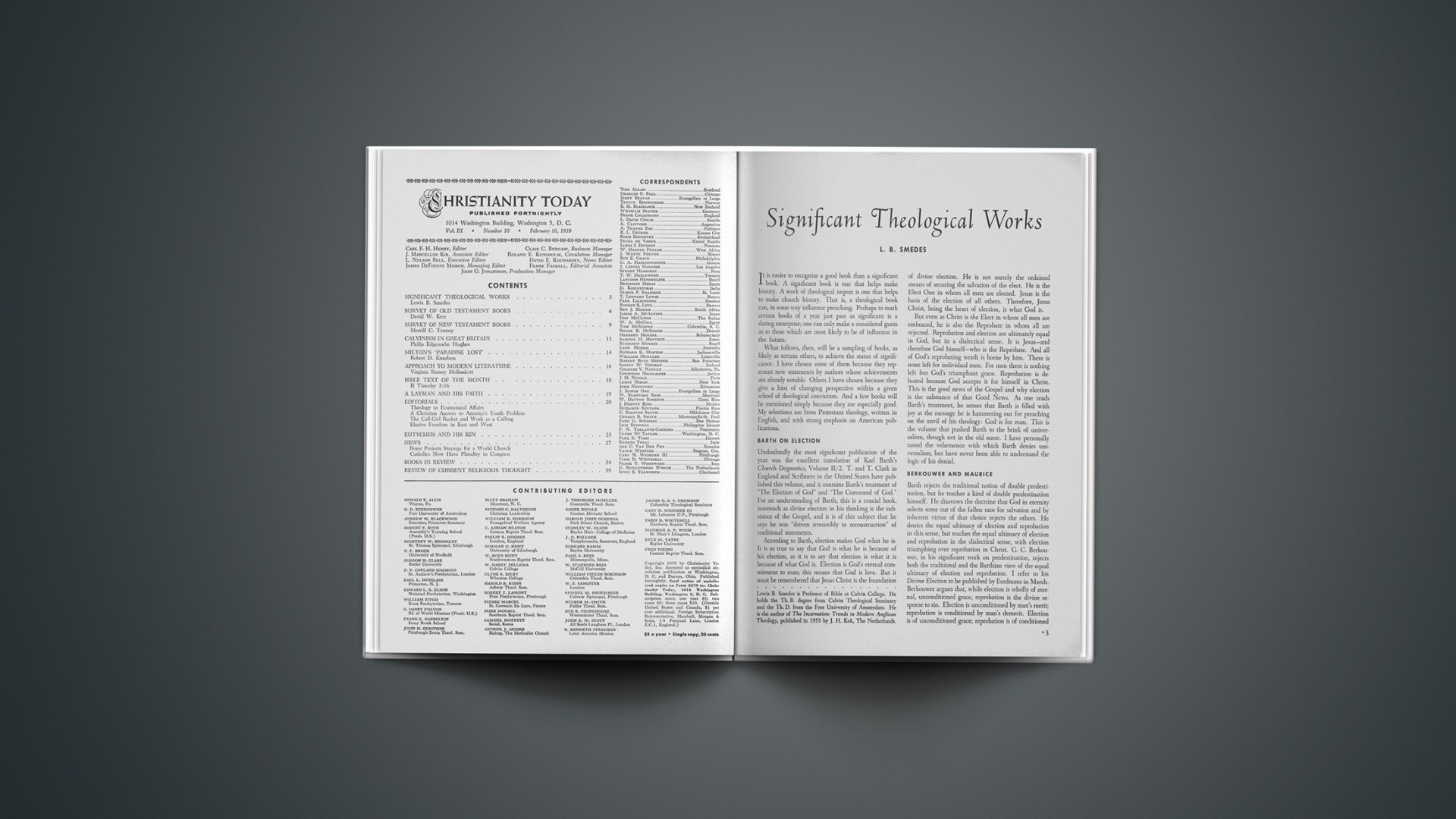
Significant Theological Works

It is easier to recognize a good book than a significant book. A significant book is one that helps make history. A work of theological import is one that helps to make church history. That is, a theological book can, in some way influence preaching. Perhaps to mark certain books of a year just past as significant is a daring enterprise; one can only make a considered guess as to those which are most likely to be of influence in the future.

What follows, then, will be a sampling of books, as likely as certain others, to achieve the status of significance. I have chosen some of them because they represent new statements by authors whose achievements are already notable. Others I have chosen because they give a hint of changing perspective within a given school of theological conviction. And a few books will be mentioned simply because they are especially good. My selections are from Protestant theology, written in English, and with strong emphasis on American publications.

Barth On Election

Undoubtedly the most significant publication of the year was the excellent translation of Karl Barth’s Church Dogmatics, Volume II/2. T. and T. Clark in England and Scribners in the United States have published this volume, and it contains Barth’s treatment of “The Election of God” and “The Command of God.” For an understanding of Barth, this is a crucial book, inasmuch as divine election in his thinking is the substance of the Gospel, and it is of this subject that he says he was “driven irresistibly to reconstruction” of traditional statements.

According to Barth, election makes God what he is. It is as true to say that God is what he is because of his election, as it is to say that election is what it is because of what God is. Election is God’s eternal commitment to man; this means that God is love. But it must be remembered that Jesus Christ is the foundation of divine election. He is not merely the ordained means of securing the salvation of the elect. He is the Elect One in whom all men are elected. Jesus is the basis of the election of all others. Therefore, Jesus Christ, being the heart of election, is what God is.

But even as Christ is the Elect in whom all men are embraced, he is also the Reprobate in whom all are rejected. Reprobation and election are ultimately equal in God, but in a dialectical sense. It is Jesus—and therefore God himself—who is the Reprobate. And all of God’s reprobating wrath is borne by him. There is none left for individual men. For men there is nothing left but God’s triumphant grace. Reprobation is defeated because God accepts it for himself in Christ. This is the good news of the Gospel and why election is the substance of that Good News. As one reads Barth’s treatment, he senses that Barth is filled with joy at the message he is hammering out for preaching on the anvil of his theology: God is for man. This is the volume that pushed Barth to the brink of universalism, though not in the old sense. I have personally tasted the vehemence with which Barth denies universalism, but have never been able to understand the logic of his denial.

Berkouwer And Maurice

Barth rejects the traditional notion of double predestination, but he teaches a kind of double predestination himself. He disavows the doctrine that God in eternity selects some out of the fallen race for salvation and by inherent virtue of that choice rejects the others. He denies the equal ultimacy of election and reprobation in this sense, but teaches the equal ultimacy of election and reprobation in the dialectical sense, with election triumphing over reprobation in Christ. G. C. Berkouwer, in his significant work on predestination, rejects both the traditional and the Barthian view of the equal ultimacy of election and reprobation. I refer to his Divine Election to be published by Eerdmans in March. Berkouwer argues that, while election is wholly of eternal, unconditioned grace, reprobation is the divine response to sin. Election is unconditioned by man’s merit; reprobation is conditioned by man’s demerit. Election is of unconditioned grace; reprobation is of conditioned wrath. They are not equally ultimate in God’s mind. With regard to the eternal decree of God, this view leaves us in imbalance. But Berkouwer does not try to achieve harmony in the eternal mind of God. He insists that he, and we with him, must stop at the limits set by revelation. If logic insists on getting behind the revealed into eternity, it is no longer the logic of Christian theology, but the logic of presumptive speculation. This is probably the most important of the translated works of Berkouwer published thus far. (Another Berkouwer book, Faith and Perseverance, was published by Eerdmans in the spring of 1958.)

There is an interesting parallel between Barth’s doctrine of election and that of F. D. Maurice, the Anglican theologian of the 19th century whose Theological Essays were republished in 1958 by Harper. Like Barth, Maurice viewed all men as elect in Christ and viewed Christ as the eternal basis for God’s decision in favor of man. Also like Barth, Maurice denied universalism. Yet, with Barth, he denied the picture of the separation of the sheep and the goats. This book contains a lot more than the doctrine of election, and Maurice is having a revival of influence in England and America.

Tillich On Faith

Karl Barth once said that faith as such did not interest him. For Berkouwer, too, faith in itself is not enough. Faith is important only in relationship to its object or content. But Paul Tillich’s book of 1958 is an analysis of faith as such. His Dynamics of Faith, published by Harper, analyzes faith as a subjective concern, and it is plain that Tillich considers faith in itself as extremely significant. This book does not, perhaps, carry the weight of Tillich’s Systematic Theology. But it is much more readable than the systematics, and makes clear, as the systematics do not, what Tillich means by faith as “ultimate concern for the ultimate.” The book contains a discerning analysis of the subjective aspect of faith, and much profitable criticism of man’s temptation to place his faith in things less than ultimate, but it misses being a genuine analysis of Christian faith. Christian faith, let us say in Berkouwer’s sense, is idolatry to Tillich. For, with Berkouwer, faith has meaning only as commitment to a Person, and this to Tillich is concern for that which is less than ultimate. Tillich also criticizes the de-mythologizing movement of Rudolph Bultmann as being negative and merely a substitution of a modern myth for an ancient one.

Mythology And Criticism

Scribner’s publication of Bultmann’s Jesus Christ and Mythology gives a rather clear explanation of what demythologizing is all about. Bultmann tells us, for instance, that he does not ask us to reject the mythological elements of Scripture (which include everything supernatural about Jesus), but only to interpret them. That is, he asks us to get the real message which the writers of the New Testament clothed in a mythology no longer capable of being taken literally. He explains the role of existentialism in his theology, denying that existentialism as a philosophy determines his thinking. And he makes clear what he means by the “nowness” of the Word of God. This book should help us judge whether, when Bultmann has removed the “unreal” stumbling blocks from the Gospel, he still has the Gospel.

Gustaf Wingren’s Theology in Conflict: Nygren-Barth-Bultmann, published by Muhlenberg Press, is a well-informed analysis of the principles by which these three theologians interpret the Bible. Wingren concludes that each fails at the starting point of hermeneutics, and that therefore each is led to unbiblical conclusions. Wingren inclines to over-simplify at times, but he has his finger on the pulse of theological controversy at its crucial points, and offers the best monograph of dialectical theology published this year.

Authority Of Scripture

Two small but potentially significant books came from evangelical writers last year. One of them is J. I. Packer’s Fundamentalism and the Word of God, published in paper binding by Eerdmans. Here is a forceful, lucid, and informed defense of the authority of Scripture as understood by evangelicals today. Readers may wonder whether there is not a subtle change of position in it from that, say, of B. B. Warfield. Packer is more willing than Warfield to allow for symbolic elements in such accounts as paradise and the fall. Perhaps more important, the reader may ask whether Packer defends the infallibility (a term he does not relish) of everything written in Scripture or of everything taught by Scripture (cf., for instance, page 169). There is a difference.

Unity Of The Church

The other book is Eerdmans’ publication of G. W. Bromiley’s The Unity and Disunity of the Church. Bromiley works from the important premise that the unity of the church is a reality created in Jesus Christ. Whether church unity is necessary or desirable is not the real question. Unity must be a fact. Churches cannot be neutral towards it. What are the foci around which unity may be visibly expressed? One of them is faith. But Bromiley will not equate faith with a creedal statement to which all churches must subscribe. Faith is man’s response to God’s seizure of him through the Spirit. It is this faith which is the focus of church unity. Another point for unity is the Bible. However, says Bromiley, we may not insist that all churches subscribe to a particular view of the nature of the Bible. Unity around the Bible must mean unity in Christ. Again, Bromiley insists on unity in the truth. But, he warns, this may not mean “unity in our own apprehension of truth.” Our own apprehensions of the truth are always partial. Unity in the truth must mean unity in Christ who is Truth. It would appear that Bromiley is sounding a new note for evangelicals on the subject of church unity, and his book ought to be read with an open mind and a deep concern for the unity of the church.

One other book on the same subject is titled The Nature of the Unity We Seek, a report on the North American Conference on Faith and Order, edited by Paul S. Minear and published by Bethany. The meaty part of the book is found in the committee reports, particularly the report on “Doctrinal Consensus and Conflict.” This report reasserts the sufficiency for membership in the ecumenical movement of the confession that Jesus Christ is “God and Saviour.” Yet it allows every church to supplement and interpret it at will. This freedom to interpret the confession, even in a way that contradicts its biblical meaning, is what offends many non-participating evangelicals. The whole report is significant reading, however, and may well be read for comparison with Bromiley’s book.

Doctrine Of Man And Creeds

Two quite different books on man came out in 1958. One is E. L. Mascall’s The Importance of Being Human, published by Columbia, a lucid, patient effort at restating the doctrine of man in Thomistic, metaphysical terms. Mascall’s thesis, in brief, is that man’s importance must be measured in terms of what he is rather than what he does: man’s being, not his function, is his true significance. The book is a worthy response to the functionalist and existentialist notion of man. The other book is by a psychologist with a theological bent. It is C. G. Jung’s The Undiscovered Self, published by Little, Brown and Company. This one will be used by preachers because of its profound critique of the modern dilemma, and because it points to a religious solution. The individual, lost in a world where things and masses swallow the real man, can recover himself only through a genuine religious experience, only by “anchoring himself in God.” The reader will have to keep asking what Jung means by God and whether Jung’s “genuine religious experience” is meant to be an experience with God or an experience of the basic, unconscious psychic stream that pulsates at the heart of the universe.

One book on historical theology should be mentioned for its sheer excellence. It is J. N. D. Kelly’s Early Christian Doctrines, published in England by A. and C. Black, and issued last month by Oxford in this country. Kelly, who had previously given us a standard work on the early creeds, takes us in this one from the beginnings of theological development to Chalcedon. Kelly’s combination of amazing clarity and exhaustive scholarship can hardly be bettered.

Not theology in the strict sense, but a brilliant penetration of Christian thought into the cultural problems of modern man is Henry Zylstra’s Testament of Vision. Published by Eerdmans under an unfortunately vague title, the book contains some of the most incisive and wise essays written by an evangelical writer in this generation. Christian wisdom informed by learning, disciplined by tradition, and mellowed by love, is brought to bear on man and his world.

Several books deserve more than the brief mention I am giving them here. For instance, Westminster added two books to the Library of Christian Classics: Western Asceticism, edited by O. Chadwick, and Calvin’s Commentaries, edited by J. Haroutunian. Concordia and Muhlenberg continued their great Luther project, giving us Luther’s Lectures on Genesis 1–5 and Church and Ministry II. Baker published Berkouwer’s Conflict with Rome, a patient discussion of theological divide separating Protestants from Rome, a treatment that exemplifies theological controversy at its fairest. Then there are L. Hodgson’s For Faith and Freedom from Harper, being Hodgson’s Gifford Lectures; G. S. Hendry’s The Gospel of the Incarnation from Westminster; and Essays on the Lord’s Supper, by O. Cullmann and F. J. Leenhardt, one of a series of Ecumenical Studies in Worship published by John Knox Press.

There are more books that should be discussed. These at least provide a sampler. The reader will doubtless discover other theological books that to him rank among the significant publications of 1958. But the real importance of what has come from the presses in 1958 will have to be heard from the pulpits of the church in 1959 and years to come. God grant that the theology of 1958 will correct and not corrupt the preaching of the Church in the time our Lord grants us still to preach.

END

Lewis B. Smedes is Professor of Bible at Calvin College. He holds the Th. B. degree from Calvin Theological Seminary and the Th. D. from the Free University of Amsterdam. He is the author of The Incarnation: Trends in Modern Anglican Theology, published in 1953 by J. H. Kok, The Netherlands.

The Multitude of His Mercies

Thy mercies, Lord, a multitude, A never-failing throng, Pursue me now and have pursued My life with joy along. And ever in that multitude I stand in deep amaze; O Lord, though swift to know Thee good, How slow was I to praise!

MABEL LINDSAY

Review of Current Religious Thought: February 02, 1959

As ONE SURVEYS current theology, he often discovers certain subjects that rarely become parts of theological discussion. We once observed this to be the case with the subject of prayer. Devotional literature, to be sure, treats the subject often. But theological literature has a tendency to ignore prayer, a fact that certainly suggests a weakness in theology. But I am thinking at present of another subject that seldom finds a place in theological writing. I refer to the consequences of sin.

I am not thinking of the judgment of God, nor of death as the wages of sin. These consequences of sin are treated in every Christian theology. I refer to the consequences of man’s sinful acts that become irreparable in history. Evil deeds have an influence that can sometimes become an irrevocable part of reality. These consequences are not removed even by divine forgiveness. It would be helpful if, when forgiveness is discussed by theologians, these irreparable consequences were also given genuinely honest treatment.

Someone may ask whether the thought of irreparable consequences of sin does not do an injustice to the reality of divine forgiveness. Why should we be concerned about the abiding consequences of sins in the light of the forgiveness of sins? It seems to me that it is very important that we keep in mind the real consequences of sin. It is striking that Paul, who has known divine forgiveness, still refers often to the sins of his own past. He confesses that he takes first place among sinners (1 Tim. 1:15), for he was formerly a “blasphemer and a persecutor and injurious.” But this “formerly” does not mean that his previous sins no longer play a role in his thoughts. He calls himself the “least of the apostles, because I persecuted the church of God” (1 Cor. 15:9). Being least does not inhibit him from prosecuting his calling with joy. But the memory of his own “formerly” does not leave him. It is difficult to imagine just what the meaning of their own “formerly” played in the lives of men like David and Peter. But that it occupied a place in their thoughts is without question.

Forgiveness is a great grace and puts one’s sinfulness in a new light. But there are consequences of sin that cannot be made good again and for this reason are not easily put out of mind. There was probably a good measure of sadness in Paul’s heart (as in the hearts of David and Peter) as he recalled his past. It is surely not the intention of the Bible that we should be concerned about and bring to their remembrance the past sins of other people. God himself no longer remembers the sins of others—his children—but throws them forever behind him. (“Thou wilt cast all their sins into the depths of the sea,” Micah 7:19). But we can hardly forget our own.

Paul, David, and Peter, keep in mind the consequences of past sins that they are no longer able to set right. A governor, for instance, can cause great suffering to the people through his sins and, though later become converted, be unable to set his former sins in order. His acts, once they have passed into history, are beyond his control. There are, of course, instances of past sins whose consequences can be set right. Zaccheus was probably able to give back four-fold of what he had stolen. But there are also debts that we can never pay. We encounter in our past sins something that is irrevocable and irreparable. It does not stunt the reality of divine forgiveness. But it does accentuate the terrible realness of sins and their consequences.

It is obvious that such facts play a role in the memory of believers. A believer is not able to set himself at peace in face of his past. There are shadows that hover over a forgiven sinner’s life. And there is nothing in the Bible to suggest that we should not think about this simply in view of the forgiveness of past sins. I believe that precisely in view of the reality of forgiveness, our sadness over the irreparable consequences of sins should be real. The consequences of our sins extend beyond our reach and stretch outside of our control. Not everyone has Zaccheus’ opportunity to make good his past sins.

We can say with certainty that there are more consequences of our sins than we are conscious of. What a vast number of ill words have been spoken, what an enormity of uncharitableness, deceit, hatefulness lies in our past. We have forgotten them, but their consequences still live. Such consequences make sin a terribly dangerous thing. It is a disturbing thought that there is so much in our past that we can never make good, that the possibilities for restoration are so limited. In view of this, it is hard to understand why the subject of sin’s consequences should be so neglected. Is it because writers are afraid that they may minimize the greatness of forgiveness? Or is it that we have too little concern for the fact that consequences of sins are not destroyed even by forgiveness?

We must not minimize the reality of forgiveness, but neither may we minimize the reality of sin’s consequences. The problem that remains with forgiven sin is our powerlessness to undo its consequences. Must we, in the face of the irreparable reality of the consequences of sin, unshackle them from our memories? I think that we must be saddened at our past sins and then bring the consequences of our past sins to God. We must pray that God will do what we cannot do about them, that he will restore what we have destroyed. There is always the possibility that is suggested in the story of Joseph: “You meant it for evil, but God meant it for good.” We must pray that God will break the chain of sin’s consequences and even turn it to good. A sensitive Christian will realize that he is himself first responsible for grasping every opportunity that remains for him to repair the consequences of his sins. But these opportunities are limited. We are often faced with our own impotence and smallness in the face of the aftereffects of our own deeds.

We have said that the consequences of sin are seldom discussed in theology. This is a short-coming in our theological discussions. For our resistance to evil is easily weakened, and evil has a way of carrying its consequences through generations, going beyond our ability to repair them. David’s prayer, after his great sin that brought harm to the nation, testifies against our own convenient forgetfulness of our sins’ consequences. “Do good in thy good pleasure with Zion; build thou the walls of Jerusalem” (Ps. 51:18).

This review is prepared successively for CHRISTIANITY TODAY by four evangelical scholars: Professor John H. Gerstner of the United States, Principal S. Barton Babbage of Australia, Dr. Philip E. Hughes of England and Professor G. C. Berkouwer of the Netherlands.

Book Briefs: February 2, 1959

Seasoned With Salt

What Luther Says, compiled by Ewald M. Plass (Concordia, 1958, 3 vols., 1692 pp., $25) is reviewed by E. P. Schulze, Minister of the Lutheran Church of Our Redeemer of Peekskill, New York.

There have been other anthologies of Luther. For the busy scholar who wants the briefest epitomes and can read German, nothing is better than Band XXIII of Luthers Saemmtliche Schriften (Concordia, 1910). Editor Hoppe’s index, which fills the large quarto volume, contains perhaps 25,000 or 30,000 direct quotations from Luther, and in each case a reference is given to the volume and column in which the statement is found in its context. Hoppe’s work also has the merit of presenting a list of references to Bible verses quoted by the Reformer.

But for those who desire, or are obliged, to read Luther in English, Plass’s trilogy will prove to be by far the most comprehensive work of its kind of which they can avail themselves. Indeed it approximates Hoppe’s index in the number of words quoted (between half a million and a million)—for the extracts, though far fewer, and arranged under a fraction of the number of topic heads, are in general considerably longer.

This handsome thesaurus was issued by Concordia Publishing House in response to a resolution of the Lutheran Church—Missouri Synod. Its three large volumes, beautifully buckram-bound and brilliant in typography, were prepared under the direction of Synod’s Committee for Scholarly Research by Professor Ewald M. Plass of Concordia College, Milwaukee, Wisconsin, author of the book, This is Luther (Concordia, 1948).

The fruit of years of labor, this encyclopaedic compilation contains over 5000 quotations on more than 200 subjects alphabetically arranged under broad topical heads. Each item has a descriptive caption, is prefaced by the author and is thoroughly documented with references to the editions of Luther’s Works in which the respective quotation is to be found. Also—and this is important in the case of Luther, who had to outgrow much of what he had learned in the Church of Rome—the extracts are, wherever possible, dated. There are many illuminating footnotes, eminently readable not only typographically but also from the viewpoint of human and scholarly interest. Valuable appendices are included in the form of a biographical register with descriptive lists of some important Luther editions and of his chief writings, a brief chronicle of his life and time, and a bibliography. The two indices consist of a supplementary index of topics and a Scripture text index.

With impartial facility Luther poured out words from tongue and pen; and almost invariably, whether in his sermons, in his private conversation, or in his books and pamphlets, he had something to say that is worth listening to. There was little indeed of what he said or wrote that was not “to the use of edifying.”

He was usually no craftsman in words; seldom was he a self-conscious stylist. There was little time in his busy life for cultivating rhetoric. Yet his words were heard and read—and they are still read, as the current monumental publication of his Works, in English, testifies. And although he may often seem less vivid in translation, however excellent (as in the present case) that may be, not only his speech but also his writing was seasoned with salt, liberally peppered, and often spiced with a dash of Worcestershire sauce. He did not need a nicely cultivated style, for in a degree unique in our modern era, he had the unction of the Holy Spirit.

Plass quotes Melanchthon as saying: “One is an interpreter; one a logician; another an orator, affluent and beautiful in speech; but Luther is all in all. Whatever he writes, whatever he utters, pierces to the heart. He is a miracle among men” (What Luther Says, I, xii).” “A voice and a pen, that is all. But there is more power in this voice and this pen to shake and mould the world than in all the bulls of a pope or the armed strength of emperors and kings.” Thus wrote James MacKinnon in Luther and the Reformation (What Luther Says, I, xvi–xvii).

Luther was, of course, pre-eminently a theologian, and he was a theologian who was bound by the inspired Scriptures and determined to exalt the Saviour. “For Luther what is not Scriptural is not theological,” Plass correctly points out, “and what does not glorify Christ cannot be Scriptural.” That point of view is reflected in all his speech and writing on theological subjects.

In matters not in their essence theological, Luther’s thinking was sometimes medieval, as in his estimate of the contemporary Copernican theory. But often in other instances, it was quite modern, as for example his utterances in behalf of democracy, separation of Church and State, income tax, price controls, and compulsory education. His comments on war are thoroughly in harmony with the popular view and governmental philosophy now prevalent in the United States. His wise and trenchant words on that subject are eminently worth perusing. The great Reformer clearly recognized, however, the futility of attempting to bring about reform by means of legislation.

In matters apart from theology we find Luther a man of strongly independent opinion, generally sound common sense and always, where the subject touches the domain of the moral, conditioned by his understanding of the Holy Scriptures, for which he had an enormous respect as the inspired Word of God.

To all who want to know what Luther had to say on almost any subject, this notable publication is to be heartily commended for its direct and practical value and its stimulus and guide to further study.

E. P. SCHULZE

How Many Authors?

Who Wrote Isaiah?, by Edward J. Young (Eerdmans, 1958, 88 pp., $1.50), is reviewed by Gleason L. Archer, Jr., Professor of Biblical Languages, Fuller Theological Seminary.

This valuable little book is a worthy addition to the growing list of Evangelical studies published by Eerdmans in their current series of Pathway Books. Written by the Professor of Old Testament at Westminster Seminary, who has previously put out a scholarly survey of Isaianic criticism in his “Studies in Isaiah” (1954), this excellent defense of the genuineness of the entire 66 chapters of Isaiah furnishes much-needed apologetic material for scholars, Bible teachers and seminarians who hold to the historic Christian faith. Even in seminaries which have been traditionally conservative in theology, the attacks of negative higher criticism have instilled doubts as to the integrity of the book of Isaiah. Scholarly discussions of this calibre should do much to restore confidence in historic view of the Christian Church and of the New Testament itself that the eighth century prophet Isaiah himself wrote the entire 66 chapters attributed to him in the Hebrew Scriptures. Not simply as a matter of faith but of keeping true to the laws of evidence, Dr. Young most convincingly demonstrates that no other theory of authorship does justice to all the facts, either from the standpoint of internal evidence or of external.

In chapter one, “Importance and Significance of the Problem,” he indicates the fallacy of the frequently expressed view that Isaiah 40–66 could have been inspired, no matter who wrote it. This opinion by implication renders the New Testament untrustworthy, for John 12:41 unequivocally asserts that the same Isaiah who wrote Isaiah 6:10 also composed 53:1. “In both instances he saw Christ and was speaking of Him. On these points the New Testament is clear” (p. 11). In chapter two the author surveys the history of negative Isaianic criticism, showing the instability and subjectivism of the rationalist scholars, whose critical judgments have resulted in chaotic inconsistency and confusion, and who have been united only in a philosophic prejudice against the possibility of supernatural prediction of the future. In chapter three, “The Witness of Tradition,” he demonstrates the inadequacy of every attempt made by modern scholars to explain away the uniform ancient tradition of the Isaianic authorship of the second part (chapters 40–66). Of particular interest is his analysis and refutation of E. J. Kissane’s theory (not discussed in his earlier works) that an anonymous admirer of the eighth-century Isaiah composed this imitation of his language, style, and circle of ideas, in order to bolster the faith of his countrymen during the Babylonian Exile. Young points out (p. 33): “The prophet was a spokesman for the Lord and therefore necessarily a divinely accredited person. The identity of the prophet had to be known for his message to be received.” In chapter four “The Position of Chapters 36–39 in the Prophecy,” he demonstrates that Chapter 39, though recording earlier events than 36–37, was placed after them deliberately to pave the way for the collection of prophecies relating to the future Exile and Restoration (Chaps. 40–66) by recording Isaiah’s denunciation of Hezekiah’s proud display of wealth to the Babylonian envoys.

It is unfortunate that the limited size of this book inhibits the author from elaborating upon some of the arguments he adduces. He leaves too much to the reader’s own industry in looking up the numerous citations listed and trying to figure out how he arrived at his conclusions. An instance in point is the set of citations from pre-exilic prophets which indicate their familiarity with Isaiah 34 (regarded by negative critics as late post-exilic in origin). To show by the laws of evidence that the Isaiah-passage must be regarded as the source borrowed from requires detailed demonstration. Yet Dr. Young does elaborate enough to make out a strong case for the priority of Isaiah 43:1–6 to Jeremiah 30:10 ff. on the basis of the Messianic title, “My Servant.”

In chapter seven “The Prophecy concerning Cyrus,” he effectively exploits O. T. Allis’s analysis (in “The Unity of Isaiah” 1950) of the Cyrus-prediction in Isaiah 44:26–28. Here he proves that Cyrus is presented as a personage who is to appear in the distant future, rather than in the immediate present (as the Two Isaiah Theory would insist). He also comes up with the surprising statistic that the name of Babylon occurs twice as often in Isaiah 1–39 as it does in Isaiah 40–66 (which is alleged to have been written in Babylon itself!) Finally, in the all-too-brief final chapter “When Did Isaiah Compose Chapters 40–66?,” he indicates that the Messianic hope had a very definite relevance to the contemporary situation in Judah during the years of the prophet’s retirement from active public ministry (i.e. in the reign of Manasseh). Only the certainty that God’s grace would ultimately triumph through the Messiah could assure the faithful remnant of true believers in Isaiah’s generation that their labor and sacrifice were not in vain in the Lord; that despite the moral failure of the nation as a whole under the influence of their ungodly king, Israel had a divinely guaranteed future and a glorious destiny to fulfill before all the world.

GLEASON L. ARCHER, JR.

Paraphrase With A Purpose

The Bihle for Family Reading, by Joseph Gaer and Chester C. McCown (Little, Brown and Co., Boston, 752 pp., $7.50), is reviewed by G. Aiken Taylor, author of St. Luke’s Life of Jesus.

Recently, a rash of books paraphrasing the Bible have appeared. This is another. In part, these seem to reflect a growing concern about the average person’s abysmal ignorance of the Bible. Many authors, including the present one, believe that the way to whet the appetite of the average person for Bible reading is to give him a version which is “more attractive” and “less formidable” than the church-approved versions.

But there is another reason why biblical paraphrases are written. Often it is to produce a vehicle of thought which will convey the particular religious philosophy of the writer. The paraphrase is primarily a commentary and an interpretation of the Bible presenting the “truth” (usually ethical) which the author believes to be concealed from ordinary eyes within the original narrative. Mr. Gaer, the principal author of this work, has approached his task evidently from this latter standpoint. He believes that his “version”—which is complete with a brief introduction to each book—preserves the central essence of the Story while discarding the dross.

According to Mr. Gaer, every chapter of the Bible is retained or accounted for, with duplications and other useless material omitted. Thus Psalms 140–149 are left out because they are simply variants of Psalm 150 which is included. Genealogies and detailed specifications do not appear. Occasionally, of course, a drastic alteration of material occurs. Isaiah 49 is 13 lines long, while the Sermon on the Mount takes up four pages and the story of the lame man at the Beautiful Gate of the Temple is left out altogether. The authors make much of their scholarly approach to the textual problem and claim to follow, in the arrangement of the Synoptics, for instance, such authorities as Huck and Lietzmann, but they close their harmony of the Synoptics with the disputed material at the end of Mark which most critical scholars reject.

The treatment accorded the gospel of John probably indicates best both the value of this book and the probable purpose which prompted its writing. John is located, because of its theme and its alleged date, at the end of the New Testament, following the Revelation. Then, although it is fully assumed that the unknown author was more of a poet than a historian, Messrs. Gaer and McCown carefully excise from the text (and explicitly call attention in their notes to the fact that they have done so) those passages in which John quotes Jesus as claiming for himself special divinity or a propitiatory purpose. Such passages are omitted, as “not directly necessary to the progress of the story,” as 5:18–19; 6:42–59; 8:24, 55–58; and all of chapter 21 except the last verse. G. AIKEN TAYLOR

Triumphant In Faith

How Sleep the Brave, by James H. Hunter (Zondervan, 1955, 256 pp., $3), is reviewed by Lucy D. Sullivan, Teacher at Bryan College, Dayton, Tennessee.

James H. Hunter gives a compelling account of the immolation of the valiant Covenanters of seventeenth century Scotland in his historical novel How Sleep the Brave. Hunted down by Catholic James II and his Scottish henchmen, these hardy Presbyterian adherents to the Scottish Covenant of 1638 are championed by a hero of epic proportions who has been proscribed by James and dispossessed of his castle and lands. Known as the Black Avenger, this combination of Robin Hood, Tarzan, and the Lone Ranger roams through the highlands in various disguises playing coronachs on his bagpipe and shooting black arrows into tree trunks as warnings to the king’s dragoons.

The precision with which this champion of the Covenanters times his arrival at trouble spots and the ease with which he carries off to safety men doomed to the torture of the boot, thumbscrew, and the Red Maiden are nothing short of miraculous. Novelist Hunter also indulges in unconvincing descriptions of nature and female pulchritude. The Girvan stream pours “in winning whimples over its rock bed,” and Duncan Fenwick, alias the Black Avenger, kisses his sweetheart’s “dimpled mouth with its rose lips.”

Although the love of the Black Avenger and the laird’s daughter, Marion Kennedy, provides the romantic interest of the novel, the central focus is the “scattered and peeled” Covenanters hiding out in caves and woods to whom the Avenger whisks us in his daring rescues. The blood of little children who refuse to betray the whereabouts of their parents reddens the mountain streams; Sheila MacLeod whose persecuted and ailing husband dies as the dragoons enter the cottage, cries “He has escaped ye a’; Yer bullets canna reach; yer flames canna scorch him; yer malice canna reach him yonder.” Donald MacLeod laying his bloody head on a rock is shot where he lies; a throng of men and women sing the forty-sixth Psalm with tears running down their faces as they stand around communion tables in the heather of the hills of Galloway, after which Peden the prophet preaches a sermon “Shall the sword devour forever?” and Duncan, the Avenger, looking down on the graves of Covenanters who had been praying when they were shot down, says sadly “There sleep the brave … they died for you and me and for the generations yet unborn, that freedom to worship according to every man’s conscience might be ours and those that are yet to be.” It is in these authentic portraits of a people triumphant in faith after years of satanic and papistic persecution that the value of this novel lies.

LUCY D. SULLIVAN

Five Points Of Calvinism

The Deeper Faith, by Gordon Girod (Reformed Publications, Grand Rapids, 1958, 135 pp., $2.50), is reviewed by Loraine Boettner, author of The Reformed Doctrine of Predestination.

This is one of the clearest and most convincing statements of the distinguishing doctrines of the Reformed Faith that can be found anywhere. The writer is a minister in the Reformed Church of America. The discussion is based on “The Canons of the Synod of Dort,” which is the principal creedal document of the Reformed Church. The Synod of Dort (1618–1619) was convened by the States-General of Holland, and there were 102 official delegates from Holland, England, Belgium, Switzerland and Germany. It was therefore an “ecumenical” conference in the true sense of the word. The primary subject for discussion was a “Remonstrance” which had been drawn up by the followers of Jacobus Arminius who had taken exception to Reformed teaching concerning the relationship that exists between divine sovereignty and human responsibility. Deliberations covered a period of approximately six months, and the deliverances dealt specifically with those doctrines which later came to be known as “The Five Points of Calvinism”—Total Depravity, Unconditional Election, Limited Atonement, Irresistible Grace, and the Perseverance of the Saints. Each of these is given a chapter heading. Special care is taken to show the Scripture basis on which each rests. A sixth chapter answers some of the objections that are commonly raised against the system, and these are shown to have no basis in fact. Chapter seven is a reprint of that part of The Canons of the Synod of Dort which sets forth the Five Points.

We welcome this book with enthusiasm. It is a great work well done. We are impressed with the author’s ability to present the grand themes of the Reformed faith in language that the average Christian can follow without difficulty, and at the same time to inspire a loftier respect for the overtones of grace that provided for our salvation in the councils of eternity. In this day when so many are searching for an easy religion, and when the supposedly “hard” doctrines of Calvinism are largely neglected or misunderstood or even unknown by so many of our people, it is a real pleasure to find a work such as this. The title, The Deeper Faith, is appropriate. Anyone who reads this book will find himself introduced to high thoughts and stimulated in his intellectual and spiritual life.

LORAINE BOETTNER

Soul Searching in Social Welfare

U. S. Protestant leaders are worried over their social welfare ties with government. Should federal money be used by Protestant agencies and institutions? What are the long-term effects on church-state relations? Such questions are provoking much soul searching at top denominational levels.

Issue Avoided In Atlantic City

Diversities in Protestant practice complicated a 1957 Atlantic City conference on the church’s role and function in social welfare. Attending delegates from 27 denominations of the National Council of Churches and some city and state councils recognized “dangers in centralized governmental action,” yet affirmed that “in a pluralistic society it is necessary that governmental agencies and voluntary services cooperate” on a non-discriminating basis “so that the needs of all people will be met.” Uncertain of the extent to which cooperation should be carried, especially when government funds are used by church-related services, the delegates requested further study and conference on church-state relations. Some critics fear the government’s use of the church to implement state programs of welfare, a progressive curtailment of voluntarism, and a free hand for “fund grabs” by Roman Catholic and Protestant groups which highly approve government aid for new building programs or “purchase of services” from voluntary agencies, or both.

Wide Range Of Discrepancy

Speaking to key Protestant churchmen interested in the social welfare dilemma, Dr. William J. Villaume, executive director of the NCC Department of Social Welfare, underscored extensive involvement in a review of major church and state relationships in the current execution of the welfare program of American churches.

Variance in Protestant practice, he said, extends to most major denominations reflects wide ranges of internal inconsistency. It involves many realms: government funds for new construction and new programs; direct subsidy of operating budgets by public funds through grants, loans, and grants in return for token payments; purchase of service by government from church-related welfare agencies; supplementation of church-related services by government agencies; licensing and other regulation of church-related agencies and services; and participation of church employees and churches in old age, survivors and disability insurance (social security).

In view of problems likely to confront American Christianity during the next 25 years in the area of church-state relations, the confused Protestant social welfare program raises denominational policy to new centrality. Social welfare committees and commissions, free for a decade to determine their own policies, may now be subject to careful scrutiny, and denominational leaders will be driven to a re-examination of the Protestant philosophy of social welfare and its controlling principles.

Hospital Construction

The Hill-Burton Hospital Survey and Construction Act, now extended to June, 1962, encouraged many Protestant hospitals to seek government funds for new construction, possibly because as welfare agencies Protestant hospitals are tied to their denominations less loosely than either Roman Catholic hospitals or other Protestant welfare activities. As of June 30, 1955, $124,978,000 in federal funds had been distributed as follows: Roman Catholic, $100,381,000; Protestant, $19,164,000; Jewish, $5,433,000. Thus projects by Roman Catholics, who claim 20 per cent of the population, got roughly 80 per cent of Hill-Burton funds awarded to church-related institutions; Protestant projects got 15 per cent, and Jewish, 5 per cent. Roman Catholics have often sought and sometimes received public funds to help meet the sponsor’s local share in supplementing Hill-Burton funds. The Sisters of the Holy Cross projected a $6 million hospital in Maryland if Montgomery county commissioners would submit a $3 million bond issue to voters. The balance was to come from public subscription, and $1 million to be pledged by the Order. But American Protestants also were entangled, even if on smaller scale; a Baptist Hospital in Pensacola, Florida, unable to raise funds for a building, lapsed into “denominational heresy”—acceptance of a Federal construction grant of $780,000. In 1957, Hill-Burton grants soared to $123 million.

Vocational Rehabilitation

The Federal government spent $47 million for vocational rehabilitation in 1957. Since 1954 grants have gone directly to private non-profit organizations. Goodwill Industries, Methodist Board of Missions agency, operates in 119 cities. Since 1954, 51 Goodwill Industries reportedly have received more than $1 million in Federal grants for vocational rehabilitation.

In 1955 the National Council of Churches surveyed 978 church-related agencies of 15 denominations with a $256,506,000 social welfare expenditure the previous year. Contributions received by 69 agencies from public funds not given as fees for service came to $ 1,217,000. Middle Atlantic and East North Central states account for two-thirds of the cases of direct government subsidy of agency budgets.

Direct Federal Grants

More recently, there has been a marked national trend away from direct subsidy of church-related institutions to “purchase of service” arrangements reimbursing agencies through fees for services rendered to individuals who are public charges. But direct grants to institutions engaged in training health and welfare personnel have soared. In less than four months of 1958, $16 million in Federal grant support went to medical schools, clinics, hospitals, university psychology departments, collegiate schools of nursing, schools of social work and schools of public health in 40 states, the District of Columbia, Hawaii and Puerto Rico.

Another form of subsidy to voluntary welfare agencies is the provision of low-interest construction loans (Hill-Burton Act provides 40-year loans at 2¼ per cent) which mortgage bankers consider unsound.

Roman Catholic Pressure

The argument that church-related welfare agencies serve the common good has been pressed by Roman Catholic leaders to gain immunity from negligence liability litigation, and to get land grants in Massachusetts for the erection of chapels at state mental hospitals and schools for the retarded. In New York City land grants have been made for the erection of both Protestant and Roman Catholic churches on the sites of public housing projects. In New York some mission societies are using public facilities to carry on their work. In New Jersey, city authorities turned the 17-story Jersey City Medical Center, valued at $10 million, to Seton Hall University, a Roman Catholic institution which has instituted a medical and dental school, with the city providing all maintenance, elevator and other services for a $275,000 rental.

Public agencies have been purchasing health and welfare services from existing voluntary agencies ready to sell specialized services to government. An NCC survey in 1955 showed that 832 Protestant agencies earn four-fifths of their operating income. Yet, of these agencies, 132 received over $6 million from public agencies as reimbursement for services rendered. Welfare agencies related to 16 denominations benefited, with Methodist, Protestant Episcopal, and Presbyterian U.S.A. agencies receiving more than $1 million each. The percentage of government purchase of service is far higher in relation to child placement and adoption agencies: 21 agencies reported only

$311,000 in service fees from individuals, while 15 agencies reported $1,026,000 as public reimbursement of services. In Detroit the seven Protestant children’s agencies in 1956 received $956,122, half of their total budget of $1,884,000, from the county supervisors. City welfare departments from Hartford to Los Angeles buy care for homeless men and women from certain missions and shelters, including Salvation Army and sectarian agencies offering a religious ministry. While Protestants sometimes have sought to justify such services independently of a spiritual mission, the National Conference of Catholic Charities challenges efforts to exclude organizations operating on a religious basis from receiving payments for service. Most Protestant and Jewish homes for children and the aged, in fact, also consider the religious atmosphere a distinctive contribution to their clients. Judges and public welfare workers carefully observe the requirement that public charges be placed, if possible, in institutions of their own faith. An interesting development is that voluntary agencies, especially sectarian agencies, impede the expansion of public services when their sponsors insist upon government purchase of their services.

Overseas Relief

Some $128,769,000 in relief supplies was distributed abroad in fiscal year 1958 in behalf of U. S. religious and voluntary organizations, according to the Department of State.

Much of the total represents the value of surplus food donated to distributing agencies by the Department of Agriculture. In addition, the International Cooperation Administration contributed $25,886,734 to defray costs of ocean transportation.

Here is an approximate breakdown of overseas relief for the fiscal year which ended June 30, 1958: By agency—Catholic Relief Services of the National Catholic Welfare Conference, $79,400,000; Church World Service, $17,700,000; Lutheran World Relief, $8,700,000; Jewish agencies, $1,841,000; American Friends Service Committee, $900,000; Mennonite Central Committee, $800,000; World Relief Commission of National Association of Evangelicals, $577,000; Seventh-day Adventists (only group which refused government food), $261,000. By country—Italy $28,423,000; Korea, $20,730,000; India, $11,029,000; Yugoslavia, $10,010,000; Chile, $9,610,000; Spain, $7,147,000; Vietnam, $5,203,000; Formosa, $4,854,000; Philippines, $4,403,000; Hong Kong, $3,363,000; Morocco, $2,710,000.

Protestant Policy And Practice

After a survey of denominational welfare executives last August, Dr. Villaume reported that such government purchase of service is almost uniformly regarded as acceptable Protestant practice. But denominational leaders are now concerned with a deeper question than the quality of the available service, the need for additional funds to carry an enlarged clientele, and government’s free offer of partial reimbursement. That question, in Dr. Villaume’s words, is: what part will acceptance or rejection play in shaping church-state relations in America in view of the church-relatedness of the institution and recipient of funds? He notes that International Cooperation Administration during the past three years contracted with voluntary agencies (sectarian and nonsectarian) for $9 million of services in community development, health, education and agriculture.

Surplus Food Gifts

A fourth type of government assistance is the supplementation of church-related services. The most obvious example is overseas distribution of U.S. government surplus commodities by church agencies. Some 1,347,000 tons of such foods have been distributed in this way to needy people in friendly lands. The cooperating voluntary agencies simultaneously procured 200,000 tons of food from their own sources. Ocean freight costs for all such distributions were paid by federal funds, while benefiting foreign governments paid inland freight and costs. All faiths have lauded the program. In 1957 National Catholic Welfare Conference distributed about 1,175,000,000 pounds of commodities, much of it government-supplied surplus food, valued at between $123 million and $148 million, at a distribution cost of $5 million. Church World Service distributed about 300 million pounds. Roman Catholic agencies have been criticized repeatedly for using their distributions for shameless proselyting, even with building Roman Catholic churches as distribution centers in areas where there are no Roman Catholics.

Foreign mission boards, both Protestant and Catholic, have often requested federal donations of war surpluses in the Far East, payment of war damage claims, and diplomatic privileges for missionaries (such as use of post exchanges).

Local Church Involvement

Supplementation of welfare services by government has nudged into many local church situations, as well as church-related agencies. Churches provide facilities for health clinics staffed by departments of health, for instruction classes for mentally retarded children and even in elementary education—all under financial contract. Public school classes are conducted in the following New York institutions: Hebrew National Orphan Home, Yonkers; Assylum of St. Dominick, Blauvelt; Cardinal Hayes Memorial Home, Millbrook; St. Agatha’s School, Nanuet; St. Joseph’s School, Peekskill; and St. Francis Sanitorium, Roslyn, N.Y.

Surplus commodity distribution is procured on the home front also, as under the National School Lunch Program. In some cases state law prohibits disbursements to private schools. Surplus food is also distributed to nonprofit summer camps. In New England a city missionary society in 1956 distributed foods valued at $1,420, delivered by a state agency for a $37.70 service charge. Summer camp and other distributions would multiply this figure thousands of times.

Another supplementation is the granting of federal research awards and fellowships to church-related medical schools and hospitals. In one year these ran $1,800,000.

The problem of church and state also shadows the licensing of church-related agencies and services. The NCC’s Department of Social Welfare in 1953 “generally approved … the licensing of voluntary institutions by state governments … provided that the freedom of the churches and other private groups and agencies to enter into these fields of service is protected.” It also stressed that “church-related institutions should neither request nor expect any exemption whatever from … minimum acceptable standards prescribed by … fire, safety, health and welfare laws.”

A sixth major area in Dr. Villaume’s report surveys the participation of church employees and churches in old age, survivors and disability insurance. The 1935 Social Security Act unveiled the uncertainty of many American churches in the matter of the relations they desire to maintain with the state, Dr. Villaume notes. Since an insurance tax compulsorily collected by the state might endanger the tax-exempt status of churches, they were apprehensive. But practical aspects soon outweighed theoretical considerations. When lay employees of religious organizations became eligible on a permissive basis in 1951, the majority entered readily. In 1954 Congress approved clergy participation as self-employed on an individual-election basis. By the end of March, 1957, more than 100,000 clergy waivers had been signed. But the coverage of a disproportionate share of older men, which drains the resources of the program, is now giving caution and, with a final deadline of April 15, 1959, only half the clergy are participating. Close to 60 per cent in the 60–64 age bracket elected coverage, and 80 per cent of those 65 and over, whereas 29 per cent of those under 30 are participating. Dr. Villaume facetiously comments that two interpretations are possible: “that older ministers are more liberal in their attitude toward the state, or that a minister knows a bargain at the expense of the government when he sees one!” Many ministers entered the program, however, on the conviction that they are tax-paying citizens and eligible on that basis rather than as ministers.

Where To Go From Here?

The sweeping involvement of Protestant social welfare programs in matters of state cooperation is quite sure to raise the question whether policy-making should be left to denominational leadership rather than to the agencies. Dr. Villaume has addressed to Protestant leaders some major questions now confronting the churches.

He asks: What are the appropriate delineations of role and function between church and state in welfare work? Where does sound democratic policy draw the line between state and voluntary welfare services? Is the same line applicable to both church-related and other voluntary agencies? What are the differences between the welfare programs of the state, of nonsectarian voluntary agencies, and of the churches, in motive, purpose and effect? What is the church’s appropriate sector of function and responsibility in community life?

Again he asks: What are sound and effective patterns of collaboration between church and state in welfare work which will not impair the freedom of either? When does a church-related welfare program become an instrument of sectarian religious influence and penetration in the community? Should state collaboration with church-related welfare work be considered on grounds of separation from sectarian religious influences or on grounds of non-discrimination? What tax funds or other subsidy or assistance should the church seek or accept from the state for its welfare work? Should the church collaborate with the state when the state welfare program is influenced by partisan politics?

These and other questions are likely to provoke a good deal of Protestant soul-searching in the months ahead. What is at stake is more than an indictment of Roman Catholic and Protestant attraction of staggering Federal monies to church enterprises, but the necessary definition of the Protestant philosophy of social welfare and the formulation of guiding principles of application.

C. F. H. H.

Does Graham Ailment Mar Revival Prospects?

NEWS

CHRISTIANITY TODAY

Mass Evangelism

“I doubt whether we have very much longer to preach the Gospel.” Such utterances were always common with evangelist Billy Graham. Not until last month did the world take them seriously.

Stricken with a rare malady which reduced vision in his left eye to a blurry 20–70, Graham was told to slacken his pace or expect the worst. Millions fell to their knees in behalf of evangelical Christianity’s most widely accepted spokesman. Few were aware of the real seriousness of his condition.

Doctors traced the trouble to a tiny yellow spot in the most vital area of the retina. Drops of fluid abnormally released from the blood stream had caused a small swelling which clouded the line of sight. Eighteen-hour days, jangling phones, and overflowing appointment books—which most often culminate in heart attacks—had taken an unusual course in this case.

Two weeks after diagnosis, the disorder had still not responded to heavy doses of cortisone and five days of treatment at the Mayo Clinic. Even with full recovery, doctors said, remaining scar tissue could impair vision as much as 10 per cent.

Disclosure of Graham’s ailment jolted evangelicals in Australia, where revival, something the 10,000,000 “down under” have never seen, seemed closer than ever as preparations for meetings by the American evangelist reached unprecedented proportions. To give him an extra week’s rest, the opening crusade in Melbourne was delayed from February 8 to February 15. Graham will bring nightly addresses, but is under doctors’ orders not to accept additional speaking engagements.

There were fears that any sort of curtailment of Graham’s ministry might lessen the spiritual awakening potential developed in such preliminaries as all-night prayer meetings, interdenominational cooperation, and counsellor training sessions. Actually, very few crusade plans were changed. But the immediate effect of developments was an even greater prayer rallying and increasing interest in the coming meetings.

What is Australia like? Here lies an island continent nearly as big in area as the United States. It currently boasts the lowest unemployment rate in the world, even as it leads the globe in the rate of highway accidents proportionate to miles travelled.

Summer holidays traditionally begin immediately after Christmas, though the moderate year-round climate allows outdoors sports during every season. Australians thus find their pattern of living based in large measure upon recreational activities, which include a great variety of pastimes (e.g. on a population basis, Australians are said to be the greatest gamblers in the world).

Australian religion is marked by almost exclusive Christian ties. Forty-two per cent of the population is identified with the Anglican church, one-fourth with Roman Catholicism. Methodists number 12 per cent of the population and Presbyterians 10 per cent.

“The background to all this,” says CHRISTIANITY TODAY Correspondent Leon Morris, “is a nation with the spiritual indifference of the materially prosperous. Australia has had a long run of good seasons. While there have been local droughts the country has not known a really bad season for 12 or more years. Last year a big drop in wool prices gave the economy a heavy blow, but it has not yet affected ordinary people very much. There is widespread spiritual complacency. While there is an undoubted quickening in spiritual things, and an air of expectancy among believers, we are a long way yet from a nation-wide revival.”

Coordinating crusade activities for the continent is Dr. Jerry Beavan, a Graham associate for 11 years, Graham’s public relations advisor, and the architect of the crusades in London, Glasgow and New York. Beaven has been laying the groundwork for the Australian evangelistic meetings for 18 months.

The crusade plan is as broad as the Australian continent, calling for a major five-week campaign in both Melbourne and Sydney, the cities in which 39 per cent of Australia’s total population is resident. Second phase of the effort: crusades running for periods varying from one to two weeks in capital cities of Brisbane, Adelaide, and Perth, and across the Tasman Sea in New Zealand’s principal cities of Auckland, Wellington and Christchurch. For these crusades associate evangelists will be in charge with Graham himself conducting the two or three final meetings.

Third level of the evangelistic effort are special one-day area-wide rallies planned for key Australian cities, including among others the federal capital, Canberra, and Launceston and Hobart on the island of Tasmania. Finally, to reach the rural population of Australia living in a network of tiny hamlets and sheep stations in the vast “outerback” region, a series of “relay crusades” are planned, utilizing land lines of the government-operated telephone service.

Local committees have been understanding, cooperative and appreciative of the Graham team’s offer to meet all of their own expenses from American funds, leaving only local items as the Australian committees’ contribution.

Prominent churchmen headed the committees; in Sydney, the Right Rev. R. C. Kerle, Anglican bishop; in Melbourne, the dean of St. Andrew’s Cathedral, the Very Rev. S. Barton Babbage; in Brisbane and Adelaide, the Rev. George Nash and the Rev. Erwin Vogt, both Methodist ministers.

Monthly the crusade chairmen from each city meet with team members in a federal liaison committee. Offices are maintained in Sydney and Melbourne.

Graham prepared to open the Melbourne crusade with a series of sermons on the Lord’s Prayer. (Films were to be taken of the rallies and flown to the United States for showing on television.) The meetings are scheduled for the West Melbourne Stadium, erected for boxing and wrestling events in the 1956 Olympics. With closed circuit TV extension, capacity was to total about 11,000. A climactic closing rally is planned for next month in the 100,000-seat Olympic Stadium.

When he comes back to the United States, Graham will face the necessity of curtailing activities even though his tentative schedule extends through 1961. The release of responsibility will be made more difficult in the face of an expansion in his ministry. The Billy Graham Evangelistic Association revealed that 1958 was the greatest year in its seven-year history. There were more responses from radio and television programs than in any previous year. Biggest single month the association has ever had from both the standpoint of mail and contributions was December, 1958. During the year the association bought nearly a million dollars worth of radio time and more than a million dollars worth of television time.

Would an incapacitated Graham reduce world-wide revival potential? Few would say so, for history has never produced a revival built on a single individual. Yet Christians pray that the evangelist’s health will allow him to maintain evangelical leadership while the world’s hour of decision is running out.

How Graham Was Stricken

What is the nature of Billy Graham’s eye ailment? Here are qualified answers from the evangelist’s own surgeon father-in-law, Dr. L. Nelson Bell, Executive Editor ofCHRISTIANITY TODAY, who writes with 40 years professional experience and a thorough understanding of Graham’s medical history:

For several weeks Mr. Graham had sensed increasingly an impairment of vision in his left eye. By January 8, the impairment was so marked that he phoned Dr. Kenneth Gieser, an outstanding opthomologist in Chicago. Dr. Gieser immediately phoned a well-known opthomologist in Louisville, where Mr. Graham had an engagement that day. Dr. Gieser flew to Louisville the next morning and after careful examination diagnosed the trouble as a rather rare condition called angio-spastic edema of the macula, which is almost always the result of excessive work and strain.

After extended telephone consultations it was decided that Mr. Graham should go to the Mayo Clinic in Rochester, Minnesota. Dr. Gieser accompanied him.

In his five-day stay, Mr. Graham received a complete physical checkup, all findings being negative other than the left eye, the original diagnosis in this being confirmed and a strict regime of medication and rest prescribed.

Mr. and Mrs. Graham then left for a Hawaiian island rest. From there Mr. Graham planned to go directly to Australia for the start of his long-planned crusade.

The overwork and strain which brought on the eye condition has not been the result of a wilful disregard of needed rest and relaxation. Nor has it been the result of poorly budgeted time either during his crusades or in interim engagements.

Rather, the abandon with which Mr. Graham has thrown himself into the work of evangelism stems from (1) an unparalleled number of open doors for the preaching of the Gospel in city and country throughout the world, and (2) the conviction that world conditions are such that doors open today may not be open tomorrow, that opportunities almost unparalleled in history should be accepted while there is yet time.

Nevertheless, Mr. Graham is entirely resigned to this enforced rest and sees in all of this a renewed challenge to undergird every effort with the power of prayer.

Reigious Assemblages

Morality And Economics

Calls for responsible capitalism at home and firmness against communism abroad marked a national conference on moral foundations of economic growth, meeting in Washington’s Mayflower Hotel January 15–16. The conference was held under auspices of the Foundation for Religious Action in the Social and Civil Order, more familiarly called FRASCO. Founded in 1953 by Dr. Charles Wesley Lowry, Episcopal clergyman and authority on communism, with Dr. Edward L. R. Elson, National Presbyterian Church minister, as co-chairman, the nonsectarian foundation aims at “uniting men and women of all faiths in a great spiritual counter-offensive against world domination by communism.”

Dr. Raymond W. Miller, Harvard Business School lecturer, told the conference that capitalism stood in need of “informed missionary communicators” for maintenance of its strength.

“The great moral foundation of capitalism is that it must assume responsibilities to society commensurate with its strength and privileges. It must be administered by its stewards both for benefit to themselves and to society. That is the function of American service capitalism.”

Professor Edward H. Chamberlin of Harvard University, remarking on Christmas season strikes, declared that it was time to reopen the question of the great accumulation of carelessly-allotted powers now exercised by labor unions. He pointed to the necessary restraints placed upon industry by anti-trust laws.

In lively rebuttal, Arthur J. Goldberg, general counsel for AFL-CIO, denied the efficaciousness of the anti-trust laws and claimed labor has not yet reached the level of management in the present power apportionment.

In general discussion on “Religion and Foreign Policy,” considerable impatience was shown toward the “most ardent welcome” given Soviet Deputy Premier Anastas I. Mikoyan by business men and civic leaders.

Even more prominent was disapproval of the actions of NCC’s Fifth World Order Study Conference in regard to Red China. Dr. Elson pointed out that the conference had spoken only for the 600 members present and not for American Protestantism. But their pronouncements were “providing moral missiles for our adversaries,” as manifest in the Communist press, he said.

He voiced his annoyance with repeated recurrence in Christian documents of the expression that we have “left to us coexistence or coextinction.” This represents “secular eschatology.” The Communists use it, but “it has no place in Christian thought.” The purpose of life, he went on, is “not to exist or coexist,” but rather to glorify God and serve him in “truth, mercy, and justice.” The question for the Christian is not one of extinction or survival, for “on the third morning was the Resurrection.” “There is the other side … the eternal.”

F. F.

Episcopal Installation

Washington Cathedral was the scene of the Right Rev. Arthur Lichtenberger’s installation as 21st Presiding Bishop of the Protestant Episcopal Church, January 14 (for his election, see Oct. 27 issue). In a colorful service essentially following forms used in English cathedrals on such occasions, six processions of some 500 ministers and laymen preceded the Bishop’s arrival—signaled by trumpet fanfare. Before a congregation of 3,000 which included 2,000 clerical and lay leaders, the Right Rev. Henry Knox Sherrill, retiring Presiding Bishop, inducted his successor.

In his inaugural sermon, Bishop Lichtenberger stressed church mission and unity. Their goals he saw as the transformation of the world and the ecclesiastical unity of “all who believe in Christ.” The catholic and evangelical traditions within the Episcopal Church he asserted to be “not opposed,” but “essential aspects of God’s truth.”

To newsmen he said that any eventual church union would come rather by individual denominational mergers than “in any general way.” Such union, he felt, should include the Roman Catholic Church.

Now his church’s chief spokesman, the bishop affirmed the church’s right to speak out on political issues but thought greater effectiveness in this area lay in action of individual Christians. F. F.

A Record?

Who holds the world record for perfect Sunday School attendance?

Mrs. Harry C. Morgan of Greene Street Presbyterian Church in Augusta, Georgia, says she has passed her 45th year of perfect Sunday school attendance—2,340 consecutive Sundays!

CHRISTIANITY TODAY readers knowing of a longer record are invited to write to the Editor.

Congress In Madras

A mile-long procession of 2,100 registered delegates climaxed the 10th World Congress of Youth for Christ International at Madras, India, last month. Thousands of others joined the line as it filed into a thatched tabernacle for the closing service of the seven-day event. Speaker was the Rev. Joe Blinco of the Billy Graham Evangelistic Association.

The congress was held on the grounds of Doveton School in Madras. Counsellors counted some 1,200 spiritual decisions as a result of the Congress meetings. A party of 45 North American delegates was led by Youth for Christ President Ted Engstrom. The trip was marked by visa delays after a misunderstanding with Indian officials.

Facts And Figures

Church Attendance

In an average 1958 week, 50,500,000 American adults (49 per cent of them) attended church or synagogue services, according to Gallup pollsters. Back in 1955 a similar percentage was recorded as a peak in church-going. The figures fell off slightly in the two intervening years.

The Gallup Poll taken at year-end also showed:

—Women were more faithful in worship attendance than men (55 per cent to 45).

—Roman Catholics attended much more regularly than Protestants (74 per cent to 44).

—Worship attendance was highest in the Midwest (54 per cent, compared to 52 for the east, 51 for the South, and 35 for the Far West).

—Proportionately, there were more churchgoers in larger cities than in small-town America (because of more Roman Catholics in metropolitan areas, said the pollsters).

—Middle-aged persons had better attendance records than either young adults or those 50 and over.

The Gi Clergy

The Veterans Administration disclosed last month that 35,827 veterans of World War II and 12,392 veterans of the Korean War have undertaken training under the GI Bill of Rights to become clergymen.

The ministry ranked just below medicine and law in the number of veterans who undertook preparation for the professions with aid of grants from the government under the GI program.

Protestant Panorama

• President Eisenhower, honorary chairman of Brotherhood Week, February 15–22, says the achievement of brotherhood is the “crowning objective of our society.” In a message to the National Conference of Christians and Jews, which sponsors Brotherhood Week annually, the President said that “with nations poised for mutual advancement or destruction, we must enlarge our spirit of brotherhood to include all men who live under the banners of liberty and law.”

• The Temple University School of Theology lost its accreditation in the American Association of Theological Schools last month. Several alumni reportedly said they believed the association had decided “that the school lacked a proper ratio of full-time instructors to its number of students.” The loss of accreditation applies only to the undergraduate school and the standing of its bachelor of divinity degree. A number of students are leaving as a result of the action.

• “A representative of the dominion government will read the lesson,” said the program of St. John’s Anglican Church, Ottawa. To the surprise of 150 worshipers who braved temperatures of 15 below zero to attend a Week-of-Prayer service, the “representative” proved to be Prime Minister John Diefenbaker, a Baptist.

• The Church of England has sold its 260,000 shares in the British Aluminium Company for a profit of at least a million dollars, Religious News Service reported last month.

• A new Swedish law authorizing women clergy prompted a letter from the Archbishop of Canterbury to the Lutheran Church of Sweden. Contents were not immediately disclosed, but limited intercommunion between the English and Swedish state churches reportedly is endangered because the Church of England does not recognize women clergy.

• In Berlin, some 130 Christian young men say they will help build churches, hospitals and other welfare institutions abroad in repentance for the suffering caused by Nazi tyranny before and during World War II.

• The Rev. David J. du Plessis, world-famous Pentecostal leader, says revival is “touching the hearts” of officials in the World and National Councils of Churches. Du Plessis describes himself as an “ecumenical Pentecostal,” meaning he favors cooperation in church unity movements.

• More Communist publications are appearing on newsstands of Khartoum, capital of the Sudan, under martial law since an army coup November 17. Marxist literature is said to be available under nearly every green tree in Khartoum and nearby Omdurman.

• To assemble data for a long-range, nation-wide program to combat syndicated crime and organized racketeering, the Justice Department is establishing field offices in New York, Chicago, Los Angeles and Miami.

• Spiritual stirrings are in evidence in Norway. Signs of awakening have been noted in a number of communities during the winter. Evangelistic meetings are drawing unusually large crowds. Many gather in state churches.

• The Church of the Nazarene in 1958, its golden anniversary year, started an average of two new churches every three days. Nazarene churches now total 4,587 in North America.

• February 10 marks the centenary of the birth of Dr. Jonathan Goforth, esteemed missionary of the Presbyterian Church in Canada. Goforth devoted nearly half a century to missionary work in China.

• The Anglican Church of New Zealand is entering “exploratory conversations” with a joint committee working toward union of several denominations. The church’s triennial General Synod authorized the move.

• Two Roman Catholic newspapers on Flores Island in Indonesia suspended publication on orders from the government. They were charged with publishing “objectionable” comments on a regulation requiring all foreigners to display the flag and name of their nation outside their homes.

Church And State

Ohio Parochialism

Under Ohio law, public school boards are legally free to provide bus transportation to children attending parochial and other private schools which meet state standards, according to Cuyahoga County (Cleveland) Prosecutor John T. Corrigan. The prosecutor disclosed his opinion at the request of a community school board which has been asked to provide bus transportation for some 400 parochial school pupils.

Corrigan’s opinion counters a 31-year-old opinion of former Ohio Attorney General Edward C. Turner who said that only pupils attending public schools are entitled to transportation at public expense.

Corrigan contends that the trend of opinion is toward consideration of such benefits as bus rides, textbooks, lunches, medical and dental expenses as being for the safety and protection of children, not for the benefit of any particular kind of school.

He cites a 1947 U.S. Supreme Court decision which held that the due process clause of the Fourteenth Amendment is not violated if public transportation is provided for children in parochial schools. Similarly, he adds, the court has held that a state may provide textbooks for children in parochial and other private schools.

In his opinion he quotes the St. Louis University Law Journal thus: “The same principle has been applied to the GI Bill of Rights and more particularly to the National School Lunch Act.”

Transportation of parochial school children is not the only big church-state issue in Ohio. A showdown looms on whether Roman Catholic nuns may wear religious garb while teaching in public schools.

Last fall, former state Attorney General William Saxbe ruled that wearing of a distinctive religious habit by teachers in public schools does not amount to a teaching of religious doctrine which is forbidden by law.

The ruling was protested by Protestant church groups. Last month Republican Representative B. A. Broughton introduced a bill in the state legislature which would prohibit nuns from wearing their garb while teaching in public schools. The measure would not, however, prohibit “the hiring by a board of education of any person associated with any religious sect, order, or denomination as a teacher or employee in a public school.”

Eutychus and His Kin: February 2, 1959

SERMON DOODLES

Dr. Knudal, one of our correspondents, received his degree in educational psychology for pioneering research in the repressed responses of a captive audience symbolized in sermon doodles. He has collected an initial sample of 64,926 doodles, representing the reactions of some 7,540 doodlers during 985 sermonic episodes. He plans to establish a clinic for the interpretation of doodles, and we submitted this sample for his comment. (The enumeration and notes are his.)

1. Gesture motif. One of the commonest preacher-based doodles. Significant index of character-image. Note mouth formation.

2. Spider webs. Intricate webs, coils, flourishes indicate impression of complexity. Check sermon structure.

3. Traffic warnings. Often sermon-orientated. Express resentment toward blocks in sermonic progress. 3? may be associated with this pattern, but is church location near grade crossing?

4. Ecclesiastical architecture. Usually suggested by church building. Visual exploration of interior is extensive and meticulous—fruitful doodle source.

5. Flower table. May be linked with 4 as interior scene, or with 6 below. Sometimes a doodle of contentment.

6. Hat show. In spite of association with 5, 6b is not an inverted flower pot. Hat contemplation unavoidable for shorter parishioners. See also Robert Burns, “To a Louse, on Seeing One on a Lady’s Bonnet at Church.”

7. Time has run out. Time-lapse doodlery common among sermon listeners. Smoke above 7b suggests fate of dinner in oven. Above smoke is hour glass (or coffee maker?).

8. Neptune? Rare, meaning uncertain. If sample is from the South, this may be a Yankee Doodle.

Suggestions

a. Eliminate flowers, hats, architecture, etc.

b. Eliminate pencils, visitors, cards, hymnal fly-leaves.

c. Eliminate the preacher, (or—pray for a revival of gospel preaching!)

ON WORLD ORDER

I challenge your contention that the Cleveland discussions were not theologically motivated (Dec. 8 issue); that the lack of attendance when Mr. Dulles spoke represents a lack of interest in the ecumenical movement; that the ecumenical movement is not faithful to the Word of God.

Council of Churches of Greater Kansas City

Kansas City, Mo.

I appreciate very much the coverage you gave to the World Order Study Conference sponsored by the National Council of Churches. I think it is especially fitting that you pointed out that the “delegates tied their hopes to a revival of social gospelism and turned from the redemptive legacy of Christ.”

There are two things which greatly concern me about the Cleveland conference. The first is that the way in which the actions were reported through the press it seemed to be much more representative of Protestantism than it was in fact. There are many within National Council denominations that very directly disagree with the actions of the Cleveland conference. There are also millions of Protestants not represented by the National Council who would strongly oppose the admission of Red China to the U. N. and her recognition by our government.

The more serious matter is the fact that the World Order Study Conference ignored the fact that the Red Communist government is not truly a government of the people. It was imposed by force without the will of the people and with direct Russian aid to Communist forces. To accomplish this meant the slaughter of at least 20 million Chinese people, the enslavement of many more in at least 2,000 slave labor camps, and the subjugation of the church to the Communist cause. The true church in China has been driven completely underground. The visible church is a show window for foreign visitors completely under Communist control.

If church leaders are to favor the recognition of Red China, it means the surrender of Christian principles to Communist principles and the elevation of the Communist social order above the church of Jesus Christ.

The National Association of Evangelicals has issued a strong official statement against the recognition of Red China. We hope that millions of American Protestants will write the Department of State renouncing the statement made by the Cleveland conference.

Executive Director

The National Association of Evangelicals

Wheaton, Ill.

The cries of horror … against the … Fifth World Order Study Conference advocating U. S. recognition of Red China have left me somewhat chilled.… I detect two overtones, not directly sounded but none the less insinuated.

The first is that those who advocate such recognition are Communist sympathizers, fellow-travelers, or dwellers on the political left bank. Patently absurd!… The second overtone that I have caught in a number of articles, but muffled in your critique of the Conference’s pronouncement, is this; that our own brand of materialism bound up in our economic presuppositions and in our economic way of life is more conducive to spiritual growth and nurture than is the militantly atheistic brand that communism advocates.

… To be sure, neither Amos nor Jeremiah … was the most popular man in the land in his day!

First Presbyterian Church

Sodus, N. Y.

CHRISTIANITY TODAY has proved so vital in many of the articles it has been publishing that I have profited greatly from some of the treatments there of Christianity in our modern world.

I am deeply disturbed at the action of the World Order Study Conference at Cleveland. That certainly does not represent the attitude of the overwhelming majority of the churches.… My own article, “A Trojan Horse,” … has been printed in about ten cities where my syndicated article appears. The response to it from people of all churches has been one of the most heartening that I have had in all the eleven years …

I have been writing “Spires of the Spirit.” The reaction has been altogether favorable and the letters have come from generals, admirals, high officials in government, members of the cabinet, legislators, business men—all of them outstanding laymen of their respective churches.

Chaplain

United States Senate

Washington, D. C.

When the World Order Study Conference of the greatest Protestant body in the United States today does lift the light of “a luminous cross” over the narrowing waters of American foreign policy, it seems a shame to me that your magazine would rather engage in innuendo and smear than publish an honest discussion of the merits or demerits of the resolution. You have acted no better than the Jesuits on this matter.

First Baptist Church

Roselle, N. J.

Bravo for your perceptive analysis of the shocking and immoral proposal of recognition by a “Christian” body of Communist China.

As a minister of the church to which both President Eisenhower and Secretary Dulles belong, I too feel that now is no time to undercut the moral, spiritual and. diplomatic position our leaders take against encouraging the butchery and aggression of the Red government on the Chinese mainland.

Together with Dr. Daniel Poling, Dr. Norman Peale and CHRISTIANITY TODAY, I reject as leftist-inspired this recommendation of Red China recognition and we pray that the National Council of Churches will flatly reject the appeasement suggested by its Study Conference which has already damaged the cause of Christ wherever it has been publicized.

It is a large breach of our trust in the democratic procedure of the Council of Churches that this unacceptable committee proposal was publicized at all before action by the parent body which appointed it.

North Presbyterian Church

Pittsburgh, Pa.

The action of the World Order Study Conference of the National Council of Churches urging U. S. diplomatic recognition and U. N. admission of Red China is sickening. Communist China, as shown by recent factual articles in several magazines, is developing an idolatry such as the world has never known before—the worship of mass, dehumanized man. The goal appears to be a nation of selfless robots, a “human” ant hill. Deliberate and persistent elimination of tendencies to individuality and dissent from the stream of heredity may breed a half-billion population whose only philosophy of life will be “Theirs not to reason why, theirs but to do and die.” Never before has humanity faced such a colossal menace. A few years ago liberals were confidently reassuring us that the Chinese Communists were idealistic “agrarian reformers.” The recent NCC action is surely a case of the blind attempting to lead the blind.

Beaver Falls, Pa.

Put me down as opposed to admission and recognition of Red China. Why deal with cutthroats as we do with Russia? I am a member of the Methodist church.… I stood 100 percent behind the DAR in their opposition to recognizing and bringing this red-handed organization into the UN.

Birch Run, Mich.

As to the action of … voting to receive that devil dominated country that has persecuted Jews, Catholics and Protestants, into the United Nations, it is absolutely repugnant to all real lovers of Christ. As a Southern Baptist, I am devoutly proud that as a body numbering approximately nine million we have no official relation with this body.…

Shiloh Baptist

Villa Ridge, Ill.

When even political leaders, military experts, and many others who do not represent the clergy but accept and uphold Christian faith, love, and truth, and can themselves see and warn of the dangers which do face this land of free men, it would seem clergymen themselves would open their eyes.…

Christ has a far different message to the churches than that which was drafted at Cleveland. It … can be found in the Bible.…

Tracy, Calif.

You don’t expect me to cut up my CHRISTIANITY TODAY, do you? But here is my ballot.…

Greenville, S. C.

SORROW BUT HOPE

Nothing has appeared in CHRISTIANITY TODAY which mingles more, hope and sorrow, with hope still uppermost—than “Where Are We Drifting?” (Dec. 22 issue). The very same idea appeared in a great sermon by Spurgeon in 1889, “A Dirge for the Downgrade and a Song for Faith” (Metropolitan Tabernacle pulpit), in which the great popular preacher uttered what could be words of sanguine augury: “The battle is not ours, but the Lord’s. God knows no difficulty. Omnipotence has servants everywhere. Sitting in the chimney-side tonight, a young Luther is preparing, as he looks into the fire, to burn the bulls of the philosophic hierarchy of today.”

Statesville, N. C.

I appreciate the frankness and reality that is presented in the editorial.… Thank you for being realistic about the world situation and our Christian situation.

New York, N. Y.

VIEWS OF REVELATION

James Packer … quotes me quite correctly in the discussion of contemporary views of revelation (Nov. 24 issue). He goes on, however, to say, “Theology pursued in this fashion is held to be ‘scientific’ and that on two accounts.”

There is some implication in the way he puts this that my own view of revelation, or the one I am summarizing, necessarily leads to this view that theology is scientific. He does not say that he is continuing to interpret my statement, but the reader might be misled on this point. However, I am not so much concerned about this as about the substantive matter that most of those for whom I am speaking in my statement about revelation would not hold that theology is scientific, and certainly not in the senses which Mr. Packer gives to that word here. Or rather, I should say that in the second sense of taking account of a scientific view of the Bible, he is correct. But on the first point of getting a strictly scientific elucidation of the nature of faith and its object, practically all the contemporary theologians that I am interpreting here would surely say no. Theology is a precise and responsible discipline, but it is confusing to call it scientific in this sense. Of course many contemporary theologians, Barth for example, speak of theology as “science,” but here it is clear the word is used in the sense of the German “geisteswissenschaft” and not in the sense of the methods of natural science.

Mr. Packer is raising, of course, a very important question of the criterion of truth for the Christian, and I am sympathetic with his emphasis upon the importance of this question.

Union Theological Seminary

New York, N. Y.

How much longer will we contend that the Bible is the final authority for Christians? Surely we have discovered that no one sees the Bible just as it is, but only as he sees it according to the background of his understanding.… Sooner or later we must admit that the Church, the extension of the Incarnation in the world, is the final authority. No self-appointed man or group of men has the right to assume that position for another. Only the Church is big, wise and holy enough to do that. Why then do we not admit that we are rebels and lay down our arms?

Superintendent

The Akron District

North-East Ohio Conference, Methodist Church

Akron, Ohio

Thank you very much for the two first articles of [the November 24 issue]. They are vital and powerful treatments on the Bible.

I appreciate [your] balance and sanity of presentation of biblical truth, as well as [your] practice of Christian love. While I accept the fundamentals of the Christian faith I cannot see a rabid fighting fundamentalism that goes out of its way to find and pick quarrels with those who do not see eye to eye with them.

The Rock Hill Presbyterian Church

Bellaire, Ohio

SOCIAL DRINKING

You speak of the “approval of social drinking voted by the Protestant Episcopal Church’s Convention in Miami Beach this fall.” (“News,” Dec. 22 issue).

I was a Deputy in this Convention and I am not aware that we voted on the subject of social drinking at all.… I assume that the misunderstanding arises from distortion of a publication of the Joint Commission entitled “Alcohol, Alcoholism and Social Drinking.” This was not voted upon by the Convention.…

Alpine, Tex.

The notorious “Report” of a committee on alcoholism which was placed before the House of Bishops of the Episcopal Church last October has unfortunately been misrepresented in both the daily press and the temperance press as setting forth the position of the Episcopal Church. Actually, the Report was merely presented, never approved or disapproved by the Bishops and never considered by the Convention, and was intended to be one of several steps of approach to the whole problem.

Wollaston, Mass.

• CHRISTIANITY TODAY’S news section fell into the same error as many other journals and regrets the mistake. In fairness to the Protestant Episcopal Church, we are glad to set the record straight. The action in question was correctly set forth in our original Miami Beach report (Nov. 10 issue).—Ed.

MEN OF UNION

The three new presidents in our seminaries—McCormick, San Francisco, and now Princeton—are all Union Seminary men. Is that a sine qua non?

Phoenix, Ariz.

• The Union Seminary attended by Dr. James I. McCord (see Oct. 27 issue) is the Southern Presbyterian institution in Richmond, Va., rather than the New York divinity school.—Ed.

THANKS

Sincere thanks for what you have given us in this superb magazine.

Christian Reformed

Modesto, Calif.

Ideas

Brotherhood for a Week

The National Conference of Christians and Jews has promoted inter-religious brotherhood in the United States since 1928. Some 10,000 American communities now observe Roman Catholic-Protestant-Jewish “Brotherhood Week” every February. (Metropolitan church editors are more and more persuaded, however, that the categories of Protestant-Catholic-Jew are an oversimplification of American life. Non-religious humanists are a powerful minority, and Christian Scientists also; evangelical Protestants, moreover, claim to be poorly represented in the inter-religious “brotherhood.”) An international World Brotherhood in 1950 widened the movement’s horizons. In 1951 the Ford Fund gave the Conference a million dollars; in 1957 Mrs. Roger W. Straus added another million to promote national and world objectives.

Fuller understanding among adherents of the world religions is necessary to advance religious freedom and civic cooperation. Earnest conversation between leaders of theistic persuasion could forge a strategic link in the world conflict against atheistic communism and naturalism. Moslems might also be included in the world program with good reason. The spiritual dearth of our foreign policy (the majority of United States citizens are church members) is attested by the effective slander of Arab propagandists who speak disdainfully of America’s “materialistic atheism.”

The unity of mankind is fundamentally a spiritual conception; sooner or later “brethren” who gloss over spiritual ultimates in their togetherness will demean the dignity of human nature and will begin goosestepping to the siren call of false gods.

Among the great religious traditions none has the design and dynamic for materializing brotherhood more than the Hebrew-Christian revelation of God and the world, which stresses the universal rational and moral responsibility of the race as well as its physical similarities. Biblical religion declares that all men by creation are children of the one Creator (Acts 17:28 f.); that they are obliged to love each other (Luke 10:27, 36 f.); that as sinners they have forfeited man’s original spiritual sonship to God (John 8:42 ff.); that they are restored to divine sonship through supernatural grace and saving faith in Jesus Christ (John 1:12; 3:5). A long view of the Western world discloses that redemptive religion alone unleashed such reservoirs of neighbor-love that caused even astonished pagans to exclaim: “See how they love one another!”

If the modern emphasis on “brotherhood” energized the preaching of the good news of man’s redemption to a lost world, evangelical Christians would soon show some enthusiasm for it. Even if these notions of brotherhood sought only to rebuke the tides of hatred in the world, and nourished man’s confidence in his created dignity, and quickened conscience in terms of the Ten Commandments and the Sermon on the Mount, much could be said in their favor.

But the distressing fact is that some of the modern “partnership” programs become agencies that not only militate against the missionary zeal and message of the Christian religion, but may even camouflage special and selfish interests in American life while they bask in the propaganda impression of devotion to the common good. By virtue of their very titles the “brotherhood” agencies have the psychological advantage of making anyone who questions their validity appear to be unbrotherly. That risk seems necessary, however, for the issues involved are worthy of examination. If today the idea of love is so often perverted (in Washington, D. C., a former theology student some months ago murdered a Howard University coed, explaining to police: “I shot her because I loved her”) it is quite possible that some prevalent ideas of brotherhood are faulty as well. At any rate, since the National and World Brotherhood Conferences hope to ply schools, colleges, churches, synagogues and community and youth and adult agencies with educational films, the underlying philosophy of brotherhood will bear scrutiny. The Christian churches will welcome every sign of concern for “the family of man” provided “the family of redemption” is not thereby subtly dissolved.

Biblical Christianity finds the restoration of the broken unity of the race in man’s supernatural redemption from sin. Without his central consideration, the “brotherhood ideal” remains too tenuous a moral and spiritual foundation for universal peace and justice. Doubtless the twentieth century cannot wait for the luxury of world conversion to repress the threat of mass annihilation, but neither dare it be betrayed into an abandonment of the decisive significance of personal regeneration. Unfortunately, because some Christian leaders minimize the importance of revealed truths even in their search for Christian unity, the churches themselves may be misled into romantic and disillusioning programs that underestimate the strategic theological basis for true brotherhood. Brotherhood has become a cliché through which the twentieth century often misunderstands and even repudiates the Bible.

Brotherhood, if it is real, expresses a loving concern for others that is not easily come by. Slogans of “togetherness” are not enough. Too many solutions to the problem of prejudice, intolerance, religious disagreement are too hurried, too parochial, too cheap. Even a brotherhood that is skin deep may go further than the spirit of the times, but for genuine understanding, brotherhood must be soul deep.

If we win a lasting brotherhood, it will mean that we can disagree without rancor and engage with maturity in constructive debate. The Bible extends a sobering lesson. Both Old and New Testaments exhort men to love God with their whole being, and their neighbor as themselves. Such love is not to be restricted to men of similar religious convictions—on the authority of revealed religion. Jesus’ great parable on neighbor-love characterizes the priest and the Levite as derelict onlookers, while the Samaritan—whose religious views were in low repute (cf. John 4:22)—Jesus made the bearer of neighbor-love.

Such brotherhood has the right, the necessity, to explore all areas of truth, including Church-State tensions; it does not consist in an evasive denial or concealment of differences, but in facing such differences in frankness and love. Loss of interest in truth leads inevitably to loss of interest in love as well.

Evidence is not hard to find that the National Conference operates not only as an inter-faith agency alongside existing religious thrusts, but in the case of Protestantism even functions over and above it, thereby sapping its evangelistic and missionary vitality. In many communities the YMCA, a Protestant movement with a tradition of evangelistic emphasis, has become the channel for inter-faith agencies whose entire and only gospel is the notion of world brotherhood. In turn, this interfaith emphasis sometimes infuses the thinking of Protestant councils of churches.

For example, during the closing days of the Graham Madison Square Garden Crusade, a Lutheran missionary among the Hebrews of New York asked if a page of paid, dignified advertisement could be placed in the metropolitan dailies inviting the Jews to a meeting which would present evidences that Jesus is the Messiah of Old Testament promise. A representative of the Protestant Council of New York protested that this would undo the gains achieved in inter-faith relations. In rejoinder, the Editor of CHRISTIANITY TODAY questioned why suppression of Protestant missionary proclamation should be the price of inter-faith cooperation. The Council spokesman yielded the point, but felt another approach would be less offensive. The upshot of the matter was that no specific appeal of any kind was officially directed to the Jews of New York. The modern emphasis on religious brotherhood does more than repudiate religious bigotry in its emphasis on love-for-neighbor; it objectively implies that the very preaching of the Christian Gospel is an ugly prejudice menacing human brotherhood.

On the other hand, Roman Catholic participation in inter-faith activities curiously involves not the slightest suppression of that church’s missionary program. It was a Roman Catholic priest, in fact, who a quarter century ago suggested the first Brotherhood Week. Yet Rome has never wavered in its highly questionable teaching that all Protestants are heretics, nor ceased to pray that all outside the Roman church will enter its fold. While New York Protestant leaders hesitated to invite Hebrews to Madison Square Garden, the National Catholic Welfare Conference did not fail to warn Roman Catholics against attending. The Jesuit weekly America constructively publicized the Lutheran World Federation’s establishment of a Confessional Research Institute to study Roman Catholic theology but only as a hopeful means of converting Lutherans to Romanism! The Roman church commends Protestant “openness” but deplores and, where Romanism is predominant, not infrequently opposes and persecutes Protestant missions. Indeed, the inter-faith movement is a serviceable framework for promoting the long-term goals of Romanism.

Through its propaganda agencies Romanism, at least in the United States, may speak flatteringly now and then about certain Protestant or Jewish virtues which it commends to its own constituency for emulation. The editor of America, for example, emphasizes that Catholics and Jews have a long common spiritual tie reaching back to Abraham. And the Rev. John A. O’Brien of Notre Dame University urges 4,800 school teachers in the New York Archdiocese to emulate Protestant evangelistic zeal. Father Gustave Weigel, distinguished Jesuit theologian, thinks the time long overdue for Catholics and Protestants to “live together and talk together in harmony and fellowship.” Only a cynical spirit could resent such expressions of sentiment; they are worthy in mood and to be encouraged.

The National Conference of Christians and Jews gives Rome strategic opportunity to participate in interfaith pronouncements against social evils and for their correction. Roman pleas for inter-faith collective moral force sometimes carry broader overtones as well. The Catholic Legion of Decency, formed in 1934 to combat immoral movies, not only failed to gain effective support from Romanists, but also experienced opposition from Protestant leaders hostile to ecclesiastical censorship. Some pleas for Protestant cooperation in the Roman Catholic battle against lewd and immoral films imply that lack of Protestant enthusiasm for the Legion of Decency approach reflects a weak social conscience.

The same double turn sometimes seems latent in Roman Catholic enthusiasm for inter-faith pronouncements against religious prejudice that stress the Constitution’s exclusion of any religious test as a qualification for high office. This Roman Catholic public enthusiasm for equality of political opportunity is linked with private pursuit of special privilege alongside the shaming of all public criticism of Rome as bias and bigotry. The force of inter-faith efforts today is thus a means to nullify Protestant criticism of Romanism, while Rome proceeds to stigmatize Protestants with everything from heresy to religious prejudice. An NCCJ spokesman urged Chicago editors for the sake of brotherhood not to print the address of a leader in Protestants and Other Americans United.

If brotherhood is to gain headway, Catholicism must face the historic fact that Protestantism in America, by and large, is committed to a separation of Church and State. Certain matters will have to be faced, and it is no service either to Church or State to cry “bias” when an open political discussion of Church-State issues is at once essential and desirable. But what is the reaction when matters involving the nature of the American tradition are brought up? Catholic spokesmen react critically to an emphasis on the historic Roman Catholic view of State and Church, to a questioning of the legitimacy of an American envoy to the Vatican, citing this as a form of prejudice and even making public charges of bigotry in the local press. Using inter-faith spirit as an umbrella, Rome can discredit any challenge to its partisan ambitions. Although repudiating tolerance when it has a majority, Rome publicly emphasizes tolerance as a means of “softening up” a resistance movement, whose public disclosure of this contradiction in Romanism is scurrilized as poor taste and intolerance.

This situation has a repressive effect upon Protestant analysis and criticism. Since Catholics foster the notion that any criticism of Romanism is bigotry, non-Catholics prefer to maintain silence rather than to protest infractions lest they jeopardize their community status. This is seen in current misgivings of some Protestants over the 10-year-old organization of POAU. Certainly human movements are imperfect, and certainly POAU has never claimed infallibility for its spokesmen. CHRISTIANITY TODAY has private reservations concerning some of its statements that sound not simply non-sectarian but actually secular in tone. So absorbed has been the POAU in fighting sectarianism that the evil of secularism has been too much overlooked. Some POAU statements sound not simply non-sectarian, but actually secular in tone. Had the dangers of secularism as well as sectarianism been stressed by POAU, the joint statement of Roman Catholic bishops that secularism is the great peril in our national life would hardly have been news. Most Americans are as eager to keep the nation from falling into the lap of the devil as from kneeling at the feet of the Pope.

Undoubtedly POAU has been preoccupied mostly with Roman Catholic infractions, and has therefore sometimes been accused (mainly by Roman Catholics) of an anti-Catholic bias. The fact remains, however, that no organization has so provoked Protestants to scrutinize their own inconsistencies on Church-State issues. Whatever may be said against POAU—that it has concentrated one-sidedly on the Roman Catholic issue, and that it sometimes defines the American “wall of separation” in a secular mood—nonetheless this organization has performed the necessary service of pressing the important question of American traditions and sectarian political ambitions. Furthermore, it has required a verdict of the American conscience on Roman Catholic goals in view of that church’s traditions and contemporary policies and practices. Those inclined to dismiss POAU as “too reactionary” dare not dismiss its concerns as unimportant. Silence becomes irresponsibility when great matters are at issue.

No fact is clearer than the world’s need of brotherhood. It needs more than “Brotherhood Week,” however. It needs more than a brotherhood in America that is repudiated in Colombia. Absence of the biblical ideal of neighbor-love threatens more than society; in the modern world, it jeopardizes Christianity and democracy alike.

END

Even The Devil Wears A Smile

Americans are guilty of the grossest folly whenever they fail to distinguish between the good will, friendliness and colossal ignorance of the Russian people about the free world, and the cold calculating smile of a godless leadership which has been guilty of the murder of millions; of every form of intrigue, subversion, infiltration, intimidation, oppressing and double-cross; of every device for the immediate and ultimate destruction of human freedom; of open and blatant suppression of faith in God and the Church; and, of the murder of young people’s minds through atheistic indoctrination.

No right thinking person hates either the Russian or the Chinese people. But Christians must hate that for which communism stands like they hate the devil himself, for communism has its source in him.

Some have been impressed by the smiling, if cynical, countenance of Soviet Deputy Premier Anastas I. Mikoyan during his recent visit to the United States. News cameras have followed him everywhere and we have seen him in stores and shops and in innumerable interviews. His apparent friendliness has been disarming, and, to some people, very convincing.

It will be a sad day for America when we accept communism or any ism at a prearranged propaganda value. Let us not forget: Satan also can wear a smile.

Protestant Muddle In Social Welfare

Increasing reliance upon Federal funds for Protestant social welfare activity is currently provoking a good deal of denominational soul-searching, as a special report in CHRISTIANITY TODAY’S news section indicates. Misgivings reach far and wide, but the vexing problem is how to resolve a compromising situation.

The analogy between Big Government and the devil, fortunately, lacks universal application. But Protestantism’s staggering involvement of social welfare in government subsidies recalls words uttered in another connection by an early critic of higher criticism. Give the devil your little finger, he warned, and soon he will possess your soul.

In view of growing sectarian pressures for Federal funds, some Protestant leaders now sense that their own eagerness for government monies may have provided Roman Catholic agencies with effective leverage for obtaining enlarged public funds serviceable to a highly objectionable Church-State philosophy.

Protestantism’s largest denomination is open to the charge of “fund grabs” as assuredly as Roman Catholicism. As the 75th hospital affiliated with its Board of Hospitals and Homes, The Methodist Church has just added the hospital in Oak Ridge, Tennessee. Now being government-built for $3,000,000, the hospital by law must be removed from federal control by 1960 along with other community installations. In its November, 1958, issue, Tell-A-Scope, newsletter of the Board of Hospitals and Homes, notes: “Residents of Oak Ridge favored Methodism by a vote of 4,209 to 2,950 for sponsorship of the 175-bed hospital.… The hospital … will be turned over to the Church for operation.… Dr. Carroll H. Long, of Johnson City, Tenn., is chairman of the Holston Conference Board of Hospitals and Homes, and has worked untiringly in gaining support for Methodist operation.… The hospital at Oak Ridge was not ‘born’ into the Methodist family. It was adopted. And it was adopted after careful study, considerate thought, and understanding action. It is an example of ‘what can be done’ to provide expanded and quality care under Church sponsorship, if enough persons are interested and willing to speak for their ‘Cause.’ At least one other group in Oak Ridge was being considered as sponsor of the hospital.… What was done at Oak Ridge can be done in a hundred other communities if people care enough.” What troubles us deeply is this denominational assumption that use of Federal funds to expand church welfare services becomes sacrosanct when it benefits Methodism rather than Romanism.

Sentimental support for welfare statism as a species of Christian, social action unfortunately has blurred the American vision for a generation. Many denominational leaders still fail to discern the semi-socialistic shadows of the times, moving in an environment that dims the distinctives of free enterprise and voluntarism. The growing provision of government security from cradle to crematory is hailed as a magnificent application of Jesus’ “love your neighbor” commandment; few detect the outlines of the omnicompetent State more and more arrogating to itself the powers of free men.

In this social climate many church social welfare workers were satisfied that national churchmen gave their blessing to federal programs, that denominations in turn were allowed to cooperate in their implementation, and that the government reimbursed such church welfare efforts for value received. The fact that the job was getting done was the all-important consideration. Other facts—the progressive curtailment of voluntarism, the growing denominational reliance on government initiative and implementation in social welfare fields, the government’s growing use of the Church to expedite State programs of welfare—meant little.

For what comfort it now affords, welfare workers lean upon the present lack of clear policy in Church-State relations to excuse their variance and diversity in practice. Instead of frank admission of Protestant inconsistencies, they point out that the churches do not know what they mean by separation of Church and State or by cooperation between Church and State. Discrepancies, they say, imply that practice is not in accord with policy—and such policy is lacking.

That these variances spring from lack of attention to Church-State relations is surely no matter of surprise. The urgent need for a serious study of Church-State frontiers and of the theology of social welfare is apparent. During the past generation highly organized Protestant social action has been less efficient in its pursuit of consistent controlling principles than in its promotion of costly and comprehensive programs. The drive for unity in action that neglects changeless principles is always in danger of running zestfully toward the wrong goal post. News that denominational leaders are taking an earnest look at divergencies in social welfare activity, now so deeply indebted to federal funds, is therefore more than welcome. What the lofty affirmation that Jesus Christ is Saviour and Lord implies for a Protestant theology of social welfare, and of the State, and of the Church, and their mutual interrelations, is a worthy and imperative study.

END

Convictions

“He’s a good fellow but he does not seem to have any fixed convictions.” This identical statement was recently made by three different people, each speaking of different individuals. All were engaged in Christian work.

But how can one be a Christian without strong convictions? How can one bear an effective witness for Christ and Christian truth on a basis of uncertainty?

Convictions are an expression of faith. “I believe” is the gateway to Christianity itself. But one of the strange phenomena of much in contemporary theological thought is uncertainty about divine revelation and a blind acquiescence in the affirmations of human speculation.

We all know that misplaced convictions can close the door to truth. “My mind is made up, do not confuse me with facts” is a humorous description of the man who has closed his mind. Often applied to those dedicated to an unreasoning orthodoxy it is equally true of some devotees of humanistic philosophy.

Admitting the possibility of arriving at conclusions which cannot be supported by fact, nevertheless, when the Christian faith is involved one must solemnly say, “God help the man who has no theological convictions!”

In the realm of Christianity there are things a man must believe—convictions which must be held—without which he remains a pagan.

Man must believe in God. Without such faith it is impossible to please Him. Not only do we believe that He is but we also believe that he is the rewarder of those who diligently seek Him.

The Scriptures makes it plain that where man denies the existence of God he is utterly without excuse. In Romans 1:18–20 we read: “For the wrath of God is revealed from heaven against all ungodliness and unrighteousness of men, who hold the truth in unrighteousness; because that which may be known of God is manifest to them; for God hath shewed it unto them. For the invisible things of him from the creation of the world are clearly seen, being understood by the things that are made, even his eternal power and Godhead; so that they are without excuse.”

Man must have a conviction about himself, a conviction which enables him to realize that he is a sinner in God’s sight. This is not easy. It is humiliating to admit our complete insufficiency and unpleasant to admit that within us there is operative a law which leads us to do evil even when good intentions are present. Lack of conviction on the matter of sin is a tragic evidence of spiritual blindness.

A Christian must have convictions about Christ; about His person and His work. At this focal point there is no room for uncertainty. There is but one Christ to be accepted: the Christ of divine revelation; of scriptural record; of historical fact; of divine Saviorhood; of personal experience. Or, he must reject Him for a Christ of human limitations, devised by human imagination and changing with the whims and opinions of men.

A Christian must have convictions about the Bible. Either it is that which it claims for itself, the written Word of God; or, it merely contains the word of God; or, it is a human document comparable in some measure with other books on ethics and religion.

Holding the latter view a theological student recently wrote: “I fail to see why we must venerate the Bible as an authentic document of religious history.… It is … a document which speaks of man’s quest for the infinite.… Is not the Koran as valid a religious source for the Moslem as the Bible is for the Christian?”

But the Christian must recognize that in the Bible there is a divine revelation, a system of truth which man could never have discovered for himself. Part of this truth is that it is God, not man, who has provided the way back to Himself.

A Christian must have convictions about the way and means of salvation. Either it is a work of divine grace by which man receives the love and atoning sacrifice of the Son of God on the basis of faith alone; or, he in some measure earns his salvation and is to that extent saved by works. An understanding of this basic truth is of the greatest importance for it involves the question of how salvation itself becomes a reality.

There are many phases of Christian truth on which men have convictions. Some are trivial or of secondary importance. On these Christians can disagree because personal redemption is not involved. But along with them there are those on which clear convictions are essential.

To those who carry responsibilities in the pulpit or classroom, Christian convictions are an imperative, for it is those who speak with the authority of personal conviction who influence others to a like commitment of faith. An evangelical scholar was recently invited to speak to the students and faculty of a very liberal theological seminary. Later some of the students remarked that it was the first address they had heard since coming to that institution in which the speaker had convictions about his faith.

In the unbelieving world, represented by professional associates; by the people with whom we work day after day; by casual acquaintances on the bus; or by the bewildered men and women sitting in the pews of many churches on Sunday, it is only those who have strong convictions based on a Christ-centered faith, and a Bible-centered message who will carry conviction to others.

But in Christian convictions there also lie a danger and a challenge. One’s certitudes of faith lose both their appeal and their witness when they beget belligerency or lovelessness. Convictions are no excuse for boorishness in any form. Of what value is a faith which is antagonistic? Our Lord set the supreme example of unswerving convictions coupled with loving consideration for those who did not believe. Rejecting unbelief, our own convictions on truth must be bathed in loving regard for those who have not yet seen that truth.

At the same time a pallid philosophy of “live and let live” has little to commend it in living men surrounded by the living dead.

In our honest desire to be judicial, fair and open-minded, it is often easy to take the fatal step of failing to have convictions in those areas where the issue is one of darkness or light; bondage or freedom; spiritual death or eternal life.

One of the appeals of the numerous cults of our day is the assumed authority and convictions of their adherents. It is precisely at this point that our Christian witness often fails.

We need to affirm with Paul, “I know whom I have believed.” It is the certainty of our faith and the object of our faith which bring comfort to our own hearts and conviction to others.

Woe to the man who has no convictions!

Apple PodcastsDown ArrowDown ArrowDown Arrowarrow_left_altLeft ArrowLeft ArrowRight ArrowRight ArrowRight Arrowarrow_up_altUp ArrowUp ArrowAvailable at Amazoncaret-downCloseCloseEmailEmailExpandExpandExternalExternalFacebookfacebook-squareGiftGiftGooglegoogleGoogle KeephamburgerInstagraminstagram-squareLinkLinklinkedin-squareListenListenListenChristianity TodayCT Creative Studio Logologo_orgMegaphoneMenuMenupausePinterestPlayPlayPocketPodcastRSSRSSSaveSaveSaveSearchSearchsearchSpotifyStitcherTelegramTable of ContentsTable of Contentstwitter-squareWhatsAppXYouTubeYouTube