Book Briefs: January 5, 1959

Christology Based On Agape

Christ and the Christian, by Nels F. S. Ferré (Harper, 1958, 253 pp., $3.75), is reviewed by Gordon H. Clark, Professor of Philosophy, Butler University, Indiana.

Taking the concept of Agape as the basic principle of theology, Dr. Ferré in this book proceeds to construct the implied Christology. Doubtless a review should indicate some of the Christological results and comment on the adequacy of the method.

In several places Dr. Ferré speaks with approbation of the creeds of Nicea and Chalcedon. “Nicea settled the question of the full deity of Jesus” (p. 42). “Chalcedon, furthermore, settled the question of the unity of Jesus’ personality” (p. 45). “The Sixth Ecumenical Council settled the question of the permanence of the two natures within one personality” (p. 46). He even says, “Mary can rightly be called the Mother of God” (p. 194). But this language is misleading, for other paragraphs make it quite clear that he is not using these words in their traditional significance. The phrase ‘Jesus is God,’ he brands as a “crass statement” (p. 38), although he admits that “there seems to be a strand in the New Testament that pulls toward this position.” He emphatically denies that the person or ego whom we name Jesus is the second Person of the Trinity. Again, “we do not speak of finality in Jesus, for growth is eternal (p. 77), and “out of two natures comes one genuine personality, neither simply God nor simply man …” (p. 78). “Any theology which insists that God was fully present [in Jesus] from birth may in upholding one truth, the primacy of God’s coming throughout the whole event of Incarnation, deny the other, the need for real growth in grace and wisdom” (p. 101). “If the Virgin Birth in any way endows Jesus with a predetermined sinlessness or, even more, with some initial presence of God which sets him off essentially from normal human beings, then the Son of God never took on our human nature” (p. 104). “The ego [of Jesus] was therefore neither human nor divine …” (p. 108). “Jesus in the most natural and indirect instances seems to have been humbly conscious of sin before God” (p. 111). “When, however, did this hypostatic union take place? We cannot tell … although it seems likely that it occurred before his baptism” (pp. 114–115). This, I take it, means that the Incarnation was an event that took place, not at Jesus’ birth, but at a time just preceding his public ministry. At any rate, the term Incarnation in this book does not bear its usual Christian meaning. The exact significance of the crucial terms is, however, not too clear. Although one can quickly see what Dr. Ferré opposes, namely, historic Christianity, the exposition of his own views is rather perplexing. He and his wife “have read aloud every word of the book in the attempt to make it as easy reading as possible” (p. 15), and in this attempt they were successful; but the fluency and poetry of the language have resulted in ambiguity of expression and obscurity of thought.

Minor examples of figurative language and the numerous cases of undefined terminology are too trivial to consider. Major obscurity is found in the theological method of constructing a Christology on the basis of Agape. The rejection of other methods is clear enough, even though the reasons given are not always convincing.

That the question of objective fact (pp. 30–31) rules out both personal experience and the experience of the Church may be granted; but the rejection of history, i.e., the rejection of the Bible (the only historical source), on the ground that this is too simple a solution of the problem of method, is not so well argued. The mere fact that we today read the Bible with minds educated by centuries of theological discussion, while warning against sources of possible blindness and misinterpretation, is not a sufficient reason for substituting some other court of ultimate appeal. A second reason for not starting with the Bible is that it does not present a single system of thought. It contains, as Dr. Ferré avers, many types of Christology, and therefore we must have some other principle by which to choose from among them. This reason for rejecting the Bible as the starting point would be a good reason, if it were true. But attempts to charge the Bible with inconsistency have always seemed to this reviewer to be cases of misconstruction. Dr. Ferré several times uses the question, “Why callest thou me good?” to show that Jesus did not claim deity. Yet, surely, this is to insist on an interpretation, a naive interpretation, that is by no means necessary.

However, if the Bible is to be rejected, it still does not follow that Agape is to be chosen as the guiding principle of theology. Dr. Ferré’s subjective preference for Agape need not be shared by others. Beyond the question of subjectivity, however, lies the question of conceptual adequacy, which question in fact becomes two questions: Is Agape clearly defined? and, Do Dr. Ferré’s conclusions in Christology follow from this concept?

Suppose Agape is precisely defined as “indiscriminate kindness to all” (p. 57). If this explicit statement really is the precise definition, then Dr. Ferré will find difficulty in deducing his Christology. If, on the other hand, the details of his Christology are deducible from Agape, its definition has been omitted. A reviewer, however, must work with what is actually stated.

Dr. Ferré supports this explicit definition of Agape with the verse concerning God’s sending sun and rain on the just and unjust alike. Yet why this theme should be designated as the central motif of the Gospels when (1) we cannot depend on any fanciful ipsissima verba (p. 57), and (2) Jesus himself was inconsistent (p. 60), and (3) the disciples did not understand him (p. 60), and (4) Jesus’ denunciation of the Pharisees, which Dr. Ferré does not believe to be an “authentic report in detail,” remains “a problem within the major conclusive context of Jesus’ living and teaching Agape” (p. 83), and when (5) “we cannot know the historic Jesus” (p. 58),—why, under these circumstances, should Agape be specially connected with Jesus or with Christianity?

Now, aside from such a doubtful connection with the Bible (a connection logically useless if Agape is the basic principle), should we conclude Agape to be indiscriminate kindness to all, we may say that God sends sun and rain upon all nations alike, but we cannot show that the gospel of grace, the creed of Chalcedon, or, say the insights of Dr. Ferré himself, have been vouchsafed to all peoples indiscriminately. Even with the rejection of the doctrine of hell—and it is the Jesus of the Gospels who talks more about hell than Paul or any other New Testament personage—and the assertion of universal salvation (pp. 246–247), it still remains evident that some people suffer more calamity than others. This Agape therefore not only is unbiblical, but fails to square with human experience, and indeed precludes any intelligible view of the problem of evil.

Finally, the definition of Agape does not in good logic require the Christology that the author derives from it. Extensive documentation would be tedious, but over and over again there are series of unsupported assertions in no necessary way attached to Agape. Why, for example, does Agape, so defined, require the Incarnation to occur nearly 30 years after Jesus’ birth? Why does Agape, so defined, require time and change to be attributes of God (pp. 237–238)? And why does Agape, so defined, require “the persons of the Trinity [to be] operational capacities in God”? (p. 205). Or, for that matter, why does Agape imply that “we can never become God”? (p. 205). These are serious questions which the reviewer thinks Dr. Ferré has not answered.

GORDON H. CLARK

Theological Environment

American Literature and Christian Doctrine, by Randall Stewart (Louisiana State University Press, Baton Rouge, 1958, 149 pp., $3.50), is reviewed by Henry W. Coray, Author of Son of Tears.

This is the ambitious and fascinating product of the chairman of the English Department of Vanderbilt University. Professor Stewart has tried to show, succinctly, how the writings of the great American authors are interstratified with and colored by their theology—specifically, their view of man.

The high priests of reason, illustrated by deists Paine, Jefferson, and Franklin, set forth man as completely self-sufficient in his efforts to think his way through the sweet mysteries of life. Closely akin to this school would be advocates of “exaggerated individualism,” rosy Pollyannists like Emerson and Whitman who delighted in deifying the creature and identifying him with the Creator.

Realistic writers of the nineteenth century, Melville, Hawthorne, and James, move much nearer to biblical anthropology, Mr. Stewart feels; for they turn the searchlight on the subtle, shadowy evils that lurk in the corners of the heart. But then the pendulum swings back to the camp of “naturalism” once more and our early twentieth century novelists, spearheaded by Theodore Dreiser, dramatize man as the victim of scientific determinism, a mere pawn of heredity and/or environment. He is therefore relieved of moral responsibility. In this reviewer’s judgment, “The Amoralists” is the most penetrating chapter in the book, and classic in its own right.

Mr. Stewart sees a healthy reaction to naturalism in the flow of good books from the desks of Miss Cather, T. S. Eliot (an Anglican in the American stream!), Faulkner, and Robert Penn Warren. “They have taken the Christian view that man is a battleground. For man embodies both good and evil. God and the devil are still active in the world, and man’s spiritual victories are won with God’s help, and in Hell’s despite” (p. 149).

It may not be out of place to suggest that the distinguished author of American Literature and Christian Doctrine would appear to reflect the influence of neo-orthodoxy. “The term Original Sin doesn’t refer primarily to overt acts, as such acts are ordinarily understood. It means basic human nature, fallible, imperfect human nature; it means the state of being human; it means that we live in an imperfect, non-ideal world” (p. 80). One might ask, “Wasn’t Adam human before the Fall? And won’t the redeemed in Heaven still be human?” The professor’s definition of Original Sin is a watered-down version of the biblical concept so admirably summarized by the Westminster divines: “The sinfulness of the estate whereinto man fell, consists in the guilt of Adam’s first sin, the want of original righteousness, and the corruption of his whole nature, which is commonly called original sin; together with all actual transgressions which proceed from it.”

HENRY W. CORAY

Baptist Distinctives

What is the Church? A Symposium of Baptist Thought, by Duke K. McCall (Broadman Press, 1958, $3) is reviewed by Harold Lindsell, Dean of Fuller Theological Seminary.

The subtitle of this volume is somewhat inaccurate, for the book is by no means a symposium of Baptist thought. It is a symposium of the thinking of a few Baptists with whom many Baptists would sharply disagree. Almost all the contributors are graduates of, or connected with, Southern Baptist Theological Seminary at Louisville. One contributor is a graduate of Southwestern Baptist and is teaching at Southeastern Seminary in North Carolina. Another is an American Baptist (Torbet). Curiously there is no real representation from southern institutions like New Orleans and Southwestern. Dr. Torbet’s representation is nominal since his subject, “The Beginnings of Baptist Churches,” shows no integral connection to the title of the volume.

The book itself is nonetheless provocative, and worthy of careful study. Obvious subjects for discussion include “The Nature of the Church,” “The Origin of the Church,” “The Ministry in the New Testament Churches,” “The Doctrine of Baptism in the New Testament,” “The New Testament Significance of the Lord’s Supper,” “Discipline in the Church” and “The Interpretation of Christian Stewardship.” A sound and moderate view of Baptist distinctives is reproduced. Thus, for example, the usual delineation of believer’s baptism, the symbolic idea of the Lord’s Table and Baptism, the distinction between the church universal and the churches as separate and complete organisms are made clear.

It is the impression of this reviewer that the crux of the book lies in the chapter entitled “The Landmark Movement in the Southern Baptist Convention.” While nothing in the volume explicitly asserts this, the reviewer thinks the book primarily speaks to Southern Baptists and that it is designed for internal consumption as it relates to their peculiar problems. No “Landmark movement” is found among Baptists elsewhere. Yet the total thrust of the book seems to be aimed against the views peculiar to Landmarkism—views which may threaten to become the focus for disruption of the Southern Convention in the future. Landmarkism claims that certain churches have “the sole right to baptize and ordain, the baptisms and orders of other bodies being null and void.” This leads naturally to the repudiation of baptisms performed by others than Landmarkism (alien immersion problem). Landmarkism further stresses “storehouse tithing” which the writer of the chapter in this book repudiates, and “closed” communion.

While the views enunciated in this volume are generally compatible with the ideas of the reviewer, it is likely that these views will be subjected to great criticism by many Southern Baptists. One gets the feeling that tensions are mounting, and that who will line up on which side, (and how many) is a moot question. Does this suggest signs of cleavage in the more or less monolithic structure of the Southern Baptist Convention? The polemic atmosphere this book will help to generate in the future is going to be interesting. It may not be completely unrelated, in fact, to the thrust of the ecumenical movement, and indeed may be a straw in the wind pointing the direction in which one segment of Southern Baptist thought is heading.

HAROLD LINDSELL

Apologetics

Why Believe?, by A. Rendle Short (IVF, London, 96 pp., 3s), Basic Christianity, by J. R. W. Stott (IVF, London, 144 pp., 3s–6d), and The Lord from Heaven, by Leon Morris (IVF, London, 112 pp., 4s), are reviewed by Frank Houghton, Bishop of St. Marks, Warwicks.

“Christians,” says Professor Rendle Short, “must be prepared to explain why they believe in God, why they think so much of Jesus Christ, and what they mean by sin. Again, if the Bible is to be treated as authoritative, it must clearly be vindicated.… It is to explain such basic Christian beliefs that this book has been written.” Virtually the same wording might have served for the preface of Mr. Stott’s book, Basic Christianity. In conducting missions in many universities, he has discovered that young men and women are prepared to listen to a balanced, carefully reasoned account of fundamental Christian beliefs regarding the fact of Christ, the fact of sin, and the atoning work of Christ. These facts present their own challenge, but Mr. Stott’s final chapters on “Man’s response” add point to the appeal, and one longs that a book like this, so scriptural, logical, and relevant to modern life, be put into the hands of thinking people who have never seriously faced the issues involved.

It is no surprise to find that 54,000 copies of Dr. Short’s little book have been published. The approach of this obviously powerful mind is all the more significant because his wide learning is coupled with deep reverence and humility, as well as occasional flashes of dry humour. And, like Mr. Stott, after building up his case, he demands a verdict. God, he says, does not advance “such proofs as will dragoon our minds, and make it intellectually impossible for us to do other than believe.” He quotes from Browning:

God, stooping, shows sufficient of His light

For us in the dark to rise by. And I rise.

The first move is His. He has revealed himself in Christ. The second move is ours.

The third of these slim volumes is addressed to a different audience, for unlike the other two its aim is not primarily evangelistic. It is, however, intended for the general reader rather than the theologian, and especially for convinced Christians who need to discover how strong are the foundations on which their faith in Jesus Christ should rest. What do we really mean when we speak of Jesus as both true God and true man? We are shown again that his own claims lead inevitably to the old dilemma, that he is “aut Deus aut non bonus homo.” His followers saw him as “a man approved of God” (Acts 2:22), as “the man Christ Jesus” (1 Tim. 2:5), and yet as “the Lord,” entitled to the name that is above every name, the ineffable name of Jehovah. As we follow Dr. Morris through his careful shifting of the evidence in the Gospels, Acts, and the Epistles, we recognize the fundamental agreement of all the New Testament writers concerning the person of Christ who is very God and very man.

FRANK HOUGHTON

How To Live

No Escape from Life, by John Sutherland Bonnell (Harper, 1958, 210 pp., $3.75) is reviewed by Heinrich B. Eiler, Minister of the United Presbyterian Church, Bloomington, Indiana.

Pastoral counseling by definition may be termed a ministry of aid to those confronted by the fact that there is no escape from life to those whose attempts to escape have ended in futility. Thirty years of such a ministry provide Dr. Bonnell with more than a title for a book.

The pattern of each chapter in the book is largely the same. Personal cases are used to give concreteness to the subject discussed. Cases are from Bonnell’s own ministry. There is a development of the subject by definition, analysis, and criticism. Subjects treated are: life’s demands and pressures, anxiety, attempted escape from life through either alcohol or suicide, and the problem of oneself. In our age these are timely subjects. The purpose of the author in writing this book seems to be from his statement: “I wish that someone would give a course in how to live.” Retrospect showed him that in his years of counseling he could be classed as both a pupil and a teacher. It is in just such capacities that Dr. Bonnell has prepared this work.

Occasionally, the author in his use of Scripture illustrates a particular danger that faces the pastoral counselor, namely, that of a psychological type of exegesis. By this is meant the adapting of a passage removed entirely from context to a particular psychological need. It also may be expressed in seeing passages or persons of Scripture primarily in terms psychological, e.g., David’s schizophrenic tendencies (p. 23), or Paul’s (p. 24). The author’s precision of definition and expression in describing matters pertaining to the psychological aspect of the problems and subjects discussed is not matched by similar precision theologically. For instance he says, “the Bible is the most … optimistic book in the world. It never despairs of man” (p. 78). This, of course, requires an accounting in the face of biblical doctrines of sin, grace and redemption. But that is lacking.

At points the author clearly states the biblical doctrine that human nature changes only through the gracious operation of God in the heart. And the distinction between regeneration and conversion, so often obscured, is also noted. Yet in general, Bonnell seems to lose precision of expression, and becomes hazy and vague.

The chapters on anxiety and suicide are worthwhile reading, the former because of the prevalence of anxiety today, and the latter because of its quality. It is to be feared, however, that for a course on how to live, this book leaves something to be desired. On the other hand, the reading will stimulate interest in the problems discussed, and will provide some degree of analysis.

HEINRICH B. EILER

Antidote To Anxiety

Faith for Personal Crises, by Carl Michalson (Scribners, 1958, 179 pp., $3.50) is reviewed by Paul R. Pulliam, Minister of First United Presbyterian Church, Indiana, Pennsylvania.

Man is hounded by crucial situations, says Dr. Michalson, and theology is shirking its duty if it fails to tell us how we can cope with these crises. What is a crucial situation? It is one which inescapably confronts all men, forcing them to some response—the kind of response which determines their whole direction of life. Dr. Michalson’s method is to begin with a life situation and work back toward a solution. To this end he divides men into three main types: the rebellious, the recessive, and the resigned. How these types will react to different crises and how the Christian faith heals a crisis is, in general, the plan of each chapter. Specifically, the book discusses the crises of guilt, doubt, vocation, marriage, suffering, and death.

As we are faced with any of these situations they become crucial to the degree that anxiety is present. In small doses anxiety is the spur that hustles us on to achievements. But when anxiety pushes out of proportion to the apparent danger, it becomes a rock that breaks us in two. The Christian faith, however, provides us with an antidote to anxiety. Recurring throughout the book is the theme that to meet life man must know who he is and who God is. The fact that we are created in God’s image tells us who we are and that we are to live responsible lives before God. This is the knowledge that unifies and heals.

Take the matter of guilt for example. There are two critical ways of bearing guilt: by blaming others for our faults, or by hating ourselves. “The Christian answer to the crisis of guilt is to show that the burden of guilt is unbearable simply because man is not meant to bear it himself. Only Jesus Christ is the sin-bearer. Because of him there is now no condemnation” (p. 51). Or take the problem of doubt. Where doubt is a bona fide intellectual doubt, the answer is simply to doubt our doubts. But how can we handle the situation where doubts spring from an emotional need to doubt? Here doubt becomes a passion that can only be resolved by the opposite passion—faith. To the doubter, therefore, must come the story of who God is and who we are. As a joke elicits spontaneous laughter from the morose, so will this knowledge elicit faith from the heart of the doubter (p. 92).

The treatment of vocation is good. Here again the same theme prevails. “Wholeness of meaning comes when a man understands who he is, the image of God, responsible to His being and the beneficiary of His mercies” (p. 113). When a man understands this he will see the democracy of all work. He will also feel deliverance from the moral burden which much work places upon us. (At this point the argument tends to weaken into a teleological ethic allowing the end to justify the means, cf. p. 110.) In the chapter on suffering he points out that suffering which arises as a result of discipleship does not produce a crisis. Crisis arises only when suffering seems so irrational that we cry, “Why did this happen?” The answer given is that we need to know God does not intend suffering. Rather it is the work of Satan. Death is similarly treated.

While the book has so much that is helpful—including a masterful style and effective illustrations—it seems to me that it is liable to one serious criticism. Michalson’s acceptance of modern critical theories of Scripture and his rejection of the Bible as it stands (pp. 55, 82) mean that he also rejects the Bible view of man’s problem. Man’s sin, his lost condition, and God’s judgment are not treated as objective matters. Therefore, the cure of anxiety can only stem from sympathetic analysis and inspired insight rather than miraculous regeneration.

PAUL R. PULLIAM

Speculative Syncretism

The First Christian: A Study of St. Paul and Christian Origins, by A. Powell Davies (Farrar, Straus and Cudahy, New York, 1958, 275 pp., $4.50), is reviewed by John H. Skilton, Professor of New Testament at Westminster Theological Seminary.

Dr. Davies, the late minister of All Souls’ Unitarian Church, Washington, D. C., credits Paul with a remarkable gift of syncretism, with a constructive, originative genius which fused elements of various origins, and founded a church. In his thinking Paul was the first Christian, and the reconstruction which he gives of early Christian history is of the naturalistic type. His epistemology is a very confident rationalism, and he never seems to question his own conclusions, however bizarre they may appear. As one may suppose of a Unitarian, there is a lack of any adequate consideration of the merits of the conservative approach to Christian origins and to conservative works at all in the field.

Even though the reader may take in its plain meaning Paul’s own testimony that he preached a gospel which was the same as that of the other apostles and was in accordance with the Old Testament Scriptures, and even though he does not credit the apostle with the kind of originative activity Davies supposes that he performed, he will nevertheless credit the author with facile powers of syncretism and speculation.

JOHN H. SKILTON

Bridging The Gulf

The Second Epistle of Paul to the Corinthians, by R. V. G. Tasker (Eerdmans, 1958, 192 pp., $3), is reviewed by Wick Broomall, Author of The Holy Spirit.

The author of this excellent little commentary is also the general editor of the Tyndale New Testament Commentaries, to which the volume under review belongs. This series of commentaries is designed to bridge the gulf between the very scholarly commentary and the very popular commentary. This design is impeccably carried out in Dr. Tasker’s contribution.

Introductory questions receive adequate attention—but abstruse problems are carefully by-passed. The aim is to edify rather than entangle and perplex. Every verse is dealt with either by itself or in conjunction with some other verse. Variant readings are proposed where the textual evidence warrants their consideration and adoption. Modern translations (especially the AV, RV, and RSV) are often cited, and preference is shown, with adequate reasons, for the better translation in each case. Quotations from other commentators add a commendable flavor to the judicious comments of the author.

Dr. Tasker accepts, without mental reservations, the Pauline authorship of II Corinthians. He defends, with irrefragable logic, the unity of this epistle. On grounds of external and internal evidence, he shows that the modern ideas of interpolations and misarrangements imputed to this epistle are precariously indefensible.

As professor of New Testament exegesis at King’s College, University of London, since 1936, Dr. Tasker is adequately equipped to deal with the intricate historical and exegetical problems with which this epistle abounds. Trite as it may sound, Dr. Tasker’s commentary is multum in parvo. It just about reaches the summa cum laude of sound and edifying interpretation; its flaws are almost nonexistent.

WICK BROOMALL

Pictorial History

The Way, the Truth and the Life, by Ralph Pallen Coleman and Elizabeth Morton (John C. Winston Co., Philadelphia, 1958, 121 pp.), is reviewed by Marian J. Caine, Editorial Assistant of CHRISTIANITY TODAY.

This is a pictorial history of the Bible for children. Writer Elizabeth Morton has interpreted simply and briefly the colored illustrations which Ralph Coleman, native of Philadelphia, gives to familiar Old and New Testament stories.

The pictures are reproductions of works which have previously appeared on religious calendars and in popular denominational journals. In general appearance, the book is attractively bound, neat, and colorful.

MARIAN J. CAINE

Three Years after Slayings—Auca Witness Renewed

NEWS

CHRISTIANITY TODAY

Sunday, January 8, 1956—Five young missionary men landed their light plane on a sandy beach of an eastern Ecuador river. Their objective? To meet a group of Auca Indians and accompany them back into the jungle, with the ultimate aim of being able to preach to them the gospel of the Lord Jesus Christ.

A flight over the Auca settlement confirmed that a party of native men was on its way to the river. Exactly what happened after that still is not known. But the fatal consequences have gone down in modern missionary history. Those who died at the hands of spear-bearing Aucas: Jim Elliot, Pete Fleming, Ed McCully, Roger Yoderian, and Nate Saint.

Within three years after the slayings, a prolonged friendly contact had been made with these same Aucas by Elliot’s wife and Saint’s sister. Mrs. Elisabeth Elliot and Miss Rachel Saint spent nearly all of October and November living in Auca territory. With them was Mrs. Elliot’s four-year-old daughter, Valerie. They talked with the very men who had committed the murders.

The three returned to Arajuno, a missionary outpost, and Miss Saint and Valerie went on to Quito. Mrs. Elliot, after a few days rest, went back to the Aucas.

While at Arajuno, Mrs. Elliot wrote the following (which, to avoid wrongful exploitation, is Copyright 1958 Pursuant to Universal Copyright Convention Sam Saint Attorney in fact; used by permission):

We had a very pleasant and uneventful trip down the Anangu River to the Curaray, sleeping on the Curaray Sunday night, traveling on up to Dario’s house on Monday and coming on out here yesterday (part way in a downpour which made roaring rivers out of the trails). I was awakened this morning at five by Dabu, who walked into my bedroom and said, “Gikari! Are you asleep?” He wanted fire, which I gave him and soon Kimi, Kinta, and Munga were in the bedroom too, sitting on the bed! Such is life. They are a great bunch and it is surely fun to be with them. Munga is getting over his shyness. Dabu never had a bit. He is the most outgoing individual you ever saw. The Quechuas are awed to see full grown Auca men out here, but it is moving to see them shake hands, play ball together, share their chicha, when you think what fear each had for the other a few months ago. When Dabu slept in Dario’s house I thought what a miracle had been wrought—it was Dabu who helped burn Dario’s house a year ago. Dario told me he had waited in hiding for several days for the Aucas to come, his gun loaded and in hand. If they had appeared then, he would have killed them. Today they are playing … ball like brothers.

Pray for our return to the tribe.

More details of the Auca witness are contained in the following account, also copyrighted, which Mrs. Elliot brought out of the jungle with her. She begins by describing a Sunday meeting:

Some give evidence of paying attention, others behave as Indians everywhere normally behave when seated in any company—one hunts lice, another compares the fly-bites on her legs with her neighbors, another exhibits her child’s putrid case of foot fungus …

But one never knows what may sink in. The wonder is that any of it does, but it seems to. Pray for clear understanding, on their part, of the love of God. If I nearly despaired of teaching this to the Quechuas, I don’t know how we’ll ever teach the Aucas.… I found among the Quechuas that the things which to us demonstrate affection, concern or real love, to the Quechuas often demonstrate either nothing at all, or just gringo stupidity. Dawa’s parents were killed by Kimu, then he took Dawa for a wife. I asked if she felt sad or loved her parents; she said, “Why in the world would I love them? They were no good—they were only going to die anyway.” John tells us that the proof that we belong to God is that we love the brethren. The Lord is going to have to do some really obvious miracles in this tribe. Start praying that they’ll learn what love is, even if their vocabulary contains only one apparently … inadequate word.

It seems to be one of the Aucas’ favorite sports—to see someone or some animal suffer. They tease and whip the dogs without mercy, pull their ears, yank their tails. And I saw a boy hold a baby up to a nest of stingless wasps which get into your hair and drive you wild with tangling and biting. His amusement at the baby’s screams knew no bounds. Today one of the girls had her little nephew whipped with a vine “because he was crying.” These give some glimpse of the kind of mind with which we deal. Do pray that we might show them what love means—I see I repeated this from above but the emphasis is not undue.

Protestant Panorama

• Canada will get another Protestant university if plans of 100 United Church of Canada leaders materialize. The school would be built somewhere in northern Ontario.

• Ground was broken last month for a new headquarters building for the Pentecostal Holiness Church in Franklin Springs, Georgia. The church’s publishing house also will be located in the new building, to be occupied in the summer of this year.

• “How Can I Make Prayer More Effective?” is the title of a sermon a great many people would like to hear. The title was the favorite in a national survey, detailed results of which will be announced in the January 18 issue of This Week Magazine.

• The United Church of Christ plans to establish a national “Lay School of Theology,” believed to be the first of its kind in the country. The pilot test for the project will come in June when a week of courses in theology, Bible, and “practical churchmanship” will be held in Lancaster, Pennsylvania.

• Financial pressures are forcing reappraisals in the Latin American missionary literature movement. The publication Verbo is being suspended.

• A mass rally of 1,500 highlighted observances in Philadelphia which marked the 150th anniversary of American Methodism’s first constitution.

• A Protestant minister was honored last month for originating the idea of combining traditional Hallowe’en celebrations with sharing small coins among the world’s needy children. The Rev. Clyde Allison, Philadelphia Presbyterian, was cited by officials of the United Nations International Children’s Emergency Fund as a check for $850,000 was presented to UNICEF by representatives of the three major religious groups in America.

• United Presbyterians are introducing a new monthly magazine for women, Concern. The first 100,000 copies were scheduled for mailing December 29.

• A Moody Press booklet titled “If I Marry a Foreigner” is causing controversy in Japan. A U. S. Air Force chaplain banned its distribution after it had caused criticism in the Japanese press. The booklet warns servicemen on the perils in taking a bride of “heathen religion” and different cultural background.

• The National Association of Evangelicals set aside the week of January 4 through January 11 for a nationwide observance of Universal Week of Prayer. The observance is being sponsored by NAE’s Spiritual Life Commission, headed by the Rev. Armin Gesswein.

• A special assembly of the Swiss Protestant Church Federation failed to reach agreement on a controversial proposal to equip the Swiss army with atomic weapons.

• The Churchmen’s Commission for Decent Publications is calling on book and magazine publishers to “set their own house in order” and adopt a voluntary code against obscenity and indecency.

• The 19-year-old youth director of a Montgomery, Alabama, Baptist revival center claims to be a third cousin of Pope John XXIII. Mrs. Juanita Shaw, wife of an airman, says her maternal grandfather and the pope were first cousins and grew up together in Italy.

• Nearly $750,000 has been raised toward the $2,500,000 goal for the new headquarters of the World Council of Churches in Geneva, Switzerland.

• The Presbyterian Church of Central Africa, founded by the Church of Scotland Mission, is being handed over to Negro African control.

• Missouri Synod Lutherans in western Iowa completed late in the fall a highly successful “Preaching-Teaching-Reaching Mission.” Visitation work was at the core of the project, which resulted in increased church attendance, a prayer life quickening, a greater sense of spirituality, and many conversions.

Africa And Asia

The Methodist Premier

The Premier of Western Nigeria, in a commencement address last month, called for a program of evangelism to combat “the anti-Christ doctrine threatening to engulf the so-called civilized world.”

Chief Obafemi Awolowo spoke to the first graduating class of the Sudan Interior Mission’s “Higher Theological Seminary” at Igbaja.

“In this country today there are still 10,700,000 pagans who have not yet embraced the faith of our Lord,” said Awolowo, the country’s leading lay Methodist. “The responsibility of bringing these teeming millions into the Christian fold mainly rests on the shoulders of Nigerian evangelists, working side by side with their European and American colleagues.” (The estimate of pagans was conservative.) Added the chief:

“Most of the outstanding figures in Church and State in this country are the products of the selfless labors of the early missionaries who risked their personal comfort and lives. As was envisaged from the start by these pioneers, the work of evangelization is rapidly passing into the hands of indigenous missionaries.

“In the present context of world affairs, we need a Church led by evangelists who are sufficiently informed and equipped to cope with the abstruse subtleties and logic of agnostic or atheistic materialism, with its attendant disregard for human freedom and dignity.

“I therefore wholeheartedly congratulate the graduating students of the Igbaja theological seminary and pray for them the guidance of the Holy Ghost in the great task that lies ahead of them.”

The Rev. R. J. Davis, West Africa field director of SIM, spoke of the occasion as “a real milestone in the history of the mission.”

“As the country rapidly approaches independence, I am glad I am a missionary now to see the fruit of the work which my predecessors have prayed and worked for,” he said. “The work of evangelization is no longer dependent on us alone but also on our African brethren. It is a privilege to work with them.”

The graduates all had taken a “lower seminary” course in past years and had held pastorates in various parts of Nigeria and French West Africa. Graduating at the same time from the women’s division were the wives of some of them, the first women graduates of the seminary.

W. H. F.

Blacklisted Sadhus

In the land of the Hindus, the Sadhus are looked upon as “the holders of divine power” by the illiterate and religious-minded people of rural India’s 500,000 villages.

This past fall, police raided a place where a Sadhu and his followers were believed to be detaining young women for immoral purposes. The police were greeted with a shower of spears and gunshot. The Sadhu was jailed.

Elsewhere, Indian police were arresting some Sadhus who were wearing garlands of human skulls. Authorities charged them with kidnapping children and sacrificing them before the goddess Kali to “attain divine power.”

Despite the incidents, the “holy men” still enjoy a special status.

Indian Ecumenism

Lack of agreement on “the nature of the church” seems to be the only thing standing in the way of a union between the church of South India and the Federation of Evangelical Lutheran Churches ein India. As a result of talks held the last two summers, a joint statement was issued recommending establishment in 1959 of a joint negotiations committee.

The talks were well enough advanced, the statement indicated, to attempt a draft of a constitution for an enlarged Church of South India. Such a church would include Lutherans and others who might still want to join.

Lutherans were still asking, however, questions such as these: What is the meaning of the historic episcopate? In what does the continuity of the ministry lie? What constitutes the validity of the ministry?

Anglicans Vs. Apartheid

A resolution calling on all its parishes to eliminate racial discrimination “in a manner appropriate to them” was adopted unanimously last month by the Synod of the Anglican Church of the Province of Capetown, South Africa.

The synod thus joined the Dutch Reformed Ecumenical Synod in rebuking concepts of a “superior” race or one “entitled to a privileged position.”

A Miracle Of Modern Missions

In the following dispatchCHRISTIANITY TODAYCorrespondent James Dickson describes how an evangelistic movement among primitive peoples sparked the development of Christianity on Formosa:

Until the time of World War II, aborigines in the mountains of Formosa were known as the “Formosan Head-hunters.” Even the efficient police system of the Japanese government failed to stop the murderous customs of these primitive peoples.

In every village was erected a schoolhouse, where young people were given elementary educations in the Japanese language. One requirement was the study of the Shinto religion, exalting the emperor of Japan and the imperial ancestors. No other religious teaching was allowed. Christianity was banned entirely.

The amazing story of how an elderly Atayal tribeswoman named Chi-oang became a believer, took a two-year Bible school course and went back to start a movement which resulted in the conversion of more than 2,000 members of her tribe, is now history. Her witness was carried on despite the fact that Christianity was outlawed, the Bible was a forbidden book, and no public meetings could be held. Secret gatherings were held in the mountains after midnight. Representatives came from surrounding villages for instruction, returning before dawn to their own villages, where they witnessed to others.

Police took drastic moves to try to stamp out the movement. Homes were searched and Bibles were burned. People thought to be believers were dragged to police stations and tortured if they refused to recant. Yet the determined fury of one of the most ruthless police-state systems known to man found itself helpless to crush the movement. One feeble old woman with no special talents and little training was the guiding spirit. God had demonstrated again what he can do with a fully-dedicated person. It has been said of Chi-oang that “never has any person done so much for so many with so little opportunity.”

But this was only the beginning for Christianity on Formosa. Missionaries returning after World War II found religious freedom. Believers were evangelizing all the villages of the Atayal tribe. Churches were being erected in a score of villages. Before long a Bible school was up, training leaders for the expanding church. Soon the trained nationals were going to other tribes to preach. Converts took it for granted that they were to witness to others. This was a distinctive feature of the aboriginal work in Formosa. In all tribal groups there has been a thriving Christian movement before there have been any graduates of Bible schools. It has been a lay movement. The churches have increased much faster than it has been possible to train leaders. Even today, it is largely laymen who are presiding at worship services and going to new villages for witness.

In our older churches, there is a tendency to professionalize our religious work. We must have specialists for every task, and often laymen become too timid to do anything. We sometimes find churches where the elders feel they cannot pray in public. It is difficult for them to publicly take part in any service because they feel that there is someone who can perform the task so much better than they can.

In more primitive churches the Christians have no specialists, and they know that if they do not witness and do the work of the church, it will not be done. They soon get a joy from such work that is sometimes not experienced by most believers in more developed churches.

“Where did you first hear the Gospel?” I asked an elder of an Atayal church.

“While I was working in the fields along with a believer from another village,” he replied.

This seemed to be the normal way to hear of Christianity.

The writer has sometimes gone to villages in the mountains, where no missionary or Chinese pastor has ever gone, to dedicate church buildings and examine candidates for baptism. Almost invariably the work was found to be started by lay Christians from other villages.

The aboriginal church in Formosa now consists of more than 350 congregations which belong to the Presbyterian church, and about 100 of other denominational groups. Roman Catholics also have been concentrating on tribal work during the last five years.

The necessity of providing this growing church with a ministry of its own has been increasingly apparent to those of us who are engaged in this work. It has therefore been decided that the most able young men who are graduated from the Bible school should be given a special short course, ordained to the ministry, and given their own churches to supervise.

The young men have had only a primary school education and three years in the Bible school. It has been most difficult for aborigines to get a “middle school” education, for they can only do so through competitive examinations. They find the tests hard because the instruction is in Chinese, in which the aborigines are less proficient.

Yet young pastors take over their new responsibilities readily. And in most cases, we have been pleasantly surprised at the spiritual acumen, executive insight and pastoral leadership shown by them.

Formosa Education

Until three years ago, the island of Formosa did not have a single Christian college. An urgent, longstanding need was met with the opening of Tunghai University.

Now, nationals also are being trained at Taiwan Theological College. About 60 students are enrolled in its six-year course. Another 20 are attending the new School of Christian Education near Taipei.

Continent Of Europe

Retort From The Wcc

Greek Orthodox bishops based their statement on a “grave misapprehension” when they attributed an anti-trinitarian concession to the World Council of Churches, the WCC General Secretariat charged last month. The charge was in reply to a message from the 13th assembly of the Orthodox Church in Greece, which announced that only their laymen could participate in WCC activities (see CHRISTIANITY TODAY, December 22, 1958). The Greek Orthodox assembly said it was led to take “a reserved attitude concerning its participation in the conferences of the Protestant ecumenical movement” because the basis of the WCC Constitution fails to mention the holy trinity, with the thought to draw in anti-trinitarians.

This was the explanation given by the WCC General Secretariat:

“The message of the Hierarchy of the Church of Greece refers to the Basis of the World Council of Churches, that is the article of our Constitution which says: ‘The World Council of Churches is a fellowship of churches which accept our Lord Jesus Christ as God and Saviour.’ This Basis was taken over from the Faith and Order movement. It had been originally formulated by the General Convention of the Protestant Episcopal Church of the U.S.A. at its convention in 1910. The invitations to the World Conferences on Faith and Order at Lausanne and Edinburgh were issued on this basis. The only churches which declined the invitation because they found this basis unacceptable were churches taking a Unitarian standpoint.

“The Evanston Assembly adopted a statement on the nature and function of the Basis (Official Report p. 306) which states specifically: ‘By joining together, the churches seek to respond to the call and action of their Divine Lord. The World Council must therefore consist of churches which acknowledge that Lord as the second person of the Trinity.’

“It is therefore clear [that the statement that the holy trinity is not mentioned in the basis of the World Council of Churches with the thought to draw in the anti-trinitarians] is based on a grave misapprehension.”

United States

Anticipating Australia

Evangelist Billy Graham says he is anticipating Australian crusades with “great confidence, not in myself but in the power of the Gospel message.” “Trusting in the prayers of God’s people,” Graham says, “the presence and power of the Holy Spirit, and the unfailing power of the Word of God, it is my purpose to preach Christ, crucified and risen.

“This gospel is still the power of God unto salvation to those who believe. I believe this will be true in Australia as in all other parts of the world.”

Even as Graham looks toward the Australian campaign, which begins next month, Americans are beckoning him back for further effort at home.

The Washington Council of Churches has invited him to conduct a one-week crusade at Griffith Stadium in the District of Columbia during May or June, 1960.

Last month he talked with ministers in Oak Ridge, Tennessee, about a possible crusade there in the summer of 1960.

The day following the Oak Ridge meeting, Graham went to nearby Clinton, where he addressed an overflow crowd on the grounds of the dynamited high school.

Integration cannot he enforced by bayonets, be told some 2,500 (including some Negroes) who jammed the undamaged gymnasium of the desegregated school. “Love, obedience and understanding are needed, instead of force.”

“The law in itself is powerless to change the human heart,” he added. “Only love can do that and only Christ can bring that love.”

The evangelist declared that “we must not even hate the depraved minds who commit acts of hatred and violence, but we must have the grace to forgive them.”

Graham also spoke last month at a dinner in Washington which honored Brooks Hays, president of the Southern Baptist Convention, who was defeated for re-election to the House as representative from Little Rock, Arkansas. The testimonial dinner was held the day after a special House committee voted, three to two, to recommend that the 86th Congress undertake a full investigation of Hays’ defeat. Dr. Dale Alford, segregationist member of the Little Rock school board, won the seat by 1,200 votes in a last-minute write-in campaign.

Earlier in December, Graham addressed 1,400 young people attending a 4-H Club Congress in Chicago. “As other youths of the world are marching for other ‘isms’,” he pleaded, “let us march together for the Cross and for Christ.”

Graham scheduled a meeting with Indianapolis ministers for January 8. He also planned to attend a lay convention in Louisville January 9–10, then fly to Texas for a state Baptist conference on evangelism.

En route to Australia, the evangelist hoped to stop in Hawaii for a rally January 25. His Australian crusade will open with a mass meeting at Melbourne Stadium February 8.

Meanwhile, it was announced that television network coverage enabled more than 100 million persons to witness Graham’s crusades last year.

The ‘Special’ Issues

“To give church people a preview of some of the special issues which will confront the first session of the 86th Congress,” the Washington office of the National Council of Churches made public last month a priority listing drafted by denominational staff representatives in the nation’s capital.

The top ten issues were said to have been selected “out of many morally and spiritually significant issues.” There was no attempt, however, to spell out moral or spiritual significance in any of the categories. Neither did the report take sides.

“While the question of the ‘filibuster’ is a parliamentary rather than a legislative issue,” said Memo, official publication of the NCC’s Washington office, “its importance for the manner in which highly controversial issues may be handled in the Congress is so great that all citizens should realize what is involved; hence, the first article in this issue.”

Other domestic affairs explained as worthy of particular scrutiny: federal aid to education; agricultural policy and program; attacks on the Supreme Court; and extension of peace-time draft.

Leading issues in international relations were summarized in this order: a Senate subcommittee’s study of foreign policy; military and economic foreign aid; international exchange of persons; disarmament and outer space; and U.S. support of the United Nations.

Why and how were these issues placed above others? Criteria, explained an NCC spokesman, were (1) pertinence to “church people,” and (2) chance of consideration in the first session.

With the criteria in mind, denominational staff members took a look at a mass of issues. Each was given a “high,” “medium,” or “low” rating. The ten issues which garnered the most “highs” were compiled as the priority list.

The question of alcohol advertising, the spokesman said, failed to make the top ten because it is traditionally a “second session” issue.

Also conspicuous by its absence was the hope of many clergy leaders that obscenity laws be made even more stringent.

Other issues which failed to make the top ten: legislation to crack down on labor and management racketeering; a bill to provide stiffer penalties for bombings and hate literature; civil rights; secrecy in government; and tighter obscenity laws.

The idea of an “honest elections bill” drew very little support in the consensus.

Memo noted that its report had the cooperation of staff members of the Baptist Joint Committee on Public Affairs, Friends Committee on National Legislation, Lutheran Church—Missouri Synod, National Lutheran Council, and the United Presbyterian Church in the U. S. A.

Needed: Home Renewal!

Americans make a “grave error” if they assume that the United States is a Christian nation, according to General Secretary Roy G. Ross of the National Council of Churches.

In an address prepared for delivery at the 50th anniversary dinner of the NCC’s Division of Home Missions, Ross warned of a secularism “which may completely undermine the church as has happened in other nations, unless the church is renewed and given more relevance to the culture in which she operates.”

Ross was unable to be at the dinner, held in Atlantic City, New Jersey. The address was read by an associate, Dr. R. H. Edwin Espy.

The dinner marked the golden jubilee of the Home Missions Council, formed in 1908, which merged later with the Council of Women for Home Missions to become the Home Missions Council of North America. In 1950 the group became the Division of Home Missions with the organization of the NCC.

A Baptist Pastor’S Marathon Swim

At Hanover Baptist Church, near the winding and widening Potomac in rural eastern Virginia, membership prospects include a middle-aged crabber who has not worshiped publicly for 20 years.

Pastor Max A. Greene has been explaining the regenerate life to the crabber, whose family attends services regularly, ever since coming to Hanover almost two years ago. Even when the conversation turns to the tides and currents of the nearby river, as it did one day last spring, Greene tries for spiritual applications.

“What do you think would be easier,” asked Greene, “for me to swim the Potomac or for you to come to church?”

The crabber guessed it would be easier to occupy a pew and, in fact, agreed to, provided Greene made it across.

“Be sure your insurance is paid up,” Mrs. Greene jestingly cautioned, when on a hot July Saturday the minister said he would attempt the Potomac swim.

Friends accompanied the trunks-clad Greene in a boat. He swam the 1.8 miles to the Maryland shore in an hour and 45 minutes. After a five-minute rest he swam back in a strong tide in two hours.

The crabber, who watched the pastor push off, had left. Six months later, he still had not come to church although the two kept on good terms.

“I don’t understand it,” says Greene. “He’s a man of his word even if he makes no Christian profession.”

The 35-year-old minister, an ex-Marine who graduated from Lenoir Rhyne College and the Southern Baptist seminary at Louisville, says his efforts are not exhausted. “I think persistence is important. I may try something else.”

Sunday Laws

The U. S. Supreme Court rejected last month two Constitutional appeals from business firms convicted of violating Ohio’s Sunday laws.

In a unanimous opinion, the court refused to review the cases “for want of a substantial federal question.” The court had acted similarly in 1957 in the cases of similar appeals from Sunday laws in Arkansas and New Jersey.

The Ohio appeals were filed by two men who had been convicted in separate prosecutions of opening supermarkets and requiring employees to work on Sunday.

Both appealed under the First Amendment which provides for church-state separation. One also challenged an exemption Ohio provides for those who “conscientiously observe another day of the week as their sabbath.” He contended that this denied “equal protection of the laws” by favoring one religious group over another and setting up a “religious test” under the law.

The other appeal also challenged the legality of the words “work of necessity” which is exempted by Ohio law.

Court observers say the court’s refusal to hear the arguments settles, as firmly as can be settled in American law, the fact that it is Constitutional for states to enact such laws as they see fit, restricting the right of businesses to operate on Sunday—or any other day of the week.

‘Fund For Pious Uses’

The fabulous enterprise which is the “daddy” of all life insurance in America, the Presbyterian Ministers’ Fund, marks its 200th incorporated year January 11.

Originally a vision of clergymen concerned about the welfare of wives and children, the fund was chartered in Philadelphia by Thomas and Richard Penn, sons of William Penn, in 1759.

The fund, now interdenominational, has never contested a claim or had a law suit in the two centuries since it began as “The Corporation for the Relief of Poor and Distressed Presbyterian Ministers and for the Poor and Distressed Widows and Children of Presbyterian Ministers.”

Its 60,000 insured as of January 1 will share in a financial commemoration of the milestone—checks totalling a million dollars representing the usual high (compared to general service policies) dividends plus a 50 per cent bonus.

Incorporation was preceded by the “Fund for Pious Uses,” established in 1717. The charter was granted three years before Equitable of London was chartered to serve the general public. The fund thus claims it was “the first life insurance company in the world founded on modern lines that still is in existence.”

Milestone Service

A service was scheduled for January 11 to mark the 200th birthday of the oldest life insurance company in America, the Presbyterian Ministers’ Fund. The service was to be held in Philadelphia’s Old Pine Street Church, founded in 1768.

The anniversary also will be marked by a dinner, January 27, for the company’s board members and employees.

And a thriving existence it is! Fund assets have gone from £5,050 in 1762 to $68,553,726, with $194,000,000 worth of insurance.

Dividends are higher and premiums are lower because ministers generally live longer. Average policy is for $4,000.

Eligibility? Regulations were revised, says the fund, “as sectarianism became less important than community welfare. Today it insures Protestants of many faiths. More than 30 denominations are represented. Less than 25 per cent are Presbyterians. Not all are clergymen.

There are foreign missionaries, ordained and unordained, who are United States or Canadian citizens, theological and pre-theological students. Wives, widows (not remarried) and minor children of ministers also are eligible.”

The company still maintains its head-quarters in Philadelphia. Offices are located in the Alison Building, an eight-story structure built in 1924 and named after the fund’s first secretary, Dr. Francis Alison. The company also owns two other buildings in Philadelphia.

The company maintains some 25 representatives in offices in 13 states and Toronto, Canada.

Fund president for the past 23 years has been Dr. Alexander Mackie, who holds a master’s degree in divinity from Princeton Theological Seminary and a doctorate from Parsons’ College, Iowa. Mackie is president of the Philadelphia Presbyterian Foundation as well, taking care of a half-million dollars in endowment funds for the United Presbyterian Church in the U. S. A.

The fund’s 58-member board of directors includes, in addition to church leaders and theologians, attorneys, industrialists, and university officials as well as financiers.

Schools And The Amish

Amish parents in Hardin County, Ohio, were given until January 10 to show cause why they should not send their children to public schools.

Authorities in the county are seeking an injunction which could close Amish private schools. Named in the action are 39 parents of 56 children enrolled in two private Amish schools. They are charged with failure to meet state requirements for classroom space, curriculum and teacher certification.

The long-standing controversy over one-room Amish schoolhouses may already have been broken, however, at least in Hardin County. There, late in the fall, a member of the Amish school board enrolled his eight children in a public school—on the condition that no photographs were to be taken and that the children would not be required to stay for extracurricular activities.

The school board member, Alvin Lambright, said he was “tired of law suits, fines and jail sentences.”

Aldein Weiss, superintendent of schools, appointed “big brothers and sisters” to look after the Amish children. “This may be a solution to our problems,” he said. “All other problems will be solved democratically as they arise.”

The Cost Of ‘Security’

Experiences of Amish farmers in Ohio supply a striking illustration of how welfare statism not only encroaches upon religious freedom, but provides forced “security” at the expense of devotion to principles that undergird thrift and a sense of social responsibility.

Amish refusal to pay for social security is based on their belief that the Bible enjoins them to care for their own (cf. 1 Tim. 5:8), rather than to rely on public assistance.

Federal authorities seized livestock and cash assets to satisfy the social security levy, even though Ohio’s Wayne and Holmes counties record not a single case of Amish solicitations of aid.

Time magazine commented that “the plight of the Amish was a footnote reminder that the welfare state has its victims as well as its beneficiaries.”

People: Words And Events

Deaths: Bishop Ralph A. Ward, 76, of the Methodist Church, in Hong Kong … the Rev. C. Denis Ryan, 59, president of the Congregational Union of Australia and New Zealand, in Christchurch … Montague Goodman, 83, president of London Bible College … the Rev. D. R. Davies, 69,author and clergyman (once Congregational, later Church of England) … Dr. Claude S. Conley, 57, president of the Pennsylvania Council of Churches and Presbyterian leader, in Pittsburgh … the Rev. Arthur Haake, 54, chairman of North and South American missions board, The Lutheran Church—Missouri Synod, in San Francisco … Dr. Paul E. Keen, 70,professor emeritus of New Testament literature at Evangelical Theological Seminary in Naperville, Illinois … the Rev. Edward J. Tanis, well-known leader of the Christian Reformed Church, in Grand Haven, Michigan … Dr. Harold C. Osterman, 51, former president, Eastern District of the American Lutheran Church.

Elections: As chairman of the NCC Division of Foreign Missions, Dr. Clara M. French … as president of the Mecklenburg (Charlotte, North Carolina) Christian Ministers Association, Dr. James F. Wertz, first Negro ever named to the post.

Appointments: As president of New Orleans Baptist Theological Seminary, Dr. H. Leo Eddleman (see Retirements) … as pastor of The Peoples Church, Toronto, the Rev. Paul B. Smith, son of Dr. Oswald J. Smith (see Resignations) … as dean of the new Methodist seminary in Kansas City, Dr. William F. Case … as professor at Andover-Newton Theological School, Dr. Culbert G. Rutenber … to the faculty of San Francisco Conservative Baptist Theological Seminary as professor of English Bible, Dr. Frank L. Waaser.

Resignations: As pastor of The Peoples Church, Toronto, Dr. Oswald J. Smith … as Anglican Archbishop of Armagh and Primate of Ireland, Dr. John A. F. Gregg, effective February 19.

Retirements: As president of New Orleans Baptist Theological Seminary, Dr. Roland Q. Leavell … as executive vice president and secretary of The Sunday School Times, Harry J. Jaeger.

Activities: Dr. Clyde W. Taylor, secretary of public affairs for the National Association of Evangelicals, planned an 80-day world missions tour beginning January 4 … Dr. John Henry Strong, son of Baptist theologian Augustus H. Strong, marked his 92nd birthday in Santa Barbara, California, with a long hike … Dr. Leon Morris will be a visiting guest professor at Columbia Theological Seminary beginning late this year … Dr. Harold B. Kuhn held a series of preaching missions at U. S. air bases in Europe last month.

Bible Book of the Month: I Samuel

The history of Israel from the birth of Samuel to the death of Saul is recorded in the book known to us as I Samuel. Originally the two books of Samuel were one. The translators of the Greek Septuagint divided the book in order to conform to the conventional size of the rolls on which Greek works were written. The titles First and Second Kingdoms were given to the resulting books, with our two books of Kings following as Third and Fourth Kingdoms. The Latin Vulgate retained the same divisions with the word “Kings” replacing “Kingdoms.” Since 1516 this division has been followed in printed texts of the Hebrew Bible also. There, as in the English Bible, the books are named I and II Samuel and I and II Kings.

Authorship

The personality of Samuel is evident throughout the first 24 chapters of I Samuel. Following a pious childhood in the fellowship of Eli, he served Israel as prophet, priest, and judge, and anointed the first two kings of the land.

Tradition has suggested Samuel as the author of the chapters of the book in which his history is recorded, with Nathan and Gad completing the work. The book, in its present form, however, is anonymous. Internal evidence suggests that it was written after the division of the kingdom (cf. 1 Sam. 27:6). The unnamed author doubtless made use of earlier materials. These may have included records made by Samuel, Nathan, Gad, and others (cf. 1 Chron. 29:29).

International Background

Palestine usually served as a buffer state between Egypt and the empires of the Tigris-Euphrates Valley. During the eleventh and tenth centuries B. C. there existed a power vacuum. Following the death of Ramesses III (1144 B.C.), Egypt was ruled by a series of weak pharaohs. Not until Sheshonk I (biblical Sheshak) who came to the Egyptian throne while Solomon was reigning in Jerusalem (935 B.C.) did the Egyptians again assert themselves internationally.

Tiglath-Pileser I (1114–1076 B.C.) was a mighty Assyrian aggressor, but following his death the land was quiescent until the accession of Asshurnasir-apal II (883 B.C.). It was during this period of inactivity that Israel experienced its “Golden Age” under Saul, David, and Solomon.

Although not confronted with armies from the Euphrates or the Nile, formidable foes had to be faced nearer home. During the time of the Judges battles were fought with Aramaeans, Moabites, Canaanites, Midianites, Ammonites, and Philistines. Difficulties with most of these groups were sporadic, but the Philistines continued as an active threat until the time of David.

The “uncircumcised” Philistines were a non-Semitic people who had come to Canaan (which, subsequently, took the name “Palestine”) from Caphtor, or Crete (Jer. 47:4; Amos 9:7). Settlements of Philistines were in Canaan during Patriarchal times (Gen. 26:1,14, 18). A large influx occurred, however, following an unsuccessful attempt to invade Egypt during the twelfth century B.C. A clash between Israel, which invaded Canaan from the East, and the Philistines, who settled in the southwestern part of the land, was inevitable. One of the results of the struggle was the establishment of the Israelite monarchy.

Content

The Birth and Call of Samuel (1–3). Dedicated from birth to God’s service, Samuel was trained by Eli, a weak but godly priest, at the sanctuary in Shiloh (2:11, 18–21; 3:1–10). This was the place where the Ark of the Covenant was kept, and it served as the center of Israel’s religious life.

The youthful Samuel acted as God’s mouthpiece in condemning the immoral practices (2:22) and greed (2:12–17) which marred the usefulness of Eli’s sons. Eli was unwilling or unable to cope with the situation. God, through Samuel, declared that Eli’s family would not continue in the sacred office (3:11–18).

The Philistines Capture the Ark (4–7). Experiencing the bitterness of defeat (4:2), Israel determined to bring the sacred ark to the field of battle as a kind of fetish (4:3). God, however, did not honor this abuse of sacred things. The Philistines captured the ark (4:11), and slew Hophni and Phinehas, the sons of Eli. At the tidings of the loss of the ark and the death of his sons, the aged priest also fell dead.

God did not permit the Philistines to retain the ark as a trophy of victory. It proved a source of embarrassment in the Dagan Temple (5:2–5) and was accounted responsible for the “emerods”—probably swellings associated with the bubonic plague—which afflicted the men of Ashdod (5:6–12).

The Philistines, determined to rid themselves of the troublesome ark, put it on a new cart with previously unyoked oxen, and sent it to Beth Shemesh (6:1–16). The men of Beth Shemesh, irreverently gazing on the ark, perhaps opening it to examine its contents, were also smitten (6:19). They sent to the men of Kirjath Jearim, in the Judean hill country, to take the ark (6:21). The earlier sanctuary at Shiloh was evidently destroyed by the Philistines (cf. Jer. 7:12). The ark remained in the house of Abinadab at Kirjath Jearim (1 Sam. 7:1) until the time of David (2 Sam. 6:3–4).

A true spiritual revival took place in Israel. The Philistine oppression quickened a sense of need which resulted in a “yearning after the Lord” (1 Sam. 7:2). Samuel demanded separation from the pagan Baalim and Ashtaroth (7:3), which proved a snare during much of Israel’s pre-exilic history. At Mizpah Israel gathered to confess its sin (7:6). A Philistine attack ended in a great victory for Israel, commemorated in the monument Eben-ezer, “stone of help” with the testimony, “Hitherto hath the Lord helped us” (7:12).

The Call of Saul (8:12). The desire of the Israelites for a king was motivated by several factors: (1) Samuel’s sons did not possess the spiritual qualities of their father (8:1–5); (2) the Israelites desired to copy the customs of surrounding nations (8:5); and (3) the Philistine threat continued (8:20).

Although Samuel warned the people of the dangers inherent in monarchy (8:10–18), the people insisted that they wanted a king. God assured Samuel that he was doing right in acceding to their request (8:7–9).

Saul, a Benjamite, had many qualities which would be admired in a king. He was young and able-bodied (9:2), with a commanding presence (9:2), and a deeply religious nature (9:10; 14:37).

While looking for some lost asses (9:3–14), Saul was directed to Samuel as a possible source of information concerning their whereabouts. God, in the meantime, prepared Samuel to anoint Israel’s future king (9:15–16).

Events took place as God had indicated they would (10:1–9). Samuel convoked the people at Mizpah where Saul was acclaimed king (10:17–24).

The first challenge came to Saul as king when the Ammonites demanded that the men of Jabesh Gilead submit to the brutal humiliation of having one eye struck out (11:1–2). Saul left his plow, cut up his yoke of oxen, and sent the pieces throughout Israel with the ultimatum that any who refused assistance would have their animals cut up the same way (11:7). The response saved the men of Jabesh Gilead and dispersed the enemy (11:11). Saul was confirmed as king at Gilgal (11:14–15), and Samuel formally renounced his judgeship, urging the new king and people to be loyal to God, and pointing out the dire consequences of rebellion (12:1–25).

The Rejection of Saul (13–15). Saul had shown an admirable spirit of humility in his first dealings with Samuel (cf. 9:21; 10:22). But early victories at Jabesh Gilead (11:1–13) and Michmas (13:2) gave Saul a spirit of self-confidence which ultimately led to his downfall through acts of disobedience. Pride ruined Saul.

Awaiting Samuel at Gilgal (13:8), Saul offered the burnt offering (13:9) which was the prerogative of the priest alone. Kingship in Israel was never absolute. The king must abide by the law of God. Samuel warned Saul that his kingdom would not last forever (13:14), for God would seek a man “after his own heart.”

A second act of disobedience brought about a permanent rupture with Samuel. Amalek was to be placed “under the ban” (berem), or devoted entirely to God (cf. Lev. 27:28–29; Deut. 13:16–18). Israel would thus renounce any personal gain from the victory. Saul fought the Amalekites (15:7), but he took Agag, their leader, alive, and spared the best of the sheep and the oxen (15:9). He sacrificed to God that which was “of no account and feeble.”

When Saul explained that the people had spared the best of the flocks and herds “to sacrifice unto the Lord thy God” (15:15), Samuel replied, “Behold to obey is better than sacrifice, and to hearken than the fat of rams (15:22). Through disobedience, Saul had forfeited the kingdom.

The Choice of David (16:2–6). Samuel, mourning over the tragedy of Saul, was commissioned to go to Bethlehem and there anoint a king of the family of Jesse (16:1). David, the youngest of the family, “ruddy and withal of beautiful eyes and goodly to look upon” was designated as God’s choice, whereupon Samuel anointed him (16:13).

David was first introduced to the court of Saul as a skillful musician whose playing on the lyre could relieve the king’s mental distress (16:22). In an encounter with the Philistine champion, Goliath, young David exhibited a military prowess which would evoke a maniacal jealousy from the distressed king.

Saul’s son, Jonathan, and David became the best of friends—a fact which is the more remarkable because they were potential rivals for the throne. Similarly, Saul’s daughter Michal, fell in love with the popular hero. Saul, by this time determined to murder David, suggested 100 foreskins of the Philistines as a kind of bride price (18:25). Instead of being killed in battle, as Saul planned, David brought back 200 foreskins of the “uncircumcised” Philistines (18:27) in record time.

Open conflict between Saul and David continued until the death of Saul. On at least two occasions (24:5; 26:12), Samuel had opportunity to slay Saul, but he refused to lift up his hand against “the Lord’s anointed.” Jonathan remained a loyal friend of David, who vowed that he would not “cut off kindness” from Jonathan’s house (20:15). When reigning as king, David remembered this vow and gave a place of honor to Mephibosheth, Jonathan’s son (2 Sam. 9:1–7).

David Among the Philistines (27). Ironically, David, the Israelite who had “slain his ten thousands” was forced to find a place of refuge in Philistine territory. Achish of Gath received David as an ally, permitting him to occupy Ziklag. Although engaging in numerous raids (27:8), David studiously avoided attacking or harming his own people, Achish, however, was not aware of this (27:12).

The Close of Saul’s Life (28–31). In desperation, Saul determined to seek a message from the dead prophet Samuel. In disguise he sought out a “witch” who was reputed to secure messages from the abode of the dead. The “witch” seems to have been more surprised than Saul when Samuel appeared and uttered the words: “Tomorrow shalt thou be with me” (28:19). God, not the “witch” warned Saul of impending judgment in this unusual way.

Providentially David was restrained from joining forces with the Philistines in their attack upon Saul (29:4). While David was fighting the Amalekites (30), the Philistines fought the armies of Israel at Mt. Gilboa. Saul, his three sons, and his armor bearer were casualties. As trophies of victory, the Philistines took Saul’s armor to the “house of Ashtaroth” (31:10), identified as the Astarte Temple, and fastened his body to the walls of Beth Shan. The annals of the Assyrian kings present many examples of flaying and hanging the skins of victims on city walls as a warning to others who might be tempted to rebel.

The men of Jabesh Gilead remembered how Saul, in the prime of life, had rescued them from the Ammonites. And at the risk of their lives they removed the bodies of Saul and his sons from Beth Shan (31:11–13) and burned their bones in Jabesh.

Bibliography

Works on Old Testament history form an important part in the study of I Samuel. Among commentaries, consult W. G. Blaikie in “The Expositor’s Bible” and A. F. Kirkpatrick in “The Cambridge Bible for Schools and Colleges.” C. F. Keil and F. Delitzsch collaborated on the Samuel volume in the Keil and Delitzsch series. The treatment by A. M. Renwick in Davidson, The New Bible Commentary has helpful appendices on “The Ark of the Covenant” and “The Critical View of Sources and Documents.”

CHARLES F. PFEIFFER

Professor of Old Testament

Moody Bible Institute

Ideas

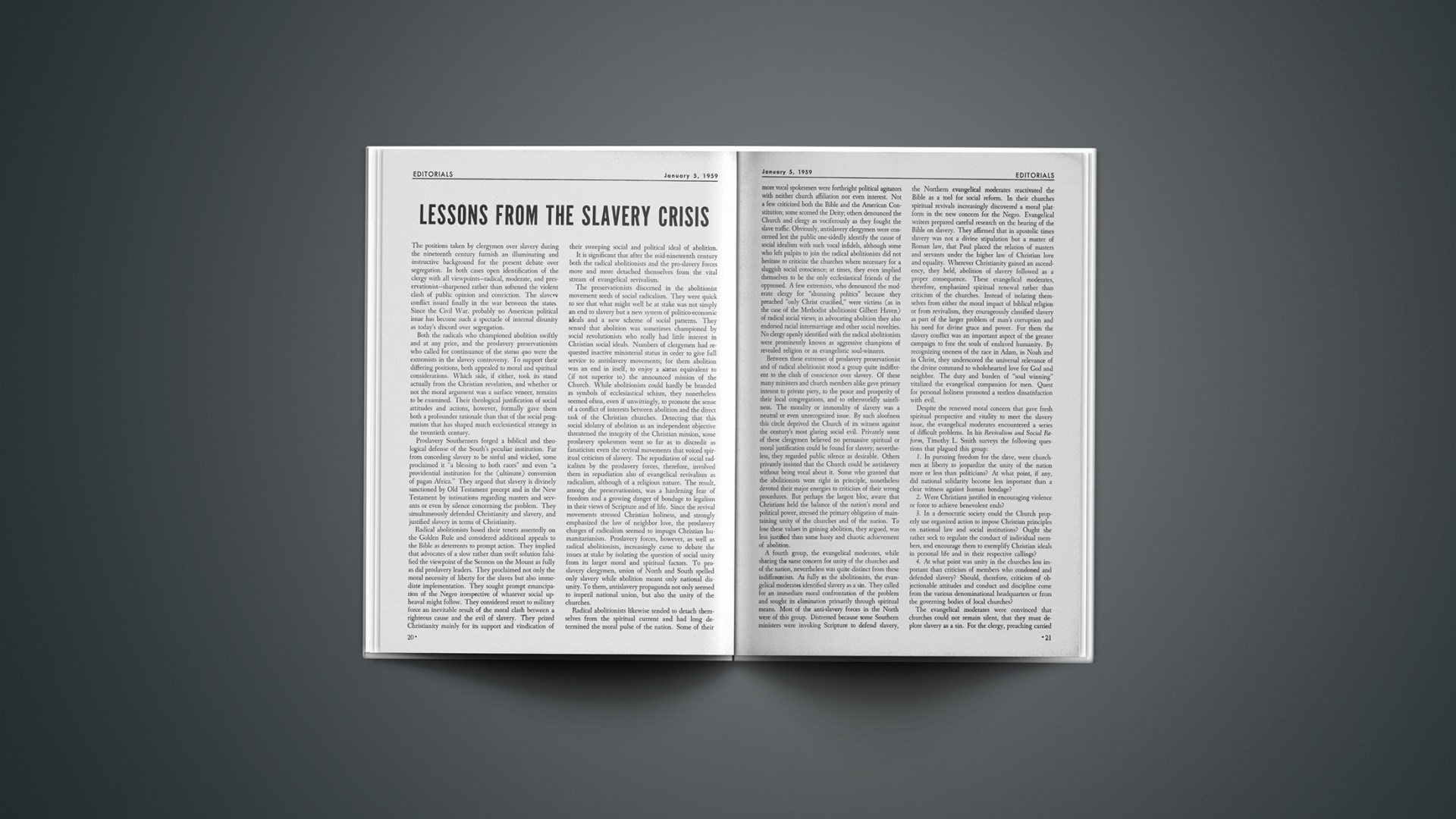
Lessons from the Slavery Crisis

Lessons From The Slavery Crisis

The positions taken by clergymen over slavery during the nineteenth century furnish an illuminating and instructive background for the present debate over segregation. In both cases open identification of the clergy with all viewpoints—radical, moderate, and preservationist-sharpened rather than softened the violent clash of public opinion and conviction. The slavery conflict issued finally in the war between the states Since the Civil War. probably no American political issue has become such a spectacle of internal disunity as today’s discord over segregation.

Both the radicals who championed abolition swiftly and at any price, and the proslavery preservationists who called for continuance of the status quo were the extremists in the slavery controversy. To support their differing positions, both appealed to moral and spiritual considerations. Which side, if either, took its stand actually from the Christian revelation, and whether or not the moral argument was a surface veneer, remains to be examined. Their theological justification of social attitudes and actions, however, formally gave them both a profounder rationale than that of the social pragmatism that has shaped much ecclesiastical strategy in the twentieth century.

Proslavery Southerners forged a biblical and theological defense of the South’s peculiar institution. Far from conceding slavery to be sinful and wicked, some proclaimed it “a blessing to both races” and even “a providential institution for the (ultimate) conversion of pagan Africa.” They argued that slavery is divinely sanctioned by Old Testament precept and in the New Testament by intimations regarding masters and servants or even by silence concerning the problem. They simultaneously defended Christianity and slavery, and justified slavery in terms of Christianity.

Radical abolitionists based their tenets assertedly on the Golden Rule and considered additional appeals to the Bible as deterrents to prompt action. They implied that advocates of a slow rather than swift solution falsified the viewpoint of the Sermon on the Mount as fully as did proslavery leaders. They proclaimed not only the moral necessity of liberty for the slaves but also immediate implementation. They sought prompt emancipation of the Negro irrespective of whatever social upheaval might follow. They considered resort to military force an inevitable result of the moral clash between a righteous cause and the evil of slavery. They prized Christianity mainly for its support and vindication of their sweeping social and political ideal of abolition.

It is significant that after the mid-nineteenth century both the radical abolitionists and the pro-slavery forces more and more detached themselves from the vital stream of evangelical revivalism.

The preservationists discerned in the abolitionist movement seeds of social radicalism. They were quick to see that what might well be at stake was not simply an end to slavery but a new system of politico-economic ideals and a new scheme of social patterns. They sensed that abolition was sometimes championed by social revolutionists who really had little interest in Christian social ideals. Numbers of clergymen had requested inactive ministerial status in order to give full service to antislavery movements; for them abolition was an end in itself, to enjoy a status equivalent to (if not superior to) the announced mission of the Church. While abolitionists could hardly be branded as symbols of ecclesiastical schism, they nonetheless seemed often, even if unwittingly, to promote the sense of a conflict of interests between abolition and the direct task of the Christian churches. Detecting that this social idolatry of abolition as an independent objective threatened the integrity of the Christian mission, some proslavery spokesmen went so far as to discredit as fanaticism even the revival movements that voiced spiritual criticism of slavery. The repudiation of social radicalism by the proslavery forces, therefore, involved them in repudiation also of evangelical revivalism as radicalism, although of a religious nature. The result, among the preservationists, was a hardening fear of freedom and a growing danger of bondage to legalism in their views of Scripture and of life. Since the revival movements stressed Christian holiness, and strongly emphasized the law of neighbor love, the proslavery charges of radicalism seemed to impugn Christian humanitarianism. Proslavery forces, however, as well as radical abolitionists, increasingly came to debate the issues at stake by isolating the question of social unity from its larger moral and spiritual factors. To proslavery clergymen, union of North and South spelled only slavery while abolition meant only national disunity. To them, antislavery propaganda not only seemed to imperil national union, but also the unity of the churches.

Radical abolitionists likewise tended to detach themselves from the spiritual current and had long determined the moral pulse of the nation. Some of their more vocal spokesmen were forthright political agitators with neither church affiliation nor even interest. Not a few criticized both the Bible and the American Constitution; some scorned the Deity; others denounced the Church and clergy as vociferously as they fought the slave traffic. Obviously, antislavery clergymen were concerned lest the public one-sidedly identify the cause of social idealism with such vocal infidels, although some who left pulpits to join the radical abolitionists did not hesitate to criticize the churches where necessary for a sluggish social conscience; at times, they even implied themselves to be the only ecclesiastical friends of the oppressed. A few extremists, who denounced the moderate clergy for “shunning politics” because they preached “only Christ crucified,” were victims (as in the case of the Methodist abolitionist Gilbert Haven) of radical social views; in advocating abolition they also endorsed racial intermarriage and other social novelties. No clergy openly identified with the radical abolitionists were prominently known as aggressive champions of revealed religion or as evangelistic soul-winners.

Between these extremes of proslavery preservationist and of radical abolitionist stood a group quite indifferent to the clash of conscience over slavery. Of these many ministers and church members alike gave primary interest to private piety, to the peace and prosperity of their local congregations, and to otherworldly saintliness. The morality or immorality of slavery was a neutral or even unrecognized issue. By such aloofness this circle deprived the Church of its witness against the century’s most glaring social evil. Privately some of these clergymen believed no persuasive spiritual or moral justification could be found for slavery; nevertheless, they regarded public silence as desirable. Others privately insisted that the Church could be antislavery without being vocal about it. Some who granted that the abolitionists were right in principle, nonetheless devoted their major energies to criticism of their wrong procedures. But perhaps the largest bloc, aware that Christians held the balance of the nation’s moral and political power, stressed the primary obligation of maintaining unity of the churches and of the nation. To lose these values in gaining abolition, they argued, was less justified than some hasty and chaotic achievement of abolition.

A fourth group, the evangelical moderates, while sharing the same concern for unity of the churches and of the nation, nevertheless was quite distinct from these indifferentists. As fully as the abolitionists, the evangelical moderates identified slavery as a sin. They called for an immediate moral confrontation of the problem and sought its elimination primarily through spiritual means. Most of the anti-slavery forces in the North were of this group. Distressed because some Southern ministers were invoking Scripture to defend slavery, the Northern evangelical moderates reactivated the Bible as a tool for social reform. In their churches spiritual revivals increasingly discovered a moral platform in the new concern for the Negro. Evangelical writers prepared careful research on the bearing of the Bible on slavery. They affirmed that in apostolic times slavery was not a divine stipulation but a matter of Roman law, that Paul placed the relation of masters and servants under the higher law of Christian love and equality. Wherever Christianity gained an ascendency, they held, abolition of slavery followed as a proper consequence. These evangelical moderates, therefore, emphasized spiritual renewal rather than criticism of the churches. Instead of isolating themselves from either the moral impact of biblical religion or from revivalism, they courageously classified slavery as part of the larger problem of man’s corruption and his need for divine grace and power. For them the slavery conflict was an important aspect of the greater campaign to free the souls of enslaved humanity. By recognizing oneness of the race in Adam, in Noah and in Christ, they underscored the universal relevance of the divine command to wholehearted love for God and neighbor. The duty and burden of “soul winning” vitalized the evangelical compassion for men. Quest for personal holiness promoted a restless dissatisfaction with evil.

Despite the renewed moral concern that gave fresh spiritual perspective and vitality to meet the slavery issue, the evangelical moderates encountered a series of difficult problems. In his Revivalism and Social Reform, Timothy L. Smith surveys the following questions that plagued this group:

1. In pursuing freedom for the slave, were churchmen at liberty to jeopardize the unity of the nation more or less than politicians? At what point, if any, did national solidarity become less important than a clear witness against human bondage?

2. Were Christians justified in encouraging violence or force to achieve benevolent ends?

3. In a democratic society could the Church properly use organized action to impose Christian principles on national law and social institutions? Ought she rather seek to regulate the conduct of individual members, and encourage them to exemplify Christian ideals in personal life and in their respective callings?

4. At what point was unity in the churches less important than criticism of members who condoned and defended slavery? Should, therefore, criticism of objectionable attitudes and conduct and discipline come from the various denominational headquarters or from the governing bodies of local churches?

The evangelical moderates were convinced that churches could not remain silent, that they must deplore slavery as a sin. For the clergy, preaching carried an obligation to sharpen the moral sensitivity of the laity and to regenerate the conscience of the community. Official denominational appeals and edicts, moreover, worked toward removing the evil. Whether local churches or their denominational offices could best maintain effective jurisdiction and best formulate judicious statements and policies was a question whose answer doubtless was influenced at times by moral indifference and self-interest. Unlike the local pastors, denominational leaders did not suffer the direct consequences of edicts on the slavery issue. Some ministers urged the brethren to use any judicious corrective measures that would not disrupt the peace and unity of the Church. On the other hand, some denominational leaders, persuaded that a voice raised long and loud must inevitably be heard, regularly issued public pronouncements that frustrated and embarrassed a number of their constituencies. Others urged hasty abolition, and attached degrees of moral turpitude to all those in the churches still involved in the slavery system. Proposals to remove from fellowship any who refused to end the slavery evil, whatever the temporary obligations and local circumstances might be, elicited strong protest. Such expulsion, it was said, would remove from the churches the very ones most in special need of Christian influences. Some considered abolition of greater importance than the harmony and unity of the churches; they asked whether slavery would be expelled from the churches or whether, instead, men of high idealism would secede from the congregations. Such an alternative inflamed the pride of the South.

The conflict between antislavery and proslavery radicals was storing up combustibles of war. While all factions spoke of brotherhood, in a controversy that imperiled the religious, moral, and political ideals of a free people, they all the while inched closer to the brink of combat. Tragically, when the clash came, it was not simply a war to free the slaves. Countless Southerners, who knew that slavery was not only doomed, but morally unjustifiable, felt also that the states should be free to resolve the issue. In the pressures for abolition they detected a bondage that impounded legitimate States’ rights. Of this they wanted no part.

Was it perchance the failure to aggressively pursue a moderate course, and instead the tendency to view the issues in extreme terms, that led at last to the Civil War? The evangelical moderates had sought to quicken conscience against sin, to supply a moral fervor helpful to peaceful emancipation of the Negro. Had they really done all within their spiritual power? Did the slow and limited pace of spiritual impact grant any moral strength at all to views essentially secular but often outwardly sanctified by spiritual clichés? Had the Almighty, as Abraham Lincoln suggested, so shaped the course of events that now the sins of all parties would be punished even while all would fight to make men free? When the decisive battle came, it was clear as never before that neither the unity of the nation nor of the Church was at stake against the freedom of the Negro. Rather, the issue was justice for the Negro in a just politico-social order, and love for the Negro in the community of faith. In the last analysis, both the State and the states faced a crisis in justice and in love. That crisis involved more than the dignity of the Negro; it measured the vigor of the nation and of the churches as well.

END

The Christian’S Duty In The Present Crisis

It is the duty of every Christian citizen to take an active part in public affairs. The present world crisis is a challenge to our faith, our courage and spiritual resourcefulness. Without this element in our national and international strategy there is little hope of winning the cold war against atheistic communism.

In Toynbee’s A Study of History he deals with a type of “futurism” associated with wide areas of Christianity and brands it as a mark of a disintegrating Western society. Eternal life is of course the most glorious possession of the Christian. Some consider it a gift which divorces the receiver from the flow of events in the political and social spheres of this present world. Eternal life, in its true biblical sense, is the life of the eternal God within the soul. While it is life rooted in another dimension, it is also life glorified by immanence. It is “the way, the truth and the life” for today and for eternity. The universal reign of God in his Kingdom is the goal of eternal life. Courage in pursuing the moral issue is fundamental for the citizen of that Kingdom.

In the present world crisis the “futurism” of some fundamentalists is being matched by an “opium smoker’s dream” on the part of liberals like Walter Lippman and Bertrand Russell. Lippman calls for “a diplomacy of accommodation” in dealing with Russia. Russell considers death the ultimate catastrophe and would pay any price for the perpetuation of the race. This is abdication of moral and political righteousness.

The true Christian does not consider the end of earthly existence the ultimate catastrophe. To him life is eternal. God is the same yesterday, today and forever. He is at the center of this world and the world to come. His truth and righteousness must eventually triumph. The Christian has no choice but to fight always on God’s side.

We must bring the holy judgments of God to bear against the present fear, appeasement and confusion which threaten to destroy Western unity and open the gates to atheistic communism.

END

The Joy of Salvation

The only person in the world who has the right to be truly happy is the Christian. Strange to say, few of us reflect much joy in our faces or in our lives.

The Christian witness would be much greater if those of us who know Christ would consistently show that something wonderful has happened to us.

To the unbeliever, joy is entirely dependent on circumstances which are superficial and transient.

On the other hand the Christian’s joy comes from a source which cannot be touched by the world. When we fail to appropriate or understand the magnitude of that to which we are heirs, we are prone to look at surrounding conditions or personal problems and in some measure revert to the world’s perspective.

It is only as we realize who Christ is, what he has done for us, and the reality of his continuing presence, that the joy which should be ours becomes a reality.

Christian joy is an inner communion and fellowship with God, brought about through faith in his Son and made real by the presence of the Holy Spirit.

This joy stems from a perspective centered in the eternal and not the temporal. While it is folly for the Christian to forget his earthly responsibility, it is at the same time impossible for him who has had a transforming experience with Jesus Christ to lose sight of his eternal destiny. When the 70 returned from their missionary journey, they were exulting because the Lord had given them power over evil spirits. Christ’s words were significant: “… rejoice not, that the spirits are subject unto you; but rather rejoice, because your names are written in heaven.”

The joy of salvation comes from things discarded and new things acquired. First we note that this joy comes from sins repented of: true repentance is part of salvation. It is sorrow for sin, not the sorrow which the world knows, for that is death, but godly sorrow which recognizes sin for what it is and abhors it because of God’s holiness.

And, of course, with repentance comes confession. Repentance that does not involve this is not true repentance. For one must be sorry not only for the consequences of sin, but the fact of sin, and, by confessing it, recognize it as an offense to God worthy of his holy judgment.

We note that repentance includes also sin forsaken. Repentance is not genuine until there has been a willingness to forsake those sins which we have admitted. This does not mean we are capable of giving up sin by an act of our own will. It is not reformation which we need but regeneration. To forsake sin requires the power of the living Christ in our lives.

So it is that we come to the joy of sins forgiven. Salvation cannot be adequately described in terms of sequence, but it is the experience of Christians that a flood of joy fills their souls when they realize the enormity of their sins and the magnitude of God’s grace. God’s forgiveness in Christ is something so far from man’s comprehension that he cannot but rejoice and wonder at the love which has made it possible.

Christian joy has its source in Someone who has done something to us and for us. And this becomes the foundation on which all other joys are built.

If Christian joy comes from things which have been discarded, then the fullness of joy, therefore, is measured in terms of things which, through Christ, we acquire.

Christian joy stems from a new fellowship. All that we have and ever hope to be is in Christ, our Saviour and Lord. Sin had destroyed our capacity for fellowship with God, but now fellowship becomes real, ever-present, intimate and replete, as his love, mercy and joy flood our souls. The growing Christian is one in whom this fellowship is a daily, increasing experience.

Joy comes from a new perspective. Only the Christian sees this life and eternity in their true relationship. None of us can see it clearly, but we increasingly realize that God has created us for a purpose, and that as redeemed ones we have a responsibility to that purpose here in this world. As we fulfill God’s plan for us and for others through us, we must distinguish between temporal and eternal, and never forget that God has prepared the latter for his own.

Joy comes from a new power. How hopeless and frustrating is life lived without Christ. How disappointing are our efforts at self-reformation, at trying to be good and never succeeding. But for the Christian there is a glorious release from the bondage of self. To him there is given a divine power that comes from the One who dwells in his heart by faith. For the first time time the power of sin is broken. God’s power, released through prayer, becomes a reality. The Holy Spirit’s presence and power completely transforms him, and the power of the written Word is revealed in all its truth and beauty. We see, too, that God, in his infinite grace, exercises his power through human instruments, and one of the joys of the Christian is the realization that God works in and through him for His own glory.

Joy comes from a new hope. Paul knew it was far better to pass into that glorious future with Christ than remain in the flesh, but he was willing to continue his sufferings for the sake of those whom God had called him to minister. However he, along with the saints who have gone before us, was realizing that our hope is not in this world but in the next. Our Lord constantly held up to his disciples the hope of heaven, and would tell them that it was a place prepared for the redeemed, so wonderful that eye hath not seen nor ear heard, nor has even the imagination of man conjured up, the glories of its reality.

One point needs to be emphasized. The joy of salvation can be lost. What Christian is there that has not sensed the loss of joy when he has fallen into sin? Sin separates man from God and is deadly. And so long as we live in the flesh, we are never freed from its sinful proclivities.

The Christian life is a battle, and Satan, the enemy of souls, is unceasingly active. When he leads us astray the joy of salvation is lost.

But thank God, this joy can be restored. David, guilty of murder and adultery, tasted the renewed joy of salvation when he confessed his sins and turned to the Holy One of Israel for forgiveness and cleansing.

Someone has truly said: “Do not judge a man by his falling.” The way of peace and rejoicing is through the One who makes us right again before God.

Surely, with these joys of salvation all so freely given, we who confess Christ should commend our faith by lives which show the inward resource of joy and the outward evidence of that which the world cannot give and cannot take away.

“And my soul shall be joyful in the Lord: it shall rejoice in his salvation” (Ps. 35:9).

Eutychus and His Kin: January 5, 1959

ATOMIC ALPHABET

A is for Atom—

the problems it sets

Brinksmanship struggles

to check the Red threats;

Churchmen Condemn this,

Convened in Commission,

Dialectically phrasing

our human condition.

E is for Experts

whose reports influential

Firm up with Figures

our Fears existential;

Guaranteed holocaust

awaits our first Goof:

H-bombs and missiles

are aimed, launched, and—poof!

Indeed that debacle

with terror is stored;

Just one day more dreadful,

the Day of the Lord!

Karl Marx and Khrushchev

and Stalin and Tito,

Lenin and Trotsky

And now even Mao-

Must be exculpated

with liberal praise—

National heroes

have summary ways.

Overseas comrades

propose a solution:

Peace is their object

through world revolution.

Quemoy must be quitted

in graceful surrender,

Red China admitted

as full U. N. member.

Satellite progress

gives Russia the field—

To travel Together

we’ve only to yield;

Unitive forces

will make us all one:

Victor and vanquished

at each end of the gun.

We surely must learn no

illusions to cherish:

Xcept we repent we

shall all doubtless perish;

Yet judgment on evil

is work for the sword;

Zeal for just rulers

is zeal for the Lord!

YEAR-END PERSPECTIVE

The past year, 1958, has been one of tension in the churches of the South as the moderate position on racial integration has disintegrated, forcing extremist choices. In evangelism, it has been a year of consolidation of gains without the fire and enthusiasm of some previous years but, nevertheless, a leveling off of efforts at personal witness on a high plane. The Episcopal pronouncement on beverage alcohol has served to relax a conscience of church people on this issue thus accelerating the accommodation of the Christian conscience to secular standards.

Along with the general public, church people have begun to take crisis on the international scene for granted. There is a note of despair about achieving real stability and peace without justice, thus the sense of urgency has been toned down while men seek normalcy in troubled times.

Yea, but Jesus Christ is Lord and the kingdoms of this world shall become the kingdoms of our Lord and of his Christ.

Southern Baptist Theological Seminary

Louisville, Ky.

Two causes for evangelical encouragement, as a spectator in England views the situation, are worth mentioning.

One for these is found in certain aspects of the Lambeth Conference which met in the summer of 1958. Much prayer was offered on behalf of the bishops of the Anglican Communion before and during their conference, and those who prayed for them may find much evidence of answered prayer in their Report. Our expectations of a world-impact on the part of ecclesiastical conferences are as modest as they could well be; but the deliverance of the committee which considered the nature and use of Holy Scripture in the Church, under the chairmanship of the Archbishop of York, may be singled out for special mention. It is a balanced and comprehensive statement which gives hope to all who are concerned for the maintenance of a sound and full-orbed theology of the Bible in English-speaking Christendom.

The other arises from the “Mission to Britain” currently being conducted by Mr. Tom Rees, an enterprise which envisages an evangelistic rally in every important city and town in the United Kingdom between October, 1958, and May, 1959. Writing in mid-November, Mr. Rees reported: “To say that we are encouraged by the process of the Mission to Britain is to put it mildly. God has done exceeding abundantly above all that we have asked. Not only are we having tremendous congregations, but far more important, we have the power and presence of Jesus Christ, and in every centre many are finding new life in Jesus Christ.”

In days when Christians are all too prone to be infected by contemporary secular pessimism, we should be thankful for these and other reminders that those who follow Christ are not on the losing side.

The University

Sheffield, England

As a British Christian on tour in Asia, I think often of the continued refusal of ordinary Christians in the home countries to think in terms of one world. Now that international events, so threatening a year or two ago, seem to give us a further spell of untrammeled activity into most of the world, we must cease to think of mission field and home base—but all as one world. As a great Indian Christian of the younger generation said to me in New Delhi, “It has been too much a one way traffic, from West to East. The whole world is a mission field and we Christians must band together to confront the East and the West with God.”

Templecombe, Somerset, England

AUTONOMY AND ABYSS

When Clyde S. Kilby disagrees “with most of W. Norman Pittenger’s recent criticisms of the writings of C. S. Lewis” (Dec. 8 issue) one must, in a large measure, agree with him.

Pittenger’s basic criticisms of Lewis are based on the assumption that the modern liberal view of Christ and the Scripture is unassailable. He assumes the dogma of the autonomy of man. He is unaware of the fact that on his assumption human experience, including that of his Christ, floats in a meaningless abyss. Naturally he dislikes whatever is orthodox in Lewis.

But not all that Lewis writes in theology is orthodox. Is it orthodox to hold that man must seek to ascend in the scale of being from animal life to participation in the life of the triune God? (cf. Beyond Personality). Would that Lewis would employ his great literary brilliance for the statement and defense of a more truly biblical view of man, of sin and of salvation than is now the case.

Westminster Theological Seminary

Philadelphia, Pa.

CHURCH MUSIC

Author Cording (Nov. 24 issue) was pleading for a spiritual type of song in which to praise God.… Since God has demanded a spiritual psalm (Col. 3:16), or psalms of the Holy Spirit, why should we think so highly of ourselves, not to use that which God has inspired in his Book.

Pittsburgh, Pa.

Thank you for publishing what so many of us in church music feel so deeply and what Mr. Cording said so well (Nov. 24 issue).

First Baptist Church

Evansville, Ind.

ANGLO-CATHOLICS

The article “Anglican Settlement under Elizabeth” (Nov. 10 issue) contains … the underlying assumption, which is never stated, that Anglo-Catholics are somehow anti-evangelical, while low-churchmen are favorable to the Fundamental view. Almost exactly the reverse is true. There are, to be sure, some evangelical low-churchmen, and some non-doctrinal high-churchmen, but for the most part it is precisely the Anglo-Catholics who hold a firm view about salvation, grace, and the Scriptures: while it is low-churchmen who tend to believe simply in the class-church theory of Anglicanism—who deplore doctrine, and are, in effect, liberal humanists.

Church of the Good Shepherd

New York, N. Y.

The article … is good in so far as it reiterates historical facts. Unfortunately when the writer says at the conclusion that “one of the firmest guarantees of the continued Protestantism of the Church of England is still its rootage in the constitution,” all freedom loving people will draw swords.… The point he makes here is one of the curses of British Christianity. The constitution may perpetuate the State Church of England, but it deadens spirituality in the land. By referring to my article (Jan. 6 issue) …, it can be asserted that every revival mentioned took place outside of established religion. All revivals do because of their very nature. If Britain is ever again to be blessed by God in this way or with any other spiritual benediction, the impact will come outside of the state church.… As a Britisher I am grateful to be permitted to live in a land where no state church exists.

Liberty Baptist Church

Blanchard, Pa.

A NEEDED WORD

Thank you very sincerely for your superb editorial “Christian Education and Culture” (Nov. 10 issue). It was a sturdy piece of thought and a much needed word to our time. Many of us are extremely grateful for your pen of truth which is etching into the thought of our time the configuration of Christ.

Los Angeles, Calif.

REMAKING AMERICA

You are to be complimented on your outspoken editorial on repeal and the liquor question (Nov. 10 issue). I believe that it would be well to call the attention of your readers to Ernest E. Gordon’s study of repeal entitled “The Wrecking of the 18th Amendment,” published by Alcohol Information Press of Francistown, N. H. In there it is clearly shown that the American public was taught to believe a “big lie” purely for commercial gain. It was an experience from which materialist, totalitarian groups are profiting in their effort to remake America into the pattern of alien philosophies. Much of the blame must be placed on the advertising fraternity and the media of mass communication for being the means of accomplishing the end.

Winnetka, Ill.

I congratulate you for the timely subject, i.e. about alcoholism and prohibition. I knew the author of the Eighteenth Amendment.… Prohibition was not perfect, but was 50 times … more perfect than the present anti-prohibition is. Cleveland, Ohio

METHODIST STIRRINGS

Thank you for … “New Stirrings in Methodism” (Nov. 10 issue). This fair treatment of the creedal-liturgical-sacramental revival … will be greatly appreciated by all who are a part of it.… It is our conviction that John Wesley, rather than the early American frontier, most adequately represents the true Methodist standards and traditions of worship.… I see this movement as a valuable corrective both to the nebulous theology with which we have been inflicted; and to the informal, undignified “meetings” which one of my parishioners recently described as being “more like Saturday night than Sunday morning.”

The Methodist Church

De Land, Ill.

If the “High Church” or “Sacramental Revival” movement within Methodism desires to “get next to” John Wesley in doctrine and spiritual quality, let them return to the Scriptures and the emphases derived from them by Methodism’s founder. He preached and taught the doctrines and experimental realities of regeneration and entire sanctification.…

Berkeley, Calif.

What is its approach to the liberal and how does it appear in the eyes of liberals? In modern Methodism this is a very relevant question. If it creates a counterpoise to the extreme modernism that has dominated in certain Methodist circles in recent years then the High Church group may have something to say that will mean something.

Tie Plant, Miss.

I was amazed and delighted to read it, for I have been president of the Order of St. Luke since its founding, and was one of the two founders.… This article is the first to be written by one who is not an officer of the organization explaining correctly what we stand for.… Unfortunately, due to the resurgent interest in ceremonial and aesthetic “improvements,” the Order has come to be associated in the minds of many people with a sort of High Church ritualism.… This is not the meaning of the Order.… However, we have had a tremendous effect upon the church in such a quiet way that this is the first time we have been credited with much of it, except by observers in other churches.

North Carolina Christian Advocate Ed.

Greensboro, N. C.

PROMOTION PROTESTED

Concerning an editorial … in regard to the Friends “Peace Promotion” (Nov. 10 issue) …, many of the Friends, usually the evangelicals, not only refuse to go along with this promotion but abhor many of the ideas they put forth.… Many of us as Friends stress the gospel of Christ rather than the gospel of “Peace.”

Midway City Community Friends Church

Midway City, Calif.

ECUMENICAL MISSION

“Whither Ecumenical Mission?” (Aug. 18 issue) is a thought-provoking contribution.… In clear, strong words it examines the program of “ecumenical mission” as being followed by certain sending churches. The conclusion reached is that “we can say ‘fraternal worker’ instead of ‘missionary,’ and ‘ecumenical mission’ instead of ‘missions’ if we like, but let us remember that we are talking about different things”.… Are “ecumenical mission” and the “business of being sent to the unevangelized” really so far apart as indicated?.… If concern for fellowship takes the place of concern for reaching the lost for Christ, woe unto us. But we have at the same time to see that there is a strong biblical warrant for the concept of the missionary in another land seeking to be “a fraternal worker” to those who are Christ’s, to those who are his new church in that land. The commission is from Christ; it is to us and to them—together. Indeed what more wonderful thing have we to do with the title “missionary” than to lose it for ourselves that we may gain it again with our brothers in the land of our adoption?

Cent. Braz. Miss., United Presb., U.S.A.

Xapeco, Santa Catarina, Brazil

A TIME FOR TRIBUTE

There is yet another view of the millennium.… It agrees with the amillennial view in that it gives a figurative interpretation of the thousand years rather than a literal, but there is a difference in the significance attached to the figure.… Verses one to ten of [Revelation 20] form a part of [the] … scene which depicts the victory celebration of the redeemed.… This … includes … the chaining of Satan for a thousand years … [and] is marked by a season of special recognition and honor bestowed upon those who had suffered martyrdom for … Christ. The actual duration of this “thousand year” period is of minor consequence in the proper understanding of the true meaning of the text. During this period not all the saints shall reign with Christ …, but only the martyrs (Rev. 20:4).… The significance is … this: Somewhere in God’s economy and plan there will be a time and place in which God will give special recognition and tribute to those who have had to pay the supreme sacrifice of their lives for their faith.…

Royal Haven Baptist Church

Dallas, Texas

APPLICATION WANTED

Every congregation would benefit if its preacher could and would read and apply “With Hearts Aflame” (“A Layman and His Faith,” Oct. 13 issue).

Boston, Mass.

How greatly I appreciate this magazine. Some of the articles are very beautiful and uplifting. In particular, I must say that Nelson Bell’s “A Layman and His Faith” is the item I most look forward to every time.

Eastbourne, Sussex, England

THE SCOTTISH MIND

R. L. Stevenson, no mean judge of men, said that the English mind never understood the Scottish mind. And James I. Packer, in his article (Sept. 29 issue) …, is an excellent example. Take his dogmatic assertion about the closing decades of the nineteenth century: “Rationalistic criticism and humanistic theology flourished in the pantheizing atmosphere dominant philosophic idealism generated.” It’s a vague, obscure sentence, unworthy of an Oxford man who is generally clear, and then it’s totally untrue. Every reading minister in the last ten years of the nineteenth century, and the first 20 of this century had The Expositor’s Bible with Marcus Dods, Alexander Maclaren, G. G. Findlay, James Moffatt …, and James Denney …; [they also read] James Stalker …, and David Smith.… All were Scotchmen. And there are a host more. Were these men “rationalistic and pantheistic?” … Dr. Packer seems strangely unaware of the splendid theological writers North of the Border.

I warned my collegiate sons never to argue with a professed fundamentalist on religion or a socialist on politics. Both of them are affected with a mental astigmatism that debars them from seeing things straight, clear, and as a whole.

First Presbyterian Church

Mannington, W. Va.

HAD ENOUGH

I once asked a lieutenant colonel … why he did not attend chapel services.… He said, “When I was at West Point, I had enough chapel to last me the rest of my life.” I believe he expressed the common attitude of the military academy graduate.

The only type of service these men learn to worship under is the “liturgical” service. Since the majority of chaplains they will meet during the course of their military career are “non-liturgical,” I think the Army would do well to make this a one-year U. S. Army chaplain’s assignment alternating between the liturgical and non-liturgical chaplain.

Chaplain

U. S. Army

A SEGREGATIONIST SPEAKS

We segregationists are not unbrotherly nor unchristian. We oppose mixed marriage.

Lexington, Ky.

FACT OR FOLKLORE

In CHRISTIANITY TODAY (Apr. 14 issue) was a letter … reporting that a Rev. John O’Kane took Abraham Lincoln, by night, and immersed him, and then enrolled him as a member [in the Disciples of Christ Church].… Since then I have carried on a wide correspondence with folks who ought to know the truth.… Dr. Louis L. Warren, president of the Disciples Historical Society, says, “He (Mr. Lincoln) did not belong to any communion. Credence should not be given to the various stories that Lincoln was immersed.… The tales of Lincoln’s immersion and church affiliations are like other folklore legends which have grown up.”

Sons of Union Veterans of Civil War

Manchester, N. H.

The Saint’s Reward and God’s Grace

Evangelical Christians uphold the Pauline doctrine “that a man is justified by faith without the deeds of the law” (Rom. 3:28). With great vigor both Luther and Calvin defended the doctrine of salvation by grace alone against the Roman dogma of merit. Calvin ardently supported statements of Luther such as the following: “Grace must be gratuitous, that is, offered gratis. It must be bestowed freely; otherwise it is not grace” (Luther’s Works, Weimar edition, 43:607). Against the Roman dogma of the meritoriousness of good works Luther asserted time and again that there can be no place for human merit between God and man. To God alone belongs all glory for man’s redemption and salvation. It is only then, when man’s salvation is ascribed to divine grace in its entirety, that the glory of God can be fully maintained (Weimar, 7:148). Unbelief, or man’s vain self-glory, is a violation of the glory of God (Weimar, 43:620). Faith that receives God’s grace and trusts in his mercy and truth, humbly attributes all glory to him (Weimar, 40:1, 360, 363; 10:2, 166). For this reason all true Christians do their works solely to God’s glory (Weimar, 19:659; 30:2, 663, 668; 43:620). On this doctrine Luther and Calvin were fully agreed (cf. Reinhold Seeberg, Die Lehre Luthers. Dogmengeschichte IV, pp. 186 ff.).

The Roman doctrine of merit, however, may seem on the surface to be supported by the reward motif which Scripture stresses from beginning to end. The divine Word promises to all who faithfully do the Lord’s will, trust in Christ, perform good works in his name, endure to the end, bear their cross with humility and patience and follow Christ throughout their life, a rich reward in heaven. How can this scriptural reward motif be harmonized with the central gospel doctrine of salvation by grace through faith in Christ without works?

It is hardly necessary to illustrate the reward motif by pertinent passages, since these doubtless are well known to all evangelical Bible students. Nevertheless, a few passages promising a reward to believers will remind us of how emphatically the doctrine is taught. Thus those who receive a prophet in the name of a prophet will receive a prophet’s reward, and those who receive a righteous man in the name of a righteous man will receive a righteous man’s reward (Matt. 10:41). Even those who give to Christ’s little ones only a drink of cold water in the name of a disciple will have a reward (v. 42). Christ’s followers who are reviled and persecuted for his sake should rejoice and be exceeding glad, because great is their reward in heaven (Matt. 5:11, 12). Those who love their enemies and do good to them will receive a great reward (Luke 6:35). If on Judgment Day any man’s work in Christ’s ministry will abide, he will receive a reward (1 Cor. 3:14). Believers are to look to themselves that they receive a full reward (2 John 8). Christ will come quickly and his reward is with him to give every man according to his work (Rev. 22:12). And in Genesis, God promised Abraham to be his shield and his exceeding great reward (Gen. 15:1). So the reward motif is found in the Bible from Genesis to Revelation.

Reward Of Grace, Not Merit

In dealing with the strictures of his opponents, Luther maintained on the basis of Scripture that the promised reward was not one of merit, but one only of grace. He was by no means perplexed by the criticism of his adversaries, but rather greatly encouraged to teach the sola gratia just because of God’s gracious promises of a reward. He recognized in these very promises God’s superabundant grace on which he could fully rest his salvation. In his exposition of Psalm 19:11—“Moreover by them [the divine statutes] is thy servant warned: and in keeping of them there is great reward”—he writes:

All this is said to comfort those who labor, not to confirm the covetousness of those who as hirelings and mercenaries seek a reward.… Similarly, he comforts also those who are troubled, in 1 Corinthians 15:58: “Forasmuch as ye know that your labor is not in vain in the Lord.” For God’s (true) servants should know that they please him in their toil so that they do not become weary, discouraged and despondent. God desires cheerful doers of his statutes who do not look for a reward. Nevertheless, those who please him will surely receive a great reward, though they do not work for it. God, who said to Abraham: “I am thy exceeding great reward” (Gen. 15:1), cannot contradict himself (St. Louis ed., 4:1165 f.).

In his great controversial monograph against Erasmus, “Concerning the Enslaved Will,” Luther remarks: God’s children cheerfully and gratuitously do what is good and do not look for any reward. They seek only the glory and pleasure of their (heavenly) Father; they are willing to do what is good even—to assume the impossible—there be neither heaven nor hell. This, I believe, is proved sufficiently by the one statement of Christ which I adduced above: “Come ye blessed of my Father, inherit the kingdom prepared for you from the foundation of the world” (Matt. 25:34). How can they merit that which already is theirs and has been prepared for them before they came into being?… But why does Scripture stress the reward so greatly?… by them the godly are incited, comforted and encouraged to continue, endure and be victorious in doing what is good and in bearing what is evil so that they may not become weary or downhearted, as St. Paul comforts the Christians in 1 Corinthians 15:58 (St. Louis ed., 18:1809 ff.).

According to Scripture, God not only gives his elect saints eternal life as a free gift, but he also rewards the grateful ministry of his believing children on their way to heaven. Viewed in this way the doctrines of the promised reward and of free grace may be taught side by side as does the Bible. To God’s grace alone we owe our salvation; by his promise of a gracious reward we are assured that our work in our Christian ministry is pleasing to him for Jesus’ sake. Both prove the unfathomable love of our merciful Father in heaven.

What The Reward Will Be

While Holy Scripture promises God’s believing saints a rich reward in heaven, it never intimates what the reward will be. It certainly will not consist in a greater degree of salvation, since all believers will share alike in the free and full salvation which Christ has procured for them by his vicarious atonement. In view of Paul’s words in 1 Corinthians 15:41, 42: “One star differeth from another star in glory. So also is the resurrection of the dead,” some church teachers have argued that the reward might consist in greater glory, especially because of God’s promise: “They that be wise shall shine as the brightness of the firmament; and they that turn many to righteousness as the stars forever and ever” (Dan. 12:3). It seems best, however, not to speculate. Paul’s argument in Romans 8:32: “He that spared not his own Son, but delivered him up for us all, how shall he not with him also freely give us all things?” deserves consideration also with regard to his reward of grace. Since God by his dear Son has bestowed upon us so rich a treasure of spiritual gifts, we may leave also the gift of his reward to his never-failing superabundant love.

The evangelical pastor may hesitate somewhat to address his congregation on God’s gracious reward, since his promises may be interpreted by some as implying a reward of merit and so may lead to the surrender of the sola gratia and the adoption of the Roman dogma of the meritoriousness of works. But the scriptural doctrine of God’s gracious reward is not so complex as to render it impossible for a pastor to explain to his hearers what it means. If presented side by side with the sola gratia, the doctrine will certainly not be misunderstood, but will greatly encourage the believing church members to continue in the Lord’s work with zeal and devotion. In fact, the doctrine must not be withheld from Christian believers, since it is a clear and greatly stressed teaching of God’s Word.

As we study the scriptural doctrine of God’s gracious reward in its usual context, we find that it is given especially to such believers as face extraordinary trials. Today consecrated church members are in special need of the rich comfort which the gracious promises of a reward convey to the Lord’s dear but troubled saints. There are so many factors that discourage loyal participation in the Lord’s work. Usually it is the small nucleus of 20 per cent that does the major part of a congregation’s Christian service.

Now, all believers in Christ are saved by grace, even those whose faith is weak and whose service is lacking in zeal. But let no one think that, since all are saved by grace, all, while receiving a free and full salvation in heaven, will be given also the same reward of grace and glory. Those who give themselves fully to the Lord store up rich treasures for themselves in heaven. Even the least good work done in Jesus’ name to his saints will be remembered and rewarded on the day when the Judge will return in glory. The service we do on earth is temporal, but the reward is eternal. God is a beneficent paymaster; he gives far more than the human mind can conceive.

Viewed in this light, the reward motif in Scripture is of the greatest importance; it glorifies God’s abounding love and greatly encourages Christian believers to be zealous of good works.

END

Preacher In The Red

TERMINAL MINISTRY

I formerly served in a community in southwest Virginia where there was a chapel sponsored by my church. This was at the opposite side of the town. It was reported that one Sunday, in announcing the services, my predecessor said:

“There will be preaching in the west end at 11 A.M., preaching in the east end at 3 P.M., and babies will be baptized at both ends.”—The Rev. WILLIAM R. SENEGEL, First Presbyterian Church, Fulton, Mo.

J. T. Mueller is crowning his long years of service as a Lutheran (Missouri Synod) theologian by writing and modified teaching service at Concordia Seminary, St. Louis, where he has been a professor since 1920. He will be 74 on April 5, 1959. Dr. and Mrs. Mueller celebrated their golden wedding anniversary February 25, 1958. Three sons are ministers.

God’s Directives for His Work

Be strong and of a good courage: for unto this people shalt thou divide for an inheritance the land, which I sware unto their fathers to give them. Only be thou strong and very courageous, that thou mayest observe to do according to all the law, which Moses my servant commanded thee: turn not from it to the right hand or to the left, that thou mayest prosper whithersoever thou goest. This book of the law shall not depart out of thy mouth; but thou shalt meditate therein day and night, that thou mayest observe to do according to all that is written therein: for then thou shalt make thy way prosperous, and then thou shalt have good success. Have not I commanded thee? Be strong and of a good courage; be not afraid, neither be thou dismayed; for the Lord thy God is with thee whithersoever thou goest (Joshua 1:6–9).

This Scripture passage, especially the last verse of it, was related to me by my pastor on the day of my confirmation. It has guided me in various ways through life, and has offered me encouragement and counsel when I needed it. Let me therefore pass it on.

But would the question be raised that this text is giving a typical example of American activism, the aberration with which we have all been so often charged? I think not. For the directives involved are divinely given in a direct sense. Who would charge Joshua, in doing what God commanded, with being guilty of unwholesome activism? And does not the giving of an order on God’s part involve, without question, the promise of divine aid in its fulfillment?

Advance In Confidence

Let us look at the first directive that is given here: Go forward strong in the faith in God’s promises. The divine imperative suggests boldness of approach: “Be strong … of a good courage … be not afraid, neither be thou dismayed.”

Tasks are always enormous. Joshua’s was to take a land and give it to a nation. The task of Christ’s disciples is to evangelize the world. Canaanites fought to the blood. In like manner, opposition to the Lord’s work has always been bitter and fierce. The world and the devil are implacable in their hatred of the Gospel.

With orders from on high, the servant of the Lord can only regard timidity as disgraceful. Valor is the requirement of those who have so great a commander, so great a high priest. God, who seems to command the impossible, gives strength for the performance of it. He is the great helper, ready to supply all that we ask, yea, even more than we think.

When we are dealing with divine imperatives, and God bids that men go forward, who are we to say no? God’s work, therefore, is to be done with the boldness that is born of true humility.

Rely On The Word

The second directive runs thus: Direct your course by the Word. There is good reason to believe that a generous measure of the Word was available at the time, sufficient to guide a man in the successful performance of the duties that fell to him. So it was with Joshua. He that bid Joshua guide his steps by it, seemed to regard it as entirely adequate for all exigencies.

It takes courage for a man to steer his course by this chart or norm. We are inclined to follow schemes and plans of our own devising and to regard them as reliable. Divinely formulated orders strike us at times as being impractical, but the Lord said, “Be strong and very courageous that thou mayest observe to do according to all the law which Moses, my servant, commanded thee.”

Obviously, that Word is to be regarded as an utterly safe norm. It becomes the norma normans not only for the Church, but also for every individual. “Do according to all that is written therein.”

Here, as so often is the case, the word was a word of promise. It specifically said to Joshua: “Thou shalt divide for an inheritance the land which I sware unto their fathers to give them.” In the Word of God, the element of promise is often more in evidence than the word of demand.

Live In The Oracles

The third directive, closely analogous to the one previous, runs thus: Live in the sacred oracles of God. Much reading and study of the Word is ordered: “The book of the law shall not depart out of thy mouth.” This involves more than frequent quoting of key passages for one’s own direction and for the advice of others. In days of old, the Hebrew would softly pronounce the words as he sought to decipher the unpointed text that lay before him. Thus the use of the mouth involves reading aloud as the first step in the process of studying.

The next step was continued meditation upon that which had been read: “Meditate therein day and night.” I see Joshua early in the morning in his tent bending over the sacred Scriptures. I see him after the others have retired at night perusing the same Scriptures by the light of a lamp, for this is what the Lord had told him to do. Such meditation, in the very nature of the verb used, involved more than some kind of dreamy reflection. It included careful planning as to how to put the word just read into effect.

Such study does not paralyze action, as too much reflection is apt to do at times. That it is to be practical and effective meditation is made clear: “Meditate … that thou mayest observe to do according to all that is written therein.” Joshua was to cultivate a wholesome personal piety built on a love for the sacred oracles of God. The manner in which Joshua was to proceed in the administration of the duties of his office is indicated: First, determine what the Word of God bids you to do; then act.

Trust In God’S Presence

The last directive is, in a sense, the most important of all: Trust in the Lord’s presence. This directive comes in the form of a promise: “For the Lord thy God is with thee whithersoever thou goest.” This resounding climax and emphatic conclusion to the whole instruction stresses the help and presence of the Lord.

But such trust, being the most vital thing of all, has certain obvious prerequisites: faith in the God who calls, complete readiness to go forward in the manner and direction he indicates, and complete adherence to the norm he would have a man follow. There must be no laxity in meditating deeply upon the Word that the Lord has given. Trust without this rests on sand and will be swept away.

But if His conditions be met, then the Lord promises to go with the man he sends. The divinely reassuring word is given: “Thou shalt make thy way prosperous and then thou shalt have good success.”

If thou but suffer God to guide thee,

And hope in him through all thy ways,

He’ll give thee strength whate’er betide thee,

And bear thee through the evil days;

Who trusts in God’s unchanging love

Builds on the rock that naught can move.

The account of Joshua in the sacred Scriptures is a success story. When this intrepid hero first appears on the scene in the battle with the Amalekites, he is directing the conflict down in the valley while Moses, with the rod of God in his hand, prays on the mountain. Israel discomfited the Amalekites in this battle with the edge of the sword. After that, Joshua with Caleb constituted a minority when the spies had reconnoitered the land of promise. Nevertheless, the hostile majority could not deter Joshua from giving a favorable report.

Joshua’s most successful enterprise was the occupation of Canaan. He virtually gave a land to a people by establishing an enduring foothold from which they could not be dislodged. For that achievement, he was ever after held in grateful remembrance. Significantly, in the book that bears the name of Joshua and records the achievements of this man of God, not one word of adverse criticism of Joshua is recorded, nor is Joshua criticized elsewhere in the Bible. Apparently he did according to the word that the Lord had laid upon him at the time he assumed office.

To you all, my beloved brethren, and to you, my dear brother in Christ Jesus, I say, Go and do thou likewise, and the Lord thy God shall be with thee whithersoever thou goest.

END

We Quote:

JOHN S. BRUBACHER

Professor, Yale University

The desire of important religious denominations … for a literate, college-trained clergy was probably the most important single factor explaining the founding of the colonial colleges.… The Christian tradition was the foundation stone of the whole intellectual structure which was brought to the New World.… Equally important, … the early colleges were not set up solely to train ministers.… The civil society would thus get educated orthodox laymen to be its leaders; the church would get educated orthodox clergymen to be its ministers. This was the idea which colonial higher education hoped to attain” (John S. Brubacher and Willis Rudy, Higher Education in Transition, Harper & Brothers, 1958, p. 6).

This was a sermon preached by Dr. H. C. Leupold, of the faculty of Evangelical Lutheran Theological Seminary, Columbus, Ohio, at the service of induction of President Alfred H. Ewald at Wartburg Theological Seminary, November 6, 1957.

Cover Story

Calvinism Four Centuries After

What are the status and prospects of Calvinism in the United States 400 years after the definitive edition of the Institutes of the Christian Religion? They are not good. In fact, they are very bad.

In this brief survey we will mention several factors which cast a gloom over the present and future, and, then, other aspects which give rise to hope. The times today are not so bad as the era before the Reformation. If the darkest hour is just before the dawn, perhaps we are near the sunrise.

The Ecumenical Trend

First, the ecumenical movement, in its present trend, is inimical to Calvinism. We say, “in its present trend,” for we do not think that the ecumenical movement, as such, or in its basic theory, is inimical to Calvinism. As a means by which all Christian churches, Calvinist and non-Calvinist, may give expression to their common unity in Christ and realize the maximum of cooperation without compromise, the ecumenical movement was born from the loins of Calvinism. The Evangelical Alliance of 1846 was probably the forerunner of the ecumenical movement and was essentially a Reformed activity.

Calvinism believes in the catholic church and rejoices in its fellowship. It holds to its own principles without compromise, but does not unchurch other Christians dubious about the value of Calvinism.

The ecumenical movement at present moves toward homogenous doctrinal thinking. Doctrinally speaking, it is based on an affirmation of the deity and saviourhood of Jesus Christ. To that much, Calvinist, along with non-Calvinist, Christians gladly subscribe. On that basis most Calvinist churches of the world have become a vital part of the ecumenical movement. The present ecumenical trend, however, is not satisfied with such a general agreement. There is a driving desire to forge an ecumenical theology. Each participant confessional group is vying with another to make its contribution to this ultimate eclectic product.

It may seem surprising to mention this trend as inimical to Calvinism. What is wrong with having Calvinism make its contribution? Is that not a favorable opportunity? Why can Calvinists not attempt to persuade other brethren, and make progress within the framework of this interchange of discussion? The answer to that question is, because the discussion is not an honest one. I realize the imperative need, in the interests of Christian charity, of explaining this charge. The fact is that most theologians who purport to represent the Reformed theology in the current ecumenical discussion are not, I feel, willing to let Calvinism speak its mind unless that speech contributes to doctrinal unity. It must be the contribution of the Reformed theology to ecumenical theology. These theologians seem unwilling to mention Reformed theology when it is hostile to ecumenical theology. They are not looking for such; they are not finding such. They are straining every intellectual nerve—and they are men of ability in many cases—to find the contributions. Their great eagerness, on the one hand, and their lack of candor, on the other, enable them to latch onto certain terms distinctly associated with the Reformed tradition, and to present the terms in a way which makes Reformed theology appear to be virtually identical with ecumenical theology, and that the ecumenical theology is Calvinism, pure and simple, but expressed in other terms.

Diluting The Contribution

For example, not long ago we heard an outstanding exponent of ecumenism who also has some reputation as a Reformed theologian. He spoke in a Reformed institution on the subject, “The contribution of the Reformed theology to ecumenical thought.” This address was typical. He cited several doctrines. I will mention only two to give a sample. One Reformed doctrine, which was to contribute to ecumenical thought, is the sovereignty of God. Beyond doubt, Reformed theology teaches the sovereignty of God, and is known among the communions of Christendom for so doing. But it teaches this doctrine in a very specific form which includes predestination. This theologian stated the sovereignty doctrine in such a way that its peculiar and distinctive flavor was drained and there remained only the most general sense of sovereignty to which no Arminian would take exception. As a matter of fact, anyone who says “I believe in God the Father Almighty” would have wondered why the speaker thought that this kind of sovereignty was a special contribution of the Reformed churches. The whole church has always believed that God was sovereign in some sense.

Again, he mentioned the radical nature of sin. When his animated discussion was finished, one realized that the speaker believed sin exists and that he is “agin” it. But more than that could not be said. No mention was made of imputation, total depravity, or inability. What must the non-Reformed listeners in the audience have been thinking? They must have wondered if this learned man was unaware that other people, besides Presbyterians, believe in the reality of sin and are “agin” it too. What was the specific contribution of the Reformed churches?

Now this intellectual spirit, which is widespread, is most unfavorable for Calvinism. How can there be any honest study of the subject if the spirit of the age demands that theologians come out of their ivory towers with some more arguments for some particular movement? Calvinism is based on absolute intellectual honesty and integrity, and the ecumenical movement in its present trend can only be advanced by deliberate unwillingness to examine truth with detachment and scientific objectivity. This “loaded” thinking is a serpent which will strangle any renascent Calvinism in its cradle.

The Rise Of Neo-Calvinism

The second factor which augurs ill for the fortunes of Calvinism is neo-Calvinism. If the most conspicuous ecclesiastical movement of our century is the ecumenical, the most conspicuous theological movement is neo-orthodoxy. Inasmuch as this has been reputedly neo-Calvinistic rather than neo-Lutheran or neo-Anglican or neo-Arminian, it might seem to be congenial to the fortunes of Calvinism. In some ways it is, but fundamentally this seems not to be so.

From the inception of this neo-Calvinism it was evident to most that it was formally different from the Reformation theology. It was, by nature, hostile to propositional revelation and creedal codifications of revelation content. That such an approach may have been congenial to modern thinkers but not to Luther and Calvin seemed clear, in spite of strenuous efforts to modernize the Reformers. If the Genevan would have stood still long enough to listen to the labored expositions of Urgeschichte, non-historical history, and timeless time, he would have had no truck with it once he grasped it. In the more recent developments of neo-Calvinism its divergence from the Institutes is becoming ever more explicit. What correspondence can there be between a theology which refuses to identify the Bible with the Word of God, is modalistic rather than truly trinitarian, denies infant baptism and forensic justification, repudiates the covenants of redemption and of works while reinterpreting the covenant of grace, is basically antinomian in theory, teaches universal election, inclines to universal salvation and makes the judgment of God into ameliorative rather than vindictive justice—what has such a theology to do with the theology of John Calvin?

Modern Indeterminism

A third adverse factor is modern indeterminism which tends to prejudice superficial thinkers against Calvinism. Actually there is nothing in the theories of Heisenberg and Planck and others which is either “here or there” as far as Calvinism is concerned. They simply imply that some things are not predictable because their laws of behavior are not determinable. This notion, however, leads some thinkers to suppose that some events are actually undetermined. The theories are not prepared to cover that much territory. But they would have to cover that much territory to prove that the Calvinistic theory of fore-ordination is false. Modern indeterminacy reaches only so far as the experiments of men reach; not so far, necessarily, as the laws of God reach. Nevertheless, the very word “indeterminancy” makes some persons wrongly suppose that things in themselves are undetermined and not merely that they are unpredictable so far as we know them. Such presumed ultimate indeterminacy is inimical to the interests of Calvinism and favors the “contingency” theory so essential to Arminianism.

Favorable Aspects

Still, all of these adverse trends of our time have aspects which promote the cause of Calvinism. First, the ecumenical movement is favorable to the interests of Calvinism in some ways. Inasmuch as it expresses the unity of the Church which survives the diverse organization of the churches, it has common cause with Calvinism. Again, the ecumenical interchange promotes a discussion of theology and in this atmosphere Calvinism thrives. Whether such discussion works for the accelerating or retarding of the ecumenical movement, discussion is a consequence of that movement and the movement cannot escape it. Especially is it true that the continental confessional groups are challenging Americans to rethink their theology. All of this involves a reconsideration of Calvinism and its claims. And it necessarily involves the question: is it true that much of the discussion concerning the Reformed contribution to the ecumenical movement is not candid? Honesty has a way of breaking through in such discussions. Their purpose may be to show what contributions Calvinism may have to make, and to repress what deterrents it offers; but the very search for contributions leads to a study of Calvinism which may find more things there than were bargained for. Calvinistic theology may be distorted, suppressed and misrepresented, but where theology is even discussed there is the possibility that it may yet be taken seriously.

Likewise, neo-orthodoxy, or neo-Calvinism, makes an oblique contribution to the fortunes of Calvinism. When a certain Calvinistic professor was inaugurated, he said that a famous neo-orthodox theologian had occasioned a revival of interest in John Calvin at his Reformed seminary. Now, it should not have been necessary for a Calvinistic institution to have its interest in Calvin awakened by a non-Calvinist! But that is what happened, and in more places than one. Perhaps we can say that the greatest modern stimulus to the study of Calvin does not come from traditional Calvinists, but from neo-Calvinists. While these men have led some traditional Calvinists astray, they have led far more non-Calvinists under Calvinistic influence. This augurs well for the future of Calvinism. One may study Calvin without understanding him, to be sure; but no one can understand him without studying him.

Likewise the cultural interest in determinism, in its various forms, holds some promise for Calvinism. The form of determinism may not be that of John Calvin, to be sure, but it makes its adherents willing to listen to him. This same determinism among the historians has led many a modern to think that Calvin was not so much a fool as some historians had formerly thought. This congeniality toward causations greater than man himself, at least, leads a person to rethink the Reformed position. Studying Calvinism under the aegis of a modern scientific, psychological, or historical determinism by no means guarantees that the study will be unbiased or successful, but on the other hand, no possible influence from Calvin can register on modern cultural life unless he is seriously considered. This call for a revisit to John Calvin is the chief by-product value in contemporary deterministic thinking.

Calvinists are incurable optimists. They are not Calvinists because they are optimists, but optimists because they are Calvinists. Calvinism teaches that every picayune event which occurs in the least important circumstance of the most trifling occasion to the most insignificant creature is the perfect outworking of the infinitely wise and good will of an eternal sovereign God. A person who believes that is, by definition, an optimist. So we say that a Calvinist is optimistic even about the pessimistic outlook for Calvinism at the present moment. The shape of things to come is not congenial to the fortunes of Calvinism in the main, but, precisely because these forebodings are part of the eternal wisdom of God, the Calvinist rejoices in them, while he repents of any guilt which he may share in the blame for them. Meanwhile, he goes on confidently assured that this is the best possible universe and all things work together for good to them that love God and are called according to his purpose (as the greatest Calvinist of all once wrote).

END

John H. Gerstner is Professor of Church History and Government in Pittsburgh-Xenia Theological Seminary. He holds the Ph. D. from Harvard University. He is editor of Jonathan Edwards’ Works, Sermons on Romans (with introduction and notes) to be published this year by Yale University Press.

My Father’s Benediction

(Numbers 6:24–26)

Now he is gone, but he has left these words Of benediction, inkwritten upon the flyleaf Of the Book, which was his gift. I read The Word he loved, gracious as dew of Hermon Or the oil that covered Aaron: “The Lord Bless thee and keep theemake his face To shine upon thee and be gracious unto thee: The Lord lift up his countenance upon thee And give thee peace.” Almost unseeing I trace The signature; then wordlessly his life Shines as from an illuminated page: Strangely he speaks who has no need of utterance, Who, having blessed, is bathed eternally In fuller light than shines upon the land.

-RACHEL CROWN

Cover Story

John Calvin’s Social Consciousness

The year 1959 marks the 450th anniversary of the birth of John Calvin and the 400th anniversary of the third and final edition of his Institutes. In a day when the “social gospel” has been placarded before the world, it is perhaps pertinent to stress that there is but one Gospel and this Gospel has its social implications. Fallen man is essentially a sinner, and any “social gospel” which does not deal in a radical manner with his sin is no gospel at all—it is “good advice” rather than “good news.” On the other hand, if the Gospel is preached without any reference to its clear social implications, then it is not being proclaimed in all its fullness. Man is a social being, and the Gospel, which is addressed to the totality of his being, has its social dimension.

Misappropriating Calvin

Frequently we witness complete misunderstandings of the Reformed faith in relation to the social needs of man. Trevor Huddleston, in his disturbing and challenging book, Naught for Your Comfort, writes:

The truth is that the Calvinistic doctrines upon which the faith of the Afrikaner is nourished contain within themselves—like all heresies and deviations from Catholic truth—exaggerations so distorting and so powerful that it is very hard indeed to recognise the Christian faith they are supposed to enshrine. Here, in this fantastic notion of the immutability of race, is present in a different form the predestination idea: the concept of an elect people of God, characteristic above all else of John Calvin.

Huddleston goes on to argue that this idea has been transplanted from its European context, and subconsciously “narrowed still further to meet South African preconceptions and prejudices.” “Calvinism,” he says, “with its great insistence on ‘election,’ is the ideally suitable religious doctrine for white South Africa” (pp. 63 f). Here is a serious accusation which cannot be lightly dismissed. The present writer does not agree that the doctrine of election is the ideological root of the unchristian treatment of blacks anywhere: whites who hold Arminian doctrines would be prone to racial prejudice, too. And if Calvinistic whites have tried to justify their anti-black policy by hiding behind election, that is neither the fault nor the consequence of the doctrine. In Britain we sometimes hear the criticism that extreme individualism, with the tenet that “a man’s home in his castle,” is really a fruit of Calvinism, which is thus virtually represented as being anti-social—to that we shall return.

John Calvin was too big a man for any ism: he knew that Truth could not be dissected, or contained by any man-made filing system. When we turn to the man himself, what do we find? We discover a remarkable social consciousness which can be easily detected in at least three spheres.

Social Consciousness In Theology

In the last chapter of the Institutes, Calvin considers the question of civil government and maintains that “the spiritual kingdom of Christ and civil government are things very widely separated.” This does not mean that “the whole scheme of civil government is matter of pollution, with which Christian men have nothing to do,” and we must remember that the State has the same Lord as the Church. The Christ who is Head of the Church is Lord of this world. This point in Calvin’s theology has been well stressed by Dr. Wilhelm Niesel (The Theology of Calvin, pp. 229 f). Calvin saw all things under Christ for the well-being of the Church. His view of the State, as a divine institution, was the highest possible and he quotes such passages as “By me kings reign, and princes decree justice” (Prov. 8:15). Magistrates, in Calvin’s view, “have a commission from God” and “are invested with divine authority” (Institutes, IV, 20, 4). Here Calvin’s argument, as always, is well buttressed with Scripture.

The implications of this doctrine for today are as vital as they are relevant. First, the Communist doctrine of the State is immoral in that (a) it makes the State exist for its own sake and (b) it has no conception of serving in any way whatever the well-being of Christ’s Church. Second, the same ideology is anti-social because it makes the State absolutely sovereign. Calvin really taught what Abraham Kuyper termed “sphere sovereignty”—i.e., family, Church and State are sovereign in their own sphere and while bound to respect and help each other must not encroach on each other’s sanctity—but all are equally subject to the sovereignty of Christ. Thus the sovereignty of Christ is the only safeguard against tyranny, and Calvin declares: “The Lord, therefore, is the King of kings. When he opens his sacred mouth, he alone is to be heard, instead of all and above all. We are subject to the men who rule over us, but subject only in the Lord. If they command anything against Him let us not pay the least regard to it …” (Institutes, IV, 20, 32). The Gospel in the hands of Calvin was, among other things, social dynamite.

Heinrich Quistorp has drawn attention to the social implications of Calvin’s eschatology (Calvin’s Doctrine of Last Things, pp. 162 f.). He shows clearly that Calvin viewed earthly government as only a temporary arrangement. The consummation of the reign of Christ will mean the end of all other rule and authority, including rule which at present is based on divine authority. Thus Calvin’s social application of the Gospel could never be called a “social gospel.” Its ultimate orientation was indisputably eschatological.

Preaching And The Social Thrust

Calvin’s preaching was expositional, and it impinged upon the lives of the people; in a word, it was relevant, and consequently effective. “Calvin’s preaching,” writes Leroy Nixon, “was a big factor in changing the character of the city of Geneva from a city of doubtful moral standing to one of the cleanest, most moral and most intellectual cities of Europe” (John Calvin—Expository Preacher, p. 66).

It is sometimes said that Calvin is responsible for much of today’s “isolationism” in society—men living selfishly in their own homes, neglecting their fellow-men. Well, listen to this:

He has joined us together and united us in order that we may have a community; for men ought not to entirely separate themselves. It is true that our Lord has appointed the policy that each one shall have his house, that he shall have his household, his wife, his children, each one will be in his place; yet no one ought to except himself from the common life by saying, “I shall live to myself alone.” This would be to live worse than as a brute beast (Sermon on Job 19:17–25).

In the same sermon Calvin says: “God has joined them all together (as we have said) and they ought not to separate themselves from each other.…”

If we turn to Calvin’s commentaries on the Hebrew prophets, we again see his insight into the historical setting of their ministry, and his own social consciousness is thus revealed. Joel is a good example of this, so is Isaiah. In Isaiah, chapter one, we read of a people who were orthodox and most religious, but because of their social sins their very prayers wearied God. Calvin comes to this passage with piercing insight and lays bare the burden of Isaiah.

Social Impact Of His Life

Calvin’s own life was a witness to the sincerity of his social concern. He himself was a poor man. In the Rue des Chanoines the great preacher of God’s Word lived in the utmost simplicity. T. H. L. Parker well says that Calvin “lived without financial worry, but he did not get rich at Geneva’s expense” (Portrait of Calvin, p. 69). His fearless devotion in visiting the diseased when the plague struck Geneva in 1542, and despite the Council’s prohibition, again reveals the love and unselfishness of the man. He did not belong to the Dives class of men.

Whatever men may say of Calvin’s attempted theocracy, it cannot seriously be denied that ere he died Geneva was, to quote James Orr, “the astonishment of Christendom for civil order, administration of justice, pure morals, liberal learning, generous hospitality and the flourishing state of its arts and industries” (The Reformers, p. 260). Calvin aimed at making Geneva a city of God, and of that city John Knox declared: “In other places I confess Christ to be truly preached; but manners and religion to be so sincerely reformed I have not yet seen in any other place beside” (McCrie, Life of Knox). In Geneva, Calvin had to grapple with sexual immorality which was rampant and open, widespread drunkenness and gambling. Calvin has been wrongly blamed for harsh measures: the truth is that he found a fairly severe form of legislation in existence—and little wonder—and he brought to bear upon it his own high ideals and convictions regarding a godly and sober life for the individual and nation. Those who pour calumny on Calvin, or “frame” his faults, do not always admit that this man made Geneva a model township with clean streets, proper drainage, health regulations, hospitals and schools. Distressed to see little children falling out of windows, he had the herald proclaim that houses should have rails and shutters. Industries such as silk, velvet and wool owed their foundation in Geneva to him.

Moral Influence Survives

We might, in conclusion, note that Calvinism in history, active in the Huguenots, Puritans, Covenanters and others, has maintained its moral influence. N. S. McFetridge’s Calvinism in History (Presbyterian Board of Publication, Philadelphia, 1882) is still an invaluable aid to this side of our subject; it needs to be read again today.

The principles manifest in Calvin’s Geneva would take definite issue with unworthy facets of modern capitalism and labor, and with Apartheid, and the unbiblical otherworldliness of “fundamentalism.” Whatever mistakes Calvin may have made, he seriously endeavored to apply biblical principles to contemporary society, and he achieved, under God, remarkable success. Are we as frank and courageous to acknowledge the social implications of the Gospel and to grapple with current evils? We need not turn to the “social gospel”—indeed we dare not—but we must return to the full Gospel that was preached and applied by Calvin. And as, in imagination, we hear the bells of St. Pierre peal over the waters of Lake Léman, while the herald recites the official proclamation of the reign of God in the city of Geneva to the great multitude standing in Molard Square, do the portentous words not find at least a prayer in the hearts of evangelical Christians in our modern times?:

In the name of Almighty God. That whereas the preservation of the Holy Gospel of Our Lord Jesus Christ in all its purity is the highest of human actions, we, the Syndics and the Councils, greater and lesser, of the city of Geneva ordain as follows: There shall be established in our city a government in accord with the Gospel of our Lord Jesus Christ.

END

Frederick S. Leahy is an alumnus of Free Church College, Edinburgh, and minister of the Reformed Presbyterian Church of Ireland—a church which inherits the ideals of the Scottish Covenanters and insists on the Crown Rights of Christ in civil as well as ecclesiastical causes. For several years he was editor of The Protestant. His present charge is in Belfast.

Apple PodcastsDown ArrowDown ArrowDown Arrowarrow_left_altLeft ArrowLeft ArrowRight ArrowRight ArrowRight Arrowarrow_up_altUp ArrowUp ArrowAvailable at Amazoncaret-downCloseCloseEmailEmailExpandExpandExternalExternalFacebookfacebook-squareGiftGiftGooglegoogleGoogle KeephamburgerInstagraminstagram-squareLinkLinklinkedin-squareListenListenListenChristianity TodayCT Creative Studio Logologo_orgMegaphoneMenuMenupausePinterestPlayPlayPocketPodcastRSSRSSSaveSaveSaveSearchSearchsearchSpotifyStitcherTelegramTable of ContentsTable of Contentstwitter-squareWhatsAppXYouTubeYouTube