Bible Text of the Month: Philippians 3:13-14

Brethren, I count not myself to have apprehended: but this one thing I do, forgetting those things which are behind, and reaching forth unto things which are before, I press toward the mark for the prize of the high calling of God in Christ Jesus (Philippians 3:13, 14).

“One thing” is of supreme importance, and that one thing he does: he forgets “the things which are behind.” Not that he does not remember them, and does not know of them any more, but his mind is not fixed on them any longer. He does not look back on them in such a way that they impede his further progress. The recollections of what he was in his former unconverted state must not paralyze and discourage him; disappointments and temptations of the past must not depress him; the thought of what God had already done for him and through him must not lead him to slackness and self-satisfaction. The hand is put to the plough and he will not look back.

Not Perfect

The question is not, have we attained to perfection? but, are we in the track of it? To hold up perfection before men as a present and instant attainment, is as presumptuous as it would be to expect the child by one leap to put himself by the side of the venerable scholar. The command is not, be finished in grace, but grow in grace, and in the knowledge of our Lord and Saviour Jesus Christ. It is fatal to Christian progress to limit any element of the Christian character to present attainment.

M. RHODES

Paul insists upon this, that he may convince the Philippians that he thinks of nothing but Christ—knows nothing else—is occupied with no other subject of meditation. In connection with this, there is much weight in what he now adds—that he himself, while he had given up all hindrances, had nevertheless not attained that object of aim, and that, on this account, he always aimed and eagerly aspired at something further. How much more was this incumbent on the Philippians, who were still far behind them?

JOHN CALVIN

Paul formerly spake of his desire, choice, and esteem of Christ’s death and resurrection, and the force thereof he found in him. Now, lest secret, insinuating, proud conceits might arise, either in himself or in them, concerning his holiness, he crosses them with a “not as,” showing that the best estate of God’s children in this world is imperfect. There is ever something to do or suffer; some lust to conquer, or some grace to strengthen.

RICHARD SIBBES

You remember, perhaps, how the discoverer in natural science, Sir Isaac Newton, said toward the close of his life, that he was but as a child, who had gathered a few shells on the shores of an illimitable sea. He saw stretching before him a vast ocean of knowledge, which his life had been too short, which even his powers had been too weak, to explore. What he felt in things natural, St. Paul felt in things spiritual—that there were heights above him which he had never fathomed; that, rich as he was in Christ, there were yet hidden in that Lord treasures of wisdom and knowledge which would make him far richer still; that God was unsearchable, unfathomable, a shoreless sea, an ocean of perfections; of which he understood a little, of which he was understood a little, of which he was understanding ever something more; but which man could no more take in than he could hold the sea and all its multitudinous waves in the hollow of his hand.

ARCHBISHOP TRENCH

Running The Race

That the prize, which God from above called the apostle to run for, was righteousness by faith, together with eternal life its consequence, is evident, not only from vs. 9 and 11 where these blessings are represented as the prize for which he ran: but also from 2 Tim. 4:8 where, in allusion to the distribution of the crowns by the judges of the games, he terms the prize for which he ran, a crown of righteousness, which the Lord the righteous judge will give to me at that day: and from James 1:12, where it is called a crown of life.

JAMES MACKNIGHT

He compares the object and endeavour of a Christian to a lawful race; so familiar was this image to the Philippians and other Greeks. The superintendent of this mystical course is God, who instituted it by his Son Jesus Christ. The path in which it is run is the part of faith, of repentance, of holiness, of every Christian virtue. The time alloted for the race is during our life. The moment of our conversion is the commencement of it, and is (as it were) the barrier from whence we start, each in his turn, as soon as the heavenly voice has called us; and the place where the race is finished is the moment of death, when we quit this world. The goal to which it conducts is the perfection of our sanctification, of the knowledge of Jesus Christ, of the power of his resurrection, and the fellowship with his death; and to this we can only attain in departing from this life.

JEAN DAILLE

Called In Christ

The call is “above” and stands in contrast to what is below. Sin is degradation, for what is ignorance but lowness of spirit? But this calling exists in a sphere of moral elevation, high or heavenly in its connection with the most High God, by whom it is issued to man.… The call is described in an ideally local aspect as high, then it is asserted to be the call of God. But it is not a call of naked Godhead, of bare Divine authority: it approaches us in Christ Jesus. It is from God—a Divine summons that pierces the spirit and ensures compliance, but it is in Christ, for it is a call which the blood of Christ consecrates, and to which his grace gives effect.

JOHN EADIE

The progress of the Christian to eternal glory has its origin in the fact, that he has been called from above by God in Christ, and has been laid hold of by Him; its continuance in the fact, that he holds firmly to Christ without contentedly looking back upon what has been already won, but with his face earnestly set towards the goal with the feeling that he has not yet reached it; and its end in the fact, that the exalted Lord receives him into His glory. It is thus an onward movement in one direction, without elation or depression, or a deviation to the right or left.

KARL BRAUNE

When we know that Christ must cause us to run the race, this makes us draw strength and courage from him, and run still till we come to the end. If we be hungry or faint in the race, he is bread of life to refresh; he is the truth to direct; the life to hold in our life till the race be run; the prize we run for; our swiftness, and strength, and assurer of attainment.

DAVID DICKSON
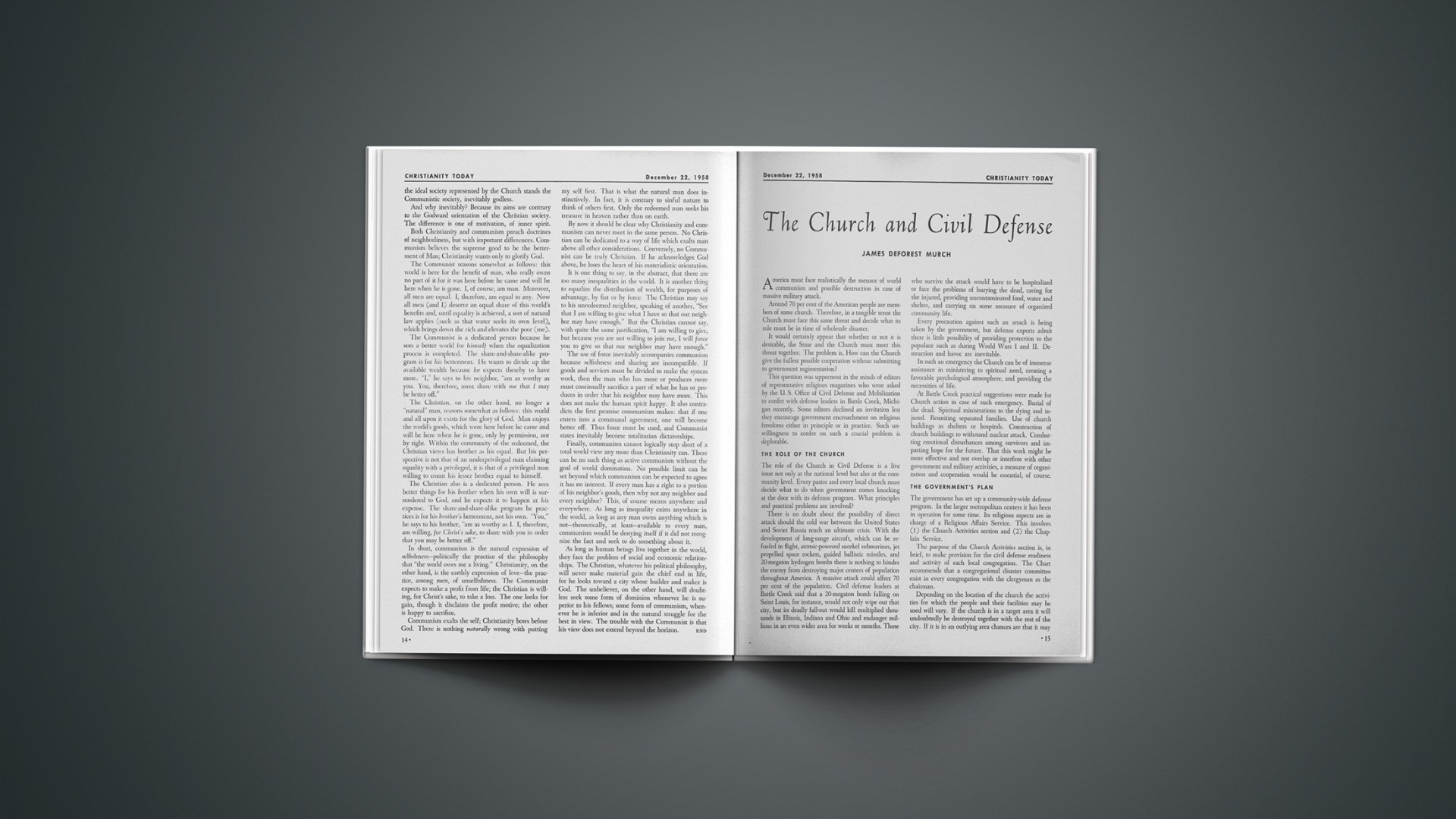
The Church and Civil Defense

America must face realistically the menace of world communism and possible destruction in case of massive military attack.

Around 70 per cent of the American people are members of some church. Therefore, in a tangible sense the Church must face this same threat and decide what its role must be in time of wholesale disaster.

It would certainly appear that whether or not it is desirable, the State and the Church must meet this threat together. The problem is, How can the Church give the fullest possible cooperation without submitting to government regimentation?

This question was uppermost in the minds of editors of representative religious magazines who were asked by the U.S. Office of Civil Defense and Mobilization to confer with defense leaders in Battle Creek, Michigan recently. Some editors declined an invitation lest they encourage government encroachment on religious freedoms either in principle or in practice. Such unwillingness to confer on such a crucial problem is deplorable.

The Role Of The Church

The role of the Church in Civil Defense is a live issue not only at the national level but also at the community level. Every pastor and every local church must decide what to do when government comes knocking at the door with its defense program. What principles and practical problems are involved?

There is no doubt about the possibility of direct attack should the cold war between the United States and Soviet Russia reach an ultimate crisis. With the development of long-range aircraft, which can be refueled in flight, atomic-powered snorkel submarines, jet propelled space rockets, guided ballistic missiles, and 20-megaton hydrogen bombs there is nothing to hinder the enemy from destroying major centers of population throughout America. A massive attack could affect 70 per cent of the population. Civil defense leaders at Battle Creek said that a 20-megaton bomb falling on Saint Louis, for instance, would not only wipe out that city, but its deadly fall-out would kill multiplied thousands in Illinois, Indiana and Ohio and endanger millions in an even wider area for weeks or months. Those who survive the attack would have to be hospitalized or face the problems of burying the dead, caring for the injured, providing uncontaminated food, water and shelter, and carrying on some measure of organized community life.

Every precaution against such an attack is being taken by the government, but defense experts admit there is little possibility of providing protection to the populace such as during World Wars I and II. Destruction and havoc are inevitable.

In such an emergency the Church can be of immense assistance in ministering to spiritual need, creating a favorable psychological atmosphere, and providing the necessities of life.

At Battle Creek practical suggestions were made for Church action in case of such emergency. Burial of the dead. Spiritual ministrations to the dying and injured. Reuniting separated families. Use of church buildings as shelters or hospitals. Construction of church buildings to withstand nuclear attack. Combatting emotional disturbances among survivors and imparting hope for the future. That this work might be more effective and not overlap or interfere with other government and military activities, a measure of organization and cooperation would be essential, of course.

The Government’S Plan

The government has set up a community-wide defense program. In the larger metropolitan centers it has been in operation for some time. Its religious aspects are in charge of a Religious Affairs Service. This involves (1) the Church Activities section and (2) the Chaplain Service.

The purpose of the Church Activities section is, in brief, to make provision for the civil defense readiness and activity of each local congregation. The Chart recommends that a congregational disaster committee exist in every congregation with the clergyman as the chairman.

Depending on the location of the church the activities for which the people and their facilities may be used will vary. If the church is in a target area it will undoubtedly be destroyed together with the rest of the city. If it is in an outlying area chances are that it may survive. The building may then serve as a shelter against radioactive fallout, and/or lodging and medical care. It is recommended that members of the congregation be in charge of services rendered within their facilities. There is to be a supervisor of Personnel Safety. This means that plans will be made for the care of people gathered in the church building at the time of an attack. It may mean teaching and training the members of the congregation and members of the Sunday School to participate in an orderly evacuation. It may mean training in going to the safest place of refuge within the building in case of an attack. It will also mean first-aid training.

The congregational plan is to include provisions for Training and Education. Much of this will be carried on under the direction of the minister who is best suited to give the congregation moral and spiritual understanding of the dangers that confront the nation. It may include instruction of lay people to help the minister in the discharge of his pastoral duties. It would also imply training in home protection, so that members of the congregation will learn through their church how to sustain themselves, not only physically, but also morally and spiritually in time of disaster.

Whereas the Church Activities branch or division of the Religious Affairs Service may be occupied both in the pre-attack, that is, in the preparatory period, and in the post-attack phase, the Civil Defense Chaplain service is designed for action only after a disaster has struck. Obviously the organization of this plan and training for it, the gathering of equipment and other needs, will have to take place before an attack, if the plan is to be operational after an attack.

The Civil Defense Chaplain Service is a plan in which clergymen will have freedom in the exercise of their ministry in time of a disaster. This does not imply that a clergyman not in the Civil Defense Chaplain Service will be prevented from the exercise of his ministry, but it means that an organized plan will be of assistance to clergymen so that they will be provided with access to areas, with identification and transportation, with communication facilities, and generally will know where to go and what to do in order to render the most effective ministry to the most people.

By means of a process which the local clergymen may work out to suit themselves, one of the local clergymen will be designated as the Chief of the Chaplain Service. This will be done on a rotation basis or some other way satisfactory to the local clergy.

Congregational worship will have to be planned. In some cases this might be arranged jointly between certain denominations. In other cases separate denominational services will need to be set up. It may be that members of a certain faith will move into an area where there is no corresponding church building. Provision will be made for public worship for all people.

The Office of Civil Defense and Mobilization is aware that the government is treading on dangerous ground here. Its leaders are quick to disclaim any federal desire to regiment or control the churches. They say the sanctity of the churches is to be preserved. They insist that no activity is to interfere with the distinctive spiritual ministry of any sect or denomination. To avoid any semblance of State authority over the Church, each community is to set up its own Religious Affairs Service in a completely democratic manner. Generally the Civil Defense Director will contact the “leading clergymen,” discuss the need with them. Then these clergymen will call together all the clergy of the community and “ask them whether they wish to render a service.” If they decide they “wish to participate” in an emergency program “alongside the government” they can then “decide on a form of organization.” An Executive Committee would then choose a Religious Affairs Chief. Then comes the implementation of the organization chart furnished by the OCDM. The Church Activities Branch of the Religious Affairs Service is then set up with its Chaplains and a Chief of Chaplains. The program has been worked out in great detail and if successfully implemented requires immediate action in setting up numerous meetings for educational and operational study.

There should be no question as to the deep concern of the Church both for the Nation and for every person in it in times of crisis as well as in peacetime. The Church is primarily concerned with life—the saving of life for eternity and the guarding, guiding and comforting of all mankind. Long before there was any Civil Defense program the Church was at work for the amelioration of the ills of mankind. It will not be found wanting now.

Yet it is easy to understand how the suspicious Protestant can visualize grave dangers which might arise from the type of collaboration of Church and State proposed by the OCDM. We need to face these possibilities frankly.

Protestant Fears

The educational and propaganda features of the program early came under fire from the national Baptist Joint Committee on Public Affairs. Said these Baptist leaders, “As loyal American citizens we share with the Federal Civil Defense Administration in its concern for adequate preparedness for national emergencies. However, we believe it is the function of the churches in their own way to provide ideological and spiritual instruction for their members. We believe that the churches have done and will continue to do an efficient work in informing their people of the evils of atheism, materialistic philosophies and other ideologies that are inimical to our religious heritage and American way of life. This function should remain with the churches and should not become a function of government.” A large sector of American Protestantism would agree with this pronouncement.

There are forces at work in America favorable to the union of Church and State. Protestants are irrevocably committed to the absolute separation of Church and State and wrote that principle into the Bill of Rights in the Constitution. Many have envisioned the possibility that a Roman Catholic priest might be made the head of the local, regional or national Civil Defense set up, and that he might exercise undue authority over Protestant pastors and churches or make emergency rulings which would limit in some way the free exercise of their religious freedoms. These critics also foresee that amicable relations with such a Civil Defense officer in peacetime might psychologically encourage a weakness toward the strict American Protestant doctrine of the separation of Church and State.

Also in the Church-State field is a growing fear of “big government” intrusion in religious affairs. There is now scarcely any area of life upon which government does not encroach in some way or other. Religion has hitherto successfully resisted penetration. Would a “permanent emergency” government program such as Civil Defense proposes eventually result in a community social life virtually controlled by welfare agencies of the government? Would the churches later be told what was legal for them to do in other areas of community life?

Promoters of world peace are disturbed. These not only include the Quakers, the Mennonites and the pacifists in the larger Protestant denominations but thousands of others who are stout for “defense.” There is quite general agreement that the Church should work for “peace in our time” just as the Hebrew prophets did for peace in their time. This strong element in Protestantism fears organized governmental propaganda spreading rumors of war, inducing a war psychosis, and constantly emphasizing horror, death, and destruction. These advocates of peace fear that the Civil Defense program might so regiment our minds and our activities as to destroy our will to peace.

The Higher Strategy

Certainly the Church should face the present crisis with a much more constructive and optimistic program than that commonly envisioned by the OCDM. Many churchmen, while believing that the picture the OCDM paints concerning impending debacle is fully justified, think there is another face to the program. This group of leaders feels that the Kremlin has no desire to reduce America to an atomic wasteland. They believe the Red dictators are more interested in infiltrating our institutions with Communist doctrine, weakening our morale and engineering a political coup d’etat which would deliver them an America that is an economically and socially “going concern.” These observers think the Church can better employ itself in fighting the atheistic Marxist philosophy of communism. Not only democratic government, the highest form of political order offering the greatest degree of individual and group freedom which guards the right of all, but religion itself is challenged by a godless, totalitarian tyranny. The Church must of necessity enlighten its own constituency concerning the Red threat. It should also seek to enlighten all our citizenry concerning the reality of God and obedience to His revealed will as essential to the preservation of their freedoms. This is the kind of Civil Defense in which the Church can major and might well prevent debacle.

All true Protestants would unite in declaring that the Church’s supreme business is to declare the gospel of our Lord Jesus Christ. This imperative takes precedence over propaganda against communism and over any government program of Civil Defense. The impact of the Gospel alone expressing itself through twice-born men in our society can do more to challenge the forces of evil than any strategy devised by men.

Time For Action

So goes the discussion whenever and wherever this Civil Defense problem is raised in the churches. Still the urgency of an effective government program is overwhelmingly apparent not only in case of war but in devastating disasters such as earthquakes, floods, hurricanes and fires. Protestants might argue until doomsday and be totally unprepared to do their Christian duty to God and humanity. Something must be done now.

It is my conviction that we should willingly respond to the call of the Religious Affairs Office of the OCDM and go as far as we can in good conscience to cooperate in our national defense program. I believe we can have faith in the personnel in charge. On the other hand the Church must be true to her calling and preserve her freedoms under the Constitution. She must be alert to detect any loophole or “small print” that would weaken her strong position in American life unhampered by government regimentation. It would appear that the OCDM’s current proposals in the field of Religious Affairs should remain under study and discussion until proper safeguards against evident dangers have been provided.

America must never allow her fears to be the means of her enslavement. In civil defense, as well as in all crisis problems which face us, we need to do a great deal of sound and balanced thinking if our freedoms are to be preserved.

END

Why Communism Is Godless

To most Americans today the word “communism” suggests all manner of evil. You need but whisper, “He is a Communist,” and, if your neighbor believes you, the alleged Communist could next be charged with almost any crime whatever and your neighbor would not be surprised. The Communist has the role of international villain once held by the Fascist, except that the Communist enjoys an even worse reputation. He would rob his own brother blind; he would betray his own parents to the police; he would delight in desecrating churches, for he is an atheist.

Even after making allowances for the excesses of some Communists, most people would indict the Communist philosophy itself for certain basic wrongs. It reduces all men to a common political denominator, it destroys individual initiative and private enterprise, and it takes away the basic freedoms that Western democracies prize. Worst of all, it is godless.

Now there is an interesting combination. How did “godless” get into that line-up? Because, most will say, it belongs there. But why? The other indictments clearly do, of course. Any ideology that seeks to erase all distinctions between men is bound to have a low view of the worth of the individual. Any political system that reduces all its citizens to a common denominator necessarily discourages private enterprise. But why must such a system be godless?

Few people, I dare say, have given much thought to the matter. If we ever notice how often communism shows its atheistic stripe, we probably explain the fact to our satisfaction by saying that it just happened that way: the spread of communism has been controlled by godless men. But, we hasten to add, if the leaders of world-wide communism could be influenced by the Gospel, Western democracies (even if not wholly identical with Christianity) could then co-exist with the disciples of Marx and Lenin. In other words, if the occupants of the Kremlin were Christian, cold war would end.

Such wishful thinking fails to take into account the possibility that the nature of communism may be such that were the leaders of Russia Christians, they could no longer be Communists. What if communism is necessarily godless? What if atheism follows logically upon its ideological premise—or, what if its ideological premise is the natural expression of atheism?

Socially and ethically, Christianity and communism appear deceptively alike. The surface similarity has often been noted, occasionally with confusing results. Not long ago certain enthusiastic patriots entered a hue and cry in the national press, charging that the Sunday School literature of a large denomination was Communistic. The literature in question advocated the sharing of one’s worldly possessions with one’s neighbor as a worthy principle of life.

Now you cannot decide that a literature is Communistic or Christian just because it advocates sharing. It could be either or neither. The point is, however, that some identify the principle of sharing with both.

In this connection, responsible commentators have occasionally taken the experience of the first-century Christians in Jerusalem to indicate that the New Testament Church practiced communism until it found that it could not make it work. But many thoughtful people are not convinced that it could not have been made to work. They find it hard to condemn any philosophy that teaches the support of the weak by the strong, that seeks to eliminate poverty by drawing upon the “haves” on behalf of the “have-nots.”

As the world-wide struggle continues, Christian spokesmen often fail to make their case against communism, and some seem secretly to wonder if the ideological issue is really crucial after all. The agents of the Cominform, meanwhile, reap an increasing harvest of converts.

To an unbeliever, Christianity indeed looks something like communism. He may wonder whether the latter, stripped of world-wide ambitions and controlled by less greedy men, would not be a similar force for good in the world.

But how could that be? If a Christian society reflects the ethics of godliness, then communism reflects the ethics of ungodliness. The Church is the community of the redeemed in Christ Jesus. Opposed to the ideal society represented by the Church stands the Communistic society, inevitably godless.

And why inevitably? Because its aims are contrary to the Godward orientation of the Christian society. The difference is one of motivation, of inner spirit.

Both Christianity and communism preach doctrines of neighborliness, but with important differences. Communism believes the supreme good to be the betterment of Man; Christianity wants only to glorify God.

The Communist reasons somewhat as follows: this world is here for the benefit of man, who really owns no part of it for it was here before he came and will be here when he is gone. I, of course, am man. Moreover, all men are equal. I, therefore, am equal to any. Now all men (and I) deserve an equal share of this world’s benefits and, until equality is achieved, a sort of natural law applies (such as that water seeks its own level), which brings down the rich and elevates the poor (me).

The Communist is a dedicated person because he sees a better world for himself when the equalization process is completed. The share-and-share-alike program is for his betterment. He wants to divide up the available wealth because he expects thereby to have more. “I,” he says to his neighbor, “am as worthy as you. You, therefore, must share with me that I may be better off.”

The Christian, on the other hand, no longer a “natural” man, reasons somewhat as follows: this world and all upon it exists for the glory of God. Man enjoys the world’s goods, which were here before he came and will be here when he is gone, only by permission, not by right. Within the community of the redeemed, the Christian views has brother as his equal. But his perspective is not that of an underprivileged man claiming equality with a privileged, it is that of a privileged man willing to count his lesser brother equal to himself.

The Christian also is a dedicated person. He sees better things for his brother when his own will is surrendered to God, and he expects it to happen at his expense. The share-and-share-alike program he practices is for his brother’s betterment, not his own. “You,” he says to his brother, “are as worthy as I. I, therefore, am willing, for Christ’s sake, to share with you in order that you may be better off.”

In short, communism is the natural expression of selfishness—politically the practice of the philosophy that “the world owes me a living.” Christianity, on the other hand, is the earthly expression of love—the practice, among men, of unselfishness. The Communist expects to make a profit from life; the Christian is willing, for Christ’s sake, to take a loss. The one looks for gain, though it disclaims the profit motive; the other is happy to sacrifice.

Communism exalts the self; Christianity bows before God. There is nothing naturally wrong with putting my self first. That is what the natural man does instinctively. In fact, it is contrary to sinful nature to think of others first. Only the redeemed man seeks his treasure in heaven rather than on earth.

By now it should be clear why Christianity and communism can never meet in the same person. No Christian can be dedicated to a way of life which exalts man above all other considerations. Conversely, no Communist can be truly Christian. If he acknowledges God above, he loses the heart of his materialistic orientation.

It is one thing to say, in the abstract, that there are too many inequalities in the world. It is another thing to equalize the distribution of wealth, for purposes of advantage, by fiat or by force. The Christian may say to his unredeemed neighbor, speaking of another, “See that I am willing to give what I have so that our neighbor may have enough.” But the Christian cannot say, with quite the same justification, “I am willing to give, but because you are not willing to join me, I will force you to give so that our neighbor may have enough.”

The use of force inevitably accompanies communism because selfishness and sharing are incompatible. If goods and services must be divided to make the system work, then the man who has more or produces more must continually sacrifice a part of what he has or produces in order that his neighbor may have more. This does not make the human spirit happy. It also contradicts the first promise communism makes: that if one enters into a communal agreement, one will become better off. Thus force must be used, and Communist states inevitably become totalitarian dictatorships.

Finally, communism cannot logically stop short of a total world view any more than Christianity can. There can be no such thing as active communism without the goal of world domination. No possible limit can be set beyond which communism can be expected to agree it has no interest. If every man has a right to a portion of his neighbor’s goods, then why not any neighbor and every neighbor? This, of course means anywhere and everywhere. As long as inequality exists anywhere in the world, as long as any man owns anything which is not—theoretically, at least—available to every man, communism would be denying itself if it did not recognize the fact and seek to do something about it.

As long as human beings live together in the world, they face the problem of social and economic relationships. The Christian, whatever his political philosophy, will never make material gain the chief end in life, for he looks toward a city whose builder and maker is God. The unbeliever, on the other hand, will doubtless seek some form of dominion whenever he is superior to his fellows; some form of communism, whenever he is inferior and in the natural struggle for the best in view. The trouble with the Communist is that his view does not extend beyond the horizon.

END

G. Aiken Taylor is Minister of the First Presbyterian Church of Alexandria, Louisiana. He holds the Ph.D. degree from Duke University. He is author of A Sober Faith, Religion and Alcoholics Anonymous, and St. Luke’s Life of Jesus.

Cover Story

The Challenge of Islam

One of the greatest challenges to the spread of the Gospel in the world today is presented by Islam. In a huge stretch of the world’s surface from Morocco in the west to the Far East and going north into Central Asia and south into large parts of Africa and Southeast Asia, the predominating section of the population in many different countries is Moslem. Many of these lands are ruled by Islamic governments, and some of them are entirely closed to Christian missions, such as Afghanistan and Saudi Arabia. Then there are large numbers of Moslems in America and in European countries like England and France. The total number of Moslems in the world today is said to be about 400 million.

In some parts of Africa Christian missions have made a great impact upon paganism, and within a comparatively few years large numbers have become converts, some of whom now are African pastors and Christian teachers. But in Moslem lands there seem to be little or no progress. And for that reason, missionary work for Moslems does not arouse the enthusiasm among Christian people that it should, nor call forth satisfactory support for it.

Moreover, it is well-known that Islam is making far more converts in Africa than is Christianity, and it is spreading rapidly, not only there but in other lands as well. Large numbers of Moslem missionaries, many of them trained in the University of Al Azhar in Cairo, are entering Africa for this purpose. Egypt has, as a definite aim, the establishment of Moslem and Arab domination over the African continent, and its emissaries are seeking to persuade Africans that in order to enjoy political freedom, Christianity (the religion of the ruling races) must be destroyed.

The Moslem Resistance

It may be asked why the people of Islam have been so hard to win for Christ. There are several reasons. In the first place we find that Islam is the only religion which presents a definite theological barrier in the teachings of the Koran to the teachings of Christianity. That is, the preaching of the gospel of Christ at once meets with opposition because the ideas therein run contrary to statements in the Koran. Islam’s uncompromising attitude to the unity of God makes the doctrine of the Trinity unacceptable. And its denial of the reality of the death of Christ on the cross causes rejection of the Atonement. There is also a firm adherence to the inspiration of the Koran as being God’s last word to man dictated to the Prophet Mohammed, and this, of course, makes for rejection of any teaching or statements in the Bible which do not agree with the Koran.

A second reason why converts from Islam are so few is this: there is a law regarding apostasy from that religion which makes any action of this kind an offense incurring the death penalty. Even in countries where this may not be the law, any convert to Christianity is in danger of his life, and is liable to suffer the loss of his possessions and separation from his home and family. Indeed, a convert has to take up his cross in order to follow Christ.

Nowadays a third reason for the difficulty is the close connection between the growth of nationalism and religion. Islam is looked upon as a national culture, Christianity is looked upon as a “Western religion”; and the preaching of the Gospel to Moslems is taken as an attempt to bring them under the domination of “Western imperialism.”

An editorial in a Singapore newspaper said that the purpose of missionary education was “to educate the natives to accept Western ideas and the Christian faith so that they would be more amenable to the white men’s rule.” The closing paragraph presented a significant challenge: “Can the Christian Church in Asian lands, immersed in Western ways and ideas, compete with the traditional Eastern faiths? Can it overcome Asian prejudice against the Western way of doing things? Or will Christianity in time retreat with the receding tide of Western imperialism from Asia?”

The answer to these questions depends on whether the Church is ready to follow its Lord wholeheartedly, and willing to take up the Cross in order to do so, or whether it will continue to be the lukewarm, flabby affair that it often seems to be—the majority of members being merely nominal or half-hearted Christians.

We must consider certain factors which are helping to make Islam more easily accepted by pagan peoples than Christianity. Wherever the Moslem trader or teacher goes, he takes his religion with him, and his ways of living are much nearer to the people of the East than are the ways of Westerners. He mixes freely with them and probably takes a wife from among them, and he is not hindered by the fact that he may have another wife (or wives) in other places. His children become Moslems, and Islam gives to its converts in the end a higher social prestige than does paganism. Also it does not make such exacting moral demands as Christianity; polygamy, one of the stumbling blocks making it difficult for a pagan to become a Christian, is still allowed. Moreover, Islam is a world-wide brotherhood into which men of all races and classes are admitted. Too often business and professional people from the West, even when they profess to be Christians, not only fail to do anything to evangelize the people with whom they come to live, but are even hostile to missionary efforts; and a barrier of culture arises keeping them aloof from indigenous Christians and non-Christians.

The Duty To Evangelize

Are we, because of all these difficulties and so much opposition, to give up the attempt to evangelize the Moslems? Many Christians, at least nominal ones, seem to think so. But we cannot exclude the people of Islam from the Commission given by our Lord to preach the Gospel to every creature and make disciples.

Let us remember that along with all the obstacles and hostility which we have mentioned, tremendous changes are nonetheless taking place today in the world of Islam. It has come into contact with movements which are at work everywhere today—i.e., secularism, materialism, communism, scientific and technological developments—and these have had a far-reaching influence in breaking down the ancient ideals of Islam. Educated Moslems are finding it hard to reconcile these new ideas with the dogmatic creed of their forefathers, and they are making frantic efforts to reinterpret Islam so as to bring it into accord with present-day conditions. But while realizing the necessity of adapting their civilization to modern ways, they are far from being willing to accept at large Western ideas and certainly not Western domination.

How does this situation affect the task of evangelizing the people of Islam? First of all, it should be said that missionary work among Moslems has not been such a failure as many people are apt to think.

Some Positive Gains

There is, to begin with, the general influence of Christianity. Without a willingness to acknowledge it, native contact with Christian ideals and the reading of the Scriptures have changed Moslem attitudes about many things. The kind of Islam which is being advocated by those seeking to reinterpret it would be almost unrecognizable by early Moslems, and surprisingly close to the Christian outlook. Lives of Mohammed are actually written in terms of Christian moral standards.

The influence of Christian ideals is most marked in connection with the position now accorded to women. Some modern apologists for Islam claim that though the Koran permitted a man to have four wives, it was on the condition that they should all be treated alike, and as this is not possible, it amounts to a virtual prohibition of more than one. In Pakistan an association of Moslem women has been formed to protect the rights of women. Strong objections have been put forward by association members to a prominent politician who is taking as a second wife a young lady who was his secretary. They said that they did not oppose the Moslem law about polygamy, but that a second wife should be taken only in very special circumstances.

In Tunisia, reforms pertaining to the personal status of Moslems became effective January 1, 1957. Among them was the abolition of polygamy, restrictions on divorce, and the institution of a minimum age for marriage. Women were granted the franchise at 20 years of age on condition that as the symbol of their emancipation they abandon the veil and be allowed to vote, which they did in May, 1957.

These are only illustrations of what is taking place today in many Moslem lands. They could be multiplied. It is important to note, however, that this does not mean the changed outlook has been the direct result of Christian teaching. Rather, it has been a contact with Christian ideals.

Apart from this general influence, we may think of the particular influence of the gospel of Christ in the lives of some of the people. In every field where Christian missions have been at work, there are known to be many persons who, though outwardly still Moslem, are secret believers in the Christian faith. We cannot wonder at their hesitation to take the step of open confession and baptism when we realize the tremendous cost involved. In the case of women, even if they become convinced of the truth and trust in Christ, it is in almost every case impossible for them to leave their husbands and their children. Let us not blame these secret believers before we have asked ourselves what it has ever cost us to follow Christ?

There are, however, in every field of Christian work among Moslems a few who have been ready to take their stand openly as followers of Christ, and in nearly every case they have had to suffer greatly for it. All the efforts of mission work have been worthwhile for the sake of these heroic souls, the forerunners, we believe, of many more yet to follow.

Let us, then, not become fainthearted in the task of bringing the gospel of Christ to the people of Islam, but rather, seek to approach it with new zeal and devotion. We need to ask ourselves how best we may do this in the times in which we live.

Toward A New Day

First of all, it is necessary that we obtain the interest of the whole Church in this enterprise. It has too often been left to the few enthusiasts. Our primary task is that we enlist the prayers of all Christians for the support of those engaged in this ministry.

Then there must be the witness of Christian lives who come in contact with the Moslems. Unless they see Christ in us, how can we expect them to believe in his power to save? Those who come from Western lands are very apt to have a superiority complex in their attitude toward African and Asian people. Often this is an unconscious attitude, but in these days of intense nationalism, it is certainly a great hindrance to any acceptance of the Christian message.

The ways of life of Western people are so different from those among whom they go that, though they might be living quite simply according to their own standards, such ordinary habits appear luxurious in the eyes of peoples of Africa and Asia. Today the work of evangelizing ought to be done more by Christians belonging to those countries. Yet, where missionaries from the West are still in demand, there needs to be a breaking down of barriers between them and their national fellow-workers and those among whom they work. This means that we must be ready to live in accordance with the ways of the people with whom we are working as far as possible without injury to health. A missionary who arrives equipped with a station wagon, a public address system, an electric refrigerator and other such gadgets seems to be enormously wealthy, and at once this creates a barrier between him and his national colleagues, and he is suspected by the people of the country as being “an agent of imperialism.”

Many of our younger missionaries (all honor to them) are facing up to these problems and are trying to lessen the barriers. If we are to bring the gospel of Christ to the Moslems and other non-Christians, we must be ready to follow in the steps of our Lord, who said, “If any man will come after me, let him deny himself, and take up his cross daily and follow me.”

We believe the day is coming when every knee shall bow and every tongue shall confess that Jesus Christ is Lord to the glory of God the Father. And if we are to be co-workers with him in hastening the day when that shall be, we must be ready to take up the cross and follow him. If this is the requisite in connection with all Christian work, it is especially so as we face the challenge of Islam.

END

Frank E. Keay was ordained a clergyman of the Church of England in 1908. He went to India that same year under the Church Missionary Society and was stationed at Jubbulpore as Principal of the Mission High School until 1922. His service in India terminated in 1957. He now lives with Mrs. Keay in a home for retired clergy and their wives in Worthing, England. He holds the B.A., M.A. and D.Litt. from London University and has written several books.

Cover Story

Missions in South Africa

The tense racial situation in South Africa is making front page news in almost every part of the globe. And the reason is that in this land of sunshine and plenty, the racial pattern is more complicated and clear-cut solutions are more difficult to visualize than at anywhere else on earth.

The world often hears of South Africa’s color problems. It hears less of the rising tide of Christian missions in this vast land between the Limpopo river of the North and the majestic Table Mountain of the South.

During the past 150 years, and especially in the course of the twentieth century, missionaries from all parts of the world have found their way to southern Africa. In the growing cities and in the lonely veld, messengers of the Cross have brought the good news of God’s love for a lost world and his forgiveness in Christ Jesus.

These missionaries have come from many lands—from Europe, the British Isles, and North America. And as is the case in India, China, or Japan, they represent many different denominations. One-third of all missionaries in South Africa are from the United States and Canada.

Today about 60 per cent of the million Bantu (African) population of South Africa belong to some Christian group or church. Some of these churches are truly indigenous, some even semi-Christian, others more or less true replicas of some continental English or American church. In their theology they cover the whole wide field from extreme orthodoxy to extreme liberalism. Most of the main South African churches however fall within the conservative evangelistic tradition with a tendency among some towards fundamentalism. More than 700,000 Africans belong to separatist groups usually under African leadership and some of them are Christian only by name and by association.

The South African branches (among whites) of most continental churches tend to be more conservative than the European mother churches.

Of the less than 3 million white people in South Africa only five per cent belong to the Roman Catholic church. Less than five per cent are of Jewish descent, and probably 70 per cent belong to some Protestant body.

Most of the Afrikaans speaking community of one and three-fourths million, descendents of Dutch Protestants and French Huguenots, belong to one of the three Dutch Reformed denominations, all doctrinally conservative bodies. They constitute the original white inhabitants of the country. The rest of the white population are Anglicans, Methodists, Presbyterians, Baptists, Lutherans, and Congregationalists.

Patterns Of Alignment

All these denominations and many more have formed branches of their own church among the native inhabitants of the land. The result constitutes an almost fantastic pattern—a classic example of Protestant division.

While most English and Continental churches or missionary bodies are drawn together in the South African Christian Council, the Afrikaans churches, whose membership constitutes more than one half of the total white population, are not members. The two main Dutch Reformed denominations are, however, linked to the World Council of Churches and the Presbyterian Alliance. The third, and extremely conservative body, has never seen its way open to join the World Council. Against this background of evangelistic zeal but Protestant brokenness and division, the position of the Roman Catholic church and its vast and growing missionary program must be seen.

Rome is making a supreme effort to win the religious loyalty of the South African Bantus. Vast sums of money have been poured into buildings and institutions in all parts of southern Africa.

In 1956 the three Afrikaans churches had 54 per cent of the total white population within the Union of South Africa. But only about 250,000 African Christians belonged to these churches (i.e. less than four per cent of the African Christian community).

To the Methodists belong the honor of the most successful of all Christian bodies in evangelizing the South African Bantus. Though the Methodist church only has a following of eight per cent among the white population, they have more than a million members among Africans! Much personnel is from overseas.

To give a more complete picture of the overall situation, these are the figures: Among the whites in South Africa, the three Afrikaans churches (Dutch Reformed) have a following of 54 per cent, the Anglicans 16 per cent, the Methodists eight per cent and the Roman Catholics five per cent.

When we face the position among Bantu (African) Christians, the position is very different. Of the total Bantu Christian community, the Methodists count 14 per cent, the Anglicans 7 per cent, the Roman Catholic church 5 per cent, the Afrikaans (Dutch Reformed) 3.5 per cent, while some 40 per cent are pagans.

As a result of the vast and far-flung missionary programs of the different churches and missionary bodies, Africans today constitute 55 per cent of the total Christian community in South Africa, while the whites only constitute 31 per cent and the “Cape” colored community 14 per cent.

The Roman Thrust

During the past 50 years, however, the Roman Catholic church has made great inroads and poured more and more workers and funds into the South African field. To illustrate this, we quote the relative number of workers and the relative growth in Roman Catholic and Protestant church membership among Africans.

If we take 100 as the number of Protestant missionaries in 1911, the number had grown to 258 in 1951, an increase of 18 per cent in 40 years.

But if we take 100 as the number of Roman Catholic missionaries in 1911, the number had grown to 1388 in 1951, an increase of 1288 per cent!

The same pattern is revealed in the relative growth in church membership among the Africans.

If we again take 100 as the number of Protestant members in 1911, the number had grown to 280 by 1951. But the membership of the Roman Catholic church had grown from 100 to 1140!

In fairness to the Dutch Reformed churches, it must be pointed out that in contrast to all other churches they raise their total personnel and all their own funds in South Africa; whereas the other churches including the Roman Catholics get most of their missionary personnel as well as funds from overseas. (Of the missionaries in South Africa, 21 per cent are South African while 69 per cent come from other lands.)

It must be said for Rome, however, that while 73 per cent of all their missionary workers come from overseas, the local Roman Catholic community far outstrips the Protestant community in the per capita percentage of missionaries raised from its own local ranks.

The Roman Catholics have in their missionary strategy concentrated on language efficiency. The result has been that whereas only 68 per cent of all Protestant missionaries are able to bring the Gospel in the language of the specific African group with whom they work, the Roman Catholic church demands that every missionary sent out to work among Africans must be conversant in their language. I believe this marks an extremely important factor. Protestants have taken note of it, however. We realize that work done through interpreters can not reach the roots of life and bring the Gospel home in the most effective way.

If we want to appreciate the overall picture of missions in this part of the world, two other factors must be considered: (1) the position of Basutuland, and (2) the remarkable resurgence of missionary activity in the Dutch Reformed churches.

As far as Basutuland, the British Protectorate centering on the fastnesses of the great Drakensberg range (Dragon Mountain), is concerned, we must point out that geographically it is the heart-land of South Africa. Strategically it is extremely important from a missionary point of view. From the Protestant side, the French have concentrated on this area for about 100 years, and they have made steady progress. But during the last decades Rome has made great headway in Basutuland, and through educational and other channels it is steadily obtaining a stranglehold on this people, although the French Protestants probably still hold a slight numerical advantage. As the situation develops there is real concern among evangelicals that the French may not be able to hold their own. This will be a great setback for the evangelical cause in southern Africa.

The other important factor is the new missionary spirit in the Dutch Reformed group of churches. The main branch (The Nederduitse Gereformeerde Kerk) has always had a strong missionary program, but until a short while ago the other two Dutch Reformed churches had no missions. The situation is changing rapidly as both these denominations and especially the Gereformeerde Kerk enter the South African field.

All these churches are working in the closest cooperation with the government (many think too close); and they are starting out on new ventures in evangelism and hospitalization especially. The changing picture reveals the following facts:

Whereas the main Dutch Reformed body, die Nederduitse Gereformeerde Kerk, had 25 hospitals in all of Africa in 1956, 20 new hospitals have been opened since or are being built or planned for the Union of South Africa alone.

As far as manpower is concerned, there has been a real upsurge. Many young men, among them some of our best trained theologians, have become missionaries. Every month stations or preaching posts are opened.

The Dutch Reformed church has also launched a fund for literature for the African. The target is 3 million pounds (about 9 million dollars), and already close to one million dollars is in hand.

There is no cause for alarm providing Protestant churches perform their duty. Hopeful signs exist that evangelicals are facing up to the challenge of the hour.

END

Ben J. Marais is Professor of the history of Christianity in the University of Pretoria, South Africa. He is a minister of the Dutch Reformed Church of South Africa. Some of his graduate study was pursued at Princeton and Yale. Of his writings, mostly in Afrikaans, some have been translated into English. Among these is Colour—Unsolved Problem of the West.

Cover Story

The Religious Situation in Israel

Israel is celebrating her tenth anniversary of independence. In spite of handicaps, the little state has made phenomenal progress in the last decade. The population has almost trebled. In a Massachusetts-size area, Israel has managed to settle more than a million Jews since 1948, and most of these have been survivors of the Nazi holocaust, refugees from Arab countries, and immigrants from Eastern Europe.

It is true that half of the country is desert-like. Fewer than two per cent of the immigrants have had any agricultural experience, over half lack vocational or professional training, many are without means, and the problem of receiving and absorbing so many people from 70 countries that differ in language, culture, and tradition has presented a challenge. Great strides have been taken to alleviate a number of these difficulties.

For instance, Hebrew has become the national language, diversified industry has come into production. Oil has been discovered in limited quantities, and local agriculture is coming to provide 60 per cent of the nation’s needs. All these developments are the fruition of scientific research. With a spirit of sacrifice and hard work, rarely seen elsewhere in our day, Israel has arrived at her tenth anniversary with great credit.

Concomitant with statehood and progress in the secular field, however, has been the vexing question of what role religion would play in the state. Contrary to the prodigious changes sociologically and economically, religion has remained static and reminiscent of that in the East European ghetto.

Theodor Herzl, nineteenth century journalist, and the late Dr. Chaim Weizmann, chemist and statesman, had much to do with the actual founding of the Jewish state. Both felt that religion would have an important place in it, but both abhorred the idea of a theocracy. They therefore espoused separation of religion and state. Dr. Weizmann’s view was that whereas the state would treat with the highest respect the true religious feelings of the community, it could not put the clock back by making religion the cardinal rule of conduct.

Religious Political Parties

Israel has achieved only partially the goal of religious separation from state. Four Orthodox religious, political parties exist to bar this: the Mizrachi, the Hapoel Hamizrachi, the Agudat Israel, and the Poalei Agudat Israel. The Agudat Israel Party, for example, is militantly orthodox and aggressive in its opposition to secularism. Besides fighting against such things as the sale of pork and the raising of pigs, it opposes a written constitution on the grounds that the Torah (the Pentateuch) is the law of the Jewish people. At the same time, it proposes religious education supported by public funds, and a law prohibiting all nonreligious activity on the Sabbath, including the operation of transport facilities. This determination to enforce strict public observance of the Sabbath has led to unseemly Sabbath demonstrations and violence.

In addition to these obstacles, Orthodox religious leaders have been hostile to the Jewish Reform movement, regarding it as nothing but a transitory stage between diluted Judaism and Christianity. They took every step to prohibit recently a postgraduate school of archaeology in Jerusalem, sponsored by Dr. Nelson Glueck of Hebrew Union College, Cincinnati. And the efforts of the Orthodox faction in the Jerusalem Municipal Council to block a construction permit were largely overridden because of Prime Minister Ben Gurion’s intervention. At the same time, an Israeli editorial pointed out that religion had become a political plaything, appearing not as a moral movement aflame with ideals and plans of action for social justice and reform, but as a subject of political party interests.

A spokesman for the government, replying to an inquiry from a Reform Synagogue in New Orleans, pointed out that it seemed incomprehensible that the very group of persons having suffered throughout the ages from intolerance should exhibit such extreme intolerance themselves. However, he noted that the Jews had made great strides in a comparatively short time in building a free society among people of diverse backgrounds. He did not wish anyone to feel that such intolerance was widespread or tacitly accepted by everyone in Israel. Mr. Ben Gurion summed up the religious-political situation by observing that the trouble lay in religion’s mixing with politics, a situation opposed to all reason. Religious immunities were being asked for political parties.

There is one important fact in all this. “Nationality” in the Middle East is identical with religion. The time-hardened pluralistic society of the area has not provided congenial soil for the transplanting of Western political institutions. The separation of Church and State in Western democracies, the belief that religion is the personal concern of the individual, and the idea that the religious group is nothing more than a non-political association are alien concepts to Middle Easterners, whether they be Jew, Muslum, or Christian. These people do not, and within the region’s social system cannot, distinguish between religion and nationality. An Israeli newspaper editorialized recently that a Jew who adopts another faith in Israel cuts himself off from participation in the life and joint purposes of the Jewish nation, losing his nationality together with his religion.

Earlier Middle Eastern history helps to explain this situation. As a Muslim state, the Ottoman empire adapted the prevailing Islamic administrative practices to its own purposes. The Sharia, or Muslim canon law, was inclusive and regulated political and social, as well as religious, matters. This law was applicable to Muslims alone; therefore, Christians and Jews under Ottoman rule were allowed to arrange their own internal community affairs. The religious courts of the various communities (Turkish: millet, Arabic: millah, meaning “creed” and/or “people,” in the sense of a distinct ethnic group, by the nineteenth century—“nation” and “nationality”) had jurisdiction in matters of personal status such as marriage, divorce, alimony, guardianship, testaments, and the like. The British during the Mandate in Palestine continued this religious judicial system, as did the new Jewish State. Thus modern Israel still conforms to the Middle East norm. Under the present millet system, intermarriage between Jew, Muslim, and Christian is impossible, for there is no civil marriage and all such matters are under the jurisdiction of the religious hierarchy.

Time magazine recently related a poignant result of the millet system. A young boy died in Israel. Burial was refused by the rabbi on the grounds that technically he was not Jewish (the father had married a Gentile girl in Poland before immigrating to Israel). A Roman Catholic priest refused burial because the boy had not been baptized. After days of wrangling, the body was buried in a Jewish cemetery, but with a fence separating his grave from the others. The fence shortly “disappeared,” demonstrating the strong feelings of many Israelis.

Restriction Of Freedom

Israel is sincere in stating that there is freedom of religion and conscience in Israel, but this is interpreted as freedom within each millet. Thus in Israel, the Protestant concept of freedom to preach, teach, and catechise, and the right of any individual to convert freely from one faith to another is frowned upon. Missionary work among the Arabs of Israel has been relatively free from interference, but this is not true in the Jewish field. Organizations have been formed to combat Christian activities among the Jews; and through various pressures of personal, social and economic nature, life is extremely difficult for a Jewish convert to Christianity in Israel. Consequently, there are Israeli Jews who secretly are believers or in sympathy with the Christian faith, but are fearful of open proclamation.

At the present time, there are approximately 50,000 nominal Christians in Israel, divided up among the nine recognized Christian millets—such as the Greek Orthodox, the Maronite, and the Roman Catholic. Protestants, arriving late on the scene, do not have recognized millet status. However, some groups are allowed to perform certain personal status functions such as marriage. A few of the Protestant groups (using the term broadly) would accept millet recognition if the government should grant it, but most are unwilling to sacrifice the principles of complete religious freedom, or to take over civil court functions.

Officially, the government’s treatment of Protestant missionaries and congregations has been quite proper. However, it has been difficult for many groups to obtain visas for new workers or for present Christian workers to continue the renewal of their visas. Independent missionaries or those representing small denominations have found it very difficult to remain in Israel, or to return to Israel after a furlough. By misrepresenting their purpose for coming to Israel, some of these brought about their own difficulties.

In dealing with this little land, one must keep in mind that 10 years is a brief period. In evaluating the Israeli and his attitudes toward Christianity, one must recognize that the Jew has formed his opinion of Christianity over a long period of time in the crucible of suffering at the hands of so-called “Christians” in Europe. The fact that the Jews have been banned at one time from living in France, Spain, and England, tortured and killed in the Spanish Inquisition, bound to the ghetto and penuary, and slaughtered by German soldiers contributes to an almost insurmountable barrier between Christianity and Judaism.

The words “Gentile” and “Christian” are synonymous to the average Jew as he thinks of Americans and Europeans. Consequently, he judges Christianity in the light of Gentile behavior. Moreover, anti-Semitism and intolerance are not lost arts to many “devout” Christians.

Israel is struggling today for her very survival. Surrounded on all sides, except for 177 miles of sea-coast, by countries that have vowed to exterminate her and her people, Israel can little afford to favor any factor which may bring dissension among her people. But the exercise of genuine Christian charity, patience, and sympathy on the part of Protestants will nonetheless be effective as Israel faces the uncertain future.

END

Paul Rowden has served the Southern Baptist Convention as foreign missionary to Israel since his appointment in 1952. He holds the A.B. degree from Emory University, B.D. from New Orleans Baptist Theological Seminary, and is currently enrolled at Dropsie College in Philadelphia in graduate study.

Cover Story

Tomorrow’s Task in Latin America

Sidney James Wells Clark, for many years intimately connected with the World Dominion Movement, has been described as “the man who saw the truth about Foreign Missions.” One of the guiding principles which he laid down was to the effect that the work being done had always to be carried out in the light of the work to be done. The unfinished task of tomorrow, he insisted, should always determine the activity of today. He defined and advocated the doctrine “that all missionary work ought to be done with ‘the Big End’ always in view, directed consciously to that end, and that whatever was done which did not assist directly to advance that end was wrongly conceived” (Roland Allen, Sidney James Wells Clark—A Vision of Foreign Missions, The World Dominion Press, London, 1937, p. 54). Time and the judgment of God upon missions in the Orient would seem to have vindicated his views.

We are entering into a new era in Latin America. Profound changes are taking place. The consciousness of these new directions invades all our missionary thinking even as it also lies near the surface of the growing self-consciousness of the Latin American evangelical church. The bearing of this upon the missionary movement is of particular concern to those of us who serve in Latin America, because in this particular area the world’s social and technological revolution is taking place amidst a population that is increasing two and a half times faster than the rest of the world.

We do not know what this will mean to us in terms of scientific advance, military and political alignments, economic conditions, and religious pressures. But in terms of evangelism, should the Lord tarry, it means that where today we are seeking to reach approximately 175 million souls, tomorrow—a mere 20 years from now—we will be dealing with 420 million! And the day after tomorrow, 550 million! We are faced with a job that is larger than ever—and more complicated. It involves a much greater number of organizations and agencies, new media and new techniques, specialized ministries and operations. Tomorrow’s task of evangelism, with all the follow-up it properly implies, must be carried out on a scale commensurate with the giant growth and radical changes that are taking place.

How, in the face of such an enormous task, are we going to fulfill the Great Commission effectively?

That is why Clark’s thoughts regarding missions are so important to us today. When we consider that of the total missionary forces in Latin America, 56 per cent belong to the Evangelical Foreign Missions Association and the Interdenominational Foreign Missions Association, and that approximately 75 per cent belong to what might be called the evangelical or fundamentalist wing of the Protestant Church, we must recognize the serious responsibility that weighs upon us.

Given this preponderance of evangelical forces, the future of Latin American Protestantism may well rest in our hands. What we are and what we do now will have enormous effect upon the Church there tomorrow. That is why it is so vitally important that tomorrow’s evangelical task be conceived and executed according to wise and scriptural principles in practical reference to “the Big End.”

Tomorrow’S Task

Evangelicals agree in affirming that the goal of missions is an effective gospel witness among all peoples that shall extend the Church of Christ, through which God’s saving grace is to be made known to every creature, in every part of the earth.

This is all easily stated and serves as the basis for all public pronouncements as to mission goals and promotion. There seems to be no ignorance or confusion as to the ultimate aim. The trouble is—as many students of missions have pointed out—that most missionaries and most societies are so engrossed with the mechanics and the daily routine of the work immediately at hand—the program of their own particular group—that the long range goals are lost sight of.

This becomes specially apparent when we break down the continent into national areas and examine the work being done in each. It becomes apparent that no coordinated effort is underway by the evangelical forces resident in the territory to complete the Commission in their area. Twenty-five, fifty and in some cases seventy-five or a hundred years have gone by, and following initial waves of advance, their chief energies are now directed toward carrying on the existing work with limited possibilities of expansion. And the most obvious deficiency of evangelical forces is the lack of a concerted movement to finish the job in their own territory.

Data regarding the work carried on are generally available. The total number of missionaries, national workers, organized churches, evangelical communities in each given area is quite easily secured. But ask the Christian worker for the precise number of cities or towns that have not been adequately evangelized, and he is lost. There is abysmal ignorance of the work that remains to be done.

Costa Rica, for example, is a small country with an area of some 50,000 square kilometers and only a million inhabitants, and yet, to our knowledge, it has never been surveyed in terms of the work to be done.

What is responsible for the huge gap that exists between our professed aims and our actual activities? Why do we talk so big and do so little to accomplish it? I believe the main reason is our failure to mobilize our entire evangelical forces in constant evangelistic endeavor. We have depended too much on the foreign missionary and too much on the full-time Christian worker. By and large we have founded static churches after the pattern in the homeland. Instead of the witnessing communities founded by St. Paul (cf. 1 Thess. 1:6–8) we have brought into being passive congregations to be waited on and ministered to by national pastors trained in the same static tradition.

As a result we face a vast unfinished job which grows larger with each daily jump in population. And if we look a little more closely, it would seem that in every country there are four major areas of need.

1. There are the unreached multitudes in the big city areas. One phenomenon of Latin America’s revolutionary transformation is the amazing growth of the cities. As in the times of St. Paul, these cities are drawing immense multitudes from the surrounding towns and villages. By modern means of communication and of transportation, the cultural and intellectual life and influence of the big cities inundate the surrounding countryside. Uprooted, overwhelmed by the new social and technological environment, the people are open to the Gospel as never before.

Nothing can equal the strategic importance of these big cities. The battle for Latin America will either be won or lost there. It is there that the social and technological revolution is taking place. In place of the former peon class with machete in belt, a labor class is rising, trained in mechanical skills, and politically conscious and vocal. And in place of the small minority of landed gentry, a growing middle class of professionals—engineers, technicians, small businessmen, lawyers, teachers—is emerging. The future of Latin America lies with them.

Apart from a few exceptions, the evangelical groups tend to be weakest in the largest city centers. Take the cities in Latin America with a population of over a million inhabitants—Mexico City, Havana, Caracas, Bogota, Lima, Santiago, Montevideo, Buenos Aires, Sao Paolo, Rio de Janeiro, San Juan—and look for large evangelical churches. They are few and far between. In planning any advance for the future, careful thought and attention must be given to a more effective program of evangelism leading to the establishment of strong, active churches in the large city centers.

2. A second area of need is in the smaller towns and villages. Hundreds of these have never been effectively evangelized. Mission societies and national church bodies have tended to lose momentum in their evangelistic outreach and to expend their principal energies in maintaining established work.

The time has come for a new evangelistic push to occupy the towns and villages as yet unreached. Such an effort is not beyond the resources of the local forces, if carried out by a partnership of missionary personnel with the national leaders and the lay forces.

3. Thirdly, in keeping with the express injunctions of Scripture, a special effort should be made to reach the unevangelized Indian tribes still found within the national confines of almost every country. The fundamentalist missionary movement has carried out the principal efforts to reach these tribes. These agencies have succeeded as never before in focusing the attention of the churches at home upon the obligation and imperative of reaching the Indians for Christ.

But the work needs to be carried through to completion. And one of the requirements of the new missionary era is that in the approach to the Indians the national Latin American churches be encouraged to take more active part and assume greater responsibility. These tribes represent, after all, their home mission fields, and the Indian churches brought into being should be properly related to the national church.

4. While not a geographic area, there remains a fourth which is tremendously important. We refer to certain strategic classes of people.

Mention has already been made of the growing middle class of professionals which is emerging all over Latin America. Evangelical Christianity has most to offer them and most to gain from them. Professor John Gillin of the University of North Carolina tells us “they are men in search of a way of life, an ideology, and a social order that will justify and legitimize their still somewhat diffuse aspirations” (“Problems of Mestizo America: A Sociological Approach,” by John Gillin, in Civilizations, Vol. V, 1955, No. 4, p. 513). What the future will hold for them and for the evangelical movement in Latin America will depend largely on whether or not they are effectively reached for Christ. But no concerted effort has been made to reach them. Our evangelical message, worship service, literature, radio programming, are still geared almost exclusively to the less educated groups.

Of equal importance are the children and young people of Latin America. It is a truism that tends to fall on deaf ears to say that the future lies with the younger generation. But one factor in Latin America—not to be found to that degree elsewhere—makes it tremendously significant. That factor is related to the population explosion already referred to, and is brought out by one tiny statistic uncovered by the Friesen & Company Commission (a Canadian firm specializing in analyzing future hospital needs) in Costa Rica. Costa Rica, though tiny, is growing faster than any country in the world; recently it passed the million mark. Of its million inhabitants, over 50 per cent are under 17 years of age!

Tomorrow’S Strategy

In the face of the immense task that looms ahead, we ask ourselves: Are our present methods effective? Is our present program adequate? Can we carry out our Commission satisfactorily at our present pace? The answer is No. It may hurt to say so, but we may as well face it honestly. If during 100 years of missionary efforts we have failed to complete the Great Commission for five generations, what hope do we have of completing it at a time when suddenly by the hand of Providence the population is doubled in one generation? At our present rate of progress and with our present manner of operation we are falling behind and will never get the job done.

What then is the proper method?

What South American missionary has not been intrigued by the amazing development of the Pentecostal movement in the Republic of Chile? The remarkable history of a small group that was forced out of a denominational church in Valparaiso, Chile, in 1910 and which has in the intervening years so multiplied that today it numbers over 70,000 baptized members and close to half a million adherents is something to make us think! Especially when it is contrasted with the relative stagnancy of the established denomination which they left, which today can muster only some 6,000 members in the whole republic! Why should one group experience such growth and the other not—in the same field?

The search for an answer is complicated by the fact that other religions and non-Christian sects are also experiencing similar success. What is the secret of their success? Are they closer to the truth than the rest of us? We should be loathe to say so. The fact that groups with such varied emphases and contradictory doctrines are experiencing equal success would seem to prove that the message of each per se is not the key to their expansion.

What then? Superior man power? A stress on the emotional? Special methods? Organization? An examination will clearly reveal that the answer to their success does not lie in their doctrine, nor their peculiar emphases, nor their particular organization, nor their ordinances. One factor accounts especially for the growth of all these different groups. It is this: their effectiveness in mobilizing their entire membership in continuous propagation of their beliefs. The growth of each group is in direct proportion to its success in mobilizing its entire constituency in continuous evangelistic action. This was, humanly speaking, the key to the success of the apostolic church—and it is the key to success today.

We must buckle down to the task of mobilizing our entire membership in a continuous program of aggressive evangelism that is properly followed up. What does this mean? It does not necessarily imply that we must abandon the media and ministries presently employed, but it does mean a definite change in emphasis: An emphasis on the Latin American rather than the foreign missionary; an emphasis on the laity rather than the clergy; an emphasis on the local congregation as the chief unit for evangelism rather than on special organizations or individuals to do the job for them. It means concentrating on a teaching job, which is not at present being carried out, and of training the entire membership of our evangelical churches in the techniques and practice of witnessing. And it means developing a program of evangelism that will enlist the enthusiastic response of Christians and give direction and continuity to their efforts. And obviously both missionary and pastor will have to set the example.

Tomorrow’S Program

If tomorrow’s task of evangelism is so overwhelming, and if the only sound strategy which offers any hope of success is the one indicated, then it is imperative that we formulate some practical plan or program that will effect the needed reorientation in our present operations and enable us to cope with the challenge.

With full recognition of our necessary dependence upon the wisdom and guidance of the Holy Spirit and with full awareness that this wisdom and guidance must be sought in partnership with the Latin American church, we would submit the following propositions:

1. The time has come for the evangelical forces in each separate country to launch a concerted, coordinated drive, making full provision for adequate follow-up, that will have for its expressed and immediate goal to complete the evangelization of the entire national territory. We believe it is most practical to think in terms of national rather than general or continental areas, because it immediately defines the specific area to be evangelized and thrusts the main responsibility upon the local forces. Problems of fellowship and cooperation can generally be best tackled, and the approach to the congregations to mobilize their membership best carried out, on a local level.

2. A simple program should be drawn up to enlist and employ the total membership of each congregation in a continuous effort which could bring all forces together in a church-centered campaign of prayer, training in personal evangelism and follow-up, organized visitation work, itinerant evangelism in the rural areas, and mass evangelism. Sparked and promoted by such a corps of outstanding workers as might be loaned and assigned by the cooperating bodies, effectively supported by such specialized media and ministries as literature and radio, and using all other means, such an evangelistic drive could be launched in one country after another and thus accomplish the goal of a stepped-up program that is commensurate with the demands of this growing continent.

3. The urgency of the times and the immensity of the task cry out to us to forsake our costly, overlapping, conflicting, competitive, independent ways of operation, and to determine to work together, lovingly respecting our differences of conviction and variety of gifts but ready to sacrifice our little ends for the sake of the “Big End.” Our agreement on the fundamentals of the faith makes possible cooperation in evangelism if we but set our hearts on it. If we do not, we may well consider whether we are not sinning against the Lord and against the multiplying millions in Latin America for whom he died.

Given the revolutionary changes and the exploding population in Latin America; and given the strategic position of the evangelical movement and the gigantic task of evangelism confronting us in that area, this is our one hope for meeting the challenge of tomorrow.

R. Kenneth Strachan is General Director of Latin America Mission, a service organization sponsoring literary, evangelistic and missionary activity throughout the Spanish-speaking world. It has a staff of 300 including 130 foreign missionaries. Son of the mission’s founder, Mr. Strachan holds degrees from Wheaton College, and from Dallas and Princeton seminaries.

The Meaning of Mary’s Magnificat

The song proclaims an upset, but this revolution is not like others.

My soul doth magnify the Lord … He hath shewed strength with his arm; he hath scattered the proud in the imagination of their hearts. He hath put down the mighty from their seats, and exalted them of low degree. He hath filled the hungry with good things; and the rich he hath sent empty away. He hath holpen his servant Israel, in remembrance of his mercy; And he spake to our fathers, to Abraham, and to his seed for ever.

In 1521 Luther was writing an exposition of Mary’s Magnificat. He was extremely affected by the sharp contrasts that Mary put into her song. Luther’s fascination for the astounding contrasts is not very surprising, since his own day was also going through enormous shocks. He could perhaps read certain parallels from his own time into Mary’s song. In a time when everything seems suddenly uncertain, one is faced with the question of whether the great changes taking place auger a revolution against all that is worth while or a reformation of what has become evil, a revolt that in the end will curse the men who caused it or a reform that will bless the life of many. This was a question that faced Luther. Were the events in which Luther was leading the way simply a turning upside down of all values, only an “overthrow of values” as Nietzsche would later say? Luther must have asked the question, but history had to answer it.

Our concern here is not with the question of the Reformation, however, but with the “overthrow of values” that Mary sang about in her hymn. One could look at her Magnificat as a profound perspective on history. For history takes shockingly sudden turns so profound that history itself almost seems a perpetual “overthrow of values.” But, it is different with Mary’s vision. We have something entirely different in this passage than a revolution born of discontentment with the status quo.

The possibilities opened up by the thought are nonetheless alarming. It is no small thing when the proud are scattered, the mighty pulled down from their seats, the humble exalted, and the hungry fed while the rich are sent away empty (Luke 1:51–53). Mary sees these upsetting events as though they had already happened. The world had not yet heard the new glad tidings; the shepherds were quiet on the hills; Herod was still comfortable on his throne; the sceptor was still steady at Rome. The angels had not broken through the dark sky of advent eve with their anthem. Yet, Mary sings as though the world had already been turned upside down, as though the thunder had already ripped the sky above a quiet earth. Mary sees the power of God breaking through. She sees everything changed. She sees a new measuring stick in the hands of God taking its new measure of things long counted certain. What has seemed very normal in the world suddenly is seen as abnormal, what has seemed secure suddenly is seen shaking at its foundations.

The magnificat alludes to another hymn, sung long before by Hannah. This hymn sees the bows of the mighty men broken and those girded with strength stumbling. It sees those who were full hiring themselves out for bread and those who were hungry now filled. It sees the Lord in action. The Lord kills and makes alive. He brings men to the grave and raises men up again. He makes poor and makes rich. He brings low and raises high (1 Sam. 2:4–7). Again, everything is upset. Places are changed; the strong and the weak, the rich and the poor, the hungry and the filled—all exchange their positions.

But it is especially in Mary’s song that all these things draw very near. The relationships in life that have been looked on as stable do not really conform to the way God sees them and to what God shall do with them. When he really comes to earth in Jesus Christ, all these so-called stable relationships are undermined. There have even been attempts to use Mary’s hymn to justify revolution; but then it has been forgotten that Mary sees these revolutionary events as purely the work of God. And what God does is wholly oriented to the event that is happening around Mary at Advent time. God’s order of things is being brought to earth in the events of Christmas night, events to which the deeds of men can do only intentional or unintentional service.

This is why Advent preaching is such exciting opportunity. It is surely the proclamation of a great joy. But when the angels of the night choir sing of great joy, they have more in mind than a holiday’s gaiety. Angels do not exaggerate. They do not exaggerate when they sing of such enormous joy. But the proclamation is also an exposé. It exposes all sham, all cant, all pretense in which men customarily hide themselves. The divine Advent—Christ in his measureless humiliation—has revealing consequences for man’s life. One learns from the Advent proclamation to look through the masks of human life. For it carries with it a divine judgment, a judgment which results first of all in the scattering of the proud. God scatters the proud with the light of what happens at Advent. The proud cannot hide their real poverty in the light of this poverty. The poverty of Christ exposes their hidden poverty. There are only two alternatives allowed by the divine exposé of the Advent: the proud must either be filled or be scattered. Once the Light has shone, there is no other choice.

This is why the Gospel of the Advent is for all times. No one since Advent can go on as though nothing new had really happened. One can celebrate the event with festivity. There is a place for Christmas feasting. But through the celebration sounds a voice of urgent warning. It is a voice with overtones of crisis, a voice which somehow must have an answer. It is like an echo of Psalm 146, in which we read of an enormous blessing poured out on the oppressed, the hungry, the prisoners, the blind, the bowed down, the stranger, the orphans, and the widows. But there is an exception to the universal blessing: “the way of the wicked he turns upside down” (Ps. 146:9). Unequalled wealth is poured out on all kinds of unfortunate creatures. But with the shower of blessing, an alarm is sounded. It is an alarm that points to the proud who have no need of the blessing. It is an alarm that shows up the proud for whom the Gospel of the Advent has become an antiquated, though sentimental romance.

In spite of the upsetting nature of the event, it gets its force from the Father’s love. It goes back for its vitality to the great humiliation for which the proud have no feeling. God’s way of turning things around has no response from them. But he who humbles himself at the Advent message shall indeed be lifted up. He who bows humbly before the great poverty shall indeed be made rich. Blessed are the meek for they shall inherit the earth.

Book Briefs: December 8, 1958

Selected Passages

Calvin: Commentaries, ed. by Joseph Haroutunian (Westminster Press, Philadelphia, 414 pp., $5) and Calvin’s Doctrine of the Word and Sacrament, by Ronald S. Wallace (Eerdmans, 253 pp., $3.50) are reviewed by G. Aiken Taylor, Minister of First Presbyterian Church in Alexandria, Louisiana.

The first of these books is the second of three volumes on Calvin projected for the Library of Christian Classics. The first volume (Theological Treatises), appeared some four years ago and included a great many hitherto untranslated selections. The selections here offered are freshly translated but the material has been available in English for a long while.

The editor has collected representative passages from the commentaries under such headings as “the Bible,” “The Knowledge of God,” “Jesus Christ,” “Faith,” “Ethics,” etc. There is also splendid introductory material on Calvin himself and two additional works: The Preface to Olivetan’s New Testament and the Dedication to the Epistle to the Romans. The overall affect is a handy reference work for uncritical study.

Most selections of Calvin material suffer from the natural tendency of any editor to select passages in keeping with his own viewpoint or interpretation. And Calvin wrote so voluminously that he can be made to say almost anything. The present collection does not altogether escape this danger. I looked to see how many of the proof-texts selected by R. S. Wallace (see book-review below) to support his thesis were included in Haroutunian’s selection of passages on the same subjects. There were almost none.

However, the danger of misinterpreting Calvin is largely avoided, in this work, by the editor’s practice of letting long passages speak for themselves. Instead of clipping and editing the several pages of commentary which Calvin frequently wrote on a single verse, he has printed the whole of each passage selected.

The second of these books is a thorough and scholarly work which develops Calvin’s thought as follows: (1) God cannot be known directly and, consequently, he cannot reveal himself directly to man, for man is unable to bear it.

(2) God, therefore, must adapt himself to man’s capacity to receive, revealing himself indirectly through signs and symbols. These offer him veiled, but they truly disclose him even as they veil him. In short, though God cannot be known, he can be encountered in and through means.

(3) Now Christ is the Mediator of all revelation, standing between God and man as the Word of God. God is apprehended only through his Word and this Word is always Christ. It is the Word (Christ) which makes the words and signs (the means) become revelatory of God.

(4) In the Old Testament the Word (Christ) revealed God primarily in the signs and symbols of worship under the Law. In the New Testament the Word revealed God primarily in the Cross and the Resurrection. The apostles spoke of this revelation of God in Christ in their capacity as preachers of it and commentators upon it. Their words become the Word, to us, when it is received in faith.

(5) Today the Word (Christ) continues to reveal God through words and signs: through the preaching and the sacraments of the Church. The frail word preached by man can actually become God speaking. It does so become when the grace of the Mediator makes it so … as faith is exercised.

To all practical purposes, then the Word of God can be spoken of in three ways: (1) with reference to Christ, (it is ever Christ, of course, and in any case); (2) with reference to the words of Scripture when they are taken, in faith, as the Word of God and when, as the effect of such faith, they become the Word; and (3) with reference to the preaching of the Gospel, whenever it is also received, in faith, as the Word.

Essentially there is no qualitative difference between the ministry of the Word in Scripture and the ministry of the Word in preaching, for in the case of each the revelation occurs only as faith is exercised. There is, however, an “added” act of faith presumably required of the preacher (although this isn’t discussed). This is the faith he exercises as he takes the words of the prophets and the apostles as his own, that his words may become the Word of God. When he does this, his words become the Word just as their words became the Word.

The above, it can readily be seen, is Calvin with a Barthian flavor. The difference between Wallace’s Calvin and Calvin himself is small, but important. Calvin himself viewed Scripture as the objective, self-verifying Word of God in a manner Wallace has not allowed. Witness this: “But God wants us to respect His mouth and we know where that is: it is where He has spoken to us by Moses, by His prophets and, lastly, by His Apostles, in order that we may be accurately taught everything that He wants us to know. So let us profit by this doctrine, that we be not rebels against the very mouth of God, his Word” (Trans. from Sermon on Deut. 1:22–28).

G. AIKEN TAYLOR

Realm Of Ideas

Luther’s World of Thought, by Heinrich Bornkamm, translated by Martin H. Bertram (Concordia Publishing House, 1958, 315 pp., $3.00) is reviewed by E. P. Schulze, Minister of the Lutheran Church of Our Redeemer, Peekskill, N. Y.

Since university men live in the realm of ideas, they will naturally produce books like this one, written by a professor of church history at Heidelberg University who has done a great deal of previous research and writing in the field of Lutherana.

The essays in this volume largely complement and sometimes overlap those found, for example, in Boehmer’s “Luther in the Light of Recent Research” (1916) and Dau’s “Luther Examined and Reexamined” (1917). Boehmer’s work is a critical evaluation of the man and his development in the environment of his times. James Harvey Robinson called it “a fresh and stimulating conception of Luther,” and it is indeed a lively book. Dau’s purpose, on the other hand, is to rebut Roman Catholic slanders concerning Luther’s life, work and doctrine. More recently, Ewald Plass in “This is Luther” has studied his character, personality, and his everyday life. And a few years ago Schwiebert, a pupil of Preserved Smith, gave us “Luther and his Times,” in which the historical setting is strongly delineated.

All these books were written by academic men, and Bornkamm has added his contribution to the ongoing business of analyzing Luther by this study of his principal ideas about theology, nature, history, politics, sociology and philology. We see in these pages his towering figure emerging from the middle ages and drawing multitudes after him. His theology, of course, was not new, but it was not medieval; it was that of primitive Christianity, based firmly upon the Holy Scriptures. In matters of science he had the modern outlook, rejecting Aristotelianism and saying, “Science consists in differentiating and sifting.” In the field of economics, he foresaw and fulminated against the excesses of an unbridled capitalism. Some of his concepts (that concerning the best form of government, for example) remained medieval throughout his life, but his insistence on the line of demarcation between the jurisdictions of Church and State, so clearly expressed by his co-worker Melanchthon in the Augsburg Confession and its Apology, is essentially modern, though with some defects which are evident to anyone who has studied his views concerning the duty of government toward the Jews and the Anabaptists, in the promulgation of which Luther appears in his least pleasing aspect. One misses in this volume a discussion of Luther’s thoughts on education. This is indeed an important topic, and it is strange that Bornkamm, an educator, gave it no place in his book.

“Luther’s World of Thought” is an easy book to read. To Lutheran pastors, and indeed to many other clergymen of scholarly bent, much of its contents will seem familiar and elementary. But it is likely enough that even many well-read Lutheran ministers can learn much from Bornkamm’s pages on Luther as a translator of the New Testament.

Bornkamm’s work is to be recommended to all who are interested in what Luther thought, which, after all, is of as great importance as what he did. But by its very physical limitations it can be no more than an introduction to its vast subject. Those who wish to delve deeper and can read German should turn to Volume XXIII of the Concordia edition of Luther’s Works. Between the covers of that fat quarto they will find an excellent summary of Luther’s thought on every conceivable topic, indexed (originally in cigar boxes, I am told) by the indefatigable editor A. F. Hoppe. In those abstracts is the quintessence of the matter, and it is presented for the most part in Luther’s own stout and trenchant words.

E. P. SCHULZE

Missionary Autobiography

Land Beyond the Nile, by Malcolm Forsberg (Harper, 1958, 232 pp., $3.95), is reviewed by Marian J. Caine, Editorial Assistant of CHRISTIANITY TODAY.

Although it says on the jacket “the real life drama of a dedicated and dauntless missionary couple,” this book has rather little to commend it for drama, and in comparison with the classic and moving epic of five missionary martyrs published a year ago, it is something of an anti-climax.

There is admittedly no glorious tragedy to Land Beyond the Nile; but this alone would not make it a weak book. It professes to be a portrayal of the kindling devotion of two people for Christ and claims to be “a great Christian adventure” (cover flap), but unfortunately the writing succeeds in only saying as much from page one to the end. A disappointment, this book is like too many other Christian books in recent years; it glosses over life and events in a rather pedestrian, threadbare manner, and as an autobiography it has little to say beyond itself.

The story is about a missionary couple, Malcolm Forsberg and his wife Enid who go to Africa as missionaries. The author carries their experiences from the time they meet at Wheaton College to their mission work in Ethiopia and later in the Sudan. The strong point of the book perhaps is in the details which Mr. Forsberg gives of missionary living, tribal primitivism and the geography of the land. Some of these descriptions are articulate, and for those contemplating missionary work in Africa and readers interested in Africa for its own sake, they are instructive. Useful also are the maps in the beginning pages of the book and photographs representing the ways and practices of Uduk and Ethiopian peoples.

MARIAN J. CAINE

Salvation Via Suggestion

The Single Path, by James W. Fifield (Prentice-Hall, 1957, 335 pp., $3.95), is reviewed by Walter Vail Watson, Minister of the Lancaster Presbyterian Church, New York.

This is a book charmingly written by a winsome and materially successful member of the Weatherhead-Peal school of spiritual health through devotion to psychological formula.

Throughout the book the brilliant pastor of Congregationalism’s largest church treats us to a succession of interesting anecdotes gleaned from his pastoral experience in Los Angeles. We view souls of all states and ages who have resolved their problems through taking the “creative plunge,” an expression which lies at the book’s heart (pp. 28–41).

This creative plunge is defined as “the bold, decisive act by which you smash through a wall that has hemmed you in through life” (italics mine). This plunge is taken “mostly … when, at long last, you lift your face to God.” In other words, God is just waiting for men to get tired enough of their failures to find every sort of success and victory through self-commitment to him. There seems to be no real need for any sort of atonement because a man is a sinner and under the guilt of unforgiven sin.

But, anyhow, Dr. Fifield presents an array of people who have found some sort of peace (he only implies it is permanent) through a rational commitment abetted by sound, discerning psychological counsel.

It is cheerfully agreed that this sort of victory over frustration may work when the focus of real need is for personal adjustment to other persons one has hitherto been unable, or has refused to understand. This may prove to be helpful in some cases.

The gospel according to Fifield also seems to assume that if we can convince ourselves that God approves our efforts at self-improvement and self-victory a happy issue is bound to be just around the corner.

The new birth, for instance, seems to be quoted with approval (p. 28). But the supernatural concept of John’s gospel is travestied in these words which immediately follow the reference to the new birth: “Forget your real or fancied lacks—your rebirth in Christ will truly make you a little lower than the angels!” Is this what Jesus meant when talking to Nicodemus? What warrant is there, pray, for taking this kind of liberty with the context of the Word of God?

Whatever he advocates it is not the Christian faith. If Dr. Fifield assents to what Paul in the Spirit referred to as the “offence of the cross,” he is very careful to conceal it. There is no evidence that he truly believes in the Christian doctrine at the heart of the gospel of John, or of Paul as expressed in the epistles to the Romans and Galatians. He fails to give due emphasis on the doctrine of vicarious atonement.

WALTER VAIL WATSON

Authoritative Work

Augustine to Galileo, by A. C. Crombie (Heinemann, 25s.) is reviewed by G. C. B. Davies, Professor of Ecclesiastical History, Trinity College, Dublin.

This volume, containing a history of science during the Middle Ages, is a reissue, without alteration, of a work first published in 1952. It provides a most interesting and exhaustive survey of the subject, such as is not to be found in treatment and scope in any other single volume. Of particular value is the section which describes the trends and experiments in technics, medicine, and science in the thirteenth century, introduced from Greek and Arabic sources, and which relates them to the subsequent developments of the Renaissance era. The work of Grosseteste, Albertus Magnus, and Roger Bacon in pure science or in philosophical criticism of Aristotle prepared men’s minds for the scientific revolution associated with Copernicus, Galileo, and their contemporaries. The emphasis on the work of medieval mathematicians brings a wholesome corrective to those who have dismissed this period as comparatively insignificant in that field.

The revolution in scientific thought of the sixteenth and seventeenth centuries was caused not only by new discoveries, but by a fundamental change in the type of question asked by scientists regarding the world and man himself. This new attitude is developed in considerable detail in the fields of astronomy, physiology, chemistry, botany, and anatomy. The first reception of this massive and authoritative work made apparent that it supplied a real need in tracing the origins and growth of ideas which have had a profound influence upon the life of mankind. The appearance of a cheaper edition will be welcomed as placing what has become a standard work within the reach of a wider circle of readers.

G. C. B. DAVIES

Excellent Study

Ezekiel: the Man and His Message, by H. L. Ellison (Eerdmans, 1956, 144 pp., $2.50), is reviewed by Anton T. Pearson, Professor of Language and Literature at Bethel Theological Seminary.

H. L. Ellison, Tutor for Old Testament Studies in the London Bible College and contributor of the sections on I and II Kings and I and II Chronicles in the New Bible Commentary, has given conservative Christianity a stimulating treatment of the prophet Ezekiel. In the nature of an expository commentary, the book follows the chapter order of Ezekiel and is best read along with the Bible text itself.

Aware of the textual problems of the M.T., the author often cites a preferred LXX reading, and makes constant use of the renderings of the R.V., Moffatt, I.C.C., and R.S.V. For example, the reading, “in the eleventh year of our exile” of LXX, Syr., is preferable to the M.T. “twelfth year” and would bring the news of the fall of Jerusalem to the exiles at Tel Abid six months after the event rather than a year and a half later (p. 118). With the fall of Zedekiah, the old order was to pass until the Messiah came, whose it is. This seems to be the first extant interpretation of Genesis 49:10. For Shiloh, Ezekiel reads shelloh, “Whose it is,” which reading is followed in the R.S.V. of Genesis 49:10 (p. 86).

Symbolism was congenial to Ezekiel with his priestly background, and the actions of chapters four and five are to be regarded as symbolical rather than literal (pp. 31–33). The prophet’s most elaborate allegories are contained in chapter 16 and 40–48. Caution must be exercised to discriminate between symbolizing and spiritualizing. The latter requires mainly a fertile imagination (p. 130).

Some selected views of the author are here adduced. The Ezekiel of 14:14 is the Dan’el of the Ras Shamra tablets of 1400 B.C. (p. 59). The similarity of the Messianic picture in 17:22–24 to the mustard seed in Mark 4:30–32 precludes requiring the birds to represent evil (p. 70). Ezekiel was not only a formalist; note his ethical stress in 18:6–9 (p. 74). Contra Pember (Earth’s Earliest Ages), Scofield, et al., Ezekiel 28:11–19 does not depict the fall of Satan. This passage and Isaiah 14:4–23 must not be detached from their setting (p. 108). “Flesh” has different connotations in the O.T. and the N.T., so that a “heart of flesh” (36:26) refers to the will as God designed it to be (p. 128). Particularly helpful is the discussion of why Tyre and Egypt were not destroyed by Nebuchadnezzar although their doom had been predicted (29:18). This is an evidence of the conditional character of national prophecy, illustrated by Jeremiah 18:7–10 and the book of Jonah (p. 102).

Ellison predicts that with the establishment of Israel as an independent state, its spiritual transformation cannot be far off. The revolt of Gog (man’s last attempt to defy God at Satan’s urging) in chapter 37 takes place at the end of the Millenium, Revelation 20:7–11, and so “that careful thinker, E. Sauer,” in From Eternity to Eternity (p. 134). Hence it is futile to attempt to identify the symbolical names Rosh, Meshech, and Tubal.

The author allots only a scant eight pages to a discussion of chapter 40–48, but he characterizes this section as apocalyptic, not prophetic, as millenial, and symbolic. He repudiates the re-establishment of a literal temple and animal sacrifices during the Millenium.

He seems a little too lenient with the false prophets (pp. 51–56). This reviewer would like to have seen some reference to Holscher’s and Irwin’s attempts to dissect the book of Ezekiel, and a notice of Howie’s analysis of the charge that Ezekiel was afflicted with catatonic schizophrenia, but a brief book cannot include everything.

We are in debt to Mr. Ellison for this excellent study!

ANTON T. PEARSON

Biblical Theology

When the Time Had Fully Come, by Herman N. Ridderbos (Eerdmans, 104 pp., $1.50), by David H. Wallace, Professor of New Testament at California Baptist Theological Seminary.

Professor Ridderbos’ monograph, the third title in the Eerdmans Pathway Books, is a useful addition to the current literature on biblical theology. In the brief span of 96 pages the author discusses the kingdom of God in the synoptic Gospels, the Sermon on the Mount, Paul’s preaching on redemption, the law of God in the Pauline doctrine of salvation and the New Testament treatment of the history of redemption. On p. 19 he disparages “eschatologism” which he defines as “an undue stress upon eschatology”; this is an appropriate corrective both to extreme dispensationalism and post-Schweitzer liberal thought. He neatly outlines the relationship of the Kingdom to the Church (p. 20 f.) by affirming, as over against the older view of the identity of the two, that the Church “derives its existence and the mode of its existence from the Kingdom of God.” Thus, the Kingdom is the prior and greater institution. The interpretation of Matthew 5:28 is taken not to mean moral equality with God, but rather the “consistency of love” (p. 30) which is expressed in loving enemies as well as neighbors. In the third chapter (p. 53 f.) the author takes up the question of the meaning of Paul’s term “in Christ.” He denies any mystical quality to the phrase and asserts that it is only a “redemptive-historical formulae.” That this is true enough is shown by 1 Corinthians 15:22 where we all die “in Adam.” But there is a legitimate mysticism in Paul which characterizes the believer’s relation to Christ as James Stewart has pointed out in A Man in Christ. The “in Christ” formula may be both ecclesiological and mystical. In the last chapter Ridderbos discusses Barth’s view of Scripture (the word of God is contained in the Scriptures but is not to be identified with them) and holds that it is “spiritualistic.” It is emphasized that while Barth exhibits far more fidelity to the word of Scripture and its historicity than does Bultmann, Barth lacks the theological justification for his treatment of the Bible, and “Bultmann with his radical criticism can in a sense use Barth’s own conception of the word of God” (p. 80).

A few inaccuracies appear in the book. On p. 16 the phrase “dynamic power” occurs. Dutch transliterations of Hebrew words persist in place of English: malkoeth for malkuth (p. 14), meschalim for meshalim (p. 27), schaliach for shaliach (p. 82). Errors in Greek are present: “for us” is given as the translation of hyper hymon (p. 53). On p. 92 marturia appears for martyria, and p. 96 reads sarks in place of sarx. However, these trifling details in no way diminish the virtue of this timely and competent contribution to modern theological discourse. Recent emphasis on biblical theology makes this work very relevant.

DAVID H. WALLACE

NCC Conference Urges Recognition of Red China

CHRISTIANITY TODAY NEWS

NCC’s Fifth World Order Study Conference made staggering commitments in foreign and domestic policy.CHRISTIANITY TODAY’Scoverage of the four-day conference, held in Cleveland, Ohio, last month, follows:

Special Report

By sharp criticism of American foreign policy and demand for softer approaches to Russia and Red China, the Fifth World Order Study Conference virtually repudiated major facets of Free World strategy shaped by Secretary of State John Foster Dulles, one of the National Council of Churches’ own elder statesmen.

Searching for ecclesiastical “middle ground” in the tense international crisis, 600 delegates from 33 communions met in wind-swept and word-swept Cleveland (where the NCC was formed 8 years earlier) and nudged “the ecumenical Church” to fuller involvement in political affairs. Unanimous support was given early U.S. recognition of mainland China and her admission to the U.N., bolder moves toward U.S. disarmament, and enlarged reliance on the U.N. (see Message to the Churches, Plenary Conference Resolutions, Report on Power Struggle and Security below). The spirited “social action breakthrough” was hailed as an effective prelude to a $35,000,000 ecumenical peace offensive scheduled June, 1959, to June, 1960, in 144,000 NCC churches.

Mr. Dulles himself addressed delegates in Cleveland’s half-filled Music Hall (reflecting grass-roots disinterest in ecumenical affairs). Recalling his participation as an NCC official in earlier studies of world order, he credited mobilization of religious support after the 1942 conference as “a decisive contribution” to formation of the U.N., and described the 1942 “guiding principles” as of enduring worth. In the face of its political overtones, he summoned the 1958 conference on “Christian Responsibility on a Changing Planet” to an “indispensable contribution to the spiritual redemption of our nation.”

Noting American materialism and moral license, Dulles stressed that “we must not ignore the need to change ourselves.” To delegates eager to modify foreign policy, he voiced a firm call to consistency in political morality: “Nothing could be more dangerous than … the theory that if hostile and evil forces do not readily change, it is always we who must change to accommodate them. Communism is stubborn for the wrong; let us be steadfast for the right.… We resist aspects of change which counter the enduring principles of moral law.”

Dulles affirmed the responsibility of the churches to proclaim “the enduring moral principles by which governmental action as well as private action should constantly be inspired and tested.” But he noted that the churches “do not have a primary responsibility to devise the details of world order.” He emphasized “dependence of our policies upon individuals” and welcomed “development by and through the churches of a citizenry … alert to promote and assure that result.” America was founded, he said, “by those who felt it their personal mission not just to accommodate themselves to change brought about by others, but to be themselves a force for change. Their sense of mission derived largely from their strong religious faith.”

Message To The Churches

The 5000-word message, which was drafted by a 23-member committee headed by John C. Bennett, and adopted in plenary session, urged:

• U. S. recognition of Communist China.

• Admission of Communist China to U.N.

• Progress toward universal disarmament by multilateral (i.e., U.N.) agreement.

• “Competitive co-existence” and limited cooperation with Communist nations.

• More liberal, imaginative foreign aid to under-developed lands.

• Full support for the U.N. as the “best flexed instrument of reconciliation now available to the nations.”

• Strong support of Supreme Court decision on school integration.

• Selection by churchmen of political leaders who will challenge defiance of the Court’s decision.

• Clergy initiative to end segregation in churches, housing, public services, economic or occupational opportunities.

• Support by churches of U.N. Genocide convention and other covenants on human rights.

Plenary Conference Resolutions

With less than half of the 600 delegates attending in the final plenary session, the NCC Study Conference on World Order adopted these resolutions in addition to the Message to the Churches:

Birth Control: Urged “an agreed Christian basis” for understanding and action regarding population control and family life.

Race Relations: 1. Urged national and state leaders in government to vigorous enforcement of the law. 2. Urged President Eisenhower immediately to call them to confer on faithful compliance with the Supreme Court decisions, considering local problems and need for progress. 3. Called NCC churches, laymen, ministers and councils to meet locally across racial lines to detail plans for implementation in local churches.

Red China: Supported right of press to travel in other lands.

Soviet Russia: Urged NCC inquiry into reports of intensified Communist persecution of Jews and Moslems.

Roman Catholicism: Urged NCC inquiry into reports of persecution of Protestants in Spain.

Genocide Convention: Urged State Department to present to the U.S. Senate and to support the U.N. Genocide Convention, and other U.N. conventions for the enforcement of human rights.

Foreign Aid: 1. Urged support of self-determination of all peoples by peaceful means. 2. Urged foreign aid on condition that recipient nations promote rather than impede the human rights of their populations.

Middle East: 1. Urged efforts to negotiate agreement through U.N. or directly; implement U.N. resolutions for return of Arab refugees, or compensate for loss. 2. U.S. support for legitimate aspirations for Arab unity, Israel’s survival in peace; political and economic progress of both. 3. Supported U.N. recommendation for internationalization of Jerusalem.

War and Weapons: 1. Categorical rejection of the concept of preventive war. 2. Acknowledgment that peace presently rests in part upon capability for nuclear retaliation. 3. Asked earnest study of the question whether Christians ought to participate in a nuclear war.

Report On Power Struggle And Security

Of the four sections into which the Study Conference on World Order divided, Section II on “The Power Struggle and Security in a Nuclear Age” was most controversial. Its report was received by the plenary session and commended to the churches for appropriate action:

• Declared its non-support of the concept of nuclear retaliation as well as preventive war.

• Would abolish military conscription and allow Selective Service System to lapse in June.

• Declared obsolete a nationalistic approach to freedom, social welfare and security.

• Urged greater U.S. willingness to resolve its disputes through U.N. and World Court.

• Required that the U.N. sanction and control the use of military force.

• Supported international disarmament and security to supersede regional alliances.

• Approved permanent U.N. police force.

• Urged more U.S. initiative in effecting international arms inspection and control; that U.S. propose a comprehensive disarmament plan and extend suspension of nuclear tests, even if unilaterally.

• Proposed that U.S. disarmament savings be used for U.N. allocations to undeveloped countries.

• Supported extension of trade and travel with mainland China, Eastern Europe and Soviet Union.

• Urged more seminars between social scientists as well as scientists from East and West.

• Suggested exploration of more effective use of U.S. surplus food in Communist lands.

• Urged more World Council meetings of East-West clergy.

• Proposed U.N. determination of peace in Formosa area and Nationalist China’s evacuation of exposed positions.

• Urged U.S. economic and technical assistance to India.

• Urged U.S. support for unification of Germany.

• Supported U.N. proposals to internationalize Jerusalem.

A Clash of Perspectives

Dulles’ words provided an unwitting rejoinder not only to facets of earlier keynote remarks by Methodist Bishop G. Bromley Oxnam, but anticipated much of the later conference discussion. Oxnam deplored refusal to recognize Red China and to admit her to the U.N. “Try the hand-clasp instead of the fingerprint,” he implored, urging that Russians be allowed to visit by “tens of thousands.”

Oxnam had few approving words for American foreign policy. “Too much of our policy is based upon fear of communism rather than faith in freedom.… We built bases in a great circle, and we cooperated with dictators who had the bases to sell, and we paid our thirty pieces of silver to tyrants who had already betrayed our Lord.” He called justification of foreign policy by national self-interest rather than altruism “pagan realism.”

“Let us so change the planet,” he urged, “that when our first visitors from Mars arrive they will find a society fit to be called the Kingdom of God.” The bishop’s highly applauded blueprint bore its usual marks of revolt against free enterprise traditions. Chairman of NCC’s Division of Life and Work, he defended the Tennessee Valley Authority as non-socialistic, supported federal aid to education, and labeled critics of Walter Reuther as “men who seek to set labor relations back half a century.”

Social Action in a Theological Void

Lack of theological orientation was a characteristic feature of the sessions. Study groups (Section IV on Human Rights was an exception, holding in view the God of creation, history and redemption) deliberately shunned a theological basis in view of NCC’s inclusive commitment. Discussions operated in a theological vacuum; connections between a fixed theology, governing axioms and tentative policies (given the priority) were usually obscure. The theological prelude to the “Message to the Churches” was superimposed.

From the outset, assuredly, the social strategy of Union Theological Seminary’s Professor John C. Bennett (“the absolutizing of ‘compromise’,” one delegate called it) shadowed the sessions. Conference initiative, though not necessarily majority identification, lay with the so-called “realists” who stressed the sinfulness of man and history, shied away from revealed principles, urged reliance on temporary axioms, and proclaimed the inevitability of sinful choices.

To Princeton President John A. Mackay this approach was “profoundly pessimistic or agnostic” when evaluated by the norm of biblical-historical Christianity. “To suggest that within history nothing can represent God’s order, that faith in Christ’s redemption projects us only into a period beyond history where God will win out,” he protested, contradicts what is “deepest in our Christian faith: that sooner or later God’s purposes will be fulfilled in history through the manifestation of inexorable moral law and divine power. Discard this, and … nothing in history fulfills the prophetic dream.” Summarized Mackay: Bennett’s social philosophy leaves man hopeless against the power of the view that history moves inexorably to a Communist climax, and it deprives the Christian Church of its dynamic in the historical order.

Program for the End-Time

But others found Bennett’s “theology of modern weapons” realistic and hopeful: “It gives a modus vivendi for 1958. Nuclear war may strike tonight. What does the Christian do?” The “real world situation” now requires recognition of “the facts of life in the power struggle.”

Dr. Ralph W. Sockman’s address noted that “the names of Nasser and Nehru and Khrushchev have become household words among us.” In the study sessions, in fact, the modern Herods and Pilates crowded God out of centrality in ecumenical deliberations. Demanded one participant: “What is the attitude of the Church toward U.S. policy on Quemoy and Matsu? Our people won’t be helped by telling them we agreed on the Ten Commandments and Sermon on the Mount and not much else.” The “Message to the Churches,” in fact, shared the New Testament sense of end-time only in a secular way (“We find ourselves always on the brink of annihilation”) and lost priority for the apostolic commission to evangelize the world through its speculative and pragmatic formulation of Christian duty:

“The immediate task of every Christian is to seize the initiative in the prevention of war and the advancement of peace.… We cannot sit complacently and hopefully behind the moral subterfuge which divides the world into ‘good and bad’ peoples (the context referred to West and East rather than Church and world—ED.), waiting for the ‘bad’ ones to be converted to our position. To do this is to insure the inevitability of war. The processes of peace … are the concern of every Christian … dedicated to ‘the sovereignty of love’ in human affairs.” Thus delegates tied their hopes to a revival of social gospelism and turned from the redemptive legacy of Christ (“My peace give I unto you; not as the world giveth give I …”).

New Socio-Political Thrust

Although the line between liberalism and neo-orthodoxy at first became more intransigent as presuppositions were clarified, the conference soon saw a fusion in which pacifist forces of many shades cooperated at certain levels. In contrast with the old social gospel, this maneuver no longer expected to usher in a millennial age, nor was there a reigning concern to formulate fixed principles of social morality. It was enough to seek peace in our time, even if by action based on “axioms” whose validity was hardly self-evident. Alongside the flight from reason there remained an excessive trust in the reformation of unregenerate human nature, and a readiness to rely on massive political action independently of the message of spiritual redemption.

Protestant Panorama

• Italian Catholic Bishop Pietro Fiordelli, fined for branding as “public sinners living in concubinage” a young couple married in a civil ceremony and not in church, was acquitted by the Court of Appeals in Florence.

• Alberto Castello, Assemblies of God lay preacher from Copiague, New York, was kidnapped during a visit to Sicily by two bandits who demanded $8,000 for his safe return. Castello was held captive in a cave for six days before fleeing to safety, unharmed.

• Police in Konitsa, Greece, arrested Gregorious Moulaites, 36, of the Evangelical Church, for allegedly trying to proselytize a fellow villager and “deceiving him” with a bribe of more than $300. Moulaites labeled the charge “completely groundless.”

• King Olav V of Norway dropped in on the 50th anniversary celebration of the Free Theological Faculty, founded to counter liberal theology by championing true biblical teaching.

• Prime Minister John Diefenbaker of Canada was received in private audience by Pope John XXIII. It was the new pontiff’s first audience to the head of a government … The annual convention of the Fellowship of Evangelical Churches in Canada proposed further study of a move to merge with the British Columbia Regular Baptist Convention and the Regular Baptist Fellowship of the Prairies. A combined church would have a membership of some 24,000.

• Southern Baptists plan to open missionary work in Viet Nam. They may also aid Baptist work in Portugal … The Indonesian Ministry of Religious Affairs reports that the number of Christians in the island nation has increased from 4½ million in 1950 to 6 million this year.

• The winner of the 1958 Nobel Peace Prize, the Rev. Dominique George Pire, 48-year-old Belgian-born Dominican priest, says he will use his $41,420 award to aid displaced persons. He has been active in refugee work since 1949. He became noted for his resistance to the Nazis during World War II … Belgium newspapers ceased publishing Sunday editions after a government order banned Sunday distribution.

• The Free Methodist Church’s Board of Administration voted to create a world-wide body by bringing into full fellowship with the parent organization its mission conferences. World membership of the church is about 90,000, more than one-third of which is in mission areas.

• Cleveland Police Chief Frank W. Story warned newsstand proprietors that unless the November issue of Playboy magazine was removed from display, they ran “the risk of criminal prosecution.” Last month’s number of Playboy was branded obscene by the Post Office Department, which said legal action was being instituted.

• The eighth National Assembly of United Church Women called on the United Nations to establish permanent and well-armed police to inspect and enforce any future disarmament agreements. Some 2,500 delegates at Denver also urged development of warning systems against all forms of aggressive attacks, elimination “insofar as practical” of nuclear weapons testing and manufacture, control of outer space and all scientific discoveries to ensure their peaceful uses, and full U. N. entry in areas where peace is threatened.

• B’nai B’rith President Philip M. Klutznick warned some 1,000 delegates attending the 60th biennial convention of the Union of Orthodox Jewish Congregations of America against splintering by “sectarian differences” among Reform, Orthodox and Conservative branches of American Jewry.… Trustees of the Union of American Hebrew Congregations announced a comprehensive program to strengthen Reform Judaism, the goals of which include the winning of 500,000 new adherents among an estimated 2,500,000 unaffiliated Jews in America.

• An average of 13,493,462 Scriptures in more than 270 languages were distributed annually during the last five years by the American Bible Society.

In this circumstance evangelical Christianity paid heavily for its failure to elaborate a social ethics conformable to the theology of redemption. Beyond criticisms of vulnerable features of Western policy, and rejection of extreme NCC positions, most evangelical delegates—and they were few in number—lacked an effective counter-thrust. Or, if they had one, the gathering winds of official commitments swiftly reduced them to a scattered minority, and frustration led to silence.

The Cleveland conference in its expressions did not preserve centrality for the Church’s revealed commission; it assumed, rather than justified, the propriety of specific Church positions in political affairs; it did not establish the rightness of its positions by any norm beyond the majority vote of delegates; and it left in doubt whether those delegates fully expressed the views of constituencies they represent. The crucial question now is whether the “Message to the Churches” will be hailed as a legitimate definition of Christian responsibility.

Between East and West

Delegates went far beyond criticism of U. S. foreign policy (alliances with totalitarian rulers; Israeli guarantees promotive of Arab anxiety; exploitation of Near East oil reserves; pursuit of inordinate self-interest; and so forth). Sympathy for the Soviet orbit was easier to detect than censure. References favorable to America were so qualified, sputtered one delegate, they were “like pronouncing heaven a relatively good place for Christians.”

While few questioned Dr. Bennett’s challenge to “the assumption of the world’s division into two ideological blocs,” observers (more than delegates) wondered whether the antithesis between Christianity and unbelief had now been diluted. Long a critic of free enterprise traditions of the West, and a champion of “competitive coexistence,” Bennett headed the 23-member committee that prepared a 5000-word closing message. The report on “The Power Struggle and Security” generously incorporated his background papers. His plea for abandonment of the U. S. “black and white moralistic approach” seemed to some, however, to yield a moral shadowland indifferent to many legitimate concerns, and indisposed to chide the Soviet bloc without simultaneously censuring the West. Dr. G. Frederick Nolde, director of the NCC Commission on International Affairs, told delegates likewise that negotiations will be fruitless “if Communist officials are obviously and patently dealt with as … adult delinquents.” Some observers thought such emphases would not only weaken faith in American policy, but bemist the ideological divide between East and West.

From the first a major revision of policy on Red China and foreign aid had behind-the-scenes approval.

The Section III report (“Overseas Areas of Rapid Social Change”) endorsed “substantially larger sums of money … through the government as well as individuals and voluntary groups for economic development in the areas of rapid social change” to help “underdeveloped countries establish their own sound economies.” The plenary session protest of John Nuveen (Baptist) of Chicago, that this would allow aid “behind the iron and bamboo curtains” permitting Communist use of it for their own ends, was unavailing. “We may be making the nations strong and Communist, rather than strong and free; we should be as interested in human freedom as in human abundance,” he said. Nuveen also warned against overemphasis on multi-lateral (U.N.) as against bi-lateral aid, because a “multi-lateral program cannot take cognizance of political factors.” Nuveen had also cautioned Section II that its projected seating of mainland China in the U. N. would assign Red China the permanent Security Council seat originally reserved for Nationalist China as a World War II ally. His warning, however, gained nothing. In closing moments of the plenary session, Dr. Ernest Griffith (Methodist) of Washington, D. C., sought to tie U. S. recognition and U. N. admission to “relaxation of aggressive posture” in view of mainland China’s recent history in Korea and Formosa straits, but the effort was overwhelmingly defeated. Conference chairman Ernest A. Gross, head of NCC’s Department of International Affairs and former U. S. Ambassador to the U. N., when sketching the dilemma of admission or rejection of mainland China, failed even to mention the implication of such admission for the Security Council.

People: Words And Events

Deaths: Dr. Frank H. Yost, 64, Seventh-day Adventist theologian and editor, newly-appointed to the chair of religion at La Sierra College, Arlington, California, of a brain tumor, in Los Angeles … the Most Rev. H. W. K. Mowll, 68, Anglican primate of Australia, Archbishop of Sydney, and president of the executive committee for next year’s Billy Graham crusade in Australia, in Sydney … Jorge de Oliveira, Baptist missionary to Portugal … Dr. William Gaius Greenslade, retired Presbyterian missionary to Lebanon, in DeLand, Florida … William P. Phillips, Baptist Sunday School leader.

Elections: As president of the Canadian Council of Churches, the Very Rev. George Dorey … as president of the new National Methodist Theological Seminary to be established in Kansas City, Missouri, Dr. Don W. Holter … as president of the Interdenominational Foreign Mission Association, Dr. R. T. Davis … as treasurer of the Board of Home Missions of the Congregational Christian Churches, Dr. Howard E. Spragg … as president of the Christian Business Men’s Committee International, Harry W. Smith, vice president of the Bank of America, San Francisco … as president of the Association of College and University Ministers of the Methodist Church, the Rev. Darold Hackler … as president of the Northern Missionary Council, Danish Bishop Halfdan Hogsbro … as honorary president of the Christian Writers Association of Canada, Alan E. Haw; as president, George Bowman; as editor of the association’s quarterly, Earl Kulbeck.

Nomination: As moderator of the General Assembly of the Church of Scotland, Dr. Robert H. W. Shepherd.

Appointments: As chairman of the radio and television department of the United Presbyterian Church in the U.S.A., Dr. John K. Mitchell … as associate publisher of the Methodist Publishing House, Dr. George M. Curry … as assistant professor of Old Testament interpretation at Southern Baptist Theological Seminary, Louisville, Dr. Jerry Vardaman.

Awards: To James D. Zellerbach, United States ambassador to Italy, the World Brotherhood Gold Award of the National Conference of Christians and Jews for “promoting good will and understanding among all the peoples of the world” … to Mary Jo Nelson, religion editor of the Oklahoma City Times, the first press citation of the Baptist General Convention of Oklahoma for “outstanding reporting of church news.”

Correction: Dr. Jesse H. Ziegler, listed in CHRISTIANITY TODAY for October 27 as having been appointed to a professorship at Bethany Biblical Seminary, actually has been on the Bethany faculty since 1941. It should have been noted that Dr. Ziegler was named associate secretary of the American Association of Theological Schools. CHRISTIANITY TODAY regrets the error.

Former U. S. Ambassador for Disarmament Harold Stassen, who was to have aided Section II throughout the study conference, arrived only in time to hear the section report presented in plenary session and made the closing comment on it. He found the report “much too dogmatic” in its view of communism as God’s judgment on the West; said he was “troubled” by its agreement that military force be sanctioned and controlled by the U. N., since this would subject it to Soviet veto; said that in the “overall context of the present struggle” he would be reluctant to approve the section’s opposition to present U. S. reliance on nuclear armaments and the request for a slowdown in military time-table; and noted that negative appraisal of American policy in the Far East might well include some things to be expected from Communist China.

Overall Trends in Cleveland

What overall trends were discernible at the NCC conference? The historic American principle of separation of church and state is clearly on the wane. Not even 30 Baptist delegates (NCC currently has a Baptist president) rose in its behalf, being seldom vocal. Nor did the prospect of enlarging Roman Catholic exploitation of church-state opportunities act as a deterrent. Direct pressure upon government policies by religious leaders of institutionalized Protestantism (“the Ecumenical Church”) is more and more approved, despite lack of a mandate at the grass-roots level (conferees were reminded of the “mandate from the National Council” to constituent churches, councils and agencies) and frequent conflict with convictions of lay constituencies, and the inherent risks when political influence and power is concentrated in any religious collectivity. However, the Big Church allows itself to become enmeshed more fully in state procedures, and identifies the Christian message with specific positions and policies on state matters, some anxiety rises lest the churches become mere agencies to accomplish government objectives. The evangelical wing of NCC was not strongly represented; its frustration mounted in attempting a counter-position, until at last its voices became silent. Pacifist-minded delegates, far from satisfied with the outcome, nonetheless viewed many resolutions as significant gains for their cause. What Cleveland dramatized most, however, is a lack of a uniform and approved Protestant theology of church-state relations, and the willingness of many delegates to move only with the rising tide. Cleveland delegates spoke much of world order, but they halted far short of a Christian agenda for civilization.

C. F. H. H.

Rally In Retrospect

The peak of excitement is past. The charges and counter-charges are being forgotten. Considered now, what did evangelist Billy Graham’s climatic Carolinas crusade meeting leave to be remembered? HereCHRISTIANITY TODAYCorrespondent Tom McMahon reflects on the big integrated meeting at the Fort Jackson Army post near Columbia, South Carolina. These are his impressions:

Mass Evangelism

The statistics were impressive—60,000 present; 1,243 decisions for Christ—adding up to Billy Graham’s largest rally on an armed forces base.

But the Reformation Sunday service at Fort Jackson had a significance far deeper than numbers, amazing as these were for a meeting that was shifted from the South Carolina capitol grounds, less than four days before.

A prominent Presbyterian minister said the rally’s outstanding contribution was that it raised a landmark for moderation in the race relations controversy.

Nearly 200 ministers, some of whom were rather cold to Graham’s ministry, rallied behind the one-day crusade after Governor George Bell Timmerman, Jr. charged that it was planned to boost an “integrationist” preacher.

The small flood of vicious criticism which followed the governor’s attack was stemmed by the obvious success of the meeting and by the presence, on the platform, of James F. Byrnes who was the state’s chief executive when Timmerman was a pale and inconspicuous lieutenant governor.

Byrnes changed some plans in order to attend the meeting and entertain Graham afterward in his home. His action threw back into Timmerman’s face the twisted charges that the evangelist’s presence at the state house would have violated laws and would have been misinterpreted as a sign of softness on the racial issue in South Carolina.

There was tragi-comedy in the one-sided controversy which Timmerman launched two weeks before the rally and intensified 10 days later in apparent violation of his initial promise not to try and stop the meeting.

In the face of prominently-displayed newspaper stories to the contrary, the governor charged that the state house site was chosen solely to boost an “integrationist.” The fact was that sponsors tried first to get Carolina Stadium, scene of Graham’s first great outdoor service in 1950, but were turned down because of “too much state fair and football” just before the only possible date.

Actually, the racial issue probably was involved in the stadium decision. Prominent University of South Carolina alumni were heard from a few hours before the decision and the attitude of a key university official changed radically.

Then, some garden club ladies, long zealous for the integrity of the capitol grounds, began to protest in fear that grass and shrubs would be trampled. The rally was moved, perforce, from the spacious north side of the capitol to the south steps, almost on the street.

To cap it off, extremists began to second the governor’s stand, but in a more vicious fashion. Some of their letters were unprintable. A Ku Klux Klan spokesman threatened to make trouble for pastors who stood by Graham.

There was a strange note in the governor’s attacks, especially when he practically forced removal of the rally from the capitol by calling its sponsors liars and lawbreakers and by charging that Graham would be a trespasser if he mounted the platform which had been up only a few hours.

This strange argument, coming from a politician who is not deeply religious, said an evangelistic rally on state property would violate the principle of church-state separation. Added evidence that some of Graham’s “fundamentalist” critics had captured the governor’s ear was Timmerman’s claim that he had been applauded for his stand by a number of ministers and ministerial students.

So the site was changed, as the early apostles sometimes changed their preaching places when persecution arose. But the sponsors of the rally, and Graham, stood pat on the message.

The evangelist himself made a brief statement on the racial issue at a press conference, then closed the door on questions regarding this matter. He said:

“Some have been so unbalanced on the whole issue that segregation or integration has become their one gospel. God pity us if we let our differences about this prevent us from presenting Christ to a lost world. My only motive at any time in coming to Columbia was to preach the Gospel and that is what I intend to do today.”

The racist, and “fundamentalist” opposition was joined later by other religionists who protested in newspaper letters and tried to bring pressure to bear on Fort Jackson’s commander for throwing wide the post’s facilities for the meeting.

But evangelical pastors stood firm. Their singers overflowed the choir stands and hundreds of ushers and counsellors turned out. The rank and file of citizens, white and Negro, responded to the situation by clogging the roads two hours ahead of time and standing, 60,000 strong, around the platform from which Graham preached. In closing he invited people to come forward as a token of the fact that at the foot of the Cross all are equal and all problems must ultimately be solved.

The rally took on the nature of a state-wide crusade. With the interest of news media whetted by the controversy, the meeting achieved new significance in the eyes of millions. A state-wide network of some 23 radio stations broadcast the service. Highlights were presented the next morning on a television network.

It is highly probable that the fellowship forged during the preparations, and the impetus of the meeting itself, will result in a city-wide, and perhaps even area-wide, program of visitation evangelism and preaching missions next spring. If such comes to pass, it may be the first time such a broad effort has stemmed from a one-day Graham stand.

Greeting From Moscow

Evangelist Billy Graham turned 40 last month. Most surprising among hundreds of greetings was a telegram from the All-Union Council of Evangelical Christians (Baptist) in Moscow:

“We heartily congratulate you on your 40th anniversary. Our hearts are full of gratitude to God for your birthday and for the years of your blessed ministry. We pray that God may give you the longest life and the richest blessings and success upon your furtherances of the Gospel.”

The message was signed by Jakov Zhidkov, president of the council, the only organized religious group in Russia other than the Orthodox church, and Alexander Karev, general secretary.

Graham is preparing for a crusade in Australia early next year.

His next U. S. crusade will be in Indianapolis, a month-long effort to be held at the State Fairgrounds Coliseum next October.

A 10 to 12-week crusade is tentatively planned for Chicago during the summer of 1961.

Anxiety Over Arms

The Canadian Council of Churches called for international control and inspection of nuclear weapons at its 12th biennial meeting in Winnepeg.

Dominion Of Canada

A Committee on International Affairs report adopted by the 100-odd council delegates urged the Canadian government to press for development of nuclear power for peaceful purposes only. Another resolution urged a more generous immigration policy.

Although refusing to urge Canadian diplomatic recognition of Communist China, the council expressed a feeling of “deep concern about the unsatisfactory position of China in the community of nations.”

A special commission of the council claimed that it is necessary to develop an “ecumenical approach” to the role of churches in universities. The council resolved to call a conference to consider how Christian work on the campus can best be inter-related.

In an address to the convention, Dr. Emlyn Davies, outgoing president, said strikes are outmoded as a means of settling industrial disputes. He called the strike an anti-social weapon because it involves “the whole community.” He said he had a great sympathy for workers who have been “shockingly exploited,” but added that the church cannot be a party to strike violence.

The great problem in evangelism, delegates were told, is “the half-awakened, indifferently-trained and lethargic members of congregations and parishes.” Nominal religion is not sufficient for those who live in a “world of fear and indecision,” said the Rev. P. P. W. Ziemann, chairman of the council’s department of evangelism.

A Move For Merger

Expressing “firm intention and desire” to continue merger talks with the United Church of Canada, the Anglican Church of Canada Executive Council voted to convene the full 35-member Anglican reunion committee and the 33-member House of Bishops for a joint meeting next February to discuss union.

Merger negotiations between the two bodies, initiated by the Anglicans 15 years ago, have been at a standstill for some time. The full Anglican reunion group has not met since the talks were begun.

Meeting in Toronto with the church’s Council for Social Service, the Anglican council also urged the abolition of capital punishment and endorsed sections of the Lambeth Report favoring abolition of war and nuclear weapons.

The five-day sessions of the executive council, which meets between the triennial General Synods, were attended by 33 archbishops and bishops and 77 priests and laymen. The action for merger undoubtedly grew out of an appeal from the United Church General Council in September that the Anglican church “make it plain whether it really wishes to continue these [merger] conversations, or whether it now desires to terminate them.” [See CHRISTIANITY TODAY (October 27 issue) for earlier story.]

Electoral Rock ’N’ Roll

The National Assembly of the Church of England tangled with the laity at its fall session.

Great Britain

A lively debate marked discussion of the role of the laity in the life and work of the church. A resolution was adopted welcoming “closer association of the laity with the clergy in the synodical government of the church.” However, the laity’s association would be “subject to the advice of the Convocations of Canterbury and the House of the Laity of the Church Assembly,” the resolution added.

Earlier, the assembly agreed that the resident of a parish must attend church at least once every six months in order to keep his name on the church’s electoral roll.

“Only too often,” lay delegate Oswald Clark argued, “electoral rolls contain certain names entered years ago of persons, who, in spite of frequent approaches, decline to enter into the family of the church, yet these names cannot be removed.”

Another speaker had called the electoral situation “unreal.” His illustration, presumably real if obscure, cited the case of a woman who was asked if she would like to be on the roll. “No,” she was quoted as having replied, “I am the rock ’n’ roll of the next village.”

Then there was the lay delegate who suggested that a good way to raise money for the church’s teacher-training colleges would be to sponsor football pools. Cries of “shame” greeted the proposal.

The assembly decided to ask the Ministry of Education to increase state grants for aided schools from 50 to 75 per cent. It was agreed that the church itself should accept the task of raising an extra $2,800,000 for expansion of the teacher-training colleges.

Apple PodcastsDown ArrowDown ArrowDown Arrowarrow_left_altLeft ArrowLeft ArrowRight ArrowRight ArrowRight Arrowarrow_up_altUp ArrowUp ArrowAvailable at Amazoncaret-downCloseCloseEmailEmailExpandExpandExternalExternalFacebookfacebook-squareGiftGiftGooglegoogleGoogle KeephamburgerInstagraminstagram-squareLinkLinklinkedin-squareListenListenListenChristianity TodayCT Creative Studio Logologo_orgMegaphoneMenuMenupausePinterestPlayPlayPocketPodcastRSSRSSSaveSaveSaveSearchSearchsearchSpotifyStitcherTelegramTable of ContentsTable of Contentstwitter-squareWhatsAppXYouTubeYouTube