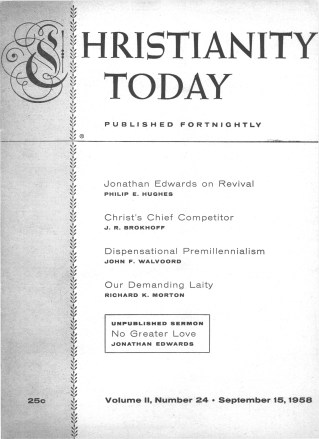
Cover Story

Christ’s Chief Competitor

On an outdoor bulletin board there appeared this sermon title: “Christ’s Chief Competitor.” Immediately below that title was the name of the minister. It appeared that inadvertently and unconsciously he was telling the community he was the competitor.

It is a serious problem today that too many of our sermons are Christless. They actually make competitors for Christ, leaving the man in the pew looking to the pulpit saying, “Sir, we would see Jesus.”

In the town in which I live, we have a weekly TV panel of ministers called “Pastors Face Your Questions.” Recently the panel received the following intelligent and disturbed letter:

As a member of one of Charlotte’s finest, largest, and richest churches, I am perfectly willing to uphold the dignity of so fine an edifice and an institution by going along with all of the preliminaries of the service on Sunday if, when we get down to the purpose of my being there, my minister would give me something to, shall I say, feed my soul, encourage that which is good in me and send me away with the assurance that God still cares and will look after me during the next week. Instead of this, he philosophizes, expresses himself in such lofty terms and grandiose manner that for the life of me, I cannot grasp his point nor appreciate his efforts. Maybe I’m wrong, maybe it wouldn’t be dignified or proper to just read God’s word from the Bible and tell me in good plain English what is going to become of me in the end if I don’t live by that word. Maybe I’m wrong in my thinking that one should be able to take home the meat of the sermon, mull over it, discuss it with one’s family over the dinner table. Maybe things have changed and no one has told me.

And so my question to you pastors is: Should Jesus Christ stand in your pulpit next Sunday and preach to your congregation, do you think he would preach your type of sermon?

This is no isolated case. This is not an instance of only one man in one city crying out for Christ-centered preaching. It is not a problem only in our day; it has been a problem throughout centuries. Preachers have always yielded to the temptation of preaching their own gospel instead of Christ’s. It is said that one Sunday Louis XVI heard a sermon full of politics and government. As he left the church, he said to the abbé: “It is a pity that you did not touch on religion. Then you would have told us something about everything.”

Not long ago, the churches of a certain denomination held daily Lenten noon services, and we ministers were urged to come and hear the leading preachers of that denomination. Desiring some good preaching and feeling the need for spiritual food, I went to hear three: two were bishops and one was a seminary professor.

One bishop preached on the subject, “What Do You Want?” He began by saying that people have many desires. The first point was, what we desire may not be what is good for us. Second, what we desire may not be what we need. There was no text. And Christ was barely mentioned. It was not a sermon; it was a moral discourse. I went away disillusioned for having received a stone when I had come for bread.

The professor preached on the text, “Whom do ye say that I am?” My hopes rose. Now, I would hear a Christ-centered sermon. His introduction dealt with the fact that people have various conceptions of Christ. Point one: Christ was at all times a gentleman; two: Christ was a man of courage. Nothing was said about Christ as the Son of God or Redeemer. He was just a courageous gentleman. I suppose a Jew, Unitarian, or a Mohammedan would be willing to say as much.

The third prominent clergyman spoke on the conscience. His first question was, whether conscience was the voice of God or one’s environment. His answer: it was both. The second part of his sermon was answering the question, what should we do about our conscience? His answer: recognize its voice, educate it, and obey it. For the third time Christ was left out. I had had enough; I did not go back to hear the remaining men publicized as among the best preachers of that denomination.

Instead of answering the letter on the program, the TV panelists decided that each would answer next Sunday with a sermon on “What Would Jesus Say if He Were Preaching Here Today?”

According to a news report, the Episcopalian said that if Jesus was standing in his pulpit that morning, he would give the Beatitudes. The Baptist said that Jesus would speak clearly, but uncomfortably, about the vices of the day. The Methodist declared that Jesus would urge members of the congregation to forgive each other. The Presbyterian minister would have Jesus preach three points: judgment, love, and joy.

We sadly note here that these ministers would have Jesus Christ giving “Christless preaching.” The ethics of Jesus was one-sidedly applied to personal and social needs and problems. But what is most subtle is the impression that Jesus would only speak from the pulpit the one Sunday that he was allowed. Is not Jesus to speak every Sunday? Should not each Sunday’s sermons be centered in and saturated with his truth? What does it mean to preach Christ Sunday after Sunday? First, it means that Christ should be lifted up that the congregation may see him. People would hear his words, see his deeds once again, and sense his spirit.

To preach Christ means to keep the cross in the center of our preaching. Jesus is much more than a man or a martyr; he is not a mere teacher of principles or a moral guide. It is his atoning death that is significant: he died for our sins; by and in him we have redemption; and through him God and man were made one. In each sermon there ought to be enough of the cross that a stranger in church for the first time would find the answer to the question: “What must I do to be saved?” Paul said, “We preach Christ crucified.”

In preaching Christ Sunday after Sunday there is a danger that we give the impression Jesus was merely an historical figure among many. He once lived and died on a cross. We neglect the resurrection except for Easter, and even then we use the occasion for assuring people of pagan ideas of immortality. But why is not the resurrection kept in every sermon throughout the year? It is assurance to our people that Christ is a contemporary Saviour, a present, living reality.

Fortifying Our Own Ideas

Why do we preachers remove Christ from our sermons? To be sure, we do not drop him completely; he is used as an illustration, and often we quote him to fortify our own ideas. We have Christless, crossless sermons because we fail to realize the true meaning of Christ. Christ above all is Redeemer and Saviour. He is the Lamb of God that takes away the sin of the world. His death and resurrection have opened up the gates of eternal life for all who accept him in faith. This is tragically left out of many sermons. Why?

Probably because we misunderstand and under-evaluate the importance of the sermon. To be popular with people and fill the pews every Sunday, we feel it necessary to entertain with humorous anecdotes and illustrations. On the other hand, we also have a sincere desire to make Christianity applicable to the needs and problems of the day. Consequently, we discuss from a Christian viewpoint politics and economics.

What is the place and significance of the sermon? This takes us to the heart of our Protestant faith. It lies in the doctrine of the Word. The means of grace are the Word and the Sacraments. The Sacraments are the Word with a visible sign. The Word comes to us every Sunday as it is preached from the pulpits of our land. The sermon is a sacramental aspect of worship, a means of grace. It is God making his appeal through the preacher. Through the sermon, God sends his grace upon his people by which they are saved and brought into a right relationship with Christ.

Where does Christ come in? A sermon is the declaration of the Word of God. What is the Word? According to John’s gospel, “the Word was God” and “the Word was flesh and dwelt among us.” Christ is the Word. To preach Christ is to preach the Word. But Christ is not preached fully except he is preached as the crucified and risen Saviour.

There is a painting of Luther preaching to a congregation. The people are not looking at Luther but at another spot in the church. A second look at the canvas shows the ethereal figure of Christ in a corner of the cathedral. The congregation is looking at Christ. The ideal situation for every preacher and congregation should be to preach Christ so fully and faithfully that the congregation will not see a master orator in the pulpit, but Jesus Christ, our Saviour and Redeemer.

As pastors go into their pulpits every Sunday, they should hear a plea from the pews: “Sir, we would see Jesus.” Are preachers today competitors or confessors of Christ?

On Friendship

What shall we say of friendship,

That timeless span of life

When mind meets mind

In selfless communion of the soul.

It is but a symbol, ’tis true

Of unsaid words, of songs

As yet unheard amid the noise

And tremor of earth-bound places.

It is not seen, nor is it found

In frenzied mind. It is only

In a quiet hour, when need

Rears its ugly head, that we

Turn, wordless, to find a hand

Within our own, warm and unafraid.

LOLA J. PEPLER

J. R. Brokhoff holds the A.B. degree from Muhlenberg College, the B.D. from Mt. Airy Lutheran Seminary, and the M.A. degree from University of Pennsylvania. From 1950–54 he was guest Professor of Homiletics at Emory University. In 1951 he became the youngest recipient of a D.D. from Muhlenberg. Since 1955 he has been pastor of St. Mark’s Lutheran Church of Charlotte, North Carolina, where he now is serving as President of the Charlotte Lutheran Pastors’ Association.

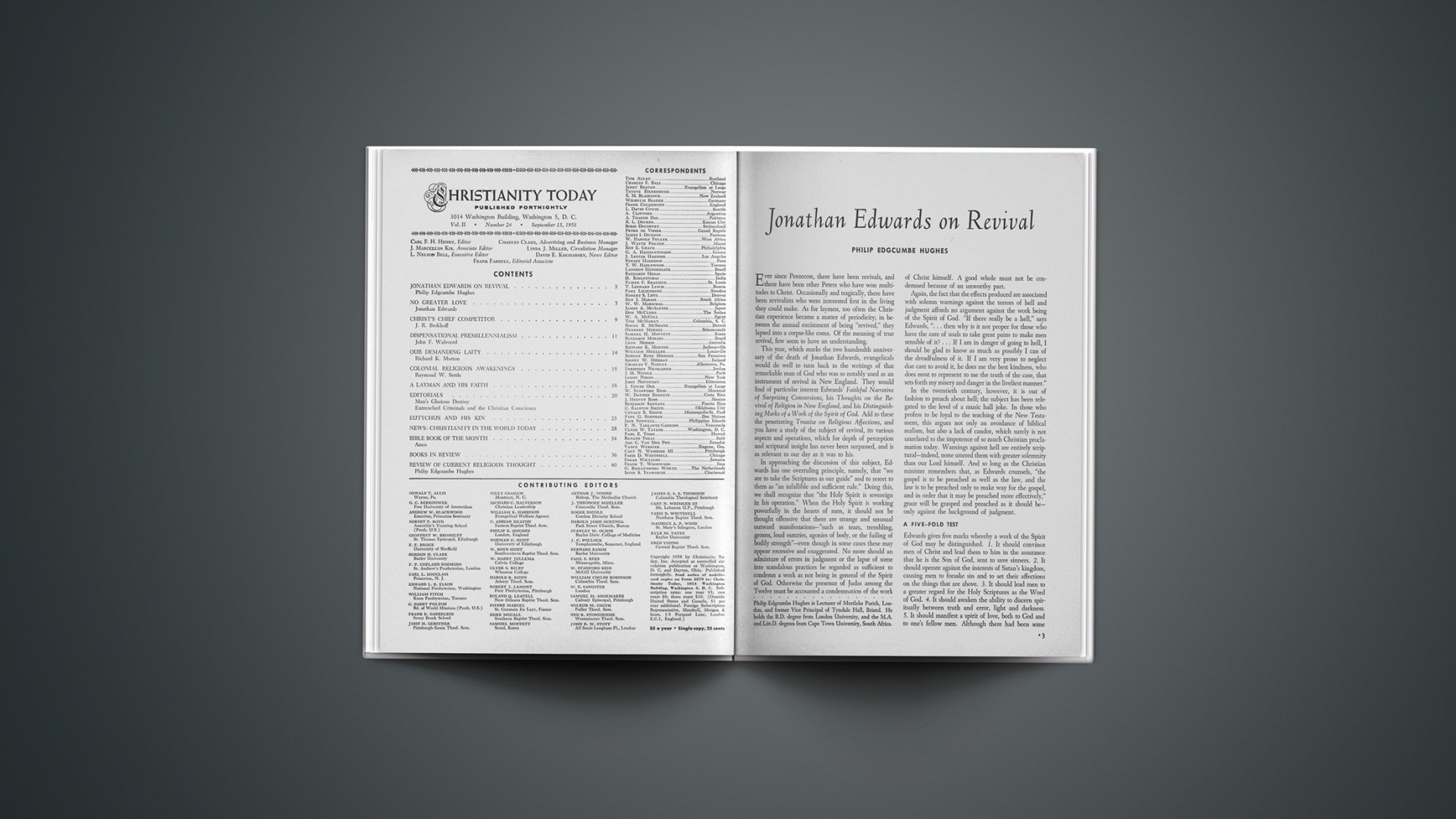
Cover Story

No Greater Love

For scarcely for a righteous man will one die: yet peradventure for a good man some would even dare to die. But God commendeth his love toward us, in that, which we were yet sinners, Christ died for us (Romans 5:7, 8).

The comparison that is here made between the love of man one to another and the dying love of God is a short digression from the main argument. The Apostle is treating of the good ground of the Christian’s hope of the glory of God. In the beginning of the chapter he describes the hope of a Christian by the greatness of the good that is the object of it and the joyfulness of it and the effectualness of it to enable the Christian to glory in tribulation. (The first three verses.) And shows how the tribulation of a true Christian is a means of increasing and establishing hope that, that a patient bearing of affliction gives that experience that greatly confirms hope. And that for the reason that the Apostle gives because in that way of enduring tribulation the love of God was shed abroad in their hearts by the Holy Ghost which was given to them. And then the Apostle proceeds to show what reason Christians have to be assured that their hope of future glory shall not be disappointed from this argument: that Christ died for them even while ungodly.

To show how unparalleled the love of Christ is the Apostle in the first place declares the utmost extent of the love of man. “Scarcely for a righteous man will one die: yet peradventure for a good man some would even dare to die.” By a righteous man must be understood a man of moral justice, one that is willing not to wrong any man but to give every one his due, and by a good man may be understood either a man with a qualification beyond righteousness, a bountiful man of a kind spirit. If we understand it in this sense the meaning of the Apostle is this that man will scarcely die for another though that other is a righteous man has always done fairly by him and never injured him. Yet possibly some would even die for one that has been good to them having received a great deal of kindness and being under special obligation. And this is the utmost that men’s love extends agreeable to what Christ says in John 15:13: “Greater love hath no man than this, that a man lay down his life for his friends.”

Or else we may understand a righteous man and good in the text as synonymous terms and signifying the same thing and both in opposition to ungodly and sinners that it is here said that Christ died for. And so the word is changed from righteous to good only for the sake of elegance of speech. And then the sense of the Apostle is this that men’s love scarcely ever goes so far as to lay down their lives for good and righteous men let ’em be persons of never so good and excellent a disposition. Sometimes the love of men has gone so far. But Christ died for those that were the reverse of righteous and good. He died for the ungodly and sinners. The Apostle herein takes notice of an instance wherein the love of Christ transcends all the love of men one to another.

Doctrine: That there never was any love that could be paralleled with the dying love of Christ or the dying love of our Lord Jesus Christ is that to which no love is to be compared.

Never was any love of any other being or any creature to be compared with this love—the love of God in giving his Son to die. However great and wonderful the love of one creature to another has been in some instances yet there has been no instance that has been any way to be compared with this. There is often a very strong affection in parents towards their children. There was a great love in Jacob to Joseph. When he thought his son Joseph was dead he rent his clothes, and put sackcoth on his loins, and mourned for his son many days. And when all his sons and all his daughters rose up to comfort him he refused to be comforted, and said, “For I will go down into the grave unto my son mourning.”

So very wonderful was the love of David to his son Absalom though Absalom had been so wicked and rebellious. Yet when David heard the news of his death how was he affected by it? 2 Samuel 18:33: “And the king was much moved, and went up to the chamber over the gate, and wept: and as he went, thus he said, O my son Absalom, my son, my son Absalom! would God I had died for thee, O Absalom, my son, my son!”

This love of Christ is unparalleled by any instance of any other love in these following respects:

I

Never was there love that fixed upon an object so much below the lover. Love is more remarkable and wonderful when there is a very great distance between the lover and the beloved—when the lover is greatly above the beloved than when there is an equality. Amongst men generally those that are in condition greatly below them are neglected by them. They ben’t looked upon as worthy of their esteem or regard. Those that are little in comparison of them are little in their eyes and little in their thoughts. Men set their love upon this or that other object and seek their friendship because they conceive that they shall be added to by their friendship and therefore neglect those that are greatly below them as thinking that they are so little in comparison of them that they with them shall not be added to.

Those men that are great in the world in high estate ordinarily neglect the mean and low. If they take notice of them it is far from being in any such way as taking them into their friendship or setting their love upon them. Men may sometimes set their hearts upon an object that is much below them but then ’tis because they think they see something in them that is not so much below. There is some qualification in them they have respect to that they conceive would in their enjoyment of it be an addition to them. There is but one thing in any being that can influence him to set his love upon an object greatly below him and that is conceived of as such in all respects by the lover and that is goodness—a mere good disposition. If a great prince should love a poor man’s child under some calamity and should pity it and lay himself out greatly for its relief and there be all signs of its being only from mere goodness and compassion would not this be looked upon as wonderful?

But if it should be so that a noble prince should from goodness and benevolence exceedingly love and pity one so inferior what is the superiority of one man above another to the superiority of the Son of God to us? The difference that may be between men and men may be great as to outward circumstances. There may be many accidental differences but their nature is the same. A poor child has the same human nature as a prince. In many things there is an equality between a poor child and a prince. Yea, the child may be superior. But Jesus Christ is infinitely above us in nature he being of a divine nature. There is no distance of nature between man and man but between God and man there is an infinite distance of nature a greater distance than there is between the nature of man and the nature of worms. There is a greater distance between the Son of God and us than there is between the earth and the highest star in the heavens.

The Son of God was every way infinitely above us. Consider him with respect to his nature with respect to his duration. Consider him with respect to all the properties of his nature, natural or moral excellencies. Consider him with respect to honor and the respect of his Father. Consider him with respect to his dominion and sovereignty over the creature. Consider him with respect to his works. He it is that has made the world that has made sun, moon and stars; that made man and that made the highest heavens and made the angels of heaven. Consider him in his importance in the universality of things. He is the last end of all things. All things are made by him and for him and by him all things consist. Consider him with respect to the honor and respect of the creature. He is worshiped and adored by the angels of heaven and will be to all eternity. Therefore if we consider the dying love of Jesus Christ in this respect there never was any love like unto it. Never was there any instance of such a stoop made by any lover. What are we that one in such a height of glory and dignity should set his love upon us?

II

Secondly, never was there any instance of such love to those that were so far from being capable of benefiting the lover. There is amongst men but little disinterested love. In those instances of great friendship, self-interest has some influence in the matter. The lover looks upon the beloved as one capable and fitted to contribute to his benefit.

Love in men ordinarily is from want from the indigence of nature. It seeks that in others which it hath not in itself. The beloved is looked upon as fitted to supply the wants and satisfy the cravings of its nature. But Jesus Christ is and always was above want. ’Tis impossible he should stand in need of anything. He had a fullness incapable of any addition. He possessed a treasure that could not be enlarged. He was from eternity perfectly happy in the enjoyment of the Father. Nothing that the creature can do can in the least add to his happiness. His blessedness is infinite and invariable.

What need can one that infinitely enjoys God the Father and his love stand in need of us men? Or what good can we do him? Christ is not dependent for anything for any good upon us or any creature for he gives unto all life and breath and all things.

Men’s love generally is from want and because they ben’t sufficiently happy in themselves. But on the contrary Christ’s love is from fullness. Men’s love seeks an addition to fill up their emptiness but Christ’s love is from his fullness and because he is so full that he overflows. Man’s love seeks the reception of something to him but Christ’s love seeks communication.

III

Never was there any that set his love upon those in whom he saw so much filthiness and deformity. Never any that loved those in whom they saw so little to attract their love and so much to repel it and to procure hatred. Parents oftentimes have natural affection to those children that are very unworthy and may love those that they are sensible are undeserving from the natural propensity there is in men to love their own though ordinarily where there is a strong affection men imagine they see that which is lovely though indeed there be not anything.

There is such a fullness of love in the heart of Jesus Christ that it flows out toward those objects that have nothing to draw. The motive is within him. It seems it needs nothing to attract it. There is a sufficient spring in Christ’s own heart to set it going. There is an overflowing benevolence that it extends to those who have no beauty nor excellency.

Jesus Christ when he passed by us saw us naked and loathsome. He might justly have turned away from us with abhorrence have left us in our filth and stood at a distance from us as abominating to have anything to do with them that were so filthy. But it was otherwise. The time was a time of love. Instead of the lovely image of God there was the foul image of Satan that appeared upon us. That corruption was in our nature that was more odious in the eyes of Christ than the nature of a toad or serpent is to us. Natural men are like vipers. Their poison is the poison of a serpent and as the venom of asps. Man by sin became like a swine that delights to wallow in the mire, is like a filthy worm.

And Christ saw all this deformity that was in their hearts. Men may set their love upon those that are very hateful because they are ignorant of them. They don’t know what is in them. But Christ perfectly knew all our filthiness. The corruption of the heart of man was all naked and open to his view.

IV

Never was there any one that set his love upon those that were so far from loving him. Men in their fallen state are the enemies of God and Jesus Christ. Nothing is more the nature or natural disposition of man as he is in a natural condition than it is to hate God. He hates Christ and can do no other than hate him. Rom. 8:7: “The carnal mind is enmity against God: for it is not subject to the law of God, neither indeed can be.” Every natural man has a mortal enmity against Christ as well as the Jews that crucified him. And this Christ knew when he was pleased to set his love upon them.

This enmity is the more provoking because it was so infinitely unreasonable. We had no reason to have a spirit of enmity against Christ. He never had done us any wrong. On the contrary all the blessings and benefits we receive are from him. Sinners have a spirit of enmity against him though he be infinitely excellent and amiable. Though he be the infinitely beloved of God yet he is hated of men. Sinners had no delight in the excellency of Christ that God the Father so delights in. Yea that very excellency is what he is hated for. He is hated for his holiness. Yea such is the enmity that was in them so rooted and fixed and strong that Christ’s dying love won’t change them. This Christ knew when he set his love upon them and undertook to die for them.

And he knew that they had a spirit of contempt towards him that they would slight and despise him. He knew that they had all such a spirit as the Jews and soldiers that spit upon him and mocked and derided him. He knew that they had such a spirit that when he was offered to them with all his benefits he should be slighted till their hearts were changed. But Christ loved sinners nothwithstanding this also.

V

There never was any love that appeared in so great and wonderful expressions. Expressions of love are of three kinds: declarations, doings and sufferings. The declarations of Christ’s love to his church in Scriptures are wonderful but deeds and sufferings are the principal expressions of love. And there is nothing in the declarations which Christ has made of his love in his Word but the same is evident in what he has done and suffered for his people and that more abundantly.

1. What Christ has done for his people and the love which he has shown them that way is very wonderful. Never was any that showed his love to another by doing so much for them as Christ has done. His love was such to his elect that he came down from heaven, he left the bosom of the Father, he laid aside his glory and came down to dwell on earth. He became incarnate. He took upon him another nature. It was a great thing for God to do to take upon him the nature of man. It was a great thing that Christ should come to dwell amongst men that he should so love us as to take up an abode amongst us for above 30 years as he did.

2. There was never in any other lover so great an expression of love as the sufferings of Christ. Expense and suffering for anyone is the greatest testimony of love. If one person bestows a great deal on another and does much for him, yet if it be without any kind of expense or suffering to himself, it is not so great an expression of love nor doth it show so great love.

To be at any great expense of money or goods for another especially so as considerably to suffer in estate by it is looked upon as a remarkable kindness. To go through many hardships and endure great fatigues of body for another, to redeem one out of captivity and from any great calamity would also be looked upon as a kindness that laid a great obligation on the beloved and ’tis a yet far greater expression of love if any should freely lose his life and be at the expense of his blood for them. Thus far also perhaps some earthly lovers have gone.

But there never was any that suffered so much for any earthly friend as Christ did, whether we consider what he suffered outwardly or in his soul.

His death besides the painfulness of it was attended with those circumstances that greatly aggravated the suffering. Christ suffered much outwardly just before his death. He was scourged and wounded with thorns and buffeted in the face by soldiers treated most ignominiously. He was spit upon and mocked and most contemptuously treated and his death was most disgraceful yea accursed.

And besides what he suffered in his body he suffered more in his soul. Sufferings of soul and body were united together. If he had suffered only in his body his spirit might have helped him to support his outward pains but he had darkness in his mind as well as pain in his body. He was smitten of God. God laid upon him the iniquities of us all. How great his inward sufferings were we may conclude by the greatness of them before his crucifixion in his agony in the garden. We are none of us acquainted with such a degree of sorrow and anguish of spirit as shall cause such an effect. The trouble and sorrows of his soul were as much of the nature of the torments of hell as an innocent holy person was capable of.

The sufferings of Christ were a greater expression and evidence of love for his being so great a person. If Christ had suffered no more than some other lovers have suffered for their friends yet his suffering would have been a more wonderful expression of love because ’tis a greater thing for a person of such glory and dignity to suffer than for a lesser. ’Tis a greater thing for a person that is God to die than for a mere worm of the dust to die and a more marvelous expression of love. For a divine person to lay down his life and spill his blood is a greater expense than for a man. A mere man has not so great a price to expend.

Who could have imagined that ever such a testimony should be given of God’s love to a creature? Without doubt it was surprising to the angels when it was first revealed to them. It was a thing unknown and never would have been conceived of had not God revealed it—that God, that a divine person should testify his love by suffering much less by such suffering.

VI

And lastly never was there any love that was so beneficial to the beloved. True love is fruitful. It always seeks the benefit and advantage of the beloved and will procure it if there be opportunity. But there is no other instance of love that in this respect is to be equaled as compared with this. The love of men one to another in many instances may have been greatly to the advantage. Parents’ love to their children may be very beneficial to them. Princes’ love to their favorites may be an occasion of their advancement to honor and wealth. Men through their love to others may have brought them out of low and miserable and distressed circumstances, redeemed them out of captivity, saved them from cruel bondage and tormenting death to honor wealth and pleasure. But no such instance can be compared with the benefits and advantages that the dying love of Christ is of to those who are the objects of his love.

For by means of his dying love they are rescued from eternal destruction. They are saved out of the furnace of fire. The deliverance of Shadrach, Meshach and Abed-nego out of Nebuchadnezzar’s burning fiery furnace by the love of Christ who himself came into that furnace to deliver them is a type of his dying love whereby he delivers sinners from the furnace of hell fire. Sinners by means of the dying love of Christ are rescued out of the paw of the devil that roaring lion that seeks to devour souls. And by the dying love of Christ those that are beloved by him are advanced to the greatest blessedness to the possession of a glorious kingdom to the wearing of a crown of glory to the seeing of God and fully enjoying of him to all eternity. By the dying love of Christ they are delivered from the foulest deformity and are now made and fashioned according to the image of God having the brightness of God’s holiness reflected from them.

And those whom he has purchased by his death the value of them is proportionable to the value of that price that was paid for them. The blood of Christ purchased things that can’t be purchased for gold. Neither shall silver be weighed for the price of them. And what makes the worth of them infinite is that they never will have an end. There will be no danger or possibility of losing them.

This is an abridged message from Jonathan Edwards’ Sermons on Romans, a forthcoming volume in the Works of Edwards currently being published by Yale University Press under the editorial direction of a committee headed by Perry Miller of Harvard University. This particular volume and sermon is edited by John H. Gerstner of Pittsburgh-Xenia Theological Seminary. Permission for the prior use of this hitherto unpublished sermon, in conjunction with the bi-centennial of Edwards’ death, has been granted toChristianity Todayby the Sterling Library of Yale and the Yale University Press.

Cover Story

Jonathan Edwards on Revival

Ever since Pentecost, there have been revivals, and there have been other Peters who have won multitudes to Christ. Occasionally and tragically, there have been revivalists who were interested first in the living they could make. As for laymen, too often the Christian experience became a matter of periodicity; in between the annual excitement of being “revived,” they lapsed into a corpse-like coma. Of the meaning of true revival, few seem to have an understanding.

This year, which marks the two hundredth anniversary of the death of Jonathan Edwards, evangelicals would do well to turn back to the writings of that remarkable man of God who was so notably used as an instrument of revival in New England. They would find of particular interest Edwards’ Faithful Narrative of Surprising Conversions, his Thoughts on the Revival of Religion in New England, and his Distinguishing Marks of a Work of the Spirit of God. Add to these the penetrating Treatise on Religious Affections, and you have a study of the subject of revival, its various aspects and operations, which for depth of perception and scriptural insight has never been surpassed, and is as relevant to our day as it was to his.

In approaching the discussion of this subject, Edwards has one overruling principle, namely, that “we are to take the Scriptures as our guide” and to resort to them as “an infallible and sufficient rule.” Doing this, we shall recognize that “the Holy Spirit is sovereign in his operation.” When the Holy Spirit is working powerfully in the hearts of men, it should not be thought offensive that there are strange and unusual outward manifestations—“such as tears, trembling, groans, loud outcries, agonies of body, or the failing of bodily strength”—even though in some cases these may appear excessive and exaggerated. No more should an admixture of errors in judgment or the lapse of some into scandalous practices be regarded as sufficient to condemn a work as not being in general of the Spirit of God. Otherwise the presence of Judas among the Twelve must be accounted a condemnation of the work of Christ himself. A good whole must not be condemned because of an unworthy part.

Again, the fact that the effects produced are associated with solemn warnings against the terrors of hell and judgment affords no argument against the work being of the Spirit of God. “If there really be a hell,” says Edwards, “… then why is it not proper for those who have the care of souls to take great pains to make men sensible of it?… If I am in danger of going to hell, I should be glad to know as much as possibly I can of the dreadfulness of it. If I am very prone to neglect due care to avoid it, he does me the best kindness, who does most to represent to me the truth of the case, that sets forth my misery and danger in the liveliest manner.”

In the twentieth century, however, it is out of fashion to preach about hell; the subject has been relegated to the level of a music hall joke. In those who profess to be loyal to the teaching of the New Testament, this argues not only an avoidance of biblical realism, but also a lack of candor, which surely is not unrelated to the impotence of so much Christian proclamation today. Warnings against hell are entirely scriptural—indeed, none uttered them with greater solemnity than our Lord himself. And so long as the Christian minister remembers that, as Edwards counsels, “the gospel is to be preached as well as the law, and the law is to be preached only to make way for the gospel, and in order that it may be preached more effectively,” grace will be grasped and preached as it should be—only against the background of judgment.

A Five-Fold Test

Edwards gives five marks whereby a work of the Spirit of God may be distinguished. 1. It should convince men of Christ and lead them to him in the assurance that he is the Son of God, sent to save sinners. 2. It should operate against the interests of Satan’s kingdom, causing men to forsake sin and to set their affections on the things that are above. 3. It should lead men to a greater regard for the Holy Scriptures as the Word of God. 4. It should awaken the ability to discern spiritually between truth and error, light and darkness. 5. It should manifest a spirit of love, both to God and to one’s fellow men. Although there had been some excesses in the course of the revival in New England, these five distinguishing marks of the work of the Spirit of God were clearly present, so that Edwards was able to conclude that what had taken place was “undoubtedly, in general, from the Spirit of God.”

Some, however, had complained that the gatherings at this time were marked by confusion and irregularity. But Edwards, while fully admitting the necessity for orderliness in the conduct of public worship under normal conditions, replied to this objection in the following way:

If God is pleased to convince the consciences of persons, so that they cannot avoid great outward manifestations, even to interrupting and breaking off those public means they were attending, I do not think this is confusion, or an unhappy interruption, any more than if a company should meet on the field to pray for rain, and should be broken off from their exercise by a plentiful shower. Would to God that all the public assemblies in the land were broken off from their public exercises with such confusion as this the next sabbath day! We need not be sorry for breaking the order of means, by obtaining the end to which that order is directed.

Necessity For Humility

He therefore warns us, where a work bears the marks of the activity of the Spirit of God, “by no means to oppose, or do anything in the least to clog or hinder, the work; but, on the contrary, do our utmost to promote it.” And those who are participating in the blessings and uplifting experience of such a work are warned against the great danger of spiritual pride, which is “the worst viper in the heart.” “The greatest privilege of the prophets and apostles,” says Edwards, “was not their being inspired and working miracles, but their eminent holiness. The grace that was in their hearts was a thousand times more their dignity and honour than their miraculous gifts.”

The necessity for humility is indicated by the fact that “God in this work has begun at the lower end, and he has made use of the weak and foolish things of the world to carry it on.” Some of the ministers chiefly employed were “mere babes in age and standing” and of little repute among their fellow ministers. Their weakness served to magnify the power and grace of God. Cold criticism of the human instruments used in this work and of the undesirable excesses which may be shown by those whose frail frames are visited by overwhelming and transforming experiences at such a time of revival springs from injured pride and from a failure to take the Holy Scriptures as the “sufficient and whole rule whereby to judge of this work.” Edwards observes significantly that “censuring others is the worst disease with which this affair has been attended.”

But the effects of a season of revival are not only to be seen in individual lives. They are apparent in the community as a whole. Thus Edwards describes how there was at the time of which he is speaking “a very uncommon influence upon the minds of a very great part of the inhabitants of New England, attended with the best effects.” Problems of juvenile delinquency and unruliness (so pressing in our day!) were largely solved: “In vain did ministers preach against those things before, in vain were laws made to restrain them, and in vain was all the vigilance of magistrates and civil officers; but now they have almost everywhere dropt them, as it were of themselves.”

Fruits Of Revival

It was also noticeable that in the greatest part of New England, the Bible was “in much greater esteem and use than before”; that the Lord’s day was “more religiously and strictly observed”; and that in a couple of years more was done in “making up differences, confessing faults one to another, and making restitution … than was done in thirty years before.” Large numbers were brought to “a deep sense of their own sinfulness and vileness,” and to a realization of “how unworthy in God’s regard were their prayers, praises, and all that they did in religion.” Many poor Indians and Negroes were converted and morally transformed, and very many little children led to love the Saviour. Multitudes, indeed, of all ages and classes of society, were brought to “a new and great conviction of the truth and certainty of the things of the Gospel.” Nor were these blessings confined to the new converts; they abounded also in the spiritual enrichment of the lives of great numbers of those who had been practicing Christians for years.

“And this,” writes Edwards, “has been attended with an abhorrence of sin, and self-loathing for it, and earnest longings of soul after more holiness and conformity to God, with a sense of the great need of God’s help in order to holiness of life; together they have had a most dear love to all that are supposed to be the children of God, and a love to mankind in general, and a most sensible and tender compassion for the souls of sinners, and earnest desires of the advancement of Christ’s kingdom in the world.”

Dignity And Depth

Here, we cannot but conclude, is the real thing. So much of the “revivalism” of our day seems to belong to a totally different category. We look in vain for the dignity, the depth, the solemnity, the self-abnegation, and the scripturalness that we find in Jonathan Edwards. Let us pray earnestly that Almighty God will turn us again, and bless us as in the days of old, and in his grace grant us to see the real thing once again in our day—a mighty, transforming work of the Sovereign Spirit!

Philip Edgcumbe Hughes is Lecturer of Mortlake Parish, London, and former Vice Principal of Tyndale Hall, Bristol. He holds the B.D. degree from London University, and the M.A. and Litt.D. degrees from Cape Town University, South Africa.

Review of Current Religious Thought: September 01, 1958

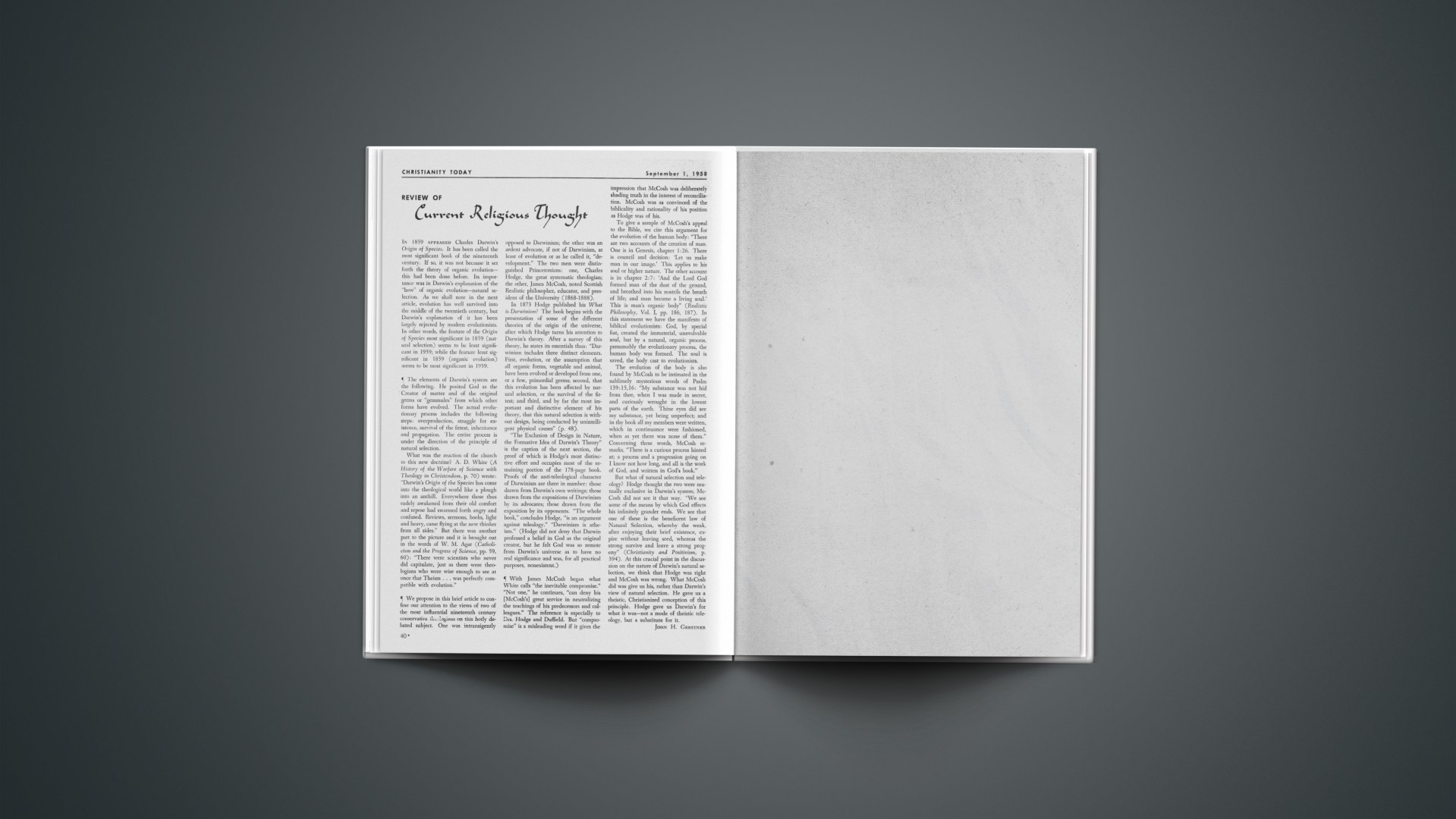
In 1859 appeared Charles Darwin’s Origin of Species. It has been called the most significant book of the nineteenth century. If so, it was not because it set forth the theory of organic evolution—this had been done before. Its importance was in Darwin’s explanation of the “how” of organic evolution—natural selection. As we shall note in the next article, evolution has well survived into the middle of the twentieth century, but Darwin’s explanation of it has been largely rejected by modern evolutionists. In other words, the feature of the Origin of Species most significant in 1859 (natural selection) seems to be least significant in 1959; while the feature least significant in 1859 (organic evolution) seems to be most significant in 1959.

The elements of Darwin’s system are the following. He posited God as the Creator of matter and of the original germs or “gemmules” from which other forms have evolved. The actual evolutionary process includes the following steps: overproduction, struggle for existence, survival of the fittest, inheritance and propagation. The entire process is under the direction of the principle of natural selection.

What was the reaction of the church to this new doctrine? A. D. White (A History of the Warfare of Science with Theology in Christendom, p. 70) wrote: “Darwin’s Origin of the Species has come into the theological world like a plough into an anthill. Everywhere those thus rudely awakened from their old comfort and repose had swarmed forth angry and confused. Reviews, sermons, books, light and heavy, came flying at the new thinker from all sides.” But there was another part to the picture and it is brought out in the words of W. M. Agar (Catholicism and the Progress of Science, pp. 59, 60): “There were scientists who never did capitulate, just as there were theologians who were wise enough to see at once that Theism … was perfectly compatible with evolution.”

We propose in this brief article to confine our attention to the views of two of the most influential nineteenth century conservative theologians on this hotly debated subject. One was intransigently opposed to Darwinism; the other was an ardent advocate, if not of Darwinism, at least of evolution or as he called it, “development.” The two men were distinguished Princetonians: one, Charles Hodge, the great systematic theologian; the other, James McCosh, noted Scottish Realistic philosopher, educator, and president of the University (1868–1888).

In 1873 Hodge published his What is Darwinism? The book begins with the presentation of some of the different theories of the origin of the universe, after which Hodge turns his attention to Darwin’s theory. After a survey of this theory, he states its essentials thus: “Darwinism includes three distinct elements. First, evolution, or the assumption that all organic forms, vegetable and animal, have been evolved or developed from one, or a few, primordial germs; second, that this evolution has been affected by natural selection, or the survival of the fittest; and third, and by far the most important and distinctive element of his theory, that this natural selection is without design, being conducted by unintelligent physical causes” (p. 48).

“The Exclusion of Design in Nature, the Formative Idea of Darwin’s Theory” is the caption of the next section, the proof of which is Hodge’s most distinctive effort and occupies most of the remaining portion of the 178-page book. Proofs of the anti-teleological character of Darwinism are three in number: those drawn from Darwin’s own writings; those drawn from the expositions of Darwinism by its advocates; those drawn from the exposition by its opponents. “The whole book,” concludes Hodge, “is an argument against teleology.” “Darwinism is atheism.” (Hodge did not deny that Darwin professed a belief in God as the original creator, but he felt God was so remote from Darwin’s universe as to have no real significance and was, for all practical purposes, nonexistent.)

With James McCosh began what White calls “the inevitable compromise.” “Not one,” he continues, “can deny his [McCosh’s] great service in neutralizing the teachings of his predecessors and colleagues.” The reference is especially to Drs. Hodge and Duffield. But “compromise” is a misleading word if it gives the impression that McCosh was deliberately shading truth in the interest of reconciliation. McCosh was as convinced of the biblicality and rationality of his position as Hodge was of his.

To give a sample of McCosh’s appeal to the Bible, we cite this argument for the evolution of the human body: “There are two accounts of the creation of man. One is in Genesis, chapter 1:26. There is council and decision: ‘Let us make man in our image.’ This applies to his soul or higher nature. The other account is in chapter 2:7: ‘And the Lord God formed man of the dust of the ground, and breathed into his nostrils the breath of life; and man became a living soul.’ This is man’s organic body” (Realistic Philosophy, Vol. I, pp. 186, 187). In this statement we have the manifesto of biblical evolutionists: God, by special fiat, created the immaterial, unevolvable soul, but by a natural, organic process, presumably the evolutionary process, the human body was formed. The soul is saved, the body cast to evolutionists.

The evolution of the body is also found by McCosh to be intimated in the sublimely mysterious words of Psalm 139:15, 16: “My substance was not hid from thee, when I was made in secret, and curiously wrought in the lowest parts of the earth. Thine eyes did see my substance, yet being unperfect; and in thy book all my members were written, which in continuance were fashioned, when as yet there was none of them.” Concerning these words, McCosh remarks, “There is a curious process hinted at; a process and a progression going on I know not how long, and all is the work of God, and written in God’s book.”

But what of natural selection and teleology? Hodge thought the two were mutually exclusive in Darwin’s system; McCosh did not see it that way. “We see some of the means by which God effects his infinitely grander ends. We see that one of these is the beneficent law of Natural Selection, whereby the weak, after enjoying their brief existence, expire without leaving seed, whereas the strong survive and leave a strong progeny” (Christianity and Positivism, p. 394). At this crucial point in the discussion on the nature of Darwin’s natural selection, we think that Hodge was right and McCosh was wrong. What McCosh did was give us his, rather than Darwin’s view of natural selection. He gave us a theistic, Christianized conception of this principle. Hodge gave us Darwin’s for what it was—not a mode of theistic teleology, but a substitute for it.

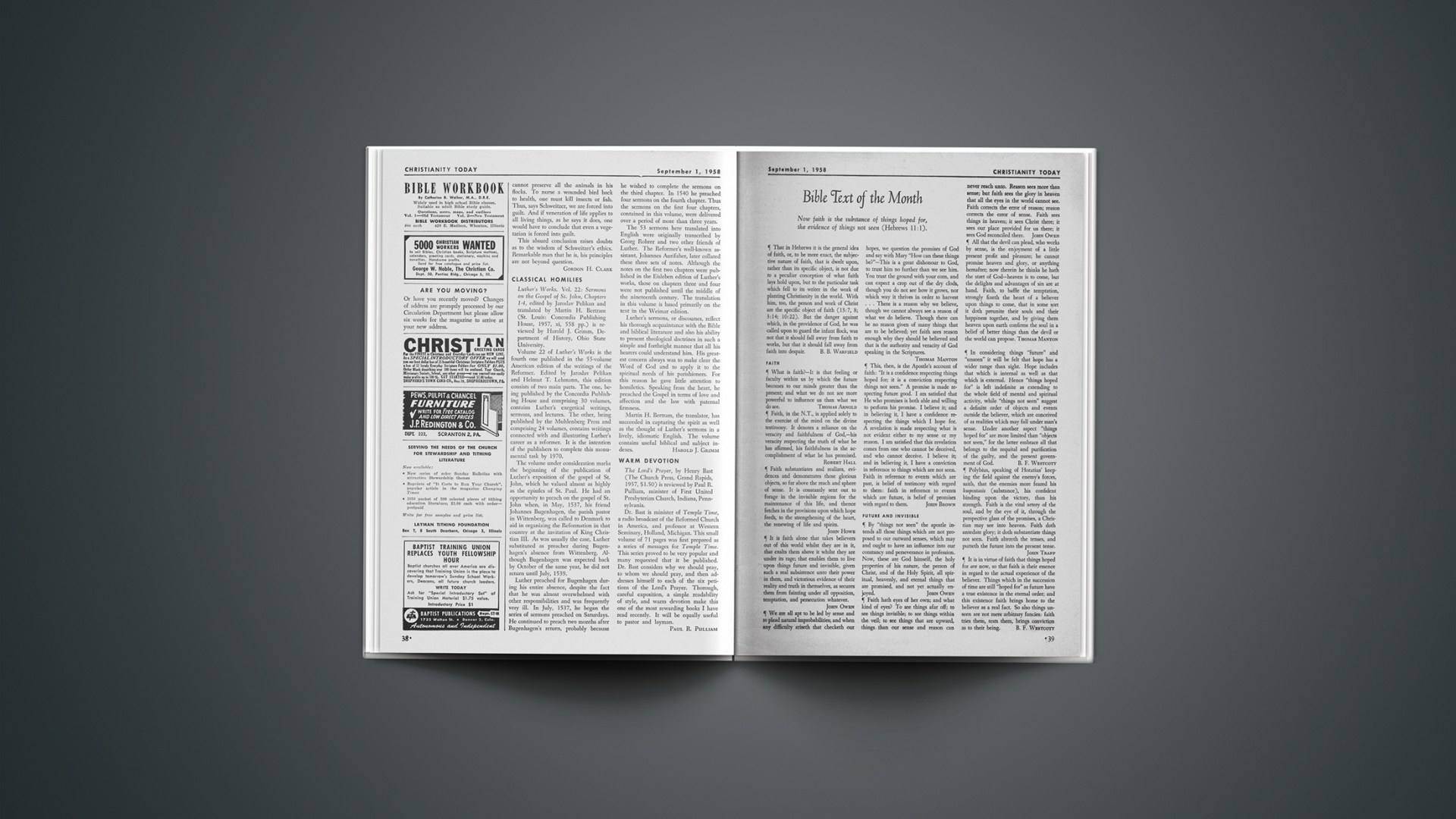
Bible Text of the Month: Hebrews 11:1

Now faith is the substance of things hoped for, the evidence of things not seen (Hebrews 11:1).

That in Hebrews it is the general idea of faith, or, to be more exact, the subjective nature of faith, that is dwelt upon, rather than its specific object, is not due to a peculiar conception of what faith lays hold upon, but to the particular task which fell to its writer in the work of planting Christianity in the world. With him, too, the person and work of Christ are the specific object of faith (13:7, 8; 3:14; 10:22). But the danger against which, in the providence of God, he was called upon to guard the infant flock, was not that it should fall away from faith to works, but that it should fall away from faith into despair.

Faith

What is faith?—It is that feeling or faculty within us by which the future becomes to our minds greater than the present; and what we do not see more powerful to influence us than what we do see.

THOMAS ARNOLD

Faith, in the N.T., is applied solely to the exercise of the mind on the divine testimony. It denotes a reliance on the veracity and faithfulness of God,—his veracity respecting the truth of what he has affirmed, his faithfulness in the accomplishment of what he has promised.

ROBERT HALL

Faith substantiates and realizes, evidences and demonstrates those glorious objects, so far above the reach and sphere of sense. It is constantly sent out to forage in the invisible regions for the maintenance of this life, and thence fetches in the provisions upon which hope feeds, to the strengthening of the heart, the renewing of life and spirits.

JOHN HOWE

It is faith alone that takes believers out of this world whilst they are in it, that exalts them above it whilst they are under its rage; that enables them to live upon things future and invisible, given such a real subsistence unto their power in them, and victorious evidence of their reality and truth in themselves, as secures them from fainting under all opposition, temptation, and persecution whatever.

JOHN OWEN

We are all apt to be led by sense and to plead natural improbabilities; and when any difficulty ariseth that checketh our hopes, we question the promises of God and say with Mary “How can these things be?”—This is a great dishonour to God, to trust him no further than we see him. You trust the ground with your corn, and can expect a crop out of the dry clods, though you do not see how it grows, nor which way it thrives in order to harvest … There is a reason why we believe, though we cannot always see a reason of what we do believe. Though there can be no reason given of many things that are to be believed; yet faith sees reason enough why they should be believed and that is the authority and veracity of God speaking in the Scriptures.

THOMAS MANTON

This, then, is the Apostle’s account of faith: “It is a confidence respecting things hoped for; it is a conviction respecting things not seen.” A promise is made respecting future good. I am satisfied that He who promises is both able and willing to perform his promise. I believe it; and in believing it, I have a confidence respecting the things which I hope for. A revelation is made respecting what is not evident either to my sense or my reason. I am satisfied that this revelation comes from one who cannot be deceived, and who cannot deceive. I believe it; and in believing it, I have a conviction in reference to things which are not seen. Faith in reference to events which are past, is belief of testimony with regard to them: faith in reference to events which are future, is belief of promises with regard to them.

JOHN BROWN

Future And Invisible

By “things not seen” the apostle intends all those things which are not proposed to our outward senses, which may and ought to have an influence into our constancy and perseverance in profession. Now, these are God himself, the holy properties of his nature, the person of Christ, and of the Holy Spirit, all spiritual, heavenly, and eternal things that are promised, and not yet actually enjoyed.

JOHN OWEN

Faith hath eyes of her own; and what kind of eyes? To see things afar off; to see things invisible; to see things within the veil; to see things that are upward, things than our sense and reason can never reach unto. Reason sees more than sense; but faith sees the glory in heaven that all the eyes in the world cannot see. Faith corrects the error of reason; reason corrects the error of sense. Faith sees things in heaven; it sees Christ there; it sees our place provided for us there; it sees God reconciled there.

JOHN OWEN

All that the devil can plead, who works by sense, is the enjoyment of a little present profit and pleasure; he cannot promise heaven and glory, or anything hereafter; now therein he thinks he hath the start of God—heaven is to come, but the delights and advantages of sin are at hand. Faith, to baffle the temptation, strongly fixeth the heart of a believer upon things to come, that in some sort it doth preunite their souls and their happiness together, and by giving them heaven upon earth confirms the soul in a belief of better things than the devil or the world can propose.

THOMAS MANTON

In considering things “future” and “unseen” it will be felt that hope has a wider range than sight. Hope includes that which is internal as well as that which is external. Hence “things hoped for” is left indefinite as extending to the whole field of mental and spiritual activity, while “things not seen” suggest a definite order of objects and events outside the believer, which are conceived of as realities which may fall under man’s sense. Under another aspect “things hoped for” are more limited than “objects not seen,” for the latter embrace all that belongs to the requital and purification of the guilty, and the present government of God.

B. F. WESTCOTT

Polybius, speaking of Horatius’ keeping the field against the enemy’s forces, saith, that the enemies more feared his hupostasis (substance), his confident binding upon the victory, than his strength. Faith is the vital artery of the soul, and by the eye of it, through the perspective glass of the promises, a Christian may see into heaven. Faith doth antedate glory; it doth substantiate things not seen. Faith altereth the tenses, and putteth the future into the present tense.

JOHN TRAPP

It is in virtue of faith that things hoped for are now, so that faith is their essence in regard to the actual experience of the believer. Things which in the succession of time are still “hoped for” as future have a true existence in the eternal order; and this existence faith brings home to the believer as a real fact. So also things unseen are not mere arbitrary fancies: faith tries them, tests them, brings conviction as to their being.

B. F. WESTCOTT

Book Briefs: September 1, 1958

Creation And Evolution

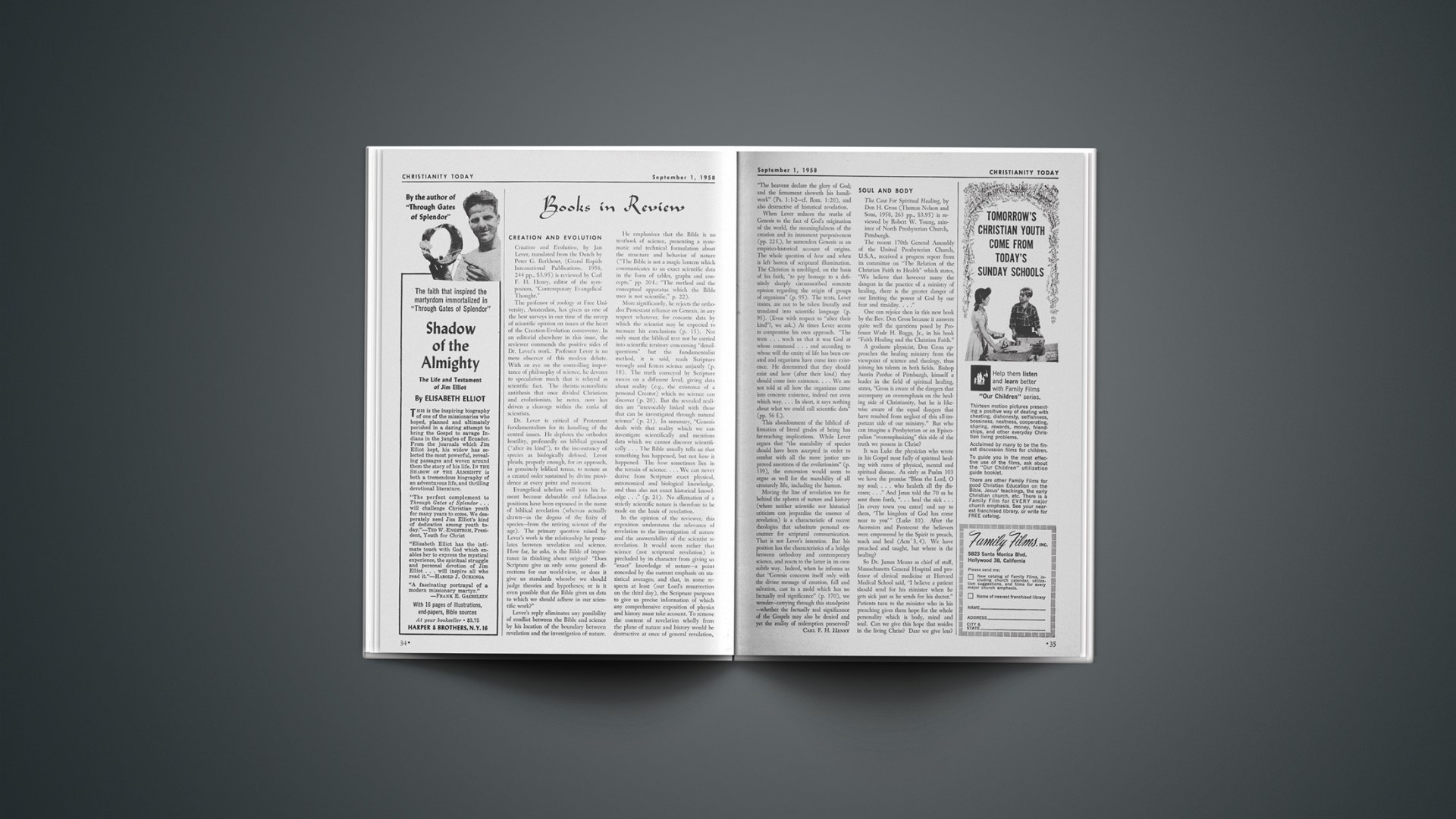
Creation and Evolution, by Jan Lever, translated from the Dutch by Peter G. Berkhout, (Grand Rapids International Publications, 1958, 244 pp., $3.95) is reviewed by Carl F. H. Henry, editor of the symposium, “Contemporary Evangelical Thought.”

The professor of zoology at Free University, Amsterdam, has given us one of the best surveys in our time of the sweep of scientific opinion on issues at the heart of the Creation-Evolution controversy. In an editorial elsewhere in this issue, the reviewer commends the positive sides of Dr. Lever’s work. Professor Lever is no mere observer of this modern debate. With an eye on the controlling importance of philosophy of science, he devotes to speculation much that is relayed as scientific fact. The theistic-naturalistic antithesis that once divided Christians and evolutionists, he notes, now has driven a cleavage within the ranks of scientists.

Dr. Lever is critical of Protestant fundamentalism for its handling of the central issues. He deplores the orthodox hostility, professedly on biblical ground (“after its kind”), to the inconstancy of species as biologically defined. Lever pleads, properly enough, for an approach, in genuinely biblical terms, to nature as a created order sustained by divine providence at every point and moment.

Evangelical scholars will join his lament because debatable and fallacious positions have been espoused in the name of biblical revelation (whereas actually drawn—as the dogma of the fixity of species—from the retiring science of the age). The primary question raised by Lever’s work is the relationship he postulates between revelation and science. How far, he asks, is the Bible of importance in thinking about origins? “Does Scripture give us only some general directions for our world-view, or does it give us standards whereby we should judge theories and hypotheses; or is it even possible that the Bible gives us data to which we should adhere in our scientific work?”

Lever’s reply eliminates any possibility of conflict between the Bible and science by his location of the boundary between revelation and the investigation of nature.

He emphasizes that the Bible is no textbook of science, presenting a systematic and technical formulation about the structure and behavior of nature (“The Bible is not a magic lantern which communicates to us exact scientific data in the form of tables, graphs and concepts,” pp. 20 f.; “The method and the conceptual apparatus which the Bible uses is not scientific,” p. 22).

More significantly, he rejects the orthodox Protestant reliance on Genesis, in any respect whatever, for concrete data by which the scientist may be expected to measure his conclusions (p. 15). Not only must the biblical text not be carried into scientific territory concerning “detail-questions” but the fundamentalist method, it is said, reads Scripture wrongly and fetters science unjustly (p. 18). The truth conveyed by Scripture moves on a different level, giving data about reality (e.g., the existence of a personal Creator) which no science can discover (p. 20). But the revealed realities are “irrevocably linked with those that can be investigated through natural science” (p. 21). In summary, “Genesis deals with that reality which we can investigate scientifically and mentions data which we cannot discover scientifically … The Bible usually tells us that something has happened, but not how it happened. The how sometimes lies in the terrain of science.… We can never derive from Scripture exact physical, astronomical and biological knowledge, and thus also not exact historical knowledge …” (p. 21). No affirmation of a strictly scientific nature is therefore to be made on the basis of revelation.

In the opinion of the reviewer, this exposition understates the relevance of revelation to the investigation of nature and the answerability of the scientist to revelation. It would seem rather that science (not scriptural revelation) is precluded by its character from giving us “exact” knowledge of nature—a point conceded by the current emphasis on statistical averages; and that, in some respects at least (our Lord’s resurrection on the third day), the Scripture purposes to give us precise information of which any comprehensive exposition of physics and history must take account. To remove the content of revelation wholly from the plane of nature and history would be destructive at once of general revelation, “The heavens declare the glory of God; and the firmament showeth his handiwork” (Ps. 1:1–2—cf. Rom. 1:20), and also destructive of historical revelation.

When Lever reduces the truths of Genesis to the fact of God’s origination of the world, the meaningfulness of the creation and its immanent purposiveness (pp. 22 f.), he surrenders Genesis as an empirico-historical account of origins. The whole question of how and when is left barren of scriptural illumination. The Christian is unobliged, on the basis of his faith, “to pay homage to a definitely sharply circumscribed concrete opinion regarding the origin of groups of organisms” (p. 95). The texts, Lever insists, are not to be taken literally and translated into scientific language (p. 95). (Even with respect to “after their kind”?, we ask.) At times Lever seems to compromise his own approach. “The texts … teach us that it was God at whose command … and according to whose will the entity of life has been created and organisms have come into existence. He determined that they should exist and how (after their kind) they should come into existence.… We are not told at all how the organisms came into concrete existence, indeed not even which way.… In short, it says nothing about what we could call scientific data” (pp. 56 f.).

This abandonment of the biblical affirmation of literal grades of being has far-reaching implications. While Lever argues that “the mutability of species should have been accepted in order to combat with all the more justice unproved assertions of the evolutionists” (p. 139), the concession would seem to argue as well for the mutability of all creaturely life, including the human.

Moving the line of revelation too far behind the spheres of nature and history (where neither scientific nor historical criticism can jeopardize the essence of revelation) is a characteristic of recent theologies that substitute personal encounter for scriptural communication. That is not Lever’s intention. But his position has the characteristics of a bridge between orthodoxy and contemporary science, and reacts to the latter in its own subtle way. Indeed, when he informs us that “Genesis concerns itself only with the divine message of creation, fall and salvation, cast in a mold which has no factually real significance” (p. 170), we wonder—carrying through this standpoint—whether the factually real significance of the Gospels may also be denied and yet the reality of redemption preserved?

CARL F. H. HENRY

Soul And Body

The Case For Spiritual Healing, by Don H. Gross (Thomas Nelson and Sons, 1958, 263 pp., $3.95) is reviewed by Robert W. Young, minister of North Presbyterian Church, Pittsburgh.

The recent 170th General Assembly of the United Presbyterian Church, U.S.A., received a progress report from its committee on “The Relation of the Christian Faith to Health” which states, “We believe that however many the dangers in the practice of a ministry of healing, there is the greater danger of our limiting the power of God by our fear and timidity.…”

One can rejoice then in this new book by the Rev. Don Gross because it answers quite well the questions posed by Professor Wade H. Boggs, Jr., in his book “Faith Healing and the Christian Faith.”

A graduate physicist, Don Gross approaches the healing ministry from the viewpoint of science and theology, thus joining his talents in both fields. Bishop Austin Pardue of Pittsburgh, himself a leader in the field of spiritual healing, states, “Gross is aware of the dangers that accompany an overemphasis on the healing side of Christianity, but he is likewise aware of the equal dangers that have resulted from neglect of this all-important side of our ministry.” But who can imagine a Presbyterian or an Episcopalian “overemphasizing” this side of the truth we possess in Christ?

It was Luke the physician who wrote in his Gospel most fully of spiritual healing with cures of physical, mental and spiritual disease. As early as Psalm 103 we have the promise “Bless the Lord, O my soul; … who healeth all thy diseases; …” And Jesus told the 70 as he sent them forth, “… heal the sick … [in every town you enter] and say to them, ‘The kingdom of God has come near to you’ ” (Luke 10). After the Ascension and Pentecost the believers were empowered by the Spirit to preach, teach and heal (Acts 3, 4). We have preached and taught, but where is the healing?

So Dr. James Means as chief of staff, Massachusetts General Hospital and professor of clinical medicine at Harvard Medical School said, “I believe a patient should send for his minister when he gets sick just as he sends for his doctor.” Patients turn to the minister who in his preaching gives them hope for the whole personality which is body, mind and soul. Can we give this hope that resides in the living Christ? Dare we give less?

Don Gross says, “This book is written with a sense of the ground swell of popular interest in healing through spiritual means … Magazine articles and books are beginning to flow forth in profusion.… New advances are being made in relating the Church’s work to medical and psychological care. Our seminaries are increasingly offering clinical training and preparation for pastoral counselling.”

Dr. Percy Payne of England taught a course, “Spiritual Healing,” in the summer Institute of Theology at Princeton Theological Seminary. All this is an increasing challenge to the leaders of our churches. Whether we are ministers or laymen, the times demand that we come to grips with the ministry of healing.

“It is our hope that this book will help them to do so,” writes Rev. Mr. Gross. “The book is intended as more than a review of what is happening in spiritual healing. Its purpose is to put those events in a fuller theological background, so that both principles and the meaning of that healing will be more clearly seen. Its purpose is to help our churches to practice Christian healing” (p. vii).

“The way to avoid interference with medical healing is to encourage all who come for spiritual healing to continue medical care strictly in accordance with the doctor’s orders. Where possible, medical and spiritual care should be coordinated. But at the very least they should not interfere with one another. God is the God of order and harmony. His gifts always supplement one another” (p. 57).

ROBERT W. YOUNG

Same Starting Point

Four Existentialist Theologians, by Will Herberg (Doubleday & Co., 1958, 346 pp., $4.00) is reviewed by Cornelius Van Til, professor of Apologetics, Westminster Theological Seminary.

There is something very interesting about this book. Here a Roman Catholic, a Greek Orthodox, a Jewish and a Protestant theologian are brought together under one roof. And there is no argument that one can hear.

Well, you say, Will Herberg has pressed them into one cover without their knowledge. They would argue, even fight, if they were only given a chance.

I doubt it. Oh yes, they would disagree on some points. But they would all agree on the most basic point. They would agree that the orthodox Protestant idea of the Bible is quite wrong. That is, they hold it to be a capital mistake to think that man should look at all the facts of life in the light of Scripture.

But, you say, that is only negative. They might still be at odds with one another as to where to start from when they seek for the meaning of life.

No, I do not think so. For there is only one other point from which one can start. Oh, but, you say, here is Maritain. He is an essentialist. What else can he be since he is a Roman Catholic. And surely as a Roman Catholic his church must have something to say about his philosophy. And here are Buber and Tillich, both of them existentialists. Surely the Old Testament must have an influence on Buber’s philosophy and the New Testament on Tillich. And then there is Berdaev. He is also an existentialist. But surely his membership in the Greek Orthodox church must color his philosophy.

Well, I do not deny that the religious affiliations of these men have some bearing on their total point of view. But we were speaking of the question of starting point. And there is only one basic starting point as an alternative to starting with Scripture. That alternative is to start with man himself.

Now there is a sense in which everybody must start with man. We cannot jump out of our skin. But there is an all-important difference as to how we start with man. It is quite proper, and in full accord with the orthodox Protestant view of Scripture, to start with man as being from the beginning of history confronted with God. Buber is quite right in saying that all of man’s relations are in the form of a dialogue.

God spoke with man from the beginning. Man’s proper attitude was a response of love and obedience. Thus man is the proximate or immediate while God is the ultimate or basic starting point.

But this is not the kind of starting point any one of these four men want. They assume that man can start with himself as though he were not a creature made in the image of God. They start with man as ultimate, as though he has light in himself apart from God.

The religious affiliations of these men therefore are really an afterthought. Of course, it may also be said that the very religion of the churches these men represent is what it is because, in large measure, if not entirely, they have built up their theology on the false starting point of human autonomy.

How does Buber on such a basis really expect to be able to think of all of human life as having the form of a dialogue? And how do the others on this basis expect to find true essence, true being and true freedom? Once man forsakes the only one who spoke to himself first, the triune God, and then spoke man into existence, he is reduced to speaking in a monologue. If he only could be so reduced. So far as his own efforts are concerned, his voice finds no response. But man, forsaking God, cannot escape God. When he tries to, when he seeks in essentialist or in existentialist form to construct a partner-in-speech other than God, he is still speaking with God. That is, he is then speaking against God. He is suppressing the truth. His search for the true essence, the true being, true freedom and true dialogue are all means by which the truth about himself, which he does not want to see, is suppressed.

It is certainly a time for great humility when we must see brilliant representatives of four great religious bodies assuming the correctness of that starting point on the basis of which profound insights may be discovered but on which ultimately the truth is repressed. Evangelical Protestants will do well to start their thinking from the Bible alone.

CORNELIUS VAN TIL

Operational Knowledge

Preface To Pastoral Theology, by Seward Hiltner (Abingdon Press, 1958, 240 pp., $4.00) is reviewed by Orville S. Walters, medical doctor in Danville, Illinois.

Theological understanding has not kept pace with the psychological and sociological insights that recent decades have made available to the minister. Pastoral theology is an operation-centered branch, in contrast to the logic-centered branches of theology. This operational knowledge must be placed in a theological context. These premises underlie Seward Hiltner’s Preface, a product of broad experience in the field of clinical pastoral training.

Such a theology must grow out of the basic study of human experience, where not only psychological and psychiatric, but also theological questions are asked, in the approach pioneered by Anton Boisen. Such a theology, Hiltner affirms, must be “grounded … in Jesus Christ as historical event and continuing saving reality in the lives of men.”

The operations of the pastor are largely included in three categories: shepherding, which is the concern of pastoral theology; communicating and organizing, for each of which the author proposes its own individual branch of theology.

Shepherding is subdivided into healing, sustaining, and guiding. This division rejects an older function of the pastor, that of discipline, on the ground that this duty is concerned more with the preservation of the church than with the healing of the individual.

For the analysis and illustration of these pastoral functions, Hiltner turns to the published cases of a mid-nineteenth century pastor, Ichabod Spencer. This pioneer in pastoral counseling was a Brooklyn Presbyterian minister who had a sense of urgency “to get a sincere and inward verdict for Jesus Christ.” In the three chapters on healing, sustaining, and guiding, the interviews of this evangelistically-minded pastor provide extensive, rich case material. Spencer’s procedures are criticized freely in the light of present-day ideas about counseling. The author takes exception to Spencer’s emphasis upon healing of the soul to the neglect of body and culture. If one holds consistently to the concept of total personality, Hiltner reasons, there can be no categorical division between secular and religious healing. But he does recognize the danger of winding up with “a humanism that has forgotten the awe and majesty and transcendence of God and the overwhelming and ultimate significance of Jesus Christ.”

Although the soul-saving efforts of Ichabod Spencer are here subjected to analysis and criticism as early examples of clinical pastoral counseling, his records still glow with zeal, earnestness and confidence in the guidance of the Holy Spirit, elements lamentably absent in most latter-day case reports. While Hiltner elaborates a theological context for pastoral theology, Ichabod Spencer exemplifies a warm-hearted evangelistic concern that is needed no less urgently by today’s students of pastoral counseling. This book does the movement a wholesome service by combining the two.

ORVILLE S. WALTERS

Genius At Work

Albert Schweitzer, by Jacques Feschotte (Beacon Press, 130 pp., $2.50) is reviewed by Gordon H. Clark, chairman of Department of Philosophy at Butler University.

This book consists of a short and intimate account of Schweitzer’s life plus two articles by Schweitzer himself; first, “Childhood Recollections,” and, second, “Ethics in the Evolution of Human Thought.”

Feschotte’s material gives a clear impression of a genius at hard work in music, theology, and medicine. Some of its pages are in the finest style of French literary portraiture. It is, however, somewhat marred by constant adulation, for Feschotte does not hesitate to identify Schweitzer as “the most famous of living men” (p. 12).

Schweitzer’s own recollections refer, among other childhood experiences, to a statue in Colmar of a Negro, which early fixed Africa in his mind. His article on ethics makes veneration of life the basic principle of conduct. Killing is the one thing most to be avoided. One wonders whether Schweitzer uses disinfectants and insect spray in his hospital, for Feschotte says that he “steers an inoffensive insect out of harm’s way” (p. 97).

While we can agree with his condemnation of bull fighting, even he realizes that some killing is unavoidable. A farmer cannot preserve all the animals in his flocks. To nurse a wounded bird back to health, one must kill insects or fish. Thus, says Schweitzer, we are forced into guilt. And if veneration of life applies to all living things, as he says it does, one would have to conclude that even a vegetarian is forced into guilt.

This absurd conclusion raises doubts as to the wisdom of Schweitzer’s ethics. Remarkable man that he is, his principles are not beyond question.

GORDON H. CLARK

Classical Homilies

Luther’s Works. Vol. 22: Sermons on the Gospel of St. John, Chapters 1–4, edited by Jaroslav Pelikan and translated by Martin H. Bertram (St. Louis: Concordia Publishing House, 1957, xi, 558 pp.) is reviewed by Harold J. Grimm, Department of History, Ohio State University.

Volume 22 of Luther’s Works is the fourth one published in the 55-volume American edition of the writings of the Reformer. Edited by Jaroslav Pelikan and Helmut T. Lehmann, this edition consists of two main parts. The one, being published by the Concordia Publishing House and comprising 30 volumes, contains Luther’s exegetical writings, sermons, and lectures. The other, being published by the Muhlenberg Press and comprising 24 volumes, contains writings connected with and illustrating Luther’s career as a reformer. It is the intention of the publishers to complete this monumental task by 1970.

The volume under consideration marks the beginning of the publication of Luther’s exposition of the gospel of St. John, which he valued almost as highly as the epistles of St. Paul. He had an opportunity to preach on the gospel of St. John when, in May, 1537, his friend Johannes Bugenhagen, the parish pastor in Wittenberg, was called to Denmark to aid in organizing the Reformation in that country at the invitation of King Christian III. As was usually the case, Luther substituted as preacher during Bugenhagen’s absence from Wittenberg. Although Bugenhagen was expected back by October of the same year, he did not return until July, 1539.

Luther preached for Bugenhagen during his entire absence, despite the fact that he was almost overwhelmed with other responsibilities and was frequently very ill. In July, 1537, he began the series of sermons preached on Saturdays. He continued to preach two months after Bugenhagen’s return, probably because he wished to complete the sermons on the third chapter. In 1540 he preached four sermons on the fourth chapter. Thus the sermons on the first four chapters, contained in this volume, were delivered over a period of more than three years.

The 53 sermons here translated into English were originally transcribed by Georg Rohrer and two other friends of Luther. The Reformer’s well-known assistant, Johannes Aurifaber, later collated these three sets of notes. Although the notes on the first two chapters were published in the Eisleben edition of Luther’s works, those on chapters three and four were not published until the middle of the nineteenth century. The translation in this volume is based primarily on the text in the Weimar edition.

Luther’s sermons, or discourses, reflect his thorough acquaintance with the Bible and biblical literature and also his ability to present theological doctrines in such a simple and forthright manner that all his hearers could understand him. His greatest concern always was to make clear the Word of God and to apply it to the spiritual needs of his parishioners. For this reason he gave little attention to homiletics. Speaking from the heart, he preached the Gospel in terms of love and affection and the law with paternal firmness.

Martin H. Bertram, the translator, has succeeded in capturing the spirit as well as the thought of Luther’s sermons in a lively, idiomatic English. The volume contains useful biblical and subject indexes.

HAROLD J. GRIMM

Warm Devotion

The Lord’s Prayer, by Henry Bast (The Church Press, Grand Rapids, 1957, $1.50) is reviewed by Paul R. Pulliam, minister of First United Presbyterian Church, Indiana, Pennsylvania.

Dr. Bast is minister of Temple Time, a radio broadcast of the Reformed Church in America, and professor at Western Seminary, Holland, Michigan. This small volume of 71 pages was first prepared as a series of messages for Temple Time. This series proved to be very popular and many requested that it be published. Dr. Bast considers why we should pray, to whom we should pray, and then addresses himself to each of the six petitions of the Lord’s Prayer. Thorough, careful exposition, a simple readability of style, and warm devotion make this one of the most rewarding books I have read recently. It will be equally useful to pastor and layman.

PAUL R. PULLIAM

South African Race Tensions

Early in June, Dr. Joost de Blank, Anglican Archbishop of Cape Town, preached a sermon in New York City.

“It is a sad commentary on the work of the Dutch Reformed Church of South Africa,” he said, “that it spends a great deal of money on missionary work but believes in keeping African and white congregations apart. It has a warped and inaccurate Calvinistic outlook.”

Subsequently, the Archbishop of Canterbury, Dr. Geoffrey Francis Fisher, sided with his Cape Town colleague in criticizing South African race policies of the Dutch Reformed Church.

The Anglican comment angered Calvinists all over the world, and the criticized church reacted by announcing its withdrawal from a proposed all-church conference which had been scheduled for South Africa in December.

What lies behind bitter feeling over the issue of apartheid, a South African term for racial segregation?CHRISTIANITY TODAYinvited Professor Ben J. Marais of South Africa to prepare the interpretive summary which follows. Professor Marais teaches Christian history at the University of Pretoria and is a Dutch Reformed minister. He has studied at both Yale and Princeton.

The Professor’S Report

People who have never lived in this lovely country can never realize the dominancy of this problem. Its shadow falls over every other aspect of national life, forming a great dividing line.

The South African racial drama is extremely complicated. People judge developments very differently. Some pick out one thread—the great housing schemes for Africans, for instance, and paint a picture of fortunate and contented Africans, “salvaged” from the terrible slums of western Johannesburg. Others only stress repressive legislation and present a picture of a gathering storm, of a terribly frustrated people, and of a country on the verge of a rumbling volcano. Up to a point, both pictures are true, but both can be terribly misleading if not put into true perspective.

The total South African population is just over 12½ million, including less than 3 million whites, usually referred to as “Europeans.” The main colored groups are the Bantus, numbering 8 or 9 million; the “Cape Coloreds,” a racially-mixed group of 1 million; and a few hundred thousand Indians.

Historically, the black-white problem started as a problem of land, of grazing rights and ownership. Basically, the possession of land is still the problem in color relations, although one hears more of political and economic issues.

African reserves constitute about 20 per cent of the total land area. No white may own land in these reserves, and no African may own land outside them. In plain figures it means that 20 per cent of the total population (the whites) own 80 per cent of the land. Most of the reserves are situated in well-watered and fairly fertile areas; others are arid.

Unified Society Rejected

According to apartheid policy in vogue in South Africa today, the idea of a unified society of whites and Africans is absolutely rejected. Stringent separate development is propagated. Within the broad folds of apartheid, however, many differences of opinion exist.

According to prevailing ideology, Africans must be given the opportunity to develop in their own cultural background and must not be forced to become “pseudo-whites” or Westerners. It is argued that only in separate development or apartheid will the Africans come into their own. In their own areas, they will have their privileges, political and otherwise. In “white” areas, they will not be granted political rights, but will be looked upon as “temporary” sojourners.

Extreme apartheid ideologists dream of a future in which all Africans will be removed to their own areas and if any Africans are allowed to enter the white areas it will only be as migratory laborers, and that for a limited time. In South Africa, one often hears about the great “sacrifice” whites will then have to make. It will mean that whites will have to do their own dirty work and the African laborers in industry and even on the farms will have to be replaced by whites, not to mention hundreds of thousands employed as domestic servants. People who take this point of view realize that if Africans are permanently employed in industry, they could not in the long run be excluded from citizen rights in the white areas, and this, they say, would lead to total integration and disappearance of the white group in the vast black African morass. This, to the white group, would not only mean a loss of color. It would, according to this line of argumentation, mean much more: not only racial suicide, but a loss of calling, of a God-given responsibility which the white Christian group has towards God, towards pagan Africans, and towards their own past cultural and religious heritage.

During recent years, parallels have been drawn between Israel in the Old Testament and the white Christian group in South Africa, and attempts have been made to give a scriptural basis to apartheid, especially on the basis of diversity in nature and creation. Apartheid has been “proven” to be scriptural by politicians as well as theologians.

Some branches of the Dutch Reformed Church, for instance, accepted such scriptural bases as late as 1951. These attempts, however, have been officially abandoned by the main Dutch Reformed denomination, and seem to have lost the day, although many ministers of religion in Dutch Reformed churches still propagate this line of thought. And if one must judge from correspondence columns of Afrikaans political newspapers, most Afrikaans-speaking citizens still accept it. During political elections, there are still the standard slogans in the Afrikaans-speaking rural districts: “God has divided people into different races; who are we to undo what God has done.” “We must accept and honor God’s decrees.” “Apartheid is according to God’s will.” Many devoted white South African believers honestly believe that apartheid is scriptural and because it either seems to be a “just” solution to them or seems to fortify the position of the white group, they stand for it.

Whites Struggle

If one knows the three-centuries-old struggle of this small white group on the tip of the erstwhile Dark Continent to keep its way of life and to guard against being swamped by the pagan millions of Africa, its way of looking at the racial situation is easily understood.

Apartheid as a political theory is not formulated by these people—they will vote for it almost to a man—but this theory was formulated by Afrikaans cultural and political leaders, some of them men of great personal integrity and idealism. According to protagonists of apartheid, it is not an oppressive policy or theory, but it is actually designed to give justice to whites as well as to Africans. In a mixed society, they say, the African will always be discriminated against, and he will remain inferior in status. In his own area or country the African will be boss and progressively be made responsible for running his own show. There the African will have his own schools, teachers, and policemen. Industries will be developed in his own areas. Exactly how this is to be done, and by whom it will be financed, is not yet clear, even to apartheid people. Of course, it is admitted, all this will take time and the movement of all these Africans back to the reserves or away from white residential areas will cause some inconvenience and even temporary grievances.

These champions of apartheid give a very vivid picture of the alternative to apartheid or total segregation. The present drift will lead to more and more Africans being drawn into white areas, into great or growing industrial cities for which they are not fitted. To most of them it means such a tremendous cultural or moral adjustment that it leads to mass frustration, to a vast moral breakup. Their old tribal cultural and religious taboos and restraints are torn to shreds, long before they are able to adjust themselves to the standards of a new society. The result is moral chaos and anarchy and heightening of tensions between the two main color groups, a situation which must utlimately lead to a vast emption.

Much of what is said in this connection is true. Whether apartheid or total territorial segregation can be a solution, however, is quite another question. At the moment, it seems extremely doubtful that the majority of Africans will ever accept it. As far as whites are concerned, although most feel for some sort of “separate development,” it must be seen whether they will be willing to support apartheid when it is fully implemented and they have to do without Africans as laborers in industry, agriculture or as domestic servants. Some propagandists for apartheid, especially politicians, meet this type of objection with the promise that once there is absolute territorial segregation, all needed African labor will be drafted on the temporary plan.

The moral and spiritual implications of such a system, however, makes it from a Christian point of view absolutely unacceptable, as it would cause the worst moral and spiritual breakup imaginable. Whereas many white Christians accept apartheid in general, as either a promising temporary or permanent policy, few responsible Christian leaders accept a policy of migratory labor on any vast scale. The dangers are all too obvious.

The churches have, on the whole, followed traditional patterns. English-speaking churches have generally declared themselves for a unified society, though in practice they have mostly followed a policy of separate church development with a degree of integration at some points. Afrikaans churches have often stood more solidly for segregation or separate churches for the different color groups whether on “practical” cultural, linguistic or even “scriptural” grounds.

The Dutch Reformed Church had followed a practice of separate churches for white and nonwhite believers for more than a century, although it did not become official policy until the 1880’s.

Among some English churches, notably Anglican, there has of late developed a more resolute and outspoken opposition to apartheid, although this church itself still has a long way to go to become a fully integrated church in theory and practice.

Baptism At Dead Man’S Rock

The site known as Dead Man’s Rock is located along Beaver Creek at East Liverpool, Ohio. About 30 people were gathered on the bank for the August Sunday afternoon baptismal service. A woman was strumming a guitar. The Rev. Gallard McCartney was out in water that came up to his waist.

Three people had already been immersed. Six other candidates were waiting. Next was the minister’s own nephew, 21-year-old Cline Cogar. The youth, whose home was in a nearby West Virginia town, had decided to come to East Liverpool only two weeks before. He had heard that his uncle was holding a tent evangelistic campaign. Besides, young Cogar needed a job. He thought the minister might be able to help.

As McCartney later said, he immersed his nephew then brought him up. “He was smiling,” the minister recalled, “as many do after baptism. Then he started shouting and grabbed me and in a moment we were in the swift current farther out. We both went under. We became separated. When I came up, he had disappeared.”

Cogar’s body was recovered downstream some 15 minutes later. Attempts to revive the youth failed. The remainder of the baptismal service was called off.

McCartney said he had conducted many baptisms before, including several since he had come from Akron, where he pastored several churches as a minister ordained by Fundamental Methodists, Inc.

Unable to explain the drowning any more, the minister said, “I’d rather it was me than him.”

Europe

The Methodists

In Stuttgart, Germany, the executive committee of the World Methodist Council approved a motion urging that a conference of Central and South African Methodist leaders be held next spring to work on the problem of racial tensions.

The motion was submitted by Dr. T. Webb of Johannesburg, who asserted that Gospel proclamation of man’s equality should be followed in achieving racial equality among all races.

During the five-day conference, renewed effort to strengthen ties among the world’s 18,000,000 Methodists was urged by Dr. Harold Roberts, World Methodist Council president who is also head of Richmond College, a Methodist theological school connected with the University of London.

The 50-member council executive committee heard reports on church union proposals involving Methodists with the Anglican Church in England, with Presbyterians and Anglicans in West Africa, North India and Pakistan, with Presbyterians, Anglicans and Baptists in Ceylon, and with the Evangelical United Brethren Church in the United States.

Meanwhile, the Methodist Church of Denmark observed its 100th anniversary with a series of festival services in Copenhagen. Methodist Danes include some 4,000 adults and 6,000 youth.

Retired Bishop Ivan Lee Holt of St. Louis had been scheduled to attend the commemorative meetings, but was unable to come because of the sudden death of his wife in Brussels, Belgium.

Fateful Sequel

In Germany, six-day ceremonies marking the 250th anniversary of the Church of the Brethren were highlighted by a rededication service on the banks of the Eder River at Schwarzenau, where the first of the Brethren was baptized in 1708.

Following the service, the gathering of some 400 German Brethren plus other members of the denomination from four continents was addressed by Dr. W. A. Visser ’t Hooft, general secretary of the World Council of Churches, Bishop Ernst Wilm of Bielefeld, president of the Evangelical Church of Westphalia, and Dr. William M. Beahm, moderator of the Church of the Brethren. Other observances were held at Kassel and Berleburg.

Among witnesses were American members of the Brethren Heritage Tour, arranged by the Church of the Brethren. The tourists also visited places connected with the early history of the pietist movement in Europe. (The Brethren movement was launched at Schwarzenau by Alexander Mack and a small group who had withdrawn from the state churches in Germany and were influenced by the pietist movement, which emphasized repentance, faith as an attitude of heart, and regeneration and sanctification as experimental facts.)

The night of August 13–14, after a month in Europe, 20 members of the touring Brethren party boarded a New York-bound plane of the KLM Royal Dutch Airlines. The plane crashed into the Atlantic Ocean 130 miles west of Ireland, killing all 99 aboard.

Only days later, a car accident in Sweden killed the wife of Dr. M. R. Zigler, European director of the Brethren Service Commission. Zigler was injured.

Modern Slavery

A Hungarian clergyman told a Western assembly this summer that exploitation, bondage and slavery is to be condemned, “even though in modern form.”

The Rev. Josef Nagy, director of Baptist young people’s work in Hungary, told the Congress of the European Baptist Federation that “no man or nation has the right to rule over another.”

The six-day Congress was attended by 10,000 from 22 countries on both sides of the Iron Curtain.

Middle East

Moslems And Christians

A former principal of Beirut’s Near East School of Theology says he does not believe a Moslem-Christian war in Lebanon is in the offing.

The Rev. Cullen Story, now back in the United States, explains why:

“1. The present constitution of Lebanon … stipulates that the country shall have a Christian president but the country itself is to be pro-Arab. There is nothing in the basic organization of Lebanon, then, to indicate any Moslem-Christian war will ever occur.

“2. The so-called ‘kid-glove treatment’ of the opposition by the ‘Christian’ army under General Shehab seems to be evidence of a studied resistance to any vis-a-vis conflict of Moslems and Christians.

“3. Christian groups in Lebanon are not united together to form any common front against Islam. Witness the outspoken views of Maronite Patriarch Meouchi, that, to say the least, are in direct contrast to those of President Chamoun.

“4. These groups, though embracing an approximate 50 per cent of Lebanon’s population, sense that they live in a Middle East containing an overwhelming Moslem majority. The last thing they would want would be to court the disaster of an open conflict with Islam.”

Far East

Christian Education

Addresses by Bishop Otto Dibelius of Berlin and a closing public worship service attended by some 16,000 highlighted the eight-day fourteenth World Convention on Christian Education in Tokyo, sponsored by the World Council of Christian Education and Sunday School Association (headquarters in New York).

The convention reportedly was the largest international gathering ever held in Japan, with more than 4,000 delegates from 63 foreign countries on hand.

Japanese Christian leaders were said to be hoping that the meeting would serve to lend impetus to the advance of the Gospel in their country. Tokyo also played host to the eighth such gathering back in 1920, when fire destroyed a specially-constructed four-story convention building only a few hours before sessions were to start. A theater building was secured as a substitute meeting place.

Last month, the convention was held at Aoyama Gukuin, one of Japan’s leading mission schools. The Rev. Michio Kozaki, president of the National Christian Council of Japan, was chairman of the organizing committee.

Presiding at the climactic public worship service was Methodist Bishop Shot K. Mondol of India, new president of the World Council of Christian Education and Sunday School Association.

Bishop Dibelius, head of the Evangelical Church in Germany, asserted that the teaching of youth in totalitarian countries poses a challenge to Christian educators. He said control over the education of young people imposed by Communist nations is giving such states a monopoly in that field.

The August 6–13 convention was preceded by the World Institute on Christian Education, held July 10-August 1 at Nishinomiya with 312 delegates from 62 nations. The institute heard a number of addresses, then divided into discussion groups which met at Seiwa College. Closing plenary sessions were under the leadership of Dr. Paul H. Vieth of Yale Divinity School.

The theme of the convention was “Christ—the Way, the Truth and the Life.”

Only Teens Laugh

What forms does current Christian witness take in Communist China? In the Catholic realm, reliable reports indicate that Red Chinese government leaders have waived overt suppression in favor of setting up a collaborationist church hierarchy with Roman liturgical rules.

But how about Protestants? Last month, a top Methodist missions official expressed hope for “resumption of contact” with Christians in mainland China. “There is a great deal of evidence that Methodists and other Christians in China hunger for fellowship with the Western world,” said General Secretary Eugene L. Smith of the Methodist Church’s Division of World Missions. Smith told a South-wide Methodist Missionary Conference at Lake Junaluska, North Carolina, that “we do know there is some religious freedom among the Christians of Red China.”

Not long after Communists won control over 600,000,000 Chinese, machinery was set up to handle Protestantism through an organization known as the Three Self Love Country Movement. The organization, billed as patriotically self-governing, self-supporting, and self-propagating, originated with the Communist Chinese Religious Affairs Bureau as a means of maintaining contact and control over Protestant churches. The Three Self Movement reportedly has 60 per cent of Red Chinese Christians.

This summer in Red China, Protestant churches were definitely open and active. Whether they were growing or declining was not clear. There was evidence that even evangelistic tours were tolerated, although the traveling evangelists were being officially denounced. YMCA athletic activities seemed to be flourishing.

Communists would have it believed that their Chinese have religious freedom to the extent that the government is not embarrassed. Jail sentences, however, are still being meted out to clergymen whose words or deeds are viewed as revolutionary. The Three Self Movement keeps a close tab on clergy patriotism. The group holds one local conference after another to keep “People’s Government” loyalties fresh in the minds of ranking Protestants.

In the spring of 1957, at the invitation of Three Self Movement leaders, 15 key Japanese religious leaders went on a guided tour of Communist China. They visited Shanghai, Peking, Hankow, Sochow, Canton, Hanchow, and Nanking. Since then, the visitors’ remarks have told more about the state of the church in Japan than they indicated of actual conditions in Red China. With one exception, the religionists gave reports which were interpreted as having a generally favorable tone toward the Communist China situation. The reports have been raising eyebrows, prompting concern as to whether Communist ideology had made inroads among those who guide Christians in Japan, whether these individuals were forgetting the incompatibility of Christianity and communism.

Among those who reviewed the reports with alarm was the Rev. Samuel E. Boyle of the Reformed Presbyterian Mission in Kobe, Japan. Boyle, a missionary to China before Communist occupation, keeps up to date on doings behind the Bamboo Curtain through Tien Feng (Heavenly Wind), a church magazine published in Shanghai. Issues of Tien Feng are rare in the free world, but Boyle has managed to secure copies regularly. Knowledge of the Chinese people and gleanings from Tien Feng prompted an evaluation of his own:

“The significance of the visit of a Japanese Christian delegation, including orthodox Japanese ministers, cannot be exaggerated. We see already the spreading virus of error entering the Japanese church by printed page and verbal reports of the 15 delegates. The pro-Communist church in China which cooperates through the liaison apparatus called ‘The Three Self Love Country Movement,’ dominated by Wu Yao Tsung of the YMCA, had made what we earnestly believe to be a nonbiblical and spiritually disastrous truce with the Communist state. The Japanese delegation stoutly denies this interpretation of the facts. Thus in Japan, as formerly in China, Bible-believing missionaries find themselves in opposition to the prominent leaders of the Asian Protestant movement.

Social Relations

For eight years, the United Church of Japan has been studying social relations. This summer the church issued an official statement:

“We intend firmly to oppose rearmament and to lay the foundation for world peace. We advocate the cessation of the production, use and testing of nuclear weapons and other weapons of mass destruction. We oppose the erecting of tariff walls as an expression of the selfishness of one nation. The Christian must so participate in politics as a citizen that the state fulfills its true function and that power is given to social justice.”

“Two powerful motives serve to blind Asian leaders of the church to the danger inherent in the Chinese ‘Three Self Love Country Movement’ solution of tensions between Christianity and a Communist state. The first and strongest motive is nationalistic pride and ambition to be counted patriotic by the state. The other motive is to achieve an indigenous, united and effective national Christian church which can be totally free from Western denominational control and foreign money, with the power which such money always imposes on the Asian Christian recipients. That the problem in Japan is now complex and dangerous, not to Western missions alone, but to future Christianity in Asia, seems apparent to us.”

Among those who visited Red China were the Rev. Jun-ichi Asano of the United Church, Mrs. Tamaki Uemura of the Japan Christian Church, the Rev. Seiju Yuya of the Baptist Conference of Japan, the Rev. Shigeo Yamamoto, of the United Church, Mrs. Masako Takegami and Mrs. Hatsue Nomiya of the Japanese Women’s Christian Temperance Union, the Rev. Kaneo Oda of the Free Methodist Church of Japan, the Rev. Shuichi Ogawa of the United Church, the Rev. Shigeji Ogasawara of the Japan Episcopalian Church, the Rev. Aoyama Shiro of the Evangelical Lutheran Church in Japan, Professor Yoshio Inoue of the Tokyo Union Theological Seminary, the Rev. Mitsuo Senoo of the Japan Evangelical Kyodan, the Rev. Ichiro Nakagawa of St. Paul’s University in Tokyo, and Editor Seiichi Waki of Christ Weekly in Tokyo.

The fifteenth member of the delegation, the one who took exception to generally favorable comments on Red China, was Toshio Suekane, general secretary of the YMCA in Yokohama, who said:

“You’ve heard that there are no flies, no dogs, no cats (which would all be a burden to the people to care for so they were eaten as food because of economic necessity) and no prostitutes. Externally this may be true. The situation is changed from what it was 11 years ago. But people clearly show their heartache. Only teen-agers laugh freely. The older ones are very serious and stem, not light-hearted. This is true even among Christians. They are all politicians, concerned with the government. That’s all you hear.”

“My fountain pen was stolen twice in Hong Kong,” Suekane concludes, “yet I still prefer this harbor city to oppressed Red China, though I could lay it down anywhere in China without being stolen. Freedom is more precious than a pen.”

Join World Council of Churches, Russian Prelate Urges

NEWS

Christianity in the World Today

“I will report to the Soviet churches, recommending that they join the World Council.”

The speaker, according to Religious News Service, was Metropolitan Nikolai, second-ranking leader of the Moscow Patriarchate, who had just met for two days with top WCC officials at Utrecht, The Netherlands.

The metropolitan’s declaration represented the most significant development thus far toward possible Russian Orthodox Church membership in the WCC.

“We cannot express a firm decision on joining the World Council of Churches,” Metropolitan Nikolai was quoted as saying. “We can only say the next stage will be one of consultation with Soviet church leaders.”

A joint statement issued after the meeting said the Russian delegation would report to the Moscow patriarch and synod that it was in “a spirit of full sympathy with the fundamental principles of the ecumenical movement.”

The Soviet delegates, the statement added, will also report favorably on the conference to other autonomous Eastern European Orthodox churches which, like the Russian body, refused to join the WCC when it was formed at Amsterdam in 1948.

The Utrecht conference was the first official meeting between leaders of the Russian Orthodox Church and the WCC, which was represented by General Secretary W. A. Visser ’t Hooft, Central Committee Chairman Franklin Clark Fry, and Greek Orthodox Metropolitan James of Melita, a member of the Central Committee.

Metropolitan Nikolai said the conference provided “undoubtedly a good basis for future contacts” between the Russian Orthodox Church and WCC leaders. He was accompanied to the meeting by Archbishop Michael of Smolensk and Mr. Alexis Buevsky, a layman.

The statement said that WCC leaders were similarly in favor of further contacts with the Russian Orthodox Church. The WCC representatives were also reported as having expressed intentions to recommend at the Central Committee’s August 21–29 meeting at Nyborgstrand, Denmark, that Russian Orthodox observers be invited to sit in, if this is agreeable to the Soviet church.

Although the August 7–9 conference at Utrecht had been arranged rather hurriedly, both sides had been expressing interest in such a meeting for some time.

Ten Years Ago

Why did the Russian Orthodox Church choose to remain out of the World Council of Churches when the ecumenical body was formally constituted in August, 1948?

The Russian Orthodox Church surely had its chance. An invitation to join was received in good time prior to the WCC’s first assembly at Amsterdam, a milestone which the Central Committee commemorated last month with a service in the Cathedral of Odense, Denmark.

Eight Orthodox bodies seriously considered a “charter member” move at a Pan-Orthodox Conference in Moscow in July, 1948. Stalinist pressure undoubtedly influenced their decision.

The conference voted against affiliating with the World Council. No representatives appeared at the Amsterdam assembly. From Moscow the word came that the WCC was “mainly political and anti-democratic and does not follow ecclesiastical aims.”

Music For America

The attraction at Denver’s boulder-rimmed Red Rocks Theater was one of the finer types of Gospel music presentations, with many top artists on hand.

People from five or more states came to hear the sacred notes of 300 musicians resound in the near-perfect acoustics of the awe-inspiring outdoor amphitheater.

The festival was more than a pleasant August evening’s entertainment. It was a big trial step for an enterprise seeking (1) to bring to the American public large-scale concert productions with an evangelical flavor, and (2) to provide a continuing outlet for Gospel artists.

The medium is Music for America, an organization which for the past two years has been presenting sacred concerts in Pasadena, California. Cy Jackson, Pasadena advertising promoter, is its creator and producer.

Denver was the first outward thrust of Music for America. Using a group of evangelical church leaders as local sponsors, the program was billed around such personalities as orchestral leader Ralph Carmichael and his songstress wife, basso Bill Carle, singer-composer Stuart Hamblen, tenor John Gustafson, organist Les Barnett, violinist John Cuneo, pianist Charles Magnuson, and choral coordinator Jack Coleman. In addition, the concert featured the quartet which gained fame with the Old Fashioned Revival Hour, along with soprano Beth Farnam and pianist Rudy Atwood, both of whom also are known to listeners of the Charles E. Fuller radio program. The soloists were supported by a choir of 250 and 48 Denver Symphony Orchestra members.

Music for America sponsors had good reason to be encouraged by the result. The advance ticket sale was the largest in Red Rocks Theater history. The attendance of 10,500 was the theater’s second largest of the season (first: Van Cliburn). Some persons came from Kansas, Iowa, Wyoming, Nebraska, and far-removed parts of Colorado only to stand throughout the concert or sit on the cold crimson boulders which rise 600 feet above the seating galleries.

The audience seemed well repaid for any inconvenience. The two-and-a-half-hour program won widespread acclaim. The Rocky Mountain News called the concert “a memorable occasion.” Best loved were Carle’s inspiring “How Great Thou Art,” Hamblen’s “It Is No Secret,” and the ensemble’s rendition of Newbury’s “Psalm 150.” Miss Farnam sang “The Holy City” with a “sweet interpretation clearly and delicately given,” according to the News. The program also premiered Carmichael compositions.

A Lag Develops

Church membership gains failed to keep up with America’s population growth last year, according to the Yearbook of American Churches for 1959.

Nevertheless, church membership in the United States reached a new high of 104,189,678 in 1957, a gain of 964,724 over the previous year, the book reports.

For the first time since World War II, the membership percentage increase was lower than that estimated for the population as a whole. Last year church membership rose by 0.9 per cent, while the population rise was estimated at 1.7 per cent. In 1956, when 62 out of every 100 Americans were reported to have church affiliation, the membership increase was 3 per cent, nearly twice that of the reported population rise. This year’s 61 per cent figure is the second highest on record.

The figures were compiled by the National Council of Churches, which publishes the yearbook.

Of the grand total with religious affiliation, 59,823,777 are Protestants, 35,846,477 Roman Catholics, 5,500,000 Jews, 2,540,446 Eastern Orthodox, and 273,692 Old Catholics and Polish National Catholics.

(The Roman Catholic church considers all persons who are baptized, including infants, to be church members. Most Protestant church bodies count only those young people and adults who have attained full membership.)

In major Protestant “family” groupings, Baptists lead with nearly 20 million members in 27 different church bodies. Next are Methodists with more than 12 million in 22 bodies. Lutherans have some 71/2 million in 19 bodies, while Presbyterians have 4 million in 10 bodies.

Top 10 Protestant groups: Methodist Church, 9,543,245; Southern Baptist Convention, 8,956,756; National Baptist Convention, U. S. A., Inc., 4,557,416; United Presbyterian Church in the U. S. A., 3,032,977; Protestant Episcopal Church, 2,965,137; National Baptist Convention of America, 2,668,799; United Lutheran Church in America, 2,305,455; Congregational Christian—Evangelical and Reformed merged church, 2,192,674; Lutheran Church—Missouri Synod, 2,150,230; Christian Church (Disciples of Christ), 1,943,599.

‘Art’ And Morality

Have Las Vegas morals dipped to a new low in a rash of nudity shows?

Increased business was not to be interpreted as “the voice of the people,” the pastor of one of Nevada’s largest Methodist churches warned operators of Las Vegas hotels featuring chorus girls nude from the waist up.

“How many of these people are tourists in town for a good time?” asked Dr. Donald O’Connor, pastor of the First Methodist Church in Las Vegas.

Whatever the full moral ramifications, Las Vegas ministers saw the situation as an opportunity for a referendum call on the whole question of legal gambling.

“If the gambling fraternity is not able to police itself against such situations as are current,” said the Rev. Walter Bishop of the First Baptist Church, “the citizens of the state will do it for them.”

Abel Greene, editor of the show business trade journal Variety, predicted that sponsors of the nudity shows will “back down” rather than risk gambling rights.

Night club acts featuring naked show girls are not new, but “come in cycles,” he said. Statutes in various communities, however, govern the circumstances. In New York City, for example, nude tableaux are permitted as a form of art. Legal control is hampered by lack of a clear distinction as to what constitutes art and what panders to lust.

Clergy reaction to Las Vegas nudity shows was led by a condemnation from Roman Catholic Bishop Robert J. Dwyer, and Variety reported an ironic note relative to his criticism. The night before the bishop issued his statement, St. Bridget’s Catholic Church Altar Society sponsored a bingo party. First prize, Variety reported, was dinner for two at the Stardust Hotel, which was featuring the “bare bosom” Lido de Paris show.

Sunday Firing

Was the Air Force justified to schedule its first moon rocket launching on a Sunday? Might the U. S. government have followed a more honorable course, in deference to the country’s Christian roots, by specifying a weekday for its initial lunar shot?

The decision to fire a moon rocket on Sunday morning, August 17, was “out of line,” said the Rev. Melvin M. Forney, general secretary of the Lord’s Day Alliance of the United States.

“Every important adventure in American history has had divine blessing,” Forney added. “To desecrate the Lord’s Day by firing a moon rocket may give those who are more spiritually-minded real cause for concern.”

Forney suggested the moon shot’s failure may have been “divine chastisement.”

“It would do us well to stop and consider whether the failure was purely human,” he said.

It was generally reported that the Sunday firing date had been agreed upon weeks in advance. Air Force officials had also indicated the following Monday and Tuesday to be acceptable alternates, should a temporary delay have arisen.

Forney said it would have been more in keeping with Christian principles to launch the rocket on a weekday, even if the date chosen offered less than optimum physical conditions as compared with Sunday.

Liberal Ties

Members of the American Unitarian Association and the Universalist Church of America will vote in February on whether the two bodies should merge.

Poll plans were announced at the five-day sixteenth congress of the International Association for Liberal Christianity in Chicago. Both groups were hosts to the congress, attended by representatives of Christianity, Judaism, Islam, Buddhism, and Hinduism.

If the Unitarian-Universalist merger is approved, a plan of union will be presented to the assemblies of each body next fall. Final membership vote on the union, if endorsed by both assemblies, is not expected to take place until 1960.

The proposed body would unite some 105,000 Unitarians and 75,000 Universalists. The United Liberal Church has been suggested as its new name.

A 12-member special commission has been negotiating the union since 1955. It conceives the merger to mean establishment of one corporation to perform for the Universalists and Unitarian churches, and possibly others, all the functions now performed by the Universalist Church of America, the American Unitarian Association and the Council of Liberal Churches. The council was formed in 1953 to federate work of various departments of the two bodies. It has been acting as an intermediary.

Among 1,000 delegates from more than 20 countries attending the congress was Bishop Miroslav Novak of the Czechoslovak Church. He said his church, largest Protestant body in the country, has some 1,000,000 members and functions without hindrance from the Communist government.

Eutychus and His Kin: September 1, 1958

FASHION GUIDE

There is no better way to be different than to stay the same. Amish “plain dress” was once completely unobtrusive, but even Dior’s latest is less bizarre on Fifth Avenue. Those cutting the patterns for the zig-zag changes of fashion have this worked out. Everyone, especially every woman, wants to be different. She can’t bear to look like an ordinary woman. As soon as she returns from vacation, she must find a new fall wardrobe that will flatter her individuality. Of course, she doesn’t dream up a queer creation of her own. In fact, by studying the magazines, she has prepared herself for exactly what the better shops are offering.

This has to be different, the same difference for everybody who wants to be different. Now to make the different women different, style creators seldom think of anything new and different. In fact, this would be a waste of time when there is so much old and different. Therefore, the difference to which no truly different woman is indifferent is sometimes only different from the last difference, and may be the very difference by which women who are not different differ from the different! This Empire style, for example. Surely there must be a few recluses, in crumbling mansions or private institutions, who have never given it up.

The supreme act of courage is to stay with the difference after it is no longer different. Urge your wife to buy a sack at an absolute clearance, and wear it for three or four years. After all, aren’t you still wearing those bargain pink shirts?

Unfortunately, style consciousness is not limited to the world of haute couture. Theological fashion seems equally potent, and appears to follow the same rick-rack pattern. Those weary of the new and different, can be overcome with a fashionable rage for the old and different. Even a Neanderthal conservative is occasionally astonished at the authentic cut of the latest orlon bearskin.

The toughest assignment is to ignore fashion for the sake of truth. The theologian who seeks to build on the achievements of orthodox theologians of the last generation cannot boast even a modish bearskin. He must work in a pink shirt.

SYMBOLISM AND DOGMATISM

Can Mr. Freeman (July 21 issue) prove that any statement about anything is not symbolic?… Can he keep warm on a winter night with only the word “blanket” over him?… One does not have to swallow every statement that Dr. Tillich makes, but one is bound to be the poorer if he refuses to consider his frequently challenging and constructive thoughts. Dr. Tillich states his adventures in thought in a very dogmatic manner. A bit more humility might benefit him, and the same might help Mr. Freeman, and, indeed, all of us.

Sacramento, Calif.

I speak as one who has been greatly helped by the thinking of Paul Tillich. I am certain he addresses himself to questions that are actually there but which can easily be obscured by any of the several varieties of “Protestant” and Roman Catholic scholastic theologies current today which insist on a propositional Deity to worship, to swear by, and to use for whipping the rest of society into some kind of shape. Tillich braves psychological hazards that Jesuitical, Fundamentalists, and “Power of Positive Thinking” expressions of “the will to believe” refuse to risk. Perhaps he himself should have a word in your journal, on the question as to which route is the more idolatrous and alien to the genius of the Christian movement.

Westminster Foundation, Univ. of Ore.

Eugene, Ore.

When Freeman represents as Tillich’s own position the view that “experience is an inexhaustible source out of which new truths are continually taken” and that “the theologian ought to be open to experience which might go beyond Christian experience,” he completely overlooks the fact that in the discussion to which he refers (Systematic Theology, I, 45) Tillich himself is in reality concerned to reject any such view. As can be readily confirmed by … the context in which the statements that Freeman paraphrases occur, Tillich’s purpose in making them is actually descriptive—or, even better, polemical; for it is against precisely such a position as he thereby describes that he is concerned to set his own view of experience as a “medium” rather than as an independent source.

So. Meth. Univ.

Perkins School of Theology

Dallas, Tex.

Your frantic support of reactionary religion … only confirms Tillich’s judgment of some years ago, that much of American religious thinking is comfortably at anchor in the backwaters of a hard-shelled and fundamentalists supernaturalism—which he has called a “happy state of backwardness.” If openness to the eternal and to the future means anything in religious thought and action Tillich is in the vanguard.

Christ Episcopal Church

Tracy City, Tenn.

One of our younger ministers … conducted … devotions.… He had given them Tillich. Even the wisest of preachers told me he didn’t know what he was talking about.… Yet Tillich gets all the space possible in your paper.… I want you to sense the deep, tragic needs of a baffled world, and give us food for … our souls.

Winnipeg, Man.

I am really delighted … you have taken Tillich’s Saturday Evening Post article (June 14 issue) and … have analyzed so competently and unsparingly his position. Dr. Bell’s article on the subject is superb. I was greatly impressed also by the article by David Freeman.

Headmaster

The Stony Brook School

Stony Brook, L. I., N. Y.

It was a very excellent criticism and certainly needed. One cannot help but feel after reading Tillich that his whole approach is just first century Gnosticism warmed over and given a twentieth century sauce. The Gnostics emphasized the idea of “depth” in their philosophy. Indeed, they were trying to give to New Testament Christianity a depth which they felt was missing. Unfortunately, they like Tillich, only succeeded in divesting the relation of God’s saving act in Jesus Christ of historicity and therefore of relevance. The historic facts of the Christian message have always been an offense to the intellectual who has not been humbled at the cross. It is tragic that Tillich’s position is often represented as being the only road by which modern man can travel if he wants to reach a mature faith. Your articles … certainly helped to show that Christian faith must be rooted and grounded in the historic acts of revelation where God in Christ has acted in time—for men and our eternal salvation.

… My prayer is that God will bless the whole ministry of the Church through the excellent and timely articles.…

Thornhill Presb.

Thornhill, Ont.

Encamped along horizontal plane in existential present

Modern man’s predicament becomes quite evident

Lost is the meaning of his life; no infinite concern

Depth the dimension that’s been lost; for which we all should yearn.

Depth is the victory! Depth is the victory!

O glorious victory of infinite concern.

The banner over us is, “Go! directions without limit.”

We’ll tread on roads no saint has trod; world-space will not inhibit.

Fair Science like a whirlwind’s breath makes all and us a tool

While transitory life-concern completely does us fool.

On every hand the foe we find drawn up in dread array.

Literal defense of our symbols for us will lose the day.

The truth of History’s healing power and power in personal life,

Is plainly in symbolic sense and pure non-literal light.

To him that hurts with hard questions; black raiment shall be given

By angels he shall be well-known, at Harvard, if not heaven.

Analysis, Existentialist with cube and plane and line

Humility’s “learned ignorance” is still their name and sign.

Chaplain

Veterans Hosp.

Sheridan, Wyo.

By far the greatest service rendered by Freeman’s article …, particularly in quoting Tillich’s references to “the continuous self-surrender of Jesus who is Jesus to Jesus who is the Christ,” is to show how really far from dead is that Gnosticism the early Church Fathers fought, and how much alive and energetic it still is, particularly in the dress of academic sophistication.

Dongola, Ill.

The references to Tillich … were handled in love and critical integrity.

Indianapolis, Ind.

PROPER THRUST

The thrust of … Prof. Cullmann’s … thesis (July 21 issue) may be in the proper direction, but can such of his quotations … as the following be considered as biblical? “He [Jesus] is now actually in the hands of God’s great enemy [death]” (p. 5). But death is a judicial penalty inflicted by God and is therefore man’s great enemy, not God’s. “He [Jesus] can only conquer death … by betaking himself … to the sphere of ‘nothingness’ …” (p. 5). I have purposely condensed this to bring out the objectionable part, e.g. calling death the sphere of nothingness. Cullmann here implies, if he does not actually say, that Jesus’ death included the cessation of existence for his soul. This is not only unbiblical, it is anti-biblical. “Death is not something natural, willed by God, … it is … opposed to God” (p. 5). This smacks of a dualism that makes death practically, if not actually, as ultimate as God. “The soul is not immortal” (p. 22). This statement agrees with Cullmann’s thought as expressed in the above statements, but it is also simply not true. The biblical data describe death in the primary sense as separation of the soul from the body, and in the ultimate sense as separation of the complete personality from God, of which the former is but a portent. And in neither case does the soul lose its existence.

Faith Presbyterian

Fawn Grove, Pa.

Making a distinction between body and flesh is certainly a bizarre idea.… It is my humble opinion that if this is a sample of Fundamentalist scholarship, they should give it up altogether and confine themselves to the emotional side of religion. Then Christianity will become an outgrowth of the old mystery religions with a modern setting.

Reading, Pa.

I cannot agree that our Lord was afraid to die. If Dr. Cullmann had not omitted the last phrase of Hebrews 5:7, this verse would have refuted his statement concerning this matter. If Christ prayed that he might be spared from death, then he was not “heard.” I believe the only thing he feared was that the sins of the whole world which were beginning to weigh heavily upon him might crush out his life and prevent him going to the cross to accomplish our redemption. The fact that “his sweat was as it were great drops of blood” and that “there appeared an angel unto him from heaven, strengthening him” would seem to allow for this interpretation.

Dean

Simpson Bible College

San Francisco, Calif.

Thank you for the stimulating article … by … Cullmann. I … appreciated his statement that sickness, although not necessarily the result of individual sin, is a result of “the sinful condition of the whole of humanity. Every healing is a partial resurrection, a partial victory of life over death.…” This is exactly what the exponents of divine healing from Drs.… A. B. Simpson … and A. J. Gordon down to the present have been saying. My ideal of a preacher is F. W. Robertson of Brighton, and I consider Oral Roberts to be in the same class.

Parkside Christian & Missionary Alliance

Visalia, Calif.

Cullmann’s vital point is that we have a sure and certain hope only because of the concrete fact of Christ’s resurrection—an … outstanding article … with … essential soundness.

Whitley Vicarage

Godalming, Surrey, England

While reading Cullmann …, I was reminded of a poem by John C. Cooper (July 7 issue). It would seem that Mr. Cooper would agree with the Socratic hope, as described by Dr. Cullmann, that “death is the soul’s great friend.” … Cullmann’s Ingersoll Lecture is a good antidote to the frazzled ending of Mr. Cooper’s otherwise inspiring poem.…

First Cong. Ch.

Brewer, Maine

ALCOHOL

The July 7 issue contained some very good articles on the social aspects of the Gospel which many have a tendency to neglect.

Solon, Maine

The last few paragraphs in … Bainton’s article do little to mitigate against the oinophilic tones of the rest of the article.… Should the subtle invitation to “moderate” drinking be accepted by untaught or mistaught people, then some of the responsibility should be thrown on the shoulders of the writers who “practice and teach total abstinence,” but at the same time undermine the authority of God’s Word regarding the dangerous poison chemically known as ethyl alcohol. San Gabriel, Calif.

The author, as he freely confesses … did not base his article on biblical precepts and examples. An habitual drinker could not have avoided them better.

Chicago, Ill.

Dr. Bainton … holds out a Bible which does not teach total abstinence … and a Christ who … dispensed alcoholic drinks at the wedding in Cana.… History proves that Christians have never risen higher … than their concept of … Christ.…

Evangelical Cong. School of Theol.

Myerstown, Pa.

I wonder if Dr. Bainton felt that there would not be among his readers any who would be so inconsistent with themselves as to read both his article in CHRISTIANITY TODAY on total abstinence, in which he seemed to endorse fully the non-literalist approach to biblical interpretation, and his more recent article in The Christian Century on pacifism, in which he appears to be rather self-consciously embarrassed about his own biblical literalism and legalism. “But if one cites a text one is promptly accused of legalism” (“Christian Pacifism Reassessed,” The Christian Century, July 23, 1958, p. 848). In the article on abstinence he openly admits that his thesis is in direct contradiction to the precepts and practices of the early Church, but seeks to justify his position on grounds of deeper Christian principles. In the article on pacifism he skips over principles and dwells more on the actual precepts and practices of the early Church.

One is puzzled as to what is fundamental in the celebrated professor’s thought—biblical precepts, biblical principles or his own concepts. On the other hand, Professor Bainton may be the latest star to appear on the dialectical horizon.

Dept. of Religion

Judson College

Marion, Ala.

If it is true that the wine of Cana was fermented, then Jesus was doing exactly what Dr. Bainton suggests a stronger brother should not do for a weaker brother—placing before him the wherewithal to yield to temptation.

Santa Rosa, Calif.

Alcohol taken even in moderation provides a degree of drunkenness.

Shelton, Conn.

The article by Dr. Bainton was especially helpful.

River Falls, Wis.

WE WOULD LIKE PERMISSION TO REPRINT IN THE DAILY PAPERS YOUR ARTICLES … ON “THE LIQUOR PROBLEMS” … “TOTAL ABSTINENCE AND BIBLICAL PRINCIPLES,” “LIQUOR, LEGALITY, AND LICENSE” … AND TO QUOTE OR PRINT THE OTHER ARTICLES AS NEED MAY ARRIVE. THE REASON FOR THIS REQUEST [IS] OUR CITY AND COUNTY ARE DRY AND THERE SEEMS TO BE SOME INDICATION OF AN EFFORT FOR A WET ELECTION.

FIRST CHRISTIAN CHURCH

GLASGOW, KY.

Concerning the article by Mr. Wallace and the Temperance League: while it is expected by the churches that they shall follow the methods of the Anti-Saloon League whose chief purpose was to close up liquor outlets, they have retreated by substituting so-called education and have let down the churches.

Townville, Pa.

Dr Jellema states, “Only 2 per cent of those who drink become alcoholics.” The latest issue of the Quarterly Journal of Alcohol Studies reports that in 1956 there were 5,015,000 alcoholics in the United States.… The Gallup Poll has recently made a survey resulting in the estimate that there are now about 57 million adults in the United States who use alcoholic beverages.… This would mean that the alcoholics constitute about 11 per cent of the present drinking population.…

State Supt.

Temperance League of Ohio

Columbus, Ohio

The editorial on “The Alcohol Problem” is the best thing on that subject I have ever read.… The article just following, “Evangelism and the New Birth,” … dovetails into [it].… The alcoholic must be born again before there can be any constructive work on emotional instability or personality weakness.

Presbyterian Junior College

Maxton, N. C.

I wish to commend you on an excellent presentation of a very serious problem that the pulpits of the land seem to have ignored for years. I’m 70 and can’t recall when I last heard a preacher even mention the subject.

Pasadena, Calif.

I would like … copies for parish distribution.

First Congregational Church

Iowa Falls, Iowa

I feel … there is only one way to arrest the spread of alcoholism; … spread the word not to take the first drink.

Winchester, Mass.

I enjoyed reading every word.… Every Christian should be active in the cause of total abstinence.

Coronado, Calif.

Your series of articles … is the most helpful I have ever read.

Emanuel’s Evangelical Lutheran Church

Pittsburgh, Pa.

It is heartening to us to see items given to such a serious problem as alcoholism by a publication such as yours.

Arkansas Commission on Alcoholism

Little Rock, Ark.

CONGREGATIONAL POLITY

In your July 21 issue appeared a statement by Dr. Truman Douglass which is an insult to all churches and ministers who do not believe that organic union is the only expression of the ecumenical movement, and therefore wish to remain outside the “United” Church of Christ. Congregationalists, from the days of the Pilgrim Fathers, have never supported Dr. Douglass’ “legal principle of ‘obedience and support to the will of the majority,’ ” for under our system of church polity each local congregation is in complete charge of its own affairs. We remain a fellowship rather than a national denomination, and a much greater number of churches than the General Council admits have taken their stand in favor of the continuation of our fellowship of free and autonomous congregations, answerable only to the guiding power of the Holy Spirit in our midst. I would like to ask Dr. Douglass how many churches have taken positive action to merge with the Evangelical and Reformed Church. The General Council takes far too much for granted when it approves recent newspaper releases claiming that all Congregational churches and ministers support this hybrid union.

First Cong. Church

Tarentum, Pa.

Christ and the Coffee Cup

Is not the heart of American life the coffee cup? When most of us wake up in the morning, we rather feel the day more promising after a cupful of aromatic breakfast coffee. And the way many employees in business tell time, of course, is not so much by the clock on the wall as by the morning or afternoon coffee break. Even executives frequently make important transactions over a cup of coffee. And it is not uncommon to see one lover gaze into the eyes of another while unsipped coffee cools. Students would flunk out of school without coffee, and the Navy would sink without coffee!

But what does the coffee cup possibly have to do with Christ? Much indeed. For one thing, it is over coffee that so many people come together, quietly relax and talk of the doings of the day. It is there they deepen their friendships. Coffee and conversation just go together. When people in our rushed and impersonal America become desperately lonely, as they often do, they hunger to meet with someone in the deeper dimensions of life. They are tired of the breezy, shallow and superficial ways so well-known to all of us. And it is the simple, common coffee cup that can often provide just the setting in which one may open and share his inner life with a friend. Coffee means communion.

Coffee Cup Evangelism

But again you ask, what has this to do with Jesus Christ? One of the deepest needs of the modern American is the need for friendship and inter-personal communion. He has lost individual identity by becoming a unit in the “lonely crowd.” He has found himself an automation within the machinery of mass culture, and often it is over so small a thing as a coffee cup that he seeks to recapture his identity. To put it simply, he is open to friendship and responds appreciatively when someone will treat him as though he were important—just because he is. It is in this context that a Christian can be a friend. And it is in this friendship that Jesus Christ can be winsomely presented as Saviour and Friend. We might well call this “coffee cup evangelism.”

Mass meetings, special preaching missions, Sunday evening evangelistic services, all have their place, and God has used them. But too often we count on them as the sole means of presenting the Good News. We have become convinced that only a few chosen ones can adequately tell of the love of Christ; only those who are professional evangelists, those who have seminary education, and those who are in “full-time” Christian work can persuade the nonbeliever to entrust himself to the Saviour! We have quite forgotten that most of us everyday five-and-ten-cent-store Christians are appointed by God as ministers of reconciliation. There are indeed those who have special gifts and ministries, such as teaching, pastoring, and evangelizing. But this does not cancel the commission God has given each of us to be an agent of reconciliation.

A Point Of Contact

How then may we fulfill this special trust from God? First of all, by the earnest exercise of prayer. Then, by means of the coffee cup. Why not? Many of our non-Christian acquaintances (and I use the word advisedly) never attend church. They would politely shun our attempts to get them to an evangelistic service. But they do drink coffee, and they hunger for friendship. Yet because they are not Christian we have not been friends to them, only acquaintances. We have looked upon them somewhat as impersonal “souls to be saved.” And we have not seen them as human beings with joys and sorrows and tensions and defeats and successes of which we share our common humanity. Too often the Christian has failed to join the human race!

Let us see the coffee cup, then, as a symbol of sincere, outgoing friendship to a non-Christian. Friendship may indeed be established and deepened over just a simple cup of coffee. A neighbor invited in mid-morning, a schoolmate with another at a stop between classes, a business acquaintance and you at the coffee shop—these present unequaled opportunities for extending friendship and in God’s time for sharing quietly Jesus Christ. Sincere friendship is an almost certain way to gain the occasion of speaking about spiritual values in life and sharing the Lord’s Good News.

Of course, there are other means to this: playing golf with a non-Christian friend; inviting him to dinner; out of thoughtfulness taking a forgotten trash can to the curb, or bringing in the wash of an absent neighbor before it rains; just a walk together or the sharing of a mutual interest. The list is endless.

But a word of warning is necessary. People are not insensitive to inter-personal feelings, and they know almost intuitively whether the friendship offered is sincere and genuine, or whether it is calculated as a means to an end. Our love and friendship ought to be freely and uncalculatingly given, not a friendship-with-a-price-tag—the tag being conversion. That is using people, treating them as things, and not loving them just because they are and because God loves them. The friendship of calculation is hypocrisy; the friendship of love and respect is a reflection of the love of God and may well be the wedge that God uses to open a friend’s heart to Christ.

Cordiality And Grace

We may not have the gift of teaching, nor of evangelism (in the sense of prominent public evangelism), nor of pastoral administration. But we all do have the peerless gift of God’s love shed abroad in our hearts. This is a spiritual gift that surpasses all others. And this kind of love, expressed in a pure and cordial friendship, is our most effective way of being an agent of reconciliation. All of us can be friends for Christ’s sake. The lonesome face mirrored in the half-filled cup may be the symbol of a soul without another companion to lift life above a monologue.

Christ and the coffee cup. Why not bring our Saviour into the very center of everyday American life as we drink coffee—and make friends—to the glory of the living God.

Warner A. Hutchinson holds the B.A. degree from University of California at Los Angeles, where he was elected to Phi Beta Kappa, and the B.D. degree from Fuller Theological Seminary. He has served as chaplain with the United States Navy and in the Spring assisted the Billy Graham Crusade in San Francisco.

Apple PodcastsDown ArrowDown ArrowDown Arrowarrow_left_altLeft ArrowLeft ArrowRight ArrowRight ArrowRight Arrowarrow_up_altUp ArrowUp ArrowAvailable at Amazoncaret-downCloseCloseEmailEmailExpandExpandExternalExternalFacebookfacebook-squareGiftGiftGooglegoogleGoogle KeephamburgerInstagraminstagram-squareLinkLinklinkedin-squareListenListenListenChristianity TodayCT Creative Studio Logologo_orgMegaphoneMenuMenupausePinterestPlayPlayPocketPodcastRSSRSSSaveSaveSaveSearchSearchsearchSpotifyStitcherTelegramTable of ContentsTable of Contentstwitter-squareWhatsAppXYouTubeYouTube