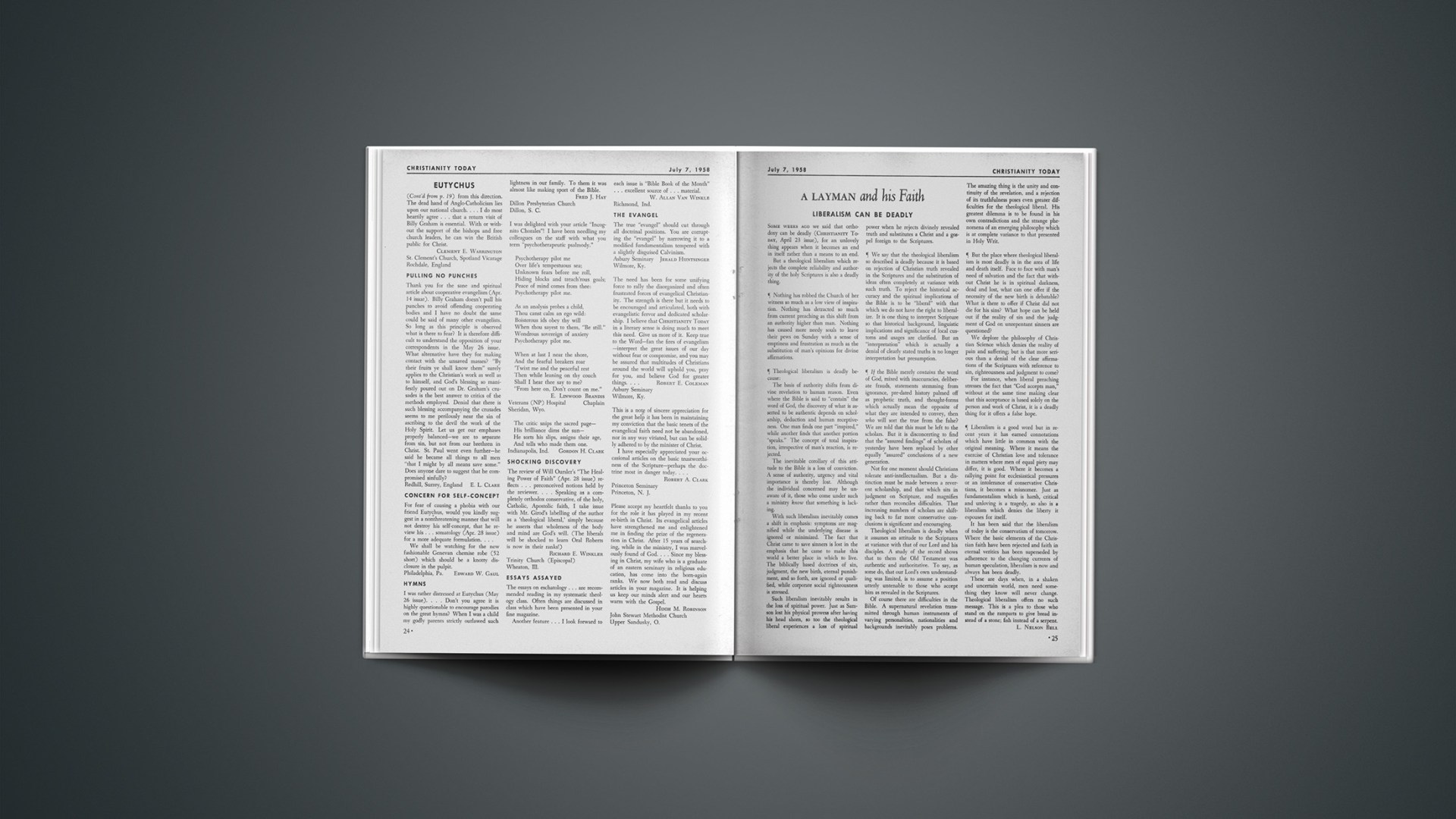
Liberalism Can Be Deadly

Some weeks ago we said that orthodoxy can be deadly (CHRISTIANITY TODAY, April 23 issue), for an unlovely thing appears when it becomes an end in itself rather than a means to an end.

But a theological liberalism which rejects the complete reliability and authority of the holy Scriptures is also a deadly thing.

Nothing has robbed the Church of her witness so much as a low view of inspiration. Nothing has detracted so much from current preaching as this shift from an authority higher than man. Nothing has caused more needy souls to leave their pews on Sunday with a sense of emptiness and frustration as much as the substitution of man’s opinions for divine affirmations.

Theological liberalism is deadly because:

The basis of authority shifts from divine revelation to human reason. Even where the Bible is said to “contain” the word of God, the discovery of what is asserted to be authentic depends on scholarship, deduction and human receptiveness. One man finds one part “inspired,” while another finds that another portion “speaks.” The concept of total inspiration, irrespective of man’s reaction, is rejected.

The inevitable corollary of this attitude to the Bible is a loss of conviction. A sense of authority, urgency and vital importance is thereby lost. Although the individual concerned may be unaware of it, those who come under such a ministry know that something is lacking.

With such liberalism inevitably comes a shift in emphasis: symptoms are magnified while the underlying disease is ignored or minimized. The fact that Christ came to save sinners is lost in the emphasis that he came to make this world a better place in which to live. The biblically based doctrines of sin, judgment, the new birth, eternal punishment, and so forth, are ignored or qualified, while corporate social righteousness is stressed.

Such liberalism inevitably results in the loss of spiritual power. Just as Samson lost his physical prowess after having his head shorn, so too the theological liberal experiences a loss of spiritual power when he rejects divinely revealed truth and substitutes a Christ and a gospel foreign to the Scriptures.

We say that the theological liberalism so described is deadly because it is based on rejection of Christian truth revealed in the Scriptures and the substitution of ideas often completely at variance with such truth. To reject the historical accuracy and the spiritual implications of the Bible is to be “liberal” with that which we do not have the right to liberalize. It is one thing to interpret Scripture so that historical background, linguistic implications and significance of local customs and usages are clarified. But an “interpretation” which is actually a denial of clearly stated truths is no longer interpretation but presumption.

If the Bible merely contains the word of God, mixed with inaccuracies, deliberate frauds, statements stemming from ignorance, pre-dated history palmed off as prophetic truth, and thought-forms which actually mean the opposite of what they are intended to convey, then who will sort the true from the false? We are told that this must be left to the scholars. But it is disconcerting to find that the “assured findings” of scholars of yesterday have been replaced by other equally “assured” conclusions of a new generation.

Not for one moment should Christians tolerate anti-intellectualism. But a distinction must be made between a reverent scholarship, and that which sits in judgment on Scripture, and magnifies rather than reconciles difficulties. That increasing numbers of scholars are shifting back to far more conservative conclusions is significant and encouraging.

Theological liberalism is deadly when it assumes an attitude to the Scriptures at variance with that of our Lord and his disciples. A study of the record shows that to them the Old Testament was authentic and authoritative. To say, as some do, that our Lord’s own understanding was limited, is to assume a position utterly untenable to those who accept him as revealed in the Scriptures.

Of course there are difficulties in the Bible. A supernatural revelation transmitted through human instruments of varying personalities, nationalities and backgrounds inevitably poses problems.

The amazing thing is the unity and continuity of the revelation, and a rejection of its truthfulness poses even greater difficulties for the theological liberal. His greatest dilemma is to be found in his own contradictions and the strange phenomena of an emerging philosophy which is at complete variance to that presented in Holy Writ.

But the place where theological liberalism is most deadly is in the area of life and death itself. Face to face with man’s need of salvation and the fact that without Christ he is in spiritual darkness, dead and lost, what can one offer if the necessity of the new birth is debatable? What is there to offer if Christ did not die for his sins? What hope can be held out if the reality of sin and the judgment of God on unrepentant sinners are questioned?

We deplore the philosophy of Christian Science which denies the reality of pain and suffering; but is that more serious than a denial of the clear affirmations of the Scriptures with reference to sin, righteousness and judgment to come?

For instance, when liberal preaching stresses the fact that “God accepts man,” without at the same time making clear that this acceptance is based solely on the person and work of Christ, it is a deadly thing for it offers a false hope.

Liberalism is a good word but in recent years it has earned connotations which have little in common with the original meaning. Where it means the exercise of Christian love and tolerance in matters where men of equal piety may differ, it is good. Where it becomes a rallying point for ecclesiastical pressures or an intolerance of conservative Christians, it becomes a misnomer. Just as fundamentalism which is harsh, critical and unloving is a tragedy, so also is a liberalism which denies the liberty it espouses for itself.

It has been said that the liberalism of today is the conservatism of tomorrow. Where the basic elements of the Christian faith have been rejected and faith in eternal verities has been superseded by adherence to the changing currents of human speculation, liberalism is now and always has been deadly.

These are days when, in a shaken and uncertain world, men need something they know will never change. Theological liberalism offers no such message. This is a plea to those who stand on the ramparts to give bread instead of a stone; fish instead of a serpent.

L. NELSON BELL
Ideas

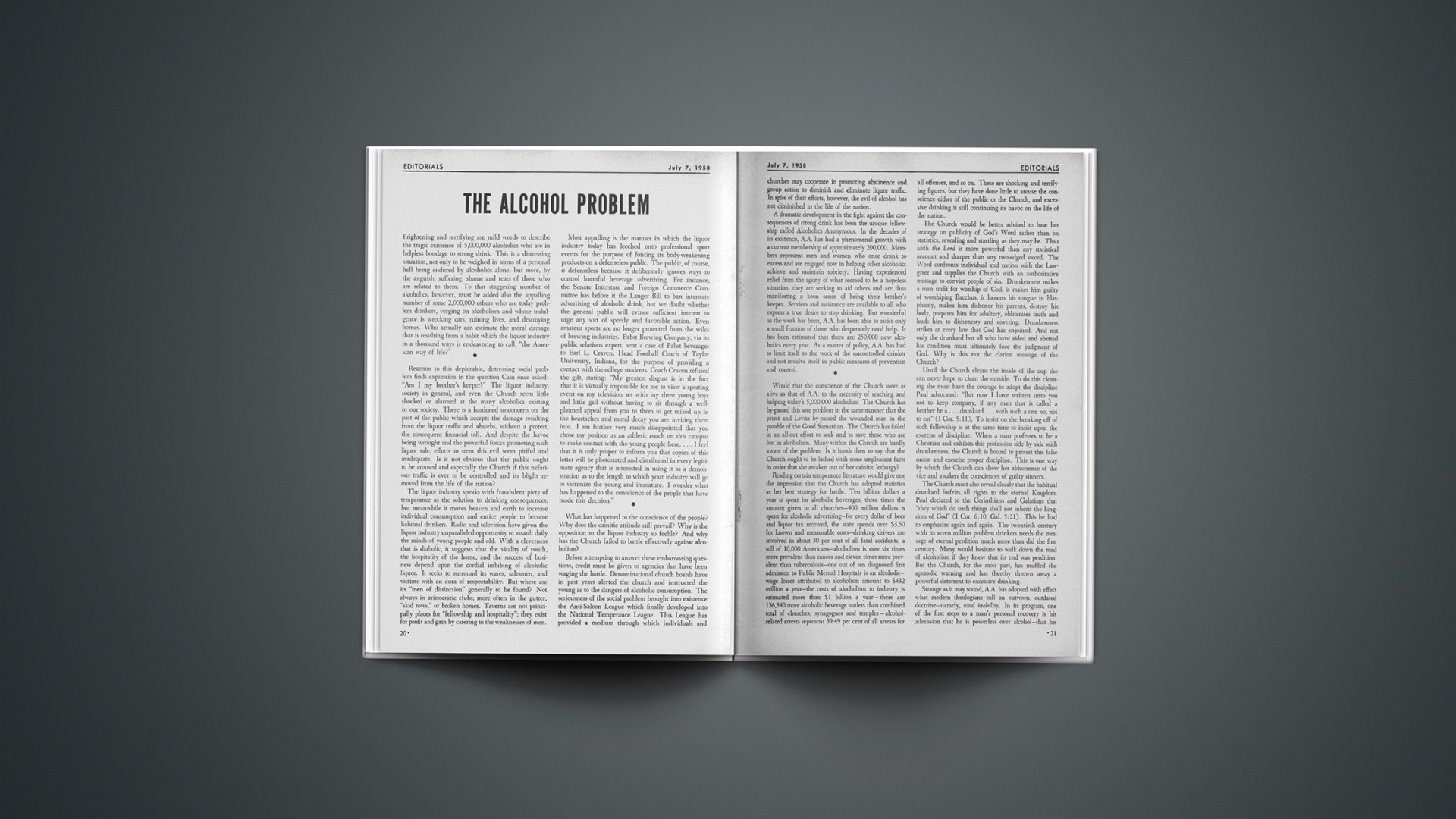
The Alcohol Problem

Frightening and terrifying are mild words to describe the tragic existence of 5,000,000 alcoholics who are in helpless bondage to strong drink. This is a distressing situation, not only to be weighed in terms of a personal hell being endured by alcoholics alone, but more, by the anguish, suffering, shame and tears of those who are related to them. To that staggering number of alcoholics, however, must be added also the appalling number of some 2,000,000 others who are today problem drinkers, verging on alcoholism and whose indulgence is wrecking cars, ruining lives, and destroying homes. Who actually can estimate the moral damage that is resulting from a habit which the liquor industry in a thousand ways is endeavoring to call, “the American way of life?”

Reaction to this deplorable, distressing social problem finds expression in the question Cain once asked: “Am I my brother’s keeper?” The liquor industry, society in general, and even the Church seem little shocked or alarmed at the many alcoholics existing in our society. There is a hardened unconcern on the part of the public which accepts the damage resulting from the liquor traffic and absorbs, without a protest, the consequent financial toll. And despite the havoc being wrought and the powerful forces promoting such liquor sale, efforts to stem this evil seem pitiful and inadequate. Is it not obvious that the public ought to be aroused and especially the Church if this nefarious traffic is ever to be controlled and its blight removed from the life of the nation?

The liquor industry speaks with fraudulent piety of temperance as the solution to drinking consequences; but meanwhile it moves heaven and earth to increase individual consumption and entice people to become habitual drinkers. Radio and television have given the liquor industry unparalleled opportunity to assault daily the minds of young people and old. With a cleverness that is diabolic, it suggests that the vitality of youth, the hospitality of the home, and the success of business depend upon the cordial imbibing of alcoholic liquor. It seeks to surround its wares, salesmen, and victims with an aura of respectability. But where are its “men of distinction” generally to be found? Not always in aristocratic clubs; more often in the gutter, “skid rows,” or broken homes. Taverns are not principally places for “fellowship and hospitality”; they exist for profit and gain by catering to the weaknesses of men.

Most appalling is the manner in which the liquor industry today has leeched onto professional sport events for the purpose of foisting its body-weakening products on a defenseless public. The public, of course, is defenseless because it deliberately ignores ways to control harmful beverage advertising. For instance, the Senate Interstate and Foreign Commerce Committee has before it the Langer Bill to ban interstate advertising of alcoholic drink, but we doubt whether the general public will evince sufficient interest to urge any sort of speedy and favorable action. Even amateur sports are no longer protected from the wiles of brewing industries. Pabst Brewing Company, via its public relations expert, sent a case of Pabst beverages to Earl L. Craven, Head Football Coach of Taylor University, Indiana, for the purpose of providing a contact with the college students. Coach Craven refused the gift, stating: “My greatest disgust is in the fact that it is virtually impossible for me to view a sporting event on my television set with my three young boys and little girl without having to sit through a well-planned appeal from you to them to get mixed up in the heartaches and moral decay you are inviting them into. I am further very much disappointed that you chose my position as an athletic coach on this campus to make contact with the young people here.… I feel that it is only proper to inform you that copies of this letter will be photostated and distributed in every legitimate agency that is interested in using it as a demonstration as to the length to which your industry will go to victimize the young and immature. I wonder what has happened to the conscience of the people that have made this decision.”

What has happened to the conscience of the people? Why does the cainitic attitude still prevail? Why is the opposition to the liquor industry so feeble? And why has the Church failed to battle effectively against alcoholism?

Before attempting to answer these embarrassing questions, credit must be given to agencies that have been waging the battle. Denominational church boards have in past years alerted the church and instructed the young as to the dangers of alcoholic consumption. The seriousness of the social problem brought into existence the Anti-Saloon League which finally developed into the National Temperance League. This League has provided a medium through which individuals and churches may cooperate in promoting abstinence and group action to diminish and eliminate liquor traffic. In spite of their efforts, however, the evil of alcohol has not diminished in the life of the nation.

A dramatic development in the fight against the consequences of strong drink has been the unique fellowship called Alcoholics Anonymous. In the decades of its existence, A.A. has had a phenomenal growth with a current membership of approximately 200,000. Members represent men and women who once drank to excess and are engaged now in helping other alcoholics achieve and maintain sobriety. Having experienced relief from the agony of what seemed to be a hopeless situation, they are seeking to aid others and are thus manifesting a keen sense of being their brother’s keeper. Services and assistance are available to all who express a true desire to stop drinking. But wonderful as the work has been, A.A. has been able to assist only a small fraction of those who desperately need help. It has been estimated that there are 250,000 new alcoholics every year. As a matter of policy, A.A. has had to limit itself to the work of the uncontrolled drinker and not involve itself in public measures of prevention and control.

Would that the conscience of the Church were as alive as that of A.A. to the necessity of reaching and helping today’s 5,000,000 alcoholics! The Church has by-passed this sore problem in the same manner that the priest and Levite by-passed the wounded man in the parable of the Good Samaritan. The Church has failed in an all-out effort to seek and to save those who are lost in alcoholism. Many within the Church are hardly aware of the problem. Is it harsh then to say that the Church ought to be lashed with some unpleasant facts in order that she awaken out of her cainitic lethargy?

Reading certain temperance literature would give one the impression that the Church has adopted statistics as her best strategy for battle. Ten billion dollars a year is spent for alcoholic beverages, three times the amount given to all churches—400 million dollars is spent for alcoholic advertising—for every dollar of beer and liquor tax received, the state spends over $3.50 for known and measurable costs—drinking drivers are involved in about 30 per cent of all fatal accidents, a toll of 10,000 Americans—alcoholism is now six times more prevalent than cancer and eleven times more prevalent than tuberculosis—one out of ten diagnosed first admission to Public Mental Hospitals is an alcoholic-wage losses attributed to alcoholism amount to $432 million a year—the costs of alcoholism to industry is estimated more than $1 billion a year—there are 136,340 more alcoholic beverage outlets than combined total of churches, synagogues and temples—alcohol-related arrests represent 59.49 per cent of all arrests for all offenses, and so on. These are shocking and terrifying figures, but they have done little to arouse the conscience either of the public or the Church, and excessive drinking is still continuing its havoc on the life of the nation.

The Church would be better advised to base her strategy on publicity of God’s Word rather than on statistics, revealing and startling as they may be. Thus saith the Lord is more powerful than any statistical account and sharper than any two-edged sword. The Word confronts individual and nation with the Lawgiver and supplies the Church with an authoritative message to convict people of sin. Drunkenness makes a man unfit for worship of God; it makes him guilty of worshiping Bacchus, it loosens his tongue in blasphemy, makes him dishonor his parents, destroy his body, prepares him for adultery, obliterates truth and leads him to dishonesty and coveting. Drunkenness strikes at every law that God has enjoined. And not only the drunkard but all who have aided and abetted his condition must ultimately face the judgment of God. Why is this not the clarion message of the Church?

Until the Church cleans the inside of the cup she can never hope to clean the outside. To do this cleaning she must have the courage to adopt the discipline Paul advocated: “But now I have written unto you not to keep company, if any man that is called a brother be a … drunkard … with such a one no, not to eat” (1 Cor. 5:11). To insist on the breaking off of such fellowship is at the same time to insist upon the exercise of discipline. When a man professes to be a Christian and exhibits this profession side by side with drunkenness, the Church is bound to protest this false union and exercise proper discipline. This is one way by which the Church can show her abhorrence of the vice and awaken the consciences of guilty sinners.

The Church must also reveal clearly that the habitual drunkard forfeits all rights to the eternal Kingdom. Paul declared to the Corinthians and Galatians that “they which do such things shall not inherit the kingdom of God” (1 Cor. 6:10; Gal. 5:21). This he had to emphasize again and again. The twentieth century with its seven million problem drinkers needs the message of eternal perdition much more than did the first century. Many would hesitate to walk down the road of alcoholism if they knew that its end was perdition. But the Church, for the most part, has muffled the apostolic warning and has thereby thrown away a powerful deterrent to excessive drinking.

Strange as it may sound, A.A. has adopted with effect what modern theologians call an outworn, outdated doctrine—namely, total inability. In its program, one of the first steps to a man’s personal recovery is his admission that he is powerless over alcohol—that his life is unmanageable. The modern church has thrown away that biblical doctrine; but the principle has become the first step in an effective program of secular reclamation! What an utter condemnation to modern theology! It is this biblical doctrine—that total inability of man to help himself, and thus his need of the Power higher than himself—that the Church must recover and preach.

One can hear the accusation of oversimplification for those who point to the acceptance of Christ as the solution to the individual problem of alcoholism. Yet the Church has within her membership many who have been rescued from this vice by personal commitments to the Saviour. Would that such people would testify as eagerly and zealously of their salvation as do the members of A.A. What message does the Church have other than the proclaiming of Jesus Christ, the only name under heaven whereby men can be saved? Thousands of suffering alcoholics need to be convinced that they are powerless to help themselves and that there is a Saviour who has the love and power to save them to the uttermost.

The Church does have a responsibility through her membership to arouse the nation to place effective controls over an industry whose products are causing carnage on our highways, breeding crime, and destroying homes. The Church has no business shirking her duty of prodding the conscience of our nation. Moreover, the Church has no right to allow A.A. to put her to shame by performing a more effective work in the recovery of helpless sinners. The Church has the convicting message and the Gospel that heals. Jesus Christ does save from the guilt and power of sin. And therein is the ultimate solution to the alcohol problem.

Evangelism, in the narrow sense, is preaching the Gospel that souls may be won to Jesus Christ. Revivalism on the other hand places its emphasis on rekindling the fires of faith and action in the hearts of lukewarm Christians. That evangelizing the lost at the same time warms the hearts of many cold Christians is something for which the Church should be profoundly grateful.

The place of the doctrine of regeneration in evangelistic preaching cannot be overstressed. Nothing is more futile than attempts of the Church to make unregenerate people act like Christians. When the words of our Lord, “Ye must be born again,” are ignored or explained away, chaos inevitably results. Centuries ago the Chinese had a word for it: “You cannot carve rotten wood.” Only too often the Church is engaged in this futile occupation.

The new birth is a spiritual reality in which God divinely transforms man. It is a supernatural act of God’s grace on condition of the faith of man. It is a transition from spiritual death to spiritual life, a work of the Holy Spirit in the heart of an individual who, under the wooing of that same Spirit, senses his need and turns to the Son of God as his Redeemer in repentance and in true faith.

Explain it? Only in the simple terms of our Lord to Nicodemus. Here he makes the clear distinction between physical and spiritual birth, along with the arresting fact that only those who are born of the Spirit shall see the kingdom of God. Christ makes it clear that this is an imperative, not an elective, that it is the only way whereby man’s earth-bound relationships are changed and he becomes a citizen and an heir of the heavenlies.

It is because the Church has so largely glossed over this basic requirement in the divine plan of man’s redemption that she finds her rolls now filled with, and often dominated by, those who have never experienced this transforming work of the Holy Spirit.

The new birth is an act of God in which he exercises his divine power, creating in man a new heart, new attitudes and new desires. It does not transform man into a sinless creature; far from it. But it does mean that he now recognizes sin for what it is and that he trusts the One who alone can deliver from both its power and its penalty. When the Apostle Paul speaks of new creatures in Christ he is affirming the fact that with regeneration there is a newness which comes from without, from the Spirit’s work, not from within. And as faith is the instrument of our acceptance with God, so the atonement is the sole ground.

One of the outstanding contributions being made to contemporary Christianity is Billy Graham’s constant emphasis on the doctrine of the new birth. A few years ago a leading London journalist remarked that Mr. Graham seemed to have been raised up for one outstanding reason—to call our generation back to the preaching of the doctrine of the new birth.

Why has this doctrine been neglected? Among the many reasons has been the modern denial of the supernatural and the substitution of naturalistic concepts of man far removed from that revealed in the Scriptures. In addition, a new doctrine of God emerged in which his relation to the universe was thought to preclude the humbling fact that man is a fallen creature, incapable of saving himself and of responding to the love of God independently of the work of the Holy Spirit.

Looking for Christian maturity, we are prone to forget that the inescapable path to such maturity begins with spiritual birth. None of us would expect an infant to manifest the characteristics of an adult, but we all recognize that physical development has its start with infancy and in no other way. Why should we expect Christians to exist, much less develop, unless there has been a time when they have been born of the Spirit? It is this strange ignoring of the facts of spiritual life which causes untold confusion and does untold harm to the visible Church. As a result, we have the dead posing as living, the blind continuing to walk with spiritually sightless eyes.

But it is not for us to say who has been born again. The judgment of others is a sin all too prevalent. There will always be men walking in the twilight zone of Christianity, like the entombed unknown soldier, known only to God. For that reason neither individual Christians nor the Church can make infallible judgments as to who are Christians and who are not.

But for any to think that one can be a Christian without spiritual birth is to go counter to the doctrines having to do with both God and man and against the clear affirmations of Scripture. Furthermore, there are millions down through the ages who have had the glorious experience of the new birth and have had the Holy Spirit testify to their spirits that they are the sons of God.

This is not for one moment to imply that regeneration is always a spectacular experience charged with emotion. For the great majority of Christians it would be difficult to determine either the time or the place when they passed from death to life. But they know that this change has taken place and it is as real and infinitely more significant than the event of physical birth.

By silence when there should have been clear preaching, by evasion when there should have been unequivocal affirmation, by a minimizing of emphasis when there should have been primary concern, the Christian pulpits have often failed miserably to preach man’s need of spiritual rebirth; and through this glaring omission many have come into the church without a saving experience of the Christ of Calvary. Because of this, they go through the motions of religious conformity without the realities of a saving faith.

Pessimistic? Not pessimistic but realistic. Critical? Not critical but factual. Unscriptural? Not if words are to be interpreted rightly. If it can be demonstrated that the new birth is a necessity, and we believe such to be the case, then it can also be demonstrated that any program of evangelism, any philosophy of Christianity, any concept of the basic condition and need of man which ignores the necessity of this work of regeneration is not only contrary to the biblical teachings on conversion, but inimical to the Christian witness.

Admitting the need of Christian instruction and the development and maturing of the Christian in every phase of daily living, we must remember that foundations come before buildings, roots before trees, branches before fruit, and birth before life.

Not only are there priorities without which there can be no Christian life, but the very nature of these priorities must be admitted. Becoming a Christian is not a matter of heredity, for God has no grandchildren. Nor is it a matter of education, for that which is dead and inert cannot be educated. Neither is it a matter of environment, as wholesome and helpful as that may be. New birth takes priority because it always comes first, and an emphasis on this truth is of the greatest importance.

We are living in a time of staggering scientific advances, in a land boasting the highest living standards in history, but also in a time of emotional uncertainties, coupled with a mounting callousness to moral and spiritual values. In all of this, the Church is deeply and rightly concerned. But the primary task of the Church is to preach Christ, crucified, risen and coming in triumph—the only hope of the individual and of the social order itself. What shall it profit if we neglect those things without which our Lord says one can never see the kingdom of heaven? What shall it profit us if we neglect our primary task and dilute or change the message, with the result that the world order remains in the clutches of the devil?

Looking through the astigmatic lenses of the immediate, we are in danger of losing sight of those things which are ultimate and eternal. Only through the new birth do the eternal verities become personally relevant, for only then can we pass from death to life eternal. In this is implicit a recognition of our sinful and lost condition and a willingness to accept that which the eternal Son of God has done for us. It is because this work of personal salvation from sin is so often lacking in messages from American pulpits today that we as a people stand in jeopardy and the Church herself has lost something of her power and witness.

God is not to be mocked. The salvation that he wrought out for mankind in the counsels of eternity and brought into effect on the cross of Calvary is God’s way and there is no other. The nature of man must be changed and this change, this transition, this new birth, is a supernatural experience, a strait way and a narrow gate, the ignoring of which has eternal consequences.

Every newspaper tells of frantic efforts to recoup our scientific supremacy as a nation. With all of this we are in the heartiest sympathy. But what shall it profit us if we successfully conquer outer space, set up a station on the moon and attain domination of these hitherto unattainable areas of the universe, unless we at the same time learn of Him through whom alone the inner reaches of the soul are cleansed and disciplined? “Marvel not that I said unto thee, Ye must be born again.”

Eutychus and His Kin: July 7, 1958

CARTOON EXPLANATION:

There are two things I have always wanted. One is to draw a cartoon. The other is to have someone explain to me the cartoons other people draw.

You see my cartoon.

Now for the explanation.

The two clergymen in the picture are in an art gallery. One is reading from a guidebook. The masterpiece they are inspecting has felt the impact of a recent article in the Post by a Harvard theologian. The professor says that the dimension of depth is religious. He seems to feel that modern art has it all over Billy Graham in this dimension. It asks a sincere and religious question “when the painter breaks the visible surface into pieces.”

This picture shows how sincere a painter can get.

It also symbolizes what I think the professor has done to the Christian gospel in seeking his lost dimension of depth.

EUTYCHUS

IN SEARCH OF A DIMENSION

In the issue of June 14, 1958, the Saturday Evening Post contained an article on religion by Professor Paul Tillich of Harvard University.… It appears to be the purpose of Professor Tillich in this article to interpret the present popular revival of religious interest as a “desperate and mostly futile attempt to regain what has been lost,” which lost thing he calls the “dimension of depth” in religion. Professor Tillich defines the dimension of depth as being “the religious dimension in man’s nature.” To him religion in its innermost nature “is the state of being concerned about one’s own being and being universally.” … To him also, “being religious means asking passionately the question of the meaning of our existence and being willing to receive answers even if the answers hurt.”

Professor Tillich rejects the idea that any particular religion, including Christianity, can furnish the answer or be the key to the search for the answer. To him the only key is that concern to know which causes us passionately to seek to learn the meaning of our existence.… Tillich says “there is always an answer but the answer may not be available to us.” He says that the real answer “is given by the awareness that we have lost the decisive dimension of life, the dimension of depth, and there is no easy way of getting it back. Such awareness is in itself a state of being grasped by that which is symbolized in the term, dimension of depth. He who realizes that he is separated from the ultimate source of meaning shows by this realization that he is not only separated but also reunited. And this is just our situation. What we need above all—and partly have—is the radical realization of our predicament, without trying to cover it up by secular or religious ideologies. The revival of religious interest would be a creative power in our culture if it would develop into a movement of search for the lost dimension of depth.” …

To try to understand Professor Tillich’s paragraph it may be useful to substitute X for the expression, dimension of depth, or for whatever is referred to by that expression, and omit unnecessary portions. So simplified his statement might appear to be: The real answer to the question of how to regain X is given by the awareness that we have lost X and there is no easy way of getting it back. Such awareness is in itself a state of being grasped by X. He who realizes that he is separated from X shows by this realization that he is not only separated from X but reunited to it. What we need above all, and partly have, is to realize that we have lost X. The revival of religious interest would be a creative power in our culture if it would develop into a movement of search for X.

Then finally he terminates his article with a remark which similarly clarified would read: In spite of the loss of X, its power is present, and most present in those who are aware of the loss and are striving to regain it with ultimate seriousness.

Presumably in all of this Professor Tillich is trying to say, as in the early part of his article, that man has lost the answer to the question: What is the meaning of life? And he has also lost the courage to ask this question; but those who, like himself, are truly aware of this loss (as distinct from persons who accept Christianity or other faiths) are the most competent and likely to regain both the courage and the answer. In the simplest possible terms it appears that Professor Tillich is pointing to himself and others who concur with his views on religion as being the only hope of ever learning the answer to the question: What is the meaning of life? Where do we come from, and where do we go?

… Although Professor Tillich avows that there is an answer to this basic question, he obviously has no real idea what it is—he is only groping for it. Nevertheless at the beginning of his article he states that man has lost the answer to the question. If it is lost there is no existing record or knowledge of it and therefore how can he know that it ever was known so that it could later be lost?…

If in all of his groping for the meaning of life throughout recorded history and undoubtedly before that, man has not progressed beyond the groping phase, why should anyone expect that the search which Professor Tillich urges so strongly will make any appreciable progress? Apart from a truly miraculous revelation our generation and those which follow will still he unhappily groping—provided man’s capacity and urge to self-destruction do not prevent those future generations from being born.…

Is it better to remain deliberately in the negative, confused and futilely hopeful state of Professor Tillich? Or, is it not common sense to investigate and try to learn from personal examination and experience the biblical answers to his question and to enjoy forever the glorious gifts of God to those who seek and trust him?

Lt. Gen., U.S. Army (Ret.)

Chicago, Ill.

FUTURE’S CHALLENGE

“The Challenge of the Future” by J. Edgar Hoover (May 26 issue) should be read by every American.

First Christian Church

Cimarron, Kan.

One quote you included … by Hoover … seemed to favor investigation of various organizations as to their communist affiliation. If your inclusion of the quote means you endorse anything like what we have lived through—may God forbid!

First Methodist Church

Loomis, Calif.

NATION’S FUTURE

An expression of appreciation … for the splendid quality of CHRISTIANITY TODAY as you tackle problems with which the Christian faith is confronted in contemporary life. Your reporting of “Religion in a Free Society” (May 26 issue) was a real service to the nation. The “proposed exchange of thought on Protestant-Catholic anxieties” I must say is courageous, but timely. It is encouraging to hear leaders in American life raising and discussing these questions that have to do with the future of the nation.

First Baptist Church

Minonk, Ill.

Your excellent report … helped the reader to gain knowledge of what the great dialog in America is all about. Your boxed quotation of a remark by Dr. Robert M. Hutchins regarding his terror of the Dial-A-Prayer movement caught my attention. I am surprised that so learned and experienced a gentleman … would dismiss the value of a telephone devotional so abruptly. We have used the automatic answering device for one and one-half years. It is not a substitute for personal prayer, Bible reading, or reading of devotional classics. It is one of many ways to assist the troubled heart in his struggle against sin in his life. The telephone devotional illustrates once again the desire of the Christian prophet to use every available means of communication to make disciples of all nations and to edify members of the body of Christ.

Saint Paul Lutheran Church

Oak Lawn, Ill.

THE INTERMEDIATE STATE

Dr. Vos has taken his stand (May 12 issue) at some considerable distance from popular understanding when he argues that the righteous in the intermediate state are deficient, abnormal, and not completely happy. Undoubtedly, this position tends to give greater relevance to Paul’s incessant stress upon the Second Advent as introductory to the glories of the future state. However, to characterize Paul’s attitude toward the possibility of appearing before the Lord Jesus in a disembodied condition as “much less desirable” is to overstate the case. In the passage (2 Cor. 5:1f.), Paul states repeatedly and unqualifiedly that he does not desire to be so found. If Paul is considering the possibility of appearing before the Lord Jesus at the resurrection in an unclothed state (see the introductory passage, 2 Cor. 4:14), one may be led to wonder, after all, if dead souls are not normally unconscious and therefore subject to resurrection. Then the passages quoted (Rev. 6:11; Heb. 11:39, 40; Rom. 8:23–25; 1 Cor. 15:50–54), and many others, might be taken unqualifiedly. In fact, Dr. Vos has quoted 2 Corinthians 5:8 inaccurately …

New England School of Theology

(Advent Christian)

Brookline, Mass.

MORE ON THE GRAVECLOTHES

May I respectfully question the position set forth in the letter entitled “Grave-clothes” (Apr. 28 issue)?… The correspondent rejects the translation of John 20:7 given in both the AV and the RV and offers instead his view that the linens collapsed retaining “the annular, ringlike shape they had been given.”

On the other hand, the best Greek lexicons, namely those by Bauer, A & G, L & S, M & M, and Thayer all support the versions, rendering the Greek verb entulisso as wrap up, fold together, roll up, fold up. The verb seems to occur three times in the N.T., twice of Joseph’s wrapping the body of Jesus in linen clothes, Matt. 27:59; Luke 23:53, and once of Peter’s finding the sweat-band that had been about the head of Jesus folded up in a place by itself, thus suggesting an ordering hand, John 20:7. In their respective commentaries Bauer and Bultmann interpret the last reference as due to an apologetical interest, that is, to show that the body was not suddenly snatched from the grave, but that everything had been left in good order. Hendrickson has a sane note on the verse in his recent commentary.

Columbia Sem.

Decatur, Ga.

In eastern lands there was a space between the main funeral garment round the torso and the napkin round the head. The latter, as Mr. Rufle points out in the account, retained its “annular” shape. It is notable that the word (rolled up) used is identical with the word in Matthew 27:59 telling how Joseph of Arimathea had rolled up the body of Jesus. It was thus apparent to the two apostles that the Lord’s body had disappeared or “evaporated” from the graveclothes without disturbing or removing them.

Belfast, No. Ireland

Former Bishop of Down and Dromore

NEW TESTAMENT DOCTRINES

Everet R. Johnson (Apr. 14 issue) … talked of New Testament “doctrines.” Perhaps, as a theological journal, you should be more watchful of your authors’ use of words. There are, of course, no “doctrines” in the N. T. (And this is of great reassurance to thoughtful Protestants.) Christ enunciated no doctrines—these were made later by mundane churchmen.

Associate Editor

Christian Herald

New York City

• Concordance study reveals that the New Testament speaks often of the doctrines and teachings of Christ and the apostles, (cf. Matt. 22:33; Rom. 16:17; 1 Tim. 1:10; 4:6; Titus 2:10, and 2 John 9). Both Christ and Paul warned against antithetical “human doctrines” (cf. Matt. 15:9; Col. 2:22). Webster’s New International Dictionary distinguishes between “the doctrines of the New Testament” and the “dogmas” of church confessions. Surely Christ’s death for sinners and his resurrection are New Testament doctrines.—ED.

WHENCE REVIVAL?

Many … will disagree with Mr. Pollock’s statement (Apr. 28 issue) that “for a lasting revival, the Church of England must take the lead.” I personally cannot see revival coming from this direction. The dead hand of Anglo-Catholicism lies upon our national church.… I do most heartily agree … that a return visit of Billy Graham is essential. With or without the support of the bishops and free church leaders, he can win the British public for Christ.

St. Clement’s Church, Spotland Vicarage

Rochdale, England

PULLING NO PUNCHES

Thank you for the sane and spiritual article about cooperative evangelism (Apr. 14 issue). Billy Graham doesn’t pull his punches to avoid offending cooperating bodies and I have no doubt the same could be said of many other evangelists. So long as this principle is observed what is there to fear? It is therefore difficult to understand the opposition of your correspondents in the May 26 issue. What alternative have they for making contact with the unsaved masses? “By their fruits ye shall know them” surely applies to the Christian’s work as well as to himself, and God’s blessing so manifestly poured out on Dr. Graham’s crusades is the best answer to critics of the methods employed. Denial that there is such blessing accompanying the crusades seems to me perilously near the sin of ascribing to the devil the work of the Holy Spirit. Let us get our emphases properly balanced—we are to separate from sin, but not from our brethren in Christ. St. Paul went even further—he said he became all things to all men “that I might by all means save some.” Does anyone dare to suggest that he compromised sinfully?

Redhill, Surrey, England

CONCERN FOR SELF-CONCEPT

For fear of causing a phobia with our friend Eutychus, would you kindly suggest in a nonthreatening manner that will not destroy his self-concept, that he review his … somatology (Apr. 28 issue) for a more adequate formulation.…

We shall be watching for the new fashionable Genevan chemise robe (52 short) which should be a knotty disclosure in the pulpit.

Philadelphia, Pa.

HYMNS

I was rather distressed at Eutychus (May 26 issue).… Don’t you agree it is highly questionable to encourage parodies on the great hymns? When I was a child my godly parents strictly outlawed such lightness in our family. To them it was almost like making sport of the Bible.

Dillon Presbyterian Church

Dillon, S. C.

I was delighted with your article “Incognito Chorales”! I have been needling my colleagues on the staff with what you term “psychotherapeutic psalmody.”

Psychotherapy pilot me

Over life’s tempestuous sea;

Unknown fears before me roll,

Hiding blocks and treach’rous goals;

Peace of mind comes from thee:

Psychotherapy pilot me.

As an analysis probes a child,

Thou canst calm an ego wild:

Boisterous ids obey thy will

When thou sayest to them, “Be still.”

Wondrous sovereign of anxiety

Psychotherapy pilot me.

When at last I near the shore,

And the fearful breakers roar

’Twixt me and the peaceful rest

Then while leaning on thy couch

Shall I hear thee say to me?

“From here on, Don’t count on me.”

Chaplain

Veterans (NP) Hospital

Sheridan, Wyo.

The critic snips the sacred page—

His brilliance dims the sun—

He sorts his slips, assigns their age,

And tells who made them one.

Indianapolis, Ind.

SHOCKING DISCOVERY

The review of Will Oursler’s “The Healing Power of Faith” (Apr. 28 issue) reflects … preconceived notions held by the reviewer.… Speaking as a completely orthodox conservative, of the holy, Catholic, Apostolic faith, I take issue with Mr. Girod’s labelling of the author as a ‘theological liberal,’ simply because he asserts that wholeness of the body and mind are God’s will. (The liberals will be shocked to learn Oral Roberts is now in their ranks!)

Trinity Church (Episcopal)

Wheaton, Ill.

ESSAYS ASSAYED

The essays on eschatology … are recommended reading in my systematic theology class. Often things are discussed in class which have been presented in your fine magazine.

Another feature … I look forward to each issue is “Bible Book of the Month” … excellent source of … material.

Richmond, Ind.

THE EVANGEL

The true “evangel” should cut through all doctrinal positions. You are corrupting the “evangel” by narrowing it to a modified fundamentalism tempered with a slightly disguised Calvinism.

Asbury Seminary

Wilmore, Ky.

The need has been for some unifying force to rally the disorganized and often frustrated forces of evangelical Christianity. The strength is there but it needs to be encouraged and articulated, both with evangelistic fervor and dedicated scholarship. I believe that CHRISTIANITY TODAY in a literary sense is doing much to meet this need. Give us more of it. Keep true to the Word—fan the fires of evangelism—interpret the great issues of our day without fear or compromise, and you may be assured that multitudes of Christians around the world will uphold you, pray for you, and believe God for greater things.…

Asbury Seminary

Wilmore, Ky.

This is a note of sincere appreciation for the great help it has been in maintaining my conviction that the basic tenets of the evangelical faith need not be abandoned, nor in any way vitiated, but can be solidly adhered to by the minister of Christ.

I have especially appreciated your occasional articles on the basic trustworthiness of the Scripture—perhaps the doctrine most in danger today.…

Princeton Seminary

Princeton, N. J.

Please accept my heartfelt thanks to you for the role it has played in my recent re-birth in Christ. Its evangelical articles have strengthened me and enlightened me in finding the prize of the regeneration in Christ. After 15 years of searching, while in the ministry, I was marvelously found of God.… Since my blessing in Christ, my wife who is a graduate of an eastern seminary in religious education, has come into the born-again ranks. We now both read and discuss articles in your magazine. It is helping us keep our minds alert and our hearts warm with the Gospel.

John Stewart Methodist Church

Upper Sandusky, O.

The Believer’s Final Bliss

The state of final bliss is not one of abstract immortality. In a great deal of non-Christian thought, there is a dualism which conceives of the human body as exercising a degrading influence over the human spirit and the state of bliss is thought to consist in the release of the spirit from the defiling influence associated with bodily existence. From the outset the Bible contradicts this dualism. “The Lord God formed man from the dust of the ground” (Gen. 2:7). Dignity belongs to the human body and man’s spirit was not imprisoned in it. God created man very good and man was body as well as spirit. The separation that takes place in death is not the debt of nature nor the inevitable outcome of man’s physical constitution but the wages of sin. Death is abnormal because it is the curse of sin.

When redemption is brought to bear upon man, it is brought to bear upon him in his totality. His body, no less than his spirit, is drawn within the scope of that redemption. The normal and the natural, disrupted by sin, is restored and the goal to be achieved in the consummation of redemption is not a blissful state of the soul’s immortality, but one in which death is swallowed up in victory; the corruptible puts on incorruption and the mortal immortality. This is why the Scripture lays such emphasis upon the resurrection of the body. Our Lord intimated that the resurrection was guaranteed by the fact that God is the God of his people and that he is not the God of the dead but of the living (Matt. 22:32). And Paul called the resurrection the redemption of the body and accorded it no lower a designation than “the adoption” (Rom. 8:23).

The Identity Of The Body

The resurrection of the body means resuscitation of what is laid in the tomb. Unbelief recoils from such a notion. But resurrection cannot be construed otherwise. The resurrection of believers is patterned after the resurrection of Christ, and it was the body which had been laid in Joseph’s tomb that rose on the third day. It was not a mere body that rose, but Jesus’ body. More properly, Jesus rose as to his body. Scripture takes pains to assure us that Jesus was buried. The angel said to the women on the day of the Resurrection, “Come see the place where he lay” and prefaced this by saying, “He is risen, as he said” (Matt. 28:6). We are not allowed to think that our Lord was disunited from his body when it was laid in the tomb. And the same is true with believers. They go to the grave in respect of their bodies and from their graves they will rise when the last trumpet sounds. There is therefore identity and continuity between the body that returns to dust and the body that will be raised incorruptible.

Resurrected Body

The body will indeed be raised “a Spiritual body”; a momentous change will have been wrought. But “a Spiritual body” is not a body made of spirit. That would be contradiction—a body made of spirit would, of course, be no body at all. “A Spiritual body” is a body that is immortal and incorruptible, not characterized by the mortality and infirmity of our present bodies, a body transformed by the resurrection and adapted to the world of the resurrection inaugurated by the resurrection of Christ as the firstfruits from the dead.

This is what Paul means when he says, “flesh and blood cannot inherit the kingdom of God” (1 Cor. 15:50). He is not denying the physical composition of the resurrection body but asserting that the resurrected bodily entity will not be subject to the frailty and corruptibility of the present age. The powers of the age to come will be operative without restraint in the resurrection—the body “is sown in corruption, it is raised in incorruption; it is sown in dishonour, it is raised in glory; it is sown in weakness, it is raised in power” (1 Cor. 15:42, 43).

It is resurrection, therefore, that constitutes and inaugurates the believer’s final bliss. A notion of consummated bliss bereft of resurrection hope has no affinity with the prospect which Christianity defines.

Christ is the first-begotten from the dead, the first-fruits of those who have fallen asleep. Christ’s own resurrection is the prototype. Even now believers are raised up with Christ in newness of life and mysteriously, though real, they are made to sit with him in the heavenlies (cf.Eph. 2:6; Col. 3:1–3). But believers are not yet glorified; it has not been manifested what they shall be. The logic of their relation to the resurrection of Christ and to the resurrected Lord is that in the manifestation of Christ’s glory will be the revelation of their glory. It is with Christ they will be glorified (Rom. 8:17). “When Christ who is our life will be manifested, then shall ye also be manifested with him in glory” (Col. 3:4). How beggarly is any concept of final bliss that does not make the glory of Christ pre-eminent and paramount! And how impoverished is the outlook that can tolerate the thought of bliss apart from the exaltation of Christ in the resplendent glory of his future manifestation! The pole star of the believer’s expectation is “the appearing of the glory of the great God and our Saviour Christ Jesus.” And, necessarily, this is “the blessed hope” (Tit. 2:13).

Glorification with Christ and the bliss it entails for the people of God must not be isolated from the broader context of a renewed and reconstituted cosmos. “The creation itself will be delivered from the bondage of corruption into the liberty of the glory of the children of God” (Rom. 8:21). It is not simply the human race that suffered the curse incident to sin. The ground was cursed for man’s sake and the creation was subjected to vanity. The crown of God’s creation fell from original integrity, and curse, bondage, and corruption for the created order followed in the wake of man’s apostasy. His environment bespeaks the curse of sin. When redemption repairs man’s ruin it must likewise work its renovating effects in the whole creation. And with the consummation of redemption this restitution will be as complete in its own sphere as man’s redemption will be in his. Nothing less could be implied in “the liberty of the glory of the children of God.”

Renewed Creation

In the restitution of creation, the transformation will be as radical as are the changes embraced in the redemption of men. The regeneration of man requires a new creation, old things must pass away and all things become new (cf.2 Cor. 5:17; Gal. 6:15). In the realm of cosmic renewal there must likewise be a new heavens and a new earth. And the process which effects this change is as convulsive and cataclysmic as that “the heavens shall pass away with a crash and the elements being burned up shall be dissolved, and the earth and the works that are in it shall be disclosed” (2 Pet. 3:10). The present heavens and earth are treasured up for fire; they will perish and will be folded up as a vesture (2 Pet. 3:7; Heb. 1:10–12). And the renewed creation will be a new heavens and a new earth emancipated from every trace of the curse and corruption of sin and pervaded by righteousness (2 Pet. 3:13).

The continuity which is exemplified in other phases of redemption must be appreciated here also. Sometimes the thought of Christians has been that the present heavens and earth will be annihilated. It is easy to understand how this idea came to be entertained. Of the heavens and the earth, we read: “They shall perish but thou remainest; and they all shall wax old as a garment, and as a vesture shalt thou fold them up” (Heb. 1:11, 12). And again: “The heavens shall pass away with a crash” (2 Pet. 3:10). But we should not identify “perishing” with annihilation. The same term is used of the old world when “being overflowed with water it perished” (2 Pet. 3:6). Yet it was not annihilated. Furthermore, the deliverance of creation from the bondage of corruption into the liberty of the glory of the children of God does not accord with the idea of annihilation.

The Image Of Christ

Whatever may be the precise character of the process by which the present heavens and earth will give place to the new heavens and new earth, it would be waiving the biblical representations to suppose that the latter would have no material constitution. We may not forget that the body of Christ’s glory is a physical body. And the glorified body of believers will be transformed into the likeness of the body of Christ’s glory (Phil. 3:21). The final bliss of believers is that of resurrection glory. And to think of the eternal state apart from the bodily and physical is to etherealize immortality after the pattern of pagan thought. It is to paganize the Christian hope. The disposition to etherealize the new heavens and the new earth is symptomatic of the same direction of thought. We truly know but little of the consummated order. But we are given sufficient data to know that the heaven of final bliss is one that will bring to perfect fruition all the demands of the psychosomatic nature with which God created man at the beginning and in which he will reconstitute him after the image of the glorified Redeemer.

Glory Of The Lord

And we are assured that the eternal habitation of the redeemed is one suited to the psychosomatic integrity which finds its exemplar and prototype in the glorified human nature of the Lord of glory. Man’s whole being will be full to capacity because the new heavens and the new earth will be constituted in righteousness and nothing will inhibit the manifestation to them nor mar the enjoyment by them of the glory of the Lord. The glory resplendent of the triune God will be there, and the tabernacle of God will be with men and he will dwell with them (Rev. 21:3).

John Murray is Professor of Systematic Theology at Westminster Theological Seminary, Philadelphia. He holds the M.A. and Th.M. degrees. His published works include Christian Baptism, Divorce, and Principles of Conduct.

Cover Story

A Radical Approach to Alcoholism

It is a trite saying that “to treat a disease one must know the disease.” But we are not always logical in our describing a disease; too often we confuse its symptoms with its causes and then proceed to treat the former instead of the latter.

Thus, with any study on the problem of alcoholism, we are confronted both with an illness that develops within a person over a period of years to the destruction of his body and soul, and also with an array of analyses and treatments that have in the past proven either inadequate and ineffective, or mutually contradictory. Here is a review of just some of these more common yet deficient concepts of alcoholism:

Alcoholism is simply a moral problem. The alcoholic seems wilfully to reject responsibility, duty, good, and chooses deliberately an evil, irresponsible way of life. He may attain sobriety for a while, he may seem even to have reformed after declaring he will never drink again. Then in apparent renunciation of his resolves, he becomes hopelessly drunk, abusive and belligerent all over again. The moral answer, at the superficial level, seems to be true, but it is not the entire answer.

Alcoholism is an addiction. When the alcoholic withdraws from the addicting substance, his deprivation produces “withdrawal” symptoms, e.g., the “shakes,” terrible vague fears, extreme nervousness, “butterflies in the stomach,” nausea at the mention of food, insomnia, and the consequent craving for the one thing that he knows will alleviate these symptoms—“a little of the hair of the dog that bit me.” These are some of the withdrawal symptoms that we see in the alcoholic. The problem appears to be simple addiction. However, once the patient attains sobriety for a few days and starts eating again these awful withdrawal symptoms disappear. The physiological necessity for alcohol seems apparently gone. Then why, after weeks, months, even years of sobriety, does he start drinking again and end up exactly where he left off before? This has confused many who have worked with the alcoholic and has led them into concepts which imply psychopathology.

The alcoholic should be classed in the category of constitutional psychopathic inferiors (C.P.I.) A C.P.I. is a congenital liar, he is often in trouble with authority, and can never profit by experience. There is not much hope for straightening out such a one. Better to remove him from society. This concept, too, seems plausible. But alcoholics can straighten out. And they were not this way before they took alcohol. These characteristics came only after drinking, and the fact that they disappear with sobriety is the clinching argument against those who label the alcoholic a C.P.I.

The alcoholic, because he is recidivous, is psychoneurotic, or perhaps even psychotic. And what he needs is psychiatric care. Alcoholism is not a disease, it is merely the external evidence of an underlying psychoneurosis and should be treated by a psychiatrist. However, if this be the difference between a moderate drinker and an alcoholic, then curing him of his psychoneurosis would make it possible for him to return to moderate, or at least social drinking. But nowhere in literature has anyone claimed to have returned the alcoholic to social drinking. On the contrary, even after 10 years’ sobriety, a few drinks within a few days or weeks will bring him back to where he left off. This solution is apparently true, but it assumes that his defection is deliberate.

The alcoholic’s problem is physiological. This, of course, is also the judgment of the materialist (mind and body both can be explained by chemistry or physiology). And because only two per cent of those who drink actually become alcoholics, the defect then is probably genetic and predisposes or sensitizes him to alcohol. Again, this may seem a plausible opinion, particularly because so many of his symptoms are due to vitamin and other deficiencies. But it confuses the effects with the cause.

The alcoholic is socially maladjusted. He has family troubles, financial worries, maybe he has lost his job. But almost invariably the socially maladjusted individual, as a result of alcoholism, might use any of these as an occasion, not a cause, for going on a drunk.

The alcoholic is, in the last analysis, a complex problem, and what we need for him is the “team” approach. The physician, the psychologist, the social worker, the psychiatric social worker, the nutritionist, the public health nurse, all composing a clinic, can examine him and record their findings. But because each one thus approaches the patient from his own angle and with his own notions as to what the nature of the disease is, the results can be and often are quite confusing. What is the analogy here?

The Problem As Person

None of the above concepts get at the alcoholic’s fundamental problem. We should know first of all what sort of person he is and how he became an alcoholic. I repeat, only two per cent of those who drink become alcoholics. Can there be a common denominator among these two per cent?

I believe these two per cent may be characterized roughly as follows:

1. The alcoholic is basically the good-hearted, softhearted, tender-hearted fellow who would give you the shirt off his back. (This does not mean he cannot be selfish.)

2. He is of better than average intelligence. He is usually the better skilled workman, tradesman, salesman, executive or professional man.

3. He has, deep within him, feelings of inferiority and inadequacy; and the oftener he fails in his resolves to quit drinking, the less confidence he has in himself.

4. He is a sensitive person, easily hurt and stores these hurts and resentments. Usually after he has been on a “bender” he wonders, “Does he know? Does she?”

5. He is emotionally immature, and tends to solve his problems according to his emotions rather than his intelligence. He is impatient and wants the solution now, and the oftener he sidesteps these problems by getting drunk, the greater his problems become and the less able he is to face reality.

When the alcoholic comes to one for help, he has usually been drinking for some five to fifteen years or more and has been out of control for at least two years. He cannot tell you just when he became an alcoholic; as often as not he fails to realize he is one. He has gone from social drinking to the phase of contentment where he has developed a tolerance to alcohol that requires larger doses for relaxation. He does experience some unpleasant effects owing to increased intake, e.g., hangover or headache. From here he enters a phase of slight concern where his increased tolerance necessitates even larger doses of alcohol, and where he experiences probably his first “blackout.” Beyond this is the point of no return for him to normal drinking. He has more “blackouts” and begins to experience the “shakes,” “morning drink” and “craving.” In this phase, he is sensitive about his drinking, minimizes it to others, and tries sneaking an extra drink or two. He may even try cutting down with no success.

Following that period he enters the phase of resistance. Here he rejects any reformation of life whatever by rationalizing, lying, making alibis and resenting those who would help him effect a change. Other disease symptoms may begin to appear, such as peripheral neuritis or alcoholic gastritis; and his dependence on alcohol increases, while “desirable” effects of alcohol decrease.

From this point he is led to a phase of acceptance, either through fear of diseased reaction and associated problems, or through the interest of someone who, by instruction and sympathy, will help him gently to accept a new way of life. He may now be experiencing hallucinations of sight or sound, or dread delirium tremens, and he himself notices dulling of his mental faculties.

If, in this phase he seeks help and does not find it because of a lack of understanding, sympathy or patience on the part of those who would help him, he descends to the final phase of helplessness, hopelessness and despair. And it is at this point that he gives up struggling and either commits suicide, or dies in one of the terminal diseases of alcoholism such as cirrhosis, Korsakoff’s syndrome or pancreatitis. (This division of the progress of the alcoholic into phases is based on Jellinek’s “Profile of the Alcoholic” as modified by R. G. Bell of the Bell Clinic, Willowdale, Ontario.)

Twofold Addiction

On the basis of 12 years’ work with alcoholics in the various phases of their problem, it seems to me that the alcoholic has really a twofold addiction: first, a physiological addiction to alcohol characterized by withdrawal symptoms, and second, a long-range addiction to escape. The key to understanding the alcoholic is this twofold addiction coupled with his characteristic personality as outlined above. His entire situation is a vicious cycle in which his feelings of inferiority are increased as his problems are intensified. It finally becomes impossible for him to face reality (his addiction to escape), and this in turn accounts for the fact that even after a period of sobriety, if confronted again with his emotional problems, he will give way. The fact that he still has feelings of remorse and dissatisfaction with himself, however, suggests the key to the solving of his problem. And his problem essentially is a spiritual one.

This is what accounts for the success of Alcoholics Anonymous. Its “12 steps” constitute essentially a spiritual approach to the problem. If we had to do away with all treatments, save one, offered to an alcoholic, that which we would keep would be the one of A.A.

There are, of course, adjuncts to A.A. medical treatment for the physiological addiction is one, and this should be done by some physician who is cognizant of the patient’s full need, and at a time when the patient is remorseful, not the day after. Antabuse, which makes it impossible for a person to drink while he is taking it, and for six to fourteen days after, if he should discontinue it, is of tremendous help especially during the year or so that he is growing in the program of A.A. and only if, by the patient’s consent, he has a collaborator and both are receiving instructions from a physician.

But the basic approach that A.A. makes to the total (spiritual) rehabilitation of an alcoholic is possible only if he recognizes that the alcoholic must know and be willing to admit that he is an alcoholic (the 20 questions help to separate the alcoholics from the social drinkers), that he can never be a moderate drinker again, that as much as his relatives, friends or minister would like to do this for him, only he can resolve his own problem, and that he cannot do this by himself but needs help. Once he is convinced of the truth of these four things, he is ready for the 12 steps of A.A.

Briefly, these 12 steps may be paraphrased: “I am powerless over alcohol … There is a Power greater than myself, God … [I] humbly seek to know his will … [and] bring help to others …” Has this not a familiar ring—the conviction of sin, of helplessness, of turning to God, and then a life of gratitude? A.A. knows that “What I keep unto myself, I lose; what I give away I keep.” “Daily prayer and daily returning of thanks”; “You can only live today”—(cf. 20 Questions, self-scoring, under the title “Are You an Alcoholic?” and also “The Twelve Steps of A.A.”).

As we thus recognize alcoholism to be the spiritual problem that it is, we can see the implications that it has for the minister, and also the physician and social worker, or anyone else. He who would help the alcoholic must have sympathy, empathy, patience and perseverance. Unless he loves this helpless soul and has compassion for him, he should not even start. Once having started, of course, he must never give him up. Only the permanent sobriety or death of the patient can release one’s obligation to him.

The approach to the alcoholic is a personal one, well expressed at a meeting of the Norwegian Medical Society in 1956. After Dr. Wildhagen had given an account of his experience working with 487 patients in close cooperation with A. A., another speaker “… compared Wildhagen’s methods with those of the salmon fisher who hangs onto his prey by the hour till he has landed him safely. Wrestling for a whole night with his man, Wildhagen would at last argue him into a clear perception of his ailments and desertion of his defensive mechanism, achieving in one night what might otherwise have required weeks or months.”

Anyone who has worked with the alcoholic in all the phases of his problem, seen him when he is unconcerned or going through the terrible withdrawal symptoms, held a basin for him when he is sick, heard his sobs of remorse and despair, been with him when he finally surrenders to a higher Power and from there grows into sobriety and confidence, clear thinking and good judgment, a better man, husband, father, worker and citizen—anyone who has seen this happen to what appears a hopeless bum knows that he stands in the presence of the miraculous.

John F. Jellema, M.D., is Chairman of the Industrial Medical Association Committee on “Problem Drinking.” He is active in rehabilitation work, and cooperates with Alcoholics Anonymous.

Cover Story

You Can Help the Alcoholic

You don’t know me, but my husband (wife, friend or relative) is drunk and we have pretty well come to the end of our rope and we can’t stand it any longer and we don’t know what to do. What do you suggest …?”

Most of us who have been in the pastorate for any length of time know what it is to receive a call like this and today such calls come more frequently. There are more alcoholics than ever before. Now that the disease has been brought into the open through education, the likelihood of any minister receiving such a call is becoming immeasurably increased.

Few of us any longer hold to the opinion expressed by one pastor of a large city church not long ago: “We don’t have that problem in our congregation.” The good brother, who declared he knew no alcoholics, no longer represents any considerable proportion of the clergy. Today, most of us have witnessed the agony associated with the problem and have known the frustration of trying to deal with it. Somewhere in our experience—if our people believed that they could come to us for help—we have met one or more of the 5,000,000 or so chronic alcoholics who, with their slightly more independent brethren, the 7,000,000 or so problem drinkers, careen their way across our land.

What are we to do about them? That depends on several factors, most of which can be recognized and analyzed: an accurate estimate of the problem of alcoholism, and the condition of the particular alcoholic you are trying to help. Each case is a unique experience, but there are certain rules of thumb.

Evaluation Of The Problem

Most authorities agree that chronic alcoholism is a condition (some call it a disease and the medical profession wishes it knew for sure just what to call it) which leaves the alcoholic helplessly unable to control his drinking. Whether physiological, psychological, emotional or what have you, the fact remains that the alcoholic is under the power of a compulsion over which he has no control by any voluntary means whatsoever. He drinks because he cannot stop drinking. He begs, lies, cheats and steals his way to the next drink because he is in the grip of forces stronger than his will or his imagination, not because he has been refused the truth about his, or his family’s condition.

A readiness to accept this estimate as factual is essential to any help you can give alcoholics. Many pay lip-service to the theory that an inebriate of the chronic variety is helpless, but then they proceed to talk to him man to man as if he has not realized the seriousness of his predicament. They ask him to promise this or that, and tell him that they are going to hold him to his promises. On his part, he insists that he can and will follow their advice. But he never realizes he is as sick as he really is. It is a part of his sickness that you cannot tell him, or expect him to do anything about.

But let us get back to the problem posed by the telephone call at the beginning of this discussion. Your inebriate may be in any of several stages of intoxication, ranging from the heavy drinking preceding actual drunkenness, to delirium tremens at the end, or a heavy hangover on the way back. What can be done will depend on the particular situation. In any case, one who expects to help should have the following information at his fingertips:

a. He should have the names and addresses of one or more doctors who understand the problem of acute intoxication of the chronic variety. It may come as a surprise to learn that an M.D. is no sign that its owner necessarily knows much more than the average layman about the intricacies of alcoholism. This is something about which very little is known by anybody. Even the nature of the “disease” is still an open question. Some excellent doctors simply do not have enough information or experience in this field. This is one reason why many refuse to take alcoholics as patients.

b. Secondly, it is essential to have the address and telephone number of the nearest A.A. group. If that address is in the next town, the distance to it should be no obstacle. But even more valuable than the address of some group would be the names and addresses of men and women who are aware of your genuine interest in A.A. and know your estimate of a given situation is likely to be accurate. You will get cooperation much more quickly if the person you call knows that you understand what to look for in such a situation. Hence, it is really helpful, in preparing for this ministry, to take the trouble to attend a few of the A.A. meetings.

c. It is important to have the address of the nearest institution in which an alcoholic may be placed and the rules governing admission to it, whether it be a hospital, nursing home, asylum or jail. Many hospitals—especially of the general or public variety—will not admit alcoholics. Hence, the county jail may be the only institution available for you at the time. And this is not as terrible as it sounds.

Wherever general hospitals admit alcoholics, it is ordinarily over the signature of doctors who have demonstrated that they know what they are doing and who will guarantee that the patient will not become a problem. I know of several hospitals that will admit alcoholics only for a particular doctor, and then they require that the patient be constantly attended by competent nurses until he is reasonably sober.

Some hospitals catering specifically to alcoholics require that those admitted be fairly sober upon admission. Hospitals offering complete rehabilitation programs will take only those who come voluntarily and who sign a pledge to remain for the full treatment. Such institutions will make little or no effort to keep an inebriate who becomes a problem—an important thing to remember, incidentally, when recommending an institution to the desperate family of a drunk on the crest of a big binge.

But in every state there are one or more institutions, usually operated by the state, to which an alcoholic can be forcibly committed, if necessary, by order of the local superior court and upon the recommendation of one or more doctors. These ordinarily take a patient for a minimum of 30 days and should be considered as last resorts. If the problem is simply one of keeping alcohol away from someone long enough to get him sober enough to deal with, the county jail may often be a good place to put him for a few days. In the county where I live, we have some very understanding public officials who know what to do for an alcoholic coming off a drunk. They will hold one on a minor charge for several days if the family pays the nominal cost.

Armed with the above information, which may be gleaned from druggists, welfare officials, Salvation Army personnel or police headquarters, you are ready to answer your telephone call. When you get there, the alcoholic’s condition will determine what happens next: Is he (or she) drunk or fairly sober at the moment? Is he violent or is he manageable? How long has he been on this particular spree? In short, how bad are the physical effects of dehydration, etc.? How long has it been since he had his last drink, or do the signs indicate that he is beginning to fight his way out of it? How old is his drinking problem? Someone may be looping drunk at the moment yet not be an alcoholic at all. Lastly, but most important of all, does he show any signs whatever of admitting that he needs help—not for the headache of the moment, but for the problem of alcoholism—and is willing to swallow his pride and ask for it?

Rehabilitation

Don’t expect to start right in with rehabilitation when you confront your alcoholic. Don’t expect to do much of anything, in fact, if he is still drunk. Certainly don’t waste your breath talking to him. That can come later when he is thinking more clearly. He may be on a crying rampage and spilling bitter tears all over the carpet, but if he is still intoxicated you simply leave him with the thought that you have something for him that he needs, and you’ll talk about it when he becomes sober. This must constitute the basis of your ministry to him until the situation is ripe for progressive therapy. For his family you have but one word of advice: “Don’t pamper or coddle him.” Love him, yes, but don’t try to protect him from anything (even jail) that will hasten the day of reckoning.

An alcoholic’s drinking can be stopped, but lasting effects will come only when he is cooperating in the program. Thus the goal to work towards is his own sincere admission that he sees himself helpless, and that the stark facts of reality have convinced him, not that he must do something about his problem, but that he cannot do anything about his problem. This is very important. It is an attitude I am talking about, not a promise or even an opinion. You cannot help a person who still vows and declares that he will do better; you cannot help him if he wants to be alone with his shame. You can help him only if—and not until—he is willing to crawl.

A man I once had occasion to deal with illustrates this point. On the day that I have in mind he was not drunk but very sick. He was in the throes of a monstrous hangover following a long drunk. The doctor, a very understanding man, and I were sitting in his room. He had been off alcohol and under medication for about 24 hours. It was only a matter of time before he would be all right, but meanwhile he was having a rough time of it. Did he want to get over the awful taste in his mouth and the gnawing pain in his stomach? Surprisingly enough, he did not. He wanted, instead, to get drunk again. He made it very plain to the doctor and me:

“I want a drink,” he said. “If you don’t give me one I’m going to get one somehow.”

“Don’t you want to clear up your head and get back on your feet?” asked the doctor.

“I’m afraid of the snakes,” the man whimpered.

“But I promised you that you would not have snakes,” the doctor assured him. “The drugs I have given you will safeguard that.”

“Well, then, I just want a drink,” the man hedged.

“You mean you would rather get drunk again than let us help you,” the doctor corrected.

“I don’t mean to hurt your feelings, Doc,” the man said, “nor yours, either,” he directed this last remark to me; “but that is just about the long and short of it.”

It made no difference that his desire to get drunk was ostensibly to relieve the headache, the pain in his stomach and the awful taste in his mouth. So long as he did not want to become sober, and so long as the hell he had been through was not something he would rather escape at any price, there was nothing that either the doctor or I could do for him, unless we were prepared to have him forcibly restrained.

In this particular case, restraint finally became necessary. After 10 more days of drinking, during which he managed to get more liquor either by telephone or in person, we finally had to put him in jail, as there was no family money for hospitalization. In a few days our friend was able to think more rationally, expressed an entirely different desire, and at last got help.

This, then, is the first step in helping an alcoholic. If he is drunk, he must be rendered sober. And he either will want to become sober (which is usually the case) or, like my friend above, he will not. If he wants medical attention, smells offensively, and his case history indicates that he will not come out of his condition in a day or two, the thing to do is call the doctor and, if possible, try to get him to a hospital. If you expect to have him on your hands longer than 30 minutes while taking him wherever you are going, ask the doctor if he would recommend about two ounces of whiskey for him before starting out. Your inebriate may need it if he is still under the influence, or if it has not been long since his last drink (less than 12 hours), but only if you are certain that his dazed condition is due to liquor and not the use of barbiturates. A little drink will guard against the violence that may erupt with less than two seconds’ notice if he is deprived too suddenly of liquid sustenance. The qualification relating to barbiturates is to prevent disaster. Alcohol on top of a stomach full of pills will aggravate the effects of the drug, and you may kill him.

If a hospital is out of the question, then your patient may be treated at home so long as the family realizes that a little firmness and a lot of patience will be required. They have probably been through this before. The doctor will use several of a large selection of drugs, beginning with sedatives that may include healthy doses of paraldehyde or something similar, to encourage sleep and guard against delirium tremens. He then will prescribe vitamins and further protective medication including, perhaps, one of the drug derivatives belonging to the “cortizone” family. Much later he may suggest one of the “alcoholic-allergy” drugs such as antibuse that rather effectively prevents further drinking so long as the patient is taking the drug.

Once the cobwebs have been swept from his brain, an alcoholic enters his second phase of treatment. Here the deciding factor is his desire to remain sober. This is not quite the same problem as the earlier one. Almost every drunk wants to sober up after a few days or weeks on the stuff, but it’s another thing to want to leave the stuff alone after the effects of it are gone. And still another thing to be unashamedly willing to confess that you cannot leave it alone without help.

From this point on, honest differences of opinion exist among counselors in how to proceed. Something must be done, not only to the alcoholic’s habits but to his personality. Sooner or later, in the opinion of many, a vital religious experience must take place, not only for the necessary power to stay sober but also for an adequate, overall adjustment to life. The minister may want to take the alcoholic in hand and attack his problem on the basis he believes will give him a religious experience. A psychiatrist may want to apply his methods of help. And the sociologist may want to improve his environment and his outlook on society.

Personally, while I recognize that an alcoholic must ultimately undergo a revolution in character and personality, and while I believe that this can only be effectively done through a profound appreciation of the meaning and power of the Christian faith, I prefer to leave the first steps to Alcoholics Anonymous. It is my conviction, after considerable experience with alcoholics, that this fellowship offers the best initial help. True, the direct religious approach that bypasses Alcoholics Anonymous sometimes succeeds. Spectacular successes have been registered by devoted persons who, critical of anything less than the highest and most holy, have rejected the rather casual approach of A.A. and have gone straight to the heart of the problem. But I cannot agree with such methods, if for no other reason than the fact that a much smaller percentage are affected by the direct approach of well-meaning but inexperienced people, and too many are frightened away. A.A. has done wonderful things in the treatment of chronic alcoholism. It represents the profoundest sort of reality. It promotes the start of a healthy spiritual vitality, and it is a launching platform from which those who wish to go further can take their departure.

Alcoholics Anonymous

The next phase of the treatment, therefore, necessarily involves A.A. or A.A.’s principles. Since this article is not directed at experts but beginners in the business of alcohol rehabilitation, I will say, unhesitatingly, that this procedure should be followed in every case. A.A. literature should be employed and contact with an A.A. group should be made. Pamphlets will introduce the program and provide illustrations of its effectiveness, and members of any A.A. group will take matters in hand promptly if it is the alcoholic himself who has asked for help. A definite and immediate program of action will follow, and will provide for those periods in the alcoholic’s life between binges and before the craving takes him on another wild ride.

To recapitulate, then, these are the emergency steps in the first stages of alcoholic rehabilitation: 1. Render the alcoholic sober if he is drunk, or provide the means whereby he can be made sober. 2. Put him in touch with an A.A. group if he is ready to ask for help. Meanwhile, the single theme to be pounded into his head from the time he can think clearly enough to understand is the simple message: You can get help when you really want it.

Unfortunately, all efforts to help may not be successful and your alcoholic may promptly fall off the wagon after a few days of shaky sobriety. If so, the whole heartbreaking process will have to be repeated again and again until the daylight breaks through and sunshine floods the soul. Remember, some alcoholics who have conquered their problem were drunk (not simply drinking) 10 years or longer; some have lain in bed too drunk to stand without help four and five months at a time. The story of alcoholism is that simple, that terrible, that “hopeless”—but that full of hope.

Each case, of course, is unique and no pattern for any other. However, one recent experience, which I might relate, illustrates perfectly the principles I have set forth as necessary for recovery. This problem, incidentally, of all those in my experience, was the most easily solved and should not be considered average.

One day a highly distraught, middle-aged man came to see me. It was about his sister who was an alcoholic. Only slightly younger than he, she had been drinking, off and on, for many years. A week or so earlier she had come to town to visit her elderly parents for the Christmas holidays, and the combination of festivities and her own loneliness (her husband had left her some time ago) had proved too much; she had gotten drunk. Evidently it wasn’t much of a binge—just enough to make her very sick. Apparently she had had other times like it, for this one left her much weaker and much sicker than a single, two-day drunk normally would have.

I asked the man whether his sister really wanted to stop drinking. He did not know, but he felt sure she did. The day we talked about it was the third since she had taken her last drink and, according to him, she was quite sure she did not want to get drunk again. The man did not know what to do. I gave him some A.A. literature, including a fine booklet entitled “A.A. for the Woman” and told him to get across to his sister the simple message that she could get help.

The next day the phone rang. A rather fuzzy female voice on the other end of the line asked if this was Dr. Taylor. She identified herself as, shall we say, Mrs. Jones. She had read the pamphlets and was very much interested to know that there were women in the world who had evidently been through experiences worse than hers, and who were now happily sober. But (she spoke with some difficulty) she needed more than anything else right now medical attention, and would I help her get in touch with a doctor. Her parents would not allow her to leave the house for fear she would get drunk. I gave her the name of a doctor who would provide what she needed. She asked me if I would call him. I said no, that she would have to call him herself. Then I excused myself and hung up.

The next day the phone rang again. It was Mrs. Jones. The doctor had come to see her, had given her some drugs and intimated that if she really wanted to stop drinking she could have all the help she needed. She was now calling to find out if I would give her more information about A.A. I told her that I would put her in touch with A.A., and if she wanted help they would come out to see her. She wanted to know if they would give her money to get back home. I said no, and after a few pleasant words I hung up.

She didn’t call again until the next day. Ordinarily any other alcoholic by this time might have gotten drunk again. But Mrs. Jones’ father and mother had guarded her with firm determination, not letting her leave the house and thus forcing her to “tough it out.” Again, she wanted to know more about A.A., and this time I gave her their number. She asked if I would call them for her. I said no, that she would have to call them herself and tell them just what she had told me. We hung up, and about 20 minutes later she called back to say that she had talked to someone at the A.A. club and they had promised to be out within two hours.

I did not hear from her until the next morning. When she called, there was a new note in her voice. She still felt somewhat shaky, admitted that she had almost not made it up the stairs to the meeting the night before, but intimated that her heart was light and her hopes were high. A man and a woman, who had come to see her the afternoon before, had persuaded her parents to let them take her to a meeting that night. She was bubbling over with the experience from which two things stood out in her mind: so many people with problems worse than hers had found peace, and God was wondrously good.

Two Sundays later, a stranger identified herself after the morning service as Mrs. Jones. If this story were fiction, I could say that she looked years younger than her age. She didn’t. But she looked happy. And she is now headed for a new and vital experience with Jesus Christ as her Saviour.

G. Aiken Taylor is Minister of the First Presbyterian Church of Alexandria, Louisiana. He holds the Ph.D. degree from Duke University. He is author of A Sober Faith; Religion and Alcoholics Anonymous and St. Luke’s Life of jesus.

Cover Story

Liquor, Legality and License

This year the brewing industry proudly notes many of its accomplishments since the time of its rebirth, 25 years ago. The distilling industry also joins with the brewers in celebration of the repeal of the 18th Amendment, an occasion “which should be meaningful not only to brewers (and distillers) but also to millions of others who have benefited from relegalization.” So spoke the president and chairman of the U. S. Brewers Foundation, E. V. Lahey, a few months ago.

He pointed out that the national economy at the time of repeal in 1933 was suffering the “deepest depression of the century” and that relegalization of the liquor traffic had brought billions of new taxes to the government, and billions of dollars to American farmers and workers. Beyond this, he implied, the industry should be grateful that 22 per cent of the beer customers are women, that the tavern is now a respectable place, that the tavern operator is “a good citizen and a credit to his community,” and that “a good job has been done in keeping the public sold on the premise that the operation of breweries and taverns is compatible with the American way of life.”

Blessing Or Bane?

This 25th anniversary of repeal is not solely of interest to the liquor industry, however. It is also an excellent time for concerned persons to study the liquor ledger and find out for themselves whether the return of legal traffic has been a blessing or a bane to our people.

What is the nature and philosophy of the liquor traffic? Its product is ethyl alcohol—bottled, advertised and sold in a thousand varieties of color, flavor and dilution. In every alcoholic product from applejack to vodka, ethyl alcohol is that colorless, merciless intoxicant and anesthetic that wrecks cars, homes and human lives. It is what a great scientist defines as “a destroyer of personality.” The huge profit from the sale of this ethyl alcohol is the chief reason for the existence of liquor traffic.

No other group tries harder to claim respectability than does the liquor traffic, and no organization is more mocked at every turn by crime, economic waste, highway wreckage and a sorry retinue of 5,000,000 men and women alcoholics.

Not Their Brothers’ Keepers

What precisely is the philosophy behind this traffic? What manner of men are those who compose it? How do they justify their life work? Were we to interview a typical distiller or brewer we might well expect him to say, “Why, certainly we are in a legal business. If we don’t make and sell liquor, someone else will, and we might as well get the profits. Of course, we’re aware that people get into trouble through the use of it, but they ought to know when to quit. If they’re going to drink too much that’s their hard luck. What about highway accidents? We’ve as much legal right to sell whiskey as auto makers to sell cars. Autos kill people, don’t they? Are we going to ask that companies quit making cars? And about alcoholics. We are not responsible for them. They’re just people who can’t take it. If they didn’t get liquor, they’d go bad in some other way. Besides, we’re willing to use some of the exorbitant taxes we pay to rehabilitate the alcoholic. Now, what more can one ask? We’re as legal and respectable a business as any.”

In the face of that argument, let us present the facts. No other commercial enterprise has required so many municipal, county, state and federal laws, ordinances and regulations to check the damaging influence upon modern society as the liquor enterprise has. The liquor traffic in our nation’s history has required two amendments to the Constitution of the United States to reduce or eliminate just the harmful effects.

If liquor traffic is a legal business, then for these reasons alone it is in an entirely different category than any other business in America. It is a privileged business, permitted to operate in certain areas, and only by the sufferance of the people. Three-fourths of the states have local option laws which give to people of counties or local areas the right to ban the sale of alcoholic beverages. Under these laws the people in about one-third of our counties have banned the sale of such beverages. Of course, they do not ban the sale of bread, shoes, automobiles or gasoline; these are essential and useful commodities. But alcoholic beverages are not only nonessential, they are dangerous; and that is why their sale may be banned by vote, and that is why the 21st Amendment allows the people of any state to deal with them as they see fit, including total prohibition if that is their desire.

Definite Liability

What about the revenue from these products? Is this not important? Certainly it is, but not as an asset. Liquor taxes are actually “liability” taxes. For every dollar they bring in to the government, from four to twelve dollars must be paid for police, jail, court, welfare and rehabilitation by the tax-paying public. An official study made by the commonwealth of Massachusetts 15 years ago showed an income of 13 million dollars to the state from liquor, with direct costs of drunkenness to the state, 61 million, or over 4 to 1. These figures did not include the indirect costs of absenteeism and economic losses.

Last year the American people spent over 10 billion dollars for alcoholic beverages. Let us assume that 5 billion of that were taxes, and the other 5 billion went for grain, labor, bottling, transportation and advertising. This 5 billion, of course, could better have been spent for wholesome products. Therefore, were we to add to that lost 5 billion another 20 billion (4×5 billion for taxes, representing cost of taking care of liquor damage based on Massachusetts figures), we would have a minimum liability of 25 billion dollars as against 5 billion brought in as revenue. In other words, we would spend $5 to collect $1 in taxes.

And then there are the broken Repeal promises—that the bootlegger would disappear, and that the saloon would be forever abolished. But bootlegging thrives today in wet states as well as dry, and in place of saloons there are close to half a million taverns, cocktail lounges, night clubs and liquor stores where ethyl alcohol is sold by bottle, barrel, can or glass.

No Moral Concern

What about the broken promises concerning advertising? Pierre S. Dupont, a staunch Repeal advocate, stated in 1931 that “advertising is one of the most fruitful means of increasing business and promoting sales. As it is the policy of this country to reduce sales of liquor, no advertising of any kind should be permitted to manufacturers or sellers.” Yet today, simply because it is now a legal business, the liquor traffic spends an estimated four hundred million in advertising for beer, wine, and other liquors. And because it apparently lacks any social or moral concern, it is advertising its wares as if they were safe, wholesome and beneficial. This is why the liquor traffic can be called a corrosive evil in modern society.

One of the great concerns of the church has been a ceaseless activity on the part of liquor people to recruit new patrons. As alcoholics and older customers die off, they must be replaced. The liquor traffic, therefore, though it protests its innocence, aims much of its advertising at young adults, and is influencing teen-agers as well.

Because of its inferiority complex due to the stigma and restrictions that have been connected with it, the industry works hard to throw an aura of respectability about itself. This effort extends all the way from local tavern owners’ participation in Community Chest and Red Cross drives to intimate contacts with officials high up in the United States government.

Much could be said about the close liaison of the liquor traffic with military and service installations, and alcoholic beverages at NCO and officers’ clubs. The U. S. Brewers Foundation representatives constantly contact top military men to make sure servicemen have ready access to alcoholic beverages.

The liquor industry cultivates the closest possible business relationships with officials of state liquor monopoly systems by playing up the revenue aspect. It promotes close ties with manufacturers of containers, transport systems and others that benefit from the trade, and to the extent that these businesses seek the patronage of the liquor industry, they themselves become part of the liquor traffic.

Particularly menacing is the corrosive influence of liquor traffic on the public press and broadcast media of the nation. It is well said that “there is a very sensitive nerve extending from the liquor advertising department to the editorial desk of our great metropolitan dailies.” Acceptance of liquor advertising generally brings with it a strong, wet editorial policy. Similar attitude is evident in radio and television. The hiring of popular TV stars like Arthur Godfrey by Schlitz, and George Gobel by Pabst, for instance, pays big dividends in slanting program content in favor of alcoholic consumption.

Furthermore, the liquor traffic is allowed to deduct from taxes all the ordinary and necessary expenses paid or incurred during its taxable year in carrying on its trade or business. This means that the 400 million dollars spent for liquor advertising and “beercasting” to persuade and encourage people to drink may be deducted by the liquor traffic as a legitimate business expense. But persons who contribute to temperance organizations which seek constructive temperance legislation find that their gifts are nondeductible for income tax purposes.

In a case before the U. S. Supreme Court right now, the liquor traffic is seeking to get tax exemption for money spent by its constituency for advertising campaigns to block temperance legislation. If the Supreme Court rules in favor of the liquor traffic, the latter will then have a double advantage. Not only will liquor advertising expenses be deductible, but all money spent by the traffic to block regulatory or restrictive legislation at the national, state or local level will also be tax exempt. But persons contributing to national or state temperance organizations which engage in legislative or lobbying activities would still be unable to claim tax exemption on these gifts.

What can be done to protect society against the corrosive influence of such a danger?

First, there ought to exist rigid laws reducing the availability of alcoholic beverages. Local option laws in many areas ban the sale completely, and under the 21st Amendment, whole states may vote themselves dry whenever a majority of voters decide to do so.

Second, young people need to be convinced that abstinence is the safe and wise way, and the church needs to give to its members basic education on the effects of alcoholic consumption.

Society’s hope lies in pushing forward to the day when men engaged in the liquor traffic will be forced to remake their businesses into constructive industries producing wholesome and worthy products to the blessing and benefit of all men.

Clayton M. Wallace is Executive Director of the National Temperance League, Inc. He edits The American Issue and The Alcohol Education Digest. He is a frequent speaker on temperance subjects in churches throughout the country.

Cover Story

Total Abstinence and Biblical Principles

With regard to the use of alcoholic beverages, my practice and teaching are those of total abstinence. This stand is based on biblical principles, but I am free to confess that it is not based on biblical precepts or biblical practice. Both the Old and the New Testaments enjoin moderation rather than total abstinence. How then can one describe one’s position as biblical if it goes beyond the Bible?

An analogy is to be found in the case of slavery. Nowhere in the Bible is the institution condemned, and from the time of the patriarchs to Philemon the worthies of both dispensations owned slaves. Many of the injunctions addressed in the New Testament to servants, according to the older versions, are correctly directed in the Revised Standard Version to slaves. The defenders of slavery in the South before the war made out a very plausible case from the Bible. Thereupon the Quaker historian Henry C. Lea satirized their plea by making an equally good case in all apparent seriousness for polygamy, which was practiced in the Old Testament and nowhere expressly forbidden in the New Testament. Yet few in this land today would fail to agree that Christian principles require alike the emancipation of slaves and the abandonment of polygamy. Similarly one may argue that Christian principles call for abstinence from intoxicating beverages.

Spirit Against Letter

Yet an exegesis which deduces from Christian principles a position at variance with early Christian practice may well appear strained. This is the old question of the spirit against the letter, the question whether the Bible is a code of laws or an enunciation of principles. The Old Testament itself discloses both views. The Pentateuch is the Torah, the Law, whereas Jeremiah called for a New Covenant graven not on tables of stone, but on hearts of flesh. Judaism tended, however, to forget the prophets and to build up the law as the only feasible focus for the religious life of the people. Christianity rebelled against the legalism of Judaism. Jesus transgressed the laws of the Sabbath and Paul declared the law to be abrogated. But legalism crept speedily again into Christianity. The precepts of Jesus were treated as legal demands and the Church in the Middle Ages built up so many regulations about holy days and clean and unclean foods that Christianity had come to resemble closely the Judaism of Jesus’ day.

Another Cycle

The Reformation was another revolt. The rules were abrogated, but the cycle recommenced. The Bible was so potent a weapon in combating the church that it soon came to be seated in a position of rigid authority. The first stage was to say that whatever the Bible did not prohibit might be allowed. The second was to say that whatever the Bible did not enjoin must be rejected. And the third was to say that whatever the Bible at any point enjoined must be reinstated. Hence in some quarters the restoration of polygamy and in Puritan England the revival of a rigid Sabbatarianism. The final stage in biblicism was not openly recognized. It consisted in imposing upon the Bible a meaning which would justify current practices actually adopted on non-biblical grounds. For example, George Fox refused to lift a hat as a mark of deference to persons in authority. His real motive was social equalitarianism, but when challenged for a biblical warrant he replied, “Shadrach, Meshach and Abednego were cast into the midst of the burning fiery furnace with their coats and their hose and their hats on.”

More insidious has been the use of this method by the temperance reformers of the nineteenth and twentieth centuries to wrest the meaning of Scripture in order to find in it an explicit warrant for their practice. Since several words, used in the Hebrew and in the Greek of the Old and New Testaments, describe drinks of juice, the assumption has been that some referred to fermented and some to unfermented beverages and that wherever a drink was commended or not condemned, it must have been nonalcoholic.

The validity of this contention can be tested only through an examination of the meaning of words, but prior to a philological study one must take into account the ethical presuppositions of Judaism and Christianity which conditioned the meaning of words. Their attitude toward the use of alcoholic beverages is not isolated, but is a part of an entire attitude to life. These religions may be described as life affirming and morally disciplined. They are to be contrasted with religions which are, on the one hand, orgiastic and, on the other hand, ascetic. Orgiastic religions believe that God is to be discovered primarily within the processes of nature, particularly those of fertility and fermentation. Communion with God is sought by eating the flesh or blood of an animal in which the god supposedly dwells, or through the excitations of sex and intoxication.

The contrast to the orgiastic religion is the ascetic, which regards all things physical as evil and as unfit vehicles for the communication of the divine. The body is defiling, especially the dead body and blood. That which excites the body, such as the sexual act and inebriation, are likewise defiling. Quite commonly religions of this type demand celibacy, vegetarianism and total abstinence. Judaism and Christianity at certain points reveal tendencies in this direction, but the main line of both is not ascetic.

Affirmative Attitude

Judaism and Christianity are affirmative in their attitude to life. The Old Testament declares that God made the world and saw that it was good. Ascetic religions regard the world as evil and frequently assign its creation to a malevolent deity. But the Jewish-Christian tradition looks upon the creation as originally good. Corruption of the good ensued. After, not before the creation, came the fall. Because of this corruption in man, not in nature, certain restrictions have to be placed upon the use of nature. Hence life must be disciplined. These two words characterize the Jewish-Christian attitude to life, affirmative and disciplined.

This being so, one would scarcely expect to find total abstinence enjoined as an absolute rule, certainly not on ascetic grounds. We should certainly expect to find drunkenness and all excess condemned. What we do find in fact is the inculcation of moderation.

But the temperance reformers would not have it so. The attempt has been made to give another sense to Scripture. This was done by making distinctions as to the meaning of the words used for beverages in the Old Testament and in the New. In each, two words are in primary use—in Hebrew yayin and tirosh, in Greek oinos and gleukos. The contention is that in each language the one word refers to unfermented and the other to fermented juice and that only the unfermented is approved.

A careful study of the context in which these words occur does not bear out the distinction. In Hebrew tirosh is the word alleged to represent unfermented grape juice. The various usages of the word indicate that it does mean the juice of the grape whether in the grape or in the vat. It is the raw product out of which wine is made as bread is made out of flour. Tirosh is commonly translated “new wine.” But this is not to say that it was not intoxicating. We have one passage in which very clearly is was so regarded. Hosea says, “Whoredom and yayin and tirosh take away the understanding” (4:11). Here tirosh is distinguished from yayin but both are compared to fornication.

With regard to yayin there is no question that it was intoxicating. Noah drank of the yayin and was drunken (Gen. 9:20–21). The daughters of Lot made their father drunk with yayin (Gen. 19:32–35). Eli said to Hannah, “How long wilt thou be drunken? put away thy yayin from thee” (1 Sam. 1:14).

Such drunkenness was roundly condemned alike in Proverbs and in the prophets (Prov. 20:1; 23:29–32; Isa. 28:1–7; Joel 1:5; Hab. 2:5).

But if the temperance interpreters were correct, yayin should be universally condemned; but such is not the case. The lover in the Song of Solomon sings to her beloved, “Thy love is better than yayin” (1:2).

The clearest passage is in the 104th Psalm: “He causeth the grass to grow for the cattle, and herb for the service of man; that he may bring forth food out of the earth, and yayin that maketh glad the heart of man, and oil to make his face to shine, and bread that strengtheneth man’s heart” (vs. 14).

And then there is the great passage in the prophet Isaiah: “Ho, every one that thirsteth, come ye to the waters, and he that hath no money; come ye, buy and eat; yea, come, buy yayin and milk without money and without price” (55:1).

As far as the words are concerned, the attempt to distinguish between a fermented wine which is condemned and an unfermented which is approved simply will not hold. The temperance interpreters are driven to say quite arbitrarily that whatever is approved must be unfermented.

New Testament Context

The attempt to find a distinction between two kinds of beverage in the New Testament, the one intoxicating and the other unintoxicating, likewise breaks down. The Greek equivalent of the Hebrew tirosh is gleukos. The word is used once in the New Testament and the context certainly indicates that it was intoxicating. The occasion was the preaching with tongues at Pentecost. Some of the bystanders were amazed. Others mocked saying, “They are filled with gleukos” (Acts 2:13). What point was there in the sneer if it meant that these men were talking gibberish because they had had grape juice for breakfast?

The common word for wine in the New Testament is oinos. This is the Hebrew yayin. As in the Old Testament only the abuse and not the use is condemned. Drunkenness is of course reproved. Our Master said, “Take heed to yourselves lest haply your hearts be overcharged with surfeiting, and drunkenness …” (Luke 21:34). Again the servant who in his lord’s absence began to beat the other servants, to eat and drink and be drunken, was to receive his portion with the unfaithful (Luke 12:45–46; Mt. 24:45–51).

The apostle Paul was shocked that at the love feast one was hungry and another drunken (1 Cor. 11:21). His corrective for this disorder was not an absolute prohibition, but that he who was hungry and presumably by the same token he who was thirsty should first be satisfied at home before coming to the assembly (1 Cor. 11:34). Again he enjoined, “Let us walk becomingly, as in the day; not in revelling and drunkenness … (Rom. 13:13). The pastoral Epistles require that bishops should not be quarrelsome over wine (1 Tim. 3:3); that elderly women should not be enslaved to too much wine (Titus 2:3), and I Peter condemns winebibbings (4:3).

(An excellent treatment on the historical side of the issue is that of Irving Woodworth Raymond, “The Teaching of the Early Church on the Use of Wine and Strong Drink,” Columbia, Studies in History, Economics and Public Law, Number 286, 1927.)

Use Of Wine

But the use of wine is nowhere subject to prohibition whether in precept or in practice. Jesus was contrasted with John the Baptist who had taken a Nazarite vow: “John the Baptist is come eating no bread nor drinking wine; and ye say, he hath a demon. The Son of man is come eating and drinking; and ye say, Behold, a gluttonous man, and a winebibber, …” (Luke 7:33–34). Surely this reproach would have been without point if Jesus were consuming only grape juice.

The temperance interpreters have maintained that the wine into which water was turned at the wedding feast at Cana must have been unintoxicating. But can one suppose that the guests at an oriental wedding, having already freely imbibed, would have considered the last wine to be the best if it were unfermented?

Finally the wine used at the Lord’s Supper must have been fermented unless Jesus was going flatly counter to current Jewish usage. The word wine, by the way, is not used in the accounts of the Lord’s Supper. Its presence is inferred from the references to the cup.

The apostle Paul recommended to Timothy that he be no longer a drinker of water, but use a little wine for his stomach’s sake (1 Tim. 5:23).

The case is so abundantly clear that so lengthy a refutation might well appear superfluous. One notes that the contributors to Kittel’s Theologisches Worterbuch do not so much as consider whether oinos might have been unfermented, nor whether nepho could have meant “totally abstinent” rather than simply “not drunk.” The only reason I have discussed the matter at such length is that in this country biblical literalists still persist in their effort to make of the Bible a book enjoining total abstinence. It is argued that since intoxicating wine is a drink of death and Christ is the Lord of life, he simply cannot have turned water into intoxicating wine. There is really no use in discussing the meaning of words in that case. The matter is settled by the presuppositions.

Need For Total Abstinence

Nevertheless a sound case can be made for total abstinence on the basis of biblical principles. These principles have to be applied and reapplied to new sets of circumstances, and what may have been legitimately permissible in one era ceases to be in another. Before considering these principles, we do well to recall the difference between the situation in biblical times and our own.

Drunkenness of course existed in biblical times and was condemned, but it was not so rampant as in our day because we have made such technological advance. First, the discovery of distillation has rendered possible an enormous increase in the alcoholic content of beverages. Secondly, an industry has arisen which depends for its existence on an expanding consumption of alcohol. Thirdly, the temptation to excess has been increased by all of the new strains involved in modern living, and finally menace of inebriation is greater in a society where any blunting of extreme alertness may result in serious accidents.

Whereas in antiquity drunkenness was certainly to be condemned as a destroyer of judgment and a breeder of crime, today in the United States alcoholism is one of our major social problems. In 1949 Dr. Jellenik compiled statistics which added up to nearly four million alcoholics in this country, to be exact the number was 3,852,000. Of these 3,276,000 were male and 576,000 were female. The alcoholic is defined as one for whom the craving for alcohol has become a disease and who consumes so much as to be recurrently incapacitated for work. (E. M. Jellenik, Quarterly Journal of Alcoholic Studies, XVIII, June, 1952, pp. 215–218.)

Selden Bacon, writing in 1951, considered the above estimates conservative. He reported also on the financial losses to industry in the year 1946. The most moderate estimate was a billion dollars. Other “seriously considered estimates ran to more than ten times that figure” (The Civitan Magazine, March 1951, pp. 1–8).

Surgeons report their heaviest time to be on weekends, because of the higher number of automobile accidents in which alcohol is a very frequent causative factor. Ministers must give an inordinate amount of time to the endeavor to keep married couples together in cases where alcohol makes it almost imperative for them to live apart.

Recent investigations have taught us that alcohol is not a stimulant, but a sedative which relaxes the controls of intelligence and will. The consumption of alcohol may develop into the disease known as alcoholism. Some persons by reason of personality factors, perhaps physical factors, are predisposed to this disease. No one can tell in advance whether he is of this type. He can find out only by getting well on the road toward alcoholism, and then to stop is a frightful struggle.

This is the situation as described by sober investigators. To this situation biblical principles must be brought to bear. The first principle is this: “Know ye not that your bodies are members of Christ?… know ye not that your body is a temple of the Holy Spirit …?” (1 Cor. 6:15 and 19). Certainly of themselves these tests do not require total abstinence. The question is, what does dishonor the body? Many will hold that a moderate use of alcoholic beverages is no dishonor, but others will reply that although a moderate use under carefully controlled conditions is no dishonor, nevertheless the moderate can lead to the immoderate, and the consequences of immoderate use in our highly mechanized society are so drastic that one is wise to preclude the possibility of excess by refraining from the moderate which may lead to it.

The second great biblical principle is consideration for the weaker brother. The classic passage is in Romans 14:

Let us not therefore judge one another any more. One man hath faith to eat all things, but he that is weak eateth herbs. Let not him that eateth set at naught him that eateth not; and let not him that eateth not judge him that eateth.… Let us not therefore judge one another any more; but judge ye this rather, that no man put a stumblingblock in his brother’s way.… I know, and am persuaded in the Lord Jesus that nothing is unclean of itself; save that to him who accounteth anything to be unclean, to him it is unclean. For if because of meat thy brother is grieved, thou walkest no longer in love.… Overthrow not for meat’s sake the work of God.… It is good not to eat flesh, nor to drink wine, nor to do anything whereby thy brother stumbleth.

Apparently there were in the early Christian community those who abstained not simply from meat and wine polluted by having been offered to idols, but from all meat and from all wine. They were vegetarians and aquarians. The apostle regarded them as weak. Nevertheless they were to receive consideration, and the strong should adopt the practice of the weak rather than give offense.

If we translate these precepts into the terms of our situation, we may say that there are some who are capable of drinking in moderation, but others either for physical or psychological reasons are in danger of the Lost Weekend. For the sake of such people, those who can drink without excess should abstain in order to create a social environment in which abstinence is not an act of courage but accepted behavior.

The apostle Paul did not draw this specific inference. He was not legislating. He was enunciating principles. These two principles, that our bodies are the temples of the Holy Spirit and that the strong should accommodate themselves to the weak, are the biblical grounds on which I base my practice and teaching of total abstinence.

In The Midst Of Life, I Petition Thee

If, in the delusion of contentment, I forget Thee;

In the hypnotic pleasure of Rachmaninoff’s Concerto,

And in the sweetened mental death of happy home;

Forgive, O Lord.

And if, in the ecstatic rapture of Marlowe’s mighty line,

And the nous stirring interest of Kierkegaard’s Panegyric upon Abraham;

I forget Thee, or mistake Thee for the good, the beautiful or the true,

Forgive, O Lord.

And lest I confuse the Creator with the Created, send me understanding,

O Lord; lest in the joy of living with good books, beautiful music

And true philosophy, I make Plato’s or Aristotle’s or Aquinas’ mistake,

And confess the Holy One of Jesus’ revelation

As one of the categories of His creation, and miss the Maker

Behind the made.

Give then, O Lord, true gnosis of Thee,

(Not in the hope that knowledge can or ever will save),

But that, in the joy of perfect self-surrender,

I may know true fellowship with Thy Son,

And full acceptance of the world, my fellowman, and death,

That only doorway to Thyself,

JOHN C. COOPER

Roland H. Bainton is Professor of Ecclesiastical History at Yale Divinity School. He holds the Ph. D. from Yale University. Among his published works are: Here I Stand, A Life of Martin Luther (1950) and Yale and the Ministry (1957).

Review of Current Religious Thought: June 23, 1958

Dr. Fred Spearman, pastor of the Third Presbyterian Church of Pittsburgh, gave out as the title of a recent sermon, “The Shift in the Harvard Accent.” Unfortunately for us, we have neither heard nor read the sermon. But the theme set us affectionately reminiscing. We had a saying, in the forties, that the formula for success in politics was to go to Harvard and turn to the left. But Harvard has shifted so much that the formula for theological success may become, “Go to Harvard and turn to the right,” or, more accurately, “the neo-right.”

In the forties, and earlier, Harvard Divinity School was a bastion of orthodox liberalism. There was no truck with this new-fangled Barthianism, except to dispose of it. It was not simply that Harvard was brooking no dialecticism, it wanted nothing to do with any theology. My former teacher and friend, Dr. Julius S. Bixler, remains to this day (though not at Harvard), an “unreconstructed liberal.” He also remains in my mind the unreconstructed image of the true liberal: genial, kindly, tolerant to the point of indifferent, urbane, learned, intellectual, refined, cultured, amused. There he was—blandly puffing on his pipe, while guest lecturer, Reinhold Niebuhr, railed against liberalism in the interests of original sin. The two men were good friends (out of the arena). Getting back to the point—Dr. Bixler was professor of theology. He may have taught a course in theology; but, if so, we never heard of it. He lectured on systematics like Karl Barth lectured on natural theology—to show that the subject had no right to exist.

The late Robert H. Pfeiffer had just come fully into his own with the publication of his famous Introduction. He was an integral part of old Harvard liberalism and radicalism. The question came up in class once, “What do you think when you read an Old Testament record of a miracle?” The answer was unhesitating and summary: “I dismiss it as non-historical.” While Dr. Pfeiffer lectured in detail on the fine points of S1 and S2, next door, Henry Joel Cadbury taught New Testament by the discussion method. Dr. Cadbury was one of the rarest of liberals—he knew a creditable amount about conservative scholarship. Warfield, Vos and Machen were respected names with him; although, so far as I know, their traditional supernaturalism made not even a beachhead in his thought. One day I asked him: “Why do you use Machen’s Origin of Paul’s Religion in the Hellenism course?” “Because it is the best statement and critique of the various interpretations of Paul of which I know.” “But you do not feel constrained by his supernaturalistic conclusion?” “No, Machen only shows that the present naturalistic interpretations of Paul are inadequate; not that all future ones need be.” Arthur Darby Nock, of famed learning, continues on and may be the “bridge” professor. A decade and a half ago he was unconcerned about grounding his religious values, which seemed rather conservative, on history. I conjecture that he is not much affected by the changing winds of doctrine.

Time would fail us to recall all of those liberal worthies of the past. But a word about the philosophy department before we say goodbye. William Ernest Hocking was most celebrated, of course, for his religious thinking. From a conservative Christian viewpoint, his theology was as relativistic as his philosophy was absolutistic. The strongest force for what conservatives hold dear was, I thought, John Wild whose strong Platonic and Thomistic strain made him congenial to orthodoxy. The late Ralph Barton Perry was a fine philosopher of the neo-critical school with a sharp sense of the distinction between historic Christianity and liberalism. He once in class referred to Unitarianism as “watered-down Christianity.” Before one seminar, when I was alone with him for a few minutes, he told me that he had himself once thought of the Presbyterian ministry. I asked what had deflected him. He had on graduation from college some formidable problems. The ministers consulted, he said, passed them off rather than answering them. Professor Perry concluded: “I thought then, as I think now, that a whole is made up of its parts. If the parts are not defensible, neither is the whole.” Thus ended that lesson.

So Harvard has indeed shifted its accent. Neo-orthodoxy appears to be dominant. Liberalism is still there, I suppose. So is everything else. Eastern Orthodoxy is represented, Roman Catholicism has a guest lecturer, Judaism has a most learned advocate in Harry Wolfson who is doing for Christianity what George Foote Moore once did for Judaism—subjecting it to friendly but penetrating critical study.

Yes, Harvard has a new theological accent, indeed. When one comes to think of that, it is rather strange that almost all theological viewpoints are represented at the new Harvard except that, to express which, the school was first founded—historic Calvinism! (It is called “scholastic Calvinism” today.) Perhaps Harvard’s new academic ecumenism may yet extend an invitation to Cornelius Van Til or Gordon Clark or Gerritt Berkouwer. If such an invitation were accepted, it would make things very interesting. And the new shot (in the arm) would surely be heard around the world.

Bible Text of the Month: Mark 12:30

And thou shalt love the Lord thy God with all thy heart, and with all thy soul, and with all thy mind, and with all thy strength: this is the first commandment (Mark 12:30).

Of all our Saviour’s wise and happy answers to insidious or puzzling questions, this is the most exquisitely beautiful, because so unambiguous, so simple, so exactly corresponding to the form of the question, so evasive of its trifling and unprofitable element, so exhaustive and demonstrative of what was really important in it, and therefore, so unchangeably instructive and so practically useful to the end of time.

These were very familiar words to our Lord’s hearers, for all devout Jews were in the habit of repeating them every morning and evening. Deut. 6:4–9, from which our Saviour quoted, was one of the four passages which were worn as “phylacteries” (Matt. 23:5) … Because he is our God, Jehovah claims our hearts’ love. As our Creator, Preserver, Provider, and Judge, he commands us to yield to him all our heart’s affection.

From Deuteronomy—from the authentic interpretation of the letter of the Sinaitic law already contained therein, which afterwards takes the form of an exhortation to repentance, and ends with the promise of circumcision of the heart—from this book does Christ address the one greatest, all-embracing commandment.

Love To God

The reply was at once our Lord’s final triumph over error, and the very central truth of all his doctrine. Heedless of their refinements, he marks that as the first and great commandment which is the sum and root of all the rest, Love to God; created as a principle in the heart, imbuing the soul—the whole nature of the living man, formed into a sound doctrine by the mind, and carried out practically with all his strength.

W. SMITH

Did ever any prince make a law that his subjects should love him? Yet such is the condescension of divine grace, that this is made the first and great commandment of God’s law, that we love him, and that we perform all other parts of our duty to him from a principle of love. We must highly esteem him, be well pleased that there is such a Being, well pleased in all his attributes and relations to us; our desire must be toward him, our delight in him, our dependence upon him, and to him we must be entirely devoted. It must be a constant pleasure to think of him, hear from him, speak to him, and serve him.

MATTHEW HENRY

The thing enjoined by this law is most substantial,—the life and soul of all other duty, and without which all that we can do besides is but mere shadow; for whatsoever we are enjoined to do else, we must understand enjoined to be done out of love to God as the principle whence it must proceed; and, not proceeding thence, the moral goodness of it vanishes as a beam cut off from the sum: for on this—with the other, which is like unto it, and which also hangs upon this—“hang all the law and the prophets.”

JOHN HOWE

If the heart was right in the sight of God, it would be as easy to love God with all the heart, as to love him in the lowest degree; yea, it would be easier; for the soul would be happier in the perfect exercise of love, than in an imperfect exercise of this affection. Again, if God was satisfied with less than perfect love, he would be content that his rational creatures should possess less moral excellence, less of his own image, than they are capable of; yea, he would be satisfied that they should remain in a state of moral depravity; for every defect of perfect love is moral depravity—is sin, that “abominable thing which God hateth.” The total want of love to God is the essence and root of all depravity; and just so far as we fall short of that perfect love which this first commandment requires, just so far we are inwardly defiled with sin.

ARCHIBALD ALEXANDER

Total Man

God is infinitely amiable and perfect and what does he require of his creatures but that they should love him with all the soul, strength, and heart which he hath given them? Can this ever cease to be an obligation? What should make it cease? Nothing but that God should become less amiable, that his perfection should fade, his goodness be exhausted, or his greatness impaired. On the other hand, what is it that he threatens to those who withdraw their hearts from him? Is it not the loss of his favor and friendship? Can either the obligation or penalty be accused of severity? Surely in this God does nothing unbecoming a wise and righteous governor. Nay, with reverence be it said, He could not do otherwise without denying himself.

R. WATSON

Nothing should be tolerated within ourselves, in our conscious, personal life, that is not inspired, controlled, or sweetened by the love we bear our God. If this be gained, the rest must follow. Such love will overflow through all the three main channels by which our personal life pours itself abroad upon society. The mind, or intellectual activities, will obey it; the soul, or emotional and passionate nature, with its social sympathies and earthly affections, will obey it; the strength or forces of the will, by which a resolved and energetic nature imposes itself upon others, and subdues circumstances to its purposes—this, too, will do its bidding. In short, the entire organism of the individual life is to stand entirely at the service of our love for God.

J. O. DYKES

But although we see nothing in mere man but disconformity to this holy commandment; yet in Jesus Christ, who was made under the law, we observe obedience to this commandment perfectly exemplified. He obeyed both internally and externally, for “he was holy, harmless, undefiled, and separate from sinners.” He never had a thought or desire which in the least deviated from this rule. And this perfect righteousness of our Mediator, was not only for our example, but for our justification, by being made over to us by imputation.

ARCHIBALD ALEXANDER

Take Christ in all his fulness, not as God merely, not as man merely; not in his life on earth only, not in his death only, not in his exaltation at God’s right hand only, but in all his fulness, the Christ of God, God and Man, our Prophet, our Priest, our King and Lord, redeeming us by his blood, sanctifying us by his Spirit; and then worship him and love him with all the heart, and with all the soul, and with all the strength; and we shall see how all evil will be barred, and all good will abound.

T. ARNOLD

Love to God is the grand leading principle of right conduct, the original source and fountain from which all Christian graces flow; from which the living waters of religion take their rise, and branch out.

B. PORTEUS

Apple PodcastsDown ArrowDown ArrowDown Arrowarrow_left_altLeft ArrowLeft ArrowRight ArrowRight ArrowRight Arrowarrow_up_altUp ArrowUp ArrowAvailable at Amazoncaret-downCloseCloseEmailEmailExpandExpandExternalExternalFacebookfacebook-squareGiftGiftGooglegoogleGoogle KeephamburgerInstagraminstagram-squareLinkLinklinkedin-squareListenListenListenChristianity TodayCT Creative Studio Logologo_orgMegaphoneMenuMenupausePinterestPlayPlayPocketPodcastRSSRSSSaveSaveSaveSearchSearchsearchSpotifyStitcherTelegramTable of ContentsTable of Contentstwitter-squareWhatsAppXYouTubeYouTube