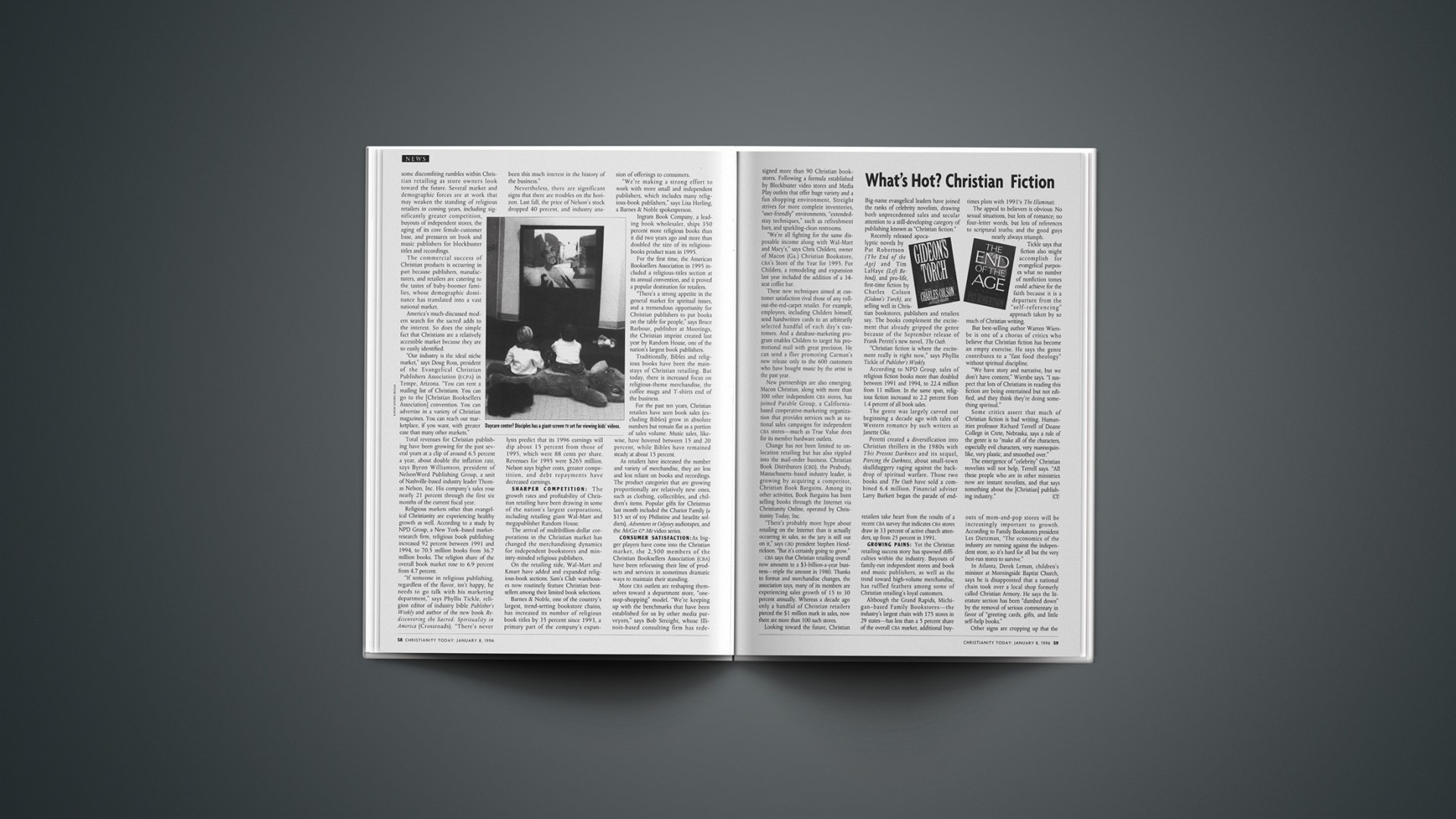

Big-name evangelical leaders have joined the ranks of celebrity novelists, drawing both unprecedented sales and secular attention to a still-developing category of publishing known as "Christian fiction."
Recently released apocalyptic novels by Pat Robertson ("The End of the Age") and Tim LaHaye ("Left Behind"), and pro-life, first-time fiction by Charles Colson ("Gideon's Torch"), are selling well in Christian bookstores, publishers and retailers say. The books complement the excitement that already gripped the genre because of the September release of Frank Peretti's new novel, "The Oath."
"Christian fiction is where the excitement really is right now," says Phyllis Tickle of Publisher's Weekly.
According to NPD Group, sales of religious fiction books more than doubled between 1991 and 1994, to 22.4 million from 11 million. In the same span, religious fiction increased to 2.2 percent from 1.4 percent of all book sales.
The genre was largely carved out beginning a decade ago with tales of Western romance by such writers as Janette Oke.
Peretti created a diversification into Christian thrillers in the 1980s with "This Present Darkness" and its sequel, "Piercing the Darkness," about small-town skullduggery raging against the backdrop of spiritual warfare. Those two books and "The Oath" have sold a combined 6.4 million. Financial adviser Larry Burkett began the parade of end-times plots with 1991's "The Illuminati."
The appeal to believers is obvious: No sexual situations, but lots of romance; no four-letter words, but lots of references to scriptural truths; and the good guys nearly always triumph.
Tickle says that fiction also might accomplish for evangelical purposes what no number of nonfiction tomes could achieve for the faith because it is a departure from the "self-referencing" approach taken by so much of Christian writing.
But best-selling author Warren Wiersbe is one of a chorus of critics who believe that Christian fiction has become an empty exercise. He says the genre contributes to a "fast food theology" without spiritual discipline.
"We have story and narrative, but we don't have content," Wiersbe says. "I suspect that lots of Christians in reading this fiction are being entertained but not edified, and they think they're doing something spiritual."
Some critics assert that much of Christian fiction is bad writing. Humanities professor Richard Terrell of Doane College in Crete, Nebraska, says a rule of the genre is to "make all of the characters, especially evil characters, very mannequin-like, very plastic, and smoothed over."
The emergence of "celebrity" Christian novelists will not help, Terrell says. "All these people who are in other ministries now are instant novelists, and that says something about the [Christian] publishing industry."
Copyright © 1996 Christianity Today. Click for reprint information.