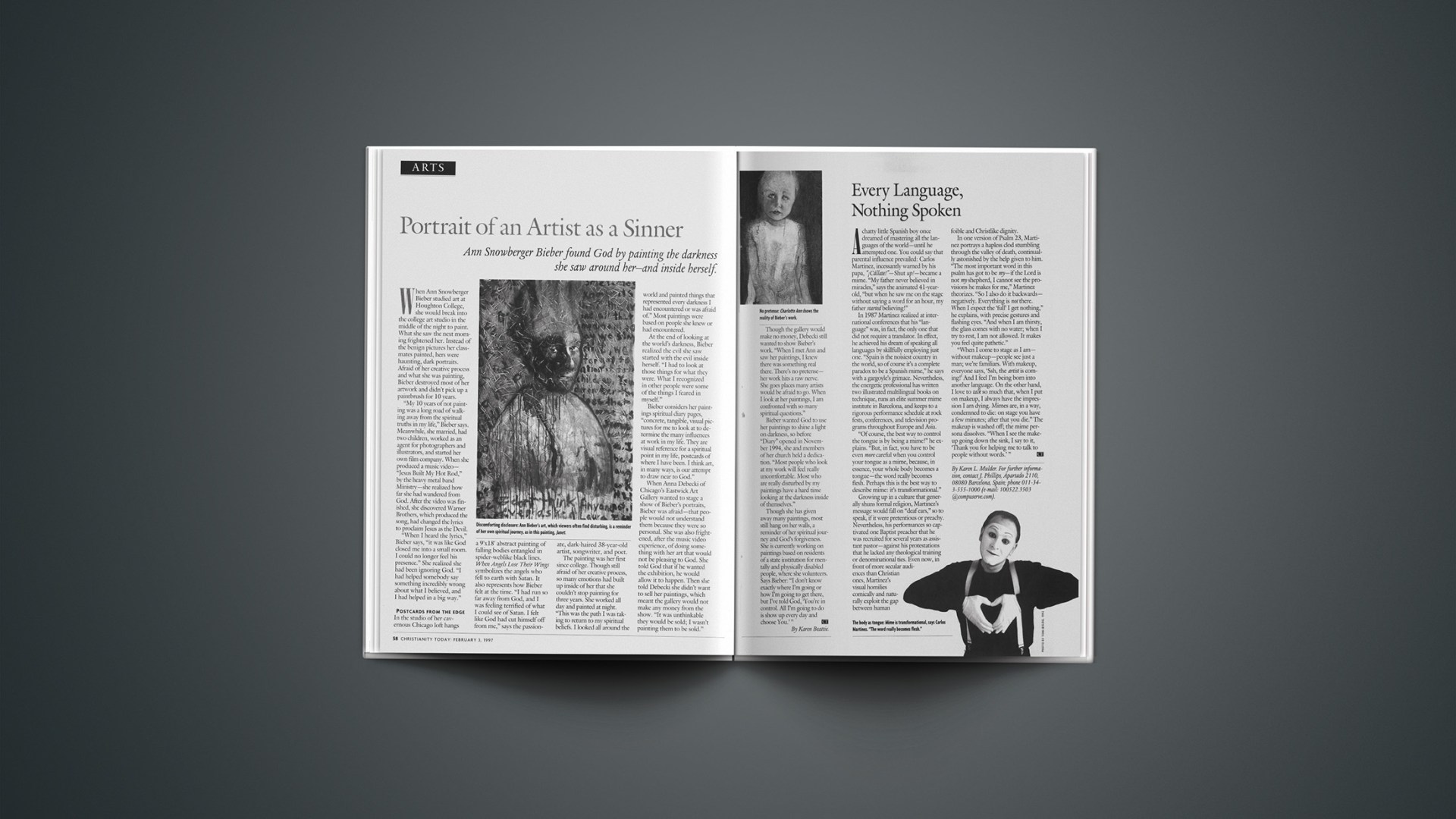

When Ann Snowberger Bieber studied art at Houghton College, she would break into the college art studio in the middle of the night to paint. What she saw the next morning frightened her. Instead of the benign pictures her classmates painted, hers were haunting, dark portraits. Afraid other creative process and what she was painting, Bieber destroyed most other artwork and didn’t pick up a paintbrush for 10 years.
“My 10 years of not painting was a long road of walking away from the spiritual truths in my life,” Bieber says. Meanwhile, she married, had two children, worked as an agent for photographers and illustrators, and started her own film company. When she produced a music video-“Jesus Built My Hot Rod,” by the heavy metal band Ministry-she realized how far she had wandered from God. After the video was finished, she discovered Warner Brothers, which produced the song, had changed the lyrics to proclaim Jesus as the Devil.
“When I heard the lyrics,” Bieber says, “it was like God closed me into a small room. I could no longer feel his presence.” She realized she had been ignoring God. “I had helped somebody say something incredibly wrong about what I believed, and I had helped in a big way.”
POSTCARDS FROM THE EDGE
In the studio other cavernous Chicago loft hangs a 9’xl8′ abstract painting of falling bodies entangled in spider-weblike black lines. When Angels Lose Their Wings symbolizes the angels who fell to earth with Satan. It also represents how Bieber felt at the time. “I had run so far away from God, and I was feeling terrified of what I could see of Satan. I felt like God had cut himself off from me,” says the passionate, dark-haired 38-year-old artist, songwriter, and poet.
The painting was her first since college. Though still afraid other creative process, so many emotions had built up inside of her that she couldn’t stop painting for three years. She worked all day and painted at night. “This was the path I was taking to return to my spiritual beliefs. I looked all around the world and painted things that represented every darkness I had encountered or was afraid of.” Most paintings were based on people she knew or had encountered.
At the end of looking at the world’s darkness, Bieber realized the evil she saw started with the evil inside herself. “I had to look at those things for what they were. What I recognized in other people were some of the things I feared in myself.”
Bieber considers her paintings spiritual diary pages, “concrete, tangible, visual pictures for me to look at to determine the many influences at work in my life. They are visual reference for a spiritual point in my life, postcards of where I have been. I think art, in many ways, is our attempt to draw near to God.”
When Anna Debecid of Chicago’s Eastwick Art Gallery wanted to stage a show of Bieber’s portraits, Bieber was afraid-that people would not understand them because they were so personal. She was also frightened, after the music video experience, of doing something with her art that would not be pleasing to God. She told God that if he wanted the exhibition, he would allow it to happen. Then she told Debecki she didn’t want to sell her paintings, which meant the gallery would not make any money from the show. “It was unthinkable they would be sold; I wasn’t painting them to be sold.”
Though the gallery would make no money, Debecki still wanted to show Bieber’s work. “When I met Ann and saw her paintings, I knew there was something real there. There’s no pretense-her work hits a raw nerve. She goes places many artists would be afraid to go. When I look at her paintings, I am confronted with so many spiritual questions.”
Bieber wanted God to use her paintings to shine a light on darkness, so before “Diary” opened in November 1994, she and members other church held a dedication. “Most people who look at my work will feel really uncomfortable. Most who are really disturbed by my paintings have a hard time looking at the darkness inside of themselves.”
Though she has given away many paintings, most still hang on her walls, a reminder other spiritual journey and God’s forgiveness. She is currently working on paintings based on residents of a state institution for mentally and physically disabled people, where she volunteers. Says Bieber: “I don’t know exactly where I’m going or how I’m going to get there, but I’ve told God, ‘You’re in control. All I’m going to do is show up every day and choose You.'”
By Karen Beattie.
Christianity Today: February 3, 1997 p. 58