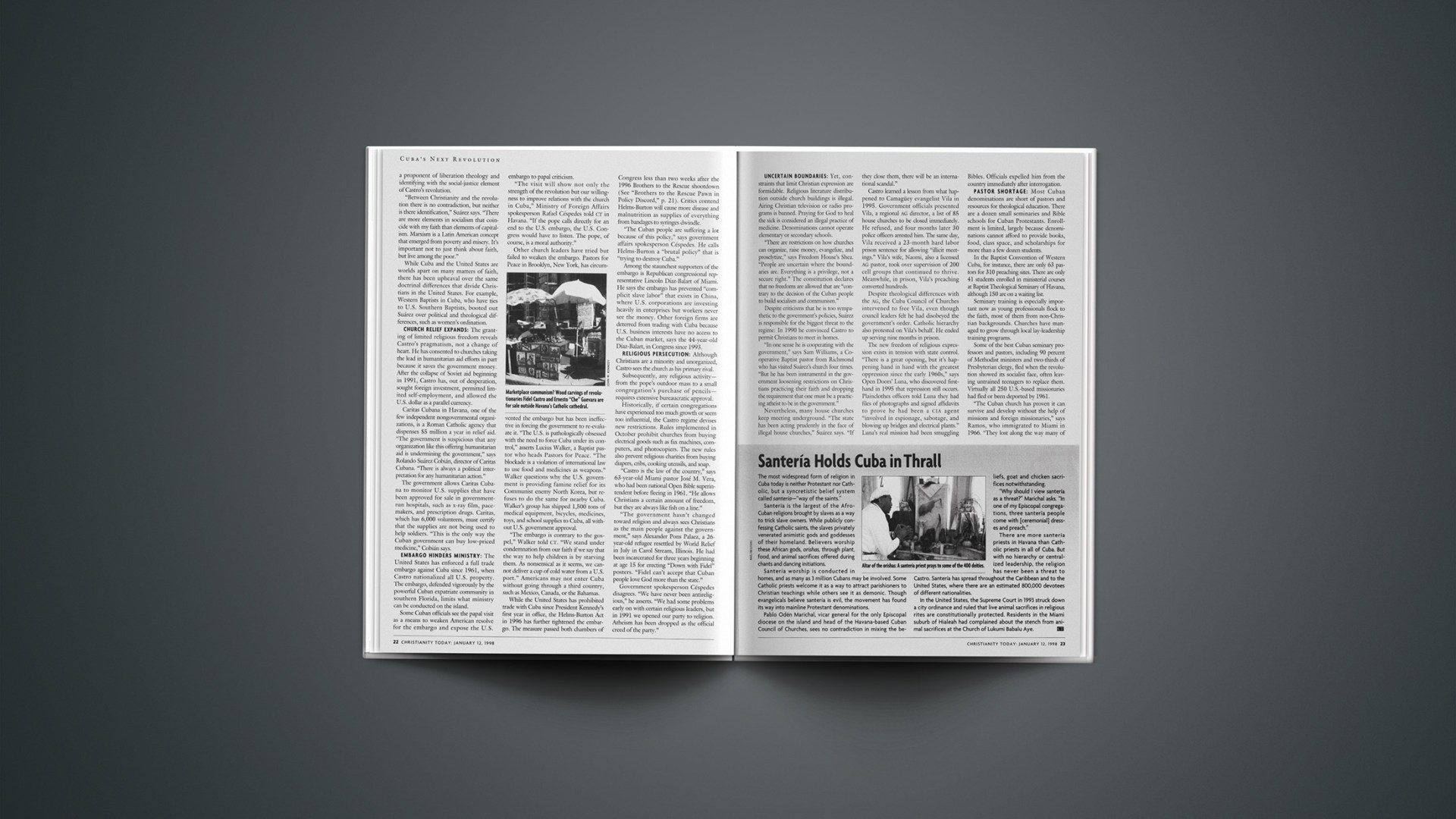
Santeria Holds Cuba in Thrall

The most widespread form of religion in Cuba today is neither Protestant nor Catholic, but a syncretistic belief system called santeria—”way of the saints.”

Santeria is the largest of the Afro-Cuban religions brought by slaves as a way to trick slave owners. While publicly confessing Catholic saints, the slaves privately venerated animistic gods and goddesses of their homeland. Believers worship these African gods, orishas, through plant, food, and animal sacrifices offered during chants and dancing initiations.

Santeria worship is conducted in homes, and as many as 3 million Cubans may be involved. Some Catholic priests welcome it as a way to attract parishioners to Christian teachings while others see it as demonic. Though evangelicals believe santeria is evil, the movement has found its way into mainline Protestant denominations.

Pablo Oden Marichal, vicar general for the only Episcopal diocese on the island and head of the Havana-based Cuban Council of Churches, sees no contradiction in mixing the beliefs, goat and chicken sacrifices notwithstanding.

“Why should I view santeria as a threat?” Marichal asks. “In one of my Episcopal congregations, three santeria people come with [ceremonial] dresses and preach.”

There are more santeria priests in Havana than Catholic priests in all of Cuba. But with no hierarchy or centralized leadership, the religion has never been a threat to Castro. Santeria has spread throughout the Caribbean and to the United States, where there are an estimated 800,000 devotees of different nationalities.

In the United States, the Supreme Court in 1993 struck down a city ordinance and ruled that live animal sacrifices in religious rites are constitutionally protected. Residents in the Miami suburb of Hialeah had complained about the stench from animal sacrifices at the Church of Lukumi Babalu Aye.

Copyright © 1998 Christianity Today. Click for reprint information.

Also in this issue

Cuba's Next Revolution: Christians are transforming Castro's Communist stronghold. But will the Protestant-Catholic relationship bred by persecution withstand the pope's high-profile visit?

Cover Story

Cuba's Next Revolution

John W. Kennedy in Havana and Miami

Classic & Contemporary Excerpts from January 12, 1998

Pottery Shard Points to Temple

Gordon Govier

Born-again Christians Lead Norway

Tomas Dixon

Christians Protest Trade Embargo

Suit Challenges Religion Classes Credit

The Apostle Shows Grit, Grace

Steve Rabey

Top Religion Stories of 1997

Swift Growth Shapes Potter's House

Jim Jones in Dallas

Sandi Patty Stages Comeback

Timothy C. Morgan

Madison Avenue’s Spiritual Chic

CHARLES COLSON & Nancy Pearcey

China’s Leaders Critical of ’Clandestine’ Missions

Ken Walker, with reports from Compass Direct news service

Internet: IRS Spurs Nonprofit Disclosure on Internet

News

Vineyard: Vineyard Founder Wimber Dies

Joe Maxwell, with Heather Johnson and John Geary in Anaheim

Spiritual Mapping Gains Credibility Among Leaders

by Art Moore in Tacoma

Why Evangelicals Have the Biggest Seminaries

News

News Briefs: January 12, 1998

Billy Graham Had a Dream

Vishal Mangalwadi

The Only Way

Daniel B. Clendenin

Roe v. McCorvey

Gary Thomas

Wanted: A New Pro-life Strategy

Bittersweet Cuban Memories

John W. Kennedy

Brothers to the Rescue Pawn in Policy Discord

John W. Kennedy in Miami

Editorial

What Really Died in Oregon

A Hundredfold Return

How Should We Pray for Cuba?

Michael G. Maudlin, Managing Editor

Wire Story

Evangelicals, Catholics Issue Salvation Accord

Randy Frame, with reports from Martin King, Baptist Press

News

News Briefs: January 12, 1998

View issue

Our Latest

The Bulletin

Pete Hegseth’s Future, Farmers on Tariffs, and Religious Decline Stalls

Mike Cosper, Clarissa Moll

Hegseth scrutinized for drug boat strikes, farmers react to Trump’s tariffs, and a Pew report says religious decline has slowed.

The Debate over Government Overreach Started in 1776

Three books to read this month on politics and public life.

The Call to Art, Africa, and Politics

In 1964, CT urged Christians to “be what they really are—new men and women in Christ.”

Turn Toward Each Other and Away from the Screen

Perhaps technology has changed everything. But God is still here, still wiring humans for connection and presence.

Devil and the Deep Blue Sea

BONUS: Amanda Knox on the Satanic Panic and Wrongful Convictions

How elements of the satanic panic and conspiratorial thinking shaped a wrongful conviction.

Death by a Thousand Error Messages

Classroom tech was supposed to solve besetting education problems. The reality is frustrating for students and costly for taxpayers.

The Chinese Christian Behind 2,000 Hymns

X. Yang

Lü Xiaomin never received formal music training. But her worship songs have made her a household name in China’s churches.

The Surprising Joys of a Gift-Free Christmas

Ahrum Yoo

Amid peak consumerism season, I prayed for ways to teach my children about selfless giving.

Apple PodcastsDown ArrowDown ArrowDown Arrowarrow_left_altLeft ArrowLeft ArrowRight ArrowRight ArrowRight Arrowarrow_up_altUp ArrowUp ArrowAvailable at Amazoncaret-downCloseCloseEmailEmailExpandExpandExternalExternalFacebookfacebook-squareGiftGiftGooglegoogleGoogle KeephamburgerInstagraminstagram-squareLinkLinklinkedin-squareListenListenListenChristianity TodayCT Creative Studio Logologo_orgMegaphoneMenuMenupausePinterestPlayPlayPocketPodcastRSSRSSSaveSaveSaveSearchSearchsearchSpotifyStitcherTelegramTable of ContentsTable of Contentstwitter-squareWhatsAppXYouTubeYouTube