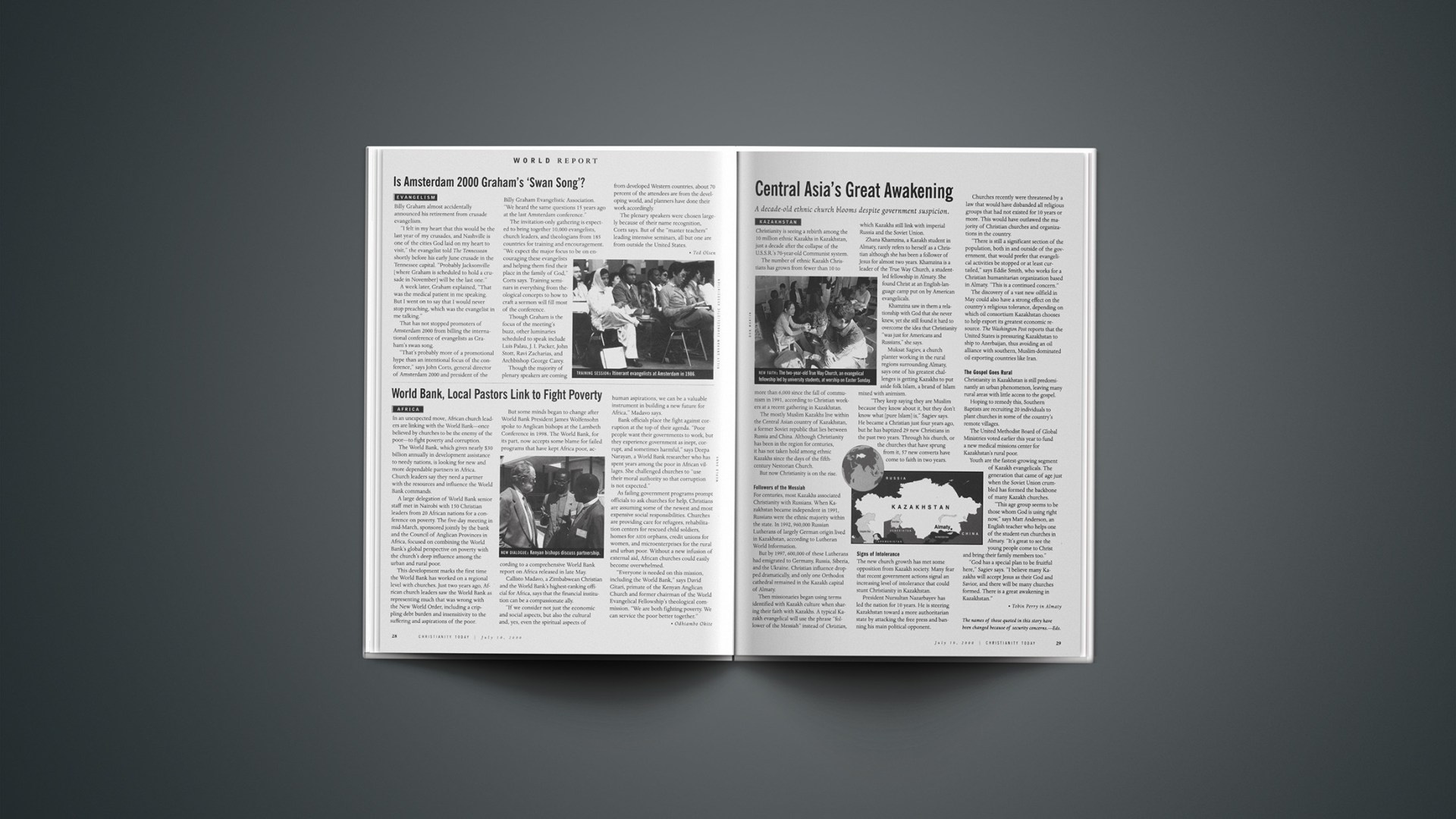

In an unexpected move, African church leaders are linking with the World Bank–once believed by churches to be the enemy of the poor–to fight poverty and corruption. The World Bank, which gives nearly $30 billion annually in development assistance to needy nations, is looking for new and more dependable partners in Africa. Church leaders say they need a partner with the resources and influence the World Bank commands. A large delegation of World Bank senior staff met in Nairobi with 150 Christian leaders from 20 African nations for a conference on poverty. The five-day meeting in mid-March, sponsored jointly by the bank and the Council of Anglican Provinces in Africa, focused on combining the World Bank’s global perspective on poverty with the church’s deep influence among the urban and rural poor.This development marks the first time the World Bank has worked on a regional level with churches. Just two years ago, African church leaders saw the World Bank as representing much that was wrong with the New World Order, including a crippling debt burden and insensitivity to the suffering and aspirations of the poor.But some minds began to change after World Bank President James Wolfensohn spoke to Anglican bishops at the Lambeth Conference in 1998. The World Bank, for its part, now accepts some blame for failed programs that have kept Africa poor, according to a comprehensive World Bank report on Africa released in late May.Callisto Madavo, a Zimbabwean Christian and the World Bank’s highest-ranking official for Africa, says that the financial institution can be a compassionate ally.”If we consider not just the economic and social aspects, but also the cultural and, yes, even the spiritual aspects of human aspirations, we can be a valuable instrument in building a new future for Africa,” Madavo says.Bank officials place the fight against corruption at the top of their agenda. “Poor people want their governments to work, but they experience government as inept, corrupt, and sometimes harmful,” says Deepa Narayan, a World Bank researcher who has spent years among the poor in African villages. She challenged churches to “use their moral authority so that corruption is not expected.”As failing government programs prompt officials to ask churches for help, Christians are assuming some of the newest and most expensive social responsibilities. Churches are providing care for refugees, rehabilitation centers for rescued child soldiers, homes for aids orphans, credit unions for women, and microenterprises for the rural and urban poor. Without a new infusion of external aid, African churches could easily become overwhelmed.”Everyone is needed on this mission, including the World Bank,” says David Gitari, primate of the Kenyan Anglican Church and former chairman of the World Evangelical Fellowship’s theological commission. “We are both fighting poverty. We can service the poor better together.”
Related Elsewhere
The World Bank Group‘s Web site contains information on upcoming summits, resources and financial partners.A brief overview of the Kenyan Anglican Church and the Anglican Communion of Africa outlines the structure of the church and key players.The World Council of Churches recently expressed outrage at a report on poverty issued jointly by the World Bank, the United Nations, the Organization for Economic Cooperation and Development, and IMF.African media perspectives on the World Bank’s working with clergy include:Why Would Churches Be Meeting With World Bank? All Africa News Agency (Mar. 22, 2000)World Bank Moves Towards Community Programmes, All Africa News Agency (Mar. 22, 2000)World Bank, Churches Review Poverty Alleviation Initiatives, All Africa News Agency (Mar. 10, 2000)Church, Bank In Debt Pact, The [Kenya] Nation, Mar. 11, 2000World Bank To Meet With Clergy, The [Kenya] Nation, March 5, 2000
Copyright © 2000 Christianity Today. Click for reprint information.