The second most effective part of the legal thriller Fracture is the pitting of two similar men—in different places of life—on a collision course.
On one side is Ted Crawford (Anthony Hopkins), an accomplished man of precision and detail. Cunning, and intelligent, Crawford is a man unaccustomed to losing. He works expertly and efficiently to get what he wants. Nothing gets by him. He’s discerning and methodical. He looks closely into even the minutest details; he prides himself for even being able to find the flaw in every egg’s shell.
On the other side is Willy Beachum (Ryan Gosling), an up-and-coming deputy district attorney. He too is unaccustomed to losing—boasting a 97 percent prosecution rate. Also calculating, proud and precise, he trades away sure-to-lose cases, launches well-executed plans to get what he wants, and never misses the details needed to win. He knows what it takes to get ahead and he does it.
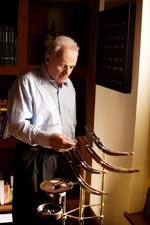
Their trajectories collide when Crawford hatches a plan to murder his wife, shoots her, gives a signed confession and surrenders the weapon full of prints. It seems to be an open-and-shut case for Beachum. But soon, the near-perfect prosecutor finds that he may be up against the perfect crime.
The most effective part of Fracture is the casting of those roles. As I watched the cat-and-mouse chase, I felt like I was seeing a showcase of acting’s present and future: one of the greatest living actors cast as the wily, wise vet, and one of Hollywood’s most promising young talents (Gosling was nominated for an Oscar last year for Half Nelson) as the rising star. It’s a great feature bout.
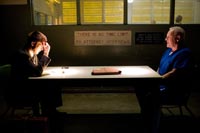
Fracture sizzles when it sets Gosling and Hopkins in opposition, places them in the same room, and lets them go. They verbally spar and mentally waltz around each other, playing games with a subtleness that made me think I was watching their thoughts more than their actions. Hopkins plays Crawford like Hannibal Lecter’s jolly and grandfatherly—though still deviously evil—twin brother. He’s scary and domineering, but also loose and goofy because he knows he’s smarter than anyone else in the room. And while the elder actor steals many scenes, the dynamic Gosling holds his own as he gives Beachum a cocky, controlled exterior that seems thisclose to cracking as he discovers he’s way over his head.

Having these two actors together would have gotten me in the theatre even if the movie was called Hopkins vs. Gosling. But Fracture isn’t just about them, it’s a decent film regardless. But they make it so much better. The movie needed good actors to add dimension to somewhat shallow characterizations. And the story itself won’t blow away audiences. It’s pretty much just an average courtroom thriller plotline (thanks to a distracting dead-end side plot about Beachum leaving the D.A.’s office for a private sector firm and simultaneously wooing his new female boss).
What fuels the movie is that it’s crafted well, and not just the acting. The directing, musical score and cinematography are top notch, making Fracture a thinking thriller where the thrills are supplied largely by scenes of talking. Still, some will be bored by this; while the beginning simmers and the ending triumphantly trots across the finish line, the middle drags because the screenplay loses its story focus.

But there are wonderful treats. Director Gregory Hoblit (Frequency, Fallen, Primal Fear) gives the film a great old-Hollywood atmosphere. There’s a simple sequence of a man arriving too late to save someone—a scene that could have been just routine, but the filming style and its loud, drum-based score lend it a heavy, foreboding feel common to ’40s and ’50s film noirs. Lighting, pacing and character tension carry the mood and make Fracture more than just another whodunit movie. Sharp dialogue, unexpected humor and crafty turns add spice to what could have been a routine crime drama. There’s even a definite Hitchcock-ian flavor to the movie with unexpected twists and turns along the way; things are not always as they appear.
As Beachum encounters these unexpected turns in the case, he has to make hard choices. After all, the movie’s underlying theme is about discovering a person’s flaw and exploiting it until he/she cracks. Will Crawford push Beachum over the edge? It’s a scintillating mental game. But the tough thing asked of the viewer is that for most of the film, neither man seems worth rooting for. Beachum almost seems like a young Crawford without a gun. Until a big moment when he finally shows his moral mettle, it’s hard to see that either of them are actually “the good guy.”
At the same time, Beachum’s eventual moral victories do ground the film’s ending—especially when he realizes that maybe he belongs in his public servant job more than he realized. These themes are subtle and perhaps tacked on, but it seems that Beachum finds his new motivation for doing his job. Once about self-promotion and advancement, it’s now about justice. The movie has an unfortunate message that any lawyer going into private practice is selling their soul, but still the simple rewards of doggedly seeking the truth seem celebrated. At one point, Beachum asks the D.A. how one can live with letting a murderer go free.
The D.A. says, “You learn to.”
Beachum answers; “I don’t want to.”
Whether he’s just headstrong or a dogged fighter for justice, Beachum continues to fight. And that’s good—because it gives us more scenes of Gosling vs. Hopkins.
Talk About It
Discussion starters- 1 Thessalonians 5:21 encourages believers to “Test everything. Hold on to the good.” In Fracture, Ted Crawford tests everything—and is able to find fault in it all. “If you look hard enough,” he says, “everyone has a weak spot.” Is there such a thing as being too discerning? Too skeptical/cynical? Can testing too much be a fault? Why or why not? What would Crawford’s definition of “good” be?
- The D.A. tells Beachum it’s normal to get used to watching guilty men walk. How have you “gotten used to” injustice or just accepted injustice as part of life? Is it naïve to think, as Beachum does, that he can prevent becoming desensitized to injustice?
- Why do you think Beachum stays on the case? To clear his reputation? To find success in a huge case? Or really to seek justice? When do his motivations change? Why do you think that?
The Family Corner
For parents to considerFracture is rated R for language and some violent content. There’s persistent profanity that uses about every word in the book—including taking the Lord’s name in vain. There are disturbing scenes of a man shooting his wife and a suicide (both actually occur off screen). There’s also a brief sequence of quickly edited and abstract—though erotic—shots of nude bodies pressed together. In addition, there’s much discussion of adultery and couples sleeping together outside of wedlock.
Photos © Copyright New Line Cinema
Copyright © 2007 Christianity Today. Click for reprint information.