The Burning Plain, the directorial debut of Oscar-nominated screenwriter Guillermo Arriaga, tells a story that seems as if it could have been lifted directly from some hidden corner of the Old Testament: the sins of the fathers are visited on the children, faithlessness is repaid with heartbreak, and sins most certainly find the sinner out. Guilt, pain, love, hate, unfaithfulness, treachery, and fear are stretched across a backdrop that spans from Mexico to Oregon, across languages and families and landscapes, across three seemingly disparate stories:
- Sylvia (Charlize Theron) lives somewhere on the breaking point, sleeping with men at random but obviously intensely lonely and, deep down, disturbed. She works at a glamorous restaurant overlooking a swirling ocean and a rocky cliff, but it’s clear that the real storm is within. One day, a mysterious stranger (José María Yazpik) starts following her around, and the secret he carries will rock her to her core.
- Gina (Kim Basinger), despite the existence of a loving husband and four beautiful children, is having a torrid affair, but when her eldest daughter—the teenage Mariana (Jennifer Lawrence)—begins to suspect her mother, she sets in motion a chain of events that will alter the destiny of many.
- A pair of brothers visits a burned-out trailer in the middle of nowhere, just before their father’s funeral. One is bitter; the other is mostly curious, longing to know more of his father. His curiosity leads him toward another who has a similar loss, but their unlikely liaison is not destined for happiness.

This would be a great film, but its narrative structure just won’t allow it. True to form, Arriaga (who wrote Amores Perros, 21 Grams, The Three Burials of Melquiades Estrada, and Babel) uses several different but loosely intertwined storylines to tell this tale, drawing the threads together at a key moment for maximum impact.
That’s all fine, and as Arriaga’s earlier scripts show, it can be a strong way to make a story; unfortunately, it just doesn’t quite work in this one. Without revealing too much, I will say that these threads are stretched over time, not space, and their nonlinear structure makes it difficult to follow what’s going on for the first half of the film. By the time we get it, we’ve spent too long trying to catch up to be fully engaged in the story. It’s not a death knell for the film, and it’s clear why Arriaga chooses to use this kind of device to tell this specific story, but it still detracts from the overall force of the film.
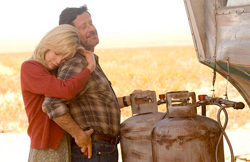
Chronologies aside, the intricately twined narratives still lack some of the passionate realism of Arriaga’s other scripts. Frankly, characters in the midst of extramarital affairs of any kind are rarely sympathetic, and although we slowly come to understand the tragedy of Sylvia’s life, it comes too late to really make us care.
Shot by the venerable cinematographer Robert Elswit (Syriana, Good Night and Good Luck, and all of P.T. Anderson’s films, including There Will Be Blood), the film’s vistas are at times truly breathtaking, from Pacific Northwestern breakers on rocks below a cliff to the hot, dry plains of Mexico. The film’s cast, which Arriaga directs well, performs ably in such an emotional story, but it is Jennifer Lawrence’s performance that stands out, as she portrays a teenager torn between love and hate, grief and guilt, romance and despair.
The tale is deeply sad. There is simply no cure or easy out for these people. Tragedy seems to be around every corner; joy has no part in their lives, or at least not for long. A parent’s actions have lasting consequences upon children and grandchildren.
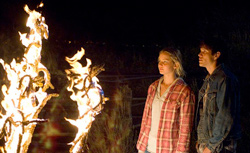
Even when the film ends, we know that these people face a long, difficult road, and that many wounds will never be healed. Sylvia pleads for forgiveness, but the words seem hollow, almost ridiculous to our ears. This is the simple truth of betrayal: we can be forgiven, but to earn back the trust we destroyed is all but impossible.
The Burning Plain doesn’t quite live up to the expectations Arriaga has set in his previous work. Still, The Burning Plain is a good film, with a strong cast, and once you get past its inadequacies, its story will haunt you for days.
Talk About It
Discussion starters- Sylvia is obviously haunted by her wrongdoing. What actions does she take to try and quell her conscience? Are there things in your past that haunt you? What do you do to try to forget them?
- Why do Mariana’s feelings for her mother fluctuate? Why do you suppose she responds the way she does? What consequences do her mother’s actions have on her? What consequences do her actions have on her mother?
- How does this story reflect Numbers 14:18? Now read Psalm 79:8, then Deuteronomy 7:9. What is the solution to the havoc that sin wreaks on our descendants?
The Family Corner
For parents to considerThe Burning Plain is rated R for sexuality, nudity, and language. There is a fair amount of full female nudity (including a woman standing in front of an open window fully naked), two brief scenes of self-harm (through cutting and burning), several sex scenes (implied or not, between unmarried couples, including teenagers), and a lot of profanity, along with several adulterous relationships and some disturbing explosions.
Photos © 2929 Productions
Copyright © 2009 Christianity Today. Click for reprint information.