There aren’t many reasons to see Gulliver’s Travels. In trying to fill several different identities, it fails at all of them.
This movie wants to be a family film and an adaptation of Jonathan Swift’s story and a Jack Black comedy vehicle0, but each identity robs from the others. Black’s outlandish style is cramped, messages for kids are tainted by inappropriate material, and Swift’s cultural themes are reduced to a dance sequence—seriously!
In this rendering, Lemuel Gulliver is a typical Jack Black character: a dopey-but-lovable loser who plays too much Guitar Hero and works in a New York newspaper’s mailroom. Thanks to low self-confidence, he’s stuck in his dead-end job and won’t ask out his crush, Darcy, a travel editor (Amanda Peet), who seems to like him (but why she does is a mystery). Characters repeatedly mention that Gulliver, as a mailroom employee, is one of the “little people” and life won’t get any bigger than this for him (get the metaphor?).
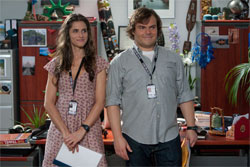
When Gulliver lies to Darcy about being a travel writer, she spends two whole minutes glancing at some unpublished writings he stole off the internet and hires him on the spot for a “small” article about Bermuda that requires a 3-week solo boat trip leaving right away. Good first gig, huh? Of course, Gulliver ends up not in Bermuda but on the island of Lilliput, where he finds himself a giant among tiny men. For the first time, he is the big (very big) man on campus. He strikes up a friendship with Horatio (Jason Segal), a man of low station who is convinced he’ll never amount to anything—especially not winning the heart of the princess (Emily Blunt). While Gulliver helps Horatio court the princess, a rival suitor looks for revenge—and to rid Lilliput of Gulliver forever.
There are some genuinely funny bits, like a recurring gag about a far-too-complicated warning bell system. And the reveal of a coffee maker built by the Lilliputians for Gulliver is inspired. But the film takes the gag of building Gulliver-sized items too far when these 6-inch people build their giant guest a mansion and … a robot? The problem with most of the humor is that the gags feel forced, only for the sake of laughter. One scene retained from the book is when Gulliver saves a burning palace by urinating on it. In the movie, there is no value to the act other than the gross-out gag of urine hitting people in the face. I got the impression that the writers had no idea what they were trying to say with their humor. As C. S. Lewis wrote, “Humor involves a sense of proportion and a power of seeing yourself from the outside.” There is none of either here.
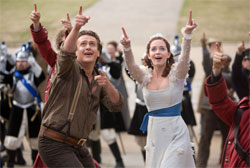
Jonathan Swift used his wit not to primarily make his readers laugh but as a weapon for social change. But the original work’s satirical bent is simply confused for comedy here. Wen you know the political meanings behind Swift’s book, it’s antithetical—if not ludicrous—to think of this satire becoming broad family comedy. And so, this adaptation feels like a high school literature student’s project that tries to explain a dense piece of writing by only hitting plot points—and completely missing the underlying themes.
Ironically, I almost think it would have been better to put more distance between the book and the film. In trying to keep some of Swift’s discussion on government and the pointlessness of war without including Swift’s actual conclusions on the issues, the filmmakers show ignorance of the original work. An example: They replace the book’s ingenious commentary about the pointlessness of the Lilliputian war (which broke out over a disagreement of how to break an egg) with a group dance routine of Edwin Starr’s song “War,” that somehow brings both sides together in peace. (For those interested in a faithful adaptation of Gulliver’s Travels, I highly recommend the exceptional, Emmy-winning 1996 TV mini-series starring Ted Danson.)

This movie’s theme is simply “be yourself,” instead of pretending to be someone more impressive. Unfortunately, the self-esteem message is already tired and worn, but it’s further muddled here by story contradictions and plot shortcuts that make little sense, other than to string gags together. The film is very fun at times, but had the story been smarter, the laughs—like the main character—would have been bigger, too.
Talk About It
Discussion starters- There is much talk about Gulliver being one of the “little people” in his office, and talk about there not being any small jobs but just “small people.” What does it mean to be a small or little person?
- What were the consequences of all the lies Gulliver told about himself? Why do you think he lied so much? Did he learn his lesson?
- What do the little people learn about war in the end?
The Family Corner
For parents to considerGulliver’s Travels is rated PG for brief rude humor, mild language and action. Gulliver shows some plumber’s crack at one point and then falls to the ground; a little person goes into his rear. A fire rampages a palace and Gulliver urinates on it to put it out; the scene is played for laughs as urine goes into several faces. Later, we see an ice sculpture of Gulliver peeing. A character is tricked into thinking the term lameass is an honorable title and it is repeated over and over. When a man is asked by a woman why he likes her, he points to her breasts and she says, “That’s not appropriate.” There is one scary scene where a skeleton is revealed under a mask.
Photos © 20th Century Fox.
Copyright © 2010 Christianity Today. Click for reprint information.