Mountaintop removal (MTR) coal mining is the biggest environmental problem you’ve never heard of. A common procedure in the Appalachian region, MTR uses explosives to blow up to 1,000 feet off the tops of mountains to extract layers of coal buried within. Coal companies often push the remaining rock and soil into surrounding valleys, destroying streams—and, often, the lives of destitute people—below.
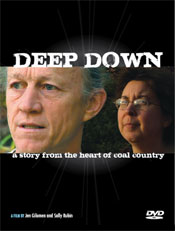
Enter Deep Down (Forward Films), a documentary that attempts to expose the problem of MTR by hanging human flesh on a complex environmental issue. The film, airing tonight on the PBS series Independent Lens, centers on Beverly May and Terry Ratliff of Maytown, Kentucky, neighbors on opposite sides of the same literal—and philosophical—mountain.
When Miller Brothers Coal Company offers to lease their land for MTR, May turns them down, but Ratliff considers signing on. He’s a carpenter with no health insurance or retirement income, so it’s easy to understand his interest in an offer of $75,000 to lease six acres.
May sees MTR as an “abomination” that should be outlawed because of its effect on the quality of water, the safety of homes, and the peace of communities. “You’re not supposed to blow the top off a mountain and dump the rock and the rubble into the nearest creek,” she says. But Ratliff sees mining as a necessary evil to sustain a region that runs on coal.
Rather than punching through a list of statistics or slapping viewers with jarring scenes of devastation, Deep Down approaches the issue in a deeply personal way, looking at lives rather than landscapes, with passionate pleas for a better approach to coal mining.
Especially interesting are the film’s theological undertones. An early scene depicts a piece of mining machinery affixed with a JESUS IS LORD banner, a sign of the intersection of theology and creation care.
On one side are those who hold a traditional dominion theology, which asserts that God gave humans the earth solely for their benefit. “I feel God put coal and other natural resources here for a purpose,” says Samuel Maggard, vice president of Miller Brothers. “That purpose is for energy requirements and jobs.” One woman from a coal-mining family adds, “God gave us resources to use, and coal is one of them… . Texas has oil, Idaho has potatoes, and we have coal.”
When faced with the environmental consequences, some respond by saying that God made the earth so resilient that humans could never inflict permanent damage. “No matter how bad we’re screwing it up, it will come back,” Ratliff says.
On the other side are those who believe that caring for creation is a stewardship mandate from a God who retains ownership of the earth and wants all of life—not just humans—to flourish. As May puts it, “There’s a document at the county courthouse that says I own 21 acres on Wilson Creek. But I don’t think I own it. Not in the sense that I can dispose of it. It is not a refrigerator. It is not a pair of socks. It’s not mine to dispose of. It is mine to take care of, and to protect, and to enjoy, and then to pass on to the next generation—hopefully in better shape than I got it.”
The connection between their theologies and their positions on MTR clearly diverge. And this is how mountains become more than just mountains. They are testaments to the glory of their Creator. They are home to some of our nation’s poorest citizens. They are rapidly becoming environmental battlefields. More importantly, they are points for theological reflection, which energy-loving Americans cannot afford to ignore.
Jonathan Merritt is author of Green Like God: Unlocking the Divine Plan for Our Planet and blogs at JonathanMerritt.com.
Copyright © 2010 Christianity Today. Click for reprint information.