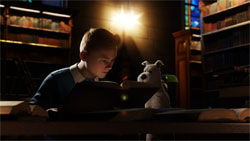
The Adventures of Tintin, a new performance capture 3D film from director Steven Spielberg, is a fun, entertaining, fast-paced adventure with astonishing visual effects. Unlike the Indiana Jones movies it purposefully invokes, though, as well as the gist of Spielberg’s work, the film never amounts to anything grand because a lack of humanity—surprising, given the cherished filmmaker’s established sensibilities.
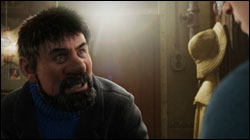
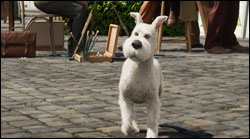
Based on a series of Belgian comic books from the 1940s, the story, set primarily in Europe, centers on Tintin (Jamie Bell), a young journalist famous for solving crimes alongside his little dog, Snowy. When Tintin buys a model ship at a local market, he unexpectedly finds himself in the middle of a new mystery involving two other ships, a set of scrolls and a hidden treasure. This leads Tintin and Snowy, along with a drunken sea captain, Haddock (Andy Serkis), and eventually two inept detectives, Thomson and Thompson (Nick Frost and Simon Pegg, respectively), on a wild escapade as they seek to unlock the mystery before the villainous Ivanovich Sakharine (Daniel Craig), who appears to be in for more than treasure.

Any and all of these characters could have been quite fun and fascinating; unfortunately, neither the script nor Spielberg develops them with much depth, and unless you’ve read the Tintin comics, you won’t get to know them very well in this film.
Sakharine may not be a Nazi, but this plotline clearly channels Spielberg’s Indiana Jones series through and through. From the setting itself, to the three scrolls with a secret message, to a trip to the Middle East, to a chase scene featuring a motorcycle sidecar, it all feels delightfully familiar. The score, wonderfully composed by John Williams, adds to the nostalgia particularly with moments sounding almost identical to that of the famous adventure series.

Also in line with Indy, Tintin entertains from start to finish. Seamlessly paced, it plays like a smooth and continuous ride, never slowing down until it reaches its destination. Its humor, the slapstick kind that Spielberg has always borrowed from his film predecessors, is amusing. As Thomson and Thompson, the comic foils of the story, Frost and Pegg are hilarious with their notable physical comedy. Their total incompetence as crime solvers and as mere human beings recalls comedy duos of earlier cinema, like Abbott and Costello or Laurel and Hardy, who could never get anything right.
Tintin‘s action focuses on the physical rather than the stylistic; Spielberg makes it work despite 3D usually looking gimmicky. An intense chase scene in which Tintin, Snowy, and Captain Haddock attempt to escape from a ship mutinied by Sakharine, stands out. Its shootouts and use of the numerous components and levels of the ship make for some visceral eye candy. The most brilliant visual effects, though, arrive later in the film in yet another chase, this time in a hillside Moroccan town where a dam explodes. Shot in one take with no cuts or edits, the scene flows as quickly and effortlessly as the water through the town, marking one of the most vital uses of 3D yet.

Visually, and in terms of entertainment value, Tintin is a stunning feat. It’s a popcorn flick of the best kind—big, loud and fast with a real cinematic scope. It’s typical Spielberg in those ways, but it’s lacking in character development and a sense of humanity. Tintin simply doesn’t tell us much about these characters. Unless we’ve read the comics, we never learn who Tintin is and never really connect with him, and, thus, we never really connect with the film on a deeper level, so it probably won’t be remembered in the same way as other Spielberg classics. It’s an Indiana Jones wannabe, but we’ll never feel nostalgic for it.
Talk About It
Discussion starters- Besides obvious themes like friendship and loyalty, between Tintin and Captain Haddock and Tintin and Snowy, what other themes did you see in the movie? Do all films have to explore deep ideas and themes, or is it okay for a film to be all style and no substance? Where does Tintin land?
- What are your favorite Steven Spielberg films? Why? Did Tintin remind you of Indiana Jones?
- In several of his films, particularly Close Encounters of the Third Kind and E.T., Spielberg explores the spiritual concepts of faith, divine intervention and redemption. What does that say about his personal worldview? Did you identify any of these concepts in Tintin? Discuss.
The Family Corner
For parents to considerThe Adventures of Tintin is rated PG for adventure action violence, some drunkenness and brief smoking. The film is packed with action from start to finish, and several characters are shot and killed in the midst of this action, but the scenes appear only mildly violent and contain little blood. Captain Haddock drinks alcohol throughout the film and is clearly portrayed as an alcoholic. Naturally, his drunkenness makes for a few laughs, but it is still depicted as destructive and morally wrong. Given the setting, 1940s Europe, a time when smoking was socially and morally acceptable, a few characters are shown smoking, but never Tintin.
Photos © Paramount Pictures
Copyright © 2011 Christianity Today. Click for reprint information.