I love American cycling. I grew up watching Greg LeMond, who was Lance Armstrong before Lance Armstrong was Lance Armstrong. Except that LeMond simply won races, and opted out of becoming a "symbol" of anything or a public "inspiration" to anyone. I remember watching LeMond battle his French nemesis Laurent Fignon (ponytail, John Lennon glasses) up and down the Champs Elysees; though I'm sure it wasn't, the whole thing felt a little more innocent. I had a road bike then. I bought spandex. I took long training rides through the country with my dad. I even raced a little.
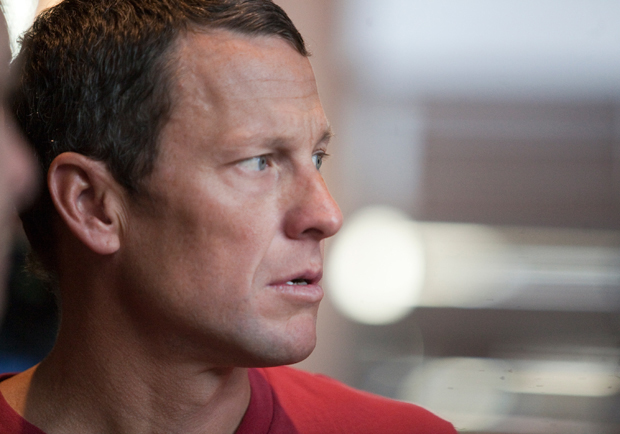
Fast forward to this week and the downfall of another modern idol, Lance Armstrong. Armstrong won seven Tours De France, after winning a highly publicized battle with cancer. There's nothing we love more than winners in this country, except, maybe, Inspirational Figures. Armstrong was both. Like anyone who loves sports and competition, I was thrilled when he stared down his rival, Jan Ullrich, on the side of a mountain before powering away and leaving Ullrich in the dust in what is now just referred to as "The Look." When I see it I still get chills. Honestly, I speak for most athletes when I say I'd love to do that to someone in competition.
Like anyone who loves marketing (are these people out there?) we were thrilled when Armstrong made the little rubber wristband a permanent part of American culture, and helped make Cancer Awareness a part of our everyday vocabulary and consciousness. In fact, it was becoming the de facto Godfather of Cancer Awareness that may have helped Armstrong keep the anti-doping dogs at bay.
American Idol
We found out this week that Armstrong was the greatest cyclist in an era in which nearly all of cycling was doping. We learned that Armstrong was the heavy-handed ringleader of what Travis Tygart, chief executive of the U.S. Anti-Doping Agency, has called the "most sophisticated … successful doping program sport has ever seen." We learned that Armstrong needed and encouraged his teammates to dope, so that they could support him at an elite level. We learned that he lied about almost all of it, repeatedly. We learned that the allure of winning and money was more than any of his teammates could deny, even though they all talked of their love for the sport of cycling, and their dreams of competing as professionals.
We also were reminded that God will not be mocked, and that idols eventually fall. Armstrong lived as a king of American culture for over a decade. He was one of those figures about whom people almost universally felt good. He was rich. He dated celebrities. He was photographed everywhere, with everyone. He raised money and he donated money. He was inoffensive to everyone outside his industry (cycling), though if media accounts are to be believed, he was reviled within it.
For a while, it seemed almost un-American to root against Armstrong. But this seemingly bulletproof American Idol fell. Indeed, God will not be mocked.
Losing All
Armstrong's many sins are now public. He sacrificed his integrity, he bore false witness, and he caused others (his teammates) to stumble into the same substance abuse that fueled his victories and enabled the idolatry in the first place. He gained the world, for a time, and seemed to forfeit his soul.
At the same time, as sinners who have all fallen short of God's glory, we've all done this at some level. I know I have. If I were still a child, powering around the back roads of Blackford County on my entry-level Trek road racer, I'd probably be crushed at Armstrong's recent downfall. But as a somewhat hardened adult cynic, I was neither surprised nor especially crushed. Let's be honest, to be an athlete or a fan today is to develop a certain comfort level with moral ambiguity. We cheer for corrupt college football programs weekly, and we hardly raise an eyebrow when our favorite baseball and football players are suspended for using performance enhancing drugs. We even regularly freak out at our own kids' little league games and chalk it up to just "being competitive."
Still, in all this, there is hope—the hope in the gospel. There is real forgiveness for sinners, for athletes and fans who are implicated in the moral ambiguity of sports. And of course, this is no cheap forgiveness but one that will require us to rethink how and in what ways we participate in these morally ambiguous situations, so that our play will be honoring to God as much as is possible in this life.
And there is forgiveness for the likes of Lance Armstrong, as reprehensible as his transgressions are. I wish Lance had repented years ago and come clean, but even today there is hope for him in the Cross. Even though Armstrong will have lost his reputation, his Tour de France victories, his well-cultivated image as a hero, and perhaps even his money, he still has a chance, in Christ, to lose everything. And in doing so, he might gain the most valuable prize of all.
Ted Kluck is the author of several award-winning books on topics ranging from Mike Tyson to the Emergent Church. Visit him online at www.tedkluck.com.